All the Church Ladies Are Having Secret Sex

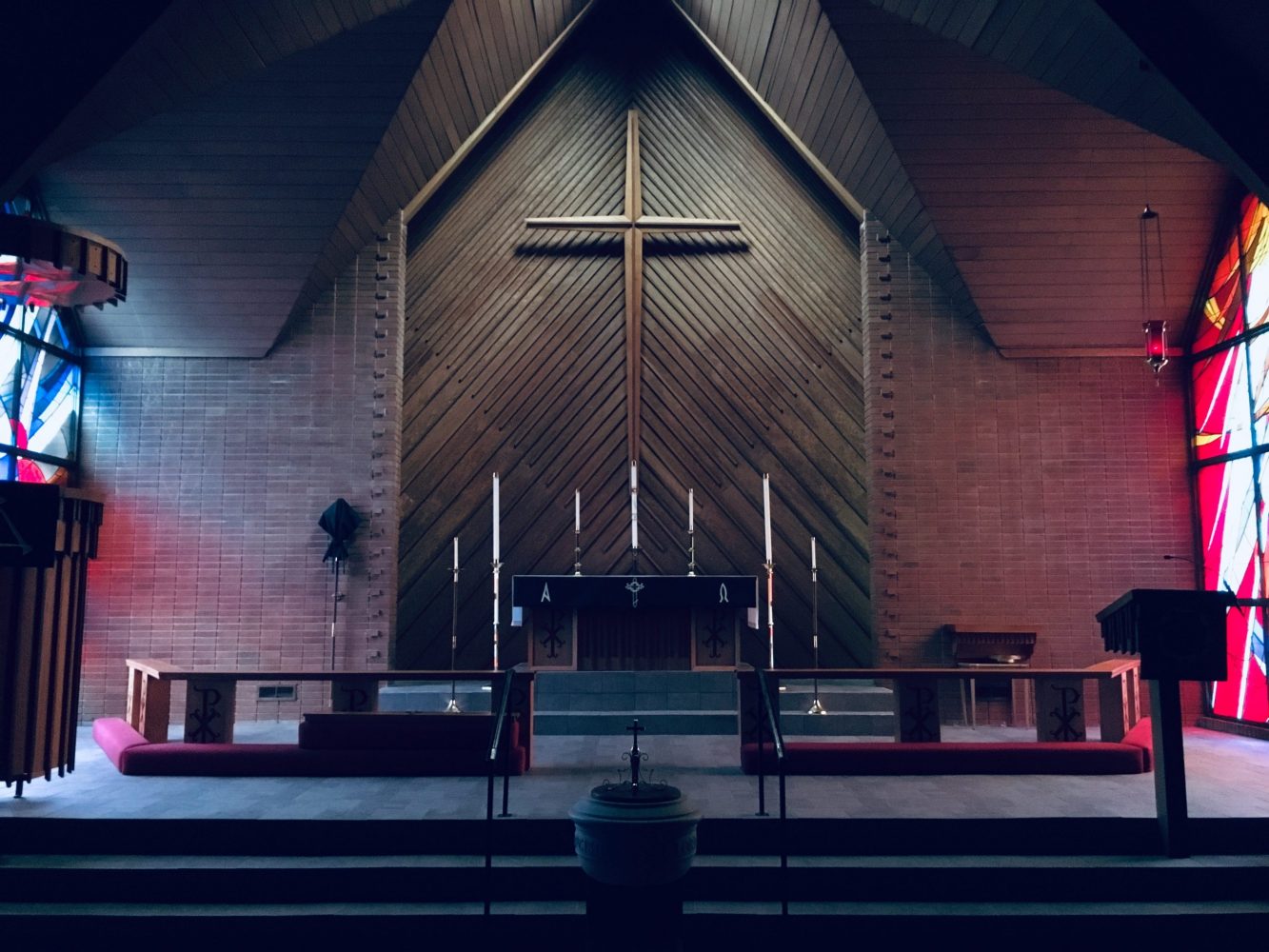
There was a point reading Deesha Philyaw’s story “Snowfall” about a lesbian couple in her debut short story collection The Secret Lives of Church Ladies where I stopped and let out a big sigh. The passage, after listing the traits of Southern Black women, traits so familiar and so beautiful to me, it made me teary and reminded me of all of the matriarchs I knew growing up, Philyaw writes:

“But we lost all those things when we chose each other. Only the memories remain. Which is why, even though we grew up in different places, so many of our bedtime conversations start with ‘Remember when . . . ,’ as we lie there in the dark with our nostalgia and nothing to distract us from it. Not even each other, not anymore.”

This passage illustrates what Philyaw does well in this collection, which is to border and make bare the line between generations, the conservatism rooted in the Black church, and the consequences when we chose to keep or not to keep secrets. 

In The Secret Lives of Church Ladies, Philyaw imagines two best friends who are secret lovers, a woman who falls for a physicist, lovers who seek solace away from dying parents, and a teenage girl drawn into her mother’s affair with “God.” Each story reveals the inner lives of women who are often overlooked and stereotyped: The Black Church Lady. 

I spoke with Deesha Philyaw about sex as a literary device, writing “grown woman” stories, and the capacity of Black women to incite change.


Tyrese L Coleman: So, I hope this isn’t giving too much away, but one of the secrets to the secret lives is sex.

Deesha Philyaw: Yes, indeed! Lots of secret sex.

TLC: Secret Lives puts sex, the having and the not having of it, as a grounding device, almost. In many of the stories, there is a way that it either turns the plot or helps understand a character or leads the reader and/or the characters toward the emotional epiphany or climax (see what I did there?). Literary sex is often times described as awful or unsatisfying or an access point to examine some hidden shame. Your characters, however, for the most part, enjoy what they do. It seems that you are more concerned with the consequences of the sex rather than the act itself. Is that true? And were you trying to approach the topic in a different, more nuanced way than say the average literary short story? Why and how?

DP: I definitely find the consequences and circumstances of the sex in the stories far more interesting than the sex acts themselves. It is fun to titillate, though. And I wasn’t thinking in comparative terms, but I did want to write the sex without my own self-consciousness about it getting in the way. I wanted to write the sex so that it rang true to the characters and their situations. Sometimes that called for nuance, and other times, less so. 

TLC: What I also really enjoy is the moral ambiguity and, therefore dimensions, given to the Black women in this collection. Oftentimes, especially when we see stories about older Black women or church going Black women, they are already given angelic status, a martyr before they even die. But the women in Secret Lives are complex and driven by their own desire while navigating the conservative landscape of the Black church. 

DP: Right, we know those very limiting binaries and archetypes. We know the public faces that those women, and the rest of us, wear some or all of the time. But we also know that all of us are fully human, and, at times, full of longing and discontent, behind those masks.

TLC: This collection is not just heterosexual love, but queer love and sex as well. Black people are and have been notoriously homophobic, especially those “Church Ladies” who belong to auxiliary and usher boards. Can you talk about the importance of including a wider spectrum of the ways in which Black women love in Secret Lives?

DP: Well, I think even our collective homophobia is on a spectrum, inside and outside of the church. Growing up, I saw queer Black men and boys marginalized, mocked, and horrifically abused, but also sometimes embraced; there was a gamut. But queer women and girls were condemned and brutalized, without exception. That’s what I saw in my little Southern corner of the world. And so these women and girls show up in my stories as free—or trying to get free—as fully themselves, loving in all the ways that we love.

TLC: I also think that there is something to be said about the concept of two Black women loving one another as friends and romantically. One of my favorite stories in the collection is “Eula,” about two best friends who have a tradition of hooking up with one another despite the obvious denial of one of them. “Eula” felt to me like a commentary on the question of whether or not you could be queer and yet still be a god-fearing Christian woman. Can you talk a little about that?

The queer Black women and girls show up in my stories as free—or trying to get free—as fully themselves, loving in all the ways that we love.

DP: I think several stories in the collection ask the question subtly or outright, “Can you ____ and still be a (good) Christian?” It’s unlikely that either of the characters in Eula would be comfortable being called “queer.” I think their situation is one of fluidity, though they probably wouldn’t like that concept either. Once again, the binary is limiting. And then, to make things even messier, how do you define “Christian”? How do you define “good”? People like the characters in “Eula” end up in a kind of bondage, trapped by fear. Fear of going to hell, but also fear of their own desires. That’s no way to live.

TLC: And also a moral fluidity too as many of the characters flow in and out of traditional mindsets and behavior, but then again, there is something holding the steady, whether it be the actual church or their family. That steadiness may be deceiving but anchoring, yet those institutions where the conflict lies.

DP: Yes! Soon after I turned my manuscript into the publisher, it dawned on me: Mother-daughter stuff runs all up and through these stories. And that makes sense because I lost my mother to breast cancer in 2005, and my complicated relationship with her was probably the defining relationship of my life. So we see in the Church Lady stories, a mother can be an anchor, as you say, a steadying force, for better or for worse. And once I took note of the heavy mother-daughter presence in the collection, it occurred to me that, simply put, our mothers are sometimes contradictions. And so are we daughters as mothers. And so it goes.

TLC: What Secret Lives is not about is men, meaning, while they play pivotal roles, the fire in say a story like”Peach Cobbler,” is in the relationship between the mother and daughter. I feel like this is more a play on the concept of a secret life for Black women. Can you talk about the roles in which men play in these secret lives?

DP: My friend Damon Young said it best. He said that men are garnish in this book. LOL. It happened organically. When I think about my experiences in the churches of my youth, it’s the women I remember most. Partly because, as a girl, I was watching them to see what my options were for this thing called womanhood. But also because, as we know, women greatly outnumber men in the church, though not in the pulpit and positions of leadership. So it’s the women who loom largest in my memories and in my imagination. Also, I grew up surrounded by women and girls. I was raised in a house with women. My mother, my grandmother, and their friends—my characters speak with their voices.

Several stories in the collection ask the question subtly or outright, ‘Can you ____ and still be a (good) Christian?’

So, yes, in many ways, this world of women was a secret place. But I don’t know that we were necessarily intentional about keeping secrets from men. Sometimes, women keep truths from ourselves and other women too, to our detriment. And, let’s be real—sometimes, men don’t know what’s going on because they don’t listen to us. 

Thinking about the stories in Secret Lives, some of the men are . . . useful. They scratch an itch, provide comfort. Others also provide something, but are also terrible. And sometimes, of course, they are the secret.

TLC: One of the things I love about this collection is how “adult” it feels. Not so much because of the sex, but most of the main characters are dealing with concerns that feel like grown women problems. I just finished reading a novel about a twenty-something and, while I adore the book, I crave stories about Black women who are in their thirties, forties, fifties, etc. Why was it important to you to represent the perspective of the grown woman?

DP: Honestly, it’s because that’s where I am right now and because my thirties is when I really started to live. I didn’t develop a sense of humor until I was about 34.  I’m knocking on fifty’s door right now, and — the pandemic and Trump notwithstanding — this is my best, most interesting life.

TLC: You and I both have talked about how important it is to put the voices and stories of Black women out in the world. It has seemed to me that Black women do so much for others and ourselves in the dark. But, now, a Black woman has been added to a presidential ticket. We always hear the phrase “trust Black women,” but what does that mean to you and are we heading toward a reality where Black women are no longer making moves in the margins? 

It’s wild that people want to marginalize [Black women], but also want to be us, dress like us, look like us. We do it first and we do it best.

DP: Yeah, we’re making moves wherever we want to. It’s wild that people want to marginalize us, but also want to be us, dress like us, look like us. We do it first and we do it best. We just want people to move out of our way, to remove barriers, such as racism and misogynoir, out of our way. We’ve learned how to maneuver around them and confront them. But we didn’t invent white supremacy or misogyny, so it’s not our job to clean up that mess. Trusting Black women means believing us when we talk about these barriers, and then clearing a path for us. But when that doesn’t happen, we have to fight our way through, for justice or for access. And then we’re angry Black women. And you know the rest. 

But then we think about our ancestors. We think about Fannie Lou Hamer and Toni Morrison and Zora Neale Hurston. We think about our grandmothers. They made a way out of no way. They told stories that centered us, unapologetically. They lived, wrote, and fought for Black people, for us. They didn’t let white folks’ limited imaginations stop them from doing the things they wanted to do. Or at least aiming for it. Zora Neale Hurston’s mother encouraged her children to jump at the sun. We have to be just as brave.

What Will It Take to Hold Back the Sky?

The Pile

The sky was lowering slowly, the great blue weight of it, and we could feel the air being squeezed out of the world. The height of the sky was unpredictable—it appeared a little lower one day, the shadows longer, and the next day the sky had been cranked back up. Some people looked around those days and said, see? It will go back to normal, just wait, and others said, but look.

People had different reactions to the confusing descent of the sky. Perhaps the sky would not press down fully, perhaps it would remain where it was for the next couple years and then lift up on its own. Then we would be able to stand up more fully, the air would be lighter on our arms. But the sky was lowering slowly, bit by bit, when we weren’t looking. We tried to pretend it wasn’t happening, but we all knew it was. There was no knowing where it was going, but where it was going appeared to be us.

We went about our lives, appalled but trying to get through the day, dazed with hope that the sky would stop on its own, but the sky kept descending, inch by inch, and the shadows across the nation stretched out, unnatural and dismal and gray.

Many of us couldn’t sleep. Some of us were having problems with our necks from constantly looking up, gauging how far the sky had lowered today, and some of us glanced up so frequently our necks froze in place. Some of us found our backs hunching, protectively, in a posture of anticipation for the future, but it was obviously pointless, as our backs were no match for the sky. Others took the easy route and just toppled over dead with worry. Others ruminated about practical things, like whether it was time to redo the roof on their house. Some tried not to never think about it but the effort of not thinking made then gaunt.

Some said stop worrying, the lowering would stop at some point. Some said we could get along with it at this height.  But it was already brushing tops of mountains, there were reports it had crushed people who lived atop high mountain peaks. The sky cruelly lowered and crushed them and then lifted, leaving them flat and bloody.

Why didn’t they go down the mountain, said some.

How can you say that?

They didn’t have to stay there. Why didn’t they go?

Someone, I don’t know who, suggested building a pile. The word itself was aggravating and vague. A pile to rise up and stop the sky. What sort of pile? With what? What was the point? The sky stretched on for farther than we could see.

The idea caught on. Shut up and build one. Bring something of your own. Anything. Toss it on. We need a huge pile. Move.

Some people were excited by the idea of a pile. They brought everything they wanted to empty out of their homes. Old towels, shoes, end tables, chipped mugs, cribs, broken chairs. It was like a giant, disorganized rummage sale, but sadly with no sale element. The sheer size of the pile started attracting people. It appeared at first a mess and then official, and we craved being part of something organized, official.

What should we add to the pile? Some thought we needed sharp things. Knives, broken windows, handled carefully. Something that would scrape the sky and stop it from being lowered more, though we did not know if a sky was scrapable, as no one had touched it. People began to hurt themselves on broken glass, so this stopped.

There were debates, some polite and some heated, about what would be best to load onto the pile. Some felt bags of manure would be most efficient, but they made everything smelly, so that ended that. There was a theory involving bales of hay, and then old magazines, as everyone had old magazines they wanted to throw out.  It didn’t matter. Everything helped.

There was a general sense of panic. People started cutting off their hair and pushing it into the pile. Some began to up the ante by surgically removing parts of their bodies. A finger. A foot. Their bravery was applauded. Some people copied them, as though trying to appease someone, but no one was quite sure who.

It was only after people started offering up body parts that others handed over property. One man lifted his four-bedroom house off its foundation, hauled it to the pile, and pushed it in. Some people cheered him on, but few followed, and though some generous people offered him a couch to sleep on, others whispered they would not let him in their homes.

Go. Keep going. We needed more things. The pile was just about to brush the bottom of the sky. All our work was leading to something useful, it was almost there, we could see it.

What if it doesn’t work? Some of us said.

What do you mean?

So we build the pile and it brushes the sky and nothing happens. What if it doesn’t work?

People were tired of bringing objects from their homes, not to mention, hair, random limbs, purses, clothes they were embarrassed to have worn. They were sick of going through their closets and unloading everything. Their homes were starting to look bare.

There was, as we got closer, a feeling of doubt.  What if we have done all of this for nothing?

What’s the point?

The sky made a slight groaning sound, as though it was gearing up for something. We all jumped.

I’ve had it, said some of us. I’m tired.

It doesn’t matter.

I miss my chair.

Whose idea was this anyway?

The pile stood, a massive mess of offerings, and it was easy to just see it as that. A damned, stupid mess. A useless activity. A waste. It stood there, silent, holding so much anger and fear and hope. One could see why people would turn from it, now, just as it was brushing the sky, just now as its efficacy would be tested. It stood there, items rotting in the sun.  Hurry! shouted someone. One more thing. Everyone. Please. Find something.  Go! We could not see whether everyone was adding to the pile or giving up; we did not know if we were all capable of, at some point, having the same thought. We flung up tall ladders and we climbed higher and higher, and when they swayed as we perched on them, we tried to grab hold of the pure blue–but our hands closed over nothing. We opened our hands, closed them, but when we tried to grab the sky our hands held only air.Still, we kept building. The pile was smelly, slovenly, grand, full of hope. Go, someone shouted, please, come on, one more thing quick, a towel, a cotton ball, an SUV, anything! There was a creaking sound from above us, a shifting, and then everyone looked up.  

What If a Government Whistleblower Found Evidence of Aliens?

Imagine being back in 2007. Did your shoulders just unclench a little? Obama on the rise, fewer than 500,000 Tweets launched into the ether per year, David Bowie and Prince still rocking our plane of existence, what’s not to miss? But with a few minor tweaks, this placid past could have been even more tumultuous than the curse that is 2020. This is the world of Lindsay Ellis’s debut novel Axiom’s End, set in what seems like the very distant past and venturing into the most existential territory possible: what if the greatest government leak in American history was first contact with an alien race? 

Axiom’s End is the first book in a series of five that traces the relationship between Ampersand, an enigmatic alien marooned on Earth, and Cora, an adrift twentysomething who unwittingly becomes the only translator between the new species and our own. The novel wrestles with the importance and limitations of language, relative morality, and how fallible the concept of “truth” becomes in the face of an existential crisis. It’s a Netflix binge series of a novel, making you fall hard and fast for these unlikely allies, flipping ever-forward to discover how these disparate creatures can ever make their alliance, and eventual friendship, work. 

It’s also an unwitting parallel to the destruction of facts that define the Trump era. Cora’s estranged father, Nils, exploits the fears and suspicions of the populace to build his own cult of personality as a document-leaking “hero,” and the book slowly reveals the lengths that he’ll race to the bottom in order to promote his own conspiracy theory agenda and folk hero legacy. Ellis plumbs into depths that would have once been unimaginable, but have in fact rooted into our daily discourse.

I spoke to Ellis over Zoom about long writing processes, conspiracy theories, and the resurgence of sincerity in a deadly serious era. 


Tabitha Blankenbiller: What events or memories from 2007 drew you to that particular era? 

Lindsay Ellis: Originally the novel started as just a pitch: what if Julian Assange found out that there were aliens and leaked that information? Sort of a cute thought experiment that I kind of came up with, which leads to the end of the two-party system in the United States. It wasn’t originally a period piece, obviously, because it was conceived during the Obama era when it made sense. Then when I brought the draft back from the dead in 2017, it didn’t make sense anymore. There’s no way that this narrative could take place in Trump’s America. So the solution is it’s an alternate reality. I could either have created a different president, or make it a period piece. And the reason I went with period piece was because, even now, a lot of the story that I had originally come up with didn’t make sense in the 2010s. We didn’t have smartphones back in 2007, you couldn’t just instantly Google stuff back then. Originally I was going to hit it in 2009 because that was when the Manning leaks happened. But I was listening to Spotify one day and this Tori Amos song came on, which I mentioned in the Protest Music of the Bush Era video that was called “Yo George,” and it was just so resigned and so defeated. And it just sort of was like, in that moment, that’s it. That’s the mood.

The novel started as just a pitch: what if Julian Assange found out that there were aliens?

It’s difficult, capturing the snapshot of the era, because people don’t really like to think about it. I think nostalgia for this time is going to be very strange because I don’t think we have ever been so critical of a period in history as that period. Even when you look at ‘80s nostalgia, a lot of unjust things were happening in the ‘80s. But people weren’t really admitting it at the time, at least outside of the fringe left. Only in hindsight, unless you were, for example, in the gay community seeing, oh, wow, that is actually a really unjust time to be alive. But during the 2000s, we were aware. Everybody knew, especially in the second half of the Bush administration. It was a very resigned, trapped feeling, which is part of why I had Cora’s state of being in the first chunk of the novel feeling like resigned and trapped, not just by her personal circumstance, but by the world being the way it was.

TB: Sincerity is a huge element of the novel that makes it work and makes it breathe and makes it real. 2020 feels like a desperately sincere time. This may be the first time in my adult life I can remember sincerity outpacing cynicism in pop culture.

LE: When you look at the ‘90s and the sort of irony poisoning and, like, we’re too cool for politics, but mainstream culture has now realized and accepted that apathy kills. Literally, apathy is what got us Trump and far-right reactionary movements. These elements were always burbling under the surface, but nobody took it seriously because that sort of sincerity was saved for losers and Social Justice Warriors. I think now we are allowed, and almost encouraged to embrace sincerity and stakes because, you know, we’ve seen what the consequences are for that. It’s another interesting aspect of deciding to make it an alternate history—getting to plot how our course goes differently, but also how it is the same. Some events play out differently, but other elements are going to play as inevitable.

TB: When you started the novel in 2013, did you foresee American culture taking these turns that we’ve experienced, getting to this point where conspiracy theories are choking out any chance at truth?

I think now we are allowed to embrace sincerity because we’ve seen what the consequences are.

LE: There were things that, if you had your head to the ground at the time, for example with Gamergate, you knew where our ship was headed before everybody else. I was caught in that net very early on, and no one tracking that story was surprised when history turned out the way they did. But with the conspiracy theories, even back in 2013, part of the research I had to do led me down those fringe rabbit holes. I was always concerned; I don’t want to give validation to these people. I wanted there to be a concrete division between actual journalism, whistleblowing, and conspiracy theory, and especially between journalism and conspiracy theory. With conspiracy theories, you have a conclusion and then you work your way to that conclusion, cherry-picking evidence and ignoring evidence that contradicts your conclusion. And that’s not journalism.

TB: It’s universally known at this point how crappy it is to be debuting and promoting a book amidst a pandemic. Has there been anything that surprised you as positive from debuting in this awful time?

LE: Maybe not necessarily related to the time, but the thing that surprises me the most is people saying that this book got them interested in reading again. I can genuinely say I didn’t see that coming, the comment of “generally I haven’t been interested in the books I’ve been reading because they feel like a slog and like homework. But this one was really easy and accessible and fun.” And I appreciate that. I designed it to be heavy on momentum and easy and accessible, but I didn’t know it would succeed.

TB: I definitely had the same reaction. I didn’t read it all during my pregnancy, and then it was only a few months after my baby was born that we had the pandemic hit. So I had not read a single book, after being an MFA super literary snob, for a year and a half. Then I sat and read this in maybe 24 hours, which is the first time that’s happened in years.

LE: Thank you. Reading shouldn’t be work, you know. It shouldn’t be a slog. It should be fun, just like watching television or any other form of media. I do kind of wish we had more Stephen King-ish, easy to read and accessible books being considered literary. Not light and stupid; even stone-cold bummers can be enjoyable.

TB: The novel includes many pop culture details, for example an In-N-Out burger plays a memorable role. How did you choose what details to include and how did you make them work for you?

LE: I didn’t want it to just be stuff I was into, like Cora’s musical taste was not my aesthetic at the time. But it’s also kind of fun because when I decided, like, okay, Ani DiFranco is kind of to her what Tori Amos was to me. Going back through, like, all this music that I missed in the 2000s, I was like, oh, this stuff’s pretty good. I like this Neko Case! She’s got a bright future! And that’s a funny thing about the mid-2000s, because I was at NYU, which is very snobby (I guess all colleges are). So I missed out on Panic! at the Disco and My Chemical Romance and only discovered that stuff later. 

Things have just become worse domestically over the last 13 years. It makes it hard to create a scenario that feels threatening.

TB: What is your view on the popular desire to explore alternate histories like you’ve done with Axiom’s End, even when those alternate histories are even worse than the reality we’re stuck in?

LE: I think this is why dystopias are so much more extreme than the reality we inhabit. In this book’s case, I can’t say the Axiom’s End world is going to be worse than ours because we don’t know what’s going to happen in our own world. I hope it’s worse because if it’s not, we’re in for a world of hurt in our reality. I hope that the trajectory that I come up with is, in fact, the worse of the two timelines, because if it’s not, I don’t know if I want to live here anymore, at least in this country. 

It’s also been a challenge because we have become so much more polarized and the right wing has become so galvanized; things have just become worse domestically over the last 13 years, categorically. It does make it kind of hard to create a scenario that feels threatening. It’s difficult to make it feel like a reader today would be like, oh no, not fascists! or oh no, militias! That would be awful! You know, I guess the way I’ve gone about it is to deliberately parallel things that have happened to kind of remind people what creeping fascism looks like and basically just mirroring things that have happened in the last five years in our own world. I know what’s going to happen to Cora’s world, so. I think we have a better chance in the long term without aliens.

Fiction Prompts Based on Stranger-Than-Fiction Locations

Setting is a crucial aspect of any story; it affects tone, language, stakes, movement—basically every part of a story is determined, at least in part, by its setting. Naturally, we thought that compiling a list of weird and wild real-life locations would offer a lot of inspiration to any writers feeling stuck in one place. Since most of us are stuck at home, why not explore some of the more compelling corners of the world in your writing?

Houska Castle, Czech Republic. Photo via Flickr.

Houska Castle, Czech Republic 

It’s criminal how few castles have been built to close a gateway to hell and keep demons trapped in a bottomless pit so they can’t enter our world and reap chaos. Luckily for everyone, Houska Castle in the Czech Republic is doing its sacred duty of protecting mankind from a deep hole that’s reportedly a gateway to hell. According to legend, horrific demons used to crawl from the hole somewhat regularly, the Nazis practiced occult experiments at the castle, and one man who was lowered into the hole was brought back up minutes later only to have aged thirty years. This creepy castle is the perfect setting for a novel about a castle guard who falls in love with one of the demons and begins studying dark magic to win the creature’s affections. 

A quaint 1800s home in Lily Dale. Photo via Wikimedia.

Lily Dale, New York

This quaint little town in upstate New York seems like an ordinary, peaceful New England destination, but in reality it’s the center of Spiritualist culture and community. The town is populated by mediums, healers, and people who simply prefer the company of ghosts. This novel could follow an old woman trying to connect with the ghost of her dead daughter and gain the relationship they never had in life. Of course, this plan would be complicated by the daughter being dead and by everyone else in town being a nosy medium with a lot of misguided, if well-intentioned, advice to give.

Hoia-Baciu Forest, Romania. Photo via Flickr.

Hoia-Baciu Forest, Romania

Everyone loves a haunted forest, and no forest is more haunted than Hoia-Baciu. The trees grow in strange shapes: curves, arcs, and clockwise spirals that can’t be explained by scientists. There’s a perfectly oval clearing where nothing grows, and nothing has ever grown (again, scientists don’t know why). There are reports of ghosts, many missing people, and even UFOs. Basically, this forest is the platonic ideal of spooky forests. You could write pretty much anything about this place, but one good idea is a novel told in two slowly converging perspectives: one of a young man from modern times who has become obsessed with the forest, and another of a young man from the past who’s deathly afraid of the place for a very specific reason.

Coordinates for the spacecraft cemetery on Google Maps.

Spacecraft Cemetery, Pacific Ocean

From one dark, remote, unexplored world to another: there’s a remote location in the southern Pacific Ocean, the point furthest from any land, where spacecraft that no longer function are sunk to the depths of the ocean. I literally can’t believe people don’t talk about this more. This location is begging to be made into a sci-fi novel about a post-apocalyptic world in which divers stumble upon the cemetery and falsely believe the earth was once colonized by an alien race, and these aliens must be stopped before they come out of hiding and rise again.

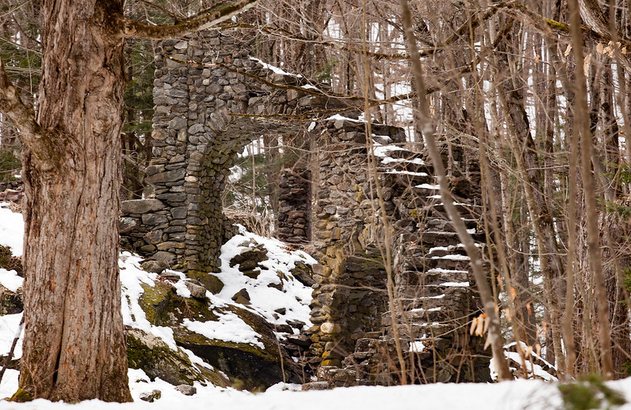
The ruins of Madame Sherri’s Castle. Photo via Flickr.

Madame Sherri’s Castle, New Hampshire

Madame Sherri was a Broadway costume designer and New York City socialite who, after her husband’s death, built an enormous mansion in the woods of New Hampshire so she could throw parties for her friends (as one does). After Madame Sherri died, her house burned down, and now all that’s left of it is a curving stone staircase deep in the forest. This location would be perfect for a novel about a young woman lost in the forest at night, who stumbles upon a mansion where a party is in full swing and all the guests seem to be from another time. The woman slowly realizes that the mansion only exists at night, and she must solve the mystery of what happened at the final party before she becomes trapped in a ghostly soiree forever.

Inat Kuća in Sarajevo. Photo via Wikimedia.

Sarajevo Spite House, Bosnia and Herzegovina

Spite houses are usually extreme examples of pettiness, but there’s a little more going on with one particular spite house in Sarajevo. When the Austro-Hungarian government tried to colonize Bosnia and Herzegovina, part of their plan was to build a beautiful new city hall in Sarajevo. Enter: an old man. This Bosnian man’s house was part of the proposed city hall site, but he refused to sell his home, no matter how much money he was offered. In the end, he only agreed to give up his land when the government promised to move his house, brick by brick, and rebuild it exactly on the other side of the river. According to legend, the old man sat on the bridge between his old and new land every day in order to oversee the rebuilding of his house. For this story, perhaps write a novel about a forgetful man slowly regaining memories of his life as he watches all his belongings pass across the bridge in front of him. 

Alnwick Poison Garden, England. Photo via Flickr.

Alnwick Poison Garden, England

In the Alnwick Poison Garden, the phrase “stop and smell the roses” is a direct threat, as the plants in this garden are all poisonous; some of them are strong enough to kill through touch or smell alone. So who would live in a castle with such a poisonous garden? A woman who wants to keep everyone at a great distance because she was forced to leave the only woman she ever loved to marry a man she had never met. Luckily he died mysteriously early in their marriage, but she keeps the garden in order to isolate herself while she mourns the lost love she fears she’ll never find again.

Screenshot of “Plants Are Taking Over This Abandoned Fishing Village” via Youtube—National Geographic.

Houtouwan, China

Though most abandoned towns and buildings end up as lifeless, crumbling grey slabs of rock or concrete, Houtouwan went a different direction. This abandoned Chinese fishing village is deserted but certainly not dead, as its houses and streets are all covered in a thick layer of bright green vegetation. The entire hillside where the village rests has turned from a bustling village to a lush natural wonder, a verdant hill shrouded in ocean mist. Obviously, this means that during full moons the greenery shivers to life and the village fills with people made from grass. We’re imagining a short story collection about the moss-people who inhabit the village, with each story covering the daily life of a different moss-person.

Photo by Forest Simon on Unsplash.

Big Major Cay, Bahamas

Have you read the Warriors series? Okay, think of that but with pigs who swim. Feral pigs have taken over a small island in the Bahamas, and they love swimming around in the clear, blue water and stealing food from tourists (the pigs can and will jump into boats in shallow areas). This story could be told as a long-running children’s series about the interactions between the different pig clans on the island, or a speculative novel about the pigs forming a closed society on the island, gaining both language skills and mechanical knowledge, stealing a boat from the tourists, and going out into the world to spread their knowledge and dogmas to all the other pigs in the world.

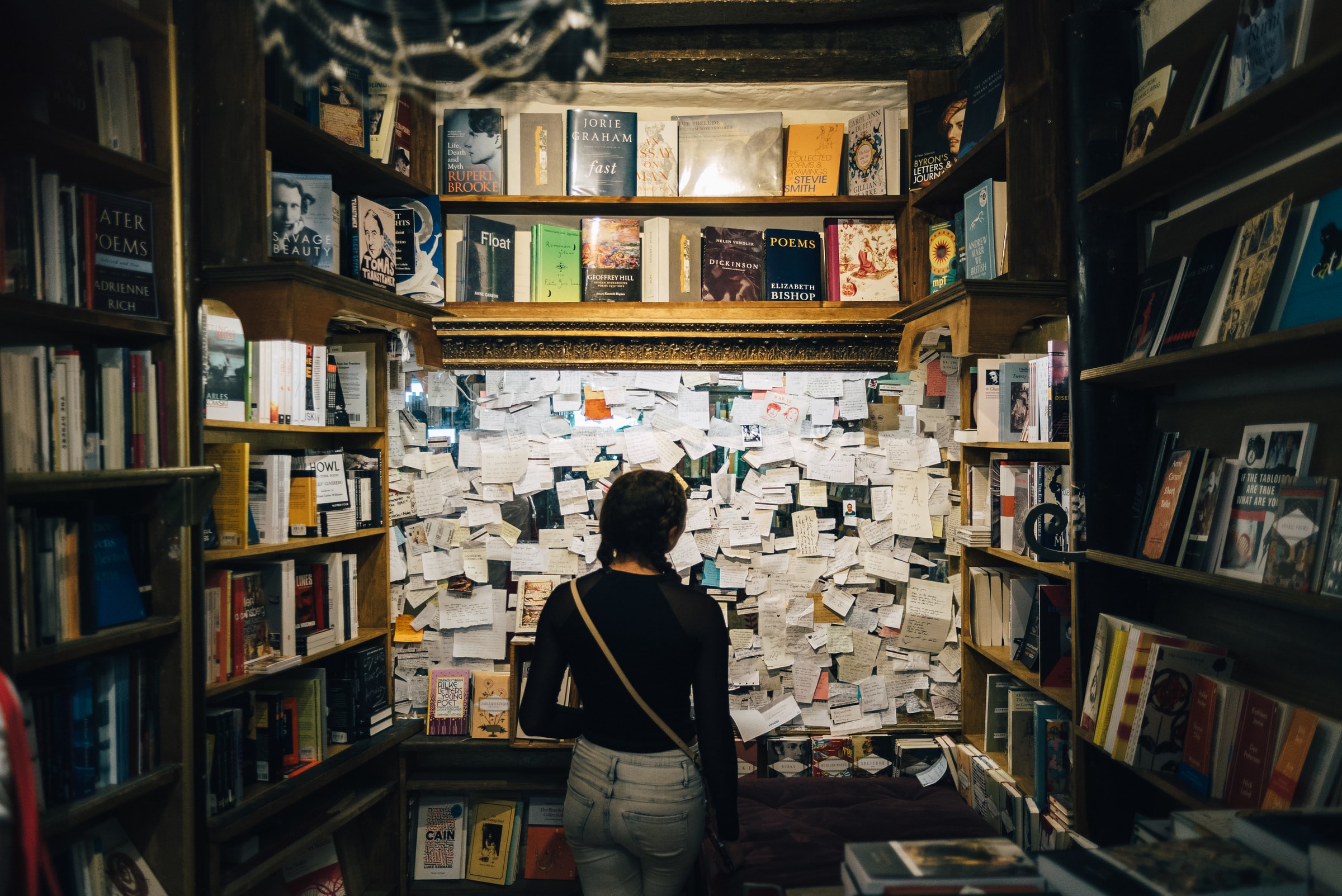
11 Radical Bookstores to Help You Plan a Revolution

If the political landscape in America today has you longing for radical transformation, it might be time to head over (virtually, for now) to your nearest radical bookstore. Often volunteer-run nonprofit collectives, radical bookstores are the type of place where you can find whole sections of anti-racist, anti-capitalist, anti-patriarchal, and anti-imperialist readings. Whether you’re looking to challenge gender binaries, demystify the prison-industrial complex, understand the finer differences between anarchism and communism, or just find fun new stories by historically marginalized writers, radical bookstores can help you get ahold of the titles you need. 

During the pandemic, many are hosting virtual events and shipping online orders, making now the perfect time to connect with radical bookstores across America even if you don’t live near one. Below are eleven great stores to get you started. (If you’re looking for radical bookstores around the world, this website can help you search.)

Red Emma’s (Baltimore, Maryland)

Named for 19th-century anarchist Emma Goldman, who dedicated her life to “the struggle against state tyranny, capitalist exploitation, and patriarchal oppression,” Red Emma’s is a “worker-owned, cooperatively-managed bookstore, community events space, and restaurant in Baltimore.” Their aim is to bring together people who have long been involved in struggles for justice as well as people newly interested in radical, anarchist, and communist ideas. You can connect with Red Emma’s on Twitter, Instagram, Facebook, and Bookshop.

Boneshaker Books (Minneapolis, Minnesota)

Boneshaker Books is a “volunteer-run, radical bookstore” that aims to introduce readers to leftist politics, facilitate conversations, and support ongoing movements. During the pandemic, the store has launched four virtual book clubs — Abolition Book Club, Politics of Pandemics, Trans Book Club, and Utopias Book Club — with more in the works. Find Boneshaker on Twitter, Instagram, Facebook, and Bookshop.

Firestorm Co-op (Asheville, North Carolina)

Firestorm is a queer, feminist “collectively-owned radical bookstore and community event space” dedicated to supporting “grassroots movements in Southern Appalachia.” When someone broke into the store and emptied the register in early May, staff didn’t call the police because “there really isn’t anything that cops could do for us that we can’t do for ourselves and if someone is desperate enough to risk their freedom for $150, maybe we’ve all failed them.” You can find Firestorm on Twitter, Instagram, and Facebook.

Red Scare Infoshop (Tulsa, Oklahoma)

Located at the crossroads of the Osage, Cherokee, and Muskogee (Creek) Nations (also called Tulsa, Oklahoma), Red Scare Infoshop “affirms and promotes values of mutual aid, direct democracy, anti-authoritarianism, autonomy and solidarity” while opposing “capitalism, imperialism, patriarchy, heterosexism, transphobia, ableism, racism, colonialism, and all other forms of oppression.” They offer books and zines on leftist literature, subversive history, radical theory, and more. You can connect with them on Instagram, but during the pandemic they remain most active on Facebook.

Left Bank Books Collective (Seattle, Washington)

Collectively owned and operated by its workers, this decades-long fixture of the Duwamish Territory (also known as Seattle) radical community specializes in “anti-authoritarian, anarchist, independent, radical and small-press titles.” Before the pandemic, they had a long-standing tradition of being open every day except May Day and New Years. Now, they remain most active on Instagram and can also be found on Facebook.

Wooden Shoe Books (Philadelphia, Pennsylvania)

Located in Philly’s edgy and alternative South Street neighborhood, this all-volunteer anarchist bookstore collective “seeks to embody the principles of anarchism and other movements for social justice.” Founded over 40 years ago as an anti-profit bookstore, they remain nonprofit today. When telemarketers phone asking for the owner, workers enjoy pointing out that there is no owner; telemarketers usually get confused and hang up. Find Wooden Shoe Books on Twitter, Instagram, and Facebook.

The Peace Nook (Columbia, Missouri)

This non-profit, volunteer-based community resource space refers to itself as “an information and social change activism referral center. It is also a storefront offering books, fair trade imports, natural foods, environmental products,  posters, jewelry, T-shirts, magazines and much, much more!” They stock approximately 5,000 alternative book titles “including progressive literature and politics, feminist, African American, LGBT, Native American, personal growth and spirituality, holistic health, sustainable living and vegetarian cooking.” You can connect with The Peace Nook on Twitter, Instagram, and Facebook.

Microcosm Publishing Store (Portland, Oregon)

Looking for graphic narratives about precursor movements to Black Lives Matter, instructions on how to not get arrested at a protest, anarchist analyses of the COVID-19 pandemic, or perhaps just some good old-fashioned vegan Scottish recipes or tips for talking to your cat about evolution? Microcosm Publishing’s catalog of books and zines has got you covered. They also have a brick and mortar storefront currently open for socially distanced pick-ups. Connect on Twitter, Instagram, and Facebook.

Bluestockings Bookstore (New York, New York)

This beloved queer, trans, and sex worker collectively run bookstore describes itself as 98% radical, 2% glitter, and 100% volunteer powered. While staff are currently searching for a new physical space that will better accommodate the store’s disabled community, they are also maintaining an active calendar of virtual events and continuing to sell books online. You can find Bluestockings on Twitter, Instagram, Facebook, and Bookshop. You can also support their GoFundMe, which seeks to raise $150,000 towards helping the store move into new premises. 

Charis Books & More (Decatur, Georgia)

The South’s oldest independent feminist bookstore has been celebrating radical and independent voices in the heart of the South since 1974. Their mission is to foster sustainable feminist communities, work for social justice, and encourage the expression of diverse and marginalized voices. The store is currently hosting a number of online events, including recurring offerings such as Black Feminist Book Club, LGBTQ+ Book Club, Trans and Friends Discussion Group, Gender Creative Parenting Collective, Race Conscious Parenting Collective, and more. Find Charis on Twitter, Instagram, Facebook, and Bookshop.

Monkeywrench Books (Austin, Texas)

This all-volunteer event space, radical bookstore, and social hub serves up “insurgent literature for aspiring partisans.” They host an anarchist study group, a Jacobin socialist/leftist reading group, zine making and overdose prevention events, and more. Monkeywrench is ready to connect with you on Twitter, Instagram, and Facebook.

Elisa Gabbert Helps Us Make Sense of Living in a Time of Disaster

My brother has always loved disasters. Growing up, fights over the remote control were Buffy vs. knowing when a plane crash is most likely to occur (takeoff or landing), or Ally McBeal vs. how the crash will play out depending on where you’re seated (if you choose the extreme front or rear, at least the end will be swift). When we traveled to the U.S. for the first time and visited the Golden Gate Bridge, he looked up and asked: “What happens if this collapses?”

I should clarify: my brother is a chilled out human who is generally curious about how the world works. I, on the other hand, am a highly-strung mess, who has carried the anxieties of the Discovery Channel well into adulthood. And to make matters worse, now all my brother’s favorite TV seems to be coming to life. Floods, AI, wildfires, chemical explosions, and viruses almost feel like a fact of existence. 

As Elisa Gabbert writes, “I wonder if the way the world gets worse will outpace the rate at which we get used to it.” 

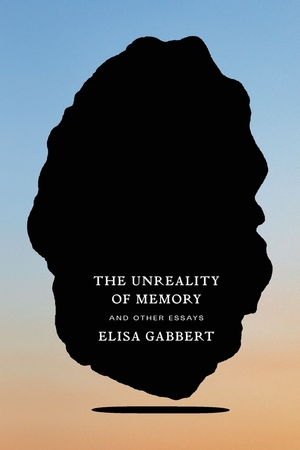
Poet, essayist, and Electric Literature columnist Gabbert’s fifth book The Unreality of Memory is an expansive collection of essays that is partly about disaster (9/11, Chernobyl, plagues), but equally about the shifting constructs of society and selfhood through which we mediate the world. From the slow violence of global warming to the fever pitch of Twitter feeds, Gabbert gracefully explores what knowledge means when its contexts are constantly collapsing—and which pieces of information we should focus on in the first place.

She writes: “We believe we need to worry about the right problems, even if we can’t solve them…And with so much that is inaccessible, unknowable, and in flux, we can’t even hold on to whatever we already know.”

I spoke to Gabbert about memory, happiness, doomscrolling, and why solving global warming is harder than eating an airplane. 


Richa Kaul Padte: Please let’s start with crises, because the way we understand and respond to them varies dramatically! Disaster is sudden, shocking, a spectacle: 9/11, Chernobyl, war—all these inspire “a sense of purpose gathering in us, an enemy taking shape.” On the other hand, “we’re poorly equipped to deal with so-called long-emergencies” even if they cause more deaths: famine, climate change, poverty. At the start of the coronavirus pandemic, I felt galvanized. As the British government’s plea went: “Stay Home. Protect the NHS. Save Lives.” There was something to do. Now, I feel so tired; I just want it all to go away. Do we respond better when we conceive of something as a disaster—and what happens when disaster turns into a long emergency? 

Elisa Gabbert: I think that’s it exactly. I’m hesitant to invoke evolutionary psychology but you could say we evolved to respond to sudden and imminent threats, via fight or flight or freeze (playing dead—which sometimes works!). These bigger and slower disasters require more concerted, organized, social effort, and the fight can be very long indeed, generations long. Often we seem to feel equal to the fight at first. But after some time goes by, and we don’t appear to be making any progress, it’s natural—and on some level even rational—to want to just give up. This seems especially true when we’re dealing with multiple crises at once. It’s like getting attacked by a bear while your house is on fire. (And meanwhile, they’re purging the voter rolls.) I think it helps to find a problem you can focus on and contribute to over the long term—like the activists who have been fighting police brutality for years and will continue to fight, whether or not it’s front-page news—rather than only responding to this or that issue when it’s reached a crisis point. Because we can’t all contribute meaningfully to everything. But we need national and world leaders to do their fucking jobs too. And we need to think of ourselves as part of a society, to have some sense of shared responsibility for human life, for quality of life. 

RKP: Yes, multiple crises, all at the same time! And even so-called “single issues” are actually so huge, right? You explore philosopher Timothy Morton’s concept of “hyperobjects”—things whose incredibly massive scales make it difficult to wrap our minds around. Like global warming, which “is happening everywhere, all the time, which paradoxically makes it harder to see [than] something with defined edges.” Is breaking up the problem a better approach, or can that also lead to missing the forest for the trees?

EG: This reminds me of a story I heard once (which may not be true) about a man who ate an airplane by breaking it up into tiny pieces. But “solving” a hyperobject problem like global warming is exponentially harder than eating an airplane. You have to break up the problem, but separate efforts might end up undermining each other. And we can’t really foresee the distant consequences of our actions. But we also can’t do nothing! 

RKP: 2020 is revealing much of what we’ve gotten terribly wrong—healthcare, community, slow living, environmental responsibility. Now, at least we can be better. But history isn’t exactly on our side. After the Black Death, you write, people weren’t more cautious. Instead, “sens[ing] a baffling meaninglessness to their being spared,” they were reckless, callous, indifferent. This really scared me, because I recognized the impulse in myself: if I survive, will I live with abandon, lessons and consequences be damned? 

You ask: “Is remembering enough, or is there a right, and a wrong, way to remember?” How can we remember to remember the right way? 

EG: It is so difficult, isn’t? In that same piece, the one about the plague, there’s a part where I say I keep thinking that we don’t deserve to be happy. But I wasn’t writing that essay in the midst of a pandemic! Now I’m not sure—I really mean this, I’m not sure—that I care what we deserve. Some days I think desperately: This is my life, my one life! I do want to be happy—not happy at the expense of others, insofar as I can help it, but I want moments of happiness, even if this time is mostly a struggle. 

The memory thing frightens me too. I wish I had an answer. I do think we have to read and engage deeply with history. There’s an impulse to sort of reject the past wholesale, to throw it all out because it’s tainted with evil, and because it’s overwhelming—the past is really almost infinite, in a sense more infinite than the future. You see this when people just refuse to read books more than X years old. I think that’s the absolutely incorrect approach. You can’t understand it if you don’t actually read it. And anyway we’re evil too, and we are part of history.  

RKP: You talking just now about moments of happiness reminded me of the chapter where you cite Jennifer Michael Hecht’s The Happiness Myth, and how we prize certain types of happiness over others. Hecht writes: “we devalue euphoria…because we value productivity,” and this struck me as very true. There is a collective value placed on a long life or a successful career—compared to, say, MDMA or bird watching without a camera. Does happiness feel so elusive (even to those of us with relative privilege) because we define it according to productivity? And how can we change this approach when the premise of productivity—capitalism—is so deeply ingrained?

Crippling panic isn’t going to help us in the long fight, but it’s also dangerous to rationalize yourself out of discomfort.

EG: There seems to be an element of competitiveness to everything, like even happiness becomes competitive happiness. Social media seems to accelerate or exacerbate these tendencies—we’re rewarded more for posting about newness and achievement than the same old routine. (I’ve always found Instagram fairly boring, but it was especially boring during the first few weeks of lockdown, I noticed.) We’re constantly made to second-guess what makes us happy, like it might be the wrong kind of happiness. We should probably all read How to Do Nothing, but I must admit that part of the nothing I’ve been doing is not reading that book yet. 

RKP: Omg that was my favorite book of 2019—it absolutely changed my life! Except now I have to constantly re-read it because I keep forgetting that my life was…changed. 

Something you explore is how “we can’t actually care about everything equally, especially not at the same time.” Our resources are not limitless, so we conserve them. In the past months, I’ve read more novels than news, watched more Netflix than Twitter. It feels good, safe, calm. 

You go on to write: “These unspoken algorithms by which we manage our empathy—they are almost innocent, almost ‘self-care.’ (We’re not committing atrocities, just refusing to witness them.)” My note in the margins reads: brutal. A month into the pandemic I tweeted: “It is okay to stop looking at coronavirus news. It is okay to stay at home and look at a book, show, cat, or plant instead.” But…is it? 

EG: I think it is okay! I think we have to turn it off sometimes, often, in fact. And if you’re already staying home, scrolling the news all night isn’t protecting you and your neighbors any more than petting your cat would. What’s not okay is ignoring these problems to the point of denial. Crippling panic isn’t going to help us in the long fight, but it’s also dangerous to rationalize yourself out of discomfort by saying, “Everyone is overreacting, there have always been problems, it’s going to be fine.” Because the thing is, if you’re alive right now, it’s because your ancestors managed not to die of AIDS or in Vietnam or in the Holocaust or of smallpox before they had a kid. It’s going to be “fine” for some people—some people will survive the pandemic and likely even climate change. But many others won’t. So it’s kind of incredibly arrogant to think that just because you happen to exist, everything will probably work out in the end.

RKP: You write: “My brain had adapted to high doses of news, and I needed more and more news just to feel something. But quantity wasn’t the problem, I wanted to know what it meant.” I know the feeling, and I keep hoping that the next link, tweet, or idea will somehow reveal the answer to me. Later in the book, while exploring wildly different reporting on the same crime, you write: “Whether it’s piles of evidence or piles of news, you read it through the lens of whatever conclusion you’ve already come to.”

When we doomscroll till 3am, are we trying to understand what everything means—or are we just reinforcing what we already believe it means? Where do we go from here?

Doomscrolling is like the drunk version of confirmation bias. If we want to feel even more guilty or scared or like everything’s fine, it can provide that.

EG: Your question puts me in mind of a line in a short essay by Tom McAllister, written about a day in June of 2018, which he ends in bed, semi-drunk, scanning his phone for terrible news: “I wanted to feel as bad as possible.” It also reminds me of something I read many years ago, so long ago I can’t remember if it was in a magazine article or a novel or what, but it was something about how getting drunk makes you feel more of whatever you were already feeling—it can turn happiness into euphoria, but it can turn sadness into despair. Doomscrolling is maybe like the drunk version of confirmation bias. If we want to feel even more guilty or scared or like everything’s fine, it can provide that. But I might be the wrong person to answer this question—at this point in Trump’s presidency/time-space, I have a very low tolerance for news. 

RKP: My favorite chapter in Unreality is “Vanity Project,” where you write: “[T]he brain seems to build a self-model, a representation of your own body within your mind.” This mental image is then what we use to navigate the world. And amazingly, a study you cite found “people were more apt to ‘recognize’ themselves…when their images had been enhanced to…appear more attractive.” In other words, even though we (especially as women) are credited with low self-esteem, the mental avatars through which we experience the world are often filtered and upgraded.

And I was wondering why we do this. Are we actually that vain, or is the self the ultimate hyperobject—too big to comprehend, and absolutely terrifying when we catch an unfiltered glimpse? 

EG: Yes, the self as hyperobject! Always evasive and partly hidden. I’ve noticed that images or videos of my face look more like I think I look when they’re small—like when you’re in a big enough Zoom meeting that your face is just a tiny part in the grid. I think our self-model is inherently low-res, the way faces don’t have to be perfectly crisply defined in a dream. Did you know that you can see your nose at all times, but your brain just stops processing it, because it’s not useful information? “Humankind cannot bear very much reality.” 

It’s Time for the Slow, Aimless Novel to Get Its Due

Speed has been the grand idol of our time, the focal point of our cultures, the ultimate goal of many a new technological innovation. We are taught to hanker after faster phones, faster cars, faster boats, faster jets. In the utopian future big tech companies would have us imagine, we are transported to our destinations in the blink of an eye, every transition between places, activities, and thoughts lasting a fraction of a second. These companies go out of their way to advertise themselves using jargon that evokes velocity—their operations are  “agile” or “nimble,” and their embedded intellectuals celebrate the arrival of “digital speed revolution,” “turbo capitalism,” and  “hyper-acceleration.”

Given this, it is rather incredible that a virus has ground this rampaging cult of speed to a halt. COVID-19  has spread like wildfire, and reduced the actual pace of our lives to a crawl. In the few weeks after lockdown commenced, it turned out that, when push came to shove, many of those lean and agile and nimble startups queued up cap-in-hand for a government bailout. 

It turns out that our survival is contingent upon slowing down, rather than speeding up.

Indeed, it turns out that our survival is contingent upon slowing down, rather than speeding up: only by reducing the pace of our activity can we minimize the carnage this virus inflicts. The faster the virus spreads, the slower we must be. In epicenters such as New York City in April, only a total lockdown, a total stop, could save lives. 

Trapped in their houses, people started to look around for ways of coping with this new pace of life. If social media feeds and blog posts were to be trusted, many picked fat novels off the shelf, some for the first time in a long while, and got to reading. Relevant titles like Jose Saramago’s Blindness or Gabriel Garcia Marquez’s Love in the Time of Cholera appeared frequently, as well as intimidating 19th-century tomes like The Brothers Karamazov or difficult modernist books like Mrs. Dalloway.

Yet our current predicament is actually best reflected by a type of novel that does not appear to be receiving as much attention. These narratives, forming a body of work collectively described as “loiterature” by literary theorist Ross Chambers, are about being stuck—in place and also narratively. They tell a peculiar kind of story that relies on lack of forward movement, of stalling and dithering, of wandering with no destination. 


In my 20s I traveled extensively across Iran by car. Over the course of those trips I encountered a whole way of living that was neither urban nor rural. It was a road-fork lifestyle. 

The Iranian plateau consists of large swathes of desert. In central states, sometimes roads stretch for hundreds of miles without even a bend. The forks on those roads, which are few and far between, play a large role in making those journeys possible. At the point where one of these roads bifurcate into two diverging paths towards two different destinations, most drivers pull over to refresh themselves. If you travel a lot, after a while you’ll notice that the forks across the country are strikingly similar, even though hundreds upon hundreds of miles lie between them. 

Common to all these junctures are the small communities that have emerged around them over time. You often see local people there, selling fruit and vegetables grown on their nearby farms or gardens. There is always a gas station, a little supermarket and a public toilet. At busier forks you are likely to find a restaurant, its menu limited to a few kinds of chicken and lamb kebab and deezi. Car mechanics often set up shop at forks. Right off to the side of the gas station you can see them in their greasy overalls, whiling away the hours on creaky chairs, smoking under the sun. 

Many tales and fables of Persian literature begin with a diverse crowd gathering around a storyteller, listening to a yarn that stretches far into the night.

This intricate, vast network of highways are dotted with little, interstitial towns inhabited by recurring types of people bears striking resemblances to the caravansaries of ancient Persia, which abounded along the Silk Road, and their ruins can be found everywhere in the central desert of Iran. Persia was the meeting point where merchants from East and West crossed paths and spent long nights under the star-strewn desert sky. We don’t know much about what they did together, but it is safe to assume storytelling was a major component of it. Many tales and fables of Persian literature begin with a diverse crowd gathering around a storyteller, listening to a yarn that stretches far into the night. Naqali, the tradition of performing stories from Ferdowsi’s Shahnameh, is the most famous example of that, and is still practiced in coffeehouses in small town Iran. Those fork road caravanserais, some of which neatly superimposed by the fork road towns of today, may have been the forgotten origin of a literary genre.


Road fork culture has evolved in diverse locales, flourishing especially in old empires that heavily relied on trade and the movement of armies. An important example of this is the Ancient Rome, which inspired Chambers to articulate his theory of the loiterly novel. 

In Ancient Rome forks were distinguishable places. Travelers there stopped to visit taverns and gambling joints, seedy hotels and brothels. Apart from the people who worked in those establishments, there were some who practically lived there: idlers with no jobs and no intention of finding one. Ostracized from urban centers,  they spend their lives wandering about the forks and killing times. 

In his book Loiterature, Chambers notes that the Latin word for this kind of place, the meeting point of three roads, is trivia. The denotation of “trivial”  in English and other European languages makes it clear how the dominant Roman culture regarded the dwellers of trivia. This disdain, Chambers contends, rose from the fact that at a trivia, social boundaries broke down. In rigidly stratified Roman society, at a trivia the aristocratic traveler, the local vagabond, the aimless wanderer, and the inveterate  gambler passed time together and participated in the same activities. 

Trivia, therefore, is antithetical to speed, progress and unidirectional movement. According to Chambers’ theory, the “loiterly novel” adopts the structure of the trivia lifestyle. The power of this form, according to Chambers, 

Lies not in not moving but in moving without going anywhere in particular, and indeed in moving without knowing—or maybe pretending not to know—where it’s going. What makes it loiterly is that it moves, but without advancing. It travels, but it travels, so to speak, on the spot, without needing to leave home.

Which brings us to the present moment, the world in quarantine: as it has become impossible to travel physically, people are inventing ways of traveling on the spot, without moving towards a pre-determined destination. 

Chambers offers delightful analyses of many artworks that fit this category, ranging from contemporary movies and memoirs all the way back to Laurence Sterne’s Tristram Shandy, which he considers the founding text of this genre. His decidedly Western gaze, however, misses a perfect exemplar of the loiterly narrative:  One Thousand and One Nights. 


It is a book so vast, Jorge Luis Borges said about the Nights, “that it is not necessary to have read,” because those stories are already “a part of our memory.”

Borges’ statement is half-true. Figures of genies and treasure-hunters, sailors fighting sea monsters to reach the shores of magical islands, are so ingrained in the global collective fantasy that we hardly bother to trace them to their origin. But his statement implies the Nights is but a collection of those stories, and the way they are assembled into a book is incidental. That is not the case. The Nights is as meticulously structured as a modern novel, and indeed a lot is lost if the book is not read cover to cover. An analysis of  the frame story of text allows us to appreciate the loiterly nature of this archetypal work. 

The book begins thus: King Shahriar, having been cuckolded by his wife, sets out to take revenge by becoming a plague upon the women of his kingdom. He demands that his vizier bring a young woman to his room every evening, and over the course of the night, he rapes and kills her. When every young woman has either been murdered or has fled town, the vizier turns to his own family. His daughter Shahrzad volunteers herself. She enters the harem not as a sacrificial lamb but rather with a plan to neutralize the king.  As part of her plan, she takes her sister Dunyazad along with her to the palace. 

When night descends, she asks the king to give her some time to put Dunyazad to sleep by telling her a story. The King permits this and while he sits waiting, he overhears the story. Shahrzad’s tale  is so enchanting that the king becomes desperate to know how it ends. But the story doesn’t end before dawn, so the monarch allows Shahrzad to return the next night and finish the story. 

But the story never ends. For a thousand and one nights, Shahrzad keeps her tale alive by digressing and loitering, embarking upon stories within stories within stories, never reaching the end of a narrative line before starting another. She keeps going until the king is completely disarmed, his anger diffused. In Chambers’ terms, the king’s “beeline,” his unidirectional, fast-moving killing mania, runs into the wall of Shahrzad’s “digression” and evasiveness. 

The aspect of Shahrzad’s character that often draws the most attention is her ingenuity and dexterity in storytelling. The frame story makes it clear, however, that she is also a spirited fighter who takes an enormous risk to halt a lethal plague in her community. Also, unlike what is commonly believed, she is not the prisoner of the king, and not just because she volunteered. Indeed, whoever came up with her name in ancient Persia, possibly while spinning out wild tales to mitigate the boredom of long deserts night in a caravansary at a road fork, took pains so the names would reveal the power structure inside the harem: Shahriar, the king’s name, comes from Shahr-dar, or literally, “landowner.” Shahrzad, which is a shorter form of Shahr-azad, literally means “free from land.” 

The list of the Western authors influenced by the Nights is practically endless. Giovanni Boccaccio, author of The Decameron, saw it as a representation of how storytelling can restrain a rampaging death machine that functioned as a plague on society, and reworked that idea into a book about an actual plague. 

The Decameron opens in Florence in throes of the Black Death epidemic of 1348 , which, as we read in the introduction, “had some years before appeared in the parts of the East and after having bereft these latter of an innumerable number of inhabitants, extending without cease from one place to another, had now unhappily spread towards the West.” As people fall prey to the disease, three men and seven women leave town for a villa in the mountains. In the pleasant greenery of the countryside they emulate Shahrzad by using storytelling as a survival strategy. They take turns telling stories every night to protect their sanity in lockdown and wait out the plague. 

Boccaccio clearly had the Nights in mind when creating the structure for his book, but the differences between these two stories are as revealing as their similarities. In The Decameron,  stories are allowed to have  beginnings and ends plots come to satisfying resolutions and impart moral lessons. For Shahrzad, resolving a narrative line amounts to a death sentence. She meanders and digresses, jumps from one story to another, postponing again and again the resolution. She faces the double challenge of keeping a story supremely interesting, then interrupting it with an equally enthralling tale, for she cannot afford a moment of frustration for her audience, the murderous man sitting right next to her, his dagger tucked away in the shawl wrapped around his waist. 

In doing so, Shahrzad transcends the “beeline” vs. “digressive” dichotomy Chambers sets up in Loiterature. Indeed, in the Nights, she executes storytelling as web-making, which is another apt metaphor for the loiterly narrative: the spider tries infinite routes, constantly moves and turns.  In weaving the web, it travels to no destination. It moves around the same spot, leaving in its wake a network of a thousand connected little routes with no beginning and no end. In the Nights Shahrzad constructs a very similar web, which also functions as a trap: on the first night Shahriar falls into it like an insect in a spider web, and over the thousand following evenings Shahrzad wraps slender but firm threads around his body, entrapping and disarming him. 

At a time when destinations are health hazards, this type of story teaches us to indulge in a different kind of journey.

The Nights, therefore, is a prime exemplar of a literary tradition that gives us a blueprint for surviving, even flourishing, in lockdown: the loiterly narrative. The texts in that tradition show us how to travel without moving, how to thrive in stasis. At a time when destinations are health hazards, this type of story teaches us to indulge in a different kind of journey, to avoid straight lines, to wander in place. 

In societies where the pace of life has accelerated at a dizzying rate, loiterly novels and their readers constitute a small, eccentric, ex-centric minority who have chosen to shun the cult of speed and traverse the world in the same fashion as Rocinante, Don Quixote’s skinny horse. They move slowly and nonchalantly, unembarrassed by their clumsy gait and occasional wobbling. They linger here, dither there, in no hurry to get anywhere specific. The journey itself is their destination. 

Many of us have gotten addicted to  speed, and now that life has come to a grinding halt, we are not sure how to function. We have spent so much time on expressways we don’t know what to do at trivia. The loiterly storytellers are among the few who do. From Thousand and One Nights to this day, countless storytellers have stepped off the expressway and sought the truth of their fiction at forks. While we were busy upgrading our gadgets to catch up with the speed of the world, they have been anachronistically honing their horsemanship to navigate craggy off-road tracks, to wander around the forks of modern life.  

The loiterly narratives have always comprised a subset of what is known as “experimental” literature, continuing a rich but modest existence on the margins of the mainstream. The global quarantine should be their moment. We need to learn to have new journeys, and for that we need new maps, new conceptualizations of place, new appreciation for pauses and for forks. The loiterly narratives can provide a blueprint for the shift of mindset required by life in quarantine, a survival manual for a world whose speedometer has dropped to zero. 

The Past Doesn’t Hurt When You Don’t Remember It

“When Eddie Levert Comes”
by Deesha Philyaw

Today is the day,” Mama announced, as she did every day when Daughter came to her room with the breakfast tray.

“Good morning, Mama.” Daughter set the tray on the padded bench in front of Mama’s vanity. She squinted at the early morning sun shining through the thin curtains. Mama’s vanity was covered with powders and bottles of fragrances that hadn’t been touched in months.

Mama brushed past Daughter without a word. She opened a chifforobe drawer and took out a navy-and-white-striped short-sleeved blouse. She carried the blouse over to her bed and placed it above a light-blue cotton skirt with an elastic waistband, smoothing down the fabric of both items with her hands, as if ironing. She frowned.

“Where did all my beautiful things go?” she asked Daughter, the room, the air. “My beautiful wrap dresses and my pencil skirts? I want to look my best for him. He’s coming today, you know. Where are my lovely sheer blouses and my pantsuits? Have you seen them? Did you move them from my closet? Are you stealing from me?”

“No, Mama,” Daughter said.

“I bought all of those things with my employee discount at Marshall Field’s department store. You have no right to take them from me.”

Daughter didn’t remind Mama that Marshall Field’s didn’t exist anymore, and that she hadn’t worked there since the eighties. Instead she gently led Mama away from the bed and into her recliner so she could eat. Mama’s appetite was still solid. The doctor said that was a good thing, relatively speaking.

Mama chattered on as she busied herself buttering toast and adding ketchup to her eggs, something Daughter had always thought gross even though she liked both ketchup and eggs.

“He’s coming today.” Mama said between chews. Droplets of ketchup dotted the white ribbon on the front of her nightgown. Irrationally, this irked Daughter, and she made a mental note to put some stain remover on it before throwing it in the wash. Easily irked and forever trying to make order out of chaos, she was indeed her mother’s daughter—the mother before this current mother. In some ways, Daughter preferred this current mother. In the oblivion of her mind, Mama was kinder—accusations of theft notwithstanding—and her needs were simpler.

Mama dabbed at her mouth with a paper towel. “Delicious. Thank you,” she said in Daughter’s general direction.

“You’re welcome, Mama.” Daughter was still getting used to such courtesy. She headed for the door. It was almost time for her first house showing of the day and for the home nurse to arrive and relieve her.

“You can come right back for this tray,” Mama called after her. “I got to get ready. He’ll be here shortly. Make sure you let me know when he’s at the door, hear?”

Daughter heard, but she stood silent with her hand on the doorknob, her back to Mama.

“Did you hear me?” Mama’s voice took on an edge of pleading. “Today’s the day.”

Daughter left the room and shut the door tight behind her.


As a kid during summer breaks from school, Daughter would sometimes whisper her real name to herself, just so she wouldn’t go months at a time without hearing it. Everyone except her teachers followed Mama’s lead and never called her by her name, always “Daughter,” as if she existed only in relation to her mother, to her function in the family. Daughter. Housekeeper. Cook. Babysitter. Nurse. Slave. That’s what she felt like. Daughter, could you do this? Daughter, could you do that? Which translated into: You will do this. You will do that. Without question or complaint, or else she got slapped. Meanwhile her brothers Rico and Bruce had been called by their given names and did only what they pleased.

Not much changed in their adulthood, only that Bruce was dead. Drugs. Rico, his wife, and kids lived on the other side of town. Daughter had to shame him into coming over on occasion to give her a break at least, even if he didn’t care about spending time with Mama.

“Yo, she’s gotta stop saying, ‘Today is the day,’ ” Rico had complained to Daughter the first time Mama told him about Eddie Levert. “I don’t want to keep hearing that crazy shit over and over again.”

“I listen to it day in and day out,” Daughter snapped. “You want to trade places?”

“You could hire someone full-time—”

“Or you could act like a son who gives a damn.”

Rico crossed his arms and sighed. At forty, he still had a baby face and a perpetual pout.

“I shouldn’t have to pay someone to sit with her when you’re right here,” Daughter had said. “I know she wasn’t a perfect mother. But she is our mother.”

“Don’t lecture me about her,” Rico said. Daughter knew that Mama didn’t like Rico’s wife, and the feeling was mutual, so she’d never gotten to know her grandkids. But Daughter had never asked Rico what it was like for him those two years between when she’d left home and when he left to join the air force. They had all been grieving Bruce’s death in their own way. But whatever life with Mama was like for Rico after Daughter moved out, she couldn’t imagine it being worse than what she endured: Mama had never laid a hand on Rico or Bruce.

“Fine. I won’t lecture,” Daughter had said. “Just . . . if Mama wants to talk about Eddie Levert, let her. She ain’t hurtin’ nobody, Rico.”

At least not the way she used to.


The Bible says, “Train up a child in the way he should go, and when he is old he will not depart from it.” In Mama’s case, in her old age, she never spoke of the Bible. Instead she preached the gospel of the coming of Eddie Levert, lead singer of her favorite group back in the day, the O’Jays.

Both Eddie and Mama, son and daughter of the South, had had to bury their children, something even Daughter, who had never had kids, understood as especially cruel. Perhaps Mama had followed Eddie’s life and career over the years and felt a special, unshakable bond with him.

In one of the family photo albums in Daughter’s basement, there was a Polaroid picture of Mama with Eddie, taken in the seventies when the O’Jays came to town. Mama had somehow gotten backstage after the concert—Daughter had never been told the details—and took the picture, which Eddie signed. In the picture, Mama wore a low-cut, fire-red dress that hugged all her curves. Her hair, dyed a brassy reddish brown, had been hot combed and then curled into Farrah Fawcett flips. If not for her full nose and lips, she could’ve passed as a Farrah lookalike, as she was barely darker. Eddie was as dark as Mama was light. He wore a white suit, his chest bare, lapels wide. With his arm wrapped tight around Mama’s tiny waist, Eddie grinned big at the camera. Mama grinned big at him. As a child, Daughter would pull out the album from time to time and stare at the photo, proof that Mama had once been happy.

When Daughter moved out at eighteen, it was partly because she feared Mama’s unhappiness was contagious and partly because she was tired of being everyone’s maid. Once she was out of the house, Daughter didn’t walk away completely. There were no more slaps, no more wounding words, and from the outside looking in, Mama and Daughter could’ve been mistaken for close.


One Friday evening, Daughter and Mama sat at the kitchen table waiting for Rico to arrive. Daughter had shamed him into coming over for a few hours so she could go out to dinner with Tony, an old friend from high school. Tony stopped by from time to time to take care of things Daughter needed taken care of around the house. Including Daughter. The year before, after Mama had a second stroke and the doctor diagnosed her with vascular dementia, it was Tony, not Rico, who had helped Daughter pack up Mama’s belongings and move her into Daughter’s house.

When Tony arrived, Mama told him, “Today is the day. Eddie is coming.”

Tony smiled at Mama and said, “Okay, young lady. I see you!”

Mama beamed and stood up to show Tony her outfit. “This is all I could find in that chifforobe to wear.” She cut her eyes at Daughter, who just shook her head. “Do you think he will like it?”

“Oh, yes, ma’am!” Tony said, “If I was a few years younger, Eddie would have some competition on his hands.”

“Oh, go on!” Mama said, blushing.

“It’s been so long since I seen him,” Mama said. With one hand, she tapped her tapered nails against the tabletop. With the other, she scratched her head. Daughter felt negligent; Mama was overdue for a wash and condition. Daughter would call her friend Tami in the morning to see if she could squeeze Mama in at her salon.

When Rico finally arrived, forty-five minutes late, Mama clapped and said, “There’s my baby boy!”

Rico kissed Mama on the cheek, but rolled his eyes when she told him Eddie was coming. “Why is she scratching her head like that?” he asked Daughter with entirely too much bass and accusation in his voice.

“Don’t.” Daughter hissed at him in response. She turned to Mama. “Mama, Tony and I are going out. Rico is going to stay with you. I’ll see you later.”

“Okay,” Mama said to the air. And to Tony: “You have a good time, young man.”

Inside Tony’s car, Daughter wept openly, and he rubbed her back and let her.

Once she had calmed to just sniffling, she said, “I’m sorry.”

“For what?” Tony asked.

“For . . . all of that. I don’t know where that came from.”

“Maybe it came from the fact that you taking care of your mama and she doesn’t even know who you are. But then Rico comes in, doesn’t lift a finger to help without you asking, and it’s all love from your mama. I’m just surprised it took you this long.”

Daughter sobbed again. Tony started the car and began driving. “Dinner can wait,” he said. “We can just drive, if you want.”

Daughter nodded. “You know, even after I moved out, I was still there for her. After Bruce died, she threw herself into everything—children’s church, Girl Scouts, Sunday School. And I drove her anytime she needed a ride. I took her to the grocery store every other week. I made sure she didn’t spend Christmas, Easter, or Thanksgiving alone. Me! Not Rico. And now I’m taking care of her. Even after . . . even after how things were for me growing up. Trying to let bygones be bygones. I was there for her. And I still am. But for all she knows, I’m just another home nurse.

“And I try not to be an asshole like Rico about the whole Eddie Levert thing, but she cares more about that man than she does me! Every single day, it’s the same thing. Sometimes I just want to scream, ‘He’s not coming! Ever!’ ” Daughter exhaled. “Is that terrible?”

Tony stroked his beard and tilted his head from side to side, like he was working out a kink in his neck.

“What?” Daughter asked.

“I don’t want to speak out of turn . . .”

“Just say it.”

“First, you need a break. And I don’t mean this, us going out for dinner. You need a real break. A vacation. But more than that . . .” Tony sighed. “Look, I don’t know what all went down when you were growing up. But you gotta make peace with it. I know that’s easier said than done. But I think you have to find a way.”

That’s all I’ve ever done, Daughter thought but didn’t say. Find a way to keep from upsetting Mama, find a way to keep Rico out of Mama’s hair, find a way to get away from Mama, find a way to take care of herself with no help from Mama. Work low-wage job after low-wage job until she became a Realtor and found she had a knack for selling, buying, and flipping houses. And now a second job: take care of Mama. Daughter cursed under her breath.

“Like I said, I don’t know what all went down. . .” Tony said.

“I’ll tell you,” Daughter said. “But let’s go eat. I’m starving.”


People in the neighborhood used to say that Mama kept pushing out babies until she got the color right. Daughter, her middle child, was darker than Bruce, the oldest, despite Daughter’s father being lighter than Bruce’s. Mama’s third and last child, Ricardo, called Rico, fathered by a Puerto Rican musician who passed through one summer, was a buttery yellow baby boy with green eyes and sandy hair. His tight curls, thick lips, and broad nose meant that he could never pass. But passing wasn’t the point. From what Daughter could piece together between her own observations and what she overheard Mama telling her friends, the point was that Rico had Mama’s color. So for once the genetic dice had rolled in favor of the light-bright girl who believed dark niggas fucked the best of all. She played a kind of DNA roulette every time she brought one into her bed. And then Mama got saved. It happened one Easter Sunday—they only went to church on Mother’s Day, Christmas Eve, and Easter. On Mother’s Day, Mama would wear a white flower pinned to her dress—Bruce called it The Dead Mama flower—and spend all day before and after church in her bedroom sobbing and missing her mother.

Daughter, Bruce, and Rico had few memories of their grandmother, a well-dressed, white-looking Black woman who had disowned their mother for having children out of wedlock. But she did come to visit a few times when they were growing up, always bearing bundles of toys, a crisp twenty- dollar bill for each of them, and for Mama, withering words about how she was living outside the will of God. Even as a child, Daughter understood her mama’s tears on Mother’s Day. She understood how your heart was still connected to your mama, even if she hurt you sometimes.

At first Daughter and her brothers felt joyful after Mama got saved, even though they didn’t fully understand why. They were twelve, ten, and eight years old, and the best they could figure is that the church ladies who surrounded their mother as the pastor prayed had done some sort of magic. Mama had walked to the front of the church weeping during the altar call, but left the service smiling, her arms wrapped around her children, holding them close as they walked home. Mama’s mama had died suddenly the year before—Daughter had overheard Mama say the word aneurysm, but didn’t know what it meant. She’d also overheard Mama tell her friend Miss Lajene that she’d wished she’d gotten right with God before her mama died.

Unfortunately the zeal of the newly converted is bewildering to the children of the newly converted. One Saturday night, you’ve got every blanket in the house draped over your head to drown out the sound of your mother’s headboard banging against your bedroom wall as she hollers her soon-to-be-ex-best friend’s husband’s name. And the next Saturday night, she’s snatching the softened deck of playing cards from your hands because “Games of chance are from the devil!”

Daughter, with the logic of a ten-year-old, thought she could understand how gin rummy might be from the devil, seeing as how the name of the game had gin in it. But what was wrong with “Knuckles” or “I Declare War,” her and her brothers’ other favorite games?

Some things changed about Mama A.C. (After Church, as Daughter thought of her). Like banning cards and men from the house. But some things didn’t change. She still told Bruce and Rico to shut their mouths—and Daughter to shut her Black mouth—if they talked too loudly when her stories were on.

And the church was no match for Eddie Levert. The O’Jays were still Mama’s favorite group, and Eddie Levert was still her favorite in the group. Mama B.C. (Before Church) would tell her girlfriends Miss Nancy and Miss Lajene, “Eddie Levert can have me anytime, anywhere, and anyway he want it, honey! You hear me?” And they would all fall out laughing.

Mama B.C. played O’Jays albums on Friday nights after dinner, if she didn’t have a date or a card party to go to. She’d close her eyes, swing her hips, and sing along with the music. Her dance partners—a Kool cigarette and a glass of whisky, on the rocks. Johnnie Walker Red was her drink of choice.

On those Friday nights, Rico played DJ, changing the albums for Mama, while Daughter played bartender, adding ice and more liquor as needed, before Mama could ask for it. It was like a nightclub for one, with Mama getting lost in love songs and crying by night’s end. Bruce would be out in the streets somewhere, staying out long enough to sneak in after Mama passed out on the couch, but before she woke up in the middle of the night to check on all of them and drag herself to bed.

As they entered their teen years, Bruce was the one out smoking dope, stealing, and brawling over crap games. But it was Daughter whom Mama warned, “Don’t be out there showing your color!” on the rare occasions Daughter went out in the evenings.

Mama A.C. still spent her Friday nights with Eddie Levert, and she needed Daughter around to entertain Rico. Without a cigarette and a glass of whisky, Mama was free to wave her hands in the air as she sang, much like she did at church. In both places, Mama’s nightclub for one and church, she was moved by the spirit to sway and eventually cry.

But over time, Daughter couldn’t discern any joy in those tears. Mama’s friends, Miss Nancy and Miss Lajene, remained “in the world,” as Mama would say. So Mama distanced herself and soon lost touch. And the ladies at church who had surrounded Mama at the altar that Easter Sunday stopped calling after Mama finished the new member’s class. Their work was done. They had led the poor unwed mother of three to the Living Water, as church folk referred to Jesus. But she wasn’t their kind of people.

Years later Daughter wanted no part of the church or brown liquor because they had both made her mama cry.


When Daughter and Tony returned home from Red Lobster, Daughter paused at Mama’s bedroom door and motioned for Tony to keep going down the hall to her bedroom. She cracked the door open just enough to see Mama curled up beneath her thin blanket and hear her snoring lightly. She closed the door and stopped to wash her hands in the bathroom once again, convinced they still smelled like crab.

In her bedroom, she found Tony already beneath her comforter. She undressed and slid in beside him. They had fallen into an easy groove with each other when Tony first started coming around, a decade earlier. He was thirty-two then, had been twice divorced, and was lonely. Daughter had never seen marriage or children in her future, had always been independent, and preferred her own company. Still, she had needs. Tony made her laugh and made her think. He was a generous lover and he was handy. For Daughter, that was enough.

Daughter tried to stay in the moment, to savor how alive her body felt next to Tony’s. But her thoughts wandered to Mama. Always, Mama. Tony gripped her tighter and stroked her faster, as if he knew he was losing her. The headboard banged against the wall, and Daughter remembered how Mama B.C. didn’t seem to care if her children heard her having sex. But the headboard banging had stopped when Mama found Jesus.

There’s an old saying: mothers raise their daughters and love their sons. But who had ever loved Mama, besides her children? Despite her devotion to the church and chaste living, Mama had never had that peace that passes all understanding that was supposed to be yours when you invited Jesus into your heart. Nor did she have that joy, unspeakable joy, promised in the Scriptures. What Mama had was the love of Jesus—whose touch, Daughter imagined, was too ephemeral to quench anything—a quieter, more passive lover than the men she brought into her bed, but who nevertheless demanded everything.


The next morning after breakfast, Daughter asked Tony to sit with Mama for a little while.

Instead of calling the hair salon, she ran to Target and bought tearless baby shampoo and conditioner and everything else she would need to do Mama’s hair herself.

After Tony left, Daughter explained to Mama that she was going to wash her hair. Mama could still shower alone and dress herself, so Daughter, wanting to respect her privacy, asked whether she would mind leaning over the kitchen sink.

“Well . . . I don’t know.” Mama patted her hair. It was mostly white now, too thin for the Farrah Fawcett flips, but still hung to her shoulders. “Do you think Eddie would like it? He’s coming today, you know.”

“Yes, Mama. I know.” Daughter swallowed the lump in her throat. “And I think Eddie would want you to let me wash your hair over the sink.”

“Well, all right then.”

It took a few tries to get the water temperature just right. Daughter had lots of towels on hand so Mama could pause and wipe her face whenever she needed to.

When they finished washing and conditioning, she took Mama back to Mama’s room to change into a dry shirt. Then Daughter sat Mama at her vanity table and stood behind her to blow-dry her hair. Mama smiled into the mirror.

As Daughter parted Mama’s hair into sections, taking her time to oil each section and massage the scalp, Mama sighed and leaned back into Daughter’s middle.

“You know, Mama,” Daughter began. “Eddie called and told me he’s going to be late.”

“Oh, no!” Mama said.

“But he doesn’t want you to worry. He wants you to know you’re in good hands with me. He said, ‘Now you take good care of her until I get there, Daughter.’ ”

“Daughter?”

“Yes, Mama. It’s me. Daughter.”

“And what else did Eddie say?”

“He said . . . ‘You tell her I’m coming and take good care of her.’ And I said, ‘Yes, sir. I will tell her.’ ”

“You always were such a polite girl,” Mama said.

She reached up and patted Daughter’s hand. “You remember me, Mama?”

“Sure I do!”

Daughter began to tear up, but also couldn’t help but smile. She didn’t know whether Mama remembered her. But it was enough to know that Mama wanted her to believe she did.

She continued massaging Mama’s scalp. “Does that feel good?”

“Mmm-hmmm,” Mama said, over and over until it turned into humming, a random tune Daughter didn’t recognize.

Daughter looked at the two of them in the mirror. Light and dark, but an otherwise matching set of round faces and big, brown eyes stared back at her. Mama’s scalp was still pale, but the rest of her had darkened over time. She was still lighter than a paper bag, she might’ve bragged, if her mind still fixated on such things.

“Mama, a long time ago, you were real hard on me. Real hard. And I don’t know if you remember any of that. Part of me hopes you remember, because I can’t forget. But then, if you remember, I wish you would apologize, or at least recognize. . .”

Mama kept humming. Then she said, “You know when Eddie sang about having a lot of loves, I was one of them loves.” Mama poked at her chest. “Me. Lil nobody me.” Mama chuckled to herself. “Eddie loved me once upon a time. That one night.”

“You’re not a nobody, Mama.”

“Oh, yeah? Well, who am I, then?” Mama sounded so lucid, it startled Daughter. As if someone else had come into the room with them.

“You’re . . . someone who can’t give me what I need. But you’re not nobody.”

“Yeah?”

“Yeah.”

Daughter twisted Mama’s hair into a single braid. Then she laid out a new turquoise sundress on the bed for her to put on.

“I’ll step out and let you get dressed. And I’ll bring your lunch when I come back.”

“That would be nice,” Mama said. “I want to be ready when Eddie comes. Today’s the day.”

When Daughter returned with Mama’s lunch tray, Mama was in her recliner, smoothing her hands over the sundress dress, smiling. “I look beautiful,” she said.

“Yes, you do,” Daughter said. She placed the tray on Mama’s lap.

Mama picked up the Polaroid next to her sandwich plate. She stared at it for a moment before putting it down and picking up her sandwich.

Daughter sighed and played the song she’d cued up on her cell phone. As the opening chords of the O’Jays’ “Forever Mine” filled the room, she expected some flicker of recognition from Mama, a smile or something. But there was nothing. Even when Eddie came in on the third verse, it didn’t seem to register with Mama that this was the same song she had quoted earlier. The song played on. Daughter wasn’t sure whether Mama was even listening. Mama ate her sandwich and fruit salad, the Polaroid forgotten.

And then, as Eddie begged his lover to stay, Mama picked up the photo and began to sing along with him, her voice strong and certain.

A Self-Destructive Woman in Her 20s Looks For Love, Sex, and Bad Influences

In Sarah Gerard’s latest novel, True Love, Nina Wicks navigates the late Obama era in a maelstrom of narcissism and malcontentment, the formation of her creative identity informed by a dark political backdrop, a hatred for the gig economy, and a string of toxic relationships.

Nina says that “self-destruction is [her] trump card.” This is true for her both physically—she’s cut herself, had an eating disorder, been addicted to pills—and emotionally, between dating a man whose solo art show consists of trash-filled tupperware (Seth), cheating on that boyfriend with her editor (Brian), and getting involved with a filmmaker who still lives with his parents (Aaron). But these harrowing relationships give Nina a certain focus: “A partner is a conduit for conducting a certain dimension of one’s experience, a way to collage and create oneself, like a walking, breathing search engine: it’s expedient to have one, affords one’s life content and depth and authority and direction.” 

Nina’s platonic and familial relationships come with their own degrees of toxicity. Her emotionally detached mother lives with a polycule in a nudist colony (“I don’t have the space or the time to clean for you,” she says when Nina wants to visit); her best friend, Odessa, harbors her own grievances against Nina (“I didn’t say you don’t work hard. I work harder than you do”). Still, Nina tries to love the people in her life in the ways that she knows how. “I’m not a sociopath,” she says. “I’m in pain. We all are.”

Gerard’s first novel, Binary Star, was named among the Best Books of 2015 by NPR and Vanity Fair and the Best Fiction of 2015 by BuzzFeed; her 2017 essay collection, Sunshine State, was a New York Times Critics’ Best Book of the Year, an NPR Best Book of the Year, and a NYLON Best Nonfiction Book of the Year, among many other accolades.

We spoke on the phone in early June, as protests following the murder of George Floyd took place throughout the country. From our respective quarantines in New York and Florida, we discussed privilege, political intersections, self-delusion, and art.


Deirdre Coyle: True Love takes place in the years leading to Trump’s election, with references to situations like the Flint water crisis and Elliot Rodger’s shooting spree, giving the novel a sinister backdrop. How did the politics of those years affect the way you wrote Nina’s relationships?

Sarah Gerard: There are a spectrum of relationships in the novel, and not only romantic relationships, but also friendships—especially the kind that I learned a lot from in my early 20s—and Nina’s relationship with her mother. I was looking for a way to make the novel feel more expansive than just—how do I say this?—I was looking at all the different kinds of influences working upon these relationships. How is the personal political, to fall back on a cliché? I don’t want to give away the end of the novel, but the precipitating event in one of these relationships is Trump’s election. And that was true for me, too, in my relationship at the time when he was elected. I mean, it was one of the precipitating events in the end of one of the most life-altering relationships of my life, significant relationships of my life. I think a lot of people felt that way, too, felt that pressure on their relationships when he was elected, because it exposed so much of what had been subterranean before that. These different tensions in people’s relationships. All of that was brought very rapidly to the surface, and people had to confront these really uncomfortable things about each other.

Some of that, in the book, is gendered, some of that is more atmospheric frustration of Nina’s with, for instance, the Florida state government in the beginning of the novel, that has allowed the fracking that has caused this red tide—this infection of red tide—that is wrapping all the way around the state. Phosphorus mining, too. So some of that is a broader frustration of Nina’s, but some of that is a conflict that she has to confront in her life every day, like in her relationship with [her boyfriend] Seth, and his kind of backwards ideas about how she should be using her body, just to give two examples. Some of it was like, how do I make this novel feel more expansive, and some of it was like, how can I dissect what’s happening between people?

DC: I hadn’t known about the red tide. Very intense.

SG: Yeah. In the book, [Nina] compares it to a fungal infection of the ocean. She says, there’s no solution, because you can’t just Monistat the ocean. So some of it’s baked into the setting, too. In the imagery, you have a number of different modes, or intersections, political intersections happening. The kind of white, patriarchal, capitalist mindset that has given the ocean a fungal infection. It was kind of a joke, but also kind of dark humor.

DC: At different points, Nina finds herself involved with a struggling artist, a struggling screenwriter, an editor, a musician. I struggled trying to decide which of her romantic partners’ work I hated the most. Did you have any favorites or least favorites among these men’s creative endeavors?

SG: Oh, god. I have a soft spot for the script that she begins writing with Aaron [the screenwriter] because it’s so earnest, and it’s also the first time that she is working collaboratively with a partner. I was exploring this spectrum of dynamics in creative partnerships. Some of it is this erotic tension, like she feels with Seth [the artist], and some of it is this trance-like worship relationship, where he’s almost like this oracle figure at the beginning, and she is his devotee. But with Aaron it’s much more a common ground where they begin, and they’re trying to help each other and fix each other, so I feel a lot of tenderness towards that. They want to get off the ground together, and they learn a lot from each other, and they grow up a lot together, even though the dynamic becomes explosive. But in the beginning, that project feels very tender to me. 

The one that I laugh at the most might be either [her friend] Jared’s benches, or Seth’s tupperware show. Brian, the editor, I don’t know—it’s kind of a tongue-in-cheek commentary on predatory editors, maybe. Because his work is not really his own;  he doesn’t really have a project of his own. He’s very parasitic.

DC: We don’t see anything he’s making, just what he’s telling Nina that she should be doing.

There are so many reasons why you might stay in a situation that’s not always happy. People can get used to a lot.

SG: Which says a lot, too, about what she might need from that relationship. She’s very hungry for approval at that stage. Also, I think every character is a line of inquiry, and Nina is very much looking for her creative voice via these different [characters]. She’s kind of a tourist in other people’s creative practices, as she finds her own voice. What was your favorite project?

DC: Oh, I had a hard time. I mean, the trash in the tupperware is just classic. Because it’s so annoying, and because you see him taking advantage of this opportunity he’s being given. He’s inconveniencing all these different people who are trying to help him. In that way, it was more annoying because it’s so self-involved and ungrateful.

SG: Yeah, remarkably. Did it remind you of anyone you know?

DC: Nobody too close to me—fortunately I guess. But it feels like something that I’ve witnessed in action. I think we’ve all been adjacent to that kind of person, in some way.

SG: It’s just a classic example of male entitlement. Especially recently, I’ve been thinking a lot about gratitude. I mean, I’m glad I have a safe place to live right now, I’m glad that I can practice my art right now, grateful that I have books to read right now, and people that I get along with, that want to help me, and keep me safe, and protect me. Just how basic it is that not everybody has this laundry list of things that I have, and so. But I think some of that, too, comes from being forced to confront those things, you know? Confront my privilege. Obviously that’s not something that Seth has ever been made to do.

DC: After hurting someone, Nina often refers to herself as “caring,” “selfless,” or “not a sociopath” (my favorite). Relatable! I know this is an unfair question to ask any author, but would you consider Nina a reliable narrator?

SG: Oh, no. No. Nina is very self-deluded and, you know, I think she is really trying. She wants to be a good person. She does really care about the people in her life, and sometimes rationalizes what she’s doing because she knows she’s fucked up but doesn’t want to hurt anyone’s feelings. And also because she has been hurt as well, and often is reacting to—how do I say this—repetitive trauma. Doesn’t trust people very easily, expects people to hurt her—and they do—but also really, really longs for someone to protect her, and really wants to trust someone, and really wants to think the best of people. She really likes giving people the benefit of the doubt. She thinks that if she’s generous enough, people might love her in return, and for some reason, [she] hasn’t learned yet that that’s not always going to happen. So no, she’s not a reliable narrator, because A) she’s pretty naive, B) she’s pretty good at lying to herself, and C) she feels a lot of shame and she really wants to hide from that feeling. So that entails telling herself a different narrative, and it might not always align with the truth. She also cares a lot what other people think of her, especially Seth, especially Brian. Wants to be the person that that person wants. She’s maybe not reliable, but hopefully she’s relatable.

DC: Well, I thought so. When she’s talking about having a partner, she says that “it’s expedient to have one, affords one’s life content and depth and authority and direction.” I feel like most people can relate to that on some level. I think we’ve all been there. I mean, maybe not, maybe I’m just speaking for myself.

Some of the poor choices [my protagonist] makes are in search of privacy, solitude, a sense of her individual self.

SG: No, no, no. There are so many reasons why you might stay in a situation that’s not always happy; that’s one of them. People can get used to a lot. Especially if they don’t know how much better it could be. And she’s pretty young, you know, she’s in her 20s. I put up with so much shit in my 20s because I had not learned yet that I could expect more. I hadn’t learned how to give myself a more comfortable life yet, how to disappoint people and be okay with it and move on. Let go with gratitude. We date people in our 20s that—well, we’re still finding ourselves, and they’re still finding themselves, you know? Or, in Nina’s case, we’re still finding ourselves, and they might be at a slightly later stage in their life, and more authoritative. So she’s learning. One of the things she has to learn is to let go when something’s not working, and that a meaningful relationship is much more than just a quick fix.

DC: Someone to split the rent with.

SG: Yeah, no. God, no. That’s a huge mistake. But sometimes you don’t know how to solve a problem otherwise yet. Maybe this person is solving it for you right now.

DC: In one of my favorite scenes, Nina looks at Waterhouse’s Lady of Shalott painting while telling her therapist, “I want everyone to leave me the fuck alone.” Truly a mood. I found her desire for solitude in a living situation, with Aaron, where she can’t physically have solitude particularly relatable during quarantine, when a lot of us are not in our space, or we are in our space and we can’t leave our space. How do you think Nina would fare under quarantine? 

SG: Ooh. Not well. Well, is she living alone, or is she living with Aaron? (Laughs.)

DC: Good question. I mean, I’m sure if she were still living with Aaron, that would not be good.

SG: Yeah, I think it really depends. Who is she quarantining with? Let’s start there. I think if she’s quarantining with [her friend] Claudette, she’d be fine. Or even Odessa, they’d find equilibrium in some way. They’d get through it somehow.

DC: So if she’s just not with a romantic partner, she’d do better, you think?

SG: Yeah, I think it depends. I mean, the book is a contained world. And of course, Nina’s life extends beyond the book, and the book ends on a cliffhanger, kind of, so who knows what happens afterward? At this stage, she might be fine. But in the book, she’s already in some ways quarantining with Aaron, and we can see how it goes. Some of the poor choices she makes are in search of privacy, solitude, a sense of her individual self, you know? Some separateness that she’s unable to find for reasons of income, her living situation, her interpersonal relationships, et cetera. 

Actually, Patty [Yumi Cottrell, Gerard’s partner] and I were talking about this earlier, too. Who has the luxury right now of living alone, or living with people of their choice, you know? It says a lot about the way society is organized. And the stratification of class across racial lines and lines of ability, gender, sexual orientation. But in particular, right now, looking at issues of race, people are dying in higher numbers in Black communities than any other, and that’s not an accident. 

I actually think Nina might be fine during quarantine because, you know, she does have [her grandmother] Nana, and Nana might actually just fly her down. Fly her somewhere else. Maybe she could. Nina is a very privileged person in certain ways. Odessa points this out to her at one point, too. Like, ‘how do you like your fancy college degree that your Nana paid for?’ It doesn’t feel good to hear that, but it’s a very fair question. And actually, some of the reason that Nina is in that situation she’s in—in that apartment with Aaron—is because she’s too proud to ask her Nana for financial help, and [Nana has] been there all along. It’s important to recognize that. So she might be just fine during quarantine. Good question. I’m glad we dissected that.

White People Need to Reckon With Atticus Finch’s Racism

When Go Set a Watchman, the controversial supposed sequel (or prequel, or first draft) of To Kill a Mockingbird, was released in 2015, I thought of the babies. In the novel, which was also haunted by irregularities around its release, righteous lawyer Atticus Finch is shown many years after the events of Mockingbird as an outright racist. The name Atticus first cracked the list of the top 1,000 most popular baby names in the United States in 2004, when the generation of white people brought up with To Kill a Mockingbird as part of the American public school canon started having babies of their own. How awkward for those kids, I thought, to bear this problematic name. Of course, I have no way of knowing exactly how many of these babies named Atticus are white, but I suspect as with all things relating to racism in America, many Black people have long known that something was rotten in To Kill a Mockingbird and have just been waiting for the rest of us to catch up. “I read To Kill a Mockingbird [in school],” said Barnard historian Dr. Kimberley Johnson in a 2015 Vox piece on Watchman, “I was the only black person in my class, and it was a horrific experience.” 

I had assumed the name would drop off in popularity after Watchman was released, but that didn’t happen. In 2014, Atticus was the 369th most popular baby name, and it’s gotten more popular every year since. In 2018, the most recent year for which data is available, it ranked 326th. More than one thousand American babies were given the name Atticus in 2018—which is the most babies named Atticus of any year since 1960 when To Kill a Mockingbird was published. 

As a nation, we’ve decided to pretend that Go Set a Watchman doesn’t exist. Or anyway, white people have. Whenever I’ve brought Watchman up in casual conversation with other white people it’s as if I’ve blasphemed: I’ve heard lamentations, denials, howls of dismay. People hate books for plenty of reasons—because they were required reading in a long-ago English class, because they were written by some divisive figure, because they’re about sparkly vampires—but the way that people hate Go Set a Watchman is different. I can’t think of another book that destroys what its predecessor had come to represent the way Go Set a Watchman destroys the fantasy of Atticus and white goodness. But fantasy is all it ever was. The Atticus of Go Set a Watchman is the same Atticus we knew in To Kill a Mockingbird, and if there was any question in 2015, there should be none now. In some ways, there are few books more appropriate than Go Set a Watchman for the current moment in which a national reckoning with racism is unfolding. 


Those white people who read and loved To Kill a Mockingbird in their youth, surrounded by white students and led by a white teacher, will probably relate deeply to Scout—now grown, living in New York, and going by Jean Louise—when she comes back as an adult to visit her childhood home of Maycomb, Alabama in Go Set a Watchman. Both start from the same vantage point and both are in for an unpleasant time. Jean Louise and her readers remember Atticus as measured, reasonable, kind to all. He was a man who took a stand for what was right even with a whole town against him. The Atticus that Jean Louise encounters in her adulthood keeps racist literature in the house. He attends town council meetings in the same room where Tom Robinson was tried and sits placid and silent as other men rant hate speech against their Black neighbors.

Jean Louise, like her readers, has ignored race her whole life. Like a lot of white people, she considers herself “colorblind,” even as her racism pervades Watchman. Still, she understands the harm that happens when white people—Atticus in this case—don’t speak up against racism:

She knew little of the affairs of men, but she knew her father’s presence at the table with a man who spewed filth from his mouth—did that make it less filthy? No. It condoned.

Many white people have that one relative they can’t talk about race with, and even more white people have relatives who spend their lives condoning the racism of others. And Jean Louise is, like her readers, really freaked out about it: 

The one human being she had ever fully and wholeheartedly trusted had failed her; the only man she had ever known to whom she could point and say with expert knowledge, “He is a gentleman, in his heart he is a gentleman,” had betrayed her, publicly, grossly, and shamelessly.

Her reaction reminds me a bit of that howl of dismay that happens when I bring up Watchman with other white folks. It is, of course, not easy to learn that the people (or books) we love aren’t what we thought. But Atticus’s racism was there all along. Some of us, like Jean Louise and her readers, distracted by his quiet grand gestures and talk of love for all in To Kill a Mockingbird, missed it. Some of us—because our lives are untroubled by the grinding daily racism Black people face in America—had the privilege of missing it.

Atticus’s racism was there all along. Some of us had the privilege of missing it.

Among those who didn’t miss it, Malcolm Gladwell pretty thoroughly laid out the case against Atticus in the New Yorker in 2009. In one passage, Gladwell discusses Atticus’s thoughts about Walter Cunningham, a Maycomb man who attempted to lynch Tom Robinson in Mockingbird:

Cunningham, Finch tells his daughter, is “basically a good man,” who “just has his blind spots along with the rest of us.” Blind spots? As the legal scholar Monroe Freedman has written, “It just happens that Cunningham’s blind spot (along with the rest of us?) is a homicidal hatred of black people.”

And that’s not even close to all of it. Atticus tells Jem that their neighbor Mrs. Dubose—who screamed racial slurs at his children daily after learning that Atticus would defend Tom Robinson—is a “great lady” and “the bravest woman I ever knew.” Atticus waves away the activities of the KKK in Maycomb of just a decade prior as if they were ancient history—another humorous anecdote about wacky old Maycomb. He tells his children that no matter what the outcome of the case, no matter what racist feats the people of Maycomb next conjure, they will still and always remain friends: “Remember this, no matter how bitter things get, they’re still our friends and this is still our home,” he tells young Scout. But good feelings and neighborliness can’t stop racism—in fact, they encourage it. As long as white people passively condone the casual racism of people like Mrs. Dubose, racism in all forms will continue to flourish. The only evidence we need of that is American history.

When Jean Lousie finally confronts Atticus about his participation in the town council meeting in Watchman, he says:

Honey, you do not seem to understand that the Negroes down here are still in their childhood as a people…They’ve made terrific progress in adapting themselves to white ways, but they’re far from it yet. They were coming along fine, traveling at a rate they could absorb, more of ‘em voting than ever before. Then the NAACP stepped in with its fantastic demands and shoddy ideas of government.”

Compare this to a scene from Mockingbird in which Atticus explains to his children that the worst possible thing a white man can do is cheat a Black person: 

Atticus was speaking so quietly his last word crashed on our ears. I looked up, and his face was vehement. “There’s nothing more sickening to me than a low-grade white man who’ll take advantage of a Negro’s ignorance.”

To the Atticus of both books, Black people aren’t fully realized individuals, they’re children who need protecting.


Atticus’s character arc over the two books not only feels true-to-life, it’s practically modern. After all, this grand public stand for what’s right while double-dealing private racism offstage is the natural mode of many white people, whether they’re aware of it or not. Atticus’s behavior is no different than that of white people who praise diverse schools and communities and then pay tens of thousands of dollars and drive miles out of their way to send their children to private school. It’s no different than white people who march for Black lives but won’t live in Black neighborhoods. 

White people have been bamboozled by Atticus because his lessons are ones we’re inherently drawn to.

White people have been bamboozled by Atticus because his lessons are ones we’re inherently drawn to—the ones that tell us we don’t need to do anything differently, we’re doing just fine the way we are. How comfortable to have to respect the beliefs of others even if those beliefs are abhorrent. How nice to not have to break ties with those in our community who believe Black people deserve less. How easy to go on living our lives just as we want to. This is the stuff that underlies systemic racism and allows it to continue. If Atticus is a champion of anything, it’s not justice or equality but comfort. And white comfort is always going to be the enemy of Black people in America.

White people have clung to the myth of Atticus, and objected to the book that tears it down, because we want it to be possible for a person to be so morally correct, so anti-racist, so willing to stand for justice in the face of everyone and everything. We want this to be true because it means we could be just as good—we would be just as good were we in his place. As John Oliver said in a recent episode on the failures of the American public school system: “The less you know about history, the easier it is to imagine you’d always be on the right side of it.” In truth, some of the people who love Atticus would have opposed integration. Some of the people who love Atticus would have voted to convict Tom Robinson. Just as Atticus cites the so-called ignorance of Black people as justification for holding them back from equality, some of the people who love Atticus turn to myths like Black-on-Black crime, welfare queens, and absent Black fathers to justify their racist thoughts and actions in the present day. Wherever and whenever Black Americans strived for equality and equity, masses of white people opposed it and masses of their white friends let that opposition go unchallenged.

If Atticus is a champion of anything, it’s not justice or equality but comfort. And white comfort is always going to be the enemy of Black people in America.

Go Set a Watchman may seem easy to dismiss because it is a bad book in many ways. It’s a book about race that tries to convince its reader it’s about something else entirely. Its pacing is weird, and it spends way too much time on flashbacks that don’t have much to do with anything. It helps that it was published under shady circumstances, that Harper Lee most likely never intended it to see publication in its present form, or at all. But the one thing Watchman does successfully is make Atticus’s racism undeniable.

A baby’s name is a wish about what he will become at a moment when all possibility extends before him. When thousands of American parents named their babies Atticus, they were naming them for the myth—the hero Atticus, the Atticus who would stand up to anyone and everyone. We can read Atticus then as a hopeful name, a name that says white people want to do better and be better, even though we have often failed. In 2015, white people weren’t ready to accept a racist Atticus Finch. But perhaps now, in the post-George-Floyd world, when slightly more white people are beginning to understand that we are the crux of the problem, we’re ready to understand the truth about Atticus and ourselves. One day, all those little Atticuses are going to grow up. Maybe one of the ways they can fulfill the optimistic dream of their problematic name is to serve as a reminder of all the ways we’ve grandstanded, condoned, and ignored—and all the ways we’re going to learn to do better.