Jamaica Road, Lisa Smith’s first novel, is both a love story and a testament to the struggles of immigrant families in 1980s London. Daphne, the lone Black girl in her class, has determined that assimilating and keeping herself small is the easiest way to survive her classmates’ racist taunts. But when Connie Small, a new immigrant from Jamaica, arrives at her school, he’s the opposite of what Daphne is trying to be.
With a shared heritage, Daphne and Connie are pushed together. What begins as a tentative friendship blossoms when Daphne’s family welcomes Connie and his family into their circle. Unlike Daphne, Connie and his mother are undocumented immigrants living with the constant threat of deportation—a threat that rises daily in a racially charged city where police officers randomly search and arrest Black boys and raid businesses to root out undocumented immigrants, and Black students march for their rights and basic protections. Amid the social upheaval, Daphne and Connie learn how to love despite the forces that threaten to keep them apart.
I spoke with Smith about the social conditions that influence events in the novel, the parallels between her novel and present-day America, and the impact of racism on immigrants trying to build new lives in a new country.
Donna Hemans:Your novel is set in 1981, but there are a lot of parallels to our current times. What was the original inspiration for the novel and how do you see your novel in conversation with the present time?
Lisa Smith: I never set out to actually write a novel about the 80s, per se. The idea for the novel came during a creative writing class. The course instructor asked us to think of an outsider and write a short description of this outsider. And I’m usually rubbish at those kinds of exercises. My mind just goes blank and I’m still gazing out the window, and everyone else is writing. But this time, as if by magic, the image of a boy who arrived at my primary school just fell into my mind.
I went to a school which, at the time, was in a very white, very working class part of South London. I was the only Black child in my class. And this boy arrived, and he was very tall, and his uniform was kind of shabby and he had a really strong Jamaican accent. It was the first time I’d ever heard a child my age speaking with a Jamaican accent. All the Jamaicans I knew—my mum, my grandma, my aunties and uncles and all of their friends—were older people who spoke with a Jamaican accent.
I was intrigued, but also a little bit alarmed, because he was just himself. I was busy trying to assimilate and not be too Black, and he was just himself. This image fell into my mind, and I started writing this description. At the same time I heard the voice of Daphne in my head. But I didn’t necessarily think I was going to do anything with it. But for some reason, these characters wouldn’t leave me alone. When I came back to the novel, I started thinking about my childhood, growing up in the late 70s, early 80s, and that’s kind of when I started thinking about how, to some extent, things have moved on, but in some ways, they really haven’t.
I was busy trying to assimilate and not be too Black, and he was just himself.
DH: In a way what came to mind as I was reading your novel is the idea that we’re always struggling for acceptance.
LS: My background is documentaries, so I’m used to researching, and my primary source is newspapers, particularly local newspapers, because they’re quite easy to come by in our local archives. I was astonished by the prevalence of racism and anti-immigrant feeling there was in the 1980s and how politicians then, like now, kind of leaned into that to suit their aims.
Margaret Thatcher, in 1979 actually gave an interview on a TV program, where she said that British communities felt they were being swamped by foreigners. And you know, it’s extraordinary when you look back because she was referring to people like my mum and my uncles and my grandparents, who came in the 1950s and 60s. When I say came, they were invited by the British government to come and rebuild the nation, the motherland, and they came willingly. And they weren’t foreigners. They were British subjects. But by the 80s, all of that had been kind of forgotten about.
DH:You mentioned Margaret Thatcher’s speech in 1979. Was that something that you heard yourself, or did you find it in the research?
LS: I was eight, I think when she made that speech so I was not really aware, but I remember particularly my grandma, my maternal grandma, being really pissed off about it. But then I also came to it through the research, through newspaper articles. In the 1980s they wanted to make amendments to the Immigration Act to make it even harder for people who were from the former colonies to come to the U.K., and also that their children wouldn’t necessarily be British, even if they were born here. I remember hearing my parents talk and it came up in the newspapers when I was doing the research. It just felt so similar to what’s happening now in the U.S.
DH: There’s a sense throughout the novel that England is an inhospitable home. What does the novel say about home and belonging?
LS: The interesting thing about Daphne and Connie is that Connie is the immigrant. Daphne is British Jamaican, but she is the one looking for belonging throughout the novel. She’s the one who basically is like, ‘Well, where do I belong? Do I belong here, or do I belong in Jamaica?’ It is something that I struggled with when I was that age, when I was a teenager, because there was no concept then of being Black and British. We have moved on a lot since then. I think young Black people who are born here will call themselves British, or they’ll call themselves British Jamaican, or British Nigerian, or British Ghanaian, or whatever. But then it was just a strange thing.
In fact, something else that astonished me when I was doing the research and looking at the newspapers was the fact that they would constantly refer to young Black British people as West Indians. The 13 young people who died in the New Cross fire in 1981, they referred to them as young West Indians. They were British of West Indian heritage, but at the time, they just felt they couldn’t write that they were British people.
DH:It feels very circular to me. We have gone through all of these things—immigration raids, protests, police randomly searching Black boys. And if you go back to 2020, we had the Black Lives Matter protests, and now we have all these raids. It all feels circular.
LS: Racism is power and people with power are not going to give it up without a fight. And they will resort to things like just basically telling lies and othering people to maintain that power. And that’s certainly what is happening here. Unfortunately, we have various right leaning politicians who will say things like the reason why the NHS waiting list is so long, or the reason why there’s no housing, or the reason why your council hasn’t filled in the potholes in your street is because of all these diversity initiatives that are happening, and all the immigrants that we’re letting in, all the asylum seekers that are sucking up the NHS resources. Anything that is kind of morally decent is seen as woke. Now, in the 80s, they called it loony lefty, but it’s the same thing. It’s just a way of denigrating what is the morally decent thing to do to maintain power.
A lot of the Windrush generation sucked up all this stuff and taught their children to be good citizens.
DH: And one of the things you did in the book, too, was create a generation of young people who were just not going to sit down and take it.
LS: The Windrush generation came to this country to help rebuild the U.K. And when they came here, they found out that they weren’t universally accepted, but they endured and they remained. A lot of the Windrush generation sucked up all this stuff and taught their children to be good citizens.
But then you scroll forward to the 1970s and the 80s—a time of high unemployment and we now know more about the reasons for the poor educational outcomes of Black children: institutional racism in education. Despite being a good citizen, we weren’t really getting anything. The second generation were in some ways worse than the Windrush generation, and whilst there was a mood amongst some of the Windrush generations, certainly, my paternal grandmother was like, ‘Oh, just buck up and just behave. If you’re getting in trouble with the police, it’s your fault because you’ve done something wrong.’ There was also the second generation just saying, this is not the case, and we deserve more.
The New Cross fire, the Black People’s Day of Action and the first Princeton uprising were a kind of testament to the fact that there was blackivism for the first time, that people were going to be collectively trying to make change, because they weren’t having it anymore.
DH: You used teenage romance to explore racism. What does it mean for Daphne to become involved with a boy from a white racist family?
LS: I thought long and hard about the kind of people I knew growing up in urban centers where there are working-class Black people, working-class white people. So more often than not, we live on the same sort of streets and certainly, if it’s a housing estate, we’d all live on the same kind of council estate. Often our parents would do the same sorts of jobs. So we were mixing on all different levels in all different places.
There was a girl who once wanted to be my best friend at secondary school, and we were best friends for a little while. She invited me to her house for tea one Saturday afternoon. I went to her house, and she introduced me to her mum, and her mum said, “Well, is it true that you lot eat goats and cows’ feet and pigs’ noses? And I was like, “Well, we do eat goat in curry. It’s very nice. And we have cow feet sometimes in soup. I’ve never had pigs noses, personally. But we also eat English food.” And she said, “Okay, so you’ll be alright with fish fingers then?”
But then later on, I was sitting eating my fish fingers, and this girl’s big sister arrives. And the big sister turns up in her Fred Perry shirt, her Dr. Martin boots, her shaved head, and she just glowers at me the whole time, all through this meal, until I leave. And my friend just walked me back to the bus stop. She was saying that was really, really nice, you must come again, completely ignoring her mum’s rudeness and her sister’s hostility. It was a difficult friendship to have, and I suppose that’s kind of what happens with Daphne and Mark. It’s just too difficult a relationship for her to have. And when we meet Mark later on he has had a child with a Black woman. But they aren’t together either, because he’s not quite there yet. He is a work in progress.
DH: At its core, it feels to me that the novel is about community. How do you see this theme intersecting with the immigrant story?
It was really common for people to live in shared houses and shared accommodation.
LS: At the start of the novel, Daphne lives with her grandmother and her auntie and her uncle and their five children in one house. That was so common. People look back now and say, ‘Oh, my God, it’s overcrowded.’ But that was normal, because when Caribbean migrants first came to the U.K. there was basically nowhere for them to live. The people on the Windrush ship were housed in the tunnels underneath Clapham Common. It was really common for people to live in shared houses and shared accommodation. And not only because it was better in terms of them not being homeless. It meant that you were kind of safe, and you were around people who understood you, who you could lean on and who supported you.
DH: And there’s also this idea of control. Over and over the characters say, “We run tings, tings nuh run we.” Connie explains it as having the ability to control how things turn out. How does this also intersect with the immigrant story?
LS: It starts off as just a useful mantra, just something to keep yourself going. But I think it is really important for immigrants to not lose sight of themselves. It’s really easy to come to a country like Britain in the 1960s and just think, oh my God, I just need to assimilate and keep my head down, and then things will be all right. But there’s no amount of assimilation that is going to suit certain people. When I was young, even though I was British born I never felt British enough. And that’s the thing about assimilation. You always feel as though you’re not quite there yet. And I think you have to just assert yourself and say, This is who I am. This is who I want to be, and this is what I will be. That comes from ‘we run things; tings, no run we.’ We’re in charge of who we are. We’re in charge of our destiny.
Folk horror lives in soil and between the shadow of the trees. It’s the stories we inherit, the rules we’re taught not to break. Don’t whistle at night, don’t look back if you hear your name called from between the trees. And always, always, respect the dead.
But beneath the rules and rituals, folklore is prejudice and misogyny wearing a mask of moss. It is colonial violence, cloaked in the skin of deer. Guilt wrapped in prayers and fetishes.
In House of Monstrous Women, Philippine folklore bleeds through the pages as Josephine and her friends chase each other through the Ranoco house. Skulls stuffed with names watch the hunt from dark altars. Insects with all too intelligent eyes follow them through the walls. And worst of all? Their hosts might be aswang—beautiful women with a hellish appetite for the dead. The fresher the better.
Like House of Monstrous Women, these eight unforgettable folk horrors will crawl beneath your skin and make your blood run cold. Some root their terror in history—where superstition, greed, and the law itself become weapons deadlier than anything that might lurk in the wood.
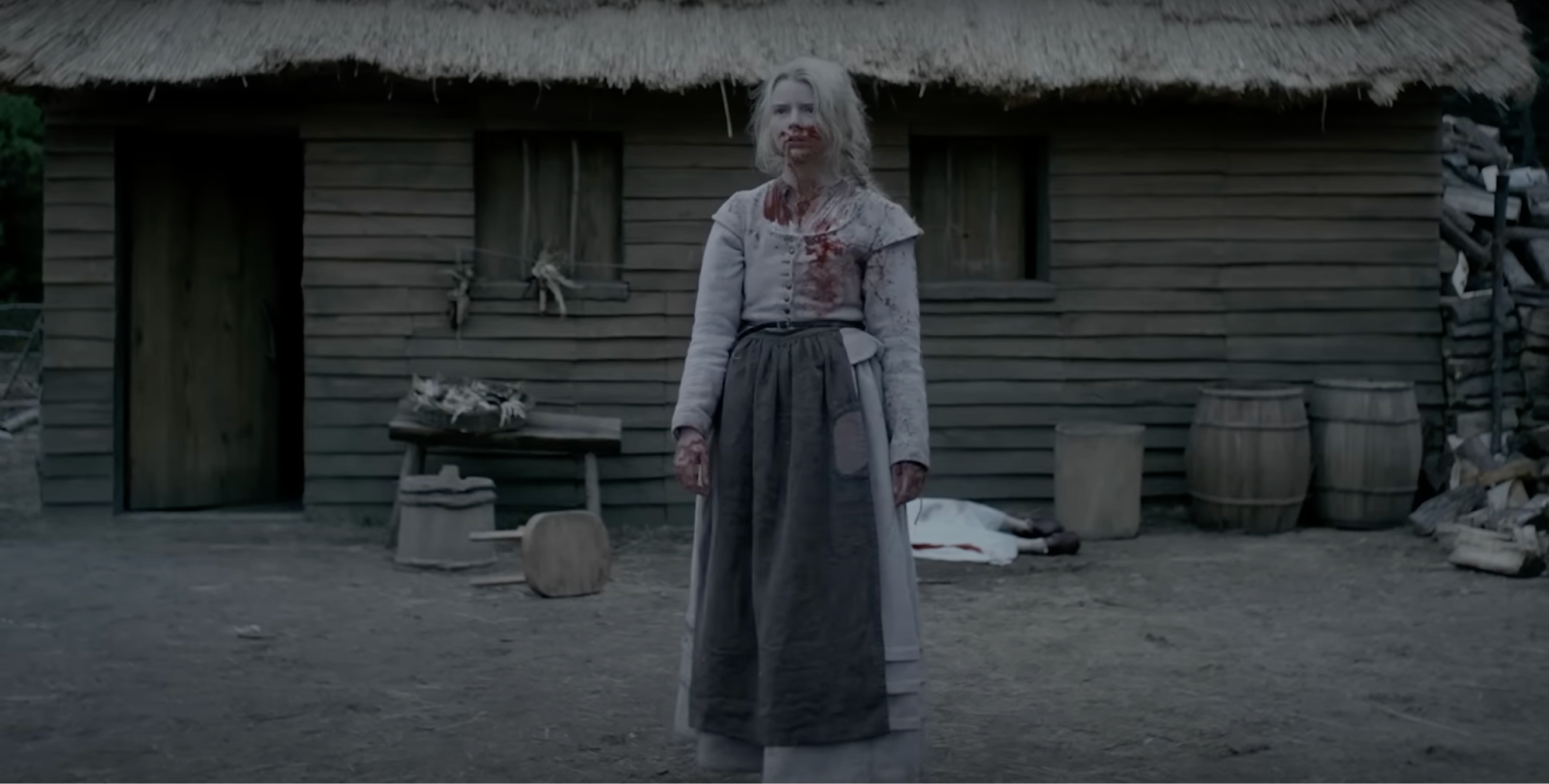
When Abitha’s husband dies in a strange hunting accident, she becomes a widow in 1666 New England—a dangerous place to be a woman alone. Soon the men of the village start conspiring to take her land, using a mixture of legal maneuvering and accusations of witchcraft. But when she stumbles across a horned creature from local legend, she strikes an uneasy bargain that might deliver her from danger… or drag her into something far worse. Slewfoot is both lush and brutal, offering a sharp examination of misogyny and prejudice.
On the last day of hunting season, four young Blackfeet men trespass on sacred ground and commit an act they’ll come to regret. The consequences are long-reaching—and they come on hooves. More than just a tale of supernatural vengeance, The Only Good Indians is a haunting novel of intergenerational trauma, guilt, and a past that refuses to let go.
Lotería might just be one of the most unique items on the list. Lotería is a traditional Mexican board game made up of 54 cards, each with a different picture. Cynthia Pelayo uses these nostalgic images as doorways into short stories that blend folklore and superstition, packed with horror and surprise. Lotería is an innovative treat and a love letter to the culture.
Mackenzie is plagued with dreams of her sister’s untimely death. Dreams where crows circle and the fog of guilt hangs heavy. But when the dreams begin to ripple into reality, Mackenzie knows she must return home. What’s waiting for her is the same heavy sadness she tried to escape… and an entity that’s only growing stronger. Bad Cree is a tale of suspense, grief, guilt, and the strength found in family and tradition.
A story of three women across time, bound by a legacy of witchcraft and danger. Minerva, a graduate student in 1998, is researching horror writer Beatrice Tremblay—a woman who vanished from public record decades earlier. The deeper Minerva digs, the more she uncovers fragments of protective symbols identical to those her grandmother learned as a girl in rural Mexico, where Alba once used them to fend off a dark presence. Now, that presence may have its eyes on Minerva. The Bewitching is a powerful tale of legacy, resistance through storytelling, and the defiance it takes to survive as a woman in a world that wishes to silence them.
When Sam returns to her childhood home in rural North Carolina, she finds it’s nothing like she remembered. Her mother, once chatty and warm, has been broken down into someone guarded and overly polite. The house they once shared has been stripped of its color and personality, reduced to white walls. Sam quickly realizes there’s something very, very wrong in the house. A House with Good Bones is a story about generational trauma, independence, and the need to break free from oppressive traditions that do more harm than good.
The Hotel is a unique collection of 15 interconnected stories, bound by the same cursed location and the legacy of a witch drowned in the marshy Fens. A sin that echoes again and again in the hotel’s twisting corridors, the violence a permanent stain. Each chapter that comes after is narrated by a different woman, ranging from guests to porters and even the hotel itself. With them comes quiet grief and dangerous secrets, filling the rooms of the hotel with a smothering suffering that will stay with you until the last page.
Red algae blooms poison the bayou surrounding the town of Mercy, twisting and mutating everything that lives within it. As townsfolk begin to disappear, the domineering harbormaster demands Noon capture the monster that’s been hunting them—a creature that sounds all too much like the water spirits in her family’s legends. But the red algae is affecting more than just the fish… and what it’s doing to Noon may be more dangerous than anything she’s been sent to hunt.
Excerpt from The Orange Notebooks by Susanna Crossman
I remember this:
We’ve just got off the Channel ferry. On the motorway, we’re heading to London. In the backseat, you say:
“Mama! Mama! The wire things are round and then go straight.”
“Sorry, I can’t hear.” I overtake a yellow Spanish lorry, glare at the driver beeping his horn. “Speak up, buba,” I yell, tired from the overnight crossing. I didn’t sleep.
“Mama, the wire things!” you shout. “The wire things are round and then go straight!”
“Be quiet, buba. I am driving!”
A sports car with the number-plate LUV U is close behind me. The driver flashes his lights.
“But Mama, the wire things by the road. . .”
In the rear mirror, I see your small finger. From your car seat, it points to a pylon. By the road, the wires reach into the horizon. Heading out to nowhere, they seem to come from the sea. The past is behind us, I think, and wish I was still on the night boat, being cradled by the swell. Briny billows. Sailing into great waters— You interrupt my daydreams:
“Mama, the wires go round and then straight.”
Glancing up, I notice that from a distance, the curves dangle like crescent moons. As we approach, the wires seem to flatten into straight lines. In my mirror, the lines continue and then disappear.
“That’s an optical illusion.” I explain, because I am a mother and, buba, it is my job to give you instructions about the workings of life. I try to tell you the rules, about danger and love, and all the things we cannot see. “An optical illusion means things are different to how they appear. An optical illusion.”
“An illusion. An illusion,” you repeat.
I look up at a road sign. We’re sixty-three miles from London, yet already I can smell Edgware pollution and fried fish, and I feel the dry powder on my mum’s skin.
In the back of the car, you whisper, over and over again:
“Illusion. . . illusion. . . illusion.”
“Illusion” is an eighties song by the group Imagination. One of my mum’s favourite tunes. As I drive on the motorway, it echoes in my ears. The world is just an illusion.
It is June. Two years later. France. Early afternoon. I go to ring the bell. A bee flies past my ear, landing on the brass door handle. Six black legs. A quiver of fur. In my mind, thoughts swarm of nectar, of the honey cake my Aunty Deb baked, a bittersweet mouthful, swallowed and gone. For an instant, I wonder about bee-killing pesticides, bee stings, pain, and draw back my hand. In Europe, there are almost two thousand species of bees. I know they are under threat. Recoiling, I think of the movie Lou watched, hour after hour, as children do in the comfort of evermore. The film, Bee Movie, portrayed bees as humans: the bee mummies and bee daddies with two bee children. Bee mornings. Bee afternoons. Clean bee nights. Bee school. Bee work. Bee retirement. Bee conformity. Bee longings. Bee love and bee hate. This humanising of the natural world is an outrageous anthropomorphic act we must not forget. The bee world has its own mystery: bees are born. Bees die. The bees are dead. The bees are buzzing. The thoughts rattle inside me. I am an empty can. No filling. No stuffing. A mother with a dead child is no longer. A mother with a dead child is a joke.
Closing my eyes, I listen to the bees. They are flying through labyrinths of grey-green stalks, gathering pollen from pale mauve blooms. The scent of lavender coats the air. A slick veneer. The sudden heat of French summers. Siesta hour. Sweat trickles down my back; the drops draw damp lines. There is an orchestral stillness, a muffled silence I know well. It seems like an odd moment to come back, while the whole world is sleeping. As though everyone is waiting, and here I am. Finally, de retour with the lavender, the sunflowers and the fig tree in the garden. Even the cicadas seem to be resting; the only thing I hear is bees. Some legends say bees never sleep and they go on and on making honey.
Over ten years ago, on the only occasion that we met, my late Basque mother-in-law, Katixa, gave me fair warning about bees. Inside the kitchen of her cold two-hundred-year-old house, nestled in the Spanish Pyrenees, we drank hot cups of moss-coloured verbena tea sweetened with chestnut honey. Outside, mist collected on every corner. It hung over the half-timbered house, drifted in green valleys, and shrouded the steep mountain peaks. Rain fell in a soft drizzle. Water coated everything, and it felt like we were floating inside a cloud. At her table, Katixa turned to me. Her grey hair was short and neat round her heavy face. Placing her hand on my shoulder, she said to me quietly in French, for it was the only language that we shared:
“Anna, when any death occurs you must go and tell the bees. You should knock gently on the hives. Inform them of the passing. Tell them the name of the deceased and their age. You must not forget to ask the bees politely to produce wax. Their wax will make the candles to light the path of the deceased, so they may travel safely to the other side.”
In the garden, I am wondering whether the bees have been informed, when I am startled by Antton opening the door. On my way here, I practised a speech to tell him: 1) where I had been; 2) what had changed; 3) what I had understood. But he looks furious, and I step back and trip over my suitcase. Before I can say “bonjour” or “hello,” Antton blurts out:
“I can’t believe you’ve finally come home.” Shaking his head, he strides back inside. Behind my sunglasses, tears form. Antton cannot see, which is a relief. These lunettes make my face feel at home. Inside here, I am safe. Some things shouldn’t be opened. Outside there are monsters, sieges, and storms.
I step into the hallway of our house. My feet shuffle and hesitate. One of them inside and the other out. Suitcase in hand. Seven years earlier when we bought La Place, the estate agent described it as “un petit château perdu.” We joked about, “our little lost castle,” bought cheap due to a leaky roof and bad wiring, miles away from everything, except for the farm down the hill. The farm called Devant-La-Place, In-Front-of-The-Place. It is time to come home. Where to begin?
Antton paces the stone corridor in his beige trench coat. Underneath, he wears a white-ironed shirt, dark trousers, and trainers with the laces tied in neat knots. His hair swept back. New white strands in the black. He looks older, like something I once read about becoming a whisper of a man. Yet he’s still carelessly refined. After all this time, I have never understood how he remains elegant in all circumstances: working and living, birth and death. But it is the trench coat that worries me.
As he walks it flaps around him, fabric brushes against fabric and makes a swish, swish sound. The coat is too severely belted for such a hot day and should be worn unbuttoned. I want to warn him: the belt is a tightening noose. By the granite staircase he turns, pulls on the buckle. The beige colour is insipid to my eyes. I feel it gnawing in my stomach, and however much I reason with myself this feeling will not go away. Antton’s mouth twitches, as it does when he is angry.
“I’m going into town for a school meeting.”
“Could I come in with you?” I ask. “We could talk in the car. I can wait while you work. . .”
He nods and comes toward me, smelling of coffee and cologne. He kisses me. Not on the lips. His kisses land on my cheeks. Two times. Old school. La bise. Inside I smile, but sadly, I’ve always liked his formal ways. It is one of the reasons I fell in love with him, his mixture of ceremony and despair, and his ability to quote philosophy and poetry, lines of Heidegger, Foucault, Plato, and Celan. “We are made of words,” Antton said, and we joked that we had grown up in bookless houses and were building our own library in the château, and that books belonged to everybody and books could change the world. We knew that once you were inside a single book it led to other books. Each single book was a library, a universe. Long ago, word after word fell in a delicate rain, and the words became a lake from which we drew our water.
“How are you?” I move backwards. I can’t touch the beige coat; I don’t want to get too near. Antton shrugs his shoulders and takes in my tracksuit trousers, crumpled T-shirt, dirty hair. The shades. The journey to get here was long. I hope he cannot smell the whisky on my breath. The bottle is in my suitcase, wrapped in clothes, stiff with salt water. But I will not drink again.
I can’t touch the beige coat; I don’t want to get too near.
“I can’t believe you’ve finally come home,” Antton repeats, but this time with less anger and more defeat, and I want to take him in my arms and apologize. But he adds, “I’m leaving in thirty minutes. Don’t be late,” and disappears into the kitchen.
It is a struggle to carry my suitcase up the limestone steps. At the bottom are things waiting to be taken upstairs (a blue jumper, a stack of unpaid bills, a screwdriver, and a plug). At the top, I know there will be things ready to be taken down. For seven years stuff has ascended and descended this way.
Now, my legs wobble as I notice Antton has added more books to the piles on each stone step: a new biography of Freud, editions of the local newspaper, Sud-Ouest. A copy of Orpheus by Cocteau with lithographs. This play, I once told a class, was “Inspired by the Greek myth of a grieving troubadour, his descent to Hades—a katabasis—to find Eurydice, his dead wife. It’s been revamped a million times. The story told a different way. Cocteau included mirrors—troubling gateways to the underworld.”
“Greek and Roman gambling,” Antton called the classic myths. “Gods playing at the cosmic game of life.”
Snakes and ladders, I think, heading upstairs, everything rises and falls, comes and goes. But the Ancients are still everywhere. Our shelves are lined with les belles lettres, red volumes and mustard copies of the Orphic hymns. “Your house is like a bookshop,” visitors joke. But, as I reach the landing, dust jackets curl, and piles of books topple onto the floor. All the paper feels suffocating, and in the heat, it smells of mildew as though mould has attacked the core. Antton has accumulated stuff while I was away; he’s been building a shelter to hide from the storm.
At the top step, my foot hits the corner of a stacked collection of second-hand French detective novels: Cet homme est dangereux by Peter Cheyney and Pas d’orchidéespour Miss Blandish by James Hadley Chase. Covers show revolvers, cadavers, and long stockinged legs. Each Série Noire is printed in yellow and black. Books striped like buzzing bees. It makes sense, I think. My Basque mother-in-law was right. The bees need to be informed.
Outside our son’s room, Antton has piled more dusty cardboard boxes. Inside one is a collection of Basque comic books written in the Latin alphabet that Antton always wishes he knew. Glancing over, I see the comic books are stories of separatists, berets, and gastronomy. Witches and mountain cheese. I wonder why he’s bought books that no one in our house can read. Antton often tells people, “All I have from the Basque language are the two awkward T’s in the spelling of my name.” But I picture these T’s like trees with outspread branches. They hold his centre.
Wiping the sweat from my forehead, I go into Lou’s room, put my suitcase down, and slide onto his bed. Around me are Lou’s toys, clothes, and his drawing stuff. Everything is the same yet Lou isn’t here. He is gone. My Lou is gone. Months have passed since I last lay here, but the grief remains, and it falls on me, a tumble of pain. If I could give it a shape it would be a boulder, a weight. Every day, I topple. Every day, I’m felled. Yet, his death has been easier when I am beneath this rock, resting in the dirt, next to Lou.
“It is more suitable,” I told my psychiatrist, Dr. Vidonne, in one of my first sessions, “when I don’t try to pretend things are normal.”
On his bed, I ache for him, in my heart, my belly, my womb. Twenty-two bones in my head miss him, and the rough grain of my senses remembers his skin. Those two square metres that my doctor friend Rachel told me are the largest bodily sense organ. Cutaneous receptors captured Lou’s touch, the feel of his small fingers, and his arms tight around me, tickles and hugs. My baby is stuck in my deep skin, absorbing shock.
A crack runs across the ceiling plaster, reaching the light. The dangling lampshade is patterned with stars, and it sets me thinking of orientation, and the damp map in my suitcase. Yann gave it to me on our very last morning together, to show me our path and notre destin.
“There must be hope,” Yann insisted, and traced our journey on the blue paper sea. At the port, we prepared to leave as the sun rose. Beneath the dawn sky everything was still, and we could never have imagined what would happen that day. On the deck, Yann’s eyes scanned the waves. “Don’t forget. Without hope we cannot breathe.”
Clutching the duvet, hope shifts inside me. Things have changed, and I don’t want them to be the same.
During the weeks I was away, I often pictured Lou’s room. Late at night, or early morning, when I couldn’t sleep, I imagined my head on his pillow, the starry lampshade swinging above. Since he has gone, the room hasn’t been touched. Small folded T-shirts and crayons gather dust. No one is allowed to tidy or clean. For inside this room are particles of Lou, flecks of his skin and strands of his hair. Tucked in his sheets, I glance over at a mirror on the wall. Lou spent hours playing here. Eyes wide open; he plunged into a trance, frowning, grinning or opening and closing his eyes. His hand stroked the glass, an incomprehensible door.
“Hello,” I remember him saying, “Hello.”
In his bed, his soft toys surround me, and I press my face into worn fur. A cocoon of fuzz: three stars from his godfather Miguel. A teddy. Two unicorns. Beside me is Lala, a small fluorescent pink rabbit that Antton won at the local fair. White stuffing leaks from a rip. Absentmindedly, I tug at this hole. Often, Lou pulled at Lala’s stuffing. Now, I roll fluff between my fingertips, repeating his gestures as if Lou’s movements were a dance and if I learn the steps, I’ll bring him back. It is wrong but somehow right, and I cry and cannot stop.
Then I remember—must unpack. But when I open my suitcase the orange notebooks are on top. An amber pull. Turning pages, I read jumbled sentences, and a series of obituaries. During my time away, I collected announcements of death, French notices nécrologiques, for: Monsieur Roger Aguinet, a happily retired butcher, the much-loved Madame Louise Pennec, the beautiful Clotilde Tressier, and the erudite journalist Marie-Bernadette, devoted Ingrid, Paul the husband, Alain and Nicole. Hubert and Dominique. Karine and Ingrid. Loved. Cherished. Beloved. Never forgotten. The last name on the page is in capitals. Letters scratched in blue. They stand five centimetres tall. LOUIS.
When I finally admitted to Dr. Vidonne that I was keeping these notebooks, she looked at me curiously. I’d never mentioned them before because despite trusting her I was frightened she would want to read each private page. I muttered, I was always muttering with her:
“It is so difficult for me, even now, to get things to make sense. Everything blurs. Me. Lou and Antton. There is so much wreckage. Irrevocable blank spots. All this.” I waved my arms in the air as I often did when I spoke, “It does not stop. But when I write in these notebooks it’s different.”
Dr. Vidonne said:
“Writing it down may help you to remember what came first, what came after and next.” Then, she looked at me with that slow stare of hers, and whispered, almost tenderly, “Write it all down, Madame. Write!”
At La Place, Antton appears in the bedroom. When I sit up, the sight of his beige coat is too much. “I’m not coming with you,” I tell him, slurring slightly. In the mirror, I catch a glimpse of myself. It is as though my face has been left out in the rain. My hair stands on end. My eyes are swollen and red. White fluff is stuck to my chin.
“I can’t believe it!” Antton shouts, and then he lowers his voice. “You’ve only just got back and you’re already playing games. I don’t even know where you went with that sailor, the man from the hospital. Do you know how terribly worried I’ve been?”
Antton storms out and slams the bedroom door. Seconds later, he yells “Merde!” I hear the sound of tumbling books, and imagine the yellow and black Série Noire falling. An avalanche of books. A swarm of bees.
I read in my notebooks:
The word swarm designates a cloud of bees or insects. There is a general sense of a large dense throng. But in old Norse “swarm” is also connected to the word for whispering. The bees are whispering, and I cannot decipher their code.
My hands tremble, and I wish I had talked to Antton, and I hope that when he gets back I find the words. I begin to think about his school meeting, and then worry about the beige coat. It is like a bird. This fact is apparent, and I am not sure where it is flying next. I pick up another orange notebook, and with a blue biro I try to draw the trench coat’s shape. The front angles of the coat stretch into vast, flapping wings. The collar rises into two horns, or eyes. It isn’t clear, and my sketch is badly done, but I am trying to depict the coat as a gigantic bird.
This beige bird, I suspect, is linked to Lou’s death. But Lou is not the only one, there are other names, everything is connected and I will write to my local magistrate. There is a list, and it will form part of the case condemning the coat, not Antton, but the power leading the beige.
For a while, I have realised people think I am going crazy, so methodically I have prepared my case, documenting my theory with hard facts, ascertaining what is behind the plot.
Closing my eyes, I think I will explain everything to Antton later, but when I push my nose into the duvet, I catch my buba’s scent. For a happy moment, I inhale Lou’s little boy smell, and everything returns. . .
It all began nine months ago, last September. Before, everything was different. Two hundred and thirty-seven days ago, my world spun, rolled, and crumbled. It is like a pregnancy wound backwards. Before that I was a language teacher, a reader, a lover, and a mother.
Back in Monsieur Kassar’s school, the Centre Via Langues, I taught English to students from all walks of life: tourism, business, medical, and literary. It was a way to make a living, and I wrote on paperboards and led conversations, explaining the difference between the phrasal verbs “getting on” and “getting off.” Each week, Monsieur Kassar, an amateur poet, placed a single rose in a vase on his desk, “in memory of the Lebanese Bekaa valley of my childhood where thousands of roses are grown each year.”
“You’re sentimental,” his wife complained.
“I am romantic,” he replied. “We are symbolic animals. We need metaphor.”
When I finished work, at home, I played dinosaurs with Lou, moving plastic models from sofa to floor. Some evenings, Antton and I discussed future renovations for La Place, for everything was unfinished, needed re-wiring, and tiles fell from the roof. But “It will be done when we have time.” We threw our hands up into the air because “que sera.” Instead, I read Duras in bed, and when the dawn lit the garden at La Place, I had sex with Antton. Days began and ended and, for six years, time turned that way.
Then, nine months ago, Louis went.
We were unhinged from the axis of the earth. A creak of tangled iron. A groaning fall. But perhaps the beginning is elsewhere.
Golden light fell into darkness, and we went to meet death and tried to journey to the end.
Maybe we could draw the starting line at the moment Yann (the boatman) and I met, the day I arrived at the hospital, or four months later, when we climbed over the wall. That June night when we left, I barely knew Yann, but it felt like a lifetime had passed between us, as though we’d been young and grown old beneath the moon. Golden light fell into darkness, and we went to meet death and tried to journey to the end. At least, I think that is what we were doing, for I am still trying to understand. It was the journey of a mother (me) refusing to abandon her child. Alone in the underworld. Alone in a non-world. I was a woman who had lost time, who went to look for the end of time. At the start of time, I found something else.
Or. . .
Maybe everything began the August day our son was born, and we chose his name. For a name can be a fresh beginning, and we wanted a name that started anew. We wrote down names for both girls and boys: James, British names, Marguerite, French names, Hannah, Jewish names. Arrosa, Basque names, Pierre, classic names, names of poets, writers, and philosophers. Finally, we chose Louis, as it suited our baby, and the pronunciation was similar in English and French. From that day on, we called our son: Lou, Louba, little Lou, mostly I called him buba.
But, after his death, I wanted Antton and I to be the only ones allowed to pronounce his name: the soft “L” followed by the voiced OU and the unvoiced IS. Louis. In silence, my lips say his name, and I call him: Louis.
Or. . .
The beginning could be the once-upon-a-time summer day I met Antton, when I was working on the ferries. The ship sailed across the deepest part of the Channel. A red line tracked our path on a TV screen. Without this meeting, our son could not have been born. A child demands a name, a place, and a destiny.
That eighteenth summer I began to equate liberty with water and got to know the sea. To start my first job, I had travelled down from London. A turn on a coast road revealed a vista, a vast blue-green. Water moved as far as the eye could see. Fourteen years ago, something rose inside me a bit like a fighting energy. Winds spilled across the surface. Tides rose and fell. Water also forms this story. There is a surface and a deep. Froth and abyss. Water has currents. It pushes and pulls our boats.
Or. . .
We could go back earlier, to a linguistic initiation, when I was five, and my mum paid our neighbour Betty to teach me French, sparking off my love for the langue française. I learnt the lyrics to the song “Alouette” and sang about larks plucked from wing to tail. French became my second language, unlocked another world. And later, that morning bird flew me from suburbia across the sky to the ferries and Antton, to the other side of the Channel. In France, I spoke and translated birth and death. Louis and I lived and died in two languages. Gentille alouette. Kind lark.
Or. . .
I could start with my roots, dig into the past, the clay, my land, my geology, the scraps and clutter of my origins, my absent English Christian father, my omnipresent Jewish mum, Helen, Aunty Deb, my stepfather, Cyril. My family. Floating around is what they also call “the gift” which I still can’t grasp. Sometimes, it feels like a river runs fast through my veins, and I must follow its course. Is the gift the fact that until last year I was never scared? Aunty Deb called me a “plucky kid,” because I was headstrong and once slapped the school bully for calling my best friend, Rachel, a “Paki.” Or is the gift my solitary, awkward character? Because since I was small, I don’t fit-into-the-crowd, can be charming or haunted by a black dog, a sullen fury. The “gift” was bestowed on Aunty Deb and her mother, my great-great-grandmother, who in 1912 foretold her own death on the Titanic.
My friend Dr. Rachel says superstition is all in the mind. She told me, “It’s just the brain taking a break. A recent study in Helsinki showed that sceptics possess greater powers of cognitive inhibition. They have the ability to reject superstitious impulses.” According to neuroscience, giving meaning to randomness is the easy way out, the basic reaction. Yet, the water inside me does not stop trying to reach out and find the answer.
For the past few months, I’ve written about this in the orange notebooks. Pages and pages trying to find the start. But what are beginnings? Shifting, treacherous things. It is like trying to identify the movement between silence and sound. Lou took piano lessons, pressed small fingers on the keys, and I tried to see when sound emerged or went. It was almost impossible. Beginnings are harder to pinpoint than ends. Full stops are a sign to show where a sentence is completed.
“Read to the end,” Lou always said when we had stories at bedtime and it got too late, “Don’t stop in the middle, Mama. Not the middle. Get to the end.”
In his room, it strikes me I need to finish the story. Put the parts of Lou together before it is too late. A Roman philosopher believed that after death there is a scattering of the union. This scattering is forgetting. Things get washed away. I must gather everything I have written in the orange notebooks. Lou cannot be left stuck in the middle. These thoughts sound like a pulsar. A rapid breathless beat.
An urgent plan emerges from the crack in the ceiling, the lavender, old books, and the nectar-drunk bees. Recently, I read that 9 percent of European bees are threatened with extinction. A red list has been made. Things have happened to the bees: habitat loss, pesticides and fertilizers, urban development, and climate change. Things are getting lost. Bees and boys.
Frowning, I write in the orange notebook:
Assemble Lou. Every memory, recollection.
Explain the journey I have been on. What I’ve understood.
Tell Lou his story. My story. The story of Antton and I. Tell him the things I never got a chance to say.
I must put Lou in the right burning place in my heart, for my baby wanders; he haunts me, day and night. Sometimes, I feel his small hands clinging to my legs, and his grip stops me from advancing. He is calling me. Yann heard him too. Antton may have caught Lou’s whispers, but we couldn’t talk about this. It was a pain that hurt too much if we went too near.
Lou is lost, and our little buba is adrift. He roams between worlds unable to find his way home. Lou should have lost his milk teeth, finished childhood, become a teenager, grown into an adult. He should have, I have said to myself so many times, because “should have” is a conditional tense, expressing a past expectation that was not met. I taught this to students, wrote on a blackboard:
We use “should have” to describe a situation with regret, where we wish to go back in time and transform an event. A “should have” clause is often followed with a BUT.
Lou should have been here BUT he is dead. Death is definitive. Death will be definitive. The grammar tense does not change.
Yet, I wrote in the notebooks:
Orpheus went down into Hades to get his dead wife, sang songs charming the underworld. He did the impossible: wept 247 litres of tears. Used 350 boxes of Kleenex bought in bulk. He spent sleepless nights reading thousands of self-help books. Orpheus implored to a gaggle of Olympian gods, who told him grief had five stages he should accept. But Orpheus couldn’t follow that path. “I mean,” he told them, “I can’t erase my wife’s photos from my timeline. She’s been there for 2,000 years.” Instead, he dared to pass through the Gates of Tenaro, and the dark torrents of Styx to reach the place of the dead.
As for me, I’ve read the book, got the T-shirt, seen the movie, and re-told the story. I am a mother with a dead child. A not-mother, stuck between worlds.
I am writing these notebooks. All of it is here, even if my psychiatrist said, “There are memories we’ll never recall, and our memories of things can change. It is a healthy process for everything we have known to evolve. The present affects the way we understand the past. Memories are living things.” Dr. Vidonne used the word “vivante,” which means “living” in French. The opening “vee” sound feels buoyant and fresh. On the periodic table, V is the symbol for vanadium, turning certain emeralds a milky-green. Green is a sign of life. In the lush Basque valleys, the word for life is bizitza, pronounced bee-zitz-ah.
When I have finished writing, I will try and get the notebooks to Lou, I can teach him languages, about bees and the chromatic wheel. If he is growing up somewhere, he can read this when he is ten, eighteen, or thirty-four. He can flip through these notebook pages in his forties or fifties. He will be older than me.
Snuggling under the covers, I glance at myself a final time in the mirror.
I forget to take off my sunglasses and fall asleep thinking about bees.
The majority of our waking hours are spent in some relation to work: commuting to/from work, thinking about work, and doing the work itself—insert argument for reduced work-time models, insert argument to stop asking people about their dream job—so of course it makes sense that our jobs find their way into our writing. But ten years ago, when I was in the thick of working as a wilderness guide, I would not have predicted that this job would become the basis for Level Watch, my first book.
Level Watch is based on my time working in wilderness therapy for a substance-abuse treatment center in the Blue Ridge Mountains. As guides, we shepherded people—most of whom were undergoing radical transformations—safely through the backcountry. I started writing the book out of a need to process the experience; I thought of it primarily as an elegy. It wasn’t until I’d been working on it for a few years that one editor told me she considered it an “untold story of the opioid epidemic”—the perspective of a treatment center employee.
In honor of Labor Day, I’ve compiled a reading list of other contemporary poetry collections with dispatches from jobs—a nursing home, KFC, a tech company—as well as commentary on labor itself. I appreciate the candor and complexity with which these writers convey such varied accounts of work—and if you contemplate your relationship to work even half as much as I do, I think you’ll appreciate them, too.
This coming-of-age book contains a series of “Requiem” poems about working on an orchard as a boy. de la Paz utilizes a “we” that transcends the speaker’s singular experience: “…how we each knew we were getting ripped off and how the filthy / dollars we’d wad into our pockets couldn’t buy us a fuller river, time…” Our earliest jobs are often where we learn how we’re viewed by others and therefore what roles we’re expected to fill in the world at-large. The boys in these poems earn “quick dollars / doing nothing except being boys, learning without comprehension, / the difficult industry of men.”
Here we read about various temp jobs. So many ways to make so little money. There’s also a quieter thread: Kunz’s poems remind me of the government’s role in our financial (in)stability. “An election happens,” we read in one poem. It’s a slipped-in, standalone sentence without fanfare, but in a poem titled “Squatters,” I would argue it’s offering commentary. In “Account,” money owed to an ex will be forgiven if the speaker will allow the ex to claim him as a dependent on her taxes: “I couldn’t believe / my luck. I let myself be claimed.”
Harrington’s poems describe the senescent body in unflinching detail that only an intimate caregiver could provide. There are moments when the nurse aides show tenderness through their competence (“Efficiency too is loveliness, is mercy. / The sheet smoothed beneath a naked haunch”) and moments when readers witness the opposite (“There is a way to drop a body atop a hard mattress, / to scrub gentle parts too hard”). Caregiving is complicated work—often moralized and underpaid—and there’s a bravery required to describe it so honestly.
I once bussed breakfast tables at a fancy hotel where all employees could eat free lunch in the staff cafeteria, but you weren’t allowed to change out of your uniform first. The higher-ups ate in their business professional clothing, so the uniform felt like a way of keeping the service workers in our place, like branding us. Tribble, in his book about his years working sixty- and seventy-hour weeks at KFC, articulates the potency of a uniform in “Polyester:” “Whatever our religion these were our vestments / now and until we disrobed … the wear and tear sure to mark us in more indelible / ways than any fabric could ever hope to cover up.”
A central thread in Stevenson’s book is the sexism within the tech industry. Her boss informs her: “the glass ceiling was high / but it was there.” A moment like this comes as no surprise after reading, in the title poem, about a department where women are sent after filing harassment claims: “each woman has her own fax machine / to do her pretend work: messages scribbled / on lightweight paper and sent / to nowhere.” I find the “pretend work” particularly devastating. In the world of this poem, a company would rather pay women to do futile tasks than to rectify a misogynistic culture. Yet another poem features women turning into inanimate skyscrapers. There’s a disembodied tone that unifies the book. The poems speak with a clinical distance, a sterile remove that is reinforced by the book’s title.
“When I stepped into the stilted trailer the crew knew I was because of a dad.” Bambrick does not write, “I was there because of a dad,” and the omitted word gives us pause, makes us reconsider what we might otherwise quickly read, accept, and move on. Through both the narrative content and the careful attention to syntax, Bambrick lays bare and upends our expectations about class, gender, and sexuality in this collection about working on a garbage crew. What for one person might be a lifelong career in manual labor, for another might be a casual summer gig brokered through a family connection. The demands on the body are viewed differently when temporary. Bambrick consistently juxtaposes people, images, and experiences in ways that invite serious inquiry.
I often hear the term reproductive labor used to describe unpaid work like cooking, cleaning, and taking care of children, but I hear it less often to describe the labor of bearing children. We call childbirth labor yet not the pregnancy itself. And what’s talked about even less is the work it can take just to reach the point of conception: “I bled through the napkin put there to be bled on … My uterus, a knocked-out tooth / of dark dye on the X-ray.” Many people labor to become pregnant in the first place. The title of Moffett’s book cleverly alludes to two kinds of labor: making a living as earning money, versus making a living as creating new life.
At its core, Seam follows in the tradition of poetry of witness or docupoetics, but bearing witness—especially to atrocity—is also a type of work. A humanitarian labor. This harrowing book documents accounts from women who were raped and tortured during 1971’s Bangladesh Liberation War. Faizullah’s poems and her positionality are both rigorously considered. In “The Interviewer Acknowledges Shame,” the shame arrives when the speaker “begins to write about it in third person, / as though it was that simple / to unnail myself from my own body.” The labor here is not just in the gathering or writing, but in refusing to look away. This is a kind of work that goes far beyond occupation. It is difficult, and it is necessary.
The most vulnerable scene in Materialists, Director Celine Song’s sophomore feature, isn’t a love scene. It’s not when John, a down-on-his-luck artist played by Chris Evans, repeatedly declares his love for Lucy, his ex and matchmaker for New York’s elite played by Dakota Johnson. Nor is it during one of the many dates Harry, Pedro Pascal’s character and a successful private equity man, takes Lucy on.
It’s a scene in the kitchen where Harry tells Lucy he had surgery to make himself six inches taller. He has opened up to her. The pair has revealed the cosmetic “investments” they’ve made to their bodies with the hopes of finding love, Harry by detailing his surgery and Lucy by gesturing to her nose and breasts. Harry is vulnerable, crouching at one point so Lucy can see how short he used to be, turning away from her when he admits he’s afraid he doesn’t know if he’s capable of falling in love.
It’s the one moment in the film where I believe they could end up together. It’s also the scene where she ends their relationship. It’s become too transactional. “Isn’t marriage a business deal?” Harry asks. “Yes, it is,” she responds, “but love has to be on the table.”
You get it. She returns to John, deciding that love, true love, is more important than money. It’s a familiar storyline. Films from Titanic to The Notebook have featured women falling for broke men. But instead of rejoicing in this outcome, audiences felt disappointed. Many a TikToker called the film “broke boyfriend propaganda,” crying “justice for Pedro Pascal.” Filmgoers didn’t want Lucy to choose love over money. They didn’t want her to choose money over love either. They wanted her to fall in love—with a man who happened to be rich.
Song is reluctant to engage with the difficult economic realities that might make a modern day New York single marry for money over love.
They wanted the ending that befalls so many of Jane Austen’s heroines. Song has called on Austen many times in the film’s press tour. “It goes back to Jane Austen, right?” she told Harpers Bazaar of working on a rom com. “Jane Austen was the first to do it. I just feel so lucky and honored to be part of a lineage of a very long-lasting and resonating genre.” To The Nightly, she said, “The question is how can a romantic film, and I believe my movie is so romantic, talk about finance so much? … My answer would always be, well, that’s true in every Jane Austen book.”
But part of why it’s difficult to take the film’s critique of class and matrimony seriously is that unlike Austen—who blames her heroines’ financial precarity squarely on patriarchal structures—Song is reluctant to engage with the difficult economic realities that might make a modern day New York single marry for money over love. Lucy isn’t worried that she and John will be unable to make rent; she’s worried they won’t be able to go to upscale restaurants. John’s lack of wealth not only doesn’t threaten Lucy’s ability to survive in the city, it barely even threatens her lifestyle.
When John and Lucy were first together, they were both struggling actors, but by the time we meet them in the film, Lucy has found professional success. She’s a matchmaker with nine weddings to her name at a high-end firm for wealthy individuals. She lives—somewhat implausibly—by herself in a one bedroom apartment in Brooklyn Heights. It’s on the smaller side—a nod to the kind of space she could afford in a wealthy neighborhood—but comfortable, and crucially not a studio. It feels both newer and less cramped than John’s apartment. It’s difficult to earnestly believe Lucy when she says “I’ll be living in your shitty bedroom,” because why wouldn’t theyjust move into her apartment?
Economic precarity—especially in New York City—is real. According to Zillow, rent in the city averages nearly $3,800 per month; it’s fair for people to consider the economics of their romantic matches. Materialists understands this reality, but it doesn’t go so far as to critique it. Other than a passing remark about her debt, Lucy seems to be thriving. While it’s questionable that she can afford her lifestyle on her self-proclaimed salary of $80k before taxes, the film doesn’t really show her struggling. Instead—as with Carrie Bradshw, Monica Geller, and many a New York heroine—we’re meant to suspend our disbelief. Of course she can afford the gorgeous apartment and high end clothes on a modest salary. Don’t do the math.
Since John’s economic precarity doesn’t seem like a true threat to Lucy’s livelihood, viewers are left to assume that the real reason they can’t be together is that she doesn’t want to be the financial breadwinner in her relationship. Throughout the film, she’s ambivalent toward her job: She compares it to working at the morgue or an insurance company, repeatedly tries to quit, and doesn’t care about being promoted.
Lucy aspires to what many have called a “soft-girl” life.Defined by TikToker museumofmia as a desire to “live my life slowly and lay in a bed of moss with my lover,” soft girls aren’t interested in the kind of corporate, girl boss feminism that dominated the culture in the mid-2000s and the 2010s. They want to engage in self care, meditating and developing elaborate skin care routines. (It’s worth noting: most of these influencers aren’t actually opting out of paid work; they’re content creators).
While the film doesn’t explicitly identify Lucy as a soft girl, her life is aligned with the movement both aesthetically and in her actions. She’s not trying to climb the corporate ladder, but she relishes in luxury—designer clothes, posh apartments, fine dining. It’s a far cry from the romantic comedy heroines of the 90s and early 2000s, who had professional as well as romantic aspirations. Bridget Jones was trying to build a media career while searching for her Mr. Right; Andie Anderson in How to Lose a Guy in Ten Days tried to leverage her dating column into a career as a serious journalist; You’ve Got Mail’s Kathleen Kelly wants her indie bookshop to succeed.
In some ways, the soft girl is a rejection of the demands that women “have it all,” an ethos those rom coms of the 90s and aughts espoused. But it is also just one step away from the trad wife. The self-professed goal of many women who identify themselves as soft girls is to become stay-at-home wives, mothers, and girlfriends.
You could read Lucy’s resistance to hustle culture as a criticism of the same capitalist structures that encourage people to view dating as an investment, something the film purports to critique. This seems to be how Song wants us to view it; she has said, in a now viral TikTok from Refinery29, that “so much of feminism has been about [being] anti-corporate and anti-capitalist. And, of course, it was always at the forefront of fighting classism.” But while Song is right that some strains of feminism have fought classism, it’s also important to remember that its objective has been to make sure women can live independently of men both financially and politically.
Lucy aspires to what many have called a ‘soft-girl’ life.
Lucy, by contrast, would rather be dependent on a man than financially independent in her own right.On her dates with Harry, she feels valuable because he treats her to dinner. When she stays over at his apartment, he makes her breakfast while fielding work calls as she lounges in his shirt. Why would she work, the film seems to ask, when her wealthy boyfriend can just go to the office and provide for her? Though Lucy ultimately makes a different choice in choosing John, it’s hard to read this as a rejection of soft girl culture when by the end, she’s still trying to quit her job without having a new position lined up or a clear plan for how she will support herself and John. She doesn’t need to be careerist, but it would be more feminist and more anticapitalist for her to acknowledge she needs to work, even if it’s not personally fulfilling.
This messaging is further reinforced through the film’s portrayal of Lucy’s clients: careerist women who have failed to find love. The film features two montages of clients detailing what they’re looking for in a match: one of men and one of women. Each features absurd requests. One of the men only wants to see women who are 27. A woman is looking for a church-going, conservative lesbian…in New York City. Lucy never loses it on her male clients. She smiles politely while they make their requests—no matter how offensive or outlandish. But to the women, she responds with disdain: “That doesn’t mean you’re due to get one [a husband],” or “you’re not a catch.” These consultations come after a moment when Lucy is having a crisis in her career. Sophie S., a long-term client of hers, has been assaulted by a man who Lucy set her up with, something the film never fully reckons with, and is glossed over as a mere plot point.
It’s telling that women are the only clients Lucy tells off. Men are entitled to get what they want, while the best a professionally-successful woman—the only kind who can afford Lucy’s services—can hope for is to settle for someone who is nice enough, a little short, and won’t physically harm her. In some ways, that’s a reflection of the culture we live in. Men continually ascend into positions of power even when they have harmed women, whereas women’s careers get sidelined by marriage and motherhood. But if the film aims to be critical of the culture that produces these outcomes, the intent is undermined by its apparent judgement of the decisions women make when it comes to both love and money.
Lucy, and her choices, act as a foil to those of Sophie and her other clients, leaving us with a portrayal of two possible paths for a woman’s romantic life. Lucy’s path—a disinterest in work beyond the luxury it gives her access to—leads her to a loving marriage. Sophie’s path—pursuing her career over romantic prospects, the film implies—has left her unable to find love. Sophie made the wrong choice, by Materialists’slogic, and she can only correct her mistake by working with Lucy to find love, even though the matchmaking company put her in a dangerous situation.
The message isn’t an entirely unprecedented one. Women in rom coms have long been expected to place their love lives above their own financial stability and careers.Andie in How to Lose a Guy in Ten Days chooses to stay with Ben instead of leaving New York for a job that would let her do some serious reporting. Joe in You’ve Got Mail shuts down Kathleen’s store. When women are professionally successful (think: Margaret Tate in The Proposal), they’re portrayed as shrew-like and in need of a man to soften and feminize them. Yes, these heroines tried to have it all, but if it came down to a choice between love and career, they chose love.
Given that Song was so inspired by Jane Austen, it’s worth asking how Austen was able to skewer classism and the patriarchy while empowering her female characters, and why Materialists falls short in comparison.
Consider Pride and Prejudice, Austen’s most popular novel andthe text Materialists is most clearly referencing. In Pride and Prejudice, we see a variety of marriages take place: Charlotte Lucas’s marriage to Mr. Collins, Lydia Bennet’s to Mr. Wickham, Jane’s to Mr. Bingley, and, of course, Lizzy’s to Mr. Darcy. Jane and Lizzy’s matches are driven by love, but Lydia gets married to avoid scandal. Charlotte marries for economic security. For the most part, Austen isn’t judgemental about these options, nor does she shirk away from the real financial precarity the Bennet sisters will face if they fail to marry. The book is straightforward about their options: losing the house and depending on relatives or becoming governesses for other families, training future girls to marry. Mrs. Bennet’s histrionics and desperate attempts at matchmaking are played for laughs, but they underscore a real fear for her daughter’s well being. There’s no way for them to live well without a rich husband. Lucy doesn’t face that same kind of precarity. Without it, the movie lacks the necessary skewering of societal structures and again leaves it feeling more critical of women’s choices than of the society that puts them in such positions to begin with.
Women in rom coms have long been expected to place their love lives above their own financial stability and careers.
The appeal of a film like Materialists at this current cultural moment is clear—and it’s likely to persist. We’re a generation of voyeurs eagerly reading Refinery29’s Money Diaries. We skyrocketed Tiktoker girl_on_couch’s declaration, “I’m looking for a man in finance, trust fund, 6’5”, blue eyes,” into an inescapably viral song. Marriage is increasingly an institution only for the wealthy: only 39 percent of working class adults were married in 2017, compared to 51 percent in 1990, according to reporting from The Guardian, and that gap continues to widen. Social media algorithms are pushing content aimed at getting young women to embrace more traditional gender roles. Materialists’scritique of the classist and patriarchal systems that got us here may fall short, but it’s starting a conversation that’s badly needed.
To succeed at making its desired statement on the capitalist machinations that make people treat finding a spouse like making an investment, the film would need to spend less time luxuriating in the high-end dinners and fine fabrics of Harry’s lifestyle and more time dealing with the economic realities of living in New York that could be, understandably, making Lucy anxious about money. Likewise, it would need to move away from casting dispersions on Lucy’s female clients, for putting their careers first. We deserve a film that is honest about what it costs to live—and what that’s costing us when it comes to love.
When I met Marissa Davis in 2017, she was a baby poet. She will admit this herself. She’d just graduated from Vanderbilt University and was spending her June as a summer fellow at the Bucknell Seminar for Undergraduate Poets. I got my chance to hear her read for the first time in one of those seminar workshops, crowded around a beige conference table in a beige room in a beige building. It was a low-stakes chance for all of us fellows to introduce ourselves through our poetry, and when Davis read her poem, I remember feeling the colorlessness of the room drip away. The feeling of some cosmic miscalculation descended: she didn’t sound like a baby poet. She had this line in her poem that, nearly a decade later, has never let go of me: “Even ash can raise a temple.”
That sentiment—of the tender possibility for growth embedded in a moment of destruction—runs like a pulse through Davis’s debut collection, End of Empire. It’s a collection that only further reinforces Davis’s profile as a preternaturally wise voice, as a kind of interlocutor between the spiritual and the domestic, the doomed and the daring, the earth and the ether.
When I first grabbed her book, I expected it to be beautiful. It is. But I was surprised by how much the book also feels like a form of travel. Davis’ language drives us through the Upland South of Paducah, Kentucky to the small apocalypse of a bee dying on a sidewalk in Beirut. She guides us through pelvic ultrasounds alongside maple seeds alongside environmental catastrophes alongside the reaches of state-sanctioned violence. And she threads these considerations together with a baffling understanding of song and dream, hope and heresy, witness and erasure.
When I reached out to Davis to talk about the book, she explained, “I wanted to find a language that could at least tug away the helplessness that can be so easy to feel these days.” For her, poetry became a force to imagine possibility in the face of despair. I couldn’t help but remember her in that Bucknell workshop, imagining similar possibilities even then. If ash can raise a temple, a poem can defy a ruin. Davis’ collection is a wager on that possibility. We chatted more about this, as well as about the tangled faultline of endings and beginnings, the act of naming, and more.
A.D. Lauren-Abunassar: There is so much urgency in a collection like this. In its demands for witness and for change on both an individual and collective level. It’s worth noting you end this book with the section “Genesis”—which we might normally think of as a beginning. If this book is both a consideration of an ending (End of Empire) and the beginning, what is it that’s beginning?
Marissa Davis: In a nutshell, the “ending” within the book (which comes at the beginning) is hopelessness. The beginning within the book (which comes at the book’s end) is hope. Or, the beginning is the end—the end of one system, a broken one that breaks us, too—and the ending is a reconstruction; the start of a new cycle, a more communal and equitable order. Or the ending is our strident, quintessentially American individualism, and life begins precisely where the self learns that it can—and must—betray its borders. Or that all borders of any kind must be betrayed. The beginning is where the self has newly understood itself via the channel of relation; and not, as before, through the brutal and consumptive gaze of structural power. Or the ending (which opens) is meant to be the kind of wildfire whose rampage, cataclysmic, also releases the seeds of certain conifers. Knowledge that leaves the self bare to itself. That opens. At the ending (the beginning, genesis—), rises: a tree.
ADLA: I love how much music is embedded in your work; even in your response just there. (The chorus of “ors” and the multiplicity they convey!) It’s making me think of how often you turn to polyvocality in your work. You speak with so many voices in this collection: Lot’s Wife, Doe of the Haruspex, Demeter, Antigone, Persephone, even a red bell pepper…What are the voices you sit with on a daily basis when you start to write?
MD: I don’t know if there are any voices I sit with regularly, per se, but I do very much love to inhabit different ones at different moments. I think there’s something that draws me about looking at the self prismatically. In telling an ancient story anew, you have to find the commonality in particularity; the particularity in commonality. Myths are a kind of mirror: which is exactly why there have been so many poems written about, for example, Lot’s Wife or Persephone. How many different ways are there to descend into an underworld, any kind of underworld, and arise from it? How many different ways are there to miss a home, any kind of home, that one can’t or should not return to?
The form is the reader’s first encounter with the work, whether they realize it or not.
I love how persona allows us to tap into the commonality of the very experience of being human while adding our own irreproducible thread to those stories. Sometimes the persona is something I choose with intention—like for “Doe of the Haruspex,” I’d just learned the word “haruspex,” found it fascinating, and wanted to try to write a poem about the idea. A lot of the time, though, I think that the persona I choose to inhabit can be a negotiation of both a desire for and fear of vulnerability, too. For example, “Demeter and Child” allowed me to write about something I was struggling with and wanted to work through without having to make it about myself. This masking, perhaps ironically, makes vulnerability easier. I’m in many ways a very private person—even to myself! I find I can say more when I’m not attaching my own “I” to the writing.
ADLA: There is something deeply sculptural about your work; poems sprawl across the page/margins, line breaks surprise us, we are held in dense prose blocks. There is also so much about land in these poems, and it feels as though they are even building their own topographies/geographies/cartographies. Can you speak a little bit about your relationship to the page and how you negotiate where you want to locate us as readers?
MD: I like using space to tell stories. It’s something that I find unique about poetry as an art form—it relies on language, yes; but also music; but also a sort of visual art. End of Empire, for example, uses a lot of fragmentation across its pages. There’s a sort of double-sidedness to it, with reclamation the force of negotiation between them. In the beginning, it’s often a representation of a fragmented self; and at the end, of a self that aims to fragment the very fragmenting structures.
Every poem’s shape has its own specific aim, though. Several of these poems sprawl across the page (or across many pages), making more the kind of topographies you’re talking about. These poems are often trying to communicate immensity in some way—whether the immensity of a fault line, the immensity of grief, or the temporal and spatial immensity of imperial violence.
The form is the reader’s first encounter with the work, whether they realize it or not. There’s something, to me, reminiscent of a child hearing the mother’s voice in the womb and only later emerging to see her. We turn the page, and our eyes take in the whole poem’s shape even before they absorb any individual word. Form is thus the first framework and the first enigma, and I want to make that count, poem to poem.
ADLA: I know we have a shared love of Audre Lorde and her essay “Poetry Is Not a Luxury.” There is a moment in that essay where she writes, “Poetry is the way we help give name to the nameless so it can be thought. The farthest external horizons of our hopes and fears are cobbled by our poems…” When you were writing this collection, what were you trying to name?
What I think this sort of poetry can do is strike the flint in many individual hearts.
MD: This question is one for which the answer evolved over the course of writing End of Empire. At a point, it was certainly myself. My chapbook, which was published by Jai-Alai Books in 2020, was actually titled My Name & Other Languages I Am Learning How to Speak. Even though very few of the poems from that chapbook feature in this collection, I do feel that there were lingering questions about identity, self-hate and self-harm and self-love, reclamation…that I was still writing my way into. The lens already begins as different, though—End of Empire is seeking the roots of that feeling of namelessness, or perhaps of a stolen name or a name called out of. It finds there something that is, first, more communally experienced; and moreover, more structural, more intentionally and systemically violent.
And I think that this is something the collection aims to name, too—the many, many effects of violence. The many ways in which it is inflicted. The many victims of it. The violence not done to us is so often invisible to us, is accepted because it is invisible to us. It is simple enough for me as a Black American to grasp police brutality and what it means. It is not always an instinct, though, to grasp, say, what violences of greed might lie surreptitiously behind the clothing I buy or the food that I eat or how much I’m used to running A/C in the summertime. How do I name my part in the web of things? How do I name this odd space of being both oppressed for my Blackness (internationally as much as domestically) and privileged—at times even oppressor—for my Americanness? Or these ingrained systems that we’ve all been brought into without even asking to be?
And I suppose the last thing I wanted to name is some sort of path out. A hope, I guess I could say. One that leans on community, on the power and dignity and beauty of resisting domination and seeking togetherness.
ADLA: Speaking of systems, it’s impossible to escape discussion of empire right now, with multiple ongoing genocides, environmental, social, political catastrophes, etc. Can you speak a little bit about what empire has to do with poetry? Or maybe what poetry has to do with empire?
MD: Language is the way we construct the world. It’s through language that we understand existence, communicate that understanding to others, define ourselves, define others. It’s a tool—and one that can be used in the service of forging and preserving hegemonic power just as much as breaking it down. You can witness the former just about any given day in the news: in the right-wing discourse around immigration, for example, or in the way that headlines have framed and continue to frame the genocide of Palestinians. Pretty much any racial, religious, sexual, gender, or other minority will grasp, without having to be told, how dominant cultural narratives shape how others view you—and very often how you view yourself.
I find poetry interesting as an axis of subversion because of how it uses—creates—language that can push against what language has created: splaying open received narratives, analyzing them, composting them in a sense, and calling something fresh to emerge. It brings the interior and the exterior into contact and communication. It summons the metaphor—which calls us to find similitude in the seemingly unsimilar; to de-other any supposed other while still leaving the difference intact. As writers, it asks us to pay attention, to look increasingly deeper. We have to create in thinking both critically and unexpectedly. As readers, we have to entrench ourselves in another’s interiority, their desire and agony and vision; we have to learn to be comfortable with the discomfort of not always understanding, of letting go of certainty and control and letting feeling take its place.
I don’t necessarily think the kind of poetry I write, though, is the kind that would guide a revolution or topple a kingdom.What I think this sort of poetry can do—or at least, what I hope it can do—is strike the flint in many individual hearts. It can bear witness, tearing the mask off of violence and making its expressions and effects better known and understood; and it can put us into connection, weaving, in that process, the feeling—or better, conviction—of solidarity with one another, which is the only shovel that can dig an empire’s grave.
ADLA: Survival is another urgent consideration in this book. We can see this particularly in “Parable for the Apocalypse We Built, I: / The Forum:” where you write: “Will it survive/ … Will we survive / … Will our children survive / … How can it survive, if dying? / … Did we not deserve a prophet to warn us?” I’m momentarily electing you prophet. What’s the warning here? And what tools do we need to survive?
MD: The warning is that the path we are on is a completely and absolutely unsustainable one. When it comes to the climate crisis, for example, the outlook for global warming and sea-level rise has never been a happy one, but corporate interests, warmongering, and the increasing ubiquity of AI (all interrelated), among other conditions, have massively accelerated the issue over the past few years—a situation that was never necessary, but that the interests of the powerful have placed every single one of us on this planet in. When it comes to state and institutional violence, a refusal to see the interconnectedness between another’s oppression and your own (take as an example some of the recent online discourse about whether or not Black people should “mind their business” with regards to the ICE raids and anti-ICE collective actions in LA) is a death sentence for them, you, and everybody.
Our best tool is believing that we do, in fact, all owe something to one another and to the earth.
The challenges are many, but the tools we have are many, too. It’s putting land back into indigenous hands instead of corporate and/or colonial ones. It’s refusing to believe that voting is our only tool of liberation. It’s getting used to being a lot less comfortable—realizing that just because we can have anything doesn’t mean it’s needed. It’s learning to care authentically for ourselves and our communities instead of relying on the “retail therapy” and consumption that are marketed to us and that both create massive amounts of waste and widen the gap between rich and poor. It’s taking on education and awareness so that we can construct our values intentionally and do our best to live by them. It’s a lot of other things, too; more than I have the space to name. And I should perhaps add that I also recognize there are limitations to personal power and responsibility in the face of that of state and corporate (often, too, state-backed) actors; much less the constraints of just trying to survive in the world order as it stands, in which money rules all. At the root, though, our best tool is believing that we do, in fact, all owe something to one another and to the earth that houses us, and then doing our best to live through that conviction—knowing that communal power is its own force, too.
ADLA: The whole collection ends with some of my favorite lines: “We yearn / to become / we become it”. This whole book is filled with moments of hunger, yearning, becoming. At the risk of sounding syrupy, can you speak a bit about what you want this collective “we” to become? What you yearn for?
MD: I’ll be syrupy, too! We’ll be syrupy together. I yearn for the we to recognize itself. To struggle in its togetherness for its freedom and to win it. I want each “I” of which the “we” is composed to feel love for every other “I”. To see that they also want to dance and sing songs, to cook the meals of their parents and raise children that will grow joyfully to adulthood, to lounge in the sunlight on a warm day, to marvel at how the sunset is a little more lavender this evening than usual. I want the “we” to have the chance to experience the full awe of their life in freedom—without the dropping of bombs or the poisoning of their land or the incarceration of their children or having to labor until weary just to survive.
Humanity is so incredibly simple in some ways that it can be almost baffling that we manage to cause each other so much pain. There are many reasons behind that, but I feel that a principal one is the inability to recognize the self in each other, an inability that tends to be taught to us. I want the “we” to unteach it. And in that unteaching, in the fight that it implies, to reclaim all the rest.
“Run for Your Life,” an excerpt from Turn to Stoneby Emily Meg Weinstein
“Well, I’d rather see you dead, little girl
Than to be with another man”
—Lennon and McCartney, “Run for Your Life”
He only said it once, at an Egon Schiele retrospective on the Upper East Side.
He was wearing his camel coat. We stood in front of each painting for a long time, holding hands and telling stories, and I thought: This is why this is good.
I was mesmerized by a huge canvas called Lovers Man and Woman. A couple, nude, in bed. The man on his back, staring at the viewer. The woman on her elbows and knees, head tucked under, hips raised, feet flexed, pale back long and bony. The man’s outstretched arm snaked through the woman’s folded ones. Though the woman’s face was hidden, her posture conveyed anguish, while the man’s expression was challenging, poised, collected.
“Why does she look so sad,” I wondered, “when he looks so satisfied?”
“Maybe he cheated on her,” Robbie said.
“Maybe she cheated on him,” I said.
There was a change in the weather, his eyes, the room.
Still holding my hand, Robbie said, matter-of-factly, “If you ever suck another man’s cock, and kiss me with that mouth, I’ll cut your head off.”
My brain knew it was bad, but not what to do or say. If I said something, we might have a fight, and those were always bad.
It didn’t sound like a joke, but maybe he doesn’t really mean it. Did the Beatles really mean it, in the song? Sometimes Robbie, like Lennon, called me “little girl,” as a joke, or a term of endearment. Maybe threatening to cut my head off was a similar metaphor, or figure of speech.
Not long after Robbie told me the specific circumstances under which he would decapitate me, we spent a perfect winter afternoon at the art museum in New Haven, where he kept an apartment that was empty save for a bed, a recliner, and a flat-screen TV. We made out on the benches in the empty galleries. We saw a pink neon spiral inside which blue neon letters said, THE TRUE ARTIST HELPS THE WORLD BY REVEALING MYSTIC TRUTHS.
It was mostly locals at the horse race on the beach in Oaxaca, five months earlier, in August 2008, but there was another pair of American travelers, two guys about our age. Like my college best friend, Leila, and I, one blond, one dark-haired.
The dark-haired one, Robbie, had blue eyes and thick, tan calves. Like tree trunks, I thought, finally getting the simile. The blond one had a map of the whole world tattooed on his back. They told us they were going to import mezcal to the States, that it was going to be the next tequila.
The mezcal, the pride of Oaxaca, was everywhere—in bars in shapely glass bottles, on the dusty shelves of the little tiendas, in plastic water bottles with hand-painted cacti on them.
After the horse race, Robbie and his friend and Leila and I drank mezcal at a bar right on the beach, steps from our respective cabanas, until, hours later, it was only Robbie and me, our bare feet touching in the sand.
He was some kind of business guy, he said. Finance. I said something about capitalism, and he said something that made me laugh. Then he said, “You have a beautiful mind.”
His cabana wasn’t as fancy as ours. Our sheets were new and smooth and his were old and pilled. Our fan was on the ceiling and made of wood, and his was plastic, rattling on the cement floor. This did not matter, because we did not sleep.
I was so relieved. It had been two years since my last actual relationship, with a guilty Catholic and quiet alcoholic with whom I had guilty, quiet, Catholic sex, after I drank one or two beers in the six-pack and he finished the rest that same night, in an apartment upstairs from his grandmother’s, outside which a single pair of granny underwear flapped frequently on the clothesline like a damp flag of surrender. Then the sex with various randos that was often worse than no sex at all. Then a long drought.
Before, in my early twenties, there had been a beautiful boy who stripped down to his boxer briefs each week after yoga class, climbed into my bed, and never touched me. Then, in my mid-twenties, there was an expatriate ex-Marine hippie-hermit on a walled farm in Peru who ravaged me like the world was ending for three straight days before waking up on the fourth to tell me that he’d had “a really intense dream” and didn’t want me to get my heart broken. He said I should stay until the end of the week, but only to watch David Lynch movies and rip bong hits. Then came the guilty Catholic alcoholic, the randos, the drought.
He ordered a $300 bottle of champagne and paid for it with three hundred-dollar bills.
From these experiences, I amassed a Pandora’s box of fears about my own desires for sex and love. I feared not having sex for a long time. I feared having sex I liked a lot that suddenly got taken away with zero explanation, or came and went, like mysterious weather, according to no pattern I could prepare for without remaining in a constant state of desire with no expectation of it ever being satisfied. I feared someone I wanted body and soul telling me what a fun friend I was, and how important it was that we stayed “in each other’s lives” because of our “great conversations.” I feared someone I desired turning their back on me and curling into the fetal position in my own bed, or theirs—literally overnight, in the middle of what I had naively thought could be a love affair, or maybe even love itself, and unilaterally deciding it was “just friendship” instead. I feared being wanted by someone boring and messed-up and quietly alcoholic in a way that felt more like a mucky sucking need than any kind of mutual desire, and the only way to not be alone was to give in and pretend, which was the only thing even more lonely. Being wanted by someone I didn’t want was even more gutting than not being wanted at all, because my unmet desire had at least been real, if only to me, while the numb absence of feeling was like an empty room in myself.
The sandy, sleepless night in the cabana soothed these fears. Or obliterated them.
The next day, Robbie and I exchanged numbers while Leila glowered from a waiting cab. Then Leila and I took his recommendation and went up to a town in the misty mountains, where the locals would sell you magic mushrooms fresh from the mist, and the family that rented the cabins came to build and light your fire for you while they took effect.
It was all just as he described. Leila and I stayed up all night, and I burned a recent bestseller, page by page, because I was sure I could write a better one. Leila briefly believed she had lost her engagement ring, but then remembered she had left it at home, in New York.
Back in New York, a few weeks later, Robbie called.
It was the final Friday of September 2008. I had just turned twenty-nine.
He named a café on Park Avenue in the twenties, a part of Manhattan I never went to. When I got there, he was wearing a blue shirt with a white collar, already finishing a drink.
He ordered a $300 bottle of champagne and paid for it with three hundred-dollar bills. We drank it and talked, and it was just like Mexico. His eyes were so blue.
The hundred-dollar bills gave me pause, but they went with the shirt. He had a jacket, too. It wasn’t from a thrift store, like the ironic suits of the struggling artists in my ironic Brooklyn neighborhood. Robbie’s jacket was a finance jacket, new and expensive. There were no tears in the pale pink lining, only a label.
It was still light when we went out on the street to smoke. Robbie lit a cigarette, and we passed it back and forth. With one hand, he threw the butt on the ground and ground it out with his dress shoe. With the other, he hailed a taxi and opened the door.
“Where do you live?” he asked, standing before the yellow taxi with his red hair in his blue shirt with the white collar.
In the cab, he pulled me astride him. He tasted like cigarettes and smelled like the beach. Crossing the East River, as we squeaked on the vinyl, I saw the bright steel beams of the Williamsburg Bridge speeding by, flashing red.
It was four days before Robbie called another taxi and left my apartment. That first weekend, and for all the months after, we slept and woke and fucked and fought at all hours. We lived beyond time and did not always eat food. That first weekend, we were so in our own world that we didn’t even notice that the stock market crashed.
Right away, Robbie said he wanted to be my boyfriend. He said he loved me. He said he was a direct descendent of a European revolutionary I’d never heard of, which was actually why his dad had had something to do with the bauxite mines in Jamaica, which was why Robbie sometimes spoke in a Jamaican accent that reminded me of the false patois of the highly problematic Sacha Baron Cohen character Ali G.
At the end of that first week in October, something happened at Robbie’s job because of the stock market crash. He worked at Citigroup, he’d said. Or maybe Citibank. Chase? One of the banks. He called me, drunk, from a pay phone. His cell phone had been shut off, he said, because of work.
He hadn’t lost his job, but he was going to work in London now. He was going to fly there every two weeks. He’d already been going once a month, but now he was going to be relocated to the London office, and they would give him his new phone.
He didn’t have a cell phone for the whole rest of the time I knew him. I could only call him on the landline at his condo in New Haven, where, he said, he was also attending the low-residency executive MBA program at Yale. When he was in London, he called from numbers that showed up with the country code 44.
My junior year of college, I studied abroad at Oxford. I knew the country code for England. It really is 44.
The first time he came back from London, Robbie called me from a pay phone and asked me to meet him at Penn Station.
At Penn Station, he said we needed to go to Grand Central, to get oysters at the Oyster Bar. Even though it would have been only a short walk, Robbie insisted on a taxi from Penn to Grand Central, and paid with a crumpled bill.
At the Oyster Bar, we ate oysters and drank martinis. I drank one and a half martinis, which was the most I could drink without puking, and Robbie drank two and a half, then ordered another.
The check came. It was well over a hundred dollars. I waited for Robbie to pull out his hundreds, but he told me something was going on with his money, with his bank, with his card, because of the financial crisis and the new job in London.
He asked if I could cover it. He said he’d pay me back. As soon as things got sorted out in London.
I had only recently gotten my first credit card. It had JetBlue miles.
This is good, I thought, throwing it down. Miles.
Quite quickly, despite the condo in New Haven, Robbie was basically living with me, when he wasn’t in school for a weekend or in London for a week or two at a time, working at Citigroup. Or Citibank.
We went to art museums and walked in the park. We had sex for hours at all hours and then lay on my velvet couch in silky bathrobes, reading philosophy aloud to each other and then had sex again on the velvet couch in the silky bathrobes.
“Anytime,” Robbie said.
That part was true. He’d have me anytime, and I had never had that.
There were other reasons why it was good. He was an amazing cook, a magician. He could make a delicious meal out of anything. If there was a can of sardines in the cabinet and a single, slimy scallion in the fridge, somehow, with condiments and spices, Robbie made something delicious. Later, when nothing made sense, I would wonder if I let it not make sense for so long because he made things that did not make sense—like a can of sardines and one slimy scallion—taste so delicious.
One night, I came home from my day job tutoring kids all over the city, and Robbie had made two pots of soup. One was dark purple—he’d found a can of black beans. The other was light and creamy—he did something with coconut milk. He put them in bowls in the shape of a yin-yang. He put a dot of the dark in the light, a dot of the light in the dark. He didn’t touch his, just waited, watching me, as I tasted.
“How is it, baby?” he asked, tenderly.
“It’s the most delicious thing I’ve ever tasted,” I said, and I was telling the truth.
By the end of October, the problem with Robbie’s credit card had not been resolved. Every meal we ate and every drink he drank went on my credit card. Miles and miles.
At the end of that first week in October, something happened at Robbie’s job because of the stock market crash.
Robbie wanted to go to Bermuda for Thanksgiving. Robbie wanted me to get an IUD.
He bought plane tickets with his frequent-flier miles. I made an appointment at Planned Parenthood.
Robbie wanted to buy expensive knives to give to Leila and Simon for their wedding gift in June. That, I didn’t do. June seemed far away.
The night Obama was elected, we were at his place in New Haven, having a fight. I wanted to go out and watch the victory speech in a crowd, but the fight went on too long, though I didn’t understand how it started.
Suddenly, for reasons unknowable, he would be very angry—maybe screaming, maybe crying. He always said it was something I did, or said, but then the next time, when I tried not to do or say that thing, it was something else.
When the worst of it passed, I could hear the people outside, shouting and honking their horns, but Robbie didn’t want to go out. He didn’t want me to go out, either. He said I’d get raped. It sounded more like a threat than a concern. So I watched the speech on my phone in the condo bathroom, listening to Barack Obama’s kind, sane voice echoing off the marble walls.
As November darkened and things got weirder, I’d think of Bermuda, and decide to figure it all out after that. I hated everything about Bermuda from the moment we arrived. The water was not warm. It was like a subtropical Britain, Union Jacks everywhere. White people being rich and Black people still working for them. Every other building in the colonizer town was a bank, and I hated every moment I spent hanging, terrified, on to the back of the motorbike Robbie insisted on renting and drove too fast.
I was homesick for my family in a way I hadn’t been since kindergarten. My parents fretted, as usual, about how to contact me while I was in Bermuda, and, once there, for the first time I felt scared by the fact that they couldn’t reach me instead of liberated, as I usually did by travel. I felt bizarrely disappeared, like I’d never come back from the Bermuda Triangle.
Robbie brought hash, cleverly packed into emptied-out vitamin capsules, and it was surprisingly strong. I hated hash anyway, but Bermuda made me hate hash more, and the hash made me hate Bermuda more.
We broke the headboard of the bed in the dark, cheap room he rented us. It was a cheesy, eighties pastel curve. I looked at the broken plastic and thought, I want to go home.
When we arrived at the airport to do just that, there was a misunderstanding. Robbie had not, as promised, bought round-trip tickets with his frequent-flier miles. His miles had bought one-way tickets, the ones that got us there. Robbie insisted otherwise, but I couldn’t make him look up the email in his phone because he had no phone. I couldn’t make him look up the email in my phone because we were in Bermuda, and I had no phone service.
But it’s no big deal, baby, he said. I’ll pay you back, I promise. Besides, he frequently reminded me, we were going to get married one day and would be very rich.
In order to leave Bermuda, I had to pay for our tickets. On the Sunday of Thanksgiving weekend. At the counter.
As they swiped my card, I didn’t feel the usual queasiness that struck as the tally of Robbie’s expenditures rose. I’d have given literally anything to leave Bermuda.
By December, we were fighting all the time, but we still had sex all the time, and when this was over, was I really ready for another long drought, and did I really want to be dateless, yet again, at Leila’s wedding in June?
Also, the money. I had to get him to give it back first.
One night, we had a fight about whether our future kids should go to boarding school in Switzerland. Another night, he told me that my writing was “like an emerald covered in moss,” and for some reason that made me cry, and for some reason that made him yell. Another night, we put up water for tea and then started having sex and didn’t hear the kettle whistle. All the water boiled away, and the teapot my mother had bought for me was melted and charred and smoldering, almost on fire. I opened the kitchen window and threw it, sizzling, into a pile of snow.
Every meal we ate and every drink he drank went on my credit card.
I went right online and ordered a new teapot, even though I owed a lot of money on my credit card already. I couldn’t not have the teapot. I’d loved it so much. The teapot arrived two days later, and I placed it on the stove. It was just like the old teapot, but a little too new. It was not the same teapot. Or maybe I was not the same person.
When he got in a mood, I just tried to give him what he needed. That’s what I learned, in all earlier iterations of intimacy—that having “trauma” meant needing “support,” and getting “support” meant “sharing your feelings,” and if that meant screaming or crying, then later, we could “repair,” which meant that I apologized for whatever I did to cause the screaming and the crying, and then tried my very best not to do it again. Sometimes Robbie even noticed me trying, and he whispered into my hair, “Get to know me. I’ve had a crazy life.”
It wasn’t the thing he said at the Egon Schiele exhibit on the Upper East Side, when he casually told me he’d decapitate me. It was the night a few weeks later, in February, when, riding the subway back to Brooklyn from the Upper West Side, I decided to hop off at Penn Station and take an affordably off-peak Amtrak train to New Haven, instead of going home to Brooklyn first and taking the cheaper, grosser bus the next day, as planned.
When I called Robbie’s landline from the train to tell him I was coming, he started yelling at me that I couldn’t come, I just couldn’t come, he couldn’t tell me why, but I couldn’t come there, not tonight, please don’t. The whiplash of the way he yelled “DO NOT COME HERE,” and then pleaded, tearfully, “Please, baby, please don’t come,” turned me around.
I got off the Amtrak train somewhere in southern Connecticut, crossed the platform, bought a different ticket, and took another train back to Penn Station. Rather than go through the subway turnstile to take the A train to Fourteenth Street to get the L home to Brooklyn, I walked through the familiar tunnels to the Long Island Rail Road and took another, very late train to the very last stop—Port Washington.
I always told people that I didn’t grow up there, just “adolesced.” I always told people that it was East Egg, where Daisy lived in The Great Gatsby.
The station was so quiet, and the air so sweet, late at night coming back from the city. I crossed the parking lot to Deluxe Taxi and climbed into an idling Cadillac reeking comfortingly of air freshener. I charged the ride to my father’s business account and signed for it on triplicate carbon paper on a little clipboard with a ballpoint pen. Then I let myself into the house with the key under the mat, and crawled into my childhood bed.
I broke up with Robbie over Google Chat from my parents’ house. He called me a bitch.
When I got back to my apartment in Brooklyn to change the locks, Robbie had left me a suicide note under the doormat. It said he had jumped off the Williamsburg Bridge, called me a bitch again, and said that he loved me.
When I worried he was dead, my parents encouraged me to call their couples therapist, who told me, very calmly, “That man is a pathological liar, and he is manipulating you.”
Then my mom sent me to another therapist, who had me tap on my upper lip while repeating the words “I am safe.”
My parents came to Brooklyn and packed up all of Robbie’s clothes in two cardboard cartons so I didn’t have to get near enough to smell them. My dad was so swift with the tape dispenser; it was just like I was leaving for college again. They helped me pay off the credit card debt, and I felt so fucking privileged—and so fucking stupid.
“At least it’s not rehab,” I mumbled.
“Or legal fees!” said my mom. “Could be worse!”
Eventually, they told me they’d gotten rid of the boxes. The camel coat. The blazer with the pale pink lining. The blue shirt with the white collar. Were they in a landfill? At Goodwill?
Put it out of your mind, they said. And I began to.
I slowly went back to being myself. And then I went looking for someone else to become.
My love affair with corporate America started out like many ill-fated dalliances—with the intention it would be fun, short-lived, and I’d walk away unscathed. During my first year out of college, I worked in publishing and after my first editorial profit and loss meeting, realized it wasn’t the best place for an aspiring writer to work. Back then, it wasn’t unusual to hear otherwise educated and kind people say things like, “Black and Latinos don’t read or buy books.”
When a college friend called me to tell me there was a job opening at the insurance company where she worked—that paid almost twice what I was making at the time, I figured it was a no-brainer. I was getting ready to apply to M.F.A. programs and as someone who didn’t have a family who could support me financially, what better way to maximize my time as a sell-out than making as much money as possible over the next year and then getting the hell out of dodge? One year turned into twenty years, and when I finally managed to leave corporate America to try to make it as a writer, I did so having lined up my pockets and my retirement plans. It’s now been five years since then, and as more time passes, the more bizarre it seems that I thrived in such a toxic environment.
Staying in corporate America as I struggled to carve a path for my writing career radically transformed my class in American society. But that’s not all I got out of the two decades of working full time. I was left with a lifelong preoccupation with workplace dynamics that has consumed me and my work as a fiction writer.
After my first novel was published—where my protagonist Luz swiftly loses her job in the first chapter and must redefine who she is in the absence of work—I wanted to turn my attention to tackling the complexities of a job while my central characters were still in it. In The Grand Paloma Resort, I decided to follow a cast of employees who work in a luxury resort and, through the course of one week, are consistently pushed to become more and more callous at times toward themselves, at other times toward members of their own community. I also wanted to create an atmosphere where it would be clear that work can be a refuge from heartache and isolation, that it is a seductive, life-affirming pursuit.
I’d like to offer you a list and a truth: the defining books of our time are mostly rooted in a person’s relationship to work. Below are seven books that tackle this in a myriad of ways: from views into the lives of a working population during genocidal mandates from the government, to tender illuminations on what it means to be part of a society that fails to count women’s work as labor, to the seduction of wealth and power that lead many of these characters to become complicit in systems that benefit from their own dehumanization, each of these novels offers an unvarnished understanding of an individual’s search for self-actualization through labor.
Published in 1998, Danticat’s historical novel follows Amabelle, a young Haitian woman who lives through the 1937 Parsley Massacre in the Dominican Republic. Amabelle is a domestic worker who lost her parents in the river that would become the setting for tens of thousands of murders decades later. In this lyrical novel, Danticat weaves the present and the past in a dream-like structure, showcasing the fluidity of a border between two countries where most people travelled daily for work and commerce. Danticat is deft at showcasing the class divide between the Haitian workers and the rich Dominicans they work for—here the toxic work environment extends past private homes, beyond sugarcane plantations to encompass an entire country. Early on in the novel, we witness as the death of a sugarcane worker goes unpunished due to the status of the person who commits the crime. Amabelle becomes aware of the intricacies of state-sponsored crimes as her employer is a high-ranking member of the army. As news spreads that the government has unleashed a massacre, we follow Amabelle as she attempts to find her lover and escape death.
Cara Romero is a protagonist unlike any other. The novel is a one-sided conversation between a senior citizen, Cara, and a work-place counselor who is attempting to help Cara re-enter the workforce after she has lost her factory job during the great recession of 2007. It becomes clear to the reader that there’s a big difference between being unpaid and out of work. Afterall, Cara works almost non-stop in her community from picking up and dropping off children, to helping feed and care for the elderly and beyond. Yet, the precariousness of her circumstances is exacerbated because the cycle of poverty, housing insecurity, and job insecurity are intricately connected. Cruz is masterful at establishing the gender dynamics that activate one of the biggest rip offs in modern society—women’s work isn’t just unpaid; it is often unacknowledged as true work.
After witnessing his father’s murder at the tender age of twelve, Javi Perez learns there is much that can be capitalized about victimhood. His teacher offers him a pass to the nurse to deal with his grief, which Javi uses to cut class. Eventually, he learns he can use tragedy to pave the way for his ambitions to become a successful writer, and as his own fountain of tragedy thins, he begins to appropriate and manufacture tragedy in order to scale the echelons of the writing world to much success. This debut is delicious in so many ways. I loved how Boryga tracks Javi’s transformation from victim to victimizer, and how this propulsive path is fueled by greed and ambition. The questions in this book about how personal history can be commoditized and how there is always someone ready to cash in loom large. Those who prosper from stories of victimhood and systemic oppression are rarely those who suffer the most.
As someone who “sold out” for several decades of my life, there was something wonderfully comforting about seeing that experience reflected to me in Danzy Senna’s hilarious novel, Colored Television. Jane, a mixed-race woman in her thirties, has been suffering as an underpaid academic for decades, waiting to finish a novel that she believes is genius and will launch her into tenure and financial stability. But beyond that, we quickly discover Jane’s true desire is wealth and status because of what she’s been deprived of. When her friend Brett, a successful television writer, allows Jane and her family to move into his mansion to house-sit, she gets to cosplay at being rich. This experience animates her desire to a point where she lies her way into meeting Brett’s television agent and pitching an idea that sounds awfully close to a television show Brett has been developing.
So much of what happens for the rest of the novel felt powerfully insightful for those of us stuck on the bottom rungs, striving. I loved that Jane’s immediate response to being told her novel was a failure was to pivot toward what she considered the life-draining world of television on the way to an easier life. The concrete material goods Jane feels entitled to and cheated of—good schools, a great house in a multi-cultural neighborhood, a finance stress-free life, the right support for her special needs son, an American Girl doll for her daughter—leads directly to exploitation. Senna offers such a wonderful ride that reveals complicity, duplicity, in a wild, page turning narrative.
Dennis-Benn’s debut novel, Here Comes the Sun, follows sisters Margot and Thandi as they struggle to survive in a Jamaican town that largely caters to a tourist economy. Their mother Delores sells trinkets to tourists to support her family and has committed inexcusable acts that placed her daughters in danger. I was most fascinated by Dennis-Benn’s portrayal of older sister Margot, who works at a resort and is also involved in sex work. Once exploited, Margot becomes an exploiter as she hides her deepest desires and identity. She is a difficult character to understand yet so much of what motivates her actions is trying to create a better life for her little sister. Dennis-Benn’s portrayal of the ways siblings attempt to step in for a parent’s shortcoming is poignant. This is a complex novel that digs into the underbelly of tourism, homophobia, and colorism.
The Farm is a brilliant debut by Joanne Ramos that follows Jane, a Filipino domestic worker and single mother to an infant daughter named Amalia. When Jane loses her job, her elderly cousin Evelyn “Ate” guides her toward a position at Golden Oaks, a facility referred to as “The Farm” where women serve as surrogates to the wealthy. The payoff for spending the better part of a year to conceive and birth a child is significant. Yet, the sacrifice is to be away from Jane’s own child. The story unfolds in a series of events that help a reader ask profound questions about immigration, class, gender, and race. As Jane’s body becomes commoditized, we understand the interplay between childbearing as an act of survival or the sacred. Ramos does a remarkable job of laying bare the ways that certain paths to progress are closed to immigrants, especially women. It’s a refreshing take on the American Dream.
In Camila Sosa Villada’s bold short story collection, I’m a Fool to Want You, the persecuted take center stage in a harrowing series of tales centering exploitation, hatred, and survival. I’ve been teaching this short story collection since it was first released last year. There aren’t many writers I’ve encountered who display such mastery in creating a sensory experience that mirrors the conceit of each of these stories. Many of the protagonists are trans people involved in sex work, but the story collection also reaches toward stories rooted in other types of othering—from a Black little girl facing racism to a straight woman who becomes a girlfriend for hire to her gay friends. Sosa Villada guides the reader with surprising humor and irreverence as she reveals the violence that trans people face. This is a story collection that doesn’t shy away from pushing darker themes that prove revelatory of our current times—when the toxicity isn’t fixed in a place but rather is a state of being for humans, central characters must transcend the human body to survive.
Electric Literature is pleased to reveal the cover ofWaiting on a Friendby Natalie Adler, which will be published on May 26, 2026 by Hogarth. You can pre-order your copyhere.
Renata is a young dyke-about-town who can see ghosts, something she’s doing more and more of lately as too many of her friends are dying of a new, terrifying disease. When Renata’s best friend Mark dies of complications from AIDS, Renata is devastated by the loss of the person she loved most in the world. And to her disappointment and increasing despair, Mark seems unwilling or unable to return for the proper goodbye they both were denied.
While Renata waits anxiously for Mark, she must stay vigilant: a mysterious, police-like force has begun ridding their East Village neighborhood of anything abnormal or inexplicable. What first seems like a scam reveals itself to be far more sinister, targeting the soul of Renata’s community. With her band of lovably eccentric pals and lovers, Renata is determined to fight back against the erasure of her friends’ memories and the sanitizing of her beloved New York. But haunting her every step is Mark, the one ghost who stubbornly refuses to reappear.
Both heartbreaking and healing, tragic and triumphant, Waiting on a Friend is a magical retelling of queer history and a celebration of youth and camaraderie. With pathos and humor, empathy and an edge, Natalie Adler freshly reimagines the past for a new generation, reclaiming the spirit of resistance and determination that would become one of the era’s defining legacies.
Here is the cover, designed by Cassie Vu:
Natalie Adler:Waiting on a Friend is a novel about the kind of friends you make when you’re young and on your own, who transcend familial or romantic boundaries. Throughout the AIDS crisis, such friendships were the height of care. I dedicated the book to my aunt, who became a hospice nurse in 1987 after her friend died of AIDS. This book is for people like her, driven by fierce love for those who have been let down by indifferent systems (which is to say, everyone). I also wrote it with my friends in mind. I hope queer and trans readers born during or after the AIDS crisis learn more about their historical inheritance and I hope the generations who lived it feel their struggles have been remembered and honored. And I want everyone who reads this book to feel the joy of belonging to a neighborhood, even as what makes it home is being changed by forces aligned against you—and to imagine the exhilaration of fighting back. What do we owe one another? How do we mourn our dead while also fighting for the living?
The cover for Waiting on a Friend promises the vibe inside: alternately bright and moody with a hint of mystery. The title does a lot of work in letting readers know what the novel is about, so it’s prominently featured here. The novel is very much about living in a city where so many lives have passed through and how gentrification erases the traces of those lives. I tried to capture both the tough material realities of New York and the ghostly sensation of sharing it with something unseen, but no less present. Cassie did such beautiful work in illustrating that feeling. The cover graphically references both the architecture and the ephemerality of city life. The texture and font are both a little vintage without being overly nostalgic. (If there’s nostalgia in this novel, it’s for a time where we could all afford to live and go out in the same neighborhood with our friends without having to work too hard.) The sunset colors suggest a gorgeous moment in time but also a sense that something is slipping away. My dream is to see someone reading my novel at golden hour at Riis or the Rockaways or on the Q train crossing the river.
Cassie Vu: For this cover, I actually read the manuscript a full year before I got to work on it, during a time in my life when I really related to the journey of the main character. I think it might be the first time this has happened to me, but I had the general idea and the concept for the cover floating around in my mind months before I sat down to design it. The book gives such a strong sense of place, Manhattan in the 1980s, and the writing has an emotional quality to it that deeply resonated with me, so all I had to do was tap into those emotions and visually depict it for the sketch phase. The colors and shapes of the letters are meant as a nod to the vintage time period, while still feeling fresh. The chosen cover was actually the first option I made when I started designing. Sometimes it just clicks!
Sign up for our newsletter to get submission announcements and stay on top of our best work.
YOUR INBOX IS LIT
Enjoy strange, diverting work from The Commuter on Mondays, absorbing fiction from Recommended Reading on Wednesdays, and a roundup of our best work of the week on Fridays. Personalize your subscription preferences here.