Samantha Irby Thinks Most People Suck But She Still Wants to Be Your Friend

New York Times best-selling author Samantha Irby may have become a household name (in certain households, anyway) following the massive success of her 2017 essay collection, We Are Never Meeting in Real Life, but I fell in love with her hilariously funny and shamelessly honest work on her blog, Bitches Gotta Eat, back in 2013. Irby’s voice is unforgettable, whether she’s being blunt about chronic illness, cat ownership, 1990s nostalgia, or the near-impossibility of basic human interaction. 

Wow, No Thank You. by Samantha Irby

Irby’s follow-up essay collection, Wow, No Thank You, offers more of what I’ve come to expect—insights both hilarious and cutting on a diversity of topics—but it is also an eerily prescient collection that suits our current socially-isolated reality very well. Is Irby clairvoyant, or was some form of social collapse, pandemic-induced or otherwise, inevitable in our imminent future? Who can say for sure? I’m just glad Irby is here to talk us through it.

I spoke to Irby over Google Hangouts—as all the very highest-quality personal interactions are now conducted—about aging, friendship, filling a pool with fat people and making Hulu pay for it, and why it’s easy to socially distance when most people are awful and boring.


Lesley Kinzel: A running theme of Wow, No Thank You is that people, generally speaking, suck and are boring. I’m curious about whether extended social isolation has tempered your view on this, or strengthened it. 

Samantha Irby: Well, I will say that an incredibly painful part of social isolation is watching people who were never forced to be interesting, and who were never forced to entertain themselves because they were alone, spiral online. I’ve read so many threads by people where it’s like, wait a minute, are you really saying you’ve never been alone and unloved in your apartment for days at a time before? You don’t have a single book, or you don’t have any shows that you want to watch, or any movies that you want to catch up on? I don’t know if it’s real spiraling or if it’s just for show, that’s the tough thing about the internet. But as much as I think people are boring, it is weird to have it confirmed. It’s weird to see that our peers can’t entertain themselves. 

It is bonkers to me that people can admit in front of everyone that they don’t know how to be left with their own thoughts for more than 10 minutes.

And I don’t mean people who are freaking out about the state of things, because that, of course, I understand. But the people who are like, “I’m so bored”—how much were you going outside? How much social interaction were you doing that now that you are left to your own devices, you’re completely unraveled? And I’m talking about on like, day seven.

It is bonkers to me that people can admit in front of everyone that they don’t know how to be left with their own thoughts for more than 10 minutes. So yeah, it’s confirmed for me that people are as boring and unwilling to find ways to entertain themselves as I suspected.

LK: I read a bunch of your recent interviews, and pretty much all of them at least mentioned turning 40 as a major topic in Wow, No, Thank You. And I mean, turning 40 is in there, but it’s not like the whole book is about fortyness. Culturally, though, and especially for women, we still look at 40 as if a tree is going to fall on you, and from that traumatic moment onward you’re just slogging toward the grave. So I’m curious about your opinion on why we hang on to this particular number as a source of panic. 

SI: Culturally, we do hang so much on 40. When I was a kid, I always thought that—and don’t ask me where this number came from—but that 27 was the age you were supposed to have all your shit together. And then 26 came and I was like, “Oh, no, this is a joke. I’m still an unformed lump of clay that vaguely resembles a person.” 

I don’t know why 40 is such a big number. For me, a theme of the book is being 40 and how much I still don’t know, and how uncertain I feel about so many things that I would have hoped to have nailed by 40. Like, I would have hoped that I could buy clothes, bring them home and feel like “Yes, this is the right thing that I want to wear all the time.” Rather than saying, “Who did I buy this for? Why did I think this would work for me?” You know, things like that where I just am like, “Why can’t I pick a hairstyle? Why can I ever feel good about any single choice that I make?” 

There’s a sociologist somewhere who has data on why 40 is pivotal. Maybe because that’s when—and I know it’s different for everyone—but you know, your hair is turning gray and your egg production slows down? I never put any pressure on 40. I don’t even have an age at which I think things will be together. I don’t know that it’s possible. 

Culturally though, in America, 40 feels so monumental. You keep hearing that it’s a big deal. And then you get here and you’re like, it’s not a big deal. And you wonder, am I aging wrong? Why do I still feel the exact same way?

So now I’m like, okay, maybe 50 is the age that you start like, feeling yourself? 40 definitely is not it for me. 

Getting older is almost just like cosplaying for some of us.

I don’t think we really change much, at least not on the inside. Getting older is almost just like cosplaying for some of us. There’s definitely a woman who’s living a Nancy Meyers movie kind of life, with a beautiful kitchen, and she wears jeans inside with collared shirts, and that person may be confident and feeling good about her decisions and not feeling like a child. But the rest of us—on my deathbed, I’m gonna be like, “Oh, I still am so worried about this one dumb thing that I’ve been worried about since I was a kid.”

LK: In the book, you mention being a fan of iconic ‘90s alt-teen magazine, Sassy. As a person for whom Sassy was a huge personal influence, I’m always interested in hearing how it impacted other people. So I’m wondering if you remember finding it for the first time and what your reaction was.

SI: So, I have always been a magazine person, and I still am a magazine person. We still get print magazines delivered every month. So I was reading YM and Seventeen and all that stuff and not seeing myself reflected in it. And then Sassy came along. I can’t remember what my first issue was. But I just remember they were covering the kind of people that I was interested in. I was really into grunge and Juliana Hatfield, and that was the first time I had seen my tastes reflected, and I treasured every issue. I’m so sad that I didn’t save them. I had them for a long time but then you know, life gets in the way. 

I also remember— didn’t they used to have like a little section where you could send in poetry? 

LK: Yes! Yes! I forget what it was called.

SI: Yeah, so this girl I went to high school with, who I didn’t know very well, had a poem printed.

LK: Whoa!

SI:  Yes! And I remember going up to her in the locker room, which is such a fraught place for any teen girl, and I was like, I’m sorry, but did you send a poem to Sassy magazine? And she said yes. And like, hearts exploded from my eyes. She was like a celebrity to me. 

I was also very into My So-Called Life, and that kind of fit right into the Sassy vein. Sassy was my shit. And I read every issue of Jane magazine too, and I bought a bunch of them off eBay to try to relive that old Jane feeling. I’m a Jane Pratt devotee.

LK: Both of these examples, Sassy and My So-Called Life, capture this point in the ‘90s where outsider girls were having a moment. The weird kids on the margins were suddenly getting this light shined on them. It was incredibly validating. 

It truly can’t be overstated how much it means to see a part of your outsider self reflected in a pop culture thing.

SI: It meant so much, and it truly can’t be overstated, especially when we think of our young selves, how much it means to see a part of your marginalized or outsider self reflected in a pop culture thing. It’s like, “Oh, god, yes, that gives me hope. Like my existence is valid.  Yes, I am worthy of being reflected in a television show. This means a lot to me.” 

LK: This is a good segue to my next question. You spend a chapter in the book talking about the summer you spent working on Shrill, the brilliant Hulu series based on Lindy West’s book. ln my own limited experience with working on a TV show, the one thing that always blows me away about the whole process is how miraculous it is that anything ever gets made. There are so many tiny little fiddly pieces that must fall together in just the right way for a show to even happen. But it does, and sometimes it results in an episode that is truly culture-changing. 

The pool party episode of Shrill, which you wrote, is one of those moments that could have gone so wrong, given that it features dozens of fat people in swimsuits. And somehow it avoids every terrible possibility and comes out so right. I’ll be honest, as a person who has been doing fat politics for over 20 years, I was a wreck when I was watching it the first time, because I kept thinking, “Hollywood is gonna fuck this up. Something’s gonna go horribly wrong.” And it didn’t. It was just great. 

My question is, what is it like to be the force behind an episode that was just so powerful and so important for so many people just starving for that kind of story, and that kind of representation? 

SI: Well, first of all, that’s incredible of you to say and I’m still so humbled. Also, I love what you said, that putting a show together has so many little pieces, and so few of them are in your control as the writer. You write your thing, you put in all the things you want to happen, and then you just hope for the best. 

I was lucky, because I knew that Lindy, as executive producer, was not going to let it get fucked up between my writing it and them shooting it. I knew nothing horrific was going to happen. But also, in the script I was like, I want this place to look like Candyland. I want to see people eating and enjoying themselves, and the people at the party need to be real fat, not TV-fat. They must be actually fat. That’s the kind of thing I can put in the script. And I can nag Lindy about it, but ultimately, she’s not the casting person and she’s not the director. It is a collaboration. 

So when I got to Portland, the first two days we shot the office scene, and the scenes in the house. I kind of eased into the pool scene, which for me was the biggest thing. A friend of mine had seen the casting call for the people for the pool party, and the casting call said, you know, “fat babes.” I was like, okay, but what if the person doing the choosing is somebody who thinks a size 10 is the fattest you’re allowed to be? So I was worried those first couple of days. 

And I’m also thinking about taking care of the people who show up. Everyone’s going to be in bathing suits. Will they be comfortable? Will the crew be sensitive, or is somebody gonna oink when I walk by? There are all these things to worry about. Your brain does a number on you, and I was just buzzing with fear by the time we got there. 

We got to the country club and I walked out and saw the pool. No one was there, and it was truly like a dream. The water was the bluest blue, and all the floaties were perfect, and it’s clear that they had taken such care to make this look nice. They had all of the extras in a ballroom at this country club. Lindy and I snuck in the side, and I peeked around and I think the first person I saw was this woman in a wheelchair. I was like, yes. And then I saw all these fat, very fat, super fat bodies in bikinis. There was food available for everyone. They had a full wardrobe crew, like three or four people, and racks and racks of clothes, all sorts of things that people could choose from. I saw all of these people being treated like I imagine every other show treats people. 

And everybody just seemed happy. They were walking around, and I think they were all just as surprised. Because there’s that part where you wonder, “Am I going to be the only size 32 in a swimsuit?”  You could feel the energy of all these fat people looking at each other. At that moment I knew, “Oh my god, they’re gonna let us do this.”  I met the director, Shaka King, and I just knew that he was gonna do it right.

Not to overstate it, but it feels like a miracle that it worked. I am still in disbelief. 

We shot with a Portland crew, and these guys were all so sweet and nice. As I was leaving the second day, this crew member came up to me—a young white guy, dressed all in black. And he was like, “Hey, are you Sam?” And I thought, oh my god, what, did I clog the Porta Potty? I’m always like, what’s the worst possible thing I could have done? 

But he’s like, “Are you Sam Irby?” And he says, “I just wanted to say thank you for writing this episode.” It’s one thing to resonate with your target audience, right? If it had been like a fat girl in a cherry printed dress, I’d be like, well, of course. Of course you’re glad. But a young white dude who doesn’t have to care about fat liberation to come up and say, “Hey, working on this is incredible. Thank you for doing this,” that’s the moment.

You hear people being like, ‘Why preach to the choir?’ And it’s like, well, because I want a good response. Duh.

You know, I want to preach to the choir. You hear all the time people being like, “Oh, why do you want an echo chamber? Why preach to the choir?” And it’s like, well, because I want a good response. Duh. But that was the moment when I thought, maybe some people who are outside of the intended audience are gonna see this and be changed by it. 

LK: Yes! 

SI: Even if it’s just that one guy, saying “I worked on Shrill so I’m a zealot about fat liberation now.” Then it’s worth it. But I know that more people saw it and were changed by it. You never know, when you’re making a thing, what the impact is gonna be. You just grit your teeth and hope your intent is clear. 

LK: You have a wildly relatable and funny chapter about the difficulty of making friends as an adult. A few years ago I moved to a whole new city. The first new friend that I made, I had met for coffee to talk about a volunteering gig. But then we hung out for two hours. And towards the end of it, she actually said to me, very thoughtfully, “I feel like you and I could be really good friends if you’re interested in that.” And I was like, oh, how civilized! I feel like one reason we struggled to make friends in adulthood as we lose the knack of just making observations like that out loud because it feels so scary and vulnerable. How can we make that kind of blunt friendship overture like a normal adult social thing? 

SI: I feel like—I don’t know how to cure people of the fear of rejection. 

LK: True. 

SI: Right? You can’t. I guess the way to do it would be to normalize the asking for friendship, and being honest. First of all, people in general need to start giving more compliments, and telling people that they like them more. So I think we start by normalizing that, by being like, Hey, you look cool. You seem cool. Your car is cool? I mean, whatever it is that drew you to the person that made you think you could be friends. And then once we normalize that, we need to normalize the next step: Would you like to talk to me? It feels so much like dating, and dating is so loaded and fraught. If we could get the feels-like-dating element out of it, it would be so much easier. 

We’re so conditioned to not tell the truth and not be complimentary because you don’t want to look like a creep, but I really think it’ll feel less creepy the more we do it. You just got to start walking up to people—maybe it sounds a little formulaic—and saying, “You look like a cool person. I’ve seen enough of you to think that a friendship could work. Would you want to have a low stakes coffee with me?” Or drink or whatever. We just have to start like asking each other out on dates that aren’t dates. And then see if a friendship naturally blossoms out of that. 

We just have to start like asking each other out on dates that aren’t dates. And then see if a friendship naturally blossoms out of that.

And it’s hard. I mean, the thing is, it takes work. But I think we also are aided by our pocket computers, and by the fact that we have access to people’s social media, because that can tell you a lot, between the coffee and following people’s Instagram. You just have to get over it. Pursuing someone feels awkward. You don’t want to be annoying. You don’t want them to get the wrong idea. But if you’re just straight up like, “Listen, I think you’re dope. Let’s let’s try to cram 40 years of history into a coffee date, and see if a friendship sprouts from that.” It’ll connect and the roots will burrow and the flower will sprout. I don’t know why I’m doing this flower analogy. If it’s meant to work out, it’ll work. And if it doesn’t, then it’s like, it’s truly a low stakes thing. Maybe they’re too busy. Just try it with the next interesting person you meet. 

LK: Another interesting thing that I’ve noticed during this pandemic is, I’m having some really deep and meaningful conversations over text. I think many people are letting go of worries about rejection and reaching out more. Some of my friends who are not normally emotionally effusive people are now saying “I love you!” all the time. 

I’m hoping one of the lasting impacts of this experience, when we get on the other side of it, is that we learn to treat friendships with the same value that we do dating or romantic relationships. The friendships in my life are every bit as important and nourishing as romantic relationships. And we need to prioritize those just as much as we do any other relationship.

SI: Yeah, and I also hope that it confirms for more of us that the relationships and the bonds that you are forming through your computer, or your phone, or whatever, are as valid as the ones that you’re forming with people in real life. I feel like I know more about people I only know on the internet than I do about people who are my neighbors, and those relationships are just as real and valid as the in person ones. 
8 Killer Books About the Dark Side of Celebrity

I’m not sure why I’ve always been obsessed with novels about depressed famous people. 

Maybe it has something to do with growing up in Washington, DC, a city devoid of glamor. Or maybe it was that DC fancied itself powerful, which felt like a big sham. Maybe it had to do with being raised as a woman in a patriarchy, seeing fame as a grand metaphor for the ever-present male gaze. Maybe I’m drawn to these narratives because fame is elusive. I’m probably drawn to fame because it’s attention without the icky strings of intimacy. 

But of course, adoration without intimacy is a magic potion for emptiness. 

Growing up, books didn’t really interest me. They always seemed to star boy-crazy, frumpy girls with poor emotional regulation. They took place in New England or Old England or the past. Books were earnest and lacked humor and had nothing to do with me. I much preferred Saved By the Bell

Then I came across Bret Easton Ellis. Ok, fine, first I read Gossip Girl. The series didn’t blow my mind but I enjoyed it—something I didn’t think possible from a book. Then in college came BEE. His sentences were exciting but not gushy. His characters didn’t cry; they numbed out with drugs. He wrote about beautiful people and dark subject matter. I wanted to do what he did. 

My debut novel, Vagablonde, is about a young woman in Los Angeles who prefers dissociation to emotional expression. She’s a lawyer by trade, but she wants to be a rapper. She meets a producer and they make a track that goes viral. She gets everything she thought she wanted, but she’s miserable. That’s because she’s self-medicating to an unsustainable degree. Also, fame is fragile. 

Obviously, all art comes from other art. (Queue: The Life of Pablo.) I didn’t write my book out of thin air. I wrote it based on the thoughts in my head, partially, but also on reality TV and movies and conversations with friends and books I’ve read. And now, at 33, I read quite often! Some could call me a book nerd. In Southern California, where I live, I certainly qualify as a nerd. Anyway, here are 8 excellent books about the dark side of fame. 

The Informers by Bret Easton Ellis

The Informers by Bret Easton Ellis

The Informers is not Ellis’s most famous book by any means. In fact, it was pretty universally panned, mostly as an uninspired repeat of his previous books. But it was the first BEE I ever read, so it was fresh to me. I borrowed it from my college friend—a genetically blessed blond gay who looked like he had been plucked straight from Ellis’s universe. I enjoyed reading about characters who felt numb at glamorous Hollywood parties and in their psychiatrists’ offices. This reading started a long journey of me trying to copy him. (I have several repeat characters in my first few novels as an ode to BEE.) While a recent reread of Rules of Attraction failed to charm me as it did in my late teens, I will always respect BEE for opening my eyes to what literature can be. 

Play It As It Lays by Joan Didion

Play It As It Lays is an utterly perfect novel—sparse and haunting and darkly funny. It follows Maria Wyeth, 36-year-old actress in the midst of a mental breakdown, and my absolute hero of fiction. Maria renders glamorous so many traits of which I’m personally ashamed. She lives in her head, casually degrades her body, and can’t keep up her end of the dialogue with hairdressers. All her friends are gay men or people with whom she is sleeping. She tends towards dysthymia, her body crackles with sensitivity, and she really just wants to spend her time wandering around and looking at the way the light hits random objects.

Most feel compelled to play the game—that is participate in our uber-competitive, capitalist society—but Maria knows the game is ultimately meaningless. She instead finds solace in beautiful images, soothing her mind through sleep, wandering, and driving. Her vision may seem depressing on its face, but there is actually something Zen about it. Maria doesn’t overthink things. Most people ask why Iago is evil. Maria doesn’t ask.

Surveys by Natasha Stagg

While Didion and Ellis focus on Hollywood fame, Stagg’s debut novel deals with a more contemporary form of celebrity: Internet notoriety. While 23-year-old Colleen is mostly anonymous at her job at Arizona mall, she’s an online personality with tons of followers. Her fame increases when she begins a public online romance with another online celebrity. Colleen reflects on fame dryly:

“One day, I was not famous, the next day, I was almost famous and the temptation to go wide with that and reject my past was too great. When I was legit famous, it was hard to tell when the change occurred. It was traceable, sort of, because of the Internet, but it was very quick.”

The LA Review of Books wrote that Stagg’s “prose vaguely recalls the affectless monotone of the drug-addled rich kids who populated Bret Easton Ellis’s late-’80s novels.” Colleen begins to unravel when a girl named Lucinda arrives online and plays the game a bit better. She’s also wise. “In the future, no one will want to be famous,” Lucinda writes in an online essay. “We will aspire to be less and less known as we grow up.” Reading this again, I hope she’s right. 

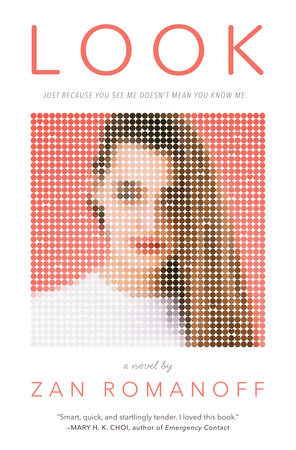
Look by Zan Romanoff

Look by Zan Romanoff

Like Surveys, Romanoff’s third novel also deals with an internet influencer. Lulu Shapiro has 10,000 followers on the fictional app Flash (which I read as Snapchat meets Tik Tok). Throughout the novel, Lulu grapples with what it means to be looked at while also navigating her first lesbian relationship. I’ll admit I was nervous to read a lesbian romance written by a straight writer, but I was impressed with how it rang true to my own queer experiences. Particularly, the ways in which the male gaze both idealizes and cheapens lesbian relationships. And, yes, I cried!!! 

Taipei by Tao Lin

Taipei by Tao Lin

I firmly believe you CAN judge a book by its cover. And that’s exactly how I found this book, which is now one of my favorites. Taipei addresses a more niche type of fame than the others on this list: lit world fame. While Tao isn’t a household name, anyone who spends time in indie bookstores or on literary Tumblr knows him as the founder of the “alt lit” movement.

Taipei is semi-autobiographical. It’s about a famous writer on a book tour, self-medicating with drugs throughout. It’s also a love story. Upon its release, Brett Easton Ellis said Taipei rendered Tao Lin “the most interesting prose stylist of his generation.” He also called Taipei “boring.” Maybe he was jealous, I don’t know. I’ll admit it took me a minute to get into Taipei. But once I did, I was captivated. I was moved. I laughed, and I cried. And I’m still trying to copy his endearingly peculiar voice. What else do you want from a novel? 

Image result for murder your life a memoir

How to Murder Your Life by Cat Marnell

How to Murder Your Life was the type of book I had to read slowly because I didn’t want it to end. The memoir chronicles the writer’s life from childhood (in DC, where I grew up!) to boarding school to Conde Nast to becoming a famous Internet writer, the unifying thread being her addiction—first to stimulants, and eventually to essentially every other drug imaginable. In the final third of the book, Cat’s addiction hits its peak and her fame skyrockets. An essay she writes about Whitney Houston’s death while high on a potpourri of substances goes viral, and at that point the Internet begins to glorify her twisted brain (Jezebel wrote, “Cat Marnell is Both Fucked Up And Fabulous,” and Vice gave her a column called Amphetamine Logic).

Marnell wants to stop using—she’s exhausted and feels ill all the time—but she’s also being praised for her addiction, and making money off it. Sad for Cat but a killer conflict to keep the reader hooked. I also fell in love with Cat’s writing style. She writes such energy, using exclamation points with abandon (might be the speed!!!) and frequently addressing the reader. Her subject matter is dark but the narrative remains light. It’s not easy to make reading fun, and Cat is the Queen. 

The Ghost Network by Catie Disabato

Confession: the author of this novel is my ex-girlfriend. I read it before we started dating, and before I even met her. And I’ll admit I read it with a lot of envy. Catie was my age, 28, and her thoughtful novel about a pop star who goes missing landed a glowing review in The New York Times. I hated her a little. But I loved the novel, a structurally inventive and intricately-plotted ride filled with trenchant social commentary. My favorite were its asides on Situationist philosophy (the fictional pop star Molly Metropolis is obsessed with Situationist leader Guy Debord). Getting critical theory fed through a queer pop culture narrative is heaven to moi

The Love Song of Jonny Valentine by Teddy Wayne

Teddy Wayne tells this charming story from the perspective of an 11-year-old, Bieber-esque pop star named Johnny Valentine. Given that I don’t care about boys or anything boyish, I didn’t expect to enjoy this novel. But I fell in love with Jonny’s funny, sympathetic, and ultimately very sad voice. I didn’t even mind reading about Jonny’s masturbatory frustrations. After Jonny can’t make himself come, he imagines a groupie accusing him of getting her pregnant and then having to issue a public statement saying that would be impossible because he couldn’t even come on his own. “[A] policeman would have to watch me in private to see if it was true, and they’d give me an adult glossy to help, and we’d also have to bring in [my bodyguard] to make sure the policeman wasn’t a child predator.” It’s these sorts of darkly funny interior monologues that sucked me into the narrative. In the end, the book nails home how just lonely it is to be a super-star. 

How Swedish Immigration Law Condemned Jews During the Holocaust

“Write soon. We long for your lines, especially because the post from Sweden arrives as it should. Take care of yourself. May God protect you, a thousand kisses from Mutti and your loyal dad.”

So concludes the final letter written by Elsie and Josef Ullmann to their son Otto, posted from the concentration camp at Theresienstadt in August of 1944 to Otto’s newfound home in Småland, Sweden. The next month, September, Josef was sent to Auschwitz. The following month, October, so too was Elsie. Neither survived.

And in the Vienna Woods the Trees Remain

The tragic correspondence was thrust upon Elisabeth Åsbrink by Otto’s daughter, who believed that the award-winning Swedish journalist would be able to do something with the collection of more than 500 letters to Otto from his parents, two aunts, and an uncle. That something is And in the Vienna Woods the Trees Remain, a heartbreaking reconstruction of one family’s annihilation by anti-Semitism in both its most rabid and staid forms. Åsbrink complements the Ullmanns’ letters to Otto with archival material from state, church, and news sources, painting a complex picture of compassion and complicity, which stretches from Otto’s family home in Vienna to his adopted home in Smaland. On one hand, a kindertransport organized by the Swedish church following the Third Reich’s annexation of Austria rescues Otto from the Nazis; on the other hand, Swedish society at all levels conspires to keep Jewish adults, like Otto’s parents, from joining their children. On one hand, Otto’s adopted family, the Kamprads, come to regard him affectionately; on the other, Ingvar Kamprad, the future founder of IKEA, is all the while actively supporting the Swedish Nazi movement.

I had the pleasure of recently speaking with Åsbrink about And in the Vienna Woods the Trees Remain. We discussed the weight of such heavy material being entrusted to a writer, the surprising role that ABBA played in her research, how Otto’s family history resonates with her own, and more.


Arvind Dilawar: The letters from the Ullmanns to their son Otto, which form the foundation of your book, And in the Vienna Woods the Trees Remain, were thrust upon you by Otto’s daughter. Was it a difficult decision, deciding to pursue the story those letters tell?

Elizabeth Åsbrink: I really did not want to deal with the Holocaust. It’s a terrible subject. It’s something that’s been painful and I would say traumatic in my family. So I said no, I declined her offer. But then, every night when I was going to sleep, I kept thinking of this boy, this 13-year-old boy, alone in Sweden, and his parents all alone in Vienna, and these letters that went between them. And I just felt obligated.

To such a great extent, there are no graves, there are no bodies. This is one of the specifics with this genocide. OK, there are mass graves and we’ve seen the photos of the piles in the camps, but generally, six million people have just vanished, erased from the Earth. And I could, through this material, pick up five people, give them their names, their lives, their bad jokes, and I could research my way almost all the way to their deaths, so I could give them that as well. The family had no idea of the particular fates that these five people who wrote to Otto had met. I did something, at least, for these people.

AD: You mention that there’s this exchange of letters that’s happening. But you were only able to get the letters that Otto saved, so there’s no record of his replies back. Did you try to track that down? Was there any chance of getting it? Or are those permanently lost to history?

EA: The people he wrote to were murdered. I have no idea what happened to their personal belongings. The parents ended up in Theresienstadt and then were murdered in Auschwitz. One aunt and uncle were deported to this little Polish city that was overcrowded, and if they died by disease or if they were shot, I couldn’t say for sure. And the second aunt, she was taken to a woods in Ukraine and shot. So letters, if they’d kept them, if they’d taken them with them, they were not preserved. I looked in several archives for letters from Otto to other people, and I did find some of them. There was one letter that he had written that had been returned when his father was in this forced labor camp in this Eichmann project, the Nisko project. So I had one returned letter that he had written. That is all I had.

AD: An important subject that your book focuses on is Jewish immigration during World War II. Can you describe how restrictive immigration laws condemned Otto and his family in particular and Jews in general? Do you see any resonance with how immigration laws are used today?

EA: Each European country had their different twists on this, so I could briefly give you a picture of what Sweden stood for. Sweden had a very restrictive attitude towards Jews before the war as well. And, for instance, Roma people were not at all allowed into Sweden. That had been the case for some hundred years. So Sweden, nationally, their identity was very attached to ethnicity, very strongly so. I actually think it still is quite strong in that way, but it is changing, slowly. But if we talk about pre-war, it was very, very connected, ethnic identity and nationality. And they didn’t want foreign elements. This is a term that one can find in official documents, “foreign elements.” They didn’t want them in the country, so very few were let in. 

In November 1938, when the Jews in Germany realized they had to get out, there was this huge refugee wave. All the European countries met to try to solve it, but no one really wanted to take responsibility, and Sweden was no better. Actually, Sweden was worse. Sweden was so afraid of getting immigrants from this refugee wave that they made a deal with Nazi Germany. They said, if you want German nationals to be able to travel to Sweden without a visa, you have to put a stamp in the Jewish passports so we can say no to them by the border, because if we let them over the border, they have to be here for a couple of months and it’s more difficult to get them out again. So Sweden actuallly negotiated with Nazi Germany and put pressure on them and succeeded. German Jews had a J stamped in their passport and, therefore, were very easy to keep out of the country. Switzerland was also in on this dealing with Nazi Germany.

But in 1943, something happened which actually changed the whole scene, one could say. It begins in November ‘42, a year ahead, when the Germans deport the Norwegian Jews. They do just like they’ve done in all the other countries: They take them out of their homes, put them on a boat from Oslo, and it goes directly to Poland. And the Swedes, then they react, because Norway is so close. It’s a “brother country,” that’s what the Swedish term is. So this was shocking. I read comments in the papers from then saying, well, I don’t really like Jews, but this is unacceptable. So suddenly Sweden woke up when it came to the Norwegian Jews. And then a year after, in ‘43, it was the Danish Jews who were going to be deported. And at the time, the opinion towards Jewish refugees had turned. When the Danish resistance movement contacted the Swedish government, it said, now we have to do something. It said, let them in. Over two nights, 7,500 people came over a strait between Denmark and Sweden, with boats, small fishing boats, any boats. And they were allowed to be there for the whole war. Sweden took care of them, gave them places to stay and school, all that. The next miraculous thing is that a lot of the Danish people actually guarded the Jews’ homes, so when they returned, they had their homes, nothing was stolen or robbed. This is a complete anomaly in the history of the Holocaust in general.

If you want to connect it to today, I would say that Sweden is still quite deep into connecting ethnicity with nationality. We have a law of citizenship that is still based on the blood principle [jus sanguinis], whilst in the US you have the [birthright] territorial principle [jus soli]. Sweden has now received a huge amount of refugees from Syria, from Afghanistan, just from the last 10 years. Since 2015, Sweden has received 170,000 refugees from Syria. I think this huge change of society, where Arabic is the second biggest language within the Swedish borders, it must lead to a change of the citizenship laws and the way that we look at nationality. I would prefer the American way. I think that’s more democratic, but that’s my personal opinion, being the child of two immigrants.

AD: How were you able to investigate the history of Austria and Sweden in the 1940s? Germany is relatively open about that time period. Is the same true for Austria, which was annexed by Germany, and Sweden, which was officially neutral during World War II?

EA: I don’t think it’s got anything to do with neutrality, these things. I found material in Swedish archives, especially about the individuals. The book is very much based on material that I found in the Swedish church archives. All the papers concerning the priest that saved these children, they are from the church archive. And that was completely open, and it still is for anyone who wants to look at it. In Austria, I found the information I needed from the Jewish community archive, which was open, but actually they didn’t want to help me because they were out of staff and under such pressure. They don’t have any money. It’s a very poor congregation. There are hardly any Jewish people left there, so they’re struggling. 

Sweden came out from WWII with a sense of guilt. This sense of guilt has made Sweden welcoming to refugees to a certain extent.

There was a funny story: The guy I spoke to there, the historian, said, I can’t help you, I haven’t got the time to help you. And I insisted on going there anyway, and he said, alright, we’ll meet that day, OK. I showed up and he really didn’t want to help me, but he gave me this and that. And then I went out for lunch and he Googled me. He came to my website and he saw that I had been working on a radio show with Björn Ulvaeus, one of the guys in ABBA, the Swedish pop band. This historian loves ABBA, so when I came back from my lunch, it was a different situation. He helped me enormously. I could find out the things about Otto Ullmann’s parents, what they did in Vienna, how their life was. And that was absolutely invaluable. So thanks to ABBA, I did some good research.

AD: That’s amazing. It seems like a very Swedish story, at its heart. Ingvar Kamprad, the founder of IKEA, features prominently in your book. Now that you’re describing the changes that Sweden underwent during the Holocaust, it almost seems like he sort of captures, in one person, the two different sides of Swedish culture struggling against each other. Because on one hand, he was an active supporter of the Swedish Nazi movement and, on the other hand, he became a close friend of Otto. Is there a way to resolve that apparent contradiction?

EA: I think you’re right in that Ingvar Kamprad is a good symbol of the Swedish attitudes, but maybe not in that way, because I don’t think he changed and the Swedish attitudes actually changed. Some speculate that it was because of humanitarian reasons, others are more cynical and say that, when Hitler was defeated at Stalingrad, the Swedes saw that things were changing and also changed their policy. I think it’s probably a bit of this and a bit of that.

But Ingvar Kamprad, he was involved in the fascist movement very intensely, which was deeply anti-Semitic. And then I found that he had also been a member of the Swedish hardcore Nazi party. I don’t know when he left that party. I couldn’t find out and he himself wouldn’t comment on this information. But when I met him—which was before I found out about the Nazi party—I knew he had been involved in the fascist movement, and the fascist movement I knew for sure was very anti-Semitic. So, of course, I asked him: How did these things work together? Loving your friend, Otto, because he really did love his friend, and still being a member of this movement? And I pressured him, and finally he said, I see no contradiction.

How do you explain that? I think one explanation is that Ingvar Kamprad was not a person who reflected. He did not sit down and think over his ideas and his thoughts. He was a doer. He was a workaholic. He did amazing things, but he did not stop and think. I don’t think that was a part of his personality, and I don’t think maybe he would have created IKEA if he’d been someone who stopped and sat down and had a good think about who I am, what my ideals are. He just went on. And also you have to remember that he was born into a family where his grandmother was very dominant and she was a Nazi. She loved Hitler. And his father was also a Nazi, Ingvar Kamprad told me himself in this interview that I did. His mother was definitely not a Nazi, also important to remmber, but the democratic ideals weren’t something that was natural to him. So that’s one part of the answer.

The other is that all these totalitarian ideas need the exception. I think that any totalitarian ideology makes exceptions for the neighbor that you like, the nephew, or the bus driver or the woman in the shop. There’s always an individual that you like, because this is what’s human in us. And these ideologies can only work if you allow these exceptions. I think that’s what Ingvar Kamprad is a good example of: the exception going parallel with the ideas. And I think the Nazis were very aware of this. Himmler, when he held his famous speech in 1942 at Posen, he talked to his generals. It was time to implement the so-called “final solution,” and he said, we all know a decent Jew, but now we have to put that aside. So he was aware that personal relations and friendships were, to a certain extent, compatible with the ideology, but now, when it was time to go to the final step, he wanted them to cut off these personal feelings. That’s the closest to an answer I have.

AD: Despite some simmering xenophobia, the Scandinavian countries today are still considered relatively welcoming of refugees. Your book illustrates how this was not the case during World War II, when Jewish refugees were systematically turned away. Did something in Sweden change between now and then?

My father and Otto have similar backgrounds: assimilated big city children. And suddenly they were Jews and were supposed to be murdered. 

EA: I think Sweden came out from the Second World War with a sense of guilt. It had economic dealings with Nazi Germany, and when the rest of Europe was ruined and bombed, Sweden was in a quite good place. The welfare state thrived after the war. This sense of guilt has made Sweden welcoming to refugees to a certain extent. Because it’s also the case that, when, in the ‘90s, we had a recession, it suddenly became a much more racist society. That is also the time when the old fascist movement connected with new right-wing movements, like skinheads and others, and created a new right-wing, racist group, which developed actually into the right-wing populist party that we have today, the Sweden Democrats. So they are directly linked to this fascist movement that Ingvar Kamprad was a part of. The recession in the beginning of the 1990s opened space up, and since then, we have had them. They were small and violent, and now they have costumes and have changed the way they speak and the way they see the future, but they’re still in the same corner.

AD: Early on in this conversation you mentioned that, part of the reason that you were hesitant to follow Otto’s story was because it mirrored that of your own family. Could you describe how your family arrived in Sweden? And did completing this project help you come to terms with that?

EA: Otto’s story connects to my father’s story very much. My father is a Hungarian Jew. He grew up in Budapest, very close to Vienna. I mean, they were part of the same empire, they’re like sibling cities. Just like Otto, my father was assimilated. He was even baptized because his parents thought that would protect him. Hungary was one of the first countries with anti-Jewish laws. He didn’t know he was Jewish until someone said “stinking, filthy Jew” to him when he was a child, and he went to his mother and said, what is that? But then things happened very quickly in Hungary. He is a survivor of the Holocaust. It’s a miracle that he survived. Long story, but the background is very similar: big city children, assimilated with the rational, scientific ideas of the world, etc. And suddenly they were Jews and were supposed to be murdered. 

I grew up mainly with my mother, and she also has Jewish heritage. She told me never to tell anyone that I was Jewish. Never, ever tell anyone. It was like a shameful secret and if I exposed it, something very bad could happen. And this is something that she gave me without words. … It was scary to deal with this material, but I was also grown up and not under my mother’s influence anymore. But still, I had a sense of danger doing it, but I decided I wanted to. I decided it was so important and I also wanted to break this secrecy. I’m not a believer. I don’t believe in blood communities, like a folk of people, but I am Jewish. Hitler would have murdered me. That’s a terrible thing, but it’s true. Writing this book was, actually what my gay friend said, like coming out. They saw it as a coming out process, and I think they’re right, it was. I think it did change the way some people look at me, and it also changed the way I see myself.

I once went to a school and they had this book as a theme for a whole term. It was amazing. Young grown-ups—the art students had made art, and the music students had made music. And then there was quite a huge group of refugees, who were in this school to learn the basics about Sweden before they started their new life. So there were a lot of 20-year-olds, a lot of people from Iraq and Afghanistan, and we had a talk. One of these Kurdish Iraqi guys, he said it was the best book he’d ever read because everything Otto had experienced, he had experienced. He’d been sent away, by his Kurdish parents, to Sweden to find a new future and he was told to be decent, to learn the language, to get a good education, all these things. He completely identified with this Jewish fate. That blew me away, and it still does.

Megan Stielstra Has the Worst Workshop Horror Story We’ve Ever Heard

In our series “Can Writing Be Taught?” we partner with Catapult to ask their course instructors all our burning questions about the process of teaching writing. This month we’re talking to Megan Stielstra, author of The Wrong Way to Save Your Life and two other collections of personal essays. You can still get on the waitlist for her 12-month memoir generator at Catapult, an intensive yearlong boot camp in writing and publishing creative nonfiction. But if you don’t get into the class, her answers to our standard ten questions are a mini seminar in themselves.


What’s the best thing you’ve ever gotten out of a writing class or workshop as a student?

I took a class on story structure with the writer Patricia Ann McNair. One of the stories we dug into was Kafka’s “In The Penal Colony,” now one of my favorites but back then—

“I hate this thing,” I said in class.

Patty is infinitely patient but takes zero shit. “Tell me why,” she said.

I went off on Kafka, finishing with “—I just don’t get it!”

Patty set the book on the floor. Then she leaned forward and said the single most important thing I learned in college, if not ever: “You don’t get to hate something just because you don’t understand it.”

A student wrote a story about my death. He was not subtle; the character was named Megan Stielstra.

What’s the worst thing you’ve ever gotten out of a writing class or workshop as a student?

A student wrote a story about my death. He was not subtle; the character was named Megan Stielstra. He included a scene of my funeral—the only person who showed up was a character based on himself. He wrote that it was very sad that nobody else loved me.

What is the lesson or piece of writing advice you return to most as an instructor?

Kiese Laymon: “We’re not good enough to not practice.” 

Does everyone “have a novel in them”?

Sure. I don’t know if everyone has the discipline to actually write it, but who knows what we’re capable of? Six months ago I thought running was hell on wheels and now I’m months into lockdown, training for a marathon, and it’s like, Who even am I? We get to try and change and fall on our asses. If writing a book is something that you feel in your bones and you want to explore the possibility, I’m here to support you. 

Would you ever encourage a student to give up writing? Under what circumstances?

Years ago, a young woman came to a scheduled conference sobbing. She’d met with another writing professor just beforehand and he told her she didn’t have a voice. Typing that makes my blood boil. How dare he. I am committed to direct and transparent conversations about the realities of art-making—money, academia, publishing—but those of us who work in education need to look long at power, how our words can crush or lift. People are putting their hearts on paper and handing those papers to us. It’s a profound act of trust and I will work like hell to be worthy of it.

Some of the writers I work with make their living as artists. Some as teachers. Some as marketing professionals, lawyers, journalists, bartenders, sex workers, counselors, doctors, administrators, acrobats. They work in childcare, healthcare, politics, finance, theatre. None of them ever gave up writing. The practice looks different, but they find how it works for them.

What’s more valuable in a workshop, praise or criticism?

Both. Your stories matter and I will damn well challenge you to make them better.

Should students write with publication in mind? Why or why not?

Students should be turned on to all sorts of different ways to engage with the creative process so they can figure out what works best for their deeply unique lives.

Your stories matter and I will damn well challenge you to make them better.

That said: for me it’s helpful to consider potential homes for my work during the rewriting process and I try to arm my students with knowledge about that process. Whether or not they make the personal decision to submit, such consideration can offer ideas for shaping the final draft. If you want to submit to Brevity, you need to cut. If you want to submit to Longreads, you can linger. Read the last five essays published in a place you love: are they more narrative-based? More argumentative, more experimental? What do you notice about how they are written and how does that influence your rewriting process? 

In one or two sentences, what’s your opinion of these writing maxims?

  • Show don’t tell: Show and tell. One isn’t better than the other—they’re tools. We have to learn when and how to use them. Start with Dorothy Allison on place in The Writer’s Notebook from Tin House and Sonya Huber on telling in LitHub.
  • Kill your darlings: Depends on where you’re at in the process. Early drafts, where you’re figuring things out? Cling to the darlings for dear fucking life. Later, when you know what the piece is doing, ask yourself if the darlings serve that intention and if not, cut-and-paste them into another document to use in another piece. Later still, before you hit send to an editor (or teacher ☺), read the draft aloud. Listen to what you’re doing with language. A deep, thoughtful line edit focuses what you’re saying and how you’re saying it (shout-out to the copyeditors I’ve been lucky enough to work with. You’re the real heroes).
  • Character is plot: Characters have bodies and our bodies move through this beautiful stupid mess of a world with all sorts of histories and stories and assumptions. I never found it helpful to think in terms of plot— I thought bodies. I thought action, reaction. More recently I’ve been reading the work of Matthew Salesses, who defines plot as “an acceptance or rejection of consequences.” I love that so much. He has a book coming out soon from Catapult called Craft in the Real World and I can’t recommend it enough.
  • Write what you know: Write whatever the hell you want. That said, please read Alexander Chee on writing “the other” and Rebecca Makkai on writing across difference.

What’s the best hobby for writers?

We can argue all damn day about whether it’s a hobby or the work itself, but jesusgod get a library card.

What’s the best workshop snack?

For me—coffee. Which—again, for me—is a food group.

The Friend That Went to War and the Friend That Went to Law School

“In Case of Emergency”
by John Cotter

A woman I didn’t know tapped at her laptop across the Amtrak aisle, Northeast Direct. She had to be running on batteries because the whole train’s power had shut down. Like when they used to switch to electric in New Haven, the reading lights snapped off and quiet appeared, making the hum we hadn’t noticed at once audible and gone. Outside the window was all salt marsh, that depth of green you only find in high summer, when the daylight’s not glaring off the water, a few spots of gold through the dark stalks. You feel as though it would be soft and cool to the touch.

I had this idea that we were invisible, the train and everyone on it. That minute when the lights overhead banked out and the engine coughed, it was like we’d shrugged on a magic cloak. Adjusting my eyes, I could make the darkening window fill with her reflection—the stranger over the aisle. I saw her hazily, an outline colored in. In the glass she looked maybe twenty-two or twenty-four: grown but with a leanness in her neck like a teenager’s, serious-minded. Maybe it was my fantasy; I was lonely enough to feel wistful about a stranger. Without realizing I’d been doing it, I had a story for her face, a personality: shy kid, straightened into one of the professions, keeping up with work even if the outage might have offered her an excuse to break off. She probably did well in college. College couldn’t have been long ago. 

I turned my head to look across the aisle. The window had lied. She had to be forty, my age, as though twenty years had passed in that second. The kid I saw in the window lived in a world of potential, so many things she hadn’t done for the first time—travel, real estate, heartbreak, maybe kids. The woman across from me, meanwhile, had filed whole parts of her life into drawers she wouldn’t open a second time. Maybe life was starting to bore her.

I turned back to the window. I watched the tip of her nose vanish, watched her chin sharpen by blurring. I had to remind myself that even though the train was stopped, the past kept receding at the same rate. 

Earlier, I’d caught a glimpse of something she hadn’t, a reminder of my old friend Taylor’s house—we were passing through his part of Rhode Island—or rather the auto-parts store across the street from Taylor’s house, on the other side of the rushes, spike grass and mermaid’s hair nearly camouflaging the place at the marsh’s edge. I made the trip from DC to Boston once a quarter and always thought of Taylor when the train approached Westerly. 

But that’s not entirely true. It wasn’t the Rhode Island marshes that made me think of Taylor so much as the marshes outside of Newark, when I looked up and caught sight of the Freedom Tower rising out of a hillock of trees, radome and beacon. Twenty years ago I’d been drinking coffee with Taylor in the kitchen of our dorm suite at UMass when the planes hit the old towers. My dad called the house phone. “We’re at war.” He sounded excited. “Pull your head out of your ass and turn on your goddamn TV.” 

I was a sophomore, badly matched with a computer science major. Taylor was the one who turned on the TV. Aside from the fear and the anger everyone else felt—anger that didn’t know how to occupy itself—I felt trapped by my dad’s voice. He’d been right all along: the world was booby-trapped. He’d tried to snap me out of my dreaminess all through my adolescence, yet it wasn’t until that moment, age nineteen, I saw how delicate my safe life was. Guys like Dad thrilled to it. 

Six hours later, Taylor and I were distractedly eating soup I’d reheated when he said, “Are we gonna go over there and kick some ass or what?” 

It took me a minute to realize over there meant Afghanistan, but of course on the evening of September 11th Taylor would have been implying some indeterminant zone of dry mountains on the other side of the world, halfway to the other side. Taylor didn’t seem like he was serious, just giving in to a feeling. This was the same Taylor who avoided conflict unless he could make jokes about it, who made himself the butt of those jokes to diffuse any tension. But I worried because his money hadn’t come through for that year and his situation was precarious. Isn’t that why people join the army? It’s a place for your body to go. 

“Are we gonna go over there and kick some ass or what?”

I tell myself now I wasn’t ever going to join up and, looking back, that story makes sense. But I don’t want to misrepresent things: I was susceptible to manipulation back then, the power of suggestion, cowed by my father but also afraid of being shot in the desert. 

Isn’t that why people join the army? It’s a place for your body to go. 

“I’m picturing Osama Bin Laden’s mother.” Taylor got solemn. “Crying her eyes out, ‘cause her son is dead. Can you see that? Just pulling at her hair she’s so sad. I wanna make that happen.”

I said “Here’s to it.” 

“You in, man? I’m dead serious.” Taylor said the same thing when our buddies Rudy and Noah showed up later with Rolling Rock and, like me, they both said yes. I’m surprised I had the wherewithal to caution them.

“You guys aren’t going to do anything right away, right?”

“You worried about what Jenna’s gonna say, man?”

Jenna was my girlfriend. She was on her way to join us. 

Rudy held my eyes. “Dude, there’s pussy in Afghanistan.”

“Go call Jenna and get your balls back,” Taylor said. “Tell her we’re gonna save the world and you’re gonna need ‘em. Seriously, you in?”

Rudy got surly. “There’s no faggotry in the army though. That’s probably why he’s not interested.” 

Strength, at times, is just the concealing of a weakness. All my life I’ve been subject to powerful emotions, usually anxiety, tearing at me from the inside, but I’ve generally been able to hide these feelings: inappropriate fear, inappropriate joy. The minute I heard Rudy say “faggot” I had the impulse to surge up from the couch and belt him. Not because I was gay but because Rudy was an asshole. I was barely able to put up with him for short stretches; I only hung out with him because of our suitemate Noah, a shy kid who played basketball with Rudy. But I learned early you have to control those inner jolts of emotion because anything you act on becomes something you can regret. Ten years after his discharge from the service Rudy filled his mouth with C-4 plastique and lit the fuse. Taylor called to tell me. He said, “It’s the first time I’ve ever felt sorry for that guy.” Perhaps, but they’d stayed friends, served together. Taylor was closer to Rudy by then than he was to me.

Strength, at times, is just the concealing of a weakness.

The sound of a couple of teens playing cards in the aisle drew me back to the train car. A sound where there wasn’t any. We’d been stopped for over half an hour and decorum was breaking down at the edges. Strangers relaxed their voices. The club car started handing out drinks—they couldn’t keep them cold. 

A woman three rows back: “I heard it was a line down; that was an hour ago but the radio said they were getting another train to either push or pull—that’s what the radio asked: push or pull?

I got a free beer from the club car. When I came back my unwitting companion across the aisle was still tapping at her laptop. What I had been taking for a nonsense flicker above her hair grew larger, caught my attention. My first impression, illusory, as though I were half asleep, was to take it for something supernatural, a little angel of thought coming out of her head. It was a black spot with shoulders, with arms and legs. It was a human figure, a real one, not above her head but above its reflection, on what I now realized was my own side of the train, in the marsh. Wait—someone was walking toward us. What was he doing out there? My adrenalin released. This was real. A grown man: stomping out there to move forward. No, he was catching his footing, brushing away tall grass as he staggered toward us, his arms in a panic. An older man, or a drunk one. 

Turning to the woman (later that night, along with the EMTs, I’d learn her name was Swetha) I met her eyes and asked, “Are you seeing this?”

Swetha’s face ran the gamut: stranger danger, act like you don’t hear, evaluate risk, he doesn’t sound insane. “Are you addressing me?”

“There’s someone out there.” 

She couldn’t see him from her side. She made a decision. Cautiously, she moved closer. She didn’t wear perfume.

She said, “Okay that’s terrifying.” 

She looked South Asian, sounded like a New Yorker.

“Do you know that guy?”

“Why would I know him?” But she gave me a look that implied I’d arranged this with him. A joke on her.

I said, “I’m Brett.” 

She brushed that away.

Out there in the evening light the stranger’s mouth moved, shouting. White hair in a cap. He wore a fishing vest but it was high tide and there was no boat. His arms waved. He wanted us to come outside.

“Do you think he’s in trouble?”

She laughed with her nerves. “Maybe he’s saying we’re the ones in trouble. Seriously, though, the engineers probably see him.” 

But he stayed there waving. She left to get a conductor’s attention. I kept watching the guy outside shout at the train’s dark windows. I knew that something terrible was about to happen. I nearly took my phone out and called Tina, because she’s serene. She’s the one who keeps the children calm; they see right through my attempts at authority or competence, but Tina has infinite patience. Our oldest, Belle, is bad with the dog, bosses him around in a way that confuses him. Only Tina can get her to stop. She does it by crouching at Belle’s level and entering her world completely—what is she trying to get the dog to do? What a great idea! Only dogs can’t do that, but here’s what they can do … 

In the weeks before Taylor joined the marines I stepped carefully around his pride. I told him he wouldn’t just be shooting at bad guys—that in a real war everyone crawled out broken if they crawled out at all. I reminded him about how my dad left his tibialis muscle and part of his foot in Vietnam, how he resented his cane, how that stick made him defend his war, and by extension all wars, because if Vietnam was a waste of time then he walked with a cane for no reason; he was a sucker.

Taylor said, “I think that’s between you and your dad, man.”

Taylor said, “This isn’t Vietnam. They started this.” 

The old panicked guy looked toward the windows ahead, like he was searching for someone, but he couldn’t see inside the train because the lights were off. Maybe we were just shadows behind the glass. 

Swetha was back. “I can’t seem to find anybody. I guess, um, maybe it’s not our problem?” But she stayed beside me, watching the stranger wave, breathing on me, transfixed. He heaved himself closer to the train, almost falling into the marsh as he wrested himself up onto the pebble grade, raised his fist to hit the metal. I could hear his shout but not the loudness, as though he was shouting into a pillow.

“There’s no conductors you said?”

“You can look.” 

The man’s face crinkled. Why didn’t a conductor go outside and learn what the problem was? Were we about to be pushed or pulled?

I said, “Stay here? Keep an eye on him.” She’d have been within her rights to say where else am I going to go? 

At the end of the car I found a couple of elderly girls gesturing exclamations at one another, an open bag of M&M’s between them. It was almost like sign language, the eloquence of their white hands in the dark car. They were telling a story about something bad, having fun telling it. A row of backs. Passengers in what looked to be a long line to the club car. If drinks were free the line would be long. I took my place at the back because if they weren’t taking cash the line would move. I’d talk to the guy in there.

There was a time in my 20s—a few months—where Taylor was my best friend, Noah was decent enough, always around, and Rudy was just a pain in my ass. Fifteen years later I was a patent lawyer with a laptop on a train, one who didn’t even make time—an hour—to get off the train when it passed my old friend’s house. Who didn’t even text my old friend, say I’m riding by your house. Who felt guilty. We’d moved in different directions—that was the story. The arguments we had when Taylor came back from overseas weren’t the cause of our distance, just a symptom. Taylor wasn’t stupid, but he didn’t think the way I thought. It wasn’t just that he didn’t have generalized anxiety disorder. When the photos from Abu Ghraib were published—naked prisoners on leashes—Taylor emailed me a picture of Lee Miller in Hitler’s bathtub. There were drastic differences between those pictures, but when I tried to explain he acted like I was splitting hairs. I’d tell him, “People got killed at Abu Ghraib.” He’d yell, “Yeah man, nobody got hurt in Dresden”; the mood back then made it impossible to hold a soap bubble of thought in your hands and pass it to someone else without the bubble bursting. If the person you were trying to communicate with had a big, persuasive personality then you were hopeless. What I wanted to tell Taylor, but couldn’t tell him in a way he heard, is that he would never torture a prisoner, at least not without a genuine sadist like Rudy egging him on. But Rudy was involved. And Taylor must have identified with Rudy in some way that never made sense to me, some way he hid from me, because Taylor used the fact I’d missed Rudy’s funeral as an excuse. Noah died eighteen months later of an overdose and Taylor—my only point of contact with Noah—kept it to himself. I would have showed up for Noah’s funeral, but even making a distinction between the two men was something Taylor wouldn’t stand. And here I was half a mile from his house; every minute I didn’t text him estranged me further. It felt aggressive, like I was punishing Taylor for signing up.

The line wasn’t moving. I had to crouch to see out the window in that car. The tide was going out, so the dark grass looked taller. I couldn’t find the shouting man, but my view was poor from inside. I was struck with the dark feeling there was no one at the counter after all, that we’d all been abandoned. I squeezed and excuse me’d up the car. A flock of suits clogged the doorframe until I patted their shoulders and shuffled them out of place. As soon as I got inside the club car I went cold: the server was gone. Plenty of explanations. No CLOSED sign. He might just be locating more coffee in storage.

Anything you imagine can be true, and half of what you imagine is anxiety. I wouldn’t be home in time to read Belle a story. She’d fuss if I wasn’t there—or did I only hope she’d fuss? I pushed back, annoyed with myself, preemptively annoyed. The line cleared. At the end of my own car I pushed the touch-plate to open the bellows, felt the air change before I’d stepped into the gangway. Real outdoor sounds: planes humming, voices traveling through open space. The outside door was hanging open, the door to the marsh. I stood dumb in its presence, the muck smell of crabshells and algae creeping with the last of a wet heat. A dangling red handle—pull for emergency exit. Someone had done it.

We were about to be pushed or pulled. Approaching the door, taking hold of its frame (I was violating the agreement we make with Amtrak, the agreement to participate in no activities beyond sitting, buying food, visiting the bathroom) I leaned out into the real air, which felt agonizingly forbidden. I could be kicked off the train for this. Beneath us ran a grade of raised earth and pebbles that stretched the track around a bend. To the left spread marsh that, further on, welcomed an inlet. I heard a splash, turned to locate it, and found her out there: Swetha, though I didn’t know that was her name yet. She wasn’t on the train anymore. She was slushing through the cold marsh after the white-haired stranger, shouting, “Was he breathing?” 

Her voice carried over the water. 

I found the latch for the stairs and—heart in my throat—dropped them from the door. She must have jumped down—a long jump. The stairs fell to ease my descent to the grade. By the time I reached the pebbles I was already shouting back. They kept running. 

“What’s the emergency?” I shouted. “Is this why we’re stopped?” 

I didn’t know her name yet, so I couldn’t shout it. 

The water touched my ankles lower than I’d expected, tide going out. I flailed for the side of the train. This was crazy. I couldn’t follow two strangers into muck. I was trying to sleep in my own bed tonight. But I put the first foot in because I didn’t want a woman tricked and hurt, and because I had the eerie intimation the problem had something to do with Taylor. Of course it didn’t have to do with Taylor. But we were too close to his house—if there weren’t a copse of trees at the end of the marsh you could see it from here. 

Dead fish and something earthier. I felt it more than I breathed it, mud draining into my shoes. This is how you learn marshes, some mysterious tragedy. Jesus, let it not be Taylor. 

This is how you learn marshes, some mysterious tragedy.

“Do you need help?” My voice loud. “Club car was empty!”

They were running, as much as you can run in a marsh. My legs lurched their way. Possibilities: had the train hit a car? The grass was tall where my neighbor and the panicked man slowed ahead of me. Their bodies rose as they moved onto it. A kind of island. That higher ground was where I found them, leaning over a canoe. It was been banked there by someone. A white boy—college age—lay propped against the stern. His lips were blueish. 

Swetha flew into action. Okay, she had to be a doctor, something like that. “Help me pull him out of there,” she told both of us. “Cradle his head.”

 I grabbed the kid’s LL Bean boots while the stranger—the boy’s father? uncle?—eased his head down. He was too heavy for a fit-looking kid. He was dead weight. She had his coat open, reached for his pulse, locked her fingers together, pushed his chest. Cardiopulmonary resuscitation. Steps were being taken. Was he already dead?

“How can I help?”

She didn’t answer. 

“Are you a doctor?”

The old man was breathless, his face all wide eyes, moving mouth. He mimed his hands up and down—he couldn’t have known he was doing it—as Swetha worked on the boy. “I called them,” he said, “I called 911 first thing.” He looked up at me, panicked. “Can you call them too. Please now?”

She kept working at his chest a long minute. I called 911. 

“A salt marsh outside of Westerly. I … I don’t know, there’s a young man unconscious and unresponsive. We were on a train.”

I couldn’t remember when my hands had felt so cold. But the air wasn’t cold. The light was fading because I struggled to look at Swetha, to make her out clearly. I still had Taylor’s number on my phone. He was in the damn army—they got medical training there.

“Hello? Is Taylor there? Oh, no I wanted him for … it’s Brett, I met you at the wedding.” Taylor’s wife answered, her name was Maddy. Maddy something. “Taylor knows medical … uh, I mean I’m by your house. Just in the marsh. He’s at work?”

She couldn’t understand why I was calling. A baby howled in the background. She apologized, said she couldn’t leave the house, said if I was in trouble I should come there. She offered to call Taylor at the dealership.

I’d wanted Taylor there to think for me. I didn’t trust myself to think. Vaguely, I felt ashamed at this. Mostly I felt dizzy. 

Swetha shouted, “Come here. I’m going to give him breaths. Right here.” She pulled me down kneeling. I knelt beside her in shallow water, the kid’s chest cold to the touch. It wasn’t warm like something living, the fire in us, spirit furnace. Somewhere, in a corner of my mind, I was aware of the sound of what I later came to understand must have been two trains coupling. Escaping steam. I realized that was the sound weeks later while I was pulling weeds out back: that vegetal smell, murk and dirt.  

“Not so fast.” She put her hands over mine, showed me how hard to pump his chest: hard. 

I hadn’t been pumping a minute—I can’t be sure, but I assume I was feeling time much slower than it moved—when I felt a push back against my palms. A quiver. It panicked me because I didn’t want to lose it. I used all the concentration I could drum up to push as steady as I’d been pushing, even as I shouted, “It’s beating! We maybe got him!” and Swetha felt for his pulse again, pulled back my arms to stop me pushing. Before she did, an instant before, I felt the kid’s warmth return, life in his heart, enough to spread up my arms into my own chest. He was breathing. He wasn’t awake but he was breathing.

I rubbed my hands together but they were already warm. The sound of his labored breath in the water acoustics brought my own breathing down. I’d been gasping with pleasure, a pulse up my chest of real joy rising and rising against my throat as I stood there staring at—what? an osprey nest. People built those on the marsh, tripods of timber. Frogs clicked and croaked surrounding us: all of the marsh was alive.

Swetha had her phone out now. Two hundred feet away from us, in the humid night, the pair of kissing engines and the cars that trailed in opposing directions switched back on with a wooosh and pulled off from the marsh, north. I didn’t see it for the boat lights growing larger, EMTs grounding a PVC against our small island. By the time the boy was strapped to a palate any far-off lights from the train were obscured by the flashlights moving around me.

“Pop your head out of your ass,” Dad used to tell me, “the world isn’t all effervescence and light.” I used to be impressed he’d put it so well, effervescence and light. 

We introduced ourselves to the EMTs as some firemen drew up a pontoon. Swetha, who turned out to be a doctor, an osteopath, briefed everyone on what had happened. The old man told me his name—I’ve forgotten it, though I remember his son’s name. I hold that name to my heart. I haven’t had the courage to look him up. Swetha shook our hands, laughed nervous and elated. 

Later, when I researched CPR on my laptop—Amtrak, when I got hold of them, was able to hold it for me behind the counter at South Station—I learned that while it was effective in clinical settings, that patients reliably lived for years after their hearts had been started up again, CPR in the field was less promising: various reasons, length of time that the patient was clinically dead, transportation. But it was possible. Young, otherwise healthy people, “free of comorbidities,” lived long lives after CPR in the field, just not many of them.

Since I’d called and talked to Maddy I had to go to Taylor’s place. Madeline was too busy putting the baby down to understand what had happened, but she understood I was safe—I’d always been safe—and set me up in the yard with a pair of Taylor’s warm socks and beer that tasted like cake. She said Taylor’s shift was almost over; when he got home he’d drive me to Westerly so I could catch a late train. I called Tina, tried to explain the emergency. She took it in with suspicion, put Belle on the line, told her to say goodnight to daddy. 

“Night Daddy Night Daddy Night Daddy.” 

I hoped Taylor got held up at work. I didn’t want to see him because I was crying by then, to my humiliation. The excitement drained out of my body; I shook wet sobs off my face, trying to keep it down so Maddy could get the kid asleep. But I couldn’t stop the sound or the shaking. My life was blinkered until that moment, made of mostly fear. I’d moved as though the earth was thin glass. Because I’d been thinking about it earlier, or because of the beer, I kept coming back to that afternoon fifteen years in the past while I cried, sitting with the three of them and the TV on, that day I kept my mouth shut and stared at the screen. I could have tried harder with Taylor. I should have even tried with Rudy, come at him with patience, brought life. Jesus, the way he died was so useless. Did the way Rudy and Noah despaired have to do with what they’d seen or done? Should I have tried to beg them off the army more gravely that afternoon? Should I have said, “The chances anyone you shoot at will have done anything even remotely connected …” But it was my own ass that concerned me, my future.

I’d signed up for pre-law, then applied to law school at BC. I didn’t talk politics unless I knew someone well. On the TV talk shows hosts floated racist accents. We poured our treasure into bombs. Taylor deployed to Fallujah. My dad clipped a yellow ribbon sticker on the back of my car and I just left it there.

A Queer Love Story About Death, Magic, and American Boyhood

Genevieve Hudson has already made a name for themself with their short fiction, which appears in McSweeney’s, Catapult, Joyland, and No Tokens, to name a few, as well as in their 2018 story collection Pretend We Live Here (Future Tense Books). Hudson’s prose has an almost mystical quality, often blending magical realism, unbridled imagination, and tender characters with a dazzling talent for crafting sentences that tremor through the body of the reader.

Hudson’s debut novel Boys of Alabama feels like a natural new summit for this writer on the rise. The book follows Max, a German teenager who moves to Alabama for his father’s car manufacturing job. Grieving the loss of his first love, Max befriends a goth, witchy, gender-nonconforming classmate named Pan. At the same time, he joins the football team and gets swept into the fray of an evangelical Christian politician, the father of a teammate, whose dark ambition has far-reaching consequences. As Max’s world both expands and narrows, the plot heats up like an Alabama summer, culminating in a clash of love and violence that can safely be described as stunning. Oh yeah, and did I mention that Max has the power to bring dead animals back to life?

Reckoning with queerness, desire, masculinity, whiteness, and trauma, Boys of Alabama is an utterly unique and gripping novel from first page to last. I sat down with Hudson to talk about boyhood, magic, queer people expanding each other’s worlds, and writing in the voice of a European immigrant to the American South.


Sarah Neilson: What drew you to write a story that, in many ways, is about boyhood? How is this a story about boyhood, and what is boyhood to you?

Genevieve Hudson: Growing up in Alabama, I was really drawn to the boys, the idea of being a boy. I was pretty captivated by masculinity, and especially masculinity as it’s presented in boyishness. It’s interesting because in a lot of ways, as a queer adult, I’m really critical of straight men or cisgender men or men that hold a lot of power in our society. But at the same time, as a young person especially, I was really captivated by it and drawn to wanting to be a boy in a lot of ways.

A lot of my friends were boys. The people that influenced me the most when I was a kid [was] this group of friends that I skated with and hung out with, and I think in a lot of ways they shaped my idea of how I thought about boys, [and] how I thought about myself. That really stuck with me. When I think about childhood, I often think of it as a boyhood in some ways. So I think that writing the story about boys was also a way of me parsing out that time in my life when so many of my friendships were with people who presented that way. And also trying to understand what masculinity meant in the place that I grew up in. 

When I think about childhood, I often think of it as a boyhood.

SN: That ties directly into the ways in which the main character Max’s idea of what boyhood is expands, especially as he befriends Pan. In what ways do you think queer and gender nonconforming people have to expand each other’s worlds, especially when it comes to possibility around gender? Was that something you knew you want to write about?

GH: [That is] definitely an idea that I returned to and think about, just as a person in the world and somebody who’s navigating my thinking through stories as I’m writing. As a queer person, my ideas of gender are always being challenged. I think that as a kid, I was just saying I really identified with these boys, but I did feel like a girl in a lot of ways too—but not the kind of girl that I saw represented around me.

I had to grow into and understand and expand my definition of [gender], because did it fit me? I think sometimes we don’t even know what’s possible or we can’t conceive of what’s possible until we see it come to life in front of us, which is a reason why representation is so important. Max had this one idea of what boyhood was and it looked a little bit more like these football boys, or like the boys he knew in Germany. But then here was Pan who made [Max] think of what could be possible.

I’ve also had that experience of meeting somebody who changed my idea of what was possible in gender and that was a really powerful moment for me. To see that this way of living and this way presenting, is also a way of being in the world and a way of being that I connect to, and [it was] inside of me, but I didn’t have access to until I saw it.

SN: How are queerness and tenderness in the book linked for you, or how are they not linked?

GH: Max is navigating these first moments of desire and connection with boys. I mean he’s had this experience before but in this moment in his life he’s navigating this and coming to terms with it, and sometimes not even really allowing himself to admit that he wants it. I think that kind of desire and want can often give way to a kind of tenderness and desire that has a sweetness in it, and a yearning. But then it can press up against a hard reality of what you think is possible, your expectations, who you thought you were before, what other people might think of you. That tender-hearted want… is quickly confronted with the cold hard metal reality of the world you live in and what you think you’re entitled to, or allowed to have in that world. I know that I struggled, in those early moments, with a tender want versus a shame or a hardness, or whatever else is bundled up in that knotted situation.

SN: Max is from Germany, and English is his second language. That results in this halting syntax and ultra-observant voice that comes from someone who’s trying to assimilate into a new place. Can you talk about writing from inside someone who is from Europe and living in the American South? Or why you decided to write a character from Germany in the South and then how you went about crafting the language around that? 

GH: In the town where I grew up, there actually is a Mercedes Benz plant really close by. There would be these German people that would crop up in different parts of the community, which is notable because it’s not an international city. Although the city I’m writing about it is not the city I grew up in, it’s similar in a lot of ways. [What must it have been like to], as a child, [come] to America? America is this vast place and people around the world have a lot of ideas of what it means to be in American. It was interesting to me to [think about] coming to America, and the America you come to is this kind of Gothic Southern landscape.

I also lived in the Netherlands for five years and I had a Dutch partner who I would bring to the South with me. Living in the Netherlands, I had a lot of conversations about the South with Dutch people and often German people who had visited this South. Seeing through this other lens gave it this “stranger in a strange land” opportunity for me. I could really look at some of the violence and the peculiarity and the singularities of what happens in Southern culture through an extra layer of defamiliarization. 

SN: In so many ways (that Max himself observes), Alabama is vastly different from Germany, but a pivotal point in the story comes when one very potent similarity is brought to light, namely the ways in which people have been persecuted at the hands of white people in both places. There’s a moment where Pan talks about being able to feel the evil in the place, but Max doesn’t feel it. He felt it in Germany, but it was something he didn’t want to look at. That is so telling about inherited violence. I’m wondering what that moment means to you—how do you see that as shaping Max’s character, Pan’s character, and the story as a whole? 

I am very interested in how violence lives in the body of people that have done horrible and unspeakable things.

GH: That was something that I really felt was important to recognize in this book, is whiteness. I mean the South obviously has such a legacy of racism and structural racism and violence. I am very interested in how violence lives in the body of people that have done horrible and unspeakable things, and gets transferred silently through generations. And how that violence to can even live in the land and hold the memory of the trauma that happens there. And how white people, even if they try to suppress these memories and turn away from certain kinds of confrontation with that history, something about that violence is still there, within the lands and in their bodies.

It’s inescapable, and living and existing in a landscape that holds that trauma affects and harms everybody that’s a part of it. It’s perpetuated by whiteness, so it was important for me to name that as something that exists in Alabama and how different white people are reckoning with or ignoring that, and if they’re ignoring it, how you see it come out in the small moments of violence that happen in the everyday mundane aspects of their lives. [There is] that parallel to Germany too, and Max, as a white person there, it’s also dealing with his own legacy of violence.

[I wanted to explore] the positioning between these two disparate cultures, but how two different people are confronting their own responsibility in the history of racism and genocide that white people inflicted.

SN: You mentioned people carrying that in their bodies, and I wanted to ask you about the corporeal aspects of the book. The characters are carrying so many things in their bodies. How do you approach writing the body, especially in fiction? 

GH: I think that looking at the body as a register for what is going on in the mind or any emotional body [is important]. [The] physical body tells you a lot about what’s going on emotionally for characters, even when it’s not a part of their emotions that they can necessarily access with the language. They feel it. For Max, this power that he has to give life back to plants and animals is also, in some ways, an irony. Because he’s looking for something to be able to heal him or for something to be able to save him. And yet he holds in his own body this profound ability to heal. But he’s looking for all these external sources that could make him feel whole or alive, or make him feel like he is redeemed in some way.

[There is also] a desire for the physical body to be in communion with the divine in some way. I found it important to look at and explore the different ways that we use our bodies to transcend or access different parts of our mind and our desires. And those two seem to be always a little bit in conversation.

The Path Not Taken

Stephanie Danler’s memoir Stray invites us to look closely at our own life: our family dynamics, our loss, our trauma, and the moments of happiness that still exist within that fragile frame.

Stray by Stephanie Danler

With deep introspection and stunning prose, Danler tells us about the years she spent after writing her first novel Sweetbitter. Leaving New York for a return to California, painful memories emerge, she recounts being brought up by an alcoholic mother and an absentee father addicted to meth, raising a sister whose life is seemingly miles away from her own despite their living under the same roof for most of their childhood, falling in love with a married man.

Danler tells her story candidly, without summarizing cause and effect or tying a neat bow on the end. The honesty she brings to her reader allows us to think about our own story, the parts that make up a whole without trying to fit our identity into a preordained box. 


Frances Yackel: The title of your memoir—at once a noun, an adjective, and a verb—can elicit so many things. What are you trying to capture with this word?

Stephanie Danler: Originally it was the noun that drew me—an animal in exile, surviving on the kindness of strangers. And as a verb, I’m drawn to this idea that there are paths—often prescribed—that we stray from in our lives and that it’s often in the straying that we grow.

FYl: In an interview with The Paris Review you said that your first novel, Sweetbitter, reflects the city in which you lived but that the narrator was decidedly not you. How, or why, did you decide on a memoir for your second book?

I believe in a lot of cases, your life depends on being able to say ‘No More’.

SD: I was in denial for years that I was writing a memoir. I wanted to start a novel, but the writing that felt most urgent to me was about my parents and about California. I pitched an essay to the Sewanee Review about California and this new relationship I was in, and about how damage lives on in us, and that’s when I knew there was a book. Even at that point, I didn’t want to call it a memoir because the expectations that come with the genre felt too heavy. I didn’t have a big ending with catharsis or a major change of direction. It’s the story’s ongoingness that I most wanted to convey. And how little decisions can build up over time to create change. I—like most people—had preconceived biases about what memoir was. As I read more and more from that world, I realized that there were absolutely no rules and that deeply inventive, experimental, and emotional writing happens even when you’re telling the truth.

FYl: Similarly to your novel, Stray brings deliberate attention to your environment, telling the reader about the history and beauty of California’s cities and landscapes. You treat your setting like you would another character. In what ways is your environment important to your writing or your writing process?

SD: Being back in California as an adult was extraordinarily eye-opening—it was familiar but mostly it wasn’t! We often take the landscapes of childhood for granted, and I know I did. I thought we always had homogenous, good weather, that our produce was season-less, that the hills were brown year-round. None of that is true. We have rainy seasons, fire seasons, gray Junes, frost in December. The citrus trees all peak together. The hills in March after a rain are as green as the Pacific Northwest. The love interest in the book uses the phrase “desert eyes” to mean when our eyes really start taking in the details and nuance of a place, and that’s what it felt like to be back here. I also believe that the physical landscape mirrors the psychological one—things look threatening when you’re scared, benevolent when you’re at peace, even if it’s the same view. And so it became important to show, first how flawed, corrupt, and damaged this environment is, but then also, how I began to fall in love with it. 

FY: Toward the beginning of the book, you mention working on a piece about your father, mentioning how difficult it was to write about him. Did you face the same difficulty writing about your family in Stray? How did you overcome this struggle?

SD: Writing Stray was awful. I want to say something writerly and wise about the struggle, but the remembering and recreating a woman in a depression who doesn’t believe she’ll ever save herself, well, just experiencing it again in my mind felt a lot like depression. And I wrote this book during a beautiful time in my life. My son was 5-months-old and I would come out of my office to nurse him and not understand which life was real. The one where my sadness is swallowing me up, or the one where I have a family and we’re safe for the moment. I cried every day of writing. I worked late and slept late. And there were scenes I resisted until the last possible second, scenes that filled me with so much shame I felt nauseous. The only way the book progressed is that the writer in me knew that anything hurting was probably important and needed to be examined. It did get easier on the second and third drafts to see it as a book and read it a bit more dispassionately. But no. Sweetbitter was fun. This wasn’t fun.   

FY: I love the theme of boundaries in Stray, of creating your identity through the ways you separate yourself from the people in your life. You say, “Here is where you end and I begin. However, while boundaries are powerful, they’re unfortunately not solid.” Do you think our individual identities are created by our family and friends or we build boundaries against them?

Part of my learning curve in moving into non-fiction was owning how powerful it can be to just tell your story.

SD: I think our identity is formed in differences. That’s true when we’re toddlers—it’s necessary to differentiate from our parents, establish an ego, a will. That fades as children want to blend in, take comfort in groups and webs of relationships—which is natural and can be beneficial. I still imagine other people with loving families and the deep comfort it must be— my husband has it and I adore being with his family. But a lot of those relationships or group identities aren’t constructive—they’re built on guilt, abuse, codependency. That’s when relearning boundaries is so necessary—and it feels impossible as an adult because you’re so conditioned to taking on other people’s pain, to rescuing, to ignoring your instinct. But I believe in a lot of cases, your life depends on being able to say “No More”.  

FY: A classmate commends you after finding out that your story is “not just a love story” and the comment sets you on a search for the meaning of the phrase. Do you think you found the answer? Did writing your memoir help you in this search?

SD: Calling anything “just a love story” is a barely-veiled sexist comment. It reveals a sentiment that has so infiltrated academia that even well-meaning feminists like myself still want to disown stories of love, the domestic, sensitivity, sexual trauma. We’re embarrassed by these stories, that they’re somehow too personal and we need to make them more abstract, more allegorical. Part of my learning curve in moving into non-fiction was owning how powerful it can be to just tell your story. That I didn’t have to make excuses for it or embellish it in order for it to be “literary.” Whatever that word means.

FY: You often question and explore the definition of happiness in Stray, did you discover anything about this indefinable word while writing about it?

SD: Ha, no I did not discover anything about happiness, except that it’s one of those catch-all words – like love – that is made up of a mosaic of highly subjective, ever-evolving context and storytelling. With my son, I try not to use it because I will never be able to explain the meaning of it to him. He’ll know it when he feels it, but the second he can describe it will probably be gone.

The History of Losing Your Grip

After weeks of living under a lockdown meant to curb the spread of COVID-19, many of us are complaining we’re losing our grip on reality. What we really mean is we’ve lost control—of our jobs, certainly of our government, our children, eating habits, routines, and feelings—and we’re reacting to those losses in sometimes unpredictable ways, like dancing, playing make believe and dress-up, or singing across balconies at our neighbors. We have wild, frightening dreams and drink heavily to alter our consciousness. A friend of mine ritually howls at the moon with her neighbors. Someone somewhere is likely scheduling a primal scream session on Zoom right now. 

But for how long can we hold on, and how do we make it through till then? Perhaps it helps to remember we aren’t the first humans in history to flip out. In fact, “losing it” played a part in some of the earliest religions that shaped Western culture. Our ritualistically frenzied forebears, the Greek maenad and Viking berserker, are complicated figures from history and myth that embody the dichotomy of the primal versus cultured, the violent and restrained, straddling that distance that exists within all of us, and which we have good reason at times to traverse. In their stories, we find opportunities to renew independence, but accept marginalization. We also uncover cathartic frenzy that could restore our humanity, or violently take it away. 

‘Losing it’ played a part in some of the earliest religions that shaped Western culture.

A ritualistic form of frenzy can be found in the tale of the wild-haired maenad, a symbol of liberation—especially for women. Clad in animal skins, she worships in the deep forest and mountains, keeping to the “old ways,” by dancing to ensure crop growth, foraging for food, and sleeping in the open. A cultic devotee of the wine-god Dionysus, the maenad is the prime example of a spiritual enthusiast, characterized by worship in the form of possession by a god “or inspired by a divine afflatus,” as Lewis Hyde puts it. In Greek literature, the maenads are called to frenzy by Dionysus himself and achieve ecstasy partly by drinking lots of wine. Once “mad”—meaning altered consciousness—they can engage in violent, orgiastic behavior, tearing apart humans and animals alike with their bare hands. 

In Euripides’s disapproving play on Dionysian madness, The Bacchae, it’s self-destructive to resist the god’s call to unravel. In her analysis, Brown Emerita Professor Ross S. Kraemer warns, “those who struggle against the god invoke a second level of possession far more dangerous than the first. It is insane to be sane, sane to be insane.” From the perspective of the present global health and economic crisis, “it is sane to be insane” sounds prescient; one must be divorced from reality to pretend our current crisis is anything other than what it is, as our president has done. We are already outside ourselves and changed in ways that may be irreversible. Resisting that reality is equally self-punishing. So if you find the call to get drunk and cut loose a tough one to resist right now, imagine the point of view of the maenad, who would see that resistance as not only futile, but counter-productive. If you want to experience the spirit of liberation, she’d say, you have to let go. 

For the maenads, the ritual cult of Dionysus also offers an escape from Greek patriarchy. In “The Maenad in Early Greek Art,” scholar Sheila McNally states, “There is no question women played a prominent role in Dionysian religion. The mysteries might have renewed women’s sense of their significance: a kind of ‘consciousness-raising.’ The men might then be thought to view the ‘raving’ of the bacchante as some today do the ‘craziness’ of liberated women.” Such “craziness” is really a frenzy of rage induced by oppression. Yet McNally argues there’s no ancient work of art that serves as a feminist poster for maenads. Instead, these images depict an “[…] escape from consciousness into another sort of existence,” a kind of inner journey that enables the adoption of an entirely new identity, like high-stakes roleplaying. “Madness” for the maenad is an altered state of awareness, one that embodies both woman and animal, a marginalized yet liberated existence. 

‘Madness’ for the maenad is an altered state of awareness, one that embodies both woman and animal.

The dichotomy of the maenad’s free-wheeling nature-love and violence mirrors the duality in the story of her chthonic wine-god, who both blessed and destroyed man (blame it on the alcohol). Just as the vine bears grapes and then withers, so is Dionysus a god of rebirth, represented at once in the three stages of human life. In Greek myth, he is torn apart, a physical death as well as a metaphoric one. Then he comes back to life, like the vine. “He was more than a suffering god,” writes famed classicist Edith Hamilton, “He was the tragic god.” Yet his cultic celebrations are largely cheerful fertility rituals, complete with phallophoria, where villagers parade through the streets waving phalluses. Fertility and revelry are juxtaposed against suffering and death to represent the circle of life. Though Dionysian worship may seem like an exercise in excess, through these rites, the balance of Nature is maintained. 

The maenads’ spirituality offers an opportunity to buck gender roles by abandoning the loom to frolic in the woods, suckling animals instead of babes, a grotesque exaggeration of performative womanhood within a patriarchal society. Hence the appeal of Dionysus to marginalized women, such as the widowed or childless; in their surrender to the divine, they are transformed from outsiders into dangerous, unpredictable, and avidly sexual figures who can roam freely. By unleashing the animalistic nature within, they shed the artifice of polite, confined womanhood to liberate the raw, unmitigated, and powerfully “real” self. Right now, it’s hard not to find that appealing.   

The maenad’s Viking brother cuts a darker figure, however. The Vikings value wisdom and honor, but they also plunder their way to Constantinople while creating one of the most intimidating fighters in history, the marauding berserker. In some accounts, berserkers are impervious to iron and fire, capable of turning into an animal, or dulling swords with a look. They endear themselves to royalty and nobles, but are otherwise a threat to those around them. University of Minnesota linguist Anatoly Liberman sums it up: “In legendary sagas, they are elite troops, and in the family sagas, they are represented as plundering, raping gangs.” From our modern perspective, the berserker is the epitome of toxic masculinity: violent, impulsive, and seemingly without empathy. He represents our deepest fears that extreme circumstances—such as, say, a world-wide pandemic that ends civilization—will force us to discover, to our horror, our propensity for violence. 

The berzerker represents our deepest fears that extreme circumstances will force us to discover our propensity for violence. 

Like most Vikings, berserkers are well acquainted with the apocalypse. They are devotees of Odin, the complex leader of the Norse pantheon who, as Edith Hamilton explains, “had the responsibility more than all the other gods together of postponing as long as possible the day of doom, Ragnarok, when heaven and earth would be destroyed” and sink into a boiling sea. The inevitable end of the world as the Vikings knew it is set to begin with the death of the tree of life, Yggdrasil, which plays a key role in Odin’s resurrection. The god gives up an eye, falls on his sacred spear, then hangs himself upside down from the sacred ash tree for nine days and as many nights. His sacrifice increases his power.  

Ragnarok isn’t actually the end of all consciousness, but only a few gods (not Odin, and not any of the other original creators) will go on to make the world anew, plus two humans. That’s it. This raises the question: what if the apocalypse is not the end of just the body, that touchstone of our reality, but the soul as well? What if the end, unlike the Christian vision of Armageddon, eliminates any possibility for resurrection, transformation, or transcendence? It’s a terrifying thought for those who believe in some kind of eternal consciousness, predicated upon an eternal soul. For those who have lost loved ones, it’s devastating. Nevertheless, as we imagine the demise of our known reality, we should remember Ragnarok is both an ending and a beginning, a creation story of the future. Put another way, the myth reassures us we are living in the prequel. The best is yet to come. 

It appears paradoxical that Odin, a wise, cultured, and intellectual god responsible for postponing the end of the world, is the cultic deity of the savage berserker, intent upon destruction and death. But Odin isn’t a peace-loving god for civilians. He accepts human sacrifices and enjoys causing strife, the characteristic human quality of any war god. Likewise, the berserker is a monster of mythic proportions. In his article “The Berserk Style in Post-Vietnam America,” author and UMASS Amherst Professor Emeritus Kirby Farrell describes the contemporary berserk warrior as existing in a “godlike state” that is “outside of culture, beyond any protective bonds. He is out of his ordinary mind, outside the magic circle of everyday reality. In the wisdom of slang, he is ‘beside himself’ or ‘out of it.’ We say he has ‘lost it.’ ” It is the very inability to reconcile humanity with inhumane action that induces his frenzy. Like the maenad, the berserker transcends into another form of existence, one that is “crucially ambiguous,” imbued with chaotic madness, while also signifying “exceptional valour and stamina.” This renders the line between legendary hero-warrior and murderer rather blurry. (Just look at famed Odysseus). 

The very things that define us as humans—our compassion and freethinking—are ritually destroyed in the trained warrior, whose purpose is to end life on command. Going berserk is a rebellion against that imposed order: “Stripped of psychic defenses, the berserker plunges into reckless emergency action,” Farrell writes, a maelstrom which may also paradoxically ensure his physical survival, even if his sense of self is irrevocably altered. In the werewolf, a mythological being believed to have derived in part from the berserker, his compulsive transformation eclipses reason and turns the human into a raging creature with magical strength and a penchant for gore. He is cursed. Farrell references My Lai and other horrific massacres as he describes berserk warriors “running amok,” killing indiscriminately, while mutilating and cannibalizing their victims. What we fear most when we contemplate giving ourselves over to frenzy is surrender to an inner monster we cannot cage or hide from those around us, who will never look at us the same way again. In this scenario, we equate our true nature with violence, as if killers are all born, never indoctrinated. 

Unlike the maenad, who is set free by marginalization, once unhinged, the berserker must transform in order to achieve the pinnacle of masculine ferocity, where he commits terrible deeds, and is then marginalized from a society that fears him. Though this may increase or preserve his god-like power, he will suffer the consequences as a man. It may come as no surprise that in AD 1015, Erik Jarl “outlawed” berserkers in Norway. In 1123, anyone in Iceland who “went berserk” faced banishment.  

Not for the first time, we fear our humanity—what it means to be humane—is at risk.

Not for the first time, we fear our humanity—what it means to be humane—is at risk. Keeping a lid on baser instincts and passions is what makes us civilized, we tell ourselves. But a beast has no compass. The calculating moves of beings driven by intellect lead to large-scale cruelty and destruction.  

Our world has been blindsided by a pandemic experts predicted years ago, the damage exacerbated by the administration of an incompetent tyrant. Cooped up with our own thoughts, we’ve shed the artifices of clothing, haircuts, and rote politeness. Now there’s no escape from who we really are, for better or worse. We fear our own Ragnarok is upon us, with one crucial difference: the story of Ragnarok spells out the end of the world in excruciating detail, while promising a new one. But there are many possible and equally terrifying outcomes to the predicament we find ourselves in, none guaranteeing a future, causing scientific projections and predictions to feel like prophecies of doom. The only sure thing about the future is that it is uncertain. Nevertheless, history shows us humans have marched on through wars and plagues before, collectively orchestrating atrocities along the way. It’s not the sound of our own howl we should fear, that barbaric yawp, as spiritual enthusiast Walt Whitman put it. If we desire catharsis, not destruction, accept the risk of marginalization and commune with the wolf within, we embrace the possibility of transcendence. Gods know, we have the time to try. 

The Last Day of the End of the World

A Run-Up to the Next Release

On the sixth day of the transition, of The Invasion, or Second Coming, or whatever else we’d taken to calling it by that point—having at first time-stamped it in the singular, a la 9/11 or 22 March, and later, with each revelation, by the hour and minute, e.g., 2:46, as was eclipsed by 16:14, then 9:36:36a, etc.—and which was next classified by global taxonomic consensus as The Consummation, and/or the viral media moniker, The Shiver, before at last designating itself care of a species-wide, intercortical audio tone, a sustained thrum which lifted gently in pitch (Over days? Weeks?) (The tone served to shoehorn us into a trancelike, post-time), akin to a Shepherd-Risset Glissando, paralytic, yet as calming as a grandmother’s hum, dolce accarezzevole, a tone which finally dolloped into a single, rapturous pulse, like some baptism-in-a-sink-drip—bwoop!—and to which everyone was subjected…we were given Everything.

We were provided an instant, mille-feuille layering of lessons that were at once vast and horizontal, fixed in meaning and without hierarchy, but which somehow still accelerated forward, a linear simultaneity: learn learn learn! Feel feel feel! We knew in heart, mind, and muscle what it was to live an entire life in another body. Another geography, another era. We were gifted the experience of being schizophrenic, or free sexed, or killed; we became astronaut and Aztec and Natterjack toad—and they became us. Our collective consciousness surfed the wave-rolls of both the first and second Big Bangs, and we were tickled to take in de facto, toss off appendices, such as the final decimal point of Pi (which rendered Pi a sputtering joke). In filmlike manner—so much of this portion was?—we were shown the lost landing points of Abu Bakr II’s expeditions. The scale and membranes of multidimensionality. We found everyone’s lost keys, and lost children. We understood asymptotic carbon star evolution as macro mitochondrial decay, and on and on and…

And having been made all right, all one, we understood that we’d been living all wrong: all of us some of the time, and some of us more than others. We thus consumed the last major correction, and were nourished by a collective empathy so vast that we could barely conceive of a time in which we worried or argued, let alone slaughtered over interpretive humanity. This immersive interiority, this shared transcendent meld, was fused to every neuron and synapse, to our very fermion marrow; “truth” was no longer up for debate, let alone definition, even conception. We were completed. Blossomed.

We couldn’t feel our toes. We had ripened somehow into a collective tissue, a biosocial, historical, scientific, and cosmic, heterotic gob of understanding—though love (best we could process its magnificence, anyway), was the overtone of all, given the joy that conjoined us in cytoplasmic, post-orgasmic trance. 

Love. Omniscience. Immobilization by awe. 

And then God came down and ate us. So here we are, waiting to be reborn. 

8 Musicals that You Might Not Know Were Based on Books

Right now, Broadway houses, high school auditoriums, community theaters, and regional concert halls are hollow and quiet. Who knows when these performances will be able to come back? The very nature of drama makes this difficult: performances are communal experiences, shared between the surrounding audience, the tech crew and orchestra, the performers, and of course, your own imagination. When so much of life has vanished in the last several weeks, I’ve been incredibly grateful for books. The hours I spend in someone else’s imagination have been salvation. But as a theater lover, I miss the shows. 

A Tender Thing by Emily Neuberger

Even while the theaters are closed, there are still ways to enjoy the art form. In my new book, A Tender Thing, the main character Eleanor falls in love with musicals from afar. She listens to cast recordings and reads the scripts for years before ever taking the train to New York, to audition for a Broadway musical. I chose to set the book in 1958 because of the transgressive and brave musical theater writing happening at the time—a tradition that persists today. Musicals, with their dance numbers and glittery costumes, often examine complicated themes under a pretty varnish. A Tender Thing focuses on one such musical, but it’s in company with dozens of others. 

It shouldn’t be a surprise, then, that many musical theater writers look to literature for inspiration. Some are obvious, huge hits with recognizable names: Les Miserables, Wicked, or The Color Purple. But there are many others whose musical counterparts are diamonds in the rough, or don’t share a title. 

I’ve put together a list here of musicals and their literary counterparts. I love listening to how a musician imagined the works of great writers, and to hear the story in another way—sometimes a very different way. Each of these interpretations brought something new to their source material.

New Directions Publishing | Christopher Isherwood

Cabaret, based on Goodbye to Berlin by Christopher Isherwood

One of the most famous musicals, and also a 1972 Oscar-winning film, is based on the story Goodbye to Berlin by Christopher Isherwood. Set in a seedy cabaret during the Weimar Republic, its depiction of a society melting down is harrowing. The film and stage production interpret the source material differently—if you’re not one for characters breaking into song, I recommend the film, where the characters only sing when performing in the cabaret. With a fantastic score and choreography, this dark musical is great in its own right. 

War and Peace

Natasha, Pierre, and the Great Comet of 1812, based on War and Peace by Leo Tolstoy

This musical presents a tight 70-page selection of War and Peace, which is probably the only way to adapt War and Peace into a musical. It focuses on Natasha’s affair with Anatole, and Pierre’s search for meaning. It’s delightful, surprisingly funny, and moving, with a fantastic cast recording. If you aren’t in the mood to tackle the tome during quarantine, perhaps the musical will do? Somehow they manage to help you keep all the characters straight!

Be More Chill

Be More Chill, based on Be More Chill by Ned Vizzini

Based on a book by the writer of It’s Kind of a Funny Story, this musical follows Jeremy, a social outcast high school student who discovers a pill that will tell the user what to do and say to be cool. A chill pill, if you will. It’s delightful and sad, and Vizzini has a knack for writing about feeling lonely, and true friendship. 

Don Quixote by Miguel De Cervantes Saavedra

Man of La Mancha, based on Don Quixote by Miguel de Cervantes

One of the most iconic works of musical theatre, including the standard “The Impossible Dream,” this work is not a true adaptation of the 1615 classic. In the musical, Cervantes is a character, and he’s just been arrested. In the courtroom, he asks to tell a story as his defense, and transforms himself into Don Quixote. The musical follows a few hours of Quixote’s life.

The Bridges of Madison County (eBook, ePUB) von Robert James ...

The Bridges of Madison County, based on The Bridges of Madison County by Robert James Waller

This romantic novel about a three-day affair was on the New York Times bestseller list for 164 weeks. But while the source material is a bit thin and maudlin, Brown’s composing skills lend real stakes and desire to the moments here. The cast recording is beautiful. 

Fun Home: A Family Tragicomic

Fun Home, based on Fun Home by Alison Bechdel

If you love Bechdel’s sharp and evocative graphic memoir, you must check out the musical adaptation. This work, the very first on Broadway with an all-women creative team, captures the heart of Bechdel’s story of growing up, coming out, and struggling with parental expectations. Told by three Alisons—child, college student, and adult—you’re taken through the life of the MacArthur-winning cartoonist as she grows up in a funeral home with a closeted father.

Ragtime by E.L. Doctorow

Ragtime, based on Ragtime by E. L. Doctorow

This musical mixes Broadway sweep with ragtime music, and splays out Doctorow’s dozens of characters, and real historical figures, onto an enormous canvas of the early 1900s. The 1998 cast recording features incredible performers like Audra MacDonald, Brian Stokes Mitchell, Marin Mazzie, and even a child Lea Michele. This is a prime example of music deepening already great material. It’s a truly gorgeous show.

Rebecca by Daphne du Maurier

Rebecca, based on Rebecca by Daphne De Maurier

One of my favorite books of all time, I was thrilled when I found out this was going to be a musical. Until… it wasn’t. With $1 million in advance ticket sales, this show looked like a hit waiting to happen. But in true De Maurier style, something was afoot. It turned out that four of the major investors in the show … did not exist! When it came time to pay up, the main investor reportedly “dropped dead.” After some investigation, all four vanished into a pile of fabricated email addresses and false receipts. A ghost story meets The Producers.