7 All-American High School Stories Centered Around Students of Color

When I was a teenager in the mid-2000s, I loved books and television about American teenagers navigating high school. From the Gossip Girl series to class-assigned texts like A Separate Peace and The Catcher in the Rye to blockbuster movies like Mean Girls, these representations of blond, ruddy, and fair-skinned characters made up a sizeable chunk of the culture I consumed.

Buy the book

I don’t even think I was bothered that none of the characters in these series and books looked anything like me. As a Latina, I knew I was an anomaly in my all-white prep school, and perhaps I never imagined that stories set in schools like mine could be told from my perspective. Gossip Girl, Cady Heron, and Holden Caulfield were certainly outsiders at their schools, but they weren’t racial outsiders, and their whiteness allowed them a sense of ownership of those places that I—a non-white scholarship student whose place was contingent on good grades—felt I had simply no authority to critique.

I wrote my book They Could Have Named Her Anything in part out of my love for teen dramas, but also in defiance of the erasure of students of color in pop culture. When students of color are portrayed in mainstream narratives, they are often situated in gritty, underfunded public schools, like in the 2007 movie Freedom Writers where white teachers are contextualized as benevolent saviors. But students of color do enroll and graduate from elite majority-white schools, despite the many obstacles to their success. (You can’t miss them—they’re usually overrepresented in websites and brochures.) What can we learn from hearing their stories?

Below are seven books in which the token minority or immigrant student goes from tertiary character to storyteller, becoming a powerful voice that calls into question to whom these institutions belong and to whom they must be accountable.

Make Your Home Among Strangers by Jennine Capó Crucet

Jennine Capó Crucet’s debut novel was the first book I’d ever read that spoke so candidly about the myriad obstacles that students of color face in higher education, revealing specifically how academia is designed to benefit its most privileged students. In the book, Cuban American Lizet struggles to care about her classes at her elite private college in New York as her mother becomes increasingly involved in activism in Miami: “I felt in those weeks that school was a job: finish my courses with the highest grades possible and get back home.” And yet Lizet’s realization is tinged with resignation, with recognition that the academy often pushes students of color out of their doors, sometimes before even graduating: “It brought me a sense of calm, to recognize my place, to admit I could only rise so far above where I’d come from and only for so long.”

Image result for margot sanchez

The Education of Margot Sanchez by Lilliam Rivera

Margot Sanchez is a complicated and delightful character whose intense desire to fit in with her white, wealthy peers leads her to do unconscionable things—like steal her parents’ credit card. And yet Margot’s bad behavior is not frivolous teenage self-centeredness, but a much deeper-rooted desire to make her hard-working parents proud, a responsibility that she feels alone in having to shoulder: “My parents have no idea who I have to compete with Somerset Prep… If I was going to be the great brown hope for my family by attending this super-expensive high school, I knew I needed to make friends with the right girls.”

Image result for born confused

Born Confused by Tanuja Desai Hidier

In 2002, Tanuja Desai Hidier published this beautifully-rendered debut that is now regarded as the first South Asian Young Adult novel. Dimple Lala is a seventeen-year-old Indian American student at a suburban New Jersey high school. She is also a budding photographer whose tendency to hide behind her camera becomes a metaphor for her ability to notice much more than what her predominantly white classmates can see: “Fortunately I have this gift for invisibility, which comes in handy when you’re trying to take sneak peeks at other peoples’ lives.”

Speak No Evil by Uzodinma Iweala

Niru is the queer Nigerian American protagonist of Speak No Evil. He knows what it’s like to be treated as an object at his elite private school,  and have the school fail to intervene: “The white kids used to touch me all the time when I was younger, like they owned me… I let them play around because there were always more of them than me.” As he grows into adulthood and into his sexual identity, Niru finds that he is not immune from his peers’ aggression despite his relative wealth in his D.C. suburb: “Then there was the time one of the girls came up to me after school and asked if she could look down my pants, just a peek, you know, to settle a debate they had after sex ed. I pretended not to hear, but I walked around the rest of the day staring at the floor with my fists clenched.”

Image result for anyas ghost

Anya’s Ghost by Vera Brosgol

In this gorgeous and wholly original graphic novel, the desire to assimilate becomes fatal as Russian protagonist Anya befriends a deceitful ghost who is more than willing to help Anya become more like the all-American classmates that Anya has little luck emulating. Anya’s longing for romantic attention in a place where being skinny and blond is equated with sexual desirability becomes the first way in which she starts to disidentify with her family, rejecting her mother’s cooking and asking for “low-fat” Poptarts instead. “Back in Russia, being fat meant you were a rich man!” Anya’s mother says, to which Anya snarkily replies, “I don’t think American boys really go for girls that look like rich men.”

This Will Be My Undoing by Morgan Jerkins

In the very first essay of the collection, Morgan Jerkins describes how the “blinding” whiteness of her high school manifested into a form of self-hatred: “If I could not be a white girl, then I could mimic one until anyone who saw me would think that my skin was a costume. I thought myself very ugly.” An early experience of racism at her suburban school led Jerkins to a framework for understanding her marginalized position in white America. When a Filipina classmate called her a racial slur for trying out for the mostly white cheerleading team, she writes, “I didn’t make the team, and therefore, she knew that I was inferior… I should’ve known my place.”

La Hija de Changó” in Love War Stories by Ivelisse Rodriguez

This moving collection of short stories sheds light on the Latinx experience. In one story, “La Hija de Changó”, the protagonist describes what it’s like to go to the Whitney School where even though most of the students are white, the differences between “the rich kids” and “the poor kids” aren’t just based on race. “Tania, who is a Park Avenue girl all the way, is making the trek uptown with us today to the botánica. Even though she’s Puerto Rican, I know she’s never been to East Harlem before and I’m sure that she’ll sit here tomorrow during fifth period lunch and regale them with stories of the big bad ghetto.” Rodriguez writes in Kweli Journal that the story is reflective of the need for majority-white schools to do more to cultivate their students of color rather than isolate them from their communities and “how education can separate us from all that we previously knew.”

After All These Months My Hair Is Still in Your Drain

Slough

White detritus flakes from me to live its other lives. I scrape it with my strong nails then methodically push it out from underneath all ten. At the blue eighties-era pool surrounded by cedars I leave little bits of myself, which dissolve in chlorinated puddles or get picked up by a sliver of breeze. By the pool’s ladder a girl’s mother fits her with a purple-scaled mermaid tail. She silently drops backwards and glides away, then flaps the tail. A megaphone request is put forth to cease the slapping of noodles. The noodles cease their slapping for two minutes at most.

This weekend, before you nearly left me, I attended a baby shower. The couple sat on makeshift thrones beneath a plastic-vine-draped arch. They received nursing scarves and pacifiers. My old friend glowed with the knowledge of her doubling. I guessed the number of baby toys in the jar but left before they announced the answer.

Right now I’m guessing how many parts of me are floating through the world, caught up in a bit of pine needles or a modicum of dust. Hangnails, dry forehead skin, whatever I’ve scraped from my scalp. Strands of hair beneath couches and hung from branches. I’m honored to leave myself in the Uffizi Gallery, the state capitol, beneath a popular statue. I visit my ex-boyfriend and find he hasn’t washed his bathroom in months, my wavy hair strands still between the toilet seat and the tank amongst the flotsam. I shake someone’s hand and lose a couple tiny particles. In exchange I get a few of theirs.

Spooky Action at a Distance

Our bodies take measured breaths and move our legs and fingers and blink our eyes and we don’t even notice. A whole factory running smoothly until the manager remembers it’s there. Soon the workers are so nervous being watched they make odd ratios of two small breaths to one big breath, and the breaths get run through the grinder and come out all ragged and ruined.

Try watching that video of the x-ray tongue moving in the act of speech — rapid slug thing leaping out and in as if for more and more food.

And for example a man in Andalusia, Alabama, makes small talk with his grocery-store cashier and you are not there. A woman feeds a bird in Juneau, Alaska, and you are not there. A man has a heart attack in a bedroom where you once lived, and you take a weird breath and look behind you to see who, at this hour, could be there.

“Well, in speaking the word sigh,” you told me, trying to comfort, “in speaking the word sigh, there is a deep hollow at the center of the tongue.”

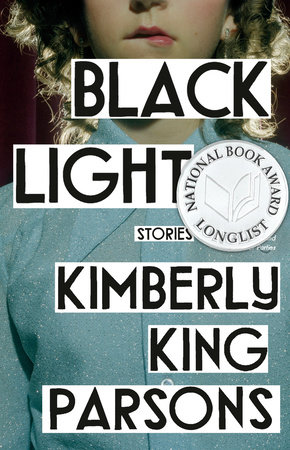
The Stories in “Black Light” Capture the Heady Obsession Between Teen Girls

Kimberly King Parsons’ fiction has been around the lit journal world for a little while, appearing in No Tokens, Black Warrior Review, Kenyon Review, and Joyland among others, and has been nominated for and won several awards. In her forthcoming debut short story collection, Black Light, the characters are all longing for something they can’t quite touch or even see. Children at camp and boarding school and in a bug-filled house; teenage girls who ache for each other; women and men who are driving away or drinking or disappearing into eating disorders or relationships or their child’s blanket fort—all of them are vividly rendered in a Texas setting that bursts off the page like Fourth of July fireworks. Black Light demands the attention of all the reader’s senses.

Perhaps the greatest strength of this collection lies in its weird, eerie, and sublimely beautiful details of setting and character. A short story that plunges the reader into its world from the first few words, and doesn’t dislodge until long after it’s finished, can be an incredibly satisfying reading experience. It seems that with recent collections like Nafissa Thompson-Spires’ Heads of the Colored People, Lauren Groff’s Florida, and Kali Fajardo-Anstine’s Sabrina & Corina (to name just a few), the short story form is being done a service by contemporary writers. Black Light is no exception to this emerging canon of exceptional stories.

I sat down with Parsons to discuss Black Light, perspective and voice, longing and obsession, naming characters, manic pixie dream girls, queerness, and more.


Sarah Neilson: Something that stood out across all the stories in Black Light is the concept of elsewhere. It’s a word the protagonists of “Glow Hunter” actually use and return to, but all of the stories have a strong element of longing to be elsewhere and the ways in which the characters pursue that desire. They take place in in-between places, elsewheres like schools, camp, a halfway house, a car, a blanket fort, a hotel room. How does the idea of being elsewhere inform your writing?

Kimberly King Parsons: I love that question. I think all of the characters in this collection are united by this idea that there’s some other life they long for that they’re not quite living. Whether that’s something they can reach through game playing, like in the case of kids, or through drugs or sex or all of the different things that these characters are doing to try to step outside of their real life—that’s definitely something that comes up for me a lot in my fiction. It wasn’t necessarily that I said, “Oh I want this story collection to be about that.” But it is; you kind of keep returning to your same desires.

I wrote these stories over a period of time from 2005 until 2017. I didn’t necessarily know that I was working at the same kind of ideas through some of them. But you’re still yourself whether you’re writing in 2005 or in 2017, and a lot of the things that I was interested in then I’m still interested in. That comes through the characters. And for me, some of it comes from growing up in a place that I kind of wanted to escape from, and having this feeling that there’s something different, there’s a different possibility that I am not able to access. So I think a lot of these characters have either stepped out of life on purpose or they’ve been, in the case of the girls at the boarding school in “Into the Fold,” essentially shipped off, pushed out of life. 

All of the characters believe that there’s something beyond what’s simple. There’s something else. Whether that means you have to get it by sneaking off to a hotel room or building a blanket fort, somehow there’s a way to try to get to another life that’s underneath this one.

SN: Most of the first-person narrators are never named and a lot of the secondary characters are never named either. Can you talk about the decision to name or not name your characters? What goes into that?

KKP: Sometimes I will find a place where you can drop in a name and it doesn’t feel forced. I don’t want information to be deposited by the writer because that feels authorial to me in a way that I feel jerks me out of the story when I come across it. I don’t think of myself as my name, nor do I think of my loved ones or the people in my life by their names. I think of them either by some sort of term of endearment or I just think of them as my brother or something. I guess I have a certain commitment to realism, but it’s also just a personal preference as to how information is transmitted to the reader in a way that doesn’t, to me, feel writerly.

I also had a mentor who forbade us from ever naming characters, which was amazing and very helpful. But there are plenty of times where you will need to have a character name. If you’re trying to write a novel, you don’t necessarily have to name your protagonist, because you can be so in their head, but it can get confusing. My mentor’s idea was that everyone should serve as an archetype to a voice. So it should be the postman or the mother or the father or whatever, and I do tend to like that a little bit. He also said things like, “A name is a void on the page, because it could literally be anything and it doesn’t change anything.” And so I kept that. Some of his rules were a little bit wacky, but that was one of the ones that, to me, made a lot of sense.

I also love the feeling of being dropped into a world without having a lot of things explained to me. You can weave in details through the craft, but I don’t like deposits of information. I try to avoid them if I can.

SN: You play with objectification in this collection in a lot of the stories. For example, in “Glow Hunter,” Bo is kind of a manic pixie dream girl, but it’s clear that the manic-pixie-dream-girl-ness is in the eye of the beholder. It makes sense that the narrator would see Bo as this fairy-like figure, given her age and budding sexuality. Can you talk a little about the genesis of “Glow Hunter,” and how you developed the character of Bo, who the reader sees only through the prism of the narrator’s infatuation with her?

KKP: It was important to me that Bo was a Manic Pixie Dream Girl in some ways. There’s a part of me that resists that trope, but it’s also very clear to me that she’s filtered through the imagination and perception of the narrator. But even the narrator starts to see the cracks and say, “Okay, she’s telling a lie and she’s actually really fake and she’s really needy and kind of awful, but so am I.” They’re both just being a teenagers trying on different identities, which is something else that I touch on in the title story quite a bit. 

The character of Bo starts off sort of magical, because it feels magical when you’re in the presence of charisma. It’s unexplainable. Everyone wants to look at her. Everyone wants to see her, but it’s not a traditional beauty. Her hand is bleeding and she’s barefoot but she has a pull and the narrator of course feels like she just wants to get close to it. Does she want her? Does she want to be her? Probably both. 

I could have been and/or was 90% of these characters in my life. These are people that I’ve met and known and been, and with Bo, I think most people have that person in high school who is just that focus that you can’t explain but can’t deny. It’s that first dramatic fixation and obsession that comes at such a crucial time when you’re coming up with your own identity. 

SN: A lot of the stories in Black Light feature women who have this borderline obsessive desire for, or fixation on, another woman. You capture the murky love between teenage girls so perfectly. It’s kind of the blur between friendship and romantic love and the deep intimacy that is also so precarious because it exists on this razor thin edge of overwhelm that kind of defines adolescence. Can you talk about the portrayal of female desire in the collection, and/or the portrayal of queerness?

KKP: Sure. I love women, and when I’m writing into these characters who are existing in that overwhelm, I’m writing my experience of the world. It’s being in a small town growing up and feeling very outside of things. A lot of the narrators’ experiences are not far off from my own personal experience. I don’t want to say I’ve just pulled things from my own life because there’s a lot of craft that goes into it and these stories are fiction, but these are still Own Voices stories. 

There’s also something about a high school where you’re not allowed to be queer because it’s not something that is an option; you have to find ways around it. I think for some of these girls, when they develop intense friendships they question where the lines are. “Am I imagining this? Is this crazy? Did that happen? Will it happen again?” It’s so fraught, I think because of the fact that it’s happening with someone in a way that’s taboo or unaccepted, especially in these little Texas towns. 

SN: Finally, I know this is an over-asked question, but I really love hearing about what writers are reading. So, what are you reading right now, and/or who are some of your literary inspirations, contemporary or not?

KKP: I have a huge love for T Kira Madden. Her book Long Live the Tribe of Fatherless Girls is beautiful and she’s a wonderful person and friend. I read drafts of that book for a very long time, and even through reading the ARC and then the final edition, I keep going back to it over and over again because the sentences are so devastatingly beautiful. I keep picking it up. 

I am a huge Amy Hempel fan and there’s some stories in Sing To It that bring me back to that exact same place and feeling I had when I read some of her stories in Reasons to Live a long time ago. Elizabeth Hardwick’s Sleepless Nights is another one I return to over and over again as a book that challenges the idea of what a novel can be. Because I’m working on a novel right now, and it’s terrifying, Sleepless Nights and Renata Adler’s Speedboat are where I go to get through it. They help me imagine how novels might be different, or that there’s some kind of form that hasn’t even been written yet. 

Right now there’s also some things that I’m excited about that aren’t out yet. Justin Taylor has a new memoir coming out next year called Riding With The Ghosts. I’m excited about that. It’s about his complex relationship with his father.

Michael Ondaatje’s Coming Through Slaughter, which is based on a real historical person, is another one I love. It’s strange — the first page of Coming Through Slaughter is an ultrasound of a whale sound. It’s bizarre. There’s photos, there’s weird separate texts. It’s very poetic.

I like things that mess with form and things that are not afraid to be really voicey and really experimental. But at the same time, I love just having something that’s a comfort. I feel like with T Kira Madden’s book, there’s just this comforting voice that makes it so you can pick it up and open it and it feels like someone’s speaking to you; you feel chosen when you read it and it’s such a gift.

7 Novels About Struggling to Make Ends Meet

After graduate school ended I discovered two things: reading for pleasure (instead of homework) was delightful again, and I had completely lost my taste for protagonists who didn’t worry about money. I used to lap up literature about fancy parties, poolside trysts, and the existential crises that inevitably come when characters don’t ever seem to work. Sunk into an abyss of student loan debt, and struggling to make ends meet by taking care of wealthier families’ children, I started instead to seek out more relatable stories for my subway commutes from Brooklyn to the Upper East Side. Books where characters have to work for as long of hours as I did, despite whatever else is going on in their lives. Books where if they don’t, it’s not an existential crisis that occurs, but an actual struggle for survival.

Buy the book

My novel, Devotion, follows a young Brooklyn transplant from a truck stop town in rural Oregon (much like myself at the time). Ella has an empty bank account and a maxed-out credit card when she’s offered a job as a nanny for a wealthy Upper East Side couple. From her new intimate vantage point Ella begins to observe everything she never had and what she finds both fascinates and infuriates her.

Here are seven novels I adore that dig into the life of the working class.

Bad Marie by Marcy Dermansky

This is, so far, my favorite book I’ve come across about a nanny. Marie, newly released from jail at 30, is figuring out how to be an adult for the first time, with no safety net. She lands a job as a nanny for the young daughter of a friend who pities her—who, in fact, has pitied her whole life. When Marie falls for the friend’s woefully inept husband, everything is thrown dangerously off the rails. Marie’s real love story has nothing to do with the husband, however. She has actually fallen for Caitlin, her almost-two-year-old charge, and their relationship is captivating and increasingly heartbreaking. 

Have you ever cleaned up someone else’s baby’s diarrhea in a public restroom? I have, and so has Marie.

Fat City by Leonard Gardner

Fat City by Leonard Gardner

This is the story of two boxers in Stockton, California. At 29, despite his talent, Tully’s boxing career never seemed to get started. He already feels his life is over. Living in cheap motels after his divorce, eating hot dogs from cafeterias, and catching jobs topping onions and picking walnuts on the farmland that surrounds Stockton, he stumbles into a co-dependent, alcohol-fueled relationship with a woman he picks up at a bar. Meanwhile, the hopeful and younger Ernie’s career seems to be taking off. Though you want to root for Ernie, it’s hard not to read Tully as a manifestation of Ernie’s future, and therein lies the tragedy.

This novel contains some of the best dialogue I’ve ever read, and certainly the best descriptions of physical labor. 

Modern Classics Good Morning Midnight

Good Morning, Midnight by Jean Rhys

Sasha Jansen is middle-aged in a society that has only ever kept her afloat because of her looks. She was hired at one time to be a mannequin in a clothing store, standing achingly still for hours on end. Now she spends her days living as cheaply and invisibly as possible, in sordid hotel rooms, while coming as close to starving herself as she can and sleeping her days away to conserve energy. Just when she thinks a man might buy her dinner she makes the mistake of mentioning how hungry she’s been. The man enters a taxi and takes off without her: “And did I mind? Not at all. If you think I minded, then you’ve never lived like that, plunged in a dream, when all the faces are masks and only the trees are alive and you can almost see the strings that are pulling the puppets. Close up of human nature—isn’t it worth something?”

Told in a lyrical, experimental style that drifts around in time and throughout spaces much like Sasha, this book feels shockingly modern. And I can’t even talk about the ending. It’s too good and too awful. You’ll have to see for yourself.

The Long Goodbye by Raymond Chandler

The Long Goodbye by Raymond Chandler

Private investigator Philip Marlowe has always struck me as a working-class hero. Marlowe spends the length of The Long Goodbye (as well as The Big Sleep) tossed around from place to place doing the dirty work of the wealthy so they don’t have to.

This book contains some of the most seething class commentary I’ve come across: “There’s always something to do if you don’t have to work or consider the cost. It’s no real fun but the rich don’t know that. They never had any. They never want anything very hard except maybe somebody else’s wife and that’s a pretty pale desire compared with the way a plumber’s wife wants new curtains for the living room.”

Invisible Man by Ralph Ellison

Invisible Man by Ralph Ellison

Like so many others I fell in love with this classic in the first chapter, captivated by a narrator squatting in an abandoned basement on the border of Harlem, wiring every square inch of his ceiling with filament light bulbs in order to steal energy from the electric company. The way Ellison portrays the narrator’s employ at a paint factory famous for its Optic White shade is brilliantly multi-layered—criticizing capitalism, grunt work, and the whitewashing of racism in America all at the same time.

The Assistant by Bernard Malamud

Centering around the Jewish immigrant community in Brooklyn during the years immediately following the Holocaust, this is a dark novel about poverty, trust, and the grim realities of redemption. Set in a small grocery store, Frank Alpine seeks to relieve his guilt from having held up and robbed the place by offering to work without pay for Morris Bober, the impoverished immigrant owner. While Frank works tirelessly to help Morris keep the store afloat, he also begins stealing from the till, and this moral ambiguity—which becomes increasingly more complicated as Frank becomes involved with Morris’s daughter Helen—is what makes the book so absorbing. The characters exist, as writer and editor Jonathan Rosen says, “in an outer borough of Stygian darkness where the inner light of the soul is in constant danger of winking out.”

Hard Rain Falling by Don Carpenter

Hard Rain Falling by Don Carpenter

As a native to the Portland area, I was conscious of how the place had changed from a dive-y, working-class city to the white and wealthy paradise Portlandia has made it so famous for today. Writing in the 60’s, Carpenter captures Portland’s seedy pool halls and cheap motels through the eyes of Billy, a young black runaway, and Jack, an orphan who bounces around from reform school to jail to shitty job after shitty job. The two develop an unexpected bond, which Jack is unable to replicate again in his life, even when he attempts to redeem himself.

What I enjoyed most in this novel was reading Jack’s thoughts during the darkest moments of his life. The writing here is stark and grim, speaking to underlying truths about our humanity and the influence of both love and privilege.

8 Grown-Up Novels with Animal Narrators

One is never supposed to buy a book for its cover, but I’ll come clean and admit that I’ve purchased many a novel because of the animal gracing its face. I own an inordinate number of books that have “wolf” in the title and no actual wolves in them. I can’t help myself, I’ve always been crackers about the creatures of the natural world, seeking out their company in life and in literature. Close encounters of the animal kind leave me wondering about what they’re thinking, enjoying their individual idiosyncrasies, and pondering our place in the natural world.

Buy the book

My debut novel, Hollow Kingdom, is narrated by a snarky domesticated crow named S.T. The time I’ve spend with the two wild crows I’ve befriended helped inspire some of my crowtagonist’s behavior and antics. As I wrote from the perspective of a crow, I read voraciously about the natural world, but felt I had to avoid animal-narrated books because I didn’t want to be influenced as I developed the unique voices of various animals.

Now that Hollow Kingdom is about to take its flight into the world, here are a few favorite animal-narrated books I love, and one that is winking at me from my TBR list and that I’m chomping at the bit to get to. 

Image result for mink river brian doyle

Mink River by Brian Doyle

I was first introduced to the beautiful mind and powerful words of Brian Doyle through his stunning essay, “Joyas Voladoras.” His novel Mink River is equally as beautiful —an experimental and literary masterpiece with a riparian and lyrical musicality. Oregon is a character, the river is conscious and everything is braided together as in the gossamer web of life. Of course, my favorite character is Moses, the benevolent crow.  

Timothy; or, Notes of an Abject Reptile by Verlyn Klinkenborg

Timothy; or, Notes of an Abject Reptile by Verlyn Klinkenborg 

Timothy; or, Notes of an Abject Reptile is a gorgeous and whimsically quiet novel. It’s filled with juicy lettuce leaves of wisdom shared through the sage, philosophical musings of a tortoise named Timothy (based on a real tortoise who lived in the garden of the 18th Century naturalist Gilbert White, and who was in fact a female tortoise but named Timothy because we humans hadn’t figured out how to properly sex a tortoise at that time in history). A favorite few lines: “My voice would shatter his human solitude. The happiness of his breed depends upon it. The world is theirs to arrange. So they tell themselves.”

I loved the worldview from the philosophic Timothy and found the tortoise-approved pace of this book so radically refreshing. It serves as a beautiful reminder for us to slow down and reconnect to the natural world. I liken it to another book (a human-narrated memoir) that maneuvers at a beautiful and contemplative pace on sentences to be savored—The Sound of A Wild Snail Eating by Elizabeth Bailey. 

16644104. sy475

Watership Down by Richard Adams 

An indisputable childhood classic, Watership Down was my first experience of a “first person rabbit point of view” and I adored it. As a child, I appreciated that it delved into dark places and didn’t leave me feeling patronized. I recently read that many readers have long suspected that Watership Down is an allegorical tale—religious, political and otherwise. According to his daughters, Adams’ hilarious response to this was “Rubbish! It’s just a story about rabbits.” Quite right. 

Image result for white bone barbara gowdy goodreads

The White Bone by Barbara Gowdy 

This novel is a little heavier than the other animal-narrated novels on this list. An incredibly creative novel told from the perspective of a family of African elephants, The White Bone takes a deep dive into elephant society, exploring their memory, culture, rituals, mythology and the way they communicate. It openly tackles the infuriating devastation caused by ivory hunters and a parched landscape; the elephants must travel far and face terrible odds to survive. The White Bone is at once hopeful, heartbreaking, wondrous and wise. 

The Bees by Laline Paull

Described as “The Handmaid’s Tale but with bees”, this novel follows the trials, trails, and tribulations of Flora, a humble sanitation bee, as she moves on up the sticky social ladder of the hive. Her differences (she is a larger, darker bee than most) put her at great risk amongst the hive, as “deformity is evil, deformity is not permitted.” Flora’s differences might be the very thing that saves her as she moves on up in the world, from sanitation, to the nursery, and finally into the inner circle of the supreme ruler, the Queen bee. A note: crows are villains in this novel, but I have to forgive it—they’re not incredibly benevolent to bees. I have witnessed this firsthand. 

Animal Farm by George Orwell

Animal Farm by George Orwell 

I would be remiss in not giving a deep cart-horse nod to Orwell’s political satire. I studied this book in school and penned many an essay about the allegorical foibles of human society and Orwell’s commentary on communism in Russian and the Soviet Union under Stalin’s rule. I undoubtedly also wrote about how I wished I lived in a society ruled by animals and I’m quite sure that it was Animal Farm that sparked my love of satire. “Four legs good! Two legs bad!” is still something I intermittently chant at my long-suffering husband. 

The Art of Racing In The Rain by Garth Stein 

I defy you not to fall in love with canine narrator, Enzo, who believes that he will be reincarnated as a human, but believes in his human above all else. Enzo tells the story of his relationship with Denny, a Seattle car dealer and aspiring race car driver as they navigate the ups and downs of Denny’s anthropocentric existence. Enzo’s narration exudes heart, love, loyalty, a little mischief, and a beautiful story of true friendship as only man’s best friend can tell it. It’s well worth a read or a reread just in time for its movie release. The Art of Racing In The Rain is beautiful and a shimmering reminder that sometimes it’s our four-legged companions who teach us how to be our best selves. 

Image result for me cheeta

Me Cheeta: The Autobiography by James Lever 

I love this satirical take on the Hollywood autobiography as told by Cheeta, the infamous chimp from the Tarzan movies. Cheeta’s wit and commentary is scythe-sharp as he recounts his Hollywood adventures now at the ripe old age of 76, while retired and living in Palm Springs. I laughed, I cried, and I trusted this silver screen veteran to give me the truth about the golden stars and bright lights of Tinsel Town, including some stark truths about substance and animal abuse. This is my favorite Hollywood memoir and without question, the greatest chimpanzee autobiography of all time. 

14 Authors Who Started Out as Booksellers

It is universally-known that if you want to write a book you should read a lot of books, but a piece of unexpected advice for aspiring writers? Work in a bookstore. You can’t go wrong working for a place that pays you to talk about books all day. You learn what’s out there, meet a community of book lovers, and maybe get your big break one day—it worked for all the writers on this list! Here are 14 authors who stocked shelves by day and wrote novels by night (and some who still do).

Jonathan Lethem

Writer of 2018’s The Feral Detective and 2005 MacArthur fellow, Jonathan Lethem has etched himself a place in the hearts of sci-fi and crime fiction lovers. But before he was crafting post-apocalyptic detective stories, he spent over a decade working in Berkeley bookstores like Moe’s and Pegasus Books. Today, he is part proprietor of Red Gap Books, an occasionally espresso-serving bookstore in Blue Hill, Maine. 

Lillian Li

Named NPR’s Best Book of 2018, Lillian Li’s debut Number One Chinese Restaurant invites readers into the Beijing Duck House after its owner passes away, laying bare the fraught relationships of his sons—the restaurant’s successors—and the establishment’s employees. Not only is Li a prize-winning novelist, she also sells books, conducts Q&As and manages the Twitter feed at Literati Books in Ann Arbor, Michigan. 

Image result for poster

Kea Wilson 

Kea Wilson’s We Eat Our Own came out in 2016 to the delight of horror-seeking bookworms everywhere. Its promise of cannibals, use of vivid detail, and roots in true events has earned Wilson praise from publications like The New York Times and Publisher’s Weekly. Wilson began writing her acclaimed debut during her MFA at Washington University but finished it in between shifts at Left Bank Books in St. Louis as their events coordinator. 

Michael Bible

Michael Bible is the author of absurdist fiction, having penned Sophia and Empire of Light. His newest work The Endless Idiot celebrated its book birthday on August 6th and is out now. Bible also worked for many years at Square Books in Oxford, Mississippi. 

Louise Erdrich 

Inspired by her half German, half Native American ancestry, Louise Erdrich has written nearly 30 novels, poetry collections, and children’s books on the topic of biracial identity. Her works have earned her several awards and accolades including a Library of Congress Prize in American Fiction and bragging rights as a finalist for the 2014 Pulitzer Prize. She is currently preparing for 2020 release of her upcoming novel The Night Watchman and owns Birchbark Books in Minneapolis. 

Image result for poster

Emma Straub 

Book mom to Modern Lovers, The Vacationers, and Laura Lamont’s Life in Pictures, Emma Straub is not only a celebrated author but a former employee of the Brooklyn bookstore BookCourt. When the Boerum Hill staple closed in 2016, Straub teamed up with her husband to open Books Are Magic, a quirky bookstore (it has a poetry gumball machine!) five blocks from BookCourt’s original home on Court Street. 

Image result for turkey

Jamie Kornegay 

Jamie Kornegay made his debut in 2015 with the novel Soil, a story about an environmental scientist whose idealistic plans to establish a sustainable farm go horribly awry. Before Kornegay joined the community of published authors, he was a bookseller, events coordinator, and radio show producer for Square Books. Now, he can be found in the stacks of his own bookstore, Turnrow Book Co. in Greenwood, Michigan. 

Get in Trouble by Kelly Link

Kelly Link 

2018 MacArthur fellow and author of such titles as Magic for Beginners, Pretty Monsters, and Get in Trouble, Kelly Link is notorious for bending the boundaries of genre, mixing fantasy, sci-fi, and horror. She is equally notorious for her love of booksellers, having sold books herself at Avenue Victor Hugo Books in Boston, Massachusetts (now located in Lee, New Hampshire). Link co-founded Small Beer Press with her husband (also a former bookseller!) in 2016. 

The Melting Season by Jami Attenberg

Jami Attenberg 

Jami Attenberg is the author of The New York Times bestseller The Middlesteins as well as the forthcoming novel All This Could Be Yours. Crowned by Kirkus Reviews the “poet laureate of difficult families,” Attenberg was once the fairy godmother of books at WORD Bookstore in Brooklyn.  

Woman No. 17 by Edan Lepucki

Edan Lepucki 

Best-selling author, podcast queen, and Stephen Colbert’s bestie, Edan Lepucki is responsible for the darkly comic If You’re Not Yet Like as well as California and Woman No. 17. She is also a former staffer from Hollywood’s Book Soup

Image result for we the animal 2018

Justin Torres 

Justin Torres’s 2011 debut We the Animals had been translated into 15 languages before being adapted into an Independent Spirit Award-nominated film. He would go on to receive several accolades and fellowships including The National Book Foundation’s 5 Under 35 and a Cullman Center Fellowship from the New York Public Library. Now a professor at UCLA, Torres once worked for the Manhattan staple McNally Jackson

Image result for Flatscreen: A Novel

Adam Wilson 

Known for his coming-of-age narratives and humorously nihilistic writing style, Adam Wilson has two books out in the world: Flatscreen (2012) and What’s Important is Feeling (2014). Wilson’s writing journey came full circle when he celebrated the release of his debut novel at BookCourt—his previous employer! 

M Train by Patti Smith

Patti Smith 

Called the “punk poet laureate,” Patti Smith is a celebrated singer-songwriter, performer and novelist. But, once upon a time, she moved from New Jersey to New York City with dreams of becoming an artist. Her first job in the Big Apple? Brentano’s, one of the grand bookstores that studded Fifth Ave in the 1970s.  

11052304

Martha Southgate

Martha Southgate wears many hats: author, essayist, teacher, and Hamilton-lover. She is also a former bookseller! The third former BookCourt employee on our list, Southgate began working at the bookstore only months before the release of her fourth book Taste of Salt. 

A Conversation with Native Voices at the Center

Editing an anthology, or a collection, is not for the weak. The curation and collation of myriad voices weaving into one another, collectively imbuing a relationship that is both structured and organic, takes focus, tenacity, and patience. Reading Shapes of Native Nonfiction, edited by Elissa Washuta and Theresa Warburton, this cohesion, and the planning behind it, is apparent. Beyond what’s explained in the introduction, with the concept-turned-theme of basket weaving, the pieces populating each section exemplify how materials, through words, come together. I came away from this collection clearly recognizing the intent of both Washuta and Warburton in how “shapes the content (material) enables a move away from a focus on a static idea of ‘Native information’ and, instead, emphasizes the dynamic process of ‘Native in formation.’” 

The trajectory of an anthology can run the gamut, and I found myself enamored as I considered the specificity of form and language in contributions from Terese Marie Mailhot, Bojan Louis, Billy-Ray Belcourt, and Laura Da’ in essays that twine themes or plait formatting, from work that could at once be categorized as anything but nonfiction, yet the truth within the material was so inherent designating it nonfiction was absolutely within scope.

In speaking to Washuta and Warburton, whose friendship and respect for one another as colleagues is as deeply rooted as their joint vision for Shapes of Native Nonfiction, it’s evident why and how this collection packs such a punch while providing space for Native writers to speak in a way that is both uniform and unique to their positions, themes, and stakes in their writing. I was eager to discuss how collaboration and conjoined thinking led to such a fantastic collection that gives Indigenous voices a chance to speak openly, having their pursuits clearly woven into something both daring and relatable. 


Jennifer Baker: Many people I’ve talked to who are editing anthologies have been doing it solo, myself included. But there’s something very different to a partnership. Can you talk a little bit about that for Shapes of Native Nonfiction?

Elissa Washuta: I originally conceived of the very basic idea of this anthology in 2014. And I knew from thinking about it and having conversations with our first editor at University of Washington Press, it was something that I was not going to be able to do alone. I wasn’t actively seeking out someone to partner with on the work. I just put the idea on the shelf and was working on a bunch of other things for years. In the meantime, Theresa and I became friends and were talking a lot about our lives and literature and writing and academia. UW Press inquired again about the anthology and whether I was interested in submitting a proposal. At the time I was not interested in doing it alone, I needed help. And I needed a collaborator. I mentioned it to Theresa and she was really excited about the idea.

Theresa Warburton: I can’t imagine having done this amount of work solo or with someone else who I didn’t trust as much as I trust Elissa. We are very close, that has been very important and you can feel that in the collection. The real foundation of it is our relationship to each other and Elissa’s relationships with other writers. Even though it took us two years to do, it’s actually more than a decade of relationship building that was at the center of this collection.

EW: It sounds hyperbolic to say this, I guess, but I don’t think I could do this with anyone I didn’t trust with my life. I trust Theresa with my life because this is my life. Doing this work. Being part of this community is at the very center of my life. And I had never thought that I was going to enter into any kind of creative or collaborative partnership to make a book. But I knew she was invested, and that there’s something at stake for her too. It’s different than what’s at stake for me, but this work is profoundly important to both of us. Being trustworthy is a quality, sure, but I know from my own work to become trustworthy that it takes hard work to get and remain there. Our separate commitments to that complement each other.

It wasn’t that there weren’t any anthologies of Native nonfiction, but that a lot of them, in both their framing and content, were the same.

JB: There’s been a kind of boon in the publishing world either topically or identity specific when it comes to anthologies. So people may think “I’m gonna do this anthology.” And it really has the potential to sound “easy.” But I also think it’s that realization, and you speak about this in the introduction at length and with such urgency, of “because we haven’t seen this we want to provide this collection, or archival material, to show that this has existed already.” When you have something that’s very specific to craft as well as those writing it from varied and distinctive identities within the Indigenous community, where do you even start?

TW: It wasn’t that there weren’t any anthologies of Native nonfiction, but that actually a lot of them, in both their framing and content, were the same. Like the same book coming out over and over. That was frustrating, not because it was a bad book but because there just seems to be so much more to say. Jenn, you were saying that there can be a sense of flippancy, a sense of “Oh, I’m just going to do an anthology.” But I think a lot of folks, myself included, don’t really, realize what kind of undertaking it is to do that or to craft in an ethical way. We agreed that we didn’t want to call Shapes of Native Nonfiction an anthology, we wanted to call it a collection, because of exactly what you’re talking about. There’s this sense that it’s showing something that’s never existed. It’s very important for us to say this is a collection of things that do exist, but by putting them in a different form we’re hoping people can see how vibrant and sort of essential it is to the field itself. Writing by Native authors is foundational to the field of nonfiction period. So, this isn’t an anthology of Native writers per se but actually a collection of nonfiction that is centering the voices of Native writers. The distinction between those two things was really important to both of us.
EW: The process by which we made the decision to do this and how we conceived of it was so far from casual. Even though we both kind of were a little bit casual, like Theresa said in thinking, “Oh yeah we could do this.” But at the same time—

TW: We were right!

EW: True. We were right. But also I had started thinking of the need for a book like this when I was teaching Native American literature(s) at the University of Washington. The anthologies that were out there were older and had a more anthropological focus on life stories. So I knew that there was a need for a form-focused book. That need remained and grew. And I started teaching nonfiction at the low-residency MFA program at IAIA (Institute of American Indian Arts). I was giving students reading lists, so I was seeing even more that a book like this is needed that is really focused on craft and form. So that was a big thing I was bringing to the work when I started doing it: knowing exactly what my intention was for the book, and exactly what contribution I wanted the book to make. And I had spoken to other faculty about their similar needs. It was very intentional and this brought urgency to the work.
TW: I think one of the reasons we came together in this way is because of that sense of urgency. How Elissa and I met was that Amazon recommended her book to me. So we say Amazon set us up.

JB: Amazon did one thing right.

TW: I brought her up to Western Washington University because I was teaching at the time. I was teaching a grad class and an undergrad class, so I brought her up to give a talk. She read an essay and then she read from her book. And I remember from her Q&A that some of the questions that people asked were so focused on very personal information, questions about cultural practices or being raised off-territory. I thought, “Wow, they really don’t have the framework for engaging with what she’s saying.” There were no questions about craft. There were no questions about what she was doing as a writer. You’ve read Elissa’s work, she does such compelling, important things. Elissa, you’re such a tight writer. Your essays turn on a pin. And since some of those questions were from my own students, I remember thinking that I had obviously not given students the framework they need to adequately engage nonfiction in this way. And we have a strong creative nonfiction program at Western, so I knew that students were getting some of that discussion of form in that field, but it was clear that was really not connecting to work by Native authors. Elissa and I started talking about these things after this event.

EW: There was one way in which that question and answer session was different, Theresa, it was how you shaped the Q&A. After a particularly personal question was posed by an audience member, you said something like, “I’m gonna step in here and I’m gonna ask some questions about craft.” In teaching Native literatures as a creative writer, I had felt like there was this divide that I was trying to navigate. In my teaching, in the language around the way craft was spoken about by writers, about how craft was spoken about by literary scholars. The way you approached that Q&A, and how I soon learned you approach the rest of your work, helped me see how these areas of study could come together. I carried that with me when we began talking about doing the work together. And it’s something we still talk about how we needed to come together as bringing creative writing and craft study and literary studies together in framing this book.

JB: I read and reread this line in your introduction, “the essay is the work of feeling and thinking,” about what elements we seek to find in the essay and how much the essay is, depending on the person, narrowly defined. How much does form come into play when we’re looking at the thinking and feeling and the way that material is actually structured? Is that something that is continually defined?

EW: I’m thinking about how, when I was sort of making my shift from fiction to nonfiction writing, a work that was really influential to me was Short Talks by Anne Carson. Which I read in a fiction class, before I ever wrote personal essays. It was excerpted in a fiction anthology. I’m pretty sure Carson considers it poetry. And I think it’s been labeled as essay. But I was so interested in the way style and form felt like the real subjects of that book.

I feel super committed to the essay as my vessel for thought and feeling. There’s understanding I can’t get to without writing the essay.

I feel super committed to the essay as my vessel for thought and feeling. I can understand my own thoughts and feelings through going to therapy or talking to a friend or just thinking. But the essay is its own separate way of knowing, way of thinking, way of dealing for me. There’s understanding I can’t get to without writing the essay. When we talk about the essay as an exquisite vessel in our intro—specifically, the form-conscious essay as an exquisite vessel—that’s what I think we’re thinking about, the way form allows the essay to be this absolutely beautiful sort of material object that is a container for thought, feeling, identification of kinship, connection, and lineage and all these things.

TW: Part of teaching Native literature in the field as a non-Native scholar has really challenged me to think about how typical genre categories—like poetry, fiction, memoir, the novel, nonfiction—where they come from and how they’re applied and how this seems to value certain kinds of writing over others. When it comes to Billy-Ray [Belcourt]’s piece, who I think is most well-known as a poet, but with his new book and this piece that is really blowing those categorizations wide open. I’m also thinking mostly about Ernestine [Hayes]’s piece that we open the book with: a more traditional literary scholar might say it exists between or across genres, somewhere on the edge of fiction and nonfiction. But what we’re trying to do in this collection is to consciously think through how such categories are related to non-Native cosmology and non-Native ways of thinking of form. And, then, to recognize that trying to pigeonhole certain writers in these ways does a disservice to their work. So, when we got Billy-Ray’s piece we thought “yes, nonfiction piece absolutely.” Especially the formal ways it takes place on the page. And the way it uses slashes. But I think some people would call that poetry too and I don’t necessarily think that’s wrong. One of the things we’re interested in, though, is how these ways that Native writing gets rigidly categorized does a disservice to the actual work.

EW: I feel super committed to nonfiction because looking at these essays and then practicing essay writing. I feel super committed to the idea that the essay can do so much more than just kind of transparently tell us about something and explain something to us, and show all its cards. I feel like the essay can be so many things and it can do a lot of the things that fiction can do and can do a lot of the things that poetry can do. And it will take all sorts of different shapes. And that’s the beautiful thing that makes me feel committed to the essay as a way of serving us a container for my real experience.

Borders Are Black Holes Where Ideas Go to Die

In September 2016, fellow author Todd Miller and I took an investigative trip to the Middle East trailing a labyrinth of state-corporate border intrigue. As writers focusing on U.S.-Mexico borderlands issues, we had already written an sleuth piece exploring two sides of a trinational U.S.-Mexico-Israel security project called Global Advantage, which is headquartered in Southern Arizona at the publicly funded Tech Parks Arizona, a business incubator on a 1,345-acre research park that offers its homeland security clients a manufacturing base in Sonora, Mexico. To us, the combination of innovation and manufacturing functions as a multinational assembly line where NAFTA free trade policies grease the working parts of an emergent homeland security border apparatus. 

The one recurring commonality that flagged us for suspicion? Books.

Living on the U.S.-Mexico border, we’re both accustomed to the arbitrary powers of discretion wielded by border and customs agents. On this trip, we took painstaking efforts to cooperate at every turn of security check-points and their accompanying infrastructure of armed guards, customs clerks, metal detectors, X-ray conveyer belts, and—as we’d find out the hard way—nondescript plainclothes officers mixed in tourist crowds far outside formal border crossing point zones. In other words, “the border” followed us everywhere we went.

Despite our precautions, the trip was punctuated, at times, by confrontations with paranoid or obtuse agents on the look-out for whatever seemed leery to them from one moment to the next. The one recurring commonality that flagged us for suspicion? Books.

Books Across Borders

We experienced the phenomenon of books as potential national security threats first at the Israeli-controlled Sheikh Hussein Border Crossing while we were returning, circuitously, from Amman, Jordan to the city of Ramallah in the Palestinian West Bank, where we were based most of the trip. We traveled this slightly longer, roundabout route back to Ramallah because locals told us it would take less time than the crowded Allenby Bridge crossing, which took half a day to get through.

I had no premonitions as we walked the long banal distance from the gate to the port building. The nearby Sea of Galilee lay somewhere out of sight; that day the dry midday heat, in the thick of midsummer, granted not even a wisp of breeze. The blistering sunshine overhead sapped my energy. I could feel then that we stood at the pinnacle of anthropogenic climate change. Later, figures came in from the World Meteorological Organization to confirm that that 2016 summer had achieved the hottest earth temperatures on record. (Until July 2019 broke all records as the hottest in modern history.) Droughts east of the Jordan River, the ground over which we then trod, are projected to double by 2100 in what is already the fourth driest country on earth where freshwater access reaches below levels of “absolute scarcity” as defined by water scientists. Climate change may not be so clear from the bird’s eye view of daily weather patterns in one’s locale, but taken together globally, the drastic increases of cataclysmic climate events like flooding, draughts, and wildfires are displacing more and more people. These new climate refugees, averaging 21.5 million per year, will inevitably encounter borders—in a manifold bordered world in the 21st century where 15 border walls that scarred the earth in 1989, have multiplied to 70 walls today. These latest targets of greater border policing were on my mind as we attempted to cross yet another border.

Inside the port building, which was typically empty of crossers that day, the cooler temperature gave us some momentary relief before what happened next. Uniformed Israeli border guards had waved Todd through the port, ahead of me, and ushered him outside the building. No sooner was Todd out of sight then one of the soldiers stopped me after searching my backpack, apparently discovering some high-interest items. As I craned my neck to see what objects piqued his concern, he pulled out all the books I carried for the journey: some pamphlet reports from an Israeli-Palestinian research organization, Who Profits, whose staff researchers we interviewed the week prior; Dan Senor and Saul Singer’s Start-Up Nation: The Story of Israel’s Economic Miracle; Jeff Halper’s War Against the People: Israel, the Palestinians, and Global Pacification. And a copy of F. Scott Fitzgerald’s The Great Gatsby. The guard stacked the books neatly on the static conveyor belt and walked over to his colleagues, where they huddled for what seemed an extraordinarily long time, seldom looking my way but otherwise rapt in their conversation.

The guard stacked the books neatly on the static conveyor belt and walked over to his colleagues, where they huddled for what seemed an extraordinarily long time.

Todd later said he didn’t know what to do as he waited for me outside. What if they detained me long into the night, as they sometimes do?

Many months later, we reflected on that moment from a downtown Tucson ice cream shop out of sight from the nearest checkpoint that lay only a few miles away outside of town. The 102-degree June heat above the Sonoran Desert acted as an open-air kiln. Todd’s two-year-old son William sat between us, nodding his shiny bobs of curly blonde hair and babbling his own contributions to the conversation. We compared memories from the cluster of border zones in the Middle East where, like the US-Mexico border and others throughout the world, authorities can ultimately target anyone for suspicion—where border guards can say (or not say) whatever they want to justify their actions. 

Everywhere we looked during that Middle East trip, there were people, including ourselves, caught, in varying degrees, in the omniscient border netting. There was a solitary man at Jordan’s border who seemed to hold himself up by one hand placed palm down on the customs window counter that resembled a theatre box office. His tapping finger perhaps counted the hours he quite possibly had been waiting to cross. I’ll never forget when Todd and I waited within the juggernaut Qalandia security checkpoint in the occupied Palestinian West Bank—stuck suspended on the road between Jerusalem and Ramallah in a chaotic place where time slows and space is walled off. Locked under its weight we seemed to move a few steps per hour among the antsy families and desperate workers all waiting, packed together in narrow rows of caged pens that evoke imagery of hogs in a factory farm. Those privileged few of us who can even get out of the West Bank through the Allenby Bridge crossing into Jordan face the endless lines of stalled buses that, when they do get going, must pass military guard posts stationed by heavily armed soldiers on the narrow road to Amman, Jordan.

In any of these situations, regardless of your citizenship status or racial profile (though many are more frequently targeted than others), border agents may think you’re a member of an armed group or they simply don’t like the way you think about the world. As if borders are a place where ideas go to die.

But not all ideas. That’s where particular books, like those contained in my bag listed above, enter the equation. Oftentimes, border zones cultivate a discriminating sense of taste in their guards about what kinds of books interest them, often in accordance with the national worldview for which the guards are hired and trained to keep watch. Being more traveled than me, Todd had been ready for this global border trend, having gleaned a wisdom through researching his growing stack of published books on the topic that sent him weaving in and out of borders all over the world and their labyrinthine, bee-hive bureaucracies. “The guards looked at my books, too,” Todd said. “But, actually, in my case, I purposefully brought a book—I forgot what it was—but it was a book that wouldn’t raise any suspicion—”

Border zones cultivate a discriminating sense of taste in their guards about what kinds of books interest them.

“It was a tourist book,” I reminded him. I remembered that book well. It was the kind of orientalist travel guide written to function as training wheels on a cultural tricycle; to hold your hand in a foreign country, warning you about any counter-intuitive customs and instill in you an arsenal of healthy suspicions. For example, I brought multiple pairs of shorts, knowing the desert weather was comparable to Arizona. On our first day in Jordan, Todd took one look at me and—in his mischievously assailing humor—recalled an analogy he read in the book that classified apparent tourists like me: In Jordan, the book warned, wearing shorts in public was like wearing a skimpy bathing suit in Baltimore in the dead of winter. Later, while wearing those same shorts, I would be accosted by the Jordanian secret police, causing me to wonder what about me, to them, might have looked odd.

“Right, a tourist book,” Todd recalled, “and I also had just a novel, which I positioned at the top of my bag.” A wry twinkle gleamed in his eye as he said, derisively: “The fact that the guards went straight for the books as if they were going straight for a weapon, is quite telling. ‘My word is my weapon,’ as the proverb goes. And the fact that they took out your books,” he continued, “some of which described a worldview that was different from the dominant government narrative, is very important when it comes to this kind of bordered world, where the gap between ‘innocent’ and guilty’ is whether you’re compliant or not compliant; between who’s considered a threat and who’s not considered a threat. And a criterion that’s being used is that you’re singled out and interrogated for books!”

In a sense, a border becomes a kind of black hole; not only fragile human bodies but everything from cultural norms to established principles of democratic order seems patted down and stripped bare. The natural laws that define up and down, the moral metrics that define right from wrong become a valueless abstract theory whose credit is not accepted there as currency. We’re passed from palm to palm by the arbitrary whims and authoritative directions of border agents.

A border becomes a kind of black hole; everything from cultural norms to established principles of democratic order seems patted down and stripped bare.

Todd and I spoke about these things, reflectively, in a place where the only disturbances came from the hustle and bustle of a downtown thoroughfare. William took another lick of his butter pecan and the clatter of street traffic waved in and out as patrons opened and closed the door to the ice cream shop. In the deluge of crowded noise, Todd relived the feeling of waiting for me outside the Israeli port of entry all those months ago. “It’s also scary, too,” he said, “because, in that kind of situation, you don’t know what’s going to happen. I was waiting for you—probably only for 15 minutes but it seems longer when you’re waiting for your friend who’s not coming out and you’re wondering what happened.” His voice deepened pitch. “A startling thing about borders is that you can disappear into the system for a long time.” Recalling a shocking headline that posted earlier in the day, we both knew whom he meant.

One of those “disappeared,” French-Canadian citizen Cedella Roman, had recently emerged from her own black hole border nightmare. Her frightful story made headlines, unlike so many other hapless detainees who lack immigration status. At a convention of police and sheriffs in 2008, former executive director of Immigration and Customs Enforcement, James Pendergraph told his audience: “If you don’t have enough evidence to charge someone criminally but think he’s illegal,” he said, “we can make him disappear.” 

So when Roman accidentally crossed the Canadian border into the United States while on an exercise run off the beachside near where Canada meets Washington State, agents from Customs and Border Protection, the parent company of U.S. Border Patrol, intercepted her when she strayed off, detaining her over a two-week timespan. But even by definition of state citizenship norms, once a citizen produces a passport, as Cedella did immediately when her mother frantically rushed to the detention facility with her papers, people like Cedella are supposed to be beyond suspicion by border officials who, time and again, nevertheless racially profile dark-skinned people like her. Todd bounded in astonishment, reacting again to the story just as when he first read it hours before. “Two weeks in CBP custody,” he remarked, “just because she jogged across the border and didn’t realize she was in another country.” The case of Cedella Roman is not the only one; many northern borderlands citizen residents, white or brown, have endured similar arbitrary detention stories.

The way border spaces act as a vacuum of political freedom elicits a dark, isolating feeling.

Gone, too, down the border void often are intrinsic political rights such as due process, even the longest-held tenants of modern social democracy which stretches back 1000 years to the Magna Carta. My brief detention at the port near the Sea of Galilee, Cedella Roman’s longer detention in the Washington State/British Columbia borderlands, and countless others who are held for many months, even years, seemed to culminate in Todd’s mind as a realization dimmed his facial features. “One of the things you always hear growing up in the U.S. is that you’re innocent until proven guilty. In a border situation, it almost feels like the opposite. You’re guilty until proven innocent.”

The way border spaces act as a vacuum of political freedom elicits a dark, isolating feeling. The rules are not explicit—or if they are, they’re hidden, and there’s no protective authority to intercede on your behalf. I felt it in my bones as I stood there submissively in the air-conditioned Israeli port building, my head bowed, next to the conveyor belt displaying my guilty stack of books as the border guards conferred about what to do with me. 

A Diary in Detention

Back at the Israeli port, Todd waited outside wondering how long I’d be held. But for me, what kept coursing through my mind was the similar tense encounter I had with the Jordanian secret police just days earlier. In between endless interviews and fatiguing day-trips to the Syrian border, Todd and I had taken a sightseeing walk from our hostel to the Roman Theatre, a historical landmark in downtown Amman. I sat writing in my diary on one of the giant stone steps at the base of the amphitheater. Just after I finished the line, “I miss my friends,” listing several names for whom I planned to bring some small trinkets, a shadow fell over my pages and I looked up at a group of three young men in plain-clothes pants and t-shirts, standing over me. They had me cornered, blocking every possible direction I could walk away, and demanded I show them my notebook and what I was writing.

They identified themselves as government agents. I didn’t have much cause to believe them until one of them reported with Jordanian military soldiers nearby who stood guard at the archway entrance. By then I had showed them my notebook pages while clutching deftly onto my knapsack. Not far away I saw Todd near the entryway standing helplessly, wondering what was going on. I shrugged at him quizzically.

Black holes, by their nature, cancel our assumptions and understanding about how the universe works.

Then, just as curtly as the men had approached me, they said I was free to go. I asked them, in English, why they detained me. They replied they thought I might graffiti the ancient theatre stonework, disregarding the fact that my writing utensil of choice was a blue-ink ballpoint pen. Todd greeted me outside. I told him what happened. His reply: “Let’s get out of here. Seriously.” We quickened our step and spent part of the day looking over our shoulders.

Back at the Israeli port of entry now, I remembered Todd’s words from the amphitheater. I wanted to be out of there so that Todd, who was still waiting outside trying to guess when I’d show up, could say those words to me again: “Let’s get out of here.” After a while, the Israeli border guard gave me back my books and, just as tersely as his Jordanian counterparts, sent me on my way.

Todd and I should be used to these experiences, since this sort of thing happens at U.S.-Mexico crossing points as well. But the more it happens to you—enduring nebulous security delays or mind games from laconic border guards—the more it reveals the reliable uncertainty of boundary enforcement. 

Black holes, by their nature, cancel our assumptions and understanding about how the universe works. Black holes are a place where all bets are off; where nothing, neither particles nor even light, can escape.  Like black holes, 21st century border policing has a quailing, forbidding quality from which seeking refuge is, naturally, the sensible move. They’re fundamentally undemocratic spaces that defy autonomy, self-determination, human rights, collectivization. But unlike natural black holes, border black holes are ultimately unnatural (a social construction) and, therefore, subject to change if enough people muster the political will to rethink their necessity and dismantle them.

Elisa Wouk Almino Thinks Novels Are Overrated

In our monthly series Can Writing Be Taught? we partner with Catapult to ask their course instructors all our burning questions about the process of teaching writing. This time, we’re talking to Elisa Wouk Almino, who’s teaching an online workshop about arts and culture writing in September. A literary translator, Wouk Almino often teaches for Catapult about getting started translating fiction, but for this class she’s drawing on her experience as the senior editor of Hyperallergic to help students write about books, art, music, theater, film, or dance in a way that’s compelling and motivating.


What’s the best thing you’ve ever gotten out of a writing class or workshop as a student?

The freedom to write whatever I wanted to. I had been so used to assignments and being told what to write about that it was truly revelatory to participate in a workshop. I was given the space to think about what I wanted to explore in my own writing and discover what it is that matters to me. 

When something is unclear or confusing it is often a sign that you (the writer) are confused. 

What’s the worst thing you’ve ever gotten out of a writing class or workshop as a student?

When an instructor is visibly unenthused to be teaching and seems minimally involved in their students’ writing and progress. Students can tell! And it makes workshop less productive. 

What is the lesson or piece of writing advice you return to most as an instructor?

Be as clear as possible. I should note that I work primarily with nonfiction writers and literary translators, though I personally think clarity is a gift across genres. Susie Linfield, who was the director of my graduate program, always pushed me to be very clear about what it is I wanted to say in my essays. She wrote questions and comments in the margins like, “What does this mean?” and “I can’t picture this.” She helped me to realize that each word in a text matters. Also, when something is unclear or confusing it is often a sign that you (the writer) are confused. 

Does everyone “have a novel in them”?

We all have stories to tell. But there are so many different ways to express them and they don’t always have to involve writing a novel or writing at all. I don’t think everyone has to tell their story through a novel. Honestly, the form can be a bit overrated! 

Would you ever encourage a student to give up writing? Under what circumstances?

I have sometimes encouraged writers to explore different formats of writing that are better suited to their strengths. For instance, some writers are better at reporting than criticism, and vice versa. But I don’t think anyone needs to give up on writing altogether—what a sad thought! If a student has the drive to write, they should listen to that. I also very much believe that writing is a skill that can be worked on and will improve with practice. 

What’s more valuable in a workshop, praise or criticism?

I think both are essential. You won’t take the criticism well unless there is praise in there too. 

I don’t think everyone has to tell their story through a novel. Honestly, the form can be a bit overrated!

Should students write with publication in mind? Why or why not?

I am generally against this. I remember workshopping one of my pieces and one fellow student asking me where I could publish “this kind of essay” (by “this kind” she meant an essay that didn’t seem to have any contemporary peg). She had a point. But today it is the essay I refer to the most—I’m constantly pulling out ideas and excerpting it in pieces I publish. Workshop is a space to see where your writing will go. I think it’s a better bet to figure out which publication is a good fit for your writing after you’ve explored it, rather than try to fit your writing to a publication. 

In one or two sentences, what’s your opinion of these writing maxims?

  • Kill your darlings: Sure, though sometimes I find it’s hard to identify your “darlings.” The sentence that draws a little too much attention to itself, that is just one thought longer than it needs to be, that has one too many adjectives—yes, cut that. But sometimes you land that sentence that feels just beautiful and right—don’t cut that. 
  • Show don’t tell: This is a good one, but as an editor and teacher of art and culture writing sometimes I think writers should tell a bit more—i.e. get to the point and say what they want to say, rather than dance around it with description. 
  • Write what you know: I increasingly think about this one. I think you can write about something you don’t know as long as you do the homework to learn about it. But as with anything you write about, I think you need have some kind of connection with your subject. 
  • Character is plot: Agreed! 

What’s the best hobby for writers?
Anything that involves slowing down and observing the world around you. 

What’s the best workshop snack?
I am a fan of libations. As for food, avoid the crunchy and smelly (unless it’s extremely delicious).

The Beginning of Our Quest for Your Mother’s Missing Body

Felipe was surprisingly quick to agree to the plan, as if his sole ambition in life had always been to recover Ingrid from the other side of the cordillera. I, on the other hand, had my misgivings. Or if not misgivings, exactly, I felt unnervingly removed from it all, as if I couldn’t even imagine the journey, as if it were a scene from a road movie that I would never play a part in. But Felipe was dead set on going, and even though I was the one who’d always dreamed of traveling, it was he who went places and my job to follow him, to find out for my mother when he’d be back. He wasn’t to go out alone. My mother had warned me as much when his Grandma Elsa died and Felipe came to live with us in Santiago. It was an old promise (and the old ones weigh twice as much as the new ones), and Felipe took advantage of it. Incapable of staying put in one place for more than   a couple of weeks, he would vanish from the apartment, forcing me to come up with all kinds of stories to cover for him: “he’s in the bathroom, Mother,” “he’s sleeping,” “he’s lost his voice.”

If I’d had a say in the matter, the three of us wouldn’t

have gone anywhere, especially not right away. Had it been up to me, I would have drawn the apartment curtains to block out the horrible symmetry of the streets, the cement-coated trees, the children already accustomed to the ash, building castles out of it. I would have told Paloma to be patient.  Her mother certainly wasn’t in a hurry. But I couldn’t persuade her to let me stay behind. “Two days at most,” she replied when I tried to convince her that I had to be in Santiago and asked her to understand (“my mother, Paloma, mine”).

Still undecided, I walked for a few more blocks before eventually resolving to go with them, to see the city from above and then come straight back. I’d ask my mother to lend me her car and we’d take the mountain road.

“Sounds simple enough,” Paloma said as we strolled through Forestal Park, Felipe whistling at the dogs who in turn were barking at a perfectly still Mapocho River. Only once we’d all agreed to the plan did Felipe come out with the real obstacle.

“And where will we put the body?” he asked, freezing on the spot.

“My mum,” Paloma corrected him with a little punch

on the arm (an unbearable caress). “My mum, Felipe. Stop referring to her as ‘the body.’”

But Felipe wouldn’t let it drop and walked right up to Paloma.

“Your mother’s dead body, Fräulein. Her body,” he said, biting the air a centimeter from her face (and a fine powder settled on their shoulders, making them look hatefully alike).

This was precisely the problem: Ingrid was dead. The image of a coffin tied to the roof of the car seemed reason enough to call the whole thing off, but within barely a couple of blocks, those two had come up with the solution.

The Hogar de Cristo funeral home was just about to close—the steel roller shutters were gliding down to the ground—when Felipe ran ahead, stuck out his foot, bent down, and banged on the door until a man dressed in black reluctantly came to attend them. He led us from a dark reception area (eight seats, a screen, a solitary weeping fig) to a room arranged in a maze of identical cubicles with office chairs and ergonomic keyboards. Felipe began talking before even taking a seat. The man listened keenly but soon lost his patience when he realized what our plan was. He pulled away in his chair, stood up, and pointed to the door. 

“Are you out of your minds?” he asked, brandishing a catalog of funeral services. “We don’t rent by the hour, sonny. Prices are per service. This isn’t a motel, and it isn’t Rent-A-Car.”

Felipe and I left the place in stitches. Paloma, on the other hand, was gnawing her nails, red with rage. I tried to calm her down, to touch her, but this only made her walk faster, storming ahead as if we might find another funeral parlor around the corner. Which is, in fact, what happened. In the middle of Avenida Vicuña Mackenna, almost unrecognizable under a blanket of ash, we found a hearse parked up waiting. (“Always prepare for the worst,” the man covering his car the night before had said.) I crossed the street, incredulous. It had to be a mirage. But Felipe was only too happy to dispel my doubts.

“Mercedes-Benz, 1979,” he said before striding toward an

old, single-story colonial house, its brickwork cracked from past earthquakes and the windows clad in dark iron bars. 

Above the doorframe, hanging on a single nail, a sign read, “Fun al O tega & Ort,” and just beneath, “Fifty ears

with you i your grief.”

The man who opened the door was young, tall, and slim, his face pockmarked by years of adolescent acne. He left us standing on the doorstep while he eyed us up. On seeing Felipe he stood up straight and held out his hand in a robotic gesture.

“I’m deeply sorry for your loss,” he said in a somber voice while nodding his head.

He was extending his sympathy to Felipe. Not to me, and not to Paloma. The aggrieved party was Felipe, who returned the man’s greeting through pursed lips, clearly fighting back the giggles. They stood there like that, as if they didn’t know how to snap out of that gesture, those mechanical condo- lences, and it occurred to me then that they were flirting, that their handshake had gone on longer than was necessary.

It was cold in the house, and as we walked in I heard a man singing along to a cumbia track in the room next door. An intense smell of fried food pervaded the hallway, making my eyes smart and forcing me to take a few steps back to get some air (onions or ash, there was no alternative). My attention turned to a living room with a tall ceiling and five coffins arranged in the middle of it. Cracked and dirty paintings of flowers hung on the walls. Felipe moved in to read the inscription beneath the image of calla lilies.

“We provide traditional wreaths, inside pieces, rose wreaths, teardrop casket sprays, and floral pillows,” he read out with a snicker. “I guess the pillows are to make the stiffs more comfortable?”

Paloma either didn’t hear or chose to ignore him. She was staring at the wood of a casket, appreciating it, stroking it with the tips of her fingers as the young man reeled off a list of characteristics from memory.

“Superior, hardy wood,” he said, rocking from side to side like a pendulum by the door. 

We were interrupted by a creaking floorboard and the appearance of Ortega Senior, taller than his son but also quite large, with a steady gaze and thick eyebrows weighing down on his eyes. He came over, dragging his slippers and meticulously drying his fat, calloused hands on a tea towel. He gave Ortega Junior a slap on the back (a pointed thump, which put a stop to the latter’s swaying) and told him that it was a matter of experience, he must watch and learn how to get it right, before adding that his son had no doubt messed it up again. I didn’t understand what he was talking about until he entered the room properly. He looked at us one by one, checking us over, then pinched his eyebrows together into a single line. 

“I’m so sorry for your loss, young man,” he said confidently. Next, and in sequence, he took Felipe’s hand firmly in his, stroked Paloma’s arm, and finally took my hand as if it were a baby bird, nestling it inside his own with heart-rending tenderness. “My condolences to you both,” he said, his eyes welling up.

We all mumbled thank you in unison.

Ortega Senior listened to Paloma without interrupting her. He nodded as she explained what had happened at the consulate, the forms, the plane diverted to Mendoza.

“I’m German,” she explained. “I’m just visiting. Help me,” she begged in a sugary voice.

Her story, told without pauses, sounded ludicrous, and I had the distinct sense that I was locked inside a dream. Ortega, however, seemed more than happy to hear her out, and he didn’t consider her cause to be hopeless. He only added, with galling solemnity, that he too would want to be buried in his patria, that anybody, all of us, would want to be buried in our patria. 

“You’ve done the right thing,” he told Paloma, and he disappeared for a moment, again dragging his slippers.

When he came back he was carrying a set of keys and a cushion under his arm.

“So you can all sit up front,” he said. “It’s bad luck to ride in the back of the General,” and he handed the cushion to Felipe, who was still spellbound by Ortega Junior. He seemed shorter and skinnier now, as if the mere presence of his father had shrunk him.

Together, father and son accompanied us to the door, and, once outside, Ortega Senior handed me the keys and looked at me doubtfully, his eyebrows hanging low over his puffy, bulbous eyes. I thanked him and sat at the wheel. Paloma took the other window seat and Felipe squeezed in between us. It was that simple: we would pay him on

our return and call if there were any problems. I wound the window down to get one last look at him and he took the opportunity to repeat, giving the hearse a couple of little dusty pats, that I should drive carefully.

“Careful with the clutch, it’s a tricky one. The General is getting on a bit now, although he hasn’t failed me yet.” (Failed, I thought, pondering that failure.)

The General was cramped inside, or at least the front compartment was, the part reserved for the living. Felipe could barely squeeze his long legs into the space between the two front seats, meaning they thumped against the gearbox no matter what position he sat in. Hanging from the rearview mirror, a toy Dalmatian and a photo of a young Ortega Junior swung to the rhythm of the vehicle, first watching then turning their backs on us. Only Paloma seemed comfortable, her legs scooped up onto those rough, threadbare seats and her eyes glued to the rearview mirror, where five, maybe ten cars had lined up in a tailback, of which we were at the front. They followed us in an orderly fashion with their headlights on.

The moment we set foot back inside my apartment, something felt wrong again. I blamed Paloma, who was adamant that it was a bad idea to tell my mother about our trip (and I counted four round halos where the mugs had been, seven cigarette butts in an ashtray, and the eight and a half blocks to cover). Paloma thought it best for us not to disclose our plans: my mother would only worry.

“She doesn’t tend to, how can I put it, take things lightly,” she said, proposing that we only tell her what we’d done afterward, once we’d come back with her (and by “her” she meant her dead mother, and by “what we’d done” she meant repatriate her, if there was such a thing as a patria to return to).

I could barely keep up with the conversation. It was only a short trip and she was sure that my mother, too, would want Ingrid to be buried in Santiago. She’d be proud of us for getting her back: it was the kind of thing she would have done (the  kind of thing that was worthwhile). It’s a good idea, I told myself, but I couldn’t shake the image of my mother cleaning the magnolia leaves, wiping each blade of grass, removing the dust now settled on the acanthus and paving stones. I pictured her shaking the trees and sweeping the floor, only to sweep it again, and once more. I pictured her dialing my number on repeat, wondering, exasperated, why I wasn’t picking up, what was taking me so long, why I’d forgotten about her. I saw her, stubborn as she was, dialing again, her breath misting up the mouthpiece, asking why I hadn’t picked up earlier, what I was up to, where I was going, why Mendoza, for how long?

“For exactly how long, Iquela? Don’t lie to me,” she would say. “What could be so urgent now when all you ever do is waste time?”

So much wasted time.


I left Santiago without leaving, or without believing that  I was really getting out. The ash was coming down even heavier as we made our way out of town and toward the foothills. Behind us, the road disappeared in a cloud of dust. Crouched on the floor to my right, Felipe was humming a vaguely familiar tune, which I soon recognized.

“The wheels on the bus go round and round, round and round . . .”

He had put on his little-boy voice and was reliving the memory of being in the back seat of the car, banging my mother’s headrest euphorically (“shush now,” “seatbelt,” “calm down, Felipe”). It was always the same. First he would tell me to sit right back in my seat.

“Let’s try something, Ique, let’s play hangman,” he would whisper in his little-boy voice, so that only I could hear it. And I would shrug my little-girl shoulders, convinced that he was about to pull out a pencil and pad and that our game would entail guessing the right vowels or burning at the stake. But Felipe never wanted to play that hangman; he wanted to play the version he’d invented himself, back in Chinquihue, which is why he would pull out a pencil and a long piece of black thread from his rucksack. 

“Stretch out your fingers, Ique. But don’t move,” he’d say, splaying my short, stubby fingers.

With my hand resting steadily on his knees, palm facing upward, on each of my fingertips Felipe would painstakingly draw two black dots for eyes, a circle for a nose, and a straight line for the mouth: five mean-looking faces. Then we’d switch roles: now it would be my turn to draw figures on his fingers. I’d give them little ties and curls, and together we’d snicker, wave our hands as if saying goodbye, and tickle one another. And then came eeny, meeny, miny, moe. 

“. . . if he squeals, let him go, eeny, meeny, miny, moe!”

One of Felipe’s fingers (the selected one) would come to the front, and the other fingers would bow in solemn reverence while my hand (my five obedient soldiers) took hold of the thread, the long rope, and tied it firmly.

“Tighter, Ique, tie it tighter,” he would say (his voice revitalized, high-pitched; impossible, that voice).

And I would watch as the blood built up at the tip of his strangled finger, those drawn-on eyes bulging as the thread cut deep into the top joint, a head on the brink of bursting, and our stifled laughter, because we mustn’t make a peep, that’s what my mother would say, “Stop that racket, for heaven’s sake, there’s a special bulletin.” (The drums, the gross persistence of those drums.)

Back in the present, the cordillera was looming over us like an apparition. I said something to the others about how dark the sky was, the fields buried under a carpet of ash, the wind’s texture now visible somehow: a gray shroud over Santiago. I had to pinch myself to believe that I was really leaving. It’s a trip, it’s real, I thought, putting my foot down to the max and feeling another flutter in the pit of my stomach. Felipe was engrossed in a pile of newspapers and Paloma had taken charge of the map, as if she’d been planning to rent a funeral car and cross the cordillera ever since she was back in Germany.

“Take Route 5 northbound, then Route 57 heading for Río Blanco and Guardia Vieja.”

I followed her instructions until I noticed the incorrect names, the altered distances, the geography of a bygone city (she was directing us out of a city from another time).

We stopped for petrol a couple of kilometers before the border. The pump attendant was killing time, dozing beneath an awning with his legs stretched out and a newspaper for a hat. Felipe got out to buy something at a vending machine (one coin, two coins, he himself an automaton), and the guy leapt up and gave Felipe a peculiar kind of bow. Once again, the condolences were for him. Then the attendant came over and, giving the hearse a once-over, even peering into the rear window, he asked after the coffin (the corpse, the sarcophagus, the casket, the house). He didn’t seem particularly interested in the answer. He’d spent the whole day on his own and wanted to talk.

“It’s dull as hell, imagine. So you guys are heading up to the snow, are you? You’ve never been to the mountains? Seriously? Just go, you’ll see. It’s really something,” he said and then gazed upward, hypnotized by those ash-cloaked peaks.

The curves in the road were getting tighter and I regretted having given in to Felipe’s pleas. Now I was the one crouched on the cushion and he was behind the wheel. The photo of Ortega Junior was swinging from side to side, as was I, barely managing to keep my balance. The road was one interminable zigzag and my heart was in my mouth as Felipe took each curve without braking.

“Don’t you girls slip into a trance now,” he said as we climbed that never-ending corkscrew. 

We couldn’t laugh. With her right hand, Paloma was clutching the door handle. Her left one was resting on my shoulder, either to stop herself from toppling sideways, or to stop me from rolling around on the floor. After a dozen or so curves, she couldn’t take any more.

“Let’s stop for some air,” she said. “I feel sick.”

From the roadside, perfectly still, the valley of Santiago stretched out before us, a sunken basin between the mountain peaks with the odd light dotted around. The road we’d just come from showed not a trace of either the hearse or us; the ash was falling so heavily that it was impossible to leave tracks. Paloma was struggling to breathe and had covered her nose with one hand, holding on to my arm affectionately with the other. Or perhaps it was merely to prevent herself from collapsing. If she’d only taken a few deep breaths she might have been able to calm down. Neither Felipe nor I had any trouble breathing that thin air. He wandered off in the direction of a cave that had somehow managed to cling onto some snow, even after the heat of the preceding days. He moved swiftly through the ash, just as he used to dash along the beach when we were children, ripping his clothes off despite my mother’s cries of “No, Felipe! Put your clothes back on right this minute. The flag’s red, it’s not safe!” Felipe would strip off and run bone naked into the waves, hurling himself at the sea the only way he knew how: like a wild animal. His wasn’t a dive for swimming, but more like an attempt to drive his scrawny body into the spray,  or rather the waves: to pierce them. I pictured Felipe running—sprinting at lightning speed— across the black, pebbly sand of Chinquihue, picking his feet up off the ground as he reached the water’s edge, taking off. With his legs still in the air, his body gradually disappeared into the water, until the inevitable happened; until, from where I stood waiting (from the dry shore, from the obedient shade of the shore), I could no longer see anything but his hands, his fingers breaking the waves that in turn broke him, tossing him into a whirlpool, swallowing him up for fifteen seconds (fifteen seconds exactly, which I counted, terrified), until he emerged again shaking and spitting. He was soon back again, tumbling into the water, slicing through it until, eventually, he came out, numb, breathless and blue, his eyes sore and his teeth chattering, telling me how wonderful, how refreshing the water was.

Felipe approached the cave where the eternal snow held on, completely impervious to the ash, and from there he shouted back that there was still some left.

“Come and see! I’ve never touched snow before,” he said with his back to us.

Then he turned to face us and held out his arms, smiling. His hands were cupping a horrible gray mush, slushy droplets of which were dripping through his fingers.

I pleaded with Felipe for us to get back on the road. It was getting dark and the ash was driving me mad, sticking to my skin. I wanted to make a move before I got stuck there, buried in the stuff. Felipe glared at me, challenging me to put up with fifteen minutes of ash on my shoulders. After some time trying to persuade him I managed to get us all back into the hearse: Felipe annoyed, Paloma indifferent, and I calmer, although my sense of relief was short-lived. The road was a black horizon. Most of the streetlights had burnt out and the route to Uspallata had become impassable. We had no choice. Felipe came off the main road and, heading deep into the valley, getting lost there in the middle of the mountains, he stopped the car and turned off the lights.

Night fell for the first time.