“…With a large enough sample, any outrageous thing is likely to happen.”
 —Persi Diaconis and Frederick Mosteller, “Methods for Studying Coincidences”

 Earth is so heavy with people, my love,
 We’ve doubled our numbers since my arrival.
 You can still fit twenty humans into a Volkswagen Beetle,
 but I worry, will there be enough seatbelts
 for our four children? What if civilization
 bottoms out backing down our driveway?
 Or you can populate two New York Cities
 with people that share your birthday.
 Isn’t that, and that, and that a coincidence?
 A miracle might strike at any moment.
 Everything rare is well done. Everyone compares
 their lottery winnings. So long, religion.
 down the road, rabbit’s foot. But even
 in a world of colossal, humongous, truly superb,
 blimp-sized numbers, my love, we’re
 exactly two people. And when we sleep,
 despite what my snoring might suggest,
 I am only one man. And of that night
 I proposed with Chablis and pawn shop diamond
 beneath the walnut tree, and you said yes,
 I’ll say this: quantity only betters the structure
 of affection, the architecture of surprise.
 As when you step from the shower
 and search for your towel even though
 I’ve hidden it for the millionth time
 so that I might behold you searching
 for your towel until you finally ask, “Hey, have you
 seen my towel?” At which point
 I jump to the rescue with dry, fluffy,
 wondrous towels worthy of Nefertiti,
 and the whole morning smells like sweet pea
 and violet body wash, lavender and citrus
 anti-frizz conditioner, and this is only
 the first hour of the day. I’m one
 timeline away from figuring out
 when the odds kicked in, how I found you.
 It’s so crowded, my love, and we’ve all
 been mistaken for someone else
 with the same first name and a one-digit difference
 in our social security numbers. If only
 we could hold a truly large mirror
 up to Earth, we could at least gain the illusion
 of spaciousness. This would also solve
 the problem of surveillance. Everybody
 making love outside, looking up
 at themselves making love in the sky.
Hey Dwayne
  --Reunion, Class of ’85

 Didn’t you shoot the water tower with a dart gun?
 Didn’t you join the Masons? Didn’t we walk down
 the swamp road and spew pot smoke into each other’s faces

 concurrent with hyper-ventilation? Didn’t I fall down
 for a minute, then wake in awe of Def Leppard,
 loblolly pines like compass needles fucked with

 by the wind-magnet? Didn’t we go to three funerals
 that Saturday? Didn’t we sit in the abandoned
 tractor trailer shifting the dead gears? Didn’t they

 sound like a hailstorm of horse teeth? Didn’t the well water
 taste like matchheads? Wasn’t our team sponsored
 by the sawed-off light of the turpentine factory?

 Didn’t our coach point to the example with a busted
 car antennae? Didn’t we ride your Kawasaki in the rain
 all the way to Turkey Fork in December? Didn’t the gray sky

 leave a skid mark on the ridgeline? Wasn’t there
 supposed to be a bonfire at the bridge, but the boat-
 ramp gate was welded shut, and the weedy beach

 was empty, but for an x of smoldering driftwood?
I still remember the feeling I had the first time I finished one of Edwidge Danticat’s stories. I’d been assigned to read her short story collection Krik? Krak!, published in 1996,in one of my undergraduate classes at Barnard College (where Edwidge was an alumna) and I had approached the book the way I often did with assigned readings—a mindset of, Okay, I just have to get through this. But by the first page, I was immersed. “Children of the Sea,” the first story in the book, riveted me with its lush language and epistolary form; it was also the first story I had ever read about Haiti, a place whose violent history I’d known very little about. By the end, I was breathless, moved, and never more aware of the power of a well-written story.
I’m not the only person in the world to notice Danticat’s talent, of course (despite what my colleagues in my MFA program might have thought)—Danticat’s stories and books have garnered her many awards and nominations, including the American Book Award for her novel The Farming of Bones (one of my favorites), National Book Award nominations for Krik? Krak! and her nonfiction book Brother, I’m Dying, and a National Book Critics Circle Award for Brother, I’m Dying. Danticat herself received a coveted MacArthur “Genius” Grant. Even without all of this institutional recognition, I know from speaking to friends that she is beloved among writers and readers, particularly among women of color.
Buy the book
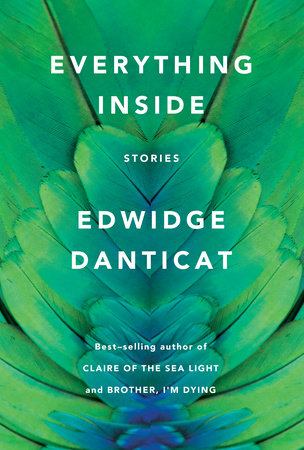
Her new book, Everything Inside, is Danticat’s first collection of short stories to be published since Krik? Krak! over twenty years ago. The stories, which center on people of the Haitian diaspora and the various traumas they seek to make sense of, feel particularly timely at this moment as America debates over the value of and moral responsibility we have towards immigrants and their children. The stories are elegant and empathetic, still bearing the hallmark tension between beauty and violence that marked her first collection. And yet they’re less sentimental, more mature, quiet, and steady—the work of someone who has lived through more and has evolved in what she has wanted to say.
I was privileged enough to speak to Edwidge Danticat over the phone, where we discussed the evolution of her short fiction, the relationships between the characters of Everything Inside and the characters in Krik? Krak! and the difficult and differing ways in which immigrants and their children deal with lingering generational effects of painful pasts and the burden of representation.
Karissa Chen: I think this is your first collection of short stories since Krik? Krak!, which you published over two decades ago. I know in between you’ve written a lot of other things—novels, novels-in-stories, a lot of nonfiction. You’ve even written a bunch of children’s books and YA books. I’m curious how it’s changed for you to go back to this form after these years. I mean, I’m sure for some of these stories you’ve probably been working on them for a while behind the scenes. But I’m wondering why you decided to return to this form and if you approach writing short stories in a different way now than you did back then.
Edwidge Danticat: I love short stories. I love to read them and I love to write them. I like the bursts of narrative. I like the economy. When I was writing the stories in Krik? Krak! I was still in college and later working a full time job. I wrote those stories during stolen moments, often before exams, and after hours in the office where I worked. There was an urgency for me about getting those stories down because I was new at writing stories and each story felt like a stroke of lighting, something that might never happen again. I was always afraid that if I didn’t stop whatever I was doing and write those stories down, I would lose them forever. I think that sense of urgency shows in the stories in Krik? Krak! They’re very direct, declarative even, like the kind of stories they’re modeled after, the oral stories that are part of the call and response of Haitian storytelling, which we introduce by saying Krik? (or asking the audience if they’re ready to listen) and having them answer Krak! (or replying yes, they’re ready to listen.)
The stories in Everything Inside, though, are stories that I have been writing for over thirteen years. I have written and rewritten them many times, even after they were published in journals or magazines. These stories have benefited from the patience I now have with both myself and with narrative, the trust I have that some resolution to the problems in the story might lie somewhere ahead, in the future. I am now more willing to wait for my stories to resolve themselves. So it was great to re-enter stories with that kind of patience, to let the stories pause and breathe, and allow the characters to keep revealing themselves to me over the years. I enjoyed going back to the form and writing stories in this unhurried way. The stories in Everything Inside are not just longer but more nuanced because of this, and you feel, I think, that you are also reading about people with a lot more time on their hands, a situation which parallels the case of some first-generation Americans who have a lot more time and leisure to linger on some things and address certain issues than their parents did.
KC: You said some of these pieces you’ve been working on for a long time. What’s the one that you’ve been working on the longest and how long did that take you?
ED: The first story in the book, “Dosas,” is the one I’ve been working on the longest. I added the most recent elements to it last year. It’s based on something that actually happened to a few people I know, where someone they loved and trusted pretended to be kidnapped to get money from them.
I also wanted to write about Certified Nurses Assistants in Miami and later added an element of something my mother said to me while she was in the hospital with terminal cancer. Everyone who was taking care of her was Haitian and she found a lot of comfort in this. So one day she said to me, It’s wonderful that so many of us are here to take care of each other. Behind these words, I was hearing her say, Who would take care of us, if we didn’t have each other? So the combination of these two things—people we love betraying us and potential strangers taking care of us—came together in the many layers of this story.
Different elements kept popping up with this story over the span of thirteen years. A possible new romance for Elsie, the Certified Nurses’ Assistant. Her thoughts on marriage. Then I saw a sign in my gentrifying neighborhood in Miami’s Little Haiti that said “Nothing Inside Is Worth Dying for” and I put that on Elsie’s door and switched it to “Everything Inside Is Worth Dying For”, which gave us the title of the book.
KC: In both your collections, all the stories seem to be in conversation with the others in the book. Krik? Krak! was very much focused on a historical Haiti, with almost a sort of magical realism and focused on the violent past of the island. Whereas I think this collection felt a lot quieter, but still very much focused on the Haitian diaspora in our current times and how they wrestle with their different traumas. There’s echoes between the stories, even though all their situations are different.
I’m wondering—and I hate to do this, because I know it’s probably very annoying for you to have the two collections compared to each other—but because so much time has gone by, do you think that your own interests as a writer have shifted since these two collections?. I’m wondering where you are as a writer now that led you to write these particular stories.
ED: I don’t mind the two books being compared because the characters in Everything Inside could be the children or the grandchildren of the ones in Krik? Krak!. Krik? Krak! is about several generations of one family. The characters in Everything Inside are not related to each other or to them, and they are certainly of another generation, but they feel connected in my mind.
If we want to be really meta, we might say that some of the characters in Everything Inside may have read Krik? Krak! and said “This reminds me of my mother or grandmother.” I meet a lot of young Haitian-Americans who say that to me about Krik? Krak!, by the way. So there’s definitely a strong connection between the two books, the most important being the ancestral town in Haiti from which both groups originate: Ville Rose.
This is what’s wonderful about having a collection. When you’re writing individual stories, they feel singular. When you put them together, a thread emerges not only between the stories, but also between your past and possibly future work. But, as I mentioned earlier, I don’t think I would have been able to write the stories in Everything Inside twenty-five years ago. Watching the shift in focus and perspective between the different generations of my family has helped a lot in shaping these stories. Watching my parents die and the next generation grow up and become adults—American adults—has really guided these stories.
KC: I think that’s really apparent in the way you frame a lot of these stories. “Sunrise, Sunset” literally had that shift in perspective going back and forth between the two generations, showing the contrast in how they’ve had to deal with motherhood. But so many of the stories are recursive—where something happens and the characters go back to see how they got to this point in time. They’re revisiting their own histories, but vis-a-vis their family, etc.
ED: “Sunrise, Sunset” is a good example of that gap between generations where there’s this missing link of knowledge on both sides. The mother believes that her daughter should be grateful for all the sacrifices that have been made so that the daughter can have the life she now has, and the daughter thinks the mother is unable to understand all that she’s going through because her mother’s experiences are from a time and place that is unfamiliar to the daughter. If only they could talk, they would realize just how similar their experiences are. Yet, there’s something heavy about trauma-related migration that makes silence comforting for both of them until the silence becomes so stifling it’s dangerous. The friction comes to a boiling point when a new generation comes into the picture, the grandson. The story fills in that gap and you realize that if one could hear what the other was thinking, things would be a lot better.
KC: One of the other things I noticed about the stories in this collection is that the “big thing” that happens almost always happens off stage. So, in “In the Old Days,” the father has already died, in “Seven Stories,” Callie’s father has already been killed, and the earthquake happened off stage in “The Gift,” even though we get to see it a little bit. Even in “Without Inspection,” although we are in the moment of his death, like with the other stories, it feels like the traumatic thing isn’t the point of drama. Maybe this is because it’s something that’s out of the characters’ control. So instead, what you end up focusing on is how they make sense of this thing that has happened and their personal histories and the memories that lead up to it and what happens beyond that moment. It’s interesting because I feel like this is not how people often think about writing. People think, Oh, we got to lead up to the point of drama. So I’m curious what it is about this aftermath that interests you, because I think there actually is a lot of tension in the aftermath.
I was always afraid that if I didn’t stop whatever I was doing and write those stories down, I would lose them forever.
ED: For the stories in Everything Inside, the aftermath feels much bigger than any singular event because the “big thing” is one in a series of events—historical, cultural, familial, personal—that are affecting these characters. What concerned me most was not just one triggering event but how the characters were trying to regroup after a series of events, some of which go back several generations. If you were to meet any of the characters in this book on the street and you said, tell me something about yourself, this is what these particular people would say. That’s how I see the contents of the stories. Plus there’s always in immigration and migration this feeling where obviously you’ve come to a new place to have a different future, but you have no choice but to keep looking back because you’ve left everything you’ve ever known behind. So you’re moving forward, but always looking back at the same time.
KC: That’s something that personally interests me as well—when you are someone who is a migrant, someone who is either refugee or an immigrant, and the different ways of dealing with things. Some people just forge forward and they’re like, This is all I can do is, all I can do is move forward. And some people are like, I have to keep making sense of what has happened to me. Obviously many people do both. I think that tension is something that is really palpable through these pieces even with the children. In “Hot Air Balloons,” Lucy has this roommate who goes to Haiti and does all this relief work, and Lucy is like, I can’t, that’s not a thing that I’m trying to, and she’s sort of inherited this conflict.
ED: Whenever I asked my parents about their lives in Haiti during the Duvalier dictatorship and what it was like to live in Haiti in the ‘50s and ‘60s, for example, all they would say is some version of “We’re here now.” This was meant to explain everything. Like if things weren’t difficult then we wouldn’t be here now, so let’s move on. I think having to leave was painful for them in a way that they never wanted to detail or even describe. They had also grown up being discreet. Living under a dictatorship you couldn’t say too much because you didn’t know what people were going to do with that information, how it might be used against you. You didn’t know who to trust. So my parents were very tight-lipped about what their lives had been like. They’d moved on in some ways but were still tied to the past, as are some of the characters in the book.
Many younger people, like Lucy in “Hot Air Balloons,” are very protective of the image of Haiti, even if they’ve never been there. So many awful things have been said about Haiti that we want to highlight its beauty. So Lucy wants to go to Haiti but not with a relief or aid group. She wants to go on vacation there. She also wants to protect this image that her parents have created for her of the beautiful beaches and cool mountains which paradoxically co-exists with her parents’ conflicting desire for her not to go there so she doesn’t come face to face with some of the things that drove them away.
KC: I think when you’re the descendent of immigrants in America, there’s that burden, right? You feel that burden to be like, I want to be able to personally acknowledge the failings of wherever my parents came from; obviously they came here for a reason. But I also want everyone here who doesn’t understand that place that I’m from to not have a negative image of it. I want them to think this place I’m from is a great place.
The more stories we have, the more storytellers we highlight, the more nuance and complex our views of a place and its people can be.
ED: Exactly. I think fiction can get at some of that nuance. There has to be some balance. It’s not all terrible and it’s not all pretty either. There’s no place or person like that. We deserve to have our full humanity and the complexity of our lives fully explored. This is why it’s important to have more Haitian novels translated and have more Haitian diaspora voices out there. The more stories we have, the more storytellers we highlight, the more nuance and complex our views of a place and its people can be.
KC: It actually makes me wonder about another one of your stories, “Seven Stories,” because that one is about an unnamed island. It’s interesting because you write from the point of view of this woman, Kim, who’s Haitian, but she is an outsider to this island and she first hears about this island through her friend Callie. And what she knows is how Callie’s father was killed, but at the same time, Callie is telling her, My island is great in all these ways. Then Kim gets there and it has turmoil, it has its own xenophobia, but it’s also beautiful and has a very well maintained facade. It actually feels very familiar despite being an unnamed island. Why did you set this story in this unnamed place and then have this woman who’s on the outside be the one to take us into it and into Callie’s story?
ED: That story was originally a novella, which would mimic one of those narratives where people go to a place for a few days and feel they understand it and write a long expert type article about it, something which happens a lot with Haiti. I decided to make the person who does this kind of writing Haitian-American because I could easily be asked to write a story like that about another Caribbean island and find myself facing the same issues Kim Boyer does. Writing as an insider/outsider feels very familiar to me as someone who writes about Haiti while living outside of Haiti so I wanted to complicate that whole thing in some way. I also had this experience when I was in my teens of having some famous Haitian exiles move across the hall from me in Brooklyn in the 1980s and later seeing them in Haiti after they’d become politicians. It just so happens though that on this particular island in “Seven Stories” they don’t like Haitians at all, but would make an exception for Kim because she’s Haitian-American. Among many other things, Kim realizes, while trying to write about the complexity of the place, that she travels differently through the world and gets a very different reaction than other Haitians who are coming to that very same place for a better life.
KC: I’m going to ask you one more question. Is there a story in this collection that either was the most difficult or one that you’re proudest of? And would you be willing to share which one that is and why?
We deserve to have our full humanity and the complexity of our lives fully explored.
ED The story I’m proudest of is “Without Inspection.” It’s the most recent of the stories and it’s a story that I’ve been trying to write for a really long time. When I first moved from New York to Miami about seventeen years ago a lot of people were coming to Miami by boat from Haiti, the Bahamas, and Cuba. I wanted to write about someone who’d made this journey but ended up falling in a construction accident, something which was also sadly happening a lot a that time. And still happens now and then these days. Last year I went to an immigration forum and I learned the term “Entry Without Inspection”, which means entering this country without seeing an immigration official, which means, on paper, you’re not technically here at all. I wanted to integrate all of those elements into one story and it took a while to figure out how to do it. I wanted to incorporate a historical and mythological element about flight as well. I also wanted to include something of the quick moment after a person dies where some loved ones who are nowhere near them experience this feeling that you can’t quite explain, whether it’s a flash of something, a shiver, a flutter, or something else. Balancing all of that with the reality of Arnold, the main character’s fall, meant a lot of research, down to how many seconds it would take to fall from a certain height. So I’m really proud of how that came out, and that’s probably why I close the book with that story.
The hardest story to write though was “Seven Stories.” I was really enjoying the company of these characters and I didn’t want the story to end. Cutting it down to a third of its original length was hard for me. I killed a lot of my darlings, but I really wanted to keep that sense of the beauty, as well as the complexity of the place.
KC: Yeah. It’s really beautiful. The island feels really real—it was so real that I actually thought, Did I miss the name? I actually flipped back several pages to double check. It seemed so real I was sure you’d been there before.
ED: I borrowed different aspects of many islands, including Haiti, to make up that place. One thing I’ve found just in talking to people about the book is that if you want to be asked about something a lot, just don’t give it a name. [laughs] People really want to know if the place is real or not. All I can say is that it’s very real to me.
KC: And I liked the song that Arnold mentions, [“Latibonit O”]! I appreciated that in the final note, you give the whole translation. Because you have it without the translation in the story and the reader still gets the effect. And then, when the reader moves to the end note and reads the lyrics, it adds something extra.
ED: You should go and listen to it online. A wonderful singer and family friend named Leyla McCalla sings a very beautiful version of it. This book ended up having a lot of singing. That’s one of the things I realized after the stories came together. It had a lot of music, from Nina Simone’s rendition of “Take Me to The Water’, to Charles Mingus’ “Haitian Fight Song” to “Latibonit O” then the hymn “Shall We Gather at the River?”
So you got your early bird tickets for Electric Lit’s Masquerade of the Red Death ($35 until October 1, going up to $50 thereafter, act now!), and now you’re stuck on what to wear. Anything red, black, or red and black will do, but you obviously want to bring your A game. Well, look no further: we’ve compiled some classic, eye-catching looks from film and TV for sartorial inspiration.
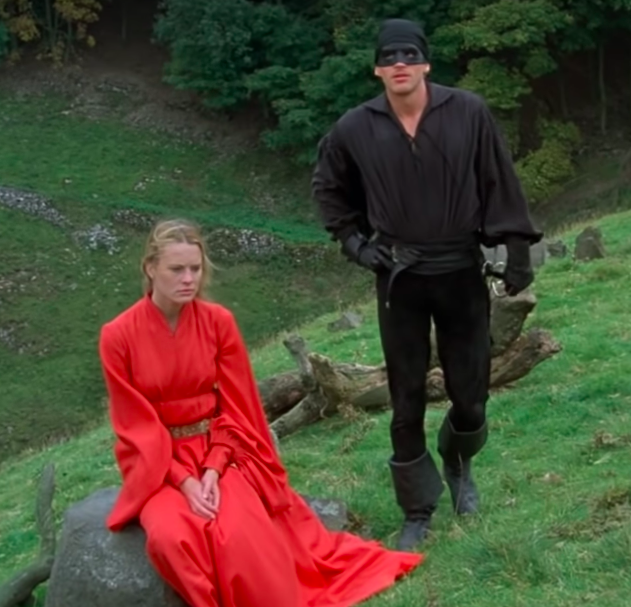
Buttercup and Westley’s Fire Swamp outfits, The Princess Bride
Sure, they look sulky here, but in a minute they’ll be declaring undying love and lightfooting it around flame spurts, which sounds like a party to us. If you’re bringing a date to the Masquerade, having one of you in full red and the other in stark black is a great idea.
Dana’s “Gatekeeper” getup, Ghostbusters
Honestly, this might be orange, but we think it’s red with gold threads and anyway we want you to bring this entire energy to the party—the hair, the coquettish bared shoulder, the channeling old gods, the sleeping four feet above your covers, etc.
Mrs. White’s party dress, Clue
The simple black sheath dress and pearls combo taken to the next level. Accessorize with flames on the sides of your face.
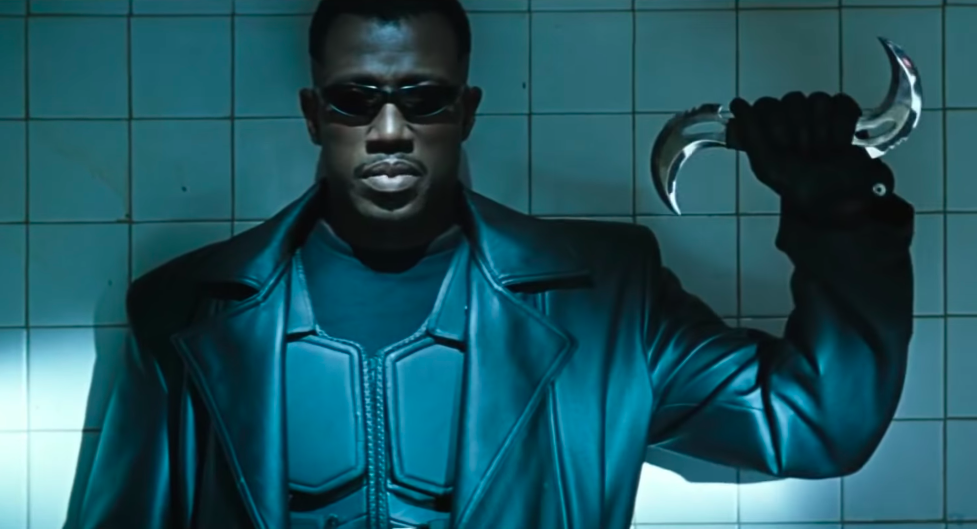
Blade’s whole thing, Blade
A black leather duster and weird little shades truly elevate any party outfit, even a bulletproof vest. Before there was Neo, Blade did it first and best.
Lydia Deetz’s wedding dress, Beetlejuice
The wedding had some problems (groom a malign ghost, bride there against her will) but that frothy red confection of a dress and veil, plus Siouxsie hair? Perfection. If anyone shows up in a mouldering burgundy tuxedo we will also be into that.
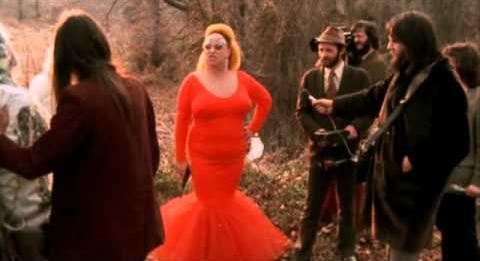
Babs’s execution outfit, Pink Flamingos
She may be the filthiest person alive, but Divine looks like a million bucks in this truly iconic mermaid gown.
Dora Milaje uniforms, Black Panther
Outside Wakanda, most military getups don’t have the requisite pizzazz for a party, and Okoye does change into an also incredible red outfit in order to blend in at a casino. But the standard-issue Dora Milaje uniforms, with their leather and metallic accents, are plenty fancy for us.
Willow’s vampire alter ego, Buffy the Vampire Slayer
Before she went evil IRL, Buffy’s geeky friend had an alternate-universe vampire version whose RenFaire-meets-dominatrix outfit sent every 1990s baby goth into orbit.
Maleficent’s horn and cloak situation, Maleficent
Listen, it’s been a hard year. You deserve to go to a party, but maybe you don’t want to change your clothes or do your hair. We have the perfect solution.
Practically anything from the Hunger Games movies
From the black-and-red training sweats to the “girl on fire” gown, from the black leather armor on the Mockingjay Part 1 poster to the… identical red leather armor on the Mockingjay Part 2 poster, the Hunger Games movies are full of fashion ideas.
The Little Man from Another Place’s suit, Twin Peaks
Cooper’s dream trip into the Black Lodge is an iconic moment in the show (consider the fact that it was parodied in both The Simpsons and a Harlem Shake video). But the dancing, backward-talking Little Man from Another Place is also important for a different reason: he’s a testament to the power of a custom-fit red-on-red suit.
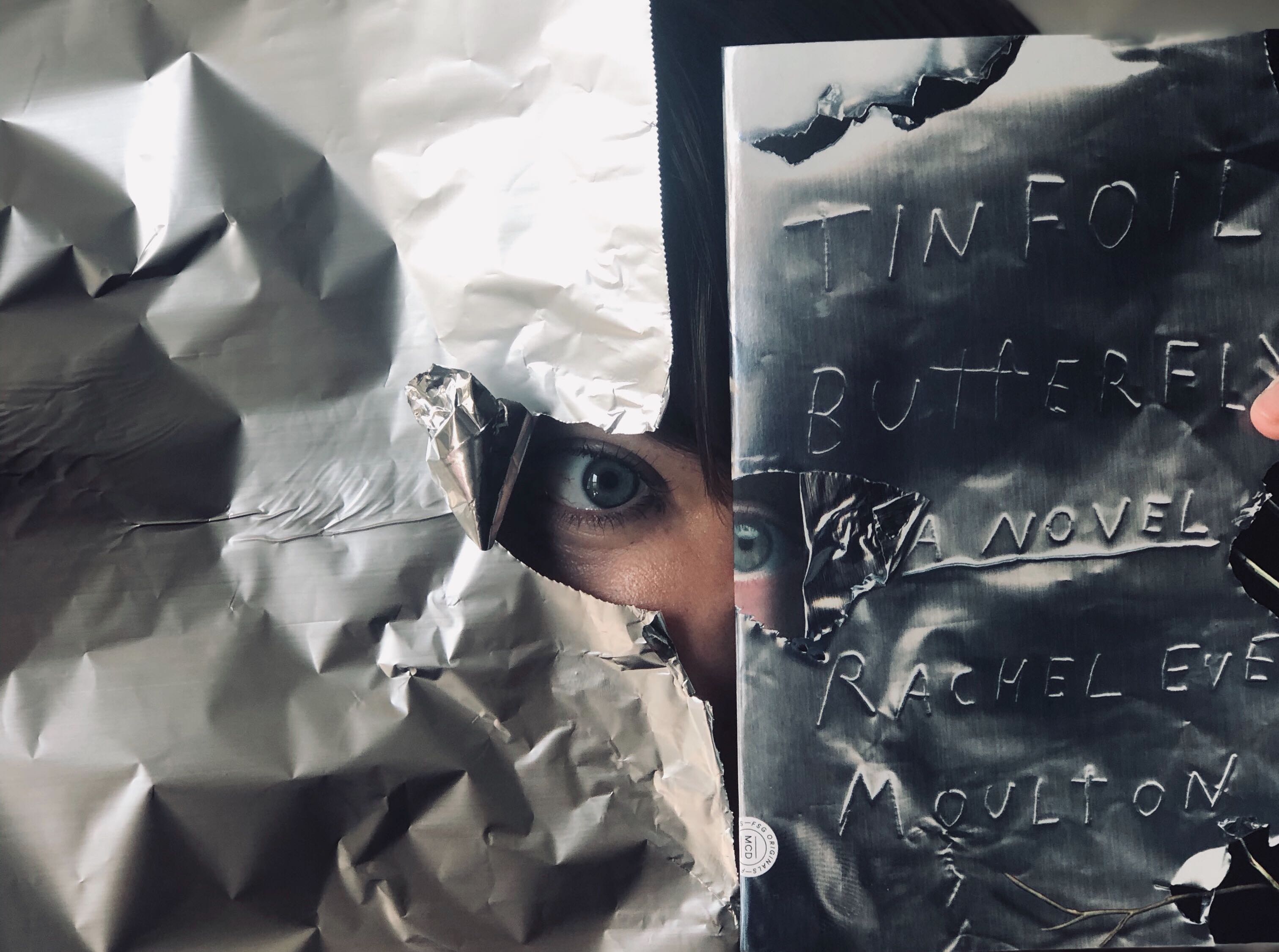
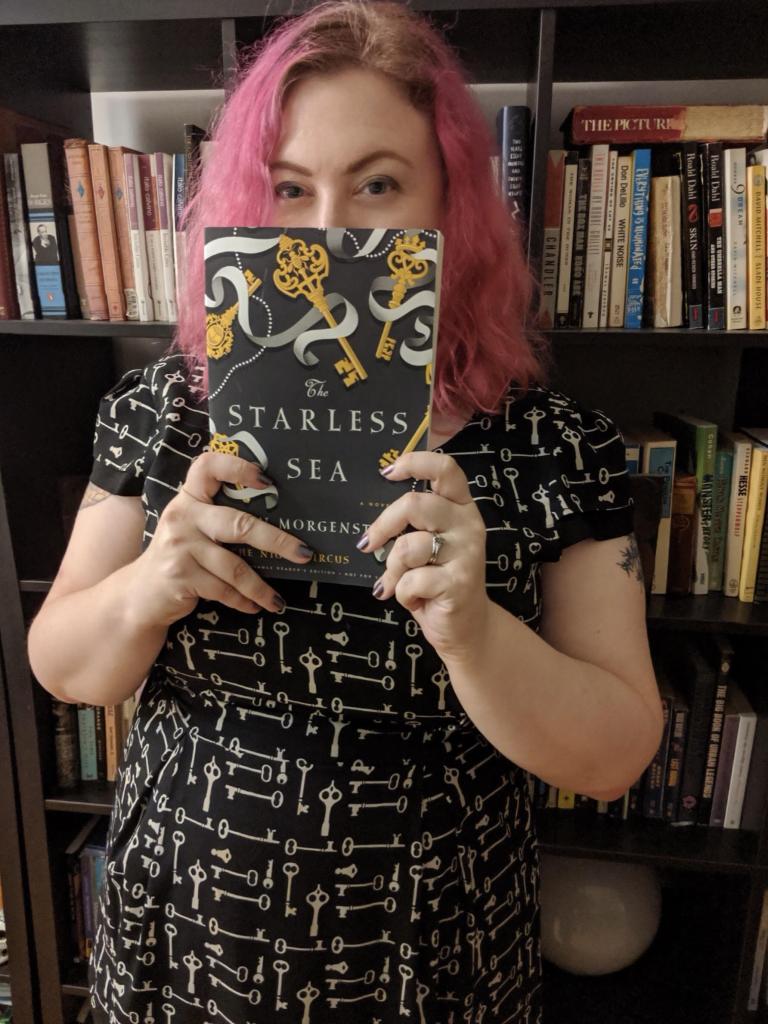
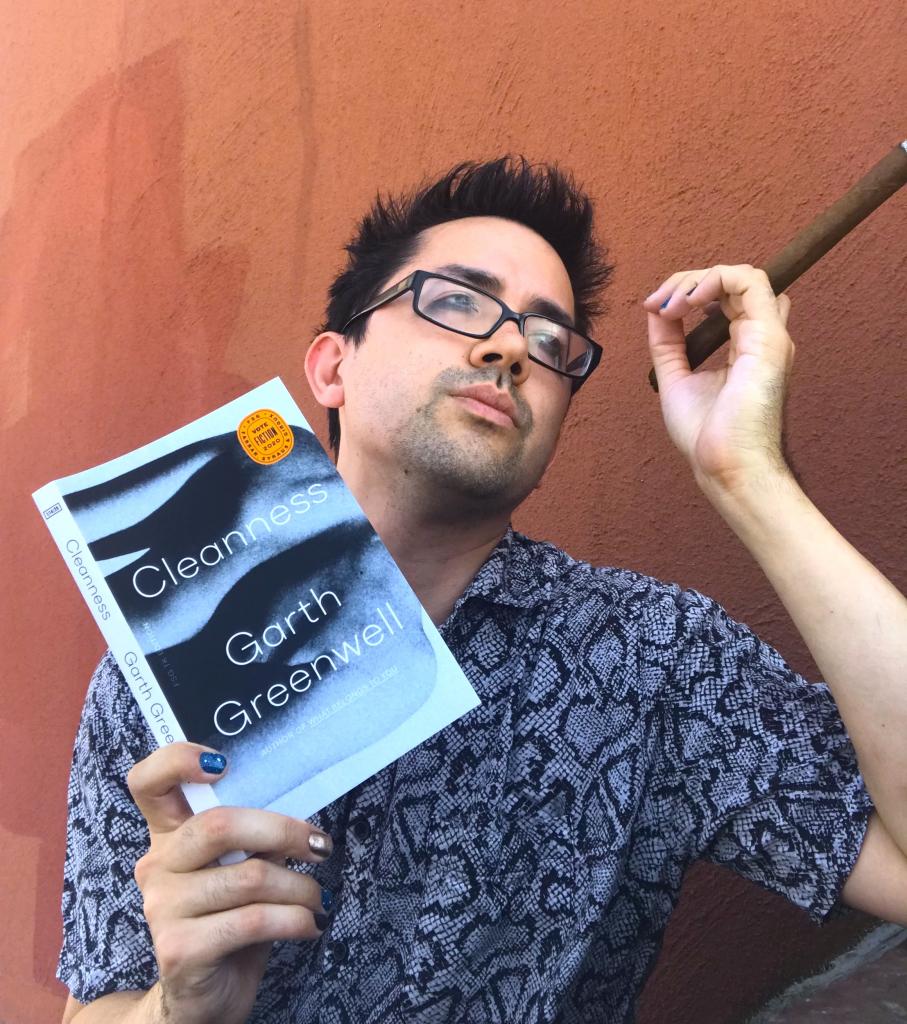
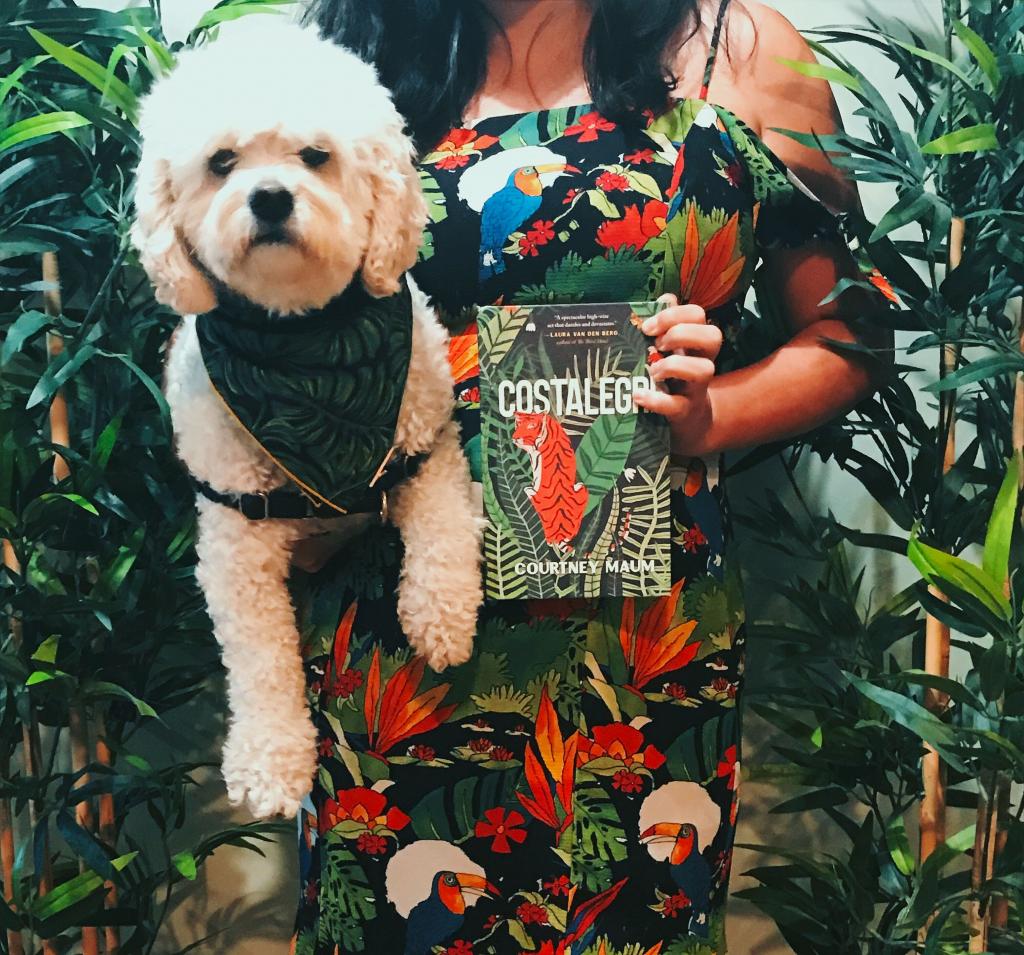
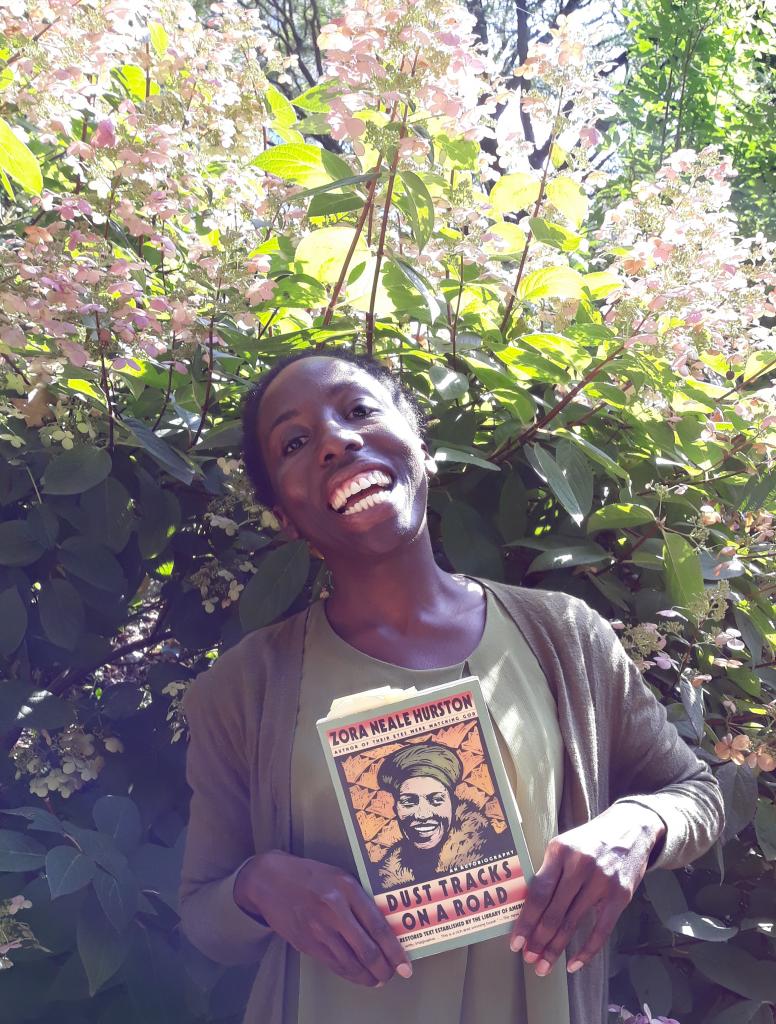
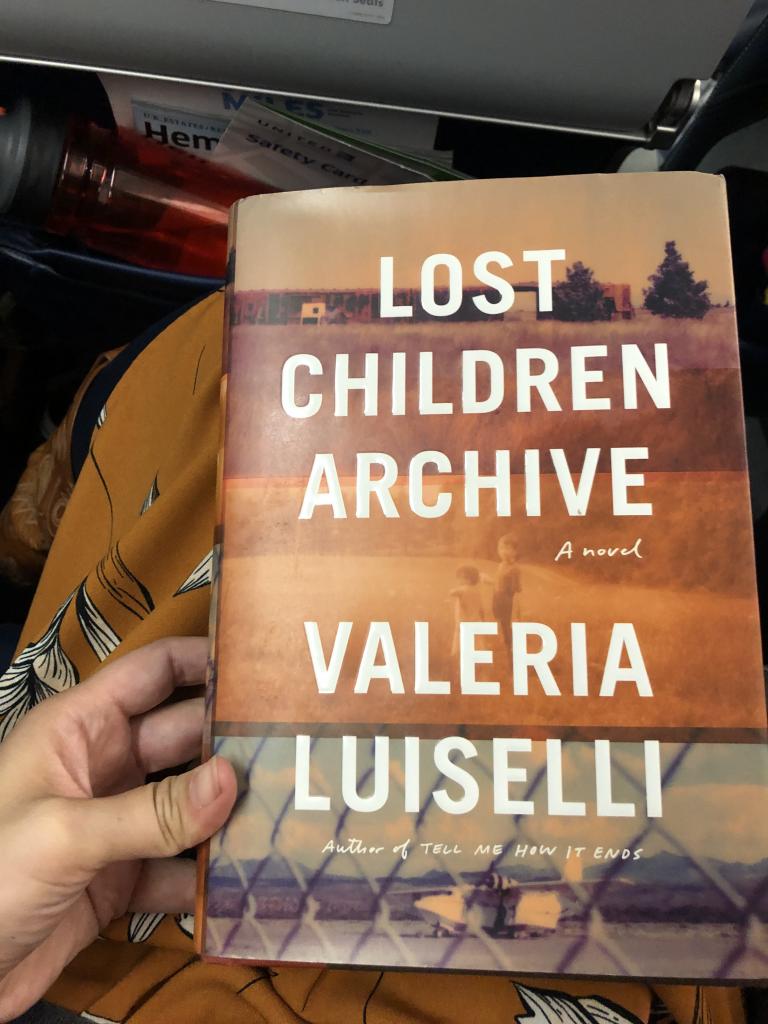
Despite the sweltering heat beating down on New York City, this week officially marks the start of fall! The leaves are turning citrus-shaded hues, Halloween merchandise is taking over the aisles of every big box store, and overly-eager city dwellers are decked out in their cashmere sweaters and knit scarves. To celebrate this cozy season, we’re challenging you to put your autumn wardrobes to work. Dress up to match the cover of a book, and you could win a Writing Well Is The Best Revenge tote bag!
To enter, post a photo of you dressed to match a book cover on Instagram, and use #DressLikeABook. Remember to follow Electric Literature and tag us. The best photos will be featured in a post on the site. For some inspiration, here is the EL team channeling our inner fashionistas.
Associate Editor of Recommended Reading Erin Bartnett is a tinfoil butterfly at heart.
Former intern Ruth Minah Buchwald moonlights as a P.I. investigating literary scams.
Editor-in-Chief Jess Zimmerman is a literary gatekeeper, hence the dress with the keys.
Editor-at-Large Michael J. Seidlinger thinking about what’s he going to eat for lunch. \m/ \m/ \m/ \m/
Dog-in-Resident Billy and his personal assistant are so ready for their tropical vacation. Why be an office dog when you can be a beach dog?
Contributing editor Jennifer Baker dazzles as the 2019 PW Star Watch Superstar! #ShineBrightLikeADiamond
Jess’s sister Sam coincidentally happened to text her this picture while we were writing this. Everyone should always color-coordinate their outfit to match the book they’re carrying!
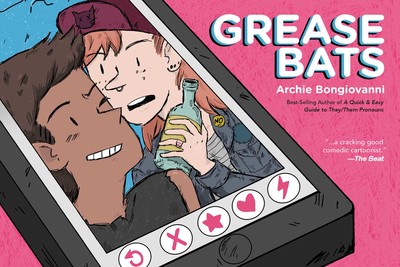
When you meet Archie Bongiovanni, you may feel as though you already know them. The jorts, the stick-n-poke tattoos, the larger-than-the-room laugh that means you always know where they’re standing. That’s because Bongiovanni’s incredibly endearing energy winds up all over the page in Grease Bats, their new slice-of-life graphic novel released by Boom! Studios. Bongiovanni has been drawing the comic strip that became the book, which features a group of queer and trans friends friending around a fictional Minneapolis, for more than five years on Autostraddle. For three of those years, I was their editor, which means I had a lot of questions. I recently caught up with Bongiovanni to chat about the experience of capturing the beating heart of a community on the page. We talked about the magic of trans cartoonists drawing trans characters, the superpower of fiction in addressing problems within marginalized communities, and why so many queer people seem to be so into comics.
A.E. Osworth: Can you tell me how the idea or inclination for the comic strip that preceded the graphic novel Grease Bats came about?
Archie Bongiovanni: I wanted to draw a story that felt reflective of my life at the time. I first started drawing the story-in my twenties, often drunk, probably horny, making some awesome decisions and the occasional messy ones, showing up for your friends and allowing them to show up for you, here in Minneapolis. I basically conceived Andy and Scout the day after Autostraddle (and you) asked if I’d be interested in a monthly comic.
AEO: If that’s the case, what made you decide to tackle something fictional, rather than something autobiographical?
AB: I was working on a lot of personal zines at the time and wanted something fun and reflective of the community I was around. I wanted to play with the dichotomy of two very different characters who loved and adored each other, but ultimately have pretty different personalities.
AEO: And fiction allowed you to do that in a way memoir didn’t?
AB: Yes, it allowed me to use moments from my life, but I got to play these moments out in characters who’d sometimes react differently than I would have! I got to play with things that happened to my friends or the idea of something—like queer karaoke being canceled because queers were too broke to sustain it at the bar.
Grease Bats allows for nuance; the characters are meant to showcase our variations, not our monolithic identities.
AEO: Was there ever a time you used the power of fiction to address something in the queer community that would have, if you had addressed it in nonfiction, resulted in more resistance? I’m personally thinking about the extreme “cancel culture” that marginalized communities sometimes engage in when it comes to policing their own, but you can take this question in any direction.
AB: I like this comic, which is ultimately about empathy, because so many of my characters feel differently about different things, and it’s not always a clean wrap up but it does end in some understanding and patience for the other. Grease Bats allows for nuance; the characters are meant to showcase our variations, not our monolithic identities.
AEO: One of the superpowers that I see in your comics is that someone will do something kinda fucked up, and maybe even another character will yell at them for it, but I’ve actually never seen a reader say they hate a character for doing something imperfect. Has that been your experience?
AB: Yup! I think my characters are (at times) really frustrating and frustrate each other and that is the truest thing of life. My pals frustrate me at times, and I know I annoy them at times as well! I’ve done some real dumb shit and there’s a balance of calling someone out on acting carelessly while also allowing them the time and space to act better in the future. And apologizing! My characters apologize to each other all the time. And I think readers like that, knowing that we all biff it sometimes and allowing for the folks we care about to biff it too. We’re imperfect, but learning. My chosen family is family, meaning at times we have the power to really hurt the other’s feelings but we also have the power to push through it together!
AEO: I want to dive in on genderqueerness if that’s okay. Is that something you’re comfortable talking about?
AB: Yes please!
AEO: As a reader and as a person who edited you for many years, I feel this incredible power radiate from watching a genderqueer artist render a genderqueer body on the page. What does that experience feel like for you? Empowering, totally mundane? Do I have a Romantic-Capital-R notion of this that is entirely unfounded?
AB: Oh it is awesome. I love drawing Andy being over-emotional when being called “sir” at a restaurant then having a crisis because that still means they’re being misgendered. I loved drawing the chapter “A Case of the Floppies” where Scout tries to distract Andy from their dysphoria by playing skeeball. It lets me draw these experiences I have authentically and non-academically, with a good dose of humor.
AEO: What do you mean when you say non-academically?
AB: So much trans and genderqueer discussion is serious. I get to draw it in a way that’s yeah, serious, but also playful! I love being genderqueer, it really comes from a playful relaxed place for me now.
So much trans and genderqueer discussion is serious. I get to draw it in a way that’s also playful!
AEO: Was that the case for you when you started drawing Andy? Or was that something both you and Andy grew into together?
AB: Oh for sure, I was just starting to come out as genderqueer. When I first started this comic, I didn’t go by Archie. And it was definitely something that I got more and more confident in. And I love Andy’s sense of genderqueerness, their love of painting their nails and micro-jorts and crop tops and they really give themself the space to Be Themself. I like that about all the characters. They allow space for them to just be their authentic selves and encourage each other to do the same.
AEO: Is there anything difficult about drawing Andy? And does that come from their particular place in the gender galaxy or from somewhere else?
AB: Andy is honestly the easiest for me to draw because I think and feel so much like them.
AEO: Who’s the hardest?
AB: Gwen and Taylor! I think Taylor is hard because they are the newest character and I have to make sure I’m checking myself about drawing them as a whole character and not just a person in grad school. And Gwen is hard because she is often, by the fault of me and also almost all my other characters besides Ari, put in a caretaking role, which is very reflective of femme folks in queer circles and isn’t fair to them or to Gwen.
AEO: I’m trying to come up with the right question about Gwen, and her femme-ness being exploited as caretaking, and I’m having trouble phrasing it. I want to acknowledge that the struggle is because I’m not femme. Something about whether you feel the need to disrupt this huge flaw in the community, that we often treat femmes as caretakers, or if you want to hold the mirror up to it and represent it accurately?
AB: I think it’s that I feel the need to challenge it and I haven’t had the confidence to draw that comic yet. It’s a little bit because I’m not sure I’m the best one to do it. I try and draw a lot of comics where Gwen is JUST Gwen, but there are chapters like The Job Hunt where she leans into caretaking. She def pushes back though, as seen in Astrology Is Real And Meaningful.
AEO: Because it’s fiction, does that mean you can talk about stuff that isn’t necessarily your experience? Is that one of the superpowers of fiction? I always struggle to answer this question myself! I am always mad when a cis person writes a bad trans character. And I’m reading it and thinking, just let trans people tell their own stories! But then I am also mad when a cis author doesn’t even give it a go. This is a real, earnest, hard question to which I am not sure there is a correct answer
AB: I don’t know if there’s a “correct” answer either, but there’s a way I try to guide my work so it has the diverse cast that’s needed to tell queer slice-of-life stories. I cannot forget where I am coming from and how that limits my lived experience and the privileges that come from it. But also, empathy is critical here, empathy and listening. I listen and believe my friends of different lived experiences where their life has challenges and their identity results in assumptions that I wouldn’t face myself.
Also if someone has written a bad trans character I’m always like…do they have trans friends?
AEO: That answer is almost always no, but it’s not never yes.
So speaking of all these other characters that are a bit harder to access, you mentioned that when Autostraddle first asked you for a monthly comic, you scoped out Andy and Scout first. But in the intervening years and specifically in the graphic novel collected version, the cast got much, much bigger. Can you talk about why it started out with two and why it expanded?
AB: It started out as two because I didn’t trust myself to draw more than two characters and have an audience care about them, especially when the comics only appeared once a month. I was real nervous about new characters but I WANTED THEM so badly. But in my mind I was like “readers won’t care or they’ll forget the next time a comic comes out.” I was wrong on all accounts! I want to introduce more characters soon!
AEO: Do you feel comfortable giving us a teaser?
AB: I want to draw Scout’s new girlfriend and have her be a part of the comic!
AEO: Topic change! Perhaps it is because I came to comics as an adult, but it is my perception that queer people love comics or are more likely to love comics than any other subset of folks. Indulge me in my probably-inaccurate presumptions for a second, do you think that’s true? Is that your experience?
Queers love comics! A lot! I think because it’s an easy medium to see yourself reflected in.
AB: Yes! Queers love comics! A lot! I think because it’s an easy medium to see yourself reflected in, unlike television where there’s SO many people that are involved to dilute or change the story. Perspective comics are often just one person drawing in their studio. And it’s an affordable medium as well.
AEO: Is there anything else you want the folks at home to know?
AB: That Minneapolis fucking rocks! Or at least the queer community here does!
AEO: Oh my goodness, yes, we didn’t talk about the role Minneapolis plays in the graphic novel! I think it’s often overlooked, but this is an explicitly midwestern queer story. Can you expound upon that a little?
AB: Minneapolis is so active and so busy and there’s so, so many cool people here doing the raddest stuff. There’s the most talented artists and activists that I am privileged to be among! All of the events that happen in the story are based on Minneapolis events (except the ’90’s lesbian floral witch party, that was D.C.).
AEO: That was a real party? Who threw that party? Do we know them?
AB: I was in Brooklyn at a queer event and someone was talking shit about Brooklyn and how the queers there suck compared to Manhattan and they were like “know what I mean?” And I was like not at all, I’m from Minneapolis, and she was like “oh no then you have NO idea about queers then, NONE.” It’s so dismissive and does such a disservice to all the queers working real hard in mid-sized cities or rural areas or basically anywhere that isn’t a gay hub. A lot of praise gets given to queer cities like San Francisco and Portland and the like, and that’s rad, but queer history and community is everywhere and it’s just as vibrant and vital (and sexual and fun!) as anywhere.
Also I do not know who threw that party. But I did get a giant hickey at that party.
In our monthly series Can Writing Be Taught? we partner with Catapult to ask their course instructors all our burning questions about the process of teaching writing. This time, we’re talking to Dawnie Walton, who’s teaching an eight-week fiction workshop at Catapult’s New York HQ. From rigorous, collaborative group feedback to readings by writers who have mastered the trickiest elements of fiction, this course will inspire you and renew your commitment to your work.
What’s the best thing you’ve ever gotten out of a writing class or workshop as a student?
My favorite workshops have all had one thing in common, and in some ways it puts me in mind of the “yes, and…” rule at the heart of improvisational comedy: Everyone in the circle embraces the core terms of your story—its style/genre, for instance, or the makeup of its central characters—and from that standpoint they help you refine and build. Any critique, then, is a nudge toward clarity and the development of meaning, toward more ambition and audaciousness within the context you’ve provided. I’ve left a workshop like this feeling tingly with possibilities, and raring to get back to work.
What’s the worst thing you’ve ever gotten out of a writing class or workshop as a student?
I really resent when a workshop harps on relatively small, easily fixable problems (an obvious mistake in math, for example). Bringing such an error to the writer’s attention is helpful, of course, but piling on to the degree of mocking is petty. It’s also a failure of the instructor to keep the workshop on track.
What is the lesson or piece of writing advice you return to most as an instructor?
You don’t need to stick to a detailed map or even have a destination in mind before you sit down to start the damn story.
Here’s a goodie from my years yearning to write fiction but intimidated by the how of it: You don’t need to stick to a detailed map or even have a destination in mind before you sit down to start the damn story. It’s okay not to know what you’re driving toward—in fact, I’ve found the not-knowing can lead to more natural narrative movement and open the possibility of characters ending up in those “surprising, yet inevitable” places. (The twin lesson, of course, is that writing is re-writing—the first draft, though very educational for you, will probably be a glorious wreck.)
Does everyone “have a novel in them”?
No, and that’s fine! There are so many beautiful ways to write that story percolating inside you. Maybe you bear down on pieces of it in short fiction, or refract it through poetry, or directly address it via memoir… The point is, you can find the form that feels right for you.
Would you ever encourage a student to give up writing? Under what circumstances?
Give up writing, period? Never. But I might suggest taking a break from one challenging project in order to regain perspective and/or mental health. (Even then, I’d recommend the student write something else, something joyful and untied to expectations, to stay inspired and in practice.)
What’s more valuable in a workshop, praise or criticism?
It depends where the writer is in the process. Personally, I find praise to be most helpful during early drafting—as in “This knocks me out; give me more of that, please.” In later drafts, when a story has a more definite shape and direction, I’m most interested in criticism about what feels extraneous, what impedes propulsion, etc.
Should students write with publication in mind? Why or why not?
My advice would be to write thinking not of publication, per se, but of your intended reader.
No… but it’s complicated. Most writers (myself included) dream about our work finding a home beyond our own laptops, but I’m hesitant to say writers should be worrying about anything except developing their singular voices. So my advice would be to write thinking not of publication, per se, but of your intended reader—not whoever you imagine to be on the other side of Submittable, but the audience for/about whom you are writing. If you come out of that process with a piece you feel proud to claim, a piece that makes sense to your readers while also engaging their brains and their hearts, you’ve gotten as close to publication-ready as is in your control.
In one or two sentences, what’s your opinion of these writing maxims?
Kill your darlings: Yes, if they are gumming up the works (and c’mon—in the pit of your stomach, you know when they are!). But save those lil babies in a separate file; just because they don’t belong in a particular story doesn’t mean they’re not beautiful, and you never know how they might serve you later.
Show don’t tell: Both showing and telling are necessary. My general rule of thumb has been to show what I want the reader to remember, and to tell relevant supporting details.
Write what you know: …and then dig deeper.
Character is plot: I doubt it’s true for everyone, but for me, extrapolating on a character — what X type of person might do in Y situation — has always helped generate plot for me.
What’s the best hobby for writers?
I find the visual arts so inspiring, especially photography. When I’m at a gallery or museum studying a portrait, I’ll often hold off on reading the adjacent description—it’s fun making up the story behind the still.
But I also love watching TV, prestige to pure trash. It helps me process modern culture and politics, which are generally central to my work.
What’s the best workshop snack?
I know I’m supposed to prefer something that doesn’t make much noise or mess, but I would be a liar if I did not pledge my fealty to the kettle chip. (There’s an art to eating them discreetly, I swear.)
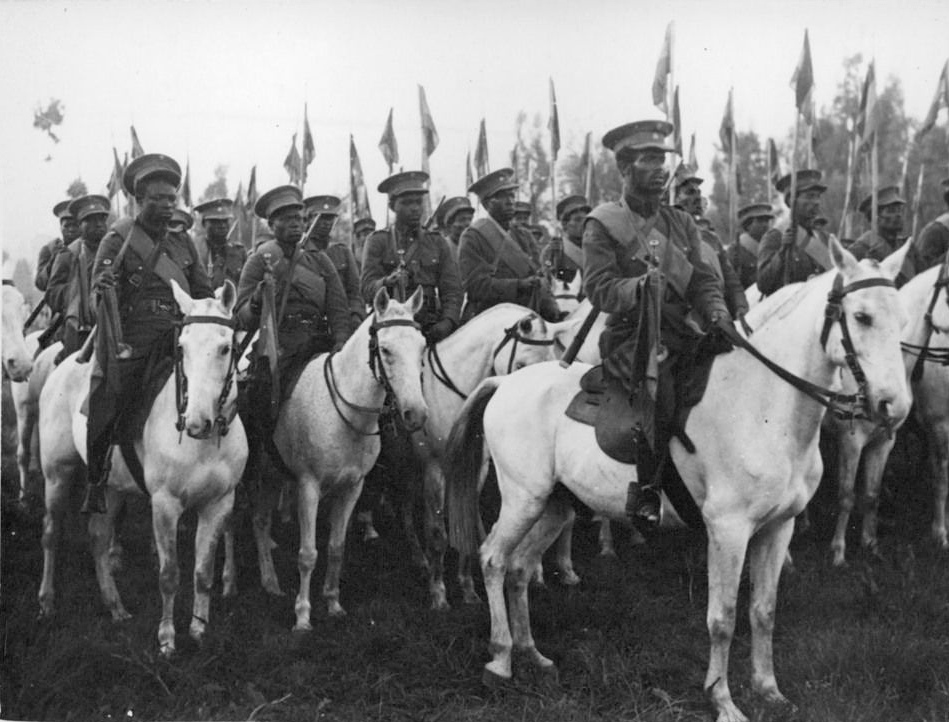
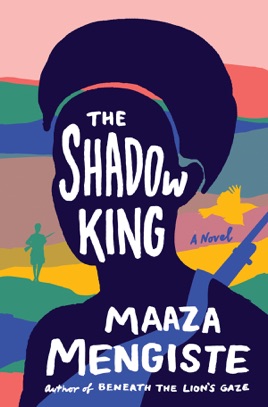
Like Maaza Mengiste’s well-received first novel, Beneath the Lion’s Gaze, her latest opens in 1974 in Addis Ababa, Ethiopia. In The Shadow King, readers meet Hirut as she encounters a bundle of photographs that bring on memories of living, and fighting through, the Second Italo-Ethiopian War. From there Mengiste takes us back through the lives of not just the Ethiopian people, but a larger nation, from foreigners to documenters to those in self-imposed exile during wartime.
In 1935, Hirut is an orphan turned servant to Kidane and Aster; they took her in as a favor to her parents on their deathbed. Kidane is set to follow in the footsteps of his father and lead his community into another war to fight against the ferenji—Italian foreigners. His wife Aster suffers from the loss of their child and the deterioration of her marriage, part of which she blames on Hirut. What transpires in The Shadow King is wide-reaching, tracking the effects of invasion, the expectation of sacrifice, the ways in which those within and on the outskirts of war negotiate their morality and the larger morality of what it means to be “free” not only as a patriot, but as a person. Mengiste weaves a story that’s both captivating and heart-wrenching, invoking descriptive imagery, choral sections, and alternative viewpoints of those at the front lines as well as those fighting beside and behind them. War is not only a fight for land but a fight to solidify the distinctions of power: who has it, who doesn’t, and how it feels to take what you feel you deserve.
Mengiste and I spoke about the ideology of war novels, the experience of regular people (especially women) in wartime, and how she built tension and perspective in The Shadow King by writing from alternating viewpoints.
Jennifer Baker: The Shadow King issuch an intense and threaded story based around the Second Italo-Ethiopian War. Was this a book that was in the works for a while?
Maaza Mengiste: It was about nine years of research and writing. When I finally got to the draft that I thought might be the end, I couldn’t believe it.
There were moments writing the book when I was terrified that I would not finish. As much as I was determined to get to the end, there was always that nagging thought in the back of my head. What if I didn’t do it? So when I did finish it I was absolutely thrilled.
JB: It’s a pretty brutal story and I always want to ask authors how are they feeling during and after writing. The brutality can be felt pretty viscerally, not only for the reader but you’re living with the characters for nine years. How did you look after yourself during this process?
MM: That’s interesting to me. You’re not the only one who’s mentioned that the book is brutal. I didn’t feel that when I was writing it, partly because I learned from my first book that no matter how much I can imagine about brutality and inhumanity in revolution and war, things were always worse. So I knew that this was really just the tip of the iceberg. And I knew that the things that I had researched, the things that actually happened were far, far worse than anything I put in the book.
I knew that the things that I had researched, the things that actually happened were far, far worse than anything I put in the book.
Also, I want to frame this question of brutality in context with what we have seen in the U.S., with the way the U.S. treats some people. The history in this country, the police brutality against African Americans… I was writing the book during this ongoing period. I was writing it during the 2016 [U.S. presidential] election. That was brutal. And the things that are happening right now with children in cages is brutal. The mass murders are brutal. So I don’t think I’m depicting anything we haven’t seen. But I think that what you’re saying is important. For me as a novelist, it’s about asking how can we move into these spaces of violence and how can we render them in language that helps to convey the cruelty, but maybe also offers a way to complicate our notions of what different kinds of cruelty look like. Something that I was working towards is representing the many nuanced ways that encounters can be cruel, brutal, violent, yet not leave a mark. It’s not simply like a bludgeon hitting you over the head again and again. But maybe the reader’s sense of brutality comes from an understanding that these aren’t just characters, these characters represent real people and we’ve started to know them, and we suddenly see the depth of pain that’s inflicted when nations confront each other through individual bodies.
JB: And also the conflict within ourselves?
MM: Absolutely.
JB: If we look at the categorization of a “war novel” they’re not exactly self-contained. War is not finite. Shadow King obviously does not come at it this way, so how did you know when and where to end it?
MM: I think that one of the questions I had to ask myself as I was writing the book was: Whose story is this and why do they want to tell it? I had to figure out what the story was in essence. And then once I realized that my intent was not to go through the entire war, then I knew that the story would end when my characters came to some kind of a realization, regardless of what was happening in the war.
And so when certain battles, personal as well as political, ended for them, that’s when the book would end. I had reached a certain point and I said, “I don’t think I can go any further. Neither can they, frankly.” The last chapter is set in 1974, and that also felt like a more natural closing for the book because the real story did not end when the war ended.
JB: As I was preparing to talk to you words such as “sacrifice” and “power” came up for me. And that it aligns to the expectation of sacrifice, especially the women, and it’s not to say the men don’t sacrifice things as well. Yet these expectations of how you support others in time of war, this is what freedom for country is, this is what patriotism means. And it’s all encouraged by a need to sacrifice something for that. Do you think that’s true?
MM: I think that for the people living during that time there were expectations of obedience and sacrifice, you’re right. The country’s at war and this is just what you do. The idea of loyalty and obedience was deeply ingrained in people. When the emperor put out a mobilization call there was no question: every family sent their eldest to war, every able-bodied man picked up his gun and enlisted. Every woman prepared to follow the army to cook and take care of the wounded. Haile Selassie was a man supposedly ordained by God to be an emperor. He could trace his blood back to King Solomon in the Bible. So when he said “Pick up your weapons, we’re going to fight,” you fight. There was no question about that. And I think with Hirut, one of the things I had to consider was how could she still be so loyal to Aster and Kidane, and to this whole war enterprise, when she herself is under such duress and is being abused. How could she be so obedient when her own self was at stake?
The idea of sacrifice, the threat of death, is constantly there. That is war.
The one thing I had to think about was that I could not place my 21st-century ideals and thinking onto this young girl who has been taught her place in life for as long as she can remember. She was born poor, she was born a peasant, she’s a servant because that’s just the way things are. That’s the way things are meant to be. I can’t place my own thinking onto her. I had to work within her world and within her cultural framework. And women, you’re right, they were told you follow behind the men: you sing these songs if you think anyone is turning back. You encourage them. You shame the cowards. But what many of the women didn’t realize was that they’d be in the direct line of fire because they were not that far behind the men when they were picking up the wounded or picking up the men. It was not only the soldier who was being asked to risk his life. And when women stepped into the front lines as well, they were confirming what they already knew: The idea of sacrifice, the threat of death, is constantly there. That is war. Our bodies become commodities for these nations.
JB: So how did these elements along with following several characters come together to be less of a straightforward narrative?
MM: I started thinking about the books I love. The reading that has completely electrified me. And it’s interesting we’re speaking now just after Toni Morrison has passed away. I remember reading Song of Solomon and realizing that she did this thing with the prose where she layered the brutality in such as way that as I was reading, I was bending into the book. I held it up close to my face so I could re-read the sentences again as though I could peer through the page to figure out what actually happened. Because she had coded language, she had coded the violence into this language that made you stop, re-read, and quite literally decode the depth of cruelty. I was shaken after reading that book, and I wanted to work with that charge that I felt while reading her book as I was writing my own book.
I was inspired by books that broke form and broke structure in a way I found riveting and challenging and enthralling. One of my favorite texts is Homer’s The Iliad. I’ve always been intriguedby the way that the chorus will step into the narrative and tell another side of the story and the battle scenes in that book are some of the best I’ve ever read. I gravitate towards books in which narrative risks are taken, and I wanted to emulate in The Shadow King. My book follows, in some ways, the form of Greek tragedies that I’ve loved. And then I was also thinking about music and the way that music is so much a part of this war between Italy and Ethiopia. I was looking at Aida, the opera, and thinking about how an Ethiopian might think of that if they were watching it as Italy invaded the country. I mean, let’s put this story into an Ethiopian context: there’s this Ethiopian princess who becomes a slave and falls in love with the man who is killing her people. It’s so politically loaded.I wanted to challenge that and and work with a musical form and also pay homage to the women who were using song as a way to galvanize fighters. Pay tribute to the way that music throughout the war in Ethiopia was really part of battle. People would gather and sing war songs before they went off to fight. I had all these elements running through my head as I was thinking about the structure of the book.
JB: The photos are what really struck me the most. You have the photographer Foto there but actually getting these segments where we are getting the descriptions of the photos and then his being embroiled in one side of this war. As a reader these photo descriptions reminds me that I’m an observer. I don’t know if purposeful or even if you can speak to whether or not that was purposeful.
A minor character asks, towards the end of the book, what war ever really ends?
MM: Thank you for saying that. That was really my intent, to force a reckoning with what we see and what we think we know from what we see. Photographs have shaped, have deformed the way we consider Africans and people from the African diaspora, Black people. These photographs have informed how we think of the West. How we think of colonizers. How we think of white people but also how we think of people of color. I considered whether I wanted to include the actual photographs and I decided to do word images. This way, I could examine some essential questions about what’s seen, what’s witnessed and the differences between those two. I wanted to see if I could capture some of that in the description of the photograph. A physical photograph wouldn’t have allowed me to do that. And part of what I wanted to constantly force the reader to question is whether what they’re looking at is actually what they’re seeing. What’s there? What remains invisible? What do we actually see of those human beings who are photographed and show up in our newspapers and in our social media news? I am hoping to move this kind of close examination off the page, beyond the book so that the next time we look at a photograph, the next time we see something stark and disturbing, we can look at it and say “Is this really what it’s supposed to be? What’s been left out?”
JB: So when it comes to Hirut’s part of the story, was there a particular place you felt comfortable landing with her? Especially since it’s such an evolution for her, she goes through a lot. Everyone goes through a lot, but I feel like we’re rooted in what she goes through.
MM: Hirut’s war did not end when the Italians were ousted in 1941. I wanted to depict a female soldier who understood that while she had helped to maintain her country’s independence, there was another war in which her body was the terrain, the battlefield, and it would not end so neatly. I had to ask myself how she would define the parameters of her own freedom and independence. What did victory mean to her? I knew this would require staying at her character for years after the end of the Italo-Ethiopian war. I think by the time I could envision her in 1974, as an older woman watching other women marching with rifles in a a brewing revolution, I really had some grounding for her, even for her in 1935. I knew I could develop her from a young age, but I had to be able to see her and be comfortable with who she was 40 years after that. A minor character asks, towards the end of the book, what war ever really ends? And I wanted to find an answer through Hirut.
On the third floor of Hauteville House, a Georgian villa on the British Channel Island of Guernsey, a man’s head, carved from the faux ivory top of a walking stick, hovers ominously above an ornately carved bed. To the right of the bed is a red curtain, which conceals a secret hidden passage. A short flight of stairs behind the curtain leads to a “crystal palace,” a lookout toward the coast of France, with a four-sectioned glass roof. In the center of the room, a white marble statuette on a pedestal, recalling the Roman goddess Diana, is perched incongruously on a footed stove that is also painted white, the figure angelic and solitary against the blue sky visible through the panes. It is as if one is absorbed within the cloudscape, at eye level with celestial bodies. This top-floor enclave is where Victor Hugo slept during most of his period of exile on Guernsey, which lasted from 1856 to 1870; it is a modest alcove where, as on an old ship’s cabin, the furniture folds and disappears into the walls, and a spare twin bed is just enough for a writer absorbed in writing life, a writer thriving in exile.
In the “crystal palace,” standing before a small black table, Hugo wrote the novels L’Homme qui Rit (The Man Who Laughs), and Les Travailleurs de la Mer (Toilers of the Sea), and a multitude of poems. He also wrote the first part of a three-volume epic poem entitled La Légende des Siècles (The Legend of the Ages), which contains many clues to Hauteville House: a game of opposition and contrast, of shadow and light. “Hugo,” explains Hauteville curator and director Gérard Audinet, “arranged his house as a kind of autobiography, with many references to his personal life, his Parisian status before exile, and to his works.” The references are most evident in inscriptions in wood and stone, which appear in unexpected places high and low throughout. Hugo’s son Charles once referred to Hauteville House as an “autograph on three floors and a poem in several rooms.”
Secret passage and “crystal palace.” (Photo courtesy of Visit Guernsey)
Hugo fled France in 1851, his vocal opposition to the reign of Napoleon III having made him a target of the regime. Louis-Napoleon, the nephew of Napoleon Bonaparte, had been elected legally, a seeming populist advocating for universal suffrage. However, once in office, he manipulated elections and stifled a free press, installing himself as the third Emperor of France via coup d’état. In 1852 Hugo arrived in Belgium, and then traveled to Jersey, the largest of the Channel Islands, before eventually settling on Guernsey in 1855, at age 49. From his upstairs loft as well as from his expansive garden, Hugo could see Castle Cornet, a 13th century fortress in St Peter Port’s southern harbor, as well as the surrounding Channel Islands, and beyond those, the coast of Normandy. Writing further clarified and strengthened his political ideals, such that when Hugo was granted amnesty to return to France in 1859, he refused, pronouncing, “I will return when freedom returns.” Hugo continued living in Hauteville House until France’s defeat in the Franco-Prussian War in 1870, which resulted in the fall of the Second Empire.
Hugo’s grandchildren and great-grandchildren gifted the home to the City of Paris in 1927 and billionaire François Pinault, who has described Hugo as “a universal voice of conscience and an enemy of oppression in every form,” recently financed a major renovation, overseen by Paris Musées. Now, Hauteville House is an intact legacy of a complex and pluralistic worldview, a literary object that embodies and breaks down the fundamental psychic conflicts between man and himself, man and society, and man and nature that Hugo examined in the writing he completed on Guernsey. In addition to La Légende des Siècles, L’Homme qui Rit, andLes Travailleurs de la Mer, Hugo completed Les Misérables at Hauteville House in 1862, an examination of class, power, dehumanization, and the inalterable human capacity for goodness and redemption that he’d first began in 1845. His time in exile reveals, writes scholar Patricia A. Ward, “an interest in the collective movement of humanity,” and a belief in an apocalyptic, revolutionary future, in which the individual, ultimately, achieves integration in society.
Hugo purchased Hauteville House, the only home he ever owned, with the proceeds from a book of poems entitled Les Contemplations, a meditation compelled by the unexpected death of his daughter Léopoldine at age 19. Ultimately, Hugo recomposed every single facing, designing every room to be a different act, scene, or universe; the tension on the lower floors leaks out in carved apertures and glazed windows and unexpected gaps that permit light in ceilings and stairwells, ultimately giving way to the ethereal upper floor.
La Légende des Siècles, the poem that is also a kind of key to Hauteville House, moves from the Biblical era to a modern utopia; parallels between the epic and the house’s decor, says house administrator Odile Blanchette, symbolize “the omnipresence of the human figure, the biblical references, Manichaeism, references to Justice and Liberty, and poems dedicated to the punishment of those who abused their power against innocents, as Napoléon III.” The first series of La Légende, published in 1859, writes Ward, indicates “how completely the opposition between progress and political oppression dominates Hugo’s interpretation of the medieval period.”
The master bedroom on the second floor, which conceals the passage to Hugo’s real bedroom, is medieval, romantic, and dramatic. This room emerges from a similarly dark “gallery of oak,” the two adjacent chambers occupying the width of the second floor. Hugo’s garden, an homage to the garden of his childhood on Rue des Feuillantines in Paris, and a model for the garden on Rue Plumet in Les Misérables, is visible from the windows below. The room is ornate and enigmatic, decorated between 1857 and 1859 with inscribed pillars with thick, winding grapevines, twisted bedpost columns, leatherwork studded with nails, a depiction of the sacrifice of Isaac on the footboard, a depiction of Dionysius carved into the headboard. The macabre tiny carved head, which is mounted on a minuscule wooden pedestal atop an elaborately carved oak headboard, only appears to be the head of a bearded and vital man when viewed from the left; on the right, the head is carved to look like a skull, its eye socket vacant, its cheek a concave hollow. Hugo etched Nox Mors Lux on the at the top of the headboard, the Latin for Night Death Light—he writes in Les Misérables, “Is there not in every human soul; was there not in the particular soul of Jean Valjean, a primitive spark, a divine element, incorruptible in this world, immortal in the next, which can be developed by good, kindled, lit up, and made resplendently radiant in which evil can never entirely extinguish?”
The master bedroom. (Photo courtesy of Visit Guernsey)
The dark palette of the bedroom and oak gallery complements a red drawing room on the first floor, bedecked in crimson damask, where wooden figures holding high torchères are posed on theatrical wooden pedestals. These spaces reveal, in some measure, Victor Hugo’s examination of the obstacles toward human progress, which might, as he describes in Les Misérables, “keep a poor man forever between a lack and an excess, a lack of work, and an excess of punishment.” In his vitriolic 1853 book of poems, odes, anthems, and songs rebuking the Second Empire, Les Châtiments (The Punishments), Hugo writes, “The heaviest burden is to exist without living.” In Hauteville House, Hugo created symbolic visual forms that contrast day and night, light and shadow, good and evil, beauty and darkness, work and dream, life and death, using dismantled and reassembled old chests, recombined Gothic elements, Flemish tapestries and Turkish rugs, mirrors, lacquer panels, Delftware, mahogany furniture, and decorative Japanese and Chinese porcelain. Artisans, carvers, and draftsmen created large-scale woodwork based on Hugo’s drawings and imagination. He built fireplaces to resemble cathedrals. He built a room made entirely of tapestries, the heavy textiles serving as walls and banquettes, one draping the ceiling, and one placed in front of a glazed window so that, like the beggar’s coat in Les Contemplations, light could pass through the seams and holes in the fabric.
These rooms all, ultimately, do eventually give way to light—in the blue room, adjacent to the red room, light strikes a mother of pearl table and two gloriously bright porthole mirrors with gilded frames, and luminous, shimmering tapestries embroidered with silver and gold jet beads. The counterbalance to darkness, for Hugo, was an unyielding belief in the limitless goodness and immutable potential within the human spirit. Early on in Les Misérables, Jean Valjean gazes at the bishop who has offered him shelter as he sleeps, before absconding with his silver, “The souls of the upright in sleep have a vision of a mysterious heaven, a reflection from this having shown up on the bishop. But it was also a luminous transparency, for this heaven was within him; this heaven was his conscience.” Later, he writes, “…cities produce ferocious men, because they produce corrupt men; the mountains, the forest, and the sea render man savage; they develop the fears, but yet, do not destroy the human.”
The red room. (Photo courtesy of Visit Guernsey)
In conceiving the fate of Jean Valjean, sentenced to five years of prison for filching a loaf of freshly baked bread, and ultimately to nineteen years for repeated attempts at escape, Hugo questioned, “What becomes of the handful of leaves of the young tree when it is sawn at the trunk?” In July 14, 1870, Hugo planted an oak in the long middle passage of the back garden at Hauteville House. He installed a pond, the “Fontaine aux serpents,” that came from the Place Royale, and a bench built so he could look to the coast of France.
On August 5th, 1870, Hugo left Guernsey and waited in Brussels with his mistress, Juliette Drouet, for the declaration of the French republic. Hugo would come back to Guernsey three times after that, the longest visit between 1872 and 1873, to finish his last revolutionary novel, Ninety-Three, published in 1874. His final visit would last from July 5th to November 9th, 1878. The decoration of Hauteville House, particularly the large carved oak pieces and painted panels, was finished after 1864, explains Audinet. In later years, repairs and improvements, for the rugs in particular, were necessary due to deterioration. The Paris Musées completed a comprehensive renovation, which exactingly preserves Hugo’s decor, in April of 2019.
Inscription reading “La fin du seigneur” (“the end of the priest”). (Photo courtesy of Amy Beth Wright)
For a writer, perhaps the most haunting and moving relics in the house are Hugo’s inscriptions, scraped and poked into wood and concrete: the names of the great writers who stirred him and of mythological and Biblical figures that shaped the cycles of imagery in his texts, and passionate declarations of his most fundamental beliefs. Above the dining room entry, he inscribed, “Life Is An Exile, Exile Is Life.” On the dining room chairs, “Hope is my strength.” On a wall bench he etched, “The End of the Soldier,” “The End of the Priest,” “The End of the Lord”—symbols of the demise of the “ancient regime,” or monarchy, explains Audinet. A great inscription over the fireplace speaks of the Virgin and Christ as a wish for the advent of the Republic, reading in part, “The people are small in your sacred arms, o liberty.” On the underside and interior of benches and recovered pews, there are names: Luther, Christ, Moise, Job, Isaie, Homer, Shakespeare, Dante, Moliere. And, in the garden, on a rear stone wall, is the phrase “Immensité dit l’être, éternité dit l’âme.” This is from a poem in Les Contemplations entitled “Magnitudo Parvi,” which can be translated to mean, “the magnitude of small things.” Addressing Léopoldine, Hugo meditates on eternity, and the cosmos. Translations differ slightly, but perhaps the most apt is, The soul claims eternity, the being claims immensity.
It is through these inscriptions, and in conceiving of Hauteville House as a total work of art, that Hugo claimed for himself a notion he penned in Notre-Dame de Paris (The Hunchback of Notre Dame), “architecture is thought written in stone.” In his fifteen-year exile, Hugo exercised the kind of limitless freedom of individuality and creativity that he believed possible for humanity at large. What is left behind at Hauteville House is not just a complex and symbolic décor, or abundant evidence of Hugo’s modernity, but also a fearless and avant garde kind of self-expression. Hugo gave his inner life an external structure, a kind of sculptural identity, which is now the legacy of a fiercely original humanitarian and artist.
“The Egg and the Chicken” by Clarice Lispector, Translated by Katrina Dodson
In the morning in the kitchen on the table I see the egg.
I look at the egg with a single gaze. Immediately I perceive that one cannot be seeing an egg. Seeing an egg never remains in the present: as soon as I see an egg it already becomes having seen an egg three millennia ago. — At the very instant of seeing the egg it is the memory of an egg. — The egg can only be seen by one who has already seen it. — When one sees the egg it is too late: an egg seen is an egg lost. — Seeing the egg is the promise of one day eventually seeing the egg. — A brief and indivisible glance; if indeed there is thought; there is none; there is the egg. — Looking is the necessary instrument that, once used, I shall discard. I shall keep the egg. — The egg has no itself. Individually it does not exist. Seeing the egg is impossible: the egg is supervisible just as there are supersonic sounds. No one can see the egg. Does the dog see the egg? Only machines see the egg. The construction crane sees the egg. — When I was ancient an egg landed on my shoulder. — Love for the egg cannot be felt either. Love for the egg is supersensible. We do not know that we love the egg. —
When I was ancient I was keeper of the egg and I would tread lightly to avoid upending the egg’s silence. When I died, they removed the egg from me with care. It was still alive. — Only one who saw the world would see the egg. Like the world, the egg is obvious.
The egg no longer exists. Like the light of an already-dead star, the egg properly speaking no longer exists. — You are perfect, egg. You are white. — To you I dedicate the beginning. To you I dedicate the first time.
To the egg I dedicate the Chinese nation.
The egg is a suspended thing. It has never landed. When it lands, it is not what has landed. It was a thing under the egg. — I look at the egg in the kitchen with superficial attention so as not to break it. I take the utmost care not to understand it. Since it is impossible to understand, I know that if I understand it this is because I am making an error. Understanding is the proof of error. Understanding it is not the way to see it. — Never thinking about the egg is a way of having seen it. — I wonder, do I know of the egg? I almost certainly do. Thus: I exist, therefore I know. — What I don’t know about the egg is what really matters. What I don’t know about the egg gives me the egg properly speaking. — The Moon is inhabited by eggs.
The egg is an exteriorization. To have a shell is to surrender. — The egg denudes the kitchen. It turns the table into a slanted plane. The egg exposes. — Whoever plunges deeper into an egg, whoever sees more than the surface of the egg, is after something else: that person is hungry.
Whoever plunges deeper into an egg, whoever sees more than the surface of the egg, is after something else: that person is hungry.
An egg is the soul of the chicken. The awkward chicken. The sure egg. The frightened chicken. The sure egg. Like a paused projectile. For an egg is an egg in space. An egg upon blue. — I love you, egg. I love you as a thing doesn’t even know it loves another thing. — I do not touch it. The aura of my fingers is what sees the egg. I do not touch it. — But to dedicate myself to the vision of the egg would be to die to the world, and I need the yolk and the white. — The egg sees me. Does the egg idealize me? Does the egg meditate me? No, the egg merely sees me. It is exempt from the understanding that wounds. — The egg has never struggled. It is a gift. — The egg is invisible to the naked eye. From one egg to another one arrives at God, who is invisible to the naked eye. — The egg could have been a triangle that rolled for so long in space that it became oval. — Is the egg basically a vessel? Could it have been the first vessel sculpted by the Etruscans? No. The egg originated in Macedonia. There it was calculated, fruit of the most arduous spontaneity. In the sands of Macedonia a man holding a stick drew it. And then erased it with his bare foot.
An egg is a thing that must be careful. That’s why the chicken is the egg’s disguise. The chicken exists so that the egg can traverse the ages. That’s what a mother is for. — The egg is constantly persecuted for being too ahead of its time. — An egg, for now, will always be revolutionary. — It lives inside the chicken to avoid being called white. The egg really is white. But it cannot be called white. Not because that harms it, but people who call the egg white, those people die to life. Calling something white that is white can destroy humanity. Once a man was accused of being what he was, and he was called That Man. They weren’t lying: He was. But to this day we still haven’t recovered, one after the next. The general law for us to stay alive: one can say “a pretty face,” but whoever says “the face,” dies; for having exhausted the topic.
Over time, the egg became a chicken egg. It is not. But, once it was adopted, it took that name. — One should say “the chicken’s egg.” If one merely says “the egg,” the topic is exhausted, and the world becomes naked. — When it comes to the egg, the danger lies in discovering what might be called beauty, that is, its veracity. The veracity of the egg is not verisimilar. If they find out, they might want to force it to become rectangular. The danger is not for the egg, it wouldn’t become rectangular. (Our guarantee is that it is unable: being unable is the egg’s great strength: its grandiosity comes from the greatness of being unable, which radiates from it like a not-wanting.) But whoever struggles to make it rectangular would be losing his own life. The egg puts us, therefore, in danger. Our advantage is that the egg is invisible. And as for the initiates, the initiates disguise the egg.
As for the chicken’s body, the chicken’s body is the greatest proof that the egg does not exist. All you have to do is look at the chicken to make it obvious that the egg cannot possibly exist.
And what about the chicken? The egg is the chicken’s great sacrifice. The egg is the cross the chicken bears in life. The egg is the chicken’s unattainable dream. The chicken loves the egg. She doesn’t know the egg exists. If she knew she had an egg inside her, would she save herself? If she knew she had the egg inside her, she would lose her state of being a chicken. Being a chicken is the chicken’s survival. Surviving is salvation. For living doesn’t seem to exist. Living leads to death. So what the chicken does is be permanently surviving. Surviving is what’s called keeping up the struggle against life that is deadly. That’s what being a chicken is. The chicken looks embarrassed.
Surviving is what’s called keeping up the struggle against life that is deadly. That’s what being a chicken is.
The chicken must not know she has an egg. Or else she would save herself as a chicken, which is no guarantee either, but she would lose the egg. So she doesn’t know. The chicken exists so that the egg can use the chicken. She was only meant to be fulfilled, but she liked it. The chicken’s undoing comes from this: liking wasn’t part of being born. To like being alive hurts. — As for which came first, it was the egg that found the chicken. The chicken was not even summoned. The chicken is directly singled out. — The chicken lives as if in a dream. She has no sense of reality. All the chicken’s fright comes because they’re always interrupting her reverie. The chicken is a sound sleep. — The chicken suffers from an unknown ailment. The chicken’s unknown ailment is the egg. — She doesn’t know how to explain herself: “I know that the error is inside me,” she calls her life an error, “I don’t know what I feel anymore,” etc.
“Etc., etc., etc.,” is what the chicken clucks all day long. The chicken has plenty of inner life. To be honest, the only thing the chicken really has is inner life. Our vision of her inner life is what we call “chicken.” The chicken’s inner life consists of acting as if she understands. At the slightest threat she screams bloody murder like a maniac. All this so the egg won’t break inside her. An egg that breaks inside the chicken is like blood.
The chicken looks at the horizon. As if it were from the line of the horizon that an egg is coming. Beyond being a mode of transport for the egg, the chicken is silly, idle and myopic. How could the chicken understand herself if she is the contradiction of an egg? The egg is still the same one that originated in Macedonia. The chicken is always the most modern of tragedies. She is always pointlessly current. And she keeps being redrawn. The most suitable form for a chicken has yet to be found. While my neighbor talks on the phone he redraws the chicken with an absentminded pencil. But there’s nothing to be done for the chicken: part of her nature is not to be of use to herself. Given, however, that her destiny is more important than she is, and given that her destiny is the egg, her personal life does not concern us.
Inside herself the chicken doesn’t recognize the egg, but neither does she recognize it outside herself. When the chicken sees the egg she thinks she’s dealing with something impossible. And with her heart beating, with her heart beating so, she doesn’t recognize it.
Suddenly I look at the egg in the kitchen and all I see in it is food. I don’t recognize it, and my heart beats. The metamorphosis is happening inside me: I start not to be able to discern the egg anymore. Beyond every particular egg, beyond every egg that’s eaten, the egg does not exist. I can now no longer believe in an egg. More and more I lack the strength to believe, I am dying, farewell, I looked at an egg too long and it started putting me to sleep.
The chicken who didn’t want to sacrifice her life. The one who chose wanting to be “happy.” The one who didn’t notice that, if she spent her life designing the egg inside herself as in an illuminated manuscript, she would be good for something. The one who didn’t know how to lose herself. The one who thought she had chicken feathers to cover her because she had precious skin, not understanding that the feathers were meant exclusively for helping her along as she carried the egg, because intense suffering might harm the egg. The one who thought pleasure was a gift to her, not realizing that it was meant to keep her completely distracted while the egg was being formed. The one who didn’t know “I” is just one of those words you draw while talking on the phone, a mere attempt to find a better shape. The one who thought “I” means having a one-self. The chickens who harm the egg are those that are a ceaseless “I.” In them, the “I” is so constant that they can no longer utter the word “egg.” But, who knows, maybe that’s exactly what the egg was in need of. For if they weren’t so distracted, if they paid attention to the great life forming inside them, they would get in the way of the egg.
I started talking about the chicken and for a while now I have no longer been talking about the chicken. But I’m still talking about the egg.
And thus I don’t understand the egg. I only understand a broken egg: I crack it on the frying pan. In this indirect way I give myself to the egg’s existence: my sacrifice is reducing myself to my personal life. I turned my pleasure and my pain into my hidden destiny. And having only one’s own life is, for those who have already seen the egg, a sacrifice. Like the ones who, in a convent, sweep the floor and do the laundry, serving without the glory of a higher purpose, my job is to live out my pleasures and my pains. I must have the modesty to live.
I pick up another egg in the kitchen, I break its shell and shape. And from this precise moment there was never an egg. It is absolutely essential that I be a busy and distracted person. I am necessarily one of those people who refuse. I belong to that Masonic society of those who once saw the egg and refused it as a way to protect it. We are the ones who abstain from destroying, and by doing so are consumed. We, undercover agents dispersed among less revealing duties, we sometimes recognize each other. By a certain way of looking, by a way of shaking hands, we recognize each other and call this love. And then our disguise is unnecessary: though we don’t speak, neither do we lie, though we don’t speak the truth, neither must we dissemble any longer. Love is when we are allowed to participate a bit more. Few want love, because love is the great disillusionment with all the rest. And few can bear losing the rest of their illusions. There are people who would volunteer for love, thinking love will enrich their personal lives. On the contrary: love is ultimately poverty. Love is not having. Moreover love is the disillusionment of what you thought was love. And it’s no prize, that’s why it doesn’t make people vain, love is no prize, it’s a status granted exclusively to people who, without it, would defile the egg with their personal suffering. That doesn’t make love an honorable exception; it is granted precisely to those bad agents, those who would ruin everything if they weren’t allowed to guess at things vaguely.
Few want love, because love is the great disillusionment with all the rest. And few can bear losing the rest of their illusions.
All the agents are granted several advantages so that the egg may form. It is no cause for envy since, even certain statuses, worse than other people’s, are merely the ideal conditions for the egg. As for the agents’ pleasure, they also receive it without pride. They austerely experience all pleasures: it is even our sacrifice so that the egg may form. Upon us has been imposed, as well, a nature entirely prone to much pleasure. Which makes it easier. At the very least it makes pleasure less arduous.
There are cases of agents committing suicide: they find the minimal instructions they have received insufficient, and feel unsupported. There was the case of the agent who publicly revealed himself as an agent because he found not being understood intolerable, and could no longer stand not being respected by others: he was fatally run over as he was leaving a restaurant. There was another who didn’t even have to be eliminated: he was slowly consumed by his own rebellion, his rebellion came when he discovered that the two or three instructions he had received included no explanation whatsoever. There was another, eliminated too, because he thought “the truth should be bravely spoken,” and started first of all to seek it out; they say he died in the name of the truth, but in fact he was just making the truth harder with his innocence; his seeming bravery was foolhardiness, and his desire for loyalty was naive, he hadn’t understood that being loyal isn’t so tidy, being loyal means being disloyal to everything else. Those extreme cases of death aren’t caused by cruelty. It’s because there’s a job, let’s call it cosmic, to be done, and individual cases unfortunately cannot be taken into consideration. For those who succumb and become individuals there are institutions, charity, comprehension that doesn’t distinguish motives, in a word our human life.
He hadn’t understood that being loyal isn’t so tidy, being loyal means being disloyal to everything else.
The eggs crackle in the frying pan, and lost in a dream I make breakfast. Lacking any sense of reality, I shout for the children who sprout from various beds, drag the chairs out and eat, and the work of the breaking day begins, shouted and laughed and eaten, white and yolk, merriment amid fighting, the day that is our salt and we are the day’s salt, living is extremely tolerable, living keeps us busy and distracts us, living makes us laugh.
And it makes me smile in my mystery. My mystery is that being merely a means, and not an end, has given me the most mischievous of freedoms: I’m no fool and I make the most of things. Even to the point of wronging others so much that, frankly. The fake job they have given me to disguise my true purpose, since I make the most of this fake job and turn it into my real one; this includes the money they give me as a daily allowance to ease my life so that the egg may form, since I have used this money for other purposes, diverting the funds, I recently bought stock in Brahma beer and am rich. All this I still call having the necessary modesty to live. And also the time they have granted me, and that they grant us just so that in this honorable leisure the egg may form, well I have used this time for illicit pleasures and illicit pains, completely forgetting the egg. That is my simplicity.
Or is that exactly what they want to happen to me, precisely so the egg can carry out its mission? Is it freedom or am I being controlled? Because I keep noticing how every error of mine has been put to use. My rebellion is that for them I am nothing, I am merely valuable: they take care of me from one second to the next, with the most absolute lack of love; I am merely valuable. With the money they give me, I have taken to drinking lately. Abuse of trust? But it’s because nobody knows how it feels inside for someone whose job consists of pretending that she is betraying, and who ends up believing in her own betrayal. Whose job consists of forgetting every day. Someone of whom apparent dishonor is required. Not even my mirror still reflects a face that is mine. Either I am an agent, or it really is betrayal.
I have tried to consider things this way: that much has already been given me, that they have granted me everything that might be granted; and that other agents, far superior to me, have also worked solely for something they did not know.
Yet I sleep the sleep of the righteous because I know that my futile life doesn’t interfere with the march of great time. On the contrary: it seems that I am required to be extremely futile, I’m even required to sleep like one of the righteous. They want me busy and distracted, and they don’t care how. Because, with my misguided attention and grave foolishness, I could interfere with whatever is carried out through me. It’s because I myself, I properly speaking, all I have really been good for is interfering. What tells me that I might be an agent is the idea that my destiny surpasses me: at least they really did have to let me guess that, I was one of those people who would do their job badly if they couldn’t guess at least a little; they made me forget what they had let me guess, but I still had the vague notion that my destiny surpasses me, and that I am an instrument of their work. But in any case all I could be was an instrument, since the work couldn’t really be mine. I have already tried to strike out on my own and it didn’t work out; my hand trembles to this day. Had I kept at it any longer I would have damaged my health forever. Since then, ever since that thwarted experiment, I have tried to consider things this way: that much has already been given me, that they have granted me everything that might be granted; and that other agents, far superior to me, have also worked solely for something they did not know. And with the same minimal instructions. Much has already been given me; this, for example: every once in a while, with my heart beating at the privilege, I at least know that I am not recognizing anything! with my heart beating from emotion, I at least do not understand! with my heart beating from trust, I at least do not know.
But what about the egg? This is one of their ploys: while I was talking about the egg, I had forgotten the egg. “Talk, talk!” they instructed me. And the egg is fully protected by all those words. Keep talking, is one of the instructions, I am so tired.
Out of devotion to the egg, I forgot it. My necessary forgetting. My self-serving forgetting. Because the egg is an evasion. In the face of my possessive adoration it could retreat and never again return. But if it is forgotten. If I make the sacrifice of living only my life and of forgetting it. If the egg becomes impossible. Then—free, delicate, with no message for me— perhaps one last time it will move from space over to this window that I have always left open. And at dawn it will descend into our building. Serene all the way to the kitchen. Illuminating it with my pallor.
You’ve got your mirror shades and your fingerless gloves, but you’ve already worked your way through Neuromancer and Snow Crash and all the other books by white men about electronically-enhanced renegades on the World Wide Web (or whatever they’ve got instead of the Word Wide Web in the cyber-retrofuture). If you haven’t gotten your fill of capitalism-ridden technodystopian hellscapes from those books plus, you know, living in a capitalism-ridden technodystopian hellscape, try moving on to some of these lesser-known cyberpunk novels.
Misha’s characters live on the fringes of her violent, polluted techno-dystopia. Her main character, Kumo, is a struggling artist, financially tenuous but deeply principled—the enemy here isn’t just corporate interests, as with most cyberpunk, but artistic sellouts. Oh, and there’s also a cult and a serial killer!
It sounds like a Black Mirror episode: a teenager comes to after a suicide attempt to find that not only is she still alive, but she’s been given cybernetic implants that allow her to remotely control a brainless, beautiful clone. When the clone becomes a celebrity, we’re left wondering: seriously, why hasn’t this been a Black Mirror episode yet?
The city-sized oil rig where Company Town takes place is a cyberpunk setting—there’s nanotech, there’s robots, there’s cybernetic implants. But Hwa, the main character, isn’t a cyberpunk hero: she’s actually the last fully-organic person on the rig, having refused all augmentations. So when someone starts murdering people (and targeting Hwa), she only has her own fighting skills and natural toughness to protect her.
A thief, an artist, and a sex worker sign up to act in a “cybercinema” movie where the audience can feel the emotions of the characters on screen. It’s a little queer, a little (okay, a lot) anticapitalist, and a little metafictional—are the intrigues and adventures the trio gets caught up in just part of the plot of the film?
The mysterious Raphael Carter wrote only this one novel, which Bogi Takács described on Tor.com as “a book in which queer post-Soviet women attempt to immigrate to a Wakanda that develops sentient bitcoin. For love.” Do you honestly need to hear more? Okay, well, there’s also a huge Russian conspiracy and echoes of reality TV (the main character has a camera implanted in her head so an audience can tune into her sensorium).
After the Big One, San Francisco is an island, but it’s still a seat of technological innovation—in this case, mind links that allow transactions to move at the speed of thought. Carly, a tough young lawyer, is thrown into a tailspin when her telelink crashes and she discovers that she’s being targeted by artificial intelligences trying to steal human (sub)consciousness.
In a near-future Taipei, wealthy people can afford special suits to protect themselves from the deadly pollution and disease that plagues the underclass. Jason Zhou is determined to expose and destroy the corrupt CEO of the Jin Corporation, which manufactures the suits—but in trying to infiltrate the world of the rich, he falls in love with the CEO’s daughter. This one’s YA, but if a week of watching Greta Thunberg has taught us anything, it’s that young adults have a better grasp of our imminent dystopia than any of us.
DON’T MISS OUT
Sign up for our newsletter to get submission announcements and stay on top of our best work.
YOUR INBOX IS LIT
Enjoy strange, diverting work from The Commuter on Mondays, absorbing fiction from Recommended Reading on Wednesdays, and a roundup of our best work of the week on Fridays. Personalize your subscription preferences here.