New York City is a mecca of creative power, housing together individuals with the same passion and literary conviction toward forming and sustaining active community. With events happening every night, it can feel intimidating to even know where to begin. Don’t worry; we’ve taken the first step for you. This is by no means a complete list of all the readings occurring in the city, but it is a good start if you are seeking to join the literary scene or wanting to hear incredibly talented writers, familiar and new, who command the stage. With so much available, why not take advantage? Cheers to the great city of words! Cheers to New York!
F-Bomb Flash Fiction, originally founded in Denver by writer Nancy Stohlman, highlights stellar flash fiction and connects the flash community together in themed readings. This series is for those who believe good things come in small packages and are unafraid to drop some F(lash)bombs.
Where: KGB Bar & Lit Mag (85 E 4th St, New York, NY 10003)
Tables of Contents pairs literature with snacks inspired by the text at a farm-to-table restaurant in Williamsburg. Featuring three readers and a Q+A, each ticket includes admission, small bites, and one complimentary drink.
Where: Egg (109a North 3rd St, Brooklyn, NY 11249)
Curators Lee Matthew Goldberg, Camellia Phillips, and Marco Rafalá, the Guerrilla Lit Reading Series showcases amazing works from emerging and established writers. Past readers have included Paul Cohen, Nancy Hightower, and Melissa Rivero.
Where: Dixon Place (161A Chrystie St, New York, NY 10002)
For nonfiction fans, Miss Manhattan is a series that hosts four writers in every reading to give light to nonfiction in New York’s literary scene. Curated by Elyssa Maxx, or Miss M, this reading has included writers like Marie Myung-Ok Lee, Paula Mejía, and Jeanne McCulloch.
Where: Niagara Bar (112 Avenue A, New York, NY 10009)
Experiments & Disorders is a well-established Dixon Place series that supports experimentation and cross-genre work. Established by Christen Clifford and Tom Cole, this series is open to fiction, nonfiction, poetry, and performance writing. Previous participants have included Lynne Tillman and Phillip Lopate.
Where: Dixon Place (161A Chrystie St, New York, NY 10002)
Franklin Park Reading Series, curated by Penina Roth, features new and prominent writers. Audience members have the opportunity to win a free-to-enter raffle. Prior readers have included Tayari Jones, Colson Whitehead, Alexander Chee, and Karen Russell.
Where: Franklin Park Bar and Beer Garden (618 St Johns Pl, Brooklyn, NY 11238)
First Person Plural illuminates creativity in the Harlem community through writing from a first person plural point of view. Since 2011, this reading series has been interested in the collective that can be shown with the “we” perspective, showing writers and artists like Jericho Brown, Nicole Dennis-Benn, and Tyehimba Jess.
Where: Silvana (300 W 116th St, New York, NY 10026)
Hosted by Alisson Wood, Pigeon Pages NYC seeks to provide spaces for a wide diversity of up-and-coming authors in addition to local writers across the city. This series has hosted writers like Rakesh Satyal, Melissa Febos, and Susan Choi.
Ditmas Lit Reading Series curated by Rachel Lyon blends a diverse and prolific array of emerging and established writers from every genre to share writing in Ditmas Park. Past readings have included literary icons like Alice Sola Kim, Leslie Jamison, and Tommy Pico.
Where: Hinterlands Bar (739 Church Avenue, Brooklyn, New York 11218)
Pete’s Candy Store Reading Series features notable literary writers, such as Sam Lipsyte, Jennifer Egan, and Lan Samantha Chang, as well as with up-and-coming stars. Curated by Jillian Capewell and Brian Gresko, Pete’s Candy Store has demonstrated fantastic readings for 15 years and counting.
Where: Pete’s Candy Store (709 Lorimer St, Brooklyn, NY 11211)
As a nonprofit, 826NYC is dedicated to helping students with their writing and inspiring a new generation of writers with unlimited potential. During its reading series, established writers, like Yahdon Israel and Lilian Mehrel, read from student works, along with their own.
Where: Pete’s Candy Store (709 Lorimer St, Brooklyn, NY 11211)
A Crown Heights reading series, Franklin Electric connects new and established poetry, fiction, and nonfiction writers whose works converse with one another. Past performances have included Chen Chen, Monica Ferrell, and Hafizah Geter.
Where: Work Heights (650 Franklin Ave, Brooklyn, NY 11238)
La Pluma y La Tinta, hosted by Raquel Penzo, gives a platform to help, promote, and inspire marginalized voices and diverse writers of color in New York. Past readings have featured readers like Astrid Ferguson, Gia Shakur, and Steven Alvarez.
Where: Cafe con Libros (724 Prospect Pl, Brooklyn, NY 11216)
Memoir Monday is a collaborative series between Narratively, Catapult, Tin House, The Rumpus, Granta, Guernica, and Longreads focusing on first-person memoir. Previous writers have been Lacy M. Johnson, Alexander Chee, and Nuar Alsadir.
Where: powerHouse Arena (28 Adams St., Brooklyn, NY 11201)
Us&Them provides literary translators an opportunity to demonstrate their writing and translation skills in one setting. Twenty-eight translators, including Kimi Traube and Taije Silverman, are handed the mic each year to read works from all around the world. This reading is full of international gems.
Where: Molasses Books (770 Hart St, Brooklyn, NY 11237)
The Freya Project is a fundraising reading series that celebrates and amplifies the voices of women and non-binary writers. The ticket sales goes towards various non-profits and small organizations that promote social justice. Founded by Natalka Burian and Nonie Brzyski after the 2016 election, past readings have included writers like Lilliam Rivera and T Kira Madden.
Where: Elsa (136 Atlantic Avenue, Brooklyn, NY 11201)
LIC Reading Series created by Catherine La Sota features readings by writers from Queens and beyond. Past readers have included Kathleen Alcott, Porochista Khakpour and Victor LaValle. The reading features three writers reading from their work, followed by a panel discussion and a giveaway of gift certificates donated by local Queens businesses.
Where: L.I.C. Bar (45-58 Vernon Boulevard, Long Island City, NY 11101)
Created in response to the 2016 election, Queens Writers Resist is multidisciplinary—celebrating democracy and resistance in all forms of writing, music, and art, while even allowing the audience to brainstorm themselves from a given prompt. In this series, everyone is inspired together. Past readers have included Jennifer Baker and Yael Horowitz.
Where: Terraza 7 (4019 Gleane St, Elmhurst, Queens, NY 11373)
America is a country that claims to love mothers and thinks they’re doing the most important job in the world, but also kind of wants mothers to just shut up about it. The effectiveness of “mom” (or, better yet, “mommy”) as a prefix for anything you’d like to label frivolous shows how little we think of actual mothers: mommy blog, mom lit, mom hair. You can buy a mug to put your “mom fuel” in at Target and carry it to school dropoff while you wear a #momlife t shirt, if you’d like to treat motherhood as personal brand or take it up as a theme in your decor. But if you start asking just why these mothers are all so exhausted, and suggest they might need help beyond coffee or wine (excuse me, “mommy juice”), you’re likely to be asked why you’re always making it political.
But what if we assumed that mothering already is political?
Dani McClain’s excellent We Live for the We begins with just this argument: “motherhood is deeply political.” This book, which interweaves McClain’s own experience as a journalist and mother with reporting and interviews with activist mothers of color, begins with chapters on birth, home, and family, and moves into the larger world with investigations of belonging, school, body, spirit, and power. Throughout, McClain identifies the political undercurrent in her mothering, such as when she asserts that the time she spends with her child is “a form of reparations,” a way of “claiming for myself and my child time that was historically denied black women and children who wanted and needed to bond.” McClain’s book, through its use of memoir alongside reporting, examines the political and cultural context of motherhood in a depth that even the very best motherhood memoirs of recent years can’t quite do.
Why, in a country obsessed with mothers and ‘family values,’ is motherhood just so hard?
McClain’s work feels particularly vital in our current political moment, in which the public and political consequences of motherhood have again taken center stage. At the same time as several Democratic presidential candidates are arguing for policies like improved maternal care and paid parental leave that would make family life easier, state legislatures around the country are gleefully passing the most restrictive anti-abortion laws we’ve seen since Roe. Following all this produces a familiar whiplash: the politicians who speak in the most simpering tones about the idea of mothers and babies and the imperative to protect fetuses also roundly reject policy and legislation that would make a difference in the lives of actual women and children. These politicians, advocates of “traditional family values,” seem to think that once the baby is born, the mother should figure it all out on her own, without any of the support from the state or from an employer that Democratic plans might offer, or that nearly every other country in the world provides.
In recent months, I’ve found myself hungering for the kind of deep analysis of mothering and motherhood that the first-person account of a memoir is hard-pressed to provide. What does it mean to be a “good mother” and where do those ideas come from? How have women in the past thought about how many children to have and when—and how have they practiced family planning? How do women around the world manage work and family, and what can we learn from places where the balance isn’t quite so hard? How might mothering spur political engagement? And why, in the United States—a country obsessed with mothers and “family values”—is motherhood just so hard?
For insight into these questions, I turned to a group of new nonfiction books about motherhood, including McClain’s We Live for the We, Kim Brooks’s Small Animals, Sarah Knott’s Mother is a Verb, Amy Westervelt’s Forget “Having it All,” and Caitlyn Collins’s Making Motherhood Work. These books merge first-person accounts of mothering with research into the historical and cultural conditions, as well as the economic and governmental policies, that have shaped the landscape of motherhood in this country. Together, these books make the powerful argument that the particular impossibilities of motherhood in America today are not the inevitable product of mothers’ biology or psychology, nor are they the fault of women wanting selfishly to “have it all.” Instead, they show, the challenges of mothering in America are socially and historically produced, the product of an American ethos of rugged individualism, which has shifted the responsibility for children to the nuclear family and especially to mothers, alongside our high level of comfort with policing women’s choices around their bodies and their families.
These books capture the wide gulf between the intensive parenting practiced by white middle-class parents and the other-mothering that’s sustained black and brown communities. Intensive mothering, first described in sociologist Sharon Hays’s 1998 book The Cultural Contradictions of Motherhood, has three core tenets: children require a mother as their primary, full-time caregiver; motherhood is more important than paid work or the mother’s career; good mothers will devote all their time, energy, and resources to the benefit of their own children. It’s a deeply individualistic, competitive, and consumerist approach to raising children, and it’s linked to the opportunity-hoarding well-documented among white middle class and upper-middle class families. Wealthy white parents’ willingness to extend their resources advocating for only their own children has been shown to reinforce educational inequality and contribute to the resegregation of public schools.
The particular impossibilities of motherhood in America today are are socially and historically produced.
Kim Brooks’s Small Animals effectively documents how this practice of intensive mothering, which she calls “conspicuous child-rearing,” harms both children and parents. Brooks’s book follows the unfolding of an extraordinary event from her own life: a stranger called the police when she left her (perfectly safe and happy!) four year old briefly in a locked car in a Target parking lot, thereby triggering a years-long interaction with the criminal justice system after she’s charged with “contributing to the delinquency of a minor.” Much of the power of Brooks’s book stems from the research that supplements her own experience, as she interviews “free-range parenting” advocates as well as historians, psychologists, and other academics who argue that giving children less freedom actually makes them psychologically frailer. Brooks considers as well the cases of women like Debra Harrell, who was arresting for letting her 9-year-old play in a park unattended. Ultimately, she argues that our culture’s insistence on unbroken supervision, coupled with the absence of accessible, affordable childcare, effectively criminalizes the parenting practices of all but the wealthiest white families.
The cultural pressures of intensive mothering combine with America’s individualist ethos and the lack of support for children and families to make working motherhood especially difficult in America. “Let’s face it: it’s harder to be a working mother in the United States than in any other country in the developed world” is the blunt opening sentence of Making Motherhood Work, sociologist Caitlyn Collins’s cross-national study of working mothers in Sweden, Germany, Italy, and the U.S. Not only are American mothers far more stressed and overwhelmed than any of the other groups Collins interviews, but American mothers also blame themselves for their difficulties balancing work and motherhood. (Italian women are similarly stressed, but they tend to blame their government for not providing more support.) The definition of the ideal mother as one who stays at home is also a peculiarly American ideal, Collins finds, with the Swedish women she interviews seeming baffled about why a grown woman wouldn’t want to work as well as raise children. (The availability in Sweden of cheap, high-quality childcare, plus decent-paying jobs with flexible hours makes combining work and motherhood much more possible.)
The idealization of the stay at home mother—a woman alone inside the house with her children—is also relatively new, historian Sarah Knott shows in Mother is a Verb; it’s only since the industrial revolution and paid work outside the house that women were expected to take on primary responsibility for childrearing, and that childcare was seen as distinct from other forms of work. Sociologist Dawn Dow’s work—cited widely across these books—also shows that this ideal of the “good mother” is not a universal; for black mothers, for example, working outside the home to provide for the family is seen as an essential trait. It’s helpful, in a time when it’s often assumed that a “good mother” must be single-mindedly devoted to her children, to remember that, while June Cleaver, with her pearls and apron and after-school cookies for her children, may be a site of nostalgia, she’s also a historical anomaly; a blip in the record, not a longstanding tradition. Understand the nuances and darknesses and twists of our history feels especially important right now, particularly given the conservative longing to return to a greatness that never really existed, or at least was never truly available to anyone not white. Using letters, oral histories, dictionaries, and other sources, Knott’s Mother is a Verb recovers the traces of the lived experience of pregnancy, birth, and motherhood from eighteenth-century North America and Great Britain to the present day. She discusses the mothering experiences of white settlers alongside native women, wealthy colonists in Philadelphia alongside enslaved women in South Carolina, and in doing so, creates a complex and layered history of motherhood.
While June Cleaver may be a site of nostalgia, she’s also a historical anomaly.
The “other-mothering” described in McClain’s We Live for the We provides a powerful counterpoint to the anxiety and competition that’s often the byproduct of intensive mothering. McClain describes the efforts of activist mothers of color to improve not only their own children’s lives, but the lives of all the children in their communities. This approach to mothering is rooted in what sociologist Patricia Hill Collins calls “other-mothering,” which McClain defines as “a system of care through which [women] are accountable to and work on behalf of all children in a particular community.” These other-mothers are not necessarily biological mothers; McClain, following Alexis Pauline Gumbs, China Martens, and Mai’a Williams, coeditors of Revolutionary Mothering, uses the verb “to mother” rather than the noun “motherhood” to show that “mothering is an action done by a range of people, including grandmothers, aunts, and queer and gender non-conforming people.” For the other-mothers in McClain’s book, this practice of care for the children of a community often becomes “a launch pad for public service”; many of these mothers use their skills in political activism to successfully argue for policy changes in schools, and some create their own schools when they believe the available options won’t serve their children. McClain points as well to women whose activism as other-mothers draws them explicitly into political life, as in the case of women like Lucy McBath, who successfully ran for Congress in Georgia after her son Jordan Davis was killed by an older white man at a gas station. McClain’s rigorous reporting and the tenderness of her relationship with her daughter are both on display here, and merging political and historical analysis with her daily life with her daughter, McClain shows that mothering can be both political and also intensely joyful.
Considering the history of motherhood reveals that much of what’s most contentious or seemingly unsolvable in our public debates around motherhood is actually the product of a specific sequence of events (often the outsized political power of a few white men), rather than the necessary order of things. Amy Westervelt’s Forget “Having it All” combines history with analysis of contemporary issues and a series of proposed cultural and policy fixes, and her book effectively unsettles many of our assumptions about motherhood as an institution. Given the current assault on reproductive rights, the historical context for reproductive choice and family planning provided by Westervelt and Knott feels particularly urgent. Early abortion was widely practiced and perfectly legal up until the early nineteenth century, Westervelt shows, with a wide range of abortifacient products sold as “menstrual regulators.” Knott documents the relationship between declining birth rates, women’s bodily autonomy, and women’s overall happiness and well-being, observing that as family size declined “women gained in health and in control over their bodies and their time.”
Westervelt’s book also highlights several moments where America was on the cusp of providing universal subsidized childcare, something that’s frequently characterized now as a pipe dream. (Though, like so many other essential problems in American life, Elizabeth Warren has a plan for that; her Universal Child Care and Early Learning Act would ensure that no family spends more than 7% of its annual income on childcare while also improving pay for childcare providers.) Westervelt describes the childcare centers provided by the Lanham Act to women working in the war effort in World War II, which were wildly popular and served 130,000 children at 3,000 sites at their peak. Despite a strong public outcry to retain those centers after the war, they were quickly closed because the Federal Works Administration determined that the best service mothers could provide to their nation was to stay home with their kids. Congress considered the issue again in the early ‘70s and passed a bipartisan Comprehensive Child Development Act in 1971 that would have created a network of child care centers, similar to what’s available in Germany and Sweden; in a section titled “There’s Always a Pat Buchanan,” Westervelt describes how a childless Buchanan persuaded Nixon to veto the bill by suggesting that accessible, affordable childcare would put America on the slippery slope to communism.
These books uncover the forces that have shaped the political landscape of mothering today. They also point the way toward something new.
For a long time, the phrase “the personal is political” felt to me like cliché, but recent assaults on women’s bodily autonomy seem to have returned vitality to the phrase. When we elect politicians who seem to not believe that women (or trans or queer folk, or anyone otherwise not like them) are really people, when public officials are willing to jail women who seek abortions and also willing to jail families who seek to protect their children by crossing the border to seek asylum, when black women are three to four more times likely to die from pregnancy-related causes than white women, of course the personal is political. Of course motherhood is political. When I’m feeling optimistic, I think we might be in a moment where public figures are willing to take the public stakes of motherhood seriously, whether that’s honoring women’s bodily autonomy and the access to contraception and abortion that allows women to choose when and how to become mothers at all, or developing support structures that make combining work and mothering easier. Motherhood has probably always been hard, but our present difficulties are exceptional, and they’re crushing for women, children, and families. The way it is is not the way it has to be. These books uncover the historical and cultural forces that have shaped the political landscape of mothering today. They also point the way toward something new.
Reading these books, I found myself thinking of Autumn Brown’s essay, “Scarcity and Abundance,” in Revolutionary Mothering: Love on the Front Lines. Brown’s description of “scarcity thinking”—“there will never be enough of anything—love, food, energy, or power—so we must horde, or conditionally offer and withdraw, what we have”—aligns to the competitive, capitalist intensive mothering practices that cause the American women in Brooks’s and Collins’s books so much heartache. In contrast, “Abundance thinking says that together, we have enough of what we need, that there is enough for all of us if we recognize our essential interdependence.” “Abundance ignites the imagination,” Brown argues. We could all use a little more abundance, a little more imagination.
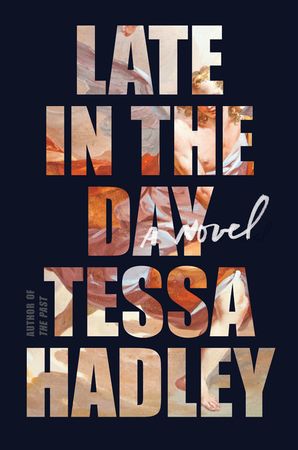
Tessa Hadley is a writer who knows how to elevate the universal hunger for belonging — to ourselves and to each other — into something sacred. To belong is to love and be beloved, but belonging is also vulnerable to loss. In her latest novel, Late in the Day, Hadley writes about what happens to four friends who uniquely belong to one another. Lydia and Christine, Alex and Zach have been friends through many lives. Lydia and Christine have been friends since school, and Alex and Zach have, too.
Buy the book
Desire changes things for the better, it seems. Lydia marries Zach and Alex marries Christine and the four have what could easily be considered a dream situation. They all remain best friends, they raise their children beside one another. They belong to each other. It’s beautiful, it’s symmetrical. In sculpting out the immediate, interior personalities of Zach, Christine, Alex, and Lydia, Tessa Hadley is somehow also able to sketch in broader strokes what it means to live in a long marriage, what it means to be an artist, what it means to be a parent, what it means to be on one’s own.
All too quickly — for us, within the first few pages of the novel — death changes things for the worse, it seems. When Zachary dies suddenly, the lines of belonging slowly spin apart. The world is uneven after Zach leaves it: who belongs to whom now?
Tessa Hadley and I corresponded over email about what it means to be a woman holding the pen and why we need fiction.
Erin Bartnett:I wanted to start off by talking about time. The title of the book, Late in the Day gestures to a specific time, and the book structurally goes back and forth between the past, when Zach was alive, and the present, when Lydia, Alex, and Christine are mourning him.
Can you talk about how you came up with this structure? Did you know the book would begin with Zach’s end? Why was it important to have the past and present coexist in the narrative time of the novel?
Tessa Hadley: When I first conceived of the novel, its two long marriages twining around each other, I imagined it unfolding in simple time, chronologically. But as soon as I thought that the strongest thing I could do to my quartet of characters was to have one of them die, reduce the four to three, I felt it wasn’t possibly to merely have that occur in chronological time. It would have come about two thirds of the way through the book, let’s say. That would have seemed somehow malevolent towards the reader, like a mean trick I was holding up my sleeve the whole time, not letting on. If I was going to do something so cruel to the four characters, then it had to be the entrance into the book, it had to be there right at the beginning, the reader had to share the writer’s privilege to some extent, watching young Zachary and all of them young and heedless, and knowing what’s in store, all the readers’ perceptions changed by this as the protagonists’ can’t be.
The rest of the structure flowed from that. I think this is part of the great metaphysical potential of the novel form, that it puts the reader in a relation to time and experience which isn’t practicable or possible in ordinary life. It opens up for us a dizzying thought experiment with past and present, confronts the imagination with juxtapositions which aren’t actually available within the real flow of time.
EB:Marriage, to my mind, is a relationship that has a very intense relationship to time, and the ways we each experience time are different. Christine, reflecting on her marriage to Alex, muses: “Since that beginning, they had both changed their skins so often. Marriage simply meant that you hung on to each other through the succession of metamorphosis. Or failed to.” I wondered, what drew you to the subject of marriage, and what did you learn about it in writing this book?
TH: It’s such an old subject, and such a perennial one. We still do such a lot of it — and in fact this phenomenon of long, long marriages is new, just because we’re living so much longer. Even second and third marriages these days can last thirty or forty years or more!
A marriage is a perfect subject for a novel, because it fastens together two individuals inside a tightly constraining form.
A marriage is a perfect subject for a novel, because it fastens together two individuals — whose personalities may well be flying off in quite different directions, especially as time passes — inside a tightly constraining form. Tension works well to support a story: the flying-off energy, pushing against the force of the containment. Adultery by itself isn’t the great subject that it was in the 20th century, because less is at stake, it’s no longer tragic. And courtship too, because marriage isn’t irrevocable, isn’t interesting in quite the same way it was in so much art of the past. But marriage, with all its difficulty and comedy and cruelty and at best tenderness, still makes such a good shape for fiction.
In the case of heterosexual marriage, it’s interesting too to press men and women up against each other inside marriage’s tight circle, watch what they do, find out what they are and what they want, wonder why they seem so different. There ought to be good novels about long same-sex marriages or partnerships, but I can’t immediately think of any.
A marriage is a perfect subject for a novel, because it fastens together two individuals — whose personalities may well be flying off in quite different directions, especially as time passes — inside a tightly constraining form.
EB: Christine, Alex, and Lydia all mourn Zach’s death in different ways. But I was struck by the way the form of the novel could perform some of the unfathomable but very real ways I’ve experienced the feelings of mourning. We get the news that Zach is dead within the first few pages, but then we grow to know him, through flashes of the past and the people that knew him, and even though we know he’s dead, he comes to life in our heads. It was beautiful and also so sad! What was it like, writing a book about mourning? Did you feel yourself experiencing mourning in some ways, too?
TH: I was anxious, that the book would be too glum — and yet I also felt it was imperative, having chosen this story, to do real justice to the awfulness of what has happened, to their mourning. So I shuttled back and forth between those worries — not being too gloomy, but not scanting the sadness either. To use again the word that came to me in answering the previous question, I suppose it’s a kind of impersonation — you have to act out in words what you think that character would feel, how the death would smite them, knock them down. So it’s a funny mixture of quite ruthless imitation of life, working in a business-like way to get the truth on the page; and on the other hand “miming” in oneself all the wash of feelings of sadness and loss that the protagonists experience. So writing it is not at all like real mourning. But it’s not devoid of sincerity and empathy, either.
EB: As an extension of that, maybe, Christine has a creeping experience of creative block with her painting — so much so that she actually locks the door to her studio and hides the key. For Christine, her block happens simultaneously with her mourning, but the two experiences are not, I thought, expressed as one in the same. But they do inform one another. And both, in some way, liberate her.What is the relationship between creativity and mourning, do you think?
If you don’t relinquish yourself to naivety, give permission to the free flow of dream-invention, then you’ll never write anything alive.
TH: That’s difficult, and interesting, to answer. I suppose a death is the supreme test, really, of the whole relation between creativity and life. There’s always perhaps something shaming in the practice of art, in relation to the real. Painting — or writing, or film (music seems to be different) — usually attempts at least in some way to imitate the real, or to be “about it.” This work of representation has been fundamental to art from its beginning — in the cave paintings, say. But there’s always a kind of shame, when you look back from your drawing of a bull to the real bull. Not enough, the artist sees. Not whole, not the whole truth. Perhaps Zachary’s death has something like this effect on Christine. Her efforts to make work which represents life are made shaming by the intrusion of this worst possible reality. She loses her trust in herself, that what she has to show is adequate to this life, this death. She’s made inadequate by it. That’s one of the ways that mourning might be disabling. At least for a long time.
EB: Christine, Alex, Zach, and Lydia all have individual relationships with art that inform their relationships with one another, at times enhancing their relationships and at other times making them impossible. It isn’t easy. Why do you think it is so challenging to have both — to create art and a “live a life” with another human being?
TH: Another difficult question! Is it because in making art we’re reaching to transcend the limits of what we are? We seize authority, we assert, in paint or in words or on film, that we are more than our partial limited imperfect selves, we enact something bigger than ourselves. But of course in our daily lives we are only our partial imperfect limited selves, as our friends and family know well! So there’s always a slight disconnect, a bit awkward and humiliating, between the aspiring dream of art and its necessary hubris, and the stumbling earthbound reality of the rest of our lives.
EB: There was a line from Zach about the way time and creativity are experienced differently for men and women. Right after Alex admits to Zach that he’s afraid he can’t write because everything important has already happened and been written about, Zach asks: “Do you think it’s a male thing?…Because the pen has been in the male hand and all that, for so long. Now that women have picked up the pen — for writing, for painting, for everything — they may feel all kinds of doubt but not that one. Because they’re not belated. As women, they’re still near the beginning.”
What was it like writing (or typing) those lines out, as a woman holding the pen? Do you think women and men are on a different timeline, creatively speaking? Why or why not?
TH: I loved typing out those lines. I’m quoting a little from Jane Austen (or Zachary is), when in a marvelous scene in Persuasion Anne Elliot is talking with Captain Benwick about whether men or women are the most constant lovers. He says that poetry shows it’s men who are most faithful, but then adds thoughtfully that of course Anne won’t accept that, will she? Because the poets have mostly been men, the pen has been in their hands…I love Austen’s subtlety, by the way, that she gives this good point to the man. So deliciously un-smug.
It is a thought I’ve had about fiction sometimes, about the mid-20th century in particular, that when so many men were declaring the end of the illusionistic novel with its imitation of life — implying it was a form fit for credulous women and children, creating a lot of angst among novelists over the validity of what they were doing — certain women writers carried doggedly on trying new things with the old form. I mean for instance Elizabeth Bowen and Elizabeth Taylor, Rumer Godden, favorites of mine. They had too much to say to give up the illusionistic novel form to intellectual despair.Of course women had been writing novels in English from the beginning. But still, women were so new in art. They had such stories to tell, from their perspective. No wonder the men, after all those millennia of creativity, were exhausted and disenchanted, had seen through all the tricks. But it was all relatively new to the women, they weren’t ready to give it up yet!
I may just be fanciful in imagining this version of literary history. Anyway, I gave my fanciful thought to Zachary, only translated into the field of the visual arts.
EB: Another kind of creative block happens for Alex, meanwhile, who admits to Zach: “I’ve always felt that was my task: to be vigilant against liking the wrong things. But it’s a mistake, perhaps. I suppose it’s what stopped me writing….The heavy hand of the critical law on the scribbler’s hunched shoulder. Thou shalt not!” In your own writing, as I understand it, you wrote four novels which, you mention in an interview with The Guardian, were “no good,” but you continued to write. How did you keep the “heavy hand of the critical law” from paralyzing you in your work early on? And now?
Our present will soon pour into oblivion along with all the other infinitude of presents that have gone before it.
TH: One’s relation to that critical hand is so ambivalent. I think I felt it on my shoulder very heavily and inhibitingly, writing those bad books. I thought I had to write the books somebody else high-minded would approve of. In order to write better I had to get out from underneath that hand and take the risk of being foolish. There’s some profound naivety built into the foundations of fiction, which is make-believe. If you don’t relinquish yourself to that naivety, give permission to the free flow of dream-invention, then you’ll never write anything alive. I think Alex couldn’t allow himself to write naively.
And yet — one doesn’t want to write like a dreamy idiot either. So “Thou shalt not!” is inhibiting and also teaches you how to do the thing properly. Thou shalt not be banal. Thou shalt not say the same thing twice. Thou shalt not be overblown or unclear… It’s a dodgem course, dodging between doubt and hope with each sentence you write.
EB:In that same interview, you mention the anxiety you feel writing novels in this current moment: “What am I doing wasting my time on this, when the world is going to hell in a handcart?” How do you get over that feeling?
TH: Probably you simply shouldn’t get over it. You should balance somehow in your head all the time you write that what you’re doing is so tiny and irrelevant — and yet concede that it may also be the best thing you can do, or the only thing. The only justification I can think of for writing novels about — let’s say, in Late in the Day — a small group of educated fortunate middle-class Londoners and their emotions and experiences, which might seem not “relevant” at all to the world’s great crises, brings us back again to where we began, with time.
The present feels so substantial and self-evident when it’s all around us. But it’s rushing away like a fast silent river in the dark, falling over the invisible waterfall some little distance ahead of where we are. Our present will soon pour into oblivion along with all the other infinitude of presents that have gone before it. I suppose I want to dip my sieve into that rushing river of present moments and hold back some flotsam and jetsam of detail, almost like an anthropologist — just to make a picture, for as long as this present lasts, of what it feels like and what it means for these kind of people to live, just here and just now.
Maybe you like a good bodice-ripper. It’s okay if you do—own it. But it nags at you: how hard is it really, to rip a garment lined with whalebone?
Maybe you like the cozy mysteries of Kate Morton and Philippa Gregory… but you can’t stop calculating the real mystery of how, while preparing a soiree, the heroine found time to slip out and walk two miles in pointy wood-soled shoes to hide that key.
Or maybe you love the classics, written by the women who actually lived in that ruffed and repressed time. In which case it’s just indiscreet to keep wondering how Jane Eyre ever got used to letting a maidservant carry her bowel movements around Rochester’s dark mansion.
Buy the book
In my books, I answer these sorts of questions, because I believe historical details in fiction bridge the gap between you and the woman whose life you’re temporarily inhabiting. They strip the artifice from these women and replace it with honest beauty. Your heroine becomes stronger when you realize she was restricted in dress, mobility, privacy, and every other freedom modern women may take for granted.
The books below all do an above-average job presenting some of the uncomfortable, smelly, sweaty truths behind our cultural image of the corseted and tea-tippling (mostly) British and American women of the Victorian era.
The Awakening Land is actually a series of three books, The Trees, The Fields, and (Pulitzer Prize–winning) The Town, each taking the reader through the development not only of our pioneer heroine but the creation and settlement of her America. It’s a motion-capture journey that follows a teenage girl, Sayward, stranded with unreliable parents in the life-snuffing early 1800’s Ohio wilderness, through a life of staggering sacrifice, danger, and strength. Richter’s mid-century prose is, like his heroine Sayward, firm and honest. His patient examination of this woman’s life reveals how our grandmothers didn’t just need to adapt to a new life, but simultaneously bend the laws of man and nature to adapt to them. And Sayward is a heroine for the ages; if she weren’t so sensible and reliable, she’d have long found her place with Scout, Scarlett, and Celie as one of the great women of literature. What do you do when you’re miserable-poor, and your boy has one chance to impress folks enough to send him to school, but all his clothes are so shabby they humiliate him? If you’re Sayward, you don’t say a word. But you spend the next 24 hours creating a perfectly tailored fashionable wool suit. And you start by shearing the sheep.
Iola Leroy deserves top credit for providing an accurate depiction of what it was like to be a black woman in the 19th century, because it was written by a black woman in the 19th century. So, even if it uses some of the stock characters and plot lines common to romantic fiction of the time, it still provides realism beyond what any amount of research could offer. Iola is a black young woman, but in no way downtrodden. Her light-skinned mother was her white father’s slave, until he freed and married her, pre-Civil War. Iola is subsequently brought up educated and ladylike in the North, until her father dies. Without his protection, she is sold into slavery. Therein starts her torrid adventures of escaping deviant men and abuses while looking for her lost family. Harper’s themes, woven into a readable, sentimental story, are not obsolete. In fact they are one of the first, freshest takes on racism, black pride (Iola is light skinned enough to pass for white but refuses to do it despite the ease it would create), and sexism. Iola Leroy shows us the front end of social misery so big that perhaps few people alive today, over a century later, will live to see the back end. Books like this one, however, provide unique viewpoints to help move things along.
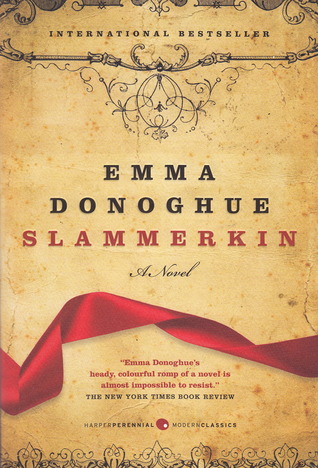
Slammerkin is set in the 18th century, not the 19th, but Emma Donoghue is one of the most lush history writers alive, so it’s worth wiggling the rules a little for her. More importantly, the particulars of the life of her character, teenage Mary Saunders, would not have been very different 100 years on. Mary Saunders was a real girl, and the rough facts of her death (not a spoiler, no one makes it out of good literature alive) were enough for Donoghue to transport you to the deadly cold of London streets, and give you the hunger pains of both stomach and soul. Mary is no one’s hero, not even her own, nor is she required to be. Donoghue puts us in a world where survival, tinged with any tiny pleasure you can scrape up, is what life is. Through Mary we learn that being “bad” can offer so much more freedom than virtuously starving—until it doesn’t anymore. Virtue provides so much safety, until the people you depend on stop treating you with care. And it’s easy to be a “good woman” until temptations and desperation overtake you, no matter what century you live in.
Nancy Turner’s book is probably the most accessible and fanciful on my list. Meaning it’s the most fun you’re ever gonna have reading about floods, rape, hostile natives, fire, dead children, bad marriage, crazy mothers, banditos, snakes, scarlet fever, and stuck-up neighbors. You’re guided through all of it by the most spitfired, kick-ass plain talkin’ pioneer woman ever to tread frontier Arizona’s miserable dust. Sarah is the technicolor version of what our foremothers went through to survive inhospitable territory. She has the spunk of the modern woman, not the silence and wiles of a 19th-century woman. She is not quiet, she does not know her place, and she always chooses virtue. A bit glossy, but a great introduction to the rough brave lives of the women of frontier America.
Before the grandmothers of white women were able to begin their harrowing journeys toward settling American land, something awful had to happen. The grandmothers of brown women, Native Americans of innumerable tribes, had to be forcibly removed from that selfsameland.
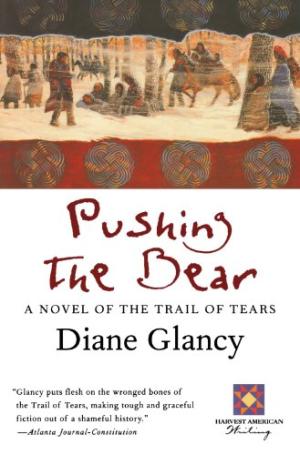
Pushing the Bear places the reader in the grit and sorrow of the Indian Removal Act, what we more commonly call the “The Trail of Tears.” Glancy uses many voices to tell the story of the long and deadly march, though most is seen through the eyes of Maritole, a Cherokee woman. The history is deftly researched, and Glancy knows that Maritole, the representative woman of the story, can’t tell her story without including the stories, anger, and fear of the people, particularly the men, around her, both Native and white. In a culture where gender roles deeply matter, emasculation by a foreign military changes more than just a society; in the case of Maritole and others displaced like her, it can change what it means to be a woman.
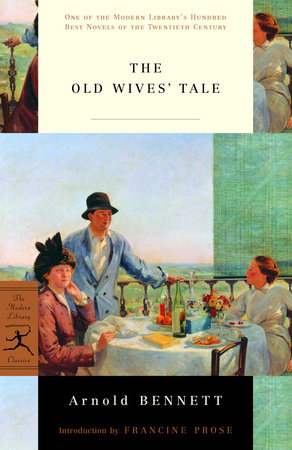
The Old Wives’ Tale is, as Victorian books will be, long, detail-heavy, and slow-paced—but somehow it’s still quite readable. It is the story of two sisters, teens when we meet them in 1860s England, and the choices each make that will guide the rest of their lives. What Bennett makes clear, though, is that they had almost no choices. They must both be wives, of course, but one is rebellious and foolhardy, one solid and perfunctory. Bennett quite outrageously shows that it doesn’t matter which road is taken; neither woman was meant to thrive, not even the proper and virtuous one. He deftly illustrates their lack of agency and the weaknesses they cultivate in response to their powerlessness. Bennett might not have known he was a feminist, but he expertly shows how Victorian society was a well-laid trap for most of its female participants.
Probably the most thorough and intriguing exploration of Victorian women’s lives, replete with transporting detail and dialog and a story you can’t put down. You’re mostly going to be accompanying Sugar in this brilliant book by multi-faceted writer Michel Faber. Sugar is one of the most sought-after young prostitutes of 1870s London. Her ability to hide her rage toward her clients doesn’t quell it, however, and she spends near all her free time writing tortuous fantasies of harming those who use her. But she is shrewd, capable, and she will find her way up and out.
But you’re also going to meet Agnes. She’s a Wealthy Respectable Woman, but so delicate, so babied, that she cannot function in society; even though her lot is the luckiest a woman of her time could draw. Or is it? Sugar never had a childhood; Agnes isn’t allowed to leave hers.
Faber doesn’t give us the simple contrast of high and low, cunning and ignorant. He has other flowers to make this bouquet sweet and thorny. The unflappable Emmeline Fox, plowing through Victorian decorum to save the fallen woman of the world, women like Caroline, “a sweet soul” who truly prefers the relatively simple work of prostitution to the “donkey work” of the virtuous poor. The women of Faber’s Victorian Age stride, stagger, dance and skulk through their distinct but intertwining worlds. Their power is limited, but they are in motion, and every tornado starts with a breeze.
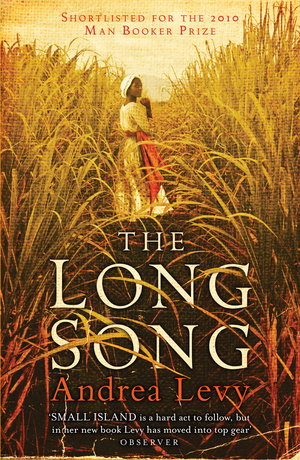
Eighty-something Miss July will tell you her story, as her son is urging her to do. But she’s not going to tell it the way you usually like to hear your ex-slave stories. She’s not even going to tell it the way her son Thomas wants her to. He’s pretty pushy for someone she abandoned on a doorstep when he was a baby. Yes, she was a slave on a British sugarcane plantation in Jamaica, and yes, she was set “free” in the Baptist War of 1831, but that’s all beside the point of the story she wants to tell. If you want some noble savage or magical negro, look somewhere else. Besides, she would say, she’s mulatto, not black, and you better know the difference.
Frankly, you might not think she’s a that pleasant of a person. Actually, there might be no one in her story who you find yourself particularly rooting for. That’s not her problem, though it does beleaguer her son a bit.
Levy is a funny writer, and she dares to bring humor to this very sensitive subject. Allowing these imperfect, mercurial, and disappointing characters to tell their own story makes The Long Song one of the most authentic depictions of 19th century women you’ll ever find.
Miles south of the wide blocks that are Greendale’s historic downtown of Greek Revival law firms, of vacant buildings with old Coca-Cola ads tattooed to their sides, of ancient, craggy men on bicycles wearing shrunken baseball caps, is her uncle’s apartment in what used to be a motel.
It’s hot. A hint of the vacuum-sealed wet of a Mississippi summer in the air. She turns off the AC and rolls the windows down, letting in a warm wash of heat, then shakes the last of the potato chips into her mouth. What the hell. Where is her uncle? She’s been in this parking lot for an hour and he hasn’t returned any of her calls. They were supposed to meet here an hour ago.
Now it’s nine o’clock and the roads are overrun by boys in big-wheeled Cadillacs. C’mon, motherfucker, they whoop over a serrated beat. Friday night and the young gleam in the gas stations and drive-thrus of this tiny city where the level of poverty (she’s read) is almost 40 percent.
Billie gets out and tours the parking lot. Each tenant has distinguished their room by the way that they cover the long window beside their front door. Some are sealed tight with tinfoil, others with a printed sheet, but her uncle’s window on the second floor is bare. A few people are sitting outside of their doors on plastic chairs. Nothing moves except for a can or cigarette. The light from passing cars gives their faces the sheen of old master paintings. Hendrick ter Brugghen’s Melancholia. The contemplation and the shadows. Nothing is happening but a wanting something to happen.
A white woman wearing a long T-shirt covering her shorts is standing on the corner like she’s waiting for a bus, but there’s no bus stop sign. It doesn’t look like she’s been able to shower for the last week, and her expression says her ride is never going to come. She paces, the flip-flops askew on her bitterly dry feet.
Someone calls, but Billie doesn’t answer. She needs to be vigilant. She gets back in the car. She needs to let Rufus out soon and it’s almost a two-hour drive back. Maybe wait fifteen more minutes. She slides deeper into the driver’s seat, exhausted from mowing the yard, which she’s never done before, having never had a yard. A mosquito bounces off the windshield and sinks into the dark interior of the car. Then through the bug-smeared glass, an older black man followed by a white woman goes up the steps and toward her uncle’s apartment.
She hops out, slamming the car door and hurrying after them. “Uncle Dee?” she calls from the bottom of the stairs.
Her father’s little brother turns, a straw cowboy hat curling on his head. Above the white V-neck under his Hawaiian shirt, a scar over his collarbone moves, knotted and dark.
“It’s Billie!” she shouts, taking the steps two at a time.
The blond woman stays by the door, impatient to get inside, but her uncle meets her halfway down the balcony, hugging her and leaving a film of beer and Old Spice. He holds her out from him. “Lord, you look just the same as when you was a kid. Sorry I’m so late. I tend to get my days and nights mixed up on the road.”
“It’s okay.” She forgives him instantly.
“Man”—her uncle shakes his head—“I can’t believe how long it’s been.” He walks her to the apartment and the blond woman moves back as he unlocks the door. “Last time I seen you, I was a teenager babysitting you.”
Her uncle is close on fifty and missing two teeth, one on the bottom and one on the top. The blond woman looks at least fifteen years younger. But it is hard to read the old acne scars, thin platinum hair, spike-thick mascara, fake designer purse, and the crooked music note tattoo below her miniskirt and above her knee.
As they go in, Billie turns to her. “I’m Dee’s niece, Billie.”
“He told me. Lacey.” The woman walks in front of her.
“It ain’t much,” says her uncle, turning on a lamp, which illuminates an office chair, a cracked brown couch, and a tilting carpeted floor the color of grease. The room is crammed with furniture from a life he must have lived a few lives ago. On the phone, he called his place a step above prison. She thought he was being funny.
“I haven’t been home long enough to clean it up.”
“It’s nice,” she says, the lie too soft to be heard.
Billie sits on the couch by the front window while her uncle goes over to the kitchenette, waving away a few fruit flies and filling a glass of water from the tap. “Thirsty?” he asks. Billie shakes her head, but Lacey sits in an ancient wicker chair in the corner and puts out her hand. He sets Lacey a glass by a dead plant on top of the AC unit, then takes a tall boy from the minifridge.
“I can’t stand this humidity already. It’s different in Nebraska.” Her uncle takes off his Hawaiian shirt and throws it at the bed, not picking it up when it flutters to the floor. “This whole damn part of town is all concrete.”
“I guess the cold snap’s over,” Billie says. From where she is sitting, the air from the AC unit is wet and rubbery.
“Nebraska? When were you in Nebraska?” asks Lacey.
“Last year.” Uncle Dee wheels himself on the office chair to the middle of the room and opens his beer. “Back when I was full-time. Now I work on an as-needed basis. Any more trouble out there at the house?”
“No. I think I just got spooked,” Billie says, tracing the blister forming on her hand where she held the lawn mower too tight. “I did hear some wind chimes. Guess that would be coming from the McGees.”
“Naw, they too far off.”
“Well, I doubt a thief is stalking me holding wind chimes.”
“We got all kind of characters out in the Delta,” he says.
“What do you think about me renting out the house? I’d fix it up a little more of course.”
“Don’t care what you do with it.” He cocks his head back to drink, almost closing his eyes.
He’s been like this about the house since she first called him after Gran died. She wanted to see if he wanted to live there. He didn’t.
“I met Jerry Hopsen on Saturday.”
He opens his eyes. “How did that happen?”
“You said his wife, Sheila, was close to Daddy so I looked him up.”
He stares at her. “And what did that old so-and-so have to say about my brother?”
Her eyes flicker to Lacey, who is examining her cuticles in the wicker chair. “He said they all grew up together—him and Sheila and Daddy.”
“That it?”
“That and he didn’t know me.”
“What in the hell he mean by that?”
“That he never met me before. Is that true?”
“Might could be. Last time you were here was a long time ago, baby. I was still in high school.” Her uncle leans back in his chair. “Cliff didn’t like people who weren’t family coming over when you was in town. If he wanted to see folks he would go to Avalon.”
Last time you were here was a long time ago, baby.
“Wait, Avalon? That’s a real place?”
“Old juke joint we used to go to off 61.”
“Just like in his poem.”
“Oh yeah, I remember that one.”
“Is it still open? Can we go there?”
He laughs. “Baby, it’s been closed down for years. Folks ain’t into jukes no more. They go to the club. You want to go to Avalon?”
“Yes. Absolutely.”
“I’ll take you this weekend. Be here at noon on Sunday. Sheila . . .” Her uncle shakes his head then grins. “Man, you never forget brown sugar sweet as that.”
Lacey swipes at him halfheartedly and collapses over her own thighs, suddenly seeming drunk, though Billie hasn’t noticed her drinking anything except water.
“What you do for work again?” he says.
“I’m a grant writer. It’s for a good nonprofit, but pretty boring, though I do get to work mostly from home.”
Her uncle is looking down into his beer as if he is trying to see something written on the bottom of the can. “I’d like to sit home doing my work.”
The chemical wail of a car alarm comes from the parking lot. Lacey doesn’t sit up, her forehead poured onto mottled knees.
Her uncle sets his sweating tall boy between his feet. “Be careful in them woods with all the snakes.”
“Wouldn’t my dog scare them off?”
“More like to get bit. The Delta can be rough on a dog.”
She glances over at the fallen Lacey. “Seems she’s no longer with us.” She looks at her uncle. “You know, when I saw Mr. Hopsen he told me something I’ve never heard before. It’s really crazy. He said that the night Daddy died, I went missing, and that my picture was on the news. Is that true?”
Her uncle shakes his head. “Why he tell you that? He’s representing it all wrong. Of course that fool would. He don’t know nothing about it.”
“Was I on the news?”
His dark eyes meet hers. “Your momma didn’t tell you nothing about it?”
“Not a thing.”
“It’s all right, honey, it ain’t that big a deal. The police were so dumb they couldn’t find you sleeping in some blankets in the closet. So they made you a missing person because you were so little and we all lost our minds.”
“The closet? Why was I there?”
“I don’t know. That’s where he kept your toys. Maybe you got scared. But they got Momma so riled up she had everybody looking for you and somebody sent your picture to the local news. Then a couple hours later, there you were.”
“I can’t believe my mom didn’t tell me about it.”
“Some times are so bad people can’t ever talk about it.”
Billie is still for a moment. “I better get going. It’ll take me a while to get back and I need to let out the dog.” She feels for the keys in her purse and is stabbed by an uncapped pen.
Her uncle walks her to the door and follows her out onto the balcony. They both lean on the railing, looking into the parking lot.
“It’s really good to see you,” she says.
“Good to see you too. Good to reconnect.” He coughs, then turns to light a cigarette, cupping the flame. “Don’t bother asking Jerry nothing.”
The cars below wash in, rushing up to the stoplight only to brake, red above red.
“I’m not planning on it.”
He nods. “Good, good. I ain’t trying to tell you what to do.”
Her uncle is singing something that she can’t make out over the rattle of window units. He coughs again. He’s still handsome but too thin. He was Grandmomma Ruby’s miracle baby, born after she was forty. Because she’d never gotten pregnant after Daddy, Mom said she thought the doctors had given her one of those “Mississippi appendectomies,” or forced sterilizations.
“Do you want me to get you some water?” she asks.
He holds up his hand, steadying himself with the other on the railing. “Naw, I’m just coming down with a cold. Always do this time of year. My summer cold.”
When Billie sees her uncle the next day, the wind is an ocean, vast and crashing down with rushing pink blossoms. On the opposite end of his balcony, a man in a wheelchair with James Brown hair gives her a salute, which she returns. For a time, he watches her expectantly, then together they watch the red and white gas station across the two-lane road.
Her uncle is inside making chicory coffee and not saying much. She’s avoided delicate subjects like how long could she have possibly hid out in a closet and why hasn’t she come here years sooner. He could have been like a second father. They’d joke and have favorite meals, he’d visit her in Philly. She’d have gotten a place with a guest room or at least a couch with a pullout bed. Maybe she would have had fewer mediocre boyfriends with pleasurably normal families.
She’s avoided delicate subjects like how long could she have possibly hid out in a closet and why hasn’t she come here years sooner.
Across the street, a girl at the gas station drops a bag of ice. It smashes open, glittering over the asphalt. The girl kicks the bag, then stoops to shovel the loose ice back into the torn plastic, finally tossing the broken bag into a trunk with a dragging bumper.
Down in the scaled parking lot, a silver pickup truck pulls up and the middle-aged woman who gets out slaps and curses a pigtailed little girl standing at her feet. A doubtful older man in a wrinkled Yankees cap gets slowly out of the driver’s seat. He leaves the truck door open and stands gazing into the gearbox as the little girl wails.
Billie slides along the rail toward the stairs. James Brown raises an eyebrow as she nears the top step. But as if she can feel Billie deliberating, the woman in the parking lot looks up: wearied, outraged, sheepish. Then the woman pushes the little girl inside one of the apartments. The older man in the Yankees cap still stares into the truck, as if doubting the reality of the seat.
“You making friends?” Her uncle is behind her shaking a cigarette from a flattened pack. He hands her a cup of coffee.
“I’ve never been popular.” Billie sits down with the cup on his neighbor’s small blue and white cooler, the backs of her thighs gluing themselves to the plastic lid. “Do you know that lady?”
“I seen her.”
“And the little girl?”
“Maybe.”
“Do you think that happens often?”
“If a child is disrespectful then they gonna get whupped. Can’t spare the rod. My momma didn’t like to do it, but sometimes it had to be done.”
“What about your father?”
“He only licked me once in a while when I’d been real bad. If he was around and could find me. Your daddy always said I got off easy being the baby of the family.”
“But there is a difference between spanking and beating.”
He lights his cigarette. “How often you get spanked?”
“What I’m saying is that it instills fear not respect.”
“How often?” He inhales.
“My mother didn’t believe in spanking.”
He laughs. “Ain’t she learn nothing from her time here in Mississippi?”
“Doesn’t mean I never got hit.” Her mother had a boyfriend who hit her a couple times when her mother wasn’t home. Not a slap across the thighs, but a bend over, pants down, and wait for the belt. It was the dread that made her hate him. Billie peels her legs from the cooler. “Why do people who hate kids have them?”
“That’s one of them age-old questions,” her uncle says, taking a drag on his cigarette. He waves to a man in a camo jacket with a long, thin blond braid walking up the steps.
She sips the coffee and sets it down. “Where did you meet Lacey?”
“Truck stop casino she work at.”
“Are you sure you don’t want the house?”
He smiles. “Don’t worry about me. This”—he gestures to the building—“is a temporary situation. I tell you what, nobody in here better off than me. I got a job and the place all to myself. There’s five, six people living in some of these rooms. Not only that but I finished high school and did a year of college at Jackson State.”
“Why did you stop?”
“I got offered a job at John Deere and went for the money. To be honest with you, I wasn’t all that interested in school. I just knew Cliff was interested in me being interested.”
Her uncle points down to a dark cherry Buick in the parking lot whose back window is covered with a trash bag. “That’s my baby.” He hands her a set of keys.
“You want me to drive?”
“I got one of my headaches.”
“Have you taken anything?”
He waves this aside. “I got a prescription. But it don’t seem to matter what I do. They come when they want.”
“What does your doctor say?”
“That it could be any number of things.”
“I think you need a second opinion.” Maybe if they get to know each other, she can help him find a better doctor.
The air in the car is thick with canned heat. She dials up the AC, backing out of the spot so that they’re facing the two-lane road. He turns off the AC and rolls down his window, looking older than he did the other night. “It don’t work. Take a right out of the parking lot.”
With the windows down, the hot wind rolls into them, burning and cooling. The sky above them is aching with rain. They drive behind a truck with an Ole Miss license plate and a large crucifix hanging off the rearview mirror. As the town is pulled behind them, the landscape becomes lush and stark. Brilliantly green with a few battered shacks half swallowed by a thicket.
When the car crackles down a dirt road, they roll up the windows. They slide in and out of wet patches as dust coats the windshield. For the first time in her life, Billie wishes she had a truck.
Avalon sits alone in the middle of a soybean field. She parks and opens the door, but her uncle doesn’t move.
“I ain’t even drove by here in a good while.” His face is turned from her.
“You don’t have to come in.”
“I’ll join you in a minute.”
She gets out and walks up to a broken bottle tree guarding the scarred patchwork of wood and tin. Bottle trees are meant to trap bad spirits, but it looks like these ones got out. She tests the narrow set of stairs with a foot, then shakes the railing, glancing back. She can’t see her uncle through the glare on the windshield.
Inside the air is dazed with heat. She can’t walk too far because the roof is caving in at the back. There are still scraps of posters on the walls and the low wooden beams are twined with rows of burned-out Christmas lights. On the rotting floorboards is the naked stain of where a jukebox once sat near the plywood stage, and above the bar, the squiggle of a broken neon sign.
She sits on an uprooted church pew, her feet at the shattered cavern of a TV. She takes out her father’s first book of poetry, Race Records, and flips to “Song 33.”
Song 33
My love,
We made our own island:
On soil too long blood fed
Where the wind don’t come
Our wooden conjure stood
all night long.
There you hear the voice of
three hundred years of sweat,
there ride on sweet mercy
all night long.
No it ain’t Paradise
It’s only Avalon.
Feels like living longer,
But my love, we dying
all night long.
What does that last stanza mean? Why dying? The floor creaks. Uncle Dee. He bends to pick a thread of tinsel from the floor.
“My Grandmomma Ida used to call it devil’s music. Sure could call the devil up.”
“I bet. Did my mom ever come here?”
“Only one time I can remember. She was carrying you. But she was still a real good dancer.” He twists the tinsel between thumb and forefinger. “In them days this was the place.” He pokes at a ripped vinyl chair, then sits. “Used to have a disco ball hanging right up there.” He points to a beam, then leans back in the chair, cocking the front legs. “You play chess?”
“A little bit.”
“Next time you come by the apartment we can play.”
“The night my father died.” She hesitates, afraid of her words in this air. “Did he come in here?”
“He stopped by.”
“Where was I?”
“With your Grandmomma Ruby.”
“How did he seem to you that night?” Suicide by fall doesn’t really work unless it’s off a bridge, but what if it was a kind of letting go, a spiraling down that ended in an accident?
Suicide by fall doesn’t really work unless it’s off a bridge, but what if it was a kind of letting go, a spiraling down that ended in an accident?
He tosses the tinsel over his shoulder. “I don’t know. He was him. Your daddy was the type of dude that ain’t ever want to sit still. Didn’t even like going to sleep. Said it was a waste of his time. When he was a kid he used to sometimes climb out of the window at night. Momma called it helling around.”
“Where did he go?”
“Meet up with other boys, his little friends, maybe drink a little bit of that corn liquor, you know. Or he went out to be by hisself. Rampaging he called it. Just wandering around the woods and shit, talking to the trees.”
“Wasn’t he scared of snakes or running into the Klan?”
“He said he knew the barn where they met.” Her uncle begins to pick bits of vinyl off of the seat between his legs. “Mama was real proud of him. She ain’t learn how to read till she was an old woman. She wanted to read the Bible and my brother’s poetry. Those were her motivations. But she didn’t like no cussing or anything disrespectful, so there was a lot she would not read. I tried reading his play to her, but that was too much. I remember Cliff wanted me to come to New York and see it performed, but at the time I was too busy being foolish over a girl.” He lets out a chuckle. “I spent the money he sent me for a bus ticket on her. Made her happy, but boy, he was mad. He call me up and say he ain’t ever gonna give me even a quarter again.
“Now Momma liked that one poem—what was it called? ‘My Sinful Days.’ She like the hoping and preaching. No profanity, just redemption talk. She figure he wrote it for her. Maybe he did. I don’t know.
“When he died, she was the one to go over and identify the body. I told her I would, but I hadn’t turned eighteen. Still had another month. She went with my uncles, Floyd and John. Those were her big brothers. After that, she read over that poem a whole lot. Like it had answers.” He looks down at the mess of vinyl on the floor. “She kept praying on it till she died. None of us understood why he had to go like that.” He looks up at her. “So young, I mean. But I moved on from it all a long time ago. Had to.”
“I understand.”
“Way I see it, they ain’t no point in dragging up something happen thirty years ago when I’m trying to make it through today.”
Billie looks at her uncle sitting in the remains of Avalon. This place reminds her of a low tide when the sea has been sucked out and the skeletons of the deep are on display. He is like something left behind that was once alive, moving in shameless beauty, cold-blooded and innocent, concerned primarily with courtship.
This place reminds her of a low tide when the sea has been sucked out and the skeletons of the deep are on display.
“Lola came to see me.”
He looks at her.
“Did you tell Lola’s nana that I didn’t want to see anybody?”
He frowns. “I said not to overwhelm you since this was your first time back. I know you want to talk more about Cliff’s accident.” His eyes are on the floor. “But I can’t hardly talk about it to this day.”
“I don’t want to hurt you. But I do wish I knew more of what happened. What he was doing out there, what I was doing.”
He looks at her. “You don’t remember nothing?”
She shrugs. “I was asleep, I guess.”
He bends forward, rubbing his temples. “Well, baby, you in the right place cause nobody round here remembers anything either.”
Avalon
This house was once a house. Seen a girl made a mother, a boy become a father who come and go, come and go. Seen a son work the land, the land flood and ruin him and the bodies floating in it. Seen a woman rush home to check on her loose children, a white boy close by her side, another kind of son, devoted for now to his mighty black mother. Seen a child burned by a pot of boiling water on the stove. Seen these walls newspapered to keep out the cold.
Heard children singing, laughing, running into the sun to chase a bullfrog. Heard a baby offer up a word for the first time. Heard the silence after underwater drinking, and the fishhook whine of hunger from a small belly. Heard the knock of white men looking for a boy hiding at his uncle’s house, heard shots in the night, far off but always too close, and heard weeping, too much weeping too damn much of the time.
Once there was only the rumble of thunder, split of rain, pulse of locust, the sounds day makes turning over into night. I heard tell of an army of wretched people, hardly clothed, who cleared the brake and swamp and panther, who built and served and escaped only when they died. Their children came here to sweat out the demons that are carried in the body.
This girl she comes wanting to know about a night in 1972 when the Isley Brothers were panting paradise for their queens and the Detroit Emeralds were asking all those babies to let them take them into their arms. But what can these walls say? Listen, girl, everything you want to know is near, telling itself over again, the song is on repeat.
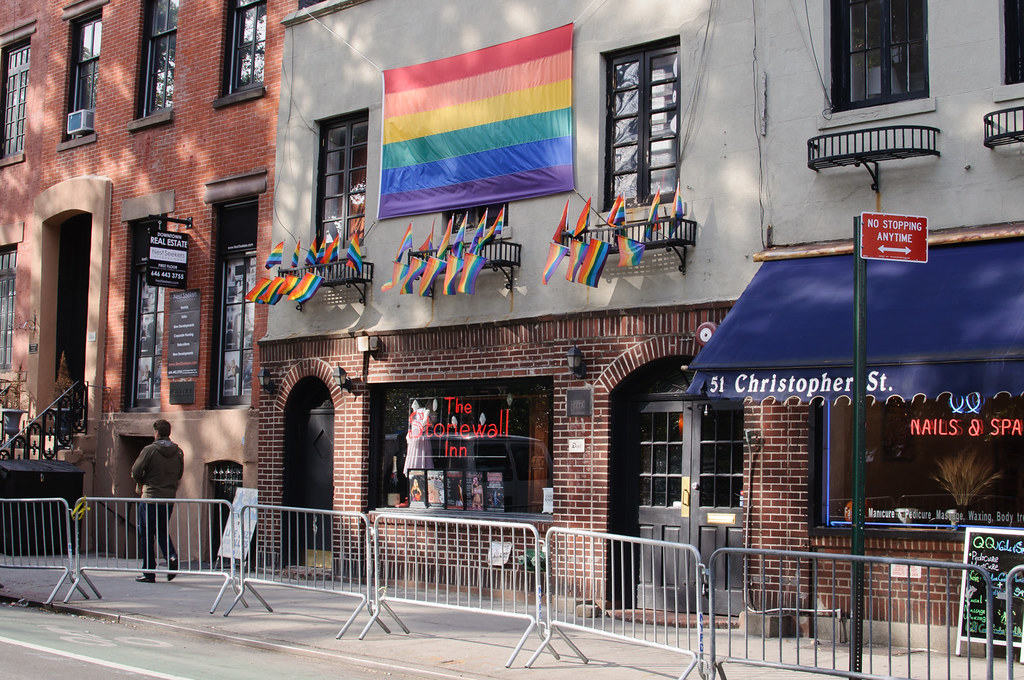
Nobody knows who threw the first brick at Stonewall. It might not even have been a brick. Legend has it a woman in the crowd yelled, “Aren’t you going to do something?” as she was dragged away by cops. We don’t know who she was.
In a smart, hilarious video for The New York Times, journalist Shane O’Neill encapsulates the only consensus about the uprising: “The Stonewall You Know Is a Myth. And That’s O.K.” The facts come from oral histories, tales told by people who where there—or said they were there, or think they were there. In O’Neill’s words, “Fifty years after Stonewall, we’re still arguing about what happened on that night. And that’s kind of the point: Stonewall was, at its core, about people reclaiming their narratives from a society that told them they were sick or pitiful or didn’t even exist.” One lesson of Stonewall is that the line between fantasy and fact is blurry. Stonewall isn’t simply history—it’s mythology.
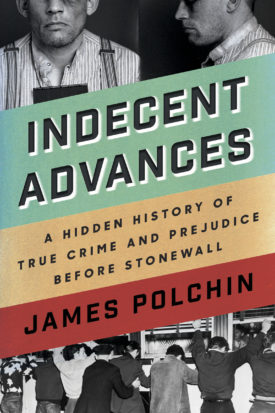
But at least it’s our mythology. One of the things that happened after Stonewall was that queer people claimed the authority to build our own mythologies; Stonewall gave us the power to turn Stonewall into a symbol and a myth. Before Stonewall, as James Polchin outlines in his new book, Indecent Advances: A Hidden History of True Crime and Prejudice Before Stonewall, these mythologies were imposed on us from the outside. Polchin’s deep dive into the history leading up to the riots underscores the difficulty of telling a story that’s so bound up in myth—and the importance of doing it anyway.
Here’s one of the facts we do know about Stonewall and the unrest leading up to it: Gay men were murdered, brutally, in huge numbers during the first several decades of the 20th century—murders that were largely neglected, their lives clouded with shame, stuffed in archives, forgotten.
As with Stonewall itself, we know the outline of this history of violence, but we don’t always know the facts involved. Polchin pulls the lives out of the archives with relentless precision in his book. The particularity of Polchin’s accounts restores some honor to the memory of the men whose brutal stories tell. But it also makes it clear that the press turned the facts of these murders into mythology almost immediately.
The press turned the facts of these murders into mythology almost immediately.
Polchin outlines a pattern to the reporting, dating from at least the 1920s. A man somewhere between 30 and50-something meets a younger one in public—on a sidewalk, in a park, in a bar. The younger man is generally under 30. Sometimes it’s two or three younger men. They drink, eventually ending up in a private hotel room or apartment. The older man is found dead, often brutally beaten.
The press reports the crime with a perplexed fixation on just how these men ended up at the scene. Eventually the younger men tells a story: the older man made “indecent advances”; the younger was only defending himself. He would often describe a blinding panic—echoing the clinical term “homosexual panic,” often used as a defense in court. As one defense attorney argued, “when a beast attacks you, you are justified in killing him.” Sometimes the assailant would be acquitted on such grounds; more often he’d be found guilty of a lesser charge and receive a reduced sentence.
The law was not on the side of these murdered gay men, or any other queer people. Polchin documents the abundant neglect and abuseof gay men by the legal system throughout the 20th century. In the press and the courts, gay men were blamed for their own deaths. In addition, queer people were subject to constant police harassment.
The story—and Polchin makes is chillingly clear that it was a single story, repeated way too often—was possible because of a widespread belief that “any ‘normal’ man would be outraged by another man’s sexual attraction.” The story is predictable and exclusive. If you were affluent white, and murdered after making “indecent advances” to a younger, poorer man, the press would mythologize you. Your story would become a sensation, before fading from public consciousness. Your legacy would be documented in archives. If you were anybody else, it’s unlikely your story would be documented.
By contrast, the Stonewall mythology is unruly and inclusive. It refuses convention. But the unprecedented size and collectivity of the event is undeniable. The people who hung out at Stonewall in 1969 are often described as “street kids.” In truth, they were an intersectional crowd—people of varied races, classes, ages, gender identities, styles, and affiliations. Drag queens shared space with buttoned-up members of the respectable Mattachine Society, seasoned New York dykes with bewildered boys new to the city. Similar rebellions had already happened in San Francisco and Los Angeles, but they didn’t become iconic. They weren’t mythologized. They didn’t become history.
These books offer a rich pre-history of Stonewall, often through disconnected facts, events, documents, and stories.
The precursors to Stonewall are legion: the establishment of the Mattachine Society in 1950, with its campaign to make homosexuality respectable in the public imagination; the publication of Barbara Gitting’s The Gay Crusaders, her autobiographical story of cross-dressing, gay bar life, and underground activism; the night in 1968 when an L.A. gay bar called The Patch was raided, and manager Lee Glaze taunted the police and announced the bar would place bail for anybody arrested; the sexual innuendo and unbridled lesbian flirtation in the performances of Bessie Smith and Marlene Dietrich; the coded lyrics of songs by Cole Porter and Noel Coward; the monthly publication of the lesbian activist magazine The Ladder between 1956 and 1970; that fact that straight police officers had no idea nellies, swishes, and sissies—in the language of the New York Times—were a powerful bunch, having spent lifetimes dealing with bigotry and bullying. And murder.
Stonewall’s pre-history contains no shortage of resistance. Polchin’s book documents the necessity of this resistance: rampant violence and victimization. The crimes he documents became headlines, the visceral available to the general public. At the time, LGBTQ culture was burgeoning, a movement was building, but the culture didn’t know it yet. Lurid crimes dominated the public imagination when it came to homosexuality. There’s a case to be made that the violence suffered by the people occluded in these headlines played a significant role in making those nights in Stonewall possible.
Polchin observes that violence against queer people was reported in coded euphemisms. As in the music of Cole Porter or Noel Coward, the queer story was there, if you knew how to decode it. To describe same-sex desire outright was a violation of decorum few would even consider risking. The paradox of the lurid and the euphemistic obscured the humanity—the lives and deaths—of the murdered men.
As people around the world prepare to celebrate Stonewall, Polchin’s subtitle suggests a difficult necessity. Stonewall is an American story. It raises questions about our past, present, and future. Rather than asking why a bunch of queers fought back over the course of six summer nights in 1969, we might ask how commemorating their resistance builds on their fierce insistence on a different future, one those alive now are free to celebrate triumphantly—publicly? What kind of party do we need to revel in all that, honor the past, and fight a living history of violence and neglect that’s still too routine for many Americans?
What kind of party do we need to honor the past, and fight a living history of violence and neglect?
The party has already started. As the Stonewall anniversary approaches, the celebrations are well underway. New York will host Global Pride, a rally commemorating the uprising. Oklahoma City, Boston, Tapei, Amsterdam, Sidney, South Bend, and Niagara Falls are hosting sister events. NYC’s Pier 97 will deliver Pride Island, a two-day music and arts festival headlined by Grace Jones. Symphony Space is producing a musical performance of Songs from the Stonewall Jukebox. The Stonewall Inn—the place itself, now a historical monument, is hostingevents every day in June. The stories Polchin tells are a reminder that these celebrations perform a cultural duty.
Stonewall is sometimes called an uprising and sometimes a series of riots. The distinction is often politicized. A riot is unruly, an uprising triumphant; rioting is criminal, rising up historical. The truth is it was both. Queer history contains multitudes. It’s got room to be unruly, criminal, triumphant, and respectable. Mythology, as commemoration, makes that possible. Polchin’s book performs a similar commemoration, revives dozens of dead men reduced to sordid true crime tales in the press—to pay them retrospective respect.
Stonewall changed the world. No question. In 1970, the first Pride marches claimed the streets of New York, Los Angeles, and Chicago—the streets news reports about all those gay murders were so interested in. Stonewall didn’t eradicate homophobia, racism, sexism, or transphobia, but over time it did a lot to change public attitudes. When Dan White murdered Harvey Milk, his lawyers mounted a curious cousin of the homosexual panic defense. “The Twinkie defense” held that too much sugary foods had made White unstable. His sentence was five years. But when the attorney for Matthew Shepard’s murderers attempted a homosexual panic defense as recently as the late 1990s, he failed. Both assailants were sentenced to life in prison. While gay panic has subsided as a defense, “trans panic” is alive and well in our courts, with the exception of California, where it is banned. Meanwhile, our country is being torn apart by the fact that white police—and ordinary citizens—are routinely acquitted for the murder of African Americans.
Before Stonewall, fact conspired with fantasy to reverse the roles of murderer and victim. After Stonewall, men like the ones whose stories Polchin tells are likely to be commemorated with respect—less likely to be murdered for desiring sex with another man. But the story in those press reports is persistent. We haven’t exorcised it. We’ve shuffled it on to other people. The story haunts the lives of African Americans, trans people, immigrants. After Stonewall, stories that once went undocumented are reported through a blend of fact and fantasy nearly identical to the patterns and conventions Polchin identifies in his book.
Polchin’s book reads like a roll call of the many dead men who haunt Stonewall.
Stonewall is a place, a bar. You can go there, walk in, experience the room where history was made. There’s a good reason Stonewall has come to represent the massive progress around LGBTQ justice. It’s inevitable that some of the murdered men Polchin writes about would have spent time there. In that sense, Polchin’s book reads like a roll call of the many dead men who haunt that history of queer resistance Stonewall symbolizes.
As we celebrate, we’re honoring the ghosts of men for whom justice was a distant fable. We’re making history visible. After all, my mom has never heard of Stonewall; many Americans have no idea what that week in June meant. We’re mourning lives of African Americans and trans people murdered more recently—people like Sandra Bland, Eric Garner, Muhlasia Booker, Brandon Teena, Trayvon Martin, and many, many more.
We’re connecting the legacy of 20th-century injustices to those we live with and fight against today. We’re reminding ourselves that change will happen. While we can’t predict future history, we can, like those street kids and their compatriots at Stonewall, play a fierce role in its trajectory.
You never know when an event may come along to change the world. There’s a good chance you won’t recognize its historic power right away. There’s a better chance that it’s one of many events—some tiny, some massive, some noticed by hardly anybody—that prepare the world to change that day. That’s the story with Stonewall. It will be the story with whatever finally shakes us out of the moment we’re living through.
Sandra Newman’s newest novel, The Heavens, haunts you like a dream you cannot shake. It is the type of book that requires you to work and pay attention, yet lulls you into a false sense of understanding, at least in the beginning. When you first meet Kate and Ben, their New York circa 2000 is idyllic, yet slightly off, still believable in the way dreams often can be. Less believable, but still dreamlike, is the fact that Kate time travels when she sleeps. She becomes Emily, a 16th century woman modeled from the real life of Amelia Bassano, the Dark Lady in William Shakespeare’s sonnets. Emily’s actions in the past create changes in Kate’s present and in between the dream and real life, is Ben, Kate’s boyfriend who loves her deeply but isn’t sure how to cope with Kate’s increasing detachment from what he sees as real life. You find yourself feeling as Kate does, awakening each day emerging from the past having to remember what is the same and what is new.
Buy the book
At once, The Heavens is a piece of historical fiction, time-travel fantasy, romance, political fiction, and literary achievement. But such a feat is not surprising from Sandra Newman, the woman who gave us The Only Good Thing Anyone Has Ever Done, shortlisted for the Guardian First Book Award, Cake, and The Country of Ice Cream Star, longlisted for the Baileys Women’s Prize for Fiction and named one of the best books of the year by the Washington Post and NPR. She is the author of the memoir Changeling as well as several other nonfiction books. Her work has appeared in Harper’s and Granta, among other publications.
I spoke to Sandra Newman about her inspiration for the book, depicting political hope in fiction, and being the loved one of someone with a mental illness.
Tyrese L Coleman: I’ve been thinking about this book ever since I read it. I have a lot of writerly questions, but I want to talk broadly first about the book and about where the idea came from. I did read in an interview that Emily is based on The Dark Lady in William Shakespeare’s sonnets, Amelia Bassano. I’m assuming that’s where the idea came from.
Sandra Newman: It’s sort of complicated. Amelia Bassano is one of the candidates to be the Dark Lady, she’s a historical figure who later went on to be a poet in her own right. But, at the time that my novel covers, she’s only 21 and had not written anything that we know of. And everything that I write about her is essentially historically accurate. That was her life.
I think all writers when they say what inspired the novel that they’re writing-what inspired it was trying to think of a novel to write about for about a year until you finally come up with something. So, that’s the real backstory.
But my husband and I have a little game that we play where we come up with premises for TV shows and books that are just jokes. His classic one is an idea for a TV show of an improv troupe that solves crimes, which was, I think, the all time winner. This one was basically Outlander, but instead of it being a Scottish laird, it’s Shakespeare she goes back in time to. And originally, it was just a joke, but my husband kept telling me it was a good idea for a book and eventually, I sort of turned it around in my head and saw how it could be a literary novel. The idea of writing 16th century dialogue was really intoxicating to me. And at first I thought it was going to be beyond me because of the 16th century details. I am not a historian, not very good at research. But I managed to do it.
TLC: I was very impressed and amazed by the dialogue, and the 16th century dialogue, specifically. It’s a novel, so you don’t necessarily know what is made up, but it felt very authentic, though I don’t know how authentic I can say it is because I’ve never been to the 16th century but it felt involved, that you took time to make sure you got it right. Am I right about that? Did you spend a lot of time looking at language from that time period and finding ways to incorporate it?
SN: Yeah, I did a ton of it. Reading a lot of 16th century literature and letters, and the few diaries that I could find. I am sort of lucky that nobody’s been to the 16th century so it’s not like somebody else can really say that I am wrong in my version of it, but it is about making it feel authentic to a contemporary reader and to be able to understand it. That is the thing. If you go too far, it’s actually too hard to understand.
TLC: I feel like this is also related to the world-building in this book. When I first started reading it, I was just going along and not really questioning the changes in the world that are different than our reality. But there was a moment where we find out a change with Ben’s mother that is different than how she is discussed earlier in the book. It was very subtly dropped in there and I was like “whoa, wait a minute!” and it was the moment that I realized that things were shifting around the characters as the book goes on. I am very intrigued by how you did this. Did you plot it out or was it an organic thing?
SN: It was sort of an organic thing. A lot of it was getting it wrong and then fixing it and then getting it wrong and then fixing it again. In the earlier drafts, it would seem too abrupt. Sometimes it would seem like I changed something and it was a mistake, there was no way of knowing whether it was a mistake. So it had to be at the point where the reader would be clued in enough that the changes were deliberate and that they had to interpret it rather than the writer making a continuity error. It took a really long time to get it to a point where it worked and it read as a novel rather than this disjointed thing where you couldn’t tell what was going on.
TLC: I read in your interview with NPR where you talked about the different ways someone could describe this book. It could be a romance. It could be a dystopia. It could be a fantasy, time travel book. Were you ever concerned about the fact that it wasn’t one thing or another?
SN: I don’t think so. I think that’s just the kind of book I write.
[My book] demands a lot of investment from the reader to put together that whole puzzle.
When I decided to write this book, I was talking my agent about it, and she was naturally concerned I would write a book that didn’t sell and I’d die in penury, which is always the risk. So she was saying, “You know Sandra, maybe you should write a book about Shakespeare’s Dark Lady and make it a book about Shakespeare’s Dark Lady instead of adding all this stuff to it because I know you,” she said, “and I know you are going to make this insanely complicated.” And of course I ignored her and made it insanely complicated. It makes it a lot more interesting to write. I’m a writer who gets bored easily and loses the passion, so that helps me a lot. It’s kind of demanding a lot from the reader too. Its demanding a lot of investment from the reader to put together that whole puzzle.
TLC: I agree. I spent more time than I normally would during a novel reading experience going back and making sure I hadn’t missed anything. It was almost like a reenactment of what was happening in the book itself because Kate is constantly relearning what her reality is outside of the 16th century when she wakes up in 2000 or 2001. Unfortunately, for Kate it wasn’t as enjoyable as it was for me.
One of the themes I kept coming to was this idea of utopias and dystopias. I felt like this book was about how you cannot have a utopia without also having a dystopia. Can you talk about that concept?
SN: The way that the frame of Kate going back in time and changing history and making things gradually worse is partly a way of having that initial world—that is better than our world but just subtly better—it’s a recognizable world but there are these things in it that are like the things that we might have dreamed of achieving but which never somehow seem to happen.
Partly, I wanted to talk about that or depict it in fiction: that feeling of political hope that we have sometimes where we can feel how little it will take to have a sane world, not a perfect world, but a world where things were moving in a good direction, where we felt that our efforts were being used to make a better world instead of our efforts being squandered to make a world that is dying. It was sort of about that and feeling out of control. What do you do to stop that deterioration? We don’t know. Each of us is just one person and somehow it seems that everything anyone does either goes nowhere or makes things worse. So, for me it was about that feeling specifically.
I know a lot of political activists, and they are the saddest people I know (that may be because I don’t know any environmental scientists). It just feels that everything that you try to do is terribly little, if anything at all, and a lot of people spend their life as political activists fighting a fight where at the end of their lives, things are worse instead of better.
TLC: I want to switch here and discuss the themes around mental illness, specifically the relationship between loved ones and those who are suffering with perceived mental illnesses. I don’t know how I felt about Kate and Ben’s relationship, considering his treatment of her. I wasn’t sure whether or not he could be forgiven for his treatment of her.
SN: You reasonably and naturally would be terrified that you would be dragged down with them [and their illness] and that’s what is happening with Ben. To the degree that it’s forgivable, I don’t know. The whole thing is so tragic, you sort of see that Ben doesn’t forgive himself, and, as with many people who can’t forgive themselves, he turns into a worse person as a way of coping with that. He loses himself.
TLC: I have a severely autistic son, and sometimes, it’s hard for me to look at his behavior and not compare it to his brother’s behavior, which is “normal” or “typical.” I’m sure in my son’s mind, everything he does is normal. So I wanted to ask you about that dichotomy between the lived experience of someone who is suffering from “mental illness” and whether or not it is the people outside putting that restriction on them.
I wanted to depict that feeling of political hope where we can feel how little it will take to have a a world where things were moving in a good direction.
SN: In the book, obviously, Kate is right about what is happening. The book comes down on her side. I don’t feel confident enough in my reality to really be an advocate for consensual sanity. I don’t feel comfortable telling those who suffer from mental illness that they’re wrong — you’re not hearing the voices of ghosts, you’re not hearing what you think you’re hearing, your version of reality is just wrong. I don’t feel comfortable saying that except when it’s an extreme and obviously dangerous thing.
It is difficult. We’ve created a world that is somehow, despite being so much safer if you follow all the rules, so dangerous if you can’t follow the rules, and so punitive for those who can’t behave in the way we expect them to behave. There’s no room for a person who would be the fool in the 16th century, who would be kept by someone as a fool and have their behavior tolerated. It might not be the best life but it would be an indulgent life.
TLC: You mentioned how Ben changed and became a worse version of himself because he didn’t know how to deal with what he saw as Kate’s mental illness but there was still a lot of love there, the love changed, but it still existed. It’s hard to disassociate your needs from the love you feel for the other individual and I thought that was very poignant in the book.
SN: It becomes this one sided thing where one party has to care for the other party long term and cannot expect anything from them, which happens with mental illness. Ben finds that with Kate because of the time-travel thing. People just cannot be responsible for how they treat you, and, up to a certain point, you can just absorb that, and absorb that, and absorb that, and keep it in parenthesis and separate from the love that you feel for that person, but that isn’t really healthy either. When it’s two adults who are in love, it doesn’t feel like a relationship anymore at a certain point.
It can even come to feel to the person who’s ill as if they’re being kept as a prisoner because they’re constantly being managed and being told what to do and their feelings are being managed. They wake up and find breakfast on the table, and the first thing in the morning is a long conversation about how you have to eat breakfast in order not to get out of control later in the day. It no longer feels like a relationship and both parties want to be free of it.
TLC: How do you want readers to read this book? Do you want readers to think of Kate as having a mental illness? Do you want us to think of her as traveling through time? Do you want us to think about it as both? Or is the whole book itself a dream?
SN: Oh, I definitely want the reader to see it as Kate traveling through time in reality. From Ben’s point of view, she really is mentally ill. There is a reality in the book, a consistent reality, that she is correct about what happening and he’s mistaken.
The book is also about how you can have a belief, as Ben does, which is completely consistent with what you see and there’s no reason to doubt the belief, and it’s incredibly convincing, and yet, you’re mistaken, which happens to all of us sooner or later. We end up realizing that we have completely and incorrectly interpreted something very important in our lives. Two years later, you look back with one new piece of information and everything falls into a different pattern.
We often associate magical stories with childhood—maybe because of fairy tales, maybe because so many of us grew up on Harry Potter, but stories about wizards and dragons are often seen as immature. Personally, I got more realistic and skeptical in my reading choices as I got older; the spell-casting sorcerers of my youth felt less accessible, and fantasy became a genre that seemed best enjoyed by, and therefore belonging to, the wide eyes and untainted minds of younger readers. That is, until one of the last English classes of my college career: High Fantasy. This class had me shaking hands with talking bears, watching magical duals, and witnessing resurrections. The world I thought I had aged out of had welcomed me back, and it’s one I continue to visit.
In these seven fantasy novels, the whole world has experienced this depressing maturity, losing access to magic—until it comes trickling or roaring back. If you, too, have cut fantasy out of your life, these books about the reawakening of magic are a great way to let it back in.
It is 1806, England is in the midst of the Napoleonic Wars, and a prophecy has just emerged predicting the resurgence of magic. Enter Gilbert Norrell and Jonathan Strange, two magicians, who, in their quest to reintroduce the practice of magic, will guide the course of English history.
Governed by magic-wielding gods called Divinities, Bulikov was once a flourishing city that conquered its way to prominence. When the people of Saypur kill these all-powerful beings, Bulikov falls to ruin. Generations later, Ashara Komayd investigates the untimely death of a Saypur professor and, in the process, unearths a dark secrets about the once almighty city, its thought-to-be-extinct rulers, and the events that brought it tumbling from power.
Recently released from prison, Shadow Moon is on his way to wife’s funeral in Indiana when the mysterious Mr. Wednesday enlists his help on an unspecified mission. Before he knows it, Shadow in involved in a supernatural war. One on side are the Old Gods, mythological deities who traveled to America with their immigrant worshippers; on the other are the New Gods, idols built from technology and pop culture. The Old Gods have mostly laid low, and the New Gods are mostly not recognized for what they are, but as they move towards their final confrontation it’s impossible to ignore that the gods are once again abroad.
At the Swan, an inn along the River Thames, two strangers have appeared: one is a man, bruised and bloodied; the other, cradled in the arms of her maimed companion, a little girl who seems, at first, to be dead. The guests at the inn rush to aid these mysterious newcomers, and then get to work trying to figure out their story. Have they suffered a series of surprising but explicable accidents, or is this evidence of the folklore everyone at the Swan half-believes?
Alif is an Arabian-Indian hacker who provides services to groups that want to avoid government detection. When his beloved chooses another man, he creates a program to track her online activity and attracts the attention of the oppressive government he worked tirelessly to undermine. While on the run—alongside a collection of memorable characters and magical creatures—Alif uncovers an ancient texts whose mystical secrets could unleash a new era of information technology.
Sunday, 4:31 in the afternoon. In Boyett’s Ariel, that was the moment when everything changed. All modern technology stopped functioning, almost all people vanished, and supernatural creatures filled the streets. Pete Garey, seemingly the only human left after the Change, wanders alone, doing what he can to survive, when he encounters a wounded unicorn.
While mourning the death of her father, Astrid Lethewood begins to live in his house and discovers that he was more than the drunkard the town of Indigo Springs thought him to be. In reality, he has been practicing magic with the help of vitagua, a mysterious blue liquid that streams into his home. As Astrid attempts to harness the magic she has unknowingly inherited, she is also forced to confront the dark secrets hidden in her sleepy hometown.
I was born in 1984, and I took the beauty lessons of the era to heart from a young age. My first concept of beauty wasn’t so much about the presence of anything, but the absence of what I then saw as flaws. My first beauty role model was Winnie Cooper from The Wonder Years, who seemed to me perfectly beautiful because (to my eyes) she had no imperfection. Winnie had big eyes, a small nose, a big mouth, and impossibly glossy hair. It was around this time that I broke my nose badly in an accident. In later years, I came to see that accident as a defining moment in my life, which had drawn the dividing line between my prelapsarian young self—inoffensive, asexual, perfect—and my later self, whose imperfections were served up, on my face, for all the world to see. Everything that went wrong with my body after that, all the gross and traumatic evolutions of puberty, for instance, seemed to be epitomized by the brokenness of my nose.
Everything that went wrong with my body seemed to be epitomized by the brokenness of my nose.
That’s probably why I thought a lot about noses, and beauty, as I watched the conclusion of Phoebe Waller-Bridge’s Fleabag. I had seen Waller-Bridge’s previous show, Crashing, in which her character makes a passing, sardonic reference to her nose as her personal “tragedy.” Season two of Fleabag begins with the image of the main character (unnamed in the show, but generally referred to as Fleabag) wiping blood from her nose, then flashes back to the start of a family dinner that crescendos towards a series of punches to the face which unfolds with the perverse logic of a multi-car pile up. By the end of dinner, the noses of four people are bloodied. I was touched, too, by the moment in season onewhere Fleabag’s best friend Boo accidentally insults Fleabag by trying to reassure her: “There’s nothing wrong with your nose,” she says soothingly, subtly implying that Fleabag must know there is.
And by ingenue standards, she’s right. Waller-Bridge’s nose is provoking. Atop her lithe form, her nose juts out at a caricaturish angle. I’m sure Waller-Bridge knows this, and uses it to her advantage, drawing attention in promotional photo shoots to the sharp angles of her beautiful face. As an adult, who sees beauty as the presence of something wonderful, rather than merely the absence of flaws, I find her luminous. And though Waller-Bridge’s characters make a few nose jokes, most fans seem to agree: as a recent spate of articles on the “Fleabag effect” testifies, fans find Waller-Bridge so appealing that her costumes have rapidly sold out and her hairstyle is having a moment.
As I watched Season Two, falling more and more in love with Waller-Bridge’s writing as I did, I kept thinking about another woman writer who is dear to me, who had a famously problematic nose: George Eliot. In particular, I kept turning a memorable passage from Eliot’s 1859 novel Adam Bede over in my mind:
These fellow-mortals, every one, must be accepted as they are: you can neither straighten their noses, nor brighten their wit, nor rectify their dispositions; and it is these people—amongst whom your life is passed—that it is needful you should tolerate, pity, and love: it is these more or less ugly, stupid, inconsistent people whose movements of goodness you should be able to admire—for whom you should cherish all possible hopes, all possible patience. And I would not, even if I had the choice, be the clever novelist who could create a world so much better than this, in which we get up in the morning to do our daily work, that you would be likely to turn a harder, colder eye on the dusty streets and the common green fields—on the real breathing men and women, who can be chilled by your indifference or injured by your prejudice; who can be cheered and helped onward by your fellow-feeling, your forbearance, your outspoken, brave justice.
Here the narrator pauses the story and explains her theory of realism to the reader, defending her declared intention to describe life not as it should be but as it is. For Eliot, realism contains its own ethical imperative: through it we learn how to accept, with grace, the imperfections of ourselves and the brokenness of others. Most of all Eliot’s realism is colored by a deep, thoroughgoing, even radical affection for humanity, in all its brokenness. She pairs an unflinching view of human frailty (“these more or less ugly, stupid, inconsistent people”) with a transcendent account of the power of human love to improve the world.
That Eliot and Waller-Bridge both alight on the nose as a symbol of human frailty won’t be a big surprise to those familiar with the writers’ lives. Both have been treated, in the media, as women whose success is in part due to their unconventional looks.The consensus of the historical record tells us that Eliot was an ugly woman with a huge nose. A number of her contemporaries, even those not trying to be unkind, described Eliot as “horse-like” in appearance. Henry James called her, with characteristic elan, “magnificently ugly—deliciously hideous.” He described her “vast pendulous nose” and a chin that went on, as he put it in French, “for days.” And yet, commentators like James often derided Eliot’s appearance en route to complimenting her great mental presence. As Rebecca Mead details in My Life in Middlemarch, both Eliot’s contemporaries and her biographers have treated her genius as if it is somehow indebted to her (perceived) ugliness. The pressure which we seem to feel to link her literary output to her looks testifies to how deeply we still struggle to understand the role of the female artist.
Waller-Bridge, too, has been repeatedly asked about her nose in interviews, because successful women in our culture are always invited by the media to reflect on their potential insecurities. She told Vogue that she remembered being called an “elephant” by a boy in grade school, an anecdote which the magazine’s profile treats as an origin point for the rage that inspired her art.
I don’t particularly go in for these theories about beauty (or lack thereof) contributing to women’s art. Yes, women are conditioned to some degree by the way the world responds to them, and yes, how others perceive them (as beautiful or ugly) will certainly have an effect on that. But I don’t like the uncomplicated relationship between inwardness and outwardness implied by such arguments; I don’t want to be a writer merely because I’m compensating for a lumpy nose, just as men don’t really buy big cars because they have small penises. Most of us, thankfully, are more complicated than that.
That said, I do think noses are important in the work of these two women, because they seem to be one route into their shared view of human complexity, which treats inconsistency and imperfection as the essence of life. Noses are an easy (and perhaps personally resonant) symbol for Waller-Bridge and Eliot because they condense a lot of the issues both writers want to keep in constant play: that we can’t control so much about ourselves, both inside and out; that we constantly want to be better; that women are expected to be small in all things; that we intrude on others, sticking our noses where they don’t belong. Noses are treated by both as simultaneously serious and trivial; if, in the world of the show, Waller-Bridge’s Crashing character believes her nose is a “tragedy,” Waller-Bridge, as the show’s creator, knows that isn’t true. Both Waller-Bridge and Eliot are interested in zooming in and out on their character’s experiences, looking at “tragedies” from both the perspective of individual experience and from a broader, more collective perspective, wherein an individual tragedy might be funny, and a funny self-deprecating joke might actually be tragic.
Eliot and Waller-Bridge both place human imperfection and human grace intimately close together.
Most basically, however, in their repeated references to broken and misshapen noses, Eliot and Waller-Bridge find a location for their meditations on the brokenness of humanity. Both writers’ works suggest that we are all broken, and that in that fact lies humor, pathos, and redemption. It’s there in Fleabag’s portrayal of stepmothers who habitually comment on the quality of the wine, priests who drink far too much, and women who want haircuts to save their self-esteem. It’s there in so many of Eliot’s novels, but particularly in her 1872 masterwork Middlemarch, where the protagonist must realize that it is the ubiquity of imperfection which binds her to her fellow humans. It is from a recognition of the shared imperfection of humanity that Dorothea Brooke finally learns that she can and must participate in the world, that she is “part of that involuntary, palpitating life,” not a “spectator,” but a participant like all others. Yes, human frailty can be desperately sad, but it can also be a source from which affection springs. Eliot and Waller-Bridge both place human imperfection and human grace intimately close together, wanting their audiences to experience the two together, not because they are in conflict, but because they are one in the same.
A counterexample demonstrates this nicely. Throughout all of Fleabag, the Godmother’s statue has been an important object, traded back and forth between the characters, stolen by multiple people, the source of many accusations. The object itself is an attractive bronze bust of a nude woman from shoulder to thigh. When Fleabag first encounters it, in Godmother’s studio, she calls it a “poor fucker” to which Godmother responds: “she’s a symbol of how women are subtle warriors” whose “innate femininity” is stronger than muscles or weapons. The first episode of the series ends with Fleabag making a cab driver uncomfortable by opening her jacket to reveal only a bra and the concealed statue, whose momentous breasts offer a stark comparison to Fleabag’s own, which she has previously joked “don’t get her anywhere.” Without a head or hips, the statue is woman distilled to what Godmother sees as our “essence”; a running joke throughout the series is Fleabag’s dismissal of this account of female power. In fact, when Godmother passive-aggressively accuses her of having stolen the statue (which she has), Fleabag replies that it was bound to get lost, because “if you rid a woman of her head and limbs you can’t expect her to do anything but roll around.” In the same episode, while they discuss the statue, Claire tells Fleabag to “keep her nose out of other people’s marriages,” a moment which contrasts Fleabag’s own tendency for precocious boundary-crossing to the statue’s mute perfection.
In the second season, the statue takes on greater relevance. When Fleabag uses it as a placeholder for the “Best Woman in Business” award (which she broke), the Best Woman in Business receives it with a wry smile and the remark: “I was going to say this is a bit on the nose, but she doesn’t have one.” That this icon of ideal femininity doesn’t have a nose speaks to the unreality of the image. A woman without a nose, in the world of the show, is a woman without the complications and imperfections that make her a person. When we, in the last episode of the series, learn that Fleabag’s mother modeled for the piece, we understand that Fleabag’s attraction to the statue is rooted not in its essentialism but its particularity. It makes sense that Godmother has elided Fleabag’s mother’s complexity in her representation; and yet through that stylized portrait, Fleabag has recognized something real, something she recognizes as her mother, who Fleabag, Claire, and Dad repeatedly remember—with deep affection—for her inconsistencies and difficulties. The statue, for all its perfection, can’t hold a candle to the memory of the complex, lovable person it purports to represent. The last moments of the series, which show Fleabag taking the statue with her as she bids goodbye to the audience, suggest that she finally accepts the power and beauty of this complex inheritance.
Fleabag suggests that we all deserve love—or, at least, that loving each other is our best strategy for surviving a flawed world.
Almost any scene from the final episode of Fleabag reinforces the value of complexity over perfection. I’ll choose the moments Fleabag spends in the attic with her father, while he lamely tries to free a mouse he believes has been caught in what he terms a “friendly trap” (that is, a no-kill mouse trap). Of course, he is also talking about himself, and the trap he has fallen into, in which he has chosen to pass his time with a glamorous and selfish woman so self-absorbed she can’t always remember his name. Dad knows that his future wife isn’t quite the person she should be, but then neither is his daughter. In acknowledging to Fleabag that he loves her without always liking her, he reminds her that grace isn’t just for winning heroines with appealing asymmetrical haircuts and perfect red lipstick, but also for cunty stepmothers, and uptight sisters, and disappointing dads. It’s for the lovable and the unlovable in equal measure. In the empathy with which it treats its flawed, ridiculous, often cruel characters, Fleabag suggests that we all deserve love—or, at least, that loving each other is our best strategy for surviving a flawed world.
This is a very Eliot-esque notion: that people deserve love and fellow-feeling not because they are good, but because they are here with us, and thus are our only option. Other people are both our albatrosses and our life rafts, and we offer them the same mixed blessing in return. Or as the best businesswoman puts it, when Fleabag complains that most people are shit: “People are all we’ve got.” Ultimately, beyond serving as a tribute to God and Fleabag, the Priest’s homily at Dad’s wedding works on a third level: it suggests that we don’t love because to do so is right or good, but because love feels like hope, and hope is our only option in a flawed world.
As Eliot would say, “the growing good of the world is partly dependent on unhistoric acts.” She and Waller-Bridge might seem unexpected bedfellows, but their ethical project is much the same: both seek to invite their audience to be generous with themselves and others, viewing moral failings as elements of life which must be accepted, like bad haircuts and broken noses. Both invite us to vigorously love ourselves and others, despite all the disappointments such love entails. It’s all a little on the nose. But it’s also true, and earnest, and in its own small way—especially in our cruel contemporary moment—radical.
If you’ve spent any amount of time in a literary scene, you’ve likely discussed whether or not pursuing an MFA is worthwhile. When there’s so much uncertainty about potential return on investment, it’s not exactly a surprise that the community puts a lot of thought into the value of the degree.
Buy the book
Even if the financial hurdle can be surpassed, it’s just as common for students to find their experience in the program lackluster as it is for students to find it utterly enlightening. Perhaps the most alluring thing about an MFA program is the high-caliber writers that end up on staff at these institutions, but this often amplifies the already bizarre social alchemy of these spaces. Students end up in competition not just based on their writing abilities but in gaining the mentorship (read: approval and admiration) of the authors whose work they appreciate.
Situated at America’s lead creative writing program, Lucy Ives’s novel Loudermilk: Or, The Real Poet; Or, The Origin of the World follows a boisterous young man of the same name who, upon learning of the ample stipend awarded to star students, decides to game the system. He isn’t a skilled writer—in fact he doesn’t write at all. Instead, he enlists his anti-social, near-agoraphobic friend Harry to do the writing. Never leading toward where you would expect the narrative to end up, the pair fumbles through their first year, straining their connection in the process. Ives’s insights on class imbalance and the changing nature of creativity make Loudermilk a rewarding read, even for readers who can’t personally relate to the absurdity of literary programs.
I spoke to Lucy Ives about the ever increasing reality that only the wealthy can afford to work in creative fields and whether you need a persona to be a writer.
Rachel Davies: Your first novel is set in a museum and Loudermilk is set at a writer’s workshop. What attracts you to creative institutions as settings for fiction?
Lucy Ives: I think all the time about how much I want literary writing not to be constrained by the conventions of institutions, not to sound like it comes out of a workshop, not to be limited to vocabularies and styles it’s learned in school, not to feel like a well-mannered creation. So there’s another side to the institutional settings of my two novels—one a museum, one a graduate creative writing program—which I think of as an attempt to turn against the conventions associated with these places by offering them up to the reader for scrutiny and reimagination.
RD: At first it’s easy to think of Loudermilk as taking advantage of the socially awkward Harry, but the more things went on, the more desirable Harry’s situation seemed—of being left all day to write and having no need to address the outside world.
Do you think that a persona is necessary in a career as a writer? Are there ways of getting around this in the 21st century?
LI: Do you have a spare persona that you can lend me? I would very much like one. Which is to say: there is a lot packed into your question, regarding mediation of experience and self and how the activity of writing has come, in this century, due to the increasing ubiquity of computational processes and personal devices, to be a means by which we appear in public, whether we consider ourselves writers, in the sense of authors, or not.
I consider myself a writer, which just means that I am a human being who makes use of the internet.
In some sense, I consider myself a writer. This might be “Lucy’s job.” But in another sense, I consider myself a writer, which just means that I consider myself a human being who makes use of the internet and/or who happens to be alive during this period in history. Everyone is a writer now, and literature’s once-special role in the making of the interrelationship between the private and public spheres is changing—since, as danah boyd recently put it, today everything is public and you have to put in work to make things private (I paraphrase; I don’t think she means this absolutely, by the way, given the state of our government, etc.). The novel used to function as a massive info leak, and I think of authors as once having had personas in order to protect their privacy, as they went about making hidden things public. There is a new calculus at play, of course, given the contemporary relationship to data. While I don’t think that the new role of literature is to “make public things private,” in some sort of reversal of the old effect, it is worth thinking more about how literature can continue to give access to information; maybe this isn’t by leaking, per se, but rather by enacting a different sort of gesture in relation that which is not entirely obvious.
RD: Can you talk a bit about the narrative’s connection to the early 2000s? When writing, did you revisit any books that were published around this time?
LI: I certainly revisited Maxim magazine. And The New York Times, The Atlantic; other news sources. I also looked at a number of poetry books published during this period in the U.S. The poems written by the character Harry on behalf of the character Loudermilk are all collaged language I took from articles published in The Atlantic in 2003 and 2004. There was quite a lot of amazing phrasing in there; it all felt very specific, like I was unearthing linguistic artifacts that could not have come into being in another era. In this sense, there’s a historical component to the novel; it contains these cobbled-together lyric indexes from that time. But in another sense, the novel is completely ahistorical, in that it depends on the academic calendar for its temporal structure; it’s just a slice of an ongoing cycle.
RD: There are a lot of hilarious moments regarding the wealth of a number of the novel’s characters and how they view creativity. Do you think there’s a way of combating or reversing the ever increasing fear/reality that only the wealthy can afford to work in creative fields?
LI: I would like to say that I think that institutions have a role to play here. Unfortunately, as the recent “Varsity Blues” scandal has made doubly or even triply clear, many of these institutions are playing a rather different role. I admire anyone who starts a magazine or other creative organization, a theater or gallery or whatever it may be, that pays its staff and contributors a living wage. This is exhausting, crucial work that I think is often underrecognized. Donate a dollar to your favorite magazine/publisher/independent space today. And, if you’re the president of a private American college and happen to be reading this interview, ask yourself, am I really contributing to the flourishing of my country and its arts by causing young people to take on historically unheard-of financial burdens?
RD: Once I had finished the book, I was really in awe of how compelling it was without relying on love, whether it be romantic or platonic. You mention this in the afterword, stating that in the book “a proxy is not an accessory to a comedic plot resulting in happy marriage but rather the main event, the hollow hero we can’t look away from, though in truth we know little enough about him.” Were you at all concerned that readers wouldn’t be so willing to follow Troy on his journey?
LI: I think that at the beginning of the novel we might think that this is Troy Loudermilk’s story, but I am not certain that, by the end of the book, it really is. Loudermilk is a sort of clearing house for the thoughts and opinions of others; he’s an appropriator to beat all appropriators, Kenneth Goldsmith included. So, at the end of the day it’s difficult for him to have a personal trajectory. He is other people, so the story is really about them.
Everyone is a writer now, and literature’s once-special role is changing.
And yes: Romantic love. This is something I have experienced but never written about. I’ve written about loss and also obsession, but never full-throated, reciprocated love. I once had a teacher—a writing teacher, as it so happened—who told me that she could write about anything, and that she had in fact written about almost everything that had ever happened to her in her life. The one thing that she could not write about, or so she maintained, was love. She offered this up as a sort of aphorism: “I cannot write about love.” This was very dramatic and made a big impression on me (as you can probably tell). This said, I am currently working on another book, a novel, and this novel is, in its own way, about romantic love. We shall see if it can be done!
RD: In Impossible Views all of the artworks are made up, but in Loudermilk a number of cultural figures and works are directly referenced, most prominently Gustave Courbet’s L’Origine du Monde. Why did you choose to make direct references in this novel?
LI: The history of Courbet’s painting is so strange it seems invented. It also fascinates me that it was probably painted from a photograph. This shows that painting always had photographic ambitions, certainly even before the invention of the technical image-making processes that were termed “photography”—for indeed there were other, earlier forms of technical images that were associated with painting. There are so many ways, therefore, that Courbet’s painting represents a sort of rupture in the history of Western art: It shows that a supposedly “high art” painting could be instrumental in the same way that contemporary pornographic images, for example, are instrumental, and it also gives the lie to the notion of the “artistic” nude.
This painting has a specific function (it is pornography) and it was copied from a pornographic photograph, yet it is, at the same time, a very skillful, beautiful (I would argue) application of paint that goes along with all the conventions and ideals we associate with the history oil painting. This painting’s ambiguities are so perfect, it seems to be saying everything: it’s elevating painting but also elevating a critique of painting, pointing out the hypocrisies of the profession and the market. Because this painting already says many of the things I wanted to say about institutions and art, i.e., about writing programs and the writing that comes out of them, by analogy, I didn’t need to make up a fictional painting. Thanks, Courbet!
RD: Did you have any experiences in particular while doing your MFA that informed the writing of the novel?
LI: Once I was asked by fellow students in my program who were employed as counselors in a sort of summer camp that the program ran for high schoolers if I would help out with a summer ritual. This ritual involved taking the high schoolers to a certain cemetery in Iowa City where the counselors would play a prank on the high schoolers to scare them. Essentially, they wanted me to go hide behind a gravestone a jump out at a certain moment and say boo. Now, I am an enormous nerd and weirdo, but I present in a fairly conventional way, and perhaps the counselors were just asking me to help them out with this task because I happened to live near the cemetery, but it is fair to say that they were not aware of how earnestly I can throw myself into things.
On the evening in question, I dressed up as my approximation of the ghost of a scarecrow, which involved wearing a paper grocery bag with a smiley-face cut in it over my head, along with some men’s clothing I had probably borrowed from my boyfriend of the time. I got some canned tomatoes and poured them into a plastic grocery bag (big grocery theme here) and went to hide in the cemetery. When the high schoolers arrived, I waited for them to get comfortable, wandering around the place. Then, as they were meandering around in small groups, I would jump out at them and throw tomato at them (or, perhaps just throw tomato on myself). I would laugh maniacally and make what I understood to be ghost noises. I do hope the statute of limitations has run out on this, because I apparently scared the crap out of a number of these young folks, and the tradition had to be ended because of what I had done. I felt really terrible about it afterward! I think I was influenced by Children of the Corn and The Wizard of Oz in unhealthy ways, and I do feel deeply sorry! There is, I believe, something of Harry in this sort of behavior—and of Anton Beans, too. I can get really, really into a charade.
DON’T MISS OUT
Sign up for our newsletter to get submission announcements and stay on top of our best work.
YOUR INBOX IS LIT
Enjoy strange, diverting work from The Commuter on Mondays, absorbing fiction from Recommended Reading on Wednesdays, and a roundup of our best work of the week on Fridays. Personalize your subscription preferences here.