Losing Faith and Finding Fantasy at Harry Potter World

I do not believe in magic. I don’t see a need for it. A belief in magic negates how complicated the world actually is. There is a universe full of wonder and terror that we are only just now beginning to understand, which makes it hard for me to put faith in ghosts or spells or other things we know not to be true.


In December of 2017, I drove with my family from Chicago to Florida, only a few days before New Year’s Eve. Although we would be staying on the Gulf Coast, my wife suggested that we take our kids to Harry Potter World at Universal Studios in Orlando on the way there. As any reasonable person might tell you, this was not on the way. It was several hundred miles out of the way and was also an additional expense—upwards of several hundred dollars. Both of our children are voracious readers and love Harry Potter. We had read the first two Harry Potter books aloud before my ten-year-old-daughter made her way through the remaining volumes on her own. But I still did not want to go to a theme park based on the books and movies.

“It’s a one time thing,” my wife argued.

I said going to Florida was special enough.

“But it’s for one day,” she countered. As a parent, one of my fears is that my children are growing up in a world that suggests just because you can imagine something, you can have it. They are good kids but extremely privileged. They have not gotten their hearts broken, they have not been disappointed nearly enough. I thought, perhaps, that driving to Harry Potter World, being confined to the backseat for twenty hours beside your sibling and then seeing adults dressed up as wizards, might be one such opportunity for disillusionment.


Once when I was four or five years old I found a small blue egg in my backyard and thought it might have been left there by an angel. I do not know why I imagined that. I told everyone at dinner that this was what I thought and no one bothered to correct me.


The way people talk about Harry Potter, their voices take on a quasi-religious quaver.

The books themselves are captivating. The characters are strong, especially Hermione, and the world J.K. Rowling builds is relentlessly layered. But you have to say this. You have to agree that you like the books or people on the internet will get angry, as if they are engaged in some political debate. The way people talk about Harry Potter, their voices take on a quasi-religious quaver. You have a feeling someone is talking about their culture, their identity. Which maybe they are.


The journey would be 22 hours in total, over a period of three days. Twelve hours to the Smoky Mountains where we would stop for the night, then seven hours to Savannah, Georgia, then a few more hours on to Orlando. We bought a map so the kids—ages ten and seven—could follow our progress. We left at 4:30 in the morning and began to drive through the cold blue Indiana light. On the road, they could watch cartoons on their iPads. At six am, we pulled over and had breakfast at McDonald’s, something our kids almost never got to do. Eating the Styrofoam-textured pancakes, seeing their sleep-deprived smiles, one could argue something otherworldly was already at play.


I have always believed—somewhat stupidly—in the majesty of America, or in the mystery of the physical landscape of the nation itself. It seems unconquerable. I had grown up in the ‘70s and ‘80s and witnessed the cosmic war between good and evil, right and wrong, and came to think that both the U.S. and Ronald Reagan were infallible. I still recalled the condemnation in that man’s voice as he accused the Soviet Union of being an “evil Empire.” All of that certainty remained in the land itself, the sturdy resolve of hills and valleys, the rising sun coming up over a rolling tree line in northern Kentucky.

There was also the almost indescribable uniformity—the same prairie, the same billboards, the same kind of cars, the same kind of houses—that gave you the sense America was endless and could not possibly be questioned. Every half hour or hour there was a sign for a Burger King, a Taco Bell, a Pizza Hut. It was impossible to ever get lost, to be uncertain in a land that repeated itself over and over again.

We stopped at a Chipotle for lunch, the second fast food of the day. Both kids looked at us like we had lost our minds; they could not believe their luck.


I do not have a belief structure of any kind of specificity. I grew up Catholic—my parents were Bosnian, Polish, and Italian—and each of those cultures possessed their own relationship to magic. Certainly the story of the empty tomb suggests the terrible possibility of magic in an uncertain world.

Once when I was eight and had trouble sleeping, my Polish grandmother gave me a St. Christopher medal to wear and said all my relatives who had passed away would also watch over me. As you can imagine, I had even more trouble sleeping that night.


The backseat began to smell the way humans do after only a few hours of driving. I caught sight of my son doing a book of Mad Libs. Then my son and daughter began to page through an illustrated version of the third Harry Potter book. Both he and his older sister were transfixed.


On the way through Kentucky into Tennessee, there was some kind of phenomenal accident on the highway. Flashing lights and road flares blocked our path. Google Maps suggested an alternate route. We left the highway and began the long circuitous drive along the backcountry of the lower Appalachians. My kids peered out the windows. The small hamlets of the Smoky Mountains had been hit hard by economic recession. In these perfectly secluded hollows and valleys, you could see homes on the verge of falling apart, a hand-painted sign warning off meth dealers, an American flag hanging above a charred motel, half-burned.


One year after one of the most contested and troubling elections in my lifetime, you could trace the shape of an entirely different country, how removed it was from the present we knew, and come to an understanding of why someone offering to support working class communities, someone with an isolationist worldview, could persuade so many voters to go against their own self-interests. If you never left the place where you had been born, the town you had grown up in, it would be all too easy to believe whatever you wanted about the world.

I worry that all these fantasy stories might suggest that, as a culture, we are in a prolonged state of arrested development.

What was this need then, to want to put your faith in something, on some basic level, you knew couldn’t possibly be true? To accept the impossible, lies upon lies, fiction upon fiction? What does it say about our capacity as humans to be fooled, how gullible we actually are, and our willingness to participate in that complete delusion?

I worry sometimes. I worry that all these fantasy stories, our never-ending quest for magic—Harry Potter, all the Marvel movies, Star Wars, Game of Thrones—might suggest that, as a culture, as a nation, we are in a prolonged state of arrested development. I worry we are unable to move past the duality, the magical thinking of adolescence, and that the books we read, the movies we watch, the television shows we love might be partially to blame.


We stopped in the town of Gatlinburg, Tennessee for the night. Everything in that town was lit-up, loud, noisy—a tourist destination surrounded by mountains. There was a wax museum which no one but me wanted to attend. So we got gigantic margaritas and then took the kids swimming at the motel pool which had a fake, indoor waterfall. There was still magic in that indoor man-made waterfall, regardless of how unrealistic the false rocks looked. We let them stay up late swimming, thinking it would tire them out. It did not. Back in the motel room with its stale-smelling air, they continued to joke and dance and wrestle until angry words were exchanged. Finally we read Harry Potter to get them to settle down. Soon they were quiet. I did not like how invested both children had become in the fates of these imaginary people.


I had seen a shift in the students I worked with as well. Twenty years ago, all the young writers I knew carried Naked Lunch around with them. The writers they admired were transgressive—Hubert Selby Jr., Jim Carroll, Mary Gaitskill. Their works questioned social and political institutions—Toni Morrison, Louise Erdrich, Dorothy Allison.

In one of my writing classes this year, an undergraduate said she did not want to read Bastard Out of Carolina because it was too sad, too real, which was why she preferred fantasy literature instead. I had assigned the novel after the recent Kavanaugh hearings.

In another class, two graduate students who were working on fantasy books said that they refused to write characters who were unlikable because they had to deal with people who were assholes in the real world all the time. For them, fiction was something else, a place to imagine, free from the constraints of reality. They did not want complex characters; they wanted characters they could root for. I have always thought of fiction as the opposite—as an in-between place, a space where you could engage with the liminal, the complex, the complicated things that could not be easily understood.


Over the mountains and down through the Carolinas to the sweeping coastal plains. I tried to talk to the kids the next day, but both of them were too busy reading or watching Harry Potter movies. But I think it was good for all of us to be silent together. It was like we were all sharing the same daydream.

Once again there was some other kind of tragedy out on the highway. We took several arcing rural roads, passing beneath the limbs of trees overcome by Spanish moss. In the motel pool that evening, a mother carried her daughter from a wheelchair to a mechanical lift so her girl could enjoy the water. It smelled a little too much like bleach. But the girl clapped, and moved her hands in the water, and splashed at her siblings, like nothing bad had ever happened to anybody.


We arrived in Orlando late the following afternoon. Apparently if you spend a night at one of Universal’s resort hotels, you can get free fast passes, which my wife discovered were essential to get on rides you wanted to. So we found ourselves staying in a nondescript fake Venetian hotel.

My son said he was too excited to sleep so we read a little more from the book.

I talked it over with my wife in murmurs after both kids finally fell asleep. I can only imagine what it would be like reading Harry Potter as a kid. I had a hard time with fantasy stories when I was younger. The covers, even the fonts, made me extremely self-conscious. Comic books were okay, but I read those in seclusion; science fiction as well. By the age of ten, the fear of being seen checking out a fantasy novel at the library was so severe that I refused to go down the aisle, as if there was some kind of negative force at play, some dark energy that would immediately nullify all my future prospects. The imaginary was one thing—if someone made the effort, you could try and explain time-travel, at least partially. The impossibility of a fantasy novel was something altogether different.

I assumed if I even touched one of those books I would be rendered both mute and invisible.

On some level, I also believe it had something to do with sex. Even at that age I was aware that certain books, certain movies, certain clothes could render you permanently sexless, and that others might see you as a less-than-ideal mate. I had a presentiment that reading fantasy novels would be an obstacle, an additional conflict to the many other problems I already had. I assumed if I even touched one of those books I would be rendered both mute and invisible.


On the morning of our day at Harry Potter World we overslept. You have to get there by 7:30am or the lines for the rides will be so long, you will never get to do them all, or so the internet told us. I was just happy everyone had eventually fallen asleep.

We went outside and took a motorized gondola down a swampy canal to the park’s entrance. We donned wristbands, got IDS made, put them around our necks. Then we waited in a long, long line. Both of our kids were more excited than I had ever seen them before. It was like seeing them on drugs. They did not know where to look, what to do with their eyes.

Universal Studios, Orlando is probably like a lot of other theme parks. I don’t know. I have not been to too many. We made our way past the front gates, practically running past the other movie-themed rides and attractions. In the distance was Harry Potter World with its gray and black castle, train station, and replica English shops and back alleys. I was dubious up until the very moment, and then when the moment arrived, an odd tranquility set over me.


I’m going to be honest now. I once got into an argument with a friend over Harry Potter, having never read any of the books. I accused her of liking a book that was made for children. I said she was afraid of adult literature. It was years before I had kids of my own; I think both my friend and I were in our late twenties. Like many writers I had a complicated opinion of any other author’s success. It was amazing to see so many adults line up at midnight to buy a book—a novel, at that. But wasn’t there something kind of off-putting, kind of odd about grown-ups being as invested in a novel as the young people it was marketed for? What did these adult readers of Harry Potter and the Hunger Games want? What was it they were running from?


I watched my kids race through Diagon Alley. We went on a ride that took us through a magical bank. A magical bank! It was cold for December in Florida and raining a little but no one seemed to notice. From store to store, we explored the replica town that had been built first in words, then onscreen. It was surreal, to stand in a place you had read about, and to see the totality of detail the world J.K. Rowling had imagined. Everyone—included the people hired to work at various points of contact—seemed enthusiastic to be there. You could not manufacture that kind of happiness.

How do you escape the idea that life is more than just good versus evil if all the most popular stories of the day suggest the opposite?

If you bought a certain kind of wand, you could point it things and those things would move. A fountain would spit water. A toy in a shop window would dance. I was apoplectic, shocked at the level of cleverness and invention. Both kids ran from spot to spot, engaged in reciting spells. Sometimes they worked, sometimes they didn’t, which I thought was perfect. Imagine if you could step into one of your favorite books and make things move around. It was implausibly and thoroughly enjoyable. We ate candy from the candy shop, drank the drinks. I turned and saw people—many, many adults dressed in black robes, many people in their twenties without children doing the very same things we were doing. I admit I was puzzled and a little saddened by this.


William Perry Jr., a psychologist and professor at Harvard, conducted a fifteen-year study of undergraduates and described the cognitive development of these students, beginning with dualism—good vs. evil and a reliance on magical thinking—and maturing to multiplicity, to relativism, to commitment. I wonder why it seems the majority of our nation is unable to move past basic duality? What if our culture, our politics, our social structures, all our entertainment only reinforces such beliefs? And what if those same stories—described in book series after book series, film series after film series—all the commercial narrative of the last thirty years only repeats the same thing? How do you ever escape the idea that life is more than just good versus evil if all the best-loved, most popular stories of the day suggest the opposite?

Moving amongst the theme park and all the people gathered there I realized I had lost faith.

The election had ruined some things for me. It had taken away a belief, my sense that, on some basic level, people could be good.

I want to believe that. I still do.


I have sometimes prayed, which is also a kind of magical thinking I have been guilty of. I have prayed for a number of ridiculous things over the years, some of which I am too embarrassed to put into writing. I believed, even at the time, that no one was listening and yet I still did it. Once my wife was pregnant and the doctors could not find the heartbeat. For several days I prayed for things to go the other way. I believed while I was praying that what I was doing might make some infinitesimal difference—which is the basis of any kind of belief, hope in the face of direct evidence to the contrary.


In the end, it was not the rides, or the millions of details translated from J.K. Rowling’s exhaustive literary imaginings. It was the people themselves. We were waiting in line to go into the Hogwarts castle and you could hear all the voices, all the languages being spoken. A Sikh family in black and green wizard robes—the father and sons also wearing turbans—waited a few feet in front. A group of noisy young Italians—all wearing robes—spoke excitedly behind. It seemed like some people had traveled hundreds, thousands of miles to come to this imaginary world, this place inspired by a book, by words, because they believed in something, as odd and fantastic as it was. Their enthusiasm did not answer any of the larger questions. Coming to a place built entirely on fantasy did not resolve the difficulty of a country’s reliance on dualism, but it was a start. It was a belief you could build on. It was an insistence in the possibility of impossibility, in the probability of improbability, which anyone could tell you is essential for any sort of change.

In the parking lot, loading up our luggage later that afternoon, I could see a number of Trump bumper stickers on the back of many minivans and SUVs, but decided not to count. I did not want to ruin the feeling, the quiet spell that had been cast.

5 Unclassifiable Books by Women, Recommended by Kathryn Scanlan

It’s hard to explain Kathryn Scanlan’s book Aug 9—Fog. It’s archival, reproducing text from a found diary. It’s transformative, rearranging lines from that diary like a collage. It’s… a book-length found poem? A remixed autobiography? Anyway, it’s cool. And Scanlan has suggested five other cool, poetic, transformative, or formally innovative books for our Read More Women project.

Read More Women is Electric Literature’s series, presented in collaboration with MCD Books, in which we feature prominent authors, of any gender, recommending their favorite books by women and non-binary writers. Twice a month, you’ll hear about the five non-male authors who most delight, inspire, and influence your favorite writers.


Mary Ruefle, A Little White Shadow

How I love this work, published by Wave Books in 2006. In its paperback form—small, slim, plain—the book is reminiscent of a religious pamphlet, which makes sense given that the original text (of the same name), made new here by Ruefle, was written by Emily Malbone Morgan, a Christian philanthropist. Morgan’s A Little White Shadow was published in 1889, and the proceeds were used to build a vacation home for the exhausted girls who worked in textile mills. Ruefle approached this text with white paint, redacting much and thereby revealing and creating a new poem. A critic in Found Poetry Review writes that in doing so, “Ruefle exposes Morgan’s voice not as author, but as figure to step out of time and address the modern,” which I think is an apt way to describe this work. The pages are archival photocopies of Ruefle’s original, preserving the texture and color of the antique, which contrast beautifully with Ruefle’s rough white. Though she is working with the text of another, the pleasure and surprise of Ruefle’s poetic genius nonetheless abounds: “very simply/It’s always noon with me/pale, and/deformed but very interesting.”

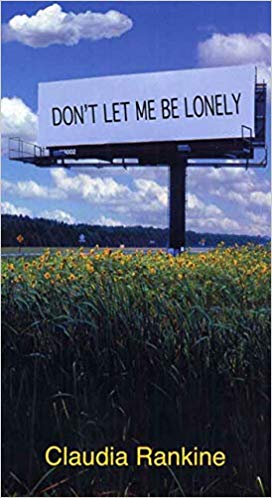
Claudia Rankine, Don’t Let Me Be Lonely

When I first read Don’t Let Me Be Lonely in a graduate class more than a decade ago, it forever changed my thoughts on form. Written in the years following 9/11 and published by Graywolf in 2004, it is a meditation on memory, loss, grief, anxiety, medication, the body, and the media, but that of course is a gross simplification of this profound masterwork. The book is sectioned into what might be called chapters by a reoccurring image, alone at the bottom of a page: a black-and-white picture of a television set, its screen full of static. Other images of television (and computer) screens appear throughout, as well as scans of prescription medication labels, a schematic for the torso and apparatus of Mr. Tools—for a while the only person in the world walking around with an artificial heart—and a diagram of the human digestive system where the intestines have been replaced by the dark mass of the United States. Rankine’s prose moves like a mind awake in the night, unable to shut off, unable to discontinue its incessant processing of images, of stories, of worry. The control with which she does this, and the depth of meaning achieved, are things to be studied, to be marveled at.

Lydia Davis, The Cows

Published as a chapbook by Sarabande in 2011, The Cows is a slim, 37-page volume wherein Davis observes the postures and movements of the cows who graze in a field opposite her home. The text—accompanied by photographs taken by Davis, Theo Cote, and Stephen Davis—is comprised of discrete, descriptive paragraphs told in the present tense. I get the sense Davis might’ve written these whenever she came into her kitchen for a glass of water or a snack—they have the daily, habitual feel of a weather journal, and in fact weather is sometimes described along with the cows: They seem expectant this morning, but it is a combination of two things: the strange yellow light before a storm and their alert expressions as they listen to a loud woodpecker. I am delighted by the endurance of this seemingly banal endeavor, by Davis’s tender humor, by her perfectly turned renderings of these animals whose positions mark her days like the hands of a clock. She describes the cows as though they are works of art—which, of course, they are.

Harryette Mullen, Sleeping with the Dictionary

The glee I experience when reading this book is something rare, and I can only imagine Mullen to have had a similarly joyful experience writing it. The poems, arranged alphabetically, are shaped by Mullen’s engagement with Roget’s Thesaurus and The American Heritage Dictionary, but also by the strategies of the Oulipo and word games like puns, anagrams, and homophones. I take particular delight in her liberal use of periphrasis (the Wikipedia example of this is the elongated yellow fruit in place of banana), which results in sentences like this one, from “European Folk Tale Variant” (her rewrite of Goldilocks and the Three Bears): The way the story goes, a trespassing towheaded pre-teen barged into the rustic country cottage of a nuclear family of anthropomorphic bruins. Yet her playfulness is ever tempered by—indeed seems to spring from—a formal rigor and investigatory purpose. I get the sense she is always listening to language and how we use it—always picking up scraps of it to contort and collage, always alive to both the shortcomings and the endless possibilities of speech.

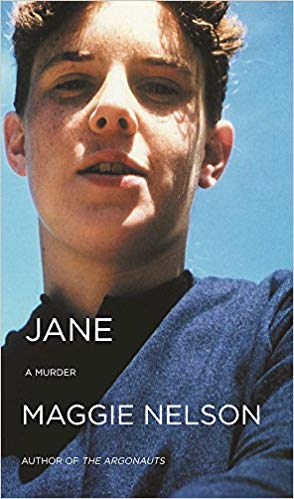
Maggie Nelson, Jane: A Murder

I’d read—loved—other books by Maggie Nelson for years, but for some reason, I didn’t read Jane: A Murder until recently. I read it in one sitting and felt it spoke to so many things I’d been trying to figure out over the years about form, about literary collage, about possibility and meaning. Originally published in 2005 and recently reissued by Soft Skull Press, the book is a portrait of Nelson’s Aunt Jane—her life and death—built from myriad sources: Jane’s diaries and letters, accounts from family members, newspaper articles, and a pulpy book that sensationalized the murder of Jane and several other young woman in Michigan in the late 1960s. Nelson manipulates her material in a way that is cohered by her poetic vision yet also remains polyvocal. It is a restless, resistant book that refuses the treatment so often given to acts of violence—a type of lurid gawking—and instead creates a complex, unsettling, and ultimately unresolved (how could it be otherwise?) depiction of a life lived, ended, mourned, and imagined.

Lenin’s Corpse Won’t Look This Good Forever

“Preservation”
by Maria Lioutaia

Over the past month, Valentina had attempted every procedure, from reputable to highly experimental. She’d bathed Lenin’s body in hydrogen peroxide and potassium acetate, employed benzene wipes, adjusted the dosages of intravenous polymer, applied refined paraffin wax in a thin layer over the face to maintain the appearance of skin, even resorted to botulinum. But the corpse had ceased all cooperation. After seventy years of successful maintenance, Lenin’s body was deteriorating faster than the morticians and biochemical scientists could keep up. Patchy dark spots bloomed across the dome of Lenin’s skull. His eye sockets collapsed like sinkholes. That morning, as Valentina inspected a gray fleshy protrusion on his temple, his left ear had fallen off into her hand like the handle on a poorly made clay mug. Most worryingly, there was a new smell about him. A damp, ghoulish, subterranean stench.

Valentina took the creaking elevator from her basement office at the Red Square mausoleum to the viewing chamber, where she could peek into the main room through brocade velvet curtains. Lenin was arranged on the central dais, as always, strategically spotlit by a soft peach wash over his recessed features. Today he was dressed in a black wool suit with double lapels and a maroon pinstripe tie. They’d had to change his suits almost daily this week, to keep up with his skin secretions. His face was serene, as though he were simply indulging in closed-eyed contemplation after a busy day of guiding the proletariat. Despite the flattering shadows of the room, Valentina could see the cluster of fungus on his bald pate through the glut of concealer.

The bare-headed procession of schoolchildren, pensioners, and tourists shuffled by on a cordoned walkway. Attendance had noticeably declined in the past year, since the dissolution of the USSR. For most visitors, dead Lenin was now just a morbid curiosity, one more thing off the Red Square checklist, after buying ice cream plombir at GUM and a photo with a celebrity impersonator. Biting editorials in the newspapers suggested that Lenin should be put to real rest, buried in the Kremlin’s walls so the country could move on into a post-Soviet future without its history so prominently on display. Valentina listened to the hush, the whisper of feet on carpet, watched the shadow-chiseled faces passing under the peach light. And in the middle of it all Lenin, glowing on the dais, magnetizing attention toward himself, the epicenter of their gaze.

Most people thought of death as an instant: a transition from being to not-being, like flipping a light switch. But Valentina understood it as a progressive condition everyone was born with, a deterioration that was irrevocably intertwined with life. Cellular degradation began long before—and continued long after—the ceasing of the heartbeat. To be able to contain the process this long, to keep Lenin’s body looking nearly alive, felt almost like commanding time itself.

Valentina savored, too, the intimacy of knowing someone after death. Her relationship with Lenin had exceeded her marriage. She knew that pale, waxy body better than her ex-husband’s and better than her son’s. Living bodies changed constantly. Acquiring new moles and stretch marks, growing hirsute or bald, wracked with new aches and smells and destructive bad habits. The encroachment of menopause was rendering Valentina’s own body alien, from the hot flashes that left hives under the folds of her breasts, to the relaxation of her jawline, its slow sag. Some mornings she looked down in the shower and barely recognized the landscape.

Lenin’s body, on the other hand, had been comfortingly consistent. Valentina had memorized the mole constellation on his back, the soft skin valleys between his ribs, the gaping maw of his abdominal incision, how the wiry bristle of his copper chest hair felt across her palm. But now he, too, was changing, rejecting all attempts to preserve him.

Valentina watched as each person came level with Lenin’s head: their chins lifted, eyes flickered at the body in nervous confusion, nostrils flared. That dendritic smell threaded itself through the room and announced with certainty that Lenin was decomposing.

“Valentina Nikolaevna, phone for you downstairs,” said Katya at her back.

As Valentina stepped off the elevator, Boris walked by with a stack of fresh gauze, trailing the smell of formaldehyde down the hallway. She entered her windowless office, lowered herself into the chair, brought the receiver to her ear.

“Valentinushka, how’s Comrade Lenin? Back to tip-top shape?” It was Anton Antonovich Saratin, the director of the Institute of Cultural Preservation.

Valentina twisted her fingers into the telephone cord. “Unfortunately, he’s not cooperating just yet.”

There was a pause at the other end. A long pause.

“Well, make him—I just had word that the Ministry of Culture is sending an inspector tomorrow morning, since there’s been some public reports of a rotting stench. And do you know what will happen if they find him ready for burial? Kaput, that’s what. For all of you down there. Possibly for me as well.”

Under her sternum, Valentina felt the sprouting of panic. “I need more time.”

A sigh on his end, the scrape of a heavy chair against wooden floorboards. “I don’t care what you have to do, shove Plasticine up his ass, lacquer him with nail polish, just make him look presentable tomorrow.” And there was the dial tone in Valentina’s ear.

She sat for a long time staring at objects on her desk—a pen, a conjoined tail of paper clips, a little figurine of a knight constructed out of acorns, twigs, and prodigious blobs of glue that Yurik had made in school years ago. What could be done? They’d already tried everything within budget and scientific reason. Could they make a wax figure of Lenin to temporarily replace the body? This required expertise, carvers and painters they didn’t have on staff and wouldn’t have been able to pay anyway. Plus, there was the issue of time. A wax copy would take time, and she had fewer than twenty-four hours at her disposal. There was really nothing to do. She’d already failed.

“Katya, get everyone in here,” she called into the hallway.

The half-dozen mausoleum staff made their way into her office, and Valentina glanced around in preemptive farewell. Her long-suffering ficus plant, its leaves in need of dusting. A gold tinsel garland pinned over her doorway and a miniature plastic fir tree decorated with tiny baubles in a ceramic pot on the corner of her desk. Two days before New Year’s. And now Valentina had to announce that Grandfather Frost was bringing everyone unemployment.

She explained the situation, but didn’t have to explain the impossibility of passing the inspection.

“Is there nothing we can do?” said Boris, leaning against the doorframe, a smear of something brown and Lenin down the lapel of his lab coat.  

“What, dress you up as him and hope for the best?” fired someone from the back, and there was a dry chuckle, followed by resigned silence.

Valentina looked at all of them. “There’s no use you being here tomorrow for the inspection. Go home early, try to enjoy the New Year’s holidays, and may ’93 be kinder to us all.”

They closed the mausoleum early, removed Lenin from display into the laboratory downstairs. Her colleagues stopped by her office one by one to shake her hand and wish her happy New Year in mournful tones, before departing. Even Boris left eventually, after attempting final, futile attempts at resurrection. Then she was alone. She ripped the gold tinsel down from the doorway and wrapped it around the acorn knight before tucking the figurine into her purse. She wasn’t sure if the ficus plant counted as government property, so didn’t risk taking it. She put on her raccoon-fur coat, picked up her bags, locked her office, and walked down the hallway to the refrigerated laboratory.

Lenin rested supine and naked on a metal table under UV lamps, a square of quinine-soaked gauze plastered onto his forehead. There were new gray striations along the veins of his feet, and his skin looked like old tights: too taut and threadbare in some regions, too loose and wrinkled in others.

Valentina stood over him a long time, then took his cold, stiff hand in hers and said, “Traitor,” before bursting into tears.

She tied her wool scarf around her head and gathered the collar of her coat tight to her neck against the bluster of damp wind racing across the expanse of Red Square. A blind sun smeared low across the sky, and the clouds on the horizon were leaden with coming snow. On the front steps of the mausoleum, Valentina rearranged her bags into the crook of her arm, ducked her head low in the wind, and took a diagonal direction past Saint Basil’s. She had no particular destination in mind. It felt too early to go home. The cobblestones under her boots were slick with gray slush.

Her wedding portraits had been taken not far from where she walked now. On the other side of the square, in front of the Eternal Flame. The memory was more painful than tender. The Moskvich auto-body factory where Alexei had worked for a decade had closed three years ago, and he’d started moonlighting in small garages, where vodka and despair were ever present. The verb spilsya had always intrigued Valentina with its accuracy. It implied not just drunkenness, but a concluded descent into drunkenness, as though taking regularly to the bottle was a slide covered in noxious slime, with no way back up. It implied a process, a degradation of will and faculties and resistance. She’d tried begging, coaxing, threatening. She’d tried hiding the money, but while she was at work Alexei hawked her jewelry and her father’s photographic equipment at bazaars for a fraction of their worth. She’d brought him to countless specialists, including a hypnotist in the suburbs. She’d even bribed an old school friend—now a doctor in a government hospital—for a referral to the high-end sanatorium in the invigorating pinewoods north of Moscow. Alexei spent two weeks there, then the day after returning home fell off their third-floor balcony drunk and broke his collarbone. Once the sling came off, Valentina told him to leave, for their son’s sake more than for her own.

This square held nothing but reminders of how things altered cruelly and permanently. Her life was in its autumn, lonely and losing leaves. Valentina made it to the fir alleyway that ran parallel to the Kremlin’s wall, where wide-backed benches stood at intervals along the walkway, though most were damp with snowmelt or tagged with loopy graffiti. She walked until she found one sufficiently protected by a sprawling blue fir and cleaner than the others. A man behind an issue of Pravda occupied one end. Valentina wiped the slats on the other end with her handkerchief, then sat down.

The day was quickly withering. People hurried toward the metro to beat the rush hour, here and there impersonators walked about alone or in pairs looking for tourists to take a photo with them for a couple of rubles. There were a few Stalins, a Marx or two, a random smattering of Pushkins and Tolstoys, but the majority were Lenins with varying degrees of physical resemblance and comportment. How dare they presume to look like him, thought Valentina. It was, in fact, hard to pick the worst resemblance. Perhaps the gangly Lenin trying to light a cigarette in the wind, his too-short army-issue pants showing hairy ankles. Or the one barely in his midtwenties, hiding his full head of curls under a cap. Posing with a young couple in front of a Kremlin wall was a doughy Lenin with the red-veined potato nose and under-eye paunchiness of a committed alcoholic. Worthless imitations, the lot of them.

Valentina heard an “Excuse me” and glanced up. But the woman holding a small boy by the hand wasn’t talking to her. She was addressing the man with the Pravda on the other end of Valentina’s bench. “Excuse me, could we take a picture with you?”

The woman gestured vaguely at her son, who sucked on a mittened hand. The man on the bench slowly and carefully started folding his newspaper, and Valentina realized that he was another Lenin impersonator, with a black overcoat open to a slightly bulging vest. Before Valentina could take a good look, the woman extended to her a boxy chrome-and-black Zenit. “Could I ask you to take the photograph, please? Do you know how to work a camera?”

Valentina nodded. Her father had taught her, and she’d taken all of their family snapshots herself, developed them in the bathroom, before Alexei had sold the camera and lenses.

She took a few steps away as the Lenin stood and mother and son posed stiffly beside him. She pressed her right eye against the viewfinder and twisted the lens, bringing the scene into focus. As the Lenin’s features sharpened, a surreal prickling of recognition made Valentina freeze. Something about the way he held himself, stiff but commanding. The carefully trimmed mustache and ruddy beard framing that familiar thin-lipped mouth. That sharp ridge of cheekbone. And those eyes, with their almost Asiatic narrowing in the corners.

She lowered the camera.

“Did you take it?” the woman called.

Valentina lifted the camera once more, wound up the film, counted out loud, “One, two, three,” heard the snap of the shutter, and handed the Zenit back to the woman, all in a haze.

The woman extended a handful of coins, asking the impersonator, “Is this enough?” He nodded curtly, then dropped the change into his overcoat pocket with a little pat. Then he sat back onto the bench and raised the Pravda back up to his face.

Valentina waited until the mother and son were far away. The only thing she could make out beyond the open swath of newsprint was the man’s left ear—small, delicately sculpted, with a defined and well-curved rim, an ear that was painfully familiar to her after she’d spent the past week trying to get it to stay on Lenin’s head. Valentina felt a kaleidoscoping of reality that made her clutch the bench slats to offset a sudden swirl of dizziness.

After a couple of moments she finally found her voice. “Pardon me, comrade?”

The Lenin tipped one corner of the newspaper and faced her. It really was uncanny. The only thing that allowed Valentina to be sure was the eye color. Lenin’s eyes had been dark brown, almost black. Beady. Those who’d seen them in person said that gaze perforated their thoughts, left gashes for his ideas to blow through. This Lenin had eyes of warm honey, amber-sealed, kind and tired.

“It’s incredible,” Valentina murmured. “Are you by any chance related?”

It would’ve been a ridiculous question even a few years ago, Lenin’s relative busking for change on Red Square, but was a reasonable possibility in the present confusion. Chemists were quitting broke universities for open-air market stands, mathematicians added spare cash as gypsy cabbies, policemen supplemented their income in the employ of mobsters.

Only after she spoke did Valentina realize she hadn’t specified whom she meant, but by the definitive shake of this Lenin’s head, it was evident she didn’t need to.

His face darkened. “Devil take it all, no. A genetic curse, a cosmic joke.” He spat on the ground as if he’d bitten into lemon peel.

The vehemence was so pronounced, Valentina drew back. “Is it really so terrible?”

He looked at her for a long silent moment, and Valentina felt herself blushing.

“You have no idea, believe me. Did you want a photo, too?”

“Not quite,” whispered Valentina.

She explained to this Lenin—his name was Sergey—the plan that had formed at her first glance of him. Once he understood what she was asking of him, he bolted up from the bench. But instead of leaving, he began pacing back and forth under the fir trees along the pavement, folding and unfolding his newspaper, flushed pink continents materializing on his forehead. On the one hand the risk of being found out, arrested, charged with—what? Surely not treason. Tampering with a dead body? Valentina wasn’t sure what the charge would be, save there would be one if they were caught. On the other hand, his overcoat was threadbare in the elbows, his shoes scuffed and thin-soled. He stopped sharply in front of Valentina and asked, his eyes downcast to the cobblestones, “So, say I do. How much?”

Valentina offered the entirety of her week’s salary. She and Yurik would get by, and a successful inspection could buy time. Maybe over the holidays she would figure out how to restore the real Lenin back to normal.

Sergey looked up at the Kremlin’s walls as though there were still snipers positioned at the embrasures. He kept rubbing his head, smoothing his hand down toward his face. Then he looked at Valentina again, carefully and steadily, for so long she became suddenly aware of her puffy post-cry nose, the fine lines around her mouth, the gray starting to show at the roots of her brunette bob. He nodded.

Valentina had little memory of how she got home. The press of silent bodies in the train car, the looming of her apartment building in the swirl of snow, her hand trembling so much that the key scraped against the metal of the lock before finding the keyhole. The apartment was silent. Only the quiet ticking of the stove clock and the muted shouts of the neighbors’ television. A scrawled note slipped under a dirty plate on the kitchen table informing her in Yurik’s disheveled handwriting that he was studying tonight at Dima’s. She drew one finger through the remnants of strawberry compote on the plate. She felt she was operating in some ether, the ether of dread of the next day.

Valentina moved over to perch on the windowsill, then drew the telephone into her lap. She picked and pulled at the numbers one by one, the rotary disk clicking back with each circumnavigation of the dial. She took a deep steadying breath.

“Oh, Annechka, you’re still at work, good.” Annechka was one of her oldest friends, a veterinarian. “Listen, I need a big favor. My cousin, she’s got this dog to transport from Lithuania, a guard dog, and it’s not exactly an aboveground transportation, if you know what I mean. They’ve got to keep him completely quiet in the truck over the border. Is there something they can give him, to make him stay asleep for a couple of hours? One of those big drooling beasties, with the thick coat. A Caucasian Ovcharka, yes. Oh, I’d say—” Valentina had lifted embalmed Lenin’s body often, but it was a different matter when it was full of blood and organs. Miscalculation could be deadly. “I’d say around seventy-five, eighty kilos. Yes”—she laughed—“a big one. They’re willing to pay, you understand, more than the usual rate.” Valentina glanced at the small soup tureen stored on top of the fridge, where she’d hidden some sparse savings meant for Yurik’s new winter boots and perhaps eventually a Black Sea vacation for herself. “Oh, Annechka, I’ll pop over right now. You’re a lifesaver.”

She couldn’t fall asleep. Headlights from passing cars chased each other across the ceiling and twice she got up to check that the vial was still in her coat pocket. Around midnight she heard the soft click of the door latch as Yurik snuck in well past his curfew, the stumbling and quiet swearing as he tripped taking off his shoes in the hallway, the gurgle of urine hitting the toilet bowl, the creak of the foldout couch springs in the other room. Now an adolescent, he seemed too tall and angular for their cramped apartment. The first time his voice had broken, Valentina was so startled by the man’s timbre that came out of her small son that she dropped the pot of water she’d been carrying to the stove. Just yesterday she’d caught him smoking near the building entrance. As she’d swatted him upstairs, he walked slowly, with a new swagger, something insolent and foreign in his eyes. By dinnertime he was back to himself, but that insight into her son as no longer her child had terrified Valentina.

At five, she gave up on sleep and headed to the mausoleum. She spent the early hours packing up Lenin’s body. He looked worse than the previous day. The gray striations now threaded over his thighs and up to his groin, as though time were collecting him in monstrous tentacles. Before zipping him up in a white bag and sliding him into the storage pod, she leaned down and pressed her lips hard against his cold, damp forehead.

“Where do you want me?” Sergey stood awkwardly in front of the dais, hands shoved deeply into the pockets of his navy tracksuit.

“First, change into this,” Valentina said, handing him one of Lenin’s black suits along with a white shirt and striped gray tie. It was a suit they hadn’t used in the rotation in a while, and it had been cleaned, but it still emanated subtle pickle-like notes of fermentation.

Sergey drew his hand across the wool, slightly frowning. Then he flipped up the manufacturer tag of the suit and laughed a short sad bark of a sound.

“I made this suit,” he said.

Valentina didn’t understand.

“You think I’ve been busking on the Red Square my whole life?” He fingered the suit collar. “I used to have a real job. Supervisor of production at the wool factory in Yekaterinburg.”

“So why did you leave?” Valentina asked.

Sergey sighed. “I was liquidated ten months ago. The official cause was the plant’s restructuring, but an old colleague higher up told me the real one. They’d determined that, for the purposes of proceeding into a post-Soviet future, it wouldn’t do to have such a walking, talking, daily reminder of the old guard. In a managerial role, even.” He chuckled. “I tried finding another job, but everyone took one look at me and doubled over laughing, sent someone to find a camera for a quick snap with their arm around the great man’s shoulders before telling me the position’s already been filled. What else can I do? I’m alone, no parents, no wife, so I come to Moscow. I drive a cab at night. The drunks think they’ve got delirium tremens when they see me. Who’d believe it was Lenin giving them a lift? Who needs a Lenin in these times?” He shrugged.

“I do,” Valentina said, and he looked up at her with those warm brown eyes. Valentina was the first to break their gaze. “Now, change.”

She ducked behind the brocade curtains, but instead of turning away, found herself compelled to watch. She gripped the velvet and leaned into a crack between the fabric. Sergey inspected the stack of clothing in his hands, rotated it slowly, then placed it on the dais and unzipped his sweat suit. Valentina had been expecting to see that familiar body, waxy and dessicated, so Sergey’s pale manly vigor sent a bolt through her. Yes, there was that ruddy chest hair, which made her palm tingle in recognition, the bare feet she knew so well flexing against the carpet. But this body was whole, living, pulsing with life and blood. Watching the muscles shift under his skin as he bent down to pull off his slacks made Valentina’s breath run shallow. This feeling brought a new awareness to her body, a trembling that made her heated with shame.

When Sergey finished dressing, she waited before slipping back through the curtains. The suit fit as if it were made for him, which she supposed it was.

“I need you to climb up here.” Valentina nodded at the empty black silken indentation where real-Lenin had lain just a day ago. Sergey eyed it reluctantly, then, hiking up his pant leg, he hoisted himself onto the raised platform. Valentina began arranging the heavy brocade covering over his feet up to his waist, as she used to tuck Yurik in at night, except here she was tucking in Lenin to his final rest, making him nice and dead again. Sergey lay still as she tweaked his collar and tie, arranged his hands in position on his thighs. His hands were warm and dry, making a comforting papery sound against her own skin. As Valentina smoothed back the hair on the side of his head, Sergey closed his eyes.

“Would you like to hear a joke?” he asked her. She expected some variant on a German, an American, and a Russian are shipwrecked on a desert island, but Sergey said,

“How do you describe all of Russian history in just one sentence?”

Valentina shrugged.

“And then it got worse,” he said.

She reached down into her bag and laid out the syringe, a bottle of rubbing alcohol and cotton balls, the small glass vial of cloudy liquid. “I’m going to give you the sedative now,” she said. She couldn’t decide whether Sergey’s agreement to the plan was a sign of immoderate optimism or terminal pessimism. Considering his life, she guessed the latter. Valentina inserted the syringe into the vial’s rubber stopper, flipped it upside down, drew back the plunger. The liquid swirled in hypnotic tendrils.

“Don’t worry,” she said, pulling up the sleeve of his suit and rubbing down the bulging vein in the crook of his arm with an alcohol-soaked cotton ball. “I’m basically a doctor.”

He was looking up at her with an expression she couldn’t decipher. As she touched the needle to his skin, he quickly placed a pausing, callused hand on hers.

“Say, after this,” he said, so quietly that she had to lean in close to hear, “would you want to get some tea with me? Maybe catch a play?” He looked more nervous about her reply than the  needle. Maybe she had him pegged wrong, she thought as she stared at him in confusion, as she stabbed the needle into his arm, as she pushed the plunger. Maybe he was, after all, an optimist.

“Okay,” she said, as his breathing deepened, the eyelids coming down like stage curtains, and there was Lenin proper in front of her, motionless and serene.

It was a possibility that hadn’t occurred to her, despite the heat she’d felt watching him get undressed. A life with Lenin, outside the mausoleum. But living bodies were deceptive, they changed. She imagined Sergey fatter, balder. Sergey, taken to drink. Having to watch him grow older than Lenin, deteriorate in real life. And here he was now, so trusting, so perfect, just her and Lenin’s body in the cocooning silence of the mausoleum. Dust swirled through shafts of soft electric light, and everything felt right again.

Valentina’s hands reached to arrange the silken pillow beneath his head. Then her hands slipped the pillow out from under him, gently, gently, laying his head back against the dais. And then her hands hovered the pillow over his face, brushed his skin with the black silk, stroked his face with it like a mother would touch the face of her newborn. That was another possibility, right there, and she found herself surprised that she was capable of it. Her hands placed the pillow lightly against his mouth and nose, then lifted it again after a moment, like a bee alighting on a flower. It was as if the universe had brought her this Lenin as a replacement for the old one, as a way of restarting, of trying again. The staff would come in after New Year’s and she would tell them, a miracle, comrades! I have solved it, I solved it for all of us. Everything is exactly as it was before. A deteriorated body could be disposed, there were ways of doing that. In this troubled time, many people went missing, and who would look for him? He had said it himself: no parents, no wife. If anyone did search for him, they wouldn’t suspect the body that’d been lying there for seventy years, observed by hundreds of people a day.

What loneliness it was, to choose.

“Statute four hundred and ninety two, Valentina Nikolaevna, deterioration of cultural relics, this is a serious allegation,” sighed the inspector from the Ministry of Culture, removing his fur hat and placing it on a ledge by the door. A sparse comb-over of white hair gleamed wetly in the dim light. “This isn’t how it used to be, you know. Everything used to be proper, by-the-book. Culture was respected, but now it’s all pell-mell, now who can tell what’s going on? It’s not polite, to have Vladimir Ilyich rotting and out on display, just not polite.”

“Goodness, who is rotting?” said Valentina, trying to keep her breathing deep and even. She smiled pleasantly. “A small skin fungus we didn’t catch in time, and someone noticed. We dealt with it promptly. Properly. Come, see for yourself.” She extended her arm like a tour guide to indicate the body on the dais.

The inspector straightened his jacket, cleared his throat, smoothed his hair. He ascended the two steps with difficulty, leaning on his cane. Valentina stood shoulder to shoulder with him, looking down at Sergey’s face.

“See,” said Valentina. “He’s no worse for wear.”

“My lights,” the inspector coughed. “He really does look quite lifelike. Quite lifelike indeed.” He leaned in. “You’ve done a tremendous job. Why, he looks like he just died yesterday.” He reached out a hand slowly, as though hypnotized. As his hand descended reverently toward Sergey’s face, in that gesture Valentina recognized a man unmoored, reaching toward a familiar past he could not admit he missed.

She quickly put a firm hand on his sleeve, catching his fingers just before touchdown. “Please, do refrain from touching. We suspect the fungal infection came from unprotected contact.” She knew that even an old, fumbling man would be able to tell the difference between a warm, pliant body and one dead for seventy years.

“Of course, of course. Protocol. Well done.” He wiped his hand on his trousers, then continued to stare down at Lenin’s face.

“Well,” he said finally. “Well.” Valentina heard a faint tremor in his voice and wanted to tell him, It will be okay. Maybe this time it won’t get worse.

The inspector cleared his throat. “No matter. I will confirm with the ministry that Comrade Lenin is as spry as ever. God grant such good health to us all.”

They shook hands at the door. He backed out of the room, wishing her a happy New Year, his gaze on Lenin to the last.

As the inspector left, it seemed to Valentina that he took all sound with him. There was a ringing in her ears. Valentina turned slowly toward the dais. Sergey’s profile glowed serene and heartbreakingly beautiful. She began to walk across the room back to him, every movement caught in thick light. Her shoes rustled against the carpet, the room swallowing sound. As she walked, a strange fear began to unfurl inside her at the sight of the perfectly still body on the dais, and the air transmuted. Reality became suspended, sealed in amber. Time trembled, a tangible curtain she could brush aside and walk through, and the body on the dais was no longer Sergey as Lenin, but Lenin himself, Lenin as he had recently died, so recently that no one except Valentina knew about it yet, or else Lenin as he had not yet died, as no one except Valentina knew he was going to die. As if she had finally succeeded in truly pausing time, preventing anything from ever changing. She sank down on the carpet, her back against the dais, and closed her eyes. She sat like that for what felt like minutes, hours. Finally, she heard a ragged inhale above her, a soft moan. She stood up, bent over Sergey, and touched his face. He slowly opened his eyes. Then he smiled, and it was the guileless, drug-drunken smile of Sergey completely, not of Lenin at all, and Valentina found that she liked it quite a lot. She brought her lips to his face, kissing his wide forehead, trailing her mouth down to the contours of his thin, pliant lips.

The inspector from the Ministry of Culture stood in the doorway of the viewing chamber, clutching the fur hat he’d forgotten and returned for, and watching Valentina and the corpse of Lenin hold each other tenderly under the shimmering peach lighting streaming down like heavenly approbation. Tears etched his lined face. For the rest of his life, the inspector never told anyone about the impossible moment he was witness to. On his deathbed six years later, the final crackling gasp of his mind recalled the image of Valentina’s reverently closed eyes as Lenin lifted a hand and softly cupped it against her cheek.

Ocean Vuong Refuses to Compromise

Spanning three generations of family history from Vietnam to rural Connecticut, established poet Ocean Vuong’s debut novel, On Earth We’re Briefly Gorgeous, is structured as a letter from the main character, Little Dog, to his mother who cannot read. As he remembers the nuanced complexities of a first young love and grapples with questions of race, class, masculinity, and survival, he reveals just how much joy and healing can still be found.

As a longtime admirer of his poetry, I was eager to hear about Vuong’s transition from poetry to fiction before we discussed how his debut novel examines violence and tenderness without flinching.


Image result for ocean vuong on earth we re briefly gorgeous
Buy the book

Marci Cancio-Bello: I would like to begin with your memorable title, On Earth We’re Briefly Gorgeous. You also have a poem of the same title in your poetry collection, Night Sky with Exit Wounds. Was one somehow a catalyst for the other?

Ocean Vuong: Not really—I just liked the title. It’s one of those titles that does subtle yet persistent work, which I’m partial to when it happens. Although they are quite different to some degree, both the poems and the novel do contain my perennial obsessions: love, sex, death, loneliness, and the very specific terror of being young and helpless but full of impossible, brimming hope.

MCB: Because of the lyric leaps and braidings of the narrative, the novel makes many poetic movements and allows readers slow down to savor your rich language and image-making while holding onto these characters with deep investment. I think it was in 2017 that you published a poem in Harper’s called “Dear Rose,” which reads almost like an early draft of the novel. What prompted you to switch from poetry to fiction, and how was this genre different for you?

Both the poems and the novel contain my perennial obsessions: love, sex, death, loneliness, and the very specific terror of being young and helpless but full of impossible, brimming hope.

OV: The poem, “Dear Rose” was actually me attempting to switch gears while writing the novel. I always believed our obsessions, questions, and interrogations to be inexhaustible. But things get tricky inside capitalism. We tend to see themes as products: once we produce work around them, they should be “done with” and therefore abandoned; we should then “move on.” Otherwise we would repeat ourselves. A culture bent on “fresh new flavors” frowns on obsession, which is misread, particularly in the western lens, as stasis and therefore death. But it’s arbitrary that any book should be an ultimate container for its investigations. So I wrote the poem in Harper’s to check in with myself, to be certain that I could still find a potent resolve within another form, and that the novel, already in its third draft by then, was not the master of those set of questions—but merely an alternative route.

The process was different in ways you would expect. The novel is longer, larger. But what I wasn’t prepared for was what came with size: haunting. Unlike a poem, which I would usually draft and put away, then go back to doing the dishes with relative calm, etc. The novel, the more you build it, the more it enlarges on your periphery—like the slowest nightfall—until you can’t do anything without seeing it darken the corner of your eye: an entire world you made getting larger, garnering its own frictions, weathers, velocities. I was haunted by fiction. If I knew how hard it would be, how total, I don’t think I would’ve done it—honestly. But now I have this set of idiosyncratic skills related to novel writing. So I hope, godspeed, that I’ll be able to use this skill at least one more time before my life is over.

MCB: Throughout the novel, violence seems like a form of intimacy (not love, necessarily, though often they overlapped). Early on, Little Dog writes, “What I really wanted to say was that a monster is not such a terrible thing to be. […] To be a monster is to be a hybrid signal, a lighthouse: both shelter and warning at once.” And immediately afterward: “Perhaps to lay hands on your child is to prepare him for war.” And later: “By then, violence was already mundane to me, was what I knew, ultimately, of love.”

Tenderness, on the other hand, feels more violent to him than violence itself. When describing the way calves are prepared for slaughter and veal, he writes that they stand “very still because tenderness depends on how little the world touches you. To stay tender, the weight of your life cannot lean on your bones.” This echoes this haunting line from earlier, when Little Dog is with his first love: “Sometimes being offered tenderness feels like the very proof that you’ve been ruined.” Can you speak to the way these two forms of intimacy frame the novel?

The novel is one of the mediums where bodies can be tested through love and violence, through tenderness and hurt.

OV: I think, if nothing else, I wanted to write a novel because I needed explore how certain actions change people (characters). I didn’t want to let them off the hook—and did not want myself, as a writer, to be off the hook in turn. The novel, then, is one of the mediums where bodies can be tested through love and violence, through tenderness and hurt—but what’s more, and perhaps most importantly, it offers the scope of an aftermath, the camera cannot pan away, the page, turning, only offers more of the world, rather than erasing it. I found this expansion both helpful and challenging in my ultimate attempt: which is to complicate the line between violence and tenderness, which felt true to my experience as a person in the world, in history.

Even the way we talk about love, our euphemisms for sex, for example, are full of possession and devouring: I could eat you, you look good enough to eat, you’re a snack, meal, sugar, honeybun, baby cake, eye candy, smash her, smash him, bang, bag, own, lock her down etc. I wanted the novel to examine those linguistic ties already found in our collective imagination and enact them into detailed lives, mediated by time and gravity. In other words, I wanted the novel to be a faithful dramatization of the American psyche. Or, perhaps even more so: a dramatization of faith, not religious per se—but the faith of desire despite the body’s limitations.

MCB: Despite the many forms of trauma, abuse, and war that reverberate through each generation, none of the characters, particularly Little Dog, come across as bitter or furious (though they have every right to be), which is astonishing in the best way. Anger gives way to a more complex way of survival and risk via Simone Weil’s “perfect joy,” and beauty, and I loved the moment Little Dog says, “The thing is, I don’t want my sadness to be othered from me just as I don’t want my happiness to be othered. They’re both mine. I made them, damnnit.” Can you talk about writing joy and beauty to the forefront rather than anger?

OV: For as long as I could remember, I have always been suspicious of anger. When I was about 12 or 13, I saw a boy, about 15, urinating in the middle of a park. It was early afternoon. He had a pistol pointed to his temple—this was back in Hartford. I remembered the gun clearly because I thought to myself how much it resembled the one James Bond used (Walter PPK). The boy was crying, urine leaking through his basketball shorts. He owed somebody money. He was in the middle of a basketball game when the other boy—maybe 19, 20—confronted him. The boy with the gun ran right into the game so fluidly that, for a moment, it seemed he was a part of the fast break, so it was a surprise to everyone when the gun came out.

I think of that image: the boy, the gun, the pool of urine widening between his Air Force 1s. That moment was charged with fear and anger—and I think it imprinted in my spirit how corrupt those energies are. They are, indeed, energies; force. And like all energies we can use them to get things done (collect a debt, retaliate injustices, bomb a country, etc), but unlike all energies, anger exhausts as it creates, and it has the power to extinguish even those—or especially those—who wield it. But anger is also an American ideal, it is one of our oldest relics and I suppose my attempt at art making is to ask—what else? Are there other energies to see and live and make by? Can I use a force more sustainable to myself, those around me? Can I possess a way of thinking that regenerates instead of destroys?

The gun, the almost-Walter PPK, turned out to be fake. It was only a lighter in the shape of death. But the fear was real. The damage was done. The other day, I yelled at my dog when he ate something he wasn’t supposed to. He was so scared he peed on the carpet. I felt so awful I nearly had a nervous breakdown. I fed him, like, two boxes of treats in a span of 8 hours. Anger is not an intelligent praxis for me—and clearly neither is guilt.

MCB: You set up the novel with an epistolary framework, which lets the story unfurl as if we are eavesdropping. Yet from the beginning the speaker admits that because his mother can’t read in English, “the very impossibility of your reading this is all that makes my writing it possible.” In attempting to close distance, Little Dog expands it. The narrative spirals like history, characters wish they could press themselves on the page like words, a scar becomes a comma and a mouth becomes a period, and language itself fails when challenged. This line in particular resonated with me: “But by writing, I mar it. I change, embellish, and preserve you all at once,” which echoes the refrain: “Memory is a choice.” Certain lines read like an admonishment on the craft of writing. Would you say more about the novel’s structure and elements of craft advice incorporated into the novel itself?

OV: When I was younger, I used to go, whenever circumstances allowed, to Sunday service at the Baptist church in my neighborhood. There I was introduced to the story of Noah’s Ark. I was so enamored of that narrative—and I think, even now, it informs how I create. The pressure for Noah was so extreme, so grand, it seems comical to look at it as a method for making anything. To think: you must build a vessel worthy of ferrying into the future everything you think will be necessary after an apocalypse. It’s a tall order—but it’s always in the back of my head. And I think I ended up asking that in both the collection of poems and the novel: what do I want to salvage of myself for a future I might not survive?

What do I want to salvage of myself for a future I might not survive?

It seems an incredibly grandiose notion—and it might very well be—but I think it’s important to actually present those stakes to ourselves, if only to challenge our craft to meet them. If nothing else, it tricks you into leaving only the very essentials in your writing, the things you’ll need to start a new world for yourself. When I was in grad school, a professor made me feel really shitty about having ambitions larger than publishing a poem here and there. He felt having hopes beyond a literary career, that is, having your work live and negotiate with a larger world—was fraudulent. I believed him for a while—but upon looking at it further, it became clear to me that the performance of humbleness—that is, empty humility—was more fraudulent. Writing then, became an accessory to a self—not a vehicle for selfhood. What we do, as writers, is hard but it’s not coal-mining or being a nail manicurist. It is a choice we made, and we made it in hopes of getting so close with language that something breaks through, something tears from the esoteric into the mundane. I think it’s okay to be honest with ourselves and ask for that. There is nothing to be embarrassed about hoping your work—this thing you work so hard on—has larger ramifications. You don’t expect it to, of course, but you should allow yourself that dream. You load your words into your Ark because you believe they can save you—and why shouldn’t they?

What I love about Moby Dick, for example, is that the novel becomes Melville’s Ark. It’s memoir, auto fiction, essay, theological, biological and metaphorical inquiry, as well as a very comprehensible yet poetic manual on whaling. He chose to compromise nothing in order to load his ship, literally. The scale of the project does not resemble the scale of other patriarchal tomes like Tolstoy or Dickens, it enlarges via inquiry, even if those queries run into dead ends. In this way, Moby Dick is not so much a novel, in the traditional sense—but a map of investigations in order order to answer questions beyond the reach of any one milieu.

Anyway, it felt important to me, as an Asian American writer, to not compromise, to refuse the decree of plot and veer, meander, detour, circumvent, queer and complicate, actions of which, in western criticism, are often seen as failures in narrative—but I feel, have always felt, are the very means of which I have built my life. To be lost, then, is never to be wrong—but simply more.

10 Comics to Read While You Smash the Patriarchy

Comics have always been great for illustrating a fight—they are both serial and cinematic, giving us plenty of time to follow a hero on their adventures and plenty of gorgeous visual art to hold our interests. The folks who make comics are always using these formal strengths to punch something—from white nationalists to zombies.  The good news: in addition to all those other punchable targets, we’re currently in an era where writers and artists’ heroes punch the patriarchy, in life and art. The bad news is, we’re all tired. And if you are as exhausted as I am, I have a proposition for you. Sometimes you have to do the fighting, sure, but sometimes you can also put on a pot of tea and immerse yourself in comic books about fictional characters delivering a knock-out, super-hero-style kick to systems of oppression. If you’re mad as hell and in the mood for some eye candy, here are ten comic book titles for a weekend of lounging and whispering pow to yourself as you live vicariously through the characters in these comics while pumping yourself up to fight another day. All the comics listed are about women and nonbinary folks kicking ass, because sometimes you just gotta rage.

Lumberjanes

Lumberjanes is about a camp in the woods for hardcore girls, both cis and trans, and nonbinary kids too, who battle supernatural creatures and expectations of femininity. Originally developed by Noelle Stevenson, Grace Ellis, Brooklyn Allen, and Shannon Watters, this comic has everything—a group of five rad pals, holy kittens (no seriously, holy kittens. Kittens that are holy. Kittens with an aura of holy-ness), three-eyed foxes. These scouts often fight authority figures that seek to control their lives and define who they are. It’s kid-friendly to boot, and because it’s been running for years, there are plenty of collected volumes.

Nimona

If you like Noelle Stevenson’s writing in Lumberjanes, you may also want to pick up Nimona, her webcomic-turned-graphic-novel about a spitfire young shapeshifter and her villainous mentor. These two charming outlaws and their exploits against the crown beg the questions: If someone is the ruler of a nation or a blonde-haired pretty-boy knight, does that automatically mean they are the good guy? What role does toxic masculinity play in competition? And, what if the “supervillains” are actually on the right side of the moral quandary? War is waged against a controlling authority, one that seeks to control the body of a young woman and discards a disabled person—a punch-worthy government indeed! Will the villains stop the heroes in time? Also a kid-friendly pick, Nimona was nominated for the National Book Award in 2015 and is good, complex storytelling that can be enjoyed across age groups.

Kim Reaper

Kim is a full-time student and a part-time grim reaper, and Becka has a crush on her. Written and drawn by Sarah Graley, Kim kicks ass with her ripped sleeves, undercut, and sense of justice as she butts heads with the oft-traditionalist Board of Grim Reapers, who punish Kim for her ambition as a reaper, and enact revenge on her using—you guessed it!—the life and body of her new friend-crush-person Becka. Fudge those guys! This comic may be appropriate for some younger readers, as long as they’re cool with punching zombies.

Goddess Mode

Written by Zoë Quinn with Robbi Rodriguez and Rico Renzi rocking the art, Goddess Mode is perfect if you’d like to dismantle some capitalism along with your patriarchy. We follow Cass, a punkish and poverty-stricken employee of the reigning technology company as she’s assigned to check in on a rich person after a mysterious computer glitch endangers the lives of many. As Cass rails against the ruling class  with trash-powered spells and the coding knowledge to replace all her served ads with cat videos, Goddess Mode crosses the streams of two genres: cyberpunk and magical girl. This comic is absolutely not appropriate for young readers as it’s got harsh language and some gory violence.

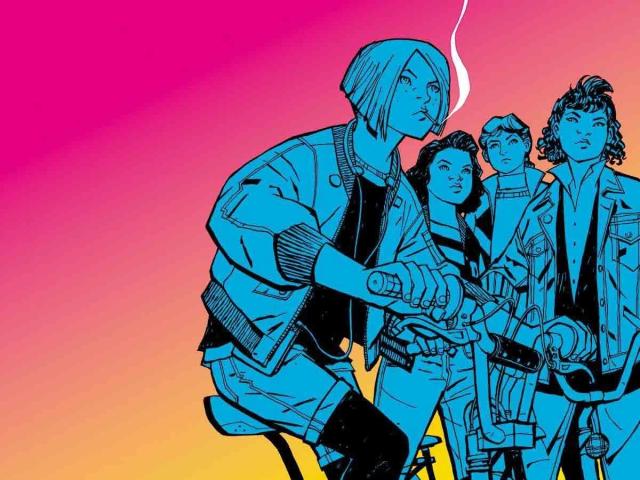
Paper Girls

If you’re a fan of Stranger Things but would have liked to follow a group of girls instead, Paper Girls written by Brian K. Vaughn, illustrated by Cliff Chiang and Matt Wilson, might be for you. Follow Erin, Mac, Tiffany, and KJ as they set out to deliver newspapers early in the morning after Halloween, November 1st, 1988. Some Very Strange Things happen and, well, let’s just say that readers don’t stick to that date (you bet we’re going to time travel!) for very long as these teens battle masked monsters and the powers that be in the form of an agency that keeps tight control on the timeline and what events are “allowed” to happen. Also, dinosaurs. This comic is very much not appropriate for young readers (much disturbing death!).

Bitch Planet

“Mother Earth, we used to say, before we understood. Before we came to know the heavens, to live here and to feel her warm embrace. Space is the mother who receives us, you see? Earth is the father. And your father…has cast you out.” Welcome to a prison planet full of women who have been jailed for being “non-compliant.” Due to the patriarchal structure of this (futuristic) world, that can mean…pretty much anything, to no one’s surprise. “Trespasses,” “gluttony,” “pride.” The corporate-government is entirely run by people who support the patriarchal status quo. A true ensemble cast written by Kelly Sue DeConnick and drawn by Valentine de Landro, this title is perfect if you’re feeling caged and would like to read about a real revolution. Bitch Planet features tons of different kinds of women with all sorts of body types coming together in community…to absolutely crush the oppressive ruling body. Please don’t ever read this to a child, it is very violent and there’s a lot of nakedness.

Moonstruck

Enter a perfectly normal coffee shop with cushy seats, great espresso and the warm welcome of a friendly staff—which happens to consist of a queer werewolf named Julie and a nonbinary centaur named Chet. This is the world of Moonstruck, written by Grace Ellis and drawn by Shae Beagle. Julie often has negative feelings about being a werewolf and tries to hide it, even though other folks tell her there’s nothing wrong with her just as she is. But when an outside force tries to dictate what “perfectly normal” actually means, and enforce it upon the bodies of myriad fantasy creatures, things take a turn. Follow our heroes as they navigate villains and crushes and cryptic prophecies from the barista witch behind the bar. This is kid-friendly and is especially good if you’re looking for gender nonconforming representation and loads of diverse bodies.

Heavy Vinyl

Let’s head back to the eighties for a teen girl fight club. Heavy Vinyl (formerly Hi-Fi Fight Club), written by Carly Usdin and illustrated by Nina Vakueva, follows Chris as she gets hired by her favorite record store. She thinks all she’ll have to deal with are misogynist customers and a crush on her super cute co-worker, Maggie, but the staff’s collective favorite singer, a front-woman for super cool band Stegosaur, disappears the night before the big show. Chris is inducted into that secret rock and roll band of vigilante detectives to find their singer and dole out some justice. Adults and teens would find this title most interesting.

Joyride

“Earth sucks, steal a spaceship.” That’s the tagline for Joyride, written by Jackson Lanzing and Collin Kelly and drawn by Marcus To. This band of three unlikely teenagers is standing up to the World Government Alliance, which is keeping anyone from leaving Earth and quashing all resistance to their rules with violence. Rather than join the state-trained groups of militarized children, Uma Akkolyte and her two friends decide to take off after they receive a distress signal from outside SafeSky, the protective shell around the planet. This series is complete, so if you’d like something you can read from start to finish, you can get all three volumes and read everything in one shot. Because of the violence, check the content first before you read to any kids in your life.

Safe Sex (forthcoming)

Not a lot is known about this title so far because it’s going to be released later this year, but Safe Sex by Tina Horn, drawn by Mike Dowling, promises to be a big queer masterpiece about freedom fighters in a world where sex and pleasure are surveilled and regulated. Head to your local comic book shop and ask to put it on your pull list, because Horn plans to pack a punch with her merry band of sex rebels. This one? Definitely not for kids.

Bonus webcomic: Cosmoknights

Written and illustrated by Hannah Templer, Cosmoknights just launched earlier this year. Because it’s beginning as a webcomic (updated Tuesdays and Fridays), I included it as a bonus (though the graphic novel will publish in Fall 2019). The tagline is “For this ragtag band of space gays, liberation means beating the patriarchy at its own game.” And based on the first chapter, Templer is beginning the story with a runaway princess fleeing an arranged marriage and saving herself with the help of a friend. It’s also absolutely gorgeous. (And it’s free.)

7 Poetry Collections by Muslim Writers

In her forward to Halal If You Hear Me, Safia Elhillo writes, “the poems and essays in this anthology are the Muslim community I didn’t know I was allowed to dream of. The Muslim community my child-self could have blossomed in–proof that there are as many ways to be Muslim as there are Muslims. That my way was one of those ways, was a way of being Muslim that did count.” Muslim women, queer, gender nonconforming and trans people don’t often have a lot of public space to have our approaches to Islam heard and acknowledged, to be counted in all of our nuanced selves.  

Buy the book

So much of our philosophy around creating this book was the based in the desire to approach Muslimness as a site of freedom, as a place where we can all embrace who we are as we are, and to create a space that simultaneously celebrated our identities and experiences, while creating direct links for us to talk to each other. There are over 60 writers in this book who are writing fiercely, who are unapologetically themselves, who demand that the world embrace their full humanity.

Here are just a few writers who are doing that, in no particular order, who we are grateful for:

Seam by Tarfia Faizullah

This book taught me so much about history: how it never remains in the past, how it always continues to inform and influence the present. Tarfia takes a close look at the Birangona, which means “brave women” in Bengali and refers to the two hundred thousand women who were raped and tortured by the Pakistani army during the 1971 Liberation War. Threading their stories with her own, Tarfia examines what it means to be a child of history in these incredible poems.

To Keep from Undressing by Aisha Sharif

Aisha writes with such stunning lyrical bluntness that keeps me coming back for more. This book is expansive, and topics of family, sisterhood, Islamophobia and Blackness thread seamlessly throughout the poems. There’s so much form-play in this book, and one of my favorite sequences is the “If My Parents Hadn’t Converted: Questions and Answers,” a series of questions that are answered by a bouquet of poems.

Field Theories by Samiya Bashir

There are so many worlds occuring in the poems of Samiya Bashir! I am forever floored by how Samiya’s poems turn and turn and turn, leading us to new discoveries with each and every line. This collection is an unbelievable blend of science, mythology, and folklore.  

The Kitchen-Dweller’s Testimony by Ladan Osman

The way Ladan wields language, wields a word, makes language feel limitless. This is a collection of poems to reread forever—startling and elegant and, if you’ll forgive my use of this simplest of words, so damn interesting. Their humor, their teeth. I read these poems, I return to these poems, over and over, and feel my eyes clear.

The Twenty-Ninth Year by Hala Alyan

The Twenty-Ninth Year is a recent release but already a favorite of mine. This book, filled with the tenderest of geographies, with great intimacies and great ruptures, is cinematic and gripping. I first read it in one sitting, ravenous, then flipped over and started it again.

Invasive species by Marwa Helal

This book, its poet, their identities, all burst with multitudes, with their wealth of names. Genre, race, nationality, language—the single-word answer doesn’t do justice to the nuances of the story. Marwa builds here a new kind of world, a new way of looking at form, at genre, at America—unmaking the old, expanding its possibilities and dissolving its borders until it fits us.

I’m So Fine: A List of Famous Men & What I Had Onby Khadijah Queen

These vivid prose poems could almost be read at first as casual, breezily and concisely collecting stories of interactions with famous men—but right below the unruffled surface is a dark, haunting meditation on sexual violence, on the kinds of casual sexual violence that stay normalized. Funny, smart, sharp, and also terrifying.

T Fleischmann Explores the Murky Relationships That Make Us Who We Are

Almost everyone has had a relationship they can’t really define. But just because we can’t put words to them doesn’t mean these relationships are any less intense—in fact, our murkiest entanglements are often the most significant. And these murky relationships aren’t only between people. We can have intense, indefinable relationships with our own bodies, with history, or community, or art. It is in these relationships we learn most about ourselves.

In T Fleischmann’s book-length essay Time Is the Thing a Body Moves Through we are pulled through time and place (Buffalo, rural Tennessee, Chicago) as if the book were one large, complex pattern of these kinds of relationships being at once woven and unwoven. Speaking on love, desire, loss, state violence, history, community, sex, and art (particularly the art of Cuban installation artist Felix Gonzalez Torres), Fleischmann’s essay is always on the move—even shifting formally between sections of prose and sections of verse. But throughout, Fleischmann remains an anchor, making space for the reader to stand in the footsteps of their experience. They are the balance point around which the entire mobile of the book is built.

Over the span of six weeks, I had the following conversation with Fleischmann over email.


John Elizabeth Stintzi: Time Is the Thing a Body Moves Through starts rather appropriately in transit—on a bus from Buffalo to New York City—as you find yourself unable to read (and begin browsing cruising apps on your phone, watching yourself get closer and further from the people in the profiles as the bus approaches NYC). One of my favorite things about your book is how it seems to not exactly have a beginning, middle, or end—how it seems to always be beginning and ending and in-between. What drew you to this moment as the entry point for the book?

T Fleischmann: The book tries to inhabit a space of becoming, with parts of the narrative or structure being incomplete, disrupted, but also stubbornly recurring. One of the ways I try to hold it all together is by opening at that intersection, leaving Buffalo being the moment of leaving one romantic friendship, and with a new love about to begin on the other side of the trip. It positions the two halves of the book, those two relationships being the book’s main narratives and forms, and hopefully orients the reader a little bit within the timelines. The bus ride also contains a lot of reflections of things to come and of the past—thinking about my relation to gay men, the land, writing/reading. I’m trying to place myself in all of this at once, beginning and ending and ongoing, to position what goes forward but also to resist closure.

JES: The book absolutely feels centered around those two relationships (with Simon and then Jackson) which, due to the interwoven structure, seem to exist concurrently. One of the main interests of the book seems to be how things relate to one another (lovers, language/metaphors, bodies, friends, etc.). What if anything did you find about yourself and love by weaving the book around these two relationships?

TF: Whenever I talk about the book I struggle to find language to describe the relationship with Simon, which was like all of my relationships—sometimes a friendship, sometimes sexual, a fling and companionship and a fling again. I see myself as both an individual and a person who is held by communities and collectives, with romantic relationships not necessarily taking prominence over other forms of connection. As I write this response, I’m returning to Kate Zambreno’s Appendix Project in preparation for a talk, and appreciating the way she thinks of language getting to the feeling underneath the thing, to Guibert’s ghost image that doesn’t exist. The feeling underneath each of these relationships, I think, has very little to do with the idea of a relationship. Resisting a narrative of love is a way I try to get to that feeling, so that love (freed of how I was taught to see it) can hopefully do its work.

JES: I’m curious as well about love as both a painful experience and as a place of potential becoming—particularly in the verse-section of the book that’s about Orpheus and Eurydice, which talks about empathizing with Orpheus’ inability to not look back (“It’s just a man deciding he would rather see his beloved than / any future the gods could promise”) and where you say “every time I fell in love with someone new, I would / be made new, too.” I wonder if you could talk a little about love as a place of turbulence and becoming in the book?

Falling in love is a place of turbulence and becoming, with no bottom (or many bottoms).

TF: Falling in love is a place of turbulence and becoming, with no bottom (or many bottoms), and I think it continues, not just the start of the relationship but the whole falling ride, and its afterlives, too. This is exciting but also terrifying. I had an obsession with making pairs in the book, reversals and mirrored reflections, with Cupid and Psyche serving as the pair to Orpheus and Eurydice, and I tell the story of Cupid imprisoning Psyche. It all gets very murky to me, a topic I return to later when I talk about BDSM and state violence. While that section of the book longs to think of love as a space where experiences of violence, trauma, abandonment might be left behind or written over, the layering of time means that it is also the space where loss might return, love a space where we are vulnerable to violence again, where its memories might rise up. I like the word you use, “turbulence,” which seems to be such a part of becoming. And I’d extend this, of course, to any kind of love—not just romantic or sexual. It changes us.

JES: I agree: turbulence feels inherent to becoming. I especially like the comparison in the word’s most banal usage, as bumpy air experienced on an airplane—something that feels harrowing but is almost never fatal (though for some, becoming is). I especially feel this as a non-binary person, wherein coming to own that identity was very turbulent (and frankly, importantly remains so). In reading your book, I feel at home in the way you talk about identity in terms that feel uncertain, contradictory, or mutable because for me identity (especially gender, but beyond that as well) doesn’t make sense in clean, well-defined terms. I personally identify with the turbulent, gnomic, questionable things about myself more than the myth of my identity fitting firmly into any box.

You talk a lot about metaphors in the book, saying that you’ve grown to dislike them “because one thing is never another thing, and it’s a lie to say something is anything but itself.” You go on to say that “not even apple and apple can be each other.” You also talk about how you don’t identify with “queer” anymore. Do you think you can speak a little to the way in which you think through your gender and sexuality in the book, and how you reject using terms like “queer” which might attempt to define you in favor of occupying a less rigid place (where you might be apple while of course not also apple)?

TF: I was never particularly drawn to narrative or stable versions of gender and sexuality, in large part because I so rarely found myself reflected in those stories, experiencing most often a kind of disidentification (I am not: straight, gay, man, woman) rather than the clarity of I am. When I was younger, this felt confusing, although now I’m more interested in celebrating the opening of it. The book does the same thing I did in life, wandering through different sexual subcultures and performing both disconnection and connection, belonging and longing. It refuses to give up my resonance in gay male subcultures in the same way it resists my exclusion from lesbian spaces, deflates my experience of BDSM, makes a party out of trans sociality. At its most hopeful, Time finds a revolutionary potential at the edges of this layering, although it comes back to a pretty simple project, of just trying to think through what I have experienced, and understand myself in relation to others. The way I have identified my gender or sexuality at different times has been a part of that, although for me, identification has obscured as much as it has revealed.

JES: Talking about process calls to mind the sections where you talk about making art with your friend Benjy in Tennessee. You write: “We make pictures because it’s fun and we want to, so we work at a very slow pace, punctuated by beer and cigarettes. These digressions, we decide early on, are the most important part of our process.” There seems to be something revolutionary and honest about the idea that digressions are “the most important part” of the process, and a good reminder to those of us (especially myself) who sometimes forget that living life and joyful non-sequitur are important to art-making. Your book feels so vibrant with life, do you ever struggle with balancing living your life and your work?

The tension that feels prominent to me is the tension between the work I want to do and the restrictions placed on me by capitalism.

TF: One thing that compels me toward autobiography is the uncomfortable blurring of life and work that occurs there. This is something that academic spaces had trained me to ignore, although writing the life should require as much attention to life as to writing. The tension that feels more prominent to me is the tension between the work I want to do and the restrictions placed on me by capitalism—finding time to write, finding time to read and take in art, creating the work I want even (or especially) when that work feels in conflict with the academy or other professional considerations. I hope to navigate this not by playing the game, but by returning to my values. Supporting the people in my communities, engaging in activist projects, providing care work, things like this exist outside of the considerations and mandates of professional cultures, but they are vital to, like you say, life. The challenge for me is finding ways to center these activities, and the way I try to do that is by remembering that these kinds of work, which may occur on the page or away from it, are at the heart of both my writing and my existence.

JES: For a book that feels so rooted in moments—and in our present world—I’m intrigued especially by your looking back at the historical (like the art of Felix Gonzalez-Torres) and the mythical (like Orpheus and the search for “Thule”). Halfway through the book there’s a long section telling the story of a religious sect that was created by this American figure (shortly after the American Revolution) known as the “Publick Universal Friend,” who is a “gender-less holy entity” that a 24 year old was inhabited by after waking from a deadly fever. How did you come across this story? What made it feel so urgent to bring into the book?

TF: I first heard about Publick through Benjy Russell, the artistic collaborator and friend who appears in Time. It’s a weird story! Part of what drew me to it at first was simply how out of place Publick seemed to my understanding of history, yet how their story was also surprisingly and often eerily familiar to some aspects of my own life. As for their role in the book, they serve a few functions. I think of them like an ivory tower, an interruption in the text, and a way to think through the limitations of imagination as a white settler, with Publick’s own fancies and delusions inseparable from the violent realities of their life, as mine are. In this way, telling their story is a read on myself, as well as a way to refract some of the book’s themes—queer rurality, belief, sex, what it is to be public, to be a friend. Understanding myself in relation to history is a fraught project (the problems of trans histories). Looking at the Universal Friend is about thinking through the delusions of whiteness, and recognizing the ways these delusions can be embedded in my trans imagination, even as it gestures toward liberation.

JES: I totally feel that—it all seems to come back to turbulence! This book really feels like a radical love letter to lives we don’t often see written lovingly in literature—non-cis, non-monogamous, rural/not-exclusively urban, and non-straight lives. The way you root the thinking the work is doing in experience, in history (art, personal, or otherwise) makes the effects of this book so much more visceral than others I might think to compare it to. There is something to how tangible the world around you feels and exists in the book that—as someone who often feels like a ghost—really shook me. A final question might be: how can a book that seems to be so often centering love and curiosity and joy feel so rupturing?

TF: It’s very easy for me, also, to feel like a ghost at times, difficult to feel like I am present. It seems to me a reasonable response, as we watch the crises escalate and the extinction continue. But the book wants to be present, not metaphorically but physically, through embodiment and community. It wants to be present through the ruptures. And we need ruptures! We can even, at times, emerge from them joyfully, loving, curious. Ghosts are powerful, too, and they can guide us forward, but for now we’re here, in a world on the edge of collapse, and the book is stubbornly optimistic in believing that our lived, visceral experiences can help us commit to that necessary process of change.

Why Can’t We Make Up Our Minds About Sally Rooney?

A few weeks ago Interview Magazine asked five New York City booksellers for their thoughts on Irish literary phenomenon Sally Rooney. Aside from establishing which New Yorkers are buying her books (“regular upper-middle class Manhattanite people,” “young literary hipsters” and, overwhelmingly, women, “specifically younger white women”), they gave a few anecdotes, like this one:

This one woman came in, dressed kind of cool, and she was like, “Okay, my therapist told me I have to read something that makes me look dumb when I pull it out.” ….And I was just immediately like, “Well, you have to read this.”

“This” was Rooney’s first novel, Conversations With Friends, which makes sense if you’ve seen the cover: two cartoony white women’s faces, one in oversized black sunglasses, pop against a juicy tangerine backdrop. It screams chick lit.

Except Rooney was longlisted for the Booker Prize, nominated for the Dylan Thomas and Rathbones Folio Prizes, and won the Costa Award, Irish Book Award, and British Book Awards, in addition to being named the Sunday Times Young Writer of the Year. Critics have praised Rooney’s intelligence and her ability to capture the zeitgeist of her generation. You’d be pretty surprised if someone asked for a book that made them “look dumb” and a bookseller pulled out fellow Costa Prize winners The Satanic Verses or An Artist of the Floating World.

The fact is that by virtue of her accolades, reading Rooney’s work can’t make you look stupid. By virtue of her book covers, however, it will make you look like you’re reading women’s fiction. And to many people, including that (female) bookseller, “dumb-looking” and “women’s fiction” are the same thing.

This particular tension—has Sally Rooney written smart, literary books, or stupid female ones?—underscores the coverage of her work. Conversations with Friends is either “a smart, sexy, realistic portrayal of a woman finding herself” (Book List) or a novel about “the invisible bars imprisoning the apparently free” (The Guardian) written by someone with a “natural power as a psychological portraitist” (The New Yorker). Complicating matters is that Rooney writes straightforward sentences and easy-to-read books. Or maybe Rooney writes taut, precise sentences and poised books; there is an odd bifurcation in her coverage, as if the media is describing two different authors depending on the publication. Sometimes she is a serious literary talent and at others she is the author of Instagrammable beach reads, the voice, and purview, of millennial women.

There’s nothing wrong with debating the quality of a book—literature is meant to be discussed—but it’s easy to fall into the is-she-or-isn’t-she-literary rhetoric and harder to step back and ask what we’re really talking about. If you look closely, many conversations about the literary caliber of Rooney’s books are actually coded discussions about how specific the books are to women. I’ll take myself as an example: I’ve spent much of my recent professional life looking at gender bias in publishing and still I found myself wondering at Sally Rooney’s critical success. Marianne in Normal People and Frances in Conversations with Friends are similar characters: they’re intelligent young women whose unusual status as likeable outsiders allows them to observe and comment on the millennial social scene at Trinity, a prestigious Irish university. It also propels their romantic story lines, which deal with burgeoning sexuality, self-esteem, and the intense, often overwhelming emotions that come with being in love for the first time. (Yes, there are male characters in her books, but Rooney’s clear talent and passion is to showcase the interiority of young women. Her female characters have a complexity that her leading men, who tend to be quiet and a little confused, don’t.) References to issues such as class or sexual orientation feel secondary to young women’s immediate emotional experience, and overall I found the novels to be enjoyable “quick reads” that lacked the resonance I associate with great literature.

Many conversations about the literary caliber of Rooney’s books are actually coded discussions about how specific the books are to women.

But how much of that reaction comes from my cultural predisposition to dismiss works about twenty-something women’s interior lives? While reasonable people can disagree on Rooney’s style or pacing, dismissing her books because of their content is giving in to the underlying belief that a young woman’s life doesn’t teach us anything beyond its own existence. It’s falling into the trap of expectation: we expect young women to be emotional, so those emotions become less interesting or worthy of examination. Comparing Rooney to say, John Banville, a writer who also won the Irish Book Award for a novel about a young romance and coming-of-age, Rooney’s characters strike me as less profound. Why? How much is it because Rooney writes about the lives of white, educated Millennial women, whereas Banville portrays white, educated Baby Boomer men, long considered a fitting subject for great books?

I’m sure I’m hardly alone as a woman whose automatic process is to equate literature with male voices and perspectives. It’s what we’ve been taught. There isn’t “men’s fiction,” after all; for men, there’s just “fiction.” Stories about men are universal stories about the human condition. Women are expected to be able to sympathize with male characters while men can find women impenetrable or uninteresting. No woman would skip a book that centers on a boy’s coming of age or marriage from a man’s point of view, yet stories about a young woman’s first romance or a struggling mother become women’s fiction, a thing apart. Worse, these stories are marketed with cheesy book covers and grouped with mass market thrillers as something you should read when you’re half-fried on the beach, which makes them unappealing to readers of any gender who want more serious fiction. It’s frustrating that women who want to read literary fiction end up ignoring many of the stories that reflect and explore their own experience just because they’ve been shelved in a different section of the bookstore, but it’s hard not to internalize the implication that women’s fiction isn’t very good or else it would be called literary fiction. And it’s not all in our heads; studies show female authors are treated as less literary by the press and books about female protagonists don’t win major awards.

Maybe this is what breaking out of the ‘women’s fiction’ ghetto looks like: a book that is praised by Leonardo DiCaprio’s girlfriend, and also by Anne Enright.

But Rooney’s did. So maybe this is what breaking out of the “women’s fiction” ghetto looks like: a commercially successful book that is praised by Camila Morrone, Leonardo DiCaprio’s Instagram model girlfriend, and also by Anne Enright, winner of the Booker Prize. A book that focuses on the experience of a young woman and doesn’t need to be about anything else to win major awards. A book that has a cheesy cover but isn’t regulated to the genre shelf. Even if it’s still easy to roll our eyes at all the hype, Sally Rooney’s success is an important step towards legitimizing female stories, which is crucial at a time when we want, and need, men to see women’s issues as universal issues, that reproductive rights are human rights, and improving women’s health and childcare policies will positively affect us all. There are going to be some growing pains, for this reader included, but if we pay attention to how we talk about female writers and their work, we can let go of the idea that “stupid” wears lipstick and “smart” has a beard.

Finally, a “Road Trip Across India” Novel That’s Not About White Men

Set mostly in India, Balli Kaur Jaswal’s fourth novel, The Unlikely Adventures of the Shergill Sisters, and her second published in the United States is both a rolicking and suspenseful trip. In it, three sisters come together to fulfill their mother’s dying wish: that they journey to visit a set list of places (Delhi, Amritsar) and perform a series of ritual tasks, from performing seva, or selfless service in the Sikh faith, to scattering her ashes in a particular place.

Rajni, Jazmeen, and Shirina are separated by personality, distance, or both. Rajni, the eldest Shergill sister by more than a decade, is a stickler for order and is thrown into a tizzy when her 18-year-old son announces that he is engaged to a woman twice his age who is pregnant with their child. Her relationship to her sisters is far more maternal than sibling-esque. Jazmeen is an aspiring actress enmeshed in a bizarre viral video scandal. She both embodies the wild, middle child trope, and subverts it. Shirina is the peacemaking baby of the family: she has moved to Melbourne to marry a wealthy man, and lives with him and his controlling mother. Her geographic distance from her sisters has made it easy to remain neutral in family conflicts, and also mum about her own trials.

Each sister also harbors secrets, which are cleverly revealed, often in flashback, as the novel unfolds. Setting aside their long-standing and deep-seated differences, Rajni, Jazmeen and Shirina confront the past and bear towards the future.

I have followed Jaswal’s career since we met in Singapore in 2014 where we quickly became friends and colleagues. I was blown away by her first novel, Inheritance.. It is a graceful and moving book about a family navigating loss and mental illness, as well as a haunting portrait of Singapore post-decolonization. I blurbed her second book, Sugarbread, a young adult novel about food, faith, and family. In other words, I am a fan.

Jaswal is based in Singapore and is currently a doctoral candidate at Nanyang Technological University. We have been in conversation twice before for the publication of her previous novels; I spoke to her this time about writing about women, genre conventions, and the diaspora.


Pooja Makhijani: Your novels concern Punjabi women and their relationships with one another and, more generally, how their lives and bodies are constrained by the patriarchy. Why do you continue to obsess about these themes in your fiction?

Every time I look at the relationships between South Asian women from a different angle, a wealth of issues and potential themes emerge.

Balli Kaur Jaswal: There’s just so much to explore! With Shergill Sisters, I was really interested in the dynamics between the three sisters, each straddling the tension between tradition and modernity in their own ways. They are so different as individuals, and I wanted to see where their paths and values would intersect. I suppose I was also interested in the relationship between birth and death, and the way each of them comes to terms with the idea of mortality.

It feels like every time I look at the relationships between South Asian women from just a slightly different angle, or place them in a new context, a wealth of issues and potential themes emerge. I think it points to the fact that intersectional identities are complex and our stories are well worth exploring.

PM: This novel is three sisters on an epic road trip, not only exploring the tensions among themselves, but also between polarities — tradition and modernity, diaspora and the home country, male and female. How did you come up with its central storyline and characters?

BKJ: I tend to write about the familial relationships between women, and I found sister relationships most intriguing because of how much history and vulnerability they can share. Sisters can be brutally honest with each other — in a way that friends cannot be — with an understanding that the core relationship will stay intact.

I was also inspired by the idea of writing an “in-between” journey story: as in the sisters are traveling to India but it’s not exactly new to them, because they grew up with some aspects of Indian culture, but it’s also not quite home.

I noticed that most road trip narratives in India tend to be from the perspective of men, or white British or American people. So many people from the diaspora “return” all the time, and the experience is quite unique. And the experience of traveling in India as a woman is quite different from the relative freedom that men have.

PM: This is a road trip novel — the road provides both geographical and narrative structure — and the road is often a symbol of freedom in such works. I found Unlikely Adventures to be a clever take of that genre, almost an inversion. Can you speak to this a bit more?

Men travel through India and have this life-changing experience, but it’s often because India is completely new to them.

BKJ: Something I noticed every time I thought about narratives I had come across about traveling in India —The Darjeeling Limited comes to mind, as does an episode of An Idiot Abroad — men travel through India and have this life-changing experience, but it’s often because India is completely new to them, so it’s a fish out of water story, or they have freedom to move, discover and explore without the same repercussions that women and girls face when traveling in India.

I was really curious about the restrictiveness of traveling as women in a country where catcalling and other forms of disrespect are commonplace. There are all these logistics to consider when you travel as a woman in India, like which forms of transport will be safest. We don’t really hear much about the way travel expands or broadens women’s definition of themselves, and we definitely don’t see enough stories about women from the South Asian diaspora traveling to India.

PM: What sort of research did writing this novel entail?

BKJ: I went on a very similar trip — with my parents though — to Delhi, Amritsar, and Chandigarh. We also went to Anandpur Sahib but that didn’t make it into the novel. Besides that, I read a lot of accounts from Indian women on social media and in the press about the daily challenges of asserting their independence in India, from things like so-called “eve teasing” to being called names by neighbors for wanting to live alone, to family pressures to get married so they could “be taken care of.” All of these attempts at owning women and suppressing their autonomy went into the context of this novel.

PM: In a previous conversation, you said, “Diaspora fiction is my favorite genre. It speaks to my experience and helps me understand ways of communicating that experience to a wider audience. To write that sort of fiction is such a privilege.” In Unlikely Adventures, too, you explore diaspora and migration and dislocation with complexity and verve. How do varying diasporic geographies, histories and identities inform your work?

BKJ: I’m interested in the idea that our cultural identities can be fairly fluid if we’ve lived in more than one place. When I was growing up, the common representations of diaspora women always pitted traditional women against modern ones, and created this dichotomy that alienated anybody who identified as both.

I’m interested in exploring the question of what it means to be a South Asian diaspora woman. Does it mean abandoning one set of values and jumping ship to another? Does it mean following traditional values that are passed down by previous generations, and then rebelling? Can it possibly be that women don’t know the answer to this and are allowed to be inconsistent?

PM: Do you think that has changed in popular or literary narratives, or are we still seeing more of the same dichotomies represented?

BKJ: I think it’s changing as we’re seeing more diverse representation, so characters and stories don’t focus entirely on Indian-ness, but other things as well — which end up providing more nuance to the questions of identity, while also telling a good story about characters doing things like traveling, or working on their failing acting careers.

PM: I love the humor in this book (as I did in Erotic Stories). In one particularly memorable scene, Jazmeen becomes involved in an altercation with her dining partner at a high-end Chinese restaurant in South London and causes a rare fish to become so distressed that it leaps out of its tank and onto the floor, where Jazmeen kicks it repeatedly. The scene, although absurd, reveals much about Jazmeen’s backstory and also forwards the narrative. Why is humor so important in your work? How to you balance humor and heaviness (given the book’s darker themes)?

There’s a lot of dark and heavy stuff in our world, but you get through each day by finding the things you can laugh about.

BKJ: I found it easier to balance the humor with heavy themes if I told the story in a fairly lighthearted tone. It’s generally how I look at life too: there’s a lot of dark and heavy stuff in our world, but you get through each day by finding the things you can laugh about. I think the only way to really discuss uncomfortable themes, and to give them a chance to sink in and resonate with people, is to provide a bit of relief with humor.

It was the same with Erotic Stories— I knew I couldn’t talk about women owning their sexuality without some heavier issues surfacing, like honor killings and domestic violence. I made sure that these themes were addressed and considered, but I balanced it out with moments of comedy so it wasn’t all doom and gloom

I think that’s the reality of being from the diaspora though — there’s some hard stuff, and some really funny stuff. They coexist.

The Last Man I Loved Was a Woman

 Green Hills
  
 You asked if the last man
 I loved was a woman.
 She was a brush
 of lipstick
 where the red sun 
 fell into our laps, an aircraft I shot
 into history. Everything felt warm like waiting, 
 alight with cobwebs, unseen and alive 
 in their absence. In the countryside,
 absence filled entire houses, cut families out
 of construction paper, stick figures went missing
 on the way to a plate of dinner.
 Our house swam up
 like a goldfish, asking. 
 Now, my mother asked 
 if my father loved men.
 Did he love them more than this,
 was that it.
 He must have loved 
 a question mark so much 
 it was no longer allowed by the heart. 
 Whatever I am allowed makes a memory.
 You visit the green hills. They are new every year
 like an annual sale, half-off and free. Here 
 is everything untouched, 
 please touch 
 and break and bring
 the stranger of your body back home. 
 You long to look at distance, sometimes beyond.
 Sometimes the car fades away. But the road remains.
 You know there are other homes in the wideness of the low world.
  
 The Unbelievable
  
 O beautiful for unbelievable bodies
 how they swam beside each other
 on the beds of America.
 In snatches of incandescence, 
 could you sense that this was not 
 a single longing but lifetimes
 of caterpillars, how 
 families of goldfish
 came alive in our fast motions.
 How far we both have traveled
 to unite here in dappled heat,
 slowed at the foot of the bed 
 where our sweaters lay piled
 a touch of rainwater seeping in,
 all the coolness that seems now worth
 reaching for the pipe drip 
 under which we met, over what seemed 
 to be hours and years at once.
 Today was stolen and rented
 among clangs of radiators, 
 orchestral squares of urban light
 revealing flowered and fruited gestures 
 of impassioned trespasses, 
 two citizens, being held
 by only one another’s borders. 
 In the water of our languages
 how this country grew suddenly unfurled
 and conceivable, and the morning glories 
 became ours in our arms.