“The Parisian” Weaves Family Stories and Palestinian History Into a Debut Novel

What is Nablus like?

“Nablus is a little village. It’s a town, I mean a city. It’s not large but we call it a city. What I mean is, even when you leave Nablus, you take it with you.”

Midhat Kamal’s response, the main character in Isabella Hammad’s The Parisian, or Al-Barisi is symbolic of the central role Nablus plays in her debut novel. It’s a city and country. Tradition, home and family. Love, loss and memory. Past, present and infinity. Nablus unfolds with history and the stories of each character—the main ones inspired by family stories. She says: “It’s a product of an obsession, in a way. It’s also not any one thing. Even the act of writing about Palestine feels complicated—What does it mean to write in English about Nablus, for example? But it became a kind of imaginative compulsion for me. In the end I think you have to follow those compulsions.”

Buy the book

Isabella Hammad voice echoes like that of a hakawatiyeh or storyteller, in an old coffeehouse in Palestine. But we are in Le Pain Quotidien in Soho. It took Hammad five years to finish the novel, released April 2019 by Grove Press. She was twenty-two years old when she started—after she graduated with an English literature degree from Oxford and before she enrolled in the creative writing M.F.A. program at New York University.

She recounts that the book was like the through-line of her life, it was the thing around which everything else revolved: From the beginning I knew it was going to be long and that it was going to use time in this way. The gulf of time is important in the book in general.

Hammad merges what we think we know and what we have yet to discover about what it means to be Palestinian. The complex characters and storyline, and the colorful and bustling city of Nablus, also known as the uncrowned queen of Palestine, are memorable. The novel begins with the fading days of the Ottoman Empire to British Mandate Palestine, and follows the Midhat Kamal’s journey to France to study medicine, his haunting love story with Jeannette Molineu in Montpellier before heading to Paris, and his eventual return to Nablus.

Despite decades of occupation, Palestinians have continued to contribute to literature, art and cinema globally——from historic Palestine to Africa, Asia, Australia, Europe, North and South America, where its diaspora lives. They write in multiple languages, have different nationalities, cultural influences, wide-ranging aesthetics, and many belong to other literary traditions and nations. But despite their contrasting experiences, they stem from a place and memory that have marked their imagination; and though they are still separated they are more connected than ever. This debut writer Isabella Hammad, this historical novel The Parisian, is an exciting addition to the literary world stage.


Nathalie Handal: Midhat Kamal is inspired by your great grandfather. How did you deal with the boundaries between fiction and non-fiction?

The author great-grandfather Midhat with his children

Isabella Hammad: As many books are, this book was written somewhere in that weird zone where memory meets imagination. It just happens that in this case they weren’t only my memories. Of course, when we make narratives of anything that has happened we are always already dancing with fiction—memory invents, and even history invents, hanging facts on strings of meaning—and so by the time they reached me, the stories of the real Midhat varied pretty drastically depending on the narrator. The result being that there were so many gaps and contradictions in my “research” that it didn’t feel, to me, that there even was a clear boundary between “fiction” and “non-fiction.”

As for broader historical realities, I immersed myself as much as I could in history books and archives and conversations with academics or people who remembered things. Imbibing history like that, your imagination puts flesh on the bones of the past pretty automatically. I tried to reach a point where my knowledge of the facts was organic enough that it could come out of me without much distinction between what I knew, remembered, and had made up. If I was writing an academic book that might be an issue. Fortunately it’s a novel.

NH: Love and nation are interweaved—is love political?

IH: For an American reading something like this, I imagine they will naturally be on the side of the individual over everything else. But for example, the bit in the end when Jamil is critical of Midhat “al-Barisi wandering around with his colored ties”—one reader told me she was shocked to see this external critical image of Midhat, as someone who is not committed enough. It’s actually a very fair criticism of him, though. When you don’t have a nation, you have to be a nationalist. It’s all hands on deck. But everything’s complicated, and we’re all human.

The author's great-grandmother Fatima
The author’s great-grandmother Fatima

I grew up hearing stories about Midhat, and most of the stories are from the later period when my father and his siblings knew him as their grandfather. They were often about his love for Fatima, which was a real love story. When she was in hospital he was kissing the soles of her little wrinkled feet and said, look at her beautiful feet. It was a real love, and also an arranged one, defined from the beginning by the dynamics of family and class in Nablus, and maybe not always easy, not always ideal.

Nablus has historically been quite stratified in terms of class. There are several main landowning families that have had historically political roles, the Hammad family included. I was interested in Midhat’s family being middle class and upwardly mobile, seeming to have this promise, this economic promise, which is partly why she consents to the marriage but things fall apart.

NH: Can you expand on that?

IH: Nablus has always been traditional and politically engaged and culturally rich, as well as full of contradictions—as most places are when you look closely enough. It’s traditional and yet, for example, some major figures in the women’s movement came out of Nablus. The image of a Nabulsiyeh is a woman who is strong-minded. I was interested in the life of a young man living under the social pressures of a conservative society that is itself under threat, on shaky ground, where everything is uncertain but they are still operating according to this ancient system. What does that mean on a human scale? What’s the fall-out?

The story I was told was that Fatima had an important role in selecting her husband and that’s why they got married. She chose him. It was important to show in the novel that it was not as simple as a man selecting a woman.

NH: Can you speak more about this change: “In Constantinople, his understanding of love changed. The curriculum at the Mekteb-i Sultani exposed him to the poetry of the pre-islamic Jahiliyya and Abbassid verses… and the works of Imru’ al-Qays and the love lyrics and ghazals.”

We think of romantic love as personal but it is intensely social–bound up in family expectations, our communities, and cultural production.

IH: Writing that passage I was thinking about romantic love being constructed by our reading habits – and the construction is always mutual – although maybe nowadays “reading habits” can also include film and tv. It’s one of the things that can vary between cultures. We think of romantic love as personal but in fact it is intensely social and bound up in other things, in family expectations and our communities and cultural production, and, even though novel-reading is mostly solitary, I do think of literature as fundamentally social. Novels are a pretty late addition in the history of literature. So that passage follows Midhat progressing from having a very childlike bond with a little girl to a more adolescent understanding of romance which is essentially couched in fantasy—coinciding with when he becomes literate. And then he meets an actual woman he likes, feels very confused, and things change again. Books can only get you so far, after all.

Midhat undergoes changes throughout the book, and I also think of him as a person who struggles with change. There are many things you could say the book is “about”, of course, but one of them is the psychological development of a man very sensitive to instability, living in chronically unstable environments.

NH: Did you read Arabic literature?

IH: My mother is a big reader and she fed me the English classics when I was young. I read Arabic literature a bit later and with pleasure and astonishment—among the first novels were probably Tayeb Saleh’s Season of Migration to the North and Anton Shammas’ Arabesques. Maybe those influenced me, I don’t know. Certainly the very earliest “texts” I was exposed to, if you can call them texts, were the oral stories.

NH: What is your relationship with the Arabic language?

IH: I don’t speak it perfectly. I speak it with my father and family members, and I did a lot of my interviewing in Arabic. But I’m shy. The spokenness of Arabic and rhythm of spoken Arabic were important for me to include in the dialogue. It seemed natural for me. There is a particular way Arabs speak to each other that you can’t translate directly into English, so I wanted to give a flavor of the sounds, and what they do rather than what they mean.

I did not grow up reading and writing and made efforts to learn. I’m reasonably fluent.

NH: For most Palestinians, the first visit to their ancestral city is a major moment—moving, memorable, a metamorphosis. Tell us about your first journey to Nablus.

IH: I didn’t know what to expect. I’d been to Lebanon and Jordan but this was different. It is one thing to be passionate about Palestine in the diaspora without going, and another thing to go and see. It had always been my intention to go. I was planning to go after university. I went in 2013. It was an exhausting trip. My grandmother and I crossed the bridge. They kept us for a long time at the border. When we finally arrived in Nablus, we met so many people, endless relatives. Engagements everyday.

NH: What surprised you?

IH: The mountainous-ness. I had an emotional reaction to it. I insisted on going walking. There is something about the way the land just comes up at you. Something about being close to the earth. The landscape moved me in a way I can’t express. It sounds like a cliché but I had a visceral reaction to it.

Nablus is beautiful—beautiful buildings. I spent a lot of time with architects. The Hammad house is still standing and features heavily in the novel.

NH: Where is it?

IH: Near the center, next to the English hospital. You can often see it from afar because of its three peaked windows, it’s the Levantine style. A couple of years ago I went on the top floor for the first time. And it’s now a circus school, there were kids doing back flips. Exquisite molding. When I first went downstairs, years ago, they sent a little boy to accompany me. I opened the cupboards and found photographs of my grandmother and relatives from the 30s and 40s.

NH: What are the differences and similarities between the Nablus during the time of the British mandate and pre-WWII Europe, which the novel is set, and the Nablus you know today?
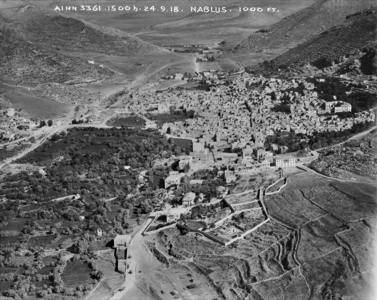
Aerial photo of Nablus, Palestine 1918

IH: It depends on which “then” we’re talking about. Comparing Nablus now with Nablus before the 1927 earthquake, for instance, there will be major architectural differences, since so many of the old buildings collapsed. 1948 was another massive shift, because the influx of refugees changed the city’s dynamic, and determined what happened during the intifadas.

I think the quality of engagement among young people is maybe something that marks off the present time, given the town’s history as a locus of political organization. My cousin says that if as a young person you want to get involved in politics nowadays you should move to Ramallah. In a way, that’s understandable. During the early 2000s, Nablus was ringed with checkpoints and unemployment soared, and economic hardship can do a lot to dampen engagement. But it can also have the opposite effect, as we have seen elsewhere. In any case, these things are never permanent and an atmosphere can change on a dime.

NH: And what is the same?

IH: The soap factories, the old coffee shops, the street vendors. The heart of old Nablus is still there, in the valley, on the mountains, in the old books.

NH: Is there an object that reminds you of Nablus?

Nablus has always been traditional, politically engaged, culturally rich and full of contradictions.

IH: There is an old map of Nablus, made by a French man. It’s outdated and has the railway line. Made in the 20s. I love his spellings. I once used it to navigate Nablus, to see the differences.

Nablus is important in the book and I didn’t grow up there so I always visit it. It became a Nablus of my imagination. I spent so much time reading and thinking about the town it would feature in my dreams.

NH: Where in London did you grow up?

IH: In West London, in a neighborhood called Acton. It was kind of suburban so as kids we played outside. It was fairly diverse. For secondary education, I went to a private school, which wasn’t as diverse. London is highly class-based and at the same time, there is a sort of mingling of ethnicities that I don’t see in New York in the same way. That’s something London has to offer that’s really wonderful. I hope it continues, as we are in a worrying moment in England.

NH: Did you grow up identifying as British or English?

IH: We were British. But my mother is Irish English and my father is a Palestinian who grew up in Lebanon. Palestine was important to us growing up. My grandmother was involved in the Palestinian community in London. She has worked for many years with several charities.

NH: Did you question your identity?

IH: I didn’t grow up feeling consciously embattled about my identity, but as a child I was also in a pretty multicultural environment anyway. There were always people of different nationalities in the house. The Palestinian cause was always important.

NH: Is living in the United States what you imagined?

IH: I thought I knew America because I had seen American television shows and films. I also thought it would be more similar to England, because of the language. At first it was pretty alien to me, and I found I was always looking for subtext when people talked—in England there is always subtext. There is also subtext in America, it just took me longer to recognize it.

NH: What is your gaze on the new generation of Palestinians?

When you don’t grow up in Palestine, Palestine becomes an imaginary place, maybe problematically so.

IH: Palestinian society has the potential to be one of the more progressive Arab societies. The pressure of Palestinian identity as a collective overrides sectarian and geographic divisions ultimately. You can see it particularly in the young generations. There are attempts to connect and be unified. Which is promising. There isn’t much to be optimistic about but this is something I feel we can be.

NH: Can you speak about what your obsession feels and sounds to you, what secret and desire have you given it?

IH: When you don’t grow up in Palestine, Palestine becomes a—maybe problematically—imaginary place. So it begins with a sort of an imaginative fixation for me, as it does for many others. I suggest problematic primarily because I think that if, after lots of idealizing and nostalgia a Palestinian from outside does manage to go back, the reality of the situation can be a bit of a shock. I am interested in all of that, all of the problems of it, both ethically and emotionally but also from a standpoint of sheer curiosity. Obsessions grow new obsessions. What does it mean to be inside or outside? Where exactly is inside? We say inside to refer to Palestinians living in 48, but I’m sure they experience their fair share of feelings of being outside. What about Gazans, are they locked in or locked out? Both, I suppose; that’s partly what it is to be imprisoned.

As for secrets and desires, those are things not to be shared.

NH: What’s your song?

IH: Firstly, storytelling. I grew up around a lot of stories. Everyone in my family is an amazing storyteller. My grandmother can tell stories for days. Her stories are weapons. The other element is language, and expression, self-expression. There is a particular pleasure from language that I do not get from anything else.

Reading “On Immunity” During a Measles Outbreak

In the days after I gave birth to my daughter, Washington state’s worst measles outbreak in decades made headlines. Two hundred fifty miles removed from the outbreak’s epicenter in Vancouver, Wash., I rocked my sleeping newborn while reading about the emerging public health crisis. Since my daughter cannot receive the MMR vaccine until her first birthday, she relies on herd immunity. As the number of confirmed measles cases rose from 36 to 55 to 71, the Google searches I relied on to assuage my first-time mom, postpartum anxieties assumed a more ominous tenor. In addition to researching cradle cap and milk supply, I began to seek information about Koplik spots and maternal antibodies.

Facts did not comfort me. More information just made my fear more real, and I found it just as frightening that other parents choose not to vaccinate when faced with the same facts. Nothing frightened me more than the fact the measles virus can contaminate an airspace for up to two hours in the wake of an infected person. The few times my husband and I ventured out in public with our newborn, the air chilled me, as if I could sense the presence of every sneeze and cough haunting the space. I felt like the older woman I gaped at on the bus in the days prior to giving birth, the woman who wore a surgical mask, latex gloves, and a plastic bag over her head and mumbled incessantly about chemtrails. I had never before had reason to fear the air.

“What will we do with our fear? This strikes me as the central question of both citizenship and motherhood,” Eula Biss writes. I was thinking about fear at three weeks postpartum, when I rose from the couch during my daughter’s nap to search my bookshelves for Biss’s On Immunity: An Inoculation. Several years earlier, when motherhood was still a theoretical and far-off state, I read On Immunity simply for the prose, for the way Biss blends research and criticism with personal experience, for Biss’s careful examination of immunity through the lenses of history, medicine, literature, economics, myth, and metaphor. The second time I read On Immunity, it was for Biss’s perspective on fear, for how she argues compellingly for vaccination without deriding parents who want to make informed choices and are fearful of harming their children. After all, even as I feared how other people’s decisions could put my infant’s wellbeing at risk, if there was one thing I now understood it was the overpowering desire to protect one’s child.

As the measles outbreak persisted in Washington state and cases surged elsewhere in the United States, I struggled with how to respond to the vaccine hesitancy that circulated among some of my friends and family. A relative who visited my newborn asked if we planned to vaccinate and described how their grandchild contracted a respiratory virus after receiving their four-month shots—an anecdote offered as evidence for the dubious claim that vaccinations can overload a child’s immune system. Still newly postpartum, I was either too anxious, or too exhausted, to muster a counterargument. Even though I affirmed our intent to vaccinate—in fact my efforts to confer immunity began with the Tdap and influenza vaccines I received while my daughter was in utero—I felt relieved when the conversation moved on to other matters. After the visit, I was troubled by how the topic of vaccination threatened to divide us even as we sat together on the sofa in my living room cooing over my daughter, and I was troubled by my timid response. Later, I would ask our pediatrician for advice about limiting our daughter’s contact with unvaccinated or undervaccinated children without being perceived as hyper-vigilant or damaging relationships with parents and children we care deeply about. “If you need to blame someone,” she said, “blame me.”

Only weeks before I had taught conversational inquiry as a form of argument to my first-year college writing students, but now I could barely remember the version of myself who emphasized the importance of making specific, arguable claims, gesturing to examples displayed on the screen behind me all the while breathing through Braxton Hicks contractions and carefully positioning myself to avoid the digital projector’s bright light and the exaggerated shadow of my protruding belly it would cast. After giving birth, I remained certain my husband and I would vaccinate our daughter, but I couldn’t quite figure out how we’d reached that conclusion, how to explain it without falling back on the social media rejoinder, “because science.”

The pages of On Immunity welcomed me into conversations about motherhood that were new to me, conversations that felt risky.

It’s not just that I lacked the energy in the weeks after childbirth to marshal facts and research findings to support vaccination. I also didn’t know how to disagree productively with other parents, especially from my position as an inexperienced new parent. During pregnancy, I had learned to speak cautiously about the decisions we were making, even when I felt confident in those decisions, because I was loath to imply criticism of other parents. The pages of On Immunity welcomed me into conversations about motherhood that were new to me, conversations that felt risky. During Biss’s son’s infancy, the 2009 H1N1 influenza pandemic and the ensuing vaccination campaign prompted mothers to debate the merits of the flu vaccine. Rather than censure these conversations for what they might reveal about our regard for science or rationality, Biss dedicates her book to other mothers, and to her own mother, and in an endnote writes, “In a culture that relishes pitting women against each other in ‘mommy wars,’ I feel compelled to leave some traces on the page of another kind of argument. This is a productive, necessary argument—an argument that does not reduce us, as the diminutive mommy implies and that does not resemble war.”

While Biss acknowledges the decision to vaccinate is not exclusively the purview of mothers, her decision to write directly to mothers is a nod to how her conversation partners have “helped [her] understand how expansive the questions raised by mothering really are.” I came to On Immunity for confirmation of my beliefs about vaccination, but found something more: the company of another mother’s mind at work, troubling the false dichotomy between public and private spheres. Just as Biss counts Rachel Carson and Susan Sontag among the mothers with whom she is conversant, so in Biss I found a much-needed companion. I recognized myself in her descriptions of life with a newborn: in her obsessive note-taking of nursing and sleeping times, in the way her hearing became so attuned to the sound of her baby crying that she perceived phantom wailing in the sound of jets flying overhead, in the monsters she imagined creeping at the windows during night feedings, in the compulsion to lie awake listening to her baby breathe. In those wakeful nights of early motherhood, I reached for On Immunity because I didn’t know how to protect my child from the decisions of other parents and the politicians who seized on vaccination as a wedge issue by framing it as an attack on individual liberty. Biss expanded my view of parenting, helping me to see how mothering is an act of citizenship, how the decisions I make for my child have consequences that reach far beyond the walls of our home.

Re-reading On Immunity during the current measles outbreak made me feel less alone in my fears about motherhood and citizenship. In her book, Biss demonstrates how our metaphors for vaccination—as well as our metaphors for the conversations we have about vaccination—can affirm or deny our interdependence, that is, the connections between our bodies and our body politic. In Biss, I found a model for how to talk with other mothers, how to become a more trustworthy conversation partner, even and especially when I am afraid. Learning how to disagree productively strikes me as essential both for being a mother and for being a citizen of the world.

When we are afraid, it’s much simpler to think in terms of familiar binaries—good and bad, natural and unnatural, public and private, us and them.

When we are afraid, it’s much simpler to think in terms of familiar binaries—good and bad, natural and unnatural, public and private, us and them. Biss sets out to disrupt these dualisms and in doing so, demonstrates the debate about vaccination has to do with nothing less than what it means to be human. For example, Biss’s response to parents who would prefer their children to develop “natural” immunity includes both an argument for our kinship with animals and machines based on Donna Haraway’s Cyborg Manifesto as well as an accounting for how the term “natural” favors the perspective of Euro-American colonizers and slavers—in other words, those responsible for bringing epidemic diseases like smallpox, malaria, and measles to the Western Hemisphere in the first place. This is a move Biss makes frequently throughout her book, demonstrating how the personal is political, making the point that “the natural body meets the body politic in the act of vaccination, where a single needle penetrates both.”

Vaccine hesitancy and fake news are words that do not appear in the pages of On Immunity, which was published in 2014, but Biss seems to anticipate the current measles outbreak as well as the viral misinformation that poisons our public discourse. “The fact that the press is an unreliable source of information was one of the refrains of my conversations with other mothers, along with the fact that the government is inept, and that big pharmaceutical companies are corrupting medicine,” writes Biss, reflecting on the 2009 H1N1 influenza pandemic. “I agreed with all these concerns, but I was disturbed by the worldview they suggested: nobody can be trusted. It was not a good season for trust.” When I read this now, as a mother and a citizen, I wonder: when has it ever been a good season for trust?

I spent the third trimester of my pregnancy discussing trust with my college writing students. As they evaluated sources for their research projects, we engaged the questions social media scholar Danah Boyd asks in her article, “Did Media Literacy Backfire?” As Boyd points out, teens seeking information about sexual health online, the conspiracy theorists behind #Pizzagate, and even parents who choose not to vaccinate are doing what teachers like me have taught them: “to question the information they’re receiving and find out the truth for themselves.” In their eagerness to demonstrate critical thinking, my students were often too quick to dismiss a source as biased simply because the writer constructed an evidence-based argument. They could critique sources, but they were inexperienced at assent. In other words, they did not know what to do with a source they deemed trustworthy.

Motherhood, as I discovered, requires many of the same research skills I wanted my college writing students to develop. Motherhood often means working from incomplete data and contradictory advice from experts and other parents to make decisions about every aspect of my child’s care, decisions whose stakes, because of my love for my child, feel staggeringly consequential. Like my college students, it means doing this work while transitioning into a new identity with new responsibilities, all while sleep-deprived. And it requires the discernment to recognize when it is appropriate to trust information sourced from others. Ultimately, Boyd makes a compelling case for assent: “I believe that information intermediaries are important, that honed expertise matters, and that no one can ever be fully informed. As a result, I have long believed that we have to outsource certain matters and to trust others to do right by us as individuals and society as a whole. This is what it means to live in a democracy, but, more importantly, it’s what it means to live in a society.”

Researchers recently released the results of a large study that offers further evidence the MMR vaccine does not increase the risk of autism. The same day, while scrolling through my news feed, I happened upon a post from a friend who in the years since we last interacted had become a mother and decided not to vaccinate. She posted a link to an article that questioned the study’s findings and admonished her followers to read studies for themselves and to fact check the articles they read and share. In the comments that followed on this post and subsequent posts, several other parents quoted from the CDC and NIH websites in their arguments against vaccination. How do we talk together about matters of import, especially when we don’t agree on what constitutes a fact? More than statistically significant results, these parents seemed to want what no study can provide: absolute certainty.

But what I can’t stop thinking about is the woman who made plain her fears by posting an image to the comments section that I can only describe as propaganda, a photograph that calls to mind a pietà, in that it depicts an adult child wearing a diaper cradled in the lap of his mother. The caption reads: “The herd who expects you to vaccinate your child will abandon, mock and ridicule you once you’ve made that sacrifice and injured your child on their behalf. And then they will expect you to do it again.” I reacted first to the image’s ableism, and then with sadness over the worldview the caption espoused, a worldview in which no one can be trusted. What does it mean to this woman, I wondered, to live in society?

“Belonging and not belonging is a common theme of children’s books, and maybe of childhood itself,” Biss realizes while reading to her son. These stories are about the kind of “us versus them” thinking that has come to characterize our public life. If vaccination is about who we understand ourselves to be as humans, it is also about who we are, or who we could be, to each other. The borders that separate our bodies are neither fixed nor impermeable, and our immunity to vaccine-preventable illnesses depends on each other.

When faced with uncertainty, I believe that trust can soften the fear.

Reading Biss renewed my conviction that as mothers and citizens we need to have productive, necessary arguments about vaccination and other matters of concern, conversations that demand better metaphors than warfare. Conversations like the series of hours-long living room sessions hosted by oncology nurse Blima Marcus, a member of Brooklyn’s ultra-Orthodox community. Marcus invited mothers to gather to discuss their fears about vaccinations. She listened to and validated their concerns even as she responded with evidence-based arguments. As a community member, she was able to address the underlying fears that made the ultra-Orthodox women more susceptible to anti-vaccination arguments while also connecting her arguments for vaccination to their values. In order to have these kinds of conversations, we need to cultivate trust. When faced with uncertainty, I believe that trust can soften the fear that forces us to extremes of dogmatic or cynical thinking.

At my daughter’s two-month well-child visit, I thought about the advice Biss’s father, a pediatrician, offered her. To seek medical care, he said, “You’re going to have to trust someone.” So it was trust I was thinking about as my husband and I cradled our daughter, leaning over the examination table while a nurse administered the rotavirus vaccine by compressing its oral applicator. A few drops of clear liquid dribbled like milk from the corner of our daughter’s mouth, but she consumed most of the dosage and the nurse seemed satisfied. Next, the nurse injected our daughter’s left thigh with the first of three shots, which in all would include the pneumococcal, DTaP, Hib, polio, and hepatitis B vaccines. I watched pain register on our daughter’s face. As she squirmed on the table’s thin paper, our ministrations were part restraint and part comfort. With calm efficiency, the nurse applied shiny, holographic band-aids. I dressed our daughter in her onesie, settled her into the car seat, and by the time we exited the waiting room she had stopped crying and fallen asleep.

Late that night, while washing my hands, something gleaming caught my eye in the bathroom mirror. There on my still-soft, postpartum belly, just to the right of my fading linea nigra, a third of my daughter’s band-aid was stuck to my skin. Like The Rainbow Fish who found happiness in sharing his beauty with the school of fish to which he belonged, my daughter’s bandage had rubbed off on me, a sparkle, a shimmering scale. As I peeled it off, I thought about all my daughter and I have shared, about how my daughter and I belong to each other and to all the other others with whom we share public space, and recalled Biss’s words, “The boundaries between our bodies begin to dissolve here.”

God Bless the Backcountry

From the Deer Stand

I’ve never seen my father
look so small before.
My feet, in the velcro shoes,
dangle from the ledge
of the almost-treehouse.
But this is for killing.
Beyond the acre of browning
grass the bay is still
as a made bed. Behind me,
more trees. More crisping leaves,
more whistling from the barn swallow.
The sun is rising in front of us, the field
barely shadowed by the low-sitting house
that my grandparents built. And my father,
below me, stands with his arms apart.
In his green shirt, his gun in one hand
and his other palm open to the cold air,
he appears as if he’s on the cross
but prepared to defend himself.
I am so young here. My jacket swishes
when I move and my father spins
and puts a finger to his lips. Quiet,
he says, they can hear everything.
Can I tell you a secret?
We sat in the quiet
for hours imagining footsteps.
My father never killed anything,
but forgive him if he says he has.

To the Backcountry

God bless our cars
for carrying all this death.
How many times have I
helped my father hoist the bodies
of dead deer into the cab of his truck?
Nothing is as chilling as the sound
of a carcass rolling in the bed
like a collection of loose bottles.
Highbeams penetrate the dark
every mile or so, recurring as a dream.
There are moths scattered
on every windshield
in the county. God bless
the backcountry.
There is no one
in the passenger seat
but our former selves,
lively and harmless as violins.
The grass beside us nothing
but a suggestion of green.
God bless the lowland
and its thick air. We travel
through the night looking
for things to set fire to.
God bless us we are alive
and possibly dangerous.

Ted Chiang Uses Science to Illuminate the Human Condition

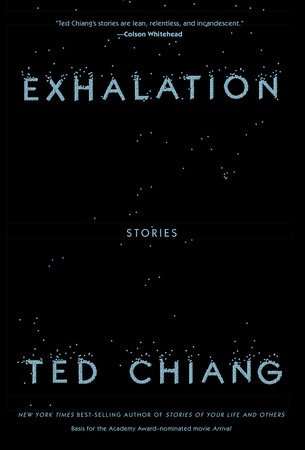
A Ted Chiang story collection can be said to resemble a rare meteorological event. A hyperobject. A comet streaking across the sky once, maybe twice in a lifetime. But whenever it lands, wherever it lands, the earthquake’s force is felt in the sternum. Every story, crafted with a watchmaker’s care and a tutelary’s vision, is a jewel.

Purchase the book

In the past, Chiang has written about how first contact with aliens can reshape the very way we communicate, how being able to encounter the beautiful, devastating powers of literal angels can both renew and break us. Here, he tackles time-travel, artificial intelligence, alternate realities, free will, and so much more. No matter the species of a story’s protagonist, no matter the universe that forms the story’s setting, the subject is always us.

Exhalation is his second collection after 2002’s Stories of Your Life and Others, spanning stories published over the course of a decade and a half.

Ted Chiang and I corresponded over email about language, about faith, cynicism, and astonishment.


Tochi Onyebuchi: In “The Lifecycle of Software Objects,” you write, “Aside from the enormous barrier to entry, raising Xenotherians won’t offer pleasures like the one [Derek] and Ana just got from watching Marco. The rewards will be purely intellectual, and over the long term, will that be enough?” This is in a story about raising digients, learning AIs that are like conscious Tamogotchis; Marco is a human-like digient, and Xenotherians are alien-like. There are these specific scientific notions you address in some of your stories: the Novikov self-consistency principle in “The Merchant and the Alchemist’s Gate” and the Sapir-Whorf hypothesis in “Story of Your Life.” These seem like very specific scientific principles you’ve attached flesh and muscle to. Do these principles occur as you’re writing? Do they precede the drafting? 

Ted Chiang: That’s an interesting quote to use as the springboard for that question. The quoted line is about the effort required to raise a conscious being from infancy to adulthood and whether anyone can do a good job at it without an emotional connection. You’re asking about whether something similar applies when I’m writing a story. For me, the scientific idea is usually the initial impetus for a story, but by itself it’s not enough for me to start writing; I don’t begin drafting until I know the ending, which means knowing the conclusion of the plot and the protagonist’s arc. 

I have occasionally wondered if I should try writing some kind of speculative nonfiction essay as a way of exploring an idea, but right now I don’t have a clear sense of what that would look like. I think fiction is the best vehicle for type of thought experiments I’m engaged in.

TO: To return to “Lifecycle,” Marco and Polo, two of the digients, want to legally become a corporation like Voyl, another digient. And that reminds me of a 2017 BuzzFeed essay you wrote where you spoke on how, when we say our greatest fear about artificial intelligence was that it would turn human, we really mean that our greatest fear about AI is that it would turn into a corporation, some hypercapitalist, completely amoral juggernaut that would bury humanity beneath a field of strawberries. Apocalypse by way of Kant. Could you speak to that idea of AI development?

TC: That story and that essay are approaching the question of AI from opposite directions. One of the questions the story addresses is, if you have a non-human entity that is conscious and capable of suffering, how do you secure it legal protection? There have been attempts to get chimpanzees recognized as legal persons, but so far none have been successful. By contrast, corporations have many rights we normally associate with human beings. While corporate personhood doesn’t provide the exact set of protections that animal-rights advocates are looking for, it might be an avenue for AI-rights advocates to pursue, if we ever wind up developing software that’s conscious. I should say, though, that we have absolutely no idea how to do that, and that’s a good thing, because if we ever do develop such software, I’m sure we will inflict huge amounts of suffering on it. 

The essay is about a different question: if a superintelligent AI comes into being—which I seriously doubt—why do so many people think it would want to take over the universe? To me it seems like a projection of Silicon Valley capitalism: tech entrepreneurs think of themselves as rational, they prioritize growth above all else, so a superintelligent being ought to do the same. This isn’t intrinsic to the idea of a corporation as a legal entity, but right now American society glorifies the pursuit of profit, which often manifests as granting corporations more power and reducing their accountability. The idea that AIs will be cold and unfeeling is a product, I think, of our fear of technology, and one of the reasons we fear technology is the way it’s been deployed against us by capitalism, the ultimate cold and unfeeling machine.

One of the reasons we fear technology is the way it’s been deployed against us by capitalism.

TO: There’s a deep humanism in your stories such that even androids and parrots, in very fundamental ways, resemble us. I’m thinking particularly of the title story where an android develops curiosity regarding the source of its own consciousness. And yet so much of the conflict in those stories stems from the fact that those protagonists aren’t human. They seem to spin against the way they turn, if that makes any sense. And I was wondering if you could speak on that: a story’s narrative propulsion arising from non-humans exhibiting human characteristics.

TC: It all depends on the specific story. It’s impossible to accurately convey a non-human mode of thinking, but some stories try to evoke that. To an extent, “Story of Your Life” tries to do that. But “The Great Silence” is doing something else; while it does include a few facts about parrot behavior, it’s more like a modern fable, and bears the same relationship to parrot cognition as Aesop’s fable does to ant and grasshopper behavior. 

“Exhalation” is doing something entirely different. Describing the narrator as non-human is a little misleading, because that term implies there are humans to use as a point of comparison. But “Exhalation” doesn’t take place in our universe at all, so there aren’t humans like us there; to put it another way, if there are humans in that universe, it’s the race that the narrator is a member of. It’s not accurate to call them robots, because the distinguishing characteristic of robots is that they’re manufactured, and they aren’t. It happens that they’re made of metal, but that’s just a cosmetic trait; they have the same standing in their universe that we do in ours. That’s why they sound like us.

TO: My two favorite stories of yours are “Hell is the Absence of God” and “Omphalos,” and I think what I appreciate most about both is that aspects of religion in the first and faith in the latter are dealt with seriously and, dare I say, compassionately. In “Omphalos,” particularly, religious faith serves as not only a compliment to scientific inquiry but an engine for it. Could you speak to the relationship between what we would consider scientific inquiry and other modes of thinking whose operation, some would argue, are premised on the absence of evidence?

TC: Before the word “scientist” was coined, individuals who studied the universe were called natural philosophers, and a lot of them were members of the clergy. They celebrated God’s glory by gaining a greater understanding of the world he created, and when they made a scientific breakthrough, what they experienced was akin to religious awe. Some people feel that wonder is incompatible with comprehension and requires mystery, but there is a long tradition of wonder in scientific research. 

I think science and religion could more peacefully coexist if we could agree that they are trying to answer different questions; science is investigating the question, “how does the universe work?” while religion is investigating the question, “how should I live my life?” To my mind, it should be possible to separate these two. Deciding how to be a good person is not something that should depend on the results of a lab experiment. Of course, I recognize that it’s easy for me to take this position because I’m an atheist. People are always going to disagree about what is the right way to live, but I’d prefer it if they didn’t try to justify their arguments with assertions about the age of the universe or the origin of species.

Science is investigating the question, ‘how does the universe work?’ while religion is investigating the question, ‘how should I live my life?’

TO: In “The Truth of Fact, the Truth of Feeling,” you have this wonderful line: “And words were not just pieces of speaking; they were pieces of thinking.” And this story, more than the others, got me thinking about cognitive processes and how the very act of writing can mold someone’s understanding of the world. Which made me curious as to why you structured “Omphalos” as a prayer-in-parts. The latter story reads a bit like a Trojan horse answer to the question of what storytelling might look like in a pre-literate society. How did the structure of “Omphalos” come to you?

TC: That’s an interesting connection, because I didn’t see those two stories as being related at all. Obviously, “Omphalos” takes place in a literate society, and as far as I know the role of prayer isn’t significantly different in literate and oral societies. “Omphalos” is structured as a private conversation with God, which is a type of prayer, but not the plea or petition that is commonly associated with prayer; it’s more about feeling a connection to the divine in one’s everyday life. As I mentioned in my answer to the previous question, there was a time when the practice of science was entirely compatible with the practice of religion. “Omphalos” takes place in a world where scientists are constantly reminded of God’s existence, so it seemed like a good fit for the narration to take the form of the protagonist addressing her thoughts to God.

TO: A recent development in science fiction is the uptick of translation of works from other languages into the American market. Ken Liu’s work with Chinese short fiction as well as with Liu Cixin’s Remembrance of Earth’s Past trilogy. The stories in the collection Iraq + 100 by Hassan Blasim. What role do you see this increasing availability of stories that did not originate in English playing in the genre’s future?

TC: When Liu Cixin’s Three-Body Problem first came out in English, I encountered a number of people who said they couldn’t get into it because they thought the translation was bad. I think what they meant was that the novel didn’t read as if [it] had originally been written in English. For example, if you didn’t know Umberto Eco’s The Name of the Rose was originally written in Italian, you probably wouldn’t be able to tell based on reading William Weaver’s translation. Three-Body Problem isn’t like that. It definitely feels foreign, and I like that it offers a glimpse into a foreign tradition of science fiction. And while I haven’t read Iraq + 100, I did read a review where the reviewer said that a story “which perplexed me in English with its unconventional form and meandering style, made perfect, striking sense if I imagined it in Arabic, shifted it into a different storytelling context.”

In theory, science fiction readers should be interested in different ways of looking at things, and science fiction translated from other languages definitely offers that. It may take a little time for American readers to adjust to foreign styles of storytelling.

Writing isn’t fun for me, but it’s something I have to do.

TO: In her 1989 essay, “Write Till You Drop,” Annie Dillard writes: “You [writers] were made and set here to give voice to this, your own astonishment.” Would you say this mission statement is a true accounting of you and your work?

TC: When I was a student at the Clarion Workshop, I had an excerpt from that essay taped to the door of my dorm room which included that sentence, and when I speak to writing students nowadays, I always quote that excerpt. That essay is available in Dillard’s book The Writing Life, and I find myself quoting from that book all the time. For example, at another point she writes, “A well-known writer got collared by a university student who asked, ‘Do you think I could be a writer?’ ‘Well,’ the writer said, ‘I don’t know. . . . Do you like sentences?’’’ I make no claims about my capabilities as a prose stylist, but I like sentences. While some writers are driven by images or scenes or characters, it’s when I get a sentence in my head that I feel that there’s a story I need to write. Elsewhere she says, “I do not so much write a book as sit up with it, as a dying friend. I hold its hand and hope it will get better. During visiting hours, I enter its room with dread and sympathy for its many disorders. I hold its hand and hope it will get better.” Writing isn’t fun for me, but it’s something I have to do.

TO: Despite the dark edges of human nature your stories explore, a thread of hope runs through them. Is that a natural part of your process or is there an active struggle against cynicism at work? I’m thinking specifically of “What’s Expected of Us” and “Anxiety is the Dizziness of Freedom.”

TC: Back when I was a teenager, I was often accused of being a cynic, and my reply was always that I was a pessimist, not a cynic. The difference being that, while I often expected bad things to happen, I believed people were basically decent, or at least upfront about their motives. Since then, I’ve seen—both from a distance and up close—how often people’s behavior is rooted in malice or hypocrisy, so it’s fair to say that I’m a cynic now. (They say no one is more cynical than a disillusioned idealist.) Many writers draw on such experiences as fuel for their fiction, but my imagination doesn’t seem to work that way. It’s not so much that I have to actively struggle against cynicism in my work as it is that I’m currently less interested in stories that reinforce cynicism.

Science fiction uses science to illuminate the human condition, and that’s what makes it worth reading and writing.

TO: Something that occurred to me while reading “Omphalos” is that they all, your stories, seem to be about scientific breakthrough. But instead of the object of scientific inquiry being a device or any physical aspect of the universe, the object is personhood. Us. If there is any thematic spine connecting your stories, it seems to be this.

TC: Faulkner famously said, “The only thing worth writing about is the human heart in conflict with itself.” I love science, but if we’re talking about fiction rather than nonfiction, science isn’t enough to sustain a narrative. Science fiction uses science to illuminate the human condition, and that’s what makes it worth reading and writing, in my view.

7 Books About Survival

There are many things people say when they’re lost for words in the face of someone else’s tragedy but “God will not allow you to be tested beyond your ability” must be the worst of them. My first response, as a Singaporean schooled by its notoriously harsh education system is: if this is a test, what’s the exam going to look like? Apart from that, the sentiment implies a complete loss of agency, plus the existence of a god that plays with its people the way kids experiment with insects, pulling one wing off, then the other, then its legs in slow succession, just to see at what point a wriggling creature becomes a husk of a thing.

Buy the book

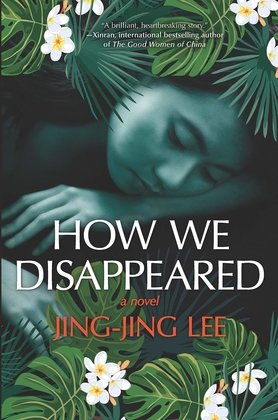
In my novel, How We Disappeared, several characters are tested for their ability to move beyond physical pain, loss, and most of all their ability to survive a war that few want to speak honestly about. The heart of the book involves a former “comfort woman,” a galling euphemism for those taken to be sex slaves by the Japanese army during World War II.

Unbeknownst to me, I had woven a strand of my family’s experience during the war into the plot – a part of our history my father must have told me about when I was too young to process the information, too small to know that it was of any importance. It’s hard to decide who had a luckier ending. The survivor in my novel, an elderly man who learns to deal with his war trauma in his own way, or my great-grandfather, who went to his grave raving about the massacre a company of Japanese soldiers had unleashed on his family.

The books I’ve chosen below are about surviving wars, literal and metaphorical, and about the people, real and not, who have come through on the other side.

Oranges Are Not the Only Fruit by Jeanette Winterson

In a later edition of Oranges Are Not the Only Fruit, Winterson admits in the introduction that it is somewhat of an autobiographical novel (both “not at all and yes of course”). It’s a David-and-Goliath story, Goliath made all the bigger because David grew up under the giant’s roof, was watered and fed and raised by the giant. Most of all it’s a story of a child who saves herself.

Because by Joshua Mensch  

I was twelve
and together we read
Homer’s Iliad (not The Odyssey) –––
though mostly Don read aloud to me;

Were it not for the fact of the narrator’s age, one might read the beginning of this lyric memoir and mistake it for romance verse. Because uses this single, powerful word to weave together a clear-eyed patchwork of memory that surround his years of abuse by a family friend. Each of the verses end with a semi-colon and at the last, the use of it hints at a beginning – if not a way to catharsis, then something, at least, that presents the hope of it.

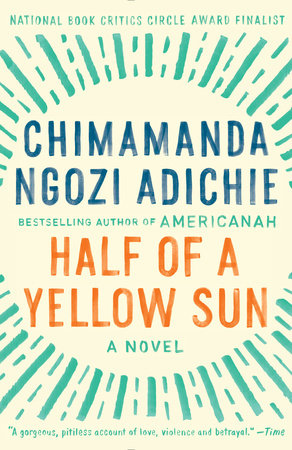
Half of a Yellow Sun by Chimamanda Ngozi Adichie

“‘There are some things that are so unforgivable that they make other things easily forgivable,’ Kainene said. There was a pause. Inside Olanna, something calcified leaped to life.” Set in post-colonial Nigeria, Half of a Yellow Sun is as much about the calamities that cleave people together (and apart) as much as it is about politics and identity before, during, and after the Biafran war. Adichie’s mastery of her material leaves the reader reeling from the scope and force of history.

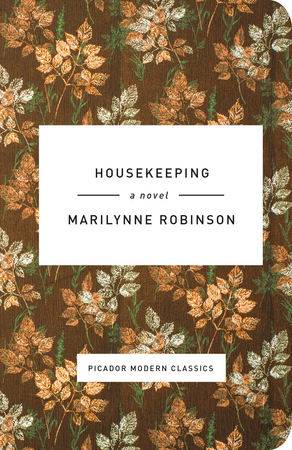
Housekeeping by Marilynne Robinson

The novel opens with the story of two sisters, such “small, unnoticed, unvalued clutter,” and their slow abandonment – first by their mother’s suicide, then by the passing of their grandmother. When Sylvie, their aunt, takes over their guardianship, she sets about keeping house but her rueful efforts only serve to convince Ruth and Lucille that her presence, too, is fleeting. Everything in the book drips of loss – even the various place names (“Lost Hills Hotel,” “Fingerbone”). The writing brings eloquence to the vocabulary of grief in a way that only Robinson can.

My Country: A Syrian Memoir by Kassem Eid

Written by a survivor of a sarin gas attack, My Country gives voice to a people most readers are used to seeing as victims and refugees. Eid writes about living under al-Assad’s rule, watching his friends and family die, and taking up arms. The current devastation of Syria and its people is made all the more poignant set against the author’s loving recollection of his childhood home.

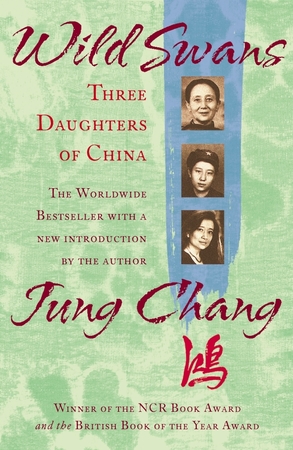
Wild Swans by Jung Chang

Banned in the author’s birth country for its portrayal of Maoist China, Wild Swans is an epic biography of a family as seen through the eyes of three women: Chang’s grandmother, her mother, and Chang herself. Chang, who was sent to re-education camp as a teenager, presents a sweeping picture of China in the twentieth century. This book is an intimate account of how the cultural revolution devastated families and devoured its own children.

The Road by Cormac McCarthy

The Road by Cormac McCarthy

“On this road there are no godspoke men. They are gone and I am left and they have taken with them the world.” Stripped of all unnecessary description and backstory, this is an apocalyptic world made all the more horrifying for its lack of vivid detail. There is only dim light, the complete lack of it, and cold, as father and son walk southwards through a devastated American landscape in search of the coast.

All Literature Is Climate Change Literature

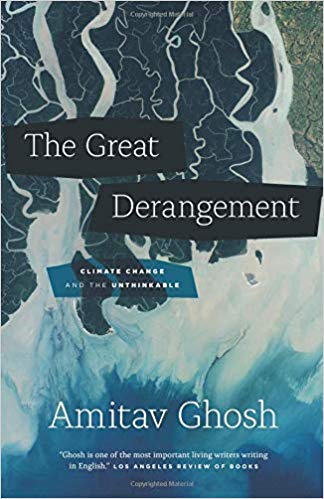
In his book-length essay The Great Derangement, Amitav Ghosh makes the case for a new literature of climate change. He argues that the modern novel is not up to the task of representing a vague, omnipresent threat to the survival of humanity. Fiction is too obsessed with the inner lives of its characters to survey a changing earth. What we need, he contends, is a full overhaul of what counts as “serious fiction”: a shift from close-focus domestic realism to a global view of environmental vulnerability. The criteria of literature must be adapted to make room for the aesthetic conditions of ecological catastrophe.

The Great Derangement by Amitav Ghosh

Ghosh acknowledges that environmental apocalypse isn’t a brand-new literary concern; he cites several authors, including himself, whose work he sees as integrating “the unthinkable” of climate change in fiction. Finally, though, he believes that the catastrophe of climate change will require an artistic storming of the gates. “I think it can be safely predicted that as the waters rise around us, the mansion of serious fiction, like the doomed waterfront properties of Mumbai and Miami Beach, will double down on its current sense of itself, building ever higher barricades to keep the waves at bay.” If one function of fiction is to help us understand the world, Ghosh thinks the literature we have now is failing in the face of global warming. We’ll need new genres, structures, maybe even words.

In fact, climate change is far from a new subject for literature. On the contrary, the variable, impassive earth is a motivating image in many of the works we already celebrate. The scale of the incoming disaster is unprecedented; our vulnerability to the climate is familiar. We just have to recognize the theme for what it is.

Ghosh notes that the scale of global warming makes it difficult to grasp and therefore hard to write about, citing Timothy Morton’s term “hyperobject” for the phenomenon. But he doesn’t acknowledge the flip slide: Precisely because of its scale, the outline of climate change may be perceived everywhere. The real alchemy of meaning takes place not on the page but in the mind of the audience. In other words, the rumbling of the archaic voice of the earth is audible as long as the reader is alert to it. Ghosh’s idea that the “individual moral adventure”—John Updike’s definition of the novel— in fiction and the phenomenon of global warming don’t go together is too categorical. Even literature that is driven by individual characters and complicated moral growth is full of insights and premonitions of climate change.

The variable, impassive earth is a motivating image in many of the works we already celebrate.

In fact, much of “canonical” Western literature unites the individual moral adventure with a sense of collective responsibility toward the earth. Ghosh doesn’t deny this, but gives too much weight to contemporary fiction as shaping our view of the world, compared to the sort of texts that many people read in college. For example, Shakespeare’s Macbeth is thoroughly modern in its treatment of human psychology, but the language of climate is also everywhere in it (sometimes in the same sentence). Greed “grows with more pernicious root / Than summer-seeming lust,” and the prophecy of Macbeth’s fall hinges on the idea that a forest can rise up and do battle. One of the most remarkable nature lines is Macbeth’s own: “The earth was feverous / and did shake.” He imagines the earth as weak like a stricken child or elder, and realizes that he is a viral agent of the world’s disease. The land suffers when the people on it delight in cruelty. Dante Alighieri gives us similarly piercing metaphors in The Divine Comedy. In Canto IX of the “Inferno,” he writes, “That marsh, which sends out so much stinking breath, / surrounds on every side the weeping city / which we cannot now enter without wrath.” The image homes in on the secretions of the face, making a startling connection between carbon dioxide-producing breath and tears, what humans sow and reap. Substitute “that marsh” for “the factory,” and you have an indelible description of modern day Beijing.

A highlight of The Great Derangement is Ghosh’s analysis of the way that industrial arrogance and blinkered imperialism shroud our essential vulnerability to nature. But is a whole new aesthetic of fiction necessary to remind us of this? Here’s King Lear, exiled to the countryside:

Poor naked wretches, wheresoe’ever you are
That bide the pelting of this pitiless night,
How shall your houseless heads and unfed sides
Your looped and widowed raggedness defend you
From seasons such as these?

The sensation of cold rain on unprotected skin and the dull, insistent irritant of hunger were new experiences to the fallen King Lear, as they will be to us Europeans and North Americans when our infrastructure collapses to rising water levels. Like Lear, we’ll soon find out that no matter how stable the worlds we build around us seem, they are arbitrary and impermanent.

We will also learn to stop assigning benevolence to certain kinds of weather. Under the extremes caused by global warming, we will grieve for the rain during the heat and the sun during the storms. In The Aeneid, another classic story with the momentum of an individual moral adventure, Virgil was alive to a very modern worry, disease of the sun. He describes pale ghosts from “Down Below” being “exposed to the scaring light” (the translation is by David Ferry). Listen to the sound of that “scaring”: it twists the rays of the welcome sun into something ugly, modern, prophesying what now mutilates our skin.

Ghosh predicts that one of the first casualties of climate change will be our “uniformitarian expectations” about “the regularity of bourgeois life.” The one book in every standard hotel room can tell us much about that disruption. In the Old Testament, the chronicler describes a famine. The Arameans “laid siege against [Samaria] till a donkey’s head cost eight pieces of silver and a quarter of a qab of pigeon droppings five pieces of silver” (2 Kings 6:25, in the new translation by Robert Alter). It is a kind of nightmare shopping list, and not far removed from the reality of modern famines, as Yan Lianke’s 2015 novel The Four Books, about the Cultural Revolution, confirms. We also know that the poor will be affected most by climate change. This line from the Hebrew Bible evokes the persistence—even flourishing—of economic exploitation in times of bitter suffering.

In the new literature Ghosh imagines, writers will better understand how to situate people within the whole environment. Animals, rivers, mountains will also be actors in the upcoming apocalyptic drama; we will learn not to “arrogate all intelligence and agency to the human,” Ghosh writes. In the introduction to the Decameron, Giovanni Boccaccio similarly points out the entanglement of human and animal life in times of crisis. “It was frequently observed, that things which had belonged to one sick or dead of the disease, if touched by some other living creature, not of the human species, were the occasion, not merely of sickening, but of an almost instantaneous death,” he writes. We share our destiny with everything else on earth. Boccaccio’s forceful language shows how perilous it is when we think we can unwind and separate our fates.

In The Great Derangement, Ghosh doesn’t mention the literature of the Flood, humanity’s great dress rehearsal for ecological catastrophe. This literature definitely isn’t modern, and is far removed from his understanding of the “serious,” realistic novel. Still, these are widely read, foundational stories that often feature singular heroes, and they accomplish much of what a new fiction could. In his Metamorphosis, Ovid describes the flood like this: “The rivers spread and swept away together / Crops, orchards, cattle, men, / Temples and shrines with all their holy things.” The gods are no match for rising water levels. Our secular objects of worship—especially, as Ghosh argues, beachfront real estate—won’t be either.

The ancient chronicler of Genesis writes of the flood, “All that had the quickening breath of life in its nostrils…died.” The adjective “quickening” is a profound statement on the shortness of human and animal life compared with the progress of ecological time, expressed with an almost magical compression typical of the Hebrew Bible. Another verse, from 2 Kings 2:19, thought not about the Flood, is equally concentrated when talking about the climate: “The water is bad and the land bereaves.” The construction “the land bereaves” might do the work of a hundred explicit climate change novels, if a fraction of the sheer interpretative power focused on the Bible was diverted to also consider its premonitions of global warming.

Perhaps most resonant, however, is the Epic of Gilgamesh. Sometimes it’s helpful to turn to another artist’s reading of a classic story, and the composer Gérard Grisey’s setting of text from the Gilgamesh myth from 1998 is, to my mind, the definitive interpretation. “I opened a window / And the day fell on my cheek,” a soprano sings, exposed to music that is gently waving, crystalline, hushed. You can hear the wind players gasping for breath during these long passages, as a person might who has narrowly avoiding drowning. “The dissociation…between the voice and the music is a sort of reflection of the situation of the human and the cosmos,” Grisey wrote in his journal in July, 1996. “Fusion and harmony or indifference and sterile struggle.” Gilgamesh imagines a place most climate change predictions don’t dare to go: a world not just of suffering, but possessed of a stillness beyond humankind.

We already have enough art to help us understand the threat of climate change. We just need to look at it with the appropriate paranoia.

The aesthetic goals Ghosh sets out in The Great Derangement are still worth pursuing. The point is that we already have enough art to help us understand the threat of climate change. We just need to look at it with the appropriate paranoia. Read Another Book, goes the meme about Harry Potter obsessives; when it comes to understanding global warming, I might instead admonish, Read Almost Any Book, and, if you are aware of the scale of the threat, you will be struck by prophecy. Besides, there are psychological reasons why we might get more from what Ghosh calls literature “that grapples with climate change avant la lettre.” Rightly or not, we tend to give more weight to predictions from the past. The disaster movie 2012 (2009) parlayed a dubious Mayan prophecy into a worldwide gross of around $750 million, when the real apocalypse is already here.

Sometimes it also seems like human imagination flourishes most when kept partly in the dark. Do we extrapolate a worldview from snippets of language better than we synthesize vast quantities of information on an issue like climate change? In politics, global warming is an all-encompassing problem that will require all-encompassing solutions. Ghosh imagines equally revolutionary changes in art. But I think that art works its wonders best through isolated moments, because the tiny lights that spark epiphany are everywhere.

We Cloned Charlotte Brontë from a Lock of Her Hair, and Chaos Ensued

A ring containing a lock of Charlotte Brontë’s hair was recently discovered on an episode of Antiques Roadshow that was filmed in northern Wales. The next step was obvious:

https://twitter.com/mollypriddy/status/1120422940401647617

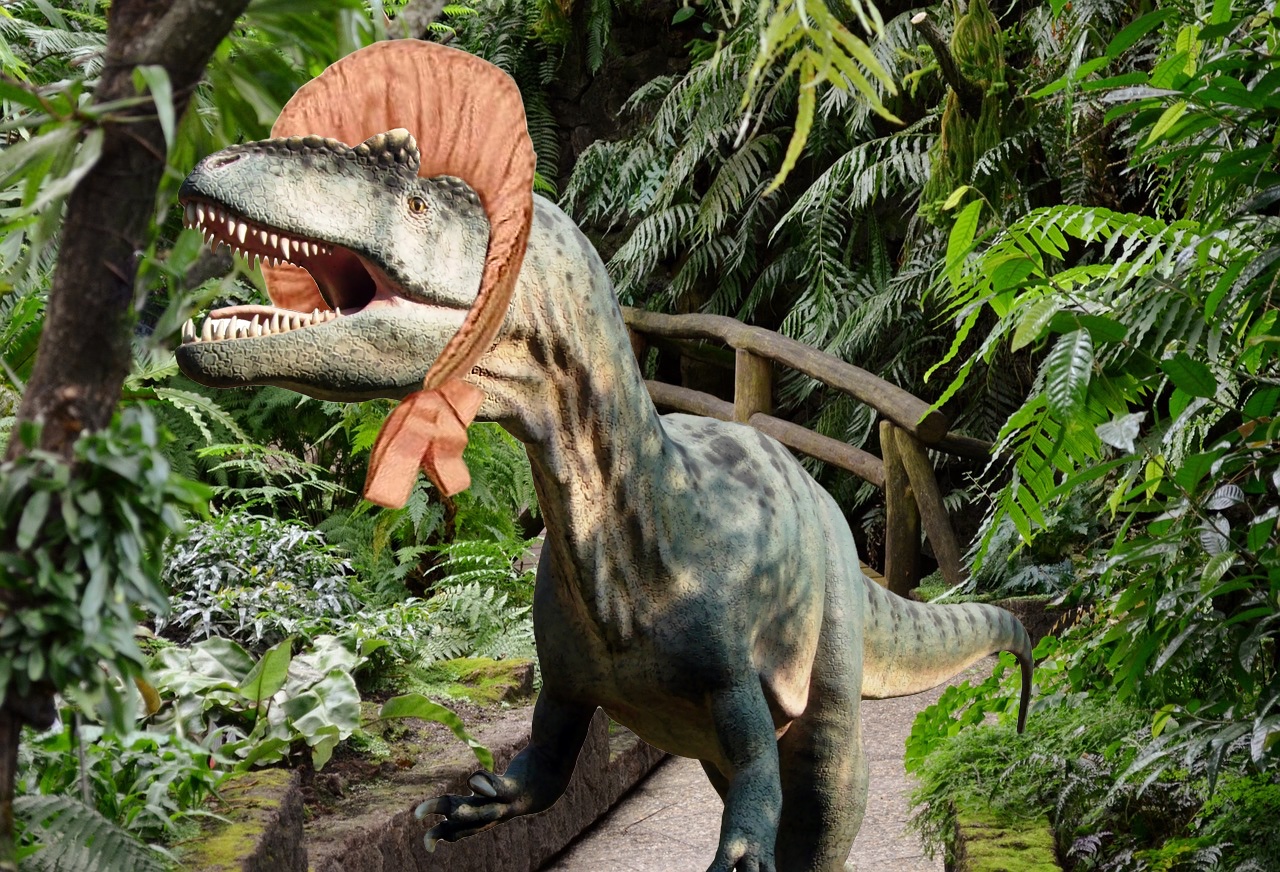
We were so preoccupied with whether we could do this, we didn’t stop to think about whether we should. Below, a few scenes from Brontësaurus Park.


Dr. Alan Grant slowly stands to look out of the Jeep, while Dr. Ellie Sattler stares at the strip of lace she is holding, marveling. “This type of embroidery hasn’t been done since the Victorian Period,” she says. “This thing—”

Grant stops her, grabbing her by the head and turning it to make her see what he’s seeing. Sattler slowly rises to her feet, mouth agape. There, in the near distance, they see what appears to be a living, breathing Elizabeth Barrett Browning sitting at a table not too far from them, hunched over and scribbling in a notebook. “It … it’s a writer,” gasps Dr. Grant.

“Is … is she a novelist?” Dr. Sattler asks.

“No, no, not a novelist at all,” Alan reassures. “Just a poet. See? Look at the line length. We’re perfectly safe.”

Now from the Jeep rises another of their party. It’s MFA candidate Ian Malcolm. Staring at Browning, he mutters to himself, “He did it. That crazy son of a bitch did it.”

Grant and Sattler move closer to Browning, shielding their eyes from the sun, trying not to disturb the writer.

“This thing writes 25, 27 words per minute,” Grant exclaims.

‘You’ve got a Brontë?’ asks Sattler, gasping. ‘He’s … he’s got a Brontë!’

“Barrett Browning?” asks their thesis advisor, John Hammond. “30, easy. And we clocked Charlotte at 32 words per minute.”

“You’ve got a Brontë?” asks Sattler, gasping. “He’s … he’s got a Brontë!” She sits down.

“Say again?” asks Grant.

“We’ve got a Brontë,” replies Hammond. Grant is feeling faint. He sits on the ground.

Hammond strides out in front of them, and, looking out over the rolling fields and forests dotted with small cafes and parchment and quill shops, declares, “Dr. of Comparative Literature Grant, Dr. of Victorian Literature Sattler … welcome to Brontësaurus Park.”


Nedry, an adjunct, tumbles down a hill and into the mud, losing his glasses. It is night, and pouring rain.

“Where are my glasses?” he asks, digging through the mud. “I can’t afford new ones. I’m an adjunct.”

Just then, he hears a hooting. He sees a figure leap behind a tree, then more hooting. The figure flashes by again, and still, more hooting. Nedry looks around in a panic. Who is it?

Suddenly, she appears. A small, pale woman wearing full evening dress and a smart bonnet.

“Oh. Uh, nice girl. Nice writer,” he says, trying to stay calm. “I thought you were one of the Brontës. But you’re not so bad. No. Okay. Run along. I don’t have any Moleskines for you. What do you want? What do you want, food? I have nothing on me.”

He slowly reaches towards the ground and finds a #2 Ticonderoga pencil.

“Here,” he says, waving the pencil. “You want a quill? You want a nice ink quill? Here,” he says, throwing the pencil as far as he can. “Go get it. Get the quill, girl! Get the quill!”

The woman looks behind her, then slowly turns back to gaze upon Nedry.

“Ah, no wonder you’re without a husband,” he mumbles. “I’m gonna burn your manuscript when I come back,” he declares, before turning to climb back to his Jeep.

But the woman follows. Nedry turns around in fear, and a slow smile spreads across her face: then, she emits a horrifying shriek, as a large Tudor ruff quickly unfurls around her face. She screams, and then coughs a dark liquid all over Nedry.

She emits a horrifying shriek, as a large Tudor ruff quickly unfurls around her face.

Nedry claws at his face in a panic, and then stops suddenly, realizing something. With terror in his eyes, he looks slowly down at the white handkerchief he brought with him to diagnose consumption.

It’s just as he suspected. Covered in a spray of blood.


In the distance, through the rain, Tim, the TA, hears it: a subtle boom, boom, boom. If he had to guess, based off of books he’d read, he would guess it was the sound made by a woman stomping in calf-high, side-laced Adelaide boots. The idea is almost too terrifying to entertain. But then he hears it again.

Boom.

Boom.

Boom.

Tim slowly leans over the front passenger seat, staring at the two mugs of mead sitting on the dashboard. For a moment, nothing. And then, across the surface of the mead: ripples.

Boom.

Boom.

Boom.

Something crashes against the buggy with a loud bang, and they all leap back in horror: through the torrential rain, they see the gore. It’s half a manuscript, ripped to shreds, simply dripping with red ink.

Who threw it? Tim stares out the window and at last, spots it: a single white arm, covered in a pale lace dress glove. Slowly, Tim looks up, up, up, up, and for the first time, at last, we see her in all her brutal glory: it’s a real life, full sized Charlotte Brontë. She turns her head slowly to meet Tim’s eyes.

“What … what did you do with the man who was editing your manuscript?” Tim whispers.

A slow, vicious grin spreads over Brontë’s face.

“Don’t you know?” she asks.

Tim shakes his head.

“Reader,” she responds, cocking her head, “I buried him.”


Outside the Jeep, Brontë’s boot comes crashing down into the mud, leaving behind the kind of monstrous footprint you’d usually only see in a museum: a woman’s 6, maybe even 6 ½.

She is looking for Tim. He scrunches into a ball, trying to stay small, but she spots him. Her eye, big and yellow, widens. A symptom of untreated hyperbilirubinemia, most likely. There was only one doctor in the park, after all, and he was needed elsewhere, as the Baker girls had the croup.

Charlotte spots Tim and lunges at the Jeep. Tim scrambles away from her, but there’s not much room in the Jeep for him to move. Stretching towards the car, Charlotte Brontë opens her gaping mouth wide … and says, “I noticed you were alone. Is your family in want of a governess?”

Tim screams and kicks, while she cries that she has considerable experience and could be quite a helpmeet for a man of his stature, and she promises she won’t be a bother as she keeps her mouth shut and does what she’s told and, besides, she doesn’t require much, just room and board and perhaps a pint of scum pie every once in a while.

“Go away!” Tim screams, and kicks at her again.

“I do not think sir,” she says, huffing, “you have any right to command me, merely because you are older than I, or because you have seen more of the world that I have; your claim to superiority depends on the use you have made of your time and experience.”

But she cannot reach him, neither with her words nor with her arms, and so she backs away, sniffing, “Well enough. I care for myself. The more solitary, the more friendless, the more unsustained I am, the more I will respect myself.”

She starts walking away, and then turns back to look at Tim. “I have as much soul as you,” she roars. “And full as much heart.” Then she turns and stomps away.

In her wake, a trail of those horrifying size 6.5 footprints, full to the brim with rainwater. With every retreating step she makes, the water quivers.


An unfamiliar woman—tall, peaceful looking—approaches Dr. Grant and the children where they are resting in their tree perch.

Lex scoots backwards in fear, screaming, “Go away!”

“No, no, it’s okay,” Dr. Grant reassures her as the woman tilts her head back and forth, examining them. “It’s a Gothic. It’s Mary Shelley. She’s perfectly safe. Look, see what she’s holding in her hand? Look at that. It’s a first draft. Can you believe it, Lex? We’re looking at a genuine Mary Shelley first draft!”

Lex slowly leans forward, closer to Shelley.

“Can … can I see it?” she asks, timidly.

Shelley nods, and reaches her long arm up to the tree perch to hand Lex her notebook.

“It is still a work in progress,” Shelley admits. “I haven’t quite landed on my final title.”

“What do you call it?” Dr. Grant asks. “If I may ask.”

Shelley nods. “For now,” she said, “I’m calling it Frankenstein: Life, Uh, Finds a Way.

Dr. Grant shakes his head and smiles.

“Clever girl.”


A hoard of writers storm past Dr. Grant, Tim, and Lex.

“Tim,” Dr. Grant says, grabbing Tim’s shoulder. “Who are these people? Can you tell us what they are?”

Tim squints. “I think … they’re editors.”

“Can I talk to one? Are they safe?” Lex asks.

These are aggressive, living copy editors that have no idea what century they’re in.

“No,” Dr. Grant says, grabbing her arm. “These are aggressive, living copy editors that have no idea what century they’re in, and they’ll defend themselves and their view of the progressive passive, violently if necessary.”

As the swarm of editors rush down the hill and towards them, the three scramble behind a nearby fainting couch to stay safe and out of sight.

And that’s when they hear it: the all-too familiar boom that could only come from a certain size 6.5 woman’s boot. Dr. Grant peeks over the edge of the couch just in time to see Charlotte burst from the forest. She grabs one of the editors by the throat while the others flee.

“Life appears to me too short to be spent nursing animosity, or registering wrongs,” she hisses.

“I’m glad we agree—” starts the quivering editor.

“And yet,” Charlotte continues, talking over her. “It has been a fortnight since I have sent you my latest manuscript, and have as of yet received nothing in return but your most bitter silence.”

“But—” started the editor.

“No,” hisses Charlotte. “Stop. Hold on to your ‘but’s.”


It is morning now, and quiet. Weeks have passed since the surviving members of the team fled Brontësaurus Park by helicopter. The island is calm, still, mostly unchanged except for a reminder here and there: the torn fence, the ransacked kitchen, the Visitor’s Center where Charlotte fought against Emily and Anne, now in shambles.

We have forgotten how beautiful the island is. Look, here, a quiet stream, bubbling, winding through the forest. Follow the stream: watch it drop off into a waterfall. See the rocks at the base of the fall; see washed up on the muddy banks next to the rocks, a red, white, and blue-striped Barbasol can, torn open, empty. Look: see leading away from the stream and towards the forest, footprints. We thought we had seen horror before, but here, now, staring at impossible size 8 bootprints, we know suddenly that our horror has only begun.

Follow the footprints to just inside the forest, where a gruesome scene awaits: the remnants of what appears to have been a game of whist, violently disrupted, the chairs toppled, the cards scattered every which way. Outside of the wreckage, only one set of boot prints continue: onward, towards the center of the island.

Back at the base of the stream, the Barbasol can spilled open, empty. Crouch down: here, our only two clues as to the can’s previous contents: slivers of a shattered test tube, and a small identification tag, yellow, square, the type used to label scientific specimens.

A small, yellow, square identification tag upon which is typed, simply: J. Austen.

Credits roll.

7 Strange and Brilliant Holocaust Novels You’ve Probably Never Even Heard About

Like many Australian Jews of my generation, I grew up in the shadow of the Holocaust. My grandparents were survivors, the kind who fled to a faraway land where they wouldn’t have to speak of the horrors they had endured. I revered them, awed by the very fact of their survival, and did not dare ask questions. Instead, I sought some kind of understanding in the vast, overcrowded field of Holocaust literature. I began with the classics: the survivor memoirists and novelists around whom the canon has been built. From there, the pickings were endless. With every book I devoured, I recast my grandparents as the central characters, sending them back to their unspeakable, private hells.

Deeper into the labyrinth I ventured, hundreds upon hundreds of books, mostly novels. The more I read, the more I began to notice a disappointing sameness to many of them. In the 75 years since the Holocaust, much of its literature has come to fit into neat narrative templates. At best, we see variations on a theme, triumph over unimaginable adversity, usually riffing on recurring tropes that border on cliché. At worst, we get schmaltzy dreck that minimizes, sanitizes, or otherwise distorts what happened. Casual readers could be forgiven for dipping into a couple and moving on, convinced they’d read what they need to about the subject. But every now and then there will be those small few exceptions, novels so astoundingly original, so daring, that they will demand the attention of even the most seasoned, fatigued readers. Here are seven Holocaust novels that smash the template.

Mr. Theodore Mundstock by Ladislav Fuks

Mr. Theodore Mundstock by Ladislav Fuks

In occupied Prague, Mr. Theodore Mundstock sets up a mock concentration camp in his apartment to acclimatize to his fate. Accompanied only by his shadow (both Greek chorus and devil’s advocate) and some weird bird-like creature, he lays out a wooden board, practices stockpiling scraps of food and simulates assaults by over-zealous camp guards. He also acts as self-appointed bringer-of-hope to those around him, promising his neighbors that they need not fear deportation as the war will end before ‘the Spring”. It is as sad as it is calculated. Is he just mad or do these baseless promises help the others survive? Mr. Theodore Mundstock is one of the best, albeit strangest, novels I have read. With generous scoops of both comedy and tragedy, it confronts very difficult issues of morality and honesty in times of crisis, all the while questioning what amounts to rational action when the entire framework of rationality has collapsed.

The Dance of Genghis Cohn by Romain Gary

The Dance of Genghis Cohn by Romain Gary

Moishe Cohn was a small-time clown on the Yiddish burlesque circuit. Murdered at Auschwitz, his last and most glorious prank happened at the moment of death: he turned around and bared his butt at the firing squad. Twenty-five years later he is still up to his old tricks, albeit only in spectral form, possessing and messing with the mind of the man who killed him. Detective Schatz, formerly SS officer Schatz, is a high-ranking policeman in a small German town where he is enmeshed in an investigation into a series of murders. Gary mines this rather wacky setup to hilarious comic effect, but in doing so manages to tackle some very big issues—complicity, reconciliation, retribution and the absurdity of de-Nazification. It is as disturbing as it is funny.

Trieste by Daša Drndić 

Trieste by Daša Drndić

When Daša Drndić died last year, the world lost one of its finest and most challenging writers. Trieste is, without a doubt, her greatest work. A masterclass in documentary fiction, it seamlessly weaves photographs, maps, Nazi documents and transcripts from the Nuremberg trials into the narrative, to tell the story of Haya Tadeschi and her relationship with the Nazi monster, Kurt Franz. The novel begins at the end: Haya is sitting alone in a nursing home, sifting through old photos, awaiting the arrival of a son she gave away as part of the Lebensborn program and had long presumed dead. What follows is a complex and harrowing meditation on the sliding doors of history in which the conventional fact/fiction divide is blurred beyond recognition. At times, the documentary elements are used to staggering effect. One chapter is just a list of the 9,000 Italian Jews killed during the war. Dizzying.

Mendelssohn Is on the Roof by Jiri Weil

Mendelssohn Is On The Roof by Jiri Weil

The rank absurdity of the Nazi obsession with racial theories has never been so hilariously derided than in Weil’s 1960 novel set in occupied Prague. Acting Reichsprotector Heydrich is giving an architectural tour to a visiting German dignitary, waxing lyrical about the Baroque style and gothic features of the various buildings. Heydrich plans the tour to end at the opera house, and to prepare for this grand finale he orders that a statue of the Jewish composer Mendelssohn be removed from the roof. Of course, the SS men given the task have no idea which statue is Mendelssohn, so they revert to stereotype and try to smash the one with the biggest nose. That, it transpires, is Wagner. They eventually get it right, toppling Mendelssohn, but leaving him on the roof, from where he comes to life to seek revenge. It is all very Don Giovanni which, not coincidentally, is the very opera Heydrich and his guest are watching inside.

Ludwig's Room by Alois Hotschnig

Ludwig’s Room by Alois Hotschnig

Ghosts, both literal and metaphorical, haunt this extraordinary novel that reckons with one village’s collective responsibility for wartime atrocities. Kurt Weber inherits his great uncle’s country house and goes through the one door he was never allowed to open as a child. As with any good horror story, what he finds inside cannot be good, but here the frights come in the form of revelations—fragmented and hallucinatory—about his family’s involvement in the operation of a nearby concentration camp and their desperate attempts to bury the evidence afterwards. The deeper Weber digs, the more he comes to realize it’s not just his family but all his neighbors who share in the guilt. A damning indictment on the ease with which one slips from bystander to perpetrator.

The Hollow Bones by Leah Kaminsky

The Hollow Bones by Leah Kaminsky

The decaying pelt of a stuffed panda narrates a good chunk of this novel that reimagines one of the strangest episodes of the Nazi era. It’s 1938 and Ernst Schaeffer, unswervingly ambitious scientist and explorer, is tapped by the SS to lead an expedition to Tibet to discover the origins of the Aryan race. Nazi ideology swiftly poisons his worldview, as he sacrifices everything to ambition, including his fiancée, Herta. The Hollow Bones is a taut, if absurd, adventure that is unafraid to ask big questions. More conventional novels have explored similar ground—what happens when science and ideology collide—but few have used such an obscure and thrilling historical footnote to do so. And, for what it’s worth, you can even visit the panda at the Philadelphia Museum of Natural History if you happen to be in the neighborhood.

The Nazi and the Barber by Edgar Hilsenrath

The Nazi and the Barber by Edgar Hilsenrath

In terms of rank brutality, moral bankruptcy and the banality of evil, Hilsenrath’s extraordinary novel knows no equal. Breaking every template in the Holocaust narrative playbook, it tells the story of Max Schulz, a ruthless concentration camp guard who, after the war, assumes the identity of his dead childhood friend Itzig Finkelstein and escapes to Palestine. There he becomes a fighter alongside the very people he had been actively trying to exterminate, helping in their struggle to establish a homeland. Schulz is a truly grotesque creation, constantly seeking to shift blame and present himself as just a regular guy swept up by circumstance. It’s an uncomfortable and, at times, repulsive read. Yet, as a satire of German post-war reckoning, it’s also outrageously funny. Little wonder Hilsenrath, himself a Holocaust survivor, struggled to find a publisher in his homeland.

In “The Unpassing,” a Taiwanese Family Grieves in the Harsh Wilderness of Rural Alaska

Why do we leave home and country? If all unhappy families are unhappy in their own ways, then there might be just as many reasons for emigration. Some leave because they have to. I became an immigrant to the United States somewhere along the spectrum between chance and choice. Reading Chia-Chia Lin’s The Unpassing brought back with force all the self-doubt, second-guessing, and dithering that has been part of my own long process, by no means over, of leaving home. After more than a decade away, the lure of undoing the journey still beckons, even as I understand rationally that no true return can be possible.

Purchase the novel

In Lin’s novel, a family of five emigrates from Taiwan to Alaska because of the father’s ambitions. There, they are shortly joined by a sixth, the baby of the family. But tragedy strikes, and the youngest of them passes away just as the space shuttle Challenger disaster shakes America. What follows is narrated by Gavin, the middle child, himself fresh from a narrow brush with death. Lin’s evocative passages and brilliantly observed details place the reader in a landscape rendered at turns foreboding or desolate by the family’s calamities. There is much to savor in her deft ability to conjure atmosphere. Garth Greenwell raves: “Maybe once or twice a year, I read a book that’s so good I want to proselytize about it. […] When I finished it I felt like I couldn’t breathe.”

I talked to Chia-Chia Lin about her debut novel, exploration, and child narrators.


YZ Chin: I really admire the title. “Unpassing” is a word that can’t be found in Merriam Webster, but feels familiar enough that readers would have some idea of what they think it means, only to second-guess themselves. It perfectly captures the instability and precariousness that permeates the novel. Is there a story behind the title?

Chia-Chia Lin: I’d always thought titles might be the one eureka moment novelists get to look forward to — since, you know, writing a novel isn’t exactly a process overflowing with confidence and certainties. As it turned out, “The Unpassing” came to me about halfway into the first draft, but I kept fidgeting with it and trying out other titles. The previous title, which I’d held on to for over a year, gestured at scale — both small and large — because in that version of the novel, the narrator was obsessed with the infinitesimal while his father was gazing upward and outward, at the stars. But I became preoccupied by other explorations, and the title no longer fit. I do think there is something about the “un” in “unpassing” that made me eventually settle on it. It evokes instability, as you said. It also suggests a haunting. It’s not the same as a negation — there’s still a ghostly imprint left. Like the word “unspeak.” It’s not the same as not having spoken at all, and in fact it highlights the impossibility of undoing speech, of rewinding an action or taking it back.

YZC: How would you feel about sharing that previous title? Its ghostly imprint?

CCL: I would feel embarrassed, now that I’ve talked it up.

YZC: Another way “The Unpassing” intrigues me as a title is how it ties in to Gavin traveling to Taiwan near the end of the novel. It’s like he’s trying to undo the journey he was brought on by his father, an “unpassing.” How did you settle on Alaska as a counterpoint of sorts to Taiwan?

CCL: The first pages I wrote were set in the woods of Pennsylvania, where I spent a lot of my childhood, but they were missing a certain energy in the landscape — something I’ve realized I need, in all of my writing, in order to proceed. Plus, since the novel’s family had immigrated from Taiwan, as mine had, there were just too many similarities, and the story kept collapsing into nonfiction, which for me spells death.

Many years ago, I published a story set in Alaska (but in the interior, where it is wilder), and I’d grown dissatisfied with it. I’d lived in Anchorage for a short but meaningful time, about 15 years ago, and I wanted to explore what it was that kept the city so alive in my mind. So I changed the woods to a white spruce forest on the outskirts of Anchorage, taking a bit of license and creating a fictional community there, and as soon as I did that, resonances started to appear: Immigrating is a venture into the unknown, and so is pioneering. The mother grew up in a seaside village, and now she was walking a vastly different, but also strangely familiar, coast. When she dug for clams on the Kenai Peninsula, she was surprisingly in her element. And so on.

Immigrating is a venture into the unknown, and so is pioneering.

YZC: I wanted to talk to you about that, the mother character. In the novel, everyone else in the family has close calls with death (illness, falling tree, mudflats etc.). The mother seems to be the only one relatively unvisited by danger. She fishes, gets firewood, keeps everyone alive. She’s also the only one who actively tries to cultivate ties to their home country, making phone calls and telling stories about Taiwan. Would you say that’s her source of strength, given she doesn’t want to be in Alaska?

CCL: It might not be an overstatement to say I wrote the entire book trying to understand the mother. I wouldn’t say that her strength comes from her ties to her home country, but it may be true that this is what she thinks. In the beginning of the story, the narrator observes that she’s shy around strangers, especially when speaking in English, despite the fact that she’s a huge, dominating personality at home. As the novel progresses and the pressures on the family increase, I began to realize that the mother, regardless of what she herself might claim, is actually the character most well suited to the environment. There are times when she even thrives. Although she’s the one harping on a return to Taiwan, when she’s finally given the chance, she doesn’t take it. There’s a note of irony when you compare the father — the one who wanted to be a pioneer — and the mother.

YZC: Along the same vein, we see Taiwanese Hokkien quoted in original only in conversation between the narrator Gavin and his mother. As someone who understands some of the language, I read those scenes as Gavin using it to distance himself from her, which I found heartbreaking. When he’s rude to her in Taiwanese Hokkien, she almost praises him. But when he talks back in English, she says “Don’t talk to me like that.” Do you think we are potentially different people when speaking different languages? How does that affect the characters’ abilities to connect with each other?

CCL: When we grow up hearing a mixture of languages, we learn at a young age to distinguish which circumstances are appropriate for which language. We come to associate particular emotions with a language. In my own life, Taiwanese Hokkien has been associated with safety and familiarity (since I spoke it only when I was very young), but it was also what was used for the kind of fighting you would unleash only within closed doors. For me, Mandarin Chinese is sometimes spoken at a greater distance; it’s what I used when I traveled to mainland China for work, or to speak with my in-laws, and it’s a language I’ve studied formally.

Almost certainly when we speak in a particular language, we are falling back on unconscious patterns and associations. I think the result is that expressing ourselves in a different way using that tongue requires greater effort. It requires us to take down some walls. In my novel, the characters often do not do this, which I think is realistic and also fascinating, in the way that missed connections are fascinating.

YZC: That resonates with me, the habits enforced by languages. How would you describe Gavin’s relationship with English? On one hand, he comes up against the legalese of lawsuits and eviction notices, and on the other, he’s experiencing kindness from his Alaskan neighbors.

CCL: I think the impenetrability of the legalese has to do more with Gavin’s age than any issue of language. He thinks in English, so it’s a private as well as a public language for him.

YZC: The ten-year-old narrator’s vulnerability really lent itself to the atmospheric passages of the novel, and for me his vulnerability comes not from the simple naiveté of a child but a kind of suggestibility. Why did you decide to tell the story through Gavin? Does it have anything to do with him being a middle child and thus (as the stereotype goes) more overlooked, more unpredictable?

CCL: The middle child positioning is part of it. I wanted him to feel some responsibility — for his younger brother, for example — but I also wanted him to be a child rather than a teenager, to be an age when he was still relying wholly on others: his older sister, his mother, his father. I think his age is important. He’s ten in the novel. To me, this is an age that allows for full complexity of thought, but retains a world view that still feels separate from adulthood. I was wary, though, of presenting him in a way that would get him tagged as precocious. I love novels narrated by children, but I usually don’t love those types of novels.

Family migration is often spurred by one person’s choices that have huge ramifications for every other family member.

YZC: What are some of those novels narrated by children that you love? What did they accomplish that wouldn’t be possible with an adult narrator?

CCL: Family Life by Akhil Sharma; The Gangster We Are All Looking For by lê thi diem thúy; The Dream Room, by Marcel Möring (especially the first chapter — it’s only four chapters long; the last chapter is slightly baffling). These are wildly different books, I might add. But they examine family difficulties at a slant that makes everything seem new. It’s not wonderment — I hate that word. It’s more like how when you lie down on the floor, you notice different things about a room. The novels don’t sacrifice nuance simply because a child is doing the looking.

YZC: You said earlier you wrote the book to understand the mother. I love the idea of writers exploring what confounds them through writing. Were there any unexpected realizations from finishing the book?

CCL: I had a lot of insights into the characters that surprised me. I’ve had similar experiences while writing short stories, but nowhere at this level of magnitude. I think it’s simply the amount of time spent with the characters, the quantity of pages written and thrown away — you begin to see congruences and contradictions everywhere.

YZC: A cheeky question, but do you have a response ready for when people inevitably ask: How autobiographical is your novel?

CCL: No, I don’t have a response ready! Most of the facts are not autobiographical (by intention), but many of the emotional situations are. Was that obfuscating? I hope so.

YZC: Good for you! I think sometimes there’s this expectation that immigration novels feature a tussle, especially for second-generation characters, between the “old culture” and the “new culture,” with some kind of resolution at the end that’s a compromise between the two. The Unpassing is a departure from this arc. Was it at all your intention to write a different kind of immigrant novel?

CCL: Haha, I would never set out with an intention to write a different kind of anything, mostly because it would incapacitate me. But I do think I’m interested in an aspect of migration that I haven’t seen explored in depth in fiction (though if you told me it already exists I wouldn’t necessarily be surprised either). What I’m interested in is how family migration — when it’s a decision rather than an absolute necessity — is often spurred by one person, and how one person’s desires or choices have huge ramifications for every other family member. For children, who have no agency in the matter, migration thrusts them into a place where they may feel they don’t belong, and yet they may not have any other place of belonging, since they were often young when they left their country of origin. They’re lacking the memories and the history. And this leaves them floating, in a way. Searching.