I’ve never seen my father look so small before. My feet, in the velcro shoes, dangle from the ledge of the almost-treehouse. But this is for killing. Beyond the acre of browning grass the bay is still as a made bed. Behind me, more trees. More crisping leaves, more whistling from the barn swallow. The sun is rising in front of us, the field barely shadowed by the low-sitting house that my grandparents built. And my father, below me, stands with his arms apart. In his green shirt, his gun in one hand and his other palm open to the cold air, he appears as if he’s on the cross but prepared to defend himself. I am so young here. My jacket swishes when I move and my father spins and puts a finger to his lips. Quiet, he says, they can hear everything. Can I tell you a secret? We sat in the quiet for hours imagining footsteps. My father never killed anything, but forgive him if he says he has.
To the Backcountry

 God bless our cars
 for carrying all this death.
 How many times have I
 helped my father hoist the bodies
 of dead deer into the cab of his truck?
 Nothing is as chilling as the sound
 of a carcass rolling in the bed
 like a collection of loose bottles.
 Highbeams penetrate the dark
 every mile or so, recurring as a dream.
 There are moths scattered
 on every windshield
 in the county. God bless
 the backcountry.
 There is no one
 in the passenger seat
 but our former selves,
 lively and harmless as violins.
 The grass beside us nothing
 but a suggestion of green.
 God bless the lowland
 and its thick air. We travel
 through the night looking
 for things to set fire to.
 God bless us we are alive
 and possibly dangerous.
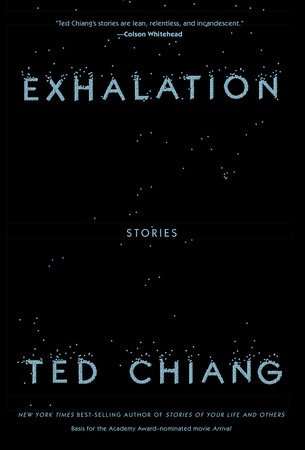
A Ted Chiang story collection can be said to resemble a rare meteorological event. A hyperobject. A comet streaking across the sky once, maybe twice in a lifetime. But whenever it lands, wherever it lands, the earthquake’s force is felt in the sternum. Every story, crafted with a watchmaker’s care and a tutelary’s vision, is a jewel.
Purchase the book
In the past, Chiang has written about how first contact with aliens can reshape the very way we communicate, how being able to encounter the beautiful, devastating powers of literal angels can both renew and break us. Here, he tackles time-travel, artificial intelligence, alternate realities, free will, and so much more. No matter the species of a story’s protagonist, no matter the universe that forms the story’s setting, the subject is always us.
Exhalation is his second collection after 2002’s Stories of Your Life and Others, spanning stories published over the course of a decade and a half.
Ted Chiang and I corresponded over email about language, about faith, cynicism, and astonishment.
Tochi Onyebuchi: In “The Lifecycle of Software Objects,” you write, “Aside from the enormous barrier to entry, raising Xenotherians won’t offer pleasures like the one [Derek] and Ana just got from watching Marco. The rewards will be purely intellectual, and over the long term, will that be enough?” This is in a story about raising digients, learning AIs that are like conscious Tamogotchis; Marco is a human-like digient, and Xenotherians are alien-like. There are these specific scientific notions you address in some of your stories: the Novikov self-consistency principle in “The Merchant and the Alchemist’s Gate” and the Sapir-Whorf hypothesis in “Story of Your Life.” These seem like very specific scientific principles you’ve attached flesh and muscle to. Do these principles occur as you’re writing? Do they precede the drafting?
Ted Chiang: That’s an interesting quote to use as the springboard for that question. The quoted line is about the effort required to raise a conscious being from infancy to adulthood and whether anyone can do a good job at it without an emotional connection. You’re asking about whether something similar applies when I’m writing a story. For me, the scientific idea is usually the initial impetus for a story, but by itself it’s not enough for me to start writing; I don’t begin drafting until I know the ending, which means knowing the conclusion of the plot and the protagonist’s arc.
I have occasionally wondered if I should try writing some kind of speculative nonfiction essay as a way of exploring an idea, but right now I don’t have a clear sense of what that would look like. I think fiction is the best vehicle for type of thought experiments I’m engaged in.
TO: To return to “Lifecycle,” Marco and Polo, two of the digients, want to legally become a corporation like Voyl, another digient. And that reminds me of a 2017 BuzzFeed essay you wrote where you spoke on how, when we say our greatest fear about artificial intelligence was that it would turn human, we really mean that our greatest fear about AI is that it would turn into a corporation, some hypercapitalist, completely amoral juggernaut that would bury humanity beneath a field of strawberries. Apocalypse by way of Kant. Could you speak to that idea of AI development?
TC: That story and that essay are approaching the question of AI from opposite directions. One of the questions the story addresses is, if you have a non-human entity that is conscious and capable of suffering, how do you secure it legal protection? There have been attempts to get chimpanzees recognized as legal persons, but so far none have been successful. By contrast, corporations have many rights we normally associate with human beings. While corporate personhood doesn’t provide the exact set of protections that animal-rights advocates are looking for, it might be an avenue for AI-rights advocates to pursue, if we ever wind up developing software that’s conscious. I should say, though, that we have absolutely no idea how to do that, and that’s a good thing, because if we ever do develop such software, I’m sure we will inflict huge amounts of suffering on it.
The essay is about a different question: if a superintelligent AI comes into being—which I seriously doubt—why do so many people think it would want to take over the universe? To me it seems like a projection of Silicon Valley capitalism: tech entrepreneurs think of themselves as rational, they prioritize growth above all else, so a superintelligent being ought to do the same. This isn’t intrinsic to the idea of a corporation as a legal entity, but right now American society glorifies the pursuit of profit, which often manifests as granting corporations more power and reducing their accountability. The idea that AIs will be cold and unfeeling is a product, I think, of our fear of technology, and one of the reasons we fear technology is the way it’s been deployed against us by capitalism, the ultimate cold and unfeeling machine.
One of the reasons we fear technology is the way it’s been deployed against us by capitalism.
TO: There’s a deep humanism in your stories such that even androids and parrots, in very fundamental ways, resemble us. I’m thinking particularly of the title story where an android develops curiosity regarding the source of its own consciousness. And yet so much of the conflict in those stories stems from the fact that those protagonists aren’t human. They seem to spin against the way they turn, if that makes any sense. And I was wondering if you could speak on that: a story’s narrative propulsion arising from non-humans exhibiting human characteristics.
TC: It all depends on the specific story. It’s impossible to accurately convey a non-human mode of thinking, but some stories try to evoke that. To an extent, “Story of Your Life” tries to do that. But “The Great Silence” is doing something else; while it does include a few facts about parrot behavior, it’s more like a modern fable, and bears the same relationship to parrot cognition as Aesop’s fable does to ant and grasshopper behavior.
“Exhalation” is doing something entirely different. Describing the narrator as non-human is a little misleading, because that term implies there are humans to use as a point of comparison. But “Exhalation” doesn’t take place in our universe at all, so there aren’t humans like us there; to put it another way, if there are humans in that universe, it’s the race that the narrator is a member of. It’s not accurate to call them robots, because the distinguishing characteristic of robots is that they’re manufactured, and they aren’t. It happens that they’re made of metal, but that’s just a cosmetic trait; they have the same standing in their universe that we do in ours. That’s why they sound like us.
TO: My two favorite stories of yours are “Hell is the Absence of God” and “Omphalos,” and I think what I appreciate most about both is that aspects of religion in the first and faith in the latter are dealt with seriously and, dare I say, compassionately. In “Omphalos,” particularly, religious faith serves as not only a compliment to scientific inquiry but an engine for it. Could you speak to the relationship between what we would consider scientific inquiry and other modes of thinking whose operation, some would argue, are premised on the absence of evidence?
TC: Before the word “scientist” was coined, individuals who studied the universe were called natural philosophers, and a lot of them were members of the clergy. They celebrated God’s glory by gaining a greater understanding of the world he created, and when they made a scientific breakthrough, what they experienced was akin to religious awe. Some people feel that wonder is incompatible with comprehension and requires mystery, but there is a long tradition of wonder in scientific research.
I think science and religion could more peacefully coexist if we could agree that they are trying to answer different questions; science is investigating the question, “how does the universe work?” while religion is investigating the question, “how should I live my life?” To my mind, it should be possible to separate these two. Deciding how to be a good person is not something that should depend on the results of a lab experiment. Of course, I recognize that it’s easy for me to take this position because I’m an atheist. People are always going to disagree about what is the right way to live, but I’d prefer it if they didn’t try to justify their arguments with assertions about the age of the universe or the origin of species.
Science is investigating the question, ‘how does the universe work?’ while religion is investigating the question, ‘how should I live my life?’
TO: In “The Truth of Fact, the Truth of Feeling,” you have this wonderful line: “And words were not just pieces of speaking; they were pieces of thinking.” And this story, more than the others, got me thinking about cognitive processes and how the very act of writing can mold someone’s understanding of the world. Which made me curious as to why you structured “Omphalos” as a prayer-in-parts. The latter story reads a bit like a Trojan horse answer to the question of what storytelling might look like in a pre-literate society. How did the structure of “Omphalos” come to you?
TC: That’s an interesting connection, because I didn’t see those two stories as being related at all. Obviously, “Omphalos” takes place in a literate society, and as far as I know the role of prayer isn’t significantly different in literate and oral societies. “Omphalos” is structured as a private conversation with God, which is a type of prayer, but not the plea or petition that is commonly associated with prayer; it’s more about feeling a connection to the divine in one’s everyday life. As I mentioned in my answer to the previous question, there was a time when the practice of science was entirely compatible with the practice of religion. “Omphalos” takes place in a world where scientists are constantly reminded of God’s existence, so it seemed like a good fit for the narration to take the form of the protagonist addressing her thoughts to God.
TO: A recent development in science fiction is the uptick of translation of works from other languages into the American market. Ken Liu’s work with Chinese short fiction as well as with Liu Cixin’s Remembrance of Earth’s Past trilogy. The stories in the collection Iraq + 100 by Hassan Blasim. What role do you see this increasing availability of stories that did not originate in English playing in the genre’s future?
TC: When Liu Cixin’s Three-Body Problem first came out in English, I encountered a number of people who said they couldn’t get into it because they thought the translation was bad. I think what they meant was that the novel didn’t read as if [it] had originally been written in English. For example, if you didn’t know Umberto Eco’s The Name of the Rose was originally written in Italian, you probably wouldn’t be able to tell based on reading William Weaver’s translation. Three-Body Problem isn’t like that. It definitely feels foreign, and I like that it offers a glimpse into a foreign tradition of science fiction. And while I haven’t read Iraq + 100, I did read a review where the reviewer said that a story “which perplexed me in English with its unconventional form and meandering style, made perfect, striking sense if I imagined it in Arabic, shifted it into a different storytelling context.”
In theory, science fiction readers should be interested in different ways of looking at things, and science fiction translated from other languages definitely offers that. It may take a little time for American readers to adjust to foreign styles of storytelling.
Writing isn’t fun for me, but it’s something I have to do.
TO: In her 1989 essay, “Write Till You Drop,” Annie Dillard writes: “You [writers] were made and set here to give voice to this, your own astonishment.” Would you say this mission statement is a true accounting of you and your work?
TC: When I was a student at the Clarion Workshop, I had an excerpt from that essay taped to the door of my dorm room which included that sentence, and when I speak to writing students nowadays, I always quote that excerpt. That essay is available in Dillard’s book The Writing Life, and I find myself quoting from that book all the time. For example, at another point she writes, “A well-known writer got collared by a university student who asked, ‘Do you think I could be a writer?’ ‘Well,’ the writer said, ‘I don’t know. . . . Do you like sentences?’’’ I make no claims about my capabilities as a prose stylist, but I like sentences. While some writers are driven by images or scenes or characters, it’s when I get a sentence in my head that I feel that there’s a story I need to write. Elsewhere she says, “I do not so much write a book as sit up with it, as a dying friend. I hold its hand and hope it will get better. During visiting hours, I enter its room with dread and sympathy for its many disorders. I hold its hand and hope it will get better.” Writing isn’t fun for me, but it’s something I have to do.
TO: Despite the dark edges of human nature your stories explore, a thread of hope runs through them. Is that a natural part of your process or is there an active struggle against cynicism at work? I’m thinking specifically of “What’s Expected of Us” and “Anxiety is the Dizziness of Freedom.”
TC: Back when I was a teenager, I was often accused of being a cynic, and my reply was always that I was a pessimist, not a cynic. The difference being that, while I often expected bad things to happen, I believed people were basically decent, or at least upfront about their motives. Since then, I’ve seen—both from a distance and up close—how often people’s behavior is rooted in malice or hypocrisy, so it’s fair to say that I’m a cynic now. (They say no one is more cynical than a disillusioned idealist.) Many writers draw on such experiences as fuel for their fiction, but my imagination doesn’t seem to work that way. It’s not so much that I have to actively struggle against cynicism in my work as it is that I’m currently less interested in stories that reinforce cynicism.
Science fiction uses science to illuminate the human condition, and that’s what makes it worth reading and writing.
TO: Something that occurred to me while reading “Omphalos” is that they all, your stories, seem to be about scientific breakthrough. But instead of the object of scientific inquiry being a device or any physical aspect of the universe, the object is personhood. Us. If there is any thematic spine connecting your stories, it seems to be this.
TC: Faulkner famously said, “The only thing worth writing about is the human heart in conflict with itself.” I love science, but if we’re talking about fiction rather than nonfiction, science isn’t enough to sustain a narrative. Science fiction uses science to illuminate the human condition, and that’s what makes it worth reading and writing, in my view.
There are many things people say when they’re lost for words in the face of someone else’s tragedy but “God will not allow you to be tested beyond your ability” must be the worst of them. My first response, as a Singaporean schooled by its notoriously harsh education system is: if this is a test, what’s the exam going to look like? Apart from that, the sentiment implies a complete loss of agency, plus the existence of a god that plays with its people the way kids experiment with insects, pulling one wing off, then the other, then its legs in slow succession, just to see at what point a wriggling creature becomes a husk of a thing.
Buy the book
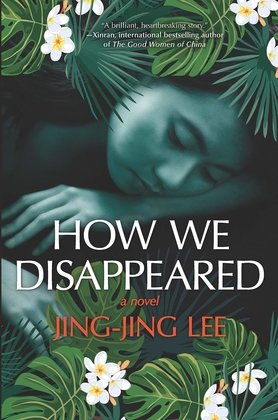
In my novel, How We Disappeared, several characters are tested for their ability to move beyond physical pain, loss, and most of all their ability to survive a war that few want to speak honestly about. The heart of the book involves a former “comfort woman,” a galling euphemism for those taken to be sex slaves by the Japanese army during World War II.
Unbeknownst to me, I had woven a strand of my family’s experience during the war into the plot – a part of our history my father must have told me about when I was too young to process the information, too small to know that it was of any importance. It’s hard to decide who had a luckier ending. The survivor in my novel, an elderly man who learns to deal with his war trauma in his own way, or my great-grandfather, who went to his grave raving about the massacre a company of Japanese soldiers had unleashed on his family.
The books I’ve chosen below are about surviving wars, literal and metaphorical, and about the people, real and not, who have come through on the other side.
In a later edition of Oranges Are Not the Only Fruit, Winterson admits in the introduction that it is somewhat of an autobiographical novel (both “not at all and yes of course”). It’s a David-and-Goliath story, Goliath made all the bigger because David grew up under the giant’s roof, was watered and fed and raised by the giant. Most of all it’s a story of a child who saves herself.
I was twelve and together we read Homer’s Iliad (not The Odyssey) ––– though mostly Don read aloud to me;
Were it not for the fact of the narrator’s age, one might read the beginning of this lyric memoir and mistake it for romance verse. Because uses this single, powerful word to weave together a clear-eyed patchwork of memory that surround his years of abuse by a family friend. Each of the verses end with a semi-colon and at the last, the use of it hints at a beginning – if not a way to catharsis, then something, at least, that presents the hope of it.
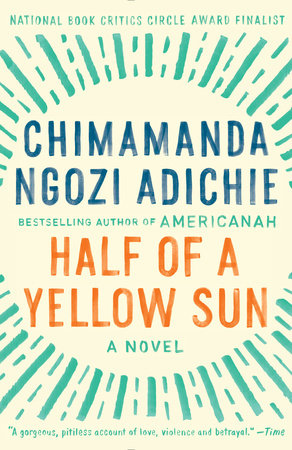
“‘There are some things that are so unforgivable that they make other things easily forgivable,’ Kainene said. There was a pause. Inside Olanna, something calcified leaped to life.” Set in post-colonial Nigeria, Half of a Yellow Sun is as much about the calamities that cleave people together (and apart) as much as it is about politics and identity before, during, and after the Biafran war. Adichie’s mastery of her material leaves the reader reeling from the scope and force of history.
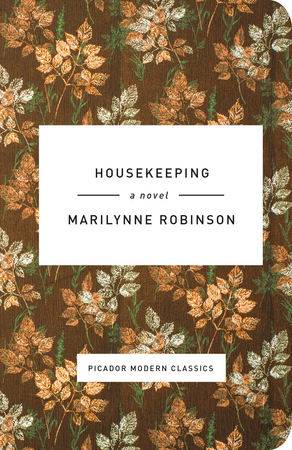
The novel opens with the story of two sisters, such “small, unnoticed, unvalued clutter,” and their slow abandonment – first by their mother’s suicide, then by the passing of their grandmother. When Sylvie, their aunt, takes over their guardianship, she sets about keeping house but her rueful efforts only serve to convince Ruth and Lucille that her presence, too, is fleeting. Everything in the book drips of loss – even the various place names (“Lost Hills Hotel,” “Fingerbone”). The writing brings eloquence to the vocabulary of grief in a way that only Robinson can.
Written by a survivor of a sarin gas attack, My Country gives voice to a people most readers are used to seeing as victims and refugees. Eid writes about living under al-Assad’s rule, watching his friends and family die, and taking up arms. The current devastation of Syria and its people is made all the more poignant set against the author’s loving recollection of his childhood home.
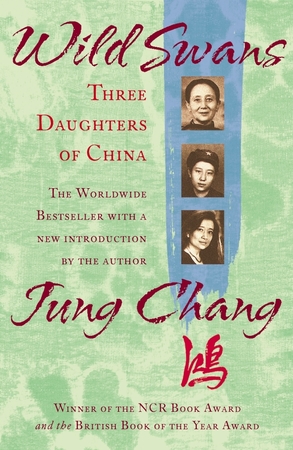
Banned in the author’s birth country for its portrayal of Maoist China, Wild Swans is an epic biography of a family as seen through the eyes of three women: Chang’s grandmother, her mother, and Chang herself. Chang, who was sent to re-education camp as a teenager, presents a sweeping picture of China in the twentieth century. This book is an intimate account of how the cultural revolution devastated families and devoured its own children.
“On this road there are no godspoke men. They are gone and I am left and they have taken with them the world.” Stripped of all unnecessary description and backstory, this is an apocalyptic world made all the more horrifying for its lack of vivid detail. There is only dim light, the complete lack of it, and cold, as father and son walk southwards through a devastated American landscape in search of the coast.
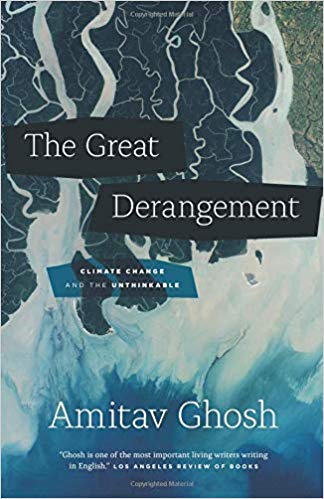
In his book-length essay The Great Derangement, Amitav Ghosh makes the case for a new literature of climate change. He argues that the modern novel is not up to the task of representing a vague, omnipresent threat to the survival of humanity. Fiction is too obsessed with the inner lives of its characters to survey a changing earth. What we need, he contends, is a full overhaul of what counts as “serious fiction”: a shift from close-focus domestic realism to a global view of environmental vulnerability. The criteria of literature must be adapted to make room for the aesthetic conditions of ecological catastrophe.
Ghosh acknowledges that environmental apocalypse isn’t a brand-new literary concern; he cites several authors, including himself, whose work he sees as integrating “the unthinkable” of climate change in fiction. Finally, though, he believes that the catastrophe of climate change will require an artistic storming of the gates. “I think it can be safely predicted that as the waters rise around us, the mansion of serious fiction, like the doomed waterfront properties of Mumbai and Miami Beach, will double down on its current sense of itself, building ever higher barricades to keep the waves at bay.” If one function of fiction is to help us understand the world, Ghosh thinks the literature we have now is failing in the face of global warming. We’ll need new genres, structures, maybe even words.
In fact, climate change is far from a new subject for literature. On the contrary, the variable, impassive earth is a motivating image in many of the works we already celebrate. The scale of the incoming disaster is unprecedented; our vulnerability to the climate is familiar. We just have to recognize the theme for what it is.
Ghosh notes that the scale of global warming makes it difficult to grasp and therefore hard to write about, citing Timothy Morton’s term “hyperobject” for the phenomenon. But he doesn’t acknowledge the flip slide: Precisely because of its scale, the outline of climate change may be perceived everywhere. The real alchemy of meaning takes place not on the page but in the mind of the audience. In other words, the rumbling of the archaic voice of the earth is audible as long as the reader is alert to it. Ghosh’s idea that the “individual moral adventure”—John Updike’s definition of the novel— in fiction and the phenomenon of global warming don’t go together is too categorical. Even literature that is driven by individual characters and complicated moral growth is full of insights and premonitions of climate change.
The variable, impassive earth is a motivating image in many of the works we already celebrate.
In fact, much of “canonical” Western literature unites the individual moral adventure with a sense of collective responsibility toward the earth. Ghosh doesn’t deny this, but gives too much weight to contemporary fiction as shaping our view of the world, compared to the sort of texts that many people read in college. For example, Shakespeare’s Macbeth is thoroughly modern in its treatment of human psychology, but the language of climate is also everywhere in it (sometimes in the same sentence). Greed “grows with more pernicious root / Than summer-seeming lust,” and the prophecy of Macbeth’s fall hinges on the idea that a forest can rise up and do battle. One of the most remarkable nature lines is Macbeth’s own: “The earth was feverous / and did shake.” He imagines the earth as weak like a stricken child or elder, and realizes that he is a viral agent of the world’s disease. The land suffers when the people on it delight in cruelty. Dante Alighieri gives us similarly piercing metaphors in The Divine Comedy. In Canto IX of the “Inferno,” he writes, “That marsh, which sends out so much stinking breath, / surrounds on every side the weeping city / which we cannot now enter without wrath.” The image homes in on the secretions of the face, making a startling connection between carbon dioxide-producing breath and tears, what humans sow and reap. Substitute “that marsh” for “the factory,” and you have an indelible description of modern day Beijing.
A highlight of The Great Derangement is Ghosh’s analysis of the way that industrial arrogance and blinkered imperialism shroud our essential vulnerability to nature. But is a whole new aesthetic of fiction necessary to remind us of this? Here’s King Lear, exiled to the countryside:
Poor naked wretches, wheresoe’ever you are That bide the pelting of this pitiless night, How shall your houseless heads and unfed sides Your looped and widowed raggedness defend you From seasons such as these?
The sensation of cold rain on unprotected skin and the dull, insistent irritant of hunger were new experiences to the fallen King Lear, as they will be to us Europeans and North Americans when our infrastructure collapses to rising water levels. Like Lear, we’ll soon find out that no matter how stable the worlds we build around us seem, they are arbitrary and impermanent.
We will also learn to stop assigning benevolence to certain kinds of weather. Under the extremes caused by global warming, we will grieve for the rain during the heat and the sun during the storms. In The Aeneid, another classic story with the momentum of an individual moral adventure, Virgil was alive to a very modern worry, disease of the sun. He describes pale ghosts from “Down Below” being “exposed to the scaring light” (the translation is by David Ferry). Listen to the sound of that “scaring”: it twists the rays of the welcome sun into something ugly, modern, prophesying what now mutilates our skin.
Ghosh predicts that one of the first casualties of climate change will be our “uniformitarian expectations” about “the regularity of bourgeois life.” The one book in every standard hotel room can tell us much about that disruption. In the Old Testament, the chronicler describes a famine. The Arameans “laid siege against [Samaria] till a donkey’s head cost eight pieces of silver and a quarter of a qab of pigeon droppings five pieces of silver” (2 Kings 6:25, in the new translation by Robert Alter). It is a kind of nightmare shopping list, and not far removed from the reality of modern famines, as Yan Lianke’s 2015 novel The Four Books, about the Cultural Revolution, confirms. We also know that the poor will be affected most by climate change. This line from the Hebrew Bibleevokes the persistence—even flourishing—of economic exploitation in times of bitter suffering.
In the new literature Ghosh imagines, writers will better understand how to situate people within the whole environment. Animals, rivers, mountains will also be actors in the upcoming apocalyptic drama; we will learn not to “arrogate all intelligence and agency to the human,” Ghosh writes. In the introduction to the Decameron, Giovanni Boccaccio similarly points out the entanglement of human and animal life in times of crisis. “It was frequently observed, that things which had belonged to one sick or dead of the disease, if touched by some other living creature, not of the human species, were the occasion, not merely of sickening, but of an almost instantaneous death,” he writes. We share our destiny with everything else on earth. Boccaccio’s forceful language shows how perilous it is when we think we can unwind and separate our fates.
In The Great Derangement,Ghosh doesn’t mention the literature of the Flood, humanity’s great dress rehearsal for ecological catastrophe. This literature definitely isn’t modern, and is far removed from his understanding of the “serious,” realistic novel. Still, these are widely read, foundational stories that often feature singular heroes, and they accomplish much of what a new fiction could. In his Metamorphosis, Ovid describes the flood like this: “The rivers spread and swept away together / Crops, orchards, cattle, men, / Temples and shrines with all their holy things.” The gods are no match for rising water levels. Our secular objects of worship—especially, as Ghosh argues, beachfront real estate—won’t be either.
The ancient chronicler of Genesis writes of the flood, “All that had the quickening breath of life in its nostrils…died.” The adjective “quickening” is a profound statement on the shortness of human and animal life compared with the progress of ecological time, expressed with an almost magical compression typical of the Hebrew Bible. Another verse, from 2 Kings 2:19, thought not about the Flood, is equally concentrated when talking about the climate: “The water is bad and the land bereaves.” The construction “the land bereaves” might do the work of a hundred explicit climate change novels, if a fraction of the sheer interpretative power focused on the Bible was diverted to also consider its premonitions of global warming.
Perhaps most resonant, however, is the Epic of Gilgamesh. Sometimes it’s helpful to turn to another artist’s reading of a classic story, and the composer Gérard Grisey’s setting of text from the Gilgamesh myth from 1998 is, to my mind, the definitive interpretation. “I opened a window / And the day fell on my cheek,” a soprano sings, exposed to music that is gently waving, crystalline, hushed. You can hear the wind players gasping for breath during these long passages, as a person might who has narrowly avoiding drowning. “The dissociation…between the voice and the music is a sort of reflection of the situation of the human and the cosmos,” Grisey wrote in his journal in July, 1996. “Fusion and harmony or indifference and sterile struggle.” Gilgamesh imagines a place most climate change predictions don’t dare to go: a world not just of suffering, but possessed of a stillness beyond humankind.
We already have enough art to help us understand the threat of climate change. We just need to look at it with the appropriate paranoia.
The aesthetic goals Ghosh sets out in The Great Derangement are still worth pursuing. The point is that we already have enough art to help us understand the threat of climate change. We just need to look at it with the appropriate paranoia. Read Another Book, goes the meme about Harry Potter obsessives; when it comes to understanding global warming, I might instead admonish, Read Almost Any Book, and, if you are aware of the scale of the threat, you will be struck by prophecy. Besides, there are psychological reasons why we might get more from what Ghosh calls literature “that grapples with climate change avant la lettre.” Rightly or not, we tend to give more weight to predictions from the past. The disaster movie 2012 (2009) parlayed a dubious Mayan prophecy into a worldwide gross of around $750 million, when the real apocalypse is already here.
Sometimes it also seems like human imagination flourishes most when kept partly in the dark. Do we extrapolate a worldview from snippets of language better than we synthesize vast quantities of information on an issue like climate change? In politics, global warming is an all-encompassing problem that will require all-encompassing solutions. Ghosh imagines equally revolutionary changes in art. But I think that art works its wonders best through isolated moments, because the tiny lights that spark epiphany are everywhere.
A ring containing a lock of Charlotte Brontë’s hair was recently discovered on an episode of Antiques Roadshow that was filmed in northern Wales. The next step was obvious:
We were so preoccupied with whether we could do this, we didn’t stop to think about whether we should. Below, a few scenes from Brontësaurus Park.
Dr. Alan Grant slowly stands to look out of the Jeep, while Dr. Ellie Sattler stares at the strip of lace she is holding, marveling. “This type of embroidery hasn’t been done since the Victorian Period,” she says. “This thing—”
Grant stops her, grabbing her by the head and turning it to make her see what he’s seeing. Sattler slowly rises to her feet, mouth agape. There, in the near distance, they see what appears to be a living, breathing Elizabeth Barrett Browning sitting at a table not too far from them, hunched over and scribbling in a notebook. “It … it’s a writer,” gasps Dr. Grant.
“Is … is she a novelist?” Dr. Sattler asks.
“No, no, not a novelist at all,” Alan reassures. “Just a poet. See? Look at the line length. We’re perfectly safe.”
Now from the Jeep rises another of their party. It’s MFA candidate Ian Malcolm. Staring at Browning, he mutters to himself, “He did it. That crazy son of a bitch did it.”
Grant and Sattler move closer to Browning, shielding their eyes from the sun, trying not to disturb the writer.
“This thing writes 25, 27 words per minute,” Grant exclaims.
‘You’ve got a Brontë?’ asks Sattler, gasping. ‘He’s … he’s got a Brontë!’
“Barrett Browning?” asks their thesis advisor, John Hammond. “30, easy. And we clocked Charlotte at 32 words per minute.”
“You’ve got a Brontë?” asks Sattler, gasping. “He’s … he’s got a Brontë!” She sits down.
“Say again?” asks Grant.
“We’ve got a Brontë,” replies Hammond. Grant is feeling faint. He sits on the ground.
Hammond strides out in front of them, and, looking out over the rolling fields and forests dotted with small cafes and parchment and quill shops, declares, “Dr. of Comparative Literature Grant, Dr. of Victorian Literature Sattler … welcome to Brontësaurus Park.”
Nedry, an adjunct, tumbles down a hill and into the mud, losing his glasses. It is night, and pouring rain.
“Where are my glasses?” he asks, digging through the mud. “I can’t afford new ones. I’m an adjunct.”
Just then, he hears a hooting. He sees a figure leap behind a tree, then more hooting. The figure flashes by again, and still, more hooting. Nedry looks around in a panic. Who is it?
Suddenly, she appears. A small, pale woman wearing full evening dress and a smart bonnet.
“Oh. Uh, nice girl. Nice writer,” he says, trying to stay calm. “I thought you were one of the Brontës. But you’re not so bad. No. Okay. Run along. I don’t have any Moleskines for you. What do you want? What do you want, food? I have nothing on me.”
He slowly reaches towards the ground and finds a #2 Ticonderoga pencil.
“Here,” he says, waving the pencil. “You want a quill? You want a nice ink quill? Here,” he says, throwing the pencil as far as he can. “Go get it. Get the quill, girl! Get the quill!”
The woman looks behind her, then slowly turns back to gaze upon Nedry.
“Ah, no wonder you’re without a husband,” he mumbles. “I’m gonna burn your manuscript when I come back,” he declares, before turning to climb back to his Jeep.
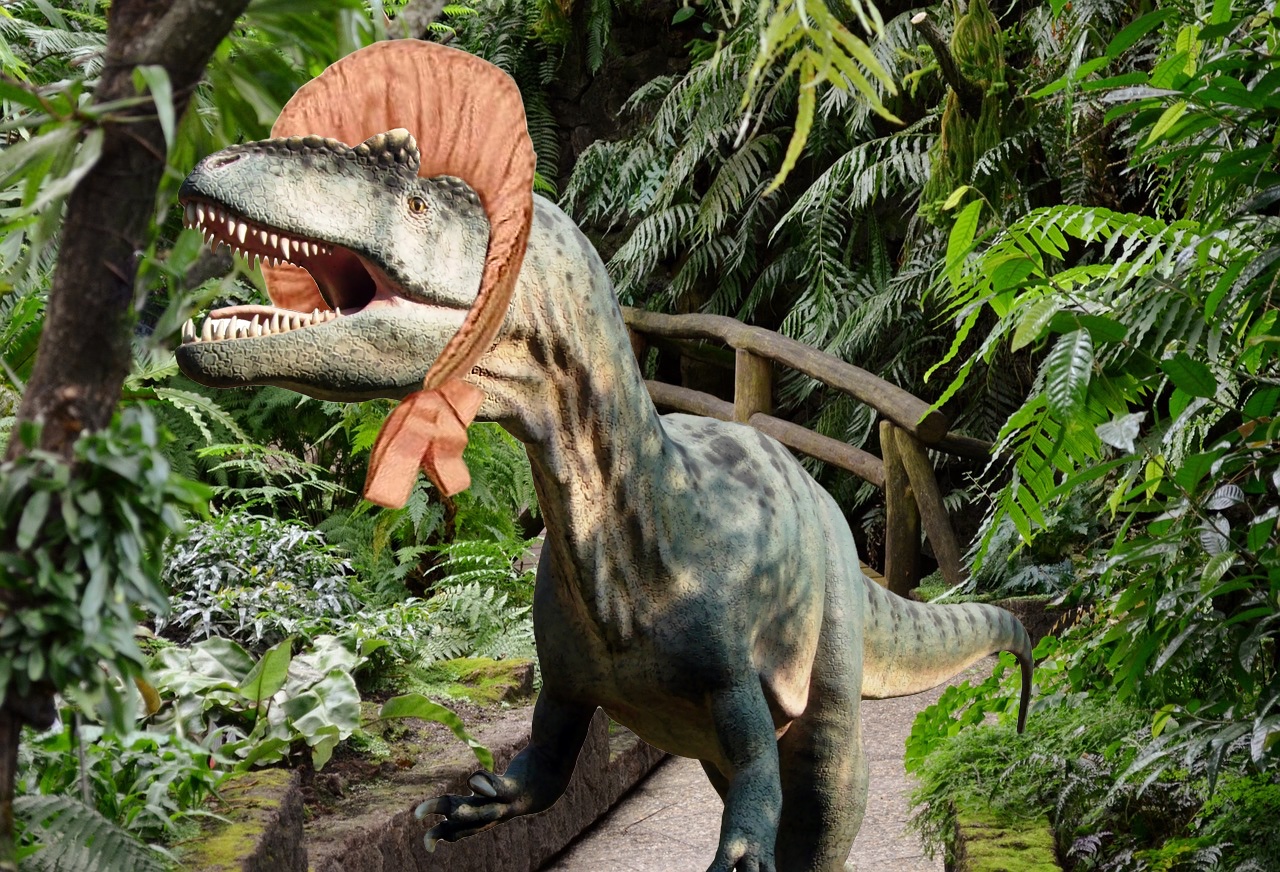
But the woman follows. Nedry turns around in fear, and a slow smile spreads across her face: then, she emits a horrifying shriek, as a large Tudor ruff quickly unfurls around her face. She screams, and then coughs a dark liquid all over Nedry.
She emits a horrifying shriek, as a large Tudor ruff quickly unfurls around her face.
Nedry claws at his face in a panic, and then stops suddenly, realizing something. With terror in his eyes, he looks slowly down at the white handkerchief he brought with him to diagnose consumption.
It’s just as he suspected. Covered in a spray of blood.
In the distance, through the rain, Tim, the TA, hears it: a subtle boom, boom, boom. If he had to guess, based off of books he’d read, he would guess it was the sound made by a woman stomping in calf-high, side-laced Adelaide boots. The idea is almost too terrifying to entertain. But then he hears it again.
Boom.
Boom.
Boom.
Tim slowly leans over the front passenger seat, staring at the two mugs of mead sitting on the dashboard. For a moment, nothing. And then, across the surface of the mead: ripples.
Boom.
Boom.
Boom.
Something crashes against the buggy with a loud bang, and they all leap back in horror: through the torrential rain, they see the gore. It’s half a manuscript, ripped to shreds, simply dripping with red ink.
Who threw it? Tim stares out the window and at last, spots it: a single white arm, covered in a pale lace dress glove. Slowly, Tim looks up, up, up, up, and for the first time, at last, we see her in all her brutal glory: it’s a real life, full sized Charlotte Brontë. She turns her head slowly to meet Tim’s eyes.
“What … what did you do with the man who was editing your manuscript?” Tim whispers.
A slow, vicious grin spreads over Brontë’s face.
“Don’t you know?” she asks.
Tim shakes his head.
“Reader,” she responds, cocking her head, “I buried him.”
Outside the Jeep, Brontë’s boot comes crashing down into the mud, leaving behind the kind of monstrous footprint you’d usually only see in a museum: a woman’s 6, maybe even 6 ½.
She is looking for Tim. He scrunches into a ball, trying to stay small, but she spots him. Her eye, big and yellow, widens. A symptom of untreated hyperbilirubinemia, most likely. There was only one doctor in the park, after all, and he was needed elsewhere, as the Baker girls had the croup.
Charlotte spots Tim and lunges at the Jeep. Tim scrambles away from her, but there’s not much room in the Jeep for him to move. Stretching towards the car, Charlotte Brontë opens her gaping mouth wide … and says, “I noticed you were alone. Is your family in want of a governess?”
Tim screams and kicks, while she cries that she has considerable experience and could be quite a helpmeet for a man of his stature, and she promises she won’t be a bother as she keeps her mouth shut and does what she’s told and, besides, she doesn’t require much, just room and board and perhaps a pint of scum pie every once in a while.
“Go away!” Tim screams, and kicks at her again.
“I do not think sir,” she says, huffing, “you have any right to command me, merely because you are older than I, or because you have seen more of the world that I have; your claim to superiority depends on the use you have made of your time and experience.”
But she cannot reach him, neither with her words nor with her arms, and so she backs away, sniffing, “Well enough. I care for myself. The more solitary, the more friendless, the more unsustained I am, the more I will respect myself.”
She starts walking away, and then turns back to look at Tim. “I have as much soul as you,” she roars. “And full as much heart.” Then she turns and stomps away.
In her wake, a trail of those horrifying size 6.5 footprints, full to the brim with rainwater. With every retreating step she makes, the water quivers.
An unfamiliar woman—tall, peaceful looking—approaches Dr. Grant and the children where they are resting in their tree perch.
Lex scoots backwards in fear, screaming, “Go away!”
“No, no, it’s okay,” Dr. Grant reassures her as the woman tilts her head back and forth, examining them. “It’s a Gothic. It’s Mary Shelley. She’s perfectly safe. Look, see what she’s holding in her hand? Look at that. It’s a first draft. Can you believe it, Lex? We’re looking at a genuine Mary Shelley first draft!”
Lex slowly leans forward, closer to Shelley.
“Can … can I see it?” she asks, timidly.
Shelley nods, and reaches her long arm up to the tree perch to hand Lex her notebook.
“It is still a work in progress,” Shelley admits. “I haven’t quite landed on my final title.”
“What do you call it?” Dr. Grant asks. “If I may ask.”
Shelley nods. “For now,” she said, “I’m calling it Frankenstein: Life, Uh, Finds a Way.”
Dr. Grant shakes his head and smiles.
“Clever girl.”
A hoard of writers storm past Dr. Grant, Tim, and Lex.
“Tim,” Dr. Grant says, grabbing Tim’s shoulder. “Who are these people? Can you tell us what they are?”
Tim squints. “I think … they’re editors.”
“Can I talk to one? Are they safe?” Lex asks.
These are aggressive, living copy editors that have no idea what century they’re in.
“No,” Dr. Grant says, grabbing her arm. “These are aggressive, living copy editors that have no idea what century they’re in, and they’ll defend themselves and their view of the progressive passive, violently if necessary.”
As the swarm of editors rush down the hill and towards them, the three scramble behind a nearby fainting couch to stay safe and out of sight.
And that’s when they hear it: the all-too familiar boom that could only come from a certain size 6.5 woman’s boot. Dr. Grant peeks over the edge of the couch just in time to see Charlotte burst from the forest. She grabs one of the editors by the throat while the others flee.
“Life appears to me too short to be spent nursing animosity, or registering wrongs,” she hisses.
“I’m glad we agree—” starts the quivering editor.
“And yet,” Charlotte continues, talking over her. “It has been a fortnight since I have sent you my latest manuscript, and have as of yet received nothing in return but your most bitter silence.”
“But—” started the editor.
“No,” hisses Charlotte. “Stop. Hold on to your ‘but’s.”
It is morning now, and quiet. Weeks have passed since the surviving members of the team fled Brontësaurus Park by helicopter. The island is calm, still, mostly unchanged except for a reminder here and there: the torn fence, the ransacked kitchen, the Visitor’s Center where Charlotte fought against Emily and Anne, now in shambles.
We have forgotten how beautiful the island is. Look, here, a quiet stream, bubbling, winding through the forest. Follow the stream: watch it drop off into a waterfall. See the rocks at the base of the fall; see washed up on the muddy banks next to the rocks, a red, white, and blue-striped Barbasol can, torn open, empty. Look: see leading away from the stream and towards the forest, footprints. We thought we had seen horror before, but here, now, staring at impossible size 8 bootprints, we know suddenly that our horror has only begun.
Follow the footprints to just inside the forest, where a gruesome scene awaits: the remnants of what appears to have been a game of whist, violently disrupted, the chairs toppled, the cards scattered every which way. Outside of the wreckage, only one set of boot prints continue: onward, towards the center of the island.
Back at the base of the stream, the Barbasol can spilled open, empty. Crouch down: here, our only two clues as to the can’s previous contents: slivers of a shattered test tube, and a small identification tag, yellow, square, the type used to label scientific specimens.
A small, yellow, square identification tag upon which is typed, simply: J. Austen.
Like many Australian Jews of my generation, I grew up in the shadow of the Holocaust. My grandparents were survivors, the kind who fled to a faraway land where they wouldn’t have to speak of the horrors they had endured. I revered them, awed by the very fact of their survival, and did not dare ask questions. Instead, I sought some kind of understanding in the vast, overcrowded field of Holocaust literature. I began with the classics: the survivor memoirists and novelists around whom the canon has been built. From there, the pickings were endless. With every book I devoured, I recast my grandparents as the central characters, sending them back to their unspeakable, private hells.
Deeper into the labyrinth I ventured, hundreds upon hundreds of books, mostly novels. The more I read, the more I began to notice a disappointing sameness to many of them. In the 75 years since the Holocaust, much of its literature has come to fit into neat narrative templates. At best, we see variations on a theme, triumph over unimaginable adversity, usually riffing on recurring tropes that border on cliché. At worst, we get schmaltzy dreck that minimizes, sanitizes, or otherwise distorts what happened. Casual readers could be forgiven for dipping into a couple and moving on, convinced they’d read what they need to about the subject. But every now and then there will be those small few exceptions, novels so astoundingly original, so daring, that they will demand the attention of even the most seasoned, fatigued readers. Here are seven Holocaust novels that smash the template.
In occupied Prague, Mr. Theodore Mundstock sets up a mock concentration camp in his apartment to acclimatize to his fate. Accompanied only by his shadow (both Greek chorus and devil’s advocate) and some weird bird-like creature, he lays out a wooden board, practices stockpiling scraps of food and simulates assaults by over-zealous camp guards. He also acts as self-appointed bringer-of-hope to those around him, promising his neighbors that they need not fear deportation as the war will end before ‘the Spring”. It is as sad as it is calculated. Is he just mad or do these baseless promises help the others survive? Mr. Theodore Mundstock is one of the best, albeit strangest, novels I have read. With generous scoops of both comedy and tragedy, it confronts very difficult issues of morality and honesty in times of crisis, all the while questioning what amounts to rational action when the entire framework of rationality has collapsed.
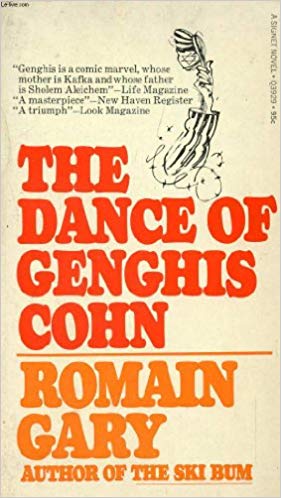
Moishe Cohn was a small-time clown on the Yiddish burlesque circuit. Murdered at Auschwitz, his last and most glorious prank happened at the moment of death: he turned around and bared his butt at the firing squad. Twenty-five years later he is still up to his old tricks, albeit only in spectral form, possessing and messing with the mind of the man who killed him. Detective Schatz, formerly SS officer Schatz, is a high-ranking policeman in a small German town where he is enmeshed in an investigation into a series of murders. Gary mines this rather wacky setup to hilarious comic effect, but in doing so manages to tackle some very big issues—complicity, reconciliation, retribution and the absurdity of de-Nazification. It is as disturbing as it is funny.
When Daša Drndić died last year, the world lost one of its finest and most challenging writers. Trieste is, without a doubt, her greatest work. A masterclass in documentary fiction, it seamlessly weaves photographs, maps, Nazi documents and transcripts from the Nuremberg trials into the narrative, to tell the story of Haya Tadeschi and her relationship with the Nazi monster, Kurt Franz. The novel begins at the end: Haya is sitting alone in a nursing home, sifting through old photos, awaiting the arrival of a son she gave away as part of the Lebensborn program and had long presumed dead. What follows is a complex and harrowing meditation on the sliding doors of history in which the conventional fact/fiction divide is blurred beyond recognition. At times, the documentary elements are used to staggering effect. One chapter is just a list of the 9,000 Italian Jews killed during the war. Dizzying.
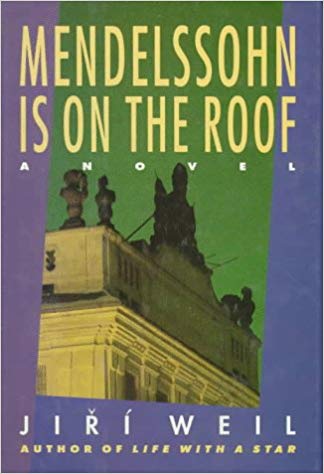
The rank absurdity of the Nazi obsession with racial theories has never been so hilariously derided than in Weil’s 1960 novel set in occupied Prague. Acting Reichsprotector Heydrich is giving an architectural tour to a visiting German dignitary, waxing lyrical about the Baroque style and gothic features of the various buildings. Heydrich plans the tour to end at the opera house, and to prepare for this grand finale he orders that a statue of the Jewish composer Mendelssohn be removed from the roof. Of course, the SS men given the task have no idea which statue is Mendelssohn, so they revert to stereotype and try to smash the one with the biggest nose. That, it transpires, is Wagner. They eventually get it right, toppling Mendelssohn, but leaving him on the roof, from where he comes to life to seek revenge. It is all very Don Giovanni which, not coincidentally, is the very opera Heydrich and his guest are watching inside.
Ghosts, both literal and metaphorical, haunt this extraordinary novel that reckons with one village’s collective responsibility for wartime atrocities. Kurt Weber inherits his great uncle’s country house and goes through the one door he was never allowed to open as a child. As with any good horror story, what he finds inside cannot be good, but here the frights come in the form of revelations—fragmented and hallucinatory—about his family’s involvement in the operation of a nearby concentration camp and their desperate attempts to bury the evidence afterwards. The deeper Weber digs, the more he comes to realize it’s not just his family but all his neighbors who share in the guilt. A damning indictment on the ease with which one slips from bystander to perpetrator.
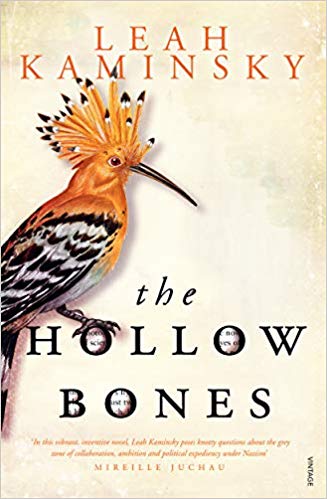
The decaying pelt of a stuffed panda narrates a good chunk of this novel that reimagines one of the strangest episodes of the Nazi era. It’s 1938 and Ernst Schaeffer, unswervingly ambitious scientist and explorer, is tapped by the SS to lead an expedition to Tibet to discover the origins of the Aryan race. Nazi ideology swiftly poisons his worldview, as he sacrifices everything to ambition, including his fiancée, Herta. The Hollow Bones is a taut, if absurd, adventure that is unafraid to ask big questions. More conventional novels have explored similar ground—what happens when science and ideology collide—but few have used such an obscure and thrilling historical footnote to do so. And, for what it’s worth, you can even visit the panda at the Philadelphia Museum of Natural History if you happen to be in the neighborhood.
In terms of rank brutality, moral bankruptcy and the banality of evil, Hilsenrath’s extraordinary novel knows no equal. Breaking every template in the Holocaust narrative playbook, it tells the story of Max Schulz, a ruthless concentration camp guard who, after the war, assumes the identity of his dead childhood friend Itzig Finkelstein and escapes to Palestine. There he becomes a fighter alongside the very people he had been actively trying to exterminate, helping in their struggle to establish a homeland. Schulz is a truly grotesque creation, constantly seeking to shift blame and present himself as just a regular guy swept up by circumstance. It’s an uncomfortable and, at times, repulsive read. Yet, as a satire of German post-war reckoning, it’s also outrageously funny. Little wonder Hilsenrath, himself a Holocaust survivor, struggled to find a publisher in his homeland.
Why do we leave home and country? If all unhappy families are unhappy in their own ways, then there might be just as many reasons for emigration. Some leave because they have to. I became an immigrant to the United States somewhere along the spectrum between chance and choice. Reading Chia-Chia Lin’s The Unpassing brought back with force all the self-doubt, second-guessing, and dithering that has been part of my own long process, by no means over, of leaving home. After more than a decade away, the lure of undoing the journey still beckons, even as I understand rationally that no true return can be possible.
Purchase the novel
In Lin’s novel, a family of five emigrates from Taiwan to Alaska because of the father’s ambitions. There, they are shortly joined by a sixth, the baby of the family. But tragedy strikes, and the youngest of them passes away just as the space shuttle Challenger disaster shakes America. What follows is narrated by Gavin, the middle child, himself fresh from a narrow brush with death. Lin’s evocative passages and brilliantly observed details place the reader in a landscape rendered at turns foreboding or desolate by the family’s calamities. There is much to savor in her deft ability to conjure atmosphere. Garth Greenwell raves: “Maybe once or twice a year, I read a book that’s so good I want to proselytize about it. […] When I finished it I felt like I couldn’t breathe.”
I talked to Chia-Chia Lin about her debut novel, exploration, and child narrators.
YZ Chin: I really admire the title. “Unpassing” is a word that can’t be found in Merriam Webster, but feels familiar enough that readers would have some idea of what they think it means, only to second-guess themselves. It perfectly captures the instability and precariousness that permeates the novel. Is there a story behind the title?
Chia-Chia Lin: I’d always thought titles might be the one eureka moment novelists get to look forward to — since, you know, writing a novel isn’t exactly a process overflowing with confidence and certainties. As it turned out, “The Unpassing” came to me about halfway into the first draft, but I kept fidgeting with it and trying out other titles. The previous title, which I’d held on to for over a year, gestured at scale — both small and large — because in that version of the novel, the narrator was obsessed with the infinitesimal while his father was gazing upward and outward, at the stars. But I became preoccupied by other explorations, and the title no longer fit. I do think there is something about the “un” in “unpassing” that made me eventually settle on it. It evokes instability, as you said. It also suggests a haunting. It’s not the same as a negation — there’s still a ghostly imprint left. Like the word “unspeak.” It’s not the same as not having spoken at all, and in fact it highlights the impossibility of undoing speech, of rewinding an action or taking it back.
YZC: How would you feel about sharing that previous title? Its ghostly imprint?
CCL: I would feel embarrassed, now that I’ve talked it up.
YZC: Another way “The Unpassing” intrigues me as a title is how it ties in to Gavin traveling to Taiwan near the end of the novel. It’s like he’s trying to undo the journey he was brought on by his father, an “unpassing.” How did you settle on Alaska as a counterpoint of sorts to Taiwan?
CCL: The first pages I wrote were set in the woods of Pennsylvania, where I spent a lot of my childhood, but they were missing a certain energy in the landscape — something I’ve realized I need, in all of my writing, in order to proceed. Plus, since the novel’s family had immigrated from Taiwan, as mine had, there were just too many similarities, and the story kept collapsing into nonfiction, which for me spells death.
Many years ago, I published a story set in Alaska (but in the interior, where it is wilder), and I’d grown dissatisfied with it. I’d lived in Anchorage for a short but meaningful time, about 15 years ago, and I wanted to explore what it was that kept the city so alive in my mind. So I changed the woods to a white spruce forest on the outskirts of Anchorage, taking a bit of license and creating a fictional community there, and as soon as I did that, resonances started to appear: Immigrating is a venture into the unknown, and so is pioneering. The mother grew up in a seaside village, and now she was walking a vastly different, but also strangely familiar, coast. When she dug for clams on the Kenai Peninsula, she was surprisingly in her element. And so on.
Immigrating is a venture into the unknown, and so is pioneering.
YZC: I wanted to talk to you about that, the mother character. In the novel, everyone else in the family has close calls with death (illness, falling tree, mudflats etc.). The mother seems to be the only one relatively unvisited by danger. She fishes, gets firewood, keeps everyone alive. She’s also the only one who actively tries to cultivate ties to their home country, making phone calls and telling stories about Taiwan. Would you say that’s her source of strength, given she doesn’t want to be in Alaska?
CCL: It might not be an overstatement to say I wrote the entire book trying to understand the mother. I wouldn’t say that her strength comes from her ties to her home country, but it may be true that this is what she thinks. In the beginning of the story, the narrator observes that she’s shy around strangers, especially when speaking in English, despite the fact that she’s a huge, dominating personality at home. As the novel progresses and the pressures on the family increase, I began to realize that the mother, regardless of what she herself might claim, is actually the character most well suited to the environment. There are times when she even thrives. Although she’s the one harping on a return to Taiwan, when she’s finally given the chance, she doesn’t take it. There’s a note of irony when you compare the father — the one who wanted to be a pioneer — and the mother.
YZC: Along the same vein, we see Taiwanese Hokkien quoted in original only in conversation between the narrator Gavin and his mother. As someone who understands some of the language, I read those scenes as Gavin using it to distance himself from her, which I found heartbreaking. When he’s rude to her in Taiwanese Hokkien, she almost praises him. But when he talks back in English, she says “Don’t talk to me like that.” Do you think we are potentially different people when speaking different languages? How does that affect the characters’ abilities to connect with each other?
CCL: When we grow up hearing a mixture of languages, we learn at a young age to distinguish which circumstances are appropriate for which language. We come to associate particular emotions with a language. In my own life, Taiwanese Hokkien has been associated with safety and familiarity (since I spoke it only when I was very young), but it was also what was used for the kind of fighting you would unleash only within closed doors. For me, Mandarin Chinese is sometimes spoken at a greater distance; it’s what I used when I traveled to mainland China for work, or to speak with my in-laws, and it’s a language I’ve studied formally.
Almost certainly when we speak in a particular language, we are falling back on unconscious patterns and associations. I think the result is that expressing ourselves in a different way using that tongue requires greater effort. It requires us to take down some walls. In my novel, the characters often do not do this, which I think is realistic and also fascinating, in the way that missed connections are fascinating.
YZC: That resonates with me, the habits enforced by languages. How would you describe Gavin’s relationship with English? On one hand, he comes up against the legalese of lawsuits and eviction notices, and on the other, he’s experiencing kindness from his Alaskan neighbors.
CCL: I think the impenetrability of the legalese has to do more with Gavin’s age than any issue of language. He thinks in English, so it’s a private as well as a public language for him.
YZC: The ten-year-old narrator’s vulnerability really lent itself to the atmospheric passages of the novel, and for me his vulnerability comes not from the simple naiveté of a child but a kind of suggestibility. Why did you decide to tell the story through Gavin? Does it have anything to do with him being a middle child and thus (as the stereotype goes) more overlooked, more unpredictable?
CCL: The middle child positioning is part of it. I wanted him to feel some responsibility — for his younger brother, for example — but I also wanted him to be a child rather than a teenager, to be an age when he was still relying wholly on others: his older sister, his mother, his father. I think his age is important. He’s ten in the novel. To me, this is an age that allows for full complexity of thought, but retains a world view that still feels separate from adulthood. I was wary, though, of presenting him in a way that would get him tagged as precocious. I love novels narrated by children, but I usually don’t love those types of novels.
Family migration is often spurred by one person’s choices that have huge ramifications for every other family member.
YZC: What are some of those novels narrated by children that you love? What did they accomplish that wouldn’t be possible with an adult narrator?
CCL: Family Life by Akhil Sharma; The Gangster We Are All Looking For by lê thi diem thúy; The Dream Room, by Marcel Möring (especially the first chapter — it’s only four chapters long; the last chapter is slightly baffling). These are wildly different books, I might add. But they examine family difficulties at a slant that makes everything seem new. It’s not wonderment — I hate that word. It’s more like how when you lie down on the floor, you notice different things about a room. The novels don’t sacrifice nuance simply because a child is doing the looking.
YZC: You said earlier you wrote the book to understand the mother. I love the idea of writers exploring what confounds them through writing. Were there any unexpected realizations from finishing the book?
CCL: I had a lot of insights into the characters that surprised me. I’ve had similar experiences while writing short stories, but nowhere at this level of magnitude. I think it’s simply the amount of time spent with the characters, the quantity of pages written and thrown away — you begin to see congruences and contradictions everywhere.
YZC: A cheeky question, but do you have a response ready for when people inevitably ask: How autobiographical is your novel?
CCL: No, I don’t have a response ready! Most of the facts are not autobiographical (by intention), but many of the emotional situations are. Was that obfuscating? I hope so.
YZC: Good for you! I think sometimes there’s this expectation that immigration novels feature a tussle, especially for second-generation characters, between the “old culture” and the “new culture,” with some kind of resolution at the end that’s a compromise between the two. The Unpassing is a departure from this arc. Was it at all your intention to write a different kind of immigrant novel?
CCL: Haha, I would never set out with an intention to write a different kind of anything, mostly because it would incapacitate me. But I do think I’m interested in an aspect of migration that I haven’t seen explored in depth in fiction (though if you told me it already exists I wouldn’t necessarily be surprised either). What I’m interested in is how family migration — when it’s a decision rather than an absolute necessity — is often spurred by one person, and how one person’s desires or choices have huge ramifications for every other family member. For children, who have no agency in the matter, migration thrusts them into a place where they may feel they don’t belong, and yet they may not have any other place of belonging, since they were often young when they left their country of origin. They’re lacking the memories and the history. And this leaves them floating, in a way. Searching.
To be queer and Asian is both a singular and collective experience. Our bodies become a reclamation in reconciling self-identity with communities that can, oftentimes, feel like they are against us. It’s a liminal space between celebration and danger; inside, we question the multiplicity of our consciousness. How do we exist? How do we generate love?
In a moment where the Supreme Court issued that it would oversee three court cases on LGBTQ+ protections, these questions seem more and more pertinent. There are no simple answers to understanding the self, but there are definitive actions that help the process and give greater access to these dialogues: Having the openness to listen. Being an ally. Creating and sustaining pro-queer rights in and out of the home. Being generous and kind to yourself. For me, creating this reading list.
With the existence of queer Asian American narratives, we are visible. These books represent the space each voice had to forge within their own cultural histories and normative society. They say we’re here, we’re with you. To write anything with a queer Asian identity is an assertion—in this long-term battle to gain community and safety and acceptance—that we will remain unafraid, even in difficult times. This is a fight we’ll win.
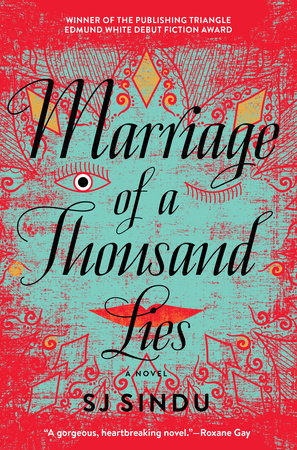
Marriage of a Thousand Lies follows Lucky and her husband, Krishna, both of whom are gay and lying to their Sri Lankan families about it. When circumstances cause Lucky to return back to her childhood home, Lucky asks herself what she is willing to walk away from when she rekindles love for her first friend.
Starting with her diagnosis of schizoaffective disorder, Esmé Weijun Wang provides a powerful look into what it’s like to have mental and chronic illness in this essay collection. The book examines everything, from institutionalization to the medical community, and comes back to the self.
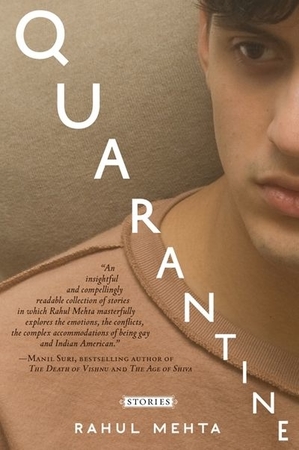
With humor and tenderness, Rahul Mehta’s short story collection moves through the lives of queer Indian American men, reconciling identity with cultural tradition in the larger scape of societal separation.
Hieu Minh Nguyen’s debut poetry collection captures what it is like to be a queer Vietnamese American in the Midwest. The book manifests as written slam poetry, speaking truth to trauma, desire, sexuality, and identity.
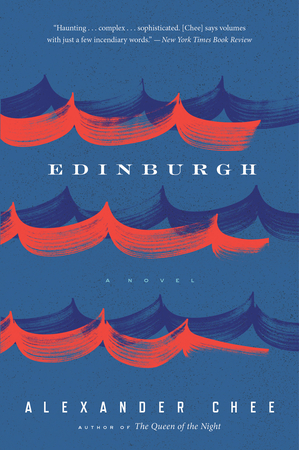
Edinburgh portrays twelve-year-old Fee, a Korean American soprano in the local boys’ choir. When he learns about how the director sexually abuses the choir’s section leaders, Fee must contend with his hurt, his silence, and what it means to forgive oneself after his friend’s death.
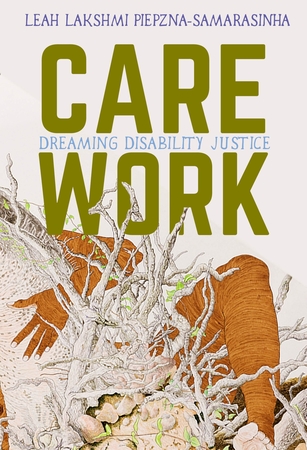
In this collection of essays, Leah Lakshmi Piepzna-Samarasinha examines the politics of disability justice. This book is a celebration to sick or disabled queer people of color, and a call to arms toward giving greater access to the community.
In this book of poetry, Justin Chin renders his experiences with mental and physical health and looming death as he returns to Southeast Asia to care for his father, who was diagnosed with cancer, while dealing with his own illness. Chin passed away at the age of 46 from a stroke.
The Exiles, otherwise known as The Two Krishnas, evokes love and loss when a woman, Pooja Kapoor, discovers her husband has fallen in love with another man. The novel takes Hindu mythology and Sufi poetry to ask what it means to know someone.
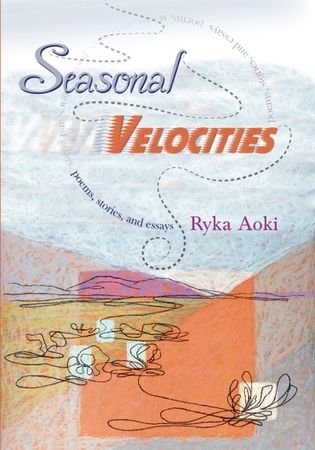
Ryka Aoki creates an intimate multi-genre collection of poems, stories, and essays with Seasonal Velocities. The book journeys through love and abuse in the trans experience—and more importantly, what it is to be human.
The Year of Blue Water is a book of poetry that moves through lyric and prose to explore the self. These poems converse with what it means to have multiple identities in this meditative search for self-knowledge.
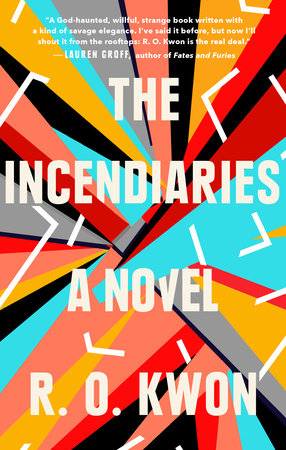
The Incendiaries follows Phoebe, a university student who gets further and further drawn into a cult whose leader has North Korean ties, and Will, the guy who loves her. Love, violence, and danger are collapsed in this powerful novel.
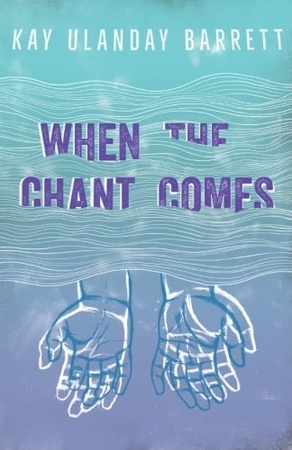
Kay Ulanday Barrett speaks to their experience with gender, race, disability, sickness, and politics in this poetry collection. These poems are unapologetic, embodying love for the body and spirit.
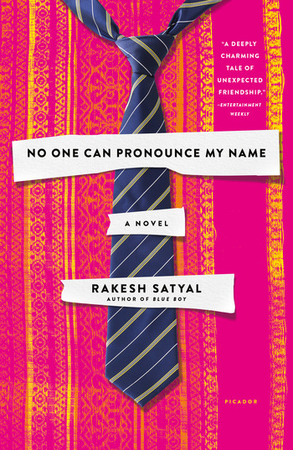
No One Can Pronounce My Name is a generational novel set in an Indian American community outside of Cleveland. The book explores what it means to be an outsider and find one’s place, through the lives of two people: Harit, a man who dresses in a sari at night to keep himself sane after his sister’s death, and Ranjana, a woman who has sent her child off to college and worries about her marriage.
In this series of Turing Test–inspired poetry, Soft Science looks at queer, Asian American femininity. These poems move from cyborgs to slugs, erasure and agency, to explore the tangle of identity and consciousness.
After winds magic realism with the experience of living as a Pakistani, Kashmiri, Muslim woman in America. This book of poetry dips into the strange and disjointed, as it frames life through a body that has felt unbelonging.
recombinant is a hybrid collection of prose and poetry that experiments with how poetry can be used to examine erasure and the reconstruction of community and lineage. Set in a speculative future, this book gives space to communal memory.
T Kira Madden’s debut memoir chronicles her coming-of-age life as a queer, mixed-race teenager in Boca Raton, Florida, to the present-day mourning over her father’s death. This novel is an unflinching, loving journey of a young woman.
One evening, I ran over a cat. Upon impact, its flat eyes reproached me, like it hadn’t known pain before. I got out of the car, stood in the headlights, and cried. It had a crushed skull and its bloody ID read “Sparkle-Motion, 5502 Ashland Ave.” I delivered it to an angry mother and a six-year-old, wearing Dark Knight pajamas, who gave me the devil’s look. I’m a vegetarian!—I wanted to say. He wouldn’t buy my sincerity. It was horrible. His reproach appeared in every human expression. My insomnia returned, and I went to my shrink.
My shrink was into alternative medicine. She had posters of people standing on cliffs, their arms raised in a V. Tuning forks lay on squares of bright orange cloth. Lamps were buried in large amber rocks. She wore blouses with choir-cloak sleeves and full-rimmed hipster glasses.
She had once been on Broadway, but never gave details about her roles. She assured me she was never hired for a lead, and eventually she grew tired of being poor. Her colleague had been a massage therapist for Kiss. This explained their lively office punctuated by flighty laughter. My shrink was laid back, and this appealed to me.
“You hit a cat. How horrible. I would be so upset.” She was never one to deny validation. She adjusted her glasses. “OK so how is your anxiety level?” She lit some incense.
“Terrible.”
Phobias are the most common mental illness, yet I had an uncommon number. They can be broadly classified as anxiety disorders, and this was my diagnosis.
“So which fears are bothering you?” she said.
“All. All the fears,” I said.
“Uh-huh,” she said. She broke out the tuning fork.
In my household, my shrink gained celebrity status the summer she helped my husband Eli through a job change. She was often called upon to assist in minor issues.
“So, do you want to go?” I said.
“Yes,” said Eli. “If you don’t mind.”
The need for a session arose from our enjoyment of a certain kind of pornography. It was about jellyfish and people getting stung during sex. These productions involved Magnum PI-type settings, bad acting, and then frantic jellyfish stinging. We had stumbled on to it, and while appalled at first, we just continued watching and were eventually turned on. We’d been watching it for weeks, doing it when the jellyfish stopped.
Yet there was a drawback to discussing sex. My shrink was like my mother.
I met Eli post-shrink, years after accepting a bad childhood. By even the most lax standards, my parents were not the Keatons, unless there’s an alternate universe where Steven and Elyse engage in all types of abuse: physical and emotional. My parents were absent any type of moral compass, even say a Jim Jones one.
When we arrived at the office, Eli took in the new posters, the aromatherapy candles, and the wish box, but said nothing. He and my shrink immediately caught up with banter.
Hitting the cat sent me into agrizoophobia, with a special fear about bears. We lived in the city but vacationed in national parks. Agrizoophobia rode my established neurosis like a pilot fish. While fixated on an object of fear, I’d repeat “motherfucker” like Samuel L. Jackson whenever I saw a cat, bear, or someone who looked like Lou Reed.
“Do you feel anxious all the time, or just uneasy in general?” She was opening a package of eagle feathers.
“It’s a real phobia this time—swear to god.”
Most people harbored a crumb of phobia regarding something—the roar of cars, fireworks, wormholes, sweating crowds at county fairs, spider webs, giant squid, etc. Once I had a phobia about manholes, a splinter of Cacohydrophobia.
My therapist specialized in anxiety treatments. Long ago, she’d studied with Francine Shapiro who had developed EMDR, a therapy utilizing REM. My shrink’s office was an anti-anxiety-lair equipped with gear—giant headphones and moon-shaped glasses, like those worn by Geordi La Forge. Patients chanted pleasant tropes while watching a sea green balloon float away.
She was hinky, but interesting. However, on my walks through Ravenswood to the train, I wondered if people could ever really know each other. Because, if anything, she knew me better than my mom. Of course, there wasn’t actual equality or shared experience. So, of course, we didn’t really know each other, which seemed surprising after sitting in her chair for six years.
Ailurophobia soon became an issue, and purring became a total detonator for me. We couldn’t visit our best friend, Michelle, because she had two cats. One was a Maine Coon the size of a bobcat, a motherfucker of twenty-eight pounds with a five-inch bat-tail. When it jumped, it shook the floor, and its meow resembled a drunk guy mocking a meow.
I developed a fear of true crimes shows, the ones deeply imbedded with the message “It really could happen to you.” I feared everything from an owl attack to a man waiting in the closet. I feared the kidnapping from the street, only to lose your cell phone before being thrown into an Oldsmobile trunk. I feared dismemberment.
On my way home, I saw a terrifying cat and swerved before going into hyperventilation. To have a cat phobia is to not be able to use the Internet. Eli looked up from his computer when I said this.
“It’s all porn and cat videos,” I said.
“Don’t I know it,” said Eli.
Someone posted a cat meme on Facebook, and I had become transfixed. “It’s horrible,” I said.“Horrible.”
He looked over my shoulder. “That’s because the cat is Photoshopped to look like Nicholas Cage. That’s both amazing and terrifying.” He closed my computer for me. “Who would do that?”
“I feel like I’m entering crazyland,” I said.
Eli and I shared one phobia. We went camping and because of the mild winter were beset by ticks. One gave Eli Rocky Mountain spotted fever. “It sounds more like a craft beer than a disease,” he said to the doctor.
He began taking antibiotics. The next morning as Eli held our dog, a motherfucker dropped to the floor with a wettish thud. It looked like a rock with legs, or what I imagined could be a polyp on a dying man. We found another twenty-six and disposed of seven at a time with tweezers and a jam jar. We both grew phobic about ticks but sharing made the fear surmountable.
But after six years of therapy, ultimately my fears grew worse. I made a catalogue: spoons, fireworks, dresses that don’t fit, bank lines, viruses, manholes, ink spots, trains, apple-picking, golf courses, Mary Lou Retton, bowling, Super-Soakers, lampshades, firearms, glass tables, etc.
On my next visit, my shrink shocked me by not asking about Eli. She had left our last appointment behind—one more proof she had a life. She stood below her “Hydration is the key to life” sign and filled her water bottle from her new pink cooler. She wore a knee-length smock embroidered with ferns. She quaffed her water bottle. “What about doing some inner child work?”
“Oh. Jesus. No,” I said. I stared at the hand puppets of Jung, Maslow, and Freud, the Tibetan singing bowl, and her reed diffuser. I wouldn’t look at her.
Really she was suggesting soul-retrieval. Good thing Eli wouldn’t be weirded out, because I would definitely tell him later. It would be more fun to laugh with him about it than to do it. Everything seemed a drag. “So we’re contacting the four-foot-tall cunt-bag?” I said finally.
My shrink lit some incense. “Now cunt-bag, that’s a name.”
Under full meditation, I focused on the memory of the woods. Its young trees and dry leaves obscured the ranch houses. The inner child jumped down from a low branch and bit my neck, and though spoon-like in bluntness, her baby incisors broke skin. “Motherfucker,” I said, but my eyes were closed.
“What’s happening?”
“She bit me.”
“She must be frightened.”
“Or she’s a bitch!” I looked at my shrink like she was crazy.
“Tell her it’s OK, that she can’t bite.”
“Don’t bite, bitch!” I said.
“I don’t think talking to her that way is going to help. Maybe you should ask her what’s wrong.” She waved more incense at me and smudged it with a feather.
“Bitch, what’s wrong!?” I shouted.
My shrink snickered. “Sorry,” she said. “Tell her if she comes out of the woods, you’ll give her something she wants, like a pony or something.”
“Really, is that good therapy? I can’t give her a pony.” Yet, secretly, I wanted a pony.
“It’s in your imagination. You can give her anything you want.”
We coaxed her past the neighbor’s house. There’s nothing worse than having to tell a kid, “You’re screwed. Whichever direction you go, you’ll be exploited. That’s your destiny, and you’ll hate it.”
“Now all we have to do is retrieve your soul,” said my shrink. Her embroidered smock made her dyed hair unusually red.
“Should we whistle for it?”
“It does sound funny doesn’t it?” She laughed.
“OK.” I told Inner Me the truth in a laconic, controlled way. But it was the pony that lured her to ride like She-Ra across an Indiana suburb, vaulting over the community pool.
“Do you feel better?”
“Somewhat.”
My inner child was supposed to settle into my apartment with an imaginary room, and the pony, in an imaginary stable. I’ve done this a good fifteen times. Soul-retrieval is the New Age-y name for it—I err on the side of Carlos Castaneda in his somewhat grounded anthropological days.
“Well, don’t be surprised if you feel a little more anxious this week.” She gave me an awkward hug.
On the drive to meet Eli at Michelle’s, I actively forgot everything.
“Just touch the cat,” said Michelle. She had the Maine Coon on a table, as if she were grooming it. “Seriously. Just touch it,” she said. It turned and growled.
“It’s fucking growling at me.”
“It’s just scared,” said Eli.
“OK. I don’t want to force you,” said Michelle. “I feel bad.”
“Yeah,” I said. “Sorry.”
On the way to the party, our failed immersion therapy left me hyper-vigilant. I didn’t mention this week my fear was polio, which could explain my fever, stiff limbs, and back pain. It didn’t seem irrational. I considered it in aggregate of an hour per day: in the bath, on the train, walking to work. Polio. I knew I would die, so was I above deadly diseases?
On Monday, I became obsessed with shooters. My office building contained a catacomb of government branches. Last year, a man brought his seven-year-old to the Social Security office. He waved a gun and demanded Arnold’s Spare Ribs, a Barq’s, and seven hundred dollars in back Medicaid costs. The elevators were cordoned off and bomb dogs sniffed the bathrooms. My fear was not totally irrational. The guy was owed seven hundred dollars, because Social Security was wrong. But for days I pictured my office door bursting open and someone blasting my face.
I did not tell Eli as I slid into bed. It was raining. He had gotten us diner food and lit a candle in our kitchen nook, which overlooked the Oak Park street and a backdrop of Victorian houses.
He researched backpacks for a trip to Montana. He had gotten a raise and found a deal on flights. “We can camp up there, backcountry, then stay in this railroad chalet.”
“There’s more chance of bear attack in backcountry. You watched Night of the Grizzlies with me,” I said.
“You have more chance of being struck by lightning. I’m not giving you a hard time though,” he said.
My fear could be traced to obsessively watching Grizzly Man, a documentary about Timothy Treadwell, whose celebrity was derived from the infamy of his bear-related death.
“Well, we don’t have to,” said Eli. On the nightstand beside him were his pocket knife and the remnants of the strap he tried to repair.
On an alpine ledge, the chalet offered a view of archaically named natural phenomena—Gunsight Mountain, Lake Ellen Wilson, Bad Marriage Mountain, and Beaver Chief Falls. This place seemed appropriate for rail men, 1920s moguls on wooden skis hiding flasks of gin, and hikers. Eli clicked through the Flickr.
“I don’t want to be resistant to things because of fear,” I said.
“Maybe we need to go someplace where there are no natural predators,” said Eli.
“I can do it,” I said. But I couldn’t do it. There was no way. Months of therapy would have to prepare me.
I have a phobia about the world ending. I imagine a visit to my favorite news outlet will yield a slide show in which the world’s end is a horrifying photo available for five seconds. Thousands of birds will have fallen from the sky and bats will have lost their nocturnal radar and slammed into buildings. Magnetic fields will have disappeared, and an asteroid will be headed for North America. It will release thermal radiation. Everyone’s fingernails will fall off. Weather patterns will change. The water will be contaminated. It’s going to be in a streaming slideshow of death.
“How have you been feeling?” said my shrink.
“I’ve been thinking about the end of the world.”
“That’s dark.”
“Well,” I said.
“No one really wants to die alone. That’s probably your fear,” she said. “OK. More to the point, is she home safe?”
“Yeah,” I said.
I left feeling light-headed, and quickly walked to a bakery to buy a peanut butter Twinkie. Already I had forgotten my shrink, the event evaporating in the street. I resented having to deal with it. I resented her.
We planned our vacation to Sperry Chalet in backcountry. We flew to Kalispell and stayed one civilized night in a railcar, a restored caboose in which we took long showers, and then we lay out flat on the clean bed and watched the Amtrak pull up and the people get out with their packs and trekking poles in the extended dusk. Rested, strapped with backpacks, we hiked Gunsight Trail, tracing the cirque of remaining glaciers. The rivers became creeks below the mountainside. A John Ford movie landscape, boulders were the size of cars, cliffs exceeded skyscrapers, and meadows diminished us to ant proportions, as if we simply crossed a city park.
In a pine forest, we climbed through bear grass, monkey flowers, fireweed. We crossed a fast-rushing river where it grew narrow. In many spots, the river gushed, an open hydrant thickening to a waterfall cascading the hill. Eli talked loudly to scare off bears, then switched to whistling show tunes. I realized Singin’ in the Rain seemed utterly appropriate for scaring bears.
I knew the origin of this technique. Other than people with exotic pets, lone hikers were most susceptible to animal attack. A ranger warned us of silence, claimed running while listening to earbuds could lead to death.
We camped on flat terrain near the rushing river. Even black bears have attacked campers at night, ripping their tents and dragging them by the rib cage. “It’s rare,” said Eli. He patted my arm. I didn’t sleep well for the first hour, but with a Valium I was out.
Bears’ chiefly vegetarian diets comforted me. They were only violent if desperate, freaked out, or if they were just an asshole bear. They mapped their habitats, knowing every stone and every tree. They could walk a hundred miles from home in search of food and were still tough enough to return to their den in just a handful of days.
“Where did you hear all that?” said Eli as he climbed a hill in front of me.
“Animal Planet.”
“God. You’re cute,” he said.
“I am kind of embarrassed by my sources.” Still I went on. “They’re unpredictable though. And they’re smart. They know we’re not to be trusted. Did you know they can run up to thirty miles an hour?”
“We’re not going to see a bear.” He cupped his hands, shouted, “No bears.”
Cresting the hill, he turned and smiled, beautiful though damp with sweat.
Still I imagined wide-set eyes, elongated snouts, longer claws, and humped backs. But their specificity was sacrosanct. They could be all gradations of brown and black and above all elusive.
When we did see the bear, it was rust-colored. It vaulted the trail’s width, like a tumbling ball, disappearing in the brush as if chased. It filled me with joy and exhilaration, as I stared at the undulating brush.
The second one moved slowly, an explorer pushing aside branches as if peering—angry at the hubbub of people. When he moved into the trail, his head lulled, heavy with chuffing. He filled the trail. He bobbed a “no” and then charged. My limbs floated. Everything slowed. I collapsed in the bear grass. Eli already lay in repose like a child, his face damp. Most of my life had been a string of phobias, and now I could think of nothing but bear grass. As I heard the bear gallop toward the hillside and dive through the brush, I thanked no one, but gazed at Eli in the silence.
DON’T MISS OUT
Sign up for our newsletter to get submission announcements and stay on top of our best work.
YOUR INBOX IS LIT
Enjoy strange, diverting work from The Commuter on Mondays, absorbing fiction from Recommended Reading on Wednesdays, and a roundup of our best work of the week on Fridays. Personalize your subscription preferences here.