Who Gets to Be All-American?

Mitchell S. Jackson’s Survival Math: Notes on an All-American Family is unlike any other book I’ve ever read. Survival Math is, on one hand, a historical and cultural expedition into Black Portland, a city that has seemingly hidden away its Black population in exchange for white hipsters, gentrification, and a facade of liberal open mindedness. On the other hand, it is a deep dive into Jackson’s family history, self-examination, and how history and the world at large overtly and subliminally motivated the “re-visioning” of Jackson’s life. Just as Erika Taylor wrote in her review for NPR, I too am wary of being too effusive with praise for Jackson’s innovative, intense, and intimate collection of essays for fear of coming across as insincere, but I assure you, the praise in this case is well deserved.

The excellence of Survival Math is not at all surprising. Mitchell S. Jackson’s debut novel The Residue Years won a Whiting Award and the Ernest J. Gaines Prize for Literary Excellence. Jackson has received fellowships from the Cullman Center of the NYPL, the Lannan Foundation, the Ford Foundation, PEN America, TED, New York Foundation for the Arts, and The Center for Fiction. His writing has appeared in The New Yorker, Harpers, The New York Times Book Review, The Paris Review, The Guardian, Tin House, and elsewhere. He is a Clinical Associate Professor of writing in Liberal Studies at New York University.

Mitchell S. Jackson and I chatted about Black Portland and who gets to be all-American. 


Tyrese L. Coleman: I’ve been dying to ask you about the men on the cover of Survival Math. Who are they and what is your relationship to them?

Mitchell S. Jackson: Those men are my kinfolk. They include my brothers, uncles, cousins, grandfather, and a nephew. They are the men whose stories compose the Survivor Files.
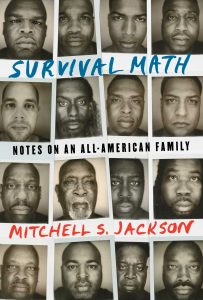
Survival Math book cover
Purchase the book

TLC: Part of what I find striking about the cover are these black and white images of Black men and then the book’s subtitle “Notes on an All-American Family.” It reminds me of a tweet from Tayari Jones where she said that the question she is asked the most is why she titled her book An American Marriage, “because it is confusing for someone like me to use ‘American’ without another word in front of it.” But, you do add another word in front of it: “All.” Your family feels very American to me but I imagine there will be some readers who will question why you included those words in the book’s title. Can you talk about that?

MSJ: Well, I guess I could start with pointing out something others have: if you don’t fit into the dominant group, you often get hyphenated: Asian-American, Hispanic-American, African-American. Those hyphenates seem a part of the great project of othering. A part of me calling them all-American is challenging the idea of who is American. In “American Blood” I claim that the people who are subjugated, oppressed, disenfranchised — and despite those harms, maintain some sense of national pride — might be the most American. The all of the subtitle is a shorthand way of asserting that claim. I want readers to question why it’s there, which is simultaneously an invite to challenge their perception of Americanness of citizenship of belonging, which as I see it, also an invitation to assess their perception of the value of a human being.

If you don’t fit into the dominant group, you often get hyphenated. Those hyphenates seem a part of the great project of othering.

TLC: The book is separated into four different sections: “Who Are We?” “What Have We Learned?” “What Have We Endured?” and “How Do We Proceed?” but within each section, there is even more structure, with poems and essays that reflect the nature of each section, and then at the end of each section, are Survivor Files. Can you talk more about the Survivor Files? Where did they come from and can I assume that the Survivor Notes correspond to the pictures preceding them?

MSJ: The Survivor Files include the portraits of the men on the cover and also a short narrative about a personal crucible. To obtain that story, I asked each of them the same question: What’s the toughest thing you’ve survived? I wrote the stories in the second person because I think that POV is dynamic in that is assumes the character of a first-person narrative but also invites the reader to imagine themselves as the protagonist of the story. Just who is the you? There’s something else about the stories: there’s a nod in each one of them to the past and the future. I mention something that happened to them before whatever is the central conflict and something that happens to them after the central conflict. That started with the first file I wrote which is also the first file in the book. And since I did it with the first one, I challenged myself to be consistent. My old mentor Gordon Lish used to counsel, “What you do once, do twice.”

TLC: You write about growing up in Portland, Oregon. I’ve only been to Portland once, but will be going back soon for AWP. Coming from the D.C. area, I simultaneously loved and hated the city. I’m no expert (obviously) but it felt like a place that wanted to rise above American conservatism while embracing fascism, as if those two seemingly opposing ideals went hand in hand, part of a “free-thinking society.”

Your book paints a city that feels utterly Black, but when I was there, it felt completely the opposite. I noticed a lot of nods to white supremacy and white nationalism. There were people working in certain shops with Nazi tattoos. And I also could not stop thinking about the May 2017 attack on the light rail where a white nationalist killed two men who were protecting two black Muslim women. But I couldn’t tell if I was just paranoid about being in such a white place.

Seeking to reconcile the portrait of Blackness you paint of the city and my feelings about the place, does my intuition have any merit? What are your feelings about Portland in regards to the place you grew up in and now when you may visit, but no longer live there?

MSJ: I think your intuition is right. I wouldn’t even call it intuition if you’re seeing Nazi tattoos. Oregon was formed with the explicit intent to exclude blacks and 162 years later the virtual monolith of whiteness in Oregon, in Portland, is the fruit of that telos. When I was growing up, I spent most of my time in the city’s small Black neighborhood: Northeast Portland (the NEP). Since the NEP was essentially my world, I didn’t feel the blatant racism that I might’ve experienced had I lived outside of the neighborhood. I was also ignorant of the state and city’s racist history. Now it seems that both liberals and white nationalist think Oregon and Portland a dandy place to live. The question is, how could it be bastion for groups who hold, at least ostensibly, radically different ideologies? What is it that links to those groups?

Oregon was formed with the explicit intent to exclude blacks and the virtual monolith of whiteness in Oregon is the fruit of that telos.

TLC: Survival Math felt very familiar and accessible for me. I think this is because of the voice. I felt as if we were sitting across from one another and we were just vibing and you were using the same language you would use in conversation, but more poetically eloquent. It gave me the impression that this is a book written by a Black man for a Black audience with no apologies made for anyone who may not catch on to certain turns of phrase or other culturally specific references. I’ve been seeing writing from other Black authors who I feel are almost deliberately eschewing the impulse to write for a more “universal” audience or understanding. Personally, I do. Was that your thought as you started drafting the pieces in this book? Or did the voice come more unconsciously than that? Should a writer, especially a Black writer, ever bow to the impulse of writing in some “universal” voice?

MSJ: One of my favorite essays is James Baldwin’s essay “If Black English Isn’t a Language Then Tell Me What is.” In that essay, Baldwin writes the following: “It goes without saying, then, that language is also a political instrument, means, and proof of power. It is the most vivid and crucial key to identity: It reveals the private identity, and connects one with, or divorces one from, the larger, public, or communal identity.” I agree with Baldwin that language is the most essential part of one’s identity because it’s how we describe ourselves and the world. I’m always trying to find language that asserts my identity. Like everyone else, I contain multitudes, so the language must capture the different aspects of self, must reflect my residence in what has often felt like disparate worlds, must illume that I’ve known what it’s like to run from the police with a pocketful of crack and also what it’s like to chat it up in a Brooklyn brownstone with Pulitzer winners.

TLC: In your essay “Exodus” you talk about the tradition of leaving, of an exodus, for your great grandparents from the South to Portland, but also your own exodus from Portland to New York and the less than straight way you made it out. As I was reading, I kept noticing the aspects of your grandparents’ life that felt very familiar to me, a Southern Black woman. Exodus means to leave or change, but I am struck by what remained, what travelled with the traveler — God, food, comforts of family, traditions. When you made your exodus, what traveled with you?

MSJ: What traveled with me on my West to East exodus was the feeling of having been tested, of having come out — alive — on the other side of trials. I needed that because New York is not an easy city to navigate. There were lean times, particularly in the summers, because I was an adjunct professor for so long and refused to get a job that was outside of the literary life. I also carried with me the belief that community was important, which fueled my desire to build community especially with other writers, once I arrived. Even now, I have been organizing and hosting the Harlem Renaissance Fete for Writers of Color for what will be five years. I hosted it with writer Jacqueline Woodson and editor Tracy Sherrod for several years and this past year, with writer/editor Jennifer Baker. The whole reason for the party is to create community for writers of color, particularly Black writers. One other thing that I brought with me on my exodus was the language of home. I never did conform to the argot of New Yorkers. I wanted to maintain the language of home because I needed it to maintain a sense of self and my for the distinctiveness of my work — I’m committed to writing about home — because I didn’t want to cede the place I loved for a new place, a place that could’ve very easily consumed a huge part of what has grounded me in the world.

The people who are subjugated, oppressed, disenfranchised   might be the most American.

TLC: Your piece “Apples”…whew, where to start? First, I think this may have been the first time I’ve read a Black man articulating what Black women have, generally, felt regarding the idealizing of white women by some Black men. But there was something more brutal, less bitter, coming from your perspective. You say in the section titled, “Myths, Fairy Tales, and Legends,” that the apple, which is a metaphoric term you use for white women that incorporates the enticement and temptation they possess for some Black men, that “The apple is part myth….The apple is part legend.” But in some ways, would you also say, that the apple is part reality? Especially when considering what white man have done to protect them, as you say, “in the name of chivalric and paternal protection of the women they’ve invested (burdened?) with the expectation of piousness, who they’ve weighted with lifetime roles as the incubator and progenitor of the white race”? Legend and myths hardly get people killed on the regular. So is some aspect of the apple reality?

Additionally, the apple feels very much a reality in my eyes being a Black woman who has lived in the shadow of this white myth, fairy tale, and legend. Reality in respect to the threats she creates.

MSJ: Yes. The apple is absolutely a reality. A part of was I trying to say was that white men had mythologized their women so that they could perpetrate corporeal oppression. Of course, Black men and Black women were featured targets of that oppression. It’s hard for me to imagine a group more keen, more intelligent, more perceptive, more strong, more resilient, more resourceful, more forgiving, more loving, more sensual, more, more, more than Black women. How could that not be seen as a threat to those intent on subjugating Black folks, which is also another way of saying, to those intent on the project of dehumanizing all those that don’t belong to their so-called race.

TLC: I have a lot of questions for you after reading “The Scale,” where you discuss your “crimes” against women and examine the root, or at least a few roots, of your behavior and what affect that behavior had on women you mistreated, but mainly, I want to know, what happened? What made you decide to do this self-examination? And what did you gain from it?

MSJ: I read an essay years ago in Esquire magazine titled “Why Men Cheat.” It was a candid essay that detailed the rationale and rules of cheating for a single man. He was unapologetic about it too. For obvious reasons, he never identified himself. I was struck by that essay. I didn’t agree with all of his rationale, but I also recognized some of my pathologies in it. The author wrote, “If you cheat, you must believe this much: that fated love is a lie, and monogamous love a deception. If you cheat, these two sentiments are your guiding light. Doesn’t mean you’re incapable of love, doesn’t mean you don’t want what love — or even marriage — can offer. It’s just a paradox. You have what you believe, and it is never the lie. You train your sentiment to fit inside the lie. Your rules fit right inside that sentiment.”

While I didn’t agree wholeheartedly with his thesis, I did recognize my aversion to deep, unguarded love and also the ability to hold paradoxical ideas concerning women. But I also recognized problems with the essay. One stark problem was that the writer never stopped to examine the genesis of his thinking. He seemed resigned to call it a paradox and leave it at that. That is understandable in some sense, since his thinking wouldn’t stand up to reasonable scrutiny. Another glaring problem with the essay was that he didn’t talk at all about the fallout of his deeds. After reading it, I asked myself, what would happen if I endeavored to examine my relationships with women, my pathologies? What would happen if I was honest about the fallout of my deeds?

Later in my thinking — I began writing the essay in 2011 — I also was very much interested in trying to track the historical and philosophical genesis of womanizing. But I also challenged myself to do it without the cover of anonymity. It seemed like if I was sincere about the effort, that I had to own it all the way. And I tried as best I could to cast myself in the most critical light. What I gained from it was a fuller understanding of the harms I’d caused. Fearing what I suspected might be paralyzing guilt, I had long avoided considering the consequences of my actions as much as I could. But in writing the essay, I had to lay them out, not only that, but read them over and over. I also got a chance to speak with some of my former partners about our relationships, and speak to them at a time when the pained I’d caused wasn’t so acute. That again gave me more perspective. I also hope that if any of them choose to read the essay it gives them a sense of understanding. I would hope that it doesn’t act as a trigger for them or any other woman, but I also realize that that’s a risk. To anyone that receives the work in that way, I apologize.

It’s hard for me to imagine a group more keen, more intelligent, more perceptive, more strong, more resilient than black women.

TLC: Also in “The Scale,” you write very candidly about your own egotism, saying “…the crux of my motivation: that, almost always, was the need to satisfy my ego, to prove to myself that I was still capable, that I hadn’t lost the power to, as we say, ‘make it happen.’” And I wonder if the choice of memoir (for you, for me, being that I am also a memoirist, and for others) is an exercise in egotism. The basis of the self-awareness needed to examine oneself has to be rooted in some form of egotism, right? If not (or in addition), where else does the memoirist’s desire to write about themselves come from? What made you write this book?

MSJ: It’s interesting because I never intended to write a memoir. I intended to write essays. My definition of a memoir is this: a narrative composed from experiences. My definition of essay is this: prose focused on a particular subject or idea. Some readers might apprehend the major sections of the book as chapters of the memoir, but I see them as essays. Because I don’t want the essays to be solely or overwhelmingly expository, I ground them in personal experience. Some of that is my experience, but in many cases in the book, it is the experiences of others: my mother, uncles, dad, etc. But again, I always imagined their stories in service of an idea. The idea that poor people might be our greatest patriots, that idea that the chosen people are the righteous that choose themselves, the idea that long-term addiction can be viewed as a long-term marriage. So, I’m not sure if this book evidences the ipseity of a conventional memoirist. I do, however, think my experiences are valuable, but I guess one of the points I’m making in the book is that mine are not the only valuable experiences, not necessarily the most valuable experiences either.

Satisfaction seems like a dangerous place for a writer to reside, one that discourages the motivation one needs to keep going and going.

TLC: In “Revisions,” you use a quote from Toni Morrison, “Endings I always know, because that’s always what the book is about. The problem is getting there.” And you write, “…gleaning the differences between a start and a beginning is crucial to revising one’s self. Starts are beholden in some respect to time. Beginnings are a harvest of timing.” Your exodus was your beginning, but I feel as though all of Survival Math is your start. Are you done revising yourself now? Have you reached a satisfying ending to your story?

MSJ: I hope that me re-visioning my life continues until I die, that I am constantly looking back to inform where to go. While I am proud of completing this book, I’m also relieved that I don’t feel like I’ve reached a satisfying ending. I would actually be scared if I did. Satisfaction seems like a dangerous place for a writer to reside, one that discourages the motivation one needs to keep going and going. The minute I start to believe I’m done revising, I’m in trouble. One could argue it would be the first moment of the end producing strong work. That said, I don’t think I’ll revisit my family in the way that I have in this book. I did it in The Residue Years in fiction and now in Survival Math in nonfiction, and though I’m sure there’s more to say, I don’t see myself reflecting on them in such an explicit and sustained way.

In that sense, Survival Math is the start of me moving into a phase in my writing life where my and my family’s personal stories aren’t the crux of the work. That’s both an exhilarating and frightening prospect for me because I place so much on ethos, so much on the authority one gains from being intimately connected to the content. Luckily, my next project is a novel about a black cult leader in Oregon, and I happen to be close with a couple of people who were in the cult.

6 Books Made of Weird Materials

You know what a book is: 200 or so sheets of paper inside a cover, right? But why not 200 or so sheets of… cheese? Or fabric? Or glass?

These artists have taken their book-loving to a new level, using non-paper materials to create their own interpretations of books. A book isn’t just paper and ink, which opens the conversation to the future of bookmaking. What are the opportunities that can come from using different materials? Is it a genius reawakening, or an expensive gimmick? And does this change how we understand books?

Here are a few of the interesting books that show the creativity, ingenuity, and humor of different artists to expand beyond the standard practice of paper bookmaking. Some of these books are important considerations, even if they would never fit on my own bookshelf. Though, if I had a book? It would definitely be made from chocolate.

https://twitter.com/MariaLai_/status/514720676348182528

Fabric

Various sewn books are made from textile materials and stitching. Maria Lai, an Italian fiber artist, embroidered books entirely from thread and cloth. Much of her art was interested in the lives and voices of Sardinian women and their domestic and social practices.

Invisible

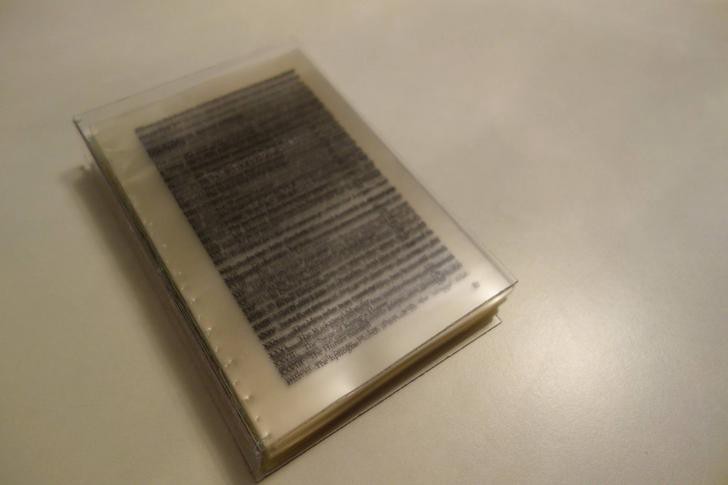
Reddit user cuddlebadger created an “invisible” print of H.G. Wells’ The Invisible Man using 1/16” Lexan sheets and fishing line. This clear copy is the perfect example of form meeting content and reminiscent of Super Terrain’s heat-sensitive copy of Fahrenheit 451, which has to be burned to be read.Buy a Copy of Fahrenheit-451 That Can Only Be Read If It’s on Fire
For a mere $451, you can now own a limited-edition heat-sensitive copy of Ray Bradbury’s bookelectricliterature.com

https://www.instagram.com/p/BpJX2UVnkuO/

Cheese

Ben Denzer’s 20 Slices consists of 20 plastic-wrapped Kraft singles. His other works include a book of 192 one dollar bills à la Andy Warhol that was sold by the Whitney Museum in 2018; 20 Sweeteners, made of 20 Splenda packets; and 5 Ketchups. Heinz, of course.

Waterproof

Mary Anne Mohanraj’s Aqua Erotica is a waterproof anthology of erotic short stories made from polypropylene, a thermoplastic polymer. This is the perfect book to bring to the beach or in the bath, though be careful. Aqua Erotica is not protected from all liquids. According to some readers, it doesn’t hold up against wine or beer, so drink beforehand. Cheers!

https://twitter.com/delight_monger/status/421317169993904128

Ice

Artist Basia Irland’s “Ice Receding/Books Reseeding,” a series of book-shaped ice sculptures frozen with seeds and other plant materials. The books are left to melt along rivers to reseed the local ecosystem with new life and raise awareness of climate disruption and watershed restoration.

Glass

In 2013, Icelandic-Dutch artist Olafur Eliasson worked with Ivorypress to create “A view becomes a window,” an edition of nine leather-bound artist books made of glass and light. The pages, created from hand-blown glass of various colors and opacities, can be read when light reflects and refracts through the glass to create brilliant illuminations.
What Science Can Learn from Constipated Dogs

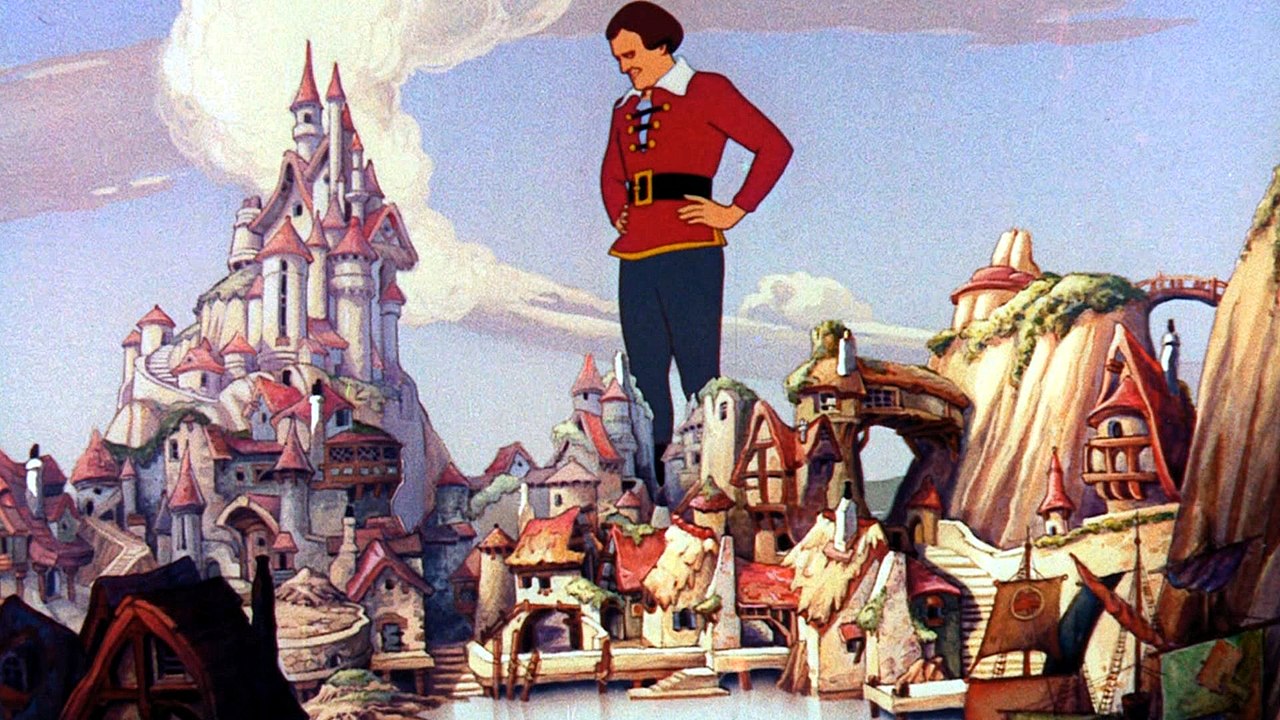
The first time I picked up Gulliver’s Travels, I was working in a protein production lab. I’d just gotten home after a painfully long day, half of which I’d spent on an experiment that mysteriously failed at the last minute — not a good thing when the deadline to get data is fast approaching — and I was more than a little stressed. Gulliver’s Travels happened to be the book nearest to the armchair into which I’d gratefully collapsed. But in spite of my mood (or perhaps because of it), Jonathan Swift’s imagination, his worlds in all their layered absurdity, fascinated me enough to read well into the night.

A similarly frustrating week would pass before I got to Book III of the Travels, where Gulliver travels to a city of people devoted to studying mathematics, but who can’t even build their houses level. A grand Academy, built for the brightest minds in the country, stands in the city center and is occupied by a motley of projectors (investigators, that is) who do things like try to determine the color of paint by touch and smell, or turn ice into gunpowder. Their attempts are met with approval by the city’s inhabitants, and only Gulliver feels there’s something ridiculous going on.

Maybe it was my irritation with the work I was doing, but in reading Swift’s satire on the science of his day, I could see the spitting image of modern scientific practice.

Admittedly, my response wasn’t typical. Almost 300 years separate our world from the one Swift lived in, and for most people, the Academy of Projectors Gulliver visits seems at first glance a crude caricature of today’s multi-billion-dollar research institutes and university science departments. The instinctual reaction is to scoff — surely modern science doesn’t involve some crackpot squirreled away in a lab waving fistfuls of test tubes, right? After all, advances in science since the 18th century have been responsible for everything from the eradication of smallpox to the launch of the International Space Station.

But first impressions aren’t always perfect. It’s worth pushing through that initial reaction and thinking through the similarities between the discipline of science that Swift saw and criticized, and the science of today. The two have more in common than first meets the eye. Even now, three centuries on, reading Gulliver’s Travels can give us insights into modern science and its relationship with the world.

We just need to know what to look for.


I’ll start by saying something about what makes Gulliver’s Travels effective at delivering its criticisms. Throughout the novel, the protagonist, Lemuel Gulliver, repeatedly encounters worlds which seem completely alien to the one he knows. On Lilliput, he meets a race of people one-twelfth the size of regular humans, living in tiny villages and cities. In Book IV, he comes face-to-face with a breed of talking horses and their vaguely humanoid slaves.

Swift hides his satire behind a veil of fantasy, and it’s only when we look closely that we see the mirror he holds up to society.

Swift hides his satire behind a veil of fantasy, and it’s only when we look closely that we see the mirror he holds up to society.

The Lilliputians may be tiny, but their capriciousness and cruelty easily match the extremes of which humans are capable. The talking horses might appear to be objects of slapstick humor, but they spend their days actively plotting genocide.

Time and time again, the worlds Gulliver visits and the beings he meets come to embody the worst of human nature and society, and Swift is so effective at leveling his criticisms because he withholds recognition of that humanity for as long as possible.

By presenting the familiar wrapped up in the exotic, Swift makes us, as readers, first experience, then intuit, and only then recognize and think.

It’s no surprise, then, that Gulliver’s Travels is often seen as one of the first science fiction texts in the English canon. After all, Swift is using a technique that in the years after him science fiction has come to perfect: burying the narrative’s relevance in a world so completely unknown that we can’t rely on our previous experience to recognize it. Darko Suvin, one of the best-known sci-fi literary theorists, describes it like this:

SF is… the space of a potent estrangement… [it is] a literary genre whose necessary and sufficient conditions are the presence and interaction of estrangement and cognition, and whose main formal device is an imaginative framework alternative to the author’s empirical environment.

“The presence and interaction of estrangement and cognition.” In other words, Swift goes out of his way to make the worlds he builds strange and unfamiliar, which causes us to bypass the fog of experience and see them afresh. And then cognition kicks in — then, once we’ve judged them properly, we can realize how similar they are to what we know, and hopefully come to a much more sober reflection on our own society.

All this brings us neatly back to Gulliver and the Academy of Projectors. By now it should be clear that here, like everywhere else, Swift gives us situations that we’ll first judge as ridiculous, and only then start to recognize. So Gulliver’s first encounter is with a scientist in the Academy who

had been eight years upon a project for extracting sun-beams out of cucumbers, which were to be put into vials hermetically sealed, and let out to warm the air in raw inclement summers. He told me, he did not doubt in eight years more, he should be able to supply the Governors Gardens with sunshine at a reasonable rate…

Mostly, this is funny because it’s incongruous — because the certainty with which the projector speaks doesn’t match up with the absurdity of what he’s suggesting. But for the more astute of Swift’s 18th-century readers, there would be a spark of recognition following the smirk.

An illustration by Milo Winter of a projector extracting sunlight from cucumbers
A projector extracting sunlight from cucumbers

By the time Gulliver’s Travels was published in 1726, the Royal Society of London, established 126 years earlier to bring about “the improvement of Natural Knowledge,” was starting to be viewed with a bit of skepticism. Partly, this was because its achievements at the time weren’t quite as numerous as people had hoped, but it’s also clear that Swift, like many others, saw some of the society’s activities as rather ludicrous.

In a 1937 essay, critics Nicholson and Mohler showed that the majority of the projects in Swift’s Academy aren’t really that far removed from what the Royal Society was working on at the time. The “sun-beams from cucumbers” idea, for instance, probably came from actual attempts at using plants to convert sunlight into gas, and experiments in bottling and selling regional air.

But that was then. How relevant is Swift’s idea about the absurdities of 18th-century science to the science of today?

Well, in one sense, the discipline has changed a lot since 1726 and has many more accomplishments to speak of. Science has certainly benefited from the process of institutionalization, and the persistent efforts of scientific organizations and the scientists in them have led to humans living longer and healthier lives. They’ve allowed us to manipulate the world in unbelievable ways, to build skyscrapers and airplanes. Science has cured diseases and saved lives, explored everything from the microscopic cell to the frontiers of space.

And it’s important to remember that toying with absurdity has played a crucial role in all thisIt’s important to remember that many of these advancements would never have come about if scientists weren’t willing to entertain the seemingly absurd — after all, the methodology of science has always been to take small steps in the direction of making the absurd a reality. As sci-fi writer Arthur Clarke put it, “The only way of discovering the limits of the possible is to venture a little way past them into the impossible.”

But at the same time, the inexorable, institutional pursuit of science has some troubling consequences. As our scientific knowledge has grown over the years, it has become increasingly segmented and stratified. To take one example, my field of study, genetics, was all but unknown until a century ago. In the seven or so decades since the structure of DNA was discovered, the field has split into literally dozens of sub-specialties. Many of these, like evolutionary genomics and pharmacogenetics, are as alien to each other as completely different branches of science.

The inexorable, institutional pursuit of science has some troubling consequences.

We have to pause and consider what impact this segmentation of knowledge may have. Swift’s projectors in the Academy are ridiculous (and pitiful) partly because they’re so engrossed in their research that they have no ability to look up, step back and see the bigger picture. And as humanity’s wealth of scientific knowledge grows, it’s getting more and more difficult for researchers and students alike to maintain a sense of perspective. Already in many universities, science programs allow little to no scope for exploring other disciplines like the humanities.

It’s increasingly the case that in science, one has to learn more and more to become an expert in less and less. This trend cannot be good for our development as individuals, and it should worry us a great deal more than it seems to.


One of the reasons we don’t often think about such things is that our society, generally speaking, doesn’t like criticizing science. I don’t mean in the sense of climate change deniers or the rabid anti-vaccination movement — we’ve got plenty of those, unfortunately. I mean that serious methodological debate about science as a whole isn’t something we’re comfortable with.

This, too, was a problem that Swift identified early on. During his tour of the Academy, Gulliver meets a projector whose task is “an operation to reduce human excrement to its original food,” and that wonderful interaction starts off in a striking way:

I went into another chamber, but was ready to hasten back, being almost overcome with a horrible stink. My conductor pressed me forward, conjuring me in a whisper to give no offence, which would be highly resented; and therefore I durst not so much as stop my nose.

This is one of the most revolting scenes in the entire novel, and Swift uses that repulsiveness to demonstrate the cult-like reverence the Academy has generated for itself. Such is the power of the institution that the danger of offending its practitioners supersedes all other concerns — even ones of basic hygiene.

There’s a serious point here: in observing the institutionalization of science in the 18th century, Swift saw the very real danger of it becoming an increasingly inaccessible, incontestable, and monolithic discipline. And unfortunately, it looks like his fears were justified.

Just last year, I met a student at the University of Edinburgh who told me that philosophers have no place commenting on the dealings of science. That only scientists have the right to judge science. Sadly, this is a common view, coupled with a growing belief that science is the only useful way of interpreting the world and gaining knowledge about it.

“What are you studying that for?” is a reaction I get regularly when I tell people that I study English literature as well as genetics. Sometimes it’s subtext. Sometimes it’s not.

Because of the very visible scientific achievements that have made our lives so much better over the years, people are forgetting that there are some questions about our existence science in principle can’t answer. Important questions, like “How should one act in order to be a good person?” and “What can we do to understand the experiences of others?” Questions that we cannot afford to lose sight of.

But the scientific mindset is at risk of overshadowing the forms of inquiry that are best suited to probing these questions, and that worries me greatly. When funding is cut to university departments, it is invariably historians, literature scholars, sociologists, artists, and anthropologists that suffer first, rather than physicists, mathematicians or computer scientists. Once upon a time, philosophers were the most esteemed members of society. Now, largely because of a lack of job funding, the vast majority of philosophy majors will never work in their chosen discipline.

And it’s a shame, because science is at its most beautiful and extraordinary when it shares the stage with other disciplines. When the insights it generates supplement other modes of thinking. When it steps into dialogue with philosophy, law, medicine, history.

The scientific mindset is at risk of overshadowing the forms of inquiry that are best suited to probing these questions.

Incidentally, the prestige of scientific authority that Swift saw as an emerging problem isn’t just something that affects the status of other fields. It’s also a reality that scientists themselves have to deal with.

Before he published a single word on evolution by natural selection — what would become the most successful scientific theory in biology — Charles Darwin spent 20 years gathering data, repeating his studies and thinking through his ideas. “You know what would happen to me if I did that?” an evolutionary biology professor from my university once told me. “I’d lose my job within a year.”

The drive to actively contribute to the prestige science commands — to further the cause of science — has led to a “publish or perish” culture in the field. Researchers are spending less time than ever reflecting critically on their work and much more time writing grant applications and publishing papers. Increasingly, quantity trumps quality.

Add to this the fact that many scientific journals are reluctant to accept negative results, and it’s no surprise that science is in the midst of an unprecedented reproducibility crisis. A 2016 article published by Nature found that of more than 1,500 researchers surveyed, over 70% had tried and failed to replicate the results of another study. In cancer biology, a 2012 inquiry estimated that as few as 11% of published results are actually reproducible. This is a major problem whose scale we’re only now starting to realize.

And broadly, this was exactly Swift’s point. If we consider the methodologies of science as a discipline to be beyond criticism, if we invest in it to the detriment of other human attempts at understanding the world — if we never step back and see the broader picture — there will be very real and devastating consequences.

If we invest in science to the detriment of other human attempts at understanding the world, there will be very real and devastating consequences.

Gulliver’s trip to the “practical” side of the Academy ends with a visit to the resident doctor, who first outlines his ingenious idea for treating colic — pumping and then sucking air through the rectum with a pair of bellows — and then demonstrates it: “I saw him try both experiments upon a dog… the animal was ready to burst, and made so violent a discharge… the dog died on the spot, and we left the doctor endeavoring to recover him by the same operation.”

The shock value is strong here, but the graphic imagery also reveals an unrecognizably, unfathomably barbaric side to science. And as always, there’s a deliberate delay for us to respond emotionally before we start to think about how accurate this depiction is — whether the science we know and trust really has the capacity for such harm, literally or otherwise. The answer isn’t easy to come to terms with.

So Swift’s final image of the dog and the doctor becomes a sad metaphor for a terrifying possible future — for a discipline scrambling in vain to repair the untold damage done in the wake of its unchecked and unquestioned progression.


In spite of all this, it’s important to remember that Gulliver’s Travels wasn’t an anti-science book. Jonathan Swift didn’t have a beef with the idea of science in principle — after all, he was writing during the Age of Reason, the Enlightenment. The very fabric of his satire, as we’ve seen, only works if people think.

Swift’s problem was with the way science was being practiced, and especially with the people who would preach it to the exclusion of everything else. By relying on rationality in his criticisms, Swift actually showed his support for the underlying principle of good scientific practice: careful and considered reason. It’s just that science shouldn’t be allowed to eclipse other modes of thought.

Three centuries on, we would do well to heed his warnings.

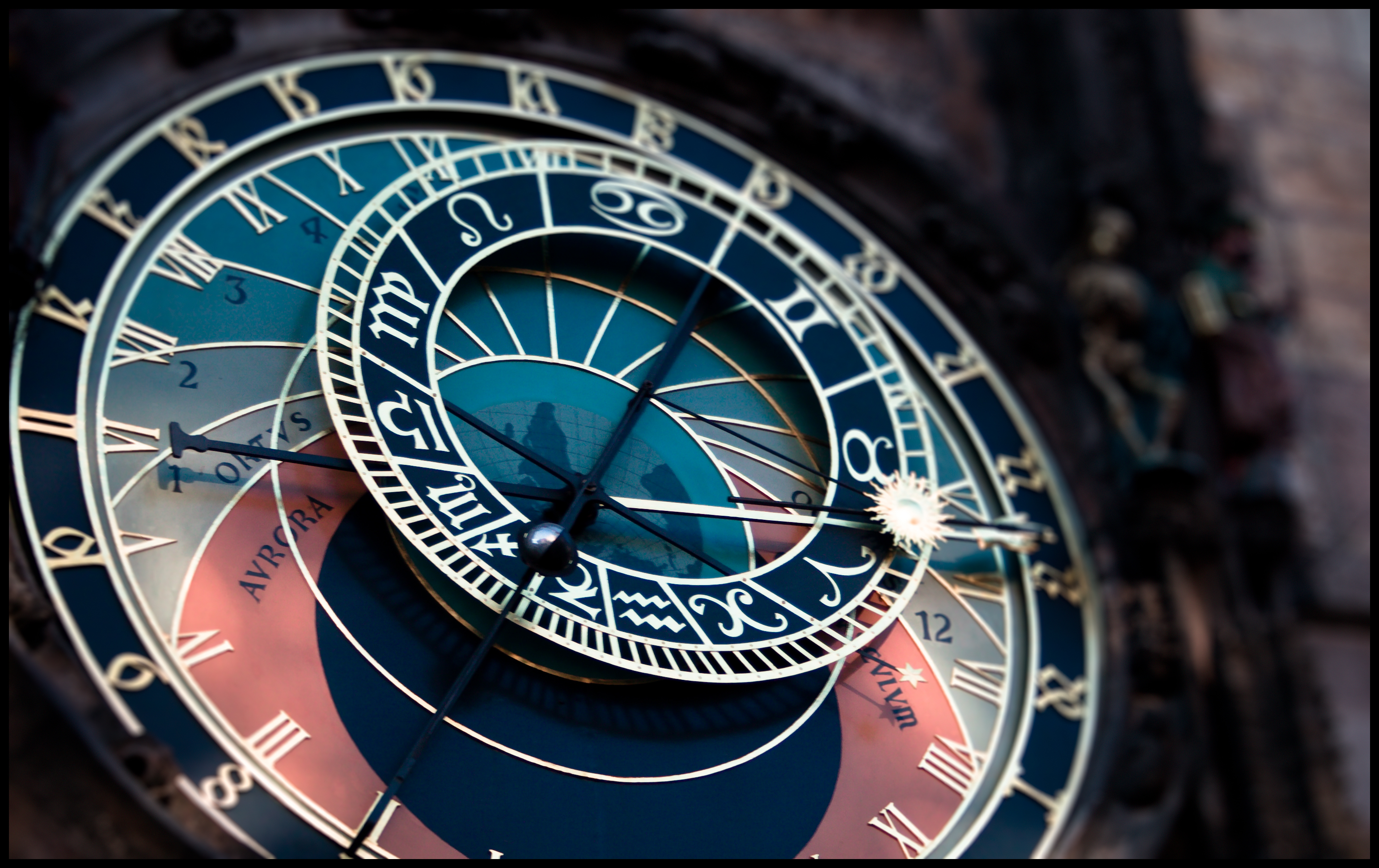
Spring 2019 Horoscopes for Writers

In spring, all things are made new — but this is also an opportunity to review the intentions we set at the beginning of the calendar year.

In April, outer planets station retrograde, where they will be for the entirety of the summer, into autumn. This isn’t going to be quite like last summer, where practically every planet in the sky was retrograde, leading to a sloggish summer where all we did was turn over the same soil. This time around, it’s just three retrograde planets: Jupiter, Saturn, and Pluto. How we expand and where we find our faith, how we work within and create structure, and where we are undergoing transformation are all up for review. You may be most familiar with retrogrades via your Twitter friends blaming every kind of wackiness on Mercury being in retrograde, but retrogrades are normal, and are just one kind of energy to work with. When it comes to astrology, knowledge is power: if you know it’s happening, you can use it to your advantage.

Meanwhile, Venus, the planet of love and value, will zip through four different signs — and four different areas of your life — asking you to consider how you bring beauty to your life, how you value different parts of yourself and those you love, and how you take the time to nurture your creativity.

At the very end of spring, just as the summer solstice approaches, Jupiter, the planet of expansion, and Saturn, the planet of responsibility, will both connect with Neptune, the planet of vision and dreams, offering blessings in kind, asking how we are going to work with the dream this summer. Jupiter (by then retrograde) amplifies the dream; Saturn asks us whether and how the dream needs revising.

This is a time of preparation. The summer will bring more eclipses, and more rooting out. Spring is a time for renewal, a time to work with retrogrades, a time to bask in the varying Venus energies, a time to use Aries fire, Taurus seed sowing, and Gemini fast-flying energy to your advantage.

Aries symbol

ARIES

Feeling energized lately? Spring is your season, a time of new beginnings, new ideas, planting seeds and breaking free after the long winter. The vernal equinox on March 20 ushers in Aries season and with it, your birthday: new year, new you.

This is a time to harness as much of that fiery, buoyant energy into your creative projects as you can. On April 5, a new moon in Aries offers you the opportunity to set powerful intentions for this new zodiac year, and for your own birthday season. New moons are all about new beginnings and new projects: what have you been muddling through this winter, having difficulty getting off the ground? Now is the time to put some fire behind that idea. (Also, this new moon will be at 15 degrees — those of you with your sun, ascendant, or other personal planets or angles within one to three degrees of the moon will be particularly impacted.)

On May 15, Venus goes into Taurus, where she is at home in its earthy sensuality — and in your house of resources and value. While Venus is in Taurus, she brings a touch of grace and nuance to how you handle your resources (as well as how you value yourself). Now is a time to pay extra attention to the give and take of the flow of money and time and exchange of resources in your life.

Writing Prompt: What project have you been meaning to get to, and just putting off? Brush it off, and make a date night with yourself to work on it — perhaps around the new moon.

Taurus symbol

TAURUS

The big news for you in the early months of this year was Uranus, the planet of change and revolution, going into your house of self and identity. It’s going to spend the next seven years here, turning over the soil. While Uranus can take a minute to get going, if you’ve got planets or your ascendant at early degrees (check your birth chart), you may be feeling these effects early. What does that mean for your writing? Uranus coming through this particular part of your life shakes up how you conceive of your very identity. That could mean what you write about, or how you think of yourself as a writer. The key is rocking and rolling with the changes Uranus throws your way: stay flexible. Not always your first instinct, Taurus: you like comfort; you like to root down. You like stability. You are an earth sign, after all.

Your birthday season kicks off on April 20. There is a new moon in your sign on May 4; a time for planting, growing — everything that Taurus loves to do. Use this energy to really focus on gathering and growing those seeds that you kicked off in Aries season, and put them down in the fertile Taurus earth. Saturn, the planet of responsibility, will have just gone retrograde a few days before; this project may, in some way, have to do with reconsidering or revising an aspect of an old project idea. The next few months under Saturn Retrograde are a ripe time for revising and re-envisioning, for making all things new.

Writing Prompt: Uranus wants to change up that topsoil and sift through, finding what still serves you — and what doesn’t. What parts of your identity are calcified — what is past its expiration date? What is it time to let go of? How does this letting go affect your creative self, your work?

Gemini symbol

GEMINI

If winter was all about working with your long-term goals, spring is all about digging in to your community and, ultimately, taking care of yourself. The season opens with planets hanging out in your house of friendships, social consciousness, and the internet: social networks like Twitter are playtime for you, and a gathering like AWP offers you the chance to truly shine. In March and early April, don’t lose the threads of new, budding relationships you are building with people. Winter can be cold, and SAD is real, but keep those new flames burning. The people you’re meeting right now will be good for you (and vice versa).

Gemini season — your birthday season! — arrives on May 21, heralding with it the winds of spring, spreading new ideas and inspiring people to travel, to share, to connect. Gemini is ruled by Mercury, the messenger, who can zip around the world and also dive beneath to Hades’ realm: Mercury is surefooted, and able to chameleon into any environment they need. This ability to adapt is a gift, but be sure that, as your season unfolds, you are standing on solid ground. When you feel rooted, your work is more rooted, as well. There is a new moon in your sign on June 3, offering the chance to set new intentions and put new plans into place.

With both Venus, the planet of love and value, and Mars, the planet of action, lighting up your house of self and identity, you’ll attract attention in a good way. This is an excellent time to continue to nurture and invest in your creative communities: Gemini delights in sharing ideas, and Venus and Mars work to put extra wit in your words.

Writing Prompt: Think of the last few gatherings you were a part of where other creative people were present. They could have been centered around writing (like a literary reading), or not. What did you like, and what did you not like? Now: how can you cultivate — and seek out — the things that you liked, the things that were nurturing, in your creative communities, moving forward?

Cancer symbol

CANCER

Summer will be here before you know it, and with it, your birthday season — and some powerful eclipses. Utilize the energy of this spring to lay track for the train that’s coming.

This spring is a time to take stock of what’s working in your life, and what isn’t. Who is working in your life, and who isn’t. In April, both Saturn and Pluto will begin a retrograde in your house of committed partnerships. These planets are in serious, empire-building Capricorn — your opposite sign, which shares similar values as you do when it comes to things like security and long-term planning. While this part of your chart governs committed romantic partnerships (certainly, something that affects the creative life), it also governs committed business partnerships — say, with an agent, an editor, or a writing partner. Writing is considered a solo enterprise, but we know it’s not. The people we love, and the people we are in this business with, significantly affect how we approach the work: what we write about, when we write, how much we get for our writing, our general emotional state. Saturn and Pluto are both heavyweights that deal with life’s responsibilities and transformation, respectively, and they are here to help you clear out any patterns that aren’t working to your highest good.

Your career gets a boost from Venus, the planet of love and value, which travels with the sun through Aries and your house of public image and fame early in the spring. Here, Venus is fiery, brazen, and no-nonsense, helping you to trust yourself — to value yourself — and to feel confident about the choices you are making in your work and how you are putting it out into the world. Venus in Aries is Wonder Woman energy — and after this winter, you could do with some Wonder Woman energy, Cancer.

Writing Prompt: Venus asks us to consider our worth, to look into the mirror and say I am worthy. I am worth it. Do you believe your work is worthy and worth it, Cancer? How have you struggled with seeing the value in your work this past year?

Leo symbol

LEO

You love spring, Leo. It’s light, independent, sunny — much more your speed than winter, when the world is resting. Spring feeds your energy, and no wonder: Aries is your fellow fire sign, a kindred spirit. This spring, the sun and Venus travel together in Aries, lighting up your house of travel, philosophy, and long-term plans. For you, this is the time of year when all the world’s a stage, full of new life and possibility, just waiting for you to be not only the lead, but also the producer, the writer, the director. For you, this time of year is about the vision. So get out the vision board — or the notebook. Go on a walk. Take an impulsive weekend trip somewhere that’s outside your normal surroundings. Get out of your head, and tap into that big heart. You may not like the word manifest, but that’s exactly what you’re good at doing, and it’s exactly what can happen for you right now.

Meanwhile, your daily routines are about to get an upgrade. Saturn, the planet of responsibility, and Pluto, the planet of transformation, are hanging out in your house of health and day-to-day work stuff: decidedly not long-term vision, but the kind of chores and routine scheduling that helps those big plans get accomplished. We have to pay attention to the little details, too, and these major planets are about to spend the entire summer (and some of the fall) in this part of your life, turning over the soil and making sure that your habits are serving you for the better. (Have you been meaning to start ordering a meal service so that you eat better — or even just purchase wrist support for your desk to help with carpal tunnel? This retrograde is gonna bring all of that up for review.)

Writing Prompt: Write out a typical daily schedule for you, then a typical weekly schedule. What parts of this could stand to be upgraded? What do you wish you had the time to improve, or to add in? (You might be surprised what the next few months bring.)

Virgo symbol

VIRGO

Where do you find your creative inspiration? Over the next few months, Saturn, the planet of responsibility, and Pluto, the planet of transformation, will be sifting through your creative consciousness, encouraging you to dive deep into your reserves. This spring, these planets will be reviewing (and perhaps also revising) how you typically find entry points into excitement. This is the part of your life that is creative, but also flirtatious and romantic — a part of your life that’s about being inspired by life’s joys. If your emotional well has started to feel stale lately, spring will bring new opportunities for change: but you might need to put in the effort. Saturn and Pluto are in Capricorn, after all: earthy energy that requires effort to build something new that lasts.

You understand how to utilize earthy energy, Virgo. You’re comfortable with the harvest, with the end of a season, but perhaps less so with the new beginning. And Aries — the fiery start of the zodiac year — strikes at a particularly deep part of your chart, in your house of intimacy. This is introspective energy. You’re comfortable in the details: with organizing, with a mind toward healing. Aries’ single-minded, laser focus on the parts of yourself and your work that you would rather not lay bare to the world? That’s less comfortable. But sit back, and consider: what discomforts is this season bringing up for you? What parts of yourself do you prefer to keep hidden — from yourself, from your professional network, from intimate partners? What is okay to keep to yourself, and what might be worth taking a second look at? Confession to others may not be the solution to everything, but self-awareness and a bit of journaling (or therapy) might be.

Writing Prompt: What parts of your life has 2019 brought up for review so far? What has felt comfortable — and what hasn’t?

Libra symbol

LIBRA

Aries is your opposite sign: the individual to your balanced, relationship-focused scales. Libra craves harmony and delights in its ability to see (and debate) all sides to an issue. You take your time, patiently researching and assessing the information before deciding your mind. Ruled by values-driven Venus whereas your sister Aries is ruled by action-driven Mars, you truly are two sides of the same coin. You kick off the autumn; Aries starts the spring. Opposites, in every way.

So what is a Libra to do during Aries season? Well, enjoy full moons, for a start. Yes, you read that right: moons, plural. The spring starts with two full moons in Libra, on March 20 (at 0 degrees) and April 19 (at 29 degrees). Having two full moons in one sign is a relatively unusual occurrence, so enjoy this double dose of your energy! Full moons are about releasing, culmination, fulfilling. What projects or ideas have you been fulfilling, personally, lately?

Aries also governs your house of committed partnerships. This isn’t just romantic; it’s also business. The sun and Venus will both spend time in this house, highlighting what you want in the long-term (are you happy with your agent, your editor, your writing group? Are these things you’re looking for?). This spring, your relationships are up for review — even as the sun and, then, Venus go into Taurus and your house of intimacy — and those relationships continue to deepen and unearth the most uncomfortable parts of your psyche. Are you bringing people into your creative life who share your vision: who are compatible with you on personal and professional levels, and who can work with you for the long term? Time will tell.

Writing Prompt: What kinds of people most rejuvenate you, creatively? What kinds of events, what kinds of engagements, what kinds of partnerships?

Scorpio symbol

SCORPIO

Your big story, Scorpio, is that your writing and short term projects are getting major shakeups this spring. Buckle in. Saturn, the planet of time and responsibility, and Pluto, the planet of transformation, are leisurely sifting through this part of your life, and when they turn retrograde come April, they will bring all kinds of long buried things up for review — and revision. You may quite literally end up revising an actual project over these next few months: specifically, its boundaries or your time commitment (Saturn) or even its very essence (Pluto).

In a similar vein, spring kicks off with rather literal spring cleaning. In your chart, Aries is your house of health and daily routine — all that day to day stuff that makes up the big picture. But the little things have to be in order in order for the big picture to flourish, yes? Use the Aries new moon on April 5 to set intentions around health, wellness, and a daily schedule this season. In many ways, your body is your instrument, and it’s important to take care of it.

Finally, you have a full moon at 27 degrees of Scorpio on May 18. Full moons are for culminating, for releasing, for letting go. This full moon is highlighting your house of self and identity — what aspects of yourself have you been working on over the last six months, and what are you ready to let go of?

Writing Prompt: What parts of your life (or creative life) feel like they’ve been undergoing a spring cleaning?

Sagittarius symbol

SAGITTARIUS

Have you been feeling lucky, expansive, like nothing can touch you? It might be because Jupiter, the planet of expansion, has been hanging out in your house of self and identity. Jupiter is home: Jupiter rules and loves Sagittarius, where its yearning spirit that craves intellectual stimulation and new experiences can go wherever free-roaming Sagittarius fires off to. In April, Jupiter goes retrograde. Keep in mind, retrogrades are a regular occurrence and they aren’t a bad thing! Just a time to do anything with a re- in front of it: review, revise, rethink. Because Jupiter is going to be retracing its steps over this part of your chart, this spring might bring up ideas or beliefs about yourself and your life path that you thought you had figured out, just for reconsideration. Jupiter is a joyful, bounteous friend and is on your side — they’re just going to sit with you for a little while and make sure that you’re sure about the next steps.

In that vein, Jupiter will square off with Neptune, the planet of dreams and all things subconscious, on June 16. Jupiter blows up anything it touches, and since Neptune’s energy is nebulous on a good day, when it connects with Jupiter, whew — watch out. At best, this energy is dreamy, allowing you to ideate without commitment. Mark your calendar for a bubble bath or maybe a creative, “wander the streets (or the woods) with yourself and see where it takes you” date. But keep a skeptical mind about people coming out of the woodwork with opportunities that seem too good to be true.

The next day, June 17, there is a full moon at 25 degrees of Sagittarius. Full moons are completing energy, and they are also excellent times for releasing. If the spring, and Jupiter retrograde, have brought up issues that you thought were long since resolved, this might be a good time to have a night in, treating yourself to some take-out and Netflix (and perhaps some journaling, too). Whatever helps you to let go, and know that you are walking on the right path, even when the journey curves unexpectedly.

Writing Prompt: What goals did you set for yourself at the beginning of this year? What have you achieved so far? What are you still working toward? What needs to be revised?

Capricorn symbol

CAPRICORN

You’re comfortable with the serious side of life, Capricorn: with making a plan, with keeping a schedule, with committing. You understand how to finish things. But even for someone like you, having Saturn, the planet of time and responsibility, and Pluto, the ever-so-slow moving planet of transformation, rock and roll and retrograde through your house of self and identity, over and over and over, can be tiresome. Are we there yet?

No, unfortunately. Your relationship to yourself — how you conceive of yourself (how you conceive of yourself as a writer, how you write about yourself) — is shifting, dramatically, with these planets hanging out there. They are digging and planting and harvesting and sifting again, a farmer with a plow. There is fruit on the other end, if you work with this and really lean into experiences you’re having and the lessons you’re learning. You might not write about them right away. This might be one of those “five years from now” essays. Be present in your body, be present with what you’re feeling, and (for once) don’t try to take the clay that’s molding you and form it into art too soon.

Of course, you’ve still got irons in the fire and creative energy to spare. Use the new moon in Taurus on May 4 to set intentions around your new ideas and projects this spring. Taurus energy feels more playful and heady, more sensual and grounded, and this part of the spring will be a particularly fruitful time for you.

Writing Prompt: Make a list of those “five years from now” stories and essays that you know you’ve got in you, that you can feel yourself working toward. And now: what feels doable now? Make that list, too.

Aquarius symbol

AQUARIUS

For you, Aquarius, spring is literally about new ideas and writing a new essay or a new story. Aries season, ushered in by the vernal equinox, lights up your house of communication and short term projects, inspiring you to take action and get shit done with those projects that have been, perhaps, on the back burner this winter. Mark your calendar for the Aries new moon on April 5, an auspicious day when the juices will be flowing: an ideal day to get a new project off the ground.

Even if projects have been a little slow to pick up speed this winter, you’ve definitely been meeting a lot of people and making exciting connections — or at least, have had the opportunity to do so. Jupiter, the planet of luck and expansion, has been blowing through your house of friendship, social consciousness, and the internet — a big ol’ party-hardy tumbleweed. Look who I want to introduce you to! It’s on you, of course, to actually pick up what Jupiter throws down — to make that coffee or drinks date, to DM that person, to follow up — but if a few folks have floated in and out of your orbit, you’re about to get the chance to get a do-over. Jupiter goes retrograde this April, offering you an opportunity to reconnect and redo. Who has popped up who you missed the first time around? Who have you been too intimidated to reach out to? Now’s the time, Aquarius. (And if you’re going to AWP, all the better: don’t let them pass you by!)

Meanwhile, Saturn, the planet of responsibility, and Pluto, the planet of transformation, are sifting through your house of rest, spirituality, and unconsciousness. Not the most comfortable place for these heavyweights to hang out, you know? If you haven’t, spring is an ideal time to get into therapy, book a reiki session, or schedule that mini personal retreat. At the very least, start blocking out intentional alone time for yourself.

Writing Prompt: Something else that comes up during a Jupiter retrograde in your house of, umm, the internet? Your online presence. Time for a quick reevaluation of your Twitter brand, of the platforms you’re using, of your website. How is your online presence serving you? Is it working for you, or against you?

Pisces symbol

PISCES

Pisces energy carries us out of the last recesses of winter and into the heady dawn of spring. Fresh off your birthday season, you go into Aries more energized than most, renewed in your self and identity and ready to translate that personal rejuvenation into value, both internal and external. Aries season brings multiple planets — the sun, Mercury, and Venus — into this part of your life and chart, which for you is about understanding how you value yourself and how that extends into material value in your life. Mercury, the planet of ideas and communication, inspires you to imagine new paths for revenue streams, while Venus, the planet of love and value, asks you to both ask for what you’re worth and intrinsically know your worth.

We live in a white supremacist, heteronormative, patriarchal capitalist society, where the monetary value of creativity and ideas are ever shifting, and the very idea of attaching money to art and people can be problematic at the best of times. But this spring, the energy in the air is pushing you to take the steps to ensure that you and yours are provided for, to the best of your ability, and that that provision comes from a place of self-assurance and self-worth.

This energy carries you through the entire spring, into Taurus season, where those seeds of value you planted in Aries time are nurtured into literal manifestations of new projects: new stories, new essays, new newsletters, perhaps even new a new job in writing and communications. Who knows? The energy is yours to work with (or not): ultimately, you are the arbiter of your own life.

Writing Prompt: There is a new moon in Taurus on May 4, a moon that will provide excellent energy for starting a new story, essay, or other project. So your prompt is this: begin at the beginning.

How Do You Even Get Started Writing a Book?

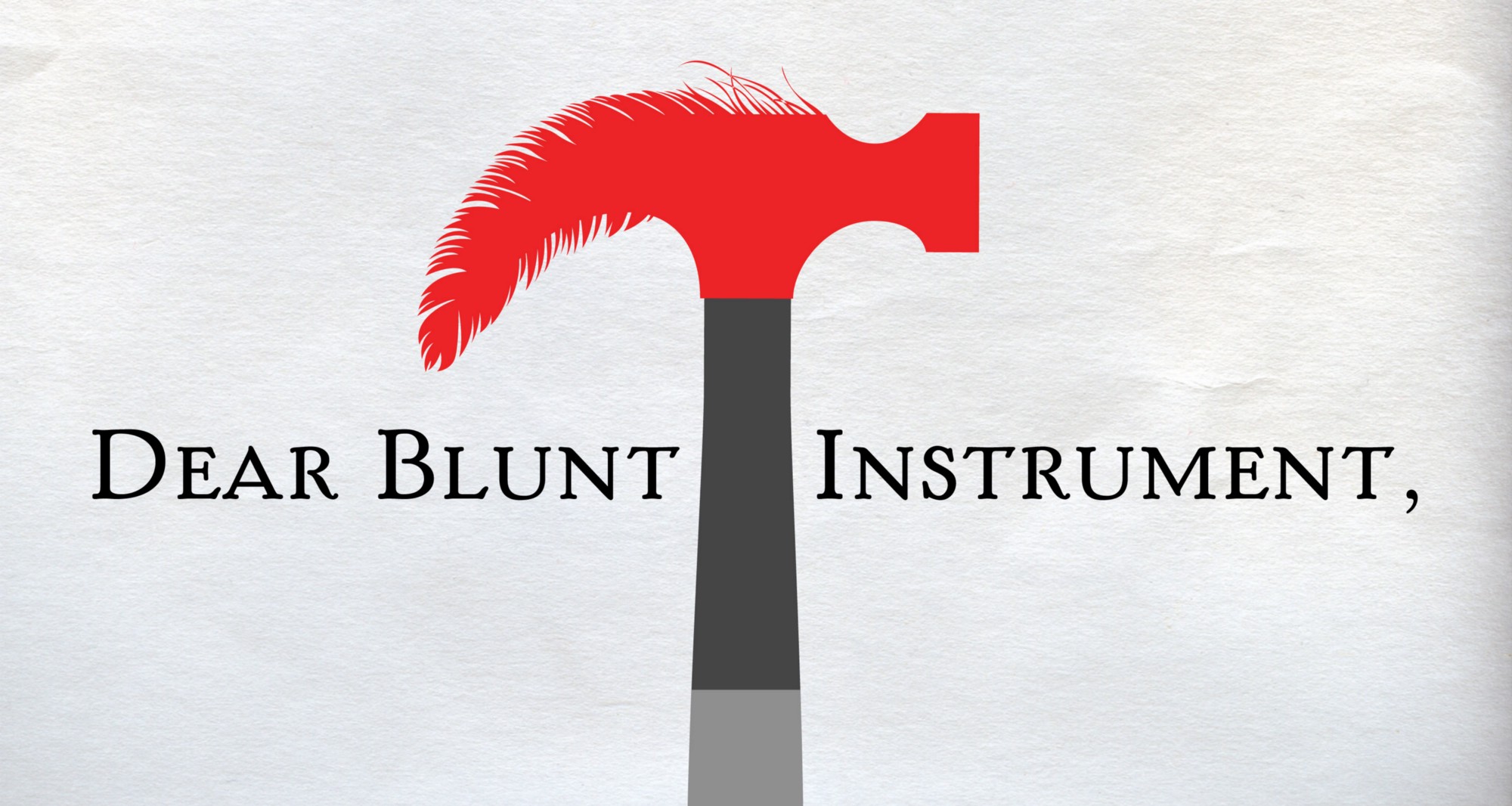
The Blunt Instrument is an advice column for writers. If you need tough advice for a writing problem, send your question to blunt@electricliterature.com.


Dear Blunt Instrument,

I’m a writer in Denver. I’ve freelanced a little bit for Westword and covered coffee and booze for a publication called Sprudge, but really I’d like to write books.

I’m working through a draft of something right now but am unsure if working on it on my own and then taking it somewhere is the correct approach, or if there even is a correct approach. Do you have any thoughts? I don’t even know how to approach a publisher, and am unsure of when the best time to do it would be.

Ben


Note: This month, the Blunt Instrument welcomes a guest columnist, the novelist, essayist, editor, and instructor John Cotter.

Dear Ben,

Congratulations on the publications (Denver loves its drugs) and on commencing the Great Work of summoning a book from thin air. What’s next depends on what kind of book you’re writing. Sit back, pour some booze in your coffee, and let’s figure it out.

If you’re writing a novel, you won’t want to approach a publisher until the book is finished and polished to a blinding shine. If you’re still in the drafting stage, don’t worry about approaching publishers now. Same goes for agents: because most agents are so swamped with manuscripts they can barely find time to panic, you’ll want to avoid bugging them until your own manuscript is as unimpeachable as it can be. If that sounds like a long time from now, rest assured that, yes, it is but a) it’ll go by fast, especially if b) you’re spending the time on a project that excites you. Make sure this is the novel you really want to spend at least two to five years writing, then write it, reading a ton of other novels in the genre as you go and studying how they’re constructed with care.

Make sure this is the novel you really want to spend at least two to five years writing, then write it.

If you’re writing a collection of either essays, stories, or poems, you’ll want to sharpen up the best of them and start submitting to magazines. Publication can attract notice — an agent may contact you, though you shouldn’t sit around waiting for it — but either way, publication makes you seem more professional, more in-demand, the sort of person worth taking a risk on. If your book is a collection of essays, this will require writing pitch letters, which you can learn more about here, here, or here.

If you’re writing a nonfiction book, like, say, another much-needed history of craft cocktails or the weed boom, you’ll want to start with a rough outline, and gradually work that into a formal proposal to send along to an agent. Formal proposals can run from 50 to 70 pages in more-or-less five parts: an introduction, market details, biography, a chapter outline, and a couple of sample chapters. Your introduction hooks your reader (your prospective agent, who wants to be hooked both for their own sake and for the sake of future readers) and makes the subject of your book seem important; show that you command the field, know what’s been thought and said on the subject, and that your own perspective is unique. Market details make clear that people will buy your book because it’s the kind of book that people buy — accordingly, if there are recent bestsellers in the same vein, mention them here. If you have literary connections, drop those names. Your biography is a list of accomplishments and qualifications. If you’re good-looking, include a picture. There’s some more advice on writing a proposal here.

Those are the broad strokes. It’s tricky to do this alone. Community is important — if often fraught — for writers at every stage. There are a few ways to hack it, which I’ll abruptly gloss herewith:

Writing guides. The most useful and most fun writing guides I’ve read are Howard Mittelmark and Sandra Newman’s How Not to Write a Novel, which will teach you to follow the rules (“giving the reader a sex scene that is only half right is like giving her half a kitten” — half a kitten is not better than no kitten), and Lance Olsen’s Architectures of Possibility, which will teach you to break those rules.

A writing group. If you know a couple of sharp and thoughtful readers, why not start a writing group? It gives you someone to share your work with and talk shop. Writing is an act of communication — readers are necessary to complete the circuit. Meet once a month or so and share. Be kind to one another.

Note: do not start a group with any old yahoos who happen to write — if they’re not also very good readers they won’t help you. If you know good readers but those readers aren’t writers, consider a favor exchange: repair the siding on their cabin or make them dinner or critique their podcast in exchange for feedback. This actually works. I helped a friend with grad school applications and in exchange she built me a desk.

Do not start a writing group with any old yahoos who happen to write — if they’re not also very good readers they won’t help you.

Classes. An MFA is a good way to make connections. But most MFAs are morbidly expensive and that debt can dog good writers to their graves. If you already have a great deal of debt then it’s not a realistic option — some of us didn’t get an MFA and write fine. Further, the last twenty years have witnessed an uncanny rise in the number of writing centers around the country: Grub Street in Boston, Lighthouse in Denver, Hugo House in Seattle … the quality of instructors at such places is often identical with what you’d find in MFA programs, and writing centers are cheaper. There, you can order classes or consultations à la carte.

You’ll notice there’s one thing I haven’t talked about so far, and that’s actually writing your book. This is the part of the business that happens alone, in the quiet of your home or the library or a coffee shop. You don’t have to work on your book every day, but if you never work on your book, then your book will never be written. About this part of the process I’ll give you one piece of advice: writing is like dreaming. What I mean is you don’t fall asleep the moment your head touches the pillow each night, and even if you do you don’t start dreaming right away. Give yourself twenty minutes or whatever to dally, strike out with false starts, read a little poetry, play a Cat Power song or two while you stare at the tree outside. It takes time. Just as you find trouble sleeping some nights, especially when anxious, so your creative mind needs some time to find its preferred orientation: relaxed but attentive. Take the time you need to find that space. Then begin.

Is He Doing Absolutely Nothing or Is He a Genius?

An Excerpt from ‘Trust Exercise’

by Susan Choi

The English People were a performing troupe from a high school in Bournemouth, a city in England. They were only fifteen and sixteen themselves, which was why the Sophomores had been granted the particular honor of hosting them. The previous September, when Mr. Kingsley had gathered them in the rehearsal room, he’d reversed his chair and leaned at them confidingly. “They’re touring with what’s supposed to be an absolutely terrific adaptation of Voltaire’s Candide,” Mr. Kingsley had explained, “and as you’ll learn in European Theatre History, Voltaire was France’s most famous playwright. Now, who’s been to England?” Involuntarily Sarah looked at David, and as quickly looked away. For her, until now, England only existed in David’s postcards. Now those Big Bens and Piccadilly Circuses and Carnaby Streets with their punks seemed like jokes played upon her alone.

David’s hand, and only David’s, raised up. The elbow remained bent, denoting his reluctance to answer this question. Sarah remembered the first time she caught sight of his house, freshman year, from the kid-crammed back seat of Senior Jeff Tillson’s car. Jeff driving some five or six nondrivers home after one of the mainstage rehearsals, the lengthy and confused overlapping directions, debating who lived nearest to school and each other, David repeatedly telling Jeff Tillson to take the other kids home until it came out that David’s house was the closest to school, in its historic neighborhood of enormous old live oaks hiding tall stately homes behind veils of discreet Spanish moss. David wound up being dropped off first, and the car had erupted with cries of “That’s your house?” while David, his face crimson, uprooted himself from the overpacked car.

The chief feature of David’s house was that it was two houses: the gracious two-story in front and a luxurious garage apartment, just built, in back. Apart from the bathroom, the garage apartment was a single enormous rec room, with David’s bed at one end and his younger brother Chris’s at the other, and a pinball machine and sofa and stereo and TV in between. David’s mother, in preparation for the English People, added a set of bunk beds, a dorm-size mini-fridge, and a microwave oven, whether to encourage total exile from the house or apologize for it, no one bothered to wonder. Eight hosts had been originally asked for, but only six had been needed, because David’s family would house two of the boys, and Joelle’s family two of the girls. The other two boys would stay with William and Colin, and the other two girls with Karen Wurtzel and Pammie. Julietta had ardently wanted to host but for reasons that went unexplained Mr. Kingsley chose Karen Wurtzel instead and Julietta fervently smiled her approval. There were also two adults, both men, both of whom would be hosted by Mr. Kingsley and Tim in their beautiful home.

Long ago in September, Sarah was still enough part of her class to laugh with everyone else when Mr. Kingsley said the English People were arriving over spring break to get accustomed to their hosts and temporary homes “before tackling CAPA, which — how shall I say? — can be intimidating to the uninitiated.” Sarah was still enough part of her class to relish the smugly held knowledge that for all its feuds and sectarian fissures, their school as a whole was a clique, unwelcoming to the outsider. Sarah was still enough part of her class to anticipate the pleasure of pitying these eager, inferior English, of surprising them with kindness, and receiving their gratitude. But now Sarah was so far outside of her class that she might have been English herself. She was so far outside of her class that when spring break ended, and school resumed, she was at first unaware that there had been a revolution, for she had missed all the contributing events: William’s guest, Simon, deserting the unpredictable austerity of William’s home for the dependable luxury of David’s garage apartment; Colin’s guest, Miles, in protest of the other three leaving him out following Simon, and being followed by Colin; David’s original guests, Julian and Rafe, mocking Colin’s Irish heritage in a manner that Colin mistook for a special distinction; David’s brother, Chris, deserting the apartment for points undisclosed, leaving Simon and Miles to nightly fight over who got Chris’s bed versus who got the sofa, while Colin uncomplainingly slept on the floor.

Meanwhile, among the girls, surprisingly it had not been Joelle’s house but Karen Wurtzel’s that became the headquarters. Karen’s English guest, Lara, had in no time at all learned and broadcast what facts about Karen nearly two years of Trust Exercising had not excavated: that Karen’s mother, Elli, unlike Karen, was pretty and fun and would stay up till all hours drinking Bartles & Jaymes and watching telly and talking and laughing while Karen stayed locked in her room and only came out to ask her own mother to please make less noise. Joelle and her two guests, Theodosia and Lilly, having hit it off like the proverbial house afire and spending the late hours after rehearsal driving Joelle’s Mazda everywhere but the forty-five minutes to Joelle’s inconveniently located home, started sleeping at Karen’s; after which, as had happened with the boys, the fourth English girl, Pammie’s guest, Cora, protested at being left out and migrated to Karen’s, Pammie trying to follow, but finding herself not invited.

After these domestic rearrangements, which took less than a week, the clique hardened its form.

Their first day at CAPA, the English People debuted as a leadership class. Though in many ways they looked physically younger than their American peers, the boys — Simon, Miles, Julian, and Rafe — being slender and smooth, their faces and chests still entirely hairless, and the girls — Lara and Cora, Theodosia and Lilly — being girlishly skinny, with no hips or breasts, the English People nevertheless separately, and even more so en masse, seemed older, their wits sharper, their knowledge more extensive and at the back of it somehow impenetrable. Perhaps cultural difference explained this. Perhaps it was all a mirage they induced with their accents, poor imitations of which became a widespread affliction of the sophomore class. The impression of power they gave seemed not wrought, but inevitable. That David or William or Joelle or Sarah or any of them had imagined impressing the English was now so unimaginable as to best be forgotten.

The two English grown-ups — Martin the teacher/director and Liam the star — first appeared after lunch, given that they were grown-ups, not visiting students, and so didn’t take classes. When everyone had assembled in the Black Box, Martin and Liam sat onstage with Mr. Kingsley, like Mr. Kingsley backward on their chairs, while Theodosia and Lilly and Lara and Cora, Rafe and Julian and Simon and Miles, sat anonymously in the risers with the rest of the students. Bantering back and forth with Mr. Kingsley about the Touring Life, One Hotel Seeming Just Like Another, and the Pleasures of Home, Martin and Liam seemed cut of that same kingly cloth as the aptly named teacher. Martin and Liam were capable of the same ostentatious air of relaxation: that manner of behaving as if unobserved, to broadcast the serene consciousness of being closely observed. Martin and Liam and Mr. Kingsley, entirely ignoring their students, trading theatrical badinage between their improperly utilized chairs, formed not a clique, grown-ups being understood not to form cliques, but another sort of unit, perhaps best called a club. To Sarah, the existence of the club registered just below thought, as a sensation of hopeless exclusion. To David the existence of the club registered as an angering challenge he wished to reject — but in such a way that Mr. Kingsley and Martin and Liam would be abashed, and desirous of winning his favor. To Joelle it was merely three men, two of whom she’d not before assessed. Joelle quickly found Martin too old and dismissed him to the same inert heap where lay gay Mr. Kingsley. Liam, by contrast, was in range. As if her eyes were a stethoscope, Joelle measured his blood: high temperature, swift tempo. Energy zigzagged unpredictably through him like the charge through a poorly wired lamp. He had arrestingly unique, ice-blue eyes such as you read about in fairy tales, but they transmitted to Joelle some sort of muffled desperation. This was a good-looking guy who would never be sexy, due to what sort of deficit or obstacle it didn’t interest Joelle to discover. Dismissing Liam as well, Joelle returned to passing notes with Theodosia and Lilly about the packet of cocaine in Joelle’s makeup bag, and with whom they should share it at lunch.

Liam had been Martin’s star student some handful of years before this, and Martin had staged Candide specifically for him, which Martin’s current students seemed to accept with no trace of resentment. Liam was twenty-four, six years out of high school. Of Martin’s age no one was sure. Sarah would not learn Liam’s story, including his age, until Liam told her himself, later on in this Month of the English. Mrs. Laytner had been unusually visible since the English arrival, intersecting as it did with ambitions she had for the school. Their multimillion-dollar theatre, with its two hundred feet of flyspace, its four hundred red velvet seats, its twenty-four-thousand- dollar lightboard, would host touring dance companies, orchestras, and whatever else one found in such beacons as Los Angeles and New York. While the Bournemouth Candide marked the American debut of its director and precocious young actors, its greater importance was as CAPA’s debut as a venue on the stage of its city. A first performance of Candide during the regular school day was reserved for CAPA students and teachers, but this was only to keep them from taking up space at the two weekends of public performances, all of which had sold out in advance, after a photo-filled feature in the city newspaper, more evidence of Mrs. Laytner’s exertions.

By the day of the first performance, the CAPA “sneak preview,” the English People are almost halfway through their stay. They seem both familiar and foreign, as if they have always been here and as if they have just now arrived. Familiar are their faces and voices, their postures, their gaits — any one of the CAPA students can pick out any one of the English from the ocean of heads in the hall, across the width of the lot ducking into Joelle’s Mazda or vaulting into David’s convertible Mustang. Foreign is almost everything else. Well as the Sophomores know one another’s private lives, which Mr. Kingsley has made them yield up like paying dues into a fund, they’ve learned so little about their English peers they do not even notice how little they know. They don’t know if Rafe lives in a large house or in squalid government housing, if Cora is a knowing virgin or a discreet libertine. They can’t crack the code of their clothes, if there is such a code, or of their accents, which to them all sound the same. They don’t know what roles any of the English people, apart from Liam, are playing in Candide, nor what roles there are, nor even what the title role is, if “Candide” is a name or a thing. Busy as they are with this quarter’s Costume History and Shakespearean Monologue and American Songbook, not one of them has read Candide. They may imagine that its title has an exclamation point. They have never seen a rehearsal because it goes without saying that the English People have no need to rehearse. They have never seen sets, props, or costumes because these don’t exist. The English People travel light.

Sarah sits alone in the full house, hidden amid instrumental musicians. She is doubly exiled from Theatre now, persona non grata among the Juniors also. Somehow the year-old secret of her one night with Brett has become current news. They hadn’t even had sex; in her memory Sarah sees Brett’s narrow, hairless body and his abashed and drooping penis, pallid and cold to the touch. But these details do nothing to lessen her crime, just as her self-isolation, her cold-shouldering of loyal Julietta and Pammie, her funereal clothes, sullen curtain of hair, and dragon’s tail of cigarette smoke have done nothing to prepare her for being an actual outcast. She’s ablaze with fresh humiliation and can no more see beyond its nimbus of heat than could anyone being burnt at a stake.

The house lights go down. Greg Veltin has a list of lighting cues he’s been given by Martin. A lightboard operator being the only technician Candide requires, Greg Veltin is the only person at CAPA, indeed in the entire United States, who’s seen a rehearsal, as rehearsals in fact there have been. Greg Veltin is looking forward to the performance. Greg’s own paradoxes, of personality and persona, of social status and historical experience, perhaps uniquely equip him to look forward to it.

Greg Veltin brings up the first cue and out saunters Liam, in generically olden-times baggy white blouse and knee breeches. The stage is otherwise perfectly bare. At CAPA, elaborate sets, props, and costumes are always required to keep busy the students who will never be cast — or who once were but are not any longer. For example, Greg Veltin, once the next Fred Astaire, now anonymous lighting cues guy. Greg Veltin appreciates the blunt lack of bullshit in this English production. Apart from the lighting cues list that Greg holds, the production consists entirely of the actor who plays the hero, and eight other actors who play, variously, the other human roles, a couple of animals, and some items of furniture, roles that aren’t really performed but denoted, with a startling carelessness Greg Veltin knows is not actually careless. He has seen it repeated with flawless precision, the tossed-off gesture again tossed, with just the same strength to just the same distance, again and again, the definite vagueness maintained so you’re never quite sure if the gesture denotes an object or an action or even the set, as for example when actors get onto all fours, as they do frequently, to play at being tables, or sheep, or South American mountains, or something else altogether.

Once Liam sauntered onstage Greg’s concentration on his cues became complete; regretfully he couldn’t spare attention to the audience reaction for fear he’d mess up. Pools of light bloomed and faded to indicate scene changes that otherwise might go unnoticed — despite, or perhaps because of, the incessant and bellowed narration. “ONCE UPON A TIME THERE LIVED A BARON IN A GREAT FANCY HOUSE,” bellowed Cora, as the rest of them, the girls dressed like Cora in knee-length ruffled skirts and snug blouses, the boys dressed like Liam in loose blouses and snug breeches, charged onstage like attacking commandos, enacting a house, a baron, fine furnishings, servants, and many abuses of servants, while Liam, as Candide, wandered this frenetic landscape of events in such a haze of charismatic idiocy Greg couldn’t decide whether Liam was doing absolutely nothing onstage or whether he was a genius. Sarah, alone in her row of musicians, saw expressionless Miles standing arms akimbo, to indicate being a wall, over which Theodosia, on tiptoes, mimed peeking. Behind the “wall” were Lilly and Rafe, Lilly flat on her back with her legs scissored open, Rafe on all fours energetically thrusting. “OH!” shrieked Lilly with gusto. “OH! OH! OH!”

“ONE DAY,” competingly bellowed Simon, taking over for Cora as narrator, “WHILST SHE WALKED IN THE GARDEN, SHE SPIED MASTER PANGLOSS INSTRUCTING THE MAID IN SCIENCE. SHE THOUGHT SHE AND CANDIDE SHOULD LEARN SCIENCE TOO!” Theodosia determinedly yanked her skirts up to her waist and leaped onto Liam, whose expression of idiocy grew so much more idiotic that Greg Veltin concluded he must actually be performing, although with unique subtlety as compared with the rest of the cast. Sarah saw, without seeing, the thrusting of groins, heard without hearing the squeals and moans. No part of this pantomime struck her as sexual; she stared as if at animals or children, organisms beneath her interest. An indeterminate sound that was equally titter and murmur had spread through the house, like an erratic wind on water. Mrs. Laytner, who had been sitting in the front row with Mr. Kingsley, rose abruptly and stalked up the aisle. The doors at the rear of the theatre swung in her wake.

Was the performance cut short, or was it simply short at its full length? Even with such headlong swiftness — the English People raced through Candide as if in reasonable expectation that large hooks would yank them offstage — it was possible for audience members to grow more discerning. This was their first real experience of double entendre, and they were starting to get it, the joke of the mismatch between words and acts; they could catch it before it flashed past. There was another mismatch, between the actors’ acts and their blithe, even dopey expressions. Stupidly grinning, the English People — Rafe and Julian and Simon and Miles, Lara and Cora and Theodosia and Lilly, and, of course, Liam — energetically pantomimed killing each other and being killed by each other, by means of guillotine, gun, bonfire, dagger, and noose; they pantomimed natural deaths via drowning and sexually transmitted dis- ease; they pantomimed raping and being raped and consensual fucking; and above all, it seemed, instances of both forced and consensual ass-fucking. In the audience the uncertain titters and murmurs and utter confusion gave way to real, emboldened laughter flaring up here and there threatening to ignite the whole house, then turning inside out and resurfacing weirdly as shame. Things were very funny and without warning weren’t funny at all, they were deeply embarrassing, and just as quickly that was funny, that ridiculous seriousness — or was it? Were you an asshole for thinking it was? And why had you thought the word “asshole”? How incredibly funny! — or not.

Greg Veltin performed his last cue and turned his attention to Mr. Kingsley, still in the front row showing the rest of the house the expressionless back of his head. To his disappointment, Greg couldn’t derive any clues about the state of Jim’s, or rather, Mr. Kingsley’s, face, from the back of his head. Greg was no longer sure what he’d expected, or what he had hoped for. The show was over — had they taken their bows? Not having started with raising a curtain, they couldn’t end with lowering one, so just walked off the stage. As throughout, the audience, once released from the spectacle, could not reach consensus on how to react. Some stampeded for the doors. Some remained as if roped to their seats. Even these motionless ones, like Pammie, appeared torn between opposing impulses, in Pammie’s case the passive immobility of shock, and the active immobility of rage. Pammie’s seatmate, Julietta, didn’t stay to find out. For Julietta, the only thing worse than watching the show would be talking about it.

Copyright © 2019 by Susan Choi. All rights reserved.

7 Thrilling Novels About Espionage

When I began writing my novel, American Spy, I didn’t have a particular affinity for the spy genre. I’ve since come to love it — especially some of the classics, like The Spy Who Came in From the Cold by John le Carré and The Quiet American by Graham Greene — but this appreciation came well after the book was already underway.

Purchase the novel

My novel started with an image that popped into my mind: it was of a black female protagonist who is a typical suburban mother — or so it seems until someone tries to assassinate her. At first, I had no idea why someone would want to kill her; eventually I asked myself what if it’s because she was once a spy? And the book took off from there. Set during the Cold War in the 80s, American Spy follows Marie Mitchell, a special agent who is approached by the CIA and asked to help destabilize Thomas Sankara’s Marxist revolutionary government.

Answering that initial question, and in so doing figuring out that Marie was once a spy, I created dozens more questions for myself. Most I had no idea how to answer, so to generate ideas I’d read spy novels. My favorites tended to be the ones that resisted the conventions of a genre that has historically been dominated by straight white male authors. Most (although not all) of the books on this list do so in some way.

Who Is Vera Kelly? by Rosalie Knecht

Part spy novel, part coming-of-age story, Vera works for the CIA — she’s an electronics expert undercover in Buenos Aires during the political tumult of the 60s. The book also details a complex backstory: Vera’s relationship with her abusive mother, and the formative relationships and experiences she has in New York as she comes to terms with her sexuality.

The Sympathizer by Viet Thanh Nguyen

In this Pulitzer prize winner, the Captain, a half-Vietnamese, half-French Communist operative, escapes the fall of Saigon. He heads to California with the General, the South Vietnamese military official that he’s been spying on. I enjoyed this book because of how resistant it is to narrating the Vietnam War entirely from the American perspective.

Invisible Man by Ralph Ellison

Okay, so this one isn’t strictly a spy novel, but I’ve included it because of what the narrator’s father is told by his grandfather when he’s on his death bed. He says “…our life is a war and I have been a traitor all my born days, a spy in the enemy’s country ever since I give up my gun back in the Reconstruction.” The protagonist puzzles over what his grandfather meant and how his words should affect his own conduct, and this motivates him throughout the novel.

Native Speaker by Chang-Rae Lee

Henry Park, a Korean American undercover agent working for a private intelligence agency, is grieving the death of his young son and estrangement from his wife. When his agency assigns him to go undercover to disrupt the mayoral campaign of a high-profile member of the Korean American community, he experiences a crisis of identity. I’m especially fond of spy novels that detail the spy’s family life as well as their work, so this book really resonated with me.

Restless by William Boyd

Set in the 1970s, this story introduces Ruth, a British ESL teacher with a young son. While visiting her mother, Sally, the older woman reveals that she’s actually of Russian origin, and that in her youth she worked as a British spy during World War II.

Berlin Game by Len Deighton

In the first novel in the Game, Set and Match trilogy, Bernard Samson is an MI6 agent who’s tasked with ushering Brahms Four, a highly valuable asset, out of East Germany. Meanwhile, he’s also trying to figure out who the double agent in his office is, and why his wife has been acting so strange lately. While this book does very little to resist the conventions of the genre, Samson, like almost all of the intelligence agents who resonate most with me, is burnt out and cynical about his work. I loaned my main character Samson’s defensive cynicism but gave hers an origin that’s different than burn out.

Casino Royale by Ian Fleming

The first in the James Bond series, this novel details 007’s famous (and entirely implausible) assignment to bankrupt SMERSH agent Le Chiffre at a French casino. It’s a fun book, and also one of the most relentlessly sexist things I’ve ever read. I think of Marie as an anti-Bond because it’s her female relationships that have the most enduring effect on her. They define her character. So, I’ve included Fleming on this list because he managed to inspire me quite profoundly despite himself.

“The New Me” Explores the Anxiety of a Life Defined by A 9–5 Office Job

The first time I crossed paths with Halle Butler’s work, it took the form of an unassuming bound galley amid dozens of other bound galleys. Back then I was a jaded book editor desperate for something to rouse me from the never-ending drawl of contemporary fiction. The galley was Jillian, a book that would become a favorite of the year for countless literary publications.

Jillian captured the complexities of anger and jealousy, disgruntlement and disgust so pristinely, you can’t help but be rapt, laughing along as Butler described social situations and conflicts so familiar can’t help but feel seen. At times, it’s cringe-inducing, at other times, you can’t help but hug the book and cry. She’s that good.

Her latest book, The New Me, increases the volume, ratcheting the drama and feels to max capacity. Thirty-year-old Millie works a temp job and is languishing until the prospect of full-time employment becomes a reality and with it the terrors of a life becoming built and defined by your job. 

I spoke with Halle Butler about temping, office politics, the nuances of self-identification, the end of the world, and more.


Michael J Seidlinger: The New Me is such a well-rendered novel, I can’t help but open with craft question: Did you go into the novel with a clear idea or was it vague, growing into it over time?

Halle Butler: I feel like it was pretty clear. I knew it would be about someone getting all worked up about a potential job offer for a job they didn’t want. I think I googled “dramatic irony” and was like “ah yes, and the audience will know it’s not going to work” and then nodded slowly and felt like a genius for a few days. But then, of course, the smaller stuff, the details, grew over time, as usual. The narrator felt pretty clear from the top, but also changed slightly over time.

MJS: The novel is a testament to the countless ways we adapt to our current life situation, leading to wondering about the variations of self, or personas, we create in order to navigate society. Do you think we really need personas in order to survive (and, gulp, thrive) in society?

HB: On a really practical level, I can’t really “be myself” as a secretary, so I have to construct a false self, a kind of “Yeah, I can do that! Thanks, no problem!” self just so I don’t get into any trouble. “You’ve reached the investment bank; how may I direct your call?” self. A “Oh, I’d love to collate these files!” self. The “real me” is sitting inside, watching and criticizing everything. This can lead to what one might call “snapping” — which might be why offices are so passive-aggressive.

I can’t really ‘be myself’ as a secretary, so I have to construct a false self, a kind of ‘Yeah, I can do that! Thanks, no problem!’ self.

But on the other hand, I’m in a situation where I’m really supposed to be myself — at a party, or at a reading, or when I’m meeting someone new in a non-professional context — I catch myself doing a performance of myself based on what self-characteristics I value, and what behaviors have amused or impressed people before, basically “who I would like to be,” and when I catch myself doing that, it feels super weird. It’s me, but it’s also not. It is and isn’t conscious, is and isn’t in my control.

I’m a different person in the morning than I am at night, when I’m hungry and when I’m not, when I feel rejected and when I feel included, etc. These things might be boiled down to “mood,” but it’s important to understand mood and personality can be the same thing.

MJS: How many personas do you think it takes to be a functional person?

HB: Hundreds.

MJS: Really wish we could just be ourselves all the time. If that were true, how long do you think it would take before society would crumble?

HB: I feel like there’s no “one me.” If I could have been myself at the office (or if I could have been relaxed, maybe), I would have been so much happier. If I hadn’t been afraid of getting fired, I would have been able to joke around and make some work-friends. I wouldn’t have felt so tense and isolated and paranoid. Yeah, I wish people could be themselves all the time, too. I think society would be fine.

If I could have been myself at the office, I would have been so much happier. I wish people could be themselves all the time. 

MJS: Early on in the novel, our narrator recreates an artist, Tom Jordan, in her mind, envisioning in vivid detail various menial details like buying underwear. It’s an intricate and utterly real act of debasing the very person and/or thing that caused us irritation and harm. Everyone does it and it’s such a release — why do you think it’s so therapeutic to play up a fantasy of someone’s failing?

HB: It’s very “I know you are, but what am I?” It restores the balance. When people used to tailgate me or cut me off in traffic, I’d get really mad (like everyone) and shout like “WHAT ARE YOU DOING??” and call them assholes or whatever came to mind, but it didn’t make me feel better. But then one day I just shrugged and said in a weird crazy baby voice “I guess he just has to poop!” It came out of nowhere, but it was really funny to me to try to humiliate this person for my own amusement. You can deflect when people are being mean to you. And, also, I’ve heard that you get the same kinds of chemical sensations when you’re thinking about something as when you’re experiencing it, so maybe fantasizing about someone’s inadequacy is a healthy(ish? healthyish?) outlet for anger. There are a ton of different answers for this question. I picked this one randomly.

MJS: Let’s talk routines — they’re made to keep people productive but sometimes they restrict people. Do you feel routines become their own restriction?

HB: I think structure is important. When you have structure for your day, you don’t have to worry about what you’re going to do. You can just do what you’re doing. But, of course, it depends on what you’re doing. When I was temping, I would have this really creepy feeling every morning where I was really aware of my mortality — like, “okie dokie, here we go again until I die!” That was awful. But when I think about my best, happiest times, many of them involve the routine of morning coffee, reading at night, making dinner, spending a few hours on a project, those kinds of routines.

When I was temping, I would have this really creepy feeling every morning where I was really aware of my mortality — like, ‘okie dokie, here we go again until I die!’

MJS: Real talk: The very existence of temp agencies is insane right? It’s become so convoluted that we need agencies to promote the very existence of a job opportunity.

HB: Temp agencies are totally nuts. You can’t get sick! If you stop responding to the temp agency even for a week, they stop contacting you because you’re unreliable. I had to work a conference on crutches once, it was wonderfully debasing.

MJS: Do you think we’re becoming robots — conditioned to be autonomous, performing tasks that pay us enough to continue doing those tasks?

HB: Yes. No. I don’t know. I have this paranoia about school — like K-12 — that it trains you to crave approval for being “right” more than it teaches you how to think deeply. You get the A, you get the dopamine, everybody tells you you’re doing the right thing, you continue to do what you think people want you to do, etc, so even smart people get addicted to conforming. What a waste! But this is just a guess/paranoia. I’m sure there’s tons of cultural conditioning going on almost everywhere, but I’m no sociologist, so I’d have to google stuff to back this up.

MJS: If Hell were the end of the world, what would your end of the world look like?

HB: I don’t really have grand apocalyptic fantasies — I never really went to church, maybe that’s part of it. You’re not the first person to ask me this, but I just don’t know. I’m just picturing these kitschy dinosaur ViewMaster things I used to look at as a kid. It’s too campy to be really scary. I’m afraid of confinement.

Liking Books Is Not a Personality

Do you remember, back in 2017, when reversing your books for aesthetic appeal was briefly a thingApartment Therapy posted a photo to Instagram of a bookshelf with the spines facing inward, and the dramatic response — dozens of users denouncing the trend as anti-intellectual, even comparing it to book-burning — felt, at the time, like the ultimate example of the bookish Internet’s capacity for outrage. Then Marie Kondo came for our books, and the bookish Internet proved me wrong.

Marie Kondo, for the uninitiated, is a Japanese organization expert who was catapulted to fame in 2011 when her book, The Life-Changing Magic of Tidying Up, became an international bestseller. The book advocates for the KonMari method, in which people declutter their homes by piling all of their worldly possessions together and asking of each one whether it “sparks joy.” (We’re going to talk about joy in a minute, hold on.) In 2019 Kondo was further elevated from book-famous to Netflix-famous with the release of Tidying Up with Marie Kondo, an eight-episode reality series in which Kondo walks clients through KonMari-ing their homes. As a result, your local thrift shop was quickly saturated with other people’s un-joy-sparking possessions, and the Internet suddenly had a lot of opinions about clutter.

In particular, a number of white women came to the defense of clutter in general, and books in particular, in language that was, frankly, pretty racist. Feminist writer Barbara Ehrenreich tweeted (and then deleted) a claim that Kondo’s accented English signaled the fall of American dominance, and then followed up with a tweet that is not much better: “I confess: I hate Marie Kondo because, aesthetically speaking, I’m on the side of clutter. As for her language: It’s OK with me that she doesn’t speak English to her huge American audience but it does suggest that America is in decline as a superpower.”

Ehrenreich’s focus on the aesthetics of clutter seemed to be a dog-whistle, prompting similarly racializing and xenophobic comments from American poet Katha Pollitt, who referred to Kondo’s “fairy-like delicacy and charm,” and Elaine Showalter, who in a now-deleted tweet claimed that “She is certainly a pretty little pixie … but I am immune to Tinkerbell teaching me how to fold my socks.” But if there was one thing about Kondo that really got the collective bookish internet’s goat, it was her suggestion, in episode 5, that people should get rid of books that do not spark joy.

She might as well have suggested that people shelve their books backwards for the haste with which her tidying suggestions were equated with book burning. The point of books, readers raged, was not joy. As Canadian author Anakana Schofield wrote in The Guardian“The metric of objects only ‘sparking joy’ is deeply problematic when applied to books… Literature does not exist only to provoke feelings of happiness or to placate us with its pleasure; art should also challenge and perturb us.”

If there was one thing about Kondo that really got the collective bookish internet’s goat, it was her suggestion that people should get rid of books that do not spark joy. The point of books, readers raged, was not joy.

The racialized language in Ehrenreich and Pollitt and Showalter’s defenses of clutter carries through in Schofield’s defense of the unedited personal library. She refers to Kondo tapping books “with fairy finger motions” as part of “the woo-woo, nonsense territory we are in.” The heart of Schofield’s critique appears to be a fundamental misinterpretation of what Kondo means by joy, a misinterpretation that Ellen Oh, founder of We Need Diverse Bookscalls deliberate:

There is an overemphasis on the words ‘spark joy’ without understanding what [Kondo] really means by it. Tokimeki doesn’t actually mean joy. It means throb, excitement, palpitation. Just this basic understanding annihilates Schofield’s argument that books should not only spark joy but challenge and perturb us. Tokimeki would imply that if a book that challenges and perturbs us also gives us a positive reaction, then why wouldn’t you keep it?

What about Kondo’s advice — that people should consider getting rid of some of their books, if those books have become stress-inducing clutter — is so profoundly threatening that white feminists across social media have been led to produce such very bad takes? It has something to do with the special status that self-identified book lovers attribute to books, and the corresponding outrage they feel when someone like Kondo suggests that they might be objects on par with underwear and coasters. To return to Schofield’s anger, the issue isn’t that Kondo has entered “woo-woo, nonsense territory,” but that her nonsense takes a different shape than Schofield’s own: Kondo awakens books by tapping them with her fingers, whereas, writes Schofield, “Surely the way to wake up any book is to open it up and read it aloud.” Why is it nonsense to tap books, but not nonsense to treat them like grimoires waiting to be activated?

We could pull apart the xenophobia, racism, orientalism, and classism at work in these critiques all day, but I want to focus on how self-identified bookish people reacted to the association of books with clutter, the demotion of these objects from sacred to banal — or, maybe more accurately, the insistence that they are no more sacred than any other objects. Here’s an exchange that I would characterize as both typical and illuminating:

@brennacgray: Ok. They’re still just objects. 
@MidianiteManna: Ah. No, to me they are experiences. It’s like saying a trip to Paris is an object. 
@brennacgray: Ok.

In addition to marveling at the Twitter-beef-defusing skills of popular culture scholar Brenna Clarke Gray, let’s think about what it means to call a book an “experience.” The status of the book as object is at once denied and overburdened: the physical codex is both a stand-in for the act of reading and a trophy to demonstrate that you have the correct emotional and intellectual relationship to that act. Mere book-owners may see books as things that can be repurposed as decor or given away when they’re no longer needed, but readers know that books contain other worlds — and their book collections become status symbols, signs of their heightened sensitivity.

There is nothing new in this link between loving books and conspicuously consuming them. There is a long, classed history of book consumption as social posturing. As American culture scholar Lisa Nakamura points out, displaying books for others to view has long been “a form of public consumption that produces and publicizes a reading self.” But contemporary bookish culture extends conspicuous consumption beyond books themselves, to a range of lifestyle goods that have, in fact, played a significant role in the recent revival of independent bookstores (and in the expansion of Canadian book retailer Indigo into the U.S.). It is also more complex than a simple display of cultural or institutional capital, rooted as this culture is in a deep emotional investment in books that consumers have been taught to express through consumption. And we can see it playing out through the history of book-buying, from early bibliophilia to the midcentury Book-of-the-Month Club’s offer to help you build a personal library to millennial-aimed blogs that turn bookishness into consumer behavior. Understanding something more about the evolution of bookishness, I think, helps us understand what happened when Marie Kondo came for our bookish clutter.

There is a long, classed history of book consumption as social posturing.

In Loving Literature: A Cultural History, Deirdre Lynch traces the long history of book obsession, or bibliomania, back to the Stoic philosophers’ anxieties about unseemly attachments to books. In the late 18th century, however, the industrialization of paper production and then print created a newly robust book market that was actively invested in anthropomorphizing books, making them part of “the living world” so that people could love them (by buying them). Stoic arguments against the luxurious over-consumption of books were, as Lynch writes, “patently trickier to sustain in a culture that was … figuring out ways to vindicate consumerist passions.” Alongside these consumerist passions for books came the transformation of the domestic sphere, with “the previously commercial, quasi-public space of the house [becoming] a personal sanctuary” — and reading becoming an increasingly private activity, one that the middle-class gentleman performed in the comfort of his own home, drawing on the reserves of his own library.

Note the specificity of gender here. The bibliophile was a man, and he collected books not indiscriminately but with great attention to their status, their value, and their collectibility. But, as Lynch points out, women were still engaging with book culture, just not via consumer decisions. (Women would become increasingly responsible for domestic consumption decisions in the 20th century, which is when the book market begins to swing decisively towards the female readers). So what form did women’s bibliomania take? Lynch describes a kind of literary scrapbooking effort that bears a striking resemblance to contemporary fan fiction and fan art worlds:

The homemade manuscript anthology — a compilation of original poetry and prose mixed with hand-copies extracts from published sources sometimes augmented with clippings from newspapers and periodicals; amateur watercolor landscapes (sometimes souvenirs of travels); imaginary portraits of characters from novels or poems (especially Walter Scott’s); pastel pictures on rice paper achieving a tremendous level of zoological/botanical accuracy of sea shells, butterflies, and/or flowers; various other specimens of fashionable feminine accomplishments, decoupage and flower and fern pressing included; locks of hair; memorial cards paying homage to the recently deceased.

Hold onto this contrast between a highly discriminating form of curated library collection and a highly personalized, almost fannish, engagement with books. The latter, I think, more accurately predicts the direction that bookish culture has gone in the 21st century, perhaps because book buying has become a predominantly feminized activity. (We also see the ongoing gendering of modes of engagement in the distinction between curative and transformative fandom.) But I don’t want to skip ahead.I

Nineteenth-century bibliomania paved the way for the 20th century middle class’s fixation on acquiring a proper library, as Janice Radway outlines in A Feeling For Books. Radway explains how the Book-of-the-Month Club (founded in 1926) became a prototype for the marrying of commerce and culture in American book culture. The organization took advantage of the expanding consumer power of Americans post-World War II, as well as the growth of the professional-managerial class, which she describes as “professionals and knowledge workers [who] were necessary to circulate the huge quantities of information so essential to an integrated consumer economy.” The children of the professional-managerial class were “taught to value books and to aspire to some form of intellectual work,” but the way they were taught to value books was oriented a little differently than the canon-conscious bibliophilia of the previous century. The Book-of-the-Month Club, Radway asserts, was invested in the idea of the “intelligent, general reader,” a readerly identity that she links to the increasing focus of the book market on marketing subcategories. Here’s Radway on how reading was understood by the Club:

An implicit theory of the practice of reading served as the foundation for the business of day-to-day evaluation at the Book-of-the-Month Club. Reading was not conceived as a unitary practice, nor were books evaluated according to a single set of criteria. Rather, reading was conceptualized as elaborated and wholly context-specific. Sometimes people read to be entertained; sometimes they read to be put to sleep; sometimes they read to find out how to eat; and sometimes they read to live other lives, to think other thoughts, and to feel more intensely. … To measure the success of any given book, the Book-of-the-Month Club editors evaluated not the features of the text alone but, rather, the precise nature of the fit between what the book offered and what its likely reader would demand of it.

This non-unity of reading makes sense as a marketing strategy, and is evident in the way the Book-of-the-Month Club framed its selections, bringing together classics, weighty nonfiction tomes, and light romantic fiction under the umbrella of a generally “improving” reading practice. The figure of the “intelligent, general reader” as free to read across categories is vital to the development of contemporary bookish culture; it lets the book market moralize reading and books in general while refusing genre- or book-specific snobbery. To be a reader is better than to not be a reader, but one kind of reading or book is not better than another. This kind of reading is what Radway defines as the middlebrow, and it has a lot to do with how books make us feel.

You can see the word sliding into an identity label, one in which ‘liking books a lot’ can become one’s entire identity.

In The New Literary Middlebrow, Beth Driscoll demonstrates that feelings are still the point for contemporary middlebrow readers. Driscoll attributes eight characteristics to the literary middlebrow: it is middle-class, reverential, commercial, mediated, feminized, recreational, earnest, and emotional. We can see, in this list, traces of how 18th- and 19th-century bibliophilia transformed into the middlebrow literary culture of the present day — the link between reading and middle-class domesticity, the attempt to rationalize a reverent relationship to commercial objects — and I think we can also see how the middlebrow picked up on those homemade manuscript anthologies, encouraging an emotional, feminized, and highly mediated relationship to books. All of these forces — class-consciousness, hyper-mediation, the link between reverence and commerce, the feminization of book consumption, and especially the figure of the general, or recreational, reader — come together in the figure of the 21st-century “bookish” individual.

So let’s talk about bookishness. The OED tells us that the word can be dated back to the 16th century, when it meant, unsurprisingly, “serious about reading books” or “studious.” Alongside those neutral definitions, though, there’s also a history of the term being somewhat pejorative, suggesting people who are unhealthily invested in books and thus divorced from the real world. The way bookishness gets used in contemporary book culture resembles nothing so much as a triumphant reclamation of the term, an insistence that over-investment in books could only ever be a good thing. BookRiot, an American new media company founded in 2011 as a lifestyle destination for book lovers, is a case study in the semantic slide of the term (though it’s only one example among many). To get a sense of how the word is being used, let’s look at a few posts.

The May 30, 2018 post “‘By Age 35’: Bookish Edition,” a play on the “by age 35” meme that was circulating at the time, tells us a lot about BookRiot’s idea of bookishness. The post is both self-consciously irreverent and illustrative. It focuses on conspicuous consumption — “you should have your spouse seriously look into shoring up the foundation under whatever room in which the majority of your books reside” — as well as the elevation of quantity over quality, suggesting you should have re-bought your childhood favorites, and filled your shelves with romance novels, “doorstopper history books,” and “an entire shelf of books you know for a fact you’ll never read, but you want people visiting your house to see that you own them.” The intermingling of romance, history, and classics on the same (over-burdened) bookshelf is reminiscent of the Book-of-the-Month Club’s intelligent general reader, who knows that it doesn’t matter what you read so long as you’re reading (or at least buying) a lot of books. A January 9, 2019 BookRiot post offers challenges for a “bookish bucket list,” including traveling to a bookish destination, meeting a favorite author, and spreading bookishness through your community “by helping someone else learn to love reading.” You can see the word sliding, from “really into books” into a kind of lifestyle or identity label, one in which “liking books a lot” (any kind of books!) can become one’s entire identity.

The most interesting manifestation of the bookish identity, for me, comes through in the feature “Book Fetish,” which is, as of my writing this, on its 343rd installment. Book Fetish is a testimony to the nigh-complete expansion of bookishness into a consumer category. It is, to be clear, not about books, but about book-proximate accessories likely to appeal to people (particularly women) who identify as bookish. A scan of a few recent columns gives a sense of the range of things: pencils, notepads, and bookmarks, sure, but also cross stitch patterns, enamel pins, tea pots, dish towels, t-shirts, mugs, jewelry, planters, art, and more and more and more.

Tank top reading "It's not hoarding if it's books"

And a major theme of these collected “fetishes” is that books are more than mere belongings — which brings us back to Marie Kondo and the belligerent rejection of her premise that books are just things. We might call it ironic that this column advertises non-book consumer items that themselves advertise the non-consumer-item status of books. Let me try to break that down: the special status of books, which we can link back to that 18th-century desire to anthropomorphize books in order to support a powerful new book market, is stamped all over Book Fetish. But the column itself testifies to the deep investment of bookish culture in the book market: it celebrates the conspicuous consumption not just of books, but of accessories that advertise your conspicuous consumption of books.

Nakamura, writing about the important role Goodreads plays in contemporary book culture, points out that the platform expands the commodification of books and readers:

Goodreads shows us how social networking about books has become a commodity, a business that lays claim to all user content, admits no liability, and reserves the right to terminate user profiles and data for any reason or no reason. Our carefully maintained Goodreads bookshelves, some of which contain thousands of books, can be abruptly disappeared.

The movement of book culture online — from buying books on Amazon to reading them on a Kindle and reviewing them on Goodreads — has far from curbed the commodification of the book world: instead, it has heightened to a degree those 18th-century bibliophiles could never have imagined. The incorporation of Goodreads into the Amazon megalith further exacerbates this situation, the special status of books somehow serving as a smokescreen for whatever Amazon is really up to (fun fact: googling “what is Amazon REALLY up to” yields 1.4 billion hits!). At the same time, this leakage of book fetishism beyond books themselves into the lifestyle accessories associated with bookishness has been a major factor behind both the survival of Canada’s bookstore chain Indigo — which recently expanded into the U.S. while rebranding as “the world’s first cultural department store” — and the resurgence of independent bookstores. Is it overkill to imagine the niche indie bookstore, with its combination of carefully curated books, quality scented candles, and ironic enamel pins, as a modern-day version of the homemade manuscript anthology — a curated space in which bibliophilia might flourish beyond the limits of books themselves?

Let’s end by bringing this full circle, back to the outrage so many (white) people directed toward Marie Kondo’s suggestion that books might be things like any others. The intensity with which self-identified book lovers love books is far from “natural”: it is instead the culmination of a complex set of cultural and economic transformations over the past 300 years that anthropomorphized books while simultaneously valorizing their consumption, that made book-loving into a consumer identity so well-defined that it has birthed a thousand cross stitch patterns. So well-defined that when threatened with a competing cultural understanding of what kinds of things books are, and how you might want to relate to them, many “bookish” folks completely lost their shit.

7 Books About Conflicted Spirituality

Some years after I began writing fiction, I hit a wall. What was I up to, writing these stories? One night, while crossing the campus where I worked, ironically, as a teacher of writing, I began to doubt that a writer like me could fit in anywhere. Then a voice of reason came to me, or maybe it was a voice of grace. All you can do is be yourself. No one in the world has your exact experiences to draw on, so just write who you are.

But who was I? A southern white woman with an intact family and deep Presbyterian roots. A kid whose sixth-grade teacher recited the Bible each day and made the girls rub her neck with cold cream. A Girl Scout whose mother sent her to primitive camp at fourteen. A girl who shed tears of devotion during communion while fighting the urge to rebel. Who saw a church retreat as an opportunity to visit a biker bar. Who spent her first real paycheck on a pet raccoon.

We all have our stories, and what we write, and how we write, springs from who we are: our memories, experiences, preoccupations, and obsessions. Now that I have a collection of stories, Let Me Out Here, I can see at least one strong theme emerge, and it’s based on who I am and what is mine to tell. A few of my stories are ridiculous, and a few touch on matters of the spirit, or belief. Things don’t often turn out well. So this theme might be called meaning and menace. Or let’s call it the sacred and the strange.

A Manual for Cleaning Women by Lucia Berlin

There’s no “church” in Lucia Berlin’s stories, although the worlds she creates, which for the most part are worlds she herself inhabited, are suffused with Catholic tradition. In “El Tim,” a lay teacher in a school run by nuns is assigned a pupil fresh out of detention. He needs to be “encouraged and challenged,” reports the detention center, so it’s up to Mrs. Lawrence, the lay teacher, to encourage and challenge him. Tim is pure menace, and in his presence the other pupils, and even the school principal, cower. When the boy refuses to button his shirt, his gold crucifix gleaming on his bare chest, Sister Lourdes, the principal, fumbles with the buttons and does it for him. After this, she buttons him everyday, she’s so intimidated by him. Here we have a standard set-up: the terrible boy, the trembling students and principal, and the lay teacher who will be the hero. Surely, redemption is on the way. But not in the hands of Lucia Berlin. Mrs. Lawrence hits El Tim across the mouth, stunning him. When she leads him back to class, she avoids “the beat of his walk.”

It’s the frankness in Lucia Berlin’s stories that gets to me. Everybody’s flawed, everybody’s just trying to live an OK life. But life can be brutal. Take, for instance, this passage from “Panteon de Dolores,” a story I especially admire:

Ofrendas are fun to make. Offerings to the dead. You make them as pretty as you can…On the ofrendas you place everything the dead person might be wishing for. Tobacco, pictures of the family, mangos, lottery tickets, tequila, postcards from Rome. Swords and candles and coffee. Skulls with friends’ names on them. Candy skeletons to eat. On our mother’s ofrenda my sister’s children had put dozens of Ku Klux Klan figures. She hated them for being the children of a Mexican. Her ofrenda had Hershey bars, Jack Daniel’s, mystery books, and many, many dollar bills. Sleeping pills and guns and knives, since she was always killing herself.

Speaking with the Angel edited by Nick Hornby

This wonderful collection of stories was created by Nick Hornby as a fundraiser for TreeHouse, a school for autistic children that his son attended at the time. The book was published in 2000, and it is, thank goodness, still in print. I say thank goodness because it contains one of the funniest and wisest short stories I know: “Nipplejesus.” In this story, Hornby gives us Dave, a hulking former nightclub bouncer (“six foot two and fifteen stone”) who lands a job as a guard in an art gallery. Because he’s such a big man, he’s assigned the room containing “Nipplejesus,” a painting composed of hundreds of cut-outs of nipples. In other words, it’s his duty to watch over Jesus, in nipple form. This is another story I could never omit from my syllabus.

Stories of Your Life and Others by Ted Chiang

Ted Chiang possesses the wild imagination of a pure science fiction writer, so it’s thrilling to see him use key theological problems as the basis of a short story, “Hell Is the Absence of God.” Is suffering redemptive, or is suffering merely suffering? Does God cause pain, or is pain merely pain? And what about hell? In Chiang’s hands, a character named Neil Fisk learns to “love God.” But not in the way one would expect. Born with a congenital defect, Neil always wonders whether he’s been punished by God. Then the angel Nathaneal makes a fiery appearance downtown, actuating miracle cures. Yet eight people also die, thanks to the angel, including Neil’s wife. Says the narrator, “Scores of people became devout worshipers in the wake of the visitation, either out of gratitude or terror. Alas, Neil Fisk wasn’t one of them.”

Neil does go on a kind of quest, though, looking to make sense of it all. Along the way, he meets a woman named Janice who has flipper-like legs, a deformity caused by the visitation of the angel Bardiel. Unlike Neil, Janice is grateful for her affliction, her “special assignment” that gives her the power to speak to audiences and inspire them. But when yet another angel comes along, and she is given two strong legs, she loses her ability to inspire. Her gain is her loss. “Clearly,” says the narrator, “God had made her task more difficult than it was before….” You have to love this audacious irony. Is hell the absence of God?

The Largesse of the Sea Maiden by Denis Johnson

It’s rare to feel left in awe. But these final stories by Denis Johnson do it to me, leaving me feeling breathless, like you just can’t believe someone could write with such fierce empathy. “Nobody wrote with more brutality and mercy, more hilarity and grace,” wrote Elizabeth McCracken in her blurb for the book. Brutality and mercy: what a perfect pair. I’m left wanting to quote passages from every story, but instead I’ll just offer two.

From the title story: “This morning I was assailed by such sadness at the velocity of life — the distance I’ve traveled from my own youth, the persistence of old regrets, the new regrets, the ability of failure to freshen itself in novel forms — that I almost crashed the car.”

And then this, from “The Starlight On Idaho”:

“What do they feed you when you’re the Pope? Try the stuff around here sometime. For lunch they give you a marshmaller and a coffee bean. It’s a salvage yard for people who totaled their souls called the Starlight Recovery Center in Ukiah, California on Idaho Avenue. Ah hell what’s wrong with me? I won’t be sending no letter to the Pope.”

Fortune Smiles by Adam Johnson

In this fine collection of seven stories, two stand out for me. The first, “Nirvana,” comes straight out of Silicon Valley, where a talented A.I. developer brings the president, recently assassinated, back to life on a screen. The president can talk, respond, and reassure, if only in two dimensions. Disembodied, he’s still able to inspire. And while he inspires thousands of people, the one he inspires most is his creator, who speaks to him out of his loneliness. His wife, a victim of Guillaine-Barre Syndrome, is confined to bed, paralyzed from the shoulders down. In her despair, she has asked her husband to promise that when she can take it no more, he’ll help her commit suicide. To ease her pain, she listens constantly to Nirvana — to Kurt Cobain, who took his own life. She can relate.

God comes in this story in the weirdest ways. I doubt Adam Johnson would agree. God? But there’s a drone in this story, and it enables Charlotte, the paralyzed wife, to visit her garden remotely. Wearing a headset, she can smell her roses. And then there’s hope for a baby: she reasons that if she can’t live, maybe she can give life. And finally there’s Kurt Cobain. “I only appreciate things when they’re gone,” he sings. He appears on a screen.

The other story in this collection I can’t forget, “Dark Meadow,” doesn’t offer anything really spiritual or redemptive, although the story does open a reader to feel deep empathy. Told in the point of view of a shaky and self-aware child molester, the story reveals the sordid business of child pornography. Imagine the risk Johnson took, conceiving such a story. Yet he manages to bring to life the pain of a man who was molested as a boy and whose memories won’t give him rest. There are sizzling moments in this story, and there are sweet, tenuous moments as well. This isn’t a story that lingers in your mind. It stays.

Pulphead by John Jeremiah Sullivan

Fourteen years ago, on assignment for GQ, John Jeremiah Sullivan rented an enormous RV and headed out to Creation, a Christian rock festival in “ruralmost Pennsylvania…a veritable Godstock.” The result is a stunning piece of journalism titled “Upon This Rock,” which opens his collection of essays. Sullivan can be very funny (“Christian rock is a musical genre, the only one I can think of, that has excellence-proofed itself”), but his best gift is his openness. He observes everything openly, with a clear eye and a deft ear. He’s so open, in fact, that he ends up hanging out with five guys from West Virginia who take him in as one of them. One night, they even pile inside Sullivan’s RV for hours, talking, playing the guitar, and listening for the mountain lion that they’re sure is lurking outside.

Midway into the essay, Sullivan digresses and tells his own story: how he, a kid who grew up in the Episcopal church, got drawn into an evangelical crowd when he was in high school, how he was so drawn in that he became a leader, good at witnessing. And then how (he doesn’t go deep into this), he backed off. This part of Sullivan’s essay has the effect of validating him and making him trustworthy. Whatever he observes at the festival, he observes from a place of understanding, which leaves him open to a final moment of self-discovery. At the end of the essay, he confesses that he came to love the little gang who became his friends. “It may be the truest thing I will have written here: they were crazy, and they loved God — and I thought about the unimpeachable dignity of that, which I was never capable of.”

God: Stories edited by C. Michael Curtis

Here we have twenty-five stories “about” God, published in 1998. Conceived by C. Michael Curtis, editor of fiction at The Atlantic, this collection gives us stories that “encounter spirituality in its human dimensions,” as Curtis writes in his introduction. All manner of encounters, as it happens. Included are James Baldwin’s painful and complicated “Exodus,” Louise Erdrich’s sexy “Satan: Hijacker of the Planet,” and Andre Dubus’s classic “A Father’s Story.” To me, this collection is notable for its inclusion of “Parker’s Back,” which might just be the most brutal and vivid “Christian” story Flannery O’Connor wrote. As a teacher, I could never leave this story off my syllabus.

TV Series: Crashing by Pete Holmes

My final recommendation is not a plug; it’s not like I’m saying, “You’ve gotta watch this show!” Rather, if I have to be honest about the work that influences me — that inspires me and makes me want to create something even half as good — I must mention Pete Holmes, the stand-up comedian who writes and stars in this comedy series about: himself. Holmes came from what people used to call “a good Christian home,” and he spent his early youth in an evangelical church. He married his sweetheart. He had a talent for comedy. He started doing stand-up, and then his wife left him. He crashed.

Bereft, doubting himself and everything, he leaned on his friends. And this is the basic premise of Crashing, a comedy series he created four years ago and that’s now finishing its third season. A comedian abruptly goes from married to single, so he crashes on different couches, which happen to be the couches of fellow comedians. He keeps doing stand-up, and he keeps trying to figure out his life. There’s a darkness that keeps haunting him.

Every episode of Crashing teaches me something. Often it’s just that it’s boldly sexy. Often it’s funny, of course. Most often, it’s filled with paradox. Pete Holmes (whose show, by the way, is produced by Judd Apatow), demonstrates that faith and art can dance together, that the mystery of why things are as they are warrants our attention as writers, comedians, and artists of all genres.