How Media Coverage Undermines Women Authors

“She is dressed in jeans and a navy shirt. She is pretty, elegant and taller than I had imagined.”

“[She] is tall and elegant, with the features of a ballerina: an expressive mouth and eyes in a finely molded small face.”

These lines are about the author Rachel Cusk, taken from a 2014 Guardian piece and a 2017 New Yorker profile, respectively. Normally, hearing about a woman’s eyes or outfit in an article that’s ostensibly about her work wouldn’t even register because it’s so common. But Cusk’s lauded Outline trilogy is an exercise in restraint—we barely learn any physical or personal details about the narrator, Faye, and their absence is notable. Cusk knows you’re used to evaluating women based on certain criteria like age, looks, and marital status, and makes a case for how much more we learn about someone from the questions they ask and the stories they tell than from superficial descriptions. Reading Cusk’s work in tandem with her profiles is uncomfortable because the way Cusk presents her character is so inconsistent with the way she herself is treated by the press.

The truth is that this kind of gendered treatment of female authors is the norm—and a recent (non-academic) study called the Emilia Report adds more evidence that you’re not imagining things. The study, commissioned by the producers of a play about Emilia Bassano, England’s first published female poet, and written by journalist Danuta Kean, compared media coverage of ten writers—five male and five female— who write for the same market. Kean compared the frequency with which each gender received coverage for their books as well as the substance of that coverage, finding a “marked bias” towards male writers. For example, when looking at four bestselling fantasy writers who all had new books being released, Kean found the two men received “widespread coverage” while the women, despite their excellent track records, received none.

Female authors aren’t getting the same exposure as men, and without equal coverage, women can’t be as successful.

Ten writers is a very small sample size, but Kean’s results are in line with similar surveys about gender parity in publishing, like a2016 report that found that although two-thirds of authors in Australia are women, two-thirds of the books that are reviewed are written by men. The 2017 VIDA report found that women are seriously underrepresented in American literary publications, too; only two of the fifteen journals in VIDA’s study published as many women as men. Studies like these show that female authors aren’t getting the same exposure as men, and without equal coverage, women can’t be as successful. It’s a question of access—people can’t read books they don’t know about, and judgement—it’s easy to assume that if women aren’t appearing in prestigious publications, it’s because they haven’t earned a spot.

Of course, as the profiles of Cusk show, the problem doesn’t end at inclusion. Kean looked at how broadsheets choose adjectives and anecdotes for women writers, and found that women are seen and presented as less literary than men. For example, the women in the Emilia Report were twice as likely as men to have their age referenced as part of their coverage. Kean pointed to Sally Rooney, the young Irish author whose literary success has whipped the press into a frenzy. I wasn’t surprised to find that only five of sixteen articles about Rooney left out her age, given how the media has cast Rooney as a poster child of the female ingenue. Though she is the rare young woman who’s been acknowledged for her literary talent, Rooney’s books still aren’t allowed to speak for themselves; they are always framed by her youth and sex. Focusing on a woman’s age is the same as talking about what she’s wearing or what she ate for lunch: it sends the message that these are acceptable things to judge a woman by and it incorporates them into the discussion of her work. (How many articles about Salman Rushdie mention that he’s 71?)

According to the Emilia Report, this treatment is especially flagrant around women and motherhood. “Women writers continue to be judged by the ‘pram in the hallway,’” Kean writes, “and pigeonholed as domestic rather than taken seriously as authors.” She’s referencing a quotation by Cyril Connolly, editor of Horizon, who said, “There is no more sombre enemy of good art than the pram in the hall.” Kean’s findings confirm what I’ve seen anecdotally for years; an article invariably mentions a female author’s familial (if not romantic) status, while male writers might be husbands or fathers or dating around, but it’s not mentioned in the opening paragraph. This practice furthers the assumption that women concern themselves, and thus should write about, love, family, and motherhood, part of the general expectation that women write stories (even fictional ones) that align with our real lives. The Emilia Report includes interviews with 27 female authors, and the words of Joanne Harris hit home: “Women are still viewed as a niche group, dealing solely with women’s issues, whereas men (even in the same area) are thought of as dealing with important, universal themes.” If women are sponges whose lives influence their work while men are fortresses whose writing can exist as a thing apart, if men can write about whatever they choose, including families that resemble their own, and be granted the interpretation that they’re writing about the universal human experience, then is it a surprise that only men’s work is taken as true literature?

The media bias against women isn’t necessarily intended to be undermining; it’s baked into the culture, not maliciously targeted. But it’s damaging, as the Emilia Report concludes: the way women writers are presented in the media undercuts the public’s ability to see them as literary. It’s not just a superficial disservice to female writers to assume that they want to write about domestic issues; forcing them to do so limits their audience and their prestige. Studies have shown that stories about the female experience rarely win prizes, especially if they’re written by women.

The way women writers are presented in the media undercuts the public’s ability to see them as literary.

The Emilia Report is only the latest piece of evidence that publishing, of all genders, needs to step up. People must ask themselves if the work they are doing is furthering or helping to dismantle the idea that women are less serious writers than men. Kean wants publishers to reevaluate book covers, which she believes “undermine the credibility of fiction by women and their ability to be taken seriously.” I agree that marketing women’s fiction in the same way as men’s is an important step in changing the view of men as more literary writers, especially when this kind of mislabeling is obvious, like when Elena Ferrante’s novels end up with Hallmark cards for book covers. But we also need to go further. We need publishers to accept stories by women that break the standard domestic tropes. The media, too, must address that way it treats female authors. We need the same amount of reviews of books by women as men, and we need to stop treating profiles of women like vanity pieces, with diet and makeup tips and surprise over how great she looks for her age. The way we see the work itself is influenced by these things–the gendered book covers, the profiles that fixate on age and physical appearance, or the lack of press coverage all together–and if women are presented as less serious they’ll be treated as such, whether or not the work bears it out.

To Dress In Another Woman’s Clothing

“Alta’s Place”
by Morgan Thomas

In Sharyn Gol, Alta told me, she blamed the cold. And it was cold. On the steppe, herdsmen wrapped the tails of their cattle with wool to keep them from stiffening and snapping in the wind. In her apartment, mare’s milk froze solid in old soda bottles. Cooked rice congealed in the steamer before she could serve it. Her heating had not been turned on.

She rolled shortbread as she spoke. I drank milk tea and listened.

Alta told the landlord in Sharyn Gol, that the cold caused her to sleep with the other woman on a single cot. The cold explained the blanket of camel hair, and the cold explained their closeness under the blanket. Cousins, she said. This is what the women had said when they rented the apartment.

The landlord must have suspected them. Why else come for the rent at dawn and on a Saturday? Why else open the door without knocking, with one key from his ring of keys?

When he entered, Alta wrapped the camel blanket around herself and rose from the cot to make tea. The other woman did not rise. The other woman did not offer explanation. She sat on the cot in her undershirt.

The landlord watched the woman in the camel blanket. The landlord accepted the rent money and a cup of tea. When Alta asked about the heating, he said the heaters would come on in two weeks, on the first day of winter, as they did every year. He finished his tea. He left.

The next month, the landlord left a notice on her apartment door. The landlord’s daughter and her new husband required a place to live. There was no longer an apartment available for the two women.

Of this much, at least, Alta managed to convince the adjudicator at the asylum office in Arlington, Virginia. She did not have the notice to show him. She’d been just nineteen then, not yet in the habit of keeping things.

“Now, I keep them,” she said to me, and gestured to her filing cabinet, where she kept copies of every lease, every credit card statement, every Costco receipt and bus ticket stub.

The landlord gave them time to sort their belongings, to find another place. But he must have spoken about them to the woman who owned apartments in the Hedde District and the manager at the Arig Complex, because when she called there were no vacancies. So she slept, again, on the couch in her parents’ three-room apartment, on a pillow stuffed with her baby clothes. Above her bed, her grandmother’s wedding deel was pinned to the wall for luck.

I was alone the night Alta came to the Snow White Launders in Arlington. The pants presser and the manager had gone home. I was drawing in my sketch journal, practicing my patterning. Back then, I sketched dresses with eyelet lace and scalloped hems. I sketched dresses for dancing, dresses for weddings. I sketched dresses I couldn’t afford to make, dresses for high occasions.

She entered in a two-piece gingham suit — skirt and jacket with a wide check print and a stain darkening the right sleeve. It was December. Gingham is a summer fabric, but of course I didn’t mention that.

“What happened?” I asked her. As a counter-girl, it was my job to elicit a thorough case history, separate the brown of dried blood from the brown of honey mustard, determine whether hydrogen peroxide or a detergent stick would better lift the stain.

“I gave an interview,” she said.

“Sure, but what happened?” I motioned to her suit.

“Coffee,” she said. “Can you clean it?”

“I can’t clean it while you’re wearing it.”

I pointed her to the shabby bathroom where the pants presser, on rainy days, spent her smoke break exhaling into the cooling vent. I asked if she’d need a change of clothes. We had two men’s shirts and a trench coat in our discard pile, waiting for the Goodwill truck.

She said she had a change with her, though she wasn’t carrying anything but a briefcase so thin I’d guessed it empty.

At that time, I’d been working at the dry cleaners less than a month, working the evening shift — two to eight. I thought it would be just a summer gig. I’d studied fashion design, and I was looking for a foot in the door. Dry cleaning wasn’t quite that, but I could handle fabrics daily, gain experience with durability and stain resistance, pay rent on my one-room efficiency in Arlington.

She emerged from the bathroom in a robe of blue silk, delicate as a moth fresh-sprung from chrysalis. No seams I could see. No buttons or zippers. Just a catch of silk at her throat and a cut-cloth sash at her waist.

I was polite. I didn’t ask to touch it. I didn’t ask where it was from, where she was from. I’d seen one-piece clothing on the New York runways, one-piece jumpsuits from Cedric Charlier, origami dresses from Issey Miyake cut and folded from a single piece of cloth. Even their best attempts allowed for zippers, a blind hem. She stood draped in a robe with no stitches I could see, as if the cloth clung to her shoulders of its own accord, held there by static or gravity.

“Is it one cloth?” I asked

“It’s a deel,” she said.

I tagged her suit, told her, “It’ll be ready tomorrow after four.”

She asked me for Vaseline. The coffee had splashed on her wrist. The skin was pink there. I didn’t have any Vaseline. I watched her fingers press against the pink skin, and I told her she should complain about the coffee. It shouldn’t be hot enough to burn.

“The problem isn’t the coffee,” she said.

“What do you mean?” I asked.

In the interview, she told them she was a lesbian. This was the reason she’d left Mongolia. When she said it, the interviewer stood. He poured coffee for himself, then offered her some. She accepted, though she drank coffee only rarely and never black. When he leaned over the desk with her cup, she thought he was handing it to her. He was planning to set it on the desk. Their hands collided, and the coffee spilled.

“Why didn’t he hand it to me?” she asked in the dry cleaners.

“Maybe he was worried the cup was too hot for you?”

She shook her head. “He didn’t want to touch me, I think. He didn’t want to touch my hand.”

“No,” I said. “I’m sure it wasn’t that.” She waited, but I didn’t elaborate. Instead, I told her I’d deliver her suit when it was finished, though this was against company policy.

She told me her name was Altansharzam. She said I could call her Alta.

My name was Cory. She could call me Cory.

She wrote her address in blue pen at the top of her laundry receipt and gathered her briefcase.

“I’m a lesbian, too,” I said, in part because I suspected it was true, and in part because it was my habit, then, to remember what had been said and reflect it back to the speaker as if it were an invention of my own.

“That’s nice for you,” Alta said. And she was gone.

After she left, I traded my number five pencil for a lighter one, and I sketched her from memory. I focused on capturing the deel — its lines, its corded hem. I didn’t bother with Alta’s hands, her long dark braid. I left her face just a three-line profile.

If I could sketch her now, I’d sketch every detail of her face, her hands, keep her with me that way.

Alta lived with a woman. Oyuka. I met her, by accident, my first time in Alta’s apartment. I knocked, and she called, “Come in.” Alta wasn’t home.

I walked past the coat closet and a boy’s bike, and there she was. She sat in the bedroom in a ladder back chair, working a newspaper crossword. A catheter tube extended from beneath her skirt into a wide-rimmed bowl. She was older than Alta, though not by much. Maybe thirty. She said, “You’ll excuse me. I’d need a leg bag to get to the door,” and lifted the end of her catheter from the bowl to show me.

I said, “Dry cleaning.”

“Set it on the table there.”

“It’s for Alta.”

“She’s getting my boy from school.”

“She’s expecting me with her suit.”

“I’ll be sure she gets it.”

When I made no move to leave, she said, “Do we owe you?”

I could wait, I said. Alta might have other clothing that needed cleaning.

“I don’t know when she’ll be back.”

“I do pick-ups,” I said, though pick-ups were also against company policy. “Do you have anything, any evening wear that needs cleaning?”

“There might be a pair of pants hanging in the closet there.”

With her permission, I drew back the closet’s accordion doors. The linen pants hung beside the deel on its cushioned hanger.

“Not that one,” the woman said when I put my hand on the deel’s pleated sleeve. “She wouldn’t want you taking that one.”

“No,” I said, but I snaked my arm up through the sleeve, cuff to shoulder. I curled my fingers over the collar and fingered the silk knots for fastening. I felt I had found Alta, unsuspecting and vulnerable, tucked away among the coats.

I left with the pants draped over my arm, and promised to return.

For three months, I went weekly to Alta’s apartment. I went for her dry-cleaning, though often there was no dry cleaning. Alta preferred to wash even silks herself. I went anyway. I stayed as long as she allowed me to stay.

What was it about Alta? Alta added peppercorns to black tea and steeped it in goat’s milk for Oyuka’s son, Bat, who drank it crouched beside the baseboard heater. Alta had a whole butchered sheep delivered to her apartment by a farmer out of Reston. Alta owned a set of knucklebones with which you could play a game like dominoes. I asked her to teach me the game, but she preferred to play Solitaire with a card deck.

I didn’t see Oyuka again. Sometimes I heard her through the walls, a snatch of laughter or song. Once, Alta also paused to listen. “Oyuka’s dancing,” she said. But the bedroom door was always closed. I saw no one, not even Alta, enter that room.

When I asked Alta to introduce us formally, she told me Oyuka’s parents had come to America from Mongolia when Oyuka was eleven years old. Oyuka was a teacher. She’d had a stroke a year ago. Alta kept her company after, kept her company still.

“Does she go out?”

“To church,” Alta said. “Sometimes.”

“Anywhere else?”

“I do her cooking. You do her laundry. Where is she needing to go?”

It bothered me. I thought Alta was embarrassed of Oyuka or tired of caretaking. “Does she have guests?” I asked. “Don’t you open the door?”
 “After work, I will open it,” Alta said, but Alta was always working.

From her front room, Alta sold things. She sold watermelon pickled in old mayonnaise jars. She sold shortbread at the zakh on Saturdays. She stamped each loaf with a woodcut, called it shoe-bottom bread. She sold Maybelline cosmetics. For twenty dollars, she offered three-hour private lessons in shading and contouring, products not included.

Alta’s customers didn’t make appointments. When Alta was home, she hung a sign from her porch — Alta’s Place for a New Face — and the Mongolian women came. Alta seated them in one wicker-backed chair and wiped the skin around their eyes with a milk-soaked cotton ball. She asked about their families as she pecked with her tweezers at their eyebrows. If a woman’s eyes watered from the pain, Alta smothered the tears with her thumb. She said, “We’ll need that cheek dry.

They leaned in to Alta as if to a mirror. She painted her face, stroke by stroke, and they copied her. They cringed when she wet her thumb to wipe away their clumsy contouring.

In my sketchbook, I copied her, too. I sat on the couch beside Bat. Oyuka kept Bat’s hair short. His favorite t-shirt had “Virginia is for Farmers” printed across the chest. He liked it because it was large enough he could pull his arms and legs inside. Alta called it his turtle look. He drew velociraptors with a stylus on a hand-me-down tablet. I sketched the women. In life, they wore button-up shirts and boat-neck dresses. In my sketchbook, they wore deels.

At the lesson’s end, they blinked at Alta with eyes made large, her twin. They sipped black tea and exclaimed over the lipstick, which left no stain on teacup or teeth, and which Alta sold for fourteen dollars. They left with a tube or two, and she washed their face from hers, stored her products on the middle rack of her convection oven, waited to begin again.

Alta always sent me home with her last student. “Cory,” she would say, “Yuna is going to see Shakespeare in the park. Maybe that is interesting for you.” She said the same about an all-you-can-eat pasta buffet and a beginning guitar lesson and a dentist appointment. Maybe that is interesting for you, and she left me fated to walk beside her student until I invented a commitment which tore me away.

By the new year, we were comfortable with each other. Once, Alta even forgot about me. Her last student had gone home. She was rolling out the dough of her shortbread to sell at the zakh the next day.

I called her name from my seat on her couch. I said, “Can I go with you to the zakh tomorrow?”

Alta startled. “I thought you were gone,” she said.

This didn’t bother me. It matched my vision of intimacy, to sit silently in the corner of someone else’s life until she stopped noticing.

“Can I go with you tomorrow?”

“You are like my husband,” Alta said. “Sitting. Watching me.”

“Your husband? You were married?”

“I told him, you have time to watch, you have time to help.”

“Can I help at the zakh?” I’d never been to a Mongolian zakh.

“Maybe one day,” Alta said. She said the same thing when Bat asked her to shave his head or visit the trampoline stadium. “Maybe one day.” A polite but clear refusal.


The next week, I asked Alta about her husband. I thought she’d brush the question off, evade it as she had done before. Instead, as she washed eye shadow samples from the crest of her thumb, she said, “My husband was like Oyuka — always telling me bring this, do that. When I am a wifey wife, he was happy, she is happy, just the same.”

Alta kept her marriage certificate and her wedding deel. She brought them to her asylum interview. She brought her passport. Form I-94. Form I-589, a copy. Fifteen credit cards, including Shell, Kohl’s, and Fingerhut. She studied Yelp reviews for the top ten gay bars in Arlington. She studied an encyclopedia of social work, where she learned the word alien.

In January, I found the printed Yelp reviews in the drawer beneath her oven. I asked her about them. She told me she had heard stories. She had heard of women denied asylum, because they couldn’t list local gay locations, because they couldn’t prove they were part of the lesbian community, because they’d only ever paid with cash.

She subscribed to Curve and Pride Life to be safe. Old issues of the magazines, sorted alphabetically, filled the lowest drawer of her filing cabinet. When she got the February issues she went to file them away, still in their plastic. I knelt with her beside the cabinet. “You can take them with you if you want,” she said.

“Have you read them?” I asked her. I removed one magazine at random. On the cover, a woman stood wearing lingerie in front of an open refrigerator.
 
 “They are kind of difficult for me.”

I read them for her. I sat on her sofa and read about the five types of lesbians and about women who were triple-bi — bi-racial, bi-cultural, bi-sexual. I was not bi-anything and felt this as something of a lack.

At twenty-three, romance so far for me was standing as fit model for Bailey Watts twelve hours before her senior thesis show, holding the exhale as her hands bumped my ribs, pinning skirt to bodice for an empire waist. Or asking my studio partner to model my linen tunic, lifting her hair and cinching the drawline neck with satin ribbon. Or perhaps lying on my back on the sand of Virginia Beach — where my family rented for one week each summer a house right on the water — lying at the tide line, alone, shivering as the waves broke over my belly.

I read those magazines with an avidity that bothered Alta. She distracted me, gave me small tasks — helping Bat through third-grade math, spinning the small drums of her prayer wheels, slicing cheap apples for Bat’s father, who came for Bat on Friday afternoons and expected to be fed. He stood in the doorway of Oyuka’s bedroom, eating the watermelon Alta had pickled to sell, and told Oyuka the boy needed new cleats and a drum set. If Oyuka could afford live-in help, he said, she could afford those things.

“He is a fool,” Alta said to me. “He thinks I am sleeping every night on the couch.”

I looked away from Alta, at my fingers on the wrinkled corners of her magazines. I did not tell her that when I thought of her, in the empty spaces of those weeks, I also imagined her sitting in the evenings in the front room in her blue deel, watching Jeopardy for the English practice, spooning globes of oil from the surface of her soup. I also imagined her alone.

In Ulaanbaatar, a city of one million people, Alta had known no one. She’d moved to the city with her husband, because the jobs in the city were better. Even her husband, she didn’t know. They’d been married only two months.

“I was a lonely person,” she said. It was the end of February, nearly the end of our months together. I helped her strip white slipcovers from her couch.

The roads were better in the city. The schools and theaters were better. The air was worse. Alta wore a mask, which fit tight to her face like a palm pressed over her mouth. She was supposed to keep the windows of their apartment closed at all times, so the air inside would be safe to breathe. She refused. She liked the breeze through the windows. She liked the chill. She liked to watch crystals of ice form on the metal of the rice cooker.

In late fall, her husband caulked the windows, preventing her opening them. This was usual, necessary to keep the apartment warm in winter. He assured her there was plenty of air through the ventilation shafts.

So why did she sometimes sit at the dining table in the late mornings, alone, and work just to breathe?

She asked her husband every day when they would return to Sharyn Gol, where she could tell cattle apart by the clip of their ears and had family to visit on the weekends, had a life of her own.

When we’d finished folding the slipcovers, she asked me, “What about your family?”

Her question surprised me. I’d told my family about Alta, my friend Alta. When they called to catch up, it was her life I described in detail. But I’d never told Alta about my family. Alta rarely asked questions, and I volunteered little. What was there to tell? My mother was a divorce attorney. My father sold credit card readers to big box stores. They announced their divorce the month I turned eighteen. They’d been planning it for years, waiting for my high school graduation. They still lived, both of them, in the same Arlington suburb, and my mother often took a circuitous route home from work, driving in her SUV past my father’s colonial, checking for unfamiliar cars in the drive, for feminine silhouettes through the slatted blinds. When we talked, she talked about my job. She called it a dead end. We didn’t talk often.

“We’re not close,” I said.

“But your mother? You visit to her?”

I shrugged. The last time I’d visited my mother, I’d told her I was gay. I’d thought it would be good for her. She was vaguely Christian, vaguely conservative. Not a bad person. She volunteered at Meals on Wheels on Thursdays. On Tuesdays, she taught classes on financial independence to women at the library. She prayed for gays, but never protested them, believed protest of any kind to be wasted effort. She didn’t cry when I told her. She didn’t shout or stand or leave the room. She told me a story about a woman couple from her church who’d gone on mission to Africa and decided somewhere near Tanzania they weren’t lesbians. They were just wounded in their hearts. Take your time, my mother said to me, deciding about those things.

To Alta I said, “My mother doesn’t understand.”

Alta shook her head. “Your mother didn’t ask if you were gay, Cory. No one asked you.”

“I’m not going to wait until they ask,” I said.

“It’s nice for you,” Alta said. “It’s nice no one is asking.” Alta put her fingers to the wrinkles beneath her eyes, looking not at me but into her mirror, at her skin loose and bare of powder. They had asked her, at her asylum interview. Of course, they had asked her.

“Sorry,” I said.

“Why are you sorry?” Alta said.

I didn’t know how to answer Alta, and she didn’t wait for my answer. She piled the slipcovers into my arms. They smelled of urine. As I took them from her, I felt obscurely insulted.

Those slipcovers were the last item I dry-cleaned for Alta.

The woman at immigration services said Alta should return to Mongolia. She could live in Ulaanbaatar. According to their country reports, the Mongolian city was more tolerant than the countryside. Alta could be discreet there. She could be safe. They had found insufficient evidence of persecution, insufficient reason for fear. Alta’s asylum claim hadn’t been denied, but it had been referred to immigration court. She would need to attend a hearing there.

Alta told me this at the dry cleaners, the day after I left her apartment with the slipcovers. She’d come to pick them up but they weren’t ready. She knew they wouldn’t be ready. She came to see me, I think, to tell me her news.

I took my break right away. I led Alta outside and around to the back of the cleaners, where the hum of the air conditioner would ensure our privacy.

The pants presser was finishing her smoke break. She lit a cigarette for Alta. Alta thanked her. I wished I’d thought of a cigarette.

I expected we’d wait for the pants presser to leave, but Alta didn’t wait.

“It is impossible,” Alta said. “I can’t go back to the city.”

She’d left the city. She’d returned with her husband to Sharyn Gol, where her husband worked winters in the Canadian mine, one of the better mines, worked summers in South Korea.

“I’ve always wanted to travel to South Korea,” the presser said. “South Korea or maybe Japan. I’ve heard the food’s better in South Korea, which you wouldn’t expect.”

The presser and Alta talked about kimchi. Alta made her own. Alta knew where the presser could get kochukaru by the pound. I waited for the presser to stub out her cigarette and leave.

After she left, I said, “The woman. The woman with the camel blanket. What about her?”

In Sharyn Gol, Alta said, she met the woman again, the woman with the camel blanket. The woman hadn’t married. She taught chemistry at school number four. In the summers, when Alta’s husband was living in South Korea, she slept in the bed in Alta’s apartment, which they had to themselves.

That woman told her sister. Her sister could be trusted. Perhaps it wasn’t the sister. Perhaps it was the man who cleared trash from the apartment’s stairwell. Or a neighbor watching from the flat across the square. Alta didn’t know. She knew it was September when she lost her job. She was twenty-five. She knows her husband came home from South Korea on an evening she’d sliced tsuivan noodles for dinner and asked if it was true she’d shared his bed with a woman. She tried at first to tell him it wasn’t true.

She left, of course. She went to her grandparents in the countryside. She lived in a good felt tent beside their wooden home. Mornings and evenings, she took milk from their Kalmyk heifers and curdled it over a wood stove, sold the sweet curds. She told time by the contrails of jets that nosed across her sky. At two o’clock, the Beijing to Moscow direct swinging northwest. At six in the evening, the Moscow to Incheon freight slicing the blue the other way.

In her interview, they’d asked, Was it true that he had come to her grandparents’ home? Her husband had come to find her?

But that part was not important, she said.

Of course, it was important, I said. All of it was important.

Her husband was not among the things she was afraid of.

“What were you afraid of?” I asked her.

She was afraid the court would not believe she was in danger. She was afraid the court would refuse to grant her asylum.

“But in Mongolia,” I said. “In Mongolia, what were you afraid of?”

She shared with me the words she had found in an encyclopedia of social work. She practiced them with me, remembering not to hold the vowels too long, remembering s can be soft like switch or have a buzz like scissors, remembering to keep it soft when she says economic persecution, to buzz just lightly in the center of housing — then soft — discrimination. She could use the English she learned in secondary school — I can’t get a job. I can’t get an apartment. But she wanted the real words, the right words.

What else? I said. I had words. I had plenty of words.

She didn’t need more words.

What about the other woman? I asked Alta. The woman with the camel blanket.

What happened to the other woman? they’d asked Alta at her interview.
 She is not allowed to teach. She has no work. She has to live with her sister.

But had anyone hurt her? they’d asked. Had she been harmed in any way?

I asked her, too. “You can tell me,” I said. “You know you can tell me.”

Alta shook her head. She hadn’t come to the cleaners to tell stories. “Tomorrow, I will go to sell my shortbread at the zakh,” she said. “You still want to come?”

Of course I did.

“Tomorrow, you can come.”

“What should I wear? I don’t have anything to wear to a zakh.”

“You can wear your street clothes.”

“Will you wear the deel?”

“I’ll wear my street clothes.”

“Can I wear the deel?”

Alta considered me. “Maybe if you want, you can wear,” she said. “Maybe it is interesting for you.”

That next morning, Alta dressed me. She said I could leave my blouse and leggings, wear the deel over them, but I wanted to wear it the right way, as she would wear it. I wanted the silk against my skin. So Alta held the deel like a curtain between us and waited for me to undress and step into it, thread my arms through the pleated sleeves, fill them. Alta fastened the sleeves then the bodice, her hands quick on the knots. I imagined her buttoning Oyuka’s dress shirts, her knuckles brushing Oyuka’s chest.

“I’ve been researching immigration hearings,” I said to Alta. I’d spent the night watching videos. Videos posted by nonprofits and shared, with #refugeerights #valuetranslives. “You should wear a men’s suit to your hearing,” I said. Women wore men’s suits in the videos. A woman from Uganda wore a bowler hat and a men’s button down. A woman from Russia shaved one side of her head and cut her fingernails down to the bed. A man from Brazil considered appearing at his interview in drag, but settled finally for a pink-collared shirt and matching eye shadow.

“I will wear eye shadow,” she said. “And my suit.”
 “You should wear a men’s suit. At least a pants suit.”
 But she had bought the suit especially for these interviews. “It’s a good suit.”

I studied the deel in her make-up mirror. “You should wear this,” I said.

Alta huffed. “It’s too small. It’s not comfortable for me.”

“I can make you one, a larger one.” I saw it, then. I saw myself sitting at my Singer 100-Stitch, hemming silk flown express from Mongolia. I saw Alta behind me, one hand on my shoulder. Confident in me. I could use my sketches. I could help her. “I’ll make you a deel to wear.”

“It’s not comfortable for me,” Alta said. “They know I’m Mongolian. I don’t need the deel.”

“This is different,” I said. I pushed Alta’s hands away from the knots. “Look,” I said to Alta. “Look at me.” I faced the mirror. She would wear the deel as I wore it. We would cut her hair to be short like mine. I spiked my hair with my fingers. “Do you see?”

Alta ran her hand over my head, letting the spikes brush her palm. “This court tells everyone no,” she said. “I have heard.”

“You’re different.”

Alta wrapped the belt of the deel beneath my ribs. “All night, I made shortbread for the two of us to carry and sell. If we sell all the shortbread, next Saturday I will have a rest day.”

The belt of the deel was tight. My breath circled in my chest. “Where will you go?” I asked Alta. If she couldn’t stay in Fredericksburg, where would she go?

She knew a place outside Sharyn Gol. She had slept in this place once, slept for four days in winter. There was a place where she would go.

Then Alta walked to the bedroom door, the door which was always closed. She opened it. “The shortbread is in the bedroom.”

The bedroom. Their bedroom.

Alta said, “Come in, Cory.”

I followed Alta as far as the doorway and stopped. In the bedroom, Bat’s army men were scattered beneath a card table. His clothes hung over the dry-line nearest the radiator. Books and DVDs towered against the far wall. Six watermelons lolled beneath the window. Bat sat on one watermelon, rolling slowly back and forth, dropping a plastic parachute man from his left hand to his right.

Oyuka sat in her ladder-back chair, looked at me in the deel, and said, “What’s the occasion?”

“Cory thinks I should interview like that,” Alta said. Then somehow both women were laughing. Bat glanced up and grinned, unsurprised. I was surprised. I stood in the doorway and watched them. I couldn’t remember ever hearing Alta laugh.

“She’ll be a sight at the farmers’ market,” Oyuka said.

“Cory doesn’t mind attention.”

“You said it was a zakh,” I said. “We’re going to a zakh.”

“A zakh is a market,” said Alta. “A market is a zakh.” Alta stacked her shortbread in produce boxes — one for me, one for her.

“I can’t wear this to the farmers’ market,” I said. I could not show up at the farmers’ market in a blue silk deel.

“You’ll be a sight,” Oyuka said.

“It’s fine,” Alta said, stacking her shortbread so high we’d have to peer out between the loaves. “Come help me, Cory,” she said.

She wanted me to enter the room where Oyuka danced. Where Alta laughed. There on the bed was a blanket of woven wool. There, a cooker half-full with rice. There, an orange plastic bathtub propped against a child’s easel. There, the empty jars to be sterilized for canning, the army fort made from a cereal box, the package of Russian butter cookies open, half-eaten. There, the room where she lived.

She’d never shown me this room. Never shown me her life.

Was I angry? Was I offended? I think I was. The room embarrassed me. I had never considered there must be more to Alta, that her life might have dimensions beyond those she’d shared with me. I felt ridiculous, standing there in the deel her grandmother had made.

“Come take the box, Cory,” Alta said.

Alta lifted the box. Maybe she meant to bring it to me.

She’d stacked the loaves too high, impossibly high.

The shortbread fell.

Cascaded.

The loaves, they broke. Crumbs scattered beneath Oyuka’s chair. Into the doorway. Alta knelt and crushed one loaf beneath her knee. She lowered the box, began restacking.

Bat stole a piece from the ground and ate it.

“Those won’t sell,” Oyuka said. “Might as well leave them.”

Alta stacked.

“Get the broom,” Oyuka said.

Alta stacked. She’d started to sweat, working right up beside the radiator. She made small noises of effort. She raised her head, strands of her black hair coming loose from the braid, crushed shortbread in each hand.

“Are you going to help, Cory?” she said. “Or are you just going to look and look?”

As if I were a gawker. Some man ogling her.

Wasn’t I helping her? Hadn’t I tried?

I should have gone to her. I should have stacked the useless shortbread. But I couldn’t bring myself to enter their bedroom, their life — not like that, not for the very first time.

I said, “I have to change,” and shut the door.

I stood alone in the room where I’d thought I’d known Alta, in the room where she told her stories, practiced with me until the English words, once unfamiliar, snapped to her tongue in sequence, easy as falling to the next drum of the prayer wheels, easy as cream before foundation before blush.

When I untied the belt, Alta’s deel fell from me.

As I dressed, I listened for the women in the other room. I heard nothing. As if they’d gone, vanished together as soon as I’d shut the door.

I left Alta’s apartment without any dry-cleaning. My empty arms swung. There were no demands at all upon my person or my time. No restrictions. Nothing to wait for, nothing to dread, nothing to force me to justify my life or to change it.

I’d have folded Alta’s deel if I’d known how to fold it. I didn’t know, so I laid it over the arm of her couch, laid it out carefully. When Alta emerged from her room to hang the deel, it would be ready for her — no wrinkles, no stray hairs, no dampness in the armpits, no evidence I’d worn it at all.

I didn’t know Alta had gone until the next fall. Oyuka called the cleaners — “I have sweaters for dry-cleaning,” she said.

I held the phone with both hands. I needed to speak to Alta. Where was Alta? Was Alta there?

Alta had left in the summer. “I remember you did pick-ups.”

“I’m sorry,” I said. “We don’t, we can’t offer that service anymore.”

She said she’d try another place.

“But wait,” I said. “Wait. What about Alta?”

“What about her?”

“Where is she? How is she?”

She was in Ulaanbaatar.

Was she all right?

She was in Ulaanbaatar. She had family there.

But I knew where Alta was. She was in the brick maintenance station outside Sharyn Gol, where she’d once spent four nights. She’d slept against water pipes. She’d not wanted to return to her husband, and it was winter, and the water pipes were warm.

When Alta tells this story, she is alone, but I tell it this way: There are two women. Alta, and a woman following Alta. There she comes, after Alta, through the small high window of the maintenance station. Alta sleeps pressed not against the water pipes, but against the body of this other woman. Alta puts her head on the chest of the woman. She hears not the pulse of water through metal, but the woman’s pulse or her own pulse. Their rhythms are the same. Alta warms her hands not at the pipe’s belly, but in the pockets of warmth the two women make together. Hushed is the water. Hushed, their breath.

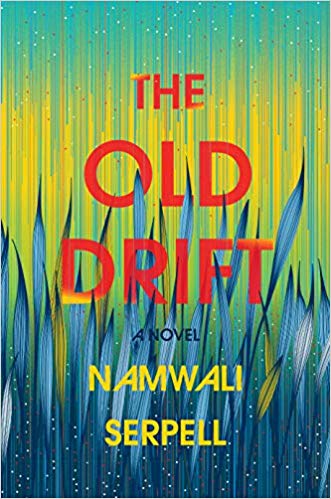
“The Old Drift” Is the Great Zambian Novel We Didn’t Know We Needed

Over the years, Namwali Serpell has received many accolades for her short fiction, including a Rona Jaffe Fellowship and the Caine Prize for African Fiction. We can now add her debut novel The Old Drift (Hogarth Books) to the list of epic stories spanning continents, decades, and generations. A mastery of language, a deftness in description, and a dip into surrealist and speculative elements makes The Old Drift a worthwhile study in holding together several storylines through the characterization of those searching for their calling, and the cost of those pursuits. In sections of “The Grandmothers,” “The Mothers,” and “The Children,” Namwali braids together three families’ lineages near the start of the 20th century to a more immediate future in 2023. The journey begins with the matriarchs, one of which is Matha, a young Afronaut-in-training whose exuberant spirit dissolves due to continuous loss until she becomes known in her village as the woman unable to stop crying. And we conclude in a sort of present-day with “The Children,” including headstrong millennial Nailah whose relationships are as unsteady as her rebellious aims. The women and men in The Old Drift expose the idealism of unification and the reality of floundering to find place.

The Old Drift by Namwali Serpell

My interest in The Old Drift came from my own leanings towards multigenerational stories. And Serpell’s novel satisfied my predilection, taking me from Europe to what was the colonized Northern Rhodesia to present-day Zambia. The Old Drift, a burial site of Europeans who aimed to settle in Zambia, is a character but more so a figure, a representation of what was and what is and what could be as each generation has a part to play in its construction and even its demise. From the late 19th century, where a white man makes claim to land that isn’t his, to several years into the future where technology is part of our bodies, The Old Drift laces together transcontinental narratives, the repercussions of colonization and reform through varied perspectives, including omniscient narrators who see all and playfully predict what is to come. Serpell and I discussed the work that goes into writing such an expansive novel and her aims for avoiding the binary when it came to Zambia, gender, and relationships.


Jennifer Baker: I’m a sucker for multi-generational novels/stories in general.

Namwali Serpell: Great! My ideal reader.

Jennifer: And there’s a lot woven in The Old Drift. I’m curious about organizing, process, and how the story came together, but also recurring themes. For a book of this scope, how do these elements initially come together, especially since there’s interracial and intraracial conflict along with the colonization of a nation?

Namwali: When I began [this novel], I was in college, in the year 2000, and was very inspired by certain texts—Rushdie’s Midnight’s Children and Satanic Verses, Marquez’s Love in the Time of Cholera and 100 Years of Solitude. But the one that really sparked the seed of this novel was Zadie Smith’s White Teeth, which depicted a multigenerational story that unfolded the endemic multiculturalism of London. The first characters in TOD emerged generationally—Jacob, Sylvia, and Matha. And it became clear about three years into writing off and on that there were three families. I knew there was this cycle of unwitting retribution between the families, where one family affects another, which affects the third, which affects the first. Their racial and cultural admixture was always forefront in my mind. I was never very good at history. I moved back and forth between the U.S. and Zambia at the key grades for learning the history of these respective countries. So it was only in learning more about Zambian history in the last five years or so that the historical aspects of the novel grew in. I always said the novel was like a plot of land, pun intended, and I knew its boundaries but not what would grow within in.

Jennifer: The Old Drift is its own character in the larger story, yet the families are definitely representative of how things carry on in the ways of colonialism, class, race, and loss.

I always said the novel was like a plot of land, and I knew its boundaries but not what would grow within in.

Namwali: Yes, the relationships between people in terms of race, class, gender, and, yes, human emotion were actually the easiest and thickest to write. Getting certain historical and cultural and bodily details right required more research—books, movies, but also very very kind friends and acquaintances who read for the Italian parts or for the parts set in Tirupati etcetera. The funnest research for me was the sci-fi stuff! I got to nerd out.

Jennifer: These relationships and what characters reckon with speaks to certain preferences, I guess, in your storytelling the process:, knowing the people but how do they operate in an ever-changing world?

Namwali: I mean—to make this comparison is already hubristic—but Edward P. Jones’s story about carrying The Known World in his head for years, 12 years maybe? And then writing it down, that resonates with me. Once they’re people, figuring out what would happen to them felt like the easiest part. I wish I had been able to tell the full arcs of some characters. But with a cast of characters this big, I could only give snippets of folks and follow certain people—like Matha—all the way through.

Jennifer: And it’s not as though there aren’t “resolutions.” I use quotes in that instance not to say it’s tied up, but to say there is a continuation to see how lives have been affected.

Namwali: Yes. I did want my characters to have full lives that change. I think about [focal character in “The Mothers” section] Thandiwe, who sets off this whole set of events at the salon out of a sense of jealousy or revenge and then moves to a whole new country and begins a new life there. I think that’s how lives work for me. I was very keen for people to understand in particular that Zambians (all Africans) aren’t just stuck in time and place.

Jennifer: Especially making that clarification for U.S. readers. Which is why I was so struck by the narratives of historical African countries in The Old Drift and Wayétu Moore’s She Would Be King.

Namwali: Seriously. Yes, I enjoyed Wayétu’s novel! I interviewed her at MoAD in San Francisco. She’s great. It was fun to think about our novels side by side because we do very different things with “magic.” I think she and I have some resonant experiences as immigrants, but we talked about how we weren’t wanting to write (yet) about that experience—of Africans coming to America (a la the first half of Americanah, which also came late for Adichie, after two novels set primarily in Nigeria). We were both very interested in how race plays out in these colonial spaces in more dynamic and surprising ways than people often think and using “magic” to convey that.

Jennifer: I, personally, prefer a story that takes place outside the States. Rather than about acclimation, it’s about another form of that in a way. Not culturally but socially, in terms of difference in perception and execution.

I was very keen for people to understand that Zambians (all Africans) aren’t just stuck in time and place.

Namwali: I’m glad to hear that. So far my stories are set either in the U.S. or Zambia but never the twain shall meet! (And some are set sort of “online.”) It’s a very different lens of looking at the world. Just to take the question of a mixed race people, in Zed and Zim, we have this category “coloured,” which is a word you can’t use in the States. But it is its own culture and social group, and there’s no “are you Black or White?”

Jennifer: I found myself very drawn into that idea of mixed race and how Whites and Blacks and Natives of the space and visitors who adopt it feel an ownership and interact but also get exiled.

Namwali: But it speaks to this absence of awareness about the resonances of the Black experience across the diaspora. Yes, it works itself out very differently. I grew up with a White father who became a Zambian citizen and his experience, and those of his peers, were radically different from say, the Stewart Gore-Brownes, who came in as settlers, or the Percy M. Clarks before that.

I find it all very fascinating precisely because race is so hard to pin down in that context. [The character of] Agnes is limited by her Whiteness, but she thrills to learn about African socialism. She is happy to abstract a Black experience onto Bantu people without looking very closely at her relationship with [her servant] Grace, for instance. I mostly didn’t want there to be heroines and villains, but to explore the intricacies of race over time and in relation. And that resonates a lot with Wayétu’s book.

Jennifer: Those relationships also branch out in class with siblings Matha and “Cookie.” The belief systems also act as a breaking point and made me think about gender relations.

Namwali: I’m so glad you brought this up! Very few reviews have noted the class politics of the novel. It ends with a pseudo-Marxist revolution! The ways Matha and Cookie process their romantic relationships are very different because of how money and politics get tied up in both. I mean poor Cookie never really gets to have love.

Jennifer: Do you think this is because she saw it as transactional? In a way, even Naila seems confused by love when witnessing the parental relationship of Isabella and Daddiji and how their marriage seemed very organic.

Namwali: I think Cookie is driven by lack. She wants what others seem to have—and that motivates her to stay with this older married man.

I wanted to explore what a relationship that is entirely based on sexual desire can be. Isa and Daddiji are like-minded as well. The tit-for-tat transactional nature of things works quite well for them, and maintains their relationship over trickier things, like Isa’s miscarriages. But Naila has no access to that truth of things between her parents, so she rebels against it and finds herself torn instead between these two young men. Rather than coming down on one side or the other about whether a transactional relationship is good or bad, I wanted to convey the reality I have seen, which is that, for some couples, it works well. It doesn’t make them better or worse people but money gets tangled with sex even in marriages (and not just in Sylvia and Loveness’s profession, for example).

Jennifer: And confusion on what love and sex may or may not equate to. I kind of felt like The Old Drift was quite feminist. Women are most often at the helm and not necessarily at “the whim” of men but had continual agency even when they were victims of patriarchal violence.  

Namwali: Yes, I hoped it would be without being pedantic! One interesting thing that happened in the publication process was that there was a continual slippage between “The children” and “The daughters” section. People would keep forgetting that the final generation is two men and a woman. And this raised the question of why I hadn’t stuck to all women, especially since I even slip out of the “bloodline” to write from Thandiwe’s POV instead of Lee’s.

I think my decisions had to do with how best to articulate the set of relations and desires in each generation because for me gender and sexuality are about relations and desires, not as much about fixed identities.

Jennifer: That ties into what I was thinking of. Liberation, or the idea of liberation, is at the forefront for many. This want and desire is pertinent for folks within marginalized identities and women (straight or gay), women of color, women at different ends of a spectrum. But the boys/men as well, have these inklings and urges that result in not-so-great behavior either.

Namwali: This got pared down a lot so I could focus on “error,” but my understanding of the “swerve” of error comes into being as the result of two competing forces: to stay put or to be free, to stick to a community/family/person or to be liberated from them. I was just talking to my sister about the specificity of the relationship between Sylvia and Loveness, which is a hierarchical kind of mentorship friendship, very common in Zambia, but is infused with desire and an awakening of desire in Sylvia. And this returns when she’s dying and missing her friend and it was my attempt to articulate the possibility of a sexuality beyond the binary of male/female, without presenting it in terms of a queer identity as such.

Jennifer: As a cishet woman, I did initially read that as a kind of sexual love tied to sexuality and an identity be it bisexual or queer. And then recognized that closeness in a way of friendship.

Namwali: Yes, it’s both. I am not afraid to write queerness, and I don’t want people to think I was shying away from it. I was just keen on trying to represent a sexuality that can dictate your life without you ever quite putting it on as an identity or a label. Homosexuality is illegal in Zambia but it’s everywhere in these kinds of undercurrents.

Jennifer: Makes sense and also this requires an openness of reading. This is not a novel you can really “get” in one sitting if you’re not keenly paying attention. A lot was deftly woven in, so many kudos to you.

Namwali: Thank you! I know I am sometimes too subtle, so I’m really grateful for your attention!

I think the subtleties work best and make us as readers work a bit harder as well in recognizing what comes about or what is to come.

Jennifer: Plus the lines are so beautiful. I re-read sentences due to their structure and lyricism. Yesterday I spoke about how, sometimes as readers and writers, we get so caught up on “pretty language” that we forget what we’re trying to say because we’re focused on how we’re saying it. Can you talk a bit about how you approach the writing itself and what it conveys as you put it together?

Namwali: It’s true! It is my foible for sure—-metaphor especially. My best friend from college, the first reader of lines from this novel, enforced a rule at some point: one metaphor per paragraph. I try to follow it but I’m sure I fail sometimes. You know, I struggle with understanding the concept of “beautiful sentences,” or rather how they come into being. It’s like certain concepts in Algebra II, where I just had to nod and memorize the rule because I couldn’t access the meaning. It’s true, but I’d be hard pressed to explain why.

My best friend from college enforced a rule at some point: one metaphor per paragraph.

I think it has to do with balance and rhythm, so reading my sentences aloud to edit has changed my writing completely. I know what an ugly sentence looks like. But sometimes people speak rhapsodically about sentences and I’m just baffled. There’s a preference for Germanic short words over Latinate ones in American schools of thought (MFAs), but I love Latinate words! And I like puns and wordplay and alliteration, which are all seen as indulgent.

Jennifer: I also think this comes from mentorship and personal preferences. If you’re not a fan of poetry, which I think is odd, then lyricism may not “seem” as direct.

Namwali: Yes, I sometimes try to imitate certain writers to feel how they write. I’m a big fan of poetry but (I think this might be the key) I’m not great at teaching it. I think those local insights about how poets do what they do are somewhat beyond me. I like that there are things like poetry and film that I don’t know as much about but can enjoy deeply, aesthetically.

10 Funny Novels About Obsession

Our obsessions make us and unmake us; they can drive us forward, keep us spinning in place, push us over the edge. Some lead to breakthroughs, some to breakdowns. Sometimes the line’s not so clear — it’s a heady energy, now creative, now destructive.

We’re all born into a world of obsessions: those of our families, our societies. Their most powerful, all-consuming beliefs and dreams may wear the cloak of tradition and convention. Many of us, in fact, enter this world as obsessions: dreams ourselves made flesh. That gets complicated. Obsession is the drama of belief: fixation.

It can be the comedy of belief, too. I love books like that, where someone gets so carried away with a conviction or project that the whole thing becomes absurd, giddy spectacle. (See Don Quixote or Tristram Shandy, master texts of the fixed idea.) If a distinct sensibility in art is formed by noticing what we notice over time and refining that into a vision, then obsession, fascination, and preoccupation herald — ideally — works of singular intensity and invention. Sometimes they wind up being really funny, too.

I started my own debut novel, Cheer Up, Mr. Widdicombe, ten years ago while obsessively reading P.G. Wodehouse. Every character in my ensemble is driven by an overwhelming desire for something that might seem ridiculous taken to a fanatical extreme: parental disapproval, a spread in a home interiors magazine, Artist’s Way-style creative rehab. But our hobbyhorses often point to deeper quests, a longing to complete the puzzle of a meaningful life. That’s part of what’s so amusing about them.

For anyone who’s ever gone over-the-top, here are ten of my favorite works of comic obsession.

Five Spice Street by Can Xue

“When it comes to Madam X’s age, opinions differ here on Five Spice Street. There are at least twenty-eight points of view. At one extreme, she’s about fifty (for now, let’s fix it at fifty); at the other, she’s twenty-two.” So begins this hilarious novel of proliferating theories and outlandish, relentless gossip by the experimental writer Can Xue. On the three-mile-long Five Spice Street, residents speculate about the sexual appetites and desires of Madam X., meanwhile performing the sort of occult experiments related to ways of seeing and vision that link it to Can Xue’s other works, many of which are rich with similar fixations.

Myra Breckenridge by Gore Vidal

Few voices are as commanding from the get-go as Gore Vidal’s controversial Myra Breckenridge: “I am Myra Breckenridge, who no man shall possess.” Gloriously obsessed with the Golden Age of Hollywood film — and with the sadistic domination Rusty Godowski, wholesome specimen of macho masculinity and a student in her Posture class at the Academy for Aspiring Young Actors and Actresses — transsexual Myra caused a stir in the late 60s by storming the citadel of sex and gender in subversive, high queer style. 

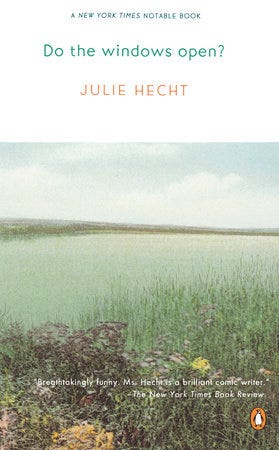
Do the Windows Open? by Julie Hecht

The semi-autobiographical narrator of these stories finds cause for shock and mental spiraling in one daily reality after another. Could her optician be “a Nazi (age is right for Hitler Youth)”, “the son of Nazi,” “a neo-Nazi,” or “at least a Nazi sympathizer”? Lying in bed with a headache, is she a wastrel on the order of Oblomov (“Certainly, I looked better and was cuter”), a failed adult in comparison to Jacqueline Kennedy, Hillary Clinton, or Princess Diana? Was Nantucket better when Thoreau used to come and give lectures? “Maybe that was the time of the world of ideas. But this was the new world. What kind of world was it? It was some other kind of world, and there was no escape.”

Flight to Canada by Ishmael Reed

One of the many great things about Ishmael Reed’s Civil War satire is the author’s technique of collapsing historical and contemporary references into a singular comedic vision. Described in The New York Times as a “demonized ‘Uncle Tom’s Cabin’” (Harriet Beacher Stowe gets some memorable comeuppance), it tracks the fates, primarily, of 1) Raven Quickskill, a poet fleeing slavery, fixated on reaching Canada (“Everybody had turned their attention toward Canada. Barbara Walters had just about come out on national television to say that the Prime Minister of Canada, this eagle-faced man, this affable and dapper gentleman who still carried a handkerchief in the left suit pocket, was the most enlightened man in the Western world”), and 2) slave-owning Southerner Arthur Swille, who receives Lincoln as a guest in the middle of the war and who meets a most appropriately deranged Gothic end.

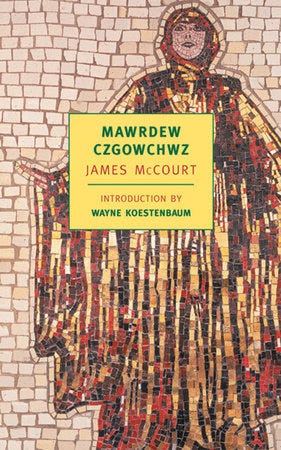
Mawrdew Czgowchwz by James McCourt

When I think about this novel I want to faint. In it, gay talk and obsessive connoisseurship rise to sublime heights; a group of New York opera queens fetch the Czech diva Mawrdew Czgowchwz (pronounced, by them and by all others hence, “Mardu Gorgeous”) to America, the better to carry out their adoration of the self-proclaimed “oltrano” (a new vocal category she has invented for herself”) and their rivalry with the “Neriacs,” worshippers of Morgana Neri, “diva of yesteryear.” “Those first years began: the Czgowchwz Era. Neri commenced to frazzle; lines were drawn.”

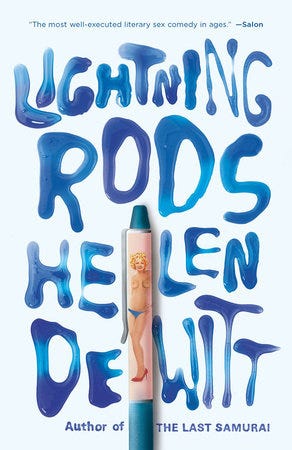
Lightning Rods by Helen deWitt

“His first fantasy was about walls. The woman would have the upper part of her body on one side of the wall. The lower part of her body would be on the other side of the wall.” In Helen deWitt’s second published novel, a vacuum salesman’s recurring sexual fantasy leads, through a combination of sheer moxy and an obsessive, absurdist elaboration of corporate workplace logic, to a hugely successful anti-sexual harassment program involving a system of “lightning rods”: female employees who serve as anonymous sexual outlets for high-performing men. Hilarious, unsettling, monomaniacal — a book about a quixotic project made improbable, provocative reality.

The Doorman by Reinaldo Arenas

Juan, a Cuban refugee in New York in the 80s, works as a doorman at a tony apartment building. His run-ins with its eccentric tenants — a woman who has tried to kill herself countless times only to be repeatedly thwarted by fate, the owners of the world’s most expensive and intelligent dog (leader of a fantastical pet rebellion later in the novel) — crackle with satirical, tragicomic energy. And then there’s Juan’s metaphysical idée fixe: “…suddenly our doorman discovered (or thought he had discovered) that his tasks could not be limited to just opening the door of the building — but that he the doorman, was the one chosen, elected, singled out (take your pick) from all mankind to show everyone who lived there a wider door, until then either invisible or inaccessible: the door to their own lives, which Juan described as — and we must quote him exactly even though it may seem (and, in fact, be) ridiculous — ‘the door to true happiness.’”

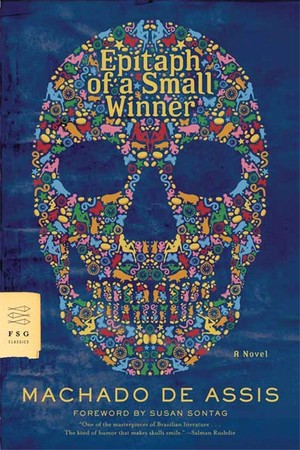
Epitaph of a Small Winner by Machado de Assis

One of the great, timeless comedies of digression and formal play: the fictional posthumous memoirs of Braz Cubas, written from beyond the grave. “I died of pneumonia; but, if I were to tell the reader that the cause of my death was less the pneumonia than a great and useful idea, possibly he would not believe me, yet it would be true.” The idea is an “anti-melancholy plaster, designed to relieve the despondency of mankind,” and while in the process of developing it a “draught of air” catches him “full on,” leading to his swift demise. “God deliver you, dear reader, from a fixed idea; better a mote in your eye, better even a beam.” The memoirs that unfold from there, told in short chapters, are full of wit, pessimism, enchantment, and, well, melancholy.

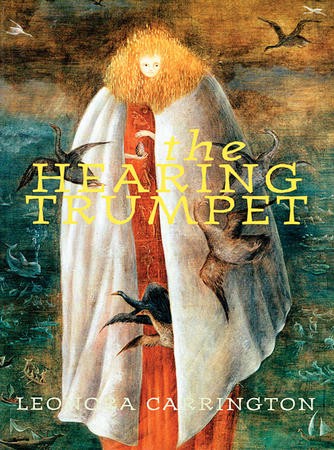
The Hearing Trumpet by Leonora Carrington

I feel a deep fondness for Marian Leatherby, the 92-year-old woman with a “short grey beard” (“Personally I find it rather gallant”) who narrates the surrealist painter and writer Leonora Carrington’s unusual, amusing novel of mystical cronehood. Packed off to a home of sorts by her family (it’s a send-up, apparently, of George Gurdjieff’s Institute for the Harmonious Development of Man), she soon becomes preoccupied with a portrait that hangs in the dining room. “Really it was strange how often the leering abbess occupied my thoughts. I even gave her a name, keeping it strictly to myself. I called her Dona Rosalinda Alvarez della Cueva, a nice long name, Spanish style.” Turns out this obsession heralds nothing less than a cataclysmic transformation of life on earth.

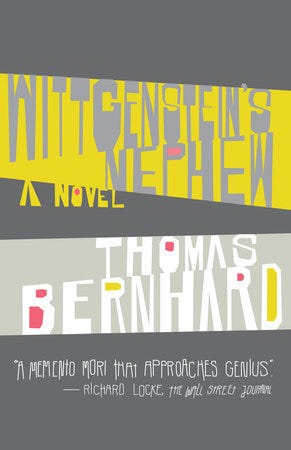
Wittgenstein’s Nephew by Thomas Bernhard

No list of books about comic obsession would be complete without at least one work by Thomas Bernhard. His signature style — full of looping, repeated thoughts and phrases — typically reflects his narrators’ obsessive, searing deconstruction of bourgeois Austrian hypocrisy. The autobiographical Wittgenstein’s Nephew concerns his friendship with Paul Wittgenstein, nephew of the philosopher, who, hospitalized in the mental institution Am Steinhof while Bernhard is in a neighboring pulmonary ward. It’s an excoriating reflection on illness, friendship, and the failures and denials of society at large. “The healthy always make it particularly difficult for the sick to regain their health, or at least to normalize themselves, to improve their state of health. A healthy person, if he is honest, wants nothing to do with the sick; he does not wish to be reminded of sickness and thereby, inevitably, of death.” It has one of the most haunting conclusions of any novel I’ve read.

Nathan Englander on Juggling Fatherhood and Writing

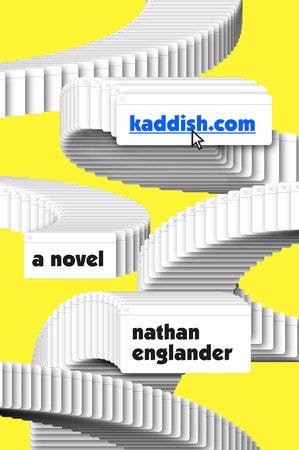
A new book by award-winning author Nathan Englander is always a literary event. But his latest, Kaddish.com is a special treat: Englander’s fifth book is coming out only one year after the release of his previous novel Dinner at the Center of the Earth.“Trust me, I’m as surprised by it as anyone,” he says when I ask. “I saw Joyce Carol Oates recently (we both teach at NYU), and I was like, “Joyce, I’m turning into you!”

Purchase the book

Englander’s earlier books were more reasonably spaced. His first novel, The Relief of Unbearable Urges, for which he won thePEN/Faulkner Malamud Award, came out in 1999. The Ministry of Special Cases followed in 2007, and in 2012 he returned to short stories with What We Talk About When We Talk About Anne Frank, which won the Frank O’Connor International Short Story Award and was a finalist for the Pulitzer Prize.

Kaddish.com is a slim and fast-paced novel, the kind you might delightfully devour in a sitting or two, and it has Englander’s signature humour and wit all over it. It is also a moving portrayal of a man starved for connection and meaning, a meditation on the tensions between tradition and modernity, and a gripping mystery story. Shuli, the protagonist, is a lapsed orthodox Jew. After his father dies, his observant sister, Dina (who lives amongst “these southern, Memphis, Grace-Landian Jews”) expects him to take on the responsibility of reciting the kaddish, the Jewish prayer for the dead, every day for eleven months. Shuli vehemently refuses, which Dina views as unforgivable, a selfish act that could keep their father’s soul from achieving “a truly radiant afterlife.” “Why can’t you do it, Dina?” Shuli asks his sister. “Fix your religion.” Eventually, Shuli comes up with a creative solution to his predicament. He goes online, finds a stranger, based at a yeshiva in Jerusalem, and pays him to pray for his father.

I chatted with Englander over email about novels and short stories, about parenthood and writing, and about Israel and Hebrew and literary translation.


Ayelet Tsabari: After Dinner at the Center of the Earth was published last year, you said at an interview with LitHub, “The joke that I am dining out on is that for Knopf’s 20 years of supporting me, I’ve written a book that is finally not about a rabbi eating toast.” Would you say that your recent book, kaddish.com, is a return to the rabbi-eating-toast genre?

Nathan Englander: There’s no better place to begin than with the self-deprecations of interviews past! I stand by the joke, but not the genre. My last novel, Dinner at the Center of the Earth, was a kind of magic-realist, literary thriller. It was a huge departure, and it got me to thinking about — and missing — the world I started out writing in. So I went back there for kaddish.com. And I kind of feel that the quest that consumes Shuli, the main character, gives kaddish.com more velocity than anything I’ve ever written. Still, back to self deprecation, what do I know? But, yes, we’re here to talk about the new novel, and so, it’s about Shuli getting himself caught up in a crazy situation and risking everything to try and put it right. Along the way we end up pondering technology and tradition, faith in the age of the Internet, sex and guilt, identity and transformation, and a host of things that I feel safe saying make this the opposite of a ‘toast’ driven book.

AT: You write beautifully about the experience of Orthodox Judaism, with humor and heart, and kaddish.com is no exception. I was fascinated and taken aback by your protagonist’s transformation, who begins the book “radically secular” as you once described yourself, and then returns to the orthodox lifestyle he had once rejected. To be completely honest, I was momentarily saddened, because I liked Larry and his “Larryness.” I felt the way I felt when people I knew became religious, a fear of losing them. But then, of course, Shuli (the name Larry goes back to) remains as loveable a character as Larry was, maybe more. I thought that was so well done. Was that a difficult thing for you to write? And what role does faith and religion play in your life and in your writing?

NE: I get teased a lot for how bad I am at being secular. Despite all my claims to the contrary — my friends (my wife!) they all think I’m harboring a religious zealot inside, just waiting to burst free. And that’s one of the ideas that sparked this book: What would it take to send someone like me swinging back the other way, to send me back to the religious world with the same kind of vengeance with which I left it.

You ask about faith in my life, and I can tell you, I’ve got plenty. That’s what a writing life is — an act of faith. It’s so vulnerable-making and so out of one’s control, and the swings are so vast, the creative swings, the ups and downs of career, of one’s own sense of self, it’s really a brutal kind of existence, one that I’m thankful for every second of every day, even when I’m banging my head against the desk. So, even when one can’t see one’s way forward, in the writing, or in the writing-world, it’s that deep-seated faith that tells you to keep writing on.

That’s what a writing life is — an act of faith.

AT: You lived in Jerusalem in the mid-90s, you attribute your secular awakening to arriving in Israel at nineteen, and you write about Israel all the time, including in this novel, in which you are going back to Nachlaot, the neighborhood where you once lived. “Of all the beautiful neighborhoods in the world,” you write, “is any as lovely as Nachlaot in the early light of day?” The journey to Jerusalem transforms Shuli, as it did you. 

As someone who was born and raised in Israel and is now back to living there (after 20 years away), I’m fascinated by your experience with Israel. I suppose I’m also just fascinated by the relationship so many American Jews have with Israel. Like you write in Kaddish.com, “this is how it is for so many in their community, back and forth to Israel, as if it’s nothing, as if one could take the Lincoln Tunnel and find Jerusalem on the other side.” What drew you to Israel, originally? Why do you continue to write about it? Would you ever consider going back? (And, not to rub salt in anyone’s wounds, but it is 68 degrees and sunny all week).

NE: What drew me to Jerusalem originally was my college roommate saying, “Go get a passport, we’re going.” And that was already a wild thing to do. My family, we didn’t travel or vacation, we didn’t have that kind of lifestyle — it was already a big deal when I went away to college, that was already a stretch. I think, tracing one line of the family tree, I can go straight back to a great-great-grandparent coming to America from Europe as the last time anyone had crossed an ocean. So, yes, just being abroad was mind boggling. 

As for Jerusalem, the idea — or, better, the ideas of that place that I showed up with were really deep-rooted and gigantical in my imagination. So when it came to laying that imagined city over the city that I found, that contrast really transformed me as a person and as a writer — it was life changing. After that year, I kept going back, and then I moved there after grad school to be a part of the great historical moment that was in full swing. I wanted to be a part of the peace process, and to witness the two state solution, and to explore the new, peaceful Middle East that was being forged — that was unstoppable and inevitable — and which has long since come crashing down.

AT: You said to Haaretz once, “I wanted to live my life in Hebrew.” That’s a pretty huge statement for a writer to make (and one that interests me especially, as someone whose first language is Hebrew, but writes in English). Did you ever think you might write in Hebrew? Does the Hebrew language inform your work in any way?

NE: I just loved living life in another language. I think that’s a real gift for a writer — to spend a day speaking and reading and thinking in one language, and then to compose their work in another. I feel like I’m a different person when I’m speaking Hebrew, that the way the language works, affects the way I work within it. And I also like a challenge that seems impossible — so it was really fun, as an adult, to crawl toward fluency until, say, I really would find myself just thinking in Hebrew, that my brain had a choice, to think or, at night, to dream in one language or another. As for writing, there must be a bad Hebrew poem somewhere, but I think I always knew books would get built in my native tongue.

AT: You’ve translated Etgar Keret’s Suddenly, a Knock on the Door, and the New American Haggadah, a literary translation of the Passover texts, created in collaboration with Jonathan Safran Foer. I find translation to be an interesting form for someone who’s also a writer; it is a good exercise in letting go of ego (and I’d imagine it would be more pronounced in the case of the Haggadah, which is an ancient and sacred text.) What are your thoughts on the act of literary translation? Do you plan to do more of it? And were you involved in your own translations into Hebrew?

NE: Aside from the Haggadah, my literary translation experience consists solely of translating some of Etgar’s stories, a job for which I was paid back in kind — that is, instead of writing out some sort of contract, Etgar just translated some of my stories into Hebrew in return. The whole experience made me really happy and I still try and come up with two other living writers who have translated each other.

I have no plans for any more translation, beyond the fact that I’d love to do some more Etgar stories if the timing ever works out. At this point, I’m pretty rusty anyway; I’ve been back home for near twenty years and only speak the language when Etgar calls. As for my own Hebrew translations, I’ve given notes a couple of times, but I mostly stay out of their hair.

And to the first part of your question, I’ve always respected literary translation as writer and reader. How could I not? Most of the books I love are books I only know through a translator’s voice. But after trying it for myself, getting to pretend to be Etgar in English, and spending a couple of years on the Haggadah, I’ve added a whole lot of wonder to the mix. It was an absolute education. What it did, was give me the chance to ponder the meaning of specific words at astonishingly inefficient lengths, to unpack, to obsess over language — over someone else’s choices — in such an extreme and highfalutin and thinky way that I couldn’t help but bring that back to my own work. It changed the way I write.

Most of the books I love are books I only know through a translator’s voice.

AT: You started out, like many writers, with short stories, (The Relief of Unbearable Urges) then after your first novel, you went back to short stories (What We Talk About When We Talk About Anne Frank). How differently do you approach writing short stories and novels? Did you find the transition challenging? What do you (secretly) prefer?

NE: Each book is always the hardest and most all-consuming in its way (even if some parts go more smoothly than others, as noted above). So, I wouldn’t break it down by form, just by the task at hand.

My first novel was published eight years after the one before it, and kaddish.com is coming out a year after Dinner, so I feel comfortable saying that the individual books make their own demands. For me, with each new project the approach to writing changes as a whole. That’s probably what keeps it feeling brand new on this end. To me, every book feels like it’s the first book, like I’ve finally got an idea about how to work, about how to write. With kaddish.com, it honestly felt like I was finally ready to write after a lifetime of writing. Prior to this book, I’d have said that the brain holds a short story differently than it holds a novel. But for kaddish.com, the experience — it was really clear at the time, really distinct and sharp — but this is the first novel that I wrote in the way I’d write a short story. It just had a different kind of genesis in my noggin, somehow bridging the two forms for me.

As for choosing a (secret) favorite? I learned this lesson when I wrote my first play, “The Twenty-Seventh Man.” Whatever I’m committed to at the moment turns into the supreme form — that is, at the time, I believe it to be the ultimate, in a real way. I thought a lot about that, sort of interrogating myself, and I decided that it’s not disloyal, or deceptive, to let my brain do that. It’s not the same as swapping out a Yankees hat for a Red Sox hat depending on who’s winning. I just think when you’re wrestling with a certain form, when you see the potential, how could you not fall in love with it? You can’t do the work if you don’t believe — and you surely couldn’t expect that belief to translate to the reader or theatergoer without that commitment on the writerly end. And, since we’re talking about the novel, I can tell you unequivocally that the novel truly is supreme — the ideal. Simple. And if you come back to me when I’m in rehearsals for my next play, I’ll tell you, there is nothing that holds a candle to live theater. It’s not me lying, it’s just me being bowled over by enthusiasm for the power of a given form.

AT: You said before that you write intensely, six days a week, allowing for one day for Shabbat. From my experience, such schedule tends to change dramatically as we become parents. How do you manage your time now?

NE: I manage it better, that’s how I manage it. Being a parent has been a real blessing for my work. I basically lost all my ennui time, the hours spent on my fainting couch with an arm thrown over my eyes, and clutching my smelling salts. Simply, the framing of time, the extreme limitations parenting puts on the work hours in a given day (if you have any control over your work hours), was something I was really determined to turn into a positive for myself. So when I get started, I kind of roll up my sleeves differently, and start typing differently, and see the time I have differently, in a way that has been really creative-making and efficient-making, despite the fact that I’m naturally super slow in all ways. What it also means is that, with my teaching at NYU, and the dog to be walked, and the gym as something that I don’t want to give up on, that I see a lot less of, well, everyone. And, also, I do a lot of night rounds after everyone has fallen asleep. When I was on deadline for kaddish.com, my wife was on deadline for her dissertation, and there was a period there that was really bananas, with the two of us tapping in and out like tag-team wrestlers, seven days a week. You take two hours. I take two hours. Back and forth until the work was done.

The extreme limitations parenting puts on the work hours in a given day was something I was really determined to turn into a positive for myself.

AT: What are you working on now? Does it involve Jews and Israel? Will it be published next year? Is it about Rabbis eating toast?

NE: With the back-to-back books, I think this is the first time in years and years that I’ve been starting from scratch. So I’ve got a million things cooking. I have a play to rewrite that looks like it will open a year from now (it’s an adaptation of my story “What We Talk About When We Talk About Anne Frank”). And there are some stories I want to spend time on, and some book ideas to unpack. My head is basically spinning right now, and as soon as something gains traction, I imagine I’ll disappear into that — that’s what I dream about, getting lost in the work. When I’m not with my family, that’s where I love to be.

7 Novels About Sex in Suburbia

When people ask me to describe my novel, White Elephant, I tell them it’s about a developer who moves into an established community, starts tearing down homes and ignites a fuse — which leads them to assume it’s a book about real estate. And arguably, it is. The book opens with a character thinking about her husband’s feud with the neighbor who’s building oversize houses in their neighborhood — but she’s also thinking about sex. Sex is actually her first thought, as sex is higher on her priority list — while construction is higher on her husband’s.

The character — Allison — might be just a tad obsessed with sex, possibly as a result of her husband’s priorities. She entertains herself during her many dog walks through her neighborhood by imagining the sex lives of her neighbors. Good sex. Bad. Energetic. Kinky. She imagines who has fun in bed, and who will divorce a few years down the road.

As a former suburbanite, I can relate. While I didn’t play that particular game, I did find myself imagining the lives lived within the houses in my neighborhood, with their tightly sealed garages, and action-hiding window treatments. Judging by the number of books about suburbia, books that often focus on the sex lives of its denizens, I have to guess Allison and I are not the only ones with this preoccupation. The following are a few of my favorites.

Summerlong by Dean Bakopoulos

While most of these stories take place in fictional towns, Summerlong takes place in Grinnell, Iowa, where, it appears, having sex and smoking weed are the primary pastimes. The story begins when the town realtor, Don Lowry (“It’s your home, but it’s my business!”), finds a young woman beneath a tree whom he believes to be dead. She’s not. He winds up spending the night with her, not having sex, but smoking lots of weed. Have no fear: there’s plenty of sex yet to come — plenty — along with skinny dipping, house breaking, wild parties, infidelity, references to Madam Bovary and questions of life and death in this story of a strange, firefly-filled summer.

Little Children by Tom Perrotta

Tom Perrotta’s Little Children, also pays tribute to Madam Bovary — it’s the book being read in the town book club. No coincidence there. The book posits many charged questions: Will Sarah, the stay-at-home mom who is surprised to find that she’s a stay-at-home-mom, sleep with Todd, the stay-at-home dad dubbed “The Prom King” by the other moms? What will happen to the sex offender who lives down the street? And what about Sarah’s (creepy) husband’s sordid little secret? Little Children is darkly funny and compelling — and was made into a great movie starring Kate Winslet.

Revolutionary Road by Richard Yates

Which brings me to another novel of suburbia that became a terrific movie starring Kate Winslet along with Leonardo DiCaprio. Revolutionary Road manages both to be extremely dark and extremely funny, and is one of the mostly acutely observed books I’ve ever read (and re-read and re-read). Sex is conniving and dangerous, the antithesis of April and Frank Wheeler’s thrilling plans for the future, in this book about a desperate couple seeking to break out of the confines of suburban life.

The Ice Storm by Rick Moody

Sex is the engine that drives Rick Moody’s dark comedy The Ice Storm, set in the affluent Connecticut suburbs in the early 1970s. Everyone from adult to teenager is preoccupied with it, sneaking off to bedrooms and basements to partake. Alcohol and drug abuse, too, know no age limits. The climax, as it were, comes during a winter storm on the night of the partner-swapping key party in this dark comic novel about isolation and boredom in mid-century America.

The Uncoupling by Meg Wolitzer

Meg Wolitzer’s The Uncoupling is a little like A Midsummer’s Night’s Dream, only just the opposite.Instead of magic that causes people to fall in love with the first person they meet in ancient Athens, magic causes the women to completely lose interest in sex in Stellar Plains, New Jersey. The play within the novel is Lysistrata — Aristophane’s play about women withholding sex to end the Peloponnesian War — which is in rehearsals at the high school. Before the no-sex spell is cast, there’s sex though, both teenage and middle aged. The denouement arrives on the night of the play’s performance.

The Arrangementby Sarah Dunn

In Sarah Dunn’s The Arrangement, sex is not just a subplot, but the main event. A couple decides to give each other a six-month pass — the eponymous arrangement — during which they are allowed to have sex with pretty much whomever they please. They draw up the rules on a piece of paper with an orange sharpie and off they go. There are fun subplots that involve chickens and camels and men in skirts. A terrific story of love and marriage that is thought provoking in addition to being absolutely hilarious.

The Position by Meg Wolitzer

The Position, also by Wolitzer, starts on the third floor of a house in Wontauket, New York in the 1970s, where the four Mellow children have discovered the bestselling sex book their parents not only have written, but have modeled for. Yes, shudder. Thirty years later, everyone’s still traumatized. The Position is by turns funny and sad, and sometimes sweetly hopeful.

Dave Eggers Thinks Privacy Is Dead

Two men are tasked with building a road in an unnamed country recovering from a recent civil war. Most other details remain undisclosed in Dave Eggers’ new novel, The Parade. What we do know is that one man, referred to as Four, is determined to finish the road on time and according to procedure, regardless of the locals they pass by begging for help or the misfortune they see along the way. His coworker, called Nine, knows the local language but is lacking when it comes to an awareness of their employer’s policies. They clash; Four doing all he can to stick to schedule while Nine shirks responsibility in order to engage with the community.

Purchase the novel

With a perceptive eye, Eggers uses fiction to investigate patterns, both political and sociological, that exist around the world. In What Is the What, he critiques American immigration policy by recounting the story of a Sudanese refugee that he met in Atlanta. In The Circle, he explores the pitfalls of social media’s intrusion into our everyday lives. With The Parade, Eggers continues to offer insight into humanity with his characters and the way they interact, or fail to interact, with the situation in which they find themselves.

I talked to Dave Eggers about economic imperialism, the socio-politics of labor, and the future of social media.


Frances Yackel: What was the genesis of your novel?

Dave Eggers: The idea goes back more than a decade. I’d seen so many odd instances of contractors in unfamiliar contexts that I started taking note. The first instance was seeing a Swedish road crew in rural South Sudan. It just seemed so incongruous and counterintuitive that I was fascinated. Why a Swedish crew? Why import all this equipment from so far, when surely there would be road-paving technology available from, say, Uganda or or Kenya. I thought about the implications of the pavers’ work, and whether or not the laborers on the ground had any inkling about the socio-political context in which they were working. That was the first catalyst for the idea, but since then I paid attention to these sorts of contractors, whether it was Chinese pipeline-builders in Africa, or Filipino electricians in Saudi Arabia — and began to think a bit about their motivations and inner life.

FY: The protagonists of your novel are impeccable representations of opposing ethical codes. On the one hand, you have a man who believes staunchly in following the procedures implemented by his superiors and you have a man bent on fashioning his own rules. The former ignores the immediate cries for help surrounding him in order to finish his job on time while the latter allows his mercy to distract him from the task at hand in order to help the people he can.

Four and Nine are examples of two opposing extremes; do these opposing extremes represent a more subtle divide in humanity? Do you think you could pick out a person and ascribe them to one side versus the other?

DE: Well, the times I’ve visited NGOs in the developing world, I’ve seen a fairly stark divide between the practical-minded staffers and the more flighty adventurers. The adventurers can be very problematic. Very often they have a love for the world and an interest in all humans, but they proceed without caution and without regard for consequences. They drop in and when they leave — they always leave — they leave a trail of chaos. In contrast, the more businesslike workers get things done, but without contemplation, in many cases, for the larger context or implications of their work. And both types of visitors can be, and are often, subject of manipulation; they become tools to advance motivations beyond their reckoning.  

If everyone really contemplated the implications of their lifestyle, billions would be paralyzed by self-doubt and even shame.

FY: Four and Nine are employed by the same company, but their reasons for doing this work are vastly different. Could you talk about the differences between motivations in Four and Nine’s decisions to take on this as an occupation? Do they overlap at all?

DE: They overlap in that for both of them, ultimately, it’s a job. They are road pavers. They’re contractors and their presence is transitory. Four, the more capable and responsible of the two, would just as soon be paving roads in his home country. But he’s found himself valuable to his company, and they trust him with the complicated tasks abroad. He has, though, chosen to eschew looking left or right; he’s focused only on the point in the distance where the road will be finished. I’m intrigued by characters like this, because they are necessary to the functioning of the world. Nothing at all, anywhere, would get done without some vast majority of people keeping their heads down, ignoring the ultimate consequences of their labor. If everyone really contemplated the implications of their lifestyle, or the work they’ve chosen, billions would be paralyzed by self-doubt and even shame. So I don’t fault Four or Nine for their place in all of this. It’s the position all humans occupy for much of our lives.

FY: Four cares deeply about the completion of the road, which helps him to pay such close attention to the details of his job. He seems to pay less mind to the ultimate purpose of the road and his journey; the growth and development of the country recovering from civil war. Are there meant to be broader implications of this lack of sentiment surrounding the country itself?

DE: All over the developing world, as we speak, foreign companies are creating roads, deep-sea ports, railways and pipelines. Sometimes, in the case of China, for example, they take an ownership stake in, say, a port in Malaysia. So there’s economic imperialism at play there. Other times, it really is a case of a foreign contractor simply completing a task and leaving. Many years ago I saw a Swedish company building a road in South Sudan, and thought that was very odd and very intriguing. Why not a Kenyan company, for example? There’s something advantageous, for the commissioning government, about bringing a contractor in from so far away — free from any local politics, and disinterested in regional power dynamics. This way, they can be trusted to do the work without getting otherwise involved, and without being too concerned with the ultimate motivations behind the project in the first place.

FY: After finishing the novel, the journey appears to have a Sisyphean undertone. Could you speak more to the supposed futility of  their job?

DE: For Nine, the work might have been futile. Then again, maybe Four sees it as far beyond his purview. The work was done, he was paid, and he moves onto the next project.

Most of the world is moving toward a complete evaporation of privacy. Regular people are creating our own surveillance state.

FY: I’d love to ask you about the Circle. Your 2013 novel feels eerily timely and prescient in our era of mass privacy breaches, never-ending Facebook scandals, and Instagram influencer culture. What is your view on social media now? Do you think we’ve given up too much of ourselves over to social media? Do you think one day we’ll all stop using social media altogether?   

DE: I think it’s continuing to morph, which is overall a positive thing. Younger people, those under 20, aren’t using Facebook at all, and that’s a good indicator for the planet. There is, rightfully, almost universal distrust of Facebook, because their culture is not one built on trust or respect for users, and yet billions still willingly give the company much of their most personal information. High schoolers, though, have altered their behavior radically — they want to communicate with friends, but directly, using WhatsApp, for example. The movement is away from public sharing and into more private communication. Consumers’ behavior and preferences will drive what happens with social media in the next five-ten years, and I dearly hope the teens will lead it all into more sane territory.

FY: The pendulum tends to swing both ways. Do you envision that this movement toward private communication as opposed to public sharing will be a permanent one?

DE: Obviously most of the world is moving toward a complete evaporation of privacy. We get temporarily upset, for example, about the cameras on planes, but there will be cameras everywhere on planes within a few years. It’s a version of Moore’s Law — as cameras get ever-smaller and cheaper, they proliferate without resistance. Within a decade, they’ll be everywhere, certainly in every public place. Every neighborhood, whether urban or suburban, will have hundreds of cameras to detect any perceived threat or deviance. In concert with the Nextdoors of now and the future, this will lead to an unsettling future, where any departure from the norm will be sound an alarm, and all interlopers or supposed strangers will be suspected.

Regular people are creating our own surveillance state. It’s insane, of course, and represents a radical evolutionary shift, but it’s pretty clear that the vast majority of the world doesn’t care so much about any semblance of everyday privacy. The omnipresence of cameras will make us slightly safer, probably, but anyone on camera tends to behave differently, so we’ll become a different species — we already are, in so many ways. This is what I was trying to explore with The Circle — whether or not living an on-camera life made us more obedient, more acquiescent to what I like to call microfascism — where digital mobs punish those deviating from social norms — and overall less interesting as a species.

FY: In addition to your writing, you also founded 826 National to help young children with literacy and writing skills. Could you talk about this relationship? How does your advocacy work influence your writing?

DE: Speaking of that — we’re about to publish a book called True Connections, which will feature teens’ thoughts on social media and the digital world. And the vast majority of the students have written very worried, and worrisome, essays. None of them are settled and content with their relationship with digital media. That lines up with Jean Twenge’s studies showing a stratospheric rise in teen depression, tied directly to the rise of social media. So the book gives teens the chance to tell it straight.

The only hope we have of turning the tide is with the teens who grew up in the shadow of the monster we made.

FY: Do you have advice for teens and young writers with concerns about these topics? What is the best way to get those voices heard?

DE: With the International Congress of Youth Voices, one of our missions is to help teen voices get access to mainstream platforms like newspapers, news networks and the like. So we were able to help Samuel Getachew, a brilliant young writer from Oakland, place an op-ed [about 21 Savage’s ICE arrest] in the New York Times a month ago. And Salvador Gomez Colon, one of our delegates from Puerto Rico, wrote for and appeared on CNN, to talk about conditions there after Hurricane Maria.

Legislators concerned about digital issues, and how they affect teens, need to talk to the teens themselves. They tell it to you straight, and they’re far more clear-headed about the topics than most adults. My generation created and empowered most or all of the worst tech tools, and the only hope we have of turning the tide is with the teens who grew up in the shadow of the monster we made.

Amy Hempel on Turning Survival into a Story

Amy Hempel’s Sing To It is her newest short story collection and her first in over a decade. Each piece is precisely honed and crafted with associational thoughts orchestrated into brevity to intensify, not lessen, the complexities behind emotions, memories and motivations. Rhythmic and tip-top language, punctuated by images and unrivaled metaphors, are tools she uses to destabilize her narrators while mobilizing readers into a cleft of curiosity and compassion. Far from being a minimalist, Hempel is a writer who magnifies a mind in motion. Her narrators swerve toward us with a muscled complexity of vulnerability, not a state of victimhood. Concise wording rivets a reader to the raw and recognizable intimacy of narrators’ interior voices that leapfrog from one thought to the next. The structure of these fifteen mirroring-life stories leaves one suspended without a safety net. 

Purchase the book

Five of Hempel’s one-page stories, (Sing To It, The Orphan Lamb, The Doll Tornado, The Second Seating and Equivalent), read like an entire novel while “Cloudland, the 62 page closing story, is a crafted artwork of resiliency that thrives within a cyclone of ever-present pain. Hovering above Sing To It’s shoreline of stories is the book’s dedication to Gloria Vanderbilt Cooper, who said, “Once you accept life is a tragedy then you can start living.”

Amy Hempel and I corresponded via email about what drove this collection — personal elements woven into fiction — and talked about the importance of associational thinking in her writing process.


Yvonne Conza: What drove this collection? And, how does it differ from your previous works?

Amy Hempel: Always, there is an image or a moment of illumination, or a wonderfully skewed sentence that comes to mind — these are the beginnings of the several short-short stories in the book. But that is not new for me. I think what is different from earlier work is the stance, a kind of attitude in the narrators. These narrators are more knowing, they’ve been around the block, as the expression goes, but they are still vulnerable. My friend Bret Anthony Johnston talks about the difference between vulnerability and victim; it’s a big difference, and I don’t feel these narrators are victims.

YC: How important is associational thinking in your writing process? Do you feel that the processing of information, through patterns, seemingly unrelated elements and contextual relationships, imparts greater layering and progression to the work?

AH: Associative thinking and memory are key to what I’ve done in this book. There is a leap of faith necessary as thoughts and recollections accrue — you have to trust that there is a reason they are occurring when they do, and you will, at some point, understand it. It’s an exciting way to work because of the discovery inherent in it. Patterns proceed from the accrual. It’s a humbling way to write, and it’s different from planning, something I’ve only done once, and that story, “The Chicane,” took thirty years to write.

Non-linear thinking is the only kind I do in real life, so it’s not surprising that it shows up on the page, as well. I don’t see life in terms of beginning, middle, end, though I suppose you can chart certain relationships in this way. Joe Brainard’s I Remember is a book that is close to my own way of thinking on the page, and of course Mary Robison’s Why Did I Ever was, and still is, influential in its accretion of seemingly small, odd moments that turn out to be central and essential.

YC: In Reasons to Live, your first collection, followed seven years later by At the Gates of the Animal Kingdom, you made reference to “branching out of grief to fear.” What is Sing To It branching out of?

AH: I think there is a larger concern with external threat — the threat to the natural world. So the stories, particularly “Cloudland,” fix a gaze towards the damage done and the damage to come unless current behavior, both individual and governmental, changes dramatically. There are many other serious threats, of course, notably the way people with power treat people without power. That is also present and addressed in“Cloudland”and other of the new stories.

The stories fix a gaze towards the damage done and the damage to come unless current behavior changes dramatically.

YC: The personal elements in your material — suicides, dogs, accidents, friendships — are cycled through a fictional transaction. In “The Dog of the Marriage” a doorman rings up to let a wife know that a beagle returned home without her husband who was hit by a car. This brought to mind the tragic experience of Abigail Thomas. (Full disclosure: I know Abigail.) In “A Full-Service Shelter,” reference is made to the narrator being afraid of the Presa Canarios, the molossers bred in the Canary Islands. That made me think of Diane Whipple’s murder by two Presa Canarios in 2001 and I thought that perhaps you had a personal connection to Whipple. Also, the woman of immeasurable kindness and talent in “Cloudland” suggests Gloria Vanderbilt Cooper. Are these elements representing both truth and fiction, or perhaps a kind of narrative toggle that morphs into the early metaphor in the opening story of Sing To It — working as “hammocks” for the stories?

AH: You are right to think of Abigail Thomas in the title story “The Dog of the Marriage.” In fact, Abby and her husband adopted the dog I called “Beagleman” in that story, with tragic consequences. I wrote that story as a prequel to Abby’s brilliant and shattering essays about what followed. And, yes, you’re right — I was referring to the Presa Canarios who killed Diane Whipple in San Francisco. Though in fact I did not know her, had just met her once. And the woman of immeasurable kindness and talent in “Cloudland”is Gloria Vanderbilt. I really like your idea of these facts in the fiction working as “hammocks” for the stories, after the image in the story Sing To It. I saw no reason to change certain facts just because they appeared in a work of fiction.

Sometimes there is no improving on what really happened. Though at the same time, a story will go where it needs to go, if you let it. I’m more interested in where something taken from experience veers off into a new mythology.Since the reader doesn’t usually know whether something in a story comes from something similar in the writer’s experience, I think that what matters is whether the story works or not on its own terms, convinces with no other input. On the other hand, there is certainly a tradition of readers thinking an “I” narrator is the author.

YC: In your 1996 interview with Sharon Olds you asked: “Do readers still ask if a poem about a father is about your father? Prior to the question, you quoted Galway Kinnell as saying, with regard to being daring, “going into the center of the intimate experience of a life, not just telling a story” is to “open yourself to interpretation of the poems as expositions of your personal life.” In interviews, your family and personal experiences get mentioned but never elaborated upon, yet both operated within the material. How do you feel about opening yourself up to interpretation that the stories in your collection expose your personal life?

AH: I do understand the interest in this aspect of writing fiction. I don’t much care what readers might think based on what they read. The people who know me know what’s what, and you can only go on record with what you want to say, to reveal, with no means or need to correct the views of other readers. It can be interesting to watch this play out. I often tell students about the reviews of a story in my first book that features a father and his children out for the day. There is no mention of the mother at all, yet some reviewers wrote of the “divorced father,” and others wrote of the “widowed father.”

There is no mention of the mother at all, yet some reviewers wrote of the ‘divorced father,’ and others wrote of the ‘widowed father.’

YC: Bret Anthony Johnston stated in an interview: “To know a character, I have to understand what they want and what they’ve lost.” Do you feel similar to Bret?

AH: I agree with what Bret said about needing to know what characters have lost. It is some of the most defining information about anyone, both on and off the page. He said another thing I find accurate about writing: Don’t write what you know is true, write about what you’re afraid is true.” I also feel that knowing what someone can do without is useful, not only what they want.

YC: Since endings of your stories leave an advancement of new beginnings, is there a narrator within this collection that you might revisit in a future story? There’s a completion to your stories but never a bow-tie ending.

AH: Thank you for finding my story endings “leave an advancement for new beginnings” — I hope to convey that, so I’m glad you saw that in them. I patrol stories — my own and my students’ — for bow-tied endings. They always sound fake, and it’s never a goal to tie off what people are up against. I can’t predict what might happen in the stories I might write next, but my fundamental concerns are likely to be the same.

YC: How do you feel survivorship works within this collection as a theme? And, is performance a necessary quality or dynamic of survivorship?

AH: I feel it is crucial to most of the stories here. In some, there are people who do not survive, and one is left to reckon with how to continue in the face of this fact. In “A Full-Service Shelter,” there are dogs who do not survive, and suffer along the way to their end. How does someone who loves them go on without imploding? It’s why I read so many memoirs, the need to know how people manage, given what they have come up against.

Everyone survives something. Or they don’t. Some people are able to live a reconfigured life after trauma, and some are destroyed in one way or another. And is a stranger’s suffering available to us? I had an interesting talk about this question with Sharon Olds years ago for an interview in BOMB Magazine. She talked about how she found her way to be able to write about this, but she went through a process of giving herself permission. Sorry to sound like a dope, but I don’t understand “performative” in relation to it as a quality of survivorship. Can you say a bit more about this?

YC: I felt, that in your collection, performance does not mean “acting” but, for me, a kind of choreography linked to survivorship. For example, The “Cloudland” narrator’s day-to-day existence/choreography has a performative movement to it, with hovering information about her past and associational thinking that leads her from one thought to the next. She says: “I left the profession of teaching English in high school — a good, private school for girls in Manhattan — in a denouncement of ambition. That is the way I tell it.”The “that is the way I tell it” part captures what I’m referencing as performative quality to survivorship. She survives and knows what to say and what to leave out — how to keep alive and live within the world. I might be overly projecting — but I do think anyone that has lived through tragedy, especially someone like Gloria Vanderbilt Cooper, can appreciate and gain from the vulnerability crafted into this collection.

AH: Thank you for clarifying, by example — “That is the way I tell it” — the “performative” movement in a story. In “Cloudland” the memories are associative because that is what memory feels like to me — it’s never a linear progression of personal history. I always had Gloria much in mind while writing these stories, particularly “Cloudland.” Her resiliency is astonishing. Her many kinds of strength inspired a good deal of what is in this book. It goes behind surviving to become thriving, though of course with the pain ever present. To manage both of these conditions at once is instructive.

YC: Would you like your writing in this collection to be viewed as short fiction, prose, poetry, or something floating within a newer landmark of, say, associational fiction? Or, are you less interested in the “label” of genre?

AH: I am not that interested in labels for kinds of writing, one reason I so appreciate and admire Bernard Cooper’s first book, Maps To Anywhere. Parts of it turned up in Best American Essays, parts are anthologized as prose poems and short-short stories, parts are memoir, and it won the PEN/HEMINGWAY Award for best first fiction the year it was published.

I patrol stories for bow-tied endings. They always sound fake, and it’s never a goal to tie off what people are up against.

YC: Who are the emerging writers of short fiction that you reading?

AH: My favorite question! But I will open it up to favorite writers of memoir too, because I am filled with admiration for Casey Legler’s memoir, Godspeed, that came out this year. In fiction, there’s the debut collection of stories coming from Kimberly King Parsons, Black Light. And There There by Tommy Orange, and Friday Blackby Nana Kwame Adjei-Brenyah, and individual stories by Dan McDermott and Nini Berndt, by Amber Caron and Karen Keats and Cally Fiedorek, Jane DeLury’s The Balcony, and A Key To Treehouse Livingby Elliot Reed, and This Is Where I Won’t Be Alone by Inez Tan, and my apologies for those I’m leaving out!

Of the newer writers I’m very keen on, most of them came to me through friends.A mutual friend gave me a galley of Casey Legler’s memoir, and another mutual friend sent me a photo of Kimberly King Parsons showing where she had tattooed a line from one of my stories on her arm! I’d liked a couple of her stories in literary magazines, and there was no way I was not going to read more after that! Sometimes reviews play a part, as with the widespread acclaim for Tommy Orange’s There There. I’ve also been reading for some prizes, and that is why I’ve fallen behind in reading literary magazines; I can’t stay current in both. Though I will certainly miss Tin House, a longtime favorite.

YC: Have you ever considered writing a memoir?

AH: The three or so personal essays I’ve written took too large a toll. There is not going to be a memoir.

YC: What is your hope for Sing To It?

AH: There is a charming story about Susan Sontag as a very young reader writing in the margins of book, “I too have had these thoughts.” I don’t know if it’s true, but I like that response.

I Remember You Were Made of Dark, Warm Wood

Blowjob in a Car Wash 
Eating peaches over the kitchen sink, 
a second mouth opens beneath my chin 
to catch the juice that trickles off. 

Deep in machine-assisted sleep I dream
of farewell banquets in carpeted ballrooms, 
the silverware twinkling in projector-light. 

This too will pass, like carside-window grass, 
as if a reel of film sped up, 
unwinding on a loop of desert waste. 

Sifting through the strata of a drawer
I find a pen printed with the name
of the hospital where I was born.

Now, by twisted strands of fate rejoined, 
I stoop to lance a fallen grape 
that has rolled beneath the oven.

Six P.M.
I can read the hour from the street corner
with the stop sign as my gnomon. 
Its shadow is taut as a kite string, 
arcing in the gale of light. 
Lifting my eyes to the horizon, 
this Illinois sunset flattens me. 

Embracing you, I descend into a cellar. 
My vision softens in the darkness. 
And I can only see the halo of your head, 
and feel the schema of your limbs. 
You become the idea of yourself.

If I could, I’d live in endless six p.m., 
the sun’s position fixed at the horizon. 
Only in this hour can I see you clearly, 
before the veil of night lowers between us, 
and I no longer know you, 
although I knew you once.

Silverfish 
Tonight I’m lonesome enough to write a letter
addressed to a Florida key. I bend my thumb
to squeeze the silver from a silverfish, 
and in its ink I fix my signature. 
Branches reach toward my window to take my hand, 
but I am inconsolable. I stomp down
the stairs like playing “Chopsticks” with my feet. 

I remember you were made of dark, warm wood— 
or do I still? 
At least I feel a warmth and see a darkness. 
We cut our hair alike and walked the streets
as if our limbs were bound together, chained
like galley slaves on the Aegean sea. 
It’s true that I remember less well than you, 
and so I remember it better, even good; 
in the dimness of my memory you gleam, 
receding to a single point of light.

Welcome to Electric Literature’s New Website

Welcome to the new Electric Literature website! No, you’re not lost. This is the same Electric Literature you know and love, only with a new outfit designed by the talented folks at CMYK.

Yesterday I told a writer we were launching a new website and he said, don’t you already have a website? I said we do, only now it looks different. Anyone who has ever gone through a web redesign knows that this is both true and an oversimplification. To prepare the new site to be as reader-friendly as possible, we’ve sorted through over 5,000 articles dating back to our first post (September 2009), considering what we’ve offered readers in the past, what we want to offer you in the future, and how we can arrange everything in an intuitive way. (It should be pretty intuitive! Weekly literary magazines The Commuter and Recommended Reading under Lit Mags, essays under Essays, etc. We also have a much-improved search function and author pages if you’re looking for something specific.)

Relaunching the site has given us an opportunity to contemplate all the different faces of Electric Literature over the astonishing ten years we’ve been around—from our self-described “ragtag” lit blog The Outlet (get it?), to our literary events coverage blog The Dish, to the first days of Recommended Reading and, last year, the addition of a second weekly lit mag, The Commuter.

To prepare the new site to be as reader-friendly as possible, we’ve sorted through over 5,000 articles dating back to our first post in September 2009.

What we’ve learned from this trip through the archives of a (knock wood) long-lived literary website is this: It’s not enough to be smart, or committed, or scrappy, or any one of a number of laudable traits that haven’t saved other great sites from oblivion. You also have to be extremely adaptable—and at least a little bit lucky. We’ve been incredibly fortunate in our devoted readership, which has grown from a couple thousand to hundreds of thousands. You’ve seen us through any number of changes we’ve made in order to stay on top of the times, the technology, and the needs of the community. This new site is the most recent, but if our luck holds, it won’t be the last.

(One more note on that storied history: We’ve imported thousands of pieces of content to the new site, some of which date back to several websites ago. If an older piece looks a bit weird, please keep it close to your heart as evidence of our evolution, and assume we know and are working on it.)

If you are going to be at AWP in Portland next week, please join us for our 10th birthday party with fellow 10-year-old The Rumpus: It’s My Party, I’ll Cry If I Want To. We’ll have cake, free drinks courtesy of our sponsor Aevitas Creative Management, and readings on the theme by Kaveh Akbar, Marie-Helene Bertino, Ryan Chapman, Bonnie Chau, R.O. Kwon, and Talin Tahajian.

EL and The Rumpus 10th Birthday Flyer

The White Owl
1305 SE 8th Ave
Portland, OR 97214
Friday, March 29th
6:30 – 9 PM

So what will we be doing for the next ten years? In many ways it seems we are approaching, or have reached, peak internet. On the other side of that peak, I hope the frenzy of our lives online will reach an equilibrium, and the internet will become (or go back to being) a place where we can find what we are looking for, rather than one that takes over. That’s the dream: a more reader-friendly version of online. An internet that looks more like what Electric Literature has always tried to be: thoughtful, well-read, irreverent but not cynical, and interested in a better world.

But people have been wrong about the online future before. Even if the internet doesn’t slow down, we’ll be here, adapting—finding ways to deliver that thoughtful experience in the midst of the digital din. Whether it’s settling into absorbing, long-form fiction, being amused by an irreverent comic, or having your mind changed by an intelligent and personal piece of criticism, I want Electric Literature to be a place where you can stick around for a while. We plan to.