An Indonesian Poet Uses Queer Catholic Saints to Create an Alternative Gospel

Norman Erikson Pasaribu was born and raised in Jakarta, Indonesia but his roots lie in the ethnic Christian Batak community of Sumatra; his family represents the many strands of internal immigration from the country’s regions to its capital.
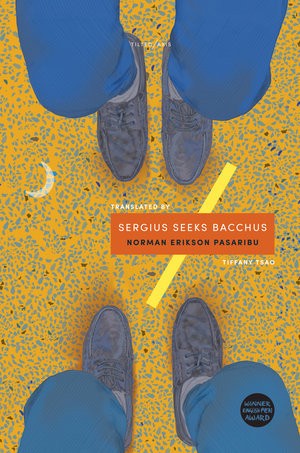
Though he writes in Indonesian, Pasaribu’s poetry collection Sergius Seeks Bacchus (translated by Tiffany Tsao) carries the inflections, songs, and stories of diaspora. His works offer the joys and isolations of queer life in a conservative landscape, a minority existence (less visible in the Javanese-dominated mainstream), and the influences of Christianity.

Pasaribu and Tsao won the English PEN Translates Award in 2018 for the collection. Pasaribu has also published a book of short stories and received the Young Author Award from the Southeast Asia Literary Council in 2017.

I spoke to Norman Erikson Pasaribu about being a multiple outsider, Batak culture, LGBTQ+ life in Indonesia, and translating gender pronouns.


J.R. Ramakrishnan: What is the significance of the title of your book?

Norman Erikson Pasaribu: Sergius Mencari Bacchus [Sergius Seeks Bacchus]’s first working title is Seperti Pohon (Like Trees), but the day I sent it to the Jakarta Arts Council’s competition, I changed it. I abruptly remembered a paragraph from my first book, where I played with the sound tinggal, which can mean “stay” and “leave,” or even “die,” depending on the prefix or suffix used. It then seemed to me that my life and fellow queer Indonesians’ unconsciously revolved around the word’s multiple meanings: Stay/Leave/Die. We are always in the state of moving as if we are endlessly searching for something. I think that “waiting” is the core component of Christian faith, that you wait because/therefore you are certain it exists. It is the same with the title of this book. We seek queerness and its liberation not because we hope we might encounter this one day, but because we are sure it is already there — printed in our lost history. What we have to do now is seek and reclaim it.

In Sergius Seeks Bacchus, I use a lot of Christian saints’ writings and juxtapose it with queerness and my ideas of love. I wrote about this for English PEN’s PEN Transmissions. Sergius and Bacchus are two of the many Christian saints that have been long adopted by queer communities. They are discreet Christians who went to the underground to pray. They both also worked for Galerius’ army. Eventually, their Christianity was uncovered and they were executed. However, Sergius and Bacchus are more mythical than historical figures. I found a lot about them from John Boswell’s work on early and medieval Christianity, which some considered as too queerly speculative.

When we were first dating, my boyfriend and I met in his car at a mall’s basement car park. We would kiss with eyes opened to look around just in case a janitor passed by and caught us. And once it seemed to me so clearly that we were exactly like those early Christians. We are Sergius and Bacchus. And some people here can bluntly associate being gay and queer with evil spirit possession or Biblical and Quranic apocalypse. I feel that if I use their faces, without subscribing to saints’ assumed perfection, it is a way to resist those associations.

My life and fellow queer Indonesians’ unconsciously revolved around the multiple meanings of the word “tinggal”: Stay/Leave/Die.

JRR: Your poems brim with Christianity. How long has your family been Christian? Do you still practice?

NEP: My mom has always been a devout Protestant. She grew up poor and Christianity gave her hope, as it did for many working-class Indonesians. My father came from a Muslim farming family, but he was orphaned when he was very young. He desperately wanted a family, a normal life. He met my mom in Jakarta and converted.

My parents sent me to a Catholic school because they associated it with a better education. I was easily awed by Catholicism’s imagery: the sad and solemn Mary, the halo in her head, her shining and burning heart. Batak-Protestantism, which stemmed from the Lutheranism, is flat and emotionless. In our church, you wouldn’t find a statue or even a picture, just a metal cross behind the podium.

I don’t go to church anymore. In 2016, after my book won a prize from the Jakarta Arts Council, I got severely depressed after online bullying. In April that year, I attended my old office’s Easter mass, and the priest, who was a Toba-Batak man, threw homophobic slurs during his sermon. I ended up excusing myself and cried outside the hall. After that, the desire to go to church gradually diminished.

My relationship with Jesus now is like with a cousin’s new boyfriend that everybody likes and praises, but you actually never meet. I want to know him, but perhaps it’s better if this cousin’s new boyfriend stays a story. I also think I can’t fully divest from Christianity more because it is a shared experience that I have with my mom, who means everything to me. It will always affect my writing and how I feel about this world. But for now, I want it to stay dormant.

My relationship with Jesus now is like with a cousin’s new boyfriend that everybody likes and praises, but you actually never meet.

JRR: You have an epigraph from Gregory Pardlo — “You are home now, outsider, for what that’s worth.” Those commas embracing “outsider” are everything! You occupy this place in multiple ways. Would you talk about “Erratum,” which is about falling in love and coming out?

NEP: I used to fight a lot with my dad, and used to hate him so much. When I got older, I felt the urgent need to look at my parents with a more intersectional lens. It’s possibly the kindest thing a queer child may offer to their parents: zoom out and another zoom out until you get the whole story. I wouldn’t ask this from anyone, but this gave me my peace.

Also, I want to admit first that I dislike it when people read my poems as memoir. It’s true I played a lot with the idea of nonfiction, but being read as a memoirist-poet also made me vulnerable. If things in the poems are not 100% what happened, I have manipulated my readers. One example is the kissing scene in “Erratum,” which never happened, even though I did fall in love with the boy who sat beside me at school.

What actually happened was the rain. In my junior year in high school, my father kicked me out of the house. It was nighttime, and I only had around Rp20.000 (around $2) in my pocket. Out of the blue, it started to rain. I was on the street in short trousers and flip flops. I was so scared and decided to go to an aunt’s house. I silently cried during the whole trip, pondering over water tails on the window. It’s one of the moments where I felt so unloved, and all I wanted at that time was death.

Whenever this memory returned, I would get sad. I invented the kiss as a poetic intervention and because I root for the boy in the poem. I want him to also have something beautiful and alive to remember. I want — as the great Mary Szybist wrote in one of her poems — the emptiness in his stomach to stop gnawing.

JRR: Homosexuality is not illegal in Indonesia but intimidation and hostility of the community seems common with anti-LGBTQ+ marches and other acts. How do you view the state of things at present?

NEP: “Not illegal” gives a radically different idea from what my friends and I currently experience. It’s not easy to speak about this without minimizing Indonesia. As a postcolonial nation, Indonesia has been through a lot. My instinct is always to always look at Indonesia intersectionally as I don’t want to reduce Indonesians into a bunch of evil-minded people.

Indonesia is communitarian. When a loved one dies, it’s common for people to collect money and give that to you as “uang duka” (mourning money). On public transportation, it was not unusual for people to start talking to you and ask about your height and weight, job, and whether you are married and have kids. This communitarian mind translated into my parents telling me, “Apa kata tetangga nanti?” (What will the neighbors say?), making social acceptance gravely important. Even to be eccentric, to be a loner, to be a reader is to be seen differently here.

All this has been heightened with social media. It has greatly affected queer bodies, who are visibly defiant of the typical “rejeki anak sholeh” (pious people’s good fortune) faces. Now more visible, queer Indonesians are ready to be put under fire — that is my bitter take about this.

With social media, it’s easier to imagine a queer liberation, now that the world is just a touch screen away. Sometimes I wonder if this terrifies the fragile hetero community, when they see the very people they’ve always dismissed are now people with more platform and agency. When the U.S. legalized same-sex marriage in 2015, the outrage here was severe. Not long after that, AILA (Family Love Alliance) proposed a judicial review to criminalize LGBTQ+. The proposal was rejected by a dissenting opinion of 5 to 4! We all feel very relieved but now, there is another proposal going on, to revise the penal code.

Some say we need to abandon the penal code since it is a legacy of the Dutch. But pre-colonial Indonesia was more inclusive in terms of gender and sexuality! And the homophobia we now have is the legacy of European colonization. Why do we want to abandon the colonial penal code, but not also the colonial mind?

Pre-colonial Indonesia was more inclusive in terms of gender and sexuality. The homophobia we now have is the legacy of European colonization.

JRR: Your book is resistance to these forces. How do you find and hang on to the courage to stand in this place?

NEP: I am not even sure if I am courageous or brave. I get terrified a lot now. What I know is I am furious with my country, I’m angry with the writers who’ve bullied me; I despise the so-called progressive heteros who conveniently went silent whenever queer Indonesians were under fire. I’m tired so I want a real change. And liberation is never a gift. We have to snatch it from the fuckers’ hands. So that’s what I’m trying to do now, as with all the queer artists and activists before me. I am just a person in a long queer history, after all.

JRR: In “Scenes from a Beautiful Life,” you mention waria, the trans community, which has perhaps historically occupied spaces differently in the region than elsewhere. I am thinking of the five genders in Bugis culture. I also remember when I was young in Malaysia, my family was friends with another family whose members included a trans person. It was regular seeing transpeople at gatherings of friends of my family. It was a tolerated — if not exactly embraced — part of reality. Public same-sex relationships, however, were abhorrent. More recently and very depressingly, there have been horrifying violence towards trans people there. I don’t know if it is the same in Indonesia? Perhaps you can tell us about the place of the waria in Indonesian society (or societies) as you see it?

NEP: I also have thought the same. In the past, it was easier for people to look and accept trans identity perhaps because there were more efforts and a clearer political stance to emancipate waria. Ali Sadikin, a former governor of Jakarta, famously said in 1968, ‘Trans people are human, and they are also Jakartans. So I have to take care of them.” But trans communities have always been the most vulnerable part of our society. They are outsiders in all levels of life. They are even hated by some gay people (who are relatively more privileged!) because they “make us all look bad.” But, imagine, you can find so many gays in offices and banks in Sudirman, but would you find a single openly trans person there, or perhaps even as a server in a nearby junk-food chain restaurant? Even the pseudo-progressive capitalists dismiss them. If you want to understand more about the complexity and beauty of Indonesian trans identity, please see Anggun Pradesha and Rikky M. Fajar’s Emak Dari Jambi (“Mommy Is Visiting from Jambi”).

Liberation is never a gift. We have to snatch it from the fuckers’ hands.

JRR: Pronouns in Bahasa Indonesia are not gendered. Was this a challenge during the translation process? Do you feel like the meaning has changed in any way with the explicit gendering in English?

NEP: It was a bit comical because Tiffany at first thought the use of English would kinda make the poems “come out” more, while I felt from the beginning the poems are so visibly queer since the gender-ignoring pronouns effortlessly give room for nonbinary experiences. It then became harder in the translation process as we started to feel that even they/them pronouns feel different from Indonesian pronouns. Anyway, Tiffany wrote a lengthy note about our collaboration and I encourage everyone to hear directly from her.

JRR: Who are Indonesian writers you are excited about right now so that we may check them out?

NEP: I want to send a shout out to Is Mujiarso/Mumu Aloha who edited the queer-themed anthology Rahasia Bulan. It is groundbreaking for its time of publication (2006) and I love Mumu’s short story in there. And then: Saut Situmorang, who is one of the best Indonesian and Batak poets working today. His collected poems Otobiografi explores the complexity of being in-between as a Batak person in terms of the geographical, the emotional, and also the poetic. And this Tupelo interview with Saut is a bliss.

I also want to share my admiration for Erni Aladjai and Dicky Senda, whose works offer understanding about life in Eastern Indonesia. Erni’s short story about a woman asking for fish for her sick daughter from her fishermen neighbors still haunts me. And to Hanna Fransisca and Cyntha Hariadi who have spoken about Chinese Indonesian identities with such depth. I feel that we are so lucky we have Aprilia Wayar keep writing against all odds as a Papuan woman journalist and novelist. I also can’t wait for the English publication of Intan Paramaditha’s novel The Wandering (trans. by Stephen Epstein).

JRR: Would you introduce the Batak community to those who are unfamiliar with it?

NEP: “Batak” is the name we use today to call the indigenous people of Tapanuli land (in northern Sumatra). Pre-colonial Batak people lived in small communities and very differently to one to another. We had different cultures and languages. Batak also used to be an evasive identity, coined by the Melayu people who lived mostly on the shore and interacted with foreign traders. So it’s one of the outside ideas, which often can be very monolithic and misleading, and got spread by travelers like Marco Polo.

And then the Dutch colonial establishment intervened. To colonize us better, the Dutch needed a name, a collective identity, something simple. They subscribed to this idea and sent people like Franz Junghuhn to research. And, at that time, who would question a white man’s research findings? That’s how the outsider’s view became the norm. While, today there are some Tapanuli people — like some Mandailing people who live in the south Tapanuli — who dislike to be called “Batak.”

From the 1900s, Batak people began migrating to Jakarta. And today, the Batak identity is a sign of brotherhood, of sisterhood. It gives you instant intimacy with a stranger. Halak kita (Our people) is how we refer to another Batak person.

JRR: I enjoyed the Batak pop lyric — “In places I wander, my heart weeps…” — in “Poetry.” How has the Batak language informed your poetry and writing in Indonesian?

NEP: The intimacy with Batak language is one of the things I’m reclaiming at the moment. When I was a kid and felt inferior to our Javanese neighbors, I would say, “I don’t even speak the language” to signify I was not so different from them. Many younger Batak people in Bekasi, like my sister and brothers, speak English better than Batak language! We have Batak-inflected Indonesian, and I use that in my writing, though I don’t think many Indonesian readers notice it.

I grew up listening to Batak pop songs. The song in “Poetry” is “Mardalan Ahu,” written by Tilhang Gultom, and is about someone who travels far and misses home and their mother. It’s the soundtrack of my parents’ generation, the Batak who migrated to Greater Jakarta. And I don’t want the sound of their footsteps drowned in the sea of time. I want it to be the foundation of my writing, the state of mind.

JRR: Your name reminds me of a line from Zadie Smith’s White Teeth: “Children with first and last names on a direct collision course.” She is referring to the novel’s immigrants’ offspring, who have names like Danny Rahman, Quang O’Rourke, and Irie Jones.

NEP: In the tarombo, the Batak family tree, we can see how names evolved over the centuries, from Raja Habeahan, to Patarnabolon, to Mangambit, to Nanggar, to Philipus, to Wilhelmina, to Johanna, and now to William, Maria, Astuti, Elizabeth, James, Sandra and so on.

My mother took “Erikson” from a Swedish brand she found in the newspapers she read excessively when she conceived me. “Son” is also a heavily-used sound for contemporary male Batak names such as Johnson, Tyson, Bison, Robinson, Jekson. These western names are, yes, rooted in the Christianization of Batak people, which took place from late 1800s until the mid-1900s. But I think, the preference for the sound of “son” came from Batak cosmology, where the names of the divinities and ancestors were full of the “on” sound. For example, Mulajadi Na Bolon (in the beginning something so big happens) who is the highest god in Batak myth.

Pasaribu is a marga (way or road), similar to a family name. When I was little, kids teased me because when they read it as a phrase in Indonesian my name might mean “pasar ibu” (market for mothers) and asked if they could buy my mother there, while I think it just means ‘The Thousandth.”

The Lost City of Lemuria, and Other Reasons I Hate Reading Pynchon

My first language was one of transcendence. I was raised by a single, nomadic mother on a relentless spiritual journey, and my childhood was laced with chatter of ascended masters and astral traveling. When I was seven, Mom moved us from a gritty SRO in San Francisco’s Tenderloin to Mount Shasta City, California, a forested nowhere land five hours north of SF because someone told her it was a “cosmic vortex.”

Mount Shasta City and its namesake mountain, a 14,180-foot dormant volcano halfway between Portland and San Francisco, attracted people like my mother from all over the world. People seeking spiritual truths via seminars on the “Ascended Masters” and stores full of “charged” crystals the size of small children. People eager to spot a Lemurian, the rumored descendants of Lemuria, a fabled sunken continent located between current-day North America and Australia. The remaining Lemurians, by all accounts, lived underneath the volcano in a secret crystal-city named Telos.

In his California novels, Vineland, Inherent Vice, and The Crying of Lot 49, Thomas Pynchon touches on key aspects of my metaphysical NorCal upbringing, characterizing a culture that encompasses pot farmers, chemtrails, and Lemuria. In Inherent Vice, Sortilège, a psychic in L.A., has recurring visions of Lemuria rising up again from the sea, a double-edged sword of a metaphor for both a sunken city and a nostalgic never-was:

He thought about Sortilège’s sunken continent, returning, surfacing this way in the lost heart of L.A., and wondered who’d notice if it did… What good would Lemuria do them? Especially when it turned out to be a place they’d been exiled from too long ago to remember.

Lemuria was pure hypothesis, a 19th-century paleontologist’s explanation for how lemurs crossed from Madagascar into India. The discovery of modern plate tectonics put the theory to bed, but Lemuria’s legend has persisted for almost 200 years. After a brief period of reclamation by Tamil nationalists, who called the hypothetical continent Kumari Kandam, the charge of Lemuria as a peak civilization lost to sea was taken up by occultists and theosophists.

Like a game of telephone, authors built on the story of Lemuria. Madame Blavatsky’s esoteric cosmology posited the Lemurians as a “root race” in human evolution. Australian professor Robert Dixon theorized that Lemuria was a stand in for post-colonial British malaise. Finally, and this is what interested Pynchon, Lemuria was a continent sunken at vague coordinates in the Pacific Ocean. And then the Lemurians came to California.

In the 1880s, Frederick Spencer Oliver wrote the novel A Dweller on Two Planets, which mentioned Lemuria in passing, but also described in detail a hidden city inside of Mount Shasta populated by a mystic brotherhood, which were later conflated to be one and the same:

A long tunnel stretches away, far into the interior of majestic Shasta. Wholly unthought is it that there lie at the tunnel’s far end vast apartments, the home of a mystic brotherhood, whose occult arts hollowed that tunnel and mysterious dwelling.

Though it was explicitly fiction and Oliver claimed he channeled the book from an entity named Phylos, the novel laid the groundwork for many of the legends still surrounding Mount Shasta. In 1913, astronomer and Hearst science writer Edgar Larkin wrote a review of A Dweller on Two Planets; a reader who went by Selvius misunderstood, and reported in a piece for Mystic Triangle that Larkin had actually viewed a Lemurian village on the side of Mount Shasta via telescope. This error was repeated by Wishar S. Cerve in his 1931 text, Lemuria — The Lost Continent of the Pacific, who wrote of the Lemurians:

Various members of the community, garbed, as was their official representative, in pure white, gray-haired, barefoot and very tall, have been seen on the highways and in the streets near Shasta. One of these oddly dressed individuals would come to one of the smaller towns and trade nuggets and gold dust for some modern commodities.

Cerve’s piece captured the popular attention of a growing number of Americans interested in mysticism and solidified the legend of Lemuria as a hidden city inside of Mount Shasta. The next year, in 1932, the Los Angeles Times Sunday magazine published a piece by Edward Lanser on the Lemurian village on Mount Shasta, titled: “A People of Mystery: Are They Remnants of a Lost Race? Do They Posses a Fabulous Gold Treasure?”

During a train ride on the Shasta Limited, Lanser wrote, he glimpsed a reddish-green glow on the side of the mountain and the conductor told him it was a Lemurian ceremony. “That these Lemurians who live in California are cognizant of the disaster that befell their ancestors,” Lanser wrote, “is revealed in the fact that each night at midnight throughout the entire year, they perform a ritual of thanksgiving and adoration to ‘Gautama’ which is the Lemurian name for America.” The lineage of the Lemuria legend, just like the language used to describe it, was slippery as hell.

The lineage of the Lemuria legend, just like the language used to describe it, was slippery as hell.

During high school, I’d sneak out the roof to smoke and watch as the lenticular clouds ringing Mount Shasta slipped from amethyst to tangerine, their neon colors heightening the otherworldliness of their shape, which locals insisted were a cover for UFOs. After a decade surrounded by white ladies who’d renamed themselves things like Sita Ram and Laughing Brook, I’d shut down New Age concepts and tethered myself to the earthly, mostly by dating a string of local redneck boys. Puffing on my Marlboro Red, I’d wonder what the fuck these people were really talking about.

Maybe that’s why I became a writer in the first place, subconsciously driven to locate tangible meaning in the gauze of cosmic diction. If I could strip away the fluffy outer layers, maybe I could determine what in my upbringing had been of spiritual value and what should be tossed for good.

By the time I finally read Pynchon about five years ago, I’d begun to write about my New Age upbringing in earnest and was deep in the futile exercise of trying to root out the material value of experiences like astral travel and channeling — searches that led me to an endless landscape of web pages with inexplicably capped text and flashing angel GIFs. Since Pynchon’s work encapsulates this particular nook of the West, I’d always assumed reading him would be like coming home. I’d avoided it the way I sometimes avoid the things I know will change me for good, things that burn so close I need to be ready to handle all their epiphany.

If I could strip away the fluffy outer layers, maybe I could determine what in my upbringing had been of spiritual value and what should be tossed for good.

So it was with great pomp and circumstance that I finally cracked the Crying of Lot 49. I was ready to dive back into the esoterica of my childhood, and I figured Pynchon, both a notorious hermit and brilliant stylist, might illuminate my murky personal history with his incisive language.

My aversion was immediate and visceral. Flooded by the frenetic language and names used as caricature and metaphor, I felt myself spinning into a nonsensical world I’d worked so hard to escape. Next, I tried Vineland, but my anxiety grew at Pynchon’s accumulation of language, which doesn’t so much create meaning but badger you into an altered state of mind. Which, for me, was too much like the hypnotic effect of New-Age diction as a whole. From Vineland:

If patterns of ones and zeroes were “like” patterns of human lives and deaths, if everything about an individual could be represented in a computer record by a long strings of ones and zeroes, then what kind of creature could be represented by a long string of lives and deaths? It would have to be up one level, at least — an angel, a minor god, something in a UFO. It would take eight human lives and deaths just to form one character in this being’s name — its complete dossier might take up a considerable piece of history of the world.

Still, l didn’t give up. After the film came out and seemed almost a bright, almost pop-y thing, I tried to read Inherent Vice. It was the book concerned with Lemuria and most accessible of the three, but the cadence and nonsensicalness of the prose both mirrored and made farcical firecrackers of the rhetoric I was bred on. Pynchon’s layering of symbolism was so rapid-fire as to render the banal obtuse, to write the overripe absurdity of New Age prose sharper and faster and hipper than it really is, or honestly, even wants to be. This master of my domain, a writer I’d been saving for last, was, for me, unreadable.

Throughout the nineteenth century, theories of lost cities and land bridges stood as explanations for things we couldn’t explain about human history. Lemuria, like fellow sunken legends Mu and Atlantis, was mythologized as a utopian civilization — enlightened and artistic.

“Human beings fall easily into despair,” Karen Armstrong writes in A Short History of Myth. “From the very beginning we invented stories that enabled us to place our lives in a larger setting, that revealed an underlying pattern, and gave us a sense that, against all the depressing and chaotic evidence to the contrary, life had meaning and value.”

Maybe for my mother and Laughing Brook and all the Lemurian hunters and crystal kids, it was not Lemuria they sought, but a place where New Age gods and angels governed. Maybe for them a lost city existed to fill in the gaps — a sunken Rorschach onto which they could project their need for merger with the divine.

Maybe it was not Lemuria they sought, but a place where New-Age gods and angels governed. Maybe for them a lost city existed to fill in the gaps.

Once, a therapist told me I was raised in a world with no edges. That made sense. On her brown floral couch, I envisioned myself trying to box up concepts like cosmic consciousness, grand unifying theory, goddess, god, all the names for an unseeable force, into tidy takeout containers. Like those who sought Lemuria, maybe I’d hoped Pynchon would distill numinous language into artistic, intellectual terms that would help me reconcile my own seeking. If I could encapsulate the nebulous beliefs of my community into something tangible, then maybe I could extract what had value and scrap the rest. And maybe, I thought, as long as Pynchon remained unread, the answers I needed to distill my history into usable guidance were still afloat. There was still hope that I could make sense of it all.

But reading him simply reiterated that nothing mystic is truly explained. That the further we move from a tangible object or experience, the more language has to stretch to encapsulate it. And in that gap language can function as a veil, a rhetorical cover for anyone who wants to manipulate its meaning — because that gap requires us to rely on faith. I wanted language to be an anecdote for the ambiguous. I wanted there to be subjects and objects. I wanted someone to be held accountable.

I’ve been saying them about those who chased Lemuria, but maybe I should say us. Maybe Pynchon was my Lemuria, my land bridge, my lost city that would somehow fill in the gaps. I’d fashioned myself a cynic, but by virtue of my desire to believe there existed an answer somewhere — in books or science or the dissection of language — I, too, was a reluctant mystic. While the Laughing Brooks of the world sought psychic or corporeal proof that humans could become enlightened — that in other places and times, they already had — I sought to understand what exactly “goddess” or “utopia” or “divinity” meant. Not because I wanted to be subsumed by the transcendent, but because I needed to know how much I should invest in the earthly. Did a 401(k) matter? How could I “stay present” if my future might be sinking to the bottom of a dark sea?

In Inherent Vice, Pynchon writes:

There is no avoiding time, the sea of time, the sea of memory and forgetfulness, the years of promise, gone and unrecoverable, of the land almost allowed to claim its better destiny, only to have that claim jumped by evildoers known all too well, and taken instead and held hostage to the future we must live in now forever. May we trust that this blessed ship is bound for some better shore, some undrowned Lemuria, risen and redeemed, where the American fate, mercifully, failed to transpire.

But Pynchon doesn’t want Lemuria to rise again, and we don’t want to find lost cities. They only serve us when they’re lost. Myths may connect truncated narratives that have morphed over time. Myths may save and teach us. But lost cities let us believe that the best has already existed. That we once knew more, lived better, touched transcendence — and by clinging to that, we have some hope that it will happen again. If we found Lemuria, we’d see that they, too, were flawed; that there never was or will be a time that we were above the glorious slop and muck of being human. As Thomas Jones writes in The London Review of Books, “Utopias are what the paranoid imagine when they’re on a good trip.”

Lost cities let us believe that the best has already existed.

After all the anticipation and waiting, Pynchon did nothing but spin smarter words into the myth-making of my mother and her peers. And just like finding Lemuria to be true and not legend, dissecting the lexicon of epiphany renders it fairy dust. There is nothing there, really. Maybe the simple truth is that I can’t read Pynchon because I, too, want to keep believing. I want to believe that someone, somewhere, can explain in concrete terms the seekers of lost cities, the not-of-this-earth, those leaving behind broken histories and families, searching for a way to disappear and, in turn, find themselves.

Charlie Jane Anders Recommends 5 Books That Aren’t By Men

As the co-founder of sci-fi and fantasy website io9—not to mention a Hugo and Nebula Award–winning author—Charlie Jane Anders knows her stuff when it comes to genre fiction. But for her Read More Women picks, the author of The City in the Middle of the Night is showing her range. Her list of recommended books by non-male authors ranges from magical alternate histories to feminist friendship epics to literary fiction from Nobel laureate.

Read More Women is Electric Literature’s series, presented in collaboration with MCD Books, in which we feature prominent authors, of any gender, recommending their favorite books by women and non-binary writers. Twice a month, you’ll hear about the five non-male authors who most delight, inspire, and influence your favorite writers.


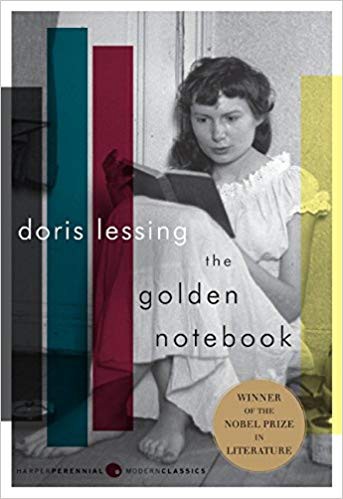
The Golden Notebook by Doris Lessing

All of Doris Lessing’s work is a huge touchstone for me, and I borrow from her shamelessly in my own writing. The Golden Notebook is the first book of hers I ever read, when I was a teenager, and it stuck with me, and it’s probably the best introduction to her work. Her sentences are so gorgeous and she had an amazing knack for capturing small details of interpersonal relations and people’s foibles with just a few well-chosen words. She’s indispensable.

Girls Burn Brighter by Shobha Rao

This book rocked my world when I read it last year. The story of two girls in a small town in India who form a unique bond and then are separated by thousands of miles, this book kept me turning pages and obsessing about Poornima and Savitha. Rao doesn’t hold back on showing the brutality and misery of the global exploitation of poor women, but there are also moments of tenderness and joy throughout this epic but personal story.

Unquenchable Fire by Rachel Pollack

Rachel Pollack is a unique visionary talent, and this bizarre story set in an alternate America full of prophets and visions will stick with you. I’ve never read a book quite like this one, although it reminds me a bit of David Foster Wallace and Daniel Ortberg. In a world full of mysticism and weird miracles, an inexplicable pregnancy turns out to be the strangest and most surprising event of all. The texture of Pollack’s world is amazing and full of brilliance.

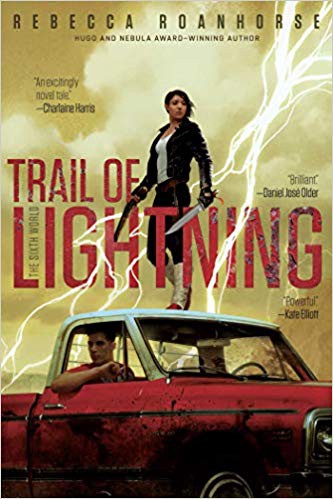
Trail of Lightning by Rebecca Roanhorse

This is another book that feels totally unique. A fantasy novel set in a post-apocalyptic world, this book follows a monster-fighter living in a Reservation that’s one of the few places left standing. The combination of a fallen United States and figures from Indigenous American folklore is so fresh and fascinating, and this book is both thrilling and astounding.

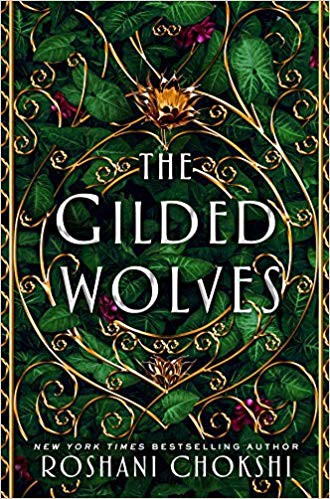
The Gilded Wolves by Roshni Chokshi

I just recently read this book and was blown away. Chokshi creates a gang of thieves in a Gilded Age Paris with magic, and throws them into a story of politics and ancient evil and battles against impossible odds. But it’s the relationships and chemistry among the main characters that will keep you following Chokshi’s characters through to the end.

Read More Women is presented in collaboration with MCD Books.

Remember This: Love Is a Verb

“Lot”

by Bryan Washington

Javi said the only thing worse than a junkie father was a faggot son. This was near the beginning of the end, after one of my brother’s marathon binges; a week or two before he took the bus to Georgia for basic training. His friends carried him home from the bars off Commerce, had him slinking around Houston like a stray. Since Ma had taken to locking the door at night, it was on me to let him back in.

At first, she hit him. Asked was he trying to kill her.

Was he trying to break her heart.

Later on she took to crying. Pleading.

Then came the clawing. The reaching for his eyes like a pair of stubborn life rafts.

But near the end Ma just stared at him. Wouldn’t say a word.

Javi sat on my bed when he told me this. Smelling fresh like he’d just been born.

I asked what he meant, and he looked at me, the first time I think he’d ever really looked at me before.

He told me it didn’t matter. It wasn’t important. He told me to go back to sleep.

2.

Ma planned on leaving the restaurant to the three of us, but then Jan had her own thing going on, and she didn’t want shit to do with the business, and Javi deployed, and it all came down on me. So I stayed. I slice and I marinate and unsleeve the meat. Pack it in aluminum. Load the pit, light the fire. The pigs we gut have blue eyes. They start blinking when you do it, like they’re having flashbacks or something, but after nineteen years of practice one carcass just feels like the next.

Way back when, Ma made Jan responsible for that, for prepping the beef with paprika and pepper, for drowning the carp with the rest of our voodoo, but then my sister met her whiteboy, Tom — working construction in the Heights, way the fuck out of East End — and he stuffed enough of himself inside her to put her in bed with a kid. Which brought our staff to two. Just me and Javi.

Neither of us gave a shit about cooking, but we both cared about eating. Ma had us wrapping beef in pastries, silverware in napkins. Javi taught me how to dice a shrimp without getting nicked. He plucked bills from pockets, cheesing like his life depended on it, and, since he was already nineteen, I followed his lead until Ma finally caught me with the fifties in my sock.

For which Javi took the blame. Ma leered him down a solid ten minutes before she told him to leave, to pack his shit, to go, to never come back. And he did it.

He went.

Joined the service. Sent postcards from brighter venues. Now it’s just me in the back. Packing aluminum in paper bags. Setting the ovens to just under a crisp. Ma pokes her head in when there’s time — the one thing we have too much of — just to ask me if I’ve got it. If everything’s under control.

And the answer’s always, always no. But of course you can’t say that.

3.

Come morning I’m in the kitchen around eight. Ma’s counting bills, twisting rubber into bundles.

Good night? she asks, and I say, Yeah, same as always, Ma.

She’ll nod like she knows what the fuck I’m talking about. Ma learned about suspicion from my father, from lies he’d wooed her away from Aldine with, but then he left for a pack of cigarettes and she gave up snooping entirely.

We don’t talk about where I go most nights or how I get back, ever, so I head to the freezer to handle the prep.

Beef’s fairly quick. Fish too. Chicken takes the longest. We douse them for a week or so — just drown the carcasses in salt. Ma adds her own seasoning, all pepper and grain and kernel, coating every limb with it. Shit she pulled from her mother, and her mother’s mother before her, back when they picked berries in Hanover. Then we stuff it all in some buckets, let them sit for like a day.

It’s something our father would do. He’d pitched Ma the restaurant like a pimp, like a hustler.

Think Oaxaca!

Bun and patties, menudo on Saturdays.

The blacks eat chicken so we’ll have that, too.

And, sometimes, I like to think that she put up a fight back then, tried to think of another plan.

But a month later they’d already set up shop. Found a shotgun off the freeway, polished it up. Our father served quesadillas and wings and pinto beans, hiring any number of the neighborhood layabouts, his friends, whooping and yelping and eyeing Ma from their stations. Sometimes she’d swat at them, ask who the fuck were they working for. Mostly she let them carry on.

My parents smoked cigarettes on the porch at sunset. Waving at everyone like they had something to smile about. But Ma couldn’t get down with his pails. How they stank up the place. She said we were living in a slaughterhouse, that her home smelled like death.

Her kids were another story: Javi and I dipped our toes in the buckets, until Jan saw us, and said to cool it, to cut it out. We kept doing it and she kept catching us.

One time she’d reprimanded us a little too slow. Javi grabbed her, and he dunked her, and he held her until his arm got tired.

Hush, he said, and then again, slower.

4.

Javi sent letters from out east. A photo of some dunes. Some birds. An old fort. White words on gray backgrounds, angled across the card. He’d say how he was doing (fine), bitch about the weather (worse than Houston), ask for more photos of Jan’s kid.

Once, he wrote a letter just for Ma. She wouldn’t let anyone touch it.

Once, he wrote one just for me.

He asked how Ma was doing, really, and about the baby. And about my plans. Said something about sending me some money. About what he’d do when he got out. He told me to write him sometime, that he’d appreciate it.

So I did that. I wrote him a letter spelling everything out. I wrote about Ma, and the shop, and the school. I wrote about Jan and the baby. I wrote about the Latina girls from Chavez I’d been meeting and fucking, and how that wasn’t working out, or how it wasn’t what I’d thought it should be, or that there was something else out there maybe, but what that was I couldn’t tell him, until I saw him, until he came back home.

I actually wrote that down.

I tossed it in the postbox before I could think about it, before it really messed me up.

But then a letter came for Ma, and then another one after that for Jan. But nothing addressed to me. I never tried again.

5.

I spend most days just trying to keep the place from burning down.

Four stoves, two ovens, three sinks. They’re always running. It might actually scare the shit out of anyone who cared to check, but nobody does that with Ma up front, dropping smiles and tossing napkins and asking everyone how their food is.

We get our rush in the afternoon, when the neighborhood shakes itself awake. Same faces every day. Black and brown and tan and wrinkled. The viejos who’ve lived on Airline forever. The abuelitas who’ve lived here for two hundred years, and the construction workers from Calhoun looking for cheap eats. The girls from Eastwood my sister left behind. The hoods my brother used to run with downtown.

Occasionally we’ll pull in a yuppie. They’d find us on the internet, review us in the weeklies. You can tell from the clothes, the bags. Their shades. How they ask what’s on the menu, any specials. Ma would treat them all like God’s children.

It’s a major event in our week, this pandering. So they get all the stops. And they’ll promise to tell their friends, to come back next week, but they sit through their meals with their eyes on the tile and their elbows on their purses so we know they never will.

Ma swears it’s the locals that gut us. That we can’t keep giving handouts.

I don’t know about that though. Change anything too much, it gets harder to keep it alive.

6.

You know the day’s almost over when Jan drops in with the kid. I set the burners to low and pop out to kiss him, and she swats at me, tells me to wash my nasty hands. Ma’s chatting with the only table occupied, a gaggle of off- duty fags, dressed down.

Ever since she had the baby Jan’s been dressing like a nun. Black sleeves. Dresses. The phone company lets her do whatever she wants — because she can enunciate — but if she’d laced those buttons from the beginning she wouldn’t be scrounging in the first place.

She talks with Ma while I play with the boy. He’s like a sack of potatoes. Fat in the face. There’s none of me there, which is fine, but what makes him even luckier’s that there’s none of his daddy either.

Jan leans across the counter, says things are looking slower. I tell her we’ve seen worse.

Any worse, she says, and there’ll be nothing to see.

It’s how she’s started talking. Between moving downtown, and living alone, and wilding out and fucking around and ending up with the whiteboy, Jan was the black sheep after she’d gotten hitched, almost as bad as Javi once he’d enlisted. Once the ring hit her finger, she swore the rest of us off. She was always dropping by Next Week, always tied up with the in-laws; until the day she finally brought Tom around the restaurant for lunch, and he laughed at Ma’s jokes, and he actually asked me about my life.

But after we ate, and her guy took off for home, Jan called us both trash. She said we’d embarrassed her. We were the reason she never came around. And Ma didn’t even blink — she just said, Go.

But a baby makes everything better.

I ask if Tom’s found another job yet, and she tells me he has, a construction gig down in River Oaks. For some billionaire apartment complex by the Starbucks.

So you should have a little extra to kick around, I say. For Ma.

We both look at the kid.

Mom’s fine, she says.

Ma’s broke.

Business in a place like this, and you’re hot about being broke?

You’re the one who said it was slow.

Trust me, says Jan. Or her, at least. She’s got a plan.

A plan.

Property value’s going up, she says. I saw at least two new buildings on the drive over. And some new families in the neighborhood.

By new she means white. We don’t even have to say it anymore.

I tell Jan if she thinks we’re selling our place, she’s who’s fucking crazy.

Yours, she says. Or hers?

Ours, I say, and my sister hums that right off, staring out the window.

But anyways, she says. How’s the queer thing going?

It’s going, I say.

Any prospects?

Stop.

I have to ask.

No one has to say anything.

Jan just shakes her head. She’s the only one who talks about it. I don’t know if Ma told her, or if Jan just put two and two together, but one day she told me it didn’t matter who I was fucking. Out of the blue. She said it wasn’t her business, or Ma’s business, or anyone’s business. She said that Javi never asked for permission. I shouldn’t have to answer to anyone.

But she always, always asks. And I give her the same answer every time.

We watch her kid. He’s still running in circles, trailing his hand along the counter. When he makes it to the boys by the window, they squeal.

They’re all done up. Hair the shade of supernovas. Out of the four of them, three are obviously fucked; the other one’s just a little too thick, touched with a shade of after- shave. He’d look like an imposter if he weren’t clearly the leader; when Jan’s kid stops in front of him, he lifts him by the armpits.

The others squeeze his cheeks. Run their fingers through his hair. They’re all in sandals, heels slapping like crocodiles. The kid’s soaking them up, taking it in. And the fags are, too — cooing, like birds, urging him not to grow, grow, grow.

7.

Couple months before he started to turn, Javi got it in his head that he’d teach me to sock a baseball. This was before Jan’s baby, and the military, and the neighborhood’s infiltration by money, but after my father left, a time when you could probably look at the four of us and still call us okay. It would’ve been summer, because he slugged me in my shoulder, said we were going outside, to get my ass off the carpet and take notes on being a man. I was watching a movie, Princess fucking Mononoke, and he told me I had till he counted to one.

I couldn’t hit for shit. Didn’t matter that it was dark out. Woofed it even when he stood in front of me, pulling his elbow back just in time.

Useless, he said, after every single shot. You’d spill a water bottle if I put it in your mouth.

But he stayed out there.

He didn’t tell me to kick rocks. Didn’t deem me obsolete. Didn’t manufacture an excuse to disappear. Didn’t knuckle me in my ear until blood came out. All that would come later, like he was making up for lost time. But that night, he stayed with me, with the moon whistling and the cars in the road and the grass inching beneath us like caterpillars.

Again, he said, shaking his head, squeezing my shoulder.

8.

The evenings I’m not out chasing ass I’m across the sofa from Ma. We’re on the second floor of the property, this joint we used to rent out after Jan left.

Halle Berry’s on the television. Boxing the hell out of some kid. It is cable and it is senseless, but I laugh when Ma laughs, turn sober when she tears up.

By the end of the movie she’s finished her tea. She’s looking over the commercials, past the credits, through the wall.

Ma, I say, and it spooks her.

She looks at me.

My mother’s the only girl in the world who smiles as sad as she does.

Just thinking, she says.

When I ask about what, she says the future.

Your sister and the baby. Your education.

And the restaurant, I say. When she makes her I-don’t- know-why-you’d-say-such-a-thing face I say she’s my mother, that I’m no dummy.

The moment Javi left, she’d started pushing me toward college. Asking about homework. Meeting with teachers who couldn’t have given a shit. And it didn’t help that I couldn’t care less either; that, in the grand scheme of things, I knew this wasn’t helping anyone.

Except eventually I changed my mind.

I thought about Rick and the rest of them. I can’t even tell you why.

And, eventually, my counselor started looking me in the eyes. I still worked the kitchen, but Ma filled in the gaps, covering for me, or hiring the stove by the hour, until I finally got the diploma and she cried at graduation and it became clear that the only place I was going was nowhere.

Money issues aside, leaving the neighborhood meant leaving the shop. Which meant leaving Ma. Leaving her broke and alone. She used to wave this off, tell me Jan was still around, but I grew up with my sister and there’s things you don’t forget. I even tried community college for a week or three, right on Main Street, sat in the front row and everything, but one day I stopped all that and no one said a fucking thing. No alarms rang. No one called the restaurant. It didn’t take long to see that there’s the world you live in, and then there are the constellations around it, and you’ll never know you’re missing them if you don’t even know to look up.

Ma’s daughter had left her.

Her son had left her.

Her husband had left her.

So I couldn’t leave her.

Not that it’s worth feeling sorry for.

It’s honestly not even sad.

They’re only inquiries, Ma says, after a while. The neighborhood’s changing.

It’s always changed, I say. It’ll keep changing.

I’m weighing our options. We might need the money.

My ass, I say. For what?

Watch it, she says.

You know, she says, but that’s all she’s got.

Ma just starts nodding. Moves her head like she’s already made her decision, but she’s still willing to hear me out, at least for a little while.

Months after our father left, Ma sat Javi and me in the kitchen, something she never did. Hair all over her face, in last week’s nightdress, she looked like Medusa in the pit.

She said if we remembered nothing else she taught us, to know that love was a verb. She had makeup all over her brow. Smears of it on her lips.

When I’d started to open my mouth Javi kicked me under the table. Didn’t even change the look on his face.

It is an active thing, she said. Something you have to do.

But now, when she shuts her eyes, I know she’s not asleep. I watch until her breathing slows.

Until I know she’s finally out.

Turning a Passion for Classical Music into Fiction

9.

This next time I’m ready when the realtor shows. Ma’s so caught off guard she doesn’t have time to lie.

It’s actually a lady. Korean, probably, but I’m not the one to know.

Well, she says, smiling at me, but talking to Ma. If this is a bad time —

It’s a great time, I say, taking the chair beside Jan. She doesn’t even glance at me.

Ma says something about the afternoon rush, but once it’s clear that I’m not getting up for anything the suit-lady smiles, dives back into her spiel.

It hurts me to say she was good. Told us who was interested, how much we’d profit. Every now and again, she’d add a quick but, as if to show us she was the only person worth trusting here, our only honest apple.

And once she told us everything, she asked if we understood, did we have any questions.

And since none of us wanted to be the one to ask them, she stood, and she smiled, and said it was nice to finally meet me.

She nodded at Ma and then Jan. Told us all to stay in touch.

We told her we would.

10.

When our father split, he took every sound in the house with him. Ma wouldn’t talk for another few weeks, at least not to us; so the last things she’d called him were what floated in the air.

Javi and I took note, but we weren’t actually worried. He’d left before. They fought, he’d take off, but he’d always materialize by Sunday, frying eggs over salsa on the stove, Beatles wailing on the radio.

But Jan told us that this time was different. That she’d actually talked to him the night he left. She said he called her sometimes, when everyone was asleep. Javi said he knew she was lying because who the fuck would waste their minutes on her, and she looked at him, and she smiled, and she said we’d never see our father again.

When I asked Javi if there was any truth to this, he didn’t say anything. He was usually the first one to pop off, calling bullshit even when he knew better — but he just put his hand on my head, and he told me to be tough. That it was the only way a man did things in life.

So I stayed up to see if it was really true. Javi’d already started sneaking out by then, and when Ma caught me by the phone that night she just blinked.

Then it finally did ring.

An alarm went off in my eyes.

I pounced on it, already asking where he’d gone, and when he’d be back, talking and talking, words bursting out of my nose, my ears, but of course it was only my mother’s brother, asking who was this, where was Ma, get the fuck off the phone.

11.

I tell Ma that selling the lot is a bad move. We’ve closed shop for the evening, and the sun bleeds through the windows.

Nothing’s been decided, she says, and Jan says Ma doesn’t have to do that, she doesn’t have to lie.

It’s done, Jan says to me now. It’s been done for a while.

I tell my sister to shut her mouth, to crawl back into her hole.

Hon, says Ma.

Let him, says Jan. Let him have his say.

Because the sale went final a week ago, says Jan. We’ll be out of the building in two weeks at most.

We, I think. I look at Ma.

She doesn’t have to explain it to you, says Jan.

Ma, I say, and she stands up to go, and I know I should follow her but I sit my ass down.

If I tell you what I think, will you listen? says Jan. She’s still at the table, knuckles under her chin. Will you be serious for two seconds?

What you think, I say.

Yes. The conclusions I’ve reached with the data we’ve acquired.

Tom’s got you thinking now? You’re the barrio’s new psychiatrist?

Let’s start with that, she says. You think you’re special. You think you’re special since you live where you live, but no one else in this dump really gives a shit about you.

Bravo.

You think if you don’t say anything about it, this place will just stay how it’s been. You think that’s a good thing. You think it means you won’t have to change.

You think, says Jan, that he’s coming back. Like, if we all stay in place, he’ll stick his head up from six feet under. We’ll just rewind everything. Click him back into rotation.

But here’s the thing, she says. Javi’s not coming back. Javi’s not here because he’s gone. Gone. And as soon as you pop your little-brother bubble, and you actually look at —

And this is why we should sell, I say. That’s your reason?

What reason, she says.

Because you didn’t fucking like him. You never fucking liked him.

Jan frowns at this. She folds her arms. It puts another thirty years on her.

No, she says. We should sell because your mother needs the money. Because neither of us has it, and the neighborhood’s buying out.

Just her, I say. My mother? You think she won’t give half to you?

She reaches across the counter to put her hand on my cheek. Massages it, one finger between the other.

I wouldn’t take it, she says.

I wouldn’t want it, she says. Because you two need it. You need it.

But if you can think of a better way to fix this, she says, you need to tell me. Right now. You need to speak up.

Jan fondles my face. I can feel it burning. It’s been years since my sister touched me, let alone with warmth.

Her fingers are sharp. A little callous.

Get out, I say.

Ah, says Jan. You’re mad.

We’re closing shop, and I’ve got dishes to wash. And you smell like vomit. Get out.

My sister looks me over like she’s deciding something. Fine, she says.

But you need to start making plans, she says. You need to figure out where you’re staying next. She’s getting older, and I’ve got a full house, so you’re damn sure not living with me.

The nickel I throw skips over the counter, across a tabletop, right by some silverware, and into her palm.

Don’t ask me how. I’d meant to hit her in the eye.

But she catches it, and she smiles, again, and she slips it in her purse on her way out the door.

12.

Javi was dead for a month and four days before his first sergeant made it out to the restaurant.

I don’t even remember what I was doing, but Ma met the guy at the register like any other customer. She had no idea.

This is what kills me, more than anything else.

Dumb luck, is what his sergeant called it. A car crash on post. Only he said it like it really was dumb. Completely illogical. The stupidest thing he’d ever heard.

When Ma asked him to sit, he told her no, he really had to go. He’d just wanted to come by. To tell her personally. Ma asked if he wanted anything to take with him. He said no, he really did need to leave. She told him anything on the menu, anything up there, it didn’t matter what, just tell her and she’d fix it for him.

I don’t know what he said to that. I haven’t gone and asked. But what I do know is that he ended up leaving with nothing.

Jan came over that night. She left the baby with Tom.

We closed shop for the rest of the week, had the funeral that weekend. Tom and his folks showed. Some of Ma’s friends were there, overdressed like toucans in too-tight dresses, crying in heels and mascara and polish. A handful of Javi’s boys made it out, a couple of guys in uniform. One of them asked me if I was his brother. He shook my hand.

Ma just stared at the casket. I thought maybe she’d kick it or push it or pull out her eyes, but she did not.

Two weeks later, doors were back open. Jan told Ma to stay off her feet, but our mother said that wasn’t necessary.

And anyways, it wasn’t possible. We honestly couldn’t afford it.

13.

The day we sign the lot away, Jan comes straight from work. Ma’s in a seat by the window, lost in this dress I’ve never seen before and haven’t since. She asks if I want to stay awhile — to look over the numbers myself — but I say no thanks, I’m fine, let me know when you’re finished.

14.

I used to think my brother would come back at night, like he used to, only this time he’d be dressed like some hijo de papi, like someone with a mother and a sister and a brother he loved. He’d have a wife by then. Somebody with a laugh. And he’d blush when he introduced us, pointing out the house’s trinkets, the floors he used to sweep. They wouldn’t have a kid yet, but it’d be on the way, and when Ma asked him who’d watch the baby he’d look at me, nod, squeeze my shoulder. Say, Who else.

He’d really know me by then. He’d know who I was.

But Javi did come back on leave, once, a few months before that final deployment.

Ma closed the restaurant for the weekend. Rushed around the place making sure everything looked right — that his room was in order, that the cabinets were clean, redusting and revacuuming and all the shit we usually ignore. Jan told her to settle down, that it was Javi, not Jesus, but Ma told her to shut up. One of the only times she’s let my sister have it since the baby.

You take care of what’s yours, was all Ma said. They may leave but when they come back you take care of them. He took a cab from the airport. Let himself in. Hugged Ma and she instantly started to cry. We did the handshake thing. He kissed Jan and he shook her husband’s hand and he snatched her baby up from the carpet so fast that everyone flinched a little bit.

Javi looked thicker. Darker. Not gruff or monosyllabic or any of that shit, but there was something there that wasn’t there the last time we’d seen him. Or maybe something that wasn’t there at all.

We made his favorite dinner, jerk shrimp with potatoes, and he tried to jump in the kitchen but Ma told him to stop playing.

For finally being home, it felt like the end of something. After dinner, he stood up. Yawned. We’d have him the whole weekend, he said, but the flight had been long. He was tired. Ma told him to get to bed, quickly, we’d see him in the morning, and before too long I followed him upstairs, left Ma and Jan in the dark of the kitchen.

My room was his room. I knocked before I went in. Javi’d collapsed across the mattress, away from the door, and he smiled when I touched him, when I took the floor beside him.

Well, I said. I didn’t finish my sentence and he didn’t follow up. We sat next to each other, just being brothers.

After a while, he said I’d grown up. Gained some weight in my face.

I’m fat, I said, and he said no, just a little weight, which was what I’d needed, and the hand he put on my shoulder felt like brambles.

We sat there for a while.

I wrote you a letter, I said, like in those fucking movies.

I know, said Javi.

And then he shut up.

Okay, I said.

So how was it over there, I said.

He didn’t answer. And it was so long before he said something that I figured he’d forgotten me.

It was just another thing to do, he said, in a different place. It’s like I could’ve just stayed in East End.

But you see how other people live, he said. And you really can’t help them if they don’t want it.

That’s one thing I’ve learned, he said. That’s what I’ve gotten out of this.

And it looks like nonsense now, like Santa Claus when you’re older, but that’s when I told him I’d been sleeping with boys.

I told him about the one from the library. About the one from the coffee shop. I told him these things, how I’d tried it with Cristina and Maribel, with LaShon and her sister; and how it hadn’t worked, with any of them, even when they’d stared me down, arms crossed. I watched Javi’s face for something to click or contort or scrunch itself into oblivion but it did not. It didn’t happen.

He said nothing, and I was finished talking. And I didn’t feel it when he slapped me.

I saw his palm coming, but didn’t know it until my shoulder hit the ground, until I looked up to see him staring.

And the thing that I remember about my brother, clearer than what he wore on the day he left, or the cracks he made about our uncle when he came to visit Ma, or the way that he laughed or the color of his eyes or his scent or his funeral, is the look on his face while I lay on the carpet.

When he didn’t get up, and I didn’t get up, I rolled myself over, made a pillow on the floor, and my brother, here and gone, fell asleep on my bed.

7 Books About the Dangers of (Mis)Communication

I n 1831, a bloody battle erupted in the small French village of Labrousse. The issue at stake was whether or not village leaders should ring the town’s bell tower during thunderstorms. Half the town argued that they should, believing the noise would frighten off the storms. The other half thought it would entice the storms and that ringing the bell was therefore a terrible idea. They came to blows, and the village prefect sided with the former camp, issuing a ban on the tolling of bells during storms. Incredulous, their opponents charged the tower during a subsequent storm and rang the bell with all their might, not realizing that they had flocked to what amounted to a massive lightening rod. Historians don’t know whether anyone was struck that day. They do know that in the midst of the conflict, no one noticed that both camps agreed on the salient point: that ringing a bell could influence the weather.

Purchase the novel

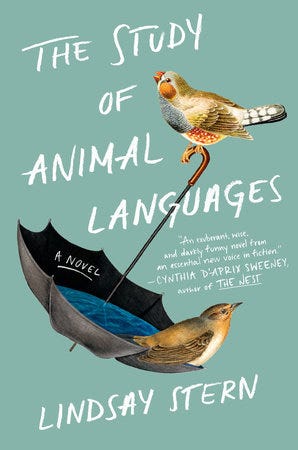
To me, that episode — recounted in Alain Corbin’s book Village Bells — doubles as an allegory for human communication at large. Why do our attempts to express ourselves so often backfire? Why do we attack each other precisely when we need each other most? I explore these questions in my first novel, The Study of Animal Languages, narrated by a philosopher whose training in epistemology does not prevent him from drastically misreading the needs of his loved ones and himself. What follows are seven books that — like the battle at Labrousse — stage the perils of (mis)communication. In dazzling and distinctive ways, each navigates the fraught margin between what we mean and what we say.

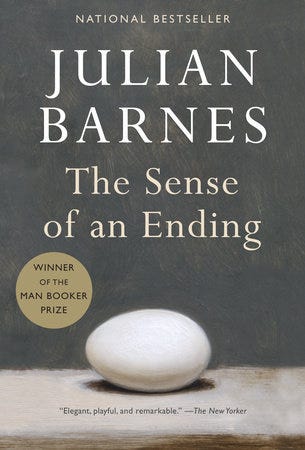
The Sense of an Ending by Julian Barnes

“The past is a foreign country; they do things differently there.” These lines open L. P. Hartley’s The Go-Between, but they pertain with equal force and subtlety to Barnes’ novel. In it, a middle-aged man confronts the fictions he has woven about his life in the form of a letter he does not remember writing.

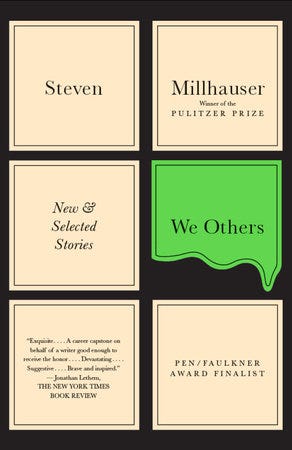
We Others by Steven Millhauser

In “The History of a Disturbance,” a husband resolves to stop speaking. His perceptions transform. So does his marriage. The story contains, among others, this gem about supermarkets: “It excites me to walk down those big American avenues piled high with the world’s goods, as if the spoils of six continents are being offered to me in the aftermath of a triumphant war.”

Samuel Johnson Is Indignant by Lydia Davis

“At a certain point in her life,” Davis writes, in what represents the entirety of her story “A Double Negative,” “she realizes it is not so much that she wants to have a child as that she does not want not to have a child, or not to have had a child.” Davis is renowned for her deceptively succinct, koan-like stories, some of which unfold in the space of one sentence. But it is the fault lines between ideas and words that most interests her. In this collection she pays fearless attention to these gaps and the earthquakes they portend.

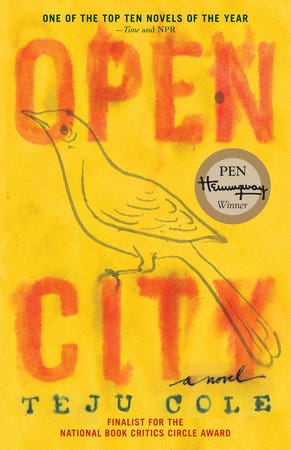
Open City by Teju Cole

Julius, a young psychiatrist, walks the streets of New York City, thinking. He reflects on class, history, and his own relationships. Until the book’s final pages, the novel seems like a triumph of essayistic fiction. Yet its real achievement is to show us, with ruthless calm, what Julius’ internal monologue has prevented him from seeing.

You’ll Enjoy It When You Get There: Selected Stories of Elizabeth Taylor edited by Margaret Drabble

“She stood before an alarming crisis, one that she had hoped to avoid for as long as ever she lived — the crisis of meeting for the first time the person whom she knew best in the world.” These lines open Taylor’s exquisite story “The Letter Writers,” about an encounter between two people who have shared an intense correspondence for ten years but have never met in person.

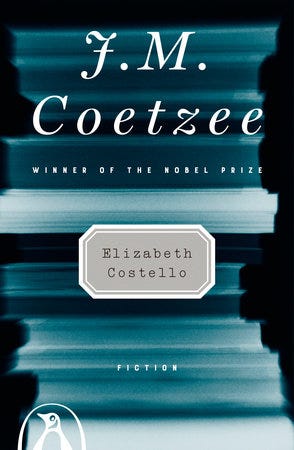
Elizabeth Costello by J. M. Coetzee

In this incandescent character study, a novelist delivers a series of speeches to audiences that do not catch her meaning. Coetzee’s exploration doubles as a critique of the academy and of the conventions of realist fiction.

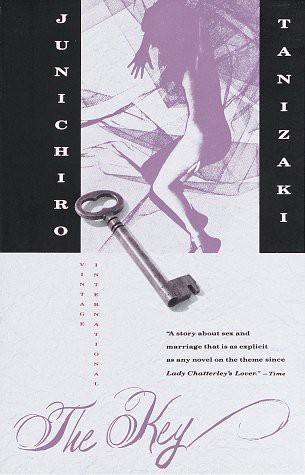
The Key by Jun’ichiro Tanizaki

Tanizaki’s exquisitely spare novel takes the form of parallel diary entries written by a husband and wife. It soon becomes clear that the two spouses are spying on one another, that each know this, and that the diaries represent an unlikely mode of communication. This ingenious exploration of the silences between lovers doubles as a fable about desire.

In Leila Slimani’s “Adele,” Sex is Violent, Disappointing, and Compulsive

Before Leila Slimani became internationally famous for her bone-freezing literary thriller The Perfect Nanny, she wrote a novel whose darkness is much more mundane. In Dans le jardin de l’ogre (In the Garden of the Ogre), recently released in English as Adèle, Slimani explores the life of a Parisian journalist with a husband, a young child, and an all-consuming sex addiction. Adèle is a modern-day Madame Bovary, bored to tears by her life but unable to determine what, exactly, would make it better. Instead, she vanishes into a spiral of compulsive sex, alienation, and lies.

Slimani never tries to explain her heroine. She observes her with cool precision, cataloging her small victories and greater defeats: the loss of her one friend, the slow decay of her professional life, and, most dramatically, the moment in which she’s forced to confront her own addiction. In doing so, Slimani creates a nuanced, respectful portrait of a woman who has lost all respect for herself.

Last month, I spoke to Slimani about sexuality, addiction, and loneliness. She was in town for a reading, and we met in the bar at her hotel. As we talked, I frequently noticed other customers eavesdropping, trying to figure out what scandalous story we were telling, but our conversation — like Adèle, in the end — was not scandalous at all.


Lily Meyer: How did writing Adèle impact your views on sex?

Leila Slimani: Writing Adèle made me conscious of how intimately related violence and sexuality are for me. I remembered becoming a teenager, and my parents telling me to be careful. I came to understand that being a woman was dangerous, and then that there were predators: men who wanted me, and would force me to do things. So for me, discovering sexuality was also discovering violence, and discovering my vulnerability as a woman. It meant discovering that men saw me as weak and fragile, and might want to protect me or to be violent toward me.

That experience influenced Adèle, and afterwards, I was influenced by traveling to Morocco with the book. Women there told me that they, too, saw this link between sex and violence. They also told me that like Adèle, they were lying all the time. It was impossible for them to tell the truth about their sexuality, their intimacies, their true desires. I became very interested in how society — every society, not only Morocco — forces women to lie or to stay silent about their intimate lives.

LM: If you had to choose the book’s dominant theme or idea, what would it be?

LS: Loneliness. It’s about being a stranger in the world, having the feeling that you don’t belong and no one can understand you. It’s about silence, too. Adèle can’t speak out, express herself, or ask for help. Many women in the world feel that. We are so afraid that we’ll be judged or marginalized that we can’t say, “Help me,” or, “I have a problem.” Adèle wants so badly to belong, to be respected. She wears the mask of the perfect bourgeois woman and good mother. So it’s about appearances, too, and how we need to offer the world an image of perfection even when we’re destroyed inside.

For me, discovering sexuality was also discovering violence, and discovering my vulnerability as a woman.

LM: Adèle has no female friends, and feels compelled to alienate the women in her life. Do you think that comes from her loneliness, or is it a secondary feature of her existing loneliness?

LS: She absolutely has a problem with women. I don’t know where it comes from, but she wants women to like her. She’s like a little girl at school, waiting to be invited to play. She doesn’t want women to see her as a predator. There’s a chapter when she says she never wants to be the most beautiful woman; she’s too afraid of other women’s jealousy. She’s not scared of men, but she’s scared of women. She has the intuition that women will know who she is, and she doesn’t want to share this intimacy with anyone. I think her problem is that she feels more threatened by women than men because women will ask her intimate questions about herself.

LM: Adèle never wants to be the most beautiful woman in the room, and yet you write early in the novel that her only ambition is to be looked at. Does that ambition ever turn into true sexual desire?

LS: No, never. It’s a very abstract ambition, too. She could decide to be a muse, a model, to do something with this ambition, but it remains passive. She wants to be an object. She wants men to put her somewhere to be looked at, but this is the ambition of a non-ambition. It’s the ambition to not be ambitious.

LM: Not long after, you refer to her as the “mistress of the present tense,” but, of course, if you live only in the present tense, you’re the mistress of nothing. You’re entirely out of control. What was it like for you to write a character who can exert no control over her past or her future?

LS: It was very exciting to try to understand this woman who is so afraid of living, and who feels that the world is so boring, and trivial, and sad. She must have had a very idealistic vision of life when she was a teenager: Everything was going to be big! She was going to feel passion! Now, the past feels very heavy to her. It makes her feel guilty, and she doesn’t want to think about it. And of course, addicts don’t want to think about the future. For people who are addicts, only the present exists. Only the moment when you take a drink, not yesterday when you were drunk or tomorrow when you’ll be drunk again.

We are so afraid that we’ll be judged or marginalized that we can’t ask for help.

LM: Did you research addiction to write Adèle?

LS: I interviewed lots of psychiatrists and specialists in sex addiction. I asked one psychiatrist for a definition of addiction, and he said, “For me, it’s when you lose your freedom to say no.” I think that’s a perfect description of Adèle. She’s a woman who has lost the freedom to say no. When you think about it, losing that freedom is terrible, especially for a woman in her sex life. It’s so hard for women to learn to say no, and for men to learn how to hear it. Very often, women persuade ourselves that we have to have sex with a man because we spent two hours having a drink with him, or whatever it is. We come under such pressure in the realm of sexuality. I think it’s very important to have that freedom to say no.

LM: To what extent is Adèle modeled after Emma Bovary?

LS: Very much. In classic literature, this is an archetypal character: the married woman who is bored. I asked myself what this classical woman would do today, or who Madame Bovary would be today. That’s why Adèle marries a doctor, and why they move to Normandy, near where Madame Bovary is set.

LM: How important was her husband, Richard, to you? Did you spend a lot of time constructing his character, or could he have been anybody?

LS: In the beginning, he was a secondary character. He was just important for the narrative, so that somebody would discover she’s a liar. But then when he made that discovery, I got attached to him. I connected to his suffering. I asked myself, “How would you react if you loved somebody very, very much and then you realized that he had a secret life? That he was lying to you? That he was unhappy in his secret life, and something had gone very wrong?” After that, I wanted to explore Richard’s personality, and to understand which one of them is crazier. When you marry a woman like Adèle, you must know that something isn’t right. You can’t marry somebody like her without understanding the presence of darkness and strangeness, so he must be a bit crazy too. I wanted to explore that. I love Richard very much, and I loved writing about him: his relationship with sexuality, his relationship with his wife, an insistence that she’s sick and he can find a cure for her. He wants to rationalize everything.

I loved my son so much — but the day he was born, I looked in the mirror and thought, ‘Something in me is dead.’

LM: Is it fair to say that Richard and Adèle are total opposites, then?

LS: Absolutely. I think that’s why they are so attracted to each other, even if the attraction is weird. She needs rationality and security; he needs darkness. They are a very strange couple, but I do think their opposition is the reason they’re attracted to each other. But she’s not able to love. Love is the only way you can abandon yourself completely, and Adèle can’t do that. She can’t even do it as a mother. She has no idea how to touch her son, feed him, take him for a walk. Everything for her is difficult, tedious, complicated.

LM: How did writing about Adèle’s inability to fully love her son impact your writing about motherhood in The Perfect Nanny?

LS: When I wrote The Perfect Nanny, I never thought about Adèle, but now that both books are out in the United States, I’ve become conscious of how dark and weird motherhood is in Adèle. I wrote it just after I had my son, and I was struggling with the discovery that yes, I was happy to be a mother, I loved my son so much — but the day he was born, I looked in the mirror and thought, “Something in me is dead. There is a Leila who is dead forever and will never come back again.” I had to grieve, in a way. I think Adèle feels that. So many times, also, I felt like I didn’t know how to act with my son. Everyone tells you how natural motherhood will be, and when it doesn’t feel natural, you feel guilty. I tried to describe that guilt in Adèle, but to turn it into a problem.

LM: I wonder if the same goes for Adèle and sex. Women are often told that once we meet our husbands, our sex lives will be perfect, effortless, all that. Is Adèle struggling with disappointment over that message, too?

LS: Yes! She is disappointed by sex as she is disappointed by motherhood. The sex scenes in movies and TV shows are always so beautiful, you know? So much tenderness, so much passion. In real life, sex is much more trivial. There’s the sound of zippers, the smell of the socks you take off. You can’t get that smell into a movie, but it’s part of the reality of sex. I think so many women are disappointed by sex, especially after the first time. I think Adèle is like a teenager who desperately wants to find the transcendent sexual experience that everyone told her about, but that probably doesn’t exist.

LM: You’ve said that your editor once steered you away from writing thoughts, and toward writing action instead. How do you use action to create and access your characters?

LS: Writing through action is mostly about my relationship with my reader. When you accept the idea that you will only describe actions, you must accept that your reader is clever. He doesn’t need to know everything that’s happening in the mind of the character in order to figure out why she’s acting in a certain way. Also, I think Simone de Beauvoir and Jean-Paul Sartre are totally right when they say that a person is defined by her actions. Not what she thinks; not what she claims or proclaims; what she does. We speak a lot about ethnicity, religion, gender, all of that, but I don’t actually think those factors determine our identity. Our actions are our identity.

We speak a lot about ethnicity, religion, gender but I don’t actually think those factors determine our identity. Our actions are our identity.

LM: Is sex Adèle’s entire identity?

LS: I think Adèle has no identity. She doesn’t know who she is. That’s why she’s so aimless and lost. She knows nothing about herself. She has no idea what to fight for, what her values are, what social class she belongs to.

LM: Do you think of Adèle as a novel about social class?

LS: I wouldn’t say it’s about social class, but in all my books, I’m interested in the bourgeoisie. I’m interested in showing that even though the dominant culture claims the bourgeoisie is calm, polite, and moral, that claim is a lie. There’s horror and violence within the bourgeoisie, and I’m very interested in exposing that.

What If You Can’t Afford “A Room of One’s Own”?

When I first read Virginia Woolf’s dictum that “A woman must have money and a room of her own if she is to write fiction,” I was homeless.

It wasn’t what most people picture when they think of homelessness. I wasn’t sleeping in the street but on couches and floors. I sometimes also shared a bed with a man when I didn’t want to. There were times I was stuck in the rain with two suitcases and no money, not knowing where I would sleep, with a bad cold, feeling like the gum on someone’s shoe. For a while, I kept all my belongings in a locker at the train station like a character in a ’70s movie. One night I couldn’t find a place to stay, so I just walked around the station all night and waited for dawn to come. Another time, the toiletries and change of clothes I always carried in a shopping bag were stolen, and when I asked about it at the station’s lost and found, I was treated with such contempt I started to cry. I stumbled off, sobbing about my lost soap and underpants, worthless junk the thief must have thrown away, but which I could not afford to replace. Most of all, I remember it as a time of walking in the cold, not having enough money to go into a cafe and order a coffee; looking at the outsides of buildings, the windows of restaurants, the warm life I couldn’t afford. I also remember my bitterness that I was expected to beg for a job I found pointless or wrong, just so I could exist in space, and the begging wasn’t even made easy; to do it, I needed a telephone number and decent clothes — things I couldn’t imagine ever being able to have again.

I’ve still almost never had a room of my own with a door that locks, as Woolf says I must have to write. Until I was 40, I never earned the minimum amount Woolf tells me I must earn — £500 a year, or roughly $40,000 in 2019 dollars. In some years, I don’t earn that now. I still think of anyone with no realistic fear of homelessness as rich.

But I’ve written eight books.

Before I go on, I feel I have to make it clear that this essay is not about “grit” — or any other imaginary virtue poor people need before they’re allowed to make art. I’ve never had grit. I’m an emotional mess. One of the reasons I was poor so long is that, no matter how I tried to be tough, I had chronic anxiety and cried over anything and never lasted long at a terrible job.

This essay is not about ‘grit.’  I’ve never had grit. I’m an emotional mess.

This is also not an essay about how becoming a writer raised me out of poverty. My childhood was middle class, and my dedication to writing was one of the things that made me fall into poverty in the first place. And mine is not such an unusual case. Being a novelist requires a huge initial investment of unpaid labor. Writing a first novel typically takes two years. After that, few first novels sell, and when they do, the average advance is in the region of $10,000.

Nonetheless, many writers keep their heads above water, even if they don’t have early success. Some manage to split themselves in two and pursue another profession while writing in their spare time. Some find an undemanding day job that pays enough to give them security. Some marry people with money.

But there are plenty like me who are perennially broke, always ending up on someone’s couch, always letting someone else pick up the check. I know half a dozen published authors who’ve had to rely on food stamps. The seedy poverty of the author has been a cliché for centuries. We find the figure of the poor writer already in the medieval era, in the form of poet-clerics called “goliards,” who begged and sang ribald songs in taverns as they wandered from monastery to monastery. Hundreds of years later, in the Beat Generation, the type survived with no essential change. Now a new generation of writers are confronting ever lower and less reliable payment for articles, stingier advances for books, fewer jobs, and smaller royalty checks. A host of new threats to writers’ livelihoods, from internet piracy to the slow-motion collapse of the academic job market, means ever fewer writers are making a middle-class wage.

Yet the public presentation of the profession remains stubbornly bourgeois. The acknowledgements pages of books tend toward lists of prestigious grants, residencies, and thanks given for the gracious loan of someone’s house in the Florida Keys; I’ve never seen anyone acknowledge the SNAP program or Medicaid, although they’ve almost certainly funded far more writers than the NEA. Even when a novel is marketed as a depiction of the working poor by a working-class writer, the press around the book usually suggests that the author, by becoming an author, has now escaped that underworld. Of course this isn’t always true — the author may not have “escaped” and doesn’t necessarily think it’s an underworld — but that narrative tends to creep into every crack. I’ve even seen an interviewer suggest a writer had left his problems behind when the writer was still living in a federal prison.

This construct also affects the kinds of books commercial publishers buy and promote. Memoirs about poverty — especially those pushed as potential bestsellers — are usually about the author’s childhood. There’s also a trend toward child narrators in novels about poverty, even those set in historical periods, and by the end of the book it’s remarkably common for the protagonist to “make good.” Commercial publishing shrinks from the idea that any worthy person — any relatable person — is still poor now.

I’ve never seen anyone acknowledge the SNAP program or Medicaid, although they’ve almost certainly funded far more writers than the NEA.

The first story I ever published was written in a derelict house with heat only in one room and fields of green and black mold on the visibly crumbling walls. I wrote sitting on the floor because our only furniture was a mattress. My boyfriend was there in the room all the time; his only other option was to stand in the freezing kitchen.

I began my first published novel at a temp job, disguising the text as a bulleted list so it resembled the reports I was supposed to be typing. I worked on that novel at four different jobs and in eight different apartments — I was always moving, sometimes because I couldn’t make rent; sometimes because a relationship fell apart, as they easily do when everyone’s broke; and sometimes because an apartment was just too awful to bear. One place had bare light bulbs that hung from the ceiling and when it rained, the ceiling leaked so badly that water dripped down from the bulbs. Another was on the ground floor and every night teens gathered outside my windows to smoke weed and have fights until dawn. Also, somehow none of these places was exactly mine; it was a boyfriend’s place or a place where I was cat sitting or a one-month sublet. I was always buying time to write by squeezing myself into less and less space, outstaying my welcome, fitting into the cracks of other people’s lives.

When I did the final edits on that novel, I was homeless again, sleeping on the dining room floor of a friend. I still remember figuring out one last crucial fix: standing over my computer at the dining table, already late for another temp job, exhausted because my inflatable mattress kept deflating in the middle of the night, breakfast noise from the kitchen coming through the doorway where there was no door, typing in an ecstasy, as happy as I’ve ever been in my life.

In interviews about that novel, I told the story of the bulleted lists, but never mentioned the homelessness, never mind the humiliation each time I had to ask for help. Most writers I know who’ve been really poor practice similar forms of self-censorship. Sometimes the reasons are obvious even to someone who’s never had money problems. One writer I know went through a patch where he had to report to a subway cleaning crew to keep getting his welfare checks. He talked about this openly to friends, but went through extreme contortions to hide it from a publisher who was considering hiring him. When I was first profiled for a women’s magazine, I had their photographer come to my apartment, only to have her look around and instantly suggest we go out to a park. After that, I had photographers meet me at a richer person’s apartment to save everyone time and embarrassment.

But often the decisions are less clear-cut. Social media, for instance, can be the ideal forum for openly discussing social class — but it’s also notoriously a place where going too far can damage your career. Most of us filter what we say. This affects how we talk about being broke. A post about student debt is safe, but one about living in your car risks losing face and professional standing. It can even come across as a passive-aggressive jab at more affluent people. One writer friend of mine commented: “On Twitter, we make jokes about being poor. We don’t talk about the fucking dread eating through us because we’ll never be stable. We don’t talk about what it means, that we’re on Twitter because we can’t afford therapy or social lives.”

A post about student debt is safe, but one about living in your car risks losing face and professional standing.

This same kind of filter is involved when writers present themselves to the public. I’ve written a memoir that dealt with my worst periods of destitution, but I’ve never told any interviewer my real feelings around getting a book published: the abject terror that the book won’t sell and I’ll end up poor again, homeless again, in the street in the rain with whatever I can carry, with a cold, looking at the windows of restaurants and homes, at all the warm life I can’t afford.

When my money problems are in the ordinary range, I feel it’s more useful to see Woolf’s “room of one’s own” as metaphorical. After all, her insistence on a physical room was predicated on the fact that women were given no public space for their intellect. Outside the room, they would be jeered at, dismissed, erased. The world still feels like this to many writers. Just being a writer is called a “bad choice”; we’re told to give it up and learn to code. If we expect to be paid, it’s greedy. If we write without pay, it’s narcissistic. As Woolf says, the world “does not ask people to write poems and novels and histories; it does not need them. It does not care whether Flaubert finds the right word or whether Carlyle scrupulously verifies this or that fact.” She is right that this indifference is hard on writers and harder on writers who are poor.

Many people become writers in the first place because we feel we have no place in the world. Writing can be an attempt to make a room where you can fully live, even if that room is imaginary, invisible to anyone who doesn’t bother to read your work. In fiction, you can create worlds where every possibility is open to you — for adventure, for love, for power. Writing can also be a way to transpose a hostile society into a realm where you can safely observe it and comment on it without being dismissed, where your judgment is godlike and final. This is especially valuable for female writers, poor writers, black writers, disabled writers, LGBT writers — all writers who have to first call into existence a world in which their voice makes a sound, then say what they have to say in the moments before that world evaporates.

Writing can be an attempt to make a room where you can fully live, even if that room is imaginary.

I can still get uncomfortable, though, when I remember that Woolf didn’t just doubt the possibility of writing without economic security; she doubted the possibility of writing well without it. She says fiction produced like that “must wither at nightfall; it cannot grow in the minds of others.” Even with so many historical examples of perpetually broke writers who produced great books, I can’t help feeling a pang of doubt. My more recent novels really are better, I think, than the ones I wrote in poverty. I assume that’s mainly because I’m more mature as a writer — but surely the stability I’ve had in recent years, the ability to think uninterrupted, is part of it too. I can’t help worrying that my writing might fall apart if my fortunes changed.

But when I look at other people’s work, I feel no such uncertainty. First of all, it’s clear to me we need poor writers more, not less, than writers with $40K a year. We can’t understand poverty if we never hear about it in the first person and the present tense; if we’re never reminded that, for poor people, poverty is happening to me, right now. And the recent viral success of first-person accounts of working-class life by writers like Linda Tirado and Lauren Hough attests to our collective hunger for writing about this experience. Finally, whatever poor writers lose from working in difficult circumstances they gain from the urgency of what they have to say; much of the greatest writing we have was produced in insecurity and squalor. This is the lesson of writers like Jean Rhys, Stephen Crane, Zora Neale Hurston, Fyodor Dostoevsky — and the list goes on and on and on.

So I want to end with a message to struggling writers everywhere. If you don’t have money or a room, write wherever you are, write however you can. Write on a park bench, in your car, at McDonald’s, in the waiting room at the ER. Eat spaghetti with ketchup and live on your parents’ sofa and speak truth to power. Don’t feel bad if you have to inhabit other people’s space like a ghost, like a mouse, waiting for the people to leave so you can come out of hiding. Write until you make room for yourself. Write until you make them listen.

An Unwinnable Video Game Taught Me How to Write Endings

My Stardew Valley avatar looks just like me — brown hair, bangs, blue eyes, dark t-shirt and jeans. I decided to try this video game to help me relax and cure my recent writing burnout after a semester in my nonfiction MFA program, where I struggled to write a single satisfying ending to anything I produced. I pick up the game one lazy weekend morning, playing my boyfriend’s copy on his Switch while he made us breakfast. Unlike writing, this farming simulator game has a discrete, understandable set of goals. So it makes sense that the character I’m piloting through this world, harvesting crops and catching fish, is meant to look just like me.

My writer’s block manifests this way: I start essays with no sense of how they should end. I am convinced I have so much to say, when in truth my work constantly comes to a screeching halt with no conclusion. Perhaps this could be blamed on a lack of confidence in my own essays. Or it could be that so much of writing, especially personal essays, depends on themes, ideas, or stories that have really happened to me converging into something profound and meaningful. Of course, not everything in life ends with the sort of poignant and emotionally satisfying ending that befits a personal essay. Or maybe I didn’t have the sort of perspective needed to finish these essays.

I am convinced I have so much to say, when in truth my work constantly comes to a screeching halt with no conclusion.

The opening sequence of Stardew Valley shows my avatar’s grandfather on his deathbed: he hands me an envelope, which I don’t open immediately. It cuts to my avatar working in a large, drab corporate office. My avatar takes Grandpa’s envelope out from a desk drawer and opens it to discover that he has left me the deed to a farm property, for when I need to escape the doldrums of everyday life. My avatar hops on a bus to a rural town to start a new life. I’d also lost two grandparents in the past year. They hadn’t left me property, but I was intrigued that the game began with a loss and the feeling of being stagnant at an office job. One life ending, another life beginning. I too, had left the doldrums of a corporate job to return to school to become a better writer, though that sense of renewal was in some ways true and in some ways false.

In the game, two characters from town “escort” me to the farm where I am left to fend for myself. I run around to check out the virtual property, overgrown with weeds and rocks and trees, which I cut down or bust open with tiny pixelated tools in order to clear enough dirt to plant the six parsnip seeds the game starts you off with.

“Is there something wrong with the food?” my boyfriend asks.

I didn’t notice he had left a full plate of scrambled eggs and toast for me. He had apparently left me a mug of coffee at some point, but I didn’t notice that either. I say nothing and keep going. Lifting my head from the screen was like coming up for air after diving deep underwater. I ate quietly, then bent my head back down to the screen again. He laughed. “I’m just glad you like the game.”

Ending an essay, or finishing any piece of art, is a challenge because it is an exercise not only in control and mastery of a story, but control of the reader as well. To end a work is to know what I as the writer want the reader to take away from the story. In nonfiction, it can be hard to know (a) when something truly ended or could be considered over, and (b) how best to express that to the reader in a way that is believable. My life hasn’t ended, and much of what I write about — my body, my anxiety, my perfectionism, my insecurity — are ongoing struggles. How can I end what may never end for me? How can I possibly conclude my essays effectively when life itself is nothing but an ongoing narrative?

Writing an ending entails not only drawing conclusions, but trying to weave and connect themes and ideas in ways that don’t feel forced. As a writer, I have to maintain a lot of creative control. There’s a need to know a sense of the structure necessary to support an ending, and even a sense of forward momentum that must be built into every sentence towards said ending. But without knowing where the essay will lead, it’s impossible to know how to execute structure, syntax, or narrative arc. While this level of creative control feels natural when I begin an essay, maintaining that control can feel taxing by the end of the work, or worst of all, irrelevant. I worry that what I have to say in the end isn’t all that compelling.

Writing an ending entails not only drawing conclusions, but trying to weave and connect themes and ideas in ways that don’t feel forced.

In an attempt to figure out what kinds of endings I like in nonfiction, I immediately thought of Aristotle’s line from Poetics, that the best endings are “surprising, yet inevitable.” The writer must build the narrative to a near-fated conclusion that still, somehow, startles the reader in a satisfactory way.

Stardew Valley dodges all of these questions. The gameplay is continuous. Many gamer YouTubers plug programmer “mod” alterations into the game’s code to see how far in time their avatars can live. What they have discovered is that there’s no end to time in Stardew Valley. This means I can keep playing, keep planting, keep talking up villagers, attend the same holiday gatherings complete with the same dialogue and activities year in and year out. Aside from a cut scene in a player’s third “year” of farming where the grandfather’s ghost “evaluates” your progress, there is no ultimate achievement or goal to work towards. Some players consider this the “end,” but from what I can tell from forums online, many continue playing far past this point.

Stardew Valley is a farm game, but farming is not the only way in which I can interact with this virtual world. There’s a larger narrative happening within the town that I, as a player, can take part in. In addition to the farming component, the farm is located within a town full of 28 characters I can interact with. Each character has their own storyline and interests. Players can raise livestock, virtual immortal animals, forever producing eggs and milk and wool. The animals never die and so my attachment to them is infinite. The game feels like writing a fictional story that never has to end, whose characters I never have to say goodbye to. If I’m unhappy with how something is progressing, or the way something was done, I can merely restart.

Eric Barone, the game’s creator, adds new character storylines, new items, new quests, and it doesn’t seem likely that he will stop any time soon. My avatar won’t age in the game and neither will any other character. All mistakes can be fixed or smoothed over. This is a life you can tune into at will and stay for as long as you want. Perfectly controlled and controllable. Unlike any other kind of content I create or consume, I can stay in this forever. For a time, this idea provides a balm to my writing woes. Rather than stay stuck in my frustration all I have to do is restart the game and, presto, I can start over again without compromising the rest of my progress, without sacrificing the game as a whole. Here, I am in control of my non-endings.

Perhaps my fascination with Stardew Valley and its lack of a conclusion can be traced to the amount of creative ambition and control needed to build a world that supports itself for that long. Not only does it invite the player in, but it also allows the player to enter into the game for however long they desire. There is no need for themes and ideas to converge, no need for a poignant end that will stay with the reader after they finish the work. Call it envy, or call it laziness, but my obsession with this game might be related to my resentment of the fact that writing has to end. That I can’t just write so well I can invite the reader into my life permanently, so they can see for themselves how it plays out. Let them draw their own conclusions.

There is no need for themes and ideas to converge, no need for a poignant end that will stay with the reader after they finish the work.

Nonfiction endings require a sort of closure, even if the issue is not, or cannot be, resolved. How many of us can say they have closure in all areas of their life? By never writing endings, I never have to sum up the parts of me I may be afraid to examine or admit to. I never have to find a structure to hold my own uncertainty.

I stop writing when I play Stardew. If the game is on, I tell myself that I am making a new story, albeit within the confines of the Stardew Valley universe. The real-life physical and emotional tension I have been feeling when I write dissipates. My clenched stomach relaxes. I can even feel my breathing slow down. My dreams are more creative, and I am more likely to write them down.

Perhaps my issue writing endings is the fact that many of the typical ways to write one doesn’t seem to work for me. No matter how I look at my work, I can’t figure out what I want the reader to take away at first. The essays I’ve been most proud of were often exploratory: here’s an important moment in my life that I want to delve into, and here’s where it began. But how to know where it ends? And what if I feel differently about this time in my life a year from now, or 10 years from now? Stardew Valley never asks these questions of me. It merely allows me to keep trying things, keep exploring, for as long as I want. The game’s creator continues to add to the game after receiving feedback from players. Writers rarely get the chance to go back to a work and rewrite it with new perspective once a work is published.

The essays I’ve been most proud of were often exploratory: here’s an important moment in my life that I want to delve into, and here’s where it began. But how to know where it ends?

I could make the endings of my essays loop all the way back to the beginning, but this feels too neat. Not all things in life loop as perfectly as the day-to-day world within Stardew Valley, and even when they do, it can feel unsettlingly neat as a reader. Surprise endings feel like cheating, withholding information from the reader for a cheap trick, betraying their trust in me as a writer. A cliffhanger merely seems pointless. If I know how something ends, I ought to just share that ending, or even the smallest closure, with my reader. This all leads me to fold in on myself and on my work, so tangled up that I stop my own writing process before it begins. The few times I do attempt to write instead of playing Stardew, I sit at my desk and tense up as I approach what I think will be the conclusion of an essay or a revision, doubting every choice I make as to how to leave this creative project and call it “done.”

After a few weeks of intensively playing Stardew after work, the game begins to make itself apparent in my body. I primarily play on my laptop, and the muscles in my left palm begin to fatigue quickly. There’s an ache in my wrist that radiates from leaning on my keyboard with too much intensity. I massage it softly with my right hand, my fingers exploring the soft tissue and tendons so unused to this level of work. Finger muscles also grow stiff, cramped. A pain builds at the back of my neck, grows roots down into my shoulders. These small, corporeal reminders of it stick with me even after I quit the game and eat a meal, take a shower, go to work, go to the gym, go to sleep.

How should I interpret this? As evidence I have internalized the game? I have never played a game so much that it has manifested itself bodily. My anxiety about writing has gone down, but my body has now latched on to new symptoms, new aches and pains, different from the ones before I began playing Stardew.

The game is now, in fact, becoming stressful. At some point I realize that even the most ongoing narratives must end. Even Stardew Valley.

Writing calls me. It always has. Like all indulgences I take part in, the game is calmative until it is overdone, and then it loses its luster, becomes yet another source of anxiety. After all, an escape is only an escape when there is a normalcy to return to. Everything must end because we, as human beings, crave closure.

The game needs to end for me. At least for now. After work one day, I go to the library and take out a book to read on the subway ride home. The print is nice on my eyes, the pages soft on my hands. Reading feels exciting again. The act makes me want to delve back into my own writing. Though I feel an urge to open my laptop and play the game as soon as I get home, I resist that urge.

I begin writing again slowly, revisiting old work and reading revisions from peers. Instead of seeing my essays as unresolved messes, I begin to see them anew: as beginnings, first stages in the lengthy writing process. Suddenly revising and rewriting feels like an opportunity to visit familiar stories I haven’t encountered in a while. Their endings feel more obvious, or at least more accessible, with the gift of distance. And unlike Stardew, sometimes the structure my personal essays take, and the conclusions they eventually reach, are surprising even to me.

Instead of seeing my essays as unresolved messes, I begin to see them anew: as beginnings, first stages in the lengthy writing process.

I revise my work in small bursts to the best of my ability for the rest of the summer. The periods of time I spend writing gradually grow longer. I sink myself into a flow state, not unlike what I’d done while playing Stardew Valley. New ideas for work begin to pop into my head naturally, as if they’d never stopped. I had no need to revisit the game because my own creativity was flowing naturally again, slowly but surely.

Getting back into writing after a long break is always terrifying. But like any essential skills, the words return. My fingers still know the place of every letter on the keyboard. It is easier now to know when to end my essays, and less intimidating to rip them apart in order to find a structure to support the shapes my work must take to reach a satisfying end. I continually remind myself that, even when one essay ends, the flow of one’s writing can remain an infinite force, one I can tap into whenever I am ready.

Dream Girls Just Wanna Have Agency

Since childhood, I have been drawn to the various iterations of the Sleeping Beauty/Briar Rose tale. Part of my fascination is aesthetic: I love the stained-glass splendor of Disney’s 1959 film and the ambrosial score and choreography of the Tchaikovsky/Petipa ballet. But there is for me — and, I suspect, for many others — a more psychically resonant appeal to the trope of the sleeping beauty. Perfect and asleep, she embodies the mystery of our subconscious desires. We don’t know what she’s dreaming about; might she be dreaming of us? At the same time, and unlike us half-awake mortals, hers is a mystery that seems capable of being unlocked. She is an enigma if enigmas were perpetually in submission, a “bottom” within an oneiric D/s relationship.

Perfect and asleep, she embodies the mystery of our subconscious desires. Might she be dreaming of us?

Still, I have never been proud of what amounts to a fascination with prone, helpless women and a disturbing narrative. In the story, enchantment turns ugly. The original tales by Charles Perrault and Giambattista Basile relate the maiden’s ravishment by the man who finds her and her persecution by her eventual mother-in-law or the man’s first wife. They arrive at happily-ever-after only after harrowing violations and betrayals. And there’s no getting past the fact that Sleeping Beauty is an infantilized figure rather than a strong woman. It’s not for nothing that in Anne Sexton’s poem, “Briar Rose,” she wakes up crying for her daddy. Anne Rice decided to just run wild with all this wrongness in her series of pornographic novels. What else can you do with this story?

Luckily, Ottessa Moshfegh’s My Year of Rest and Relaxation breaks the spell. Her novel offers a revisionist narrative of the sleeping beauty, in which she refuses to be objectified and rages with agency. Reading it, I couldn’t help but think of two earlier novellas about lovely girls asleep, Yasunari Kawabata’s House of the Sleeping Beauties and Memories of My Melancholy Whores by Gabriel García Márquez. In these three fictions, the sleeping beauties seesaw between accessible and inviolable, but only in Moshfegh’s does the slumbering heroine leap to life.

García Márquez quotes the first lines of Kawabata’s 1961 novella in the epigraph of Memories of My Melancholy Whores: “He was not to do anything in bad taste, the woman of the inn warned old Eguchi. He was not to put his finger into the mouth of the sleeping girl, or try anything of that sort.” (Those who’ve read a lot of Kawabata will know he had a thing for women’s fingers, hands, and arms.) A more direct translation of the Japanese title, Nemureru bijou, would be “Sleeping Beauties”; the English rendering shifts the focus from the comatose girls to the uncanny bordello and the experience of visiting it.

Kawabata was in his 60s when he wrote House of the Sleeping Beauties, which stylistically recalls the sidereal montages of Snow Country, the novel with which English readers are most familiar, more than the energy and cheekiness of early works like The Scarlet Gang of Asakusa. The story may be about the ecstasy old men feel when they pay to sleep next to teenage girls, but it’s unlikely to give you sweet dreams. The unease is established in the opening scene, when Eguchi greets the madam and becomes fascinated by the bird on her kimono sash: “It was not that the bird was disquieting in itself, only that the design was bad; but if disquiet was to be tied to the woman’s back, it was there in the bird.” If Memories of My Melancholy Whores will elegize and even celebrate elderly love and living, House of the Sleeping Beauties exposes the horrors: “Had he not come to this house seeking the ultimate in the ugliness of old age?”

The girls are drugged before he arrives and don’t wake until he has left them, so they have no memory of the nights spent with Eguchi or the other men.

The cold that will turn fatal is stressed from the start. The room in which the clients sleep with Beauty is draped in crimson velvet, a nightmarish hibernaculum. Eguchi smells phantom scents, including a baby’s milk. Soon he is dreaming of deformed infants, which he attributes to his having sought out a “misshapen” pleasure. The girls are drugged before he arrives and don’t wake until he has left them, so they have no memory of the nights spent with Eguchi or the other men. Yet these blank-slate girls have the curious power to usher in memories for their clients. Soon Eguchi is recalling long-lost lovers, his mother’s death from tuberculosis, and his favorite daughter’s marriage, which she rushed into after being deflowered by another man. In between these flashbacks, Eguchi ogles and prods the naked girls passed out beside him. He fantasizes about defiling and killing them. He also imagines them as incarnations of Buddha.

As a former bar hostess in Japan, I’ve long been familiar with the staggering variety of fetishistic options for men seeking company and entertainment in that country. It’s a niche market; I was once offered, based on my Polish heritage, a job at a hostess club that catered solely to men seeking Eastern Europeans, and the pleasures at other clubs I knew of were far weirder than strong cheekbones and bumpy noses. As such, House of the Sleeping Beauties has never struck me as that far-fetched in its particulars. What has always shocked me is the coldness with which the women in the novella are treated. In his final visit, Eguchi sleeps beside two young women, and one — the dark-skinned girl whom he suspects may be a foreigner — dies in her sleep after he turns off her electric blanket in the dead of winter. “Go back to sleep. There is the other girl,” the procuress soothes him. He thinks, “There was of course the fair-skinned girl still asleep in the next room.” The xenophobic and racist implications always jolt me awake at the story’s end.

The aged male characters in both stories feed vampirically on their sleeping beauties, using them to recall the dream of youth.

In many senses, House of the Sleeping Beauties and Memories of My Melancholy Whores are complementary. Kawabata’s procuress thinks of Eguchi as a guest who can be trusted (i.e., she believes he’s impotent), but the madam in García Márquez’s novella scolds the unnamed protagonist when, despite his famed virility, he doesn’t ravish his dormant girl. Kawabata’s tale unfolds in a primeval land of winter, while Memories of My Melancholy Whores languishes in the tropics. The latter has a happy ending. Still, the aged male characters in both stories feed vampirically on their sleeping beauties, using them to recall the dream of youth.

García Márquez’s protagonist is meant to breathe Romantic blasphemy, but look too closely and it becomes hard to indulge him.

Like Kawabata, García Márquez was in his twilight years when he penned the 2004 novella. It opens with a frank confession: “The year I turned ninety, I wanted to give myself the gift of a night of wild love with an adolescent virgin.” His desire is a solipsism; the girl is only the substance of the gift to himself, her personhood incidental. I think García Márquez’s protagonist is meant to breathe Romantic blasphemy, but look too closely and it becomes hard to indulge him. At one point he recounts how, decades back, he raped his maid and upped her salary to account for sodomizing her once a month. He refuses to let the madam tell him the true name of his drugged beloved and christens her “Delgadina.” When the madam announces that Delgadina’s birthday is December 5th, he remarks, “It troubled me that she was real enough to have birthdays.” In other words, for all of García Márquez’s gifts as a writer, this is a book unlikely to be embraced in the era of #MeToo.

After his first night with the fourteen-year-old factory worker who has been procured for him, the narrator casts her as a virgin martyr: “When I returned to the bedroom, refreshed and dressed, the girl was asleep on her back in the conciliatory light of dawn, lying sideways across the bed with her arms opened in a cross, absolute mistress of her virginity.” Indeed, we never see their consummation, nor do we readers interact with Delgadina while she’s awake.

House of the Sleeping Beauties closes with death, Memories of My Melancholy Whores with euphoria. The madam assures the narrator that Delgadina is madly in love with him, and even his lost Angora cat returns. The book refuses to awaken from its own dream.

Eguchi repeatedly casts the other old men who come to the house — the ones who, unlike him, can no longer function sexually — as sad, whereas to García Márquez, it is the women themselves who are melancholy. But the unnamed heroine of My Year of Rest and Relaxation is less sad than furious.

If I’m honest with myself, one of the draws of the sleeping beauty myth for me is that the young woman at its center is faultless. Even if violated while asleep, she cannot be blamed for it. Real life, for most women, is far more complex, with culpability always crouching in the shadow of the bed. But Moshfegh refuses to portray her sleeping girl as a victim to be used or a flawless woman destined to suffer stoically. (Indeed, a sleeping beauty is usually the most stoic victim of all.) Her narrator is arrogant, selfish, manipulative, sometimes mean. She doesn’t shrink from telling lies to get her shrink to dispense as many pills as possible. She’s a drug and sleep addict who doesn’t even bother to shift blame. While she likes sex, she is firmly positioned as a narco- rather than a nymphomaniac.

One of the draws of the sleeping beauty myth is that the young woman at its center is faultless. Even if violated while asleep, she cannot be blamed for it.

What’s subversive in Moshfegh’s novel is that the dream girl refuses to be the blank beauty onto which others project their fantasies. In fact, it is when she starts her obsessive-compulsive sleeping that she stops worrying about her appearance. Before she had looked “like an off-duty model.” Now she shuffles to the bodega in disarray: “‘You have something,’ the man behind the counter said one morning, gesturing to his chin with long brown fingers. I just waved my hand. There was toothpaste crusted all over my face, I discovered later.”

The narrator’s beauty serves a purpose. My Year of Rest and Relaxation questions who is allowed to feel emotional pain. The main character of the novel is ridiculously privileged: Because of an inheritance from her late parents, she doesn’t have to work and owns a stylish apartment on the Upper East Side. She has a degree from Columbia gathering dust in her closet. Her fantastic looks are stressed so often that it reads like a running joke; in the course of the novel, she’s said to resemble Faye Dunaway, Kim Basinger, and supermodel Amber Valetta and is “better than Sharon Stone.” Yet she’s utterly miserable despite all of this good fortune. While others may interpret her plight and its depiction differently — for example, as an indictment of the empty glitter at the turn of the millennium — I believe that Moshfegh went to great lengths to prove that depression and chronic feelings of emptiness can transcend objectively good circumstances. Given the surprise with which the suicides of celebrities like Anthony Bourdain and Kate Spade are greeted, we could use this reminder that mental illness and strife cut across all demographics and pay little heed to worldly success or advantages.

In the other two books, men’s narcissism leads them to fixate on sleeping women; in this book, the sleeping woman fixates on sleep as a way of rewriting societal expectations.

In light of the narcissism of the male protagonists in House of the Sleeping Beauties and Memories of My Melancholy Whores, that of the female narrator in My Year of Rest and Relaxation could also be seen as a clever inversion of gender norms. Sure, it’s a self-defeating mechanism, or at least it would be if the heroine didn’t seem to be growing out of it by the end of the book. But it also means she’s claiming a right to self-absorption that men within and outside of novels have long assumed they possessed. In the other two books, men’s narcissism leads them to fixate on sleeping women; in this book, the sleeping woman fixates on sleep as a way of rewriting societal expectations.

The novellas by García Márquez and Kawabata could certainly be given psychoanalytic readings, but only Moshfegh’s satirizes psychiatry and prescription drug therapy. The narrator chooses her grotesquely incompetent shrink from a phone book; indeed, she is looking for the kind of incompetence that will result in a major drug score. The dreams she shares with this Dr. Tuttle are fabrications maxed out with Freudian currency. In one of them, she puts someone else’s diaphragm in her mouth and performs oral sex on her doorman. But she hoards to herself her true dreams, which process the trauma of her parents’ early deaths. She insists on remaining opaque in the power struggle of psychiatric treatment and uses the doctor for her own purposes, fully availing herself of the vast pharmacopoeia available to anyone who can afford visits with such a doctor.

Despite her abuse of the doctor-patient relationship, she seems to honestly, tragicomically, expect her prolonged period of sleep to rejuvenate her. As she puts it, “My hibernation was self-preservational.” At face value, this belief sort of makes sense. After all, isn’t sleep supposed to heal us? In this way, My Year of Rest and Relaxation intersects not just with the sleeping beauty myth but with the oppressive rest cure of “The Yellow Wallpaper” — except in this case, it is the narrator directing the cure.

Narrative logic would seem to demand that the sleeping girl be the object, not the subject, of the story. Moshfegh’s novel manages to make the sleeper the subject.

However misguided such actions may be, it’s notable that they are actions. Narrative logic would seem to demand that the sleeping girl be the object, not the subject, of the story. One of the intriguing things about Moshfegh’s novel is that she manages to make the sleeper the subject. In House of the Sleeping Beauties, by contrast, Kawabata frequently uses the causative-passive form to describe the girls’ state; in English, this construction is rendered as “had been put to sleep.” The causative-passive form in Japanese is often used to connote a sense of victimization, of something bad being done to a person who lacks agency. Moshfegh’s narrator, on the other hand, goes to tremendous lengths to put herself to sleep with soporifics, again and again. She’s causative-active.

Near the end of the book, she does briefly become an object as she poses, while heavily drugged, for a video series by a repellant and pretentious artist-of-the-moment. One review of the piece describes her as “a bloated nymph.” But her ability to dismiss the objectification and return to the outside world once her hibernation is over makes it clear that she feels empowered and, now, very much awake. The protagonists of House of the Sleeping Beauties and Memories of My Melancholy Whores were both at the end of their lives, but Moshfegh’s is poised for the future on her Louboutin stilettos.

Kawabata’s tale is set in snow and Garcia Marquez’s steams with heat, but Moshfegh’s story spans four seasons. Like House of the Sleeping Beauties, My Year of Rest and Relaxation ends with a death. Chekhov’s gun takes the form of an open window in this book. When the narrator settles down for her four-month-long sleep, she vows that if she doesn’t feel better by the end of it, she will commit suicide by jumping out her window. However, the character who leaps through an open one in the last scene is her toxic best friend Reva, and not by choice. A novel set in Manhattan that begins in summer 2000 and specifies a year’s time frame can only have one ending: something to do with 9/11. (In this sense, the one thing that lacks agency in this novel may be, to a small extent, the narrative itself.) The woman falling from the tower — a terrible inversion of another fairy tale trope, of maidens who must be rescued from high rooms — might as well be one of the sleeping beauties depicted in earlier tales, who needs to be shaken awake at all costs.

One thing’s for sure, though. We haven’t heard the last of the sleeping beauty. She (or perhaps a beauty of another gender) will keep speaking through contemporary literature even as she struggles to free herself from sexual predation and other bad dreams.

The Animal I Keep in the Cage of My Bones

Lines after my vasovagal syncope

Here it comes again, heather sea
that surges the shore of my vision
each time the nurse fits my vein
with needle and pump, or
at the bone-click of cervix
clamped open. Brain’s signal
lost to the heart, vert.
unbound from horiz., I make
my own static, a broken
focus promise. The display —
my father’s hope-blue irises,
some distant Irish uncle’s flush –
goes colorless. The nurse offers
water, crackers, sour-apple candy,
but this is the way the animal
I keep in the cage of my bones
rehearses its death, this is its day
of atonement. Or day of geologic
remembrance. Slow fade to before
the earth knew of invasion,
before the body was something
to measure and prick. Flashback
to the world without seams
or borders, to the woman who,
walking a rutted path, first felt
my future cells stir. Flashback
to the ocean first seeing itself
in the sky. To the river I cross
every morning, which looks back
at me like a child who knows
I am lying; knows the window
that divides me from water, flecked
with the memory of hard rain, is easy
to break. Floaters, the doctor says,
are the jelly of the eye trying
as it imitates the shape of each
object’s wish to be seen. Emulsion of fear
and desire, water clouded with starch.
What else could be left of the world
after passing through the body? I come to
in the waiting room, holding a plastic cup
of my breath. Plastic the receiver, the rememberer:
on your colorless veil I’ll write my life. Lymph
makes its rounds again, makes a fist
of refuse. The nurse stands watch until
my vessels fill again with my heart’s
constant broadcast, until my body
takes the shape of its container.

For the body

Alan Turing, age 16

is a machine, sharing its eyes
with the horse and the cinemascope,

blood with the gas engine, fountain pen.
What have I in common

with other living things? The moment
a dinosaur’s jaw cracked

in two — one half snapping birdlike,
the other ground to powder. We have

that. We have the objects in this room
where a billion years have come

and laid down on the tile, seeping
out the screen door and down the garden

drain. This parlor: dresser scarf — ashtray —
good light for reading — easy chairs

with ribbing. Moonstone bust of a mother,
a child rising out of her, mountain

from slip-strike. Although it hurts me, out
of a living line, out of stone or meat, I choose

myself again, again that is one of me, here
where my carriage grew vertical, where my fists

forgot the heavy ground. But your body, wedge,
remembered. Cartridge leaking color.

On the year’s white page, parting
black from un-black. I don’t feel much

like writing more today.

About the Author

Leah Falk’s poems and essays have appeared in The Kenyon Review, FIELD, Best New Poets, Poetry Daily, Los Angeles Review of Books, and elsewhere. She’s received support for her writing from the Yiddish Book Center, the Vermont Studio Center, and Asylum Arts. She lives in Philadelphia and runs programming at the Writers House at Rutgers University-Camden.

“Lines after my vasovagal syncope” and “For the body” are published here by permission of the author, Leah Falk. Copyright © Leah Falk 2019. All rights reserved.