“A Tiger Fighter Is Hard To Find” by Ha Jin

We were overwhelmed by a letter from the Provincial Governor’s Office. It praised our T’V series Wu Song Fought the Tiger. The governor was impressed by the hero, who fought the tiger single-handedly and punched it to death. The letter read: “We ought to create more heroic characters of this kind as role models for the revolutionary masses to follow. You, writers and artists, are the engineers of the human soul. You have a noble job in your hands, which is to strengthen peoples’ hearts and instill in them the spirit that fears neither heaven nor earth.” But the last paragraph of the letter pointed out a weakness in the key episode, which was that the tiger looked fake, and didn’t present an authentic challenge to the hero. The governor wondered if we could improve this section, so that our province might send the series to Beijing before the end of the year. That evening we had a meeting and decided to reshoot the tiger-fighting scene. Everybody was excited, because if the series were sent to the capital, it would mean we’d compete for a national prize. We decided to let Huping Wang take the part of the hero again, since the governor had been impressed by him in the first version. He was more than happy to do it. The problem was the tiger. First, a real animal would cost a fortune. Second, how could we shoot a scene with such a dangerous animal?

With the governor’s letter in hand, we obtained a grant from the Municipal Administration without difficulty. Four men were dispatched to Jilin Province to ship back a tiger just caught on Ever White Mountain. By law we were not allowed to acquire a protected animal, but we got papers that said we needed it for our city’s zoo. A week later the four men returned with a gorgeous Siberian tiger.

We all went to see the animal, which had been put in a cage in the backyard of our building. It was a male, weighing more than six hundred pounds. Its eyes glowed with a cold, brown light, and its scarlet tongue seemed wet with blood. What a thick coat it had, golden and glossy! Its stripes would ripple whenever it shook its head or stretched its neck. I was amazed at how small its ears were, not much larger than a dog’s. But it smelled awful, like ammonia.

We were told to feed it ten pounds of mutton a day. This was expensive, but if we wanted to keep the animal in good shape, we had no choice.

Huping Wang seemed a little unnerved by the tiger. Who wouldn’t? But Huping was a grand fellow: tall, muscular, straight-shouldered, and with dreamy eyes that would sparkle when he smiled. I would say he was the most handsome young man in our Muji City, just as his nickname, Prince, suggested. One girl told me that whenever he was nearby, her eyes would turn watery. Another girl said that whenever he spoke to her, her heart would pound and her face would burn with a tickle. I don’t know if that was true.

A few days before the shooting, Director Yu, who used to be a lecturer at a cinema school in Shanghai, gave Huping a small book to read. It was The Old Man and the Sea, by an American author whose name has just escaped me.

The director told Huping, “A man’s not born to be defeated, not by a shark or a tiger.”

“I understand,” said Huping.

That was what I liked most about him. He wasn’t just handsome, not like a flowered pillowcase without solid stuff in it. He studied serious books and was learned, different from most of us, who merely read picture books and comics. If he didn’t like a novel, he would say, “Well, this isn’t literature.” What’s more, he was skilled in kung fu, particularly mantis boxing. One night last winter, he was on his way back to his dorm when four thugs stopped him and demanded he give them his wallet. He gave them a fight instead. He felled them with his bare hands and then dragged the ringleader to a nearby militia headquarters. For that, he got written about in newspapers. Later, he was elected an outstanding actor.

The morning of the shooting was a little windy and overcast. Two trucks took us four miles out of the city to the edge of an oak wood. We unloaded the tiger cage, mounted the camera on the tripod, and set up the scene by placing a few large rocks here and there and pulling out some tall grass to make the flattish ground more visible. A few people gathered around Huping and helped him with his outfit and makeup. Near the cage stood two men, each holding a tranquilizer gun.

Director Yu was pacing back and forth behind the camera. A scene like this couldn’t be repeated; we had to get everything right on the first take.

The medic took out a stout jar of White Flame and poured a full bowl of it. Without a word, Huping raised the liquor with both hands and drank it up in a long swallow. People watched him silently. He looked radiant in the passing sunlight. A black mosquito landed on his jaw, but he didn’t bother to slap at it.

When everything was ready, one of the men shot a tranquilizer dart into the tiger’s rump. Holding his forefinger before Huping’s face, Director Yu said in a high-pitched voice, “Try to get into the character. Remember, once you are in the scene, you are no longer Huping Wang. You are the hero, a tiger fighter, a true killer!”

“I’ll remember that,” Huping said, hitting his left palm with his right fist. He wore high leather boots and a cudgel across his back.

Director Yu’s gaze swept through the crowd, and he asked loudly if everyone was ready. A few people nodded.

“Action!” he cried.

The door of the cage was lifted up. The tiger rushed out, vigorously shaking its body. It opened its mouth and four long canine teeth glinted. It began walking in circles and sniffing at the ground while Huping, with firm steps, began to approach it. The animal roared and pranced, but our hero took the cudgel from his back and went forward resolutely. When he was within ten feet of the tiger, the snarling beast suddenly sprang at him, but with all his might Huping struck it on the head with his cudgel. The blow staggered the tiger a little, but it came back and lunged at him again. Huping leapt aside and hit its flank. This blow sent the animal a few feet away. Huping followed it, striking its back and head. The tiger turned around with a menacing look. Then they were in a real melee.

With a crack, the front half of the cudgel flew away. Huping dropped the remaining half, just as Wu Song does in the story. The beast lunged forward, reached for Huping’s leg, and ripped his pants, then jumped up, snapping at Huping’s throat. Our hero knocked the animal aside with his fist, but its attack threw him off balance — he tottered and almost fell.

“Keep engaging it!” Director Yu shouted at him.

I stood behind a large elm, hugging my ribs.

“Closer, closer!” the director ordered the cameraman.

Huping kicked the tiger in the side. The animal reeled around and sprang at him again. Huping dodged the attack and punched the tiger’s neck. Now the drug began taking effect; the tiger wobbled a little and fell to its haunches. It lurched to its feet again, but after a few steps collapsed. Our hero jumped on its back, punching its head with all his strength. The tiger, as if dead, no longer reacted to the beating. Still, Huping pulled and pushed its huge head, forcing its lips and teeth to scrape the dirt. The tiger remained motionless, only its tail lashing the grass now and again. “Cut!” Director Yu called, and walked over to Huping as two men helped him up from the unconscious animal, The director said, “I guess we didn’t time it well. The tiger passed out too soon.”

“I killed him! I’m the number-one tiger fighter!” Huping shouted, With his fists balled at his flanks, he began laughing huskily and stamping his feet.

People ran up to him and tried to calm him down. He wouldn’t stop laughing.

“I killed him! I killed him!” he yelled, his eyes ablaze.

The medic poured some boiled water into a bowl and took out a sedative tablet. He made Huping take the medicine.

“Good wine, good wine!” Huping said after drinking the water. He wiped his lips with his forearm.

Then, to our astonishment, he burst out singing like a hero in a revolutionary opera:

My spirit rushing toward the Milky Way

With my determination and bravery

I shall eradicate every vermin from earth… .

A young woman snickered. Two men clutched Huping’s arms and dragged him away while he was babbling about plucking out the tiger’s heart, liver, and lungs. They put him into the back of a truck.

“He’s punch-drunk,” said our Party Secretary, Shanlong Feng. “Tough job — I don’t blame him.”

The tiger was lifted back into the cage. Director Yu wasn’t happy about the botched scene. According to the classic story, which our audience would know well, the hero is supposed to ride the tiger for a while, bring it down, and punch its head hundreds of times until it breathes its last. The scene we had just shot missed the final struggle, so we would have to try again.

But Huping was in no condition to work. For the rest of the day he laughed or giggled at random. Whenever he saw someone coming into sight he’d shout, “Hey, I killed the tiger!” We worried about him, so we called in a pedicab and sent him to the hospital for a checkup.

The diagnosis was mild schizophrenia, and the doctor insisted that Huping be hospitalized.

What should we do about the fight scene? Get another tiger fighter? Not so easy. Where on earth could we find a fellow as handsome and strapping as our Prince? We looked through a pile of movie and TV magazines in the hopes of finding someone who resembled him, but most young actors were pale-faced boys; few had the stature and spirit of a hero.

Somehow the prefecture’s Propaganda Department heard about the governor’s interest in our TV series. Its deputy director phoned, saying we should complete the revision as early as possible. Ir was already mid-September, and trees were dropping leaves. Soon, frost and snow would change the color of the landscape and make it impossible to duplicate the setting.

Because it was unlikely we would find a substitute for Huping, some people suggested using him again. Quite a few of us opposed this idea; those who supported it didn’t seem to care about a man’s life. In private, some of us — clerks, assistants, actors — complained about the classic novel that contains the tiger-fighting episode. Why did the author write such a difficult scene? It’s impossible for any man to ride a tiger and then beat it to death bare-handed. The story is a pure fabrication that has misled readers for hundreds of years. It may have been easy for the writer to describe it on paper, but in reality, how could we create such a hero?

Full of anxiety, Director Yu suffered from inflamed eyes, which turned into curved slits between red, doughy lids. He’d wear sunglasses whenever he went out of the office building. He told us, “We must finish the scene! It’s a once-in-a-lifetime opportunity!”

One night he even dreamed he himself wrestled the tiger to the ground, and his elbow inflicted a bruise on his wife’s chest.

We were worried, too. Our company couldn’t afford to feed the tiger for long; besides, we had no place to shelter it for the coming winter.

The next week Secretary Feng held a staff meeting with us. We discussed the predicament at some length. Gradually it became clear that if we couldn’t find a substitute, we would have to use Huping again. The proponents of this idea argued logically and convinced us, its opponents, that this was the only way to get the job done.

At the end of the meeting, Director Yu stressed that this time everything had to be accurately designed and calculated. The tranquilizer dart should carry a smaller dose so that the tiger would remain on its feet long enough for our hero to ride it awhile. Also, we would have to be more careful not to let the beast hurt him.

To our relief, when the leaders broached the decision with Huping, he eagerly agreed to fight the tiger again. He said that he’d live up to their expectations and that he felt fine now, ready for work. “I’m a tiger fighter,” he declared. His voice was quite hoarse, and his eyes glittered.

“Yes, you are,” agreed Secretary Feng. “All the provincial leaders are watching you, Huping. Try to do a good job this time.”

“I shall.”

So we trucked the tiger to the site the next morning. The weather happened to be similar to that of the previous time: a little overcast, the sun peeking through the gray clouds now and then. I identified the elm and the spot where the fight had taken place before. Huping sat on a boulder, with a cudgel across his naked back, while the medic massaged his shoulders. After a tranquilizer dart was shot into the tiger’s thigh, Huping rose to his feet and downed a bowl of White Flame in two gulps.

Director Yu went over to give him instructions, saying, “Don’t lose your head. When I shout, ‘On the tiger!’ you get on its back, ride it for a while, then bring it down. Before it stops moving, keep punching its head.”

“All right,” Huping nodded, his gaze fixed on the caged animal.

In the distance, on the hill slope, a few cows were grazing, and occasionally the west wind blew their voices to us.

The tiger was let out. It pranced around, bursting with life. It opened its mouth threateningly. It began eyeing the distant cows.

“Roll the camera!” shouted Director Yu.

As Huping approached the tiger, it growled and rushed toward him. Our hero seemed stunned. He stopped and raised the cudgel, but the beast pounced on him and pawed at his shoulder. With a heartrending cry, Huping dropped his weapon and ran toward us. The tiger followed, but having been caged for weeks it couldn’t run fast. We scattered in every direction, and even the camera crew deserted their equipment. Huping jumped, caught a limb of the elm, and climbed up the tree. The animal leaped and ripped off Huping’s left boot. Instantly, a patch of blood appeared on his white sock. “Save my life!” he yelled, climbing higher. The beast was pacing below the tree, snarling and roaring.

“Give it another shot!” Director Yu cried.

Another dart hit the tiger’s shoulder. In no time it started tottering, moving zigzag under the elm. We watched fearfully while Huping continued yelling for help. He was so piteous.

The tiger fell. Director Yu was outraged and couldn’t help calling Huping names. Two men quietly carried the cage toward the motionless animal.

“Idiot!” Director Yu cursed.

The medic wiggled his fingers at Huping. “Come down now, let me dress your foot.”

“No.”

“The tiger’s gone,” a woman said to him.

“Help me!” he yelled.

No matter how many sweet words we used, he wouldn’t come down from the tree. He squatted up there, weeping like a small boy. The crotch of his pants was wet.

We couldn’t wait for him like this forever, so Secretary Feng, his face puffy and glum, said to a man, “Give him a shot, not too strong.”

From a range of five feet a dart was fired at Huping’s right buttock.

“Ow!” he cried.

A few men went under the elm to catch him, but he didn’t fall. As the drug began affecting him, he turned to embrace the tree trunk and began descending slowly. A moment later the men grabbed his arms and legs and carried him away. One of them said, “He’s so hot. Must be running a fever.” “Phew! Smelly!” said another.

Now that our hero was gone, what could we do? At last it began to sink in that the tiger was too fierce for any man to tackle. Somebody suggested having the beast gelded so as to bring the animal closer to the human level. We gave a thought to that and even talked to a pig castrator who didn’t trust tranquilizers and wouldn’t do the job unless the tiger was tied up. Somehow, Choice Herb Store heard about the suggestion and sent an old pharmacist over to buy the tiger’s testicles, which the man said were a much sought-after remedy for impotency and premature ejaculation. In his words, “They give you a tiger’s spirit and energy.”

But having realized that the crux of our problem was the hero, not the tiger, we decided not to castrate the animal. Without a man who physically resembled Huping, we could get nowhere even with a tamed tiger. Then someone advised us to find a tiger skin and have it worn by a man. In other words, shoot the last part of the scene with a fake animal. This seemed feasible, but I had my doubts. As the set clerk whose job it is to make sure that all the details match those in the previous shooting, I thought that we couldn’t possibly get a skin identical to the real tiger’s. When I expressed my misgivings, people became silent for a long time.

Finally, Director Yu said, “Why don’t we have the tiger put down and use its skin?”

“Maybe we should do that,” agreed Old Min, who was in the series, too, playing a bad official.

Secretary Feng was uncertain whether Huping could still fill his role. Director Yu assured him, saying, “That shouldn’t be a problem. Is he still a man if he can’t even fight a dead tiger?”

People cracked up.

Then it occurred to us that the tiger was a protected animal and that we might get into trouble with the law if we had it killed. Director Yu told us not to worry. He was going to talk with a friend of his in the Municipal Administration.

Old Min agreed to wear the tiger’s skin and fight with Huping. He was good at this kind of horseplay.

Two days later our plan was approved. We had the tiger shot by a militiaman with a semiautomatic rifle. The man had been instructed not to damage the animal’s head, so he aimed at its chest. He fired six shots into the tiger, but it simply refused to die — it sat on its haunches, panting, its tongue hanging out of the corner of its mouth while blood streamed down its front legs. Its eyes were half-closed as though it were sleepy. Even when it had finally fallen down, people waited awhile before opening the cage.

‘To stay clear of the people who might be involved with the black market, we sold the whole carcass to the state-owned Red Arrow Pharmaceutical Factory for forty-eight hundred yuan, a little more than what we had paid for the tiger. But that same evening we got a call from the manager of the factory, who complained that one of the tiger’s hind legs was missing. We assured him that when the carcass left our company, it was intact. Apparently en route someone had hacked off the leg to get a piece of tiger bone, which is a kind of treasure in Chinese medicine, often used to strengthen the physique, relieve rheumatic pain, and ease heart palpitation caused by fright. The factory refused to pay the full price unless we delivered the missing leg. How on earth could we recover it? Secretary Feng haggled in vain, and they docked five hundred yuan from the original figure.

This time there was no need to persuade our hero. Just at the mention of beating a fake tiger Huping got excited, itching to have a go. “I’m still a tiger fighter. I’ll whip him!” he declared.

Because the shooting could be repeated from now on, there wasn’t much preparation. We set out for the woods in just one truck, Old Min sat in the cab with a young actress who was allergic to the smog and wore a large gauze mask. On the way Huping grinned at us, gnashed his teeth, and made hisses through his nose. His eyes radiated a hard light. That spooked me, and I avoided looking at him.

When we arrived at the place and got out of the vehicle, Huping began glaring at Old Min. The look on his face suggested intense malice. It made me feel awful, because he used to be a good-hearted man, gentle and sweet. That was another reason why the girls had called him Prince.

Old Min changed his mind and refused to play the tiger. Director Yu and Secretary Feng tried to persuade him, but he simply wouldn’t do it, saying, “He thinks he’s a real tiger killer and can have his way with me. No, I won’t give him a chance.”

“Please,” begged Director Yu, “he won’t hurt you.”

“Look at his eyes — they give me goosebumps. No, I won’t have anything to do with him.”

Desperate, Secretary Feng shouted at us, “Who’d like to play the tiger?”

There was no response, only a grasshopper snapping its whitish wings in the air. Then an explosion came from the distant mountain where granite was being quarried.

Director Yu added, “Come on, it will be fun, a good experience.” Seeing that no one was stepping forward, he went on, “I’ll treat whoever takes the part to an eight-course dinner.”

“Where will you take him?” asked the young truck driver, Little Dou.

“Four Seas Garden.”

“You really mean it?”

“Of course — on my word of honor.”

“Then I’ll try. I’ve never been in a movie, though.”

“You know the story Wu Song Fought the Tiger, don’t you?”

“Yes.”

“Just imagine yourself as the tiger being beaten by the hero. Crawl and roll about, keep shaking your head until I say, ‘Die.’ Then you fall down and begin to die slowly.”

“All right, I can give it a shot.”

Huping was already in his outfit but was not wearing a cudgel this time.

They wrapped the small driver in the tiger’s skin and tied the strings around his belly. Director Yu said to him, “Don’t be scared, Try to be natural. He’ll wrestle with you bare-handed. That tiger skin is so thick that nobody can hurt you.”

“No problem.” The driver spat to the ground, then put on the tiger’s head.

The director raised his hand, an unlit cigarette between his index and middle fingers. “Action!” he called. The tiger crawled into the grass, wandering with ease. Its rump wobbled a little. Huping leaped on its back and began riding it around, shouting, “Kill! Gripping its forelock with his left hand, Huping hit the tiger hard on its head with his right fist.

“Oh, Mama!” the tiger squealed. “He’s killing me!”

Huping kept punching until the tiger staggered, then collapsed. Just as we were about to intervene, Director Yu motioned us not to move. Old Min laughed boisterously, bending forward and holding the swell of his belly with both hands. “Oh my! Oh my!” he kept saying.

Meanwhile, Huping was slapping the tiger’s face and spitting on it as well.

The animal screamed, “Spare my life! Spare my life, Grandpa!”

“He’s hurting him,” said Secretary Feng.

“It’s all right,” Director Yu assured him. “Keep the camera rolling.”

I said, “If he cripples the guy, we’ll have to pay lots of money.”

“Don’t put such a jinx on us!” Director Yu snapped at me.

I held my tongue. Finally, Huping got off the tiger, which lay still. He started ferociously kicking its flank, head, neck, face. While his boots produced muffled thuds, he cursed, “Kill this paper tiger! I’m finishing him off!” How frightened we were! The driver made no noise.

Huping stepped aside, picked up a rock as large as a melon, and muttered, “Let me smash this fake.”

We ran over and grabbed him.

“Stop it!” the medic yelled at the hero. “You already beat the crap out of Little Dou!”

Huping wouldn’t listen and struggled to reach the motionless tiger. It took five men to restrain him, wrench the rock from his hands, and haul him away. He shouted, “I killed another tiger! I’m a real tiger fighter!”

“Shut up!” Director Yu said. “You couldn’t handle a tiger, so you turned on a man.”

Hurriedly, we removed the animal skin from Little Dou, who was unconscious. His lips were cut open; his mouth and eyes were bleeding.

Old Min, still unable to stop chuckling, poured some cold water on Little Dou’s face. A moment later Little Dou came to, moaning, “Help. . .save my life . . .”

The medic began bandaging him, saying we would have to send him to the hospital without delay. But who could drive the truck? Secretary Feng rubbed his hands and said, “Damn, look at this mess!”

A young man was dispatched to look for a phone in order to call our company and send for the other driver. Meanwhile, Little Dou’s wounds had stopped bleeding, and he could answer some questions, but he couldn’t help groaning once in a while. Old Min waved a leafy twig over Little Dou’s face to keep mosquitoes and flies away. Tired and bored, Huping was napping in the cab alone. Except for the two leaders who were in the bushes talking, we all lounged on the grass, drinking soda and smoking cigarettes.

Not until an hour later did the other driver arrive by bicycle. At the sight of him some of us shouted, “Long live Chairman Mao!” even though the great leader had passed away eight years earlier.

The moment we arrived at the hospital, we rushed Little Dou to the emergency room. While the doctor was giving him stitches, the medic and I took Huping back to the mental ward. On the way Huping said tearfully, “I swear I didn’t know Little Dou was in the tiger.”

After a good deal of editing, the fake-tiger part matched the rest of the scene, more or less. Many leaders of our prefecture saw the new part and praised it, even though the camera shakes like crazy. Several TV stations in the Northeast have begun rebroadcasting the series. We’re told that it will be shown in Beijing soon, and we’re hopeful it will win a prize. Director Yu has promised to throw a seafood party if our series makes the finals and to ask the Municipal Administration to give us all a raise if it receives an award.

Both the driver and Huping are still in the hospital. I was assigned to visit them once a week on behalf of our company. The doctor said that Little Dou, afflicted with a concussion, would recuperate soon, but that Huping wasn’t doing so well. The hospital plans to have him transferred to a mental home when a bed became available there.

Yesterday, after lunch, I went to see our patients with a string bag of Red Jade apples. I found the driver in the ward’s recreation room, sitting alone over a chessboard. He looked fine, although the scars left by stitches on his upper lip still seemed to bother him, especially when he opened his mouth.

“How are you today, Little Dou?” I asked.

“I’m all right. Thanks for coming.” His voice was smoother, as though it belonged to another man.

“Does your head still hurt?”

“Sometimes it rings like a beehive. My temples ache at night.”

“The doc said you could leave the hospital soon.”

“Hope they’ll let me drive the truck again.”

His words filled me with pity because the other driver had just taken an apprentice who might replace Little Dou eventually. So I gave him all the apples, even though he was supposed to get only half of them. He’s a bachelor without any family here, whereas Huping has two older sisters who live in town. I found Huping in his room. He looked fine, but no longer possessed any princely charm. He had just returned from kung fu exercises and was panting a little. He wiped his face with a grimy white towel. The backs of his hands were flecked with tiny scars, scabs, and cracks, which must have resulted from hitting sandbags. I told him that we had received more than three hundred fan letters addressed to him. I didn’t reveal that more than 90 percent of them were from young women and girls, some of whom had mailed him sweetmeats, chocolates, raisins, books, fountain pens, fancy diaries, and even photos of themselves. How come when a man becomes a poor wretch he’s all the more splendid to the public?

Huping grinned like an imbecile. “So people still think I’m a tiger fighter?”

“Yes, they do,” I said and turned my head away. Beyond the double-paned window the yard was clear and white. A group of children were building a snowman whose neck was encircled by an orange scarf. Their mouths puffed out warm air, and their shouts rose like sparrows’ twitterings. They wore their coats unbuttoned. They looked happy.

Huping stroked his stubbled chin and grinned again. “Well,” he said, “I am a tiger killer.”
7 Books About the War on Terror

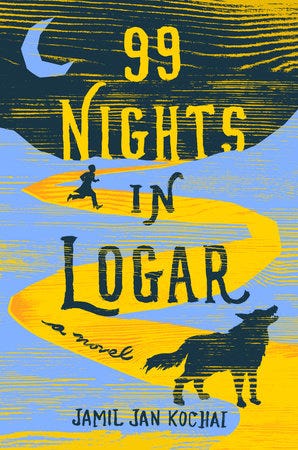
M y novel 99 Nights in Logar — about a small group of young boys searching for a ferocious guard dog in a small village in Logar, Afghanistan — primarily stems from a series of events I recall quite often (and quite nostalgically) from a three-month trip I took to Afghanistan in 2005 when I was twelve years old. Though I’ve lived in the shadow of the “War on Terror” since 2001, this trip to Afghanistan was the first time I really came face to face with the surreal nature of America’s war in Afghanistan.

Purchase the book

I watched the machinations of the “War on Terror” (its surveillance, its checkpoints, its weaponry, its barricaded semi-colonies where foreigners are safely separated from the native population, its behemoth Humvees, its reports, its stories, its legends) in awe and in horror, and in many ways, I wrote my novel 99 Nights in response to this odd sense of being both constantly overwhelmed by joy (joking and running and swimming and laughing and skipping stones) and by fear.

Approximately eighteen years after the US began its “War on Terror”, the world (especially the Islamic world) has only been made more violent and more chaotic as a result. Nonetheless, out of this absurd carnage has appeared some incredible, heartrending, and oftentimes surreal books. Here are just a few:

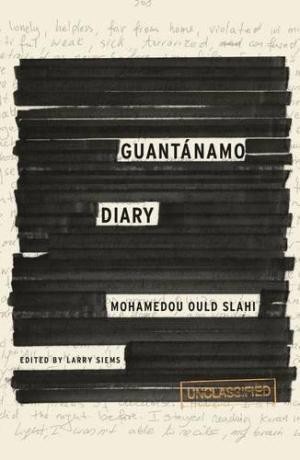
Guantánamo Diary by Mohamedou Ould Slahi

In Guantánamo Diary, Mohamedou Ould Slahi gives a harrowing account of the fourteen years he was held without charge or trial at Guantanamo Bay. He wrote his memoir in captivity. Thus, large portions of the text were censored and omitted by the U.S. government in a very Orwellian fashion, giving the text this almost unintentionally (horrifically) postmodern aesthetic. In this way, the book becomes a chilling testament to America’s state of censorship, Islamaphobia, historical erasure, torture, and our very understanding of how, and to whom, violence should be inflicted.

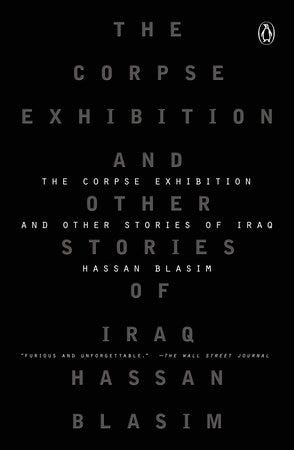
The Corpse Exhibition: And Other Stories of Iraq by Hassan Blasim

If you’re tired of reading American perspectives on the War in Iraq, take a look at The Corpse Exhibition: And Other Stories of Iraq by Hassan Blasim, an Iraqi-born writer. His collection of short stories The Corpse Exhibition is probably the most soul shattering book on war I’ve read since Isaac Babel’s Red Cavalry. Blasim takes on the atrocity of the American War in Iraq with a horrifying (and awe inspiring) sense of absurdism and unflinching realism.

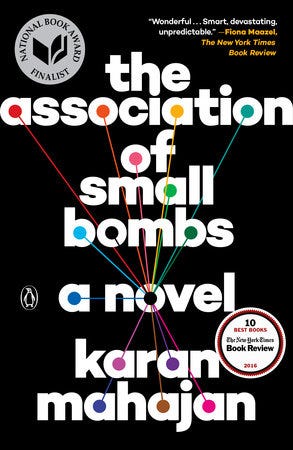
The Association of Small Bombs by Karan Mahajan

Written from multiple perspectives (bombers and victims and everyone in between), Karan Mahajan’s The Association of Small Bombs weaves an incredible tapestry of stories and lives in the wake of a “small” bombing in Lajpat Nagar, Delhi. Terror, in Mahajan’s novel, never exists in some sort of an ideological vacuum, rather Mahajan demonstrates how violence and terrorism (both of the militant and the state sponsored variety) are produced and reproduced from a complex set of material and political circumstances. As much as The Association should be lauded for its impeccable prose and complex characters (as it has been), the novel should also be recognized for its aversion to a reoccurring simplification of how and why “terror” occurs.

Karan Mahajan on the Inner Lives of Terrorists & Victims in Today’s India

Look by Solmaz Sharif

I read Solmaz Sharif’s poem “Reaching Guantanamo” in my office at UC Davis, around noon, on a sunny day sometime toward the end of spring. I can recall, vividly, almost every detail from the moment of my reading because this poem has left such an indelible mark on my sense of seeing and being seen. Much of Sharif’s work focuses on the violence of language (and the language of war), so it seems fitting that this poem would have such a visceral and devastating effect upon my body (my skin, my heart rate). I shook. I shuddered. I nearly wept. Kafka once said “A book must be the axe for the frozen sea within us.” Look is one of these books.

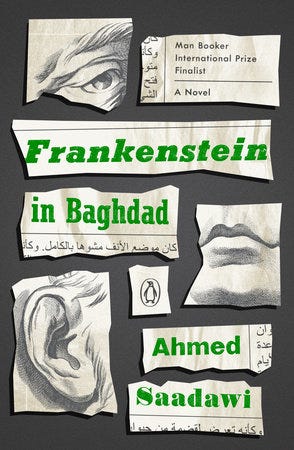
Frankenstein in Baghdad by Ahmed Saadawi

A drunken junk seller collects the abandoned body parts of bombing victims and begins to stitch together a Frankenstein-type-monster in Baghdad, Iraq during the early years of the American occupation. Somehow Ahmed Saadawi’s Frankenstein in Baghdad only gets wilder from there as the Frankenstein creature begins to take vengeance upon the killers of the victims from which he was created. Darkly comic and beautifully written, Saadawi’s Frankenstein becomes a surreal depiction of the monstrosity of the American War in Iraq itself.

Radical Skin, Moderate Masks by Yassir Morsi

A lecturer in politics at La Trobe University, Yassir Morsi draws upon Frantz Fanon’s classic text Black Skin, White Masks to explore questions of how, and if, Muslims are able to represent themselves politically. What does it mean to “de-radicalize”? Or to become “liberal” within the context of the “War on Terror”? Unafraid to delve into experiences from his own life, Morsi writes a brilliantly theorized text, without falling into the pit of Academic jargon. Especially for young Muslim writers, Morsi’s Radical Skin, Moderate Masks is a must read.

A Virtue of Disobedience by Asim Qureshi

In a time when Muslims across the globe are being pressured (by Imams and Feds alike) to submit to the will of oppressive states and regimes for the sake of peace and obedience, Dr. Asim Qureshi, Research Director at the advocacy organization CAGE (more on them later), has written a philosophical treatise extolling the virtue of disobedience.

Drawing upon his own experience working for CAGE — which campaigns against state policies targeting Muslim communities and advocates for the rights of Muslim political prisoners held without trial — Islamic scholarship, and histories of civil disobedience in the US and South Africa, Qureshi argues that resistance to systemic oppression is not only universally virtuous but is an essential character of Islam itself. A brilliant, sensitive, and necessary text. Please consider donating to CAGE.

About the Author

Jamil Jan Kochai is the author of 99 Nights in Logar. He was born in Pakistan and grew up in the United States. His story “Nights in Logar,” upon which this debut novel is based, won the 2018 O. Henry Prize. He currently attends the Iowa Writers’ Workshop.

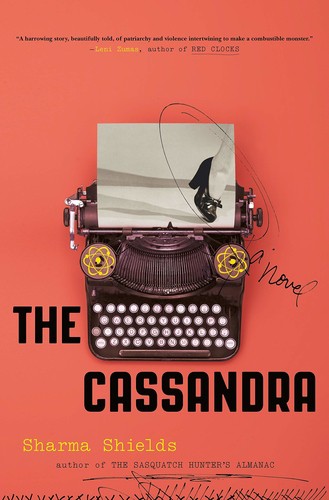
“The Cassandra” Is a Novel about Toxic Masculinity and Cursed Women

Summoning references to classic Greek myth, The Cassandra, set in the 1940s, focuses on the life of Mildred Groves, a young, unusual woman who sees visions of the future. When an opportunity for employment at the secretive Hanford research center presents itself, Mildred leaves home and enters a totally new world — one she sees as a hopeful land of possibilities. But there’s much more than possibility lurking in the dark corners at Hanford.

Dissecting humanity’s cravings for power and our fascination with destruction, Sharma Shields’ The Cassandra is a call for us all to truly think about who we are — and who we are becoming.


Bradley Sides: In your latest novel, The Cassandra, you mix magical realism with myth. You present a young woman named Mildred Groves, who very much reflects Cassandra from mythology. Mildred, like Cassandra, sees horribly bleak visions of the future that no one believes. What was the genesis of your novel?

Sharma Shields: The setting of Hanford came first, before I considered Mildred or Cassandra. When I was diagnosed with multiple sclerosis five years ago, a couple of people mentioned the high incidence of MS in the Inland Northwest, where I grew up and live now, and someone said to me, “It’s because we’re downwind of Hanford.”

I’d been thinking of writing a gloomy Northwest version of Mary Shelley’s Frankenstein, and it occurred to me after I heard this that Hanford was the perfect setting.

Early on in my research about Hanford, I was surprised to read that virtually no one working there in 1944 had any idea what they were manufacturing. There was even a rumor floating around that they were producing toilet paper for the troops overseas. When I took a tour of Reactor B in the summer of 2015, I marveled at the irony of the vintage signage everywhere, “Loose lips sink ships,” “Safety first,” etc. Secrecy and safety were the paramount messages, but of course this is a place that contributed to more than 100,000 deaths in Nagasaki; a place that has poisoned our local environment and caused numerous thyroid cancers, birth defects, and polluted crops and water. The irony there is remarkable.

As I mused on all of this violent secrecy, I thought of Cassandra and the Trojan war, “the shambles for men’s butchery, the dripping floor.” And from Cassandra sprang Mildred Groves, who hails from Omak, a small town near where my mom grew up (Okanogan) in arid central Washington State.

BS: From the start, Mildred is such a complicated character. She’s driven. She’s strong. She’s loyal. I was rooting for her all the way, but I’d be lying if I didn’t admit that I also found her to be frustrating, especially after she gets settled in at Hanford. What do you hope readers take away from her after reading her story?

SS: Mildred is frustrating, probably in a lot of the same ways I frustrate myself. She’s eager to please (to a fault), she’s naïve, she internalizes the behavior of others, she’s willing to put herself down to make someone feel better. The way she accepts and makes excuses for the verbal battery of her mother and sister is alarming.

Mildred does what a lot of us do, suppresses herself until that negative energy bursts out of her, and the wrong people get hurt. She does awful, incalculable harm. It parallels the harm our country has done to others; the harm humanity does to itself. By the end of the book, she is utterly changed, physically, mentally. I hope readers find something relatable in her struggle and in her complicity and fallibility and regrets, but also in her power and her attempt to enact change. I wanted her to be both: powerless, powerful, like we all are. I’m hoping Mildred expresses a sharp warning about how we treat ourselves and treat others on both an individual and global scale.

BS: Men certainly aren’t the only ones who mistreat Mildred (her mother who continually calls her a “ferret face” has to be mentioned), but they are the most consistent in doing so. They are truly awful to her — even from the first chapter when she has her interview at Hanford. They harass, abuse, and devalue her. Nevertheless, she persists. The Cassandra feels timely.

SS: Both women and men in this novel are capable of cruelties large and small. Many of the characters turn violent and commit horrific acts, including Mildred, but you’re right, this is a novel about the prison of militant nationalism and toxic masculinity, and how those confines really in the end harm us all, regardless of gender.

Many of the interactions between men and women in the book are taken directly from my own life: critical comments issued about female bodies, unwanted attention, a sense of never truly being safe, patronizing treatment, and even assault and rape. Someone very close to me in my own family, a woman I love and admire and look up to as being one of the hardest-working and strongest humans I know, was put in the ER by her own husband. He dangled one of her sons over a balcony in their large house, he beat her senseless. I remember keenly when my parents received the phone call about her hospitalization. I was in grade school. I remember listening to their hushed, upset voices, and how endlessly dark the night sky seemed through their bedroom window. How could someone do this to another human being? That man was a radiologist; he ended up losing his Washington State medical license for abusing patients, but he’s practicing again in Idaho.

I was working on a new draft of this book when Trump said his “grab them by the pussy” comment, and what I felt — what a lot of women felt — was actual physical pain. It was hard to breath, my lower body ached, and a hurtful memory from when I was 14 began to plague me. For years I’d told myself that what had happened was my own fault, but I was approaching 40 now, and it was ridiculous to keep deceiving myself in this way. My mom arrived one day when I was working on one of the most violent scenes in the novel, and she could see I was agitated, depressed. I told her I didn’t know what I was doing to myself, writing in these dark places, and pulling from events I’d never let myself fully articulate to anyone, let alone myself. My mom suspected what was happening to me at 14 with this older boy, and we’ve now had open discussions about it. At the time I assumed it was all my fault, but it was not. It’s also bigger than being just that boy’s fault (he, like Kavanaugh, was 17 at the time): Something societal needs to change. I poured a lot of these emotions and memories into the book. 1944 really isn’t that far away. A lot has changed, and very little has changed, too.

Trump’s presidency has not caused more misogyny or racism or ignorance, the way some people think. It’s a product of it. This has been in our country for a long time, this white nationalism and misogyny. He is the poster child for it now (and he’s a child in so many ways, behaviorally); he represents a staunch portion of the population unwilling to open their minds and evolve. My own personal belief is that the humanities can teach us how to become better people. But I also see the naiveté in such a statement. Are we broken beyond fixing? I’m not sure. I hope not.

The Cassandra also became unexpectedly timely when Hanford started popping up in the national news again, this time for leaking nuclear waste tanks and, most recently, for attempted shut downs of Hanford watchdog groups. Now that I’ve researched Hanford, I’m not surprised by any of this. We’ll be feeling the direct repercussions of Hanford’s creation in our region and country for a long time, environmentally and ethically. When the administration gloats about funding nuclear programs and major defense/weapons programs, I cringe. We are setting ourselves up to destroy more, when what we need is repair.

This is a novel about the prison of militant nationalism and toxic masculinity, and how those confines in the end harm us all, regardless of gender.

BS: It’s early in the year, but these lines have to be some of the most sobering I’ll encounter throughout 2019:

“The things we’ve done to the children of this world — slavery, brainwashing, exile, genocide — do any other creatures harm their children this way? These deviances built our own nation, they’ve built all of the civilizations of men. I awoke with the certainty that none of us deserved to be alive, myself least of all.”

I know we’re technically dealing with fiction here, but this feels as real as it gets. How difficult was it to admit something so haunting about our species — and ourselves?

Sharma Shields: I grew up very sheltered from the truth of our history, regional and otherwise. In school, we learned the Whitman Massacre in Walla Walla was a “thoughtless tragedy,” rather than a retaliation of the Cayuse for being systematically murdered by the Whitmans and other settlers. Hitler was talked about as an anomaly, as if genocide wasn’t occurring here, or wasn’t occurring worldwide at that very moment. Slavery was also a thing of the past, not to concern ourselves with, and when I asked someone in my family about it, they said we shouldn’t beat ourselves up for what our ancestors did.

I’m of the other mindset: We should beat ourselves up for what we’ve done. What we should not do is draw a line between our present selves and our history; the two are inextricable. It is easy to be lazy, complicit. So easy. I’m guilty of it even as we speak. But we are educated humans, capable of imagination and empathy and hopefully social evolution. By acknowledging our darkness, our propensity for violence and greed and cruelty, maybe we can begin to imagine shedding it for something less harmful. Is such evolution possible? I really don’t know.

It’s been upsetting for me to see the ways in which children, especially, are harmed in this world. Having children now, I read the news and I’m gripped by a profound sadness for the joy and love we are shuttering. Native girls and women are missing and/or dead, children are separated from their parents on the border, a girl on the Pakistan/Indian border is tortured to death because her religion is not the same as someone else’s, children in the public school where my husband teaches are homeless, maybe to avoid being abused again, or because their own parents are in jail, or have abandoned them for drugs. Near and far there is failure. And it’s our failure, collectively.

It may be true that it makes me critical of myself, these thoughts, that I’m always pressing myself to do better, and I’m always examining my own failures of kindness and fairness and compassion (of which there are many, so many). But I’m sick of individualism, of this country with its pull-yourself-up-by-your-boot-straps mentality, a mentality that has never and does not apply to marginalized groups. There was a great article in the New York Times recently about women in politics, about how they must rise as a group effort and not individually. At first I was annoyed that we as women can’t go it alone, but then I realized: Going it alone might be the whole problem. There is hope in unification, in coming together rather than tearing apart.

Now we just need all of us to unify somehow. I don’t know how to do it. I don’t know if I believe we can do it, but I hope so. My novel is intended to be a warning about what will happen if we don’t.

By acknowledging our darkness, our propensity for violence and greed and cruelty, maybe we can begin to imagine shedding it for something less harmful.

BS: You, I believe, are one of our great writers working within magical realism and weird fiction. Whether I’m reading one of your stories from Favorite Monster or exploring the worlds and situations you’ve crafted in your two novels, The Sasquatch Hunter’s Almanac and The Cassandra, you are someone who boldly embraces the fantastic. What is it that attracts you to this genre of writing?

SS: I’ve always felt there was truth in our nightmares and in the unknowable. There is so much we don’t understand about our universe, about our own existence, and crossing into the abstract forces us to confront uncomfortable questions.

I think quite a lot about Nietzsche’s Birth of Tragedy, which describes how we spend much of our lives distracting ourselves with Apollonian rationality — materialism, schedules, religion, our jobs — but how art and the imaginative can pull back that velvet curtain and reveal the chaos beyond, or what Nietzsche calls the Dionysian spirit. I’m curious about this chaos, about the unexplained, and I’m always startled by the lengths we go as humans to avoid considering chaos and our smallness and mortality. I’ve sort of made it my life’s goal to be comfortable with these uncertainties, and our potential insignificance is comforting to me, how we are no more than this tiny infinitesimal heartbeat in a vast incomprehensible universe. To realize my own smallness shrinks the ego, and along with it shrinks my many anxieties (and being an anxious person, this is a much-appreciated consequence). I can’t help feeling that there is compassion to be found in this acceptance, that if we understood how small our lives truly are, we would be kinder to ourselves and to our fellow humans. It seems that so many problems in our world come from people’s grandiosity and self-righteousness.

I become most enthralled in the writing process when I surprise myself, when I wind up somewhere I least expect. Sometimes this occurs through a character behaving in a way I hadn’t thought they would (a kind person, for example, committing a heinous act), and sometimes this occurs with the arrival of a mythological creature, an enchanted heron or a witch, say, or maybe a fantastical event such as a baby snatched up by an eagle or a bottomless pit opening up in a forest. The last two events take place in my novel The Sasquatch Hunter’s Almanac, and the metaphors they carry with them are incredibly personal to me, as wacky as the plots are: the former a metaphor for postpartum depression and parental anxiety, the latter a reflection on the endless depths of loss and guilt. I love the metaphorical wiggle-room the fantastic allows us. Metaphor is my jam, both writing and reading-wise.

In The Cassandra, compared to my first novel, I wanted the focus to be less on the fantastic and more on the historical, given the absolutely alarming research I uncovered about Hanford. A lot of that shit was weird enough. But drawing the parallel between Mildred Groves and her powerful visions, and Cassandra and her visions from the Orestian trilogy became important to me: These are two women mired in times of war, at the mercy of those more powerful than they are, and their very lives are at stake. They are powerful seers, but cursed to be ignored. The strangeness of her visions served a few purposes for me: It heightens the metaphorical and the emotional in the book; it creates an interesting tension between the very real events at Hanford and the fantastical, a push and pull of reality and nightmare; and it hopefully entertains by discussing history in a way that might be more memorable than reading a dry text book.

BS: There’s an actual Cassandra from mythology, obviously. But you have other elements from history that you channel, too. Hanford research center, the place where Mildred works, was a real place. There are several historical references from World War II. I mean, there’s a lot of real-world connections going on. Were having these historical elements limiting, or did you find them helpful?

SS: I’ve surprised myself by finding a lot of inspiration in real historical events — I never before considered myself a historical writer. I’ve always loved researching, whether for college essays or for my reference job at the Spokane County Library District, so I suppose in a way it was inevitable that research would become a focus in my fiction. In this book, I feel (perhaps erroneously) like almost every detail, down to every line, is connected to something researched. The actress mentioned throughout, for example, Susan Peters: Mildred Groves adores her from afar and talks about her throughout the book, at first in a star-struck way, and then by the novel’s end, more mournfully. Peters was a real star in Hollywood in the 1940s. I found her on a website about the “100 Most Beautiful Women of All Time,” and was surprised to see someone from Spokane (my hometown) listed there. The story I uncovered about her was remarkable: she was injured in a hunting accident and left paralyzed, and she attempted (and failed) to reintegrate into a very ableist Hollywood. Without meaning to, I’d found an interesting parallel to Mildred’s uphill battle against the militant forces at Hanford.

It was one of my favorite aspects of writing this novel, finding historical puzzle pieces like this and arranging them within the plot. It gives the work these interesting layers to peel open, and it helped me draw out Mildred’s character. It was also my way of tipping my hat to Peters, this historical figure who tried to upset the norm in a place devoted to surface-level beauty. For me it was not at all limiting but rather a tantalizing challenge, another way of finding inspiration in the unexpected.

Trump’s presidency has not caused more misogyny or racism or ignorance, the way some people think. It’s a product of it.

BS: I’d like to wrap up by going back to our first topic: speculative literature. What have you read recently that you’d recommend for lovers of all that is magical and weird?

SS: My favorite recent reads include: Wayétu Moore’s She Would Be King, a breathtaking blend of history and magic involving the origins of Liberia; Samanta Schweblin’s Fever Dream, a surreal eco-nightmare; Carmen Maria Machado’s Her Body and Other Parties, a story collection about women’s autonomy/agency and lack of it. I’m very excited to start Marlon James’s new trilogy. I love what he said in a recent New York Times interview, “Genre is such a ridiculous convention, as ridiculous as the idea of the Great American Novel.” He points out as a kid that he was never required to cleave works of literature into separate categories and how weird it is we force people to do that now.

“Faust” Was the Original Viral Content, and It’s Still Relevant Today

I f the legend of Faust — the old man who sells his soul to the devil himself in exchange for youth, power, and glory — originated with the Germans in the 16th Century, it’s been perfected by the Americans in the 21st Century. Not the actual Americans (though there’s an argument to be made for that), but The Americans. When the FX series debuted in January, 2013, just ten days after Barack Obama was sworn in for his second term, its showrunners couldn’t have predicted how relevant the story of two Soviet spies embedded in the D.C. metro area in the 1980s would be by the time The Americans wrapped on May 30, 2018. In the wake of Donald Trump, travel bans, border walls, and Russia probes, a series finale that ended with KGB operatives Philip and Elizabeth Jennings sacrificing everything for the deal they made with their country felt uncomfortably resonant.

Despite the FBI’s pursuit, the Jenningses make it back to Moscow. But after 20 years in the United States, they’re now in a Soviet Union that is completely foreign, and one that they sense has an uncertain political future. Philip’s best (and only) friend, the Bureau agent leading their pursuit, will have hell to pay for letting the family escape, both personally and professionally. The cost for eluding capture also means that Philip and Elizabeth are forced to to abandon their son and are in turn abandoned by their daughter along the way.

The Faustian exchange is manifold and multilayered in The Americans: Philip and Elizabeth give up their futures of certainty in a country that, while mired in Soviet sameness, also sold its citizens on a sense of security. The decades they spent building their lives in the U.S. meant decades of decisions — from having kids to buying a Camaro — that would all come in second (at best) to whatever needed to be sacrificed for the USSR. And, in the end, it all gets sacrificed, including much of the faith they had in their government when their exposure is wrapped up in a plot by their own handler to discredit Soviet leader Mikhail Gorbachev. They bargain away their sense of belonging in order to serve their country, and in the end, the devil comes to collect.

Making it back to Moscow, the Jenningses still have a ways to fall: The Americans wraps in 1987, two years before the fall of the Berlin Wall, and four years before the collapse of the USSR turned Russia into a kleptocracy. Even if their American-born children are deported to the USSR and reunited with their parents (as was the case with the children of Russian spies living in the United States in the 2010s), it’s likely that the family would be even more miserable and fractured. Hell is other people.

The U.S., as we came to realize over the six years that The Americans ran, is no better off. To add insult to injury, this revelation is due in part to a presidential election currently under investigation for potential ties to the Russian government. The lines between who is Faust and who is the Devil in that dichotomy are as skewed as a state-run newspaper.

The lines between who is Faust and who is the Devil in that dichotomy are as skewed as a state-run newspaper.

How we view history depends largely on how we frame it. Faust entered into legend in 1587 with the German chapbook, The Historia von D. Johann Fausten, published by Johann Spies and presumably based on the real-life alchemist Johann Georg Faust. Faust conjures Mephistopheles in the woods and makes him an offer: his soul in exchange for 24 years of absolute power and knowledge. With the devil at his side (and, improbably, a poodle), Faust rubs elbows with sultans, popes, and Helen of Troy. Two dozen years later, Mephistopheles demands payment in full. The morning after the final day of the bargain, Faust’s innards are discovered scattered around his bedroom — the rest of his body is found in his courtyard.

The Spies chapbook traveled with the velocity of a Tomahawk missile, resonating with audiences for both its fantastic episodes and gory end. Scholar Gerald Strauss describes the pamphlet as “the very paradigm of a late medieval… user-friendly article, attractively packaged, designed to grab and hold attention, and capable of leaving some sort of enduring mark on the mind of the targeted reader.” In other words, it was the 16th-century equivalent of BuzzFeed clickbait, presented as a dichotomy of virtue versus damnation with clear heroes and villains. It’s the cautionary tale of what happens when we eradicate our deepest fears and satisfy our highest goals.

Faust was the 16th-century equivalent of BuzzFeed clickbait, presented as a dichotomy of virtue versus damnation with clear heroes and villains.

It didn’t take long for English translations to take hold, including Christopher Marlowe’s dramatization, Doctor Faustus, which premiered in 1592. In Puritan New England, its popularity was comparable to the Bible, the occasional hymnal, and a few schoolbooks. Even as the “Sinners in the Hands of an Angry God” aesthetic of the 17th and early 18th Centuries faded away, Faust (much like history) repeated itself.

Goethe became the grandmaster of the legend between 1806 and 1831, when Parts I and II of his Faust were published. Instead of being a black-and-white story of one man’s willing descent into damnation, however, Goethe painted his version with shades of 19th-century grey. His Faust bemoans in Part I, “Two souls are locked in conflict in my heart/They fight to separate and pull apart.” This chronic dissatisfaction, rather than the specifics of his contract, becomes Faust’s downfall — as well as the downfall of Marguerite, a love interest he seduces once he regains his youth, but is incapable of fully loving. His bargain with Mephistopheles becomes a bet: He’ll serve the Dark Lord if and when he finds pure, unadulterated happiness within the totality of the human experience.

Until then, he’ll take a particularly Romantic reward: “a frenzied round of agonizing joy,/Of loving hate, of stimulating discontent,” and “The whole experience of humankind,/To seek its heights, its depths.” There could hardly be a more 19th-century request.

Goethe’s Faust is one of the first to become relatable rather than revilable. In him, we can see our own desires and dissatisfaction, as opposed to a cautionary tale that reminds us to suppress those same desires. Indeed, after being originated by Spies, cemented by Marlowe, and given new life by Goethe, Faust has continually been reinvented as a metaphor for whatever we desire and fear most. The nature of the bargain, and the actual deliverables, are details to be dictated by the times. In the 16th century, Faust bartered mortality for knowledge; in the 19th, he made a gentleman’s wager to achieve Romantic transcendence.

Across the 20th century, Faust continued to flourish as a tabula rasa for many of humanity’s greatest atrocities, the desire being godlike glory. Mikhail Bulgakov’s The Master and Margarita placed the devil in Stalinist Moscow, where he exposed the USSR’s culture of greed, excess, and sycophancy. Thomas Mann’s Doctor Faustus chronicled the story of a composer who barters with Mephistopheles in the shadow of Hitler’s Germany, unaware of the ramifications of this deal until there’s no escape (in its 1948 review, the New York Times didn’t miss the opportunity to call out Mann’s home country for having “sold its soul to the Nazi demon for transitory worldly glory”).

Across the 20th century, Faust continued to flourish as a tabula rasa for many of humanity’s greatest atrocities.

Historical figures themselves started to become implicated in the meme, even to the point of backlash. J. Robert Oppenheimer, the father of the atomic bomb, was so associated with the trope that, writing for Dissent magazine in 1956, Günther Anders declared Faust dead. “Since we are in a position to inflict absolute destruction on each other,” he argued, “we have apocalyptic powers. It is we who are the infinite.” Faust’s fatal flaw, Anders argued, was the “inability to transcend his finitude” — something we as a society with the power of nuclear destruction can even begin to understand.

But have we really transcended?

On a Saturday night in Berlin just before Halloween, I exit the U-Bahn at the Deutsche Oper station, just before a performance of Berlioz’s La damnation de Faust. This means passing a large slab of a monument by Alfred Hrdlicka, titled Der Tod des Demonstranten (“The Death of the Demonstrator”). Hrdlicka depicts a man suspended upside down by two police officers in full riot gear. The demonstrator, his back turned towards the viewer, is held by the legs, his wrists pinned together, his back bared. He looks vaguely Christlike, or like an Icarus who has flown too close to the sun and is now being dragged back down towards his doom. It’s an apt visual to encounter before seeing Berlioz’s date with the devil.

But Benno Ohnesorg, the subject of the memorial who was killed outside of the Deutsche Oper in 1967, isn’t another Faustian avatar, rather he represents the price of power. At just 26, the classics student was attending his first demonstration, opposing the Shah of Iran’s visit to Berlin and the German government’s welcoming of an authoritarian leader with a heinous human rights record. Iranian agents and German police began to attack the peaceful demonstrators, and in the chaos that ensued, Sergeant Karl-Heinz Kurras shot Ohnesorg in the back of the head. He died en route to the hospital, leaving behind a wife who was pregnant with their first child.

Sergeant Kurras was exonerated officially, but damned by left-wing student groups. These events contributed to the radicalization of the Red Army Faction, which terrorized West Germany throughout the 1970s. Adding insult to injury, in 2009 Kurras was revealed to have been a Stasi operative for East Germany.

Looking now at The Death of the Demonstrator, I’m reminded of why Alexandra Richie dubbed Berlin “Faust’s metropolis.” It’s a city that’s both terrible and wonderful, a city that has both created and destroyed, and “above all, a place where history could not and still cannot be hidden away.” Even in plain sight, history has a knack for repeating itself. The Deutsche Oper’s Damnation de Faust presents the story in a Weimar-esque black-and-white staging, hinting at Thomas Mann and the price of transitory worldly glory.

But that’s what we need most in 2019: In an era of American politics in which the rhetoric and actions of the current administration are being compared to Nazi Germany by Holocaust survivors and scholars alike, the Dante-like idea of Hell being circular takes on new meaning. The more fully we pursue the peak of our desires, the more reason Mephistopheles has to circle back and collect. Most striking about the Ohnesorg memorial, seeing it again just a few months after national debates in the US surrounded the fate of so many Confederate memorials, is that it calls upon us to remember the true cost of power is chaos.

In the United States, we hide this damage behind our own monuments to Faust, because we’re not ready to acknowledge the bargains we’ve cut over the years in the name of hubris. We’re not ready to settle those debts. We’re still stymied by our finitude. Here, in Faust’s metropolis, history is unable to hide behind metaphor.

The more we spin metaphor, the more likely we are to overcomplicate it, which can be either to our advantage or to our detriment. The more Faust continues to repeat itself, the harder it becomes to discern the doctor from the devil — much like a copy of a copy, the lines become blurred. We’ve gone around this loop too many times for it to still be a straightforward cycle of deals made and honored (come hell or high water). We’ve surpassed the Puritanical, black-and-white binary of good and evil. The more we spin metaphor, the more likely it is that a kink will be introduced into the system, turning that straightforward circle into a Möbius strip. If a character goes in as Faust, he comes out the other side as the Devil himself. There’s no longer a clear beginning or end, no distinction between terror and wonder. Our Faust retellings in 2019 have spun into finer shades of grey. The days of simply wanting a “frenzied round of agonizing joy” were simpler times.

The more Faust continues to repeat itself, the harder it becomes to discern the doctor from the devil.

Even in the era that The Americans takes place, we were beginning to realize the contours of this grey area. Playwright-dissident Václav Havel began toying with the idea of adapting Faust for his era. During his second round of incarceration between 1979 and 1983, he began working on what would become Temptation.

Prison served as the crucible for Havel’s interpretation, which transitioned from a straightforward resetting to a metaphor for imprisonment — and, by extension as he wrote to his wife Olga, “a metaphor of the general human condition (the state of ‘thrownness’ into the world; the existential significance of the past, of recollection, and of the future, the spinning of hopes; the theme of isolation and pseudohope, the discovery of ‘naked values,’ etc.).”

In Havel’s reworking of Faustian metaphor in the shadow of Stalinism, morality became one vast grey area. His avatar for Mephistopheles professes to be “only a catalyst” who helps humans tap into their own innate potential for good or evil. “Do you know why you called me a devil?” he demands of Havel’s Faust. “In order to shift your own responsibility.” Later on, he tells Faust, “It would be enough if you mobilized, in the name of a good cause, at least one thousandth of the cunning that your director mobilizes from morning till night in the name of a bad one.”

Havel exposes the underlying fallacy of the original Faust: Evil is subjective, so to align with a perceived evil is simply aligning with a perception. It may, in fact, be the morally right thing to do. Given that this was written during a prison stint for subversion, however, there’s still no happy ending for Havel’s Faust, evil or not; in the end, he comes to realize that he sold himself for enlightenment and knowledge, but only received a thinly-veiled self-deception in exchange.

Still, the blurred vision between “good” and “bad” set the stage for our own takes on the legend between the end of the USSR to today. Also working in the theatrical vein, Randy Newman’s musical adaptation of the work made swift use of the songwriter’s acerbic flair for lyrical editorial, even when it came to God. “In all my life, I don’t believe I’ve ever heard such bullshit,” sings Lucifer in the opening number (evocative of mega-church gospel services). “Even from you,” he adds to God, “a master of bullshit.” God (sung on the concept album by James Taylor to Newman’s own Lucifer), to return to Havel, “behaves too much like a person.” Newman’s Gen-X slacker version of Faust — who, incidentally, is only in this for the girls and the entourage — doesn’t stand a chance in this divine pissing contest.

Which only serves to reaffirm that we aren’t done with our open market on Faust. Consider even the past few weeks, which have seen further revelations of privacy being sold for as little as $20 a week to Facebook, our lust for knowledge sated by WikiLeaks (which in turn only aided our current state of political dysfunction), the hubris of this week’s State of the Union, or the fact that Roger Stone’s single-minded lust for attention may lead to a prison sentence — but one that will guarantee him even more attention. (Stone has a tattoo of Nixon on his back, I have a tattoo from Gounod’s Faust on mine: We all have our own priorities for what remains indelible.)

Even if we do come to know the whole experience of humankind, successfully seeking out its heights, we also have to contend with its depths. This means coming to learn that we’re all poor devils. It means acknowledging that our actions have consequences, whether we have the supernatural behind us or not. Either we persist in our willful disregard of these points, or we keep making these deals on a “buy now, pay later” mentality, up to the point where we lose sight of what it is we’re actually selling ourselves for. Faust has yet to die, because in the end, history has robbed us of our capacity for the infinite, and we’ve yet to reconcile our finitude. Faust, meanwhile, will stick around until we do.

That’s our end of the deal.

How Do You Translate a Book About Translating a Book?

Emma Ramadan is one of the new generation of translators helping spotlight the most exciting works from around the world. Never one to shy away from a challenge, Ramadan’s first translation was Sphinx by Anne F. Garréta, a love story with no gender, which presents an interesting challenge when moving from French into English. Her translations focus on the writing of women, but her latest work, The Revenge of the Translator by Brice Matthieussent, examines the dynamic between translator and translated. As the idea that Americans do not read works in translation breaks down, the National Book Awards have brought back the award for Translated Literature and Amazon’s publishing wing leans into its imprint dedicated to works in translation. Emma Ramadan sat down with Parrish Turner to discuss the challenges of translation and how it can offer fascinating new perspectives on culture and place.


Parrish Turner: How does Revenge of the Translator fit in with some of the other books you have translated? What was the process of choosing this project?

Emma Ramadan: Up until this year pretty much, I was always pitching things. I heard about it when I was in my Master’s [of Translation] program at the University of Paris. At the end of the course, someone said to me “Oh you should really read this book,” and I loved it.

In terms of how it fits in with everything else, on the plot level, it is very different than the things I usually do. I am drawn to work more focused on women, non-white male authors generally speaking. I’m also very drawn to books that kind of allow translation to be shown in a different way. With Sphinx, the act of translating that book was very different than translating your typical novel. It was the kind of novel that required some finagling on my part to make sure the constraint came through the same way it did in the French. I am very drawn to the kind of project that takes translation to the next level. Although [this book] is very different in terms of content for what I usually translate, it does kind of bring up that same thing of the process of translation and the act of translation being a part of the reading experience. Because it is framed as this book translated from English into French and because of the end it is being translated back into English, I had to put my name at the end. It is an odd thing that pushed translation and the translator’s path into being something more evolved than the average book.

PT: Did the act of translating about translation affect your approach?

ER: Probably on some kind of subconscious level. I think it’s funny in the sense that this book is clearly poking fun at the idea that translators take over books and make these changes and then I had to literally change one of the character’s names in the book to be me. That feels like this kind of ironic turn at the end.

PT: Do French readers get a slightly different ending?

ER: I don’t think in terms of the way I was translating the book. I don’t think I was purposefully trying to stay super close to the French because I was trying to counteract the role of what Trad was doing and all his interventions. Matthieussent himself is a translator and it was important to me that he read the translation and that he was comfortable with it. He was sent the whole translation and shockingly, he intervened far less than other authors I have worked with. He literally just sent back “oh, you have Doris instead of dDeloris and you have this typo here” and that was it. It was like three comments. He didn’t say “oh, maybe this adjective would have been a better fit here than the adjective you chose,” which I have gotten before. He was very hands-off and went through my translation and [said] “cool, I think you got it.” It was really surprising for me, but also not surprising, because he is clearly of the mind that translators know what they are doing, because he is himself a translator and I am sure he doesn’t appreciate when authors try to give him really insane notes on his work. In terms of that, meeting with the author… was really important to me for this book.

PT: Do you usually meet with your authors?

ER: For me, the biggest benefit of being a translator and motivator as a translator is making those connections and new friends. And even if they don’t end up being my friend, having those new encounters with people whose work I really admire is hugely important. Being able to meet an author I admire and working with them on getting their book into English. That back and forth is hugely valuable and I really love that.

Unless there is an author who is not alive, then I always try and reach out and meet with them. Some of the authors I have translated I have become really close to. Anne Garréta was in Providence a few months back for a conference and she made a point of coming to the bookstore that I run, Riff Raff. That really touched me that she really wanted to see the space I was in and hear more about my life and see what my life was like. I think there is a lot of stuff that goes along with translation, but having connections with authors or with my co-translators is a huge pro. Even if they don’t speak English and can’t read my translation or give me feedback, just meeting them that feels really special. There is an immediate warmth to that relationship and it is very special.

PT: I find it interesting that you describe that relationship as warm because I think that part of what the book is talking about is the intimacy. It seems like you are describing a different sort of relationship than the narrator or the translator of this book.

ER: You mean me as opposed to Trad who is antagonistic with his author and David who is extremely antagonistic with his author. I have never had an openly antagonistic relationship with any of the authors I have worked with. I definitely have had little arguments here and there. If there is an author who also speaks English who also feels very strongly that a certain phrase should be translated a certain way I don’t necessarily agree with that. It can get a little heated, but I have never planted a bomb in an author’s home or stolen an author’s girlfriend.

It can get a little heated, but I have never planted a bomb in an author’s home or stolen an author’s girlfriend.

PT: I mean, there is still time…

ER: There is always still time. I imagine there probably exist in the world translators who really don’t get along with the authors they work with. To me, all the magic of the act of translating would go out the window if I didn’t feel a connection or bond or feel just neutral toward the author. I feel like if I really openly was not getting along with the author, it would make translating their work more difficult and it would make me trying to make the beauty of every sentence wouldn’t make this beautiful moment it would be an ugh experience. Maybe that is why Trad is interfering so much in the author’s text, because he has such disdain for the author. Every now and then there is going to be a sentence or metaphor where you are going to think: “Oh, I wish that sentence wasn’t in here, it is so cringe worthy.” But if every sentence was like that, why would you take on that project?

PT: I read in an interview that you learned French later in life, even though your parents spoke French and didn’t teach it to you. What did learning French, especially through a translation lens, teach you about French culture? What is the relationship there?

ER: Yeah, I started learning French in high school, continued in college, and did a Masters in Paris and then went to study abroad in Morocco. I think you learn so much through translating. If I am translating a book about Paris then I am learning about Paris. I just translated a book by Virginie Despentes called Pretty Things that takes place in Paris and people are walking in the streets. You are describing different neighborhoods and learning different things from the authors that you aren’t necessarily going to learn from speaking it in the classroom. Even being there, ’cause if I go to Paris or another part of France as a tourist, I’m not going to be able to access the same things that an author would. The way that people use language; the way the dialogue is written; the slang that characters use depending on their place in society. These are things you really have to pay attention to as a translator so you can replicate it in English, which means you have to have a deeper understanding of what is going on and why an author is using certain words for this character. And why they are using slang in this instance.

I remember when I was translating Sphinx, I met with Anne Garréta for the first time. There is this scene right at the beginning of the book and you don’t know the gender or sexes of either character. The narrator is in this seedy bar in this kind of sketchy neighborhood in Paris and is described as feeling nervous. Garréta said to me, you have to understand in this neighborhood in Paris, this is the kind of people that go there and who the narrator is encountering. So if the narrator is a gay man, then they would be nervous to be beaten up by these people. You have to understand this context of Paris in order to translate it accurately to understand why the narrator is nervous. I was like, oh, that makes a lot of sense. There are certain things you have to force yourself to learn to make sure your translation makes sense. Just by translating a certain book or a certain city, you are doing a lot of research. Especially the Moroccan stuff I have translated, I don’t know that I would have been able to do it anywhere near as accurately if I had not been to Morocco. There are so many descriptions of so many kinds of places and the odor of so many different things. You might not have as good a grasp on things if you haven’t been there, but you can teach yourself if you need to from a distance.

PT: What are you working on next? What are you keeping an eye out for?

ER: I am finishing up a book for Restless Books called The Boy, in French it was La Garçon, by Marcus Malte and it won the Prix Femina in 2017. It’s about a boy whose mother raises him completely isolated from society, in the French countryside. He has never talked to anyone, never seen anyone else. And she suddenly dies and he has to figure his way out into society, if he can survive and he ends up getting enlisted in the war and all this stuff happens to him. It is, on the sentence level, probably my favorite thing I have ever translated. The sentence and the writing; I am just totally in love with it. For Dorothy Publishing Project, they are a really great small press and I am really fortunate to be doing this Marguerite Duras collection of nonfiction and newspaper writing for them. I am co-translating that with a woman from my Masters program and that has been super fun for me. Marguerite Duras is my favorite writer of all time. I don’t know how to describe it except that it is an honor. That has been really special for me. I am always looking for writing. I will never say no to translating queer Moroccan authors or authors from parts of the world people aren’t paying [enough] attention to. I have a special place in my heart for Middle Eastern [areas] and Morocco, Nagrani, Tunisian, that kind of writing, because I’m Middle Eastern and I spent time in Morocco and that is just a place in the world where my heart is. Right now I am really looking for project that on the sentence level just blows me away. The act of translating a book that is stunningly beautiful, nothing really compares to that. It just makes every minute I spend on those books enjoyable and interesting.

7 Books About Worlds Within Worlds

Rabbit holes, magic wardrobes, subtle knives — my favorite moments in my favorite books were always when we got to step out from one world into another one, the hidden world that had been here adjoining ours all along. Whatever wackiness or magic waited inside Oz or the Chocolate Factory, it would be hard to find anything more wonderful than that threshold between worlds. The sensation of the mothballs transforming into snow as they crunch underfoot at the back of the wardrobe — that was what I wanted when I wanted a story.

Purchase the novel

A world within the world is what all fiction offers, and in such looking-glass moments, we catch a reflection of ourselves, readers, with our heads in one world and our chairs in another. In Julio Cortázar’s tiny, perfect thriller “Continuity of Parks,” it’s the reader’s green armchair that becomes a dangerous portal, the real place toward which an imaginary killer comes tiptoeing, knife in hand. In the One Thousand and One Nights, the happy vertigo of stories within stories within stories quakes the ground of each new world we enter: we’re never certain when a new rabbit hole will open beneath our feet — an effect W. G. Sebald, Jesse Ball, and Rachel Cusk all exploit in novels that, in their own brilliant ways, thread hidden passages among stories and worlds. Even when we put down books like theirs with stories within stories and worlds within worlds, we can’t shake the feeling that there must be new worlds hidden everywhere. “Behind every word a whole world is hidden that must be imagined,” Heinrich Böll says. Seems true to me: every person, place, thing, and word — a chamber of secreted histories.

When I was working on the stories in Aerialists, I started thinking of them as realisms with holes in them. No matter the premise I started from, each story soon enough revealed another reality that peered into it. One character imagined finding a pattern in the kitchen linoleum that would unlock a world he calls The There. Another character created a virtual replica of his lost neighborhood world. Another imagined a portal into her disabled friend’s mind. I’m not sure why my stories kept opening into such alternate worlds — maybe a reality, in order to feel real, requires some vantage outside of itself, just as waking consciousness requires dreams. The list here assembles some of my favorite literary works of worlds within worlds, some of the post-YA portals I’ve loved.

The Blazing World by Margaret Cavendish

In 1666, Margaret Cavendish, the Duchess of Newcastle, published The Description of a New World, Called The Blazing-World, a bizarre and delightful work of feminist science fiction and utopian experiment. A young woman kidnapped by a seafaring merchant is shipwrecked at the North Pole. Merchant and crew freeze to death but the young lady, kept alive by “the light of her Beauty, the heat of her Youth,” slips through into another world, ablaze with vibrant stars, that is conjoined to hers pole to pole. There she’s greeted by Bear-men, Fox-men, and Geese-men and made the empress of this new world. As empress, she’s mostly concerned with questions of natural philosophy, which she debates with the Magpie-men and Jackdaw-men, but she also organizes an invasion of her home world, deploying “Fire-stone” to burn down her countrymen’s wooden ships. To be read alongside Daniel Dutton’s brilliant novel about Margaret Cavendish, Margaret the First.

My Life in the Bush of Ghosts by Amos Tutuola

My Life in the Bush of Ghosts is a marvelously surreal and linguistically brilliant novel by Yoruban Nigerian author Amos Tutuola. The narrator, a seven-year-old boy fleeing a slave war, runs into the bush not knowing that this bush is the Bush of Ghosts, “banned to be entered by any earthly person.” He lives there among the ghosts, moving from ghost village to ghost village, befriending burglar-ghosts, having ghost weddings. My favorite ghost is the “flash-eyed mother” of “fearful, dreadful, terrible, curious, wonderful and dirty appearance.” Large as a “vast round hill,” with a mouth that can “swallow an elephant uncut” and eyes that are always “bringing out splashes of fire,” she rules the 13th ghost town where baby-sized ghosts feed her bush animals all day. The bush world is a chaotic mix of Christian and Yoruban imagination, violent, comic, and vibrant.

Tropisms by Nathalie Sarraute

The most bewildering world within the world, strangely and obviously, is one’s own black-box interior. Before it gets refined into conscious thought and emotion, inner life is a weird world of unnamable churning sensations. One of the strangest and subtlest attempts to represent the alien inner world is Nathalie Sarraute’s first book, Tropisms, a beautiful series of spare prose experiments in which she attempts to show the “movements” of our inner weather, movements “hidden under the commonplace, harmless appearance of every instant of our lives.” “These movements,” she explains in a foreword, “slip through us on the frontiers of consciousness in the form of undefinable, extremely rapid sensations. They hide behind our gestures, beneath the words we speak, the feelings we manifest, are aware of experiencing, and able to define. They seemed, and still seem to me to constitute the secret source of our existence, in what might be called its nascent state.” As if this weren’t strange enough, Sarraute then relates these “movements” via scenes of people calling upstairs at dinnertime or window shopping or passing their shabby neighbors on the stairs, using such everyday scenes to evoke the inner world. Sarraute went on to write novels and a bestselling childhood memoir, but she claimed these inner movements were what united all her work.

So Long, See You Tomorrow by William Maxwell

So Long, See You Tomorrow is a perfect “realism with a hole in it.” The realism is an autofiction about a boy in 1920s Illinois mourning his mother and snubbing a friend whose father has committed suicide (and murder). But in his mourning and regret, the narrator seeks some passage back to the world and life he’d known when his mother was still alive. “The idea that kept recurring to me…was that I had inadvertently walked through a door that I shouldn’t have gone through and couldn’t get back to the place I hadn’t meant to leave.” His reality is a bad Narnia he’s stuck in.

Maxwell’s novel is full of invisible doorways of this kind, between tangent worlds. When the narrator’s father remarries and buys a new house still under construction, the narrator visits the new house after school and plays on the framing, balancing on the beams and passing between the wall studs, performing something metaphysical or counterfactual as he crosses through his future walls: “I had the agreeable feeling, as I went from one room to the next by walking through the wall instead of a doorway, or looked up and saw blue sky through the rafters, that I had found a way to get around the way things were.” As an adult, the narrator connects that magic scaffolding with Giacometti’s delicate sculpture the Palace at 4 A.M., a spare half-built architecture where, he imagines, “What is done can be undone.”

The Lathe of Heaven by Ursula K. Le Guin

Le Guin’s hero George Orr has a strange condition: what he dreams becomes reality. If he dreams of peace or drought or alien invasion, the world will have it. Le Guin’s novel tracks his increasingly disastrous sessions with a hypnotherapist who wants to use Orr to cure the world’s ails and raise his own star. People say the novel is a pessimistic meditation on the utopian imagination, but there’s such liveliness in how the novel, chapter by chapter, reassembles its world from new dream materials, it seems like a celebration of imagination, even when the aliens invade. There’s also a beautiful romantic plotline, the lovers finding each other in spite of their deleting worlds, that must have been an inspiration for Eternal Sunshine of the Spotless Mind. Here “reality” is the world within, the fragile thing encased in capricious human imagination and ambition.

The Aleph and Other Stories by Jorge Luis Borges

An Aleph, in the world of Borges’s masterful, bitter short story of that name, “is one of the points in space that contain all points.” So here, the world within the world is the world itself, which reveals itself, every detail, from every angle, to anyone who looks into an Aleph. A literary rival of the narrator happens to have an Aleph in his cellar in Buenos Aires. When the narrator finally peeks in the Aleph, “a small iridescent sphere of almost unbearable brightness,” he’s dizzied by the sight of a whole contained in one of its parts. “I saw…a sunset in Querétaro that seemed to reflect the color of a rose in Bengal, saw my bedroom (with no one in it), saw in a study in Alkmaar a globe of the terraqueous world placed between two mirrors that multiplied it endlessly…saw the Aleph from everywhere at once, saw the earth in the Aleph, and the Aleph once more in the earth and the earth in the Aleph….” If literature’s aim is to show the universal in the particular, it would be hard to do better than this — the whole world in a bright marble — which may be why “The Aleph” is a story of literary competition as much as magic artifacts. “Aleph,” Borges reminds us in a Borgesian note at the end of the story, is the first letter of the Hebrew alphabet — ℵ — said in the Kabbalah to have the shape of “a man pointing to the sky and the earth, to indicate that the lower world is the map and mirror of the higher.”

Arcadia by Tom Stoppard

Arcadia is a bewilderingly smart play about, well, entropy and English gardens and academic rivalry and “carnal embrace,” which, as one of the principals explains, is “the practice of throwing one’s arms around a side of beef.” I’ve never seen it staged, but it’s as readable as a novel — a delicious, bawdy, nerdy mystery thriller. The play’s scenes all take place at Sidley Park, an English country estate, but they alternate between the early 19th century and the present. While they conduct their love affairs and tutoring lessons, the Romantic era characters — Lord Byron somewhere off stage among them — speculate about entropy, the world’s inevitable progression into disorder. Meanwhile (whatever that means across centuries), present-day academics vie to reassemble what happened in 1812 at Sidley Park. Though staged as worlds beside worlds, with the two eras alternating scene by scene, Arcadia is fascinated with what time conceals and destroys for good, fascinated with how — and whether — the past is contained in the present. In the final scene, both sets of characters join on stage together, oblivious to each other, yet waltzing the same magical, dizzying waltz together.

I Keep a Stack of Kraft Singles in the Fridge

American Rarebit

Click to enlarge and scroll.

About the Artist

John Leavitt is a writer and artist whose work has appeared in The New Yorker, Vice, The Awl, The Toast, and more. He can be found at Leavittalone.com and @LeavittAlone.

“American Rarebit” is published here by permission of the artist, John Leavitt. Copyright © John Leavitt 2019. All rights reserved.
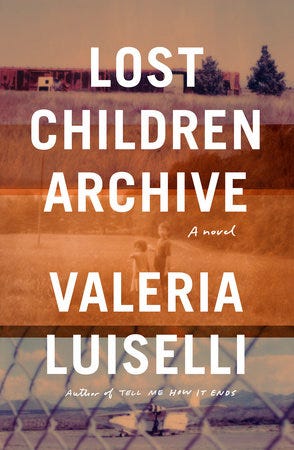
“Brown White Black” Is A Love Story About Family and Identity

It’s rare to come across an essay collection that is unequivocal in addressing the systemic norms that impact identity while also being compelling and incisive about the relationships that form us. Nishta J. Mehra’s memoir Brown White Black: An American Family at the Intersection of Race, Gender, Sexuality, and Religion achieves this by recounting her experience as a queer woman, and as a child of Indian immigrants in a segregated Southern town, and in addressing her own internalized biases while being transparent about the challenges of raising a Black child in America.

Through frank, clear prose Mehra explores what it means to be a part of a family that the world does not often recognize. Her book is a meditation on lived experience and how one comes to be, but it’s also a love story one that emphasizes the intersecting identities of Mehra, her wife, and her daughter. Mehra and I chatted on the phone about her complicated relationship with her hometown, what she hopes her daughter will garner from her childhood experiences, and how her identity has evolved since becoming a mother.


Genelle Levy: Brown White Black focuses on intimate, emotional moments surrounding your family and personal lived experiences, what was your writing and meditative process like?

Nishta Mehra: A lot of what my process looks like is paying attention in my daily movements through the world. I’ll jot things down as they happen. It’s a process of turning things over in my head and trying to make connections between the things I see in my classroom, in my personal life, and in parenting my child and drawing those lines between them. Most of the drawing together happens on the page for me. I think that’s true for most writers. We figure out what we think by writing. It often looks really messy until I start to figure things out. Then things start to take shape on the page. Then I realize what I’m trying to talk about. I often don’t really know going into it. I just know I have questions and I’m trying to figure out why something bothers me, or why I’m interested in something or why something felt a certain way when it happened.

GL: Childhood is a main theme in Brown, White, Black. You wrote about your childhood and your daughter Shiv’s childhood. Since becoming a mom what has surprised you in terms of what it means to come-of-age as a person of color in America?

NM: I think it’s both exciting and frustrating to watch and see what Shiv has access to. The exciting part in particular is with Shiv’s gender-fluidity and her interest in things that are not typically permissible for someone born into a male body. It’s been exciting to watch and see the space that she has to explore and that other kids have 30 years later. It’s certainly a polarized conversation, but it has been encouraging for me to talk and think about gender in a way that wasn’t possible when I was Shiv’s age. In terms of race, I think I’m a little less encouraged. It’s really important that we can find books and TV shows that don’t just have a token character of color. Those are real and they impact our everyday life. But there’s still so much work left to do in that area. You still have to really seek out that material.

It often looks really messy until I start to figure things out. Then things start to take shape on the page.

GL: That’s interesting because you referenced a children’s storybook that you like to read to Shiv about two penguins that is a queer love story. I’m disappointed years later to hear that there’s still a lack of children of color in children’s books.

NM: I think one of the things that strikes me is that we still have to actively seek out books with characters of color, and we have the resources to do that. We live in a city with a great library system that’s conscious of the population that it’s serving. But diverse children’s books are not in the bookstores. For folks who don’t have access to those things or don’t have the resources, the means, the time or the money these are systemic problems. It’s not just about an individual personal family frustration. It’s that there’s a wide-reaching impact related to a lack of representation. It’s more than just a nice moment. It’s a lifeline for certain kids.

GL: So, you’re a Southern woman having grown up in Tennessee. How has your experience as a queer minority woman been impacted by the Southern culture around you?

NM: I think one of the things that Southern people will often joke about is that at least here you know where the discrimination is and you can see it. There’s a certain amount of ownership around the issues and history of racism and discrimination in the South, that’s not to say that it doesn’t exist in other places. It’s frustrating, this idea that the old systems of discrimination exist only in the American South. It’s become pretty clear recently that that’s not the case. This kind of discrimination can look different in other parts of the country, but it doesn’t mean that it’s not there.

GL: Memphis is such a complicated place for you because, although you had some negative experiences there, it was also such a key part of your childhood and it’s still home for you.

NM: A lot of us have that feeling about our hometown no matter where it is. It’s a push and pull. You love it, but you’re frustrated by it. It’s complicated because my dad also died there. So there’s lots of layers to that. My wife is not from Memphis so she doesn’t have the attachment to it that I do. It’s not on our list of places that we would consider living. It’s complicated when we visit Memphis because we’re more visible as a family in terms of our identity than when we are in other parts of the country that are more integrated. It’s something Shiv has noticed. The community that I had in Memphis is comprised of mostly Indian and White people. So, that’s a different experience for Shiv to be in spaces that are majority White. I don’t want that to be her experience. I don’t want that to be the norm for her. I have a set of unresolved feelings about Memphis. I do love it very much, and I have a lot of people that I love there. I’m proud of the work that has happened on the ground in terms of activism in Memphis. People are trying to push conversations and make change happen. There’s a draw to want to be a part of that, but then there’s also a sort of fear that the cost would be too high in terms of what Shiv’s experience would be like.

GL: In “Working the Trap” you wrote about what versions of queerness are accepted by mainstream society. Acceptable queerness has mostly been attributed to cis, white gay men that conform to traditional ideas of masculinity. It seems that queer women, especially queer women of color are still othered within the LGBTQ community.

NM: I think I really struggle with the ways in which queer identity is softened to be more palatable in mainstream culture. Most mainstream representations depict queer women of color with long hair and in feminine outfits with white partners. It’s rare that we see two women of color together as a romantic couple in gender non-conforming fashion or more unconventional style choices that exist outside of gay white mainstream culture.

GL: Within the queer community there was some division in terms of embracing gay marriage, and you write about this when discussing your own wedding. Some people within the queer community had ambivalence about embracing heteronormative conventions such as traditional marriage, but there were also others who wanted to have the ability to legalize their love and benefit from the civil freedoms that marriage grants. Can you elaborate on how your feelings changed regarding that issue?

NM: I have several different perspectives. I can completely respect people who choose to forgo marriage. Even the idea of monogamy as being superior to other forms of relationships is very heteronormative, and tied to a sense of morality. One thing that the queer community has done, and doesn’t get a lot of credit for, is pushing and challenging notions of what love, companionship, and family look like. But I’ve also had the personal experience of feeling very excited about getting to marry the person I love. Jill and my decision was very pragmatic, but if we weren’t parents we might’ve been having a different conversation. That was a big motivator for us especially being adoptive parents, and having to navigate challenging legal dynamics. We wanted that piece of paper.

The queer community is pushing and challenging notions of what love, companionship, and family look like.

GL: You also wrote about some of the negative stereotypes you had internalized about other minority groups as a result of living in a segregated city and about the challenges of the inter-minority racism you encountered in the South Asian community. Could you elaborate on that?

NM: I think it’s a very urgent and important conversation to have. I can only speak for the demographic I’m a part of. Asian Americans are labeled as being the model minority and that’s definitely a factor. I did not grow up inside of a community that had any sort of awareness or conversation about what social justice might look like. I’m not saying this doesn’t occur in Asian American communities, I know that it does, but that wasn’t part of the conversation when I was growing up. Now it’s starting to happen in pockets and some of it is generational. I was really moved when there was a viral letter about Black Lives Matter that got translated into a bunch of Asian and South Asian languages through a social media crowdsourcing effort. People were volunteering to translate this statement so that young people could talk to their parents about why it’s important that Asian Americans and minorities stand in solidarity with the Black Lives Matter movement. It made me feel less alone and to see the desire amongst young people to really engage their parents was very moving.

GL: You didn’t waver when it came to addressing your own privileges and biases. What would you suggest in terms of how people can meditate about their privilege(s) and biases, especially for those who aren’t writers and can’t just work that out on the page?

NM: I try to consume media that offers a different perspective from my own, whether that’s visiting a particular website or subscribing to a certain newsletter. That can sometimes push buttons. Then you have to ask yourself: Why is this rubbing me the wrong way, why am I feeling defensive right now, why am I getting prickly? It takes practice. It’s human to get defensive, but I think it’s a muscle we can exercise. I’m lucky to have lots of people in my life who challenge me, and are willing to engage in those hard conversations with me. I think the more we cultivate those kinds of relationships is the more that we can practice the kind of work we need to do. But I think the desire has to come first. I think with the desire is the acceptance that there is no endpoint. Some people have pushed back against this idea of “wokeness.” There’s no specific arrival point. It’s a becoming. It’s a posture you adopt, and you can’t put it down. The second that you stop doing that work, you’re back to not being woke anymore.

How Could a Mother Leave Her Child?

Growing up with an alcoholic mother is a full-time job — the tending, the fretting, the terror. A somatic nightmare. But once my mother left me, I was not off the clock. At nine years old, I had retired from nothing. Instead I was bathed in an uncategorized grief, though I would not have known to call it grief for a very long time.

The trouble was that my mother was not dead when she abandoned me and did not return. She was breathing and living, going through the motions of a life just as I was. I wondered if she cried when she was alone like I did nearly every evening, looking up at the clean ceiling of my grandparent’s house, my new home.

Death was simpler to imagine. Easier to explain. I wanted a death when she left me because it felt a death. I wanted life to match itself but it did not.

There are plenty of dead mothers to be found in mainstream narratives, or mothers who return by story’s end, but those aren’t the same thing as the loss of a living mother — a mother still in the world, just not the same world as her child. So when I read the memoir Mother Winter by Sophia Shalmiyev, it was like looking in the mirror and seeing myself, all blood and pulp and bruises, my body split down the middle by my motherloss; it lapped the salt of that wound.

Mother Winter chronicles Shalmiyev’s childhood separation from her alcoholic mother, Elena, and how she tries to find her mother later as an adult. She so perfectly conjures life as a child of an alcoholic though poem-like prose, describing a scene where she turns on a light and sees her mother limp, two men possibly raping her. I would have to learn about Elena by reading an instructional manual that didn’t exist. She describes her mother’s dark lined eyes and lacquered lips, the blue veins on her breasts and the desperate way she drank hairspray, men’s cologne. My mother, too, could get by on chemicals if needed: vanilla extract, Listerine, the bottles circled by her fuchsia lipstick.

Mother is a circle, Shalmiyev writes. A complete and perfect hole.

Elena is the ghost trailing Shalmiyev’s existence, and while many women grace the vignettes of Mother Winter, the book is indisputably about her: the search for her, and the failure to find a satisfying answer to the burning question I have also carried my whole life — how can a mother leave her child?

Shalmiyev’s father did not leave the cord intact for her mother to be found, letting Elena fade from view as he and Shalmiyev flew over the ocean from communist Russia to the United States for a new life where she would work for a feminist high school newspaper, Riot Grrl her mantra. Her stepmother Luda mused that she should feel grateful — why miss your whore mother when you are better off without her?

The book is about the failure to find a satisfying answer to the burning question I have also carried my whole life — how can a mother leave her child?

“Why miss your mother” was a question I heard too, and it shamed me. People probably thought it comforted me to hear that I was better off without my mother, but it did not. Telling a child their mother is scum, no matter how horrible she may be, is telling the child she is scum. You cannot separate the two.

Shalmiyev’s mother, like mine, was not dead, but an alcoholic. Shalmiyev writes her mother poems, imagines her. Every night for a long time I imagined my mother coming screeching around the corner into my grandparents cul de sac to take me in the night. I wanted something crazy to happen. But the fantasy stopped there. There was no new life waiting. There was only the life I’d always known, alcohol at the helm. My mother knew all the recovery lingo; she had been in and out of programs since she was a teenager. King Alcohol, she called it, before she knelt to worship.

It is one of life’s supreme gifts to find a book that seems to tell your story — not just the emotion of something familiar, but what feels like your exact heart. I’ve only felt this once before in my life, while reading White Oleander by Janet Fitch. In this sprawling novel, the young narrator is accounting for a maddening loss when her poet mother goes to prison for murdering an ex lover. Her mother is not dead, but taken. Shalmiyev says early in Mother Winter that she was stolen from her mother (though she rationalizes that her mother left her years before when she chose the bottle). I, too, felt that perhaps I had been stolen from my mother, that the courts were determined to keep us apart, setting up impossible tests and barriers that my mother would never be able to accomplish. She had to go to rehab, they said, she had to get a job, she had to show she could keep up a safe living situation for us, she had to she had to she had to. But how was this woman, who for a time could not even leave her bedroom, could not even make me one meal or take me to school, possibly do all of those things? Stolen. When I talked to her on the phone for our limited phone calls after she left, after she never showed up for her court date, we would muse how unfair everything was in life, how unfair it had all been to her. She would cry into the phone and I would comfort my mother for the loss of her daughter.

Shalmiyev says when she saw her mother and the men, she became the mother and her mother was the baby. I have felt I have been a mother most of my life, but only in the last four years have I become a mother to my own children. Only then have I felt the deepest need I’ve ever felt for my mother, but also the widest expanse away, the most disdain for her.

She would cry into the phone and I would comfort my mother for the loss of her daughter.

I can’t get her buttermilk smell off my mouth, Shalmiyev writes. She does not worship Elena, but she can’t shake her. I read Mother Winter to be a love letter in many ways to Elena but also to the other mothers Shalmiyev auditions: Feminists, writers, activists, painters, ballbusters, killjoys, sex workers, gay men. In this way, Mother Winter became a mother to me. I will turn to it again and again for truth, the electricity of the writing, the way Shalmiyev is unapologetically a human woman, motherless and brazen, holding her tampon in with one finger while she takes a shit and her children go wild around her.

Motherhood is not romanticized in this book, except in its undoing. It is the most romantic thing I can imagine, similar to the way Cheryl Strayed proclaims her mother as the love of her life. I know I will chase my mother’s love until the ends of the earth and when I arrive there not having found it, I will chase it some more. I will hold my own babies and feel the sensation of being an elder woman to someone and want the physical pressure above me, the actual press of another’s body shielding me, my own mother, the one who is supposed to offer these things to me, these guiding lines and animal knowledge, and I will feel only open air on my skin. I will watch my friends be mothered by their own mothers and bite my lips until they bleed in my mouth. I’ll smile, I’ll be the things she was not to me, but I’ll also be her. Like her, I won’t be able to tolerate alcohol in any amount, and like her, I’ll expose a sensitive skin to the knife of the world, and I’ll feel the way her body has been assaulted and taken from her time and again in my own body, how can I not? I came from her, her cells forming my own, and I’ll be her but I will also be myself, no numbing elixir at the ready besides my book companions, and occasionally, the weight of my daughter in my arms.

After the birth of my son I knew I was finished having children. My body told me I was done and I listened. I laid on the table of Tami Lynn Kent, the Ted Talk “Vagina Whisperer,” while she did a myofascial massage on my “bowl,” her gloved fingers inside me reading my vaginal aura with pristine accuracy. She found the motherloss in my body immediately. She found the places I held that pain and had for so long. She prompted me to close my eyes and go to a happy place and visualize release. I have done meditation before. I have released my mother many times. This time I saw a black star sky, my spirit floating like a glowing outline. I was on my way to healing, soaring alone. But then something happened. My outline stopped and turned back, grabbed the hand of another outline, my mother, and carried her along for the healing. This was new. I felt peace. Shalmiyev writes, I could buy the ticket, take the ride, but never arrive at my body, clean and fed. Not until I cleaned and fed children of my own. Perhaps I had arrived back at myself, clean and fed, so clean and fresh and full that I was finally able to hand some of that to my mother’s hollowed spirit and ask nothing in return. It will be only this, I thought. Giving away this love will be the only consolation I will ever find.

I know I will chase my mother’s love until the ends of the earth and when I arrive there not having found it, I will chase it some more.

Shalmiyev writes, Elena. Mother. Mama. You. I choose You. Says she would like to wear the equivalent of a medical alert bracelet: I lost my mother and I cannot find her — née Danilova. Yes, I thought. A bracelet would do nicely. I’d like one too.

When I was 25 and riddled with tension headaches and migraines, my motherloss still unsolved, my acupuncturist told me I was stimulating my umbilical region with the belly button ring I had gotten as a teenager. The piercing was triggering the mother zone, literally the physical place I had been connected to her, nourished by her body. That night I took the ring out in the shower, giddy at having perhaps found the culprit of my pain. A belly ring all along was slowing me down.

Why can’t anything ever be easy?

When I turned eighteen I knew time was up. Time was up on my childhood and the space in which my mother could have screeched up that driveway and reclaimed some life with me. I was going to community college. I was legally an adult and no one had custody over me. I felt astonished that my worst fear had happened — my mother never came back — and yet I was still standing. She missed it all. I missed it all. Life went on anyhow. I ate and smoked and breathed and fucked and walked and cried and drank I drank I drank and I tried to find her up my nose and in a bottle but those things were never really for me and offered only the ugliest pleasure. By 20 I was done with all that. I’ve stayed done.

My mother is still not dead. She has never met my children. She saw me once before I graduated high school and we sat in my broke-down Chevy Malibu and smoked cigs with the windows up in an Applebees parking lot on the edge of town where she snuck me drinks that I paid for, and then had me take her to a liquor store so we could streamline our drunkenness, get down to some frugal and serious drinking. The photo albums I had brought to show her waited in the backseat for the right moment. I meticulously chronicled my own life the way I imagined a mother would for her children — I made my own baby books — but the books stayed in the backseat as I watched her throat move in the most desperate way drinking from a bottle of vodka as if it refreshed her, as if it were water, and I drank too and I knew I was drunk but would have to drive her back to the hotel she was staying in with the man who took her from me, stolen, and it was a pain to understand that my mother didn’t mind if I drove drunk, didn’t mind at all. She liked me this way. She played with my long hair. The photos remained unseen.

I felt astonished that my worst fear had happened — my mother never came back — and yet I was still standing.

But still I choose her, no matter how many years pass. I cried in my therapist’s office weeks before having my son because I was ready to reveal my truth. That despite everything I still wanted my mother. I still somehow chose her and I always had. My mother probably thought me stoic, all my boundaries, all my self protection, but under all that, I wasn’t cold for her. My secret she would never know: For her I maintained a warm fire in case she ever wanted to come in from the cold.

Recently my mother tells me on the phone that maybe things all worked out for the best. I got to live in a nicer house with my grandparents than she could have ever provided me. I got to have birthday parties. Her voice trails off. My voice booms. “I never cared about birthday parties. I wanted you,” I said.

I chose you. Mother Mama Mary. I choose you.

The differences between my mother and Shalmiyev’s are probably plenty, though admittedly I conjoined them into one mother in my reading. But the main difference remains: My mother is found. I have her address. I ship her soft sweaters because I know she cannot walk anymore and will not leave her apartment and most certainly cannot stroll into her local Gap and try on a soft sweater, so I send them to her. I could fly there right now if I wanted. I could show up and make her look at me. I did it once with my boyfriend at the time. We planned a total ambush of detox and AA. Shalmiyev flew to Russia to find her mother with her at the time boyfriend, too, but they had no address. She packs a bag of American things her mother might like, carefully chosen gifts. The heart to do that is so big. Perhaps both of our journeys were fruitless. Perhaps they were not.

Shalmiyev has a son and daughter, as do I. She says of her daughter, watching her baby body stretch across the writing desk turned changing table, I think about how I want to be her so badly. I too would like to be my daughter, so safe snuggling or dancing, or even when she is mad and slamming doors around the house, her anger meaningless to my love. The more I love her the more my heart fills in. The more I love her, the more I ache for that same love but cannot find it.

Shalmiyev cringes when she finds that her small son has crumpled the photograph she has of her mother, one of the few talismans she treasures. His palm has crushed it and the photo flakes. I wonder if when Shalmiyev looks at photographs of her mother she sees the same immense beauty I see when I look at photographs of my mother. I see her frozen there, the most beautiful woman in the world. Perhaps more beautiful than she would have ever been to me had she fed and clothed me, had her love been there every day like a rug under my feet. The possibility of the love and the failure to deliver has cut her features striking to me, unknowable. My daughter will always see my familiar face and not think of untouchable beauty, but of home.

I see her frozen there, the most beautiful woman in the world. Perhaps more beautiful than she would have ever been to me had she fed and clothed me.

As I read I imagined myself and Shalmiyev conjoined motherless women. Holding our own children and feeling the weight of the aloneness, but also feeling the gratitude for somehow making it out alive enough to hold children at all. We wear the motherloss now invisibly. No one can look at us and know. Perhaps she, like me, holds the loss like a rock in her pocket, something to reach in and feel the rough edges of while walking in bitter cold air alone, imagining our mothers watching us somehow, as if life could be that magical, as if we might find them at the corner store, clear eyed and ready, and it’s all been a big mistake.

So how can a mother leave her child?

Shalmiyev knows, and so do I, and so do many others before us. She writes of Gertrude Stein whispering in her ear: But dead foremothers speak.“There ain’t no answer. There ain’t gonna be any answer. There never has been an answer. That’s the answer.”

Valeria Luiselli’s ‘Lost Children Archive’ is a Road Trip Novel about the Border and Its Ghosts

When friends ask me what Valeria Luiselli’s new novel, Lost Children Archive, is “about,” I say it’s about many things. The big theme that stands out for me is immigration — in particular, the “crisis at the border,” and more specifically, how we talk about and deal with children. The novel brilliantly reflects the pervasiveness of these issues by keeping the current crisis as background noise; Luiselli never lets it enter the main stage. Yet, immigration is only one of many themes in the book. Lost Children Archive can also be read as a critique of technology, what it means to return to radio, cassette tapes, maps, polaroids, and what this return to these older/lesser technologies tell us about our current “American experience.” Another major thread is empathy: can we really love someone else’s children as much as we care about our own biological children? Part of empathy is also listening. The novel essentially is about listening to everything around us in order to better understand the world we’re walking on.

Purchase the book

From her work as an immigration translator that was well captured in Tell Me How It Ends, we arrive at a work of fiction that is not about immigration but fiction with immigration — a distinction I hope writers and readers think about in a time when our media, politicians, and own interests seem to be making immigration into an obsession. I have not stopped thinking about this book, the world it builds. In the best way, Lost Children Archive has stayed with me, making me look at my own immigration story in a different way.


Javier Zamora: Your novel brilliantly captures the current immigration moment; by that I mean it addresses invisibility and hypervisibility of immigration. Could you talk about this?

Valeria Luiselli: It’s definitely not a novel about immigration, but it’s a novel with immigration. It’s a story that looks at immigration’s course and it looks at the way we can talk about political violence more generally. So one of the things that I believe as a writer is right there in the novel to a degree, or more than what I believe, it’s one of the questions that I have been asking myself now for many years. The question is this: how do you write about crisis? And in particular, about a particularly vulnerable population without doing more harm to said population?

For example — on a very basic level — does writing about undocumented children bring them into a kind of unsolicited visibility? Or does it make them more likely to become prone to become a target of political violence? So does writing about undocumented children make them more vulnerable in the context of an administration that will surely target them this way? But then not writing about them — if we all shut up and not even look — then the vulnerability is perhaps of another kind, right? Then perhaps political violence can go unseen, unreported, ignored, and ultimately with impunity, right?

I debate myself constantly between those two poles. I think that the novel is different from my essays in that it doesn’t explicitly reveal a political stance. It quests more than advocating any kind of answer.

Does writing about undocumented children bring them into a kind of unsolicited visibility?

JZ: Regarding searching or questing, I think what I got from your book, and maybe because it was published so close to Tell Me How it Ends, I learned a lot about what I expected from a book through reading your novel. Could you talk about how you relate to expectations, both what you expect from yourself as a writer and what your readers expect from you?

VL: To be very very blunt and honest with you, I don’t think about expectation when I’m writing. Really on the day to day basis, I’m thinking about sentence structure, form, architecture, and rhythm. What I do think about when I step a little bit away — from the moment of engaging with the language and with my work — is whether the form and the vehicle which I’m using is the exactly correct one for what I’m trying to say.

What happened to me is that at some point I was writing the novel — I started writing it in the summer of 2014 — and at some point, I started to use it as a vehicle for my political rage and for my political stances and I started writing more directly about the immigration crisis within the novel.

After a while, I started to realize that I was really messing the novel up. I wasn’t really doing justice to the novel, I was kind of suffocating the prose. And I wasn’t doing justice to the issue. So I stopped writing it and I wrote Tell Me How it Ends. And it was so clear that that was the form I wanted to say had to be an essay, had to be more straightforward, had to disclose a more clear political stance as well as a positionality of where I’m writing from. I’m a member of the Hispanic community but also I am a member that came here to study a PhD but didn’t come here undocumented. So all that I could leave very clear in a very straightforward approach to the issue right? And only then was I able — when I finished Tell Me How it Ends — to go back to the novel and have a different kind of narrative distance which was just what I wanted to do in the novel.

JZ: At some point, did the political rage — some of which you say turned into Tell Me How It Ends — become the Elegies for Lost Children? Because, to me, the Elegies act as this weird, dark undercurrent. Reading them, I thought it was an actual book, as you claim, and was surprised to later learn it is your own fabrication — which is brilliant. And why the choice of creating these made-up Elegies from other literary references? Why do that? Instead of incorporating actual events, like news, in other words, a very non-fiction approach?

VL: First of all, I don’t appreciate fiction that kind of just reproduces the violence of reality or the violence that we read about. I find it a little bit parasitic and also sometimes sensationalist. There were all these novels in Mexico when the narco wars broke out and the drug wars started, I found it suffocating.

I never really wrote anything in fiction about the drug wars in Mexico. I guess Tell Me How It Ends is my best approach to it. But until time passed and writers had been finally able to take a kind of pause and a breath and a narrative distance, and then other much more interesting books about violence emerged. Like Yuri Herrera’s books, particularly one book I forgot the title right now, La transmigración de los cuerpos (The Transmigration of Bodies) I think. That’s to say, I had never really appreciated a certain kind of fiction in its approach to political violence.

I also had decided while writing Tell Me How it Ends that I didn’t want to use testimony as such — kind of just use the voice of someone who had told me their lives and reproduce it to a minor detail is also just a little bit transgressive. So Tell Me How it Ends takes bits and pieces of a person’s life — different people’s lives — but never a full testimony, and their stories somehow always visibly intertwine with my interaction with them. That same thing in the novel became pure to me.

I didn’t want to transgress. I didn’t want to appropriate. I didn’t want to reproduce, as things are reproduced in the media. So I had to find another way in. And that’s exactly what fiction is about right? Finding different ways in. The way that happened was, as things are, a little bit by coincidence and a little bit by generating the conditions for coincidences to happen, and those conditions had to do with just reading other people’s takes on different historical instances of children in situations of virtual abandonment or forced migration. And among the many many books I read, there was this book by Jerzy Andrzejewski, The Gates of Paradise, that narrated the children’s crusade in the 13th century. In a way not such a different story in its brutality to the one of children fleeing now. That gave me a way in, like a rhythm, a way of stepping one step back and again finding a narrative distance.

And I really like that you say that it is like a dark undercurrent. That is exactly how it felt writing it.

I started to use writing as a vehicle for my political rage and for my political stances.

JZ: Speaking of ways into a narrative, the cataloging, archiving, documenting, reenacting, incorporated into the text do a great job to tell the story. As a reader, I found myself going back and re-reading the elegies, going forward to see the polaroids, analyzing the “boxes” between chapters, etc. … In other words, the “form” the book takes, propels the story forward. Where did that come from and how did the “form” come together?

VL: How? Very slowly. The thing is where to start? On one hand I have always been interested in the question of how the archive that you work with or even just the materials that you work with and the space that you work in leave a print — like a fingerprint or footprint — in the work that you are producing. I mean there are many types of writers and I guess there are writers who sit in a room and are completely oblivious to every material around them and are completely into fiction. I write very different, I write with a lot of material companions, so like books and cutouts and pictures. If I work in a library, I’m constantly standing up and getting books. I think that in my book, in my work, the fingerprints of the archive always somehow show up.

In this novel I was interested in meditating about storytelling, about how we compose stories with the pieces of things we have, and how there are many ways of composing stories but we ultimately decide to arrange them and to somehow build a narrative and to mediate our relationship to the world in that narrative. Because I was interested in that question I integrated the archive of the novel very visibly.

I think that the way that you said you read is really very fortunate and gives me great joy to hear that. Because I think that is exactly how I would like to read. Because you can see this book that’s mentioned here has this echo here, and how would I as a reader recompose that? And I think that laying that archive there for others to move along also maybe creates a more active interaction between the mind of the reader and the text; because it’s read in more ways, you can shift, you doubt, you can reckon.

JZ: And the personal experience too. I also followed along with the sounds. I’m a reader that likes to listen to music while reading and I was listening to the albums mentioned in between chapters. The boxes act as the sounds that you should listen to, a sound bibliography of sorts. And regarding that, I had never listened to “Metamorphosis,” by Philip Glass, I had no idea –

VL: It’s such a beautiful piece right?

JZ: It’s absolutely beautiful. It sort of mimics, or acts, like the novel. I find “Metamorphosis,” very ironic because it ends and begins almost the same way. It’s very circular.

VL: It is, it has like a very minimalist circularity.

JZ: And that’s a huge theme, or a key, that unlocks your work. There are echoes, there are birdsongs, there are trains. Even Apacheria comes off as circular. There’s a revisionist impulse in all of this.

There are many ways of composing stories but we ultimately decide to arrange them to build a narrative and to mediate our relationship to the world in that narrative.

VL: Definitely. It’s about how we tell history, right? And therefore, how we make past as presence, so yeah there is something revisionist. A stance on a political and aesthetic. Like a very intimate stance with respect to basically how we make sense of stories in time. Reenactment has to do with it. Reenacting is on one hand a very desired cultural practice where an event, a historical event, is reproduced ad nauseam for consumption and entertainment. But in another sentiment, in another more intimate sense, it’s also a way of playing out history and maybe bringing that which is far away historically and peoples who are faraway and circumstances unreachable and bringing it intimately close. And maybe being able to experience a deeper kind of understanding and empathy through that ledge.

JZ: And speaking of very personal, the polaroids at the end, you’re probably going to get this question a lot, are those your children?

VL: So there’s one kid in the pictures right?

JZ: Yes

VL: Yeah that’s my daughter.

JZ: Was having a family, being a mother, help with the part of the book that is told via a child speaker? I ask because I’ve seen terrible examples of attempts of trying to convey childhood, myself included, and it comes off as trite. But your writing is genuine, there’s never a point in which I know an adult is writing…

VL: I think that since I became a mother like 10 years ago, I have always intimately written about childhood and children. Maybe before I did as well but differently. I spend a lot of time around children. I teach creative writing workshops in the detention center for undocumented kids. For a while I did interviews and translations in courts with kids.

I have many nephews. I only have one daughter. And I have two step-sons from my ex-partner, but they grew up with me too. So I always find myself around children. And I sense that my only way of making more sense of adulthood has had a lot to do with reconnecting to childhood, not severing the person we were — when we looked at the world the way we did when we were little — from the person that we are now. I am always trying to translate those two worlds back and forth.

JZ: Now I’m gonna ask a question that annoys me when others ask it, but will ask nonetheless. From my understanding you wrote this novel and Tell Me How it Ends first in English right?

VL: Yeah, I did.

JZ: So this is the second book that you begin in English if I’m not mistaken?

VL: Yeah, it is. I mean I have written many other things in English and many bits and pieces of my previous books were first in English because the notes that I think in are always bilingual. And I’m not sure if you’re fluent in Spanish, are you?

JZ: Sí.

VL: So you’ve experienced the empezamos la frase con un idioma and then you finish it in the other? Our brains, I think especially if you’re Hispanic in the US

JZ: Or everywhere…

VL: Wherever, everywhere, it’s not only that, I mean, we are a humongous community here, so it’s not like we’re on an isolated language like in Norway or something. There are at least 60 million cabrones who speak Spanish here, right? Second largest Spanish-speaking country in the world! I mean it doesn’t consider itself a Spanish speaking country for some bizarre reason, but [America] is a Hispanic country too.

Within this, I find really interesting how my brain here, even though I have maybe been bilingual since I was 5 years old — I went to American schools in Korea when I was 5 and I learned how to read and write in English before I did so in Spanish. So I haven’t been bilingual since I was born, but since I was five — but my brain never connected the two languages as absolutely as it has here in the U.S. It’s like here we have a third language here which is this confluence of both Spanish and English.

JZ: Did that help?

VL: I think it helps writing because if you are bilingual or trilingual — if you are at least bilingual, you know that certain things can feel better or more accurate in one language and not in another. So when you are forced to say it in only one of them, there’s always like this need to be more precise because that language is maybe not doing justice to what you’re trying to say exactly. So then I think that forces you to be incredibly rigorous and think things once and twice and three times and eleven thousand times until you find the exact way, which is usually, I mean there’s something very fertile in that. You’re not taking the direct route to anything, you’re always kind of meandering on until you find where you wanted to go in terms of finding meaning.

JZ: Along those lines, I really appreciate that you don’t really make that big of a deal around ethnicity or immigration status of the novel’s protagonists. It’s very subtle. There’s this almost-fear but it’s not an overwhelming fear, and it’s not this overly flat or reductive depiction of a migrant’s story in this country like how most media outlets depict immigration. I commend you for that.

And I don’t know if you know, but I immigrated and I crossed the border along the desert, and I’m just completely tired of all the narratives that are going around regarding this topic, and I’m tired of the sensationalist coverage in the media (from all political views). And I just thought your novel does a brilliant job balancing all of these things, in the background of the novel. A sort of background noise.

VL: Oh wow what an honor. Don’t say that, you’re gonna make me cry.