A Story About an Unfinished Love Affair and Readymade Literature

“Emergency in Favor of Twice”

by John Holten

The artworld was always a safe place, a refuge and somewhere I was all to happy to retreat, and sure I’d curated one or two shows, written some exhibition reviews, took part in the wider game but I always considered myself a writer first and foremost. I never expected the artworld to present me with a conundrum I wouldn’t be able to solve, an emergency to which I would not recover. There was always a mystery as to what Duchamp’s first readymade was; note the interrogative what, not which or what ever happened to, although of course the younger sibling Fountain is famous for having been more than likely destroyed after Stieglitz’ iconic photograph of it. Then there is also the theory that Duchamp didn’t even choose the urinal but that it was the Baroness Elsa von Freytag-Loringhoven who signed off as Monsieur Mutt. But who created or what happened to Fountain are not the problems on which this story turn: like so much art history of the last century, they are but the accidental and academic backdrop.

The story begins in Berlin. The bar was full with the neighborhood hipsters though that sounds like a slur I don’t intend to throw. Mostly they were just artists and music heads, people just getting by and working as much as they could in the city — which is to say obscurely or not at all — staying out late as if avoiding their under furnished sublets because to be in them at nighttime, that time of day so full of potential, would only make them lonely. I said hello to the few faces I recognized at the bar, people from my time here around 2011, 2012 and sat down and took in the drinking and conversing, the ordering of drinks and boisterous flirtations. But I don’t really want to talk about the bar. As much as that is possible seeing as I met her there, as I sat at the counter near to the entrance, pretending to myself that I was there to think through my next possible life moves. She was with a large contingent of Spanish speakers, Colombians mostly I learned later, together with the Spanish crowd from the Bartleby bookstore. Out of this profusion she sat down beside me and we got chatting in that interrupted parataxis so common to such a bar at such a time, the Berlin usuals: where we were from, how long had we been here, what did we do in life?

Me: Ireland; just passing through; a writer and curator.

Her: Argentina; two years; artist.

I lost her interest when instead of asking her follow up questions about herself as one is supposed to do and so make her talk about herself more, I stumbled trying to explain how I had lived here before but she didn’t seem to care and then, soon after, she was gone, lost to the back of the bar, lost among the jostling crowd, beyond those two deep waiting at the only available spot to order. The haze of inebriation, myriad lines of attention, attentions kaleidoscopic.

Out on the street I was smoking a bummed cigarette, swaying on my feet and taking in the steadiness of Sonnenallee, when she came from the side and reminded me we hadn’t properly introduced ourselves. Her name was Mina, an anachronistic name I found a tad surprising. Let’s get a coffee sometime? Sure, I said with obvious delight, or a drink. Or a drink, she smiled and turned and looked down the street, continuing to speak: I can tell you my secret theory of the readymade. It involves Duchamp obviously — she had turned back to face me, the trace of a smile lingering — and Borges. A literary art guy like you should love it. She said then we were the same: We’re the same you and me, we both have Irish blood and badly kept hair, our countries both know economic ruin and embarrassment and have lots of cows…
The night was warm and indistinct and I laughed at her cultural analogies. It was drunk hour and people remained neither inside nor outside the bar but rather seemed to be constantly moving between the two. Some women sat around a low table on plastic chairs laughing loudly but speaking quietly as if in mock efforts to respect the neighbors. Mina was talking to a group in Spanish. I finished my cigarette and left soon after for home.

I forgot that she had a theory of the readymade, all I remembered was her confidence. Some detective work on Facebook led me to her quickly enough, we had a dozen or so friends in common, mostly through people from the bookstore, and she used her real name: Mina Vismara. I guess I fancied her a little. She had wanted to meet me again and such was my weak position in the indifferent universe at the time that this was more than enough for me. At the time I was fairly convinced that one never actually meets interesting people in real life, that people are boring or annoying — they’re not like the populace of the novels we love as teenagers. Sure they can be smart and amusing but one has to really work hard in putting them all side by side, to line them up and evaluate their auras as it were and once you’ve done that you might just be able to say, yes, I have lived with the luck of meeting one or two interesting people. Otherwise, I think of Ann Cotten’s dictum: I’m no misanthrope, I just find the people I’m around annoying, stupid or overly glum.

A week or so later I found myself sitting across from Mina Vismara on a low stool in the same bar in which we had first met. I put my elbows on my knees and joined my hands together: I wanted to be open to her, to make her feel confident that she had my undivided attention. But then, like an alchemist, like Duchamp himself, she was going to start dividing everything, including the limits of my attention.

She started talking about graphic design and the books she liked to buy, about Willy Fleckhaus and how she came to Germany because she liked the U Bahn design. She said her favorite books were full of widows and orphans. That her mother gave her to her auntie to raise and she’s never gotten over this relinquishment (she asked me if this was the right word and I said I guessed so but wasn’t sure). She said that she was at the Venice Biennial in 2013 but she hadn’t gone into the German Pavilion, which was in fact that year housing the French Pavilion as both countries had decided to swap their fin de siècle abodes in the giardini. Post-nationalism in the giardini she said, the biggest doubling in contemporary art history! So it came about that Anri Sala was representing France as an Albanian in the German Pavilion. The queues had been very long. The artwork was called Ravel Ravel Unravel and she started to explain in great detail this artwork she apparently never saw. It was a three screen video-work in which two pianists play Ravel’s Piano Concerto for the Left Hand in D Major which the pianist Paul Wittgenstein — naturally the brother to the philosopher Ludwig — had commissioned, one of many, after having had his right arm amputated during the First World War, a radical division as it were. The two renditions are slightly out of sync, creating a disharmony that is at times cacophonous and boisterous but also somehow elegiac as if reminding us that time is out of joint and history itself is unraveling. On a third screen a DJ tries to scratch these two versions together into a harmonious whole, which of course is impossible: people always forget what it is DJs actually do, she said with an exasperation that was a little startling. She said she had sat beside Sala during a dinner once and he was very charming and very smooth, he had a nice wristwatch and eyes that penetrated right through you such that she was deeply attracted to him but also repelled because she knew so many women must have felt the same concentrated attention he so easily dealt out, he was a man that knew exactly what time he had to get up at the next morning and what he had to do. Our primary sources exist online she said, what we have to play with are digital files. Did I lament the demise of books, she asked. I didn’t, I said, because there’s no demise. She demurred: I guess it’s true that we’re all still readers and always will be. Duchamp had explained, she went on, that the choosing of what became readymades was merely a little game between ‘I’ and ‘me’: he wanted to get away from his own tastes, his own eye for the pleasing or the more favorable, but of course to do so he had to fool himself and to limit the amount per year of readymades he would put out into the world. There were, after all, only 20 or so over his lifetime. Borges meant something similar, she said, with his late piece Borges and I: the public and the private persona, the most intimate doubling of them all, and to be in favor of entertaining yourself twice, once in solitude by way of collecting your favorite physical items or consuming food you find pleasing say, and a second by pleasing others around you and sharing the art you may create even in the quietest moments of your limited days — this was a fruitful way of going about life. She said: she remembered growing up in Buenos Aires and going on holidays each summer to the south near Mar del Plata and once upon returning home she had an existential crisis that left her paralytic in fear of having to grow up. She realized that she would one day lose her parents and that the annual ritual of the holidays by the beach would stop and that she would be an adult herself. This had made her cry and led to a talk with her mother in which she spoke of her fear of growing old. She has abandonment issues. She said her favorite musician was Andy Stott but this had nothing to do with what she wanted to tell me, which was her theory about Duchamp and how it included Borges and her hometown Buenos Aires.

It went something like that the first readymade by Duchamp wasn’t Fountain as people who don’t know anything falsely assume, or even Bicycle Wheel or Bottle Rack, but another work called Emergency in Favor of Twice and that the latter had never been photographed nor described in any way, the only thing that was known about it was its name, written by Duchamp in a letter to his sister Suzanne in 1914[1]. It was from Buenos Aires that he also wrote Suzanne in 1919 to mark her wedding with the instructions for her favorite readymade and which Roberto Bolaño used in 2666, and it was called The Unhappy Readymade. Which was a geometry book hung outside to be slowly destroyed by the elements. She started to talk about delay, as a concept, and that Emergency in Favor of Twice was about the same event that happens at different times. I started to lose her and my eyes roamed, first to take in the bar and then back to Mina and her crossed legs and I thought how male writers are always describing women in much the same way as men check them out and I grew ashamed. Ashamed to be a failed writer and ashamed to be a man in the world. But the truth was I had no idea any longer what she was talking about or why she had felt the need to meet me a second time and tell me any of this but I refocused my attention. She was saying that artist projects like Saâdane Afif’s Fountain Archive really bore her, or even annoy her — I started to think she was talking in circles — and that the real work to celebrate was Emergency in Favor of Twice because it demonstrated why Duchamp stopped painting, stopped making art and that decision, to stop making first retinal art and then art altogether and spend his life playing chess and making the odd art deal here and there, was where the real meaning lay. Then a remarkable thing happened: she asked me about my writing and I told her a little about it and how I also edited a book or two ‘a couple of years ago’ and she grew quiet and let me talk and the more I talked the more I realized what failure sounded like and how the best thing to do was stop writing immediately.

We left each other with a warm enough embrace but it was perhaps not what I was hoping for. I may have loved her but it was clear I didn’t have the attention span to love her, and in any case, she would never love me back. We both stood up at the same time and the hug we gave each other was light and fleeting now that I think of it, I suppose you could even call it business like. It was still evening and not yet night and the bar was quiet and the street outside seemed empty. I’ll be in touch, she said, I’ll try and make sure to get you further evidence. She was grinning, checking her pockets that she had everything, whilst also keeping her head held high and I thought how she was almost about to break into laughter and while that may make her seem aggressive or dismissive right at that moment, as if she was merely playing me for a fool, it was in fact the very opposite of those things and I thought she was like a fire engine whose call-out was a false alarm, its siren and lights growing silent and dark, returning meekly to its station. Emergency in favor of twice, I said suddenly, it could also mean something like a false alarm. You know, like the boy who called wolf. No, she said, I don’t think so. It doesn’t mean anything at all, that’s the point, it means everything and nothing and this alone gives a clue to the possibility of its existence. It lies innately in the world, just as surely as you’re going to go to the toilet at some point tonight, after I leave you’re going to keep drinking and at some point you’re going to piss into the descendant of Fountain and you will continue to live in this artwork, to make it real like Brian Eno did with Fountain (he claims he pissed in it at the Whitney), this is the function of the readymade artwork…Seguro azar. Certain chance.

She was right about me pissing in the urinal, in fact no sooner had she breathed out the door leaving the faint hum of the poetry of Pedro Salinas like a waning electric filament than I had gone into the toilet to relieve myself, only curiously there wasn’t actually a urinal of the ceramic kind of Fountain’s ilk, there were buckets, two black plastic buckets sat suspended in a wooden sort of table and one pissed straight into them at the bullseye at the bottom, a metal, domestic plughole. A quaint DIY urinal in a dive bar, one that was trying all too hard. The night that followed I cannot recall but I’m certain it went the route such nights must travel.

I left the city soon after and spent time in Birmingham on a residency, then to Glasgow, Dublin. I was listless and bored and gradually over time I had become fearful of making false equivalences so that I couldn’t enjoy one thing more than another without succumbing to a reading, or a viewing, or a listening that I felt was unjust to the work at hand, a priori. I would listen to an Arcade Fire song and think I could intuit the vestiges of a James Turrell work from the 1980s or I would read Tom McCarthy and spend the entire book scratching notes in the margins like ‘Robbe-Grillet’ or ‘Warhol’ — the inverse of how he probably wrote and this obvious and fickle distillation of mine made me depressed and ultimately unable to enjoy reading.

It is true that I saw doubling and delay everywhere and the meeting with Mina stayed in my mind and I would think about this missing artwork and what emergency lay behind Duchamp’s word games. Each time I was back in Berlin I would look her up but as it was we would always miss each other, she would be back in Argentina on some obscure business trip or preoccupied or simply silent, replying only weeks later with a short apology and a blossoming of energy that would carry my interest in her just a little while longer: she was a consummate charmer, of this I had no doubt.

My career, such that it existed at all, was in free fall and I wasn’t writing a thing. In Dublin I moved in with a friend from my college days, this was just last autumn and I tried to juggle making rent-money with serious efforts to undertake the burden of writing a novel. I thought of Mina (I wrote the words SEGURO AZAR in large print on the wall above my desk) and played with Cagean efforts of chance and randomness. When I realized I was in danger of plagiarizing Perec I took up playing Go with a maniac’s enthusiasm in the hope of purging him. I was clearly losing my grip on things. The writing spiraled off and fizzled out in several directions, never really catching light. The money jobs came and went: bartending, sales, bike courier. I realized I was sinking. I made plans for London, New York. I even thought about returning to Paris where I had started out almost a decade before. I thought about curating something, some exhibition that looked at the readymade from a new perspective. I just didn’t know what that perspective would be.

Around this time I finally read through Calvin Tomkin’s strangely arid biography of Duchamp and not without surprise I noted that the man had no interaction with Ireland whatsoever, and as far as I can see I mean that: none. Nada. In my despair I feared for population explosion, seeing how much smaller the world was 100 years before. Joyce and Duchamp were connected through the figure of John Quinn, the New York lawyer and art collector, who, via Pound, was a patron of Joyce; for Duchamp, Quinn was an integral actor in the first Armory Show and instrumental in getting Duchamp from Paris to New York.

I grew cynical.

‘After Duchamp it is no longer possible to be an artist in the way it was before.’ And the same could go for Joyce. Why exactly write a novel after Ulysses? What did any of this mean? My favorite sneer to anyone who would listen to me was that nobody knew what to do with the readymade in literature, found text and the individual talent, the only example I could find in Ireland was of Joseph fucking O’Connor writing out sentences of John McGahern. In some of the most difficult, cringe inducing passages of reading I’ve ever encountered, O’Connor writes about how he became a writer and one almost reads through your fingers at the sheer intellectual and literary parochialism of it all, as if Pierre Menard had never existed, had never opened Cervantes, as if the actions of a 16-year-old boy should be paraded anew as an adult with the excuse of the former’s innocent naivety.[2]

But I didn’t wish to wallow in this cynicism, god knows there are enough frustrated and mediocre writers out there that I didn’t need to add to their numbers. And besides the story played out elegantly: Mina sent me a message on Instagram, it was an image of a chess game with each player having just two pieces left on the board, caught in suspended delay, her thumb scribbling the words over it in bright blue. And that was it: the first readymade was predicated to solve the conundrum between determinism and free will. Borges taught us that, and Duchamp knew it from playing chess, which he had really got into in Argentina and from which, chess and the parsimony of geometry, he would never really escape. When he did it was just to reprise everything that had gone before. And this is when I’m supposed to outline my epiphany, give it a frame so it is all the more believable yet still shrouded in happenstance mystery: I was looking out the window when I thought I saw the blond of Vismara’s hair. Or, making coffee the thought suddenly came to me as I poured in the water. But, dear reader, no such moment exists. Made-up epiphanies and pious metaphor are — one last false equivalence — to writing what retinal art is to the conceptual. I would never write again and this story would be my last, and that was a good thing.


[1] 15th January approximately. My dear Suzanne, A huge thank you for having taken care of everything for me. But why didn’t you take my studio and go and live there? I’ve only just thought of it. Though I think, perhaps, it wouldn’t do for you. In any case, the lease is up 15th July and if you were to renew it, make sure you ask the landlord to let it 3 months at a time, the usual way. He’s bound to agree. Perhaps Father wouldn’t mind getting a term’s rent back if there’s a possibility you’ll be leaving La Condamine by 15th April. But I don’t know anything about your plans and I’m only making a suggestion. Now, if you have been up to my place, you will have seen, in the studio, a bicycle wheel and a bottle rack. I bought this as a ready-made sculpture. And I have a plan concerning this so-called bottle rack. Listen to this: here, in N.Y., I have bought various objects in the same taste and I treat them as “readymades.” You know enough English to understand the meaning of “ready-made” that I give these objects. I sign them and I think of an inscription for them in English. I’ll give you a few examples. I have, for example, a large snow shovel on which I have inscribed at the bottom: In advance of the broken arm, French translation: En avance du bras casé. Don’t tear your hair out trying to understand this in the Romantic or Impressionistic or Cubist sense — it has nothing to do with all that. Another “readymade” is called: Emergency in favor of twice, possible French translation: Danger Crise en faveur de 2 fois. This long preamble just to say: take the bottle rack for yourself. I’m making it a “Readymade,” remotely. You are to inscribe it at the bottom and on the inside of the bottom circle, in small letters painted with a brush in oil, silver white color, with an inscription which I will give you herewith, and then sign it, in the same handwriting as follows: [after] Marcel Duchamp. [Francis M. Naumann and Hector Obalk, eds.; Jill Taylor, trans. Affectionately | Marcel: The Selected Correspondence of Marcel Duchamp. Ghent, Belgium: Ludion Press, 2000, 43–44.]

[2] ‘Whenever I tried to write, there was only frustration. One evening, in dismal hopelessness, I found myself copying out “Sierra Leone” word for word. I ached to write a story. So I wrote one of his. I must have felt that the act of writing would make the words somehow mine. I suppose it was comparable to aspirant pop-stars throwing shapes and pulling pouts in the bathroom mirror. But something richer and more interesting was going on, too. McGahern was teaching me to read, not to write: to see the presences hidden in the crannies of a text, the realities the words are gesturing towards. Perhaps this is what pulses at the core of the desire to read: the yearning for intense communion with words we love. Not just with what they are saying, but with the words themselves. Perhaps every reader is re-writing the story.’ The Guardian, August 5, 2008
For Women, the Sin of Indulgence Is the Worst Sin Imaginable

I. Story & Sin

For eight years, I have been working on a story about the original sin.

It goes like this: Eve sits alone in a diner at the edge of town. Fluorescent lights glow off linoleum. The air is pale, sick. The narrator, omnipresent as the dense smell of the fryer, watches Eve, believes her grotesque. Eve’s face is ruddy and bloated. Her stomach spills over the tight waist of her jeans, her ankles swell and roll from the elastic top of her socks. There’s a smear of mashed potato on her shirt, something pink and dry crusted to the side of her mouth.

Her table is full of half eaten goods. Dozens of dishes sit before her, small bites taken out of each of them: meatloaf glazed with gravy, doughy crust on a chicken pot pie, a high stack of pancakes, eggs, now cold and stiff, fries smothered in thick, sweet ketchup. Despite this, she is unsatisfied.

This is not a woman we are meant to pity. She has everything she could want before her. And yet.

Saints, Demons, and an Isolated Woman

Here is where things fall apart. Enter the waitress, all yellowed nails, greased hair, dark stains on her teeth. She knows what this woman wants, knows the round taste of desire, the sweetness, relief in giving in. Over and over her quick pink tongue whispers temptation — cinnamon swirls, cream piled high on flakey crust, and, of course, tart, soft, delicious apples nestled in between it all.

This story has taken many forms. Sometimes I tell it as poem found in the words from a large blue Bible on my bookshelf. Sometimes it is a lyric, the pages stained thick and sticky with melodrama. It has been hurtful, helpful, biting, nonsensical. Sometimes what I write is good. Mostly it is bad. No matter what form it has taken, it has never quite worked.

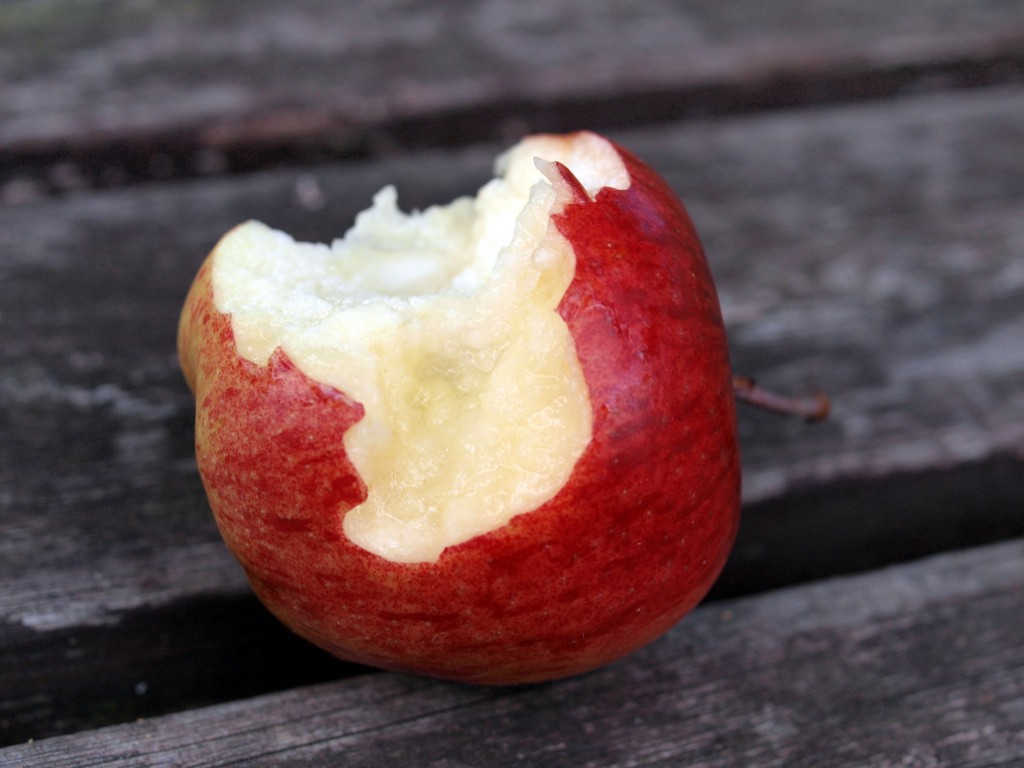
Perhaps this — my need to tell this story, my inability to tell it — is because I started the story at age 19 and try as I might, I just can’t seem to make it less obvious. Woman as rib: clean, bare, sharp. Hunger as sin. The fat, clear juice of an apple rolling down the chin: lustful, obscene.

Woman as rib: clean, bare, sharp. Hunger as sin. The fat, clear juice of an apple rolling down the chin: lustful, obscene.

II. A Woman Takes A Bite

I stopped looking in mirrors at age 14. I avoided my reflection at all costs — not even a glance in a department store window, a flash into a bathroom mirror — knowing that each peek, no matter how brief, would result in a quick intake of breath, disgust. A conscious act of self preservation. It lasted a year.

I went on my first diet at age 8, after my cousins laughed at how tight my shirt fit across my belly, the “little buds” on my chest that refused to blossom. That summer marked a clear line from before to after, the awareness of my body sudden. I was growing quickly, horrified at the ways I was expanding, my flesh swelling around my bones. Although I did not yet fully understand the largesse of guilt, I was warm with shame each time my tiny stomach swelled with after-dinner pie from my grandmother or sweets from the corner store.

I went on another diet at 11, this time alongside my mother. The round curve of my adolescent belly was clear through my ballet leotard; I cried when the scale went from two digits to three. Sweat poured from my hairline down to my chin, from my armpits down the sides of my body, the humid July air made all the more unbearable by the heavy sweatshirt I wore to hide my body at all times.

Unconsciously, food became rapture, repulsion, something I thought of always, with agony and intense desire.

At age 17, I stopped eating altogether, save for one apple (Pink Lady, sweet, whole), one pepper (bell, yellow, sliced), and one nutrition bar (peppermint chocolate, dry) per day. Some days, after school I would break, coming back to myself only when my stomach was distended, my fingers, hands, wrists covered in crumbs from hours of binging. Despite my momentary lapses, this was the age that I was thinnest. The age I still hunger for while teetering on the periphery of recovery.

This trajectory is predictable to the point of boredom, known well by many. It goes on and on, journals full of calorie counting and loathing, years full of better, then worse, whatever “better” and “worse” mean. Even now it exists in my inability to walk into a room without comparing my own body to those around me. The tragedy is in the details (my teeth grew soft from acidic bile! I had a brief spell of religious fervor, hoping that perhaps through prayer, God would grant me a body tiny, delicate!). My disordered eating controlled every aspect of my life.

It comes as no surprise, then, to learn of my obsession with the creation story. A woman takes a bite and the whole world falls.

III. Two Facts and an Opinion

1. According to Mental Health America, roughly 20 million women and 10 million men currently suffer from eating disorders in the United States. This includes anorexia nervosa, bulimia nervosa, and binge eating disorder. The prevalence of eating disorders “is similar among Non-Hispanic whites, Hispanics, African-Americans, and Asians.” Eating disorders take many forms, transcend borders. They exist not, as is commonly believed, in a privileged, white, or even exclusively female world, but rather in collective agony for people of all backgrounds.

2. In 2015, the census reported the percentage of Christians in the United States at 75%. While that number is down from previous years, America still boasts the largest Christian population in the world. While certainly not all of these self-identified believers put faith fully in the story of creation, or any sort of God at all, they have no doubt been taught, at one point of another, about the fall of man, what came before, the consequence in after.

It is old and yet ever-present, this despair. Tertullian, often referred to as the “founder of Western Theology,” once declared to the women in his audience:

And do you not know that you are (each) an Eve? The sentence of God on this sex of yours lives in this age: the guilt must of necessity live too. You are the devil’s gateway: you are the unsealer of that (forbidden) tree: you are the first deserter of the divine law: you are she who persuaded him whom the devil was not valiant enough to attack.

I would venture to say that the numbers of reported eating disorders are a low estimate, made up of the lucky few who are able to seek help. How could they not be? We are surrounded by conceptions of womanhood directly perpetuated by this story. It’s on the periphery of comical, overt, obvious. But whether we are a product of our culture or our culture is a product of us, it is clear that the question of the female body, of what to do with female desire, is all-consuming.

Whether we are a product of our culture or our culture is a product of us, it is clear that the question of the female body, of what to do with female desire, is all-consuming.

One woman in my family bragged often of how, on the day of her wedding, she had a 20 inch waist. Another swung between a strict daytime diet of chalky protein shakes and evenings of chips covered in melted cheese. A girl in my grade would wake up at 4:00am to run for miles and miles every day and eat nothing all day but Diet Coke, her teeth quickly stained yellow. Another would quickly drink hot cups of coffee followed by cold water to tighten her belly as though it were full.

None of these women were ever diagnosed with an eating disorder although their eating was disordered. I myself was not diagnosed officially until age 25, more than fifteen years after I had begun to obsess over my body. When I told a friend, at age 15, that I was worried about how much I was binging and purging, she answered “Kris, we all do that.”

IV. Hollow, Hallowed

Once, I was on a diet that consisted almost exclusively of raw vegetables. An ambitious adolescent, I packed my days with after-school dance lessons, rehearsals for drama club, and a part-time job as a secretary at my ballet studio. So much of my life, of my eating disorder, looked on the outside like discipline. And in between my busy and demanding schedule it was easy to hide what I was — or rather, all that I wasn’t — eating.

On this particular diet, there was no bread allowed, no dessert, no dairy, rarely any fruit or sugar. I spent weekend mornings baking cookie after cake after muffin after pie. I didn’t eat any of it, not even the thick and creamy batter from the bottom of the bowls. Instead I would force my younger brother to eat the many loaves of banana bread, the fruit tarts, the snickerdoodles, sick with envy at his ability as a young boy to eat whatever he wanted, full on pride at my own restraint, and hollow — hallowed — hungry.

During this period, I remember reading a “helpful” trick on a “pro-ana/pro-mia” online forum — yes, you are eating a salad, some celery, a black cup of coffee (perhaps half full of vodka), but close your eyes. Pretend it is something you truly desire. Something sinful, forbidden. Feel all the ways it sits on your tongue, smell its soft sweetness as it enters your mouth, slides slowly down your throat.

And so I would. As I snapped carrot stick after carrot stick between my softened teeth, I would think instead of a banana split. I imagined the thick, creamy puddles each flavor would make as they melted together in an August heat. I fantasized about the hot fudge, heavy in the way it caressed each sugary mound. It was better than an orgasm, an early form of masturbation — the plumpness of the cherry, the whipped cream so light it would cloud the roof of my mouth, the tender grit of each chopped nut between my teeth.

Of course, this meal — chosen because it practically took more calories to chew than it conferred — tasted nothing like the sundae I imagined. I ate furiously, willing each bite to be what I wanted, chugged water until my stomach hurt, until I sobbed with the feeling of fullness, with the fact that not a single baby carrot, a single sip of water, satisfied my craving.

And in truth, no matter how good my imagination, nothing was as wonderful as the one thing I desired. I could have tasted a hundred things, let them all wallow in my mouth as I closed my eyes and pretended and nothing would have satisfied. Nothing would have tasted as sweet.

V. Bones

In the story, Eve looks over the bounty at her table and then shyly up at the waitress. She is ashamed of her own desire but understands she will not be able to taste anything she brings to her lips until she gives in. She is tired of fighting. Exhausting from rationalizing. It’s a fucking apple. It shouldn’t be this hard.

The waitress raises her pen to her pad — “All finished here, dear? Can I suggest some homemade pie a la mode for dessert? It’s just out of this world.”

And this is where I stop.

No matter how many iterations this story has taken, I am never able to continue past this point. I do not want Eve to be weak. I do not know what weak means. As writer, I could take control of this narrative. Give the woman what she wants, no matter what hell there is to pay. I could invert it, change the ending, let Eve taste the forbidden without consequence. Allow room for lust without fear of punishment.

No matter how many iterations this story has taken, I am never able to continue past this point. I do not want Eve to be weak. I do not know what weak means.

But I don’t, because that’s not the point. That’s not the world I live in, the reality I’ve been allowed. That’s not the story I’ve been told.

I am lucky. I have been given the ability to change my own fate (my own story, my own fall), and the tools to do so. I have a job that provides healthcare which allows for medication, weekly therapy sessions. I have a group of supportive friends who understand and give room for my many anxieties. I have a partner who, when we were first dating and I was unable to eat in front of him, would close his eyes and hold my hand while I tasted my meal. I have access to education that has taught me about my illness but also, importantly, so, so much about body positivity. I have a voice with which I can say: yeah, this whole apple-as-sin thing? Maybe I’m being too literal here, but that feels fucked up to me.

But many days there is only so much I can fight, only so much I am able to do, for myself and for other women, for the shame, constant and hot in our stomachs, for the consequences we are forced to bear for this hunger.

Over and over we are told the story of the fall — the banishment from heaven on earth because of one raw moment of wonder. One moment of lust. One moment of taking.

But if we are nothing but bone — a rib, made from man, made from earth, dirt, worms — then we are malleable. We have the ability to sharpen and indeed we are being sharpened day by day, whittled to a point by the rough edges that surround us. Perhaps one day, I will finish my story, give Eve what she desires, fearless of the consequence. Perhaps one day, I too, will be whittled. So sharp, I can cut off a piece of that god damn apple myself.

8 Groundbreaking Experimental Novels That Are More than 100 Years Old

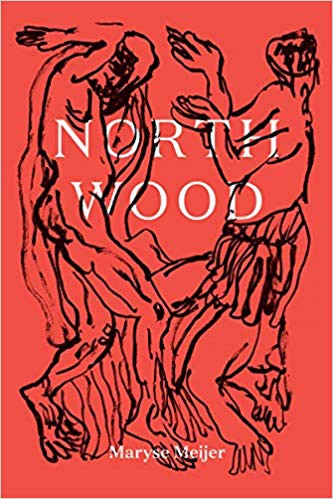
When I describe my novella Northwood to others, I always call it experimental — mostly in order to manage their expectations. I initially conceived of Northwood as a book of poems, and though it settled into being a short novel, it still contains elements of poetry and linked microfiction. I tell people it’s “experimental” so they won’t be confused when it’s not what they expect. But what does “experimental” literature really mean? Experimental in relation to what? Perhaps it’s more accurate to say, not that Northwood is a brand-new experiment, but that it’s part of a long-standing, well-established tradition of literature that pushes boundaries of genre and form.

We tend to forget that there has always been work that plays with form, style, content; work that is modernist before the modern era, or postmodernist before the postmodern age, or avant-garde ahead of its time. Work that anticipates modes and subjects and ideas and structures that would be put to use ubiquitously decades later. But if all of the things so-called experimental writers do now have been done — many times — before, sometimes centuries ago, then what is really experimental or unusual or deviant about these works? What are our our literary norms, and who decides, and defines, that which is perceived to stray from them? What prompts a writer to stray from the path set by an external notion of the mainstream, or one’s own self-imposed categories, habits, genres? And do truly experimental works always feel new?

I don’t have the answers to these questions, but in my own struggle to figure out what the heck I was doing with Northwood, I looked to some books that are 100 or more years old but which still feel strange today, books by writers who informed my own experiments with form and voice and style.

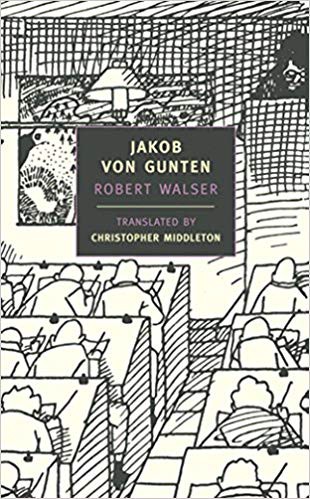
Jakob von Gunten, Robert Walser, 1909

This novel, about a young man who attends a school for servants headed by a mysterious, possibly incestuous, pair of siblings, completely disregards any traditional notion of plot or narrative arc. Full of fanciful, obsessive digressions on the nature of objects, light, and smiles, Walser (whom Kafka cited as an early influence) proved that a satisfying narrative could be almost wholly internal, moving in meandering circles or not at all, much like Louise-Bennant’s recent (and brilliant) Pond.

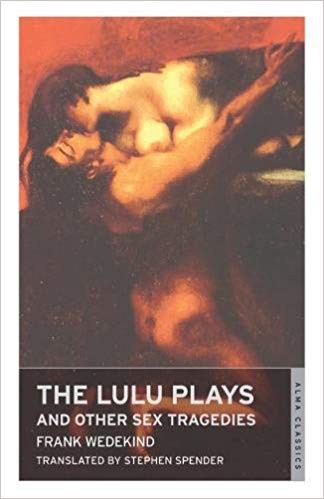
The Lulu Plays, Frank Wedekind, 1894

Written in two parts, spanning five acts, Wedekind’s mammoth Lulu is a twisted, hyper-sexualized, astoundingly feminist exploration of a young, murderous prostitute longing for freedom. I can’t say enough about the final act, which features one of the most intensely bathetic, horrific, and moving murder scenes I have ever read. It is at once ridiculous and emotional, sympathetic and sneering; it’s a masterpiece of tone ahead of its time, or any time.

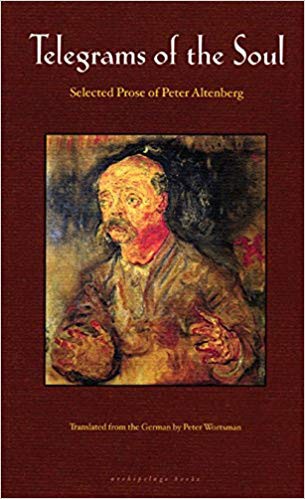
Telegrams of the Soul, Peter Altenberg, circa 1890

This collection of Altenberg’s mini-“essays” are, like Walser’s short pieces, largely plotless and charmingly surreal (and, in their darker moods, a lot like Lydia Davis’ fictions — flash before flash was a genre). Take this line from his piece “On Smells”: “even good books never stink, they are the distillation of all the malodorous sins one has committed of which one has finally managed to extract a drop of fragrant humanity!”

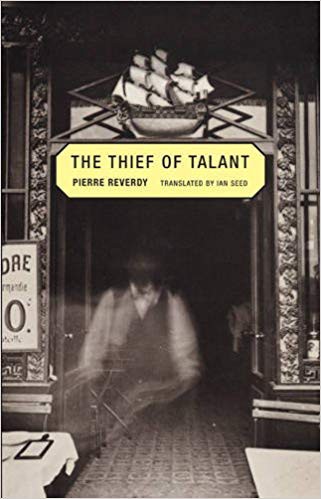
The Thief of Talant, Pierre Reverdy, 1917

A novel that looks like poetry, or a book of poetry that looks like a novel — whatever it is, The Thief of Talant is formally fascinating and emotionally engaging. Unlike some of the other works listed here, the idiosyncrasies of which are surprising but sometimes dated in tone, Reverdy’s work feels completely out of time; it could have been written yesterday, and yet it is more than 100 years old.

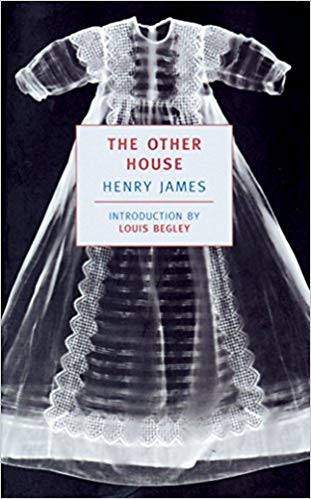
The Other House, Henry James, 1896

This novel, told almost entirely in dialogue and plotted at a furious pace, reads more like a film script than a novel; there are no interminable sentences or endless blocks of text as per the late Jamesian mode here. A masterclass in economy, it’s a surprisingly cinematic novel written long before the film scripts it so uncannily resembles.

How Queer Writers Are Creating Queer Genres

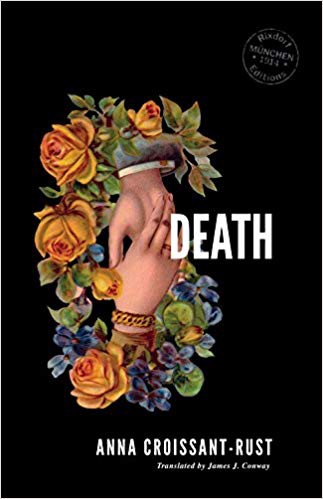
Death, Anna Croissant-Rust, 1893

The short works of Croissant-Rust (yes, that was her real name) are a mix of wild emotion and detachment, full of exclamation points and exhortations while retaining an eerie sense of distance. Morbid, sentimental, surreal, Rust breaks down narrative into patterns of feeling, abandoning any formal devices or logic. When someone describes a modern work as “dreamlike,” I think of Rust, who is, for me, the original dreamer; these are pieces written by ghosts, desperate to send a message to the living while at the same time utterly resigned to failure.

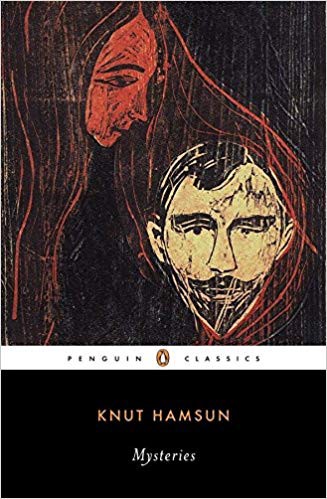
Mysteries, Knut Hamsun, 1892

Like much of Hamsun’s pre-Nobel work, Mysteries is remarkable in its defiance of plot and traditional character development; not much happens (and, as the title suggests, what does happen isn’t explained), and characters’ motives are entirely obscure, yet Hamsun manages to create an atmosphere as gripping as any pot-boiler. I return to this book every year, trying to figure out how Hamsun manages to make so much out of so little; but it is so subtle, its magic so recessive, I doubt I’ll ever figure it out.

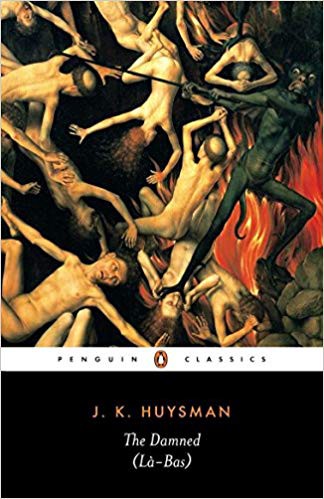
La Bas, Joris-Karl Huysmans, 1891

This book just flat out messes with my head. Its style mimics the decadence of the social world it depicts; dense, wild, intoxicating, repugnant, surreal, more Lynchian than Chekovian, anticipating the excesses of writers like Dennis Cooper and Kathy Acker. For me, it’s fascinating more for its subject matter than its readability as a novel — the depiction of a psychotic Satanic mass alone is worth the price of admission, proving that there has always been an appetite for “edgy” work.

Gary Shteyngart Wants Finance Bros to Do Something Else with Their Lives

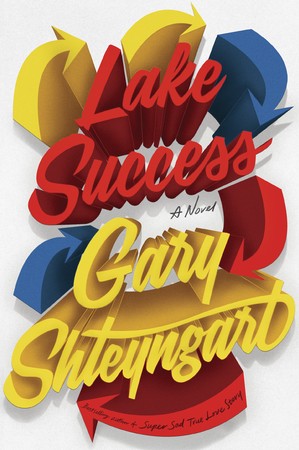
Gary Shteyngart's new novel was directly influenced by the dark storm brewing over American politics. Set during the 2016 election on the verge of Donald Trump’s presidency, Lake Success takes readers on a road trip across a divided America to understand how we got to where we are as a country today.

Purchase the book

The anti-hero of the novel is a hedge fund manager in the throes of an existential crisis. Barry Cohen is a Queens-boy turned Wall Street-man who (like the majority of men in their forties) grew up thinking money solved everything. He finds himself on an odyssey into the heart of America via a Greyhound bus. Like Barry, Shteyngart went on a Greyhound road trip in June 2016 thinking Trump would never win.

I spoke with the author while he was on his book tour about writing a tragicomedy, why he hopes he can make at least one hedge fund manager quit their job, and the fallacy of what makes you successful in America.

Adam Vitcavage: A lot of novels published recently that speak to the times were written and sold prior to the 2016 election. When did you first come up with this idea?

Gary Shteyngart: I started a couple of years ago. The idea for the Greyhound trip was in 2016. When I started writing the book, I had no idea Trump was going to win. I had to change the book a bit because he was in the background of it. I had to change it a bit after I realized the thought of civilization collapsing.

AV: You set out on your own Greyhound tour. Why was it necessary for you to go through what Barry does?

GS: You know, I don’t have much of an imagination. I became like a journalist so I could experience it to write about it. It was fun — well, maybe fun isn’t the right word — to get on the Hound as they call it to see America that way. Heading to the West Coast and into the wilderness seems like a very American thing to do. The American Road Trip is one of the great genres of literature. [America] is such a big country, beautiful, and it lends itself to a trip like this that most countries don’t.

AV: After your trip, what do you find that most of America — the general population or the media — misinterprets about the non-coast? The wilderness?

GS: The important thing is that this is a country that is, first of all, absolutely beautiful. People forget because we’re entranced the idea of sitting by the shore and watching the waves collapse. The real beauty of the country the deserts and the foothills.

The people I met, with exceptions, were really striving. This is a hard-working country. We think people kill themselves on the coast because things are so expensive. People kill themselves in the middle just to survive. Everyone I met had plans and dreams. You hear Trump broadcasting we were a finished nation and we had to go back to some period to make ourselves whole again. The country was doing great. It was only around Mississippi and Louisiana that I ran into white supremacists who were spouting Breitbart stuff at me. They were yelling about crucifying Muslims and Jews, which is a similar thing that happens to Barry in the book.

If I can make someone quit their job in finance and realize they can do something else with their lives, that would be a win

AV: Your first three novels dealt with immigrant protagonists and this is your first American one. Why make him American this time around?

GS: The immigrant experience is still in the book. [His wife,] Seema is the daughter of immigrants. It’s not entirely gone because I think it is impossible to write about America without any immigrant experience. But it is the first book without the Russian Jewish immigrant experience, which is the big departure.

I feel like I had written enough of that. I needed a break. My last book was a memoir which I had written about myself to such an extent. I wanted to clear that away. It was wonderful to try something different. Barry is similar, but it is baby steps away from my normal characters. Normally, my characters are underdogs. Barry is not. Power is so concentrated in this country. I wanted to tackle that issue and see what that world was like.

AV: You grew up in New York in the eighties when Wall Street was everything. Was that world something you ever envisioned yourself living in?

GS: Sure, when I was growing up. The movie Wall Street was great when I first saw it. They don’t have to worry because they were rich and that appealed to me at the time. For a while, that’s what I wanted to do but then I went to Oberlin and of course, that wasn’t going to happen.

AV: I find the finance world so interesting. Everyone at one point probably thinks about living in that world because America has taught us to obsess over money, but I don’t really think anyone knows what a hedge fund manager really is. Do you know people in this world?

GS: Oh yeah, I spent three years hanging out with them. I met a couple who were very happy to let me in their lives and were very honest with what they thought of hedge funds. Some were critically so. Putting Barry together wasn’t very hard.

When I was a kid, I thought money could cure everything. I left the project thinking I never want to talk about money ever again. These lives are very circumscribed and boring in a way. You spend all day moving money around and screaming at you competitors then meeting them for a poker game betting them even more money.

Lake Success is about the tragicomedy of trying to change and never quite getting it right.

AV: With people like Barry who have a lot of money, it may be hard for the general public to sympathize with them. Was there ever a concern that readers might not agree or side with Barry?

GS: I never wanted readers to come away thinking they loved hedge funds. That was not the point. In fact, if I can make someone quit their job in finance and realize they can do something else with their lives, that would be a win. In the end, I don’t think people can finish the book and think this is what they want. He’s a mess. He was never loved the right way as a child. He never learned to love his own son the correct way. Without giving too much away, I do offer some chance of redemption. The book is about the tragicomedy of trying to change and never quite getting it right.

AV: Would you consider Barry an anti-hero in a way?

GS: I guess. I’m not against that term. I think he is somewhere in the middle. What he does is so awful, but the fact that he is not consciously malicious — well some of it is — but it’s mostly out of ignorance. He’s an ignorant character. I like characters who aren’t quite sure who they are themselves. I think there is a disconnect between who we think we are and who we really are.

AV: That idea of ignorance is exactly the state I think America is in right now.

GS: Yeah.

AV: I don’t think we know who we are.

GS: I agree 100% and I’ll add to that. All of these wealthy people, which is Barry in a nutshell, who have their ideas of poor people all have idiotic ideas. I went to a school that had a lot of lower-class students but had such ambition. A lot of people I met went to schools like that. People think I work so hard and that they came from nothing and anyone else can do the same. It’s not true. It’s just a fallacy.

The best thing we can do [in Trump’s America] is get off the internet and buy a book in an independent bookstore.

AV: Throughout my twenties, I realized that I spent a lot of time thinking the world owed me something just because I simply existed. So many people I know struggle with that identity crisis.

GS: I think your generation believes more of that. The identity of the country is up for grabs like never before. Especially in such a negative way. I think there are going to be more financial crises. People like Trump abet that. They create their environment to benefit off of that. People like Barry were able to make money because their world was lightly regulated. We were in an environment where greedy and not terribly bright people to succeed. And that’s what happened.

AV: I know this isn’t about the current presidency and it is strictly Barry’s story and that the 2016 election only changed the course of his story. Outside of the book, how much has this presidency consumed your time? Are you reading Twitter every hour or try to push everything aside?

GS: I try to do both. It’s very important to remember we have lives and families. He wants to push into everything and control everything. He’s very totalitarian in that way. That’s absolutely terrible. We need to fight back in some ways. I think fiction allows us to create a personal space. The best thing we can do is get off the internet and buy a book in an independent bookstore. We need to get away from this environment built by Trump.

Three New Poems by Ursula Le Guin

Bats

i
When I used to see bats flying
in the California twilight
their intricate zigzag voices
went flickering with them
but they fell silent with the years
and without that tiny sonar static
to see them flicker
in and out of being
is a kind of blindness

ii
In the twilight in my dream
a little bat was flying
and awakening I wondered
if the bat that I remembered
flying in the twilight
of the dream of California
was in California or the dream.

Ancestry

I am such a long way from my ancestors now
in my extreme old age that I feel more one of them
than their descendant. Time comes round
in a bodily way I do not understand. Age undoes itself
and plays the Ouroboros. I the only daughter
have always been one of the tiny grandmothers,
laughing at everything, uncomprehending,
incomprehensible.

Looking Back

Remember me before I was a heap of salt,
the laughing child who seldom did
as she was told or came when she was called,
the merry girl who became Lot’s bride,
the happy woman who loved her wicked city.
Do not remember me with pity.
I saw you plodding on ahead
into the desert of your pitiless faith.
Those springs are dry, that earth is dead.
I looked back, not forward, into death.
Forgiving rains dissolve me, and I come
still disobedient, still happy, home.

About the Author

Ursula Kroeber Le Guin (1929–2018) was a celebrated and beloved author of 21 novels, 11 volumes of short stories, four collections of essays, 12 children’s books, six volumes of poetry and four of translation. The breadth and imagination of her work earned her six Nebulas, seven Hugos, and SFWA’s Grand Master, along with the PEN/Malamud and many other awards. In 2014 she was awarded the National Book Foundation Medal for Distinguished Contribution to American Letters, and in 2016 joined the short list of authors to be published in their lifetimes by the Library of America.

“Bats,” “Ancestry,” and “Looking Back,” are published here by permission of The Estate of Ursula K. Le Guin. Copyright © The Estate of Ursula K. Le Guin 2018. All rights reserved.

Searching For My Immigrant Roots with W.G. Sebald

Two tributaries enclose the village of Wittelshofen to the east. On the Sulzach, white lilies float over deep holes in the riverbed, and trees lean over the gray surface of the water in the wind. A bridge over the Sulzach becomes Haupstraße and cuts the town in half. From there, Schulstraße leads north, past houses painted in half-hearted blues and mustard yellows. The road ends at a brown barnyard that houses the museum of local history, which appears permanently closed. A silver plaque is mounted on a stone, dedicated to Wittelshofen’s Jewish community: “They lived here in peace for 300 years.” South of Hauptstraße, an alley named after the other tributary, the Wörnitz, leads to the town’s only guesthouse. Villagers wander in to plan weddings and baptisms.

The German writer W.G. Sebald was unusually alert to these quieter displacements. In his novel Austerlitz, a boy is sent away via Kindertransport from his Jewish parents in Prague to a preacher’s family in Wales, a break that permanently destabilizes his understanding of reality. In The Emigrants, a talented teacher who briefly fought in Hitler’s army kills himself. The Holocaust is omnipresent in Sebald’s work, like it is in Germany, but mostly as a kind of hollow center, a void at whose edge we can only stand through the stories of people who weren’t there. Sebald traces around the outside of history, breaking our hearts as we slowly perceive the shape of the thing. Reading him, I got to know intimately the rifts history caused in his characters’ semi-fictional lives. I went to Wittelshofen hoping to learn my own family’s history as closely.

Reading Sebald, I got to know intimately the rifts history caused in his characters’ semi-fictional lives. I went to Germany hoping to learn my own family’s history as closely.

I had been assigned to cover productions of Wagner’s Parsifal and Lohengrin at the Bayreuth Festival — Yuval Sharon had recently become the first American and the second Jew to direct an opera there — and, on my day off, my husband and I drove the three hours from Bayreuth to Wittelshofen, past Nuremberg and Ansbach, through a storm that turned the sky metallic silver. Josef Oestreicher, my great-great-great-grandfather, was born there in the Schmalzgasse in September 1833, and left for America as a teenager. Would there be any signs of him or his family, or only what Sebald, in The Rings of Saturn, called “traces of destruction that reach into the distant past”? Did my family have any connection left to this secretive place?

My grandmother gave me a copy of Oestreicher’s memoirs. In his time, Wittelshofen had a population of 500, evenly divided between Protestants and Jews. Oestreicher went to school, worked on his family’s farm, and spent his free time fishing and shooting primitive guns. His family was prosperous — his father, Abraham Isaac, owned a library of Hebrew books — but large, and by the time Oestreicher was a teenager, his mother decided he would need to leave. “She could see no promise in the future there for me,” he wrote.

At four o’clock in the morning on October 4, 1850, Oestreicher and his sister Ida started for America. Their journey took them to Feuchtwang, Würzburg, Aschaffenburg, Frankfurt, Mainz, Rotterdam, and finally Le Havre, where they boarded a ship for New York City. The conditions during the month-long journey were so unpleasant that a monk attempted suicide by jumping overboard. (He was saved by the crew, but they warned him they wouldn’t repeat the favor if he tried again.) Josef and Ida arrived on November 21. They watched as the passengers, angry with their treatment at the hands of the ship’s first mate, formed a mob and “beat him till they nearly killed him.”

The conditions during the month-long journey were so unpleasant that a monk attempted suicide by jumping overboard.

Dark American realities soon replaced German ones in Austrian’s mind. After a year peddling cheap jewelry on the streets of Detroit, Oestreicher reached a tiny town in Wisconsin called La Pointe. A family friend had a store there and hired him as a clerk. The village was made up of a handful of “white Americans, 50 Canadian Frenchmen who were married to squaws, and a number of full-blooded Indians.” Oestreicher complained that his brother, “to his own detriment and loss, often trusted needy and hungry Indians.” When a young Native American man stole food from the store to feed his family, he was thrown in jail and nearly succeeded in hanging himself. Exposure to cruelty has a way of misaligning the human psyche. The narrator of Sebald’s The Rings of Saturn journeys through the English countryside, seeing latent evil everywhere. He finally suffers from mental collapse, unable to perceive the porous border between history and present.

It’s not clear from his memoirs at what point Josef Oestreicher became Joseph Austrian. He accepted his new name, in a certain sense a new personality, with the casual innocence of the young immigrant. America became his predominant frame of reference. Sebald, in The Emigrants, describes a similar process whereby one reality extinguishes another. Ambros Adelwarth, the narrator’s uncle from a small German village, becomes butler and possible lover to the scion of a rich Jewish New York banking family, Cosmo Solomon. Together they take a trip through what was then Palestine. Adelwarth wrote in his journal, “In the places where only the shadows of the five punished cities of the plain, Gomorrah, Bela, Sodom, Zeboim and Admah, can be perceived, now bay bushes, crown flowers and mimosoideae grew from the riverbeds, like in Florida.” When, late in life, Joseph Austrian returned to Germany for a restorative stay in the spa town Carlsbad, he booked a Munich hotel that was “a favorite of American tourists.”

Researchers Have Found Two New Pages in Anne Frank's Diary. Should We Read Them?

For emigrants, modes of transportation become agents of destiny, fraught and liberating, acting as bridges between past and present lives. In Sebald’s Austerlitz, the narrator encounters the title character in the waiting room of Antwerp’s Centraal Station. “When he wasn’t busy writing something down, he turned his attention to the rows of windows, the pilasters or other details of the hall’s construction.” (Austerlitz’s mother, we will learn, was deported by train to Theresienstadt.) Austrian, similarly, was fascinated by ships. After arriving in New York, he continued on to Albany on a steamer called the Isaac Newton. “I sat up all night long in the engine room watching the machinery,” he wrote. He expanded his businesses from shops to copper mining and eventually bought his own ships, ferrying passengers and cargo across Lake Superior. (He christened his favorite the Peerless.) Even when his memoirs are at their most perfunctory, they include detailed measurements of steamers, and he felt invigorated by port towns. But a friend of his was killed when a ship called the Sunbeam sank on Lake Superior.

When Austrian returned to Wittelshofen, in 1889, bearing silk shawls and other gifts, the bond between him and his home already seemed severed. “We went around to the old school houses, to the synagogue and the church at which we took a mere peep from the outside,” he wrote. “Even the buildings looked smaller and more dilapidated than I had pictured them.” The grave of Abraham Isaac Oestreicher was crumbling away; the inscription on it was unreadable. By an operatic coincidence, an old friend and neighbor of Austrian’s, Frumeltn, died the evening he returned. “She had gone to a great deal of trouble to get up a grand meal for us. Exerting herself when she was ill had brought on a sudden death.”

Destruction is a constant in Sebald’s novels and in history. Austrian emigrated to America in time for his descendants to avoid the Holocaust, but he knew jagged suffering. He saw Abraham Lincoln’s body during the funeral procession in New York in April 1865, and watched strangers fight over souvenirs. He gave sandwiches and coffee to people made indigent by the Great Chicago Fire of 1871. He watched sheriff’s deputies enforce a mining company’s monopoly with muskets. One son, Austrian’s “little sufferer,” succumbed to scarlet fever at age two. Another died as a teenager, in 1903. “It is ever too fresh in our minds,” Austrian wrote years later. His daughter Alice lost her two-year-old boy.

As Sebald knew, ordinary lives are rich in symbolic drama. We must simply choose to read them as literature.

As Sebald knew, ordinary lives are rich in symbolic drama. We must simply choose to read them as literature. The most moving parts of The Emigrants are when Sebald switches from his own fluid writerly voice to the shorter sentences of his character’s journals. Circumstances pile up, allowing us to choose whether to interpret them as metaphor or coincidence. In an essay from Teju Cole’s Bright and Strange Things, the novelist visited Sebald’s grave. Near the site of the car crash that ended Sebald’s life, Cole noticed a newspaper headline about a murder. “It was another set of lives, another set of fates rising to the surface for a moment before falling into history,” Cole wrote, acknowledging both the transient nature of these moments and their emotional power. There is potential for metaphor in the objects of Austrian’s life, but more importantly, it can be read as one of “small and neglected stories” Sebald treasured.

When I visited Wittelshofen, I was reminded of yet another line of Sebald’s, from Vertigo: “The village was, I thought during my late arrival, more foreign than any other conceivable place.” Austrian must have experienced something similar when he returned to Wittelshofen. If there is no trace of my family in Wittelshofen, that is at least partly by choice. Austrian’s memoirs are a more important document. As I read them, it was like, as Sebald wrote, they “had expanded throughout all possible dimensions of time, as if they had endured into the lines I’m writing now.”

Fatima Farheen Mirza on Having Sarah Jessica Parker as an Editor

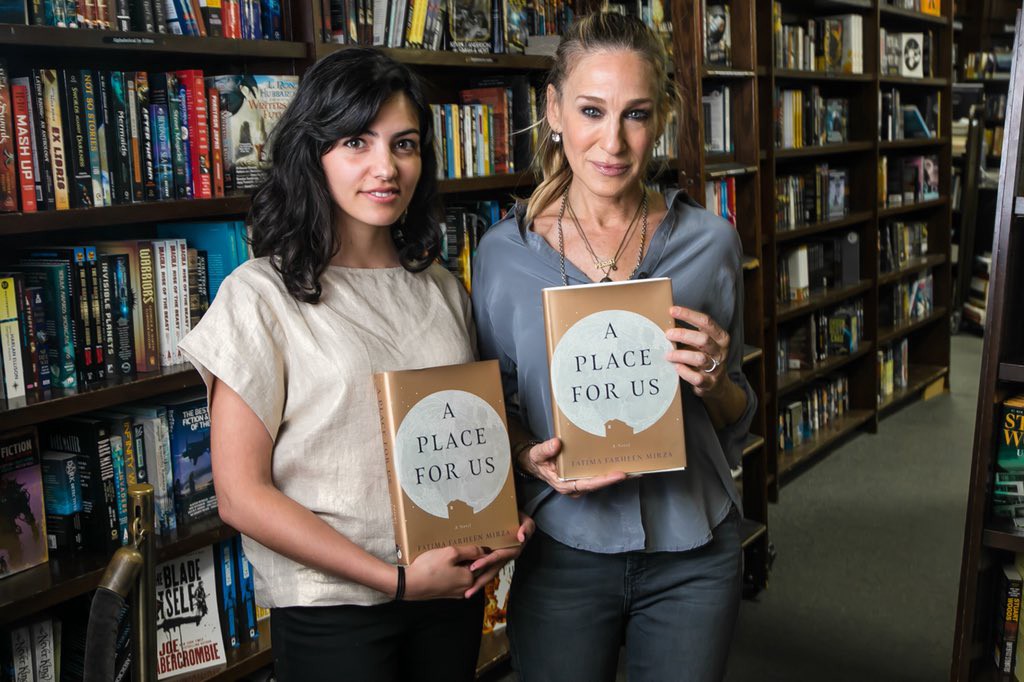
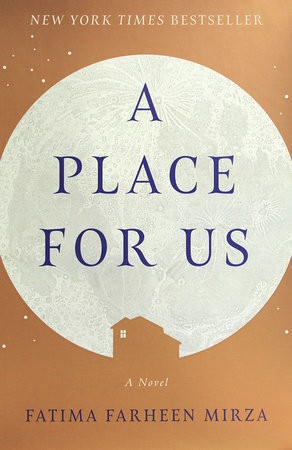
Amar, the not-so-prodigal son of a Muslim family returns for his sister’s wedding and tears open tucked-away secrets in Fatima Farheen Mirza’s A Place for Us. Mirza simmers the family’s deep love for each other and its dysfunction by handing narration to different family members and skipping time, backward to 9/11 and beyond, and onward to 2016.

The characters look back in search of the roots of Amar’s rebellion and his flight from the family. With delicate, embracing prose, Mizra interrogates memory, faith, and hope. The debutante of the shiny new SJP for Hogarth imprint (editorial director, Sarah Jessica Parker), Mirza’s novel slid into the New York Times Bestseller List upon its publication.

I spoke with Fatima Farheen Mirza about being with her characters when they are alone, Shia Muslim heroines, and receiving edits from SJP.


J.R. Ramakrishnan: How did you react when you first heard that Sarah Jessica Parker was interested in your book? What was your relationship like during the book’s journey to publication?

Fiction asks a reader to look closely at a life, and the act of looking itself is a loving act, an affirming one, and it sends a powerful message: your life matters.

Fatima Farheen Mirza: I’m so happy that the book found Sarah Jessica’s hands. She’s one of the most remarkable people I’ve ever met, one of the most genuine, and I’ve learned so much from her. It has been inspiring to see the way she’s gone above and beyond with her role as an Editorial Director. Every time we’ve spoken about the novel I’ve had the thought that she is the ideal reader a writer might want for their book because she reads with her whole heart — she’s thoughtful, insightful, and so precise in her observations. It’s clear that she cares about the characters as though they were real people and that she reads books as though she’s lived in them. And I’ve felt so lucky this past year to have her support and guidance, whether we’re celebrating something exciting about the book, or she’s offering advice on how to approach an interview, or talking through what it is like to create something and share it with the world, how it can be both frightening and rewarding. She’s really been there for me, and her presence, her kindness — it has made publishing this novel a truly meaningful and unforgettable experience.

JRR: In A Place for Us, you take us deep into the world of an American Shia Muslim family. We have italics to remind us of the non-English words but you also don’t really offer over-explanation of elements such as the ziyarat or the differences between Sunni and Shia Islam, which is part of the daughter Hadia’s later rebellion. I appreciated this but I wonder if you felt any obligation to explain your community? Did you feel like a translator of sorts?

FFM: The only obligation I felt was to the characters — to do justice to their story as they would tell it, which meant only including the details or phrases that would naturally arise in their mind or in a scene. The words in Urdu are ones they would not think to translate, or sometimes ones that have no English equivalent. I avoided explanations unless they were necessary to understand the emotional impact of a moment, but even then there are ways around turning to a reader. For example, in one scene, Amar chooses to not go to mosque on eighth Moharram, which sends an immediate message to readers who have grown up commemorating Moharram, but those who haven’t can understand the significance of Amar’s decision based off of the other character’s reaction to it, and their dialogue.

JRR: It’s often the case when a reader is offered multiple POVs, a favorite emerges. I latched on to the son Amar at first and then the patriarch Rafiq, who we meet at the end in full. Was the multiple narrator approach always the intention for this narrative?

FFM: From the very beginning I was writing in multiple perspectives. Hadia’s came first — originally, she opened the door to Amar when he’d just come home to attend her wedding, after having run away years ago. Soon after, I started writing in Layla and Amar’s perspective. Only after I’d written the bulk of the past sections did I enter Rafiq’s perspective. The first line of his voice is exactly as it appears now, and I remember being so surprised by its presence — it was in first person, and he was speaking from almost a decade into the future. One of my aims with the novel was to offer as complete a picture of this family as possible, to fully understand the difficult position they’re in, and I knew that if I wanted a balanced portrayal, I’d have to write through multiple perspectives.

JRR: I enjoyed how each character accounts for — and in some cases — shoulders the blame for Amar’s trajectory in the novel. As all their creators, I wonder what moment you see as the point that Amar stepped off into the abyss?

I was trying to look honestly at a family like mine, in the hopes of also better understanding my home, and how where I came from shaped who I am.

FFM: In some ways, the entire novel is an attempt at an answer to this question. For a character to return to a moment from their past is to implicitly ask: what did this moment mean? How could I have spoken differently, acted differently, for a better outcome? When Rafiq remembers the night of Amar’s birth as an omen, we do wonder if Amar was destined for his life from the beginning. Other times, when Layla is having a hopeful conversation with his teacher, or Hadia is watching him study for a spelling test as a kid, the avenues his life could take seem full of possibility. But though these questions drive the novel, the scenes never answer them, because it is impossible to land on a clear, simple answer. Each action, each relationship, exists in a web that becomes more complex, more tangled, the more you try to look at it to parse out a single cause.

JRR: The post 9/11 altercation Amar has with one of this former friends (the betrayal!) felt so real. Was this episode in the book inspired by events you experienced?

FFM: Yes, that scene was inspired by events that I and many of my loved ones experienced, and continue to. To be honest, anti-Muslim or racist encounters are much more present than the book portrays — it’s like a constant low hum that is unnoticeable on most days, but will rise in volume when another brings attention to it — a man on the plane asking me if I am one of the good ones upon learning my name, for example, when I’d only been wondering if I would be able to fall asleep during the flight.

But for this family, I didn’t want to dwell in those encounters — I didn’t ignore them — but I felt very stubborn about wanting to guard them from being primarily accessed through that lens. The anti-Muslim interactions, the racism, the political context they live in — it puts an inescapable pressure on their lives, but it is also what others bring to them, the labels the world forces them to face. And I wanted to be with my characters when they were alone. So I would think, why can’t Amar’s story be about falling in love for the first time, about carving Amira’s initials into his windowsill? Why can’t Layla wander between library shelves wondering which book to check out? Why can’t Hadia dye a chunk of her hair electric blue? These are the very moments that fill their days, give meaning to their life, and the focus of their heart and attention, after all.

JRR: In my limited understanding of the Shia cosmology, women such as Fatima, the Prophet Muhammad’s daughter, and her own daughter Zaynab are formidable, vocal characters. In your book, Hadia and Huda are no pushovers either. In their own ways, they chafe against patriarchy. How close would you say you are to your characters in this respect?

FFM: In my own life, I was much more vocal than Hadia and Huda. Hadia accepts some of the conditions of her life and she also chooses her battles wisely, whereas I was much more stubborn, and almost to a fault could not do anything I truly didn’t believe in. To the great annoyance of my parents, I was always trying to distinguish between what they wanted for me and what I wanted for myself, or challenging what was expected for me as a girl that was not expected of my brothers. But the novel was not the form for me to work through my thoughts on the patriarchy or to fictionalize my own journey, as my job was to imagine and honor Hadia’s experience, which is determined by her personality and grounded in the particular details of her life.

To be honest, anti-Muslim or racist encounters are much more present than the book portrays. It’s like a constant low hum that is unnoticeable on most days, but will rise in volume when another brings attention to it.

But I loved that you touched upon Bibi Fatima and Bibi Zaynab — as these were the early women of Islam whose stories I was told as a child, and they were strong, they were sharp, they were brave. They were vocal about their beliefs, and advocated for social justice, even if they were the only women present doing so, or if they were speaking out against men who were opposed to them. Growing up, if ever I was frustrated by the messages that were being sent to me as a young woman, I’d see how at odds the messages were with the character and examples provided by these women. One was noticing this pressure placed on daughters to settle down partly as a way to give peace of mind to her parents, as they would know that their daughter’s life was secure and provided for, which frustrated me when it was expressed to me, or to other young women — even as one’s education was being valued and supported — because it still implicitly discouraged the idea that she could provide for herself, secure her own future, and above all, trust in herself, her own capability, her own path. And in these instances, I’d like to remember Bibi Khadija, the wife of the Prophet and the mother of Bibi Fatima, who was an incredibly successful and independent businesswoman, who employed the Prophet before their marriage, and whose wealth later supported the Prophet and his message.

JRR: I mentioned that I was reading your book to a Brit/American-Pakistani friend of mine and she told me that all her cousins are reading it too with great excitement. Have the people in your immediate community offered literary praise (or criticism)?

FFM: That makes me so, so happy. Hearing from readers who connect with the book on that level has honestly meant the world to me. At first I was really surprised by how consistently it was encountering familiar details that spoke to my family, or my immediate community. But I also understand it, as I’ve hardly ever seen the particular details of my life reflected in literature, movies, or song, and anytime I do it is so inexplicably powerful I start crying. Fiction asks a reader to look closely at a life, and the act of looking itself, even if it is looking at something painful, is a loving act, an affirming one, and it sends a powerful message: your life matters.

One reaction that has meant a lot is when other first generation readers tell me that it has helped them better understand their parents, or feel at peace with some of the difficulties of growing up in a household like ours — whether it be a household of faith, or one that is caught between two cultures, two languages. I have no words to describe what that means to me. That alone is all I could have hoped for. Maybe because it is what I’d been trying to do with through novel for myself — I was trying to look honestly at a family like mine, trying to capture the details that are dear to them, and not flinch from or reduce the difficulties, in the hopes of also better understanding my home, and how where I came from shaped who I am.

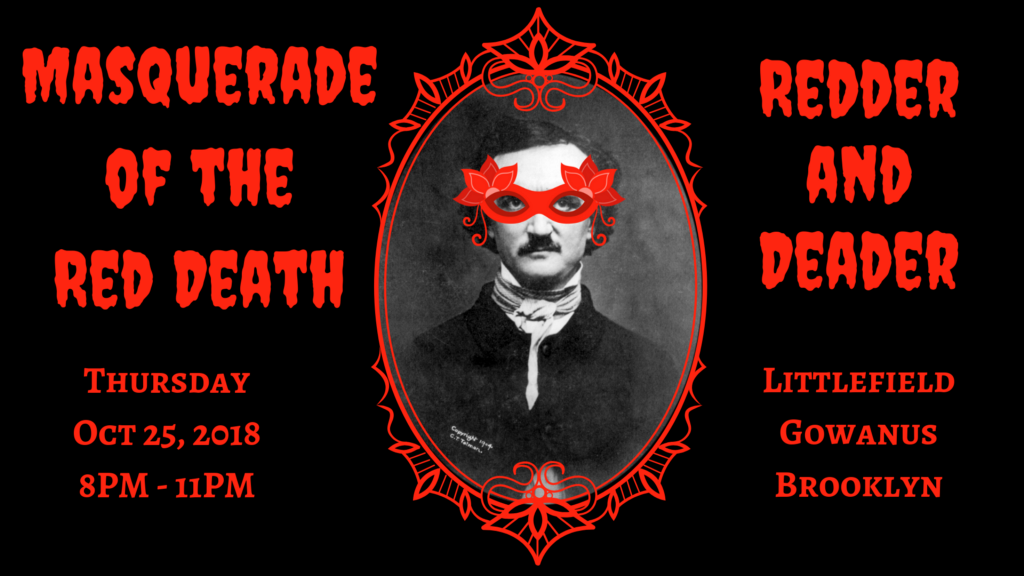
Last Chance for Early Bird Tickets to the Masquerade!

Tickets to the Masquerade of the Red Death: Reader and Deader are on sale for $35 until 11:59PM on Sunday, September 30th. On Monday, the price goes up to $50. Do yourself a favor and get yours this weekend!

The Masquerade of the Red Death: Redder and Deader
Thursday, October 25, 2018
8–11PM
Littlefield, 635 Sackett St, Brooklyn

Dress Code: Red or black festive attire
Tickets include a mask and free drinks all evening.

At Electric Literature, we accomplish a lot with very little, serving 5 million readers per year with a small, hard working staff. Funds raised by the Masquerade go directly to supporting our mission to make literature exciting, relevant, and inclusive. If you are unable to attend, please consider making a donation to support our efforts here.

We look forward to seeing you at the Masquerade!

Electric Literature is a 501(c)3 nonprofit and your ticket purchase is tax-deductible to the extent permitted by law.

Tim Gunn Is My Writing Teacher

Tim Gunn is leaving Project Runway, and I don’t know how to imagine the workroom without him. I mean the workroom on the show, but also my own office — because in the course of watching Runway obsessively while writing my dissertation, Gunn has become my de facto writing coach.

If you’re not familiar with Tim Gunn, picture a dapper white man who looks like he could be a friend to Princess Diana or Beyoncé: suited up, quietly smiling, respectfully standing next to the diva to give her a little gravitas. He’s impeccably dressed and unflappable, always, but when the chips are down, or when he’s worried about you, he will let his brow furrow in sympathy. Gunn is a vision of a certain kind of class personified; in his role as mentor to Project Runway contestants, he is never seen outside of a suit or without a pocket square. (He’s also one of the few white people besides Helen Mirren who never seems to age.) But more than looking nice, Gunn seems by all accounts to be genuinely nice and encouraging. His cheerleading has kept the designers on the show going for the decade and a half of its run, despite their high-pressure competitive environment. And as someone who tends to be hard on myself and my own creative and academic output, I’ve discovered that it keeps me going, too.

As someone who tends to be hard on myself and my own creative and academic output, I’ve discovered that Tim Gunn’s cheerleading keeps me going.

I started binge-watching Project Runway during spring break a couple of years ago while I was buckling down to do some work on my dissertation. Some people need complete silence in order to write; I need something ranging from white noise to actual noise. Silence gets me stuck in my head; other sounds keep me grounded and focused. I was struggling through taking some inchoate dissertation notes, before I knew what my argument was, when I thought to throw on Runway as a pleasant distraction. It backfired, somewhat, as I found myself getting more and more invested in the show. It wasn’t just the clothes, though that was part of it — the good ones and the bad ones. It wasn’t just the tantrums or the triumphs of the designers, most ill-equipped to function well in such a pressure cooker. It was the calming presence of that white man in a grey suit. He wasn’t just telling them they could do it; he was telling me.

Part of Gunn’s motivational appeal is structural. The judges who appear most often on the show’s run — former Marie Claire creative director Nina Garcia, fashion designer Michael Kors, and supermodel Heidi Klum — are often very direct to the point of harshness. They moved into that mode early, as in the critique in Season 5 that had Kors spitting, “It looks like toilet paper caught in a windstorm.” Kors’s commentary that season inspired Entertainment Weekly to knit together a poem of his most memorable critiques. Garcia is less lyrical, but no gentler, more likely to drop a devastating “I have no comment.” Klum is the judge who seems to take the most care with contestants’ feelings, partly because she often frames her critique as opinion, liberally using the phrase “to me” (though that care is a lot less evident when, as happens frequently, the contestants are actually designing something for her). Gunn falls somewhere in the middle of their approaches: when he has a harsh thought, he eases you into it, often asking, “May I be frank?”

Everything I Know About Writing a Novel I Learned from Watching British People Bake

His job is markedly different than the judges’ job: he sees in-progress garments in inchoate stages, sometimes when they’re nearly done, but more often when they are just piles of fabric or an idea (as with Season 8 and Project Runway All Stars wunderkind Mondo Guerra, who never drew sketches). Gunn accesses part of the imagined reality of the clothing when what the judges see, for better or for worse, is the final product. Despite the cameras and the other designers in the workroom, he somehow manages to carve out private moments with each contestant when he’s making his pre-runway rounds, offering advice, pointing out inconsistencies, and, usually, finding a moment to (genuinely, it seems) let loose his mellifluous laugh. (Go listen to it. It’s just lovely. It must calm some of the designers the hell down in an instant.)

As I got deeper into dissertation writing, I realized that, though I have an uncommonly wonderful, sharp-eyed, and supportive dissertation director, Tim Gunn is a great pinch-hitter when she’s not around. Writing a dissertation is a confusing and sometimes futile-seeming process. It’s like a really messy book. And it’s a really messy book that you get a lot of feedback from one person on (your chair), combined with possibly conflicting feedback from two to four more people on (the rest of your committee), as well as thoughts from anyone else who respects or loves you enough to wade through early drafts. As I get closer to finishing, it strikes me that the weirdest part about the whole thing, though, is that once you write one, you never write another one. It’s not entirely unlike designing a dress on the show: the situation is pressured, the stakes sometimes seem insurmountable, you may feel like you have no idea how to do it, there’s a likelihood that you’ll cry in public, and the finish line is you staring down a small group of people who are invested in your work but tend to tell you what they really think.

Writing a dissertation is like designing a dress on the show: the situation is pressured, the stakes sometimes seem insurmountable, there’s a likelihood that you’ll cry in public.

To work on a longform writing project is to launch yourself into a morass of feelings and ego in which you bumble around trying to make sense of still-forming ideas, and it’s in the deepest muck of this that Gunn’s motivational sayings are most helpful. “Make it work” is his famous, Yoda-like catchphrase that contestants sometimes mutter to themselves in the heat of a challenge. Its vagueness is the root of its helpfulness for a frustrated dissertation writer: when he says it, I hear the implied “you will.” You will make it work, Gunn is advising. He’s less lecturing than buoying up. You’ll find a way. This pile of fabric (or pile of expletive-punctuated draft pages) will become something real, and you just have to figure out how. It’s not his job to tell you exactly what steps to take, but he knows you can get there. Gunn’s description of how to be a good mentor, as he told the New York Times in 2013, is just like how to be a good writing teacher or dissertation advisor: “I’m here to guide, I’m here to support, I’m here to be the cheerleader, but you’re doing the heavy lifting.” (His own books include Gunn’s Golden Rules: Life’s Little Lessons for Making It Work and Tim Gunn: The Natty Professor: A Master Class on Mentoring, Motivating, and Making It Work!)

The least cynical understanding of a dissertation is that it is the culmination of an intense and long several year-period of study; the most optimistic (and most useful) understanding is that it’s the first draft of what will become your first academic book. The cynical answer is that it’s a hoop to jump through to get your degree. All seem true to me, and the interplay of feelings extends to other kinds of writing. Writers of all sorts and in all genres, I think, have to be simultaneously cynical and optimistic. We are constantly mucking around in the mess and magic of our own brains. We’re constantly getting excited and pitching and waiting and getting rejected and pitching again. Anyone writing anything longform, in particular, is likely to be wallowing in confusion at least part of the time, but the optimism is what keeps them coming back to their pages. Perhaps equally because I’m an optimist and a masochist, I do both academic writing and freelance writing, which means I’m usually moving back and forth between inspiration and exhaustion on any given project I’m working on. Not unlike Project Runway designers, writers have to repeat a lot of the same moves over and over again with fresh energy and in a bog of feelings that, even with the show’s cagey editing, clearly sucks them under and spits them out, too.

Not unlike Project Runway designers, writers have to repeat a lot of the same moves over and over again with fresh energy and in a bog of feelings.

Tim Gunn genuinely wants every contestant to succeed, and I believe that’s true of good dissertation advisors and editors as well; it’s definitely true of mine. They’re not just there to offer really cogent comments about how garments (or writing projects) in progress are going. They’re also there to hold the contestants up through a really pressured time. They help you figure out how to structure or edit this Behemoth Thing the likes of which you haven’t attempted before, and within that, they also do some cheerleading. (A notable difference is that sometimes Gunn is able to bring back a kicked off designer with his Tim Gunn Save; grad students struggling amid corporate university austerity aren’t as easily rescued.) My advisor wrote me a note I will never forget in November 2016, reminding me that when the world is burning down, writing is in some ways even more important. So, as Gunn has advised for 16 years, I’m making it work.

Megan Abbott Tackles Deadly Misogyny in the World of Science

Crime writer Megan Abbott has never met a closed-up world she didn’t like. From cheerleading and gymnastics in Dare Me and You Will Know Me to the noir nightclub settings of Queenpin and The Song Is You, Abbott is fascinated by the drawn curtain, the locker room, the space only a chosen few can enter.

Purchase the book

In her ninth novel, Give Me Your Hand, that space is even more competitive and cutthroat than usual. The action takes place in the Severin Lab, among a group of post-doc biologists jockeying for two coveted spots studying premenstrual dysphoric disorder, or PMDD, which causes uncontrollable, agonizing mood swings. Kit, the only woman in the lab, is praying that this will be her moment — and then Diane, her former best friend, appears in the lab, bearing a Harvard degree, a reputation for brilliance, and a secret that only Kit knows.

I spoke to Megan Abbott on the phone about female rage, misogyny in the world of science, and what can happen when you bottle up anger — or keep a secret — too long.

Lily Meyer: Why did you use biology as your entry point for a novel about female rage when biology is so often how women’s anger is dismissed?

Megan Abbott: I never intended to write a book about female rage. I didn’t even know Give Me Your Hand would be about science. I wanted to write about the notion of passing on a secret that burdens its recipient. I was haunted by the notion of a secret as albatross. Beyond that, I knew that when the secret-teller and secret-carrier came together later in life, it should be in a competitive work environment. I’d written many books about sports, so I wanted to make it a competition of the mind. After that, I became interested in women in the sciences, and how hard it was for them: how many are pushed out by institutional sexism, by open misogyny, by operating in an all-male environment for so long.

LM: So often, male characters in this book dismiss Kit, the protagonist, by saying she works hard, not that she’s smart. They call her a worker bee. How have you seen this form of sexism operate in the world?

MA: I was talking about this with a male friend a couple months ago. He said, “If someone told me I worked hard, I’d take it as a compliment,” and I said, “If someone said that to you, it would mean something completely different!” It’s so loaded. The way women’s work is diminished is that it’s not about the quality of the work, or our capacity or intelligence. We just grind harder — that feisty little one, you know? Again, I wasn’t thinking consciously about this when I was writing the book. It came up bit by bit, in scenes. Then the presidential campaign started, and stakes felt higher and higher. I became hyper-aware of the ways women have to put sexism aside and trudge forward until we can’t any longer.

The way women’s work is diminished is that it’s not about the quality of the work, or our capacity or intelligence. We just grind harder — that feisty little one, you know? I became hyper-aware of the ways women have to put sexism aside and trudge forward until we can’t any longer.

LM: As a pair, Kit and Diane move forward in such different ways. Kit has her head down; Diane has her head in the clouds, though not in a happy way.

MA: I was interested in exploring a character who grew up with trauma, and who doesn’t quite connect to the world or the self in the same way others do. Diane is smart enough to know she lacks that connection, so she performs it. That struck me as very painful. Kit’s more like the rest of us: she puts her feelings on a shelf at the top of a closet. It’s the way so many women operate.

LM: Speaking of performance, why is there so much Shakespeare in this science novel?

MA: The real-life inspiration was a girl who confessed a crime to another girl because they were reading Hamlet. The idea of literature inspiring a confession was irresistible. Once I had that idea in my head, I started thinking about how female power works in Shakespeare. The title comes from Lady Macbeth, and during the campaign, Hillary Clinton was always called a Lady Macbeth figure. I still bristle every time someone uses that term, because first, I think it’s sexist, and second, it’s a wrong reading of that play!

LM: If you had to pick one, which Shakespeare character would Diane be?

MA: That’s hard, because you never tap Diane’s center. I might choose someone like Iago, who doesn’t understand why he’s doing what he’s doing. That’s why we’re all fascinated by Iago. Also, Iago always seems like he’s in some ways a projection of Othello’s, and I often thought that Diane was a projection of Kit’s. She does what Kit is afraid to do. Kit would like to be able to operate like Diane: to not care, to not connect with all the feelings that she’s burdened with.

Megan Abbott on Family, Ambition and the Mystery of Gymnastics

LM: Is there a moment when Kit truly acts on her anger? How would that look for her?

MA: She has no idea, which I think is true for a lot of us. One of the things that’s been so striking for me in the last two years is the way anger gets sublimated into other places. It never dissipates, just bubbles up where it’s not expected. I think a lot of women feel that to fully release their anger would be too dangerous. That’s why Kit, like Diane, isn’t capable of having a romantic relationship. Feelings are dangerous.

LM: As a result, there’s something alluring in the novel about Premenstrual Dysphoric Disorder, about the inability to control one’s rage. How did you find PMDD?

MA: I wanted to use a women’s health issue. I had heard of PMDD, but I had no idea how common it was. It’s so under-reported, and denied so often. There’s a lot of stigma and shame. Doctors steer women away from believing they have PMDD, which is a classic example of the way women have been treated by the medical industry. But once I started reading, I couldn’t tear myself away from the case studies. Imagine a situation where your body takes over your life for a week every month, and your emotions are completely uncontrollable. That feels very powerful — disruptive, painful, but there’s definitely a power in it. It’s so unacceptable for women to behave that way.

LM: Now that the book has been out for a bit, what responses have you gotten from women in science? And women with PMDD?

MA: It’s mostly been women in science. I thought I’d hear more from women with PMDD, but there have only been a handful — though I’ve learned that several women I know have it. There’s still a great stigma attached to it, and I was very conscious and wary of how I used it, because to explain how it functions would be to spoil the end of the book. I did have to explain to one person that the book does not claim PMDD makes you a killer. The book claims the opposite, really.

I was interested in how hard it is for women in the sciences: how many are pushed out by institutional sexism, by open misogyny, by operating in an all-male environment for so long.

LM: Give Me Your Hand feels mythic, somehow. Why is that?

MA: I wanted it to feel gothic, out of time, slightly eternal. Once you do that, there’s such freedom. You can go darker and stranger. When you’re writing a crime novel, the logistics can be so frustrating, especially with phones, technology, and social media. It’s so great not to have to tangle with that.

LM: Does writing in a mythic register also make it easier to think about the book’s big questions of morality?

MA: Absolutely. That’s why I so often write books set in hothouses. Environments like that create their own morality, which I think is so interesting, especially when that morality clashes with one of the characters. It’s the bubble effect. Or a better way to put it is to say there’s a moral drift that occurs, for all of us, when we’re in closed environment. That drift fascinates and horrifies me. For instance, I read so much about labotage — lab sabotage. How people commit it, and respond to it, fascinates me. What happens to you in that kind of situation, where you’re slowly distorted by the world around you?

LM: Outside the lab, what do you think Kit’s feminism would look like?

MA: I always thought that Kit’s main issue in the larger world was class. Because she’s always been the only woman, she doesn’t think about gender quite the same way. Class becomes a larger divide, or one that she carries more. She views everyone through a class lens: those shoes are expensive, that shirt is expensive. It kept coming up with Diane, because in some ways, the combination of Diane’s brilliance and her not having to worry about money gives Kit an easy way to think about Diane. She thinks Diane has had it easier than, in the end, is the case.

LM: How do you think about your readers? Who do you write toward?

MA: There’s no specific reader in my head. I think about telling stories in a bar before last call. I want it to be the most exciting story, and I want the feelings to land. I want to be true. When I think about endings, I think about two types of reader. Some people need the ending to play fair, which means I have to answer the book’s main questions. Others need an ending that’s emotionally satisfying, that leaves room for ambiguity, and lets the reader bring him- or herself into the book. I think about those two kinds of readers, but other than that, I’m just imagining a person next to me at the bar, and hoping I can tell a story well enough that they finish a bottle of bourbon with me.