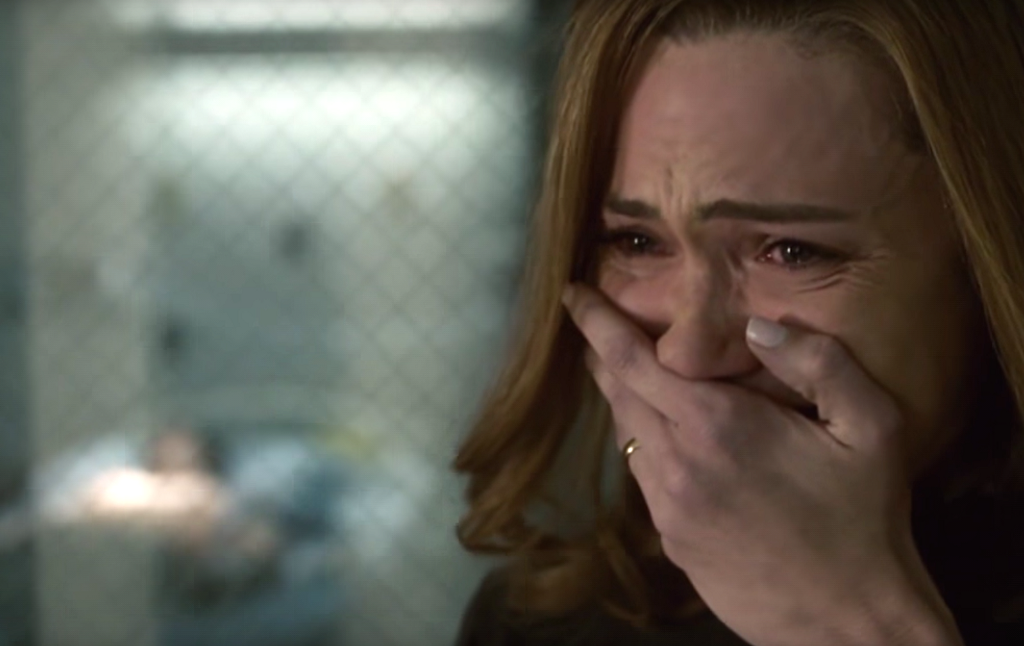
‘This Is Us’ Is My Grief Counselor

M y father gave me stories, and the stories he gave me were dark. He read me Catcher in the Rye when I was nine, let me watch The Exorcist when I was 10, and rented me Misery on VHS after I broke my ankle at 11. As an adult, I developed an aversion to any non-emotionally devastating narratives as my tastes veered towards all things perverse and repugnant. Keep your George S. Kaufman to yourself, thank you very much, and bring me some Tennessee Williams! If it doesn’t end with cannibalism, why bother? Yet, when my father told me he had terminal lung disease and the only treatment was a lung transplant — a major procedure with its own risks and a fairly shaky five-year survival rate — his influence on my tastes all but vanished.

In the first weeks after his diagnosis, I experienced brief flashes of the moments just before he delivered the news. I had been eating Alfredo pasta with my fingers. In my mind’s eye, I would see my thumb and index finger, caked in chalky white sauce, pinching three loose ringlets of noodles. In “Shipwrecked,” essayist Janna Malamud Smith writes of constantly thinking of scenery from Robinson Crusoe after her mother’s death and realizing this was a metaphor. Her mother was the ship and she Robinson, ransacking the remains for valuables. I thought pasta was my Crusoe, but later realized it was a flashbulb memory. This is a term for exceptionally detailed, snapshot-like recollections of the moments preceding bad news. The mind cannot instantaneously process trauma, so it clings to its context for later examination. The details of these moments make them seem meaningful.
They are not. Desperation lacks introspection, so scraps stowed under its guidance are often benign. But this doesn’t mean the mind has no capacity for self-soothing. To paraphrase Smith, our brains often scour their repositories and deliver the necessary. With time, mine delivered. I found solace in a soapy NBC melodrama. My Robinson Crusoe was not pasta; it was the Pearsons.

One night, about a month after my father’s diagnosis, I felt a sudden urge to watch the new This Is Us even though I had missed three episodes in a row. I was transfixed. I spent the weekend re-watching the first season and then catching up on what I had missed of the second. After this, the show became a treasured weekly ritual, an obsession worthy of roughly 42 minutes of undivided attention per week.

‘This Is Us,’ given its decidedly non-literary nature, felt like a display of disloyalty to my father and his aspirations for me.

At first, I felt embarrassed by my infatuation. My dad wanted me to be, and still wants me to be, a writer. As he got sicker, my resolve to do so grew. This Is Us, given its decidedly non-literary nature, felt like a display of disloyalty to him and his aspirations for me.

To appreciate This Is Us, you must first accept that it is not high art. This is an observation, not an insult. Smith does not classify Robinson Crusoe, a rather pulp-ish novel, as high art either. Robinson is a classic, but Smith concedes a classic does not a masterpiece make. Classics, by Smith’s account, are measured less by artistic mastery and more by how many find within them something intimately necessary. Beowulf is one of the first stories in human history. You can kind of tell, but the central lesson it preaches — evil must be vanquished, but will always regenerate — helped define the moral backbone of Western culture. The story’s not great, but it’s important.

This Is Us has become an important weekly ritual for millions of Americans. In the Golden Age of Dystopian Narratives, no one particularly expected a traditional family drama to thrive. The show goes against every fashionable convention in modern television. The characters aren’t morally ambiguous, but fundamentally good people who make mistakes. The worlds in which they exist are not bleak futuristic settings or seedy underbellies, but average cities and towns. The dialogue is not laced with subtext; the characters say mostly what they mean. Yet the show was a bona fide hit from the moment it premiered in 2016, earning a slew of Golden Globe and Emmy nominations. Somehow, This Is Us crammed itself into a secure spot in the otherwise bleak airwaves.

In the Golden Age of Dystopian Narratives, no one particularly expected a traditional family drama to thrive. The show went against every fashionable convention in modern television.

In the show’s early days, I watched the program on occasion but never found it particularly compelling. I could, however, understand the appeal. I remember reading a review that stated perhaps the creators of This Is Us sensed a public fatigue overlooked by other show runners. The future was uncertain due to a multitude of environmental and political factors and human existence was feeling increasingly precarious. Viewers, therefore, may have grown tired of all the high concept, high fantasy, and high cynicism in modern media and longed instead for a soothing elixir in the form of good old-fashioned stories about relatable people. The timing for a show like This Is Us to thrive was impeccable for the public and, with time, for me.

Before my father got sick, my preferred brand of solace was all things raw and brutal. The Odyssey was important to me during my formative years as a reader and this bred an ardent belief in the archetype of the journey to the underworld. To return home, one must first plunge into the dark. You cannot rise before fully embracing the fall.

To return home, one must first plunge into the dark. You cannot rise before fully embracing the fall.

Two months before my father’s diagnosis, I was clinically depressed, unemployed, and fixated on two pieces of art. I re-watched the BoJack Horseman episode “Ruthie” and read the same Tony Hoagland poem, “Disappointment,” every day. “Ruthie” employs a framing device in which Princess Carolyn’s eponymous great-great-great-granddaughter Ruthie purportedly narrates from the future, but we later learn Ruthie is a fantasy spun to cope with a miscarriage. It isn’t real, Princess Carolyn says, but it makes her feel better. The episode reflected a mentality Hoagland captured in his poem:

She played the flute, he played the fiddle
and the moon came up over the barn.
Then he didn’t get the job, — 
or her father died before she told him
that one, most important thing —

At the time, the motif of engaging with the fantastical as a coping mechanism rang painfully true, but I am no longer much of a daydreamer. I have stopped envisioning my future. I don’t think about crowning professional achievements while waiting for the bus. I don’t think of names for my potential children while in line for coffee. When my father got sick, my narrative changed abruptly. I could not recalibrate. Instead of “Ruthie,” my would-be daughter was named Ramona and, just like Princess Carolyn’s offspring, she was poised and funny and articulate. I still hope to have her someday, but envisioning that baby frightens me because the familial unit I always saw surrounding her is disappearing. When we lose our loved ones, we lose aspects of our imaginations; some realities are no longer tenable, and our fantasies dissipate into the uncertain abyss of a future without.

This sense of instability makes us long for narratives more comforting than our own, seek out stories that do all the imagining for us.

When we lose our loved ones, we lose aspects of our imaginations; some realities are no longer tenable, and our fantasies dissipate into the uncertain abyss of a future without.

My present disconnection from Hoagland and “Ruthie” is probably for the best. Distancing myself from these works has let me appreciate their more understated moments. My definition of high art remains imprecise, but I do think the definition relates to the amount of impartial study a work demands. Without requiring anything from a reader or a viewer, a story is just that — a story.

There is, of course, nothing inherently wrong with storytelling for the sake of storytelling. Some tales are told for commiseration, to share personal joys and fears without delving too deep into the complexities of such emotions. This seems to be the intent of This Is Us. The program, in fact, openly invites viewers to eschew detached scholarship and instead view the work through the lens of personal experience. I mean, this is in the title. This solicitation of personal connection is not a weak point, especially because the decision is clearly intentional. In “The Trip,” Kevin slyly remarks on this when a pair of pseudo-intellectual New York City actors show up uninvited to his family’s cabin. The interlopers laugh uproariously at campy home videos of Kevin and his siblings, trying to dissect and deconstruct this archetypal display of the American family. Kevin’s response? “It is quaint, it is American, but guess what? So are we . . . what’s wrong with being normal?”

This question gets to the meat of the narrative. It is not really a genuine inquiry as much as a not-so-subtle argument. Human beings are often conventional, uninteresting even, but average experiences are still worthy of documentation even if they’re not intellectually challenging. We can all fit in the cabin — both the brooding academics and those of us just trying to be human.

Human beings are often conventional, uninteresting even, but average experiences are still worthy of documentation even if they’re not intellectually challenging.

That being said, for all of these proclamations of authenticity, This Is Us is not by any means realistic. Some of the situations are realistic and the underlying emotions behind those situations are realistic, but the theatrics that go into conveying all this are beyond belief. The Pearsons are characters meticulously crafted in a writer’s room. They exist in a heightened reality, the Platonic Ideal of our own. This brand of storytelling was vastly more fashionable in Shakespearian times, when drawn-out speeches were the norm, but today we want our drama grounded, our characters nebulous, and our stories unsentimental. To put it in laymen’s terms, we simply shouldn’t buy the shit This Is Us is selling in 2018. And yet, we do — sometimes. Why?

In her brazenly unsentimental Blue Nights, Joan Didion talks frankly about the loss of her daughter and reflects on the shelf life of awe. The memoir is less about grief and more about the inevitability of regret. The central message is that gratitude is an entirely un-sustainable virtue and grief makes this obvious. In the most poignant passage, Didion takes us on a journey of the storage spaces in her New York apartment and shows us all her mementos of lost loved ones: fading photographs, Burberry raincoats, ivory rosaries, her daughter’s old school papers, wedding invitations from people who are no longer married.

“In theory, mementos serve to bring back the moment,” she writes, “In fact, they serve only to make clear how inadequately I appreciated the moment when it was here. How inadequately I appreciated the moment was something else I could never afford to see.”

I believe this to be the root of the flashbulb memory, the reason my brain clung to lukewarm pasta; it’s the mind’s way of recognizing and then compensating for this lack of awareness. When we confront the transient nature of life, a switch is flipped and our minds go into appreciation hyper drive. They cling to anything and everything — no matter how inconsequential — to make up for what we could never afford to see. But this is not enough. We are not cognitively capably of perpetual awe and so we are all fated to overlook and, with time, regret overlooking.

But the Pearsons? They can always afford to see.

The Pearsons never fail to recognize the Big and Important moments and such moments are marked by overt declarations of passion, prolonged soliloquies in football fields, and confrontations far too bold and poetic to ever manifest in reality. The characters do not exist in a happy world: Kevin is an addict, Kate has lifelong issues with weight and body image, Randall struggles with mental illness, and the Big Three lost their father at a young age in a horrible accident. Yet, these characters receive consolation earthly humans are not granted and watching this play out on screen is a cathartic experience.

These characters receive consolation earthly humans are not granted and watching this play out on screen is a cathartic experience.

Look at Jack’s death. Unexpected, terrible, drawn out to an almost gratuitous degree, but that funeral? Rebecca leads her children out of the funeral home with her late husband’s ashes in tow. They drive to a tree, where Rebecca recounts an emotionally resonant story, and then lays out some frank truths for the kids. Kevin and Randall don’t have to be the man of the house and it wasn’t Kate’s fault her father died, even if she insists on believing as much for the rest of her life. Everyone hugs. They scatter the ashes. End scene.

Trying to manifest this kind of reality with my own family would require such a dramatic shift in the established dynamic that it would take us years to get there, if we ever got there at all. It isn’t that my family is highly dysfunctional; it’s just that most people are simply not as aware of their emotions or as good at identifying the underlying emotions of others. I cannot picture myself, in the event of my father’s death, somehow astutely diagnosing how everyone is feeling. Even if I managed to pull this off, I doubt me giving a drawn out speech under a tree somewhere would provide the nearly instantaneous emotional relief it provides the Pearsons.

Life is not like this. Life is more like The Catcher in the Rye and BoJack Horseman, filled with conversations we will never have and realities that exist only within the confines of imagination.

Immediately after my father’s diagnosis, I cried every day for about a month. It was all very painful, but also normal, and the conventionality of my grief felt like a betrayal to my father. I thought frequently of how he pushed me to write. He gave me Alice Munro, Toni Morrison, John Steinbeck, and Fyodor Dostoevsky. I felt he wanted me to have a literary reaction to his illness, but I had nothing original to contribute to the zeitgeist of loss. My reactions — time slowing down, the initial denial, the little things that made it feel real — were all pretty typical. The first Christmas after my father got sick, “As Time Goes By” played in the airport bar while I waited for a plane and I wanted to smash my half-full glass of IPA onto the counter and shatter it. I resented that the fundamental things applied to me. I was supposed to be different.

The conventionality of my grief felt like a betrayal to my father. I resented that the fundamental things applied to me. I was supposed to be different.

Grief is insulting because it is not interesting. If you have to go through something terrible, can’t it at least be revelatory in some way? Can’t it lead to Promethean fire instead of something quaint, American, and normal?

The only thing that felt original to me was the fact that I adapted. We often don’t talk about it, for fear of sounding cold, but even tragedies become routine with time. Some biologists theorize grief is not, in and of itself, evolutionarily beneficial. It is a side effect of having relationships. Our loved ones are advantageous to have around as packs increase the likelihood of survival. Grief, then, is an alarm reaction that occurs when the sense of security provided by a vital pack member is taken away. Luckily, we are equipped to cope. We have a way of finding new pack members to fill the void. After my father got sick, I grew closer to my friends and to some family members. I weaved a stronger network for myself and, after awhile, felt happy and secure on some days, and then on most days.

I was thankful to know I could survive psychologically despite the potential loss of my father, but I disliked feeling detached from my feelings. Even when faced with reminders — news on progression, discussions of treatments — that my father was no more than a bundle of increasingly fragile organs hauled around in a flesh sack, I found myself unconsciously repressing my emotional reaction. I went from crying every day to being unable to cry at all.

Grief is insulting because it is not interesting. If you have to go through something terrible, can’t it at least be revelatory in some way?

To combat the sense of numbness, I turned to all my usual desolate narratives only to find they sparked no emotional reaction. It was only that night a month later, when I rediscovered the Pearsons, that this numbness broke. In the episode, the family goes to therapy together. The show overtly spells out some painful truths about sibling rivalry, addiction, and all those familial arguments that are never fully resolved. But I did not particularly care about the subpar dialogue and gross misrepresentation of what therapy actually entails. I sobbed, and it was the freeing and restorative cry I sorely needed.

Roger Ebert always said you have to judge a work by the standards of what it wants to accomplish. This Is Us is essentially emotion porn, but that’s the point. For that, four stars.

My Old Man and the Sea

Right now, I do not need convoluted dramas, because — whether I liked it or not — my grief is not convoluted. This Is Us is my go-to cry aid because it does not require heavy analysis. While my father, who does not watch the show, may not consider it literary, I don’t need it to be. This Is Us reflects my brain’s base emotions back at me, and reminds me it’s okay to be normal.

For an hour a week, I choose to exist in a world that strives only to show me an overblown performance of human experience. She played the flute and he played the fiddle. The moon came up over the barn, and then he didn’t get the job. But he got to wax poetic in a football field and teach us all a valuable lesson about how short life is. Her father indeed died before she told him that one important thing, but in her late 30s a kindhearted fiancé and a lovable shelter dog helped close the wound.

It’s not real. But it makes me feel better.

The Body is Not a Natural Home

“Jagatishwaran”

by Chaya Bhuvaneswar

In the back of the house there is a corner room that does not open onto the lush and well-tended garden. Its shutters are eyelids opening and closing with the wind. Light comes in small beams from the courtyard where pots are being washed. A woman is sweeping dirty water away from the steps outside the window. At a certain spot behind the empty teak wardrobe that barricades the door, all noises from the courtyard and the kitchen it adjoins are muffled by thick wood. Crouching there, it is not possible to hear the women shouting at each other, mistress to servant and back again, scolding and fretting, cramming the small house full of nervous life.

Flat on my stomach, facing the wall, I can look at my paintings. They are vivid miniatures, set low, near the molding. Their tiny faces sport green Kathakali dancing masks, leering with painted lips and yellow hair like aging American starlets, their glossy eyes faded. My paints have dried in large, expensive tubes littered on the floor, strewn in the dust along with tiny sable brushes that were once a woman’s accessories. The mirror on the wall is British, cracked and decadent looking with too many faded gilt curlicues around it. Amid old newspapers and combs black with hair dye, I keep my shaving kit, and my traveling case. The mirror, like the room, is dark. When I look into it I see the sweat on my forehead and chin and wonder how it remains in the air-conditioned coolness.

I shelter myself from the house with second-hand screens, four of them, made of wood that looks better for the dust on it, less costly and more secure. I write after the others have gone to bed, hiding my diaries and papers during daylight hours. Sometimes their faces flash by me in the darkness, as if they were peering in rudely through a space between the screens. Only the visitors are overcome by curiosity; the niece from the States who looks at me with her little cat face, jeans curving around soft hips; my sister the doctor, talking about leper colonies at tea, bringing medicine and the toasters when she comes, making the house smell of Ben-Gay and bread. Even the trees in the garden move away from the house, as if in disgust. The living room is brightly lit behind embroidered cotton drapes. On each evening of her stay, from behind the screens, crouching. I hear the news on television and listen to loud, excited voices talking above it, nearly drowning it out. The niece is always quiet when her mother and my father shout about corruption and bribery or point to picket signs and angry crowds when they appear on the old-fashioned screen.

No one in this house knows that I listen to a radio hidden in my room, and that I read imported copies of The Herald Tribune. Or that I spend the money given to me by Father on tobacco, and go to the same place almost every afternoon with my pockets bulging. Nixon, Watergate — my sister doesn’t know how much I know, how much I hold fast in my memory from those times. Imprisonment, Emergency. Who wouldn’t have been paranoid then? But it’s my sister who’s the smart one, the doctor lady. She thinks of us as dull-witted rice-eaters, waiting for her borrowed, Anglo china plates and blue jeans, silk ties and pantyhose, perfume in fish shaped bottles, white linen napkins and forks — so we won’t eat with our hands — expensive bolts of brilliant cloth,smelling slightly of glue, precious… “The exchange rate is wonderful,” my sister remarks, at least with the grace to laugh uneasily. Once she brought paints on a visit — “Padma picked them out specially,” she explained, handing over a shiny gift-wrapped box. Padma’s gift. They are beautiful and useless now. Exotic.

I don’t voice my opinions anymore because I know they only pretend to listen, looking at me as if I still ranted and raged as I did in the early days of my illness. Break down. Maybe schizophrenia, all his ranting…I can hear them whispering, concerned. The cleaning woman who goes everywhere, poking into wardrobes for silk pieces and loose change, cleans carefully around my teak screens, never daring to touch anything behind them. On trips to the kitchen to fill my coffee mug, I watch her slowly moving and she peers at me, afraid. That’s what the barricade is there for.

From behind the screens I can smell food from the kitchen, the smell cleaving to the carpets, damp, stronger than the scent of leaves and sweat from the courtyard. The old man calls me “demon” when he sees me eating, muttering as if I were still a young child and he were bending over my pillow promising candies in my ear. I am his youngest son; years and years ago he called me “eyes” in Tamil, which meant I was the dearest. Then in school I didn’t turn out like his nine good children, neither physicist nor lawyer, neither doctor nor engineer. I got sick, I remind him often, just before my college exams. I got very ill, it was terrible. First tuberculosis, then something else, something in my head. I was in pain, for pity’s sake. It became too late, impossible to work. To do anything but sit or stand very quietly, in peace, left to myself. I’ve tried to explain. “But you’re a grown man now,” Father says in disbelief, “and that was years ago.” He talks about my hair and the sweat on my face, jabbing at my clothes, fuming, gesticulating, until my mother stands between us, the veins bulging in her frail hand on his arm.

Mother used to come at night, years ago, before I put up the screens, to ask how I was, but now she’s afraid. Once I pushed him hard, not her, never her, and I felt disgust at his shriveled skin, his nasal voice, always skeptical, his tiny well-read eyes like an elephant’s, nearly blind but remembering everything.

On some evenings when the house is empty my father and I sit in the library pretending to read, not looking at each other, crickets caught between the pages of old books, gray moths appearing from the bare bulb on the ceiling as if by spontaneous generation. He taps his cane as he turns the pages, licking his soft, wrinkled thumb as he lifts the corners like a toady hidden in reams of office paper, calculating newborn deaths and taking bribes. I stare at him first if he’s been bothering me that day. “Have you taken your medicine?” he asks in English. Patrician, concerned, I am silent. In the dim light he can see the outline of my face, my bones almost his bones, my hands threatening. “Don’t hit me,” he says, as a warning, though I never do, and he knows it. It has become an evening ritual, more honest than prayer.

When my sister comes in the summers there are annual rituals — special prayers, more sweets, more garlands lying on the puja-room floor or hung in glossy pictures of the gods. She calls for the barber to come in the evening. He does his work squatting on the steps leading out toward the blue main gate of the house, never coming in the house. He squints up at the dimming sunlight and tells my sister’s son to hold still — he uses scissors and a gleaming old fashioned razor. The little boy shakes his head no, rubs his soft, protruding belly and laughs. Once I watched from the doorway, making him laugh even harder by imitating the girlish, feline sounds of his voice, until my sister stood in front of me and edged the door nearly closed. “Leave him alone, he’ll get himself cut,” she muttered quietly, not looking up at my face. I stared at her as she turned away, aware of the fresh smell of her hair and clothes. “Why don’t you take a bath,” she advised, watching the boy, her shoulders tensed until I moved out of sight.

The large book cases in the corridor between my room and the puja-room are opened in the summers for my sister’s daughter. Her back pressed against the wall, eyes fish-flat behind thick glasses, she reads old books, like Omar Khayyam’s Rubaiyyat, in the failing light. “Conserve your eyes,” my father says when he passes on his way to prayer, rapping on her glasses with a finger. He adds with an old woman glimmer in his voice, “Near-sightedness is a reading disease.” She puts the book down, covers her face with her palms for a moment and laughs, as if pretending to put her eyes away.

When she was younger, she asked me all kinds of questions about Indian politics, Shakespeare, the price of sandalwood soap in villages, why I had painted on the walls. She would nod calmly at the answers and say little. She would lean against the door of my room near the book cases, staring like a pretty cat with blue-black eyes and secret thoughts. “Don’t bother Jagat Mama,” my mother began to say, when the girl grew older, and she nodded as if she understood. “Leave Padma alone,” my father said once, stopping me on my way out from taking salt from the kitchen. Now with her large feet in new American tennis shoes, with her hidden breasts and her delicate neck, she only glances at me now and then with that same mute questioning look, grown-up ivory jangling at her wrists.

When my sister comes every summer, Father comes out of his room to talk to her. My niece and mother smile and whisper to each other as my sister talks about San Francisco, New York, Santa Fe, the old man repeating the names, drawing them out with his proud camel lips. My sister doesn’t know that I’ve seen the names in books, in the paper. I’ve heard them pronounced properly on my secret radio. They talk about the days she has left in India, counting up the brief nights and muddy afternoons watched from the window of the genteel Ambassador car, traffic stopped for thin men driving even thinner cows across the road and being photographed by the niece’s new expensive camera. I listen to them without hearing words, staring from behind my book at the faces. I am quiet in my dusty chair, sitting away from the soft light that hangs over the center of the room. Crickets chirp near my ear on the window, the light bounces off the limbs of a black dancing Shiva that has been placed on top of the television set. I watch their faces as they think about the tiny airport, old man and woman pressed against a large window with other damp cotton cloth-wrapped bodies, looking out at the plane with tiny windows about to take off. Men in white, Western style uniforms will dot the runway, red English and Hindi letters juxtaposed on glossy machine white wings. Before leaving the house they will pray, jeans and mustard seeds packed, my niece and sister looking awkward in new saris. They will mix languages in a sad babble of exclaiming. When my parents cry they look like blind newborns, skulls soft and nearly bald, features melting so that the sharp creases of age grow mild and nearly invisible.

In the early afternoons, after lunch has been cleared away, I sit in the dark room near the door, listening to the servant wash pots outside; my travel kit propped on my knees. The women sleep lightly in a cool room, the door closed, the light soft on their thick eyelashes. I close my eyes, waiting, wondering if the old man is too tired to watch me. He asks me questions like a child. “Where are you going? Where do you go in the afternoons?” When he has not eaten well he demands, “Why don’t you go get a job, demon, if you feel strong enough to go out every day?” He combs back his few strands of white hair, crackling them with static and impatience.

He follows me to the main road only on dry afternoons. I sense the gate swinging open again behind me. I hear my father softly complaining to stray dogs. “That man shoveling dirt over dead bodies is better than you,” he said once, when he saw me stop to look at a young man with dirt on his teeth. “He’s working at an honest job.” I made no answer, walking on as if he were a beggar I heard whimpering in the street. My father continued. “He isn’t draining the life out of his parents.” I took longer strides that day, aware that my breathing was strained, aware of the wind pressing against my back.

In the afternoons, I lose him easily in the crowd, when we get to the rikshaw stand where drivers are always waiting. He follows me only to demonstrate that he can, I suppose. The effort of the gesture is enough. He turns back without running after me, wiping his high forehead with a white handkerchief my mother ironed herself, and slowly starts the walk home. Chewing paan and leaning on his auto-rikshaw, the driver watches the old man as I climb into the back. The driver is a young boy who comes to the big house in his rikshaw on some evenings, waiting by the blue gate to take my sister and niece to the bazaar. He notices the flowers in my niece’s hair, glancing down at her soft brown fingers gripping the bar against his warm back before asking where to go.

The driver doesn’t need to ask where I am going. Like all auto drivers he is careless, even dangerously fast. I can barely see the road from the tear in the plastic sheet that serves as a door. I grip the metal bars tightly, knuckles showing white, tasting the potatoes and rice I ate before I left. I am thrown forward when the driver stops for a person or an animal. I swallow the different tastes in my mouth, remembering the salt hoarded in my room from the kitchen in newspaper packets. I imagine the peppermint taste of the crushed medicine my sister bought for me this time, which my mother will soon start mixing in the salt. When I fell ill again last year, Father cried on the phone to my sister long distance. No doubt the connection took hours to get, with long silences and wrong houses woken up somewhere in the middle of the night by a sudden ceaseless ringing. After the phone rang in the right house, darkness here and light there, Mother excited and barely whispering, “It has come, it has come,” in girlish Tamil — I could hear my sister loud and soothing, yelling calm assurances through the static.

The women stand in the doorway as the rikshaw pulls up, watching for me and tittering slightly. They’ve never asked my name, but they know who I am. I wear dirty orange kurtas like scarves around my neck and knotted around my waist so they will set me apart from other men. They speak to me in more measured voices. I pay them well with Father’s money. They don’t smoke cigarettes in my presence, though they accept the tobacco I bring for them with gentle smiles and nods, hiding their eyes. I have seen each one of them with mouths wiped clean of paint, hair loose and smelling of hibiscus, laughing at their children and stroking black kajal on their babies’ eyelids. My face is dry when I lie on their cotton sheets, gather up the hems of their thin embroidered saris in my hands. The sweat disappears from my chin and my cheekbones, though the rooms here are warm and the breeze is barely stirred by low ceiling fans.

At times I stay past the late evening, missing dinner at home but not needing to eat. I stay for the morning, sensing the presence of women waking and stretching their smooth, bare arms in flats above and below me, hearing children fighting downstairs as if they whispered in my ear, and the dogs from the street below as if from a great distance away. I hear bangles jingling from downstairs where sugar in coffee is burning, the smell stronger passing from the downstairs windows to where I stand on the sturdy balcony, waiting for the night to pass into morning, listening to the woman in the room behind me as she unwinds the sari from her slender hips.

The balcony is made of slate gray concrete that, where chipped away, looks like the softened surface of stone dancers in northern temples, with faces torn away by harsh, factory polluted wind. There is a thin black railing that stretches out in a winding pattern of water snakes around the balcony, with the thick slabs of concrete rising up from the base like graceless fingers pointing up much higher than a small child’s head. I have seen the children often play up here; I have heard their laughter as I stood waiting. There are spaces between the thick slats for their small brown faces to look out.

At night most people in Bombay and all the big city-villages far from here throw dinner parties, and use their balconies to hear moonlit fake American music with evening-gowned, light-skinned ladies beside them. Here the smells below the balcony predominate: corn cooking in street fires, pigs nudging garbage, incense burning in a window, cows leaving holy excrement for fuel, autos letting off fumes while drivers gossip, smoke and count money. But there is nothing at all to see on the urchin-abandoned street until just before the sun rises.

The paint on the railing is chipped away in places, showing metal that glows underneath in the dark like sudden fireflies. The rest of the railing is slowly revealed by the dim progress of morning, until the full, unblanching sunlight hits it, is seized by it, and is made burning black. But there is no hint of that when the early morning buses approach the street empty, pausing until the motor scooters have passed and the factory workers have disappeared inside, five to a bus seat and some hanging on the railing above, peering through small windows. Their faces can barely be seen from the balcony, but when they smile their betel-stained teeth gleam.

For an hour between the departure of the buses and the appearance of wobbling rice-flour faces and flower design on the ground of the balcony, new smells of clarified butter and talcum powder twist out from the room inside, lingering after those smells have been replaced by cooking green beans, tiny pickled mangoes, and saffron-flavored rice. A woman’s acrid sweat tinges the stone as the seven o’clock sun approaches. I avoid her eyes as she moves about next to me, hiding my eyes with a hand, staring down at the loud crows beating their wet wings below to drive the garden awake.

There is a child’s school uniform draped over the side of the railing which never dries completely. Several small pictures have been inserted in the slates of the balcony; the expectant face of the goddess of learning, a bubble-gum wrapper full of salt, and a much-handled picture of an erotic couple on the porch of the Temple of the Sun torn from a tourist magazine. At times, I finger a worn Vishnu prayer book with doodles that blind the serpent upon which the god is resting. I picture the old man praying under his breath at the tea table. The balcony is an unsmiling witness, uncritical save for an occasional blast of wind or smog that it harbors which ruffles my hair suddenly.

And the trees outside the balcony, not whispering like pines in a Canadian forest, not readying themselves to scatter and blush like New England trees after the first spring respite from the cold? There may be trees like that in white winter resorts at hill stations, modelled after slick postcards, but here the trees are lush and solitary. There is one great and rustling tree, tropical, green, shimmering and wild, never cut back from the balcony so that on certain nights it sweeps drying cloths with branches like fingers gesturing and rolling a cigarette. “Isn’t that a banyan? Or perhaps a neem?” I imagine an American accented voice saying, pointing at it, as young hippies stand on the balcony and marvel at the rustic charm of the street. A washerwoman stricken with typhoid in some rainy night has been seen crouching down next to the trunk outside the main gate, looking up warily at the balcony and the people.

I know there will be no dinner parties here, and music that issues from the room opening onto the balcony — a woman singing in Hindi about a god being mistaken for a deer — is often quickly and abruptly ended. But there will be moonlight. Peace in the leaves of the tree and the awkward protective slats of the balcony after screaming fights about men, the price of school books, the length of a child’s new frock and the rust on the body of a new black bicycle. Its wheels are closely entwined with the circle designs of the black railing of the balcony. Leaning forward in my seat, I remember my father named me Jagatishwaran, “lord of worlds”, holding me aloft.

In the darkness approaching I look at the ground, peering down through the slats, seeking out the sudden fireflies, the lighted tiny lamps in the windows, roadside meal-fires in the street. But there is nothing to look at in the twilight except the feeling of night itself in the slammed doors and fading child-shouts on the street below. The promise of moonlight contains the promise of the burned incense and rice-flour tracings that I will see there again in the morning, after the view and the objects of the street calmly and fatalistically appear.

One evening when I return to the house it is the end of the rainy season, nearly time for my sister, who is so adept at comforting, to leave here for her American city. They have all gone to the market again. A pink carnation has budded, tender, in the box of green placed outside the front door. I crush a few petals underneath my tongue, wondering why they are not sweet, sucking them like candy, resisting the dank smell that permeates the unlit rooms. Even the maid servant has finished for the day. She will return in the morning to clean pots and thalis piled high in the stone sink in the courtyard, excavating soap and dishrags as if they were moist treasures.

I sense dust on the covers of old books in the corridor, their pages crumbling — a good wind would blow away the words, the fine English print. I wonder if the old man would even mind that only husks were left if every one of their pages were gone. I run a hand along the old curved spines lined in neat rows before opening my door.

It’s darker here than in the rest of the house, though there is a small kerosene lamp burning. “You’ll set a fire,” the old man always says to me. “Use the good American fluorescents.” I can see my niece’s hair gleaming in the light, near my paintings, her head bent forward. She sits cross-legged on the floor, old books lying open all around her. Her back is to the door, her wide shoulders relaxed. The room smells of turpentine. “Near-sightedness is a reading disease,” I say, in my best grandfather voice.

She turns quickly, her eyes solemn, hiding something in her hand. The dust makes her cough. She smiles when she recovers herself. “Look,” she says, opening her hand. I look away from her, afraid. There are pictures of stone Cholas maidens in a few books left carelessly open, revealing contemplative moon-faces, wide hips and shoulders, girl-breasts, gray and perfect in relief. “Please look,” she says again. I see the brushes in her hand. There are caps on the clean tubes of paint now, a water jar on my dreams, a tiny palette made of wood. “It’s carved,” she says, smiling. There are drop cloths on the ground, as if my work could begin at any moment. She is silent, drying off the last delicate brush with her long fingers. “Why?” I ask, not exactly unkind.

“They are gifts from me,” she says. The teak screens are closer together than before, as if they have been gently moved aside and then carefully eased back into place, order preserved. She drops the last brush into a child’s pencil box on the floor, probably her brother’s. The paintings are brighter in the lamplight, the smiles on the mask still lewd and masculine. The wall above them is blank, expectant like Padma’s face. “Please get out,” I tell her. She takes off her thick glasses and wipes the sweat from the bridge of her nose. Her eyes are distant, as if she were listening to crows settling on the roof for a moment.

“Have you seen this?” she asks, holding up a book and pointing. A woman smiles in black and white, her hips exaggerated, legs strong, arms bent with hands pointing upwards, fingers curled. We stare for a few moments, meditating. “I know all the hand gestures mean something,” Padma says, her voice soft. She adds excitedly, “Some of the dancers in this photo are wearing Kathak masks like the ones in your mural.” I look away from her at the dresser, at combs and open bottles of hair dye and smile furtively. The book in her hand was once before in this room, on that dresser, open to the picture of a woman balanced on a tiny demon’s back, vanquishing greed with her graceful stomping feet. I had made marks on the pictures of the dancers. In a notebook hidden under the bed there are line-drawings of masks, of temple-dancers — all useless, exotic and beautiful.

She stands up, the book still in her hand. I gather the others, shutting away the orange colored abstract Ganeshas, Rajput miniatures with black staring beetle eyes, Nataraja dancing on the top of a temple, trapping gaudy life between the fading covers of old books. She takes them from me, brushing my hands with her smooth child fingers. Her hair has come undone from the effort of the afternoon; suddenly I feel ashamed. I promise to work on my paintings again, and her eyes open wide with pleasure. When she smiles like my mother I look down, unable to thank her. “You know, I may be in love,” she blurts out, pausing at the door and balancing books on her hip, trembling slightly. “Uncle, please don’t tell.” She disappears behind the screens. In the dark somewhere the town is closing, and my sister will come soon.

In the morning, I watch my niece, waiting for clues. She is quiet as usual, setting off on long walks when the women are bathing or asleep, or hiding by herself in the garden, reading secret letters. “When she was small she was afraid of snakes,” my mother says fondly, waiting for the vegetable seller with his cart and watching Padma move a chair behind the trees. My father retreats to a back room with a book, preparing for abandonment as my sister packs and talks to her husband on the phone. She does her packing everywhere as usual, suitcases open on the floor and in the landings, saris and scarves mingled in radiant profusion, lists made on crumpled envelopes and pieces of newspaper. Sometimes Padma swings on the gate with young children or waits while they play, serene and maternal. “Only one more trip to the market,” my sister promises, when she sees Padma waiting at the gate for the auto-rikshaw. When he finally arrives, her smile is pure and flushed, the twilight settling on her neck. Her mother waits in the rikshaw as Padma slowly gathers up her full skirt using both hands. “Don’t forget to lock the front door,” my sister tells me, and I nod, dutiful. Padma’s hair is loose and long enough to fall in front of the cold metal pole that separates the driver from his passengers, her black curls helpless, streaming down as the rikshaw jerks forward. Strands of Padma’s hair are crushed between the pole and the driver’s back, tickling his bare skin through the white cotton shirt. “You’re imagining things,” my sister would say, if I described it. Her voice would be angry. On trips from the square with the driver I say nothing, watching him in the rear-view mirror until he turns once, his eyes full of laughter, stopping for an old woman who’s wading with difficulty between animals and bikes. He is young, I realize, like my niece. We wait. “My name is Ramdas,” he whispers in Hindi, like the medieval bard by the same name. Then he looks ahead again, lurching forward quickly before anyone can cut him off, because the old woman is safe now, after all. He resumes hurtling onto my usual, my only, destination.

Months later, standing on the balcony in the early afternoon while there is still light, I read Padma’s letter. It is the first time she has written to me since she was young, when she held onto the gate like a child, waiting only for her mother. The letter is new but is already faded, crumpled, sent by air-mail on cheap blue aerogram with wispy ballpoint pen handwriting like mine. “Uncle,” she wrote, after some grown-up pleasantries. “I thought of you when Ramdas told this to me.”

Wild-eyed, blacker in your brows than crow-black nights, your legs are twisted into heavy branches, rivers fallen in your tangled hair. You take me up into the dance, your arms taut with the tiger-tooth bracelets. I was silk-clad and pale in the incense-burning light. Bells and gongs clamoring, emptying my mind of fear, I forgot that you had burned the body of the god of love when he teased you with his beauty.’

A man puts washed clothes on the balcony, nodding politely, cutting the cloudless sky into dark, wet shapes. A bottle-green sari mingles sinuously with the shining body of black lattice. The dark green is flecked with gold crisscrosses and flanked by deep yellow borders of crushed silk ending in tangled threads. It is faded with many washings, a pleasure gift when there was no chiffon to turn the eye away from grandmother cloth. I put my face up against it, as if smelling my mother.

Days after waiting on the balcony, I stay at home, away from the women. It is the day my niece Padma has been scheduled to leave. There is no time for argument or recrimination — every member of the household strains in silence under heavy suitcases, loading two taxis. The taxi-drivers are fed, given tea, made to engage in small talk and polite price-negotiation. Sweating, I look in my room and see that the paints are just where Padma has left them. I wipe my face with a damp cloth, staring at the mirror and feeling impatient. To go to the airport, I will have to bathe. My face is dry in the bathroom mirror, even with steam rising from the walls. Turning from her post beside the window, Padma smiles when she sees that my hair is washed and combed. There is a red tear-drop in the center of her forehead. Her hair is bound in rose and daisy petals like a bride’s.

Padma’s hands are soft, pressed together. She prostrates herself before the old man, then the old woman, her mother looking on. They touch her smooth hair with approving, wrinkled hands. She eludes them by promising to be back in half an hour, walking quickly down the street. Her mother sits on the front steps, saying nothing as Padma’s younger brother plays in the driveway. He giggles, imitating me as I describe the route the taxi-drivers should take with my hands. The old man stands behind my sister, hands resting on her shoulders, little eyes squinting in the light.

In the taxi I sit in front with the driver, next to my father. His elbow is sharp in my side when the driver makes a wrong turn. When we reach the airport early he wilts, no longer angry. He waits before opening the door, trapping me inside the car for a long moment. My mother’s voice is unnaturally bright as she adjusts the back of my shirt collar, her hands shaking a little. “Appa,” my sister says softly, when she helps him out of the car, easily bearing her weight.

The airport is crowded, hot, inefficient. There are nuns everywhere. “Oh, don’t sneer at everyone,” my sister says, her voice matter of fact, before she takes her place in line with Padma. I help the taxi drivers load suitcases onto a cart, which is then wheeled to the tiny airplane and loaded on by men who soon become tiny dots in the distance. I put change in vending machines, buying copies of the Times, bottles of Limca soft drinks. My father, rooted firmly to the earth like some ascetic waiting for a boon, says nothing. He stands in one spot as people push past him impatiently.

Padma and her mother become dots too as the line of passengers moves toward the runway. We wait at the large glass, looking out, old man and woman waving, bodies pressed against tall windows, straining hard to see. Long after Padma and her mother are hidden from view, we stand there and move into ourselves, imagining trays of candy and bright-painted stewardesses, hearing the canned Ravi Shankar music, breathing the sweet, stale pressurized air that must be coursing through the plane at that moment.

Weeks later, in my sanctuary with Padma’s neat letter in my hand, I breathe easily, wondering at the purity of polluted air.

“Ramdas said you were named after Shiva. I miss you. Please write soon, and paint. Your loving niece,” she has written, printing her name at the end in round childish letters. I turn the blue leaf over in my hand, looking at the address of my father’s house…Jagatishwaran, Padma has printed before it, with no last name, only lord of worlds.

A woman stealing up soft behind me, having first turned to the radio in the room below, places her hand on my neck, her lips soft on my cheek. I put Padma’s letter in my pocket, thinking of how I stood in the airport, watching the old man and woman stare out the window as the plane began to move. As we watched it take off I had moved close behind my father, bracing myself against his sobs, my hands steady on his bony shoulders. “Let’s go home,” my mother said, fumbling for a handkerchief. They looked up at me as if they were children, Father’s eyes almost erased by tears. “Please get the taxi, Bhuvan,” he had said, calling me by name.

Now, here on the balcony, I feel bare female arms around my waist, woman-soft while a radio plays a song below. My hands on hers, flat against my stomach, we brace each other gently, waiting for dark to settle on the street.

How Do You Advocate for LGBTQ Rights When Your Culture Has No Word for Gay?

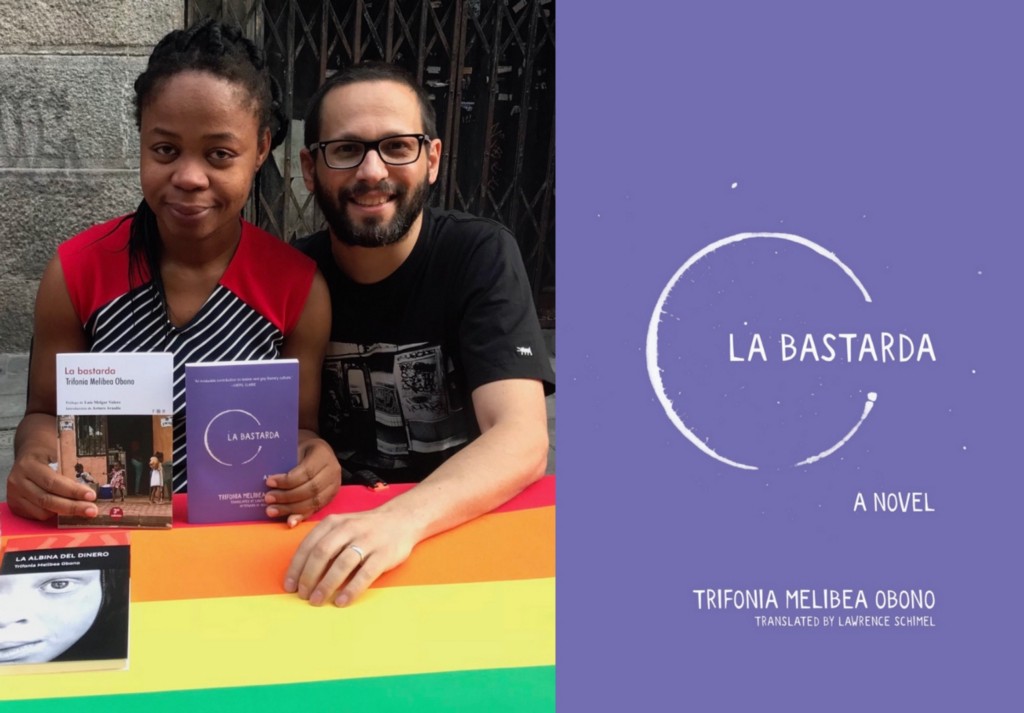
Trifonia Melibea Obono is an Equatorial Guinean writer and activist, who has published three novels (Herencia del bindendee, La bastarda, and La albina del dinero) and a short story collection, Las mujeres hablan mucho y mal, which won the 2018 Justo Bolekia Boleká international Prize for African Literature.

Purchase the novel

I translated into English her novel La Bastarda, which is the first book by a woman writer from Equatorial Guinea to be published in English. It is the coming of age story of a young Equatoguinean girl, Okomo, in her search for her father, who she’s never met because her mother died in childbirth and he had never paid the bride price, so Fang tradition holds that she belongs to her mother’s father and his tribe. La Bastarda is the story of Okomo who falls in love with a woman and (along with various other characters) challenges the patriarchal, polygamous Fang culture.

I spoke to Obono about advocating for LGBTQ+ rights in Equatorial Guinea.

Lawrence Schimel: Homosexuality in Equatorial Guinea is seen as “something white people do,” something alien to the African reality, even though that is far from the truth. How does our understanding of sexuality change in an international context?

Trifonia Melibea Obono: Sexuality continues to be a taboo subject in Equatorial Guinea for most people. And the reason that homosexuality is attributed to white people is simple: in this country, all phenomena that people don’t understand are attributed to God, witchcraft, or white people. It’s the habit here to blame the white people for many things, for everything that goes wrong. These same attitudes and behaviors are reproduced throughout black Africa.

Things will change over time, with the implantation of democracy and efficient educational systems in black Africa, and the real opening of our nations to the international world on a cultural level. We will understand then that we black people are the equal to whites, and that sexual-affective orientations are something human.

My novel advocates for the right of women to have a sexuality.

LS: In La Bastarda, you comment that a word for “lesbian” doesn’t even exist in Fang, although there is a term to denote gay men: “man-woman.” Are there people in Equatorial Guinea who are trying to change and expand the languages (as well as the culture)?

TMO: As of now, the concept “lesbian” is a neologism in the ethnic languages of the country. That’s how women who love women are called. Nonetheless, due to the conceptions held about homosexuality (that it’s a habit of white people, demons, evil spirits) the definition that’s given to the concept “lesbian” is very pejorative. Very derogatory.

In Guinea, we speak six or seven languages, plus English and French, and now Portuguese has been incorporated as well. The homophobia and machismo from Western cultures that accompany the term “lesbian” have augmented Guinean attitudes toward lesbianism. In many parts of the world, LGTBI women don’t just need to confront homophobia, but also machismo and the patriarchy.

The sexuality of the Fang woman doesn’t exist. Not even the heterosexual woman has a right to her sexuality, the only thing expected of her is reproduction, that’s it. My novel advocates for this right for women: the right to have a sexuality.

The homophobia and machismo from Western cultures that accompany the term “lesbian” have augmented Guinean attitudes toward lesbianism.

LS: In La Bastarda, the characters who don’t fit within the heteronormative society wind up creating new models of families and communities. Do you think that literature can change society? On the one hand, your novel makes visible certain realities that aren’t otherwise expressed or documented in your country, and on the other, it serves as a guide for Equatoguineanxs searching for ways to live their identities.

TMO: Literature is a weapon of change. Literature doesn’t lose time, each work is a new story, each work is a challenge because we writers have a responsibility: to create characters, consider problems of society, and propose solutions.

La Bastarda makes visible various problems: violence against women, homophobia, polygamy, child abuse, family rights, mortality of mothers in childhood, corruption, poverty, etc. One element in the novel that seems very positive to me is the forest. The forest represents harmony, freedom, a society tolerant of diversities. The forest is the Guinea of the future, it is a new country.

LS: In your novel, you touch briefly on one of the most serious problems for lesbian and bisexual women in Equatorial Guinea: being forced by their tribe and/or their families to be raped until becoming pregnant. Can you talk more about that?

TMO: The forced pregnancies of LGTBIQ+ women in Equatorial Guinea is an important issue that must be confronted. Because women “in this non-African situation” aren’t covered under the fundamental laws. Besides, people say, there aren’t any cases. They tell me: Maybe some you’ve discovered, knowing how much you exaggerate when you talk about feminism, these ideas of the white people that you brought back from Spain. For now, there also isn’t any money for “these white people things.”

LS: What authors — both within Equatorial Guinea as well as outside of it — have influenced and nourished your understanding of sexuality? And of feminism?

TMO: Guinean books don’t touch on the question of sexuality directly. I have been very affected by the gender roles that women play and the humiliations they suffer, from the first page to the last in the works of Ecuatoguinean literature. Ekomo, the novel by María Msue Angüe, marked me very strongly in this regard.

On the other hand, growing up among Fang women and men (my father and mother are both Fang) helped me to be a feminist. Within me, these women have sowed the seed of a person who will fight for and defend herself and her rights. Now that I’m older and a writer myself, I can see why the discourse of works like The Second Sex (by Simone de Beauvoir) and Sexual Politics (by Kate Millett) resonated with me from the outset.

LS: What was the first book you read about diverse sexual-affective identities?

TMO: When I wrote La Bastarda, I had not read about feminism nor sexual-affective diversity. But I had made love with another woman. I had made love with a man.

Literature is a weapon of change. Each work is a new story, a challenge because writers have a responsibility: to create characters, consider problems of society, and propose solutions.

LS: You just won the Justo Bolekia Boleká International Prize for African Writing for your book of short stories Las mujeres hablan mucho y mal (Women Talk a Lot and Badly). As a writer, what difference is there for you when you write a short story versus a novel? What does each format offer you to tell the stories you want to tell?

TMO: The stories are my therapy in the morning, at night and at noon. The poor things. They don’t love me now, I know. But they help me speak with my surroundings, they listen to me. That’s why I still have some balance. Now that I’ve just answered this question I will write another story, and shortly I’ll revive.

The novel is my traveling suitcase. It holds me for hours, days, months, speaking with the characters and forgetting for a moment that I was born in Equatorial Guinea without the option to choose; that I am a woman without having chosen to be one, that I am not heterosexual in a world with a dominant heteronormative culture.

The novel is the kidnapping of a woman from nowhere, caught in the tam-tam of the repression and the silence of how badly the economy is.

LS: Given the realities in Equatorial Guinea that there are no publishing houses in the country nor bookstores that sell books, do you write in a different way knowing you need to publish with publishing houses outside your own country?

TMO: The lack of publishing houses is a barrier. If you are an Equatorial Guinean who writes, first you need to tell yourself: “Hey, woman without a land, land without publishing houses nor bookstores, where do you think you’re going? Stop! Look around you. What do you see? Nothing. There you are. Nothing.”

Why Kanishk Tharoor Draws Plumbing Diagrams in Writing Class

I n our monthly series “Can Writing Be Taught?” we partner with Catapult to ask their course instructors all our burning questions about the process of teaching writing. This month we’re talking to Kanishk Tharoor, author of the story collection Swimmer Among the Stars. Tharoor is also a contributor to The Guardian, The New Yorker, The Los Angeles Review of Books, The Paris Review, and others, and the radio presenter for the BBC’s “Museum of Lost Objects.” He’ll be teaching a six-week advanced fiction workshop on “Writing the Other” at Catapult’s New York headquarters, starting October 9.

What’s the best thing you’ve ever gotten out of a writing class or workshop as a student?

The American creative writing workshop can be a strange place for those of us who write somewhat unconventionally or about subjects removed from contemporary American life. There’s always the risk of running up against puzzlement, disdain or, worst of all, indifference. So I was always grateful to find colleagues willing and even eager to meet my work on its own terms.

What’s the worst thing you’ve ever gotten out of a writing class or workshop as a student?

When you spend so much time immersed in the work of your peers, you can — without even meaning to — find your writing veering in the same direction as others. It’s like when riding a bike, you find yourself drifting towards something that’s caught your eye (admittedly, I’m not a great cyclist). Try to stick to your own lane.

We wouldn’t expect everybody to have a sculpture or screenplay in them, or for that matter for everybody to have a home run in them or a chicken soup or a cantilevered bridge.

What is the lesson or piece of writing advice you return to most as an instructor?

I often repeat a metaphor taught to me years ago, about how the flow of prose is much like the flow of water through pipes — the pipes need to bend and turn for the water to flow properly and not get caught up in eddies, just as we need judicious variation in narrative to maintain the reader’s attention. My students seem to find my diagrams of plumbing not totally outlandish. I’ve no idea if that’s really how pipes work, but I do think it’s true for prose.

Does everyone “have a novel in them”?

I don’t like the phrase (we wouldn’t expect everybody to have a sculpture or screenplay in them, or for that matter for everybody to have a home run in them or a chicken soup or a cantilevered bridge). A good novel comes out of talent and intelligence and curiosity, and not everybody will have those qualities in equal measures.

Would you ever encourage a student to give up writing? Under what circumstances?

I can think of only two quite different circumstances in which I would do that: 1) if writing is making it impossible for the student to support her family or meet other material responsibilities or 2) if the student was for whatever reason committed to writing fiction that was hateful about or malicious to vulnerable people.

What’s more valuable in a workshop, praise or criticism?

Praise, and not because we can all use a bit of affirmation once in a while. I think it’s quite important in the workshop environment for criticism to come out of praise. I make my students focus at the beginning of workshops on what’s effective about a given piece. Finding positives can be a lot harder than tearing somebody’s work to shreds, but it encourages students to think more deeply about a piece of writing and the habits of a writer. The criticisms and suggestions that follow later in the workshop tend to be more rigorous and helpful.

Should students write with publication in mind? Why or why not?

If it helps motivate you to write, then that’s fine. If it conditions how you write, then you’re probably thinking too much about the destination and not enough about the way there.

Finding positives can be a lot harder than tearing somebody’s work to shreds, but it encourages students to think more deeply about a piece of writing and the habits of a writer.

In one or two sentences, what’s your opinion of these writing maxims?

  • Kill your darlings: Sure, be a ruthless editor and prune what’s excessive and tangential in your manuscript. But you should still be able to take pleasure in what you’ve written and not be so suspicious of your own enthusiasm that every lovable sentence gets sent off to the guillotine.
  • Show don’t tell: No, firstly because it’s a false dichotomy; its very difficult to do either well without doing some of the other. And secondly because I’ve often thrilled at beautiful, powerful stretches of exposition. One of the great pleasures of fiction is letting a good writer tell you what’s what.
  • Write what you know: Emphatically, no. Write about what fascinates you and what you think is important, and use fiction as a bridge to the wondrous, desperate world beyond you.
  • Character is plot: “…and plot is character.” The maxim suggests that there’s some kind of perfect equilibrium we should strive for in fiction between events and characterization. I don’t think that’s the case. A successful piece of fiction doesn’t need to tick every box. I’ve read wonderful works where very little happens and likewise read wonderful works where individual psychology is not at all important.

What’s the best hobby for writers?

I find watching sumo wrestling transporting and inspiring. If a 300-pound behemoth can swivel like a ballerina and lure his enemy into empty air, I can finish this chapter.

What’s the best workshop snack?

A former mentor introduced me to the Italian combination of red wine and taralli, so I’ll always associate fiction workshops with olive-oil cookie crumbs and wine stains.

Advice from Tayari Jones to Writers in Difficult Times

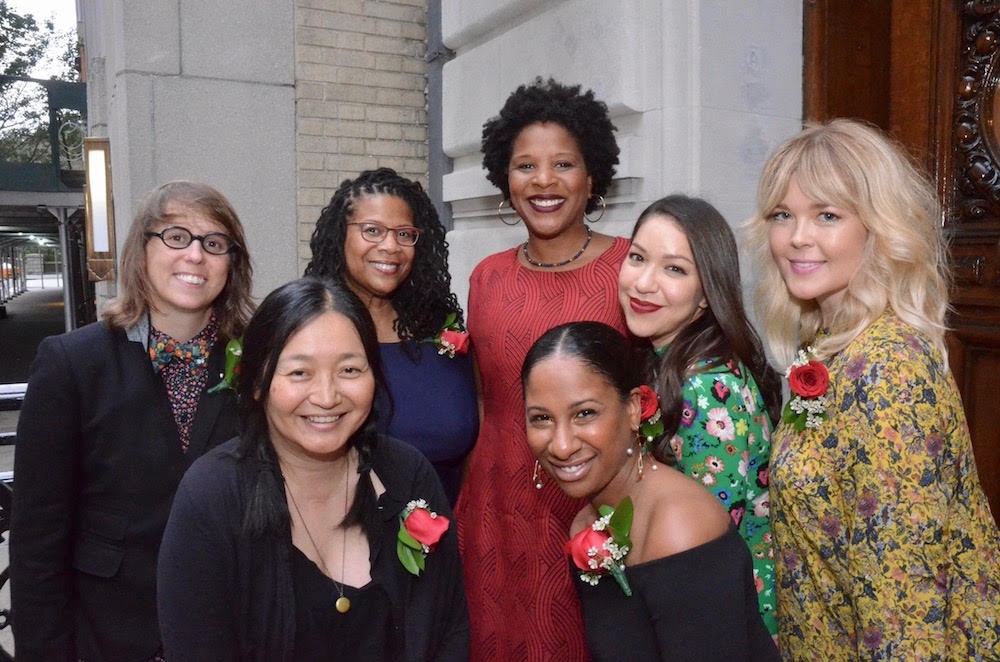
Tayari Jones delivered these remarks on September 13 to the 2018 recipients of the Rona Jaffe Foundation’s award for emerging women writers: Chelsea Bieker, Lisa Chen, Lydia Conklin, Gabriela Garcia, Karen Outen, and Alison C. Rollins. Author Rona Jaffe established the award in 1995, and since then the Foundation has awarded more than $2.5 million to promising women writers. The day after the award ceremony, Jones’s novel An American Marriage was long-listed for the National Book Award.

In the fifteen years since I published my first novel, I have on several occasions been asked to speak to emerging writers. I usually take the position of telling them the things that I wished I had known when I was finding my way as a writer. I tell them how I wish I had not worried so much about being liked. I wish I had known how well things would work out. I wish that I had trusted my voice — clear, but often too loud, serious, but sometimes silly. I wish I had known that my ideas were complicated, not confusing. I wish that I had known that being accessible was a good thing. In other words, I wish I had found out earlier that myself was the best person for me to be on the page and in life.

And I still believe these things.

I wish I had found out earlier that myself was the best person for me to be.

However, today, such advice seems a bit too precious as we face a world in peril the likes of which I have never witnessed. I searched for the perfect metaphor, but everything that came to mind seemed too obvious. My imagination kept returning to to image of flame destroying all that we hold dear. But the metaphor seemed a bit dramatic, hysterical even. But then as I watched the footage of wildfires churning through California — the ultimate expression of global warming—I was even more strongly tempted to use the image of fire as I speak about the challenges we face today. But still, I resisted.

And then, just a few days ago, I watched the television open-mouthed and wet-eyed as flames engulfed the National Braziliam museum in Rio, destroying thousands of years worth of irreplaceable artifacts, from precious works of art to the fossilized remains of our earliest ancestors.

When we come to experience fire not just as an idea, but as a literal phenomenon, it is clear that fire is not an apt metaphor for our moment in history — for burning is an irreversible devastation. Firefighters with their hoses and chemical remedies can halt the damage, but they cannot restore.

We are citizens and artists and we have the power to take our country back. The goal is not to return to the nation (and even the world) that we once were — for so many of us know that yesteryear was hardly a dreamscape. Even in 2009 when Barack Obama took his oath of office and Elizabeth Alexander offered a praise song for the day — even on that cold January morning, when millions gathered to wish our society well, we all came together to celebrate hope, but also commit to change. Let us not forget that even in that moment of excitement, we knew there was work to be done.

We are citizens and artists and we have the power to take our country back.

But now, all these years later, we are a nation and a planet in crisis and we must each use our resources to create the world that we want to call our own. There was a time in my life when I sat at my writing desk to spend a few hours each day, looking inward, telling my story. This was art, of course. As the descendants of Africans held in slavery in this country and denied literacy, sometimes at the penalty of death — I believed that whatever I might write was an act of defiance. And it was. And it is.

However, this is not enough.

My message to you today is not just advice for writers and artists. This is a call to action for all of us, each according to her ability. This is a plea for truth telling in all of its complexity. I am asking you to be brave enough to forsake likes and shares in favor of revealing potentially unsettling realities. Alice Walker famously urged us to “be no one’s darling.” I would like to expand on this and push you to be no one’s darling, not even your own. In these perilous times, we must interrogate ourselves on the page and in life. We have to ask ourselves how what can we do to make the world better and make ourselves better. We have to sacrifice our comfort as individuals and as artists. There is the other famous quote that says that “art should comfort the afflicted and afflict the comfortable.” It’s a catchy saying and true as water, but we must understand that we ourselves are both comfortable and afflicted.
In these perilous times, we must interrogate ourselves on the page and in life.

But let me return to where I started this story, as a young writer, telling my own truth and taking pleasure and challenge from the task of remembering and translating feeling into words.

I push you to responsibility, but I don’t want to deprive you of the delight of creation and the pleasure of your imagination. Rather, I urge you to find and claim your voice, mission, and joy all at once. Rejoice in resistance. Seek out the satisfaction of hard work. Learn to revel in forward motion.

Congratulations to you, this year’s class of Rona Jaffe Fellows. Seeing you standing here fills me with great optimism, which I am sure is shared by everyone in this room. Your talents are a bright light that will show us the way. As the great Toni Morrison’s declared in her Nobel lecture: “The bird is in your hands.”

What To Do When Your Time Machine is Broken

Let’s say that you’ve rented a time machine. You travel to another era, you explore, you marvel, you enjoy. But afterward, when you climb back into your time machine, you discover that the thing won’t start. It’s broken. Bad news: you’re stuck in a time that isn’t yours.

Purchase the book

What do you do?

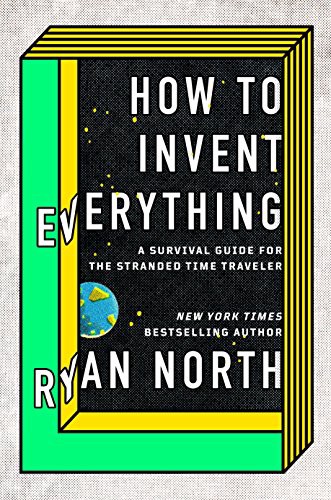
The answer, according to Ryan North’s wonder of a book How to Invent Everything: A Survival Guide for the Stranded Time Traveler, is not to try to fix the time machine — in North’s fictional universe, they’re unrepairable — but to instead “fix” the time that you’ve found yourself in by re-inventing all of the technology that you desire, from scratch. Invention, the book quietly suggests, is its own form of time travel.

With this wonderfully playful premise, North (author of Dinosaur Comics, Romeo and/or Juliet: A Chooseable Path Adventure, The Unbeatable Squirrel Girl) presents a step-by-step guide, complete with flowcharts, a technology tree, scientific appendices, and footnotes, for inventing everything from language to farming to mining to bicycles to computers. Would you like to learn the Universal Edibility Test? Perhaps you’d find it helpful to have major schools of philosophy “summed up in a few quippy sentences about high-fives”? And maybe you’d like to invent buttons way before they were invented in our timeline?

The scale of How to Invent Everything is downright encyclopedic, and the voice, on every page, bubbles with humor. Reading it brought me back to all the afternoons I’d spent as a kid flipping through the big reference books in my local library, and then eagerly running home to tell anyone who’d listen what I’d learned. One of this book’s great achievements is the way it so gracefully combines scholarly rigor with youthful wonder.

Ryan North and I corresponded over email and talked about the book’s formal hybridity, the relationship between technology and civilization, and whether or not storytelling itself is a technology.

Joseph Scapellato: One of the many things that I love about How to Invent Everything: A Survival Guide for the Stranded Time Traveler is how it so exuberantly embraces hybridity. It’s a work of nonfiction, but with a science-fiction frame; it’s part guide, part how-to, and part real-and-imagined history; it’s packed with diagrams, charts, and schematics; and underneath it all runs a lively through-line of voice-driven humor. Can you talk about the genesis of this ambitious project?

Ryan North: The basic idea for the book is something I’ve been thinking about since I was a kid: if I went back in time, what could I change? Once you exhaust the “give myself lotto numbers” angle you’re left with the — to me very vivid — image of being trapped in the past, describing how great the future is, and everyone around you saying “okay, great! How do you invent it?” and me just… shrugging. For decades I’d wanted a book like How to Invent Everything, and finally I decided to write it.

After the book was announced I saw many many people saying “oh wow, I’ve wondered about this exact same scenario myself!” so it seems this fantasy wasn’t unique to just me. I’m really glad to hear that, because it was (and still is) one of my favourite things to think about.

The earliest drafts had a bit more “future history” in them: I had all this detail on the world the time machine had come from. But I ended up taking out most of that and leaving it mostly as broadly suggestive hints, because I realized: once you invent time travel, you’ve invented everything. Need a phaser? Travel to the future, and if it can be invented, you’ll find it there. So I realized I was trying to describe what was effectively the singularity of singularities, and instead refocused on just one element of it: the tourism. The idea that in the future time machines would be rented out willy-nilly to the general public the way Winnebago are now struck me as both a crazy — and really interesting — idea.

I actually wrote a fair section of the book — almost a quarter of it — before I started thinking “okay, yes, this will work”. Because while yes, it’s a comedy book, and while yes, none of us are likely to be stranded in the past anytime soon — I still wanted it to be a sincere book. I wanted it to be an actual guide to actually reinventing civilization, from scratch, in any period in Earth’s history, and I wasn’t at all certain such a book was even possible. I was really relieved to discover that it is!

JS: Do you have any favorite time-travel books/films? (Especially ones that might have influenced the way that you thought about this project?)

RN: Oh my gosh, this whole book exists because I spent most of ages 6–12 thinking about Back To The Future and what I’d do in variations of that situation. And I’m just realizing this now, but How To Invent Everything is really just Gray’s Sports Almanac — the book Marty takes back from the future to give himself an advantage in Back to the Future 2 — taken to its logical conclusion. Only instead of instructions on what horse to bet on, it’s instructions for everything. Marty could really cause a lot of trouble with this book.

Like I said though, the model of time travel used in the book is different than most stories or movies I’ve seen — including the one Marty deals with. By avoiding the one-timeline model and instead having each trip back in time create a new parallel timeline, time travel becomes “safe”, and I think there’s actually a lot of really interesting stories you can tell there!

I wanted “How to Invent Everything” to be an actual guide to actually reinventing civilization, from scratch, in any period in Earth’s history.

JS: The narrator — also named Ryan North — is steadily optimistic and encouraging, but quite critical, at times, of how long humanity went without making certain discoveries. He’s especially embarrassed about buttons:

Look, you know how a button works. We don’t need to explain this. They’re one of the simplest practical inventions we have…but figuring out how buttons work still took humans more than four thousand years […] Buttons could’ve been invented at just about any point in human history. Save humanity from doing the cultural equivalent of walking around with our fly down for four thousand years straight. Invent buttons already.

What, in your opinion, accounts for these long gaps between innovations?

RN: That’s one of the things that was so fun about this book. Lots of popular science takes the approach of “look at us humans, and look at the wonders we have created” — which, yes, is true. But having a book where the voice was “look at us humans, and look at all these times were, in retrospect, we were screwing up the entire time” — that’s fun. And it’s not like there’s a shortage of examples: the countless times we didn’t invent penicillin when we had everything we need to, or kept forgetting that vitamin C cures scurvy, or couldn’t figure out how buttons work, or [etc etc etc, the list goes on for so long].

I think you get these gaps because, in truth, invention is hard. To invent something, you have to take the world as it is, take those pieces lying around you, and put them together in a way nobody else has before to create something original that the world has never seen. That’s hard! And it’s what makes a book like How to Invent Everything possible: by laying out the answers, by showing you what one person can do on their own if they just have the advantage of knowing what they’re supposed to be doing — we can sidestep all those delays and uncertainty, and instead let you skip right to the fun part: making new things.

Buttons are a fun example because we got part of the way there, and then stopped. A modern person would see that and invent the button without even thinking about it, because we all know what the answer looks like. But if you don’t, you think attaching a shell to your shirt is already pretty great, because now you look handsome. You don’t know you can go further to make them practical as well as pretty. You don’t know what you don’t know.

I wonder a lot what scientific discoveries we’ll be looking back on in 200 years and saying “how could they not have seen that?”

JS: The book’s science-fiction frame — the premise that this guide was written in the future, sometime after 2043 — means that the reader is occasionally treated to footnotes that reference future inventions/events. For example: the eventual existence of time machines, weather control machines, and (my favorite) the fact that the moment when time travel is discovered becomes a popular destination for time travelers from the future to visit. At any point, did you sit down and plan out this future setting in detail, or did these references emerge spontaneously?

RN: Generally, most of the science fiction was added spontaneously as I wrote: either as a way to explain something that we don’t know the answer to (like, for example, why the reference kilograms are changing mass, or, in more fundamental questions, why precisely we sleep), or as a way to take a break from some more difficult concepts to have some fun in sci-fi land.

I love the idea that in this utopic future things are so great that that they have retail-market time travel, but people still want to take vacations to get away from it all. And if you think about it, given the model of time travel in the book (each trip back creates a new timeline that doesn’t impact the one you came from, so it’s impossible to mess things up for you/kill your own grandmother/etc) — that’s basically a holodeck. It’s an incredibly ethically-fraught holodeck, for sure, but it’s a scenario in which you can visit any point in history and do whatever you want, and at the end go back to the future again. It’s wildly irresponsible, but also, it would be really, really hard to resist. I can see why people travel through time, even given the non-zero risk of the time machine breaking, stranding you in the past, and forcing you to rebuild everything from scratch.

The Art of Time Travel Through Friendship

JS: You conducted a tremendous amount of research to write this book, as shown by the lengthy bibliography. What emerged from this research that you didn’t anticipate — that surprised you about the history of humans/technology?

RN: Hah, it’s funny you mention the bibliography! Originally my intention was to not have a bibliography — or at the very least put it only on a website — because there’d be no reason for this book designed to be read when you’re alone in the past to have one. But we ended up putting it in the book for a couple of reasons: I thought it was useful to be able to point people towards great texts if they wanted to know more, and it was at least a clue that all those facts and figures in the book are, in fact, real. So that ended up being baked into the premise: the book is from the future, I found it, and in preparing it for publication researched everything I could to verify that it was real — and in doing so, built that bibliography.

But! To answer your question: it was those delays in humans figuring out things that surprised me. Before I started I had this vague idea that as soon as something was possible to be invented, then we probably invented it soon afterwards. But that’s reasoning without factoring in all the ways humans can make things complicated, messy, and wrong. My favourite example in the text is how we learned — and then lost — both the causes of and cure for scurvy over a dozen times throughout history. You’d think something that useful would be remembered, but it’s fascinating how things can change and knowledge can be corrupted or lost. In the scurvy case, one of the reasons the disease returned was because the British had switched to a cheaper source of vitamin C (from lemon to lime juice), without realizing their limes had much less vitamin C in them. Then they started running it through copper pipes, which also destroys it. But they didn’t notice that their scurvy cure was now useless, because steamships had been invented (meaning sailors were spending less time at sea, away from those fresh fruits and vegetables high in vitamin C) and nutrition on land had improved too (meaning sailors had greater stores of vitamin C to begin with). It was only when they started to explore places like Antarctica that scurvy “came back”, and with the old cure apparently suddenly ineffective, they were back at square one.

It’s not hard to imagine how a quick tip from a single time traveller could have a massive effect on history here.

When it comes to building civilizations, you can pick and choose just about everything…except for stories. The one thing we can rely on about humans is that we’ll always tell each other about ourselves through stories.

JS: You have a background in computational linguistics, which no doubt came in handy when you were writing the language and computer sections of this book. What sections, though, were the most challenging for you to write or research, and why?

RN: Hah — I can actually give you the specific section: the bit on calculating dates and times for navigation and timekeeping. Some of these calculations are relatively easy if you have known-good stars to use, but since I wanted the book to be useful no matter what time period you’re trapped in, I couldn’t use any of that: the stars we see in the sky are moving, and though it seems slow from our perspective, go back a million years and any star charts I included would be useless. So they all had to be done based on the only star whose location WOULD be known no matter what time period you could survive in: our star, the sun.

And while on the surface it’s just “the Earth goes around the sun”, once you get into it in detail there’s so many things that are happening: the Earth is spinning, and that spin is at an angle, and it’s wobbling like a top, and it’s speeding up or slowing down depending on where in its orbit it is, and most of these values are cycling over time, etc, etc, etc. It turned out that getting all of these variables sorted across time was way more challenging that I thought, but I’m really proud of the chapter that resulted!

JS: How to Invent Everything makes an argument for what a civilization is (and isn’t). An early chapter, titled “Calorie Surplus: The End of Hunting and Gathering and the Beginning of Civilization,” gives a frank assessment of the challenges of farming — the “Extremely Garbage Features of Farming” — then ends on this note:

In light of these downsides, we would like to take this opportunity to remind you that it is inarguable that farming leads to calorie surpluses, which leads to specialization, which leads to innovations like apple pies, time machines, and the latest mass-market portable music players. If you work hard, you will produce these. If you hunt and gather, you will not. Instead, you will eat bugs you find under a rock. Best of luck with your decision.

A running theme is that certain core technologies are essential for civilization. In light of this, how do you define “civilization”? And what is this concept’s relationship, if any, to the state of being “civilized”?

RN: I see civilization beginning at the moment you look around and take the world not as it is, but as it could be. Pure hunting and gathering isn’t really a civilization, because you’re just taking what you can find — plus, since you’re always moving, you’re not building anything for the long term, because there is no long term: just the seasons of the endless now.

But the second you start saying “you know what? It can be done better.” — that’s when you start building a civilization. That’s when you start taking what you can find and combining it in new ways, better ways, to produce a world in which — ideally — other humans and yourself no longer need to worry about basics like food, heat, and protection, and can instead begin worrying about more interesting things, like what gravity is and how a global network of computers might work. You can do this in a hunting and gathering context, but farming is what makes it reliable, sustainable, and scalable.

As for the second part of your question: for me calling someone “civilized” means that that person is someone I can trust to act in an interest outside their own. A civilization means living with other people, and at some point when you’re living with other people — no matter who those people are — you’re going to need to be able to put the needs of the community above yourself. A civilized person will help someone pick up their dropped bag of groceries, because it’s the decent thing to do. An uncivilized person won’t, because there’s nothing directly in it for them. Saying this out loud, it’s making me realize that I can pretty much draw an equals sign between the words “civilized” and “decent”, which I suppose is why I wrote a book on how to create civilization in the first place. We can be done better too.

JS: Just to press you, a little — would you consider a hunting and gathering society a civilization if it approached the “it can be done better” question through culture, rather than technology? And what’s your take on the argument that hunting and gathering is a long-term approach to living a life with others — that it ensures environmental sustainability/stability in a way that, say, the industrial-revolution approach doesn’t?

RN: Oh, for sure! And I’m not here to say you’re not living in a civilization if you’re in a hunting-and-gathering world and doing more than just hunting and gathering, culturally. One of the core issues I had to address early on is answering this question: what is civilization? And rather than try to tease that apart and draw lines in the sand, I decided to sidestep it all and decided my guide would be to reinventing a technological civilization. That comes with pluses and minuses, of course! Heck, as soon as you invent the technology of animal husbandry, you’re bringing in all the diseases that animals carry that you only really get exposed to by close contact with animals — rabies, plague, salmonella, and more. There’s definite downsides.

And in a place and time where food is plentiful, a technological civilization is absolutely going to be a hard sell. I can imagine people responding with “Wait, you want us to labor in order to eat? You have to farm? You have to take care of animals instead of just eating one when you’re hungry?” We sometimes think that as soon as technological civilization started everyone just jumped on board because we all loved it so much, but I don’t think that was the case. And there are still a few (a very few, but still) societies on Earth that have rejected most of the things we associate with “civilization”, and I’m not going to tell you we’re right and they’re wrong.

The core idea of a technological civilization — like I said earlier, that rather than taking the Earth as it is, we can change it to something that better suits us — is an incredibly powerful one, and it can also be incredibly destructive. Depending on your view of humanity and what it’s managed to accomplish, you might think a smaller, sustainable, less ecologically impactful civilization is better for the Earth, and I’m not sure I could argue otherwise. Heck, I have a friend who believes in voluntary human extinction (where humans decide to stop having kids and grow old peacefully, with the motto being “last one out, turn off the lights”) and we’ve had some great discussions about all this stuff.

But I’m a firm believer that the greatest resource we have on Earth is human brains, and the greatest thing we can do to support those brains is to build things — like civilizations — that let more of them survive, thrive, and reach their full potential. Civilization leads to farming, which leads to more calories produced per meter of farmland than you get with hunting and gathering, which in turn leads to more healthy and creative human brains. A properly-configured civilization should let all of those human brains thrive, because you never know where genius lies.

Can civilization-building be done better than what we’ve done in our own history? Absolutely. The “narrator” of the book is often pointing out the parts where we messed up big time, and imploring the reader to do better. There’s so many opportunities for that!

I’m a firm believer that the greatest resource we have on Earth is human brains, and the greatest thing we can do to support those brains is to build things — like civilizations — that let more of them survive, thrive, and reach their full potential.

JS: Early in How to Invent Everything, spoken and written language are identified as fundamental technologies; later on, there are sections on how to innovate in visual art, with musical instruments, and in music theory; but there are no sections on oral storytelling or written literature. Do you consider storytelling/literature to be essential to civilization? Is storytelling/literature a technology?

RN: What a great question! One of the most interesting things to me is how optional a lot of the things we think are fundamental are: a lot of us structure our lives around them, but most civilizations on Earth got along just fine without computers. Heck, many of them got along just fine without the wheel. And that underlines the fact that so much of what we consider essential really isn’t, and that there’s so many ways to live your life. When it comes to building civilizations, you can pick and choose just about everything…

…except for stories.

I couldn’t find a single example of a group of humans that didn’t tell stories. There’s actually a quote in the book from Ursula K. Le Guin — when trapped in the past, you are encouraged to plagiarize it — that reads “There have been great societies that did not use the wheel, but there have been no societies that did not tell stories.” That really resonated with me. As much as the book explores missed opportunities in our own history, we’ve never missed one with storytelling. The one thing we can rely on about humans is that we’ll always tell each other about ourselves through stories. So that made it one of the few things that didn’t require any sort of explanation in the book: we just do it naturally, and it’s innate!

(And while visual art and music are similar in that humans make them on their own, there’s still technologies required — for example visual perspective, instruments — to really help them reach their potential. All you need for storytelling is a voice, and if you want to write them down, well, there’s technologies in the book for that too.)

JS: What are you working on next?

RN: I’m not sure! I’m in that beautiful spot where you finish one book and you don’t know what the next book will be yet. I write a monthly comic with Marvel Comics — The Unbeatable Squirrel Girl — so that’ll continue, but as for my Next Big Book… that’s still (taking it back to time travel)… in the future.

8 Books about Alien Invasions that Take Place Outside the U.S.

If you read what is considered science fiction canon, you’d be forgiven for thinking aliens only invade the United States or United Kingdom. Though the genre is inching towards inclusivity, the canon, as always, is kind of stuck; most “classic” sci fi books are written by white American or British men. And since alien contact narratives often distill what a society thinks of foreigners, that means we have a lot of books in which malign forces either attack or infiltrate Western societies.

The archetypal alien invasion is War of the Worlds (1897) by H.G. Wells, your basic Imperialism allegory using the Martians as stand-ins for the British Empire. The framework is fairly straightforward: aliens, who are technologically advanced and hostile, attack Earth. Earth (read, the U.S.) fights back with the most advanced weaponry and most savage and ingenious soldiers. Usually we prevail. But aliens may not arrive with sturm und drang, but instead infiltrate, as in The Body Snatchers (1955) by Jack Finney, where the aliens drop pods and slowly replace humans, or The Andromeda Strain (1969) by Michael Crichton, where a super-microbe spreads from a downed satellite. This, too, can be easily read as a xenophobic metaphor.

So what happens when we take the U.S. and the U.K. out of the center of these stories? In my book Rosewater, I took the infiltrative approach. I set it in Nigeria, where we have experience of first contact from British colonizers. The book focuses on how aliens change humans, giving some of them special abilities while going about their own agenda.

Here are eight books that feature alien invasions outside the U.S. or U.K.

A Planet for Rent by Yoss

Yoss is the most popular and controversial science fiction writer you’ve (probably) never heard of. Yoss is from Cuba and this insane book is about aliens who appear benevolent to start with, helping us resolve the environmental mess we have made of the Earth, but soon turn humanity into an underclass on the outside of their utopia. It is episodic, heartbreaking, and a perfect picture of 1990s Cuba.

Lagoon by Nnedi Okorafor

Set in Nigeria, Dr. Okorafor’s book was a response to the insulting portrayal of Nigerians in the 2009 film District 9. One of the amazing things about this book is how it shows you the results of the invasion from different strata of Nigerian society and even different fauna. It gives the reader an idea of how extraterrestrials would be dealt with in the absence of a well-funded FBI-style organization, and it’s also a great view of Nigerian society.

What To Do When Your Time Machine is Broken

Micromegas by Voltaire

This is one of the earliest works of science fiction, from 1752. The eponymous Micromegas is a giant alien heretic from a giant planet, who visits the “insects” of Earth, around the Baltic Sea. He is surprised to find intelligent life and this book is concerned more about philosophy than space battles or technology.

The Flying Man of Stone by Dilman Dila

The fictional African country in this novella is likely based on Uganda, from which the writer hails. This story has the distinction of speaking about colonization both metaphorically and literally, with ancient aliens who bestow technology or power at a high price. It explores altruism, and the idea of stopping war with superior weaponry, and what that means to the everyday African.

The Three-Body Problem by Cixin Liu (translated by Ken Liu)

This First Contact story won the Hugo award in 2015 and has the honor of being the first full-length Chinese sci-fi work to be translated into English. With three interwoven time periods including the Cultural Revolution, this ambitious novel delivers on all fronts. The aliens (Trisolarans) are of the approaching malevolent armada variety, the ideas are dense, there are lush, mind-expanding set-pieces in the VR game Three Body, and the only parts that flag are the characters.

The Eternaut/El Eternauta by Hector Oesterheld and Francisco Lopez

This book is a little hard to find, and I only know of it because I read a version as a child and could not get it out of my mind. Popular in Latin America, with a creator who was “disappeared,” El Eternauta is a story of alien invasion, but also a political allegory. With the presence of a glowing alien dome, radioactive snow, and invulnerable creatures called “gurbos,” it is the best kind of science fiction with a blend of ideas and politics. It is well-drawn, intense and evocative of siege mentality. I am reliably informed that there is graffiti of the hero (Salvo) in Buenos Aires to this very day.

All You Need Is Kill by Hiroshi Sakurazaka

This is a light novel (raito noberu), which is the equivalent of an illustrated Young Adult book. What would have been a standard alien invasion and exo-skeleton-enhanced defence of the Earth is elevated by the presence of a 24-hour time loop a la Groundhog Day. The book was also adapted into a surprisingly effective movie called Edge of Tomorrow.

The Woman Who Thought She Was A Planet by Vandana Singh

Those of us who are fans of Vandana Singh are prepared to fight to the death defending her work. This story (part of a collection) shows us a woman who is inhabited by tiny aliens. Humorous and elegantly rendered, it is told from the perspective of her husband who is perplexed when, for example, she will not wear clothes since planets don’t need them.

Consider these a starter pack. Once you go looking, you’ll find a variety of works in translation from other cultural perspectives, and the question to ask yourself is this: When you look at the aliens, who do you see?

Appeasing the Beasts of Remembering

Procedural

Following the incident in the daycare and the incident in the high school and the incidents in the assisted living facility and the dog park, Barhydt was transferred to the Solved Crimes Division. It was their job to field calls related to cases that had already been closed. It surprised him, how many calls came in. People had a spotty relationship with the past. They revived it and they banished it. They rewrote the existing revisions. They elided months and years with a single word. Barhydt, for his part, was not sympathetic. He believed in a monolithic fossilized past, that behind us was a continuously expanding block of immutable moments. He treated the complainants with scorn and ridicule. He treated their calls as pranks from the void. In late July he took a call from a man who said his son-in-law had robbed him. Barhydt drove to the man’s apartment in Fordham Heights. He introduced himself and threw the closed file at the man’s sallow face. The papers that fell onto the floor detailed the investigation of the robbery, included the confession of the man’s daughter and her lover, who hoped to pin the theft on her husband. It included the transcripts of their trials, where each tried to blame the other, and the Bureau of Prisons report on their incarcerations. It also included a small typed notation that the son-in-law had relocated to Virginia and a clipped obituary from the Richmond Times-Dispatch. He died of pancreatic cancer in 2004. The caller did not understand what had happened. He stood dumb in a puddle of papers. “I am the Avenging Echo,” Barhydt said. “I am the Beast of Remembering.” He gave the man a gentle slap on the side of the head and walked to the door. Soon Barhydt was transferred again. This time he was sent to Uncommitted Crimes. It was a unit for maniacs who could not be trusted anywhere else. They sat around all day and made up offenses they imagined taking place across the city. Barhydt became the most decorated officer in the unit’s long, long history.

Bless This Mess

The ghost was unobtrusive and kept her distance. Then she started doing us small favors: retrieving items believed to be lost, unlocking the door when we forgot our keys, turning out lights we left on. It sounds comforting but it was not. We are messy and absent-minded. In the mortal coil our ghost was organized and tidy. We are her hell. We mumble awkward thanks when we notice any new housework she’s done and, when we’re out, have begun discussing the possibility of an exorcism.

The Criminal Element Adapts and Evolves

I would say things have improved since we began turning criminals into animals. They are generally good-natured or occupied with their animal business. At worst they’re a little confused, and that’s hardly a thing to hold against them. Sure, there’s an influx of manure in the streets and nests and burrows have appeared in places where they aren’t wanted, but a brand new public works project has given would-be criminals jobs powerwashing away the mess. Civic pride is unfamiliar and buoying. We fall asleep at night feeling assured and listening to agile creatures commuting through the trees. Among certain people, though, there is growing suspicion that criminals who’ve yet to be caught have changed their tactics, sinning against us in more subtle ways. They operate in passing lanes and with public utilities. They rent unoccupied apartments strictly for the purpose of having loud, ecstatic sex with the windows open. It’s said they are making us doubt our abilities, resent our children, shorten our temper. If we feel threatened again we can only rely on those we love and trust, and the rabbits and pandas we pass on the street, working so hard to become themselves.

About the Author

Pete Segall’s work has appeared or is forthcoming in Conjunctions, SmokeLong Quarterly, Necessary Fiction, The Literary Review, Matchbook, and elsewhere. He lives in Chicago.

“Procedural,” “Bless This Mess,” and “The Criminal Element Adapts and Evolves” are published here by permission of the author, Pete Segall. Copyright © Pete Segall 2018. All rights reserved.

Dressing Up as Other People Helped Me Learn to Tell My Own Story

O n the day of the April masquerade, I retrieve the supplies I purchased during the Halloween season. Liquid latex, scar wax, isopropyl myristate. I spot-clean my forearms and left shoulder with cotton pads and rubbing alcohol, ignoring the caustic smell.

My younger sister Anna, the make-up enthusiast, is standing by to assist. She selects a foam beauty blender, and I douse it in the pungent liquid latex. As I sponge the mixture onto my skin, it immediately fuses into a solid barrier that traps my arm hair beneath its surface.

For the next hour, she helps me layer on the flesh-colored scar wax, the blending foundation, and burgundy powders until the patches resemble ill-healed wounds. When we’re both satisfied, Anna sets the make-up with a finishing matte and hairspray. She’s not coming with me on my adventure — not her scene — but she still wants her work to last.

The rest of my costume: sleeveless vest, choker, skinny black pants, brown boots, gloves, and an eyepatch I’ve sewn myself. With expert precision, I tuck my wavy brown hair up into a tied-off pantyhose on my head. Anna helps me carefully tug the gold wig from South Korea over my ears. My campy, teenage geek-heart pounds. Each costume piece gets me closer not just to my chosen character, but closer to feeling powerful, feeling adventurous, beautiful, sensual. To tip-toeing toward the dimensions of myself that I otherwise never get to see.

This will be my third anime convention. By now, my Christian parents are resigned to my peculiarities, so they send me off with a promise to check in periodically via text. I punch in a quick message on my flip-phone when my high school friends and I arrive at the downtown hotel just a few miles from the Mall of America. The place is booked solid: wall-to-wall nerds on every floor. After dumping our bags in our reserved room, we race to the main lobby.

The convention’s dizzying atmosphere of color, sound, and pageantry floods red-hot excitement into my brain, my chest, my feet. For the whole weekend, I’ll be pulled in all directions: talking up plot at panels like “The Existential Philosophy of Cowboy Bebop”; fawning over strangers’ complete ownership of their chosen characters, down to the smile and strut; spending my babysitting money on DVDs and art and soft toys; and dancing, for a while at least, at the crunchy neon raves that pump audio voltage through those early-2000s nights.

Although I struggle with limited depth perception from the eyepatch, my left eye lasts a solid four and a half hours before I start to feel the strain. The burn scars hold up beautifully and attract considerable attention, but I give it out just as much. I compliment embroidery, appraise prop weapons, and revel in our triumph of translating the abstract into the flesh through this singular act of love.

In three short days, as after every convention, I will be back at school. I will bring souvenir posters and stickers to the friends who lament having been stuck in “the real world” for the weekend. And I will return to the humdrum reality of tolerating the mousy girl in the mirror.

Like most teenage misfits with odd proclivities, I did not leave what I loved behind as I moved towards adulthood. During a psychology course in undergrad, my professor opened one lecture by showing us a video taken at a previous San Diego Comic-Con. I leaned forward in my front-row seat, excited to see myself in the subject of today’s discussion. After about thirty seconds, though, a searing contempt uncurled between my ribs. The video’s narrator prowled the convention center’s main hall, singled out women and asked demeaning questions about their bodies. He lobbed barbed comments at the men. How old are you? How long have you been doing this? Is your mom okay with you working on this in her basement?

After the video, which was dubiously posited as a segue into identity and stability, the professor remarked that anyone willing to spend that much time, energy, and money on a costume must have unresolved personality issues.

A quick internet search confirms the opposite: perfectly reasonable people have been dressing up in costumes for hundreds of years. Masquerades have been culturally significant in the West since the fifteenth century. Initially, the masquerade’s purpose was both religious and political. It was during the Renaissance period, particularly in Venice, that masquerades developed purely for pleasure. The Venetian mask persists as a symbol of this lavish era. Still, in Venice, they sell masquerade masks by the cartload, although they sometimes bear Made in China stickers that the merchants don’t care to remove.

Beginning in the 1800s, costume parties became the high society pastime of both English and American gentry. Often accompanied by guide books, these costumes ranged from abstract concepts to historical figures to literary characters. Arden Holt’s 1887 book Fancy Dresses Described; Or, What To Wear To Fancy Balls details over 200 pages of original women’s costume ideas. Some are nonsensically abstract —

while others point to the more refined elements of nature for inspiration:

As science fiction became popular among the same class of people at the turn of the century, it was only a matter of time until the enthusiasm for fancy balls birthed a new subculture. The inaugural World Science Fiction Convention was held in conjunction with the 1939 New York World’s Fair. It was here that the first green-caped “futuristicostumes” were spotted. Over the next 30 years, the art of costuming would be practiced across national, racial, gender, and class boundaries. By the 1970s, costuming was an international phenomenon. And in the 1980s, it became known as “cosplay,” the Americanization of the Japanese kosupure — abbreviations for “costume” and “play.”

As the professor quieted the class for lecture after his remark, I collected my things and slipped out. After an adolescence of eccentricity, I’d considered myself immune to judgemental comments. But the professor’s words lashed at a deeper, festering thought I’d pushed to the corner of my mind: if you like yourself best when you’re dressed up as somebody else, then who are you?

In the daily life of my early teens, modesty reigned. My private school required a strict dress code. No blue jeans, no hats, no logos larger than two inches. No sweatshirts or sweatpants. No unnatural hair or piercings beyond the earlobes. No flashy jewelry. For the girls specifically, things were more nuanced. Fortunately for my tomboy sensibilities, we were permitted to wear khakis and corduroys. Skirts and dresses had to fall to the knees or below, preferably with tights or stockings. Only light, natural-looking makeup was allowed, although we were encouraged against this. And of course, no cleavage. But all of this was subjective based on body type. A shallow scoop-necked shirt could get you pulled aside between classes and sent to the nurse for a baggy replacement if a teacher deemed it a touch too tight or a fraction too low. Discomfort was a daily nuisance: pants that were alternately too loose or too small, shirts that curled up on themselves and required constant adjusting.

My sister recalls a moment in middle school when the girls in her year were forced to endure an excruciating lecture from the principal. It’s very likely that I also received this lecture at some point, but tuned it out while reading a book on my lap under my desk. The focus of the lecture, as Anna reports it, was simple: their bodies and their budding sexualities were their greatest temptation, a doorway to lustful sin that they must be mindful of every day. They’d have to consider the familiar dress code in the context of their changing bodies. “You may think your shirt is fine, ladies, but look down.” The principal gestured broadly to her own breasts, buried under a blouse and a buttoned blazer. “Is the fabric stretched so tight that you could bounce something off there?” Some girls responded with nervous giggles, but the principal remained clinical in her delivery. “If it’s that tight, you need another shirt.”

As a teenager, I disliked my body. I was small-chested, short, something my soccer coaches called “stocky:” good for dodging and pivoting quickly, bad for clothes shopping. My face was oily and acne-prone. I wore braces. My daily solace was the tight circle of literary-minded friends with whom I discussed everything but the real world.

I don’t remember which of us introduced anime and manga into the circle, but soon our lunch and locker conversations were divided between our latest fantasy read, Japanese comics, and where to find anime episodes online. We strategically maxed out our library cards so we could each check out a different stack of manga books, then lend them to each other before the due date. We burned through entire series at lightning speed: Fullmetal Alchemist, Bleach, Naruto, Fruits Basket, Death Note. We kept ordered lists and schedules and left the little volumes in each other’s lockers with mini Post-It note reviews. Sometimes, I preemptively censored the more revealing comic panels with Post-Its, mostly for the benefit of our group’s survival. We were known for reading during class — me most of all, ahead of my peers in most subjects and perpetually bored. We’d be doomed if a teacher spotted a scantily-clad woman over someone’s shoulder mid-lecture, the private parts obscured only by a flirtatious coil of smoke.

An Autobiography in Anime

We read nothing close to pornographic, and yet, I still had to work to quiet the tiny convicted voice that whispered wrong, wrong, wrong as I devoured stacks of manga. It was the only temptation that I indulged. There was something special in these books that celebrated and imagined the body in all extremes of motion, heroism, and sensuality.

I was not cognizant of all these factors at age thirteen, when I made my first cosplay for a local party: a cut-up shirt made to resemble a tunic, black leggings, and a carefully-traced mock tattoo on my left clavicle. True to the character I was imitating, I flattened the collar wide to display the ink and admired, with surprise, how pleasing and fair that expanse of skin was.

Of the hundreds of women’s costumes in Holt’s 1887 book, just 25 include the suggestion of trousers. Most are paired with a short skirt or petticoat. The most masculine of these are, unfortunately, Orientalist in nature:

In spite of this, it’s easy to see how the mid-century sci-fi boom coincided with a loosening of gender and sexuality norms to create the body-positive, sex-positive, gender-bending cosplay subculture that we see today (a culture that notably, still, struggles with exotifying and othering). At cosplay’s core, though, is this: the allure of wearing a different identity and working its performance for acclaim and applause. I think this was a quiet fear my parents held as I fell fiercely into the cosplay obsession — that I might try something on that I shouldn’t, and that I might like it.

At fifteen, I was head-over-heels for dozens of pretty anime boys. I loved their chic clothes, their ludicrously slender figures, and their feminine faces, irreconcilably soft and roguish. One favorite was a slick-suited bodyguard whose focal feature is a colossal shock of orange hair. I could buy orange hair with my babysitting money. The rest would be easy. I thrifted for a teen boy’s suit and matching Doc Martens. I crafted a nightstick from a light saber, plastic piping, and spray paint. And, after weeks of careful research and eager waiting, the glorious orange wig arrived. I transplanted fat and shiny goggle frames off their elastic band and onto sunglass temples so they’d stay put in the synthetic wig fiber without constraining the hair’s volume. Underneath the fuzzy mane, I saw myself in drag, and I was determined to sell it.

All weekend long at that year’s convention, people called out to me by the character’s name. I posed, quipped, and high-fived. Whether or not people could tell I was a girl was irrelevant. I loved every minute of it. And though my feet blistered from three days in the Doc Martens, I strutted and swaggered with an intoxicating pretty-boy invincibility.

And I was drawn to this performative peacocking, too, regardless of gender. In the darker parts of myself, I was struggling with same-gender attraction and that doublethink of intense denial. In the midst of this, an acquaintance that I’ll call Ash posted a photo.

Telling Queer Love Stories with Happy Endings Is a Form of Resistance

In my teen years, everyone on the Minnesota cosplay circuit was in the habit of posting their costumes-in-progress on social media. Other than my own cosplay group, I hardly knew many of these friends in the “real world.” We’d all met at events and followed each other digitally on that basis. Ash was one of these. In the local scene, Ash’s skill was unmatched. Their talent went beyond meticulous tailoring and craftsmanship. Ash could inhabit a character like no one else I knew. This was due in part to their delicate, androgynous features; features similar to those of the characters we all adored. But Ash had a flair for playing in the character’s skin, even outside the convention atmosphere.

A few weeks before a cosplay get-together, Ash uploaded a photo album of themselves wearing chosen character’s military uniform. They struck various poses, showing off the costume’s fit and craftsmanship. Near the end of the album, though, were sexy close-ups — still in character, but only partly costumed. I stared, wholly overtaken by their short, tousled hair, brows done heavy like a man’s, and their men’s shirt unbuttoned at the throat.

When I fell into cosplay, I was on the tail end of my decade in Christian school. Biblical literalism infected every area of study, from math teachers waxing rhapsodic about the divine perfection of tessellations to the more dangerous claims in our history textbooks. Bible class was just another hour of the day, along with science and music. Angels and demons were as real as Newton’s theory of gravity — and by venturing into the subculture of cosplay, I was warned, I might fall into spiritual darkness just as surely as the sun rises and sets. Yet I went, or was allowed to go, because I was an excellent Christian, and because the grand pageantry of the conventions brought me no greater joy. Cosplay is not, after all, an exclusively sexual subculture. I was trusted to avert my eyes and remove myself from any compromising situations.

When the Power Failed

During that first convention, I met openly gay people and older teens who confessed to cross-dressing regularly. I witnessed no shortage of kinky ensembles worked into the cosplay getups: ball gags, blindfolds, leather and chains, fursuits. I was sheltered, but I knew that these people were reacting against the rigid notions of gender and sexuality that I was taught to stand for. Yet I only felt shame in keeping this company during the limited hours when we were accompanied by a parent chaperone. Their presence reminded me to see this experience through the eyes of a Christ follower, and not the eyes of my own curiosity. In the parent chaperone’s absence, the flagrant flouting of societal norms was less shocking to me, and I felt less guilt for my proximity to it. Inwardly, though, I still drew a line in the proverbial sand that distanced me from those who played in the fluid sphere of the cosplay scene. My narrative was different: I was a straight Christian girl here to explore a comic book wonderland — I wasn’t here to be devious or contrarian. Cognitive dissonance, when applied with enough force, becomes a substitute truth.

Yet every Monday after every convention weekend, I spent my class periods counting out the days until next year’s event in my student planner. I showed off my souvenirs at Wednesday night youth group and endured Sunday sermons by daydreaming about my next costumes, doing mental gymnastics about how to save enough money for two new wigs. My adolescence rested on this ironic crux: that the one weekend a year I spent immersed in a fictional masquerade brought me closer to the joyful truth of myself than a life of dogmatic modesty ever did.

In a 1992 interview with Artforum, philosopher Judith Butler reiterated the thesis of her book Gender Trouble — “gender is performance” — which had been appropriated and misunderstood in the two years since its publication. “The bad reading [of Gender Trouble] goes like this,” she says. “I can get up in the morning, look in my closet, and decide which gender I want to be today…so that what you get is something like the commodification of gender, and the understanding of taking on a gender as a kind of consumerism…Performativity has to do with repetition, very often with the repetition of oppressive and painful gender norms to force them to resignify.”
I consider Butler’s observations of performative repetition and gender roles as I parse out my story — the real story, hidden underneath the dogma and denial. I try to reconcile them with the understanding that my consumerist hobby lent me of my queer identity. I first read Butler in college while away from home and church. During that time, I’d transitioned out of my anime phase and into the broader sci-fi & fantasy subculture. Ages thirteen through eighteen saw me cosplay as pretty boys and warrior women. But in college, something shifted. I was drawn to alluring and mysterious women who populated live-action dramas. Women whom I loved so dearly that I learned to walk in painful heels, apply lipstick and eyeshadow, sway my hips as I sauntered in a tight skirt. Women for whom my admiration was wrapped up in envy and desire.

As I was running out the door to my first general sci-fi convention in such a costume, I returned inside to retrieve a tiny can of hairspray from my mother’s travel case. I had grown into a well-adjusted adult in spite of my persistent peculiarities, so my parents no longer fretted over my hobbies. As I rifled through the bathroom cabinets, my father came upon me, startled. In a long black wig, fitted dark clothes, patterned tights, blood-red lips, and without my eyeglasses, I looked to him like a total stranger.

What a Cross-Dressing Lady Knight Taught Me About Gender and Sexuality

When I think of performance, my first thought is not of Butler’s “repetition of oppressive and painful gender norms”: of my long years and fearful nights praying against my desires, of the lukewarm fraternity boys I dated in college with discomfort and little interest, of the stiff and ill-fitting clothes I had to wear to school. Instead, I think first of that red-hot peacocking swagger, my true self under those repetitive, normative layers, that needed the paradoxical cover of costume to safely come out and play without consequence.

The bad reading of my life goes like this: that the four days out of the year that I spent in costume created a linear path to understanding my queerness. Of course the untangling was more agonizing and more difficult than that. I was barely out of the closet when I attended my last convention in the summer of 2014, but it was enough. For the first time, I didn’t buy a wig for my costume. I dyed my hair a deep, vibrant red that would last months after the one short weekend. And though I knew myself during that last convention, knew the confident charmer could stick around long after the rave lights were cooled and stored away, it was the only time in those seven years when I understood why putting on a costume felt like coming home.

There’s More to Singapore Than Just ‘Crazy Rich Asians’

Singaporeans joked that after the Trump-Kim summit, Americans finally knew that Singapore is not part of China. Any complacency on that score was shaken when the State Department made a faux pas by implying that Singapore is part of Malaysia. Separated by a narrow strait, Singapore and Peninsular Malaysia were governed together as Malaya by the British, but after achieving independence from colonial domination, both Southeast Asian countries split acrimoniously in 1965 over ideological and personality conflicts, and Singapore was on its own.

Nationalistic observers may date the birth of Singapore literature to the birth of the country, but the literary tradition has far deeper Malayan roots. Some of the most interesting contemporary writers of Singapore draw on that rich tradition. It is a literary culture shaped by a complex indigenous and Malay inheritance and by early Chinese, Indian, Arabic, Jewish, Armenian, and Persian migrations. It is still being shaped by more recent migrations from China, India, Malaysia, and the West. From the outset, the new nation-state instituted four official languages — English, Chinese, Malay, and Tamil — designating English as the communication bridge between the different races and ethnicities, and between Singapore and the wider world.

After five decades of nation-wide schooling in English, Anglophone literature in Singapore is flourishing, at the regrettable expense of literatures in the other languages. There is, however, some official support for the other literatures. The biennial Singapore Literature Prize, the highest literary accolade in the country, is given to works of poetry, fiction, and non-fiction in all four official languages. The prize has highlighted well-deserving works of great literary merit, and has attracted, as such prizes do, a considerable amount of controversy for overlooking important authors.

As the founder and organizer of the NYC-based literary nonprofit Singapore Unbound, I seek to bring this exciting literary efflorescence to American attention. The biennial Singapore Literature Festival in NYC brings Singaporean and American authors and audiences together for readings and conversations about literature and society. The 3rd Festival, to be held this year from October 4–6, at Asia Society and the National Black Theater in Harlem, among other venues, features Americans such as Vijay Seshadri, Stephanie Burt, Hari Kunzru, and Chinelo Okparanta, and Singaporeans such as Balli Kaur Jaswal and Ng Yi-Sheng (both in the list of recommended reading below).

In between festivals, we run the Second Saturdays Reading Series, a monthly gathering in private homes around NYC. Over at SP Blog, we publish reviews of American books by Singaporeans and vice versa. Our new imprint Gaudy Boy is dedicated to bringing Asian voices to America.

I hope readers will enjoy the list of Singaporean titles compiled below. These Anglophone authors are who I consider to be some of the most exciting voices in Singapore right now. The presses are all local and independent, and much deserving of our support. While attempting to cover different genres, styles, and perspectives, the list does not aim to be comprehensive. It is a sampler to whet the appetite, and it will have done its job if it encourages readers to explore beyond this list.

The Art of Charlie Chan Hock Chye by Sonny Liew

Winner of 3 Eisner Awards (the comics world’s equivalent of the Oscars) and the Singapore Literature Prize, The Art of Charlie Chan Hock Chye does the impossible: it makes Singapore history both educational and entertaining. Written from the point of view of a fictional comics artist, the graphic novel counters the monochromatic official state narrative with a colorful world of neglected truths and plausible imaginings. Alternative facts have never been so well deployed. Inventively the novel interweaves the artistic career of Charlie Chan Hock Chye with the rise and fall of leftist politics in Singapore. Comics aficionados will, additionally, appreciate the interweaving of a history of graphic styles, from both the East and the West, into this very Singaporean portfolio by Sonny Liew.

Sugarbread by Balli Kaur Jaswal

Balli Kaur Jaswal’s third novel Erotic Stories for Punjabi Widows was recently selected by Reese Witherspoon for her book club. Female empowerment, and its imperilment by religious, sexual and racial chauvinism, is a common thread through all of Jaswal’s books. Erotic Stories, set in London, is an assured accomplishment. Her first novel Sugarbread, a finalist for the Singapore Literature Prize, paints an intimate and moving portrait of Pin, a young girl growing up as a Sikh Punjabi in supposedly post-colonial and multicultural Singapore. Here are the nuances, the contradictions, the compromises of living as a member of a religious and ethnic minority in a country, all thrown into sharp relief by the alternating narrative of Pin’s mother. Under the winning charm of the writing, Jaswal asks tough questions of our societies and us.

It Never Rains on National Day by Jeremy Tiang

Like the eponymous crazy rich Asians in Kevin Kwan’s novel, Jeremy Tiang’s characters go in and out of Singapore, but unlike Kwan’s complacent and oblivious jetsetters, the Singaporeans who people Tiang’s fictional world are filled with unease, anxieties, and ennui. A teacher leaves her chaperone duty in Berlin to participate in a rave. A young woman marries a rich British banker and is cast into his elite circle in Switzerland. Tiang is the master of the weighted word. In his well-measured style, he probes Singaporeans’ fear of crossing thresholds, what is called schwellenangst, also the title of one of the best stories of the collection. In doing so, he shows that Singaporeans are never more themselves than when they leave Singapore. His first novel State of Emergency won this year’s Singapore Literature Prize.

Writing Behind My Country’s Back

And the Walls Come Crumbling Down by Tania De Rozario

Written with a poet’s sensibility, this memoir tells the harrowing story of a young woman who leaves home without telling her family that she is never going back. What has driven this young lesbian writer and artist to this decision? What is life like, moving from place to place, living on infrequent and poorly paid freelance work, a life so at odds with the family- and career-focused lives of most Singaporeans? The image of a house, deteriorating in the rain, infested with roaches, becomes the powerful lens through which De Rozario view not only her own life, but also the state of the country. What reads as a moving memoir turns out to be also a stinging critique of Singapore. The style, with its keen ear for the cadences of language, befits the poet of Tender Delirium, shortlisted for the Singapore Literature Prize.

A Book of Hims by Ng Yi-Sheng

What I admire about Ng Yi-Sheng as a writer is that he does not follow anyone’s dictates, but his own. last boy, his debut poetry collection that won the Singapore Literature Prize, is freewheeling and voracious in subject matter and style. His next book, after a long break, is a collection of spoken-word poetry, which he has performed to some notoriety. Heedless of literary boundaries, Ng has written speculative fiction and a novelization of a film. In his third work of poetry A Book of Hims, he gives us a set of tender love lyrics, as daring as ever in their metaphorical leaps, but also courageous and powerful in their plainspoken eloquence. “I am sick,” he confesses, “of chasing beauty; I will choose/ to love another as one loves/ an ancient cat.”

Ministry of Moral Panic by Amanda Lee Koe

The Ministry of Moral Panic electrified Singapore readers when it arrived on the local literary scene. Here is a voice unlike previous voices of Singapore fiction. It is energetic, knowing, nervy, awkward, brash, in a word, contemporary. Dialogue is not courteously set off with quotation marks, but runs along with and in the text. The stories flirt with sentimentality and stereotype but are usually rescued by verve and style. What are they about? The “hot fuss” of love, between a curator and her artist, between a teenage girl and a much older married woman, between a school boy and a ladyboy in the salty form of the country’s tourism icon, the Merlion. Love is interrogated again and again about its negotiations and negations in order to discover what is real. Amanda Lee Koe is a beguiling storyteller.

Corridor by Alfian Sa’at

Alfian Sa’at’s Malay Sketches, published in the USA this year by my press Gaudy Boy, is named by Electric Literature as one of “7 Short Story Collections to Read This Year.” Alfian thoroughly deserves this accolade as he is one of the finest writers produced by Singapore. In addition to being a short-story writer, he is a playwright, poet, and translator. His first collection of stories Corridor already amply displays his keen powers of observation and sympathy. The title refers to the common space that links neighbors in Singapore’s high-rise apartment blocks. In like manner, the 12 stories in the book explore the ties between Muslim Malays, and between the community and others. Fully inhabiting the living spaces of this densely populated country, the stories rise in the imagination to become symbols of our search for affinities.

The Lover’s Inventory by Cyril Wong

Cyril Wong is, to my mind, the best living Singaporean poet. Two-time winner of the Singapore Literature Prize, Wong has written and published profusely. There are poetic gems in all his books, and his latest collection The Lover’s Inventory is no different. It offers his characteristic lyrical intelligence, emotional honesty and biting sarcasm as the lover takes stock of all his past loves. The newer element is the layer of memory, the working of hindsight, the depth of reflection. Without losing any of its bitchiness, the poetry strikes a note of reconciliation, a chord of gratitude, as in “Thanksgiving”: “Thank you for paying for everything/ from the hotel to the lube to the takeaway/ and also, at times, for making me pay.”