9 Weird Literary Relics People Spent Serious Money On

The original 1926 sketch of the Hundred Acre Wood by Winnie-the-Pooh illustrator E.H. Shepard is going up for auction in London this July, and could sell for more than £150,000 (or about $200,000). According to a Sotheby’s employee quoted by the Guardian, the map is “probably the most famous map in English Literature.” (While I love Winnie-the-Pooh as much as the next child raised on Disney reproductions of the British bear empire, I find that statement a little disappointing — and one I disagree with. But I digress.)

Old books don’t sell as well as old art. And somebody’s got to keep the lights on. Luckily, estates can pad their pockets with earnings from every other relic of the author’s life. Here, we’ve collected a pile of weird literary paraphernalia (i.e. not books), that sold for lots of money at auction — everything from locks of hair to used toilets. (In some cases we converted pounds to dollars.) It’s easy to judge the people who think to even sell these things that have nothing to do with the literary works that make our beloved authors immortal. But it might be more productive to wonder if we, the fans, confront the larger question here: have we really come to terms with the Death of the Author?

Photo: Bonhams

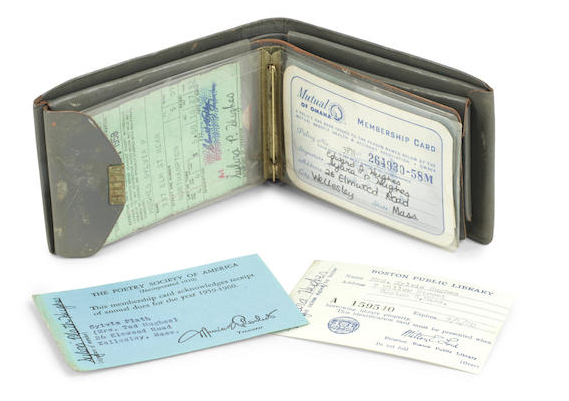
Sylvia Plath’s Wallet— $11,674

No money inside, just lots of ID cards — for the Boston Public Library, the Poetry Society of America — as well as a photo of Plath with her mother and brother near a Christmas tree. (Would Plath’s wallet be filled with half-used coffee punch cards, or would she be more scrupulous about these things? I wonder.) The value-add is the fact that the ID cards were obviously “signed” by Sylvia Plath. Among the collection of Plath’s paraphernalia recently sold at auction: her fishing rod, her typewriter (which sold for more than Jack Kerouac’s), her annotated library, her drawings, her watches, and lots of her clothing. And while we all knew Sylvia Plath’s writing was worth more than Ted Hughes’s (I even hate to make the comparison), it’s satisfying to see how the worth of her stuff backs that up. (Ah, capitalism.) According to The New York Times, Plath’s property outsold Ted Hughes’s property by more than double, earning a total of $551,862 by the end of the auction.

Sylvia Plath Looked Good in a Bikini—Deal With It

J.D. Salinger’s toilet — eBay auction starting at $1,000,000

When J.D. Salinger died in 2010, his house in Cornish, New Hampshire was purchased and promptly mined for insights about Salinger’s reclusive lifestyle. What was he doing in there all that time? According to the couple who bought the house, he was writing a lot on the toilet. “Who knows how many of [his] stories were thought up and written while Salinger sat on this throne!” the couple wrote on their eBay listing. Though the toilet was made in 1962, after most of Salinger’s work was published, the toilet lived in Salinger’s home for many years, “used” and “unclean.” Unclear how much the toilet ultimately sold for.

Photo: Nate D. Sanders Auctions in Los Angeles

A letter in which Harper Lee bashes Trump’s Taj Mahal — $3,926.00

An unnamed bidder purchased this letter in the spring of 2016 — which means they bought it before the election. Harper Lee sent the letter to her friend Doris Leopard in 1990. In it, she writes:

“The last set of Visitors departed today: the worst punishment God can devise for this sinner is to make her spirit reside eternally at the Trump Taj Mahal in Atlantic City.”

Photo: Julien’s Auctions

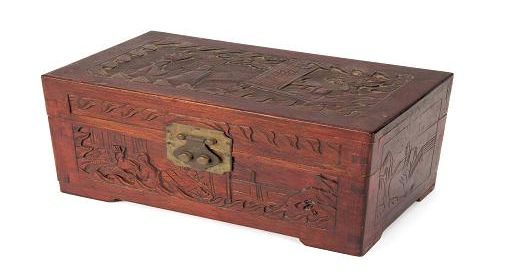
Truman Capote’s ashes — $44,000

That’s right. Some weirdo bought the snuffed out remains of Mr. Capote. For a lot of money. But the truth of the matter is, those ashes didn’t come straight from the fire. The ashes, housed in a Japanese wooden box, were formerly owned by Joanne Carson, wife of the Tonight Show host Johnny Carson. She said holding on to the ashes of her dear friend Mr. Capote brought her “great comfort.” Fine enough, but it gets weirder. Along with Capote’s ashes, the clothes he was wearing at the time of his death were also sold, as well as two of his prescription bottles — the clothes for $6,400 and the pills for a whopping $9,280. Now, I’m doing some quick deduction here, but does that mean Ms. Carson found great comfort in holding onto his death shroud and expired pills, too?

Truman Capote’s Ashes Could Be Yours

Photo: Bonhams

Charles Dickens’s Dog Collar — $11,590

Charles Dickens, according to the auction website, was a proper Victorian in the sense that he liked dogs. The collar is large, and rules out the fantasy of Dickens frolicking down the street with a small Pomeranian. Could he resist the dog, begging for some mo’ supper?

Charles Dickens’ Toothpick — $9,150

Dickens fans must be pretty devoted—and pretty rich—to have two big-ticket items make it to the list. No humbug, really. According to The Washington Post, the gold and ivory toothpick with a “retractable mechanism” was sold “by heirs to the Barnes & Noble family” at the auction house, Bonhams. The toothpick was estimated to sell between $3,000 and $5,000, but the unidentified bidder must have really wanted the gross-ass relic. God bless us, everyone.

A whole beach that looks at a lighthouse that might have inspired Virginia Woolf’s ‘To the Lighthouse’ — $106,342

The 76-acre plot of land on the Cornish coastland was the subject of a wild bidding war, with international bids from the US and even Russia driving up the final bid to a number well beyond the estimated value of the property. The land can’t be developed or used for much — and the new owner can’t even stop people from using the property — but from the Upton Towans beach, you can see the lighthouse on Godrevy Island, which many believe is the inspiration for the lighthouse in Woolf’s novel. According to the auctioneer quoted in the Guardian, the property is “simply a ‘trophy’ piece that someone could take pleasure in looking at and say ‘I own that.’”

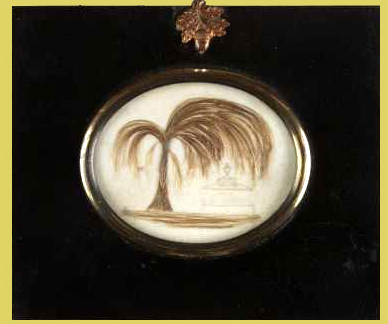
A locket that might contain Jane Austen’s hair — $6,382.50

While it hasn’t been proven that the hair is really Jane Austen’s, the “in memoriam” locket, which is made by taking strands of the deceased person’s hair and weaving them into the image of a weeping willow tree, might match the only known lock of Austen’s hair. And it’s a truth universally acknowledged that a single man, in possession of a good fortune, must be in want of this locket.

Photo: Bonhams

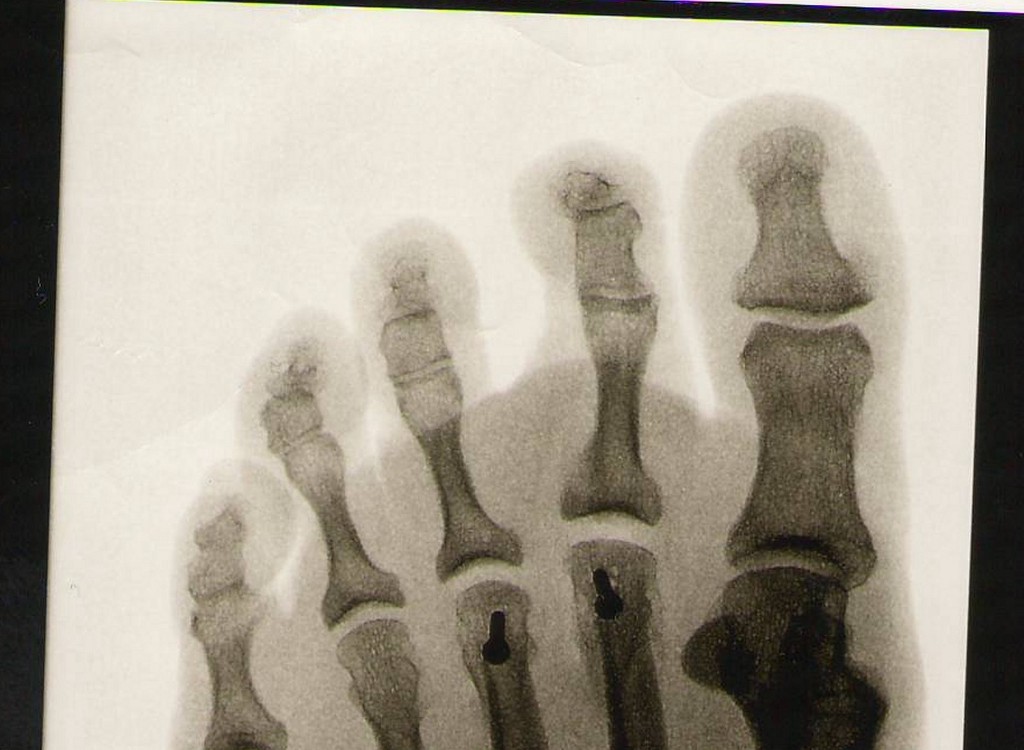
An X-Ray of Ernest Hemingway’s Foot — $15,000

The X-rays of Ernest Hemingway’s foot show evidence of the injuries he incurred on the Italian front in 1918, which he would later go on to write about in A Farewell to Arms. Weirdly enough, these medical beauties are still up for grabs, but hold off on buying them just yet, as investment values may wane when it’s “revealed” (i.e. people accept) that Hemingway was an overrated misogynist. (Gasp! Did I write that?)

‘MEM’ Is a ‘Black Mirror’ Episode Set in Jazz Age Montreal

What if scientists could extract memories from your brain? Sure, it sounds like a nice way to forget the worst parts of your past, but what if each extraction created a cloned version of yourself, doomed to re-experience that memory over and over again?

Purchase the novel

That’s the conceit behind Bethany C. Morrow’s debut novel, MEM, a clever work of speculative fiction that reads like a Black Mirror episode set in Jazz Age Montreal. In this version of the 1920s, extracted memories live sequestered in an underground vault while their wealthy “sources” run around care-free in the city above.

Things get complicated when one of these “Mems,” officially known as Dolores Extract #1, somehow remembers every moment of her Source’s life before the extraction, and every moment of her own life as a Mem thereafter. She adopts the name “Elsie” after her favorite movie character and lives independently in an apartment outside the Vault. Like her counterparts on Star Trek and Black Mirror, Elsie forces us reconsider what it means to be a person when she becomes in danger of being “reprinted.”

I spoke with Bethany C. Morrow over the phone about living as a Black American in Montreal, omitting the institution of whiteness in her book, and whether or not she’d go through with a memory extraction procedure herself.

Adam Morgan: Where did this concept of memory extraction come from?

Bethany C. Morrow: Wishful thinking. I was laying in bed thinking about how science isn’t as interesting as science fiction, which is really disrespectful to scientists. I remembered how big of a deal Dolly the sheep was and how people were like, “We’re cloning a sheep!” But I distinctly remember the short shelf life of Dolly’s clones. They’d say “We did it!” and then, “Nevermind, it died.” These sheep didn’t have anything in common. They didn’t think the same thoughts. They didn’t remember the same things. So I thought, “Why isn’t cloning about the actual memories instead?”

I thought, “Why isn’t cloning about the actual memories instead?”

AM: Have you ever wanted to remove a memory? Would you ever go through with a procedure like this?

BM: People might assume that MEM is a cautionary tale, but I think I would absolutely have to know what it feels like to know that you don’t remember something. It’s a horrible experiment, because if the consequences are as far-reaching as you suppose, there’s no undoing it. But I would definitely want to know, how much does this memory impact other memories, and other aspects of my personality. So until I actually met a Mem, I would absolutely want to do it.

AM: The publicity blurbs for MEM mentioned “the shadow of Montreal slave trade.” Were you thinking about that at all while you were writing this?

BM: I wasn’t thinking about it when I was writing Elsie’s story, but I think something that’s really important for people to understand — especially as somebody who does sensitivity reading and talks a lot about own-voice representation — is that I am Black. Elsie herself is very much a product of the version of the 1920s that she lives in, but I wrote the book, so my prior knowledge and my lived experiences and my socio-economic understanding is going to come out.

When I was first decided I was going to move to Montreal, one of the things I started researching was the proliferation of the culture of omission in a country that had 206 years of slavery, but claimed that it didn’t have slavery. So my confusion was, why wasn’t there a huge exodus to Canada? Because all you hear is “Canada was at the end of the Underground Railroad,” and, “There was never any slavery or Jim Crow in Quebec.” So I started doing some research on it because this doesn’t make any sense. If that’s true, where are all the Black Canadians? Where are all the Black Quebecois? Of course, it’s not true.

And also, as a Black American who has lived in two other countries, I can say this: when you leave America, you become American. As a Black American, I don’t necessarily face the same things that I would face in my own country because I’m seen as an American. But you see that the same racism you experienced in your country is still happening to African French people and Black French people. It’s just not happening to you because you’re seen as an American.

I guarantee you that people will see some parallels to enslavement, and in an essay I say that the only thing I’ve actually omitted from MEM is whiteness — as an institution, not a heritage or a race. So we still have enslavement in this book. We still have these hierarchies. We have the supremacy, the ownership. The thing that makes it speculative is that they’re happening in the absence of whiteness.

The only thing I’ve actually omitted from MEM is whiteness — as an institution, not a heritage or a race. We still have these hierarchies. The thing that makes it speculative is that they’re happening in the absence of whiteness.

AM: What drew you to 1920s Montreal?

BM: Elsie was wearing a cloche hat every time I imagined her, so that was the first thing. And living in Montreal, I don’t know anybody who’s not obsessed with the Art Deco architecture. And another thing was the Persons Case, where Canadian women activists were trying to overturn the law that said women weren’t legal persons. That wasn’t overturned until 1929, so I knew I didn’t want the story to reach that point.

I think that the first thing that Americans don’t usually understand is that living in Quebec does not feel like living in Canada. It’s the same country, but culturally it’s completely separate. It’s immediately different as soon as you cross the border from Ontario into Quebec.

AM: Elsie encounters a lot of real-life arts and culture that would have been around in the 1920s. Why did you include the movie The Toll of the Sea, for instance?

BM: It really goes back to what was happening in Montreal, because Montreal is this strange hybrid between North America and Europe — or like a frozen snapshot of a different Europe. So I actually wanted to figure out what sorts of things were they interested in at the time, and The Toll of the Sea was on a short list of movies that seemed likeliest to be shown in Montreal. I watched all of the movies, and The Toll of the Sea just grabbed me because almost felt too modern in terms of its commentary. Knowing how slow society is to recognize its own flaws and white supremacy, it was really startling to watch that movie. It’s about a Chinese woman who falls in love with an American man and they have a child together. I already knew who my character was and I thought, “This is a movie that Elsie would absolutely become obsessed with.”

AM: Does the magazine The Delineator appear for similar reasons?

BM: The Delineator appeared because it had a really pretty cover. I connected so much with what’s inside of that [October 1906] issue, but I knew there were certain things I would just have to ignore because they would not work with my world. Elsie would notice that there are only white people in this magazine. She would notice that there are caricatures of little tar black children in the advertisement section. She would notice all of those things because it’s not something that is normalized in her fictitious version of the 1920s that I placed her in. But I did want to read the stories and the fiction and see what I could use, and the fact that there was so much that I loved, and that Elsie quotes herself, was really just happenstance, because I literally chose that issue based on the cover.

AM: What’s next for you? You’ve got a YA novel coming out with Tor, correct?

BM: I’m very, very excited about The Sound and the Stone. I just got my editorial letter last night and my stomach hasn’t recovered. It’s a contemporary fantasy set in Portland, Oregon. It’s about two black girls, sisters, who both have a supernatural identity, one of which is known and has to be hidden, and one of which is beginning to reveal itself. One of the sisters, who’s named Octavia after Octavia Butler, is a siren, and it’s in a version of the world where only black women are sirens. It’s not romantic. It’s not beloved. It’s not attractive. It’s hated. So within the black community, there’s a network that keeps them safe from discovery.

My sister lives in Portland so I’ve spent a lot of time there, and I’m from the West Coast, and I really want to see more representation of Black American kids who are West Coast, who don’t necessarily have any known ties to the South, or to their roots in the African diaspora. I think it’s a very different experience, because a lot of literature that read, it’s almost like every black person is from the South, and every Black person is aware of where their family is from. But I don’t know that. There are a million reasons why we don’t know that, slavery of course being number one, and also just having a family that’s racially diverse. I feel like those kids don’t necessarily get represented a lot, who still do have very strong community ties, very strong family ties.

What It Means to Be a Writing Teacher in the Age of School Shootings

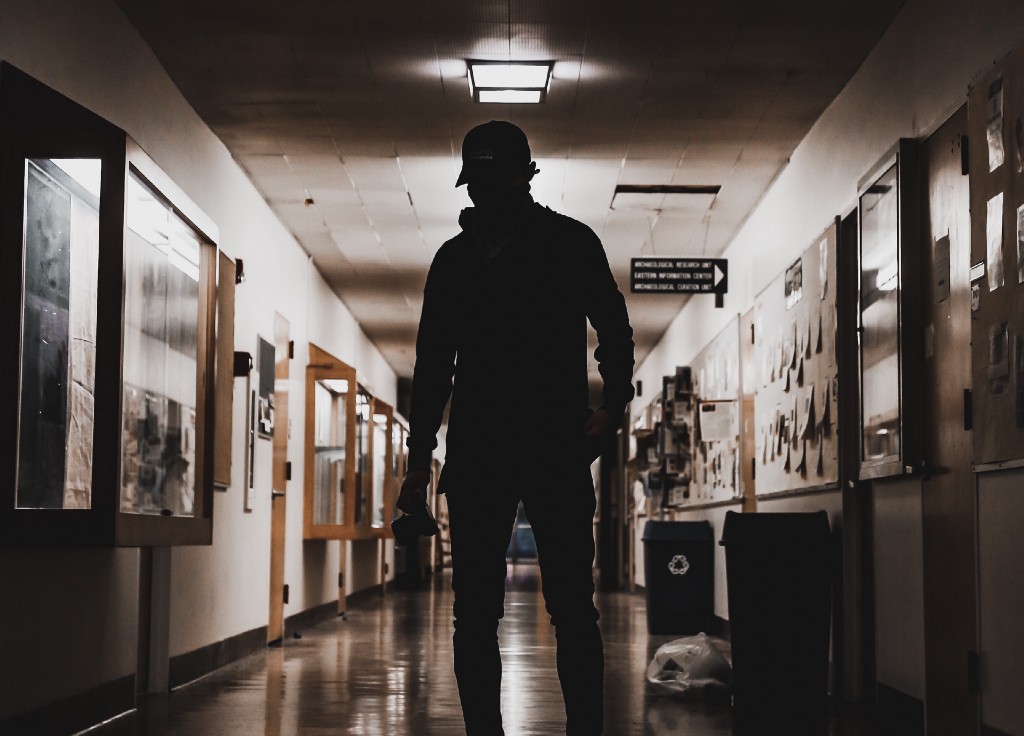
I’m teaching on a Monday morning when a young guy — distressed denim jacket, headphones — walks past our room. My students and I are seated around a long table, made of three tables pushed together. “Workshop-style,” we call it. It’s an introductory fiction writing course, held in an Art Education classroom — at the University of the Arts, it’s not uncommon for rooms to double as other things. This one has a sink and paper towel dispenser in one corner, and the walls are papered with second-graders’ self-portraits. The classroom is long and rectangular, tucked in the back corner of the tenth floor. On the wall facing the street stand four tall windows with heavy metallic blinds that rattle when it’s breezy. It’s a cold day, but the room is warm, so the windows are cracked. Even ten floors up, the sounds of downtown Philadelphia blow in from the street: impatient honking, throbbing bass, an ambulance’s long wail. The opposite wall faces the hallway. The top half is a window, through which anyone walking by is visible to us, and we to them.

When I arrive, my students are awake, engaged at ten in the morning. I love these students. I hear their chatter from down the hall. This morning, Jaymie is telling us she’s been experimenting with drawing freckles on her face — life hack, she says. Tyra is scraping the inside of a yogurt with a plastic spoon. I flick on the lights, leave the door propped open. Today we’re discussing Miyuki’s draft, which is quite good, and everyone is excited for her. They have taken careful, plentiful notes; their hands are in the air. The story features an unreliable narrator, and we talk about how details can reveal the character indirectly. The tabletop — Micki’s potato chips and feminist literature, Zoe’s giant water bottle — is cluttered in the way of a family’s shared dining room.

I nod, throwing out questions, listening hard to what they’re saying. I’m energized by their insights. To discuss fiction with students like these has been, for more than 20 years, one of the primary pleasures of my life. In my peripheral vision, I see movement, a person, in the hallway. Not unusual, a person in the hallway. Except that our classroom is in a back corner, and there’s very little traffic here. This person, a guy — kid? man? — is moving slowly. My eyes flick toward him: jacket, headphones, patchy beard. He pauses, chin down, and I feel something leap in my chest — a lousy description. We’ve talked in class about how to describe familiar feelings in original ways, but that’s what it is: a leap in the chest. I’m trying to focus on what Liz is saying, but my attention is diverted — I don’t believe my students notice him, or if they do, they’re not alarmed. Of course not. A teenager in a distressed jacket, scruff, headphones. A UArts student, almost certainly. Edgy-looking but probably, like so many UArts students, enormously sweet. He’s pausing because he’s late for class, adjusting his iPod or checking his phone. I watch out of the corner of my eye until he keeps going.

This is new, this vigilance. Or it’s vigilance of a different sort.

When I began teaching college, at the University of New Hampshire, I was 22 and getting my Master’s in writing. It was 1995. Email was relatively new. Flavored things — coffees, bagels — were trendy, popping up along the main street in Durham. Grunge was popular. Bill Clinton was President. The shooting at Columbine would occur three years later, in the spring.

Four months before, I had been a college student, a senior at Bowdoin. Now I was teaching college students. Each semester, as part of my graduate assistantship, I would teach one section of First Year Writing: English 401. I’d spent the entire summer preparing, reading the assigned anthology and tabbing pages, taking notes, drafting schedules — I had no idea, really, what I was doing. Assign a theme, my grandmother had suggested. She’d gone to school in a one-room schoolhouse in northern Maine.

My cousin Jimmy, in fourth grade, asked: What will you do if they ask you something and you don’t know the answer?

An innocent question, but it hit a nerve. I guess I’ll tell them I don’t know the answer, I said.

It was hard for me to believe I would be teaching actual students, which was surprising — or, perhaps, totally unsurprising — since I had been practicing to be a teacher all my life. As a child, I’d had an imaginary class. I stood at the chalkboard that hung in our living room, just to the right of the front door next to the record player, lecturing effusively to the empty room. In real life, I was very shy (I never spoke in class unless called on, not even in college) and beset with fears, both everyday and imagined — robbers, kidnappers, fires, nuclear war — around which I built elaborately detailed narratives in my head. In front of my imaginary class, though, I was confident, articulate and impassioned. I typed up alphabetical lists of my students. Ola Bass, Lester Cable, Cleo Cottsworth, Sidney Douse. I listed their daily activities, scheduled their parent-teacher conferences, assigned them instruments in the school band. Some of them I enrolled in an extracurricular called “Afterschool Adventure Course.” I instructed them to write essays, then wrote said essays, in different handwritings and at different ability levels, grading and commenting on them with a red felt-tip pen — Wonderful true-to-life account or, more often, Highly disappointing effort or Please see me. I was far more harsh than any teacher I’d encountered in real life; it was as if I was playing a part, similar to the brassy, fearless girls I wrote about in my short stories, embodying characters unlike myself.

Now, at 22, these students were real people. I recall staring at the roster of twenty-four names in disbelief. I bought a pale blue spiral binder — TEACHER’S PLAN BOOK — and penned their names neatly on the red lines. I debated what to wear on the first day. I would always dress up more than the other teachers — who, this being New Hampshire, wore mostly jeans and sweaters — but I felt the need to establish my authority. I was young, still shy. Each week was a series of hills and valleys. For the 24 hours that preceded every class — it met for an hour on M/W/F — I subjected myself to mounting, almost paralyzing nervousness. After class, a brief, exhausted reprieve. The next day, it started again.

In the classroom, I was somewhat able (at least, I think) to disguise my shyness. It helped that I came in with the day’s plan more or less memorized. I hadn’t learned yet that the best classes are often the ones that go off-script, allowing for interesting digressions, and wouldn’t have had the confidence yet to let that happen if I had. I knew I could write well and help my students write better. I was diligent and prepared. And I cared — I cared. Whatever I lacked in classroom presence, I believe I made up for in the intense attention I gave every student. I still have all my old teaching notebooks and am astonished by the pages upon pages I devoted to every one: notes on the students, their essays, our meetings about their essays. A wonder I was doing any writing of my own.

In 401, the emphasis was on writing from personal experience. Recreate a moment or experience from your life that was significant, went the instructions. Watch out: don’t just tack the meaning of the event onto the ending but try revising so that meaning is revealed. Naturally, such an assignment elicited deeply personal stories. Deaths of relatives. Near-fatal car accidents. Abortions. Addictions, friends with addictions. As I read those essays, then and for the next four years, I felt concern, and amazement, and also, I suspect, a touch of pride in their openness, even the gravity of their subjects, as if this somehow reflected well on me.

Looking back, there were things my students wrote about that — 22 years old, no prior teaching experience, relatively little life experience — I was not qualified to be dealing with. Often they were revealed explicitly: the students were telling me on purpose. This could be difficult, but was at least clear-cut. Other times, it was more complicated — the unreliable narrator, the accidental subtext, the truth that stormed suddenly, seemingly inadvertently, to the top. Like the essay about a father’s drinking that gradually revealed itself to be about the student’s drinking. By the end of the paper, my notes in the margins dwindled down to nothing. What a powerful piece, I wrote. I made a few suggestions but I had trouble treating this as just a writing assignment because I was — am — concerned.

“What a powerful piece,” I wrote. “I made a few suggestions but I had trouble treating this as just a writing assignment because I was — am — concerned.”

Or the essay about the eating disorder (there were many essays about eating disorders) that was alarming not only in its details but its note of forced resolution, of “meaning.” After our conference, in my notebook, I scribbled for two pages: The paper was difficult to discuss because I believe she is still quite ill. I asked her if she wanted a counseling number — she said no, she liked handling it on her own.

For all my worries, I only actually suggested counseling to students a handful of times. Maybe I was wary of overreacting, overstepping. Maybe therapy felt like a bigger deal to me then. Maybe it was my old shyness kicking in. When I did, I followed the advice we had been given: write down the phone number so they can turn to it later, prevent our conversation from evaporating as soon as they open my office door.

Those first years in New Hampshire were a crash course in teaching, but also in discovering that teaching is about much more than I understood when writing stern notes to my imaginary students: not just a responsibility to the material on the syllabus, but to everything else. Of course this is true for all teachers, but perhaps uniquely writing teachers, who read so much about their students’ lives.

In 2000, I moved back home to Philadelphia and began teaching at the University of the Arts and, in 2004, at the New School in New York. I was now teaching only fiction writing — which was, in some ways, simpler. We never assume fiction is autobiographical, I tell my students early in the semester, establishing the ground rules for our discussions. We refer to “the narrator,” not “you.” Fiction: let’s treat it as such.

But this doesn’t apply to me — how could it? Naturally, over the years, there have been stories that worried me. Or, if not the story itself, then the feeling of the story. The obsessive, digressive references to eating. The description of a murder that is, yes, somewhat cartoonish, but also overly elaborate, gruesome — gleeful. (Is this something? Is it nothing? Is it generational, the by-product of violent movies and video games?) Or the boyfriend character who hits the girlfriend character with no remorse, no seeming awareness that it is even wrong, and — here’s where it gets more complicated — not just awareness by the character but awareness by the story, by the student. (How to navigate these fine points? When to break the wall and step in?)

Rarely is it clear what to do. Fiction is subtle, half-invented, safe. A kind of pact. Usually, unless a story truly alarms me, I don’t address these things outright. I might make an observation in class about the profound sadness of the character, the moral ambiguity of what he does or doesn’t do. Submit a CARE report. Watch my student with a closer eye.

Usually, unless a story truly alarms me, I don’t address these things outright. I might make an observation in class about the profound sadness of the character, the moral ambiguity of what he does or doesn’t do.

Are there times I didn’t intervene, over the past 22 years, when perhaps I should have? Maybe. Probably. I still remember an essay for 401, one of my first semesters, in which a student described how her mother punished her if the bathroom towel was not centered precisely on the towel bar, equidistant from each end. Not the most concerning detail, on the face of it. But I still remember it, and I remember her, and the sense that it was just a sliver of the whole and troubling story. But I didn’t say anything. I probably praised the detail for being so specific.

10/4. UArts Alert: FBI Security Advisory. Violence threat against unspecified Philly area college on 10/5. Be alert for suspicious activity. UArts security increased.

The text message, directed to all faculty and staff, comes in late on a Sunday afternoon. It is October 2015. It’s been almost 20 years since I taught my first college writing class and I am now the director of the undergraduate creative writing program at the University of the Arts. The world is a different place. Filled with new fears, fraught in new ways. The week before, there was a shooting at a community college in Oregon; nine people are dead.

The Columbine shooting was in April 1999. This was before cell phones were ubiquitous or Facebook existed and one heard about news the instant after it occurred. I’d been holed up all day marking papers and hadn’t heard what happened until that evening, from one of the students in my class.

It was at school too (UArts, April 2007) that I heard about Virginia Tech. I was standing by the copy machine outside the door to the dean’s office, heard him suck in his breath. Later, I watched the news, feeling incredulous, nauseous. An interview with the shooter’s creative writing teacher ran on CNN.

Later, I watched the news, feeling incredulous, nauseous. An interview with the shooter’s creative writing teacher ran on CNN.

December 2012. CNN again: this time my husband and I are in a hospital waiting room. I’m having a fertility test; we’ve been trying to have a baby. I was told the test is painful, was instructed to take eight Motrin before coming. The news about the shooting at Sandy Hook is playing on the TV bolted to the ceiling. The waiting room is full but silent, all eyes pointed at the screen. We’re finally ushered into a room, where I’m injected with dye, my Fallopian tubes swimming with ink. The doctor says, If you ask me, they should stop putting these things on the news.

Sunday afternoon, seven minutes after the text, a more detailed email is sent to all faculty and students.

Subject: FBI Safety Alert.

The FBI and Alcohol, Tobacco and Firearms (ATF) have notified all universities and colleges in and around Philadelphia of a threat of violence against an unnamed university or college that was posted on social media. The post alleged that such a threat would take place Monday, October 5 at 1 p.m. Central/2 p.m. Eastern time.

I teach at 10:00 on Monday morning. When I wake up, feeling tense, it’s still dark. I check email and find a note from Glorious, one of my students. The subject line is empty. It had been sent late the night before. It says only: I’m terrified to come to school tomorrow.

I understand, I dash back. If you feel uncomfortable, stay home.

Because who am I to reassure her? I’d like to stay home too. I’d like to not leave my house for a week. But I get ready for work and nurse my son, who just turned one. At 7 a.m., my mother arrives to babysit. She is worried. On her drive over, she heard a report about the threat on the news.

On the subway, another email appears. It reiterates what we know — the threat, the timing — with additional details about increased campus security, patrols by federal law enforcement, Philadelphia police. It is unknown whether the threat is a hoax, so increased safety measures are being taken, the email says. Students who believe it best not to go to class today will not be penalized.

Twenty-three minutes later, a clarification. Faculty and staff, in addition to students, should use their own best judgment re: their comfort level in coming to campus today.

I forward both emails to my husband. Jesus, I write.

Be careful, he writes back.

When I arrive at my building, there are extra security guards at the doorways, standing on the sidewalk instead of sitting in the lobby behind the desk. There’s a cop too, as well as the director of the music program. He is greeting students warmly, trying to inject the familiar into the unsettling and strange.

I arrive at my classroom early, a little before 10:00. Some students are absent. Understood. The ones who are there, I’m impressed by their courage, as impressed as I am sympathetic to the ones who were too nervous to come. Our class feels fairly normal, which doesn’t feel normal. At 11:20, class is done.

If I could, I would head home then, but it so happens that at 1:00, I’m scheduled to visit a Contemporary Novel course. My friend Rahul assigned my book; at the beginning of the semester, we’d planned I would come that day to discuss it. If you don’t want to stay, I totally get it, Rahul tells me kindly. But, I think, if these students have read my book and are showing up to discuss it between the fraught hours of one and four, I should too.

We meet on the sixth floor, in a large classroom near some acting studios. About half the class is absent. Understood. The other half is there, participating generously. We talk about structure and symbolism, about drawing on one’s own life in fiction. Then we hear a loud noise from the hallway — conversation stops. We glance around the room. A shout, we think. At UArts, a shout in the hallway is not so unusual — a vocal major warming up, theater major rehearsing. And that’s likely all it was. The moment passes. Nothing happens, not on our campus and not on any campus. We share a nervous laugh, move on.

This new vigilance is more layered. In 2018, I still worry about my students — what they may or may not be going through, may or may not be alluding to in their writing, accidentally or on purpose. I worry about things they confide to me in my office. They are depressed. Anxious. The whole world is anxious. Anxiety has become the norm. I submit CARE reports; I check in with them, check in again. I commute to school, alert for some unseen catastrophic event lurking around the corner. I realize my reaction is probably somewhat outsized, the by-product of my old fearfulness. I also know that ten years ago, even five, I wouldn’t have stopped to notice someone walking slowly by my classroom, but now I do.

They are depressed. Anxious. The whole world is anxious. Anxiety has become the norm.

11/1. UArts Alert: Threat against UArts staff discovered on social media. Security increased. Philadelphia PD investigating.

It is November 2015, another Sunday, when this text appears on my phone. The previous threat was five weeks ago. The Paris attack was two days ago. This time, my immediate response is fury — is this what it means to be a college professor now? Because I didn’t sign up for this. Neither did my students. Maybe I should hold class in my living room, like my professor in grad school. Or teach online. Write full-time. I weigh what’s most important to me. My family. My husband, my little boy.

My husband, too, is less diplomatic this time. Screw it, he says. Cancel class and stay home.

But I go, because that’s what we do. What we’re doing. By Monday morning, the police suspect this threat is related to a domestic dispute. There’s still extra security on campus. My students, all but one, are in class at 10:00. They seem to shrug this one off, an annoyance, roll a collective eye at the kind of losers who post threats online. Maybe they’re so accustomed to social media that they’re inured to it. Maybe this is just the world they know.

It’s no surprise to me that my son, now three, has his own imaginary class. His students are a motley crew of stuffed pigs and ducks, musical instruments, plastic tools, a wind-up snowman. I love to watch him teach his class, the simplicity of what it means to him. “O-kay,” he says, perched on a makeshift stool made of wooden blocks. He speaks with a funny emphasis that he must associate with adults sounding authoritative. “We’ll eat a snack,” he says, addressing his students, laying out his lesson plan. “We’ll dance. We’ll play with our friends. We’ll build. We’ll think about things.”

Another Monday morning. I’m on my way to school. Lately, my commute feels like one long held breath: the ten-minute ride on the commuter train, apprehensively scrolling through the latest headlines, hoping some new horror hasn’t transpired during the night. The transfer at 69th Street, the twenty-minute subway ride into Center City. The subway feels relatively safe in the morning, less so in the afternoon. A few weeks earlier, midday, I was walking down the stairs to the platform when two guys approached me and asked: Are you nervous? You look nervous. They spoke quietly, smiled slightly. I walked back upstairs (nervous, yes, now of course I’m fucking nervous) and waited until they were gone, until my panic had hardened into anger, not wanting to walk back down to the platform but wanting to just get home. Last week, on the train, there was an altercation in the next car over; we were held at the station until police arrived. A few months prior, the subway was stopped at 56th Street because a Penn undergraduate had jumped onto the tracks. I take a seat now, watching the stations blow past the window, punctuated by stretches of flickering dark. Across the aisle, a guy is playing a video game on his cell phone. It sounds like the spattering of gunfire. I open up Tyra’s story to read again before class. It’s speculative fiction, a love story set in the midst of an imagined global disaster. The government has collapsed. The ocean has risen three feet. When I get off the subway, I quickly walk the eight blocks to my building — coffee, bagel, good morning to the security guards — where I take the elevator to the eighth floor and am glad to reach my office, turn on my computer, shut the door, exhausted. The day has just begun.

Science Fiction and Fantasy Novels That Take Us Beyond the Gender Binary

Most of the time, writers include only two genders in their stories, because that’s what our society tells us is valid. There are men and there are women. End of conversation. But in reality, gender is a social construct with real-world implications. In other words, despite the fact that the gender binary is essentially made up — despite the fact that gender, period, is is essentially made up — our lives are shaped by our perceived and assigned gender.

We organize our lives around the binary. Clothes, bathrooms, toys — even Doritos — are gendered. It can be difficult to trouble the notion of gender because it has such a long-reaching impact on our lives, but, to borrow from an old chant: we’re here, we’re genderfluid and nonbinary. Get used to it. And, perhaps more importantly, recognize and create more space for us.

We’re here, we’re genderfluid and nonbinary. Get used to it. And, perhaps more importantly, recognize and create more space for us.

Writers have an opportunity to put their best skills to use exploring and questioning where the constructed meets the real. (Personally, I think that’s both the opportunity and responsibility of writers, whether we’re talking about gender or anything else.) Of course, we desperately need the voices of nonbinary writers to tell these stories, but we also need nonbinary characters and their storylines to be visible in more books, period.

“I think hard times are coming when we will be wanting the voices of writers who can see alternatives to how we live now and can see through our fear-stricken society,” said Ursula Le Guin, venerated science fiction and fantasy writer, in her National Book Foundation lifetime-achievement award acceptance speech in 2014. After going on to deliver a beautiful takedown of capitalism in general and the industry of publishing in particular, she concluded, “Resistance and change often begin in art, and very often in our art — the art of words.”

Le Guin saw science fiction and fantasy as not only an opportunity to create fascinating magical and technologically advanced worlds, but also as an opportunity to envision something truly novel. These genres give us an opportunity to imagine realities untainted by a status quo that erases the lives of nonbinary folks.

These genres give us an opportunity to imagine realities untainted by a status quo that erases the lives of nonbinary folks.

So, what better setting to redefine gender and gender variant characters than the worlds created by science fiction and fantasy writers, worlds that by their very nature both reflect the constructed society created by the author and the real world we all live in?

That’s not to say that science fiction and fantasy are the only places genderfluid and nonbinary characters should live. We belong in all kinds of stories — science fiction and fantasy have just led the way.

Below are six science fiction and fantasy novels that explore gender, and their hits and misses.

The Left Hand of Darkness by Ursula K. Le Guin

“A man wants his virility regarded, a woman wants her femininity appreciated, however indirect and subtle the indications of regard and appreciation. On Winter they will not exist. One is respected and judged only as a human being. It is an appalling experience.”

Published in 1969, Ursula Le Guin’s science fiction novel The Left Hand of Darkness presents a future in which the Ekumen, a union of 83 planets, is on a mission to make contact with other planets inhabited by humans. To do so, they send one person to make first contact. Each planet was the site of genetic experimentation of various types.

On the planet called Gethen the genetic experimentation resulted in humans on this planet being primarily neuter with periods of sexuality in which they transition into either male or female hormonal dominance. When Terran ambassador Genly Ai is sent to Gethen, the inhabitants categorize him as a Pervert due to his constant state of being male. Genly observes, retells myths, and includes notes from anthropologists who studied Gethen and found that the Gethenians have lived for thousands of years without rape due to their gender fluidity. It may also, they surmise, be why they have never had a war.

Estraven, a native inhabitant and political leader of one nation, is exiled for his support of Genly, but they find each other again in another country. The two are drawn together across the galaxy and the world of Gethen for political and humane reasons and they develop a close relationship that changes their fates forever.

What a Little-Known Ursula K. Le Guin Essay Taught Me About Being a Woman

Left Hand is not without issues, though. For one, Le Guin uses male pronouns to refer to everyone, relying on the convention of the time when it was published, which is still widely used today, that “he” is the gender-neutral pronoun. (Le Guin later revised her opinion in her book Steering the Craft.) Another issue for me is that while the Gethenians are ambisexual, this is a unique feature of this one planet, which erases the gender fluidity of humans that already exists on Earth, Genly Ai’s home planet.

What I adored about The Left Hand of Darkness was the juxtaposition of a harsh planet in a moment of political upheaval against the intimate love story that unfolds between people from different worlds, centuries, and genders. While the book is not widely considered to be a love story, I would argue that portion of the narrative is where questions of gender and sexuality take on a human face.

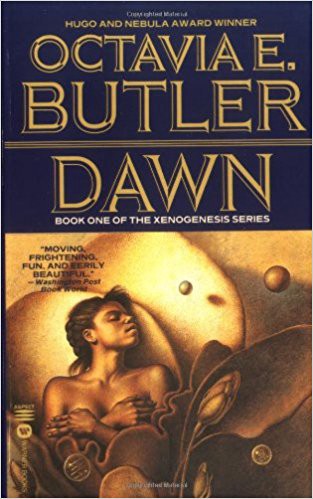
Dawn by Octavia E. Butler

“This might be her only chance ever to watch close up as an ooloi seduced someone. She thought it should have bothered her that the ‘someone’ in this case was Joseph. She knew more than she wanted to about the wildly conflicting feelings he was subject to now.”

Octavia Butler’s Dawn (1987) is the story of Lilith Iyapo’s contact with aliens, the Oankali, over 200 years after nuclear war broke out on Earth, destroying humanity. As she interacts with the Oankali, she realizes she will be responsible for saving humanity — with or without the aliens’ help.

The Oankali are remarkable beings with sensory tentacles they use to experience the world. They also have a third gender, called ooloi, that facilitates all their sexual contact. The Oankali travel throughout the universe combining genetic material with other species they meet, a goal they describe as a biological imperative. As they incorporate new species into their genetic material, they breed out the negative tendencies of each. For humanity, our worst feature is the particular combination of our high level of intellect with our hierarchical reasoning.

When the novel opens, we find Lilith waking up on one of the Oankali ships where she is being held captive. She is the first human to have been awakened from stasis and is selected to greet all the other humans that will be awoken.
The book is an exploration of humanity, sexuality, race, xenophobia, and freedom. Ava DuVernay will adapt the book for television, and I can’t wait to see what she comes up with.
Dawn is truly a must-read. The novel is filled with compelling characters who not only have to grapple with a whole new world but also have to deal with and survive humanity’s failings, such as rape, murder, and kidnapping. Strengths of the narrative are the way the third gender of aliens facilitate sexual contact and the very human rejection of interbreeding with aliens. Weaknesses include the use of “it” for the ooloi, which has an effect of dehumanizing the third gender, and the fact that there are no overtly queer or gender variant humans, so as with Le Guin’s novel, the existing fluidity and complexity of sexuality on Earth is omitted.

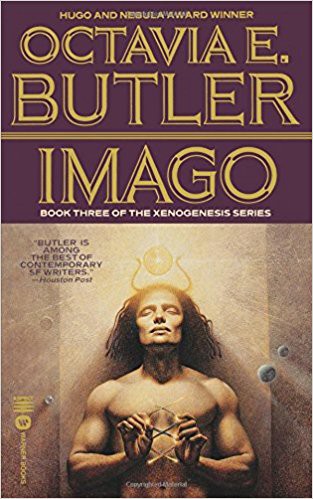
Imago by Octavia E. Butler

“There were still some Humans who insisted on seeing the ooloi as some kind of male-female combination, but the ooloi were no such thing. They were themselves — a different sex altogether.”

Imago (1998) is the third book in the Lilith’s Brood trilogy. While the book takes place on the same Earth as Dawn, it is a very much changed world, 100 years later. We follow Lilith’s son, Jodahs, as he reaches an Oankali version of puberty called adolescent metamorphosis.

Jodahs is a construct, meaning he has human and Oankali genetics. When he enters his metamorphosis, it becomes clear that he will not be male or female, but rather ooloi. This is the first ooloi construct and represents a danger to humans and Oankali alike. Given their ability to combine genes, an unpaired ooloi could harm just about anyone or anything. Only finding human mates can help an ooloi control the changes in and around themselves. Alone and without mates, Jodahs becomes despondent.

As Jodahs wanders the jungle having reverted to a lizard-like state due to their loneliness, they finds two humans. And they’re fertile, a fact that should be impossible since the Oankali have sterilized all the humans who have decided not to join them. Jodahs falls in love with the siblings and decides they are his mates. He immediately changes his appearance to become pleasing to them and the three bond deeply.

Now More than Ever, We Wish We Had These Lost Octavia Butler Novels

Imago is an incredible exploration of a nonbinary gender identity, from the perspective of an ooloi, a nonbinary Oankali/human hybrid. We get to walk alongside Jodahs as their body changes and we get to feel how they feel about themselves, their sibling, and how the Oankali have treated humanity. The narrative brings the questions Butler raised around race, gender, and freedom in Dawn full circle, interrogating whether the Oankali can consider humans their equals. Butler still uses “it” to describe the third gender in this narrative, but it is less jarring due to the fact that the “it” is also the “I” telling us the story. More importantly, we finally get a (partially) human face to gender fluidity and nonbinary gender identities.

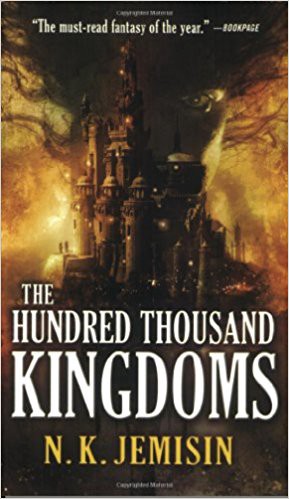
The Hundred Thousand Kingdoms by N.K. Jemisin

“A woman’s face shone at me from the darkness, proud and powerful and so breathtaking that I yearned for her as much as I had for him, and it did not seem strange at all that I did so.”

N.K. Jemisin’s debut novel from 2010, The Hundred Thousand Kingdoms, is an epic fantasy novel exploring race and gender dynamics. A young woman, Yeine, whose mother was heir to the throne of the eponymous kingdoms, must compete to take her mother’s place. Yeine struggles with the caste system in a magically built castle/city where the old gods are kept as slaves and the humans in charge serve the one true god.

Almost immediately, she meets a trickster god named Sieh and one of the creator gods named Nahadoth, aka the Nightlord, who tries to kill her in a manic state. After he regains composure, Yeine feels attracted to Nahadoth, despite warnings of his destructive and all-consuming power, and eventually allies herself with the enslaved gods.

When she’s researching her situation in the library, she stumbles upon a depiction of Nahadoth from when he was free in which he has breasts. Only upon enslavement by his former lover/brother/fellow creator god is Nahadoth forced into a static male form. He had formerly assumed many forms across the gender and biological spectrum, a reality Yeine gets to experience intimately when she’s seduced by the Nightlord and his many hands.

Another important aspect of the novel is the other half of Yeine’s family, who are Darre. In their matriarchal society, “typical” dominant gender roles are inverted. It is women who are fighters, religious figures, and leaders.

The Hundred Thousand Kingdoms is a wonderfully sexy novel with complex and compelling characters. The fluidity of Nahadoth’s gender is beautifully represented as a composite part of his nature. He is the god of change and being unchanging is painful for him. Unfortunately, I can’t remember a time we meet a genderfluid human, though her interactions with Nahadoth certainly make Yeine question a lot about herself.

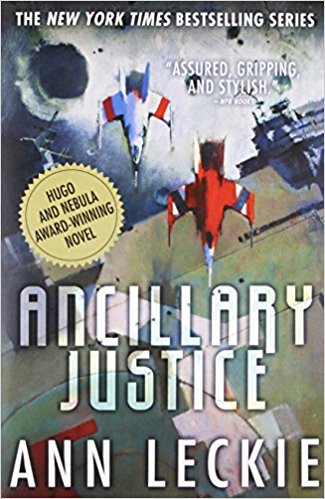
Ancillary Justice by Ann Leckie

“Radchaai don’t care much about gender, and the language they speak — my own first language — doesn’t mark gender in any way. This language we were speaking now did, and I could make trouble for myself if I used the wrong forms. It didn’t help that the cues mean to distinguish gender changed from place to place, sometimes radically, and rarely made much sense to me.”

Ancillary Justice, published in 2013, is a space opera set in a colonized universe where there is one ruler to whom everyone must bow, the Lord of the Radch. In contrast to the other novels on this list, everyone in this one is referred to with the female pronoun.

This is the first book on the list where the protagonist, Breq, is actually the gender variant character. Breq is a nonbinary, asexual artificial intelligence who once occupied a ship with a retinue of enslaved bodies she implanted herself into and controlled. Due to political turmoil on one planet, and a bad run in with the Lord of the Radch, Breq ends up implanted in one single human body.

We Need More Non-Binary Characters Who Aren’t Aliens, Robots, or Monsters

One of the aspects of this novel that I most adore is how the narrative is put together. It isn’t that everyone is called “she,” but then — wink, nudge — the narrator gives us hints that this person is a female “she” and that person is a male “she.” Instead, the only time Breq speculates about the gender of people around her is when she is trying to use the conventions of a given language where pronouns are gendered. When I first read this book, I was delighted and astonished at what Leckie could achieve without giving us a marker we generally rely on to differentiate characters.

The entire series is filled with non-traditional relationships, powerful expressions of love and intimacy, and a vision for a desperately fought for, inclusive, queer community fighting against a hegemonic regime. Throughout the series a bitter battle for freedom wages, but in the end, only Breq’s ability to see herself as a flawed individual, capable of making mistakes, saves her life and the lives of her crew, friends, and family.

The Mirror Empire by Kameron Hurley

“Sometime in the last few days, Taigan had decided it was time to change the way Taigan thought of himself…hirself…herself…yes, herself, again.”

In The Mirror Empire, Kameron Hurley set out to write a world where nonbinary people exist and multiple societies’ definitions of gender and race clash against one another. The 2014 book also blurs the line between science fiction and fantasy, depicting magical, epic fantasy societies facing interdimensional foes.

One of the main characters is a powerful magician named Taigan, who experiences hir gender so fluidly, that depending on how ze is feeling, ze uses any of three pronouns: she/her, he/his, or ze/hir. Ze isn’t the only nonbinary character, as there are other named characters who use “ze” pronouns as well.

What’s exciting about this particular narrative is how it doesn’t erase gender, but rather embraces all genders. Several of the cultures in the novel acknowledge three or more genders and characters are fluent in using nonbinary pronouns. At one point, Roh, a male character from one of these cultures, laments that in another society that has slaves, those people are assigned a gender, a denial of a basic right in his society: the ability to self-define.

There is even a society that is so toxically matriarchal that husbands are possessions to be beaten, raped, shared, and killed as the wife deems fit. This society inverts the fantasy trope of a young woman being sold into marriage to a sexually abusive man (think of A Game of Thrones). What is powerful about this depiction, though, is the time we spend with the victim, Anavha, and the way the narrative condemns toxic gender binaries of any arrangement.

There are three main things I love about this novel. First, nonbinary identities are normalized. Second, more than one nonbinary character exists, so being nonbinary is represented as the diverse identity it is — not all nonbinary folks are the same and this novel gets that. Finally, there is a temptation, sometimes, to believe that a matriarchy would fundamentally be better than the patriarchy. The matriarchies we see in The Mirror Empire interrogate this assumption in productive ways.

8 Books About The Pain of Being Exiled From Your Home

My novel Call Me Zebra is about dislocation, about being unmoored from one’s home, and about how literature can be a lifeline in exile. In the aftermath of her father’s death, Zebra, born Bibi Bibi Abbas Hosseini, decides to retrace the journey she and her father made from Iran to the United States via Catalonia years ago. As she moves across the Western Mediterranean, her political anger fuels the production an epic text of protest writing she calls “The Matrix of Literature: A Philosophy of Totality,” a manifesto that will connect the threads of all the literature she has been steeped in throughout her life. Zebra asks the reader to think alongside her about how we can account for and navigate that which has been erased through revisionary histories?

Purchase the novel

This list of books about exile, fugue states, banishment, political prisoners and the displaced — some of which make an appearance in Zebra’s manifesto — are all, in one way or another, a meditation on the idea of home and hearth. They share a central question: How does dislocation shift our experience of identity, community, and language?

Considered together, these books offer us nuanced insight into our fragile human condition and remind us of those whose stories are at risk of being forgotten; they guide us to think of writing as testimony and historical record and provide us with the time and space to consider the psychic and material imbalance of our world. Each of these books is a gesture toward restoring the balance just that little bit. Here are eight books about exile.

Disoriental by Négar Djavadi

Told with clear-eyed propulsive prose, this kaleidoscopic novel is about an Iranian family foraging for a life in France, trying to piece together the shattered parts of their ancestry and identity. I was instantly drawn to the narrator’s father, Darius Sadr, who spends his life “bent over a ream of writing paper” and whose destiny is “joined to the staircases of the world…and to the indifferent gazes of the passers-by.” I’ve completely fallen in love with his absurd, embittered logic and with his daughter Kimiâ’s wild, untethered voice. Disoriental is told from Kimiâ’s perspective as she sits in the waiting room of a fertility clinic in Paris with the possibility of the next generation of Sadr’s looming on the horizon. This electrifying novel is as much about the tricks of memory as it is about art and politics and the ways in which we are left alone to contend with the tragedies of history that come at us in waves.

The Brothers: The Road To An American Tragedy by Masha Gessen

Masha Gessen, who I consider to be one of the most courageous journalists of our times, retraces the cultural and historical roots of our current political climate with astonishing precision. She fearlessly takes on the big issues: terrorism, LGBTQ rights, that horrifying, belligerent duo, Vladimir Putin and Donald Trump, and the disturbing ways in which the bodies and psyches of migrants and exiles are unjustly taxed. In the process, Gessen reveals to us the complicated collective tapestry of our lives. The Brothers is a must read for anyone who wants to understand the deeply disorienting history of the rise of nation-states and the ways in which the old laying down of borders informs acts of terrorism today. The book opens with a detailed map titled “The Tsarnaevs’ Journey: Every few years the Tsarnaevs traveled thousands of miles in search of a better life,” immediately refocusing our attention on the long tiresome journey that lead to the nightmare in Boston on April 15th, 2013.

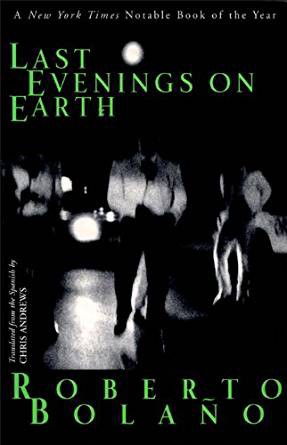
Last Evenings On Earth by Roberto Bolaño

The first short story collection in English by the beloved Chilean author, Roberto Bolaño, contains fourteen stories, each told from the perspective of an exiled writer on an impossible quest to survive the everyday at the margins of society, far from home. The measured tone of these stories is exquisitely counterbalanced by the ineffable shadow of trauma and loss that Bolaño expertly casts over his deliberate, almost clinical sentences. The opening story is set in Girona, on the outskirts of Barcelona, and as someone who took refuge in that strange city’s labyrinthine network of cobblestone streets to write, I was, as I always am by Bolaño’s writing, immediately seduced.

The Displaced: Refugee Writers on Refugee Lives edited by Viet Thanh Nguyen

With contributions from Vu Tran, Porochista Khakpour, Novuyo Rosa Tshuma and other refugee writers, this collection of essays, beautifully curated by Viet Thanh Nguyen, gathers seventeen different narratives of flight, displacement, and dislocation. Poignant and timely, these essays ask us to live with our eyes wide open during a time of geo-political crisis. Also, 10% of the cover price of the book will be donated annually to the International Rescue Committee, so I hope readers will help support this book and the vast range of voices that fill its pages.

The Smell and Notes from Prison by Sonallah Ibrahim

Sonallah Ibrahim is one of the most influential Arab novelists of the twentieth century. Beautifully translated into English by Robyn Creswell, That Smell is a modernist masterpiece told from the perspective of a political prisoner who wanders through the streets of Cairo, adrift and estranged, in the aftermath of his release from prison. Ibrahim’s writing is deceptively simple, a record of the minutiae of his days as the ghost of his former self spies on what used to be his life. He smokes cigarettes, showers, visits family, old lovers, and his mother’s home, but behind these relatively banal acts is a politically charged mind struggling to re-enter the world after a long exile in prison. This edition includes Ibrahim’s Notes from Prison, originally written on cigarette paper and smuggled out of jail, along with an essay about the process of writing of That Smell, which was quickly confiscated and banned by the authorities.

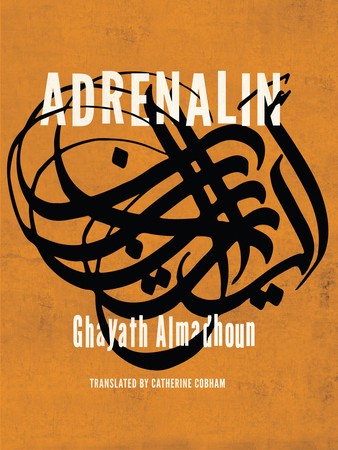
Adrenalin by Ghayath Almadhoun

Syrian-born, Stockholm-based Palestinian poet Ghayath Almadhoun’s intelligent, relentless, and formally precise poems explore identity, nationality, nation-building, war zones, history, love, death, friendship, and injustice. This is political poetry at its best and the translation from the Arabic by Catherine Cobham is spectacular.

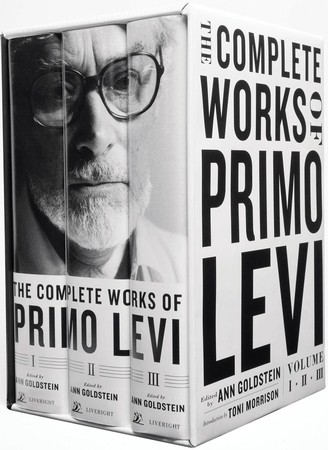
The Complete Works of Primo Levi edited by Ann Goldstein

I came to Levi’s work early on through his slim novel The Wrench and more recently, If This Is A Man and its companion text, Survival in Auschwitz. Levi’s sensitivity is extraordinary, his writing breathtaking; the scope of his literary influences is immeasurable, his erudition as a chemist and writer unparalleled. He is a writer full of heart and wisdom. It is a gift to us all that his complete works, a collection of fourteen of his seminal books, are now available in English, a herculean effort that was in the making for sixteen years. To raise the bar even further, the collection is introduced by the Nobel laureate Toni Morrison.

What Lies Between Us by Nayomi Munaweera

Born in Sri Lanka and raised in Nigeria, San Francisco-based writer Nayomi Munaweera’s lyrical transcendent novel draws us into the lush, verdant landscapes of Sri Lanka and the undulating streets of San Francisco. The narrator, Ganga, has a dark and secretive past that threatens to erode her life. Many year after she was forced to leave her idyllic childhood home and immigrate to America with her mother, Ganga marries a charismatic man to whom she never reveals her disquieting past. Soon enough, an accidental pregnancy causes her to unravel and to commit a terrible final act. Munaweera’s work has been compared to that of Jhumpa Lahiri and Michael Ondaatje. Atmospheric and vibrant, her prose pulses with wisdom, sweeping us off our feet image after image.

The Successful Candidate Will Not Have a Dead Bird in Her Pocket

“Little Bird”

by Claudia Ulloa Donoso

He loves to seat and hear me sing,
Then, laughing, sports and plays with me;
Then stretches out my golden wing,
And mocks my loss of liberty.

William Blake

I have a cat named Kokorito. He’s big — seven kilos — and furry, and he isn’t very social. His main way of showing affection is bringing me tiny dead birds. This is what cats do, I know: give their owners dead birds as presents. Or maybe trophies. Who am I to say?

Kokorito never eats the birds. He tortures them, plays with them like balls of wool, but in the end he always leaves them in my bed, which is where I do everything these days, even eat. That’s how I’m so sure the birds are for me.

My cat, who has seven lives in the Americas and nine here in Scandinavia, brings me death as a present, but the thing is, I’ve seen plenty of death already. I don’t really need any more.

Maybe Kokorito disagrees. Maybe he thinks if I paid more attention to death, it wouldn’t bother me so much. He’s the expert, I guess. He has at least seven lives, like I said, and after the twenty days he was gone last winter he must be down a few. When he came home, he opened the window himself, drank some water, and fell asleep in my bed for two days. Then he got up, meowed, and lived again.

The birds are the best gift Kokorito has to give. Maybe he wishes he didn’t have to deliver them in their death throes, beating and panting and flapping, all –ing, and then suddenly past tense. Or maybe that’s the point. Maybe my cat wants me to understand that lives, except his, end in just a few seconds. Well, I get it, Kokorito. No repeats.

When I find a bird dying in my bed, I wrap it in damp paper towels, leaving its heads uncovered so it can breathe. I warm the bird in my hands, clean the blood off its wings, stroke its feathers and try to open its beak. When it dies anyway, or when I find one that’s already dead, I make a shroud out of Kleenex and bury it outside, or at least take the bird under the birch trees and hide it in the dry leaves.

The 2 bus from Øvre Hunstadmoen is the only one that will get me to the center of Bodø. It passes every twenty-seven minutes starting at six in the morning. I always get to my appointments early, since if I miss the bus it’s impossible not to be late.

Today, as I’m leaving for Øvre Hunstadmoen, having timed my departure perfectly in order to get downtown on schedule, I see a bird dying in the hallway, near the place where I drop my bag and take off my coat when I get home. I can’t leave it there to die, but I can’t miss the bus, either. I go to the kitchen, dampen a paper towel, tuck it around the bird and put it in my right coat pocket. Then I leave the house at a run.

When I get on the bus, I’m sure the driver notices that I only use my left hand. He watches me struggle to open my purse, find my wallet, pay my fare. I don’t function well with one hand. He must notice, too, that my other hand is buried in my coat pocket, which means he must know that I’m hiding something. For all I know, he can tell that I’m carrying a dying bird.

Norwegians generally take off their coats as soon as they come inside because buildings in Norway are all heated. In friends’ houses, they take off their shoes right away, too. Every entryway is packed with coats and jackets so the coat stands look bulky as men. In this office they have hooks on the wall like a butcher’s shop, but with winter coats hanging instead of skinned steers.

In an interview for a project analyst position at the Department of Culture, it’s bad manners not to take off your coat when you walk into the office. It’s also bad manners not to shake the interviewer’s hand. If I keep my coat on, the interviewer will think I’m not open, or that I’m uncomfortable. He’ll think I’m hiding something. If I don’t take off my coat, he’ll start to imagine what I’m hiding. He’ll imagine all the way down to my underwear, and what if he doesn’t imagine the right underwear for the job?

I won’t be able to communicate properly if I leave my coat on. I’ll sit there like an armadillo, like a turtle, like a porcupine hiding its head, showing its spines as it trundles along. All I can do to distract the interviewer from my spines is smile. When I’ve read tips for job interviews, they suggest that smiling helps you make a good impression. So I’ll smile, but not too much. I don’t want to seem nervous. My teeth are very white and once my smile won a contest at my dentist’s office. My prize was twenty tubes of toothpaste, plus some fluoride.

When I smile, the interviewer smiles back. I know I should use some more body language to make a good impression, but I keep my right hand in my coat pocket even though the moment to shake hands has arrived. I have two options here: if I shake with my left hand and leave my right hand in my pocket, he’ll think I’m strange, or that I’m rude for making him shake with his left when it’s accepted in every country on earth that you shake hands with your right.

The other option is to remove my right hand from my pocket and offer him a damp handshake full of bird germs and, for all I know, yellow feathers, which could end up stuck to his palm. That wouldn’t be a good start. But this is the option I choose. We shake hands, right to right, and it seems to go over well. I don’t think he notices that my hand is a bit damp, and of course there’s no way for him to know that the dampness isn’t sweat but cat spit and wet paper towel and, probably, bird blood.

The interviewer talks without taking his eyes off my CV. Maybe he doesn’t care that my coat is still on. He seems distracted by his own tic, if it’s a tic, of opening his eyes too wide and raising his eyebrows while he talks. Still, he seems perceptive. I think he’s guessed the color of my bra.

I don’t want him to give me the look that the bus driver gave me this morning because I had one hand hidden in my pocket, so I hide them both. He must think that I’m shy, or nervous, but his gestures don’t change. He keeps talking, opening his eyes and raising his eyebrows. I can’t tell if he seems surprised or indifferent or both.

“It’s very cold today,” I say.

It’s true. My comment is sincere, and he takes it that way, because after I say it he stops the interview to offer me a cup of coffee.

He comes back with two coffees and I wait for him to drink first. He slurps his coffee and then grimaces. He must have burned his tongue. Anyway, now he doesn’t open his eyes quite so wide.

“I can see that you are qualified and that you’re ready to take on the responsibilities associated with this position. I am sure that you would manage your projects carefully and well. We are looking for a person who will be cautious, given that the funds set aside for cultural projects have been reduced this year.”

This makes me think that the job is mine, and I squeeze myself tight with excitement. Then I reach for the coffee mug in accordance with our new ritual: you take a sip, I take a sip. After that I put my hand back in my pocket, and I feel something move. The bird has come back to life.

“I only have one more question,” the official says. “Why do you think that we ought to hire you?”

“Because I can take responsibility for lives other than my own.”

“What does that mean?”

“Well, in terms of culture, imagine I’m in charge of organizing the Philharmonic Week. I have to be responsible for all the composers who are dead but still alive. Take Chopin. He’s dead, but you and I both know that when a musician like Argerich performs his work, Chopin comes back to life and takes flight in the concert hall. Besides, when you’re working on a project like the Philharmonic Week, you’re in charge of the musicians in the orchestra, the singers in the choir, the conductors. Their lives are part of your job as well as their instruments.”

“I understand. And could you explain how you were in charge of other people’s lives at your most recent job?”

I can’t explain, because now the bird is beating its wings. I can’t hold it any more. I take it from my pocket, unwrap the paper towel, and put it on top of my CV, which is still on the desk. The bird is injured. There’s a spot of blood on the towel, but it’s alive.

The bird gets to know me. It walks across the languages I speak fluently, then shits on my work experience. It stops on my contact information and stays still. I pick it up gently and stretch out its wings: fragile, but intact.

“It’s a yellow-breasted kjøtmeis,” I say. “When I was leaving the house to come here, I found it dying in the hallway, so I’ve spent this interview thinking not just about how important this job would be for my professional development and about the dead classical musicians for whom I would be responsible, to say nothing of the live musicians who I would support, but also about saving the life of this bird. So another qualification of mine for this position is that I can stay calm and perform well under pressure.”

The bird chooses this moment to fly. It circles the office, flashes like a star over the computer screens, shits again on the budget reports spooling out of the printer. It lands on the city archives and looks down at the Department of Community Administration with the proud raised head of a newly decorated veteran. The bureaucrats watch from their cubicles, spinning on their ergonomic chairs, but nobody stands. Most of them stay quiet, admiring the bird, smiling, but some are annoyed; some turn back to their screens and protect their head and faces with sheets of printer paper.

The interviewer and I can see that it’s time to open the windows.

The bird feels the cold February air rush into the office and follows it to freedom. It bounces off the photocopier and shoots out the closest window. The building is cold now, but otherwise the day has returned to normal, and I go back to the interviewer’s office to finish my coffee.

When I leave the interviewer doesn’t shake my hand. That doesn’t concern me, since Norwegians often avoid physical contact when they say hello or goodbye. Instead, he brings back his favorite trick, opening his eyes and raising his eyebrows as he says that he’ll call me. I believe him and smile to show it.

On the way home I see plenty of birds, but I’m looking for the one that kept me company during the interview. I’d like to say thank you. Sometimes it’s a good idea to carry dying animals around, to keep your hands in your pockets, and to never take off your coat.

We Need to Stop Leaving Women Out of Discussions of Latin American Literature

Years ago, not long after Gabriel García Márquez passed away in 2014, I attended a conference held in honor of his work. It was a two-day event that brought together writers, scholars, critics, and industry professionals to celebrate his life and legacy, and as a writer whose life was transformed by reading One Hundred Years of Solitude and Love in the Time of Cholera, I was ecstatic to be in attendance.

A couple of hours in, though, I started to notice a pattern. It’s impossible to discuss someone who’s had such an immense influence in Latin American and world literature without it also becoming a reflection on the literary canon as a whole. Conversation turned to Gabo’s peers, his contemporaries, the writers who influenced him and those he influenced in turn. It retraced the Latin American “Boom” of the ’60s and ’70s, the stunning rise of magical realism, and the ways that future generations of writers wrote in reaction to it. Panelists spoke at lengths about the links between Latin American politics and Latin American works of literature. And yet, all the names of authors mentioned, even anecdotally, were of men.

Panelists spoke at lengths about the links between Latin American politics and Latin American works of literature. And yet, all the names of authors mentioned, even anecdotally, were of men.

Eventually I began keeping count. Every time a speaker mentioned a writer’s name, I took note. Men in one column, women in the other. By the end of the second day, I had four mentions of women and 44 of men (the marks pictured here continue on other pages). In this two-day discussion about Latin American literature, not a single one of those four women was Latina — not one. We were non-existent; our male counterparts were being celebrated while we’d been left forgotten, silenced, and ignored.

I’d never felt more invisible. I’ve been haunted by this for years, and even more so recently, as sexual abuse allegations against Junot Diaz have begun to surface. Here is machismo at its most dangerous. Here’s how an entire industry enables and perpetuates the abuse of power. The systems that fail to even see Latin American women writers at a two-day conference are the same systems that fail, time and again, to protect us. When an entire literary canon revolves around the praising of men’s voices, it drowns out women’s voices. It erases our stories and experiences. It leaves us vulnerable to abuses that no one in power will care to listen to.

When an entire literary canon revolves around the praising of men’s voices, it drowns out women’s voices.

I don’t know all the answers, but I do know that there are countless Latin American women writers whose voices and contributions to literature deserved to be upheld during that conference. This list is inspired by notes I took — each a reaction to a specific point mentioned by a panelist — and so it is by no means extensive. For one, it focuses mainly on women authors born and/or writing in Latin America, rather than those of us writing in the US, because it’s in response to a conversation focused largely on the Latin American “Boom” originating with male writers from Colombia, Peru, Argentina, and Mexico.

But the machismo that took root in our native countries continues to plague us across borders. This list is simply a start, a small step, toward the work required to correct it.

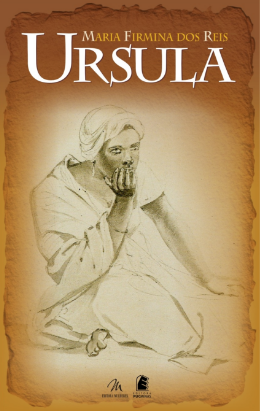
Maria Firmina dos Reis, Úrsula (1859)

Historical trauma, the trauma of colonialism, and crises of humanity are often discussed extensively within the context of Latin American literature. Maria Firmina dos Reis was an Afro-Brazilian abolitionist who wrote Úrsula, the first novel depicting the violence of slavery in Colonial Brazil — and she did so from the point of view of women. In dos Reis’s novel, Úrsula, her mother, and other female slaves tell of their lives and memories in their homelands and later, the violence they’re subjected to as they’re brought to Brazil. Together, their voices are a powerful counter-narrative and an example of the resistance to the erasure of memory so emblematic in Gabo’s work.

María Luisa Bombal, House of Mist (1935) and The Shrouded Woman (1939)

Chilean author Maria Luísa Bombal is the pioneer of Latin American magical realism that you probably haven’t heard of. Her novellas blend the real with the surreal as her female narrators struggle within the confines of unhappy marriages and a male-dominated hierarchal society. As in these and other stories, the fantastical becomes an escape and a sanctuary, blurring the lines between memory, desire, and actuality. Bombal’s work predates Márquez’s work, and she was contemporaries with fellow Chilean writer Pablo Neruda, (at one point, even living with him and his wife) but her work is rarely mentioned as a precursor to what many call the “quintessential” example of magical realism, One Hundred Years of Solitude.

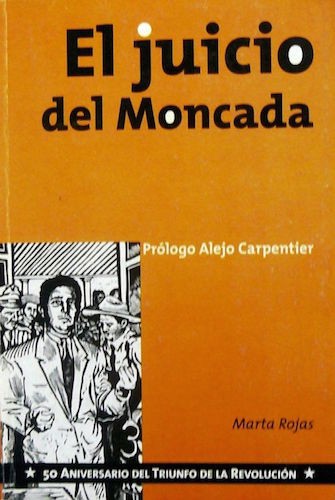
Marta Rojas, The Trial of Moncada (1966)

In 1953 Cuba, then-law student Fidel Castro launched an attack on Fulgencio Batista’s military barracks. Rojas, a recent journalism graduate, chronicled the bloodshed and published it despite government censorship. She later attended Castro’s trial in the aftermath of the attack, and turned its recounting into a novelized story, The Trial of Moncada. Rojas had a long, renowned journalism career, covering Cuban national and world affairs and the Vietnam war. Today she writes fiction that continues to be grounded in journalism as it sheds light on the racial and social divides in Cuba, all within the context of its colonial past. Márquez, who for decades was criticized for his friendship and support of Castro, also began his career as a journalist, and often credited his journalistic background as the trick that made the magic in his work seem real.

Isabel Allende, The House of the Spirits (1982)

To be fair, Allende’s work is often spoken about in the same breath as Marquez’s, a comparison she herself has dismissed. Yet the Chilean author of 23 books that have been translated in 25 language and sold nearly 70 million copies was deeply impacted by Gabo’s work. “In his pages, we saw ourselves in a mirror,” she has said. “It was as if someone was telling me my own story.” Allende’s debut novel, The House of the Spirits, was adapted into a movie starring Meryl Streep and Winona Ryder and is often taught in schools as the eminent example of magical realism. Ilan Stavans, a professor of Latin American and Latino culture at Amherst College in Massachusetts and publisher of Restless Books, once wrote that The House of the Spirits “symbolized the end of the old-boys club in Latin American letters.” I hope that will be true one day.

Laura Esquivel, Like Water for Chocolate (1989)

Laura Esquivel’s debut novel, Like Water for Chocolate, was a phenomenal success in her home country of Mexico, where it went into multiple printings in its first year, then was soon translated in more than 20 languages. Set during the Mexican Revolution, the novel employs magical realism and Mexican recipes to tell the story of Tita, who infuses her emotions into the food that she cooks, sometimes with alarming consequences. Her tears in a cake batter make everyone who eats it violently ill, her erotic fantasies infuse another with sheer lust. It is hard to imagine any greater conversation about magical realism taking place without mention of Esquivel’s work.

Gioconda Belli, The Inhabited Woman (2004)

Revolutionary Nicaraguan author Gioconda Belli came from privileged upbringings and joined the Sandinista National Liberation Front (FSLN) in 1970 to resist against the Somoza dictatorship. She eventually went into exile and wrote a semi-autobiographical novel that tells of a sheltered, self-involved woman whose spirit is overtaken by that of an indigenous woman, and who is galvanized to join the revolutionary movement against her country’s dictator. Belli’s work is known for fusing political activism, feminism, eroticism, and nature through magical realism.

Dahlma Llanos-Figueroa, Daughters of the Stone (2009)

Llanos-Figueroa’s debut novel traces the lives of five generations of Afro-Puerto Rican women, beginning with Fela, who poured the essence of her unborn child into a stone before she and her husband were both separated and sold into slavery. The eventual conception and birth of her child is the beginning of a long line of daughters whose stories are part of the African diaspora, connected by a legacy of magic, trauma, storytelling, and memory. Spanning the 1800s to present day New York, Daughters of the Stone is a novel about mothers and daughters who navigate cultures and spaces, pain and love.

Claudia Salazar Jiménez, Blood of the Dawn (2016)

It’s a common misconception that Latin American fiction must automatically be equated with magical realism. In fact, many authors in the generations to come would purposely reject the fantastical in order to portray the violence of the past and present with unapologetic realism. In Blood of the Dawn, Peruvian author Claudia Salazar Jiménez writes the violent history brought on by the Shining Path in the 80s and 90s through the voices of those who lived it, but whose stories too often went unheard: that of the women. Jimenez’s language is brutal, courageous, and unflinching, revealing the ways that women experience social and national violence in deeply personal, traumatic ways.

12 Books for Sports Fanatics

The very first fragments of the book that would become True were written over 20 years ago as part of a planned non-fiction book about soccer in America that, even before I was 20 pages in, had become a fiction book about rival soccer teams in a Los Angeles amateur league. Those first soccer files were lost several computers ago, but the world of pick-up soccer in Los Angeles continued to obsess me.

Purchase the novel

Three years ago I returned to the material, but for some reason, this time I was writing as a female soccer player, one so talented she could dominate in pick up soccer games with men. Her life story, how she came to be this girl who played on dusty, far-flung pitches on weekday afternoons, turned out to be the story I wanted to tell. Why had nobody heard of the best soccer player of her generation? She was the female soccer equivalent of basketball playground legends like Joe Hammond or Earl Manigault. While I was writing, I wasn’t thinking of the potential pitfalls of writing a female main character or the commercial risks of writing a sports novel. Sports novels seldom make the bestseller list.

From the memoir of an NFL wide receiver to a novel about a chess player struggling with addiction, here are twelve books about sports that have stayed with me,

The Queen’s Gambit by Walter Tevis

The protagonist, Beth Harmon, is a brilliant chess player struggling with addiction. The descriptions of orphan Beth Harmon’s discovery of chess and her steady climb up to Bobby Fisher levels of chess dominance provide a natural and comfortable narrative structure. Tevis is masterful in his depiction of Beth’s peculiar genius and unique talent. The lexicon of chess gambits and moves could easily alienate a general reader, yet through the lens of Beth’s intense and peculiar intelligence — today, Beth would be described as on the spectrum — the story exerts a magnetic pull.

“202 Checkmates” by Rion Amilcar Scott

The Southpaw by Mark Harris

Bang the Drum Slowly is the much better known and praised of Mark Harris’ novels, but its precursor, The Southpaw, is less sentimental and more ambitious. Narrated by a young prospect, Henry Wiggins, climbing the New York Mammoth’s system, The Southpaw is a coming-of-age novel wrapped around the story of Sam Yale, a veteran pitcher near the end of his career, idolized by young Henry Wiggins. Yale, an aged, angry tyro, can’t help but challenge the adoration of the young naif. “I just play for the money I do not need and fornicate for the kicks I never get,” Yale tells Wiggins, “If I was to write a book they would never print it. It would be five words long. It would say, Do Not Fuck With Me.”

Fat City by Leonard Gardner

It’s impossible to exclude Gardner’s only book from this list. It’s a sports novel in the way that, say, Double Indemnity is an insurance novel. Gardner’s Billy Tully and Ernie Munger are fighters so low-down on the bill that when they fight on the road, their trainer puts them on a bus and wishes them luck. The book is set in the kind of dive bars, fleabag hotels, and strawberry fields familiar to Jack London and John Steinbeck, only Gardner has the courage to shy away from redemption for his failed and never-was boxers. The ring beckons as redemption, and Gardner has the courage the deny his characters any such salvation.

Slow Getting Up by Nate Jackson

Nate Jackson, a bottom of the roster tight end and wide receiver for the Denver Broncos, was never a household name and that’s what makes his book about the realities of life in the NFL so captivating. Jackson’s NFL is a cynical and manipulative entertainment conglomerate that exploits athletes like Jackson who know full well the price they are paying and would eagerly do it again. What makes Jackson’s book so fascinating is that awareness at the price he is paying, mentally and bodily, yet he ultimately concludes, reluctantly, that the intoxication of living this alpha-male version of the American dream is fully worth the price. Jackson writes with a surprising wit, and rejects your sympathy even as he is explaining how players feel compelled to take any medication or injection they can to get out on the field. It’s the most honest book I’ve read about the National Football League.

Solo: A Memoir of Hope by Hope Solo with Ann Killion

Hope Solo’s tumultuous history with the United States Women’s National Team, her frequent and public disputes with coaches and players, and her legal troubles, have made her a controversial figure who is also, inconvertibly, the best goalie in women’s soccer history. Her life story tells of when she was kidnapped by her father at age seven, the rival girls she has punched in the face, and names the teammates she despises. It’s rare to read an athlete be this candid about her struggles.

A Fan’s Notes by Frederick Exley

Exley’s fictional memoir of obsessive fandom foresaw the future of American sports and the obsessive identification with gridiron heroes that has by now become accepted behavior. Believe it or not, there were decades during which you could go to a football game and nobody would be wearing his or her favorite player’s jersey. Exley’s tragic memoir, during which his obsessions with Frank Gifford and the New York Giants became an escape from his debilitating depression, provide a remarkable snapshot of where American sports fandom was heading, even as Exley himself was wise enough to warn that his own compulsion was destroying him.

9 Stories About Sports, Games, and Gamesmanship

Down and Dirty: The Life and Crimes of Oklahoma Football by Charles Thompson and Allan Sonnenschein

During the 1980s, Barry Switzer’s Oklahoma Sooners were the best team in college football, running an impossible to stop wishbone offense built around fleet-footed quarterbacks recruited by dubious means. When Heisman-frontrunner Jamelle Holleway was injured in 1987, Charles Thompson stepped in to lead the Sooners to an 11–1 record and the Orange Bowl. Down and Dirty tells the inside story of those teams, the money players were receiving, the crack-smoking in limousines outside country clubs where Holleway and Thompson were about to give motivational anti-drug talks, and Thompson’s eventual arrest by the FBI for selling cocaine to an undercover agent. One of my favorite sections of the book was Thompson describing his childhood in Lawton, Oklahoma, where he ran for money as drug dealers and bookies would bet on young boys in footraces.

I Am Third by Gale Sayers with Al Silverman

I am including this book because it’s the sports biography I read as a young boy that left a powerful impression on me and humanized a larger than life athlete. Young boys and girls of a certain type read these kinds of sanitized sports biographies and, inevitably, some of them will stick with us even as we reach adulthood. I will never forget Gale Sayers receiving a free hamburger for every touchdown he scored in high school, and eventually eating seven “Pookie” burgers after one game. Also, this book contained the powerful chapter “Pic”, about Brian Piccolo, the running back who would pass away from cancer, that would become the basis for the movie Brian’s Song. How could a young boy resist?

Soccer Against the Enemy: How the World’s Most Popular Sport Starts and Fuels Revolutions and Keeps Dictators in Power by Simon Kuper

Well before How Soccer Explains the World by Franklin Foer, there was this masterpiece by Kuper, who wrote about the variations and obsessions of soccer fans around the world and the very real class, religious, and national boundaries that are defined by loyalties to and for specific clubs. His book was written just before the total dominance of a dozen or so super clubs would change club soccer into a far more commercial endeavor. His description of the cultural differences of how the sport is played and watched around the world are still relevant today. The racism of the Ukraine, the Ajax developmental system, the Italian catenaccio defense, it’s all here, told in first person and vivid prose.

Pistol: The Life of Pete Maravich by Mark Kriegel

While I was writing True, I often thought of this book, in part because Maravish so much resembles the protagonist of my novel in that his sport was his sanctuary and the rest of his life outside of basketball always seemed to be turning to shit. Maravich spent his life outside of basketball searching for meaning, exploring yoga, Hinduism and even becoming a UFO obsessive at one point. Kriegel’s book deftly explains how Maravich’s family of origin and in particular his father, Press Maravich, created both the perfect basketball player and a deeply broken human being.

Sandy Koufax: A Lefty’s Legacy by Jane Leavy

I didn’t remember the subtitle to this book, and now find it odd, as the enigma that is Sandy Koufax somehow survives even this beautifully written account of one of our most beloved athletes. Leavy uses the nine innings and 27 batters of Koufax’s 1965 perfect game against the Chicago Cubs as the structure of the biography, using each at-bat and put-out as a prism to tell more and more of the lefty’s life story. The Koufax that emerges is the most complete picture yet, but Koufax himself remains somehow, tantalizingly elusive. The book takes on a beautiful, almost romantic quality as Leavy attempts to tease out the man. Certain figures somehow escape even the best writer’s attempt to capture their essence. Leavy’s masterpiece is perhaps one of my favorite types of books; a lovely, well-crafted, search that ultimately never quite finds its subject but leaves the reader honored at having witnessed the attempt.

Ghosts of Manila:The Fateful Blood Feud Between Muhammad Ali and Joe Frazier by Mark Kram Jr.

This history of Thrilla in Manilla, perhaps the most famous boxing match in history, is built around Kram’s spectacular reporting for Sports Illustrated on Muhammad Ali and Joe Frazier in the 1970s. His deadline piece for the magazine, “Lawdy, Lawdy, He’s Great,” is one of the best pieces of prose ever dictated down a telephone to an editor just hours after the fight was over. “It was only a moment, sliding past the eyes like the sudden shifting of light and shadow, but long years from now it will remain a pure and moving glimpse of hard reality, and if Muhammad Ali could have turned his eyes upon himself, what first and final truth would he have seen.” And it goes on, with scenes involving Fernando and Imelda Marcos, the fight itself, and both Ali and a blinded Frazier after the fateful bell for the 15th. Over three years writing for Sports Illustrated, my dream was to write a piece as good. I never came close.

About the Author

New York Times bestselling author Karl Taro Greenfeld penned the novels The Subprimes and Triburbia, a New York Times Editor’s Choice. His memoir, Boy Alone, was a Washington Post Best Book of the Year. Karl has also written Dr. J: The Autobiography (co-authored with Julius Erving), NowTrends, China Syndrome, Standard Deviations, and Speed Tribes. His prize-winning writing has appeared in Harper’s Magazine, the Atlantic, the Paris Review, Vogue, GQ, the New York Times, and others. His books have been translated into twelve languages.

The New ‘Fahrenheit 451’ Movie Fails to Reckon with Bradbury’s Racism

This piece contains spoilers for the new Fahrenheit 451 film on HBO.

I first read Fahrenheit 451 as an eleven-year-old bookworm, working my way through every scrap of written material available to me. It was the summer of 1995, and I’d never heard of the internet, so this meant trawling the big cardboard boxes overflowing with old paperbacks that had been stashed away in our garage. Taking a classic escapist route from my bad home life, I devoured them all — bleak dystopian novels, science textbooks well beyond my grade level, explicit romances that had my teachers asking my mother if that was really appropriate for a kid my age. A classmate once caught sight of me with a copy of Little Women and wrinkled her nose in distaste. “Why do you always read such weird old books?” she asked. I didn’t have any explanation — I just knew I couldn’t help it. Books unlocked new ideas, new possibilities, and I couldn’t get enough. It was only natural that a book set in a world where books were forbidden, where reading was a secret act of revolution against a hostile society, would fascinate me.

I still have that same copy of Fahrenheit 451 — a trade paperback edition printed circa 1993, whose creased cover and flammable pages are already yellowed and crumbling. I reread it prior to watching the new film version, starring Michael B. Jordan as protagonist Guy Montag, and Michael Shannon as his boss — and ultimately, the bad guy — Captain Beatty. The novel was largely as I remembered it, until I got to the end. At the back of the book, there are a few pages Bradbury wrote decades later, in 1979, where he gets into what he thinks the real threat to literature is. I’d forgotten that reading this coda as a child always left me feeling uncomfortable, in a way I couldn’t fully interpret yet.

In the coda, Bradbury is angry about what he describes as censorship, but there are a lot of different complaints all jostled together under that one big umbrella. There’s anger at the editors of Ballantine Books, who removed the words “damn” and “hell” from their edition of Fahrenheit 451. There’s anger at anthology editors who bowdlerized great authors when putting together a compilation of the classics for school readers. But most of his anger is aimed at the threat he believes to be posed by minorities.

He is angry at a “solemn young Vassar lady” who asked whether he might write more female characters. He is angry at other readers who disapprove of how he wrote “the blacks” in one of his stories. He is angry at “the Irish,” “the Chicano intellectuals,” at “every minority” that has some perspective on his stories at variance with his. In his own words, every last one of them “feels it has the will, the right, the duty to douse the kerosene, light the fuse…. Fire-Captain Beatty, in my novel Fahrenheit 451, described how the books were burned first by minorities, each ripping a page or a paragraph from this book, then that, until the day came when the books were empty and the minds shut and the libraries closed forever.”

In the coda, most of Bradbury’s anger is aimed at the threat he believes to be posed by minorities.

Beatty serves as the conduit for these views in the novel. In words that could have been spoken by the author himself, he tells the protagonist Montag, “Once, books appealed to a few people, here, there, everywhere. They could afford to be different. The world was roomy. But then the world got full of eyes and elbows and mouths. Double, triple, quadruple population. Films and radios, magazines, books leveled down to a sort of pastepudding norm, do you follow me?” Too many cooks spoil the intellect, it seems. Can’t have too many people reading, it’ll ruin it for the rest of us.

A few pages later, Beatty continues in this vein: “Bigger the population, the more minorities. Don’t step on the toes of the dog lovers, the cat lovers, doctors, lawyers, merchants, chiefs, Mormons, Baptists, Unitarians, second-generation Chinese, Swedes, Italians, Germans, Texans, Brooklynites, Irishmen, people from Oregon or Mexico…. All the minor minor minorities with their navels to be kept clean.” This, he explains, is why magazines became “vanilla tapioca” and books became “dishwater,” although he grants that comic books and porn continue to do quite nicely.

Of course, this is a novel: the author’s ideas do not have to align with those of his characters. Based on his coda, though, I suspect these views are a pretty accurate picture of the inside of Bradbury’s head. The author was a legendary crank, and probably wasn’t a big fan of anyone who didn’t live up to his intellectual standards. The book takes this to a horrifying extreme: after Montag joins a small band of nomadic professors (all men), who hail from Harvard, UCLA, Columbia, and other elite universities, they all watch as the city they have fled is bombed out of existence. All the illiterate citizens left behind are obliterated: “the explosion rid itself of them in its own unreasonable way.” Literary types might call this a deus ex machina. It’s not exactly subtle.

Reading this passage now feels sickening. A story I once believed to be about the importance of staying open-minded and intellectually curious is unmistakably steeped in elitist, supremacist thinking, in which the hopeful vision of the future is one in which only men who went to good schools survive. This must feel like an even deeper betrayal to a person of color.

A story I once believed to be about the importance of staying open-minded and intellectually curious is unmistakably steeped in elitist, supremacist thinking.

As of this writing, the new film version, available on HBO, has a 32% critics’ rating and a 26% audience rating on Rotten Tomatoes. This is stunningly bad for a movie based on a classic novel and helmed by two stars fresh off wildly successful movies. Adapting the book for modern audiences must have been a challenge: there’s a lot that was changed, and a lot of that doesn’t quite gel. In particular, other critics have pointed out the clumsy attempts to update the film to reflect modern technology. Early on, the book-burning firemen collect and burn a pile of computers and server equipment that had been successfully uploading scanned books… presumably to remote cloud storage, where others would still be able to access them? If so, that trail is never followed; the burning is treated as a complete victory.

What few critics have touched on, however, is the casting. Jordan initially hesitated to take on the role of Montag, telling IndieWire, “I wasn’t really interested in playing an authority figure,” given relations between the police and the African-American community. He came around after deciding that an authority figure with an arc that leads him to support the resistance was a valuable story to tell now. However, the movie tiptoes around this idea, where it could resonate powerfully.

For example, we periodically see images of Frederick Douglass throughout the movie, alternately being burned or uploaded for preservation. A former slave who learned to read in secret as an act of rebellion, Douglass might be a natural source of inspiration for Montag. But we never hear his name, and Montag never encounters his words.

A former slave who learned to read in secret as an act of rebellion, Frederick Douglass might be a natural source of inspiration for Montag. But we never hear his name, and Montag never encounters his words.

Only one scene directly addresses Montag’s race. The firemen have discovered a massive cache of books in an old woman’s house in the woods. Picture a grandparent’s summer cabin: countless classic paperbacks spilling off tables, weighing down half-broken bookshelves, piling up in stacks on the floor. Tonally, the moment where an awestruck Montag takes in the sight of that many books for the first time is half big library reveal from Disney’s Beauty and the Beast, half episode of Hoarders.

In this scene, Beatty, who has his own secret lust for literature, teases Montag with the books, picking them up at random and offering them to Montag before telling him of the dangers that they pose. “Ah, see? Huck Finn, and his n_____ friend,” he says, the camera panning away from the actor’s face as the slur is pronounced. “The whites knew that you blacks were offended, so what did we do? We burned it.” The movie has made a subtle shift here — while Bradbury lays the blame on minorities, here it is ambiguous. Who is being blamed for the pivot to censorship: offended black people, or overreacting whites?

The movie has made a subtle shift here — while Bradbury lays the blame on minorities, here it is ambiguous.

Beatty moves on to a new book. “Oh, and then Native Son comes along, and the whites didn’t appreciate that one all that much, so they burned it too.”

“Why didn’t they like it?” Montag asks, his eyes wide. Beatty looks at him, then looks away. Moments later, he intones, “We are not born equal, Guy, so we must be made equal by the fire, and then, we can be happy,” as he contemplates a copy of Mein Kampf.

The movie doesn’t attempt to explore the questions this exchange must have raised for Montag. Instead, his consciousness is expanded by reading Dostoyevsky’s Notes from Underground with his romantic interest Clarisse, who is played by the Algerian actor Sofia Boutella and who, thank God, is not a 17-year-old girl (as in the book), but a complicated double agent. When Montag finally meets up with other members of the resistance — inexplicably referred to as “Eels” throughout the movie — they ask him why he is risking everything to join them. His answer is confusing. Something about how he remembers sitting by the ocean as a kid, pouring sand endlessly through a sieve, “like my whole life passed right through me and I missed it. I’m not gonna let that happen again.” It’s a weird image — one we never see in the multiple flashbacks we get of his childhood — and it makes his motivation not one of resistance against oppression, but of self-blame.

The Literary Roots of the Incel Movement

The movie smartly updates the members of the resistance from an interchangeable band of Ivy Leaguers to a diverse group whose intellectual bona fides are not proven by their degrees, but by the books they have memorized. They’re led by Khandi Alexander, who has memorized every word of Toni Morrison’s Song of Solomon. Other authors preserved by the Eels include Rumi, James Baldwin, Chairman Mao, Zadie Smith — clearly a deliberate departure from the old-school Western canon that Bradbury largely focuses on in his book. Going by his coda, he would have found this irritating: “For it is a mad world and it will get madder if we allow the minorities… to interfere with aesthetics.”

Perhaps this is why the movie never quite gels: it wants to sound the same alarm as the book, warning that control of ideas is a slippery slope, but the book exists in a time when the loudest cries of “censorship” come from a dominant culture in no real danger of being erased. The film tries to broaden the book’s definition both of literature worth saving, and of the readers fighting to save it — but it does so through winks and nudges rather than asserting this message out loud. To commit fully to Bradbury’s views on intellectual freedom is to accept an exclusionary stance that doesn’t play nicely with what few social justice-oriented moments the movie does include.

To commit fully to Bradbury’s views on intellectual freedom is to accept an exclusionary stance that doesn’t play nicely with what few social justice-oriented moments the movie does include.

Imagine, instead, a retelling that amplifies voices forgotten by the Western canon Bradbury championed. Imagine a story of a dystopian society where a person of color encountered the words of their ancestors for the first time — literature that has frequently been suppressed in real life — and found something that spoke to them personally. Imagine Khandi Alexander’s character telling us why Toni Morrison spoke to her so deeply that she committed every word to heart. Imagine Montag actually reading the words of Richard Wright and Frederick Douglass, and finding out for himself why they made white people angry. In this retelling, more readers and more voices don’t water down literature to an insipid norm. They bring it to life — bursting with powerful ideas from all different perspectives, and all the more revolutionary because of it. What an incendiary story that would be.

Always Pee After Sex with a Merman

Several years ago, writer Chelsea Hodson introduced me to Melissa Broder’s poetry. I picked up Meat Heart, and fell in love with the collection’s apocalyptic charisma: “There appears a hinge in every young woman’s life / when ponies fly out of her soul, her tongue catches fire, / a wet corsage falls from the ceiling. Your ponytail / will not protect you.” I devoured Meat Heart and When You Say One Thing But Mean Your Mother, then pre-ordered Scarecrone, then waited for more.

In 2015, Broder revealed herself as the voice behind @SoSadToday, a darkly comic Twitter account hyped by Katy Perry and Miley Cyrus, now boasting over 650,000 followers. @SoSadToday gained popularity through its narrator’s frank yet funny tweets about depression and desire, like “love in the time of anxiety disorder”, “*whispers during sex* i hate having a body”, “fuck me in the middle of a cookie sandwich”, or (a personal favorite) “feel like satan would have sex with me and then message me 5 months later like ‘hey’ and talk about music.” After Broder’s unmasking, a poignant personal essay collection of the same name followed in 2016.

Purchase the novel

This year, Broder brings us her debut novel, The Pisces, in which an academic, Lucy, becomes enamored of a merman, Theo, on the shores of Venice Beach. The novel deals in romance, obsession, group therapy, and the complications of mer-sex.

“The difference between love and _______ is makebelieve,” Broder wrote in her 2014 poem, “Shiny Eyes.” Love, makebelieve, and blankness permeate The Pisces as well. Between Lucy’s existential anxieties and her lover’s literal tail, The Pisces is charged with mythologies both personal and universal.

Melissa Broder and I talked over the phone about physical dissolution, capitalist magic, and sex with mythical creatures, our conversation occasionally punctuated by her dog, Pickle, barking at his canine enemy down the street.

Deirdre Coyle: You’ve said that you were never a big mermaid fan. What are your favorite mythological creatures? Are there any you find more fuckable than mermen?

Melissa Broder: Not to fuck, but I love a Pegasus. Not to have sex with, just to be my companion. In terms of fucking, I would say my top is Apollo because he’s a twink, and he reminds me of a wild skater boy of the sun. We’d hook up once and then I’d never hear from him again, which is very hot.

I feel like Circe from the Odyssey. One time, I hooked up with a woman and we had the exact same boobs, and it really freaked me out. Circe turns Odysseus’ men to swine, but then she feels guilty and turns them back. And that’s something I could totally see myself doing. So I feel like Circe and I would hook up, and then we’d realize we’re very similar, and then we’d just become friends.

‘Circe’ Shows Us How Storytelling Is Power—And How That Power Can Be Seized

I think the Kraken, that giant squid? I’ve always had a thing for Ursula the Sea Witch; she’s so hot. You know that painting, The Dream of the Fisherman’s Wife? It’s hot. I mean, come on, you gotta get with the giant squid.

So I’d say those three, and maybe, if I was feeling frisky, Cerberus, the hound of hell. I just read this book called The Bridegroom Was a Dog by Yoko Tawada; it’s a New Directions book. The woman has sex with a dog, but you’re never really sure if this character is fully a dog, or just has dog attributes, you know? It’s a dog personified. And I feel that way about Cerberus; it’s not like really fucking a dog. It’s a hybrid, something with dog attributes.

I’d probably be more inclined to have sex with all of those guys before I’d have sex with a merman. But Theo is pretty hot. I’d fuck Theo.

I mean, come on, you gotta get with the giant squid.

DC: In Celtic mythology, the mermaids of are supposed to be really beautiful, while the mermen are described as being grotesque and monstrous. They’re really ugly and that may be why the mermaids prefer to hook up with sailors. That obviously doesn’t apply to Theo, because he’s hot, but I was wondering if there were any particular merpeople mythologies that you drew from while writing him?

MB: No, because I needed to create Theo the way I needed to create Theo. First of all, I needed him to be a character who would turn me on, so I could write hot sex scenes. So I built him how I wanted him to be built, and I’m sure there are mer-fundamentalists who are gonna be like, “No.” But, you know, that’s what the imagination is for. I mean, I knew some things about mer-lore and mer-mythology, but not so much about mermen, actually. I always joke, when people ask how similar I am to Lucy, I’m like, “Well, I’ve never fucked a merman, so.” But I’ve also said there are mermen on Tinder. And certainly the gross mermen you’re describing are. Recently, I keep getting hit on in the supermarket by these dudes who are the same dude over and over again. And I get really angry and mean. Not just that they’re trying to talk to me, but also because I’m like, why can’t you just be young and attractive? Then maybe I would tolerate you in stereo for a minute. I’m mad that the people who are hitting on me are the ugly mermen, and not the hot mermen.

I’m mad that the people who are hitting on me are the ugly mermen, and not the hot mermen.

DC: If you’re gonna get hit on by a rando in the supermarket, they could at least be hot.

MB: Yeah, like if a merman’s gonna hit on you in the granola bar aisle? Come on, man. So I find myself being really mean, which is interesting because in the book, Lucy has a really hard time saying “no” when she’s in sexual situations that she doesn’t like. She appears to be giving consent, right? But inside, she’s like, “Ugh.” But she doesn’t understand why she doesn’t say “no.” And I’ve felt that way too sometimes, with not only sexual situations, but also just interactions with people in the world. So it can feel really liberating to not give a fuck, and to be like, “Get away from me.”

DC: I love it. I think women are socialized to make people comfortable, and that makes it hard to yell at creeps, even when they’re objectively being creepy.

MB: Yeah. But then sometimes you’ve had enough and something takes over within you.

DC: And that’s great. Even on Lucy’s first Tinder date, she goes out with a creepy guy, and she goes home with him, but doesn’t want to have sex with him. It’s a really funny scene even though it’s also describing a very creepy reality, where she feels like she can’t leave. She watches him masturbate, and that’s her way of getting out of the situation. But she’s still having this internal monologue about wanting to leave.

MB: I’m actually writing a piece about this right now, exploring what it is within us that — when there’s no threat of violence — that doesn’t say, “Wait, stop. I don’t want to be doing this.” For myself, it’s almost like sometimes I don’t value my own reality. It’s like, “Well, let’s just finish this up and we’ll be done.” It seems easier. Instead of being like, “Stop. I’m out of here.”

DC: Not creating conflict.

MB: Yeah.

DC: Lucy gets a U.T.I. after a bad date, because she doesn’t pee after sex. It’s terrible for the character, but I love that you wrote about that. I couldn’t think of any other novel where a character gets a U.T.I., or even a yeast infection, but it’s such a common experience.

MB: Yeah, that definitely happens after not a “good” sex scene. But even with the “good” sex scenes, I’m committed to a sort of “pleasure realism,” I like to call it. Sometimes I’ll be reading erotica, or literary erotica, and the woman comes on page 121. And I’m like, I wouldn’t have come ’til page 138. Whether you’re having sex with a merman, or you’re having sex with a human, sometimes it takes a long time to have an orgasm. You should always pee after sex. And sometimes, the U.T.I. in my own life has been more profound than the sexual experience, and a more lasting memory. So I find that those details are important to include.

DC: Physical dissolution has a lot of appeal in the book, which is also something you’ve written about in your poetry, and on Twitter. There’s a scene where Lucy says, “I certainly understood the prison of the body…[I] tried to sustain that gift I had given, which was to disappear in the nothingness and thus no longer have to be aware of it.” I think that describes something difficult to put into words but extremely relatable. Do you ever find creative work to allow that sense of physical dissolution?

MB: Sometimes when you’re in the flow of writing, you do get to vanish into it. And, you know, it’s the quest for a higher power, the desire to escape oneself. I feel like it’s all the same. It’s just a question of what we make our higher power, you know? ’Cause I’ve made so many things my higher power, and Lucy obviously makes sex and love her higher power. And the problem with that is that it works really well but it’s not sustainable, because we’re reliant on something outside ourselves to get out of ourselves, when in truth, there’s also that place deep within ourselves where we can escape having a body. And it’s probably the same place that we find outside of ourselves, but it’s not contingent on anything ephemeral, or any other person, place, or thing we have to buy or ingest or consume to get there. But it seems so much easier to go outside ourselves for it, because all that shit’s right there — and who wants to go within? For myself, like Lucy, my greatest fear is disappearing, or dissolving. And my greatest wish is disappearing or dissolving. It’s like Lucy says, there are two kinds of vanishing.

For myself, like Lucy, my greatest fear is disappearing, or dissolving. And my greatest wish is disappearing or dissolving.

DC: In that vein, I also really liked the scenes about “capitalist magic” as a way to search outside yourself for that vanishing. Personally, I’m super into the idea that buying something will make me spiritually whole. And I like that that showed up at the beginning of the book, when Lucy first moves to Venice and finds the New Age store. And she kind of replaces crystals with sex and love.

MB: Yeah. And it’s all the same, right? It’s all the same. It is such a delicious thought, like, oh if I just purchase this thing, then I will be rendered whole. But then you take it home and it just becomes more crap after a while, and you just need another crystal. Not to say that I don’t love crystals, and I think they’re things of beauty, and they probably can be harnessed. But I think that when we look to anything outside ourselves to be the thing — there is no the thing. There are things. And perhaps there’s a daily recipe of different things to keep us afloat.

Venice is such a ripe place for capitalist magic. It is perhaps the epicenter. You go into the boutiques, you go into the crystal shops, and it’s like, oh, the answer is all here. I just have to buy this candle that is said to bring financial stability…for 40 dollars. So there’s a little bit of judgment about it in the book, but a lot of it’s just compassion for that human instinct. And it’s funny! It’s so human.

DC: What made you decide to set the book in Venice?

MB: Well, I lived there for four years. I was working from home, and I was three blocks from the beach, so it was almost like, I couldn’t not set the book in Venice. I was steeped in Venice. I’m actually working on another book right now and that’s set in Venice, too. Venice is such a character. I mean, I didn’t want to move to L.A. [from New York], but then I moved to Venice and really loved it. Being from the East Coast, maybe for the whole time I was living [in Venice], I was very aware of where I was living. Even living in New York, after a couple of years, I forgot I was living in New York. It’s just home, it’s just your stuff. But in Venice, I remained aware of how special it is, how unique it is, how totally nuts it is, for so many reasons.

Lucy obviously makes sex and love her higher power. And the problem with that is that it works really well but it’s not sustainable, because we’re reliant on something outside ourselves to get out of ourselves.

DC: Lucy’s relationships with women in The Pisces have a redemptive quality that provides a really nice foil to the toxic relationships that she’s having with men, especially in the beginning of the book. I was revisiting your collection, Scarecrone, after reading The Pisces, and there’s a line in the poem “Mythic” that reads, “I brought my holes and all the men / flew up inside. / What got left behind are women / who will save me.” I think Lucy’s relationship with Claire — and I don’t want to get into spoiler territory here — was a particularly interesting foil to Lucy’s romantic relationships.

MB: Yeah. I mean it’s funny because a lot of people have said, “Oh, Claire is horrific!” I’m like, Claire is the funnest friend you could ever have. I would be friends with Claire in four seconds. But I do believe in the power of women to save each other’s lives. I’ve experienced it many times over, and sometimes it can even be strangers. Sometimes — like in Lucy’s case, in group therapy — you can get the message that will save your life from someone you cannot stand. You just never know where the message is going to come from, and you only have to hear one thing. And sometimes you can be completely resistant to the messenger, and be repulsed by the messenger, perhaps because the messenger — like the women in group therapy — reflects things about you, your own vulnerabilities, and you’re like, “Ew! How can this person be putting their vulnerabilities out there?” Because you have not gotten to a comfortable place where you can put your own vulnerabilities out there, like Lucy. She’s just like, “Ugh, disgusting! So weak and unappealing.” And that’s not to say that all the characters in the group are likeable. But just because the messenger doesn’t look or seem like who we think they should look or seem like, or just because we don’t agree with everything they say, doesn’t mean they might not have one message for us that’s of profound value. And I think Lucy comes to realize that.

DC: So I kind of wanted to end on a goth note.

MB: Nice.

DC: In one scene, Theo describes Lucy as “gloomy yet charming,” and “gently death-ish.” And I felt like that could also describe your internet presence, especially with @SoSadToday, and it’s something that resonates with a lot of people. How do you find that balance in your work, between being gloomy and charming?

MB: Well, I think the ability to charm about gloom and depression is definitely a privilege. Because there have been times in my life where the window shade goes all the way up, and it’s like my eyeball is pressed against death, and there isn’t any space, or there doesn’t feel like there’s any space to charm about it. So when the blind goes down just a little, and you can get a little distance, I feel this way about writing, and it’s why I love to write and why I love humor; I love control, and there are certain things like death that I’m never gonna have control over, but that illusion of control is very sweet. And writing has given me the ability to live in that illusion of control, and that may be an illusion. But it’s also given me the ability to reframe narrative of the past, which is not so much an illusion. You get to reconstruct narrative, and you get to find out what you know. I don’t really know how I do it, and how I maintain the balance, but I can tell you why I do it. That is because I have a great fear of the unknown, and a great fear of life and death equally. Writing gives me the illusion of being moored.