“Little Bird”
by Claudia Ulloa Donoso
He loves to seat and hear me sing,
Then, laughing, sports and plays with me;
Then stretches out my golden wing,
And mocks my loss of liberty.
William Blake
I have a cat named Kokorito. He’s big — seven kilos — and furry, and he isn’t very social. His main way of showing affection is bringing me tiny dead birds. This is what cats do, I know: give their owners dead birds as presents. Or maybe trophies. Who am I to say?
Kokorito never eats the birds. He tortures them, plays with them like balls of wool, but in the end he always leaves them in my bed, which is where I do everything these days, even eat. That’s how I’m so sure the birds are for me.
My cat, who has seven lives in the Americas and nine here in Scandinavia, brings me death as a present, but the thing is, I’ve seen plenty of death already. I don’t really need any more.
Maybe Kokorito disagrees. Maybe he thinks if I paid more attention to death, it wouldn’t bother me so much. He’s the expert, I guess. He has at least seven lives, like I said, and after the twenty days he was gone last winter he must be down a few. When he came home, he opened the window himself, drank some water, and fell asleep in my bed for two days. Then he got up, meowed, and lived again.
The birds are the best gift Kokorito has to give. Maybe he wishes he didn’t have to deliver them in their death throes, beating and panting and flapping, all –ing, and then suddenly past tense. Or maybe that’s the point. Maybe my cat wants me to understand that lives, except his, end in just a few seconds. Well, I get it, Kokorito. No repeats.
When I find a bird dying in my bed, I wrap it in damp paper towels, leaving its heads uncovered so it can breathe. I warm the bird in my hands, clean the blood off its wings, stroke its feathers and try to open its beak. When it dies anyway, or when I find one that’s already dead, I make a shroud out of Kleenex and bury it outside, or at least take the bird under the birch trees and hide it in the dry leaves.
The 2 bus from Øvre Hunstadmoen is the only one that will get me to the center of Bodø. It passes every twenty-seven minutes starting at six in the morning. I always get to my appointments early, since if I miss the bus it’s impossible not to be late.
Today, as I’m leaving for Øvre Hunstadmoen, having timed my departure perfectly in order to get downtown on schedule, I see a bird dying in the hallway, near the place where I drop my bag and take off my coat when I get home. I can’t leave it there to die, but I can’t miss the bus, either. I go to the kitchen, dampen a paper towel, tuck it around the bird and put it in my right coat pocket. Then I leave the house at a run.
When I get on the bus, I’m sure the driver notices that I only use my left hand. He watches me struggle to open my purse, find my wallet, pay my fare. I don’t function well with one hand. He must notice, too, that my other hand is buried in my coat pocket, which means he must know that I’m hiding something. For all I know, he can tell that I’m carrying a dying bird.
Norwegians generally take off their coats as soon as they come inside because buildings in Norway are all heated. In friends’ houses, they take off their shoes right away, too. Every entryway is packed with coats and jackets so the coat stands look bulky as men. In this office they have hooks on the wall like a butcher’s shop, but with winter coats hanging instead of skinned steers.
In an interview for a project analyst position at the Department of Culture, it’s bad manners not to take off your coat when you walk into the office. It’s also bad manners not to shake the interviewer’s hand. If I keep my coat on, the interviewer will think I’m not open, or that I’m uncomfortable. He’ll think I’m hiding something. If I don’t take off my coat, he’ll start to imagine what I’m hiding. He’ll imagine all the way down to my underwear, and what if he doesn’t imagine the right underwear for the job?
I won’t be able to communicate properly if I leave my coat on. I’ll sit there like an armadillo, like a turtle, like a porcupine hiding its head, showing its spines as it trundles along. All I can do to distract the interviewer from my spines is smile. When I’ve read tips for job interviews, they suggest that smiling helps you make a good impression. So I’ll smile, but not too much. I don’t want to seem nervous. My teeth are very white and once my smile won a contest at my dentist’s office. My prize was twenty tubes of toothpaste, plus some fluoride.
When I smile, the interviewer smiles back. I know I should use some more body language to make a good impression, but I keep my right hand in my coat pocket even though the moment to shake hands has arrived. I have two options here: if I shake with my left hand and leave my right hand in my pocket, he’ll think I’m strange, or that I’m rude for making him shake with his left when it’s accepted in every country on earth that you shake hands with your right.
The other option is to remove my right hand from my pocket and offer him a damp handshake full of bird germs and, for all I know, yellow feathers, which could end up stuck to his palm. That wouldn’t be a good start. But this is the option I choose. We shake hands, right to right, and it seems to go over well. I don’t think he notices that my hand is a bit damp, and of course there’s no way for him to know that the dampness isn’t sweat but cat spit and wet paper towel and, probably, bird blood.
The interviewer talks without taking his eyes off my CV. Maybe he doesn’t care that my coat is still on. He seems distracted by his own tic, if it’s a tic, of opening his eyes too wide and raising his eyebrows while he talks. Still, he seems perceptive. I think he’s guessed the color of my bra.
I don’t want him to give me the look that the bus driver gave me this morning because I had one hand hidden in my pocket, so I hide them both. He must think that I’m shy, or nervous, but his gestures don’t change. He keeps talking, opening his eyes and raising his eyebrows. I can’t tell if he seems surprised or indifferent or both.
“It’s very cold today,” I say.
It’s true. My comment is sincere, and he takes it that way, because after I say it he stops the interview to offer me a cup of coffee.
He comes back with two coffees and I wait for him to drink first. He slurps his coffee and then grimaces. He must have burned his tongue. Anyway, now he doesn’t open his eyes quite so wide.
“I can see that you are qualified and that you’re ready to take on the responsibilities associated with this position. I am sure that you would manage your projects carefully and well. We are looking for a person who will be cautious, given that the funds set aside for cultural projects have been reduced this year.”
This makes me think that the job is mine, and I squeeze myself tight with excitement. Then I reach for the coffee mug in accordance with our new ritual: you take a sip, I take a sip. After that I put my hand back in my pocket, and I feel something move. The bird has come back to life.
“I only have one more question,” the official says. “Why do you think that we ought to hire you?”
“Because I can take responsibility for lives other than my own.”
“What does that mean?”
“Well, in terms of culture, imagine I’m in charge of organizing the Philharmonic Week. I have to be responsible for all the composers who are dead but still alive. Take Chopin. He’s dead, but you and I both know that when a musician like Argerich performs his work, Chopin comes back to life and takes flight in the concert hall. Besides, when you’re working on a project like the Philharmonic Week, you’re in charge of the musicians in the orchestra, the singers in the choir, the conductors. Their lives are part of your job as well as their instruments.”
“I understand. And could you explain how you were in charge of other people’s lives at your most recent job?”
I can’t explain, because now the bird is beating its wings. I can’t hold it any more. I take it from my pocket, unwrap the paper towel, and put it on top of my CV, which is still on the desk. The bird is injured. There’s a spot of blood on the towel, but it’s alive.
The bird gets to know me. It walks across the languages I speak fluently, then shits on my work experience. It stops on my contact information and stays still. I pick it up gently and stretch out its wings: fragile, but intact.
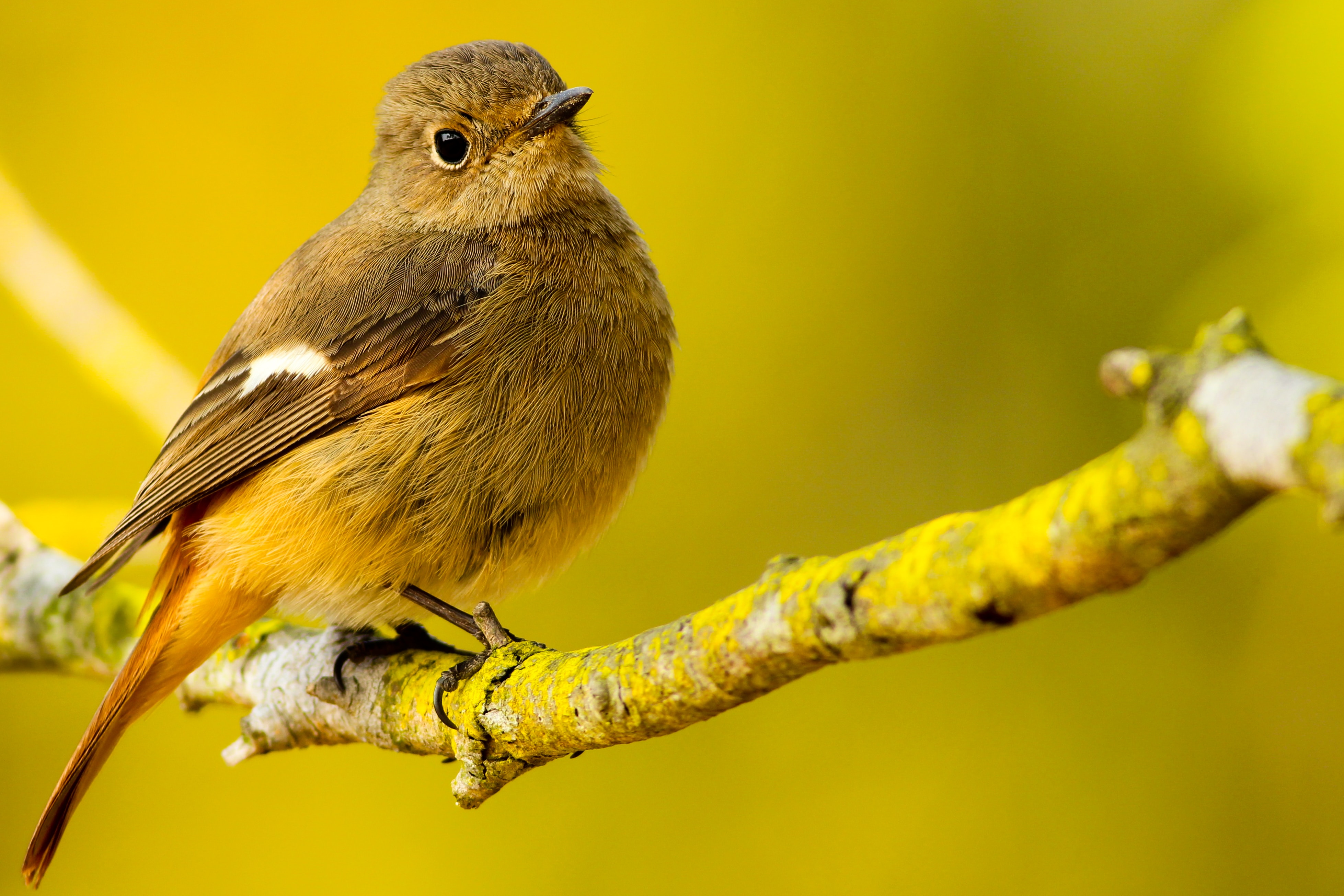
“It’s a yellow-breasted kjøtmeis,” I say. “When I was leaving the house to come here, I found it dying in the hallway, so I’ve spent this interview thinking not just about how important this job would be for my professional development and about the dead classical musicians for whom I would be responsible, to say nothing of the live musicians who I would support, but also about saving the life of this bird. So another qualification of mine for this position is that I can stay calm and perform well under pressure.”
The bird chooses this moment to fly. It circles the office, flashes like a star over the computer screens, shits again on the budget reports spooling out of the printer. It lands on the city archives and looks down at the Department of Community Administration with the proud raised head of a newly decorated veteran. The bureaucrats watch from their cubicles, spinning on their ergonomic chairs, but nobody stands. Most of them stay quiet, admiring the bird, smiling, but some are annoyed; some turn back to their screens and protect their head and faces with sheets of printer paper.
The interviewer and I can see that it’s time to open the windows.
The bird feels the cold February air rush into the office and follows it to freedom. It bounces off the photocopier and shoots out the closest window. The building is cold now, but otherwise the day has returned to normal, and I go back to the interviewer’s office to finish my coffee.
When I leave the interviewer doesn’t shake my hand. That doesn’t concern me, since Norwegians often avoid physical contact when they say hello or goodbye. Instead, he brings back his favorite trick, opening his eyes and raising his eyebrows as he says that he’ll call me. I believe him and smile to show it.
On the way home I see plenty of birds, but I’m looking for the one that kept me company during the interview. I’d like to say thank you. Sometimes it’s a good idea to carry dying animals around, to keep your hands in your pockets, and to never take off your coat.