The Still-Untold Story of Van Morrison’s ‘Astral Weeks’

When Van Morrison’s producer died abruptly of a heart attack at the end of 1967, Morrison’s contact at Bang Records became Carmine “Wassel” DeNoia, a “low level” mobster later convicted of bribing radio DJs to play certain records more heavily than others. When bribery failed, he used other means. “So here’s this disc jockey,” he said in 2001. “I throw open the window, pick him up, flip him, shake him out by the ankles. Ninth floor. All the change fell out of his pockets. Some friends of mine picked it up.”
One night, Wassel went to see Van Morrison at his hotel. Van was short-tempered and drunk, and Wassel was Wassel. Before the night was over, he’d picked up an acoustic guitar and smashed it down over Morrison’s head.

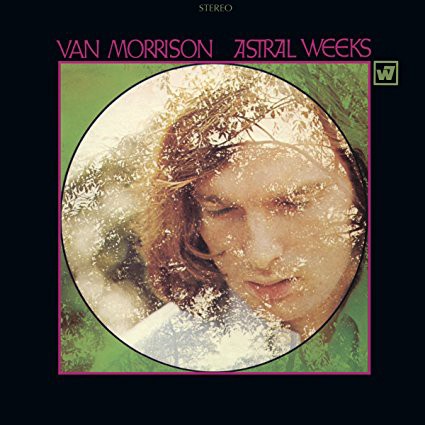
For reasons not entirely unrelated, Morrison soon fled New York for Boston where, according to Ryan H. Walsh’s new book, Astral Weeks: A Secret History of 1968, he “planned, shaped and rehearsed” the songs that became the record Astral Weeks, which is my favorite record in the entire world.

I was in college when I started listening to Astral Weeks. At that time my thoughts were about as mystical and vague as Van’s seemed to be: I liked to think that the record could show me how to live, how to be in the world.

I was living on the second floor of a lovely, dingy house with two other girls. We each had wide eyes and a penchant for feeling things so intensely we didn’t always know how to manage ourselves. We were raw, exposed, each of us with our own little handful of trauma. Later, things between us grew difficult, even sour, but back then, we were all a little in love with each other.

I liked to think that the record could show me how to live, how to be in the world.

It was just a brief period that we lived together. During that time we drank a lot, smoked a lot of weed, listened to a lot of music, loudly, and sang. Up to then I had been shut up into myself as tightly as a matchbox. But Sam sang, and she sang all the time, and she had an achingly clear, shimmering voice, and she sang with such a sense of wonder and joy that soon I was singing, too, not only when I was alone, and even with the windows open.

We sang along with what we listened to. We listened to a lot of Sam Cooke, especially the gospel songs. We listened to the same things over and over again. Joni Mitchell, Gillian Welch, Emmylou Harris with Mark Knopfler, Alison Krauss with Robert Plant, and sometimes I’d go off on a tangent when I’d want to hear Dylan, which the others would tolerate, more or less, and also we listened to Van Morrison.

Eventually we discovered we could climb out through the kitchen window and onto the roof that overhung the front porch. It was a narrow, tar-covered ledge that could fit one person lying down length-wise or the three of us seated side by side with our legs dangling over the edge. We would set up our speakers in the window and blast our music through it while we sat and talked or sang. We even danced out there. Once a man came along on a bicycle and asked if he could take our photograph; we didn’t even tell him off, only shrugged, I think, and turned away. I can’t remember whether he took the photo or not. I can remember playing “Sweet Thing” out that window at top volume at 7:30 in the morning while we drank our coffee on the roof, thinking, in earnest, that we were doing the neighborhood a service.

But I can’t remember if Sam first played me Astral Weeks or if it was a boy I started seeing then. It might have been the boy. When Van sings, in “Cyprus Avenue,”

I think I’ll go walk by the railroad with my cherry, cherry wine

I believe I’ll go walking by the railroad with my cherry, cherry wine

I still think, That’s the part that boy liked.

His voice needs no accompaniment, no backing to prop him up. He is like Joni Mitchell in that way. The strength of his voice, or her voice, carries each song. But where Joni’s voice is sharp and clear as cold clear water, Van’s is as grainy and textured as velvet. He sings with a ferocious urgency, like he has to, like he might die if he doesn’t — or, worse, simply disappear from the world. He’s plaintive, howling.

But he isn’t just plaintive. He can be funny, ridiculous, both — possibly unintentionally. Near the beginning of “Ballerina” he says, in his misty, romantic way,

and if somebody, not just anybody

wanted to get close to you

for instance me

And later in the same song he roars with such passionate conviction you think he’s about to deliver something really profound, but what he says is:

the light is on the left side of your head

Is this a reference to something? I don’t know. But, oh, this song. The quick pinging of that bass line, like quick satin steps across a stage. Or

just like a ballerina stepping lightly

as Van says himself. But I can’t write down the lines. They bear such slight resemblance to the lines he sings. It’s that old cliché: painting about architecture. But it’s also his delivery. The notes spill and tumble and trip from his mouth like they would from a bird’s. Listen to him trilling, at the end of “Madame George,” “the love that loves to love that loves the love to love,” and on, and on.

I can’t write down the lines. They bear such slight resemblance to the lines he sings.

He was born George Ivan Morrison in 1945 in Belfast. Later he developed a taste for the occult, but it doesn’t seem to have come from his parents. While his mother briefly became a Jehovah’s Witness, his father was an atheist. Perhaps more importantly, his father built up a “vast collection” of records, mostly American blues, ballads, gospel, and folk; Woody Guthrie, Hank Williams, Jimmie Rodgers, Eddy Arnold, Gene Autry, Sonny Terry, Brownie McGhee, Sister Rosetta Tharpe, and eventually, Muddy Waters, Howlin’ Wolf, Little Walter, Big Joe Williams, John Lee Hooker.

Both he and his father revered Leadbelly (who appears on the song “Astral Weeks” under his given name, Huddie Ledbetter). Later Van kept a framed picture of Leadbelly on his wall. Walsh reports that soon after Astral Weeks was released, “feeling burdened by the image, he was about to throw it out.” “At that moment,” Van told an interviewer, “I was fiddling around with the radio — I wanted to hear some music — and I tuned in this station and ‘Rock Island Line’ by Leadbelly came on. So I just turned around, man, and very quietly put the picture back on the wall.”

My Butch Lesbian Mom, Bruce Springsteen

He was 13 when he played with his first band, the Sputniks. After that, he played with Midnight Special, the Thunderbolts, the Monarchs Showband, and Them. He found a bit of fame with Them. They went to London to record a few hits (“Gloria,” “Here Comes the Night”), went to San Francisco to play the Fillmore, Los Angeles for the Whisky A-Go-Go. In 1966 he left Them for New York, the producer Bert Berns (he of the heart attack), and “Brown-Eyed Girl.” After Berns’s death, he was caught up in a tangle of contracts with Berns’s widow and Wassel and eventually fled to Boston where, according to Greil Marcus, “late-night DJs soon got used to a character with an incomprehensible Irish accent drunkenly pestering them for John Lee Hooker music.”

I’d thought Ryan H. Walsh’s Astral Weeks, the book, would be about the making of Astral Weeks, the record, but it is more about the context in which the record was made. Walsh spends an unaccountably large portion of the book describing the Fort Hill Community, a small cult that grew up around Mel Lyman, former harmonica player for the Jim Kweskin Jug Band. Lyman claimed to be God (opinions on whether or how much he meant it seem to vary), ordered his followers around, and wrote charming little poems, like the one that starts:

I am going to fuck the world

I am going to fill it with hot sperm

There are also chapters about Timothy Leary, the Boston strangler, the movie The Boston Strangler, the so-called “Bosstown sound,” and the Velvet Underground.

“This is the secret history of Boston in 1968,” Walsh tells us, a history of “people desperately hunting for something intangible and incandescent, many of whom referred to that something as God. Some found it, embodied it, or impersonated it; others were crushed by it.”
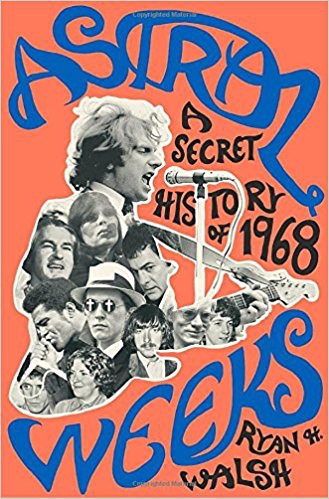
What does all this have to do with Van Morrison? I suppose Walsh wants to say that while Van was in Boston, writing and rehearsing the songs that became Astral Weeks, so were a lot of other people, like Mel Lyman, Timothy Leary, Lou Reed, and they were all at work on their own weird projects, and whether or not any of them actually interacted with Van that summer, in person, all these goings-on must have affected the very air of Boston, which Van was inhaling, and which must have therefore affected the record, and so on, etc. It’s a tenuous line of reasoning on which to base an entire book.

Astral Weeks wasn’t made in Boston. At the end of the summer, Van Morrison went back to New York, signed with Warner Brothers, and recorded the album at Century Sound Studios, 135 West 52nd Street.

That summer, Van played with a string of Boston and Cambridge musicians. These included John Sheldon, a 17-year-old guitarist living with his parents (Van asked to move in; Mrs. Sheldon said no), Tom Kielbania on bass, Joey Bebo on drums, and John Payne on flute.

Van had just married a girl named Janet Rigsbee, a model and aspiring actress he’d met with Them in San Francisco. Five years later, she left. Walsh tracks her down to Sheldon, California, where she tells him, “Being a muse is a thankless job, and the pay is lousy.”

But it sounds like she was quite a bit more than a muse. She helped him to write, or at least to revise. “Van liked to work in a sort of stream-of-consciousness way back then,” she tells Walsh, “letting the tape recorder continue to run while he just sort of played guitar and improvised, trying various things for twenty minutes or so at a time. Then we would go back, listen, and decide what was good, what to keep, tidy up rhyme scheme, and then try it out again.” Did she say “we”? Was she playing Anna Grigoryevna to his Dostoevsky? Mileva Marić to his Einstein? Why doesn’t Walsh ask any more questions?

Was she playing Anna Grigoryevna to his Dostoevsky? Mileva Marić to his Einstein? Why doesn’t Walsh ask any more questions?

My room was at the back of the house. It was a sunroom, really, with no insulation and wood floors painted yellow. If you walked through it, you could get to a screened-in back porch that we stopped using when we discovered the roof. I collected golden cast-off cicada skins and the pennies I’d flattened on the railroad tracks with Sam and the boy.

When I hear Astral Weeks I still think of that house, Van singing

and I will raise my hand up into the nighttime sky

and count the stars that shine in your eye

and just to dig it all and not to wonder,

that’s just right

and I’ll be satisfied not to read in between the lines

and how, after a night when none of us could sleep, Sam would say, in the morning, that our nervous energies must have kept each other awake, even though we’d each been in our own room.

At that time — for just a brief time — I thought, like Marianne Dashwood in Sense and Sensibility, that maybe everything could be said out loud — that everything should be said out loud. That you could feel things with a purity, an intensity, that most of the world seemed to shun. That you could raise your hand up into the nighttime sky, and so on.

At that time I thought that maybe everything could be said out loud — that everything should be said out loud.

For years afterward, I couldn’t listen to Astral Weeks at all. It has been nearly a decade and I am only rediscovering it now.

Walsh is preoccupied by Van’s decision not to use electric instruments on Astral Weeks; he keeps coming back to it. There are a few competing explanations but the story Walsh likes best comes from John Sheldon, who played guitar for Van that summer. Sheldon insists that Van appeared one day and announced he’d “had a dream in which there were no more electric instruments.” That was that; they all switched to acoustic.

Midway through Astral Weeks, the book, Walsh describes Lisa Bieberman, an early associate of Timothy Leary’s and an advocate for LSD. Bieberman later grew disenchanted with Leary, the beliefs they’d shared, and “a time when we thought the world could be enlightened just by flooding it with acid.”

Minus the acid, this was how I thought during that year when I sat on a roof, loving Astral Weeks — that you could receive knowledge or understanding in a sudden rush, that dreams could be prophecies, that you could bypass sadness by immersing yourself in some extravagant bliss.

This was how I thought during that year when I sat on a roof, loving Astral Weeks — that you could bypass sadness by immersing yourself in some extravagant bliss.

Or as Van sings in “Sweet Thing,”

I will never grow so old again

and I will walk and talk in gardens

all wet with rain

It comes as something of a disappointment to learn that none of the musicians you’ve gotten to know over the course of the book actually helped record Astral Weeks — not John Sheldon, or Joey Bebo, or Tom Kielbania, though Kielbania was at least present during the sessions. Walsh doesn’t introduce the Astral Weeks players until the very last chapter. Richard Davis played upright bass, Jay Berliner guitar, Connie Kay drums, and Warren Smith, Jr., of all things, vibraphone. The one exception was John Payne, who came to the sessions with Kielbania, and managed to beg his way on to the title track. (“Please,” he said. “Please let me play on this song.”)

The others were jazz musicians. The producer, Lewis Merenstein, had brought them in. Some of them played with the Modern Jazz Quartet, some with Charles Mingus. Earlier that same day, Berliner had “recorded jingles for both Noxzema and Pringles potato chips.” None of them had met Van Morrison before; none of them had heard of him.

Watching Dolores O’Riordan Dance on Yeats’ Grave

Berliner later said, “This little guy walks in” — pudgy, pasty, ginger-headed as he was — “past everybody, disappears into the vocal booth, and almost never comes out.” He added, “Even on the playbacks, he stayed in there.”

Richard Davis said, “I don’t know what he was doing in there!” He said, “He’s a strange fella!” Davis also said, “We were not concerned with Van at all, he never spoke to us.”

Of course it says much more about me and my own inclination for what Walsh calls a “default mode of noninteraction,” but I have trouble with this slight, small petulance around Van’s silence in the studio. I know that he was rude. I know that he walked into the room and, out of shyness or nerves or irritability or something else, walked past everybody in that room and shut himself into his little booth. But how, once they heard the howling that erupted from him, could they hold it against him? Listen to him on “Ballerina,” how he sings, almost calmly,

well, it’s getting late

and pauses, and the strings brush past a few beats, and he murmurs yes it is, yes it is, and bursts:

and this time I forget to slip into your slumber

like a lion, tipping his head back, roaring. Then there’s the line about the light by your head, and then:

and I’m standing in your doorway

and I’m mumbling and I can’t remember the last thing that

ran through my head

What I mean is: how much more emoting does he have to do until we’re satisfied? So he doesn’t want to do small talk; so, ok.

Walsh says that it’s “a point of contention” whether Van gave the musicians lead sheets or chord charts to work from, “but Davis believes Morrison just strummed the song and sang it from the booth once or twice, with the musicians improvising their parts on top of his composition.”

Greil Marcus is wonderful in his descriptions of Van’s interactions with the musicians, their responses to each other. In his book When That Rough God Goes Riding, he describes how Morrison was

saying nothing to the musicians in terms of banter or instruction, and saying everything in the cues of his chords, hesitations, lunges, silences, and in those moments when he loosed himself from words and floated on his own air. But that’s too simple. When you listen, you hear the musicians talking to each other; more than that, you hear them hearing each other.

Merenstein later said that the finished record had been so utterly contingent on a number of chance happenings that if any one of them had gone differently, it wouldn’t have been made. It “had to happen because it had to happen,” he said, and Marcus goes further: this awareness of contingency, he writes, “becomes an awareness that the fate of a song, whether or not it will achieve the finality you in fact know it will, rests on the way Richard Davis steps out of a rest and whether or not Morrison will know what Davis has just done and what he himself can now do to live up to it.”

They’re magnificent together on “Madame George,” Van’s voice and Davis’s bass twining around one another, Davis tapping out the spine of the song so Van can sweep over it. Every moment of this song, Marcus writes, is another little contingency, every moment in which Davis and Van beckon and respond to one another.

They’re magnificent together on “Madame George,” Van’s voice and Davis’s bass twining around one another, Davis tapping out the spine of the song so Van can sweep over it.

While Marcus finds these contingencies painful, even frightening — “it’s scary,” he writes, “because the inevitability of the music is also its unlikeliness” — I’m struck by the fact, not that it might never have happened but that it happened at all, one moment at a time, one after another, in this room full of musicians Van wouldn’t speak to, that they could communicate like this, Van and the musicians in the room, Van and all the musicians, but most particularly Van and Richard Davis, because as Marcus writes, “at its highest pitch, the album has become a collaboration between Morrison and Davis,” and, even more than that: “In the blues term for the shadow self that knows what the self refuses to know, here Davis is Morrison’s second mind; there Morrison is Davis’s.”

Van might have tooled around that summer with John Sheldon, Joey Bebo, and Tom Kielbania, but on the album, you’re hearing Richard Davis, Jay Berliner, Connie Kay, and Warren Smith, Jr. and, setting aside Walsh’s arguments about the influence of Boston on the record, they’re the ones I want to hear about.

The greater disappointment of Walsh’s book is learning that Van later disavowed Astral Weeks. “They ruined it,” he said. “They added the strings. I didn’t want the strings. And they sent it to me, it was all changed. That’s not Astral Weeks.”

Once they’d recorded the tracks, Merenstein brought in the arranger Larry Fallon, who added harpsichord to “Cyprus Avenue,” horns to “The Way Young Lovers Do,” — and distributed strings across the entire album. I’ve always found the strings lovely.

Van later disavowed Astral Weeks. “They ruined it,” he said. “They added the strings. I didn’t want the strings.”

“Van seemed quite happy with the album at the time, he truly did,” Merenstein insists now. “In fact, everyone did, at the moment it was completed.”

Then again, why worry over Van’s thoughts? How often does an artist make a good judge of their own work? As Walsh points out, Van’s thoughts on Astrals Weeks “change from interview to interview. He’s said it was originally planned as an opera, and also that it’s just a random assortment of songs. That the arrangements are ‘too samey’ and — incredibly — that it’s not a personal record.”

I have heard so many artists speak so obliviously about their own work. Take Dylan, who so frequently either dislikes his own songs or simply neglects to record them (“I’ll Keep It with Mine”), or to release them (“Series of Dreams”), or even to remember them at all (“Love is Just a Four Letter Word,” which he wrote, forgot, and then one day, riding in a car with Joan Baez, listened as her version of it came on the radio and said, in all innocence, something like Hey, that’s not a bad song).

In 2008, Van Morrison announced his intention to perform Astral Weeks live, in its entirety, at the Hollywood Bowl. The show would be recorded and the recording would be released. He brought back some of the original players, too, including Richard Davis and Jay Berliner.

But when the musicians arrived for rehearsal, they found stacks of sheet music waiting for them, on which every note they’d played — they’d improvised — in 1968 had been notated. Van expected them to perform the songs exactly as written. “Do you know how crazy that is?” Merenstein asks Walsh. “For that kind of playing?” Richard Davis made it through two rehearsals before bowing out of the show.

When the musicians arrived for rehearsal, they found stacks of sheet music waiting for them, on which every note they’d played — they’d improvised — in 1968 had been notated.

There’s a part of me that sympathizes with Van here: this need, not merely to replicate, but to return to such a moment, to return fully, to return to each note. Of course you can’t replicate it; of course you can’t return to it.

Part of me wants to believe him when he says the strings ruined Astral Weeks, but his saying it doesn’t make it so. Of course it is difficult to make art, difficult to make in the world what you have already made in your mind. Difficult to make art and difficult to rely on other people to help you make art. It is difficult to be very young and to feel intense sadness and intense joy, often simultaneously, and to figure out a way to live in the world. I love Van Morrison at this moment when he is young and rude and raw, before he sinks into fame and disappointment like an insect into amber. It is so apparent it hardly needs saying. Of course it is difficult to behave well, difficult to live well; of course it is difficult to live at all.

How to Bury Immortal Humans

The Underside

Once upon a time we lived on the right side of the ground. Our village prospered and the crop yield was good. Fields of gold colored wheat and rows of silver corn. We bathed in the yellow light of the sun. But then one day our people stopped dying. There was talk of a great enemy beyond the bounds of our village. Over backyard fences, our parents whispered to their neighbors, The world is a scary place, you know. So they took to burying us down here. To keep us safe. Safe from what, we do not know. Some of us believe the crops were dying, that the reserve in our silo mills had begun to run out. The great enemy beyond the village, they say, was Hunger. There were too many mouths to feed and even the immortal get hungry. Either way, it’s true, we think. The Underside is a safe dry place, though sometimes a little rain gets in.

The first of us arrived here on the cusp of adulthood — just before a boy sprouted hair at his underarms, just before a girl first bled from between her legs. But soon the appropriate time for a child to descend became the subject of an endless and circular debate. When a baby begins teething? When a baby is born? Some of us indeed came here straight from the belly, swaddled and carried to the Saint Paul’s cemetery, in the arms of our own fathers or a midwife. In the beginning, the whole town gathered to witness the event. The men from our village would carve out a place in the curve of the earth with their shovels and their picks and their garden hoes. They’d brace and bracket the walls with wood beams. They did this to support the ceiling. Then the women would thatch a crosshatch with straw and sweet grass, and lay it down to close us in. The last of us, though, were deposited in the thick of the night, alone and unwitnessed. By then our parents reasoned it was best we not get used to the light. And so the cemetery became a city of the living dead, for it was no longer needed to hold bodies relieved of their breath. And each headstone now marks the place where a child went down. The villagers refer to them as homestones now.

Eventually, our people stopped having children altogether. Our departures left in them a pit so deep, a hunger so bitter, all the corn and wheat in the world would not touch it. When they buried us, they filled our holes with blankets and lanterns and candles and lamp oil, with matches and flint, batteries and steel wool, with pillows and photographs and first aid kits, and small toys with which we were to pass the time, and buckets and cloths that we use to wash with the water we bring back to our holes from the Underside’s well. With the older kids they buried small shovels, that we might burrow our way to the homes of the others. They provided us with extra beams and brackets and instructed us to begin the mouth of a tunnel from the top and work down, to be wary of places where the ground got soft. They told us never, ever attempt to tunnel up. With the little ones, they buried what food they felt they could spare: burlap sacks of carrots and beets, potatoes and other things that sprouted and spudded and grew away from the sun — an incentive for those little ones to be found. And at night, our parents dreamed of large underground rooms, enough space for an underground farm.

But of all the things they gifted to us, none is more treasured than the catalogs of our histories. Histories, we say, though you might call them stories. Still, we recognize ourselves in these pages, dressed up, for sure, fancified, perhaps. Many, in fact, have required a good deal of translating. Like the history of the girl and the wolf in the woods. What’s a woods? some of us ask. What’s a woods? What’s a wolf? Well, woods is easy. It is a place for a path, and a path is akin to the tunnels we’ve down here. And a wolf, what is that but the threat of another kind of hunger? See here, in the home of the little girl’s grandmother, the wolf opens his mouth and swallows the little girl up. She slides down his throat, which too is a tunnel, a path that ends in the pit of the wolf’s stomach. What’s a pit? A pit is another word for a hole. Oh, we all say. Hole is word we all know. And grandmother? Well, that is a word which we don’t — a very large mother? — so perhaps it is best if we choose to ignore it. But here, see here, at the end of the history, a man comes along with a knife and splits open the wolf’s belly? He pulls the girl right out of the pit. Out of the pit, we say. We repeat it. He pulls the girl right out of the pit.

If it is true what they say, and history too has a way of repeating, it is difficult not to find some comfort in these stories. We know, we know — this is how rumors get started. One day, your neighbors are simply chitchatting, and the next you’re all burying your children alive. But the history of the girl and the wolf in the woods is not the only one of its kind. There is another, it is one of our very favorites. It is written in a catalog complete with illustrations. It is the history of a childless toymaker and a beautiful blue fairy who brings the toymaker’s marionette to life. A marionette? Let us just call it a baby. And the baby, more than anything, wants to be a real boy. It is a sentiment with which we can sympathize acutely — it strikes at the taut strings of our Underside hearts. So the baby goes out into the world, goes out like the little girl goes out into the woods, like the place beyond the bounds of our village. The childless toymaker waits, wringing his hands, until the baby proves itself worthy of being remade whole. No, not hole, whole, another word for complete. And when the baby succeeds, the blue fairy bestows upon it the soul of a real boy, and he and the toymaker live happily thereafter. It is hard not to see the toymaker and the blue fairy for what we know them to be — a father and a mother — and harder yet not to believe that our own fathers and mothers are up there waiting. Waiting for us to turn into real boys and real girls.

Sadly, these are not our only histories. There is one we have read only once, but it is lodged in our memories. It is the one about a child who, like us, has been buried, but unlike us they do not bury the child to keep it safe, they bury the child because it is dead. But the child is stubborn, and one day from its grave an arm springs forth, and try as they may to push it back into the earth, the arm rises again, slapping the ground with the flat of its hand. Distraught, the child’s mother takes a switch from a nearby tree and beats the arm, and beats it, until it recoils to rest for all time at the child’s side. Weirdly, this history has infected our dreams, and in them our arms acquire a great elasticity. They stretch and stretch and worm their way through the crosshatch, through six feet of dirt, to the Upside, where the air is free of the earth, and emerge like tulips at the base of our homestones. Our fingers quiver in the breeze like white, ruddy-tipped petals, and in these dreams our parents, who hunger for our presence, who have all along been up there waiting, see these strange flowers flapping, see these strange flowers swaying, and not for a minute do they think to look for a switch. Instead, they take our hands and cover them with their own, sometimes two, sometimes four, and weep for their joy. They think they too must be dreaming. And our desire to embrace them is so strong that our arms become even more tensile, stretch even further — in these dreams our arms are made out of rubber — and we wrap them around our parents’ midsections once! thrice! so many times! that we squeeze the life right out of them.

About the Author

Benjamin Schaefer is a writer and editor from upstate New York. He studied literature and creative writing at Bard College and the MFA program at the University of Arizona. His fiction has appeared in Guernica, and he is the recipient of fellowships from the MacDowell Colony, the Millay Colony for
the Arts, and the Virginia Center for the Creative Arts. He serves as the prose editor for Fairy Tale Review.

“The Underside” is published here by permission of the author, Benjamin Schaefer. Copyright © Benjamin Schaefer 2018. All rights reserved.

PEN America‘s New Guide Recognizes Online Harassment as a Threat to Free Speech

Today, PEN America launches its Online Harassment Field Manual, a resource with the mission to better prepare and empower writers, journalists, and all of us living our lives online with more tools to deal with hateful speech and trolling. This is not your hackneyed sexual harassment instructional pamphlet — you know the ones: equal parts bad writing and bad advice, depicting harassment in crisp, neatly colored-in story lines that resolve all-too easily. The Online Harassment Field Manual, by contrast, is more comprehensive: with personal stories, health and wellness tips, legal advice, and cyber security suggestions, all informed by 230 writers and journalists who deal with online harassment in their daily lives.

The manual includes practical resources like step-by-step guides for preventing doxing (the distribution of your personal information across the internet without your consent); advice on how to combat hate speech with counter-speech; and guidelines for using online writing communities to fight back against online harassment. It also outlines new roles for employers, tech companies, and law enforcement officials who are responsible for ensuring no one is forced into silence. One of the most powerful sections of the field manual is the “real life stories” section, which includes accounts from writers and journalists who have experienced online harassment and its aftermath.

Indie Bookstore Demonstrates How to Deal With the Alt-Right

It’s clear that PEN America recognizes online harassment as a virus that poisons a person’s whole being, the effects all-encompassing and paralyzing. It’s crucial we have resources set up to acknowledge and respond to this reality—especially because online harassment disproportionately affects women, people of color, and the LGBTQ community, people who already struggle to find footing in a historically white-male-dominated literary world.

PEN America was founded in 1922 and works “to ensure that people everywhere have the freedom to create literature, to convey information and ideas, to express their views, and to make it possible for everyone to access the views, ideas, and literatures of others.” With the Online Harassment Field Manual, PEN America is taking a stand against online harassment as an obstruction of freedom of speech.

With the Online Harassment Field Manual, PEN America is taking a stand against online harassment as an obstruction of freedom of speech.

And we should identify online harassment as a threat against free speech. So many previous attempts to address online harassment have been mired in a new form of victim blaming: by pointing to the untamable internet, the anonymous comment fields, or social media as explanation for the hate, previous attempts elide the violence (psychological and otherwise) being committed by actual people against other actual people. Rather than condemning the internet writ large, and in the process throwing up its hands about making real change, PEN America is instead working to empower and protect our rights as thinkers and writers in the digital space we care about and believe in cultivating together.

We reached out to Laura Macomber, Journalism and Press Freedom Project Manager at PEN America to learn more about how PEN America envisions the Online Harassment Field Manual operating in the MeToo moment, and online harassment as an issue of free speech.

EL: How do you envision writers and their allies using this manual?

LM: Storytelling is an essential part of countering online harassment: without people like Lindy West, Leslie Jones, and Mary Beard coming forward to share their experiences and draw attention to the horrors of online abuse, this problem would continue to be trivialized by tech platforms and society in general. We thought it was really important to include the voices of a diverse group of writers inside of the Field Manual, not just to highlight the ways in which online hate takes a toll personally and professionally, but also to offer solidarity to lesser-known or emerging writers who may be suffering unseen.

We thought it was really important to include the voices of a diverse group of writers in the Field Manual, to offer solidarity to lesser-known or emerging writers who may be suffering unseen.

Our practical goal for the Field Manual is that it help writers protect themselves online by offering information about cyber security, self-care, and law enforcement as they relate to cyber abuse. We also exhort online allies and the institutions that employ writers — newsrooms, publishers, etc. — to recognize their stake in this issue by offering them “best practices” for supporting writers during online harassment. But I would say our more lofty goal is that this Field Manual will generate deeper and more widespread connections among writing and journalism communities and their allies online, so that we can keep coming up with innovative ways to address this issue and not retreat into our corners, which is what allows online hate to thrive.

EL: What did PEN America learn about online harassment while putting this manual together?

LM: Our 2017 Online Harassment Survey of writers and journalists gave us a lot of insight into how online harassment impacts writers’ personal lives, professional lives, and well-being. Two-thirds of our survey respondents reported having a severe reaction to online harassment — including refraining from publishing their work, permanently deleting their social media accounts, or fearing for their safety or the safety of their loved ones. Those are pretty egregious outcomes for something that many people still want to say isn’t a “big deal.” I think the other troubling, though perhaps unsurprising thing we learned was how alone people feel when they’re targeted by online abusers. So many of the writers we spoke to said that to be targeted online was to feel isolated, scared, and lonely. How can something that happens to so many people result in so much isolation?

So many of the writers we spoke to said that to be targeted online was to feel isolated, scared, and lonely. How can something that happens to so many people result in so much isolation?

EL: Can you expand on the relationship you see between PEN America’s mission to protect free speech, and the trends you’ve witnessed in online harassment for writers?

LM: In the “about” section of the Field Manual we address this very question. Online harassment is a free expression concern precisely because it can result in people censoring themselves or withdrawing from online discourse out of concern for their safety and sanity. Writers and journalists are on the front lines of this battle: we rely on their voices to reflect our national narrative and cover the most pressing issues of the day. We can’t afford for them to be silenced. On top of that, online harassment unduly burdens groups and individuals who are already marginalized — people for whom online discussion has actually been an invaluable medium for increasing the visibility of women, people of color, the queer community, and other groups. When people stop speaking out and writing about topics they feel are important, everyone loses, especially in a country where we pride ourselves on our speech freedoms.

EL: Why now?

LM: Because we can’t afford to wait! We’re in a tenuous moment. The President and his administration continue to bully journalists, and in turn online trolls feel emboldened to bully anyone they disagree with, or whose identity — for whatever reason — offends them. Obviously online harassment has been around since long before the 2016 election, but if we continue to ignore its implications and the chilling effect it’s having on writers and journalists at a time when this country’s leaders are working to minimize the value of our free press, we’re all in trouble. And it’s not just the current administration: outrage mobs have become an issue on both sides of the political aisle. While we’d all be better off if we stopped shouting over and saying terrible things to each other, one way PEN America can contribute to the conversation is by offering the strategies for nurturing productive online discourse that are contained in our Field Manual.

If we continue to ignore online harassment and the chilling effect it’s having on writers and journalists at a time when this country’s leaders are working to minimize the value of our free press, we’re all in trouble.

EL: Do you see this project as being in conversation with the Me Too Movement?

LM: It’s impossible not to — especially since women are really the ones who have pushed the issue of online harassment into national consciousness. In some ways it’s ironic that #MeToo started online, which is where so many women face unprecedented sexual harassment every single day. And yet, it also speaks to how powerful and necessary our online communities are for elevating the voices and experiences of people who have been historically ignored and oppressed. Which is exactly why we created this Field Manual: to ensure that voices aren’t silenced and that people continue to exercise their right to speak online.

EL: Anything else you’d like to add?

LM: There’s still a long way to go, and we need a lot of different stakeholders to continue contributing to this conversation. We hope, as a start, that this Field Manual will make it into the hands of anyone and everyone facing online hate, and that it will inspire its users to continue campaigning for safer and more inclusive online communities.

I Couldn’t Read This Author’s Memoir in Chinese—So I Learned Spanish

Why did I decide to learn Spanish? The short answer is that I wanted to read a certain book. The long answer is more complicated, but it begins, like that book, with a young Taiwanese writer named Sanmao, her Spanish husband, and the Sahara desert.

The book is called Stories of the Sahara, or Diarios del Sáhara if you’re reading it in Spanish, but it might as well be The Thousand and One Nights for the hold it has on me and scores of other readers, most of them in the author’s native China and Taiwan. Diarios is a collection of personal essays, a chronicle of one plucky Chinese woman’s marriage to a Spanish man and her adventures in what was, in the 1970s, the Spanish Sahara. It is as addictive as a daytime soap, and like any good soap opera, it seems too outrageous to be real. The author steal souls with her camera, doles out Chinese medicine and aspirin to los saharauis, and somehow gets roped into playing midwife for her neighbor’s daughter. She gets her driver’s license while evading the civil guard, who want to write her up for months of illegal driving. She endures an exhausting family reunion and eventually wins the love of her Spanish in-laws. She even writes a love letter for a delusional shopkeeper and tries to save a resistance fighter’s wife from being publicly executed.

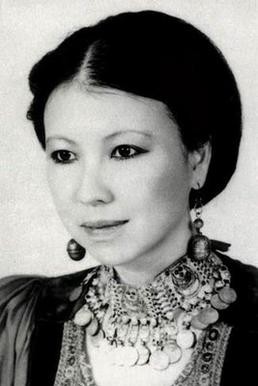
But I don’t know any of this, not yet. I’m not even really looking for Sanmao, but she — or her ghost — finds me anyway. I’m Googling another Chinese writer, a very famous, very literary Chinese writer, when I glance down and see her photograph in Google’s little salad bar of related searches. People also search for…and there she is, neatly labeled with that odd, Madonna-like mononym, looking just a bit like a Chinese Frida Kahlo.

Sanmao’s picture on Wikipedia

We have bohemian artist types? I think, and click on her picture. A quick glance at her Wikipedia article confirms that, yes, we Chinese most certainly do have bohemian artist types. And Sanmao, if her Wikipedia article is to be believed, is a bohemian artist type par excellence. I scroll through her page. It’s got one of those little banners at the top to warn readers that what they’re reading might not be strictly verifiable, but I breeze right past it. The name, I learn, is a pseudonym. It refers to the protagonist of a well-known Chinese comic strip, an intrepid young homeless boy who suffers from malnutrition and therefore has only three hairs on his whole head. Sanmao the real-life traveler and writer was born Chen Maoping in Mainland China, and later moved to Taiwan. I scroll a bit faster so I can get to the good stuff, the interesting stuff, the potentially unverifiable stuff.

‘Stories of the Sahara’ is as addictive as a daytime soap, and like any good soap opera, it seems too outrageous to be real.

Ah, here it is: Dropped out of school quite early on and was tutored at home. Went to university in Madrid. Traveled. Became engaged to an older German man, who promptly dropped dead. Married a younger Spanish man, lived in the Sahara desert, wrote a best-selling book, wrote over twenty books, including a few translations of a Spanish-language comic strip, lost her husband (at age 27!) to a tragic diving accident. Traveled, lectured, lived for another twelve years. Hanged herself in a Taiwanese hospital on January 4th, 1991. A strange, unidentifiable feeling burrows up from the lower levels of my mind. It digs and scratches and finally breaks the surface. Suddenly I understand that I am reading this woman’s Wikipedia article on the anniversary of her death. The book becomes an inevitable point in my future. I need to read it; I will read it.

I am staring at an Amazon product page. Somehow I’ve managed to pull a single Spanish translation of Stories of the Sahara out of the vast sea of Chinese editions. It’s not English, but it’s something. I picture myself reading it at a snail’s pace, a dictionary in one hand and a grammar guide in the other. Forget it, I tell myself. Just wait for the English translation to drop. I do some shopping for a friend’s birthday, I look at books about the natural history of the domestic cat, I listen to a little Willie Nelson. But before too long I’m back on the product page for Diarios, feeling an itch in my purchasing finger. How hard could it be?

Unlike Japanese, which I once knew well enough to follow cheesy game shows and children’s books, and Spanish, which I figure I might be able to learn, I will never, ever be able to learn Chinese. My Cantonese is atrocious. I once asked my grandmother for a walking chicken instead of directions to King Street, and I’m an easy mark for my mother, who likes to say ridiculous things to me in Cantonese (“Lazy worm! Lazy worm! The lazy worm likes to drink tea! Drink more tea, lazy worm!”), then watch me respond, in English, to what I think is a simple request for another Coke with extra ice. My written Chinese is limited to the characters that make up my name (which, incidentally, literally means something like “Pure, Clear English”) and a handful of other words, like: person, enter, month, day, year, woman, man, tea, flower, hand. The only things I can say with any confidence in Cantonese are phrases I’ve learned from television: Move it, Kobe! Save me, I’m dying! My left eye sees ghosts! It’s the truth, and I know it as well as anyone: I’ll probably be a ghost by the time I learn enough Chinese to hold a sane conversation, let alone read a book. If I want to read Sanmao — and I do — I’m going to have to learn to read her in Spanish.

I begin having dreams in which my dead grandparents keep running into Sanmao and José in the afterlife. Sometimes they exchange glances while strolling eerie landscapes dotted with pyramids. Sometimes I’m there with my grandparents, and Sanmao and I wave at each other. One night I have a dream in which I cannot find my grandmother. This is unfortunate because I seem to require some kind of life advice. I roam the afterlife, peering into pond-sized wells, kicking up sand, sizing up the distance between where I am and where she might be. Eventually, Sanmao and José come find me. They point to a temple on a jagged cliff face. She’s busy, they say. But you can talk to us!

The Spanish-language edition of Sanmao’s book arrives nearly a month earlier than expected, considering that I’ve ordered it from the U.K. It’s a bright canary yellow, and the front cover is full of text while the back cover is full of Sanmao. She’s wandering in the desert, dressed in a loose caftan and a rather striking tribal-style necklace. One hand brushes her hair away from her face.

There are more photographs inside, mostly portraits and snapshots of Sanmao and her husband, José. Here’s Sanmao walking through the desert, José by her side. Here’s Sanmao in front of her house, José by her side. Here’s Sanmao getting her marriage license, José by her side. They’re young and beautiful and if they were alive today, I think, they’d probably be living in Taos, New Mexico. It all seems terribly romantic.

If you Google “Sanmao and José,” like I did, you’ll find no shortage of news articles that read a little like notes for a novel. The opening sentence of an article from the English edition of El País reads, “There is a grave at the cemetery on the Canarian island of La Palma that is always garlanded with fresh flowers.” The last sentence from an article in La Palma Ahora, the local paper of the Canary island where Sanmao and José lived at the time of his death, puts it like this: “La muerte de Quero en la costa de Barlovento el 30 de septiembre de 1979, en cierto modo, fue también la muerte de San Mao.” I understand enough Spanish to get the gist: the death of José was also the death of Sanmao. But I can’t help thinking that his death also gave birth to the romantic legend of Sanmao y José, whose grip on me seems to be growing. And it’s not just me. The online papers tell me that José’s grave is an established pilgrimage site for Sanmao’s readers, and that she has her own tourist route in the Canary Islands, too.

For me, however, the first leg of the journey takes place at home.

The book sits on top of a pile of junk for a few days. I’m convinced that it’ll rot in my office, unread, like some kind of moderately expensive, international doorstop. And then, very casually, I begin learning Spanish with a surprisingly good educational telenovela called Destinos — and Sanmao’s book. For a period of nearly two months, I do absolutely nothing in my spare time but watch Destinos, read Diarios, and fill notebooks with terrible, terrible Spanish. My first real sentence in Spanish is whimsical, light, and completely spontaneous: “El jaguar está en la bañera y se quiere más burbujas.”

Destinos is essentially an immersion course: you are lowered into a linguistic bubble bath and the amount of cold English water dwindles with every episode until everything, even the explanatory asides from the narrator, is in hot, frothy Spanish. The dialogue and narration become more complex as you progress, but the story, in true telenovela fashion, is so addictive that you forget all about learning verb forms and tenses and instead become obsessed with other, more pressing, concerns. Will Raquel and Arturo ever get together?! What about Don Fernando Castillo’s first wife — when do we find out where the hell she actually lives? And what about Don Fernando’s firstborn!? How is Raquel ever going to find him?!

My fascination with Sanmao is rooted in telenovela question: What’s going to happen? And now what?

I know that my fascination with Sanmao is rooted in the telenovela question, the Scheherazade question: What’s going to happen? And now what? Most of her essays revolve around her curiosity, her need to investigate the people and the world around her. She does what she does and goes where she goes because she wants to see what will happen. But my interest in her also stems from one of her more curious qualities: she’s not particularly interested in perfect outcomes. That is, she’s willing to rough it and see how things develop, warts and all. In an essay called “Empezar de cero,” or “Start from Zero,” her husband-to-be discovers that she’s brought a sack of money with her, and that it was a gift from her father. He gives her a long, serious look before throwing down the proverbial gauntlet. “You wanted to come to the Sahara because you’re a stubborn romantic, but you’ll get sick of it soon,” he tells her. “With all that money, you won’t want to live like the rest of the world.” He offers her a compromise: once she’s seen everything she wants to see and she’s finished with her trip, he’ll give notice at work and they’ll go back to Spain together. She’s spitting mad, of course. He knows that she’s an experienced traveler, although she’s never been to a place quite so rough, and he knows that the Sahara is her great dream, her great obsession. So she agrees to put the money in the bank and live only on what José can bring in. After all, she’s not here just to look. She’s here to live.

That first night, she writes, she almost froze to death. She slept in a sleeping bag on the cement floor of their house, and José wrapped himself in una fina manta he had purchased earlier that day. It must be something like a thin shawl, or a wrap. I won’t look it up, not yet. Maybe later, if it’s really killing me. I seem to be getting accustomed to this hard, rocky space between not-knowing and knowing.

Reading Sanmao in Spanish gave me an excuse to be a bona-fide learner, a truly empty vessel.

Reading Sanmao in Spanish gave me an excuse to be a bona-fide learner, a truly empty vessel. I didn’t need to know everything because I really, truly, didn’t know anything. But I wanted to know everything! If I could read half an essay a day and understand most of what was happening, I was happy. I’d got the juicy, meaty bits, and that was all that mattered. If I didn’t understand a word or two, I would keep reading. Some words I managed to figure out from the context and repeated exposure: aquello, demasiado, gritar, chillar, tienda, casarse, boda, el coche, carretera, bosque. That, too (as in demasiado pequeño, or too small), yell, screech, shop (and also tent), to marry, wedding, car, highway, forest. And some words I looked up: pintauñas, tozuda, apretarme, charlando. Nail polish, stubborn, to tighten (as in one’s belt), chatting. I was dying to know what they could tell me about not only about Sanmao’s world, but mine, too.

In a sense, we readers already know what’s going to happen: Practical, levelheaded José, who sometimes underestimates his wife but is more often in awe of her talents, is going to drown in the sea. Sanmao will soldier on for twelve more years, writing and lecturing and looking, but she, too, is going to drown. Not in the sea, but in the cold, sterile air of a hospital suite. You, my dear readers, will live a while a longer, as will I, and we both know what happens next. But what she was after — what we are after — is far more interesting. We want to see everything between the great knowing of birth and the greater unknowing of death. We want to feel it in our bones.

10 Book Designers Discuss the Book Covers They Rejected, And Why

Have you ever bought a book just because the cover caught your eye? I have. I remember walking into the Strand bookstore and immediately gravitating towards Stephanie Danler’s Sweetbitter because the (now iconic) millennial pink cover stood out in a sea of paperbacks.

The book cover is the first thing a prospective buyer sees and a cover can go through multiple iterations before reaching the shelves of your local Barnes & Nobles. A proposed cover can be killed for a myriad of reasons: too gendered, too messy, too simple, too cliched and the list goes on. Using color, typography, and artwork, a cover has to be bold enough to attract attention and evoke the message and tone of the book at the same time.

I asked ten book cover designers about the evolution of their design process. These designers shared their rejected work with Electric Literature and elucidated on how the final cover best encapsulated the essence of the book. The rejected covers start on the left and the final versions are on the right.

Cover Design by David Litman for Simon & Schuster

Bullshit Jobs: A Theory by David Graeber

“[The book has] a great title and a simple but fascinating premise: the rise of useless, meaningless jobs and an argument against them. I wanted the cover to show how someone might occupy themselves at a bullshit job. Better yet, how might a creative person fill the day at a job that doesn’t allow self-expression. Having some experience with this, the design solutions were intuitive.

I liked the idea of the typography being made up of pushpins. The end result turned the commonplace office objects into something quite pretty but also begged the question of how many hours (many) and how much monotony (a lot) went in to assembling such a thing. As is sometimes the case, legibility was a concern. One criticism was that it was hard to tell what the pushpins were: ‘are they candy?’ Ultimately it was decided to go in another direction.

The crossbow was assembled using various objects from our office supply shelf. It was important that it only be made using items that are on hand in every office. I liked the imagery of some poor wage slave slinging handmade arrows into a cork-board in a desperate, maybe sophomoric attempt at entertainment. There was something rebellious about the idea of a weapon fashioned from office supplies — like staging a miniature coup. The placement and angle of the object over the type felt powerful and iconic like a crucifix.” — David Litman

Cover Design by Jaya Nicely, Artwork by Brendan Monroe for Unnamed Press

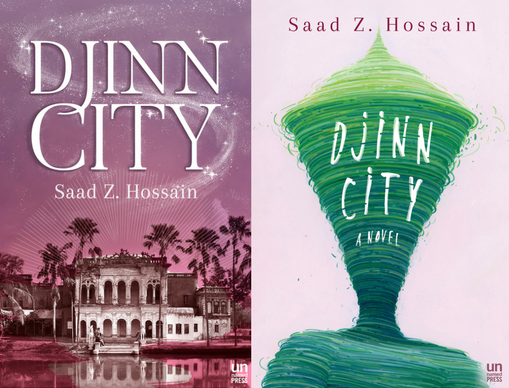
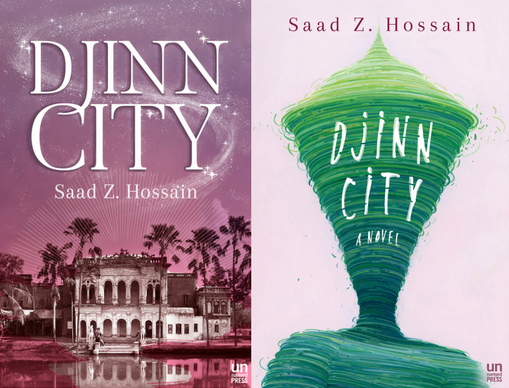
Djinn City by Saad Z. Hossain

“We had actually been using the original cover for quite a while, but when we were about to go into production on the galleys, we realized it wasn’t quite right. Djinn City is set in contemporary Bangladesh, and is a fantasy novel that addresses a lot of the challenges that the country is facing now and in the future, such as climate change and overpopulation. We needed a cover that felt much more modern, that also spoke to Hossain’s dark sense of humor and the wild adventure story that’s at the novel’s heart.

The original cover was too focused on the magical elements, which while are integral to the story, felt too rooted in tradition, and in the historical visions that the idea of ‘Bangladesh’ conjures. Saad Z. Hossain is part of the future of South Asian writing, not the past, and we needed a cover that reflected that. The final cover features art work by Brendan Monroe, an amazing artist we are really happy to work with.”— Olivia Taylor Smith, executive editor at Unnamed Press

Cover Design by Sarah Smith for The Experiment

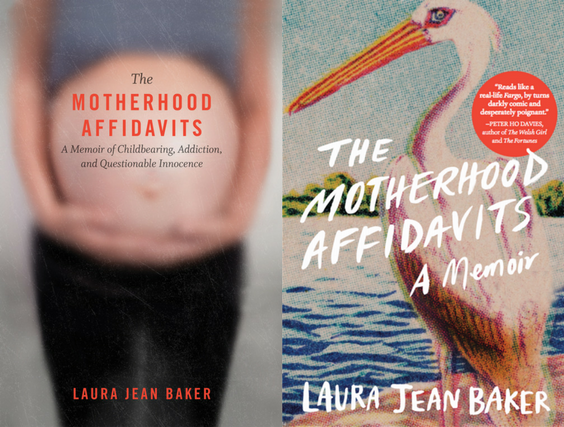
The Motherhood Affidavits: A Memoir by Laura Jean Baker

“Some of the rejected covers for The Motherhood Affidavits were very beautiful, but they were either too gendered, too retro-looking, or just not tonally in line with the book. It has a lot of themes going on, so it was a struggle to represent them visually without it being too on-the-nose. There’s a lot to convey: motherhood, marriage, financial struggles, addiction . . .

We wanted a cover that could only be the cover for this particular book, and one that wasn’t too feminine because we want men to read it too. In the end, we went with this powerful image of a very uncute stork because of what a stork represents. A stork brings babies. But they’re usually depicted in a very cute and happy way. Our stork is a bit ominous, as though it brings more than babies, and leaves you wondering.” — Sarah Smith

Cover Design by Olivia Croom for University of Hell Press

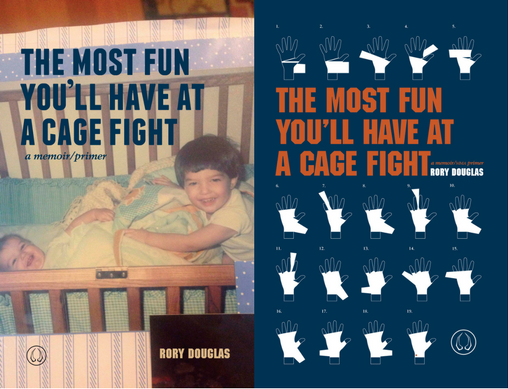
The Most Fun You’ll Have in a Cage Fight: A Memoir/MMA Primer by Rory Douglas

“The book is based on a McSweeney’s column Rory Douglas wrote for two years about his brother Chad Douglas, a Boeing scientist and amateur mixed martial arts (MMA) fighter. As you might imagine, the story is brutal but filled with humor.

The first version emphasized the book as a memoir with the beat-up photograph of the two brothers. I liked the play between the word ‘cage’ next to the crib bars and ‘fight’ next to the two smiling baby brothers. But this isn’t a straightforward memoir, and the cover needed to reflect that.

We went with the guide-to-wrapping-your-hands concept because it played into the how-to aspect of the book — it’s a memoir and primer on fighting after all. The step-by-step layout allowed me create a grid (I love a good grid), which lent itself a balanced and striking design (see what I did there). I love the typography because the octagonal ‘O,’ ‘S,’ ‘C,’ ‘G’ call to mind a fighting ring. And, yes, in theory, you could successfully wrap your hands following the instructions on the cover.” — Olivia Croom

Cover Design by Suki Boynton for Feminist Press

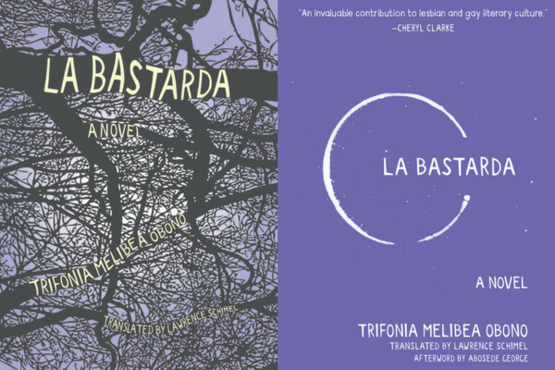
La Bastarda: A Novel by Trifonia Melibea Obono

“I strongly believe that voice and tone play significant roles in how book covers can effectively communicate a particular story. La Bastarda was presented to me as a coming-of-age tale set against the unique backdrop of Equatorial Guinea. The story focuses on an orphaned girl who enlists the help of village outcasts to find her father. The outcasts reside in the forest surrounding her village, and the forest itself is a point of intrigue and taboo activity.

With this in mind, I tried to put myself in the shoes of Okomo, the orphaned teen. I wanted to express, through her eyes, what this forest could look like to a young, impressionable, and curious girl. I rendered a cover from the perspective of someone looking skyward through the trees at night. We decided not to use this cover for concerns regarding legibility, as there is a lot of text that needed to be included (author and translator names, as well as the tagline ‘a novel’), but also because we thought that specific representations, whether it be a tree, a face, or specific renderings of type, could result in the cover falling into certain stereotypes about the region in which this book takes place.

The final cover design is an abstracted concept of the tone that I picked up on when I read the novel. I wanted to express a young woman coming of age and being brought into an inner circle of outcasts and finding her way. I treated the title, La Bastarda, as a character that slowly creeps into an opening in this circle of outcasts. Also, this design is much more minimalist than the forest design, and this simplicity allows for clarity, of course, but also diverse interpretations brought by the reader.” — Suki Boynton

Cover Design by Tyler Comrie for MCD

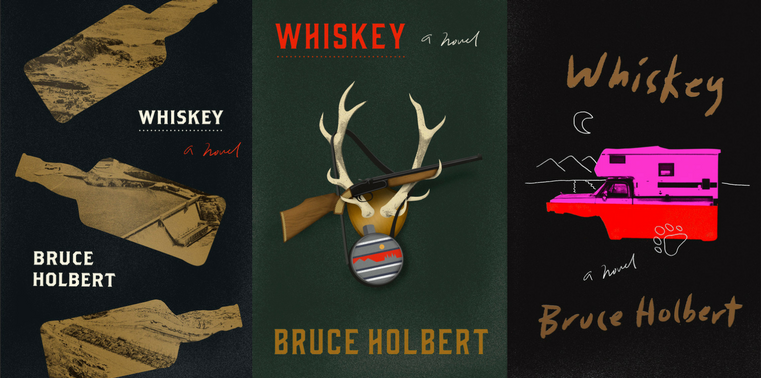
Whiskey by Bruce Holbert

“[The initial cover] was well received by the publishing house, and was only a few steps from approval. However, when presented to the author for a final vote something didn’t fit with his vision and it was vetoed. Perhaps the gun was too aggressive, or maybe there was an aversion to antlers, but in the end it simply wasn’t right and didn’t communicate the desired message.

The final version pulls relevant imagery from the story and is much more fitting as a whole. The RV is a prominent reference and very much a lens through which the story is told. Half submerged under the moonlight, it’s reflection reveals the underlying substance that toxically ties the family members together and symbolizes the fuel igniting antics between them.” —Tyler Comrie

Cover Design by Matthew Revert for Lazy Fascist Review

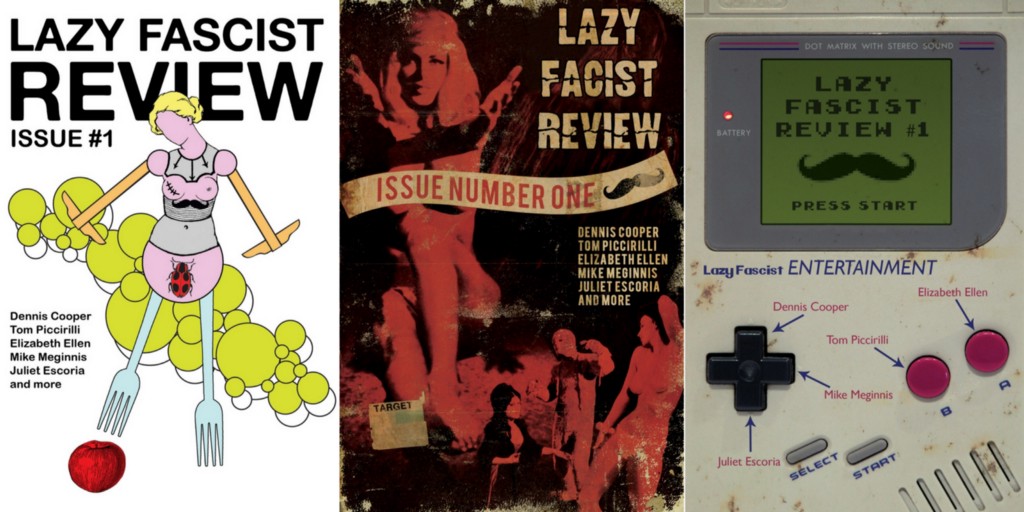
Lazy Fascist Review edited by Cameron Pierce

“The first rejected cover of the Lazy Fascist lit journal is an example of me designing something only I really like, but it was fun and I still love looking at it. When I was told it was ‘too weird to appeal to anyone,’ I designed a cover that leaned heavily on the sort of graphic conceits one finds in the design style associated with Italian exploitation films. While this was quite a successful design, Cameron was worried its appeal would be limited to those with an interest in Italian horror and escape the wider literary community.

We both agreed it was a good idea to use nostalgic connection to draw the eye of potential readers and making the cover look like a Gameboy seemed like the perfect solution. It appealed to the right demographic and was ubiquitous enough to have a wide enough reach. If you’re under the age of 35, who isn’t familiar with the Gameboy?” —Matthew Revert

Cover Design by Strick&Williams for Restless Books

The End by Fernanda Torres

“With the initial cover idea, we suggested the five aging friends in Rio de Janeiro — the first through five separate hourglasses, each standing in for a life lived colorfully — but run/or running out! (We particularly enjoyed building the title type out of the hourglass stands — the letters ended up looking a bit like bones.) The partially deflated balloons in the next layout were meant to suggest the end of a long and joyous party. With the third, we built a neon sign composed of colored bulbs at varying brightness — with some even burned out. And we paired these letters with neon angel wings as a nod and a wink; these men were far from angels.

The author was hoping for more tension between the title and the content. ‘The book,’ she reminded us, ‘has a very heavy title, but it is full of sex, humor, and bad behavior.’ She sent over some vintage carnival photos. She said, ‘I like the idea of having crazy, smiling people, at the peak of their happiness confronted with the fact that they will all face THE END.’ We were worried [using photography on the actual cover] might be too specific. It’s no fun for the reader when the cover designer shows you what fictional character(s) looks like. We turned up the photo of the young, handsome friends frolicking on Copacabana Beach that ended up on our final cover — a solution we really love.

Restless Books bravely embraced the limited color pallet and straight type treatment juxtaposed against all that Brazilian frivolity. Book spines can be a great space to have some added fun, so we introduced Copacabana’s fabulously graphic, wave-like street pattern and overprinted it with a neon yellow, so that it would glow in the bookstore.” — Charlotte Strick & Claire Williams of Strick&Williams

Cover Design by Jim Tierney for Del Rey

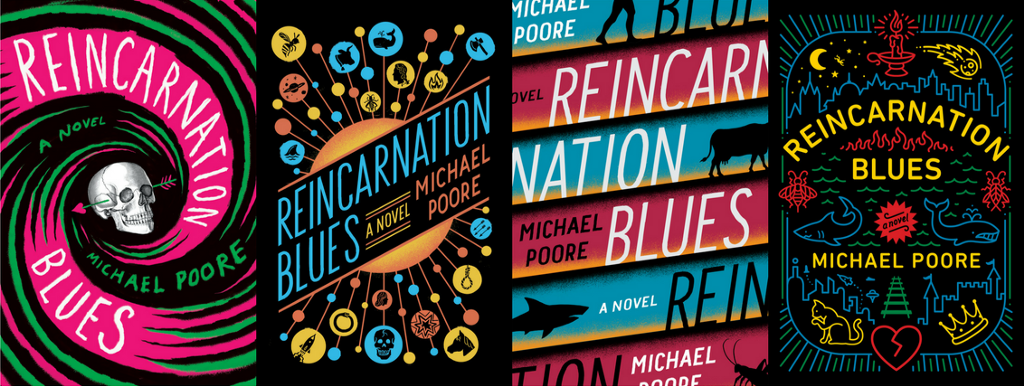
Reincarnation Blues by Michael Poore

“The novel follows Milo through many of his final lives (and deaths), so the sheer amount of imagery available to me was a bit overwhelming. The novel, taking full comedic advantage of the reincarnation cycle of punishment and reward, flings Milo back and forth between the far future and the distant past, and into the bodies of all varieties of animals and people.

For my first round of sketches, I tried to find the simplest way to communicate ‘cyclical death’— but in a fun way; ominous symbols like a gravestone and a skull, rendered in a bold and colorful style to reflect the story’s ‘lively’ approach to death. My other sketches went in a more literal direction, because when a story involves meteors, catapults, space ships, romance, and sharks, it would be such a waste not to at least try putting as much of that as possible on the cover.

As far as I know, most of these were well-received at the first cover meeting, but the more dense and detailed sketches were the clear favorites. However, they wanted to see a few more revisions without the skull and weapons (which were making it feel a bit too violent). Ultimately, the finalization process came down to deciding which of Milo’s many lives should be represented on the cover. In the end, we settled on a winning combination.” — Jim Tierney

Cover Design by Nicole Caputo and Donna Cheng for Catapult

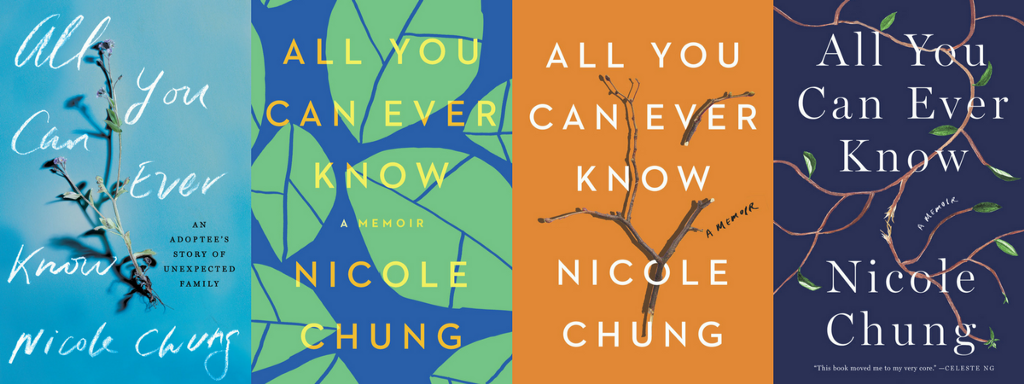
All You Can Ever Know: A Memoir by Nicole Chung

“The title, All You Can Ever Know, is a very luring one and I initially thought of a typographic approach. But as I started reading this book I began to feel how deeply rooted and raw the emotions in Nicole Chung’s writing was and I knew I wanted to use some organic imagery where it was both beautiful and broken. The images that came to mind had to do with the makeup of a “family tree,” i.e.: the leaves, branches, flowers, and buds. As I was doing some image research I found some photographs that captured the overall idea, but they felt too quiet and subtle.

We ultimately produced an illustration that is stark and evocative set against a midnight blue backdrop. The cropping of the branches as it trails off the page shows its crossover to the unknown and that it’s a part of larger entity. The branch intertwining in the title leading into the torn, loose branch reveals the depth and passage of the secrets, discovery, and untold truths in the memoir, which comes with the risks, discomforts, and loss. The torn, not yet broken branch indicated a disruption in the ‘family tree’ of losing one’s roots and the rediscovery to one’s identity, which is a central part of the memoir.” — Donna Cheng, Freelance Designer

“The earlier concepts that Donna had designed were conceptually strong and all had something we liked: the graphic treatment felt bold and like a big book but we felt they lacked an emotional component. We loved the use of the photorealistic branch and the soft changes in the background shadow that created some depth, but this cover had a self-help tone that felt limiting. Overall they each had strengths but were a bit too precious and incongruent with the author’s voice.

After the author had some more time to think about it, she began to question what the break in the branch might evoke about adoption. For her, adoption doesn’t mean brokenness beyond repair, or that lost family connections are beyond repair either — in many ways, the book is about how those connections and ties matter even when we don’t know how to name or talk about them. So we tried several versions and ended with one where the tendrils of the branch still make a connection with each other on either side. We needed to be sure that we were sending the right message about adoption, one that was positive so that this cover would honor Nicole’s experience and story.” — Nicole Caputo, Creative Director at Catapult

The Secret Writing Tips I Learned from Kendrick Lamar

The first time I heard Kendrick Lamar’s song “Sing About Me, Dying of Thirst” was in 2012, on a Saturday spent sick inside my college dorm room. Thanks to a stranger who had decided to kiss me, I had mono. Lamar’s now-classic album Good Kid, M.A.A.D City had just been released and since I wasn’t doing anything but feeling sorry for myself, I decided to give it a listen.

When I got to that song — track 10 — my sick body perked up. The 12-minute, two-part epic’s first half is contemplative and smooth. Seven minutes long, it pulses with a tender, lingering guitar loop (a sample from jazz guitarist Grant Green’s 1971 recording “Maybe Tomorrow”) and spins dizzily with drums (a sped-up sample from Bill Withers’ 1972 song “Use Me”). Kendrick spits an intricate tale of loss, rapping in letter form from the perspective of two people whose siblings have died. It’s a somber, confrontational song about memory and legacy. Between each sullen verse, Kendrick sings the chorus in a static, almost alien voice:

When the lights shut off and it’s my turn
To settle down, my main concern
Promise that you will sing about me
Promise that you will sing about me.

The song gave me a random surge of energy. I suddenly felt ripe, charged with the same sense of longing Kendrick laid out so viscerally on the track. I got further into the song, nodding my head despite the painfully swollen glands along my neck. Kendrick delivered his verses circularly, hypnotically. They seemed to spin and spin around an elusive drain. For just a few minutes, I didn’t feel sick.

But then something happened. In the second verse, Kendrick took on a female persona, transforming into a prostitute who boasts about being invincible. The fury rises in his voice as he repeats: “I’ll never fade away.” The song spins, the pitch grows. Both lyrically and sonically, it was the best part of the song. Then all of a sudden, I heard the voice lose its speed. Second by second, it grew quieter until there was nothing but the beat left. Another verse soon started up. But it seemed the magic of the moment, of the song, was lost. Panicked, I checked my iPod. The volume was fine. I played the verse again, this time monitoring the volume. Again, at the zenith, the voice dipped into silence.

I played the verse again, this time monitoring the volume. Again, at the zenith, the voice dipped into silence.

I rewound the track and played it again. It wasn’t an iPod glitch. He really just ended the verse. The first verse had also been cut short, by sudden gunshots, but the deliberate fade in verse two felt like a mystery. I listened to the song over and over, my ears grasping for the trailed-off lyrics, seeking to decipher the words that were lost. Sitting on my futon, surrounded by tissues and throat nearly sealed shut, my eyes welled. I wondered how a moment of such joy could shrivel up so quickly.


Four blocks, one avenue over. That was the length of my walk “home” from the 145th Street subway station. I had moved to New York just two months prior, and the dingy, yet strangely affordable studio I’d managed to sublet for a few months before I found a “real” place to live felt more like a dorm than a home. The heat did not work, the fridge got cold only when it wanted to, and I had to wear shoes in the shower, which was down the hall. While displeased with my living situation, I refused to complain out loud. I knew that I would have to make adjustments to make it in this city.

I moved to New York from South Africa on November 2nd, 2017. I had spent the year so far working in Durban as a Fulbright English Teaching Assistant. My twin sister met me at JFK and we went to her place. The plan was to spend two weeks there and figure out my life. And I had a lot of figuring out to do. I had no job and no place to live. All I had was a finished manuscript, some savings, and one goal in mind: find an agent and publish my book. In fact, before I even boarded the plane for New York from South Africa, I’d already pitched my book — a short story collection — to dozens of agents. After working eight hours a day teaching high school English, my evenings would be spent maniacally typing stories and obsessively pouring over edits. My plan was to score an agent before I got to New York. But on the day I arrived at JFK, the one agent who seemed most interested in the book sent me an email: a gentle pass.

That first night at my sister’s place, my ears still clogged from the 17-hour flight, she and I went to dinner in Downtown Brooklyn. After spending 10 months in Durban — a notoriously chill seaside city — I met the chaos of New York with a blend of awe and exhaustion. It felt strange to be home, but not quite home. To move from one foreign place to another felt unstable, like setting up shop inside a house of cards. Despite feeling unmoored, at dinner I tried to sit comfortably in my chair, in my skin, in front of the plate of American foods I’d missed dearly, in front of all the unknowns that lie ahead.

All I had was a finished manuscript, some savings, and one goal in mind: find an agent and publish my book.

When I woke up the next morning, my sister was already at work. My body felt disoriented, on the other side of the ocean. Panic settled in. Doubt. Impatience. Maybe another agent had emailed me? I rolled over and checked my phone. Nothing. I took a shower, grabbed my laptop, and went out the door. I was going to find a café to sit in and apply for a few jobs. Just in case.

A couple days of aimless wandering and fruitless email-checking later, I anxiously swallowed my pride and emailed the agent who had rejected me: “Can I revise the manuscript and resend?” I told her I would revise all the stories, cut them down, and make them interlinked. She said yes. But I knew she wasn’t going to wait forever. I responded ecstatically and promised I’d get her a revised manuscript in three months.


Two months passed. In that time, I moved from Brooklyn to the temporary studio-dorm near the 145th Street station in Hamilton Heights. I spent both months hunched in front of my laptop, reading, wincing, cutting, typing. Sometimes I’d write at “home.” But when it got too cold inside, I figured I might as well be outside. So I’d drag myself out of the house and around the city, trying to get inspired. I was drained. My savings were running out, my sublet was ending, and I couldn’t get these stories to do what I wanted. Revising a short story is like being on an episode of Hoarders: you are surrounded by things that you like and would love to keep but should probably let go of for everyone’s sake. At least this is how I felt as I stared at my manuscript with the promise I’d made to the agent echoing in my head. I had nine stories to revise and make more concise. There were thousands of words to purge. Each day was spent painstakingly gritting my teeth and holding down the “delete” button. Time was running thin.

Revising a short story is like being on an episode of Hoarders.

By January, I had revised all the way up to the middle of the collection. But I was particularly stuck on one story: “Addy.” This story — about a pregnant teen who moves into a group home — was like a literary slinky winding down an eternal staircase of doubt. It had gone from short and sweet flash piece to epic meditation on teenage pregnancy in contemporary America, and now I was trying to whittle it down from its bloated 50-page form into something more digestible. In my quest to cut words, I read each line closely, alternating between extreme cringe (“I can’t believe I, a human woman, wrote this”) and irrational hubris (“Jane Austen who?”). Between each sentence lay an unbearable indictment on my worth as a writer and as a human being. “Addy” was a thorn at my side — the impossible hill I needed to climb before handing over a new manuscript to the foot-tapping agent. But I still couldn’t fix it. Despite days spent trying to gather the courage to cut out a scene or a paragraph, I just could not do it. I was holding on too strongly to something. I just didn’t know what.


January 5th, 2017. Walking “home” from 145th Street station, earbuds blasting, my legs were numb from spending the day trekking from café to café on the hunt for Wi-Fi and an outlet. My shoulder throbbed with the weight of the eight-pound MacBook in my bag. Mentally, I was drained, too. I had spent the day revising “Addy.”

As I pounded cement, each dull knock of the laptop on my hip reminded me of the story, of the way it just didn’t work. Of the way this whole “moving to New York and being a writer” thing just didn’t seem to work. I panicked. This wasn’t just about cutting sentences and adding metaphors — it was about getting the agent and the book deal that would allow me to live my dream of becoming a writer. Not just a writer: a full-time writer, with a book! I was only 23, but I convinced myself that I was running out of time.

That day my music was playing on shuffle. For some unknown reason I didn’t feel like listening to the sad rotation of five songs that I usually stick to. My phone is rarely updated, so it’s mostly music ranging from 2009 and 2013 — lots of T-Pain and Dubstep. I’m extremely impatient. If a song plays and I haven’t already choreographed a dance piece in my head by second eight, then I usually turn. But something about the war I’d had with “Addy” that day had me paying closer attention to songs I usually skipped.

I was only 23, but I convinced myself that I was running out of time.

On the corner of Broadway and 145th, that Kendrick Lamar song from 2012 came on. I had loved “Sing About Me, Dying of Thirst” since that first, feverish listen. Still, I tended to skip it, because it always made me cry. The even, teeming drums. The soft, wistful guitar. Kendrick’s dreary, passionate rhymes. They all stirred me, left me feeling overwhelmed. But in that moment in January, walking sullenly along Broadway, the song’s sentiment matched that of my life. I listened without pause. I found myself on that walk “home” feeling more open, more willing to take things in. Maybe by listening to songs I usually skipped, I was somehow redeeming the sentences I’d been forced to cut from my story? Maybe the wishing I’d had that someone would take their time with and value my art had made me want to take my time with someone else’s?

On 148th and Broadway, the song reached its zenith. And then the second verse, as it had once before, suddenly faded away. It should be noted that in “Sing About Me, Dying of Thirst,” the fading away is ironic. The impersonated female voice is begging not to be forgotten. As “she” pleads: “I’ll never fade away, I’ll never fade away, I’ll never fade away,” the verse goes on, intricately rambling, but the voice fades into silence. All that is left is the ticking beat. Echoes of desperation linger as the empty track becomes cavernous, suddenly gutted. My ears strained for more, eager to savor the remnants of the voice.

As the song dimly went on, I found myself blinking back tears and thinking yet again of “Addy.” I thought about the difficult chopping of words and how these sentence-level sacrifices added up to a general feeling of being stripped away. But when the song ended, I rounded the corner and reminded myself that I still loved it. Even though it didn’t go on as I had wished.

Then it hit me: Kendrick’s cutting the volume on a verse was not some ill-conceived decision. It was a bold artistic declaration: just because something is done well, does it mean it needs to be overdone. I initially wanted the verse to go on forever. But what if it did? Would I keep rewinding it just to get to the sweet spot? Or would I simply grow tired and switch the song?

It was a bold artistic declaration: just because something is done well, does it mean it needs to be overdone.

I realized that I could cut sentences, paragraphs, even whole pages out of the story and be okay. Kendrick’s leanness, his courage to cut the line short showed me that I could cut things from my writing. I could end each sentence at its highest point. I didn’t have to cling to every word. The words clogged the page, blocked all attempts at cohesion. Letting go was the only way. After all, isn’t it better to satisfy than to overwhelm? As I walked up the steps of my “home” a maze of possibilities came into view.


The following month, I took Kendrick’s unintentional advice. I found the high point in each sentence and cut them short. I ended lingering scenes sooner. I clipped dialogue, made it more true to life. Editing became a breeze. I was no longer afraid of removing the endless details and context I thought short stories needed. I no longer felt pressure to put every single thought onto the page. Each word would speak for itself. On February 1st, I re-submitted the book to the agent (bless her heart) and prayed that all my private work could become public.

A few months passed. I didn’t hear anything from the agent. My money thinned. I sucked it up and got a job. Two jobs. I sent the revised manuscript to (and was rejected by) more agents. I moved to Bushwick, then to Crown Heights, then to Flatbush. Still, in-between morning shifts at a cafe in Hell’s Kitchen and afternoons as an intern in Midtown, I would obsessively check my email, waiting for the magical “yes” that would change my life. I’d pinch my iPhone screen, scroll down and hold my breath as the spinning circle released, then stayed pitifully stagnant.

One day in June, I checked my email. It was there: the agent’s response. “I found much to admire,” she wrote. “Ultimately, however, there were aspects of the collection that overshadowed these positives.”


In the weeks after I let it sink in that I wasn’t going to be published — and that my book definitely wasn’t as good as I thought it was — my number one feeling was that I had wasted my time. Between the months spent writing in Durban, the late nights spent pitching, the back and forth with the agent, the agonizing edits, and the spiral crossing of my fingers, I clocked a year of my life devoted to one project that had seemingly gone down the drain. What had been the point?

I found myself contemplating the last two lines of “Sing About Me, Dying of Thirst”:

Now am I worth it?

Did I put enough work in?

I had put a lot of work in, but it seemed I just wasn’t worth it. The whole project felt terribly futile. Yet again, I recalled the moment I didn’t want Kendrick’s second verse to end, the time I wanted so badly to know what the silenced voice went on to say. I thought about the act of listening and the act of rapping. The act of receiving art and the act of making it. And I struggled to reconcile my art with its nonexistent audience. The vocal trailing off in “Sing About Me, Dying of Thirst” ironically forfeits the glory attached to presenting art to an audience. This raises the question: what happens when art exists outside the realm of validation? What of an unread novel? What is art unattached to a contract or an auction? Most importantly, what should be made of every artist’s “stripped away vocals” — our stories that no one reads, our songs that go unheard, our paintings that no one buys? Does the lack of validation make them meaningless?

As weeks turned and the rejection settled in, hindsight let me admit that I had been nowhere near as good a writer as I thought I was — and at 23 I was in no way prepared to publish a book. Aside from the obvious lack of substance, it seemed my manuscript failed because it was so rooted in the desire for external validation. What began as an earnest literary pursuit in South Africa turned into a sloppily assembled plan to earn a living in New York. Instead of revising for art’s sake, I became crazed with the task of revising for the agent. I wanted to do whatever it took for my work to be seen. Little thought was given to the possibility that the recognition was not the most important part of writing.

I thought about the act of receiving art and the act of making it. And I struggled to reconcile my art with its nonexistent audience.

July came. Then August. By September I was back in my parents’ house in Milwaukee, unpacking bags yet again. Only this time I wasn’t unpacking South African souvenirs and undeclared foods; I was unpacking the experience I’d had in New York. The experience that started with grand plans to publish a book at 23, and had ended with an empty bank account, crushing rejection, and a series of failed job interviews. In Milwaukee, totally unrecognized, I found the courage to keep writing, even though I lacked an audience. And I loved it. There was no one reading, no obsessive email checking. Kendrick’s writing lessons remained useful. It was then that I realized that visibility, recognition is not essential to being a writer. The writing was the most important part of being a writer. The writing: mining through memory, through fragments of conversation, through sights, and emerging with semblances of beauty and reason. Each time we mine, we improve. We emerge with more precious material.

When I first heard Kendrick’s trailed off verse in 2012, I thought, “What a waste.” But in 2017, as I shelved a book of short stories, I realized that there is value in the things that go unheard, unseen, or unread. We writers often struggle to reconcile our need for feedback and our need for validation. The line between craving validation and desiring visibility is pitifully thin. This isn’t necessarily our fault. Too often our art is forcibly confined to ourselves; to empty rooms, solitary laptop screens and private notebooks. Then when we emerge from the literary abyss, stack of papers in hand, we naturally want to shove it right into someone’s chest. Writing is one of the only art forms that is more hidden than visible. Paintings are on walls; passing strangers see them. Music is played. Ears can’t help but hear. But writers have to work to be seen. We want our work to be seen. We want to be seen. We want our solitary efforts to be recognized. But at what point does that very valid need to not be solitarily scribbling turn into a constant or, dare I say, compulsive desire for our art to public?

Music is played. Ears can’t help but hear. But writers have to work to be seen.

To this day, I toe the line. But thanks to Kendrick, I now tend to err on the side of restraint — I no longer write epic short stories, and I no longer send world-renowned agents poorly assembled manuscripts. But I do find solace in believing that the writings unseen are not valueless. My book still hasn’t been published; I haven’t been able to send a sarcastically-signed copy to all the agents who scorned me. But I do find redemption in my new belief that my failed book had not been a waste of time. Instead, I’ve come to believe that every shelved project is not done in vain. I believe our greatest efforts can remain exactly that, ours. Our greatest stories and novels can remain inside our hard drives — either by choice or not-so-much by choice — and can still be contributing to a conversation, whether internal or external. I think these projects are sitting there, yes. And I do believe they are festering, folding in on themselves. But I also believe that they are deeply planted seeds.

Tom McAllister and Elise Juska on Writing Fiction About the Aftermath of a Mass Shooting

On the 14th of February 2018, a heavily armed former student in Parkland, Florida opened fire at the students and staff members of Marjory Stoneman Douglas High School, leaving seventeen dead. The Parkland shooting has unleashed a renewed wave of protest against gun violence with the survivors championing the Never Again moment. In a country that is constantly mourning the victims of one mass shootings after another but has failed to pass any meaningful gun control, the subject of gun violence could not be more urgent. Published in April, two new novels explore the aftermath of America’s deadly gun culture.

In Tom McAllister’s How to Be Safe, high school English teacher Anna Crawford turns on the TV to find her face flashing across cable news, the prime suspect of a mass murder at her school. The real perpetrator is found, and the police clears Anna of any wrongdoing, but she is still regarded with suspicion in a town that quickly descends into paranoia. Caustically funny and brutally raw, How to Be Safe satires the media frenzy that engulfs a tragedy.

The fatal rampage in Elise Juska’s If We Had Known takes place in a mall in small town Maine. Professor Maggie Daley learns that the shooter, Nathan Dugan, was a former student in her freshman writing class after a classmate’s viral social media post about Nathan writing “a paper that was really weird.” Maggie finds Dugan’s long-forgotten essay in her files that hints at his violent nature. Consumed with guilt, she finds herself at the heart of a contentious public scandal that threatens to destroy everything she has. If We Had Known is a gripping read that asks hard questions about culpability and scapegoating in the wake of a crime.

The authors spoke about writing fiction based on reality, the catalyst behind their books, and wanting their novels to be known as more than the “mass shooting books.”


Tom McAllister: Elise, the first question (that people have asked me a lot too) is when did you start working on this book about a shooting? What prompted you to? How long were you working on it?

Elise Juska: This book has been a strange journey. I actually started working on it ten years ago after [the] Virginia Tech [shooting]. There was an interview with a creative writing teacher, she had taught the shooter. He had been pulled out of class because his instructor wasn’t comfortable with him. This creative writing teacher was working with him one-on-one but then they had seen all this disturbing dark stuff in his creative writing and she was interviewed about it after the shooting.

That interview haunted me and stuck with me as a teacher. I know you too are a teacher, but just for me the prospect of something coming up in student paper as a red flag that I somehow missed and then something horrible happens (not that she missed it, she tried to alert people and made all these attempts to notify people), so that was where the idea originally came from.

TM: My understanding of the Virginia Tech [shooting], just from mass media was that… they start to blame people, scapegoat people. Some of it was like “oh, these fiction teachers never did anything.” It seemed like the popular narrative became that there were all these red flags that the teacher completely ignored, but it sounds like not the case.

EJ: In fact, yeah she told the police, she told the administration. There was this interview on the New York Times daily podcast with the person who owned the gun shop that sold the gun to the shooter. He was being asked (I can’t remember exactly) if he felt responsible after and wished he hadn’t done it. He said something like the teacher should have caught it.

TM: That’s consistent with how the gun industry seems to operate. Have you had students in your fiction classes who were doing things that worry you? Cause students write weird stuff in fiction classes. A lot of times it’s copying the Walking Dead or whatever TV shows they like anyways. Have you had any problems? How do you decide where that line is?

EJ: Yeah, it’s so tough. Do you teach just fiction?

TM: I’ve done non-fiction courses too. I’ve had two students [where] I’ve been really concerned that they were a danger to themselves [and] I’ve reported things.

EJ: I’ve taught both also. When I first started teaching, I had just graduated from college. I was 22 teaching freshman [composition], [I got] all kinds of incredibly serious personal issues showing up and I was so ill-equipped to deal with these things. I was trying, I was worried, I cared but I hadn’t encountered most of these things in my own life.

TM: And you’re still just learning the basics of running a classroom.

EJ: And I’m totally shy, paralyzed by nerves, and reading about some harrowing stuff but at least the assignment is write about a personal experience and this is the thing that they’re choosing, so they’re telling you in effect. It didn’t feel as much as I was interpreting or looking for subtext, but in the fiction classes it can get really dicey.

How could we write about anything else but what’s going on? Fiction reflects the world.

TM: Right after the Virginia Tech [shooting] happened, I had people asking well, what do you think? Some samples of the kid’s stories had gone up and I wouldn’t have noticed them as being bad or not unless it was paired with weird behavior too. Cause so many stories (usually from young men) have so much bloodshed. There’s swords and decapitations and monsters and it’s hard [to tell]. Not so much now, but years ago you get a lot of people doing American Psycho stuff or Chuck Palahniuk stuff. I feel like a lot of times, the only stories they know how to tell.

I also wouldn’t be able to turn off that guilt if I was that teacher. It seems like it would be impossible not to be constantly questioning whether you’re at fault for people dying.

EJ: Same. I’ve seen a lot of student work that’s really into gore and you think it’s a lot of what they see in movies or on TV and sort of mimicking that. Sometimes just the way that it’s written feels different, where there’s glee in it or just something that feels worrying.

TM: I guess that’s so hard to describe unless you’ve read hundreds of hundreds of student papers and stories.

EJ: Sometimes so hard to know if I should intervene in this case. Have you had to?

TM: In fiction class, I had one guy who hadn’t written anything that weird but he did after one of the school shootings. I think he wrote something like “I should have done the same thing, this guy is a hero” and he was removed from school the next day. I never saw him ever again.

EJ: He was your student?

TM: Yeah, I of course did not know him very well. My interpretation was that it was more a twenty-year old kid who taught it would be funny to push people’s buttons and didn’t realize the severity.

EJ: Circling back to your original question, when did you start writing the book?

TM: After Sandy Hook. So we both had five years after. In my book, the teacher is blamed at first. In the frenzy after [the shooting], they see her name and she ends up on TV. That’s all it takes for people to say: yup, she must have done something.

I was really thinking about the Boston Marathon bombing, there was this social media frenzy afterwards. All these people on Reddit who were studying pictures trying to determine who it could have been, drawing circles and arrows on people. Some of these people’s lives were almost totally ruined. The New York Post just put a picture of two men — who were totally innocent — suggesting that they were the suspect of the bombing. I just thought about the toxicity of that kind of culture that’s so desperate to find a quick, easy answer to something’s that’s not an easily answerable problem. That started the idea of the school shooting… and [the media frenzy] gave me some catalyst to move forward after the shooting.

One reason that people are interested in our books is because they say it is timely and it is, but the Parkland shooting hadn’t [happened] when we were writing it. How long ago did you finish [your book]?

EJ: I finished it about a year ago and I had been working on it four years prior to that. It’s felt pretty complicated having the book out right now. Logistically we have been working on this book for years, you hate to think that anyone might feel that you’re exploiting what’s going on. So have you been struggling with that too? With not being too self-promotional?

TM: Absolutely. There have been times after Parkland… where some people were tweeting out screenshots from my book that [they] felt kind of commented on [the shooting]. On one hand, I thought that’s kind of amazing, you wrote a thing where people feel like is kind of relevant to what’s happening in the world. On the other hand, it’s like I can’t have anything to look like I am personally sharing this because it looks gross.

It’s weird because when I did my first reading from the book, there was a shooting at the YouTube headquarters and I’ve already resigned myself to having to start most of my readings with some disclaimer like I know five people got killed last night, sorry. But it’s also kind of why I wrote it, kind of why you wrote it too. That this is an ongoing condition.

EJ: That’s the struggle. No, you don’t want to be exploiting what’s going on in fiction but also how could we write about anything else but what’s going on. I mean, fiction sort of reflects the world.

Going back to why I wrote it, the story to me was about the teacher: what it feels like to be that teacher [knowing] that there is this thing that you missed and how do you wrestle those feelings of responsibility.

TM: The school shooting for you is a catalyst for talking about some other stuff.

EJ: Yeah that’s what I mean cause I feel like [my book] does get described as a school shooting book. [The shooting] is the first scene, but [the book] is really about the aftermath, on the teacher, and on other people and what that ripple effect is like.

TM: [The shooting in] mine is an eight page prologue and then the rest is all aftermath. What made you decide not to emphasize the shooting aspect?

EJ: So the opening scene, the teacher is just hearing the news and then realizing [the shooter] was her student. Shortly after, the classmate posts something on Facebook that goes viral. Something about what he remembers about this kid writing in class and then she goes digging in her class and she finds the papers. So yeah, I guess that’s just the moment. Is yours the actual scene of the shooting?

TM: It’s actually the lead up, none of the violence actually happens on the page. [I was interested] in having to stay in that really traumatic aftermath where a lot of people, for a whole generation [even], are affected by it.

[Two questions] that I have been thinking about and people have asked me about: do you have hopes that the book will have an impact on any social issue and do you think that’s even the job of the novel to do that?

EJ: I guess in some ways that depends on the intention of the novel. I didn’t go into it, in my head, that I was writing this book about this issue. It was I’m writing a book about my own greatest fears as a teacher that I’ve worried about for a long time. What about you? From what I’ve read about your book, it’s really driving towards the end on a collision course. It feels so angry and emotional and hyped up all the way through. Was it hard to sustain that all the way through as you were going?

I’m writing a book about my own greatest fears as a teacher that I’ve worried about for a long time.

TM: A website was doing a roundup of upcoming books and they said if you’re angry read this one first and I felt very good about that. I was afraid I was too didactic with the book and that it would be propaganda then.

Even if it’s what I view as socially desirable propaganda, that’s still what it is and so it was really important to me in the early drafts to make sure I was focusing on an actual person and a character and trying to build out this person’s life and her voice and her worldview. Otherwise I would have just wrote an essay about my thoughts on the issue and I didn’t want that. But it was hard, partly because periodically there would be some new outrage or some new horrifying incident where the same rhetoric happens, the thoughts and prayers and all that stuff.

In one way, that helped to fuel the project. If I was kind of losing steam, I would write. I would remember why I was so invested. Then on the other hand, I had to check myself and make sure even if it’s a book that had clear politics or views, that it wasn’t a book with an agenda.

EJ: I was also feeling the same way. I found the book personally so hard to get through at times because of what was going on in the world. To have those things happening in the real world, to retreat to fiction and to have that fiction be also this harrowing place where I’m researching the psychology of shooters. It was just at times unbearable to be in both.

TM: How much research did you do on it?

EJ: I did a fair amount of reading, even though the shooter [in my book] kills himself at the shooting so his point of view isn’t in there especially for that reason, I wanted to have a pretty good sense of who he was. As he’s seen through the lenses of all these other characters, I was just clear on who that missing person was in the middle. So I did a fair amount of research there. Did you?

TM: I did some kind of real research and some kind of clipping through bits and pieces of some articles. I read Columbine by Dave Cullen which is just really great. I thought I knew everything about Columbine. It happened when I was in high school and I was really invested in following that story. It turns out I knew very little of what happened. Twenty years later, he can point out the bad reporting and the misconceptions.

There was the book called One of Us [by Åsne Seierstad] about the Anders Breiviks mass murder in Norway. That guy was a real different thing, a hero to a lot of alt-right type whereas the Columbine shooters, they’re in the more traditional school shooter mentality.

EJ: Is there anything else you want your book to be known as besides a school shooting book? Do you think for your next book that you’ll go towards the loaded cultural topic or something else?

TM: I think there’s a certain temptation to suddenly to feel like a certain kind of writer, like I’m going to be the trending topics guy or I’m going to throw myself into becoming this whole thing. That kind of scares me, limiting myself in that way. I don’t have a lot of good projects rolling right now but I want it to be something similarly as exciting for me to work on. I bet for certain anything I would do won’t have the weird, somewhat fortuitous timing of having just showing up at the same time people are talking about whatever the next thing is. Do you have a plan for the next thing?

EJ: I don’t really, I would like to have a next thing for the next book that comes out just to feel that I have traction on something else. I’ve been writing a lot of essays lately. Writing this book was so hard and so harrowing and kind of emotional. I’ve just backed up and been writing essays which I’ve really been liking. I actually feel like I’m a short story writer, that’s where I feel most happy and most comfortable and that’s who I kind of essential am.

What Does It Take for Ultra-Orthodox Women to Leave Their Repressive Lives?

I met Deborah Feldman in Brussels at the end of January, when she was invited by the Goethe Institute to talk about Überbitten, the expanded German edition of her second memoir, published in English as Exodus.The book renders with bare honesty Feldman’s experience parting from orthodox Judaism, the only world she knew, and reinventing herself in a different country.

Deborah Feldman

Feldman achieved notoriety after her first book, Unorthodox, was published in the U.S. in 2012. In it, she describes the repressive nature of her life within the Satmar Hasidim community in Williamsburg, her arranged marriage at 17, and her subsequent decision to take her son and leave the community.

For Feldman, history is a kaleidoscope where the past can morph if observed from different angles. In the second half of Überbitten, she explores her life in Germany, her relationship with Germans, and the way the Holocaust is understood and integrated in the collective consciousness there. As a descendant of Holocaust survivors, she asks fundamental and tough philosophical questions. Had she been a Nazi, would she, in all certainty, have refused to carry out acts of violence and annihilation? As in most aspects of life, the answer is not cut and dry.

I spoke to Deborah about her books in Brussels, and later continued our conversation through email. Our conversations focus on the Hasidic community’s relationship with motherhood, infertility, and women’s bodies.


Mauricio Ruiz: In Unorthodox, you explore the themes of motherhood and fertility. These days, some women have the choice to decide whether they want to have children or not, and when; others still do not have that choice. How do women who do not want to have children cope with this reality in Hasidic communities?

Deborah Feldman: I do not think this is a reality anyone I knew ever “coped” with. The greatest social misfortune in this community is infertility. It is grounds for divorce. Women who cannot produce children are relegated to the lowest possible position in society, they are seen as completely useless, purposeless, valueless. In Unorthodox I describe how I was treated in the first year of my marriage in which I failed to become pregnant: I was threatened with divorce, homelessness, complete abandonment, I was subject to abusive criticism of my basic worth as a human being, I was made to understand that my ability to have a child was my only value and that if I failed to fulfill this expectation I would be treated like waste. So I think in this atmosphere it is not actually possible to entertain ideas about rejecting childbirth, because reproduction itself becomes a form of survival, and those survival instincts are very strong.

MR: Could you talk a little about your mother? What were your thoughts and reflections about her while you were growing up? Did you have mixed feelings (because she had pursued the life that she really wanted; sad because you couldn’t spend time with her)?

DF: I think my feelings could be described as a mixture of fear and curiosity. The latter because it was this great unknown, this outside world to which she had fled, and the concept of a life and an identity out there, and the former tied to the understanding that we are doomed to repeat familial patterns, that her fate could determine my own.

MR: When talking about Exodus, you mentioned that when a Hasidic woman in Israel decides to leave the community, she doesn’t enjoy the same rights as another non-orthodox woman under the Israeli Constitution. Could you elaborate a little bit more on that? Wouldn’t this be a violation of human rights?

DF: I think to understand this you have to research how the Israeli government works. There is this awkward coalition between the secular and orthodox parties in which exceedingly questionable political deals are made that have very little to do with democracy, but are a result of what happens when a democracy includes a sizable anti-democratic element. You have an agreed-upon segregation of Israeli society, in which members of orthodox communities are subject to biblical law and religious dictates, while secular members have access to a whole different set of laws and rights. A problem occurs when a member of the orthodox world wants to cross over. Orthodox parties will not accept that secular Israeli society will step in to support this “runaway” with its granting of new civil rights or defend it against the laws and restrictions of the society he or she has left. It demands that all of its members, both current and former, be seen as in their “jurisdiction.” So in the name of a fragile political detente, runaways are left in a kind of no man’s land between the two worlds; they are required to make their way across to the other side completely at their own risk.

Runaways are left in a kind of no man’s land between the two worlds; they are required to make their way across to the other side completely at their own risk.

MR: Referring to the case of a famous Israeli writer’s sister happily living in the settlements, you explained that human beings tell themselves everything is okay, that they are happy. It’s a self-preserving mechanism. What do you think it would take for women living in the settlements to be able to see what you’ve come to realize?

DF: I really do not know. I think my realization came about because I had this curiosity about another world, another perspective, and I sought contact with it. So I was able to develop alternate modes of thinking. But what do you do with people who are to afraid to nurture this curiosity

MR: While explaining the religious philosophy of the community you grew up in, you mentioned the three oaths upon which orthodox Judaism was founded after the destruction of the Second Temple:

a) Do not try to take the land.

b) Submit completely to the authorities in exile.

c) Establish and make clear the differences between yourselves and the people in the countries where you live.

How was that reshaped after the Holocaust? What narrative was created by the scholars and rabbis?

DF: These are the Three Oaths, and they are known to all Jews all over the world, and may be interpreted differently depending on the community, but they are part of a common diaspora heritage. I think the way my community reshaped the “myth” of oath-based punishment versus redemption after the Holocaust was to claim that we were living in a time when Jews wanted to cast off this pact they had made with God, they wanted to take back the land (zionism) assume political authority or at least equality in their various countries and cast off their differences by clothing themselves, naming themselves, and speaking in a manner that was customary in whatever society they might find themselves. The Rabbis claimed that this was not only rendering the promised eternal redemption impossible but also bringing on a kind of apocalyptic temper tantrum from a God who had proven, with the Holocaust, to no longer be able to contain his rage and frustration with this forgetful children.

Meaghan O’Connell Thinks Motherhood Is What Keeps Women Oppressed

MR: In your books you explore women’s relationship to authority, especially religious authority. Why is it, in your opinion, forbidden for women to read the Talmud? Will there be a day when it isn’t?

DF: The tradition of reading and discussing the canon of Jewish texts has always been masculine in the orthodox community. On the other hand women are reading these texts in reform Jewish communities. The ideology of Orthodoxy will not allow for women to do so within their own world. This is just how religion works. I think it is not very realistic or productive to discuss ways in which radical patriarchies can make adjustments or allowances for women, since to do so would require a crumbling of their very foundations. Perhaps we need to learn to accept that the two poles are irreconcilable, and it is not our obligation to find ways in which to render such communities more acceptable to us. I find efforts to engage in “cultural understanding” very naive and counterproductive. I would appreciate it if Jewish secular liberals had more confidence in their own value system and were able to criticize instead of chalking it all up to cultural differences.

MR: You read a beautiful passage from Unorthodox where you, for the first time, decided to break an imposed rule. I really liked that, the idea of questioning the rules that govern our lives. How do you think people living in Israel, and the world in general, could become more conscious of the rules that govern their lives?

DF: Isn’t our whole capitalist society structured in a way as to prevent this?

MR: In Unorthodox you recount the anecdote where one day you forgot to put on one of your garments (the rule being: knitted on top of woven fabrics to avoid revealing too much of the female figure) and later being sent back home to change. There seems to be a constant control of women’s bodies, and women are often made to feel, unjustly, guilty for bad things that happen in the world. Do mothers, grandmothers enforce those rules (given that they know what it means to feel that themselves)?

DF: Yes, women do enforce this, because they are taught that they will be rewarded for this with approval, even power. This happens in the Jewish secular world as well.

Biking Through the Land of Ghosts

“The World Holds What It Remembers Most”

by Tess Allard

It rains every day now — if these are days, in the traditional sense. Tangled masses of autumn clematis overspill the rotting fences. The sky is flat white, a cap to the world. Everything is spongy and yields to the touch; everything is coated with moss and algae and scales of lichen. But at night the clouds clear and the stars arrive, and they are strange stars now, the ghosts of ancient constellations, ever-changing. The sky is the only place that does not repeat itself. Each night I study them and make up names: the Drowned Sailor, the Hungry Wolf, the Lost Child. Long-ago humans must have gazed these stars, right where I lie. They must have had names for them too.

Without the confines of linear time, the rain does not bother me. Out of habit I wear a raincoat, but when I’m soaked it’s not unpleasant — it just is, like everything now. It’s never cold or warm. It’s the perfect neutral temperature that so many years of climate control sought to obtain. I ride my bike under the laden clouds, along routes I’ve deemed to be safe: past the marina, where the moorings of boats both real and remembered moan and creak in the river’s sway; along one stretch of empty highway, where shimmering ghost houses teeter on knotweed hills, ghost children in their windows, ghost wives hanging laundry, ghost steelworkers forever climbing down rickety stairs to the mills. But if I go much farther, there will be the pileup. The twisted wreckage, the sobbing, the flashing ambulance lights and the smell of blood and burning rubber, all of it unceasing. Like a record caught in its final loop, a little pop as the scene begins again.

When time collapses, what is left? Which events have imprinted themselves most indelibly onto the fabric of the world? At my house, I found, it was the death of a draft horse, back when this land was still a frontier. It lies on its side among my strawberry beds, feebly lifting its head, wild eyes rolling, skin stretched taut over bones — and it screams, a high panicked whinny that echoes across the vanished fields. I tried for a while to stay at home, comforted by the objects of my former life, but I couldn’t stand the sound. And down the street was something worse. A woman screaming for help, two gunshots in quick succession. I didn’t have to investigate that; I remembered it from the news.

Now I stay in a quieter place, a new-construction building on a dead- end street where apparently nothing has ever happened. Ghost rabbits dart through the rooms. I should be used to it, but it still unnerves me. I’ve made a space for myself in the attic, where nothing loops at all. Blankets and candles and a stack of books. I could stay here, but my body always itches to move. I think sometimes about leaving the city, but what must the rest of the world look like? If I biked east I know I’d find Johnstown flooding, the unimaginable horror of Gettysburg; to the south, mine collapses and Flight 93 — and what smaller, personal crises in between? The worst moments of someone’s life, endlessly replayed.

But there are happy memories, too. Down in the hollow where I sometimes stop to sit beneath the sheltering oaks, a tangle-haired little girl in a deerskin dress plays in a field, picking dandelions, spinning until each puffed strand detaches, and they rise in a cloud around her, and on her face is perfect joy.

I miss you, Matthew. I miss you, Sarah and Susan and Raja and Julian. I miss all you people out there in the streets, on the buses, at the checkout line in the grocery store. Real human bodies exhaling, sweating, moving of their own accord: who would have thought I would long for strangers so fiercely?

Yes, there are the shapes of people: dark-coated Victorian men and ancient tribeswomen and marching soldiers and Iroquois fathers teaching their children to hunt — but I can walk right through them. They have scent and sound and look almost solid, but there is no corporeal heft. Their bodies do not stir the air; the earth is not marked by their passing. I can sit in the middle of a howling fire and feel nothing but the rain beading on the vellus hair of my hands.

I remember these small joys the most: walking barefoot in fresh-cut grass, clover crushed between my toes; getting off work early on a summer day; grilling burgers in a friend’s backyard. Playing catch with dogs. Bubble tea. Sex on a snowy morning. The sun. My god, I miss the sun. I like to imagine that someday this will end, and the orderly world will return, and there will be other living humans again, and we will ask each other: where were you when time collapsed? And I will say: I was stepping off a city bus, like any other day. The square was thronged with people — but they weren’t hurrying to work, they were just standing — and they were dressed like in old movies, and there was a shimmer in the air like heat off asphalt, and I knew right away that something was wrong. In the center of it all was a huge, mangy bear in a vest and top hat. Two mustachioed men were prodding him in the back with metal poles. They were making him dance.

It wasn’t an art piece; it wasn’t a flash mob; it was the world eating itself, the telescoping of all time into a single moment. The bear stumbled, howled, and dove suddenly into the crowd. People scattered. I watched the bear pull a baby from its pram and shake it between its teeth, tearing at the air — and then a gunshot, filling the air with reeking smoke. The bear crashed to the ground. The infant’s nanny sobbed. The scene blinked out of existence for a fraction of a second and then began again.

I will say: how long did it take you to figure it out? Did you spend hours upon hours trying to ferret out the rules, to make some sense of the chaos? Did you wander in circles, thinking: why is it only me? Did you believe we were all still alive, trapped and hidden, waiting for the key to release us? But for now there is no one to ask. It is only me, the ghosts, and the rain.

Sometimes I am brave enough to venture into uncharted territory. Uncharted — funny to think of it like that, these places I once loved. I am an explorer and cartographer now: I mark the map of the city on the wall of my room with little shorthand doodles. Smiley faces, sad faces, question marks. Skulls and crossbones for the worst. When I go out exploring I take a notebook and write down my discoveries. Is this what it felt like to be an ancient sailor, setting sail into the boundless unknown? Here there be monsters. Here be the edge of the world.

I set sail on my two wheels, backpack and notebook and raincoat. I speed downhill on the empty road as fast as my bike will take me, helmetless with wind pummeling my cheeks, a thrill rising high in my chest. I sail blindly past the child getting hit by a bus. I detour around the arsenal explosion. I ignore the forest fire shimmering through the rowhouses. I pass through the middle of a buffalo stampede. I am getting better at this unmoored existence.

At the bridge I turn left instead of going straight, and I am suddenly aware of the drumming of my heart. I haven’t been here since everything changed; all things imaginable await. But I cross the bridge anyway, passing over the ghosts of clattering rail yards, and pedal up the hill until my calves burn with effort.

At the park a group of boys run circles in the basketball court, and if I squint and ignore the repetition of their movements I can almost pretend they are real. Imagine that: children playing. Walking past the playground on a summer Saturday when the light is fading and the streetlights are coming on and listening to their joyous shrieks, these creatures of infinite possibility.

I walk up toward the court to watch. The boys are lanky, awkward, maybe thirteen, with the thin gold chains and frosted hair of the late ’90s. I sit in the damp grass and watch them circle. One of the boys trips on each go-round, and I focus on him, studying his face — why does he look so familiar? And then it hits me, suddenly, like a wave breaking against my chest. It’s Matthew. It’s Matthew as a boy. I am certain of nothing so much as this, though he was already broad-shouldered and bearded when I met him, though I’ve never seen photos of him at this age. The world has brought Matthew before me to show me what I have lost.

I stand and move toward him, hands outstretched, as if I could touch him if I just wished hard enough, but of course I pass effortlessly through. I stand in the center of their whirling circle, willing the air to move around me, for something, anything about this to be real. Matthew’s face flickers with surprise as he trips, laughter as he rights himself, determination as he catches up. I would know those expressions anywhere. It is the cruelest kind of irony.

How do you mourn your husband when the whole world has disappeared? I spend the night in that circle, right at the spot where Matthew trips so his weightless body intersects again and again with my own. I watch him as the new stars traverse the sky and I listen not to the whirr of insects or the distant sirens that used to fill the city night but instead the echoed sounds of history. I fall asleep and when I wake my hair is soaked with rain.

It is hard to pull myself away. I keep looking back as I pedal, testing the limits of my balance, until the playground is hidden above the crest of the hill. Halfway home I realize I’m headed to my old house. Not the rabbit- run, blank-walled house I’ve been staying in but the one I shared with Matthew in the vanished world, where we cooked pasta primavera and hung up mismatched curtains and lounged in the shade of our old white oak, its beaded strands of pollen dusting our shoulders. I stop in the middle of the road. I watch a nest of huge speckled eggs wriggle on the ground, something with claws just beginning to break the shell. I hesitate for a long moment before turning around. I can’t get mired in my own past when I’m already mired in everyone else’s.

But it’s easy to say that, isn’t it? Like it used to be easy to say I’ll wake up at five-thirty to go to the gym, or I really don’t need to spend fifteen dollars on lunch. But the whole time you feel the pull of what you truly desire. I lock my bike to the railing of the porch, though there’s no one alive to steal it. At least it’ll slow me down a minute, give me time to think.

At night, as I lie in my pile of blankets in the attic room, it plays itself over and over in my mind like one of the memory loops: that moment when I stepped off the bus, the dancing bear, the frantic fumbling for my phone to call Matthew only to find a useless hunk of plastic. A dead screen that looked into nothing. Walking all the way home, the route filled with incomprehensible scenes. Finding our house empty. Seeing the horse in the strawberry beds and falling to my knees and sobbing, bereft of understanding, unable to put the pieces together to assemble anything like sense. And thinking then, and thinking still, that surely Matthew had not disappeared. Surely he too was wandering this foreign world, separated from me by some kind of spectral veil. If I puzzled this out, perhaps I could lift it. Perhaps I alone was meant to undo this.

I know that if I stay here I’ll be drawn to the playground again and again. I’ll camp out in that spot, yearning. I’ll forget my maps and my expeditions and my careful attempts to unravel this mystery and I’ll plant myself there like a dog waiting for its master. And so I leave. It’s not as difficult as I imagined. I pack my messenger bag and panniers and test my brakes and fill my tires. I go back one last time to lie on the ground and let Matthew trip over me, his face coming so close to my own that if he were real I could feel his breath on my cheeks.

I take the long way out of town. I ride through ghost houses, long ago demolished for construction of the highway. I ride through a disappeared lake, plunging into the depths where fish weave in and out of the spokes of my wheels, passing beneath of the shadows of rowboats. I stop in the hollow where the little girl twirls, struck with light from an invisible sun, gazing with pure rapture at the dandelion seeds. I put my hand on her head and pretend I can feel her warmth. I kneel and wish her goodbye.

I bike through open country, vine-choked forest, four-lane highways with nothing but ghosts. I raid abandoned rest stops for road atlases. I dangle my legs off the edge of an overpass and look out at the mudslide hills, bare roots reaching like fingers from the dirt, not strong enough to hold the earth together when faced with endless rain. What will happen when it all slips away? Will the memories stay if the true earth dissolves?

Ohio gives me a fiery plane crash, a farmer’s daughter falling from an attic window, brilliant mounds of snow as high as my chest. Indiana gives me a howling tornado. It gives me a baby tugging on the ears of a golden retriever, rolling in the dust of a long-gone lane. I mark all this carefully in my stack of maps, labeling a key in the corner of each. I shortcut across dead fields where water gathers in the rut from my tires, a sodden scar on the face of the earth. Matthew and I took a road trip, once, getting a third of the way across the country before our Volkswagen’s engine blew — did we stop beside this field when we changed a tire? Did his feet graze this asphalt before it was cracked? But there’s no use in wondering. Matthew is not here.

In Illinois there is a massacre, a wide bloodstained meadow of bodies and panicked horses and people being shot right where I stand, Shawnee with blood streaking their bare chests and settlers with filthy coats and gleaming guns. I swerve as a horse careens toward me and lose my balance, tumbling into the grass. Its massive form tramples substanceless over me. I lie there with my eyes closed, breathing quietly. I can still hear and smell it. My heart does not know this happened long ago.

I know I should go on, but I lie there as dusk gathers, thinking about all the days to come. I will keep riding across this country, weathering the worst. I will forge a path into the unknown. I will map it all until there is nothing left to discover. I will quantify, categorize, trace careful lines of roads and borders until I’ve crowded out the mystery with reason. And I’ll wait. I’ll wait for that morning when I open my eyes to an astonishing day, pure crisp sun-soaked blue, and all the people I used to love will be waiting out there, and the world will be simply itself.

By now the light has faded. I roll onto my side, the wet ground yielding as I move. Across the road is a cornfield, which is a cornfield in this layer of time, too, though in the memory it is tall and tipped with gold. The ghosts of a thousand fireflies are winking out there. They rise up from the ground, drifting like embers. They climb the tassels and perch on their precipice and blink their secret song into the night, searching for their mates. They will search forever. They don’t know that they are dead.

The Best Book Is the One You Can’t Remember

One Saturday when I was very small, probably only 4 or 5 years old, my father took me and my brother to our local library. I sat on one of the tiny chairs (an attraction in themselves), towered over by creaking shelves stacked with books of all ages, forms, sizes, shapes, colors. A librarian handed me two tickets, stiff card, colored a municipal green-grey, my name written on them in an institutional hand. They felt powerful; they made me feel powerful. Not only was I being recognized as an autonomous citizen for the first time, granted membership in a serious institution, but I now also had the possibility of picking anything I liked from the laden shelves then taking it home for a week before returning to repeat the process. (Last year, on beginning work at an academic institution, when handed a barcoded piece of plastic with my picture on it, I felt something of the same glow.)

The small local library (still there, I am pleased to note, despite severe cuts to library services in the U.K.), seemed enormous to me, its treasures surely endless. Early on, there was one book I borrowed that enchanted me. I wasn’t a strong reader at the time, but remember the book intensely. Not the plot, mind, nor much about the characters. I certainly can’t remember anything as helpfully specific as the title or the author. I distinctly remember a house being on fire, at night, a palpable sense of both danger and excitement. Later, I seem to remember melancholy, or sadness, the characters having to set out on a journey. I’m pretty sure fireworks appeared at one point. A family was involved, the protagonists a pair of siblings, perhaps. It was illustrated, I’m sure, but sparsely, pencil drawings in muted colours. Not much to go on, a librarian or bookseller’s nightmare when a customer walks in and asks for it, certainly, but the atmosphere that book created and the feeling it provoked in me was vivid, indelible.

I wasn’t a strong reader at the time, but remember the book intensely. Not the plot, mind, nor much about the characters. I certainly can’t remember anything as helpfully specific as the title or the author.

It stayed with me, as books can do, and a few weeks later I decided I wanted to read it again, but was unable to find it on the shelves. I had an idea the cover was red, mostly. I looked through every red book on the shelves. It wasn’t there. I thought I may have accidentally taken it from the ‘teenage’ shelves, so looked there, to find nothing. I may even have asked a librarian who couldn’t help me (no computerized records of lending then.) I never found it.

I’ve been looking for that book ever since.

No bookshop, the older and dustier the better, is safe from my attempts to rifle its shelves; no library containing a neglected children’s section will be spared my attempt to track down that missing volume.

And yet, I know full well that were anyone ever to say, “Oh yes, I know exactly that book you’re looking for,” and hand it to me, in pristine condition or terribly tattered, I’d be disappointed. Partly, it’s the search for the book that’s the pleasure, an excuse to endlessly trawl book vendors of all stripes. Mostly, though, I fear its reality: in my mind, that book can be anything I like. If it were real, it would have to be what it is, and nothing more.

In my mind, that book can be anything I like. If it were real, it would have to be what it is, and nothing more.

Books have a strange relationship with memory. I have sometimes been convinced that a certain book contains a lengthy, rapturous, intricately-detailed description of a place, or a clear yet careful elucidation of a complex idea, only to go back and find a scant couple of sentences. On the other hand, there are entire chunks of books that my memory elides (did anyone else forget the whole second half of Wuthering Heights?). I was pleased when a well-known writer (and yes, I’m afraid I’ve completely forgotten who) recently remarked that they couldn’t remember plots at all, only characters and settings. Two fans of the same book may each remember a different experience entirely.

Indeed, two readers of the book may experience something different entirely: a book isn’t just a collection of words on a page, but our emotional and intellectual engagement with it, the context we read it in, or the stage of life we’re at when we read it. Our impressions or understanding of a book can be affected by what we think we know about the author, or the fact that someone you don’t like told you it was great, or by the fact you’d just fallen in love the first time you read it, or maybe the cover matched your favorite shirt. All these influence how we remember, or mis-remember, the things.

A book isn’t just a collection of words on a page, but our emotional and intellectual engagement with it, the context we read it in, or the stage of life we’re at when we read it.

Re-reading after a long interval can be a haphazard pleasure. We may indulge in immersing ourselves in our pasts again, or perhaps find previously unearthed treasures, or — quite possibly — remain faintly disappointed. When I was thinner, younger, and somewhat more intense, a book to be seen with was Milan Kundera’s The Unbearable Lightness of Being. I remember making sure its smart red jacket poked out of my pocket for a good while toward the end of the 1980s: I thought I loved its narrative swerves and shows of the author’s hand, the philosophical enquiry, the heavyweight references, the political heft, the obliquely glamorous Prague setting, the meditations on chance and destiny. (And yes, in my memory this has somehow got mixed up with the film I’m not sure I’ve ever actually seen all the way through.)

No, I Can’t Picture That: Living Without a Mind’s Eye

I’ve long since lost the book. I suspect I gave it away to someone in an attempt to impress them, someone who remained resolutely unimpressed, and I have — occasionally — thought about going back and reading it again. But I won’t, for fear it should have aged worse than I have, for fear it would feel clunky and hectoring, for fear that protagonist Tomáš would reveal himself the sexist git I suspected he was even then.

Unlike the childhood book I scarcely remember, I fear I remember The Unbearable Lightness of Being only too well. Going back to it may mean having to go through the excruciating process of being myself again, as a callow 20 year-old. It’s better, I think, in this case to take what I remember about the book and consider how it can be useful for me now: its mixture of essay and story, of history and fiction, its shifts in tone and register, its digressions, its wide-ranging intellectual curiosity.

It’s better, I think, in this case to take what I remember about the book and consider how it can be useful for me now.

And yet, there are also those books we cannot re-read, either because they’ve got lost or have vanished, or because our own faculties fail us and we simply cannot remember what they are.

What can we do with them? The same thing, I’d argue. Take what you do remember, or at least what you think you remember, and build your story from that. you may never find the lost book, or even want to find it, but what you can discover in the search for it may be invaluable.

In his book Not To Read Alejandro Zambra claims we “write only when others haven’t written the book we want to read. That’s why we write one of our own, one that never turns out to be what we wanted it to be.” So I have tried, but even that attempt will never stop me grubbing through second hand bookshops and old libraries, looking for that experience I hope I may, one day, be able to recreate.