It’s Okay If Writing Doesn’t Make You Happy

A friend recently told me they got no joy from writing. “So I stopped,” they said with no regret. My friend’s posture remained erect and their eyes laser-focused. But I’d found what they’d said upsetting. This person is a writer I greatly admire. Someone whose work I will tell anyone as indisputable fact is some of the best stuff I’ve read.

Their words hit me at my core, I think because I worried I’d see myself saying something similar down the line. My first instinct was to jump into hero mode: How could I fix this? How could I help my friend understand their talent enough to get back to producing? I realized that pushing back would be more for my benefit, an attempt to convince myself that it couldn’t happen to me. So I sat and listened. I didn’t insert my rebuttals. I wanted to understand where they were coming from.

I sat with my friend’s statement for weeks. Hell, I’m still sitting with it. When we’d met I had been avoiding my own writing due to personal circumstances. I found ways to procrastinate, be it under the guise of research or simply being stuck and not pushing myself any further. I considered whether the pull that compelled me to return to the page translated to me finding joy in writing via the dictionary definition? Was it really that simple for others to find pure satisfaction, gaiety, bliss from the act of writing?

Yes, my friend had told me: The children and teens they lead in writing workshops find writing joyful. There’s a carefree nature of the process for them where nothing outside of the work is of concern. My friend decreed that for them the writing life had become pretentious in a way — focused on the deals that were (or were not) made and for what amounts. The internet provides endless material we can measure ourselves against where we’d easily find ourselves wanting what we don’t have; and this professional jealousy appeared to dominate discussion over craft. My friend needed to regain that true joy the young people they taught had when writing about donuts or flatulent animals without concern for agents, publishing deals, sales, etc.

Was it really that simple for others to find pure satisfaction, gaiety, bliss from the act of writing?

Having worked with elementary school students months earlier, I remembered that kind of excitement. I remembered how overzealous they got as we began a group story, each student adding a new scenario until it became a dreamscape within a dreamscape where no one would ever die. Their smiles were genuine, their giggles infectious, their energy off-the-charts. You couldn’t tell these kids that they needed better structure. That they needed to make a more coherent plot to attract audiences. That their work simply wasn’t plausible. As we created an improvised story together, I pointed at one child, then another, all of them shouting over each other as the dragon ate the prince then took over the castle that ultimately was demolished by lava.

There’s something to behold in the beauty of storytelling in itself: An appreciation for the unfiltered ability to come to the page ready and willing to allow your characters, or your narrator, the space to take you where they need to go rather than attempt to construct it into something digestible, marketable, and/or accessible for a particular audience. Would my friend regain that joy? Did I have that kind of joy ? Or was “joy” a misnomer? I may be trying to mash the act and the word together into something incoherent—into what it’s not, at least for me. But I knew that to not write left me joyless. In fact, not writing tends to be debilitating for me.

So what does make me write? Stubbornness? Or, and this is also plausible, a deep-seated need to get these ideas out of my brain? Does joy work its way into any of those scenarios? There may be some key tenets to sticking with it—not simply the pleasure of imagination and creation, not only the pats on the back when it works out, if it does, or simply an appreciation for getting over another hurdle. Maybe joy, in a sense for those of us who live and breathe writing, who cannot imagine a life without words, ties to other factors that keep us coming back. The authors I admire rarely cite joy as the reason they write; instead, they talk about engagement, stubbornness, obsession, obligation. Could one, or all, of these factors be a replacement for the kind of uncomplicated joy in writing my elementary school students feel?

Maybe joy, in a sense for those of us who live and breathe writing, who cannot imagine a life without words, ties to other factors that keep us coming back.

Engagement

At a talk for her latest book, An American Marriage, Tayari Jones said that the right word for her when it came to writing was “engaged.” It’s not always a fun process, it is one she’s adamant about. Jones was specific in saying that it was enjoyable and, of course, difficult to figure it out. The “it” in this scenario being her process, characters, story arcs, what-have-you. Her current book that’s received much deserved praise was a struggle being one of the longest and hardest books for her to write.

Hearing her admit her own frustrations, I considered if a lack of “joy” translated to an inability to be engaged in the writing. An inability to stick with it without paranoia, concerns, the dreaded “imposter syndrome” kicking in or rather kicking the chair from under you.

Stubbornness

Junot Díaz wrote about how he became a writer through five years of failure for Oprah magazine online. He spoke to his stubbornness, a relentlessness to keep going, the accumulation of bad writing be damned. “Want to talk about stubborn? I kept at it for five straight years. Five damn years. Every day failing for five years? I’m a pretty stubborn, pretty hard-hearted character, but those five years of fail did a number on my psyche. On me.”

He attempted to find alternatives to writing becoming a “square,” as he called it, before going right back and salvaging some small bit from the debris he’d sought to forget. Chalk this up as persistence or insistence, but it circles back to stubbornness to that inherent need because to not create takes something away from who we are.

Am I Still a Real Writer If I Don’t Feel Compelled to Write?

Obsession

“Obsession can be a useful tool if it’s a positive obsession,” insisted Octavia Butler. She explained how the storytelling was instilled in her at such a young age she became obsessed. I don’t know that she found “joy” in the process. Like Díaz, Butler never said that blissful word nor spoke of a surge of happiness in the process itself. As it was for him it was for her: a need. Over time, Butler attained and quit jobs she hated while always writing, pushing through to learn as much as she could before publishing steadily. She and her mother were scammed by fake agents, rejection letters piled up and were tossed out by Butler, her writing was dismissed before it was heralded.

Butler didn’t deny the hardship of publishing or publishing science fiction as a woman of color. For her the pursuit was part of a fixation she refused to let go of. This “positive obsession,” as she dubs it in the essay of the same name, kept her focused, ready to push back against the sexism and racism of the genre, to create new expectations because what she was doing wasn’t able to be categorized. She kept at it because to obsess over what she felt she could do made her that much more determined to succeed.
Obligation

In one of her essays in Sister Outsider, Audre Lorde dissected the problems of silence politically, creatively, and inherently. “Tell them,” her daughter said to her, “about how you’re never really a whole person if you remain silent, because there’s always that one little piece of you that wants to be spoken out.” To ignore that piece of you, Lorde’s child went on to explain, meant it gets angrier forcing itself out of your mouth sooner or later. While Lorde’s “The Transformation of Silence into Language and Action” didn’t specifically speak to the writing process it tied into it due to what Lorde never denied about herself as a Black lesbian poet. Again, words like “joy” or “happiness” or “content” didn’t appear in this piece or any of the ones referenced. And perhaps they don’t have to. Maybe the insistence of the need for language, for connection, is enough.

As I sit with the idea of “joy,” I figure that for us creatives, it’s more layered than its dictionary definition implies. It could be that those elements of engagement, stubbornness, obsession, and obligation are part of the “joy.” If there’s no need, no burning from within to sit butts to chairs and function as creator, and speak out and obsess damn the consequences or the outcome, then that’s where all is lost. Writing will always be a struggle, it always has been. Jones, Díaz, Butler, and Lorde all struggled before becoming lauded and continued to struggle in their own ways thereafter.

Perhaps those elements of engagement, stubbornness, obsession, and obligation are part of the “joy.”

To tap into joy, whatever that means for you, makes it necessary to stop worrying about what others have and “focus on yourself,” as my grandmother said to me a lot as a child. Jones, Díaz, Butler, and Lorde do not speak of the business of writing. They home in on the craft of it, the action (or inaction) of it, the necessity of it to the core of who they are. That’s the place where joy lies, where some form of it has to be. These authors focused on their passion when internal and external forces — be it frustration at progress or a printed rejection or fear to speak — could’ve taken that joy and in some instances did.

The engaged, stubborn, obsessive, obligated nature of being a creator forces us to look at who we are and the world around us. Maybe that’s satisfactory enough to live with those words, produce them, and share them. I doubt I’ll achieve that ecstatic free-for-all high that my friend’s or my own young students get, that unadulterated appreciation for the silliness and limitless craft. But I may be finding that joy in a quieter, fiercer way that brings me back to the struggle of creation again and again and again. I don’t know if my friend will loop back to that passion and necessity they used to feel or if that’ll be enough to keep them going. But there was relief in knowing that my positive obsession wasn’t going to go away.
On the Memories that Rewrite a Past

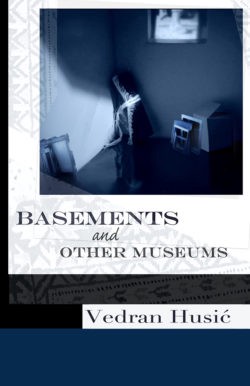
Vedran Husić’s debut story collection Basements and Other Museums, to be published in March 2018 by Black Lawrence Press, has two glorious, violent, complex, multiethnic, and fractious nations as its twin poles: the former Yugoslavia, and the United States of America.

Purchase the novel.

Its vision ranges widely. A story like “Hand in Glove,” with a gay Bosnian refugee working for the Census Bureau in 1990s suburban St. Louis, sits next to “The Exile of Muhamed Mehmedbašić,” in which one of the assassins of Archduke Franz Ferdinand — and the only Muslim in on the plot, as he points out — contemplates his act. One is invited to lift and turn the prism of this world, finding arresting images along the way: children making a game out of dodging snipers’ bullets; a brawl over a Serbian soccer jersey worn into the wrong bar; bored refugee teenagers listening to The Queen is Dead on a laptop; a man slipping over the border to Trieste to procure superior blue jeans for the black market of Communist Yugoslavia.

After reading the collection, I talked to Husić about war and private memory, piercing one’s illusions about the past, and Nabokov. Lots of Nabokov.


Matthew Neill Null: While you’ve lived in America for years, your hometown of Mostar seems to me the spiritual locus of your work. Could you talk about that place and what it means for Basements and Other Museums? When Americans think of the Bosnian War, the siege of Sarajevo may come to mind, but they probably don’t know what happened in Mostar.

Vedran Husić: Mostar is definitely the capital city of this collection, but the Mostar evoked and represented in these stories is mostly an imagined, mythical Mostar. It’s a hybrid blur of reality and dream, both immediate and distant, like a vivid memory. I think that’s fitting for a wartime setting, a place in the constant act of transformation, either through destruction or recreation, where all of its inhabitants are in exile, even those who never strayed across its shifting borders. The details of description are precise but elusive, both dynamic and passive, specific and yet, ultimately, tantalizingly, out of context; they ground readers as much as they keep them afloat. And that’s how Mostar has always felt to me.

Mostar is also a very fertile setting, put under siege by the surrounding Bosnian Serb forces and then divided between Bosnian Muslims and Bosnian Croats, a division that still stands today; there’s the minaret on one side of the city and the steeple on the other. But Mostar is fertile ground that I felt I had the expertise to plow, whereas I didn’t feel I possessed that same proficiency regarding Sarajevo. “Deathwinked,” for example, is set in Mostar’s sniper alley, another simultaneously delineated and amorphous setting, though the infamous “Sniper Alley” was actually two streets in Sarajevo. But my imagination had no claim on Sarajevo, because my curiosity was invested elsewhere.

Deathwinked

MNN: Could you talk about how “Witness to a Prayer” came to be? With its footnotes and Borgesian imagined texts, it’s likely the most complex story in the book.

VH: I’m glad you think that as that story is my favorite in the sense of it being a perfect marriage between what I had to do and what I wanted to do. Like most of my stories, though, it came to be through a stringing together of stubborn images in my head and an accumulation of “observations” in my notebook. There was an overabundance of these “observations,” in fact, the notes spilling over into footnotes. The form, as mentioned above, is that of a case history, an oblique biography, and Ivan Borić, the subject of that history/biography is abstractly based on Nabokov, his beliefs and prejudices regarding literature, as well as, most significantly, his style of expression of those beliefs and prejudices. But the real human center of the story is based on a couple from Sarajevo, good friends of my parents, who lost their own daughter during the closing stages of the war.

I’m the son in all my stories; even when every other part of the character is not me

Here things become complicated. I never spoke, formally or even informally, with that couple about their daughter’s death; I took their loss and imagined a story around it that wasn’t their story. I would wonder what “truth” could my imagination provide me about the loss of a child. When I wrote about the death of a parent, I was taking to its natural extreme a very real possibility, and so despite the admittedly stylized rendering of grief, I felt I was being honest in its depiction (I might as well “confess” that I’m the son in all my stories; even when every other part of the character is not me, the way the character is a son is the way I’m a son, or at least one of the ways.)

In “Witness to a Prayer,” I solved the problem of “truthful” representation through metafictional trickery, revealing that Ivan Borić’s internal monologue, which comprises the story’s second half, was imagined by the narrator, an admirer of Borić who has come to interview the writer’s widow. (If this spoils the story for certain readers, then those readers wouldn’t have enjoyed it anyway.) I wanted to say that access to such pain and grief is impossible, always an illusion, but that the attempt counts and the attempt is what generates literature. I wanted to emphasize that empathy is not understanding, but an honest attempt to understand, a kind of loving. I wanted to inspire belief in readers without deceiving myself or them that I had bestowed any actual knowledge. I wanted to say that truth is our faith in the possibility of truth in this world, a kind of imagining.

Gauley Season

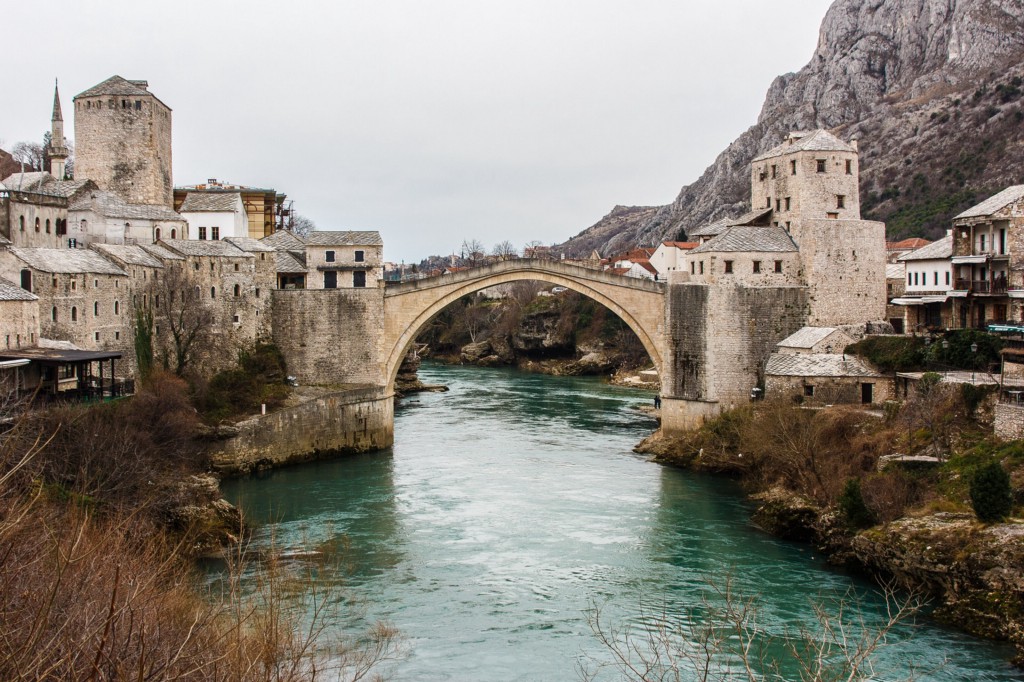
MNN: In “Documentary,” the narrator begins, “Only a delusional man will seek solace and affirmation from his memories, but I’m telling you the past is all I have, all I know, when talking about him, and there is a kind of solace, if not affirmation, in thinking back on our shared childhood in America.” Maybe this yearning is a natural point-of-view for this refugee character. But as I read the stories, I began to feel that this statement was the organizing principle for the book itself — perhaps for all of Bosnia, where the 16th-century Ottoman Bridge of Mostar was destroyed by Croat troops in 1993 and has since been rebuilt in period detail, a central image in your book. From a vague present, the characters are mining a past where everything seemed more fixed and concrete. The great dramas of their lives are behind them, and they are recursive, picking apart that past bone-by-bone. Did you have this in mind when you were writing?

VH: Memory is a central theme of the book, the way it recovers and rewrites the past, and my characters depend on memory’s power to certify and comfort while simultaneously being suspicious of that power. The characters that lived through or died in the war are usually the ones who recall a prewar past that is, as you put it, “more fixed and concrete,” and hang on to this vision with everything they’ve got. The immigrant characters, by contrast, are freed from day to day survival and allowed to philosophize on the nature of memory, question the purity of any past. In the former stories, memory is never really evaluated, only strenuously exercised, while in the latter stories, memory is constantly interrogated, its power invested with doubt, not hope, unable to truly confirm or console. Memory is one of the metaphorical bridges in this collection, perhaps the main one, connecting past and present, Bosnia and America, the real and imagined, but bridges get destroyed and what’s rebuilt offers a kind of solace, perhaps, but little affirmation, or only its illusion.

Let me conclude my answer the way your question began, with a quote from one of my stories: Daniel, who has come to Mostar to visit his father’s grave in the collection’s penultimate story, “Like Coming Home,” upon seeing the Old Bridge (Stari Most, from where Mostar gets its name) thinks how, “Despite the recent reconstruction it was still called the Old Bridge, and, perhaps, for all intents and purposes, it really was. But I knew it was not, nor would it ever be, the bridge over which my father had walked.”

MNN: Correct me if I have your biography wrong, but after you left Bosnia, I believe you lived in Germany for a few years before your family was settled in St. Louis as refugees. So I’m wondering about your journey to writing fiction and poetry in English. Did you “choose” to write in English for particular reasons, or did it come naturally when you first sat down to the desk? You mentioned Nabokov, and I can imagine an alternate universe in which he happily continued to write novels in Russian, American residence be damned. The Balkans are so linguistically rich that, similarly, I imagine various paths forked in front of you.

VH: Well, technically, I was a refugee in Germany, and by coming to America I became, merely, an immigrant, since the war at that point was over and we had an actual choice between going back to Bosnia or coming to America. But I don’t really agree with this terminology, since that choice was really no choice at all. Similarly, there was a choice between writing in Bosnian or English, but that choice was also only an illusion. I think, and I dream, only in English, and though I consider myself, ideally, a citizen of the world, it is the fact that I write, and am solely able to write, in a distinctly American brand of English that is the most authentically American trait about me, whatever “authentic” or “American” means. I came to writing and reading rather late, and when I started writing I’d already lived in St. Louis for eight years and my mother tongue, unexercised and forlorn, was a fading memory. I am able to speak it, somewhat correctly, in the same odd though slightly less thick pseudo-German accent with which I speak English, I can barely write or read in it. So Nabokov’s “private tragedy,” as he called it, was not one I mirrored with my own mother tongue as for me all roads led to the English language.

Memory is a central theme of the book, the way it recovers and rewrites the past

MNN: Do you think your heritage gives you a special vantage point to write about this place? I know you come from a rigorously secular background that’s typical of the former communist Yugoslavia — it reminds me of my own atheist great-grandmother, a Slovene peasant from Strmca. But your father has a Muslim background and your mother a Catholic one, and the Bosnian war played out in bloody fashion on religious fault-lines between Catholic, Muslim, and Orthodox. It had to be devastating for your family to watch. My grand theory is that important Yugoslav figures tended to come from mixed unions, because they didn’t suffer from ethnic myopia. Danilo Kiš was the child of a Hungarian Jew and a Montenegrin Christian, and Marshall Tito, with a Slovene and a Croatian parent, was married to an Orthodox Serb.

VH: I will gladly buy into that theory! I do think there’s truth to the idea of a diverse heritage leading to a more elevated vantage point from which to view and understand a complicated event. For that reason all but one of my narrators are products of a mixed marriage. Afforded an added perspective from which to look at the breakup of Yugoslavia, they can tell the story of that breakup with a special insight, a telling that’s made more urgent by our voice being in the clear minority. Even Muhamed Mehmedbašić is doubtful about the role his religion plays in his self-definition and fearful of what part it plays of how others define him. A full Muslim, he’s the sole exception to my narrator rule; this exception was not really prompted by Muhamed being a historical figure, but by my desire to write from a purely Muslim point of view, since they did suffer by some margin the worst loss of life and land. And by writing from a historical perspective, I wanted to show that the prejudice toward Muslim Slavs was not merely a recent development but existed at the formation of Yugoslavia, which was a kingdom before it became a communist republic. Communism, despite its obvious liabilities, is what held the country of my birth together this long.

They felt deeply betrayed by the breakup of the only place where they felt they truly belonged, the only real home they knew.

My father does come from a Muslim background — and though non-practicing, he was interned in a concentration camp merely due to his last name — and my mother from a Catholic one; moreover, I have family in Serbia proper who affiliate with the Orthodox faith. My parents are not religious, as you stated, nor were they members of the Communist Party, but they did sincerely believe in Yugoslavia and loved their life there. A lot of my fiction explores this belief in a failing country: was it nativity or true faith? Is there a difference? What is certain is that they felt deeply betrayed by the breakup of the only place where they felt they truly belonged, the only real home they knew.

MNN: The first story of yours I read was “Deathwinked,” [which appeared in Recommended Reading] and the voice really struck me, how unapologetically romantic, lyrical, and word-drunk it was. It stood out as being so different from the restrained voices that I associate with MFA programs in America — and yet you got an MFA from Arizona State. So who are your influences as a writer? When I describe your work to people, I talk about Witold Gombrowicz (for the way you stretch moments of time like taffy) and Danilo Kiš (for the subject matter and the “case histories” of the characters), but now I realize I might be projecting my own interest in Slavic writers onto your work.

VH: I don’t mind flattering projections, and it’s always a thrill being compared to writer I never read (Gombrowizc in this case), the thrill of discovering a ghostly lineage. As for Kiš, I did read him deeply during the writing of these stories, the only Yugoslav writer I have read extensively. He is mentioned in “Witness to a Prayer” — a “case history” of sorts and a story about artistic influence as much as anything else — along with other writers who have made an impact on me, chief among them Vladimir Nabokov. But you’re not too far off when you mention Slavic writers, as my earliest reading (which began, as I said, rather late, in my twenties) were Russian writers, from Gogol to Dostoevsky to Isaac Babel and Ivan Bunin (and of course the Nabokov of the first, European half of his career).

Paul Celan also looms large over this collection; I read him my first semester of the MFA, in John Felstiner’s amazing translation, and “Deathwinked,” the initial draft of which I wrote that semester, was largely inspired by his poetry and my homesickness. Poetry for me has always been equal to fiction in its simulative powers, and I seem to be especially attracted to writers who write both, like Stuart Dybek and Denis Johnson (and Nabokov as well, again!). To them I owe much of my stylistic debt. But no list of influences would be complete without my fiancée, the wonderful writer Naira Kuzmich, who recently passed away from lung cancer at the age of 29. I met her during our MFA and she is by far the best thing to happen to my writing and in my life.

For Women’s History Month, #ReadMoreWomen

Dear Electric Literature Members,

Today we launched a #ReadMoreWomen social campaign to celebrate Women’s History Month, and to kick off our membership program on Drip, Kickstarter’s new patronage platform. We encourage you to tweet with the hashtag #ReadMoreWomen to recommend books by women and nonbinary authors, and visit electricliterature.com/readmorewomen for essays by and about women.

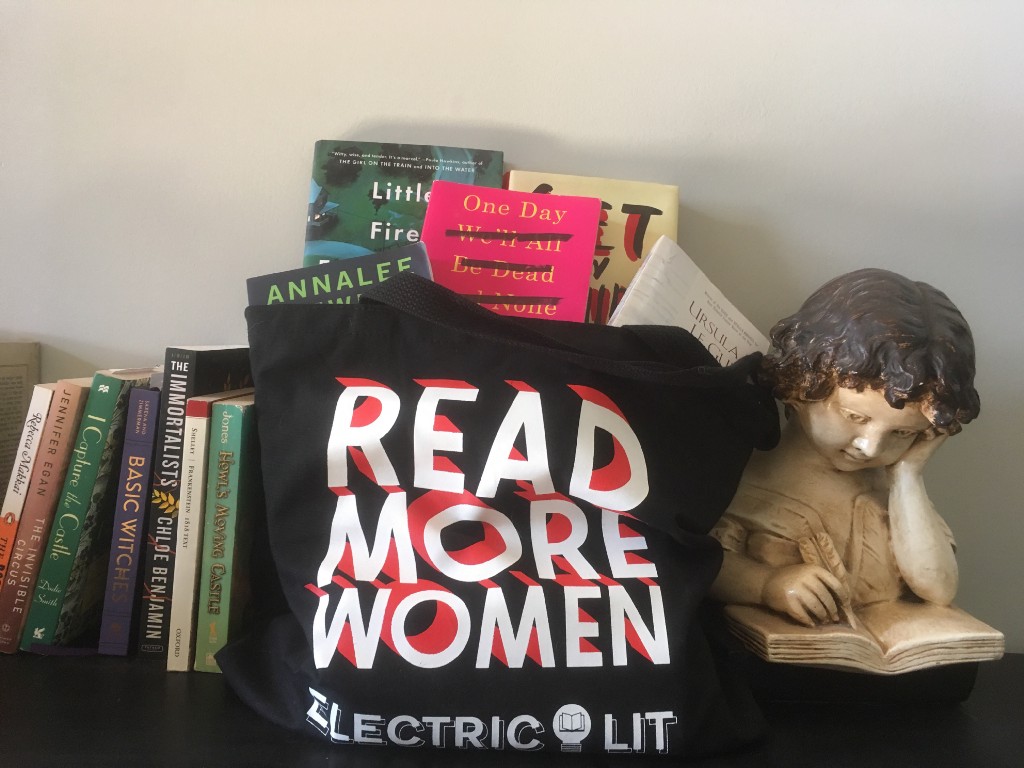
As an incentive to founding members on Drip, we’re offering our new READ MORE WOMEN tote bags, pictured below. These tote bags aren’t available anywhere else. But, since you’re already a member, you can purchase one at 20% off with the code UrsulaLeGuin here. (The code is case sensitive.) This offer is exclusive to members and expires on April 7, 2018.

Though it’s not ideal to have multiple membership platforms, we want to be prepared in the event that Medium stops supporting publication memberships. You are also welcome to switch your membership account to Drip to a receive a complimentary tote in addition to year-round submissions, bonus editions of The Blunt Instrument, and a monthly Recommended Reading themed eBook. For now, Drip members do not yet have access to the full Recommended Reading archives.

Speaking of members-only submissions, we have been getting some great work lately! We recently accepted submissions by Electric Lit members Sequoia Nagamatsu and Benjamin Schaefer. To further incentivize you to submit, we’re guaranteeing a response time of less than 3 months, which is half the time it takes us to read regular submissions.

One more exciting update for all of you nonfiction writers: We’ve also added a members-only portal for essays! Links for both are below.

FICTION: http://bit.ly/ELmembersonlyfiction

ESSAYS: http://bit.ly/ELmembersonlyessays

As always, if you have any questions please feel free to email me at editors@electricliterature.com. Your support means so much to us; we really couldn’t exist without it.

Gratefully yours,

Halimah Marcus
Executive Director, Electric Literature

‘Three Billboards’ and the Way We Forgive Racist White Men

O f nine Best Picture Oscar nominees for 2018, none have been so polarizing as Martin McDonagh’s Three Billboards Outside Ebbing, Missouri (2017). Taking place in the rural south under the backdrop of its racial tension, Three Billboards has become the awards season’s poster child for its narrative mishandling, or downright abuse, of anti-Black racism, the spirit of the 2006 Best Picture-winner Crash reborn — another film that stoked ire for taking on race while failing to appropriately address it, and which gained subsequent success despite. As the light shone brighter on Three Billboards, it went from a film festival darling to a multiple Golden Globe and Screen Actors Guild Awards winner, and now a winner of two Academy Awards after being nominated for seven.

Criticism of Three Billboards is warranted: few Black people are included in a film which explicitly talks about racism in the rural south; Blacks end up portrayed as little more than props in a story that centers (white) victims of violence; a Black woman is thrown in jail, apparently in retaliation against the film’s white star, and is nearly forgotten there. In short, Black pain is the backdrop of a film largely unconcerned with it. But of the many justified gripes that Three Billboards has given rise to, the most insistent defense on the part of the film’s fans (and numerous award committees) revolves around a character named Dixon (Sam Rockwell, winning the Oscar for Best Supporting Actor for his portrayal) as the grievance that is least deserved. What this backlash reveals is not only who we are expected to sympathize with, but also how readily we offer forgiveness when it comes to racist white men.

Black pain is the backdrop of a film largely unconcerned with it.

Both criticisms and defenses of Dixon usually refer in some way to his “redemption arc.” A redemption arc is a specific type of storyline in which a morally repugnant character reveals the good inside them over the course of the narrative and ends up acting on their better selves, essentially paying an emotional restitution to the viewer and regaining their favor. You hated Jaime Lannister for pushing Bran Stark out of a tower, but you hate him less — or even come to like him — as he grows close to Brienne of Tarth, saves some characters’ lives, and protects King’s Landing. You hated Severus Snape at the beginning, only for his journey to lead you to care about him, despite what came before. The same, as applied in Three Billboards, looks like this: initially depicted as racist and violent, Dixon draws empathy from the viewer through a reveal of his sad home life with his verbally abusive mother, from his personal growth as he tries to become a better person, and as he helps Mildred find justice for her daughter.

The problem is that none of those things should change how we feel about a violent and racist character.

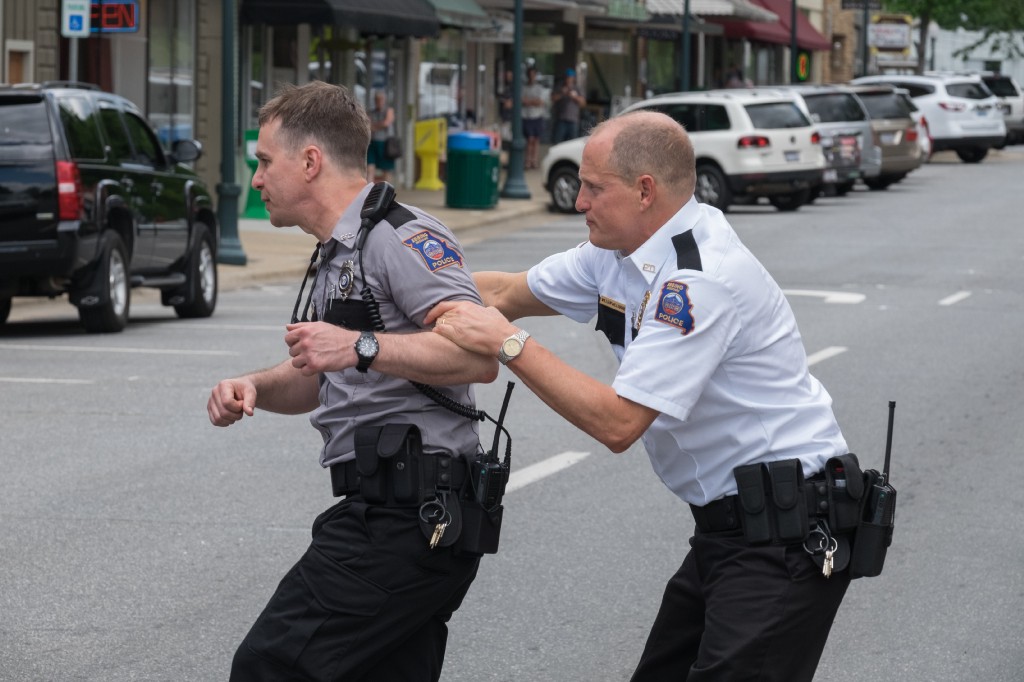
Sam Rockwell and Sandy Martin in ‘Three Billboards’ | Merrick Morton/Image courtesy of Fox Searchlight

Viewers sympathetic of Dixon believe that he, by virtue of his attempt to change, pays an emotional price that is restitutive to the other characters, as well as to the viewers themselves. But none of Dixon’s acts are in relation to the violently racist portrayal that makes viewers hate him in the first place. While Dixon is shown to have a pathetic home life, that doesn’t begin to pay the moral or emotional cost of his racist violence. And while he tries to help Mildred find her daughter’s rapist and murderer, he ultimately fails. In the end Dixon accomplishes nothing, and helps no one. When it comes to restitution, he doesn’t actually pay.

A redemption arc requires a redemptive act or accomplishment, which begs recollection to 2006’s Best Picture winner, Crash. Widely lauded by many white critics to the chagrin of many Black ones, Crash features a racist cop (Matt Dillon) who sexually assaults a Black woman (Thandie Newton), but who, in the end, rescues her from a burning car. The movie’s theatrical poster famously includes the woman clutched to his chest, putting this narrative at the forefront out of all others in the ensemble film. Its message was cringingly clear as a racist-cop redemption arc — the character’s saving of a Black woman intended to reflect his deep-seated valuation of her life, which was only buried under the trauma of his own life experience (to say nothing of his failure to value her life when he molested her before).

Why We Love Women’s Revenge Narratives

It makes for a ripe comparison, Three Billboard’s Dixon standing alongside the racist, assaultive cop from Crash, except that from a narrative point of view the latter crosses the finish line to include what every redemption arc ultimately needs: a redemptive accomplishment. The result is Crash’s cringeworthy message and imagery, while Dixon in Three Billboards actually fails to accomplish anything at all.

Three Billboards ends in an uncomfortable place, treating with sympathy a character who remains undeserving, while expecting that the viewer will be endeared to a racist cop with no redemptive accomplishments and who achieves literally nothing positive. Those who do find Dixon sympathetic raise the question of whether his character arc is the problem, or whether such sympathy reveals an uncomfortable latitude in their feelings towards racists. The alternative is not to find Dixon sympathetic at all — to actually hold his character to the standard of redemptive accomplishment.

Those who do find Dixon sympathetic raise the question of whether his character arc is the problem, or whether such sympathy reveals an uncomfortable latitude in their feelings towards racists

To deploy the redemption arc loosely, as McDonagh has in Three Billboards, is to afford more credit than racists deserve. It presupposes that someone’s attempt to change is enough: that their positive intent is enough to outweigh their negative impact. Frankly, the price of Dixon’s redemption is so high that even if he had been successful in bringing down the film’s unseen murderer and rapist, its indirect relation to his racist past (and presumably racist present) would still be inadequate. The film sets the bar for redemption dishearteningly low, if we’re meant to see this racist white cop’s attempt to help a white woman as the sole requirement for him to be able to redeem himself. Worse, his character only succeeds in making Mildred more like him, as they both spiral deeper into unchecked violence and white vigilantism, failing to change the status quo. Familiar territory for a racist white police officer.

Sam Rockwell (left) as Dixon in ‘Three Billboards’ | Merrick Morton/Image courtesy of Fox Searchlight

Three Billboards invites a lot of deserved criticism for its handling of racism, which will hopefully lead to more careful consideration among moviemakers who tread the same landscape in the future. But the questions it raises of who we sympathize with, and expect sympathy for, ask for self-reflection from us audience members, too.

Jhumpa Lahiri Translates the Fine Print of Aging

“Trick”

by Domenico Starnone

Mario was moving a chair as close as possible to mine.

— Can I use your computer? he asked.

— Don’t even think about it.

I hesitated before sitting down. I was tempted to pick up the cell phone and yell at the publisher: I don’t give a fuck about oxygen, about brightness, tell me in plain words what’s wrong with it, because otherwise I’ll quit the job and forsake the pittance you’ll give me for it, I don’t want to waste time.

But I didn’t do it, and the anguish of old age poked its head up once more. I needed that work, and not for money — my house in Milan and my savings kept me comfortably — but because I was scared to think of myself free from the obligations of work. For at least fifty years I’d moved from one deadline to the next, always under the gun, and the anxiety of failing to suitably tackle one then another, followed by the pleasure of successfully doing just that, was a seesaw without which — I finally confessed to myself outright — I couldn’t bear to picture myself. No, no, better to still keep saying for a while, to acquaintances, to my family, to my son-in-law, above all to myself: I need to work on James, I’m extremely behind, I have to come up with something as soon as possible. Thus, under Mario’s attentive gaze, I resumed examining my sketches, especially the chaotic ones from two nights back.

At first I only did it to calm down. I looked at the pages, I appreciated the good smell of cooking that was entering the room in spite of the closed door, and now and then out of the corner of my eye I kept watch on the boy, who was keeping his word, never scraping his chair, scarcely breathing. The whole time Mario stared at the pages with me, as if we were having a contest to see who would get tired first. But then at a certain point I stopped being aware of him. I got an idea: to use the drawings of the apartment the way it had been many years ago as a backdrop for the New York house in James’s story. The hypothesis stirred me, here was a good way to begin: I’d make rooms on the other side of the ocean, from the 1800s, collide with rooms in a house in Naples, from the mid twentieth century. Great. With my pencil I immediately began to isolate, among the disorder of those crammed, marked-up pages, certain details that seemed useful to me. And my mind fired up so quickly that when Mario called me, feebly — it was a moment in which everything was coming together, I could picture it all vividly — I told him sharply: Be quiet, you promised. But he repeated, softy:

— Grandpa.

— What was our deal?

— I have to be quiet and not move.

— Exactly.

— But I just have to tell you one thing.

— Just one. What is it?

He pointed to a few strokes of the black marker, in a corner on the right side of the page that I was looking over. He said:

— That’s you.

I looked at the drawing, it was an absentminded scribble. Perhaps it represented a young man gripping a knife, maybe a boy with a candle, but in such a vague way, as if my hand had strayed without meaning to into that corner. When had I done it? The other night? A little while ago? The lines writhed swiftly, a flicker that barely presented itself before disappearing. I didn’t dislike it, it reminded me of the stuff I knew how to do when I was a boy, and it moved me that, contrary to my beliefs, I’d captured something from those years — something of what I was able to draw when I lived in that apartment with my parents and my brothers. I’ll use it, I told myself, it’s good. And I asked the boy:

— Do you like it?

— I guess. It sort of scares me.

— It’s not me, it’s a doodle.

— It’s you, Grandpa, I’ll show you.

He slipped down from the chair with a resolute look.

— Where are you going?

— To get the photo album, come, bring the drawing.

He waited for me to get up, taking me by the hand as if we might lose one another. When I opened the living room door, we were assaulted by a cold blast. Evidently Sally, to air things out, to dry the wet floors, had opened every window, and now the apartment was freezing. On top of that, the noise of the traffic, without the protection of the double-paned glass, rose up harshly. We went into my daughter’s study; there, too, the window was wide open, and the racket from outside was suffocating shouts from afar, like someone pounding a rug with a carpet beater. Mario dragged a chair up to a cabinet full of doors. I tried to stop him.

— Tell me where the album is and I’ll get it for you, I told him, but in vain. He relished climbing. He opened one of the doors, turning the key. He pried out an old-fashioned album, dark green, and handed it to me.

— You have to close it up, I reminded him.

He closed it.

— And lock.

Ably he turned the key.

— You’re a dwarf, I told him.

— No, I’m not.

— Yes, that’s exactly what you are, a dwarf.

— It’s not true, I’m a little boy, he said, getting upset.

— All right, sorry, you’re a little boy, Grandpa’s stupid and says stupid things, stupidly. Never mind.

I helped him jump off the chair — but this time he tried to free his hand, he wanted to jump on his own, something I tried to prevent — and when he landed with a little yelp of joy, he asked me:

— Did you mean I’m one of the seven dwarves?

— Yes, I replied. And I explained that he’d been wrong to get offended, it was a compliment, it meant: You’re sensible and wise. Then I set the album on the desk and asked him where the picture he wanted to show me was. I knew the album well: It contained family photographs that had been passed down from my mother to my wife and, when my wife died, to Betta. The child leafed through it with expertise and showed me an image in which I was with my mother and my brothers. I had no memory of it, I must have always looked at it unwillingly. I’d considered every moment of my adolescence a hateful constriction. Surely my father had taken the picture, he looked at us through the camera and we looked at him. Everyone but me was smiling. How old was I? Twelve, thirteen? My face was repugnant: long, thin, unrefined. Time had left every millimeter of the picture intact, apart from my own contours. Or maybe the image had always been like this, and some fault in the developing had damaged only my outline. Nothing about the face and stringy body appeared complete. I had no mouth, no nose, my eyes were hidden by the thick arcing shadow of my brows, my hair dissolved in the albumen of the sky. Of that instant frozen by the camera, I only recognized the flash of hatred for my father. I looked at him without eyes, with aversion, because of his gambling habit, how he’d raised us in poverty, the fury he’d embodied and unleashed onto my mother, onto us, when he didn’t have a hand to play. The aversion had been rendered precisely, and now it repulsed me.

— See how it’s you? Mario said.

— Not really.

He brought my drawing alongside the photograph.

— Don’t lie, Grandpa. It’s you.

— I wasn’t like that, it’s the picture that makes me look that way.

— But that’s exactly how you drew yourself, look. You’re really ugly.

I shuddered:

— Yes, indeed, but it’s a bit mean of you to say so.

— Dad says you’re always supposed to tell the truth.

I guessed it was Saverio who had called me ugly, in that picture and perhaps in general. Bodies — these tattered shreds of nature — need affinity to get along, and my son-in-law and I had never managed to feel affinity for one another. I still heard the screams, the carpet pounding was getting louder. I examined the facade of the building across the street, where no one was screaming or beating a carpet. I asked:

— Grandpa, in addition to being ugly, is also a bit deaf. Do you hear that shouting?

Closing the album, he replied:

— Yes, it’s Sally.

— Sally? Why didn’t you say so?

— I didn’t want to bother you.

I pulled on my earlobe, the lobe of my right ear, hoping to improve my hearing. The shouts were coming from the room where we slept. I went to see what was happening, and Mario trailed me as if he already knew. Sally was on the balcony, the glass door was closed. She was banging her hands against the double-paned glass but the blows and her shouts — Grandpa, little Mario! — resounded weakly in the room and throughout the apartment, precisely because of the double-paned glass. I remembered Betta’s warnings: The balcony door didn’t work well. I thought to myself, annoyed: The publisher, Mario, Sally, it’s impossible to concentrate. The woman should have been dealing with me and the child, instead here I was wasting my time because she was scatterbrained. She’d opened every window in the house and then gone onto the balcony without thinking that the wind would have slammed the door shut. And now there she was, shouting for help.

— Stop banging on the glass, I said. We’re here.

— I’ve been calling out for half an hour.

— Oh, come on.

— Can’t you hear?

— I’m a bit deaf.

— You know how to open up?

— No.

— Mister Saverio didn’t teach you?

— No.

Sally looked dejected and pounded the glass yet again. I felt we had, in that moment, twinned feelings: Both of us exasperated by the time we were wasting, each blaming the other, and this made me feel unexpectedly close to her. Mario on the other hand was getting on my nerves, he wanted to play at every occasion.

— Grandpa, I know how to open it.

I didn’t answer him. I asked Sally:

— Can’t you open it from outside?

— If I could I wouldn’t be calling you. There’s no handle outside.

— What do you mean there’s no handle?

— What do I know, Mister Saverio bought it this way. But to release it from inside all you have to do is pull up, hard, then pull down.

Mario stepped in:

— Get it, Grandpa? You pull this way, then turn that way.

He motioned precisely with his hands, and I repeated after him without even realizing.

— Like that, he said approvingly. Should I get a chair and help you?

— I’ll do it myself.

I set to it but without success. The door wouldn’t open.

— You have to do it hard, as hard as Dad.

— Dad’s young, I’m old.

I tried again. I pushed the handle up and then down, with tremendous resolution. Still nothing.

— I can’t stand here all day, Sally said, starting to fret. I have other houses to get to. Call the fire department.

— What the hell are you talking about?

The child tugged on me, but I ignored him. Then, to attract my attention, he started repeatedly striking my leg with a closed fist.

— I have an idea.

— Keep it to yourself and let me think.

He kept punching my leg. I grunted:

— Speak.

— Sally lowers the bucket and pulls up the empty space. When it’s all gone she climbs over and leaves.

Sally, exasperated, screamed:

— If I don’t get to work they’ll fire me. Please do something. When the door doesn’t open you need a screwdriver.

— Yes, Mario confirmed. Dad opens it with a screwdriver, sometimes. I can help you, should I go get the screwdriver?

— You’ll be of more help if you stop talking.

I was frazzled, I couldn’t concentrate. How long had it been since I’d used a screwdriver, pliers, a wrench? I kept thinking about the scant strokes I’d made at the edge of the page and, at the same time, Mario’s voice, insistent, that drew attention to — rather, that pointed out to me — similarities between those strokes and the teenager in the photo. I was at risk at that age, I did poorly at school, I struggled with Latin. My father had sent me to a small foundry close to our house, a place that no longer existed. For a few months my hand and my mind found new direction, and perhaps the scrawls I’d made had something to do with that period. I need to make sketches like that, I told myself, and I felt that I was ready, my mind wouldn’t let up, it pinned me to my surroundings, rapidly suggesting ideas, not for freeing Sally but for drawing after drawing; I saw them emerge, disappear. I pictured a doodled version of myself as a boy, one who knew how to turn the door handle the right way, and could capably use a screwdriver. I felt I could access that efficient figure without lifting pencil from paper, moving instead directly from the tips of my already gnarled, grease-stained hands, then rising up again through my strong arms and tense neck, until it reached the ugly grin on my face. I had so many versions of those teenagers in mind. That throng was mutations of me between the ages of twelve and twenty, when I stopped growing and found the strength to escape that house. Now I wanted to try a backflip, over more than fifty years of adult work, down down down to the first time I took a stab at creating images. It was almost as if it were really possible to put today’s passionate, red-hot working and reworking behind me and sink into an absolute zero, into a hole in the ice where everything was preserved. I seized the handle, and with rage — rage, not ire — I pushed it, first up, then down. I felt a click, pulled the door, and the door opened.

— About time, Sally sputtered, and returned indoors nearly shouting: I’m out of here, I’m late.

She explained what to do for lunch and for dinner that day and the next, but all the while she spoke only to Mario; I no longer inspired any trust in her. She shut herself in the storeroom, came out looking like an elegant elderly woman, and then off she went.

I sat down on the edge of my bed. Mario quickly removed his shoes, climbed up, and started to jump off of it with squeals of joy, undoing Sally’s work. He asked: Are you going to jump too, Grandpa? The glass door was still wide open, the balcony surged out against a deep-blue sky. I saw a yellowish weed sprouting up from the black, uneven traces of soil between the tiles. I said to the boy:

— You can’t pull up empty space with a bucket, Mario. Don’t you dare play that game you were talking about. The empty space is always there, and if you go over the railing and jump, you die. Didn’t Dad tell you that? All he told you was that I was incredibly ugly?

Then I, too, took off my shoes, I got up on the bed, and we jumped for a while, holding hands. I felt my heart in my chest like a huge ball of live flesh that went up and down from my stomach to my throat and back again.

Announcing Electric Lit’s #ReadMoreWomen Campaign

Unless you’re working hard at it, your reading list is probably too male, too Western, and too white. For mysterious reasons (?!?), those are the books our white-male-dominated culture values. They’re the books you’re assigned in school, the ones the men around you insist you listen to them talk about, the ones that show up on lists of “80 books every man should read” in which 79 are by men, the ones that influence our very idea of “literary value.”

Needless to say, you should be working hard to diversify your reading list. In fact, if we don’t elevate a wider range of books, we won’t be able to grow as a culture. The white male perspective we’re spoon-fed from birth is stultifying; if you don’t fit the profile, you’re led to feel like your voice isn’t important, and if you do, it’s easy to get the message that all you have to do is show up. It’s boring, it’s exclusionary, it’s self-perpetuating, and it’s bad for everyone. And the easiest no-brainer place to start, the place that barely even requires any extra effort and yet seems to be beyond many people, is by reading the 50-plus percent of the population that isn’t men.

So in honor of Women’s History Month (March) and International Women’s Day (March 8), and in service of literature in general, we’re launching a #ReadMoreWomen campaign. (The name is based on a tweet about Andy Weir, author of The Martian, whose “By the Book” interview in The New York Times revealed him to be one of those people for whom the minimal effort of reading non-men is too hard.) We challenge you to increase your consumption of women and nonbinary authors, and tweet at @ElectricLit with the hashtag #readmorewomen to tell us what you’re reading or recommend a book. And you can fashionably admonish others to do the same by becoming a founding member of our crowdfunding efforts on Drip, Kickstarter’s patronage site, which entitles you to one of our beautiful new Read More Women tote bags, designed by Stephanie Kubo. For the time being, the totes are not for sale anywhere else online! But fortunately for society, books by women are available wherever books are sold.

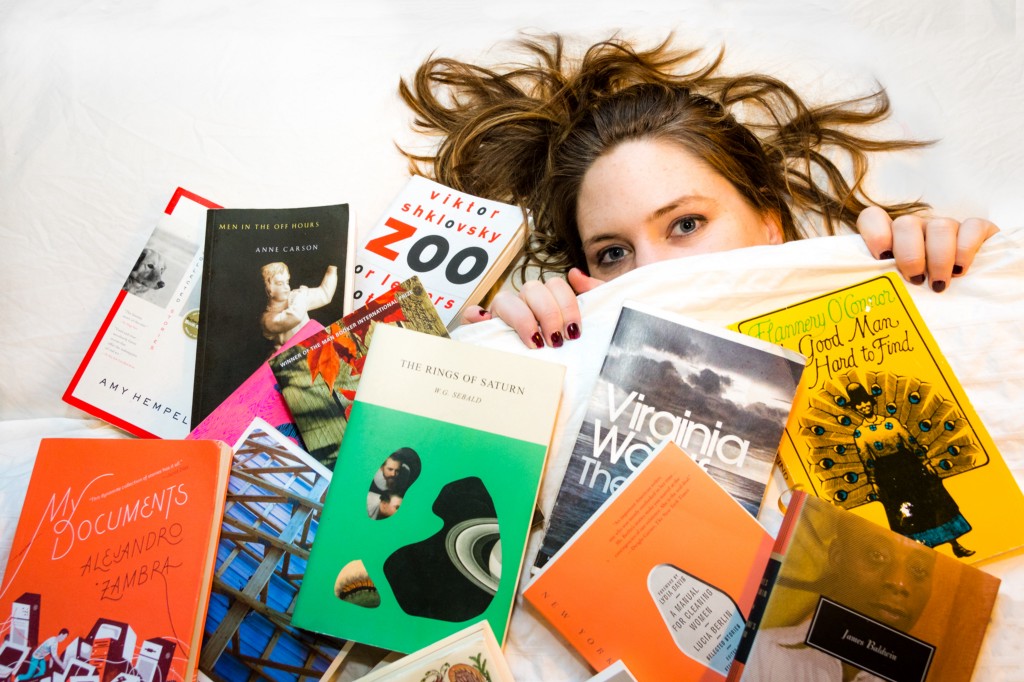
Becoming a patron doesn’t just get you the tote (although, again, it’s a really good tote and should probably be incentive enough. It’s holding like 20 books by women in the photo above!). It’s also a way for you to support Electric Literature’s efforts to make literature more exciting, accessible, and inclusive. We’ve collected some of our best recent essays by women about books by women, as relevant examples of the type of work you’ll help support by contributing to our Drip.

If you wait to be handed your books, well, you know what you’ll get. If you want something else, you’ll have to go and find it. We think you should.

Read more women — they’re half of all people, y’all. Read more nonbinary and trans authors. Read more queer authors. Read WAY more authors of color. (We could only make one tote bag at a time!) Read more women, but more importantly, read more widely. We all stand to benefit.

I Fell in Love Because She Hated Shakespeare

Novel Gazing is Electric Literature’s personal essay series about the way reading shapes our lives. This time, we asked: What’s a book that made you fall in love?

I was a freshman in college, at the time — fresh in every sense of the term, fresh-faced and fresh out of an intensive senior year of high school. In love with world, in love with myself after a long post-breakup year of learning who I was again, in love with the possibilities of a new start at college. I was also an intended theatre major, and, obviously, in love with William Shakespeare.

She was also a freshman, next door neighbors with my best friend. A leather jacket-wearing art student with an astounding collection of hats and a tough-chick attitude.

The second day of school, we walked to dinner together, along with two or three other people from her hall. My best friend and I lapsed into a fairly standard conversation, in which I — being a bit of a pretentious intellectual trying to make my best impression on the cute girl from down the hall — brought up my favored topic, the astounding genius of the Bard himself: Shakespeare.

And she said, “You know, I don’t really like Shakespeare.”

I don’t need to describe the way my heart sunk in my chest, found its way into my stomach, and then toppled out of me, unceremoniously, onto the ground at my feet as she said it. Everyone who has ever tried to impress a crush only to be shot down mercilessly knows how it feels, like your internal organs are suddenly made of quicksand. I felt small, for just a second, silly for my infatuation with the Bard. If this girl, cool and collected as she was, didn’t like Shakespeare, what did it say about me that I did? What argument could I ever make to persuade her that Shakespeare — or, more importantly, that I — was cool?

“What do you mean, you don’t like Shakespeare? He’s a master, he’s a genius, he’s the greatest poet of — ”

“He’s overrated,” she said, finally, and my little heart sank and floundered, heavy with some unpleasant fusion of disappointment and embarrassment, and the conversation moved on to something unrelated, although for the rest of dinner it was all I could think about.

I wrote it all off, later that night. After I admitted to my crush, my best friend told me, “oh, her? I think she likes guys,” and we left it at that. I stilled my heart, did whatever I could to swallow the nervous feeling in my throat when she talked to me, and despite the disappointment, I resolved myself to be okay with it. If there was no way for me to woo her, well, such was life. I had just gotten out of a relationship where my hobbies and interests had taken a backseat to everything else; I couldn’t date someone who didn’t share — or at least appreciate — my near-obsessive love of Shakespeare any more than I could date someone who wasn’t queer.

I couldn’t date someone who didn’t share — or at least appreciate — my near-obsessive love of Shakespeare any more than I could date someone who wasn’t queer.

Instead, a steady friendship developed, without the messiness of attraction in the way, and she came to mean a lot to me, my crush all but smothered beneath my determination to make new friends.

For her, our disagreement over Shakespeare was probably forgotten too. We spent our conversations — dozens of conversations, over lunches and dinners with friends for the first semester of our freshman year — discussing the things we had in common instead. There were authors and poets we both liked — John Keats and Neil Gaiman and Mary Doria Russell — and movies, and comics, and music.

Occasionally, these conversations, warm and passionate, made something ache within me, a reminder of what I’d wanted at the start, but I did my best not to let that distract me from the friendship we had.

As time went on, though, our difference of opinion nagged at me — and contributed to my growing fascination with her. The closer we grew as friends, the more we had in common, the more similar our tastes were revealed to be, the more I became convinced that she must have been wrong: if I liked her, and I liked Shakespeare, she had to like Shakespeare. There must have been some mistake.

One night, on my way home from a party, still too buzzed from what was only the second time I’d ever had alcohol to feel comfortable settling into bed and getting some well deserved rest, I stopped by her room to say hey.

If I liked her, and I liked Shakespeare, she had to like Shakespeare. There must have been some mistake.

She was tired; her roommate was out partying — as was, it seemed, the entire rest of our small college campus — and she’d been watching Bright Star on her laptop, curled up in bed. But she invited me in and I joined her and at some point, during this strangely intimate evening, we got back onto the topic. “I might have just had really bad teachers,” she admitted, almost ashamed, when I told her I still couldn’t believe that there wasn’t even a single Shakespeare play she found appealing in the least.

It was as if she had looked me in the eye and said, “I want you to know, I’m also gay.” Something about the way she admitted to it made me realize, for just a moment, that all had not been lost that day. That there was still a chance. The crush I’d been crushing sprang back in full force as I fumbled for something to say.

“You have to read him out loud,” I answered, and I must have been blushing.

“Is that so?”

I dragged her back to my own dorm room — also empty, both of my roommates out at a sorority party or something — and pulled down from my overstocked bookshelf a blue leatherbound copy of the Complete Works of William Shakespeare, one of two copies of the text on my shelf, not to mention the several individually bound plays lined up on either side.

It’s almost painful to recall, the performativity of this action, my fingers lightly tracing over the paper-thin pages of this ancient, useless Complete Works that I had purchased in a used bookstore just before leaving for college for this exact reason: to look impressive, someday, to a cute girl I had a crush on. The gilded edges of its pages had faded almost to brown, the ink so light some parts of the text were illegible, and I scanned through it, play by play, and looked for something to read.

What I love now, as an adult, about Shakespeare is that it’s impossible to read Shakespeare aloud without some sense of irony, and even more impossible to read Shakespeare aloud romantically without leaning into that. To read Shakespeare aloud as a serious romantic gesture cannot help but be embarrassing; it misunderstands Shakespeare at its core. The doubling of its context always lingers between the words. As I flipped through the pages, trying to maintain my mask of calm intellectualism, I wracked my brain for a passage that was romantic in even the least.

Hamlet to Ophelia? No way, he’s an asshole. Bassanio to Portia? He only wants her for her money. Romeo to Juliet? Kill me now, a worse cliché there never could be.

I settled for something remarkably unromantic — Mercutio’s Queen Mab speech from Romeo and Juliet, a role I’d understudied just a year before, a monologue I knew well enough I barely needed the page in front of me to make it through.

I read it, and she listened.

Coincidences, you know, are an incredible thing. Just a few nights later — a week or two before Valentine’s Day — two of our mutual friends, a couple at the time, sat with me at dinner and mentioned that she and I would make a cute couple.

“I know, too bad she’s straight,” I lamented.

“Who told you that?” they replied.

It was like the moment of a Shakespearean comedy in which one character removes a mask or a costume and reveals themselves to be someone else entirely, a perfectly timed conflagration of events which solves the unsolvable complication of the plot in one fell swoop. A case of mistaken identity, or mis-conveyed message, had fallen between us for months, the audience watching along in frustration as we danced around each other, neither understanding the entire situation. A perfect example of dramatic irony, in which I had misjudged her, and had suffered for it.

A case of mistaken identity had fallen between us for months, the audience watching along in frustration as we danced around each other, neither understanding the entire situation.

I don’t know how much of this was orchestrated — by her, or by fate, or by Cupid himself, gearing up for the big holiday — but what I do know is that I was emboldened. Valentine’s Day came around and I spent forty-five minutes agonizing in my best friends’ room just down the hall from her, trying to decide whether or not to say something, whether to knock on her door and leave a note or to knock on her door and kiss her or to not do anything at all, and not risk the gentle curve towards whatever was happening between us.

I left a note, eventually — six lines of John Keats’ “Bright star, would I were steadfast as thou art — ” and a box of chocolate covered pretzels on the floor outside her room. It was the kind of sickeningly sweet gesture I’d always dreamed of having the courage to make, romantic and Romantic in equal parts. I knocked and ran, taking cover in my friend’s room until I knew she’d picked it up and closed the door again.

But it didn’t feel like enough.

I’d had a few drinks. I probably don’t have to say that; it’s fairly apparent from what comes next. I went outside, I counted out the windows on the first floor of the dorm until I came across the one I knew was hers, and I threw a pinecone at the window. It was cracked open, just a bit, an unseasonably warm night, and so I didn’t wait for an answer.

I probably also don’t have to tell you what lines I quoted next. But soft, what light through yonder window breaks. It was a different time, when my memory was better: I knew the whole bit by heart, all twenty four lines before Juliet cuts in. I recited it. I bowed. I went back to my room.

By the time I got back, she’d texted me.

She left campus to go home a few weeks after that. We hadn’t kissed, we hadn’t even seen much of each other since we confessed our feelings. But we talked on the phone a lot, for the remainder of the semester. I remember sitting on my bed on the phone with her, reading pieces of Hamlet aloud, teasing out the intricacies of the language, letting my voice lilt into the language of passages I knew the meaning of back to front.

“I’m going to read you every word of every Shakespeare play aloud until you find the one you love,” I told her, phone tucked between my shoulder and my cheek as I flipped through the familiar pages of that terrible old book.

I didn’t have to go very far. Pretty soon, she loved them all.

As in any Shakespeare play, the miscommunication or misunderstanding has to be overcome or it will become the downfall of the hero.

I don’t know what would have happened, if I had let the assumptions I made about her stand unchallenged. Likely, she would never have loved Shakespeare, and I would never have loved her. But as in any Shakespeare play, the miscommunication or misunderstanding has to be overcome or it will become the downfall of the hero.

I count myself lucky, still, that our story was written a comedy and not a tragedy.

We’ve been together for six years now; neither of us is much of the same person we were then, though remnants of those eighteen-year-olds still remain: my vaulting excitement and insecurity when someone disagrees with an opinion I value dearly, her leather jacket and ability to outpace me in really any argument. We’ve bonded over a hundred books since then, argued over maybe even more, but when people ask me how we met, I always return to the same story: she told me she hated Shakespeare, and so I couldn’t let her go.

What Do the Allegations Against Sherman Alexie Mean for Native Literature?

Recent accusations and revelations have made their way to the fore of discussions in the Native/Native American/American Indian literary world: we are now aware that a number of women say they’ve been harassed or abused by Sherman Alexie, the writer whom the white literary establishment has anointed as what Alexie himself has referred to as the “Indian du jour for a very long day.” After weeks of Twitter discussion, some of Alexie’s accusers went public yesterday, talking to NPR about what they endured. Though many of us look forward to the clarity of having this mistreatment out in the open, we find ourselves at an hour where we can see the gates from every side, and all that’s rushing against them.

At the moment, Sherman Alexie has addressed some allegations of abuse and abusive behavior, and refuted others. But this is also a time of reckoning for the literary world’s treatment of Native writers. As an extremely popular writer in the mainstream who has written a number of young adult works, Alexie is often the only Native voice heard in many social studies, language arts, and English curricula. White writers and scholars may find themselves wondering, “who should we get to replace him?” They may not even realize that this question highlights the gates that tend to surround Native lit, their complicity in maintaining them, and the consequences of their actions — actions which are akin to literary colonialism.

This question highlights the consequences of their actions — actions which are akin to literary colonialism.

I’m not comfortable writing this, but none of us should be. Many of the women in my community are too upset to talk about this yet, and I’ve been asked to speak up — but how do I write about what this means for contemporary Native literature? I want to make it reflective of our work; respectful, joyful, and solemn, and funny, imaginative, and caustic, far-reaching and future-looking, mindful of the past yet anti-ossificative in nature, punk and classical, both non-traditional and deeply so, conflicted, chock full of pain, irreverent and angry acknowledging all the relatives while selfish for our field and ourselves, deeply in love with who we are and more so who we need to and can be, acknowledging the fuckedupedness of it all while we eat tradish for supper and zingers and twinkies for dessert and we laugh.

We’ve been brought to what is likely a singular moment in the history of “Native lit,” whatever that might be, one that our kids will teach and write about some day. How do we adapt to this moment in ways that work for all of us, that honor what we all (note, all, of course) do?

How do we adapt to this moment in ways that work for all of us, that honor what we all (note, all, of course) do?

But before that, an apology. From me. Alone. Not for all men, because that’s just lazy. They can do it themselves. They should do it themselves. Because we are relatives and family and kin and colleagues and know better, can do better, will do better, better do better. I am also sorry, yet again, that this collective weight has fallen on all of you, and I think we men hope that you will ask us to share whatever bits or entirety of it you would like us to. And if you’re hesitant to ask because you’re worried we’ll get it wrong, well you’ll be right about that. So as an aside, I’ll ask any men reading here to get it together. Be ready to do some work when asked. Get. Your. Shit. Together.

Now. The question we’re being asked, directly or indirectly, by the white establishment is: “What do we replace it with?”

“It” being the one text, the one book, even the one writer.

That “one?” That’s a problem. That one definition of Native, the one arbiter of taste, the one writer of the moment, the NDN du jour, the one chief to sign all the treaties.

That’s America’s problem.

Since Day One, Europeans have been incapable of seeing the diversity of nations and communities and people in this hemisphere.

And it hasn’t changed.

So here’s what I’m proposing.

Maybe this time, we’ll tell you. When we’re ready. (Some of us have already begun — see, for instance, Elissa Washuta’s constantly expanding thread of Native writers on Twitter. One isn’t going to be good enough anymore.) Again, you’re asking for a whole lot of unpaid labor, countless hours of research and reading, talking, tending, and listening goes into our “field,” our work as the makers. And in this moment, we have an opportunity to change a whole lot of rules. And since, just as in 500 years of settler mismanagement of their stolen spaces on these continents, we are about to need a whole lot of indigenous science and knowledge to bring things back into balance, so are we going to need to decide what this particular segment of cultural production and art needs to have for balance, and for health. Because right now there’s a whole lot of words and stories pushing up and forward. And I think the pin that’s been holding it and us all back is loose enough to fall out at any minute.

Which means you’re gonna have to sit down, settlers.

While you’re doing that, maybe ask yourselves why you have no backup plan for your selection, your one text, book, writer, in what you do, what you teach. Maybe ask if you need to rethink what and why you do what you do.

Ask yourselves why you have no backup plan for your selection, your one text, book, writer, in what you do, what you teach.

It’s gonna take some lifting from you too.

In the meantime, we’ll get back to you on all this. Women will of course be figuring it out. Like they always have, like they always do, like they always will. Men, step in where and when asked. Be ready. And listen.

On the listening? I’ll be listening for the one thing I know is coming. The one thing I always wait for.

Laughter.

But we won’t laugh until the women do. If they can’t, or won’t, we don’t deserve to.

Because when they do, it’s the finest sound the world has known. It’s how we know it’s going to be okay.

Why I Left Men for Books

Two years ago I exchanged a human being — brown-eyed, alert, filled with complex nerve endings and a fluency in several languages — for a stack of books the length and weight of a person, a stack that now occupies the left side of my bed. Do I regret the trade? The short answer is: often. The medium length answer is: not enough to do anything about it. The long answer, because there is always a long answer, is what follows. For, who are we, what are we, if not a combination of books we have read, conversations we have had, regrets and anxieties we have suppressed, and promises we have allowed ourselves to hope for? If each life is “an encyclopaedia, a library, an inventory of objects,” as Italo Calvino suggests, then this is my attempt to re-shuffle the last few years of my life, to understand what it means to be a reader, a woman reading, a single woman who chooses books.

If you asked him, my former human, he’d say I exchanged him for a city, a program in which one is required to read a book a day and not a slim book, a fat one with tiny margins and no dialogue (otherwise known as a Ph.D.). This is not entirely accurate. I didn’t leave him for a city or even a country — but I did leave him, in some small way, for the books I now sleep with. That is to say, I left him for a life that is shaped by the abundance that books offer us but also by the solitude they bind us to.

The pursuit of an intellectual life and the desire for intimacy should not have to be mutually exclusive. Yet, for many women — particularly, women writers, academics, and artists — this continues to be the case. They are faced with a choice between the cultivation of love, companionship and family, and a retreat into solitude and creative work. Of this gendered double standard the poet and essayist Leslie A. Miller writes, “The image of the male poet in retreat can be attractive to society. But the image of a female poet in retreat is somehow against nature, a liability that can lead to emotional bankruptcy.” There is, thus, a form of solitude that attends the female artist, one that suggests deviance, stubbornness, abnormality and precarity.

This leads me to ask: Is there a particular solitude or separateness unique to the female reader? I’d like to pause on this question. For if there is something distinctive about the solitude of the female reader, what form does it take? How does it disrupt the delicate emotional economy in which we live? What does it reveal about our culture’s perception of reading and of women who read?

The pursuit of an intellectual life and the desire for intimacy should not have to be mutually exclusive. Yet, for many women — particularly, women writers, academics, and artists — this continues to be the case.

In the late 18th century, before she wrote her seminal work A Vindication of the Rights of Women, the philosopher and women’s rights advocate Mary Wollstonecraft put together an anthology for women entitled The Female Reader. It was designed as a pragmatic guide that would enable women to function as intellectual adults. For her and the other proto-feminists of the 18th and 19th centuries, reading was a technology of access, a way of introducing women (though not including them necessarily) to a worldly conversation. It promised a retreat from domestic obligations and an entrance into public life.

We see the same gesture 200 years after Wollstonecraft in Elena Ferrante’s globally renowned Neapolitan series. One reason Ferrante’s novels are so popular is that they foreground reading as a radical act, one in which we, readers, can participate, revealing the ways in which the female reader causes a threat to the patriarchal order. As a precocious and brilliant child, Lila issues library cards in all her family members’ names in order to access a world beyond the grey courtyards of her neighborhood, though even this does not allow her and our narrator Lena to shape a life that is not patrolled by arrogant, dismissive, and abusive men.

Reading, for these writers, relays a direct access to power. The female reader is a powerful reader. But at the same time, she is a neglectful woman. Is this, then, still the case in 2018? What is the role of the female reader in our era? What is at stake for women when we open a book, when we turn our critical attention away from the demands of our everyday lives and toward the open conversation of the page?

I read, much of the night, and go south in the winter. In university a professor drew our attention to this line from T. S. Eliot’s The Wasteland. The speaker is reading, he said, so that means she is not having sex. The line has stayed with me ever since.

She is reading so she is not conceiving children.

She is reading so she is not listening to you.

She is reading so she is alone.

Or she is not alone but separate. She is in what Frederic Nietzsche calls “the inward cave, the labyrinth of the heart” into which “no tyranny can force its way.” She is reading and so is locked within a solitude of her own making and her own protection.

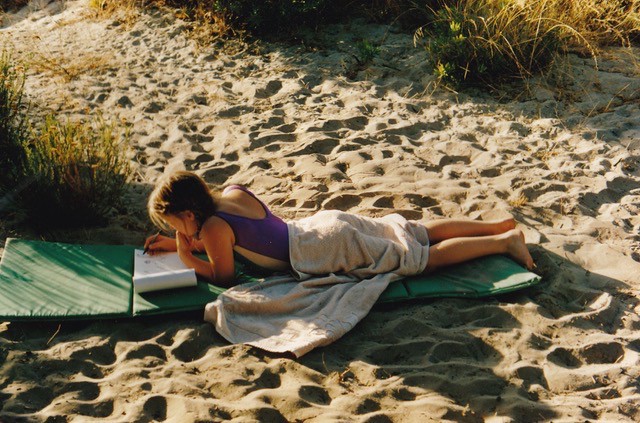
A girl alone on the sand, writing in a journal.

One reason that the solitude of the female reader might be more political, and more controversial, than that of the male reader, is that time operates differently for women — so we are made to understand. Women’s bodies, we learn, are living clocks, which cannot keep pace with men due to their biological utility. As men careen to the peak of their careers, women are faced with a paralyzing set of questions and decisions to make. Lydia Davis, whose writing has been described as a “grammar of loneliness,” sums it up well in her one-line story “A Double Negative”:

At a certain point in her life, she realizes it is not so much that she wants to have a child as that she does not want not to have a child, or not to have had a child.

By inviting books into her bed, the female reader’s retreat becomes an attempt to find refuge from the impasse that this double negative evokes.

Someone I met on a dating app once told me that at 33 he was the prime dateable age for a man. The prime age for a single woman was, of course, significantly younger. I’m not sure why he told me this. Perhaps to remind me that the cards were stacked in his favor, that men age more productively, increasing in value with each grey hair. As proof he cited charts, assembled by dating sites like OKCupid, exhibiting the “official” decrease of women’s desirability and the increase of men’s desirability. Like two mountain peaks, one red, one blue, they change course over a person’s lifespan. The red (female) peak experiences a quick drop off after the age of 23 while the blue enjoys a long, luxurious decline down the slope of undesirability. Similar charts depict deeply entrenched racial biases (see Hadiya Roderique’s excellent article “Dating While Black”). These charts make painfully legible the systemic racism and sexism that shapes not only our desirability but our desires.

What I have learned over the past three decades and what I am trying to unlearn, is that for women love, durable intimacy, and companionship is an economy of scarcity.

What I have learned over the past three decades and what I am trying to unlearn, is that for women love, durable intimacy, and companionship is an economy of scarcity. With each year our stocks depreciate. As Olivia Laing reflects in her study of loneliness, The Lonely City, single women in their mid-30s find themselves at an age where “female aloneness is no longer socially sanctioned and carries with it a persistent whiff of strangeness, deviance and failure.” This “whiff” of strangeness haunts the female reader as she claims her separateness from the world, when she bows her head to the page rather than the baby monitor.

“There is never a right time to start a family,” a doctor once told me when I went to get a prescription for birth control. “I just wouldn’t want you to regret it later.”

“Do you have children?” I asked her. I had just turned 30.

“Yes,” she said proudly. “I have four.”

Regret. This word takes on a particularly gendered connotation in this instance. Like the Davis short story, I questioned my actions, staring at the birth control prescription (I didn’t use it in the end). I did not want not to have a child, to carry with me that “whiff” of abnormality, failure, and prickly eccentricism — did I? Not having a child, it seemed, was the worst possible case of FOMO a woman could experience in her lifetime. Despite my resistance to societal demands, I could feel myself being pulled in. Now, three years later, even though I’m closer to my reproductive “expiry date,” this anxiety has lessened. This is thanks to the conversations I have had with other women, conversations about the books we are reading, about our strategies of navigating a world that is still largely hostile and blocking rather than enabling to women.

This is something we are particularly adept at: using storytelling and its trivialized genres — confession, complaint, “gossip” — as a means of negotiating, and potentially even dismantling, the impasses that structure our lives and shape our experience of the world.

A collage of women with the books they sleep with

How to take down the patriarchy? 1. Build a network of brilliant and difficult women. 2. Sleep with more books.

Yet the question remains: does reading make us lonely or less likely to “find a mate”? Or does our dissatisfaction with our societal position, with the dudes we meet online, with the double standards we face in our professional and personal lives, turn us into readers?

Perhaps the answer is: a bit of both.

Reading turned me inward, but not to escape men. To survive men.

I won’t describe my past life, because if I did I would have to describe him. I would have to tell you about how, as we prepared for sleep, he would turn to me and say “last look” before he switched off the light, so that we could memorize each other’s faces in the moment before the blackout. This was so that we would recognize each other if by chance we should share the same dream.

I no longer meet him in my dreams. Or if I do, we no longer recognize each other. As Neruda says, “the same mouth / is now another mouth.” We pass each other without a second glance.

These days I have instead been dreaming of babies — the Instagram famous babies of my friends. I’ve memorized their tiny faces in all the configurations of joy and despair captured by their many daily, hourly, updates. Theirs are the last faces I see before going to sleep. They are my “last look.” And their faces, and the faces of strangers, men on dating sites gripping giant fish or crouching in front of Machu Picchu, ads promoting a new miracle diet (ice cubes and self-discipline), cat videos, pug videos, a heavily documented Christmas vacation, brunch, group brunch, someone’s bathroom selfie, these are the last images to be imprinted on my retina. These are the visions that I bring with me into that horizontal world of sleep, and which, until recently, have dominated my dreams.

I have taken to sleeping without my phone. The phone, a tool of communication, of connection, is also a technology of loneliness.

For this reason I have taken to sleeping without my phone. The phone, a tool of communication, of connection, is also a technology of loneliness. Banished, hypnotic, it pulses in the far corner of my room. But I will not be seduced. I will resist its vibrations with the perseverance of Odysseus at the mast, with the self determination of the ice cube dieter. (Though sometimes I’ll wake up in the middle of the night and stalk across the room to check it.) For now, and I’ve made a rule of it, only books are allowed near my bed.

Tonight, I’m reading in order to examine my own solitude and the solitude of the women around me, who, for whatever reason, have not found companionship through conventional routes. Because of the breakdown of a long-term relationship, a series of disappointing intimacies, or the prevailing insistence on “informal” relationships (where one is not supposed to “catch feelings”), or because of circumstance, or choice, or a refusal to settle, we have become difficult women. Misfits. Killjoys. Ours is, to borrow a line from Emily Dickinson, “The Loneliness One dare not sound”; ours is a political solitude. Yet, as Audre Lorde reminds us, “anger is loaded with information and energy.” Though it may be attended by visceral disappointment and sometimes even despair, it makes legible a broken system. As Laing writes, our “difficult feelings” are not a simply a consequence of “unsettled chemistry, a problem to be fixed, but rather a response to structural injustice.” Disappointment, dissatisfaction, irritation — these are political emotions. They are useful and dangerous. Or, rather, they are useful because they are dangerous.

It is not lost on me that solace and solitude share the same root. I find myself suspended between these two wor(l)ds.

It is not lost on me that solace and solitude share the same root. I find myself suspended between these two wor(l)ds. I sleep amongst dead authors but living books. I sleep beside living authors and silent books that lie, opened, awake, beside me. In a way it is not dissimilar to sleeping beside a lover; there is the alien consciousness, encased in the soft shell of the book. There is the quiet angular weight, the blunt spine, the pages warm and musty as skin. “What makes lovemaking and reading resemble each other most,” Calvino observes, “is that within both of them times and spaces open, different from measurable time and space.” The reader submits to the act of reading. She forgets herself, suspended, as poet Lisa Robertson puts it, “in the vertigo of another’s language.” To be shaped by a text, by the contact with another’s innermost thoughts — this is a form of pleasure.

It is a form of love as well.

For, as the cultural theorist Lauren Berlant observes “what being in love secures is the evidence that you have had an impact in the world by being a condition of possibility for someone else.” To be a condition of possibility for someone else is not only to be someone’s fantasy but to be the conduit for that fantasy. This is not unlike the relationship between the reader and the book.

To love then is to read. To be loved is to be read.

Here, in the lamplight, I enter into a slow communion with my book. I enter into a space beyond measurable time. This becomes my last conversation of the day. Perhaps my most important one.

Books have become my cure to the overstimulation of the screen and the small but cumulative disappointments of my everyday; they have become the soft technology that mediates the hard, flickering machinery of my waking life. They offer a retreat from life but also an entry point into understanding my life. They are more than a consolation prize; they are the trapdoors into what Virginia Woolf in her diaries referred to as “the real world,” the expansive and private world of the mind.

Reading ‘The Odyssey’ Far From Home

After a protracted fall during the length of which the leaves perpetually seem on the verge of turning, winter arrives in one swift blow. Overnight, the trees shed their leaves and the low hanging boughs are lined with snow. For a few days, the air turns frigid. A ghastly wind blows through the streets, glazing the roads with a thin layer of ice. It is a rough and forbidding initiation, a grand entrance that clears the city of walkers, sends everyone indoors. The silence is palpable. The heavy load of snow that is rudely dumped on our homes mutes the noise of distant traffic and the whistle of the train as it cautiously chugs down the tracks that cut across the city.

It is here, in South Bend, Indiana, that I first read The Odyssey. I am not ashamed to admit that there are many great books I have not yet read. Quite the contrary: It is a fact that delights me, makes me feel hungry, alive. I prefer to remain aware of all of the great books I have not yet read, not to mention all of the great literature that has not yet been written. And since so much of literature is about navigating the spaces we inhabit, then it follows that I also orient my inner compass towards those remote landscapes in which I have not yet lived. To further stitch the two together — literature and landscape — I tend to think carefully about where it is I am living when I suddenly take an intense unforeseen pleasure in a great book. A classic. So, I fell in love with The Odyssey in South Bend; and, like a perfect mirror effect, that falling transformed my relationship to the city.

This is a strange, magical place; it is also harsh and withholding. Living here requires a great deal of fortitude and patience, not to mention an appetite for solitude from those of us who weren’t born or raised here and who don’t have built-in networks we can fall back on to bolster us through the seasons. Here in South Bend, the sun appears sparingly in the winter. When it makes a rare appearance, people rush out of doors in droves; they stick their faces in the light, breathe the fresh air, shake off the stale, sooty climate of their homes. Our neighbors dust off their cross-country skis and go around the block while their children make snow angels, or fly downhill on their sleds at the park as the family dogs watch over them with bemused looks from their fixed position under the unrobed sycamore on the hill. These are the tell-tale signs of South Bend’s unrelenting winters. It won’t be long before Lake Michigan — immense, magnetic, temperamental — will be a glacial mass embellished with translucent ice floes.

Landing on the shores of the Third Coast after years of wandering was something I never saw coming. The landing was not easy. I felt emotionally shipwrecked. I had left North America for Spain two years prior with the intention never to return, a failed search for home that had taken me to Italy and then back to the U.S. It was at this particular juncture in my life, during those first psychologically demanding years of living in the Midwest, surviving its winters and coming face-to-face with its brutal legacy of distaste for otherness, that I started reading The Odyssey. I discovered a few vague parallelisms: Lake Michigan is haunted with shipwrecks, and the landscapes that hug the Third Coast have been shaped by The Great Migration, transformed by Polish, Italian, Latin American and Arab immigrants, globalized by Somali and Hmong refugees. And The Odyssey, a tale of loss, reckoning, and encounters between civilizations, is full of shipwrecks, digressions, wandering, narrowly escaping death, being blown off course and arriving at the most unexpected shores.

As it turns out, Ulysses’ nostos — his difficult, mesmerizing journey home by sea — brought into sharp relief my own strange journey across Europe, North America, and the Middle East. Nostalgia (which comes from nostos) has kept me company, an unrelenting philosophical mentor, as I have crossed and re-crossed the Atlantic in search of a place to put down roots. Instead of the goddess Athena who guides Ulysses and his son Telemachus on their travels towards and away from home, a nauseating nostalgia for the past hovered over me, simultaneously attracting and repelling me. But, no matter how many times I retraced my footsteps, one thing remained unclear: Nostalgia for what? For which version of my past? A country? A person? An atmosphere? A smell?

Ulysses’ nostos — his difficult, mesmerizing journey home by sea — brought into sharp relief my own strange journey across Europe, North America, and the Middle East.

Given the disorienting cartography of my life, there isn’t a singular home for me to return to. I am from nowhere; or, perhaps, I am from a constellation of places which habits and social codes violently contradict one another, leaving me empty handed. That emptiness, though excruciatingly painful, has also allowed me to cultivate emotional and psychological dexterity, to embrace digression, and to comfortably linger on the shores of foreign cities on my impossible search for a place to call home. While Ulysses had Ithaca, an exact geographical point to which to return, I am still waiting to find the story of my return, the many dizzying returns, that will likely lead nowhere except further inwards, a descent I make willingly and on which my writing depends.

This spiraling structure, of returns nested within returns, echoes the narrative blueprint of The Odyssey: ten years after the Trojan War, Telemachus leaves Ithaca in search of his missing father, and almost simultaneously, after a long sequence of fantastical near deadly events, Ulysses leaves Calypso’s island and arrives shipwrecked on the island of Scheria. Along the way, Telemachus hears tales of his father’s adventures through Nestor, King of Pylos, and Menelaus in Sparta. Five books into the epic, we begin to hear the story again, but this time told by Ulysses himself; the inhabitants of Scheria have promised the help he will need to return home safely, but only after he has recounted the story of his adventures. So, before we arrive at Ulysses’ own telling, the tale of The Odyssey is told and retold by a varying cast of characters whose own stories have intersected with Ulysses’ narrative. These retellings of the past are crucial to the narrative’s future. The memory of Ulysses’ journey — his nostos — is kept alive by different tellers, echoed and re-echoed, safeguarding the continuity between the past and the future. In his essay “The Odysseys Within the Odyssey,” Italo Calvino writes beautifully about the “risks of forgetting the future” by allowing the past to slip from memory. He reminds us that woven throughout the song of The Odyssey are the lines “to think of the return,” “to speak of the return.” This echoing, or infinite return to central events of the past and to the shape of the hero’s journey, is a linguistic and mental structure familiar to most exiles and to the loved ones they have to leave behind along the way.

Before we arrive at Ulysses’ own telling, the tale of The Odyssey is told and retold by a varying cast of characters whose own stories have intersected with Ulysses’ narrative.

I wholeheartedly believe that preserving the possibility of a future in which justice has been restored depends in large part on remembering the past, on actively recalling and retelling our struggles. But I am also intrigued by the architecture of The Odyssey as a whole, and, in particular, in the great spatial and temporal leap that occurs between books IV and V, that momentary negative space in which Telemachus’ telling pauses and Ulysses’ telling begins. It is in this electric tension that their songs of longing for one another reverberate at the highest frequency, paving the path for their critical future encounter in Ithaca. Like absence and presence, loss and reckoning, the two parts of the narrative are interdependent: to preserve the story of The Odyssey we must hear the song of the exiled hero alongside the song of those Ulysses leaves behind. These two experiences, of those who leave their homeland and those who remain, do not fit together squarely; they do not add up to an exact whole. Central to their respective integrities is that charged space in between, that hollow dimension or hiatus against which silent surfaces our hopes, desires, longings, and despairs echo, reaching a crescendo, a critical mass.

Understanding, therefore, surfaces through narrative accumulation, through the circulation and recirculation of the story of our struggles and the silences when those stories are not being told. Those in-between, liminal spaces — the silences — are critical not only to preserving the differences in our songs of sorrow, but also to creating the necessary space for us to sit with our collective struggles without requiring them to be perfectly synchronized. In this context, the possibility that The Odyssey was written by several people, or gathered by Homer from oral tales that had been recounted for generations, becomes doubly charged. It is a classical collage, a song of multiplicity, an epic poem that doesn’t seek to erase the fault lines and fissures that become a part of our identities in the process of learning to be human while we may be lost at sea, or faced with a disorienting number of shifting cultural, geographical and linguistic points of reference. It is a poem that is as much about speaking our story as it is about moving beyond reason, and into a quiet space of reckoning, where the embodied experience of grief and desire is not forsaken in the process of giving shape to the memory of the journey through language. The silences, too, repeat. And a great deal of unabashed weeping and wailing occurs throughout The Odyssey.

The Girls Who Turned into Trees

For better or for worse, I am extraordinarily sensitive to space. The first year of living in South Bend, I wept incessantly. Some of the tears I shed in longing for the balmy air of Barcelona in the summer, some for the streets and sounds of Florence, Italy, where I had ended up living, a brooding city with a bloody history exquisitely masked by ornate buildings and laced with the sapphire waters of the Arno. Unlike Florence, South Bend is no open-air museum. It is a rust belt city dotted with abandoned warehouses, homes with blown out windows covered with plastic to keep out the frigid, winter air. It is a city in the process of recovering from financial collapse, and when I first arrived here six years ago it was much less recovered than it is now.

The Midwest is an inspired, but scarred landscape. It’s haunted with the legacy of racism and segregation and marked by rampant poverty. These issues are not ghosts of the past — which would be difficult enough to reckon with — but ongoing realities. Here, the pain of our great human failures is not masked by exquisite architecture, but rather by that well-known brand of Midwestern politeness, the ability to look the other way practiced so often and with such diligence that it has been raised to an art form. And then there is the warmth and hospitality that comes at a high price, subjecting those of us who are not from here to a line of questioning so alienating that one might wish to be invisible. Surviving in the Midwest as an outsider requires subterfuge, cunning, a robust temperament — qualities Ulysses possesses and which Telemachus is taught to acquire in his journey from boyhood to manhood. But weeping is as much a central note in the symphony of the poem; the weeping is cathartic, yes, but it also serves as a form of remembering and reminding us of the characters’ emotional memories, their embodied experiences. In fact, the first time we see Ulysses he is alone, weeping on the beach: “. . . as always, / wrenching his heart with sobs and groans and anguish, / gazing out over the barren sea through blinding tears.”

Weeping, longing for home, unsure of how it was I had landed in such unexpected shores…these were the circumstances that lead to me to fall in love with The Odyssey and that taught me an unforgettable lesson: in order for a great book to have a lasting impact on us, the circumstances of our lives have to have ripened for the encounter, the frequency of our character calibrated to that of the book. I am writing here of The Odyssey, but also of all of the great books people always claim to be rereading or apologetically concede to not having yet read: Bleak House, Middlemarch, Don Quixote, War & Peace, The Shahnameh, The Epic of Gilgamesh. The list goes on and on. What excites me is the fact that sometimes we are lucky enough that our life intersects with a book at a critical juncture, almost instantly transforming our consciousness, or illuminating a fact or feeling we have always suspected but preferred not to acknowledge about ourselves. Such books haunt us for years by stirring awake our own dormant ghosts, by reminding us to remember.

Weeping, longing for home, unsure of how it was I had landed in such unexpected shores…these were the circumstances that lead to me to fall in love with The Odyssey.

I suspect I will forever circle around the notion of home, searching for it despite knowing that it can only exist on an abstract plane within my imagination. I also suspect that for most of us the feeling of belonging is almost impossible to locate, but that once found it is transportable to anyplace. For now, I’ll continue to linger on the shores of the Third Coast, surrounded by fertile plains of soy and corn that unfold as far as they eye can see beneath the wide, pearl-pink skies of the Midwest. Once the glacial winter cedes to spring, the tulips emerge, their silky bulbous shapes sway in the cool April breeze. The geese will return, waddling around in single file and honking at drivers. The ground will thaw and the grass will regain its color. Thunderstorms will roll in, the silver veiny flashes of lightning radiant in the twilight. Summer will be green and lush and the air will be filled with the song of canaries and blue jays and woodpeckers carving holes in the trunks of the trees. There’s great beauty here. It is not all strain and sorrow. I no longer weep about living in the Midwest, but I couldn’t have remained here without weeping, without sitting in that uncomfortable and, at least for me, unfamiliar space beyond language.

To return again to where I started: the shame we are required to perform upon admitting that we have not read a certain classic. Well, according to Calvino, “All that can be done is for each of us to invent our own ideal library of our classics; and I would say that one half of it should consist of books we have read and that have meant something for us, and the other half of books which we intend to read and we suppose might mean something to us.” Calvino is one of my authors, the way that Homer was one of his. But I find myself dissatisfied with the inventory he proposes. My library is also filled with books that, for some reason or another, I never intend to read. The negative capability created by those books serve as fuel for me to search for the books that I will read and that will momentarily steady my restless nature. I am soothed by the idea that there will always be an enormous number of books I will never be able to read — that my life, however long it shall be, is too short to allow me to fully exhaust literature’s possibilities. Those books help me hone my search and give a certain gravitas to the choices I do make. After all, I consider the intersection where life and literature meet a window that allows us to simultaneously look without and within, a vantage point onto infinity. And in order for that space to be meaningful, we each have to craft it in our own time, at our own pace.