Pretty much everyone who reads sometimes uses books as a way to escape. A book is a door to another world, a way to get away from reality for a few minutes or hours and focus on characters and circumstances wholly and blessedly unrelated to one’s own life. Sometimes, the more unrelated to one’s own life, the better.
I love literary fiction; it’s the genre I read most frequently. But literary fiction also tends to be about things that are distinctly related to my life—heartbreak, money, family troubles. So when I have a particularly bad day, I tend to turn more and more to science fiction and fantasy. Reading a book about a wizard or a spaceship is my version of taking a stress nap. While literature about serious, familiar, recognizable problems is both necessary and important, sometimes life is hard and I want a space opera where the gods are real and teenagers can conjure up demons.
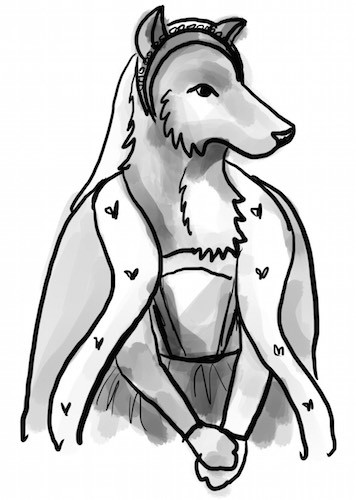
Like I said, though, literary fiction is the genre I read most frequently. Which is why sometimes, when I start to wish literature offered more of an escape from reality, I find myself scanning my shelves full of novels about family and death and imagining that they’re about wizards and dragons instead. Yes, The God of Small Things is great, but right now I want to read about Minimantia, deity of everything under one centimeter in diameter! Could someone please write that for me? And while you’re at it, write these:
In reality this is one of my favorite novels, but I would also probably love it if it were an epic battle between the actual Fates and the actual Furies, playing out partly in the realm of the Gods and partly in the lives of a few humans who gradually begin to wonder if they are being used as pawns. Part one in a trilogy.
This is the second book in the series that starts with Fates and Furies, in which the one Fury who survived the war with the Fates must live as a normal human while reconstructing her powers and plotting revenge. She starts a punk band called “The Sound.”
A Hunger Games-style trilogy about a spunky kid escaping a repressive dystopia in which “blood purity” is valued above all things and children are “corrected” in order to gain higher status and please the authorities. Our hero, Jonathan, sees his world’s cruelty for what it is and must infiltrate its highest echelons of power and take them down from within.
City on Fire
In a world ruled by a mysterious cult of fire worshippers, the perpetually burning city is a holy city, and can only be visited for the initiation trials that each youth must undergo before they enter adult society. Nothing is known about the trials before one enters the city, and far from everyone who goes into the burning city ever returns. Will our three heroes survive their upcoming trials in the city on fire?
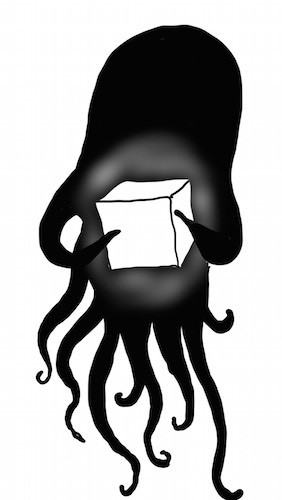
Everyone in the city knows about Them, but no more name than that is ever given to them, and it is best not to speak about Them, and certainly never to approach them. These shadowy beings hover on the outskirts of a city, preventing anyone in the city from either coming in or leaving. They each hold a strange, glowing box. When a plague decimates the city’s populations, a few intrepid residents who are still healthy must confront these unknown beings and the things in the boxes that They carry, to try to win their escape from the city and gain help for the people within.
A space opera about a single ship that has survived a debilitating space war and must use “slouching” — a dangerous, experimental time travel technology that allows them to travel undetected — to reach Bethlehem, a mythic oasis planet in a neutral zone which none of the characters have visited and which is perhaps not entirely what it seems.
A planet with two suns, and two warring religions, each of which worships a different one of the two suns. An epic told from the perspective of many different individuals on both sides of the conflict.
A steampunk novel in which our hero must construct The Orange, a secret weapon disguised as a piece of fruit. He wears goggles to do it. The goggles are crucial for some reason.
The Heart of Darkness was once the noblest ship in this galaxy’s fleet, but after its captain suffered a tragic loss, turned rogue and is now a space-pirate ship full of corruption and debauchery, hunting down other members of the fleet who were once its trusted friends. The book is written from multiple perspectives, including that of the ship itself.
A young girl discovers a secret portal in gift shop at the zoo, which transports her to an evil fairy queen’s private collection of living glass animals, whom she befriends and tries to free from their captivity.
A steampunk horror novel about the construction of surveillance robots. Despite terrifying obstacles and the opposition of the Society of the Changing Mirror — a cult of wizards who control society from afar and abhor all technological advances — the Watch-Man must be set.
Thanks to the celebrated new translation by Emily Wilson, Homer’s Odyssey is enjoying something of a feminist moment. It is surprising that it has taken this long for a woman to publish a translation of this epic into English, especially given its multitude of female characters. Despite its first line beginning with the key word andra, “man” (that is, Odysseus), it so teems with dynamic women that Samuel Butler in 1897 published a book entitled The Authoress of the Odyssey arguing — untenably — that it was written by a woman.
Women in this epic are undeniably powerful — without the aid of Athena, Nausicaa, Arete, or Ino, Odysseus would never have made it back to the shores of Ithaca. But women are dangerous as well, threatening the hero’s journey home. Odysseus must face and overcome Sirens, Scylla, Charybdis, Circe, and others.
Women in this epic are undeniably powerful — without the aid of Athena, Nausicaa, Arete, or Ino, Odysseus would never have made it back to the shores of Ithaca.
To me the most fascinating of Homer’s characters has always been Calypso, the goddess who saves Odysseus’s life and then imprisons him on her island for years. Calypso is terrifyingly dangerous — not unlike the other monstrous and elemental female opponents male heroes of Greek myth must meet and defeat in order to acquire their masculine bona fides, such as the Amazons, Harpies, Furies, and Medusa.
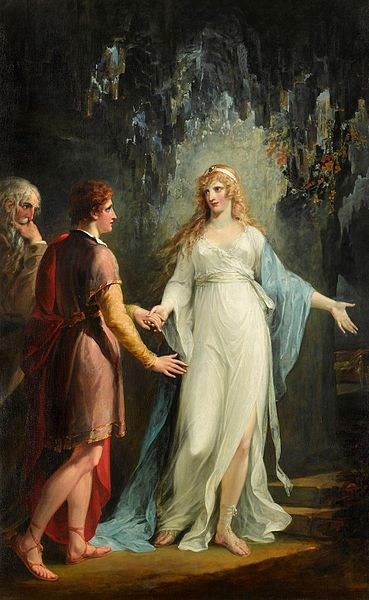
“Calypso receiving Telemachus and Mentor in the Grotto,” painting by William Hamilton
Feminists have rightly begun to see these vanquished women as figures ripe to be reclaimed. Electric Literature’s editor-in-chief Jess Zimmerman has penned a series of powerful essays for Catapult recovering myth’s marginalized female monsters. The figure of Medusa and her complex legacy in western thought loom large in Mary Beard’s newly publishedWomen and Power, a history traced also by Elizabeth Johnston for The Atlantic. The mythical Amazons, defeated and “tamed” by heroes such as Hercules and Theseus, form the background myth for Wonder Woman, whose long-awaited film arrival this past summer was hailed by some (though by no means all) as a feminist victory. Emily Wilson herself has commented on the feminist potential of the Odyssey’s monsters to Bustle, “They’re presented in ways that are powerful…and very attractive and seductive.”
The human women of the Odyssey have likewise received feminist press recently. I myself have suggested that Penelope’s trick of weaving and unweaving a shroud to keep her suitors at bay foreshadows current feminist modes of resistance via craft — by this trick she is able to transform tools of oppression into tools of empowerment. But Penelope remains a woman in need of a patriarch, never allowed to attain to masculine power in her own right. And she in turn oppresses those women below her, the female slaves who, as we shall see, suffer violence with her sanction — a facet of Penelope that Wilson has rightly and repeatedly emphasized.
Penelope’s trick of weaving and unweaving a shroud to keep her suitors at bay foreshadows current feminist modes of resistance via craft — by this trick she is able to transform tools of oppression into tools of empowerment.
Wilson suggests, moreover, that if we are to see glimpses of real female power in the poem, we will find them not in its human but in its divine women:
There is a vision of empowered femininity in the Odyssey, but it is conveyed not in the mortal world but in that of the gods….The divine Calypso, Aphrodite, and Circe provide passionate models of female power — idealized fantasies of how much agency mortal women might have, if only social circumstances were completely different.
Such recognition of female power in the poem prompts one to ask whether Calypso is ready for a feminist recovery. My first inclination is to shout “yes!” to the skies — but to do so overlooks too much of what Homer tells us about her and the way she treats Odysseus.
Those artists and writers who do find in Calypso a sympathetic figure see her as a female lover abandoned and left alone, a frequent mythological predicament familiar to, say, Dido or Ariadne. In Ignorance, published in 2000, Milan Kundera writes:
Calypso, ah, Calypso! I often think about her. She loved Odysseus. They lived together for seven years. We do not know how long Odysseus shared Penelope’s bed, but certainly not so long as that. And yet we extol Penelope’s pain and sneer at Calypso’s tears.
A similar sentiment is found in Suzanne Vega’s 1987 song “Calypso,” narrated from the goddess’s point of view on the eve of Odysseus’s departure. She sings:
A long time ago
I watched him struggle with the sea
I knew that he was drowning
And I brought him in to me.
Now today
Come morning light
He sails away.
After one last night, I let him go…
I will stand upon the shore
With a clean heart…
It’s a lonely time ahead.
I do not ask him to return.
I let him go.
The elisions in these retellings, however, cannot be ignored. The Calypso episode is not a positive portrait of female power. Instead it shows us that asymmetrical and hierarchical power, no matter the biological sex of its wielder, masculinizes its possessor while subjugating and feminizing its victims. Calypso, like Penelope, exhibits oppressive behavior that severely compromises her feminist potential.
The matriarchal and patriarchal modes of power that are in competition with each other in the Calypso episode at first glance look quite different from one another. Hermes marvels as he arrives on Calypso’s island to deliver Zeus’s command that she let Odysseus go (a command omitted from the Kundera and Vega retellings). The lush landscape is a feast for the senses:
The scent of citrus and of brittle pine
suffused the island. Inside, she was singing
and weaving with a shuttle made of gold.
Her voice was beautiful. Around the cave
a luscious forest flourished: alder, poplar,
and scented cypress….
A ripe and luscious vine, hung thick with grapes,
was stretched to coil around her cave. Four springs
spurted with sparkling water as they laced
with crisscross currents intertwined together.
The meadow softly bloomed with celery
and violets. He gazed around in wonder
and joy, at sights to please even a god. (Wilson)
Greek thought constantly linked women to nature and men to cities and civilization. The fecundity of nature around Calypso’s cave signifies her unchecked feminine power. In an epic in which women’s voices emit dangerous siren songs, Calypso’s beautiful singing suggests everything here is under her sway. Her weaving is the activity par excellence of women in ancient myth, indicative of a fearsome feminine craftiness. The island is woman’s domain, Calypso’s natural cave utterly at odds with the kingly Olympian palace Hermes has just left, where the voice of authority belongs to Zeus. At first glance this island paradise is intensely seductive, the most tempting vision of feminist power the poem has to offer.
And yet, everyone Calypso keeps in her company is a slave — including Odysseus. It is clear that Calypso has imprisoned him: “Calypso, a great goddess, / had trapped him in her cave; she wanted him / to be her husband.” To be here means to be at the mercy of Calypso’s power.
What Calypso wants is not something new or different from masculine authority but her own feminine one to match it.
What Calypso wants is not something new or different from masculine authority but her own feminine one to match it. Chafing against Zeus’s command, she complains that goddesses are prohibited from enjoying the same dalliances with mortals that the male gods do: “You cruel, jealous gods! You bear a grudge / whenever any goddess takes a man / to sleep with as a lover in her bed….So now, you male gods are upset with me / for living with a man. A man I saved!” It is tempting to root for Calypso’s protest at this double standard. To quote Wilson in Bustle, “I love that the poem is able to at least have that moment where a female character is totally powerful and totally able to say, ‘There’s a problem with how we’re doing this.’” Or, similarly, John Peradotto, who states that Circe’s speech here “can be seen as representing revolt against a system whose order is made to depend on the suppression of female sexual desire in a way that is not expected of males.”
But of course the affairs male gods have with mortal women are often best described as rape, a term that likewise fits Calypso’s sexual domination of Odysseus as she replicates the very system with which she finds fault. Every day Odysseus weeps on the shore, powerless to leave:
His eyes were always
tearful; he wept sweet life away, in longing
to go back home, since she no longer pleased him.
He had no choice. He spent his nights with her
inside her hollow cave, not wanting her
though she still wanted him.
Some have sensed a poignant sorrow in these lines. Gregory Hays, in his New York Times review of Wilson’s translation, says that “we feel sadness on both sides” here. But I have difficulty mustering the same sympathy for Calypso as for Odysseus, who must sleep with the goddess without desire and without choice. My students, ready to condemn Odysseus for his faithless philandering, are always caught off guard by this passage. Put simply, Odysseus — like all victims of rape — does not have the power to say no. His daily weeping recalls that of his wife Penelope, who spends tearful days within the women’s quarters of her palace. If gender is defined not as biologically determined but as a culturally constructed phenomenon informed by power, then it is not Calypso but Odysseus who plays the woman’s part in this episode.
Put simply, Odysseus — like all victims of rape — does not have the power to say no.
As Mary Beard has ably demonstrated, “We have no template for what a powerful woman looks like, except that she looks rather like a man.” This is exceedingly true of Calypso in the Odyssey, who uses her divine authority in ways that replicate the nastiest aspects of patriarchal power, such as sexual domination and enslavement. As long as Calypso’s island mirrors Zeus’s own hierarchical structure, as long as she occupies the masculinized position of power, there are no feminist lessons to be learned here, only new iterations of the same ancient forms of male domination.
What of Odysseus, who learns how it feels to be a feminized victim of masculine power, who pines daily for his home and endures nightly sexual trauma? Does he learn to see things differently, to become a more just man upon his return? What does he want?
Calypso famously gives him a choice: leave and suffer new waves of human suffering or stay amid the luxuriant comforts of her island as a god — return to Penelope or stay Calypso’s forever. His choice is quick and clear: “I want to go back home, / and every day I hope that day will come.” Wilson in her introduction is highly attuned to the desire for power that informs this choice:
If Odysseus had stayed with Calypso, he would have been alive forever, and never grow old; but he would have been forever subservient to a being more powerful than himself. He would have lost forever the possibility of being king of Ithaca, owner of the richest and most dominant household on his island.
In other words, Odysseus’s choice is fueled not by a conviction that such unbalanced power is fundamentally wrong. He just wants it tipped in his favor. His experiences as a feminized slave have kindled his masculine desire to dominate.
Odysseus’s choice is fueled not by a conviction that such unbalanced power is fundamentally wrong. He just wants it tipped in his favor.
At first it seems as if the text offers a more hopeful possibility. After he leaves Calypso’s island, Odysseus encounters a terrible storm, washing up at last on the island of Phaeacia, where he encounters the teenage princess Nausicaa, who is ripe for marriage. He offers her a vision of marital concord at odds with the asymmetrical arrangement he’s just experienced with Calypso, one that bodes well for his reunion and future days with Penelope:
So may the gods grant all your heart’s desires,
a home and husband, somebody like-minded.
For nothing could be better than when two
live in one house, their minds in harmony,
husband and wife.
Perhaps Odysseus’ subjugation has taught him the severe shortcomings of unchecked authority, have rendered him able to imagine a way in which man and woman can live on egalitarian terms. Or perhaps, to quote Wilson again, he simply “has a strong ulterior motive for buttering [Nausicaa] up, since his life depends on her help.”
The text does not give us a clear answer, yet it continues to tempt us with the possibility that Odysseus has become sympathetic to the perspective of the subdued female. In one of the most famous similes of the epic, Odysseus, moved by the song of the Phaeacian bard Demodocus, cries like a woman whose husband has been killed in battle:
Odysseus was melting into tears;
his cheeks were wet with weeping, as a woman
weeps, as she falls to wrap her arms around
her husband, fallen fighting for his home
and children. She is watching as he gasps
and dies. She shrieks, a clear high wail, collapsing
upon his corpse. The men are right behind.
They hit her shoulders with their spears and lead her
to slavery, hard labor, and a life
of pain.
We might hope that Odysseus’s harrowing experience with Calypso has taught him something about what it means to be without agency. But of course it does not. In a scene that both Wilson and others have written about in the wake of the new translation, Odysseus brutally punishes the slave girls (not “maids” or “servants” or “sluts,” as the Greek is often rendered) who slept with the suitors overrunning his house in Ithaca. As classicist Yung In Chae observes, Wilson’s translation brings out (unlike many by men before her) the slave girls’ lack of agency: “The slightest alterations in translation can turn a girl into maid with few choices, a slave with none at all, or a slut who only has herself to blame. And it took a woman to see, or perhaps just care about, those differences.” But whereas Wilson’s female eyes can see the difference, Odysseus’s eyes, though feminized by his own experiences, cannot. He strings the slave girls up and hangs them for their disobedience to his absolute patriarchal authority over his house.
The Odyssey is, of course, a wonder to read, its women and men fantastical instantiations of intensely human fears and desires. In the end, though, there are few models of power in the Odyssey that anyone, feminists included, should be keen to embrace for our world today. Perhaps Odysseus’s intelligence and craftiness, like those of his wife Penelope, offer strategies to survive the experience of disempowerment, but they contain no long-term solution to fundamentally unjust hierarchies.
In the end, there are few models of power in the Odyssey that anyone, feminists included, should be keen to embrace for our world today.
Like its hero, Homer’s epic cannot imagine its way into a new paradigm even as it recognizes the precarious positions that women and the oppressed too often find themselves in. Though it fails to offer better solutions, it does have lessons to teach about the damaging ways authority gets wielded and about those who unjustly get to wield it — and perhaps that is why we should all read it, for its negative rather than positive representations of power so that we can be on guard against them.
I do not want a feminist hero who merely refashions masculine tools of oppression as her own. To quote Audre Lorde’s landmark feminist essay:
For the master’s tools will never dismantle the master’s house. They may allow us temporarily to beat him at his own game, but they will never enable us to bring about genuine change. And this fact is only threatening to those women who still define the master’s house as their only source of support.
Or, to quote Mary Beard, “You cannot easily fit women into a structure that is already coded as male; you have to change the structure. That means thinking about power differently.” Calypso offers not a hopeful possibility for women but a warning to any woman who climbs the tiers of power without questioning or transforming the asymmetrical system that keeps women as a whole in check. If the structure is not changed, in can waltz Hermes, armed with Zeus’s authoritative command, to overpower you in turn. As long as it is built upon the oppression of others, the same hierarchy that at one moment works for you can now work against you. Unlike Odysseus, we can choose to really see ourselves in the disempowered and by doing so change who we are for the better. That is the challenge for anyone reading the Odyssey today.
While I wholeheartedly embrace the refashioning of myth’s female monsters as our own, I do not want to find feminist empowerment where it should not be, a new female face superimposed upon the same old tale. As much as I love these old Greek stories and always will, we all desperately deserve a new one.
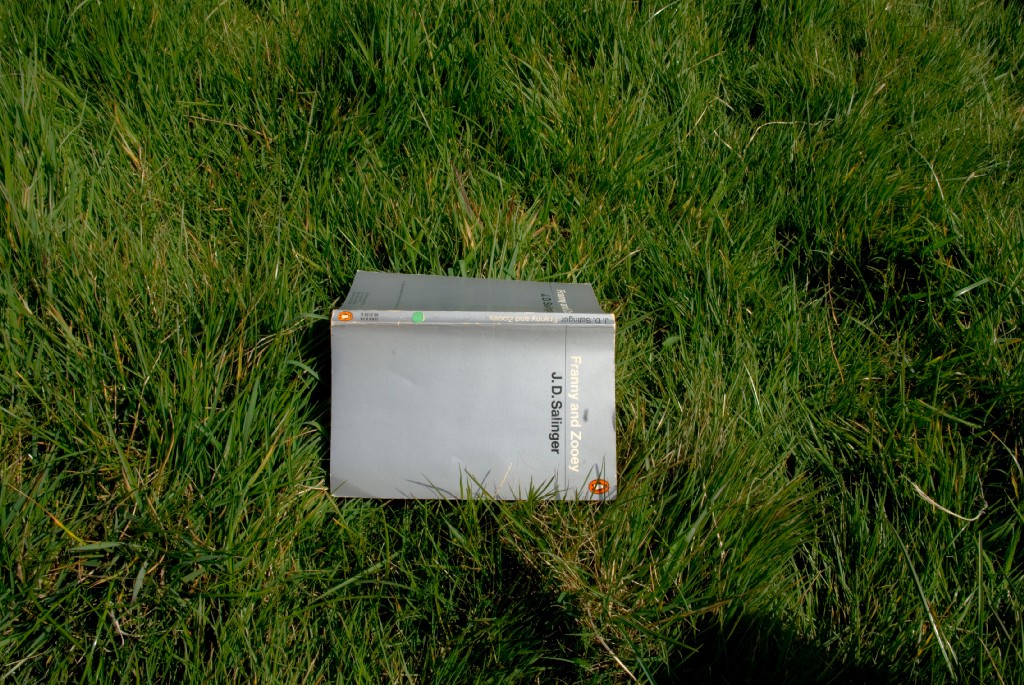
A friend of mine has a theory that there’s an age group for each Salinger book. Naturally, The Catcher in the Rye should be read by teenagers. I read it when I was thirteen, was very moved, and haven’t picked it up since for fear that my 26-year-old self will despise it. Franny and Zooey belongs to the twenty-somethings. For the post-30 crowd, there’s Nine Stories, and somewhere beyond that, I suppose, Raise High the Roofbeam, Carpenters and Seymour: An Introduction.
I didn’t know about this theory when I was thirteen, so I read them all in the span of a few years. When fifteen-year-old me read Franny and Zooey, I had no means of knowing that I would someday go on many dates with many versions of Lane Coutell. Re-reading Franny’s section now, I could control-F the word “Flaubert,” replace with “Kerouac,” and I would end up with an exact replica of a conversation I had with one of my boyfriends in college.
As a teenager reading Salinger, I saw opportunities. Salinger presented a world where people reference their lunch and Turgenev in the same breath — I wanted desperately to speak their language. I regularly skipped class to go to the art museum downtown, I lived in thrift stores and bought any dress with a 1960s silhouette, and all of my books came from the second-hand store run by a curmudgeonly old man. As far as I was concerned, if I didn’t carve out a place for myself as the next literary genius by the age of eighteen, then I would certainly be doomed to an unremarkable life. Salinger, with his admonishments of dull normal people in favor of geniuses who don’t have to try, looked like a shortcut to selfhood.
It feels unfair that a white man from the 1960s could have such an impact on my present personality, but here we are. It’s embarrassing. In a review of Franny and Zooey, Joan Didion recounts a party where a Sarah Lawrence type tried to sing to her the praises of Salinger: “Salinger was, she declared, the single person in the world capable of understanding her.” Didion was unimpressed. She described Franny and Zooey as “spurious, and what makes it spurious is Salinger’s tendency to flatter the essential triviality within each of his readers, his predilection for giving instructions for living.” There’s an undeniable comfort in the prescriptive writing of Salinger and, like most teens, I was willing to take whatever dosages Salinger could dole out. I was the drunk Sarah Lawrence type who felt understood — but minus the alcohol, the degree from Sarah Lawrence, and any invitations to a party where Joan Didion would be in attendance.
It wasn’t as if I didn’t grow up reading beautiful, compelling books by women — I tore through all the classics, Austen, the Brontes, Woolf, eventually made my way to Plath. There was a decent roster of feminist icons and characters to pick from there. However, I was bookish, sporadically depressed, and incurably meek. I wasn’t ever going to be an Elizabeth Bennet. Instead, I became a Franny.
I was bookish, sporadically depressed, and incurably meek. I wasn’t ever going to be an Elizabeth Bennet. Instead, I became a Franny.
Or, I made myself into a Franny. I’m not so sure. Either way, I’m certain I’ve written or said some variation of this from Franny’s letter to her beau, Lane: “I hate you when you’re being hopelessly super-male and retiscent (sp?).” It’s the “(sp?)” that crushes me. That constant need women have to point out our potential flaws before any man can come bearing down on our credibility for them. Or, perhaps Franny’s defense of Sappho: “I’ve been reading her like mad, and no vulgar remarks, please.” Please, please, don’t shit all over this thing that I love. Oh, I asked that in so many words, so many times before.
Franny’s section brings to mind flashbacks of every time I’ve sparred with these distant, intellectual men like Lane Coutell and crumbled on the spot. And I would like to say that I left those matches back in college, but we all know that’s not true. If a man asks me with the right inflection, “Just tell me first what a real poet is, if you don’t mind,” I have few doubts I’d wind up mumbling and sweating and then, like Franny, running to have a cry in the bathroom.
At the heart of Franny’s issues is the Jesus Prayer. After wrapping up an unprompted oral defense on Flaubert, Lane goads Franny into to telling him about the book in her bag. After which point, entire monologues spill out of Franny’s mouth about The Way of the Pilgrim and this One Weird Trick That Will Bring You Closer to God — namely, a prayer that, if repeated to the point of subconscious impulse, will invoke enlightenment of some kind. Franny explains: “…you only have to just do it with your lips at first — then eventually what happens, the prayer becomes self-active. Something happens after a while.”
Franny has to be provoked into telling him about her book — when you just know if Lane had been reading that book he wouldn’t shut the hell up about it. It would be his opening line, “Darling, you just must hear about this prayer book! I’m going mad over it!” She wouldn’t get a word in edgewise.
We all know Franny is more intelligent, more nuanced, more compelling than Lane, right? Right?
If I’m being honest, I wanted to be a Zooey. Zooey who gets to sit in his bathtub and yell at his mother, call her stupid and fat, tell his ailing sister she “looks like hell.” Zooey with his savage but undeniably snappy quips — “Phooey, I say, on all white-shoe college boys who edit their campus literary magazines.” He’s intoxicating and he also makes me want to vomit.
The thing about being a Zooey (or a Holden or a Seymour or a Buddy — take your pick) is that when you’re a Zooey, every flaw you have becomes yet another thing to be desired. Zooey’s cruelty is not only tolerated, but invited by his mother and sister. His brother Buddy, “who was a writer, and consequently, as Kafka, no less, has told us, not a nice man,” is the primary advice-giver of the Glass family. Men gain credibility for bearing their flaws. Often, their flaws become the very source of their authority.
Men gain credibility for bearing their flaws. Often, their flaws become the very source of their authority.
I wanted to be Zooey and tell everyone that they were doing everything incorrectly in only the most malicious of terms. But mostly women — insert something about internalized misogyny here. Like when he tells Franny she’s having “a tenth-rate nervous breakdown.” Poor Franny isn’t even allowed to have a depressive episode the right way.
At the peak of my teenage Salinger years, I wanted to be an art monster. Other heroes of mine included Hamlet and — god help me! — Stephen Dedalus. A bunch of intellectual men whose depression and anxiety manifested in acerbic backtalk. Because it’s so much more fun to be cruel than to be wounded.
There’s something irresistible about the cadence of Salinger’s geniuses — dress your flaws up in witticisms and if other people are hurt it’s because they’re stupid phonies. It’s also a very effective tool to alienate yourself from your friends and loved ones — at least, if you’re a woman, it is.
It turns out sad women don’t get to be asshole geniuses.
I’m not a nice depressive — my world loses meaning for weeks at a time and I grow fangs. Characters like Zooey gave me a vocabulary to be malicious to every person around me and pass it off as artistic integrity. But I was the only person in on the secret joke, aware of my own genius. Unlike Zooey, I wasn’t rewarded with people fawning over me. It turns out sad women don’t get to be asshole geniuses.
The sad women I encountered in classic literature usually met one of two fates: marriage or exile. Growing up, I never felt the brooding sadness of a Bronte heroine or the violent despair of Plath’s Esther (is that the first-rate way to have a nervous breakdown?). Franny is a rare exception; neither married nor exiled, she exists on the periphery of genius.
Franny gets the scraps of what the gifted men around her have and is made to believe that that’s enough — countless times, I’ve lived through the moment when Lane asks Franny to read over his paper, as if that’s an honor and not just a request for a free editing service. I see myself in Franny because through her I learned to apologize for being too sad, for being too mean, for being too egotistical, for wanting to be a genius.
I know that I’m Franny because I once dated a guy who tried to ask me out by saying we could be “the smartest couple on campus” and somehow that shit worked. I know that I’m Franny because one time when my apartment was being re-painted, a painter knocked one of my plants off a shelf and my first reaction was to apologize, but I don’t know what the hell for. I know that I’m Franny because goddamn if I don’t appreciate having a cry in a bathroom stall, hiding my depressive episodes in a place where men can’t tell me I’m doing it wrong.
I’m the one asking “(sp?)” and when a man questions me, “You think you’re a genius?” I feel mocked, attacked — of course I don’t think that, I can’t even spell “reticent” correctly.
I see myself in Franny because through her I learned to apologize for being too sad, for being too mean, for being too egotistical, for wanting to be a genius.
I believe Didion when she says, “What gives [Franny and Zooey] its extremely potent appeal is precisely that it is self-help copy.” Throughout the book, Franny is being coached, taught, corrected, whether it’s from Lane, Zooey, or her brother beyond the grave. It feels good to be given instruction — a notion heavily reinforced if you’re a woman. To this day, I allow myself to hear some version of Zooey’s voice in my head with the idea that I’m doing it to protect myself. I’d like to believe that men can’t be cruel to me if I’m cruel to myself first.
I read Salinger’s books over and over again throughout high school, sometimes out loud in a 1960’s New York accent. Seeing myself in his characters, I tried to inhabit them — and when that wasn’t possible, I just dated different versions of them and sat quietly while they berated and diminished me. I really believed I was lucky just to be there. Being a true genius’s free editing service is somehow better than being a normal phony. I put on the lives of Salinger’s characters hoping that, through consistent repetition, something might happen.
What’s irresistible about Zooey and his ilk is that none of them would ever need a Jesus prayer. Their intelligence, wit, and overall superiority is inherent. Zooey’s section opens with a four page letter from his brother debating whether he’s destined to become an actor or get his PhD in Greek. There’s little question of whether Zooey can fail at either — in regards to being actor, “You’re a born one, certainly.” Discussions of Franny’s future? “You can at least try to, if you want to.”
When people ask me what I plan to do with my writing, I have my own Jesus prayer, a set of answers that I repeat over and over again, ad infinitum. It’s not Zooey’s intelligence or his talent that I crave; it’s his freedom from having to prove it.
It’s not Zooey’s intelligence or his talent that I crave; it’s his freedom from having to prove it.
At one point towards the end of the story, Zooey lectures Franny: “An artist’s only concern is to shoot for some kind of perfection, and on his own terms, not anyone else’s.” Any artist who doesn’t fit the art monster archetype (white, cis-male, hetero) knows how troublesome these terms are: how frequently we are questioned about them, the exhaustion of having to explain it countless times. I don’t expect to have the luxury of my own terms anytime soon. Men are not going to stop asking me what my art is about, or where I get off thinking that I can make it in the first place.
But when I consider Salinger’s terms for being an artist or a genius — authenticity, effortlessness, some form of innate brilliance — it feels ridiculous that I ever strove towards them. The entire point is that people like Franny and I cannot achieve them. No matter what I do, my efforts are visible. I‘m not allowed to be a genius by that definition—and who cares? I’m a Franny, and that’s enough.
Michael Nye’s debut novel is, in his own words, the completion of a massive apprenticeship that took twenty years to complete. All the Castles Burned is woven with many semi-autobiographical threads, but Nye never thought those stories would become his first full-length book. The author worked through other ideas for novels, published a short story collection, Strategies Against Extinction, in 2012, and spent years as an editor for the Missouri Review and Boulevard, before finding the story he wanted to tell.
Purchase the novel.
That story belongs to the character of Owen Webb, a charming outsider in a prestigious private school who forms a connection with the enigmatic Carson Bly. Narratives of adolescent male friendship are having something of moment in current literature, but unlike a lot of recent books, Nye’s story — like many a bored teenager — looks for the thrilling in the ordinary, the adventures in the everyday. Set in the mid-1990s, Owen and Carson bond over basketball, and begin a friendship that will last nearly two decades.
I spoke with the author about how All the Castles Burned evolved over the years of writing, and why he chose to write about a friendship between two young men.
Adam Vitcavage: This is your debut novel, but your short story collection, Strategies Against Extinction, published in 2012. Was this always the first novel you intended to write?
Michael Nye: It wasn’t. This is actually attempt number four for me. The previous version, novel number three, was finished back in 2010. I went through the whole process of looking for an agent, then I got an agent, he never sold the novel, he quit the business, and he dumped me as a client. I had this novel that nobody wanted or had interest in. I had a reckoning at that moment. I sat down to read it to see what I thought. As I was reading it I started x-ing out pages and deleting chapters. Eventually my 80,000 word novel became a 20,000 word novella.
I figured I had to start from scratch and started on the next book. I’ve always been a believer that once you finish a book — whether it gets published or not — that you move onto the next one. It took four attempts but I finally got one of these novel things to work for me.
MN: They were vastly different. The novel that I didn’t sell was about a man with a brain condition who falls in love with a girl who is Asian-American. It was set in during one summer. There was a lot of writing about heat and nature. The one before that was about baseball. The one before that was chronologically backwards. I had been influenced by Charles Baxter’s First Light. I didn’t really understand how to write a mosaic novel and I just wrote it backward. That was about a son and his relationship with his father. It didn’t have anything to do with my real life or male friendship. There were similar thematic elements, but they definitely were not the same book.
AV: All the Castles Burned is semi-autobiographical. Was that always intended?
MN: It really wasn’t. Initially this was a book about the friendship between the two boys. Owen Webb, the protagonist, and Carson Bly who is his friend. It always had a similar structure where it started in the mid-1990s and leapt ahead fifteen years. Early drafts wanted to be like Nabokov but I’m really not a Nabokovian. It really didn’t work. The second half failed miserably.
When I was trying to figure out what was missing from this protagonist, I started thinking about Owen’s father. In the final version of this book, Owen’s father, Joseph Webb, is a stand-in for my own father. In 1990, my father, who had been working as a chemical technician, was arrested and eventually tried and convicted for crimes very similar to what happens to Joseph in this book. That strain of the novel definitely came from a place where all of these events are true to the best of my memory.
AV: And what about the mother? Was she similarly created as the father?
MN: She’s a fictional character. My mother and I dealt with my father in different ways. When I was a teenager, we really dealt with it as individuals rather than as mother and son. In this book, I knew that when Owen needed help near the end of the book, he would need to reach out to somebody. Through multiple drafts of the book, it became clear that it needed to be the mother.
AV: As I was reading the book, I was really drawn to that father-son relationship. When you were writing that part, did you find it hard to bring out those autobiographical elements?
MN: Not so much. The things about my father and my past have been churning out in my mind for almost thirty years now. There are so many elements of my relationship with my father that I have been trying to puzzle out and think through. Of course, the more you think about the past the more you begin shaping it to who you are now. You often stop trusting those memories. I relied on the facts about who my father was and who I wanted Joseph Webb to be in the book. From there, I let Joseph become his own character. It was really just a point of reference for me. Then to have both boys have fathers who are absent in very different ways was one of those nice things that gives an undercurrent to the story and why these two boys are drawn together.
AV: These boys have a unique bond that was refreshing to read about. Male, teen friendship isn’t often as raw as this. Young women get stories about friendship, discovery, and so forth, but boys always have to go through something extraordinary. For instance, The Loser Club battles an extraterrestrial shapeshifter that presents as a clown, another Stephen King plot finds the boys in The Body bonding, but again it’s driven by finding a dead body. Your novel is highlights the mundanity of adolescence. Why did you want to tell Owen and Carson’s story?
MN: What struck me about these two characters and boys in general is that we don’t often see that subtler type of friendship. It’s rarely discussed unless there are these, like you said, extraordinary events. It’s funny that you bring up Stephen King because I was just re-reading my friend Aaron Burch’s book, which is about reading The Body and what friendship has meant to him as an adult. It felt like a thing I am always curious about. I’m in my late 30s now and I’ve moved around a bit. I’ve noticed how men rarely make friends outside of school or work and we rarely discuss friendship. I’m surprised it isn’t discussed more. There’s nothing taboo about it and I think writers take it for granted. I wanted to explore it on a more personal level.
I’ve noticed how men rarely make friends outside of school or work and we rarely discuss friendship. I wanted to explore it on a more personal level.
AV: As you were exploring their friendship, it stems from basketball. How did sports fall into the novel?
MN: I needed something that put them together. I love basketball; I’m a huge pick-up junkie. I was not a good basketball player in high school and none of the boys’ feats are based on anything factual. The great thing about basketball is that there are great team elements where you can have action in the book involving all of the characters, but then there are slower moments involving practice or shooting free throws. Stuff you can do alone so you can also get the individual.
I think for many boys, not just Owen and Carson, sports is the first foray into making friends with other boys. There are a lot of things that become unspoken in your relationship because everything is done through play, games, who wins, and who loses.
How you communicate and express grief, loneliness, sadness, anger are things that get developed over time. That’s what you see happening between Owen and Carson as the book goes on.
AV: Did you know where you wanted these boys to go from the moment they connected shooting hoops?
MN: I generally thought about what was happening between these boys as something that will last for a long period of time. One of the things I love about first person novels is where that person is speaking from the here and now, what it is he or she remembers or doesn’t remember, and how the protagonist shades memory. I knew I always wanted the story to pass a long period of time.
The challenge was those boys weren’t always going to be together during those fifteen or twenty years. How was I going to attack that? I had a basic idea of what I wanted to happen because I knew I wanted it to be about friendship and how that escalates into violence.
AV: The book is broken into three parts. Was that always in the background when you were plotting this?
MN: That was edited in over various drafts. I think the original version of this book featured equal halves of 1994 and 2008. What I found when I was talking to friends who were reading early drafts was that the second half just didn’t work. One of my friends asked me what the book was about and I answered that it was about the friendship between Owen and Carson. She gave me the advice to spend more time in 1994. Ultimately, the bulk of the book became about their youth and only a short portion at the end of the book is set in what I consider Owen’s present.
They sat at a rectory table, fire in the stone hearth burning. A pilgrim’s feast. Neighbors. Autumn — leaves driven against the house. He put food in his mouth with the food in his mouth he hadn’t chewed enough to swallow.
“I could go out tomorrow.”
He leaned into her.
“I could find somebody next week. A companion, people seek company — to eat with, read the newspaper with, whatever we do, this is natural. Someone to talk to. Poor Beryl can’t do it. Past a certain age, you can’t argue this, women — of course it’s sad. Well, I find it sad.”
He poured wine for the girl and the firelight, thrown, hissed and shattered in it. The glass was dipped in gold — a golden circle — buoyant, living.
At last he swallowed; this seemed to hurt him. A tremor kept moving through him and through everything he touched. One shoulder sloped low. Years on the mound. The joy of it.
“Maybe not everywhere but certainly here,” he went on. “She has me, naturally, but when I go?”
Shaking, all of him. And the windows shook and wind in the trees and the first bright scraps of snow.
Halloween. Talk of costumes — the children’s, the grandchildren’s. Someone was going as mulch, somebody else as a stop sign.
“I’m going as who I used to be,” one of them said.
The girl turned back to him.
“That face,” Phillip said, “is not attractive.”
She had been tearing skin from the fat of her cheek, tatters of it, to swallow. She was sorry. Why was she sorry? Now she was sorry she had said she was sorry.
“Please,” Phillip said, impatient.
His wife was three chairs away, laughing. She was absolutely silent when she laughed. Good breeding, she called it, indignant. Her father had brayed like a mule. He had struck her once with a pitchfork — her husband had. For something. A lost key? A broken cup? Unforgiveable. But she forgave him.
“Poor Beryl. It doesn’t matter that she used to be beautiful or that she’s smart and easy to talk to. Beryl is stuck with me and when I die, Beryl will be stuck alone. That’s the way it is. Who wants her? You reach a certain age and nobody — nobody wants anybody, really.”
After dinner they gathered at the larger hearth and listened to the wind in the chimney. A deer approached and watched them, standing in the dark field. The first the girl had seen. The deer were dying — a mite of some kind. They fell sick and walked madly in circles.
Leaves struck the glass of the windows and lay, one upon the other, in a fringe around the house. A glassblower’s house. He was talking. She was in love with him but he was married. He had hair like a cherub’s, like a painting of hair. Firelight was on it. His hands — she couldn’t explain it — he caught her watching them as he moved. He had had them insured, he laughed, for thousands. Tens of thousands, even. They meant that much to him.
They drank brandy and he kissed her in his kitchen, a surprise. Not a word. He turned her to him.
Now she slipped into the hall where the heat didn’t reach and made her way to his children’s room. His girl was named for a month in summer, his boy for a tree that grew nobly on a continent far away.
Beryl, the girl thought. A mineral. A pilot flying in darkness over the far Serengeti.
She lay down with the boy above the covers. You could love children and nobody stopped you. You were allowed. And they were let to love you, too.
People were already putting on coats by the time she came back into the room. She had fallen asleep in the boy’s bed. The deer had come closer and watched her, the girl dreamed, its breath fogging the glass, fever glazing its eyes. A springtime deer, it couldn’t help itself. The spots on its hide still showed.
She would name her children simple names. Meriwether. Linnaeus. Hidalgo — no. Sam. Jack. Jane. Just names. Not the names of stars or places. Not trees.
So many trees in these hills. She would never leave.
He studied in Venice. He liked Venetian glass.
Florence: no.
Simple. Bob. The glassblower’s name was Bob. He kept tabs of acid in a candy tin in a drawer beside his bed. In Scotland once he had fallen asleep, tripping, in a field of passing flowers. A flock of sheep closed in around him. Bob, they said. They said, Bob Bob Bob.
Dell.
Rain — no. Maybe Wen.
Beryl will live to be a hundred and marry again, and the glassblower will go off with somebody else, a girl, not this girl, not a farm girl, a plump and sullen Venetian girl, and Phillip will be dead in days. An old man, nimble, in swimming trunks. A Halloween swim, his custom. A last act. A passable dive. The fallen leaves still burning.
About the Author
Noy Holland’s latest work is I Was Trying to Describe What It Feels Like: New and Selected Stories, out now from Counterpoint Press. Noy’s debut novel, Bird, came out in 2015 to much critical acclaim. Other collections of short fiction and novellas include Swim for the Little One First (FC2),What Begins with Bird (FC2), and The Spectacle of the Body (Knopf). She has published work in The Kenyon Review, Antioch, Conjunctions, The Quarterly, Glimmer Train, Western Humanities Review, The Believer, NOON, and New York Tyrant, among others. She was a recipient of a Massachusetts Cultural Council award for artistic merit and a National Endowment for the Arts Fellowship. She has taught for many years in the MFA Program for Poets and Writers at the University of Massachusetts, as well as at Phillips Andover and the University of Florida. She serves on the board of directors at Fiction Collective Two.
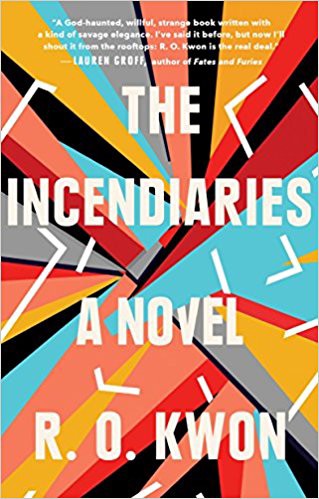
I have long admired R.O. Kwon’s fiction and so it was a thrill to hold her debut novel, The Incendiaries, in my hands for the first time. I won’t attempt to summarize the plot because, as is the case with most books I love, the summary won’t come close to doing the novel justice — but The Incendiaries is lyric and devastating and it takes a hard and beautiful look into the religious void.This novel officially joins the world of books on the last day of July. Dear reader, mark your calendars. In our conversation, R.O. and I discussed having faith — in the religious sense, in the joy-terror of novel writing, and in a writer’s convictions.
Laura van den Berg: Can you describe the initial seeds for The Incendiaries? How did the book first begin to take shape in your imagination?
R.O. Kwon: I’ve joked that everything I write is, in some way, about the God I lost. I’m not sure it’s a joke, though. I grew up so freakishly Christian that my life plan was to become a missionary. I use the word “freak” as a direct quotation, since that’s what I called myself, with pride: a Jesus freak.
Then, in high school, I lost the faith. I can’t really overstate how painful it was — I used to think it would have been less hard to lose my parents than to lose the God I loved, since God, in my idea of Him, promised He’d give us back all that we lost. I was so heartbroken that, for the following year, I couldn’t see much of a reason to keep living. Meanwhile, my family and friends, most of whom still believed, dismissed my apostasy as a youthful, short-lived rebellion. So, I felt very lonely, too. I hoped to write for that girl who felt alone, to tell her I’m here. In addition, I started realizing that a lot of people exist on just one side of the belief spectrum: they know what it is to believe in a god, or they have no idea at all. I wanted to cross that rift, to show each side what the other’s worldview can look like.
I’ve joked that everything I write is, in some way, about the God I lost. I’m not sure it’s a joke, though.
I also have distant family members I’ve never met who live — or lived — in North Korea, and who I’ll probably never meet. To try to fill that hole in knowledge, that deep longing, I kept reading accounts of North Korea. The little information that makes it out, though, feels so incomplete. Eventually, I became interested in exploring this gap, in dwelling, imaginatively, in that place of unknowing, and my novel’s cult leader, John Leal, took on a North Korean past.
LVDB: Thank you for sharing this history. I can very much see, and feel, this grief on the page and also those places of “unknowing” — we do know more about John Leal and his past as the novel progresses, yet we never come to learn the “full story,” if such a thing even exists. In my view, while character histories can powerfully contextualize the present they should resist offering up definitive explanations — a line The Incendiaries manages beautifully. Much space is devoted to the interplay between past and present, with the past contextualizing, yes, but also deepening complexity and mystery. Were these sorts of craft questions on your mind as you worked on the book?
ROK: Thank you for saying that. I think a lot about balance, and complexity, and how vast we all are. Other humans can be so fascinating! The people I know best continue to surprise me with the multiverses they contain. I want to rip them apart, but in a loving way — I crave all their secrets, and I’ll never get them. In fiction, as much as I can, I hope to do justice to that complexity. (I’m reminded of Anne Carson, who said, “On the day He was to create justice God got involved in making a dragonfly and lost track of time.”)
LVDB: I was lucky to be an early reader for The Incendiaries and, if I’m recalling correctly, the draft I read was grounded entirely, or almost entirely, in Will’s point-of-view. When I read the novel in galley form, I really loved the choice you made to open up the POV, to fold in other voices, including John Leal’s. What informed that shift?
ROK: There’s so little fiction about losing faith — and then there’s so little, too, about finding it. In The Incendiaries, Will says that he can’t forget the God he lost, and “the joy [he’d] known, loving Him.” That was my experience, too, and I wanted to bring it to life — to give witness, in a way, to a profound and irretrievable joy.
I badly hoped, in other words, to give life to varieties of belief, and, in time, I thought I could best do this by actively portraying some of these varieties. Will has lost God, while the woman he loves, Phoebe Lin, is starting to find Him. I wished to show what it can be to love an invisible, silent being so much that one might be driven to, say, blow up some buildings.
LVDB: I think one of the greatest terrors and joys (joy-terrors?) of working in the long form is knowing that there will be so many false destinations along the way — scaffolding we cling to for years; moments that feel like discovery but will prove themselves to be a wrong turn — and that the work will lead me to places that I could not possibility anticipate and I have no idea what I might find there. Quite possibly somewhere fucking terrifying! This is true, I think, in the short form as well, but the scope of the novel can, in my experience at least, have a way of intensifying the process.
I know you worked on The Incendiaries for a long while and I’m wondering — what did the process look like for you? Did you have false starts and discoveries? Did the work lead you to places you could not have anticipated from the outset?
ROK: Joy-terrors — good lord, yes! I’m still aghast at how long this book took. Ten years. I so badly want the next novel to take less time. I’m hoping for, I don’t know, five years. Four? Three?
But about false starts: for two years, The Incendiaries mostly consisted of a melancholic woman’s private meditations on the nature of an absent God. For those two years, I worked and reworked the first 20 pages of a novel. The thing is, I got hung up on a metaphor: I thought my novel, like a building, needed a solid foundation, i.e., the first 20 pages. But — and this is still more proof of how powerful language is, and how dangerous metaphors can be — there’s no point in laying a foundation if you have no idea what the building will look like! Is it a skyscraper? An opera house? So, by the end of those two years, I had 20 pages of intricately reworked sentences that I — threw away.
The novel really came to life when I started externalizing the book’s obsession with faith, and centering it upon extremist, creed-driven ideologies. What I noticed is that, every time there’s a new terrorist attack, a shooting, an explosion, people say they can’t understand what the perpetrators were thinking. The terrorists are “monsters,” their actions “unimaginable.” This language of incomprehension is also, of course, sturdily a part of U.S. politics.
Rigorously agnostic though I now am, actively progressive as I strive to be, I can’t forget the God-crazed girl I once was.
I know a lot of people are justifiably sick of being asked to empathize with the ideologues and bigots who want us dead, our rights taken, our bodies claimed as theirs. But some pro-life dogmatists truly do believe they’re doing good — some terrorists, even. Rigorously agnostic though I now am, actively progressive as I strive to be, I can’t forget the God-crazed girl I once was, the fanatic who believed that life starts at conception. Who, believing this, could have prioritized the rights of unborn fetuses over those of living women. Given this history, and with and despite my personal convictions, I wanted to portray both these worldviews without dismissing one side as being utterly beyond comprehension.
LVDB: What books were especially important to you while you worked on The Incendiaries?
ROK: Oh, god, so many. There’s one book by Virginia Woolf that was so totemic I can’t say its name — I’m afraid that, if I name it, it might lose its magic. For the last few years I was working on The Incendiaries, I read parts of this unnamable Woolf book every day.
I even — should I confess this? One tries to avoid sounding too odd. But, in desperate moments, I prayed to Woolf, as though to a patron saint. Not because I believe she’s out there somewhere; I don’t; as I’ve said, I’m very agnostic. But I asked for Woolf’s help just because I love her so much. (There’s artistic precedent for this: George Balanchine prayed to composers while making his ballets! And Malcolm Lowry told a friend he’d once been driven to pray to Kafka. He answered my prayer, Lowry said.)
Other books I read multiple times, over the years, were written by Clarice Lispector, Marilynne Robinson, Julio Cortázar, Kazuo Ishiguro, Theresa Hak Kyung Cha, and Elizabeth Bishop. I love We the Animals by Justin Torres and Open City by Teju Cole. Anne Carson’s Eros is, in a fashion, where my novel began. W.G. Sebald is the shit. There are ways in which the novel is, I think and hope, deeply feminist, and Audre Lorde helped see me through.
More than anything, though, what helped was the day-to-day act of writing itself.
LVDB: I find that practice beautiful — and now you have me wondering about what writer I would pray to. I shall have to think on this.
We’ve been talking a lot about faith and I can’t help but think about how the act of writing a novel is, in many ways, an extraordinary act of faith — if an agnostic one. When I’ve worked with students who are writing novels, their most pressing questions are very often ones of faith — How do you keep going? How do you push through the periods where the project seems utterly hopeless? How do you sit in the uncertainty of unfinishedness? So, I was wondering: could you pinpoint a specific moment of extreme difficulty with the project, a time when your faith in it was really challenged, and how you managed to keep going? Could you also pinpoint a moment of deep joy?
ROK: Oh, god, there were so many difficult moments. Close to the five-year mark, in a fit of despair, I started a new novel. I think I eked out a single sentence, and then I thought, No, I still believe in this first book, fuck, I have to see it through.
But then, the book required five more years after that! Part of what kept me going was the help and encouragement of very generous friends, you included. The sense I mentioned of writing for the lonely girl I was — that also helped. Aspects of what I was writing about — terrorists, extremists, North Korea — kept being front-page news, which let me imagine I had something to say that people might be interested in hearing, and that helped.
More than anything, though, what helped was the day-to-day act of writing itself. Of getting to engage seriously, often desperately, with the English language. Words, words, words! I love the shape of words, I love the comet-tail histories of words. I love the roll and crunch of syllables in my mouth. Most of the time, writing’s so fucking hard. But in the rare, astonishing moments when the writing’s really going well, when I’m so deep in it that I forget I have an I, there’s nothing like it. (As Goethe said: “The songs made me, not I them.”) It’s the purest joy I know.
If I were to write a love story featuring the Titanic, I would be the heroine, and the middle child of the White Star Line’s Olympic class of ships would be the object of my obsessive, Platonic affections. It would be the touching tale of an undiagnosed autistic girl and her best nautical disaster, transitioning through major life events such as starting kindergarten, or getting bullied, or being discovered by Dr. Robert Ballard using underwater robots.
Unfortunately, a filmmaker who grew up only twenty minutes down the road, in Chippawa, Ontario, had a somewhat different vision — and $200 million to realize it with.
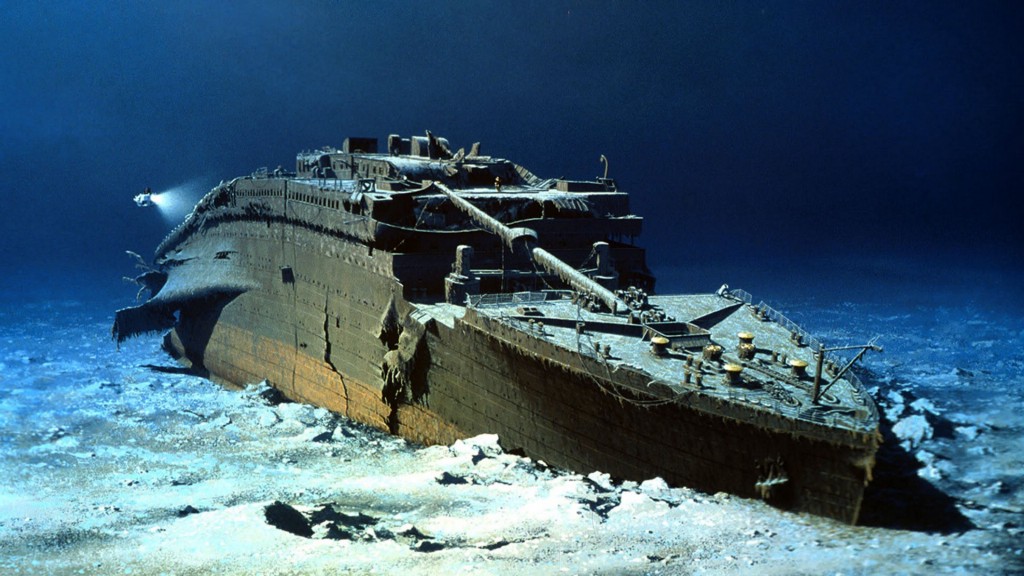
I first became aware of the RMS Titanic when I expropriated my grandfather’s copy of a December 1986 National Geographic out of our mail. From what I’d come to expect from the magazine, the cover was a little boring. It mostly consisted of words I couldn’t read yet — I was an inquisitive four-year-old, not an advanced one — over a plain blue background. There wasn’t a single green-eyed girl or skeleton with snake jewelry in sight. But there was something about the central rectangular photo that intrigued me, so I took the issue to my room, flipping through to figure out what the cute underwater robot could see through that crusty old window.
I spent the next hours looking at otherworldly photos of broken benches, algae-covered crystal lamps, and the largest boat I’d ever seen. Later, my parents, able to read the accompanying article and having general knowledge of the subject, told me everything they could about the ship, its 1912 sinking, Ballard’s 1985 discovery of it, as well as his return expedition the following year, which had given the world the pictures we were now looking at. I asked more questions, and they promised they would do their best to help me find the answers. This continued on for the next eight years.
Where others might see preciousness, over-ambition, or the capricious whims of a spoiled, only child — or the abnormal behavior of an undersocialized only child — my parents saw a golden opportunity to encourage a love of learning. They gave me books and videos, and took me to the library to source whatever materials we couldn’t afford. We went to museum exhibits, screenings, and historical society presentations across southern Ontario. In October 1987, they made my young life by taking me to a talk given by Ballard himself.
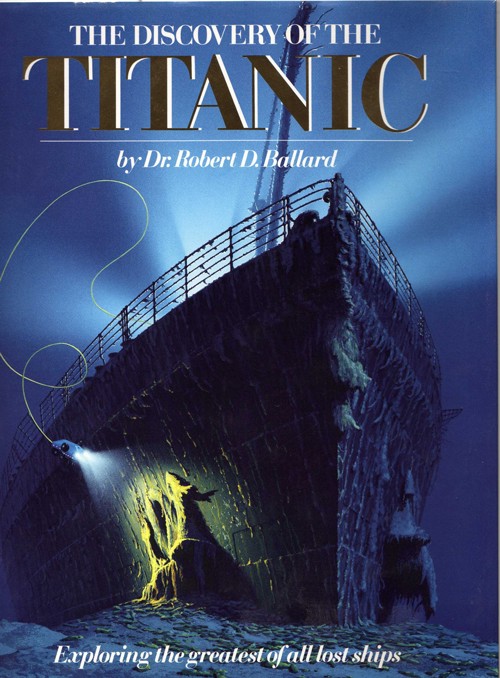
After autographing my copy of The Discovery of the Titanic, he asked if I wanted to be an underwater explorer when I grew up. I’d already been leaning towards writing, but didn’t want to disappoint him, so I said yes. Oddly, he encouraged me to do well in math. I had to tell him that we didn’t have mathematics in kindergarten.
My parents’ instincts paid off beyond what they could have imagined at the time. My obsession with the Titanic didn’t just teach me about the ship itself — it was also a launching pad into other areas of study. Ballard’s work made me curious about math and science. The stories of the ship’s survivors and victims taught me about the human condition. The fact of Captain E.J. Smith going down with his ship, and the string ensemble that played as long as possible to comfort the passengers as it sunk, were my introduction to honor, duty, tradition. The choices of Isidor and Ida Straus expanded my notions of love and sacrifice, the struggles of third class passengers my class consciousness, and The Unsinkable Molly Brown became my first strong female role model.
I grew deeper into my Titanic obsession just as a lot of people in my life thought I should be growing out of it. When adults stopped finding it cute, and my classmates concluded that I was far from cool, it provided a necessary escape from a life I didn’t always understand. Rewatching a video, rereading a book, or repeating a fact in my head gave me a temporary break from not fitting in, or worrying about how poorly I was surviving the psychological warfare that awaited me at school. In one particularly low moment I told a photo of the Titanic, between sobs, that it was my only friend. And I genuinely believed that.
In one particularly low moment I told a photo of the Titanic, between sobs, that it was my only friend.
The intensity of my obsession only faded when I was twelve. I switched schools and made a couple of good friends. My intense focus moved on to Canadian indie rock and the spoils of my local Blockbuster’s foreign film section. I didn’t need the Titanic the way I once had, though I remained fond of the ship. It had taught me so much, and helped me through even more. I would always love it, and feel a little possessive of it, for that.
When in late 1996 I started hearing about a big-budget film focused on my old friend, I received the news with dread. The film snob in me loathed the idea of Hollywood getting its action-romance cooties all over it. I’d also gotten weary of watching people act cool for discovering things months or years after they’d made fun of me for them. And the sad little weirdo in me just wished that she could keep this one precious thing to herself.
K, my oldest and best friend, and perhaps the only non-blood relation who never told me to shut up about the Titanic, consoled me by promising that we would go and make fun of it together. As adolescents of the ’90s ironic viewing was the most withering insult imaginable. But that plan fell through when she started hanging out with my bullies. I handled it as you might expect a girl with undiagnosed social issues and years of being bullied would. By the time Titanic finally came out that December, my former friend and I couldn’t even sit in the same theater together, let alone side by side.
Eleven years after I’d first laid my hands on the issue of National Geographic, I was back where I had started: staring at an image of the Titanic alongside my supportive parents. I possessed just enough self-awareness to know I should probably approach the film with an open mind. But as genuinely cool as it was to see the Titanic launching, sailing, and sinking, thanks to the prohibitively expensive special effects, everything that happened on it and after it filled me with bitter rage.
As cool as it was to see the Titanic launching, sailing, and sinking, everything that happened on it and after it filled me with bitter rage.
I wasn’t particularly fond of Titanic the film. The love story was insipid. As far as dreamy blonde passengers went, Jack was no match for A Night To Remember’s Harold Sydney Bride. It wasn’t even the best film about a sinking vehicle to come out that year. But as a Titanic nerd, I was incensed. No amount of digital wonder could make up for the way James Cameron had used the disaster’s real-life victims and heroes. I knew full well that the ship hosted more interesting stories than that of a poor rich girl, living like common people, doing what common people did, sleeping with common people, then running around on a sinking ship for another hour of runtime. All of them deserved better than to be treated like bit players in Rose and Jack’s hollow journey.
I was not in the majority when it came to people’s feelings about Titanic. The film was an inarguable success, breaking box office records, winning eleven Oscars and remaining in theaters for a year. I tried to stay positive, because it seemed to make other people extremely happy, and I wanted to be happy for their sake. But I was miserable. My beloved coping mechanism had been co-opted seemingly by the entire world. I’d endured years of being told that I was weird and unlikable for loving a boat too much — and suddenly those very people were obsessed with the same damned boat. And yet, I was the weirdo again, because now I didn’t love it enough.
I’d endured years of being told that I was weird and unlikable for loving a boat too much — and suddenly those very people were obsessed with the same damned boat.
It took more time sulking alone in my room, ingesting morbid music and Ingmar Bergman films, than I would care to admit, but I finally got over it. I discovered new, weird interests like cult ’60s spy shows, new shipwrecks (the Lusitania, and the likely apocryphal but too-bizarre-to-resist Ourang Medan), and new friends who had passions like mine. I actually forgot about Titanic’s approaching 20th anniversary, until the first wave of thinkpieces fell upon us. But I figured I would be able to read them with an open mind.
I wasn’t. I’m not, as it turns out, anywhere near mature or objective enough to navigate the current wave of Titanic nostalgia. But I have the empathy to realize that the film meant something very different to a box office-bursting number of people than it did to me, and possess enough life experience to appreciate their stories in a way I was neither equipped nor inclined to at the time. The people who flocked to it had their own issues, their own dreams, and clearly the story gave them a touch of whatever it was they needed. I’m happy it made romantic young women feel less guilty about their passions, and that Rose’s plucky heroism may have acted as a kind of gateway drug to feminism. I just wish these epiphanies could have been inspired by a film about anything else in the world.
Here’s where my new outlook crumbles like brittle fracturing steel against an iceberg: I understand that Titanic changed many young lives for the better, but what I remember is how it reinforced the social pecking order, and made those of us not cool enough to be part of a major cultural moment feel even more isolated. Every time I try to stop being a petulant teenager about the film, I start to feel like a sad little girl instead, still on the outside, still incapable of loving the right things at the right time, or responding in the right way.
The ship doesn’t belong to me any more than it belongs to James Cameron. We can each have our own personal meanings, our own stories.
My childhood hero, Dr. Ballard, always argued that the Titanic shouldn’t belong to any one person. He was speaking about the actual artifacts at the bottom of the Atlantic, but I believe this works metaphorically, too. The ship doesn’t belong to me any more than it belongs to James Cameron. We can each have our own personal meanings, our own stories. For all I know, K might be out there right now, pasting my scowling face onto Billy Zane’s body and talking about how the movie helped her celebrate her emancipation from her dorkiest and most pedantic friend.
My story is that I lost my best boat and my best friend in the ass-end of 1997 and, in 2017, am still telling it. The irony is that perhaps after all I did take something away from that non-tragedy of a plucky young woman who escapes her barely stifling life against the backdrop of a major maritime disaster. Just like Rose, the hero in that tale, I have also never let go. And I am beginning to suspect I never will.
I recently read a review that has me shaken and, if I am being honest, angry. The book of poetry it reviewed has received critical acclaim — deservingly so, I think — but the review in question appears to be a “take-down” of the poet and their aesthetic costumed as a review. As I read it, I felt as though I wasn’t learning anything new about the book, just the reviewer’s biases, their love of allusion, their thirst for a book-encapsulating soundbite. In short, it was easy to identify the review as a bad review.
This made me think about how easy it is to figure out when reviews are bad, often when the reviewer gets in the way of the review, foisting upon the text and reader often poorly articulated senses of what constitutes “good work.” But that made me wonder — what makes a good review?
I actually like it when someone intelligently brings their own ideas of aesthetics to a text, but that seems very subjective, doesn’t it? Is it possible I am getting in the way of my reading of reviews? Is there a way a reader should approach reading a review? And, if I were to write a review, how does that differ in how I approach the work? How do you write a good review? How does the whole idea of “reviewing” a work not become mired in aesthetic subjectivity?
Sincerely,
Viewer Reviewing Reviews
Dear Viewer/Reviewer,
I’ve been a poet in the poetry world for a pretty long time, and the question of whether or not there should be “negative reviews” of poetry books has amazing staying power. When a “take-down” like the one you’re referencing appears, poets inevitably suggest that negative reviews are a disservice to poetry, since so few people read poetry as it is — the implication being that a negative review could hurt the book’s already meager sales, and therefore silence is more kind. I find this argument pretty unconvincing; surely even fewer people read poetry reviews than read poetry. An absence of reviews isn’t going to help a book’s sales either, and in any case it’s not the critic’s job to make sure a book sells.
W.H. Auden said that “attacking bad books” is “a waste of time.” But I don’t really agree, as long as the “attack” provides interesting, instructive perspective, because some books are bad in ways that deserve attention. What matters are the critic’s intentions — the point of a piece of negative criticism should not be to make sure that people don’t buy or read the book in question. Further the point of positive criticism is not to make sure that people do buy and read the book. Good criticism shouldn’t even fit neatly into the “good review”/“bad review” dichotomy — it should be more like an essay, with the book as the occasion, than a recommendation engine. Good criticism is worth reading even if you’ve already read the book or never plan to.
Good criticism is worth reading even if you’ve already read the book or never plan to.
So what is criticism for, if not to tell you what to read? A piece of criticism should illustrate an engaged and considered approach to a book and, by extension, other books like it; it should demonstrate what good reading and good thinking about reading look like.
The problem, then, with bad criticism is rarely subjectivity; subjectivity is inescapable. The problem arises when the critic’s subjectivity masquerades as objectivity, or when the critic’s subjectivity isn’t informed or isn’t interesting.
Good criticism is as difficult to write as any other kind of writing — but I realize it’s a bit abstract to say you can write better reviews by being smarter and more interesting (although it’s true!). So here are a few practical strategies in terms of how to approach a book that you want to write about, and some guidelines for what good criticism of any genre should and shouldn’t do.
When reading a book you might want to write about — but actually, if you’re serious about reading, and if you’re serious about criticism you need to be serious about reading, whenever you’re reading any book — keep a pencil or those little sticky tabs and a notebook nearby. Get comfortable with ruining your books; go ahead and dogear and write in them. Underline and marginalize (in the original 19th century sense: make marginalia). If you JUST CAN’T DO IT or you’re reading a library book, use sticky tabs instead, and write your thoughts and annotations in a notebook; just note the page number you’re responding to. Make this notebook your reading journal. These notes will be incredibly helpful to you later, but further, I think it tricks you into being a better, closer reader, and making more connections. Great writers notice a lot of things, and meta-notice what they notice. Cultivate your habits of observation.
A good review provides context: What tradition is this writer working in? Who else writes like this or about these things? What other books is it in conversation with? Does it represent a natural or surprising evolution in the author’s career? To provide this context you’ll need to do a little reading around the book you’re focusing on — an informed reader is usually a better critic. If that doesn’t appeal to you, consider that you might not be the best person to write about this book.
If you love a book, resist the urge to heap praise on it right away. It’s boring and looks blurby. I like criticism that shows me what a book is like before telling me how to feel about it.
I like criticism that shows me what a book is like before telling me how to feel about it.
Explain the book’s aim, form, and project, in a value-neutral way to start. Just tell us what the author and the book are trying to do. Be as generous as possible in your assessment of the book’s aims; don’t get mad at the book for not doing something that it’s not trying to do. What is the book about (in terms of its subject matter) and about (in terms of its larger themes)? What does the prose or verse actually look like on the page? (Focus on the writer’s choices, though, not the book designer’s or printer’s.) Describe their style, their tone and diction. All of this is basically a way of showing what it feels like to read this book: What are its effects on the reader’s mind, and how does it achieve them?
Back up your description with examples. This is where your notes come in. (As you read and start to make assessments of the book, you should be looking for quotes that are particularly illustrative of the book’s approach or style.)
All of this attentive description and illustration will get a lot of the work done. With or without you adding in overt value judgments, readers will start to get their own sense of how well the book accomplishes what it’s trying to do.
Great critics have a compelling sensibility; their way of looking at and commenting on the world is what we go to them for, more than book recommendations per se. Their reviews are always cross-referencing each other through this common sensibility. So put yourself into your criticism; just remember that thinking is more interesting than feelings. If a book makes you mad, fine, you can say that, but then reflect on why that is.
Question yourself — your assessments and reactions and biases — as much as you question the book. Your questioning doesn’t necessarily need to appear in the finished review, but do the background work.
Question yourself — your assessments and reactions and biases — as much as you question the book.
If you can’t think of anything interesting to say about a book, don’t write about it! It’s very hard to write a good review of a mediocre, neither-here-nor-there book. So, write about books that make you think.
If you don’t like a book, don’t attack its fans, or the people you presume to be its fans, or their presumed reasons for liking it. It’s rude, for one thing, but you’re also probably wrong. And it’s not necessary for everyone to agree that a book is good or bad.
If you have some kind of preexisting, personal problem with the author (not their work), you are probably not the best person to write about the book. In general, don’t bring the author’s appearance or personal life into your criticism unless you’re really, really, really sure it’s relevant to how we read the work. It’s more permissible if the author’s dead.
Don’t make unfair comparisons. I recently read a piece of criticism that compared a book of personal essays by a debut author to a collection of reprinted essays, mostly criticism, by a much more mature author; this just didn’t seem like a useful comparison. One would come to these books with very different expectations.
Finally, as a corrective to the prescriptiveness of all these guidelines: Don’t feel hemmed in by a formula for a “good review.” For example, you needn’t begin — or end — by talking about the book directly. You can get away with almost anything if you’re smart and interesting enough. When in doubt, read more — both more books and more criticism.
I discovered Ursula K. Le Guin quite by accident — on the library shelf, but not in the science fiction section. I was browsing the literary journals, which were stood up like little jewels in the entranceway of the library at Willamette University in Salem, Oregon.
I had been sent to that section of the library by my speech coach — sent to find a suitably thought-provoking and emotionally stimulating passage, with less than 50 percent dialogue, that I could read aloud without rushing in less than 8 minutes.
My task was to find a piece suitable for entering in competition in the Prose category, which demands of its high school competitors that they be “a master storyteller, drawing the audience in with a well-cut and interesting piece, energy and variety in vocal inflection, and the ability to engross the listener in what is being read.”
I was not sure at all that I was any such thing, and I had no idea what I wanted to say or do. But I had propelled my 16-year-old self into this moment nonetheless, and was now spending a week of my summer vacation among the stacks of a college library, looking for a piece that I could “connect with in some way on a personal level” and that “flattered” me and my abilities, as the guidelines for Prose suggested.
It was a volume of the short-lived literary book series Left Bank that I ultimately picked up — Vol. 2, circa 1992, featuring Le Guin’s essay “Introducing Myself.” “I am a man,” she begins, and goes on to spin a sardonic fable rich with wordplay, arguing, with dripping sarcasm, that “man” is what she must be — since to be a person, one must, it seems, be a man.
That first sentence shocked me with its daring. I read the whole thing through, my heart beating faster with each new paragraph, and when I got done I walked it straight over to the copy machine and ran off two copies and rushed back to my speech coach as fast as I could go.
“We have been told that there is only one kind of people and they are men,” Le Guin writes. “And I think it is very important that we all believe that. It certainly is important to the men.”
‘We have been told that there is only one kind of people and they are men,’ Le Guin writes.
Le Guin skewers all things stereotypically masculine with dismissive wit (“I can’t write my name with pee in the snow”) while also hinting at the toxicity of masculinity (“I can’t shoot my wife and children and some neighbors and then myself”) in her litany of why she is not a “first-rate man,” but rather “a very poor imitation or substitute man.”
She touches on issues of body image when she laments that she looks “like a hen in a pillowcase” when trying to wear “those trendy army surplus clothes with ammunition pockets from the Banana Republic Company catalogues,” and manages to capture self-deprecation and mockery in the same breath.
Her writing is at once abundant, rich with metaphors, jokes, plays on words and knowing cross-references, while also being singularly focused, every word pushing her narrative forward with stunningly well-crafted focus.
All of this struck my 16-year-old self on two equally resonant wavelengths: First, there was an intake of breath at the thought that this was what writing could be: this sort of knowing, joking wit that was also deeply confessional and intimate. And second, a deeper realization that this is what being a woman could be: someone at once wise and self-questioning, seeking understanding and answers, unfeminine but not masculine, unflinchingly intellectual.
In her 2004 anthology of non-fiction writing “The Wave in the Mind,” Le Guin introduces “Introducing Myself” simply as “a performance piece, performed a couple of times.” I can only imagine what it would have been like to see her perform it. I know that when I stood up in front of the judges in my high school speech competitions, opened my little black book, and read those opening words, “I am a man,” I felt wise, powerful and a little bit wicked.
My speech coach loved the piece, and I loved it, deeply. Together we paired it with passages from “Fascinating Womanhood,” a 1960s self-help book for women that seemed to capture everything retrograde about midcentury attitudes toward women, sex, marriage and domestic life. In performances, I switched between my two “characters” — hunched over, smirking, one eyebrow raised as I growled out the opening lines; then upright, prim, bright-eyed as I doled out saccharine advice on being a happy housewife.
I didn’t become a champion of the Oregon high school forensics circuit with my piece, but I did win one of the only trophies of my entire life with it. The judges praised me for originality, for a piece that was provocative and had a point of view. I was just happy to be spending so much time with Le Guin, to have the chance to embody something of that wise, powerful and slightly wicked spirit.
Le Guin’s words have echoed in my mind throughout the decades since I first read this deeply felt and even more deeply thought gem of an essay. On first reading, what struck me was Le Guin’s sense of resignation, of confession, of having worked for too long in service of an impossible goal — to live in a man’s world.
On first reading, what struck me was Le Guin’s sense of having worked for too long in service of an impossible goal — to live in a man’s world.
“I look back on all my strenuous effort because I really did try, I tried hard to be man, to be a good man, and I see how I failed at that,” she writes.
I am not sure how I knew, even at 16, that I would become a woman who, like Le Guin, owns three bras and feels that she is shaped wrong and is not as tough as she ought to be. A woman who sheepishly tweaks out the nine or 10 hairs that grow on her chin. A woman who can’t seem to find the right foothold among the available options of masculine and feminine — who feels, as Le Guin wrote, that “if I had any real self-respect, wouldn’t I at least have had a facelift or some liposuction?”
As I have aged, my relationship to the feminine has remained complex. I think of Le Guin often when I look in the mirror at my messy brows or contemplate my unshaven legs. I feel vaguely urged to do something about these less-than-feminine aspects of myself. But, like Le Guin, I do not. It does not seem to be part of who I am now, any more than it was when I was 16, and shocked the freshman in my art class, who would run up, giggling, in packs, and ask, “Can we see your hairy legs?”
I fear that I may have taken too seriously Le Guin’s cynical suggestion of equating femininity with non-personhood and have, like her, ended up on a sort of third road of being some sort of “poor imitation or substitute man.”
But as my 40th birthday approaches, I have found myself coming back, not to Le Guin’s electric opening line, but to her wry ending salvo, in which she threatens, at age 60, to “give the whole thing up” and “start pretending to be an old woman.”
“I am not sure that anybody has invented old women yet,” she writes, “but it might be worth trying.”
I think of Le Guin often when I look in the mirror at my messy brows or contemplate my unshaven legs.
Several years ago my mother, who is older now than Le Guin was at the time she wrote “Introducing Myself,” confided in me about aging.
“The great thing,” she said, “is that I just don’t have to give a fuck anymore.”
Like my mother, and Le Guin, I am learning how to be what I am — still learning from Le Guin these many years later. Learning how to not give a fuck anymore. Learning to give the whole thing up and invent something new. May we all face our own futures with a fraction of Ursula K. Le Guin’s wit, insight and acuity. She has left us so many gifts to help us find our way.
M y first exposure to the works of Ann Quin, if memory serves, came via a list of recommendations by Blake Butler of notable books published by Dalkey Archive Press. This led me to Quin’s 1972 Tripticks, a formally bold and deeply unsettling work–the sort of experimental fiction that reconfigures how you process text, feels ahead of its time. Tripticks was the fourth and final novel that Quin published in her lifetime; she died the following year. In the ensuing years, Quin’s work has gained a cult following for its innovation, its tactile sense of place, and its unique ability to capture a feeling of desperate unease.
Purchase the collection.
The new collection The Unmapped Country brings together Quin’s shorter works, from stories and some autobiographical pieces to writings that were unfinished at the time of her death. Jennifer Hodgson edited the book and contributed its introduction. Over email, we discussed the process of assembling The Unmapped Country, how the collection speaks to her legacy, and the works and movements that helped shape Quin’s own work.
Tobias Carroll: We’ll start with the basics: where did you first encounter Ann Quin’s writings? Did you find yourself drawn to them from the first read, or did they grow on you more slowly?
Jennifer Hodgson: I first encountered Quin in that way books have of opening into one another. As a student, I was very much taken with those weird, wonky writers of the mid-twentieth century who don’t quite fit anywhere. Elizabeth Bowen led to Muriel Spark who led to Johnson and then I alighted on Quin. I was in a mildew-y, Patrick Hamilton-y sort of phase at the time, so I guess I was ripe for a claggy book like Berg. For as long as I’d been interested in books and in writing, I’d also frequently felt that this culture, this thing called “The Novel” wasn’t really for me, that I was a kind of interloper in a tradition where I didn’t really belong. Discovering Quin and her contemporaries, like Johnson, Brigid Brophy, Christine Brooke Rose, and the rest, was like opening up a door. It felt galvanizing to me as a reader (and as a human) in that sense of, oh, I didn’t realize you were allowed to do that.
TC: Contemporary writers who have championed Quin’s work include Juliet Jacques, Lee Rourke, Blake Butler, Tom McCarthy, and Deborah Levy—a wide-ranging group, though I’d argue all of them fall under the “experimental” heading. Have you noticed any common elements among the writers who have enjoyed her writings?
JH: Perhaps given that I’ve been immersed in Quin’s writing of late, it’s not surprising that I hear her echoes everywhere, but I do — amongst the writers you mention and also in the work of people like Claire-Louise Bennett, Eimear McBride, and others. With Quin it’s easy to see a kinship, but quite difficult to pinpoint a legacy. There are writers who I’m convinced must have read Quin, but you find they’re not aware of her and then they’ll read her voraciously with this incredible sense of recognition, like an influence that’s always been there without them realizing.
I’m going to leave aside debates about the appropriateness of the term “experimental”—they often feel a bit like a Sealed Knot re-enactment. Nevertheless, what the writers you mention here share with Quin, and what they have in common, is a curiosity — perhaps even a conviction — about the possibilities of fictional narrative (whatever that is, they generally insist on asking), coupled with a sense of dissatisfaction about the narrower interests of mainstream literary culture. They also share a declared interest in fiction not for its capacity to reflect and to make sense of experience, but to render the expressive distortion of reality. By that I mean how the world gets filtered through subjectivity and is then somehow presented, all at once, as a completely imaginary yet substantive universe.
TC: Is there one particular work that you’ve found to be the best starting point for someone looking to read Quin’s bibliography? Would you say that The Unmapped Country could fill this role?
JH: It’s a tricky one, this, given that her now five-book body of work covers such a lot of ground. Take your pick: Berg tends to be the “gateway” Quin, the one people chance across first; then there’s her nouveau roman-esque mid-period, with Three; Passages is a dark take on all those sixties myths about “finding yourself”; and finally there’s Tripticks, her bizarre Burroughsian road novel. For my money, I think Quin really suits the closer, headier confines of the short story. If you want to read her at her filthiest, at her strangest, then start here — but then I would say that.
What these writers share with Quin is a curiosity — perhaps even a conviction — about the possibilities of fictional narrative coupled with a sense of dissatisfaction about the narrower interests of mainstream literary culture.
TC: Why do you think Quin’s work isn’t as widely read as some of the writers to whom her work has been compared?
JH: Up to now, Quin’s always been a not-quite-cult writer. And she’s not alone in that. Her loosely-agglomerated peer group of innovative writers from the sixties — people like Brooke Rose, Johnson, Brophy, and Burns — have also remained out on a limb for many years, although, Johnson enjoyed a rehabilitation of his own some years back. And I think the reasons for that probably exceed the space we have for this interview, but I’ll give it a go. I think all these writers, to a greater or lesser extent, have fallen down the back of the sofa of literary history. During their time they tended to be dismissed as superannuated modernists, or as the victims of some sort of ghastly French flu. And then subsequently, their achievements have often been overshadowed by an idea we have of that period in British literature as mired in old-fashioned realism. If pressed, I’d say that Quin’s moment has come now (at long last!) thanks to the recognition of readers’ appetites for new and interesting forms of writing — an appetite which has been consistently underestimated by a jittery and overly-cautious book industry.
TC: What was the process of assembling The Unmapped Country like?
JH: Quin isn’t (yet?) judged important enough to have an archive of her own, so since her death in 1973, her papers have remained scattered across various archives, private collections, cupboards, drawers, and boxes in the loft. I spent the last seven years or so collecting them back together again. And it’s a pretty strange and uncomfortable thing to do, to go riffling around in the dusty papers of someone else’s past. All the paper trails, all the needling emails to octogenarian ex-boyfriends asking if they maybe, just maybe, have a story or two that’s been sitting in a box in their back bedrooms these past fifty years. But in the end it was the kind of wild goose chase I couldn’t resist.
All the paper trails, all the needling emails to octogenarian ex-boyfriends asking if they maybe, just maybe, have a story or two that’s been sitting in a box.
TC: In “Leaving School — XI,” Quin makes a passing allusion to joining “the Young Conservatives’ Association.” I don’t find a lot of overtly political aspects to her writing — do you know if this reference points to something greater in her work, or was evidence of an ideological period that she left behind?
JH: Are you asking whether Quin was a Tory [a member or supporter of the British Conservative party]? I’d say that what this reference really points to is the paucity of social life for teenagers in England in the fifties! You’re right, I think, to identify that Quin isn’t as explicitly politically engaged as some of her contemporaries and peers like, say, Doris Lessing or Alan Burns or Johnson — and she wasn’t an activist in the sense that someone like Brigid Brophy was. In one of the few lengthy interviews she gave during her lifetime (with Nell Dunn, for her 1965 book Talking to Women), she claimed not to be “political,” that class “never bothered [her]” and that it was “overdone,” that she was “sick to death” of it being the focus of the social realist novels of the fifties. But I think she’s being a little disingenuous, or perhaps provocative, here. The political aspect of Quin’s writing appears in more implicit, diffuse ways, very often as an almost hidden but very insistent undertow to the close, hothouse world of her characters.
To a greater or lesser extent, all her writing centers on a dissatisfaction with quotidian life, coupled with the compulsion to dig around underneath and find out what’s really going on underneath the furniture and the flummery. She’s also concerned with questions of human freedom, possibility, and alternative means of human connectedness. I guess in that sense she’s absolutely a writer of the sixties. But what’s always interested me about Quin is that, for her, liberation is never a benign thing. We have these characters going on wild quests, or attempting to impose their will on the world, or get out of their own minds through self-exile, or sex, or drugs, but they only ever arrive at disillusion or disappointment or frustration — or worse, out-and-out brutality.
Her writing centres on a dissatisfaction with quotidian life, and the compulsion to dig around underneath, find out what’s going on underneath the furniture.
TC: Several of the stories found in The Unmapped Country were first published in the journal Ambit, which also published early work from J.G. Ballard. Did you get the sense that Ambit had any influence on Quin’s development as a writer?
JH: Certainly, in the latter part of her writing life she began experimenting in earnest with the visual-textual style that had found a home at Ambit, particularly seen in Eduardo Paolozzi’s work for the magazine. One reviewer not-too-kindly called it “Ambit-dextrous sub-Burrovian cut-uppery.” But beyond this particular magazine, other British writers were making forays into the similar styles — I’m thinking in particular of those especially out-there, middle-period Brooke Rose novels (Out, Such, Between and Thru), Brophy’s In Transit, Burn’s Babel and Dreamerika!, as well as, of course, The Atrocity Exhibition. And something that hasn’t been much talked in relation to Quin’s work is the influence of British Pop art. She’d been a secretary at the Royal College of Art during the early sixties, where she had come into contact with the scene incubating there amongst artists like David Hockney, Peter Blake, Pauline Boty, Patrick Caulfield, and others. Some of her earliest writings are texts ghost-written on behalf of a student at the RCA, the New Zealand artist, Billy Apple. I think Quin, her peers, British pop art, and Ambit were part of the same moment of cross pollination, all drawing upon a lurid fascination with “Amerika” and the ideas about language that were emanating from French critical theory to create this new, texty, pulp-y, modernist-inflected mode.
DON’T MISS OUT
Sign up for our newsletter to get submission announcements and stay on top of our best work.
YOUR INBOX IS LIT
Enjoy strange, diverting work from The Commuter on Mondays, absorbing fiction from Recommended Reading on Wednesdays, and a roundup of our best work of the week on Fridays. Personalize your subscription preferences here.