Novel Gazing is Electric Literature’s personal essay series about the way reading shapes our lives. This time, we asked: What book was your feminist awakening?
On the morning of my first day of high school, everyone in my homeroom sat in silence — stiff-backed and rigid and afraid, sweating through the dress shirts our mothers had bought for us. No one knew what the social hierarchy was here, at this all-boys Catholic school where black-robed friars walked the halls and the upperclassmen towered over us, their voices deep enough to be our fathers’. It seemed better, that first morning, not to risk breaking any unspoken rules. It seemed better not to speak at all.
But this unnatural reserve didn’t last long: by mid-September, my homeroom buzzed with voices. The boys around me complained about our biology homework, and speculated together over whether the Bills had a shot at the Super Bowl this year. Most of all, though, they liked to talk about the girls at our sister school. Sluts, the boys called them, in an easy, matter-of-fact tone that made me flinch. Whores. Their disgust became even more pronounced when they talked about gay men. Fags, they said, the word making little tendrils of alarm uncurl along my spine. Homos. Worst of all were the times when my new classmates pretended to be gay. They lisped their words and waved around boneless wrists until it was clear that to be gay was also, in some mysterious but definite way, to be a grotesque parody of a woman.
While all of this happened, I stayed quiet. Watchful. Whenever I was at Saint Francis, my chest always went tight with fear, and I clenched my teeth until my jaws ached, reminding myself to always be careful. Every now and then, though, I slipped up.
Once, in the early weeks of school, I watched a group of freshmen play dodge ball with some upperclassmen. I couldn’t stop looking at one senior boy, the class president: earlier, he’d spoken to all the freshmen in the dim quiet of the school chapel, lecturing us about responsibility and respecting our teachers. Shirtless now in the cavernous gym, he ducked and wove and whipped until sweat gleamed against the lean muscles of his chest. I was still watching him when another boy stepped close and murmured something in his ear.
I had a fraction of a second — just long enough to feel a flicker of doubt, long enough to hear more acutely the squeak of sneakers and the boom and crack of balls — before the senior turned his head to look right at me, dark eyes pinning me in place. Caught.
And though I looked away immediately, I could feel the heat rising under my skin, shame flaring inside me like a lit match.
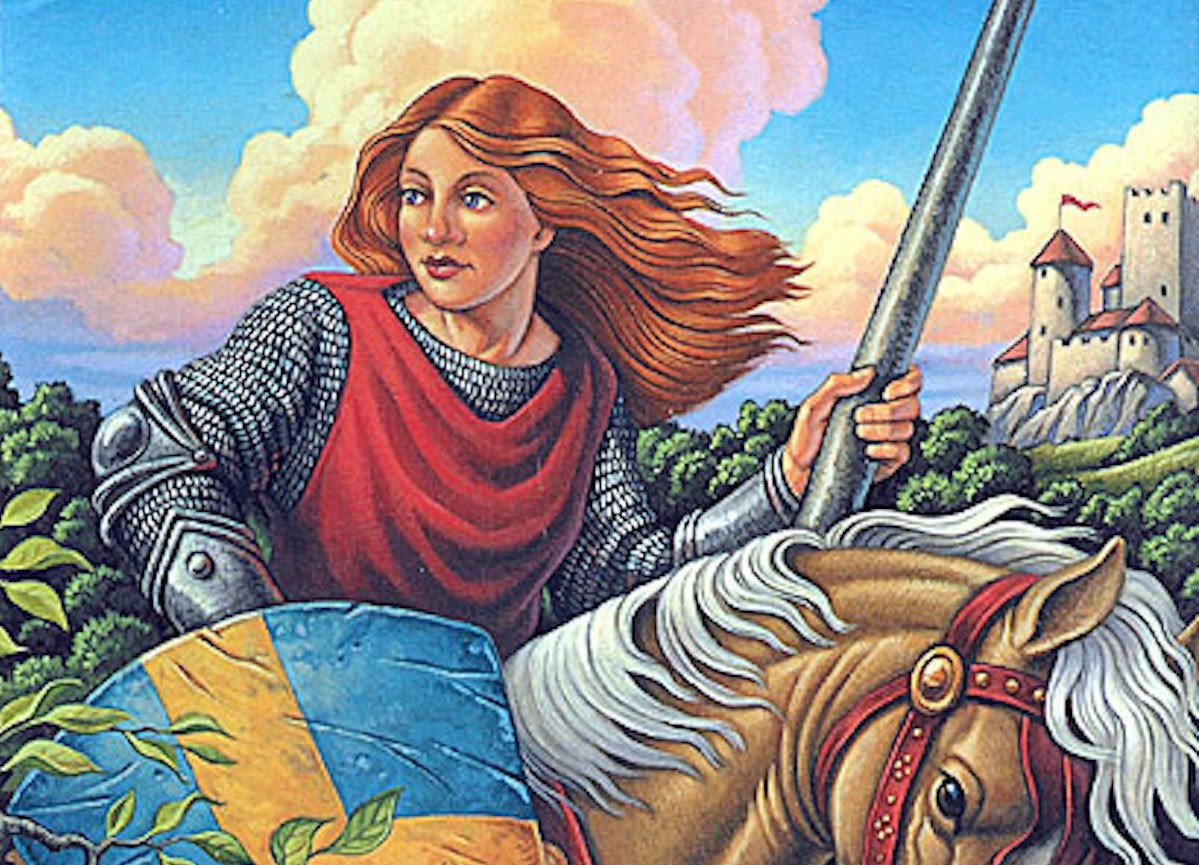
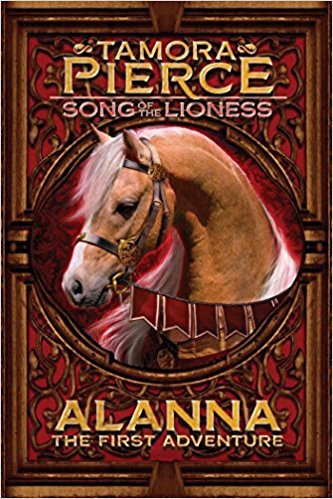
After days like these, there was only one way I knew to feel safe again, one way to make my muscles loosen and my jaw unclench. On the bus ride home, I would curl up with Tamora Pierce’s Song of the Lioness quartet, a series of young adult fantasy novels that detail the adventures of Alanna, a teenage girl who disguises herself as a boy in order to train for knighthood in the medieval kingdom of Tortall. I first began devouring the series in middle school, reading and re-reading the pastel-colored paperbacks until they were dog-eared, their spines broken from being opened again and again. But the Alanna books became even more important to me as high school began. Oddly enough, they felt relevant in a new and pressing way. Because even though she had violet eyes and a horse named Moonlight, Alanna’s daily life training at the palace ran strangely parallel to my own at Saint Francis.
In the first books of the series, Alanna has to keep her true identity a secret from her classmates. She refuses to go swimming, even on the hottest summer days, and binds her breasts once she starts developing. Despite these obstacles, she does well at the palace, making friends and facing down bullies. When one of them breaks her right arm, she starts to train with her left, practicing relentlessly until she’s ambidextrous. And yet, Alanna is still nagged by self-doubt, a creeping sensation of inferiority. Even after she finally defeats the bully who broke her arm, she can’t quite let herself feel proud of what she’s accomplished. “She was still,” the narrator tells us, from a perspective deep inside Alanna’s mind, “a girl masquerading as a boy, and sometimes she doubted she would ever believe herself to be as good as the stupidest, clumsiest male.”
For reasons I was only beginning to make out, Alanna and I were kin.
My freshman year at Saint Francis began in the fall of 1999, a time when there were very few YA novels about gay teens. But even if more had existed, I would have been too afraid to read them: afraid both to be seen with these books, and afraid to identify with their main characters. The Song of the Lioness series let me think about the experience of being closeted in a way that was safely distanced from my real life. In Alanna, I found a heroine who thrives despite her inability to come out, and despite the psychological costs of remaining in the closet.
In Alanna, I found a heroine who thrives despite her inability to come out, and despite the psychological costs of remaining in the closet.
The novels also held another truth, one I wouldn’t be able to fully register for another few years: how important it is to fight back against all those voices — both outward and inward — that claim that being either female or effeminate is disgusting and shameful.
If Pierce’s books armed me with a nascent feminism, they also helped me make real friends. Right before my freshman year began, my mother brought home a new, internet-enabled computer. I used it to find fan sites devoted to the world of Tortall. Hosted on free websites like Angelfire, GeoCities, and Tripod, these sites had names like “Lady Jayla’s World of Fantasy,” “Seraphsong’s Page,” and “The Dream Plains” — and nearly all of them, it turned out, had been made by girls around my own age. Soon I was trading long emails with half a dozen other fans. Our letters started out as detailed discussions of Pierce’s books, but before long the focus shifted to our daily lives: our friends, our schools, our families. These were the bookish, clever, sarcastic peers I couldn’t find at Saint Francis, but desperately needed in my life. Even now, almost twenty years later, I can tell you their names: Shanti, Alison, Kel, Eiram.
Before long I started role-playing with some of these friends online, in a chat room devoted to Pierce’s world. After the daily fear and silence of high school, the relief was incredible. In the chat room (which, for game purposes, was a tavern in Tortall), there was no need for macho posturing, no need to worry about my high, feminine voice or my short, weak frame. We were in a place where bodies vanished, leaving only our words — and those, too, would be gone the next time we logged in. Safe in this knowledge, I relaxed. I let myself be warm and funny and playful: all of the things I couldn’t allow myself to be at Saint Francis.
But I let myself be more than those things, too. My character, Darius, was a mage, and he always entered the chat room — the tavern — in the same way: he appeared magically, “in a blaze of silver fire.”
At school I wanted to be forgotten, to erase myself like an Etch-a-Sketch when you shook it hard enough. But in front of the new computer, chatting with all my new friends, I wanted so much more. I wanted to burn with a light that you wouldn’t soon forget.
Today, more than three decades after the publication of the first book in the Song of the Lioness series, many millennial-age women have written about how Pierce’s heroines provided them with powerful feminist role models. In her blurb for Pierce’s latest book, the author Sarah J. Maas writes that Pierce’s novels “shaped me not only as a young writer but also as a young woman. Her complex, unforgettable heroines and vibrant, intricate worlds blazed a trail for young adult fantasy — and I get to write what I love today because of the path she forged throughout her career.” Author Bruce Coville, meanwhile, observes that, “Having been with Tammy at signings and listened to the young women who speak from their hearts about how they were empowered by her books, I know it is impossible to overstate her impact.”
But the Alanna series was valuable to me for slightly different reasons. Long before I took classes in feminism and queer theory, it helped me to understand that misogyny is a weapon wielded against women and gay men alike. And it promised me, too, that this weapon could be overcome. The first book in the Song of the Lioness series culminates in a chapter where Alanna and her close friend, Prince Jonathan, enter the mysterious Black City and fight a group of evil creatures known as the Ysandir. Midway through the battle, the Ysandir realize that Alanna is actually a girl and use their magic to burn away her male clothes in an attempt to humiliate her. Although Jonathan is shocked to learn Alanna’s true identity, he keeps fighting alongside her, and together they defeat the Ysandir.
Long before I took classes in feminism and queer theory, ‘Alanna’ helped me to understand that misogyny is a weapon wielded against women and gay men alike.
In the final pages of the book, Jonathan — who has been trying to decide which of the knights-in-training he should select as his squire — asks Alanna whom he should choose. “A week ago,” the narrator tells us, “she would have told him to pick Geoffrey or Douglass. But she had not been to the Black City then. She had not proved to the Ysandir that a girl could be one of the worst enemies they could ever face.” Alanna keeps thinking about her time training at the palace, remembering all her hard work, all her accomplishments. “All at once,” the narrator says, “she felt different inside her own skin.”
Alanna tells Jonathan that he should pick her, and he says that she was already his first choice.
She felt different inside her own skin. The first time I read that sentence, more than twenty years ago, it was a promise. A promise that I would not always be so afraid, a promise that I could fight — and win — against all the voices that crackled inside me, telling me that I would never be as good as the stupidest, clumsiest male.
She felt different inside her own skin. It was a promise, but also a gift — one as beautiful and unexpected as silver fire.
In today’s cycle of culture and media, 300 editions of anything is a lot. So many, in fact, that when we tried to figure out a way to theme our 300th issue around it, there wasn’t much fodder to draw from other than movies starring a steroidal Gerard Butler. Almost two years ago, we celebrated our 200th publication with a four-part issue based on the “200 episode club,” or sitcoms that have released as many episodes: Frasier, The Cosby Show, The Jeffersons, and Love Boat. But the list for the proverbial 300 episode club was, unsurprisingly, mostly Law & Order spin-offs.
And then we noted the calendar date that our 300th issue would release: Valentine’s Day. It’s a day that brings out affection and vitriol, passion and sworn indifference, roses, chocolates, menus with astronomical prix fixes, and spikes in wishful condom purchases. (There isn’t really a way to fit this in smoothly, but it’s also our senior editor’s birthday.)
The Love Story, and its shadow, The Heartbreak Story, are a kind that will never get old — there will be versions and retellings and sequels for as long as humans exist. Love, in short, is perhaps the grandest source of anguish and inspiration. So we’ve decided that’s what we want for our 300th issue: Love, in short.
For one week, from January 8 through the 16th (yay for long weekends!), we’ll be opening submissions for 300-word love stories. Recommended Reading only publishes fiction, though it is up to you how thinly you choose to veil the scumbag character who cheats and then meets an untimely death. We are not accepting multiple submissions per writer, so make sure to pick your best one, and that it is 300 words exactly, not including the title! The issue will be composed of ten stories, and upon acceptance, we can offer $25 per 300-word story. All submissions should go through our submittable page, where you’ll also find the complete guidelines.
Electric Literature is thrilled to announce the addition of its newest board member: writer and co-founder of The Toast, Nicole Cliffe.
Electric Literature’s mission is to make literature relevant, exciting, and accessible in every sense of the word, and as an organization run by women, is also committed to publishing work by diverse and feminist voices.
“I’m thrilled and excited to be joining the board of Electric Literature, an organization that cares as much as I do about bringing great writing to everyone. I’ve loved the voices that Electric Lit has been showcasing, many of whom I remember having my hair blown back by at The Toast (in a good way!), and I’m looking forward to getting to work!” said Cliffe.
Cliffe’s appointment comes two years after Halimah Marcus was promoted to Executive Director, and four months after Jess Zimmerman joined as editor-in-chief. Jennifer Baker, creator and host of the Minorities in Publishing podcast and a 2017 NYSCA/NYFA fellow, also joined as a contributing editor in August to focus on craft, the publishing industry, and representation in literature. Since then, Electric Literature has published influential articles at the intersection of feminism, culture, and literature, including “What I don’t Tell My Students About the Husband Stitch” by Jane Dykema, an essay about Carmen Machado’s collection Her Body and Other Parties, which attracted half a million readers.
Cliffe will join board members Andy Hunter, Electric Lit’s co-founder and publisher of Catapult and Lit Hub, acclaimed novelists Michael Cunningham and Lev Grossman, Bookforum publisher Danielle McConnell, the vice president and executive editor of HarperCollins, Sara Nelson, and the vice president and executive editor of Farrar Straus and Giroux, Sean McDonald.
Along with her co-founder Mallory Ortberg, Cliffe’s legacy at The Toast, which ran from 2013 to 2016, was one of smart humor and feminist inclusivity. On The Toast’s last day of publication, Hillary Clinton contributed to the site to thank the founders for creating “spaces where women can speak their minds freely.” Although nothing can replace The Toast in the hearts of its millions of readers, Cliffe’s guidance will help Electric Lit provide a space for inclusive and progressive work about literature, without losing a sense of fun.
M y husband, baby, and I were on vacation in Andalusia. The thirteen month-old napped in the car while we drove to the next destination, the historical city center of Seville, then put him into a pack and tried to take in a site or two. We needed food. A recent rain had emptied most outdoor tables. We dove inside a restaurant on the Plaza de la Pescadería. The baby refused to stay put. He couldn’t yet walk, and his attempts at crawling his way across dirty floors to cobblestone squares made me nervous. I gulped down my meal, and, while my husband ate, carried the baby to a window. A few neighborhood kids were chasing a ball through the puddles. Baby was mesmerized — for five whole minutes.
Soccer. My eyes rested on the ball, tracing its movements. The kids pushed it between the empty café tables, using two of them as goalposts. One team took charge and ran the ball toward the pedestal of a small statue. The statue caught my attention. At that point in our trip, we’d encountered so many monuments to priests and monarchs that it took me a beat to understand that I was looking at something different.
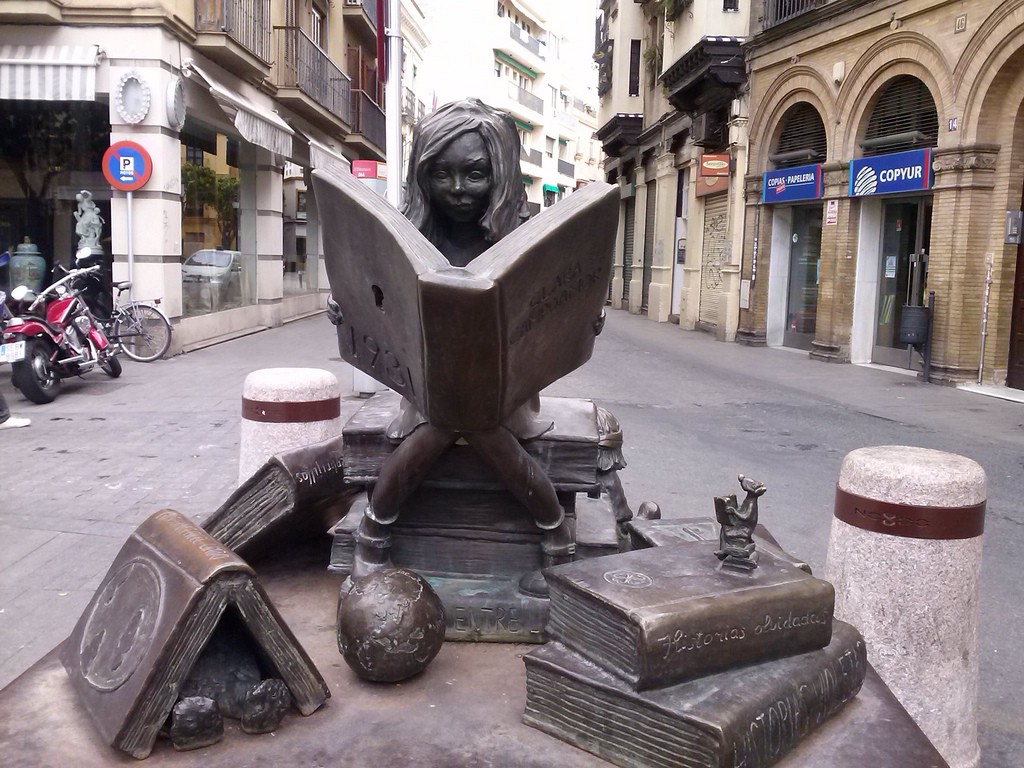
Atop a bronze pedestal sat a little girl, also cast in bronze. She perched on a pile of books, a heavy, oversized volume precariously balanced on her lap. More books were piled at her feet and a few toys lay scattered on the pedestal next to her. The girl was unimposing, as though she were in her own home, occasionally interrupting her reading to caress a worn toy. When one of the kids hit her pedestal with the ball, all of them looked up, as though to check whether or not they had disturbed her reading.
Baby squirmed in my arms. He’d had enough of looking. He wanted to be out there, chasing the ball through the puddles. The whole puddle business attracted his great attention. Dirt! Water! Bubbles! Water! We needed to move.
I took a quick snapshot of the statue. As soon as my husband finished eating, we put the baby back in the pack and ran for the next site on our itinerary.
When one of the kids hit her pedestal with the ball, all of them looked up, as though to check whether or not they had disturbed her reading.
Upon our return to San Francisco, I posted the travel photos online. A friend saw the little girl statue that had transfixed me for just a moment and translated the inscription on the pedestal. It was erected in 2007 by sculptor Anna Jonsson and dedicated by the city of Seville to the memory of Clara Campoamor “for her incalculable contribution to the work of women’s rights.” But who was Clara Campoamor? What had she done to deserve this kind of commemoration in the center of one of Europe’s most famous cities?
It took just a few clicks to gather the basics. Campoamor is to Spain what Susan B. Anthony is to the United States. In 1931, Campoamor swayed the government of the newly established Spanish Republic to extend full suffrage to women. “Only he who does not consider women to be human would affirm that all human and civil rights should not be the same for women as for men,” Campoamor had said during the debates. “A Constitution that gives the vote to beggars, to servants, and to illiterates — of which there are some in Spain — cannot deny it to women.” Her rhetoric proved convincing. Decades later, a score of schools and cultural institutions bear her name; her visage has graced stamps and coins; a recent television film dramatized her achievement in the suffrage debates; in 2006, for the seventy-fifth anniversary of the vote on suffrage, a larger-than-life bronze bust of Campoamor was erected in Madrid. That same anniversary, in 2006, occasioned the city of Seville to commission its statue.
According to photographs I found online, the Madrid bust of Clara Campoamor follows an image of Campoamor produced at the time when she, a successful lawyer, had been elected to a seat on the Spain’s Constituent Assembly. The neck of the sculpture appears exaggerated — it’s nearly as broad as her face, the sternomastoid muscles bulging. In Russian (my first language), I would describe this as a “bull’s neck” — the neck of a powerful and dangerous animal. Campoamor’s chin looks slightly upturned and her lips are extended into a quiet smile, suggesting the idea of hope and aspiration. Her short hair is combed in waves as though wind is blowing against her face. A gentle wind, by no means a storm. In the Seville statue I’d glimpsed a different story.
I read on. Campoamor was born in Madrid in 1888 (that year Susan B. Anthony organized an International Council of Women in Washington, D.C.). Her mother was a dressmaker and her father worked as an accountant in a local newspaper. When he died, ten-year old Campoamor had to quit school to help her mother. She began as a part-time seamstress and went on to a variety of menial jobs. It is this ten-year old who nurtures her dreams by reading big books that I saw in bronze on the Plaza de la Pescadería. This girl is gathering resilience for the challenging road ahead.
It is this ten-year old who nurtures her dreams by reading big books that I saw in bronze on the Plaza de la Pescadería. This girl is gathering resilience for the challenging road ahead.
Campoamor eventually became a telegraph operator and then a typist and a typing teacher. In her twenties, she wrote for popular newspapers, arguing for the rights of women, and, in particular, poor women. At the age of 33, she enrolled at the University of Madrid School of Law and participated in the debating societies in Madrid. She earned her degree at the age of 36 and was 44 at the time she won the election to the Constituent Assembly. Following the exile of King Alfonso XIII, in 1931, the Constituent Assembly was tasked with composing the brand new Republic’s constitution. Campoamor was one of only two women in the Assembly. Victoria Kent was the other and, for political reasons, argued against Campoamor on the question of suffrage. Having won the vote for all women, Campoamor lost the political battle and in 1933 was not reelected to the Assembly. In 1936, fearing for her life during the Spanish Civil War, she fled the country. Franco’s regime barred her from returning to Spain. She spent several years in Argentina, writing a biography of Sor Juana Inés de la Cruz, and later settled in Switzerland. Until her death in 1972, she continued to write on topics of feminism and her experiences in politics.
The friend who had translated the monument’s inscription shared with me a link to the sculptor’s webpage. The site was surprisingly easy to navigate in English. Anna Jonsson’s body of work was divided into four sections, “Sculptures” — all, with the exception of the Clara Campoamor sculpture, in brightly colored clay; “Embroideries,” “Dance-Performance,” and “The Super-Violeta Channel.” The biographical note explained, “Anna Jonsson was born in Skellefteå, Sweden in 1961 and has been resident in Seville since 1982 where she came to study Fine Arts. . . . Anna is a multidisciplinary artist, but sculpture has formed the basis for all her work.”
The commission for the Campoamor statue had been a competitive one, which Jonsson won. A few members of the local press had been upset that the winner was not a Seville native. Others expressed some confusion about the relevance of the depiction of an iconic female figure as a young child. Campoamor’s name had come to bear heft, and some criticized Jonsson’s imaginative approach as not reverent enough. My friend ended her note with the link to the artist’s social media page.
Campoamor’s name had come to bear heft, and some criticized Jonsson’s imaginative approach as not reverent enough.
Anna Jonsson responded to my email within days. In the next few weeks, we emailed back and forth, and she provided fuller back story about the monument on the Plaza de la Pescadería and how it became a part of Seville.
“My thoughts were, How do you pay homage to a person you really admire?” Jonsson wrote. “How do you get people to want to learn more about her? Typically, you would recommend a book by or about that person. I would like everyone to read Campoamor; everyone, and especially my own beloved daughters. So I created a girl in the space of her own, her room with toys and books. Campoamor was a lawyer; therefore, among the toys is a blindfolded doll and a mouse resting on a scale. When it rains, the cup of the scale fills with water and it looks like the mouse is swimming. The titles on the spines of the books provide clues on how to read women’s history: History in between, in limbo, invisible, purple . . . and yes! the keys to history — Who won the war? Who wrote the book?”
The books are titled “Historias obvidades,” “Historias violetas,” “Historias invisibiles,” and so on. While preparing to work on the sculpture, Jonsson reread Campoamor’s writing. Johnson wrote, “I read books by her and about her. What most impressed me was her performance in Congress during the debates on the women’s right to vote. Her speech was so outstanding, so clear-sighted, so clever and respectful — she made the rest of them sound like fools. At the time everyone was persuaded by Campoamor’s eloquence.”
Though initially the sculpture received some criticism, it has become a beloved site for locals and the tourists alike. “The neighbors in the plaza like it, they even tried to make it a place for exchanging books,” Jonsson wrote. Unfortunately, “this initiative ended when the city cleaners threw the books away.” Architecture and fine arts students have used the sculpture for their projects; it has received attention from a prize-winning photographer and even a theater company that wanted to use it for a performance. Tour guides include the sculpture on their routes, and the city cleaners do a great job of removing any occasional graffiti. Jonsson clarified, “The sculpture has been very little vandalized which is really amazing, considering that there are restaurants, pubs, and a disco in the square. I feel that people care about the girl. I wonder if she somehow touches upon everyone’s protection instinct.”
This tenderness enchanted me. I began working on an essay about the artist and her statue — my own artistic reaction to the statue. But it took a long time — over a year —to get it right. Then I realized that while I’d been identifying with the little girl, measuring my own childhood and abilities against that of little Clara Campoamor, Jonsson had approached her creation as though the famous feminist were her little girl — a child who needed her care.
While I’d been identifying with the little girl, measuring my own childhood and abilities against that of little Clara Campoamor, Jonsson approached her creation as though the famous feminist were her little girl — a child who needed her care.
She was mothering her work. Though technically I’d been a mother at the time when I encountered the girl, my baby had been very much attached then, he still felt like a part of my body. It wasn’t until a few months after the trip, when he started calling me “mama” that I began to suspect that I was one. Jonsson’s description of her statue — I’d been thinking of it often — finally landed, allowing me to understand that my point of view was shifting.
The shift is not linear, but rather a matter of adding something like a new photo filter to the existing array. My relationship with Anna Jonsson’s artwork revealed this clearly.
That winter in Seville, on the Plaza de la Pescadería, the transaction was quick. I saw the statue of the little girl and recalled my own childhood, surrounded by books. I identified with the girl the feeling of staring at the pages of the books and trying to extrapolate from them the road ahead, the future as yet unwritten, a life filled with possibilities. That girl could grow up to be anyone she wanted to be — and, looking at her, I felt like I still could, too.
When I return the image of the sculpture all these months later, knowing something about Clara Campoamor and her work, I still face the representation of her as a little girl. The sense of possibility is still there, but it’s curbed now by what I know about the facts of her life. Campoamor made an important difference in the lives of women, and yet I imagine her own filled with disappointment in things small and large. I know and so does Jonsson what it’s like to live in a country not one’s own (Jonsson has referred to her own experience as being “an inbetweener”), but she and I have chosen our homes and can only imagine what it must’ve been like for Campoamor to live out her life as an exile. Women of Spain have held on to their right to vote through the years of Franco’s dictatorship, but the battle for representation and equality is by no means over.
Jonsson wrote that the girl “somehow touches upon everyone’s protection instinct.” The desire to help, to do something for the girl feels urgent. I wonder: What could I have done for Clara Campoamor had I been her mother? How could I have mothered her in such a way as to help her build the resilience and strength needed to accomplish what I know she must on a road that is so singular and solitary? More than that, I wish for her to have arrived at the end of her life with the same sense of accomplishment I have when I look at her chapter in history in retrospect. I want to comfort her by reminding her of her own importance.
What could I have done for Clara Campoamor had I been her mother? How could I have mothered her in such a way as to help her build the resilience and strength needed to accomplish what I know she must on a road that is so singular and solitary?
Studying Anna Jonsson’s site, I’d spent some time on the page titled “The SuperVioleta Channel.” This is a series of feminist videos, executed in an absurdist style. In my favorite of these, “Perdón,” a young girl wearing a purple wig and made up to look middle aged repeats the single word apology, “perdón, perdón, perdón, perdón” for three and a half minutes, varying her expressions and intonations, reflecting the multitude of ways in which women say they are sorry. The effect is haunting.
I asked Jonsson about the collaborative aspect of her art. I had expected her to talk about the work itself, her artistic vision— instead, Jonsson focused on her two daughters. Ingrid and Greta have been her models, and from the beginning, they have also been her co-creators. Both girls grew up to be artists. The older, Ingrid García Jonsson, has achieved some prominence as an actor in Madrid. The younger, Greta, is a dancer who is also studying law. At first, most collaborative ideas came from the mother, but as time went on, Jonsson has become a participant in her daughters’ creative work. “It’s a privilege having someone so close to you who always supports your crazy projects.”
In this context, I ponder the Clara Campoamor sculpture anew. What if this little Clara really were my own daughter? If motherhood, considered in historical terms, feels like a weighty responsibility to which I’m decidedly not equal, Jonsson’s words sound hopeful. Perhaps being an artist — or a writer, or a lawyer — and a mother doesn’t have to be an either-or proposition. One doesn’t need to take away from another, but could instead nourish and enrich the other. This realization, however, requires a change of attitude and an act of resistance to a dominant cultural trope.
Becoming a mother means, it turns out, becoming a mother in my imagination. Becoming a mother also means becoming a mother to my imagination. I’ve been given an opportunity to transform my imagination, to guide it from the achievement-dominated myths about work that I’ve inherited and to look instead for plots that are additive and creative.
Becoming a mother means, it turns out, becoming a mother in my imagination. Becoming a mother also means becoming a mother TO my imagination.
Clara Campoamor changed something very real in the world, but I doubt that as a little girl she had set out to defend women’s rights. It’s heartening to see Spain celebrating her accomplishments. All the more, it’s exciting that in portraying Campoamor as a little girl, Anna Jonsson has enabled us to see her not through the power of her achievements but through the everyday scene of her as a child with a wide open future.
What do we do with the art of monstrous men?” asked Claire Dederer in The Paris Review last month. When genius creators like Bill Cosby and Roman Polanski are also known to be criminals and abusers, does it become somehow immoral to appreciate their work? Or, by contrast, is it unacceptable not to appreciate it, to let emotions like revulsion stand in the way of a purely intellectual appreciation of skill? When Dederer finds herself unable to sit through Woody Allen’s Manhattan without nausea, is she doing right by the victims, or wrong by the auteur?
It’s an interesting thought experiment, one we keep coming back to again and again — though rarely with more urgency than in the last few years, and then especially the last few months, as more and more abusers are unmasked. Is it possible to separate the art from the artist? Is it ethical? These are the sorts of philosophical questions that launch thousands of words of text. (Here’s Pacific Standard in 2014. Here’s The Guardian in 2013. Here’s Newsweek in 2009.)
But meanwhile, as we wrestle with the questions of what to do with morally hideous artists, we ignore the more hideous truth: Most of the men whose abuses are now coming to light aren’t makers of art. They’re gatekeepers.
Most of the men whose abuses are now coming to light aren’t makers of art. They’re gatekeepers.
Two and a half weeks after Dederer’s essay was published in The Paris Review, that publication’s editor, Lorin Stein — the person tasked with setting the magazine’s artistic vision and selecting the writing that does and does not appear — resigned due to accusations of sexual misconduct. He’s only the latest literary gatekeeper to fall. Hamilton Fish, president and publisher of The New Republic, resigned under similar circumstances in November. Leon Wieseltier, former literary editor of The New Republic, had a new magazine scuppered by harassment claims.
In the entertainment world, too, the abuses are being perpetrated not only by people whose art we can hand-wring over — the writers, the actors, the directors — but by the people behind the scenes, the ones deciding whose voices get heard. Harvey Weinstein, in many ways the hard-falling rock that set off this avalanche, was not a creator but a producer. “The accused are men who help to determine what art gets seen and appreciated — and, crucially, paid for,” wrote Rebecca Traister in New York Magazine. When abusers don’t just make art, but decide what art is, the calculation becomes trickier. It’s not Woody Allen’s movies that are tainted; it’s the entire movie endeavor. And as literary gatekeepers hit the ground, they spread a similar stain.
You can’t point to a work of genius by Stein and debate over whether it can still be appreciated. He wasn’t a maker, but a tastemaker — part of a network of white, male, and yes, sometimes abusive literary tastemakers who have long defined what it takes for writing to be successful, what it means for writing to be “good.” Witness, if you have the stomach for it, this nauseating-in-retrospect New York Times profile of Stein from when he took over the magazine. Stein offers to “pimp” Zadie Smith, and declares himself “kissed out” after a party, but the article also muses on his literary connections — all men — and his responsibility to the ideals of literary quality. “[The Paris Review] will stand or fall on the quality of its literariness,” says one of Stein’s colleagues in the article’s closing quote. “It has to provide beautiful, witty, rarefied fun of a distinct kind. … Lorin needs to make The Paris Review matter to people for whom literature matters.” It’s Leon Wieseltier.
This closed-system idea of literary value, defined and defended by the kind of men who have always taken their power for granted and used it for gain, reverberates well beyond any single piece, or even any single publication. Nor will it be solved simply by removing the gatekeepers from their positions of influence. The Paris Review did once have a woman editor, Brigid Hughes, though she was ousted in favor of the more famous and flashy Philip Gourevitch in 2005. (And subsequently erased from the publication’s history; I wouldn’t have known about her without a tweet thread from A.N. Devers.) In a Times profile of Hughes, written when she took over the magazine in 2004, she insisted over and over that her only goal was “to publish good writing, whatever form that takes.” When the reporter asked if she would try to shift the publication’s notoriously skewed gender balance, she demurred that “I’m not going to consciously insist on half men and half women,” although she allowed that she has “different tastes” than founder George Plimpton. It matters to have a person with different “tastes” — or rather, with different life experience, prone to noticing and appreciating different things — at the helm. But when “taste” and “good writing” are defined in large part by that network of powerful literary men, the ones clapping each other on the back about making literature matter and then being exposed as abusers one by one, it may not matter enough.
If your idea of value springs from an ethical void, it’s time to transplant it onto stronger soil.
Once you realize how much the structures of literary power are bound up with the concept of literary quality, it becomes clear — if it wasn’t already — that our entire concept of “quality” is suspect. The Paris Review publishes twice as many men as women; are men twice as good? The New York Timesdescribed Stein as “regarded by many as a champion of new talent, including some women writers,” but that “some” is poison. One can’t really make the case that Stein was a champion of women writers generally; under his auspices, The Paris Review went from one-third women writers to… one-third women writers. So who broke through to be part of the illustrious third? This is not to say that the writers who did make their way into The Paris Review’s pages aren’t worthy, but we should illuminate the hand that picked them, and the other work it cast aside. In short, if you weren’t already paying attention to the ways that whiteness and maleness determine what we value in art, you should be now.
There is such a thing as “good writing”; it’s not a purely vacuous phrase. (Most of the work in The Paris Review is, in fact, good writing, in various ways!) But any first-year writing workshop would push you to unpack the word “good.” Do you mean rhetorically effective writing? Emotionally effective? Simple and clear writing? Evocative writing full of detail? Too often, what we actually mean by “good writing” is “writing that has been ratified by the literary establishment.” But the literary establishment, we are coming to find, is bad. (Morally.) If your idea of value springs from an ethical void, it’s time to transplant it onto stronger soil.
We can ask ourselves now, again, whether we can separate the art from the artist, and ask ourselves again when the next allegations come to light. But perhaps it’s more important to ask whether we can separate art from the people who decide what art is — and, crucially, what we’ve been missing that they wouldn’t let us see.
Novel Gazing is Electric Literature’s personal essay series about the way reading shapes our lives. This time, we asked: What book was your feminist awakening?
In the summer of 2003, I was riding Metro-North from New Haven, Connecticut back to New York City where I lived when the power to the train failed. For the first hour, I barely noticed the delay, or the hot mutterings from passengers which had slowly escalated from the odd outburst to a constant buzz. I was deeply preoccupied reading Under the Banner of Heaven, Jon Krakauer’s true story about a brutal double murder committed by two followers of a fundamentalist offshoot cult of Mormonism. I had just convinced my book club, composed entirely of women members of the Church of Jesus Christ of Latter-Day Saints (the mainstream Mormon church, abbreviated L.D.S.) to read it.
My book club, which met in New Haven once a month, had the lofty title Women of Words. It was composed of Yale professors, grad students, and professionals. Every member identified as a feminist — a term still somewhat disparaged by our larger church community. The group typified a small but emerging new generation of Mormon women who were defying the stereotype of cookie-baking stay-at-home mothers. These religious yet ambitious women defied everything I had experienced, and resented, about how Mormon women are expected to behave: to passively accept their inability to hold leadership roles in Church hierarchy; to relinquish career and accomplishment to support family life; to eschew conflict and embrace submission for the sake of peace and harmony.
I committed to one meeting, reluctantly; I assumed it would be a quilting circle that might dare to read an Oprah Book Club selection. I was wrong. I got intellectually schooled when we read Joseph Stiglizs’ Globalization and Its Discontents, and struggled to finish the entire tome Mother Nature — an 800-page academic dissection of everything from infanticide to breastfeeding to female genital mutilation. When I suggested we read a Jon Krakauer book, all twelve members looked at me with tight smiles. They were too polite to tell me, new to the group, that the latest book by an adventure writer, even if it was on the New York Times Bestseller List, was not on par with the groups’ standards of provocative, feminist, and intellectually stimulating literature.
I didn’t actually want to read the book. But during the summer of 2003, New Yorkers seemed to be buying it by the crateful. This was right before Kindle and electronic copy exploded. What people were reading, out in the world, was more public; strangers witnessed, and in my case were subtly influenced by, one another’s choices. I saw businessmen on the subways, strap-hanging with one hand, pinching the book open by thumb and pinky with the other, too dialed in to be tortured by the sweaty lurching of the A train. Moms with strollers and Starbucks in Riverside Park, engrossed in the tale while their kids ate sand and cried for Cheerios. I was the only Mormon anyone in New York City seemed to know at that time, and I was constantly peppered by questions. “You’re Mormon, right?” “Have you read this?” “What did you think of it?”
I had seen from the countless book jackets, which appeared everywhere from the sides of buses to glossy ads in The New Yorker, that Krakauer’s latest bestseller was another sensationalist account of a tragedy, but this time, “the roots of the crime lay deep in the history of an American religion practiced by millions.” That religion, I knew, was Mormonism. I briefly looked on the internet, and learned that the story centered around the crimes of Ron and Dan Lafferty, who, directed by a revelation from God, murdered their own niece and sister-in-law. The Laffertys, followers of a fundamentalist Mormon sect, had previously been excommunicated from the mainstream L.D.S. church. There was nothing in me that wanted to read about this gruesome crime, effectively marketed as a page-turning summer beach read and flying off the Barnes and Nobles shelves. The religious convictions of these psychopaths had nothing to do with the mainstream faith that I practiced. I saw no reason to make Krakauer rich from conflating my mainstream L.D.S faith with the freak-show of fundamentalists. This was my pat answer, along with, “That book just doesn’t seem that interesting to me, in a literary sense.”
I can’t remember how many times I was asked about the book before I finally broke down and bought it. Something about disparaging the story without reading it felt like ignorance — and a perpetuation of the censorship culture in which I was raised. From the time I was a very small child, I had been told that the world would try to cast doubt on the miracles that I believed in, and that I shouldn’t read anything about my religion not explicitly sanctioned, written, and published by the L.D.S Church itself. Any literature which commented on Mormonism outside of these strict boundaries was the work of Satan. The official presentation of L.D.S Church history, to its members, reads something like a cross between a Disney movie script and Chicken Soup for the Soul; at no point do the revered people and events — the bedrock on which rests the faith of millions — ever show a dark, faulted underbelly. I had a vague idea about “real” Mormon history: the dubious origin of the golden plates on which the Book of Mormon is based; the powers of translation which Joseph Smith claimed to have; the soap-operaesque philandering and polygamy of the most revered prophets of the LDS faith, Joseph Smith and Brigham Young. But at that point, I thought I had found a way to make peace with a religion that was too much a part of my family, my past, and my identity to give up on. The L.D.S. church provided an amazing community of support. My entire family were practicing members. I had rejected the idea that the devil was behind all criticism of Mormons, but something in me was still resistant to seeking out negative commentary about my beliefs.
I had rejected the idea that the devil was behind all criticism of Mormons, but something in me was still resistant to negative commentary about my beliefs.
The summer I read the book, I was 28 years old, had just completed a graduate degree at Yale, and had gotten married the year before to a non-Mormon. In my book group, I had found an intellectual, razor-smart group of women who seemed to be able to both believe in Mormonism and exercise critical analytical skills across a variety of intellectual disciplines: business, art, history, medicine. It seemed silly to let a rock-climber turned adventure writer titillate the public with an outlandish tale, using my faith as bait, without being able to offer some kind of thoughtful rebuttal. My book group, mostly humoring me, agreed to read it — with the general feeling that it would be a quick, poorly written, and boorish read.
But on the train that sweltering summer day, I was hypnotized. This was a story of men who had grown up believing in the same Book of Mormon stories that I did. Who believed, just as I had for many years, in the same fantastic tenets that are the foundation of the Mormon Church: the validity of personal communication with God, unquestioning devotion to a modern-day prophet, and the selective justification of violence for religious purposes.
The jarring yells of a panicky group of commuters startled me from my reading; several people were trying to open the windows of the roasting car, the air conditioning having failed with the power. Nobody knew that this was the first few minutes of the now infamous 2003 blackout that shut down the power grid for an enormous swath of the Northeast, including all of New York City. I shifted, trying to unstick my legs from the vinyl seat so I could see what was going on. I was grateful for a reason to tear myself away from the most terrible story I had read in a long time. Krakauer had just described how the victims’ throats had been slit — the murders a fulfillment of God’s will. The series of events that led up to his crime included the Lafferty brothers’ embrace of the Mormon tenet of personal revelation: God had told Ron and Dan to leave mainstream Mormonism for a fundamentalist sect, and to convince their other four brothers to join them. God had also told them to practice polygamy, just as the Prophet of this new sect commanded. Ron’s spouse refused to let him wed other wives, and ultimately left the marriage — with support from Brenda Lafferty, the wife of Allen, the youngest of the Lafferty brothers. God told Ron to kill Brenda Lafferty, whom both brothers blamed for abandoning the marriage. Ron and Dan Lafferty, following this revelation, obeyed God and murdered Brenda and her baby daughter Erica.
People on the train were starting to panic; passengers had begun to notice no one had cell reception. This was just two years after 9/11 and most people in New York had learned that it was no longer foolish to assume the worst. A conductor appeared and informed us that the train and every station on the line had lost power completely. The problem seemed to be huge; the train and everyone on it would be stuck on the tracks indefinitely. Every able-bodied person was advised to exit the cars and walk down the tracks about half a mile to a nursing home — the closest facility to the train tracks the conductors had been able to find in any direction.
This was just two years after 9/11 and most people in New York had learned that it was no longer foolish to assume the worst.
I thought about trying to call my husband, to tell him what was going on, but like everyone else’s, my phone was useless. Not that I really wanted to talk to him. The marital bliss I had naively expected from newlywed life had not materialized in the year since our wedding day. From the outside, we appeared to be the yin-yang of couples, a success story of “opposites attract.” I was a devout Mormon; he was a lapsed Protestant. I commuted to New Haven to manage HIV/AIDS studies based in India and South Africa, and volunteered at organic farms in my spare time. He worked at a Midtown bank. I was a Democrat; he was a Republican. But things were not going well. I used my job in New Haven as an excuse to spend a large part of the week away from my new husband. I looked forward to my frequent overseas trips as an escape from the disappointments of our marital bed. Both of us were paying the price for my religious devotion. My unquestioning obedience to the revelations of an 80-year-old Utah man, Gordon B. Hinkley, the current Prophet of the mainstream L.D.S church at the time, had precluded us from having sex before our wedding night.
After the doors had been pried open by hand, passengers awkwardly lowered themselves and their possessions — strollers, briefcases, purses, and luggage — several feet from the car to the ground and began walking down the tracks, straight into the glaring summer sun. People stumbled over the rails, walking tentatively, not really knowing where the hell we were going. One train conductor had run up ahead, his arms waving in the distance at the point where passengers should veer off the tracks, duck through a hole in the wire fence, and spill onto the perfectly manicured lawn of a large white building. But the nursing home wouldn’t let anyone inside. Groups of passengers would arrive five or ten at a time, buzzing and knocking on the glass doors to be let in to use the bathroom, the phone, or get a drink of water. Again and again, a disembodied voice would crackle through a small speaker by the doors, saying no one could enter the building for fear that so many visitors and germs would infect the frail and elderly residing inside. Every few minutes the scene would repeat itself with people throwing up their hands and despondently plopping down in the grass. The pristine lawn, peopled with overdressed passengers, looked like the scene of the saddest picnic ever: hungry, thirsty people in torn skirts, broken heels, and sweat-stained dress shirts, sitting on briefcases and suit coats spread out like blankets, waiting for food, water, or at least a ride home.
Faced with the prospect of being stranded indefinitely, I turned back to my book and read the entire story throughout the next six hours. I couldn’t put it down. At one point someone placed a tiny cup of water and a package of Lorna Doones next to me. I unwrapped and nibbled at a cookie until I forgot about it, letting it melt in my sweaty hand. I remember needing to pee and forgetting about that too. When I finished, I felt hollowed out. Ashamed. It would have been easy to convince myself the book had nothing to do with me or anything I believed in — the subjects of this narrative were disenfranchised men whose financial failings, thirst for power, and desire to fuck other women prompted a libertarian rejection of the rule of law, and delusional revelations from God justifying lecherous misdemeanors and heinous crimes. But there were too many parallels between Under the Banner of Heaven and the revered founders of my own religion. Much to the official L.D.S. Church’s chagrin, a wealth of historical evidence suggests these prophetic figures were similarly motivated and guilty of many similar acts of deceit and violence, just short of cold-blooded murder. They had practiced polygamy — often pressuring underage girls to become sister-wives. They embraced the selective use of violence to achieve religious goals. They lied, cheated, vandalized, and committed other crimes out of economic desperation and deluded religious conviction. Krakauer did not try to blame Lafferty’s actions on the official L.D.S. Church. But by explaining the historical circumstances surrounding the religion in which Lafferty was raised, Krakauer laid out, clearly and succinctly, with cited and accurate sourcing, many details and events I had not previously seen told in such a public, compelling, and engaging way.
I read the entire book throughout the next six hours. When I finished, I felt hollowed out. Ashamed.
What really bothered me was that this book had taken what I, and many (but definitely not most) Mormons, knew as our dirty little secrets, and told them in scintillating detail to the entire pop-culture reading public. Prior to this book, the historical peccadillos and transgressions of early Mormonism had been relegated to marginal academic explorations. But this book was now on the shelves at T.J. Maxx and Costco, at every Hudson News in every airport across the United States. Krakauer’s book was the first chink in the censorship fortress the L.D.S. church and its members had been building around themselves for as long as I could remember. It was hard to hide from information — previously only available by digging through the dusty stacks in a library — that now occupied the New York Times bestseller list. That everyone from your dog walker to your barista was reading on their lunch breaks.
But more than having to face my neighbors, co-workers, and even the damn mailman who I had seen resting in his truck, the book spread over his face while he napped, I had to face myself. I had to admit that the real reason I resisted reading this book was because the L.D.S. Church didn’t want me to, had told me for my whole life not to exercise my own judgement. I had done so many things “because the Church said so.” I went to church for over three hours every Sunday. I watched men, and only men, perform religious rites and hold leadership roles. I paid 10% of everything I earned to the Church. I had never tasted wine. Enjoyed a coffee. Smoked a cigarette. I spent years of my life reading and studying scriptures that were likely fabricated by a 14-year-old farm boy turned charismatic cult leader. I accepted the need to wear the weirdest, most unsexy, knee-length underwear because the L.D.S. leadership said that God had commanded it. Instead of trusting my body and my instincts about sex I had trusted the Church; I hadn’t had intercourse with the one partner I had committed myself to for the rest of my life.
That’s when my shame for my thoughtless obedience, the sugar from the cookies, dehydration, fatigue, and growing sense of how the fuck was I going to get home — and what was waiting for me when I got there — hit me. I started to weep and couldn’t stop. I didn’t know what to do with what I now realized the LDS Church had so effectively taught me; with a marriage I had too cluelessly entered; with this fucking book that I had convinced twelve other L.D.S. women to read.
Another passenger sitting nearby asked me if I was okay. I couldn’t answer. Misinterpreting my tears for the despondency of the power-grid situation, he said “Don’t worry. Everything is going to be alright.” Noticing the book in my hand, and possibly attempting to distract me from the fact that the sun was going down and that we might all be sleeping on the lawn that night, he said, “Hey! That’s Krakauer’s new book! I totally want to read it. I read Into Thin Air in like an hour. Is this one any good?” I wiped my tears and told him it was. That everyone should read it. “Here, take it.” I said. He looked at me, surprised, and started to walk away. Then he stopped, considered me for a moment, and said, “I talked to one of the cooks at the nursing home who was smoking out back. He’s driving back to New York City and willing to fill his car with anyone who’s got $50 in cash. There’s one more seat in his car. I’ll float you if you don’t have the money. You seem like you really need to get home.”
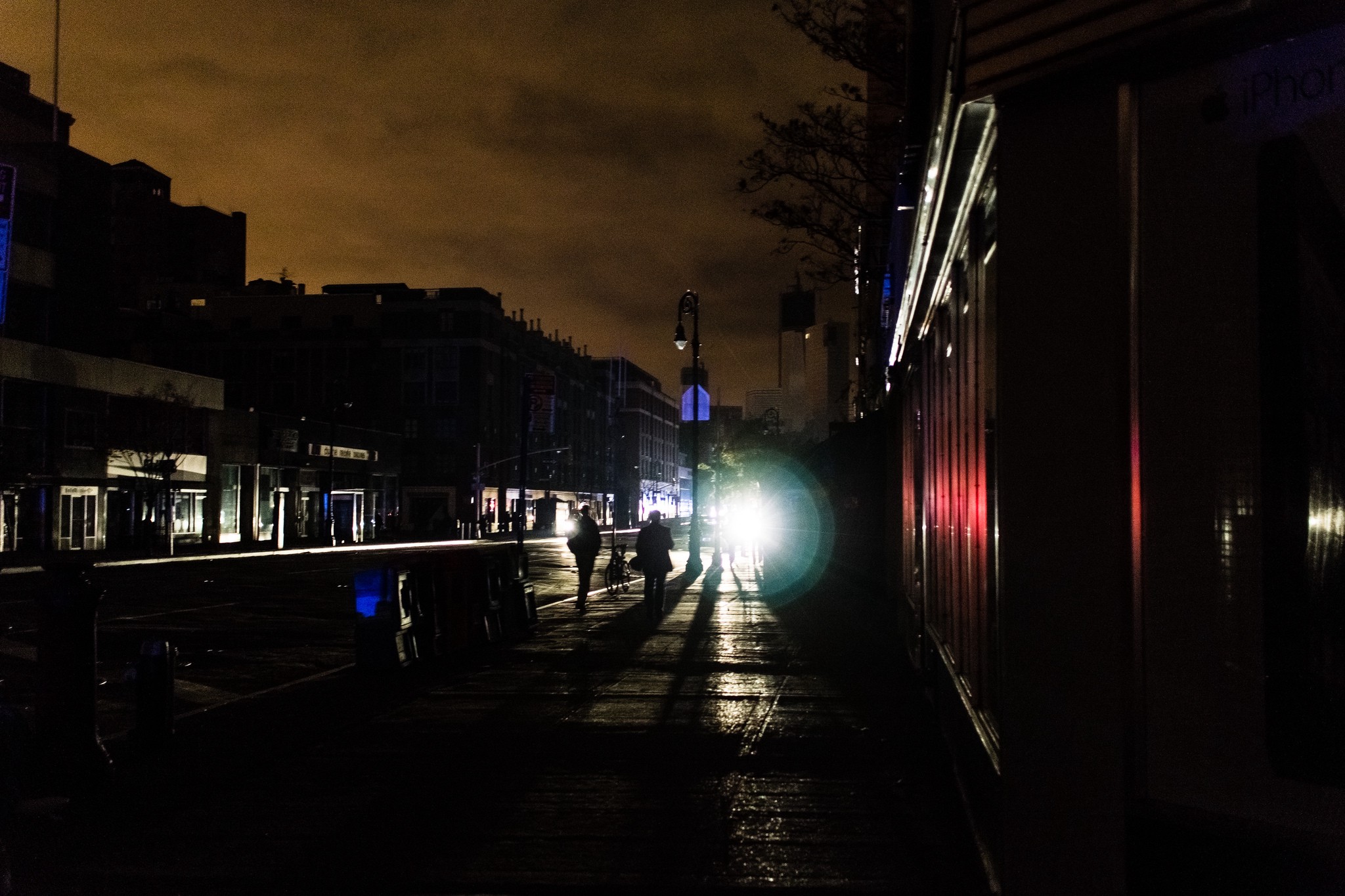
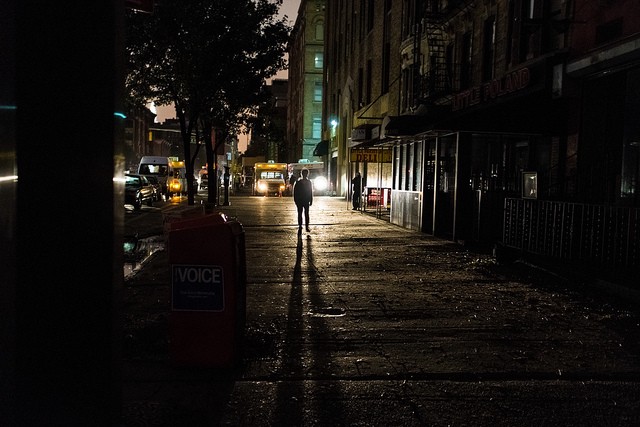
I accepted his offer. The four other passengers and the driver kindly ignored my silent tears as we drove. I exchanged email addresses with the guy who now had my book and to whom I owed this ride and 50 bucks. We went as far into Manhattan as we could before eventually being stopped by a cop with flares. The police had declared a moratorium on driving. “We’re worried people will get hit by cars.” I got out at 120th Street, started walking, and soon understood what he meant: so many people were on foot, trying to get home, that the sidewalks couldn’t contain everyone. The streets were full of pedestrians, walking very slowly, trying not to trip, fall into a pothole, or bump smack into a streetlight or one of the thousands of garbage cans, newspaper stands, or other random obstacles strewn across the city.
East Village during a blackout. (Photo: Dan Nguyen)
During those three hours of walking in almost total darkness to Magnolia Street in the West Village, I felt more lost than I have ever felt in my life. The night was moonless. No one I saw had a flashlight — every store that sold them had shuttered for fears of looting. I couldn’t see people until they were literally one or two feet in front of me. Street signs took minutes of scanning to find. There was nothing to do but keep walking. I remember pausing to catch my breath and realizing I was in Times Square, inky and lightless as the deepest woods I had ever camped in. It was beautiful and stupefying — like the truth I had been realizing and hiding from and reminded of by Krakauer’s book. The truth about my religion, and about myself. I just stood there looking at nothing for a long time. I had no fucking idea what to do with any of it.
I was in Times Square, inky and lightless as the deepest woods I had ever camped in. It was beautiful and stupefying — like the truth I had been hiding from.
When I arrived at my apartment on Magnolia Street, I walked up the three flights and let myself in the front door. I thought my husband might have been worried, and I pictured him rushing to the door to greet me. He was sitting on the fire escape, drinking a beer. He heard me come in, but didn’t get up. Through the light leaking in from stars and candles from our neighbors windows I saw him look my way, then turn back toward the street. I heard him sigh. He took another sip of his beer. I knew in that moment: he’s not relieved that I’m okay. He isn’t elated that I made it home, miraculously, on the craziest night either of us had ever experienced in Manhattan. He isn’t happy to see me. He wasn’t worried. He doesn’t love me either.
But this moment of truth would be like many others. I didn’t know what to do with it. I didn’t know a lot of things then. I didn’t know that one of the twelve women in my book club had never read anything about the “real” history of the L.D.S. church; my book choice would completely devastate her faith. She never attended church again after we met to discuss Under the Banner of Heaven. I didn’t know I would try so hard to keep believing for another two years before leaving Mormonism behind for good. I didn’t know it would take me another nine years and three children to leave a doomed marriage. Or that, fifteen years after reading Kraukauer’s book, I would get so much more out of having coffee in bed with my boyfriend on Sunday mornings that I ever did from attending three hours of church on the Sabbath. Or that life, without the rote answers, clear direction, and all-encompassing structure of Mormonism to guide me, would feel so much like stumbling around slowly in the dark, trying to find my way. And that this feeling might last the rest of my life.
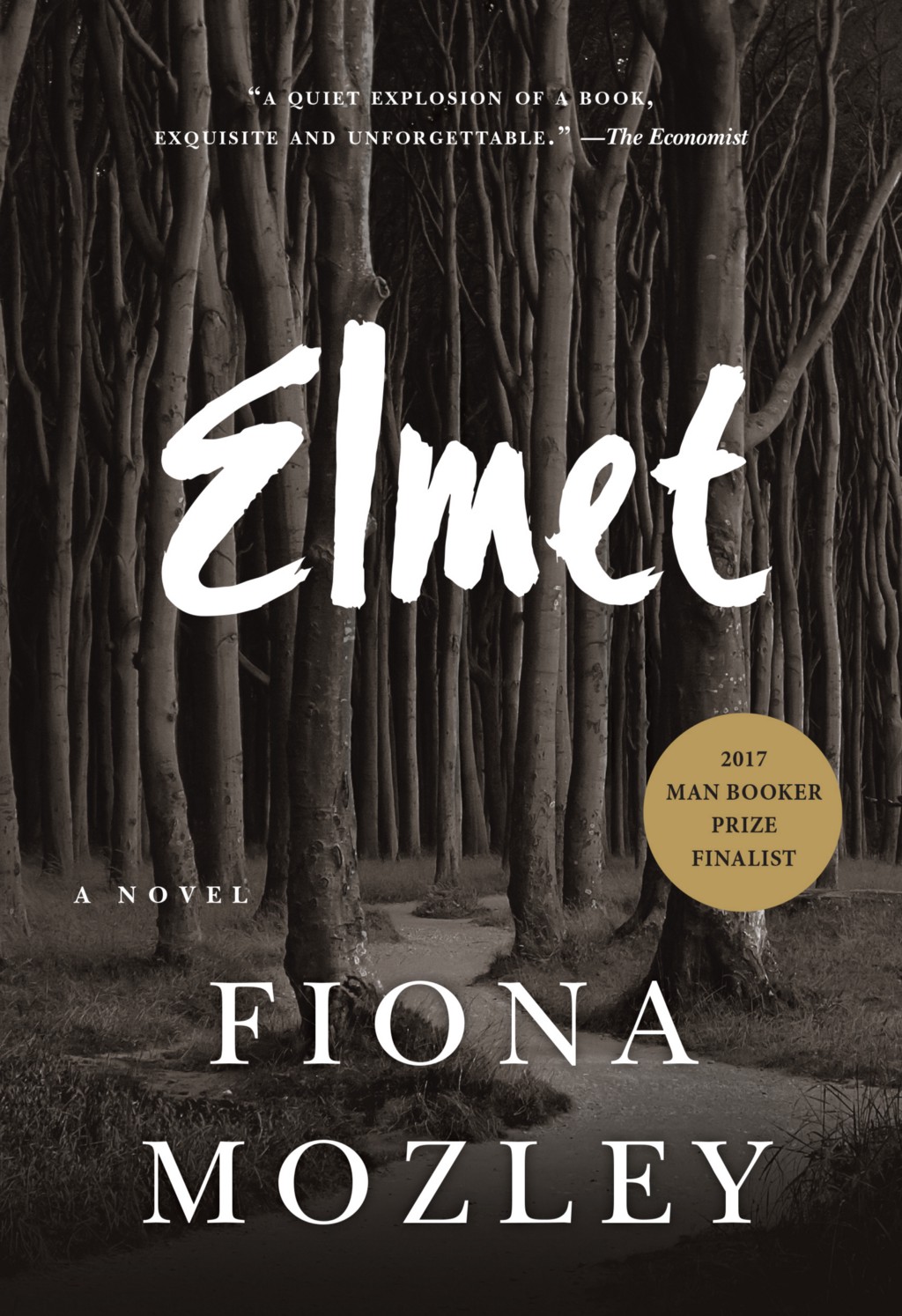
Fiona Mozley’s debut novel, Elmet, shortlisted for the Man Booker prize, is a firestorm of a story. Through carefully woven characters, Mozley spools a tale that simultaneously homes in on the dynamics of a family and assesses the systemic issues within a rural society.
Purchase the novel.
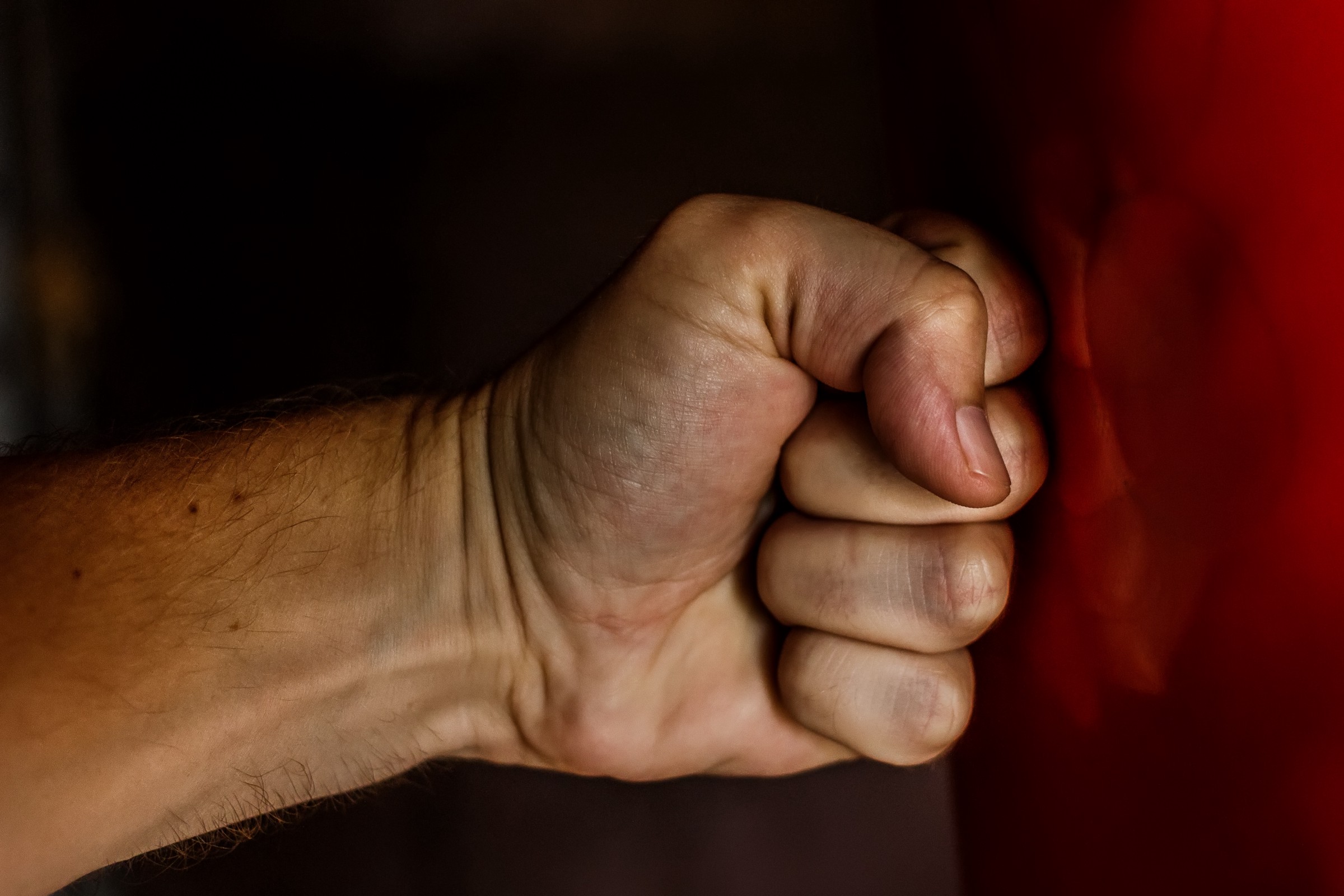
Teenagers Daniel and Cathy live with their father, John, in Northern England. John earns his living from his aggression and strength — he’s an undefeated bare-knuckle boxer — yet his relationship with his children is centered on tenderness. While the sensitive son and his tougher sister struggle with the that roles society has prescribed them, together, the family is carving out what seems like a sustainable life in a post-industrial, rural landscape. But when John begins to organize his neighbors to fight for better living standards, what begins as a property squabble with a landlord spirals out of control, affecting every aspect of the family’s life. Elmet is more than the story of a family fighting for its livelihood. It’s about the ways that childhood shapes who we become as adults, and how violence is embedded and perpetuated in our culture.
Mozley and I spoke over email about the dangers of a society that rewards aggression and functions on individual shame.
Rebecca Schuh: The book’s epigraph is perfect:
“Elmet was the last independent Celtic kingdom in England and originally stretched out over the vale of York…But even into the seventeenth century this narrow cleft and its side-ginnels, under the glaciated moors, were still a ‘badlands,’ a sanctuary for refugees from the law.”
Is it a quote you knew before you began the novel, or did you find it while working on the manuscript?
Fiona Mozley: I came to that particular Ted Hughes collection (Remains of Elmet) after I had nearly finished the novel, which was unfortunate as it is full of real gems that would have complemented the writing process perfectly. That said, the quotation — which is from the introductory material of the collection — was a convenient way to quickly explain to the reader why the novel is called Elmet. I didn’t want to discuss the ancient kingdom too much, as there was a danger of detracting from the story’s contemporary concerns, but the reason I gave it that title was to evoke a sense of antiquity; to remind the reader that the boundaries of the landscape have not always been the same. I wanted it to be a shadow; a ghost, if you like.
RS: The chapters of the book are structured in an interesting and particular way, with longer, conventional chapters interspersed with shorter, italicized vignettes. It creates an effective sense of duality. Can you describe the process of reaching that narrative structure?
FM: The structure of the book is the product of collaboration. I submitted it to my agent, Leslie Gardner, without any of the italicized vignettes in which Daniel travels north. She suggested to me that the manuscript might require something else to bind the novel together. She asked me to reflect on why Daniel, the narrator, wanted to tell this story. It was this that prompted me to write those extra chapters in the separate and, at times, indistinct time-zone. I am very glad that I did. She was right I think — they do bind the novel together. After Elmet found a publisher in the UK, my editor there also wanted me to accentuate those passages. I don’t mind being up-front about this collaboration, or admitting that the original idea to include those vignettes was not my own. Writing can be such a lonely task, and I think those rare moments of collaboration are something to be lauded rather than dismissed.
RS: You explore a really interesting side of the parent-child bond. Can you talk about what fascinates you about that particular relationship?
I am fascinated by interactions between people who are very different, whether those differences are in background, temperament, or even physicality.
FM: I am fascinated by interactions between people who are very different, whether those differences are in background, temperament, or even physicality. Families are interesting because, theoretically, there are profound similarities between their constituents. And yet deep differences can also emerge. In Elmet, the three characters of the central family — Daddy, Cathy and Daniel — are bound tightly by their love for one another, but they are also each confused by how the other two members of the family unit operate. For example, Daddy cannot understand how Daniel and Cathy can possibly survive in the world when, in terms of physicality, neither of them has anything like his strength or magnitude.
RS: Early on in the book, there’s a passage about Cathy and Daniel carrying childhood games into adulthood. I think this is a common phenomenon — how do you think childhood games shape the way adults interact?
FM: Childhood games are the building blocks of society (no pun intended). The manner in which we learn to interact with each other as children goes on to inform all sorts of behaviors as we get older. Schools can be hostile places, and children can be just as cruel as adults, but the playground can also be a place where children learn lessons in empathy and freedom of imagination. In Elmet, Daniel and Cathy find both these things to be true. Through their games, they learn about social relations and discrepancies in power. They also learn to explore these discrepancies, and to question what they see.
RS: I loved the line, “A naked body is just a naked body. Shame is only in beholding.” How did you develop the theme of shame throughout the novel?
FM: This passage is again about the impact of cultural representations and expectations on a person’s sense of self. We are told from a very early age that different parts of our body mean different things. Both Daniel and Cathy learn these lessons, although at the same time both of them find ways to undermine these expectations. I suppose you could also say that the sentence you have quoted was my attempt to present a sort of equivalent for the “tree falling in the woods” aphorism. A naked body alone in a room (or alone in a wood) is a very different thing from a naked body among a crowd. It’s all about situation and perception.
RS: At one point, Daniel says, “I had an inside sort of head. She had an outside sort of head.” I was intrigued by this description and the passage that followed — can you expand a little on that idea?
A naked body alone in a room is a very different thing from a naked body among a crowd.
FM: Daniel is a reader and also a writer, and as with many people who like to engross themselves in those activities, he spends more time reflecting on the world around him than inhabiting it. Cathy is the opposite. She is a person of action. She is more interested in that which is external, outside her own head, be it the copse and the countryside around the family’s house or the processes of building, digging, chopping wood, running, hunting. I wanted to establish a contrast between the intellectual and the physical.
RS: A friend of the siblings, Vivien, says, “A lot of men feel like they should be violent. They grow up seeing a violent life as something to aspire to.” This quote felt especially potent given the current context of male violence being revealed in the press. Can you talk more about that quote and what drives men to violence?
FM: Our cultures seem to be obsessed with violence. That’s an obvious thing to say, but it’s true. The kinds of aggression that are revealed in Elmet are informed entirely by this cultural obsession rather than by any lived experience. I am lucky in that I have had very little first-hand experience of violence; most of what I have seen has been mediated by the arts: by literature, theatre, film, the visual arts, or simply the news, which is, of course, authored like any of these other aforementioned media. Does this make my writing on the subject less authentic? Well, that’s a question for someone else to answer, but I do know that Elmet was, in part, an attempt to explore the deep impact that cultural representations of violence have on both men and women. Some of the male characters in the novel (though not all) find themselves behaving in a manner they think they should behave in. Likewise, Cathy — the narrator’s older sister — is haunted by images and stories of murdered women. As she sees her own body developing into that of a mature woman, her response is that of terror: terror at finding herself, likewise, the victim of violence.
In your question, I think perhaps you’re referring to the recent Hollywood scandals. Is it surprising that men treat women badly in Hollywood? Well, I have no experience whatsoever of that industry, but like most people I have watched a lot of Hollywood films. Are female characters treated badly in Hollywood films? Yes. So I guess there’s your answer.
RS: How did you go about representing a society in decline?
FM: That’s a tricky question. For one thing, I grew up and still live just north of the area I describe in Elmet, and I am not sure I would say it’s in decline! However, it’s certainly true that the novel focusses on the troubles faced by industrialized regions in the post-industrial era. Once the whole area was a forest, then it was a patchwork of fields and agrarian settlements, then mills and factories and coal mines sprang up, and the people who had worked the land were given jobs in these new industries. When the mills and factories and coal mines stopped being profitable they were closed, but these people couldn’t then return to the land. So where do they go? Politicians necessarily work on short-term problems and short-term solutions — that’s the nature of their jobs. But I think it’s also important to take a step back and consider the wide expanse of centuries that recline behind any given moment.
As well as revealing the conundrums posed by regions like Elmet, it was also my desire to touch on some possible solutions, even if those solutions don’t find a full form over the course of the narrative. There are moments of hope, of community spirit, of tenderness. Fundamentally, these are the solutions that these regions require. Yes, it’s true that “community spirit” and “tenderness” do not form coherent social or economic plans, but it’s sentiments such as these that must be at the foundation of any strategy. The biggest obstacle to the regeneration of certain neglected regions — both in the U.K. and possibly in the U.S.A. (though I admit I am not as informed about the situation there) — is that there doesn’t seem to be a genuine desire among policy-makers to consider the plights of these communities. And how do we solve that? Well, by trying to induce a bit of tenderness.
After my father’s death, I ended up in what I came to call “The Worst Apartment in Daytona.” Muggy and humid, the linoleum seethed with cockroaches at night. The stench of my next door neighbor’s weed seeped through the wall and, more than once, I watched from my front window as the parking lot filled with lights and sirens.
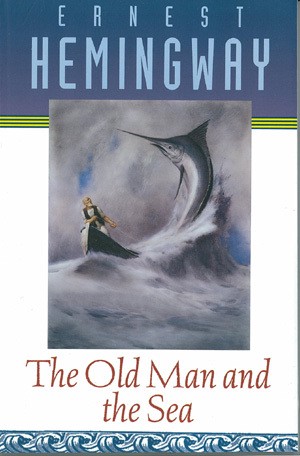
After six months of working nights as a certified nursing assistant and coming home to an apartment packed with the detritus of my former life, I ripped open the cardboard boxes of my dad’s books to seek refuge. He owned four copies of The Old Man and the Sea, one for each of our bookshelves. When I asked him why, he said the book was like a barometer. That with each new decade of his life, he would read the novel again, and it would tell him who he was. Every time he read it, he saw Santiago’s marlin as something different: his brothers’ deaths, loneliness, our failing horse farm, my mother’s mental illness.
My dad was one of those people who always seemed to have the right answer. I would have given anything to talk to him again. I always thought of things, like jokes or realizations, I wanted to text him, but thought the intimacy of reading his books would be more than I could endure. I was afraid reading the book again would be like having a conversation with him. I would want the novella to last forever and, unable to finish it, I would become stuck in my grief. The problem was, I didn’t want to grieve. I didn’t want any of this. I wanted my old life.
Reading The Old Man and the Sea again was like Santiago, the book’s protagonist, going out to fish: he hoped for a catch, sure, but he didn’t anticipate he would catch that behemoth marlin. He thought he would be back quickly. So did I. I didn’t understand grief before. I thought people who were dragged under the surface of it were weaker than me. But I soon found grief was a much bigger fish than it looked from a distance. Up close, it was a marlin the size of my boat, and I thought, like Santiago did, that either it would take me or I it; there was no in-between.
When I opened the book, a faded receipt fell out. It was for Gooding’s Supermarket in Silver Springs, FL, close to my parents’ horse farm. The date stamp at the top read 05/27/90, 39 days after I was born. My dad bought pineapple-orange-banana juice, pork ribs, and water. He was running the horse farm then. As I read I tried to imagine what he was thinking. Inexplicably, he underlined each instance of the word “urinated” and blued in the ‘o’ in whore. No other marginalia waited to clue me into his thoughts.
Who was my dad each time he read this book? If I hadn’t moved home from college when he was first diagnosed, I would hardly have known him. Before then, I knew him as any child knows a parent. He was an archetype, a stand-in, not a fleshed-out character. I knew a list of things he liked: planes, books, history, and cooking. I knew a rough outline of his life, with many spaces held by “I’ll tell you when you’re older.” In the four years between his diagnosis and his death, we spent hours, weeks, days together. He filled each of these moments with stories.
I didn’t understand grief before. I thought people who were dragged under the surface of it were weaker than me.
When he was a teenager, his favorite part of being a stock boy at Publix was getting there at 4 AM, before everyone else, and planting a lingering fart in the freezer. A few years later, when he was driving a delivery truck for Hughes Supply, he nearly got into a car accident with a pretty girl, because he was trying to impress her. Like most of his stories, this one was apocryphal. It included the truck catching air from an overpass and slamming down so hard that all the bathtubs in the back cracked. And for the girl he ran off the road, he tried to smile his way out of it. This got him a date at least, but she wasn’t the one.
The dad who arose from his stories wasn’t the same guy I knew as a kid. This version of my dad was a charmer and a goofball. He surfed and rode motorcycles. Once, a woman moved in with him because he cooked her coq au vin. That woman was later the classroom mom of my kindergarten. He taught me life was funny like that.
To this day, I don’t know everything about him. I only know his stories and the stories others told. But I do know enough that I can guess what the marlin was each time he read The Old Man and the Sea.
As a young man, the marlin was hope, lost to tragedy. With his brothers’ deaths — his younger brother Timmy killed in an accident involving a lawn mower when he was a little kid (seven, I think?), and his older brother John in a motorcycle accident while he was on shore leave from the Navy in the Keys. These two deaths shattered everything my dad believed about the world. Before that, he believed, as many people do, that bad things only happen to bad people. He read The Old Man and the Sea soon after that, and he saw Santiago’s fortunes rise and fall with the marlin. Santiago, who seemed virtuous and hard-working, lost everything. On his first reading of The Old Man and the Sea, my dad saw that life could be fickle and cruel.
In his mid-20s, my dad’s marlin was love. He once told me that women get over love easier than men, and I think he said that because of someone in his past, a woman who died in a car accident a week before he was going to propose. If he ever told me her name, I can’t remember it. Despite his love of storytelling, he kept certain memories guarded, especially the ones about death. Did he think he was guarding me? Did he think if I knew how dark the world could be that I’d lose hope like he did?
Did he think he was guarding me? Did he think if I knew how dark the world could be that I’d lose hope like he did?
He met my mom on a blind date when he was 28, and they were married six months later. She was a whirlwind of emotions. A storyteller, too, the words she wove around our lives elevated them to the level of myth. According to her, we were southern gentility. Her favorite book was Gone with the Wind. A champion equestrian and racehorse trainer, like my dad, she had struggled against grief: her brother shot himself in the head, and her father, a lauded neurosurgeon who mapped the brain with Wilder Penfield, mixed sleeping pills with wine and never woke up.
It makes sense that their love was tumultuous. My childhood is marked by arguments about inconsequential things. In particular, a spat about eggs benedict carried on for more than ten years. But the early days of their marriage, at least according to my mom’s and his stories, weren’t so contentious.
By the time my mom became pregnant with me three years into their marriage, she was running Arabian Nights Farm, one of whose horses had won the Arm and Hammer Classic. Before then, my dad had never ridden a horse. But while my mom was pregnant, and for a while after I was born, my dad, the city-boy surfer, ended up running the farm.
What was his marlin then, 39 days after I was born? Was the marlin me? Was it my life? He always said he wanted a better life for me than he had. I thought that meant the American Dream sort of thing: house, car, job, family. Except he had all that. Nonetheless, he seemed disappointed. He wanted to be a naval aviator. He wanted to go into space. He wanted to be a writer. He fell in love over and over again. His life hadn’t turned out the way he planned, but disappointing lives don’t make the kinds of stories he told.
What was his marlin then, 39 days after I was born? Was the marlin me? Was it my life?
Maybe when he said he wanted me to have a better life, he meant a life not full of grief. But that, I think, would be a bleak sentence. A life without grief would be a life without love.
My problem has always been that I fall in love with everything. That’s why I’m a writer. It gives me free rein to pursue, to obsess. My dad had the same problem. I believe he saw himself in me and that scared him. He wanted to protect me. That’s how I was his fish.
I discovered that one night with the rain sloshing down in The Worst Apartment’s flooded courtyard, and the more I thought, the more I understood that grief was not my fish. Just like I was my dad’s, he was mine: he spent years of his life amassing enough money so that I might have all the chances he didn’t. All the possibilities had hung before me. They were the shore at the other side of my grief, far away, but they were there.
I was living in a hellhole. I hated my job. I didn’t have family to turn to. I didn’t know where I was going. Everything he’d done for me, I was afraid that I had wasted it. He continued to work two years into his illness to make sure I went back to school. In those years, I commuted to class, dreamed of being a writer, and came home to watch as his condition worsened until he could no longer walk. I had just barely graduated before then, but I couldn’t work, because he needed me. Our savings dried up, and after he died, I struggled to find my place in the world. I was a caregiver for the elderly, because I couldn’t get another job. My dream of being a writer — of being anything other than in poverty, struggling paycheck to paycheck — seemed as far as a distant shore.
All the possibilities had hung before me. They were the shore at the other side of my grief, far away, but they were there.
It’s been almost four years since my dad died. I still think about him, but it’s starting to hurt less. I’m a teacher and a writer now, and I feel like I’m doing something, that all the heartache he accumulated in his life was not wasted on me.
Most importantly, I think he’d be proud that I didn’t let the marlin sink me. I passed the sharks, weathered the expanse of grief to find the shore…but unlike Santiago, I made it home with my marlin, because of it. Those last months of his life showed me I didn’t need to lose the thing I was struggling against — whether it was faith, love, grief, or disappointment — to make it back to shore.
My dad experienced so much grief and heartache, but in the end, even though he was dying, even though he was afraid, he was happy because he had me.
“I would do it all over again,” he said with tears in his eyes the last time he left the hospital. “The divorce, cancer, everything. Because if that never happened, you would’ve never become my friend.”
During my second fiction workshop at my MFA program, my professor asked us each to take turns bringing in a favorite short story. The idea was that everyone in the classroom would read and dissect each short story, and that being exposed to the different tastes of our classmates might help us gain a broadened perspective on what short fiction is able to do.
For my week, I chose “Children of the Sea” by the Haitian American writer Edwidge Danticat, from her National Book Award-nominated collection Krik? Krak! The story had been my favorite short story since I’d come across it in undergrad. It was a story that broke my heart; a story that, when I finished, I simply closed the book and had to take a moment to breathe. I was so moved by the story that first time that I wrote a blog entry about how much it inspired me. I can’t remember the exact words I used, but the entry amounted to both a realization and a promise: that the thing I most ached to do was write something that would make someone feel the way I felt after reading this piece; that no matter what else I might do in my life, I wanted at least to try, once, to move someone with my words.
So, no big deal. I was only bringing in the story that set me on the path towards being a writer.
I worried a little that this wouldn’t be considered a “well-read” choice. I wasn’t entirely sure what a well-read choice would be. I didn’t major in English in undergrad (I majored in psychology, and I don’t regret it). This means that, unlike many of my peers, I was never forced to read many “classic” canonized works — to this day I have yet to pick up any Hemingway, Steinbeck, Twain, Austen, most of the Russians. I wasn’t exposed to Joyce or Flannery O’Connor until after college. I read Wilde for the first time two years ago. I’ve read a single book by Faulkner, never finished Anna Karenina, and struggled through D.H. Lawrence’s Women in Love when I took it upon myself to read it. I don’t feel apologetic for this, but at the time, entering an MFA program — one I had been rejected from the first time I applied, no less — with this lack of knowledge meant that I felt a touch of imposter syndrome. Unlike my peers, some of whom confided to me that they felt the assignments were just a rehash of what they’d already learned in undergrad, I had mostly only read contemporary literature, novels I picked up in bookstores from the “New Releases” shelf. While I read a lot, the books I chose weren’t exactly what I figured those students who studied literature or writing seriously read during their academic years.
But when it came to Danticat, I was confident that the story’s emotional power would make clear why I’d chosen it as my favorite. “Children of the Sea,” if you haven’t read it, is written in epistolary form, told entirely in letters ostensibly traded by two young lovers in during a period of dictatorship and political unrest in Haitian history. Danticat’s language is lush, brimming with emotion, evocative imagery, and lyricism. It’s an unbearably sad story, highlighting the helplessness yet fragile hope of the lovers in the face of political machinations beyond their control.
The story was too maudlin, too emotional. They felt the love was contrived. They thought the metaphors were overwrought. They felt the tragedy was unconvincing.
The other workshop students intimidated me. Unlike me, they were mostly in their second year; unlike me, they were almost all white. They were opinionated and sure of themselves, having had an extra year to grow confident in their ideas, I guess. They were also less welcoming than the people I had met in my own cohort, and so, aside from a couple of exceptions, I hadn’t become friendly with them.
I don’t recall the discussion of the story being governed by workshop rules; that is, I’m certain I was allowed to speak and participate in the conversation. But, either because I was shy or because I was anxious, I don’t remember offering my thoughts on the story as it was being discussed, though I’m sure I was asked by the professor to give a brief introduction. The other students, never shy to share their thoughts, immediately jumped in. I can’t remember exactly how they phrased their criticisms, but I remember the gist: the story was too maudlin, too emotional. They felt the love was contrived. They disliked the form. They thought the metaphors were overwrought. They felt the tragedy was unconvincing. They felt it was the work of a young writer, an inexperienced one — certainly one they’d never heard of. (Danticat was indeed young at the time, and this was her first collection, but she had won several awards by that point, including the MacArthur Genius Award only months prior.) One by one, they tore the story to shreds. They even ripped apart the story’s last two lines: “From here, I cannot even see the sea. Behind these mountains there are more mountains and more black butterflies still and a sea that is endless like my love for you.” It was a quote I loved and had memorized and put in my email signature all through college, but they called it a vague and meaningless metaphor.
Not a single person liked it. I shrunk in my seat in embarrassment and shame. I remember trying to justify my choice in bringing in the story. “Maybe it’s because I’m a young writer too,” I said quietly. “Maybe that’s why I didn’t see all these flaws. Maybe that’s why it speaks to me.”
At break, I stood outside the building with some other people, including a white guy who was the only second-year student I was friends with. He looked at my face, took a drag from his cigarette, and then gently admonished me: “Don’t apologize for what you like. You like what you like. Stand by it.” I nodded, grateful for his kindness, but I noticed that he did not say he liked the story. I left that class burning with humiliation and self-doubt. Perhaps I simply didn’t know what good writing was, I thought. Perhaps I was so under-read that I had no sense of what made a story successful, what made it a failure, what was too overwrought, and what was elegant in its simplicity. I had embarrassed myself in front of my peers, outed myself as someone who had terrible taste in literature, someone who couldn’t determine a good sentence from a bad one. I went home that day second-guessing myself, wondering if I would ever be able to write a good piece of fiction given that my own taste in writing was so clearly off.
It was only several years later, when I was already out of graduate school and I began meeting other writers of color, that I discovered that not only did other writers know of Edwidge Danticat, but that she was beloved. I watched other people’s eyes light up the way mine did when they talked about her work, or become bashful and shy like I did when meeting her at a signing. I listened to these writers of color — many of them descended from immigrants like me; many of them women, like me — talk at length about how Danticat’s work served as a model and inspiration to them. The longing, the inherited pain, the oral storytelling quality, the poetry, the magic, the duende — all of the things about Danticat’s work that speak to me were qualities that also spoke to these people. For the first time, I began to realize that it wasn’t that I’d had bad taste — I’d simply been privy to the way a white audience reads something when it isn’t intended for them, when it isn’t rooted in the language and cues that they have valued as “good.”
I began to realize that it wasn’t that I’d had bad taste — I’d simply been privy to the way a white audience reads something when it isn’t intended for them.
It pains me now, to think of the years in between that workshop and when I realized other people loved Danticat. Those were years I spent trying to excise the emotions from my work, to wrestle my work into something palatable in a conventional (read: white) way. I read Carver and tried to figure out if I could ever be as sparse or economical as he was. I read the pithy, quirky, ironic stories of my peers and wondered if I could somehow become more wry, more darkly funny, or else more serious and filled with restrained gravitas like the canonical writers some of them looked up to. This isn’t to say that there weren’t things I had to improve upon — I was a young writer and I was prone to using too many metaphors, towards prose that veered towards purple. But my crisis was an existential one, where I wanted to be a different writer than I was, where I wanted to care less about being moved — or perhaps I wanted to be moved in a different way, the “right” way.
This illustrates, I think, the danger of a limited canon not just for readers, but also for young writers trying to find out how best to express the heart of who they are. It isn’t just about having mirrors, where readers can see themselves reflected in literature, and windows, where readers can understand other people’s experience through literature (though, of course, that’s a big part of the argument for diversity and inclusivity). It’s also about offering different models of work. What gets published, what’s deemed worthy — these are things selected by gatekeepers whose standards of what passes for “good” are rooted in their own worldview, histories, and traditions. Though this is starting to change, these gatekeepers still overwhelmingly represent the dominant culture. When they deem something “not good” instead of recognizing that they simply don’t understand it because it hails from a different literary and cultural tradition, a cycle is perpetuated where the same “acceptable” work gets made over and over again — and anything else is derided. Those in the margins are left questioning the validity of their work and stifling their impulses as artists, or else (and I am grateful for the folks who do this) defiantly making the work anyway, with the confidence that their work is meaningful, despite what those in power might say — and despite the fact that they may never be rewarded or recognized.
Sometimes, a marginalized writer breaks through; Edwidge Danticat, of course, has been lauded by gatekeepers, as is evident from her many awards. Still, a few token writers will never be enough to break people out of the mindset that this stuff isn’t worthy. I do wonder if my classmates might have looked upon the story differently if they’d known of Danticat’s many achievements, though. I wonder if that, in some perverse sense, would have “legitimized” her. I think it would.
I’ve reread “Children of the Sea” many times since that day in that workshop, and have even taught it to students, and while I can recognize that it’s an imperfect short story, it still moves me the way it did all those years ago, before I even knew I would become a writer. I proudly stand by my love for it, and to this day, Danticat remains one of my most cherished influences. Had I not found my community, people who confirmed what I had known in my heart — that Danticat and writers like her speak to people like me, and that alone confirms their merit — I might have wasted more time trying to become a writer that I was not. I might have continued in vain to write towards what I thought those white readers felt was “good writing” in an effort to please and pander to them. I might have given up on writing altogether, uncertain of my own discernment, discouraged by ability to conform. I’m lucky that I did not do any of those things. I’m lucky that I found the people for whom Danticat’s stories were meant, because now when I write, I too, in turn, write for them.
Double Take is a literary criticism series in which two readers tackle a book’s innermost themes, successes, failures, trappings, and surprises. In this edition, Heather Scott Partington and Ian MacAllen explore Christine Angot’s memoir-inflected novel, Incest.
The central relationship in Christine Angot’s autobiographical novel Incest, translated from the French, is not an incestuous one. It’s a brief, intense love affair between the narrator (also “Christine Angot”) and another woman—an affair that, as the book opens, has fallen apart. But, as one might expect from a book literally titled Incest, the specter of incest—Christine’s earlier sexual relationship with her father—hangs over the narrator’s experience of love, grief, motherhood, illness, and trauma. It’s a provocative book from a consistently provocative (though rarely translated) writer. Our readers ask: is there deeper value beyond the shock? And in what sense is sex, and incest, kind of like writing?
Heather Scott Partington: From the start, I was struck by Angot’s direct, fragmentary sentences. In the beginning, when she’s introducing her romantic obsession, I think it works particularly well to convey her desperation. “Even at this very moment,” she writes, “Have to stop myself from calling her… I call back to say, ‘above all, don’t call me again.” She binds the idea of homosexuality as a choice with her inability to gracefully let the relationship go. She says, “I was homosexual for three months… I was homosexual the moment I saw her.” At first I wondered if this posture on homosexuality — as optional, binary — was intended for shock value. But after reading the entire novel, I don’t think this is a piece of work that gets its value just from jarring its reader. (Though it’s certainly intended to provoke.) Incest is a raw examination of desire and obsession, but I think to reduce it to words like brave would undercut the complexity of Angot’s work.
What was your initial reaction, Ian? Do you think Angot intends her reader to recoil, a bit, from her approach and subject matter?
Ian MacAllen: My first thought was that this book was one about frustration. It manifests itself in multiple ways. Creatively, she is frustrated, but there is also constant tension between concepts like sex and love between both abusive and healthy relationships. There is frustration in expression of these emotions and the cognitive dissonance required to process them. She says, “‘Everything can always be mashed together’ could have been my motto,” and I think that gets to the heart of these conflicts. I’m not sure I see her view of homosexuality as a literal choice, but moments where she is allowing a truth to emerge, one that must coexist with other desires. I see that as an extension of her frustrations as well as part of her recognition that everything is linked.
HSP: I saw it less as frustration and more as an innate inability to change who she is. For me, her true self keeps rising to the surface of both her relationship and her sentences. The “mashing together” gave this text interesting layers. While the narrator reminded the reader continually of the limited term of this relationship, she is unable to leave her love or escape her stylistic tendencies. It is worth noting that Angot rejects interpretation, rejects the idea of readers codifying the narrator’s beliefs or identity in any way, writing, “To take this book as a shit piece of testimony will be an act of sabotage, but you’ll do it. It screws up a woman’s life, it screws up a writer’s life, but, as they say, it doesn’t matter.”
In fact, when the text becomes metacognitive, when — in the second half — she begins to comment on her choices as a writer and try to make different ones, she seems to fall back into the same patterns of layering the story back into itself. She calls it “a miracle of logical disorganization.” I agree with you particularly about the way she links healthy and unhealthy relationships, deliberately crossing a reader’s boundaries.
IM: She feels immutable in that way — and overall there wasn’t much of a change in her through the duration of the narrative other than coming to terms with that inflexibility. I’m not sure I agree that she is actually rejecting interpretation, though. She says, “I associate things others don’t associate, I bring together things that don’t fit together… I highlight opposites.” To consider those relationships demands a level of interpretation. Consider the examples she cites like “blonde-bitch” or “money-hate.” These are fairly abstract associations. Also, the irony is that in a translated work, the whole thing is to some extent already interpreted for us by the translator. As readers of the English, we don’t have the opportunity to read Angot without a level of interpretation imposed on the text. There is no pure text here, unless we go back to the original French.
Angot is being most truthful when she is discussing her choices as a writer. On one level, I see this book as a treatise on writing itself.
She is struggling to organize the world — or her interpretation of the world. This is the challenge of any writer, and that’s why talking about sex can be so relevant. So much of sex is having control. A writer has absolute control, something that seems to have been lost through abuse, but that she is struggling to recapture through writing. I think this is partly why she includes the definitions of incest and narcissism and desire to seize control of this language — like when she gives a concrete and specific definition of incest:
We call incest a sexual relation without force or constraint between blood relatives to a degree prohibited by the laws of each society. In almost all societies, except for a few cases including Egyptian Pharaohs or the ancient nobility of Hawaii, incest has always been severely chastised then prohibited. That is why it is so often kept secret and experienced as a tragedy by those who engage in it.
So much of sex is having control. A writer has absolute control, something that seems to have been lost through abuse, but that she is struggling to recapture through writing.
HSP: I found myself thinking about the French a lot, too. Many of her linguistic tricks seemed like near-puns (my French is pretty rusty, though). I also had the feeling that a lot of this worked on a different level in the original text.
Again, here we see how two different readers approach a narrative differently. I read the passage you cite — about highlighting opposites — as indicative of how she places objects together without analysis. To me, the novel resists interpretation so stubbornly. Angot underscores this with her flat affect when writing of difficult or taboo circumstances. The narrator’s paired opposites represented a microcosm for how she tells this story. She juxtaposes dissimilar things to provoke. I suppose it’s more accurate to say she juxtaposes in such a way that forces her reader to hold two opposing thoughts at the same time — particularly the idea of parent/child relationships with sexual relationships. This brings me back to my original thought:
I wonder if Angot’s desire to be provocative supersedes the story she wants to tell. She definitely makes me question whether there are some topics that the human mind cannot (and, for reasons of survival, should not) compute.
She definitely makes me question whether there are some topics that the human mind cannot (and, for reasons of survival, should not) compute.
What do you make of this book being labeled a novel, rather than nonfiction? Does genre affect the way you read the work?
IM: I agree; Angot is reaching to be provocative. You don’t title a book Incest without looking to get a rise out of people. There are definitely moments where she the language is designed to incite like when she says to “make the vagina’s wetness go into the anus” or “I move the cock, I see the spot. I penetrate. My fingers become a cock.” Its tapping into a kind of raw emotion as a catalyst to feel. Yet there are these other moments — like when she reflects on the Barbie doll put under the tree — that feel much more controlled. It’s another example, as you say, of two oppositional ideas being forced upon the reader. There is this unabashed discussion of sex acts and desire, and she wants us to have this sense of sweet loving coziness of family, but I take it as Angot pushing us towards discomfort rather than the impossibility of contemplation.
Genre is a curiosity. The idea of a novel as a genre for a bookstore means something very different than it does for the author of a book. I can’t help but think of another French writer, Adrien Bosc, who’s “novel” Constellation was translated last year. Americans are more thoughtful of the distinctions between fiction and nonfiction, while in French the flexibility always existed. I’m paraphrasing what Bosc said, the moment information is organized by chapters, there is a kind of fiction that exists. In Angot’s case, even if this was based on memoir, there is an inclination to fictionalize due to the nature of the material. Also, she insists that “I don’t have the right to use real names, the lawyer has forbidden it, not even real initials.”
You don’t title a book ‘Incest’ without looking to get a rise out of people.
If we consider this as nonfiction, albeit nonfiction as a metaphor, it strikes me that she is making linkages between unconnected ideas, the mashing up she talks about. Also in context to sexual abuse, that writing is about power and vulnerability. Do you think I’m reading too much into this?
HSP: I’m less concerned with trying to figure out how true something is than I am trying to figure out how I understand it or experience it while reading, anyway, since that’s the only part of this I control. The author writes it down, choosing details and edits certain things out, so even a memoir becomes a representation. That goes to what Bosc is saying with his ideas about imposing a narrative structure. Angot seems to want to muddy things — her deliberate choice of, conflation of, and emphasis on names from her actual life draws attention to the fact that readers look for autobiographical connections, or truth. In the passage you mention, she calls her own work “serious invasion of the privacy of the author’s father, as she recounts their incestuous relations in precise detail.” She wants to push the genre button, too. Pushing readers toward autobiographical details feels like it’s in line with how she wants to shock.
I don’t think you’re reading too much into it. Sex is transactional, and so too is writing. Writing is manipulative; asking a reader to feel things while their eyes look at words on a page. There’s power changing hands in both scenarios. Both involve vulnerability, and incest is a perversion of healthy boundaries. It makes sense to me Angot wants to push boundaries in her writing, too. Angot’s mimetic style forces a reader to be in her narrator’s head and I would argue it’s not a comfortable space — but that she doesn’t want it to be. She says, “my mental structure is incestuous… I associate things others don’t associate” and “I suffer from hypermesia, too strong a memory.” She wants us to feel uncomfortable, to feel too much. She wants us to feel what her narrator feels.
Sex is transactional, and so too is writing. Both involve vulnerability, and incest is a perversion of healthy boundaries.
I love when she writes, “writing is not choosing your narrative. But taking it, into your arms, and putting it calmly down on the page, as calmly as possible, as accurately as possible.” There’s a sense that this story was unavoidable, that she had to tell it this way, that even if she’s, as she says earlier, “touching garbage,” she has to treat this story with accuracy. Which, of course, I see takes me right back into discussions of genre, fictionalization, truth.
This book is an infinite loop of connected ideas.
IM: To the success or failure of the book, it’s worth considering we are now almost two decades after it was first published in the French and many of the topics she confronts don’t seem nearly as shocking or abnormal. The book was first published in France in 1999, the same year same-sex civil unions were legalized. Now marriage equality is rule of law both in France and the United States. The English translation is entering into a very different world than Angot’s original text. I think the internet has changed our perception also by making available and normalizing a great number of sexual fantasies, inadvertently devaluing the original shock value of certain taboos.
I agree — juxtaposition is where the novel wants to thrive. The book spoke to me as a metaphor of creative process, the frustration of that experience. The idea of the author becoming her own obstacle to the story could even be intentional. I could understand Angot making some conscious choice to disrupt the narrative to convey the irritations and limits of creative expression.
The internet has changed our perception by normalizing a great number of sexual fantasies, inadvertently devaluing the original shock value of certain taboos.
HSP: Incest is certainly always going to be taboo (for good biological reason, right?) The other topics she touches on, less so. I think it will still have appeal in 2017 to readers who want their assumptions challenged, or for whom traditional notions of family, romance, or story don’t hold enough appeal. I am not that reader, though, and Angot doesn’t do enough innovation in how she tells the story to make this a captivating thought-journey. It disturbed me. Even knowing that was the aim of the author, it’s not one I’m likely to pick up again or recommend. The point at which I start to feel manipulated as the reader is usually the point when I check out. This one felt too contrived, too constructed in service of a response.
IM: Every author is manipulative to some extent, but the magic happens when authors trick us into believing we aren’t being manipulated. Maybe the problem with this text is with the voice. The attempt to be provocative is disrupting the ability to mask the manipulation, and so we are conscious of these efforts and put off by it.
DON’T MISS OUT
Sign up for our newsletter to get submission announcements and stay on top of our best work.
YOUR INBOX IS LIT
Enjoy strange, diverting work from The Commuter on Mondays, absorbing fiction from Recommended Reading on Wednesdays, and a roundup of our best work of the week on Fridays. Personalize your subscription preferences here.