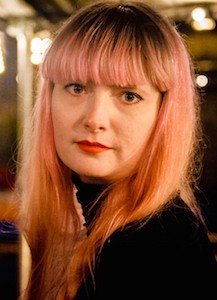
Liska Jacobs Knows a Hot Mess When She Sees One

Get ready to know Liska Jacobs’s name. Her debut novel, Catalina — the first of two from MCD Books, FSG’s new experimental venture — is the kind of drunken, mascara-smeared bender that inspires thinkpieces, fandom, and heated arguments at cocktail parties. Jacobs’s heroine begins the novel on the edge of disaster, and she never looks back. Dumped by her married boss/boyfriend, Elsa snatches a purse full of pills and heads out to do some damage while she licks her wounds. Through the breakups of both friends and lovers, Jacobs explores the art world’s influence, the fantasy of southern California, and how we think about wanting.

Elsa’s voice has echoes of the strong, tragically beautiful protagonists of literature who’ve come before her, but Jacobs’s work stands alone, an insightful and sexy glimpse into the tragedies of aging and the misconceptions of youth. Jacobs and I caught up over email recently about self-destructive characters trapped in their messy identities, and the most enthralling fuck ups in literature.


Heather Scott Partington: You have done such a beautiful job weaving art and museum work into the narrative. What do you remember most about your time at The Getty? What do you think most people would be surprised to know about that world?

Liska Jacobs: Thank you! I worked at the Getty Research Institute as a Special Collections Library Assistant for five years, beginning as a work-study student while finishing up my undergraduate degree. I was very lucky, this was in 2008, right at the beginning of the recession.

The Getty is such a gorgeous place, perched up on a hill, overlooking West Los Angeles and the 405. What I remember most was that on a clear day you could see the sun reflecting on the swells in the Santa Monica Bay — you could see Catalina too. But because it’s so removed I also remember a feeling of isolation, of loneliness. It’s where I first realized that when you look at something beautiful, a distance is created between what it is you’re viewing and yourself. In Catalina, Elsa is a lot like the Getty, or one of the art pieces in the galleries. She’s beautiful and that makes her something to look at, something to project onto, but also makes her very alone.

What I eventually found to be surprising was that working at the Getty was a job like any other. When I started there I was very young, I thought the Getty was going to be it for me. A place I could work until retiring — just surrounded by art and beauty and like-minded people. But the reality was timecards, and sick days, and cutbacks, and end of month reports. It was important in Catalina to show Elsa coming to terms with that same kind of disillusionment — that fantasy never quite matches the reality.

HSP: What was it about Catalina that made you want to set your novel there?

LJ: Today it was triple digits in Pasadena, where I live, so I retreated to the west side. I’m working from the LMU library, which is on a hill facing the bay and the mountains. I can see Catalina from here. I’ve lost count of how many times I’ve been able to make out that island from somewhere in Los Angeles. It’s always there, on the horizon, this funny little lump of land just off the coast. Half of it is this classic California tourist trap, selling the idea of “paradise,” and the other half is this rugged natural landscape.

You really can’t ask for a better setting than one that can reflect that kind of duality, and the tension created by it.

I felt like it was this perfect compact version of Los Angeles. At the heart of the city you have Hollywood, which perpetuates this fantasy world, how relationships should be, what we should want, and surrounding us is the Santa Monica Mountains, the Los Angeles National Forest, and the Santa Monica Bay — the real Southern California. In the book, you have a group of friends who haven’t seen each other in five years. They’re all different people now, they have contrasting wants and needs — but they’re still pretending nothing has changed. You really can’t ask for a better setting than one that can reflect that kind of duality, and the tension created by it.

Support Electric Lit: Become a Member!

HSP: Elsa follows a long tradition of protagonists who make bad decisions, and she’s a beautiful mess. Who are your favorite literary fuckups?

LJ: Such a great question. My favorite literary fuckups have to be Joan Didion’s Maria Wyeth, Elena Ferrante’s Olga, and Deborah Levy’s Kitty Finch. Oh! And of course Sylvia Plath’s Esther Greenwood.

But I’m probably most influenced by Jean Rhys’s protagonists. Specifically, for this book, Sasha Jensen in Good Morning Midnight. Like Sasha, Elsa is self-destructive and spiraling. When I first started writing Catalina I thought maybe I would do an updated version of Sasha’s story. I had thought times have changed, Elsa could have a happy ending, or at least a liberating moment. But as I wrote and rewrote the ending I had to accept that female characters like Elsa, like Sasha — women who are pissed off and calamitous, who are labeled “unlikeable” — get punished. Maybe it’s a societal or cultural thing, I don’t know. But it was a pretty depressing realization. I mean Good Morning Midnight came out in 1939, and nothing’s changed? Women still don’t have the luxury to fuck up, there’s no girls will be girls for us. What a bummer.

I had to accept that female characters like Elsa, like Sasha — women who are pissed off and calamitous, who are labeled “unlikeable” — get punished.

HSP: Elsa hits rock bottom early, and then spends some time down there. How did you keep narrative tension when a character began the story at such a desperate point? How did you maintain a sense of forward propulsion?

LJ: Ha! You’re right. From the first sentence Elsa is ordering up a pitcher of Bloody Marys just for herself, and it doesn’t take long for her to start popping pills. Part of it is knowing nothing good can come from this — someone drinking and doing drugs and having sex will have to hit rock bottom.

Why Are Friendships Between Teen Girls So Radioactive?

But that’s only a fraction of the tension. It really comes down to the other characters. There’s history between Elsa and all of them. With Charly, they’re old friends — best friends — and upon reconnecting Elsa almost immediately sees a crack in Charly’s perfect world. Same with Robby, who is Elsa’s ex-husband. That word is so charged in and of itself. Then add in his new girlfriend Jane, who’s a fitness fanatic and know-it-all, and smiles a bit too much at Tom (the new factor in the “old-friends” equation) — and it becomes a powder keg. Elsa is on a private bender, and she will inevitably be the spark. I think it’s sort of like watching a train wreck in slow motion. You can’t look away.

HSP: Catalina captures the push-pull of young marriage, and the way that young relationships don’t necessarily grow with us. Elsa tells herself, “Drink and be content. This can be enough for you, too… Give it time, just wait.” Can you talk about how you worked this into Catalina? How it shaped Elsa?

LJ: Poor Elsa and Robby. They really aren’t suited. In many ways the roles we have for men are just as unfair as the ones we give women. Robby, who thinks of himself as a savior, a good guy, sees Elsa and fits her into the box of damsel. But Elsa is no damsel (or she sure as hell will not let anyone treat her as one). It’s a recipe for disaster! For them both. When we’re young we try on certain identities as a way of finding ourselves. It puts any relationships — romantic or otherwise — in peril from the start. And it’s hard to write that kind of truth without bleeding into melodrama, or to be tempted into clichés.

When we’re young we try on certain identities as a way of finding ourselves. It puts any relationships — romantic or otherwise — in peril from the start.

Really, Catalina came about because of Elsa. I wanted to write a female character who was pissed off and disillusioned. After leaving the Getty I sat down and her voice sort of tumbled out. I kept writing to find out why she was hurting.

HSP: It’s not just romantic relationships from Elsa’s past that needle her. Catalina is one of the more frank examinations of female friendship, of the way we can outgrow each other and change without knowing what to do. Elsa says, “I think over our friendship. Back in the beginning, in those dusty orchard days, I’d swear we were on the same page…” What drew you to exploring these relationships and breakups?

LJ: Recently I was talking with a friend about why some break-ups hurt more than others, and we agreed that when someone teaches you something they sort of become part of your identity, which makes it a much harder break-up. This is what’s happening with Elsa, she’s reeling after an affair ends with her boss, Eric, who is an intellectual and well-known curator. He’s really gotten under her skin.

And this is where female friendships come in: they start under the skin, and only go deeper from there. Which makes them such dangerous and precious things. When they go wrong they are profoundly painful, and writing about it requires a tremendous amount of honesty, mostly about yourself. I have a twin sister and a little sister, and we’re close. But if you look at the span of our relationship there are dark spots that all three of us pretend aren’t there. I think we’re starting to see more realistic portrayals of female friendship — Elena Ferrante’s Neapolitan novels come to mind. Hopefully we’ll see more.

HSP: Catalina switches point of view several times, which has the effect of Elsa seeing outside of herself. When she writes of her proposal, the propulsion toward marriage, she says, “You’re in the passenger seat and there’s traffic and he slips the ring on your finger and you betray yourself. You say yes, believing you love him because you want to love him.” Can you talk a little bit about your approach to point of view and narration?

LJ: I’m so glad you asked this. Elsa is going through an identity crisis. It’s why she gives a false name to the hotel bellboy Rex, why she gives another to the television producer Rafa — and why she can imagine that there’s a version of herself still in New York.

But her crisis is also about memory, which works two-fold. Elsa will replay a memory and judge what she said or did, or if the memory is painful it’s easier for her to put distance between herself and the incident. It’s something I think we all do. So in Catalina, Elsa slips into second-person when she’s uncomfortable, but also because she’s searching for the true version of herself. Is she unlikeable? Is she a whore? Is she at fault, or the victim? Because this is a first-person and a voice-driven novel, I thought it was important to have this reflected in the writing. I also think memory is murky at best, somewhere between truth and fiction, and switching to second-person blurred that line even more.

I also think memory is murky at best, somewhere between truth and fiction.

HSP: My favorite line in the novel comes at the end of a sad story Tom shares, and he says, “That’s just how it is, baby… The worst kind of want is to survive, and we all have that.” What does this mean to you?

LJ: In Catalina all the characters want things. Really it’s a whole book about wanting. What I think Tom is saying is that the worst kind of want is the kind that makes us stay in impossible situations. I don’t know if it’s cultural or a human thing, but we always want more and are willing to give up so many things to get it.

Charly and Jared, Robby and Jane, and Tom too — they were all there from the beginning. It was important that none of them feel like the villain or the classic foil character. What I wanted to do was write a story where the tragedy wasn’t just because of one person’s actions — each one of them is trapped by the identity they’re ascribing to, and what they think they want.

HSP: Was this novel something you workshopped during your time at UC Riverside’s MFA? If so, how did you retain so much of your own voice and perspective? This novel doesn’t feel over-workshopped.

LJ: I’m so glad you think so! I came into the UCRPD program with Catalina as a novella, and showed it to Mary Otis in my first workshop. I hadn’t shown it to anyone up until then, and honestly if she had said there was nothing there I would have been so discouraged I would probably have chucked it. That’s something I really appreciate about the UCRPD program, every single professor I worked with treated me and my work with respect. When you have that kind of support as a writer you can really cut loose. I felt I could push Elsa and the other characters further and further, eventually fleshing out the novel. I owe that program a hell of a lot.

I think part of the reason I was able to retain my voice is because the story is so voice-driven. I know who Elsa is, what she would and wouldn’t do, and I know the other characters just as well. Half the fun was getting all them into a room and seeing what happened. It’s probably why I stuck them on a boat!

HSP: Catalina is the first in a series, correct? Can you talk about how it’s been different to write the second book? Is that something you’ve started already?

LJ: I think the main difference is time. With this next book there are set deadlines which I’m required to meet, but I think that actually energizes me. It helps that I’m really excited about this next book. I’ve even managed to bang out a first draft!

With Catalina I had all the time in the world. From novella to when Catalina comes out Nov 7th, it will have been five years. This next book isn’t a sequel per se, but I think anyone who loves Catalina will love it too.

HSP: What’s the best thing you’ve read lately?

LJ: Oh, this is a tough one. I’ve been reading a lot, mostly for essays and lists to accompany the publication of Catalina. How about I name two? I was floored by Richard Lange’s short story collection Dead Boys. He hits the right note between hardboiled Los Angeles and real human truth. And Rachel Khong’s Goodbye Vitamin, which I think should be a California classic. Her descriptions of traveling the length of the state are understated and gorgeous.
The 7 Scariest Little Girls in Literature

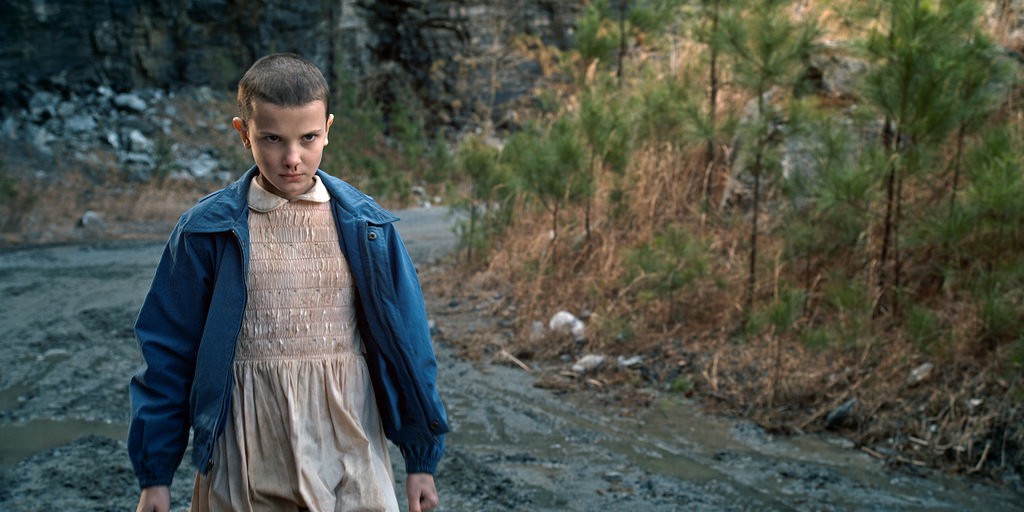
The breakout star of Netflix’s Stranger Things is Eleven (or, as we now know, Jane, but she’ll always be Eleven in our hearts). In her pink frock with the Peter Pan collar, she looks sweet and sometimes even canonically “girly.” But she can also move a truck with her mind, or open a portal to the Upside Down, or simply make you pee yourself. She’s terrifying. Everyone loves her. She’s our friend, and she’s crazy.

What makes the scary little girl so sensational? Films, especially, come back to the vacant-eyed and terrifying child again and again: from Wednesday Addams to the Shining twins, they stare directly at you while you shove popcorn into your mouth and try not to grab a neighboring stranger’s arm. Sometimes they’re evil, but not always; the terror doesn’t solely come from them meaning you harm. These little girls are scary because they can’t be manipulated, because they refuse to conform to the role of the female child: sugar and spice, seen and not heard. They’re scary because they’re powerful, but also because they’re not supposed to be.

This list collects powerful and frightening young women of literature, who refuse to stay in their sweet and innocent box. With these girls, what you expect is not what you get, and what you get might fuck you up.

Rhoda—William March, The Bad Seed

Adults see Rhoda as just a little girl. In fact, they see her as the ideal little girl: obedient, intelligent, and objectively cute. But the children she attends school with see that something isn’t quite right with Rhoda. After a child is found murdered, and Rhoda is caught in a lie, her mother Christine begins to investigate, and discovers a series of deaths all connected to her young daughter. The book follows Christine’s investigation of what’s wrong with Rhoda—and whether it’s her fault.

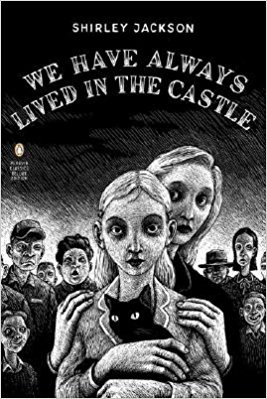
Mary Katherine “Merricat” Blackwood—Shirley Jackson, We Have Always Lived in the Castle

Merricat commits an unthinkable crime when she is only twelve. (Spoiler alert for a 55-year-old book follows!) After being sent to bed without supper, she poisons her family with arsenic in the sugar bowl. Only two of her family members survive, one because she denies pudding at the table and the other because he only added a small amount of sugar. Merricat shows no remorse for killing her family; however, she becomes spiritual and places boundaries on herself — the guilt finds different ways of manifesting in her life. At the end of the novel, Merricat and her surviving sister, Constance, are run out of the town and rely on each other for survival. The reader is left supporting Merricat as an independent, powerful witch in her own right.

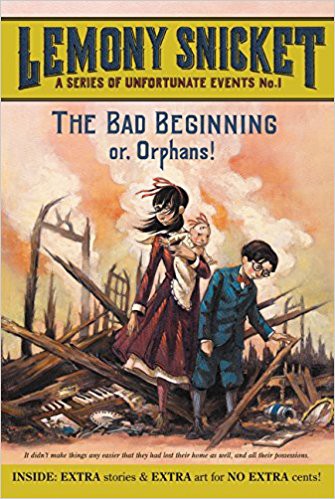
Sunny Baudelaire—Lemony Snicket, A Series of Unfortunate Events

Sunny Baudelaire is an unexpected heroine. She’s only a toddler, but she’s also the most wise Baudelaire of the pack, constantly spewing out deep intricate references that would make the biggest Rick & Morty fan squeal with delight. Sunny has her older sister, Violet, to look up to, but even before the frontal cortex that would help her mimic her sister’s behavior is even given a chance to develop, she already knows how to navigate the world. She uses her teeth for everything, understands the drawbacks of fear of the known and unknown (i.e., leeches, snakes, dark hallways), and is a master of disguise. There is more to Sunny Baudelaire than her age in months.

Beloved—Toni Morrison, Beloved

Beloved’s power transcends her brief life. She is a revenant kept alive by the guilt of her mother and murderer, Sethe—and once she takes on a human form, nutritionally supplemented by Sethe as well. It isn’t until the power of the black female community exorcises Beloved from 124 Bluestone that Sethe and her daughter Denver can go on to live a life without the trauma of the past continuously haunting them.

Alia—Frank Herbert, Dune

Because Lady Jessica drinks the Water of Life while carrying Alia, her child is born with unusual abilities. She is far more knowledgable than the average toddler, can speak clearly, and can even tell the future. Even in a science fiction context, such power behind the face of an innocent little girl is uncanny and, yes, scary.

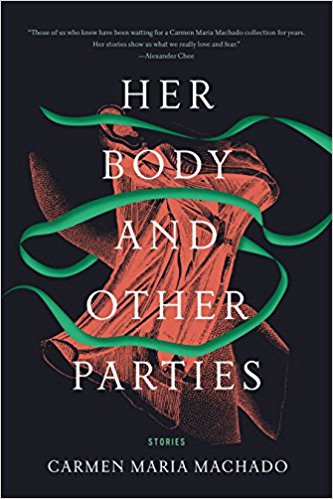
The girls-with-bells-for-eyes—Carmen Maria Machado, Her Body and Other Parties

In the middle of Carmen Maria Machado’s breathtaking collection of short stories, there is a novella Especially Heinous: 272 Views of Law & Order SVU. As if the Law & Order SVU series wasn’t captivating enough, Carmen Maria Machado gives Benson, Stabler, and New York City a supernatural twist. Benson is haunted by girls who have bells for eyes, young women who were murdered and improperly buried around the city. They seek out Benson to find their bodies and eventually possess her. The bells are their way of communicating, but so is their heartbeat coming from the ground of the city. They are powerful when they are powerless, their presence can be heard as well as felt, and the guttural intuition that ensues from such sensations helps Benson solve the case.

Amma—Gillian Flynn, Sharp Objects

In a similar vein as The Bad Seed, Sharp Objects takes a look at the power of generational evil, nature versus nurture. Protagonist Camille escaped Wind Gap, her hometown, only to be drawn back to solve a series of murders whose victims are found with nails painted and teeth pulled. Amma, the protagonist’s stepsister, is coddled by their mother, who feeds Amma pills in order to keep her unwell. In the novel, Amma begins to recognize the power of her sexuality, a realization that continues to haunt the adult psyche and helps to make young girls creepy. At the end of the novel, the mystery is solved — but at this point, you can probably guess who the murderer was.

A Life Described in Teeny Tiny Pieces

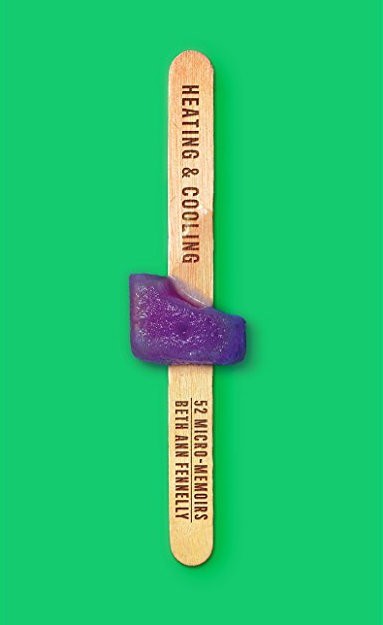
Beth Ann Fennelly began her career as a poet, but over the course of seven books, her work has continued to branch out in terms of experimentation and collaboration. Her most recent book, Heating & Cooling: 52 Micro-Memoirs, uses short-form prose—some as short as a sentence—to explore the fleeting moments that become persistent memories.

With a consistently beautiful economy of language, Fennelly tells small stories that ask the reader to focus on tiny moments, and how those moments build into the arc of a life. From entertaining factoids about the poet’s past (did you know Fennelly played the Mary Poppins to Vince Vaughn’s Mr. Banks in an elementary school production?) to deep truths about friendship, marriage, parenting, and aging, Heating & Cooling expresses a life in a distinct and unusual form for memoir. The vignettes are consistently entertaining, but always poised, eloquent, and full of moments of tenderness.

Over email, Beth Ann and I talked about creative anxiety, her exploration of structure, and the portrayal of middle-aged love.

RS: Your book perfects a version of the vignette format. Have you always worked in this style, or did it develop in your work over time?

BF: This form is a departure for me. Before I published this book, my husband and I wrote a collaborative novel. Called The Tilted World (HarperCollins, 2013), it was set in the flood of the Mississippi River in 1927, and it ended up being a big project. Although we’d published four books each, we’d never written one together. In addition to teaching ourselves how to collaborate, we had to do a lot of research. And it was high stakes: we spent four years writing the novel. Imagine, if it failed, how costly that would have been for our marriage.

Luckily, it didn’t fail. After we returned from book tour, tuckered, I wasn’t sure what I wanted to write next. There followed a long, frustrating fallow period in which I wasn’t writing. I was scribbling little thoughts and ideas in my notebook — some just a sentence, or a paragraph, the longest just a few pages — but nothing was adding up to anything. Eventually, however, it occurred to me that I was enjoying this scribbling. After the high stakes, research-heavy, character-imbedded thinking of the novel, my own life seemed rich material again. The little memories or quirky thoughts or miniature scenes I was creating seemed refreshing. So, strangely, I identified the feeling of writing before I identified the activity. I thought, What if this “not writing” I’m doing actually is writing, and I just don’t recognize it because it doesn’t look like other writing I’ve done? What if I need to stop waiting for these things to add up to something, and realize maybe they already are somethings, just small? Once I’d recognized the form and gave it the name the micro-memoirs, I realized I was almost done with a book.

What if this “not writing” I’m doing actually is writing, and I just don’t recognize it because it doesn’t look like other writing I’ve done?

RS: From the first micro-memoir, “Married Love,” which continues with “Married Love II, III, IV, etc.” throughout the book, you begin a theme that I was trying to put a name to—it seemed almost like domestic humor. How did you build these pieces over time, and how did you choose these specific anecdotes from your marriage?

BF: “Domestic humor” — what a great term! In this sequence, I was thinking about middle-aged love. This year my husband and I will celebrate our 20th anniversary, and I still think he’s sorta awesome about 98.3 percent of the time. When we met, I’d write him all of these gushy romantic love poems. And while I still love him, and still write about him, the role he plays in my work is different now — he’s not the singular obsessive focus of my work, and sometimes he’s relegated to the margins. But there’s a bit of comfort in that, too — that if I take my gaze away from him, he’s not disappearing. Also, the kind of love we have has, of course, changed from that first-bloom erotic intensity to something more mellowed and complex and richer and funnier. I wanted to look at that, because our society tends to only portray early love, or unrequited love. Middle-age love hasn’t captured our imaginations, so it was fun to investigate.

RS: The book is very funny; do you make an effort to put humor into your writing or does your general sense of humor find its way onto the page?

BF: I don’t sit down and try to be funny — I just try to capture the events of my days, and any day is full of a lot of funny moments, if you just take time to notice them. Motherhood is funny. Sweet and noble and exasperating and empowering — but also funny. I wanted the book to capture the fullness of the human experience — and humor is a big part of being human.

A Poet Survives Abuse, Brain Trauma, and a Hurricane, Then Turns to Memoir

RS: What’s your process for deciding what form a memory takes in writing?

BF: I think when the memories come, they arrive with a kind of feel. Some want to be dreamy, more poetic, have elongated syntax, or be rich with metaphor. Some want to move very fast and need a short sentences or a flat tone. Some need white space to moderate and provide a moment of reflection that allows a difficult trope to touch down. Each piece seems to have its own requirements and I just try to use my ear to figure it out.

It was important to me that the book have a lot of stylistic variation and look different on the page — I wanted to keep the reading experience lively.

RS: How do you select the stories that made it into this edition? Did you have a unifying theme? Do you have any sections that you cut that were particularly difficult to part with?

BF: An early draft of the book had 100 pieces. My editor suggested I cut it down, not because any of the micro-memoirs were huge pieces of garbage, but because the book felt a little overwhelming. So I cut down pieces that seemed like outliers, thematically. I kept ones that focused on my central roles — wife, mother, writer, woman — and hoped the cuts allowed a kind of coalescing among these central roles. The book is in some ways about the choices we make in an effort to be happy.

I wanted the book to capture the fullness of the human experience — and humor is a big part of being human.

RS: I loved the piece “Nine Months in Madison” — I’m from there! But I loved how the piece elucidated artistic anxiety through a sense of place. How did you reach that intersection of place and anxiety with this piece?

BF: Oh Madison is such a cool city! But while I lived there, I was feeling a lot of pressure to figure out what I would do next for a job, and how I would manage to make a living. I was really poor. And I was training for a marathon, circling Madison’s lakes endlessly, and circling the dilemma of my future endlessly, and I used the form of random pieces of information about my time there — information that linked up but didn’t fully construct a narrative — with information about Madison, like how many people have drowned in the lake, especially Otis Redding. I wanted a kind of itchy feel to come out of these numbered sections that would be both self-portrait and city portrait — or, as you put it, the intersection of place and anxiety.

Support Electric Lit: Become a Member!

RS: In the piece “Daughter, They’ll Use Even Your Own Gaze to Wound You,” I loved the approach you took to discussing various forms of harassment — can you talk about approaching very serious topics like this through art?

BF: That micro-memoir details in three paragraphs the three times in my life when a man exposed his genitals to me. The times took place in different cities, when I was at different ages. I always assumed this was a very unusual thing that I’d been exposed to three times, but one time I was in a conversation with six women and five of them described similar experiences. It made me consider the omnipresence of threat for women — that these experiences are so common — that women just have to accept this as part of what it means to be a woman, and have eyes that someone might, at any time, place something wounding in front of. I wrote the three paragraphs with a two-sentence rhyming couplet at the end, so it’s kind of a fucked up sonnet. Not that a reader would need to know that — just that the Shakespearian sonnet form was in the back of my head as a model. Sometimes it’s the presence of art that can help us shape these experiences, construct an arc that offers meaning to the randomness of life.

The Rise and Fall of the Luxury Baby Farm

“Ourselves, A Little Better”

by Mai Nardone

NEW HOTEL

The opening was timed for the anniversary of the first test tube baby. A facility erected as a milestone: five decades of obstetrical progress. The chosen ground was a frontier of Bangkok, itself a forerunner in the contest for medical tourists. It opened as Newbirth Centre Asia, but for its hospitality-trained staff would be known locally, and later infamously, as New Hotel.

Ourselves, A Little Better (Electric Literature’s Recommended Reading Book 286)

The first commission was from a photogenic Australian couple, Bill and Joyce Boe of New South Wales, of tabloid-famous infertility, of an undefined beige ethnicity. They wanted a boy. Less than a year later, baby Adam was born to specification: 8 lbs., hazel eyes (his mother’s), AB+, and free of Bill’s family’s strain of an enzyme deficiency disease. The headline of The New Century, an Australian newspaper, exalted, “Science Bests Nature”.

UNNATURAL SELECTION

Dial back one decade and two patents, to the year New Hotel’s founder Dr. Susan Sims, then an embryologist at Waindell Medical Institute, pioneered a technique for egg harvesting and maturation.

It was a triumph of will more than science. Sims, Connecticut raised, had been drilled by prep-schools and a childhood fascination with natural selection to understand existence as competition. Like the best Thoroughbreds, she knew only forwards, the grind of track dirt underfoot, the constant gnawing at the bit. She spent her thirties butting her head against the gates that held her back, thwarted in her experiments on oocyte maturation. The object of her obsession she found under the microscope, the prison of her vocation: cell boundaries. She kept a habit of snacking from a bowl of flavored, half and half creamer capsules as she worked. French Vanilla, Hazelnut, Sweet Crème — everyone, said one former lab assistant, “knew what to buy Susan for Christmas.” The popped, crumpled shells littered her desk, giving off the sour stench of obsession. Sims preferred to work alone, and alone she made her discovery.

In vitro maturation (IVM) is the maturing of oocyte in a petri dish (hence, ‘in glass’). At the time, IVM was already on its way to displacing traditional egg harvesting procedures, which required the egg to mature in a woman’s womb before being extracted. IVM made egg donation easier; donors no longer had to endure procedural injections of a hormone cocktail. Dr. Sims’ method also improved egg quality and doubled embryo yield. She produced an unprecedented pregnancy rate: 74%. She didn’t publish the findings or disclose them to the university. Instead, she forfeited her position and, like every great American innovator, took the technology private. A year later Sims’ California-based fertility clinic, the Hatchery, came to be.

Enter here the marketing guru behind the Hatchery’s rise, Sims’ partner Denis Osman, who in a previous incarnation had made his name pushing pregnancy skin care products (breast firming cream, elasticity oil, stretch mark gel). Moms of the AOL era may recall the NewYou campaign, a weekly newsletter detailing postpartum mothers experiencing a ‘rebirth,’ second lives as figure skaters or salsa competitors. By the late 90s one prominent magazine was referring to Osman as “the patron saint of new mothers.” Still, his downfall was swift, the result of boasting, on a late-night show, that he had penned the stories himself. The Hatchery became Osman’s own opportunity at rebirth.

Denis Osman’s talent was understanding that relative ease of egg donation after IVM changed the way donors could be wooed. The Hatchery opened as an all-around fertility provider, but was quickly driven to mainstream attention for its hallowed egg donor database. Osman bought full-page ads in newspapers. A booth pushing donation popped up outside the Harvard Square T Stop, and fliers dotted the third-wave coffee shops of Princeton, NJ. Teams of intern copywriters produced think pieces that were pushed out through content recommendation engines. They directed chatter down the why-not route: the money was good, the process was (almost) painless, the eggs would have been flushed, anyway. An early employee of the Hatchery recalls a training session in which she was told to identify target donors as “Ivy League and Out Of Your League.”

The Hatchery went an extra length by providing each donor with complimentary cryostorage of a dozen of her eggs, which were vitrified (‘turned-to-glass’ rather than ‘frozen’). To reinforce this point, in the cavernous lobby of the clinic hung an impressionistic oil painting [1], an artist’s idea of what vitrified human eggs, collected in straws and stored in a dark swirl of liquid nitrogen, might look like: a string of rhinestones, a belt of stars. A hedge against the future — what if? The result of Osman’s campaign? Donors signed on in droves. Soon, the Hatchery had its pick of the country’s ‘finest’. And once the Hatchery had its pick, so did its clients.

[1] Now displayed in the Human Odyssey room at the California Academy of Sciences.

Courtesy of TERRITORY

A survey of donor profiles, recovered from a cloud storage facility where the backup database was held, gives us an idea of what a perusing client might have seen. Each profile included a banner, often a collage, but sometimes a single image (a still lake, a rising sun, Machu Picchu). The pictures were themselves a timeline, beginning with baby-with-attitude through cap-and-gown. The average age of donors was twenty-five. Dimples were advertised. Ethnicity, hair type, body type, body weight, body hair, height, SAT score, eye color. Do you: sing in the shower; have gay or lesbian friends; like your handwriting; believe in life on other planets. Donors touted “strong leadership abilities” and “team player.” The language was always effusive. Ancestry.com provided the genealogy, complete with known monogenetic diseases. Everyone had gay friends. Less than one percent of donors identified as gay. Questions most often left blank: Corrective lenses? Multiple sex partners? College GPA? One early donor ended her personal statement with, “I love animals, human bodies, and working out. I love healthy meals. I use my artistic abilities to draw anatomies.”

Two years after opening, the Hatchery had already captured a third of the domestic reproductive technology market, prompting the Federal Trade Commission to open an antitrust investigation into the company’s practices. The Hatchery App topped the Lifestyle category of the App Store (for its app, Osman had hired the product team behind that decade’s most popular dating application). Eggs stored in cryogenic capsules were being shipped worldwide. The period also saw a rise in offspring t-shirt slogans: Rappaccini’s Daughter, Son of Krypton etc. The New York Times ran an Op-Ed piece titled What Do We Do With All These Eggs? an echo of investors’ cautiousness about the egg-donor boom. The public supposed a natural limit to the growth. Was infertility on the rise? It was not.

THE NEW GALTONIANS

For outsiders, the chief difficulty of extrapolating the future of the Hatchery was the seclusion of its founder. It wasn’t that the Hatchery was a particularly secretive institution — to garner client trust in what was a relatively new field, the staff was transparent, the legal team explicit, the doctors accessible. But each subsequent circle of workers obscured the founder, a cumulative effect, as of translucent sheets overlaid. Sims was known to work in isolation, in her laboratory in the center of the circular structure. She had her own entrance that opened onto the carpark. One employee worked there three years and only saw Sims twice. “We didn’t know if she was in or out. We had a running bet, a pot you contributed a dollar to each morning.”

This isn’t to say Sims neglected her duties as boss. She was meticulous, collecting all the client reports, reading each donor profile. Handwritten notes of commendation were shuttled from her lab to the employees. One recovered note reads, “Tracy, superb work with the Mendez family. You really surprised me this time.” It was an eerie juxtaposition of platitudes and detachment for some, but many were spurred on by the Sims’ gaze, as if aware of a coach’s presence on the sideline. One employee described the environment of the Hatchery as a modern-day Panopticon: was Sims watching now? Sims was present in the soothing minimalism of the lobby and the multi-flavored creamers available in the break room.

Other scholars have argued that there were clues in Sims’ interests, and in the few interviews given by Osman, but such reports are overblown and entirely retrospective. When Sims eventually went on trial, for example, the tabloids went into a frenzy, reading into the Sims’ court-presented possessions the doctor’s peculiarities. They wanted a Henry Jekyll, a Victor Frankenstein. Instead, they found a shy, messy woman. The most portentous of the items turned out to be the bedside reading:

Leach, Gerald. The Biocrats: Implications of Medical Progress

Hornblum, Allen M. Acres of Skin: Human Experiments at Holmesburg Prison

Galton, Francis. Hereditary Genius

Galton, Francis. Kantsaywhere

The last entry especially captured the public’s imagination. Kantsaywhere, written by Charles Darwin’s half-cousin Francis Galton in the early 20th century, is a novel describing a utopian, eugenic society. Sims in college had founded the New Galtonian Society, an unsuccessful attempt to resurrect Galton’s ideas about the inheritability of intelligence in the context of modern genetic determinism. The club only held one meeting, which Sims attended alone, surrounded by chants of a student protest staged outside the classroom.

So how does an idea that a couple decades previous had been spurned by an entire student body come to the mainstream? Michelle Huang, bioethicist and historian, notes in her book Manufactured Evolution that there was a necessary confluence of scientific advancement and “unregulated thinking” to augur the rise of Newbirth and the making of New Hotel.

Huang points the sequence of thinking that was rekindled under the Human Genome Project and saw the proliferation of ‘Understand Your DNA’ services. The mapping of the human genome demystified that final frontier. And although the new preeminence of genetic determinism spawned a number of protests about scientific tyranny and even a hit documentary from The National Geographic titled Cells: Imprisoned by the Genome, the movement lacked the conviction of previous decades.

In medical circles at the time, restrictions to gene therapy were being debated. Recombinant DNA, the technology for genomic editing, had come of age. It was possible to edit germ-line DNA (eggs and sperm) and therefore scientifically feasible to genetically augment (or diminish?) future generations of humans.

At the same time, Huang argues, the world was undergoing a separation of family and kinship. The modern family was an economic unit, a household — consanguinity had lost consequence. The previous year had seen the abolition of the last monarchy (the biggest champion, as it were, of the bloodline). A new era in American statecraft reintroduced pro-democracy regime change on a scale reminiscent of the Cold War. The Arab Spring swept North Africa, and covert CIA operations led to the fall of other dynastic autocracies (see the example of North Korea). Even the family-industrial model favored among the ‘Asian Tiger’ economies had given way to public companies. This was true especially in South Korea, famous for ascension through the avenues of chaebols (Samsung, Hyundai), those paragons of the family conglomerate. Thus, it mattered less in the modern era whether children resembled parents. What was important was improvement, each generation producing a better specimen than the last. Birth became not about reproducing genetic features, but improving upon the old.

Perhaps when we abandoned family, we also lost sight of legacy, and therefore history. The last of the Auschwitz-Birkenau survivors had passed away, and despite the best efforts of schools, new wars were layered over old wars. 20th century eugenics was too far back to provide its cautionary tale. That history had fossilized; it was the wreckage of an earlier civilization.

Huang’s storyline, however, treats history’s course as that of a river: its ocean destination inevitable, and coaxed by the earth’s topography. And yet only a visionary, like Susan Sims, could have charted that route in the present. And there were signs of her unique vision. From its inception, the Hatchery hadn’t been registered under its own name, but that of a parent company called Newbirth.

MAPMAKING

One of the documents to survive the Hatchery’s paper purge, which preceded the court hearings, is the handwritten notes of one doctor. Under the heading Corrections, the doctor has scrawled the following: “Type 1 diabetes, myopia, father’s height five inches below the national average, poor visual-spatial intelligence.”

Imagine now that you believe in the correlation (and it’s been argued there is one, especially in men) between height and success. You’ve lived with the daily inconveniences of myopia, the shadow of diabetes, a lifelong difficulty interpreting maps. A fertility provider promises to manufacture the desired result. The Hatchery was already in the business of gene therapy. Preemptive genetic screening was a given, and the usual suspects — sickle-cell, Tay-Sachs, hemophilia — were routed. Sims simply needed to expand the existing menu and up the price. She asked Osman if he could sell it. He said he could.

NEWBIRTH: OURSELVES, A LITTLE BETTER

The phrase was borrowed from James Watson, co-discoverer of the structure of DNA. His response to questions on the potential of genetic engineering was, “Why not make ourselves a little better.”

Osman also studied DuPont Pioneer’s successful branding of genetically ‘edited’ crops, a follow-up to the poorly marketed GMOs of the previous decades. The language of education was employed: head start, trajectory, success. Osman molded the message to suit focus groups of various demographics. The message was always positive; it emphasized augmentation. Through the Newbirth campaign, Osman hoped to gently usher the world into a new age of genetic tinkering.

Sims meanwhile had utilized her egg database to map polygenetic traits that could be marketed to intended parents. Polygenetic diseases had long plagued the scientific community. How to pinpoint the responsible genes, given how many different genes could influence, say, heart disease. Such diseases were not as easily isolated and snuffed out as monogenetic ones, like sickle-cell anemia. Germ-line augmentation was only as good as the traits that could be isolated. Many in the scientific community moved on to epigenetics, and the naysayers trailed those advances for a time.

Sims, however, had delved into the race to map master-regulator genes (a race led, incidentally, by Sims’ former employer, the Waindell Institute). A master-regulator gene is a gene thought to determine the pathway for cell fates. It’s a switch that creates a cascading effect; an initial flash in the bolt that arcs through the human genome, forking unexpectedly, activated or muted by environment, by chance. Sims realized that she only needed to isolate the such genes for the select traits she wanted to sell. Hers was a nimble and small operation. She already had the largest collection of human eggs and corresponding genealogy ever amassed. Also, America’s embryonic stem cell research was sluggish in returning from years of suppression under the Bush Jr. administration. Within a year, she had already isolated three master-regulators, discoveries that only surfaced for the scrutiny of the hovering NIH, Recombinant DNA Advisory Committee, and FDA when Denis Osman filed patents for the genes’ locations.

Sims wasn’t doling out certainties, of course, but propensities. Switch on a gene and increase the likelihood for logical-mathematical intelligence, for verbal-linguistic intelligence, and even, perhaps, for kindness. How she charted the cascade set off by the master-regulator gene was described by one geneticist as triangulation. Sims fixed one trait’s position using its relationship to two known traits, and once oriented, mapped down, pausing at each level to find her bearings. Once she had covered the master-regulators for various intelligences according to Howard Gardner’s theory of intelligence, she devoted herself to other favorites from the questionnaires: leadership ability, body type, dimples.

MEANWHILE…

Osman, in filing the patents, had in mind success on the scale of Genentech’s patent of recombinant insulin in the 80s. His ambitions were quickly stymied by the courts.

Meanwhile, The Economist magazine ran a special report on surrogacy, highlighting China after the lifting of its one-child policy. Picture this: Chinese families wanting for first sons, more sons, but the mothers beyond childbearing age. There followed increased demand for women who could carry a fetus to term. That demand, it turned out, was huge. Market forces prevailed. Thailand and India became the world’s surrogacy destinations.

Meanwhile, Sims was vacationing in Thailand. What was she doing there? Scouting. She would find Thailand a hospitable country for Newbirth. It already had an established gestational surrogacy industry. Also, thanks to a recently-completed high-speed rail that began in southern China and stitched together Southeast Asia, Bangkok was the playground of China’s millionaires. Specific records of Sims travels are scant, especially because the attention of geneticists and the media was on the patent case, which that week was settled by the Supreme Court.

What was patentable, it turned out, was Sims’ method. But no matter. On the other side of the world, the foundations were being laid for Newbirth Centre Asia. Its primary market was China, a nation less squeamish about the sort of genetic augmentation Sims would sell. The previous year, genetic modification of the human embryo had been attempted at Sun Yat-Sen University with barely a ripple of dissent. China was a country of over 10 million millionaires. Its Ministry of Culture had spent the last decade pushing money into ‘historical’ blockbusters with the purpose of re-education. They emphasized Confucian principles. And so, when time came for Osman to put together a narrative for the marketing team, he sold two packages. One involved surface changes, what Sims liked to call ‘the shell’, and the other emphasized the Five Constants of Confucianism:

仁 Ren — humaneness

義/义 Yi — righteousness

禮/礼 Li — propriety

智 Zhi — knowledge

信 Xin — integrity

How and whether Sims isolated a ‘righteousness’ master-regulator is unclear. Being a private enterprise, Sims’ research wasn’t open to peer review, and with its Thailand base, it wasn’t under the scrutiny of the FDA.

Build-a-baby, as the process was later called, started at USD 300k. This base package involved “maximization.” The baby’s genome was comprised of the best of each parent, without any additional features. Augmentation (beyond maximization) was 50k-80k per feature, depending on the difficulty in creating a reasonable propensity for that feature.

At the program’s inception, the main obstacle for Newbirth was that the pregnancy rate for in vitro maturation was still 74%. Given the intricacies of gene editing and the wait to see whether the fertilized embryo would take, Sims realized that it was inefficient to implant the embryo in the intended mother. Instead, she used surrogates. She implanted identical embryos into four women (sometimes as many as eight) at a time. If more than one fertilized egg was successful, they aborted the remainder, a cold and clinical and demonstrably effective strategy.

For its first trial (a batch?) Newbirth Centre Asia received over ten thousand applications from all over the world. Osman chose the Boes as the poster parents, citing their “empathetic features”.

CHAMBERS

The New Hotel is today a museum, a display of hubris, or ambition. Try the guided tour. One guide suggested to me that the structure was built to resemble a cell: solid outer boundary, the nucleus of the main office in the center of a glassy atrium. On a later visit, I was told the structure most closely resembles Jeremy Bentham’s fabled Panopticon, a prison design. The upper chambers, they’ll tell you, are where the surrogate mothers were imprisoned during their pregnancies. They’ll use that word: imprison. You’ll be invited to step inside a room.

Personally, I see in the structure a Russian doll effect: hollows within hollows. The facility, a round chamber, and within it chambers, and the mothers, round, fulfilling roles as chambers. And when you’ve arrived at the smallest chamber, a thing growing.

A year after New Hotel opens, Sudhidaa Chaiprasit, an undercover journalist, enrolls herself in a new cohort of surrogate mothers. What follows are the headlines we know: GENETICIST GROWS POST-HUMANS IN PRISONERS. We learn of a surrogate’s self-induced miscarriage, of a suicide, of infanticide. New Hotel is shut down.

Sims is later charged by the International Criminal Court of violating the Nuremberg Standards. Osman and the lab technicians testify to believing that the implanted embryos belonged to clients. Many were actually Sims’ experiments. She needed chambers; she hid her experiments in the children born to clients.

The following was taken from Sims’ court statement:

“I tried to free us from genetic determinism. From our evolution, our genes, which will fail us. You look at me and see the worst of humankind. I looked through the glass and saw in my work a future for our kind.”

In her experiments to perfect the human race, Sims held the embryos against a standard that could be traced back to the client questionnaires of the Hatchery. She wanted to create the ideal embryo, and by planting it her army of surrogates, begin the work of propagating a generation of post-humans. Ourselves, a little better.

On the eve of the trial’s verdict, Susan Sims kills herself with an injection of phenol to the heart. She is 49.

Despite the media barrage, there’s much that was kept secret by the Thai police. We don’t know, for example, how many children were born to Newbirth in that first year. A conservative estimate puts the number at two hundred. It’s suspected that the CIA has been working to track down the children for genetic testing.

And what of the promised qualities? Was Sims successful in her attempt to imbue these children of science with the Five Constants? The many intelligences of Howard Gardner’s theory? With kindness? It’s not known whether she managed to perfect the embryo according to her designs. However, Sims, who never married, kept in her home a vat of liquid nitrogen, a chamber, in which she stored a straw of her own embryos, vitrified and glimmering, already modified, already fertilized, one woman’s ante in a game for the future — what if?

Reading ‘Girl, Interrupted’ in the Psych Ward

I ’ve re-read Susanna Kaysen’s Girl, Interrupted nearly every spring since I was eighteen. She has a bit in there about how springtime is suicide weather, and the first time I read that line it was one of those revelatory sort of moments that casts the rest of your life in a different light. Because of that, the book has become forever linked with the season, and my yearly springtime sads send me scrambling through my bookshelves, praying that last year I was sensible enough to re-shelve it in its proper spot.

I know for certain that I reread Girl, Interrupted in April of this year, because I tried to work the “suicide weather” line into an essay about suicidal ideation. My editor took it out, with a note about how it seemed a bit trite to open with a Kaysen epigraph. She was right; the line added nothing to the piece and wasn’t meant to. It was there as a sort of secret note to myself, a reminder of the slippery, tricksy nature of this season. You think you’re watching the earth wake up from its deep freeze, all birdsong and warm breezes and snub little snowdrops pushing up through the soil, but really you’re feeling yourself coming out of your own cold storage, with every pain and misery and heartbreak the spring has ever brought you melting and rising in you like sap.

Two months after the publication of my suicide essay, I woke up one morning and knew I was going to kill myself that day. Or rather, I couldn’t think of any good reasons to put it off any longer. Why drag myself through another miserable day on the increasingly remote chance that things might get better? I’d been making that gamble for months, and not once had the cards come up in my favor.

By that point, I hadn’t slept in weeks. I’m not a good sleeper to begin with, and then one dose of Cymbalta — which my psychiatrist had prescribed in the hopes that it would help manage not just my moods but my increasingly debilitating joint pain — broke my brain. I stopped sleeping altogether; even an increased dose of my extra-strength prescription sleeping pill couldn’t touch it. I couldn’t eat. I couldn’t read. I couldn’t write. My mind moved in rapid circles, the same awful cycles of thought over and over again. My muscles ached from a body that was locked in constant state of fight-or-flight. Day bled into night bled into another day bled into another night bled into yet another day.

Two months after the publication of my suicide essay, I woke up one morning and knew I was going to kill myself.

I tried breaking my days and nights down into hour-long increments, then into quarter hours. I told myself that if I could survive from 3:15 am to 3:30 am, then I would be all right. But of course after that I always found myself staring down the barrel of another fifteen excruciating minutes.

Then one grey June afternoon I felt like I couldn’t survive even one more minute. I downed a bottle of sleeping pills and some whiskey, wrote a note, and got into bed. A few minutes later I got out of bed, shoved a few things into my backpack, stumbled down to the street and took a cab to the hospital.

I wound up on an involuntary 72-hour hold in the psychiatric ward of downtown hospital. As the nurse sorted through my hastily packed bag to remove anything forbidden — my pen, as it turned out, was a sharp, as were my bobby pins — she didn’t even pause when she pulled out my copy of Girl, Interrupted. Maybe she didn’t bother to read the title. Or, more likely, I wasn’t the first to bring this book in with me.

Kaysen’s account of her years spent in a mental hospital may seem like a strange choice for someone actually facing time in one, but to me it seemed like the most natural thing in the world. If I’d been traveling to Greece I would have brought a Lonely Planet guide or whatever, something that would give me the lay of the land and help me understand the local customs. Since no one has seen fit yet to print a patients’ guidebook to psychiatric wards, Girl, Interrupted — the first chapter of which is titled Toward a Topography of the Parallel Universe — would have to do.

I had a lot of time to read on the ward. Breakfast and morning meds happen at 8 am, and after that there’s a four-hour stretch before lunch. There’s usually some kind of programming in the afternoon, either art therapy or group therapy or walking group, the last of which involves walking circuits of the ward like a high school student who has to do laps for misbehaving during gym class. Dinner is at 5:30. There’s no official time for lights out, but unless you’re willing to go to bed at 8, the evening hours are even longer and emptier than the gulf between breakfast and lunch.

Since no one has seen fit yet to print a patients’ guidebook to psychiatric wards, Girl, Interrupted would have to do.

I spent my first two days in my bed, which was in a cozy sort of alcove up against a window, with the lights dimmed and my curtains drawn. I felt like the rest of the world was a stormy sea and my corner of the ward was a raft; as long as I clung to it and clung hard, then I could ride out my time in the hospital and go home to my family. I clung to my book, too, as both an insight into the strange new world I found myself in and a link to my other life, the one that existed somewhere outside the walls of the hospital. I didn’t talk to anyone except the nurses and doctors. I took all of my meals alone at my little bedside table, even though my nurse mentioned meaningfully that the staff “liked it” when patients ate together in the dining room. When I told her I’d rather not, she wrote something in my chart.

As Kaysen notes in Girl, Interrupted, everything a patient does or doesn’t do on a psychiatric ward is pathologized. The doctors “had a special language,” she writes: “regression, acting out, hostility, withdrawal, indulging in behavior. This last phrase could be attached to any activity and make it sound suspicious: indulging in eating behavior, talking behavior, writing behavior. In the outside world people ate and talked and wrote, but nothing we did was simple.”

Sure enough, during my next meeting with my psychiatric team (doctor, intern, and student), they told me that people had noticed that I wasn’t engaging much with other patients. Other meetings brought up other notes about my behavior: it had been noticed that I cried frequently, that I didn’t eat my breakfast, that I didn’t participate in group activities. A good portion of the half hour or so I had with the psych team every day seemed to be devoted to reviewing what I was and wasn’t doing on the ward.

I was tempted to say something very witty and cutting about how I was a suicide case in a hospital, not some ambitiously networking businesswoman at a social event. But as much as witty and cutting might rack up point with friends and admirers, they don’t tend to go over so well with doctors. And I knew that if I wanted to be considered well enough to get out of this place, then I needed to be someone who went over well with doctors.

The psychiatric field tends to value compliance above all other traits. A compliant patient, after all, is one who is likely to take her medication on time and show up to appointments and follow commands like “tell someone if you feel like you’re going to hurt yourself.” And yet a hospital is not an environment where compliance flourishes; patients have no access to fresh air or sunshine, they’re expected to follow arbitrary rules to the letter, and if they do things like question their medication or try to talk to hospital administration about conditions on the ward, they’re labelled “difficult” and medicated even more aggressively. While I was in the hospital I saw a situation escalate from a frustrated woman throwing a cup of (cold) tea on the floor to that same woman being pinned down by guards and injected with a tranquilizer.

It wasn’t hard to see that if I wanted to be released, I would have to learn to be compliant. Which meant learning to participate in day-to-day life on the ward.

Coming into the hospital, Girl, Interrupted had felt like a friend that I was allowed to bring with me — someone I’d known for more than a decade who knew the ins and outs of life on a psychiatric ward. Having this friend with me made it easy to spend hours alone in my alcove, flipping through the pages of my book by the humming fluorescent light above the bed. And yet as easy as it was to be alone with my book-friend, she spent hours patiently convincing me to get up and out of my room and talk to someone else. After all, Kaysen’s relationships with other patients form the core of Girl, Interrupted’s narrative; it’s their camaraderie that makes the book what it is. And a guidebook is a guidebook, by which I mean that you choose not to follow its advice at your own peril.

Coming into the hospital, Girl, Interrupted had felt like a friend that I was allowed to bring with me.

I started spending time in the patient lounge. I joined in a game of scrabble and offered to get snacks for movie night. I taught a regular yoga class every morning to help alleviate the post-breakfast boredom. I traded stories with other patients, and felt the giddy freedom of talking openly and candidly about mental illness with people who really got it. With them, having made a suicide attempt didn’t make me an object of pity or fear; it just made me one of the guys. It was the most normal I’d felt in months.

The doctors and nurses at the hospital were there to make sure that I was safe, that my medications were working, and that I had some sort of plan for what I’d do after I was discharged. All of the staff I encountered were kind to me and they all seemed to genuinely care about my welfare, but that was about the extent of our relationship. It was the other patients who sat with me while I cried, who listened to the litany of reasons why I was a bad person, who respected my space when I just wanted to be left alone. It was the other patients who devised a game to keep us busy over the weekend, one where we pretended we were at sleepaway camp complete with ugly crafts and late-night ghost stories.

Girl, Interrupted was what had made the idea of being in the hospital bearable. It was the other patients who helped me bear the hospital itself.

The Women Who Carried Violence In Their Bodies

When I was six years old, my family lived next to a man rumored to be a pedophile. Back then, the word meant nothing to me beyond hush-hush talk about him touching his female pupils inappropriately. I didn’t know what made some touches appropriate and others not. My parents must have heard the rumors too because they banned me from interacting with him longer than it took to pass customary greetings.

The glory of childhood is in its transparency, the not-so-black and white lines, the non-sinister imagination and untainted morals. This innocence will lead me to run errands for this man against the dull ringing reminder of my parent’s warnings. I couldn’t see the wrong in helping him buy items from the store two houses away, especially as I got to keep whatever change was left.

Innocence will lead me to run errands for this man against the dull ringing reminder of my parent’s warnings.

On one such errand, he handed me back the extra change, thanked me and tapped my bottom as I walked away. I thought nothing of it. My mind was occupied with the thought of the melting chocolate cubes I’d buy with my hard-earned money. But my brother witnessed what had transpired and told my parents who thought plenty.

Later, my father called me into my parent’s bedroom, where I was met with the unforgiving leather of a belt and a statement leaving no room for response: I heard you went to Mr. Tola’s house today.

I was whipped until my wails stuck in my throat and I choked on my own saliva. The brown of my skin was crisscrossed with red, blue and black welts. Blood trickled out of torn flesh. My mind swirled with questions for the belt and the hand that brought it down. I knew I was being accused of something. I’d been found guilty and this beating was my punishment, a loving attempt to purge me of the evil that sponsored the crime. The injuries I sustained took at least a decade to heal.

Over the years I grew reclusive, terrified of beatings. I blossomed into a teenager and headed to university, elated to be away from the transgressions of family and heady with the scent of freedom. I unfurled my wings and flew off into the sunset — but too close to a man with lava for hands. He raped me, left me flat on the ground with melted wings, and I wished my next breath would not reach my lungs.

Surrounded by a culture bounded by shame and sewn heavy with silence, the key to surviving was to leave no footprints stained with blood or traces of trauma that could lead back to: I heard you were in his house that night? What were you doing there?

I borrowed several pages from the book society hands all girls at their christening, whole chapters filled with rules: what to do, what to say, how to behave, how to be a good girl, how not to bring disgrace to your family. Where I come from, a person’s strength is directly proportional to how much suffering they can endure and still do what is expected of them. I have good practice from watching my mother do it. I believe I am very strong. Look at me hold it all in.

Where I come from, a person’s strength is directly proportional to how much suffering they can endure and still do what is expected of them.

Reading has always been an intimate experience to me. Books provided a sacred companionship no one could desecrate. I had a tendency to assume the characters’ lives — their triumphs were my own, my secrets were theirs. I have lived meaningful lives this way. This communion has helped me walk over a thousand hills and made sure I made it down. Somehow.

When I plucked The Color Purple by Alice Walker from my shelf and first met Celia, she was writing a letter and the raw confusion in her voice was palpable. Like me, she had been abused. She was only a teenager and could not tell anyone about her pain, didn’t know if anyone would listen. She decided to write to God, the one person she felt was close enough to know, and distant enough to not create problems. Her first letter opens:

Dear God, I am fourteen years old. I have always been a good girl. Maybe you can give me a sign letting me know what is happening to me.

I understood the exhaustion one must endure in order to bleed on paper. I kept a journal. I filled it with all the questions I was too afraid to ask out loud, not from fear of not making sense, but something deeper: shame at needing to ask at all. My brother found the journal and was about to read it aloud to my parents before I wrestled it back. I decided to keep my words in my chest, so they did not shame me.

My brother found the journal and was about to read it aloud to my parents before I wrestled it back. I decided to keep my words in my chest, so they did not shame me.

Celia was two years younger than me when we met, yet she embodied a lot of the things that I was. We both were afraid of our own voices. We both believed that the world would automatically be good to us if we did what we were supposed to. The world was never that pragmatic. Much of Celia’s frustration flowed from her perception of herself through the lens of others. People called her ugly, she believed it. They treated her badly, she judged herself worthless.

Society sees women that are raped as dirty and ruined, and I believed it, and I wanted desperately to be clean again.

My body was an ocean I could not cross, and floating around were pictures of men who had taken things from me: my father, random men on the streets, friends, relatives, the man with lava hands…

Men took things away from Celia too, but when she began to ask for those things, so did I. Together, we verbalized independence, resistance. We stood a little more upright. By the end of the novel, my face was streaked with tears.

A book club suggestion introduced me to Dominique Francon, one of the most complex characters to ever come into my life. We struck up a slow, unpretentious friendship filled with questions. The Fountainhead quickly became my favorite book. I was grateful to Ayn Rand for bringing Dominique to me.

A stark contrast from Celia, Dominique was an intelligent, opinionated, and eccentric woman. She was most things I wanted to be. She shunned societal expectations and criticized opinions she found to be lacking substance. Dominique was the ruler of her own world; she dictated the course of her life. She had what women everywhere in the world wanted: freedom.

Alvah Scarrett asks, “What do you want, perfection?”

She says, “Or nothing, so you see I take the nothing.”

“That doesn’t make sense,” he says.

She says, “I take the only desire one can really permit oneself. Freedom, Alva, freedom.”

She knew what she wanted, demanded it, and refused to apologize. Alvah says, “Dominique, it’s abnormal to feel so strongly about anything.” She responds, “That’s the only way I can feel or not at all.”

As I read, a new conversation began with myself. I wanted to be this woman, I wanted to be in control of my body and life, I wanted the world to stop taking things away from me. I discovered feminism.

As I read, a new conversation began with myself. I wanted to be this woman, I wanted to be in control of my body and life, I wanted the world to stop taking things away from me.

Over the years, my mind has circled back to this conversation whenever I voiced my opinions about women’s issues. There has always been someone eager to tell me what I’m allowed to be angry about and how far that anger can go, how passionately I can denounce actions that hurt me. I recognize this as an attempt to negotiate false middle grounds. I’m able to see the unfairness of having to fight on uneven ground while being expected to play by another’s rules, and reject it, because I was there when Dominique pointed this pattern out to Howard Roarke:

When I think of what you are, I can’t accept any reality except a world of your kind, or at least a world in which you have a fighting chance and a fight on your own terms. That does not exist and I can’t live a life torn between that which exists and you. It would mean to struggle against things in men who don’t deserve to be your opponents. Your fight using their methods and that’s too horrible a desecration.

My connection with Dominique meant I had to find myself in a way of my choosing, at my own pace. It was time to reclaim my battered body from my father, take back my sexuality from the abusers, seize my pride from purity culture, denounce the patriarchy in all forms for what it was, even if it meant sacrificing some of its benefits.

Benevolent misogyny is still misogyny. Benevolent misogyny is a foster child of patriarchy.

A moment of crisis occurs in The Fountainhead between Dominique and her love interest, Howard Roarke. This crisis has been christened “The Rape Scene” and the literary community is split into two groups, those who think a rape occurred, and those who don’t.

This crisis has been christened “The Rape Scene” and the literary community is split into two groups, those who think a rape occurred, and those who don’t.

The apologists in the literary community consider this scene symbolic because character traits and ideals suggest this is what Dominique wanted and the only way she could have given herself to Roarke. I find this argument problematic as the idea of cues, suggestive actions and character traits serving as concrete validation of sexual request can easily spiral out of control. Speech is the language of consent, especially between people with no prior sexual relationship.

What I got from the scene is how easily lines can blur when a thing is taken out of context. Desire for a person is not approval or a signal that it is okay to have your way with them. In reality, where there are no narrative motifs to help escape accountability, a smile can be pounced upon as implying sexual desire instead of vocal consent. There are way too many women who carry violence in their bodies already. We cannot make room for any more.

A Poet Survives Abuse, Brain Trauma, and a Hurricane, Then Turns to Memoir

I realize how much this need to gloss over actions to make them more acceptable has permeated some of my past sexual experiences. I know violence can be subtle, creep under the skin like it belongs there. I too have called it a different name. I have wanted to absolve perpetrators of responsibility because I cared about them or was too embarrassed to call what had happened what it was. I figured piling makeup on the face of the experiences was the only way to look at myself in the mirror and not feel so ravaged. Otherwise the old pains would begin to ache and I was out of places to hide pain. I thought that if it didn’t happen, then I didn’t have to feel anything. I’m still finding myself. I am naming all the transgressions now.

And I wondered about the futility of ridding girls of innocence in the name of protection. Are female bodies cursed to be crime scenes waiting to happen? Can we ever keep ourselves safe enough to escape the violence if it comes bearing our names on its hands? On how many fronts can we fight this battle of preservation without losing whole portions of ourselves?

Are female bodies cursed to be crime scenes waiting to happen? Can we ever keep ourselves safe enough to escape the violence if it comes bearing our names on its hands?

I wonder what a safe woman looks like.

Early this year, I went hunting for books written by women of color and a copy of Zora Neale Hurston’s Their Eyes Were Watching God found its way into my hands. I gulped down the classic coming-of-age story of a woman named Janie.

From the outset, I was confronted once again by the array of violence committed against the female body: religious, cultural, social, economic. It seemed they were all in a race to see which could subjugate women the most.

I read and bore witness to the female body used transactionally, bundled away in exchange for sex, family honor, marriage, fragile egos, respect. And I considered that what little joy we women win back for ourselves also carries grief. I am thinking of war-torn bodies, little girls forced to become veterans before they have the chance to live a little.

Janie is born after her 17-year-old mother is raped by the schoolteacher. She grows up under the watchful caring eyes of her grandmother, who, after she is caught kissing a boy, decides to marry her off to an old man.

I was reminded of my parents and the accountability they forced on my shoulders, the crackle of a belt dancing through air, my body punished for male transgression.

Can we ever escape violence, or must we merely tolerate it? How much do we owe it and how much is owed to us? Will the debt ever be repaid?

Jamie’s second husband, Logan Killicks, eclipses her voice and tries to control it. I’ve seen men in my life do same. I’ve seen men on television do it. I’ve seen men everywhere do it:

“Thank yuh fuh yo’ compliments, but mah wife don’t know nothin’ ‘bout no speech-makin’. Ah never married her for nothin’ lak dat. She’s uh woman and her place is in de home.”

The idea of a female voice that is seen and heard is an inconceivable atrocity to some. The need to censor and police the female body is built on fear. But fear of what? A culture that rids the male body of responsibility and accountability while tattooing blame on the female body is dangerous and benefits no one.

The idea of a female voice that is seen and heard is an inconceivable atrocity to some. The need to censor and police the female body is built on fear. But fear of what?

Women are culturally engineered to be custodians of patriarchy as much as men are. The existence of these wonderful, rebellious, independent, audacious women characters opened my eyes to painful realities. I drew inspiration from their experiences, some of which had been mine. Like them, I did what I could to move against the swirl of transgression.

I am reclaiming my time. I am learning what freedom is. Coming into myself with the audacity of sunshine after a storm. I am verbalizing my defiance.

Support Electric Lit: Become a Member!

“The young girl was gone, but a handsome woman had taken her place. She tore off the kerchief from her head and let down her plentiful hair. The weight, the length, the glory was there.”

This signifies Janie’s release from the shadow and control of her husband.

I, too, am crafting my freedom. I am saying my name again and again until I learn to trust it. I am rejecting the little things, like being called to make dinner for my healthy brother who can cook perfectly but would rather play games than feed himself. I am making my dissatisfaction known. And when someone says it is wrong to feel so strongly — it’s just cooking — I’ll remember the personal is also the political. I will stand my ground.

Every time I make these little triumphs, like Janie, I’ll pull in my horizon like a great fish net, and I’ll summon my soul to come and see.

Spiders in the Sky, Spiders in the Mouth

Lucid Ruse

I’m eating lunch with Sami and watching the season’s first storm. Sami fled Syria seven years ago. His son, Victor attends school with Wil. Sometimes, Victor dresses like Charlie Chaplin. After lunch, I dress like Lear. All day the moody air. My friend, Chris, is directing the play next year and he asked that I provide him with a poet’s perspective. I stand opposite Hannah, who’s playing Goneril. Two crowns on the table. I choose Goneril’s. Fine, Chris says, but read Lear’s lines. I look Goneril in the eye. Hark, nature, hear: Dear goddess…Into her womb convey sterility. Dry up in her the organs of increase. If she must teem create her child of spleen. Goneril winces. Or is it Hannah? A living father’s living daughter. Chris asks me how I feel. Sad, I say. Sad for Goneril. Sad for Hannah. And sad for Lear for going insane inside patriarchy. For not hearing Cordelia. For his inability to receive. Blindfolded, I’m led downstage. Extemporize on the word vision, Chris says. I talk about Edgar’s imagination nurturing Gloucester’s imagination, till Gloucester finally sees beyond his false fall over the cliffs of Dover. When Chris removes the blindfold my eyes squint into a spotlight’s glare. Is nudity standing on a stage pretending to be someone else, or standing on a stage pretending to be yourself? Walking home, lightning strobes the neighborhood. Expecting to find Kisha in bed, her face lit by the glow of her laptop, I open our bedroom door to a room so dark is it even a room? From that emptiness, Kisha says, I’m watching the storm. Later that night I listen to Lou Reed’s Walk on the Wild Side. When I tell Kisha I’m only now realizing Reed’s brilliance she shows me an article in which Reed admits his jealousy over Kanye’s ability to turn an album (Yeezus) into a “novel.” Why, I ask Kisha, am I so behind the times? You were raised in Banks, she says. Banks is a one stoplight town surrounded by strawberry fields and forests. For fun, my friends leaned out the passenger window of a car and smashed mailboxes with baseball bats. Our mascot was the Braves. Baseball fans pretended their arms were tomahawks while chanting what they imagined were Native American battle cries. We listened to popular radio: Spice Girls, Smashing Pumpkins, Nirvana. Friends and I stood by our lockers staring at Nevermind’s album cover, the underwater baby reaching for a dollar bill. The baby is Spencer Elden, now a California artist whose penis might be more famous than Ron Jeremy’s or Michelangelo’s David’s. When I Google the most famous penises in history. Number six is Lili Elbe, an early 20th century Parisian whose wife dressed him as a woman to model for a portrait, triggering a long struggle between Elbe’s public, male persona and emergent female self. Eventually, Elbe underwent a series of operations in which his penis was removed. It’s rumored that as a teenager Lou Reed’s parents approved electroshock therapy to relieve him of homosexual tendencies. The next morning I’m in the grocery store parking-lot when a hot air balloon passes overhead, its basket skimming the building’s roof. All week, pilots from across the country fly balloons over the valley in the annual balloon stampede. I walk faster. The balloon’s burner is pulsing bursts of flame. The basket grazes a powerline before landing in the parking lot of the Elks Lodge where a yard sign supports the 2016 Republican presidential nominee. That evening Kisha says, Your hands look idle, then lays her feet in my lap. I press my thumb into the sole of her foot and tell her that Wil worries Trump is going to send Victor’s family back to Syria. I walk to the kid’s room. They’re asleep. I lie down on the floor and breathe against layers of shame. Growing up, my sister and I battled for control of the TV. Fingernails dug into my arm. When I kicked her in the groin she collapsed to the floor. Boy body. Girl body. Breathing sleep, they sound the same. I’m in the kitchen the next morning making eggs when Wil points out the window at a hot-air balloon shaped like a giant clock. We step outside. Scan the sky. Between us and the balloon, a strand of gossamer floats near the roofline. Then another. And another. Hundreds of barely visible spinnerets drift through the air. Every fall, baby spiders climb to a high point, position their abdomen to the sky, then release fine silk spinnerets until the slightest breeze carries them away. The spiders travel a few feet, or a thousand miles; even ships at sea have recorded spider landings. The migration is called ballooning. Mortality is high. Once, in a high school baseball game, from the pitcher’s mound I watched a killdeer run hysteric over the infield grass. Someone said it was pretending to be wounded, that it might draw our attention away from its nest filled with eggs camouflaged in the chalk line beyond first base. Further beyond, behind the outfield fence, I saw a boy on his knees. For a moment, I thought he was praying, but he was planting flowers around the base of the flagpole marking the distance between me, and the disaster of ignoring intuition. One thing I love about Kisha is that she never stops me from staring at men I hope see in me what I see in them.

Lucid Ruse

Lindy shits her pants again. Little herring, let’s bathe, you and me. I’ll tell you a ghost story. Housesitting for Joshua For Emma Forever Ago on repeat for hours sleeping on the couch I felt hovering a ghost. Go find Brandon, I said. Place your ice fingers around his shingle ribs. In the morning, I emptied a bottle of Garnier Fructis fortifying shampoo. Is Joshua’s hair curlier than mine? Must be. He’s your standard tropical bird type; books arranged by subject on tables in every room. I wrote to Joshua: “I love your apartment, its friendly ghosts” is the story I tell Lindy. After cleaning the shit off her back, we’re naked on the bed. What poet hasn’t wished at least once in her life that poetry was dead? Some of us walk into fear, give it the finger; poem’s future zero according to Brandon who occupies disproportionate space in my heart compared to the time I’m with him. Wil says he fears the people he hears elongating vowels like Aaaaaand, we’re done here. In the CVS where I get the flu shot, neon touches Wil and me pretending to be strangers, fun for a while, like narcotics, then you prefer ye olde perception. Gold stars to that tagger transforming hydrants into R2-D2 when no is watching the lightning downgrade from Habanero to Hot Paper Lantern Kisha grinds to powder for soup for our neighbor cross-stitching “My teen has meth-face” into a pillow she’ll hang on a nail the western wind stuck in her door before the streeeeeets welcome her daughter forever. If your eye is the first circle, horizon is the second, I say to Wil. If only I could stand on my head between mirrors, trace one hand with the other, the horror of it, like an animal, or worse, an animal I know. I subdue the overwhelming sublime by writing poetry between mirrors developing blemishes made worse my imperfect mouth Kisha promises to kiss when I offer it. In the kitchen, cutting meat require my undivided attention. When I say, The best artists are assholes, Kisha says, Mind the fucking ham hock. Forgive me for staring but your waist is so, so Victorian. After reading Ruskin we make love in shirts whose arms we know for less control. In my anxiety dream I pitch a no-no to the soundtrack Not Everyone Long for God is Medieval. In the morning, it’s like angels really are and not merely bell episodes against dying. In the Spanish cloister of this apartments near zero boundary between me and strangers fucking, Kisha’s reading “A Kentucky of Mothers,” Medela Pump emptying the side Lindy fell asleep on. In the bathroom, I rinse something red from my hair. Wil enters with spiders a nightmare left in his mouth. I blame the fable about a wife cutting her husband’s sparrow’s tongues in half. My eyes grow to see you, Wil says. I hate his knowing so much before reason intervenes. I feel better after readingPoets are ludicrous. And the best people I know,” in Callie’s poem. Wil draws a sea animal that will die soon, because a bat has it and a Jedi has the bat. Dad, I don’t think you know this. There are 100 moons because there are 100 worlds like the Brooklyn and the North Pole. Wil’s sea animal stares at me, till I change. Eye affirming cracks in walls baby rats enter in this part of the city officials call Electric. On the phone with his grandfather, Wil describes his day. I look for myself in every word. I never want to exist outside his thinking. My knowledge of the architecture reveals I know a little despair, but not the source of the sea smell guiding me, ushering me out into the night air giving me something to do in this privilege I’ve so long tried to ignore, happy to pass the time with friends and even alone on the sidewalk where I toss a paper airplane over the street, watch its flight into a passing car’s open window, awfully deserving, I think, of a little applause, so I’m clapping when couples exit the bar, pause to register my position, then continue walking against sirens, seldom and mixed through a landscape divided and mostly out of focus. Passing by is that me in the future tense? All these screens emitting light I’d like to turn away from. The shrugging effect seasons have when days begin the same, or nearly the same in gestures, seconds feelings take to change. Congratulations on that sweater, I think hear someone say, or the other anxieties different from these, till the question becomes whether or not the good spells might persist into areas dark and dangerous that almost belong to me when the humming of my thoughts leave small marks on paper as I sit between mirrors when Lindy’s not sleeping against the clang love is the beginning of a life poetry makes immense.
Tick

The Secret History of Cricket Magazine, the “New Yorker for Children”

No one answers the phones at Cricket Media.

The company has fully embraced the opaque, untouchable nature of most contemporary companies: a pretty website, a menu of general email addresses, and a fully automated phone system.

You press 1 for one set of publications, 2 for another, 3 for the dial-by-name directory. Or you can hold the line for a receptionist who simply doesn’t exist.

In the course of researching this story, I’ve dialed many names, held the line, emailed addresses both general and specific, and tweeted at Cricket. But I failed to reach anyone who currently works there.

Cricket wasn’t always so unavailable. Founded in 1973 by an educational reformer, Cricket has been accessible to so many children for the last 44 years. Generations of young readers cut their teeth on the pieces in Cricket: work by writers like Lloyd Alexander, George Selden, Ursula LeGuin, and Julius Lester.
In a time when children’s magazines mostly featured hidden object drawings and games, Cricket stubbornly refused to underestimate its young readers. It welcomed their correspondence, and was such a human endeavor that for many readers, finding Cricket in the mailbox every month was like a visit from a friend.

Cricket stubbornly refused to underestimate its young readers.

Kelly Link, whose collection of fantastical short stories Get In Trouble was a Pulitzer finalist in 2016, loved Cricket so much as a child she’s kept all of her back issues — she could not bear to get rid of them. Cricket influenced her to become a writer “one hundred percent,” she says, and more than that, nudged her toward writing short stories.

“[Cricket taught me] that poetry and short stories could be playful,” Link said. “That you could write contemporary short stories deliberately. That I liked some short stories better than others, and I especially liked stories of the fantastic.”

Laura Newcomer, a professional writer and editor, also read Cricket as a child. She loved that the magazine felt like it was written for her.

“I was an intelligent and extremely imaginative kid, and I felt like the magazine didn’t patronize me. Instead, it felt like it celebrated me and other kids like me, and provided a space for us to come together and be smart and imaginative together,” Newcomer wrote to me.

That sense of kids being taken seriously was no accident. It was the whole idea.


In the early ’70s, Marianne Carus received a submission for her fledgling literary magazine. It was from Astrid Lindgren, the creator of Pippi Longstocking. The submission was part of her manuscript for her latest novel, The Brothers Lionheart.

It was a children’s book, but not a happy one: within the first three chapters, the titular characters both die and go to the afterlife; the older brother sacrifices his own life to save the younger in a housefire, and the little brother later dies of tuberculosis.

Carus read it, loved it, and decided she had to publish a portion of the book. It was excellent literature, and that was what she wanted in her newest endeavor, Cricket, a literary magazine for children, a curated collection of the cream of children’s literature, that would eventually come to be called “The Little New Yorker.”

When Carus, now 89, talks about her philosophy in creating Cricket, she paraphrases English poet and children’s author Walter de la Mare, saying only “the rarest kind of best in anything is good enough for children.”

“We only accepted stories and art of the highest quality,” she said. But “the rarest kind of best” and “the highest quality” didn’t always align with what people thought was appropriate for children.

Carus’s staff balked at The Brothers Lionheart. The story’s themes of death and disease seemed too dark for a children’s magazine.

Her art director called to tell Carus that the new magazine could not publish the story. It was too dark, and too sad. Carus was unmoved.

Her art director, Trina Schart Hyman, called from her home in New Hampshire to tell Carus that the new magazine could not publish the story. It was too dark, and too sad. Carus was unmoved.

“I said ‘Trust me, Trina. I will have it in Cricket,’” she said. “So we did.”

Marcia Leonard, then on staff as an assistant editor, remembers not loving the story, less because of the themes and more because of its presentation, but she also trusted Carus’s judgment.

“Although Marianne sought her editors’ opinions, we recognized that she was in charge and the magazine was her baby, so she made the final decisions,” she wrote in an email.


There was no watershed moment when Carus, a German immigrant and mother of three, decided to found a literary magazine for children. Instead the magazine was born out of a cluster of enterprises, pressures, needs, and about 13 years of interest in educational reform.

A poem from Cricket Magazine featuring art by Eric von Schmidt. (Courtesy of Caitlin von Schmidt)

It all started when André Carus, the oldest child of Marianne and her husband Blouke, started first grade for the second time in the fall of 1959. He had already attended school in spring of that year, when his family was on a year-long trip to Germany. When the Caruses returned to Illinois, his parents were appalled by the repetition and the limited vocabulary of the Dick and Jane books he was given to read in school. That experience prompted the Carus family to launch the Open Court Readers, a reading curriculum that relied on phonics and engaging reading material.

Starting publications is a Carus family tradition. In 1887, businessman Edward Hegeler — Blouke Carus’s great-grandfather — started the Open Court Publishing Company. The original goal of the company was to publish two journals: The Open Court, a journal which aimed to reform religious thought using the principles of science, and The Monist, a philosophical journal. (The Open Court put out its last issue in the 1930s. The Monist is still published today, now by Oxford University Press.)

So when the Carus family, in the early ’60s, decided that their son’s reading material was substandard, they used the family publishing house to publish the Open Court Basic Readers.

Blouke Carus is an engineer by training, but absolutely dedicated himself to improving the U.S. education system. He found himself up against not just the Dick and Jane see-and-say method of teaching reading, but inertia in the educational system.

It’s been a long battle. When I reached Marianne Carus to talk about Cricket, Blouke had left their home in rural Illinois to go to Washington, D.C. to talk to education officials.

“He’s 90 now, my husband,” said Carus. “But he’s still very young at heart, and very fortunate that he can still travel to Washington and talk to the most important people there. They listen to him, but they don’t do very much about it.”

While the Open Court Readers were Blouke Carus’s project, Marianne was brought in early on as a kind of tastemaker. The Open Court Readers focused on phonics paired with good reading material, so that children would be interested in reading. Marianne, who studied literature at the University of Freiburg, the Sorbonne, and University of Chicago, knew good work when she saw it, and was able to identify selections that should be included in the readers.

Carus is one of those rare adults who seems to understand children; when you talk to her about the choices she made as Cricket’s editor, she draws on her own experience of being a child who loved to read.

“Short reading material is very important. It gives you a certain sense of accomplishment if you finish a story or if you finish a short book,” she said. “When I was a child, and I was reading one book after another, I was very happy when I did finish a book and didn’t just leave it because I was not interested in it anymore.”

She founded Cricket because in her work with the Open Court Readers, she discovered a dearth of good short material for children.

In the early 1970s, there were about 100 children’s magazines on the market. None of them carried great material, in Carus’s opinion. She recalls reading Highlights for Children to André when he was sick with a sore throat. Highlights did the trick — it put him to sleep. It also put Marianne to sleep.

“I was reaffirmed in my belief that children needed something they would stay awake for,” she said.

‘I was reaffirmed in my belief that children needed something they would stay awake for.’

Carus modeled her new project after St. Nicholas Magazine, a literary magazine for children which ran from 1873 to 1943, and had been edited by Mary Mapes Dodge, the author of Hans Brinker, or the Silver Skates.

The magazine began in 1972 with a small staff: Marianne and a part-time secretary worked on-site in the company’s office in LaSalle, Ill. Trina Schart Hyman, whom Carus had met at a book fair and hired as Cricket’s art director, worked remotely from her home in New Hampshire, sending her work in through the mail.

Carus also brought on an editorial assistant, Marcia Leonard, a recent college graduate with a degree in children’s literature. Leonard had been taking a summer course at Radcliffe in magazine and book publishing when one of her classmates showed her an ad for a new children’s magazine. She had been planning to go to New York, but she couldn’t pass up an interview with a new children’s magazine in her home state of Illinois. So she drove out to LaSalle, a little town in farming country.

“After I talked to Marianne about the magazine and her plans for it I knew I had to be there,” she said. “That was very exciting, to be in on the very beginning of something.”

Carus asked Leonard to commit to two years. Leonard promised one. She was there for six and, in that small office in that little midwest town, Leonard received a more rigorous training in editing than she might have gotten in New York.

“Marianne was a great mentor. She would sit beside me and go through a manuscript I had edited and she would talk with me about [why I made the edits I’d made]. I learned tremendously from that experience,” said Leonard, who is now a freelance editor and the author of more than 100 children’s books.

The cover of Cricket’s first issue. (Courtesy of Marcia Leonard)

In 1972, Carus, Hyman and Leonard put together a pilot issue of Cricket. There was only one problem with it: Drawing from the example of St. Nicholas, the magazine’s titles were hand-lettered, which made it hard to read. So Carus brought in a designer: John Grandits.

While Grandits, who is now a children’s author, started with the Carus Publishing Company as a typographer, he quickly learned through working with Carus and Hyman a truth about Cricket’s philosophy: good storytelling wasn’t just about the printed word. The stories should be linked to the best illustrations possible.

“Illustrations are a speciality field, and in ’73 there were many great illustrators still working and still alive and Trina was able to corral them and get them to work,” said Grandits, who later became Cricket’s art director and took the magazine from its original 6 by 9 size to its now-iconic 7 by 9 format.

All of the artists in Cricket were remarkable; Grandits recalled one conversation in which Wally Tripp painstakingly explained how to correctly alter a horse’s anatomy so it could be anthropomorphized.

“He says, ‘Well, horses have hooves. They have no opposable thumbs. If you’re given a story to draw with a horse, how do you resolve the thing where he has to have a top hat and cane? He can’t put the hat on. He can’t hold the cane. What do you do? There’s a lot of illustrators who sort of lay it nearby, and it looks as if they’re holding it maybe, and nobody ever addresses the question of how the hat got on the head. But what you have to do is make adjustments to the anatomy of the horse.’ So he said, ‘Here’s a horse skeleton.’”

Tripp sketched out a horse skeleton in the dust of the fireplace where they were sitting. He went on at length, about how many fingers a horse should have, and how the cleft part of the hoof could work as an opposable thumb.

“He’s worked through all this, very seriously and very sensibly,” said Grandits. “There are big problems you have to solve if you want to draw this with honesty and honor.”

Another of Cricket’s artists was the late folk singer Eric “Rick” von Schmidt. Singer, composer, friend and collaborator to the likes of Bob Dylan, von Schmidt was also an artist. His work can be seen on album covers from the ’60s, but also within the pages of Cricket.

The first piece he did for Cricket was in 1979, said Caitlin von Schmidt, who is herself an artist. (She began reading the magazine that year, when he started working for them.)

“It was all storytelling for Rick,” said Grandits. “You tell stories with your pictures, you tell stories with your songs.”

Hyman herself, who died in 2004, was an incredible artist. Her dreamy, detailed drawings won her the Caldecott Medal in 1985 for her work in St. George and the Dragon by Margaret Hodges. (She also garnered three Caldecott Honors.) It was Hyman who drew Cricket, Old Cricket, Ladybug, Sluggo, and all the other bugs, worms and spiders that still crawl, wriggle and jump through the pages of Cricket and its sister publications.

“[Trina] just had such a wonderful way of drawing them,” said Leonard. “They served as explanation of difficult words so if there was a vocabulary word that might stop a kid reader the crickets would explain what that word meant. They also had their own little life in the four-block cartoon.”

The first Cricket and Ladybug cartoon, by Trina Schart Hyman and John Grandits (courtesy of John Grandits)

The Brothers Lionheart was published serially in 1974, beginning in Cricket Vol. 2, #12. The response from readers affirmed Carus’s decision to include the excerpt in the magazine. A Librarything review from 2013 describes having read the first installment and not being able to find subsequent issues of Cricket to finish the story.

“Oh how I suffered, not knowing what happened to the two brothers who jumped out of their burning house to what seemed certainly to be their deaths, ” wrote user anderlawlor. “Then in 2002, I was working at Dog Eared Books in San Francisco and someone brought this book in to sell. One of the best days of my life. It actually holds up to twenty years of longing.”

‘Kids love to cry. I wanted to cry too when I was a child.’

Susan Bernofsky, a translator shortlisted for the Warwick Prize for Women in Translation for her German to English translation of Memoirs of a Polar Bear by Yoko Tawada, was a voracious reader of Cricket as a child. She remembers The Brothers Lionheart as a particular favorite.

“I think I loved it so much because of the sadness and the modeling of how to deal with sadness with love and grace,” she told me. “I loved the picture the story painted of fraternal love, and the idea that somebody could send a message of love from beyond the grave.”

Carus, in giving children credit for being able to respond to a range of emotions, had made the right decision.

“Kids love to cry. I wanted to cry too when I was a child,” said Carus. “And in some ways, it was a relief, to be able to cry about something. Just as it is a relief to cry about when you are very very happy.”


Children — like Link, Newcomer, and Bernofsky — responded to the trust that Carus showed them. They wrote in en masse, often addressing their letters to Cricket and Ladybug, sending story suggestions, recipes, and letters. One child, said Grandits, found a cricket in their home and mailed it to the bugs “as a friend.”

“The response from the readership to the magazine was phenomenal,” he said. “These kids took this thing very personally… from very little to very mature, kids would write to us.”

Cricket was a gateway drug to The New Yorker,” said Sarah Burnes. Burnes — now a literary agent at The Gernert Company — read Cricket cover to cover when she was a child. She loved the stories and conversations between Cricket and the other bugs.

‘Cricket was a gateway drug to The New Yorker,’ said Sarah Burnes, a literary agent.

“It certainly played a big role in my becoming a fanatical reader of both magazines and books, and then an English major, editor, and now agent,” she wrote.

“It sounds cliche, but I think the word ‘transported’ applies to my experiences with reading the magazine,” said Newcomer. “I eagerly looked forward to its arrival and could get lost in current and back issues (I saved every single magazine for years) for hours. It was like entering a flow state through creative consumption as opposed to creative output.”

Bernofsky began reading Cricket as a 7-year-old in 1973. Her mother, a teacher, learned about the magazine before its official launch, and subscribed Bernofsky and her younger sister to Cricket, starting with the very first issue. She read each issue multiple times.

“I still remember some of the drawings and poems and stories today,” she said in a Facebook message. “There was a little poem ‘Pity the girl with the crystal hair, how can she run, how can she bicycle?’…I could probably still recite most of it.”


André Carus went from being the inspiration for the Open Court Readers to being their publisher; he managed the Carus Publishing Company (Open Court’s parent company) from the mid-’80s until 2011.

It was during his tenure that Cricket’s magazine family expanded to include its 14 sister publications, including the other “bug” magazines: Babybug for babies, Ladybug for toddlers, Spider for small children and Cicada for teens. There were other magazines as well: Grandits and his wife Joann were brought back to Carus Publishing to launch the nonfiction magazines Muse and Click.

When I reached out to him for this article, Carus was willing to be interviewed, though he asked me to do some homework first. He wanted me to read a 2006 book called Let’s Kill Dick and Jane: How the Open Court Publishing Company Fought the Culture of American Education, written by Harold Henderson.

The book, commissioned by Carus, is less about Cricket, which is mentioned just once, and more about Open Court Readers and Blouke Carus’s quest to reform U.S. education. In fact, although Carus was attached to the magazines, he feels the textbooks were the greatest contribution to education in the U.S.. The Open Court Readers, he points out, made a difference to disadvantaged children who needed to learn how to read. Cricket was aimed at a demographic that would probably have been literate anyhow.

I asked Carus, now 64, what it was like growing up alongside his parents’ publishing enterprise and educational efforts.

“Oh, I was a believer,” he said. “I think the company made a difference.”

Unfortunately, Carus inherited a difficult business model; magazines are normally supported by ads, and none of the Carus magazines ran ads, relying instead on subscriptions.

The business model was made even more difficult by the rise of the internet. Cricket and its sister publications did move online in some ways: by 2007 parts of all the magazines were available online and electronic versions of the magazines were available to subscribers. That didn’t help, however. Cricket, which had long relied on subscriptions to its physical magazine, had a difficult time finding a way to adapt to an online environment.

Cricket, which had long relied on subscriptions to its physical magazine, had a difficult time finding a way to adapt to an online environment.

In 2011, when it was sold, the company was still fulfilling many print subscriptions. Two thirds of those subscriptions, said Carus, were gifts from grandparents.

It wasn’t enough to keep the company afloat. The Carus magazines had always catered to an audience that was willing to pay a little extra for quality, but there weren’t enough of those customers to keep the company solvent. While the Carus Publishing Group had some success finding new customers through direct mail in the mid-’00s, the 2008 financial crisis dinged it badly. Banks were no longer as willing to deal in cash flow lending.

“If we hadn’t sold, we would have gone bankrupt,” said Carus.

Now that he’s out of the publishing business, he is engaged in another of the Carus family’s passions: philosophy. Carus earned a Ph.D. in philosophy from the University of Chicago in 2007, and writes a blog dedicated to the work of the German-American philosopher Rudolf Carnap. He now lives in Germany, where he is a visiting fellow at the Munich Center for Mathematical Philosophy.

He seems both saddened and relieved when we talk about the sale of the Carus Publishing Company. He’s finally free to pursue his love of philosophy — he says he never really got any peace until the company was sold — but he’s sorry to have to sell the company his parents built.

The textbooks had already been sold off in the late ’90s. The magazines were sold in 2011 to ePals Corporation, a Canadian digital education platform that would hopefully be able to bring Cricket and the other magazines into the digital age. That company is now called Cricket Media.


Cricket is still around.

I found one of the latest editions in a library this fall, and it’s as well-written and well-illustrated as ever, which is unsurprising, considering that the current editor-in-chief worked with the Caruses before the magazines were sold.

If reviews from current and former employees on Glassdoor are to be believed, the current editorial staff still cherishes the values held dear by Cricket’s founders, although the management is struggling with the realities of magazine publishing.

Today’s Cricket is exactly like its namesake. Its output can’t be ignored. But if you’re trying to find the cricket itself, good luck.

There is a hint in those reviews that the current owners might be educational reformers in their own right: one review talked about the owners’ vision for school-wide technology and their conviction that the way students are educated must change.

It sounds quite familiar, but I never found out, of course.

Cricket is named for a scene in Isaac Bashevis Singer’s A Day of Pleasure, in which a cricket in the house chirps all night, “telling a story that would never end.” Today’s Cricket is exactly like its namesake. Its output can’t be ignored. But if you’re trying to find the cricket itself, good luck.

The 10 Best Umbrellas in Literature

Like their real-life counterparts, umbrellas in fiction have a peculiar knack for getting lost, borrowed, stolen, and turning up in all sorts of unexpected places. They have been revered and reviled, cared for and cast aside, and used as weapons, shields, metaphors and even magic wands. Sometimes they slip into the action for a brief moment before ducking out again; other times, they are the catalyst for an entire novel. Perhaps most intriguingly, novelistic brollies frequently reflect real-world attitudes towards umbrellas, and the myriad meanings humans have invested in them over the centuries.

In researching my book Brolliology: A History of the Umbrella in Life and Literature, I’ve traced the humble bumbershoot’s origins and eventual domination, its reputation and moral associations, and even its erotic potential. Here is a collection of some of my very favorite literary umbrellas: from the pivotal to the mundane, the intriguing to the downright bothersome.

Howards End, E.M. Forster

When Helen Schlegel absent-mindedly abducts a stranger’s umbrella one day, she can little imagine the ramifications of her thoughtlessness. Her unfortunate victim is a clerk, Leonard Bast, who possesses very little money or social standing but yearns for education, art, culture. When he retrieves his brolly from the Schlegels’ house the gulf between their classes yawns wide — they have countless umbrellas; he has just the one, and it’s in appalling condition — and still wider as the Bast and Schlegel families become ever more entangled. What follows is a sensitive yet damning exploration of class relations, social norms and women’s rights in early 20th century England — a time when, in Forster’s words, “the Angel of Democracy” proclaims that “all men are equal — all men, that is to say, who possess umbrellas.”

The Umbrella Man, Roald Dahl

This short story is very Dahl, and wonderfully touches on truths that have followed umbrellas around for centuries: the sumptuousness of a well-made brolly, the class connotations attached to them, and the umbrella’s propensity to be lost, borrowed or stolen. I won’t give away the ending, but suffice it to say that, when George Borrow (an apt umbrella name if ever there was one) wrote in 1907 that “robbers never carry umbrellas” he could not have predicted the wildly inventive uses Dahl would put one (umbrella, and robber) to.

The Giant, O’Brien, Hilary Mantel

This novel is a fictionalized account of the “Irish Giant,” Charles Byrne. Fleeing the poverty of 1780s Ireland to seek fame and fortune on British shores, O’Brien and his friends arrive to a country quite different from their own, with a few novel inventions not seen in the course of their rural upbringing: staircases, and umbrellas. These “[canopies] on a stick,” as one character describes them, are in their earliest days of use in England, and Mantel deftly captures the real-world antipathy towards them with the reaction in her novel: boys like to throw stones after umbrella-carriers, and “collapse the tent on their heads, making them sopping.”

Elizabeth is Missing, Emma Healey

One of the unexpectedly pivotal characters of this novel is a woman living on the very edges of society. Driven mad by grief and trauma and shunned by her community, the woman carries an umbrella, “a shabby inky thing, half unfurled,” which she brandishes at passers-by (and occasionally hits them with). It’s an echo of a time when umbrellas were aligned, in the British imagination, with scruffy, disreputable, and decidedly lower-class characters. In fact, Healey’s “mad woman” has, in Australian author Ruth Park’s The Harp in the South, a literary sister: an Aunt Kathy who “went mad and danced Salome’s dance in her skin and an umbrella.”

Harry Potter and the Sorcerer’s Stone, J.K. Rowling

What child, reading the first Harry Potter book for the first time, could fail to be beguiled by the image of Hagrid, the hulking hairy half-giant who makes a dramatic appearance in the earliest hours of a rain-whipped morning, finally giving readers what they have longed for — a friend and rescuer for neglected Harry, and overdue comeuppance for his bullying cousin, Dudley? Certainly not ten-year-old me, and the frilly pink umbrella Hagrid swooshes through the air to conjure a curling pink pig’s tail from the seat of Dudley’s trousers has held a special place in my heart ever since. It’s not exactly a magical umbrella… but that’s another story.

Martin Chuzzlewit, Charles Dickens

It’s hard to narrow down Dickens’ best brolly mentions because there are so many, including at least two essays (“Please to Leave Your Umbrella,” in particular, is superb) and a whole cast of memorable characters. However, the most (in)famous is undoubtedly Mrs Gamp, the self-satisfied, generally sozzled nurse of Martin Chuzzlewit, whose dubious qualifications primarily consist of eating, drinking, and snoozing beside her long-suffering patients. So memorable was Mrs Gamp’s umbrella — terrorizing coach passengers with its pointy end, catching innocent bystanders around the throat with its handle — that her very name became synonymous with the objects, and “gamp” remains part of British vernacular to this day.

Amerika, Franz Kafka

Kafka’s first, and unfinished, novel, was in part inspired by Dickens — so it is entirely appropriate that it should contain an umbrella. Sixteen-year-old Karl Rossman has been shipped to America in disgrace after being seduced by a housemaid. He is about to disembark when he realizes he has left his umbrella in his cabin. In the process of trying to recover it he befriends a stoker, who takes him to the ship’s captain, who just happens to know Karl’s long-lost uncle, who offers Karl unlooked-for friendship and hospitality (for a time, at least; it wouldn’t be Kafka otherwise). The umbrella, as far as we hear, is never recovered.

Madame Bovary, Gustav Flaubert

Like her future husband, I became slightly besotted with Emma when she appeared in the early pages of Madame Bovary beneath a luminous sunshade on a molten spring day. Indeed, a sunshade, or an umbrella, accompanies her through much of the novel — most tellingly when she first expresses dissatisfaction with her marriage, or begins to fall in love. It is one of the more subtle, yet striking instances of an umbrella’s delicate eroticism and its ties to the individual.

Mary Poppins, P.L. Travers

No list of literary brollies would be complete without mention of the iconic Mary Poppins, whose umbrella accompanies her on adventures, errands, and the occasional flight over Cherry Tree Lane. The Poppins of the books is far sharper than Julie Andrews’ saccharine movie counterpart — and exceedingly vain about her parrot-headed accessory.

Umbrella, Will Self

Umbrellas abound in this linguistically playful, modernist jaunt of a novel set partly in an umbrella factory — and the text is absolutely crawling with brollies. They appear in the hands of almost every character; they are sprinkled liberally throughout as metaphors; they are intertwined with sex, death, dreams, memory, hallucinations, medicine, the moon landing — they even, in one or two memorable scenes, transcend human-umbrella boundaries entirely. Ever wondered what it might feel like to turn into an umbrella? Read this, and wonder no more.

About the Author

Photo by Magda Wrzeszcz

Marion Rankine is a London-based writer and bookseller. Her work has appeared in The Times Literary Supplement, The Guardian, Overland, and For Books’ Sake, among others. Her latest book is Brolliology: A History of the Umbrella in Life and Literature.