
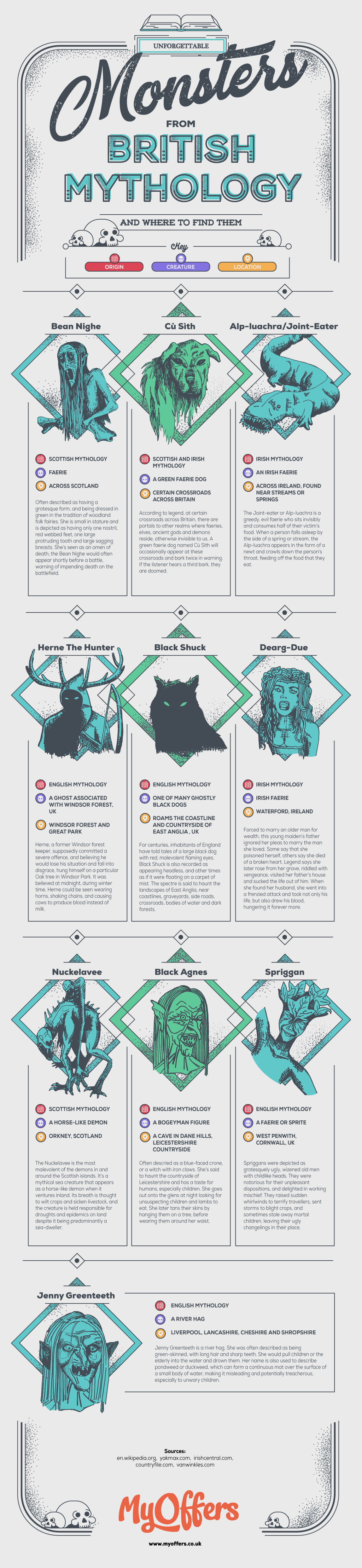
An infographic of creatures from English, Irish, and Scottish folklore, and where you can find them



Lucid Ruse
I’m eating lunch with Sami and watching the season’s first storm. Sami fled Syria seven years ago. His son, Victor attends school with Wil. Sometimes, Victor dresses like Charlie Chaplin. After lunch, I dress like Lear. All day the moody air. My friend, Chris, is directing the play next year and he asked that I provide him with a poet’s perspective. I stand opposite Hannah, who’s playing Goneril. Two crowns on the table. I choose Goneril’s. Fine, Chris says, but read Lear’s lines. I look Goneril in the eye. Hark, nature, hear: Dear goddess…Into her womb convey sterility. Dry up in her the organs of increase. If she must teem create her child of spleen. Goneril winces. Or is it Hannah? A living father’s living daughter. Chris asks me how I feel. Sad, I say. Sad for Goneril. Sad for Hannah. And sad for Lear for going insane inside patriarchy. For not hearing Cordelia. For his inability to receive. Blindfolded, I’m led downstage. Extemporize on the word vision, Chris says. I talk about Edgar’s imagination nurturing Gloucester’s imagination, till Gloucester finally sees beyond his false fall over the cliffs of Dover. When Chris removes the blindfold my eyes squint into a spotlight’s glare. Is nudity standing on a stage pretending to be someone else, or standing on a stage pretending to be yourself? Walking home, lightning strobes the neighborhood. Expecting to find Kisha in bed, her face lit by the glow of her laptop, I open our bedroom door to a room so dark is it even a room? From that emptiness, Kisha says, I’m watching the storm. Later that night I listen to Lou Reed’s Walk on the Wild Side. When I tell Kisha I’m only now realizing Reed’s brilliance she shows me an article in which Reed admits his jealousy over Kanye’s ability to turn an album (Yeezus) into a “novel.” Why, I ask Kisha, am I so behind the times? You were raised in Banks, she says. Banks is a one stoplight town surrounded by strawberry fields and forests. For fun, my friends leaned out the passenger window of a car and smashed mailboxes with baseball bats. Our mascot was the Braves. Baseball fans pretended their arms were tomahawks while chanting what they imagined were Native American battle cries. We listened to popular radio: Spice Girls, Smashing Pumpkins, Nirvana. Friends and I stood by our lockers staring at Nevermind’s album cover, the underwater baby reaching for a dollar bill. The baby is Spencer Elden, now a California artist whose penis might be more famous than Ron Jeremy’s or Michelangelo’s David’s. When I Google the most famous penises in history. Number six is Lili Elbe, an early 20th century Parisian whose wife dressed him as a woman to model for a portrait, triggering a long struggle between Elbe’s public, male persona and emergent female self. Eventually, Elbe underwent a series of operations in which his penis was removed. It’s rumored that as a teenager Lou Reed’s parents approved electroshock therapy to relieve him of homosexual tendencies. The next morning I’m in the grocery store parking-lot when a hot air balloon passes overhead, its basket skimming the building’s roof. All week, pilots from across the country fly balloons over the valley in the annual balloon stampede. I walk faster. The balloon’s burner is pulsing bursts of flame. The basket grazes a powerline before landing in the parking lot of the Elks Lodge where a yard sign supports the 2016 Republican presidential nominee. That evening Kisha says, Your hands look idle, then lays her feet in my lap. I press my thumb into the sole of her foot and tell her that Wil worries Trump is going to send Victor’s family back to Syria. I walk to the kid’s room. They’re asleep. I lie down on the floor and breathe against layers of shame. Growing up, my sister and I battled for control of the TV. Fingernails dug into my arm. When I kicked her in the groin she collapsed to the floor. Boy body. Girl body. Breathing sleep, they sound the same. I’m in the kitchen the next morning making eggs when Wil points out the window at a hot-air balloon shaped like a giant clock. We step outside. Scan the sky. Between us and the balloon, a strand of gossamer floats near the roofline. Then another. And another. Hundreds of barely visible spinnerets drift through the air. Every fall, baby spiders climb to a high point, position their abdomen to the sky, then release fine silk spinnerets until the slightest breeze carries them away. The spiders travel a few feet, or a thousand miles; even ships at sea have recorded spider landings. The migration is called ballooning. Mortality is high. Once, in a high school baseball game, from the pitcher’s mound I watched a killdeer run hysteric over the infield grass. Someone said it was pretending to be wounded, that it might draw our attention away from its nest filled with eggs camouflaged in the chalk line beyond first base. Further beyond, behind the outfield fence, I saw a boy on his knees. For a moment, I thought he was praying, but he was planting flowers around the base of the flagpole marking the distance between me, and the disaster of ignoring intuition. One thing I love about Kisha is that she never stops me from staring at men I hope see in me what I see in them.
Lucid Ruse
Lindy shits her pants again. Little herring, let’s bathe, you and me. I’ll tell you a ghost story. Housesitting for Joshua For Emma Forever Ago on repeat for hours sleeping on the couch I felt hovering a ghost. Go find Brandon, I said. Place your ice fingers around his shingle ribs. In the morning, I emptied a bottle of Garnier Fructis fortifying shampoo. Is Joshua’s hair curlier than mine? Must be. He’s your standard tropical bird type; books arranged by subject on tables in every room. I wrote to Joshua: “I love your apartment, its friendly ghosts” is the story I tell Lindy. After cleaning the shit off her back, we’re naked on the bed. What poet hasn’t wished at least once in her life that poetry was dead? Some of us walk into fear, give it the finger; poem’s future zero according to Brandon who occupies disproportionate space in my heart compared to the time I’m with him. Wil says he fears the people he hears elongating vowels like Aaaaaand, we’re done here. In the CVS where I get the flu shot, neon touches Wil and me pretending to be strangers, fun for a while, like narcotics, then you prefer ye olde perception. Gold stars to that tagger transforming hydrants into R2-D2 when no is watching the lightning downgrade from Habanero to Hot Paper Lantern Kisha grinds to powder for soup for our neighbor cross-stitching “My teen has meth-face” into a pillow she’ll hang on a nail the western wind stuck in her door before the streeeeeets welcome her daughter forever. If your eye is the first circle, horizon is the second, I say to Wil. If only I could stand on my head between mirrors, trace one hand with the other, the horror of it, like an animal, or worse, an animal I know. I subdue the overwhelming sublime by writing poetry between mirrors developing blemishes made worse my imperfect mouth Kisha promises to kiss when I offer it. In the kitchen, cutting meat require my undivided attention. When I say, The best artists are assholes, Kisha says, Mind the fucking ham hock. Forgive me for staring but your waist is so, so Victorian. After reading Ruskin we make love in shirts whose arms we know for less control. In my anxiety dream I pitch a no-no to the soundtrack Not Everyone Long for God is Medieval. In the morning, it’s like angels really are and not merely bell episodes against dying. In the Spanish cloister of this apartments near zero boundary between me and strangers fucking, Kisha’s reading “A Kentucky of Mothers,” Medela Pump emptying the side Lindy fell asleep on. In the bathroom, I rinse something red from my hair. Wil enters with spiders a nightmare left in his mouth. I blame the fable about a wife cutting her husband’s sparrow’s tongues in half. My eyes grow to see you, Wil says. I hate his knowing so much before reason intervenes. I feel better after reading “Poets are ludicrous. And the best people I know,” in Callie’s poem. Wil draws a sea animal that will die soon, because a bat has it and a Jedi has the bat. Dad, I don’t think you know this. There are 100 moons because there are 100 worlds like the Brooklyn and the North Pole. Wil’s sea animal stares at me, till I change. Eye affirming cracks in walls baby rats enter in this part of the city officials call Electric. On the phone with his grandfather, Wil describes his day. I look for myself in every word. I never want to exist outside his thinking. My knowledge of the architecture reveals I know a little despair, but not the source of the sea smell guiding me, ushering me out into the night air giving me something to do in this privilege I’ve so long tried to ignore, happy to pass the time with friends and even alone on the sidewalk where I toss a paper airplane over the street, watch its flight into a passing car’s open window, awfully deserving, I think, of a little applause, so I’m clapping when couples exit the bar, pause to register my position, then continue walking against sirens, seldom and mixed through a landscape divided and mostly out of focus. Passing by is that me in the future tense? All these screens emitting light I’d like to turn away from. The shrugging effect seasons have when days begin the same, or nearly the same in gestures, seconds feelings take to change. Congratulations on that sweater, I think hear someone say, or the other anxieties different from these, till the question becomes whether or not the good spells might persist into areas dark and dangerous that almost belong to me when the humming of my thoughts leave small marks on paper as I sit between mirrors when Lindy’s not sleeping against the clang love is the beginning of a life poetry makes immense.
No one answers the phones at Cricket Media.
The company has fully embraced the opaque, untouchable nature of most contemporary companies: a pretty website, a menu of general email addresses, and a fully automated phone system.
You press 1 for one set of publications, 2 for another, 3 for the dial-by-name directory. Or you can hold the line for a receptionist who simply doesn’t exist.
In the course of researching this story, I’ve dialed many names, held the line, emailed addresses both general and specific, and tweeted at Cricket. But I failed to reach anyone who currently works there.
Cricket wasn’t always so unavailable. Founded in 1973 by an educational reformer, Cricket has been accessible to so many children for the last 44 years. Generations of young readers cut their teeth on the pieces in Cricket: work by writers like Lloyd Alexander, George Selden, Ursula LeGuin, and Julius Lester.
In a time when children’s magazines mostly featured hidden object drawings and games, Cricket stubbornly refused to underestimate its young readers. It welcomed their correspondence, and was such a human endeavor that for many readers, finding Cricket in the mailbox every month was like a visit from a friend.
Cricket stubbornly refused to underestimate its young readers.
Kelly Link, whose collection of fantastical short stories Get In Trouble was a Pulitzer finalist in 2016, loved Cricket so much as a child she’s kept all of her back issues — she could not bear to get rid of them. Cricket influenced her to become a writer “one hundred percent,” she says, and more than that, nudged her toward writing short stories.
“[Cricket taught me] that poetry and short stories could be playful,” Link said. “That you could write contemporary short stories deliberately. That I liked some short stories better than others, and I especially liked stories of the fantastic.”
Laura Newcomer, a professional writer and editor, also read Cricket as a child. She loved that the magazine felt like it was written for her.
“I was an intelligent and extremely imaginative kid, and I felt like the magazine didn’t patronize me. Instead, it felt like it celebrated me and other kids like me, and provided a space for us to come together and be smart and imaginative together,” Newcomer wrote to me.
That sense of kids being taken seriously was no accident. It was the whole idea.
In the early ’70s, Marianne Carus received a submission for her fledgling literary magazine. It was from Astrid Lindgren, the creator of Pippi Longstocking. The submission was part of her manuscript for her latest novel, The Brothers Lionheart.
It was a children’s book, but not a happy one: within the first three chapters, the titular characters both die and go to the afterlife; the older brother sacrifices his own life to save the younger in a housefire, and the little brother later dies of tuberculosis.
Carus read it, loved it, and decided she had to publish a portion of the book. It was excellent literature, and that was what she wanted in her newest endeavor, Cricket, a literary magazine for children, a curated collection of the cream of children’s literature, that would eventually come to be called “The Little New Yorker.”
When Carus, now 89, talks about her philosophy in creating Cricket, she paraphrases English poet and children’s author Walter de la Mare, saying only “the rarest kind of best in anything is good enough for children.”
“We only accepted stories and art of the highest quality,” she said. But “the rarest kind of best” and “the highest quality” didn’t always align with what people thought was appropriate for children.
Carus’s staff balked at The Brothers Lionheart. The story’s themes of death and disease seemed too dark for a children’s magazine.
Her art director called to tell Carus that the new magazine could not publish the story. It was too dark, and too sad. Carus was unmoved.
Her art director, Trina Schart Hyman, called from her home in New Hampshire to tell Carus that the new magazine could not publish the story. It was too dark, and too sad. Carus was unmoved.
“I said ‘Trust me, Trina. I will have it in Cricket,’” she said. “So we did.”
Marcia Leonard, then on staff as an assistant editor, remembers not loving the story, less because of the themes and more because of its presentation, but she also trusted Carus’s judgment.
“Although Marianne sought her editors’ opinions, we recognized that she was in charge and the magazine was her baby, so she made the final decisions,” she wrote in an email.
There was no watershed moment when Carus, a German immigrant and mother of three, decided to found a literary magazine for children. Instead the magazine was born out of a cluster of enterprises, pressures, needs, and about 13 years of interest in educational reform.
It all started when André Carus, the oldest child of Marianne and her husband Blouke, started first grade for the second time in the fall of 1959. He had already attended school in spring of that year, when his family was on a year-long trip to Germany. When the Caruses returned to Illinois, his parents were appalled by the repetition and the limited vocabulary of the Dick and Jane books he was given to read in school. That experience prompted the Carus family to launch the Open Court Readers, a reading curriculum that relied on phonics and engaging reading material.
Starting publications is a Carus family tradition. In 1887, businessman Edward Hegeler — Blouke Carus’s great-grandfather — started the Open Court Publishing Company. The original goal of the company was to publish two journals: The Open Court, a journal which aimed to reform religious thought using the principles of science, and The Monist, a philosophical journal. (The Open Court put out its last issue in the 1930s. The Monist is still published today, now by Oxford University Press.)
So when the Carus family, in the early ’60s, decided that their son’s reading material was substandard, they used the family publishing house to publish the Open Court Basic Readers.
Blouke Carus is an engineer by training, but absolutely dedicated himself to improving the U.S. education system. He found himself up against not just the Dick and Jane see-and-say method of teaching reading, but inertia in the educational system.
It’s been a long battle. When I reached Marianne Carus to talk about Cricket, Blouke had left their home in rural Illinois to go to Washington, D.C. to talk to education officials.
“He’s 90 now, my husband,” said Carus. “But he’s still very young at heart, and very fortunate that he can still travel to Washington and talk to the most important people there. They listen to him, but they don’t do very much about it.”
While the Open Court Readers were Blouke Carus’s project, Marianne was brought in early on as a kind of tastemaker. The Open Court Readers focused on phonics paired with good reading material, so that children would be interested in reading. Marianne, who studied literature at the University of Freiburg, the Sorbonne, and University of Chicago, knew good work when she saw it, and was able to identify selections that should be included in the readers.
Carus is one of those rare adults who seems to understand children; when you talk to her about the choices she made as Cricket’s editor, she draws on her own experience of being a child who loved to read.
“Short reading material is very important. It gives you a certain sense of accomplishment if you finish a story or if you finish a short book,” she said. “When I was a child, and I was reading one book after another, I was very happy when I did finish a book and didn’t just leave it because I was not interested in it anymore.”
She founded Cricket because in her work with the Open Court Readers, she discovered a dearth of good short material for children.
In the early 1970s, there were about 100 children’s magazines on the market. None of them carried great material, in Carus’s opinion. She recalls reading Highlights for Children to André when he was sick with a sore throat. Highlights did the trick — it put him to sleep. It also put Marianne to sleep.
“I was reaffirmed in my belief that children needed something they would stay awake for,” she said.
‘I was reaffirmed in my belief that children needed something they would stay awake for.’
Carus modeled her new project after St. Nicholas Magazine, a literary magazine for children which ran from 1873 to 1943, and had been edited by Mary Mapes Dodge, the author of Hans Brinker, or the Silver Skates.
The magazine began in 1972 with a small staff: Marianne and a part-time secretary worked on-site in the company’s office in LaSalle, Ill. Trina Schart Hyman, whom Carus had met at a book fair and hired as Cricket’s art director, worked remotely from her home in New Hampshire, sending her work in through the mail.
Carus also brought on an editorial assistant, Marcia Leonard, a recent college graduate with a degree in children’s literature. Leonard had been taking a summer course at Radcliffe in magazine and book publishing when one of her classmates showed her an ad for a new children’s magazine. She had been planning to go to New York, but she couldn’t pass up an interview with a new children’s magazine in her home state of Illinois. So she drove out to LaSalle, a little town in farming country.
“After I talked to Marianne about the magazine and her plans for it I knew I had to be there,” she said. “That was very exciting, to be in on the very beginning of something.”
Carus asked Leonard to commit to two years. Leonard promised one. She was there for six and, in that small office in that little midwest town, Leonard received a more rigorous training in editing than she might have gotten in New York.
“Marianne was a great mentor. She would sit beside me and go through a manuscript I had edited and she would talk with me about [why I made the edits I’d made]. I learned tremendously from that experience,” said Leonard, who is now a freelance editor and the author of more than 100 children’s books.
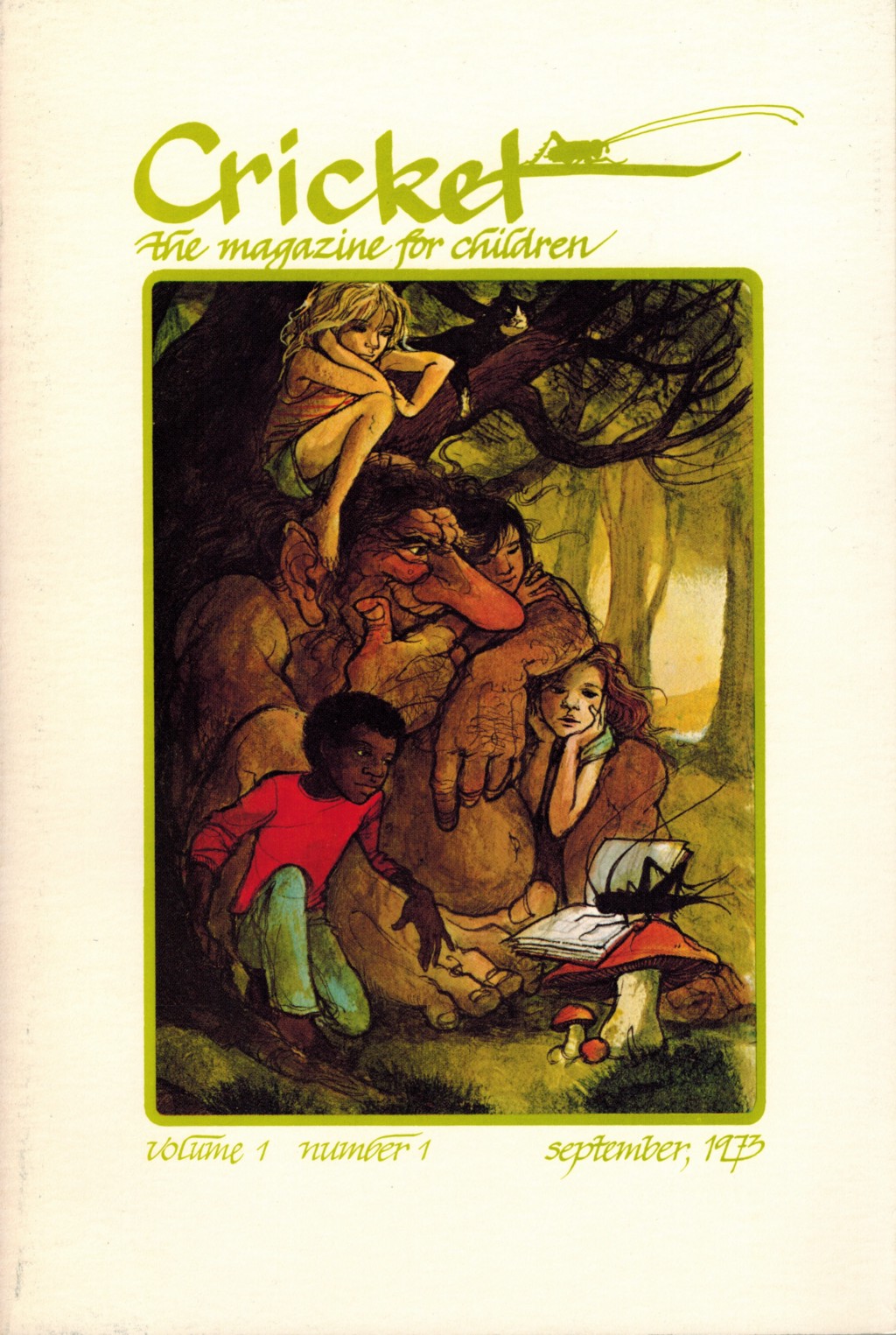
In 1972, Carus, Hyman and Leonard put together a pilot issue of Cricket. There was only one problem with it: Drawing from the example of St. Nicholas, the magazine’s titles were hand-lettered, which made it hard to read. So Carus brought in a designer: John Grandits.
While Grandits, who is now a children’s author, started with the Carus Publishing Company as a typographer, he quickly learned through working with Carus and Hyman a truth about Cricket’s philosophy: good storytelling wasn’t just about the printed word. The stories should be linked to the best illustrations possible.
“Illustrations are a speciality field, and in ’73 there were many great illustrators still working and still alive and Trina was able to corral them and get them to work,” said Grandits, who later became Cricket’s art director and took the magazine from its original 6 by 9 size to its now-iconic 7 by 9 format.
All of the artists in Cricket were remarkable; Grandits recalled one conversation in which Wally Tripp painstakingly explained how to correctly alter a horse’s anatomy so it could be anthropomorphized.
“He says, ‘Well, horses have hooves. They have no opposable thumbs. If you’re given a story to draw with a horse, how do you resolve the thing where he has to have a top hat and cane? He can’t put the hat on. He can’t hold the cane. What do you do? There’s a lot of illustrators who sort of lay it nearby, and it looks as if they’re holding it maybe, and nobody ever addresses the question of how the hat got on the head. But what you have to do is make adjustments to the anatomy of the horse.’ So he said, ‘Here’s a horse skeleton.’”
Tripp sketched out a horse skeleton in the dust of the fireplace where they were sitting. He went on at length, about how many fingers a horse should have, and how the cleft part of the hoof could work as an opposable thumb.
“He’s worked through all this, very seriously and very sensibly,” said Grandits. “There are big problems you have to solve if you want to draw this with honesty and honor.”
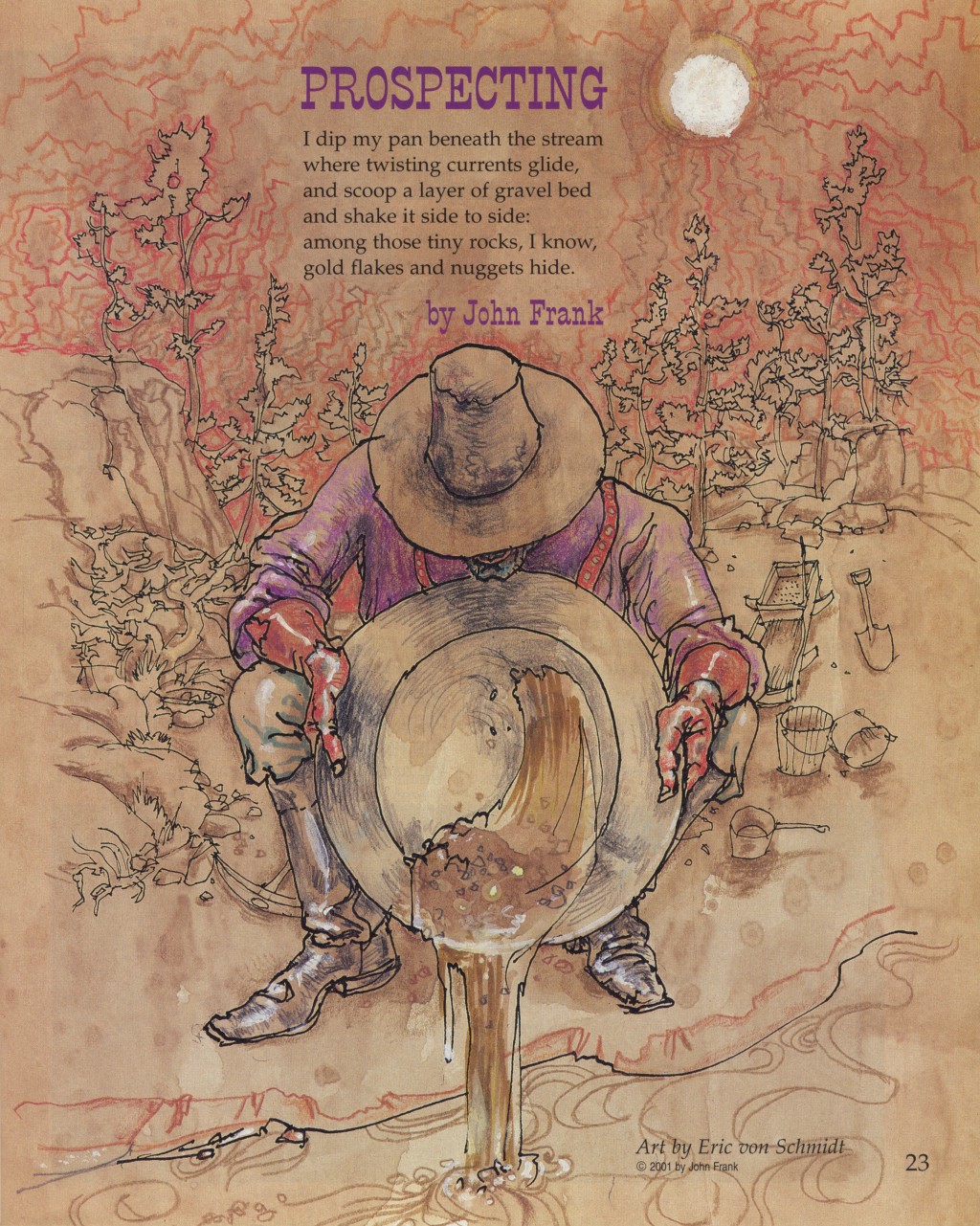
Another of Cricket’s artists was the late folk singer Eric “Rick” von Schmidt. Singer, composer, friend and collaborator to the likes of Bob Dylan, von Schmidt was also an artist. His work can be seen on album covers from the ’60s, but also within the pages of Cricket.
The first piece he did for Cricket was in 1979, said Caitlin von Schmidt, who is herself an artist. (She began reading the magazine that year, when he started working for them.)
“It was all storytelling for Rick,” said Grandits. “You tell stories with your pictures, you tell stories with your songs.”
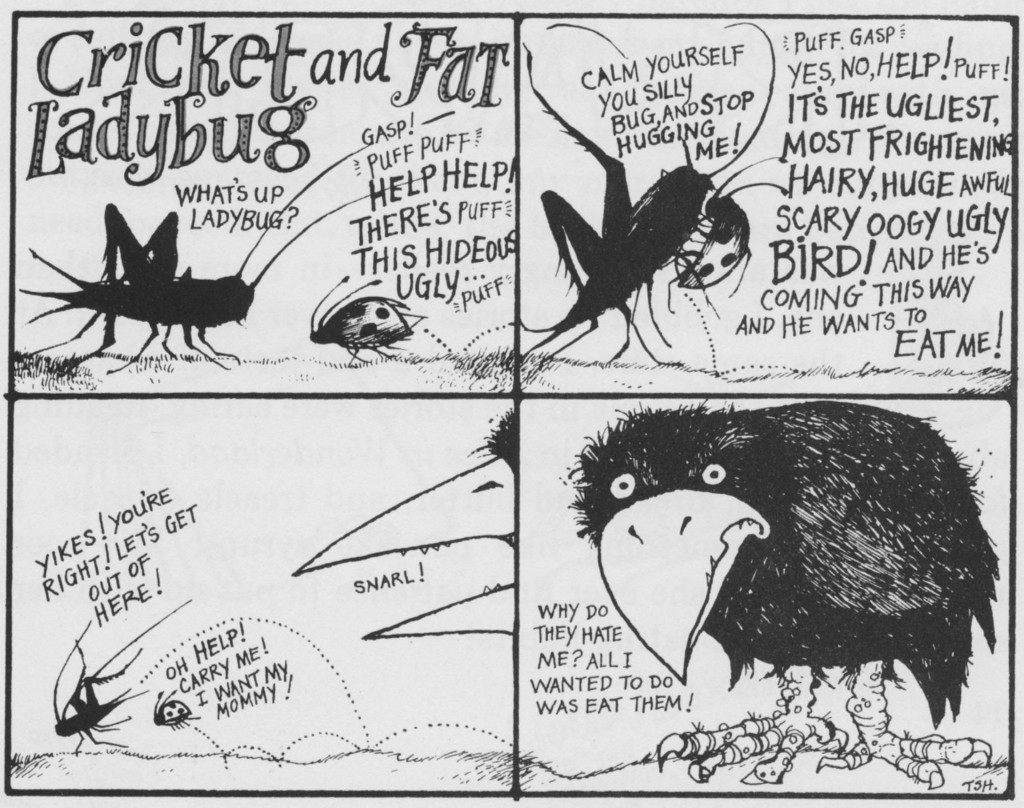
Hyman herself, who died in 2004, was an incredible artist. Her dreamy, detailed drawings won her the Caldecott Medal in 1985 for her work in St. George and the Dragon by Margaret Hodges. (She also garnered three Caldecott Honors.) It was Hyman who drew Cricket, Old Cricket, Ladybug, Sluggo, and all the other bugs, worms and spiders that still crawl, wriggle and jump through the pages of Cricket and its sister publications.
“[Trina] just had such a wonderful way of drawing them,” said Leonard. “They served as explanation of difficult words so if there was a vocabulary word that might stop a kid reader the crickets would explain what that word meant. They also had their own little life in the four-block cartoon.”
The Brothers Lionheart was published serially in 1974, beginning in Cricket Vol. 2, #12. The response from readers affirmed Carus’s decision to include the excerpt in the magazine. A Librarything review from 2013 describes having read the first installment and not being able to find subsequent issues of Cricket to finish the story.
“Oh how I suffered, not knowing what happened to the two brothers who jumped out of their burning house to what seemed certainly to be their deaths, ” wrote user anderlawlor. “Then in 2002, I was working at Dog Eared Books in San Francisco and someone brought this book in to sell. One of the best days of my life. It actually holds up to twenty years of longing.”
‘Kids love to cry. I wanted to cry too when I was a child.’
Susan Bernofsky, a translator shortlisted for the Warwick Prize for Women in Translation for her German to English translation of Memoirs of a Polar Bear by Yoko Tawada, was a voracious reader of Cricket as a child. She remembers The Brothers Lionheart as a particular favorite.
“I think I loved it so much because of the sadness and the modeling of how to deal with sadness with love and grace,” she told me. “I loved the picture the story painted of fraternal love, and the idea that somebody could send a message of love from beyond the grave.”
Carus, in giving children credit for being able to respond to a range of emotions, had made the right decision.
“Kids love to cry. I wanted to cry too when I was a child,” said Carus. “And in some ways, it was a relief, to be able to cry about something. Just as it is a relief to cry about when you are very very happy.”
Children — like Link, Newcomer, and Bernofsky — responded to the trust that Carus showed them. They wrote in en masse, often addressing their letters to Cricket and Ladybug, sending story suggestions, recipes, and letters. One child, said Grandits, found a cricket in their home and mailed it to the bugs “as a friend.”
“The response from the readership to the magazine was phenomenal,” he said. “These kids took this thing very personally… from very little to very mature, kids would write to us.”
“Cricket was a gateway drug to The New Yorker,” said Sarah Burnes. Burnes — now a literary agent at The Gernert Company — read Cricket cover to cover when she was a child. She loved the stories and conversations between Cricket and the other bugs.
‘Cricket was a gateway drug to The New Yorker,’ said Sarah Burnes, a literary agent.
“It certainly played a big role in my becoming a fanatical reader of both magazines and books, and then an English major, editor, and now agent,” she wrote.
“It sounds cliche, but I think the word ‘transported’ applies to my experiences with reading the magazine,” said Newcomer. “I eagerly looked forward to its arrival and could get lost in current and back issues (I saved every single magazine for years) for hours. It was like entering a flow state through creative consumption as opposed to creative output.”
Bernofsky began reading Cricket as a 7-year-old in 1973. Her mother, a teacher, learned about the magazine before its official launch, and subscribed Bernofsky and her younger sister to Cricket, starting with the very first issue. She read each issue multiple times.
“I still remember some of the drawings and poems and stories today,” she said in a Facebook message. “There was a little poem ‘Pity the girl with the crystal hair, how can she run, how can she bicycle?’…I could probably still recite most of it.”
André Carus went from being the inspiration for the Open Court Readers to being their publisher; he managed the Carus Publishing Company (Open Court’s parent company) from the mid-’80s until 2011.
It was during his tenure that Cricket’s magazine family expanded to include its 14 sister publications, including the other “bug” magazines: Babybug for babies, Ladybug for toddlers, Spider for small children and Cicada for teens. There were other magazines as well: Grandits and his wife Joann were brought back to Carus Publishing to launch the nonfiction magazines Muse and Click.
When I reached out to him for this article, Carus was willing to be interviewed, though he asked me to do some homework first. He wanted me to read a 2006 book called Let’s Kill Dick and Jane: How the Open Court Publishing Company Fought the Culture of American Education, written by Harold Henderson.
The book, commissioned by Carus, is less about Cricket, which is mentioned just once, and more about Open Court Readers and Blouke Carus’s quest to reform U.S. education. In fact, although Carus was attached to the magazines, he feels the textbooks were the greatest contribution to education in the U.S.. The Open Court Readers, he points out, made a difference to disadvantaged children who needed to learn how to read. Cricket was aimed at a demographic that would probably have been literate anyhow.
I asked Carus, now 64, what it was like growing up alongside his parents’ publishing enterprise and educational efforts.
“Oh, I was a believer,” he said. “I think the company made a difference.”
Unfortunately, Carus inherited a difficult business model; magazines are normally supported by ads, and none of the Carus magazines ran ads, relying instead on subscriptions.
The business model was made even more difficult by the rise of the internet. Cricket and its sister publications did move online in some ways: by 2007 parts of all the magazines were available online and electronic versions of the magazines were available to subscribers. That didn’t help, however. Cricket, which had long relied on subscriptions to its physical magazine, had a difficult time finding a way to adapt to an online environment.
Cricket, which had long relied on subscriptions to its physical magazine, had a difficult time finding a way to adapt to an online environment.
In 2011, when it was sold, the company was still fulfilling many print subscriptions. Two thirds of those subscriptions, said Carus, were gifts from grandparents.
It wasn’t enough to keep the company afloat. The Carus magazines had always catered to an audience that was willing to pay a little extra for quality, but there weren’t enough of those customers to keep the company solvent. While the Carus Publishing Group had some success finding new customers through direct mail in the mid-’00s, the 2008 financial crisis dinged it badly. Banks were no longer as willing to deal in cash flow lending.
“If we hadn’t sold, we would have gone bankrupt,” said Carus.
Now that he’s out of the publishing business, he is engaged in another of the Carus family’s passions: philosophy. Carus earned a Ph.D. in philosophy from the University of Chicago in 2007, and writes a blog dedicated to the work of the German-American philosopher Rudolf Carnap. He now lives in Germany, where he is a visiting fellow at the Munich Center for Mathematical Philosophy.
He seems both saddened and relieved when we talk about the sale of the Carus Publishing Company. He’s finally free to pursue his love of philosophy — he says he never really got any peace until the company was sold — but he’s sorry to have to sell the company his parents built.
The textbooks had already been sold off in the late ’90s. The magazines were sold in 2011 to ePals Corporation, a Canadian digital education platform that would hopefully be able to bring Cricket and the other magazines into the digital age. That company is now called Cricket Media.
Cricket is still around.
I found one of the latest editions in a library this fall, and it’s as well-written and well-illustrated as ever, which is unsurprising, considering that the current editor-in-chief worked with the Caruses before the magazines were sold.
If reviews from current and former employees on Glassdoor are to be believed, the current editorial staff still cherishes the values held dear by Cricket’s founders, although the management is struggling with the realities of magazine publishing.
Today’s Cricket is exactly like its namesake. Its output can’t be ignored. But if you’re trying to find the cricket itself, good luck.
There is a hint in those reviews that the current owners might be educational reformers in their own right: one review talked about the owners’ vision for school-wide technology and their conviction that the way students are educated must change.
It sounds quite familiar, but I never found out, of course.
Cricket is named for a scene in Isaac Bashevis Singer’s A Day of Pleasure, in which a cricket in the house chirps all night, “telling a story that would never end.” Today’s Cricket is exactly like its namesake. Its output can’t be ignored. But if you’re trying to find the cricket itself, good luck.
Like their real-life counterparts, umbrellas in fiction have a peculiar knack for getting lost, borrowed, stolen, and turning up in all sorts of unexpected places. They have been revered and reviled, cared for and cast aside, and used as weapons, shields, metaphors and even magic wands. Sometimes they slip into the action for a brief moment before ducking out again; other times, they are the catalyst for an entire novel. Perhaps most intriguingly, novelistic brollies frequently reflect real-world attitudes towards umbrellas, and the myriad meanings humans have invested in them over the centuries.

In researching my book Brolliology: A History of the Umbrella in Life and Literature, I’ve traced the humble bumbershoot’s origins and eventual domination, its reputation and moral associations, and even its erotic potential. Here is a collection of some of my very favorite literary umbrellas: from the pivotal to the mundane, the intriguing to the downright bothersome.
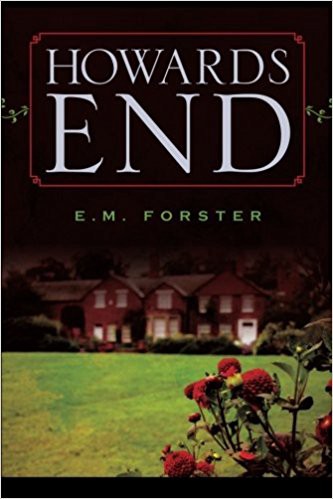
When Helen Schlegel absent-mindedly abducts a stranger’s umbrella one day, she can little imagine the ramifications of her thoughtlessness. Her unfortunate victim is a clerk, Leonard Bast, who possesses very little money or social standing but yearns for education, art, culture. When he retrieves his brolly from the Schlegels’ house the gulf between their classes yawns wide — they have countless umbrellas; he has just the one, and it’s in appalling condition — and still wider as the Bast and Schlegel families become ever more entangled. What follows is a sensitive yet damning exploration of class relations, social norms and women’s rights in early 20th century England — a time when, in Forster’s words, “the Angel of Democracy” proclaims that “all men are equal — all men, that is to say, who possess umbrellas.”

This short story is very Dahl, and wonderfully touches on truths that have followed umbrellas around for centuries: the sumptuousness of a well-made brolly, the class connotations attached to them, and the umbrella’s propensity to be lost, borrowed or stolen. I won’t give away the ending, but suffice it to say that, when George Borrow (an apt umbrella name if ever there was one) wrote in 1907 that “robbers never carry umbrellas” he could not have predicted the wildly inventive uses Dahl would put one (umbrella, and robber) to.

This novel is a fictionalized account of the “Irish Giant,” Charles Byrne. Fleeing the poverty of 1780s Ireland to seek fame and fortune on British shores, O’Brien and his friends arrive to a country quite different from their own, with a few novel inventions not seen in the course of their rural upbringing: staircases, and umbrellas. These “[canopies] on a stick,” as one character describes them, are in their earliest days of use in England, and Mantel deftly captures the real-world antipathy towards them with the reaction in her novel: boys like to throw stones after umbrella-carriers, and “collapse the tent on their heads, making them sopping.”
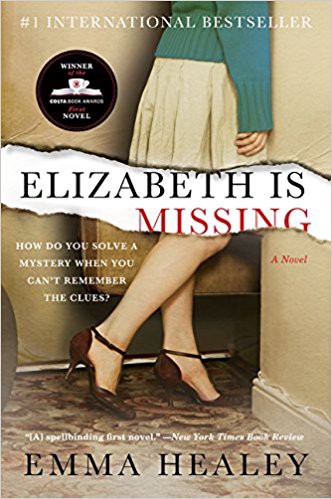
One of the unexpectedly pivotal characters of this novel is a woman living on the very edges of society. Driven mad by grief and trauma and shunned by her community, the woman carries an umbrella, “a shabby inky thing, half unfurled,” which she brandishes at passers-by (and occasionally hits them with). It’s an echo of a time when umbrellas were aligned, in the British imagination, with scruffy, disreputable, and decidedly lower-class characters. In fact, Healey’s “mad woman” has, in Australian author Ruth Park’s The Harp in the South, a literary sister: an Aunt Kathy who “went mad and danced Salome’s dance in her skin and an umbrella.”
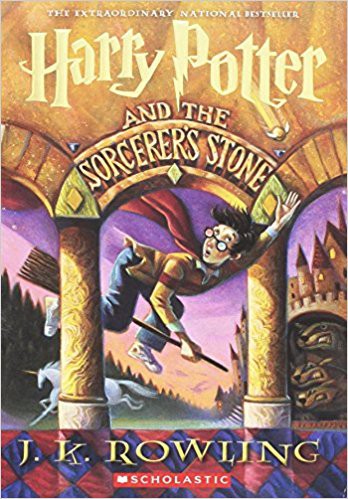
What child, reading the first Harry Potter book for the first time, could fail to be beguiled by the image of Hagrid, the hulking hairy half-giant who makes a dramatic appearance in the earliest hours of a rain-whipped morning, finally giving readers what they have longed for — a friend and rescuer for neglected Harry, and overdue comeuppance for his bullying cousin, Dudley? Certainly not ten-year-old me, and the frilly pink umbrella Hagrid swooshes through the air to conjure a curling pink pig’s tail from the seat of Dudley’s trousers has held a special place in my heart ever since. It’s not exactly a magical umbrella… but that’s another story.

It’s hard to narrow down Dickens’ best brolly mentions because there are so many, including at least two essays (“Please to Leave Your Umbrella,” in particular, is superb) and a whole cast of memorable characters. However, the most (in)famous is undoubtedly Mrs Gamp, the self-satisfied, generally sozzled nurse of Martin Chuzzlewit, whose dubious qualifications primarily consist of eating, drinking, and snoozing beside her long-suffering patients. So memorable was Mrs Gamp’s umbrella — terrorizing coach passengers with its pointy end, catching innocent bystanders around the throat with its handle — that her very name became synonymous with the objects, and “gamp” remains part of British vernacular to this day.

Kafka’s first, and unfinished, novel, was in part inspired by Dickens — so it is entirely appropriate that it should contain an umbrella. Sixteen-year-old Karl Rossman has been shipped to America in disgrace after being seduced by a housemaid. He is about to disembark when he realizes he has left his umbrella in his cabin. In the process of trying to recover it he befriends a stoker, who takes him to the ship’s captain, who just happens to know Karl’s long-lost uncle, who offers Karl unlooked-for friendship and hospitality (for a time, at least; it wouldn’t be Kafka otherwise). The umbrella, as far as we hear, is never recovered.
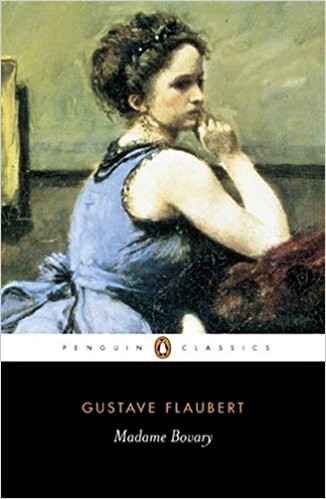
Like her future husband, I became slightly besotted with Emma when she appeared in the early pages of Madame Bovary beneath a luminous sunshade on a molten spring day. Indeed, a sunshade, or an umbrella, accompanies her through much of the novel — most tellingly when she first expresses dissatisfaction with her marriage, or begins to fall in love. It is one of the more subtle, yet striking instances of an umbrella’s delicate eroticism and its ties to the individual.

No list of literary brollies would be complete without mention of the iconic Mary Poppins, whose umbrella accompanies her on adventures, errands, and the occasional flight over Cherry Tree Lane. The Poppins of the books is far sharper than Julie Andrews’ saccharine movie counterpart — and exceedingly vain about her parrot-headed accessory.
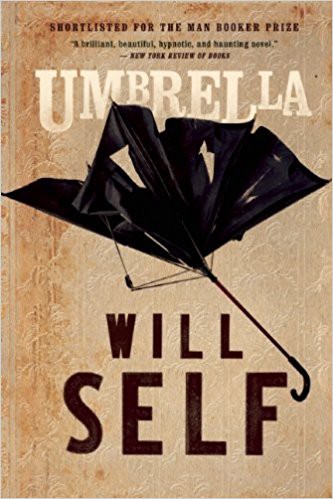
Umbrellas abound in this linguistically playful, modernist jaunt of a novel set partly in an umbrella factory — and the text is absolutely crawling with brollies. They appear in the hands of almost every character; they are sprinkled liberally throughout as metaphors; they are intertwined with sex, death, dreams, memory, hallucinations, medicine, the moon landing — they even, in one or two memorable scenes, transcend human-umbrella boundaries entirely. Ever wondered what it might feel like to turn into an umbrella? Read this, and wonder no more.

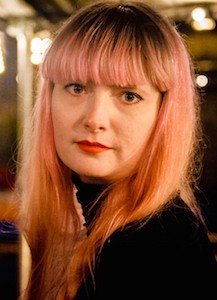
Marion Rankine is a London-based writer and bookseller. Her work has appeared in The Times Literary Supplement, The Guardian, Overland, and For Books’ Sake, among others. Her latest book is Brolliology: A History of the Umbrella in Life and Literature.
The Blunt Instrument is a semi-regular advice column for writers. If you need tough advice for a writing problem, send your question to blunt@electricliterature.com.
Dear Blunt Instrument,
There are some (a lot?) of writers who say shit like, “I have to write, I couldn’t not write, writing saves my life” etc. etc. (like cough my ex before last whom I’ll apparently never get over). So the reason I don’t think I’m a real writer, even though I’ve been published and some writers/people I respect have told me I can write well is because I don’t feel like I have to write.
I’ve been blocked for years and avoid writing almost every day. I can only manage haikus or song parodies because they’re so short and constrained that my hatred for my words and ideas doesn’t have time to kick in. So I feel like I’m probably not a writer, compared to my stupid ex who writes everyday and has been working on a book for years, along with getting engaged. FML.
So I guess my question is, am I not a real writer if I don’t feel like I have to write?
—Am I Real

Dear AIR,
First of all, I don’t see writers versus real writers as a useful distinction unless writers includes fictional characters who write and “authors” who let ghost writers do all the work. That’s not you, so if you write sometimes and not never, you’re a “real writer.”
Now let’s unpack this assumption a little. It seems closely related to what a friend of mine calls “the ass-in-the-chair canard,” or the idea that you need to write every day if you want to be a real writer. I hate this idea — it’s both privileged (it’s a lot easier to write every day if you’re healthy, if you don’t have to work a full-time job, if you can afford to do stuff like have an office, pay for childcare, have a housekeeper, etc.) and gatekeeper-y (a way of keeping those less lucky people out of the game). It’s also a version of that uniquely American condition I think of as Productivity Madness (more is always better! Suffer! Produce!).
If you write sometimes and not never, you’re a “real writer.”
This version — the “I can’t not write” canard — is slightly different, but as a way of shaming writers who aren’t as prolific as you, I find it similarly unsavory. Probably people who feel like they “have” to write don’t actually have a compulsive disorder; probably they mean they really like writing, or they find it really helpful in some way, or that it’s a learned routine. When you do something all the time, not doing it starts to feel wrong. (If you feel like you have to eat breakfast right when you wake up, guess what — you feel starving in the morning because that’s when you usually eat, and your body has learned to prepare for the onslaught of food by lowering your blood sugar. You can unlearn that.)
I’m Almost 40 and Still Getting My Stories Rejected—Am I Running Out of Time?
In reality, writing — art-making in general — feels different for everyone. Some writers write a book a year like clockwork, others take a decade. Dorothy Parker said “I hate writing but love having written.” Woody Allen seems to keep making movies purely out of habit. As for me, I love writing! But I don’t love writing if I do it every day. To borrow a metaphor from sex, I have a long refractory period; writing releases built up tension, but it’s not very enjoyable if I don’t allow time for the tension to build.
Rather than holding yourself to an arbitrary standard, what would be useful is figuring out a process or set of habits that works well for you. Being “blocked for years” and “avoiding writing almost every day” doesn’t sound super healthy, even if it doesn’t mean you’re not a writer; it sounds like you’d like to be writing more than you are.
I would try to figure out what is keeping you from writing. Is it mostly competitive jealousy? Or just not feeling confident that your writing is good? What was different about your life when you were writing more? Did writing used to make you happy — either while you were doing it or at least afterwards? I assume it must have, on some level, or you wouldn’t be asking this question. Can you re-create those circumstances? Can you isolate the parts of writing that you find meaningful, and do them more? You don’t have to do it every day, but as noted above: you have to do it sometimes, not never.
Now, since the ass-in-chair routine is well established elsewhere, I’d like to devote a little space to the benefits of not writing every day.
1. Not writing gives you time to read. When I have too many writing deadlines I honestly feel annoyed that I don’t have more time to read. Reading is the greatest! It’s also maybe the easiest way to become a better writer.
People who have time to write and read every day are lucky jerks. If you’re not a lucky jerk, reallocate some of the time when you feel like you should be writing to reading instead. Go to the library a lot and surround yourself with books. Abandon books that don’t interest you. Read books that do interest you with a notebook and pencil and those little sticky tabs nearby. Also, light a candle, pour yourself a beverage, get into it! I like to treat reading as a luxury, and being an engaged reader always makes me want to write.
2. Not writing gives you time to have experiences. I can’t stand that thing where people are talking about something interesting in the world on social media or whatever, and some scold pops in to say, “This is a distraction/waste of time, get back to work.” As though anyone can literally work all the time and never stop to talk to humans or engage in politics and expect to make good art out of that.
You actually have to spend some of your life living and doing normal life stuff or you can’t be a good writer. Life gives you stuff to write about, plus perspective and insight and context. Too much ass-in-the-chair time and you’re not getting exposed to the actual world.
You actually have to spend some of your life living and doing normal life stuff or you can’t be a good writer. Life gives you stuff to write about.
3. Not writing gives you time to think. Even when you know exactly what you want to write about, even when you’re deep into a draft or second draft or whatever, you still need time out of the chair to think. You can think while you write, yes, but writing comes so much more easily if you’ve done some of the thinking work beforehand.
Support Electric Lit: Become a Member!
There are tons and tons of studies that show the brain is really good at solving problems (even creative problems!) when you give it plenty of time and space to do its thing. The amazing thing is that a lot of the work gets done unconsciously! What could be easier?! When you give yourself permission to think, you can have good ideas without even trying. They’re canards too, but the take-a-shower and go-for-a-walk canards really work in my experience; they offer just enough of a distraction that your unconscious mind, which knows a lot, can get to work without your conscious mind always trying to steal the show.
Supposedly Charlie Parker, according to the art critic Jerry Saltz, once said, “If you don’t play the saxophone for a year, you get a year better.” I love this idea so much. It jibes with my experience of learning as discrete, more than continuous. Instead of steadily getting better on a curve, it feels more like we suddenly level up. It’s like all this potential learning gets stored up, and then a change of circumstances or an artistic breakthrough turns all that potential into real energy.
I say all this to say, when you’re a real writer, not writing is writing.
Most of the time, research scientist Janelle Shane’s pet neural network is the most creative entity on the internet—sorry, everyone who toiled for an MFA just to be outdone by a machine! It’s generated paint colors beyond the dreams of DuPont (Stanky Bean, Grass Bat, Snowbonk), kitten names even the gentle weirdos at the rescue couldn’t imagine (Snox Boops, Big Wiggy Bool), and this year’s hottest Halloween costumes (Disco Monster, Pumpkin Picard, Grankenstein). It’s come up with a whole anthology’s worth of short story titles—including “Zombies of Florence,” “Indiscreet Maidman,” and “Swords and Batman: Summer Party?”—and tried its hand at Doctor Who episodes and Harry Potter fanfiction. It even helped write an opera. What’s the last opera YOU helped write?
Of course, we know exactly the limits of its creativity. For each of the neural network’s projects, Shane explains what she used for a database and how she set up the parameters the program uses to generate new ideas. All the AI can do is slice up its inputs, figure out how they’re made, and put them back together in highly algorithmic ways. But that’s really all the human brain can do, too—we just can’t see the gears.
The human brain is quicker and more sophisticated with its cutting and pasting, though, and its database is HUGE. (To create a true robot writer, you might first need to simulate the entire history of civilization, a la one of my favorite Stanislaw Lem stories.) This means that sometimes, the neural network runs up against a challenge that’s relatively easy for a person, but that an artificial intelligence just can’t hack. One of those challenges, apparently, is writing the first line of a novel.
Support Electric Lit: Become a Member!
Shane fed a few hundred famous first lines into the neural network, and it tried to learn how to make them—but a few hundred data points aren’t nearly enough, and the AI balked. “The neural network proceeded to do what it usually does when faced with too little data, which is to give up on trying to understand what’s going on, and instead just try to read it back to me word for word,” Shane wrote. “Think of it like cramming for a test by memorizing instead of learning how to apply rules to solve problems.” Results included “It was a dark and stormy night; the rain fell in torrents — except the station steps; plump Buck Mulligan came from the stairhead, bearing a bowl of people.” You can see how things went wrong.
There were a few minor gems; I might read a book that started “It was a wrong number that struggled against the darkness.” But ultimately, like everyone other aspiring writer in the world, Shane’s AI can’t learn to write the perfect first sentence unless it reads a lot of them first. That’s where you come in.
Shane has set up a Google form to collect more first lines for the AI to read and learn from. You can add the first line of the unfinished novel that’s sitting in your drawer, or the favorite book that’s sitting on your bedside table. You can methodically go through your bookshelves and feed every first line into the database. The more first lines the neural network gets to read, the better its own writing will be. Think of it as training the robot writer who will one day replace you.
And meanwhile, congratulate yourself on being able to do something an artificial intelligence can’t do—yet.
As if broadening our reading horizons beyond our native tongue wasn’t impressive enough, great translators do so much more. They go further than the meaning of a text, give us access to the melody and feeling of literature from different worlds. And yet, for their almost magical service to global readers, they are often under-acknowledged.
We’d like to have a round, of sorts, for all the translators out there. So, for two weeks, from November 15th through 29th, we’re opening a special period of submissions for our weekly fiction magazine, Recommended Reading, exclusively for translated work. If you’re in the business of language conversion, check out the guidelines and notes below.
This period is just a special window for underrepresented work — we happily accept translated stories during any submissions opening, and if you’re a member, year-round! Check out our membership benefits here to find out more!
If you talked to me in 2015 in any capacity, chances are I would have recommended two things: BoJack Horseman and Infinite Jest by David Foster Wallace. I was spending my days working in a movie theatre box office, and when I didn’t have lines to memorize or wasn’t trying to come up with the next great comedy bit, I was re-reading and re-annotating some of my favorite passages. I even bought a bigger purse so I could haul all 1,079 pages of it with me every day to work. When I got home, maybe just to feel something, I would go to Netflix and get a pep talk from Princess Carolyn or a nihilistic statement from Secretariat or even just watch BoJack go on a bender. The book and show became my bibles of sadness, a road map of my own neuroses and the ones I’d seen in my family for years.
In 2015, a full year after I had graduated college, I had seen few of the changes I had hoped “post-grad” life would bring. I was still working at a movie theatre, I was still pouring most of my paycheck into helping my mom buy gas and groceries, Sallie Mae was calling me almost every day demanding the money they said I must have available based on my part-time salary, and I was just stuck. I was using my theater degree to stand around wearing three layers of wool in 90 degree heat to say five lines in iambic pentameter, and I was using my English degree to write ebooks, blogs, and web content for less than $5 an hour. I was living with my mom, who after two suicide attempts in the last four years, seemed almost okay but barely surviving on the few job prospects available to women who took breaks from careers to raise children. When I wasn’t at home, I was with my dad, also still recovering from losing a job at the bank around 2008 by working as an accountant at the treasurer, a job he gained through working at a temp agency.
The book and show became my bibles of sadness, a road map of my own neuroses and the ones I’d seen in my family for years.
So, when I watched BoJack Horseman, a character obsessed with escaping through entertainment and make-believe and a couple substances, I saw myself. Whenever he had a run-in with his mother telling him about the darkness inside him, I saw my mom’s parents printing out her bank statements and demanding, in front of me, why she spent $3 on a video rental when she should be worrying about rent. Standing onstage, the air hazy from kicked-up sand, humidity, and the steam of my own sweat while I told Macbeth he was surrounded, I felt like BoJack or his character Secretariat — running after this impossible thing that made that empty feeling standing inside the box office worth it.
When I opened up Infinite Jest, I saw myself in Hal. The descriptions of his family and the way the brothers spoke to one another resonated with me so much. More than anything, it was the way the characters talked about lying. As Hal says to his brother Mario,
Boo, I think I no longer believe in monsters as faces in the floor or feral infants or vampires or whatever. I think at seventeen now I believe the only real monsters might be the type of liar where there’s simply no way to tell. The ones who give nothing away.
Hal spends a great deal of effort trying to break liars into different categories. I’ve been lied to in one way or another my whole life: that internet and hot water going to come back, that rent has been paid, that mom and dad are just working things out, that dad is attracted to mom and they’re in love, that dad is away taking care of grandma, that it’s going to be okay, and that a college degree guarantees a paying job. So watching Hal navigate the lies and deal with the world, it was cathartic to see a family not unlike my own.
I even tried to articulate it to a coworker one time in the box office. He asked about the book and I said, “Yeah, I like how it talks about sadness.” I’d made him watch BoJack, too, so maybe he put things together. “Are you sad?” he asked.
And I guess I was.
Years later, after watching the most recent season, I know now that these two pieces of media that got me through my post-grad funk have more in common than I thought.
The reasons I started reading Infinite Jest and watching BoJack Horseman weren’t far from each other. Before I got into the book I obsessively read biographies of famous comedians. I found out that Infinite Jest was the favorite book of the showrunner of Parks and Recreation Mike Schur. I wanted it because I thought it would teach me about the entertainment industry, and maybe also about writing. BoJack Horseman, something billed as a “animated comedy you might like” on Netflix, hooked me in the way it spoke about being an actor, being someone in entertainment. After spending hours in auditions, and then in rehearsals that wasted my time with hours of waiting, I got it. I got BoJack’s drive and his need to run away. I got that while being in the performing arts can feel like a way to escape your life, you keep running into the same problems. What I didn’t get was that Infinite Jest and BoJack Horseman are telling different versions of the same story.
The story: A man is talented in his field. In the back of his mind, something is eating at him. There’s something about his home life or his parents or just maybe his brain that he’s trying to get away from, that he’s trying to get past. So, he tries as hard as he can. Eventually he turns to substances to help, but they actually make it worse. Then he has a choice: either move forward or get stuck.
The story: A man is talented in his field. In the back of his mind, something is eating at him. Then he has a choice: either move forward or get stuck.
Hal is a young man at a tennis academy with nothing but a great future in front of him, but he’s addicted to pot. The more he thinks and talks to people, the more we see it turns out that his substance use is a symptom of something deeper. Whether it’s due to the horrific death of his father, the fraught relationship between his brother and his mother, or the lies nearly every member of his family tells, he can’t function and desperately wants to.
BoJack Horseman is not a young man. Years after his successful but mediocre sitcom Horsin’ Around, he’s addicted to multiple substances and desperate for a comeback. He works with a ghostwriter and has to deal with both his past and how he can change for the future. Over the course of several seasons he also intentionally sabotages the future of his roommate’s rock opera, drags a costar along on a bender that ultimately results in her death, abandons a movie project where he plays his dream role, Secretariat, to see his friend, and almost rapes her daughter. For me, the whole show revolves on the question of whether BoJack Horseman, despite the way he tends to abuse drugs and alcohol and drag people down with unhealthy behavior, can actually move forward and be a “good person.” Like Hal, he seems to want to, but ultimately always gets in his own way.
Both stories deal with the idea of entertainment and how it can consume you; in Infinite Jest people are literally killed by their addiction to escapism, while in BoJack it’s the entertainment industry that sucks them under. As BoJack’s friend Charlotte says in season 1, episode 8: “Look over there. See those tar pits? Hollywood’s a real pretty town that’s smack on top of all that black tar. By the time you realize you’re sinking, it’s too late.” But the real tar in both of these stories is the legacy of family trauma.
As Adam Piper writes in “Chained in a cage of the self”: Narcissism in David Foster Wallace’s Infinite Jest,
Parental neglect and abuse, drug and alcohol addiction, and obsession with entertainment all work to increase characters’ narcissism and self-absorption. This increased narcissism prevents characters from developing meaningful relationships, and this absence of meaningful relationships contributes to the feeling of sadness[…] Rather than confronting reality and working to overcome their sadness by attempting to form meaningful relationships, characters instead seek to escape this sadness through the various fantasies provided by drug-use and entertainment. These fantasies […] [increase] their unhappiness. Certain characters are able to break free of these narcissistic impulses by turning outwards to form meaningful relationships.
Netflix could use this as a show summary for BoJack Horseman.
Just like Hal, BoJack is raised by parents who don’t have the capacity to really care for him due to past trauma or even just ineptitude. Pain and suffering is a part of his development. As his mother, Beatrice Horseman, says to him in season 2, “You were born broken, that’s your birthright. And now you can fill your life with projects. Your books and your movies and your little girlfriends but it won’t make you whole. You’re BoJack Horseman. There’s no cure for that.”
Because of that kind of upbringing, BoJack has a hard time holding on to relationships without just burning them to the ground by doing something horrible. The real difference between Hal and BoJack? Hal sinks into the tar, and at the end of this season, BoJack seems to be moving out of it.
The real difference between Hal and BoJack? Hal sinks into the tar, and at the end of this season, BoJack seems to be moving out of it.
Three quarters of the way through Infinite Jest, in “The Year of the Adult Depend Undergarment,” Hal loses control of his voice and body when he tries to communicate. What happens after Hal starts developing symptoms is unclear. He definitely does his best in school, despite what happens whenever he tries to communicate with another person. He definitely tries to go to a college interview and is subsequently hospitalized. He also attempts to dig up his father’s head in relation to a Canadian terror plot. But the book doesn’t tell us Hal’s eventual fate. Does he get better? If he doesn’t get better, what does he do? While he’s still able to be a remarkable tennis player, he is presumably never able to communicate with another person and probably becomes addicted to pot again. His whole life has been dedicated to tennis, but without the ability to communicate, he won’t be able to be on a collegiate team. He loses all agency.
BoJack, even with all of his issues, does have the ability to take action — because unlike Hal, he can recognize the patterns that are imprisoning him and dragging him down. Though BoJack goes on more substantial benders and seems to relapse more than we ever see from Hal, he actually proves that he can change for the better and get past his family trauma. The horrible experience his mother had is passed down to him affects him every day, but in this season proves he can walk away from it. He can take control and make things right and walk away from the horrors of his family’s past. Hal, on the other hand, simply can’t. When he gives up pot, he finds it so unbearable to stay vertical that he decides to be horizontal. He is also grappling with how easy it was for his best friend to lie his way out of a urine test for him and how much lying that easily scares him. So he lays on the floor, and like BoJack watching “Horsing Around” over and over, he watches every single film his father made. When he finishes his entertainment bender, he finds he has lost the ability to even speak.
The book is agnostic on why, exactly, Hal loses his power of speech — a powerful drug? Mold he had eaten as child? The ghost of his father? But at any rate, he loses everything. Hal fades into the background of a story that he started. BoJack, despite everything that has happened, is moving out of the tar, and for the better.
What allows him to succeed where Hal fails? The turning point for BoJack may be Todd’s speech in season 3, episode 10:
You can’t keep doing this. You can’t keep doing shitty things and feel bad about yourself, like that makes it okay. You need to be better […] BoJack, just stop. You are all the things that are wrong with you. Not the alcohol or the drugs or any of the shitty things that happened to you in your career or when you were a kid. It’s you. Alright? It’s you.
Before that moment, it seemed like BoJack ruining his and everyone’s lives over and over and over again was going to be the formula of the show. Every season it would get bleaker and bleaker until he destroyed himself. Instead, BoJack seems to gradually learn first how to stop living in the past, then how to stop running from his problems, then how to consider running towards something, and finally, how to stop. At the end of Season 1, we see BoJack looking over the sea, trying to reclaim his past. At the end of Season 2, we see him trying to run and that other runner telling him he has to keep running every day. At the end of Season 3, we see him almost kill himself by letting go of the wheel but then pull over to watch wild horses run together. At the end of this past season, he’s not looking to escape and he’s not running. He’s not going off to escape on a bender. He’s standing at home and he’s talking to his sister on the phone. He’s not running, but he’s moving forward.
To be a BoJack, and specifically a BoJack at the end of season 4 and not season 1, is to recognize when you’re living in a pattern. More than that, it’s to recognize that you’re not letting yourself taking control of it.
To be a BoJack, and specifically a BoJack at the end of season 4 and not season 1, is to recognize when you’re living in a pattern.
I didn’t see my pattern until July 2016. It was staggered at first. Every two years my family would have a major incident: a suicide attempt, followed by past due notices, and a big move sometimes, other times not taking enough insulin. December 2015, a little after Christmas, after a feverish night of limited mobility, I called an ambulance. A paramedic screamed at me, “Why did you wait so long? HER FOOT, IT’S LACRIMOSING!” In the car, my sister sobbed while we waited to follow the ambulance, and said “she said it was lacrimosing, does that mean it’s dead?” I remembered Latin class in high school and said: “I think that means it’s crying.”
They ended up cutting off my mom’s foot. She was able to get disability after going into rehab and got a nice apartment. That worked out for a while. It was back into the pattern: big disaster, solving the disaster, finding a new place to live, and everything’s okay again for now. The pattern repetitions got faster, though: several months later my mom started having mini-strokes and we received an eviction notice. She went to the hospital and came out again. She started staying with friends while my sister and I backed out on a roommate deal and started looking for a place. Mom went to the hospital again maybe a month later, for surgery to remove her gallbladder, apparently the trigger for the “mini-strokes.” After the surgery, her friends were worried about letting her stay. Sitting in this hospital room in the middle of this pattern accelerating and accelerating out of control, spending the night because I promised I would even though I have an opening shift as a hostess in the morning, and my mom has sobbed herself to sleep because we don’t know what to do, I realized I had a choice. I could do what we’ve always done: crawl back to my mom’s parents on our bellies and ask them for help even though I know there’s a cost, even though I know it will make me feel like shit, even though I know it will force me to swallow their poison — or I could do something different.
On July 7th, 2016, I published a GoFundMe and raised $2,825 dollars from Facebook friends. That money allowed us to stay in the Red Roof Inn for a little over a week and provided us with the down payment of the apartment we currently live in. We haven’t gotten the help of our grandparents since they stormed out of the hospital room just a few days later. I now work as a full time writer at a marketing company, which pays the rent for this apartment totally out of the pattern.
Like BoJack, I had to realize the things I was letting happen to me and my family: borrowing money, being beholden to my grandparents, not being able to pay rent, late notices, and mental health crises. I realized in that hospital room, I had to make conscious choices to make things better. I had to try something different. That’s the saving grace of BoJack this season. He tried something different and so far it’s working. Hal did make an attempt to change — he tried to quit pot, he saw that people were lying to him, but in the end, he didn’t break the pattern. He got overwhelmed with the lies people told him and didn’t change his narrative. But BoJack’s trying, and I am too.
What is a “currybook”? Canadian author Naben Ruthnum coined the term to describe a particular kind of diasporic writing that combines easy South Asian cultural touchpoints, swaths of old world nostalgia, and a vague sense of the exotic coalesce beneath a paperback cover — and is then mass-marketed towards both homesick immigrants and curious outsiders.
Growing up in a Mauritian household in sleepy Kelowna, British Columbia, Ruthnum was always unimpressed by the warm rows of these currybooks — their covers tinted orange, plum, or persimmon — that he’d find lining his parents’ bookshelves. As he got older and settled into his career as a multi-genre fiction writer, he began to question his dislike of this particular type of “immigrant as identity” diasporic writing, as well as the publishing industry’s penchant for these so-called “sari and spice” affairs. In Curry, his debut for Coach House Books, Ruthnum set out to investigate his own fraught relationship with curry — as a spice, yes, but more so as a greater symbol of his own identity. He explores how eating curry, reading other writers’ thoughts on curry, and the racialized dynamic surrounding curry play into his own identity as a brown, diasporic writer.
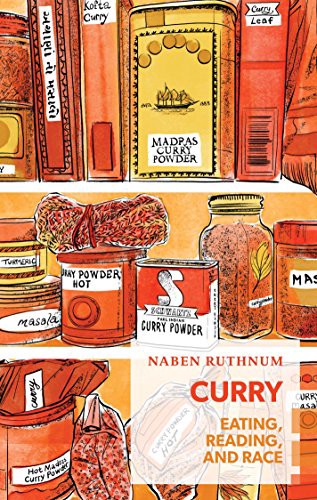
The book is a sort of jumble; it’s part memoir, part literary critique, part culinary history, and part rant, the sort of mashup that makes quite a lot of sense once one considers Ruthnum’s own varied writing background. He doesn’t hold back on his opinions of the more damaging or reductive tropes associated with his target, but pulls no punches when it comes to himself, either. Throughout Curry, Ruthnum grapples with his own prejudices — against currybooks, against their more exoticized, feminized counterparts (which he calls “mangobooks”), against the glut of diasporic novels that felt both too familiar and utterly foreign to his own experience. That penchant for clear-eyed self-interrogation keeps the book from feeling too polemical; instead, it makes Curry all the more accessible, steered as it is by an author who is, quite simply, working through his own shit.
Discussing big, sensitive ideas like identity, authenticity, and the immigrant experience may be a tall order, but in Curry, Ruthnum digs in with gusto.
Kim Kelly: The idea of the “currybook” and your conflicted feelings about the genre is a central theme of Curry. Could you break down what exactly a “currybook” is, and why they’ve become such a thorn in your side as a South Asian writer?
Naben Ruthnum: “Currybook” is a term I had for a certain kind of diasporic brown novel when I was a teenager: the type I didn’t want to read. The way I describe these books in Curry is as “nostalgic, authenticity-seeking reconciliation-of-present-with-past family narratives,” and that tends to spur recognition in readers who know what I’m getting at: often, these books will have drifting red silks and a braid on the cover, or a scatter of powdered spices, maybe a mango or two. And often, as I discovered when reading this book, books that happen to adhere to these rough genre guidelines are well-crafted, heartfelt works of art, not just parroting of the “sari and spice novels” (a more popular term for currybooks) that have come before them.
But the themes and relationships at the heart of these novels didn’t resonate with me as a writer — at least not across all of my work. Problem is, I did write one short story, “Cinema Rex,” that dealt with brown kids on the island of Mauritius in the 1950s and their subsequent, film-obsessed lives in the West as adults — classic ingredients for a currybook, and the first piece that garnered me any real attention from awards juries, publishers, and agents. Many of the people who liked that story were put off by the rest of my work, which ranges from thriller to literary fiction that isn’t always centered around brown protagonists. Pushing forward over the next few years as a writer, I realized that the pressure of expectation to create a literary persona and work that is recognizable as fitting into pre-existing versions of Western brownness, complete with tragic looking back, generational disconnect, and an inability to cook amma’s aloo gobi, was a real part of what was standing in the way of me getting to publish what I wanted.
Wealth and Family in the New India
KK: In the book, you talk a lot about the demands that are placed on brown writers by the publishing industry as well as the reading public — this sense of needing to either seamlessly assimilate or exoticize oneself. How do you think this way of thinking can be effectively challenged? How can the industry make more space for brown writers to be whoever they want to be?
NR: That pressure to exoticize my writing and work in a way that is, funnily enough, actually asking me to conform to a pre-existing story template that we’ve read dozens of time before, a sort of prefab exotique, has been a dominant pressure in my career. The go-to answer to this problem tends to be getting more people of color in editorial boards and agencies. But, as I say in the book, it’s not simply white audiences who gravitate toward echoing, nostalgic stories of brown identity repeatedly: it’s a significant contingent of the brown audience as well, and readers of all backgrounds. So just getting an editor of color to read your book isn’t the magical fix-it to getting stories of unique brown identity in the West out there — or the stuff that I tend to write, which is clearly informed by my racial and class background, but doesn’t often plainly foreground issues of racial and cultural identity. I think the key to getting more space for stories out there is something like a serious version of what I’m doing with this book, where I make fun of and create discomfort in readers and publishing industry operatives who have an extremely narrow internal definition of “diversity.” It has to be an ongoing, and sometimes mean, discussion.
The pressure to exoticize my writing and work is, funnily enough, actually asking me to conform to a pre-existing story template that we’ve read dozens of time before.
KK: The subject of family consistently appears throughout the book, from your own Mauritian clan to the overarching concept of “authenticity.” How did writing this book lead you to interrogate your own relationship with family? What’s the most significant thing you learned as a result?
NR: Family dynamics are so often at the heart of currybooks, good and bad, and there is a very recognizable pattern that many of these books tend to stick to, which often reflects the lived reality of their authors. You know what I’m going to write — conservative parents who don’t understand why their children are listening to rap and sometimes dating white people. I’m being wildly reductive here to get a point across, and that point is that the lived reality of some brown people in the West may fit this pattern — but bring individuality, class, education, artistic leanings, religion, isolation, generational distance from the subcontinent into it — and what you get is an incredible range of different parents and children interacting differently.
For example, the scolding aunties that I see in certain novels are a type I recognize as real, a type that resonates with young South Asian people I’ve talked to — but the closest aunt in my family lived in London, is highly progressive and independent, and was taking me to bizarre Wooster Group plays when I was in university, encouraging me to think and write exactly what I wanted. That extended-family-disapproval thing was never a part of my life, while it’s embedded in the lives of many other brown Westerners.
I did learn, as elsewhere in the process of researching this book, that my initial, childish dismissal of trope-heavy books by South Asians was immature and incorrect. There are truths about family relationships that don’t become any less true from being repeated: it’s just that there are other truths that I’d also like to read about, and they need to be published more often. There are also truths among the currybook tropes about family, nostalgia, and homecoming that are distinct, odd, and hyper-specific, that risk being lost as these books are marketed and promoted as belonging to one mass of shared experience.
KK: The concept of curry is itself rooted in sociopolitical turmoil, stretching from the earliest days of the British Raj to the racism still experienced by South Asian people. How do we decolonize curry?
NR: Pushback is embedded in curry’s recipe, I think. The chilies in Indian curries come from Portuguese traders centuries ago, planted on Indian soil to make commerce with Europe and elsewhere easier: but Indians took ownership of the spice through culinary ingenuity. Adapting the incredible variety of dishes that are classed under the curry banner to Mughal courts and the Raj afterwards expanded the definition while catering to certain palates, but there’s no sense of the colonist owning the dish — I feel that curry is a dish that has the world in it, a historical, evolving food that can’t perhaps ever be properly “decolonized,” but it can spur a discussion for just how complex and worth unpacking these terms and this insane history is. That discussion has to be about making these different historical and colonial paths to what’s on your plate known.
I feel that curry is a dish that has the world in it, a historical, evolving food that can’t perhaps ever be properly “decolonized.”
KK: Your discussion of Soniah Kamal’s essay “When My Authentic Is You Exotic” and the “mangobooks” seemed to hit a particular personal nerve, especially the idea of how diasporic brown people feel forced to police themselves to avoid falling into perceived stereotypes. What is at the root of your (and other brown writers’) professed dread of writing to “serve” white audiences?
NR: I’ll speak for myself, but it’s probably a sentiment many brown writers share — the idea of serving your own banal existence as exotic to white readers, or, even worse, inventing a sense of connection to the past, or a sense of alienation that you might not properly feel in order to create an effect in a white reader that is based on seeing your name and author photo then reading a narrative about an orphan trying to reconnect with their severed homeland — is just plainly chilling.
I certainly try not to let this get in my head too much. Despite having written this book, I do think it’s extremely important for my time spent writing fiction to take place inside my own head and in the story, as divorced from ideas of audience reception as possible. That’s part of what I was working out with Curry: exactly what it was I thought of all this stuff, and how I could find a way to have a career that didn’t involve me trying to outsmart industry expectations behind the scenes. Making my part of the discussion public seemed to be a good way to do both.
Support Electric Lit: Become a Member!
KK: As a writer, what did you seek to accomplish by publishing this book? And now that it’s out, would you say you’ve achieved that goal?
NR: Now that the debate about diversity in literature is loud and ongoing, it’s important to have disagreement-within-ranks about what constitutes diversity, and what the various problems in the industry may be. I had to work against this obstacle personally when it came trying to get my work published, because I kept running into a tacit definition of what brown writing looked like: a definition that my work didn’t fit into. “Being accepting of diverse narratives” risks morphing into an acceptance of “being accepting of THE diverse narrative,” whatever that may be for one’s insert-cultural-group here. Of course, writers like Chimamanda Ngozi Adichie have already precisely nailed this problem, and in part, my book was just adding to the work they’ve already done — but the other thing I wanted to do with this piece was to joke, to suggest, to discomfit people, whether they be of color or not, into thinking about these issues for themselves, and not just seizing onto a solution that I myself never arrive at, in the book or in my own career.
And I can’t forget the publishing-my-first-book part of the deal, especially because I’ve been fortunate enough to get press and reader attention for Curry. My selfishness as a writer, my desire to have books out across genres and to write for other mediums, is a motivation that I never want to underplay, and I think that’s useful in making the points I made the way I made them — in talking about the career and aims of an individual writer who is constantly confronted with a genre-cast mold of what he is supposed to writing, I’m telling to story of the racialized writer as an individual, not a type, not a category: a weird person shaped by race and class, certainly, but too many other important and trivial factors to enumerate.
In 2010, I was three years into writing my linked story collection when I took my first trip to Vermont to attend a writers’ conference. My workshop was a group of seven that included our instructor, Ellen Lesser. With a couch and cushioned chairs set in an oval everyone talked around me and about my story. I remained “in the box” (that is, not allowed to speak) during my classmates’ deliberations and discussions. My only additions were steady nods or pursed lips. Once I was allowed to speak, I thanked them, but bemoaned the fact that this particular piece in my collection was taking a long time. Ellen crossed her legs and met my eyes. She tucked a salt and pepper lock behind her ear and said in a kind and confident tone, “You’re acting as if writing should be an efficient process, Jennifer. It’s not.”
Six years later, I returned from yet another conference where I workshopped another story in this same collection. The instructor in this case, Tayari Jones, recognized the character, having seen a previous iteration of a story a few years earlier. Like Ellen, she gave me the tough love stare and asked, “What’s taking so long?” I had no answer.
Who, exactly, determines what “slow” means when it comes to the writing process?
Where Ellen’s comment attempted to help me reconcile the writing process. Tayari’s question pushed me to try and understand my process. I was unable to pinpoint my reasons — personal, professional, creative — for not finishing, but I also had a hard time accepting that the process is the process. Ellen’s words rang as a kind of “it is what it is” lament that has no finite answer or fix. For many of us we’re still figuring out “our process.” We tinker with methods of productivity as “process.” “Process” is not always efficient nor pretty. In fact, it is a pain in the ass.
A popular post on Electric Literature is an infographic of how long it took authors to write their most famous novels. The timing ranges from 2.5 days for The Boy in the Striped Pajamas to 16 years for the Lord of the Rings trilogy. I’m unsure if these metrics provided relief or added anxiety. Did this mean that I was right on track because Victor Hugo needed 12 years in the 1800s to finish an epic novel, or that I was way behind schedule compared to the 4 years it took Audrey Niffenegger to produce The Time Traveler’s Wife? Pulitzer prize winner Donna Tartt, a notably reclusive writer, seems to publish a novel every 10 years. Another Pulitzer winner, Junot Díaz, has called himself a “slow writer,” too. Slow doesn’t keep the words from coming, yet is it a fair measurement? And who, exactly, determines what “slow” means when it comes to the writing process? Is it us writers, the business, public expectation, or the characters and stories that need time to develop?
I also work in book publishing where schedules for manuscript to final product is part of the job. We need to know how long it will take to copyedit, typeset, and print a title. I know that preparing a book for the printer can take several months, to print and bind it a few weeks. The pace of reading, meanwhile, can fluctuate due to a reader’s eagerness to turn the page or scroll further. The act of creating is in itself an immeasurable thing and yet there are barometers readily available, ones we also put on ourselves when it comes to meeting deadlines, applying for residencies and grants, and so on.
The same year I first visited Vermont, Susanna Daniel wrote about the “quiet hell of 10 years of novel writing” it took for her to complete and sell her debut, award-winning book Stiltsville. “Quiet hell” is a great description for the time it takes to hone in on what you want to do and what the work is, along with the insecurity and fear of pursuing such an endeavor, as well as the growth required to continue this bizarre act of writing. Susanna mentions a sense of “non-accomplishment” as one of the factors tempting her to ditch the pursuit. Writing is hard, she wrote, but what’s harder is not writing and not finishing. Ultimately, we return to the tortuous page because we feel that urge and need as artists.
This sense of non-accomplishment triggers anxieties: the pressures of perfection writers place on ourselves in addition to whatever expectations the outside world may push into our orbit. I recall Tayari saying as much at the Well-Read Black Girl Festival in September: Perfection can be a form of procrastination. Something is keeping us (me) from finishing. Enter the internet, which bestows a bevy of information: notifications of a sale; news of a story about an author taking a year to create what’s taken me a year to contemplate, thereby initiating an internal competition of when one “should” be done. In those moments of seeing or reading about others’ progress, I have a niggling doubt about whether or not I really am a writer. When was the last time I submitted something? When I stare at my drafts and my eyes settle on dates connected to documents I see the growth, yet it feels as though I’m barely inching away from the start of the marathon and the massive banner for the end is miles away.
The pressures of perfection make it appealing to click away from my Word document and open a web browser. It’s kind of masochistic, wondering why I’m not finished with a particular project while at the same time baking a bundt cake, editing someone else’s work, checking email I checked three minutes ago, and going on social media using the hashtag #amwriting to relay my progress even though we all know I’m not writing in that moment. Once I begin to question the words on the page, a scene’s progression, and/or my overall concept, it’s a brief reprieve to go for a bike ride rather than tackle the problem at hand. The pressure of being perfect as an artist in a world full of artists, residing in one of the most artistic cities in the world, living with characters for almost a decade, has me throw up my hands and say “I put in enough time, right?” before I log onto Twitter. (#TheStruggleIsReal.) It leads me to settle in my chaise with a book and be optimistic that I won’t be as hard on myself for the time not spent on the work. The pressure has me hope that the distance I felt growing between myself and the words on the screen isn’t as broad as I perceive it to be.
Song of the Shank author Jeffery Renard Allen told me that writers “actively seek ideas.” We may be so dogged in our pursuit that we want, or even expect, to be able to come up with the kernel of one at will and within a specific amount of time. But there’s also a level of development that needs to happen, this also takes time. Jeff was one of my instructors and my mentor as a grad student at the time he had been working on Shank — a fictional account of the prodigy Blind Tom. Eight years after I graduated, I purchased Song of the Shank at a reading at Housing Works remembering the project he’d been researching and drafting as he critiqued my own writing. “Song of the Shank taught me that we have to be patient and let the ideas find us,” he told me.
And sometimes, what feels like the finish line may be the halfway point. Bellwether Prize winner and New York Times best-selling author Heidi Durrow’s debut The Girl Who Fell From the Sky “went through at least twelve major revisions over the course of the years I worked on it and three of those were after I had a book contract,” she said. Heidi estimates she deleted 150 pages of her prize-winning manuscript and “built it back up.” The idea that the work ends once the deal is sealed is a fallacy, reflecting the constant growth and development writers go through to get their writing to a place we’re comfortable with before releasing the reins.
Michele Young-Stone, author of The Handbook for Lightning Strike Survivors, told me that time constraints are “comical.” Michele wrote the first draft of her novel in 2004. “By March 2005,” she said, “I thought I was finished. It took four years of revision, letting the manuscript sit for months, to see the bigger picture. I sat down and rewrote the whole book in 2008.” The Handbook for Lightning Strike Survivors would publish in 2010, six years after Michele began.
Writers will never stop setting unrealistic timestamps to finish a story and send it out. In fact, the pressure we put on ourselves can be paralyzing in its intensity, and the feeling of non-accomplishment is a pervasive weight. I began this process thinking “oh yeah, this collection will take a couple years at most,” but the weight increased with each critique, workshop, meeting with an instructor at a conference or a friend for brunch who read it over and said there was more work to be done. “You’re getting there” is a phrase I hear often. “I see what you’re trying to do” is another. My eyes become shiny every time I hand off the latest draft to my cohort. I’m thinking, “Validate me, please. I think I finally got this right. Please tell me I’m done.”
Nowadays when this happens, the words “It takes time” echoes in my head, in Ellen’s voice. It takes time to know your characters and for them to speak to you. It takes time for the feedback to sink in and for a resolution to burst forth. There are moments I hate the people I’ve created on the page, and there are times where I love them so much I cannot bear to press the backspace button to delete a scene they appear in. There are moments when I grin at my perceived brilliance and am humbled, grateful and slack-jawed when someone says, “This works” or “You did a great job with structure” or “I love this and want to publish it.” These factors, the bits and pieces that come through, the material that’s kept and what is cut further illustrates the “inefficiency” of the process. A process that can’t always be measured, no matter how many times I hear “slow” versus “fast” or find out how long it took such-and-such award-winning writer to get their project out in the world.
I asked Susanna how she was able to persevere in her “quiet hell,” despite outside barriers as well as internal ones. She told me she “realized that writing — in the long form especially — is an act of faith and that I needed to generate that faith for myself in a prolonged way.” Jeff noted that the man he was in 2000 “was not a man capable of writing” his most recent novel. I don’t know if this made me feel better or not, but it did provide more insight than I had before. I once heard Ron Carlson say at a workshop, “stay in the room.” He meant this metaphorically and literally. In order to stay in the room, I will not think about the person who initiated this anthology at age 27 as the same person to finish it several years down the line. To stay in the room and accept my process, whatever it may be, also means not dwelling on something I cannot change. But I may have to turn off the wifi.
 Thank You!









.jpg)