8 Funny Novels That Make Light of the Writer’s Plight

Nothing is easier to poke fun at than the life of a writer, with our overly lofty ambitions, fragile egos, and navel-gazing ways. For this reason, there is no shortage of comedic novels that pull back the curtain on this humiliating struggle, following writer main characters as they attempt to produce “important” works of literature in the face of their all too human shortcomings—fear of failure and of criticism, addictions of all kinds, jealousy of other writers, and of course, a debilitating sense of inadequacy paired with a desperate longing for external validation. 

My debut novel, Bitter Texas Honey, follows Joan West, a privileged, pill-popping, Texan degenerate who yearns above all else to be seen and acknowledged as a writer. To that end, she is desperate to finish her long-abandoned coming-of-age novel, or at least get a short story published somewhere respectable. While the novel is about much more than writing, Joan dedicates much of her mental energy toward this pursuit. She carries a notebook everywhere, mining her life (and the lives of those around her) for compelling material. However, like many young writers, Joan is sorely misguided. While she dreams of book signings and prestigious awards, she lacks the discipline to actually sit still with the blank screen and face herself, to be present long enough with her thoughts to write anything approaching truth. 

The following eight novels also satirize their main characters’ literary ambitions. Each of these books features a writer main character at varying career stages, battling against their own ego. What I enjoy most about books like this is their humor, stemming from the refusal to take themselves too seriously as authors. While not all these novels are autobiographical, one can’t help but pick up on a hint of self-deprecation in these stories. It feels that these authors are inviting readers to laugh at themselves alongside their main characters. 

Perfume and Pain by Anna Dorn 

In Dorn’s sharp, hilarious, and compulsively readable tale of lesbian chaos, 35-year-old novelist Astrid Dahl is struggling to write her fourth book. She longs for the naïve confidence she possessed in her twenties, and finds herself crippled in the wake of the criticism she’s received after being politically incorrect at a Barnes and Noble event. Dorn’s handling of Astrid’s authorly ego is delightfully ironic and embarrassingly relatable. People with healthy egos don’t become writers, Astrid muses early on. They become engineers.

Old School by Tobias Wolff 

Short story great Tobias Wolff’s semi-autobiographical novel follows a young, bookish scholarship student at a prestigious boarding school in the 1960’s. Spanning one academic year, the novel’s structure is built around 3 successive writing competitions held by the school to win an hourlong audience with incredibly famous visiting authors (Robert Frost, Ayn Rand, and finally, Ernest Hemingway). Wolff’s protagonist—ambitious, competitive, and insecure—is desperate to win, and you can’t help but root for him, even as he makes questionable decisions to achieve his goal. Come for Wolff’s masterful storytelling and moral acuity; stay for the funniest takedown of Ayn Rand in contemporary fiction. 

Yellowface by R.F. Kuang

Fantasy writer R.F. Kuang brings her genre chops to this satirical literary thriller. She takes aim at the entire publishing industry while skewering her protagonist, white novelist June Hayward, whose desperation for outward success leads her to steal and publish her late friend’s manuscript under a vaguely Chinese-sounding surname. Every page of Yellowface is dripping with June’s jealousy, greed, and unhealthy ego. The result is a gripping page-turner that is by turns funny and terrifying. 

Less by Andrew Sean Greer 

In Greer’s charming novel, 49-year-old “minor” author Arthur Less accepts a stack of invitations he would usually decline. He jaunts around the globe, to New York, Mexico, Italy, Germany, Japan, and India, to avoid attending, or even being in the same time zone as, the wedding of his longtime ex-lover. Throughout his journey, we are reminded of poor Arthur’s career insecurities. His narrator describes Less early on as “an author too old to be fresh and too young to be rediscovered, one who never sits next to anyone on a plane who has heard of his books.” Despite his perceived worldly failures, it is hard not to fall in love with Arthur Less by the end of this tenderhearted novel.

My Struggle: Book 5 by Karl Ove Knausgaard 

In the fifth installment of his poignant autobiographical epic, Knausgaard breathlessly catalogs in unbelievable detail the humiliations and humanity of an ambitious aspiring writer. The novel spans the decade leading up to his first book deal at age 28. Throughout, we watch young Karl Ove oscillate between overconfidence and crippling self-doubt. The result is both hilarious and poignant. You don’t have to read the preceding four My Struggle tomes to enjoy this engrossing and honest portrait of a budding novelist. 

A Lie Someone Told You About Yourself by Peter Ho Davies 

In Peter Ho Davies’ clever, at times heart-wrenching novel, a professor and writer confronts deep moral questions about marriage and fatherhood while grappling with the painful aftermath of an abortion, as well as his young son’s potential autism diagnosis. Despite the heavy subject matter, Davies brings his signature wit to the story, especially when poking fun at his protagonist’s descent into careerism in the face of his somber reality: 

He takes her advice of so long ago, writes about their loss…. Maybe it’ll be his big break, his New Yorker moment. He still feels owed something. 

A Novel Obsession by Caitlin Barasch

Caitlin Barasch’s addictive, thrilleresque debut follows New York City bookseller Naomi, a wannabe writer who goes to absolutely unhinged lengths to gather material for her first novel. Namely, by stalking her boyfriend’s ex-girlfriend. The story is painful, but propulsive. You might cringe the whole time, but I found it impossible to look away from the mess Naomi makes in her determination to prove herself as a novelist. 

Death Valley by Melissa Broder 

Melissa Broder’s latest follows a novelist as she ventures into the California desert to escape her “anticipatory grief” and gather material for the “desert section” of her novel-in-progress. Here, she intends for her main character to have a pivotal epiphany. However, Broder’s funny and self-aware hero lets her flaws lead her astray, and she find herself into serious danger. This slim novel represents Broder at her best. This survival tale is surreal, meta, and poignant. 

Exclusive Cover Reveal of “Little Movements” by Lauren Morrow

Electric Literature is pleased to reveal the cover of Little Movements by Lauren Morrow, which will be published by Random House on September 9, 2025. You can pre-order your copy here.

Thirty-something Layla Smart was raised by her mother to dream medium. But all Layla’s ever wanted was a career in dance, which requires dreaming big. So when she receives an offer to be the choreographer-in-residence at Briar House in rural Vermont, she temporarily leaves behind Brooklyn, her job, her friends, and her husband to pursue it.

Layla has nine months to navigate a complex institution and teach a career-defining dance to a group of Black dancers in a very small, very white town. She has help from a handsome composer, a neurotic costume designer, a witty communications director, and the austere program director who can only compare Layla to Black choreographers. It’s an enormous feat, and that’s before Layla’s marriage buckles under the strain of distance, before Briar House’s problematic past comes to light, and before Layla finds out she’s pregnant.

Little Movements is a poignant and insightful story that explores issues of race, class, art, and ambition. It is a novel about self-discovery, the pressures placed on certain bodies, and never giving up on your dream.


Here is the cover, designed by Cassie Vu.

Lauren Morrow: One of the first things people wanted to know when I told them about my book–that it had sold, it was real, it was happening!–was what I imagined for the cover design. I was at a loss. After all these years, I’d never truly considered the cover, despite knowing how important it is. The cover is often the first encounter someone has with a book. Perhaps that was why I couldn’t think about it. My job, for so long, had been to focus on the words inside. Shifting my focus to the outside, the visual presentation of it all, felt overwhelming.

Eventually, of course, I had to think about the cover. I sent my editor a concept document that included many of the gorgeous covers I’ve admired in recent years along with some early ideas. I knew I liked clean text and bold colors. And I was certain I wanted a figure of some sort, at least in part. The book is largely about dance, after all.

Soon after sharing my thoughts, my editor sent back some early design concepts, and while I liked some of them, nothing felt quite right. I offered feedback and sent images of different dancers doing different things than what they’d been doing in the design I’d like the most of the few offered. More complex positions and energy. The designer incorporated those ideas in a way that was nearly exactly what I’d asked for, and yet still, something was amiss. Everything shared was beautiful, but none of the dancers felt quite right. The image needed to be complicated a bit. It needed texture, layering, something unexpected. My agent even found dancer wallpaper that offered a more abstract feel, which I liked quite a lot (I still may buy the wallpaper for my apartment; watch this space).

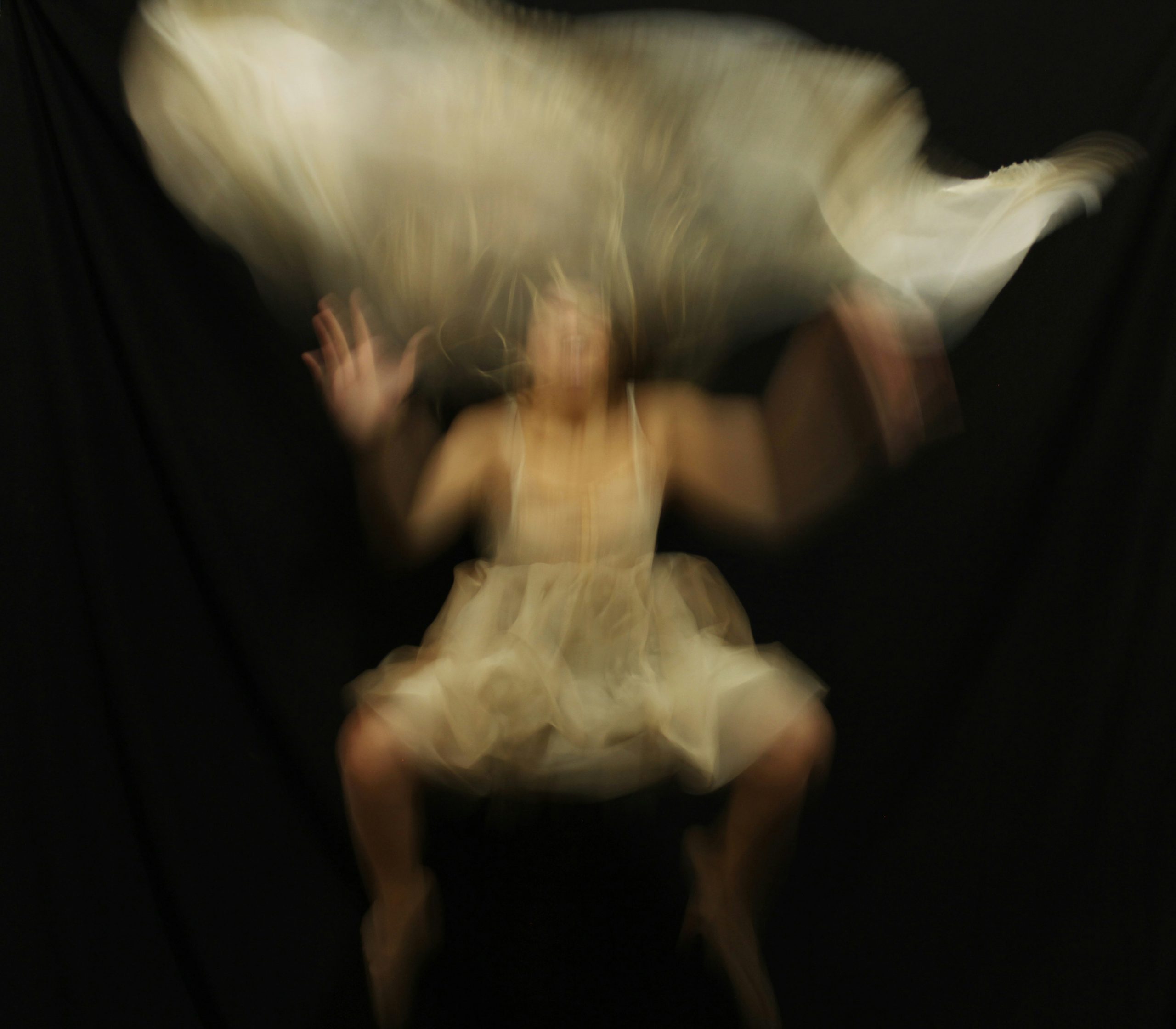
The next round offered four very different concepts, all of which were lovely, but the one that caught my attention–and that of everyone I showed–was the one without a figure. There is so much movement in the image, even the suggestion of a body wrapped in the gorgeous flowing fabric. It makes you look twice, think twice. It makes you wonder.

I love that there’s no visible figure on the cover. No projection of who we’re meant to imagine on the pages. There is a quality of falling, of isolation–crucial to the book. It’s fluid, and sexy, and full of life, all without a body.

Another reason I was drawn to this particular design is that it feels like a nod to so much beautiful dance imagery, most notably the fabric that swims across the stage in the “Wade in the Water” section of Alvin Ailey’s Revelations. Ailey and his work loom large in the book, and it felt really powerful to see this deepened, inverted nod to that work here. I don’t believe it was intentional on the part of the designer, but for me, it’s impossible not to see that imagery on the cover. I spent many years working for Ailey and still see the company–and inevitably Revelations–at least twice a year. When I first scrolled through the final round of options and landed on this one, the fabric floating down, I got a bit teary. That was when the decision was made, I suppose. It felt fated in a way.

For so long I’ve kept things close to the vest with this book. It’s my way with most things, and a debut novel is a vulnerable thing. A person cracked open. But now, I’m eager to share it. To show it. There is proof that it exists. That it’s a thing people will be able to have and hold. And she’s a beauty.

Cassie Vu: We knew that we wanted to represent movement in some way on this cover, so first we went down the path of having a dancer in a spotlight on the cover, and different versions of cropped, dancing bodies. Ultimately we decided against that, because even though the book is set in the dance world, the main character is a choreographer, not a dancer. The author liked the deep purples and pinks of the color palette I had been working in, so we used that and leaned into a more abstract approach. The final image is meant to evoke movement, dance, perhaps the shape of a body, a little bit of tension… but nothing too obvious!

9 Books of Long Poems You Should be Reading

My favorite way to experience a long poem is to listen to it. Because while your body is busy walking or using the elliptical machine or folding piles of blue jeans and t-shirts and pajamas, a voice is laying, like garlands, rings of thoughts and images around your mind, layering a place for you to wander. 

It’s the digressions in a long poem that I love—the apertures, structural fractures, pockets, and tunnels. The trap door dropping you down into a dungeon; the stairs leading you out. Poe—whom I adore— argues in The Poetic Principle that poetry should have unity and this unity is impossible in a long poem; but it’s the disunity that attracts me. 

I once knew a man who worked in Mission Control at NASA, and he explained to me that his job was to do the math calculations required to keep the International Space Station in orbit. He used the metaphor of balancing a broom vertically in the palm of your hand: his work was like the infinitesimal or large movements to keep the broom aloft. I love that tension in a long poem, the way it’s always threatening to crash down, peter out, rupture, or break; I love the ways the author then invents shapes to keep the thing aloft, to account for shifts and junctures, the unity in the disunity. 

My new book, Rich Wife, is composed of long poems because the form is capacious. Registers shift; perspectives shift; the form can undulate from a list to a quote to a description of a memory or a painting. Montage, collage, dialogue, slang, poems within poems. The long poem allowed me to consider a knot of topics—money, beauty, art—with the fullness that the subjects demand.

And on to my recommendations.

Poemland by Chelsey Minnis

A book-length musing about poetry and its glittering potentials and failures, this poem consists, almost exclusively, of aphorisms, metaphors, absurd jokes, and idiomatic turns of phrase… Reading Poemland is like walking around the set of a film you love, sitting in actual chairs which are also pretend chairs, being in a place that exists but does not exist, tawdry but imbued with shared feelings of longing. Her writing is like fake fur, the color chartreuse, a miniature weapon hidden in a vintage snap-clasp purse. Charming and pouty, it reminds me of the feeling of reading a glossy fashion magazine while lying on your stomach in your childhood bed. It reminds me of those girlish leather diaries that have DIARY written across the front in script, and come with a tiny padlock and a tiny set of keys.

The book opens:

This is a cut-down chandelier…

And it is like coughing at the piano before you start playing a terrible waltz…

The past should go away but it never does…

And it is like a swimming pool at the foot of the stairs…

Nature Poem by Tommy Pico

The second book-length poem in a series of four book-length poems, Nature Poem is an argument, a conversation, a soundtrack, an endless scroll. Taking up the problem of both wanting to write a nature poem and not wanting to embody stereotypes about American Indians, Pico ends up writing a book that circles and weaves a complex response, encompassing feelings and ideas as large as the poem itself, impossible to distill. Reading this poem is like watching a virtuosic dance performance, as Pico shifts tones, employing lists, refrains, anaphora, epistrophe, jokes, puns, personification. Like Minnis’s poem, this poem too is about poetry itself, its limitations and magic. Nature Poem delves into romance, identity, pop culture, city life, and death, returning again and again to the premature deaths of cousins back home. Pico creates a place where meaning and emotion can stream back and forth intelligibly among this chaotic, fragmented world we share.

the fabric of our lives #death

some people wait a lifetime for a moment like this  #death

reach out and touch someone #death

he kindly stopped for me #death

kid-tested, mother approved #death

oops, I did it again #death

it keeps going, and going, and going #death

Tender Data by Monica McClure

The center of Tender Data contains a group of longish poems that were originally published as the chapbook Mala. These slender montages bring together the feelings of being a girl — being looked at, looking at yourself as an object, longing, desire, innocence and its loss, the narrow roles family and society present for you. Childhood scenes are spliced with older perspectives, with metatextual analysis of the poem as poem, critical analysis of how she’s positioning herself, resisting received categories. These poems juxtapose small town aspirations and gossip and poverty and glamour and grocery store aisles and slips of admonishments and slang. Climb inside these poems to become a girl in the early 2000s, in body and spirit, to experience the liquid confusing swirl.

Let’s talk about angels

I saw one just returned from jail with his gentleness

flung over the couch next to his money stack

We didn’t know each other anymore

and never had

We were standing beside our youths like babysitters

But the truth is I was the only one who’d ever had one

Bloom & Other Poems by Xi Chuan, translated by Lucas Klein

In his longish, essayistic poems in this book, Xi Chuan takes up a subject — the mandate to bloom, beautiful fakes and decrepit antiques of the Panjiayuan Antiques Market, an early morning, Manhattan — and he approaches it from in front, beside, below, near, far, with humor, with humility, with cynicism, with history, with literary forefathers, with grandiosity, turning and turning until the subject is exhausted thoroughly, until we, having journeyed and arrived together, land at the poem’s feet. Xi Chuan takes up what could seem the least promising of subjects—just walking around, looking around—and with the force of his intelligence and the shape of his thoughts wrings from them meditations which are surreal, self-deprecating, self-aware, often recalling, too, the long history of poetry, art, and politics of China, people from the past peering across time into the present, and he peering back at them.

People half real half fake pursue a happiness half real half fake,

fall in love half real half fake, and fall into a daze looking at half real half fake antiques; their demands for justice are also half real half fake.

On a world half real half fake they gain a sense of unreal reality we might call transcendent!

Collected Poems by James Schuyler

The long poem “Hymn to Life” appears at the end of Schuyler’s 1974 book of the same name, which is now out of print — but contained within his Collected. Hymn to Life is a churning meditation on mortality and the essential beauty, horror, and meaninglessness of life. The poem is structured around the passage of spring in D.C. — a city whose blankness and stony facades the poem abhors — and in it Schuyler cycles between personifying nature and time, dipping into memories, and describing the life unfurling in the new season, its blue jays and daffodils and pear trees, not idealized but as they are, wavering in and out of existence as time tumbles forward, and also as real things framed by the modern world — sometimes diseased, existing among ugly monuments, glum weather, the sounds of chainsaws, noticed, forgotten about, wild, planted in corporate planters, with tourists milling about. Meanwhile, through it all, life, which is passing, picturesque, not picturesque, slips by and we remain unknown to ourselves, by turns grumpy and depressed, by turns astonished by its wonder.

Attune yourself to what is happening   

Now, the little wet things, like washing up the lunch dishes. Bubbles   

Rise, rinse and it is done. Let the dishes air dry, the way

You let your hair after a shampoo. All evaporates, water, time, the   

Happy moment and—harder to believe—the unhappy. Time on a bus,

That passes, and the night with its burthen and gift of dreams. That   

Other life we live and need, filled with joys and terrors, threaded   

By dailiness: where the wished for sometimes happens, or, just   

Before waking tremulous hands undo buttons. 

Memorial: A Version of Homer’s Iliad by Alice Oswald

Memorial is a fragmented, pared-down, interpretive translation of The Iliad that removes everything but the graphic deaths, elegiac laments, and similes. So what’s left is this timeless imprint of war, its waste and finality, interspersed with brief, impressionistic portraits of familiar kinds of men, their cowardice, arrogance, callousness, regret, terror, mixed with the eternal natural world and rhythms of life — an old woman’s spidery hands measuring wool, the weak petals of a poppy battered by rain, rocks battered by ocean water in an explosion of spray, a toddler raising its arms to be lifted by its mother. The portrait of a soldier who loved to sit on his front porch and make his friends laugh is an ancient portrait of a living face, the boys who died then, the boys who die today. The wastefulness of ancient war, of modern war; life as a sieve the world passes through, or the world as a sieve that life passes through.

Like when a mother is rushing

And a little girl clings to her clothes

Wants help wants arms

Won’t let her walk

Like staring up at that tower of adulthood

Wanting to be light again

Wanting this whole problem of living to be lifted 

And carried on a hip

Pedro Pietri: Selected Poetry by Pedro Pietri

Pedro Pietri’s poems vibrate with indignation, revolving around those usually ignored — alcoholics, immigrants, the men who clean windshields at intersections, people living in government housing that’s overrun with cockroaches, people who play the lottery and have a collection of dreams. The most famous poem in this book, “Puerto Rican Obituary,” rotates around the refrain of a handful of names — Juan, Miguel, Milagros, Olga, Manuel — their hopes, exploitation, sacrifice, work, waste — the grayed-out half-life of people separated from their people, of people working now for a promised future that hovers forever just out of reach. Pietri’s poetry appeals to me in its stylistic irritability — the refusal to conform to prevailing conventions, veering into his own voice, manic all-caps, repetitions, patterns, deviations, dialect, surreal detours, a rhythm of his own.

All died

dreaming about america 

waking them up in the middle of the night screaming: Mira Mira

your name is on the winning lottery ticket for one hundred thousand dollars

All died

hating the grocery stores 

that sold them make-believe steak

and bullet-proof rice and beans

All died waiting dreaming and hating

Returning the Sword to the Stone by Mark Leidner

If Jack Handey wrote a book of poems, it might be a book like this one. Fond of aphorisms, surreal premises, outlandish but oddly familiar similes, and silly diction (on humility: “it feels awesome”), Leidner’s longish poems are absurd jokes taken so seriously they become unbearably sad and unbearably sweet. Beneath the jokes, the subjects are love, mortality, ego, and the mystifying beauty and pain of life. Reading these poems feels like playing NES with your friends for hours and hours, drinking 7-Up through Sour Punch straws, staying up so late that a feeling of wrongness seats itself in your chest — piercing pleasure, nostalgia, teetering between wells of joy and doom. 

I hate it when I’m in geometry class

intent on disrupting the lesson 

with inane and off-topic contributions

only to be moved to silence 

by the beauty of the Pythagorean theorem

Air Ball by Molly Ledbetter

The long poems in this book are composed of lines of single sentences leisurely doled out with the pacing, structure, and confidence of a stand-up routine, in which set-ups are paid off in ways you didn’t anticipate. These are poems concerned with taste, status, posturing, heartbreak, small observations, grief, and the difference between art-world art and the actual experience of art, which is private, occurs in slivers, and is never as perfectly encapsulated as a prestigious gallery show written up in a brochure. Ledbetter bestows meaning on what would otherwise be detritus or ephemeral — your Uber ride history, children shouting “air ball!” from a nearby school, a handmade plate that reads “This too shall pass.” These poems make me feel as though I’ve spent an afternoon with a new friend, and have left with fresh observations uncoiling within me, which have unspooled dozens of new thoughts.

I never thought about where the train that cuts through the center of town was going.

Whatever I hear now in its whistle is like those bells in The Polar Express.

Like believing in believing in Santa, which I do.

Like bunk beds that squeak like an old wooden boat.

Like how good those nuts on the sidewalk smell at Christmas.

Like a mediocre cookie plate.

Back then, I could really have been someone.

In “Mỹ Documents” Silicon Valley Surveillance Is a Family Problem

There are certain novels you really hate to see in the company of words like timely, prescient, or propheticThe Handmaid’s Tale, say, or Parable of the Sower. Yet Kevin Nguyen’s latest novel unfortunately seems to have been beaned with the dodgeball of Apollo; Mỹ Documents chronicles a family and a country fractured by the mass internment of Vietnamese-American citizens after a nationwide series of terror attacks, reprising a dark chapter of American history (and truly American history’s favorite thing to do is reprise its dark chapters).

Nguyen’s Internment 2.0 has its own distinct flavor, defined centrally by the presence of technology—at the same time that contraband laptops and USB drives become lifelines to the outside world within the camps, Silicon Valley enthusiastically supplies the surveillance and signal-jamming technologies keeping the imprisoned in line. The world’s reaction outside of the camps, too, is frighteningly plausible—with Vietnamese-Americans making up less than .7% of the population, and exceptions carved out for the well-heeled professional class, it becomes easy for those on the outside to act like 2 million people didn’t just vanish; or worse, to pretend there’s a justifiable reason they did.

In fact, the only stark divergence from our reality in the world of Mỹ Documents is that its journalists seem a lot more principled, courageous, and effective than the ones currently standing by and shrugging as the breathing tube gets yanked out of democracy. Let’s just hope we don’t end up calling this book optimistic.


Tony Tulathimutte: The book takes a pretty satirical view of journalism and in interesting ways, a lot of the characters end up being journalists in one form or another, whether it’s the reporters at Top Story who are covering the internment of Vietnamese Americans. Or on the inside, the Camp Tacoma’s rival papers, Nhật Báo and Korematsu. I was interested in what the book had to say about the role of journalism vis-a-vis atrocities like this.

Ursula’s story reads almost like an allegory of opportunism, using other people’s stories for personal enrichment. The book begins with her getting praised and rewarded for telling her grandmother’s immigrant sob story, which ends up being partially untrue. And on the other hand, Korematsu seems to bring genuine aid and comfort to the interned people. Do you think that there’s something unavoidably exploitative about reporting on atrocities like this? Or is it more of a matter of how it’s practiced and incentivized?

Kevin Nguyen: I don’t even think it’s necessarily reporting on atrocities, specifically. I think the construct of journalism — and I say this as someone who works in it and admires the field and believes in the importance of a free press — that when a source talks to a journalist, the person that benefits the most in that interaction is always the journalist. The journalist is the person in a position of power.

And that ranges everything from people within the current federal government leaking stories about what’s going on with Elon Musk, all the way to people just telling their stories about the diaspora. I want those stories to be out there. But at the same time, the power dynamic of journalism always benefits the writer.

TT: Could you say it benefits the journalists even more so than the people who are reading the journalism? Because in a way, journalism does save the day in this book. It’s implied toward the end that it plays a part in rolling back some of the atrocity, right?

KN: Yeah, it does. I tried to thread the needle on that in the book. Journalism as a practice is very powerful. But there are still ways it is exploitative and there are still ways that the people who practice it can be selfish and can be power seeking while still doing the good work.

TT: Yeah. And I mean, I think it’s especially underscored in this book because Ursula’s getting all of her reporting, at least at first, from her own cousin who’s interned and actually doing all of the sort of legwork and sticking her neck out, and not really getting the credit for it. It’s like, “Oh, I just had somebody talk to me, but my own family member sort of risked life and limb to get the information to me and I’m reaping the rewards for that.”

KN: The construction of the book heightens that dilemma. I constructed a scenario in the fiction of the novel that kind of makes it the most extreme. So usually when a source talks to a journalist, they’re able to see the product quite immediately and the effect of it. And because of the setup of Mỹ Documents, the characters in camp don’t see the effect of the journalism until much later.

TT: The first thing I wondered even before I read the book was, why would Vietnamese people be singled out to be put in internment camps? There isn’t an immediate paranoia or legacy of Vietnamese guys specifically being domestic terrorists on U.S. soil. What I found interesting was that the book doesn’t actually really answer that. It lays out what they did and how they did it, but stays pointedly ambiguous about why they did it, Though there are some gestures at online radicalization and misinformation. But I’m curious about the choice to leave it ambiguous.

KN: In talking about this book, a lot of people have called it speculative fiction or dystopian, which I don’t think are inaccurate genres or frameworks. But the reality is, the scenario that happens in the book is one of policy. And whether you believe that thing would be enacted today, that’s up to you. But it was enacted during World War II, right?

TT: All it took was something like Pearl Harbor to make it happen.

KN: And it singled out Japanese Americans who had nothing to do with the attack on Pearl Harbor, right?

TT: Right.

KN: And so, in a way, it’s actually quite random who was affected. And it’s also interesting that it actually fell along basically ethnic and national lines. So in a strange way, the book kind of plays a little bit with the idea of Asian American solidarity. The universe of the book believes that Asian American solidarity and identity can be a real and useful thing. It’s also a construct. And that’s sort of the weird dilemma of solidarity in general.

TT: It was a construct devised explicitly for the aims of political solidarity, right? In the ‘60s by some Berkeley kids.

KN: And the usefulness of it just depends on the situation. In some ways, you and I have a lot in common because we’re both Southeast Asian Americans from Massachusetts, but in other ways it’s also kind of bullshit. What does Vietnamese culture actually have that much to do with Thai culture? And these are already, in a lot of people’s minds, two cultures that are conflated. There are just other ways to divide these experiences, along the waves of immigration, and we almost never do that. Instead, we just think about these former national or ethnic lines.

TT: Yeah. I mean, there’s a nasty historical irony in the conflation of the two, since Thailand was pretty much a de facto air force base for the US during the Vietnam War.

Now let’s consider the other side of the internment act. I thought it was very funny that you expect to see these evil mustache-twirling villains who’ve authored the policy, but they’re largely absent. Except for John McCain, or a kind of alt-historical version of him.

He’s only referred to as the War Hero. He’s one of the big proponents of the AAPI bill that institutes internment. So I guess it’s a two-part question. One, can you talk about the choice to generally leave the villains in the story faceless? And two, does the choice of John McCain as one of those few faces constitute a sort of payback? I mean the guy would not stop calling Vietnamese people quote-unquote gooks until his dying day. Is this a reckoning with that fact that never seemed to drum up that much outrage?

KN: “Payback” is maybe strong, but I don’t think it’s inaccurate. I think especially when I was writing this over the past five years, there was an emergence of this kind of “good” conservative Republican war hero type, and John McCain has come to represent that thing. Yeah, I obviously think that thing is bullshit.

TT: It’s almost not even fair to just single out Republicans. There’s also John Kerry, you know?

KN: Yeah. But I think to your earlier point too, I did want to balance some things where certain touch points would feel specific enough to make the world in the book feel grounded. But I also didn’t really want it to be about how Republicans are terrible and they’re the war hawks or whatever. More than that, I wanted this to be a family story more than it is about what caused instigating conflicts in the book. This is a story about the tensions between the characters rather than about how—or if—they get out of camp.

TT: A different angle on the notion of facelessness comes in the form of Big Tech’s role in the internment. In the middle of the camp there’s this giant obelisk called the Tower that blocks all sorts of incoming and outbound Wi-Fi and cell signals. The company who runs it is pretty much a fictionalized version of Palantir from what I could understand. But Google gets involved too, and they’re named outright in the book. So can you talk about how—especially vis-a-vis the recent tech oligopoly in government—tech becomes the executor of these government policies?

KN: The masks came off so fast and so hard this year that I think that things I was trying to get at are just… they’re really out there in the world in a way they weren’t a year ago. But a lot of the book too is a send up of very stereotypical Asian American ambition and assimilation. So I think a lot of Asian Zoomers, they really want to work at these big tech companies, right?

Because these are lucrative jobs, they’re prestigious and people don’t often think about the implications of what these companies are doing, hidden behind these guises of progressive values. As we’ve seen certainly in 2025, all those values went immediately out the window as soon as President Trump threatened tariffs. So that was a little bit about naming Google specifically. I mean, I also briefly worked at Google and it was really interesting being there, mostly because so many people in my family were like, “You made it. This is the job.”

It pays well. I wasn’t really that high up, so it just paid fine. But it was kind of the new Goldman Sachs in that way. Actually being there, it was a tremendously dim and boring place to work. So I think part of it was sort of reckoning with that gap. So I put a little bit of my personal life in there in that sense.

TT: It’s useful in thinking about that fissure in Asian American solidarity that you were talking about before. There’s no starker divide than, Are you one of the ones who has to go to the camp or not? And the ones who are spared are the ones who have jobs that are considered useful for the prevailing order, like how Ursula and Alvin work for journalism and Big Tech. Is this a comment on conditional privilege or how privilege for Asians is conditioned on work?

KN: Yeah, it’s conditional privilege. It has a lot to do with work. It’s also, I think Asian Americans do it to themselves as well, right? I think there’s a strong belief among Asian Americans that they can transcend identity or the way they are perceived by almost fulfilling the stereotype of what Asian Americans are supposed to be.

TT: I would not even necessarily restrict it to Asians in that I think that a lot of America or what we call the American Dream is premised on the idea that working really hard will make you the exception, will make you successful. You should not resent the ultra wealthy because you could be one of them as long as you grind. But it’s just that here, it’s focalized through whatever stigmas may exist, being an immigrant or looking different and so on.

KN: I think there’s just a very specific Asian American flavor of it that pervades the book.

TT: It’s this weird combination of doing an exceptional job, but not being seen doing it or expecting any commensurate reward, just stability. That seems to be the bargain.

KN: A lot of those jobs tend to be engineering jobs, which have been celebrated because they are so lucrative, but they’re actually quite vocational. Especially when you work in a place like Google, they tend to be very uncreative as well. And they don’t involve a lot of leadership or other things that tend to actually be evaluated in the workplace. It’s like engineers just tend to be very well paid worker bees by definition.

TT: To speak a little more on this idea of solidarity, there’s also the rivalry between Jen and Dennis or between the two sort of rival papers they run within the camp, Korematsu and Nhật Báo. One way to read it would be sort of a historical rhyme of the Vietnam War where you see this factionalism between people of the same culture, although obviously, it’s along different ideological lines. It’s not all that easy to interpret, though, because Dennis is so mysterious. We don’t know what’s in the paper. And he does seem to come as close as it gets in the book to a villain walking around that people have to deal with. 

KN: I read a lot about Japanese incarceration. And you can kind of tell part of the imagination of the book is evoking what that would look like today. The book is an echo of Japanese incarceration, right? And a lot of the book is also these Zoomer characters trying to live without the internet. But what actually ends up happening in some ways is they create a lot of the dynamics of the internet within camp. And I don’t even mean that in a negative way. I think human beings, they just like to make things, whether that is art or stories or garbage, it’s just kind of a necessity of being a person.

And so even when they’re constrained in these detention camps, they’re still doing that thing. And then from within that, especially when you tell stories, Jen ends up recreating the same power dynamics of journalism and what she does, and then in ways, what she’s creating is maybe valuable from one perspective. But then Dennis comes along with Nhật Báo and he believes what he’s creating is powerful too. And I think the lines are a little tricky or they’re just not that clear about when you create something that you feel like is doing good for a community of people or readers — at what point does the doing good justify selfish and power-seeking behavior?

TT: It’s not all that different from the zeal people get for nation-building projects or the idea of capitalism triumphing over communism. And by that token too, I guess a good note to close on is that the book seems to suggest that a lot of good that is done in the world and a lot of the life worth living occurs either in the cracks of institutions, or entirely outside of them. Some trace of this notion is in every plotline. Alvin is able to smuggle an important document out of Google through this kind of unethical move of taking the computer of the woman he’s been hooking up with. In the camp, a kid makes movies on his phone, and people watch K-dramas and Superbad on contraband USB drives. Korematsu gathers in the unused swimming pool to smoke these tiny, miserable little joints that are probably all seeds and stems. And then there’s El Paquete, which is an impressive organization that’s trafficking things in and out of the camp, but is by the standards of industrial commerce, probably pretty small and purpose-driven. The last example would be Jen and Dan, who drop off the grid altogether at different points. So is there an ethical way to exist in an institution, especially a really big one, like Big Tech or the government or media? Or is it the kind of thing where at best, you just sort of malinger and drag your heels?

KN: Yeah. I was reading a piece today that I would say quite ungenerously described all of Sally Rooney’s work as trying to be good under late capitalism. It’s not incorrect. I think her books do a little more than that. But yeah, I think this is a book that starts in a place where right and wrong seem fairly clear cut, and then quickly it’s clear that oftentimes doing the right thing is actually quite harmful to a lot of people. And then sometimes being selfish is actually an action that ends up helping a lot of people or doing a lot of good.

Everything in the book plot-wise is muddy in that way. The book is very un-prescriptive about moralizing these kinds of things. It’s more like wrestling with a heightened reality of what we’re living.

TT: It did seem to me, in different ways, that for Jen and Dan, it was what they needed, not what would be categorically good for everyone to do. Although, who knows? Things are getting very shitty.

KN: I’m kind of in that phase of pre-publication where I’m getting text messages and emails, and I think now they’re some strangers who are sending me DMs and everyone keeps talking about how “timely” the book is. They mean it kind of in a complimentary way. I definitely don’t write fiction to meet a specific moment and certainly not to predict this one.

TT: Yeah, I mean, it’s not really possible to be timely on the same reaction cycle as any other medium. If you sold a book today, it wouldn’t be out for two years.

KN: Right. Someone said the book was prescient, and I know again, it’s supposed to be complimentary, but this kind of thing has happened before. And just imagining it happening again is actually not a great stretch of imagination. A lot of the book is about these kids learning about Japanese incarceration for the first time by experiencing it. And I think if there’s actually a lesson here: it’s how that history has somehow been swept under the rug, even though it’s in plain sight.

Why Does Cinema Love Making Asians Become American?

For all of its small miracles—big laughs and bigger gasps, brilliant performances by Joan Chen and Izaac Wang, sharp dialogue that evokes almost too well the brash posturing of ’00s suburban adolescence—Sean Wang’s 2024 coming-of-age comedy-drama Dìdi left me with the feeling that I had seen this one before. The strong-willed child, the disapproving mother, the half-comic-half-tyrannical grandmother, the tense family dinners, the heated arguments conducted between English and Chinese. It gives one, I thought as I walked out of the theater, the unmistakable impression of being an Asian American Film.

In the last decade or so, and especially since the huge box office success of 2018’s Crazy Rich Asians, films and television shows by Asian American directors and with majority-Asian American casts have debuted at what seems an ever-accelerating pace. Part of a general enthusiasm for “diverse” popular media, the mushrooming production of Asian American media by major entertainment companies has given us a dizzying list of titles, from prestige dramas like The Farewell to YA dramedies like Never Have I Ever, blockbusters like Shang-Chi and the Legend of the Ten Rings to indie darlings like Everything Everywhere All At Once. If we take the marketing, box office figures, and effusive reviewers at their word, there has never been a better (or more entertaining) time to be Asian American.

Yet I wince a little to identify myself as such. I am a third-generation Japanese American, raised in the San Francisco Bay Area amidst perhaps the most vibrant and diverse Asian diasporic community in the U.S., but if I am an Asian American, I am a somewhat reluctant one. Films like Dìdi are regularly praised for being “good representation,” and though the upward turn in both quantity and quality of depictions of Asian Americans in media is undeniable, I can’t help but feel that this representation has failed to deliver on its lofty promises of empowering Asian Americans and fostering racial harmony. It is not precisely that I, personally, don’t feel “represented,” or that I think these representations are inaccurate or inauthentic. It is rather that I am disillusioned with the project of representation itself, at least as it has been articulated in the popular discourse of Asian American media.

Where more and better representation would seem to invite an expansion of Asian American creative and political possibility, the Asian America that has emerged onscreen feels like the opposite. It is not a broadening but a narrowing of Asian American experience, a congealing of infinite variation into a single narrative core which then appears as the “authentic” essence of Asian America. 

This Asian America, the backdrop and the product of what I call the Asian American Film, is an example of French philosopher Jean Baudrillard’s concept of the “hyperreal”: a sign that has come unmoored from its referent, a mere image which has acquired the gravity of the real. In its repetition and consistency, the hyperreal is something like the “cliche,” but the power of the hyperreal lies in its ability to appear not cliche. Cliches bother us because they remind us of the contrivance, the artificiality of the representation; the hyperreal makes us believe that we are not dealing with representations at all.

Representation has failed to deliver on its lofty promises of empowering Asian Americans and fostering racial harmony.

The logic of representation and authenticity insists that what marginalized minorities need is to see more people like us on the TV. But in doing so it assumes that there is a clear and self-evident object to be represented in the first place (“people like us”) and obfuscates the active, creative nature of representation itself. Representation never simply mirrors an already-existing reality. It pares and polishes experience in order to create a finite object which resembles a world. In naive calls for better representation, the idea seems to be that any representation, so long as it is produced by a member of the ingroup, expresses some kind of essential, unified, and politically potent “truth” about a group’s lived experience. But, as recent years of Asian American filmmaking have demonstrated, this line of thinking lends itself easily to the production of hyperrealities, which obscure, rather than reveal, real people’s lives.

What exactly does this hyperreal Asian America look like? You probably already have some idea, but let me sketch, briefly, the characteristics of the Asian American Film. In the first place, it takes little more than a glance at the posters for the above-named films to see that mainstream Asian American media is dominated by East Asian—primarily Chinese, Taiwanese, and Korean American—stories, with the occasional Indian entry, while the Japanese, Filipino, Vietnamese, Cambodian, Hmong, and countless other diasporic Asian American filmic imaginaries remain virtually nonexistent. The Asian American Film clings to a tenuous ethno-racial metonymy: the leap that we make when we refer to this mostly East Asian American body of film, or any individual film, as “Asian American.” 

Within this restricted ethnic scope there is, too, a certain curious homogeneity. From New York to LA, sci-fi to sentimental drama, there are some things you can almost always expect to see in the Asian American Film: nagging mothers, enforced extracurriculars, gaggles of judgmental aunties, cluttered homes hung with calligraphic scrolls, problematic non-Asian partners, parents convening to compare their children’s extracurricular accomplishments. These tropes appeal to an overdetermined idea of the Asian American life which we are supposed to recognize as our own, and end up producing the very world that they claim merely to represent. 

The calling card of the Asian American Film—what accounts for much of its chronic sense of déjà vu—is not a single scene or character type but a formal tendency: a narrative structure premised on the tension between Asian immigrant parent and their American child, a fundamental opposition which generates the narrative energy of the film and constitutes its emotional core. The parent is old-fashioned, conservative, and demanding, possessed of an “Oriental” backwardness and incapable of comprehending the child’s wild American ways. A relatively straightforward—and especially common—version of this narrative is the trope of the Asian immigrant parent who struggles to accept their gay American child. In Dìdi, it is teenage protagonist Chris’ passion for skateboarding videos and other early Internet-era amusements that signifies his endearingly free American spirit, while his mother Chungsing’s kitschy oil paintings indicate her old-fashioned, culturally conservative outlook; their clashes, less a matter of personal disagreement than mutual unintelligibility, form the film’s affective backbone.

For onscreen Asian Americans, teenage rebellion is never only generational.

The feeling of narrative satisfaction is achieved when the child has either overcome the parent’s authoritarian power, brought them around to a more progressive way of thinking, or a combination of both. It is through this narrative crucible that our hero(ine) emerges as a proper Asian American; “Asian” being only a modifier, though a significant one. For it is not only the immigrant parent that must be rejected or overcome in the Asian American Film, but Asia itself which hangs over this hyperreal Asian America like a threat, Asia which must be pushed aside, excised like a tumor or put to rest like an angry ghost. “You’re so Asian,” Chris hisses at his mother in a moment of exasperation. When he makes friends with a group of non-Asian, slightly older teenage skaters, he lies and tells them that he is only half. 

Plenty of white kids fight with their parents, too, but for onscreen Asian Americans, teenage rebellion is never only generational. It comes superimposed with a layer of cultural meaning, the (more or less) tacit assumption that what is at issue is not mere familial discord but an East-West culture clash. Even when the child comes to accept the well-meaning of their parents, there is always a figure just behind them (usually, as in Dìdi, a grandparent) in which the backwardness and despotism of Asia persists. Behind each of these figures, too, we could imagine an endless line of scowling parents, but the source of the discontent is always, ultimately, the dark, distant phantasm of Asia itself. It is no wonder then that the coming-of-age is such a popular genre in Asian American fiction: in addition to the child becoming an adult, the coming-of-age narrative stages the process of the Asian becoming an American.

It will probably be objected that the aforementioned films cannot have been performing the covert ideological work I have suggested, because they are reflections of reality and therefore innocent of such schemes—in fact, many of the works I have referenced are semi-autobiographical, a privileged form in Asian American storytelling at least since Maxine Hong Kingston’s landmark memoir The Woman Warrior. I am not suggesting, following Frank Chin’s notorious attacks on such writers as Kingston and Amy Tan, that these films are fraudulent, their directors race traitors and fake Asian Americans; unlike Chin, I have little faith in the existence of “real” Asian Americans. 

The Asian America I know, comprising experiences as vast and varied as can be expected from a population of over 20 million people, has hardly appeared onscreen in its fullness. This Asian America includes, of course, a great number of repressive immigrant parents and rebellious American children. But it also includes families like mine, who have been in the United States for over a century; mothers like mine, born in Long Island and speaking only English. It includes parents, immigrant or not, who don’t care if their child is gay or wants to go to art school; it includes parents who themselves are gay and went to art school. It includes Asian Americans who never knew their parents, who never start their own families, who give up on America and go back to Asia or someplace else altogether.

It is a cruel irony that this real heterogeneity disappears under the guise of representation and authenticity. It is not only excluded from but distorted to fit a predetermined image of what constitutes “authentic” Asian Americanness. My problem with the Asian American Film, which recounts again and again the same story of immigration and adjustment, is not so much its lack of verisimilitude as its myopia, its privileged status as the only Asian American story we seem to be able to tell. 

It is not only Asian America’s contemporary expanse that disappears under the uniform gloss of the Asian American Film, but its rich history. Almost twenty five years on from the release of his book The Deathly Embrace, Asian diaspora scholar Sheng-Mei Ma’s observation that “[the fact that] Asian America is more than 150 years old but rebels like a misguided fifteen-year-old attests to its stunted growth” still rings true. My great-great-grandparents came to this country more than a century ago to build the railroad that united these states, and since those first waves of mass immigration, Asian Americans have have been excluded, incarcerated, and segregated, have worked the land and built cities within cities, have organized and resisted, assimilated and transformed. And yet all of this heavy and wonderful history is virtually inconceivable in the eternal present of the Asian American Film, where history is something that happens elsewhere, in a vague Old World of war and deprivation. 

Asian America is, in its totality, unrepresentable.

The narrowness of the Asian American Film corresponds to the disappointment of Asian America as a political project, a feeling captured well by Steven Duong’s short story “Dorchester.” A disillusioned Asian American writer is invited to read a poem at a protest against the killing of an elderly Asian woman. “They had painted their signs with slogans like Stop Asian Hate and Protect Our Elders,” Duong writes, “things we all believed in, because what else could we believe?” Though it does not refer explicitly to film, “Dorchester” dramatizes the awful gravity that the hyperreal Asian America exerts on those who cannot but call themselves Asian Americans. The narrator runs away from the reading with a sick feeling in his stomach, recalling the deceptions of his mother, who had lied about being a beleaguered refugee when in fact she arrived in America on a plane, “nine years after the fall of Saigon, nine years after [she] had supposedly boarded the fishing boat at dawn.” In Duong’s story the mythology of Asian America has the coercive power to compel certain types of narrative production and exclude others. The sprawl of our lives shrivels into an “authenticity” where Asians can only ever arrive in America in their huddled masses, seeking a better life for their ungrateful offspring.

I am aware, of course, of the irony of my referring to “Asian America” and “Asian Americans” throughout this essay despite my professed skepticism about the coherence and usefulness of these categories. Like the protagonist of “Dorchester,” I feel an obligation to these terms in spite of their limitations, or maybe just a kind of Stockholm Syndrome – what else can we believe?

Asian American Studies scholar Susan Koshy suggests that “‘Asian American’ offers us a rubric that we cannot not use.” But in using it we must acknowledge its perpetual partialness, its failure to bear the burden it takes upon itself. 

In pointing out the failure of the Asian American Film to represent the wholeness of Asian American experience, I am not suggesting that we redouble our attempts to represent, that there exists somewhere a more perfect authenticity if only we can find it. Imagine, for a moment, that we were to represent Asian America in its infinite variety: every ethnic group, every region, every family configuration, every possible relation of the Asian to the American and the immigrant to the native-born. What then would we have achieved but Jorge Luis Borges’ proverbial map the size of the empire itself, coterminous with the land it attempts to reproduce and thereby useless? 

Asian America is, in its totality, unrepresentable. Perhaps there is some comfort in imagining otherwise, in being handed a ready-made narrative and aesthetic package and being told: this is your world, this is your story. Undoubtedly there is comfort in the production and re-production of Asian America as the triumphant result of individualized struggle between Eastern repression and Western social freedoms. But there is greater courage and honesty in shedding the straightjacket of realism and sentimentality, breaking out of the home and into the streets, building something bigger and stranger and more ambitious. 

Don’t get me wrong: I enjoyed Dìdi. But I’m sick of the autobiographies, sick of the family dramas, sick of Asians becoming American. If there is to be an Asian American filmography — which seems inevitable and is not necessarily undesirable — I want one always new and never authentic, collective but not self-contained. I am not entirely pessimistic about the possibility of an Asian American cultural and political identity of the type imagined by the Asian American dreamers of the ‘60s and ‘70s, but any such project must move past the shortsighted aim of producing authentic representations and towards a collective imaginary that embraces, rather than elides, multiplicity. One that does the difficult work of building shared goals through difference, not just within Asian America but between, across, and throughout Asia and America. 

7 Campus Novels That Break the Mold

Your standard fish-out-of-water campus novel goes like this: Scholarship kid finds themself surrounded by absurdly  wealthy children only to get caught up in their wicked ways. The “hayseed goes to the big city” premise always delivers—especially the makeover phase when the interloper MC learns the ropes (too well) and gets semi-corrupted before righting themself. 

But I’ve read this story many times over so I certainly wasn’t going to write a campus novel following this arc. My boarding school book, To Have and Have More, is about the rich kids who belong—the ones who never question whether they deserve their legacy spots or special treatment. They possess every privilege imaginable but, in their teens, already feel trapped and sense that their lives are preordained. I get why it’s narratively convenient to tell the story from the perspective of the new kid but supporting characters like Daisy Buchanan and Mathilde de la Mole are the miserable rich girls who captured my attention, and that’s just the type of anti-heroine I’ve centered in To Have and Have More. 

This list consists of campus novels that diverge from the standard arc and provide more in the way of professors and politics of academia while remaining in that most beloved of settings: the private school campus.

Japanese by Spring by Ishmael Reed

It so happened that I was reading Reed’s 1993 university culture wars satire while Claudine Gay and Liz Magill were inescapable headlines. Japanese by Spring is so entertaining that it (slightly) lessened the disheartening truth that all of Reed’s critiques still stand—little progress has been made in taking DEI out of bureaucrats and opportunists’ hands. Our world still puts POC professors like Reed’s Prof. Benjamin “Chappie” Puttbutt in the impossible position of either being considered 1) a Social Justice Warrior (pejorative) by the university administration or 2) a race traitor by his community. Reed gets infinite mileage out of petty politics and small-minded backstabbing. 

Abigail by Magda Szabó, translated by Len Rix

Campus novels sometimes catch flack for not having “stakes”—this book cannot be accused of such. Set in Hungary against the backdrop of WWII, Szabó demonstrates how war touches every corner of life and even if you ensconce your daughter at a boarding school for safekeeping, there are limits to a father’s protection in wartime. The wonder of this book is how Szabó conveys the small moments of adolescence—pettiness, inside jokes, crushes—do not cease to exist even under the most dire circumstances. There is still joy and beauty and mischief when the world is falling apart around you. 

Enemies of Promise by Cyril Connolly

This is my most unconventional pick because I’m recommending one specific third of this criticism-cum-memoir. Part 3, “A Georgian Boyhood,” is Connolly’s autobiography of his time at Eton, where he was friends with George Orwell. The title of this book is drawn from the idea that many of the “most promising” students are the ones who end up as disappointments: “Whom the gods wish to destroy they first call promising.” Thus, to be an “enemy of promise” is to gird yourself against a jinx of sorts. I find it presciently self-aware that Connolly completes his literary criticism (parts 1 and 2) with a description of his schooldays to provide context for how and why he thinks about books. His Eton education informed his perspective (and prejudices) on literature and it illuminates his critical writing to understand how he came to think the way he does. 

The Prime of Miss Jean Brodie by Muriel Spark

Imagine your teacher is a fascist who puts up pictures of Mussolini in your sixth grade classroom—and she’s incredibly charismatic. The campus in question is the Marcia Blaine School for Girls and the ineffable Miss Brodie sticks with her students from age 10 through 17. This book is a hilarious examination of the teacher-student dynamic and how potentially dangerous the combination of impressionable kids and an agenda-having instructor can be. Since it’s Muriel Spark, she keeps it light and errs on the side of comedy but the sinister implications land. (When friends ask for a short book recommendation, this is the 150-page novel I point them to.)

Groves of Academe by Mary McCarthy 

Don’t read this if you need someone to “root for”. Almost every character is unlikeable, irredeemable, and/or selfish—and I only wish this book were longer. The fact that McCarthy draws on her experiences as a professor at Bard and Sarah Lawrence makes me deeply curious about how the book was received by her ex-colleagues (who are represented as the absolute last people you would ever want to work beside.) I love a well-drawn hypocrite and Henry Mulcahy (who casts himself as the victim of a witch hunt) is painfully believable in his intellectual posturing and campaign to get other faculty members on his side. 

The Rector of Justin by Louis Auchincloss

When you look back on your schooldays, there is probably at least one authority figure who still feels larger than life. Auchincloss captures the fascinating phenomenon of an institution being carried on the back of one such person. Headmaster Prescott is beloved by (almost) all who pass through the prep school’s halls and the prospect of his retirement is a death knell for the school. The hero worship Prescott receives and the weight of his failures counterbalance each other to create a character who also manages to carry this entire book. The Rector of Justin is both a paean to wonderful schools and also a cautionary tale about believing in your own mythos.

Come and Get It by Kiley Reid 

College campuses are ripe for discussions about class—where else do legacy nepo-babies and first-gen scholarship students cross paths constantly? It’s an extreme melting pot that forces awkward questions out into the open at every turn. Reid’s Such a Fun Age probed into class-race-power dynamics of a Black babysitter and white mom. And this follow-up similarly examines grey zones between an RA, a visiting professor/journalist, and a transfer student who fled her previous school. There’s nothing more entertaining than asking young adults what they think is “tacky” and “classy”—and that’s exactly how Come and Get It opens. When you grow up, you learn not to answer the tacky/classy question because it is only ever asked to cast you as a mouthpiece for a certain milieu. 

Every Upbringing Is an Indoctrination

“The Cult” by Mel Kassel

Cass’s mother is on TV, crouching and rocking with the other cultists. Her closeness to the camera makes her a set of flesh-pieces, never a whole person: thighs, stomach, breasts (blurred, but anyone can see where the blur changes color around her nipples), chin, cheeks, slipping in and out of view. 

Some of the cultists are crying. Their queen has died, the way all their queens have died and will die. Soon, they’ll choose a new one, and they won’t be on TV again until the next bit of drama. 

Cass is alone on the couch, but she says aloud, “I’m not calling her.” She imagines sending a small ship into the recesses of her body to scout for sympathy. The crewmembers, their mission, doomed. 

Imagine it, Cass tells herself. She steers the ship, scanning for crevices. The queen was your mother’s friend. Perhaps all that should matter is that your mother has lost a friend. 

The inner voice, the ship’s drive, morphs. Now it sounds like her ex, Vera. If nothing else—if you can’t muster organic compassion—maybe you can respect that she’s in mourning.

Cass tries. It feels like a cosmic squinting, an effort to see the world in a whole new way. She can catch just a glimpse of it, a reality in which her mother is more pitiable than offensive, where everything is softened. That was how Vera saw things. Vera could access the most generous view on any issue, report it as though she was summarizing a book she’d read. She’d tilt her head, stare upwards at nothing, and say, “Well, if you look at it like they do . . .”  

Cass turns off the TV. Her dad will call soon. He calls every time the cult gets coverage. She considers getting into the shower so that she’ll miss the call, but doesn’t, because it’s better to power through, talk him down. She wants to text Vera, but can’t. They agreed on no contact for at least a month. 


The cult started when Cass was in high school. They called themselves the Colony. It was a tone-deaf name, given that its members were almost all white and wealthy and Californian. They were trying to emulate the hierarchies, diet, and behavior of naked mole-rats; and naked mole-rats, the cultists would explain to anyone who asked, live in groups called colonies, governed by queens. Just like ants, just like bees!

Cass and her friends laughed at these interviews. The nude middle-aged cultists, all paunch and desperation, smiling as they assured reporters that they knew it sounded crazy, but they’d seen the results. 

“It’s actually really sad, though,” someone in Cass’s friend group would say, when the laughter stopped. “They’re just going to die sooner.”

Everyone in the Colony had some kind of cancer. Most of them had run out of treatment options. They became versed in mole-rat lore and shared it as a slurry of science and religion: naked mole-rats are inexplicably resistant to cancer. They perceive pain much less acutely than we do. They don’t wither with age—their cells defy senescence. They eat clean, mostly roots and tubers. They have designated chambers for sleeping, dining, shitting. They are humble, nearly blind, hardworking, denizens of the earth. The only eusocial and ectothermic mammal. 

The interviews irritated Cass. She flinched at the nudity, how these people made their bodies everyone’s business. To her, they already looked vaguely tumorous, bulging where her eye wanted flatness. Even the really skinny ones had patches of skin that were loose or pitted. Was that how she would look when she was older? Her parents looked like that already, although her mother tried not to. Sometimes at dinner she would use her spoon to measure out a single dollop of casserole, potatoes, or meat, then fill the rest of the plate with romaine lettuce. “I love the crunch,” she told Cass. When it wasn’t lettuce, it was fat-free chocolate bars that crumbled into dust when pinched, or tiny microwaveable troughs of vegetables and soggy rice. 

Despite her efforts, despite daily runs and twice-weekly spin classes, her mother’s shape was cemented. She was big and soft and thought herself hideous. Cass marveled at the size of her bra cups on the drying rack, first enviously, then fearfully. 

Her father seemed like a different species. Skinny chest, slight potbelly, skinny legs. He ate whatever he liked. 

Cass had seen pictures of them from when they were younger and couldn’t reconcile the images with the people she knew. Footage from the cult confirmed her suspicions: as you aged, you became a lump-ridden, pathetic thing. 

“It’s like, you’re already in a cult—do you really need more attention?” She and her friends huddled around her phone, watching another interview. 

“Right,” someone said. “No one wants to look at your old ass anyway.” 

“Especially when you get all sick and wasted and stuff.”

“What do you think it smells like in there?”

“Fucking gross,” Cass said. 


Her dad doesn’t call until the next day. Cass’s phone lights up next to her computer and she ignores it to finish a sampler of logo proposals for a boutique tea company. She calls him back during her lunch break. 

“What’s up?” she asks, mouth full of salad. 

“Sorry, I know you’re at work.”

“Yeah. What’s up?”

“Well, I’m worried about your mother.” 

He only refers to his ex-wife as “your mother,” or, if they’re around others, “Cass’s mother,” as if the crucial connection is between her and Cass. But it’s his own sad obsession that keeps the woman in their lives. He reminds Cass of one of those dogs that won’t get up from its dead owner’s grave. 

“In a new sense, I mean,” he says. “I think she’s going to put herself up for . . . the leadership role.” He also refuses to use the cult’s lexicon. He won’t say “queen.” 

“Okay?” Cass says, stretching out the word. 

“I really think that if we both talked with her, she might be less likely to . . . endanger herself further.” 

“How do you know she wants to be queen?” 

“Well.”

“Have you been talking to her?”

“We speak on the phone sometimes. She reached out about a month ago.”

“You’re such an addict!” She laughs. This flavor of disappointment is comfortable, almost satisfying. “Does Trish know? I’m sure she loves that you’re still talking to your cult-wife.” 

“Trish knows. She actually agrees with me.”

“I’m not doing this. I can’t believe you called me with this.”

“Your mom is sick. She doesn’t realize . . . Look, you know what they do to the leaders. I don’t want that to happen to her. Please, Cass—”

Cass hangs up. She taps her front teeth with the tines of her plastic fork, pushes at her gumline.


Her father told her about her mother’s cancer diagnosis during her senior year of college. He called her and read facts from a handout. 

Lightheaded from confusion and embarrassment, Cass told her roommates that her mother had breast cancer, not colorectal cancer. Breast cancer was easier to talk about, its milestones somehow familiar to the three of them. They closed their eyes and shook their heads at words like mammogram and mastectomy, words with a grim, feminine poetry, located an immeasurable distance from bowel and stoma and polyp

She moved back home after graduation to “help out,” a phrase that terrified her in its expansiveness. She couldn’t say no when her father asked, but there were so many things she did not want to see. The blood and shit of it all. Mostly the shit. 

A resectioning surgery had been scheduled, and Cass began having nightmares about the aftercare. In one, she had stacked her mother’s used bedpans in her closet at college and forgotten about them. The university was calling and calling her, demanding that she retrieve them immediately. But years had passed since she’d left them there, and she could not imagine what had festered in that closet since, what had happened to the human waste after all that time.  

Back home, her father told her that he only needed help driving her mother to and from appointments at the hospital. Her relief was overwhelming. She couldn’t stop smiling and laughing during her run that day, feeling the residue of terror leave her body. Afterward, she brimmed with generosity. She resolved to be patient and leash her pettier thoughts. She would allow her mother to probe about her life, and she would share choice morsels that would amount, in her mother’s mind, to a new level of intimacy. 

This strategy worked better than expected. For a few months, it seemed as though the cancer might actually bring them closer. They talked about Cass’s ambitions in graphic design, her social life, television, and neighborhood gossip with a newfound playfulness. Her mother was so subdued that they rarely had cause to argue. She couldn’t go out to eat, so she couldn’t ask servers and cashiers if they thought her daughter was gorgeous. She couldn’t exercise, so she didn’t register both of them for 10Ks or buy them matching athletic wear that was a size too small, a challenge to “work into the shorts.”


Cass meets Richie after work at the Cuban place between their train stops. He looks good, and their hug lasts a beat longer than it has to. She decides she deserves a spontaneous, we-love-each-other-as-friends fuck after everything that’s happened in the past two days. She orders them both drinks and takes his hand.

“I’m exhausted,” she tells him.

“Work?” he asks.

“And everything else.”

They argue over which empanadas to order and have the server settle it for them. Cass flirts and over-strategizes. He knows about the breakup, but might think it too recent for them to safely sink back into their pattern of affectionate hookups. She doesn’t think he’s seeing anyone. She gets the perfect amount of buzzed and keeps tearing small pieces off her paper placemat instead of eating more plantain chips. Midway through the meal, she becomes direct. 

“Would you be interested in fooling around tonight? No pressure.”  

“Oh, uh, yes! Yeah.” He studies her. “That’s okay?”

“I need it,” she says, and he’s so flattered he almost starts glowing. 

They walk through a light rain to his apartment. They delight in the awkwardness, knowing that they’ve dismissed it before, teasing each other with the imaginary threat of it. They’re half an hour into a movie they’ve both seen when Cass slides her lips up his neck, and that’s enough to turn him urgent, his hand at her collarbone, pressing her into the couch even as he says they should move to the bed. 

It’s quick, and as soothing as sex can be for her. He doesn’t investigate her like Vera did, with a frenzied delight that could be equally arousing and unnerving in its force. He doesn’t burrow into her armpit and tell her he just wants to breathe there. He doesn’t smack his mouth loudly around her clit, which made her come even as the crudeness of the sound made her wince. She redirects him when he focuses on a specific part of her, moves against him with all of her body so that he can’t narrow in. She wants to be cloudy, something wholly pleasant and indivisible, unexamined. She goads him into selfishness, into a practical rhythm. He thanks her as he wipes his semen off the small of her back. 

He doesn’t investigate her like Vera did, with a frenzied delight that could be equally arousing and unnerving in its force.

They lie in bed facing each other, her with the sheet up to her shoulders, him uncovered. She can feel the smear of sweat under her leg where her stomach had been. She imagines their sex as though she had been observing it from the side, watching the fat on her belly and arms shudder. She tries to sweep the scene out of her brain. 

It was nice, she tells herself. It was nice

“You okay?” Richie asks. “What’s up?”

He doesn’t do social media, he probably hasn’t seen the news. He knows about her mother, though—she told him the story, back when they worked in the same office. 

“Mostly family stuff,” she says. It’s a test to see if he really wants to talk about it. 

“Your mom? How’s she doing?”

“She might be the new cult leader. The old one just died. Of cancer, shockingly. And my dad—classic codependent, apparently he’s talking to her still, which I just learned today—is trying to recruit me for an intervention. Because—” 

“She’s getting worse?” 

“No—well, maybe—but it’s because they do something to the queens.” She closes her eyes and talks with them shut. “In a regular mole-rat colony, when a new mole-rat becomes queen, she gets longer. She becomes the biggest mole-rat. By a lot.”

“Seriously?”

“Yeah.” She doesn’t add what she knows about reproductive hormones, about the increase in space between queen mole-rat vertebrae. She doesn’t want to allude to all the research she used to do. “It’s crazy.”

“Holy shit.”

“And the cult tries to recreate it. All the queens at the Colony somehow get taller. It’s a surgery they do. My dad’s worried they’re going to kill her.” 

“What?” His face is concerned, clenching. “That’s awful.”

“Yeah, but I can’t get involved. She made her batshit choice and I need to just live my life.”

“Yeah. Of course. This definitely isn’t yours to take on.” 

“Right. I know.” 

She’s punctured the mood. If they fuck again, he’s going to try at tenderness, and she can’t handle that. She watches him, searching for the moment when he puts the new information about the cult aside. But it’s too weird, of course it’s too weird, he can’t table it. 

She asks if they can sleep, because she really is exhausted, and, still wearing the same troubled expression, he reaches over her to turn off the light. 

She runs her fingernails down her sides, over her hips, giving herself goosebumps. She sucks in her stomach, tries not to let it round out again. She doesn’t feel exorcized. If anything, she feels more bloated than before she told him. It’s always like this, when she talks about her mother. It’s like she’s coughed up a mass—hair and clotted spit and something buzzing in the center—held it up above her head, then pushed it back down her throat. And now, Richie’s been reminded of it. He knows it’s still in there. Nothing gets untangled in talking about it, but she forgets that, every time.


The resectioning surgery seemed successful. But months later, the cancer recurred, and her mother started chemotherapy. It made her so nauseated that she couldn’t eat much at all. She shed weight, visibly, for the first time in Cass’s life. 

“At least something good’s come of all this,” she would say, squeezing her thigh.  

“Don’t say that, Mom,” Cass would respond. “There’s nothing good about this.” 

The relative peace between them leaked away as her mother’s silhouette sharpened and Cass’s stayed the same (not very fat, but, as her mother put it, “made of circles, not lines”). The treatments made her mother tired and snippy. She was bitter that she couldn’t take her new body out into the world. She picked at the clothes Cass wore and wanted to hear every detail of her day. She’d get frustrated if Cass couldn’t remember what she’d done in a certain window of time. 

“Surely you did something this afternoon?” she’d say. “Even if it was just texting? Did you read? Did you go out? Close your eyes and think back!” 

Cass never went inside the hospital; her father kept her mother company during the treatments. The chemotherapy slowed but didn’t stop the cancer. They recommended another surgery, and though her father and the doctors reassured her otherwise, her mother became convinced that she would wake up with a colostomy bag. An unthinkable outcome. She told anyone who would listen that she’d rather die.  

She left for the cult while Cass was away at a bachelorette party. She wrote a short note with no apology: I’d like to try something new, and I have that right. I love you both and will be in touch.


Cass meets her father and Trish for lunch. It’s a two-hour train ride each way, essentially her whole Saturday, and she’s sure it’s a trap. But it’s Trish’s birthday—she has to go. 

They act convincingly innocent. They ask what she’s designing at work, which clients request the most difficult logos. They gently steer the conversation toward the breakup. 

“Are you speaking to each other?” her father asks. 

“Not yet,” says Cass.

“Good riddance,” says Trish. 

The check gets paid and they haven’t mentioned her mother once. Cass isn’t fooled. When her father suggests that they walk off the meal, she sucks on the inside of one cheek and waits for the opening move. 

“Cass, is it alright if I bring up something rather sensitive?” 

Trish, a dental hygienist who always matches her skirts with her tops, is much skinnier than Cass’s mother. But the two of them share the same oppressive warmth. To reject them outright is to be proven a monster. 

“Sure,” Cass says.

“Your father and I would like to talk about your mother. We’re concerned that she’s not in the right . . . headspace . . . to consent to this procedure. The police can’t get medical records, but we know it’s most likely the equivalent of a back-alley surgery.” 

It’s so sad, Trish talking about this, of all things, on her birthday. She had taken a single bite of the chocolate mousse that the server brought her, blown out the candle in the most prudish way imaginable, lips sphinctering tight. Her love for Cass’s father is steely, no-nonsense. Cass doesn’t know how he recruited her for this fight. 

“I know,” she says. “Just, let me think for a second.” 

They walk in the vague direction of the house, and she imagines them approaching the alcove with the dark red door, Trish’s cocker spaniel barking from behind it. She can picture the kitchen, stacks of those little instant coffee cups and the huge plastic wheels of pre-cut fruit. It’s much smaller than their old house, which sits just six blocks away. Her father sold it after her mother left. 

She doesn’t want to go inside. She stops on the sidewalk, defeated. “What do you want me to do?” 

“At least talk to her,” her father says. He might cry. She doesn’t want to see it, or see Trish comforting him. “Before they do it.” 

“I don’t know how to contact her.” 

There’s a new number. Cass taps it into her phone, labels the contact Mom 2, and walks back to the train.


The Colony wanted to dispel any rumors of coercion, so much so that they allowed journalists to tour the repurposed field house where they lived. A few months after Cass’s mother joined, a semi-famous cultist died. The media dialed up its coverage, re-discovering the cult with fresh agitation. Cass and her father watched the reports and looked for her mother in the footage.

“There she is, pause it,” her father would say. Cass was awed that he could pick her out so easily, especially when she was hunched over in the background, only her back and buttocks visible. It was disturbing, how hungry he was for the sight of her mother, how attuned he was to the specifics of her naked body. It felt equally important and wrong to watch for her together. 

Back then, she spoke to her mother once a week. The Colony had a room with a single laptop where members could video chat for half an hour at a time. At Cass’s request, her mother positioned the camera so that only her face, none of the rest of her, was in the frame. 

“But you won’t see how good I look! We used to shower together, you know,” her mother said.

“Yeah, when I was three,” Cass said.  

She would tell her mother about the TV spots, trying to hint at how the outside world perceived the cult, but her mother seemed happy that they were being featured at all. She mostly spoke about her new social life. She acted as if the people were the same types she could have met anywhere. The gossip intersected with a jittery reverence for the queen, a woman named Miranda.

“God, she really is . . . I mean, the only word for it is regal,” she said.

“She’s just a person, Mom. Like you.”

“There’s something different about her. She’s six-foot-five, for one thing.” 

Cass read everything she could about the Colony. They claimed that the life spans of their members surpassed doctors’ estimates by enough time to be statistically significant. They released what they said were comparative scans of tumors, fuzzy white voids that shrank or disappeared across images. Members shared a sleeping chamber, a latrine, a strictly vegan diet. Shoes were the only clothing allowed.   

“But shoes mean you’re new,” her mother told her, whispering. 

The Colony maintained that their queens grew taller in a “biological mirroring process,” their bodies changing to fit the authority of the role. But there were doctors and even ex-members who gave accounts of a grueling surgical procedure. There had been eight queens since the Colony began, and each of them had the telltale scars on their legs and backs. Undoubtedly, reporters said, the surgery hastened their deaths. 

Cass visited websites where debunkers shot holes through each of the cult’s beliefs. She researched real naked mole-rats, even looked to see if any nearby zoos had them on exhibit. She shared her findings with her mother, carefully at first, then with a feverishness that made her yell and sputter.

“How can you believe this?” she asked. “How can you be this stupid? You’re not fucking rats. You just can’t accept that you’re dying.”

“Cass, honey, that’s enough.” 

“You can’t address anything I’m saying. You won’t, because you can’t.”

“It’s not what I want to talk about with you.”

“Why talk to me at all? You’ve found a place where everyone has to like you.” 

Her mother had taken a deep breath, her face serene. “I’m here because I like myself.”


She’s supposed to call her mother, but all she wants to do is call Vera. Cass goes for a run so she won’t have to think about either of them. 

Her new neighborhood is more residential than the one she and Vera lived in. There are houses with porches and yards sprinkled among the apartment buildings, and a park with willow trees and a winding concrete path. Cass turns into the park just as a new song begins to play through her earbuds. She leans into the sense of serendipity. 

There are other people in the park—families with strollers, dog walkers, kids using the softball field. She keys in on her fellow runners. Which of them are also avoiding their mothers and exes? There’s a woman in green shorts, a man with ankle weights, a jogging cluster of teens. Cass pictures lines of kinship stretching between them, the wires charged and rippling. They’re all out here because they want something to be different. If not their bodies, then the tides of their thoughts. She wonders how many of them started running because a parent pushed them into it. The teens in particular—did they really want to be out here? Had they done the work of delineating their own desires? Did they know that work was possible? Maybe, she thought, if you ran with friends, motivation didn’t matter as much. The running became something to share, a social event. 

Running with her mother had sometimes felt like that, if they weren’t training for something specific and comparing their times. Vera, on the other hand, didn’t run and had never gone with Cass. She was naturally slim, a talented dancer, but a homebody, and not fond of regimented exercise. She could be graceful without working at it. 

There had been a queasy sense of triumph in the running, when they were together. It burned calories, of course, and it impressed Vera, who would try and lick the sweat from Cass’s shoulders when she took off her sports bra to shower, Cass batting her away. It also made Cass feel quietly honorable, knowing she was doing something healthy that Vera refused to do. 

Cass slows down, puts a hand against a tree, spits on the ground. She needs to reset. 

No contact, she thinks. She imagines a large red X drawn over Vera’s face, then her mother’s. She should be running for herself, not anyone else. 

No contact. She repeats it like a mantra, speeds up again, pairs each word with a step. 


When they fought, Vera didn’t hear how smug she sounded. She spoke like she was levitating, like Cass couldn’t possibly reach her. 

“You can’t just accept everything, or you’ll have no standards,” Cass told her near the end. They were arguing because Vera had defended a new-agey friend whose “full-body meditation practice” prohibited any physical labor after 6 PM. 

“Imagine if I started living like that,” said Cass. “I couldn’t clean, so the house would be a disaster. I couldn’t work out. Your metabolism is blessed, but I’d get huge.” 

“So get huge and live with me in a dirty house.” Vera had shrugged and continued to work on a crossword puzzle. “I wouldn’t care.”

“Fuck off,” Cass said. 

“Anytime you want. I’d still love you.”

Cass felt as though she was speaking to her mother, trying to cut through a cocoon of blank-faced holiness. She spoke low and fast. “You can’t just say that like it’s nothing. Don’t act like you wouldn’t notice if I got fatter. Like it wouldn’t be a problem for you.”  

Cass felt as though she was speaking to her mother, trying to cut through a cocoon of blank-faced holiness.

Vera put her pencil on the coffee table and looked up at Cass from the couch. “Woah, okay. Cass, I’m not with you just because of your body. It wouldn’t be a problem at all.”

“Oh my God, can you please just admit to some human feelings? Ones that don’t make you the most progressive thinker in the world for a second?” Standing over Vera, arms crossed, she felt anchored to the floor with conviction. 

“You think you know better than me how my sense of attraction works?”

“I think you just don’t want to acknowledge that your attraction would change, because you’re more interested in being virtuous than being honest.” 

“That’s so fucked up I don’t even know where to start.” Vera leaned back and Cass saw that she wasn’t mad at all; her face was anguished. 

“Then don’t,” Cass said. “Don’t change anything, don’t clean, eat whatever you want, and hang out with your brainwashed friends. I’m going to bed.”

It wasn’t their last fight, but it’s the one Cass remembers most vividly. When she thinks of the breakup, she sees Vera’s face in that moment: That’s so fucked up I don’t even know where to start. She looked sad and surprised at once, her mouth slightly open, her forehead bunched into lines. It was insulting at the time, this sudden performance of concern, another judgment from the more enlightened party. 

But perhaps it had been genuine. Maybe it had been as much of a jolt as Cass’s rage. And if that was true, what else had Cass misinterpreted? 

The question follows her, a humming membrane she knows she could push against, and possibly pass through, if she wanted. 


When she was six, her mother took her to get her tonsils out. 

“You’ll go to sleep, and when you wake up, you’ll get all the ice cream you want. Sweet deal, Cassie-lassie.” 

She counted backwards from ten, breathing cherry-flavored gas. 

When it was over, she felt scraped raw. She was scared that her neck must be thinner, that they had taken too much. Her trust in doctors cracked down the middle. The ice cream hurt to swallow. 

But the real betrayal came a year later, in the back of the car, on a road trip to see her grandparents in Florida. She was looking out the car window, asking why people weren’t climbing the palm trees to get the coconuts. She demonstrated how she would have shaken the trunks to knock them down, grabbing the side of the door and throttling her whole body. Something shifted, came loose in her right ear. She squirmed a finger in there. A small, white piece of tubing came out. 

“Dad,” she said, trying for nonchalance, “what are ear tubes?” 

“What?”

“You know, tubes that come out of your ear?” 

“What?” Her mother twisted her torso almost all the way around in the passenger seat. But when she saw the tiny tube in Cass’s hand, she laughed. “Oh, sweetie, those were to help your ear infections. The doctors put them in when you got your tonsils out. I didn’t mention it back then because I didn’t want to scare you.” 

“Did one fall out, honey?” Her father smiled at her in the rearview mirror. “They’re supposed to come out, it’s okay. It means they did their job.” 

“Yes,” she said, and started crying in big, gulping coughs. 

“Oh my god,” her mother said, and her father pulled onto the shoulder. Both her parents asked her why she was crying, but they were so worried that they shouted the question, which made her cry harder.  

“It’s okay, honey, really, nothing’s wrong,” they said, over and over.  

When she thinks about it now, she feels a fossilized place in her chest where the panic had burst. She remembers it from a distance, tries to dissect it. Of course, she’d been stunned by the revelation that objects had been put inside her without her knowledge, and that those objects were falling out unexpectedly. But the worst feeling, the rushing that made her cry in the car, had been a fear veined with shame. Was she so damaged that they were scared to tell her she needed fixing? Would they put tubes in other places? What else had to be done? She didn’t know what was inside her, only that it merited work, and some of that work had already started.  


The news runs more features about the queen’s death, the cult’s upheaval. They’ve almost completed the clandestine process of choosing the new queen. Cass’s father texts her photos he’s taken of the television, and they look like pictures of cryptids. They show a stooping figure, a pale arm. 

“Pretty sure I got her in this next batch,” he texts. “Do you see her?” The pictures are so grainy, it’s impossible to tell who’s even on the screen. Cass doesn’t want to see them. She doesn’t watch the news or listen for the cult’s name. 

At night, she stands in front of the bathroom mirror, naked, hearing Vera in her head. I want to french your belly button. I want to put your whole ear in my mouth. I want to kiss you all over, every part of you. Here, here, here.


When the month is up, she and Vera get coffee. 

Cass keeps stretching in her chair as they talk, touching her toes or lifting her arms to the sky, unsure how to be at rest. 

“Do we talk about how we’re doing?” she asks. 

“I just assume we’re not great,” Vera says, and Cass relaxes, slightly.  

They’re methodical as they run through their updates. They laugh at the appropriate points, and it’s both scripted and genuine, an exercise to which they’ve both committed. 

Cass doesn’t tell Vera about her mother. They’d never met. When Vera asks, Cass waves a hand to the side and says, “Oh, she’s still in there,” which is true. 

They agree that it’s been hard, not talking, but they don’t make solid plans to meet again. It still feels early. 

Vera hugs her before she leaves. Cass knows it’s coming and tries to memorize it: the placement of Vera’s arms, the pressure, how unthinkingly she enfolds her body. There are still so many parts of herself she cannot imagine knowing. 


Later that night, she calls the number her father gave her. A man picks up, and she has to tell him, then another man, who she is and who she’s trying to reach. 

Then her mother is on the line. “Cass?”

“Hi, Mom.”

“Why are you calling? Is something wrong?” Her voice is different. It’s slow and airy. She sounds sick or drugged, blatantly fragile. Cass’s stomach flips as though she’s crested a hill too fast. 

“No,” she says. “Dad wanted me to call you.” 

“He’s worried, I know. It’s okay.”

Cass can hear fumbling, her mother’s body shifting on sheets. She feels herself blushing. The call is already too intimate. 

“Cass?”

She tries to rank her questions in order of priority. She’ll have to eliminate some of them. Something has progressed. The cancer, maybe, or her mother’s indoctrination, or both. 

 “Yeah, sorry. He just wanted me to talk to you before you . . . become queen.” 

“I’m already close to six feet,” her mother says.

“What?”

“I’m already close to six feet. You start growing, even before the last one dies. That’s how they know who will be next. I told your father this, he doesn’t listen.”

“I thought they made you queen, somehow. With an operation.”

“Yes, but you start growing on your own first. It was my turn.” A creaking noise. Other people in the room? “They’re measuring me every day now.”

“Congratulations.” The word leaves Cass gently. It feels like it’s using a different kind of air, drawn from a new chamber inside her that has been pressurized open. It’s out before she knows she’s going to say it. 

“Thank you. They say I’m growing faster than most of them. They make lines on the wall, and every day the line goes up a little. I can see them right now. You know, I was born for this.”

“Sounds like it.” 

“I thought you might try to talk me out of it.”

“As long as they’re treating you well.”

“Of course they are. Let me show you. How do you turn on the video?”

Cass knows, but doesn’t tell her. “I just called to say hello.” 

“I can show you how tall and skinny I am. I feel like a new person.”

“That’s okay.”

“No,” her mother says. “I want you to see. For you, I mean. You were always so shy about this sort of thing. I embarrassed you.” More fumbling. 

“Mom?” Cass says. “I’m going to go now.”

“No, I want you to see. Hold on. Cass?”

“I’m happy for you. Good luck. Seriously.”

She cries as soon as she hangs up. The warmth in her face and chest crowds out everything else. She can barely feel the bed beneath her. 

She walks to the bathroom, dizzy, and stares at her face in the mirror as it reddens and shines. Her eyes are small, her lower lashes clumped together into points. Her mouth is pulled back like she’s about to rub her lips together and even out some lipstick. Her cheeks are swollen. She can feel the muscles beneath them tightening in the way they only do when she cries. 

She tries to feel disgusted by her reflection. She exaggerates the pinched expression on her face, puffs out her cheeks. She presses her hands against her stomach and feels her flesh pool out around them. 

It doesn’t work, not all the way. She can’t distract herself. Whatever’s happening to her is too strong.   

10 Novels Exploring Complicated Feelings About Ambition

In a novel (and in life), ambition is a potent force. To want, to want, to want. It is the gasoline fueling a character to do and say all sorts of craziness. But like any explosive force, ambition – especially unfulfilled ambition –  is toxic. Eats away at you. 

And yet, what is ambition really? Is it an individual’s honorable quest, as some say, to simply live out the totality of their potential? Or, is ambition merely a byproduct of a society that cannot separate being from having? Is ambition innate to a person’s identity, or does ambition only exist in a communal context? To have power, to have importance, to have affluence? If we were the last person on earth, would there be a point to being ambitious? 

My debut novel, Tilt, is a novel about an earthquake but it is also a novel about ambition. Specifically, the kind that is unfulfilled. The kind that eats you alive. The narrator, Annie, was a gifted child and a playwright prodigy who became a very regular and unremarkable adult. Now, having survived a massive earthquake, walking in desperate search of her husband, Annie must take one last hard look at her dreams, and ask herself if she can ever truly put them down, and what they’ve cost her. 

Here are 8 contemporary novels that explore ambition in complicated, nuanced, and exciting ways: 

Colored Television by Danzy Senna 

My favorite book of 2024. Colored Television casts an unflinching eye on the often unspoken desire behind many people’s ambitions: to get rich. A whip-sharp look at the marriage of two artists living in LA, this book is full of the stink of failure and the sweaty desperateness of class aspiration. 

Writers & Lovers by Lily King 

This was probably the first “ambition book” I ever read and it so closely aligned with my own artistic ambitions that it took me a minute to truly understand its depth. Casey is 31, her mother has just died, she works at a waitress and lives in someone’s garage. And she cannot let go of her dream of being a writer. This book will stay with you for long, long, after you finish it. 

Convenience Store Woman by Sayaka Murata

In Convenience Store Woman, the main character isn’t suffering from ambition, but a lack of it. And she’s not suffering. That’s the whole problem. Keiko has worked at a convenience store for 18 years, is unmarried and childless, and lives in a modest home. Everybody around her sees her as deserving of pity because she hasn’t accomplished anything. But she is content. This book will pull you in with a seemingly simple premise but actually accomplishes something quite profound: making you question why we need ambition at all.

Great Expectations by Vinson Cunningham

Written by a staffer on Obama’s first presidential campaign, Great Expectations is as much about aspiration as it is about ambition. A coming-of-age story, a record of a distinct moment in American history, and an examination of politics, race, religion, and family. A book written with so much heart and style you won’t even notice yourself turning the pages. 

So Big by Edna Ferber

Inspired by a true story, So Big is about a woman who is determined to make something of her life no matter what it takes. When she has a son, she names him So Big, and puts her own dreams to the side in order to help foster his. As every child gymnast tells us, that never goes great! This book is an examination of the American Dream, and asks us that eternal question: is it better to chase money or to be true to yourself? 

The Interestings by Meg Wolitzer

The Interestings follows a group of teenagers who meet at a summer camp for the arts and remain friends through middle age. They’re talented, hopeful, and ambitious. But they soon realize that’s not enough. Some of them give up on their dreams for money. Some find fame and fortune. A really interesting (lol) look at art and envy, and the pain of comparison. 

The White Tiger by Aravind Adina

Written in the form of a letter, The White Tiger tells the story of a Indian man who was born into incredible poverty and is now a self-made entrepreneur, and murderer. Aravind Adina is one of my favorite writers, and this book is no exception. At turns a social critique of modern-day India, a meticulous satire of greed and striving, and an examination of ambition that comes from desperation but truly eats you alive. I read a review that called it an “anguishing howl of rage” about poverty and class inequity. I’d say that pretty much nails it. 

Yellowface by R. F. Kuang

A tragic death, a stolen manuscript, a faux racial identity, a scathing insider look at the publishing industry – what more do you want in a book? What Yellowface lacks in nuance, it makes up for in funny page-turning delight. You will read this book fast.

In “Audition,” Motherhood Is a Performance

What to do in the aftermath of a shocking revelation? In Katie Kitamura’s Audition, we are plunged into an aging actress’s head as she prepares for an upcoming theatrical production and is faced with an unexpected surprise: a stranger tells her that he is her long-lost son. 

As the show progresses and family tensions escalate, it becomes clear that the narrator is navigating an increasingly unstable reality. Readers are left to puzzle together what kind of story they are reading—and which version to believe. With the simmering, understated tension that marks Kitamura’s prose, Audition mines the ripple effects of an intimate disruption. It makes us question what we define as family and what narrative bonds tie one family member to another. Simultaneously, Kitamura also has us question what narrative bonds tie the narrator to the reader, calling attention to how we are continually constructing, revising, and interpreting our own internal monologues. 

As a longtime fan of Kitamura’s work, it felt surreal to interview her over the phone. We talked about the performance of motherhood, what seduction might mean for her characters, and writing in a fractured voice. 


Jaeyeon Yoo: What was the origin point of this novel? I was immediately struck by the narrative voice, which seemed to resonate strongly with your previous two novels, A Separation and Intimacies—do you see it being in conversation with them?

Katie Kitamura: I’m a very slow metabolizer of ideas. I will have a little seed of a thought, then sit with it for five or six years before I even think about trying to turn it into a book. In some ways, it’s a kind of test case: if the idea is still with me half a decade later, then it feels like something that I do need to write about. In the case of this novel, I think I had the idea after I finished a book I published in 2017, A Separation. I saw a headline of a newspaper article that said something along the lines of, “A stranger told me he was my son,” and I chose not to read that article because I had the very strong feeling that there would be a clear explanation for why this had happened. I was much more interested in keeping the idea, with all its openness and unresolved nature. 

Eventually, after I wrote Intimacies, I decided that this was the book I was going to try to write. In a funny way, it would have been hard for me to write this book before I wrote Intimacies, because the three books—A Separation, Intimacies, and Audition—have a lot of thematic similarities, The voice is very similar, an unnamed first-person and female narrator, and all three of them are very preoccupied with performance. In A Separation, the central character is performing the part of a grieving widow, when, in fact, her actual relationship with her ex-husband is more complicated than that. In Intimacies, I was very interested in thinking about the courtroom as a theatrical space and how narratives of persuasion are built through theater. And then in Audition, I finally thought I’d just tackle the idea straight on, and I made the central character an actor. 

JY: That’s really interesting how you hinged on the word performance. For me, I viewed this idea of “performance” as a triangulation between the other two themes of interpretation and translation from before. 

KK: That’s absolutely the case. To me, all three characters are the channels for other people’s language, other people’s words. And it’s very deliberately quite gendered. In Intimacies, the central character is surrounded by speaking men. In Audition and Separation, the male figures in their lives are writers. There’s something interesting about women who are in a position of speaking but who aren’t speaking their own words, and how much agency there is in the act of interpretation. In fact, I think there is quite a lot [of agency, although] I’m very interested in the idea of passivity in general; I like the idea of writing passive characters in fiction, because I think so many of us actually exist in quite a passive way. We live with the illusion of agency, but we don’t have that much agency. 

We live with the illusion of agency, but we don’t have that much agency.

But in Audition, I wanted to write a character who would be more active than some of my previous protagonists, who would act upon the world in some way. I’ve been very interested in what you can do with first-person narration, and the degree to which, with the inherent unreliability of first person, you can create a sealed world. Everything is through the point of view of the narrator—there’s no stable ground, no external touch points. I wanted the very structure of the book to be jostled and shaped by the perspective and the consciousness of the central character. It was a question of how the will of that character imposes herself, not simply on other characters but on the mode of storytelling itself.

JY: On that note about the book’s structure, I’d love to hear you talk more about this split in the middle of the book, where the narrative itself cracks apart. 

KK: The ambition for me was to write a book that would be as open as possible. As a reader, one of the things that I don’t always enjoy is the sense of a book that has a closed, single solution: that all the pieces are falling into place and everything has been resolved. It was very important to me that Audition felt like a book that could contain multiple interpretations, and that would vary quite a bit depending on who was reading it. 

The books that I admire the most change radically with every reading. They’re not necessarily books that seem formally experimental in any way, but just books that have a depth or resonance, where you can find different things on each reading. The example that I always think of is Portrait of a Lady [by Henry James]. The first time I read that novel, I was in my very early 20s, and I thought it was about a young woman making her way in the world. I read it again when I was in my early 30s, and I thought that it was a novel about disappointment. With some books, they offer space for the reader to bring quite a lot to the text. 

I wanted to write something where a lot of the book would be dependent upon the input of the reader. I don’t want Audition to be read as a book with a solution but, obviously, I had a pretty clear idea of what I wanted to do with the book. To some extent, I suppose the two parts are part of a fracturing of the narrator’s selfhood. It’s this fragmented psyche that is coming together on the page in a way that is full of contradictions. The single narrative that a character might normally have to understand themselves, in this case, is constantly coming apart and then coming back together again. That was the basic structure of the book as I conceived of it. And this cracking, this fragmentation is fundamentally part of this character. [Similarly], there are versions of your own personal history that you rewrite retroactively. Almost pathologically, you continue to rewrite the version of the story of who you are. I was trying to call attention to that in this novel, to really look at how we write stories about ourselves and how they’re never fixed. They change over the course of our lives—but we don’t always see the ways in which we’re revising them.

JY: In this trio of books, there is this throughline, alongside seduction, of betrayal and fidelity. In Audition, it played out as a preoccupation with faithfulness to the text (of the play) and to the concept of a family.

I’m less interested in characters betraying other characters, than I am in characters betraying themselves.

KK: Betrayal is at the heart of my books. The narrator of Audition has this realization that the problem of the family is her. That was a moment that was really fun and interesting to write. This goes to what we were saying about seduction—I’m less interested in characters betraying other characters, than I am in characters betraying themselves. Whether it’s through something they do or their understanding of who they are.  

JY: I want to bring up translation again, which played a prominent role in the other two books, because translation is so often discussed in terms of betrayal and fidelity. Of being “faithful” to the original or “betraying” it, and so on. 

KK: There’s this line about translation in French being the word for betrayal. When I think about translation, I think it’s interesting how much is active betrayal—the very active choices you make—and then there are the questions of what language you are translating into, and what does that mean. What does it mean to be translated into English? I’m personally interested in accidental betrayal: the things that are absolute mistakes, that happen without intention. 

JY: What drew you to this mother-son relationship as this central tension in the story?

KK: I’m very interested in the volatility of relationships, and particularly of relationships that we’re conditioned to think of as stable in some way, whether it’s a family dynamic, the relationship between a mother and a child, or the relationship in a marriage. In fact, those relationships are incredibly dynamic and subject to change—as they should be. In my previous novels, I focused on that moment of looking at somebody who you believe you know quite well, and then experiencing them suddenly as a stranger. I primarily looked at that through the lens of domestic or romantic relationships, but it occurred to me that the place where that is truly turbocharged is in a parent’s relationship with their child. [Children] are changing so constantly; that experience of looking at your child, somebody you’ve known truly for the entirety of their life, and finding them change almost beyond recognition, is something that happens from a very early stage. I think this only accelerates all the way through to adulthood and beyond. Focusing on a parent-child relationship allowed me to kind of look at a dynamic I was already interested in, but in a heightened way. I also think the relationships between parents and children are very fraught. There are issues about control and freedom that fascinate me, which are brought to the fore when you’re looking at a relationship between a parent and child.

There is a culturally conditioned image of motherhood, and it’s very hard to not try to emulate that role.

We were talking earlier about performance. The thing that I certainly experienced, and that I know a lot of my friends experienced when we became parents, was this extraordinary amount of roleplay that takes place when you become a mother. There is a culturally conditioned image of motherhood, and it’s very hard to not try to emulate that role, because you don’t know what you’re doing for the most part, especially with the first child. So you reach for the role, as you have seen it codified in culture. I think there is a lot of performance that happens in the material reality of being a parent, which happens almost unconsciously. And there’s a lot of alienation from yourself as well, which can take place because you’re quite wrapped up in performing this ideal of motherhood. You create a wedge between who you are and who you’re performing. I was not as interested in writing about early motherhood, and there’s been so much wonderful writing about that particular phase. It really struck me how those dynamics might change, but they don’t totally go away, even when a child is older.

JY: The alienation you talked about ties in so directly with the fracturing that we talked about earlier—the self cracking apart—and the different ideas that performing motherhood might lead to. One of the other themes that we’ve been circling, with discussing open readings and agency, but haven’t directly talked about is ambivalence. Could you talk more about the role of ambivalence in your work?

KK: I think all of the characters are ambivalent about family structures, relationship structures. They have a skepticism towards institutional frameworks. At the same time, they are all aware of the risks of stepping outside of those pre-ordained frames that people are told to occupy. It’s not as simple as “the whole world is terrible, family structures are terrible,” and so on. It’s about understanding the allure of those structures as well. It’s very much in Audition, this lure of playing a part that is clearly defined. It’s a seduction. It’s not only social status that’s conferred on the mother or the wife. It’s also the security of being so clearly defined. On the one hand, they’re pushing against that [security]. On the other, they have a longing for that. So they’re operating in the in-between. In Audition, playing the part of a mother and a family is something that is overwhelming. It’s clearly fraught with danger: of letting a stranger into your house, your life. But it’s something the narrator can’t resist.

JY: That’s so interesting, especially how seduction in the book is not between one character and another, but rather between oneself: one’s personal fantasy, not an external person. 

KK: Yes, now that you mention it. It is characters who are being seduced by ultimate versions of themselves. 

JY: Which, maybe, is how it works in real life. What kind of person will I become with this person? It’s not even about the other person.

KK: A relationship is something where I can become something other than what I am.