Two weeks ago, we asked you to write 280-character short stories, in honor of the unasked-for, unappreciated, and frankly awful increase in Twitter’s tweet length restrictions. Uncannily, we wound up with 280 submissions. (Actually, it was 282, but we’ll round down.) Among them were tiny tragedies, tiny comedies, and tiny political satires; there were tiny births and deaths and tiny sex. (And regrettably, tiny failures at following directions, as we received at least a dozen 280-word stories.) We hadn’t known it was possible to pack so much drama into 280 characters, but in accordance with our theme—“the story must be about something getting magically, randomly, inexplicably, or mysteriously bigger, longer, or just… more”—these snippets of fiction seemed to expand to contain something bigger than themselves.
Out of 280 entries, the Electric Literature editors chose five winners, and New Yorker writer and cartoonist Sara Lautman illustrated them. We still hate the 280-character tweets, but with these five writers, at least we know they’re in good hands.
Stephen Aubrey, “Cohabitation”
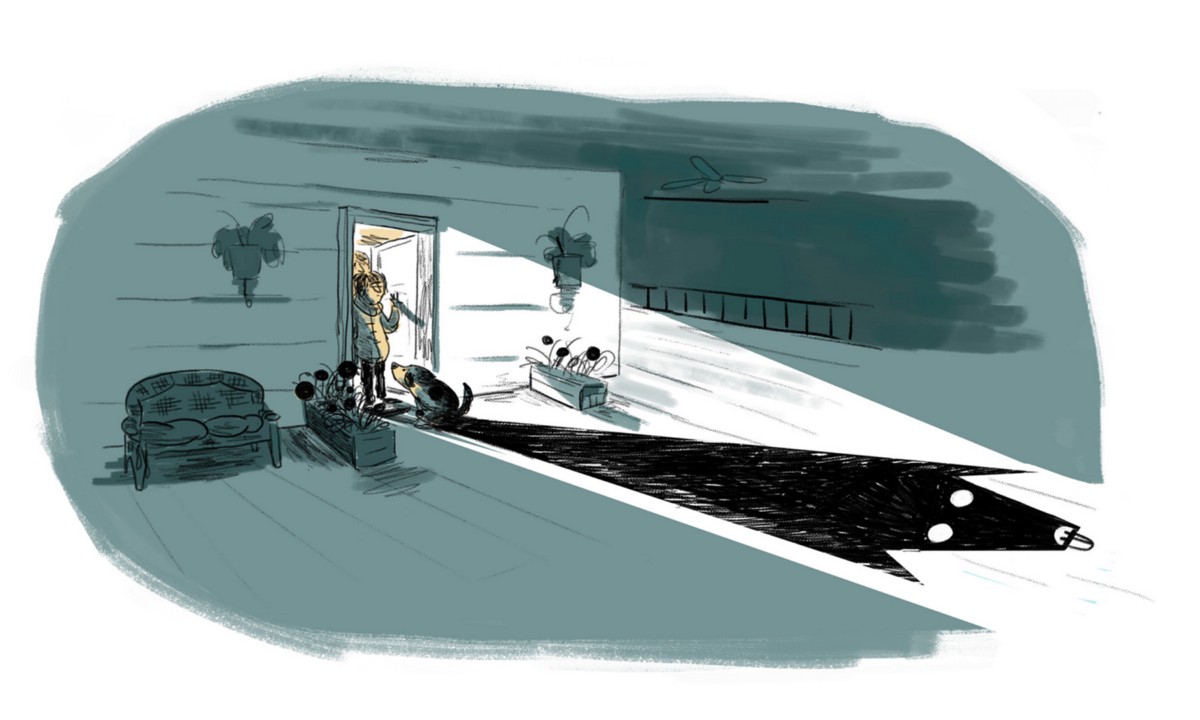
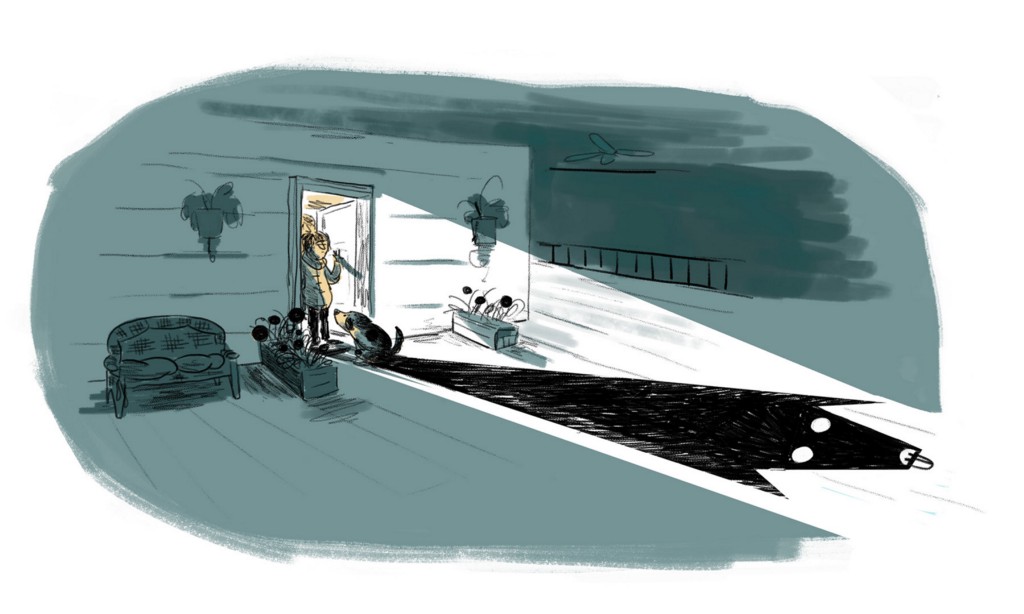
Our first night living together, we took in that puppy howling outside the door. An auspice, I thought. But we’d never done this before. We didn’t know how small things can grow, what little space we can be left to live in. We were not the sort to abandon something until we were.
M. Lopes da Silva, “Several Coats of Coats”
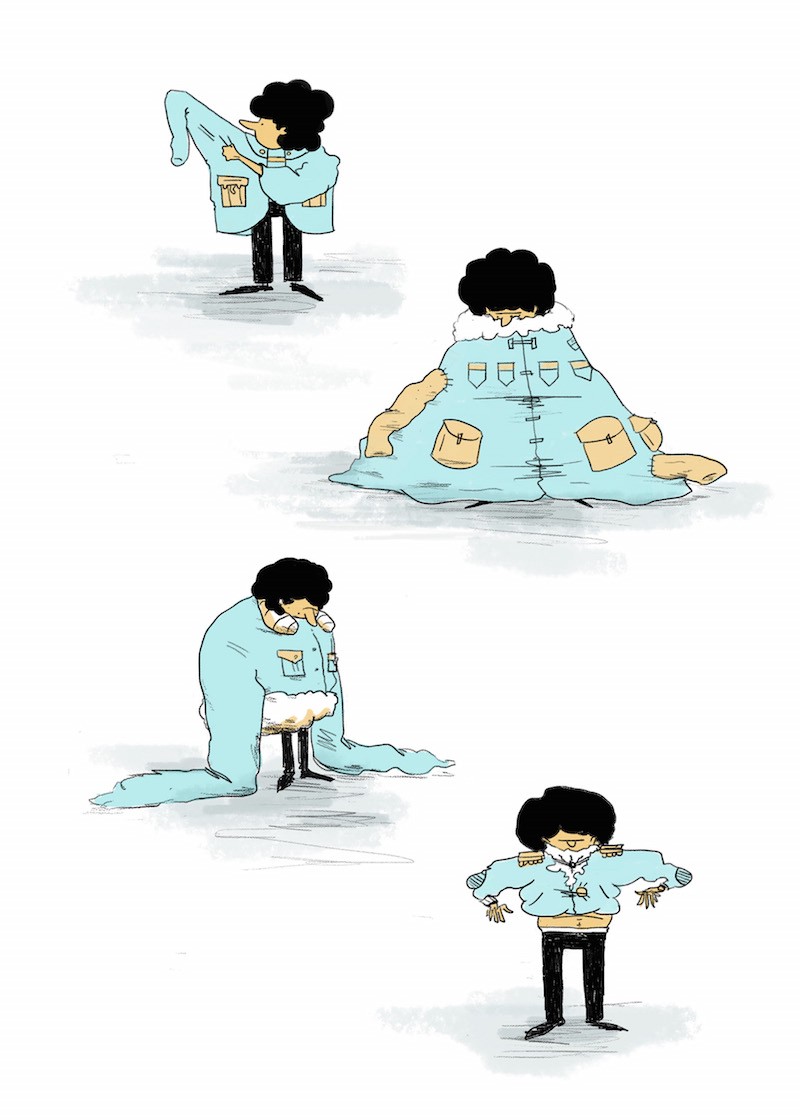
In the pockets of the coats there were always other, far more dashing tiny coats that — when shaken out and placed in the sun — would promptly grow to full size. In those new coats? More tiny coats. The trouble was that none of them would ever quite fit, no matter what you tried.
Josh Lefkowitz, “A Moment of Silence”
The fans stood in silence for 58 seconds before the hockey puck dropped. Someone remembered the school back east, so they added 26 more. The church; the nightclub; etc. Minutes turned to hours, everyone standing silently. “I’m tired of this,” said a girl. “Quiet,” said the crowd.
James Lough, “When We Lost Alphonse”
We worried when Alphonse tried heroin, which exposed him to the world of marijuana, and quickly opened the door to beer, which naturally led him to pretzels and peanuts. Before we could intervene, we found him enmeshed in a group who allegedly ate nothing but vegetables.
Tamar Nachmany, “Mount Sinai”
All the electronics above my hospital bed are gossiping about when, exactly, I’m going to die. It sounds like a concert I heard in Berlin many years ago. We were told to close our eyes and listen. Static. Beeping. Rain. My monitor is the principal violin. I am not dying alone.
Stephen Aubrey is a writer and theater-maker living in Brooklyn. His writing has appeared in Publishing Genius, Commonweal, The Brooklyn Review, Pomp & Circumstance, and Electric Literature.
M. Lopes da Silva is an author and fine artist living in Los Angeles. Her work has appeared or is forthcoming in Blumhouse, The California Literary Review, and Queen Mob’s Teahouse, and anthologies by Mad Scientist Journal, Gehenna & Hinnom Press, and Fantasia Divinity Publishing. She recently illustrated the Centipede Press collector’s edition of Jonathan Carroll’s The Land of Laughs.
Josh Lefkowitz won the Avery Hopwood Award for Poetry at the University of Michigan. His poems and essays have been published at The Awl, The Millions, The Rumpus, and many other places including publications in Canada, Ireland, and England. He lives in Brooklyn, NY.
James Lough’s upcoming book, Short Circuits: Aphorisms, Fragments, and Literary Anomalies will be published by Schaffner Press in April. His oral history, This Ain’t No Holiday Inn: Down and Out in New York’s Chelsea Hotel 1980–1995 (Schaffner Press 2013) was optioned by Lionsgate Entertainment for TV production. He is a professor of nonfiction writing in the Savannah College of Art and Design’s writing department, which he formerly directed.
Tamar Nachmany is the director of 1010 Residency, a former writer-in-residence at the New Mexico School of Poetics, and a former Johns Hopkins University Woodrow Wilson Research Fellow. Her work has been shown at the Bell House (Baltimore), the Cullom Gallery (Seattle), the Jewish Museum of Baltimore, and other venues. She is currently writing her first novel.
Sara Lautman is a cartoonist, illustrator, and editor in Baltimore. Her drawings have been published by The New Yorker, Playboy, Mad, Jezebel, The Paris Review, The Pitchfork Review and The Awl. She is the Comics Editor for Electric Literature’s Okey-Panky, and in 2016, Recommended Reading published her illustrated “cut-up” collaboration with Shelia Heti, “The Humble Simple Thing.”
Our culture does not love soft men. In Carson McCullers’ The Heart is a Lonely Hunter, a tender barman named Biff Brannon feels himself to be both mother and father to everyone in a small Georgia town. To make this feeling tangible, he wants to adopt a couple of kids. “A boy and a girl,” he imagines; “in the summer the three of them would go to a cottage on the Gulf… and then they would bloom as he grew old.” But he owns that bar, has a demanding wife, plus is probably queer, and the calendar reads sometime in the 1920s. Biff does not get his wish.
Stephen Sondheim’s musical Into the Woods also opens with wishes. A baker and his wife wish for a child, but they can’t have one because the Baker had a shitty father who earned a curse that follows the whole family line. In the Baker’s best number, “No More,” Baker Senior appears and sings, “We disappoint, we leave a mess, we die, but we don’t.” Fathers of tender men die hard, it seems. Or they weren’t around — the Baker sings back, “No more curses you can’t undo left by fathers you never knew.” The Baker’s wish for a baby comes true, but to get it, he has to lose his wife. The consequences of wishing are always dear, we learn, even fatal.
The consequences of wishing are always dear, we learn, even fatal.
I was negative 57 years old when McCullers’ book punched its way onto the literary scene, and negative one when the curtain went up for Sondheim, but a raw and raging twelve when Paul Thomas Anderson’s film Magnolia found its way into the dusty off-brand video store in my Chelsea neighborhood. “I’m sick and I’m in love,” wails William H Macy’s character, a gay quiz kid all grown up, as the bar patrons, men who keep their feelings on lockdown, look on in horror. “I do have a lot of love to give,” he says later, sitting on a gas station trash can and his face covered in blood. “I just don’t know where to put it.”
Thunkity thunk, went some knock of revelation and recognition. Here was a brand new thing, yet I’d felt it myself: a sense of wrongness, that something in your gender and your body and your way of being does not match up with what the world requires or will allow. The video store owner, which mostly stocked gay porn and regarded my portly posterior with real confusion, was all too happy to let me keep Magnolia for many, many months.
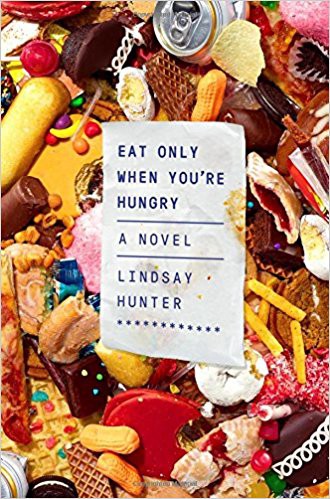
Lindsay Hunter’s Eat Only When You’re Hungry is a welcome addition to the miniature curio cabinet of works centering male tenderness, softness, vulnerability, and yearning. The novel’s crackling core is Greg, a fat, hungry, sexual, alcoholic father who embarks on a lonely and lazy cross-state voyage in a rented RV to find his drug-addicted son, Greg Junior — GJ.
As I read I dog-eared the pages that called me out or taught me something new about parenthood, marriage, addiction, family dysfunction, food compulsion, hunger, the body, the texture of objects, or the American South, but soon I had to stop it. Every other page was getting folded.
The RV seemed made for men like him, men whose asses needed room to spread, men whose backs zinged at the sight of a golf club. The driver’s seat was as wide as two seats in the Volvo, skinned a plush gray something or other, and felt four feet deep with cushion. The headrest stayed out of his way but was at the ready whenever Greg needed cradling.
Could I love this description of Greg any more? I could not. (Relatedly, see my thoughts on male frump as an aesthetic, which also includes Biff and the Baker). Could Greg hate himself any more? He could not. Comfort, spreading, cradling — these are things that Greg does not allow himself in his regular life with his sturdy and shut-down wife, Deb. “Hair pinned back out of her eyes,” Hunter writes of Deb. “Purse snug under her arm. Nothing worrisome, nothing out of place.” Yet just on the other side of the Deb coin is his ex-wife Marie, an untidy curly-haired woman who drinks too much and likes to fuck, facts about which Greg feels profound ambivalence. And could he love his son, GJ, a smart, sensitive kid who likes camping and lets other boys drink out of the bottle before he does, any more? He could not. (That camping flashback, where we learn that GJ is truly an unsalvageable addict … break my heart into glittering smithereens, why don’t you, Lindsay Hunter).
Greg’s universe is polarized, populated by only two kinds of people: those whose hungers eat them alive (Greg, his son GJ, his father, his ex-wife Marie) and those who lock theirs up and swallow the key but are able to live normal, if fundamentally sad, lives (Deb, his father’s girlfriend Lydia).
If a family is a gradual loosening, a journey from denial to acceptance with the passing generations, Hunter skillfully sets up Greg’s son GJ, the quest object of this book, as the opposite of Greg’s own parents. His parents are a grey sky and his son is a tornado and he sits somewhere in the middle, ping-ponging back and forth between restriction and indulgence, between too much feeling and too little. The way parents both love and hurt their own children in precisely the same ways is perhaps this book’s most devastating illumination, and just simply how terrifying and random and loving and terrifying again it is to be a parent. “Y-ball. T-ball. Pop Warner. Tap dance (Marie’s idea),” writes Hunter in one of two stylistically innovative mini-chapters that add zing to the whole book. “Crayons, markers, paints. Charcoal. Spray paint. Skateboard. Body board. Beach summers. Sky-blue swimming pools. Hotels. Resorts. Camping. Hamburgers, pizza, hot dogs, ice cream.” These are all the things we buy and give to our kids because what else is there to do but try to love and offer them things. And then, a few lines later: “Big gulps. Beer. Whisky. Dope. Hash. Tar. Rocks. Spoon, needle. Pipe. Darkness. Light. I’m sorry. It’s okay. Theft. Shouting.” These are things we make with them, and the other things we gave them.
The way parents both love and hurt their own children in precisely the same ways is perhaps this book’s most devastating illumination.
In my fat processing group, we are often grappling with a gap between the fat positivity movement, which reminds us that being fat is a body characteristic like being tall or redheaded, and the reality of the air we breathe everyday, which equates flesh with failure and teaches fat people to hate not only our own bodies, but also our hunger — our needs, wishes, desires, feelings, and very guts. Though Hunter herself is surely aware of fat positivity and fat acceptance, Greg is not — all the book allows him when it comes to his body is hatred and shame, feelings meant unequivocally to slosh over into how we understand his feelings towards all desire and vulnerability in general. It’s a choice on Hunter’s part that feels both disappointing and true.
The strategies Greg’s parents and his wife practice do not work. This much is clear by the end of the book. GJ’s strategies do not work. His appetites have eaten him alive , as hunger denied is wont to do. This kind of extreme black-and-white thinking feels bang-on for an addict and the child of addicts, which Greg’s son is—and, which we learn in the final pages of the book, Greg also is. He goes to bring his son back, to save his kid from the clutches of insatiable need and out-of-control desire, but the person he ends up saving, of course, is himself — but by the end of the book we readers are hungering for some sort of middle ground.
As political actors, we want to practice the most liberating and idealistic thinking and behavior, but as humans we are flawed, stuck, cruel, damned, busy, poor, programmed, and oppressed. Greg’s mother didn’t eat and didn’t feed him; the seeds of equating need with weakness began there. Yet it doesn’t feel outside the bounds of good art to wonder if Hunter might have explored other perspectives towards fatness, hunger, and shame through the wishes of her other, equally glittering, supporting characters.
One glimmer of this that Hunter does offer is expansive possibilities as to how to deal with an addicted or self-destructive child beyond enabling or condemning. Greg’s father’s girlfriend Lydia smokes crack with her addict daughter so she can empathize. Greg himself decides to listen, to self-examine, and to love.
One important feature of my childhood what my father called “the automatic no.” To hear him tell it, my sister always said “no” to any request he or my mother might make of her: no to setting the table, no to picking up milk, no to seeing some new doctor who would surely cure her, once and for all, of her fatness. To hear my sister tell it, her “no” was a necessary corrective to the power of Our Father, to whose dictatorial demands and senseless moods we had been submitting for all of time. If my sister was the one who always said “no,” I was the one who — if I spoke at all — always said “yes.” From my bedroom, I listened to my sister and my father do battle. Our apartment rattled with endless things and their opposites — it’s like this, no it’s like that; yes you will, no I won’t.
After years, you start to leave rooms, leave lovers, leave cities from no discernible motivation, just to see if you can.
But here is what I have found out: To live in the automatic no is to block the process that happens when you say “yes” or “no” by choice, and start to move towards or away from things on purpose. After years, you start to leave rooms, leave lovers, leave cities from no discernible motivation, just to see if you can. You become unable to say “yes” and mean what “yes” means: come closer. These days, I’m trying not to pingpong back and forth, but instead sit lost, homesick, and ill, in the middle. For me, this has been growing up.
It’s Biff who closes McCullers’ book, alone in the bar, after all the other characters have left.
His heart turned and he leaned his back against the counter for support. For in a swift radiance of illumination he saw a glimpse of human struggle and of valor. Of the endless fluid passage of humanity through endless time. And of those who labor and of those who — one word — love. His soul expanded. But for a moment only. For in him he felt a warning, a shaft of terror. Between the two worlds he was suspended… Between bitter irony and faith. Sharply he turned away.
Moonlight scooches over the kitchen floor, a white tongue, panting, licking, shedding its skin, looking for a corner, a place to hide and puddle.
Something in the refrigerator begins to shiver. Is it the brown eggs? The ice cubes?
My bowl of die?
There, there, I say to the moonlight as I stroke it with a wire whisk. There, there.
“Guests might find that Carrington had crept into their room at night, cut off a chunk of their hair, and served it up to them in an omelet the next morning.”
Each morning, another key.
I find them on the table, hanging from a nail. What do they open?
They look like skeletons, fossils, needle-nosed fish.
I find them in my slippers and under my pillow.
I suck them and put them in my ears, my nostrils, my bellybutton.
They taste like marrow. What do they lock?
I fill my mouth with my keys to keep them, to keep my keys away from you.
20 Days with Julian & Little Bunny by Papa
Little Bunny speaks with people across many years.
At the suggestion of an inquisitor, Little Bunny twists Julian’s tits. They lick tongues. They lock whatnots.
Perhaps I should see the school doctor about this?
Julian keeps his hair as long as a cow’s tail, so he can flick away the black flies.
On a hike in the forest, we discover a trail of breadcrumbs. Julian picks them up with his tongue. We’re in league with the wolf, Little Bunny explains.
When Little Bunny walks barefoot, she holds her breath.
Julian pinks up at the sight of an abandoned piano. He collects their keys so he can reintroduce them to the ocean.
The rain makes me mistake Monday for Sunday, March for August.
Julian eats cauliflower for fear of being turned into cauliflower.
Little Bunny’s song requires an open window and a blade of ash. She will use her song to scratch her name in the air.
Little Bunny and Julian apologize for no dinosaur for dinner.
I order delivery.
When Little Bunny walks barefoot, over the hot sands, holding her breath, the water shivers.
Julian takes me to the movies, instead of school. We fill our pockets with packets of salt, pepper, mustard and ketchup. We like previews. We eat California rolls.
Little Bunny uses a blue marker to color-in the wrinkles around her eyes. All rivers flow into her irises.
I write with a pencil, so I can erase, so I can turn the words into
Pink curls.
Julian: When I was a boy my grandfather refused to take me hunting because I talked too much. What did I say? My dancing days are kaput! What did my voice sound like? White swallows. White swallows.
I intercepted a call from my proper authorities and recited, poorly, a small poem by Rimbaud, in French. They hung-up.
Little Bunny: Tes crocs luisent.
Why did you name me papa, I never ask.
A September Gospel
My ribs are sardines.
They beg me to turn the key.
But when I do, I shiver. Or is that dancing?
The fish are not pleased.
It reminds them of their death, below decks, above the sea, covered in salt, rocking, singing their sardine songs as the fishermen cleaned their blades with red ale.
I grab the freezer door to steady myself and it opens. I stick my head inside. What a world! Swedish meatballs, peas, vodka, pearl onions, samosas, ice cream and a cow’s heart.
The light bulb is a white dwarf, humming, radiating, dreaming of its future as a black dwarf.
My chest pulses. The fins sense water. They want to dive into the vanilla lava, swim to the ocean in the center of the earth and transform into a swarm of Eves.
Later, outside, I sit on my stoop, sipping hot vodka and onions.
A clutter of uniformed school children pass.
Each one of those angels will tease the skinned rabbits in the butcher shop window, I know.
I scratch my neck and there it is, the key. Caught in my throat. I loose a gulp of booze and whisper to my ribs:
vivat, don’t swoon I’m greasing the track, soon we’ll all be free.
Some stories are primal. Some have drawn the attention of readers for centuries or even millennia–they might be national epics, sacred texts, or myths that explain some quality of the world. Depending on the reader, they might be all those things. But just as certain stories retain the ability to hold an audience rapt, so too do they inspire a particular group of writers to retell them.
This is far from a new literary tradition. Italo Calvino’s bibliography involves plenty of genre-defying, narratively innovative, and head-spinning works; it also includes 1956’s Italian Folktales, a massive collection of, well, retold versions of Italian folktales. William Butler Yeats collected several volumes of Irish folktales in the late 19th century. And in 1973, R. K. Narayan, best-known for his works of literary realism, published a shortened prose version of The Ramayana, a centuries-old Tamil epic. Canongate’s ‘The Myths’ series has included contributions from writers like Ali Smith, David Grossman, and Margaret Atwood. Here, the definition of ‘myths’ is wide-ranging: Smith’s Girl Meets Boy juxtaposes a retelling of Ovid’s tales of changing bodies with more contemporary concerns, while Grossman’s Lion’s Honey is an essayistic meditation on the Old Testament story of Samson.
Some tellers of ancient tales prefer a decidedly restrained approach, a neutral tone that serves as a literary middle ground between the archaic style in which the stories were initially told and a more contemporary voice. For others, though, a contemporary sense of language is crucial. Chester Brown’s recent graphic novel Mary Wept over the Feet of Jesus retells several stories from the Bible pertaining to sex work. Brown uses a familiar and conversational tone throughout; one caption memorably reads “Meanwhile, in Heaven, the angels are hanging out.”
Among the highest-profile retellings of ancient stories in recent years is Neil Gaiman’s Norse Mythology. Gaiman has a longstanding fascination with the deities. His novels American Gods and Anansi Boys feature riffs on immortals from numerous pantheons, with questions of perception, belief, and evolution thrown into the mix. Even earlier, Gaiman wrote several of the Norse gods–notably, Thor, Odin, and Loki–in his groundbreaking Vertigo comics series Sandman.
There’s an element of circularity, then, to aspects of Gaiman’s introduction to Norse Mythology, in which he writes about his own initial experience with these Norse figures.
My first encounter with Asgard and its inhabitants was as a small boy, no more than seven, reading the adventures of the Mighty Thor as depicted by American comics artist Jack Kirby, in stories plotted by Kirby and Stan Lee and dialogued by Stan Lee’s brother Larry Lieber.
It’s probably also worth pointing out that a version of Marvel Comics’ Thor turned up, albeit briefly, in the Gaiman-penned series 1602. Norse Mythology marks the fourth time Gaiman has taken a crack at these characters; like Johnny Cash going into the studio with Rick Rubin, there seems to be an effort to get back to the basics, to find what’s essential in a familiar story without too many additional trappings.
The Wolves Pursuing Sol and Man, Hélène Adeline Guerber (1909)
It’s significant that, by and large, there are no postmodern or metafictional nods in Gaiman’s retellings. The way in which stories are told, and how belief in certain narratives can influence reality, are concepts Gaiman has wrestled with in numerous works. Here, the narratives are more straightforward; this feels more suitable for an all-ages audience — it’s more about the flair of the telling. There is the sense that he did savor writing some choice bits of dialogue—the trickster Loki reveling in someone’s inability to consider “the exactness of their words,” for instance. And the voice through which Gaiman recounts these stories also is polished; it’s one that seems familiar and collegial with both these characters and the reader experiencing the stories:
That was the thing about Loki. You resented him even when you were at your most grateful, and you were grateful to him even when you hated him the most.
In his introduction to Norse Mythology, Gaiman writes about his process of assembling this book, reading “words from nine hundred years ago and before, picking and choosing what tales I wanted to retell and how I wanted to tell them.” In an interview with Petra Mayer at NPR, Gaiman spoke about the appeal of this particular mythology because it has an end point, which created a sense of a larger narrative. Ragnarok, Gaiman argues, “turns the entire thing into a tragedy, which gives it depth, it gives it base notes, it gives it a peculiar profundity.” It’s a prime example of how a modern storyteller can find their own angle on long-running narratives.
Like Johnny Cash going into the studio with Rick Rubin, there seems to be an effort to get back to the basics, to find what’s essential in a familiar story without too many additional trappings.
That’s an essential part of crafting retellings that will endure. In a 1988 interview with Adit De, R. K. Narayan spoke about his own work with classic narratives — retellings of The Ramayana and The Mahabharata. For him, the need to retell these stories was essential. “They are symbolic and philosophical,” he explained. “Even as mere stories, they are so good. Marvellous. I couldn’t help writing them. It was part of a writer’s discipline.”
For some writers, tapping into the essential elements of an older text can be its own reward. Others may well want to explore more contemporary questions or use the narrative to critique something in their own society. Halldor Laxness’s novel Wayward Heroes was written in 1952, but was only recently translated (by Philip Roughton) into English. From the first page of Laxness’s novel, he makes it clear that this is a conscious retelling of an older work:
Most of the stories of these warriors we find so remarkable that recalling them once more is certainly worth our time and attention, and thus we have spent long hours compiling into one narrative their achievements as related in numerous books. Foremost among these, we would be remiss not to name, is the Great Saga of the Sworn Brothers.
If the tone of that passage strikes you as overblown, that’s the point. The two sworn brothers in question, Þorgeir and Þormóður, engage in a host of bloody feats over the course of the book that ultimately feel more tragicomic than remarkable. In a long essay about the works of Laxness for Harper’s, Justin Taylor argues that “Wayward Heroes belongs in the pantheon of the antiwar novel alongside such touchstones as Slaughterhouse-Five and Catch-22.”
Whether straightforward or revisionist, these stories can be adapted into countless forms, and experienced in a host of ways.
Throughout the novel, there are reminders that this is a retelling of an older story. A paragraph in one section of the novel set in Greenland opens with a line that reads like nonfiction: “Sources state that when Þormóður reached the Eastern Settlement…” Later on, the action pauses entirely so that the book’s narrator can draw attention to narrative discrepancies: “There are two different accounts concerning what subsequently occurred between the brothers-in-law.” From there follows a long and self-effacing explanation of why, exactly, one of the two accounts has been chosen to appear in these pages.
Image from Icelandic saga
This seems entirely in keeping with Laxness’s wry tone, which takes notions of heroism and national glory down several pegs. So too is the use of narrative ambiguity when one of the novel’s central characters dies. “[W]e shall never gain a clear answer from men of learning — the old books differ widely on these details,” Laxness writes.
For writers like Narayan and Gaiman, revisiting older stories was a kind of master class in narrative: finding what was most essential about certain essential stories and making it their own. For others–Laxness certainly comes to mind, as do several of the writers who have written books for Canongate–the oldest of stories are fertile ground to examine much more contemporary concerns. And perhaps that’s the biggest testimonial of all to the staying power of some of these narratives: whether straightforward or revisionist, they can be adapted into countless forms, and experienced in a host of ways. Some of these stories date back to the oral tradition; a series of repeated retellings was what made them endure over the years, the decades, the centuries. Retelling might involve a storyteller finding their own perspective on something timeless; it might involve using an ancient tale to illuminate something contemporary. Though the stories in these relatively recent retellings are printed and bound, their lineage hails back much further into the history of narrative. What these contemporary forms and devices do, then, is give us something to handle, something to set beside more recent works, seeing how these stories have influenced generations of stories and storytellers that followed. And perhaps for some readers, these versions will spark a new cycle of tellings and retellings.
This month, the novelist Viet Thanh Nguyen was awarded one of the most prestigious honors a writer can receive: the MacArthur “genius” grant, given to artists, thinkers, and public intellectuals whose ideas have culture-altering potential. This, in itself, should surprise no one. Nguyen writes with arresting moral and intellectual force, often about people scarred and uprooted by conflict. As the MacArthur Foundation put it in its citation, Nguyen’s demonstrated a unique gift for exploring how depictions of the Vietnam War “often fail to capture the full humanity and inhumanity, the sacrifices and savagery, of participants on opposing sides.”
But the MacArthur is just the latest in an astonishing run of literary successes, one that makes it easy to forget a simple fact: A mere 18 months ago, Nguyen was still unknown as a fiction writer. His career began quickly, and seemingly out of nowhere, in April 2015 — when a rave on the cover of The New York Times Book Review made his debut novel, The Sympathizer, one of the year’s most-discussed books. Shortly after that, The Sympathizer won the 2016 Pulitzer Prize in fiction, bringing Nguyen international fame. Since then, he’s stayed busy, publishing two celebrated books in short succession: a work of nonfiction cultural criticism, Nothing Ever Dies: Vietnam and the Memory of War, and a short story collection, The Refugees.
But Nguyen is no overnight sensation — far from it. In this interview, he opens up about a period of his life that’s been mostly overlooked: the two decades he spent trying, and mostly failing, to write fiction, working in secret while he juggled a host of other responsibilities. We discussed the 20 years of work that preceded his debut, the challenges he faced along the way, and — when it seemed his literary ambitions would never quite materialize — the strategies he used to keep going.
Viet Thanh Nguyen and I first spoke in 2015, discussing how he stumbled on The Sympathizer’s first sentence, an opening that finally allowed him to complete the rest of the book. That conversation appears in Light the Dark: Writers on Creativity, Inspiration, and the Artistic Process, published this fall by Penguin Books. He teaches at the University of Southern California, and spoke to me by phone.
Joe Fassler: Your public life as a novelist has really only been about two years long — but I’ve read in interviews that writing fiction was important to you for many years before that. Tell me about your private life as a fiction writer.
Viet Thanh Nguyen: I started writing fiction semi-seriously when I was in college. But I felt I was a better scholar than a fiction writer, so I decided to pursue academia and graduate school. I thought that I would write fiction on the side and when I got tenure, I’d concentrate on the fiction more fully.
That’s not quite how things turned out. It took me 20 years to learn how to be a writer, and part of that was because I was also being an academic at the same time. It was very much a long-term act of trying to balance both of these sides of myself — dealing not only with the demands of the art, but also with the petty world of ego and human vanity. I simply wasn’t making as much progress as quickly as I wanted on the fiction, and that was hard.
JF: How did you actually make time for your creative work, given the demands of full-time teaching and academic work?
VTN: Well, I’m very fortunate that I’ve had a very tolerant partner for most of that time. The reality was that there was very little free time, because academia is obviously a full-time job, and then writing had to come on top of that. I wouldn’t say that writing was another full-time job, but it consumed a lot of hours.
During the summers, I’d have enough free time that I could writer. But during the semester, I would probably do some work on the weekend, and whenever I had free time — when I wasn’t grading midterms, for example. During the teaching periods, I never got to write every day. I would only get to write every once in a while. The luxury of writing every day was not something I had the discipline to do.
It really wasn’t until I had writing residencies that I could write full-time. The first time that ever happened to me was not until 2004, when I did a fellowship at the Fire Arts Work Center in Provincetown. Then I really got to know what it meant to be a full-time writer, and it was a really difficult experience.
JF: I imagine that kind of pure, unstructured time was the opportunity you’d always been waiting for. But you’re saying it was difficult?
VTN: Very difficult. Up until that time, I’d been writing in the margins of my life — longing, just longing for the moment when I could write full-time. As a result, I was also completely unrealistic about my abilities. Up until that moment, I’d been thinking: oh, I’m actually a pretty good writer. I just need that chance. If I could just be full-time for a while, I can finish this book of short stories that I’m writing.
I realized that I faced a choice: I could give up on being a writer, or I could decide to persist.
So I got the chance. But Provincetown was a disaster. Finally, after all that time, I could write eight hours a day — and the outcome was completely bad. Number one, I was forced to confront the fact that I had a completed inflated sense of my own abilities. Number two, I was forced to confront the difficult reality that I had much more work to do before I could become even a competent writer.
That year was supposed to be the wonderful moment in my creative life up until that point, and it turned out to be the worst moment. And I realized that I faced a choice: I could give up on being a writer, or I could decide to persist. I decided to persist, and I think that was the moment that I really started becoming a writer. It was the process of overcoming those unrealistic expectations, of buckling down and spending another decade writing, that was really transformative.
JF: After that humbling experience at Provincetown, did you change anything about your schedule, your mindset, or your approach to writing?
VTN: Well, two things. One, I did change my approach to writing. I realized that I can’t write eight hours a day, which is what I was trying to do. The next time I had a long stretch of time to write, I only gave myself four hours a day. That was the right amount of time. There’s something about writing that, to me, is much more exhausting than office work, for example, or academic work, which I can do eight hours a day or more. For me, four hours seems to be the right amount.
I think it was Hemingway who said he’d stop writing when he reached a good moment — stop when you feel happy with the day’s work, and when you’re in the middle of a sentence or a paragraph while you still have an idea of what’s going to take place next. And resume the next day. That’s great advice, and I took it to heart.
The other thing I learned is that, for me, part of being a writer is about endurance. The ability to withstand rejection, and neglect, and obscurity, and all of that. I really began to learn that for real in Provincetown, because up until then I could imagine that I was an academic. There was a reason I wasn’t getting my creative work done, and I had all these excuses lined up for why I wasn’t writing more.
But after Provincetown, there was no excuse. That whole decade following that, right up until The Sympathizer was published, was about learning how to endure, just living with the art itself. Just trying to be faithful to the art, and believing that if I took as long as I needed to take, something good would come out of it. I learned I could not force myself to, let’s say, write the book within a year, simply because I wanted that success. It wasn’t going to happen.
JF: Still, it must have been hard at that point to have your career be so lopsided: your academic credentials greatly outweighed your creative accomplishments, even if your heart was really with your fiction. How difficult was that for you, emotionally, during the long period in which you wrote your novel?
VTN: It was hard, because I was successful in my academic career and I knew exactly what to do to maintain that. I could have just stayed with that, you know? But then, because I decided to devote much more time to writing fiction, it meant that both of my careers were developing at an equally slow pace. On the academic side, I could see other people moving far ahead of me, and that was distressing. On the fiction side, I thought that I was moving too slowly — I felt I would never have the time to get a book published.
What if I spent 10 or 20 years doing this, and I could still not get a book published, and then both my careers would be a disaster?
It was difficult enough just to learn how to write. But also, because I’m a petty human being, I was concerned about whether or not my efforts would have any kind of material outcome. What if I spent 10 or 20 years doing this, and I could still not get a book published, and then both my careers would be a disaster? Just trying to live with that possibility, and trying to have faith that I could do this, was really very challenging.
JF: Considering how badly things went at Provincetown, and what an ongoing struggle the work was, what made you stick with it? What kept you from giving up?
VTN: Occasionally I would get some recognition. I did sell a story when I was in Provincetown; from there, every year or two, I’d sell a short story or something. So small rewards came in little bursts. They didn’t happen very often, and they didn’t bring very much money or renown, but it was enough to keep me going.
Besides that, I think it was just sheer stubbornness, and the willingness to just work. For me, writing is about just sitting in a room, looking at the computer screen — no music, no window, just a blank wall. It’s a grind, but there was something in me that could endure all of that. I don’t know where it comes from. I do think a lot of it comes from my parents. I grew up watching them work 12 to 14 hours a day without relief.
While what I do as a writer is nowhere near as physically taxing as what they endured, I think that I learned lessons from them about just persevering, just putting one foot in front of the other, and hoping that would take you somewhere far, eventually.
JF: I don’t know about your parents’ work — tell me more about that.
VTN: They ran a grocery store for a decade during the key years of my youth. It was a brutal experience, physically brutal, but also very violent because of crime that you have to endure as a small business owner in a working-class neighborhood. It was very tough for me to watch them do that. While I never wanted to do anything like that, I certainly looked to their model of sacrifice.
I think being a writer very much involves sacrifice. Let’s say you use Malcom Gladwell’s figure, the 10,000 hours he’s said you have to work before you can learn to do something well. (I recently I had to count all the hours I spent in that early period for a sake of my accountant — and 10,000 hours was about what it came out to, disbursed over 15 or 20 years.) That means you have to give up 10,000 hours of your life, which could be much more productively used for your career, or for just entertainment and pleasure. The challenging thing is that there’s no guarantee those 10,000 hours are going to lead to anything whatsoever, besides what is meaningful personally.
JF: We first spoke in 2015, shortly after The Sympathizer was published, but before the book was awarded the Pulitzer. You explained how you came upon the novel’s open sentence, a breakthrough moment in a long, arduous process, one that helped you finally understand the novel’s tone and terms. Where were you in the process when you at last wrote that all-important first line?
VTN: I knew when I set out to write the novel that the opening was really important — that it would set the tone for the entire novel. And so, immediately after I wrote the outline for the novel (which is only two pages), I set about trying to figure out the opening scene and what that opening line would be. It took me, I think, pretty much the entire summer of 2011, which is when I started writing The Sympathizer.
It took all summer, but when I finally got that opening sentence, I wrote to a friend — who, besides my partner, was the only person I was talking to about the novel. “I’ve got it,” I said. “I’ve got this opening line.” And I was right. The voice and rhythm of that line drove the entire book.
JF: We all know how this story ends: You finished the novel, and published it to great acclaim. But there’s no way you could have known that outcome then. Let’s just say it went the other way, as it does for so many writers — even deserving one. Let’s say The Sympathizer had sat, instead, in your drawer. Do you think you would have been content with the sacrifices you’d made anyway?
VTN: I’m not the right person to ask, in some ways — because I did get rewarded for my work. It’s hard for me to put myself in a hypothetical situation where these things didn’t happen to me. The last 18 months have been crazy, and mind-boggling, but they’ve obviously made the last 20 years totally worth it.
But if my reality had turned out differently, if I never got a book published, would it have been worthwhile? I like to think that it would have been. Writing is only partially about the external rewards of publishing a book — even only partially about the external manifestation of the book itself.
This is not something that you want to voluntarily embark on because you think it’s going to be fun, or cool, or anything like that. It has to come out of some deep need.
There’s a spiritual dimension to it, I think. If someone finds it necessary to write, then it’s worth the sacrifice. By the way, that’s why I tell people: If you don’t find it necessary to write, you shouldn’t do it. This is not something that you want to voluntarily embark on because you think it’s going to be fun, or cool, or anything like that. It has to come out of some deep need.
If it’s coming out of that deep need, then the sacrifice will be worth it — because, I think, through the act of writing, you learn something about yourself. The whole idea about spirituality being necessary as a way of disciplining yourself, and separating yourself from the world of tempting vanities that is so tempting: I think that applies to writing as well. Even writing that doesn’t lead to a material outcome.
JF: So what was it that made it worth it for you, then? Before the publication came, before the book’s success?
VTN: I think that if I hadn’t become a writer, I would’ve done something else that would’ve required that discipline. I would have been a fanatical gardener, or a fanatical cook, or something like that. For those of us who become writers, we have that trait within ourselves — this desire to master something. A desire to try to become an expert at something through the art — something somehow related to what we feel, and what we need spiritually.
It’s a lifelong endeavor. I think that, even if I hadn’t somehow gotten a book published in the last few years, I would’ve kept at it. You know, there are these stories of writers who don’t get published until they’re in their 50s, or 60s, or 70s. Sometimes, that’s the reality of things.
Of course, I hope my career isn’t finished. And if it isn’t, there will be future tests of my spirit, and my soul, and everything else still ahead — whole different set of tests than what I’ve already been through. I have to believe that I can face those as well.
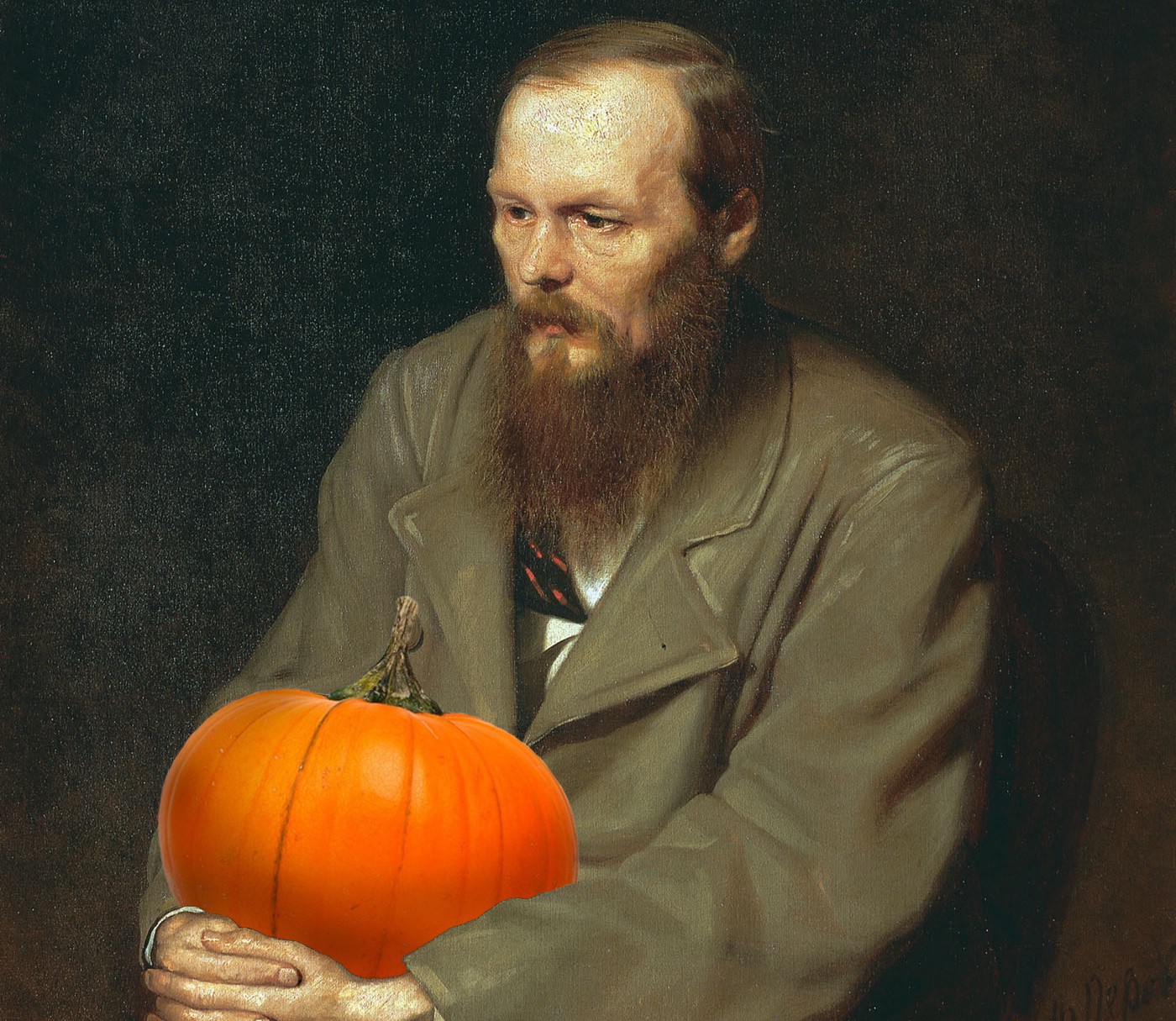
After a long weird summer, it’s finally, finally fall—season of mists and mellow fruitfulness, season of lying on the floor crying because the sun set at 6 p.m., season of Halloween candy and decorative gourds and that dancing jack o’lantern guy. And most importantly, season of pumpkin spice.
Oh, you think pumpkin spice is basic? Well, tell that to prominent Russian novelist Fyodor Dostoevsky! (You can’t. He’s dead, which is also very seasonally appropriate.) Snuggle up in a cozy sweater and enjoy these classics made more autumnal, more nutmeg-scented, and somehow even whiter than before.
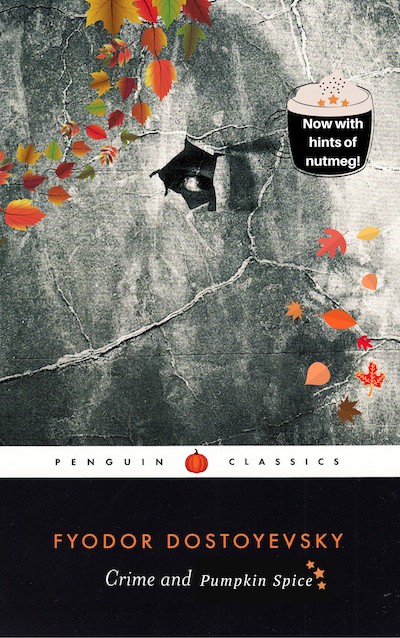
Crime and Pumpkin Spice
Before committing his crime, Raskolnikov believes that murder is permissible; afterwards, he comes to believe that murder is monstrous. But what happens when he believes that murder is delicious?
Notes from Underground and The Double Pumpkin Spice Latte
Are you capable of enjoying a cup of tea with sugar in it? Then imagine how much more you’ll enjoy a double pumpkin spice latte.
Poor Folk Without Pumpkin Spice
In Dostoevsky’s first pumpkin spice novel, two cousins mail a Starbucks punch card back and forth and discuss whether they can afford to buy pumpkin spice Pop Tarts at Trader Joe’s.
The Gambler and Nasty Business and Pumpkin Spice
The man wrote a lot of novellas. It’s fine. We can’t all write War and Peace. Anyway, there’s jamming two novellas into one book and then there’s jamming two novellas into one book with a swirl of pumpkin spice and we know which one’s better.
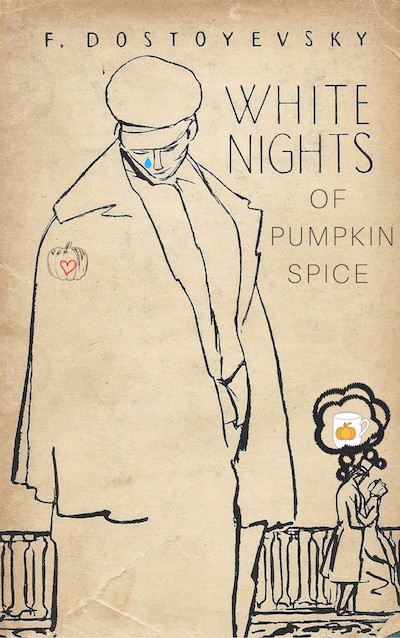
White Nights of Pumpkin Spice
A short story about unrequited love that can only be soothed by eating a dozen pumpkin spice Milanos.
A Raw Youth (Now in Pumpkin Spice)
A son rebels against his father by scolding the old man that “actually, there’s no pumpkin in so-called ‘pumpkin spice’ flavoring.”
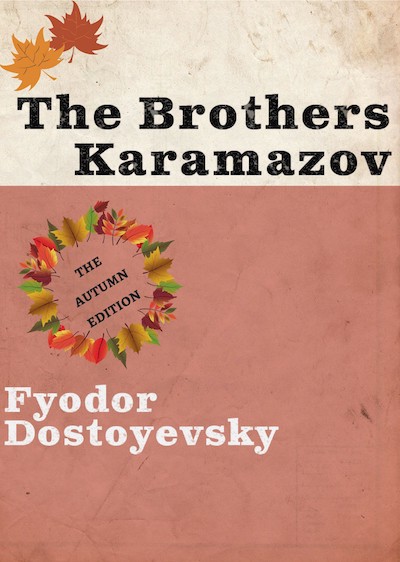
The Brothers Karamazov (Autumn Edition)
Mitya, Vanya, and Alyosha put on light jackets.
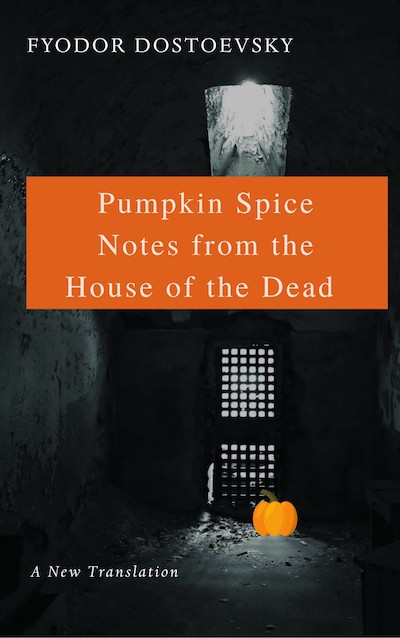
Pumpkin Spice Notes from the House of the Dead
A personal memoir of the grueling and inhumane conditions in Siberian labor camps, but with pumpkin spice notes.
Pumpkin Spice Demons
An unassuming town becomes the nexus for a pumpkin spice revolution.
The Orange Idiot
It’s Dostoevsky’s epic novel about a good, kind, compassionate leader, but with pumpkin spice. What did you think it was?
It’s a big deal to get a starred book review in Kirkus, but you’ll never know exactly whom to thank. The biweekly review magazine is hugely influential—bookstores and libraries look to its pages to find out what to order—and it doesn’t dole out praise lightly. Reviews are often critical, sometimes downright harsh, and always anonymous.
Thanks to a company-wide policy, though, we do know one thing about Kirkus reviewers of young adult novels: They are, to whatever extent possible, matched with the identities of the book’s principal characters. “Because there is no substitute for lived experience, as much as possible books with diverse subject matter and protagonists are assigned to ‘own voices’ reviewers, to identify both those books that resonate most with cultural insiders and those books that fall short,” reads a statement on the Kirkus site. In theory, this prevents sub rosa racism, ethnocentrism, ableism, or other troubling themes from slipping past reviewers who don’t find them painful.
Accordingly, Laura Moriarty’s American Heart, in which a teenage girl in a dystopian America tries to help a Muslim woman escape internment, was assigned to a Muslim reviewer. She found the book “terrifying, suspenseful, thought-provoking, and touching,” and on October 10 gave it a starred—but, as usual, unsigned—review. Usually, it’s negative reviews that raise ire, but in this case the rave garnered immediate criticism from people who objected to American Heart’s “white savior” narrative. (The publisher employed several sensitivity readers, ostensibly to avoid giving offense in just this way, but the plot still hinges on a white protagonist and viewpoint character literally saving a woman of color.) Bestowing a starred review on a book that is about rampant Islamophobia but centers and elevates a white character was, critics said, evidence of how—in the words of writer Justina Ireland—“Kirkus Reviews of books reinforce white supremacy.”
Kirkus took the criticism to heart, but its response was clumsy. The publication rescinded the book’s star and altered the review; the first decision was made in collaboration with the reviewer, the second was not. (She made the edits, Kirkus says, but she did not initiate them: “We wanted her to consider if changing what we thought was sort of reductive word choice, and adding deeper context, is something she thought might be appropriate,” editor-in-chief Claiborne Smith told Vulture.) The new review notes that “it is problematic that Sadaf is seen only through the white protagonist’s filter.”
Ultimately, this response leaves nobody happy. Those who took exception to the original review aren’t all that mollified, those who object to any acknowledgment of racial or religious inequity are mocking another example of “PC gone too far,” and caught in the middle is a nameless woman of color who is being browbeaten for liking a book too much.
Would this have turned into such a fiasco if the reviewer had been asked to sign her name? Surely individual Muslims may differ on what they do and don’t find offensive or off-putting; people have different thresholds, and whom among us doesn’t have a problematic fave? One could argue that any Muslim woman of color who doesn’t find American Heart at least a little troubling is enacting internalized Islamophobia, but presumably one would not move to silence her or demand she be overruled. A signed review would be marked as the opinion of the reviewer—a reviewer who has experienced life as a Muslim woman of color, and who (whether or not someone else would agree) finds herself adequately represented. An unsigned review is the opinion of Kirkus, and that’s where the trouble lies.
An unsigned review is the opinion of Kirkus, and that’s where the trouble lies.
Kirkus is right to take identity seriously, though it’s clearly stumbling forward rather than sailing. (This is not the first furor to erupt over a starred Kirkus review.) Especially in novels for young people, it’s important for readers to see themselves reflected on the page, and for that reflection to feel valid and complete and not undermining. Matching reviewers’ identities with characters’ is a positive, though imperfect, step towards recognizing novels that succeed in this endeavor, and those that fail.
But Kirkus is trying to take identity seriously while simultaneously remaining a sort of multi-mouthed monolith in which every review appears to be handed down from on high. (This is, of course, by design; Kirkus reviews get their cachet from the Kirkus name.) If we’re going to acknowledge, as we should, that people’s life experience affects how they read books, we should also acknowledge that reviewers are individuals. It’s okay that one Muslim woman of color was untroubled by American Heart, or saw value in it that for her outweighed its skewed presentation. That shouldn’t be taken to mean that other criticisms are invalid or wrong because the book is officially Good. It only seems to mean that, because it seems to come from Kirkus the powerful and faceless publication, not from a person. Maybe acknowledging—and eventually ameliorating—the homogeneity of literature means highlighting, not hiding, the diversity of its gatekeepers.
I guess it would be ironic if I didn’t sign this one.
Cambodian American poet Sokunthary Svay is tired of hearing about the Khmer Rouge. After concluding a yearlong review of Cambodian literature available in English, Svay found that nearly every accessible text about the country of her birth concerned either Angkor Wat, the ancient Angkorian Kingdom, the Khmer Rouge, or memoirs written by Cambodians who survived the Khmer Rouge’s genocidal purges.
In her first full-length collection of poetry, Svay explores these remarkable and complex aspects of Cambodian and Cambodian American lives. Her distinctive voice blends an identity rooted in Cambodia’s complicated past with contemporary ideas about Khmer traditions, refugees, and the trauma of exile in a way that’s original and vitally important to both the Cambodian and the American experience.
Tillman Miller:What kind of experience did you and your family have leaving Cambodia and settling in the United States?
Sokunthary Svay: I wasn’t born until after my family left Cambodia, so I was spared that experience. My parents don’t really like to talk about it, and that’s a common theme for Cambodian refugees. What bits I know are from the random times that my father has spoken about it, and I put it in my book: how they crossed through the jungle; how at one point, during monsoon season, they were stuck for three days and couldn’t walk anywhere; how when they were crossing the border into the Thai refugee camps, some people were led either by Thai pirates or former Khmer Rouge members to a field filled with landmines. They led these people to their death. A lot of dark stuff. Even in the camps themselves, my mom had told me that often soldiers would drive by at night and they would pick on people. My mom had said that my crying kept the soldiers away, so I’d saved her life. I remember crying on a New York City street thinking, I saved my mother’s life by crying in Thailand.
My mom had said that my crying kept the soldiers away, so I’d saved her life.
TM:Many young Cambodian Americans have written about how they’ve had to wrestle with inherited trauma. Can you speak more about this?
SS: The term “inheriting trauma” is kind of a big thing right now in certain writing communities, but for me it was the way that my parents responded to how they were living in the Bronx: the fear that they had, the mistrust. That’s what I had inherited. I felt like that was how we were supposed to be. For example, we didn’t open our door. If someone came to the door and they were unannounced, we would look out the keyhole but we would almost never open it up. Sometimes we would pretend we weren’t even there. We had ten locks on our door. There were two big chains that we put Master locks on and an alarm. That was just the atmosphere of the Bronx in the 1980s.
As refugees you’re always trying to help out other refugees, so we invited another family to live with us. They lived in our bedroom — it was two parents and their newborn — and the five members of my family lived in the living room. I can’t remember how long that was for, but it just seemed normal to us: that this was how people grew up.
TM: Did that experience of having one “inherited” life at home and seeing another way of life on television make you feel torn between two cultures?
SS: It sounds cliché, but of course. As an adult now I’m torn between many cultures, not just the ethnic and national ones. Back then though, absolutely, because I would go to school and I would succeed there where I got attention and praise from teachers. But when I came home, I would hear things like, “You should be speaking more Khmer. Why do you speak English? Why are you crying over the departure of one of your teachers when your dad is in the hospital?”
My parents just didn’t understand the connection that I had with school because those people had seen something good in me. Whereas at home the focus was just: eat, do this, do that. I knew that my parents were taking care of us and that they loved us in their own way, but as a child you somehow think you’re at fault for how things turn out and it didn’t feel like a loving household. Speaking to a lot of Cambodian Americans I hear about how many Cambodian parents who came here are like that because they have/had undiagnosed PTSD.
TM: Did you try to process this pain and confront tragedy through your poems?
SS: Totally. I didn’t have a good relationship with my parents growing up, and it was especially bad with my mother. I was pretty wild. At a certain point I stopped coming home on weekends. I almost dropped out of high school, but when I made it to college I got a scholarship and I felt renewed because somebody believed in me again. When I took a poetry class with Marilyn Hacker, I was thinking, “What are the questions that I have?” And a lot of the questions that I had were about my mother: “Why couldn’t we get along?” I couldn’t stand having conversations with her, and so I started writing poems from her point of view to understand — when she looks out with her own eyes — what kind of world does she see? How does she see the people around her?
I couldn’t stand having conversations with my mother, and so I started writing poems from her point of view to understand — when she looks out with her own eyes — what kind of world does she see?
TM:Can you tell me about your decision to use your mother’s voice in some of your poems?
SS: My mom is full of great soundbites. She’s much funnier in Khmer, her native tongue, and I’ve always found her really fucking hilarious. I thought about a time when I used to DJ, and I came home at three of four in the morning with big platform boots and my bag of records. When I came in the door my mom said, “Where you go? At least prostitute bring home money!”
A few years later I thought about that line again and all the ways my family has “whored” themselves out — myself included — and I wrote those poems by stringing a bunch of incidents together with things that my mother has said. Her words are magic. A lot of what I write in her voice are direct quotes. Most people don’t want to listen to her because she speaks English with an accent, and people immediately dismiss her; but when she speaks in English she can still bite. In writing the poems, I tried to translate her words as I recalled it. It was a way to get her words down because I thought, “Damn, she’s really got some amazing things to say and teach.”
TM:Does your family ever read your writing? How do they react to your work?
SS: My mother’s reading level in English is limited. She left school around the age of fifteen when she married my father, and he was schooled in French. He’s actually able to read English well and he’s even on Facebook posting political things. I don’t know how they would respond to my work. They know that I write. Their understanding is very vague, and I’m okay with that. I don’t need them to understand what poetry is or what my poetry is.
TM:There seems to be a certain longing for Cambodia in your poems. What exactly is it a longing for?
SS: There’s definitely longing. It’s something that’s been done in a lot of writing: the longing for a home that isn’t really your home or the longing of home as an idea. When I was younger I thought, “I’m going to go to Cambodia and it’s going to solve all of my problems.” When I went there at the age of 22, that’s when I met my family for the first time. Most of the people that are on the list of the missing and dead in the poem “No Others” — with the exception of my father’s parents — were all alive. So that poem has a happy ending. But I didn’t get to meet any of those people until I was 22, and I guess I was expecting everybody to still be traumatized from the Khmer Rouge because so much of the diaspora is based around that narrative. The reason the refugees are in the United States is because of that. It’s the starting point for our history here, whereas in Cambodia they want to move on. I was surprised by that and it felt strange because I associated so much of my college identity and my twenties around that trauma. It was an unexpected lesson that I learned.
It’s something that’s been done in a lot of writing: the longing for a home that isn’t really your home or the longing of home as an idea.
TM:Another striking line from your writing can be found in your Asian American Writers’ Workshop essay. You say, “I want to stop writing about the Khmer Rouge. I want to be done — done talking about their destruction.”
SS: I spent a good portion of my college years studying Cambodian survival memoirs as part of my honors thesis. When I did a review of Cambodian literature available in English, all of it was either about the Angkorian Kingdom, the Khmer Rouge, or survival memoirs.
We keep writing about the Khmer Rouge and I wonder if that’s re-traumatizing our people. It was a horrendous few years, but there’s so much other stuff going on. I want to know what Cambodians sound like in the United States. When we have a second generation that’s going to be influenced by the urban surroundings in America and class issues, but also growing up in the time of the Internet — I’m really curious to see what kind of narratives come out of that. Bryan Thao Worra, who is Lao, was adopted by a U.S. soldier and he writes speculative fiction that takes place in Southeast Asia. He’s using science fiction as a method for reimagining where Southeast Asians can go as a literary community.
TM:How do you think the publishing industry can help Southeast Asian writers and Cambodian writers?
SS: I got the attention of Willow Books, which is a flagship of Aquarius Press. It’s an independent press run by Heather Buchanan and she publishes specifically underrepresented communities. That’s a great model to replicate. When a publisher puts the call out there and gets the work and can say, “We see something in this, how can we help you grow?” That’s great. I think having small presses and organizations that can do a call for underrepresented groups, then find the submissions that look like they might be ripe and ready for publication or editing help.
There’s not enough representation for Southeast Asian American writers. So another way to help was to create my own institution. I got tired of waiting around for people to recognize me and other Cambodian Americans. That’s why we started the Cambodian American Literary Arts Association.
TM:Who are other Khmer or Khmer-American writers that you read and are influenced by?
SS: Bunkong Tuon has a poetry collection published by NYQ Books that came out in 2015 called Gruel. Monica Sok is another poet. And Peuo Tuy who published Khmer Girl. We’re two of the founding members of CALAA. Vaddey Ratner has received a lot of attention for her novels. I’ve read an excerpt of Music of the Ghosts. There are also some other up-and-coming Cambodian fiction writers that I’m hearing about like Kimarlee Nguyen.
Trying to classify the writings of Joanna Walsh is nearly impossible. In 2015, she had two books released in a relatively short period of time: Hotel, part of the Object Lessons series of short books, examined the title structure from a host of angles–physical, theoretical, and cultural. Then her story collection, Vertigo, delved into characters’ complex psyches, pushing into layered psychological landscapes and exploring questions of memory, guilt, and obsession. The two books did a stunning job of establishing Walsh’s range as a writer and the intellectual rigor with which she pursued her chosen subjects.
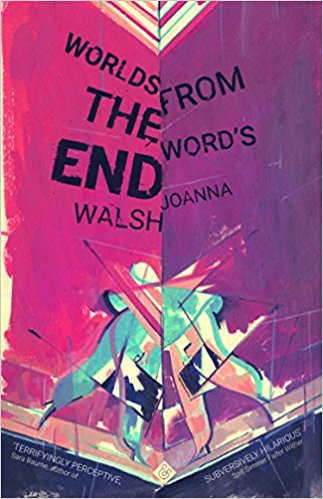
Her new collection, Worlds From the Word’s End, shows a very different side of her work. Here, she explores numerous permutations of language: the title story is set in a near future in which the way humanity uses words is in flux, while “Exes” takes the concept of homonyms and suffuses it with a sense of intimacy and regret. We spoke about the new collection, its connection to her earlier work, and its incorporation of various unlikely pieces of literary history.
Tobias Carroll: There are a number of recurring themes and motifs in Worlds From the Word’s End, including spaces for transit and decidedly literary dilemmas. Did you have any overarching themes in mind as you began to put this book together?
Joanna Walsh: The stories were written independently of each other over a number of years. When I sent Danielle Dutton at Dorothy all my stories a few years ago, she chose the stories with a hyperreal focus, that dealt with the fine detail of the operations of women’s lives within families, for Vertigo. The remaining stories seemed to have something in common too: something to do with how words adhere to things, and the points at which language touches, and takes off from, reality.
TC: The title story of Worlds From the Word’s End deals with questions of language and communication, and involves a paradoxical narrative, with sentences like, “I’m writing to you so you’ll understand why I can’t write to you any more.” What are some of the challenges of writing in a metanarrative way like this?
JW: I find it natural. I’m a writer because I know that language is a borrowed or stolen, imperfect and communal attempt to create meaning. It’s best not to take it too seriously, but it’s also good to take that unseriousness as seriously as possible.
TC: How did this particular story come to be the collection’s title story?
JW: I went through lots of titles with the publisher of And Other Stories, Stefan Tobler. He was concerned that people would muddle the ‘Worlds’ with ‘Word’s,’ but nothing else seemed to fit, and then I realized I liked the idea that the title might be confusing or difficult to say, because it hints at some of the things I’m trying to do with words in the book. I like language that doesn’t only represent something for the reader, but that asks them to engage in some kind of surprising way. Most of my previous books have had one-word titles, so I was excited to have a whole phrase.
I’m a writer because I know that language is a borrowed or stolen, imperfect and communal attempt to create meaning.
TC: The story “The Story of Our Nation” was first published in 2015. Since then, questions of national stories have become even more paramount in nations around the world. Did you find any unexpected resonances as you revisited it for this book?
JW: “The Story of Our Nation” is a satire on, amongst other things, the kind of voluntary self-data collection we’re asked to do online: there’s also a bit of gaming language, so there’s the notion of the amount of control we have over creating an environment that might be entirely artificial (and how, in such an environment, do we deal with nature, which is beyond our control?) and, perhaps oddly, a kind of awareness of shows like “The Great British Bake Off” — you have that in the U.S. now I think — which attempts to construct a kind of idea of Britishness. Since I wrote the story, patriotism has taken a very sinister turn. Yuri Herrera called Worlds From the Word’s End dystopia as a room in your own house, and, yes, my dystopias are domestic. I was interested, and continue to be interested, in collusion: how people act in everyday life according to ideas that limit or harm themselves and other people.
TC: Several of the moments of connection make for interesting juxtapositions, like how the kidnapping narrative of “Enzo Ponza” segues into the portability of the title character of “The Suitcase Dog.” What was the process like of ordering these stories?
JW: I’d really never thought of that! I wrote “The Suitcase Dog” with Kafka’s Investigations of a Dog, and Stein’s Identity in mind: what can a dog know, and what can a person know of themselves via a dog, how can I use language to describe a dog’s experience. I’ve read that an Oulipian writer (I think) wrote a series of poems using the only human language pets know: “sit” and “treats” etc. I’ve never been able to track these down. Perhaps they don’t exist.
Author Joanna Walsh
TC: “Like A Fish Needs A …” opens with an epigraph from Flann O’Brien. Do you see these stories as working in a similar vein to his, balancing metafiction and the absurd?
JW: I love everything about O’Brien apart from his deep strain of misogyny. I was partly responding to this: trying on the absurd tradition, which has also often had difficulty dealing with women, via a woman’s body. It felt both affectionate and rebellious.
TC: The conclusion of “Bookselves” has a wry humor and candor that struck deeply at the heart of this reader. Did you have an archetypal bibliomaniac in mind as you wrote that, or someone more specific?
JW: This was another story that reacts to a story: in this case Georges Perec’s Winter Journey (Un Voyage D’Hiver), and the alternative title of Bookselves is Un Voyage Vers (A Journey Toward), in the tradition of the Oulipo’s series of stories written after Perec’s work, which describes a man who discovers a book that appears to quote many famous sentences from French Literature, before he discovers that the book was published before any of these works. He loses the book, and is unable to find it again. Lots of the stories in Worlds are, in part, reactions to other works. I guess they are, as you say, metafictional. All my work processes the influence of other writers, but this is often only a minor part of what I’m trying to do; in Worlds it’s upfront. I did think of particular details I’ve noticed from mine and other people’s book habits, but no specific person or collection in mind.
TC: You’ve written a book called Hotel, and several of the stories here deal with hotel life. Do you see this collection as being a continuation of (or variation on) themes you’ve addressed in previous books?
JW: I continue with themes, though I always hope to vary them. I like writing about domestic spaces, and I like writing about the spaces we create for ourselves when we want to be rid of them. I’m sure I’ll continue to do this…
Language might be a tricky and treacherous tool with which to intend anything, but, as well as a fault, that might be its saving grace.
TC: The narrator of “Two Secretaries” makes it clear that, unlike her coworker, she is a clerical assistant. What first drew you to questions of titles and how people’s descriptions of themselves affect how they’re perceived?
JW: I spend a fair amount of my time out of the U.K. and whenever I come back I’m horrified by the false consciousness that seems still to exist around class: the British royal family seem so much in the media, so central to people’s lives; fictional TV programs are often about aristocrats, and are aspirational. I’m sure this contributes to preventing people from seeing their own circumstances accurately, and being able to act. My “clerical assistant” would rather live a circumscribed life, identifying with her workplace superiors, than see her existence more, as Perec wrote, “flatly.”
TC: Has the process of revisiting these stories, where reality can make language malleable, had any effect on the way that you’ve used language in the time since then?
JW: In Worlds From the Word’s End I was thinking more of the ways language makes reality malleable, or some kind of interchange between the two. I like the word malleable, which means “something that can be hammered.” It makes me think of the Russian writer and theorist Viktor Shklovsky who, in an essay in 1964, wrote that is as difficult to use writing in propaganda, as it is to use a samovar to hammer in nails. It’s not absolutely impossible, but that’s not what a samovar was designed for. Language might be a tricky and treacherous tool with which to intend anything, but, as well as a fault, that might be its saving grace.
Double Take is a literary criticism series in which two readers tackle a highly-anticipated book’s innermost themes, successes, failures, trappings, and surprises. In this edition, Liz von Klemperer and T.A. Stanley discuss Jennifer Egan’s National Book Award–longlisted historical novel Manhattan Beach.
The characters in Pulitzer Prize winner Jennifer Egan’s latest novel range from sailors to gangsters, bankers, and union workers. At the center of its orbit is one Anna Kerrigan, haunted by the mystery of her father’s disappearance. True to the novel’s noir-inflected atmosphere, Anna investigates her father’s life, looking for answers to the questions that have dogged her. Of course, the investigation is merely the tipping point from which conflict proliferates and allows the vast narrative to breathe. With Manhattan Beach, Egan once again demonstrates her mastery of the sweeping, multi-character narrative.
Liz von Klemperer: I was drawn to the theme of using conventional femininity as a survival tool. Anna’s coworker Nell, for example, is hyper femme, and uses traditional markings of femininity to gain advantage in the male dominated society of ’50s New York City. Upon first meeting Anna, Nell advises her to wear lipstick to work so her boss will be more lenient and let her leave the office for lunch. By the end of the book, Anna dons another disguise when she buys a wedding ring at a pawn shop to hide the fact that she is pregnant and unmarried. When she is on a train while visibly pregnant, she notices how people are only friendly and offer aid after they’ve seen her wedding ring. She reflects that there is “so much power in that slim band.” Egan has presented a world in which women’s independence is gained by their attachment or implied attachments with men, and visible markings of conventional womanhood are crucial to achieving this power.
Anna’s aunt Brianne’s femme presentation, on the other hand, is presented as comical. For example, Brianne tells Anna she has to use “all my wiles” to acquire two tourist sleeper tickets from Chicago to San Francisco. She douses herself in perfume and begins to flirt with the man behind the ticketing booth at Grand Central Station. Anna finds Brianne’s leveraging of femininity for social and monetary benefits as “stale,” a tool that does not work anymore because she is not in her sexual prime. Throughout the book, Brianne tells Anna about how she lives off suitors and trysts with successful men, but at the end of the book we find out she is self-sufficient and working at a bar and living alone. I’m still pondering this twist.
T.A. Stanley: For some reason, I wasn’t all that intrigued by a lot of the aspects of gender politics that Egan presents in her new book. I feel like I’ve read a lot about this time period and social anxieties regarding women in the workplace and women living alone. I mean, I did watch Mad Men, after all. But in all seriousness, I felt unsurprised by most of the reactions from the characters throughout the novel, save for a few exceptions which I’ll get to.
I feel like I’ve read a lot about this time period and social anxieties regarding women in the workplace and women living alone. I did watch Mad Men, after all.
Nell was mostly the typical archetype of a “kept woman.” It’s certainly an interesting trope to dive into, as well as a reality for many women throughout history — resorting to their femininity as a means to a living — and it creates many interesting questions (i.e. what’s the difference between what Nell does and prostitution? What’s the difference between both and the idea of “marrying for money?” How do we, as a society, treat these various survival tactics employed by women throughout history?), but I don’t think Egan spends enough time with Nell for much of that to be addressed or considered with adequate depth. She doesn’t seem too concerned by this.
Like you said, women’s independence is only gained through implied attachments to men, but it feels like less about independence and more a careful navigation to avoid being ostracized by society. There is no freedom, obviously, just a rigid code for the “correct” type of femininity. Of course, this correct femininity is completely confounding, as we know. Anna appears pure, but isn’t, and she uses her perceived innocence to break through gender barriers at her job. Nell uses her femininity in a “dangerous” way to extort men. Both are using what they know and what they are comfortable with to get by in this world. There is certainly something interesting about that, and in many ways these archetypes still exist today, although in different forms.
Brianne was a character that I really wish we had seen more of. I think her illusion functions similarly to Anna’s wearing a wedding ring at the end of the book — a tactic to avoid a questioning of her lifestyle. It seems like a simple survival tactic, yet hits on a theme you mentioned with Anna: the double life and the reinvention of one’s identity. The main characters have one or more identities they inhabit. Anna’s dad, Eddie, leads a double life working for the mob and lying to his family and eventually fakes his death to start a new life as a third mate on a merchant ship. Dexter Styles changes his name to erase his Italian background and maintains various lives as a gangster and family man, even giving one of his lives a name — The Shadow World.
Of course, Anna goes through so many lies and double lives, to the point where at the end of the novel she is maintaining several different timelines and lives to hide the paternity of her unborn child (one life with her mom, one with the Navy Yard, one with family who was hosting her, one with the passengers on the train to California). Besides Brianne’s revealed double identity, the other secondary character whose possible second life I was most intrigued by was Mr. Voss, who may or may not be a gay man.
LVK: I thought it was a stretch that Anna would understand the nuances of racial inequality in America at the time. I also read her recognition as a reflection of her own self-interest. She wants to integrate into the white, male dominated diving program, and her awareness of her black coworker Marle does not exist outside of this context. Both intuit that they must fly under the radar to be accepted, or rather tolerated, in the program.
It’s worth noting that Anna and Marle eventually work together outside of their diving cohort when they go to find Anna’s father’s remains. Bascombe, who was barred from the navy because of his poor eyesight, also joins the mission. It’s poignant note: These three misfits band together to complete a task despite their environment’s tacit discouragement. I found it powerful that they acquired skills from white patriarchal structures and then illegally used them for their own benefit. Despite this, Anna and Marle’s fear that white men will be threatened by their partnership is ultimately realized during their mission when Dexter enters the story. While watching the three work on the ship —
His idleness made everything around him register on a scale from irksome to intolerable: Anna’s cohorts holding her ankles to guide her feet into the massive diving shoes; the Negro’s hand under her chin while they attached the harness, or whatever the hell it was. Their insularity made him envious — not just of the men but of all three of them. They were working together, two men and a girl, with evident ease. Even after the diving suit was on and she no longer looked like a girl, he was resentful of their shared knowledge, their nomenclature and expertise.
He is so threatened by watching this exchange that he demands to go dive down to search the ocean floor with Anna! This scene shows the extent to which the novel’s white male characters feel the need to maintain dominance by subordinating others. As you pointed out, Dexter approves of women who don’t act like “most girls,” but he is deeply uncomfortable with women and minorities demonstrating expertise he is not privy to.
Eddie’s relationship with race is perhaps more informed than Anna’s, as he has a realization about systematic racial oppression that goes beyond his own self-interest. When his ship docks in South Africa, for example, Eddie wonders why the bosun does not get of the ship despite being at sea for months. Once on land, Eddie quickly realizes that the blatant racism on land is a threat to the bosun, forcing him to stay sequestered on the boat. He is confronted with his privilege in a way that Anna is not, and his future decisions are informed by this knowledge. On that note, what do you think about Eddie’s relationship with the bosun? They have a tumultuous relationship rooted in race and class that I’m still teasing out.
TAS: The dynamic between Eddie and the bosun is certainly very interesting. A lot of their distaste for each other stems from a mutual misunderstanding of who the other person is, and a mischaracterization not only based on race but also on class. Some of the politics of the ship’s chain of command were interesting, although I’m not sure I completely followed it. Eddie is a third mate, who “commanded no one,” whereas the bosun “commanded a deck crew of some thirteen sailors.” So while the third mate is technically a higher ranking officer, the bosun commands a certain amount of respect and clout due to his direct command over crew members. To be honest, I get very lost in this stuff, but that’s what I gathered. They seemed to be on equal footing since Eddie acknowledges that the bosun doesn’t have to call him “sir.” Some of the politics at play here come from Eddie’s shock in encountering more-or-less egalitarianism on the ship and the bosun’s resentment of Eddie who, despite being uneducated, can climb ranks rather quickly:
He thought of himself as being kind to Negroes, but he was accustomed to Negroes who had less than he. The jumbling of races on merchant ships had been a shock at first: it was common for white men to work under Negroes, South Americans, even Chinamen. But this bosun wasn’t just better spoken and — it was obvious — better educated than Eddie. He’d had a contemptuous way of looking at Eddie that brought to mind the phrase “dumb mick.”
There are many layers at play here. The bosun’s disdain from Eddie is not wholly devoid of stereotypical assumptions of Irishmen as dumb and uneducated, but most likely also comes from a place of resentment for Eddie’s ability to climb ranks as a white man. While the bosun claims that he has no desire to climb the ranks (if he did he would be “master of [his] own bucket years ago”), Eddie sees this as posturing since he “had never encountered a Negro captain on any American merchant ship.” I wouldn’t doubt that the bosun also enjoys pointing out their educational differences to dissuade those who would try to stereotype him as incapable because of his race. Eddie certainly has his eyes opened to some of the more structural ways in which racism affects the bosun and those like him, as you point out. His naive understanding of his benevolence to other races is turned on its head and he is forced to deal with how he benefits from his race, as you point out. This perhaps brings about a deeper understanding of the bosun’s plight and from this and their shared near-death experience they can bond in a deep way.
LVK: I also want to talk about the theme of disability throughout the book. Eddie, for example, has a total shift in his perspective towards disabled characters. At first, he is so ashamed by Lydia that he attempts, as a toddler, to suffocate her with a pillow while she is falling asleep. Although he eventually stops and is appalled by his violence, it still shows a deep-rooted fear of disabled people and their needs. On the boat, however, he meets Sparks, whom he sees in a humanizing light —
Eddie was stricken with sympathy for him. To be a deviant and a cripple, without good looks or fortune or physical strength — how had Sparks managed to endure such a life? Yet he’d more than endured; he was ever cheerful.
Eddie risks his own life to save Sparks when the boat begins to sink and gets him to safety. He notes that, once on the lifeboat, Sparks has a valuable skill to offer, as he is able to operate the radio. Perhaps this is Eddie’s attempt to make up for the wrongdoings of his past. An optimistic reading of this scene, he finally sees both the humanity and societal merit of people with physical disabilities. These scenes are important because they show Eddie’s propensity for change, and transform him into a less pathetic, more likable character. I find this shift surprising and effective, as Egan initially sets Eddie up to be absent father archetype and then proves our assumptions wrong.
Lydia is, of course, the main disabled character. Her illness is both repulsive to Eddie and Dexter but also appealing, as she is described as soft, unspoiled, angelic, clean, and fragrant. Anna and her mother love Lydia unconditionally. What do you think about the theme of disability, and the able-bodied characters’ acceptance, fascination, and aversion to it? How is this informed by the voices of the disabled characters, specifically Lydia’s stream of consciousness speech?
TAS: To be honest, I’m still trying to work out Lydia’s presence in the novel and how her disability and her voice work in connection to the other characters. On some level, she is what binds all three of the characters together. Dexter would never have formed the bond with Anna if she hadn’t asked him to help her take Lydia to the beach, and Eddie is deeply connected to Lydia as well. We are not made to sympathize with Eddie’s inability to fully acknowledge or love his disabled daughter; instead we hope that he works through his fears, as he does when he is near death at sea. Anna and her mother, conversely, never waver in their devotion, care, and love for her. It might be a quick way to show where our moral center is and who still has a lot of growing and changing to do to find their way back to this morality.
We are not made to sympathize with Eddie’s inability to fully acknowledge or love his disabled daughter; instead we hope that he works through his fears.
Lydia’s stream-of-consciousness voice is obviously very connected to the sea. Her words are described as coming in “waves” when Eddie is near death and seeing her laughing and talking. The text mimics this rhythm and cadence of the waves and the ocean. The ocean has a way of cleansing Lydia and bringing her joy and peace before her death, so perhaps Lydia and her words cleanse these other characters of their wrong thinking and various sins and misdemeanors? I believe that after his time with Lydia on the beach is when Dexter makes steps to leave the “shadow world” of the mob and enter a more acceptable career. Lydia and the sea perhaps work in tandem as a powerful force to show people a path towards redemption.
LVK: Lydia really does act as figure of redemption. Because she is immobile and for the most part non-verbal, she becomes a figure who is responded to, as opposed to a character that acts autonomously. This was somewhat disappointing to me because I’m always hoping to read disabled characters whose disability is not their main characteristic, and where they are not the target of pity.
I’m also interested in how Lydia plays into recurring notions of idealized female purity imposed by Dexter, Eddie, and society at large. Dexter and Eddie express the desire to preserve their daughter’s sexual “purity,” and become viscerally distressed when confronted with the idea that their daughters could express their sexuality. Both Eddie and Dexter are simultaneously disturbed and intrigued by Lydia and her disabled body. When Dexter comes to take Lydia and Anna to the beach, for example, he resents “the project of providing this accursed creature an experience of the sea.” However, he notices that she “smelled fresh, wonderful, even, like the version of flowers that inheres in feminine creams and shampoos.” He likens her eyes to his daughter Tabby’s doll’s eyes, as they are “luminous blue and unblinking.” Lydia is constantly infantilized and described as pristine.
Male characters also infantilize able-bodied women. While at a dinner, for example, Dexter hears a “dyspeptic-looking man” say, “We treat our girls too gently, that’s a fact… in the Red Army, girls work as medics — they carry the wounded off the battlefields on their backs.” Moments later, he justifies the fact that, “in the trades the girls are what we call ‘helpers’ — they assist a man senior to them. And we keep them off the ships.” Women are simultaneously viewed as coddled and ill equipped to handle tasks designated for men. This, to me, is an interesting symptom of how gender codes had to be deconstructed during WWII. It was in the interest of the state for women to work, but at the same time men in power were motivated to uphold negative gender stereotypes in order to maintain their own elevated social power. In other words, these men considered women useful workers, but not too useful, otherwise they threaten patriarchal structures that benefit men. Lydia is an amplified manifestation of Dexter’s cohort’s perception of women as fragile and doll-like. When Dexter meets Lydia, he is forced to confront what an actual disabled woman looks like.
TAS: I have read A Visit from the Goon Squad and remember really loving it. In comparison, Manhattan Beach disappointed me. While there were times where the narrative compelled me enough to move me forward — and Egan’s writing is still engaging, intricate, and solid — I didn’t end up feeling a connection to the characters or themes. While the characters were well defined and felt alive, I didn’t really get a sense that they had a story I’ve never heard before. I remember not being able to put Goon Squad down, while Manhattan Beach dragged quite a bit for me. There is definitely a part of me that feels saturated by WWII narratives, so this may be part of my reaction as well. I am a fan and will continue to read more of her work (and hopefully re-read Goon Squad). Maybe this book just wasn’t for me.
LVK: The narrative in which a girl/woman has to “play the game” in order to overcome obstacles presented by the patriarchy doesn’t especially float my boat. I found myself cheering Anna on when she was first getting in the scuba suit or “dress” as it’s called in the book. She reels at the weight, but persists despite her male peers jeering at her. To her boss’s dismay, she ends up being one of the few people who can complete underwater tasks. On the surface this seems like a victory but is ultimately kind of depressing. In this way, Egan’s narrative presents Anna’s strength in relation to men and the systems they’ve devised. You mentioned this earlier when you said Lieutenant Axel “pretty much only praises Anna at the expense of other women,” and I wish Egan explored more of the repression inherent in Anna’s “victories.” This is not to say Egan’s characters should act in accordance with feminist principles or be critical and aware to the degree we want them to be. I just wish there was less reveling in female success as relative to male dominance and more attention paid to the often clichéd ways this kind of narrative typically unfolds.
The narrative in which a girl/woman has to “play the game” in order to overcome obstacles presented by the patriarchy doesn’t especially float my boat.
TAS: I think I’m a bit tired of the “exceptionalism” narrative. The “look at this woman prove everyone wrong!” angle is fun and can feel empowering, but we know that it didn’t really make anyone more open to more women in the field. They quite literally see Anna as an anomaly, an exception to the rule. Egan addresses this, but rather subtly, in my opinion, and it makes the narrative a bit trite.
I also didn’t take to the love/lust story between Anna and Dexter. It felt forced and creepy. There are plenty of uncomfortable sex scenes in literature, but I just didn’t like that theirs seemed to happen only as a plot device to get Anna pregnant in such a way where her only solution is the convoluted lie and move from New York. I’m also never a fan of the “fake-out abortion” plot angle wherein a character is set to have an abortion and changes her mind last minute because she can’t imagine not having the child. To me, these storylines seem to only serve to make our heroine seem more “virtuous” and “pure,” especially when Anna is compared to Nell who we know has had at least a couple abortions and is a morally ambiguous character. Nell’s a kept woman who cheats on the man who she is threatening to expose to his wife if he doesn’t pay for her livelihood. She’s had abortions, so what better way to make our character seem wholly different and more morally acceptable even though she also has had an affair with a married man? Well, she’ll decide to suddenly keep the baby, of course!
I’ve seen this move done on several TV shows and movies, and I’m sure it happens in other books, and I never like it. There’s still this huge stigma against showing a character you are setting up as a moral center and “good person” as being capable of actually having an abortion. She can think about it, even set an appointment, but she always changes her mind last minute. It’s a dramatic beat that’s completely uninteresting and off-putting to me. But that could be simply a personal gripe as someone who has had an abortion. It’s something that always stings and feels stigmatizing to those of us who have made and followed through on that decision.
LVK: I want to feel surprised by the twists and turns of a story, but not feel guided through the plot of the book by the author. Manhattan Beach felt too neat at times. I’m drawn to stories that leave room for ambiguity, that leave me wondering at the end.
DON’T MISS OUT
Sign up for our newsletter to get submission announcements and stay on top of our best work.
YOUR INBOX IS LIT
Enjoy strange, diverting work from The Commuter on Mondays, absorbing fiction from Recommended Reading on Wednesdays, and a roundup of our best work of the week on Fridays. Personalize your subscription preferences here.