How the Entertainment Industry’s Selective Use of Black Culture Hurts Us All

This spring, Steve Bannon’s script for a hip-hop reimagining of Shakespeare’s Coriolanus leaked. Titled The Thing I Am, Bannon’s version sees Bloods and Crips battling it out in South Central Los Angeles in the aftermath of the 1992 Rodney King verdict. The play features characters by the names of “Gangsta Voice” and “Mack Daddy,” and the exact dialogue one would expect from someone who seeks to re-enact The Birth of a Nation by masking it as Boyz n the Hood. As Rob Corddry, an actor and comedian who participated in a reading of the play, remarked to The Washington Post, “it seemed like, to me, if anything, a white guy, with a chip on his shoulder, saying, ‘I can talk about this, I can say these things this way, because why not? Who are you to say I can’t?’ It almost seemed a way to indulge himself in being racist.”

Narration is key here. By narrating the experience in what Corddry described as a “black urban vernacular,” the play believes that sounding black — and in this case, a particularly stereotypical attempt at it — is the same as engaging with blackness.

The play believes that sounding black — and in this case, a particularly stereotypical attempt at it — is the same as engaging with blackness.

Bannon’s is a spectacular example of a long tradition that has sought to commodify black lived experience and turn it into a marketable product, without doing anything to challenge the continued inequalities — cultural, social, economic, political, etc. — and governmental violence that shape it. In Bannon’s case, of course, the picture is especially dark. He has actively worked to further shore up white supremacy, making his voyeuristic cultural voyage into blackness all the more remarkable. Why hip-hop? His desire for black visuals and sound through a white voice cannot be seen separately from the cultural capital, the alleged innovativeness that is automatically assigned to productions that tackle otherwise cookie cutter narratives, emblems of the status quo, through unusual forms. A production of Coriolanus is perfectly respectable, but add hip-hop to the mix and you have the hot ticket in town for, as Larry David said after he saw Hamilton, “white people looking to solidify their liberal bona fides.” Of course the two cannot be compared: Hamilton is a brilliant, truly inclusive and diverse hip-hop musical that, unlike Bannon’s, uses the genre to masterfully rewrite white-centric notions of belonging and Americanness. It was also written, produced, and staged by artists of color.

An excerpt from “The Thing I Am”

But David’s observation — even if somewhat tone-deaf given his own track record of overwhelmingly white productions — is on to something: the way in which the lived experience of people of color and the attendant culture is divested of all the physical and psychological violence that comes with it, and propped up as a cultural marker of sophistication. It’s nothing new. As Norman Mailer observed in his 1957 essay on the rise of the hipster—or “The White Negro” as he called this new class of disaffected young people—it was the “cultural dowry” of blackness, and in particular jazz, that came to define what it meant to be cool or hip. Mailer was himself problematically invested in hypermasculinity and its racial connotations, but his remarks record a significant shift. The essay chronicles the transformation of sonic blackness from something to be erased to something that should be included to attract white audiences — still a defining goal for many productions.

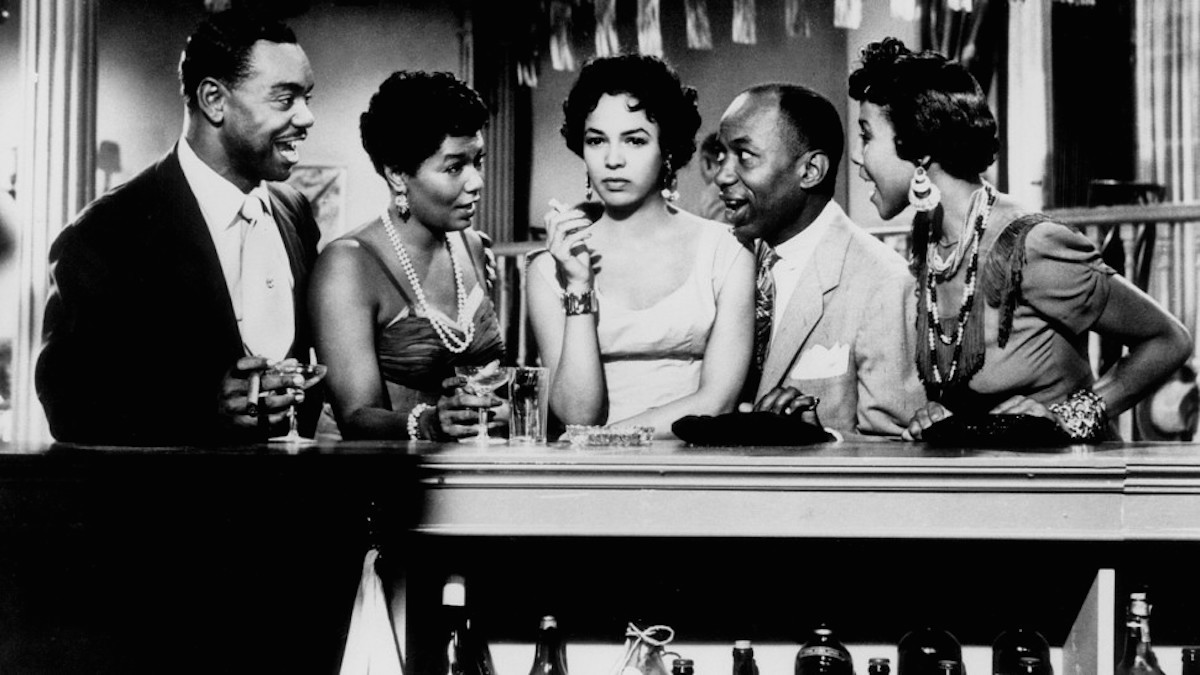
The tensions between erasure and inclusion, the visual and the sonic, are visible everywhere. On the soundtrack of 1954's Carmen Jones, an all-black adaptation of Bizet’s Carmen, stars Dorothy Dandridge and Harry Belafonte are overwritten by white voices, even though they were both accomplished singers. Dandridge and Belafonte lip-synched to music recorded by opera singers—in Dandridge’s case a white woman—in keeping with the idea that opera was a genre of whiteness. The result is a disorienting and confounding disconnect between visual and sound. In this year’s HBO hit Big Little Lies, a series that I loved, the opposite is true. There is a near-total absence of actors of color, but black musical performers play a central role in setting the mood.

While Carmen Jones and Big Little Lies present inverse sonic scenarios, they both share one thing; whiteness prevails and determines — literally — what can be heard.

The arc between the two may seem like a leap, but let’s consider some of the cultural coordinates that lie in between: the whitewashing of jazz in La La Land; white writers and voice actors developing and recording Amos ‘n Andy for the radio before it became televised; white voice actors speaking in black vernacular on The Cleveland Show and other cartoons; the general glee over Natalie Portman and Anne Hathaway rapping with exaggerated gesturing; characters like Michael Connelly’s Harry Bosch (also in the TV show Bosch) whose eclectic and rich jazz collection is used to somehow mark him as not just any detective; rapper Iggy Azalea’s quick ascent to popularity through use of black southern vernacular; the many instances of hip-hop music accompanying scenes that are intended to show white women devolving (like in this spring’s Rough Night, where Scarlett Johansson and co work themselves into all sorts of trouble while Khia’s “My Neck My Back” and J-Kwon’s “Tipsy” play). I could go on. What all these instances share is that black sound is invoked and appropriated to signify something about whiteness, thereby ignoring the very context and lived realities that produced it. As one of the high school students in my summer class wrote poignantly in a personal reflection, “ultimately, white people are far more appreciative of black culture than they are of black people.”

In Carmen Jones, whiteness exerts its omnipresence by aurally taking center stage in an all-black production. Directed by Otto Preminger, the all-black adaptation of the eponymous Broadway show by Oscar Hammerstein, set to music from Georges Bizet’s opera Carmen, follows Carmen (Dorothy Dandridge), a spitfire worker in a parachute factory who seduces a newly-engaged soldier (Harry Belafonte) tasked with transporting her to jail. His infatuation drives him into ruin and eventually into fury, as he strangles Carmen for leaving him. As with Bannon’s musical, the “Negro dialect” was authored by a white man, musical mogul Hammerstein. As James Baldwin wrote in his scathing and brilliant review of the film, “the result is not that the characters sound like everybody else, which would be bad enough; the result is they sound ludicrously false and affected, like ante-bellum Negroes imitating their masters.”

But there was an added level of intrigue that ultimately reifies whiteness as the aspirational standard of worthy cultural production: the songs, though lyrically similar to the rest of the film’s dialogue, were dubbed by opera singers. In stubbornly tethering the mode of delivery to its source text (opera) while radically redrafting the narrative to reflect a new demographic (black and working class vernacular), the film set itself up for tension. As Jeff Smith observes, “the frequent reference to operatic voices served to reassure audiences that Carmen Jones remained closely tied to the Bizet opera,” a move that generated a double standard surrounding white participation in black cultural production.

Besides its two stars, the cast also included well-known actresses Pearl Bailey, Diahann Carroll, and Olga James. However, despite this all-star and all-black cast, Carmen Jones erased the voices of its black performers in order to preserve its operatic qualities — a genre synonymous with respectability, high culture, and whiteness. Even though Dandridge had been a successful singer for twenty years by the time Carmen came along, and Belafonte had a record deal with RCA Victor for his forays into folk and calypso, they were not allowed to sing their own parts. Preminger and the studio maintained in the film’s pressbook that while the production would be executed in “Negro dialect,” the film required “young romantic leads with operatic voices. The two don’t often go hand in hand.”

Dandridge was a well-known singer when Carmen came out

The result was predictable. As Marilyn Horne, the white opera singer who dubbed Dandridge’s songs, remarked in her autobiography, when Fox put out the call for singers “there was no color barrier either — whites could apply.” One does not need a lot of imagination to conclude that the opposite—a black singer applying to be the voice of a white actress—would never fly at a time when Jim Crow laws continued to segregate most public services. Horne’s excitement at the opportunity to audition shows that she was far removed from both the realities that curtailed opportunities for actresses of color like Dandridge and from the subject material — domestic violence, urban black culture, poverty, and wartime segregation—that Carmen asked her to vocally embody. As Horne recalled, she worked closely with Dandridge, listening to her speaking and singing voice to match the “timbre and accent” so that “when I sang I had a little bit of Dandridge in my throat.” This included the lyrics in “Negro vernacular,” with songs like “Dat’s Love,” “Dat Ol’Boy,” and “Dere’s a Cafe on De Corner.” Dandridge sang first, after which Horne mimicked her in the proper key. In an unprecedented move, the film therefore included Horne in the opening credits for voicing Dandridge’s songs, and LeVerne Hutcherson for Belafonte. Horne was white, Hutcherson black, but what the two shared is that they possessed the required operatic register, measured by white-centric standards.
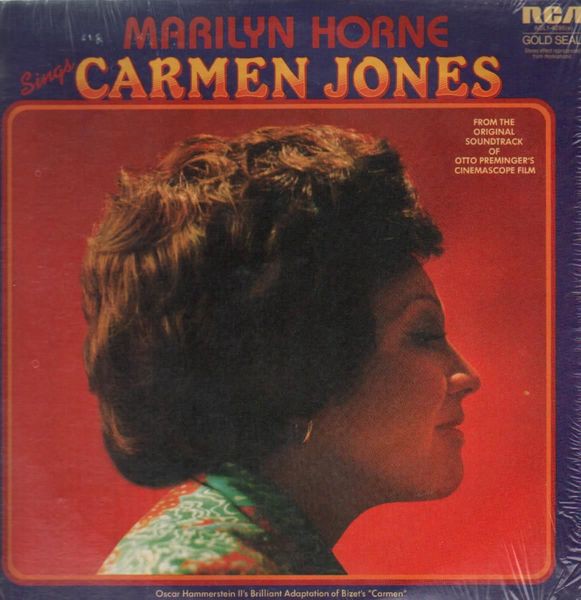
The LP cover for Marilyn Horne’s recording of “Carmen Jones”

While the production company maintained that the arrangement “worked beautifully,” in no small part due to Belafonte and Dandridge’s facility in lipsyncing, the result is disconcerting to say the least. This is outside of its actors’ fault. As Baldwin wrote, “I am not trying judge [the cast’s] professional competence, which, on the basis of this movie — they do not even sing in their own voices — would be quite unfair to do.” In erasing Dandridge’s voice, the producers applied one further white filter on content that was already marked by its unnatural dialogue and its opera origins. Yet, besides Baldwin, there were few complaints; it was so rare to see blackness on screen, let alone a film with an all-black cast and a high production value, that no one questioned the implicit racialized value system underlying producers’ insistence on narrating the adaptation through an operatic structure over a “swing version,” a genre seen as inferior. Blackness was seen, not heard, but no one seemed to mind.

In contrast, in HBO’s Big Little Lies, a drama about a set of incredibly rich white women in Monterey, California, the music interrupts an otherwise overwhelmingly white visual. It is, admittedly, a gorgeous and seductive series, featuring an all-star cast with a sublime Nicole Kidman, Reese Witherspoon, Shailene Woodley, and with Laura Dern and Zoe Kravitz in supporting roles. It also offers a very real look at abusive and tangled dynamics that lead to domestic violence, bypassing cliched narratives that associate violence against women with working class or alcoholism. Perry (Alexander Skarsgard) is an all-too real monster, a man impossibly charming to the outside world — and often also to his wife, until he isn’t.

Nicole Kidman, Shailene Woodley, and Reese Witherspoon in Big Little Lies (HBO)

Based on Liane Moriarty’s book about a similarly privileged set in Australia, and adapted for the screen by David E. Kelley and director Jean-Marc Vallee, Big Little Lies uses recurring panning shots of a volatile ocean to suggest to the viewer some truths about human nature. It explores this nature through a mostly white cast; Zoe Kravitz is the only performer of color with significant screentime and dialogue.

Music takes on a life of its own — what the ocean does visually, its soundtrack does sonically, by using carefully selected songs to build characters and fashion tone. Fans have embraced the soundtrack, leading to the release of an official CD, and music supervisor Susan Jacobs received an Emmy for her work on the show’s final episode. Director Vallee and Jacobs mostly incorporate music diegetically; the characters play music for their spouses, their parents, their friends. Madeline’s daughter Chloe, for example, has an iPod that brings on much of the musical action.

But where the show opts for racial homogeneity on-screen, it elects to flesh out its characters by employing a much more diverse palate of cultural markers, communicating heartbreak and pain via historically (and distinctly) black genres.

But where the show opts for racial homogeneity on-screen, it elects to flesh out its characters by employing a much more diverse palate of cultural markers, communicating heartbreak and pain via historically (and distinctly) black genres. We get Irma Thomas, Charles Bradley, The Temptations, and Leon Bridges foreshadowing some of the most pivotal developments.

Celeste deeply feels the heartbreak of Thomas’ “Straight from the Heart” and the loneliness of being unable to leave of “Anyone Who Knows What Love Is,” both melancholic soul songs from the 1960s, the start of Thomas’, known as the “Soul Queen of New Orleans,” career. Jane’s son grows obsessed with The Temptations’ “Pappa Was A Rolling Stone” in his own quest to find his father, whereas Madeline’s daughter plays Charles Bradley’s “Victim of Love” and “Changes,” both vintage soul offerings, at various points in the series. We also get Otis Redding, Naomi and the Gospel Queens, and contemporary soul singer Leon Bridges. The latter’s song “River,” seen by full title on the car radio display and later on an iPod, receives special acknowledgment when Reese Witherspoon’s character says “this is such a beautiful song.” The lack of on-screen diversity makes the musical score, rich and eclectic, even more noticeable.

“River” by Leon Bridges plays in Madeline’s car (screenshot)

Support Electric Lit: Become a Member!

It’s an undeniably great soundtrack, but the terms of its inclusion raise some questions. In an interview with Vulture, Jacobs remarked of the music that “we have these new soul singers that have incredibly beautiful voices, and they offer diversity. There are songs here that no one had ever heard of before, and then mixed together with Neil Young. You can’t beat it.” It is a point well-taken in terms of the wide array of songs included in the show. But the observation that the soul songs “offer diversity” is a little more troubling — at which point does the sonic diversity become a stand-in for real, on-screen diversity, a way of performing the air of inclusivity without actually being committed to it? Big Little Lies contains several moments that suggests that the pendulum has swung firmly in this latter direction, as the characters’ musical tastes are celebrated as a mark of culture or sophistication, or of an existentialism divorced from its musical roots in black genres. It is ironic that the theme for the culminating party is “Elvis [Presley] and Audrey [Hepburn],” as Presley was among the first to stoke an appetite for “black” music and was one of the originators of a performance aesthetic that gave a white man’s vision on what black male sexuality was imagined to look like. As Eric Lott helps recall, Presley straddled the boundaries of fakery and racial theft, critiqued as “a performer who got more from black culture than he gave.” In the words of Flava Flav and Chuck D, of rap collective Public Enemy, in their song “Fight the Power:”

Elvis was a hero to most
But he never meant shit to me
Straight up racist that sucker was
Simple and plain
Motherfuck him and John Wayne

To see Adam Scott and James Tapper, Madeline’s husband and ex-husband respectively, fight to establish their masculinity by imitating Elvis’ performance style, gyrating on stage, in this context emerges as another moment at which Big Little Lies musical allegiances encounter unexpected racial and class scripts.
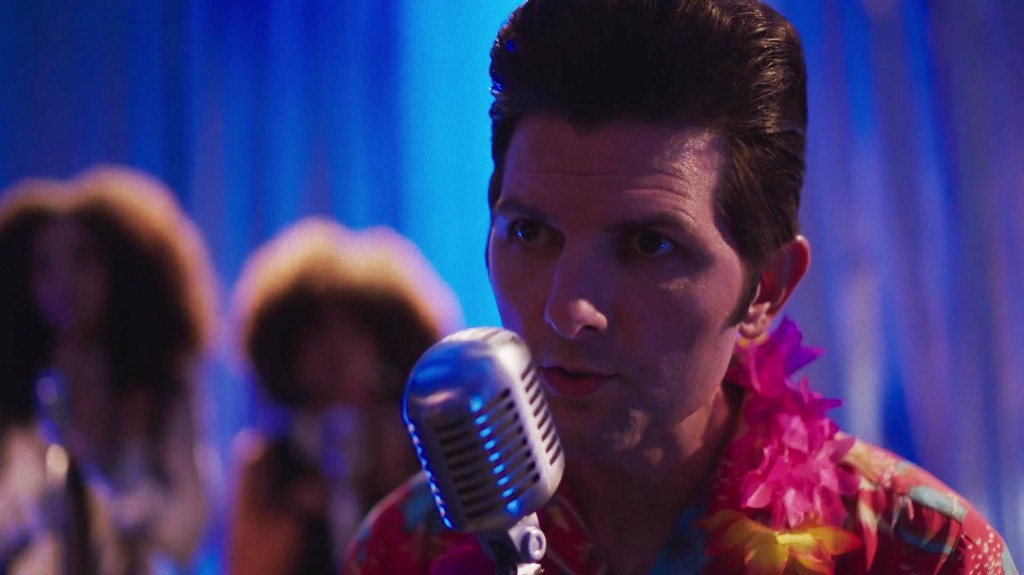
Adam Scott performs as Elvis (image credit HBO)

While the characters’ infatuation and identification with music most often remains unaddressed, the limits of this sonic inclusion of blackness are exposed at a dinner party. When Bonnie (Zoe Kravitz) puts on Sade’s “Cherish the Day,” Madeline is mesmerized. “I love this music, is this Adele?” she asks. “Uh, no, it’s Sade actually,” Bonnie replies. It’s a moment of honesty that dares narrativize some of the disconnect that exists between the series’ often diegetic soundtrack and the rich white women that inhabit its world. Of course Madeline would not know Sade. Her main reference point for the blend of smooth R&B, pop, and soul that she believes she is hearing is its most popular incarnation, Adele, the woman who through the sheer melancholy and longing in her voice managed to get away with bypassing soul’s time-honored techniques of improvisation, of swaying, of call-and response. That it is Adele, a white British superstar, who first comes to mind for Madeline is telling. It’s the whitest imaginable referent for music deeply rooted in the black experience.

That it is Adele, a white British superstar, who first comes to mind for Madeline is telling. It’s the whitest imaginable referent for music deeply rooted in the black experience.

The genre of soul itself, and the subgenre of quiet storm — another blend of jazz fusion, pop, and R&B that “Cherish the Day” is most often classified as — emerged as part of a larger movement in the 1950s through 1980s that sought to express pride in blackness. The song choice befits Bonnie — soul’s “aesthetic of upward mobility,” and quiet storm’s targeting of upscale black audiences, as Jason King explored, make Bonnie, a wealthy yoga instructor, the perfect embodiment of the polish and elegance associated with it. What matters here is why Big Little Lies has Madeline thinking it was Adele.

White performers of soul are nothing new. As with any musical style, a wide array of singers has been attracted to its sound. The 1960s saw the blue-eyed soul of Dusty Springfield; the 2000s inaugurated Adele’s reign. In a way, then, Madeline’s mistake is merely set up to mark her as ignorant. As Vulture wrote, “what better rich white mom joke is there than the fact that all white moms think everything is Adele?” However, seeing it as a mere joke — which is possibly how the producers intended it — ignores the larger issues with the series’ score. Adele’s popularity is both a function of her sheer brilliance and the palatability of white expressions of historically black genres, evidenced also in her much-discussed triumph over Beyoncé at the Grammys.

The inclusion of Madeline’s error in Big Little Lies is as close as the show comes to exposing the women’s penchant for black musical artists as merely another marker they use to solidify their class status, to read as sophisticated. It’s a brilliantly self-aware scene. Yet the moment is quickly undone when an undeterred Madeline pats her audiophile husband Ed (Adam Scott) on the arm to tell him “we should get this, honey,” and an annoyed (and embarrassed) Ed responds that they already do. If Madeline is not cool enough, Ed is. The fact that the pair think they can acquire an air of cool or navigate awkward social settings through their possessions is a theme carried throughout the scene; Madeline compliments Bonnie on her unusual place setting (“especially the tiny little forks. I just want to use all of them”) and on her Mexican clay wine glasses (“I really love these creative little cups”), continuously solidifying that while it is Bonnie who deviates from the norm, they are down with this otherness. Madeline even seeks to recoup some of the credentials she lost to her husband in music taste by remarking that “Ed prefers more traditional glass cups for wine, but these are [nod of approval].” The complex and muddled ways in which blackness, or foreignness, come to connote coolness persist throughout the show.

Art Must Engage With Black Vitality, Not Just Black Pain

The main non-diegetic song in the series, its opening theme, is also of note here. Michael Kiwanuka’s “Cold Little Heart,” a soul fusion song, is intercut with picturesque views of Monterey and the protagonists parading in Audrey Hepburn garments, and edited to emphasize the emotional hollowness of its characters (“I believe if I just try/ you’d believe in you and I”). Thematically it’s not a leap. However, the video that the Nigerian-British singer made could not be more different than the softly-filtered luxury of Monterey. Set in what Stereogum called a “bleary urban environment,” the video stars Keith Stanfield (Get Out, Straight Outta Compton, Atlanta) in a tale that director David Helman said depicts grief and “the loss of a father figure.” The video shows Stanfield in a variety of ordinary situations with a black teenager; teaching him how to drive, playing basketball, etc. The majority of the video, however, is devoted to the boy giving bodily expression to the raw pain of losing Stanfield through dance. We never see another soul; he is truly alone in the world.

A still from the video for Kiwanuka’s “Cold Little Heart”, starring actor Keith Stanfield

Kiwanuka’s first single of the CD that spawned “Cold Little Heart” further suggests that the deracinated, universalizing edit applied by Big Little Lies obscures how much the music was shaped by an experience in which race assumes vital importance. “Black Man In A White World” repeats its title forty-four times in its 3.5 minute runtime. The effect is sobering. It begins to make tangible the pervasiveness of race when it comes to how one is seen in society. The video, bringing up the specter of police brutality, was directed by Hiro Murai, a director known for his work on FX’s Atlanta, the television show that, more than any other, set out to make people “feel what it’s like to black,” to use creator Donald Glover’s words. While the inclusion of Kiwanuka’s song in Big Little Lies has undoubtedly exposed a new audience to his music, it is once again the terms of engagement that feel hollowed out here.

By not saying anything, Big Little Lies just replicates the colorblind logics that are bred in the communities like the one it depicts.
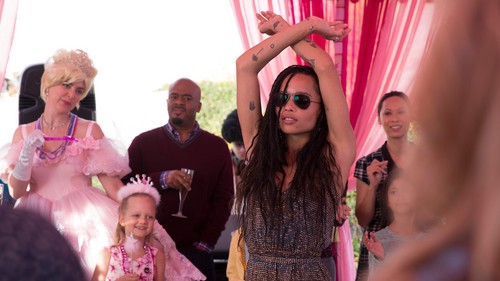
Zoe Kravitz may be the only prominent character of color, but the show does not show Monterey as homogeneously white. (image credit: HBO)

Ultimately, what’s so puzzling about the discrepancy between Big Little Lies’ visual and sonic diversity is that it could have so easily been different. Nowhere does the show suggest that Monterey itself is homogeneously white; law enforcement, lined up at a press conference, including a black female detective in charge of solving the murder that structures the show, is predominantly non-white. Some of the other parents, attendees to the school fundraiser where the murder occurred and therefore questioned by the police, are also black and Asian American. It would have been easy to include one of these as a main character. However, they are nothing more than bit players to the unfolding drama that centers predominantly on Celeste (Nicole Kidman), Madeline (Reese Witherspoon), and Jane (Shailene Woodley). Race, in fact, is never mentioned. Zoe Kravitz herself said that “her [character’s] race is just not a thing,” whereas some critics interpreted the absence negatively and have accused the show of whitewashing. At its heart, by not saying anything Big Little Lies just replicates the colorblind logics that are bred in the communities like the one it depicts.
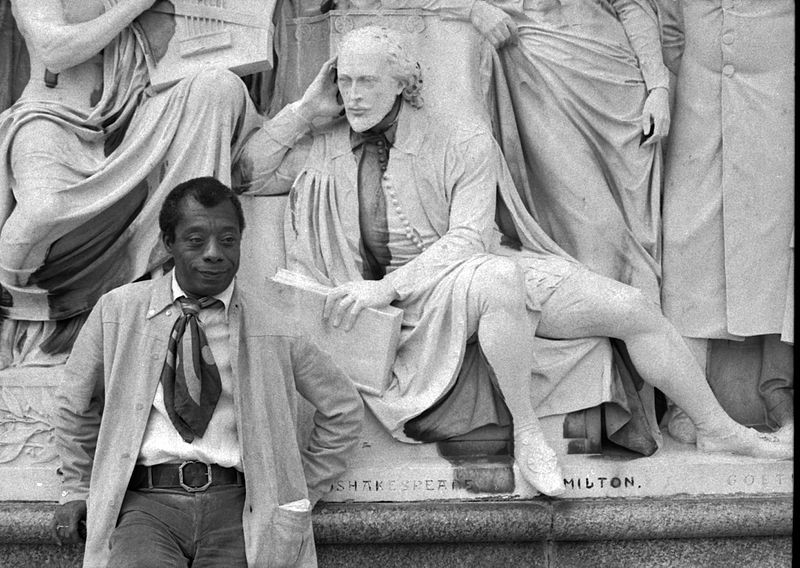
Baldwin with a statue of Shakespeare at the Albert Memorial

There is no inherent issue with people appreciating music that has its roots in another race or class experience. Taste is not bound by such metrics, and the last thing we need is people policing what others can or should enjoy. But the danger lies in the fact that this enjoyment sometimes comes in lieu of engagement, when people want the culture but not the people borne of it. Spectacular examples like Bannon’s screenplay obscure that similar impulses can be found in many mainstream productions. In Carmen Jones whiteness was audible, in Big Little Lies it is silent. The norm does not have to announce itself. Seeing the arc between the two can help us understand that it is the simultaneous precarity and omnipresence of whiteness that shapes most mainstream cultural production, and that’s exactly why it is so important to visually challenge it. As Mailer wrote towards the end of his essay,

What the liberal cannot bear to admit is the hatred beneath the skin of a society so unjust that the amount of collective violence buried in the people is perhaps incapable of being contained, and therefore if one wants a better world one does well to hold one’s breath, for a worse world is bound to come first, and the dilemma may well be this: given such hatred, it must either vent itself nihilistically or become turned into the cold murderous liquidations of the totalitarian state.

In silencing blackness, or evoking it only culturally, white liberalism — even if sometimes with all the right intentions — has kept alive the illusion that maybe race doesn’t matter as much, or that reason can be used to convince reactionary voices that more humane policies are needed. However, we are at a juncture where the totalitarian state Mailer cautioned against has nearly arrived. It seems increasingly immoral to divorce culture and lived experience, to consume and relate affectively to music without even a second thought for the black and brown bodies that face daily violence or without doing anything to offset the vast representational imbalance that keeps the status quo feeling comfortable.

In silencing blackness, or evoking it only culturally, white liberalism — even if sometimes with all the right intentions — has kept alive the illusion that maybe race doesn’t matter as much.

Of course Big Little Lies is not the main offender here, but it does raise the question of when incorporation becomes appropriation or fetishization. If POC listen to traditionally white cultural forms, like country music, they are accused of aspiring to whiteness, yet white Americans can take anything without ever surrendering their whiteness or being questioned for it

Ironically, in Mailer’s case this also meant that he replicated some of the very commodification of black culture he described. As James Baldwin wrote of “The White Negro” in an essay for Esquire,

Why should it be necessary to borrow the Depression language of deprived Negroes, which eventually evolved into jive and bop talk, in order to justify such a grim system of delusions? Why malign the sorely menaced sexuality of Negroes in order to justify the white man’s own sexual panic? [..] The really ghastly thing about trying to convey to a white man the reality of the Negro experience has nothing whatever to do with the fact of color, but has to do with this man’s relationship to his own life. He will face in your life only what he is willing to face in his.

This is where the difference between inclusion and representation surfaces. The time for euphemisms is over. It is not enough to either see or hear, or to embrace culture while discarding people. Representation demands that everyone gets to show and voice their own truth.

Why the Mountains Love the Lake

Le Pain Quotidien

“For a very long time,” she said, “I thought the French were masochistic.”

“And why is that?” I asked.

“I thought ‘le pain quotidien’ meant ‘the quotidian pain’.”

Not to Blame

Orbs of white lights were floating across the outdoor garden G and I visited one Saturday night. I smiled because the orbs reminded me of many glowing moons.

A handful of nights ago, I attempted to capture the moon in a photograph. But the moon was visibly diminished in the photograph. It was less large and less luminous than it appeared to my eyes. I mentioned this frustration to G.

G laughed. “And the moon is to blame for this?”

4am

I awaken to the glow of his phone screen.

The silence around us is thick and inky, only punctuated by the low rustle of wind passing through the grasses.

Have you brought the moon indoors for me? I whisper.

At the Laundromat

Yesterday, I did my laundry.

When I returned to retrieve my clothing from the nondescript laundromat, I discovered that my favorite wool sweater had shrunk in the wash. In determined stubbornness, I struggled to put it on anyway, only to become hopelessly entangled in its constricting static.

“Oh, what have I done to you?” I cried to the sweater. “And what have you done to me?”

Question-Answer

I had a question for you.

“Did they like me?” I whispered.

“You want everyone to like you,” you whispered back.

Office Furniture

“Assistant to the Chair is such a funny job title.”

“I mean, what is that, an armrest?”

Misdefinitions

Ogle: an ogre playing a bugle

Panache: ganache served on a pan

Baffles: a batch of waffles

Strident: a brand of chewing gum

Ensconced: to be buried under a variable amount of scones

Indelible: unable to be sold in a deli

Crestfallen: a tube of Crest toothpaste that has fallen to the floor

Cantankerous: of or related to the sound a tank full of multiple cans makes when driving over numerous bumpy hills

Hamlet on Businesses

To B2B or not to B2B, that is the question.

Hamlet on Apartment Rentals

To 2B2Br or not to 2B2Br, that is the question.

Hamlet on Pencils

2B or not 2B, that is the question.

Mother Goose on Metric Feet

Mary had a little iamb.

Descartes on Metric Feet

I think, therefore iamb.

Like a Mirror

Many nights ago, when we were traveling in Iceland, he told me this story.

“The lake loved the mountains. And so the lake willed herself to become very, very still and very, very clear, so the mountains could rise every morning with the light of the sun and look at his own reflection.”

“But why?” I asked him, even though I already knew the answer.

Steps

We are walking. I match his pace in the way good friends or lovers begin to fall in sync, but I do so comically, deliberately, taking one exaggeratedly large step after another.

“Are you trying to see how it feels like to be me?” he asks. “How does it feel?”

I look at him, at his blonde hair catching glimpses of foggy Saturday sunlight. “Deeply unsustainable,” I say.

“Same,” he replies. A half-smile spreads to light up his face.

I continue to walk in stride as we amble down the street, up several hills, to his apartment, where we must part ways.

Paired / Despaired

So many couples walking, holding hands, and so many couples, walking dogs while holding hands, and here I am alone, walking my bike along the sidewalk.

Almost

“Funny how strayed and stayed are almost the same word.”

“Yes, almost-same, to a T.”

Prizes

I was hoping to win the record player in the raffle. A boy I loved was moving away. He gave me all his records since he could not bring everything with him. I did not own a record player. I was trying to use this, the possibility of winning one, as some sort of sign.

This is what happened. I did not win the record player. A couple won it. I watched them embrace in joy and triumph, with the record player held awkwardly between them like a square shaped child.

I stood there, empty handed. How little there was to win in love. How much there was to lose.

Birds

I misread “great egret” as “great regret” today. In a dream, my regrets became winged birds. Oh, how they took flight, and filled the blue sky.

Life as a Verb Tense

Present imperfect.

“Professional Driver, Closed Course” by Carrie Laben

8 Pieces of Modern Technology That Science Fiction Predicted…Or Invented

In 1945, pioneering science fiction author Arthur C. Clarke began circulating a manuscript called The Space Station: Its Radio Applications. This paper proposed that space stations could be used to broadcast television signals — an “out there” statement during a time when television was not yet a commercial entity. Seventeen years later, in 1962, the Telestar 1 communications satellite relayed the first transatlantic television signal in history. Fast-forward fifty-four years to 2016 and President Trump’s inauguration was viewed by a live global audience of 30.6 million viewers, in an event that was virally compared to the science fiction TV show, The Twilight Zone.

Clarke was not the first sci-fi author with uncanny technological predictions — and certainly not the last. Many works of science fiction involve technological speculation that bears remarkable resemblance to the pieces of technology woven into our lives today. This brings to mind an intriguing question of the role that speculative fiction (and especially science fiction) plays in driving technology by postulating future advancements — and sparking innovation.

The following list of fictional works were technologically ahead of their time and stand testament to the immense creativity of science fiction authors.

1888: Credit Cards

Edward Bellamy’s Looking Backward

In the book: In this futuristic utopia, a card allows people to borrow money from a central bank on credit, eliminating the need for physical money. Sound familiar?

“Are credit cards issued to the women just as to the men?”

“Certainly.”

“The credits of the women, I suppose, are for smaller sums, owing to the frequent suspension of their labor on account of family responsibilities.”

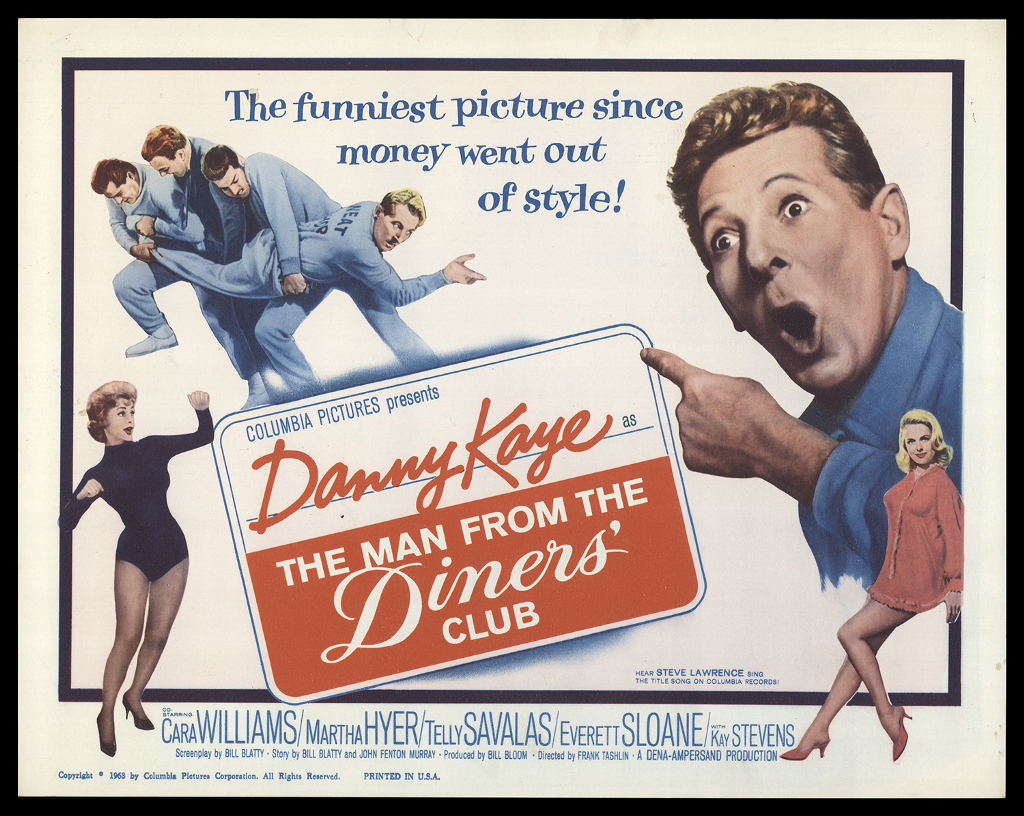
In reality: The first popular credit card was introduced by the Diner’s Club in 1950. As of 2012, over two billion active credit cards were in use around the world, accounting for $1 trillion of debt. In fact, the average American household receives six credit card offers a month.

1911: Video calling

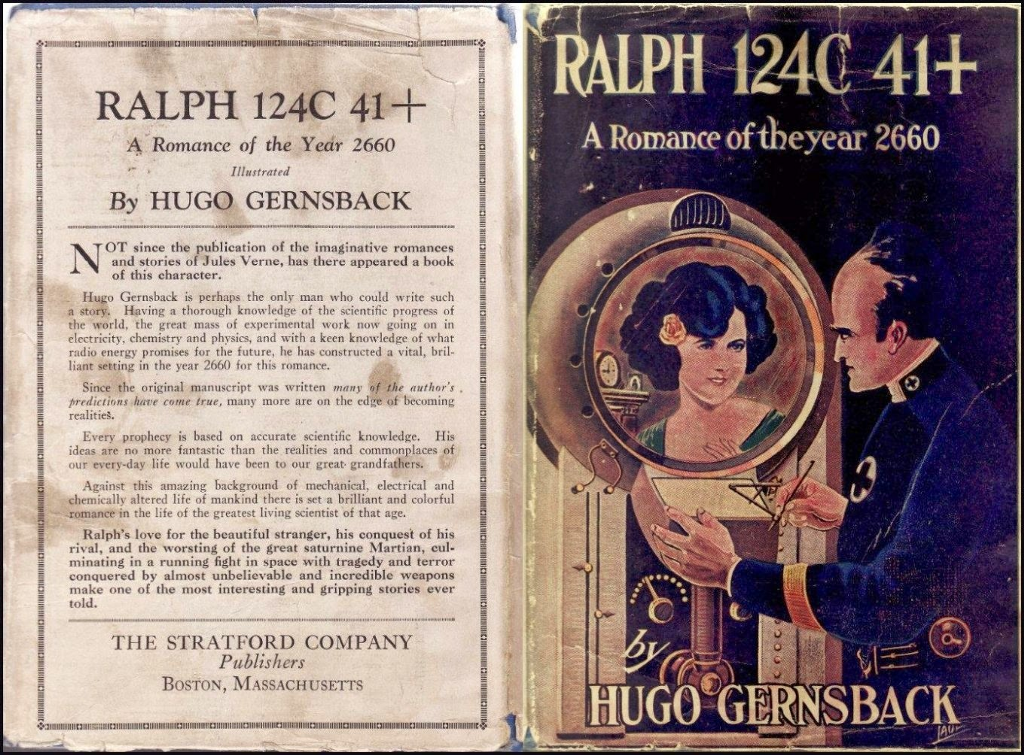
Hugo Gernsback’s Ralph 124C 41+

In the book: The “telephot” is a video-telephone device used by the heroine, Alice 212B423, to call for help when she’s threatened by an avalanche. In a blinding feat of technological progress, she is able to place this call to Ralph… from over 4,000 miles away.

After several vain efforts to restore it Ralph was about to give up in disgust and leave the Telephot when the instrument began to glow again. But instead of the face of his friend there appeared that of a vivacious beautiful girl. She was in evening dress and behind her on a table stood a lighted lamp.

Startled at the face of an utter stranger, an unconscious Oh! escaped her lips, to which Ralph quickly replied:

“I beg your pardon, but ‘Central’ seems to have made another mistake. I shall certainly have to make a com­plaint about the service.”

In reality: Today, more than 340 million minutes of video calls are made each day on WhatsApp alone. Factor in other popular video calling softwares such as Skype, Google Hangouts, Facetime, and Facebook Messenger and our collective time spent video-calling one another becomes astronomical. This generation will likely be the first to make more video calls than voice calls.

Photo by e-anjei

1931: Mood-Enhancing Pills

Aldous Huxley’s Brave New World

In the book: “Soma” is a hallucinogen distributed by the government, en masse, to control the population. Citizens are conditioned to love the “calming” effects of the drug, using it constantly to avoid feelings of discontent.

“A gramme is better than a damn,” said Lenina mechanically from behind her hands. “I wish I had my soma!”

In reality: Many have drawn comparisons between Brave New World’s drug-dependent society and America’s ever-increasing reliance on prescription medication. In addition, they feel that Huxley may have predicted the direction of the entire pharmaceutical market, and the subconscious notion that in order to be “healthy,” we most likely need to be medicated.

1939: Surveillance

George Orwell’s 1984

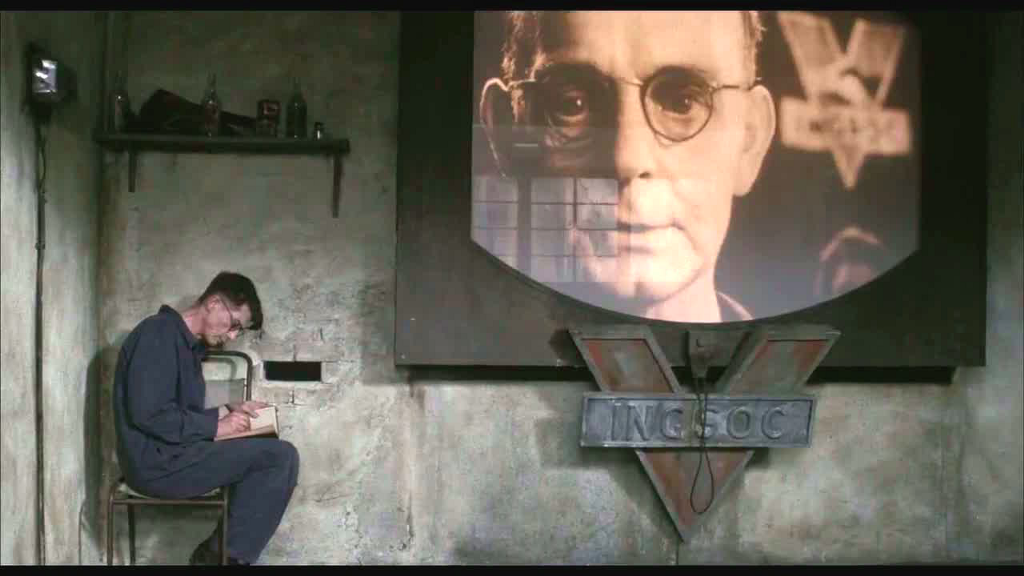
In the book: The dystopian concept of Big Brother originated with 1984, leading to the term “Orwellian” entering everyday practice to describe a totalitarian state characterized by surveillance, misinformation, and propaganda. In the novel, telescreens are used to watch a person’s every move — a blatant act of surveillance, as the government’s total control has removed any pretense of privacy.

You had to live — did live, from habit that became instinct — in the assumption that every sound you made was overheard, and, except in darkness, every movement scrutinized.

In reality: In 1942, just three years after 1984 was published, closed-circuit television (CCTV) was used for the first time to monitor the launch of a V2 rocket in Germany. Today, surveillance goes miles beyond simple public video monitoring. However, instead of getting into a lengthy (and inevitably disturbing) explanation of all the ways that the public is surveilled by the government, let’s just say that there are currently over 32 CCTV cameras within 200 yards of the house where Orwell wrote 1984.

1968: Tablets

Arthur C. Clarke’s 2001: A Space Odyssey

In the book: Described as a “foolscap sized Newspad,” astronauts use tablet computers while conducting spaceships diagnostic checks, or when they need a line of communication to Earth.

“Floyd sometimes wondered if the Newspad, and the fantastic technology behind it, was the last word in man’s quest for perfect communications. Here he was, far out in space, speeding away from Earth at thousands of miles an hour, yet in a few milliseconds he could see the headlines of any newspaper he pleased.”

In reality: The date, location, and people involved in the invention of the tablet is debated. However, the first tablet ever sold was HP’s Microsoft Tablet PC, released in 2002. Today, tablet sales have surpassed desktop and laptop sales combined, and almost half the American population own a tablet.

What’s more: NASA pilots can sometimes carry bags with over 40 pounds of hard-copy aviation documents. This has caused many NASA pilots to start a “tablet computer revolution in aviation.” Arthur C. Clarke would be proud.

Faraday Future mock-ups

1969: Electric Cars

John Brunner’s Stand On Zanzibar

In the book: Brunner’s depiction of America in the year 2010 includes motor vehicles that are powered by rechargeable electric fuel cells.

It’s supposed to be automatic, but actually you have to push this button.

In reality: The publication of Stand on Zanzibar coincided with an increasing demand of cars and the Interstate Highway construction program. These days, the question is not whether electric cars will come to be, but how long it will take them to become mainstream. And the answer seems to be: soon. Tesla and Volkswagen have both announced plans to produce over one million electric vehicles per year by 2025, and Volvo has stated that come 2019, all of its new models will be either hybrids or battery-powered.

1972: Bionic Limbs

Martin Caidin’s Cyborg (aka TV’s The Six Million Dollar Man)

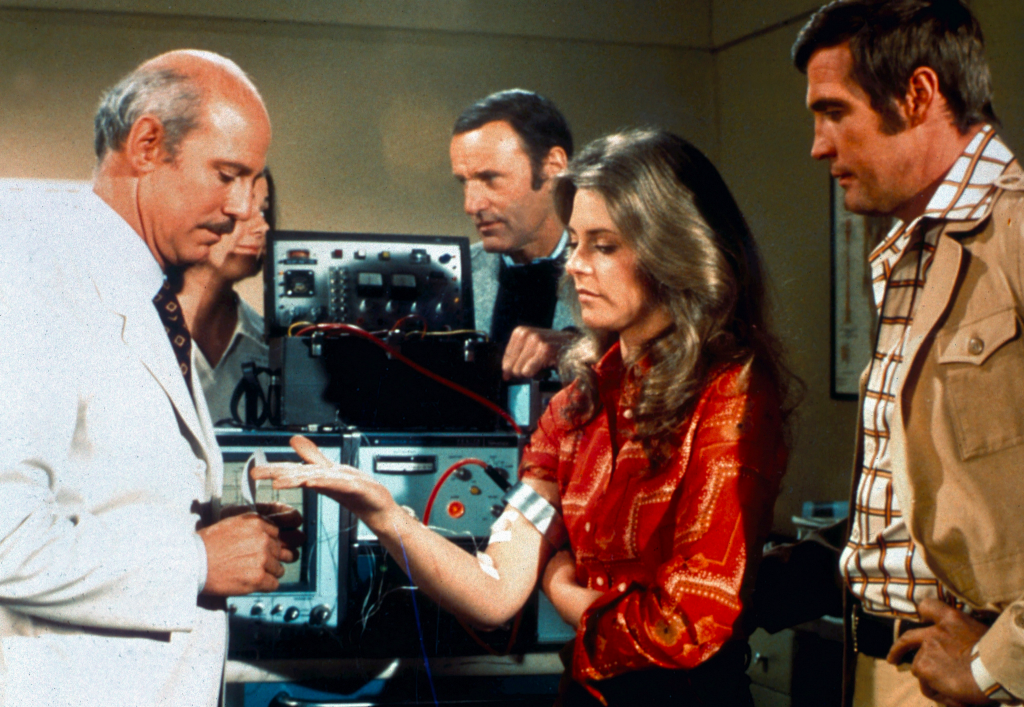
In the book: Pilot Steve Austin crashes in flight and loses his legs, left arm, and an eye. His legs and left arm are replaced by a team of doctors with bionic limbs — leaving him a “cyborg” (part man and part machine).

To make everything clear, I don’t much give a shit for your operation. I’m willing to go as part of the great experiment. I just want you to understand that I don’t owe you a thing.

In reality: In 1993, Robert Campbell Aird, a muscle cancer survivor and amputee, was given the world’s first bionic arm at the Margaret Rose Hospital in Edinburgh, Scotland. He was able to operate this arm through a cap with micro-sensors which detected electrical brain impulses being sent to the “limb.”

Today, researchers are building man-made organs that contain living human cells. Advancements in bionic livers, kidneys, lungs, and hearts are poised to end live-organ transplants — a development which would likely come as a relief to the 121,000 Americans currently on a waiting list.

1984: The World Wide Web

William Gibson’s Neuromancer

In the book: Cyberspace is described as a “consensual hallucination” created by millions of connected computers on a globally-accessible network called PAX. This network can be (and is) hacked into.

A graphic representation of data abstracted from the banks of every computer in the human system. Unthinkable complexity. Lines of light ranged in the nonspace of the mind, clusters and constellations of data. Like city lights, receding…

In reality: This pick came from Michael Rowley, UK editor of Andy Weir’s The Martian. As Rowley says, “Science fiction is sometimes talked about as the literature of ideas. How better to illustrate that than William Gibson using the term ‘cyberspace’ in his debut novel, Neuromancer. As Gibson described how his protagonist, Case, ‘jacked into the consensual hallucination that was the matrix,’ a new way of looking at and experiencing information was visualised. In a year that shared its date with the title of George Orwell’s 1984, a science fiction author writing on a manual typewriter allowed us to name and visualise what would later become the internet.”

To get into the ways that the internet and cyber-crimes affect our society today would require an article in itself. For now, you can take a peek at this (frightening) Internet Live Stats website for scale.

What’s next?

— In 2004, Geoff Ryman’s Air predicted that by the year 2020, people would be able to access the internet from their own brains — and according to Ray Kurzweil, futurist author and inventor, we may not be too far from realizing this technology. Kurzweil believes that by 2030, people will be able to go online via a nanobot that can tap into our neocortex, connecting us directly to the web.

— Equally as forward-thinking, Ernest Cline’s Ready Player One (published in 2011) is set in the year 2044, where society escapes the hardships of an energy crisis by entering the “OASIS” — a virtual world. All you need to do to get into OASIS is don a VR visor and some kind of haptic technology, such as the gloves or the suit. Just one year after the book’s publication, Oculus announced the Rift headset on Kickstarter. Now, Oculus Touch has gloves that allow you to pick things up in VR and full suits are being developed as well.

And after that?

Well, if we’re lucky, the events of H.G. Wells’ The Time Machine (1895) will come to pass and, at the very least, the world will still exist in the year 802701. What we can count on as both readers and consumers of technology is that speculative fiction will remain a means of looking forward and imagining future innovations, while also questioning the eventual implications of the status quo.


About the Author

Arielle Contreras is a staff writer at Reedsy, a curated marketplace that connects authors and publishers with the world’s best editors, designers and marketers. Over 2,500 books have been produced via Reedsy since 2015.

The Asian American Women Writers Who Are Going to Change the World

This past year of national chaos has often had me thinking, What if? What if, before this year, I’d spoken up more, given more, fought more? On the one hand, if I’d allocated the entirety of my waking hours toward canvassing for the side of political good, I still, in all likelihood, wouldn’t have prevented this year’s kakistocratic events. But if a thousand people like me had done more? Ten thousand?

What-if rue like this is mostly useless, but it can, at least, help lead to future action. Toward that end, I’ve felt heartened and inspired by the examples set forth by fellow writers — especially, at times, by politically outspoken Asian American women. It’s a demographic often expected to be relatively quiet, even docile; what’s more, we’re routinely labeled the so-called model minority, a hateful idea trying to press us into the service of white supremacy. It’s evil shit, and not-at-all-quiet exemplars abound, including Nayomi Munaweera, Celeste Ng, Vanessa Hua, Nicole Chung, Alice Sola Kim, Jarry Lee, Rachel Khong, Tanwi Nandini Islam, Aimee Phan, Vauhini Vara, Jenny Zhang, Karissa Chen, Mira Jacob, Kat Chow, Steph Cha, Kirstin Chen, Tracy O’Neill, Larissa Pham, Marie Myung-Ok Lee, Suki Kim, Marie Mutsuki Mockett, Sonya Larson, Shuchi Saraswat, Catherine Chung, Shanthi Sekaran, Christine Hyung-Oak Lee, Jia Tolentino, Hasanthika Sirisena, Nina McConigley, Krys Lee, Solmaz Sharif, Ru Freeman, Lisa Ko, Janice Lee, Katrina Dodson, Aja Gabel, Sonya Chung, Jade Chang, Rowan Hisayo Buchanan, T. Kira Madden, and, and, and.

In this roundtable, I spoke with four such vocal women: V.V. Ganeshananthan, Porochista Khakpour, Bich Minh Nguyen, and Esmé Weijun Wang. They’re all versatile writers who frequently work across genres, splendid novelists who also write candid, powerful nonfiction, and who are brilliantly forthright about their political views. Here’s Ganeshananthan in the Asian American Writers’ Workshop’s Margins about who gets to write what they don’t know, and her essay “The Politics of Grief” in Granta. Here’s Khakpour on writing as an Iranian American in Catapult, and her essay “How Can I Be a Refugee Twice?” in CNN. Nguyen wrote about being a refugee in Literary Hub, and, along with Karissa Chen and Celeste Ng, published a rap-battle response to Calvin Trillin’s “Have They Run Out of Provinces Yet?” Finally, take a look at Wang in Buzzfeed about the “good” schizophrenic, and in The Believer about metaphors of mental illness.

We talked on Google Hangouts about different kinds of writing, expectations of Asian American women, physical height, and varieties of activism.


R.O. Kwon: I wanted to assemble this roundtable because I admire you all, and I’ve learned from you — from your wonderful books, of course, but also from how vocal you are about your politics. Were there any catalyzing events that led you to start writing politically, or has this always been a part of your writing life?

Esmé Weijun Wang: For me, it depends on what you mean by writing politically. If, for example, we’re talking about mental health advocacy, I’d say I started writing about that back in 2010 or so, and there were definitely catalyzing events. But in terms of writing more about issues of race and white supremacy, I feel like that’s been, for me, more recent, with the exception of some writing I did in the 90s and early 00s. Part of my more recent participation in the discussion has come from seeing other people of color, especially Asian American women, writing about similar issues.

Bich Minh (Beth) Nguyen: Yeah, I’ve always written about race and racism, and Asian American identity, but I hadn’t always talked about it. I do think I’ve become more vocal because of social media, and because of what’s been happening in the past couple of years. It took me awhile to grow into the more public space.

V.V. Ganeshananthan: A lot of my early writing probably wasn’t especially political. For me, Twitter, in particular, is a helpful, liminal space between writing and talking. I do write politically, but I will sometimes say things on Twitter that I wouldn’t say aloud. It’s strange, since I have a large enough following that it’s probably larger than any room I would address — which isn’t to say it’s that large — but I feel very comfortable there. I think that comfort has expanded.

Wang: You know, when I was 17, I published two essays in a book. One essay was about Asian fetishes, and the other was about Asian identity, about the Caucasian pseudonym I used for a long time when I was first starting to write. I don’t immediately think about what I wrote back then because, at the time, there wasn’t social media. You would publish something, it went into a book or some other print publication, and that was basically it. There was no feedback, not like there is now with essays published online.

Porochista Khakpour: I think there were catalyzing events that led to me being a political person. For example, being a refugee with political asylum status and a “resident alien” green card. The L.A. Riots when I had just become a teenager. Going with my father to protests at L.A.’s Federal Building on a variety of Iranian immigrant causes. My identity as an Iranian American was to be interpreted primarily politically, so I had no choice. By the time my first novel came out a decade ago, I knew that was how people saw me, and more and more I rose to the call and the need, which was very real.

Support Electric Lit: Become a Member!

Kwon: I wonder how you think about dividing your time and energy between writing fiction and memoir versus speaking out — whether it’s on Twitter and Facebook, or via essays — about the political situation? Is there any divide between these kinds of writing for you?

Nguyen: Honestly, I’ve had a lot of trouble writing since last year’s election season. I’ve had trouble thinking about my writing as being relevant. Sometimes I find myself writing about political topics on Facebook, but I’m not actually writing my book. In writing classes I took, we were always discouraged from writing anything political because we weren’t supposed to preach, and anything political was considered preaching. Of course, that’s not what I actually believe. But it takes an active form of thinking about what political writing is to feel brave enough to make it happen in my own writing rather than on Twitter or Facebook.

Wang: Yeah, I feel similarly. Social media feels like a safer space for being deliberately political. I’ve been trying to experiment with what, exactly, feels meaningful in terms of including politics in my nonfiction and fiction. Last fall, I needed to send Granta a new story for their Best of Young American Novelists issue, and I was having a lot of trouble coming up with something fresh. I felt it wouldn’t be meaningful unless it addressed the current political situation, and that was something I’d never thought a lot about before. The story I ended up publishing in that issue includes the election. It concludes with the night the results come in, and I’d never done that before, including a political moment in fiction. I’m finishing a book of essays about schizophrenia, and I have to convince myself of the relevance of what I’m writing. Sometimes, it feels like nothing is relevant unless it’s obviously relevant.

I have to convince myself of the relevance of what I’m writing. Sometimes, it feels like nothing is relevant unless it’s obviously relevant.

Khakpour: I am constantly online, and that is where my activism finds itself most these days, given I deal with physical disability, too. I spend several hours on social media daily, and that goes mainly to political causes, so there is no real struggle to divide the time. It’s who I am. I can’t possibly tune out, especially not these days. My other writing may be separate or may be related but it continues on a whole other track. Activism has been part of my identity for many decades.

Ganeshananthan: I’ve written about a different set of politics for a long time, and with the goal of including politics in essays, fiction, and poetry. I have clear strategies and thoughts about how to do it in a Sri Lankan context. In Sri Lanka, the population is reading in three languages: people don’t always have reading material in common, so I’m always thinking about translation in a way I don’t in the United States. Also, a lot of my Sri Lankan characters are involved in politics. I’ve had American characters in my fiction a long time, but they’re often less politically active. I’m not sure why that is, and I’m not sure they are going to stay that way. I’m still figuring that out, but I think it’s helpful to have some practice in another sphere.

Kwon: I’m curious if — well, I’ve realized I often react to what people expect of me. I know that, sometimes, strangers think I’ll be quiet, passive, demure as fuck, and I take almost cartoonish measures to try to contradict those expectations. I curse a lot, things like that. I also get tired, though, of projecting a strength I don’t always feel. Beth, you’ve talked online about how people think you’ll be quiet, and how they can get extra angry when they learn you won’t be, you’re not. In your writing life, on social media, do you feel the weight of these expectations about women, especially Asian women? If you do, how do you handle them?

Nguyen: I will say that I have cultivated a strong resting bitch face, and it has served me well. I have had to deal a lot with the consequences of not meeting people’s expectations — in my personal life, in my academic life. People don’t understand that they’re reacting to a stereotype. They don’t understand their own anger, and I cannot adequately explain it to them. It just makes them angrier and more defensive. The problem ends up being all mine. It’s very difficult to have a conversation with a white person about this level of racial stereotyping because, typically, they don’t want to admit they harbor those feelings. I have to expend a lot of extra energy working around that, trying to avoid it. I don’t think it’s useful or personally satisfying, and I don’t always do this, but it’s sometimes the only choice I can make to avert the larger racial disaster that usually happens when a white person is even gently called out for harboring racist ideas.

Wang: As a teenager, I wanted to stand with my hips thrust out, hands in back pockets, trying to inhabit a demeanour that went against type. During my wedding rehearsal, a table of my friends said, Oh, we were all just talking about how we were all so intimidated when we first met you. I was really surprised to hear that, and kind of proud. I feel like my reputation has moved away from being deliberately intimidating. There are times when I miss that, in how I’m perceived.

I have cultivated a strong resting bitch face, and it has served me well.

Khakpour: As an Iranian, sometimes I’m not even considered Asian. It’s hard to know where we fit in, much less what stereotypes get tagged on us. I mean, I know straight men sometimes have some sort of fetish, which is pretty horrific. But I think for my group of Asian Americans, others so barely know us that they can’t even guess what we will be like. “Terrorist” is as far as it will go. But I’ve been heartened when Asian American groups bring us in as West Asians, because then we can find ourselves in these discussions. We often aren’t even allowed to consider these issues because we fit in nowhere.

Ganeshananthan: From a pretty young age, I was hell-bent on being perceived as vocal. So people where I grew up did not think of me as quiet. I think it helped that I was tall. I was the tallest girl in my class for many years, up until I was eleven or twelve, and then I stopped growing. But I already had the psychology, even though I didn’t keep growing, and now I’m just average. Sometimes, people will say to me, Oh, I didn’t realize that you’re only 5’5”.

Nguyen: That’s tall!

Wang: Porochista and I have talked about the fact that people think she’s a lot taller than she actually is. Even though I’ve spent a lot of time with her in person, and know her well, I still think of her as maybe being 5’10” or 5’11”, even though she’s 5’6”. It’s interesting to think about how taking up physical space influences perceptions of Asian women.

Nguyen: I wrote about part of this in a book, Short Girls, because I grew up short in a city where everybody was really tall. Throughout my childhood, people would say, Oh, you’re so short, you’re so small, how’s the weather down there? As a result I felt small, that I didn’t deserve to occupy space, and I think that did something to me. What’s interesting is that, now, I always forget that I’m short. I am, actually, very short. I’m five feet tall, but in my mind, I don’t feel like a short person. I don’t think about my size. For me, that is a big mark of my progress. I grew up feeling so short, and now I just feel like a regular person.

The Last Chinese American Woman Writer Who Hasn’t Read Maxine Hong Kingston

Ganeshananthan: It’s funny, Beth and I were roommates at a conference in Iceland. We’d met before, but it was the first chance we had to spend a lot of time together, and I remember you referred to yourself as short, and I said, You’re not short. You said, Stop, look at me, and I —

Nguyen: I was wearing heels!

Ganeshananthan: Yeah, you were wearing heels. But I’d also developed a much taller conception of you, and I think we must be putting all kinds of work into this. I mean, I played an instrument that I picked because I was told it was too big for me. I pursued it seriously for years! Also, we’re not supposed to be funny. I remember that, at one event, a young woman said to me, repeatedly, I didn’t think you’d be funny!

Wang: Oh, gosh, I relate to that so much.

Nguyen: Oh, yeah.

Ganeshananthan: To be fair, I wrote a fairly serious first novel with half of one joke in it. But people sometimes have fixed ideas about what you will or should be like, and that’s tough. That can come from within your own community, too. People say, How did you do this, why did you do this, I have some ideas for your book. In some of those conversations, people are definitely a little surprised that I’m not demure.

Kwon: I know I’m not the only person who admires you all for being writers who try visibly and actively to be forces for change, and for good. What advice do you have for other writers who want to be more politically vocal?

Wang: I think a good way to start, and a good practice for me to continue, is to amplify other voices, particularly those of marginalized people who are being directly affected by this new administration. Retweets can seem simple, but I feel they’re also really important to do. And for people who aren’t used to talking about politics on social media, it’s also a way to not have to try to compose something eloquent and new.

Nguyen: That’s what I would say is key, is to support other writers’ work, and to be part of that community. Community is what we need and what is going to get us through these time. We have to be active in it, and do our part. I know it’s not always easy to speak up. In my classes, I don’t force students to talk if they tell me they’re really introverted. I want them to know they can speak up in different ways. For example, I’ve been thinking a lot about motherhood as one issue in academia. Academia is not the most welcoming place for mothers, even though it seems like it should be. So I’ve often kept that part of my life hidden, and then I realized that wasn’t doing any good. I was just reinforcing the idea that mothers should not be mothers in academia. And so I thought, Okay, this is another aspect of life where, if I step up a little more, and try to be more open about it, visible, maybe I can help somebody else.

I don’t believe in writers who are not invested in wanting to change the world.

Ganeshananthan: I agree. The idea of amplifying other writers’ voices is important. Taking that one step further, I think it’s a particularly American narrative that there are two choices, and you must pick one: I must speak out and I must be on the top of every mountain or I have done nothing useful. From working in a Sri Lankan context, I’ve also gotten that, sometimes, the political things I do don’t have my name on them. That might mean I’m editing an op-ed for someone else, I’m helping them get in touch with an editor who might appreciate their work, I’m arguing with them so they think their political arguments out differently. There are many options. I’ve seen people I admire come up with alternatives that work for them. They say, I can’t go to a protest, for example, but I would like to offer my home as a meeting space. I can’t be at this rally but if someone would like to take my car, or if someone would like to have a meal at my house — other forms of support are possible. It’s been really moving.

Khakpour: Stop being afraid. Speak up. Be yourself. There is no dignity in keeping it all inside. If you are a writer, you have something to say, certainly. So do it. And don’t stop. I don’t believe in writers who are not invested in wanting to change the world.

12 New Book Covers Created for Sherlock Holmes’ 125th Anniversary

Saturday, October 14 marks the 125th anniversary of Arthur Conan Doyle’s The Adventures of Sherlock Holmes: the first collection of his short stories previously printed in The Strand Magazine. Despite the fact that they are amongst Sherlock’s most famous cases, few stories in this collection have ever received their own cover designs — an oversight that has now been corrected.

To celebrate this major milestone, twelve professional book designers from Reedsy have created exclusive new covers for each of these fantastic stories.


1. A Scandal in Bohemia

(Design: Rafael Andres/Reedsy)

Also known as…

“Victorian Sextape”

What’s it about?

Holmes is hired by the King of Bohemia to recover a photograph showing him standing (fully-clothed) with his former lover, the American opera singer Irene Adler. In subsequent adaptations, Irene Adler would frequently be recast as Holmes’s love interest — or in the case of the recent BBC series, a bisexual dominatrix extortionist Sherlock-stalker.

The New Cover

“After reading the story it was clear that the photograph was the concept to play with,” said illustrator and book designer Rafael Andres.

“The idea of obscuring the identity of the character was the first idea that came to my mind. I considered covering the face somehow, but I decided the empty collar would have more visual impact — so I researched a vintage photo, deleted the head and reconstructed the shirt collar.”

“Combined with the title, I wanted this design to have a hint of humor — after all, for a prince in Victorian times, losing one’s head would be considered extremely careless.”

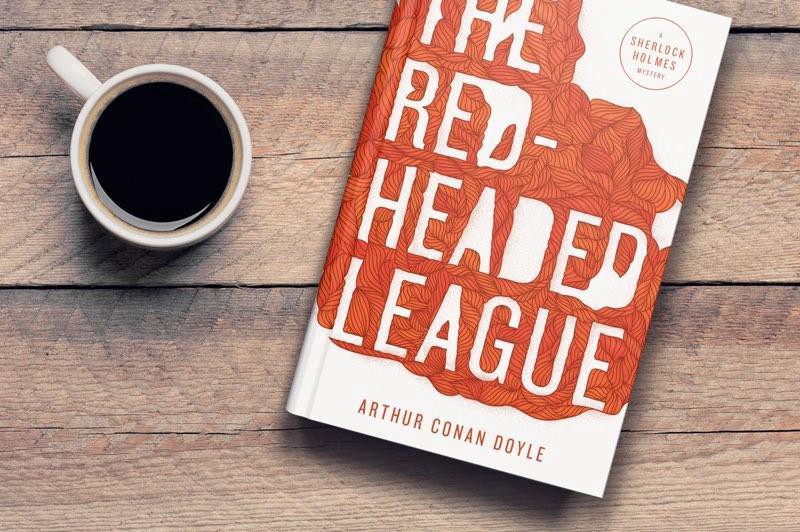
2. The Red-Headed League

(Design: Annabel Brandon/Reedsy)

Also known as…

“Gentlemen Prefer Non-Blondes”

What’s it about?

Holmes is visited by a red-headed pawnbroker who’s fallen into some good luck. There’s apparently a charitable organization in London that is simply giving money away to ginger blokes in exchange for doing menial tasks. As the poor red-head suspects (and as Holmes will undoubtedly prove) this league is not what it claims to be.

The New Cover

“I just love the idea of Fleet Street filled with hundreds of red-headed men fighting for the same job,” said designer Annabel Brandon. “I took a quick look at some great illustrators of hair like Gerrel Saunders, and Sara Herranz — and used their work as a jumping off point. But instead of showing the letters of the title as hair, I used the negative space — the hair being the sideshow to the subterfuge.”

3. A Case of Identity

(Design: Cinyee Chiu / Reedsy)

Also known as…

“The One Where Sherlock Lies to a Woman”

What’s it about?

A young woman, the recipient of a minor inheritance, comes to Holmes when her elusive fiancé disappears on her wedding day. The strange part is how this mystery beau made her promise to always be faithful to him — “even if something quite unforeseen” happens to him.

Holmes solves the mystery on the spot, yet chooses to shield his client’s delicate female psyche from the truth. Sherlock’s approach to human psychology is a little bit dated, to say the least.

The New Cover

“One of my favorite illustrators is Elly MacKay — who photographs her beautiful papercut artworks to create a real sense of depth in her designs,” says designer Cinyee Chiu.

“Inspired by her work, I played with the blur and the light with the two mysterious male characters in the story.”

4. The Boscombe Valley Mystery

(Design: Elie Huault/Reedsy)

Also known as…

“Sherlock and Watson Hit the Road”

What’s it about?

Holmes and Watson take a trip to a rural community in Herefordshire to investigate the murder of a local landowner. The victim’s son has been charged with the crime, and it’s up to Sherlock to prove otherwise.

Like every Holmes story published in The Strand Magazine, The Boscombe Valley Mystery featured illustrations by Sidney Paget. It was Paget who, in this story, introduced the deerstalker hat which would become one of Sherlock’s signatures.

The New Cover

French designer and comic book illustrator Elie Huault created an evocative black-and-white cover that captures the beauty and the menace of the English countryside. The low-angle perspective hints at a voyeur hidden in the grass, teasing the notion that the real killer is close at hand.

5. The Five Orange Pips

(Design: Lara Evens/Reedsy)

Also known as…

“Sherlock Holmes vs. The Ku Klux Klan”

What’s it about?

A young man reveals that his father and uncle have recently passed and that the latter had extensive dealings in the American Deep South. Before their deaths, each received a mysterious envelope containing orange seeds, marked with the letters “K.K.K.” Modern readers will figure out who the murderers are even before Holmes does.
The New Cover

“I drew the inspiration for my design from Victorian wallpapers,” said designer Lara Evens. “Some of these wallpapers were embedded with arsenic, which made the colors especially vibrant — but had the downside that they were deadly. Killers hidden in plain sight, if you like.”

“I created a detailed illustration which seems innocuous at first glance. Only after reading the story, or taking a closer look, does it become clear that the illustration is conveying the details of a macabre tragedy.”

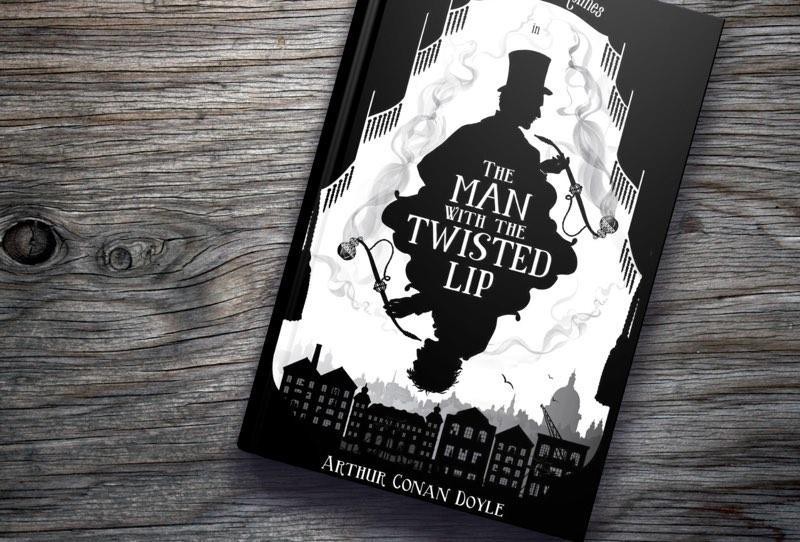
6. The Man with the Twisted Lip

(Design: Laura Barrett/Reedsy)

Also known as…

“Beggars Can Be Choosers”

What’s it about?

When respectable businessman Neville St Clair goes missing, Watson and Holmes head to the seedy opium dens of East London. A beggar is charged the murder… only for Holmes to reveal that the beggar and the victim are the same man! St Clair has been living a double life as a street bum — having long ago discovered how lucrative panhandling could be. This idea of wealthy beggars may seem unbelievable, but stranger things have happened.

The New Cover

Laura Barrett is a British designer and illustrator. Among her specialties are digital renderings of traditional Scherenschnitte or paper cutting designs.

“As the two character of the beggar and rich gentlemen are the same, I thought it might be nice to flip them and create an ornate frame,” Laura said.

To accentuate this theme of duality, Laura worked to create two skylines: the background, the relatively affluent areas surrounding St Paul’s Cathedral in the background, and London’s industrial docklands in the foreground.

7. The Adventure of the Blue Carbuncle

(Design: Andy Allen/Reedsy)

Also known as…

“A Very Sherlock Christmas”

What’s it about?

It’s late December in London. Sherlock has to figure out how a Countess’s priceless jewel went missing and ended up in the neck of a Christmas goose. It’s a mystery that takes Holmes and Watson across the city — and is wrapped up in an ending that embraces the spirit of the season!

The New Cover

For his design, designer Andy Allen wanted to avoid rehashing old covers. “I was thinking of including the goose somewhere on the cover, but it feels a bit obvious, and it’s on most of the covers of previous editions.” Instead, Andy chose to focus on the gemstone that gave the story its title.

“Playing with typography is something I really enjoy doing, and this story has so many twists and turns that I wanted to experiment with how the title is revealed on the cover. The facets and reflections of the gemstone pick out different sections of the title in a random order, so the reader pieces it together themselves.”

8. The Adventure of the Speckled Band

(Design: Jake Clark/Reedsy)

Also known as…

“Dial ‘S’ for Snake”

What’s it about?

Helen Stoner (a young woman with a small inheritance, like the victim in “A Case of Identity”) fears that her stepfather is out to kill her. Just a few years before, her twin sister had died uttering her final words, “the speckled band!”

The story’s twist is fairly well-known: the “speckled band” of the title is a venomous snake which the stepfather used to kill Helen’s sister — a fate he intended for Helen until those pesky Baker Street boys got involved.

The New Cover

“I wanted to shake things up a bit — bringing in a modern style to my cover with a bit of a vintage feel,” said designer Jake Clark.

“I thought of a slightly out-of-focus look that you used to see in older film photos. So I mixed in some photo textures, distressed it some, and mixed in a blurry portion of the title, and kept a desaturated warm tone to help push that idea. With the snake wrapped around the silhouetted man’s arm, I was looking to create a dynamic focal point.”

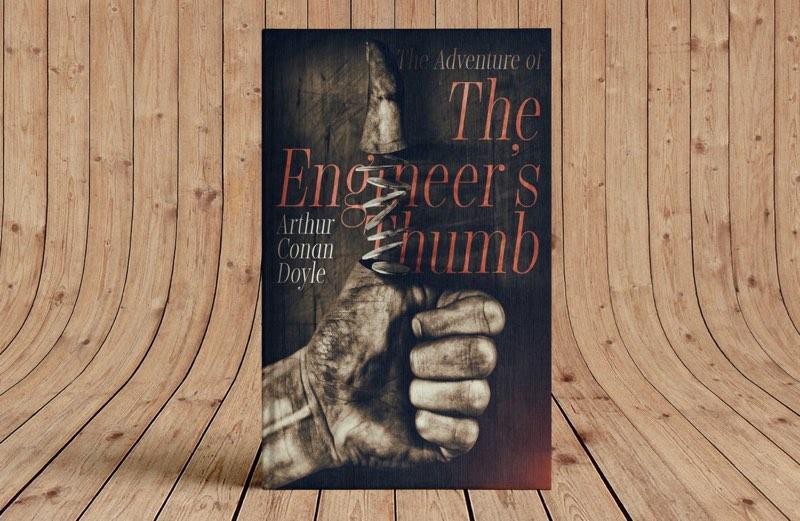
9. The Engineer’s Thumb

(Design: Vince Haig / Reedsy)

Also known as…

“Who’s got one thumb and was almost murdered? This guy!”

What’s it about?

Injured engineer Victor Hatherley is being treated by Dr. Watson and recounts how his thumb was severed the night before. Like many victims in Conan Doyle’s stories, Hatherley was offered an enormous amount of money to do a simple job. Blinded by his greed, he notices too late that his employers are counterfeiters, and he narrowly escapes with his life (but not his thumb).

Sherlock, Watson and the police search the scene of the crime, only to discover that they are too late and the villains have escaped with their loot. It’s one of the only two stories where the villains get away from Holmes, scot free.

The New Cover

“The original idea was based around a mock technical illustration — like the diagrams you might see on a patent application,” said designer Vince Haig. “It would have been an ink sketch of a hand, with the thumb sliced into coins to represent the how the engineer was blinded by greed.”

“In the end, I scrapped the technical illustration part as it wasn’t working particularly well — and I went with a design that looks more photo-real but in keeping with the same concept.”

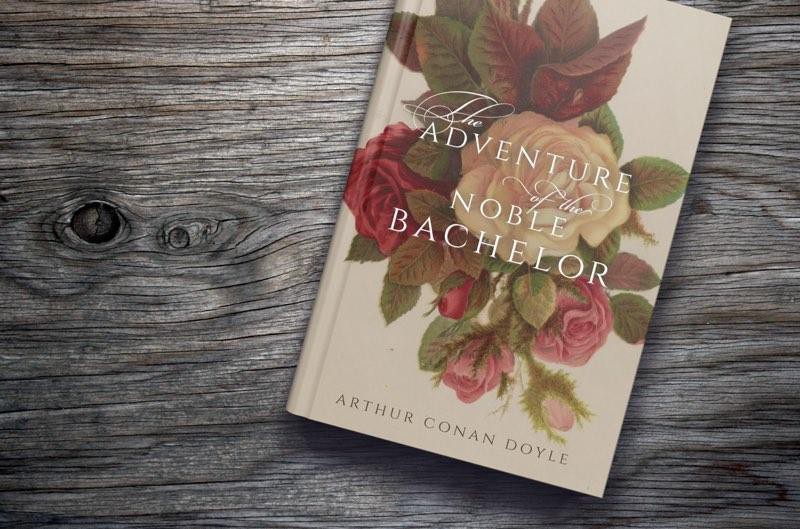
10. The Noble Bachelor

(Design: Phillip Gesser / Reedsy)

Also known as…

“Runaway Bride”

What’s it about?

Sherlock Holmes finds himself once more playing the role of marriage counselor.

A bride disappears from her wedding reception, and no one is more confused than the groom, Lord St Simon. Her dress and ring are found washed up in Hyde Park, and one of the few clues Holmes has to go by is an incident at the ceremony that saw a mysterious gentleman return the bride’s dropped bouquet. Who is this man? And is he responsible for the woman’s disappearance?

The New Cover

“My original concept worked around the image of smoke rings rising from a pipe to form the shape of three wedding rings,” said designer Phillip Gessert. “The idea was to hint towards a third person, the mysterious bachelor, interfering with the marriage at the center of the story.”

“This concept proved a little too enigmatic, and in the end, I took a simpler approach using a simple illustration of a bouquet.”

Phillip’s final design has nods towards the illustration style of the period and also provides a contrast between an image of a wedding bouquet and the titular bachelor — hinting at the role he will play in this mystery.

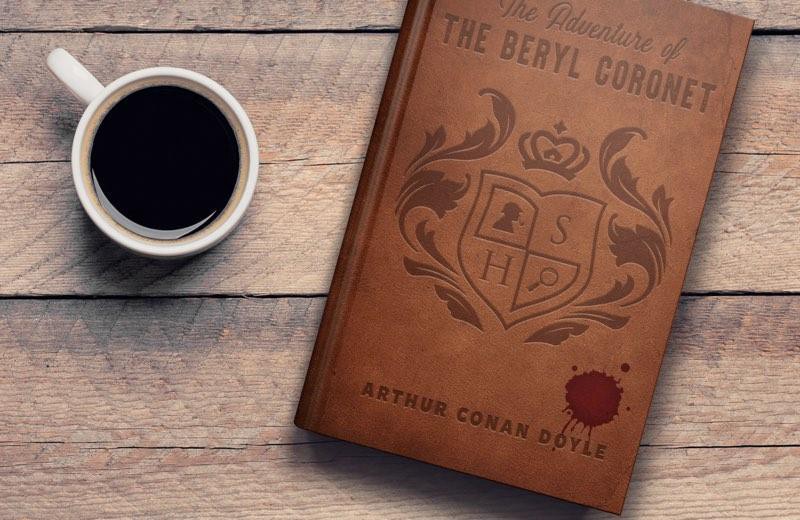
11. The Adventure of the Beryl Coronet

(Design: Heidi North / Reedsy)

Also known as…

“Dude, Where’s My Crown?”

What’s it about?

A banker takes a bejeweled crown home for safekeeping, and late one night, he discovers it in the clutches of his son, Arthur — with some priceless gems missing. Arthur refuses to speak, and nobody can figure out where the gems went (or how Arthur even got them off the crown). It’s up to Holmes to get to the bottom of the case.

The New Cover

“I design a lot of books for the gift market and wanted to give this story the same treatment,” said designer Heidi North, a former Art Director for Simon & Schuster whose portfolio includes covers for almost every major publisher.

“I have worked on some embossed “leatherette” covers with ribbon markers in the past. I wanted to keep a masculine feel for Sherlock Holmes with the leatherette look, but I added a sinister twist. I liked the dichotomy between the gift leatherette look and the sinister aspect.”

12. The Adventure of the Copper Beeches

(Design: Jessica Bell / Reedsy)

Also known as….

Jane Eerie

What’s it about?

If there’s a recurring theme in Arthur Conan Doyle’s work, it’s that if someone wants to pay you more than you’re worth, something’s up. Young Violet Hunter is considering a position as a governess in a country estate. She’s offered an incredible salary with a number of strings attached, including the condition that she cut her long hair short. When this turns out to be just the tip of a creepy iceberg at the Copper Beeches estate, she calls for Sherlock Holmes.

The New Cover

With a plot that’s closer to a Victorian ghost story than an average Sherlock Holmes mystery, “The Copper Beeches” inspired designer Jessica Bell to create a cover that tips its hat to modern psychological thrillers and women’s fiction. The photograph of the woman could represent one of two women in the story, a mystery that’s only accentuated by the covering of her eyes.


About the Author

Martin Cavannagh is a staff writer at Reedsy, a curated marketplace that connects authors and publishers with the world’s best editors, designers and marketers. Over 3,000 books have been produced via Reedsy since 2015.

12 Bars Where You Can Drink Your Way to Literary Greatness

What’s the secret to becoming a successful author? Ask 100 people and you’ll get 100 different suggestions; there’s a whole cottage industry devoted to craft advice. You should write a little every day! You should write only when you’re inspired! You should meditate! You should go on a retreat! But there’s one piece of writing advice that nearly everyone agrees on: It really helps if you’re a little drunk.

And what better place to get writing-drunk than in the footsteps (and barstool butt-prints) of some of the greatest authors in history? We’ve found a cool dozen bars around the world with top-shelf literary pedigrees. Put together an international bar-hopping spree and make your favorite writers—from Simone de Beauvoir to James Baldwin to Roberto Bolaño—into your drinking buddies.

Photo: Sean Davis

White Horse Tavern, New York City

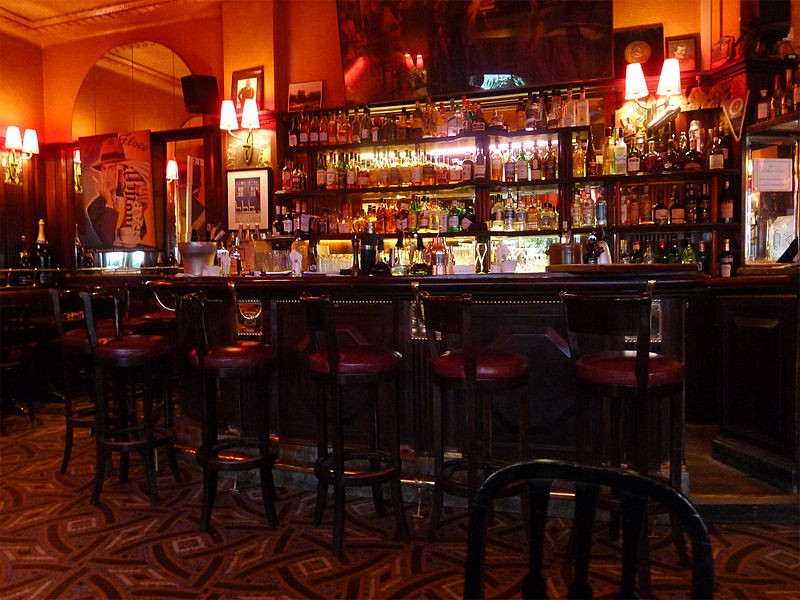
In a past life, the White Horse Tavern in New York City’s West Village was a hot spot for dock workers and longshoremen. Then, in the early 1950s, writers including Dylan Thomas began frequenting it and building up the locale’s reputation. Soon, James Baldwin, Norman Mailer, Hunter S. Thompson, and Jack Kerouac (who was turned away many a time) started turning up. These days not too many artists are skulking around the West Village or pulling up at the bar at White Horse, but in its day, it was among the most raucous, welcoming, beer-splattered centers of downtown intellectual life. And if you can get a window spot on a crisp fall day, it’s still pretty damn good.

Photo: Jazz Guy

The Algonquin Blue Bar, New York City

During the 1920s, the Algonquin Hotel played host to a group of authors, actors, journalists, and self-styled wits who dubbed themselves the “Algonquin Roundtable.” They met almost daily in the bar to engage in some lively literary discussions. Dorothy Parker, Heywood Broun, and The New Yorker magazine founder Harold Ross made appearances. Nowadays, the Algonquin welcomes literary lovers who don’t mind dropping close to $20 for a drink to (hopefully) absorb any creative greatness still lingering within the building.

Photo: Andrew Malone

El Quijote, New York City

There was a time — much romanticized now, possibly apocryphal — when art could be traded for rent at the Chelsea Hotel. Those were the days of Patti Smith, Robert Mapplethorpe, Janis Joplin, the Jefferson Airplane. It was a different New York, and a different Chelsea Hotel. Through it all, El Quijote has persisted. It’s more of a tapas scene now, but in it’s day, the bar and restaurant attached to the hotel lobby was a happening place and home to many a lively artistic debate.

The West End Bar closed and became a Cuban restaurant which also closed. (Photo: InSapphoWeTrust)

West End Bar, New York City

Are you surprised there are so many literary bars in New York City? The West End Bar was located in Morningside Heights, just a few blocks away from Columbia. A favorite among students and faculty, it soon became a popular meeting spot for the Beat Generation. Allen Ginsberg, Jack Kerouac, and Lucien Carr spent hours there discussing their studies and futures. It also featured prominently in the infamous incident that supposedly unified and haunted the Beats — the killing of David Kammerer.

Photo: Allie Caulfield

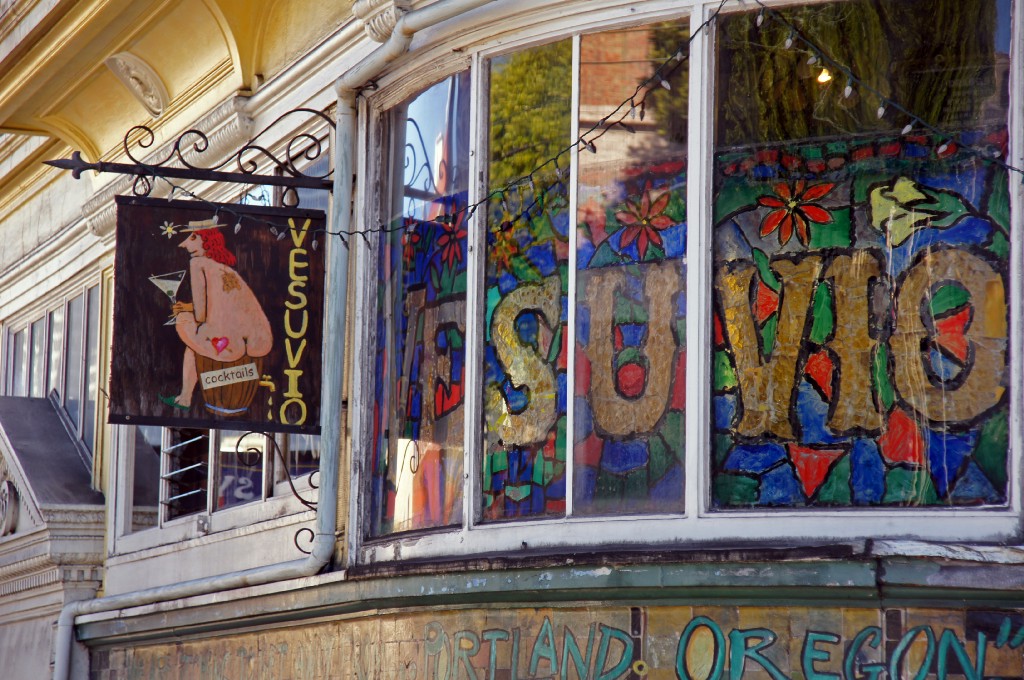
Spec’s, Vesuvio, and Tosca, San Francisco

The Beat Generation writers were also alive and well on the other side of the country, in San Francisco and drinking in three main watering holes: Spec’s, Vesuvio, and Tosca. Vesuvio was the haunt of the Beats: Ginsberg, Kerouac, and Neal Cassady. Spec’s also has a fair share of literary history; the city’s poet laureate Jack Hirschman met there every Wednesday evening with fellow poets.

Photo: Mbzt

La Closerie des Lilas, Paris

This cafe/restaurant/bar is famed for being the spot where literary giants wrote, drank, and hung out with each other. Ernest Hemingway was a regular here in the 1920s and even gives the establishment a warm salute in his memoir, A Moveable Feast. Situated between Latin Quarter and Montparnasse, a secluded-enough place that explains why writers preferred to hole away there.

Photo: Lienyuan Lee

Les Deux Magots, Paris

This famous cafe has garnered a reputation for being the assembly place of Paris’ intellectual elite. Common patrons of the establishment were Surrealist artists, Simone de Beauvoir, Jean-Paul Sartre, Ernest Hemingway, and a fair share of visiting American writers. It’s literary fame was so powerful that a prize was named after the cafe; the Deux Magots literary prize has been awarded to a French novel annually since 1933.

Photo: manray3

The Eagle and Child, Oxford

The Eagle and Child (nicknamed The Bird and Baby) has some pretty impressive literary associations. Namely, it is often linked to the Inklings writers group, which included the dynamic duo that is J.R.R. Tolkien and C.S. Lewis. Starting in 1933, the Inklings met on Thursday evenings in Lewis’s college rooms to read and discuss manuscripts and materials. While the formal get-togethers ended in 1949, the writers’ group continued to hang out at the pub.

Photo: Graham Stanley

Cafe La Poesia, Buenos Aires

Cafe La Poesia in Buenos Aires continues to pay homage to the literary giants that graced the venue with their presence. It was founded in 1982 by journalist and poet Rubén Derlis and thereafter became a place for artists and thinkers of San Telmo to get together, discuss, and create. After being closed in 1988 and the businesses occupying it later having failed, Cafe La Poesia opened again on 2008, fully recognizing its important history.

Photo: Google Maps

Cafe La Habana, Mexico City

This renowned Mexican cafe has hosted a number of history’s most important figures, such as el Ché and Fidel Castro. It was also the meeting place for Chilean novelist Roberto Bolaño and the poetic infrarrealismo movement. In his famous novel The Savage Detectives, Cafe La Habana is disguised under the name Cafe Quito.

Photo: Google Maps

Est!, Tokyo

This veteran in the Tokyo bar scene has been active for over 80 years. Est! has served a number of fine literary figures such as Yukio Mishima.

Photo: Jessica Spengler

McDaid’s, Dublin

Dublin is a literary city and a drinking city. So it’s not surprising that a number of watering holes have laid claim to writers and books they have influenced. Among the people who have quenched their thirsts at McDaids’s are Brendan Behan, Paddy Kavanagh, J.P. Donleavy and Liam O’Flaherty. A number of portraits hang on the wall in commemoration of the bar’s impressive clientele.

Jennifer Egan Brings Us To a Forgotten New York

Aging rock musicians, New York fashion models, teenage backpackers. Italy, Illinois, an African safari. The breadth of Jennifer Egan’s narrative scope has been extraordinary — and extraordinarily successful, garnering a Pulitzer Prize, National Book Critics Circle Award, and Guggenheim Fellowship, among others. So no one should be surprised that her latest novel, Manhattan Beach, takes yet another different form from her previous books, this time historical fiction.

When we met for coffee in her neighborhood of Fort Greene, Brooklyn, Egan told me she was aware that her readers might be surprised, and not always happily so, at how different Manhattan Beach is from her last novel, the modern and experimental A Visit From The Goon Squad. Writing “straightforward” historical fiction wasn’t the plan, she said, but Egan doesn’t do things by halves, and Manhattan Beach embraces its form, fully immersing readers in the noirish world of New York City during World War II. At the center of the book is Anna Kerrigan, a young woman who is determined to become one of the sole female divers working at the Brooklyn Navy Yard. Anna is still haunted by her father’s sudden disappearance years earlier, so when she has a chance encounter at nightclub with a man who has clues to what happened, she’s determined to discover the truth about her father and the life he lived.

I had the pleasure of speaking to Egan about switching genres, why she’ll stick with a project, and doing extensive period research on everything from 1940s dive manuals to the strange lives of New York City’s piers.

Carrie Mullins: I took the B train to get here, and as we crossed over the East River from Manhattan I was thinking about how we’re not actually that far from the Brooklyn Navy Yard. But before reading Manhattan Beach, I wasn’t aware that it was there, or of its role in World War II.

Jennifer Egan: I know, most people aren’t. I wasn’t!

CM: How did you become interested in it?

JE: I think it started when 9/11 happened. It seemed like such an important step in the life of New York and the story of American power that I found myself starting to think about the beginning of America as a global superpower, and that led me naturally to World War Two. And I was thinking a lot about how it would have felt to be in New York at that time. I started looking at a lot of pictures, and this was really ages ago, I mean I had a one-year-old and a three-year-old and now they’re both taller than I am, so this was like 2004/5. I started looking at a lot of images of New York City during the war, and what was so striking again and again was the omnipresence of water. It was all about the water, and that’s just not true anymore; well I guess it’s a little more true now than it was when I first got to New York because the waterfront has been revived so beautifully. When I got to New York in the late ‘80s, it was a weird period where the waterfront revival hadn’t happened but there wasn’t really any commerce on the water in Manhattan. I used to live on West 28th Street and run along the west side and see all these rotting piles and piers.

CM: Oh yeah, they were totally decrepit. I grew up in the West Village, a few blocks from what’s now the incredible West Side Highway bike path, but at the time it was just trucks and drug dealers and prostitutes.

JE: Right! The piers have had all these sorts of strange lives, and that was interesting to me. And when I started researching, I immediately stumbled upon the Navy Yard, which was the epicenter. Then I thought yeah, that’s still there, so I had someone who was helping me research, and he set up a tour with their archivist. They had just hired her, she was from Pratt, and she was so great and took me around and showed me all this stuff. I was pop-eyed because it was so cool and I’d never had the slightest inkling that it was there. I was shocked by how enormous it was — it feels gigantic.

CM: You get that sense in the book, which kept striking me because I’d never even heard of it.

JE: It’s really big but it feels kind of hidden. It still is; it’s an industrial park but it’s somewhat invisible from the outside. So that’s sort of how it progressed: war, waterfront, Navy Yard.

Spies Like Us: A Conversation With James Hannaham and Jennifer Egan

CM: Did you know when you started researching that you wanted to do a work of historical fiction?

JE: I sort of did, though I didn’t think it would be as simple as ‘we are in the past.’ I thought there would be a little more dynamism to the movement between past and present. I had done a lot of that in Goon Squad, and I thought that’s kind of fun and supposedly I’m good at that (laughs), but I tried and it did not work in this context at all. I have a writing group I meet with, and they were so irritated with me. It was just not appealing whenever I tried to move around in time, so I just kind of let all that go. I don’t think of it as quite as straightforward as I think it’s interpreted as being, but that’s OK. It’s so clear to me that we’re in the present reading about the past, and that awareness is on my mind all the time. But when I tried to wink openly at the reader about that and threaten that illusion, they found that aggravating, so I stopped doing that. But you know there is a lot of stylization — I’m thinking a lot about movies, all of that is intentional, part of a way of having a little fun with the fact that we’re reading and writing this now.

CM: Was it a challenge to get all the historical details right? The cars, the venues, the outfits…

JE: I mean that stuff is pretty easy honestly, because of Google.

CM: My big fear is that I’m going to write something based off of Google and it’s going to be totally wrong.

JE: [Laughs] Well the hard part was the mindset. What are the people remembering? What are their pasts, their parent’s pasts? I didn’t have to research just World War Two but the Depression, and then back, and back, I was going all the way to the Gilded Age. The amount I felt I needed to know to start inventing turned out to be a lot greater than I thought.

The amount I felt I needed to know to start inventing turned out to be a lot greater than I thought.

CM: I know you did some interviews with people who lived through that era. Were those helpful in that regard?

JE: Yeah, I did a lot, and that was the best part, being able to speak with some remarkable people towards the end of their lives.

CM: What was the most surprising thing you learned from those interviews?

JE: That’s a great question. For the women who worked at the Navy Yard, it was striking how vivid that time still was for them. It felt like they’d had an experience that hadn’t been replicated since, which was very moving in a way. And a lot of them would say, oh no, no men ever whistled at us, they were such gentlemen — but I found myself a little skeptical. I think because we were creating an actual oral history, a historical record, and they would be part of an archive at the Navy Yard, I think they were guarded and very careful about the down and dirty of it all, which was frustrating. There was one woman who kept alluding to some incident that had occurred at a New Year’s Eve party but no matter what angle I came at it from, I couldn’t get it out of her. I think that guardedness is also left over from that time, this worry about saying something out of turn or seeming to complain. They felt very grateful a lot of them, to have had that opportunity.

CM: Is your approach to writing a project like this, where you’ve done a lot of historical research, different to something like say Goon Squad, that’s set in the present?

JE: Not really no, I pretty much did it the same way. It’s harder to do it when you need a lot of research because I don’t really start with a story or characters, I focus on a time and a place. I do what I guess some people would call automatic writing out of that, and try to write 5–7 pages a day. I just want to see what comes up. In a way, Goon Squad was the best suited book to my method that I’ve written, and maybe that’s why it was the easiest book I’ve written. I haven’t actually thought of that as a reason until just this second, but I think that’s really true because the fact that I wrote it in small pieces means that I didn’t end up with the hundreds of pages of handwritten material which I normally do, so it felt more manageable all the way through. And I guess the fact that all my books are so different from each other made it extra fun to make every part of that book different.

I would say this book is the worst suited to my methodology and the reason is that because when I don’t know what the story is and I don’t know what the characters are, it’s very difficult for me to research ahead of time. I mean I did some — I had a vague sense of the milieu but I didn’t know what I needed to know, so there was this weird sense of trying to build a bridge as you’re trying to walk across the bridge. It felt so hopeless in moments, so what I did was to do some slapdash research in the moment just to be able to go forward. I would do some research, and then I’d hack my way through something, but then at the end of the day I had twenty-seven legal pads of terrible writing that was poorly researched and I had to deal with that. It was a year and half of work. I had to type it up, which is always hard, and then read it, and then I thought so seriously about quitting.

Support Electric Lit: Become a Member!

CM: Why did you stick with it?

JE: Two reasons. One is that there was nothing else I really wanted to do, which in a way sounds passive but it’s important — if there is nothing else pressing on me then it means I haven’t resolved the thing I was doing. And then in a way the bigger motivator is that the research itself still felt incredibly enthralling. That was such a pleasure. I thought, why am I so excited to be reading a 1943 diving manual?

CM: I often have this anxiety about what I call the authenticity police, the idea that people want to see some kind of personal connection between the author and their work even though, at the end of the day, it’s fiction and by definition it’s all made up. Did you feel that at all, writing about a topic that you didn’t experience first hand?

JE: Going on the Liberty Ship in San Francisco was essential. I don’t know what I would have done if I couldn’t visit. I’ve been there repeatedly, and I went on a little cruise on it. I went to the National Archives, which are down at the old Custom House in Manhattan and it’s a pretty amazing building. I’d never been in there. But the nightclubs, the restaurants — a lot of it is movies and descriptions in fiction and frankly, in my prior life, a certain knowledge of nightclubs of my own. So I worked all that together and extrapolated.

There was a long time when I felt really stiff, I felt a little stymied. I think the challenge is to know enough that you feel comfortable. Even though this has been vetted very thoroughly, I’m sure people will still catch mistakes. And it’s like, really, who cares? I finally reached a point where I felt confident, but that took a long time.

CM: Some writers also seem to get more penalized than others for writing outside experiences that they’ve lived themselves.

JE: I’m lucky, I don’t feel like I’ve been penalized for that. On the whole, I’ve been pretty much welcomed into these other realms, so I guess it is possible. When I was working on Look at Me, I was afraid that I was overstepping my boundries in some way, that I was going too far, whatever that means, but no one had ever said that to me. I think one of the most dangerous things about prejudice of any kind is how it’s internalized and becomes a type of self-censorship. The work is potentially not even getting made.

I think one of the most dangerous things about prejudice of any kind is how it’s internalized and becomes a type of self-censorship. The work is potentially not even getting made.

CM: So many characters in the book read mystery novels — Chandler, Ellery Queen — and there are noirish aspects to the plot. Have you ever thought about writing a straight-up mystery?

JE: I would love to, but it’s so hard to do it well. Often unveiling the murderer requires so much feinting and darting that it’s hard to have real psychology. It’s a genre I think a lot about, and if I could find a way to do it well, I’d love to.

CM: Well I love that you’re writing across the bookshelf so to speak. A lot of fiction writers get hemmed in. The publisher says, this is the book that did well, let’s see five more like that.

JE: No publisher has ever said that to me, thank God, but I have moved publishers and I think that’s partly because a publisher buys one book and that’s what they like. There is no way I could find a world and stay in it, it’s just not going to happen. But I think it’s a challenge for readers, too, and I’ve been really grateful for the ones who have stuck with me. I lose some every time and I know this one will be no exception. It actually might be worse this time because a large audience found Goon Squad and I guess there could be a book that’s less like that one than this one is, but you’d have to think hard to find one, they have no overlap whatsoever. And before that I’d written a kind of gothic thriller which led me into the world of gothic fiction lovers, which is a big, vital, fun world to be in and they really embraced the book and I think Goon Squad was not really what they were hoping for.

CM: Yeah, I think you’re starting to see a little more flexibility in terms of authors writing across genres, but generally people see an author’s name and just want an iteration of the same experience they had the last time.

JE: I do sympathize, and I can’t blame anyone for saying this just isn’t my cup of tea. And it’s hard for authors — we live in a culture that really values branding and there is a legitimate pressure, that’s what social media is in a way. We all need to make a living. But for me, the fun of it is to do things I’ve never done before, and if I couldn’t do that, then I’d have to find something else to do.

How Big of a Deal is Wikipedia Plagiarism? That May Depend on Who You Are

Did prominent poet and editor Jill Bialosky break the first rule of Writing 101, the one that every college student learns in freshman year? That’s the claim literary critic William Logan is making about Bialosky’s memoir, Poetry Will Save Your Life. In The Tourniquet Review on October 4th, Logan accused Bialosky of plagiarizing “numerous passages from Wikipedia and the websites of the Academy of American Poets and the Poetry Foundation.” (Bialosky, and a group of 72 prominent authors who cosigned a letter of defense to The New York Times, disagree — or rather, they don’t disagree, but they don’t think it’s such a big deal.)

Here is a comparison of a passage about poet Robert Lowell that Logan references in his review:

Bialosky: “Although Lowell’s manic depression was a great burden for him and his family, the exploration of mental illness in his verse led to some of his most important poetry, particularly as it manifested itself in Life Studies. When he was fifty, Lowell began taking lithium to treat his mental illness.”

Wikipedia: “Although Lowell’s manic depression was often a great burden (for himself and his family), the subject of that mental illness led to some of his most important poetry, particularly as it manifested itself in his book Life Studies. When he was fifty, Lowell began taking lithium to treat his mental illness.”

Bialosky responded to the allegations saying: “William Logan has extracted a few ancillary and limited phrases from my 222-page memoir that inadvertently include fragments of prior common biographical sources and tropes after a multiyear writing process. This should not distract from the thesis of this book, which derives from my own life, my experiences and observations.”

To be clear, the “fragments” are chunks of almost word-for-word paragraphs, and the “common biographical sources” include Wikipedia, a source of information that every freshman student is taught not to use. Even the founder of Wikipedia, Jimmy Wales, has urged that Wikipedia should not be cited for academic purposes.

The 5 Weirdest Lawsuits About Authors Stealing Ideas

Copying and pasting off Wikipedia is a rookie mistake, and perhaps a forgivable one if you’re a college student or even an entry-level blogger. But Bialosky is the vice president and executive editor at W. W. Norton, a publisher of literary anthologies widely used in universities. That’s right: Instead of citing, say, The Norton Anthology of English Literature for biographical information, a Norton editor, writing a serious memoir, chose to copy and paste from a open-source website without using any attributions. It is baffling.

The only plausible explanations that we have for this are:

  1. Norton does not give its editors free copies of its lauded anthologies, and at a steep $61.42, they were too expensive for Bialosky, who had to rely on free web sources she was then too ashamed to cite.
  2. An overworked assistant or some poor hapless intern tasked with researching the poets’ biographies decided that they weren’t paid enough to ghostwrite parts of someone else’s memoir so copy and pasted instead. (Or a slightly more diligent hapless intern meant to un-Wikipedia the quotes eventually, but got distracted with ordering her boss’s lunch.)
  3. Bialosky herself took notes from Wikipedia and then later forgot they were verbatim, which raises the question of why a prominent editor was using Wikipedia as a primary source.
  4. Bialosky took notes from actual primary sources and later forgot they were verbatim, and the Wikipedia writer did the same thing.

Plagiarism claims are a common plague in the publishing industry. In 2002, author and historian Doris Kearns Goodwin resigned as a Pulitzer prize judge after allegations surfaced that many passages in The Fitzgeralds and the Kennedys were lifted almost verbatim from other writers’ works. Goodwin made a financial settlement with Lynne McTaggart, the author of a biography of Kathleen Kennedy from which she copied up to 50 passages, after McTaggart threatened to sue her for copyright infringement. Like Bialosky, Goodwin insisted that the instances of plagiarism in The Fitzgeralds and the Kennedys were inadvertent; she blamed a research assistant with sloppy handwriting for the “mistakes.”

Some notable voices think Bialosky should take her licks like Goodwin; others are appalled by the very idea that using the same words to describe something qualifies as “plagiarism.” Here are some reactions from the literary world, ranging from calling Logan sexist to calling Bialosky a sociopath:

The common refrain used by Bialosky and her supporters in defending her alleged plagiarism is that using “straight biographical information” is not plagiarism, and failing to use quotations and citations is “a common error.” A common error that, as Talya Zax at Forward points out, could devastate the career of a writer less established than Bialosky: “A student can fail or be kicked out of a class, and in some cases expelled, for plagiarizing in exactly that manner. I’m a writer at the start of my career; in an unofficial survey, my editors said that if they were shown evidence I’d plagiarized to a similar extent they would likely fire me.”

A group of 72 writers and self-described “friends of literature,” including authors like Jennifer Egan and Claire Messud, wrote a letter to the Times scolding it for publishing William Logan’s allegations and “giving a large platform to a small offense.” The gist: How could The New York Times “taint the reputation” of an “accomplished editor, poet and memoirist” and “substantial contributor to American letters”? The “friends of literature” — many of whom, not for nothing, are friends and colleagues of Bialosky — note that her theft was not “egregious” or “intentionally performed,” and that it would be corrected in future editions. They do not make the claim that it didn’t occur.

Repeating dry facts verbatim from Wikipedia is indeed a pretty common, non-egregious error — an easy mistake to make. An embarrassing mistake, even. Should Bialosky be shunned, ruined, or punished? Probably not. (Doris Kearns Goodwin, we’d note, is still a prominent public intellectual.) But should she be embarrassed? Probably yeah! And the graceful response to embarrassment is saying “gosh, I’m so embarrassed”—not rallying famous writers to your defense. (We appreciate her not throwing that theoretical-but-probably-real intern under the bus, though at this point everyone knows that people who grew up with the internet research by copying and pasting into a document and then paraphrasing later. Whether better methods should be taught is a matter for another story.) There’s a whiff of “do you know who I am” about this response, and all we can think is: yes, you’re a talented and respected woman of letters. Perhaps we should hold prominent editors to a higher standard, not a lower one.

—By Jo Lou, with Jess Zimmerman

On Poverty, Sports, and Violent Men

Last month, word started coming across the border from Canada of a new book from an author named Kevin Hardcastle. It’s called In the Cage (Biblioasis), and the most common point of comparison has been Cormac McCarthy, a claim we might have been inclined to discount if it weren’t coming from Donald Ray Pollock, a favorite around here and a man who knows a thing or two about Cormac McCarthy. The Globe and Mail described the novel, about “a retired cage fighter fallen on hard times, trying to support his family in Ontario’s Simcoe County” as “noirish,” “folkoric,” and “a fierce, beautiful book.” As it turns out, another of Hardcastle’s admirers is John Irving, who reached out about interviewing Hardcastle for Electric Literature.

Now, incisive, hardscrabble novels about fighters fallen from grace and turned to crime just so happen to fall in our wheelhouse, but even if that weren’t the case we’re not in the habit of turning down pitches from John Irving. So, please, read and enjoy Irving and Hardcastle’s conversation. They discussed rural poverty, combat sports, and refusing to write “utterly shitty characters.”


John Irving: People make — or, out of their circumstances, are forced to make — dire decisions in your novel, In the Cage. This is also true of many of the stories collected in Debris. Does this come from your sympathy for, and understanding of, the rural poor? Or is this partly an inclination in your imagination — one that draws you to the drama of dire decisions? Maybe both?

Kevin Hardcastle: The drive behind almost all of my work is to write poor people, and the rural poor, with empathy and understanding. And to not romanticize or write their situations as a tool for reflection or comparison. I grew up working class, and we were pretty damn poor at times, and I saw the damage it does to people. I was lucky enough to have a close, supportive family, who did the best with what they had, and that gave me a shot at writing these stories even though my chances of getting to publish books were never going to be very good, realistically, coming from my socioeconomic background, and from a small town where there are very few examples of artists who have ever made a living at their trade.

After making it this far, there is a wealth of material and an organic connection to the characters I write that helps keep the stories grounded without them becoming some kind of lesson, or too miserable, and without letting the people become caricatures. I hope, at least. I think the tightness of my family, despite hardship and tragedy, has taught me not to feel shame over being poor, or rural poor. I detest poverty as a condition and the factors that force it to be a way of life for so many. That is probably why I write criminals sympathetically. Most of those characters I write are good people, under intense pressure, who do what they’ve got to do to stay alive, or protect their families.

On a simpler level, I care most about writing where something is at stake. A small event or trick of chance that would be a nuisance to the rich can destroy the life of a poor person. I always think on that while I write. As a result, some of the most traumatic and painful parts of this narrative may hit close to home for many readers.

When you write the poor honestly, something is always at stake.

JI: Similarly, heartbreaking endings come naturally to you. You’re clearly drawn to them; you’re good at them. How much of this is based on what you’ve seen? How much on what you’ve read — meaning, what you most like to read? And again — the “imagination” word — how much is this what you instinctually imagine? Maybe all three?

KH: Well, I appreciate that very much, and I do put a lot of work into the endings. I have had a good deal of personal experience with elements in my fiction that fate the characters to potentially heartbreaking ends. I know poverty and mental illness and addiction and violence quite well.

That being said. I’ve been exposed to some bad things, but lots of that is a toe in the water compared to what others have gone through, and have sometimes survived. I still root many of the direst fictional events and situations in reality, but I use experience to extrapolate how much worse it could actually be, and where that’ll lead a person. I try to humanize hard actions and articulate how a person might get to a place where they push all of their chips into the middle. I’m not interested in explaining it all away, but I want it to be understood, and for readers to feel the weight of those decisions and what they ultimately lead to.

Watch Chuck Palahniuk Read Fight Club 4 Kids

JI: Violence is common in your literary world, where violence is also vividly described. I’m thinking of that boxed maxim to the left of the masthead to The New York Times: ALL THE NEWS THAT’S FIT TO PRINT. I’ve often thought of good fiction as the news that is necessary to hear, despite it’s not being “fit” to print. Not only the Times, but many newspapers, would tell us that someone uttered “a homosexual slur.” That’s not good enough (or bad enough) for good fiction; we have to hear the actual words. There is an awfulness to the violence in your fiction, but how else should violence be described? Everyone today asks where fiction “comes from”; related to my first two question, tell me about the violence. I’m guessing it’s true to what you’ve seen; I’m also guessing that you hate it, but you seem drawn to depict it truthfully. Increasingly, today, isn’t violence — in one form or another — what we most fear? Tell us about the violence in your writing, and in the world.

KH: It is important to speak plainly about violence and to write it plainly. This is something I believe deeply. As you suggest, good fiction tries to look straight down the maw of ugly or difficult matters — but without trying to be exploitative or too fantastical, or, as with writing poverty, without romanticizing what violence tends to be. If we engage with violence as it is, we can also start to see all the disparate components involved, whether in intent or magnitude. All violence is not the same, and all violence does not come from the same place. Writers tend to do better with sex as they depict it, and seem more comfortable doing that. But they lousy up writing about violence often. I think I do the latter far better, but that might just make me the weirdo here.

To apply all this to In the Cage, I had to write all those different kinds of violence with some authenticity. If you write violence incorrectly, or fudge it to make it easier to digest, you lose any lasting effect on your reader, and your work will not hold any goddamn water at all when somebody who understands that violence firsthand takes a look at it. There was a lot of conversation in the editing about how likely it is for a sawed-off shotgun to blow an arm off (something I’d suspect you have researched). Or about how your eyeball often sinks lower in your face when you have a broken orbital (something I knew from having a doctor examine a maxillary fracture in my face from sparring). Even for a regular reader though, who has never (luckily) experienced violence of this magnitude, it is much the same as lines or paragraphs where the writer is trying to tell us something meaningful without fully focusing on it. If you fake that, and don’t feel it yourself, in your bones, nobody else will.

Further, you can write violence in an overblown, bad action movie kind of way. Nobody flies across a room. Nobody’s fist explodes on someone’s face. That is ridiculous. If you are writing violence fantastically, to make a point about something else, I understand that approach. But, if you are trying to speak honestly about it, and write honestly about it, you have to understand what every single word means and where it should go.

Where it becomes especially important in my book is where “violence” as an aggressive, sudden, brutal act, in the depicted shootings and stabbings and murders, must be distinguished from the so-called “violence” of the Mixed Martial Arts fights. There is violence there, but this is where the general public, and many other sports fans, miss the point of what MMA is. I do not think that MMA is “violence,” as it stands. Violent and dangerous physical activities happen in the cage, but it is an athletic contest of skill, and technique, and heart, and mental fortitude that I do not think has an equal. To the average person, even a boxing or football fan, the damage from kicks and knees and elbows, the grappling, the blood, might appear more rude and brutal. But they are far less dangerous than twelve rounds of boxing or linesmen smashing each other over and over for the duration of a game. If you wouldn’t call football “violence,” you shouldn’t be calling combat sports violence. That’s important.

As we’ve discussed before, in an interview I did with you when Avenue of Mysteries came out, the monotony of the training in a combat sport, the workmanlike approach of it would bewilder people. Sure, there is room for nervousness, and fear, and fury, but they have to have been channeled and controlled for you to be successful. You can certainly apply a workmanlike approach to killing or hurting people, but much of that level of physical violence happens from losing to some of those impulses. That kind of violence also happens with more chance involved, a level of randomness not under the control of anyone. In most cases of real gunplay or fights in the street, the man or woman who should win does not always, and they will rarely come out of it unscathed. They are subject to chance in a way that athletes in the cage are not.

There is a reason I wrote Daniel as a truly exceptional fighter and a real problem to deal with. To make him formidable, sure, but also to show even a man that hard can never be fully prepared for violence at its worst. He can even be robbed of victory within the cage, within the rules, but that is a safer space than the outside world is for him, by far.
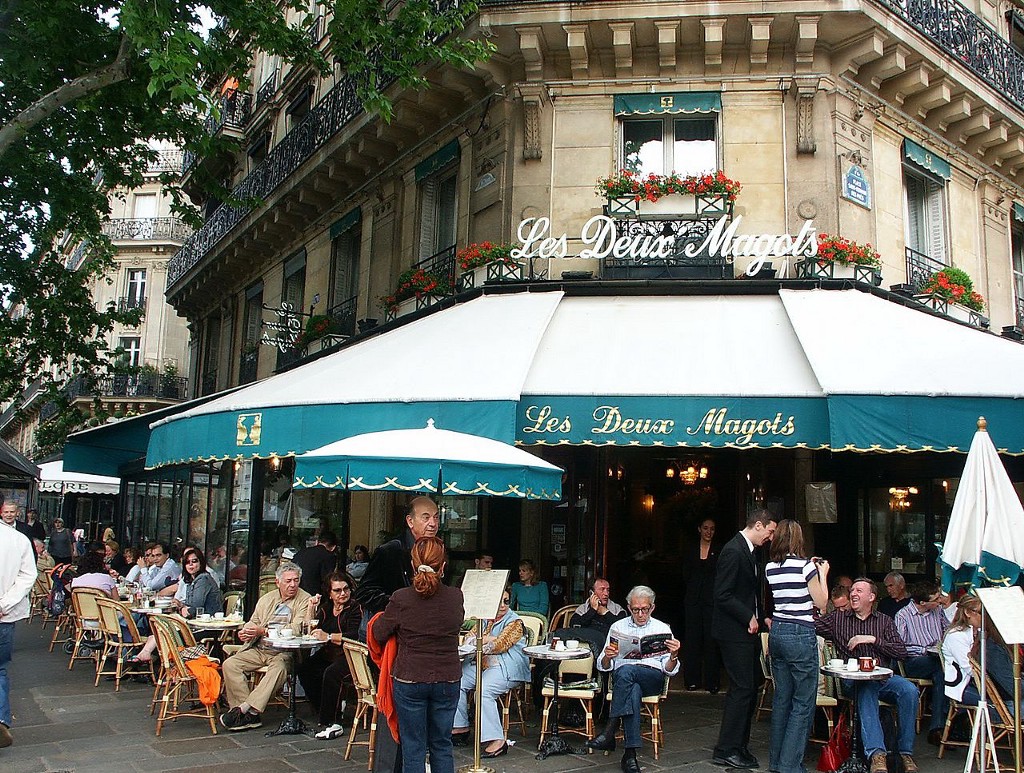
A small event or trick of chance that would be a nuisance to the rich can destroy the life of a poor person. I always think on that while I write.

JI: The sure-handed craftsmanship in the Debris collection of stories is very present in In the Cage, but the novel gathers a momentum that no short story can achieve. Similarly, a novel allows you to develop characters in a way no short story can equal. In the case of In the Cage, I don’t mean only Daniel and Sarah, though they are complex and heartfelt characters. I mean the bad guys, too. Wallace, Clayton, Tarbell — they’re truly terrifying. Tell me about your transition from writing short stories to expanding in a novel. Was it natural? Was it hard?

KH: This all happened sort of backwards for me, because I’d actually written a much crappier version of this novel six or seven years ago. I rewrote it before my then-agent tried to sell it and nobody would buy the thing. It certainly had its flaws but there was a good book in there for an editor willing to really dig in. Unfortunately, nobody was willing to take a chance on it at that stage in my career.

So, in the meantime I kept writing stories and getting them published, and that led to Debris, and to my publisher Biblioasis and editor John Metcalf. As the stories were mostly published in journals, and we didn’t have a ton of work to do, John asked for the novel nobody would bite on, and told me he saw something in there and would take a crack at it. That’s how I got one of the most important and influential editors in Canada.

I have heard a few excellent novelists, like yourself, or Cormac McCarthy, talk about the novel as the most impactful and lasting form of fiction writing, but I still believe in the short story as an unforgiving, bare bones, naked-as-the-day-you-were-born type of writing that demands so much skill and precision. My main goal here, in retrofitting the novel with the tools I’d sharpened writing stories, was to make sure the prose got up to that level throughout, and that I held the same kind of focus on the purpose and weight of the narrative, and the characters, from the first word to the last. It wasn’t easy to keep rebuilding this book, strengthening and defining the characters more clearly draft after draft, but the closer I got the more I felt like I’d finally written the book I wanted to write.

Author Kevin Hardcastle

JI: An aura of foreboding accompanies Daniel in In the Cage. You do foreboding well — the criminal associates in Daniel’s past, the low-lifes who overhang and cloud his future. “In the dark and pisswet alleyway” — how Chapter Two begins — does not bode well. “I’ve about had it with this shit,” Daniel says, only halfway through the second chapter. Near the end of Chapter Three, there’s another ominous omen — Daniel sees something, or he imagines he does. “A shape there. A second later it was gone and he didn’t know if it was an animal or just a trick of the brain.” No doubt there’s trouble coming. Where did you learn this — from what or from whom? It takes practice to get foreboding right.

KH: I think that is where my interest in writing horror fiction comes into play, and because I have always gravitated toward atmosphere and tone. I started reading your friend Stephen King when I was ten years old (thanks mom), and, while I didn’t understand all of the nuance and literary work, I understood the underlying tension in the characters’ lives. And I probably internalized, even as a young person, lessons on how to write real people, especially working class people — which King is not given enough credit for by even the most self-serious “literary” writers — and then to have the worst happen to them.

This is something you do as well, in that I’ve heard you answer questions about autobiographical writing by saying you write what you most fear happening to those you love, not what has actually happened. I do both, but I agree with that approach of building characters we empathize with and can see as real, then have all kinds of horrible shit happen to them, laying it out as stark and ugly as it needs to be.

The trick is not to telegraph entirely, but I don’t mind a little bit of fatalism, and the idea of the reader knowing that the axe is going to fall at some point — but not knowing when or how hard or exactly to whom. My favourite authors are those who can cultivate an atmosphere where fate looms heavy, but there is still some mystery as the characters move toward their end. Books like Death Comes for the Archbishop by Willa Cather, or the work of my favourite Canadian author, Alistair MacLeod, build such a powerful sense of mystery in the way characters experience the natural world. Cormac McCarthy spoiled my horror aspirations forever when I read him, because I realized nothing could be more frightening than the way he wrote almost-historical fiction, and the natural world, and the underlying terrors people suffer or provide.

It’s always been my aim to write stories where you know that there are only a few ways the narrative can end, few of them happy, but you will still follow the characters and root for them as they fight. The more serious and effective that sense of foreboding is, the more the reader will dig in.

JI: Your sympathy, extended to minor characters — even toward thugs who misbehave — is everywhere apparent. Daniel’s fellow worker, LeBlanc, has been laid off, too. They go out for a beer together. But LeBlanc presses Daniel to connect him with the criminals LeBlanc knows Daniel knows. When Daniel refuses, they have an ugly fight in the men’s room; Daniel takes the beaten LeBlanc home. Daniel’s unexpected sympathy for LeBlanc ends Chapter Ten — when Daniel realizes that LeBlanc’s “old lady” has left him, and the defeated man lives alone. Tell me about the origins of this sympathy.

KH: I think I cheat a bit by rarely writing utterly shitty characters. Instead, I write a lot of good people who are compelled to do bad things. In this novel, that includes some of the thugs and criminals that have been shaped by their injuries and trauma, the circumstances of their lives and the trappings of the region that made them. If I’ve done my job and genuinely empathize with them, the reader might too. I do my best not to be precious about where their decisions lead them. I love many characters I write, even the minor ones, but I don’t hesitate to harm or kill them when their number is up.

Support Electric Lit: Become a Member!

JI: I like what’s imaginative in your fiction, but I also like what’s realistic — what’s authentic. I believe those two elements, in the same story, are essential. You’ve done a little fighting — a little training to fight. I did, too. I competed as a wrestler for twenty years; I coached wrestling (I trained younger wrestlers) until I was forty-seven. You’ve trained for MMA. I recognize Jung Woo, the Jiu-Jitsu guy; I’ve rolled around with guys like him. And when Daniel loses a fight because of a bad ref — a bad call — he doesn’t try to justify himself. “I lost,” he says. Right or wrong call, that’s the truth; a bad call still means you lost. It’s a tough balance — between stretching your imagination and staying authentic. Daniel’s situation becomes growingly horrendous, but you keep it real. Tell me about that process.

KH: My training was mostly in Muay Thai, and some boxing, but I actually never trained full-out in MMA, and had no grappling until this year. When I was a younger, dumber man, I also got into some trouble in the street that I drew upon heavily in earlier writing about violence, but that was more of a visceral, very emotional type of experience. The actual technical understanding of fighting and how to write it didn’t come until I had proper training in Muay Thai.

There’s a reason for the great tradition of boxing literature and journalism by literary writers. Fighters and fight gyms are fascinating and full with human drama. There are no lies told in the cage, or in the ring, or on the mats, and there is something profound to that. If you spend enough time training, you identify the traits that make fighters who they are, and that shows you how they are built of different materials. I was never good enough to fight, but I trained hard, and I understood enough to know what separated people like me from true fighters. And I saw it enough to articulate it in writing.

When I wrote the fight and training scenes, I didn’t want to dumb down or over explain. I used common language from the sport, and I made an effort not to write in some hyper-interested academic way, or as an investigation of psychologies. Again, characters who fight are not literary tools or curiosities. In the fight, as you know well, there are thousands of hours of ingredients that go into one successful technique, or an exchange between combatants. A fighter will not be dwelling on that in the thick of it. Things happen fast and much of it is imperceptible to a spectator, but everything has a history and a reason and anything mystical in that cage is simply a result of repetition and training and drilling and sparring. The best man doesn’t always win and all of that training and work can be scuttled by a broken shinbone or a headbutt or an eye gouge, a bad ref, a blown call. The power of all of that is that there is no way to make it unhappen. There is a permanence and finality to the events that take place in combat sports that has a weight heavier than any other sport. You will have always been knocked out by that man or woman. It will always be that, if they sunk the choke in, and you did not tap or have the ref to pull them clear, they could’ve killed you.

But again, I don’t know everything, and I didn’t fight. So that is where I lean on my knowledge of MMA and what I’ve heard from true fighters who have been down in that deep water. For very practical reasons, I made Daniel a Muay Thai and striking specialist with decent grappling that is more defensive than anything. That was to play to what I knew best in my actual experience. I knew enough to let my imagination take the wheel when I was out of my depth. I think that base of knowledge, and being immersed in this world, really grounded the work and made it interesting enough to engage readers who don’t have a natural draw toward combat sports. Even for those who dismiss those sports entirely.
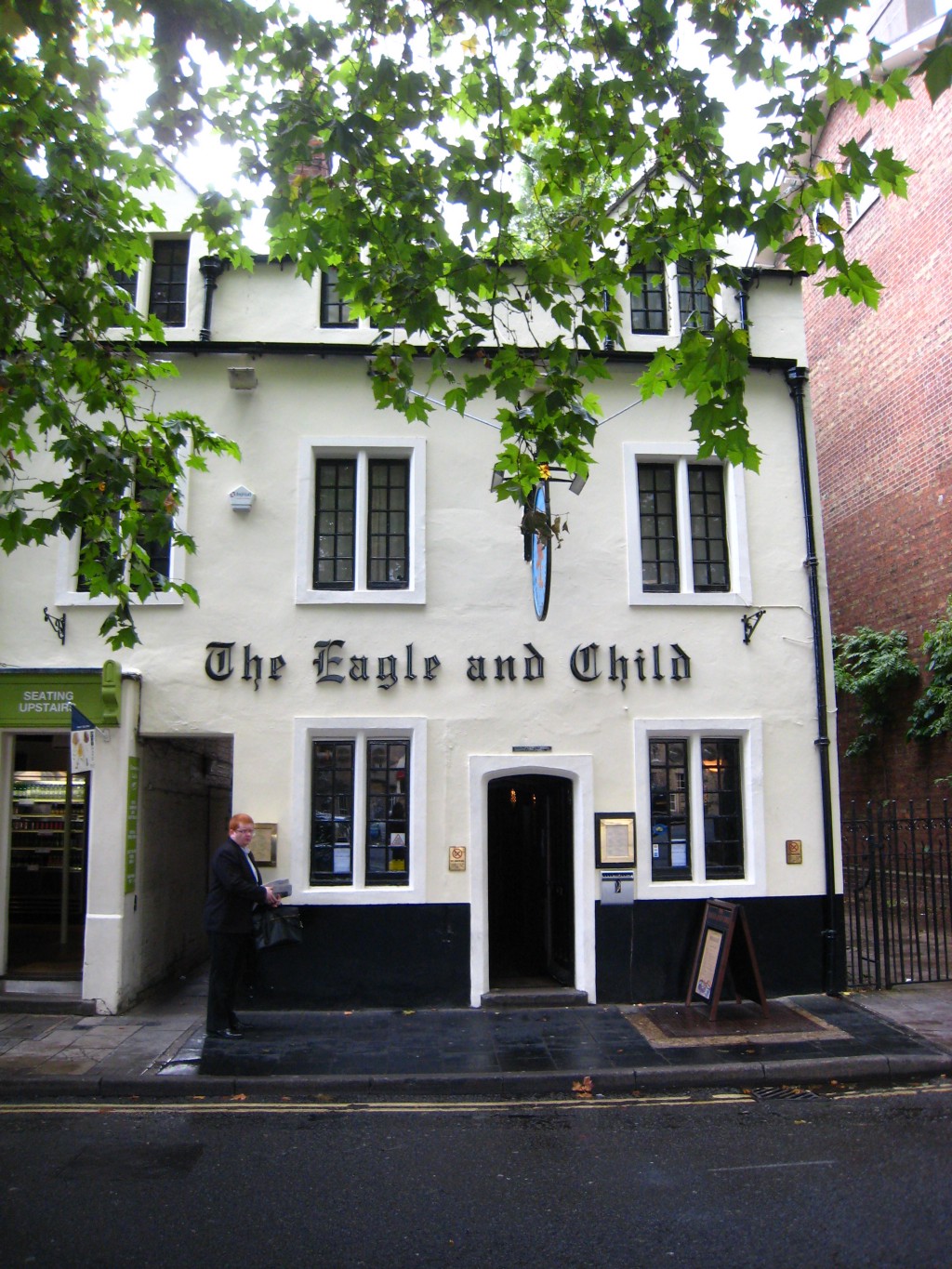

There is a permanence and finality to the events that take place in combat sports that has a weight heavier than any other sport. You will have always been knocked out by that man or woman.

JI: Fatalism, inevitability — we get that from Greek drama. Maybe Shakespeare got it from Greek drama, too, but Shakespeare did it as well or better. Doom is always impending. We know the criminal temptation is waiting for Daniel’s luck to run out. You’re still foreshadowing at the end of Chapter 26 — you never stop! Daniel and Sarah are talking about how he’s going get some money.

“I’ll get work,” he said. “Doesn’t matter what it is.”
“Yes,” she said. “It does.”
He tried to smile for her.

Or, much earlier in the novel, when Daniel finds his young daughter in a fight. He tells her not to do it again.

She said she’d not. Tried to stoneface him as she made the promise. Daniel looked at his daughter hard and knew that it was too late by years for her to keep it.

You write about family — especially Daniel’s fear of something happening to his loved one, his wife and daughter — with tenacity and understanding. You’re not a husband or a father, but you’ve done a good job of imagining a husband’s and a father’s fears.

I know: Flaubert was not an adulterous wife, but he got Emma Bovary right. Tell me more about that.

KH: This is something that I’ve heard from a few readers, especially those who have children and wives or husbands. As with my writing about poor and other marginalized people, I’ve not experienced the far extremes of love and loss in the way a father might, but I’ve been close enough to understand what it would look like.

Daniel’s entry point is my father, who was a welder, and who struggled a great deal keeping a roof over his family’s head in a small town with an economy they’d driven right into the dirt (not to mention our years in North England after Thatcher gutted that part of the country). He also lived with severe depression and anxiety, and alcoholism in his last years, as a result of physical and psychological abuse he suffered as a child. I loved my father very much, still do, and as I got older I began to truly understand and admire how strong he was for us, to break a cycle of violence and abuse, and to protect us as best he could from the indignities of poverty and the humiliations and perceived failures that haunted him through his life. He could not see any of his accomplishments, other than his children, and that is a hard thing to think about. But I wrote a lot of his life into other stories, and he lived to see some of those, and he thought there was good in doing it. It has also helped me work through a lot of these traumas to write them into my stories.

My father was not a “tough guy” in the way Daniel is, though he was hard as a coffin-nail when he had to be. But this whole heartbreak about lives you could’ve had, that were taken from you, and feeling powerless no matter what your skills — that is from my dad. He just couldn’t catch a break. If I’ve written Daniel effectively at all as a father, it is because of that.

JI: Readers who’ve read your short stories — “Montana Border,” in particular — will recognize Daniel and Sarah. There’s a neat overlap with the “Montana Border” story in the italicized beginning to Part One of In the Cage. I love those italics at the start of the designated Parts; they’re both Prologues and Epilogues. They introduce us, but they often sound like elegies; they’re very mournful-sounding. Okay, so you’ve expanded the cage fighter story (“Montana Border”) from Debris, but In the Cage has a darkness that’s more remindful to me of “One We Could Stand to Lose” and “Hunted by Coyotes” — in my view, those are the two darkest stories in the Debris collection. Did you always know that In the Cage was a very dark novel, or did it get darker as you wrote it? Did the darkness surprise you?

KH: Well, I went back and forth on what do with those italicized parts, but they seemed to win people over as the book developed, so it is good to hear you liked them. That is how I designed them since the early drafts, to set the tone of the novel, and to speak to some of the wounds from the past that put Daniel and his family in the position they are in.

It is true that “Montana Border” ends where Daniel and Sarah have narrowly escaped a biker gang from the prairie, and she is planning to leave with him, and the child she’s carrying. That isn’t a bad end in comparison to many of my stories, as you know.

The story I always knew In the Cage would be is the story of a fighter who just missed. He missed his shot to become champion and make real money right as the sport took off. There are thousands of those stories for fighters, and athletes, and many of them don’t get told. But, as with “Montana Border,” I didn’t want to write just the psychology of a fighter, or a character study of the kind of man who does that work for a living. I was more interested in exploring the circumstances that led him down the path he follows. The social and economic pressure, along with the effect of the terrain and the natural world. It was always going to be dark, looking at poverty and violence so bluntly, but the depth of that darkness seemed natural. I am interested in the struggle more than the end. It matters most how people fight when faced with that kind of darkness, even if it is a losing battle. All that foreboding and inevitability, the likelihood of catastrophe, they all lend a tension and atmosphere to the book that hopefully keeps a reader engaged, if unsettled. But none of that matters if they are not invested in how these characters fight and try to survive, whatever the odds.

Why I Can’t Stop Reading Self-Help Books

Novel Gazing is Electric Literature’s personal essay series about the way reading shapes our lives. This time, we asked: What’s a book you read in secret?

When your seven-year relationship implodes in two weeks and you find yourself alone in your apartment with only the silent company of your ornery cat, you may find, like I did, that you begin to grasp in search of solid ground. I suddenly had time. I had space. I just didn’t know what to do with any of it. So I did what I always do when I feel untethered and unsure about something: I turned to books.

But not to novels of love come and gone. Not to collections of poignant essays or biographies of inspiring historical figures. Instead, I turned to that self-help genre known, with vague aspiration, as “personal development.”

Ten years ago, when I worked at a small bookstore in downtown Vancouver, I would look askance at people that came in and asked for these books. What happened in their life that led them to this moment? I thought as I guided them to the self-help section, speaking softly and smiling as if anything more would break them. I was a bratty early twenty-something fresh out of university with shaggy hair and an even shaggier beard, and the only books I wanted to read at the time were ones that were at least 400 pages and had been reviewed as “difficult, but rewarding.” Naturally, I read David Foster Wallace’s Infinite Jest. But The Power of Now? Don’t even.

I have learned to consume them in secret, in my own home, reading them the way you would eat a bag of M&M’s that you keep stashed behind the kale chips.

In the last three years, though, as my longest relationship crumbled and I approached and then crested the age of 30 having accomplished none of the things my teenage self thought I would have by this point (be a novelist! Visit Berlin!), I found myself addicted to personal development books, to the promise they held.

I have learned to consume them in secret, in my own home, reading them the way you would eat a bag of M&M’s that you keep stashed behind the kale chips. When I talked about these books with my friends it provoked a wide-eyed frozen smile that I imagine is only used when they are listening to someone explain why this new cult they joined is actually really good, just hear me out. I even use the self-checkout feature at the library lest I become the subject of pity and clicking tongues in the librarian break room. “Did you see the guy come in to check-out Daring Greatly: How the Courage to Be Vulnerable Transforms the Way We Live, Love, Parent, and Lead? Poor, poor sweet dear. More baby carrots, Agatha?”

But despite the overwhelming urge to hide the cover of whatever self-help book I’m reading with a well positioned thumb, I keep turning to them, again and again, because they make me feel hopeful. Reading personal development books gives me a feeling akin to the one I got when I started a new year of school. I would imagine all the ways I’d be a better person that year: more organized, funnier, happier. I would have more friends, be more popular, think more positively. Those hopes, of course, eventually melted away under the consistent dull hot light of everyday routine, but for a brief brilliant moment each year my life opened up with possibility. Now, it’s within the pages of these books that I place my tiny pathetic hopes.

I read The 7 Habits of Highly Effective People by Steven Covey and wrote a personal mission statement, promptly lost the piece of paper it was written on, and forgot all the habits except maybe one (something about goals being good, I think?). I read Better Than Before by Gretchen Ruben and vowed to get my life back on track through fostering good habits, but only managed to keep cracking my knuckles. I read The Highly Sensitive Person by Elaine Aron, which was really helpful in providing me a rationale for canceling plans with people to stay home and watch Netflix. “I’m highly sensitive,” I’d text. “It’s a medical thing.”

I am aware that the Personal Development Industrial Complex fuels and is fueled by a brand of late capitalism that pushes us to be more effective and better members of society, to acquire more stuff to simplify our lives: to produce, to consume, to aspire. Many of these books have the whiff of scam about them, of the snake oil salesmen: Just follow these seven steps! These ten principles! These three easy frameworks! They make it seem so easy with their anecdotes, self-deprecating tone, and strategies backed up by the occasional scientific paper to prove to you that this is, you know, science. I know all of this. I get it. Still, I can’t stop.

Because the point of reading personal development books is not to be a better person afterwards. The point is to thrill in the imagining, while you are reading the book, of the better person you could become. It’s not the outcome, but the act of reading that is the balm. This is why they can become such a compulsion — why the “saved for later” section of my online library profile is not the latest Booker Prize winner, but is instead filled with titles like How to Manage Yourself and The Power of Habit and Start with Why. I recently read an almost 300-page book about how to manage email so I can be more productive, and you know what? I enjoyed it.

The point of reading personal development books is not to be a better person afterwards. The point is to thrill in the imagining, while you are reading the book, of the better person you could become.

When I turn the pages of these book, studiously copying inspirational quotes into my notebook that I think may come in handy later (they won’t), I feel a blossoming warmth spread throughout my body. Everything becomes possible. I can conquer the drudgery of work, the intricacies of my relationship, my own anxieties and bad habits, my procrastination. No longer will I flop onto the couch when I get home to watch YouTube clips of Kristen Wiig impersonations or 25-minute compilations of Seinfeld bloopers. I will do things. I will be somebody.

But, like with any drug high, I’m eventually left feeling confused and deflated. Real life pulls itself back into focus, leaving whatever epiphanies I had blurred. What was that fourth habit again? Wait, how was I supposed to organize my email inbox for greater happiness? Never mind, here’s another book to read. It will be in this one that I find the perfect thing, the one that sticks, the one that works. The ultimate answer is always on the horizon, tantalizingly out of reach.