Maybe It’s Time to Do Away with Anonymous Reviews

It’s a big deal to get a starred book review in Kirkus, but you’ll never know exactly whom to thank. The biweekly review magazine is hugely influential—bookstores and libraries look to its pages to find out what to order—and it doesn’t dole out praise lightly. Reviews are often critical, sometimes downright harsh, and always anonymous.

Thanks to a company-wide policy, though, we do know one thing about Kirkus reviewers of young adult novels: They are, to whatever extent possible, matched with the identities of the book’s principal characters. “Because there is no substitute for lived experience, as much as possible books with diverse subject matter and protagonists are assigned to ‘own voices’ reviewers, to identify both those books that resonate most with cultural insiders and those books that fall short,” reads a statement on the Kirkus site. In theory, this prevents sub rosa racism, ethnocentrism, ableism, or other troubling themes from slipping past reviewers who don’t find them painful.

Accordingly, Laura Moriarty’s American Heart, in which a teenage girl in a dystopian America tries to help a Muslim woman escape internment, was assigned to a Muslim reviewer. She found the book “terrifying, suspenseful, thought-provoking, and touching,” and on October 10 gave it a starred—but, as usual, unsigned—review. Usually, it’s negative reviews that raise ire, but in this case the rave garnered immediate criticism from people who objected to American Heart’s “white savior” narrative. (The publisher employed several sensitivity readers, ostensibly to avoid giving offense in just this way, but the plot still hinges on a white protagonist and viewpoint character literally saving a woman of color.) Bestowing a starred review on a book that is about rampant Islamophobia but centers and elevates a white character was, critics said, evidence of how—in the words of writer Justina Ireland—“Kirkus Reviews of books reinforce white supremacy.”

Support Electric Lit: Become a Member!

Kirkus took the criticism to heart, but its response was clumsy. The publication rescinded the book’s star and altered the review; the first decision was made in collaboration with the reviewer, the second was not. (She made the edits, Kirkus says, but she did not initiate them: “We wanted her to consider if changing what we thought was sort of reductive word choice, and adding deeper context, is something she thought might be appropriate,” editor-in-chief Claiborne Smith told Vulture.) The new review notes that “it is problematic that Sadaf is seen only through the white protagonist’s filter.”

Ultimately, this response leaves nobody happy. Those who took exception to the original review aren’t all that mollified, those who object to any acknowledgment of racial or religious inequity are mocking another example of “PC gone too far,” and caught in the middle is a nameless woman of color who is being browbeaten for liking a book too much.

Would this have turned into such a fiasco if the reviewer had been asked to sign her name? Surely individual Muslims may differ on what they do and don’t find offensive or off-putting; people have different thresholds, and whom among us doesn’t have a problematic fave? One could argue that any Muslim woman of color who doesn’t find American Heart at least a little troubling is enacting internalized Islamophobia, but presumably one would not move to silence her or demand she be overruled. A signed review would be marked as the opinion of the reviewer—a reviewer who has experienced life as a Muslim woman of color, and who (whether or not someone else would agree) finds herself adequately represented. An unsigned review is the opinion of Kirkus, and that’s where the trouble lies.

An unsigned review is the opinion of Kirkus, and that’s where the trouble lies.

Kirkus is right to take identity seriously, though it’s clearly stumbling forward rather than sailing. (This is not the first furor to erupt over a starred Kirkus review.) Especially in novels for young people, it’s important for readers to see themselves reflected on the page, and for that reflection to feel valid and complete and not undermining. Matching reviewers’ identities with characters’ is a positive, though imperfect, step towards recognizing novels that succeed in this endeavor, and those that fail.

But Kirkus is trying to take identity seriously while simultaneously remaining a sort of multi-mouthed monolith in which every review appears to be handed down from on high. (This is, of course, by design; Kirkus reviews get their cachet from the Kirkus name.) If we’re going to acknowledge, as we should, that people’s life experience affects how they read books, we should also acknowledge that reviewers are individuals. It’s okay that one Muslim woman of color was untroubled by American Heart, or saw value in it that for her outweighed its skewed presentation. That shouldn’t be taken to mean that other criticisms are invalid or wrong because the book is officially Good. It only seems to mean that, because it seems to come from Kirkus the powerful and faceless publication, not from a person. Maybe acknowledging—and eventually ameliorating—the homogeneity of literature means highlighting, not hiding, the diversity of its gatekeepers.

I guess it would be ironic if I didn’t sign this one.

—Jess Zimmerman

A Child of Cambodian Refugees Finds Her Past Through Poetry

Cambodian American poet Sokunthary Svay is tired of hearing about the Khmer Rouge. After concluding a yearlong review of Cambodian literature available in English, Svay found that nearly every accessible text about the country of her birth concerned either Angkor Wat, the ancient Angkorian Kingdom, the Khmer Rouge, or memoirs written by Cambodians who survived the Khmer Rouge’s genocidal purges.

In her first full-length collection of poetry, Svay explores these remarkable and complex aspects of Cambodian and Cambodian American lives. Her distinctive voice blends an identity rooted in Cambodia’s complicated past with contemporary ideas about Khmer traditions, refugees, and the trauma of exile in a way that’s original and vitally important to both the Cambodian and the American experience.

Tillman Miller: What kind of experience did you and your family have leaving Cambodia and settling in the United States?

Sokunthary Svay: I wasn’t born until after my family left Cambodia, so I was spared that experience. My parents don’t really like to talk about it, and that’s a common theme for Cambodian refugees. What bits I know are from the random times that my father has spoken about it, and I put it in my book: how they crossed through the jungle; how at one point, during monsoon season, they were stuck for three days and couldn’t walk anywhere; how when they were crossing the border into the Thai refugee camps, some people were led either by Thai pirates or former Khmer Rouge members to a field filled with landmines. They led these people to their death. A lot of dark stuff. Even in the camps themselves, my mom had told me that often soldiers would drive by at night and they would pick on people. My mom had said that my crying kept the soldiers away, so I’d saved her life. I remember crying on a New York City street thinking, I saved my mother’s life by crying in Thailand.

My mom had said that my crying kept the soldiers away, so I’d saved her life.

TM: Many young Cambodian Americans have written about how they’ve had to wrestle with inherited trauma. Can you speak more about this?

SS: The term “inheriting trauma” is kind of a big thing right now in certain writing communities, but for me it was the way that my parents responded to how they were living in the Bronx: the fear that they had, the mistrust. That’s what I had inherited. I felt like that was how we were supposed to be. For example, we didn’t open our door. If someone came to the door and they were unannounced, we would look out the keyhole but we would almost never open it up. Sometimes we would pretend we weren’t even there. We had ten locks on our door. There were two big chains that we put Master locks on and an alarm. That was just the atmosphere of the Bronx in the 1980s.

As refugees you’re always trying to help out other refugees, so we invited another family to live with us. They lived in our bedroom — it was two parents and their newborn — and the five members of my family lived in the living room. I can’t remember how long that was for, but it just seemed normal to us: that this was how people grew up.

Imagine American Literature Without Immigrants

TM: Did that experience of having one “inherited” life at home and seeing another way of life on television make you feel torn between two cultures?

SS: It sounds cliché, but of course. As an adult now I’m torn between many cultures, not just the ethnic and national ones. Back then though, absolutely, because I would go to school and I would succeed there where I got attention and praise from teachers. But when I came home, I would hear things like, “You should be speaking more Khmer. Why do you speak English? Why are you crying over the departure of one of your teachers when your dad is in the hospital?”

My parents just didn’t understand the connection that I had with school because those people had seen something good in me. Whereas at home the focus was just: eat, do this, do that. I knew that my parents were taking care of us and that they loved us in their own way, but as a child you somehow think you’re at fault for how things turn out and it didn’t feel like a loving household. Speaking to a lot of Cambodian Americans I hear about how many Cambodian parents who came here are like that because they have/had undiagnosed PTSD.

TM: Did you try to process this pain and confront tragedy through your poems?

SS: Totally. I didn’t have a good relationship with my parents growing up, and it was especially bad with my mother. I was pretty wild. At a certain point I stopped coming home on weekends. I almost dropped out of high school, but when I made it to college I got a scholarship and I felt renewed because somebody believed in me again. When I took a poetry class with Marilyn Hacker, I was thinking, “What are the questions that I have?” And a lot of the questions that I had were about my mother: “Why couldn’t we get along?” I couldn’t stand having conversations with her, and so I started writing poems from her point of view to understand — when she looks out with her own eyes — what kind of world does she see? How does she see the people around her?

I couldn’t stand having conversations with my mother, and so I started writing poems from her point of view to understand — when she looks out with her own eyes — what kind of world does she see?

TM: Can you tell me about your decision to use your mother’s voice in some of your poems?

SS: My mom is full of great soundbites. She’s much funnier in Khmer, her native tongue, and I’ve always found her really fucking hilarious. I thought about a time when I used to DJ, and I came home at three of four in the morning with big platform boots and my bag of records. When I came in the door my mom said, “Where you go? At least prostitute bring home money!”

A few years later I thought about that line again and all the ways my family has “whored” themselves out — myself included — and I wrote those poems by stringing a bunch of incidents together with things that my mother has said. Her words are magic. A lot of what I write in her voice are direct quotes. Most people don’t want to listen to her because she speaks English with an accent, and people immediately dismiss her; but when she speaks in English she can still bite. In writing the poems, I tried to translate her words as I recalled it. It was a way to get her words down because I thought, “Damn, she’s really got some amazing things to say and teach.”

TM: Does your family ever read your writing? How do they react to your work?

SS: My mother’s reading level in English is limited. She left school around the age of fifteen when she married my father, and he was schooled in French. He’s actually able to read English well and he’s even on Facebook posting political things. I don’t know how they would respond to my work. They know that I write. Their understanding is very vague, and I’m okay with that. I don’t need them to understand what poetry is or what my poetry is.

TM: There seems to be a certain longing for Cambodia in your poems. What exactly is it a longing for?

SS: There’s definitely longing. It’s something that’s been done in a lot of writing: the longing for a home that isn’t really your home or the longing of home as an idea. When I was younger I thought, “I’m going to go to Cambodia and it’s going to solve all of my problems.” When I went there at the age of 22, that’s when I met my family for the first time. Most of the people that are on the list of the missing and dead in the poem “No Others” — with the exception of my father’s parents — were all alive. So that poem has a happy ending. But I didn’t get to meet any of those people until I was 22, and I guess I was expecting everybody to still be traumatized from the Khmer Rouge because so much of the diaspora is based around that narrative. The reason the refugees are in the United States is because of that. It’s the starting point for our history here, whereas in Cambodia they want to move on. I was surprised by that and it felt strange because I associated so much of my college identity and my twenties around that trauma. It was an unexpected lesson that I learned.

It’s something that’s been done in a lot of writing: the longing for a home that isn’t really your home or the longing of home as an idea.

TM: Another striking line from your writing can be found in your Asian American Writers’ Workshop essay. You say, “I want to stop writing about the Khmer Rouge. I want to be done — done talking about their destruction.”

SS: I spent a good portion of my college years studying Cambodian survival memoirs as part of my honors thesis. When I did a review of Cambodian literature available in English, all of it was either about the Angkorian Kingdom, the Khmer Rouge, or survival memoirs.

We keep writing about the Khmer Rouge and I wonder if that’s re-traumatizing our people. It was a horrendous few years, but there’s so much other stuff going on. I want to know what Cambodians sound like in the United States. When we have a second generation that’s going to be influenced by the urban surroundings in America and class issues, but also growing up in the time of the Internet — I’m really curious to see what kind of narratives come out of that. Bryan Thao Worra, who is Lao, was adopted by a U.S. soldier and he writes speculative fiction that takes place in Southeast Asia. He’s using science fiction as a method for reimagining where Southeast Asians can go as a literary community.

TM: How do you think the publishing industry can help Southeast Asian writers and Cambodian writers?

SS: I got the attention of Willow Books, which is a flagship of Aquarius Press. It’s an independent press run by Heather Buchanan and she publishes specifically underrepresented communities. That’s a great model to replicate. When a publisher puts the call out there and gets the work and can say, “We see something in this, how can we help you grow?” That’s great. I think having small presses and organizations that can do a call for underrepresented groups, then find the submissions that look like they might be ripe and ready for publication or editing help.

There’s not enough representation for Southeast Asian American writers. So another way to help was to create my own institution. I got tired of waiting around for people to recognize me and other Cambodian Americans. That’s why we started the Cambodian American Literary Arts Association.

TM: Who are other Khmer or Khmer-American writers that you read and are influenced by?

SS: Bunkong Tuon has a poetry collection published by NYQ Books that came out in 2015 called Gruel. Monica Sok is another poet. And Peuo Tuy who published Khmer Girl. We’re two of the founding members of CALAA. Vaddey Ratner has received a lot of attention for her novels. I’ve read an excerpt of Music of the Ghosts. There are also some other up-and-coming Cambodian fiction writers that I’m hearing about like Kimarlee Nguyen.

Joanna Walsh Is Setting Language on Fire

Trying to classify the writings of Joanna Walsh is nearly impossible. In 2015, she had two books released in a relatively short period of time: Hotel, part of the Object Lessons series of short books, examined the title structure from a host of angles–physical, theoretical, and cultural. Then her story collection, Vertigo, delved into characters’ complex psyches, pushing into layered psychological landscapes and exploring questions of memory, guilt, and obsession. The two books did a stunning job of establishing Walsh’s range as a writer and the intellectual rigor with which she pursued her chosen subjects.

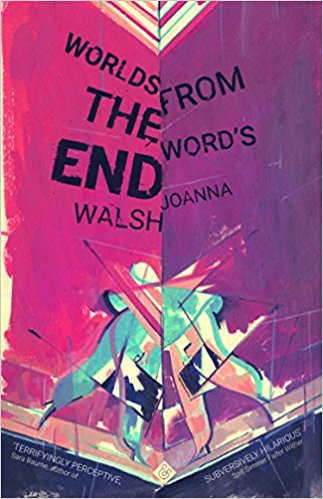
Her new collection, Worlds From the Word’s End, shows a very different side of her work. Here, she explores numerous permutations of language: the title story is set in a near future in which the way humanity uses words is in flux, while “Exes” takes the concept of homonyms and suffuses it with a sense of intimacy and regret. We spoke about the new collection, its connection to her earlier work, and its incorporation of various unlikely pieces of literary history.

Tobias Carroll: There are a number of recurring themes and motifs in Worlds From the Word’s End, including spaces for transit and decidedly literary dilemmas. Did you have any overarching themes in mind as you began to put this book together?

Joanna Walsh: The stories were written independently of each other over a number of years. When I sent Danielle Dutton at Dorothy all my stories a few years ago, she chose the stories with a hyperreal focus, that dealt with the fine detail of the operations of women’s lives within families, for Vertigo. The remaining stories seemed to have something in common too: something to do with how words adhere to things, and the points at which language touches, and takes off from, reality.

TC: The title story of Worlds From the Word’s End deals with questions of language and communication, and involves a paradoxical narrative, with sentences like, “I’m writing to you so you’ll understand why I can’t write to you any more.” What are some of the challenges of writing in a metanarrative way like this?

JW: I find it natural. I’m a writer because I know that language is a borrowed or stolen, imperfect and communal attempt to create meaning. It’s best not to take it too seriously, but it’s also good to take that unseriousness as seriously as possible.

TC: How did this particular story come to be the collection’s title story?

JW: I went through lots of titles with the publisher of And Other Stories, Stefan Tobler. He was concerned that people would muddle the ‘Worlds’ with ‘Word’s,’ but nothing else seemed to fit, and then I realized I liked the idea that the title might be confusing or difficult to say, because it hints at some of the things I’m trying to do with words in the book. I like language that doesn’t only represent something for the reader, but that asks them to engage in some kind of surprising way. Most of my previous books have had one-word titles, so I was excited to have a whole phrase.

I’m a writer because I know that language is a borrowed or stolen, imperfect and communal attempt to create meaning.

TC: The story “The Story of Our Nation” was first published in 2015. Since then, questions of national stories have become even more paramount in nations around the world. Did you find any unexpected resonances as you revisited it for this book?

JW: “The Story of Our Nation” is a satire on, amongst other things, the kind of voluntary self-data collection we’re asked to do online: there’s also a bit of gaming language, so there’s the notion of the amount of control we have over creating an environment that might be entirely artificial (and how, in such an environment, do we deal with nature, which is beyond our control?) and, perhaps oddly, a kind of awareness of shows like “The Great British Bake Off” — you have that in the U.S. now I think — which attempts to construct a kind of idea of Britishness. Since I wrote the story, patriotism has taken a very sinister turn. Yuri Herrera called Worlds From the Word’s End dystopia as a room in your own house, and, yes, my dystopias are domestic. I was interested, and continue to be interested, in collusion: how people act in everyday life according to ideas that limit or harm themselves and other people.

Support Electric Lit: Become a Member!

TC: Several of the moments of connection make for interesting juxtapositions, like how the kidnapping narrative of “Enzo Ponza” segues into the portability of the title character of “The Suitcase Dog.” What was the process like of ordering these stories?

JW: I’d really never thought of that! I wrote “The Suitcase Dog” with Kafka’s Investigations of a Dog, and Stein’s Identity in mind: what can a dog know, and what can a person know of themselves via a dog, how can I use language to describe a dog’s experience. I’ve read that an Oulipian writer (I think) wrote a series of poems using the only human language pets know: “sit” and “treats” etc. I’ve never been able to track these down. Perhaps they don’t exist.

Author Joanna Walsh

TC: “Like A Fish Needs A …” opens with an epigraph from Flann O’Brien. Do you see these stories as working in a similar vein to his, balancing metafiction and the absurd?

JW: I love everything about O’Brien apart from his deep strain of misogyny. I was partly responding to this: trying on the absurd tradition, which has also often had difficulty dealing with women, via a woman’s body. It felt both affectionate and rebellious.

TC: The conclusion of “Bookselves” has a wry humor and candor that struck deeply at the heart of this reader. Did you have an archetypal bibliomaniac in mind as you wrote that, or someone more specific?

JW: This was another story that reacts to a story: in this case Georges Perec’s Winter Journey (Un Voyage D’Hiver), and the alternative title of Bookselves is Un Voyage Vers (A Journey Toward), in the tradition of the Oulipo’s series of stories written after Perec’s work, which describes a man who discovers a book that appears to quote many famous sentences from French Literature, before he discovers that the book was published before any of these works. He loses the book, and is unable to find it again. Lots of the stories in Worlds are, in part, reactions to other works. I guess they are, as you say, metafictional. All my work processes the influence of other writers, but this is often only a minor part of what I’m trying to do; in Worlds it’s upfront. I did think of particular details I’ve noticed from mine and other people’s book habits, but no specific person or collection in mind.

TC: You’ve written a book called Hotel, and several of the stories here deal with hotel life. Do you see this collection as being a continuation of (or variation on) themes you’ve addressed in previous books?

JW: I continue with themes, though I always hope to vary them. I like writing about domestic spaces, and I like writing about the spaces we create for ourselves when we want to be rid of them. I’m sure I’ll continue to do this…

Language might be a tricky and treacherous tool with which to intend anything, but, as well as a fault, that might be its saving grace.

TC: The narrator of “Two Secretaries” makes it clear that, unlike her coworker, she is a clerical assistant. What first drew you to questions of titles and how people’s descriptions of themselves affect how they’re perceived?

JW: I spend a fair amount of my time out of the U.K. and whenever I come back I’m horrified by the false consciousness that seems still to exist around class: the British royal family seem so much in the media, so central to people’s lives; fictional TV programs are often about aristocrats, and are aspirational. I’m sure this contributes to preventing people from seeing their own circumstances accurately, and being able to act. My “clerical assistant” would rather live a circumscribed life, identifying with her workplace superiors, than see her existence more, as Perec wrote, “flatly.”

TC: Has the process of revisiting these stories, where reality can make language malleable, had any effect on the way that you’ve used language in the time since then?

JW: In Worlds From the Word’s End I was thinking more of the ways language makes reality malleable, or some kind of interchange between the two. I like the word malleable, which means “something that can be hammered.” It makes me think of the Russian writer and theorist Viktor Shklovsky who, in an essay in 1964, wrote that is as difficult to use writing in propaganda, as it is to use a samovar to hammer in nails. It’s not absolutely impossible, but that’s not what a samovar was designed for. Language might be a tricky and treacherous tool with which to intend anything, but, as well as a fault, that might be its saving grace.

‘Manhattan Beach’ Takes On Gender, Race, and Disability—But Is It Any Fun?

Double Take is a literary criticism series in which two readers tackle a highly-anticipated book’s innermost themes, successes, failures, trappings, and surprises. In this edition, Liz von Klemperer and T.A. Stanley discuss Jennifer Egan’s National Book Award–longlisted historical novel Manhattan Beach.

The characters in Pulitzer Prize winner Jennifer Egan’s latest novel range from sailors to gangsters, bankers, and union workers. At the center of its orbit is one Anna Kerrigan, haunted by the mystery of her father’s disappearance. True to the novel’s noir-inflected atmosphere, Anna investigates her father’s life, looking for answers to the questions that have dogged her. Of course, the investigation is merely the tipping point from which conflict proliferates and allows the vast narrative to breathe. With Manhattan Beach, Egan once again demonstrates her mastery of the sweeping, multi-character narrative.

Liz von Klemperer: I was drawn to the theme of using conventional femininity as a survival tool. Anna’s coworker Nell, for example, is hyper femme, and uses traditional markings of femininity to gain advantage in the male dominated society of ’50s New York City. Upon first meeting Anna, Nell advises her to wear lipstick to work so her boss will be more lenient and let her leave the office for lunch. By the end of the book, Anna dons another disguise when she buys a wedding ring at a pawn shop to hide the fact that she is pregnant and unmarried. When she is on a train while visibly pregnant, she notices how people are only friendly and offer aid after they’ve seen her wedding ring. She reflects that there is “so much power in that slim band.” Egan has presented a world in which women’s independence is gained by their attachment or implied attachments with men, and visible markings of conventional womanhood are crucial to achieving this power.

Anna’s aunt Brianne’s femme presentation, on the other hand, is presented as comical. For example, Brianne tells Anna she has to use “all my wiles” to acquire two tourist sleeper tickets from Chicago to San Francisco. She douses herself in perfume and begins to flirt with the man behind the ticketing booth at Grand Central Station. Anna finds Brianne’s leveraging of femininity for social and monetary benefits as “stale,” a tool that does not work anymore because she is not in her sexual prime. Throughout the book, Brianne tells Anna about how she lives off suitors and trysts with successful men, but at the end of the book we find out she is self-sufficient and working at a bar and living alone. I’m still pondering this twist.

T.A. Stanley: For some reason, I wasn’t all that intrigued by a lot of the aspects of gender politics that Egan presents in her new book. I feel like I’ve read a lot about this time period and social anxieties regarding women in the workplace and women living alone. I mean, I did watch Mad Men, after all. But in all seriousness, I felt unsurprised by most of the reactions from the characters throughout the novel, save for a few exceptions which I’ll get to.

I feel like I’ve read a lot about this time period and social anxieties regarding women in the workplace and women living alone. I did watch Mad Men, after all.

Nell was mostly the typical archetype of a “kept woman.” It’s certainly an interesting trope to dive into, as well as a reality for many women throughout history — resorting to their femininity as a means to a living — and it creates many interesting questions (i.e. what’s the difference between what Nell does and prostitution? What’s the difference between both and the idea of “marrying for money?” How do we, as a society, treat these various survival tactics employed by women throughout history?), but I don’t think Egan spends enough time with Nell for much of that to be addressed or considered with adequate depth. She doesn’t seem too concerned by this.

Like you said, women’s independence is only gained through implied attachments to men, but it feels like less about independence and more a careful navigation to avoid being ostracized by society. There is no freedom, obviously, just a rigid code for the “correct” type of femininity. Of course, this correct femininity is completely confounding, as we know. Anna appears pure, but isn’t, and she uses her perceived innocence to break through gender barriers at her job. Nell uses her femininity in a “dangerous” way to extort men. Both are using what they know and what they are comfortable with to get by in this world. There is certainly something interesting about that, and in many ways these archetypes still exist today, although in different forms.

Brianne was a character that I really wish we had seen more of. I think her illusion functions similarly to Anna’s wearing a wedding ring at the end of the book — a tactic to avoid a questioning of her lifestyle. It seems like a simple survival tactic, yet hits on a theme you mentioned with Anna: the double life and the reinvention of one’s identity. The main characters have one or more identities they inhabit. Anna’s dad, Eddie, leads a double life working for the mob and lying to his family and eventually fakes his death to start a new life as a third mate on a merchant ship. Dexter Styles changes his name to erase his Italian background and maintains various lives as a gangster and family man, even giving one of his lives a name — The Shadow World.

Of course, Anna goes through so many lies and double lives, to the point where at the end of the novel she is maintaining several different timelines and lives to hide the paternity of her unborn child (one life with her mom, one with the Navy Yard, one with family who was hosting her, one with the passengers on the train to California). Besides Brianne’s revealed double identity, the other secondary character whose possible second life I was most intrigued by was Mr. Voss, who may or may not be a gay man.

Jennifer Egan Brings Us To a Forgotten New York

LVK: I thought it was a stretch that Anna would understand the nuances of racial inequality in America at the time. I also read her recognition as a reflection of her own self-interest. She wants to integrate into the white, male dominated diving program, and her awareness of her black coworker Marle does not exist outside of this context. Both intuit that they must fly under the radar to be accepted, or rather tolerated, in the program.

It’s worth noting that Anna and Marle eventually work together outside of their diving cohort when they go to find Anna’s father’s remains. Bascombe, who was barred from the navy because of his poor eyesight, also joins the mission. It’s poignant note: These three misfits band together to complete a task despite their environment’s tacit discouragement. I found it powerful that they acquired skills from white patriarchal structures and then illegally used them for their own benefit. Despite this, Anna and Marle’s fear that white men will be threatened by their partnership is ultimately realized during their mission when Dexter enters the story. While watching the three work on the ship —

His idleness made everything around him register on a scale from irksome to intolerable: Anna’s cohorts holding her ankles to guide her feet into the massive diving shoes; the Negro’s hand under her chin while they attached the harness, or whatever the hell it was. Their insularity made him envious — not just of the men but of all three of them. They were working together, two men and a girl, with evident ease. Even after the diving suit was on and she no longer looked like a girl, he was resentful of their shared knowledge, their nomenclature and expertise.

He is so threatened by watching this exchange that he demands to go dive down to search the ocean floor with Anna! This scene shows the extent to which the novel’s white male characters feel the need to maintain dominance by subordinating others. As you pointed out, Dexter approves of women who don’t act like “most girls,” but he is deeply uncomfortable with women and minorities demonstrating expertise he is not privy to.

Eddie’s relationship with race is perhaps more informed than Anna’s, as he has a realization about systematic racial oppression that goes beyond his own self-interest. When his ship docks in South Africa, for example, Eddie wonders why the bosun does not get of the ship despite being at sea for months. Once on land, Eddie quickly realizes that the blatant racism on land is a threat to the bosun, forcing him to stay sequestered on the boat. He is confronted with his privilege in a way that Anna is not, and his future decisions are informed by this knowledge. On that note, what do you think about Eddie’s relationship with the bosun? They have a tumultuous relationship rooted in race and class that I’m still teasing out.

TAS: The dynamic between Eddie and the bosun is certainly very interesting. A lot of their distaste for each other stems from a mutual misunderstanding of who the other person is, and a mischaracterization not only based on race but also on class. Some of the politics of the ship’s chain of command were interesting, although I’m not sure I completely followed it. Eddie is a third mate, who “commanded no one,” whereas the bosun “commanded a deck crew of some thirteen sailors.” So while the third mate is technically a higher ranking officer, the bosun commands a certain amount of respect and clout due to his direct command over crew members. To be honest, I get very lost in this stuff, but that’s what I gathered. They seemed to be on equal footing since Eddie acknowledges that the bosun doesn’t have to call him “sir.” Some of the politics at play here come from Eddie’s shock in encountering more-or-less egalitarianism on the ship and the bosun’s resentment of Eddie who, despite being uneducated, can climb ranks rather quickly:

He thought of himself as being kind to Negroes, but he was accustomed to Negroes who had less than he. The jumbling of races on merchant ships had been a shock at first: it was common for white men to work under Negroes, South Americans, even Chinamen. But this bosun wasn’t just better spoken and — it was obvious — better educated than Eddie. He’d had a contemptuous way of looking at Eddie that brought to mind the phrase “dumb mick.”

There are many layers at play here. The bosun’s disdain from Eddie is not wholly devoid of stereotypical assumptions of Irishmen as dumb and uneducated, but most likely also comes from a place of resentment for Eddie’s ability to climb ranks as a white man. While the bosun claims that he has no desire to climb the ranks (if he did he would be “master of [his] own bucket years ago”), Eddie sees this as posturing since he “had never encountered a Negro captain on any American merchant ship.” I wouldn’t doubt that the bosun also enjoys pointing out their educational differences to dissuade those who would try to stereotype him as incapable because of his race. Eddie certainly has his eyes opened to some of the more structural ways in which racism affects the bosun and those like him, as you point out. His naive understanding of his benevolence to other races is turned on its head and he is forced to deal with how he benefits from his race, as you point out. This perhaps brings about a deeper understanding of the bosun’s plight and from this and their shared near-death experience they can bond in a deep way.

LVK: I also want to talk about the theme of disability throughout the book. Eddie, for example, has a total shift in his perspective towards disabled characters. At first, he is so ashamed by Lydia that he attempts, as a toddler, to suffocate her with a pillow while she is falling asleep. Although he eventually stops and is appalled by his violence, it still shows a deep-rooted fear of disabled people and their needs. On the boat, however, he meets Sparks, whom he sees in a humanizing light —

Eddie was stricken with sympathy for him. To be a deviant and a cripple, without good looks or fortune or physical strength — how had Sparks managed to endure such a life? Yet he’d more than endured; he was ever cheerful.

Eddie risks his own life to save Sparks when the boat begins to sink and gets him to safety. He notes that, once on the lifeboat, Sparks has a valuable skill to offer, as he is able to operate the radio. Perhaps this is Eddie’s attempt to make up for the wrongdoings of his past. An optimistic reading of this scene, he finally sees both the humanity and societal merit of people with physical disabilities. These scenes are important because they show Eddie’s propensity for change, and transform him into a less pathetic, more likable character. I find this shift surprising and effective, as Egan initially sets Eddie up to be absent father archetype and then proves our assumptions wrong.

Lydia is, of course, the main disabled character. Her illness is both repulsive to Eddie and Dexter but also appealing, as she is described as soft, unspoiled, angelic, clean, and fragrant. Anna and her mother love Lydia unconditionally. What do you think about the theme of disability, and the able-bodied characters’ acceptance, fascination, and aversion to it? How is this informed by the voices of the disabled characters, specifically Lydia’s stream of consciousness speech?

TAS: To be honest, I’m still trying to work out Lydia’s presence in the novel and how her disability and her voice work in connection to the other characters. On some level, she is what binds all three of the characters together. Dexter would never have formed the bond with Anna if she hadn’t asked him to help her take Lydia to the beach, and Eddie is deeply connected to Lydia as well. We are not made to sympathize with Eddie’s inability to fully acknowledge or love his disabled daughter; instead we hope that he works through his fears, as he does when he is near death at sea. Anna and her mother, conversely, never waver in their devotion, care, and love for her. It might be a quick way to show where our moral center is and who still has a lot of growing and changing to do to find their way back to this morality.

We are not made to sympathize with Eddie’s inability to fully acknowledge or love his disabled daughter; instead we hope that he works through his fears.

Lydia’s stream-of-consciousness voice is obviously very connected to the sea. Her words are described as coming in “waves” when Eddie is near death and seeing her laughing and talking. The text mimics this rhythm and cadence of the waves and the ocean. The ocean has a way of cleansing Lydia and bringing her joy and peace before her death, so perhaps Lydia and her words cleanse these other characters of their wrong thinking and various sins and misdemeanors? I believe that after his time with Lydia on the beach is when Dexter makes steps to leave the “shadow world” of the mob and enter a more acceptable career. Lydia and the sea perhaps work in tandem as a powerful force to show people a path towards redemption.

LVK: Lydia really does act as figure of redemption. Because she is immobile and for the most part non-verbal, she becomes a figure who is responded to, as opposed to a character that acts autonomously. This was somewhat disappointing to me because I’m always hoping to read disabled characters whose disability is not their main characteristic, and where they are not the target of pity.

I’m also interested in how Lydia plays into recurring notions of idealized female purity imposed by Dexter, Eddie, and society at large. Dexter and Eddie express the desire to preserve their daughter’s sexual “purity,” and become viscerally distressed when confronted with the idea that their daughters could express their sexuality. Both Eddie and Dexter are simultaneously disturbed and intrigued by Lydia and her disabled body. When Dexter comes to take Lydia and Anna to the beach, for example, he resents “the project of providing this accursed creature an experience of the sea.” However, he notices that she “smelled fresh, wonderful, even, like the version of flowers that inheres in feminine creams and shampoos.” He likens her eyes to his daughter Tabby’s doll’s eyes, as they are “luminous blue and unblinking.” Lydia is constantly infantilized and described as pristine.

Support Electric Lit: Become a Member!

Male characters also infantilize able-bodied women. While at a dinner, for example, Dexter hears a “dyspeptic-looking man” say, “We treat our girls too gently, that’s a fact… in the Red Army, girls work as medics — they carry the wounded off the battlefields on their backs.” Moments later, he justifies the fact that, “in the trades the girls are what we call ‘helpers’ — they assist a man senior to them. And we keep them off the ships.” Women are simultaneously viewed as coddled and ill equipped to handle tasks designated for men. This, to me, is an interesting symptom of how gender codes had to be deconstructed during WWII. It was in the interest of the state for women to work, but at the same time men in power were motivated to uphold negative gender stereotypes in order to maintain their own elevated social power. In other words, these men considered women useful workers, but not too useful, otherwise they threaten patriarchal structures that benefit men. Lydia is an amplified manifestation of Dexter’s cohort’s perception of women as fragile and doll-like. When Dexter meets Lydia, he is forced to confront what an actual disabled woman looks like.

TAS: I have read A Visit from the Goon Squad and remember really loving it. In comparison, Manhattan Beach disappointed me. While there were times where the narrative compelled me enough to move me forward — and Egan’s writing is still engaging, intricate, and solid — I didn’t end up feeling a connection to the characters or themes. While the characters were well defined and felt alive, I didn’t really get a sense that they had a story I’ve never heard before. I remember not being able to put Goon Squad down, while Manhattan Beach dragged quite a bit for me. There is definitely a part of me that feels saturated by WWII narratives, so this may be part of my reaction as well. I am a fan and will continue to read more of her work (and hopefully re-read Goon Squad). Maybe this book just wasn’t for me.

LVK: The narrative in which a girl/woman has to “play the game” in order to overcome obstacles presented by the patriarchy doesn’t especially float my boat. I found myself cheering Anna on when she was first getting in the scuba suit or “dress” as it’s called in the book. She reels at the weight, but persists despite her male peers jeering at her. To her boss’s dismay, she ends up being one of the few people who can complete underwater tasks. On the surface this seems like a victory but is ultimately kind of depressing. In this way, Egan’s narrative presents Anna’s strength in relation to men and the systems they’ve devised. You mentioned this earlier when you said Lieutenant Axel “pretty much only praises Anna at the expense of other women,” and I wish Egan explored more of the repression inherent in Anna’s “victories.” This is not to say Egan’s characters should act in accordance with feminist principles or be critical and aware to the degree we want them to be. I just wish there was less reveling in female success as relative to male dominance and more attention paid to the often clichéd ways this kind of narrative typically unfolds.

The narrative in which a girl/woman has to “play the game” in order to overcome obstacles presented by the patriarchy doesn’t especially float my boat.

TAS: I think I’m a bit tired of the “exceptionalism” narrative. The “look at this woman prove everyone wrong!” angle is fun and can feel empowering, but we know that it didn’t really make anyone more open to more women in the field. They quite literally see Anna as an anomaly, an exception to the rule. Egan addresses this, but rather subtly, in my opinion, and it makes the narrative a bit trite.

I also didn’t take to the love/lust story between Anna and Dexter. It felt forced and creepy. There are plenty of uncomfortable sex scenes in literature, but I just didn’t like that theirs seemed to happen only as a plot device to get Anna pregnant in such a way where her only solution is the convoluted lie and move from New York. I’m also never a fan of the “fake-out abortion” plot angle wherein a character is set to have an abortion and changes her mind last minute because she can’t imagine not having the child. To me, these storylines seem to only serve to make our heroine seem more “virtuous” and “pure,” especially when Anna is compared to Nell who we know has had at least a couple abortions and is a morally ambiguous character. Nell’s a kept woman who cheats on the man who she is threatening to expose to his wife if he doesn’t pay for her livelihood. She’s had abortions, so what better way to make our character seem wholly different and more morally acceptable even though she also has had an affair with a married man? Well, she’ll decide to suddenly keep the baby, of course!

I’ve seen this move done on several TV shows and movies, and I’m sure it happens in other books, and I never like it. There’s still this huge stigma against showing a character you are setting up as a moral center and “good person” as being capable of actually having an abortion. She can think about it, even set an appointment, but she always changes her mind last minute. It’s a dramatic beat that’s completely uninteresting and off-putting to me. But that could be simply a personal gripe as someone who has had an abortion. It’s something that always stings and feels stigmatizing to those of us who have made and followed through on that decision.

LVK: I want to feel surprised by the twists and turns of a story, but not feel guided through the plot of the book by the author. Manhattan Beach felt too neat at times. I’m drawn to stories that leave room for ambiguity, that leave me wondering at the end.

What Wonder Woman Meant to Her Earliest Fans

In Wonder Woman #7, published in the winter of 1943, Diana and her mother stare into their Magic Sphere on Paradise Island and see that in the future, a woman will become president. (Before praising Wonder Woman’s creator, Charles Marston Moulton, for his progressiveness, note that he sets this victory in the year 3004 A.D.) The opening blurb states that it will be “Wonder Woman herself, that gorgeous, stupendous personification of all that is glorious in American Womanhood” who will be president. The superhero’s alter ego Diana Prince runs on behalf of the “Woman’s Party” against her very own Steve Trevor. After watching herself take the oath of office in the Sphere, Diana turns to her mother and says, “Oh Mother, he didn’t beat me after all — I almost wish he had. Poor Steve!”

Contrast this sentiment with the feminist (particularly white feminist) embracing of the new Wonder Woman franchise. While comparative essays exist discussing dueling origin stories in the comics and movie and the sanitized sexuality of the film, the context and substance of these early comics deserve critical examination. What did American womanhood mean to a 1943 audience?

After watching herself take the oath of office in the Sphere, Diana turns to her mother and says, “Oh Mother, he didn’t beat me after all — I almost wish he had. Poor Steve!”

Wonder Woman debuted in All-Star Comics #8 in 1942, with her origin story marking her early years with her Amazon sisters (including jousting atop kangaroos) and the fateful crash-landing of Steve Trevor on Paradise Island. Diana opts to leave the island to aid the world of men, bringing with her a magic lasso, mind-controlled radio, and invisible jet. Besides these gifts, she wears her characteristic costume and her bracelets, which repel bullets but also act as kryptonite if chains are attached to them by men. Charles Moulton Marston’s explanation of the constant chaining up of Diana has been described, on one hand, as a nod to the struggles of the suffragettes. On the other hand, Marston once justified the chains to his editor by saying that “women enjoy submission.”

Wonder Woman, of course, wasn’t written as a primary text for cultural sensitivity and enlightenment, but for entertainment. One memorable episode matches foe Paula von Gunther against Diana Prince in a scheme to cease accessible milk supply for the youth of America in order to cripple the armies twenty years down the line. One has to appreciate the ridiculous long-sightedness of a villain like that, as well as the obvious schilling in the comic for the American dairy industry.

Early Wonder Woman comics matched the heroine, her bandleader-sidekick Etta Candy, and love interest Steve Trevor against two types of bad guys: WWII-era Axis spies or Greek gods from outer space. Both of these types of adventures veer into uncharted territories of non-sequiturs. For instance, in Comic Cavalcade #1 (Winter 1943), while attempting to rescue a boy from a Nazi submarine, Wonder Woman stumbles upon Hawthorne’s House of Seven Gables, which becomes key to her victory. And then there’s Sensation Comics #13, where Wonder Woman, rumored dead, reveals herself at a co-ed bowling championship (and defeats Nazis).

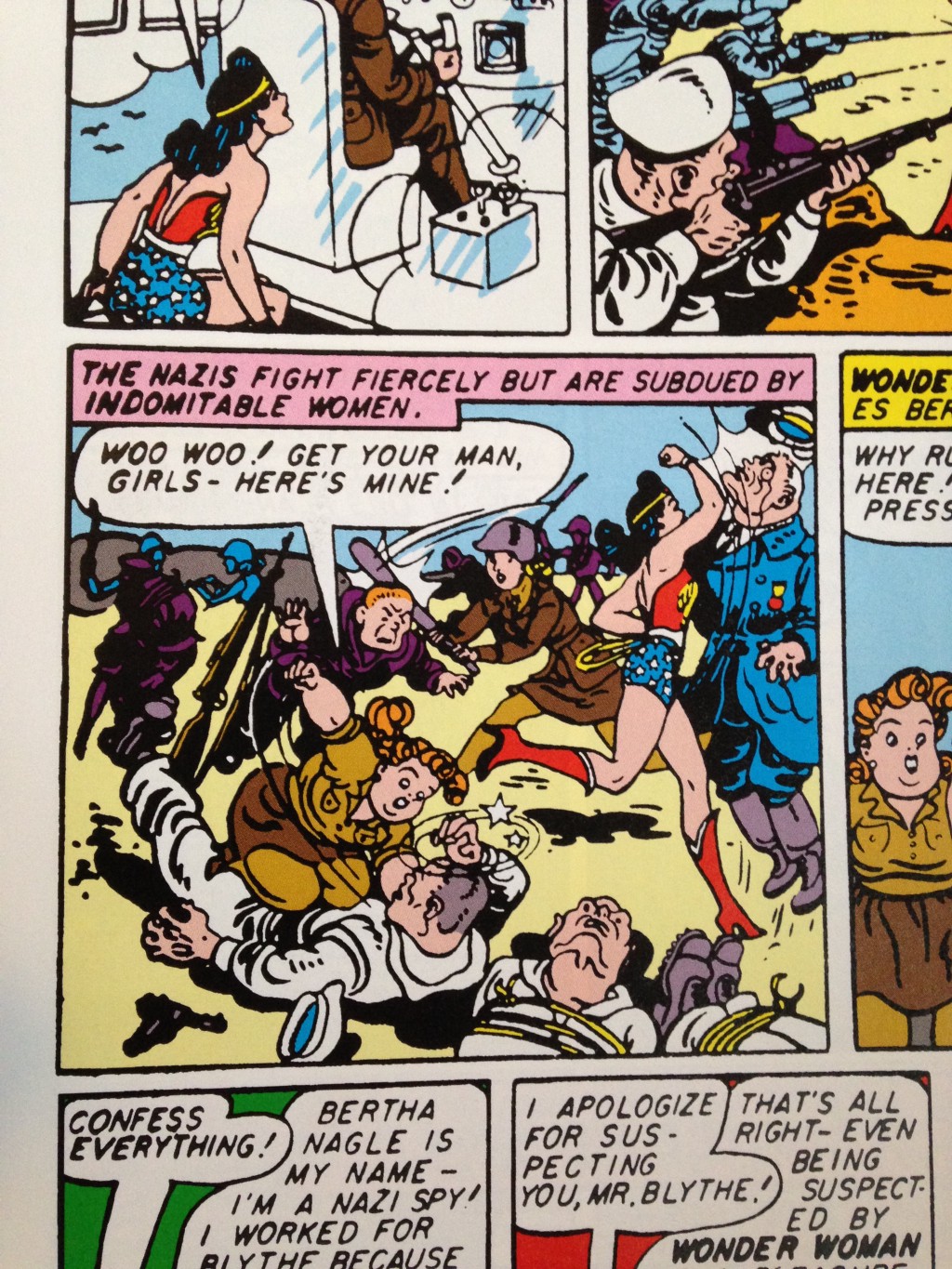
From Comic Cavalcade #4 (Fall 1943). Photo: Rachel Mans McKenny

Pop Cultural Propaganda

Zany plot twists aside, the widespread nature of comic books meant their cultural impact went beyond entertainment. These comics marked the golden era of comic books, at least in terms of sales. Scholars Ames and Kunzle note that 18,000,000 comic books were sold monthly, making up a total of a third of all magazine sales in 1943. It’s not surprising to find overwrought plotlines in 1940s-era comics. Duncan, Smith, and Levitz note in The Power of Comics that early comic books mixed the format of comic strips with the drama of the “hero pulps,” like The Shadow and Doc Savage.

Alongside the superhero drama in early Wonder Woman stood the real-world antipathy of the Axis Powers. This comic’s portrayal of patriotism matched many of the concerted national efforts geared toward women and children at the time, who happened to be Moulton’s major audience. Rarely did American propaganda posters put out by the army show explicit, photographic realism of the battlefield. Instead, images like Rosie the Riveter became popular. Likewise, many Wonder Woman comics at the height of U.S. involvement in the war featured a plea to buy U.S. stamps and bonds. In one episode, Diana Prince wrestles an opponent for war bonds.

Wonder Woman comics at the height of U.S. involvement in the war featured a plea to buy U.S. stamps and bonds. In one episode, Diana Prince wrestles an opponent for war bonds.

Marston’s tagline, which asserted that Wonder Woman represented “the ideal of glorious modern American womanhood” appeared frequently in the early comics. As alter-ego Diana Prince worked at Army Intelligence Headquarters, she had access to military documents and, as Wonder Woman, she often worked in partnership with the American government to complete missions. In Sensation Comics #20, for instance, Diana Prince goes undercover in the WAC, the Woman’s Army Corps.

Public perception and popular media depiction of the WAC forces were mixed. Leisa Meyer writes in Creating GI Jane: Sexuality and Power in the Women’s Army Corps During World War II that cartoons of the era depicted the possibility of subversion of men’s position as head of the household “with drawings that included a man sitting at home knitting a sweater for his WAC wife, as well as a frail-looking bespectacled husband wearing an apron and wielding a broom while asking his Army wife at the door if she had his monthly dependency allowance.” In contrast, Marston’s depictions of women working in munitions factories and digging trenches certainly illustrate the power of women.

The reality of WAC life was more complex than either of these diametric views. On one hand, Meyer writes, WAC units served in combat areas overseas in noncombat roles. In making this “noncombat” distinction, the Army could place American WACs to Europe to serve, but also “could preserve the roles of some men as ‘protectors/defenders’” if they remained at home. Still, even though WACs served noncombatant roles, they experienced many of the dangers of all Army service personnel at the time, such as air raids and open fire.

White Saviors, White Saved

In Marston’s comics, secret Axis agents are constantly in Diana Prince’s business, usually putting poor Steve Trevor in peril. Unlike modern superheroes, the majority of Diana’s foes have no superpowers of their own. In most plots, the weapons of war are loose lips, lost plans, and espionage. Many storylines include female victims and female criminals who are usually redeemed by the end of the story. Diana’s most common foe in the early comics is the Baroness Paula von Gunther, whose mob of female slaves often tricks Diana into captivity. Later in the series, Paula is redeemed; it turns out that her service to the Nazi cause was due to her daughter’s imprisonment. Once little Gerta is freed, Paula joins the women of Paradise Island and the Amazons. Marston writes that many of Paula’s female slaves join her, but, as if in some kind of BDSM fantasy, many of them still prefer to be chained up a good deal of the time. Later, the blonde and bumptious Priscilla Rich, “the glamourousest deb in America,” has a similar redemptive arc.

However, redemption usually only came for white villains. The Japanese Princess Maru reoccurs frequently as a non-repentant foe, and Yasmini, an Egyptian princess, dies rather than reforming. No matter the gender of the opponent, non-Western cultures in Wonder Woman often match the sensitivity of Mickey Rooney’s role in Breakfast at Tiffany’s. Racist lingo, like “Nip,” jars the modern reader during any battle against the Japanese. Marston was far from the only comic or cartoon purveyor to use such language during the time period. The exoticism of the villains is both exploitative and audience-driven. After all, as comic books began to replace pulp magazines, they offered a cheap version of escape. Wonder Woman not only served a patriotic cause with its red, white, and blue spangles, but served to feed into the idea of American exceptionalism.

Wonder Woman not only served a patriotic cause with its red, white, and blue spangles, but served to feed into the idea of American exceptionalism.

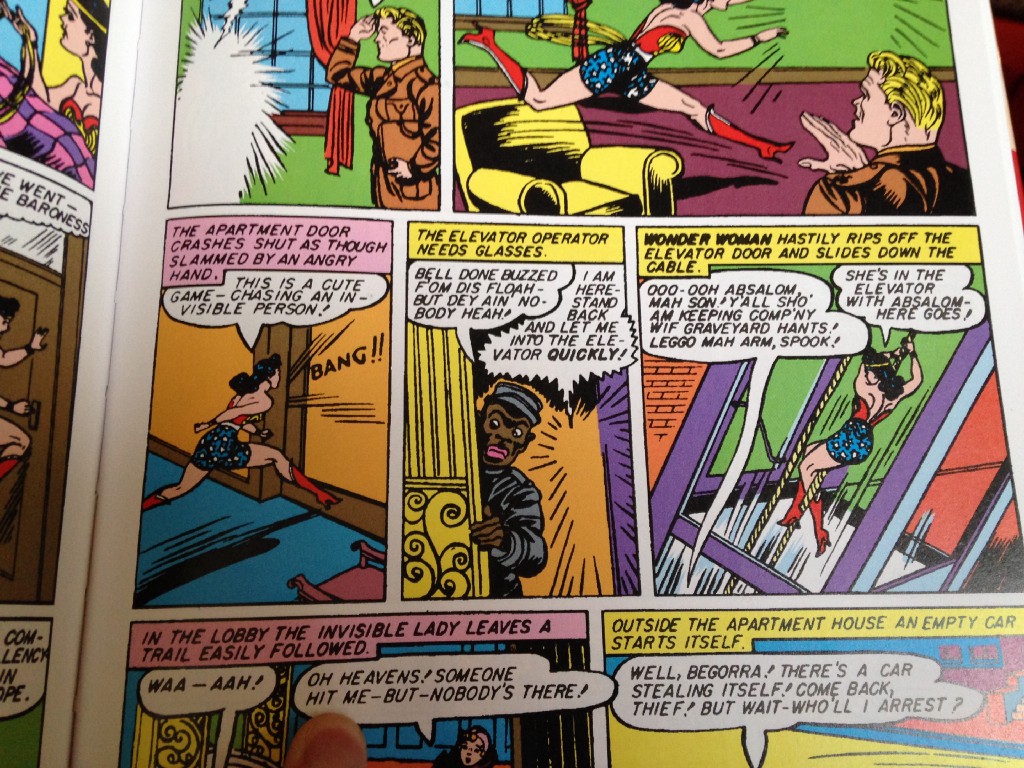
The designation of “true American” in Marston’s eyes seems further limited by color. Just as galling as the portrayals of Asian characters is the (rare) portrayal of African Americans in Marston’s early comics. In Wonder Woman, roles for black characters are limited to those of busboy, porter, and maid. In a time of war, the lack of inclusion of black service members comes across as a particularly jarring absence. As described in Meyer’s Creating GI Jane, black women made up 10% of the original WAC forces. In Wonder Woman’s WAC adventures, however, only white service members are pictured, consistent with the segregationist policies of the time period. With so many black service members, both male and female, Meyer notes that black press at the time advocated for a “Double V” strategy — victory against foes abroad and against racist policies on the home front. That effort would fail to be realized, even in comic books. Even the Amazons of Paradise Island appear white.

From Wonder Woman #3 (February and March 1943). Photo: Rachel Mans McKenny

The new movie’s diverse cast of Amazons is one step in the right direction, though a modest one, and with a female director and a strong box office return, Wonder Woman 2 is a certainty, as is the 2019 scheduled release of Brie Larson as Captain Marvel. Scan the rest of the upcoming releases in the superhero genre, however, and things look less female-led indeed.

In Wonder Woman, roles for black characters are limited to those of busboy, porter, and maid. In a time of war, the lack of inclusion of black service members comes across as a particularly jarring absence.

How much can one ask of a single superhero? Wonder Woman carries the nostalgia and admiration of millions in her various re-imaginings, but she also drags cultural baggage with her. Hope Nicholson points out in her book The Spectacular Sisterhood of Superheroes that Wonder Woman isn’t anywhere near the only female superhero, but she was one of the earliest and remains one of the most enduring. Nicholson writes, “Diana has the added pressure to be everything. And as a result she becomes nothing.”

In the scene in which Wonder Woman takes the oath of office in 3004 on behalf of the “Woman’s Party,” Marston never writes that Diana Prince is the first woman president of the United States. Comic characters like the 2015 reboot of Ms. Marvel and the forthcoming Ta-Nehesi Coates-led Storm series offer new superhero possibilities to readers. Hopefully, young people will dig into the genre of comic books beyond Diana Prince to the wide selection of characters that explore, with complexity and tenacity, the new meanings of American womanhood.

What Can Poetry Do That Politics Can’t?

Last year, the poet, novelist, and literary essayist Ben Lerner published a slim book called The Hatred of Poetry in which he argued that “contempt” was inseparable from poetry’s practice and consumption — and that this contempt actually revealed the “tremendous social stakes” at play in poetry, the sense of possibility that the form continued to evoke. People hated poetry because they believed in poetry. Their distaste was an expression of their sublimated desire.

Now Matthew Zapruder, a poet and one of the editors behind the Seattle-based poetry press Wave Books, has written another book-length defense of the artistic form called Why Poetry. The two authors’ arguments differ, but their premises are more or less the same: Poetry is ancillary to the lives of most Americans, at best, and widely detested at worst. “Clearly, there is something about poetry that rattles and mystifies people,” Zapruder writes in the book’s introduction. “[I want to] take seriously the objections people have, and try to address those objections clearly and simply, in order to explore what poetry is, and why, despite its supposed difficulties and obscurities, so many people still write and read it.”

Zapruder is nothing if not sincere — he seems to truly believe in the potential of poetry to improve people’s lives, and, over the course of more than two hundred pages, he lays out his case. First, what are people’s objections? Many of these will be familiar even — or perhaps especially — to those who do not read poetry. Poetry is pretentious, cryptic, elitist, and futile. One needs a master’s degree to understand it. It’s irrelevant to the larger culture. It makes nothing happen.

The two authors’ arguments differ, but their premises are more or less the same: Poetry is ancillary to the lives of most Americans, at best, and widely detested at worst.

That last criticism is a quote from a famous elegy by the poet W.H. Auden (“For poetry makes nothing happen: it survives / In the valley of its making”), and it is often used to imply that poetry is essentially apolitical; it may accomplish something on the page, it may move the individual writer or reader, but in the worldly affairs of politics, economics, society, and the state, it is basically useless. It doesn’t prevent wars, enact legislation, or inspire social movements. It doesn’t construct roads, create jobs, or sign welfare checks. In an era of intense politicization, this is an potentially damning critique. What, in the end, is poetry for?

The answer, for Zapruder, is nuanced—and it is this quality, nuance, to which Zapruder seems most attracted, even if his intention is to argue in a way that is both direct and clear. In this aim, he mostly succeeds. He is excellent at describing, in plain language, why poetry is different from other forms of writing, and how it can help people to lead deeper, more emotionally textured lives. He is less convincing on the subjects of political speech and poetry, and it is these stumbles that cast doubt on his poetic project as a whole.

Why All Poems Are Political

Zapruder’s most arresting arguments have to do with the subject of language itself. Poetry refreshes and renews language to which we have become habituated, he asserts, drawing from the work of Russian literary theorist Viktor Shklovsky. It transforms the inherent limitations of language — the failure of words to fully represent the objects to which they have been correlated — into “a place for communion.” It combines private and public language, facilitating communication and connection. It allows for imaginative leaps and associations (Aristotle’s definition of a poet, according to Zapruder, was a person with “an eye for resemblances”). It releases us from “the pressure of the real” (Wallace Stevens’ phrase), those “mundane, terrifying, distracting, and often monetary pressures [that] can make us feel like automatons.”

It is only when Zapruder departs into the politics of poetry that his arguments become thornier and harder to accept. His first argument relates to political speech, his second to political poems themselves. For the first, he uses George Orwell’s famous essay, “Politics and the English Language,” a more recent, and perhaps more relevant, essay by Roxane Gay called “The Careless Language of Sexual Violence,” and other texts to suggest that the attention poetry gives to language is political as well as personal.

Poetry refreshes and renews language to which we have become habituated.

Tyrannical political leaders (as Orwell and another of Zapruder’s sources, the German political theorist Theodor Adorno, knew all too well) often distort language to conceal their own violence — think of the Bush Administration’s euphemistic “enhanced interrogation techniques” instead of the more honest and troubling “torture.” Imprecise language leads to imprecise thinking, according to Orwell, with devastating sociopolitical results. Zapruder laments how “a certain word or phrase will take over the language of pundits and politicians and make its ways through our screens and listening devices and then pass through us like some kind of virus. Arab Street. Republican Brand. Public Option…” Part of poetry’s power, for Zapruder, is its ability to rehabilitate this fallen language into something more beautiful and true.

Such efforts are indisputably valuable, but I fear the political import of such “defamiliarization” is less than Zapruder would lead us to believe. The avoidance of abstraction and cliché, the deployment of unusual descriptions, the turn of a disarming phrase — these are important to literature, and they can be meaningful to an individual experience of politics. But mass communication, repeating memorable words and phrases, and even the employment of propaganda are vital to electoral politics in the sense of winning elections, building coalitions, and passing legislation. Imagine trying to persuade a nations’ representatives to support public health insurance, for example, without a bland, pithy phrase like “public option” to rally around. Political speech, in this context, is antithetical to the poetic project Zapruder describes. One needs language that is familiar, not unfamiliar, that can be employed and understood by large masses of people. “I am fascinated and horrified…when I hear dead metaphors and totally familiarized phrases start to emerge from my own obedient mouth,” he writes. I relate to this horror. But does he suggest we use poems?

One needs language that is familiar, not unfamiliar, that can be employed and understood by large masses of people.

Other problems arise in his chapters about political poetry. He argues that poems that express prefabricated political points of view can devolve into “editorials, or sermons, or rants.” “When that happens,” he writes, “the poems, however laudable in their intentions, can stop feeling like poems, and become more like, at best, poetic prose, and at worse, decorative, unnecessary lyricizing.” While poets should engage with the deepest and most complex moral questions of their time, Zapruder maintains, their responsibility is to language most of all. “[F]ollowing the suggestions of the material of language, instead of trying to bend it to expressing what we already know, is inherently ethical,” he asserts, appropriating an argument from the poet Richard Hugo. Make poems beautiful and true, he says, channeling Keats, and the poet will arrive at an ethical place.

But Zapruder wants to have it both ways — to preserve poetry as a place for intellectual and creative freedom and also for the outcome of this unlimited freedom to be automatically ethical. “Following our internal sense of music leads us to revealing who we really are,” he continues. But what if “who we really are” is white supremacist or fascist or authoritarian? History is filled with examples of excellent artists who subscribed to odious systems of thought, not least of whom was Wallace Stevens, who serves as the kind of patron saint of Zapruder’s book. Stevens, it must be remembered, once wrote a poem called, “Like Decorations in a N****r Cemetery.” Beyond this more obvious example of historical villainy are the more mundane and widespread instances of contemporary white poets who write unconsciously white supremacist poems, contemporary male poets who write unconsciously male supremacist poems, contemporary capitalist poets who write unconsciously capitalist poems, and so on. To say that if a poet writes something that aligns with her own standards of truth and beauty the result will automatically be ethical is pure magical thinking. Poets are no more ethical than anyone else, nor are our inner lives any less poisoned by the political systems we inhabit.

Poets are no more ethical than anyone else, nor are our inner lives any less poisoned by the political systems we inhabit.

Politics, for Zapruder, seem primarily to be a matter of personal choice, a system of values or ethics that has been developed individually and internally. “If you are a person who really, truly cares about the environment or politics or equality in matters of race or gender or economics or anywhere else, these concerns will naturally emerge in your poems,” he writes. But this line of argument fails to take into account the ways that politics are often chosen for people, not by them — and how these imposed choices create social and political identities to which individual thought, speech, and expression are often inevitably conjoined. “Regardless of how poets feel about aesthetic matters, we all agree we are citizens,” Zapruder claims. But are we? At a time when DACA, the program protecting undocumented people who came to the United States as children from deportation, is in danger of being eliminated, it’s obvious that not everyone who writes or reads poetry in American society enjoys the legal or social protections of citizenship. Nor do they have the luxury to choose which political issues they care about most deeply.

Support Electric Lit: Become a Member!

Zapruder is most compelling when he discusses the ways poetry can engage individual imaginations to break down social boundaries and divisions. Here, too, however, there are holes. “People do not believe in inequality or racism or global warming because they have not been informed,” he says. “[T]hey disbelieve because they cannot or choose not to imagine.” It is true that imagination, as a starting place for empathy between individuals, is essential. As a politics, however, it is inadequate. Imagine for a moment, if you are not one yourself, an undocumented DACA participant currently fearing displacement from her home because a group of powerful white men made her abstract and so politically expendable. Does Zapruder mean to suggest that this person imagine the realities of the powerful people who seek to do her harm? More likely, he intends the opposite. But then who is he writing for?

The answer, I suspect, is people like him — white, upper-middle-class, highly educated, liberal. Zapruder does include a few poets of color in his book (Robert Hayden, Amiri Baraka, Victoria Chang) but remains deeply invested in the historical canon of American poetry (Stevens, Whitman, Dickinson) while failing to consider the harm that such tradition contains. He reduces politics to the site of the individual while failing to acknowledge the social and political structures to which individual experiences are often subordinate. And he argues for nuance and complexity while failing to recognize that, for more and more people in this country, these qualities are luxuries that they simply cannot afford.

He argues for nuance and complexity while failing to recognize that, for more and more people in this country, these qualities are luxuries that they simply cannot afford.

Reading both Lerner and Zapruder, one senses the real tragedy is not that “people” are reading less poetry now — poetry has always been a somewhat rarified form in this country — but that educated, professional people are reading less poetry now, to the detriment of their inner lives. Perhaps this is why Zapruder says, rather strangely, that “poets and [tax] lawyers both are deeply concerned with what lies at the limits of language, and the fearful and intensely attractive nothingness beyond.” Or why Lerner can make so much of an encounter with a dentist who, “as he knocked the little mirror against my molars, [seemed] contemptuous of the idea that genuine poetry could issue from such an opening.” If even lawyers and dentists have no interest in poetry, both authors seem to be saying, then our country is really screwed.

And perhaps this is a tragedy: Poetry is miraculous in many of the ways that Zapruder so eloquently describes. It can change individual’s lives. But let’s not pretend that “the renewal of language” or “poems as vehicles of imagination” will improve the world on a mass scale. For that, we need politics — struggle, sacrifice, slogans, and solidarity.

What ‘Twin Peaks’ Can Teach Us About Writing—And Experiencing—Trauma

When the first episode of Twin Peaks aired in 1990, I was captivated. In my early teenage years, I wasn’t quite sure what I was looking at, but like the fearless protagonist FBI Agent Dale Cooper mused to his voice recorder (and by extension, “Diane”), I was willing to go along on this journey to “a place both wonderful and strange.”

Earlier this summer, I revisited the original series before the long-awaited third series premiered. Watching Twin Peaks, a show that begins with the discovery of a Laura Palmer’s plastic-wrapped body, was a vastly different experience as an adult. By this time, two young women I knew in high school were murdered by men. I had lived through threats of violence and the trauma of living in a homeless shelter (and sometimes on the street). I had met countless young women marked by the trauma of abuse. Laura Palmer could have been a friend. She could have been me.

Laura Palmer could have been a friend. She could have been me.

Re-watching Twin Peaks meant revisiting the horror of abuse and murder, horrors that seemed far away in my youth, but that as an adult I felt deep in my bones. It was often an uneasy feeling to watch scenes that evoked these memories and feelings, but as a writer, I was interested in how Twin Peaks could achieve this effect through the structures underpinning its approach to storytelling. Here are the lessons I’ve learned from Twin Peaks about how to write trauma in a way that feels as visceral, surreal, and challenging as living with it.

Subvert Expectations

The original series was a police procedural couched in soap opera tropes. Agent Cooper arrives in Twin Peaks and teams up with the local sheriff to unravel the mystery of Laura Palmer’s murder. Each early episode ends in a cliffhanger and scenes are sometimes played against a fictional soap opera “Invitation to Love” — a drama preferred by locals — to highlight the mirroring that unfolds throughout the story of a small town plagued by dark secrets.

But if Twin Peaks is an amalgamation of these typical television story structures, it is also a subversion of them. Director and writer David Lynch, along with co-creator Mark Frost, poked at traditional by-the-numbers story structures. The love stories found in a conventional soap operas usually end in grand weddings scenes and, eventually, a new baby added to the cast. In a typical crime mystery, the audience would expect concrete answers to a central question: Who is the killer?

Expanding the Twin Peaks Universe

Lynch and Frost lulled viewers into specific sets of expectations, many of which they had no intention of delivering. The love triangle between Ed, Nadine, and Norma is left unresolved in the original series, while other romantic threads are left hanging indefinitely. The big question that kept viewers watching week after week during the original series run — Who killed Laura Palmer? — was only answered when network executives forced the show to identify the killer in the second season. Lynch decided to walk, only to return for the season two finale to highlight the many more important questions that existed beyond the perceived central mystery.

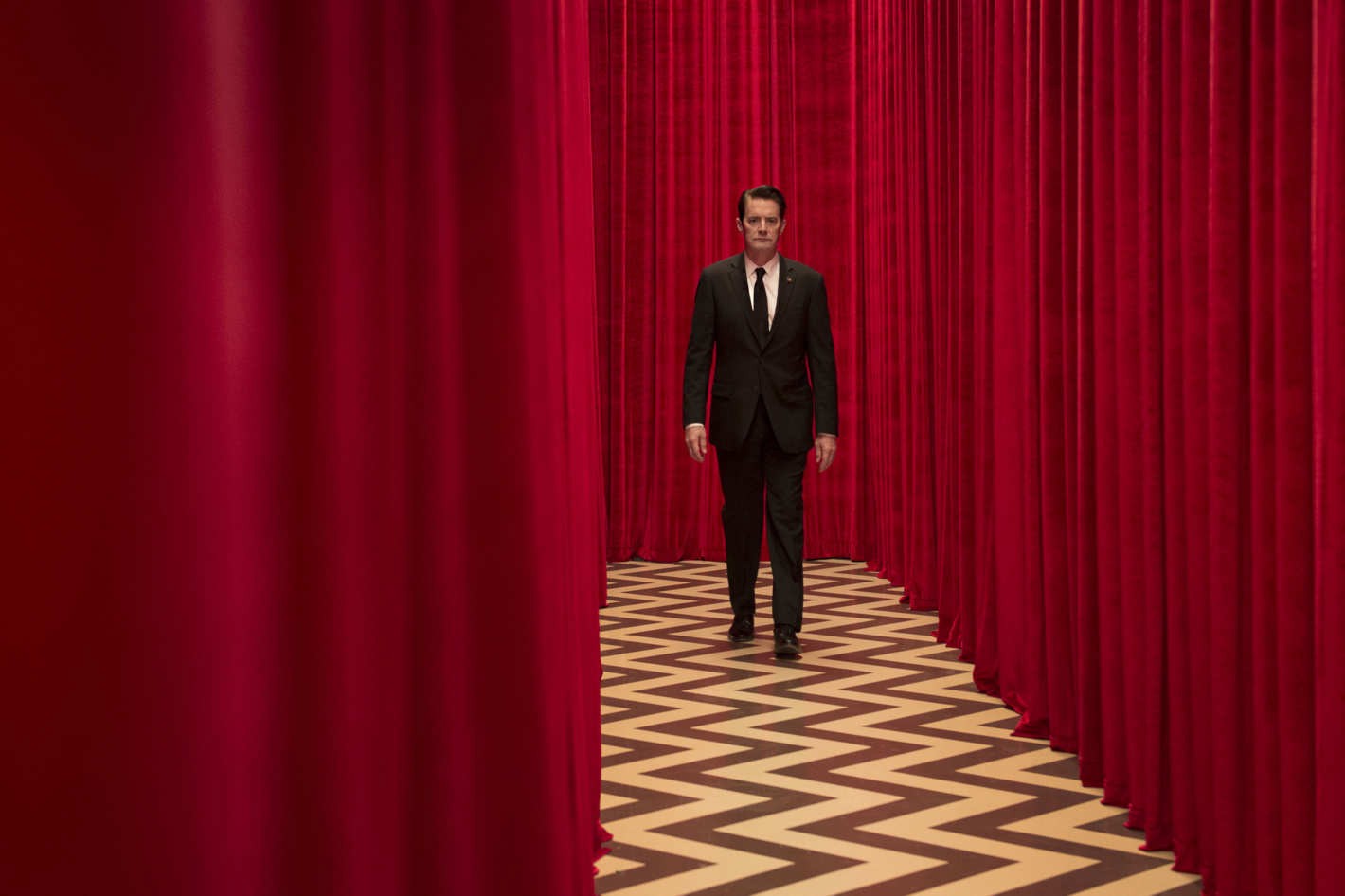
We could say that Agent Cooper follows a familiar story, reminiscent of epic poetry, including his visits to the “red room.” In many ways, he is our mythic hero journeying to the underworld. But Lynch teases out the hero’s return, and we can’t be sure he is triumphant. As a writer, what I find useful here is the toying with formality to surprise and upend our notions of what’s to come. I can adopt the fairy tale structure without entirely submitting to conventions; the heroine of my story might not live happily ever after. I’ve borrowed from missed connection advertisements to tell a story of loneliness, the label on a bottle of body wash to convey my unclean memories — to create something new and unexpected. In this sense, Twin Peaks’ storytelling shares similarities with “hermit crab” essays, braided essays, and other experimental forms that provide structures we can upend, just as the the foundation I knew became unsettled.

Don’t Be Bound by Linearity

Most of us are familiar with the traditional plot structure found in Freytag’s pyramid. Stories begin with exposition, the action rises, we reach a climax, the action falls; and when we reach the dénouement, our anxieties are soothed. In the world of Twin Peaks our anxieties are rarely relieved. The rising action of one storyline, such as the identity of Laura’s murderer, appears to climax when “Bob” is revealed as having inhabited Leland’s (Laura’s father) body, but what “Bob” is remains a mystery. Just as we think we’ve reached the dénouement, the story shifts wildly during the second season finale, which takes place almost entirely within the “red room,” an extra-dimensional waiting area connecting good and evil meeting places.

Lynch and Frost became more structurally ambitious throughout the show’s recently aired third season: Twin Peaks: The Return. Chronological storytelling is shunned in favor of storytelling that spirals outward and inward at irregular beats, much like Agent Cooper trapped inside the mysterious glass box, shifting toward, and then away from, the viewer. In one episode, Bobby finds an item left by his father, but several episodes later, and at least a day later as the story proceeds, he appears in the Double R Diner and says he’s found the items that day. Lines are repeated and entire scenes are replayed as if time is looping. Or, perhaps we are hearing echoes from alternate timelines. “Is it future, or is it past?” is a repeating question, and a nod to the viewer. The answer: perhaps it is both.

Much of this aversion to linear storytelling stems from Lynch’s sense of “dream logic.” In the original series, Agent Cooper allows his dreams to lead him closer to the identity of Laura’s murderer. His dreams are treated as seriously as physical evidence; the line between the physical and dream world is intentionally blurred. Dreams, and the irregular structural logic behind them, are viewed as something not outside ourselves, rather, as an essential part of being, and therefore, an essential part of the Twin Peaks storytelling structure.

This unusual approach to storytelling spoke to me because it is the way I visualize my own story. My memories of homelessness often appear as dream-like, disconnected scenes without a clear narrative arc: a man threatening my life in the dead of night, a pregnant girl begging strangers for a place to sleep, the elderly man at the shelter who always saved a serving of butterscotch pudding for me. I often have difficulty pinning down exact dates, and memories of specific threats sound repetitious. Stories like Twin Peaks help me trust that I can lay out the pieces, collage-style, and arrange them in a way that makes sense to me while being honest about my experiences with readers. As writers, we might be familiar with narratives that jump around in time, but the reader or viewer is typically made aware of these shifts. The original series gave ample cues, but The Return was far less willing to take the viewer by the hand and, instead, trusted the audience to make sense of it all, as we might trust our own readers to do the same.

Vary Perspective

Before I had known death up close, I was repulsed by television shows that exploited the violence perpetrated against women for ratings: the CSIs, the Law & Orders. The victims in these stories seemed to function more like plot devices than fully formed characters we could imagine as people existing in the real world. When the original series aired, I wondered if Twin Peaks would follow the same path.

Laura Palmer in the “red room”

But Laura was always at the heart of the story. Even in death, she speaks from the beyond, through the “red room” scenes, the recordings she made for Dr. Jacoby, and her diary. Yet, as the series progressed, we began to question perspectives. At one point during a Twin Peaks: The Return dream sequence, we are asked, if we live inside our dreams, then “who is the dreamer?” Or: Who is telling the story? The series tends to turn the camera back to the viewers, prompting the question: What is the viewer’s place in the narrative? If Twin Peaks is also the story of how an entire town could be implicit in a girl’s abuse, then this shift in perspective is warranted.

As a writer, this view opens the possibility of adopting the perspective of someone outside myself to approach my own story. I might attempt to show a scene from that pregnant girl’s perspective, or the elderly man who showed me small acts of kindness in my darkest days. I’ve also found it helpful to experiment with second person point-of-view to close the distance between the reader and the events in a nonfiction narrative, particularly when the real life scenes I write about seem stranger than fiction. Perhaps an incident where I was cornered in a parking lot one evening seems cliche when written from an outsider’s perspective, yet, even as I often experienced the feeling of looking at myself from afar in times of danger, we can find ways to bring readers into that scene, and we might more often ask ourselves to consider the reader’s place in a story.

Resolution Is Not a Guarantee

The framework at the heart of Twin Peaks resists conventions at every turn, and this point is most evident in the series’ “ending” (if we can call it that), a point of contention I expect we will debate for years to come. Could Agent Cooper change the course of time and save Laura, or is this impossible, foolhardy optimism with dire consequences? Leaving the conclusion open to interpretation feels natural to the story’s internal logic, and further proves that Lynch and Frost have faith in the audience. As a writer, I admire this candid choice. Is there an ending to our stories? Can my own ending exist, or will I forever be haunted by my past as it echoes through my writing? Time and time again, my stories veer into darkness and resist clean endings, even when it is not my aim.

Viewers might find the disjointed nature of Twin Peaks difficult to parse, but the show’s messy, unpredictable narrative is closer to the truth of human experience if we are to weigh our internal, abstract lives as heavily as our flesh-and-blood veneers. To fully develop characters, and give them resonance within a narrative, the psychological life of those characters must ring true. Like the multiple planes of time and existence found in Kate Atkinson’s Life After Life, we live multiple lives devoid of orderly resolution.

Viewers might find the disjointed nature of Twin Peaks difficult to parse, but the show’s messy, unpredictable narrative is closer to the truth of human experience.

I’m as tempted to unlock the mysteries of Twin Peaks as much as any fan, and I cling to a few theories closer than others. This is a show that resists clear mapping from one episode (or “part”) to the next and rewards repeat viewings like a complicated novel that begs to be re-read. Watching The Return, I couldn’t help but think of Mark Z. Danielewski’s House of Leaves, and books built on the “multiple pathway” experimentation found in anti-novels (or “counter-novels”) like Julio Cortazar’s Rayuela (or, Hopscotch), and in the same vein, Ana Castillo’s The Mixquiahuala Letters.

Rather than a puzzle to be solved, Twin Peaks opts for mood; to do otherwise would be inconsistent with the open-ended nature of trauma. We are set adrift between oceans of “what-ifs” resting in multiple times and dimensions, just as I wonder what if I had made different choices or circumstances had changed. The final episode introduces a realm that feels both familiar and remote, populated by recognizable faces known by other names. A house is no longer the home we knew. When I write about sleeping in a bus station, I know the danger intimately, but at the same time, it feels as though it happened to another person in a time and space outside everything I know today. Home became an empty silhouette, its meaning forever changed.

The final scene of “Twin Peaks: The Return”

Laura is continually reborn, never fully fading from the narrative, but we are left to question if the horrors she endured will perpetually cycle. Our hero takes Laura by the hand and attempts to lead her out of a darkness that may be, tragically, inescapable. If “Bob” is vanquished, there is still “Judy,” evil by another name, just as my own experience with homelessness led from one danger to the next. Perhaps Agent Cooper is merely the fabled knight wished for by those who know him as pure fantasy, a hero who inevitably loses his grip and is left searching for resolution.

Twin Peaks concludes on Laura’s sudden, terrifying scream, as though she feels the echo of trauma that cannot be erased from the narrative no matter how the lens shifts — an end note I identify with. Pain cannot be extinguished in favor of closure. Although the stories I’ve grown up with dole out justice and right wrongs, this is not my story, nor the stories I write. I feel a responsibility to resist the type of writing that confines trauma to easy endings. Like Laura’s silenced voice whispering into Agent Cooper’s ear as the credits roll, the telling is a struggle, but we must continue to find ways to make our voices heard.

The Weirdest Mom in the Neighborhood

“Gunpoint”

by Matthew Lansburgh

The summer before I started seventh grade, not long after Patty Hearst was sentenced to thirty-five years in prison, my mother married a man who owned a ranch house with a yard full of lemon trees. As far as she was concerned, she’d hit the jackpot. Gerry didn’t drink, he had a job, and, whenever we went out to eat, he always picked up the check. After dating a string of losers, after moving from apartment to apartment at least once a year for nearly a decade, my mother told me — three weeks into her new relationship — that, no matter what, we could not spit on the luck God had given to us. “This chance is once in a lifetime,” she said.

My mother met Gerry on a ski trip organized by Amway. She put the vacation on her credit card and arranged for me to stay with a family that lived down the street. “Bingo,” she announced on the phone, four days after she left. “I met someone perfect. He’s a little tight-lipped and has a tummy, but he’s an accountant, and he owns a condo in Mammoth.” A few months later they got engaged and we moved from Ventana Beach down to L.A.

In retrospect I realize that Gerry had no idea what he was getting himself into. He liked routine, he hated conflict, and he wasn’t used to dealing with difficult people. My mother, who immigrated to the United States from Germany at the age of twenty to work as a maid, has always been the kind of person who doesn’t take no for an answer. Within a week of our move, she’d butted heads with Gerry’s neighbor Sandi Sarconi by borrowing her rake without asking permission. My mother happened to be using the rake just as Sandi drove down the street in her red BMW. The incident probably wouldn’t have been a big deal if my mother had simply apologized, but she tried to justify herself, explaining that Gerry’s rake was too rusty to work properly, then using the discussion as a way to horn in on Sandi’s weekly doubles game with Carol Wallace, a woman who lived up the block, and two other women my mother had been wanting to meet.

It promptly became clear to everyone involved that Sandi and Carol did not like my mother’s style — didn’t like the fact that my mother cut her own hair instead of going to a salon; that she brought wiener schnitzel, rather than lasagna, to Carol’s annual potluck; that she let Gerry’s dog, Goldie, defecate in people’s front yards. In September, Carol called just as we’d sat down to dinner.

“Why hello there,” Gerry said when he picked up the phone. He was wearing the same thing he put on every night after he got home from the office: worn jeans and a flannel shirt. “Is that so? I see. That’s unfortunate. Yes, of course, I’ll have a talk with her.”

My mother, who’d been telling Gerry a story about how the cashier at Vons had tried to overcharge her for a bag of oranges, was wiping up the gravy on her plate with her finger. She had a worried look on her face, a guilty look. I’d seen the expression plenty of times.

“Carol says Patti Schneider saw you laying out in their backyard with your top off,” Gerry said when he hung up.

“Really?”

“Yes, really. Did you go swimming in her pool, Heike?”

“I went for a quick dip. Is that such a crime? I tried to knock, but no one was home.”

“She says she saw you lay out on the deck and take off your top.”

“That’s ridiculous,” my mother said, getting up from the table and clearing the plates. “I simply pulled down the straps a bit. She’s just jealous of my beautiful figure.”

Gerry took off his glasses and studied them, as if he’d been socked in the face.

“Everyone hates me,” my mother complained to him a few weeks later. “You have your job. Stewart goes to school. I have nothing. I need a good friend.” My mother had made Gerry his favorite meal — meatloaf with spätzle and fried onions — and she had tears on her cheeks. Gerry wasn’t stupid. Even before she made the request, he knew what she had in mind. She wanted him to let Sabine, a woman my mother had met at the German bakery in Hawthorne, move in with us. Sabine was from Munich, and, after being evicted from her apartment because she had too many cats, she’d recently moved to a motel that rented rooms by the week.

“No, Heike,” Gerry said. “There’s not enough room.”

“Don’t be such a stick in the mud. We can put a futon in your office. I saw one for sale at the Goodwill — only fifteen dollars, including delivery.” Gerry stared at my mother, using his fingernails to pluck the stray hairs that grew from the edge of his ears. “Wait till you meet her. She has warm eyes and a kind smile. Your heart will go out to her.”

After dinner, when Gerry still hadn’t given in, my mother became semi-hysterical. “You don’t know what it’s like for me here! Sometimes I almost kill myself. Is that what you want? To come home and find your wife hanging from a rope?” I was in my room studying, but I could hear everything. It wasn’t the first time I’d heard my mother trot out the suicide card.

“Enough!” Gerry shouted. I got up from my desk and looked through the crack between my door and the wall in time to see him storming off to the garage.

“Model airplanes,” my mother yelled, still in tears. “My husband loves model airplanes more than his own wife!”

We drove to Inglewood to visit Sabine on a Saturday morning. My mother had gotten up early, made French toast, and put on the halter top she used to wear when she had to take her car in to get fixed.

“Do I really have to go?” I asked as I watched my mother put her plate on the carpet so Goldie could lick up the Mrs. Butterworth’s. I hated the fact that my mother let the dog eat off our dishes, and I was convinced we’d end up with worms.

“Have to go? It’ll be fun. Gerry takes us to Marie Callender’s for lunch.”

“But I have homework.”

“Ach! Who does homework on Saturday? Come on now. Behave or you won’t get any pie.”

I reminded her that I didn’t like pie and said something about the science fair project I needed to work on, and then, when I knew I was fighting a losing battle, I went to my room to change out of my pajamas. The truth is I hadn’t wanted to stay home to study. I was hoping that Jason McFarland — a kid who’d moved into the house next to the Wallaces in June — might knock on our door. Jason and I weren’t friends exactly, but sometimes he’d stop by to see whether I wanted to go out to the bushes behind our house and look at a stash of dirty magazines he’d stolen from his father. For some reason, Jason had decided that a place at the back of our yard, behind the lemon trees, was the perfect hiding spot for his dad’s porn: three Penthouse magazines full of lurid photos of Amber Williams and Tonya Lee and Felicity Light and other women whose names I’ve forgotten, in poses that for many years I could recall with surprising clarity, including the one of Tonya next to a fire truck with a bare-chested man in suspenders who had hair leading down to his navel and biceps that looked like the gym teacher’s.

The first few times Jason and I snuck out back, usually after school when my mother was running errands, Jason led the way. I watched, the branches of the lemon trees digging into my back, while he unearthed the mildewed treasures and flipped through their pages. Jason was in eighth grade, only a year ahead of me, but already his voice had changed and he boasted an Adam’s apple. I remember leaning close to him, ostensibly to get a better look at the photos — so close that sometimes my arm grazed his shoulder or forearm or some other part of his body. I studied the blond hairs that had begun to sprout from his cheeks and his upper lip. I remember wondering whether he had a boner.

I stayed still, nervous that we might be caught or that Jason might notice me gazing at him. The dirt was damp and soft, and its earthy smell rose up to meet the scent of the lemons. I imagined my mother coming into the garden and calling out to us. “Stewart!” she yelled once, after getting home from a tennis game and not finding me in the house. “Are you here?” I heard her voice carry across the lawn and the hedges, through the thicket of branches, and I froze.

“Don’t be such a fag,” Jason said, while she was still outside in her yellow Fila skirt, shouting my name. “She’s not gonna find us.” His breath was warm and made my ear tingle.

Sabine’s motel was even more rundown than I expected. It was on a busy intersection, and the office windows were covered in bars. The only parking space was next to a group of guys in tank tops sitting on their motorcycles, and before Gerry had gotten out of the car, one of them called my mother baby and made a loud kissing sound.

“How long is this going to take?” I asked.

“That’s enough! Do you want to ruin the only friendship I have?”

I trailed my mother and Gerry — who walked on the edges of his feet, complaining that his arches hurt — across the parking lot, toward a room with a door that looked like someone had tried to pry the knob off. My mother knocked, and a tall woman in a skimpy robe answered. “Heike, Liebchen,” she exclaimed. “You came after all. Careful the cats do not run outside.”

When I reached out to shake Sabine’s hand, she leaned forward and embraced me. “Heike, you didn’t tell me Stewart was so handsome! I bet all the girls are chasing after him right and left. How wonderful to finally meet you, my little Prince Charming.”

“Likewise,” I said, trying to keep some distance between her chest and mine.

Sabine’s room was small and reeked of urine; the curtains were drawn, and the only light came from a small lamp next to the bed. Two litter boxes covered the carpet next to the dresser, and neither looked like it had been emptied in days. At the foot of her nightstand sat a bowl of dried cat food and a dish of water with something bloated floating on the surface.

“My goodness,” said Gerry, gesturing toward the cats. “Are they all yours?” Two of the creatures were up on the dresser, trying to climb into a box of full of papers.

“Yes, these are my babies,” Sabine said. She stroked one on the back and grinned, exposing a set of teeth that were too large for her mouth.

“Aren’t they cute?” asked my mother, as she picked up a white kitten and cradled it like an infant. “Feel how soft.” Gerry put his hand out tentatively to stroke the cat’s fur. “See, mein Schatz. Gerry takes a liking to you.”

“They are my blessing,” said Sabine. “Without my Bübchen, I would not know how to survive. I do not have such a nice family.” Sabine looked at me and then, before I could pull away, she put her hand on my thigh. I felt the skin of her palm, cool and moist as a raw chicken cutlet. “My ex-husband, Rolf, and I tried to have a child for many years. We wanted a son.” Her robe had come open a bit, and I glimpsed a terrifying expanse of white skin.

Gerry told Sabine that she lucked out finding a hotel that allowed pets.

“Ja. They do not mind die Bübchen. My old landlord was quite cruel. He continually nailed papers to my door demanding that I must move out of my house. I was a good renter. I paid him on time. I was clean, but he insisted I leave. I am sure it was because of the cats. Only in America would such a thing happen. Gerry, do you know if this kind of thing is legal to do?”

Gerry started to respond, but my mother interrupted. “Of course it’s illegal. What one does in one’s own home is no one else’s business. How could he have objected to a few kittens? Does he also throw his wife out if she has twins?” My mother and Gerry sat in plastic chairs while I sat on the bed next to Sabine. The air was thick with dander, and my eyes were watering; I felt like I’d been locked in a bunker. I sneezed twice, insisted I was having an allergic reaction, and asked whether I could wait in the car.

“Fine, Mr. Party Pooper. Just don’t get anything out of these vending machines. We eat lunch soon.”

Outside, the Hells Angels were gone, but two teenage boys were now doing wheelies on their bikes. The boys looked like they were in high school, and they didn’t have shirts on. I tried not to stare but found myself glancing furtively at them, partly out of fear that they might ride over and do something to hurt me, partly because any guy who’d already gone through puberty caught my eye. Their nipples were larger than mine, and I could see veins on their arms. I myself was a late bloomer, and the fact that I hadn’t sprouted as much hair under my arms or around my crotch as other kids in the locker room caused me perpetual angst. I stood next to the car wondering whether I should go back to Sabine’s room to ask for the keys. A minute later one of the guys shouted something in Spanish, and they both laughed. I stared at the fender of Gerry’s Oldsmobile, afraid to look up. I tried to wedge my right foot under one of its tires, pushing the front of my shoe into the space between the rubber and the asphalt until my toes hurt. Then I heard what sounded like a pebble hit the windshield. I looked up and saw the bigger of the two kids throw something else in my direction as they sped away, shouting maricón.

My mother kept telling me I should be happy she married Gerry. She said that Gerry had saved us from being homeless, but Gerry wasn’t the kind of father I’d hoped for. He didn’t mess up my hair with the palm of his hand when we were standing in line at McDonald’s or tickle me until my stomach hurt. He didn’t take me Boogie Boarding in the summer. Most of the time, he just wanted to sit in his easy chair and be left alone.

Occasionally I wondered what it would feel like to be kidnapped. I imagined men wearing masks driving up in a van and forcing me inside at gunpoint. I pictured them pinning me to the floor and taping my mouth shut, sending my parents a ransom note like I’d seen on TV. I played out various scenarios in my head: my mother calling my father in Colorado, pleading with him to send money; my father flying in to meet the police, then driving around town with my mother, putting up posters with a photo of me; my parents standing next to each other in a house I’d never seen — a two-story house with a nice living room and a pool in the back — surrounded by men in FBI uniforms, wearing headphones and hovering over tape recorders they turned on each time the kidnappers called.

Over the next several days, as I lay in bed at night trying to fall asleep, I heard my mother and Gerry having more sex than usual. My room shared a wall with the master bedroom, and I often heard, if not their exact conversations, then at least the murmur of their voices, punctuated with my mother’s occasional laughter and yelps. I knew what my mother was up to. She’d also been posting fliers at the grocery store and the laundromat advertising “potty-trained” kittens.

“He’s just worried they won’t get along with Goldie,” she’d confided. “If we find them a family, he’ll come around.” She extolled the cats’ beauty to anyone who would listen: people she met when she was hitting against the wall of the tennis courts at the park; the Sarconis’ gardener, Frank Herrera; anyone else who happened to cross her path. Then one afternoon — I remember it was a Wednesday, the day I had to drag the garbage cans out to the street — my mother came into my room while I was cutting out photos of Mayan ruins for a social studies project. “Guess what?” she said, standing in the doorway in her bikini. “This Saturday we have a little surprise.”

She had some kind of heavy cream all over her face, something she put on whenever she went out to the garden to take a sunbath. I asked her what kind of surprise.

“We have your friend Jason over for dinner,” she said, giving me a sheepish grin.

“Jason? What do you mean?”

“Well, I know how much you like him, and I thought I surprise you by inviting his family over for dinner. I called his mother this morning.”

“Are you insane!

My mother insisted that she was just trying to be a good neighbor, but I knew what she was scheming. The thought of having her try to unload some of Sabine’s cats on Jason’s family, of having them watch my mother prance around in her dirndl, trying to yodel and telling the stories she always ended up telling complete strangers — stories about how, during the war, even a potato was a luxury and how the husbands of the women who hired her when she moved to America tried to have sex with her in the pantry or the gazebo or the garage — made me want to throttle her.

That night, I lay awake listening to the ticking of my clock. I heard my mother and Gerry go to bed, and in the distance I heard the sound of a train, like a foghorn out in the ocean. Periodically, I got up and turned on the light to see what time it was. I had a math test the next day, and I kept going over word problems in my head: questions involving the number of ice bricks necessary to build an igloo of a given size, or the quantity of paint required to cover a specified number of walls.

I thought about how my homeroom teacher, Mrs. Wilson, told me I was only allowed to ask her two questions per day and how she’d started making a clucking sound whenever I raised my hand. I remembered how even Jackie Fleischman, the girl with the leg brace, laughed when I asked Mr. Gutierrez whether something he’d said was going to be on the test. Recently I’d seen Jason hanging out with Sam Espinoza, a kid who carried his skateboard around with him all the time and who sometimes threatened to beat me up if I didn’t give him a quarter. I wondered how long it would be until Jason figured out that everyone at school thought I was weird.

As it turned out, I didn’t have to wait until Saturday for things to unravel. Two days later, I was walking home from school when I saw a police car in front of the Wallaces’ house. Even from the top of the hill I could see the car’s red and blue lights. School had ended an hour before, but I’d gone to the library to check out some books on Andrew Jackson. As I came down the hill, after it was too late to turn around and retrace my steps, I saw my mother and Sabine on the Wallaces’ lawn, in their bikinis, being questioned by the police. Carol Wallace was standing next to them, gesticulating wildly while, to my horror, Jason and his sister stood on their porch, eating ice cream sandwiches and watching the spectacle unfold.

“Stewart!” my mother shouted. “Call Gerry. These men are trying to arrest us!” My mother’s bikini was emergency orange, and the top was so tight the entire world could see her nipples. It was her favorite bikini, the one she called her orange knockout. Immediately I ran down the street, certain that Jason and his sister were watching me flee.

I arrived home out of breath and stormed through the house. Goldie got up from under the table and lumbered over to me, wagging her arthritic tail. “Out of the way, pig!” I yelled as I grabbed the phone to dial Gerry’s number. On the third ring, his secretary picked up and told me he was in a meeting. “Is there a message?” she asked.

“Can you tell him his wife called? She has a question about dinner.”

When I hung up, I stood in the living room wondering what to do. Goldie was standing by the back door, staring at me. I looked at the bowl of lemons that my mother kept on the kitchen counter and the bottle of coconut suntan lotion. I imagined turning Goldie into a dragon and getting on her back and flying away. I wished I could turn the lemons into hand grenades and the suntan lotion into a flamethrower and burn Gerry’s house to a crisp.

Sometimes I wished my mother had never met Gerry. I thought about how, when we first moved to L.A., my mother kept saying that the master bedroom, with its brown shag carpet and embroidered pillows, smelled like Gerry’s wife, Fern, was hidden away in one of the closets, recently deceased. I remembered how my mother took all the sheets and blankets out of the bedrooms and washed them on hot, how she used so much detergent that it smelled like someone had dumped a bottle of perfume into the Maytag, how she kept the windows open all day, even when it was raining. I remembered her asking Gerry whether he appreciated everything she was doing to make his house nicer. More livable was the term she used. I remembered her getting up on the step stool with a bucket of bleach and scrubbing all the cupboards.

At first Gerry thanked her and said the house had needed a good cleaning, that he’d forgotten how dirty things can get if you don’t stay on top of them. Then one day Gerry was in the family room, looking at his bookshelves, and he asked my mother where she’d put all his magazines. “Were you still reading those?” she asked. “I thought you were done with them, they were so full of dust. I put them in a shopping bag by the bikes. There was spider behind them I had to kill.”

Gerry took off his Dodgers cap and rubbed his forehead. He stared down at the carpet and made the whistling sound he made whenever he was trying to act like everything was okay. “Is that where the photos are too? In the garage?”

“What photos?”

“Don’t play dumb, Heike.” I knew which photos he meant: the photos of Fern sitting in front of the fireplace wearing a New Year’s hat, and Fern throwing a stick for Goldie at the beach, and Fern and Gerry with their sons, David and Rick, in front of Tomorrowland. The photo of everyone at Disneyland was my favorite. When we first moved to Gerry’s house, I looked at that photo a lot. I wondered whether Gerry and Fern were good parents and whether David and Rick were happy growing up. I remembered trying to figure out what David and Rick were like back then, before their mother died. I wondered whether they were into fantasy games, or volleyball and skateboarding. The few times I’d met them, they both seemed quiet. Not nerdy quiet, just distracted, like they wanted to be somewhere else. In the photo they both seemed well-adjusted though. They were smiling and holding hands with Mickey Mouse. Gerry was giving Rick a piggyback ride, and Fern had her arm around David. For some reason I always ended up wondering whether Fern already had cancer growing inside her when that photo was taken. I often wondered whether my mother might have cancer or something else wrong with her; I wondered who would take care of me if she died.

“Did it ever occur to you that those photos might be important to me?” Gerry continued. He spoke slowly, enunciating each word carefully, as if his tongue caused him great pain. Then he went out to the garage, got the shopping bags, and brought them inside. I stayed on the couch in the family room, but I wasn’t paying attention to the TV. I was waiting to see what Gerry would do. I was waiting to see whether Gerry would throw something at my mother and tell her to fuck off. That’s what my real father would have done. He would have told my mother not to touch his fucking things ever again. Instead, Gerry got a dishtowel from the kitchen and wiped the photos. He held each frame carefully and ran the towel over the surface of the glass.

“I’m sorry,” my mother finally said, starting to cry. “I shouldn’t have put them away. I just couldn’t stand it anymore, seeing Fern there every day, judging all the time from the grave.”

Standing in the living room, I could tell Goldie wanted me to pet her. She was looking up at me, wagging her partially bald tail. I decided that, instead of going back to check on my mother, I would scoop up Goldie’s droppings. It was the chore I hated most, the chore Gerry always had to remind me to do before I got my allowance. I opened the door to the yard, and Goldie followed me outside; even though she was old, she still liked to make her way over to the lemon trees and give them a sniff.

I walked to the grass with my plastic bag and the shovel, and I remember wanting to cry. The grass was brown, and some of the turds were so old that they looked like little pieces of wood. I retrieved the droppings with the utmost care, making the task last as long as possible. At one point, Goldie stood next to me, panting. Ten minutes later my mother and Sabine returned home.

“There you are,” my mother yelled. “How dare you leave us stranded there on our own. Did you see the police? We could have been imprisoned!”

I told her I’d tried to call Gerry but that he was busy, and I was waiting for him to call back. I showed her what a good job I’d done cleaning the lawn. Sabine, whose hair was still damp, kept saying she wanted to be driven back to the motel.

That evening, Gerry laid into my mother. “I’ve had it, Heike! I can’t live like this anymore!”

“How was I to know Carol would get home so early? We just went for a quick dip.”

“By the way,” I announced in the middle of their fight, “I’m not going to be here for dinner on Saturday.”

“What do you mean?” asked my mother.

“I’m just not. I’m not going to sit here in front of Jason and his sister and act like everything is normal. They probably think you’re a total retard.”

“How dare you!” She lunged toward me, but I was too fast. I ran into my room and locked the door.

“Open this door and apologize to me!” she screamed. “I am your mother!” The more she pounded, the louder I turned up the radio. I sat at my desk trying to concentrate until, eventually, I put on my shoes. I emptied everything out of my backpack, took my life savings — $56.23 — from the box I kept under my bed, and folded up three of my favorite T-shirts. I put the shirts in my backpack, along with the Dungeons & Dragons characters I’d painted by hand and a piece of turquoise my father had given to me as a present, and climbed out the window.

I moved fast, past house after house, afraid someone would catch me. When I reached the intersection at the top of the hill, I headed to Vons. I thought that, at a minimum, I’d need cereal for my trip. I walked to the aisle with the Fruit Loops and Lucky Charms and the other cereals my mother always said were too expensive, and as I studied the choices, I wondered whether I should have told Gerry and my mother where I was going. I imagined them pounding on my door, then picking the lock. I pictured my mother going berserk. I considered sneaking back to leave a note so she wouldn’t worry. I’ll be okay. I’m going to Mrs. Moy’s. Love, Stewart

Mrs. Moy was the woman who’d taught me Sunday school in Ventana Beach. She’d always told me that if I ever needed anything or if I was ever in trouble, I could give her a call. I didn’t know her address, but I knew her number by heart. I went up to the cashier, gave her a box of Frosted Flakes, and handed her a ten-dollar bill.

“Do you mind giving me my change in quarters?” I asked.

“You bet, sweetie. You going to Vegas?”

I smiled, not sure what she meant, then headed to one of the payphones, where I picked up the receiver and dialed Mrs. Moy’s number. An automated voice told me I needed to put in ninety-five cents for the first three minutes, and after I deposited the coins, I listened to the phone ring. I let the phone ring at least twenty times before I finally hung up.

I watched the people in the parking lot put bags of groceries into the trunks of their cars. I wondered whether my mom and Gerry were watching the ABC Thursday Night Movie, something about a woman who claimed her family was abducted by aliens. Eventually, I decided to walk to the beach. I’d walked to the ocean lots of times with my mother, and I remembered how each time we passed a particularly nice house, one of us would say that was the kind of home we wished we could live in. Some of the houses had elaborate gardens and pools and huge windows that allowed you to see into the living rooms and kitchens and dens. I thought about the children on the milk cartons. Every morning, when I was eating my Cheerios, I always stared at the black-and-white photo of whatever child was featured in that week’s advertisement. The caption was always the same — Missing Child — but the details were different:

Melinda Ramirez, Age 9. Last seen in El Cerrito Mall (June 23, 1975)
Peter Yates, Age 7. Last Seen at Pismo Beach (March 13, 1973)

When I arrived at the bike path along the edge of the beach, I headed toward the pier. Occasionally I saw someone go by on roller skates or a bike, but for the most part the beach was deserted. The air on the pier felt cooler than I expected, and below me I heard the sound of the water. I sat at the end of the pier, letting my legs dangle over the edge and studying the oil derricks in the distance. I kept looking at my watch, wondering whether my mother and Gerry had figured out I was gone. I wished I’d brought a jacket along, instead of just my sweatshirt, and I tried to keep my legs as still as possible so I wouldn’t get any splinters.

Eventually, a homeless guy with a sleeping bag and a fishing pole sat down on the pier and smiled at me. “How’s it going, buddy?” he said. His teeth were brown and crooked, and he wore a shaggy beard. There’d been stories in the news about a man who strangled women in the Hollywood Hills and about a retired dentist in Arcadia who kept a twelve-year-old girl locked up in his cellar for ninety-six days, until she finally escaped when he went to the movies. I imagined the principal of my school telling everyone at Friday’s assembly that my dismembered body had been found in a dumpster.

“What brings you out to these parts?” the drifter asked.

I pictured a hiding place under the pier where he forced people to have sex with him before he suffocated them. I wondered whether anyone would hear me if I screamed.

“Want a swig?” He offered me a bottle inside a paper bag.

I shook my head, looking down. My body felt light; suddenly I had to go to the bathroom. Without thinking, I leapt up, grabbed my backpack, and sprinted down the pier, toward the houses along the shore. I ran until I was sweating hard and my lungs felt raw and I reached a group of teenagers sitting on the strand smoking and laughing together. They looked at me and smiled, but I didn’t stop. I climbed the huge hill leading from the train tracks to Sepulveda in record time. I pictured my mother on the couch, holding her wooden spoon, waiting. I decided to tell her that I’d snuck out of the house in order to buy her a gift.

Finally, when Gerry’s house came into view, I saw that all of the lights were off except the one in my room. I hurried down the block and peered into my window. Miraculously, my room was exactly as I’d left it: the door was still locked, the folders and books I’d taken out of my backpack on the carpet next to my bed. I climbed back inside, my heart like a drum. A few minutes later, I turned out the light and got into bed. I held my breath, listening, but the house was perfectly quiet.

The next morning, when my alarm clock went off, I got dressed and went out to the living room like nothing had happened. “Thank you for saying goodnight,” my mother called from the kitchen. “That was very nice of you.”

I apologized, saying I’d fallen asleep while I was studying. “We don’t have any more apples,” she said, as she was making my lunch. “Is a banana okay? They’re a little brown.”

That afternoon, after I got home from school, I was in my room when Jason’s mom, Mrs. McFarland, called to say they’d come down with the flu. “Are you happy?” my mother hollered. “Your friend cancelled! They’re not coming over.”

During the following weeks, I went out of my way to avoid Jason. I changed my route to and from school, and I spent as little time as possible in the hallways between classes. I took solace in the fact that next year Jason would be going to Tres Caminos High. As for Sabine, my mother’s plan to have her move in never came to fruition. Two weeks after my mother and Sabine were almost arrested, as I was coming home from school, I saw my mother sweeping leaves in the driveway. She was wearing sunglasses, but I could tell she’d been crying. When I asked her how she was, she refused to look at me. “Fine,” she replied.

“What’s wrong?” I asked.

“Doesn’t matter.”

“What do you mean? What happened?”

“Nothing. Nothing happened.” She kept sweeping the leaves, and I stood there looking at her. Finally she said, “Sabine is moving to Ohio. She decided to move back East to be closer to her cousin.”

“Gosh. When did you find that out?”

“Little while ago.”

“Really?”

“Yes, really. Stop pretending like you care about me. I know you don’t give a damn.” My mother started sobbing. “I just can’t take it anymore.” She let the broom fall onto the driveway. “One of these days I move back to Germany.”

I tried to calm her down. I asked her to tell me what Sabine had said, and then she told me the story. She said that Sabine never agreed to let her give any of the cats away and that, when my mother told her what she had in mind, she flipped out. “She accused me of trying to steal these pets from her. I told her this was not the case at all, but she wouldn’t listen. I drove over there and tried to talk to her, but she was like a different person — so cold and icy. Her eyes were like rocks. Afterwards, I couldn’t even drive I was so upset. I had to pull over into a gas station.”

I stood under the huge willow tree outside Gerry’s house, looking at my mother, wondering whether I should give her a hug. I knew she wanted me to cry with her, to tell her I loved her and no matter what, I would always be there for her. I knew she wanted me to reassure her that it didn’t matter what Sandi Sarconi or Carol Wallace or Jason’s mother thought of her. But I couldn’t bring myself to say any of these things.

That December, amidst continuing news stories about Stockholm syndrome and the Symbionese Liberation Army, Hotel California hit the charts and Rocky and King Kong were released. The few times that I saw Jason over Christmas break, he was walking on the street with a girl who wore lots of lip gloss. By that point, I already knew that he’d climbed over the fence to retrieve his magazines. I’d gone out back one afternoon when my mother wasn’t home, and all I found amidst the thicket of lemon trees were a few torn pages with part of an article about trout fishing and some photos of a woman sitting on the hood of a green Porsche. The paper was wet and discolored, and when I shook the leaves and dirt from the pages, a pill bug fell to the ground.

I brushed the dirt off the paper as carefully as possible and folded the pages. I surveyed the area to make sure I hadn’t accidentally missed any remnants of the other magazines, then crept out of the tangle of branches and went back to my room. I closed my door, spreading the pages out on top of my desk and examining them, as if I were looking for some kind of clue. I knew that soon enough my mother would come home and start making dinner and that she would expect me to peel potatoes or make fruit salad or stir something on the stove so she would have someone to talk to.

Is Jane Austen Frivolous?

In Late to the Party, we ask writers to read a seminal author who has somehow passed them by. You can read previous entries here.

As an adolescent prone to black-and-white thinking, I assumed there were two kinds of people in this world: people who were interested in love, and people who were interested in death. I counted myself proudly in the latter category. I didn’t understand how anyone could settle for the confectionary earthliness of love when meaty, cosmic death was on the table. When love turned dark and inched toward death, as it does in many novels (Lolita, The Lover, and Season of Migration to the North spring to mind), I could get on board, but otherwise, I considered romance the domain of the frivolous. The marriage plot novel, then, was an even greater blight: it was frivolity once removed, a frivolous investigation of people preoccupied with the frivolous. The work of Jane Austen, therefore, was obviously a non-starter, no matter how much it was considered to be critically and culturally beyond reproach.

I might have chugged along happily for the rest of my life without ever reading Austen, had I not moved to England in 2015. It wasn’t an easy transition: I was aimless and lonely a lot, the latter no doubt owing to my confusion at the rules of interpersonal conduct, so different from the forthrightness New Yorkers were known for. At first, I found myself frequently enraged at listening to someone relay a message using one hundred words, when they could have summed it up neatly using ten. During phone conversations with plumbers or pizza delivery men, I’d often try to trap them into saying “no,” which is basically a swear word for nonconfrontational Brits.

I assumed there were two kinds of people in this world: people who were interested in love, and people who were interested in death.

But in my two years living here, I’ve found myself — yes, I’ll say it — falling in love with the peculiar British character: repressed, evasive, witty if a bit wordy, enamored of their history, a bit classist at times, but tough and lacking in self-pity. Who could resist the charms of a culture that wields a seemingly innocuous word like “quite” as a weapon of passive-aggression? Couched in so many qualifiers, an insult won’t be felt until after impact, when you’re already crumpled on the floor, clutching your spurting jugular. It’s really quite impressive.

I decided, therefore, to break my own rule and dip into Austen: a giant of literature who on the one hand transcends nationality, but on the other, is so specifically British in her worldview and so beloved by Brits. (She’s the second woman, apart from the Queen, to have her face grace paper tender.) I wanted to hear about England, in other words, from one of its most beloved native daughters.

The plot of Pride and Prejudice needs no recounting — or anyway, I didn’t seek any out despite never having read it (I had seen Bridget Jones’s Diary a few times, although I embarrassingly didn’t realize that it was based on Pride and Prejudice until I read the book). Though I knew how the book concludes going into it — and suspect I would have figured it out almost immediately even if I hadn’t, as Austen doesn’t seem too worried about building suspense — I decided to refrain from reading the many, many works of commentary on the text before I began: the academic papers, the think-pieces and paeans, the riffs and re-makings. I wanted to come to the text the way I would have at fourteen, when all I would have had to inform my reading was a set of encyclopedias, the introduction to the book and the endnotes. I wanted to see if my 33-year-old self — less jaded in many ways that her teenage precursor, but still inclined towards darkness over light, and severity over fun — could become smitten with Austen the way people have since its initial publication in 1813.

And you know what? I was besotted. Sure, the language wasn’t as poetic and descriptive as I might prefer, but I don’t think one reads Austen for inventive metaphors and swooning lyricism. The real appeal here is the view of the historical era, and the wry, winking banter — just the stuff I’d fallen in love with over the course of my time in England. Take for example, a moment in chapter five of Pride and Prejudice, when Mrs. Hurst and the protagonist Elizabeth Bennett, out on a walk, encounter Fitzwilliam Darcy and a female companion. Seeing that the path is only wide enough for three — and disinclined toward the heroine Elizabeth’s outspokenness — the other two women grab the arms of Mr. Darcy and begin to strike out. When Darcy makes a move toward including her, Elizabeth responds with a subtle barb: “You are charmingly group’d, and appear to uncommon advantage. The picturesque would be spoilt by admitting a fourth.” The notes to my edition (written by British academic Vivien Leigh) clarify:

Elizabeth refers jokingly to the contemporary cult of the picturesque, a fashion in both landscape appreciation and garden design which emphasized a painterly aesthetic… The allusion here is to [William] Gilpin’s Observations, Relative Chiefly to Picturesque Beauty… particularly the Mountains, and Lakes of Cumberland, and Westmorland (1786), where… he explains… his “doctrine of grouping larger cattle”: “Two will hardly combine… But with three, you are almost sure of a good group… Four will introduce a new difficulty in grouping…”

So in the most essentially British way ever (by invoking landscape gardening, nonetheless), Elizabeth refers to the two catty ladies as cows. This book, I realized, was as much about delivering the killer comeback as it was about snagging the right man.

Though the time period in which the book takes place is not one I’d opt to inhabit if given the choice, it’s amusing to get a glimpse of it — this explains the appeal of, among many other things, Downton Abbey — and to imagine what you would be like if you were forced to follow the rules the characters are beholden to. Would you be like Elizabeth, spirited and unconventional (on which, more later), or like her sister Lydia, so eager to get married she runs off with the first guy who looks at her? Would you obsess over money and hierarchy, like Mrs. Bennett, or carve out a little space for yourself away from society, as her husband does? Despite most of the characters living in large homes outside of town, society has the potential to suffocate them: information about who is refusing to dance or who is coming back to inhabit his country manse is constantly being exchanged in drawing rooms (though fewer drawing rooms than I’d been led to believe) or lengthy epistles. The Bennett sisters even take trips into the local village specifically for the purpose of hearing gossip. But none of the characters, with the exception of perhaps one, seems particularly bothered by the smallness of their world. On the contrary, all the buzz is enlivening to them, and to the world of the novel itself. It makes the book exactly as Austen herself described it: “too light & bright & sparkling.”

One aspect of the story, however, continues to rankle me: the fact that everything works out just a little too perfectly in the end. This is what I find both charming and annoying — but mostly annoying — about what, for simplicity’s sake, I’ll call chick lit (sorry, Jennifer Weiner). Elizabeth is a plucky, winning heroine, for sure. She trudges through the mud to visit her ill sister, propriety be damned; she refuses a strategically viable marriage proposal because the suitor is a putz. She speaks candidly, and a bit caustically, before someone of greater social stature in her stand-off with the condescending Lady Catherine de Bourgh, a choice that obviously has a risk attached. Elizabeth reminded me a little of my younger self, who thought not only that reading about love was stupid, but that all men were stupid, and pursuing them, therefore, to be the same. “What are men to rocks and mountains?” she asks rhetorically when her aunt offers to tour around the Lake District with her.

However, I had been under the impression prior to reading the book that Elizabeth was something of a revolutionary figure, when in reality she doesn’t so much upend the rigid strictures of her society as determine a way to fit neatly within them. At the novel’s end, she just so happens to marry a very wealthy man, who just so happens to be handsome and honorable, too. We’re assured in the last chapter that Elizabeth never gives up her “lively, sportive, manner,” which is a comfort, I suppose, but still a bit too easy. How wonderful it must be, to be afforded the ability to be both righteous and rich.

What would happen for those whose husbands weren’t as woke as Fitzwilliam Darcy?

It’s the “rich” part that remains a bit of a sticking point for me. When asked by her sister when she first fell in love with Darcy, Elizabeth responds, “But I believe I must date it from my first seeing his beautiful grounds at Pemberley,” a line which stopped me in my tracks. According to the academic Vivien Leigh, who wrote the introduction to my volume, this probably has less to do with Darcy’s wealth than it does with what she believes his “beautiful grounds” represent: the object of her affection’s thoughtfulness towards his belongings, including his servants and tenants. Maybe that’s true, and maybe I’m projecting a contemporary sense of social justice onto the past inappropriately, but I found myself asking a lot of questions about what would happen for those whose hearts didn’t align so neatly with their bottom lines, or whose husbands, though titled, weren’t as woke as Fitzwilliam Darcy. (Lydia, Elizabeth’s “vacant” and “unabashed” sister, is not quite intelligent enough to be a sympathetic token.)

Ersatz-enlightened though it is, Pride and Prejudice was still a delight to read. It won’t keep me up nights pondering its great mysteries, or be a work I expect I’ll re-read anytime soon, but it was pleasant, and, yes, even quite fun. And it helped solidify a lesson I had been learning since I moved to England. Back in the days immediately after the move, when I felt lonely and culturally marooned, I thought it best to stay at home and focus on my work, which was inevitably about serious topics. No time for love, Dr. Jones — I had to write about death. But the isolation only made it worse (go figure) and soon my mood was bleaker than a bleak house. So I cut a deal with myself: I would force myself to put work to the side and go out and do enjoyable things, and if it made me feel better, I’d have to concede that simple pleasures were, in some cases, more valuable than severity. I went to the theater, I took in movies at the London Film Festival; I swam in the Hampstead Ladies’ Pond, viewed court proceedings adjudicated by men in funny little wigs, and read novels that had nothing to do with my research. Even if my social circle didn’t widen tremendously, focusing on uncomplicated joys helped a lot. Never again will I deny the worth of fun for fun’s sake, love over death — in life or, as Austen has taught me, in literature.

Claire Messud on the Power and Pitfalls of Female Friendship

Over the course of Claire Messud’s career, she’s made a practice of chronicling women’s lives, not the commonly showcased milestones of marriage and early motherhood, rather the in between moments — twenty somethings failing to settle on a predetermined path, women finding inner passions late in life. Her new novel, The Burning Girl, records its two main characters at another brink: the moment, the summer, between girlhood and adolescence, when Julia and Cassie quickly migrate from dwelling in fantasy worlds to meeting firsthand the dangers that befall young women as their bodies and minds mature.

Though The Burning Girl fits into an emerging canon of literature delving into the passionate bonds between young women, it would be a mistake to reduce this genre to simply “female friendship.” Rather this book provides evidence that the stories of young women can provide a kaleidoscopic lens through which to discuss the history of womanhood, how American culture treats teenagers, and the unique ways young people approach issues of social class.

Messud is as eloquent to converse with as her novels are to read. We spoke on the phone about the primal allures of abandoned places, how teenagers create social taxonomies, the persistence of the Madonna-whore complex, and, of course, the ragged terrain of friendship between girls and women.

Rebecca Schuh: Early in the novel, we get a sense that Julia’s friendship with Cassie is tinged with a casual possessiveness. Do you think that there’s a possessive nature to the intense friendships of childhood and adolescence?

Claire Messud: I have no objective proof that that is so, but from a subjective experience and anecdotal knowledge, yes. I realize that the passions of the girl I was and the girls I’ve known, the passions of those early adolescent friendships are like being in love. The intensity of it, this sort of complicated sense of precariousness and loss if another friend comes into the equation — can a group of two expand to be three, or does that mean that somebody will be ousted?

RS: I love that there’s really this renaissance of not just the intensity but the complexity of the friendship between women whether they’re young or older.

CM: I imagine you probably read the Elena Ferrante books, I did too of course, and that’s just one of a number of going back even some years. Sheila Heti’s book, which is about a character named Sheila Heti and a number of her relationships and friendships but central in the book is her close friendship with her artist friend Margeaux. It’s mostly loving and then sometimes not. With our closest friendships certainly, sometimes we know we can be close to somebody because we can have a fight with them. The closer you are, the more complicated it gets. The challenges and joys are intertwined with each other and inseparable.

The closer you are, the more complicated it gets. The challenges and joys are intertwined with each other and inseparable.

RS: When the girls sneak into the members only quarry swimming hole, Julia notes that they’re gaining this awareness of their families relative places in the financial hierarchy of the city. When do you think that teenagers start becoming aware of those class differences?

CM: Maybe in New York there are seven year olds who are aware of social class differences. But even if children are aware that your house is different from my house, it usually isn’t framed in terms of a broader social context. I think one of the things that happens as we enter adolescence is we become aware of the world, the world beyond ourselves and ourselves in the world, literally self-consciousness. And that involves sort of trying to understand a taxonomy of the world. And social class, even if it’s unconscious, becomes part of that.

Our daughter is now 16 and I can’t remember exactly whether it was sixth or seventh grade, I realized that in her head, she had a hierarchy of popularity for the entire class, she could have said “I’m 37th,” it was so precise. And that wasn’t about economics, but an awareness of the economic disparities of peoples lives was part of the algorithm ultimately. It was part of this broader social awareness that they were coming into at that time.

RS: It’s so fascinating to hear it spoken about like a taxonomy. And then dating comes into play with popularity.

CM: That’s the moment where you lose agency because somebody else is making a choice. The boy or girl, whatever, that you fancy is either going to fancy you back or is going to choose somebody else. And that factors into the hierarchy. The realities are so multifarious and complex and interesting, and you know you do see kids who assess all that and very actively although quietly opt out, who sort of put on a pair of sweatpants and a big sweatshirt and have their hair fall in front of their eyes and are just like you know, I’m not going there. I’m not interested in this procession, this dance, this taxonomy. I’m not going to do it right now. I’m stepping aside.

Why Are Friendships Between Teen Girls So Radioactive?

RS: It seems like there’s a universal jumping off point for that sense of social mapping.

CM: I’m sure it’s also related to hormones and stuff because by fifth grade, there are kids who are physically growing up. That simple animal thing of your body factors so much into how things play out. You have no control over it, whether you shoot up really early or whether your palms sweat. You don’t have any control over those things and yet they have such a role in where you end up in a social hierarchy.

RS: Such a big part of the novel was this idea of girls learning to be afraid, and talking about the body — those two ideas are so closely intertwined. How do you think that girls bodies changing affects or even instigates the kind of process of becoming fearful?

CM: I think that it’s two sides of the same coin in a way. Our society gives such mixed messages. On the one hand, girls are encouraged to celebrate and adorn their bodies and flaunt them, and then on the other, are encouraged to feel awkward or self conscious or afraid.

In conservative religious cultures, girl children can wear whatever they want until they hit puberty and then they must dress modestly. They get physically covered up. And we in our culture do an almost metaphorical version of that. On the one hand we say no, wear whatever you want, wear that tiny tank top, those shorts, it’s your right as a girl, but instead we then have this list — don’t go out on your own at night, don’t get in a car with a stranger, there’s this list of prescriptions or circumscriptions around girls lives which are abstractly analogous to covering a girl up, if that makes sense. We put limits in a different way. And the limits aren’t on her actual physical body in the world but they’re on her movement in the world.

RS: One of the most unsettling aspects of the novel for me was the part where Cassie’s stepfather wants this unexplained control over her lifestyle, and it seemed like that’s another similar note, that kind of control. Where do you think that desire, on an either personal or wider cultural level, to control young women comes from?

CM: Historically, if you go back to earlier centuries in our culture, women were chattel, women were property. And if your property was marred or harmed, your own value was less. There’s this sort of underlying sense that daughters have a value, but if they are compromised sexually then that value, it’s not just the value goes away, it’s something worse. That’s such an underlying history that feminism has battled against for well over a century. There are people who retain vestiges of that in whatever form.

Women were chattel, women were property. And if your property was marred or harmed, your own value was less.

RS: The girls spend a portion of a novel breaking and entering into the abandoned women’s asylum, how did you choose that setting as a place for their playacting and fantasies?

CM: There’s a literal answer and there’s a more metaphorical answer, and the literal answer is, we spent a year in Berlin, and in and around Berlin there are a lot of abandoned buildings with extraordinary history and I became sort of obsessed with some of those abandoned buildings. There’s no chicken wire fence, no do not enter signs, there’s just these ruins hanging out there and you can wander through them at will.

Part of it was also this literal interest in the asylum and the notion of what an asylum is. Refugees seek asylum. It’s the same word as the insane asylum. But it is a sort of refuge, and for me there was some sort of metaphorical narrative too, about the girls literally going into the woods, going into their subconscious, going into a shared place of childhood play that is safe and free, and is at the same time the darkest places with this terrible history, this history of suffering, that is specifically about women.

Human traces in a state of dereliction is very interesting to me. I don’t know if you know the work of this photographer Robert Polidori, he’s done these large format photographs of Havana, of New Orleans right after Katrina, Chernobyl and Pripyat. These are places where people have lived and left everything. In Havana the people are still there, the buildings are just incredibly decrepit, but in these other places where people had to abandon their lives in great haste and nature has come in in this sort of extraordinary way. And for me there’s something very haunting and evocative and primal about it. That was part of setting the girls play in such a place because it’s both at once so great and awful, light and dark.

RS: I love what you’re saying about it being a subconscious space where it’s very primal, because the way it’s positioned in the book, it’s the last time they’re truly able to fantasize as children and live partially in that space. I think as you get older, it’s so much harder to inhabit that unrestrained mental space.

CM: I think it is and it’s sort of sad as a parent to watch your children having to let go of that, or feeling it’s time to let go of that space. And you wish for them more time.

Support Electric Lit: Become a Member!

RS: It’s interesting what you were saying about Berlin not having “do not enter” signs. I was thinking about how, in the novel, there’s the quarry and the abandoned mental asylum, and the girls are really experimenting with this idea of who’s allowed in a certain space, whether it’s because of class or because the place is private property. Can you talk about the idea of girls having access to different spaces and how that affected the novel?

CM: That’s a really interesting question. It’s almost like an Escher drawing, I see it in terms of boundaries. I see it in terms of separations between spaces rather than spaces themselves. And the degree to which growing up is about creating or acknowledging boundaries that when you’re younger you don’t, and as we were saying earlier, the ways in which a community, a family, a society is laying out the maps and the border of what and where people can go and what is permissible for them. And Cassie in that sense is somebody who is just not staying in the boundaries. There’s a whole set of things, first Anders Shute arrives in her life and the boundaries such as they were shift and she has no control over that, and sort of can’t believe that’s happening in her own house, in the space that was supposed to be the safest one. And then there’s the second thing — in running away from home, she’s doing something that is very much taboo. Along with other behaviors, then, it puts her beyond the pale of not only her family but also the community itself. And she then becomes somebody who grown-ups are trying to catch and enclose and put back in her cage.

RS: That reminds me of another line that I noted, in the portion of the novel where Cassie and Julia are growing apart, Julia says “Without anybody saying so outright, I was being told that my path was more valuable,” and that line really relates to what we’re talking about, because it’s this idea that Julia’s path is more valuable in part because she’s sticking to the path, she’s not trying to break the boundary as much as Cassie is.

CM: The Julia path is society is smiling on her and saying that’s the valuable path because you’re not breaking rules, but it’s also, back to the middle school popularity stakes, it’s the uncool path. And then as we all remember there are the girls who miraculously and bafflingly sort of cover both tracks. The straight A students who are on all the varsity sports teams yet they also have an edge and are partying and going out with boys early and somehow their parents don’t know that — that’s sort of the 14 year-old version of having it all, managing and navigating both economies. But back to women and bodies and fear, for the broader society there still is this underlying madonna-whore narrative in which the good girls get one set of treats and the bad girls are desirable but dismissible.

There still is this underlying Madonna-whore narrative in which the good girls get one set of treats and the bad girls are desirable but dismissible.

RS: I was talking about that with one of my friends recently, we’re in our twenties, but that complex still lasts. We were joking that the new madonna-whore is the nice girl-party girl complex. It’s still happening.

CM: It’s still going on. Old habits die hard. It’s still in there, no matter how much we think things have changed.

RS: As Cassie and Julia grow apart there’s this evidence that Julia’s idealized version of Cassie is different from the school’s social perception of her, among the rest of her peers, and that both of those are different from the real truth at the core of Cassie’s life. How did you feel that those different perceptions, both Julia’s and her peers, affected Cassie’s path as a character?

CM: There are lots of things I tried to write about in this book and one of them was the degree to which we make up stories and invent stories and internalize stories that we’ve heard. There’s a truism that our stories are the reception of our culture. It’s a two-way mirror, and those stories also create the culture. That happens on the micro level as on the macro level. If I believe that my friend is no longer trustworthy because of one incident, or two incidents, and then I thought she was loyal and kind but actually she’s two faced and horrible, and you rethink every experience through that lens and suddenly everything, the whole story looks different. What I was trying to write about, is the feeling of, “I know how that story goes or I know what happens next, I’ve heard this before.” And we don’t really. And because we don’t pay full attention, we don’t ever really know.

RS: Later in the novel there’s Julia relating the parts of Cassie’s story and it almost feels omniscient. She’s the narrator and she acknowledges that, but I got the sense that there was a level of fantasy to how engrossed she was in Cassie’s mind.

CM: It isn’t even her recounting what Cassie told her. It’s totally third hand. I’m glad you had that experience, moments of thinking we’ve slipped into the third person narrative, and then remembering, no we haven’t. This is Julia making this up. And there’s no way that Julia had access to these details. That’s what I feel like we’re doing in our lives.

RS: There’s this fundamental unknowability to the portion of the story where Cassie leaves for Maine, because you’re hearing it through Peter, and you’re hearing it through what Julia thinks of what happened, but it’s going back to that subconscious dream because it’s not concrete, which is what made it so gripping, that there’s so many possible ways it could have gone.

CM: I used the word mystery earlier and I wanted this to feel open. I am now fifty. If you had asked me twenty years ago about a trajectory of life, I would have said well you learn more and more and you understand more and more and things become clearer, and you get through life and you can say you understand these things, this is true and this is not true. And actually no, my experience of certainly the last decade is that I think I know less and less. People and things I thought I knew are just more and more mysterious. And that’s sometimes amazing and sometimes awful, but I am learning still to look differently at the world. There’s so much we don’t know. We just don’t know.