An Underground Library on the NYC Subway

The MTA and NYC libraries partner to offer free eBooks to commuters, with selections from Recommended Reading

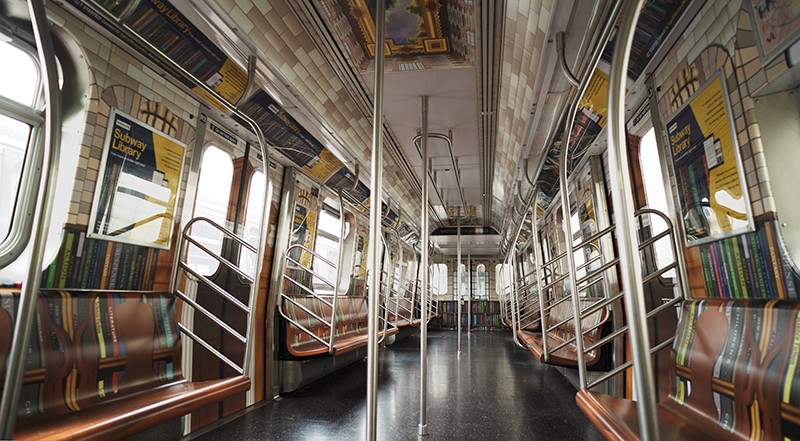
New York City’s commuters are already regailed by showtime, mariachi bands, and the occasional harmonizing quartet, but this summer, riding the subway is about to get even more entertaining. As a way to celebrate free cellular service and WiFi in underground stations, the MTA has partnered with the New York Public Library, Queens Public Library, and Brooklyn Public Library in creating a hybrid of the two systems: the Subway Library.

As part of this six week promotion that began last week, the MTA has remade the interior of a 10-car subway train to resemble the New York Public Library’s Rose Main Reading Room. Adorned with “SUBWAY LIBRARY” in a multitude of bright colors on its exterior, the train is running along the E and F lines. However, the promotion is not only available for those who will be lucky enough to get on this train in the coming weeks; by logging into the WiFi of any of the underground subway stations, patrons can get free access to hundreds of e-books and other online reading, all of which has been donated to the New York Public Library by publishers. After the six weeks, readers will need a library membership to access the content and the app.

The selection of e-books includes new fiction and nonfiction releases, classics, thrillers, and young adult books, available to browse on the promotion’s website. Electric Literature’s own Recommended Reading has contributed selections from our archives for the project, making members-only stories by authors such as Jesmyn Ward, Deborah Eisenberg, and Lydia Millet available to all New Yorkers. In addition to the selection of short fiction, novel excerpts are available from Zadie Smith’s Swing Time, The Wind-Up Bird Chronicle by Haruki Murakami, and Commonwealth by Ann Patchett.

Recommended Reading Archives

In a news release on the MTA’s website, New York Public Library President Tony Marx says, “The New York Public Library’s mission is to make information and knowledge accessible to all, and this exciting partnership with the MTA is certainly right on track…By making thousands of free stories easily available to subway straphangers, we are encouraging reading, learning, and curiosity. We hope people take their love of reading with them once they leave the subway by checking out one of our 92 branches or downloading our e-reader app SimplyE.”

Accommodating for various travel times and readers, the Subway Library shows a dedication to one of NYC commuters’ most popular pastimes.

From His Corner, A Bodega Owner Watches Brooklyn Change

Double Take: What Superheroes Talk About on Their Time Off

Note: Double Take is a literary criticism series wherein a book goes toe-to-toe with two authors as they pick apart and discuss its innermost themes, its successes and failings, trappings and surprises. In this edition, Rosie Clarke and JW McCormack go in-depth with Eugene Lim’s Dear Cyborgs.

Rosie Clarke: Let’s chat on Hangouts!

John McCormack: Yes, sorry, hi! I’m so simpleminded I can’t drive my module. Or remember how to use messenger.

RC: It’s all good! There’s something very Microsoft about Google Hangouts that sets my teeth on edge.

JMC: Do you want to do chat another way?

RC: Is the old Gchat still running? I know they’re phasing it out. I mean this is fine.

JMC: I sort of thought this was Gchat.

RC: It is, as in, Gchat is dead: Long live Google Hangouts.

JMC: That’s right. Now, on top of our confusion about Gchat vs. Talk vs. Hangouts is the fact that I had thought that we would be having a live conversation; instead, we were supposed to write one another a series of emails. I think this series of misunderstandings has brought us here; as well, the wonky platform we’re using underscores a key theme of Dear Cyborgs.

RC: Yes, for me the book feels like a series of monologues, one-sided conversations, with no clear recipient or audience. I found it very hard to connect with what was going on at times. Even the actual conversations that occur are quite alienating. I think the intimacy characters feel with one another aren’t shared by the reader, mainly due to a lack of character development, but we can come back to that. Did you have the same response?

JMC: Right! I suspect this is a situation where we think the same thing but feel differently about it. To your first point, I certainly “a series of floating monologues” is a good way to define the novel’s structure. The characters aren’t actually speaking (at least not entirely) nor is what they’re talking about the basis of the story. It’s a little like Godard’s whispered intrusions in his late 60s movies and a little like the radio writer Joe Frank. But let’s go back to the ‘story,’ the initial premise. How would you describe it?

RC: In part, it’s a memoir, a series of nostalgic recollections about growing up and sharing the kind of closeness with a friend that only comes from a shared sense of alienation. And when that closeness is severed, it echoes that sense of being haunted by its absence. On the other hand, it’s a series of meditations on protest, resistance, the purpose of art as a creative force, commerce. So the “novel,” the connecting thread, is an attempt by the narrator to capture or recapture this significant friendship. The meditations are more like short stories, sometimes even manifestos, conveying messages I feel are not entirely realized.

I was certainly mislead by the superhero element!

JMC: Oh, let’s about that superhero element. Frank Exit is a superhero fighting the machinations of his nemesis, Miss Mistleto, throughout the city. In the meantime, he hangs out in karaoke bars with his artist friends, Muriel and Dave. The superhero chapters alternate with chapters that detail the story of a Vietnamese immigrant named Vu, who moved away when the narrator was a child but who resurfaces near the end of the novel and proposes that he and the narrator collaborate on a series of comic books, which would seem to explain the superhero content, right?

Except all of that — and I’ve left out the postcards addressed to, Dear Cyborgs, popping up throughout — is just a frame to explore the themes you mentioned: ideas of art and resistance.

RC: I feel like using superheroes as mouthpieces for socio-political commentary is a clever move by Lim, I just wasn’t expecting it, but probably because I’m conditioned by the kind of superhero-centric content I consume predominantly being provided by the MCU and D.C., where any discussion of politics is, shall we say, not subtle.

JMC: Oh, you mean inasmuch as the mutants of the X-Men are standing in for minorities or how Iron Man fights Captain America in a kind of explosive Bush administration dumb-show?

But I think that Lim’s goals here are to illustrate every variety of adjacency. Adjacency being a force more powerful than love.

Art is certainly adjacent to consumption, just as it is the passing of strangers and the miracle of chance encounter — probably central to every work of literature, but usually not taken as a central feature as it is here — is what turns us into people. As though personhood is a thing that seeps like a ghost through crowds.

That’s what I take from the part where a character is talking about how he likes to “ghost.”

“Now human exchange has been reduced to transaction… I’d test it out quite literally. I’d go to the busiest plaza, the most packed rooms, the jammed streets. And I’d stand just to the side, next to the thoroughfare or just against the jostle of bar bodies in Brownian motion. And the world would revolve around me, even, it felt, flow through me.”

“We’d pass by each other untouched.”

That’s what it is to be a cyborg, right? It’s a super-modern condition where we’re an audience plugged into every conceivable entertainment, including our own lives, but at a considerable distance.

RC: Yes, absolutely, and the postcards that punctuate the chapters are directed at us. They’re very tongue-in-cheek, but vaguely threatening, and sometimes nonsensical in a way that makes me think that some sort of A.I. or algorithm wrote them, which would make sense in the context. And I think the distance that’s inherently connected to our state as “cyborgs” is apparent in the book itself; rather than pulling you into an intimate, absorbing narrative, the reader is constantly being kept at arm’s length, confounded, turned around. And the notion of ghosts and ghosting that you mention are recurring themes. The narrator feels haunted by Vu; the “villain” Ms Mistleto appears and disappears; we ourselves feel like ghosts observing conversations from behind a kind of veil of disconnection.

JMC: I think we are invited to view narrative art with suspicion. Maybe I’m imagining things, but I think I caught a bitter joke at the expense of Italo Calvino and the kind of, you know, primacy of art and the nobility of reading that we all pay lip service to while knowing that, at most, we are “parasites signaling to other parasites.”

I mean it in the way Frank Exit mentions that he lost his book and we expect he’s going to go on losing his book while only getting part of the way in like in If on a winter night’s a traveler. Instead, his friend just turns up and says, “By the way, here’s your book.”

There’s a long quote near the beginning that’s worth trying to parse because it seems like the thing we’re being dared to challenge throughout —

“However, there may be a sliver of protest still possible, which you may rightfully accuse of being worse, a reactionary or collaborative tactic which I nonetheless think is the only possible defiance left outside of the terminal possibilities of suicide, the morally corrupting option of guerrilla warfare, or the subtly but fundamentally distinct choice of utter acquiescence. This alone-possible and admittedly vaporous defiance is merely to live and accept one’s culpability but try without going into heroics to participate minimally as a parasite does, getting one’s needs and not much more, not often much more.One tries then to touch only lightly the general degradation but also to become no longer concerned with it. One becomes accepting of powerlessness, is rendered complacent and mute, but tries nonetheless to signal other like-minded parasites, not in order to gather and foment rebellion, which would be too grandiose a goal, but simply so as to provide reflection, the mirage or actuality of company, that is, simply to make known one’s kind’s existence as a remaining possibility. In the end this contemptible character I’ve sketched, the artist, is all that remains of the initial quest for purity.”

That is, the artist recognizes the base-level un-livability and outrage of the culture as it is. But rather than do the usual thing and claim that art is transformative on a mass scale, Lim’s artist serves to broadcast one’s existence as a remaining, but not redemptive, option.

That’s the dilemma that all the various dialogues seem to be picking up from different angles.

RC: Very Camus-esque — laying oneself open to the indifference (or in this case, hostility) of the world, and in that acceptance lies the impetus to go on despite it all.

JMC: It’s so immediate. Galvanizing, palpable. Maybe that’s why I was more forgiving of the fact that the characters are often little more than mouthpieces, the super-heroics little more than self-aware, coy line drawings penciled in around the monologues that make up the bulk of the book. Because Lim anticipates, and indeed problematizes, our impatience with the escapist literary norm.

RC: Yes, returning to your earlier comment about art’s adjacency to consumption, I think that in Dear Cyborgs, art is more than adjacent — Lim represents art as intrinsically connected to commerce, even when the artist sets out to create something impossible to value. I’m thinking of the character Sonny Rhee, who “allowed only twelve of her paintings to exist at any one time… What this meant was that when she finished a new painting, she would burn her oldest one”, and buyers have to buy all twelve paintings in the understanding that eventually, all of them will have been burned and replaced by different works. Of course, the irony is she’s hugely successful, albeit temporarily, because that kind of gimmick is highly sellable.

The reason is Lim’s focus on capitalism and its machinations, and whether protest and demonstration are viable methods of resistance, or just shouting inside an echo chamber or, worse, into the void, or if by creating a painting with the purpose of destroying it one is feeding the function of art as capital rather than rejecting it, because through that destruction you’re acknowledging its value.

JMC: I am so glad you brought the Sonny Rhee part up. I felt like I was going to have a difficult time re-capping it, but it’s one of my favorite episodes.

RC: Likewise, it’s one of my favorite parts.

Double Take: Joan of Arc in a World of Endless War

JMC: In a way, it’s the most lucid book I’ve read lately. All the books I’ve related to lately have basically brought up the question(s) — what are we doing here? What are we party to? What is desirable? What is apt, given that the correct socio-political view is the horrified, baffled, fearful, woke one?

Another good joke: When the book entitled Dear Cyborgs appears, the narrator asks what it is and the answer is —

“A program, a drug uploaded through your eyeballs, an idea virus. Techincally, a bio-based cybernetic machine to collapse space-time, or psychosomatically one that activates clairvoyance, or, more poetically: a time machine. If you read it, you can know the future or the past.”

“What?

“Just kidding. It’s my autobiography, kind of. My life story, but fictionalized.”

We have at our command, a vast vocabulary of information, knowledge, points of reference and affinities. We can cross-reference science fictional concepts, apply classical storytelling modes to comic books and dissect the Barthesian content of midnight movies, with uncanny skill and speed. We’ve successfully banished all notion of high and low art. It’s hard to believe what a slight comfort it all is. And when we look hard for something pure, “the initial quest,” what do we find but the market, which we know reinforces all the very destructive tendencies we set out to oppose.

Thus, I think, the book’s plot/character elements are tinfoil recreations. To pretend otherwise would to be giving the lie to Lim’s whole project. It would be too comforting to develop these phantoms according to our expectations.

Because what good have our expectations done anybody lately?

Frank’s sister appears drunk at a gallery, railing at her brother’s hypocrisy because she believed in his artistry but now seems to have recognized him as a parasite. She states the case thusly: “Now we’re all Icarus. Cyborgs with our wings. An augmented reality. The Cassandra warnings forgotten. And it’s always on, always simultaneous: the soaring and the panic, spasm and grace, flight and fall. Burn it to the ground. Burn it to the motherfucking ground.”

RC: Fiction that responds to the sense of a societal malaise and directionlessness that isn’t sci-fi, or dystopian fiction, is much more interesting to me, and Dear Cyborgs does feel distinct in that way.

I think it speaks to the questions you posited — what are we doing here? What are we party to? What is desirable, what is apt — which are very specific, unanswerable questions, or perhaps the answers are unwanted in a way.

The chapter where Ms. Mistleto recounts her experiment in “alternative living” arising from a protest which turns into the occupation of a skyscraper, in an attempt to “refashion the occupation… and make it into a utopian colony founded on principles of equality, collective decision making, cooperative labor, and shared property.” Of course, like Sonny’s attempt to disengage art from capital, this project fails, and the occupiers give up and leave. The violent desperation of the protest, a cry out for something better, is inevitably cooled to a gradual acceptance of the status quo. I think that’s a fear a lot of us have at the moment, that the strength of our current convictions are insufficient to overthrow whatever powers we oppose. And when I think too much on that I do see Frank’s sister’s point — is there a way to fix this?

JMC: That’s another great sequence — that occupied skyscraper.

Well, the novel is kind enough to include its own source code at the end. The narrator reunites with Vu and devise their project —

“Superheroes going out to lunch complaining to their therapists, unsure about their parenting styles. A chase scene where the driver and his passenger, while making split-second decisions, talk about different forms of resistance to power. A murder mystery where the detective receives a call at the crime scene from her father and she tells him her theories about the history of suicide protests around the world, analyses of madness and megalomania versus desperate agency, and the dangers of aestheticizing violence.”

That’s the kind of thing we’re talking about in this book, right?

Think about the example of Richard Aoki, which gets a good amount of ink. A radical Asian-American comrade of the Black Panthers outed after his death as an FBI informant!

RC: Yes —

“[T]his utterly and helplessly American character: the secret and self-elected perpetual foreigner modulating between a double and triple identity.”

JMC: I think Lim’s answer would be adjacency. Accident and adjacency. We accomplish a surprising amount merely by existing as living records of our parents’ mistakes and the betrayal of our national ideals.

RC: Huzzah!

JMC: I kn0w. I’m thinking of the fact that, if I remember correctly, when Vu vanishes, he leaves our narrator with a text, right? Is it the text inherited from his father?

RC: That’s correct — it’s a book — and the narrator initially hides it without reading it.

JMC: Well, that’s the hope then: the unread, unwritten book.

It’s the book Frank Exit loses, bookmarked with arcane postcards inscribed with these kind of Buddhist koans… or in the sort of overheard conversations that percolate throughout the novel without adding up to a traditional narrative or scene.

That’s adjacency — the absorbed, the witnessed, the incidental insight that fails to add up to a coherent world view…and yet, one of these days…like when Bowie sings —

“one day I’m going to write a poem or a letter/ one day, I’m going to get the faculty together”

RC: And so maybe our biggest act of resistance is to resist the compulsive urge to make sense of the senseless, the ambiguous, the ghosts, which I can see now was perhaps my mistake when approaching the book initially. Rather than possessing and consuming, we should witness, be grazed by, be passed through by phantoms.

JMC: I think it is rare to encounter self-aware, genre-spliced postmodernism that is this worldly and purposeful, or pop that is this utilitarian, serious and searching, or timely state-of-the-nation reckonings that are this optimistic, open, and kindhearted. The union of seeming opposites, co-existing across 163 pages is, for me, a reason to be cheerful.

RC: You’ve converted me. I came into this feeling somewhat negative about the book, but I think I allowed myself to be swayed by a misconception going in, or wanting it to be something different. I think to write a book about immigrant experience that isn’t about immigrant experience, about superheroes that skews their whole purpose, and about capitalism and resistance that doesn’t succumb to bright-eyed idealism or weary cynicism is quite an achievement.

JMC: Agreed. An expansive about-ness that is nonetheless the story of a mind, an experience, a moment. The miracle is that we have the power to transmit these things — it’s not a solipsistic vision at all! Cyborgs are capable of that crucial crossing-over on waves of air. I guess we should end with a quote, almost randomly chosen —

“Someone said we can weaponize our invisibility, our outcast status, by converting it into anonymity. We may do that. The point is we’re out of here. It’s the only escape. The rest is lying to yourself. That’s what we’ve decided. And we’re tough. We can do it. But we have to keep it lean and mean. Just us and on the run and slash and burn.

“IS there another way> Maybe there’s not even this way. The culpability and embeddedness so tight and inextricable.

“We’re going to make a perfect sand painting, a masterpiece ice sculpture — and then suicide pact our way into history I mean oblivion.”

RC:

“Muriel is actually a foundling extraterrestrial sent from a far superior civilization (…) I’m a mere Earthling, and therefore far less inherently powerful, but I’ve mastered various physical disciplines and martial arts as well as having proven myself in battle with a certain tactical wiliness, which seems to impress. Despite these accomplishments, as you no doubt will notice, I tend to be depressed and anxious much of the time.”

A Literary Guide to Southern California’s Beach Towns

The 230-mile stretch of coastline between Santa Barbara and San Diego is one of the ripest subjects of the American pop culture imagination. But for all the sun-bleached shows and surf-beat bands, Southern California beach towns are a little underserved by real-deal literature.

Fly Me

When I set out to write my novel, Fly Me, I wanted to write a book about stewardesses and the ’70s, but more than anything I hoped to contribute something to the limited shelf about these places along the coast. To peel away the familiar imagery and plug in to the psychology of a setting that makes people feel a way nowhere else makes them feel, and consequently compels them to behave in stark and strange ways. These books are my very favorites that set stories at the beach and get to the heart of what it means to live at the edge, where, as Joan Didion writes, things better work, because that’s “where we run out of continent.”

Traveling roughly north to south…

Santa Barbara: Cutter and Bone by Newton Thornburg

The best kind of thriller, in that the murder mystery driving the plot is secondary to the 3D portrait of post-Vietnam nihilism that cripples the drifters at the book’s core. They made this into a movie starring a young Jeff Bridges (Mr. Santa Barbara himself), but it’d be a mistake to miss the extraordinary writing in what many call Thornburg’s masterpiece. The book does an especially powerful job conveying that quintessential contrast of relentless beauty (of the SB setting) with the blackness of the events and the characters caught up in them.

The White Album

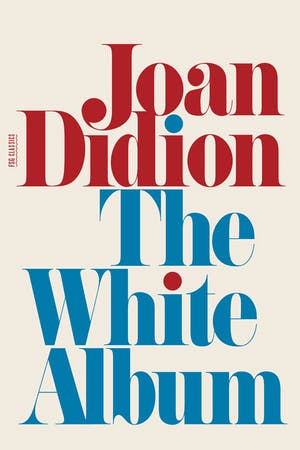
 Malibu: The White Album by Joan Didion

You can’t talk about the psychology of California without talking about Joan Didion. But while many associate her more closely with other California settings — Sacramento (Where I Was From), San Francisco (“Slouching Towards Bethlehem”), Hollywood (Play It As It Lays), even the L.A. County suburbs (“Trouble in Lakewood”) — Didion also trained her penetrating gaze on Malibu when she was living there with her husband and daughter during the early-70s.

A Single Man by Christopher Isherwood

Santa Monica: A Single Man by Christopher Isherwood

This short novel—set in a single day in the life of Isherwood’s mourning professor, George—is a capsule of both the expat collective in Santa Monica in the years after the war (when Isherwood, Thomas Mann, Aldous Huxley, and Bertolt Brecht collectively complicated the cliché that brains didn’t belong at the beach), and, more essentially, the gay scene in Santa Monica in the early ’60s. It’s a beautiful and refreshing glimpse of a Santa Monica of a different era — and as with even the most unrelated novels set in Southern California beach towns, the book’s perfect climax requires an ocean.

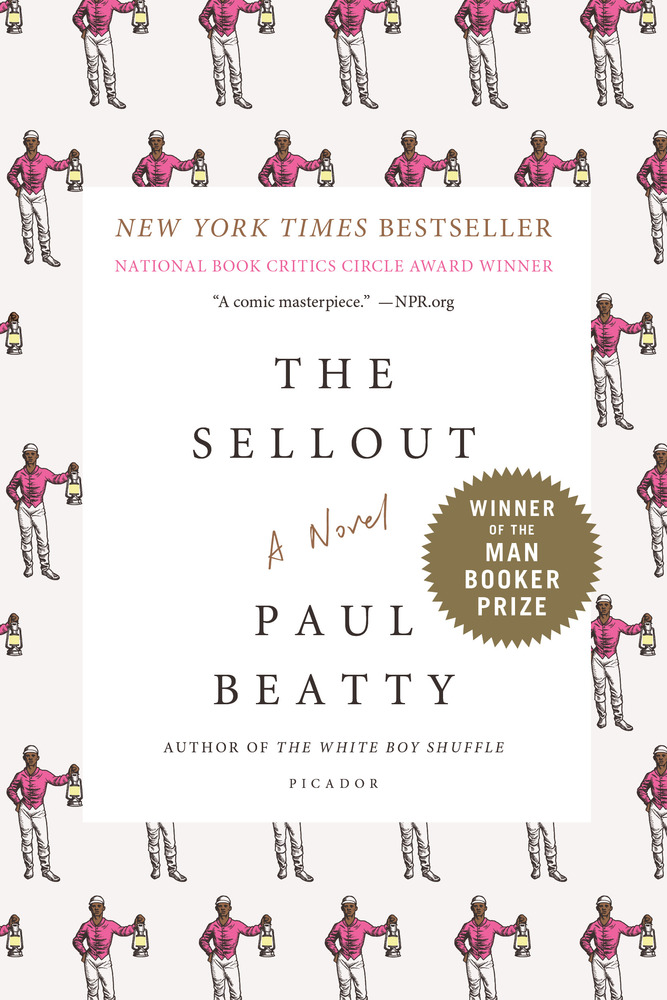
 The Westside: The White Boy Shuffle & The Sellout by Paul Beatty 

These two books by Beatty are genius. And while most of each take place in other neighborhoods in Los Angeles, the scathing characterizations of the beach towns — where Beatty’s narrator grows up (in The White Boy Shuffle) or visits often to surf (in The Sellout) — are so crisply-observed that they’re certainly true. One of the essential subjects of L.A., of course, is the division that exists between the city’s wealthier and poorer neighborhoods, despite their often close proximity to one another. The narrator of The Sellout explores that paradox again and again by taking the short bus ride from his home in Dickens (“the murder capital of America”) to the beach towns ten miles to the west. His breakdown of how a black surfer gets treated in each of those towns along the bay is face-coveringly damning and hilarious.

6. Inherent Vice by Thomas Pynchon (2009) — Gordita Beach (Manhattan Beach)

Pynchon lived in Manhattan Beach during the late ’60s while he was writing Gravity’s Rainbow — as unlikely a place to knock out a Europe-in-wartime doorstop as Santa Monica was for Isherwood and Mann. But forty years after leaving, Pynchon published a tangly whodunit starring a stoner P.I. named Doc who lives in a fictionalized M.B. called Gordita Beach. Though the plot is often as paranoid and confused as Doc, the remarkable clarity and specificity with which Pynchon recalls and relates not just the details of the period but the psychology of the folks living near the beach as the lights go out on the ’60s, proves Pynchon was soaking up more (and smoking less) than might’ve been assumed by people who knew him around town back then.

Palos Verdes / Rolling Hills: Model Home by Eric Puchner

This is the best book I’ve read about life “on the hill” — the peninsula at the southern edge of the Santa Monica Bay. The wealthier communities on the Palos Verdes Peninsula are a mix of cliff-perched mansions, horse-y estates, and cookie-cutter track homes, and they remain to this day a little unknown even to folks living in L.A. and Orange Counties. Eric Puchner’s debut novel gave full exposure to the version of the place that existed in the ’80s — and to the complex privilege and attendant edginess that comes if you’re living out there with a sense of un-belonging.

Huntington Beach: Tapping the Source by Kem Nunn

Nunn has been described as the poet laureate of “surf noir,” and he laid claim to the title with this debut. A teenage outsider from the desert comes to Huntington looking for his missing sister and gets caught up with the seedy surfers, bikers, dealers, and pornographers (some are all four) who hang around the pier. As with Thornburg (above), it’s the writing — which is better than it needs to be to carry a book with such pace and movement and mystery — that makes the novel special: both the depth of what’s going on in the hero’s head, and the precision of sensations, like, say, catching a wave. Though it’s not a direct adaptation, this book is said to have inspired Point Break.

Newport Beach: The OC

Some memorable stories by Michael Chabon (A Model World), David Foster Wallace (Girl With Curious Hair), and Victoria Patterson (Drift) notwithstanding, no book does Newport Beach — or the specific psychological strangeness of life in any of these towns — like the first two seasons of The OC. (No joke!)

The Barbarian Nurseries (Tenth Anniversary Edition)

Laguna Rancho Estates (Orange County): The Barbarian Nurseries by Héctor Tobar

If Southern California coastal life is a little underserved by fiction generally, the stories of the immigrants who work in the wealthier communities are especially few and far between. Which is why Héctor Tobar’s book — centered on a Mexican-American maid in a fictional gated community — is such a revelation. Tobar, who’s worked for decades as a journalist boring beneath the Southern California of easy surfaces, gives us a social novel of the strange and singular interplay between the classes in communities like this one.

 Laguna Beach: Savages by Don Winslow

We started with a crime novel set in a placid beach town and might as well bookend it with another one. Dealers Ben and Chon get a little overextended with their marijuana outfit — squeezed by a Mexican cartel who kidnaps their (shared) girl, “O”—and it’s not long before the plot, like many of Winslow’s, bleeds into the business over the border. Which is the right place to leave things; Mexico’s a whole other story.

In ‘Roughneck,’ Not All Wounds Heal

The past has the power to haunt us. It can consume us and take over our lives. When it does, we find ourselves in a world of darkness, which is the very territory that Jeff Lemire’s latest graphic novel, Roughneck, occupies.

Readers familiar with the Eisner-nominated author’s masterpiece Essex County, about secrets and family bonds in a rural community, will find some familiar ground here in Roughneck. Derek Ouellette serves as Lemire’s protagonist, and Derek is broken — completely broken. As a young hockey star, he committed a “vicious attack” on an opposing team’s player. Consequently, Derek lost his spot on the team. This incident causes his life to spiral out of control. He turns to drinking, and bar fighting becomes a mere hobby to him. He speaks crudely, and his interactions are harsh and uncontrolled. Unfortunately, Derek falls into a situation where he can’t escape his reputation in his small town of Pimitamon, and that eats away at him. He lives a life void of attachment. That is until his sister, Beth, suddenly arrives back in town.

Beth’s appearance catches Derek off guard. Like him, she, too, is broken. She’s unexpectedly pregnant. She’s trying to escape her abusive boyfriend. She’s addicted to drugs. To make her situation worse, Beth overdoses on Oxycontin shortly after she arrives back in Pimitamon, and she winds up in the hospital. Derek agrees to take care of her, though. He takes her to an isolated hunting camp in the woods, where they both plan to recover — both physically and emotionally. Together, they begin on a tumultuous journey to find some sense of healing.

Will This Marriage End in Fire?

Lemire’s graphic novel sounds explosive, and it certainly is. However, it’s also quiet and introspective. Derek and Beth’s initial conversations are direct, but they carry a fragile undertone that rings of authenticity. After Beth comes home from the hospital, Derek tries to ease the tension in an early exchange of dialogue that he begins:

“Well, the fire’s low. How you feeling otherwise?”

“Like I’m a total mess.”

“Yeah? Well, so am I. Where does that leave us?

“Freezing our asses off in the bush together.”

“Yeah. Pretty much.”

They speak with humor to soften the world that has, at least for now, consumed them both.

In what is the novel’s most moving frame, Lemire takes us back to what has to be the worst day from Derek and Beth’s childhood: the day they were in a tragic traffic accident that killed their beloved mother. It’s here that we see Derek’s past loving nature. He wraps his arms around his sister and comforts her. “It’s okay, Bethy. Don’t look. Don’t look at Mom,” he says. By Lemire including this tender flashback, we see how far Derek has fallen. Now, he struggles to even communicate with his sister. He’s a long way from being able to truly comfort her. It’s these intimate moments that make the overall narrative soar.

Roughneck is a simply-plotted story, but it’s so expertly executed that it seems complex — and even sophisticated. Lemire uses a circular style in storytelling. Abuse appears first as we learn of Derek and Beth’s mother living in a physically and emotionally abusive relationship. Then, when Lemire presents Beth’s situation with her abuser, we see how tough the cycle is to break. Lemire uses this same circular motion when looking at Derek’s progression. He was once a hockey star. Now, he finds himself back in the rink — if only to recall those glory days.

Lemire explores classic American themes. There is isolation, loneliness, loss, and perseverance. Although Roughneck is a graphic novel, it should come with the term “literary” somewhere in its classification. This is a finely crafted work of fiction.

Lemire’s illustrations enrich Roughneck, and they capture the book’s moodiness with great success. The lines are harsh, drawn with jagged and tense strokes. The angles have a gritty feeling, too. The close-up shots of Derek’s face display his rugged nature, and they also show his internal pain. Lemire is just as successful in his renderings of Beth, which work to showcase her vulnerability as well as her strength.

Near the end of Roughneck, Beth goes to visit her abusive father, whom she hasn’t spoken to in many years. She tells him, “I wanted you to see that I’m still here. You — you almost killed me, but I’m still here.” Amidst all of her pain, she’s finding her footing. There’s hope for Lemire’s two troubled souls, and there’s hope for us, too. Jeff Lemire’s Roughneck shows us that overcoming a troubled past and finding peace might be a rocky road, but it’s one that’s worth the journey.

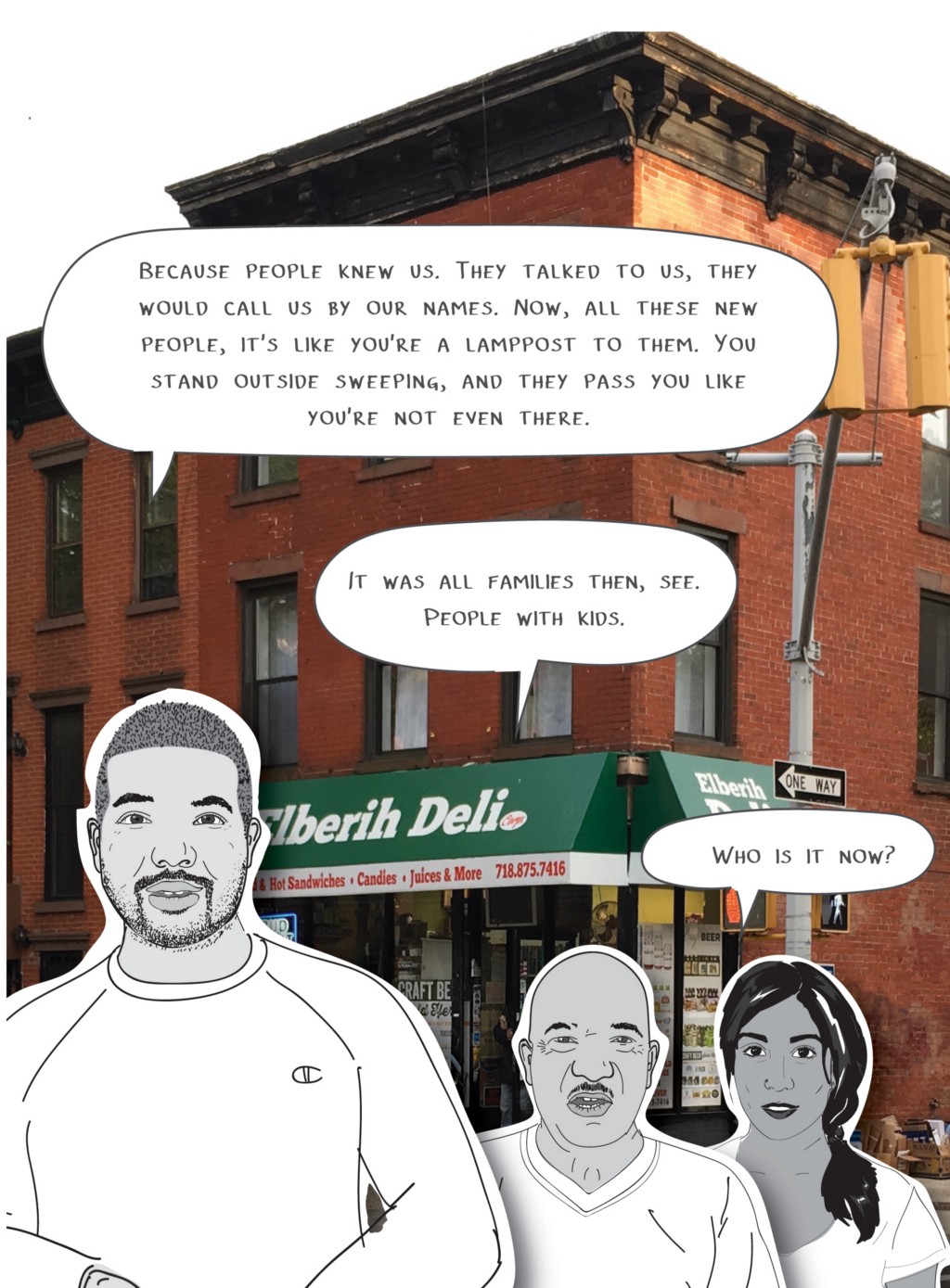
From His Corner, A Bodega Owner Watches Brooklyn Change

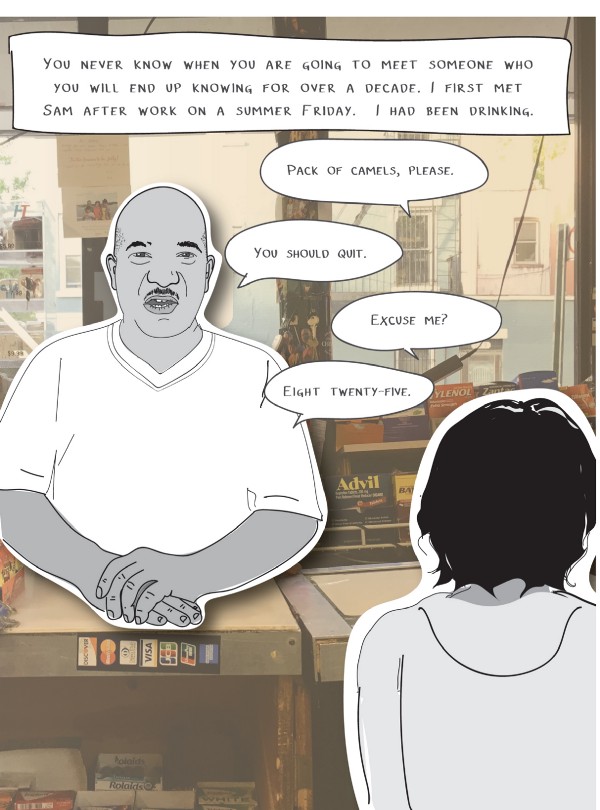
You never know when you are going to meet someone who you will end up knowing for over a decade. I first met Sam after work on a summer Friday. I had been drinking.

Mira (short dark hair): Pack of Camels, please.
Sam (behind counter, a bald man with a small mustache): You should quit.
Mira: Excuse me? 
Sam: Eight twenty-five.
We had just moved into the neighborhood. Back then our block had a drug den on one side, and a family who sat outside an RV listening to the radio all day on the other.

Neighbor man, smoking a cigarette: Hola, morena.
Mira, offscreen: Hey.
Neighbor woman, also smoking: Ay, que ridicula con esos zapatos!
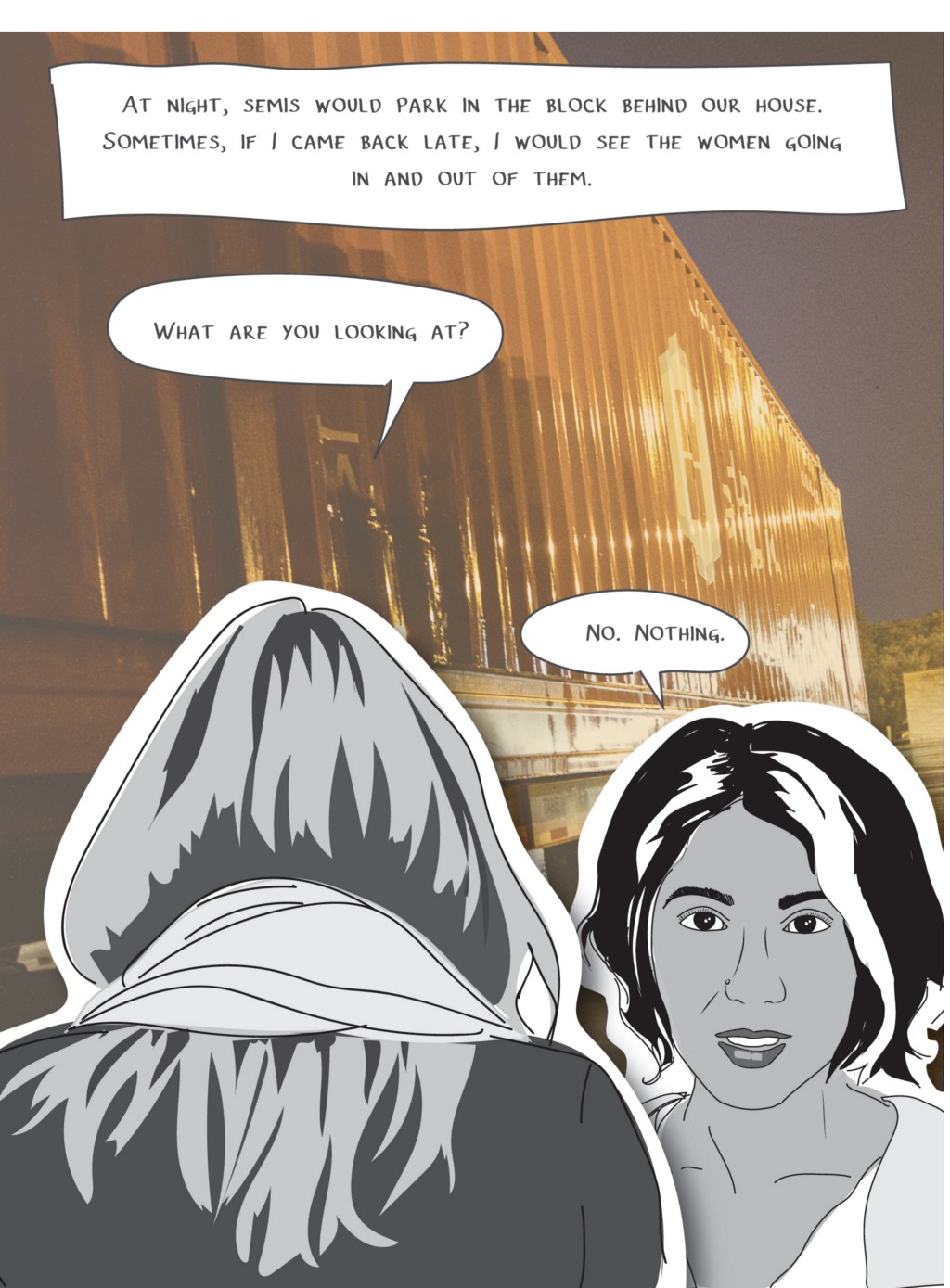
At night, semis would park in the block behind our house. Sometimes, if I came back late, I would see the women going in and out of them.

Woman, long blonde hair: What are you looking at?
Mira: No. Nothing.
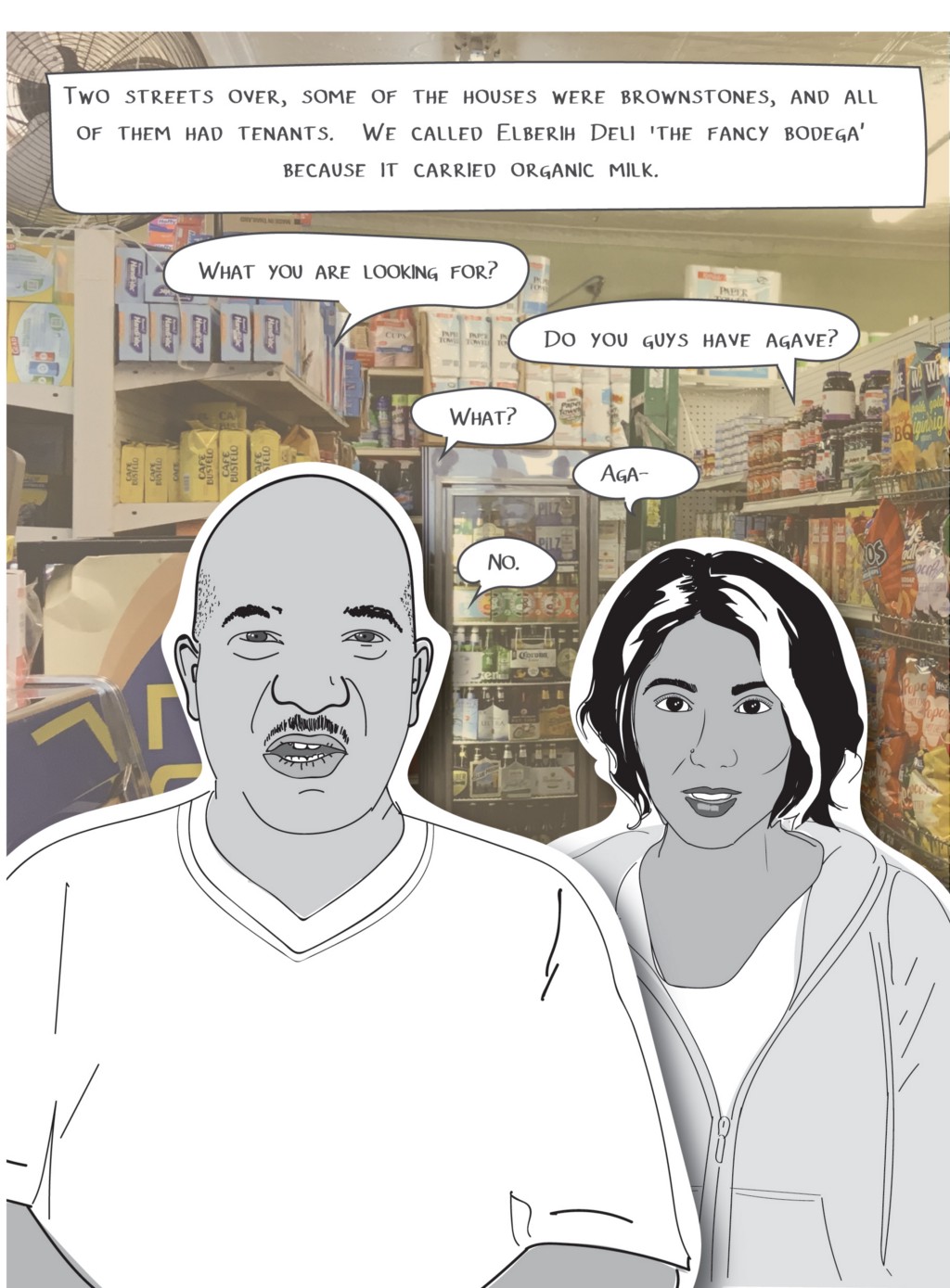
Two streets over, some of the houses were brownstones, and all of them had tenants. We called Elberih Deli "the fancy bodega" because it carried organic milk.

Sam: What are you looking for?
Mira: Do you guys have agave?
Sam: What?
Mira: Aga-
Sam: No.
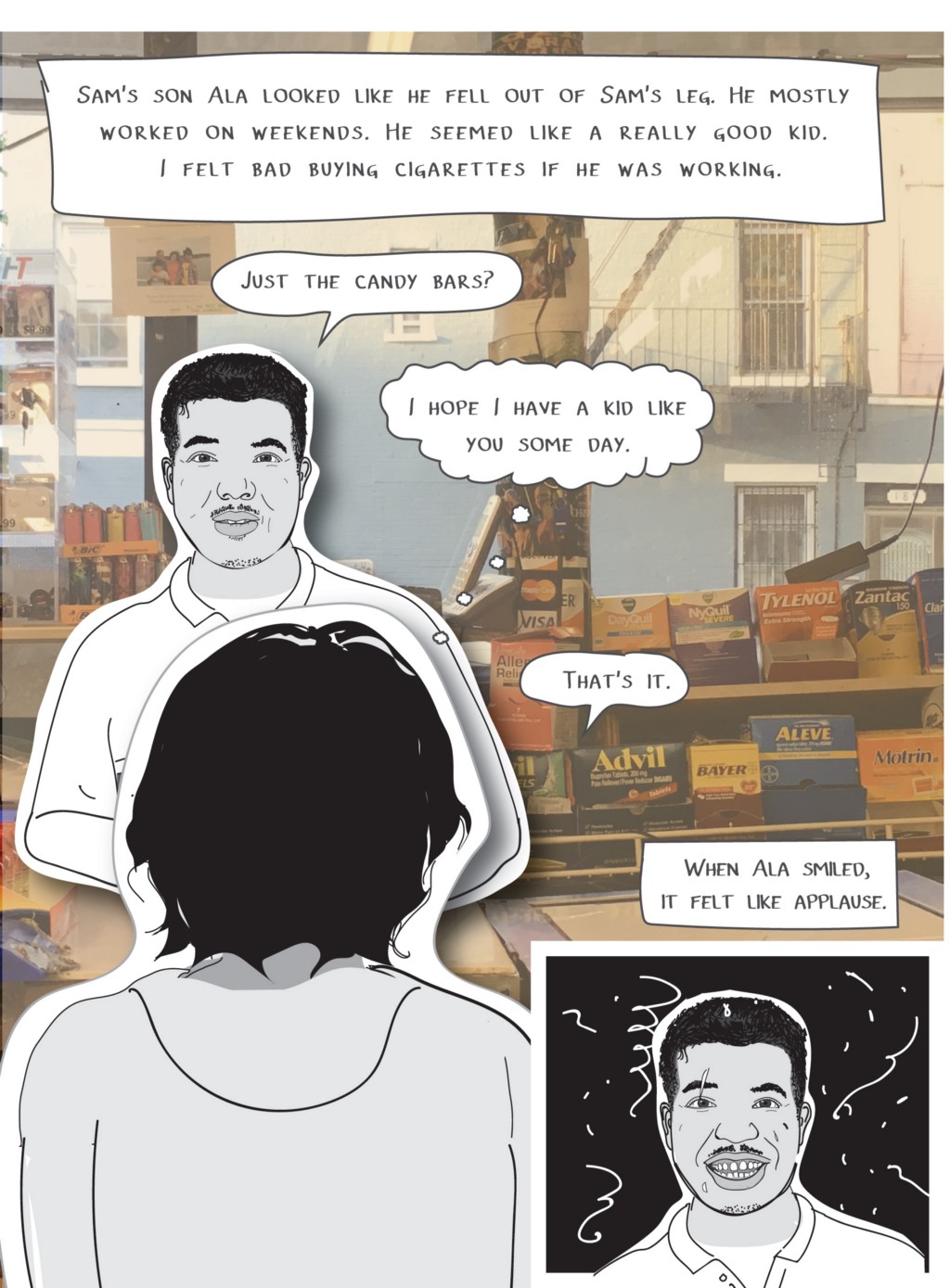
Sam's son Ala looked like he fell out of Sam's leg. He mostly worked on weekends. He seemed like a really good kid. I felt bad buying cigarettes if he was working.
Ala (looks just like Sam but with hair): Just the candy bars?
Mira: (thinking) I hope I have a kid like you some day. (out loud) That's it.

When Ala smiled, it felt like applause.
The year I got pregnant was the first time Sam ever smiled at me.

Sam: It's gonna be a boy!
Mira: You think?
Sam: I know. The belly. My wife was like that with the boys.
Someone offscreen: Do you have organic yogurt?
Sam: Second shelf.
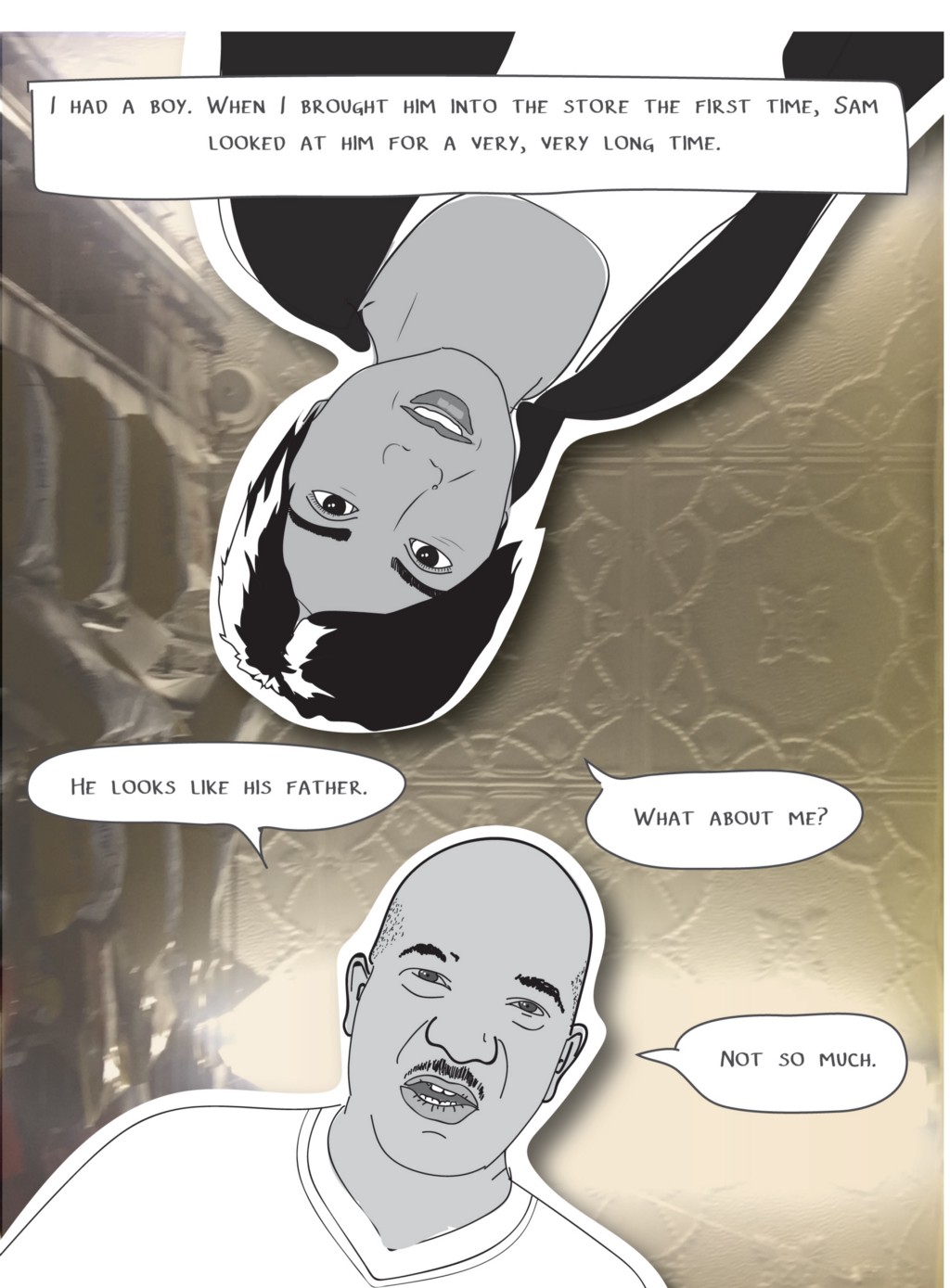
I had a boy. When I brought him into the store the first time, Sam looked at him for a very, very long time.

Sam: He looks like his father.
Mira: What about me?
Sam: Not so much.
The year my son turned four, movie stars moved into the neighborhood. Farm-to-table restaurants opened up. A lot of our old neighbors started moving away.

White woman with long hair: I thought they'd have more yard, for what they're asking.
White man with a beard and sunglasses: Let's keep looking.
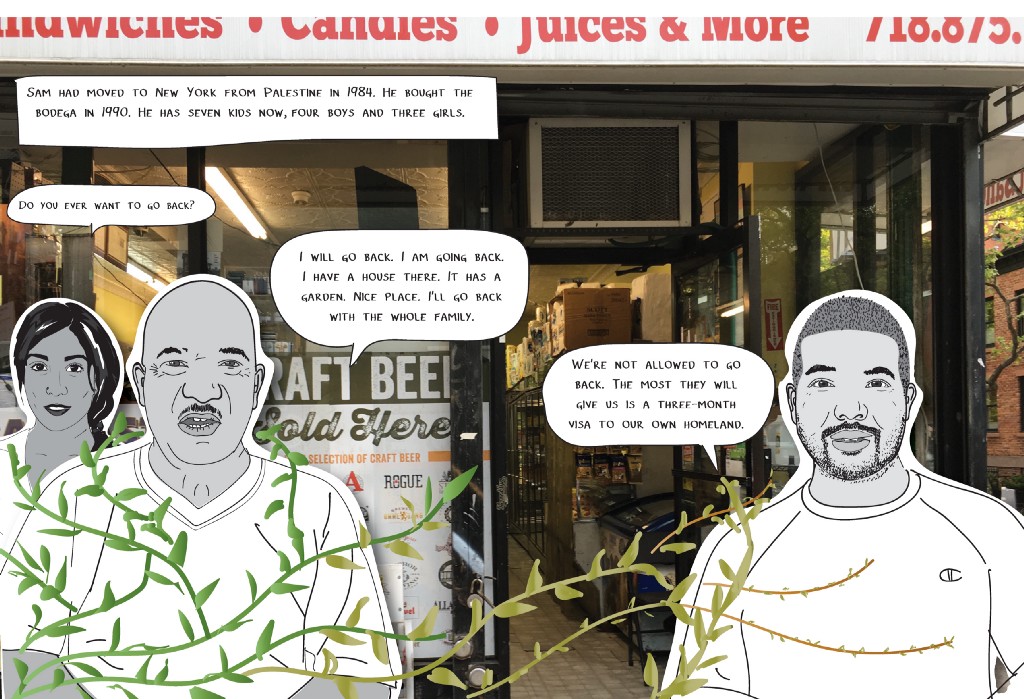
Sam had moved to New York from Palestine in 1984. He bought the bodega in 1990. He has seven kids now, four boys and three girls.

Mira: Do you ever want to go back?
Sam: I will go back. I am going back. I have a house there. It has a garden. Nice place. I'll go back with the whole family.
Sam's son, who has a beard and a buzz cut and is wearing a Champion shirt: We're not allowed to go back. The most they will give us is a three-month visa to our own homeland.
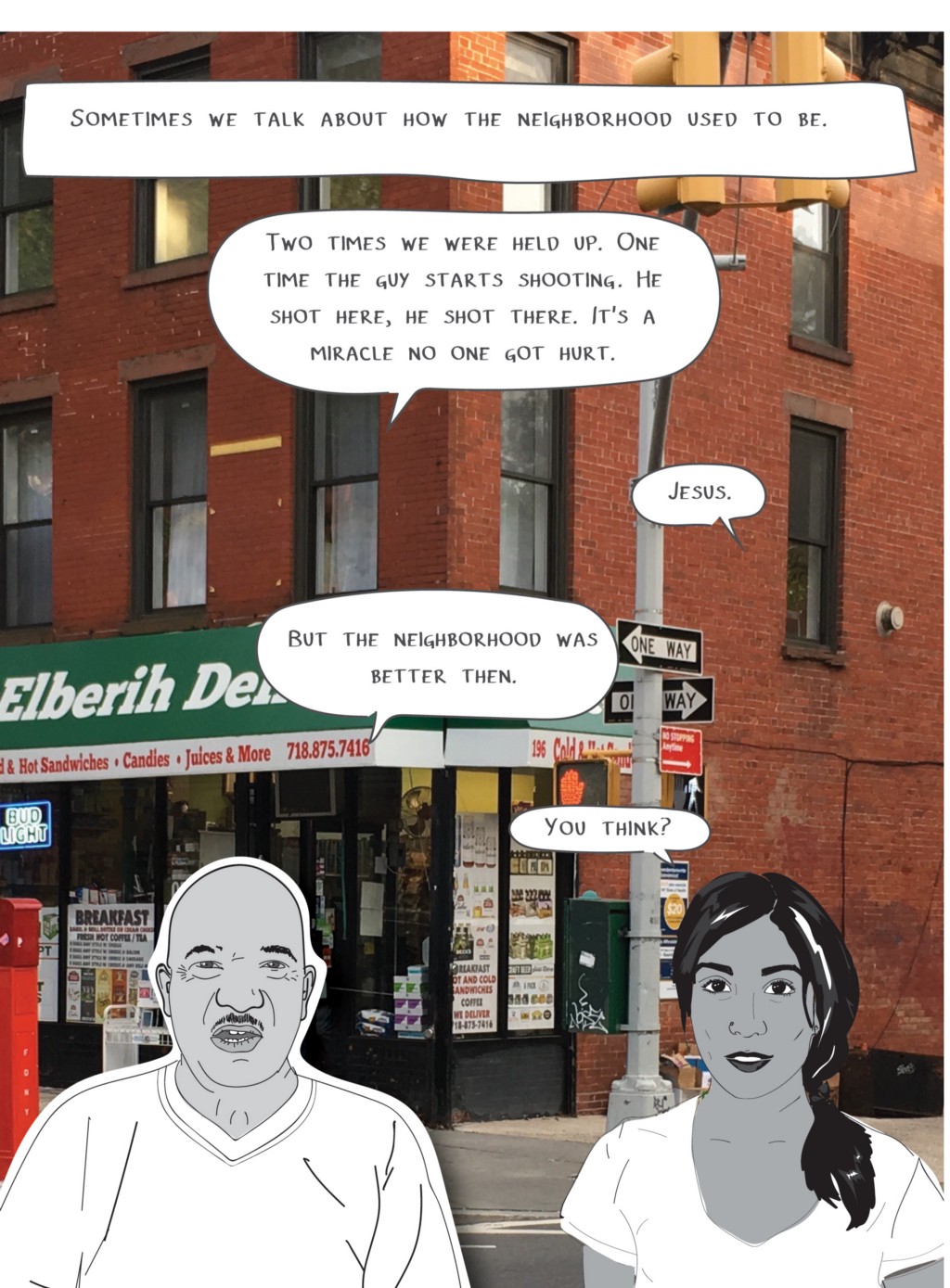
Sometimes we talk about how the neighborhood used to be.

Sam: Two times we were held up. One time the guy starts shooting. He shot here, he shot there. It's a miracle no one got hurt.
Mira: Jesus.
Sam: But the neighborhood was better then.
Mira: You think?
Sam's son, the one with the beard: Because people knew us. They talked to us, they would call us by our names. Now, all these new people, it's like you're a lamppost to them. You stand outside sweeping, and they pass you like you're not even there.
Sam: It was all families then, see. People with kids.
Mira: Who is it now?
Sam: How do I know who? You live here. You tell me.

About the Author

Mira Jacob is the author of the critically acclaimed novel, The Sleepwalker’s Guide to Dancing, which was a Barnes & Noble Discover New Writers pick, shortlisted for India’s Tata First Literature Award, longlisted for the Brooklyn Literary Eagles Prize, and honored by the Asian Pacific American Librarians Association. She is currently working on her graphic memoir, Good Talk (Dial Press, 2018). You can find more of her drawn conversations over here: instagram.com/goodtalkthanks.

— The Bodega Project is supported by a grant from the New York City Department of Cultural Affairs.

Ted Wilson Reviews the World: Windex

★★★★★

Hello, and welcome to my week-by-week review of the world. Today I am reviewing Windex.

If you have a dirty window, you have two options; smash out all the glass, or clean it with Windex. Smashing the glass is dangerous, costly, and leaves your home vulnerable to intruders. But with Windex, your windows will be so clean that birds will forget you have windows.

Scientists at the S.C. Johnson Laboratory for Windex Studies have determined Windex to be the Most Incredible of all window cleaners. Their pamphlet didn’t get into specifics — which is fine by me because I’m not a scientist — but I have to say that’s a pretty impressive accolade to receive.

Windex is also great for the environment, as I have learned firsthand. Fill your bathtub with it and you don’t need to waste any water to bathe. A tubful of Windex will last up to a week before it starts to get weird and you need to change it. If you typically take a 45-minute shower, that’s millions of gallons of water saved each year.

A lot of people say Windex isn’t safe to drink — and that’s partly true — but you can condition your body to not reject it. Start with very small amounts and work your way up. After a few months you can drink an entire shot glass of Windex without feeling too bad. (I didn’t want to drink Windex, but to understand it fully for this review I had to. I drink everything I review.)

The price of Windex can’t be beat. It’s cheaper than a kombucha. I don’t know what a kombucha is — it might also be a glass cleaner — but it’s much more expensive than Windex.

Because so many people use Windex, it’s a great conversation starter. Next time you’re at a party and experiencing an awkward conversation with a stranger, trying mentioning how you bought some Windex earlier in the day even if you didn’t. I’ve made a good number of friends with whom our only real common ground is Windex. It’s all we talk about. Ever.

Disclaimer: This review hopefully retroactively sponsored by Windex.

BEST FEATURE: It’s addictive but not in a debilitating way.
WORST FEATURE: Bathing in Windex can leave your skin with a blue tint if you stay in for more than an hour.

Please join me next week when I’ll be reviewing Star Trek.

TED WILSON REVIEWS THE WORLD: INVASIVE PASSION

Kurt Baumeister Envisions an Even More Bizarre America

The society we find ourselves in today — a culture comprising equal parts absurdity and corruption — begs to be satirized, if not so much for comic purposes than for greater moral ones. Here in 2017, we have at least as much to lampoon as the ancient Romans (we’re only a couple more excesses and a few more reality TV shows away from the return of vomitoriums and gladiatorial blood sports, it seems), yet fewer and fewer people seem to be writing satire — or, more pointedly, fewer and fewer people seem to be writing satire well. Thus Kurt Baumeister’s zestful, remorseless, clear-eyed debut novel Pax Americana bounds on to the scene at a time when its humor is not only welcome, but necessary.

The plot and premise of Pax Americana reads a bit like a the sly wink of James Bond novel as directed by Tarantino at his most manic. The story begins in the year 2034, a time when America’s large-scale conservatism and religious fundamentalism has a stranglehold on the national consciousness. In the novel’s first chapter we are introduced to Tuck Squires, an agent for the Interenal Defense Bureau, whose internal narrative sets the book’s tone as he is driving along in his Epiphany listening to Christian music:

“He cut the music and thought of America, of all it had meant and would mean to the world. He thought of another song, one that soared in a very different way than Jehovah’s Wishlist. He thought of ‘America the Beautiful,’ how it was a conundrum, so right and so wrong all at once.Or, not so much wrong exactly, more like inadequate, unable to see far enough forward to take in not just America’s yesterdays, but its todays and tomorrows.”

Tuck, as we can infer from this passage, is as earnest a Traditionalist as they come…. and it is usually the earnest and self-serious who most desperately need to be satirized. As we meet his Traditionaist cronies — a cast of characters ranging from the once-suave special agent Ken Clarion to the charismatic Rev. Dr. Ravelton Parlay, owner of the Righteous Burger restaurant chain and occupant of an estate modeled after the Whie House (the hilariously named Bayousalem) — we see Baumeister’s ability to produce characters of nearly Dickensian grotesquerie yet present them in such a congenial way that we can’t help almost liking them, or at least feeling sorry for them, even as we acknowledge how corrupt and wrongheaded they are. It takes a skillful satirist to elevate the buffoons to a level of humanity without losing his comic edge, and Pax Americana manages to strike this balance in an appealing way, with delightfully acrobatic shifts between the highbrow and the lowbrow, the quotidian and the fantastic, the modest and the grandiose.

At the book’s progressive moral center is Diana Scorsi, an intelligent, attractive, and idealistic woman who soon finds herself in “a black Wonderland… a dimension where things can go wrong in a great hurry.” Scorsi is the inventor and developer of groundbreaking computer software that could change the sociopolitical landscape, essentially returning us to a more autonomous, free-thinking, pacifistic ways of being: “Everyone could have their own god, and that god would be Symmetra, and if everyone had it there would never be need for war again.”

10 Sci-Fi Visions of the Afterlife

Naturally, the Traditionalists have other ideas for how this software should be used. The resulting conflict includes kidnapping by men in superhero masks, fiery deaths and near-deaths, scenic locales, double agents and double crossers, and a surprise ending that most readers should find oddly satisfying. Pax Americana itself is a mad romp, utterly pleasurable and fun on one level while trenchant and recognizable on another. The complacent idicoracy in Baumeister’s vision of 2034 is not so distant from the increasingly divided country we are seeing today, which adds relevance and gravitas to a novel that already stands on its own as being a hell of a lot of fun.

But the greatest pleasure in Baumeister’s writing lies not just his comic gifts and political prescience; it comes also from his nimble versatility and depth, exhibited in many passages throughout Pax Americana. Note this bit of omniscient reflection of Ken Clarion’s: “Whether it was love for the country, the job, or a woman, love lingered. Even when everyone around you believed it had become something else — jealousy, pain, friendship, hate — even then, you carried a memory of its time as love. Like faded tracks in fallen snow, footprints only you could see, love survived whether you wanted it to or not.” This is terrific writing with an unpretentiously literate sensibility, suggesting the work of an author with far more plays of light and shadow to show us.

Birth of the Cool: Italian Expats in Brooklyn

Class (Melville House) is a hell of a book. It’s a big, sprawling story that wanders up and down Manhattan, Brooklyn, and Rome, with some detours to a Catholic youth camp and the afterlife. It’s about money and upward mobility and everything you’d expect from the title, but it’s also about sex and God. There’s a lot of God in this book — which makes sense, given that the author, Francesco Pacifico, is a practicing Catholic and a lapsed theologian.

His last novel, The Story of My Purity, was all about God too. There are lots of gods in Class, though. Plenty of the characters are devout Catholics — and the ones who aren’t are devout Marxists — but the presiding deities are Jay-Z and Kanye circa Watch the Throne, which most of the characters are obsessed with. And then there are characters who worship publishing houses, or record deals, or Louis Vuitton. Reading Class can feel like watching a music video (granted, there’s a scene in which several of the characters film one) or flipping through a Vogue editorial — it’s beautiful, and luxurious, and you don’t know what the hell is going on. That’s all right. This is a novel to let wash over you, to take in, to accept that you can’t master. Of course it is. Pacifico wrote it from life. There’s no mastery here.

Lily Meyer: Let’s start by talking about cool. Am I right in thinking that this is primarily a book about cool?

Francesco Pacifico: You’re right. Cool in the face of aging. I sold the apartment where the book is set, and I went to pick up my things the week of the book launch. And I was thinking yesterday — my gastroenterologist told me I had to quit drinking, and I thought, Class was written on the other side of losing the apartment and losing drinking. So I’ve aged even more since the book started.

When it started, I was thirty-five and I knew no twenty-five-year-olds. But the idea of the book was that there’s no need to work, since there are no jobs. I wasn’t doing much, but my cousin, who decided not to study literature because he wanted a real job, was an engineer, and he made less than I did at the time. I wanted to write about that, so I had to get into the Roman hipster scene and meet all the stand-up comedians and pop artists. For them, hustling to become a pop artist is like hustling to become a lawyer. It’s the same. So I wanted to write about that.

Also, I’d started going to New York, and I wanted to write about New York. I wanted to write about the fact that everyone was drinking their own Kool-Aid and no one could see the city as a generator of myths. There was Williamsburg cool, Lower East Side cool, et cetera — and the Balzac in me started thinking, New York is perfect to play with cool.

LM: There are a lot of people making art in Class, but none of them are very good at it. Or at least, they’re not good at it yet. Was that hard to write about?

FP: I will eventually feel confident enough to write about a good artist, but I can’t do it now. I don’t want to jinx my process. There’s this fancy TV station here, and I was invited on a show there, and these two great-looking people in their early twenties were interviewing me about Class. They said, “How does it feel since you’ve made it?” and I grabbed my balls with my left hand, which is an anti-jinx procedure in southern Italy. The whole moment, people talking about success — it really freaked me out. It’s something you should never mention. It’s so fleeting.

Author Francesco Pacifico.

LM: Another thing that seems incredibly hard to me in this novel is writing the narrator, who is omniscient, and also dead. Why is she dead?

FP: I have a lot of thoughts about the relationship between what purgatory is for Catholics and what fiction is for Catholics. There’s a fake Polish theologian in this book, and he says that purgatory for the Church is a purifying fire that prepares you for heaven. So I was thinking, language is something that’s like a fire, because it has no weight, but it’s strong. And then I thought, if I want to play with the Catholic mind, what if writing a novel is like confessing to a sin? What if the language purifies you? So the narrator is someone who’s atoning.

Other than that, she had to be a woman and she had to be a Marxist. I don’t know why a woman, but for me, you cannot have the Catholic church without Marx, or Marx without the Catholic church. Also Freud. Freudian analysis made me a real Catholic. Before, I was in the Church, but I couldn’t listen to other people.

“I have a lot of thoughts about the relationship between what purgatory is for Catholics and what fiction is for Catholics.”

LM: What’s the relationship between those three things for you?

FP: No one in the Church ever talked to me about class. I have a very sophisticated mother and a very smart father, but they grew up inside the Church, and their lack of sophistication about a lot of things is fascinating. I know so much about the 21st century that they don’t. At the same time, you can’t be a Marxist and enjoy being a Marxist too much. That’s what happens to non-Catholic people. They think Marxism is like the fountain of youth, but Marxism should be a way to portray society and relationships. We need more down-to-earth, lame Marxist thinking. Day-to-day, compassionate Marxism.

And then the Freudian part. When I started going to psychoanalysis to fight my panic attacks, I realized that psychoanalysis was the pinnacle of Western civilization. It gives you a center from which to be able to love — in a Christian sense, I mean. In the sense of substituting empathy for charity. I could never be empathetic before psychoanalysis because I was raised in a place where having an emotional center wasn’t considered part of Catholic life. You ended up doing all these sort of psycho-financial speculations: what are my actions for? Am I helping people? Doing that without a center, you just make a mess.

LM: Speaking of messes, let’s talk about translation. First, it seems to me that there’s a lot of cultural translation in Class. Do you expect readers to understand the culture of this book completely?

FP: I’m fighting a battle against perfectionism. You can’t write about a place if you know everything about it, because how could it be fascinating? Same with reading. When I was fifteen or sixteen and reading Kerouac, I didn’t know about bebop. But I started listening, and it blew my mind. See, culture is a journey. It’s important to be attracted to something you don’t know. That’s how you get somewhere, but you’re always getting somewhere. You’re never there.

“See, culture is a journey. It’s important to be attracted to something you don’t know. That’s how you get somewhere…”

LM: Finally, you translated this book yourself. What was that like? No one translates their own work!

FP: Since this is a book about the way Italians experience American culture, there was a lot of English in the Italian version. I wanted to make the point that if in the 20th century, Italian writers had to combine regional dialects with Italian, now we have to combine English with Italian. I can’t play with dialects, because I was raised by people who didn’t speak in dialect. I can only play with English. But the translation was a very painful process. I changed the book too much. God, let’s stop. I’m starting to remember when I translated the book, and it’s too painful. I don’t know if I could do it again.

The Brazilian Novelist Who Inspired Borges, Márquez, and Amado

Why People Don’t Like “I Love Dick” (Hint: Because It’s About Women)

The evidence is everywhere. America loves dicks. The Washington Monument, ice pops, Michael Fassbender, and our President, who is undeniably a dick. But it goes back further than that. Here’s a short list of some dicks (both real and fictional) Americans have loved: Christian Grey of Fifty Shades, Justin Bieber, Chris Brown, Don Draper, Stringer Bell, Tony Soprano, Al Swearengen, Will Hunting, Mark Wahlberg’s fake dick from Boogie Nights, Patrick Bateman, Hans Gruber, every character James Spader ever played, especially when he was young, most of the characters Bill Murray’s played, Michael Douglas in Fatal Attraction, Gaston in Beauty and the Beast, Bruce Wayne, Jack Nicholson in Five Easy Pieces, The Shining, As Good As It Gets, and Something’s Gotta Give, Russell Crowe (in life), Sean Penn (in life and in art), Clint Eastwood’s many iconic dicks, like his character from Dirty Harry, and Steven Segal’s entire oeuvre. Dicks aren’t just confined to low culture, either. We love Alfred Hitchcock, Woody Allen (dear God), Bret Easton Ellis, Norman Mailer, Ernest Hemingway, Jay Gatsby, Holden Caulfield, and I’ll say it, Tom Sawyer. He was a dick. We may all like Forrest Gump, but no one wants to fuck him.

So if Americans love dicks so much, why don’t people seem to like Jill Soloway’s new Amazon show, I Love Dick? The show, an adaptation of Chris Kraus’s 1997 novel, stars Chris (Kathryn Hahn) as a frustrated filmmaker who becomes obsessed with a laconic conceptual artist named Dick (Kevin Bacon) while her husband, Sylvere, is at Dick’s writing retreat in Marfa, Texas. She’s not just obsessed with him, of course, but with his namesake body part, and what it might be able to do to her. She starts writing Dick erotic letters, which turns her husband on until she actually sends them. Sylvere’s humiliation turns to rage when Chris starts posting the letters around town in a kind of performance piece of her own. Things devolve from there. Though the setting and plot of the show differs — the book is entirely epistolary and set in New York and California — the show aims to fulfill the ambition of the book, which Jenny Turner has called a “künstlerroman,” that is, the story of an artist’s development.

Reviews of the show have been lackluster, especially considering Soloway’s outsize influence on the current culture, thanks to the success of Transparent. The New York Times called I Love Dick overwrought, complaining that it if you miss a “theme” of the show, the “characters [will] explain it explicitly” to you in due time. The Boston Globe reported that despite their high expectations, “the reality” of the show “is a whole lot less appealing” than had been expected. Matthew Gilbert of the Globe wrote that “at points, it’s as thin as its titular joke, a pun that the script leans on like a fifth-grader with a new command of naughty words.” The Hollywood Reporter called it “messy and not very likeable,” while Variety gave it an otherwise good review but called it “occasionally exhausting.” Notice the gendered nature of these critiques. All sound like they could be leveled against an individual woman, perhaps Chris Kraus herself: she’s messy, immature, pretentious, not very appealing or likeable, and kind of exhausting.

It’s hard to believe that the bad reviews are thanks to the subject material’s sexual explicitness, since so many shows on television today deal with serious, challenging material. Transparent, Soloway’s first venture, loosely based on her own experience of having a parent transition late in life, is nothing if not provocative; it has grappled with issues of gender and sexuality more explicitly than any show before, and has become a huge critical and commercial success by doing so. Hulu’s recent adaptation of Margaret Atwood’s The Handmaid’s Tale, about a patriarchal dystopia, is also a critical and popular success, despite the fact that it contains content at least as controversial as I Love Dick (I would say much more so). The Handmaid’s Tale graphically depicts ritualized rape, female genital mutilation, state-sanctioned murder, and the hostile takeover of the United States government by religious zealots, and people love it. As the long list of ‘dicks’ above shows, we don’t generally have a problem rooting for male anti-heroes, even when they’re mafiosos, pimps, misogynists, murderers, or rapists. Nor does the TV-viewing public have a unilateral distaste for edgy shows with progressive, even radical, politics. Yet a story about a woman with a crush in the desert isn’t gaining traction. Even when Kevin Bacon plays that crush, and you get to see him shear a sheep topless.

Photo Credit: LeAnn Mueller/Amazon Prime Video

Reviews which fault the show for being “unlikeable” and “exhausting” rely on what are by now cliché criticisms of female characters and women in general. These reviews are not only remarkably gendered in their language, but they’re also wrong. I Love Dick is a very good adaptation, and a good (maybe even a great) show. Some people just don’t like it because they don’t like women, particularly women who want and have sex, and particularly the parts they have it with, like vaginas. Soloway recently acknowledged that part of the appeal of Transparent may have been that it starred a man, albeit a man “playing a trans woman.” She told the Times, “I don’t think America understood that at first…I was writing pilots about unlikable women for 15 years, but it took a man in a lead role for me to actually get any attention.” It’s still early days, and I Love Dick may gain a fanbase with time, but the early reviews suggest that — hard as it may be to believe — America may be more comfortable watching a man transition than watching a heterosexual cis-gender white woman desire a heterosexual cis-gender white man.

Reviews which fault the show for being “unlikeable” and “exhausting” rely on what are by now cliché criticisms of female characters and women in general

While Transparent explores gender fluidity, I Love Dick doubles down on a certain kind of essentialist femininity — not the passive kind we’re used to seeing in art — but an essentialist femininity nonetheless. In the first episode, Dick insults Chris’s intellect and artistry. She rages at him but is also titillated. The last episode finds Dick and Chris finally about to hook up, when she gets her period as he is fingering her. In the final shot of the series, Chris’s menstrual blood trickles down her bare legs as she walks through the desert, and we’ve got the iconography of a primal scene: Eve who sinned by wanting — punished by the pain of childbirth and periodic bleeding — is cast into the desert. Throughout most of the series, Dick doesn’t reciprocate Chris’s desire, but she wants him anyway; ironically, almost magically, because he won’t let her know him, she’s able to objectify him in a way that is productive for her art. The artist in Chris has arisen out of her experience with Dick, just as Eve was cleft from Adam’s rib. But this is different, because Eve and Adam wander the desert together once they are cast out of Paradise. When Chris realizes that it wasn’t her desire for Dick (or dick?) dripping between her legs, but rather her menstrual blood, she walks out into the desert alone. Contemporary feminists may be uncomfortable with this final image and the way it closely aligns female desire and agency with the traditional biological markers of womanhood. As Soloway’s other show has amply demonstrated, not all women have ovaries, and not all women menstruate.

Rightly or wrongly, I Love Dick harkens back to an earlier moment in feminism. Transparent is a masterpiece, but it is about gender, family, women, and men. At its heart, it is a traditional narrative in the sense that it’s about the soul’s quest to find its place in the world. Its political valence is queer, not feminist (these vectors intersect but are not the same). I Love Dick is all about women. Its milieu is a very particular, and at this point somewhat historical, feminism. The show captures the moment in which Chris Kraus wrote the novel, in 1997, before gender studies and women’s studies had coalesced in academia, before notions of gender fluidity became widespread, and before intersectionality became a concern of mainstream American feminism. To her credit, Soloway adapts the material in ways that acknowledge the limitations of the original text for today’s intersectional feminist moment: in the novel, Kraus writes from the frenzied perspective of one privileged white woman. Her letters are a screech into the void created by the male intellectuals who surround her but won’t hear her. The Amazon adaptation, however, widens its focus, telling stories from the perspectives of other women with different backgrounds and experiences, and who don’t share the fictional Chris’s privilege with regard to capital, education, or race. For instance, in one of the season’s most powerful episodes, “A Brief History of Weird Girls,” three women besides Chris write letters to Dick, explaining how he has catalyzed their growth and artwork. For one of them, a native of Marfa named Devon (the remarkable Roberta Colindrez), Dick’s macho swagger gave her a model to imaginatively grow with as a young woman who was discovering she was a lesbian (the final episode finds her making art about that process). Compared to the gorgeous ensemble made up by Colindrez, Dick’s gallery’s curator (Lily Mojekwu), and India Menuez as an art historian of porn, Chris is the woman who is the most difficult to identify with, not only because of her privilege, but because of her fecklessness. That the show in general maintains its focus on Chris’s experience, however, suggests that the adaptation wants to preserve the challenge that the original offered to the masculine status quo: it says, look at this woman, watch her, see her do all these things that men have done in art a million times, and feel how you feel about it. Whether you like it or hate it, you will have learned something about yourself.

Soloway has stated that this was her goal, not just to adapt the book, “but [to]…record the feeling of what happens when you read the book.” Kraus herself lauded “A Brief History of Weird Girls,” for “adapt[ing] the phenomenon of the book rather than the book itself.” Just like with Chris’s erotic letters, none of the letters in “A Brief History” are actually about Dick. They’re about the way the women are using Dick to create something for themselves. As Jenny Turner put it in a 2015 review of the novel for the London Review of Books, Dick is “a man-size ‘transitional object’ who happens to be in the way” of Chris’s character. This episode — and the series as a whole — captures that truth for a broader array of women characters than just Chris.

If watching women use Dick for their own growth sounds unpleasant or opportunistic, remember that male artists have relied on female ‘muses’ for just that throughout most of recorded culture

If watching women use Dick for their own growth sounds unpleasant or opportunistic, remember that male artists have relied on female ‘muses’ for just that throughout most of recorded culture. It’s also worth noting that Soloway, creator of a runaway hit for Amazon, still had to go through Amazon’s pilot process in order to make I Love Dick, while Woody Allen, as the New York Times reported, did not, despite the fact that he had never made a television show before, and that his reputation has suffered in recent years after his daughter Dylan Farrow wrote an open letter to the Times recounting her experience of sexual abuse at his hands. When asked about why she was subjected to the pilot process and Allen wasn’t, Soloway responded: “one word: patriarchy.” Our culture views women with suspicion, and hates women who want things. We are comfortable with men who want things, even men like Allen, who have demonstrated in their art (not to mention their real lives) their willingness to desire things which our culture considers aberrant. But a woman wanting, even wanting the thing that heteronormative culture tells her she is supposed to want — dick — is trouble. Women are supposed to be wanted, not to want. Chris wants Dick single-mindedly, the way Hillary Clinton wanted to be president, and our culture finds that objectionable, even gross. Well-behaved women are wanted. Nasty women want things.

Stalkers in action

I Love Dick may not be perfect, but its reception reveals to us how much difficulty we still have seeing women portrayed as desiring beings. I think the show is about much more than a simple role reversal, but even if all it was doing was putting a woman in the position traditionally held by a man, it would be enough to reveal to us how uncomfortable we still are with women, their bodies, and their desires. John Cusack can hold a boombox outside a girl’s window and we swoon, Richard Gere can stalk a prostitute up a fire escape and that counts as romance, but a woman character writes a few dirty letters to her crush and we’re as creeped out as if she’d just boiled his son’s bunny. I Love Dick, unlike The Handmaid’s Tale, Game of Thrones, or popular potboilers like Law and Order: SVU, does not contain any violence, against women or men. We don’t see any women get raped, or even threatened with rape. We’re never scared that Dick is in any danger. And yet it is clear that the show feels dangerous to many of us, especially when it reveals how fragile men can be when they are treated like women.

Our problem isn’t that the show is about loving dick; it’s that it’s about women loving dick in a utilitarian way, in a way that helps them become more themselves. Chris may love Dick, but that does nothing for him, while it does a lot for her. That’s not a story our culture is used to hearing, and it’s not one we like.