Against Worldbuilding

Forget plot or characters. Don’t worry about voice or structure. If you believe the internet, there’s nothing more important in fiction than worldbuilding. “Every story requires” worldbuilding, which is “is an essential part of any work of fiction” and “the very essence of any good fantasy or science fiction story.” What once was a term used for a certain strain of second world fantasy fiction has spread across cultural criticism, and is heard in university literature classes and video game reviews in equal measure.

Not long ago I was at a reading for the fantastic short story writer Kelly Link. The first audience question was “How much worldbuilding do you do for each story?” I’ve heard this question asked of many short story writers (myself included) of different genres and styles.

While worldbuilding is an important part of some types of fiction in a couple genres, it’s a largely counterproductive concept for most types of fiction

Worldbuilding vs. Worldconjuring
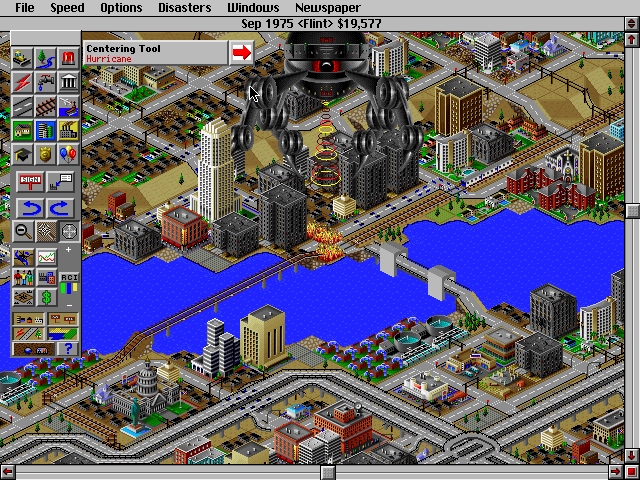
Worldbuilding is fun until the aliens attack

As a reader, I’m most drawn to writers that invent new realities or tweak our own world into bizarre new shapes. My problem is not with non-realist writing, but in applying the rules of certain types of science fiction and fantasy to all types, and beyond. But what is “worldbuilding”?

Some people will argue, tautologically, that all fiction takes place in a world and thus all fiction worldbuilds. But the way most people use the term is similar to what Chuck Wendig’s definition: “[worldbuilding] covers everything and anything inside that world. Money, clothing, territorial boundaries, tribal customs, building materials, imports and exports, transportation, sex, food, the various types of monkeys people possess, whether the world does or does not contain Satanic ‘twerking’ rites.” Worldbuilding is not merely creating a fictional setting and writing a narrative in it. It is an attempt to flesh out an invented world in way that allegedly feels “real.” In a perfectly executed work of worldbuilding, there would be no gaps in the world for the reader to fill in. Everything from the goblins’ favorite type of baby wipes to the export taxes on Martian ray guns would be worked out (at least in the author’s mind if not on the page). This is not possible, but worldbuilding expects the author to have “rules” that are “logically” followed to their conclusions.

Everything from the goblins’ favorite type of baby wipes to the export taxes on Martian ray guns would be worked out (at least in the author’s mind if not on the page)

In contrast to “worldbuilding,” I’ll offer the term “worldconjuring.” Worldconjuring does not attempt to construct a scale model in the reader’s bedroom. Worldconjuring uses hints and literary magic to create the illusion of a world, with the reader working to fill in the gaps. Worldbuilding imposes, worldconjuring collaborates.
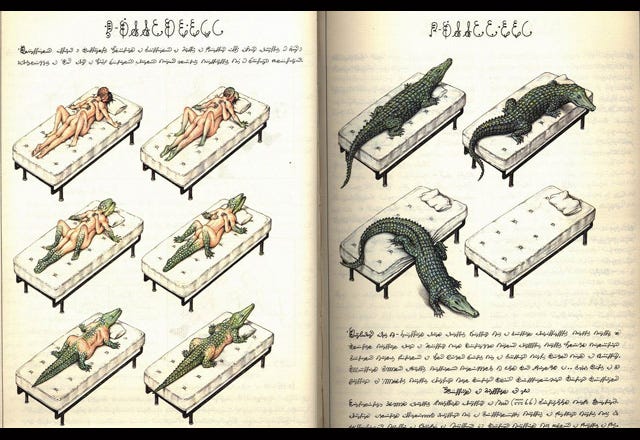
A page from the mysterious Codex Seraphinianus

Let me make a necessarily incomplete analogy to another platform. In painting, worldbuilding is like Renaissance art that attempts to create realistic figures even when they are cherubs, demons, or god. Worldconjuring is a spectrum of other techniques: Matisse implying dancing figures with a few swoops of the brush, Picasso creating a chaos of objects to summon the horrors of Guernica, Magritte shattering our vision with impossible scenes. We should enjoy realistic paintings, but we shouldn’t impose their standards on every school of art.

Worldbuilding is The Silmarillion, worldconjuring is ancient myths and fairy tales. (In fairy tales, we don’t learn the construction techniques of the witch’s gingerbread house or the import/export routes of evil dwarves.) Worldbuilding is a thirty page explanation of the dining customs of beetle-shaped aliens, worldconjuring is Gregor Samsa turning into a beetle in the first sentence without any other fuss.

All stories may need to conjure a world, but only a few benefit from building one.

All stories may need to conjure a world, but only a few benefit from building one.

What Worlds Need Building?

At the Science Fiction and Fantasy Writers of America page, Patricia C. Wrede offers a large list of worldbuilding questions for writers such as “How early do people get up in the morning in the city?” and “What shapes are tables/eating areas (round, oblong, square, rectangular, etc.)?” Wrede doesn’t expect authors to know all these questions, but they give a good idea of the level of detail at which many worldbuilding authors are asked to think.
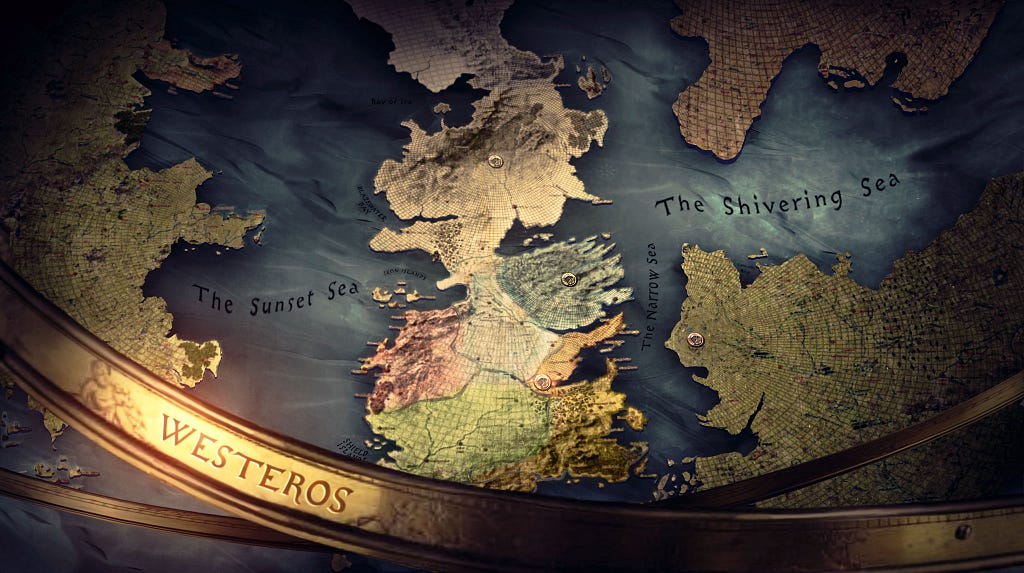
George R. R. Martin’s Westeros

What kind of fiction needs such details? A prime example might be A Song of Ice and Fire, where the varying religions, political factions, and regional customs are indeed a huge appeal of the books. It’s also no coincidence the series is massive. As we’ve pointed out before, the current five books (of a planned seven) are 12 times as long as One Hundred Years of Solitude, 36 times as long as The Great Gatsby and more than and 80 times as long as The Metamorphosis. As a general rule, the longer we stay in a world, the more worldbuilding might be necessary.

Even in epic fantasy stories, though, it’s questionable how much detailed worldbuilding improves a work. Tolkien is revered among worldbuilding obsessives for going to such lengths as inventing complete languages for his fictional races before even writing the story. Contrast that with George R. R. Martin, who famously describes himself as a “gardener” instead of an “architect,” and who simply makes up some fake words and lets the reader infer the rest. Readers may prefer one series to the other for a variety of reasons, but I doubt one reader in a million prefers The Lord of the Rings because dwarven has more realistic grammar than Dothraki.

And plenty of great fantasy books fall outside of this kind of faux-realistic worldbuilding. Marquez’s brilliant and epic One Hundred Years of Solitude is filled with magical happenings, but the magic exist for metaphorical and poetic effect. One character is constantly followed by yellow butterflies, but there is no explanation for this. There are no “rules” governing who gets butterflies and who doesn’t.

And for all the worldbuilding love that The Lord of the Rings gets, Tolkien’s work would fail the worldbuilding guides I’ve linked to here. He may have set the table for high fantasy, but he doesn’t even pass contemporary fantasy author Brandon Sanderson’s first “law’ of magic. The focus on worldbuilding has moved far beyond simply creating some interesting backstories and complex politics to increase the drama of the tale, to expecting a writer to have mapped out every detail of a world as if they were producing an encyclopedia instead of a story. Would the mythic The Lord of the Rings be improved by more discussion of elvish trade agreements and Mordor dining room etiquette?

Was Star Wars improved by midichlorians and trade negotiations?

A Crazy Fan Theory about Crazy Fan Theories

The problem I see with worldbuilding is that readers have come to expect books to meet a standard that the author can’t possibly (and probably isn’t trying to) meet. When I’ve taught fiction classes, I’ve often seen that when students encounter a book outside of the modes of actual realism or faux worldbuilding realism, they don’t know how to evaluate it. They believe that a different way of seeing reality aren’t invitations to see reality in a new way yourself, but simply failures of worldbuilding.

(As an aside, it isn’t a coincidence that the celebrated SFF “worldbuilders” are Western writers, typically white, while imaginative writers from so many other cultures get lazily lumped together as “magical realism.” Worldbuilding insists on a certain concept of supposedly logical “realism” that pretends it is the only way to see the world.)
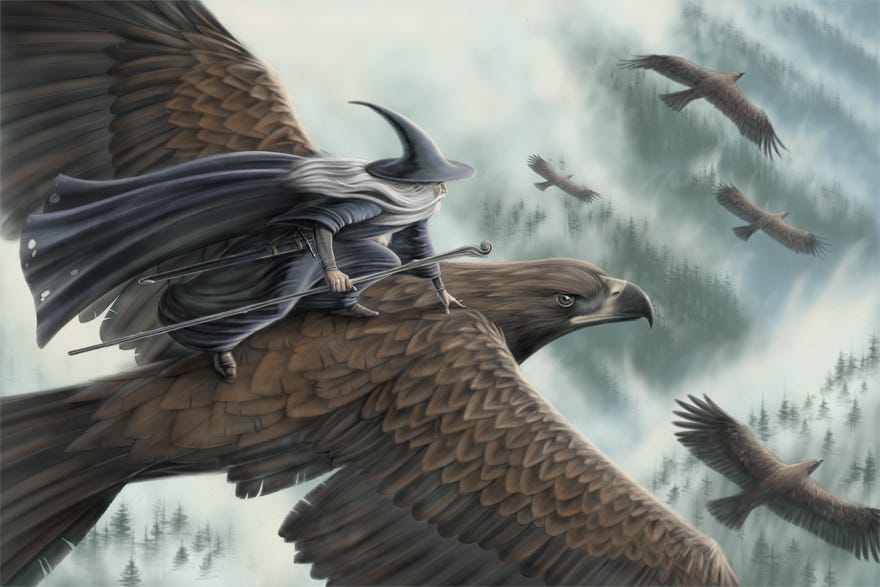
lazy ass eagles

At the same time, fans of worldbuilding works focus not on the arc of the story, the struggles of the characters, or the aesthetic power of the fiction. They focus on the inevitable moments when worldbuilding breaks down. My least favorite example of this is the “crazy fan theory.” These normally begin on a site like Reddit, then spread like Kudzu across the internet. Why didn’t the giant eagles simply fly Frodo to Mount Doom? Well, it would be a really boring story if they did! That doesn’t satisfy fans, who instead create fan theories that “explain” and “fix” and “change the way we see” famous works like The Lord of the Rings. (These crazy fan theories exist for basically every popular book or movie that has ever been produced.)

The urge to “fix” or “explain” art is one we should always be suspect of.

“Bad Worldbuilding” Is Just Bad Writing

None of this is to say that there aren’t many stories that are poorly written. That are set in dull worlds with corny characters and unoriginal plots. But are these problems truly one of worldbuilding? Take Charlie Jane Anders’s often-referenced “7 Deadly Sins of Worldbuilding.” Anders is a great writer and a smart critic, and I agree with the substance of almost everything she says. One dimensional alien/fantasy cultures are lazy and lead to bad fiction. Stories need a sense of why the events are happening now and not some other day. Anders’s advice is solid.

But do we need “worldbuilding” as a concept to explain why moral simplicity, characterization without nuance, or a lack of a tactile sense-of-place can be a problem? A work of fiction set in 2017 will also be bad if the characters lack nuance, the political messages are heavy-handed, and the story is wrapped up in an overly-logical bow. Good writing is complex and ambiguous, not simplistic and heavy-handed.

But do we need “worldbuilding” as a concept to explain why moral simplicity, characterization without nuance, or a lack of a tactile sense-of-place can be a problem?

At the same time, the appeal to “realistic” portrayal of alien or magical beings doesn’t have anything to do with realism. Magical creatures don’t exist! If aliens exist, we don’t know what they are like yet! Human history doesn’t illuminate the history of fictional creatures. It’s quite possible that an alien race might have a monoculture, and the creatures of actual mythology and folklore were often portrayed simplistically. The call to make make such races more complex is not to make them more “true” to the reality of dragons, Martians, or giant eagles. It is a call to make them more human, and thus more interesting to human readers.
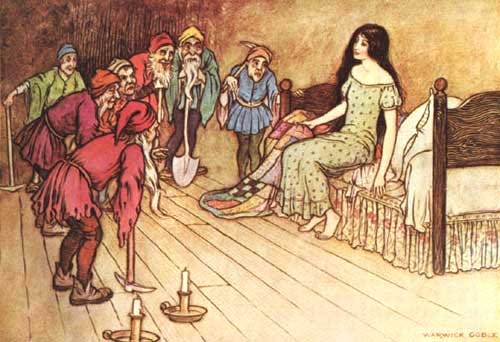
Fairy tales were very unfair to creepy dwarf culture

Storybuilding Vs. Worldbuilding

Ultimately, the logic of worldbuilding always succumbs to the more important logic of storytelling. George R. R. Martin liked the idea of a planet that goes through decades-long winters, but he also wanted it to seem like medieval Europe with similar wildlife and political structures that would, in “reality,” not survive decades of winter. What matters in a story is the story, and what serves the story is useful. The Machiavellian political struggles of Westeros are the story of ASOIAF, and so the complex politics of the region matter where the grammar of Dothraki or the breeding habits of Westeros mammals do not. The mythic sense of civilizations passing is part of The Lord of the Rings, so the history of the races and kingdoms matters even if their biological plausibility doesn’t. Harry Potter’s class might be a fraction of the size it should be, but the small cast of characters works better for the story that Rowling wants to tell.

It isn’t a world that a writer is creating, it is a story. The goal of the writer is not to clutter the path with every object they can think of, but to clear the way for the reader’s journey.

The World of Fiction Beyond Worldbuilding

The main reason I think worldbuilding has become a problem is that it leads people to believe that “realism” is the primary point of fiction, even fantasy fiction. But representing reality — whether “real” reality or a fictional one — is simply one way of telling a story, just one house in the city of fiction. Surrealists, magical realists, post-modernists, and countless other movements or styles create fantastic worlds that function on other levels — mythic, philosophical, Freudian, etc. — that are at odds with this idea of worldbuilding.

Representing reality — whether “real” reality or a fictional one — is simply one way of telling a story, just one house in the city of fiction.

One of my favorite novels is The Woman in the Dunes by Kobo Abe. It’s about a man who misses his bus while looking at insects at the beach, then gets tricked into living in a village where each house lies in a big hole in the sand. The villagers spend their days on the Sisyphean task of shoveling sand to avoid being buried alive. The book is amazing, thought-provoking, and bizarre. And it could only be ruined by worldbuilding (how could such a village survive in modern Japan without being discovered? Wouldn’t sand actually just collapse on all of them?) You have to accept it on its own terms.
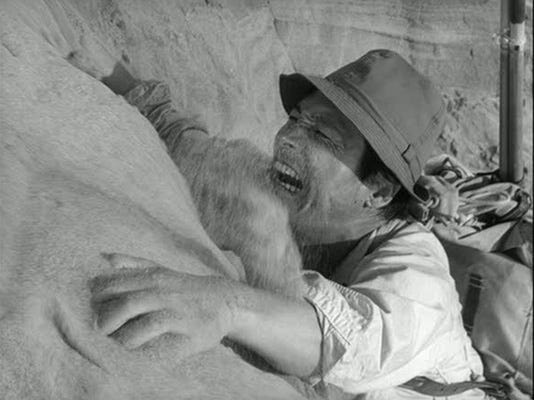
#ThatDuneLife

Julio Cortazar is not failing at worldbuilding by not describing the tax rate of vomitted rabbits, nor is Ray Bradbury violating the rules of SF by having the implausible buildings on Mars. They are simply doing something different.

The reader who expects worldbuilding is frequently the reader who expects fiction to have “answers.” The one who wants all mysteries to be solved, all stories to have “a point,” and all ambiguity to be swept under the rug. Worldbuilding may expand a world, but the concept is narrowing the paths available to writers and to readers.

UPDATE: I’ve published a follow-up article that addresses some of the questions and critiques in the comments here. If you want to argue more about goblins and aliens, give it a click!
More Thoughts about Worldbuilding and Food

On Grieving and What Comes Next

A telephone psychic told Elvis Babbitt, the 12-year-old narrator of Annie Hartnett’s debut novel Rabbit Cake, that she couldn’t be sure whether or not Elvis’s mom killed herself on purpose. She drowned while sleep-swimming, and that is all they can know. Intent would not materialize. It’s a tough lesson for a child to learn: Sometimes the most important questions are the ones least likely to be answered.

Over the course of Rabbit Cake, Elvis has a lot of questions that are not answered. When she is ten, her mother goes missing and is found, two months later, caught in a dam across state lines in Georgia, twelve miles from their hometown of Freedom, Alabama. Everyone in their family copes in different ways. Their dad begins wear their mom’s lipstick. Lizzie, her teenage older sister, lashes out at her friends and begins eating in her sleep. Elvis tries to take care of them.

The title itself comes cakes shaped like rabbits that Elvis’s mom would make on many special occasions. And they eventually turn into a coping mechanism, too, when Lizzie attempts to set the Guinness World Record for Most Rabbit Cakes Baked.

It is fitting that even the book’s title refers to a coping mechanism, as the novel’s focus is on the way these characters grieve and cope. Hartnett evokes this powerfully. She understands that one of the most difficult parts of the process is continuing to have the power to handle the daily obstacles required to keep oneself and those one cares about safe and healthy.

That is not, of course, how Elvis digests things. Hartnett tightrope walks over the gulf between what her character understands and what her audience will with remarkable dexterity. When Elvis is staying up late in order to supervise her sister in case she sleepwalks into the kitchen, it is clear both how necessary it seems to Elvis and how destructive it is in the long run. And she sometimes doesn’t have access to quite how troubling some of what she sees is.

She relays the information plainly and clearly.

“I found my sister drinking milk straight out of the carton. The milk had gone sour…I tried to take the milk carton from her but she wouldn’t loosen her grip. Some of the curdled milk splashed onto the floor, and not even [the dog] would lick it up.”

This is a tough image to handle. There is a youthful innocence woven into the fabric of language that cuts deeper. She is aware that her sister may get very sick from what she is doing, but the concerns are so factual, almost plain. She knows what food poisoning is but does not seem to know how bad it can be.

Outside of the Babbitt’s home, Freedom is a rich world. Some of the book’s most vibrant sections take place in the local zoo, where Elvis volunteers. There too the violent and scarring is often immediately juxtaposed with the endearing. In the beginning one chapter, she is describing the black bears at the zoo.

“Nacho and Yoyo had been raised as circus bears. We tried to treat them as wild animals now and never went into their enclosure when they weren’t locked in their sleeping cages. [A zoo employee] told me that sometimes you could catch Yoyo doing her dance routine, standing on her hind legs and rotating in a circle. Yoyo the Ballerina Bear had been her stage name. She’d been kept chained up when she wasn’t performing.”

Again, Elvis’s reportorial style of narration relays heartbreaking information to the reader without much fanfare, which only makes it hurt worse. Elvis is not given the luxury of staying naïve to the underbelly and neither is the reader.

The book’s limitations, sometimes, also spring from Elvis’s perspective. This comes through most obviously within the context of Lizzie’s and her father’s relationships. There is only so much a character can know about what another person won’t share with them, and her youth is a secondary limiting factor. It makes perfect sense, in that if Elvis did understand more about Lizzie’s relationship with her best friend it would be difficult to believe. But that does not make the lack of insight easier to swallow for the reader.

The book’s loose structure is provided by a grieving chart that a counselor at Elvis’s elementary school gives her. The counselor says it will take 18 months to complete the process and gives Elvis a two-month buffer to account for the space between when her mother went missing and when she was found. Elvis is a science-driven kid, and a structure like that makes sense to her. Eighteen months is a long time, but it is not the longest. It insists upon the existence of an unseen track, and it insists that at some point, the track will end.

In other words, it provides hope that there might be hope. In the face of all the bad that comes her way, the chart is always there to reassure her that, sometime in the future, she will feel better.

An end will come. For better or worse, an end will come.

Coming of Age at Harvard and in Hungary

Taking a Story Somewhere Dangerous

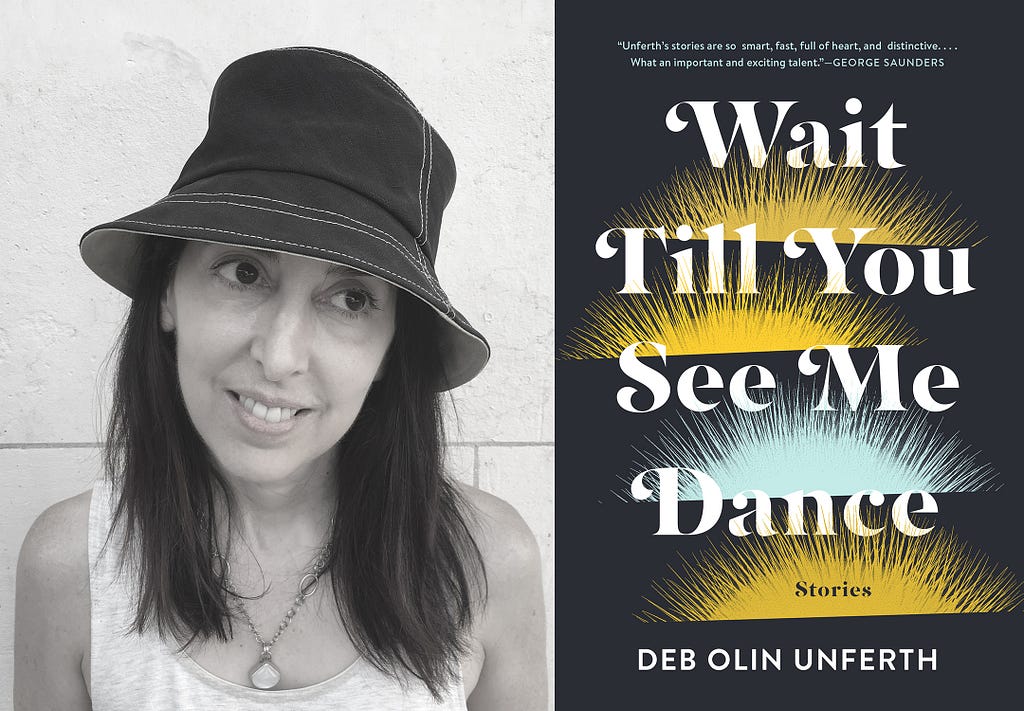
In her collection Wait Till You See Me Dance, Deb Olin Unferth deals in turns of phrase and turns of luck. There are dips into wells and lifts over dunes, and the step-ball-change of shifting intentions. A shooter describes a family on a beach dodging bullets as “Keatonesque.” In the story, “Draft,” a description of the scraps of an incomplete story quickly sprints from “shifting dots of sunshine on the floor” to “botched, bloody murder.” It is a limber collection with the dexterity and precision to launch in most any direction. If Unferth’s book is a dance floor, it is a dance floor unmoored, the dancers in constant and immediate danger.

Perhaps the greatest peril here is that of love, both in its presence and absence, the way it can appear and disappear, conjured and then obliterated. “Who can explain the recession of love?” asks one of Unferth’s narrators. “Love’s sneaky decline?” In her story “The Magicians,” Unferth writes about Houdini’s “elephant room”: a room too small to fit an elephant, and yet, of course, it populates itself with an imagined elephant the minute the listener hears the story. She writes, “by calling it the elephant room he had made me imagine the elephant in that room…It became the elephant room by magic.” Unferth’s stories engage in this sort of sorcery, populating rooms with love even if love is crushing, is absurd, is too large to fit through the door.

Hilary Leichter: The story “Your Character” is such an amazing meditation on the randomness and brutality of creation, the way a character’s fate can spring from a simple turn of phrase. And maybe the way a real, human life can also spring from an arbitrary series of sentences smushed together. Why did you choose to put the story in the second person? I wondered at who might be speaking, and whom they might be addressing.

Deb Olin Unferth: I’ll tell you how that story came about. I was working on a novel, and getting insanely frustrated, so I typed into a google search “how to write a novel,” which seemed the best way to go about it in the moment. I read around on a bunch of different websites, mostly about how to write horror and fantasy, and then I stumbled on a novel-writing forum, which seemed to have thousands of people contributing (is this inspiring? I’m not sure). One thread, under the “plot” category went something like, “What to do with your character if you’re stuck.” And there were hundreds of responses, pages and pages of them, a string of sentences, each beginning with “Your character,” such as “Your character is hanging by a piece of yarn over a fire.” Very similar to the ones in the story. I loved it and began hearing the story in my head before I’d even left the thread. I wrote it all out very fast, modeling mine after the ones in the thread and even just taking some more or less word for word, and then I spent a long time arranging them so that I felt the story had its own little arc — such as you come upon a series of sentences about water, or a series about sleeping, or a series about the love interest, and so on.

A Story of a Murderous Adjunct by Deb Olin Unferth

HL: The stories in your collection range from a paragraph to many pages long, and yet even the tiniest of the bunch feels complete, a perfect morsel. How do you know when a story is done?

DOU: Yes, the shorts — like “Your Character” — I tend to see whole before my eyes before I write them, or as I’m drafting them. Many in the collection are like that: me hearing something in my mind and getting it down. The longer pieces are different and take immense plotting and developing. I often think a story is done long before it is, or a story is done and yet it sits in a corner for years, mostly forgotten. I don’t have a good system.

HL: When you set out to writing, do you have a sense whether a story is destined to be closer to flash fiction, or something longer?

DOU: Yes, I usually know. Sometimes I try to squeeze one into another — grow out a short piece or squash a long piece and it rarely works.

HL: In “Granted,” we see two historians struggling to spend the grant they received to travel to an unnamed country. They must spend it all, and can’t seem to spend enough on anything. I love the way this piece unravels around the title and the premise, until it ends up somewhere extreme and surreal. A similar thing happens with the story “Likable,” in which variations on the word in the title are almost weaponized so that we might end up at the final sentence, a gasp-worthy moment. What is the seed for these kinds of stories? Do they start with the title, with their exuberant conclusions, or somewhere else completely?

DOU: “Weaponized,” I like that. The repetition I like the most in prose is perhaps Steinian, or maybe that’s just how I think about it. My thinking is: each time I come upon a repetition of a word or a phrase my experience of it should be different. The meaning of it should shift so that each time I see it, the word surprises me with its newness. By the time I reach the end, I want the word to have come to have many meanings, many connotations, and to produce many emotions.

“Each time I come upon a repetition of a word or a phrase my experience of it should be different.”

I studied philosophy as an undergraduate and now I live with a philosopher. Definitions are the lifeblood of philosophy. What would philosophers do if they didn’t have anything to define or if they weren’t considering different shades of meaning? They’d have to take down their shingle.

HL: I first encountered your prose while working on NOON with Diane Williams. Can you talk a little bit about how NOON has influenced your writing?

DOU: I talked at length about how I met Diane Williams and how essential she was to my becoming a writer here, and every word of it is still true. I would add to it that I have watched her discover a new generation of writers in recent years. Her touch is perfect. No one knows the sentence better than she, no one can track sound across a page or hear the off-note in a line like she can. I simply and baldly love her without reservation.

HL: Many of your stories here feature teachers and students, and the complicated ways those relationships can unfold. There’s this great line in the title story of the collection: “I was what is called an adjunct: a thing attached to another thing in a dependent or subordinate position.” Can you speak a little bit about how your own experiences as a teacher have influenced your writing?

DOU: I once had a book called What Color Is Your Parachute that is supposed to help you figure out what you should do to support yourself without wanting to kill yourself. They help you determine your best money-making match by having you do a series of convoluted exercises and filling out huge numbers of charts and making bigger and bigger charts. So I did it all, I had charts taped together all over my floor (yes, on paper), and at the end of all of it — and it took weeks — the book declared very simply that I should be a teacher. And that was exactly right. I love being a teacher! In fact summer gets to be a little hard on me psychologically with no teaching.

But some of the worst days of my life have been spent teaching. By that I mean, the most depressing periods in my life, I was usually in the middle of a semester and had to turn up and turn it on and bring it on with a smile. I remember crying in the bathroom many times when I was an adjunct. I remember students coming in and seeing me blowing my nose and wiping my tears. Being an adjunct is the worst. I channel some of that into my stories.

HL: In your story ‘Voltaire Night,” the teacher and students in a writing class take one night of the semester to share the worst thing that has happened to them: in the past week, month, in their entire lives. I want to do reverse Voltaire Night with you. What’s the best thing that happened to you this week?

DOU: That’s easy. In addition to being a professor at the University of Texas at Austin, I run a prison creative writing certificate program at a prison in southern Texas. One of my students made my husband and me wooden boxes — a jewelry box for me and a “manbox” for him, where he can toss his keys and change when he comes in the door. I have never been more touched by a gift.

Yeah, you can’t get away with Voltaire Night anymore. No one wants to talk about the bad things that happened. I’ve noticed this. It’s always “most embarrassing moment” or “most looking forward to,” etc. I tried last semester to get my students to tell stories about the worst thing that had happened to them and they looked at me like I was deranged.

PEN America to Present Women’s March with Award for Free Expression Courage

Bob Bland has been asked to accept the award for the March

Women’s March via Flickr

This year’s PEN/Toni and James C. Goodale Freedom of Expression Courage Award will honor the Women’s March, according to a statement released today by PEN America. The award, which honors “exceptional acts of courage” in demonstrating freedom of expression, will be presented at PEN’s annual gala on April 25th. Bob Bland has been asked to accept the award on behalf of the Women’s March.

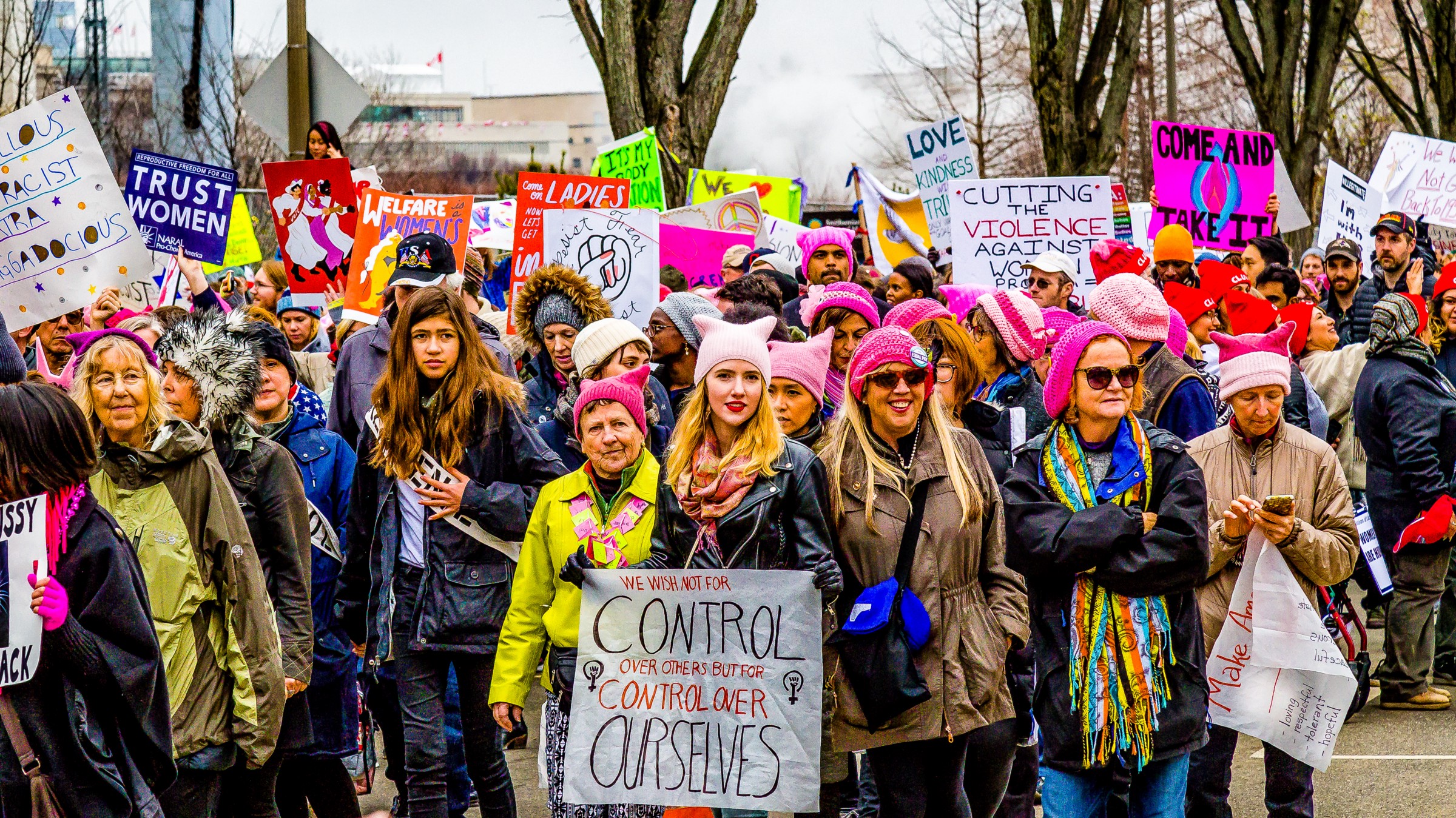
On January 21st, 2017, women of all ages and their allies, donning pink pussy hats and carrying homemade signs, turned out on an unprecedented scale. 673 marches were organized, bringing together an estimated five million people on all seven continents. The rallies were entirely peaceful, with not a single arrest made. Speakers at the Washington protest, including Gloria Steinem and Senator Kamala Harris, underscored the March’s mission statement, which reads:

“The Women’s March on Washington will send a bold message to our new government on their first day in office, and to the world that women’s rights are human rights.”

The PEN award recognizes that the March embodied more than a protest against President Trump, becoming a show of support for diversity, women’s healthcare reform, LGBTQ, religious, reproductive rights and other issues.

PEN America’s press release quotes its executive director, Suzanne Nossel:

“The Women’s March began as a quixotic idea shared with friends on Facebook. In the hands of 99.9% of people, it would have ended there, as a pipe dream. But Bob Bland and the group of women who joined her forged a powerful, diverse coalition that worked with immense drive to win over skeptics and build the support of an extraordinarily broad coalition of which PEN America became part.”

PEN America has told Electric Lit that Bland alone has been invited to accept the award on behalf of the March, but that it hopes other organizers will be able to attend the ceremony. Bland is the Brooklyn-based fashion designer who, the night after the election, went on Facebook to suggest a women’s protest. Her efforts were combined with Teresa Shook, a woman based in Hawaii who created a Facebook page for a rally that quickly garnered over ten thousand RSVPs. Shook’s event was originally called “The Million Woman March,” which prompted criticism of her and Bland’s efforts and the absence of women-of-color in the planning process. Three nonwhite women with substantial organizing experience — Linda Sarsour, Tamika Mallory, and Carmen Perez — were asked to join the protest as co-national chairs, alongside Bland.

2017 marks the third year the PEN/Toni and James C. Goodale Freedom of Expression Courage Award will be handed out. The award incited controversy in its inaugural year by honoring the satirical French newspaper, Charlie Hebdo, after the deadly attack on the magazine’s Paris office. Some PEN authors, including Michael Ondaatje and Francine Prose, pulled out of the gala because of the paper’s history of offending various religious groups in France, particularly the Muslim community. The 2016 award went to Lee-Anne Walters and Dr. Hanna-Attisha, the pair who exposed the lead poisoning water crisis in Flint, Michigan.

34 Books by Women of Color to Read This Year

INFOGRAPHIC: The 20 Most Popular Books Throughout History

Though it may seem like an impossible task, the blog over at Global English Editing has taken a stab at compiling the 20 most popular literary works throughout time. Below is a fascinating infographic that goes as far back as 10th Century BC with I Ching and fast forwards to modern written works like Fifty Shades of Grey (sorry, history). So do you think these are the most popular books in history? Read the whole list and its fun facts and see for yourself!

Neruda & Paterson: Notes on the Contemporary Poetic Film

A Story of Strangers and Emotional Celibacy

“Creed”

by Carys Davies

She could see Creed’s place now, up ahead, not more than another three quarters of a mile.

On the big flat stone at the top of the path she stopped to rest, pushed back her sticky hair and wondered again what he would do when he saw her — what he would say and how he would be and what he would look like too, close-up, after all this time.

For years now, for most of her life, she’d seen him only from afar, mending his walls or checking on his sheep or coming down off the high fell with a bucket to the spring above the waterfall, a bulky hatted figure.

A few times over the years she’d thought about going up there and knocking on his door and saying to him, Michael it’s me. Ruth. From the valley. Come. Sit with me at least.

Once not long after her thirtieth birthday she’d come up this far along the path with a box of her brother’s old dominoes in her pocket. All the way along the river and up over the slick black rocks on the west side of the beck to the top, with the game’s smooth pieces chinking against each other and her thumb fidgeting with the sliding wooden lid, she’d rehearsed what she’d say to Creed when she reached him: that it was crazy, idiotic, them living like this — the two of them in this vast forgotten garden of bracken and stone and pasture and bog, like the very last people on earth, but never speaking, never coming close to one another.

She’d pictured them both at his table, her brother’s dominoes spread out between them in various arrangements, not speaking perhaps (neither of them had much practice at that) but at least sitting together in a not-uncomfortable silence. Then up here at the big flat stone at the top of the path she’d lost her nerve. In the distance, his thick-walled bothy with its arrow-slit windows had looked so closed-in and stubborn and hunched against the weather and the world, so like a fortress for his feelings, that she’d lacked the courage to go on and had turned around and gone back down.

Today she was wearing her brown work boots and her black coat and her blue dress and she hoped she looked respectable. She didn’t want Michael Creed to open his door and look at her and think she was a fright.

She’d been a child when his wife died, ten or eleven years old.

She remembered the two of them coming to her father’s church. The wife’s dark hair. Creed a young man, broad-shouldered and strong, with a neat beard.

Her father had gone up there a dozen times afterwards and tried to comfort him but Creed wouldn’t let him in the house. She remembered how tired and discouraged her father had looked the last time he came home.

‘What happened, William? What did he say to you?’ her mother had asked, rather fearfully, and they’d all watched him hang up his coat and press his lips together and set down his Bible on their kitchen table and tap it lightly with his fingers. He’d looked as if he was debating with himself whether to repeat in front of his family what Creed had said.

‘He said, Janice, that God had greatly disappointed him. He said that he had begged Him for His pity and His mercy and had been refused. He said there was nothing now I had to tell him that he wanted to listen to and if I ever came trespassing on his land again and tried to talk to him about God’s love, he would come out into his yard and stick his shotgun in my crap-filled mouth and shoot me.’

Creed stayed away from the church after that, and if he ever came face to face with her father down in the valley he turned around and walked the other way. He began to avoid anyone who attended the Sunday service, which in those days had been nearly everyone. At some point he moved out of the farmhouse he’d shared with his wife and into the bothy further up the fell. Eventually he stopped coming down into the valley for anything. It was as if, not being able to look God in the eye and spit in His face, or inform Him personally that he was sending Him to Coventry forever, Creed had settled on the next best thing. Or perhaps he’d decided that there was no face to spit in and he was living in a world of fools; that from now on, he was on his own.

He mended his walls and birthed his ewes and when autumn came he drove the new season’s lambs up along the high straight track that had once been the Romans’ way north to the border, sold them to be slaughtered, picked up his supplies and walked back the way he’d come. Anywhere he had to go, he took the old Roman way, never the path down into the valley, the track along the river that took him past their house and the church.

What would he look like?

Like the other men she remembered in their fifties and sixties who used to live here? Bull-necked men with brick-red faces and bow legs and giant hands?

When he was young his hair had been brown, chestnut-colored, she remembered that.

Not as dark as his wife’s but still brown. His beard had been brown also.

And hadn’t he had one brown eye and one grey? She thought so. She thought she remembered her sister Pam remarking on it once when they were girls.

Her sister Pam and her brother Frank always asked after him when they came. ‘And what about Michael Creed?’ they said. ‘Do you ever see him, Ruth? Is he still up there?’

‘Yes,’ she told them. ‘He’s still up there.’ But what if he wasn’t? What if since the last time she’d glimpsed his bulky shape in the distance, he’d died or given up at last and gone away, like everyone else?

What if she got there and knocked on his door and there was no answer and when she pushed it open the place was empty and cleared out and there was nothing up there but his sheep and a couple of starving dogs?

In winter, months went by sometimes without a sign of him. Then there’d be a storm, a heavy fall of snow, and he’d be up there with his dogs, digging out his buried sheep. The dogs trickling over the white hillside, showing him where to put his shovel so he could bring them out alive. In spring, around lambing time, she woke sometimes in the dark and saw the pinprick beam of his flashlight moving over the sloping fields as he went about checking on things.

Over the years her father’s scattered parish had dwindled away.

One by one the farms had emptied out. The old had died, the young and the middle-aged had moved away. Where there’d been two shops and a pub, a school and a recreation room there were only the carcasses of buildings. When her father died, no one was sent to replace him. Where there’d been people and families and children there was only her left now, and Michael Creed.

Who would have thought a place could fall in on itself so quickly? That so monumental a ruin could be achieved like that? Almost, it seemed to her sometimes, it had happened in the blink of an eye, or in the course of one brief night while she slept.

Hikers who came up this far poked their faces in at her window. They seemed amazed to see curtains, chimney smoke, her boots at the door. Once, coming back from the church, she’d found a young couple in woolen hats and waterproof jackets on the step at the back of her house, picnicking on crisps and sandwiches and hot tea from a thermos. They’d hardly seemed to believe her when she said she lived here, and when they’d gone she thought of them telling their friends about the woman they’d found living way up at the far end of the valley by herself, using the words she’d overheard her sister Pam and her brother Frank whispering to each other when they came and thought she was outside, words like squalid, primitive, unhygienic.

For a time, she’d let her brother and sister drive her back with them for a few days. But in town she discovered, as the years went by, that her clothing attracted attention, that her appearance shocked people. One cold Christmas when Pam came to collect her she’d got in the car wearing both her dresses, her blue one and her knitted fawn one, one on top of the other. Pam had been ashamed. All that week Ruth saw her making silent signals with her eyes to her friends. She discovered also that she’d aged more quickly than these people. Carting water off the fell to her house in a bucket, hauling fodder from the pasture on a sledge for her cow Charlotte, chopping wood and breaking sticks and stuffing them into the stove and picking up scraps of slate off the hills to mend her roof — it had all made her age more rapidly than Pam and these other women who came to Pam’s house and tried not to gawp when Pam said, ‘This is my younger sister, Ruth.’ Like Pam, all the women still had dark hair and neat unbroken fingernails and attractive teeth. She couldn’t imagine how they managed it. She cared a little about it, this difference between the way they looked and the way she did, but not much. She told Pam she’d not be going back with her again. She was happy where she was, she’d no urge now to leave.

She’d stayed on to look after the church. When no one came to replace her father, it had been impossible for her to think of leaving it untended and unused. In winter she put holly in the alcoves. In spring, hawthorn and valerian. On Sundays she stood in the cold in front of the empty pews and read aloud the lesson. She patched the roof and polished the colored window in the nave and the blackened script engraved on the brass plaque her father had screwed into the lintel over the door when he first arrived here from the coast. It was still her favorite Psalm: I will lift up mine eyes unto the hills from whence cometh my help. My help cometh from the Lord.

In the back behind her house she grew swede and onions and potatoes and spinach. She had apples and blackcurrants and gooseberries from the trees and bushes her mother had planted. In winter an arsenal of things preserved in jars. A taxi came nine miles up the valley track once every three months and drove her to Penrith for her shopping. Her sister and her brother visited twice a year from Carlisle. She had no phone and no television but she had chickens and her cow and a sewing machine and her father’s books. She knew that there was another kind of world and she could see that it had its attractions but she did not want to live in it. She wanted to be here.

She liked it here. She was forty-two and she had not been lonely, not really. She had never lived her life expecting it to change.

Around her neck she wore the small wooden cross that had belonged to her father and as she walked she touched it every now and again to make sure it was still hidden beneath her dress.

She’d tried to leave it behind but in the end she’d not been able to.

She’d unhooked the clasp and dropped the chain into the palm of her hand and tipped it onto a plate and stepped out of the door but when she got to the path she’d felt so naked and afraid without it that she’d gone back and put it back on and slipped it inside her dress, telling herself that Creed wouldn’t necessarily see it. However things went, she would do everything she could to hide it from him.

As she walked her legs shook.

Her damp face boiled with heat, her blue dress clung to her like another skin, her heart thumped like a big beating wheel. She took off her black coat, folded it over her arm, and carried it. She wished she could turn back here and go back down to the beck and splash her face and cool her throat with the icy water.

Above her, a pair of peregrines rose in circles and vanished high up over the crags, into the blue. From beneath she could see the yellow flashes of their legs, the black streaks of their tails and wingtips and as she watched them she imagined looking down out of the sky at the dark speck of herself moving slowly over the pale brown hills towards Creed’s bothy. The ground was boggy here, up on the higher ground after the path gave out. As she plodded through it the stiff grass brushed her bare knees.

She wished she didn’t resemble her father. She wished she wasn’t tall as he’d been. She wished she didn’t have his springy hair and large beaky nose and pointy chin. She didn’t want Creed to open his door and think of her father and think that after all these years she’d come to him on some kind of religious mission. She didn’t want him to be surly and unwelcoming. She didn’t want him to slam the door in her face or bellow at her through one of his narrow windows and tell her to be gone. She didn’t want him to pull his gun on her. She wished she’d come up here that other day, with the dominoes. She wished this wasn’t her first time. She wished that the ice had been broken between them before now — that she could at least have become an ordinary neighbor to him. Come on, Michael, it’s just us now. Sit with me. Everyone else has gone. The old have died, the young are all in the towns. My brother Frank, remember? My sister Pam? They’re in Carlisle. Pam’s a nurse. Frank’s at one of the big hotels. The Glaisters have all gone. Partingtons too, and Capsticks and Pickthalls and Hawksmiths, all upped and gone.

She wondered what Creed made of it all, this emptying out. She wondered what he felt when he turned up at the slaughterhouse with his new season’s lambs, or went into the places he visited for his supplies. She wondered if the people there exchanged secret glances and if he was made to feel uncomfortable. She wondered if he felt like she did and if in spite of everything that had happened in his life, he was always glad to come home.

There was more wind up here. It cooled her face and made a rushing sound through the stiff grass and the bracken, a sound her father always used to say was the same sound he’d grown up with, the sound of the sea. When he said that, her sister Pam used to beg him to take them all on holiday somewhere to the coast, to Morecambe or Blackpool, somewhere sandy and warm where they could stretch out on towels and go bathing and eat ice cream and see the lights and a show, and every year that they didn’t go she told Ruth that the first bloody chance she got, she was off out of here, away from this boring fucking dump of a valley, these prehistoric hills and struggling miserable little farms.

Up ahead now, only another hundred yards, Creed’s bothy sat like a dark stone resting in the bottom of a deep smooth-sided bowl. All around it the tawny ramparts of the hills rose to the sky. There’d been no question this morning of setting off towards anything else; there’d been no question of the nine mile walk along the river to a road where she might sit for an hour and wait without a single vehicle passing. With each step now she felt her own slow, dragging gravity. Across the marshy ground she proceeded with difficulty and sometimes she stumbled.

His yard was bordered by a woodshed and a privy and the L-shaped dwelling part of the bothy itself. Turf and ferns and a spongy blanket of moss grew on the thick shaley roof slates. The bothy door was painted brown. Bronze lichen grew on his walls like rust. A trio of his black-faced sheep burst out from behind them when they saw her coming, bunching together and jostling each other in their hurry to get away, as if she was something dangerous.

Oh Jesus, what would he say to her? Would he be appalled by the sight of her? Would he know who she was? Would he hold that against her? Would he look past her through the open brown door and out beyond the opening in his yard across the soggy uplands and the pale brown hills and down into the long tapering valley with its scattered emptied farms and ask her how in glory’s name it had happened? Would he turn sarcastic and ask her if she’d had a visit from the Holy Spirit?

At the corner of his yard a rowan tree grew out of the stones. She leaned against it, breathed. The hour’s walk, the climb, had taken her half the day. Her hair felt prickly and dry as gorse. There was bog cotton in it, grass and cuckoo spit. Blood leaked out of her, filling her boots and coating the ground. She’d known since this morning that something was wrong.

She could no longer recall the Scotsman’s face, only his sandy hair and his pale body.

When he was gone she realized she didn’t know his name or the name of his town or what job he did in the rest of his life or if he had a wife and children. She wasn’t used to conversation and they’d hardly talked.

He told her he’d come over Rampsgill Head and round Blea Tarn and after that the fog had come down and he’d had no compass and had to continue on his hands and knees, worried that he’d turned himself round and wasn’t where he thought he was and that on one side or the other there might be nothing but crag and scree and a sheer plunging drop to the bottom. When he saw her light he’d thought at first it must be the sun or the moon, a small whitish glow in the murk.

In the morning he’d thanked her for the hot breakfast and her warm bed. He was glad the ugly weather had brought him to her door, he said. He’d had a nice time.

She could see nothing now, even in the daylight everything was dark and all she could feel was the raised lump of the cross at her throat. She wished she hadn’t worn it. She was afraid again it might make Creed angry, that anything like that might disgust him still, that he’d send her away. She began to tug at the chain and fumble with the clasp at the back of her neck. Her last mad thought was that she wished there was some way she could tidy herself up. At least put a comb through her hair.

Creed’s dogs found her in his yard.

He didn’t recognize her but he knew she must be one of the Reverend’s daughters from the valley, whichever one had stayed behind. He could see the beveled edges of a crucifix beneath the blue fabric of her dress. He couldn’t remember her name but over the years he’d seen her many times, a dark point down there, moving between her house and the church. He’d seen the cars that once in a while fetched her away then brought her back along the track beside the river. Her lips moved a little and he wondered if she was praying. There was blood on the stony earth of his yard. A large clot, dark and ragged like liver on the hem of her dropped black coat.

Creed was brawny and white-haired and tall. He lifted her up and carried her inside and put her on his bed. In his whole life he had never seen so much blood.

At the sink he rolled up his sleeves and scrubbed himself and slipped his right arm up inside her. He moved his hand up past the torn and pulsing placenta and found the breeched legs, the curving beads of the small spine. Ruth’s eyelids fluttered and Creed didn’t tell her that she’d come too late. He knelt by the bed and stroked her hair and told her in a soft voice that she was a good girl, a brave girl. He repeated the same whispered words over and over the way he did with his sheep when they couldn’t birth and they were suffering and miserable; and when he was sure there was no more time and no other way he boiled up a pan and went in under the breastbone with his razor and brought out the child, a tiny curled-up girl with a pointy chin and a small beaky nose and a glistening cap of sand-colored hair, and when the long night ended and morning came and Creed had done everything he could with his boiled cloths and his needle and his fine cotton thread, when he’d tried every desperate thing short of a prayer to stop the blood and there was nothing at all, now, that could be done and it was over, he went and stood for a long time looking out through one of his arrow-slit windows at the sloping fell aflame in the dawn with the child in his arms.

She was light as a leaf and just as beautiful.

He’d call her Rowan, after the tree in his wall.

He wished his wife could see her.

George Takei Will Publish a Graphic Novel

The story will take on his time in a WWII-era US internment camp

Actor George Takei is taking up the pen to write a graphic novel about his childhood, according to a statement released by publisher IDW. Best known for his portrayal of Sulu on Star Trek and his rather amusing Twitter, Takei will be telling the story of his family’s detention in a US internment camp during World War II. At the time, Takei was five. The novel will take on issues of racism and human rights and will explore how Takei’s confinement impacted his art, fame, and activism. The New York Times reported on the publisher’s announcement; Takei, of course, had his own take on Twitter:

Takei previously delved into similar material in 2015, when he starred in the musical Allegiance, which was also based on his youth. He sees the graphic novel as an opportunity to reach an even wider audience, according to his statement: “When the opportunity to tell my story in the form of a graphic novel presented itself, I recognized the value in making it easily accessible for our youth to discover and digest the material, bringing attention to an important and relevant issue, while preserving it for generations to come.”

He also noted that he hopes the book will advance his “ongoing mission of spreading awareness of this disgraceful chapter of American history.”

The as yet untitled work is due out in 2018.

The Power of Culture: an interview with Marie Mutsuki Mockett, author of Where the Dead Pause, and…

Here Are the 2017 Hugo Finalists

N. K. Jemisin and Cixin Liu in the Running for Best Novel

Franklin P. Dixon

Science fiction’s most famous award just announced it’s finalists! The Hugo Awards — which have gone to writers like Philip K. Dick, Ursula K. Le Guin, and William Gibson over the years — have recently been embroiled in scandal as reactionary voters decried the diversity of nominees and tried to manipulate the ballot. However, this year the ballot stuffing seems to have been curbed and science fiction fans can hopefully return to celebrating these great works.

Here are the nominees:

BEST NOVEL
All the Birds in the Sky by Charlie Jane Anders (Tor Books / Titan Books)
A Closed and Common Orbit by Becky Chambers (Hodder & Stoughton / Harper Voyager US)
Death’s End by Cixin Liu (Tor Books / Head of Zeus)
Ninefox Gambit by Yoon Ha Lee (Solaris Books)
The Obelisk Gate by N. K. Jemisin (Orbit Books)
Too Like the Lightning by Ada Palmer (Tor Books)

BEST NOVELLA
The Ballad of Black Tom by Victor LaValle (Tor.com Publishing)
The Dream-Quest of Vellitt Boe by Kij Johnson (Tor.com Publishing)
Every Heart a Doorway by Seanan McGuire (Tor.com Publishing)
Penric and the Shaman by Lois McMaster Bujold (Spectrum Literary Agency)
A Taste of Honey by Kai Ashante Wilson (Tor.com Publishing)
This Census-Taker by China Miéville (Del Rey / Picador)

Victor LaValle Talks About Horror Fiction, Imaginative Illiteracy, and Lovecraft’s Complicated…

BEST NOVELETTE
Alien Stripper Boned From Behind By The T-Rex by Stix Hiscock (self-published)
“The Art of Space Travel” by Nina Allan (Tor.com, July 2016)
“The Jewel and Her Lapidary” by Fran Wilde (Tor.com Publishing, May 2016)
“The Tomato Thief” by Ursula Vernon (Apex Magazine, January 2016)
“Touring with the Alien” by Carolyn Ives Gilman (Clarkesworld Magazine, April 2016)
“You’ll Surely Drown Here If You Stay” by Alyssa Wong (Uncanny Magazine, May 2016)

BEST SHORT STORY
“The City Born Great” by N. K. Jemisin (Tor.com, September 2016)
“A Fist of Permutations in Lightning and Wildflowers” by Alyssa Wong (Tor.com, March 2016)
“Our Talons Can Crush Galaxies” by Brooke Bolander (Uncanny Magazine, November 2016)
“Seasons of Glass and Iron” by Amal El-Mohtar (The Starlit Wood: New Fairy Tales, Saga Press)
“That Game We Played During the War” by Carrie Vaughn (Tor.com, March 2016)
“An Unimaginable Light” by John C. Wright (God, Robot, Castalia House)

BEST RELATED WORK
The Geek Feminist Revolution by Kameron Hurley (Tor Books)
The Princess Diarist by Carrie Fisher (Blue Rider Press)
Traveler of Worlds: Conversations with Robert Silverberg by Robert Silverberg and Alvaro Zinos-Amaro (Fairwood)
The View From the Cheap Seats by Neil Gaiman (William Morrow / Harper Collins)
“The Women of Harry Potter” posts by Sarah Gailey (Tor.com)
Words Are My Matter: Writings About Life and Books, 2000–2016 by Ursula K. Le Guin (Small Beer)

BEST GRAPHIC STORY
Black Panther, Volume 1: A Nation Under Our Feet, written by Ta-Nehisi Coates, illustrated by Brian Stelfreeze (Marvel)
Monstress, Volume 1: Awakening, written by Marjorie Liu, illustrated by Sana Takeda (Image)
Ms. Marvel, Volume 5: Super Famous, written by G. Willow Wilson, illustrated by Takeshi Miyazawa (Marvel)
Paper Girls, Volume 1, written by Brian K. Vaughan, illustrated by Cliff Chiang, colored by Matthew Wilson, lettered by Jared Fletcher (Image)
Saga, Volume 6, illustrated by Fiona Staples, written by Brian K. Vaughan, lettered by Fonografiks (Image)
The Vision, Volume 1: Little Worse Than A Man, written by Tom King, illustrated by Gabriel Hernandez Walta (Marvel)

BEST DRAMATIC PRESENTATION — LONG FORM
Arrival, screenplay by Eric Heisserer based on a short story by Ted Chiang, directed by Denis Villeneuve (21 Laps Entertainment/FilmNation Entertainment/Lava Bear Films)
Deadpool, screenplay by Rhett Reese & Paul Wernick, directed by Tim Miller (Twentieth Century Fox Film Corporation/Marvel Entertainment/Kinberg Genre/The Donners’ Company/TSG Entertainment)
Ghostbusters, screenplay by Katie Dippold & Paul Feig, directed by Paul Feig (Columbia Pictures/LStar Capital/Village Roadshow Pictures/Pascal Pictures/Feigco Entertainment/Ghostcorps/The Montecito Picture Company)
Hidden Figures, screenplay by Allison Schroeder and Theodore Melfi, directed by Theodore Melfi (Fox 2000 Pictures/Chernin Entertainment/Levantine Films/TSG Entertainment)
Rogue One, screenplay by Chris Weitz and Tony Gilroy, directed by Gareth Edwards (Lucasfilm/Allison Shearmur Productions/Black Hangar Studios/Stereo D/Walt Disney Pictures)
Stranger Things, Season One, created by the Duffer Brothers (21 Laps Entertainment/Monkey Massacre)

BEST DRAMATIC PRESENTATION — SHORT FORM
Black Mirror: “San Junipero”, written by Charlie Brooker, directed by Owen Harris (House of Tomorrow)
Doctor Who: “The Return of Doctor Mysterio”, written by Steven Moffat, directed by Ed Bazalgette (BBC Cymru Wales)
The Expanse: “Leviathan Wakes”, written by Mark Fergus and Hawk Ostby, directed by Terry McDonough (SyFy)
Game of Thrones: “Battle of the Bastards”, written by David Benioff and D. B. Weiss, directed by Miguel Sapochnik (HBO)
Game of Thrones: “The Door”, written by David Benioff and D. B. Weiss, directed by Jack Bender (HBO)
Splendor & Misery [album], by Clipping (Daveed Diggs, William Hutson, Jonathan Snipes)

BEST EDITOR — SHORT FORM
John Joseph Adams
Neil Clarke
Ellen Datlow
Jonathan Strahan
Lynne M. Thomas & Michael Damian Thomas
Sheila Williams

BEST EDITOR — LONG FORM
Vox Day
Sheila E. Gilbert
Liz Gorinsky
Devi Pillai
Miriam Weinberg
Navah Wolfe

BEST PROFESSIONAL ARTIST
Galen Dara
Julie Dillon
Chris McGrath
Victo Ngai
John Picacio
Sana Takeda

BEST SEMIPROZINE
Beneath Ceaseless Skies, editor-in-chief and publisher Scott H. Andrews
Cirsova Heroic Fantasy and Science Fiction Magazine, edited by P. Alexander
GigaNotoSaurus, edited by Rashida J. Smith
Strange Horizons, edited by Niall Harrison, Catherine Krahe, Vajra Chandrasekera, Vanessa Rose Phin, Li Chua, Aishwarya Subramanian, Tim Moore, Anaea Lay, and the Strange Horizons staff
Uncanny Magazine, edited by Lynne M. Thomas & Michael Damian Thomas, Michi Trota, Julia Rios, and podcast produced by Erika Ensign & Steven Schapansky
The Book Smugglers, edited by Ana Grilo and Thea James

BEST FANZINE
“Castalia House Blog”, edited by Jeffro Johnson
“Journey Planet”, edited by James Bacon, Chris Garcia, Esther MacCallum-Stewart, Helena Nash, Errick Nunnally, Pádraig Ó Méalóid, Chuck Serface, and Erin Underwood
“Lady Business”, edited by Clare, Ira, Jodie, KJ, Renay, and Susan
“nerds of a feather, flock together”, edited by The G, Vance Kotrla, and Joe Sherry
“Rocket Stack Rank”, edited by Greg Hullender and Eric Wong
“SF Bluestocking”, edited by Bridget McKinney

BEST FANCAST
The Coode Street Podcast, presented by Gary K. Wolfe and Jonathan Strahan
Ditch Diggers, presented by Mur Lafferty and Matt Wallace
Fangirl Happy Hour, presented by Ana Grilo and Renay Williams
Galactic Suburbia, presented by Alisa Krasnostein, Alexandra Pierce and Tansy Rayner Roberts, produced by Andrew Finch
The Rageaholic, presented by RazörFist
Tea and Jeopardy, presented by Emma Newman with Peter Newman

BEST FAN WRITER
Mike Glyer
Jeffro Johnson
Natalie Luhrs
Foz Meadows
Abigail Nussbaum
Chuck Tingle

BEST FAN ARTSIT
Ninni Aalto
Alex Garner
Vesa Lehtimäki
Likhain (M. Sereno)
Spring Schoenhuth
Mansik Yang

BEST SERIES
The Craft Sequence by Max Gladstone (Tor Books)
The Expanse by James S.A. Corey (Orbit US / Orbit UK)
The October Daye Books by Seanan McGuire (DAW / Corsair)
The Peter Grant / Rivers of London series by Ben Aaronovitch (Gollancz / Del Rey / DAW / Subterranean)
The Temeraire series by Naomi Novik (Del Rey / Harper Voyager UK)
The Vorkosigan Saga by Lois McMaster Bujold (Baen)

JOHN W. CAMPBELL AWARD FOR BEST NEW WRITER
Sarah Gailey (1st year of eligibility)
J. Mulrooney (1st year of eligibility)
Malka Older (2nd year of eligibility)
Ada Palmer (1st year of eligibility)
Laurie Penny (2nd year of eligibility)
Kelly Robson (2nd year of eligibility)

Those Teenage Years When Everything Is New and Death Is Just Around the Corner

Julie Buntin’s debut novel, Marlena, is about loss, addiction, and teenage friendship. After Cat’s parents divorce, she has to leave her fancy private school behind and move with her mom and brother to a small town in rural northern Michigan. Enter Marlena, the beautiful, musically gifted girl-next-door with a creepy dad and an affinity for pills. Cat and Marlena’s relationship grows more intimate and dangerous as Marlena introduces Cat to a series of firsts, until inevitably — as the reader knows from the very first page — Marlena drowns in six inches of icy river water. Decades later, the sudden appearance of Marlena’s brother, Sal, forces Cat to revisit the ghost of her old friend, whose influence and mysterious death continue to plague Cat’s life.

While living in New York City last summer, I took advantage of its vast literary scene by attending as many readings as possible. One night, I stumbled into Bo’s Kitchen & Bar Room for a #YeahYouWrite event, where I met Buntin. I knew who she was. We have friends in common, and I had heard that her debut novel was outstanding. I had also heard that Buntin was incredibly kind and outgoing, so I felt comfortable approaching her to introduce myself, and I’m so glad I did — all the rumors were true.

When I arrived back in LA, a copy of Marlena was on my doorstep. I read it without pause, entranced by Buntin’s glorious prose and this toxic teenage friendship that felt real and relatable enough to be my own memory. When my editor asked me six months later to interview Buntin, I practically leapt out of my seat to phone her at home in Brooklyn to talk to her about girls, drugs, and Marlena.

Andrea Arnold: In my mind, Cat and Marlena’s friendship was so probable and genuine that I couldn’t help wondering if they stemmed from a real life relationship. How did you come to the story?

Julie Buntin: This is always a tricky question to answer. Cat isn’t me, Marlena isn’t based off of someone I know — they’re fictional characters. At the same time, it would be silly not to acknowledge the fact that I have had many formative female friendships just as intense as Cat and Marlena’s relationship, and in that sense I was writing from experience. I did also lose a friend in my early twenties. She was a very different person than Marlena, from a very different background, but she had been on a dangerous path with substances for a long time. Her death changed how I thought about our time together as teenagers, the stuff we got up to. She died when we were in our twenties, long after we had already grown apart. Writing about some of these subjects — intense friendship, substance abuse, teenage recklessness — felt more urgent after losing her.

“The Thing Between Us” by Julie Buntin

Arnold: The world of the novel encapsulates a series of firsts for Cat — first kiss, first sex, first cigarette. What makes this time in our lives fascinating to read about or why do you like to write about teenagers?

Buntin: Teenagers are very smart people who often make very bad decisions. A fifteen-year old girl, a seventeen-year old girl — they can be so perceptive. They can sniff out an insecurity in a heartbeat, or offer up a very sharp judgement that has some basis in truth, but so often those judgments and observations are lacking in the nuance and empathy that comes with adulthood. They’re smart but they don’t have wisdom, or an awareness of consequence. I find the hubris of thinking you know everything really fascinating. Cat and Marlena think they understand their parents, right, that they can see them for who they really are, that they have this terrific insight. What they observe might have some basis in truth, a certain accuracy, but they’re not really fully able to interpret those observations, to understand the how and why. The space between the observation and the interpretation, the kid and the adult, an experience as it’s lived and an experience from the perspective of adulthood — that’s writerly catnip for me.

Also, those teenage years are such a potent time. In the book, Cat talks about how some people grow up and don’t think about their teenage years at all while others think about them all the time. But we all had those experiences with firsts — it’s fun to write about them (and read about them, I hope) because they’re so charged, so big, so vivid. I also wanted to track the lineage between the teenager who decides to kiss the boy or make a terrible choice or experiment with alcohol and the adult that teenager becomes — how close are those two versions? How far? What do they have to do with each other?

Arnold: I saw Cat as a good girl who is lonely and sad and gets lured into Marlena’s web. Is that true, or other than geography, what intertwines their souls?

Buntin: I don’t think of Cat as a good girl. I think of her as a scared girl. Cat wants to be liked so much. She doesn’t know who she is — it takes the force of Marlena’s personality to get Cat to begin to develop her own sense of self. Compared to Marlena she is more stereotypically well-behaved, but then, I don’t see Marlena as a bad girl either. In some ways, I think Cat’s moral radar is more confused than Marlena’s — Marlena has a problem, and her problem directs the choices that she makes, especially the dangerous and self-destructive ones. But, especially at first, Cat doesn’t have much inner direction; she’s very susceptible to peer pressure, and Marlena is the person who helps Cat begin to be able to define her own boundaries, even as Marlena pushes them.

It’s interesting that teenage friendships are so often based on circumstance. You’re usually friends with the people you grow up with and who live nearby. In terms of what connects them, beyond that, I think that with each other, Cat and Marlena experience that exhilarating sense of looking out at the world from the same vantage point. And Marlena’s music made Cat see her as somebody with a big destiny. When she sees that in Marlena, it’s intoxicating. Marlena, I think, is drawn to the fact that with Cat she can be a blank slate.

Arnold: That idea of childhood friendships being circumstantial made this book so relatable. I’m still close with lots of girls from home. I was just talking about that with one friend from like first grade. We met because of circumstance and still hang now because we both moved to LA. I’m lucky — it could’ve turned out badly!

Buntin: Right! The accumulation of time becomes a kind of glue in friendships. I have friends like that too. That was something Cat and Marlena didn’t have. They aren’t constricted by the other knowing their past. When they meet, they get to decide who they are for each other — what kind of friendship they’ll have, who will play what role — in that way, best friendship is always a collaboration in the act of telling a shared story. I wanted to write about how girls make and mythologize those stories, and I needed Cat and Marlena to be strangers, for there to be an element of the random in their meeting, in order to really explore that.

“Best friendship is always a collaboration in the act of telling a shared story. I wanted to write about how girls make and mythologize those stories…”

Arnold: Socioeconomic distinctions are important in the novel. Cat’s life is comfortable until her parents divorce. Afterwards, Cat’s mom cleans houses, and one night the girls break into her client’s mansion and throw a party. How would these girls have been different people had they lived in that house instead?

Buntin: I think some elements of being a teenager are universal — the intensity of those firsts, the passionate friendships, the insecurity and yearning — but this would be a different story if both girls had more money. Cat was comfortable when her parents were married in the sense that they were getting by, but it was still a paycheck to paycheck existence. That’s why the divorce wreaks such financial havoc. If this were about wealthy people, maybe they would have had more supervision in the form of hired help or a stay-at-home parent, I don’t really know. Certainly, neither girl would be living with the immense anxiety that permeates life when you’re not sure where the money is going to come from, whether it’s going to come at all. There might not be as much chaos and instability in the background. A more concrete sense of opportunity. I think it’s hard as a teenager in a small town, when you don’t have any money and you’re not sure what’s going to come next and no one is telling you to go to college, to think about the future, to say, I’m going to live for this next thing, instead of just in the moment, because as a teenager everything in your body is screaming now now now. If you’re the kid in the mansion, maybe you have more faith in later. Cat and Marlena think about the future in a fantasy way, but I don’t know if Marlena especially believes in her gut that she actually has a shot at a better life, which corresponds to the kinds of choices she makes in the novel.

Arnold: The reason I ask maybe is because I also grew up in the Midwest but on the opposite side of the tracks as Marlena, yet I felt like I knew that girl, like she went to my high school. I wasn’t friends with her, but she was there. The main question I had while reading your novel was: how could this girl or any struggling with fucked up families surrounded by hardcore drugs and abusive men and circumstances out of her control survive it?

Buntin: It’s hard to think in those terms, but, yeah, I think so — I hope so. I think in a hypothetical or in a different story there is. One thing Cat’s struggling with, trying to discover in the process of telling this story, is if she can track the moment where things toggled from bad to really bad — which step was the one that went too far? What if a couple of things that didn’t even seem that consequential at the time had gone down differently? What if she told someone something? Asked for help? Stood up to Marlena? There are a ton of ways to try and intervene in real life, with real people — but that’s not what this book is about. Especially because Cat’s revisiting this year in memory, the consciousness of the novel is ever aware of the fact that Marlena won’t survive it. It’s the train barreling down the tracks and knowing that you can’t stop it from the very first page. That’s Cat’s story.

“What if a couple of things that didn’t even seem that consequential at the time had gone down differently? What if she told someone something? Asked for help?”

More personally, I’ve seen people struggling with addiction and watched it turn around. I’m also familiar with the point where you know that it might not. You hope and hope that it will but, I don’t know, I think that’s one of the difficult things about writing about addiction — how do you capture that horrible dawning feeling when you recognize, shit, this person is in way over their head? Or juggle the dual awareness, as a writer, of knowing just how much trouble a character is in, but writing a narrator who misses all the cues and is suddenly blindsided by the extent of an addiction, because she was naïve or self-absorbed or because the addict has become such a good liar? That happens so often in real life, that you both see and do not see what is going on — I know it from my own experiences with an addict in my family.

Arnold: Why was it important to show Cat as an adult living in New York looking back on her life? Why fluctuate from present to past and not just tell the story about the girls as teenagers?

Buntin: My answer to this goes back to when you asked why it’s fun to write about teenage girls. The fact that they are so sharp and perceptive but don’t have much wisdom is exactly why I wouldn’t want to write a novel about teenage girls from the perspective of a teenage girl. I wanted to be able to move between the past and present, to hold up each moment and let it refract off all the years that had passed, Cat’s sense of herself as an adult versus who she thought she’d be, etc. I needed that narrative distance in order to explore how memory changes the stories that we tell, how frustrating and impossible and beautiful it is to try and find the truth in our own pasts. Cat had to be telling this from the perspective of adulthood in order to do that — I needed that emotional range. Plus, aside from Sal’s reappearance in Cat’s life, the reason Cat is telling the story of that year is because she’s on a precipice with her drinking. To write the book I wanted to write about addiction, I had to go back to the problem that had been shadowing Cat since she was fifteen — her reliance on alcohol, which started the same year she met Marlena. It’s a life-defining year for that reason, too.

Arnold: So Cat is meant to be an unreliable narrator.

Buntin: Definitely. Cat, in telling this story, is trying to get to the truth of her own experience, but whether or not she can rely on her own impulses as a story teller, as a witness, to be objectively true — that’s something she’s wrestling with. A first person narrator is always unreliable, but I really wanted Cat to lean into that and say, I told you this, but I didn’t tell you this, to make the reader question what Cat’s motivations are in sharing certain things, what she might be hiding from herself, what she might not be ready to admit. For me, Marlena is about female friendship, definitely, and coming-of-age, but it’s just as much about memory — how we build our identities out of these stories from our pasts — and the act of telling. What changes during that process, what we can discover or reveal? What does it mean to take ownership over your own story?

Arnold: I saw the girls’ brothers, Jimmy and Sal, as the only male figures here that weren’t terrible people. This question is meant to be a little cheeky. Were you concerned about or did you think about what it would mean to portray most of the male characters in a book about female friendship as unlikable?

Buntin: [Laughs] No, I did not, but I love that question. I did not want to vilify men, I did not set out to do that, but I was interested in how you portray an absence of a male figure. You have to draw an outline so the reader is aware that that character is haunting the events that are happening in the book without him ever appearing on the page. Cat’s dad gets his scene with Cat, but I wanted to make the fact of his having left something that was always in her psyche, even when she wasn’t directly talking/thinking about it. That was a fun challenge. And I think of Jimmy and Liam as good guys essentially. They’re just not the story’s heart. The central relationships are between Cat and Marlena and Cat and her mom. Those other relationships had to be in a faded zone outside of the frame in order to amplify the female relationships. I am sure men can handle it.

Arnold: To me, Jimmy was the most tragic character because he had a chance to get out and didn’t take it.

Buntin: I think of him as somebody who has a lot of potential and just chokes, at least during the year the book is set. He decided he was going to take some time off and then just never got back on the right track after that. For some people, taking a gap year is a great idea, but for others it is a terrible sinkhole. He lost his inertia. He wound up in this new town and didn’t know what he was doing, but I love his character — he’s a sweet, intense guy, but he’s always a little bit of a mystery to Cat. He grows up to be just fine though — better than Cat in some ways.

Arnold: When exactly does this story take place? Would things have turned out differently for Marlena had she grown up today?

Buntin: Marlena and Cat are in high school circa 2006, during the rise of the opioid epidemic and at the moment when social media was still sort of a novelty, before it fully swallowed every teenager whole. Also just before the housing bubble bursts. All these things impact the story, their specific circumstances, but I didn’t put in any dates in the book — as a reader, I tend to find such markers distracting, and I wanted to create an impressionistic sense of time, for it to feel a little like everyone’s high school experience. The only deliberate timestamps in the book are references to technology that came out in 2005, 2006. Because it was also important to me that Cat be an adult as she’s looking back, that means the narrative present takes place a few years from now.

Maybe it would have turned out differently for Marlena if she had been in high school today — there’s certainly more of an awareness of the danger of pharmaceutical drugs. And I don’t think small towns are as isolated now — the Internet provides constant access, constant connection. Teenagers today know that there is a bigger world out there.

Arnold: You earned your MFA from NYU. Did you start the novel while you were there? What was it like workshopping it?

Buntin: I did start it while I was there, sort of, in the sense that I first wrote something with these two girls in it. I was in a novella writing class and I wrote like sixty pages, and not one of those sixty pages are in the book you read. But those pages were about Cat, Marlena, Ryder and Greg. I honestly don’t remember what it was like workshopping it. I think there was some debate over whether it was YA. I sat on those pages for a while, poking at them here and there, but I was working on another novel very seriously at the same time. The other novel was experimental and written in fragments and super autobiographical. It was not very good, and I hated writing it. Writing Marlena felt entirely different — it was immersive and compelling. I wanted to find out what happened to the girls. It was a relief to realize that the story that you want to write is probably the one you should be writing. After I committed to Marlena, it went quickly. I finished a full draft about a year after grad school, though I did a full-blown rewrite after it sold. I feel like I wrote two books — the book that I sold, and the book that is coming out.

Arnold: In addition to being a writer, you also work for Catapult.

Buntin: Yes, I direct the creative writing program — we host a robust series of workshops and master classes in our NYC offices, and also online. I’ve also edited a few books.

Arnold: How is the editing process different for you than for other editors since you are in the unique position of also being a novelist?

Buntin: I think editing has taught me to kick my own ass! [Laughs] And in a way that I really didn’t know how to do before. If you’re editing someone else’s work, and you are coming at it from a place of love, of wanting the book to be the best possible version of itself, the writer to reach their highest potential in every single sentence, and you don’t apply that same intensity to your own editing process, then you’re a hypocrite.

Arnold: What are you writing next?

Buntin: Right now, I’m trying to keep my head above water between all the book stuff and the regular pressures of my day job. It’s a little early to talk about the novel that I’m working on now, but I can say that it is set at a boarding school, with a bigger cast of characters, both teenagers and adults. The adult perspectives are more central to the narrative than the teen perspectives. It’s also not in first person, which feels really liberating after writing in Cat’s voice for years and years.

The Sense of a Happy Ending

Signs that you are watching a feel-good movie: a long sequence in which the protagonist opens up the shop where they work; they insert the key in the lock, roll up the blinds, flip the hanging open/closed sign. A tinkling bell announces the arrival of a customer who, by contrast, alerts us to the protagonist’s ennui––whether a klepto who places a books down his pants (Notting Hill), rude customers (My Big Fat Greek Wedding), or an old woman who one-ups the protagonist with talk of her internet sex life (You’ve Got Mail). Further signs: the protagonist attends a lightly comedic Lamaze class; running jokes which involve the mailman, or old men using “modern” technology.

Jim Broadbent and Michelle Dockery in ‘The Sense of an Ending’

Julian Barnes’ 2011 Booker Prize-winning novel The Sense of An Ending featured none of the scenes listed above. Its 2017 adaptation to film, written by playwright Nick Payne and directed by Ritesh Batra (The Lunchbox), contains every one of them.

Barnes’ novel is the story of middle-aged, middle class British man Tony Webster. Tony narrates his story in two parts. One focuses on Tony’s school years, beginning with his friendship with the enigmatic Adrian Finn, the new student at his all-boys boarding school. Adrian is cool, angsty, and smart; he reads Ted Hughes and comes from a broken home. He offers his teachers pseudo-intellectual justifications for not answering their questions (“I can’t know what it is that I don’t know. That’s philosophically self-evident”). Once at university, the second key character in Tony’s life appears: Veronica Ford, who, like Adrian, is alluringly inscrutable and elusive. Tony endures an awkward weekend at the Ford family’s home, including a steamy breakfast with Veronica’s sexually-charged mother. Before long Veronica dumps Tony and begins to date Adrian, a heart-stomping betrayal that threatens to confirm Tony’s misgivings about his own, prosaic nature.

Billy Howle as young Tony and Emily Mortimer as Mrs. Ford

The second part of Tony’s narration opens with a riddle. Veronica’s mother has now died, and has bequeathed the middle-aged Tony with Adrian’s diary. In both the film and novel the diary serves as the story’s hook: why did Mrs. Ford leave it to him? Why did she have it in the first place? And, what information does it contain about Adrian? These questions lead to greater thematic questions about memory and the consequences of seeing life through our own myopic worldview.

The film features some amazing British actors — Jim Broadbent as the older Tony, Harriet Walter as his ex-wife Margaret, Charlotte Rampling as present-day Veronica, Michelle Dockery as Tony’s daughter, and Emily Mortimer as Mrs. Ford. It seems like a missed opportunity not to use the engaging (and Oscar-winning) Broadbent to explore an unlikeable and narcissistic character. He instead plays Tony as one of your eccentric, luddite uncles. Rampling, at 71, remains electric, and manages to embody the person we imagine Veronica would become. But it is Harriet Walter as Margaret whose performance helps rescue the film––which makes it all the more ridiculous that hers is the only major character not featured on the promotional poster.

Book cover (left) and film poster (right)

This is how the movie deals with explaining Tony’s past: Tony sits down with his ex-wife over pasta and wine and regales her with old stories. This scenario happens not once, but twice. Giving us a “plausible” reason for why Tony would be telling someone his backstory ends up feeling more artificial than if we were suddenly sucked into the vortex of the past. Walter, as his ex-wife, helps to mediate this stiff play-like format, in her subtle depiction of Margaret. Thanks to her we ultimately believe that these are two people with a complex past, divorced but still intimate. She can expose Tony’s bias without sounding like the plot device which, in these moments, she is.

Broadbent and Walter

A screenplay never contains every scene out of a book, nor does it follow its plot to the letter, and so it makes a certain kind of sense that the movie The Sense of an Ending combines the book’s two-part structure into one cohesive arc––this way the audience is intrigued by the mystery of the diary from the outset, and Tony’s “present” remains our fixed point in time. Still, I was stunned to find the essential character of Adrian practically cut from the film. This presents a problem from a technical point of view: without knowing much about Adrian, the story’s big twist––and it’s meant to be a doozy––doesn’t really make much sense. And yet, what bothered me more (likely because I had read the book, and unlike my co-moviegoer wasn’t left wondering what had just happened) was Batra’s choice to recast the novel as a conventional romance story about a boy and his first girlfriend. In the book it is his relationship with Adrian, not Veronica, that Tony mourns when he learns about the diary. Focusing on Tony’s romantic relationship with Veronica dismisses how important our platonic teenage relationships are, how much we invest in them, and how much they shape our identities.

The decision to minimize Adrian’s role in the film is all the more incomprehensible given the glut of other scenes he added (see: list above). In fact, the movie contains so much original material that it’s basically an entirely new story, that of the redemption of Tony Webster, a bumbling old man who receives a strange bequeathment which ultimately causes him to realize how selfish he’s been, especially with regards to his treatment of his ex-wife and his daughter. Here is one particularly telling sample of that extra material: in the novel Tony briefly mentions that his somewhat-estranged daughter is married with two children. In the film, the entire narrative arc is structured around his daughter’s fraught pregnancy; she is an unmarried 36-year-old who has chosen to have a baby sans father. Her baby’s delivery, with Tony standing at her shoulder as she pushes — literally and finally “there” for his daughter — is one of the film’s emotional highs. But why take a novel already stuffed with emotional stakes — two suicides, multiple broken hearts, forty-year secrets, unwanted babies, festering regrets––and add to it this new plot device?

I can only point to the text, to the sentences themselves. Julian Barnes is easy to read; his language is straightforward and unfussy. He doesn’t load up on adjectives or run sentences on for pages to mirror his character’s emotions. Perhaps the absence of dark, taut, or twisted language misled the movie team, and they read Tony as a conventional old British man (the way he invites the mailman in for coffee in the film certainly suggests this). Barnes excels at subtlety; his Tony’s regrets are slow burning, shrouded in fake candor. Or maybe Hollywood simply doesn’t accept unhappy endings.

Because the novel isn’t happy. Its ending does not uplift the reader, as the final lines suggest: “There is accumulation. There is responsibility. And beyond that, there is unrest. There is great unrest.” Yes, there is a revelation––Tony realizes he has deluded himself about his life, that he’s been indulgent and simply told himself the version of history which made him feel better about himself. This kind of a realization is a personal triumph, but sometimes, maybe oftentimes, it’s a small one, fruitless except for the inherent goodness of realizing the truth. That’s why Tony never actually reads the diary he receives — it’s moot, he can no longer change how he behaved towards Adrian or Veronica; there can be no satisfactory end to their story. There can just be an end.

The Jittery Fearful Tone of Julian Barnes’ The Noise of Time