China Gives Winnie-the-Pooh the Boot

A new Party edict targets foreign picture books

Don’t be fooled by their cuddly appearance and supposed adherence to Taoist principles — Winnie-the-Pooh and other residents of the Hundred Acre Wood are radical agitators dead set on poisoning the minds of children. Or at least that seems to be the new official position in the People’s Republic of China. According to reports from the Hong Kong-based South China Morning Press, Communist Party heads have instructed publishers to drastically limit the number of foreign picture books printed in country. In some cases, the edict is being interpreted as an outright ban. Late last week, the e-commerce behemoth Alibaba announced that its online shopping site, Taobao, would cease the sale of foreign books in order to “create a safe and secure online shopping environment to enhance consumer confidence and satisfaction.”

The new policy means that beloved children’s books like Roald Dahl’s James and the Giant Peach and A.A. Milne’s Winnie-the-Pooh series will soon be all but unavailable to the world’s largest population and its hundreds of millions of children. The limitations promise to dramatically shift the children’s publishing industry in China. According to the SCMP’s report, the PRC’s three bestselling picture books are all from foreign sources: Les P’Tites Poules series; (France), the Barefoot Books World Atlas (Britain); and Peppa Pig (Britain).

The justification behind the ban, in the words of an editor at a state-owned publisher in the PRC, is to reduce the “inflow of ideology” from western sources. The crackdown is part of a larger Party effort to halt dissemination and popularity of western ideas in the education sector.

Another editor told The Financial Times: “I can’t imagine this restriction to be possible, because its implementation is so difficult, and it also has no benefit whatsoever for the people or the country.”

Could that mean there will soon be an underground trade in Goodnight, Moon and The Little Prince? For the children’s publishing world in China, it’s a brave new world.

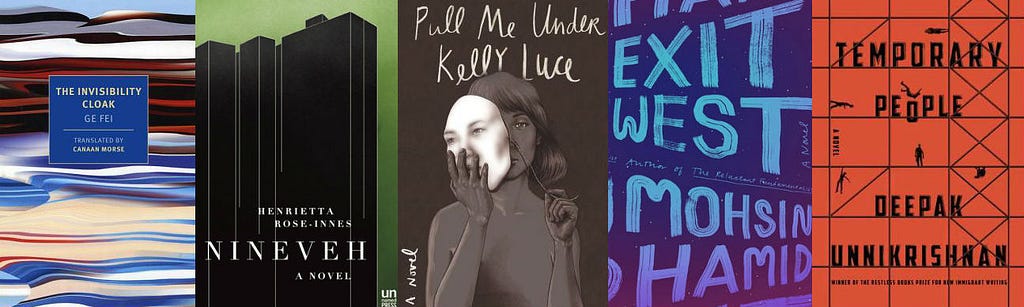
“Nadia and Saeed” by Mohsin Hamid

“Nadia and Saeed”

by Mohsin Hamid

In a city swollen by refugees but still mostly at peace, or at least not yet openly at war, a young man met a young woman in a classroom and did not speak to her. For many days. His name was Saeed and her name was Nadia and he had a beard, not a full beard, more a studiously maintained stubble, and she was always clad from the tips of her toes to the bottom of her jugular notch in a flowing black robe. Back then people continued to enjoy the luxury of wearing more or less what they wanted to wear, clothing and hair wise, within certain bounds of course, and so these choices meant something.

It might seem odd that in cities teetering at the edge of the abyss young people still go to class — in this case an evening class on corporate identity and product branding — but that is the way of things, with cities as with life, for one moment we are pottering about our errands as usual and the next we are dying, and our eternally impending ending does not put a stop to our transient beginnings and middles until the instant when it does.

Saeed noticed that Nadia had a beauty mark on her neck, a tawny oval that sometimes, rarely but not never, moved with her pulse.

Not long after noticing this, Saeed spoke to Nadia for the first time. Their city had yet to experience any major fighting, just some shootings and the odd car bombing, felt in one’s chest cavity as a subsonic vibration like those emitted by large loudspeakers at music concerts, and Saeed and Nadia had packed up their books and were leaving class.

In the stairwell he turned to her and said, “Listen, would you like to have a coffee,” and after a brief pause added, to make it seem less forward, given her conservative attire, “in the cafeteria?”

Nadia looked him in the eye. “You don’t say your evening prayers?” she asked.

Saeed conjured up his most endearing grin. “Not always. Sadly.”

Her expression did not change.

So he persevered, clinging to his grin with the mounting desperation of a doomed rock climber: “I think it’s personal. Each of us has his own way. Or . . . her own way. Nobody’s perfect. And, in any case — ”

She interrupted him. “I don’t pray,” she said.

She continued to gaze at him steadily.

Then she said, “Maybe another time.”

He watched as she walked out to the student parking area and there, instead of covering her head with a black cloth, as he expected, she donned a black motorcycle helmet that had been locked to a scuffed-up hundred-ish cc trail bike, snapped down her visor, straddled her ride, and rode off, disappearing with a controlled rumble into the gathering dusk.

The next day, at work, Saeed found himself unable to stop thinking of Nadia. Saeed’s employer was an agency that specialized in the placement of outdoor advertising. They owned billboards all around the city, rented others, and struck deals for further space with the likes of bus lines, sports stadiums, and proprietors of tall buildings.

The agency occupied both floors of a converted townhouse and had over a dozen employees. Saeed was among the most junior, but his boss liked him and had tasked him with turning around a pitch to a local soap company that had to go out by email before five. Normally Saeed tried to do copious amounts of online research and customize his presentations as much as possible. “It’s not a story if it doesn’t have an audience,” his boss was fond of saying, and for Saeed this meant trying to show a client that his firm truly understood their business, could really get under their skin and see things from their point of view.

But today, even though the pitch was important — every pitch was important: the economy was sluggish from mounting unrest and one of the first costs clients seemed to want to cut was outdoor advertising — Saeed couldn’t focus. A large tree, overgrown and untrimmed, reared up from the tiny back lawn of his firm’s townhouse, blocking out the sunlight in such a manner that the back lawn had been reduced mostly to dirt and a few wisps of grass, interspersed with a morning’s worth of cigarette butts, for his boss had banned people from smoking indoors, and atop this tree Saeed had spotted a hawk constructing its nest. It worked tirelessly. Sometimes it floated at eye level, almost stationary in the wind, and then, with the tiniest movement of a wing, or even of the upturned feathers at one wingtip, it veered.

Saeed thought of Nadia and watched the hawk.

When he was at last running out of time he scrambled to prepare the pitch, copying and pasting from others he had done before. Only a smattering of the images he selected had anything particularly to do with soap. He took a draft to his boss and suppressed a wince while sliding it over.

But his boss seemed preoccupied and didn’t notice. He just jotted some minor edits on the printout, handed it back to Saeed with a wistful smile, and said, “Send it out.”

Something about his expression made Saeed feel sorry for him. He wished he had done a better job.

As Saeed’s email was being downloaded from a server and read by his client, far away in Australia a pale-skinned woman was sleeping alone in the Sydney neighborhood of Surry Hills. Her husband was in Perth on business. The woman wore only a long T-shirt, one of his, and a wedding ring. Her torso and left leg were covered by a sheet even paler than she was; her right leg and right hip were bare. On her right ankle, perched in the dip of her Achilles tendon, was the blue tattoo of a small mythological bird.

Her home was alarmed, but the alarm was not active. It had been installed by previous occupants, by others who had once called this place home, before the phenomenon referred to as the gentrification of this neighborhood had run as far as it had now run. The sleeping woman used the alarm only sporadically, mostly when her husband was absent, but on this night she had forgotten. Her bedroom window, four meters above the ground, was open, just a slit.

In the drawer of her bedside table were a half-full packet of birth control pills, last consumed three months ago, when she and her husband were still trying not to conceive, passports, checkbooks, receipts, coins, keys, a pair of handcuffs, and a few paper-wrapped sticks of unchewed chewing gum.

The door to her closet was open. Her room was bathed in the glow of her computer charger and wireless router, but the closet doorway was dark, darker than night, a rectangle of complete darkness — the heart of darkness. And out of this darkness, a man was emerging.

He too was dark, with dark skin and dark, woolly hair. He wriggled with great effort, his hands gripping either side of the doorway as though pulling himself up against gravity, or against the rush of a monstrous tide. His neck followed his head, tendons straining, and then his chest, his half-unbuttoned, sweaty, gray-and-brown shirt. Suddenly he paused in his exertions. He looked around the room. He looked at the sleeping woman, the shut bedroom door, the open window. He rallied himself again, fighting mightily to come in, but in desperate silence, the silence of a man struggling in an alley, on the ground, late at night, to free himself of hands clenched around his throat. But there were no hands around this man’s throat. He wished only not to be heard.

With a final push he was through, trembling and sliding to the floor like a newborn foal. He lay still, spent. Tried not to pant. He rose.

His eyes rolled terribly. Yes: terribly. Or perhaps not so terribly. Perhaps they merely glanced about him, at the woman, at the bed, at the room. Growing up in the not infrequently perilous circumstances in which he had grown up, he was aware of the fragility of his body. He knew how little it took to make a man into meat: the wrong blow, the wrong gunshot, the wrong flick of a blade, turn of a car, presence of a microorganism in a handshake, a cough. He was aware that alone a person is almost nothing.

The woman who slept, slept alone. He who stood above her, stood alone. The bedroom door was shut. The window was open. He chose the window. He was through it in an instant, dropping silkily to the street below.

While this incident was occurring in Australia, Saeed was picking up fresh bread for dinner and heading home. He was an independent-minded, grown man, unmarried, with a decent post and a good education, and as was the case in those days in his city with most independent-minded, grown men, unmarried, with decent posts and good educations, he lived with his parents.

Saeed’s mother had the commanding air of a schoolteacher, which she formerly was, and his father the slightly lost bearing of a university professor, which he continued to be — though on reduced wages, for he was past the official retirement age and had been forced to seek out visiting faculty work. Both of Saeed’s parents, the better part of a lifetime ago, had chosen respectable professions in a country that would wind up doing rather badly by its respectable professionals. Security and status were to be found only in other, quite different pursuits. Saeed had been born to them late, so late that his mother had believed her doctor was being cheeky when he asked if she thought she was pregnant.

Their small flat was in a once handsome building, with an ornate though now crumbling facade that dated back to the colonial era, in a once upscale, presently crowded and commercial, part of town. It had been partitioned from a much larger flat and comprised three rooms: two modest bedrooms and a third chamber they used for sitting, dining, entertaining, and watching television. This third chamber was also modest in size but had tall windows and a usable, if narrow, balcony, with a view down an alley and straight up a boulevard to a dry fountain that once gushed and sparkled in the sunlight. It was the sort of view that might command a slight premium during gentler, more prosperous times, but would be most undesirable in times of conflict, when it would be squarely in the path of heavy machine-gun and rocket fire as fighters advanced into this part of town: a view like staring down the barrel of a rifle. Location, location, location, the realtors say. Geography is destiny, respond the historians.

War would soon erode the facade of their building as though it had accelerated time itself, a day’s toll outpacing that of a decade.

When Saeed’s parents first met they were the same age as were Saeed and Nadia when they first did. The elder pair’s was a love marriage, a marriage between strangers not arranged by their families, which, in their circles, while not unprecedented, was still less than common.

They met at the cinema, during the intermission of a film about a resourceful princess. Saeed’s mother spied his father having a cigarette and was struck by his similarity to the male lead in the movie. This similarity was not entirely accidental: though a little shy and very bookish, Saeed’s father styled himself after the popular film stars and musicians of his day, as did most of his friends. But Saeed’s father’s myopia combined with his personality to give him an expression that was genuinely dreamy, and this, understandably, resulted in Saeed’s mother thinking he not merely looked the part, but embodied it. She decided to make her approach.

Standing in front of Saeed’s father she proceeded to talk animatedly with a friend while ignoring the object of her desire. He noticed her. He listened to her. He summoned the nerve to speak to her. And that, as they were both fond of saying when recounting the story of their meeting in subsequent years, was that.

Saeed’s mother and father were both readers, and, in different ways, debaters, and they were frequently to be seen in the early days of their romance meeting surreptitiously in bookshops. Later, after their marriage, they would while away afternoons reading together in cafés and restaurants, or, when the weather was suitable, on their balcony. He smoked and she said she didn’t, but often, when the ash of his seemingly forgotten cigarette grew impossibly extended, she took it from his fingers, trimmed it softly against an ashtray, and pulled a long and rather rakish drag before returning it, daintily.

The cinema where Saeed’s parents met was long gone by the time their son met Nadia, as were the bookshops they favored and most of their beloved restaurants and cafés. It was not that cinemas and bookshops, restaurants and cafés had vanished from the city, just that many of those that had been there before were there no longer. The cinema they remembered so fondly had been replaced by a shopping arcade for computers and electronic peripherals. This building had taken the same name as the cinema that preceded it: both once had the same owner, and the cinema had been so famous as to have become a byword for that locality. When walking by the arcade, and seeing that old name on its new neon sign, sometimes Saeed’s father, sometimes Saeed’s mother, would remember, and smile. Or remember, and pause.

Saeed’s parents did not have sex until their wedding night. Of the two, Saeed’s mother found it more uncomfortable, but she was also the more keen, and so she insisted on repeating the act twice more before dawn. For many years, their balance remained thus. Generally speaking, she was voracious in bed. Generally speaking, he was obliging. Perhaps because she did not, until Saeed’s conception two decades later, get pregnant, and assumed therefore she could not, she was able to have sex with abandon, without, that is, thought of consequences or the distractions of child-rearing. Meanwhile his typical manner, throughout the first half of their marriage, at her strenuous advances, was that of a man pleasantly surprised. She found mustaches and being taken from behind erotic. He found her carnal and motivating.

After Saeed was born, the frequency with which his parents had sex dipped notably, and it continued to decline going forward. A uterus began to prolapse, an erection became harder to maintain. During this phase, Saeed’s father started to be cast, or to cast himself, more and more often, as the one who tried to initiate sex. Saeed’s mother would sometimes wonder whether he did this out of genuine desire or habit or simply for closeness. She tried her best to respond. He would eventually come to be rebuffed by his own body at least as much as by hers.

In the last year of the life they shared together, the year that was already well under way when Saeed met Nadia, they had sex only thrice. As many times in a year as on their wedding night. But his father always kept a mustache, at his mother’s insistence. And they never once changed their bed: its headboard like the posts of a banister, almost demanding to be gripped.

In what Saeed’s family called their living room there was a telescope, black and sleek. It had been given to Saeed’s father by his father, and Saeed’s father had given it in turn to Saeed, but since Saeed still lived at home, this meant the telescope continued to sit where it always sat, on its tripod in a corner, underneath an intricate clipper ship that sailed inside a glass bottle on the sea of a triangular shelf.

The sky above their city had become too polluted for much in the way of stargazing. But on cloudless nights after a daytime rain, Saeed’s father would sometimes bring out the telescope, and the family would sip green tea on their balcony, enjoying a breeze, and take turns to look up at objects whose light, often, had been emitted before any of these three viewers had been born — light from other centuries, only now reaching Earth. Saeed’s father called this time-travel.

On one particular night, though, in fact the night after he had struggled to prepare his firm’s pitch to the soap company, Saeed was absentmindedly scanning along a trajectory that ran below the horizon. In his eyepiece were windows and walls and rooftops, sometimes stationary, sometimes whizzing by at incredible speed.

“I think he’s looking at young ladies,” Saeed’s father said to his mother.

“Behave yourself, Saeed,” said his mother.

“Well, he is your son.”

“I never needed a telescope.”

“Yes, you preferred to operate short-range.”

Saeed shook his head and tacked upward.

“I see Mars,” he said. And indeed he did. The second-nearest planet, its features indistinct, the color of a sunset after a dust storm.

Saeed straightened and held up his phone, directing its camera at the heavens, consulting an application that indicated the names of celestial bodies he did not know. The Mars it showed was more detailed as well, though it was of course a Mars from another moment, a bygone Mars, fixed in memory by the application’s creator.

In the distance Saeed’s family heard the sound of automatic gunfire, flat cracks that were not loud and yet carried to them cleanly. They sat a little longer. Then Saeed’s mother suggested they return inside.

When Saeed and Nadia finally had coffee together in the cafeteria, which happened the following week, after the very next session of their class, Saeed asked her about her conservative and virtually all-concealing black robe.

“If you don’t pray,” he said, lowering his voice, “why do you wear it?”

They were sitting at a table for two by a window, overlooking snarled traffic on the street below. Their phones rested screens-down between them, like the weapons of desperadoes at a parley.

She smiled. Took a sip. And spoke, the lower half of her face obscured by her cup.

“So men don’t fuck with me,” she said.

Speed and Crisis, with Daniel Magariel

In his debut novel One of the Boys, Daniel Magariel uses his personal history to write from the perspective of a young boy who starts a new life with his brother and father. Everything is perfect in the eyes of the preteen, but events slowly turn heartbreaking when the father’s addictions and violence begin to rise to the surface. The novel carries a lot of emotional weight in a brief space — less than 200 deeply-affecting pages.

Magariel honed his craft throughout the years in places ranging from cafes in northern Manhattan to the foothills of the Rockies, before he ended up at Syracuse’s MFA program studying under George Saunders. Raised in Kansas City, the now-Brooklynite called to talk about how his childhood influenced One of the Boys, crafting the voice of a preteen, his obsessive editing habits, and more.

Adam Vitcavage: Since you’re a debut author, I feel like we should start with some background so readers get to know you. How and why did you become a writer?

Daniel Magariel: Like most writer’s, it was almost a compulsion. At some point, I started to take myself seriously. I was a senior at Columbia and I was graduating soon — this happened when I was in my final year at Syracuse as well — and there was this “oh shit, I’m about to leave college unemployed” moment. I seem to do my best writing under circumstances like that.

I had just made the leap into writing fiction [during my senior year of undergrad]. I had been messing with non-fiction. I thought about doing long form journalism, but during that final year at Columbia, I realized I had been really holding back on what I truly wanted to work on: a novel.

I used to frequent this little cafe on 111th and Amsterdam called The Hungarian Pastry Shop. While there, attempting to put down the first few words of fiction I’d written since a story about dragons in the first grade, I came to learn that this cafe was a workplace for the likes of Nathan Englander, Rivka Galchen, and Julie Otsuka. To be honest, I knew very little about contemporary fiction at that time, and I had no idea who they were until I googled them, but once I had, I started looking for them daily, studying their routines, watching them just sit and work. Beyond my amazement at how long they could hold it in — their pee, I mean — I was enthralled by how they showed up and stayed at it, for several hours nearly every day. There was nothing glamorous about this place — no outlets, dim light, burned coffee, tiny tables — and yet I learned something so critical by watching brilliant writers do the modest work of sitting and working. That place was my moveable feast for the several years between undergraduate and graduate.

At 23-years-old, I moved to Colorado and got a job working the night shift at a treatment center for at-risk youth. It was a lockdown facility in the foothills of the Rockies with coyotes howling at night while these kids slept. I would try to stay up and write. A lot of what I wrote was just a bad, horrible version of what I have now.

Vitcavage: From there you started to apply to MFA programs?

Magariel: From there I started to apply to MFA programs. I actually moved back to New York for a year after living in Colorado for a year. I became a caterer and worked on MFA application essays. I got into Syracuse and moved to upstate New York.

Vitcavage: Syracuse is producing a lot of great fiction lately. Was your novel a product of that program?

Magariel: I walked in with two chapters of this book. They were my application pages: chapters five and six. I wrote them as short stories. I set it aside for two years and worked on other stuff, including a lot of short stories and another novel that I still won’t look at.

In the third year at Syracuse, the six fiction writers get to work with George Saunders a lot more and I decided to jump back into this novel. He wasn’t in love with what I was working on so he brought up how my application stories had energy. I wrote another story and started working on them sequentially.

He eventually became my thesis advisor and was very supportive of the energy of the project. The novel looks much different now than it did back then. Three years later I had a completed book. A very short book.

Vitcavage: I did want to talk about the length, but first I want to make sure I know about the genesis of the book. It’s very emotional and seems very personal. It started as short stories, but were they ever meant to be linked?

Magariel: Yeah, they were meant to be linked. As for the genesis…I don’t think I’m fooling anybody. It’s clear that to write a book that so intimately portrays so few characters in a very private environment such as addiction with parents the writer needs to connect with it. My father was an addict. My sister, my brother, and I watched — you know, I don’t even remember when we realized that he was using drugs. It was just sort of a part of our lives until it was, “Oh shit, that’s why he acts the way he does and is weird sometimes.”

That awakening to the weird things happening behind the closed door and all the strange signs was the genesis of the book. Then my job as a fiction writer is curating, organizing, cutting, exaggerating, and escalating fact.

Vitcavage: Why keep the boys nameless?

Magariel: It’s funny. There are these happy accidents that people have while working with material for so long. Your instinct to do something is different than the meaning it garners by the end. I heard people say there is this anonymity with the namelessness and it sort of makes it universal. The reality is that I feel awkward in fiction when I name people. Once I name people, it doesn’t feel real. The first few stories, I didn’t want to name them. It worked, so I kept doing it.

Vitcavage: It’s funny, I noted while reading it: “No character names — universal?” and it seems like everybody just wants to attribute that to your book.

Magariel: Yeah, and I think it does. It works. I didn’t realize until I wrote a few chapters.

Vitcavage: You mentioned length earlier. It’s been a trend for these emotionally draining, heavy stories that are 700 pages. A recent favorite of mine was Hanya Yanagihara’ A Little Life, which is a doorstopper and your book can literally slide under the crack of my door. What was it about keeping this story short?

Magariel: It was voice. I started writing these chapters and velocity was the most compelling and stylistic choice. I heard, and I don’t necessarily believe this, but there are these doorstoppers and readers are losing their attention spans. Even though I don’t believe that, I thought, what if it was true, what if I wrote a book that was so fast that readers actually wanted to slow down.

The length was a product of the style. I wanted it to be longer, but it wouldn’t get any longer. I also realized what better way would there be to describe what it’s like for a twelve year-old to be under the spell of a father who keeps setting fires everywhere. There is no time for reflection. No time to stop and take in what’s going on. You’re constantly forced into a crisis.

I needed to find a way to do that and my solution was speed. Maybe I was able to get the reader to understand how frantic the life of the narrator is.

Vitcavage: How did you tap into a preteen boy’s perspective so that his voice fit the literary style?

Magariel: I upped his language abilities and his ability to reflect at times. I also made the language so clipped and even at times repetitive. My German translator said this was a deceptively easy book to translate, but it’s a difficult style to emulate. Readability doesn’t always mean a lack of style or a lack of intent in the language.

I needed to figure out the twelve year-old narrator. You try to imagine what life was like at twelve. What it would be like to experience these things. You put him in a room and you have these dynamics. There’s an older brother, so of course a boy that age would want to be pals with his older brother. Of course he’ll want to worship his father. These things are obvious.

Then there was the speed. The sentences become even shorter and condensed. They had to become more packed with what was essential for that moment in time. I do think the boy’s language and diction is upped.

Vitcavage: Going back to Syracuse, when you were working with George Saunders, what was that process like? I think a lot of people who read this kind of interview were like you: younger writers who want to take this seriously. Can you sort of walk me through what your MFA experience was like?

Magariel: I had an insane routine. I’d wake up at 6am and go to the library. I’d write for an hour. An hour doesn’t sound like a lot, but that’s my rule. When I sit down I don’t want four hours or six hours. After that hour I go to the gym immediately after. I’d swim laps for an hour and then go back to the library for an hour.

Vitcavage: Was the gym a place to reflect on what you wrote or just clear your head?

Magariel: I’m reflecting the whole time. I’m in a no-mind mode where I can do repetitive activities. Like walking two miles anywhere. As long as my mind automatically wanders to the work. The downtime is an essential part of my writing. The more I can build it into my schedule and routine, the better the work. I discovered this a lot that year. I was looking for these intense bursts where I’d get maybe 50 words, but they were 50 solid words. I could walk away from them and think about what the next 50 words would be.

One of the best parts of that process was that I would work my way slowly and methodically through a chapter and by the time I was done with the draft it was pretty solid.

Then to get the writer’s saint of the 21st century — i.e. George Saunders — to look over a draft was amazing. There was something about writing those four first chapters for him that helped. He was my audience, there was no one else. So knowing that, I obviously I wanted to impress him, I wanted to give him my absolute best work so he could give me the best feedback possible.

There was also that urgency, like in my undergrad — after my MFA was over, I wouldn’t have a job, which meant I wouldn’t have the time to write.

Vitcavage: After writing and clearing your head, what is your editing or reflection process like?

Magariel: At night, I like to have a stiff drink and read over everything I wrote and line edit. I edit obsessively. I write for an hour burst here and there, then at night I take a pen and just mark it up. I continue to mark up those pages until there are no pen marks. It’s likely to take six months of going back to the old stuff. Once there are no marks, I say okay and move on.

Vitcavage: What are you editing on those nights? For voice, for grammar, for anything in between?

Magariel: There are different stages. Grammar is one of those things writers overlook. I mean, in an MFA no one is teaching classes about grammar. When you get close to publication you realize you have to have a grammar style, too, and it has to be consistent. It’s like: obviously. Then you question yourself. Do I always need a comma after an adverbial clause that introduces a sentence? Do I need a comma after a terminal too or either? Do I need a comma following a main clause when I have a subordinate clause at the end of the sentence? Should I use italics instead of quotations when referring to something someone says?

It all seems intuitive and obvious, but when you’re going through the work you realize there are some inconsistencies with grammar. That was my favorite part about publishing this book. I did a full grammar reboot when the copy edits came back.

But when I’m editing, I’m also looking for anything I can cut. The best feeling in the world is when I write a beautiful paragraph and I get to cut it because the page or the scene or the chapter functions at a higher level without it. Even if it functions at the same level, I cut it. I just look for whatever in the completed work is absolutely essential. If there is any doubt, it’s not staying.

I print out my pages every night and take a pen to it. Whatever edits I made is how I start the next day.

Vitcavage: So, you graduate then you make all of the edits, and sell the book. It obviously happens overnight.

Magariel: Yeah, it happens overnight. [laughs] I spent two years working before I sold the book. I mean, let’s see: the book was not sold this time last year. [Literary agent] Bill Clegg had signed me around February 18 of last year. It all happened really quickly. I wanted to turn the book in as complete as possible. I brought it to a place where I didn’t think I could take it any further. Bill saw it and gave me some notes. Then Nan Graham and Daniel Loedel brought it at Scribner and they gave me notes. Yeah, the book sold in April of last year.

Vitcavage: Then this basically did happen overnight, which is never the case.

Magariel: Seriously. The book will be out less than a year after it was sold.

Vitcavage: What are you working on next?

Magariel: A novel. A longer one this time. My wife grew up in a commercial fishing town and I’ve gotten to know a lot of the fisherman. I’ve spent a lot of time down there with them and have plans to spend more time. I’m trying to push myself to a place where I’m totally uncomfortable. The first chapter starts off with a woman reflecting on the death of her child. I’m not that.

Prize for Innovative Small Press Publishing Goes to Fitzcarraldo

Republic of Consciousness prize won by John Keene’s Counternarratives

The inaugural Republic of Consciousness prize — set up to reward innovative independent publishers — has been awarded to British press Fitzcarraldo for their publication of American author John Keene’s collection Counternarratives. Citing the work’s formal inventiveness, the six judge panel unanimously awarded Keene and Firzcarraldo the £3,000 prize. The £1,000 runner-up prizes went to Tramp Press for Mike McCormack’s Solar Bones, And Other Stories for Anakana Schofield’s Martin John, and Galley Beggar for Paul Stanbridge’s Forbidden Line. All winners have been encouraged to give a third of the proceeds to the winning authors.

Unlike many larger awards, the Republic of Consciousness does not require publishers to pay an entry fee. The prize says their criteria is “perfectly expressed on the Galley Beggar website as ‘hardcore literary fiction and gorgeous prose’.” British novelist Neil Griffiths began establishing the prize last year, donating £3,000 of his own money and fundraising the remaining £4,000. Speaking with The Guardian, Griffiths commented “the small presses are still struggling for that shop window…publishing requires high-end commercial novels and niche novels, even if they don’t sell millions.”

Looking hopefully to the future of Republic of Consciousness, Griffith’s expects corporate sponsorship to “double, if not triple, the prize fund.”

18 (More) Amazing Novels You Can Read in a Day

Who loves short books? Just about everybody, as we can tell. Over the past couple years, one of our most frequently read posts is our list of 17 Brilliant Books You Can Read in a Sitting.

If you’ve read your way through those, here’s a new list of some of brilliant short novels. I went with 18 this time because, well, it’s one more. As with the last list, I’m avoiding the most famous short novels that everyone is familiar with. You don’t need me to tell you about Jesus’ Son or Ms Dalloway. “Short” here is defined as under 200 pages. Just long enough to read on a short flight or a long ride.

The Nonexistent Knight by Italo Calvino

Calvino’s most celebrated books are probably Invisible Cities and Cosmicomics. Both are brilliant, but for my taste the best work Calvino did was his “heraldic trilogy” of fabulist historical novels: The Baron in the Trees, The Cloven Viscount, and The Nonexistent Knight . My favorite is The Baron in the Trees, about a, well, young baron who runs up and lives his life in the trees. But it is slightly over 200 pages. So I’ll list The Nonexistent Knight, a novel about, well, a knight who doesn’t really exist yet who is summoned out of “goodwill and faith in the holy cause” of Charlemagne. As a bonus, most editions include the equally brilliant short novel The Cloven Viscount about a, well, 17th century viscount who gets cloven into his good and evil halves by a cannonball.

The Vegetarian by Han Kang

My favorite book of 2016, Han Kang’s The Vegetarian is a dark and haunting novel about a woman who suffers horrible abuse from her family after she decides to stop eating meat. The book is told in a three part structure, each part from the point of view of different character — but never the woman herself.

(You can read Electric Lit’s review of the novel here.)

Multiple Choice by Alejandro Zambra

Multiple Choice is a book that really shouldn’t work. The novel is composed of short prose pieces in the style of a multiple choice test. But instead of being gimmicky, the book is a simultaneously moving and humorous meditation on language, family, and history.

(Read Electric Lit’s interview with Zambra here.)

The Ballad of Black Tom by Victor LaValle

We interviewed LaValle about the book here, and you can read our review here.

McGlue by Ottessa Moshfegh

Moshfegh has gotten a lot of accolades for her recent novel Eileen and collection Homesick for Another World. Those books deserve the attention, but so does her overlooked debut — a drunken nautical novella called McGlue. We have an excerpt of the book in our Recommended Reading archives.

Train Dreams by Denis Johnson

Johnson’s short quasi-novel Jesus’ Son is his best work, and his long novel Tree of Smoke won the National Book Award, but don’t overlook Train Dreams. This historical novella about the early 20th century American West is proof that a novel doesn’t have to be long to be epic.

Dept. of Speculation by Jenny Offill

Offill’s 2014 book is one of those impossible to define yet impossible to forget novels. Seeming to mix memoir and non-fiction with fiction, aphorism, and fragments, Dept. of Speculation is lyrical and philosophical book about marriage, motherhood, art, and life.

Autobiography of Red by Anne Carson

Like the previous entry, this novel is a thrilling mix of different forms: poetry, scholarship, mythology, and fiction. The core of the book is a modern retelling of Geryon, a monster from Greek mythology who interacts with Hercules. If you love poetry, mythology, and fiction, you simply have to read this.

The Mezzanine by Nicholson Baker

Baker’s 1986 novel The Mezzanine is a sort of literary answer to the Seinfeld question: can you write a novel about nothing? While the novel basically just follows an office worker walking on a mezzanine one day, Baker’s lengthy digressions turn a boring stroll into a poignant and often hilarious read.

The Story of My Teeth by Valeria Luiselli

Like several books on this list, The Story of My Teeth is a surprising combination of forms. The book is written in several different parts, and includes a meta-non-fictional note on the writing process, which involved a interstate collaboration between Luiselli and workers in a juice factory in Mexico. The story itself is about a man named Gustavo “Highway” Sánchez Sánchez who auctions off the teeth of celebrities and dead writers. (You can read Electric Lit’s review here.)

Sula by Toni Morrison

Toni Morrison is one of the living geniuses of American letters, and one capable of putting all of life into a novel — even a slim one. Sula is only 190 pages, but it has everything from comedy and tragedy to love and hate and beyond.

Heart of a Dog by Mikhail Bulgakov

What would happen if scientists implanted human organs in a dog? Why, he’d become a slovenly bureaucrat of course. Bulgakov’s SF satire of the “New Soviet man” and attempts to change human nature is still relevant and hilarious today.

The Literary Conference by César Aira

Argentina’s Aira is the master of short, weird books, so many of them could fit on this list. And in truth, The Literary Conference is so short that it is more like a long short story than a novel. But I love it, and it’s published individually by New Directions so it goes on this list. Despite the banal title, this insane tale features everything from buried treasure and mad scientist to gigantic worm monsters.

The Box Man by Kobo Abe

Kobo Abe is one of my favorite authors, a master of blending different genres into his surreal Kafkaesque view of the world. The Box Man is a kind of postmodern thriller about a man who rejects modern life to go live inside of a box. He writes his story on the inside of said cardboard box as a mad doctor hunts him trying to take the box for himself.

The Lake by Banana Yoshimoto

On the other end of the spectrum from the surreal fantasy of Kobo Abe, Yoshimoto’s The Lake is an introspective and moving novel about an artist who falls in love with a former cult member. (The cult is inspired by the real life group who poisoned the Tokyo subway in 1995.)

Winter’s Bone by Daniel Woodrell

You may have seen the movie, but definitely don’t miss out on the book. A stunning work of country noir, Winter’s Bone mixes a Southern Gothic lyricism with a mystery set in the contemporary meth-infested Ozarks.

The Invention of Morel by Adolfo Bioy Casares

No less than Jorge Luis Borges said that this was a “perfect” novel. Of course, he and Casares were friends, but this slim 1940 novel is definitely a wonder. This early science fiction story with a twist I won’t give away here is a must for fans of speculative fiction.

The Haunting of Hill House by Shirley Jackson

If you know Shirley Jackson from her infamous short story “The Lottery” then you know she can do creepy. But nothing will prepare you for The Haunting of Hill House, which is simply one of the best horror novels ever written. (And the 1960s film version is pretty great too, but, as always, read the book first.)

Enjoy these recommendations? Check out the first list, 17 Brilliant Short Novels You Can Read in a Sitting.

Why Wouldn’t You Be a Feminist?

Jessa Crispin has a label problem. It might be an external one, borne of an editor’s decision to title her book Why I Am Not a Feminist: A Feminist Manifesto. But in choosing to use such a title, her book is set up to be a contradiction on two counts. For Crispin is a de facto feminist, and though the complication of her argument allows for an ironic wink (slash marketing ploy) in the title, the slight volume lacks the clarity or call to action of a manifesto. Crispin, a notorious contrarian who founded Bookslut, where many a writer (myself included) got her start, presents a loop of circular logic; while some of the writer’s essays on similar material have been clearer and more forthright, the manifesto suffers for want of a through line.

Crispin’s manifesto first takes aim at the label of feminist, but also directs its ire at those who would disown it. The general tone, in Crispin’s writing of the manifesto, is one of free-floating exasperation at the misinterpretation of the feminist cause and feminist intentions. Crispin is wounded by this perceived confusion, and writes a hearty defense of second-wave feminists like Dworkin and MacKinnon; she offers her strongest critiques when going after capitalism, celebrity, and self-help culture. But much of Why I Am Not a Feminist suffers from a lack of grounding in external references or specific examples of what she’s critiquing. Whereas Crispin’s other work in essays is direct and specific, Feminist offers something less consistent.

In the epigraph to Why I Am Not a Feminist, Crispin quotes E.M. Cioran: “A book should open old wounds, even inflict new ones. A book should be danger.” Crispin is no stranger to embracing risk. She shook the literary world with her 2016 Vulture interview with Boris Kachka, declaring both that she was shuttering Bookslut and that she just didn’t “find American literature interesting.” She said:

“I find MFA culture terrible. Everyone is super-cheerful because they’re trying to sell you something, and I find it really repulsive. There seems to be less and less underground. And what it’s replaced by is this very professional, shiny, happy plastic version of literature.”

But the author worked for decades prior to distinguish herself from mainstream literary culture, celebrating disparate and non-commercial viewpoints with Bookslut, Spolia, and her previously published work. Her editorial influence is distinct: Bookslut celebrated books on the literary fringes: those from indie publishers and small presses, as well as reviews of all stripes. Crispin’s essays on feminist issues took direct aim at both her contemporaries and historical feminist writers. It is significant, then, that Crispin’s manifesto leans heavily on generalizations and not the evidence-based rhetoric of her typical takedown. It could have been much stronger.

Why I Am Not a Feminist relies the most on abstraction where it is the most angry, in its first third. While nothing about Crispin’s anger rings false, the author’s depictions of slights against the feminist cause, of how feminism has been co-opted in order to broaden its appeal, rely heavily on vague pronouns and passive voice without attribution. In the introduction, she says:

Somewhere along the way to female liberation, it was decided that the most effective method was for feminism to become universal. But instead of shaping a world and a philosophy that would become attractive to the masses, a world based on fairness and community and exchange, it was feminism itself that would have to be rebranded and re-marketed for contemporary men and women.

They forgot that for something to be universally accepted, it must become as banal, as non-threatening and ineffective as possible. Hence the pose. People don’t like change, and so feminism must be as close to the status quo — with minor modifications — in order to recruit large numbers.

In other words, it has to become entirely pointless.

Who decided? Who are the “they” and “people?” Why not mention any specific authors or their work? While Crispin is ostensibly outlining a valid point, it’s one she doesn’t come back to with support, and this is support the reader craves. Consider also that she discusses how:

The most prominent feminist writers right now have twisted themselves in knots trying to distance themselves from their predecessors, willfully misrepresenting the work of women like Andrea Dworkin and Catherine MacKinnon and denying any association therewith. Dworkin’s ‘weaponized shame,’ Laurie Penny wrote in a column at New Statesman without explaining how she has come to sum up Dworkin’s belief system as such, ‘has no place in any feminism I subscribe to.’

And yet, Crispin fails to name check any contemporary feminist writers except Penny, and offers no specific critique of how either Penny or these other writers “distance themselves” or “misrepresent the work” of feminists who came before. In a manifesto that positions itself in the title as the contrarian view to the mainstream feminist label, Crispin’s unsupported critique of her contemporaries seems like an oversight, and one that wouldn’t be so glaring if she hadn’t enumerated it in her introduction. Since she mentions the historical influence of Dworkin, MacKinnon, Millett and others, one wonders why she omitted her contemporaries. In contrast to the well-referenced and illuminating work she did in her 2015 essay, “Wounded Women,” at The Boston Review (in response to the #yesallwomen campaign and Leslie Jamison’s work on gendered pain in The Empathy Exams), Crispin’s argument about the current movement evaporates. Is it true that the feminist cause has been sanitized so it can be made palatable to a larger group of people? Perhaps. But Crispin tries to prove it with ire in lieu of evidence.

Why I Am Not a Feminist is at its most thoughtful when it is tackling specific issues. “It’s easier to think about the power you don’t have,” Crispin writes, “than to think about how you are wielding the power you do have.” Her critique of capitalism and how women use money in order to ameliorate the gendered differences in a sexist society are both valuable and illuminating. She writes that once women find themselves in positions of power, they often abandon the feminist ideals they held in order to get there, or abandon thoughts of helping other women. They also often have to adopt typically male roles. “In order to succeed in a patriarchal world,” she writes, “we took on the role of patriarchs ourselves. In order to win in this world, we had to exhibit the characteristics the patriarchal world values and discard what it does not.” Crispin offers a particularly enlightening critique of the publishing industry and the way that white women have come to dominate from the inside. Though previously male ideas of taste were used to keep women out of publishing, those same systems now ostracize and marginalize women of color and people in the LGBTQ community. When Crispin is specific, her words land. She makes it clear that it is easy for the oppressed to become the oppressor, and she calls to women to fight from outside the system so that they don’t adopt the values of a patriarchal society themselves.

Crispin sums up the troubles that plagued the planning of the recent Women’s March (though her manuscript was surely completed prior to the event, it takes on more weight in light of the explosion of protests following the inauguration) and the difficulty the contemporary women’s movement has as it attempts to center its message. She condemns the desire of some feminists to sanitize the ideals of the movement, or to “rescue” women from their own Muslim heritage, in an approximation of the male role of rescuer. But her sharpest words are about what she calls “choice feminism.” “This is the belief,” she says

[T]hat no matter what a woman chooses… she is making a feminist choice, just from the act of choosing anything […] So simply by choosing anything at all, you are bucking the patriarchy and acting like a feminist […] No debate, no consideration, no discomfort required.

Crispin calls repeatedly for radical, fringe-based feminism. She argues against feminism in its homogenized form. She calls for women to gather at the edges of society in order to form new systems that are no longer based on patriarchal ideals.

What is troubling about Crispin’s arguments is that they can resemble the same logic she critiques. Though she ends her book by saying, “You are not doing feminism wrong,” her manifesto argues against that idea. She criticizes the online feminist community for not allowing nuance, for disallowing debate and a “space for writers to work out complicated ideas in public,” but she narrowly defines parameters by which a woman may call herself a feminist. Labeling continues to be a problem, and since Crispin doesn’t offer a cogent alternative to the feminist label, she is stuck debating against what the label can represent.

Crispin is right; there are those who would take up the feminist moniker — or any label of any cause, really — and use it without thought or without the proper research. But it’s impossible to arbitrate thoughtfulness, and at times Crispin does. As the author circles into the very thing she critiques, it becomes clear that the problem is the messiness of people; the democratization of anger is imperfect because people are imperfect. Crispin vacillates between allowing people their imperfection and demanding that feminists exhibit a higher standard. If, perhaps, she offered a way forward or a more cohesive outline for the future, this wouldn’t matter so much.

“We must lay claim to the culture,” Crispin writes, “occupy it.” She argues for feminism that wounds. Feminism that doesn’t devalue men, but also doesn’t ask for male validation. Crispin argues for the establishment of new systems that are independent of the old systems that were built upon patriarchal and sexist ideals. The problem is that she doesn’t offer much in the way of a specific call to action. How might this be accomplished?

Where do Crispin’s words fall in line with other feminist writers who she perceives as misinterpreting the historical feminist cause and the ideals of the feminist movement as it moves forward from here? These questions would be easier to answer if Why I Am Not a Feminist was more specific in its debate, more grounded in reference to what Crispin rages against. She is not manifestly clear.

“Paradise,” poems by Andy Stallings

Paradise

Mud cuts the burn. And
where the quiet lake has left
permanent ripples in shale,
direct your sensation to the
granule and weep. I walked
her the long way home, with
hopes to meet the elderly
sisters who smelled of
fermented flowers, and
passed out vials of tincture
on Halloween. Her departure
was unexpected, also,
unspecified. We had a banker
in common, felt kinship
beside the private pool.
At the edge of perception,
I measured movement, and
put memory to a test of
selection bias. Wherever the
birds weren’t, settled up my
debts. When you say interest,
what do you really mean.

Paradise

The small birds we call
sparrows move slowly across
the plot of sandy ground
where a house used to be,
almost in formation, though
given to impulsive flights out
to the side, or ahead, or
upward. For an annotation, I
wrote the whole poem down.
The anchor swayed, or so it
seemed. Does one really think
of others, and here I don’t
describe anyone’s altruism.
There is childhood, one of
language’s many plumb
topicals. And what brings you
here to my face today, what
pre-condition concludes, or
extends, or inaugurates, with
my glance. Exhaustion in the
profile. Response is infinite.

Paradise

Had anyone from the 1980s
seen her standing by that
chair waiting for the table to
be cleared of its beignets and
sugar, they’d have turned her
photograph into an album
cover. But who could gather
every cigarette butt flicked
away on even one block of
one city. By extension,
biography. Every morning he
lifts the wire basket from the
tub of hot oil just as the grate
on the storefront opens, just
as someone sweeps the
sidewalk up, just as dawn
“puts on its rosebush” and a
man lets his horses run in the
gentle surf. But who doesn’t
change lives. Whirl of noise,
suave screaming void.
Nothing sweet’s still coming.

Paradise

You learn to throw the punch
by taking it. My size of your
poise. I tell her that, yes,
there are times when one must
be quiet, that people die
sometimes from not keeping
quiet, and I’m not proud, but
she’s quiet then, and sleeps.
Is there any sentence that
doesn’t in context flourish, as
any person passing makes the
mirror a frame. Minute after
minute of heat we share.
Bothered grass, wild grain.
There was so much that
filtered through the years,
the tone and shape of a story,
the voice of the person telling
the story, the way the road
curved as he grew ill along it,
the villa where the hill
opened into the valley, the
valley stretching to the sea
under all that sunlight, into
all those centuries, and she
sat on an ancient low stone
wall eating an ice cream bar,
Magnum Double Caramel,
and smiled.

Paradise

But how often does the
janitor answer the joke.
Fingers pressed to the
weakest points, she split
the board to crack the
conversation. Lovely the
granite stair, though I won’t
speak for you. But in
photographs, he’s stunned.
Three stripes define the
forehead, a chest full of
spiders or bugs, the scratched
sky, suicide of a friend.
Swarming insects distill the
grave’s impermanence into
an image. A chewy mouth. I
don’t know what the sticky
substance is.

Paradise

The man called himself “Old
Blue Eyes,” and ran a local
taxi service by that name, but
in the General Store he
operated, no other store for
miles around, the milk was
often sour, and he said no
child should enter the store
and leave without a gift,
which he held to, giving my
daughter a small jewel, a
clicking pen, and some paper,
and it was in this manner that
he meant to build a loyal
customer base that would
mature sometime after he’d
died, and the General Store
closed. Singular, derived of
multiple sources. Then in
closer proximity to absence.
A soft horse. Bitter farmer.
What isn’t terrifying about
childhood.

Paradise

Once extricated, we didn’t
know how to say stop. The
film ran on an infinite loop,
and showed a high aerial
view of a vehicle circling an
abandoned oval racing track
in the California desert, but
at times the perspective
flipped to the vehicle’s
passenger side, the camera
pointed directly at passing
vertigo. It ran just eight
minutes, but I felt discrete
and eternal. Nothing but
passing sentences, they might
come from anywhere. I’m
lifted into arrival, brought
lunch to rot on the sidewalk,
made myself a devastating
drink. All this laughter,
a sensation like being
swallowed. On the other
hand, I’m falling asleep
as I write this.

Paradise

As for sexual pleasure, it lies
entirely in the other’s
pleasure, arched and beyond
control, which surprised me,
as when a friend’s book was
published and I wasn’t
jealous at all. A lingering
sense of wild holes in the field
next door. And the ocean
a pair of blue directions, a
watery blue lineation. From
Antonioni’s films, I recall
only Monica Vitti’s face as
she stares out over volcanic
rocks, then vanishes. I’m
imagining only exteriors,
while interiors throttle the
visible. Another time, they’d
knocked on the palazzo’s wall
at night and someone had let
down a key. Cleft or cleaved.
Skin transmits a feeling of
perforation.

Stuck in the Middle With You: On Reservoir Dogs and the Soundtrack to Savagery

The images catalogued forever in my consciousness from Quentin Tarantino’s first hit film, Reservoir Dogs (1992) queue up whenever I happen to find myself thinking about severed ears, torture, or, more frequently, when I hear a particular song. With little effort I can conjure up the scene. Rookie cop Marvin Nash (Kirk Baltz) duct taped to a chair, wounds blooming from his face while Michael Madsen, or Mr. Blonde, beats him. He sputters and spits, snot and blood running from his nose as he swears to knowing nothing about their jewelry store heist being a setup. Marvin’s got children for god’s sake! Unfortunately Mr. Blonde doesn’t care whether he knows or not. He just wants to torture Nash, and he tells him this, tells him that he is going to hurt him because he just likes hurting people. Marvin Nash is crying for his life, and you’re thinking about his children at home, his wife waiting for him to return.

Mr. Blonde, a cigarette dangling from his lips, pulls a straight razor from his boot — what kind of psychopath carries a straight razor in his boot? — and you feel certain that something very, very bad is going to happen. Something grisly and memorable. “Do you ever listen to K-Billy’s Super Sounds of the 70’s,” Blonde asks as he turns on the radio, twisting the knob to find his station. “It’s my personal favorite.”

It’s then that we hear the first bouncy notes of the song by Stealers Wheel, “Stuck in the Middle With You,” and its lyrics (“I don’t know why I came here tonight / I got the feeling that something ain’t right”), as if the music were saying what you’re thinking. Blonde struts across the warehouse floor like a rooster, the razor in his hand. He dances and shuffles. Two red stripes of blood stream down from Marvin’s nose, painting the silver tape. He’s breathing heavily, and grunting beneath the gag. As the music plays Blonde dances toward Marvin, comically shuffling and wielding the blade like a brush. He slashes him across the cheek, then grabs his face, studying his work.

With his back to the camera Blonde sits down on Marvin’s lap, almost as if he’s going to kiss or hold him. Instead he reaches over the rookie officer’s head. We see Blonde’s back, the arching arm, the razor, the reach. And then the camera turns away, gazing above to a doorway where the words “Watch Your Head” have been spray painted.

Kirk Baltz and Michael Madsen in ‘Reservoir Dogs’

The camera returns as Blonde stands holding up the severed ear and looking at it, pinched between his fingers. “Hello? Hello?” he waggles the ear around, talking into it. The song meanwhile continues to fill the warehouse space, rising up like a breath — and then fades into an exhalation, a brief respite, as Blonde makes his way outside to retrieve a can of gasoline from his car. The music dies out behind the closed door. You hear the sound of children playing, somewhere in the distance, hopefully far away.

The music swells again as Blonde reenters the warehouse. It’s as if the song only exists in this room, a product of this particular, horrible moment. To this day I cannot hear that song without seeing the warehouse, Blonde dancing, and helpless Marvin Nash taped to the chair. Tarantino has admitted in interviews that the song came first, before anything else. As if “Stuck in the Middle With You” were the obvious musical accompaniment to torture.

We are capable of imagining and even of desiring to hurt. At least that, if not actually capable of enacting hurt, too. That is why the movie, and this scene in particular, succeeds: because it implicates you, as a witness, in the violence.

Joyce Carol Oates once said of a young Mike Tyson, “…he has the power to galvanize crowds as if awakening in them the instinct not merely for raw aggression and the mysterious will to do hurt that resides, for better or worse, in the human soul, but for suggesting the incontestable justice of such an instinct… ”[1]

This scene is the Mike Tyson of movie scenes. It forces us to imagine Marvin’s suffering, to view the almost pornographic hole in the side of his head, making us want to hurt and torture Mr. Blonde in turn. Even more troubling, the scene convinces us of the “incontestable justice” of that desire. Tarantino lets us feel the creeping horror, the suspense, and finally the release, the ecstatic exhalation when Mr. Blonde is suddenly shot dead by Mr. Orange (Tim Roth), who’s been slowly bleeding out all this time, forgotten in the background. When it happens, you realize that a vengeance has been done, that you wanted it done.

Tim Roth as Mr. Orange

Of course our reprieve is a brief one, a momentary satisfaction of our baser instincts that passes quickly, like all adrenaline rushes. After Blonde is dead the music, a folk-pop imitation of Bob Dylan, continues to play — here I am, stuck in the middle with you — looping on in your thoughts like a television jingle. That song amplifies the savagery of the scene precisely because of its incongruity, its essential wrongness. Those images don’t fit the sound. They bounce off of it, to stand in even starker relief.

The song has since become infamous, inextricably linked to this moment. For those who still recall the grisly images, and the sight of Mr. Blonde dancing with a straight razor, I imagine they must feel the same pull of gravity as I do, the same moral weight, dragging them back to that warehouse.

There is a single story we all know about the painter Vincent Van Gogh, the tortured artist who cut off part of his own ear and then mailed it to a lover. It seems to persist as a kind of parable, a lesson or a warning, perhaps a story of mythic or of aberrant love. But if, like me, you were raised in the cultural crucible of the 70s and 80s, there is as much if not more gravity in the haunting specter of the ear cradled in a bed of grass in David Lynch’s 1986 movie Blue Velvet, or of Mr. Blonde senselessly removing one of Marvin Nash’s ears, or Mike Tyson biting off Evander Holyfield’s, as is in this old chestnut of Van Gogh’s self-mutilation. The story has changed, lost some of its force, but the power in the act itself remains.

In everyday life we don’t think much about our ears or pay much attention to the ears of others. Although, as this scene from Reservoir Dogs reveals, ears have a greater signifying potential as objects, as metonyms for bodies themselves. We forget that sound, presented in utero, was our first experience of the outside world. We forget the ear until confronted — suddenly, violently — by its absence. We forget Van Gogh, but we remember Tarantino.

I myself have a difficult time forgetting, however, primarily because I have seen a necklace of ears, like a string of dried apples, kept as a trophy at the top of an underwear drawer.

“You wanna touch ‘em,” my childhood friend asked me one day. We were alone at his house, standing in front of his father’s dresser, the top drawer pulled partway open.

“No,” I said. I asked him to put them back.

He went on to say that his father had cut the ears off numerous Vietnamese soldiers, men whom he’d killed in combat. He had kept the necklace as a reminder. I tried to picture the man, the father with all his secrets, standing there at the end of a long day, opening the drawer and taking out the ears, rubbing his fingers over them, worrying them until they softened and bent to his touch.

As a child growing up in the 70s, the Vietnam War mostly seemed to be a knot of secrets that the fathers of other boys brought back with them. Fathers who didn’t talk much about how it was twisting them up, although perhaps they didn’t have the words. The large part of my understanding came from books, television, and movies. But when I saw that necklace of ears, I faced for the first time the actual reality of that war, and the prospect it suggested of savagery and of torture.

I recoiled from the drawer, and walked alone down the hall. I didn’t want to see anymore — I didn’t want to believe.

My father had avoided the draft, his number never actually called. It took that day at my friend’s house for me to feel that I was part of an entire generation raised by men who had done terrible things, men who’d killed and mutilated others, for reasons they couldn’t or wouldn’t articulate. Not my father, but other men, who would go on to become football coaches, attorneys, bricklayers, ditch diggers, Boy Scout leaders, school teachers, professors, writers…

By the time “Stuck in the Middle with You” had topped out at number six on the Billboard charts in 1973, the Vietnam War was already beginning to wind down. On January 27 of that year the Paris Peace Accords were signed, thus signaling the United States’ retreat from the country’s most costly engagement — financially, morally, and psychologically — since the Civil War.

My friend told me once that his father had been nicknamed “The Preacher” by his platoon in Vietnam. In all the times I’d spent at their house I had barely heard the man speak a word, so I never quite knew whether this nickname was meant ironically or in earnest. I was assured in any case that he’d been an outspoken leader, often dispensing advice to the younger men and boys, and also that he had carried the biggest, heaviest gun — the M-60 — all by himself.

I was already afraid of him before then, but something definitely shifted that day. A new kind of fear arose in me, a fear of the future, for all of us. Seeing what was in that drawer gave me a vision, a truth I would carry forever, a ghost of our collective past that would continue to haunt me, and return again some twenty years later as I watched Mr. Blonde carve up Marvin Nash on the movie screen. The world had changed, and pop culture possessed the power to capture this change, the new leap in our associative thinking. It was no longer Van Gogh, with his quaintly distressing tale of psychotic love, that sprung to mind anymore. Not after Mr. Blonde and Marvin Nash, not after Tarantino. There was only and always now this savage act of violence, and that jarring song, throughout it all, bouncing incessantly in the background.

[1] From Joyce Carol Oates’s essay, “On Mike Tyson,” from her collection of essays, “On Boxing,” Ecco Press, 1994.

Kerry Washington is Bringing Brit Bennett’s ‘The Mothers’ to the Big Screen

The hit literary debut is about to take Hollywood by storm

Kerry Washington & Brit Bennett

Ever since Brit Bennett’s stunning debut, The Mothers (Riverhead) came out in October, the book has been a fixture in trains, coffee shops and on park benches. It may have seemed like just about everyone you knew, or wanted to know, was reading it. The novel earned bestseller status, critical praise and a bevy of prizes and ‘best-of-year’ nods. Recently, you may have found yourself eagerly flipping through its pages, or maybe just staring across an aisle into that mesmerizing cover — a stain glass swirl of silhouette and lush color — thinking, “I wonder how long before somebody makes that a movie?”

Wonder no more. Last night, Warner Bros. announced it had acquired movie rights to The Mothers, with Kerry Washington’s production company, Simpson Street, at the helm. Washington —the star of Scandal, and a burgeoning Hollywood powerhouse, having notched her first production with last year’s Emmy- and Golden Globe-winning HBO movie, Confirmation — will serve as producer. In case that doesn’t give you enough comfort that the project is in the right hands, Bennett herself has been named an executive producer. Go ahead, you now have permission to get excited.

While you’re at it, you may also want to begin preparing emotionally. The Mothers — book, movie, hell the radio play if they want to go that route — packs a wallop. Set in Southern California, the story takes on suicide, faith, abortion, regret, friendship, romance — just about every big sensation and experience you can think of. At the center of it is Nadia Turner, a grieving teen who gets involved with a pastor’s son, gets pregnant, and finds herself confronted with choices that will change the course of her life. The novel follows Nadia into adulthood, still grappling with the decisions she’s made.

You can read an excerpt on Electric Literature’s Recommended Reading:

Nadia by Brit Bennett

And when you’re done, why not check out the interview, too?

Brit Bennett on Family, Religion, and Upending Expectations of Black Narratives

The principals took to social media last night to express their excitement:

Okay, readers and movie buffs, commence assembling your dream cast.

How America’s Checkered Past Is Being Turned into Compelling Children’s Books

A picture book about the atomic bomb? A middle-school book about our first presidents and the people they owned? A fast-paced account of Daniel Ellsberg and the Pentagon Papers for young teenagers?

While Donald Trump and his administration play loose with facts and figures, a substantial number of authors and illustrators are presenting American history to students in all of its gory, complicated, and fascinating glory. Akin to the golden age of realistic YA fiction that began in the early 1970s, this approach to American history veers away from what we might wish had happened to focus on what actually happened. These books grapple with volatile issues that have shaken the country for hundreds of years — among them the displacement of American Indians, the mistreatment of women, minorities, and immigrants, and governmental malfeasance — and emerge on the other side with an idealism that is energizing as well as critical and questioning.

These books grapple with volatile issues that have shaken the country for hundreds of years…and emerge on the other side with an idealism that is energizing as well as critical and questioning.

In this effort to captivate and enlighten, these books have cultural allies, most visibly Hamilton, the theatrical phenomenon that has blown the dust off of Founding Father debates and has welcomed thousands of public school students in New York City with subsidized $10 tickets. Like Hamilton, these books celebrate America’s great constitutional principles while acknowledging human flaws and conflicting perspectives.

One of last year’s most compelling books for children, Kenneth C. Davis’s In the Shadow of Liberty, focuses on a basic American hypocrisy. As Davis puts it, “conceived in liberty . . . the country was also born in shackles.” Written for middle-grade students, the book documents for young readers what life was like for those who were owned by early American presidents. Although Davis describes events of two centuries ago, he effectively signals their longstanding relevance. He wants the next generation to be made aware of how white-supremacist views affected colonial society and continue to this day.

In addition to explaining how central slavery was to the United States in its earliest years, Davis recounts how five individuals — William Lee, Ona Judge, Isaac Granger, Paul Jennings, and Alfred Jackson — were involved, involuntarily, in the lives of George Washington, Thomas Jefferson, James Madison and Andrew Jackson. For instance, young readers go beyond the usual storyline about Washington’s victory at Yorktown and find out that one of the first things Washington did after the battle was to capture enslaved people who had escaped from Mount Vernon. One of Davis’s next books will examine American Indians — “alongside slavery,” he says, “perhaps the most contentious and horrific chapter in American history.”

Young readers go beyond the usual storyline about Washington’s victory at Yorktown and find out that one of the first things Washington did after the battle was to capture enslaved people who had escaped from Mount Vernon.

Teaching about the less glorious episodes of the United States story has often come up against opposition. In one famous instance, the current Housing and Urban Development Secretary Ben Carson declared that 2014’s revised Advanced Placement American history curriculum was so “anti-American” it would inspire students “to sign up for ISIS.” That’s certainly the opposite of what Davis and likeminded authors have set out to achieve. And it runs counter to what they have experienced with young readers. Says author Marc Aronson, “It’s such a fearful image — that we would lose our kids entirely if we don’t provide this lacquered image of our past.”

Unless they are being very effectively sheltered, children and teenagers know about all sorts of human fallibility among public figures, and it makes sense to show the complexities of history early and often. Carole Boston Weatherford has written more than thirty books, mostly about African-American historical figures, and says, “We have to teach our kids the whole story. We need to understand each other’s experiences.”

Weatherford recently wrote Voice of Freedom, a picture book about Fannie Lou Hamer, who became a leading light in the 1960s civil rights movement. Born poor in the Mississippi Delta, Hamer was unaware she had the right to vote until she was in her forties. Says Weatherford, Kids can gain inspiration from her because she was such an unlikely heroine. . . Her life shows that we need to know more. The more you know, the more you can advocate — not only for yourself but for your family, for your community, and for your fellow citizens in the world.”

Voice of Freedom describes not only Fannie Lou Hamer’s hard-earned victories but also the injustice, grief and physical pain she experienced. Ekua Holmes’ vibrant collages depict Hamer’s loving family relationships as well as her brutal beating in prison. “I don’t censor the truth or talk down to children,” says Weatherford. “I know they will ask the right questions.” She remembers discussing one of her previous books, about the segregated lunch counters in the South, with children in North Carolina: “One of the boys in the audience said, “Who made that stupid rule?” And that is the reaction I expect kids to have. The next challenge is to keep infusing that into our culture.”

“One of the boys in the audience said, “Who made that stupid rule?” And that is the reaction I expect kids to have. The next challenge is to keep infusing that into our culture.”

Other picture-book authors have also found engaging ways to handle difficult topics. How difficult? Last month’s picture-book releases include one about lynching (Strange Fruit: Billie Holiday and the Power of a Protest Song) and another about the American development of the atomic bomb. The Secret Project features stunning illustrations by children’s book legend Jeanette Winter and a spare, powerful text by her son, Jonah Winter. Says the younger Winter, “The book is intended for very young readers. But it is by no means intended as a bedtime story. I see no reason why every nonfiction picture book has to have a happy ending. Why not encourage children to think? Or to learn about the parts of their cultural history which are not so virtuous? If we keep whitewashing the ignominious chapters of our history, then basically we are continuing to create successive generations of adults who don’t really know or care about the dangers, for instance, of nuclear proliferation.”

The Secret Project features stunning illustrations by children’s book legend Jeanette Winter

Steve Sheinkin, another author who labors to produce a nuanced, richly researched view of American history, started out as a textbook writer. The work soon frustrated him since he wasn’t allowed to include the full stories of figures like Benedict Arnold. The editors told him to describe Arnold as a traitor and leave it at that. “And I thought,” he says now, “that is what’s wrong with how we teach history. Number one, we’re wasting a good story and making it boring. Number two, that’s not how it was. This guy was a hero and a villain.”

Sheinkin abandoned textbooks for narrative nonfiction, going on to write gripping books on such topics as Benedict Arnold, America’s quest to create the atomic bomb (Bomb), a dismaying miscarriage of justice during World War II (The Port Chicago 50), and a Vietnam War whistle-blower. In this last book, Most Dangerous: Daniel Ellsberg and the Secret History of the Vietnam War, Sheinkin explains in thriller-like fashion how a dedicated cold warrior turned against the war and leaked classified documents, leading to a landmark First Amendment decision by the Supreme Court in 1971. Sheinkin’s new book, Undefeated: Jim Thorpe and the Carlisle Indian School Football Team, not only tells a rousing sports story but also discusses some of the government’s shameful actions concerning American Indians.

“Number one, we’re wasting a good story and making it boring. Number two, that’s not how it was. [Arnold] was a hero and a villain.”

Just as Sheinkin invigorates his historical narratives with elements of mysteries and detective stories, other children’s-book authors and illustrators are examining America’s controversial legacies with the help of startling artwork. There is a long tradition of innovative illustration in children’s literature, and now there’s a growing urgency to depict the conflicts of the past more truthfully.

A milestone in the graphic-novel field, the March trilogy turns a personal account of the civil rights movement into a complex and fascinating portrait of brave men and women battling white supremacists. Written by Congressman John Lewis and Andrew Aydin, with dynamic black-and-white artwork by Nate Powell, the books include acts of brutal racism but also reveal the divisions and tensions within the movement. Examining two natural disasters that involved some failures of governance, author/illustrator Don Brown has created two stark and beautiful books, Drowned City: New Orleans and Hurricane Katrina and The Great American Dust Bowl, that impart personal stories alongside dismal facts.

The March trilogy turns a personal account of the civil rights movement into a complex and fascinating portrait of brave men and women battling white supremacists.

Other authors — and of course the publishers who produce their books — have deftly incorporated archival photographs into their histories. The text and images of Albert Marrin’s Flesh and Blood So Cheap, which focuses on the 1911 Triangle Fire, work together to take readers back to a time before strong labor regulations. For her lucid, meticulously researched chronicles, such as last year’s This Land Is Your Land, Linda Barrett Osborne has used old photos and documents from the Library of Congress to make distant events immediate and affecting. Says Tonya Bolden, the author of Emancipation Proclamation and many other books, “young people can be quite fascinated by history and quite engaged . . . when you help them understand that history is the context of their lives.”

Often focusing on American history, these authors also take opportunities to show young readers that America is part of a global community and global history. Marc Aronson is currently working with author Susan Campbell Bartoletti on a nonfiction anthology about 1968 that will examine the unrest that occurred all over the world that year. Aronson has also written two books with his wife, Marina Budhos, that explain the interconnectedness of the planet and its people. Sugar Changed the World tells a story spanning thousands of years about how the sugar trade has been intertwined with slavery and science. Their forthcoming book, Eyes of the World, chronicles how Robert Capa and Gerda Taro helped invent modern photojournalism, which transmits the news of the planet to those who are interested.

Undertaken well before the bewildering presidential campaign of 2016, these eye-opening books for children speak to the struggles the nation faces on a number of fronts. Amid fake news and bizarre misreadings of history, the books offer needed correctives and honest inquiry to the next generation. At the risk of appearing to disparage Donald Trump and his appointees, their capacity to absorb lessons from history, and their leadership abilities, a quotation that’s often attributed to Frederick Douglass seems appropriate: “It is easier to build strong children than to repair broken men.”

A longer list of the author’s recommended reading can be found here:

30 Books That Show We’re In a Golden Age of American History for Kids