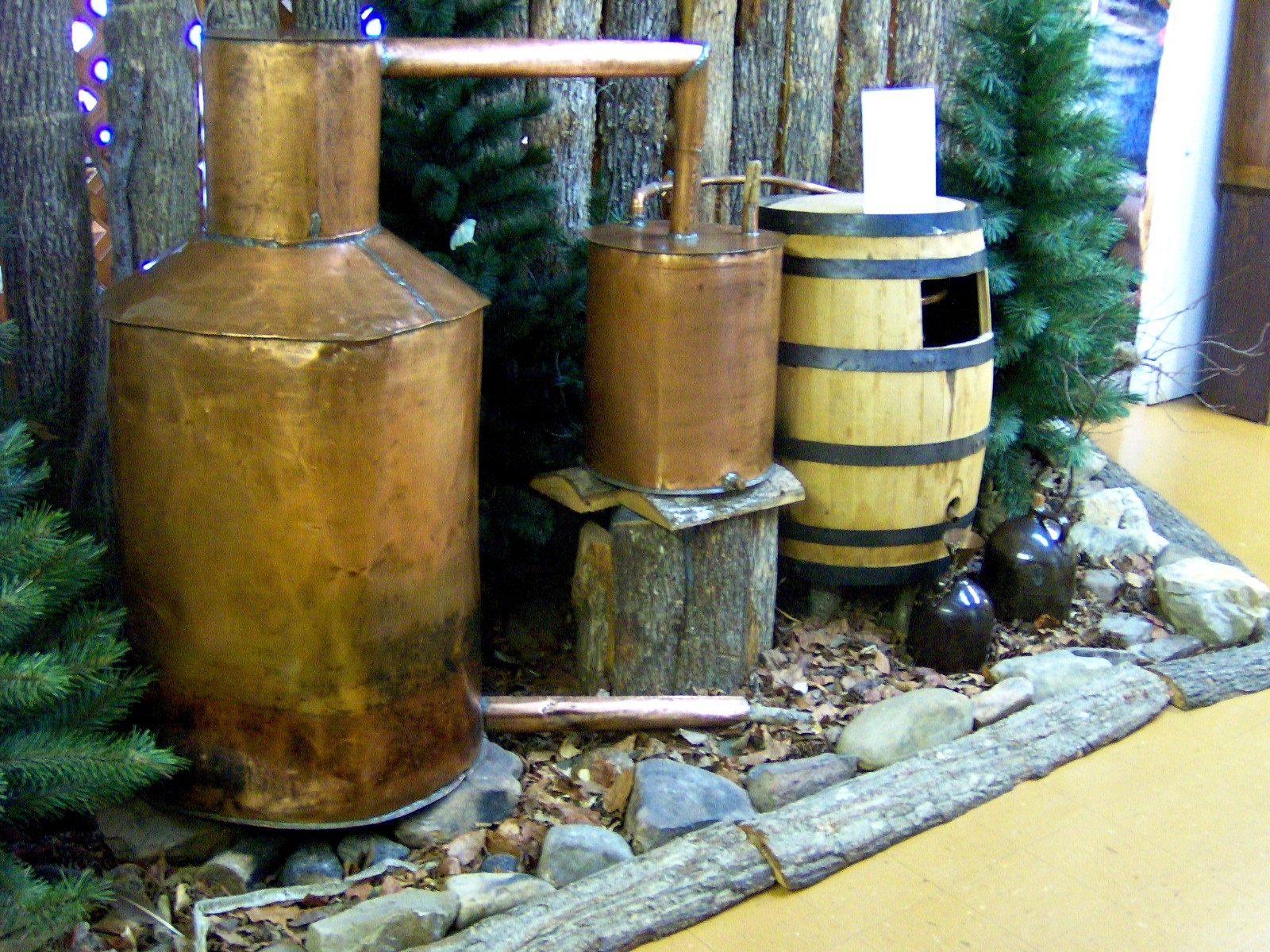
Vodka is the science of alcohol, the moonshiner told me. And whiskey is the art.
A soft rain beat down against the tin roof above us as he stroked the dark train of his beard. It was a quiet moment made holy by the barrel of mash fermenting in the background. This was what I had come for: to hear an artist meditate on his medium and to let it breathe new life into my own.
This trip was equal parts inspiration and research. I’d traveled three and a half hours from my home in New Jersey to Sal’s barn in West Virginia because I’d fallen in love with mountain whiskey when my first book came out a few years ago. In it, I’d written about the sexual assault I’d once sworn to keep secret and the widespread damage it caused in my small hometown in the Rust Belt. I was one of several silent victims, and my memoir debuted to an onslaught of accusations. When it came out, I was also two months pregnant. I was called disgusting, a liar, and a cheat by people who had once been friends. I felt proud to publish that memoir, but it came at a price. My own art had left me exposed, vulnerable, and tired.
This was what I had come for: to hear an artist meditate on his medium and to let it breathe new life into my own.
It was a lonely and mournful period, one that caused me to question my own artistic instincts. I knew that good art often offends, but I didn’t know it would hurt so much. I couldn’t get myself to write through it. That was asking too much of myself. In my experience, a writer doesn’t always write. Sometimes she just thinks. Despairs. Feels. Instead of writing, I decided to lend my strength to welcoming the pain I’d censored since my adolescence. I’d never before experienced such necessary isolation, and it lasted for months.
Then I came across a string of stories about mountain moonshiners in the Appalachian anthology Foxfire, and it kept me the best company. Any time my world would start to buck or pitch, I’d picture old moonshiners with their buckets and spirals of copper, sitting by the fire and working alone in the dark. It wasn’t the whiskey itself that drew me; it was the process of creating it, the way a ‘shiner steps into the night and doesn’t look back. I had done the same with my own work — I had weighed the cost of retreating to safer territory and chose to remain. Those mountain men assured me that I was right where I was meant to be. There is no art if there is no risk.
It wasn’t the whiskey itself that drew me; it was the process of creating it, the way a ‘shiner steps into the night and doesn’t look back.
After my son turned a year old, my stories returned to me. I wrote about moonshine, about love, about loss. For our anniversary, my husband and I spent a day hunting for real corn whiskey and a real distiller to go with it, and by midday we’d only come across sugar shine made in Kentucky and sold at tourist traps. I’d read about Sal on the internet, and we drove past his property a few times before we parked in his gravel lot and took a wagon down the slant hill behind it. The ground was covered in mud and fog curled around the pines.
“Smell it,” Sal said, nodding at the barrels.
Together we leaned over his latest batch of whiskey. It smelled like roasted corn, earth, and summer.
“It’s not ready to run yet,” Sal said. “Still needs time.”
He took my baby in his arms and looked out over his hill. The expanse of the field behind the barn gave way into the mountains and reminded me of Van Gogh’s wheat fields, the way each stalk raises its hand toward the swirling sky. In the Corn Belt, grains are culled, soaked, and fermented before they’re born again into liquor. Sometimes I think our hearts break like that — a kernel at a time, finding its flight in the wind.
Sometimes I think our hearts break like that — a kernel at a time, finding its flight in the wind.
Like artists, moonshiners know how to befriend sorrow. They spend hours in solitude, often awake while the rest of the world dreams. The nickname “moonshine” was coined for the midnight hours distillers spent working in secret in the woods. It’s been illicit by nature since its origins when Scots immigrated to the hills of western Pennsylvania and the Virginias and used their whiskey to barter for food and other necessities. They were using it to survive — a truth that proves making art is as much a necessity as it is a luxury. A moonshiner’s work may never see daylight, and it runs the risk of being destroyed by rain or wind or the law. This is what makes it precious — its strength and its fragility. Sharing my story had left me similarly potent, but raw, and what I needed was to chase that darkness instead of run from it. I let my first book cut my heart open so I could begin to write again.
Even Sal’s first batch of moonshine came in the wake of a broken heart. The barn he uses for his whiskey and bourbon had been built for his beloved black draft show horse who had died. It wasn’t just the horse Sal and his family missed. There’s an art to coaxing a powerful animal to bend at the slightest touch, and Sal’s family missed that ritual of togetherness, of nurture. I find a secret here that resonates for me as writer and as a human — our best work often births itself from absence. I have a mantra I repeat to myself when I fear all is lost: Destruction isn’t the opposite of creation. It’s the antecedent. This is why I like abandoned buildings and overgrown Ferris wheels. It isn’t just because they remind me of the home I left. They remind me every sentence I write is a chance to build something new from the wreckage.
A moonshiner’s work may never see daylight, and it runs the risk of being destroyed by rain or wind or the law. This is what makes it precious — its strength and its fragility.
I imagine it might have been something like that for Sal, who began in his kitchen with a small 10-gallon still fashioned from a lobster pot. The first batch was terrible, Sal told me, but it was a starting point. As the author of many failed first drafts, I understood him well. He’d used an old family recipe that substituted sugar for corn, a shortcut that made the liquor taste like rubbing alcohol. It gave a good buzz, but it told no story of what it had once been. In time, Sal tested his way toward his own trademark, a whiskey that tasted like the West Virginia grain it had come from. He had no models, only a desire to let his moonshine speak for itself.
There’s an old Appalachian saying about this kind of survival that every artist reckons with: root, hog, or die. I like it because it’s imperative rather than formulaic, as the best advice tends to be. I once heard Colum McCann caution against writing what you know. Write toward what you want to know, he said. Standing in his barn between his pot of mash and his gleaming copper still, Sal has somehow accomplished both. He set out to discover what his ancestors had already attempted — a magic concoction of corn, sugar, and fire — and in it, he found his art.
Formulas for mountain whiskey are like creative writing classes in one way: they both talk of necessary mystery and make no promise of finding it. Sal didn’t mind sharing his moonshine recipe with me because he didn’t need to keep it a secret. It’s a mash-up of ratios and gut feeling, an hour to an hour and a half of boiling, days of waiting for the mash to ferment. Even if I attempted Sal’s recipe myself, I couldn’t recreate his flavor. The dirt is different where I come from, the water, the air. Each bottle of whiskey has a voice all its own.
Formulas for mountain whiskey are like creative writing classes in one way: they both talk of necessary mystery and make no promise of finding it.
It’s funny that I fell for moonshine almost from the moment I could no longer drink it. Throughout my pregnancy and a year of breastfeeding, mountain whiskey became less of a spirit to me and more of a story in a bottle. Like this: Fireside, old ‘shiners raise their glasses and sing songs of heartache and young love and children growing old. Bootleggers earned their names from the flasks they hid in their boots, and the Scots-Irish passed down stories of stills stowed beneath gravestones, trails of wooden crosses left to lead the law astray, and spatters of furnace bricks erected in memorial at the season’s end. Once the leaves fall and expose their hidden stills, they spend the winter remembering the fruits of their labor, and drinking it, too. Many moonshiners work to make enough money during the swell of summer to last them through the leaner months, the same way a good book keeps us company through the darkest of times. I’m no moonshiner, but that’s why I started writing so many years ago — to reach out of the jar that bound me and go palm to palm with the life of a stranger.
It takes only two weeks to make moonshine, and it’s tempting for me to say “if only” when I consider the glacial pace required in getting myself to write the truth and write it well. But here’s the larger picture. Corn is planted in winter and abandoned for months in the dark before its shoots break ground. The soil that cultivates it has been tilled for generations. It’s impossible to define the moment a jar of moonshine began just as it’s impossible to say when the stories inside me first took root.
Just before we left Sal’s barn, his wife poured me a shot of whiskey, and I drank it slowly.
“Tastes just like sitting on your back porch,” she said, and she was right. It was warm and smooth and lingered in my throat like an old secret.
Moonshine taught me that art is necessarily subversive. It may be born in the dark, but it doesn’t have to live there. It’s true that we sometimes attempt things others wouldn’t dare. We make people angry. With every word, every drop, we hope to stop time. We fail. And even still, when the time comes, we can shine.
and if the City falls but a single man escapes he will carry the City within himself on the roads of exile he will be the City
— Zbigniew Herbert
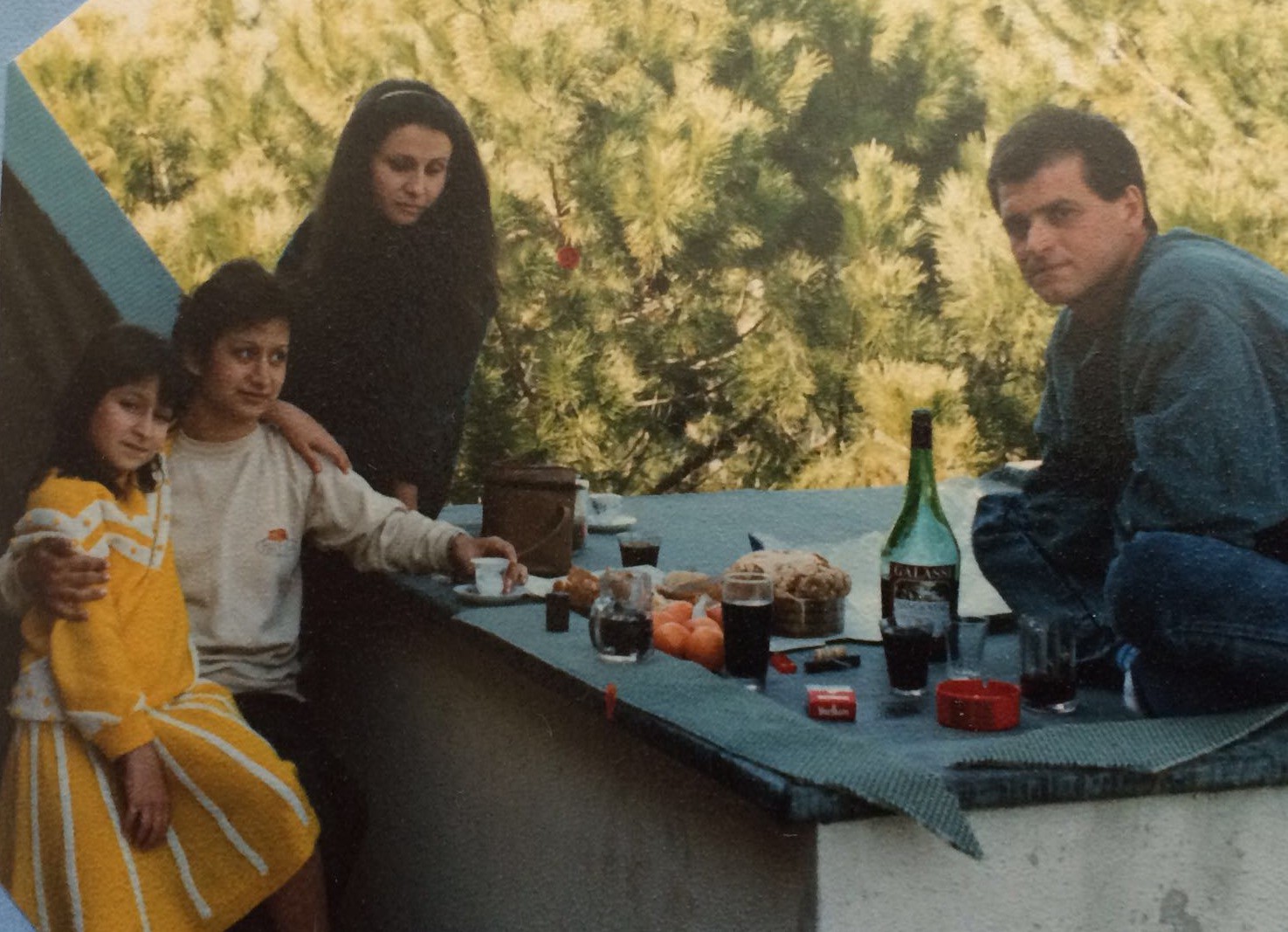
For two seasons when I was nine, I lived in a refugee hostel outside Rome, a place where time had stopped and people waited without purpose, plan, or country. Arriving in government cars, we spotted Hotel Barba from far off roads or neighboring villages, the great house on the hill, dotting the landscape. In the late eighties, for just two years, the owner leased it to the government to house the likes of us, an eclectic circle, rich and poor, young and old, illiterate and scholarly, who came from Afghanistan, Iran, Romania, Poland, the Soviet Union, and wherever else turned out refugees in those days. Our lot included professors, surgeons, internationally known preachers, field workers, soldiers, activists. My mother, an outspoken Christian doctor, had fled Iran with my younger brother and me in 1987. We had already spent a year as refugees in Dubai.
Despite a charming exterior, Hotel Barba was a refugee camp and we were to stay put, having been granted no status in Italy. But, to its residents, many of whom had escaped death, the deafening quiet of Mentana village was a purgatory. All day we sat around and languished in the winter chill, praying that by summer we’d be gone from there — all except two, a young Romanian fleeing with his wife, and my mother, both of whom filled their days with work. I read English books and played hopscotch and became obsessed with having a home again, with ending the wander days, rooting, and with the mysteries of adulthood. Each day when the postman arrived, the crowds outside the mail cubbies swelled, jostling for a good view. We wanted to know, “Who got his letter today?” If someone had, the crowd hushed as he opened his envelope, fingers trembling, eyes scanning, then either cried quietly into his palm, muttering curses, or loudly on his knees, thanking his god. Everyone was frantic for a letter from America or England or Australia, roomy Anglophone countries. All we did was dream, a maddening state, and battle loneliness.
We fought boredom in increasingly desperate ways: an Afghan grandmother collected bricks from a nearby construction site and carried them back to her room under her chador. Her daughter read fortunes from the remnants in mugs of instant coffee. A 20-year-old Iranian soldier with his face half bleached from a wartime chemical burn taught the children soccer. Later, the same children snuck into a neighboring orchard to steal unripe peaches and plums, because our tongues itched for sour and had nothing else to soothe the craving. I offered an English class, attended by a handful of burly Russian men. I skipped around the yard in my pink skirt with the men following, taking notes as I pointed to things: tree, fence, chador, babushka (they indulged me). People grumbled. They complained. They fought.
One day, an unhappy wife fled into the arms of her young friend, the only other Romanian, aside from herself and her husband, then residing at Barba.
Probably the couple had befriended their compatriot, a student with a guitar and a spasm of curly brown hair, before their sentence at Hotel Barba began. Day after shapeless day, the three sat in that Italian courtyard, smoking and suffering quietly together, the only Romanian speakers in a house of political outcasts. I imagined that they spoke of home. Mostly they watched the children play.
She wasn’t beautiful. Her face was flat, her eyes sleepy — but she had a sly smile, the look of a secret always on her mouth. She was tall with dark hair, wide hips, and painted-on jeans. The couple had no children. In the evenings the husband returned from a hard day in the gardens, looking worn. He drank a beer on his balcony, too sated with work to engage in human theatre. But his wife pined and slinked about. She whispered with her lover behind the hotel.
Her husband was a clean-cut man with sad eyes and a kind smile. He worshipped her. A few days after their arrival, though he was college educated, he found a cash job as a gardener so he could buy dresses for her. “So she doesn’t feel like a refugee,” he said. Residents of Barba didn’t have jobs, though it wouldn’t have been unheard of to help the local builder lay some brick, or hold down a bleating lamb for the butcher, or deliver a few newspapers in the early morning. But this man labored with purpose, every day, and it seemed that he craved to diminish himself to show her his love. What then — the adults wondered aloud — did she want? One day in the sunny courtyard, with the husband just over there, the student looked at her with a hunger so intense that, as a child, I recoiled.
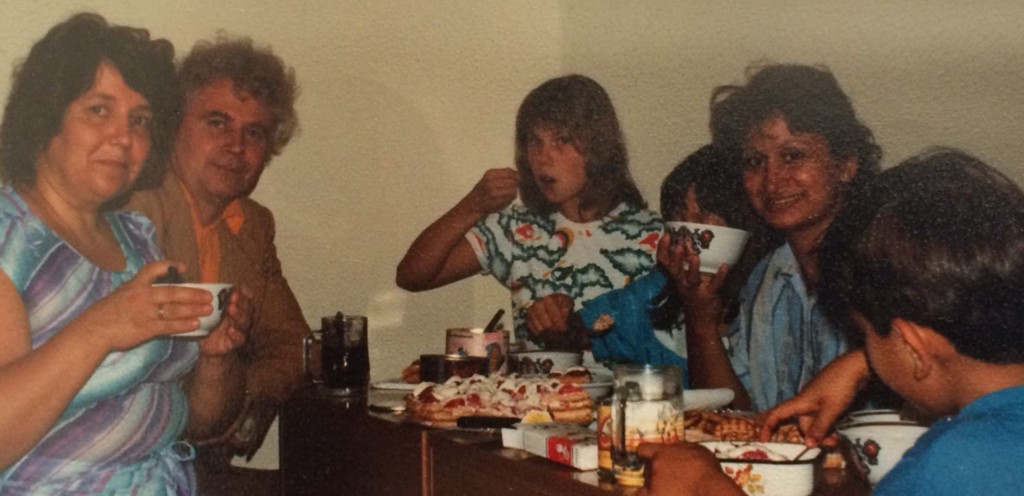
Every night the three shared dinner. At mealtimes we sat with our own tribe, slipped into our native tongue, complained in our own way. As a single community, the residents of Barba had only a handful of rituals: gatherings around the mail cubbies, displays of affection for the boy who ladled the soup course with a singsong “Zuppa!”, morning stampedes for the strawberry jam and collective contempt for the grape which seemed to multiply and became a symbol of our many deprivations. And, of course, we gossiped. The women whispered about the Romanian wife, “She’s so foolish, so cruel.” Once, when my mother was trying to teach me about reputation, wisdom, and gravitas, she said, “Do you know how many strangers from all over the world got to know her only as that stupid woman?”
At mealtimes we sat with our own tribe, slipped into our native tongue, complained in our own way.
Like my mother, I believed she was stupid. Soon, her husband was spending most daylight hours away from Hotel Barba, sweating outdoors despite the winter chill, to make extra money for her. He would return after dark and give her small gifts and kiss her and they would smoke together. But she spent her days flirting with her friend, and talking to a Polish woman who became a repository for her breathless confessions. Later my mother told me that in Hotel Barba, no one knew anyone else’s situation. Was the shabby old man at the breakfast table a brilliant professor? Was the red-clad woman humming in the yard an heiress or a housemaid or a doctor with nimble fingers? Had she fled political or religious persecution? We couldn’t know. All we knew was that everyone was bored, watching each other, and why would you want to become their jester only to find out later that the squinting eyes fixed upon you belonged to a president or a poet or a judge?
The former Hotel Barba, viewed from nearby hill.
As far as love triangles go, I’ve only seen two others as intense as that one. Like our Romanian neighbor, my mother and I each experienced one in our early thirties. My mother left my father and our life in Iran because she found love elsewhere, inside a competing story. Her pursuit of Jesus, her Christian faith, and the promise of freedom and spiritual purpose drove her with no less passion than the young wife’s lust and ennui drove her. For that love, she left family, home, and a beloved country, carving a permanent hole in her heart. Two decades later I too fled from a marriage (and a home and country; I lived in Amsterdam) under a similar spell — a young lover who felt like a connection to Iran, a home I badly missed. He too had a guitar and a reckless streak. Though, unlike my mother (who still loves Jesus) and the Romanian wife (with her high hopes from her lover), I lived under no delusions that this man was anything more than a long arm reaching out from the shore. He would hold on until I could breathe again and then he would go.
What interests me now is this: why do such stories share so many details, no matter their setting? The unhappy wife of a good man — it happens so often.
In 2011, just before our separation, my husband, Philip, and I decided to look for Hotel Barba. At the time, it had seemed important to make this pilgrimage. Maybe we sensed an end coming. maybe this chapter of my history held answers for our troubled marriage. We made phone calls but no one in Mentana remembered the hotel. We rented a scooter and drove there anyway. Long before we arrived, I spotted the house on a hill from the road toward town. I didn’t need confirmation. I knew that hill, that manor on the horizon surrounded by valley.
It had been renamed Hotel Belvedere, a place for businesspeople to rest and to eat forgettable meals on their way to conferences. It was a hot summer day and we roared up to the dirt path, our cheeks were flushed and windblown. For the second time in my life, I felt the elation of pulling up that steep, meandering road to Hotel Barba, watching it appear — that jolt of the heart. Each time I was overcome by a sensation of perfect rescue, the feeling that I was plucked by some unseen hand from an awful fate.
Barba had been more than a house to us, the exiles it sheltered. Some places travel on with you.
The refugees were gone, the building renovated, the courtyard converted to a parking lot and the canteen turned into a restaurant and espresso bar. Something about the building conjured transition for me. It felt like change and homelessness, like stripping off a costume and setting off anew. Barba had been more than a house to us, the exiles it sheltered. Some places travel on with you. They grow up with you, at the same pace. As I jumped off the scooter and ran the rest of the way, I could see that Barba and I had grown in strange parallel, scaling up our exteriors, like sisters reuniting in adulthood, all done up for each other.
I requested to see our old room. I didn’t know the number, only the balcony overlooking the courtyard (now parking lot). The concierge took me from room to room in search of the correct view. It was a slow day. He promised to introduce me to the owner afterward. For whatever reason, standing on that balcony preparing to have my photo taken, I blurted, “A Romanian man used to climb our balcony to get to the one a few doors down. He was in love with the wife.” I had forgotten that detail, the student climbing. Then another lost detail returned. “Oh god,” I said, looking into the yard. “They ran away together. How could I forget that part?”
Russian and Persian tea, Hotel Barba.
The first time I saw Barba, from a black car in 1988, it must have been chilly and dark because I recall arriving after dinnertime in winter. My mother, brother, and I were bundled in the backseat, grubby from our international flight. Inside, we sat on our one bed and wondered what we would eat, where we would get money, if we would find friends among our neighbors. Would we meet Farsi speakers? How long would we stay? Which country would accept our asylum petition? Before long, someone knocked on our door. A punkish hotel employee, no older than twenty, told us we had missed dinner. That night, I saw the glass room for the first time, empty, dark. We ate leftover pasta and thanked God that meals were provided here.
My mother didn’t succumb to boredom or partake in the human drama of the place — she wasn’t interested. When it became obvious that we would be at Hotel Barba for a while, she made it her job to continue our education. She refused to languish in the hotel like the other exiles. “It won’t happen faster if we sit and wait. People pay a fortune to visit this country.” So she stuffed our backpacks and we rode buses to Pisa, Venice, and Rome. My mother was thirty-two, my age when I returned to Hotel Barba the second time on Philip’s scooter. I can’t imagine the kind of adventurous drive that would motivate her to brave Italian public transport alone, in summertime, with no money, no language skills, and two whiny children.
In a remote village with no car, our options for school were limited. Some Barba children had enrolled in local Italian schools, but my mother insisted on English. She found a group of American homeschoolers at a church in Rome, over an hour away by bus. She devised a plan so we could attend school during the day but still receive the three daily meals that Hotel Barba offered. She enlisted the help of the punkish staffer and the brick-gathering Afghan grandmother. Each day at lunch, the employee would entrust our meals to the Afghan grandmother, who would wrap them up and save them for us. At night when we returned, we would eat those lunches, saving our fresher dinners for lunch the next day. No matter what was served, my mother would transform the components into sandwiches (hard, crusty rosetta rolls came with every meal) and hang them in plastic bags in our balcony where they might cool and survive the morning bus ride to Rome. I still remember the strangely satisfying texture of a sandwich made with pot roast and a layer of green peas, the rosetta finally soft enough, after a night spent soaking in gravy.
Memories of the old Afghan woman — scurrying behind the hotel with a brick under her skirts, saving our bag of food, kissing my cheeks — brings a fleeting smile to my lips. Now I wouldn’t recognize her in a lineup of grandmothers; funny the daily nothings by which an entire person becomes known. My mother wants me to learn this as I grow older — How many strangers know her only as that stupid woman?
Because we had joined the school halfway through the year, they didn’t have workbooks for us. My mother spent her days erasing hundreds of pages of used ones, making sure she removed every marking so we could do our work without temptation of old answers peeking through. When the weather got warm, we would sit in the courtyard all afternoon, my mother erasing her fingers raw, my brother and I writing. It cut the tedium, and soon our boredom died down.
Over the months my fascination with the Romanians grew. I wasn’t sure why they had left home, just that it was a Communist country then. As with all Barba guests, something frightening had happened and they had fled. Their rooms were on the same hallway as ours. An agile person could climb from balcony to balcony. Once I climbed to the couple’s room and knocked on the window, and the husband gave me a sip of his drink. It was my first taste of beer, and I hated it.
The second or third time I noticed the affection between the young wife and her friend, I had wandered into the empty dining room. I found them alone, their heads almost touching. She looked up abruptly and offered me milk and sugar with a few drops of coffee, a concoction I hated (foreign drinks became a problem for me over the years: I hated sodas, coffee, beer, skim milk, frozen slushies, tonic. I was an Iranian girl — I liked yogurt soda, still water, and sweet tea). Later, I saw her in the courtyard with her husband. He held her hand and they watched me in that amused, longing way lonely couples look at other people’s children. I wasn’t confused by what I had seen. I thought, “She loves both men, but she’s already married so it’s too late.” I didn’t attach any possible emotion to the too-lateness of it.
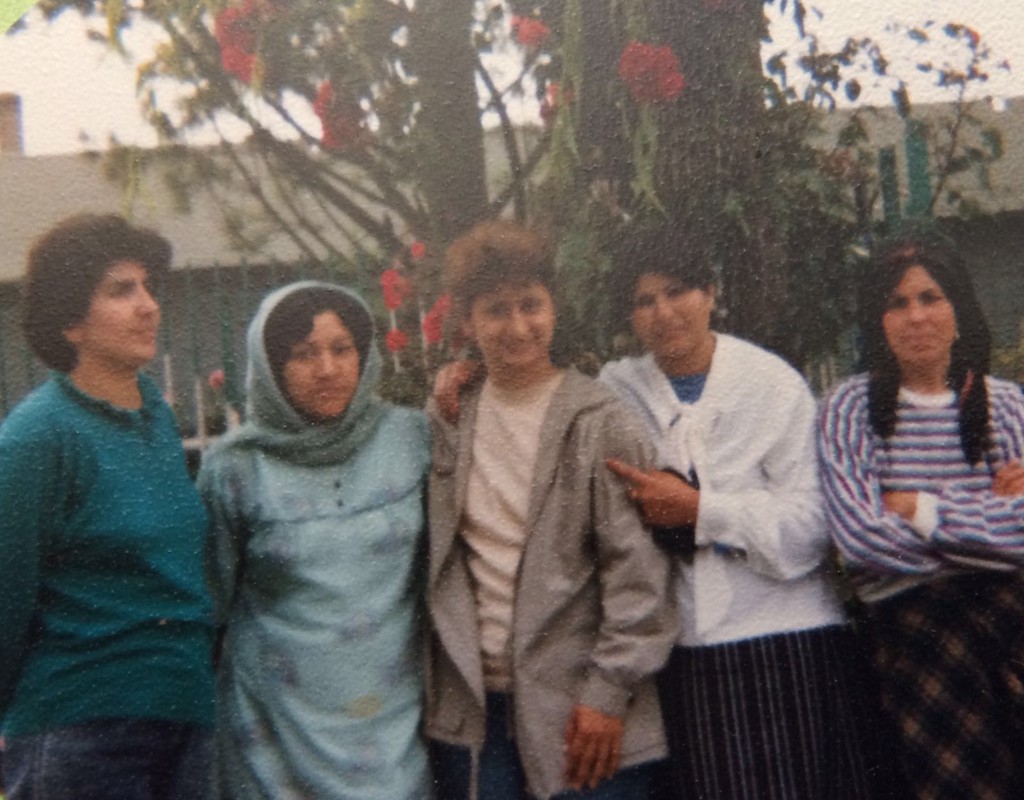
Iranians and Afghanis at Hotel Barba.
A few months into our stay news spread that the young woman had abandoned her husband and fled with the young friend to the Swiss border on foot, hoping to cross over illegally. She was tired of waiting for asylum, tired of the boredom, tired of her husband. She was withering in our shared purgatory. The rumors flared up again. The lovers were hitchhiking to Switzerland. They had vacated Hotel Barba, becoming fugitives in Italy. I’m not sure if we were allowed simply to leave Hotel Barba. Yes, we left every day for school, but could a person just pick up their bags and move out? We were, after all, carrying flimsy documentation and were largely unemployable, un-house-able, and without options. We were social cripples and Barba was our temporary guardian. What would they do alone in the inhospitable bowels of a foreign country with nothing but their passion and his guitar? “They’re just bored,” the older women would mutter. “The days are so long here.” I’m sure that such words were whispered in Barba’s many languages, though my gossipmonger of choice was the Afghan grandmother.
The pair had disappeared in a delirium of spring fever and, for some days afterward (my memory tells me two weeks, but was likely much less), I had my first opportunity to witness heartbreak up close. The husband grew pale. He sat alone in the courtyard or in his room drinking dark beers, his head in his hand, probably thinking he could have bought her more things. Some days he sat in his balcony, frothy mug in hand, looking out at the winding gravel driveway. He stopped working. What were they doing, alone in the open world? Did the student hold her hand as they walked? Did she lose her fingers in his curls? Did they pretend to be Italian and rent a room and share a bed? I imagine he strummed guitar for her on Italian roadsides, spending their meager lire (too few for train tickets) on pizza and Coke to share with her as he flagged kind motorists, shivered in his thin jacket, and slowly noticed her flaws. Back then, I pretended they were visiting Pisa and Venice as we had done — I pictured him kissing her on the cheek and I blushed at the idea. At nine, I was curious and opinionated and I judged her. Her husband was the more handsome one anyway, I decided, and look how he suffered for her sake. I hated her and hoped God would punish her with permanent asylum to Canada.
The pair had disappeared in a delirium of spring fever and, for some days afterward…I had my first opportunity to witness heartbreak up close.
In time, the runaways returned. They were caught at the border and sent back to the camp with their heads hanging. My memory puts regret on their faces. Only a few months more and they might have been welcomed into a new country, able to leave Hotel Barba with respect and warm goodbyes. Now here they were again, back in their old rooms, forced apart from each other and enduring the silences of the man they had betrayed. Probably their recklessness delayed all three of their visas.
They had no choice but to reconcile with the husband, to eat with him silently every night, to make chitchat about books, to smoke in the courtyard. It was a spectacle and everyone watched in awe and secret fascination. What gall! Where would she sleep? Of course, she returned to her husband’s room, since she was assigned to it. After that, the student spent his days in his single room — as in real life, it was his moment to disappear, his memories of youthful adventure bringing him satisfaction and nostalgia but no heartache, leaving the couple to suffer alone. But at meals, they were still the whole of Romania, and so they shared a table. Maybe a new exile would soon arrive and relieve them of the burden of three, but such trios aren’t free from each other even in the wider world.
Sometime in that turbulent season, when the weather was warming and the restless residents of Hotel Barba were overcome by renewed desire for a country, we discovered why the Afghan grandmother was collecting bricks. In mid afternoon a crowd was forming around the mail cubbies again. The Iranian soldier with the white-blotched face was trembling, thanking Jesus. “I’m going to California!” he shouted. It saddened me; I would miss him, and our ball games. Having left my own father in Iran, I was attached to him. As it turned out, a few days later, we would receive our letter too and would be on the same flight as my soldier friend. As the crowd dispersed, someone saw the Afghan woman scurry up the stairs with a brick under her arm. The punkish staff member or Zuppa man or somebody followed her and insisted on seeing her room. Soon news spread around Hotel Barba that she had built a shower seat and was spending hours a day sitting happily under the stream, wasting the hotel’s water. They dismantled her seat. She threw an epic tantrum. The tedium had reached new heights of toxicity. We were drinking it now, mad with it.
A year or two later, we visited that Afghan grandmother and her daughter in California. It turned out they were from a wealthy, important family, a fact we could easily see when we met them in their own house. “Do you remember that Romanian woman who ran away with the younger man?” the daughter asked my mother as she poured skim milk over my cereal — my first taste of the vile blue water. That detail was all they remembered of a woman who had shared their home for months.
Thinking back on this story, I wonder if my mother knew that I was watching, if she saw all that I committed to memory under her nose, as she was rubbing out answers to math problems. I missed my father, my aunts and uncles. I wanted to know why people leave each other. Maybe my mother too was thinking about love in those days, alone as she was after a decade, with no companion, no consolation but her unwavering belief in Jesus. And weren’t we all obsessed with love? Despite the daily burdens of refugee life — unfamiliar food, hot buses, lack of school, the possibility of being sent back to face imprisonment and death — I believe that everyone there continued to function on that register. Even when first order needs were in question, love was all, the only thing more basic than home or country.
Mentana, circa 2011.
Decades later, I drank an espresso in the same dining room, our familiar canteen, while the grandfatherly owner patted my hand and offered me a wafer. I thought: years ago I drank milky coffee in this room, unable to imagine that one day I’d enjoy the taste. I thought of the Romanians. Why do stories repeat themselves in this way? How does love stop being love, and how can I tell if it’s happening to me?
“This room is exactly the same,” I said. “Those windows…”
“It’s much nicer,” the owner said; the concierge translated. “Big renovation.”
“It seems the same to me,” I said, looking out at the leafy landscape below the dining room. “It was nice then too.”
“Probably because your taste improved at the same rate as the renovation,” Philip joked. I recalled the bitterness of those first coffees and beers, the watery milk. Now, as an adult, I had brand new senses. The world had reset. Most people return to childhood sites and find them shabbier or smaller, though the places are unchanged. Barba seemed the same to me, maybe because we grew in step. Had my husband and I grown in step? Did our love keep up with our changing palates? Did we carry our years together, as one carries a city or familiar gravel road or a beloved house, and would we continue to carry them, even as we moved on from each other?
Most people return to childhood sites and find them shabbier or smaller, though the places are unchanged. Barba seemed the same to me, maybe because we grew in step.
Maybe this was just what happens to love — in a secluded refugee camp or in a yuppie apartment in a big city center. Over the decades, I’ve lived in a bustling Iranian village, a sleepy Oklahoma suburb, a chaotic Italian refugee camp, on a New York avenue, and an Amsterdam canal. I’ve learned: the same things happen. Now I travel only for details I can’t imagine or invent, not for broader understanding. We are hardly original. It seems to me that some human tribunal predating known cultures has drawn out every footpath and built high walls around it, just out of sight. Detours are tempting, like running off to the Swiss border with no paperwork, but inevitably temporary. The walls will soon appear. People will fall in love; they will live for a few years in ecstasy and delirium; then love will end. They will be lost for a while. They will crawl back toward the main road. Who decided this?
And yet, these patterns make stories pleasurable for me, their soothing echo insinuating some buried answer. Why does love end? When does a marriage stop being a marriage? I’m reminded of Alice Munro’s words: “It’s as if tendencies that seem most deeply rooted in our minds, most private and singular, have come in as spores on the prevailing wind, looking for any likely place to land, any welcome.”
The name Hotel Barba still fills me with dread and nostalgia: that first lick of a Cornetto, the crunch of unripe peaches stolen from the garden, the tinny taste that filled my mouth in embassies. After my second visit, it also conjures images of myself as the unhappy wife of a good man, in a green summer dress, trying to find the tree whose peaches I had stolen, the bench where I taught Russian men a few words of English, the sound of a Romanian student climbing over my balcony with his guitar. For years, the characters in Hotel Barba have appeared unbidden in my fiction. Young heroes arrive with milky scars whitewashing half their face. Menacing lovers carry guitars and have curly hair — fingers are lost in it. Grandmothers in chadors hide little indulgences under long skirts. Idle women with sleepy eyes make themselves silly with yearning. Back then, the worn-down paths seemed new to me. But I saw things and I began to learn the patterns: All Love ends. Without a country, a fire is quenched, another flares. Limbo is temptation itself — the itch to make life happen, faster and faster.
Thinking of the lovesick wife of Hotel Barba, another truth presents itself: only two people in that refugee camp loved enough to seek work, toiling to dull the sting of exile for someone else. Does love have to end? My mother and the Romanian husband struggled for it; for them, it didn’t come cheap. I want to try it for myself. I want to love enough to labor and slog, to diminish, to rub my fingers raw. And yet — I can’t curb this other, darker instinct; I try to imagine what it would have been like to be stuck with two lovers in a purgatory, and I crave the unnatural closeness, the spark of fear, the drive to create and destroy and create again. I long for the drama. Despite all that I’ve seen, the common endings I’ve come to know, I still manage to think, what a good story it would make, so original and new.
— A version of this essay originally appeared in Epoch.
We at Electric Lit call New York City our home, but in our reading as well as our travel choices, we’re enthralled by cities far-flung and across continents. In the dark labyrinth of a city at night, a mystery, a love affair, a crime might take seed at any moment. In the bald light of an urban morning, millions of characters wake to swarm the avenues. Often, a city becomes an illustrious and capricious character in and of itself. In their wildness, cities contain heartbreak and ambition, art and loneliness, poverty and dreams. It’s hard to think of a more fecund plot in which short stories might grow.
So in homage to our city and yours, we’ve unlocked 9 stories from the Recommended Reading archives for a limited time — cities are, after all, home to transients. For just $5 a month, members of Electric Literature get access to the complete Recommended Reading archives of over 250 stories — and year-round open submissions. Membership is tax-deductible, helps us pay writers, and keeps all of our new content free. So if you like what you’ve read, please join today!
The Dirty Kid by Mariana Enriquez, recommended by McSweeney’s
In the of Constitución, the most dangerous neighborhood in city of Buenos Aires, a woman has chosen to return to and live in her family home, her grandparents’ house. She forms an acquaintance with a child who she has seen outside the window of her home, sleeping on a mattress in the street with his mother, an addict. The body of a decapitated child shows up in the streets days after an altercation with the mother, and the narrator is sure it is the mother’s child. Through the scaffolding of a crime story, the author of the acclaimed collection Things We Lost In the Fire moves through issues of class, gender, politics and lineage.
The Time Machine by Dino Buzzati, recommended by Kevin Brockmeier
Buzzati imagines a city, Diacosia, built around a special electrostatic field called “Field C” which slows down the growth rate of living beings. Humans within an 800-meter radius of the field’s center can live for two centuries, giving the city it’s ancient-sounding name. Buzzati grounds this fantastical premise in language that reads with the clarity of anthropology, but, as Kevin Brockmeier writes, “shades gradually over into poetry.”
Blackass by A. Igoni Barrett, recommended by Chinelo Okparanta
Okparanta, acclaimed author of Under the Udala Trees, describes the novel from which this excerpt comes as a Lagos-based retelling of Kafka’s The Metamorphosis: “A young man wakes up to the realization that he is no longer who he once was, but has become a different kind of ‘being.’ In Barrett’s version, the young man goes to bed a black man and wakes up white.” When Furo’s skin color-changes, he must renegotiate a city and relationships with which he was once intimately familiar, but has now become foreign.
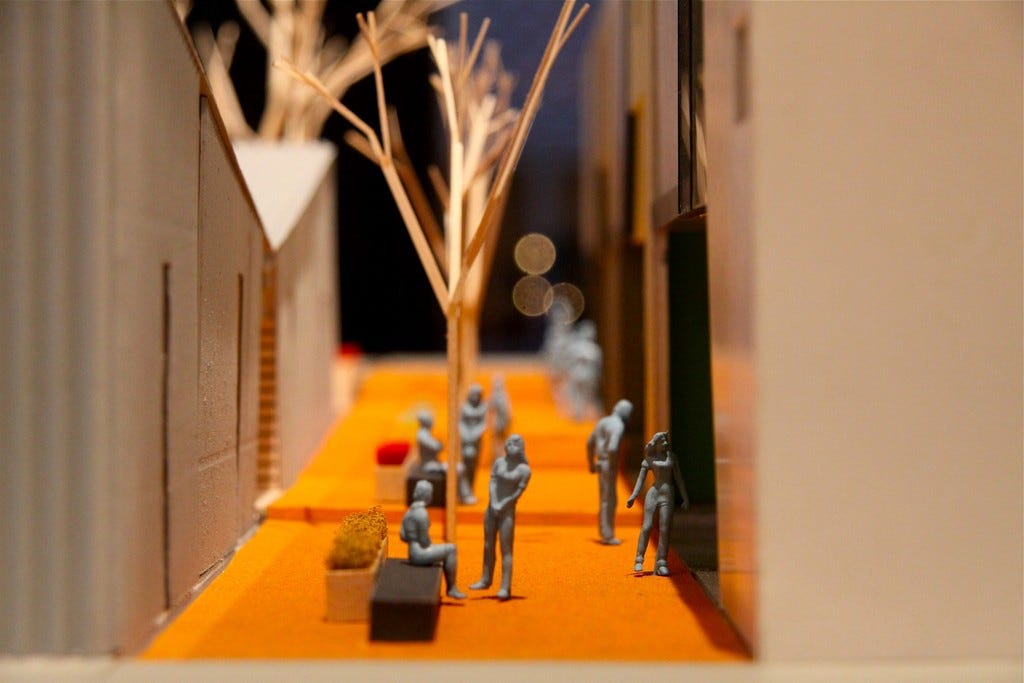
Eddie is new to the suburban town of Elverton, where he finds friendship with Trevor, a fellow outsider. But Trevor proves to be more unusual than Eddie bargained for: his hobby of rigorously recording the buildings and homes of Elverton so that he can rebuild them precise miniatures makes him an outcast. Despite constant ridicule, Trevor never gives up on his project. In this musical story of boyhood and loneliness, the question surfaces: are we destined to our environment, or can we create the domain of our dreams?
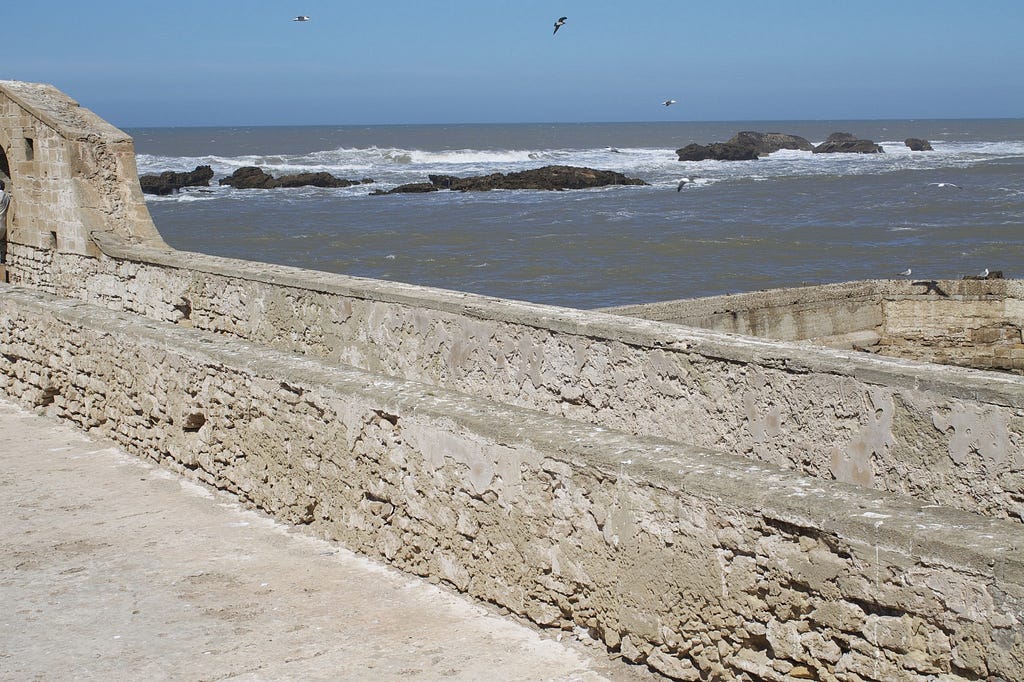
After leaving the city she was born in, Jeanie has chosen a life of alienation: she moved away from her mother to the “blue Moslem [sic] town” and spends half her time in a Muslim house and half with Nazarenes. “The highest street in the blue Moslem town skirted the edge of a cliff,” the story begins, and it is here, overlooking rock and seawater, that Jeanie meets her one friend, Zodelia, everyday. As Lynne Tillman writes, Bowles “never [writes] an unnecessary word.” While “Everything is Nice” conveys the airy confusion of being a stranger in your environment, it is Bowles’s precise language that shows the beauty of being lost in the world.
Gogarty by Michael Deagler, recommended by Electric Literature
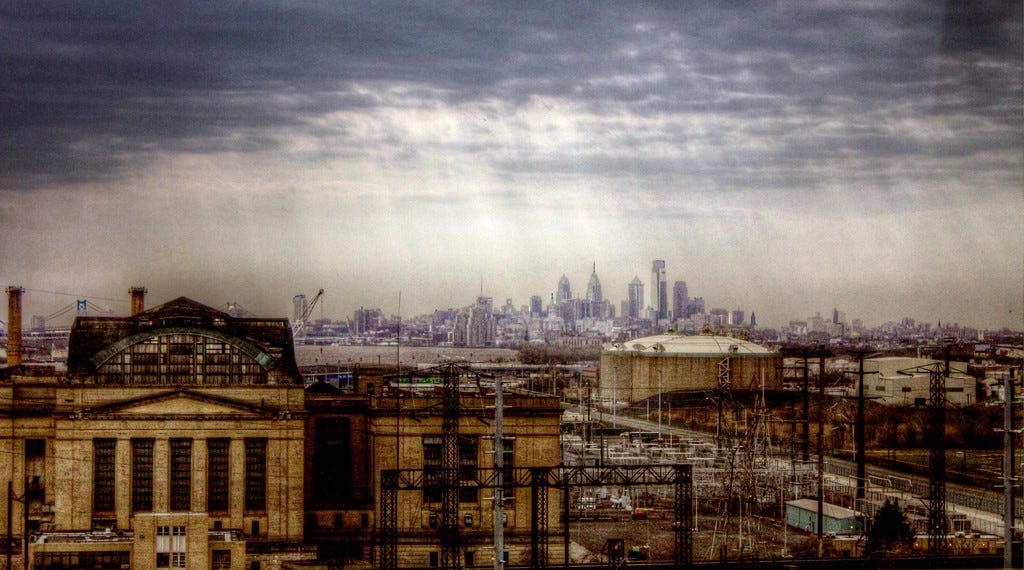
The title character, Gogarty, lives in a Hamburg Süd shipping container in the West Kensington neighborhood of Philadelphia. Recommended Reading’s Editor in Chief Halimah Marcus is a Philly native, and can attest that Gogarty is “a character representative of that city you know and love despite also knowing everything that’s fucked up about it.” Like those characters and those cities, “Gogarty” is a story that anticipates grit and violence, and finds something compassionate and humbling instead.
Secret Stream by Héctor Tobar, recommended by ZYZZYVA
Riding his bike down a busy road, Nathan happens upon Sofia, her clothing caught on a roadside fence. On the other side of the fence, there is a concealed stream that Sofia is on a private mission to track. Though it rings with the curiosity and possibility of childhood summer adventures, this story is set in contemporary L.A., with two adult protagonists guiding us through the story. If cities are playgrounds for grownups, then this is a story that insists adventure and make-believe are ageless.
The Unraveling by A.N. Devers, recommended by David Gates
The endeavor to find an apartment in New York City is enough to convince some people they should live somewhere else. In Devers’ story, the horror of the apartment search sinks to a new level of darkness. Told through the correspondence of emails, husband and wife Cecelia and Gregory enlist one Edward Askew, known broker of a desirable Brooklyn neighborhood, to help them find a new home. As the messages from Edward grow increasingly unsettling, and the happy couple are warned to avoid Mr. Askew, the story takes on an eerie tone, somewhere between a fable and a nightmare.
Cathay by Steven Millhauser, recommended by Aimee Bender
Through a series of micro chapters, each of which, Aimee Bender notes, is “as carefully tended as a Japanese garden,” the Pulitzer Prize-winning author of the novel Martin Dressler delivers a portrait of an Emperor ruling his city. The vignettes such as “Birds,” “Eyelids,” “Dragons,” and “Ugly Women” wander through mystery, sadness, art, and imagination. As Bender writes, this is a story that “uplifts, and saddens, and bewilders, and shimmers.”
I know when people will die. I meet them, I can look into their faces and see if they have long to last. It’s like having a knack for math or a green thumb, both of which I also have. People wear their health on their faces.
There was a time I lived alone in the crappiest neighborhood I would ever live in and had few friends and worked at a place where the people I saw were all quietly abandoning their plans, like I was. I had the faces of dying people all around me. One day the office assistant called me over to her desk and said she was an Indian dancer and how would I like to go to an Indian dance?
This same office assistant had once said to me, “You know what I think every time I look at you? Guess. Guess what I think.”
“Here comes the bride,” I said.
“Wrong,” she said. “I think about that movie where the angel comes to earth and shows a man the future and how bad it’s going to be, and the man looks at the future and says, ‘But what about Mary? What happens to her?’ And the angel says, ‘You’re not going to like it, George.’ And George says, ‘Well, I have to know. Tell me, Angel.’ And the angel says, ‘She’s an old maid! She works at the library!’ And the man says, ‘Nooooooo!’”
“I don’t know that movie,” I said.
“‘She’s an old maid! She works at the library!’ You should put that on your voice mail.”
“I don’t work at the library.”
“People would know they had the right number.”
After that she called me Mary and soon had them all calling me Mary.
This office assistant sat at her desk and handed out notices about forms that people had forgotten to fill out. She wrote down on slips of paper chore lists, reminders, disclosures she’d received from above: Tag your food. Turn in your book orders. You have been chosen for a special assignment. I didn’t like her. She was young and hard to talk to and not nice. She wasn’t the only office assistant. There were two others, who were locked in an eternal battle and fought every single day. A partition had been raised between them in the hope that if they didn’t see each other they would each cease to believe in the other’s existence. It hadn’t worked. All it did was make them think they each had their own office, which they protected fiercely. The entire setup was confusing and inconvenient. If you wanted anything done, you had to depend on the first office assistant, the one who had asked me to the dance.
So this assistant was a lot of things but she certainly was not Indian, and on the day she asked me to the dance I said so. “What kind of an Indian are you supposed to be?” I said. Then it turned out she meant Native American — or American Indian. But she wasn’t that either.
“You have the cheeks of a cowgirl,” I said. “You have the face of a cowboy.” It was true. She was both pretty and masculine.
Well, she had learned how to dance some Native American dances and her own mother had sewn her a Native American costume. It was beautiful, the costume, she said, and if you drove out of the city, you could find the land the Native Americans once lived on and still do today and where they dance still. She had a flyer about it, look.
“I never heard of this place,” I said.
“Do you want to come or not?”
“I don’t know how to dance any Native American dances.”
“They’ll teach you, everyone will. They’re very nice out there.” I didn’t know why she wanted me along. Maybe she wanted more friends, which might not be so bad considering the way things were going just then.
“Okay,” I said. “I’ll go.”
“Great,” she said. Her eyebrows went up. “You’ll drive? I don’t have a car.”
At this job, four times a day, thirty people assembled before me, and it was my duty to tell them some useful fact about the English language, a fact they could then take and go out into the world with and use to better their positions in society. There were no grades in the class. It was a pass/fail class and whether they got a “pass” or a “fail” depended on an essay they had to write on the last day, which was read and evaluated by outside sources. These outside sources were supposed to be mysterious, were maybe not even people, were maybe just God, but I happened to know were simply whichever teacher or two the office assistant lined up to do it. It was a probationary class, intended for the students so illiterate that it was almost unseemly to have them there. It was the last-chance class. It went by the number 99. Anyone who passed got to enter college for real, sign up for 101. Anyone who failed had to leave. The students from 99 were all over the hallways. They didn’t care about any useful facts to take out into the world. They cared only about the essay graded by outside sources. Thirty percent failed most years and everybody knew this. The students in 99 disliked me with a vigor and a courage that were kind of amazing. I stood at the front of the room on Mondays, Wednesdays, and Fridays, and said, “The test is graded by outside sources.” I used this to respond to every complaint, defense, and plea.
The test is graded by outside sources.
The test is graded by outside sources.
The test is graded by outside sources.
That day, after I agreed to bring the assistant to the dance, I went and stood in front of my third class of the day. It was nearly the end of the semester and they had that unstrung look to them — gaunt, spooked, blaming. “Let me remind you,” I told them, “I don’t grade the tests. And I can tell you this much. Any essay without a proper introduction will not get a ‘pass,’ so let’s turn our attention back to the board.”
I was what is called an adjunct: a thing attached to another thing in a dependent or subordinate position.
The assistant had it a little wrong about the movie, by the way. It wasn’t the future that George got to see. The angel’s job is to show George what the world would be like if George had never existed. The premise of the movie — because of course I’d seen it, everyone’s seen it, if you were born in America you’ve seen it — is that George is unhappy and has been for many years, his whole life nearly, and he is so full of regret and fear that he wants to die, or, even better, not to have been born in the first place.
2.
Some months before the assistant asked me to the dance, the associate chair called me into his office. This was a man whose face held the assurance of the living: he’d hold up a good long while yet.
“Do you have room in any of your classes?” he said.
“No,” I said, “I don’t have any room. I certainly don’t have room two weeks into the semester.”
“I’m sorry to hear that, Mary, because we’ve got this kid here.” He pointed to a kid in the corner whom I hadn’t noticed yet. A thin boy who clutched several plastic grocery bags to his chest.
“My name’s not Mary,” I said.
“It’s not?”
“He missed two weeks,” I said. “Forget it.”
“He’s here on a visa.”
“Does he speak any English?” I said.
We looked at him. He looked back at us as if he might startle himself off his chair.
“Take the kid,” the associate chair said.
Once a visa student in 99 wrote me a poem about how much I was helping him improve his grammar. One of the lines of the poem went:
Thou laid really strong excellent basement.
The kid was a worse-than-average 99 student. He couldn’t write a sentence. He turned in his first jumbled essay and I thought: There is no way this kid is going to pass. And I thought: What a bother for him to fly all the way across the world to sit in my class and then to fly back home. And by the time I finished those two thoughts he was already shifting to the back of my mind, he was already taking a seat amid the blur of other students, whose names I would never know, whose faces I’d forget, and whose passing or failing grades were like changes in the air temperature, were nothing to do with me.
Every semester I went through this. I’d had the job two years. I had local city kids and a few foreign students, all of them ready for certain destruction. Some brought me fruit baskets. Some tried to bribe me into passing them. One threatened me, told me his “alliances” would look me up one day.
By the third week of the semester what this kid was to me was nothing to do with me.
By accident I heard him play. I was walking down the hallway toward another tedious day and a strange sound stopped me. Strands of violin and piano were coming from behind a door. I looked in.
Did I mention that this run-down school, this flat barrel-bottom place, was run between the walls of a building designed by a very famous architect? Yes, it was. It had been the high point of the architect’s career. It was while making this building that the architect had come up with his very best ideas about designing buildings and had summed these ideas up in a short catchy sentence that he said aloud and that was later written into books that were read all over the world and that was now familiar even to the layperson. After saying this catchy sentence, the architect succumbed to his drinking problem and never straightened himself out and eventually died bankrupt and alone, but this building still stood, and now somehow these people had gotten their hands on the place and were ruining it as fast as they could. Water damage, broken tiles, missing doorknobs, and, worst of all, modern rehab: linoleum floors, drop ceilings, paint over wood. Catastrophe was setting in, but this one room had been preserved — perhaps because the public still encountered it on festive holiday occasions. The architect’s one mistake had been to put this room on the seventh floor. The public had to be ushered in past the wreckage to reach it, up the new fake-wood-paneled elevators, over the colorless hallway carpet that had been nailed down there. But once inside, an auditorium opened up overhead and it was flawless. It marked that thin line of one artistic movement shifting into another, one great artist at his best.
On the stage the kid from my class was on the piano. Another student was playing the violin. The kid kept lifting one hand, keeping the left hand going and conducting the violin with his melody hand. Then the violin stopped and the kid continued to play and the sound I was hearing was formal and sad and peculiar. I myself had studied piano for years. I’d wanted to be a concert pianist in high school, which is its own separate bad joke now, but I knew this guy was super good. The piece had a density and a mathematical oddness, an originality. He stopped playing and looked up. I ducked out the door.
I stood in the hallway, thinking. How had such a talented kid wound up at our school? The school was no great music school. There were better music schools up the street, not to mention all over the country and the world.
I felt like I couldn’t breathe for a moment, like my lungs were being pressed. I saw the emotional deadness in me and I saw it lift. It was temporarily gone.
Another paper of his landed in the pile. I couldn’t understand any of it. Something about cars. The color of cars. Maybe about the color of cars. Something about the advent of America, of bank machines and microwave sandwiches. That afternoon he sat in the back of the class, wrote down whatever was going up on the board. I told him to talk to me at the end of the hour. He came and stood in front of me, his plastic bags in his hands at his sides. He was the same height as me, and he had sharp, dark good looks, though his nervousness shaded them. “Yes, miss?” he said.
“Why don’t you explain to me what you’re trying to say here,” I said. I had his paper in my hand, and he lifted his eyebrows over it.
“Is it not right?” he said.
I dropped the paper onto the desk. “This writing is horrendous,” I said. “What are you doing at this school? Didn’t you apply anywhere else? Proper music schools?”
He said nothing.
Suddenly I was overwhelmed. “Well?” I said. “Well?”
The room was washed-out that day. Even the fluorescents were dim.
“You’re never going to pass this class,” I said.
He turned and walked toward the door.
“I heard you in the auditorium,” I said, shaking. “I saw you.” He stopped at the door and looked back at me.
You think it’s so easy doing what’s right?
Once I had a student from Mexico who’d crossed the Rio Grande over and over and had always been caught. At one point he’d been lost for three days and nights, alone in the Texas desert. He’d thought it was the end of him for sure. At last he found a road and thought, My God, I am saved. The first car that came down the road was border patrol. He was back in Mexico in an hour. Another time he had tried to cross and had been sent back and had been so frustrated that he decided to use all his money and fly to Canada that same day, which he did. I don’t know why he didn’t just stay in Canada. I never asked him that. What’s so bad about Canada? But he had that American addiction, I guess. He tried to cross at Niagara Falls, had been caught again, and was sent back again — so two times from two sides of the country in thirty-nine hours. Well, he’d made it to the United States at last and the only reason he wanted to be here, he said, was to get an education. (“What, they don’t have schools in Mexico?” I’d said, and he’d been annoyed.) Here in the United States he’d gotten fake papers, he told me. He’d gotten a job with those papers, was working under a fake name. The job paid for him to go to college, so he was getting a degree under a fake name and would have to give up his identity forever, but he didn’t care. If he didn’t pass the class, the college would make him leave and the job wouldn’t pay for school anymore.
He didn’t pass.
Frankly, I knew it didn’t matter if he passed or not, because I knew he wouldn’t live for long. I had no idea how he would die but I knew.
I went into the chair’s office to find this kid’s file. The music kid, not the Mexican kid.
“What are you doing in there?” the office assistant called to me. “You’re not supposed to be in there.” She followed me in and watched me pull open a cabinet drawer.
“Those are confidential,” she said. “That is strictly administrative.”
“I need to see something.” I took out the kid’s file.
“What do you need to see?” she said, coming up behind me and leaning over my shoulder. “You don’t get to see.”
“Could you shut up for two seconds? For God’s sake.”
The name of his country was at the top of his file and it surprised me. It happened that his country was in a civil war that year. We’d been bombing them for reasons that had become suspect. It was all over the news. It was a mess.
The file had several notes in it. There was his acceptance date and his refusal letter. He’d received scholarships from several schools. He’d not chosen our school, the letter said. But thank you. Next there was a note from admissions, dated a year later. He wanted to come after all. He’d lost his scholarship from the school of his choice. He hadn’t been able to get out of his country. He was of drafting age. There was a freeze on his passport. But this year, this week, there was a temporary reprieve. He could leave if he had sponsorship. Would we sponsor him? The date of the note put it two weeks into the semester, three days before he’d joined my class.
Any other school would have said, Come spring semester, come next year. But he couldn’t come next year. It was leave then or be drafted and surely die. Probably his second choice and third choice had refused him. Fourth choice. Who knows how low on the list we lay. All I know is our school said they would take him — not out of generosity, it seemed from the paperwork, but sheer incompetence. If he failed this class, he’d have to go back, sign up for the war like everybody else.
The odd thing was, I looked at him, and I couldn’t get a read on him. He could live another month, or he could live eighty more years.
I went to his musical-composition teacher and asked him what he planned to do about this kid.
“‘Do?’” said the composition teacher. “Explain ‘do.’ Can you guess how many students I have?” he wanted to know. “Look, I’m not a blood donor. Do I look like a blood donor?”
“I’m an adjunct too,” I said.
“Okay. You know what I’m talking about.”
The adjuncts were always tired. Our classes were over-enrolled. The school didn’t give us health insurance. Every year there was a Christmas party and the adjuncts were never invited. All the adjuncts shared one big office in a space like a spaceship, full of desks and boxes and books. We worked under contract and we were paid nearly nothing. Below minimum wage. People were shocked when they found out how much I made. I hated the other adjuncts, some younger, some older, each with their own cowardly reason for being there. And I hated the associate chair and the smug new-world music he played with his suburban band on weekends, and how he assigned me 99 semester after semester, somehow slotted me in there without even knowing my name. And I hated myself for hating all these perfectly reasonable citizens who were just going about their lives.
I needed to just pass him myself. Put a big P on his paper and move him through.
I guess I was in love with him a little. I didn’t want him to go back.
I wasn’t used to being in love, not with anyone and certainly not with a student, certainly not one eleven years younger than I, one I barely spoke to. It was horrible. I had to wait for our class and then hope to see him in the hallway beforehand, maybe walk in at the same moment, and I had to wonder whether he’d be going to some performance at the school that night and therefore whether I should go too. I had to puzzle out where he’d be rehearsing and which group he hung around with (the other foreign musicians: the Chileans, the Russians, the Japanese) and where they might be and whether I could sometimes be nearby, watching. I tried to do an especially good job in his class. I stopped reading aloud from the textbook. I required the students to visit the writing center. The papers came back even worse.
I was giving it up, had given it up. He wasn’t even going to pass the class.
“That’s some lousy job you’ve got.”
This was the office assistant talking. I was stapling sheets of paper together. I was pulling out staples from papers I had incorrectly stapled and restapling the papers to the correct ones. I looked over at her and could suddenly see that she was doomed. I could see it as clearly and abruptly as if I’d reached over and stapled right through her jugular, put six staples into her neck.
“What else do you do,” she said, “walk dogs? Clean up their crap? This job’s not for you. You should quit.”
A staple lodged under my fingernail. “Hey,” I said, “do you have anyone lined up to do the essays yet?”
“What essays?”
“The 99s.”
“Oh, crap. I was going to bribe someone.”
“I’ll do it.”
“No one wants to do it.”
“Put me down.”
“I can’t put you down.”
“Go ahead. Put me down.”
“Can’t do that. You’re not an outside source.” She was right about that. The outside sources weren’t from outside the school or the country or the planet but from outside 99. The 101 teachers read the 99s. The 205 teachers.
I said, “Who checks? Does anybody check?”
“I check. I’m supposed to check.”
“Don’t check.”
“I’m not putting you down.”
I was surprised by this. In previous semesters, I’d been on the receiving end of mass emails begging someone to volunteer. Anyone not teaching 99 could expect to get asked to come in on the last Saturday of final-exam week. I had thought it would be easy to convince her, that she would be relieved.
I’m not saying it’s proper or right to love a student, and I’m not going to pretend I never did anything about it, because I did, but I can say I didn’t do much.
All I did was to bring the office assistant to the dance and threaten to kill her.
In the movie about George and the angel, the angel shows George what the world would be like if George had never existed. It turns out that without George the world would be a cold, dark place. Without George people would be poor and lonely. Some people would be dead because he hadn’t been there to save them. Others would be older than they would be if he had lived. Without George a dark force would be in control, and the population would be suppressed and subdued by it. People would walk, bundled against the fierce winds, to their coal stoves to eat their bland Christmas dinners alone.
The moral of the movie is that, well, it’s too bad that George is so unhappy and that he never got to do the things he wanted to do, that he never even got to form a clear idea of what he might want to do, had instead carried with him in his heart all these years a vague longing, a sense that somehow this was all wrong, that there was a shimmering ship bumping around out there in the dark that he’d wanted to board, not knowing where it was headed but feeling so trapped and helpless where he was that he had to believe the ship would bring him someplace better. It’s too bad that’s how it was for him, that his life had been so sad, but on the upside, look how much his misery was doing for others. His daily struggles, his failures, his defeats, somehow held in place this delicate system, so that while the population wasn’t happy exactly, at least they weren’t despondent or dead.
3.
It was toward the end of the semester. We were rushing toward winter break, zooming around the hallways. Outside, the city looked as if it had been tacked up and smudged with a thumb. It was the days of early darkness, a few sprigs of tinsel. No snow, but somehow we had slush or something slushish and damp on the streets.
“How would you like to go to an Indian dance?” the office assistant said to me.
“What kind of an Indian are you supposed to be?” I said.
On Saturday morning I drove to her neighborhood. It was the first clear bright day we’d had in weeks. Her neighborhood consisted of a set of small streets squeezed between two enormous bridges. She lived at one end of a long brick street that started out luminous, with shiny storefronts and upscale groceries, and smoothed out into pretty little residential three-flats, painted matte colors or made of brown stones. As I drove down it, I could see glimpses of the river between buildings. I pulled up and waited.
I had known my brother would die young and he did. I had known my neighbor would die. I had known about a high school friend and about another friend who became a lover and then went back to being a friend and then was dead.
This was the kind of neighborhood where people live long lives.
The office assistant came out of the building. She was carrying a large black case, like for a cumbersome instrument. “What is that?” I said.
“Our costumes,” she said.
The dance turned out to be incredibly far. It took hours to get there. We drove on roads leading out of the city and into the vast land of America. It was a hell of a lot of highway out there unreeling beside the median strip, dry fields behind chain-link fences, antenna towers, tollbooths, flagpoles, sky. It was the kind of drive where you pass a series of billboards and road signs that promise there will be snow cones, there will be rest in forty-eight miles, God is on the way. There was a sudden insane rainstorm, clear out of a drained day. The rain drummed down so hard on the car it drowned out our voices. All we could see were stars of water on the windshield. We were driving through outer space, through a comet.
“I’m going to pull over,” I said.
“No,” she said. “Go.”
After a while the rain dried up, and we were once again going over the empty land, passing an occasional spray of houses, the lost communities of our citizenry. A line of fat white birds flew by overhead, making it look like real work to get where they were going.
“Is the dance on a reservation?”
No, what did I think, the assistant wondered, that the reservations were just there for anyone to go in and steal out of their wigwams?
“Where, then?”
Well, I’d see, for God’s sake. Now would I quit asking questions and listen to the story the assistant was trying to tell about her mother, something about the costumes, how her mother had sewed them with her own fingers based on a Native American costume description. Her mother had supported her through everything. When she drew comic books her mother had always been the first to read them. When she had love problems she could always bring them home. She’d had drug troubles, she’d suffered rejection from her father, but her mother had always been there.
I still hadn’t told her that no matter how great her mother was I wasn’t wearing any fucking Indian costume.
Another note about the movie. The office assistant had not been comparing me to George, the lead, who at the end of the movie cries out that he is grateful for his bad life and enjoins his daughter to get over to that piano and play them all a song. I was being compared to Mary, his wife, who, if she were not around, nothing would be much different — George would have married a different lady, that’s all — and I have to say I do see the connection. Nothing would be different if I weren’t around. I haven’t caused anything, good or bad. Even if I have done something inadvertently, as, say, in the movies when a man moves a cup and a thousand years later all of humanity explodes, it’s likely that if I hadn’t been born, my mother would have had a different baby around the same time and that baby would have been somewhat like me or mostly like me and would have made similar choices, probably the very same ones, and she would be here right now instead of me, feeling the things that I feel in my stead. And any ill or beneficial effects that I may have caused would be caused by her, not me. She’d take care of moving or not moving any cup that I would have or not.
“You should quit that job,” said the office assistant. “You’re no good at it.”
“I do all right,” I said. “You might let me help you out with those essays.”
“What essays?”
“The 99s.”
“Not this again.”
“Did we talk about this?”
“What makes you think you have any reason to ask me for a favor?”
“Not a favor. I’m doing you a turn. A friendly turn, friend to friend.”
“You think we’re friends? Why do you think I asked you along? You have a car. I asked five other people before you.”
“I’ll pay you a hundred dollars,” I said.
This made her laugh. “You think I’m going to risk my job for
a hundred bucks?”
“A thousand.”
She looked over at me then, and I could see she knew I had my secret reasons for wanting to do this, reasons that were in some way shameful. And she knew it because she had her own dark, shameful secrets, all you had to do was look at her to see them, lurking behind her face, old pains, secrets having to do with the ancient beginnings of her life — with the end of it too.
“Pull over,” she said.
“Fine,” I said. “Let’s go home.”
“No way,” she said. “I just have to pee.”
We were on the blankest, bleakest stretch of road of the whole trip so far. I don’t know why she chose that moment and not twenty minutes back at the gas station and not twenty ahead into whatever was up there waiting.
“All right, all right,” I said. I eased to the side of the road. “Hurry.” She got out and ran over the brown earth.
I stared out the windshield at the flat land. Bits of rain and mud were still coming down. I waited. I considered dumping the costumes on the side of the road where she wouldn’t see.
The thing about the kid’s music was that you didn’t know what was going to happen next. You’d think you knew where it was going but you were wrong. There are very few parts of life like that.
What was she taking so long for? I stretched my neck around, saw nothing. The land around me seemed pressed into the ground, the blades of grass crushed, the few trees bent and barren. I noted the time on the dashboard. She’d been gone twenty minutes. I turned off the engine, put on the flashers. Got out. It was damn cold. Was she playing a trick on me? Had somebody picked her up out there? Was I supposed to wait here for hours and then, after dark, drive back lost, run out of gas, wander around on these roads with a gas can, which I didn’t even have, only to be made fun of on Monday? I knew there was a game that went something like that, but in the version I knew, the person in the field was the one left behind. The one in the car was the one who laughed.
I called to her. I locked the car, took a few steps in the direction I thought she’d gone. It was early afternoon by this time but the sky had turned a heavy dark gray. I stepped into the field and looked back at my car to be sure she wasn’t springing out, breaking a window, hot-wiring the car, and speeding away without me. The wind swayed the antenna. I walked farther into the field. It was when I came to a little block of cement, no higher than my knee, that I finally heard her.
“Hey! Hey!”
“Where are you?” I said. On the other side of the cement was a hole. I leaned in and saw her. “What are you doing in there?” I said.
It was a well that had been partially filled in. The sides were smooth. Her face was turned up to me, and in that moment her death came at me so strongly and vividly I felt dazed. “That’s the stupidest question anyone has ever asked me in my life,” she said. “Didn’t you hear me screaming?”
The fact is, no, I hadn’t, until I was almost upon her. The wind, I guess. From the road I hadn’t heard a thing. The well was far too deep to climb out of. She could have been out here for days. She could have never been found.
“Are you hurt?” I called down.
“I’m wet. There’s mud.”
“Did you break anything?”
“I don’t think so. Get help.”
I hesitated. If I left, went driving down the road, I was pretty sure I’d never find her again.
“Maybe I have something in my car,” I said.
“Well, go look.”
I ran back to the car, studying the angle so I’d find my way back. I had so much crap in my trunk — crates of books, laundry detergents. I had a board she might be able to grab onto. I found a piece of rope from when I’d tied my mattress to the roof and moved over two blocks. I ran back to the well.
“I’ve got this rope,” I said. “Might be long enough.” I crouched down on the wet ground.
“Toss me an end.”
I almost tossed her an end.
I didn’t toss her an end.
I dangled the rope out of her reach. “You’ll put me down?”
“Put you down?” She jumped for it, missed.
“The 99s. You’ll let me read?”
“For fuck’s sake,” she shouted.
“Will you?” I waved the rope between us.
She thought about it. “No,” she said.
“Suit yourself,” I said. I pulled the rope out of sight. So it turned out her death was by my own hand, or lack of, it appeared. I walked away.
I heard her call, “You don’t scare me . . .” and then her voice was gone. I went back to the car.
It may seem like I was being heroic here, trying to save this kid, but the truth is I was just grateful to be feeling something.
I started the car. If she was gone, paperwork would jam up for weeks. There’d be an administrative breakdown. Next week was finals. They’d be grateful to me for volunteering to do the essays.
“Don’t worry about 99,” I’d say. “I’ve got it covered on this end.”
If, at that moment, someone had been strolling along, they would have thought I was checking my map, not leaving a life in a hole. And if someone were looking in from overhead, she, in her hole, would look completely separate from me. What was really going on was a fact she and I would share and no one else would ever know, because there was no one looking down from the clouds. Civilization settled on that a century ago. It would be her word against mine for all eternity, and who would ever believe a person would do something like that?
I shut off the car. I got out of the car and went back. “You still there?” I said.
“No, I left,” she said.
I didn’t ask her if she’d changed her mind, if she was ready to beg. I just lowered the rope and she grabbed it.
I had done this for a kid who’d never even looked my way. I grasped the rope with all my might and, inch by inch, I pulled her out.
Something she had on me, this assistant, which I didn’t know at the time, was that I had been fired already. Or not hired back. The next semester’s class assignments were sitting in our boxes. There was nothing in my box. I just hadn’t realized it yet. There’d been complaints about me, poor evaluations. The students in my 99s had the lowest passing rates. For two weeks now she’d been trying to tell me and I’d ignored her. I’d thought she was just being mean.
Me? If I had been her, I would have agreed to anything. I would have let her assist in whatever she wanted if she had assisted me just then. And assuming she did lift me out, there was no way I would have still gone to the dance with a nut like that, but she was. The fact that she was capable of that, of refusing me and now of brushing off the dirt, hopping into the car, slamming the door, and saying, “We’re almost there!” made me a little afraid of her.
We arrived. It was a regular grade school and the dance was held in the gym. And, yes, she had been telling the truth. Regular Native Americans were coming in and going out. And, yes, they had on their regular traditional outfits, just like she had said they would, and some of them had on a piece of a different outfit — from when the British came galloping across the land and the Native Americans knocked them over with a spear and took their jackets and then passed them from hand to hand until today, when one showed up wearing a Benjamin Franklin jacket and another showed up in a white wig, and isn’t that interesting? Yes, it is.
Everyone started dancing. There were a couple of men on the side with some drums.
“Now, look,” I told the office assistant, “you don’t have to stick to the story. Everybody here knows that we’re not Native Americans and that they all are, and what do you think they’re thinking about us?”
“But I have our costumes.” She patted her box.
“All right, let’s see them,” I said. “Let’s have a look, but even in traditional Native American outfits we are not going to look like Native Americans. Nobody’s going to believe it.”
“But wait till they see me dance,” she said.
She opened the box. Inside were two giant pom-poms, that’s what they looked like. Each costume was made out of bright orange yarn, long strings of it, and it covered your whole body and even had a flap for the head. She put it on me. I stood there and let her. Then she put on her own costume. The other dancers had on animal hides, beaded dresses, but no one tried to keep her from dancing. They just stopped and stared as the assistant, in her orange outfit, walked out onto the dance floor. No one seemed able to believe what they saw. Of course, I did not dance. Then she came back and got me.
They’d had meetings about me, my name was on the table. There was no way she could have assigned me to do it. So that part I understand. But this is what I wonder: Why had she asked me to drive her to the dance? Was she that nervy? Or was it possible that she meant to warn me, give me advice?
So she got me into the costume, she had me beat on that, but the fact was: she was still going to die. Pulling her out had done nothing. I’d win in the end — not a race I was particularly excited about, a pain-in-the-ass race, one I hadn’t asked to be in, one that was far lonelier than I’d expected. But she would be gone and I’d be going on. So we each had something on the other, the office assistant and I, when we went out onto that dance floor.
The kid would not die young. He would live on and on, much longer than the office assistant, much longer than I. He’d live almost forever. I know that because the next semester I had to find out if he’d passed the class and made a life in these United States, or if he’d failed, returned to his war-torn land, fought, and died. I snuck into the school several times after I’d been let go, skulked around the cafeteria looking for him. Finally one day I saw him coming out of the elevator, saw his face, and I hurried back outside.
The office assistant must have slid his paper into the “pass” pile a week before she died. She’d seen me with his file. It wouldn’t have taken a genius to put it together.
Two weeks after the dance she leaped off the building, made the papers.
Okay, so what, so we look crazy in these pom-poms. Leave the poor assistant alone. Imagine what she must have been through to wind up looking like that. Imagine what her life must have been like, having a mother who would make something like these. Imagine what suffering she has had that I will never know. Just clear the floor for her. Everybody get out of the way — can’t you see the office assistant wants to dance? Would you give her a little space? Give her a little music too? A little bang on the drum for her to stomp a foot to? Well, the Native Americans were ready to see something like that, so they took seats in the bleachers to watch. And as for me, I may be an old maid, and I may spend my life loving people who never loved me, and loving them in ways that aren’t good for me, but I stepped around with her. I danced.
Colson Whitehead’s literary blockbuster is headed to Amazon TV
It’s official: The Underground Railroad adaptation-of-your-dreams is happening. Amazon has announced an agreement to develop a limited series based on Colson Whitehead’s bestselling National Book Award-winner, with none other than writer-director Barry Jenkins — of Moonlight fame — at the helm. According to The Los Angeles Times, the plan is for Jenkins to adapt the novel as a six- or seven-hour series made up of hour-long episodes. Jenkins called the novel a “landmark work” and said he expected that doing the project “the right way” would require considerable time and effort. So, maybe don’t hold your breath waiting for this one to pop up on your Fire TV.
But, once there is a script, expect The Underground Railroad to be fast-tracked. The project, which will be executive produced by Jenkins’ Strike Anywhere Films, Pastel, and Brad Pitt’s Plan B, is in script-to-series development. That means once the script has been green lit, production of all the episodes will begin, rather than having to wait on Amazon’s usual elongated calendar, with pilots made available for public viewing before any decision is made whether to proceed to series. (Fans of Amy Sherman-Palladino may be wondering why The Marvelous Mrs. Maisel didn’t get the same expedited treatment — just nine more months to wait for Episode 2…)
“Colson Whitehead’s book is a sweeping, character driven, boundary destroying epic,” Joe Lewis — Amazon’s head of Comedy, Drama, and VR — told the LA Times. “Having Barry bring it to life for Amazon Studios is thrilling. We couldn’t be more excited to see what they create.”
Whitehead shared in the enthusiasm on Twitter.
Now that it's totally official, I feel okay about spreading the word — I'm pretty psyched, obviously! https://t.co/tTQjIceu24
Adding that this cast list is pretty fab, except that Walton Goggins should play *all* the white dudes in the book, Eddie Murphy style... https://t.co/jxWjssTh6x
The Underground Railroad isn’t the only literary adaptation Jenkins is working on. He also has a finished script adapting James Baldwin’s If Beale Street Could Talk for the big screen. Here’s hoping Amazon throws another pile of money at him and gets that project made on the double.
Aura Xilonen wrote her debut novel The Gringo Champion (Campeón Gabacho) at age nineteen. The book tells the story of a young Mexican boy, Liborio, who crosses the border into the United States undocumented. Among anxiety-inducing episodes, violence, and an insane amount of swearing, the story follows Liborio as he scrambles to survive, gets a job at a bookstore and develops a love for literature — and boxing. The novel is funny, crude, experimental, and peppered with words that Liborio makes up as he discovers more and more language through reading.
Xilonen started working on The Gringo Champion at age sixteen, on the side of a job she still holds as a part-time cashier in her grandmother’s shop. She’s now finishing her film studies in Mexico. “Film is actually my first passion, and afterwards comes literature,” she told me. “Film is the love of my life and literature is discipline.”
Xilonen is generous, honest and oftentimes unmeasured. I first got in touch with her over email. She was casually affectionate from the beginning, in a way that feels immediately familiar, and which I rarely encounter in the English-speaking world. “Hi, cough, cough, cough. I was horribly ill with the flu last week. I spent all of yesterday in bed but I had to study for an exam at university. Cough,” she wrote in one of our first exchanges. In the exchanges that followed, she merged stories about life and family with more considered thoughts about the book and its reception at home and abroad.
The Gringo Champion, which won the prestigious Mauricio Achar award in Mexico in 2015, has been translated into eight languages. In English, the translation comes from Andrea Rosenberg, published by Europa Editions. The book has resonated in the Spanish speaking world in the last two years — Xilonen says she has received messages from readers telling her she made them laugh and cry in equal measure. In a recent review of the book appearing in The Los Angeles Times, Professor Ignacio M. Sánchez Prado wrote that “Americans of all stripes — including its intellectual elite — possess an astonishing level of ignorance regarding [Mexico].”
Let us hope that books like this one help breach that depressing divide.
Marta Bausells: You were a teenager when you wrote The Gringo Champion. Where did the idea for the novel come from?
Aura Xilonen: It came from feeling like I needed to preserve my memory. When I started writing it, my grandpa had just suffered a stroke, and I felt so much pain seeing him lie in a hospital bed, and later in a wheelchair. He used to be a giant, an oak. As far as I was concerned, he was made of the same matter stars are made of. Seeing him so diminished, slowly fading out, prompted me to write so I wouldn’t forget him. A lot of what Liborio goes through is based on stories he and my grandma told me about his life — he always would tell us of his adventures in Mexico and the US. It’s a shame he didn’t live to see my novel get published, though he would sometimes read parts of what I was writing about him and he would lift his hand and smile.
From a practical point of view, it came from the fact that when I was a kid, I lived in Germany for two years with my aunt, and she forced me to write 1,000 word-long letters that we religiously emailed to my family in Mexico. This was incredibly hard initially, but as years went by, I guess this weekly practice trained me, perhaps a bit like athletes train for the Olympics.
I also think my novel is an homage to my ancestors. My grandparents are the roots, my uncles and aunts and mother are the branches, my brother and cousins the fruits, and I am a tiny flower, shyly hiding between the leaves and the birds.
Bausells: The story revolves around the experience of an undocumented immigrant and the struggles he encounters, and a lot of it is set in the underground boxing world. What kind of research did you have to do to immerse yourself in that world?
Xilonen: It didn’t involve much research beyond some internet searches about boxing teams and brands. Like I said, most of it is based on the stories my grandfather, also named Liborio, told me, and some is based on my own experience living in Germany as an undocumented immigrant, the fear of being discovered in my aunt’s apartment, or the anxiety of going to school and not understanding anything, because my schoolmates were Turkish, Arab, Chinese or Japanese. We played and talked using sign language.
All my characters are a mix of myself and people I know, especially my family. For instance, the character of the Chef is based on my uncle who challenged me to the impossible mission of reading the entire dictionary, because “we’re language” and “our ideas are as long or as short as our vocabulary is,” he would say. I actually used a male character because he told me that if I wanted to grow with my stories I had to use a man, and see what I would come up with. It was like a literary exercise and I liked the idea of it.
Bausells: I found the contrasts in the book interesting: between violence (physical and in the language) and love (with often sickly-sweet, over-the-top, uncontainable language); or between the street and the sanctuary of sorts that is the bookshop. How and why did you decide to introduce these discordant elements?
Xilonen: Maybe because love is also a form of violence: the stolen, annihilated or resuscitated kisses; the hugs that asphyxiate; the caresses that feel like hammers … Maybe the best-tasting kisses are those after a fight.
I think most people aren’t romantic in their daily life, and that explains why we make books that taste like honey. I’ve always been shy and quiet, maybe because as a kid I moved schools and had to change friendships constantly. I didn’t feel like I belonged anywhere and I hated lots of things, including dancing, avocado, and anything jelly-like. I still do. But I’ve discovered that, through writing, one can find a hidden romantic side that doesn’t usually come out.
Bausells: The novel is also a true love letter to bookshops.
Xilonen: Yes. At home we had a library of over a thousand books and it used to be my brother’s and my refuge when my mom told us off. It was the one place we could just be, away from the shouting. Also, my grandfather always read a lot. My memories are of him with an open book. His bed and study were always full of scattered books.
Bausells: This has been the first time I have read a full Spanish novel in translation, being a Spanish speaker. It was weird and fascinating, and I spent half the time checking the original text to compare, especially as you use so many popular and made-up words. I loved Rosenberg’s work (with countless hilarious words like “wordify” or “knockoutified”). But this is a book full of Spanglish and full of culturally-sensitive nuance, starting with its title. What was the translation process like for you? Were you worried its essence might get lost?
Xilonen: On the contrary, I love the final result. The intention was for the language to be reinvented in each of the languages. I bow in front of Andrea Rosenberg’s extraordinary work. I created those words to signify that, as Liborio starts to read, his lexicon is very poor, but as he learns and reads the dictionary, he starts naming things with his own words … And I prefer the term Ingleñol to Spanglish, because in the original novel most of it is in Spanish — and it gives me more pleasure to use the Ñ that English doesn’t have and which Cervantes’s language contributed to the world.
Bausells: Liborio suffers all kinds of violence, is beaten up and chased several times, has a miserable past, and is running away the whole time. Was that a conscious decision you took?
Xilonen: The world has enough violence; it’s exacerbated by the media and the internet — and what’s even more tragic, by us through social media. And, even if my intention was to put Liborio in situations of physical and emotional violence, at the same time there’s hope, love and solidarity alongside the anger and the hate. In fact, in the most chaotic and vulnerable situations in the book, somebody lends him a hand. There’s always hope, at an arm’s length — as long as we don’t eat each other.
“There’s always hope, at an arm’s length — as long as we don’t eat each other.”
Bausells: Which other authors have influenced you, and what did you read growing up?
Xilonen: Much like Liborio, I started by reading books that had drawings, illustrations, like Asterix and Mafalda. Then I moved on to children’s books. Harry Potter was one of the watersheds of my life — I wouldn’t leave my room until I finished those mammoth books. Later, I read all the trilogies my girlfriends were also reading: from Twilight to Hunger Games — or, later, Fifty Shades of Grey. At the same time I was reading Tolstoy and Tolkien.
The author that most dazzled me was Juan Rulfo — everyone told me his Pedro Páramo was a masterpiece of universal literature, but the first time I read it, it was incomprehensible to me. The second time I started to get it. The third time I was mesmerized by his use of words, how they bounced along the edges of the page. Right now I read everything, especially theater, because I am studying cinematography, so I am reading everything from Shakespeare to Ibsen.
Bausells: The book describes the horror of crossing the Río Grande and everything that comes after for migrants. Were you trying to transmit a political message about immigration and humanity?
Xilonen: All human creation has a political message, some more untarnished than others. I wasn’t thinking about politics when I wrote this work, but I also didn’t want to disentangle myself from that relationship. I was mostly focused on the story, but I also thought about the dearth of the desert, the border and the storms they could trigger in Liborio’s life. I thought about the tragedy and suffering of my character and then extrapolated it to the millions of sufferings that must exist out there; about their forgotten screams. I thought about the thousands of anonymous graves that must store the bones of disappeared migrants. I thought about the stories of some of my grandma’s workers who had gone away as mojados (name given to Mexicans who enter the United States by crossing the Río Grande– literally meaning “wet”) and on their returns talked about the hell they had lived in the States.
“I thought about the thousands of anonymous graves that must store the bones of disappeared migrants.”
Bausells: What’s your life like in Mexico?
Xilonen: I live in my grandmother’s house with my mother and my uncle and aunt. We have a goose, some hens, a chihuaua named Musa, and two Australian parakeets that kiss each other from time to time. I live close to a big lagoon, in Puebla, and when it’s hot there are mosquitos everywhere. They fall on our skin like bombardments. Whereas when it’s cold, our house is a freezer and we often see penguins coming and going. My grandpa was cremated and he rests in an altar my grandma got built in the corner of the living room, and there rest his picture, his glasses and his fountain pens. And I think everyone in this house is slightly mad.
Bausells: What do you make of people calling you a “prodigy” or the like? And, if I may be a bit impertinent myself, how did you manage to get published before you were 20?
Xilonen: On the contrary, I feel like I’m already elderly, because life moves too fast and if you don’t do everything you must do at the right time, opportunities go by in the blink of an eye. We have young prodigies like Mozart, who composed his first work at four, or Rimbaud, who wrote his masterpieces at nineteen and then stopped, or Mary Shelley, who wrote Frankenstein at seventeen. There are many examples. I only learned to write because they forced me to. It was as if I were doing military training — that’s why I compare it to sports. Before I started this book, I’d been writing for nine or ten years.
Bausells: What have you learnt since you wrote The Gringo Champion?
Xilonen: I have learnt not to be scared, because people see me differently now — especially at university, they think a writer knows everything. But no. I’m twenty-one and I have thousands of movies to see and millions of pages to read. Gah!
Bausells: One of the accomplishments of the book is how it generates empathy. Being that the story is set in a border town in the US, featuring an “illegal immigrant,” it was painful and apt to read it in January, as Trump took power. Was that on your mind these last few weeks?
Xilonen: Unfortunately you’re right. I would have loved for the book to be just fiction, but now, it looks like we might be talking about a terribly hostile and damaging time for all of us in which tolerance will become, again, a dream to fight for, when it felt like we were starting to have it at an arm’s reach. But there’s always hope — in the same way that Liborio finds helpful allies so he doesn’t fall into the abyss, I think most Americans are wonderful, tolerant people, open to humanism, generous and committed to freedoms, dreams, and helping those in need, those most unprotected.
And I also believe that most Trump voters made that choice because they couldn’t find an exit to their dissatisfaction and desperation, and that they’re people who wouldn’t attack another human being. I believe that they wouldn’t humiliate another person for their color, culture or religion. We must worry about those who fly the flag of racism and use hatred as their weapon to harm others, because they still haven’t understood that the world is so diverse, and that that’s where all its beauty stems from. And if my book can make a small contribution to living in better harmony, I hope it does so.
After several decades, a rare recording of J.R.R. Tolkien reading passages from The Lord of the Rings resurfaced just in time for Tolkien Reading Day! For the last fourteen years, the Tolkien Society has designated March 25th as a reading holiday in honor of the adored writer of The Hobbit, The LotR trilogy, and The Silmarillion. Diehard fans of The Lord of the Rings will recognize this as the date that the nefarious ring was destroyed in the blazing fires of Mount Doom. According to Aletia, Tolkien, a medievalist scholar and Catholic, presumably chose this day as a nod to Medieval Catholicism, which formerly subscribed to the belief that March 25th was the date Jesus died on the cross and triumphed over evil.
A reader of the website Brain Pickings, Eugene F. Douglass, Jr., dredged up the long-forgotten recordings of Tolkien reading from LoTR to commemorate his legacy. It starts with with Chapter 1 of Book I of The Fellowship of the Ring. Enjoy the full recording here:
The Writer’s Wallet is a new Electric Literature series focusing on writing, money, and the often long-distance relationship between the two. This month, we’re looking at how to pay taxes on your freelance writing income, and next month we’ll probably look at ways to make the process easier for next year — even if we know we’ll give up after a few weeks. The author is in no way a financial advisor or expert, but he is trying to boost his financial literacy without using words like “adulting.”
If you have questions about money and the writing life, tweet them at @benasam, and he’ll try to get you a real answer in an upcoming column. If you live near NYC, come to Electric Literature’s The Writer’s Wallet panel at The Center for Fiction with Tracy O’Neill, Jennifer Baker, Amanda Clayman, Benjamin Samuel.
Although there’s some debate about who said it first (Benjamin Franklin, Daniel Defoe, Christopher Bullock, or Mark Twain), the fact remains that there’s nothing certain in life other than death and taxes — except, as far as I’m concerned, the commitment to avoiding both. I don’t think I’m alone in the feeling that I’d rather die than deal with tax forms. Every year, I tell myself that I’ll get ahead on my taxes, that I’ll be prepared, that I should just get it over with. As tax season approaches, I’ll lull myself to sleep murmuring “tomorrow, tomorrow, tomorrow,” only to awaken in a panic come April, wondering why I’ve put myself in this position again.
As a freelance writer (with a full-time job) and devout procrastinator, identities which feel inextricably linked, paying taxes is particularly overwhelming and dreadful. I don’t understand what I owe, why I owe it, or even how to find out, so I’d rather just avoid it all together. But this year was different. That’s right. Sound the trumpets, start the parade, and don’t forget to send that taxman over with a briefcase bursting with confetti, because I’ve filed my taxes and it’s not even April yet.
What helped me find the motivation was the reassurance that I wasn’t the only one struggling with the process, and I owe that to Amy Smith, Co-Founder and Co-Director of the Headlong Dance Theater company and patron saint of tax-fearing writers. I first heard of Smith when the New York Times visited her workshop for the Whiting Awards, where she helped winners of the $50,000 prize prepare for the financial realities of their good fortune (which, in part, meant learning about the taxes they’d owe). Smith considers herself an artist first and a financial teacher and tax preparer second. In other words, she understands both artists and the IRS, and she’s on our side. “It’s become my personal mission to help other artists with their financial literacy,” Smith told me during a recent phone call.
Smith and I spoke as the desolate tempest of tax season loomed, the horizon darkened by a cloud of W-2s and 1099s. While Smith didn’t help me file my taxes, she was a beacon that assured me I could get through tax season without getting lost. What follows is Smith’s insight for writers hoping to get past taxes and back to their real work.
Here’s what you can still do before April 18:
1) Choose your weapon:
Using a professional tax preparer or software will come at a cost, but it could save you money and time in the long-run. As Smith sees it, the time you’re spending on your taxes is time you could have invested in your writing — or, if you’re like me, making excuses about why you’re not writing.
Last year, about two weeks before taxes were due, I handed over a stack of papers that included my financial records and recent employment history to a harried tax-preparer in downtown Manhattan. “Good luck!” I told him. “Please don’t steal my identity.” When I returned about a week later, he told me what my return would be, and I gave him a check for $85. It was fine, I guess, but I never really felt I had an opportunity to learn or challenge anything.
While I am curious to learn more about the taxes I pay and the deductions I’m taking, I’m not ready to fill out a tax form solo. If there’s anything more daunting than the blank page, it’s the 1040. So this year I used TurboTax for the first time, which Smith recommended for its reputation and customer service. Surprisingly, using software was more expensive ($135 because, in addition to the 1040 for my full time job, I was filing Schedule C for my self-employed income that came from freelance writing), but I did feel more in control of what was happening. And I did call customer service. Repeatedly. And no one made fun of me for my ridiculous, paranoid, and esoteric questions.
If TurboTax isn’t the system you want to use, there are plenty of other alternatives. And there may even be free resources in your community to help you pay your taxes. Check with your local public library, or take a look at this list for other options. However, some free tax prep services won’t assist with Schedule C, which is what you’d use to file your self-employed income from freelance writing. If you’re going solo and paying your taxes with little more than a calculator and a sheaf of papers, godspeed and good luck. (Also, if you know how to do that, maybe you should be writing this instead.)
2) Deduct everything you can
Forget about what your step-dad thinks about your poetry: writing is work. (We can get into why writers need to be paid for their work another time.) And as with any work, that means you’ll have income and expenses. Expenses are where those helpful tax deductions come in. Your expenses lower your net income, which means you’ll owe less to the IRS.
So what’s a deductible expense? According to Smith, deductible expenses are ones that are ordinary and necessary to your work. In other words, “If it’s something you bought because you’re a writer, it’s deductible.” Some of the tools you require as a writer may serve double-duty, like a computer, cellphone, or internet bills. “Those are necessary to your work,” Smith said. “So even if you would have bought them if you weren’t a writer, it’s still totally or partially deductible on your tax return.” Another big one to consider is rent. If you do the majority of your writing at home, and have a dedicated place for your writing, you’ve got a home office and you can deduct that percentage of rent from your taxes. (The same applies if you rent office space for your writing.) “It’s really fine to do that, and it’s appropriate to do that because it’s ordinary in your line of work to have a desk that you write at and necessary to your work to have a desk to write at,” said Smith. To me, that sounds like a good reason to get a bigger, more deductible desk.
Now, here’s a quick look at how deductions can lower your income and, as a result, the amount you’ll owe in taxes. Let’s say you’re working on a novel, but you support yourself through a full-time job and some freelance writing. In addition to tax liabilities from your day job, you’ll have to file Schedule C to pay taxes on your freelance writing, which brought in $5,000. First of all, congratulations! Now let’s look at your expenses:
Supplies (paper, pens, and a new laptop) = $1,500 Research/books/meetings at coffee shops = $50 Rent for your home office = $2,400* Utilities = $120* Total expenses = $4,070 Your net income from writing is then $930, and you’d only owe taxes on that, not the full $5,000.
*We’re assuming your home office, where you do the majority of your writing, is a 10×10 ft space in your 500 sq ft apartment, where your total rent is $1000/month and you pay $50/month for the internet. That means your office is 20% of your apartment, so you can deduct $200/month in rent and $10/month in utilities. Also, these numbers are simplified, so please don’t complain about what real rent costs are in your neighborhood.
3) Be prepared to pay, but don’t be afraid to lose
I’ve ended many, many tax seasons wondering how I could owe any money to the government when I made so little. It was frustrating, and it hurt, both emotionally and financially. How would I recover from that unexpected expense? How did I get surprised by this again? If you’ve also been surprised by how much you owe on even the humblest freelance income, you’re in good company. Even if your income is low enough to qualify for the Earned Income Tax Credit, which, according to Smith, many artists are, “you still might owe a little bit because of that [15.2%] self employment tax on Schedule C.” Again, that self employment tax is in addition to whatever taxes you owe on your 1040, if you have a full-time job.
It might feel unfair to pay taxes on the money you’ve hustled to make when you’re still barely getting by, but there’s a reason for it, and it might make that blow a little more bearable. Those taxes you’re paying on your freelance work are there “because you have not been paying into Social Security and Medicare the way you would be if you had a W-2 job,” said Smith. If you had a full-time job with a W-2, that 15.2% would be split between you and your employer. Since you’re your own boss, you have to pay it on your own. If that isn’t exactly a consolation, it might at least clarify what you’re actually paying for. “In a way,” Smith said, “knowing that, helped me feel a little bit better about it.”
Most likely, you’re going to owe taxes on your freelance income. Unless, that is, your expenses exceed your income, in which case you’d be filing a loss. Since writing is work, when you’re freelancing you’re actually running a business, and sometimes even businesses don’t make a profit. “It’s normal for business to have expenses before they have significant income,” Smith said. “That’s called being a startup.” But don’t take that as incentive to take a dive, only deduct your actual ordinary and necessary expenses. And you might want to get some help before you make that filing. “If you have very minimal income and significant expenses, you might want to check in with someone before filing,” said Smith. “But it’s normal and appropriate to have a loss on Schedule C.”
Writers may be masters of language, but most of us are not what Tom Wolfe called “Masters of the Universe.” And, like any other group of professionals, writers have different experiences with money — we may earn less or more than our peers, we may have debts or dependents, we may be financially savvy or financially illiterate — but we all have to pay taxes in the end.
If you’re a writer with questions about finances, tax-related or otherwise, tweet them to @benasam, and he’ll try to find an answer for an upcoming column.
A tragic reminder that you should never burn books
History teaches us that nothing good comes from burning books. That’s true even if you are doing it for non-ideological reasons. Last week, an unidentified Florida man threw historical caution and basic common sense to the wind, and started an ill-advised paperback bonfire in his yard. Well, that wind picked up the sparks, and the result was a devastating 400 acre wildfire that has destroyed 10 homes and led to the evacuation of 150 residents.
In a statement obtained by UPI on Wednesday, Annaleasa Winter of the Florida Fire Service said, “It was an illegal burn. It was paper. It got away from him.” Initially firefighters were able to contain the fire to a five acre radius, but the lethal combination of dry conditions and gusty winds is proving to be a significant challenge for the 200 personnel from five local agencies who are tirelessly trying to keep it from spreading more than it already has. As it stands now, the fire is about one-half mile wide and 2 miles long. Nassau County Emergency Management Director Billy Estep describes the origins of the fire as accidental, but the man who started the book burn will still have to pay for the man power and equipment that has been allocated to stopping the fire.
Let this tragedy serve as an unfortunate reminder that there are dozens of effective ways to get rid of unwanted books that don’t involve a match and kerosene: donate, sell, recycle, or get really creative and hollow them out and repurpose your hardbacks as the perfect hiding spot for your deepest secrets and/or jewelry. The ideas on Pinterest are endless.
Double Take is a literary criticism series wherein a book goes toe-to-toe with two authors as they pick apart and discuss its innermost themes, its successes and failings, trappings and surprises. In this entry, Gabino Iglesias and Hannah Lillith Assadi delve into one of March’s most buzzworthy and exciting titles, Mohsin Hamid’s Exit West. In the novel, two characters, Nadia and Saeed, meet and soon fall into a deep love affair; all the while, the city around them teeters on the brink of civil war. Soon they have no choice but to leave their homeland and old lives behind. As you’ll see in Hannah and Gabino’s discussion, Exit West is a heartfelt and harrowing narrative that transports the reader to a world so alien and torn while, at the same time, introducing two characters the reader won’t soon forget.
Gabino Iglesias: During the process of reading the book, there were a few little things I kept noticing, and was curious about. One, for example, is the fact that the city is nameless. I know the violence is real — the severed heads, disappearing buildings, military violence, and even the guys playing soccer with a human head are pulled from real life — but given the surreal elements in the novel and the fact that the author never names the destroyed city, it sounds like he (or perhaps it was an editorial choice?) wanted to create extra space between the narrative and reality, a space where fiction acts as a cushion, so that readers can focus on the developing relationship between the main characters.
Hannah Lillith Assadi: The fable like quality of the narration and the unnamed city is indeed interesting, and I agree with you that perhaps the author’s intention was to draw us into the story of the relationship between Saeed and Nadia versus setting the novel in a place where we could draw parallels to the news (and as a result potentially get distracted by the real facts of that place).
The decision to keep that city unnamed vis-a-vis the Western places that are, i.e. Mykonos, London, Marin, was also powerful to me. Often, when we speak of terrible things in the news, we use proper nouns to summarize the horrific: The siege of Aleppo, the protests at Standing Rock, conflict in the Congo. Hamid’s refusal to name the place from which the two protagonists flee makes it, in some ways, more present and immediate to the reader. Though it is obviously foreign (to a Western audience), it is still a town that houses an apartment with a lemon tree, a place where two people smoke joints and hook up, a place where underground music is played, a place where people pray, and — yes — a place where people are killed, and parents die. It doesn’t matter that it has a name. It’s home to these characters. More home than London, Marin, etc.
Oddly it was not in the moments of bloodshed (the severed heads, the disappearing buildings), but in the moments where magic begins to enter the lives of the protagonists, I found myself brought to tears by the book. In some ways, it captured the desperation of a world that only magic and magical doors can resolve.
GI: I agree with you on that special sense of “home” Hamid manages to make us feel through his characters. I also found the way Saeed’s father, prayer, and at one point even smoking a joint also became “home.” It’s just one of those small things that made it an outstanding read. I’d also like to add the way Hamid looks at telephones, social media, and the inexplicable sense of drifting apart Nadia and Saeed start feeling, which, at least for me, brought about the most emotional passages in the novel. What were your favorite elements and why?
“There is also the motif throughout the book […] of the way our technological connectivity reflects the network of lights in cities.”
HLA: It’s interesting that you also noticed the way technology is treated in this novel. On the one hand, the characters’ phones’ function almost like the magical doors offering passage out of their war-torn reality and then, of course, later in the novel as a distancing device once the relationship begins to fall apart. The phones are another symptom of the mass surveillance system used to track the migrants across the world. There is also a very disorienting scene depicting Nadia not knowing whether the photo she is seeing on her phone of a woman in robes is indeed her at that very moment and whether she is living two realities — one virtual and one corporeal.
Despite the terrifying capacity of the technology we carry with us now, I think the book provides one of the most forgiving portraits of the way these devices add solace to our lives. For instance, when the signal is switched off on all mobile phones in Saeed and Nadia’s home city, it is almost more terrifying for them than the bombs falling around them — that feeling of being marooned without contact.
There is also the motif throughout the book, which I found quite moving, of the way our technological connectivity reflects the network of lights in cities. The way that darkness can be beautiful when thinking of the Milky Way cast over the cities of New York, Paris, etc. in a French photograph but when it happens — i.e. when London goes dark over the migrants — it can be utterly terrifying.
“Hamid manages to dissect [characters drifting apart] without having to explain it.”
GI: Yes! The scene with Nadia looking at Nadia/not-Nadia made me pause mid-reading for a few minutes. It appears, with his relaxed style and straightforward storytelling, Hamid generated a conversation with academics like Jean Baudrillard while exploring the shifting nature of mediated identity. I thought that was brilliant. The same goes for the way he used light sources, both artificial and natural. And I love that you bring connectivity to the discussion because the motif runs throughout the narrative in technological and emotional form. Just like electricity comes and goes, we see a change in the way Nadia and Saeed perceive each other.
Hamid makes us feel like this is a natural process because “personalities are a single immutable color, like white or blue, but rather illuminated screens, and the shades we reflect depend much on what is around us.” In a way, his treatment of their drifting apart became, through a few passages as great as the one I just quoted, the inevitable theme of the novel that I knew would come back to haunt me in the shape of a question.
We’ve all been there and there is plenty of fiction that tackles this growing sense of distance between two people, but I think Hamid manages to dissect it and expose without having to explain it. That touched a nerve with me. How did you react to the last third of the book?
HLA: Unlike most reading experiences I’ve had, where the last third is where I feel the most moved, with this book, it was the first third of the novel that pulled at my heartstrings. Regarding the tragedy that befalls Saeed’s parents, his mom being killed and his father left behind, I felt more tugged into that sense of inevitable distancing that most of us must face in this life — away from our families and toward our potential partners.
I think I truly began to weep on the train when Saeed leaves his father like that knowing they would never see one another again. The stakes in that departure felt so much more critical than Nadia leaving the shanty in Marin and beginning her new life. This isn’t a criticism just a statement on what spoke to me emotionally. I was very satisfied with the end, but it was more as if I had gone on a journey with characters that resolved itself elegantly and comfortably rather than tore my heart into pieces which is probably a good thing given all they had been through.
One thing I wondered about was the interspersed departures from the Nadia/Saeed narrative to the auxiliary characters whose stories Hamid tells — including the maid in the end in Marrakesh, the older woman living in Palo Alto, the sleeping woman in Australia, etc. It felt to me those small anecdotes were being used to mimic the globalization of the “refugee issue” (for lack of a better term). When I reached those sections, I wondered if the novel would have functioned as well without them. Not to nitpick a near masterpiece but it was just one of the techniques Hamid uses that sometimes tripped me up, other times really moved me.
GI: I don’t think the departure or Saeed’s losses made me sadder than the average narrative centered on “loss,” but there was a line that — as an immigrant who left home and family behind — made me stop: “…when we migrate, we murder from our lives those we leave behind.” Hamid is a fantastic author and he knew there were plenty of words he could have used here, but he went with murder, and that made the line striking and powerful. This is one of those rare novels that understands Otherness at its core and shares it with readers. I love encountering such novels, and enjoy watching them succeed and generate buzz, especially when they deal with these tough themes.
I’m glad you brought those auxiliary characters into the discussion! At first, I thought that, as happens in other narratives, those stories/lives were somehow going to collide in a meaningful way. They never did. Maybe he was letting us know that the experience is, as you say, a global one that’s repeated in countries worldwide. Maybe he knew that the Nadia/Saeed binomial was heavy with emotional grit and he wanted to give readers a small reprieve; while not entirely “light,” the sections recounted things that happen to characters we’re not as emotionally invested in. I’m not saying my answer is applicable to everyone, but as a book critic, I think the novel would have worked just as well without those narrative parentheses.
“This is one of those rare novels that understands Otherness at its core and shares it with readers.”
HLA: Yes, that line is particularly powerful and echoed toward the end as Hamid closes on the anecdote of the old woman living in Palo Alto: “We are all migrants through time.” Perhaps what affected me so much about leaving the father was the violence of the departure (despite its magical qualities) — through a one-way door, versus the distancing between Nadia and Saeed later on in the book, which was far more graceful and organic. Something like a murder.
It’s certainly a pleasant thing to witness all the buzz generating around this book given its politically relevant undercurrent (and its beauty). I wonder what sort of attention this book would have received had it been published two or three years ago, when the refugee crisis in Syria and elsewhere was just as horrific, but not as prevalent on our radar in the States.
In general, and to steer away from the book as it exists in and of itself, and to examine its reception, I find it endlessly fascinating that the press and the industry celebrates a narrative that manages to portray aesthetically what’s already dominant on the news. As if we need fiction to “name” the thing, personalize it for us, make it human. This is more a question of what fiction can do and what it does well. On the other hand, are novels subject to the “right place, right time” of journalism? Has it always been this way? Can they ever stand alone?
Since you asked my experience of reading this on an emotional level, I want to ask you how you experienced the novel, reading it as an immigrant yourself as you mention below. I’m the daughter of a Palestinian refugee but I was born and raised in this country. We all have lenses through which we read, and I know that I have some distant family members who disappeared from Syria a few years ago. Some turned up in Europe, some did not. A few may have drowned in the sea. I can’t deny that Hamid didn’t name the home city of Nadia and Saeed, I imagined it as a city in Syria in my own mind. Did you have a place in mind while reading?
“I find it endlessly fascinating when the press celebrates a narrative that manages to portray aesthetically what’s already dominant on the news. As if we need fiction to ‘name’ the thing, personalize it for us, make it human.”
GI: Indeed, I think the book deserves to be described as beautiful. It’s one of those strange narratives that make you say, “You should read it! I mean, it’ll hurt, but the hurt will be so, so good.”
In terms of the novel’s reception, my guess is it has something to do with the “Hollywoodification” of everything. There is a great love story here. It’s framed in a way that overpowers everything else. Details become huge. Feelings become a world. Maybe that has something to do with it?
Strangely enough, I also had Syria in mind. I’m sure it has to do with that photo of Alan Kurdi, the drowned refugee boy whose tiny body we all saw on the shore. More than any other of the many horrific images we’ve seen, that one stuck with me. If you care about fellow humans, it’s hard to keep Syria out of your mind for long, and that’s where my head went once devastation made itself present in the novel.
There is a multiplicity of migration types, and mine belongs to the “good” side of the spectrum. I call my mother every day. I can go home at any time. Even if I got to put up with folks complimenting my English and “subtle” accent. I have an American passport. For others, like the family members you mention, their story is different. Their leaving home is wrapped in dark uncertainty and danger.
Reading Exit West, there were some passages that struck a chord, lines that made me feel that all migrants share a universe. However, there were some strong differences. I had a friend who died in the streets, face down in the gutter. They ended up that way because of gangs and drugs, not politics and war. Between young men dying in the streets and men playing soccer with a human head there is a large gap, and it’s one that I have thankfully never crossed.
HLA: It’s interesting you speak of those dying in the streets from drugs versus those dying in war zones, but I think of the streets as another sort of war zone albeit ones not with bombs falling but with bags and cash exchanged for self-destruction.
I, too, experienced my fair share of early death among those I loved, many from drugs and I chose to write into that grief. I’ve always felt personal loss as a galaxy of pain in its own rite.
You brought up the love story, which I realize, we haven’t touched on much. I did find it particularly moving but not at all in the bombastic Hollywood way. It seems to me in Hollywood one of them would have to die or disappear to accommodate the screen lust for romantic tragedy. But in Exit West, they only drift apart after coming through so much together, and that felt so true. Maybe I’m contradicting myself to what I said earlier but such is the reading life.
I’m so glad it ended as it did, the two encountering one another as strangers just as the book began, in their home city, still dreaming of the Atacama.
GI: It’s so true. The streets are a war zone. In countries all over the world, street life has claimed more young people than war itself.
What I was trying to unwrap and make sense of earlier was how Exit West is, at its heart, a love story but it feels so much more about war and death. It felt real and the narrative has, as you mention, an ending that is both believable and perfect for the narrative.
“The streets are a war zone. In countries all over the world, street life has claimed more young people than war itself.”
HLA: I completely agree — in the way the love story in The English Patient creates sympathy across supposed enemy lines in the desert, this story humanizes the Otherness of Nadia and Saeed. There are details that still linger with me, which is how I know I won’t be soon forgetting this book: the lemon tree, Nadia’s records, her emotion for the girl in Mykonos, the father witnessing that horrific soccer game.
GI: There’s a lot of imagery in the novel that sticks with you. For me, it also left a lingering sense of unease: If these two souls go through so much together and still drift apart, how are the rest of us going to build truly meaningful, lasting relationships?
DON’T MISS OUT
Sign up for our newsletter to get submission announcements and stay on top of our best work.
YOUR INBOX IS LIT
Enjoy absorbing fiction from Recommended Reading on Mondays, strange, diverting work from The Commuter on Wednesdays, and a roundup of our best work of the week on Fridays. Personalize your subscription preferences here.