At the end of Kate Zambreno’s 2011 novel Green Girl, Ruth, the titular heroine, goes to the Tate Britain museum to see Francis Bacon’s 1944 painting Three Studies for Figures at the Base of a Crucifixion. As she stares at the triptych, contemplating the three half-abstract, half-anthropomorphic figures, twisting and tortured against a burnt orange background, Zambreno lets us in on Ruth’s thoughts:
The open mouth. What is there to do but scream? And no sound comes out. We have lost ourselves. We offer ourselves up to our popes of abandon, of frenzied despair. Our identities gone. Our faces blurred, racing.
When pressed to vocalize her opinion by her male companion, however, Ruth is unable to find any words. All she can answer is “It’s horrible and beautiful. Like life, horrible and beautiful.”
This assessment of existence — as well as the level of inner life provided to the main character — is a generous step forward for Zambreno. In her previous novel, O Fallen Angel — loosely inspired by the same Bacon painting and now being reissued by Harper Perennial — life is pretty much only horrible. A twisted fairy tale in three intersecting parts, Zambreno’s 2010 novel dissects the willful blindness and rigid oppressiveness of contemporary American life, unsparingly charting its murderous consequences.
The first of the three sections, which alternate throughout the book, introduces us to the character of Mommy. In a long, unbroken paragraph, Zambreno begins by mimicking the sing-song tone of a children’s book to situate us in the world of a rule-abiding suburban family: “She is his Mrs. and he is her Mister the Mommy and Daddy.” As the section continues, the language becomes a playful stew of reading primer exposition, clichéd language, and punning wordplay, all designed to take us into and around the limited consciousness of Mommy.
This matriarch, we soon learn, is a stickler for defined familial roles and is terrified of anything outside her suburban enclave. “When she was a little girl,” Zambreno writes, “she had her whole life mapped out a whole houseful of children! In their pajamas with the footsies for Christmas morning!” Anything that differentiates from this fantasy, imbibed from her own parents and passed on to her children, is inadmissible in her world. She turns off the news when anything unpleasant comes on and her only experience of other countries is the simulacra provided by a trip to Disney’s Epcot Center.
But the world is stubborn; it just won’t cooperate with Mommy. Not only does her brother turn out to be gay, but her daughter, Maggie is a very bad seed. Unlike her brother, who has followed accepted practice by marrying and reproducing, Maggie finds herself locked in a downward spiral of drug use and random fucking, and is later diagnosed with bipolar depression. In the Maggie sections of the book, Zambreno breaks up the breathless sections of prose that she uses in the Mother section into tiny paragraphs — perhaps reflecting Maggie’s clipped consciousness — but maintains the same heady stew of language.
Indoctrinated by her mother’s love of fairy tales, Maggie sees her life as being defined and betrayed by these stories. “Maggie used to dream of Prince Charming,” Zambreno writes, but “Prince Charming is really a wolf in disguise.” Maggie is unable, given her natural curiosity, to limit herself to the role dictated by her mother. As a result, she sees herself as bad, and then, as in a self-fulfilling prophecy, acts out the way she feels, throwing herself to the metaphorical wolves (i.e. fuck-and-run men). In grimly hilarious prose, Zambreno charts this descent: “And Sleeping Beauty didn’t make him wear a condom and now she has pelvic inflammatory disease and crotch-itch and genital warts, but oh, the memories.”
But for all its dank humor and brutal dissection of the nuclear family, O Fallen Angel is also a philosophical novel, deeply concerned with the problem of freedom. For the Sartre-reading Maggie, the question of purpose is foremost. She knows that she wants more to life than to “always [do] the dishes and [hold] a steady job,” but, after seeking freedom from that life, she can’t conceive of any alternative. And, so, at the end of the book, homeless, jumping from one man’s bed to the other, she achieves the only freedom available to her, one that isn’t really free at all. For her mother, who by contrast, rejects anything out of the accepted order (“What’s the use with all that freedom Mommy thinks”), things end nearly as bleakly, as this paragon of repression transforms into something like a tragic character, unable to escape her own overwhelming fear.
If this deliberately myopic woman chooses to see the world only as benignly angelic, then she finds her dark counterpart in a self-appointed avenging angel. The third section of the book follows a madman named Malachi, based on Virginia Woolf’s Septimus Smith, who receives messages from the air and rebroadcasts them to passersby near the highway. This prophet of doom, the “messenger angel” who has “come down to warn the people,” views the world in its proper state of grotesquerie. Like Bacon channeling his vision into writhing abstractions, Malachi looks at TV sets and sees “Guillotined heads. The disembodied.” He contemplates our “cell phone towers of Babel.” He wants to offer the world a “spectacle of human suffering” to break through our distractions. If Mommy, then, insists on viewing the world in its narrowest terms and Maggie is overwhelmed by the enormity of a ruleless life, it is Malachi who provides a wider perspective, an essential third viewpoint. That his own existence proves as futilely mortal as that of the other two characters means that Zambreno’s acid vision is a fully committed one, but it also serves as a stern reminder that, even in defeat, our so-called false prophets may still have plenty to tell.
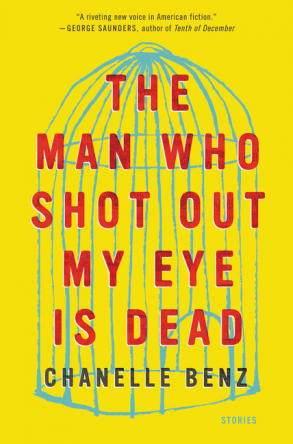
Finding a distinct voice is the first benchmark any great writer must accomplish. Chanelle Benz, author of The Man Who Shot Out My Eye Is Dead (Ecco), has created more than just a voice to stand out from the crowd. She’s created ten.
The stories in Benz’ debut collection are told from perspectives ranging from an eighteenth century slave to a baroque-style piece told in the collective We. The book begins with a non-traditional western that grabs the reader in close, then follows up with a contemporary story of family and violence that is just as gripping. It’s not just the wide-ranging eras and plots that make each story stand out; it’s the carefully-crafted voices. Benz is a trained actress who learned presentation is everything when it comes to captivating an audience and translated that skill into her writing. I recently spoke with her about how this collection came to be, how she found the voices, and people of color in the literary world.
Adam Vitcavage: It is easy for a short story collection fall into the trap of every story becoming redundant because the author wanted cohesion. Your collection is cohesive in tone, voice, and theme, but each story is so unique. How did you come up with such a wide variety of ideas?
Chanelle Benz: I initially set up an experiment for myself. What if I wrote a spy story? What if I wrote a post-apocalyptic story? What if I wrote a western? The first story I wrote was “Adela” — the second story in the collection — and I started doing that challenge. Things started to go awry. My version of a spy story was “The Diplomat’s Daughter,” which isn’t really a spy story; it’s more of an identity story. I just had a lot of fun doing it.
For me, part of it was trying to find a container for my story. It was healthy for me to set this experiment up. I guess the other cheat was that I was going to all of these periods of time that I’m interested in. When I was a woman growing up, and as a brown person, you’re not in historical movies or a lot of things. You have to insert yourself into it. If you want to be Billy the Kid or part of his posse you have to be his half-sister from some illegitimate fling.
Adam Vitcavage: One thing I found very interesting about the collection were the distinct voices of each narrator. How did you hone in on all of the different characters and how they sounded?
Chanelle Benz: I used to be an actress. I came from mostly a theatre background where we did a lot of Shakespeare, the Jacobian dramas, so I think part of it was from my theatre background. When we were learning accents, we would learn phonetically, as well as sometimes by ear. But I could not get a handle on phonetics. I could just not understand it that way. What I could do with accents was give myself a key into it. It was some sort of sentence that I would repeat to myself over and over again until my tongue memorized the movement of the accent.
I think I must have done something similar with the writing. If I found a key into the voice I could find a way into the story. For the final story, “That We May All Be One Sheepfolde,” I read a lot of Thomas More’s letters and made lists of words to find my way into the cadence of that time without making it so far removed from what modern day readers would know.
Some voices come right away for me while others take a lot of work. “Adela” opened with the children’s voice. I wrote the first sentence and had to figure out where to go next. I added the scholar’s voice later. It just so happened that I was reading a lot of scholarly, post-Colonial essays at the time that I could pull some of that language.
Adam Vitcavage: Are there any examples that still stand out?
Chanelle Benz: I can’t think of any off of the top of my head because I made such long lists [of words]. I might end up dropping some of that, but I never came up with a single sentence. Just words I would try to insert into the story somehow.
Adam Vitcavage: You mentioned how growing up you weren’t really represented in movies and whatnot. How do you feel these time periods tie back into current events and how people of color are portrayed today?
Chanelle Benz: I think that it has a lot of resonance. When I set out to write [the stories], I wasn’t consciously thinking that I was going to write any political message. I think there were stories, like in “The Peculiar Narrative of the Remarkable Particulars in the Life of Orrinda Thomas,” Orrinda says something about it’s her crime to be two things: a brown woman. These two words “brown” and “woman.”
I feel that’s true today. There’s a punishment. You’re persecuted for just being. I don’t go around thinking of myself as as a brown woman. I just go around as me. It’s just the outside world that shows me I am these things and that there is a cost to that.
I don’t go around thinking of myself as as a brown woman. I just go around as me. It’s just the outside world that shows me I am these things and that there is a cost to that.
That’s true for a lot of my characters. There’s a cost to being who they are and how they were born into the world. I think that’s still true and that it’s probably going to get even more true.
Adam Vitcavage: I live in Arizona and a lot of my friends are of Mexican or Navajo descent and while I rarely think about it, hearing them talk about recent events, I try to connect, but as a white male I know I’ll never really understand. There are these outside persecutors telling us that we’re different in some way even though we aren’t.
Chanelle Benz: Because I’m brown and kind of lighter, that also carries a privilege, too. I haven’t had to put up with a lot of things other people have. I’m British and used to have an accent, so because of how I talked and looked, some of those things carry a privilege. I never experienced the things my friends might have because they were slightly browner or speak a different way. They’ve had to carry something different.
I think the things that are happening with Trump and the racial hatred that is coming out, for a lot of people in the black community or different communities of people of color, they’re not surprised. It’s not new to them. The news of police brutality is interesting because it’s not new. Not at all. The rest of us have just never had to deal with that on a daily basis.
It’s interesting because the things that other people had to deal with for so long while a huge majority of us haven’t are all of a sudden having to be dealt with by all of us.
Adam Vitcavage: Do you feel that — and I don’t want to use the word — but do you feel that there is a duty for people of color to express this through literature? Or what’s the place of literature in a climate like this?
Chanelle Benz: I don’t feel there is a duty. I definitely don’t feel like it’s people of color’s job to write about or even talk about these things. You know, I want the right to talk about dragons. I want the right to write about whatever.
I do think in a time like this and you’re an artist, you can be an activist, you can call your senator, you can be involved. But you’re a writer. It’s important. What I guess I would say is that you shouldn’t be afraid to alienate your fan base by standing up for your convictions. Don’t be afraid of putting something on Twitter because my Trump readers won’t buy my book.
All stories are about the human condition. That’s what all of the greatest stories do. They make all of the trappings of humanity transparent and they tap into that. I think that it’s important to not be shallow but to dig deep, whatever that means. It doesn’t need to mean be political. It just means to get at what it means to be human.
It doesn’t need to mean be political. It just means to get at what it means to be human.
Adam Vitcavage: Within this short story collection, a lot of it thematically deals with race, history, family, and violence. What drew you to these larger themes?
Chanelle Benz: Family is one of those things that you keep repeating. You just keep coming back to it. It’s a deep unresolved issue. As for violence, I just think we live in a violent world. In my own life I have had to deal with a certain amount of violence like I’m sure a lot of people have. It’s something that carries a certain charge and a certain stain. When you’re involved in an act of violence, especially taking someone’s life, you can’t undo it.
Peter Brook, who is an English theatre director, talks about Hamlet as this great moral dilemma to avenge his father and kill his uncle. But once he takes his life, his soul is stained forever. Brook talks about what it means to kill someone. On a certain level, violence is like that as well. Once you do violence on someone, it’s marked on their body forever. Mostly all of the characters in the collection have a choice where they can become involved in this or not.
Adam Vitcavage: Did you always plan on releasing these as a collection? I know some of them were published previously, but was that always the plan?
Chanelle Benz: Once I had two or three, I thought I had a collection. I probably thought I had 20 stories. There was a story that didn’t make it and “Recognition” was written right before the manuscript was final. I know the stories are very different, but I think there is a thread that binds them together.
Adam Vitcavage: I read an interview you did with Kit Frick in 2013 and you had the title of the collection then. Is that how long you knew this was a cohesive work?
Chanelle Benz: Yup. [laughs] The first story I wrote in around 2010 and I didn’t know it was a collection. I was working on a failed novel then. When I started writing stories I didn’t think of myself as a short story writer and I thought my novel was what I was going to finish. I was working with George Saunders around 2012 and the mechanics of the short story really clicked for me. That’s when I knew I could do it.
Adam Vitcavage: Out of the stories in the collection, which one proved to be the most difficult or had the most revisions?
Chanelle Benz: When I’m writing them, I think they’re all really hard. Definitely “The Diplomat’s Daughter” had the most revisions. I ended up with five versions of that. I had the one I liked, the one my agent liked, the one someone likes, you know? In the end the one we went with didn’t bother me. That’s what I like about short stories: I feel like you can totally have a few versions that go different ways and they’re all viable, unlike the novel. There doesn’t have to be a definitive one.
It was challenging to figure out the order [of the story]. I had to put myself inside of the reader. To me the story is very clear, but there are a lot of scenes and then there weren’t. It was a story that was very pulled back and I had to put a lot more in to lead the reader. I was hesitant to put the headers in there, but an editor at Granta was very helpful.
It was the kind of story that was like a deck of cards where I could keep adding scenes to it. It felt at times that there were turning points and different kinds of revelations. Actually, the version I put in Granta is different than the version in the book.
Adam Vitcavage: What about the easiest or most natural story?
Chanelle Benz: I think “West of the Known.” I’ve probably been writing that in my mind since sixth grade. It came out naturally — not perfectly; I had to change around a lot — but I can remember writing a lot of the scenes quickly and how it felt when I was going to write the bank robbery scene. I told myself to just do it and write a bad version of it first.
When [the character] Jackson came onto the page I instantly knew their relationship. It came so naturally.
Clipped off by infinity. Poet and essayist Joseph Brodsky is describing the ends of a bridge arching over the Canal Grande on a night trip around Venice. On my reading of Brodsky’s words to Janina, she speaks of her father: she is the bridge with no ends and her father is infinity.
Two Poles walk into a café. One is Janina, a second-generation Australian; I am an immigrant who occasionally struggles with the peculiarities of speaking English in this country. I want to write about Janina’s life, so we sit in the café on Acland Street in St Kilda and Janina tells me she is scared of her father. She is middle-aged — at her last birthday she turned forty-eight — but she remains scared of a man she hasn’t seen for many years. The fear sticks to her guts and it is the same size as it was when she was eight, nine, ten, eleven, twelve, thirteen years old.
I want to write about Janina’s life, so we sit in the café on Acland Street in St Kilda and Janina tells me she is scared of her father.
Here is one meaning of fear: when a thought of someone or something arrives unwelcomed in your mind and begins a tug-of-war between your heart muscle with its needy hurt and every other muscle fibre in your body, rigid with adrenaline.
To unknot this sensation, the thought requires shaking loose. To shake loose means its opposite here: it is to sit still with a thought and the emotion fed by that thought. In her hands, Janina holds a filthy, folded piece of paper. She unwraps it and reveals a handwritten list of ‘Dos’ and ‘Don’ts’ for the times in the day when her heart, mind and body separate and compete for attention. Do sit with the discomfort, which will roll over you like a wave (but mostly like a tsunami, Janina says). Do name the emotion. Don’t resist it. Don’t chase the thought or the feeling. Do accept the pain, and that what you are feeling right at this moment is your hurting heart, and that it will pass. Do this repeatedly, for as long as it takes until the suffering ends.
Janina speaks of her father in a whisper using his given name and even this is a reluctant utterance. She was born in Australia but carries his European past in her blood, skin and muscle. For four decades Janina has not spoken about what happened to her as a child. Some mornings she is surprised to be alive, surprised that she can see out another day. She is sensitised to the intensities of daily life, and recites to me lines from a poem (by a poet whose name she cannot recall) that reminds her of this vulnerability: ‘With disbelief I touch the cold marble, / with disbelief I touch my own hand.’
It is Czeslaw Milosz. This, I can understand. Milosz writes poems only in Polish, refusing to write for English speakers: ‘Let them accommodate; why should I accommodate to them?’ he said.
Janina says: I can only know this Polish man through translation by another.
Janina talks to me about a professor of literature, Elaine Scarry, whose book The Body in Pain explores pain as being not ‘of’ or ‘for’ something. We have a fear of something (terrorism, something happening to our children) and we hold a love for someone or something (a tiny wounded bird in our hands), but pain has no object in the external world. Pain is not of or for anything: it can only ever be itself. And pain itself has the ability to destroy a sufferer’s language.
Pain is not of or for anything: it can only ever be itself. And pain itself has the ability to destroy a sufferer’s language.
The experience of suffering great pain and watching others in pain can unmake humans in different ways, Janina says. Although the Royal Commission into Institutional Responses to Child Sexual Abuse in Australia is ongoing, and although the media is saturated with commentary on how damaging this form of abuse can be, she says the inability to understand or empathise with another’s pain is why some human beings can listen to adult victims of child abuse and say: It happened decades ago. Can’t you move past it? Why didn’t you speak up sooner?
Janina knows these questions well; she regularly asks them of herself.
Vivian Gornick writes: “the way life feels is inevitably the way life is lived.” Janina says she struggles with her shattered identity — her sense of ‘I ’ — and now and again life feels too painful for her to continue. She says she cannot help feeling this way. She wants it to be otherwise, but she cannot find the words to make it so.
And what of the Commissioners and County Court Judges exposed to accounts of institutional sexual violence against children or sexual abuse within the social institution of the family, Janina asks. Imagine the pain of hearing another’s agony so intricately described and watching the faces of those reliving relentless memories from long ago.
Imagine the pain of hearing another’s agony so intricately described and watching the faces of those reliving relentless memories from long ago.
The Commissioners overseeing the Royal Commission have access to counselling and peer support, I say. A County Court of Victoria worker told me the Court offers a similar program to help Judges, Associates and Tipstaves with the vicarious trauma that can result from listening, hour after hour, day after day, year after year, to testimonies of sexual violence.
Does all that witnessing silence them, Janina asks.
Sometimes, I say. The County Court worker said one strategy Associates and Tipstaves use to offer each other relief is to make inappropriate jokes and remarks that they would never say outside of the Court environment. It helps lift the mood.
What’s brown and sticky, Janina asks.
I laugh. A stick, I say.
It is the only joke I know, she says.
I cannot escape myself or my past,says Janina.
She still accepts every portion of blame for what happened to her as a child. But how can an eight-year-old be responsible for the actions of an adult? What happened to you could not possibly be your fault, I say. The moral obligation for protection lies with the adult. She says two things she does know are the power to change the self-blame sits in her open palms, and the responsibility for staying alive is her work to do because there can be no reprieve from herself.
Some things only reveal themselves with time.
Janina met an Australian man a few years ago who was identical in manner to her father: infested with paranoid, vain arrogance and a pathological need for perfection and, thus, for control. With this man she replicated her father-daughter relationship. He told Janina he felt dead inside. Twice he told her this, once when drunk, once sober. At the time she knew anxiety and joy and living in confusion with these two emotions as well as the occasional desire to kill herself, but not the acute sensation of dying or death. After entertaining for a short time this man’s past (as complicated as hers) and his determined but probably unconscious desire to destroy her, Janina recognised inside herself an empty, discarded loneliness that came close to what the man described as dead inside. She says it took one year of not talking, not writing, not reading, not listening to music, being visited with Father Flashbacks every night, four nervous breakdowns, time in a psychiatric hospital and a recovery centre before something resembling relief re-entered her life. Janina calls this year-long trudge through punishing pain and unconscious self-excoriation survival.
She says it took one year of not talking, not writing, not reading, not listening to music, being visited with Father Flashbacks every night, four nervous breakdowns, time in a psychiatric hospital and a recovery centre before something resembling relief re-entered her life.
Janina says every human being on this planet has a complex personhood, and to sociologist Avery Gordon this means people ‘remember and forget, are beset by contradiction, and recognize and misrecognize themselves and others.’ We also suffer both ‘graciously and selfishly’, get stuck in our troubles, yet have the remarkable ability to transform ourselves. And to survive.
But Janina will not use the words ‘victim’ or ‘survivor’ to describe herself. She fears they will seep inside, smother her permanently, boxing her into how she should be. While her days continue to contain miniature ripples of joy alongside oceans of despair, she will not carry around those words like lead. She wants a rarer and better thing: To be unlabelled. Unmarked.
After she explains to me her injurious relationship with the Australian man, I tell Janina this is what I see: she was a victim of what Freud called repetition compulsion – a drive to repeat an original trauma in her life in order to overcome the constant anxiety stemming from that trauma. Although she was worn down by her need to attend to the mastery of this anxiety by having an affair with identical-Father, somewhere along the way she made a conscious decision to slough away the exterior and internal threats of self-annihilation through persistence and sheer guts so she could succeed at the basics of what a life requires — that is, to survive each day.
She laughs at me. She tells me I am full of Shit ‘n’ Freud.
In Ghostly Matters, her masterful book on the cultural experience of haunting, Avery Gordon quotes legal scholar Patricia Williams: “that life is complicated is a fact of great analytic importance.”
Analyzing the complexity of her emotions and memories is the only way Janina can understand her father.
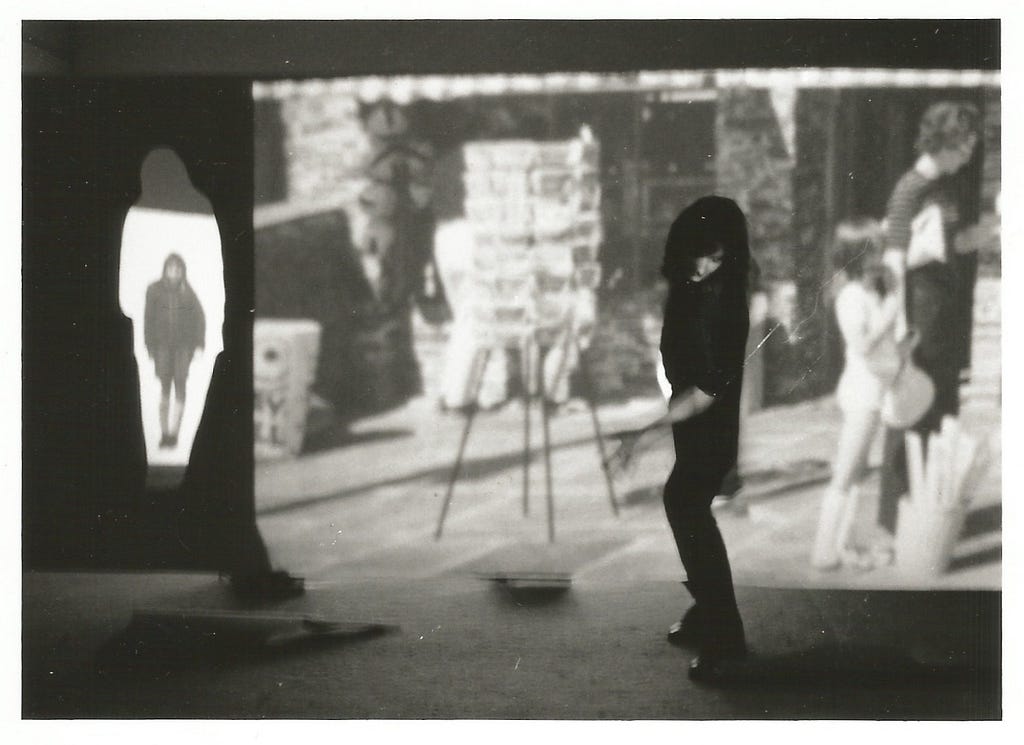
“When I Grow Up I want to be Remembered.” Performance #1. Slide projections of family snapshots, paper, knife. 1991. ANU School of Art. Janine Mikosza
When he calls her on the phone from the other side of Australia to ask how she is, this happens: she is suspicious; she doesn’t believe him; and she doesn’t trust him. Why would a man who harmed her so deeply and who remains taut-mouthed on the past want to ask after her health? Does he do it for forgiveness? Is it forgetfulness? Janina listens to him ramble and is patient when he wants to talk about his grandson, her son who has not known one shred of vileness, and when she hangs up the phone she murders each day on her calendar with a violet pen until the next call.
Janina says some people she’s met who have had stable, loving, unviolent childhoods have difficulty understanding the need to run towards something and away from it at the same time; it is beyond the exactness of personal experience. To them it is like dodging cars on a busy road, putting yourself at risk of certain harm. She says there is no point explaining that you live haunted by things that happened to you decades ago and there are pictures and sounds in your head constantly playing like an endless looping GIF, and apart from a temporary reprieve by detaching from reality nothing you can do or say will make them disappear.
The best you can do is to learn how to manage your emotions and lower your immediate distress.
The ones among us who have the ability and opportunity to corral their thoughts, memories, experiences and opinions within the tidy boundaries of a story and who can disclose their trauma publicly in this way are the ones we are attuned to, the ones we want to hear. Of course they are: their voices are less messy, more sane, more contained than voices like Janina’s. When I say to Janina I will write her story because my role is to make certain the forgettable ones are never forgotten and she displays great bravery for her survival, she says you don’t understand.
When I say to Janina I will write her story because my role is to make certain the forgettable ones are never forgotten and she displays great bravery for her survival, she says you don’t understand.
Although I am now proficient in English, it will always remain my secondhand language, and sometimes, as the novelist Maaza Mengiste writes, “I have fallen between its cracks trying to trudge my way toward comprehension.” But this fight to write and speak English words is also why I can face Janina and say: My struggle for le mot juste makes me work harder to understand what you say and mean and feel, and to know your trauma, vicariously.
Speak out, they say. Write what you fear and throw it out into the world, they say. It will be cathartic, they say. As a writer, Janina has met too many of these they people. Janina does not want to write her life story. Memoir; personal essays: she chokes on these words. The exposure of the confessional ‘I.’ Even though she knows the ‘I ’ is a construction (often a confection, says Janina), it creeps through many forms of non-fiction, foregrounding the author/narrator as subject. The topic revolves around the narrator’s perfectly flawed centre and everyone outside this self is collateral damage to the author’s journey of discovering themselves.
Janina does not want to write her life story. Memoir; personal essays: she chokes on these words.
(Done well, this writing contains evocative ideas and wiry muscle words, I say.)
(Yes, but mostly it is not well done, says Janina.)
Of course, while the narrator critiques others, they may also speak poorly of themselves (“please note my lack of education and/or lack of sophistication and/or dysfunction of some type”). Janina agrees with Maggie Nelson, who, in The Art of Cruelty, labels the principle of memoirists and personal essayists that claims you can say anything about other people as long as you make yourself look just as bad as a “sham, a chicanery, one with its roots planted firmly in narcissism.”
Essayist David Rakoff wrote that he researched subjects in the hope he would find out more about himself. He called his research “me-search.” At least he was honest, says Janina.
Maggie Nelson also wrote, “Writing can hurt people; self-exposure or self-flagellation offers no insurance against the pain.” Janina says this is another reason why she has no desire to write memoir or personal essays, or to deliberately write autobiography into her fiction, or to speak of what happened to her except in a general way. She has no need to injure those who hurt her. In exposing them, she harms herself: for me, this is not justice, she says.
Due to her aversion to writing personal narrative, but with a need to know where the roots of her family’s violence took shape, Janina asks her father to write and send her his life story. She wants to know more about his childhood during the war and to find in his tale a reason or reasons for why he did what he did to her, and in the process discover more about herself (this is her “me-search”). But she does not want to be in his presence. She uses her young son as cover (my fear is despicable, she says), and asks her father to write his life for her son so he will know where he came from.
Janina says to me: I can only know my Polish father through my son.
She asks her father to write as well as he can in English. Her son doesn’t speak Polish.
I ask: Why doesn’t he speak Polish?
She says: Because I don’t speak it and never will, and children are given what their parents are able to give them, and nothing more.
While Janina’s father hurt her body he spoke to her only in Polish. When he called her useless, hopeless, stupid in front of others he said it in English so she would feel the precise articulation of his words.
When he called her useless, hopeless, stupid in front of others he said it in English so she would feel the precise articulation of his words.
When he argued with Janina’s grandmother, aunt and uncles he did so in Polish.
When Janina’s mother called her one of those girls on the street corner, and when she told her husband you spend more time with your daughter than you do with me, she said it in English in front of Janina so her daughter would understand every word.
She shares her grandmother’s name. She pronounces it with a ‘J’ — Jar-neena — and I wince at its harshness. Janina with a soft ‘J’, like a ‘Y’: this is how you pronounce it, I say. But she cringes whenever it is spoken this way. My name can never be gentle, she says, and I call myself by my Australian name — Janine with a hard ‘J’ and no ending in ‘a’.
Janine knows “yes” in Polish (tak), but she can’t remember “no.”
Is it net? she asks. Or ne, or nein?
It is simple, I say. It is ‘nie’.
Janine says nie, and with her Australian accent it sounds like a “yeah.”
I cannot escape myself or my past, says Janine.
But she has no need to write violent details of her childhood. As Susan Sontag once wrote, “there’s nothing wrong with standing back and thinking.” Some things can remain your own and don’t have to be released to the world. If she did reveal in print the crimes against her, she could (potentially) have a sniff of temporary freedom from her suffering, and readers would congratulate her on her courage and the redemptive brutality of her self-exposure. And she could add to the literature on family violence piling up like dead bodies in bookstores. But then what? What comes afterwards? Would this revealment sustain her? Would it be effective in offering her some sense the suffering would end? She would return to the daily struggles of her life with the additional pressure of being labelled a memoirist.
But then what? She would return to the daily struggles of her life with the additional pressure of being labelled a memoirist.
There are some things broken that can never be unbroken. Pain has the ability to destroy a sufferer’s language, so Janine says: I will find other ways to describe the experience and aftermath of violence, how I feel it, taste it, hear and smell it, and write my stories not detailing explicit violence but clearly borne from it. I need to write about states of uncontainment, says Janine. To make the pain of and for something.
I am not sure what this would look like, but I will not write Janine’s life story. I can attend to what she says and doesn’t say without locking it up into words. It is her right to argue against public disclosure, to not write of her past, and to live with ambivalence and uncertainty and contradiction. For now, we sit in this café and I paraphrase Brodsky’s words — what makes a narrative breathe is not the story itself but what follows what. And what follows what, I say, is both the summation of our lives, and for each of us to decide.
Janine looks at me in my eyes, smiles and says: Nie. You know nothing.
All the best literary links that are fit to, well, link
Lena Dunham talks to Mary Karr about dealing with Trump voters, teaching, and getting asked about David Foster Wallace too often: “Everybody in America owes me a dollar who read Infinite Jest. I guess having grown up in the period of time that I grew up, I grew up with this. I think women of your generation, they have better underwear. They have better eyebrows. They have better bra technology. Better politics. I think they like themselves a little better. I think the men of your generation are a little better, a little more sophisticated. They’re not going to call a woman a whore because she has a job that she goes out at night in a car. You have freed women to talk about the shitty sex of hookup culture and how hard it is to have relationships with other women at your age, through your twenties when you get out of school, those pressures. As I say, I think you’ve made the all-American menstrual hut.” — Mary Karr
Michiko Kakutani writes on President Obama’s voracious reading while in office — “During his eight years in the White House — in a noisy era of information overload, extreme partisanship and knee-jerk reactions — books were a sustaining source of ideas and inspiration, and gave him a renewed appreciation for the complexities and ambiguities of the human condition.”
(Read this for all of President Obama’s book recs)
Ottessa Moshfegh discusses her depression, writing, and the Scottish singer Lena Zavaroni with The Atlantic’s Joe Fassler: “My nature is not to feel thrilled at being alive. I’m 35 now, but up until my 30s, I really just wanted off the planet. I also have been somebody who felt pretty helpless about my own eating disorder. Nobody came to my rescue, and it was really depressing. I think eating disorders are a way of trying to change who you are because you feel powerless to change the world.”
How an independent bookseller obsesses over his customer interactions: Samuel Gaffe Goldstein writes on the perils of customer service — “My human weakness revealed itself recently when a customer asked for a Copenhagen travel guide and I handed her a Lonely Planet Belgium. To confuse Belgium with Copenhagen takes real talent”
Tom McAllister on why podcasts may be the future of book reviews — “Book reviews have traditionally been written in an ostensibly objective voice, while podcasts provide a more personalized, idiosyncratic response to a given book.”
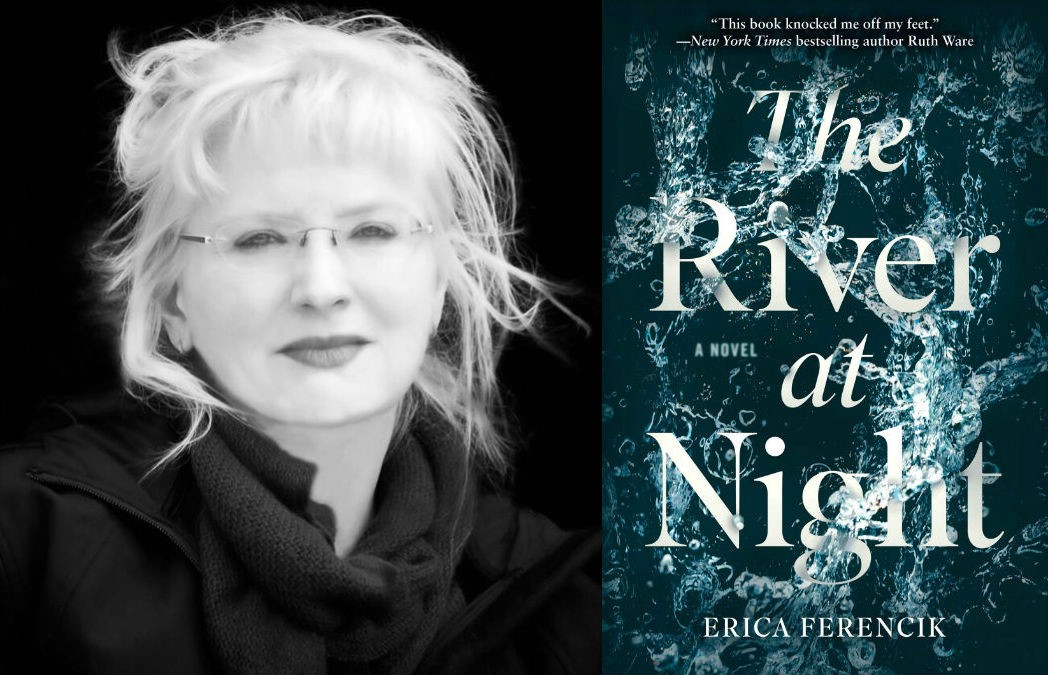
The majority of fiction set in Maine is dominated by Stephen King. Every now and then an author chooses to set their writing in the vast wilderness of the Pine Tree State and truly captures the essence of the area. Erica Ferencik has done just that. Her new novel, The River at Night (Gallery/Scout Press) is a thriller about four women on a rafting trip that quickly turns into a nightmarish fight for survival. Ferencik’s writing moves as swiftly as the river the women find themselves on. The novel manages the kind of character development and probing of motivations that most books in the genre miss out on.
I recently spoke with Ferencik about Maine, what influenced her style, and how research is both important and interesting work that ever novel needs.
Adam Vitcavage: So, you live in Massachusetts — what drew you to write about Maine?
Erica Ferencik: My first goal was to write a book. It wasn’t about Maine necessarily, but the there were really two reasons to write this. I read the book Deliverance by James Dickey, which became a movie that everyone references. Cue the banjos, you know.
Adam Vitcavage: Yeah, those dueling banjos.
Erica Ferencik: Have you read it?
Adam Vitcavage: I haven’t, but I’ve seen the movie. Which backs up what you just said.
Erica Ferencik: Exactly. Well, Dickey was a poet. He wrote this beautiful, repugnant, visceral novel about four men in Georgia. I just fell in love with how he approached the story. It’s in real time and how he builds the suspense, the way he describes natures is very stunning.
The second inspiration was an ill-fated hiking trip of my own with four women friends to the White Mountains in New Hampshire. The woman who planned the trip didn’t do a very good job. We were staying in the hut system in New Hampshire and we were supposed to make it there by 5:30 and didn’t get there until 10:00 at night, when there is still just a shred of light.
That experience made me think of where I could write about that was super remote and had always fascinated me. Maine was perfect; it is so big. Going up there I was amazed by the nothingness. It was a choice for where I can set the characters so that it was drivable for them to get to, but that they can still get completely lost.
Adam Vitcavage: I read in your acknowledgements that you researched a lot about Maine. What was that like?
Erica Ferencik: I took a nine day trip to Maine to research the book, and I wanted to interview people who lived off-the-grid. I didn’t know anyone, so I called all of the chambers of commerce from Caribou through Fort Kent and they all said, “Yeah, we know people, but they live off-the-grid and won’t want to talk to you. That’s why they live off the grid.” Then there was always this pause before they would tell me, “But I know somebody who knows somebody.”
I was able to set up interviews with seven people. Two had families and five were individuals. They all lived off-the-grid. I went up there having hotel reservations for all nine nights but only had to stay in one the first and last night because they all put me up overnight. One was a rehabbed bus, one was a boat — and I don’t know how it got there on the land — outside of Sweden (Maine). I got these wonderful interviews with these people. I wasn’t trying to be literal with the story; I was just trying to get their motivation. So many time my assumptions were wrong about why people decided to do this. They were all different.
Believe me, I was often really cold. I did this in November and early December. I had a knapsack with mace and power bars and lots of warm clothes. One guy — I met him on the highway and got on his horse and rode into the woods for an hour and a half until we got to his place where he lived with his family. They gave me lunch of bear meat and wild parsnips. He made me sign this old carbon paper agreement that I wouldn’t tell anybody details about his family or where exactly he lived. He basically made me sign it before I got on the horse with him to get back to my car.
Adam Vitcavage: Other than the guy who took you to his house on horseback, what were some interesting things that happened to you during this research?
Erica Ferencik: The big unexpected thing was that people wanted me to stay overnight. Once I got their trust they wouldn’t shut up. They all wanted to talk. One kid was about 20 years old and it was his second year out there. I was stunned by his resourcefulness. He would be like Kerouac by night and there were wolves howling out of his cabin at night. He didn’t want to use anything man-made. Everything he used and wore and ate was from the wilderness except for his ax and his gun. He knitted his own long underwear, hat, clothing. He made a belt buckle out of a piece of deer bone.
From one side of his mouth he would say he wanted to be alone to discover who he was in the natural world. At the same time from the other side of his mouth he said he hoped that one day some of his friends would set up a mile away and have their own life out there. He did admit to me that once a week he goes to the library to check his email and to get a box of cinnamon pop tarts. He was a very idealistic and brilliant young man.
Adam Vitcavage: How did all of this tie back into The River at Night?
Erica Ferencik: I did get a lot of ideas about how these characters might survive. And how they might disappear. I also interviewed a ranger to get details on how someone might disappear and how they look for people. What happens when they find someone? Those sort of things.
I also interviewed a family and asked how they were dealing with having no money. They had a little girl and the wife was pregnant. Their deal was that they were from Philadelphia and they couldn’t get jobs. They were going to be damned if they were victims of the economy and wanted to be home owners. They built this tiny little place and had a trailer behind them, they had dogs for protection, and they even killed a moose that was right outside of their door. It ended up being too much meat so they got help to learn to dress it. That’s how they met their neighbor who was 12 miles away.
Adam Vitcavage: After doing all of this research and putting your characters into this predicament, how much did you feel you needed to get the geography right? Or did you just throw that to the wayside to get the feel of Maine right?
Erica Ferencik: Well I did a weird mix of techniques. I took a very real place but put a completely fake river in. Not one person said, “Hey! There’s not a river called that.” Not only that, there isn’t anything like an unexplored river in Maine. Nobody said anything. I used the names of real places, and there is a river sort of like my river, but not really.
It’s funny because no one has had a problem with that so far. Obviously I just wanted to create a story.
Adam Vitcavage: How did you work on the pacing for a literary thriller like this?
Erica Ferencik: There’s a lot of editing, but I’m the type of person who plans it all out. I think it’s great that there are writers who can write without an outline, but it’s impossible for me. It’s too big! You need to see the whole thing in your head whether it’s through writing an outline in some way. You can’t build a house without a blueprint.
In terms of pacing…My undergrad was in fine arts and painting. At 28 I woke up and had no desire to ever paint again and I started writing. I began writing screenplays. I was trained to think visually right away. There’s a great book called Story by Robert McKee that really helped. Knowing how to write screenplays helped me to learn to write novels. It took writing screenplays for me to really understand the three act structure and to understand stakes, reveals, and all of the other techniques that go into films. I don’t think any novelist is hurt by learning screenwriting. That’s the most powerful thing you can learn to help create thrillers. Books that move and are visual that grab you need those things.
I don’t think any novelist is hurt by learning screenwriting. That’s the most powerful thing you can learn to help create thrillers.
As a writer you need to always ask “what’s my story? what’s my story?” Even to the sentence level — “What does that have to do with my story?” Especially in this day and age when nobody has an attention span at all. You can’t risk losing people.
Adam Vitcavage: What does your outlining or planning actually look like?
Erica Ferencik: First of all, I think the first step is coming up with an idea that is book worthy. Sometimes you come up with an idea and you’re a genius and you go to bed. Then you wake up the next morning and you’re an idiot because the idea you came up with is flabby or doesn’t have enough complexity. It just doesn’t work. The big thing is having an idea.
Once I have an idea, I like to be able to say the story. Just say what the story is in a couple of sentences. Knowing the basic super stuff like the three act structure, I pull the story from different sides like the dough of a pizza. I figure out my characters, what they want. Everybody needs to want something. Who is the protagonist and what do they want?
I figure out the outer story: what happens. And the inner story: what is happening emotionally. Those two lines intersect and separate and intersect and separate. Then I lay out the subplots and how they resonate off of the main plot.
I never edit myself down. I always have pencil and paper with me or my recorder because I know I won’t remember my ideas. I just work it out and in the end I have literally a 20 to 30 page outline with lots of notes.
That’s the real work of it. I mean, all of it is work. But writing isn’t writing; it’s thinking. As long as you figure it out, it’s all there.
The clocks had been stopped and she did not know if a day had yet passed only that it had been light then dark, and now the light had come again, but had it yet been a day? In this uncertain passage of time, she had not had thought. Instead a road of airless wool had unfurled wide in her head, winding monotonous through the astonishment of her loss.
Just before, when Henry had lain swamped in his own blood, his wife had heard his mother telling the new Negro cook as they stood outside the bedroom door with the dinner tray: “There is an art to dying and the boy does not have it — never mind he has been dying since first he was born.” Out the bedroom window in the fermenting dark, a loose dog had again started baying. “Should I turn over a shoe, Henry?” his wife had asked, wiping her folded handkerchief across his mouth. Henry’s eyes were closed, active in their closing, the collar of his nightshirt flecked red. Having been married to him fifteen years she had grown accustomed to his notseeing. Notseeing his mother’s slights when first he brought her to Mississippi. Notseeing her unseemly origins. Notseeing her father’s vulgar, dubious profession. Notseeing Judah’s exhausted frailty betrayed by the transparency of that child’s skull.
For days now his wife had heard voices speaking of her, the Yankee, so of course a Negro lover, a motherless daughter who had entrapped Henry. Whether this was spoken as she sat there in the swelter of the parlor as the townsfolk came in to view the body she could not tell, she knew only that the voices were those of women.
Her own mother had not bothered giving her a name. Perhaps predicting that she would not live past birth, it then being a time of yellow fever, or perhaps imagining that if she were to survive girlhood, she would enter into the fleshly profession, adopting a name meant to jollify men — Diamond Dolly, Baby Minnie, Big Kitty — rendering a name prior to that undertaking inconsequential. It was her father who had named her Emmeline. Emmeline, after his sister who while still a girl had fallen from a tenement window in the Lower East Side.
Emmeline stood in the stately plush oppression of the parlor and went to where her husband had been placed, propped, arranged, displayed, to where the day was finding its way into his body, choking the candles and compression of flowers.
That rot in the heat could not be her Henry. The dull gold hair she had combed and cut, the smooth emaciated body she had bathed, making certain to touch every part — the left hollow of his collarbone, the stilldamp behind his knees, the indent of his lower back — because it was said that a dead person’s spirit could enter through your hands she had gripped and kneaded his fast ossifying skin, pinching his spirit into hers.
For it was through the body that they had first understood each other. When first he saw her outside of the finishing school, he had taken her hand as if he had been waiting for her.
His dying left her in a strange muscular silence: a black halo of notsound. If ever they were to speak again it must be now through the spirit.
She closed her eyes and traced the scrolled back of the sofa to the center of the parlor, nipping her shin on a serving tray. She walked until she banged into the wall, bruising her left knee, sliding along until she felt the door. When she opened it, she opened her eyes.
No sunlight striping the hall’s floral patterned wallpaper. No pallbearers coming to carry him away. Nobody to tell her if it had yet been a day and if she, Emmeline, once the wife of Henry Stovall, was free to leave his body.
Emmeline was not seen leaving the house except for Sundays. On the church bench, the weeping veil of black crepe could not wholly hide her, but she felt sequestered, screened. Only Judah, squirming on her lap, could slip under and touch, his fingers reminding with their hot wet that though no longer a wife, she must be a mother. The baby clutched her skirts as if trying to steer her, melting his yellow curls into folds of her heavy black serge. Kissing his hands was enough to make him smile for she was his religion.
Every night before midnight, Emmeline let herself out of the whitewashed front door and hastened down the line of cedars clotting the path, her skirts rushing over the ivy trailing down the roots as a net of branches spread above, dissecting the night sky.
Over Henry’s grave, the damp silence was swallowed thick and she was nakedly awake in the stutter of birds and stars calling through the melt and sway of Spanish moss suffocating the trees.
HENRY JAMES STOVALL 1855–1889
She called but he would not come.
Nine months passed before Emmeline received a letter from her father, Zebediah Ferris. In it, he made no mention of Henry, or of the year and a day that a widow must wait when in deep mourning. He wrote only: “I need you here.”
She did not comprehend his urgency but recognized the habitual, cryptic pattern of all his attending her. When on holiday from The Select School for Young Ladies in Atlanta, she would arrive at a temporary town of picks, shovels and pans to live with him among the drinking, whoring and gambling. Either he had ignored her, or furiously concealed her in a hotel, setting Wilkie, a former buffalo hunter and his enforcer, at her door.
Emmeline could not disregard the letter. It was her father who had sent her East to the expensive school, he who made certain that her marriage to Henry Stovall, variously contested by his family, had taken place, he who had been the originator of all her good fortune and as he was fond of saying: the devil has his price.
Outside the parlor, Judah, a condensed weight on her hip, dropped his head on her breast.
“Sleepy, button? Yes, we’ll do it now,” she kissed and kissed him. “We’ll do it quick.”
Mother Stovall did not look up from her bookkeeping until Emmeline spoke saying, “Mother,” and the parlor filled up with a static, continuous ire as she raised her goldgray head but not her pen asking, “Yes? What is it?”
Emmeline hesitated. “I’m afraid I’ve had a letter from my father.”
“It’s about time. I saw it delivered.”
“He said that he wants — well truly he needs me to come out West. And I feel I ought.” Emmeline shifted Judah onto her other hip.
“Hadn’t you better not. To take a trip? Now? Why it isn’t at all seemly. Write that you will come in three months.”
Emmeline turned away, lingering near the piano. Judah stretched to pick the wax at the bottom of a candle perched next to the sheet music. “But how could people, Christians I mean, find fault in my traveling to see my family? Is that not a duty? Not a wise and sensible course?”
“Nonsense. The world will know it as a lack of respect for the memory of the dead. That you should have the courage to go against it — a Stovall would not contemplate it — it must be the extravagance of your age talking.” Mother Stovall put down her pen. “Wasn’t Harper’s right that the sham lady will always be manifest?”
Emmeline put her chin on Judah’s hair. “I have no wish to be the cause of talk, Mother.” As she kissed his head, her lips felt for the thin, compact burn of a fever. She began vainly humming. He had yet to fall ill.
“Don’t you take that boy if that’s what you are supposing.”
Emmeline opened her mouth.
“Why? Why Judah is as susceptible as ever his brothers were. Traveling for so many days on a dusty road will kill him if he isn’t first slain by Indians.”
“Won’t my father want to see him, having never done so? He never got to meet August, or even Caleb.”
“There was reason for that.” Mother Stovall sniffed. “Caleb. You always had a partiality for that boy — petting him so.”
Caleb had died in the time it had taken her to change her dress. He had squeezed her hand crying “Mama,” and she had cradled him as she did the day he was born. She had not believed he could die.
“And should I care what he of nopast may desire? He whose scandalous vocation Henry did not care to dwell on, nor whoever your mother may have been, yet how could not I? Being a Stovall of Mississippi, how could not I?”
Mother Stovall had clung to this refrain for fifteen years, brandishing it whenever she could: a dull, starved outrage gone solid.
Reaching for a pinecone, Judah toppled a frame from the mantel. Emmeline crouched on the empty bricked hearth where Henry’s rifle leaned with Caleb’s fishing rod, saying, “Judah, now look — you almost broke it.” It was a painting Mother Stovall had done: a small portrait of Henry, a white- blond boy in short pants. She laid it facedown on the mantel.
“As a man Henry did not have to dwell, but we women must. You and I must.”
Judah kicked and Emmeline set him down, watching him toddle and yank on a curtain rope. “Gently. No, I’d not have him fall ill, of course not. Be gentle with it, Judah. And I am sorry if it gives some reason to talk, but I have to go. Mammy Eula can care for him while I’m away. It won’t be for long. A week or two. It couldn’t be for long.”
The goldgray head lowered back to the bookkeeping, scratching over the household accounts. “What would you not do for that horror of a man? As if you are his dog and he has said, Come.”
For what did her father need her, to what use could she, a mother, a new- made widow, a woman of thirty-two, be put to by a brothel-owner in a cowboy town? When the stagecoach rattled in and the ditched road bucked her one last time, the black lace went tight around her throat. But as the driver opened the door and her hands accepted his, the constriction of lace left her.
The two remaining passengers, a pregnant woman and a hazy notyoung whore, grimaced at the mud track meant to be a main street, at the slop pot stench of the tents, at the baleful eyes of purblind men. Emmeline stood in the center of the thoroughfare, drawing back her heavy crepe veil, letting in the din of burnt hard necks. How long it had been since she had known this incongruous measure of relief which now undid her as she staggered tranquil into the dusty hotel?
“Hell is in session, Emme. The town lost its marshal last month.”
“Did he run, Pa?” she asked, sitting on a chair by his bed, her hands clasped tight in her lap. She could not get comfortable.
“Naw, he was strung up. Turns out he used to be a bandit before he turned lawman and had returned to the old ways. Made a miscalculation robbing a bank near Fort Worth and those folks came down here for justice. I myself could not help him though you might have said he was a friend.” He said this while he paced the hotel room, a dirty glass of whiskey in hand.
“Oh dear. Well, I do hope they broke his neck first.”
“Naw, not that rabble. He hung there like an angry chicken for nigh on two hours turning blood purple.”
“Now Bart, you’re exaggerating. It was half that, and it was a bank near Galveston not Fort Worth.” Madame Cora, her dyed blond curls rolled tight to her head, in far finer dress than Emmeline, smiled triumphantly from above a cape of fox fur.
“Jeysus,” said Wilkie from where he stood by the door twisting the stillred of his mustache. “Sure is durn good to see ya, Emme. You look right well. Glad you come help us with them Morgan boys.”
“Shut your mouth, Wilkie,” said her father finally sitting down on a chair on the other side of the bed, a ragged titan in a new suit.
Till then she had avoided the dirty patch covering his left eye, waiting for him, but in the tension of all in the room she now sensed an agreed deflection. “What happened to your eye, Pa?”
The new gauntness of the large, square face glared at her. He leaned over the bed, flipping the patch to show a ruined hole damp with healing. “The girls got the men a little too excited and they took to shooting out the lights. That’s how some celebrate their salary.”
She wondered why he bothered with the lie. “Who did it, Pa? Was it these Morgans?”
“I see you’re still in mourning for Henry. But now ain’t you always in black.” His remaining eye which was also her eye scraped at her. “I reckon since you’re dark, being a widow becomes you.”
“Pa?” Her voice close on a whisper, as if they were alone. “The night before Henry died, I heard a dog.”
“Howling?”
“Yes.” She nodded, her eyes wide.
“Did you now?” He too came soft at speech but with an austerity she could not at that moment match.
“Yes Pa. Howling and howling. It wouldn’t stop. I don’t know whose dog — I don’t know just whose it was. And it was odd but I remembered something Ma had said, and it is one of the few things I ever recall her saying to me, but when Flossie — do you remember Flossie? — was sick with fever, Ma said that when someone is dying you must go under the bed and turn over a shoe. Remember?” He was the only person she had told, could tell.
“And did you,” he asked, “did you turn over a shoe?”
“I only remembered what Ma had said when I was in the garden with the minister and he was asking me what kind of coffin did I want. But when I went up and asked Henry — ” She scratched her cheek. “No I didn’t do it right away. Do you think, Pa — ?”
“It hasn’t been a year, has it, Emme dear,” said Cora, folding and refolding her cape over powdered breasts. “What with losing two sons and then your husband, Lord, why you don’t know yourself. It’s a good thing you come here to be with us.”
“I’ll have to go back soon,” Emmeline said.
“I thought you might bring the boy,” said her father.
Her face burned for she was wishing she had not come at all. “Judah is too like his father and brothers.” Emmeline untied her bonnet and smoothed the veil, seeing Judah when he woke in the morning, his undiluted joy upon seeing her face. Who else would ever look at her like that? “I suppose you want me as madam.” She spoke now with the vigilant serenity which kept her intact.
“I didn’t spend money on your fancy school for that. Besides, I got one here. Cora gabbles on but she knows her trade. I’ll give her that much. You being the grand lady in the Old States is worth something. I ain’t about to throw away all that damn accomplishment.”
“And since I’ve come on,” Cora said, “a trick here can earn five dollars — ten a week and you got fifty. We got a whole bunch of new girls too, did you see? Oh, they got to feeling blameful at the start but then they watch as their savings pile up! Emmeline honey, you could be an angel to your father now in his time of need.”
“Shut your mouth, woman. There’s a man who wants to meet you, a man I want you to marry.”
“The man who shot out your eye?” Emmeline asked.
“The man who shot out my eye is dead.”
“You do not mind if Wilkie remains, do you Mayor Gibson? It is a great comfort to my father to know that I am accompanied until I am able to hire a female companion.”
“Dear madam, as you wish. Have you had trouble finding a suitable abigail?”
From across an unvarnished table in the shadowed vacuum of the hotel parlor, there was a brutish, glittering air about the fact that Mayor Gibson’s coat reeked of cigar smoke and his breath was saccharine with brandy. He was a man who did not wear his weight well. The corpulent pucker under his eyes seemed to be dragging itself from the bone.
“Well sir, I did not know that I would be visiting for quite this long, and I find, without the least surprise, that there is a scarcity of respectable women in town.”
“Ma’am, I myself will make inquires on your behalf.”
“It is most kind in you,” she said and smiled in her light, fatal way.
“Your father has told me that you have recently lost your husband to consumption.”
“Yes sir.” At his mentioning Henry, she began to detest him.
“Such a cross to bear when already you have said farewell to others. How long has it been?”
Her throat went dry. What was Judah doing now? Likely playing in the garden, or sleeping on Mammy Eula’s nap. “Coming on eleven months.”
“So recent, so recent. Why it might feel to you he were alive yesterday. It did so with my sweet wife and little girl child. Time passes differently for the bereaved, does it not? And when you wake in the morning, there are those first moments when you are innocent of knowing like Adam in Eden.” He pressed a limp hand over her glove and through the black kid came a damp heat. “Your father said I would find us of a similar understanding.”
This man she was supposed to marry was a fool. She felt behind her to where Wilkie stood, thumbs in the pockets of his shabby waistcoat, and was scalded by his notwatching.
“Sir, I will confide to you that the reason I have stayed is because I am dreadfully worried, dreadfully worried that I might lose my father.” She heard her words as if someone else was speaking.
“I do believe, ma’am, that we will meet those that we have lost, that itself Death is but one level of our moving closer toward God.”
“I would like…I do believe that as well. Yet I cannot help but feel my father is fortunate that the bullet which took his eye did not pierce his brain.”
“In these parts, danger predominates in so many of our young men’s dispositions.”
“But sir, I have heard that these Morgan brothers are regular bandits, that they ride with posses and such, robbing the Mexican ranch — ”
“As I myself am no Wild Bill, it has seemed best to let such beasts deal with their own. Is it hard on you there being no Methodist church in town? Is it possible you might find comfort at a small gathering I sometimes frequent? I could introduce you to our celebrated Miss Ada.”
She finally felt she could withdraw her hand. “What takes place at these gatherings?”
“The assembled ask Miss Ada questions of metaphysical abstraction and she answers with what I would deem supernatural eloquence. You would find her elocution upon the subject of the deceased most enlightening.”
“I suppose it is true that I sometimes feel there is nothing noble in my grief.” This may have been the one true thing she had spoken.
“There is that which assuages the mourner, the one who has yet not charted the passage to the grave and may have a vague horror upon its account. Why ma’am, if I could but show you the liberation that could be yours — but I do not seek to proselytize, only offer you the solace which I have found. If I could arrange it, Mrs. Stovall, would you care to join us?”
“I think — ”
“Your father seemed to feel you might.”
“ — Yes. He is so often right,” she smiled and Mayor Gibson smiled at her, wiping his hands on his thighs. “I could do with the solace you speak of. Though I can’t help but think that I would know some measure of it if I knew my father were safe from the Morgans. You see, talk of them taking their revenge is all over town. It seems unjust when it was Shep Morgan who shot Pa, and Pa who was simply defending himself. But Shep being their kin, the Morgans shall never see reason.”
“Would ease your mind if I had a warrant put out for their arrest?”
“It would…” She pretended to be flustered. “No, yes it would, that would, it’s true.”
“Please do speak freely. Are we not friends?”
She decided to lower her eyes. “I don’t wish to seem ungrateful, sir.”
“You could never.” Again, he pressed her hand.
Now she looked straight at him. “As long as the Morgan brothers are alive, my father is in danger.”
“And as mayor, I could see that they hang?”
“My father believes it would ease my mind.”
“And he being so often right?”
She need say nothing, she had won him, and was impatient for the game to end.
“Dear lady, I shall see it done.”
“Thank you.”
“Now that we are friends you must call me Jasper.”
“Thank you, Jasper,” she said.
Emmeline tucked the letter in a drawer next to a memorial tintype of August, her first baby upturned and openmouthed in her arms. Henry had not wanted Caleb photographed saying we had him for eight years, we will not forget him. He had a signet ring made; the band filled with Caleb’s hair.
The day of August’s burial it had rained, but rain so light she could not feel it, and still the dirt would not go soft, lending the shovel a feverish tinny rasp that bit and bit. But the morning after Caleb died she and Henry walked the sunny fields, their sweat and tears loose in the gold lead heat. Now she could not clearly see Caleb’s face. She who had made him — her and Henry and God.
“You’re a right good girl.”
She turned from the dresser to face the balcony. She had to close her eyes to say it. “My boy is ill.” But he was with Mammy Eula, a better nurse than herself, she knew. She hated hearing her babies cry, the pained mewl that none of her words could soothe. “I have to go back.” She pulled her trunk onto the bed, opening it.
Wilkie folded his arms, as if to shrink his bulk. “He’ll get better. Don’t you fuss yerself. Thet Miss Ada is a medium.”
She needed fresh air, outside, the fresh air. “I’ll tell Pa. I can come back once Judah’s well.” From the balcony she could see Mayor Gibson passing below. “Am I the only woman who isn’t a whore that Mayor Gibson has known in years?” She watched as a drunk was thrown from a saloon by two men who stood over him as he yelled. They took turns kicking and punching him until he went quiet in the mud.
“An you wearing black. He likes thet.”
“Mayor Gibson is a powerful man. He’s gonna be governor someday.” Her father came into the room but not onto the balcony.
“It’s all a humbug — spirit rappers,” Wilkie spat.
“As long as Miss Ada ain’t managed by P. T. Barnum she’s all right in my books,” her father said.
“It ain’t right,” Wilkie said.
She felt impatient with Wilkie, her father, the choking weight of the air.
“Judah is ill, Pa.”
“There’s always a spider bite or a cut or a cold. You can’t keep them from the peril of the world — it’s the world, Emme.”
“Yes, but I have to go back. You do see, don’t you?” The words were said with a narrowing restraint.
“You’re gonna marry the mayor.”
“Pa, I’m not trying to get your back up but must it be marriage?”
“Emme, that man there is a civilizee, he don’t wanna be seen with no soiled dove. Decency and order, that’s what this town is coming to.”
She tried to wring the irritation from her voice. “But even if the mayor does hang the Morgans there will come more just like them.”
“That’s why I need this fellow in my pocket and your marriage is gonna put him there. I’m a man of business, I can’t go around having my eye shot out by every hayseed that has a hankering, now can I?” He watched Mayor Gibson walk by the drunk and enter the saloon.
“I’ll marry him when I come back, I promise.”
“She’s a beauty, ey?” Her father came behind her, clapping his hands down on her shoulders.
She flinched. “I will, Pa. But I have to be with Judah.”
“When she was a kid and she’d play outside in the thoroughfare, grown men’d watch her and weep. Remember that Wilkie?”
“But what if he should be like Caleb or August? I have to — ” She tried to twist away but he propelled her inside. He shoved her down into the chair in front of the dresser, keeping his hands on her shoulders.
“Her mother too. Some men’ll perish over a woman. Not me, but some. Emme wouldn’t know but plenty tried to buy her mother off me. Lillie had a little of everything in her… German, Mexican, Ethiope… and in them days, Wilkie, any drop made you a slave.”
“Is there affection, Pa? Is there any affection between us?”
He grabbed her by the jaw. “And my Emme was so pretty, so pretty — ”
She tried to pry off his hands and get up but he wrapped both hands around her neck so she sat back down.
“So when the fellas came round, asking when she’d be ready to fuck, it was me — not Lillie, not the drunk with no head for business so soaked no man wanted to get horizontal with her — it was me who held them off, me who made Emme a lady and married her to money. Wilkie, I’ll admit I never expected a man as wealthy as Henry Stovall, but I knew him for a reckless sort when I first laid eyes on him. Holding hands with Death all his life made him a gambler who wouldn’t pay any heed to the objections of his family.”
“Zeb,” Wilkie said, his hands tentatively reaching.
Her father thumbed her throat. “But I still hadn’t achieved a happy ending. For there was, you see, an impediment. What was that impediment, Wilkie? What was it? You remember?”
“Zeb, now I don’t mean to argufy but Emme’s a right biddable girl. Sho she’s seen to it we’ll see them Morgan boys hanged. There ain’t no need to speak on days past.”
“That’s right, her mother. Because not only was Lillie a whore but a negress and that kind of union ain’t legal in Mississippi, not then and not now, it being, according to law, incestuous and void. But as I knew Henry was the type to perish over a woman I said: pay me and they will never hear a whisper, those high- class Mississippi Stovalls. Because I am not the type to perish over a woman, because no matter what she is I am her father, I dosed Lillie’s whiskey with enough laudanum to kill an elephant.”
He let her go.
She stared at him in the mirror and then into her own eyes realizing that she already knew.
“Now Emme’s a fine lady, she can afford to have sensibility, but not me and I tell you, Wilkie,” her father said, his voice proud and violated, “how sharper than a serpent’s tooth is it to have a thankless child.”
“Now you may join hands,” said Miss Ada from where she sat in a bloom of crepe and camphor at the head of the table.
Mayor Gibson took Emmeline’s left hand and an old woman retrieved her right. She ground her teeth so she wouldn’t pull away and tried to watch the medium crease with effort then fall bland, passive for the so- called spirit, intoning: “We are here tonight to seek the divine illumination of our spirit guides.”
Emmeline rolled her head from side to side, stretching her aching neck. And who indeed should be her spirit guide?
August Thayer Stovall 1876–1876 5 mo. 11 d. “So small, so sweet, so soon!”?
Caleb Edmond Stovall 1877–1885 8 Y’s 4 mo. 15 d. “When blooming youth is snatch’d away!”?
Henry James Stovall 1855–1889 In the 34 year of his age. “Earth hath no sorrow that heaven cannot heal”?
Not Judah. She was leaving tomorrow morning on the next stage. To please her father, she would marry the mayor, but first she would go home to her son. She needed to feel the weight of him, his damp head in the crook of her arm.
“We should all concentrate on our most pressing question with loving reverence,” said Miss Ada.
Did she who could not believe in Heaven have a question? Emmeline crossed and uncrossed her legs, resisting the urge to kick. Did there exist a persistent, incorporeal presence hungry and blind and monotonous as hate, one neither wholly living or dead who by being neither was cursed to wander with eternal incomprehension of both? When death came did that which animated dissolve back into the earth, or was there some union of energy wherein some shape or rather in no shape she would be with them again? Or did the straining and longing and recoiling of this life beget nothing but a silence beyond notsound? Why did this frowsy woman not weighing a hundred pounds fetid with camphor insist on trumpeting her talent of conjuring demon or angel or humbug?
Heat soaked Emmeline’s neck like a rash, sweat itching her scalp. She should say she was too hot but she shouldn’t interrupt. Well and if it got
worse she —
She was kneeling in a graveyard. The stone slab that covered the length of a coffin was cracked, shards of granite caved in. From the oak trees around her, music was playing: fiddles and brass, the clap of boots stamping, as if somewhere there were dancing.
“Emme?”
She heard a cough.
“Henry?”
He cleared his throat. “I can’t see a damned thing.”
She reached through the hole and through the dark, braying and sweet, she saw Henry’s discolored face, a moving bruise under his eyes. “You’ve come back — ” She crushed herself in him. “I just want to be with you,” she said into his beard. “I just have to. I can’t be without you. I don’t want to, Henry!”
“Sweet girl,” he said but she could not see his tongue move.
“If I die, will I get to be with you?” She kissed him and he tasted of sour earth. “You have come for me, haven’t you?” She held his face in her hands, memorizing the ruin of eyes notblue.
He shook as if swimming up to her. “I don’t want you to worry, darlin. He’s with me now.”
“Who? Caleb? Judah?”
She heard a noise and looked up. It was as if she were at the bottom of a well. Two faces peered down at her through a tunnel, a man and a woman whom she did not know. They seemed so urgent — shouting for her, though she did not know what they wanted, who they were, or now who she was, but that there was something of where they were which vaguely had to do with her, whoever she was. In this paralyzed musing she found herself, regardless of having made no decision, materializing into the room where they were, into the rolling furnace of a body which was hers.
“Emmeline, Emmeline” they insisted until she knew her name.
She lay in the dark on a sofa, the candles having gone out. Mayor Gibson and Miss Ada were bent over her, fanning her, holding up smelling salts. She burst into tears. The silence, that black halo of notsound, had left her.
Emmeline slept into the next afternoon. It was almost sundown when she woke in a daze, everything tilted, the sun crackling like light rain through leaves. She thought she was in her bedroom in Mississippi hearing a baby cry in the next room. Standing, the blood roared oversweet in her ears. She saw the sealed letter on the dresser. She went to the nightstand, rinsing the sulfur from her mouth, and picked up her Bible, a wedding gift from Henry, as neither her mother nor her father had ever seen fit to give her one. But she set it back down between a bottle of perfume and her pincushion, placing the pipe that had been Henry’s on its cover, and again washed her mouth. She could not taste clean.
On the balcony with the letter, the town went quiet and forgotten.
Leaving off her veil, she stumbled down to the thoroughfare. At the window of a dance hall, she watched a man two- stepping with a tawny whore and everything in her body went incredulous with ache and she knew herself to be that little girl standing outside her father’s brothel, looking in the window at her glazed sharp mother tendering up her soft impervious breasts, manufacturing ardor for the men sore and mean with desire and her father at the glass saying No you cannot come in.
The men and the whores had turned to stare. She was beating the window with her fists until she heard her left hand break. Then she ran through the streets until First Street, north until she reached the treeless graveyard. There, she found her mother’s grave in the older section, buried under piles of stones the same as the bandits.
LILLIE FERRIS 1840–1874 “Sleep on now, and take your rest.”
Cradling her aching hand, Emmeline knelt on the cracked dirt before her mother’s wooden marker. “You were never like a mother… But I’m sorry,” she cried, “I am. But now Judah’s gone where do I go? I can’t go back but I can’t stay.”
“M’am.”
A young man’s voice in the falling arrested dark.
“Do y’see this here? This is my younger brother. You might look at me and think well he musta been mighty young. He was, an my mamma charged me with his keeping but I guess I did not keep him.”
She refused to turn to him — to the constant anonymous need of the world.
“I didn’t even kill him like Cain did Abel. Naw, I did nothing but carry him until he died right there in my arms.”
She felt him pressing the empty space behind her and itched with a violent grim frustration.
“It shoulda been me or Virgil or Jim. Christ, it’s hard.”
If she were to die here, if this man were to kill her now, what would be etched on her grave?
“Look at me, lady, I ain’t bad- looking. Goddammit, I was accounted handsome back in Carolina.”
Not dead but gone on before?
“Hey.” His hand on her shoulder.
“I swore I ain’t gonna pay for it ever again after that.”
Asleep in Jesus?
He pulled her. “I could use some comfort.”
Blessed are they that mourn: for they shall be comforted.
“Ain’t this is an old grave? Why you still wearing black?” The young man stood over her drinking from a bottle of rye in the stain of the abating twilight.
She was silent then said, “I’m a widow. This is my mother’s grave.”
His hand went down her arm. “Did you love him?”
Her mind’s eye passed through as many images of Judah as it could conjure until he was a sleeping infant across her lap with his thin, perfect skin and lightly open mouth.
“Yer husband,” he said, turning the diamond ring on her wedding finger. “The one yer widowed from.”
“Of course…”
“But you’re gonna marry again?” He would not let go her hand. “I reckon you ought not.”
“What then would you propose?”
“Honor the memory of the dead like I’m gonna.”
“How do you do that?”
“I’m gonna murder the son of a bitch who kilt my little brother. Me, ma’am? I’m a thorough cutthroat.”
“I’m thirsty,” she said. “Would you have enough? Of the rye?”
“Would it be fittin?”
Her smile was bitter, brief. “You sir, have never been a delicately bred female at the mercy of her father.”
He let her take the bottle and asked with anxious subjection, “Do I seem ugly to you?”
“How can I say when most of you is hiding under that beard.”
He stared down at her mother’s grave. “How did she pass?”
“She was a whore. How ever do they all pass?”
“Lillie Ferris. She related to Zebediah Ferris?”
“He’s my father,” she said and sweat parted down her back.
The young man seized her wrist and the bottle smashed at her feet. He dragged her to where shep morgan had been painted on a white post above a new grave. She was not afraid because it seemed to be happening so slowly.
“Why’d he have to shoot him?” He shook her. “It were an accident. Cause Shep — Shep he weren’t the swaggering type. Not like the rest of us, you see?”
He shook her until she laughed. “Do I see?” she said.
He threw her away from him. “He was jest turned fourteen.”
“A boy.”
“Why’d he do it then?”
“Don’t you know how men do?” she asked.
“I know how men die,” he said.
“So do I,” she said and began to walk away.
He went to her again, blocking her path. She stopped and her face hollowed with ache.
“I’m gonna kill your father. That offend you?” he enunciated this as if through her he could reach the ears of that man.
“Why should it? Very little is likely to offend me. I have spent a good amount of time among countless examples of intoxicated humanity.”
“You think I am that?”
“I don’t care. I suppose you must be born astray like all other men. You’ve come of age in a time rife with fearmongering. But Henry always said that I could not fully know, being born a woman, and perhaps I don’t, but then being I am on the outside perhaps I can see it all.”
Because he too was a prisoner of the fragile flesh, because it would be a quick chaos that in its intricate burn would hold still time, because she could, she asked: “Would you lie with me?”
He seemed to try and outright laugh, sifting the voice that had spoken to him amongst all the other voices that had ever spoken. “You jest ask me to fuck? For a fact?” He was trembling, peering at the flat land, the backs of the buildings. “Out here?”
She stepped close enough to inspect the freckles across his sunburnt nose, the coarse twist of his red hair. He looked hungry, decorous, and young — far younger than she.
“Ain’t you pledged to marry?”
“I’ve decided to take your advice.” She began unbuttoning the neck of her dress.
His fingers trailed hers helplessly. “What’d I advise?”
“To honor death.”
She led him to an open space between the graves. He took off his coat and made a bed in the dust, punching it soft.
“Is that comfortable?”
She laid back, pushing her head in the folds of his coat and feeling the ground’s retreating heat. He looked away as she bunched up her skirts.
“Come here,” she said.
He took off his hat and knelt between her legs, dogged and secret. “Do we — what’s your name?”
“Emmeline,” she said, unbuckling his pants and helping him to angle inside.
Nick Offerman, Carrie Brownstein, Don Cheadle, Julianne Moore (and basically the cast of your dreams) read ‘Lincoln in the Bardo’
George Saunders’ soon-to-be-released and highly anticipated first novel, Lincoln in the Bardo, is shaping up to be a high water mark in the annals of audio books. The recently announced 166-member cast features Nick Offerman, Ben Stiller, Don Cheadle, Julianne Moore, Mary Karr, Maranda July, Jeff Tweedy, and Saunders himself, among many others. In fact, Random House, the novel’s publisher, has already submitted the list to Guinness World Records for the most narrators within a single audio book — a rather specific, but apparently legitimate, record category.
Narrted from a cacophony of decidedly biased — and often conflicting — perspectives, Lincoln in the Bardo tracks the eponymous president at the onset of the Civil War as he confronts the death of his young son, Willie. In the audio book excerpt below, the narrators disjointedly debate Lincoln’s stoic, or less than stoic, comportment as he crosses a room to examine Willie’s coffin. Unsurprisingly, the intercut, and often playful exchanges seem to indicate the novel retains the enrapturing dynamism of Saunders’ masterful short fiction. Not to mention a wonderful sampling of Nick Offerman’s voice.
Listen here:
Here’s an even longer list of the audio book’s known cast members:
Who knows more about good books than professional book critics? For many readers, the National Book Critics Circle Award is one of the most prestigious literary awards. Today, they announced their finalists in six categories. They also announced three other award winners: Margaret Atwood, a titan of literary and science fiction literature, was awarded the National Book Critics Circle Ivan Sandrof Lifetime Achievement Award today; Yaa Gyasi won the John Leonard Prize for a debut book for her highly acclaimed “Homegoing” (Knopf); and critic Michelle Dean won for Nona Balakian Citation for Excellence in Reviewing for her reviews in outlets like The Guardian and TheNew Republic.
Here are the finalists in each category:
FICTION
“Moonglow,” by Michael Chabon (Harper)
“LaRose,” by Louise Erdrich (Harper)
“Imagine Me Gone,” by Adam Haslett (Little, Brown)
“Commonwealth,” by Ann Patchett (Harper)
“Swing Time,” by Zadie Smith (Penguin Press)
NONFICTION
“Evicted: Poverty and Profit in the American City,” by Matthew Desmond (Crown)
“Stamped From the Beginning: The Definitive History of Racist Ideas in America,” by Ibram X. Kendi (Nation)
“Dark Money: The Hidden History of the Billionaires Behind the Rise of the Radical Right,” by Jane Mayer (Doubleday)
“Nothing Ever Dies: Vietnam and the Memory of War,” by Viet Thanh Nguyen (Harvard University Press)
“Writing to Save a Life: The Louis Till File,” by John Edgar Wideman (Scribner)
AUTOBIOGRAPHY
“The Iceberg,” Marion Coutts (Black Cat)
“In Gratitude,” by Jenny Diski (Bloomsbury)
“Lab Girl,” by Hope Jahren (Knopf)
“The Return: Fathers, Sons, and the Land in Between,” by Hisham Matar (Random House)
“The Song Poet: A Memoir of My Father,” by Kao Kalia Yang (Metropolitan)
BIOGRAPHY
“Moscow Nights: The Van Cliburn Story,” by Nigel Cliff (Harper)
“Shirley Jackson: A Rather Haunted Life,” by Ruth Franklin (Liveright)
“Black Elk: The Life of an American Visionary,” by Joe Jackson (FSG)
“Krazy: George Herriman, a Life in Black and White,” by Michael Tisserand (Harper)
“Guilty Thing: A Life of Thomas De Quincey,” by Frances Wilson (FSG)
CRITICISM
“White Rage: The Unspoken Truth of Our Racial Divide,” by Carol Anderson (Bloomsbury)
“Against Everything: Essays,” by Mark Greif (Pantheon)
“Looking for The Stranger: Albert Camus and the Life of a Literary Classic,” by Alice Kaplan (Univ. of Chicago Press)
“The Lonely City: Adventures in the Art of Being Alone,” by Olivia Laing (Picador)
“Am I Alone Here?: Notes on Living to Read and Reading to Live,” by Peter Orner (Catapult)
POETRY
“House of Lords and Commons,” by Ishion Hutchinson (FSG)
“Olio,” by Tyehimba Jess (Wave)
“Works and Days,” by Bernadette Mayer (New Directions)
“At the Foundling Hospital,” by Robert Pinsky (FSG)
Kathleen Rooney’s new novel, Lillian Boxfish Takes a Walk(St. Martin’s Press) follows the life of the red-headed poet of Murray Hill. Spanning six decades, from Lillian’s illustrious career as R.H. Macy’s highest paid ad-writing woman, her life of poetry, love, and heartbreak, to the New Year’s Eve of 1984, where she takes her long, adventurous walk through Manhattan, this novel is both sprawling and personal, and in Kathleen Rooney’s hands, Lillian is nothing short of extraordinary. Via email, I had the pleasure of discussing the new book with Rooney, where we covered Lillian, the joys of research, and the Rooney’s own love of walking.
— Timothy Moore
Timothy Moore: There’s so much here that I want to talk about with Lillian Boxfish, and time, and writing, but maybe we should start with something more basic: walking. A major part of your new novel is Lillian’s journey from one end of Manhattan and back on New Year’s Eve, 1984. It’s no small task, Lillian being in her eighties during a time when New York City was seen as deteriorating and dangerous, but it becomes increasingly important for her to make this long trek. Can you discuss a bit your own views of walking? Do you find walking to be important to your development as a writer/teacher/editor/person? Maybe it’s not so basic a question after all!
Kathleen Rooney: This is a basic question in the sense that aimless yet attentive walking around an urban environment — aka flânerie or dérvive or psychogeography — is one of the basic necessities and joys of life: city walking is fundamental. An essential foundation. A starting point. I’ve been a walker ever since I was a little kid — every time I get to a new place, the first thing I want to do is to walk around it and map it in my mind with my feet. Walking means so much to me that it’s difficult to distill what I love — the physicality and rhythm, the potential for meditation, the freedom, the chance encounters with strangers — into a single response, which I suppose is why I had to write a novel about it.
Walking resembles and relates to both reading and writing to such an extent that I teach a class at DePaul (and sometimes in the Iowa Summer Writing Festival) called Drift and Dream: Writer as Urban Walker. It might seem surprising that you could teach a whole class on something as universal as walking, but I’m continually amazed at how relatively few people walk, or how walking is mistakenly seen as a chore to be minimized or an inconvenience to be avoided. I grew up in the suburbs and intuitively despised car culture — its waste, its destruction of our environment, its isolation of people into tiny, atomized units where serendipitous encounters with others are almost totally eliminated — and found myself drawn to cities and to flânerie before I even know the activity had a name. As soon as I could leave for college, I chose to move to Washington, DC and since then have lived in cities almost exclusively. I’ve lived in Chicago for almost 10 years now, and no matter how many times I walk through this city, I never get bored. Because if you’ve taken a walk once, you’ve taken it once — even if you walk down the same stretch of street a hundred times, it will be different on every single journey because the city is an organism that’s always growing, changing, dying and being reborn.
Lillian shares this admiration of cities, as well as the xenophilia that a lot of urban drifters share — not a fear of difference, but a desire to seek it out and interact with and appreciate and understand it. Normally, I’m leery of hyperbolic prescriptive claims, but I truly believe that if more people took walks through cities, the world would be a better place.
I truly believe that if more people took walks through cities, the world would be a better place.
Moore: That’s what really struck me with Lillian — her ability to seek out people, strangers really, and have patience with them, and more often than not, she connects with them. Even though, by the 1980s, her poetry is no longer in fashion, and her writing career at R.H. Macy is long over, and the city itself is drastically changing, she holds onto this personal ethos. I think the fact that she is aware of her failures and growing loneliness (she is no Pollyanna!) while holding onto what she values, makes her a more complicated character. While Lillian was inspired, in part, by the real life Margaret Fishback (who was also a poet and ad woman in the 1930’s) — I’d be interested to learn of your process with developing Lillian as a full-fledged character in her own right.
Rooney: Thanks to an invaluable tip from my high school best friend, Angela Ossar, I got to be the first non-archivist ever to work with the archives of Margaret Fishback at Duke University back in 2007. Fishback herself is an important proto-feminist figure, a pioneer of advertising and a gifted light verse author, so I’m hopeful that the novel gives readers an occasion to learn more about her. I’ve written a piece about her advertising innovations and poetry for the Poetry Foundation that you can read here. And I worked with them to get a selection of her work included in their archives here.
That said, it took me several years before I figured out what to do with the material I’d worked with in the archive on a larger scale. The key that unlocked my idea that it should end up as a novel was to give Lillian the fictional character an undying affinity for flânerie, and also to give the book a split structure, partly set starting in 1926 to chart Lillian’s stratospheric rise and eventual fall, and partly set on New Year’s Eve in 1984 as she’s on this magical — but still realistic — 10-plus-mile drift. This balance let me have the imaginative flexibility to create scenarios for Lillian to respond to, and to round her out as someone distinct from the person who inspired her. I love movies — like Adventures in Babysitting or Desperately Seeking Susan — and books — like Patrick Modiano’s In the Café of Lost Youth and Vivian Gornick’s Fierce Attachments — where the city itself stops just short of becoming a character. So in a way, getting to research so much about New York in all its various 20th century incarnations is what helped me to create the character of Lillian most of all.
Moore: This split structure really paints the drastic changes in New York’s incarnations — I wonder, what was it about 1984 New York City that worked for a setting instead of, say, 1990? Was there something about this year that struck a chord with you?
Rooney: 1984 was the year I needed because of Bernhard Goetz, aka the Subway Vigilante. On December 22, 1984, he shot and seriously wounded four black teenagers — who he claimed were muggers — on a downtown 2 train. He escaped and went into hiding for nine days before eventually turning himself in to police. You know that Billy Joel song, “We Didn’t Start the Fire” that came out in 1989? Nine-year-old dork that I was at the time, I looked up every single reference and out of all the monumental historic events listed in the lyrics, that one stunned me the most because I couldn’t imagine doing that: taking “justice” into my own hands with the intent to kill four strangers on mass transit. As an adult, I continue to be fascinated by how polarized public opinion was regarding his act at the time, with some people appalled and others hailing him as a hero. The crime rate in New York in that era was incredibly high and a lot of people despaired at how to turn it around, which meant some people inevitably thought Goetz’s approach was the right one.
Lillian, of course, finds violence repulsive. So I wanted her to simultaneously have a chance to weigh in on Goetz’s horrific act in terms of her beliefs in respect and civility, but also to show how fearless she’s resolved to be. To stay in New York from 1926 to 1984 would take quite a bit of commitment and determination, and Lillian has it.
Personally, the suburbs make me sick because they’re boring, exclusionary, homogenous, car-centric and full of suspicion of people who are different. So thematically, I wanted to show Lillian being enamored and unafraid of the unruly and heterogeneous city in a way her own son, Gian, a city kid turned city-fearer is no longer capable of. Also, at a time when a lot of her old friends are bailing for the Sun Belt, Lillian continues to be true to her first and most consistent love: New York.
Last but not least, 1984, lucky for me, worked with the age that I needed Lillian to be for the timing of the rest of the story (the Roaring 20s, the Depression, WWII, etc.) to work. She was born in 1899 (though she lies and says 1900 to not have to admit to having been born in the 19th Century), so by 1984, she’s quite old. I wanted her to be elderly enough for a walk of this distance and duration to be exceptional and impressive, but not implausible.
Moore: A lot of writer’s struggle with research and incorporating their findings. Would it be fair to say that you lie on the opposite side of that spectrum? Is there any advice you can give writers in the midst of their research?
Rooney: The research phase of any project — whether it’s fiction, nonfiction, or poetry and whether it’s something set now or in the past — is my favorite phase. Because when you’re researching, everything about the project is pure potential — it could be anything and it could be the best! Once you start translating what you’ve learned during the research phase into the book itself, of course, the potential energy becomes kinetic and the ideal that you may have held in your mind starts to emerge as a less-than-perfect real thing. That part is fun, too, but research is fascinating to me because I love reading and learning and finding inspiration in sources outside my own lived experience. I can usually tell that I’m doing research right when I get the feeling that even though I am dealing with facts, the process is also an imaginative act. Little stumbled-upon details can illuminate a character or suggest a setting or trigger a scene, and tiny bits of trivia can open out onto much bigger vistas.
As for advice, the thing about research is that a person could theoretically do it forever. It would be impossible to ever truly hit a point where you know everything there is to know about a given topic. So you have to judge when to move on from research — or at least pure research — and into the writing phase itself. Eventually, you have to let your inevitably imperfect knowledge be enough so you don’t get stalled out. You can always move back into more research after you’ve begun writing if you need more info or detail for a particular chapter or scene.
A piece of advice that I find invaluable specifically for the relationship of research to fiction comes from Janet Burroway who got it from Mary Lee Settle. In her excellent text book, Imaginative Writing, Burroway says that Settle says: “Don’t read about the period your researching, read in the period,” meaning immerse yourself in the vernacular of that era — the memoirs, the letters, the magazines, the novels, etc. This recommendation helps ensure that the fiction doesn’t become too non-fiction-y, which is to say bogged down with excessive and almost journalistic detail at the peril of plot, voice, and character.
Moore: I think that’s great advice — especially since we get such a good feel of the ads and the poetry of Lillian’s time in your novel. There’s a witty, playful quality to her writing specifically; it’s not fluff as there’s often a seriousness and intention behind her work (both in her ad writing and her poetry). Later in the novel, Lillian is viewed as an anomaly in the ad writing that she’s done — do you think Lillian’s brand of writing is a lost art in advertising? What about poetry?
Rooney: Lillian’s era was one in which magazines and newspapers included verse in virtually every edition or issue, and in which the poets who write that verse could be handsomely paid for it. That era is over, but thanks to Poems While You Wait, I can say that people are still willing to pay good money for poetry. More importantly, I can say that people still like to read and enjoy it. Whenever we set up our typewriters somewhere to do poems on demand at five dollars a pop, we almost always encounter demand from the public that exceeds our supply. I get so bored when I hear people say that poetry is dead or that nobody reads poetry. It practically seems like the main poetry critics for the New York Times Book Review, for instance, David Orr and William Logan, are contractually obligated to say in every review something along the lines of: “Nobody likes this stuff, but here’s a review of a new poetry book anyway!” It’s tiresome. So sure, light verse is arguably a lost art, but people still love, need, and want poetry, especially poetry that is, like Lillian’s (and her real-life inspiration, Margaret Fishback’s) fun but serious. A great book coming out in 2017 that I think is a perfect example of light-yet-heavy and brilliant work is Bill Knott’s I Am Flying into Myself: Selected Poems 1960–2014, edited by Tom Lux.
Lillian’s kind of snappy, rhyming ad copy is mostly a lost art, too — or maybe less lost art and more just out of fashion. But I think that someone with her attitude — attentive, observant, generous, sharp, progressive and a great watcher of people — would still be well-suited to excel in the field of advertising, except in different structures and formats.
Moore: Now that we’re reaching the end of our interview, I’m going to cheat a bit and ask you multiple questions, all wrapped in one! Now that Lillian Boxfish Takes a Walk is out in the world, can you reflect on your experience with writing this novel? Has it been different from your other work? And, finally, what will you miss most about writing Lillian?
Rooney: Multiple questions in one — nice efficiency! And retrospection! I sent this novel to my agent in August of 2015, and St. Martin’s accepted it for publication in November of that year, so the book has been written for a while, and the actual experience of writing it feels far away, especially because I’ve been working on other projects — including Magritte’s Selected Writings and another novel — since then. But when I look back on writing Lillian, I have particularly fond feelings about working so closely with the Google Map I made of her route across Manhattan, a more artistically rendered version of which is on the inside cover of the book. The fact that my protagonist, though imaginary, had such a tangible path is something that sets this book apart from anything else I’ve done. I like that anyone could take her walk in real life if they were inclined to do so, and I’m grateful to St. Martin’s for doing such a gorgeous job with the map, because maybe some people will actually take it. As for what I’ll miss most about writing Lillian, there are so many things I like about her, but I think that here I’ll say: her lifelong work ethic. She is someone who loved her work and was able to lose herself and find joy and fun in it, and that made it easier for me, when it came to writing the novel, to do the same.
About the Interviewer
Timothy Moore has been published in McSweeney’s Internet Tendency, the Chicago Reader, and Entropy. He is a Kundiman fellow. He currently lives, teaches, and sells books in Chicago.
In the introduction to his book Excellent Sheep: The Miseducation of the American Eliteand the Way to a Meaningful Life, professor and essayist William Deresiewicz writes: “The ability to engage in introspection… is the essential precondition for living the life of the mind, and the essential precondition for introspection is solitude.”
Though a hunk of metal and glass can hardly qualify as company, one cannot deny that true solitude is scarce inside the first-world bubble of interconnectivity. Writers in this modern world are incentivized to call attention to themselves as writers, to promote themselves, to be their own PR people, their own agents. Advocating for one’s writing in the public domain can overshadow a writer’s focus on many things, their own writing included. What impact is the interconnected world is having on the quality of our work and our perception of others’ work? Wouldn’t our work be better if we spent more time thinking, introspective, alone? Wouldn’t we care more about the quality of the work than the publicity around it?
Ottessa Moshfegh was born in May of 1981, the daughter of classical musicians from Croatia and Iran. From a young age, Moshfegh had ambitions of following in her parents’ footsteps to become a classical musician, and spent countless hours of her childhood practicing piano in isolation.
But in the end, Moshfegh chose another solitary craft. She began writing at the age of 13 and fell in love. A summer stay at the Interlochen Center for the Arts intensified her passion. She matriculated to Barnard College, and eventually attended the Brown University MFA program, from which she graduated in 2011.
For those who have never read Moshfegh’s writing, the following quote from her NPR interview with Scott Simon will give you some idea of what her work is like:
“I remember the first story I ever wrote. I can’t remember what it was called, but the first lines went like this. ‘I killed a man this morning. He was fat and ugly and deserved to die.’”
As this first effort indicates, Moshfegh’s writing leaves her reader cold and empty. But like all great fiction, her stories change the way you understand yourself and the world around you. All of those murky, repulsive things that have been lingering at the back of your mind about your boss, your wife, your son, your neighbor — suddenly they’re not so ugly any more. Suddenly they’re OK. Ottessa Moshfegh’s fiction does for the devil on your should what Elena Ferrante’s Neapolitan novels do for female friendship.
Moshfegh began gaining notoriety with her short stories. She became a frequent contributor to the Paris Review, publishing six stories in the magazine between 2012 and 2015, and has also published stories in The New Yorker, Granta, and VICE. Her story “Bettering Myself” won the Paris Review’s Plimpton Prize for Fiction in 2013, the same year that she received the Wallace Stegner fellowship from Stanford University.
Moshfegh’s first longer effort, the novella McGlue, garnered her the FENCE Modern Prize in Prose in 2014. McGlue tells the story of a sailor with crippling alcoholism attempting to piece his life together as he struggles with his addiction in the underbelly of a whaling ship. FENCE Prize judge Rivka Galchen praised McGlue for its “mouthfeel of language:” indeed, with McGlue, Moshfegh displays an ability to create a language of her own, reminiscent of William Gibson’s effort in Neuromancer or Anthony Burgess’s in A Clockwork Orange. McGlue feels like the bowels of a ship, its words the dried blood and insects and spilled rum that warp the wood of its hull. It’s a gorgeous and bewildering first person account of a life that is somewhere between forgotten and ethereal.
Moshfegh’s short fiction continued to appear in the Paris Review and elsewhere until Penguin Press released her debut novel Eileen in August of 2015. Eileen tells the story of Eileen Dunlop, a secretary at a prison for boys who lives with her abusive, alcoholic father and whose world turns upside down when a gorgeous new colleague enters her life.
Though Eileen won the Pen/Hemingway Award for Fiction and was short-listed for both the National Book Critic’s Circle Award for Fiction and the Man-Booker Prize, it received mixed reviews. There is no denying the distinctiveness of Moshfegh’s writing, but Moshfegh maps her voice over a paint-by-numbers narrative structure that she clearly cribs from the noir genre. Eileen’s voice acts as the only force of narrative propulsion for the majority of the novel. The books begs us to read the last 40 pages for the first 220 pages. In the end, Eileen is a frustrating novel of atmosphere, a gorgeous vortex of exquisite sentences that chases its own tail.
Moshfegh subsequently gave some validation to the novel’s detractors. In a Masters Review essay entitled “How To Shit,” Moshfegh writes:
“A few years ago, when I was very broke, I made up my mind to write a novel that would appeal to a greater audience than my previous work. I deliberately embraced the conventional narrative structure in order to reach the mainstream. I pictured a plausible audience of avid readers as people who live vicariously through books — in other words, people with boring lives. I considered the personal paradigm of a bored, imaginatively escapist person. Boredom is a symptom of denial, I thought. A bored person is a coward, essentially. So I conceived of a character trapped by social mores, who plumbs the depths of her own delusions and does something incredibly brave; I thought that would be fun for the kind of audience I was writing to. Thus Eileen was born. And I did make a little money. I’m telling you this because many of my creative decisions were motivated by the emptiness of my bank account. I looked at the dominating paradigm and I abused it.”
Moshfegh here self-criticizes for allowing popular opinion to guide her art. Eileen was Moshfegh’s moment of imitation. She imitated to great acclaim, but her subsequent interrogation of her motivations behind the novel reveal a deep unease with her decision to allow popular norms and outside voices into her creative process. In trying to create something that would appeal to a broader audience, Moshfegh betrayed herself and felt dissatisfied with the resulting work.
With a dazzling novella and an acclaimed novel under her belt, Moshfegh’s next book is Homesick for Another World, a collection of fourteen short stories, out on January 17 from Penguin Press.
Homesick for Another World towers above Moshfegh’s previous two book-length efforts, containing multiples of the emotionality, tragedy, black comedy, pathos and genius of her previous two books combined. It is rare for an author’s collection of short fiction to have so much more power than their novel, but it is in fact the case that every story in Moshfegh’s collection packs the punch of her novel. Homesick presents us with 14 Eileens in a purer form, stretching across the the world, brought together in one volume to define who we really are and how pointless that definition is.
But this is no surprise to those familiar with Moshfegh’s short fiction. Each of her stories distills her brilliance. Ringing with heartless descriptions of the emotions of pathetic men and miserable women, her short stories create realities of isolation that grapple with the filth and visceral discomfort of what it is to be a human being. Her stories employ a brutalist nihilism, forcing you to follow a character into the inner depths of their self-inflicted pain. Each scene is a right hook of eloquent depravity. Each sentence is a hand-crafted bullet.
“Bettering Myself” encapsulates what it is to be young, fucked up and off the rails in New York. “The Weirdos” pits a narrator with no self-esteem against a methamphetamine-addicted psychopath. In “No Place for Good People,” Moshfegh dissects the plastic happiness and performative glee coating suburban America with far more darkness and far fewer words than David Foster Wallace. The end of “Slumming” places you before a harrowing act of cruelty and provides no clear explanation for this act. “Nothing Ever Happens Here” is an exquisite rendition of suffering and delusion in Los Angeles. “The Surrogate” contains some of the collection’s most memorable gems of self-hatred and fatalism. If you want to understand the headspace in which Ottessa Moshfegh operates, look no further than “The Locked Room,” the shortest story in the collection. “Mr. Wu” and “A Better Place” are the best stories in the collection; the ending of “Mr. Wu” detonates in your hands, while the ending of “A Better Place” pierces your heart like a splinter.
Ottessa Moshfegh has spent a great deal of her life alone. The vast majority of her characters are severely lonely. In her short stories, Moshfegh uses isolation to convey profound truths that simultaneously horrify and comfort you.
Moshfegh’s third book displays just how cutting and transcendent these truths can be. Homesick for Another World is a spider web dripping with existential pain and vapidity and self-obsession and lust, the very elements that most haunt us in this day and age of interconnectivity, the very forces that drive us to blog and to post and to tweet in search of some kind of fulfillment that these actions will never bring us. Her narratives fester beneath us, ancient ruins of existential despair. They remind us that it’s normal to be in pain, to feel sadness, and to keep our pain and sadness to ourselves. Her stories tell us that being lonely can be satisfactory. They make us disengage from the noise of the modern world and enter a vacuum in which we can look inward and think about who we are and what we care about and why we do what we do.
Ottessa Moshfegh is at peace with these stories. She wrote them without an audience in mind. She didn’t write them because she needed the money. She is not promoting them on social media. In fact, she has no public social media accounts. You won’t find a way to order her collection on her author website because she has no author website (as the New York Times’s Teddy Wayne pointed out). These stories are Moshfegh’s deepest, darkest moments of introspection. Let them in.
DON’T MISS OUT
Sign up for our newsletter to get submission announcements and stay on top of our best work.
YOUR INBOX IS LIT
Enjoy strange, diverting work from The Commuter on Mondays, absorbing fiction from Recommended Reading on Wednesdays, and a roundup of our best work of the week on Fridays. Personalize your subscription preferences here.