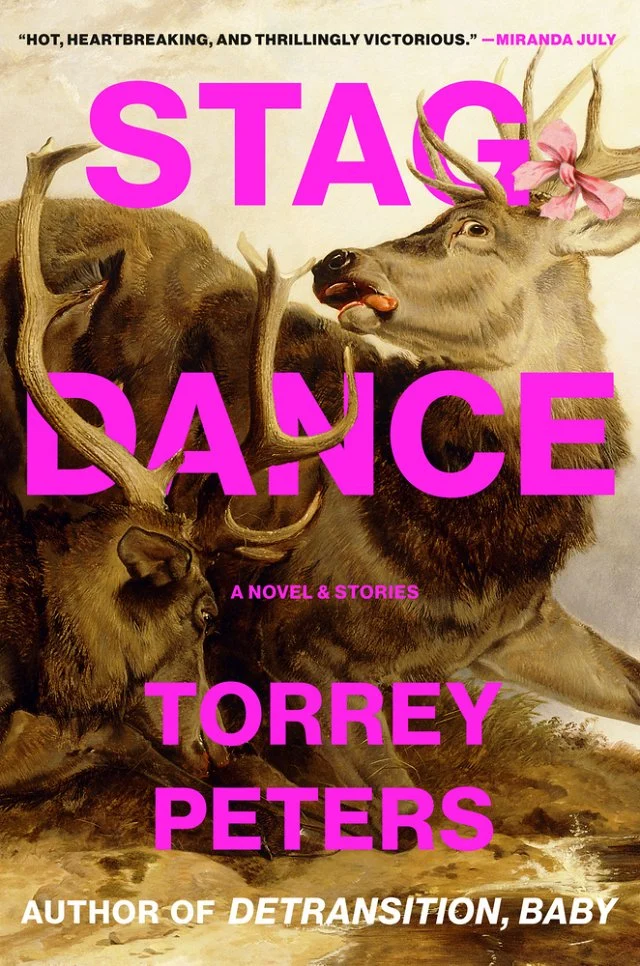
Reading Stag Dance three times in a row was not just an indulgence—it was a necessity. Torrey Peters’ masterful exploration of gender gripped me from the first page. To say I loved this book would be an understatement. What I found within its pages was possibility. What brought me back every time was the raw, unfiltered intimacy that felt both deeply personal and universally resonant.
Stag Dance is composed of three short stories and a novella: an apocalyptic vision where a virus—unleashed by a group of trans women—reshapes the world; a teenage bro at a Quaker school struggles to accept his love for a sissy; a “Masker” crashes a trans women’s meeting in Las Vegas. Finally, a western telltale novella to end all western telltale novellas follows a lumberjack working for illegal timber in the depths of winter and grappling with his femmeness and his relationship to his fellow men.
What Peters accomplishes so brilliantly is cracking open the feelings of gender—feelings that not only belong to trans people, but to everyone who wrestles with identity, shame, and belonging. Stag Dance embraces the grotesque, the cruel, the darkly humorous, and the deeply human aspects of feeling gender and the ways it shows up in our relationships. Each story in this collection sizzles with emotion, pushing the boundaries of what it means to feel, to desire, and to exist, opening new ways to understand ourselves and each other.
This book arrives at a time of escalating persecution of trans people, amid a political climate steeped in fear, anger, and paranoia. Within its pages is something urgent and necessary—something that demands to be read, considered, and felt.
Julián Delgado Lopera: It’s incredible that Stag Dance is coming out as this new fascist coup is enacted and all these anti-trans orders are happening. It’s very timely and so good. Why do I love this book so much? First it deals with transness and gender expansiveness in a way that feels very refreshing. Very unapologetic. A command on a special intimacy around gender that is not trying to be didactic or explicate itself. How did you arrive at this very different lens around gender?
Torrey Peters: The binary that I’m interested in breaking with this book isn’t male and female, it’s more cis/trans. I think it’s easy for cis people to read about trans people and say, oh that’s so different than me, I can’t never understand. But in this book there’s only maybe three characters who identify with the word “trans.” Everybody else is just feeling a way. The thing that trans people feel isn’t unique to trans people, trans people have just named themselves trans. But cis people also have some of these feelings about gender, also have questions about sexuality, also are titillated. Cis people are constantly making a choice to have a gender. I wanted to shift Stag Dance away from an identity-based work to: let’s talk about how this stuff feels. Oftentimes being trans is about dwelling in feelings and trying to find names for those. Which is something we all do.
JDL: I absolutely love that. How did you come up with each story?
TP: The first stories were “The Masker” and “Infect Your Friends and Love Ones,” which are a horror story and a speculative fiction dystopia. I self-published them in Brooklyn around 2016 in a project I ran where I self-published novellas with other trans women. “Infect Your Friends and Love Ones” had to do with my relationship to the larger trans community.
Cis people are constantly making a choice to have a gender.
“The Masker” was about fetish—the fact that if you get to transness through fetish or sexuality, it is often considered not respectable, and also that there is some big difference between cross-dressers, transvestites, trans women [where] one is legitimate, one is not legitimate. Spoiler: in “The Masker,” there’s a character that wears a silicone full body suit, and what the book uncomfortably says is: maybe this person is also trans, even though all the other people in the story, including the cross-dressers, want this person to not be considered legitimate or trans. My third book was going to be a soap opera, but it turned into Detransition, Baby, so I returned to it later with the telltale western that is “Stag Dance.” And a teen romance, which is “The Chaser.”
JDL: As a person who has been many different genders, this examination of feelings around gender is one of the main elements that pulled me in. One of those feelings is shame. The main characters experience a lot of shame: shame in being close to someone that doesn’t pass fully, shame in loving and being attracted to a feminine boy; shame around desiring femininity and shame for another trans woman’s sense of womanhood. Could you talk about the role of shame in the book?
TP: Shame is intimately connected to fear. For example, when the pretty protagonist in “Infect your Friends and Love Ones” is walking with another trans woman and feels she is more likely to get clocked, that is fear. The actual threat is outside, but then the shame becomes, what if I am recognized as this person?What if this other person I will be recognized as is gross? And that comes back to, what if I am actually gross? Shame oftentimes is very revealing of where fear comes from and where it circulates in a person. When you write what you are ashamed of, suddenly the shame can be looked at. All of those thought processes that are normally recursive and hide themselves can be seen. It has a strange feeling of dissipating it.
I was ashamed when I was writing “The Masker.” I thought, everyone is going to think this book is disgusting, and not even because that much disgusting stuff happens, but just because I am ashamed of characters like The Masker who is a freak fetishist. I am ashamed of the older trans woman in that same story who thinks she knows what femininity is, but it’s an embarrassing form to me; I am ashamed of the sissy who is getting off on it. I wrote the entire thing in shame, and when I published it, I found solidarity. People read it and were like: I am like that, I see that, I feel that way. And instead of shame, I had the opposite: love and a group of enthusiastic people. It was a very powerful experience for me.
In my early writing about trans stuff, prior to “The Masker,” I really wanted people to like me. I wanted people to think I was normal. I wrote stuff that told people, don’t worry I’m totally fine, yes sure I dress up on weekends, that’s cool, it’s like some people go to football games and some of us dress up. I’m just like you. I’m in heels, that’s all. Not only was it dishonest but it reinforced feelings of shame I had, whereas writing into the shame was really freeing.
JDL: There’s a lot of cruelty happening, which I love. There’s a specific flavor of cruelty in the book, some arises from the shame, and sometimes it’s campy and dark. Robbie from “The Chaser,” for instance, is very cruel in a way that I found complex and fascinating, because technically the narrator, the bro, is the oppressor towards Robbie. But then that power shifts in the story, and Robbie ends up enacting many acts of cruelty on the bro that are only visible to the reader.
When you write what you are ashamed of, suddenly the shame can be looked at.
TP: I also love cruelty, it has always been part of my sensibility. And not only do I love cruelty amongst the characters, I also love cruelty towards the reader. A lot of [my] favorite books are cruel to the reader. Someone like Nabokov is incredibly cruel to his readers. Oh you liked this character? Let me do an awful thing. Cruelty is a kind of sublime embrace of the sticky gore of life, a way into the viscera of life. Love can get you there too, but it’s really just one side of it.
JDL: In most of the stories there is a flavor of cruelty that stems from queer intimacy. There is this sense of understanding each other really well, a depth of intimacy and knowledge that you, as the writer, are cracking open raw and using for cruel purposes.
TP: That’s very well said and observed. In order to be really cruel to somebody, you have to know them, they have to trust you. There’s betrayal in cruelty. Otherwise it’s just brutality.You’re right, cruelty happens with people who are intimate with each other, who know each other and who know the soft, painful places to press.
JDL: I want to move to “Stag Dance,” the novella in the collection. The voice of Babe, the main character, is very different from the other voices in the book and is so specific to a place, a particular kind of man, a specific social class. Some of his emotional expressions, for instance, I would re-read two or three times because they were so brilliantly articulated. How did you build this voice?
TP: There are two things to The Babe’s voice: the cadence and the vocabulary. Last winter, I wrote a page in that voice. It didn’t have any of the weird vocabulary, it was a voice that was trying to figure itself out, and it had a very strange cadence to it. A tumbling kind of cadence. I knew it was going to be a lumberjack because I was building a sauna in rural Vermont, and I was in the woods all the time. Gender-wise I was going nuts in the woods. I was alone building something, feeling independent, and because I grew up as a boy in the Midwest, it was like, if I’d never transitioned, I would be a lonely man in the woods building some shack on my own, telling myself that I am self-sufficient. So wtf did I transition for? Sort of like: if you change gender in the woods and there’s no one around to see it, do you even change gender?
I came to Colombia with those preoccupations and started researching. I found this book of lumberjack lingo from the turn of the century, a dictionary compiled [by] the sons of loggers in the 1940s. I started using the cadence and the words from this book. I wrote the first three chapters in really official logger words, and then about halfway through the book I started occasionally inventing my words. Like, whatever, Melville did it…I was reading Moby Dick and Blood Meridian, these classics of Americanah, and I’m writing in that genre. These cowboys and whalers are using obscure words from the King James Bible. It’s the discrepancies in the words that make books like Blood Meridian so interesting.
JDL: I was very interested in the moment when The Babe starts embracing his femininity and wearing the brown fabric triangle that’s supposed to be worn by any lumberjack who wanted to be courted as a lady. Just wearing this piece of fabric activated big changes in him. Talk a bit about that shift in the behavior.
There’s betrayal in cruelty. Otherwise it’s just brutality.
TP: I was thinking about prosthesis and the ways trans people, and cis people too, use prosthesis. For instance, when I have acrylic nails, they change the way I open my purse. I can’t just grab my purse with my whole hand, I have to daintily open it, and that creates a sort of feedback loop where then if I’m opening my purse so daintily, I better be dainty. For the Babe, instead of heels or nails or a strap-on or packing, his awareness of this brown fabric triangle pinned to his crotch is enough to reanimate his body. Something that happens often when you are trans—and sometimes for people who aren’t—objects become part of you. Your body is not actually contained. I sleep with people who use strap-ons and some sort of sublime thing happens where that is part of their body. The magic of it is not in the symbol of the phallus, it’s something different, something that we can imbue and extend our bodies outward into the world. For me, there’s something very special about this big logger taking this little piece of fabric and being like: I’m going to put all my femininity in it and animate it and bring it to life as part of me. It’s sad and funny and sublime and triumphant.
JDL: A sort of dystopian, dark, very alive nature is the backdrop of a lot of the stories. And in a way that feels very trans to me: ever changing and unexpected. It feels like nature is itself another character to which the main characters react. How did that come about?
TP: In this book I was more interested in: when I’m building the sauna and I’m alone in the woods and nobody sees me, how do I know I’m a girl? Much of the trans work that I have read takes place in urban settings where the background is a human-built world. My actual experience has been, for instance, intentional communities in Tennessee or out in Seattle where people are getting land, or trans motorcycle groups that are going places. The relationship between the material world, the natural world, can feel very different in the woods. I talked to a lot of Vermont women about this. How do I know I have femininity when every day I wear muck boots and Carhartt’s and go dig my car out of the mud? How do I show the occasional man what I want him to see? That spins out to all this weird nature stuff, in which the woods turns into a witchy place. This is where the supernatural stuff in the stories come from. My connection to this stuff is not gender theory but woods-witch feminine energy.
JDL: Is there anything I didn’t ask you want to share?
TP: When I published Detransition, Baby one of the things I got frustrated with was always being held up as representative of trans experience. In a funny way, Stag Dance is much weirder, and because of the political climate, I actually do want to speak out more. I hope to use its weirdness, make people think of trans issues more broadly. Not that I want to represent people, but I want to talk about things like solidarity this time around in a way that I didn’t the first time.
I would like to end by asking you something. We’re in a place of fear because of this rise of fascism. Is there an action around trans solidarity that people can take and/or a mutual aid org that you like?
JDL: For an action: call your trans elders. Take them out to dinner. It’s very important to focus on trans youth, but we cannot forget our elders. For organizations, there’s Fight to Live in NYC, which is a community effort working to end the incarceration of Black, Indigenous, and/or people of color who are queer, trans, and/or Two-Spirit in NY. And there’s El/La Para Translatinas in San Francisco.
An excerpt from Stop Me If You’ve Heard This One by Kristen Arnett
Cold Open
You can tell a joke one of two ways:
1. Open your mouth and say the damn thing.
2. Wait for someone else to try to tell it for you.
The second way is almost always funnier. People don’t want to hear a punch line; they want to feel like they’ve beaten you to it. Pretend you’re dumber than the audience, at least at first, and suddenly you’ve got them eating from the palm of your hand. The real gag is waiting behind the scenes, tucked neatly inside the fake-out. It’s an actual diamond ring disguised as a gaudy cubic zirconia.
I’m telling this to the woman from the birthday party, but she’s not listening. Her eyes have that faraway look, sleepy with desire. Lips part to reveal a slip of tongue and a back tooth gone inky with rot. I’ve got her up on the sink, underwear pulled down. She’s jiggling her legs rapidly, knees knocking together because I’m taking too long. She’s been after it ever since she opened the front door and found me waiting on her porch.
Listen, I’ve been busy. For the past two and a half hours, I’ve entertained her six-year-old son, Danny, and his entire first-grade class in a sprawling suburban Central Florida backyard. I’ve built zoo animals from stringy multihued balloons and pulled never-ending scarves from the ends of my belled sleeves. The bulbous yellow daisy on my lapel has shot water at the woman’s husband, soaking the neck of his expensive Ralph Lauren polo. I’ve thrown a whipped cream pie into the moon of a child’s upturned face and spritzed seltzer at an elderly schnauzer who took my rented pant leg between its tiny razor teeth and yanked until the hem unraveled.
“Come on,” she says, voice breathy and impatient. “Hurry.”
There’s a swath of black hairs lining the top of her right ankle, a sprawl of red dots climbing the inside of her bare thigh from a shaving rash. She kicks free of her underwear and almost knees my nose off in her rush to get naked. I reach up to right it, smearing a lick of greasepaint on my gloved fingertips. I’ll have to wash them with dish soap right when I get home or else they’ll stain. I tell her this, but she doesn’t care about that either.
“We’ve got ten minutes,” she says, which means we’ve got less time than that.
I keep my clothes on because that’s what she wants. The baggy polka-dot blazer, the orange striped shirt and gold bowtie, the purple spangled suspenders, my oversize parachute pants with their lines of glittery silver thread outlining the sperm-shaped squiggles of bright neon green. My shiny red shoes are long enough to bang into the side of the toilet bowl as I wrench off her blouse. Buttons plink onto the black-and-white tiled floor.
“Finally.” She wraps her legs around my waist, feet bouncing against my back as I slip off a glove with my teeth so I can slide my fingers inside her. She looks away from my bare hand, not wanting to see anything that’s not CLOWN ; she’s paying for CLOWN and has wanted CLOWN since she called the agency’s number two months earlier to plan her son’s birthday party. She stares hungrily at my painted face: the wide slick of paint that surrounds my mouth, the black and indigo triangles that shape my eyes, the iconic red foam nose that holds my overly hot breath inside its spongy interior. The wig I wear is powder blue, curls springy and cute, like a deranged Shirley Temple who just got back from Burning Man. Atop the wig sits a tiny rhinestone and suede cowboy hat I picked up one afternoon at a pet shop, which is now a staple of my clowning gear. I’m Bunko, a rodeo clown who’s terrified of horses. Goes over great with the kids.
“Do you have a dick?”
I stop thrusting and look down at her, finding us suddenly off-script.
“A dick?”
She licks her lips. Pink lipstick feathers at the corners of her mouth. “Not a real dick. I know you’re a female clown, I’m not dumb. I mean like . . . a dick dick.”
“A dick,” I repeat, because our time together is nearing its inevitable conclusion and neither of us has gotten off. There’s sudden shrieking inside the house, the bang of sneakers against the expensive maple floorboards, the groan of furniture as bodies ricochet against the walls. Soon her husband will do the thing that all husbands do when faced with a crew of screaming children: he will search for his missing wife.
“Also, I’m not trying to be a jerk or anything, but could you use the clown voice? I mean, I’m paying for the experience, you know?”
Shifting back into Bunko is easy enough. I grin down at her and widen my eyes dramatically.
“Let’s see what I’ve got up my sleeve,” I say, high-pitched and giggly, the tone I’ve worked to perfect since I took up clowning eight years earlier. “I bet Bunko’s got something just for you.”
I’ve got nothing like that in my clowning kit. All my dildos are at home, squirreled away inside my nightstand. But if I’ve learned anything from clowning, it’s that there’s always a way to turn nothing into something. I’ve entertained an entire backyard full of people with nothing but a wooden spoon and a cast-iron pan as accompaniment, drumming the theme from The Brady Bunch while simultaneously dancing a jig. I’ve landed a somersault on a Slip ’N Slide while juggling three Coke cans and somehow managed not to break my neck. If I can’t MacGyver myself a dick out of thin air, then I need to find a new profession.
Clowning is an excuse to make everyday life wildly, luxuriously absurd. I create a drumroll sound effect with my tongue, wriggling my fingers expectantly before delving inside the interior pocket of my coat. I rummage in there for a moment, allowing the expectation to build, and then suddenly produce a magic wand.
Her eyes widen. “Ooh.”
It’s collapsible. I’d used it earlier at the party, tapping the brim of Bunko’s undersized cowboy hat to summon a rubber snake, exclaiming in alarm when the wand broke into pieces and the reptile suddenly “escaped.” It gets a laugh every time, that stupid wand, and I hold it out in front of me now like I might actually create some real magic.
If I can’t MacGyver myself a dick out of thin air, then I need to find a new profession.
As she tentatively takes it in her hands, I let it collapse. The woman screams with joy, legs immediately spreading as I command the wand erect again. It’s not nearly as wide as a dildo, but it’s not the size of the wand that matters, it’s the motion of the potion that counts, and the woman seems thrilled with what I’ve produced. I prod it inside her as she stares up at my makeup-caked face, hands knotted in the sides of my bright blue wig, grunts spilling from between her closed lips as I hurry, hurry, hurry. We’re definitely running out of time. It sounds like there’s a stampede heading toward the bathroom, so many little bodies needing to purge their bladders and bowels after swilling cups of overly sugary lemonade and consuming a towering Publix layer cake that must have cost the woman a small fortune. People with money never think about what birthdays cost. No expense is spared for a kid who will barely remember the day; there is no other choice than to have a party because the alternative—no party, no gifts—is unthinkable for the upper middle class. They’ll never have to waffle over a bank account in the teenage digits, deciding which birthday dreams get to live and which must crawl away and die.
I should have charged more.
She cranes upward and presses her face to mine, tongue slipping inside my mouth as she comes. I wrench backward and push her away, sure my makeup is ruined, and it must be, because some of it now coats the right side of her face in a Picasso-style swirl. Sudden banging on the bathroom door. The wand has collapsed again, slithering out of her body. I shove it back in my pocket as she yanks her underwear on, blonde hair mussed and frizzy from repeatedly rubbing against a stack of bright yellow hand towels.
“Hurry,” she says, but this time it’s said with a trace of genuine fear as she works to scrub the greasepaint stains from her chin with a wad of damp toilet paper.
I clear my throat, but she won’t look at me. My usefulness has reached its inevitable conclusion upon delivery of her orgasm; the clown must go back in the box. If I put out my hand and tried to touch her shoulder just now, she’d swat me off like a cloud of gnats.
More shouting. It’s the husband. He’s agitated, demanding a response from his wife. “Marcia, are you okay? Marcia, answer me!” She looks more like a Samantha, I think, then pocket the thought for later as I climb inside the oversize tub and clear the windowsill of bath products. I shove the frame open and use the soap dish as a stepping stool, bottles of Pantene Pro-V and floral-fragranced shower gel falling to the floor as I heft myself onto the lip, shower curtain wrapped around my scissoring legs.
“Shit,” I say, because the thick loop of wire that keeps my pants extended has caught on the edge of the frame. The lock on the door has proved ineffective in the face of the husband’s outrage; there’s a loud crack as the cheap fiberboard breaks. Pieces of MDF clatter onto the tile floor as he bursts into the bathroom.
One more solid push and my pants finally tear. Someone grabs my leg and yanks off one of my oversize shoes as I slither through the opening. I fall forward into the blazingly hot Florida afternoon, landing face-first in a thatch of bougainvillea. My blazer snags on the thorns as I roll free, knocking into a pair of black garbage bins.
It’s always the jokes that go off the rails that work best, I think, as my own shoe flies from the open window and whacks me hard in the neck. The beauty of it stuns me for a moment, and I stand in the sunshine and watch the shoe roll down the hill and land in a nearby flower bed, squashing a clutch of fuchsia peonies.
“You fucking clown!” The husband yells it again, in case I missed it the first time. “You goddamn fucking clown!”
He chucks a shampoo bottle at my head. I duck and it smacks into the side of the garbage bin, Pantene spurting from the broken lid. I take off down the street at a gallop, abandoning my clown kit in the middle of the couple’s living room. It’s full of stuff I need for work, a hundred fifty dollars’ worth of makeup and gear, and as I’m running for my life, I realize that the man isn’t wrong. The punch line is sitting right there.
I am a literal fucking clown.
Aquarium Select III
The hot older lady with the baby bearded dragon is at Darcy’s register. I know this because Darcy is clicking the talk button on her walkie-talkie and repeatedly hissing the word “fire-breather” into the mic. It sounds like the opening to an especially bad EDM track. Jamming the button alone is usually enough to pique my interest; it’s our signal that something special is happening so we should drop what we’re doing and pay attention. For an exotic pet store, “special” happens way less often than you’d think.
The headset buzzes, and then there’s a brusque, no-nonsense voice in my ear. “Stop messing around.”
Darcy clicks back in, all mock professionalism. “Yes, sir, Mister Manager.”
Work is boring, but at least it’s predictable. The paycheck is fine for part-time work that barely requires rubbing two brain cells together. It gives you time to think about anything other than what you’re getting paid to do. That’s what Darcy and I tell each other when the days begin to stretch out in front of us like chewing gum that’s had all the flavor gnawed from it. Boring is better than stressed-out. We’re financing our creative careers.
Clowning ain’t cheap, I think. I mentally pour one out for my kit, abandoned last week in that woman’s living room.
“I need restock on aisle four. Filter socks and media baskets.”
If we don’t respond, he’ll yell at us again. On a boring day that would be fine by me—it gives me something to do, and he’s funny when he’s pissed. In fact, several of my clown identities have taken on very specific uptight Mister Manager vibes: peacocked chest, veins in my neck protruding as I grind my teeth. But since I want to check out the woman at the register, I take one for the team and answer him.
“Right away, Mister Manager.”
“Knock that crap off,” he says. “I’m tired of it.”
Mister Manager’s real name is Roy Mangia, but Darcy and I have been calling him Mister Manager ever since the third week of work when I heard him accidentally announce it as his last name over the intercom. He’s a forty-something dude with a roachy patchwork beard who eats the same overly mustardy tuna sandwich every day for lunch. The guy drives a teal-green Mazda Miata with a rack for his incredibly expensive racing bike dangling from the back. He’s the poster boy for masculine midlife crises.
Instead of heading to aisle four so I can do my actual job, I slip past the tower of glowing blue tanks that line the wall of the shop and power walk to the register. There she is: the MILF of my dreams. She holds out the lizard for Darcy’s inspection. She’s been coming in at least once a week after buying it from our coworker, Wendall, who neglected to tell her that baby bearded dragons are essentially the French bulldogs of the reptile world: allergic to nearly everything, expensive as hell, and almost always on the verge of death.
“He’s shivering. See? His neck is all pale.”
Darcy hums noncommittally. Her mohawk is especially tall today, nearly grazing the bottom of a long banner advertising Ocean’s Blend supplements. Darcy Dinh likes a theme, and she generally sticks to aquatic colors when it comes to her hair: blues, greens, purples. This week, she’s gone for a mix of all three. If she stood in front of the store, she’d blend in chameleon-like against the paint. The exterior was painted by a muralist ten years earlier. It features bloated whales and scraggly, bug-eyed seagulls on a background of murky, phosphorescent foam. Some days, when I arrive for a shift, it feels as though I’m entering a rip-off SeaWorld. It’s a part of the scenery for me at this point. My eyes scan past the paint and over the aisles of piled-up junk. Wobbling stacks of glass tanks? Check. Bags of fluorescent gravel? Check. Gigantic wall mural that features what might be a demonic mermaid? Check.
Wendall is standing next to the entrance, pretending to clean the window. The rag in his hand moves in circles about five inches from the actual glass. His face is bent over his phone, and it’s giving his skin a greenish, unattractive tint. It used to be that Darcy and I would have yelled at him by now for leaving us with all the work, but lately she’s been giving him a pass. Making fun of a coworker is a team sport, and she’s dropping the ball.
“Cherry?” Darcy waves me over. “Can I get your help with this?”
The woman turns to me and holds the lizard out for my inspection. I stare at it like I know what I’m doing and declare that it needs a better heat lamp. Despite four years working at Aquarium Select III, I know almost nothing about reptile care.
“He’s cold,” I say, because even I feel frozen inside the tundra that is our shop. Mister Manager keeps the temperature akin to that of a walk-in freezer. He claims it’s good for circulation, but really he’s just trying to prevent us from curling up in dusty, hidden corners of the store and napping when business is slow. It’s a miracle that the animals haven’t all died in this latest instance of the Ice Age.
I lead the woman to aisle two where we keep the reptile habitats and various supplies, supplements, and equipment. Most of this stuff has been sitting on the shelf for years; we don’t have much turnover because people prefer to buy their pet stuff online. The boxes are coated in a fine layer of grime. I can feel Darcy’s eyes boring a hole into my back. I don’t have to see her to know that she’s thrusting her hips in a pornographic gesture that would get her suspended if our boss caught her. When I turn around, I see that Wendall has wandered over from his “cleaning” project and is busy showing Darcy something from his notepad.
Seven clicks in a row over my headset as I put my arm around the woman’s shoulders and guide her around the corner.
Wendall’s not included in this lambasting because he is never around. I’m not sure he even has a walkie-talkie, much less an earpiece. It’s a point of contention between myself and Mister Manager because I’m of the opinion that since Wendall takes two-hour bathroom breaks and three-hour lunches, he’s technically the worst employee at Aquarium Select III, yet we’re the ones getting chewed out over a little harmless fun. Wendall is a slam poet who is never not high. On shift he’s either spaced-out or droning on and on about black holes, so it makes sense that he wouldn’t care about stocking shelves. Darcy used to hate it too, but now she laughs when she sees him scratching down goofy little phrases in his notepad, like he thinks he’s going to be the next Kerouac. But I’m not fooled. The guy’s a secret menace. Whenever he does anything job related, it just turns into more work for everyone else. Take restocks, for instance. He puts everything on the wrong shelf, then throws up his hands in despair when confronted with the error. Usually, it’s me or Darcy who’s tasked with fixing it, the age-old tale of women having to take care of a helpless man. Except he’s not helpless; he’s just lazy. Or maybe, a little malicious. It’s like how my older brother Dwight used to load the dishwasher poorly so that our mother would stop asking him to do it.
I bet she wishes she could yell at him about the dishwasher now, I think. We could take turns really laying into him in person instead of dealing with all the jumbled detritus of his memory piled up in our heads.
“Which light are you using?”
“This one,” the woman says, picking up a box. “Is it no good?”
She has stowed the bearded lizard inside her neon-pink fanny pack. I can see his tiny face mashed against the mesh front pocket as he wriggles around frantically, searching for a way out. I pretend to examine the light, but mostly I’m staring at the incredible amount of cleavage spilling from her Lycra workout top.
“It’s possible you need a different bulb for it,” I say, because that sounds sensible enough to be actual advice. “Something warmer.”
Along with the Lycra top, she’s wearing a pair of pink and yellow spandex leggings and fluffy white leg warmers. Her hair is what a box of dye might call “spicy cinnamon,” and there’s approximately two pounds of makeup on her face. I don’t know what it is about women who could be my mother that gets me off, but I am a sucker for anyone over the age of fifty who looks like they are about to lead a very rigorous step aerobics class. Possibly it’s due to the fact that I’m looking for someone to take care of me since my own mom forgot to call me on my last birthday, but even I’ve got my limits; I’m not going to ogle this woman’s tits while reminiscing about my unhappy childhood.
Aquarium Select III stocks only three different types of heating bulbs, so we take our time poring over the packaging—the woman because she’s genuinely interested in saving her lizard’s life, and me because her skin smells like a mixture of cotton candy and dryer sheets.
“I’m not sure,” she says, frowning so hard it looks like it hurts. “What do you think?” Her lipstick is a slick of bright red, a color that’s entirely reminiscent of the clown paint I wear for work events. I wonder if it’s the same brand I use when I’m out of the good stuff.
I could lie and make something up, some bullshit about faulty heating elements and Florida humidity, but my heart’s not in it. It’s thinking about the clown paint that did it; my kit with all my best stuff abandoned in some woman’s living room because I was too much of a coward to go back for it. There’s not enough in my bank account to buy more. I’ll have to use the cheap, shitty stuff that makes my face break out until I save up enough for the good greasepaint again. There’s an audition in a couple of weeks I’ve been gearing up for—an opportunity to get in on a traveling children’s showcase that tours from Gainesville down to St. Petersburg—and if I prep my set list wisely enough, I could be good to go on gigs for the entire summer. I could network with half the clowns in Florida and land even more full-time work. But no gear means no audition means no money. Twenty-eight years old and broke with a chin full of acne isn’t exactly a persona I want to lean into.
“I’m actually not sure either.” I slide the box back onto the shelf. “It could be any of these.”
The woman sighs deeply. “I don’t want him to die. My husband left three months ago, and Bradley is the only thing getting me through it.”
Twenty-eight years old and broke with a chin full of acne isn’t exactly a persona I want to lean into.
“Bradley’s a great name for a bearded lizard. It makes him sound like he’s got a 401(k).”
I awkwardly pat her shoulder as her lip quivers and her eyes leak trails of bright blue mascara.
“Your name’s Cherry?” She sniffles hard. “That’s exotic.”
“Not really.” My name is actually Cheryl, but nobody except my mother has called me that since I moved out at eighteen. Cherry is a good time, a person who owns a muscle car and drinks straight gin and parties ’til three in the morning. Cheryl is the name of the person who does taxes for a living and drives a sensible, buff-colored sedan. Cheryl is Nancy’s letdown of a daughter, Dwight’s disappointing younger sister who was never as funny or as cool or as smart as he was. But Cherry belongs only to herself, and she’s beyond fine with that.
“I’m LeeAnn. Boring name for a boring old broad.”
“I don’t think you’re boring,” I say, poking at the lizard that’s squashed inside her fanny pack. It has stopped moving, which probably isn’t a good sign. “I think you’re a very cool reptile broad.”
She’s crying again. Instead of prolonging her misery, I lead her to the back of the store where Mister Manager is directing a trainee named Austin on how to painstakingly scrub stains from the side of the turtle enclosures. They’re coated with a thick layer of sickly green algae from the bacteria that drifts off their shit and from rotten chunks of uneaten food.
“No, like this.” There are large sweat stains darkening both of his armpits. “Up down, up down. You gotta get a real rhythm going or you’re gonna miss spots.”
I clear my throat. Austin the trainee looks at me with puzzled recognition. He has a real baby face: chapped pink cheeks, bare hint of stubble over his puffy pink lips. Can’t be older than seventeen. I probably clowned at a birthday party he attended; it’s happened before.
“Mister Manager, this customer needs some of your expertise.”
He stops windmilling his arms long enough to scowl at me. “We’re busy, Cherry.”
“LeeAnn here is having a problem with her bearded dragon.” I lean forward conspiratorially and shout-whisper as loud as my voice will let me. “One she bought here. From Wendall. With the protection plan. Ninety-day refund guaranteed in cases of animal loss.”
He straightens up and smiles at her. “Right. Let’s get you sorted.”
I leave them to figure it out.
Back at the register, Wendall has disappeared. Darcy is painting her chewed-up fingernails with a bottle of gummy Wite-Out that has probably been sitting in the supply drawer for at least ten years.
“You fuck her?” Darcy asks.
“I wish.” I hop up onto the counter and let her paint stripes of Wite-Out in my short black hair. I need a haircut. It’s getting too long in the back, threatening to turn into a mullet, but I can’t be bothered to pay someone to cut it properly when I know I’m just going to be shoving it under a wig. At times I wonder if it would be cheaper all around to just dye my own hair like Darcy does; then I could perm it and walk around all day like I’ve been electrocuted.
“Do you think Bunko would’ve fucked her?”
“Probably.” My black jeans are frayed at the hem and dragging on the floor, picking up dirt and lint. I put my foot up on my lap and yank at the threads until they come off in my fingers. “Look, pubes.”
“Don’t change the subject.” She yanks on my hair, and I yelp. Darcy’s short, but she’s strong. She plays drums for a local punk band called RHINOPLASTIZE , and her arms have the kind of muscles that could choke a man to death without her even breaking a sweat.
“I’m not going to fuck that old lady,” I say. “She’s too nice.”
“What does nice have to do with anything?”
I let her paint a stripe of Wite-Out down the center of my nose. “Too nice for me.”
Someone walks through the double doors at the front and squints blindly in the dank, purplish light. We can’t keep anything too bright in the store because it upsets the aquatic pH balance of the fish tanks, according to Mister Manager, but it seems like it has less to do with any of that and more to do with the fact that you can’t tell the store is a pigpen if no one can actually see the tumbleweeds of dust rolling around on the scuffed linoleum floors.
The guy stops at the register across from us. “Y’all got Science Diet?”
“What’s that?” Darcy blows on my nose so the paint will dry faster. Her breath smells like the Sour Patch Kids she ate for lunch. “Like Lean Cuisine?”
He looks at her in disbelief. “No, it’s dog food. How can you work at a pet store and not know that?”
She stares back. “You’re saying you want to eat dog food?”
“What?”
“Try five blocks over at our partner store, Aquarium Select II,” I say, interrupting before the interaction can turn into something that requires disciplinary action. Darcy might think it’s fun to get fired, but unlike her, I need this job. Her need for constant conflict occasionally makes me want to strangle her.
When he leaves, Darcy throws the bottle of Wite-Out at the closing door. It ricochets off the glass and bounces into a coral display. “What kind of moron goes to an aquarium shop looking for dog food.”
“What kind of aquarium shop sells bird feeders?”
It’s true that our selection makes no sense from an aquarium perspective. While Aquarium Select II and Aquarium Select III both offer a variety of fish, dozens of tanks, assorted filters, corals, crustaceans, reptiles, and a wide range of aquatic plants, they also stock items that have nothing to do with aquariums, including cat toys, Weedwackers, mole repellent, potted orchids, and fireplace implements. There is no Aquarium Select I.
“None of this matters.” Darcy closes out her register with a bang and then gives it the finger. “This job is a negative, a zero. It’s a time suck. What matters is the stuff out there.”
I act like we haven’t had this conversation at least two dozen times over the course of the last week. “Out where?”
She jabs her thumb in the direction of the front door. “There. Where shit is alive.”
“Okay, Dr. Frankenstein.” She’s not wrong, but recently I’m finding it hard to stay motivated. Aside from the upcoming showcase, the agency can’t approve any bookings until I rectify my gear situation, and there’s no quick way to refit a kit, especially if you’re broke. The pants I ripped were a rental, which means that even though I stitched them up the best I could, I still owe money for the repair. It’s a tremendous bummer to realize that I’ll have to work at least ten more mind-numbing shifts at Aquarium Select III before I can afford to pay for all of it.
“We should quit,” Darcy says for the fortieth time. “Start making art.”
“I am making art.”
“You know what I mean.”
I do and I don’t. It’s not the same for Darcy, which is a reality she conveniently forgets. If Darcy quits this job, she’s got a financial safety net ready and willing to catch her. There will be other jobs, other opportunities. If I quit, I’ve got my car to live in and a twenty-five-dollar Dunkin’ gift card for groceries. The two of us have very different ideas when it comes to how to achieve our dreams. And recently, our discussions about how to get there have gone from talking to stepping carefully around a minefield full of arguments.
Mercifully, she changes the subject. “Are you coming to my show tonight?”
“I can’t,” I say. “I’ve got a date.”
Darcy doesn’t like this. Her nose wrinkles, mouth twisting like she’s tasted something rotten. “Bring her. Unless she’s a piece of shit who doesn’t like good music.”
Our friendship is predicated on the fact that we both pour all our real energy into our respective creative passions. We hang out, we fuck around at work, and we discuss our plans for the future. RHINOPLASTIZE is a whole separate problem. Darcy has it in her head that her band could suddenly take off, like maybe the record label people who discovered all her favorite bands might stumble into a decrepit house show in the middle of Central Florida and point at her like God’s spotlight has shone down on her spiky head, as if she were the next coming of John Bonham. It’s that kind of fantasy thinking that keeps us both constantly hustling—her with music, me with clowning. Neither of us has time to date. It’s one thing to hook up with women; it’s quite another to admit that at some point I might end up with a girlfriend. That would ruin everything.
Easier to turn it all into a joke, I think, and quickly pivot to clown mode. “I don’t like bringing new women around my friends until I’m sure they can behave themselves.”
“So, what you’re saying is you’re a misogynist?”
I gather my backpack from where I’d stashed it earlier beneath the counter. “I wasn’t talking about the women behaving. I was talking about you.”
“Fuck off,” she says, and barks out a laugh. “You’re such an asshole.”
Darcy’s got a great sense of humor. And by that I mean that I can tell the same joke fifteen times and she’ll still listen to it, even if she does roll her eyes and call me a moron.
“I’m taking off,” I yell to the back of the store, and when Mister Manager comes on the walkie-talkie to tell me I still have twenty minutes left of my shift, I pull the plug from my ear and toss the whole thing to Darcy.
“Bye, bitch!” She chucks the walkie under the counter. “Hope you get laid!”
Outside in the late-afternoon sun, I stretch my arms and let my skin bake before climbing into my car. After spending six hours chilling in an icebox, the heat is intoxicating. I remove the shade from my windshield and stash it in the back before running my hands along the oxblood leather seats, fingers tapping along the shiny chrome of the dash, a breathy woman’s voice rasping out sexy lyrics from the custom speakers, bass throbbing beneath me.
Cheryl might drive a sensible sedan and stay far away from drama, but Cherry has a candy-apple-red Pontiac Firebird, and she’s not afraid of anybody’s blowhard husband. Cherry’s got an audition in a few weeks. Cherry’s going to ace it.
“Let’s go get your gear back,” I say to my reflection in the rearview mirror before blowing myself a kiss.
Early in Jon M. Chu’s film adaptation of Wicked there’s a shot of Elphaba and Glinda sitting in a poppy field. Glinda looks on fondly as Elphaba places her signature black hat on her head. The image is clearly a flashback, a memory, that springs to Glinda’s mind as she speaks with the rejoicing citizens of Munchkinland, but unlike the others that appear in this sequence, we don’t see this scene later in the film. It feels private, as if the depths of Elphaba and Glinda’s friendship go deeper than what the viewer understands.
Chu spent much of the film’s press run emphasizing the fraught friendship between the film’s two leads that reigns supreme. His adaptation splits the film into two parts. The first, out this fall and winner of five Oscars, ends at the show’s act break as Elphaba flies off on her broom, singing “Defying Gravity.” Chu spends two hours and 40 minutes on what runs for ninety minutes in the stage show, using that extra time to develop the relationship between the two leads.
Yet, when we left our showing of Wicked on a drizzly November evening, my husband and I did not talk about the relationship between the two leads at all. We talked about politics. We weren’t alone — Reddit threads were abuzz with comparisons between the film’s characters and Kamala Harris and Donald Trump and conversations about the film’s prophetic politics. Many expressed surprise that this pink and poppy musical had political undertones.
Wicked, and the broader Oz universe, has long been political. Critics read L. Frank Baum’s novel as an allegory about populism and monetary policy in the 1890s. When Wicked first premiered in 2003, creators Winnie Holzman and Stephen Schwartz cited both Bill Clinton and George W. Bush as inspiration for their Wizard. The Wizard of Oz has long been a mutable figure. His showman-like qualities and desire to dampen economic discontent by scapegoating vulnerable groups have led people to compare him to presidents from William McKinley to Donald Trump.
Many treat Oz’s political resonances as second-tier to the fairytale. In Wicked’s case, fans of the musical have long favored the loving/loathing relationship between Glinda and Elphaba to the show’s political undertones. Part of what helps the political allegory land in Chu’s adaptation is that he understands that it’s not ancillary to the friendship plot. Elphaba and Glinda’s differences are rooted in their desires to break free from or work within Oz’s existing power structures.
Fans of the musical have long favored the loving/loathing relationship between Glinda and Elphaba to the show’s political undertones.
Elphaba and Glinda’s friendship, and their journey in the first half of the stage show can be summed up like this: popular girl befriends social outcast and together they work to achieve their goals. Glinda’s growth is from a shallow, privileged and naive bully into someone who is more understanding and willing to help others. Elphaba transforms from an insecure young woman into one who is confident about her powers and passionate enough to use them to protect others from torment — in part because no one was there to protect her. Already, it’s easy to see how this friendship could have political undertones. The other Ozians react in horror and discriminate against Elphaba because of the color of her skin. Glinda’s privilege aligns her with Oz’s existing power structures.
All of the material is there, the film just takes time to emphasize it. In Chu’s hands, the film explores Elphaba’s experiences with discrimination and it develops her relationships with the talking animals — who get much more screen time than they do stage time. He treats Glinda as someone who isn’t naive about her privilege, but one who wields it as a weapon to get what she wants.
Consider Elphaba’s expanded role for a moment. The film, like the musical, emphasizes how Ozians react to Elphaba’s green skin with horror and discomfort. When Madame Morrible gets on Oz’s radio system to announce to the country that Elphaba is the enemy she uses her green skin to villainize her. But Elphaba isn’t the only vulnerable character in Oz. In Chu’s expansion, she spends much more time with the country’s talking animals, who the Wizard is targeting and trying to silence. In these early scenes, her nanny, Dulcibear, a talking bear, is the only one to care for her as she promised she would immediately after Elphaba’s birth, when her father rejects her. Later, after her father scolds young Elphaba for inadvertently using her powers to startle school yard bullies and upsetting Nessa, Dulcibear tells her, “he shouldn’t have blamed you,” a sentiment Glinda will echo later in the film when Elphaba speaks of her mother’s death. Talking animals were some of the first citizens of Oz to accept Elphaba, so when she sees that they too are being discriminated against it feels personal.
The threat against the animals looms throughout the film. It’s not limited to scenes where Dr. Dillamond appears as it is in the stage show and it affects more characters. Early on, when Elphaba first arrives at Shiz University and her magic powers send the courtyard furniture flying, a bench knocks into the store building’s facade. It cracks a decorative shield, revealing that the stone was put up to cover a mural of animals. In the stage production, Dr. Dillamond is the only major animal character. Others appear briefly, like the goat that delivers Elphaba, but they don’t have dialogue. When Doctor Dillamond sings “Something Bad,” which details how Oz’s government is rounding up and silencing animals, he sings it just to Elphaba. In the film, he sings it with a group of other animals who are concerned about their rights. Elphaba overhears their concerns. As she watches, she’s overwhelmed by her own memories and visions from her past and of Oz’s future — her father screeching “take it away” at her birth, the chalkboard in Dr. Dillamond’s classroom is defaced with the message “animals should be seen and not heard” — and a vision of the future where Dillamond is in a cage, unable to speak. Chu links Elphaba’s experiences with hate to the discrimination the animals are facing in Oz in these moments and in doing so helps the reader see why she’s invested in their future.
Chu links Elphaba’s experiences with hate to the discrimination the animals are facing in Oz.
Elphaba’s visions, too, play a more prominent role in the film, as does the development of her magic powers. Elphaba’s magic is tied to her emotions. Before she learns to control it, we see it manifest when she wants to protect her sister, Nessa, or when she feels strong emotions. In one training scene, Madame Morrible uses Elphaba’s passion for the animals as a means of drawing out her powers. Morrible asks how Elphaba felt seeing the defaced chalkboard and, as Elphaba grows angry on behalf of the animals, she sends a coin flying. Her dialogue, “no one should be scorned, or laughed at, or looked down upon,” recalls how other Ozians have treated her. Her empathy links to the animals and unlocks her power. By giving her a more personal motivation for standing up for the animals, Chu strengthens the arc her character takes in the musical and emphasizes that Elphaba has always been a political character.
It’s with Glinda’s development that Chu truly deviates from the stage show. While the film’s additional focus on Elphaba’s backstory enriches her character arc, its treatment of Glinda transforms her from a silly, naive, privileged girl into someone who understands the machinations of power. Glinda’s over-the-top emotional responses — dramatic hair flips, weeping over Fiyero — are played for laughs in the stage show. She’s a silly girl, overly invested in her crushes and social standing, without a real understanding of the social and political power her popularity brings. In Grande’s performance, gone are the shrieks and giggles of a little girl. Her dialed back demeanor makes all of her actions seem carefully calculated. From their first scene as roommates she’s asking Elphaba to help her get into Madame Morrible’s sorcery seminar. She isn’t just spun into the Emerald City with Elphaba via the magic of set design; she leaps onto the in-motion train and says, “I’m coming.” When she sings that world leaders didn’t have “brains or knowledge,” but popularity, the audience doesn’t burst out laughing because here Glinda doesn’t seem frivolous. She seems prescient.
Glinda’s careful calculus is most clearly seen in the film’s rendition of “Dancing Through Life.” Ahead of Fiyero’s arrival at Shiz, we see her plot her outfit, purloin a book from a fellow student to seem smarter, and fib once he arrives, saying she is supposed to give him a tour. Her efforts to bewitch him are much more involved than in the musical, where she simply walks up to him and introduces herself. Her manipulations continue throughout the song. She knocks another woman out of the way when Fiyero says “find the prettiest girl, give her a whirl.” She sets up Bok and Elphaba’s sister Nessa Rose — it’s implied because she hopes, in part, it will lead Elphaba to recommend her to Morrible. She manipulates those around her to increase her social standing and get closer to her ultimate goal: enrolling in the sorcery seminar so she can gain favor with the Wizard. When she joins Elphaba in taking a stand for animals — by changing her name — after state officials remove Dr. Dillamond from Shiz, it feels like she’s doing it to impress Fiyero, not because she actually cares about the issues. It’s performative, the equivalent of a pussy hat.
The tension between Elphaba’s activism and Glinda’s quest for power comes to a head in “Defying Gravity.” A mere eight minutes in the show, Chu stretches the number into a half hour, multi-beat sequence, beginning when Madame Morrible orders Glinda to bring Elphaba back, “if you want to do yourself some good.” This line is a departure from the musical, where Glinda runs after her friend of her own accord, and it clarifies her intent as she petitions Elphaba to remain in Oz. She’s not begging a friend to stay; she’s trying to increase her own power. I’m not saying that Glinda is only using Elphaba to increase her standing; I believe the girls genuinely care for one another, but Glinda is unable to sacrifice proximity to power for the sake of their friendship.
That’s part of what makes “Defying Gravity”’s penultimate moments so painful. I know Glinda will be remaining in Oz with the Wizard, even as Elphaba begs her to join her cause. Proximity to power trumps their friendship. Chu shoots the moment in close ups, cutting between the two women so we can see Elphaba’s hope her friend will join her juxtaposed against Glinda’s tight-lipped certainty that she will remain. As the number goes on, Chu cuts from these tight close ups to a rotating medium shot, a departure from the musical, whose blocking moves them closer together, suggesting Glinda might go. When Glinda leaves the shot to get Elphaba’s signature black cloak, we return to a close up, putting Elphaba’s devastation on full display. Glinda chooses the power she can gain working with the Wizard and Madame Morrible over her friend. Their political perspectives are part of what makes the scene heartbreaking.
I saw Wicked in November, weeks after the 2024 election. After losing the presidential election, Democrats found themselves at a crossroads: would they stand with vulnerable groups — as Elphaba does in Wicked — the people of color, immigrants, transgender people and others who Trump has maligned? Or would they try to play the blame game, scapegoating whole populations to try to seize power, as Glinda ultimately does in Wicked.
Democrats, in the immediate aftermath of the election, scrambled to make the case for either stringent opposition to Trump or embracing working with him. These arguments didn’t split across internal party lines. More moderate Democrats like Kentucky Governor Andy Beshear joined party progressives like Alexandria Ocasio-Cortez in saying Democrats can’t “play the blame game” and can stand up for values like supporting the LGBTQ+ and still win elections. Some progressives, including senators Elizabeth Warren and Bernie Sanders, said they’d be willing to work with Trump on populist policies. Others blamed the party’s stance on trans rights for the loss, advocated for shifting to the right on border policies,
Chu could not have known that his decision to emphasize the political choices Glinda and Elphaba make would make Wicked still feel politically relevant more than a month into Trump’s second term. But as Democrats have largely refused to embrace a clear path forward for the party under the new administration, many feel in limbo.
Different Democratic politicians are jockeying for power, taking stances based on what they think will advance their personal careers. California Governor Gavin Newsom said that “it’s deeply unfair” for transgender women to compete in women’s sports. Maine’s Governor Janet Mills vowed to defend the rights of trans athletes to compete in the sports that align with their gender, despite Trump’s threats to pull funding from the state.
Just like Glinda and Elphaba at the end of Wicked, Democrats have failed to come together to put forth a unified vision that counters the politics and actions of the ruling party. We’re stuck in a tower in the Emerald City’s castle with Glinda and Elphaba, as one girl begs the other to choose between staying behind and increasing her personal power or working together to mount a resistance. They can’t decide whether it’s more important to try to change the system from within or to usher in a whole new system of government in Oz.
They can’t decide whether it’s more important to try to change the system from within or to usher in a whole new system of government in Oz.
What’s more: in the moment when Glinda and Elphaba should be figuring out how to consolidate their own power to counter the Wizard and Madame Morrible, they instead attack one another. Glinda tells Elphaba early in “Defying Gravity,” “I hope you’re happy how you’ve hurt your cause forever. I hope you think you’re clever.” Elphaba counters: “I hope you’re proud how you would grovel in submission, to feed your own ambition.” It’s reminiscent of Democratic infighting — how the party has always failed to coalesce behind its platform, even when they’re in power, whereas Republicans fall in line.
In the movie, the girls’ failure to work together leads to devastating consequences for the talking animals. The Wizard continues to vilify them and many lose their rights to speak. In real life, immigrants and the LGBTQ community, and trans people in particular are in the crosshairs, left vulnerable to attacks both from the right and their supposed allies on the left. It’s uncertain if anyone will stand up for them — and if they do, will they receive support from the broader Democratic party? Or will the leaders decide to sacrifice vulnerable populations to win elections? We’ve already seen this happen in countries like the UK, where both the Conservative and the Labour party have attacked trans rights and shifted right on immigration.
Unlike in real life, we know how the story of Wicked ends. Glinda aligns herself with the Wizard and Madame Morrible, catapulting herself into the most powerful position in the fictional country. Elphaba fakes her death and flees Oz. The girls both end up okay in the end, but in the interim the Wizard continues to attack the rights of the talking animals. They lose their ability to speak and many have to flee Oz. The first film may have captured the political uncertainty of our current moment — and the choice Democrats are faced with, but I suspect Chu’s second installment will feel equally politically prescient when it’s out next fall. It will serve as an augury for what will happen if Democrats fail to create a unified opposition.
When I think of the canonical divorce novel, two polar opposites come to mind: the primal scream that is Elena Ferrante’s2002TheDays of Abandonment, published in Italy years before her famous Neapolitan novels, and, very much on the other end of the spectrum, Nora Ephron’s 1983 Heartburn, which is a laugh-out-loud funny account (with recipes!) of, legend goes, Ephron’s own divorce from Watergate journalist Carl Bernstein. Recently it seems there’s been an uptick in divorce novels and memoirs, likely because we are the first generation to come of age in the time of no-fault divorce, which only became legal in all 50 states in 2010. It follows that we’d be writing about it.
I have to admit, I never thought I would get divorced, let alone write a novel about a divorce. But after 15 years of marriage, there I was, moving out into my own apartment, newly single… right before the beginning of a certain global pandemic you might recall. It was a terrible situation and also a terribly interesting one: I felt like I had so much perspective and clarity, suddenly, about marriage, relationships, the patriarchy, compulsory heterosexuality, and desire. I took notes, especially once I started dating for the first time, and soon an idea for a novel popped into my head: What if, rather than choosing from the actual people who are available on, say, the dating apps, there was an app that could create your ideal person from bits and pieces of others? My novel’s protagonist Rachel became an app developer, and the novel was off and running.
Something I found interesting was that once my novel Animal Instinct was finished, but before it was published, it seemed like there was suddenly a stream of new divorce memoirs and novels: Kelly McMasters’ thoughtful The Leaving Season, Maggie Smith’s beloved You Could Make This Place Beautiful, and Sarah Manguso’s ferocious Liarsto name just a few; along with divorce-adjacent books about women rediscovering their desire in midlife, like Miranda July’s All Fours. It’s rather beautiful to realize that, during a time when I felt alone and maybe a little crazy, there were all these other women out there feeling the same way. Isn’t that one of the foundational joys of reading, after all? – When someone articulates a feeling you thought only you had?
Here are seven novels that each made me think about divorce—and life—a little differently.
Funny to think of it now, but before divorce was as common as it is today, there wasn’t an easy shorthand for someone who has been divorced. Ursula Parrott’s 1929 novel Ex-Wife (so scandalous it was originally published anonymously) is often credited with popularizing the term “ex-wife.” The book, full of startlingly contemporary insights, opens with the narrator getting ready for a cocktail party, and her friend sharing a sort of taxonomy of ex-wives: “Not every woman who used to be married is one…You’re an ex-wife, Pat, because it is the most important thing to know about you.” By her theory, women who move on easily or fall in love again soon, are no longer primarily “ex-wives.” Pat, the narrator, agrees: “An ex-wife’s a woman who’s always prattling at parties about the joy of being independent, while she’s sober… and beginning on either the virtues or the villianies of her departed husband on one drink too many.” It’s an evergreen truth that there are different stages of being post-marriage, and this Jazz Age novel dives right into the first painful, exciting, scary, liberating, sexy, lonely, confusing, exhilarating years right after the protagonist’s divorce.
This lushly-written novel breathes life into the fun fact that liberated women love: Up until the 1970s, when other states began to relax their divorce laws, Reno, Nevada was known as the Divorce Capital of the World. You just had to establish residency there for at least 6 weeks and then chose one of some set grounds for divorce—as opposed to almost everywhere else, where one had to prove adultery or abuse in order to end a marriage. This led to a cottage industry for ranches and boarding houses where women seeking divorce could stay, in a time when many “respectable,” middle-class women would likely have never lived on their own. Rowan Beaird’s atmospheric novel The Divorcées follows one of these women: Lois, who is in her early twenties, and has been relatively privileged and sheltered, going directly from her father’s house to her husband’s house. Her time at a luxury divorce ranch in Reno becomes more than a waiting period—she starts to get to know herself in a whole new way. A vivid, sun-baked setting plus unforgettable characters plus the revolutionary idea that a woman like Lois might want to end a marriage simply because she doesn’t feel seen and respected by her soulless husband? Yes, please.
So many of the great divorce novels ask the question, What if divorce isn’t the end, but the beginning? This is the thrust of The Not-Wives, a wild, sexy, queer book about restarting and revolution. Set against the backdrop of Occupy-era NYC, this poetic novel tells the story of three women who are decidedly Not Wives—one bisexual woman who is looking for love and hoping to start a family (while being constantly sexually harrassed by men she works with); one young unhoused woman who needs to wrench free of her addict partner; and one queer mother who is still getting her footing after a recent divorce. Liberated sex lives are intertwined with political resistance here; the book opens, “Perhaps fucking was a road map for those of us who no longer believed in directions.” Each of these women is looking for new road maps, paths that don’t necessarily hew to the white-picket-fence-heterosexual-nuclear-family blueprint we’re all meant to desire. As the divorced mother says: “I used to think my job was to stay whole, to keep it all humming along like the vaudeville act with the spinning plates, every plate just about to fall and break, but still miraculously whirling. But I was wrong, my job was to let the plates crash and shatter. My job was to fall apart spectacularly, and then to make a new self out of fragments.”
This charming, hilarious romance isn’t often presented as a divorce novel, but the protagonist is a single mother who has been divorced, and her baggage from the way that marriage ended informs her largely-nonexistant romantic life. This book takes place long after Eva’s divorce-dust has settled and she’s been decidedly single for years, focusing on establishing her writing career and raising her sassy tween daughter, who only sees her father during the summers. Eva also struggles with chronic migraines, which led to the dissolution of her marriage (“I wanted a wife,” her husband weeps, “not a patient”). When we meet Eva, she’s about to embark on lusty reunion with a long-lost love, and without giving too much away, rest assured it’s a deeply satisfying read for any divorced person who has ever worried that they might be “too much,” or that their past hurts and present needs make them unloveable. I’m all for portraits of women in midlife, especially mothers, reclaiming their desire after divorce – and this is a particularly fun (and steamy) one.
Another book that’s not exactly a divorce novel, per se – but is both about perhaps the messiest breakup of all times, and has my favorite book dedication ever: “To divorced cis women, who, like me, had to face starting their life over without either reinvesting in the illusions from the past, or growing bitter about the future.” (Why, thank you!) Detransition, Baby is about two complicated characters who have recently broken up: Reese and Amy, who are both trans women—until, that is, Amy detransitions, having found life as a trans woman simply too complicated, becoming Ames instead and living as a cis man. Both Reese and Ames struggle to find equilibrium after this dramatic shift. Reese dives into risky sex with unavailable people (a classic post-divorce coping mechanism, really), while Ames finds himself sleeping with his boss, a divorced woman named Katrina, who he accidentally gets pregnant. Since Reese had always talked about wanting a family, Ames wonders if the three of them can work something out all together—after all, they’re modern people, aren’t they? In one unforgettable scene, the three of them are talking (at the GLAAD Awards gala, of all settings), and Reese says to Katrina, “Divorce is a transition story… since I don’t really have any trans elders, divorced women are the only ones I think have anything to teach me, or who I care to teach in return.” Reese, Katrina, and Ames all have things to teach each other, and a shared urge to find new ways to shape relationships and families – like so many people who emerge from divorce feeling cynical about the exisiting systems.
Believe it or not, some divorce stories are told by men (!). This inventive book, originally published in Argentina and recently translated from the Spanish by Chris Andrews, features a recently divorced man, Kent, spending Christmas in Buenos Aires. There is something uniquely unsettling about those first post-marriage holidays, which might account for the odd feel of the novel, and for Kent’s openness to strange and magical synchronicities. Kent is sitting at a cafe when, through a series of commonplace-yet-curious events, he encounters a cyclist who it turns out he not only knows, but whose life has been interwoven with Kent’s in numerous, numinous ways. Coincidences lead to near infinite digressions, like the spokes of a spinning wheel. In one surreal scene, characters have to escape a labyrinthine burning building via a scale model that shrinks their own dimensions to a sub-atomic scale. It’s described as a “microcatastrophe within the microcatastrophe,” a phrase that seems to me like it could be just as accurately applied to the labyrinth of divorce. Throughout this slim, strange book, the dislocated world it describes feels very much to me like that raw time right after a marriage has ended.
There is nothing like the funny frankness of a Marcy Dermansky novel, in which absurd circumstances tend to befall the most complex and yet oddly relatable women. I considered highlighting The Red Car here, Dermansky’s 2016 book about an unhappily married woman on the run in a cursed red car haunted by her dead boss (obviously), of which the author has said, “I think I was writing a case for divorce with this book.” But the prolific Dermansky has a new addition to the divorce novel canon with Hot Air, which opens with the divorced protagonist going on her first date in seven years: “Joannie was not certain how the date was going… She had never been on a proper date with her ex-husband even before they were married. He had just sort of worn her down, so clearly in love with her. And that was a big chunk of her life. Her marriage. Years and years of her life. Stolen.” The first date in question is interrupted by, you guessed it, a hot air balloon piloted by a squabbling married couple crashing into a swimming pool. (What, you didn’t guess that?) Joanie’s introduction to her post-divorce desire is thus defined by an unexpected adventure she embarks on with these unhappy billionaires – and Cesar Aira-level coincidences, as the husband turns out to be the person Joanie had her first kiss with back at summer camp as a child. Proof that life after divorce can be very, very surprising.
We regret that your story does not meet our current needs—much as we apparently do not meet Mandy’s current needs. We wish you luck placing this piece elsewhere. We also wish Mandy would give us one more chance. We suppose we don’t always get everything we wish for.
Sincerely, The Editors
Dear Writer,
Thank you for sending us your poetry. Please know we have fully considered your work. We have also fully considered all our old text conversations with Mandy. We see now that we probably came across as overly eager. Our friend Derrick says we should use less capitalization and punctuation in our messages, so as not to look “uptight.” But Mandy knows we’re an editor. Does Derrick think Mandy would be impressed by us being bad at our job? Not that we’re prescriptivists—we believe in original expression over adherence to grammatical “rules.” But sending a “u up,” as Derrick suggests, feels crass. Anyway, we’re not accepting these poems.
Best, The Editors
Dear Writer,
“We appreciated the opportunity to review your submission; unfortunately, it is not a right fit for us at this time.”
That’s the rejection we just got for our hybrid narrative, “Nor/Mandy Invasion,” and while we’re not upset, we do find the phrasing odd. “A right fit?” It sounds hillbilly-ish to us, like “These britches ain’t a right fit, Paw.” It’s fine, though. We’re fine.
As for your piece, we have decided against offering publication at this time. See how professional that sounds compared to “not a right fit”? So that should be some consolation.
Regards, The Editors
Dear Writer,
Thank you for your interest, but your writing is not a fit for our magazine.
Actually, “fit” by itself still sounds wrong. Is it us, or does “fit” almost imply something sexual? Sorry, we’re in a strange place emotionally. We’re going to take a pause and finish this rejection later.
Cordially, The Editors
Dear Writer,
We are unable to include your flash fiction in our upcoming issue. This is not a comment on the quality of your writing.
It obviously is, though? That’s such a lie, like when Mandy said that we were a great person, but she wasn’t looking for anything serious. Meanwhile, word has it she and Derrick are pretty serious.
Respectfully, The Editors
Dear Writer,
Unfortunately, your essay was not among the pieces we selected during this reading period. Many authors of original and well-crafted pieces will receive this letter, and you are also receiving it.
What if we sent Mandy our hybrid narrative? Super casually, like “Haha, look at this random thing we totally wrote as a joke”? Is that a crazy idea?
Casually, The Editors
Dear Writer,
Thanks for the look, but we’re afraid we’ll have to pass. As writers ourselves, we know how much time goes into one’s craft. For example, one can pour one’s life’s blood into a piece of hybrid writing that combines prose, poetry, song lyrics, animation, NFTs—a real Gesamtkunstwerk—only to have another person respond with a two-line email about how they “don’t really get this experimental stuff, but good for you, being creative.” And then one sees that person’s Instagram story where they’re out with Derrick at a glow stick party at the trampoline park. And Derrick has posted a snarky comment alluding to one’s very vulnerable work, even though one did not give permission for it to be shared with said ex-friend Derrick. Then one remembers that people can see who looks at Instagram stories, so one posts a thumbs-up emoji like it’s no big deal and one isn’t dying inside. And one resumes reading literary submissions alone, which one has done ever since the whole masthead quit because they felt “disturbed” by one’s crying during staff meetings. In conclusion, hopefully this piece will find the perfect home, like Mandy and Derrick found each other.
–The Editors
P.S. Please subscribe to our newsletter. It’s all we have.
While Trump’s second term has been an overwhelming barrage of shocking events echoed in a staccato tone of news stories, this past Saturday became a flashpoint when Columbia University student Mahmoud Khalil was snatched by federal agents under vague accusations of supporting terrorism, a claim that stems from Khalil joining millions of students and community members in demanding an end to the genocide in Palestine. Every effort has been used to undercut the movement to end Israel’s brutal assault on Gaza, but underpinning each tactic, from expelling students to sending in police to violently clear protest encampments, is the same central assertion: that these demonstrations are harmful to Jews and directly supporting Hamas.
Weaponized accusations of antisemitism have been leveled to suppress support for Palestine for years, but since October 7th, it has become a unified rallying cry for those who believe any criticism of Israel is beyond the bounds of humane discourse. The far-right has long seen this as a perfect political opportunity: they can claim to care for Jews, who usually vote left, and simultaneously use accusations of antisemitism to attack their enemies, the organized protest movement of the left. This was codified most specifically in Project Esther, the portion of the Heritage Foundation’s Project 2025 vision for what they could accomplish in a second Trump administration.
Their program is named after the Biblical Esther who, under threat of Jewish annihilation, turned the tables on her oppressor. These Republicans, most of whom are Christian Zionists rather than Jews, would show their pro-Jewish bona fides by lobbying for harsh sanctions on speech they deemed “anti-Israel,” most specifically deporting student protesters (Trump said on Truth Social that Khalil is the “first arrest of many to come”). This seemed like a far-right fantasy, but Trump promised to turn campuses into culture war zones, and the government has now made their advance with the capture of Khalil. The White House even tweeted “Shalom” to Khalil after the arrest, gloating about the suffering they have sparked and giving the action a particularly Jewish appearance. While it is certainly depraved that a primarily Christian far-right think tank would appropriate a Jewish figure for their political agenda, it’s not altogether different than the way others have, including the Israeli far-right.
This time last year, as war commenced and tens of thousands of Palestinian civilians had been killed, many on the Israeli Right laid special attention on Purim, the celebratory Jewish holiday built on reading the Book of Esther—the same one that the GOP tries to embody in its alleged fight against the enemies of the Jewish people.
The Book of Esther tells a bombastic farce where Persian King Ahasuerus orders his luscious queen Vashti to strut in front of his dignitaries during an extravagant party, and when she denies his demands, he fears her Jezebelian behavior will inspire women to disobey their husbands. He picks Esther to replace her and likewise chooses Haman to rule Shushan, yet after Haman is offended by Esther’s relative Mordechai, Haman decides to dispose of the Jewish people entirely.
Mordhechai and Esther launch a scheme to flip that decree on its head. Mordechai reminds Ahaseurus how loyal he is, Esther reveals Haman’s plan, and Haman’s attempts to rectify the situation goes sideways. Eventually, the decree is shifted: it is not the Jews who will be killed, but instead it is us who are able to kill, first Haman and his sons and then tens of thousands of Persians. From that moment forward, just as we fast on Yom Kippur, we celebrate with drink and merriment on Purim, the time Jewish life was spared and our enemies received just desserts.
This story was, for most of Jewish history, a boisterous comedy where evildoers are punished and the Jewish people are saved. When we celebrate Purim, which falls this year on March 13-14, we remember the events by cheering as we read from the Megillah (scroll) and wearing garish costumes to honor the absurdity of the entire affair.
Reading the text this year, after nearly a year and a half of Palestinian genocide and with Project Esther underway, simply feels different.
For most American Jews, the final cruelties in the Book of Esther, relegated to Chapter Nine, are not the focus. Instead, Purim is a time for kids to dress up, where we celebrate our perseverance, to take pleasure in one of the more amusing stories from the Bible (it can be laugh out loud funny), and to pat ourselves on the back: we are still here, no matter how many times they’ve tried to butcher us. But for the Israeli far-right, Megillah Esther is not just a tale about our survival, but the persecution that survival demands. Reading the text this year, after nearly a year and a half of Palestinian genocide and with Project Esther underway, simply feels different.
Because pro-Israel politics are so often conflated with the work of organized Jewish life, there can be complicated feelings about Jewish tradition at a time of unimaginable suffering the land Torah called Eretz Yisrael. In journalist Peter Beinart’s 2025 book,Being Jewish After the Destruction of Gaza, he asks questions that aim to get at the heart of this. The book is a logical progression of the same questions he has been asking for fifteen years, which have evolved alongside the changes in Israeli politics.
“[I’ve] always been troubled by the way people talk about the Book of Esther…there’s a connection there between not really reckoning with the ninth chapter of the book of Esther and not reckoning with what has happened in Gaza,” Beinart told me on the first day of Adar, the Hebrew month of which Purim is the prize jewel. We don’t just excuse the violence of the Purim story, Beinart points out, we abandon it almost entirely. In two of the most popular survey books on Jewish tradition, those given to students and converts, the genocide of the story’s conclusion is omitted completely, and commentaries on the Book of Esther tend to focus on almost anything other than the violence enacted by Jews: the feminist heroism of Esther, the fickleness of state power, God’s invisible ability to work through human hands, the strategies and tactics we need to establish safety. All of these are valuable lessons from the story, but without the ending, something is missing.
“For most of our history, when Jews had little capacity to impose our will via the sword, the conclusion of the book of Esther was harmless and even understandable fantasy,” writes Beinart. “Who can blame a tormented people for dreaming up a world turned upside down. But the ending reads differently when Jews wield life and death power over millions of Palestinians who lack even a passport, let alone an army. Today, these blood-soaked verses should unsettle us.”
The way the Book of Esther is often discussed plays into why so many are unwilling to use the term genocide for the IDF’s campaign or to mention the Holocaust alongside other genocides: to be Jewish is to be a victim, never a perpetrator. Many of our stories were written not from just a point of vulnerability, but utter powerlessness, and when we read them in perpetuity without acknowledging the world has changed or that there is a powerful army claiming to speak for Jews, we assume that Chapter Nine can only exist in our imagination, never in the rubble of Gaza City. The world has already been turned upside down, we just haven’t acknowledged it.
The world has already been turned upside down, we just haven’t acknowledged it.
“I have mixed feelings about every Jewish text, as we all should,” says Rabbi Jessica Rosenberg, whose work often places Torah in its historical context and wrestles with its complexity. “What transcends time about the story is that we don’t have cut and dry good guys and bad guys.” She points out that the destruction of Gaza is not the first reminder of the darkness that lies in Esther. In 1994, far-right Settler Baruch Goldstein entered the Cave of the Patriarchs, a site held sacred by both Jews and Muslims, and opened fire on Muslim worshippers with his IDF-issued rifle, massacring 29 before being engulfed and killed by the survivors. Goldstein is still revered by some on the Israeli far-right as a hero who engaged in Kiddush ha-Shem (sanctification of the name), acting as a kind of modern Mordechai against people he believed to be enemies of the Jews. As Beinart points out, there is a certain honesty in the appeal the Zionist right makes to Esther, that brutality is in the text; it is the rest of us who often refuse to grapple with its implications. Today, we hear Israeli politicians calling Palestinians ‘Amalek,’ the Biblical race G-d commanded the Israelites to snuff out from under heaven, the same one that Haman is said to represent. “Purim isn’t only about the danger gentiles pose to us. It’s also about the danger we pose to them,” he writes.
Reading Esther in 2025 should compel us, by force of history, to read the entire story, and to wrestle (the name Israel means “wrestle,” as in the one who wrestles with G-d) with what it means. In their 2024 book on Jewish tradition, For Times Such as These, Rosenberg and Rabbi Ariana Katz write, “Alongside and deeply woven into the story of resistance and rebellion, it is essential to confront and be accountable for acts of violence by Jews that this story spawned and encouraged. Not only do Jews take up armed resistance, they enact revenge killings; the legacy of the violence in this ripples through our text tradition and history.”
“I experience our lineage as profoundly radical and liberatory and magical,” Elana June Margolis told me as she prepared for the Purim Spiel she is writing to be performed on stage before a packed New York audience. This is her fourteenth year writing a Purim play, which takes a wildly vaudevillian, burlesque, and unapologetically queer retelling of Esther—one of the most inventive ways of making Jewish tradition relevant. This year she is doing it for the long-standing progressive Jews for Racial and Economic Justice (JFREJ), whose Purim Spiel was earth shattering for her years ago, at time when she was wrestling with the hold Zionism had on Jewish life and the ways in which her queerness didn’t seem to fit in many synagogues.
This year’s spiel is named Project Vashti, with Esther crossed out, a nod to the way Project Esther is mobilizing the name of our matriarch to level attacks on activists and Palestinians.
“There’s so much liberatory potential [in the Purim story], and there’s a lot of really nasty, nasty images in there that deserve to be wrestled with,” Margolis says. Part of why we tell the story, she points out, is that this is the story we tell: it has been with us for millennia. It is part of how Jews have historically processed our experiences, our fears and dreams, and our obligation to ourselves and others. “I don’t know that I could say I know what the Purim story is about…I’m so deep in the story, what isn’t it about?” she says.
Purim Spiels are a long-standing theatrical tradition that picks up on the absurd comedy of Esther, and then pushes its ideas further by escaping into costumes, giving way to debauchery, and lowering the cost of entry: it’s a Jewish event, but anyone is welcome. Purim is known for drinking (and a few other great things as well), and Talmud teaches that we are “encouraged to get so drunk that they can no longer distinguish the hero of the tale…from the villain Haman.” In the end, we no longer have enemies, only friends.
“On Purim, permission is given to reveal the hidden light at every moment,” writes hasidic rabbi R’ Kalyongmous Kalma Shapira. While the cheers and jeers may come from the violence of the book, the festival has expanded beyond its alleged root. We party because it’s good to party.
And yet, the brutality remains. This is why in 2024, when the genocide in Gaza was only six months old, Margolis’ Purim Spiel directly reckoned with the crimes of Chapter Nine, incorporating references to the present moment. In the Spiel, anti-Zionists from Jewish Voice for Peace (JVP) wearing “Ceasefire Now” shirts declare we can’t abide the holiday with what’s happening in Gaza. “We have a responsibility to get present with the truth and turn the tables, both on the narrative in the Megillah and the way it is playing out in real time now, in Palestine,” they shout.
None of us are saved until all of us are.
But Margolis’s Purim Spiel doesn’t end with Purim’s erasure. It continues by doing what Jewish tradition does best: it reinvents itself. “The tools to transform our tradition are encoded within the tradition, an inheritance designed to heal itself [and] align us with liberation,” says one character later in the Spiel before calling the Megillah, the scroll that contains our story, to be brought before the crowd. Jews exist calendrically, but since Judaism is the process of interpretation and even imprinting, the stories that mark that calendar never remain the same. In the end, “we tell the stories we tell, until the stories start telling us,” says Margolis. This is why the question of what the Book of Esther is really “about” is so opaque, at once revolutionary and reactionary depending on the commentary.
“I’m glad that I didn’t grow up hearing [the violent ending] of the story because I’m glad I didn’t grow up thinking being Jewish means killing other people,” says Ami Weintraub, an author and rabbinical student whose 2024 book To the Ghosts Who Are Still Living grapples with the legacy of Jewish trauma. “I don’t think that’s a choice that is skirting the responsibility. It’s a choice of what we are going to revere in our community…and in this moment, it hits different…and there’s more wisdom for us now.” Rabbis have intentionally shifted our focus over time to emphasize the values they want to impart, to create traditions that highlight pieces of our inheritance that embellish our best selves This is why we celebrate Hanukkah with a hanukiah and the story about the oil that lasted longer than it should, rather than the story of militant fundamentalists executing their enemies and re-establishing the covenant of G-d’s law. But both stories are there, just as there are multiple threads found in Esther.
“Acknowledging the suffering we have instilled in others makes us full humans,” says Weintraub. “Stepping into full humanity requires acknowledging the suffering you cause.” That acknowledgement has naturally made its way into our holidays already. As I hear the Megillah read, we will acknowledge the suffering, not just with cheers, but with sorrow. Some synagogues use despairing melodies, reminiscent of the bloody wine drops of anguish over the plagues used against Egypt in the Passover story. Others are leading difficult conversations, meeting with activists, taking the tactical lessons that Esther teaches: to stop state violence we need every strategy on the table. Some midrash says Purim is when the Jews finally accepted the Torah, but I think it’s also when we became people like any other, the multitudinous ability to hurt and be hurt.
Esther is written about Jewish vulnerability at a time when we didn’t have state power. And while much of the tradition of reading the megillah has been to place the oppression Jewish communities were facing in a spiritual context, we experience suffering and survival now as we did then; for the story to have meaningful continuity, we cannot be limited by how the story was once told. And if Esther is, ultimately, a story where all things are possible, we have to think about what the story means when the world where it is being read has already been turned upside down, one where we fight for our liberation, then turn it back as oppression on our enemies.
“The oppressed, instead of striving for liberation, tend themselves to become oppressors,” wrote Paulo Freire in Pedagogy of the Oppressed. The desire to liberate and the desire to oppress are not always a different desire, or, as rabbi Menahum Nahum of Chernobyl said, the greatest salvation and healing comes from taking the “evil urge” and raising it to a holy purpose. More rage isn’t inherently pure, it has to be molded, channeled if it is ever to raise us beyond the confines of our current moral reality. Without this there is no hope for tikkun olam, the healing of the world. None of us are saved until all of us are.
Without explicit discourse about the implications of moments such as Chapter Nine’s ending, we rob the text of its capacity to teach, to unpack the human experience, to illustrate the full dimension of what we are capable of. As Oren Kroll-Zeldin, a Jewish Studies professor and author of the 2024 book Unsettled, says, “I think that it is our responsibility to tell that part of the story and to think about it in connection with the past and how we make sense of the past in the present…Teach the bad parts.”
Esther tells a story about how we become free, and then what we do with that freedom. As with similar parables, sometimes our liberation is bound up with the liberation of others, or, as with the Exodus story or the Book of Joshua, our freedom is derivative of others’ suffering. “Esther illuminated Israel like the light of dawn, while this light itself was like darkness for the nations of the world,” says Midrash Tehillim. Purim’s lightness weighs heavily, the two emotions inevitably bound together, like the grief of losing an old world and the joy of perhaps inheriting, or inventing, a new one.
The Jewish tradition teaches that the mission of the Jewish people, perhaps of all people, is to piece together the brokenness of the universe, embodied in things as large as the galaxies and as significant as a human life. This future, as Rabbi Lawrence Kushner wrote, begins “when we treat another human being as a human being,” allowing the “captive sparks” of holiness to be released and “the cosmos is healed.” Honesty about the stories we tell, the implications they have for life and history, is not just about treating those who have suffered as human, it’s about finally seeing ourselves as human as well.
“‘They tried to kill us, we survived, let’s eat’ isn’t the story of our holidays,” writes Beinart. “It’s a choice about what to see, and what not to see, in Judaism, and in ourselves.”
If closing our eyes to the full story has ensured a profound sameness, where healing has been supplanted by rituals of warfare and revenge, then perhaps it’s time to ensure nahafokh hu. Something else is possible.
Nicole Graev Lipson’s debut Mothers and Other Fictional Characters is a collection of twelve tightly crafted essays that blend personal narrative with reflections on history and literature. The book is, of course, an exploration of motherhood, but Lipson is also broadly concerned with the roles women often play—or are expected to play. In “The New Pretty,” for example, she riffs on the concept of beauty, which is not a “physical ideal” but rather “the promise of power, for which we cede the power we already have. “The Friendship Plot” examines the ways in which female friendships have been portrayed from antiquity to now. As with many of the essays in this collection, the author challenges the stories we’ve been told. Lipson is bored, for example, by the tired notion that “girls and women are wired for rivalry.”
Lipson calls her book a “bibliomemoir” and this comes through in the ways in which she connects her experience– and the experiences of her family–to literary texts. “As They Like It,” originally published in Virginia Quarterly Review and later included in the 2024 volume of Best American Essays, examines gender identity and generational change through the lens of Shakespeare’s Rosalind. The opening essay, “Kate Chopin, My Mother, and Me,” explores sexual temptation through the lens of Chopin’s “The Storm” and the resulting scholarly debate: Was Chopin condoning or condemning the female protagonist’s affair? Is she a hero or a villain? Or neither, as Lipson suggests, since life is more complex than the reductive narratives that are often fed to us. Above all, Lipson continually returns to this central question: How, in the face of idealized versions of motherhood in which intellect is pitted against the maternal, can a woman “carve out a motherhood that’s not a projection of others’ fantasies, but an authentic expression of her values?”
I spoke to Nicole Graev Lipson about resisting the “good mother” archetype and the connection between caregiving and creativity.
Victoria Livingstone: Let’s talk about the title of this collection. I interpret the reference to “fictional characters” as an invitation to challenge the reductive stories we have been told about the roles women play, whether as thinkers, friends, lovers, or mothers. Can you say more about the title?
Nicole Graev Lipson: I love how you call this an invitation, because that’s exactly how I wanted the reading experience to feel—like a door held open for readers to walk through to consider alongside me the narrow templates of womanhood our culture hands us. I wanted to challenge these reductive stories, yes, but even more, I wanted to explore how easy it is for us as women to become complicit in their telling, erasing our own complexity as we step into fictional versions of who we are. My way into this territory was to write as intimately and honestly as I possibly could about the ways I’ve embodied these templates against my better judgment–as a girl, a young adult, a mother of three, and a woman now standing in the shallows of middle age.
My book’s epigraph contains a quotation from Simon Weil’s notebook: “Imagination and fiction make up more than three quarters of our real life.” Each chapter of my memoir conjures a particular attempt to tease out truth from the fiction in my life, and to locate the strength to live this truth more fully. In one, my sudden, aching attraction to a younger man upends my sense of what it means to be a happily married woman. In another, I grapple with what it means, as a mother and creator of life, to destroy my frozen embryos left over from a round of IVF. In another I lay bare how I’ve fictionalized myself in the most literal way possible: by altering my very flesh to conform to beauty standards.
As a reader, English teacher, and book critic, I knew that pursuing these questions would mean revisiting the treasured literature that has shaped my understanding of the world and my place in it—works by Doris Lessing, Gwendolyn Brooks, Virginia Woolf, Shakespeare, and others. These forays into literature give the book’s title a secondary meaning as well—because it is so often in the realm of the imaginative and fictional, ironically, that I find truth.
VL: The opening paragraph describes a photo of your mother before she was a mother. In the photo, she is young and glamorous. For me, the image ties into one of the themes of your book: the sort of splitting of selves that can accompany the experience of motherhood. Could you say more about that?
NL: Finding that photo in my mother’s drawer when I was a girl had a profound impact on me, because the woman in it—sprawled on a loveseat in a velour catsuit, smoking a cigarette and squeezing my father’s cheeks—seemed so wildly different from the mother I knew, who was very composed and subdued and most certainly didn’t smoke. It illuminated for me a whole new way that my mother hadn’t always been A Mother, and that she contained layers and facets far beyond my imagining.
It illuminated for me a whole new way that my mother hadn’t always been A Mother.
During my teen years, the extent of the schism between my mother’s outward life and inner life came to a head in explosive ways. All this made me acutely attuned to how much pretending the role of mother can demand, and the potential harmful consequences of this pretending. My husband and I were married for six years before we had children. I kept delaying, not because I didn’t want kids—I very much did—but because of my looming sense that once I became a mother, I’d be subsumed into a sort of generic, stock “Mother” identity and have to forfeit all my particularity. I’d internalized that the realm of motherhood was a separate place entirely from the realm of intellect and ideas, and the prospect of leaving behind my “thinking” self, in particular, filled me with dread.
After our first child was born, I did find myself lured, for a time, into enacting what I thought “good motherhood” looked like, frantically pureeing vegetables and trying to wear my daughter in one of those earth-mama slings I could never figure out how to wear right. I felt so powerless to resist the archetype that I threw myself into it instead. What ultimately freed me was coming to understand just how faulty—and misogynistic—the assumed divide between mothering and thinking is. Mothering is thinking, through and through. There’s perhaps no experience that has challenged me to observe, theorize, analyze, and revise my assumptions of what it means to be human as caring for children has. And I would say that my best parenting happens not when I’m pretending, but when I’m being my most genuine, idiosyncratic self. I think children can sniff out dishonesty, and they respond—like all of us—to the true.
VL: What role does literature play for you in reconciling the various parts of ourselves?
NL: Literature for me has been a life-saving reminder that we all contain contradictions and are more complex than meets the eye. I think it’s so easy to go through our days imagining that other people are more whole—and in a way, more simple–than they are. We assume that the mother we always see on the playground smiling hugely as she pushes her child on the swing always feels joyously unconflicted about her role, and we can’t help but wonder what’s wrong with us. Literature frees us from this illusion, because it allows us to peer directly into the consciousness of others, where things are always layered and shadowed. It’s a sort of practice ground for embracing our own complexity.
VL: You offer no easy answers. In your essay on IVF, for instance, you are unable to reconcile your political ideology with your reluctance to destroy embryos stored in a lab. I see writing as a transformative process. What did writing these essays reveal to you? Did your views on any subject shift as a result of writing this book?
NL: The writer Philip Lopate said that “The essay offers the chance to wrestle with one’s own intellectual confusion,” and for me this feels very true, and so different from what’s commonly expected in public discourse, which is airtight argument and opinion. I love essay-writing because it allows for ambivalence and bewilderment. More than ever in our polarized climate, we are expected to pick a side and know precisely where we stand. Personally, I have a clear opinion on very few things that involve any level of complication.
I’d say that “As They Like It” is a good example of how an essay can be a place for reckoning with confusion. Observing the ways my oldest child began, in early adolescence, to migrate from girlhood to boyhood was deeply confusing. On the one hand, I love my child and wanted to support them no matter where this journey was headed. On the other hand, I had questions, and the changes were happening too fast for me to wrap my head around. I was hungry for the stories of other parents who struggled to get their footing as I did, but nearly all the first–person writing I found by the parents of trans and gender non-conforming kids was persuasive in nature, op-eds in the service of a politized stance. I wanted to see if I could come at this topic from a purely human stance, and to reckon honestly on the page with my own learned biases and blind spots.
Every single essay in this book was born from the very human desire to resolve a dilemma. I wanted to figure out once and for all what to do about the ethical problem of my frozen embryos, what to do about the harmful ideas about manhood my son is absorbing, what to do about my fear of becoming irrelevant as my body ages. I’m not sure if any of my views changed as a result of writing this book. But what the writing did do was help me claim more fully those truths I know deep in my bones but have been taught to question. It emboldened me to honor my own authority, and to trust the wisdom I’ve gathered in my decades on earth.
VL: This book is, as you put it, a bibliomemoir. You mention canonical authors such as Adrienne Rich and Kate Chopin as well as contemporary writers. What about the recent surge of books on motherhood? I’m thinking of books published in the last five years– which books have you found particularly influential or surprising?
Motherhood doesn’t exist in a vacuum. It intersects with every other facet of the human condition.
NL: These books are like candy to me, honestly. I think there’s a bit of an oversimplification in the publishing industry categorization of the “mother book”—an assumption that these books are all more or less alike and will appeal to a very specific sort of mother-reader. But motherhood doesn’t exist in a vacuum. It intersects with every other facet of the human condition. I love seeing the endlessly varied ways motherhood can lead writers to a fuller, revised understanding of their other experiences and preoccupations. In her memoir Lessons for Survival, raising two Black sons heightens Emily Raboteau’s awareness of the threat of climate changes, particularly for marginalized communities. Yael Goldstein-Love’s speculative novel The Possibilities is about postpartum motherhood, but it’s also a wild adventure into quantum mechanics and the multiverse. Mothers and Other Fictional Characters, too, isn’t about motherhood, per se, but about all the characters women shape-shift their way through as we move through life. Motherhood is sometimes the topic, but more often, it’s a lens through which I encounter the world.
I think there’s been a real awakening in the past few years to how the “failures” we feel as mothers are often, in truth, societal failings. The book that first opened my eyes to this, Adrienne Rich’s 1976 Of Woman Born, isn’t new. But there are more recent books I’ve loved that deepen Rich’s arguments and bring them into the 21st century. Sara Petersen’s Momfluenced, for instance, opened my eyes to the ways our digital world has intensified expectations around motherhood, and Amanda Montei’s Touched Out traced a line for me I hadn’t quite seen before between rape culture and the surrendering of bodily autonomy “good” motherhood demands. I’m so happy that these books are being written, and that these dialogues are happening.
VL: I agree! There are so many recent books–including yours– challenging reductive narratives of motherhood. However, at the same time, terms like “mom brain” and “mom guilt” persist– and, as you point out, terms associated with the term “mom” or “mommy” are trivializing and often insulting. Many of us then internalize the biases associated with those terms. A lot of recent literature is pushing against that– what about other art forms? And how else can we call attention to the problems with that kind of terminology?
NL: I was an art history minor in college and have always responded powerfully to visual art, though I have no particular talent in this area! But I love going to museums and galleries and have discovered in recent years some artists who are challenging the cliched tropes of motherhood in beautiful ways. If there’s a bias in the literary world against motherhood-centric work, the sense I get from my artist friends is that this is even worse in the art world, where there’s still this lingering myth that to be a real artist, one must devote herself obsessively and single mindedly to her work. Motherhood, in this narrative, is a dealbreaker, not inspiration.
My newsletter, “Thinkers Who Mother,” explores the symbiosis between caregiving and creativity, and in each issue, I highlight a particular writer or artist. I recently featured the sculptor Venetia Dale, who creates fiber sculptures out of other people’s unfinished embroidery projects and casts the stuff of her daily life—like leftover food from her children’s meals—in pewter. Her pieces don’t try to hide the disruptions of caregiving but instead make unfinishedness part of their shape and beauty. I also loved profiling the photographer Kristen Joy Emack, who has been photographing her daughter and nieces together for over a decade in a series called, “Cousins,” which beautifully makes visible how caregiving can hone our attention.
For the love of god, let’s not call these women “mom artists”! They are artists, and one of the experiences that informs their art is motherhood.
VL: Your mother is an important character in this collection. You write about how much emphasis our culture places on our relationship with our mothers in shaping who we become. You write that “We come to understand that our mother signifies, and that our relationship with her is a story crucial to pursue.” Could you say more about this?
NL: I think there’s a fine and precarious line between a deep regard for the role mothers play in nourishing life, and the scapegoating of mothers when things go wrong. This goes all the way back to Eve, right? The original sinning mother, whose mistake we are all still paying for. In A Room of One’s Own, Virginia Woolf writes that “We look back through our mothers if we are women,” acknowledging the ways our mothers shape and influence us. But in the warping context of patriarchy, the primacy of mothers is often used against us. We become a convenient target of blame for things that aren’t truly in our control. Sometimes, this blame might of course be warranted—there are some truly horrific mothers out there—but I do think we’re trained by our culture to be acutely attuned to our mothers’ every misstep, and to interpret these as injuries to us.
I absolutely went through a period in younger adulthood of falling into this trap. I conjure a memory, in the book, of sitting in a therapist’s office in my early twenties, searching for something concrete that would explain the sudden, overwhelming depression I was experiencing, and feeling relief when this therapist coaxed me into talking about my mother. The problem wasn’t me, it was her!
Becoming a mother disabused me of this illusion. Nothing has ignited my compassion for my mother like discovering just how much raising children demands. I also now understand the psychic burden of internalizing, as so many of us do, that whatever goes wrong in our children’s life must originate in some fault in us. This is a terrible cross to have to bear. If there was one gift I could give to all the mothers I know, it would be freedom from this excruciating belief.
kim·chi
/ˈkimˌCHē/
noun
      a Korean dish of spicy pickled cabbage.
In a Korean household, you will commonly find two refrigerators. One is your run-of-the-mill refrigerator stocked with everyday groceries and condiments—milk, eggs, fresh produce, ketchup, your favorite brand of hot sauce, maple syrup, leftover couscous. The second one, though it now comes in a generic upright form, was originally conceived as a top-loading cabinet, not dissimilar in appearance to a top-loading washing machine. This refrigerator contains special compartments for holding kimchi while maintaining a frigid 32 degrees Fahrenheit, low air circulation, and high humidity levels to facilitate fermentation and preservation.
If your home is very traditional, your second refrigerator is outside, and it is not a refrigerator at all but an ovoid earthenware pot ranging anywhere from one to 60 liters in size, buried deep in the earth so its mouth is level with the ground. Throughout the winter months, the jars maintain temperatures between 32 and 35 degrees Fahrenheit, their porous walls allowing evaporating salt water to escape, casting flower-like designs on their outer surfaces. These kimchi pots are referred to as onggi, though they also have more specific names based on size: danji for small jars, hangari for medium ones, and dok for the largest.
Our household is neither traditional nor high-tech, so our second refrigerator is a normal kitchen refrigerator that lives in our garage. On first glance, its insides appear gutted and ineffective, shelves spaced far apart and drawers removed or sitting crookedly atop one another, but there is a system and a logic to the arrangement. In summertime, the rickety drawers burst with produce; through the long winter months, each of the two remaining shelves hosts tall glass bottles brimming with spice-freckled napa cabbage, whole radishes stripped of their skins and floating phantasmagorically in golden brine, quartered cucumbers stacked like logs and slowly growing supple while still maintaining a good crunch (Koreans are all about the textures). Kimchi by the gallon—kimchi galore.
The layers of pickled vegetables dwindle with each passing day, served out in generous portions to be consumed alongside aromatic chicken soups infused with ginger and jujubes, braised short ribs so tender they fall off the bone, or cooked—into spicy seafood pancakes with golden-batter lace that melts on the tongue or hearty stews that evoke an otherworldly reddish glow. When we have to fish through the jars’ opaque liquid for slips of kimchi, spring is arriving, and soon, sunny harvests will fill the refrigerator drawers with raw vegetables to be salted, spiced, and fermented in the newly emptied jars, ready for winter once again.
If you are Korean, you likely already know all of this.
Excerpt from NPR’s Code Switch podcast, hosted by Shereen Marisol Meraji and Gene Demby. Episode: “Hold Up! Time For An Explanatory Comma” with guest Hari Kondabolu on December 14, 2016
DEMBY: So…on this week’s episode of Code Switch we are talking about something we’ve been calling on our team the explanatory comma.
MERAJI: It’s like Tupac Shakur, comma, the rapper-slash-actor who did this and that and all this other stuff, and we’re going to explain to you who he is. Or, you know, Taika Waititi…The filmmaker from New Zealand. He’s part Maori, part Russian Jew and 100 percent brilliant.
DEMBY: So that little aside there, that’s the explanatory comma. And it’s not really a hard and fast line when we should use it…when is it appropriate for us to explain stuff that we think people should know? And when is it appropriate for us to just let people figure it out in context and how do you decide when to let people just look through the window…
When I was in elementary school, I asked my mother to pack Korean food for my lunch. I thought it would be cool to bring something different from the other kids, that I would be able to show off my kimbap or bulgogi or gyeranmari. Also, I didn’t like the sandwiches she packed me.
My mother refused. She had the foresight to know I would have been bullied, though she never said as much. Her euphemistic explanation: Korean food was for the home; outside of it, we should eat what others eat. She took this motto to heart, always listening carefully to my lists of the latest trends at school, food or otherwise. She dropped heartfelt notes in my lunchbox; she took me shopping for skinny-jeans; she offered to buy feathers for my hair (thank goodness I declined).
Assimilation is never easy, whether it is into the words on a page or the new life your immigrant parents are building.
When I returned from friends’ homes, she asked me what we had for lunch, or snack, or dinner, and when I had friends over, she’d prepare similar dishes: mac-and-cheese, chicken nuggets, spaghetti with meatballs. Perhaps this is why I so closely attach Korean food to my mother, and to my sense of home—for a long time, before it gained overnight popularity, we ate Korean food only at home, only when no one else was there to see it.
Confined to the viewfinder of my school-day anecdotes, my mother took pains to fit me into the snapshot of my surroundings in hopes that doors would open for me, that I would never be outside the window, looking in. Assimilation is never easy, whether it is into the words on a page or the new life your immigrant parents are building.
KONDABOLU: The explanatory comma often ends up being stuff that is about people of color or marginalized groups…ours is the stuff that has to get explained…I wanted to explain it because I want to reach as many people as possible because we’re talking about lots of complicated and big things. And at the same time I wanted to make it clear to listeners who do know what I’m talking about that, you know, this is also for us and you shouldn’t feel like, you know, this section isn’t for you…
DEMBY: OK. That is a thing that I think we feel a lot, right? It’s like, are we talking to white people here when we do that? You know what I mean? That sort of specific anxiety over that.
Sometimes I read one-star reviews for books by authors I admire:
it was annoying that she used so many foreign words without any glossary to help those of us who don’t know the language
I never felt like I was really in Korea; ___ never describes anything endemic to Korea or Korean culture with the kind of finesse with which ______ _______ described Iran in ____ __ _ _______ ____, which is an excellent book. So what you get is a boring book about indistinguishable characters in a blandly described environment.
I read this book for my book club. I [had] a hard time getting into the book. The writer mixed in Spanish words which was interesting, but I often had to look words up on Google.
the use of Korean words and phrases (without translation) was annoying.
When my friends and I discuss books we’ve read, one title that comes up is Crying in H Martby Michelle Zauner. An excerpt from the opening:
Ever since my mom died, I cry in H Mart.
H Mart is a supermarket chain that specializes in Asian food. The H stands for han ah reum, a Korean phrase that roughly transIates to “one arm full of groceries.” H Mart is where parachute kids look to find the brand of instant noodles that reminds them of home. It’s where Korean families buy rice cakes to make tteokguk, the beef and rice cake soup that brings in the New Year. It’s the only place where you can find a giant vat of peeled garlic, because it’s the only place that truly understands how much garlic you’ll need for the kind of food your people eat. H Mart is freedom from the single-aisle “ethnic” section in regular grocery stores. They don’t prop Goya beans next to bottles of sriracha here. Instead, you’ll likely find me crying by the banchan refrigerators, remembering the taste of my mom’s soy-sauce eggs and cold radish soup. Or in the freezer section, holding a stack of dumpling skins, thinking of all the hours that Mom and I spent at the kitchen table folding minced pork and chives into the thin dough. Sobbing near the dry goods, asking myself, Am I even Korean anymore if there’s no one left to call and ask which brand of seaweed we used to buy?
“Have you read it?” my white friends ask me. “It’s really good, it made me cry.”
“I stopped midway,” I reply.
In a virtual meet-up of Tiger Balm, a Korean American writer’s collective led by authors Gene Kwak and Joseph Han, guest author Crystal Hana Kim speaks on the topic of explanatory commas:
KIM: It doesn’t make sense for a Korean character to explain Korean words, if I’m in their interiority. So that was easy for me to write from their perspective, use the Korean words that are necessary and not say, like, “kimchi, comma, a fermented cabbage, comma,” like I didn’t even need to do that because it wouldn’t make sense to the emotional truth or lived experience of the characters… And then it was just really important for me to find an agent and an editor who understood what I was doing and wouldn’t say, like, “You have to italicize these words,” or “You have to explain this,” or you know, “You have to broaden or cater—or revise the story to cater to a Western or whiter audience.”
KIM: I have some Hangul throughout the novel, and it’s important for me to not translate that, and it’s important for me to have an editor who knows—because she can’t read Hangul—she will not get some of the subtleties, and if you read Hangul then you’ll understand the book in a different way at the end than someone who doesn’t, and I’m okay with that, and she is thankfully okay with that, too.
Ever since my mom died, I cry in H Mart.
H Mart is a supermarket chain that specializes in Asian food. The H stands for han ah reum, a Korean phrase that roughly transIates to “one arm full of groceries.” H Mart is where parachute kids look to find the brand of instant noodles that reminds them of home. It’s where Korean families buy rice cakes to make tteokguk, the beef and rice cake soup that brings in the New Year. It’s the only place where you can find a giant vat of peeled garlic, because it’s the only place that truly understands how much garlic you’ll need for the kind of food your people eat. H Mart is freedom from the single-aisle “ethnic” section in regular grocery stores. They don’t prop Goya beans next to bottles of sriracha here. Instead, you’ll likely find me crying by the banchan refrigerators, remembering the taste of my mom’s soy-sauce eggs and cold radish soup. Or in the freezer section, holding a stack of dumpling skins, thinking of all the hours that Mom and I spent at the kitchen table folding minced pork and chives into the thin dough. Sobbing near the dry goods, asking myself, Am I even Korean anymore if there’s no one left to call and ask which brand of seaweed we used to buy?
The closest H Mart to Colorado Springs, Colorado is in Denver, an hour’s drive away. My strongest childhood road-trip memory: Once a month, we pile into our 2000 silver Honda Odyssey—my mother, my father, my older sister and brother—and drive seventy miles to Denver, where we spend hours browsing the aisles of H Mart, filling one, sometimes two shopping carts with buckwheat noodles, gochujang, packs of gim, bags of shrimp crackers, fresh tofu, red bean popsicles, anchovies, Solomon’s seal tea, cuts of meat for galbi and samgyupsal, a box of one dozen chamoe, containers of ready-made banchan, trays of dduk and kimbap, jars of kimchi.
When my siblings and I tire of begging our parents for Yakult, mochi ice cream, and bbeongtwigi, we steal plastic bags from the long rolls in the produce section, filling them with air from our lungs before tying them closed: makeshift balloons we pass back and forth—don’t let it touch the ground!—until, inevitably, they land on some unexpecting halmeoni’s head; until, inevitably, our mother’s sharp-tongued “Ssst!” motioning to stop, calm down, hand her that bag for these melons; until, inevitably, we pile into the van and back out of the parking lot at dusk with a trunkload of H Mart goods, provisioned for yet another month, and the sky grows dimmer as we drive homewards until, inevitably, the lights of the Air Force base glitter like diamonds at the foot of the Rocky Mountains and my eyelids, grown heavy, can’t quite close on that dazzling landscape.
Texts to my friend about a book conversation I had with a coworker:
he told me the book instilled in him an interest for “books about other cultures”
and then i felt compelled to try to explain to him that he shouldn’t approach books by poc authors with the expectation that they will culture him
and i was like race is not the only differentiator of perspectives in novels by poc writers
like that would be saying that hemingway is the same as salinger is the same as etc
and i thought he was following my argument about not all white male authors being the same
so i was like and that also applies to poc authors, like not all authors of a specific race are going to have the same perspective
and he thought about this for a second and was like mm maybe
Excerpt from “Min Jin Lee on Her New Novel and Writing about the Korean Diaspora” by Marina N. Bolotnikova in Harvard Magazine, February 13, 2019
“I’ve been asked why I write about Koreans,” Lee said. “And it seems like such a strange question. Because why wouldn’t I write about Koreans? To me, Koreans are mothers and fathers and daughters and sons, which means Koreans are like us; we are worthy of consideration and reflection.
KONDABOLU: The majority of the references we’re going to get fed are things that are dominant in white culture and [are] claimed to be American culture and only American culture. And then we have our other stuff, you know, like our family stuff, our community stuff. And, you know, that’s—that becomes our other consciousness…Like, that was—you know, our lives. Like, we’ve already done all that work. Why do we have to fall behind because somebody else didn’t do the required reading?
Crying in H Mart makes me cry because although it covers topics close to my diasporic upbringing, it, like so many books that came before, was not written for me. Zauner is explaining to me a world in which I already live; when I read her book, I am the one looking through the window.
Another transcription from the Tiger Balm call:
KIM: I think [for] the _____ ______ essay—I think she wanted me to italicize Korean words, and I would explain, like, why I wouldn’t, and she said, “But this is our standard formatting,” and then I couldn’t win…Sometimes I would try to push back on the italics, and they would sometimes just say like, “This is our—this is the in-house style,” but for me, the important thing is to explain what I’m doing, and if they in the end say no because it’s in-house style, then I can’t—I’m not going to push further.
When I look up “house style guides” for major publishing companies, the results are sparse, which causes me to wonder, What are they hiding from us? All I can find is Bloomsbury Publishing’s September 2016 version of House Style Guidelines for Authors and Editors. Here is the“Foreign Languages”section (underlining my own):
Use italic type for any words or phrases given in a foreign language (that have not been subsumed into English), with a translation, in parentheses and in roman, if necessary (don’t use quotation marks for this translation). Names of institutions, organizations and other proper nouns should not be italicized.
Example: doppelgänger (double)
Give titles of foreign-language works in italic, in the language in which they were written / composed / painted etc., and follow with an English translation of the title, in parentheses and in roman.
When you quote in languages other than English, use roman type inside quotation marks.
Example: ‘Au fait, beau T-shirt’
Localized terminology that may be unfamiliar or confusing to non-native readers should be avoided, and replaced by appropriate terminology for the language chosen. (Example: the term lakh would be unfamiliar to non–South Asian readers.) If the term must be included, add an explanation in parentheses. Example:Jewels and slaves worth ‘5 lakh’ (500,000 Rupees) were stolen.
Example: Out of endless possibilities, the worth of ‘5 lakh’ (500,000 Rupees) was attributed to an Orientalized, subjugated juxtaposition of “jewels and slaves.”
Example: Could the estrangement be any clearer than when providing the title, l’Étranger (The Outsider), as an example?
Example: Some sense of my language legitimacy as both an American and ‘hanguk saram’ (Korean) was stolen.
Due to its prevalence on menus of contemporary non-Korean restaurants, its plentiful stock in beloved grocery stores like Whole Foods and Trader Joe’s, and increasingly non-italicized usage, one might say that the word “kimchi” has been subsumed into the English language.
But kimchi has always been a part of my English. Whose English has this word now been subsumed into?
Example: Some sense of my language legitimacy as both an American and ‘hanguk saram’ (Korean) was stolen.
Hello _____,
Thank you for the opportunity to publish my short story…I looked at the proof and took note of a few corrections needed…
I noticed that “Aiya” is italicized in:
“Aiya”, I heard Baba say
when it originally was not. This also occurs for “xiaolongbao” on pages 116, 117, 118, and 120. I’d appreciate it if we could change the formatting on those words back to non-italics. I understand that italicization is a common editorial practice for non-English words, but it is important to me that non-English words be incorporated seamlessly in my text to emulate the natural way they occur in dialogue in multilingual households.
I’ve truly enjoyed working with _____ on the edits for this piece and appreciate the journal’s openness in accommodating my storytelling choices thus far. I look forward to the issue!
Best,
Elizabeth
— —
Hi Elizabeth,
Thank you for your reply and close read!
Our house style has traditionally been to italicize words in another language, but this discussion has been evolving. We will return those words to Roman. Please take a look the attached revised proof to be sure I’ve fixed everything.
Thank you!
Best,
_____
Crystal Hana Kim was my college workshop professor. In class, she emphasized that the writer should never feel compelled to explain to the reader. After the Tiger Balm call, I followed up on our longstanding email exchange.
I especially enjoyed the conversation [with Tiger Balm] about the explanatory comma and italicization in publishing—I actually had my own encounter with this recently…she was very understanding of what I was trying to do, although we compromised on providing inline hints for Korean words. It’s interesting to me that such small editing choices can have such profound effects—each time I try to reword a sentence to provide contextual clues, I wonder if I’m toeing that explanatory comma line. With each edit, each decision, I have to evaluate if it betrays some part of my literary agenda. All this to say, editing is such a careful and meaningful process.
KONDABOLU: Certainly…there [were] a ton of comedy references that we didn’t explain… like, we didn’t explain what biryani is. And I would like to think people know what biryani is… And it’s not just like, “you mean the Eastern version of paella?” I mean, I would lose my mind. I would lose my mind.
DEMBY: Yeah, that’s the other thing. Like, what if you do the explanatory comma wrong? Like, what if your explanation is actually trash?
KONDABOLU: Yeah. I mean, you got to be careful because it almost causes more damage, right? You know, and also how you minimize something that’s important to a group of people…
Cho Dang Gol is a homey restaurant my parents found in New York City after dropping me off for my first semester of college. They take me there for dinner before heading back to Boise.
“Come here when you miss Korean food,” my mother tells me as we cut into blocks of homemade tofu with our spoons, the mildly sour taste refreshing in the late-summer heat. So at the start of my first Thanksgiving break away from home, three months since I last tasted Korean food, I do.
My college friends, C and P, are both from the tri-state area; they go home for every school break, be it three days or three weeks. Under their parents’ roofs, they sleep in their childhood beds and eat their parents’ cooking. It is the start of Thanksgiving break; they are due to go home the next day, but they accompany me to Cho Dang Gol for dinner that evening.
The soondubujjigae is hot and comforting; though it doesn’t taste like my mother’s, it tastes like home. But more than the stew, I am fixated on the banchan, specifically the kimchi. When the mains have been cleared away, I extend my chopsticks toward the toppling mound of kimchi on its flat, round dish. C and P stare at me with wide, curious eyes as I shovel piece after piece of kimchi into my mouth, one right after another. It’s the good kind, ripe and spicy, so hot it burns my tongue, but I don’t stop—it’s been so long, too long, since I’ve tasted kimchi. I consume enough to last me the next few weeks before I fly back home: monthly provisions.
When I can’t handle the spice anymore, I set down my chopsticks, glug water. Only a few stray pieces remain in the dish.
“Wow,” says C, who is also Korean American. “I’ve never seen anyone eat kimchi like that.”
Meaning, she hadn’t seen anyone eat kimchi on its own, as neither ingredient nor side dish. But I watched my dad do it all the time. He would sit at the table before dinner was ready and lift a chopstickful of kimchi to his lips, munching it like a starter salad. He did this after dinner, too, when the only thing remaining was the communal dish of kimchi which, if nearly empty, he would clear with ease, kimchi juice and all.
Meaning, my relationship to kimchi is vastly different from C’s.
Let me start off by saying that, no, kimchi is not literally a verb. It’s a noun used to describe an array of salted vegetables fermented until sour with lactic acid bacteria. And while a jar of the red, cabbage-based variety is probably sitting in your fridge right now—and is, to be sure, a mainstay of Korean cuisine—there are a million other shapes, sizes and flavors in the pantheon of kimchis. “Many things, like cucumbers, chives, and apples, can also be kimchi’d,” write Deuki Hong and Matt Rodbard in Koreatown: A Cookbook, in which they explore the myriad ways in which kimchi is more of a technique than just a single item, “more of a verb than a noun.”
A handful of the million types of kimchi:
Baechu kimchi
Kkakdugi
Oi sobagi
Pa kimchi
Nabak kimchi
Altari mu kimchi
Gat kimchi
Baek kimchi
Geotjeori
Bossam kimchi
Yeolmu kimchi
Dongchimi
Buchu kimchi
Kkaenip kimchi
When we move to Boise, Idaho, there are no H Marts in the entire state. The Asian marts that do exist—a Vietnamese grocery store, a Chinese market—stock kimchi in limited, unreliably scheduled amounts, with little variety. So my mother takes it upon herself to make her own.
Even the mere acquisition of ingredients for this task is difficult; in Boise, Idaho, it is nearly impossible to procure the correct radishes for kimjang, but my parents have a supplier. Once a year, my dad’s coworker’s church’s community farm harvests vast supplies of radishes, a portion of which my mother then turns into bottles of altari mu kimchi.
The kimjang process is long and painstaking. First you must wash and trim mounds of vegetables—volumes that overflow the sink. Then you salt them in layers so they are evenly coated and let them sit for two to eight hours until they grow supple. You must rinse them once again, then mix and spread a red pepper paste (or other seasoning) among the vegetables. It takes a lot of time and care to ensure each radish, cabbage, green onion, is equally coated in red pepper paste. By the end of it, your hands sustain a garish orange hue and tingle from prolonged contact with salt and spice.
In the fall, my mother makes jars upon jars of kimchi, all of our favorites—baechu kimchi, altari mu kimchi, dongchimi, oi sobagi. She never asks me to help, though one time, when I am visiting home, I do. The two of us stand in the yellow haze of the kitchen light on a cold autumn evening, scrubbing red pepper paste into cabbage leaves. The trick for even distribution is to pick up a clump of julienned radish, spring onion, and mustard greens and, using it like a sponge to gather the spicy paste, paint the cabbage leaf. Then we roll the leaves into little balls and pile them into the jar. By the end of the evening, three glass half-gallon jars of kimchi sit in a row on our counter; over the next two weeks they will marinate until they fizz and bubble, and we will dish them out in glistening ruby piles to grace our kitchen table, riches we consume.
“It will taste even better because you helped,” my mother tells me as we rinse our tingling hands.
KONDABOLU: [With] an explanatory comma, you can’t write a page after a comma and then end the comma and continue the sentence.
Kimchi, a Korean dish of spicy pickled cabbage, or radish, or cucumber, or myriad other vegetables, all of which go by their own names—baechu kimchi for cabbage, oi sobagi for cucumber, kkakduki for radish (though there are other types of radish kimchi, like dongchimi, which isn’t really spicy, but is actually a mild winter kimchi, categorized as such due to the radish’s late fall harvest period, and so is commonly consumed throughout the winter months)—as well as their own tastes and textures, like the bright, crisp notes of baechu kimchi, or the juicy, toothy burst of flavor from oi sobagi, or that sweet, addictive crunch of kkakduki, as though biting into a perfectly ripe apple—but beyond the textures lie the memories, often of family, or mothers, because kimchi and kimjang, the process of making piles of kimchi to last the whole winter, is communal yet intimate—it is the collective acknowledgement of the need for food (because kimchi is very much a household staple due to its preservative qualities that carry throughout the frigid winter months, a source of nutrition and flavor dating back over 4,000 years) but also the close dynamics between mother and child, like how one of my earliest memories of my mother is when she would fill a shallow bowl with water and dip each piece of baechu kimchi into the bowl, rinsing away the red pepper flakes until the cabbage emerged from its baptism clean and pale, mild enough for my child’s palate, repeating this process thoroughly and methodically and moreover she would expertly stab her chopsticks into the ribbing of each cabbage slice, tearing it into small strips I could fit in my child-size mouth, and we would eat like that, me consuming white fermented cabbage strip by strip, my mother hardly eating at all, focused on the parade of cleansed kimchi pieces that ever dwindled on the rim of my plate, and if that’s not love I don’t know what is, or how now, when the holidays are approaching, meaning I will be flying home soon, my mother on the phone will say guess what I have waiting for you, and I will say what, and she will whisper like a secret, dongchimi!, and I will gasp dramatically but also sincerely, because dongchimi is my favorite kimchi, which is of course why she goes through such pains to make it, though she calls me a halmeoni, a grandma, for loving it, because it is supposedly an archaic taste most appreciated by senior citizens, and when she dishes it out, slicing the fat radishes into quartered circles on the cutting board, I will dip the ladle into the jar for the fizzy, electrolyte-rich juice and sip it straight from the ladle, cool and sour on my tongue, and my mother will shake her head at me and call me halmeoni, and I will laugh and she will laugh and that is what kimchi is,
KONDABOLU: I mean, you really have to be brief and it’s going to be minimizing. So, you know, sometimes I wonder, like, should we actually just do a parenthesis after and just make a longer explanation or is a footnote better—in written form, I mean—or is there another way to do it? Because I think sometimes you really have to put time in to define the terms and define the people. And it’s worth it if people get a fuller picture.
Is this essay a parenthesis or a footnote?
In a Korean household, there are commonly two refrigerators. One is your run-of-the-mill refrigerator stocked with everyday groceries and condiments—milk, eggs, fresh produce, ketchup, your favorite brand of hot sauce, maple syrup, leftover couscous. The second one, though it now comes in a generic upright form, was originally conceived as a top-loading cabinet, not dissimilar in appearance to a top-loading washing machine. This refrigerator contains special compartments for holding kimchi while maintaining a frigid 32 degrees Fahrenheit, low air circulation, and high humidity levels to facilitate fermentation and preservation.
If your home is very traditional, your second refrigerator is outside, and it is not a refrigerator at all but an ovoid earthenware pot ranging anywhere from one to 60 liters in size, buried deep in the earth so its mouth is level with the ground. Throughout the winter months, the jars maintain temperatures between 32 and 35 degrees Fahrenheit, their porous walls allowing evaporating salt water to escape, casting flower-like designs on their outer surfaces. These kimchi pots are referred to as onggi, though they also have more specific names based on size: danji for small jars, hangari for medium ones, and dok for the largest.
Our household is neither traditional nor high-tech, so our second refrigerator is a normal kitchen refrigerator that lives in our garage. On first glance, its insides appear gutted and ineffective, shelves spaced far apart and drawers removed or sitting crookedly atop each other, but there is a system and a logic to the arrangement. In summertime, the rickety drawers burst with produce; through the long winter months, each of the two remaining shelves hosts tall glass bottles brimming with spice-freckled napa cabbage, whole radishes stripped of their skins and floating phantasmagorically in golden brine, quartered cucumbers stacked like logs and slowly growing supple while still maintaining a good crunch (Koreans are all about the textures). Kimchi by the gallon—kimchi galore. The layers of pickled vegetables dwindle with each passing day, served out in generous portions to be consumed alongside aromatic chicken soups infused with ginger and jujubes or braised short ribs so tender they fall off the bone, or cooked—into spicy seafood pancakes with golden-batter lace that melts on the tongue or hearty stews that evoke an otherworldly reddish glow. When we have to fish through the jars’ opaque liquid for slips of kimchi, spring is arriving, and soon sunny harvests will fill the refrigerator drawers with raw vegetables to be salted, spiced, and fermented in the newly emptied jars, ready for winter once again.
“System Change, Not Climate Change,” we chant during environmental marches. We write the slogan on signs and hashtag it on social media. But how do you change systems when your government denies climate change, silences experts, and promises to increase fossil fuel production?
When my daughter was born in 2014, it was the warmest year on record; each year since has been warmer. Confronted with a crisis that would shape my child’s life, I felt both overwhelmed and determined to act. Eventually, I started a free environmental newsletter called Cool It: Simple Steps to Save the Planet. Through my research, I have come to believe that while engagement and voting are essential at changing systems, we can take immediate action as we wait. The purchases we make—and more importantly, the ones we don’t—and the gardens we grow can support the world we want to live in. Climate change isn’t a dystopian possibility hundreds years away, it’s already here.
In this reading list are seven books to read that offer a sustainable path forward:
In Soil: The Story of a Black Mother’s Garden, Camille T. Dungy addressed the first Trump presidency, writing, “In the months after the 2016 presidential election, I often found myself in the company of people, almost always white, who said, ‘This is all so surprising. This isn’t who America is!’ . . . But I was not shocked. For quite some time–since the beginning, really–Black Americans have pointed out that ‘this’ is actually happening.”
It is now 2025 and “this” is still happening, but even more egregiously. Soil expands the definition of nature writing, inviting in those—such as mothers—who have been excluded from the genre. She is mindful of her readers’ mundane responsibilities because she, too, has to wash the dishes. As Dungy nurtures her garden, pulling up bindweed and growing native plants, she contends with both a pandemic and racism. She weaves these lived experiences together into a book that is wise and sustaining, and through it, she shows us the work we must undertake to create a better future.
In Unraveled: The Life and Death of a Garment, journalist Maxine Bédat traces the life cycle of a pair of jeans from the cotton fields of Texas to a textile plant in China to a garment factory in Bangladesh to an Amazon fulfillment center in Washington and finally to a landfill in Ghana. Bédat ends her extraordinary reportage with some concrete action steps for consumers, including an invitation to join the Clean Clothes Campaign. You’ll be haunted by Rima, a textile worker in Bangladesh who is paying for our addiction to fast fashion through unbearable work conditions.
Could you go a full year without throwing anything away? That’s the challenge Eve O. Schaub embarks on in Year of No Garbage: Recycling Lies, Plastic Problems, and One Woman’s Trashy Journey to Zero Waste. Schaub composts food scraps, recycles glass bottles and cardboard boxes, and even teaches readers about “aluminum foil potatoes,” but what can she do with all the non-recyclable plastic that flows through even the most vigilant of households? Schaub is as funny as she is educational, and you’ll find several ways in this book to reduce your plastic waste.
In Thicker than Water: The Quest for Solutions to the Plastic Crisis, Erica Cirino visits the great Pacific garbage patch, describes the plastic found in the stomach of a sea bird, meets scientists working on plastic alternatives, and interviews activists fighting to close the petrochemical refineries of Cancer Alley. Plastic, we learn, is only cheap because we ignore its harms to our health and the environment. Cirino arms readers with alternatives to single-use plastic and advocates for more circular systems.
Amelia Pang’s Made in China: A Prisoner, an SOS Letter, and the Hidden Cost of America’s Cheap Goods begins when a woman in Oregon buys Halloween decorations and finds a note inside: “If you occasionally buy this product, please kindly resend this letter to the World Human Right Organization.” The note was written by Sun Yi, a political prisoner in China whose work unit made the decorations. Journalist Amelia Pang finds and interviews Sun Yi, bringing us both his story of state mandated reeducation and the horrific labor camps where so many of our goods are made. We have all purchased something (probably a lot of things) made by slave labor. The book ends with clear action steps.
In his evocative and well-researched book The Day the World Stops Shopping, journalist J.B. MacKinnon imagines how life would be different if we stopped shopping. Chapter four is titled “Suddenly, we’re winning the fight against climate change.” Shopping, it turns out, is a big reason we’re heating the planet. The gains we make with renewable energy are canceled out by our escalating consumption. Each decade, we buy more and more things, requiring more and more energy. On the day the world stops shopping, however, we not only win our fight against climate change, but we have more time and richer experiences. MacKinnon is clear that his book’s premise is only a thought exercise, yet he is serious about conscious consumption and how it is the key to saving the planet and ourselves.
In Nature’s Best Hope: A New Approach to Conservation that Starts in Your Yard, Douglas Tallamy challenges us to use our yards to support biodiversity. He sounds the alarm on insect collapse and explains why pollinators are essential to our survival. Most importantly, he gives us the information we need to turn our yards into habitats. Tallamy’s book highlights the importance of growing nectar plants like Joe Pye weed and keystone species like goldenrod and how native milkweeds are essential for monarch butterflies.
that isn’t mine. In my life, I reach for a lemon, blooming blue,
my hand breaking the waxy mask, a delicate sensation all its own.
Metamorphosis
I didn’t want to believe in nature or nurture. To be the girl
whose picture I keep in a book next to my bed. To die
at thirty-two with a gun clasped in my hand. My mothers,
my two fragile wings: the one who carried me, the other
who cared for me. Both of them a weight I bear, folding
and unfolding their pull against my back. I know
not all creatures can endure the burden of change, the way
the caterpillar dissolves completely during metamorphosis—
tissue thick and sticky, cells coding re-creation. But the body
and its double is already predetermined inside the egg,
long before the creature is even born. An open question:
if at a fancy restaurant, my father-in-law turns to me
and says “I guess you’re really white trash, then,”
does it mean it’s true? Once, after a terrible storm,
I found several chrysalises in the garden, bright green pods
nestled in the sharp slate of the garden path. The home
I made for them: a large dinner plate. I delighted in the bounty
of small gems, until the silhouettes of half-formed wings
shrunk and blackened against the cloudy edge. What I’d wanted
was an ending that wasn’t so inevitable. Instead, I learned
to camouflage myself. To make the face of some fiercer animal.
DON’T MISS OUT
Sign up for our newsletter to get submission announcements and stay on top of our best work.
YOUR INBOX IS LIT
Enjoy strange, diverting work from The Commuter on Mondays, absorbing fiction from Recommended Reading on Wednesdays, and a roundup of our best work of the week on Fridays. Personalize your subscription preferences here.