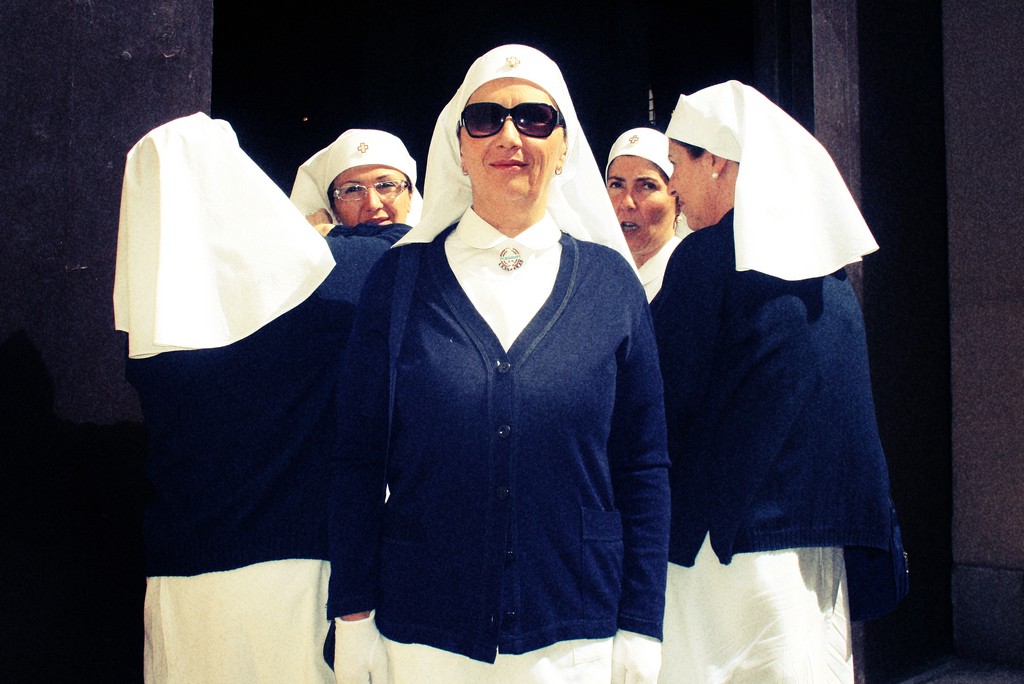
“Carry Me Home, Sisters of St. Joseph” by Marie-Helene Bertino

I am quitting a boy like people quit smoking. I am not quitting smoking. The pamphlet insists: Each time you crave a cigarette, eat an apple or start a hobby! Each time I think about Clive, I smoke a cigarette. If I have already smoked a cigarette, I eat an apple. If I have already eaten an apple, I start a hobby. I smoke two packs a day. I pogo-stick, butterfly-collect, macramé, decoupage. I eat nothing but apples. I sit in my kitchen, a hundred of them arranged on the table. If I can eat this pyramid of apples, I will be over Clive.

The pamphlet insists: Identify then eschew all triggers! Clive was a rodeo clown. When a rodeo comes on TV, its riders attempting to buck and kick into my mind, I turn it off. I eschew you, rodeo. Clive was also a devout Christian. I drive two blocks out of my way to avoid Saint Terese of Avila. I eschew you, Church.

The pamphlet isn’t all hard love. After time passes, it admits, you can reclaim your triggers. For instance, answering an ad for a groundskeeper and general helper and moving into the basement of Saint Terese of Avila.

Saint Terese of Avila’s convent shelters fifteen sisters of Saint Joseph. On the first day, Sister Crooked Part leads me around the halls, pointing out significant rooms and answering my questions. Terese is the patron saint of headache sufferers. Her symbols are a heart, an arrow, and a book. The sisters of Saint Joseph are a teaching order. They do not fly and they do not sleep in cubbies built into a wall, their names spelled out in puffy paint. Do I have any serious questions?

“Are there patron saints for everything?”

Nuns should wear nametags. Another one, wearing the same drab dress and habit, leads me to the basement where I will be staying. My room is dimly furnished and contains a bed, a small desk, and rough-looking blankets the color of dirt. The air is wet. The gaping mouth of a vent hangs over the bed and through it I hear singing.

Sister Whoever says: “That’s the Sunday choir. Their voices are God’s messengers.”

I listen.

She asks if I have any dietary needs as I hoist my bag on the bed. “All I need are apples.”

On the desk I prop up the pamphlet on how to quit smoking. Next to it: three cartons of Marlboro Lights.

Sister Whoever says, “Trying to quit?”

“Dear Christ no.”

By the stairs, we pass an ordered line of silk slippers, fifteen pair or so, different colors and sizes.

“What’s up with the shoes?” I say.

She doesn’t answer, but continues to the courtyard I will be expected to maintain.

She frowns toward a line-up of sagging tomato plants. “We don’t have much luck. Lots of vines but no tomatoes. One or two for sandwiches. Maybe you could talk to them?”

Into the courtyard sweeps another nun, followed by a line of children. They walk with their index fingers poised over their lips. Each child wears rain gear designed to look like an animal or insect: tiger, fish, ladybug, duck. The procession halts at Sister Whoever, whose name turns out to be Helena. Helena introduces me to Sister Charlene, who removes her finger just long enough to whisper “hello.” Sister Helena explains what I will be doing at Saint Terese. I sense movement near me and look down into the big browns of a little boy. He has a frog rain slicker and a bowl haircut that went out in, what, 1984?

“Meow,” he says.

“I’m afraid you’ve received wrong information.”

“Your nose moves when you talk.” He looks disappointed in me.

Sister Charlene makes two sharp claps with her hands, startling us both. “Christopher! Back in line!”

He rejoins his classmates. Sister Helena says, “Charlene thinks you should talk to the tomato plants. Encourage them to grow.”

Sister Charlene smiles. “Say: how are you doing today, tomatoes?”

Sister Helena: “Reward their progress.”

I wait for them to reveal whether they are joking. The kids jostle in their slickers.

Sister Charlene leads them out of the courtyard and Sister Helena has business in the kitchen, so I am left alone with the tomatoes. I feel nervous like a newcomer at a party, trying to small talk with a person I’ve just met.

I say, “How you bitches doin’?”

I do laundry. I dust shelves. At dusk, I sweep the courtyard. It is a catchall, a dust collector. I start by the corner where the tomato vines slouch toward hell, and end up near my small window. The sisters of Saint Joseph allow me to keep my pogo stick in the courtyard. When I finish sweeping I pogo around, inordinately proud of the clean space.

Sister Helena takes a turn. It’s her first time on one; I yell pointers from where I lean, crunching an apple. Her skirt tucked between her small knees, she makes a happy zigzag through the courtyard. She doesn’t know how to disembark, and wobbles into the vegetable garden. The tomato plants break her fall.

Later she says, “What is your relationship to God?”

I fill a plastic bag with ice cubes. We sit at the mahogany breakfast table, where every morning I serve oatmeal to the fifteen sisters of Saint Joseph. Some like it milkier than others. Sister Helena never complains.

“Relationship with God,” I say. “Let me think about that.”

She waits. The ice cubes arrange themselves around her swollen elbow.

I want to know more information before I answer. “Does everyone have one?”

“With different gods and in different ways. Yes.”

“So it doesn’t have to be a go-to-church type thing?”

She smiles. “There are no wrong answers, Ruby.”

“I think there might be,” I say.

“What do you think happens when we die?” She sounds for a moment like a little girl asking about clouds.

“Atheist is the answer to the question you’re asking.”

“No God for you?”

“Sorry to say.”

“That’s all right. Each of us holds a piece of the puzzle.”

“Here’s a question: is there a patron saint for everything? Like, disappointing movies? Or turnips? Socks you can’t find? And outlet malls?”

Every night on the roof they switch on a giant, glowing Saint Terese. Palms facing heaven, she implores her god. Her heart is on the outside of her chest, it shines in porcelain. The light fills the courtyard and squeezes through the bars on my window. It doesn’t bother me. I chain smoke until dawn, blow smoke rings to her.

The first Friday night I am painting a ceramic cat and eating apples when I hear scuffling in the hall. Muffled whispering and the sound of a large door closing. In the hallway, the slippers are gone. I run to my window and stand on a crate.

The sisters are crossing the courtyard, quiet as secrets, each of them wearing a black coat. I can make out Sister Helena, the arms of her coat tied around her joyful shoulders. They move through the gate, the last one closes it behind her, and they are gone.

The next morning the slippers are back, pointed toward the wall in a perfect line. The toes: immaculate arrows.

I water the tomato plants. I’m not a fan of tomatoes, I tell them. They make bread soggy. But I like tomato gravy and bruschetta. Is it broo-shetta or broo-sketta?

They don’t answer.

I list other things I like.

Every week I assist Sister Charlene at Sunday school. My job is to walk the kids to recess and church, administer their snacks, generally make their stay comfortable.

Charlene runs her class like she is half clairvoyant, half yoga instructor. “I’m wondering why I hear talking toward the back of the carpet.” She holds her hands out like a sleepwalker. “I’m picturing a class that is ready for snack time.”

Order is maintained by a giant construction paper “stoplight” on the front board, comprised of a green, yellow, and red face. The green face holds a wide smile, the yellow face a constipated wince, the red a murderous frown. Every kid has a clothespin with their name on it, which begins every day clipped on green. If the kid misbehaves, their clothespin moves to yellow and the kid can’t participate in snack time. If the kid does anything mortal like strangle the goldfish, they move to red although, Sister Charlene informs me, no kid has ever moved to red.

“Most stay on green the whole day.” She beams.

If everyone stays on green all day, it’s a gold sticker day.

Sister Charlene passes a bookmark to each kid, face down. She counts to three. On three, they flip them over. Whoever has the rainbow sticker gets to feed the goldfish. The kids seem jazzed about this possibility. Rachel, a girl who constantly touches her nose as if confirming it is still there, wins. She tosses flakes into the aquarium under the reverent gazes of her classmates.

A kid near me starts to cry. It’s the frog with the bowl haircut.

“I never get the rainbow sticker,” he says. He seems to have an ongoing argument with the letter “r.” I nevell get the rainbow stickell.

“Christopher,” Sister Charlene warns.

“It’s just a sticker,” I say. “Two ninety-five for a pack of ten.” Then I realize he probably doesn’t have money.

“But I want to feed the goldfish!”

“It’s just a goldfish,” I say. “Do you want an apple?”

He does not want an apple and won’t calm down. In his distress, he accidentally backhands a little boy named Sergio.

Sister Charlene moves Christopher’s clothespin to the yellow face. “You are on yellow. No snack.”

Christopher stumbles forward and back. He screams, “Yellow!” and “Why?”

Sister Charlene looks away. “No elephant tears.”

I want to explain to him that yellow is just an idea, an arbitrary way of maintaining order. At my job they would give us written warnings. In the comments section, they would write “belligerent with clients,” or “sleeping at desk.” It’s the same thing. Belligerence is a matter of opinion, anyway. I got that warning after my work revamping the Trix slogan. They had Silly rabbit, Trix are for kids for something like 30 years and asked for something fresh. I made up storyboards and posters for what I thought was a brilliant new direction: Stupid fucking rabbit, not everything’s about you.

Sister Helena and I work in the garden. She informs me what each plant needs and I inform her when a bee is near her by saying “bee.” She arranges the trumpet of a lily. “I think nature has within it the cures to all human illness.”

“I’m curious how you know that.”

“It’s a theory, Ruby. It’s my own.”

I am disappointed. “I thought you had some inside info.” Then I say, “bee.”

She lets it land on her arm. “He’s part of the group.”

“Let’s see after your head swells to the size of a hot air balloon.”

I tell the tomato plants about the rainbow sticker. I tell them I’ve begun to differentiate the nuns. I tell them who my favorites are. In order: Sister Helena, Sister Charlene, Sister Mary. My least favorite nun is fat Sister Georgia.

Fat Sister Georgia scares the creamy lord out of me. She is a rotund woman who takes up two chairs in the dining hall. When you smile at Sister Georgia she does not smile back. Her green eyes are unamused always, and she does not think I am funny, which bothers me. She arrived at the convent years ago with a letter from her parish in Germany and a small valise Sister Helena said smelled like bacon. Her sound is a clipped, disapproving tsk. She sits in the dining hall surveying those around her with the unimpressed look of a gymnastics coach. The other sisters regard her with respectful fear. The occasion of her waddling by is a five-minute holiday in the courtyard. The sisters pause their trowels, mark their pages, scuttle out of her way. Their eyes follow her sadly, as if she were a specter or a town crazy.

“Please stop calling me at work,” Clive says.

I hang up the phone.

I walk the Sunday school kids to recess; single file, index fingers poised over their lips.

“You are a line of quiet ducklings,” I remind them.

Christopher breaks rank and walks next to me, body completely out of his control, like he is shaking something off every limb. He talks. To himself, to others, to Jesus, to the goldfish. He is never not talking. He is already on yellow for interrupting morning prayer with his thoughts on robots.

“Where do butterflies sleep?” He swings his arms.

“In the forest,” I say. “Back in line.”

“I’ve been to the forest,” he says. “And I’ve never seen a butterfly sleeping.”

“Then they sleep in chimneys,” I say. “Back in line.”

“Your face is weird.”

“You have an outdated haircut.”

“What’s an outdated — ”

“Back in line.”

We reach the yard and pray. Sunday school is an orgy of praying. Amen, and the ducklings scatter.

Minutes later, Tyler is screaming. He has not been offered the opportunity to turn the jump rope and has decided to become a lunatic bitch about it.

“Francine’s had five turns already!” he yells.

Francine is a little girl who looks like she could get you a job somewhere great. She holds her end of the jump rope in an elegant hand.

“What can I do to fix this?” I say.

“Tell her to give me a turn!”

“Francine, give Tyler a turn jumping rope!”

She shrugs, drops the handle.

Tyler bounds off, the pain of the previous five minutes gone. All he wants is the jump rope and once he gets it, he is fine. He does not wonder if it is something in him that makes Francine think he is undeserving of the jump rope. There is no longstanding rift. The needs of kids are simple. They want a turn jumping rope. They don’t want anyone to call them ugly. They don’t want their snot on them, they don’t want anyone else’s snot on them. Devoid of sarcasm, they are quivering, earnest-eyed balls of sincerity. When Tyler rejoins the game, he and Francine hug.

After fifteen minutes, I line them up.

“Let’s blow this pop stand,” I say.

Francine raises her hand. “We pray now.”

Once in a while, I smell Clive on my skin and it stops my day. It’s a train crossing, I wait to pass. Eventually the lights stop flashing, the barriers lift. I keep moving.

“Amen,” I say.

“Amen,” say the ducklings.

Bookmarks are on each desk when we return. Whoever gets the rainbow sticker hands out the singing books. This time it’s goody-goody Francine. Christopher supports his sad face on his fists.

“Stupid sticker,” he says.

“Christopher,” Sister Charlene warns.

A moment passes. The goldfish snaps at a flake of food.

“Stupid singing,” says Christopher.

Sister Charlene says, “Principal’s office.”

I escort him. We sit in folding chairs.

His voice is sober, finite. “I’m unlucky.”

I say, “You just need to learn how to zip it.”

Later, Sister Helena makes a blindfold out of her small hands and leads me sightless to the courtyard.

She counts to three and pulls her hands away, and I am face to face with a garden of green tomato vines and one bashful tomato. “And there are buds everywhere.” She points. “Here, here, and here. There. There. A bunch on this side. Look.”

I hold the tomato in my hand. The color red is just occurring to it, having reached halfway down its green body. But, it’s strong. You don’t have to be a gardener to know. This tomato has moxie. I bite into an apple.

Sister Helena folds her hands. “It’s a miracle.”

“I don’t believe in miracles,” I say.

“Yet there it is.”

Not long after, the tomatoes are cartwheeling from the vines. They swoon, they somersault, they enact big scenes.

“Now you’re just showing off.” I frown, but I’m proud and they know it. I tell them: I don’t think there is such a thing as luck. If there were such a thing as luck, tomato plants, I would be the unluckiest person on earth.

Consider my life.

Clive and I met at church; he was attending, I was asking directions to a bar. He spent five years as an attorney for a ridiculously named law firm before quitting to become a rodeo clown at Lone Star Steakhouse, reasoning a discount on Lone Star’s Frisbee-sized steaks was more appealing than helping millionaires iron out their real estate problems. He dropped g’s from his speech and added phrases like “no bigger than a minute” and “rat’s ass.” Twice during the dinner shift Clive galloped out on a broomstick and performed tricks. He became lauded in the steakhouse circuit for his “leaning tower” trick, where he encircled a patron, normally a woman eating a basket of steak bites, in a quivering column of rope. He left me for a waitress at Lone Star who posts pictures of herself on the Internet wearing nothing but a cowboy hat and chaps.

Being without Clive felt as absurd as seeing an ostrich counting exact change for the bus. Or, an ostrich doing anything, anywhere. Ostriches are bizarre and unrealistic. I was so upset I couldn’t sleep, which I remedied by sleeping at work. Because of that and the Trix people, I lost my job writing commercials.

Unemployed, the most I could hope for in a day was that one activity would set off a domino effect: check mail, mail has catalogue, call to order candlesticks made from found wood, operator has Southern accent, pull down book on Louisiana, realize book is dusty, dust bookshelves, celebrate over glass of wine with no clear memory of how the afternoon’s activities had begun, knock head against coffee table, die.

I know it’s not cancer. But, am I unlucky? Am I?

Clive says: you must must must stop calling me at work.

I hang up the phone.

Sister Helena and I sit near the glowing Terese and throw tomatoes across the courtyard to the other roof.

“Will we go to hell for this?” I say when one hits the opposite wall and slithers into the courtyard.

Sister Helena is fifty-five and still a giggler. At first she reminded me of a saucer-eyed French movie star, then a Muppet, now I’m back to French movie star. Her left eyebrow is a miracle: capable of expressing every human emotion.

“You have strange ideas about Catholics, Ruby.” She winds up and pitches her tomato. She has a surprisingly good arm.

I ask what it’s like being married to God.

“I feel protected and safe,” she says. “I don’t have to shave my legs.” The giggle again.

I stop, mid wind-up. “You don’t shave your legs?”

She shakes her head.

“Like, ever? You must have some growth. I’m just saying. When God gets home, you are going to have some serious maintenance to do.”

“I think God has more important things to think about.”

“Maybe,” I frown. “Maybe not.”

She asks if I pray and I say, “Praying is…involved.”

She says, “It’s like making a phone call.”

“A phone call to God.”

“I know you are saying that sarcastically but yes, a phone call to God.” She throws the last tomato and faces me. “Let’s make a phone call to God.”

I blink.

She holds her hand as a receiver. “Ring, ring,” she says.

I blink.

“Ring, ring.” She covers her pinkie, the “receiver.” “Answer the phone.”

I can’t do anything but blink. She keeps ringing. Finally, I answer.

“Ruby!” she says. “It’s God!”

“God,” I say, “where are you calling from?”

“Heaven!”

“You sure have a lot of explaining to do. There goes my other line.” I hang up.

“You can’t hang up on God,” she says. “Call him back.”

“Ring, ring,” I say.

Sister Helena pretends to do her nails. “Ring, ring,” I insist.

She answers her hand. “Hello?”

“God,” I say. “Ruby here.”

“How did you get this number?”

“Information,” I say. “You’re listed.”

“There’s my other line. So long!” She hangs up.

“You can’t hang up on me!”

“Just did.”

We sit for a moment in silence. Sister Helena seems pleased with herself.

I say, “Where do you ladies go on Friday night?”

She shrugs. “I’m glad you came, Ruby. Things are more fun now.”

“Don’t fall in love with me, Sister. I’m a runaround. A real slippery fish.”

“You talk like a gangster.”

A voice calls to us from the courtyard where Sister Luisa Nosy Pants stands with her hand shielding her eyes. “What are you doing up there?”

Sister Helena says: Run.

On First Fridays, I escort the ducklings to mass.

The Church at Saint Terese was built when people still feared God. It is shaped like the business end of an arrow. Built to, in the event of apocalyptic quake, wrench free from the earth and rocket straight to heaven. Serious pews. Stained glass windows throw colored lights onto our faces. Genuflecting, shaking hands: religious exercise. A lot of fuss. All this for me?

Maybe God gets nervous in places like this, the way I feel in restaurants with linen napkins, because if He does exist, I don’t feel him here.

Afterward, I water the tomato plants. I tell them, I did not eat one apple today. Not one. I hold a few of their bigger leaves, the exact size of my palms.

That night, I am decoupaging a lamp when I hear scuffling in the hall. The sisters of Saint Joseph slip into their shoes. I run to the window and stand on the crate. Whispers, multi-shouldered shadow, gate click and gone. I pace the floor. I wind a scarf around my neck and leap the stairs to the courtyard.

Don’t wait up for me, tomato plants!

The sisters shuffle up Route 1. I follow a spy’s distance behind, catching snatches of talking and singing. Summer is hanging on. The trees I pass showcase their leaves: gold and silver. Truck high beams light me; I leap into a bush. When I climb out, the sisters have vanished. I look up then down the road. A billboard above me says: Call Today! I run. Several yards ahead is a stucco building with a sign: The Slaughterhouse Bar. Down the highway I hear the defeated bleating of a horn: a cut-off, a missed signal. I decide to go in, drink whiskey, and figure out how I was given the slip by twelve women of the cloth.

It’s a saw-dusty local’s hole with pear-shaped men lining the bar. Walking through the vestibule I encounter a strange tableau: Sister Charlene feeding a bill into the beat-up jukebox. Fat Sister Georgia ordering beers and saying something I can’t hear to the bartender, a cute remark; he winks as he slides the tray to her.

Sister Helena is at the bar, sipping from a pint of beer. She notices me. “You have leaves in your hair.”

The rest of the sisters exchange worried glances.

“This is not good,” says Charlene. Then, “Trampled Under Foot” blares out of the speakers and she yells “Get the Led out!” The sisters of Saint Joseph hold their beers and wag their bodies around the dance floor.

Sister Charlene takes my arm. “You can’t tell anyone about this.”

“No one would believe me. Also, I have no friends.”

She nods. We drink.

“The rainbow sticker thing,” I say. “Is it necessary?”

Her shoulders pulse with the music. “The bookmarks?”

“It bums the kids out when they don’t get the rainbow sticker.”

“That’s part of life, Ruby.”

“I know it’s part of life…but they’re five. They have their whole lives to be disappointed. Maybe they don’t need a lottery enacted every Sunday.”

“It’s not a lottery, it’s a way of making a decision.”

“Well now, Sister, it’s a lottery.”

Sister Mary is playing an air drum solo. Her technique is chaste, virginal. “Lookin’ good, Mary!” Charlene yells, then to me says, “Agree to disagree.” She holds out her beer and we clink. “You’re here now, so you might as well dance.”

The sisters play every Rolling Stones, Led Zeppelin and ELO song the jukebox holds. I crochet in and out of them. Heaven exists, maybe. I drink to it, to the bar, these women and this night. I drink to the tomato plants. I drink to Christopher. I drink to all the ships at sea.

They seem to have an inside joke about “Houses of the Holy,” a joke I am trying to shoehorn myself into when the door opens and a group of men trudge in. One of them careens into Sister Charlene who pulls her skirt away and says excuse me as he passes.

Same man gets to the bar, and knocks Sister Helena with his elbow. The beer she holds splashes onto her habit and face. The man turns back to his buddies at the bar.

“Hey!” I call. “You spilled beer on Sister Helena.”

He turns around, his face blank. “What happened?”

Sister Helena dabs her nose with a napkin. “Ruby, it was an accident.”

I am having trouble keeping my balance. I lean on Sister Mary. “You spilled a beer on a nun,” I yell. “A nun!”

He stares blandly in her direction. “Sorry.”

“Are you the patron saint of dickheads? Say you’re sorry and mean it.”

When he looks up to see who is yelling at him his face takes on a look of bemusement. “I did.”

The sisters of Saint Joseph close ranks against, unbelievably, me. Sister Charlene gets between me and the man, whose look of bemusement is fading into something more volatile, which delights me. There are only two things I know how to do: encourage plants to produce tomatoes as bright as the sun, and fight. I paw the ground like a bull. I rev up.

“Calm down,” he says. Then, thinking about it, adds, “Bitch.”

I charge. The sisters of Saint Joseph spring into action. They rush me joyously, a line of wide receivers shouldering a tackling dummy. I am knocked ineloquent against the floor.

“You bitches are crazy,” I cry to the tin ceiling. “You crazy bitches are crazy!”

I try to get up. My drunk blooms. My head wants to stay down. The sisters pull me to my feet. They hang me like a wet T-shirt on a clothesline made out of the shoulders of Charlene and Mary. “Our apologies,” one of them says.

“Is she a nun?” the man says.

Sister Mary says, “Dear God no.”

They carry me out of the bar. Sister Helena walks in front, conducting us like an orchestra. “Don’t let her head loll around like that,” she says. “Hitch your hip against her thigh, Mary. Pin her hand to your shoulder, Charlene.”

Slowly, with Helena conducting, we make our way down the road to the convent.

They pause halfway to rest. I ignore Sisters Charlene and Mary, who rub their dancing hips in pain.

“Quit exaggerating.” I take a seat on a tree stump. The tree stump is swaying. Or, I am swaying. “I’m no bigger than a minute. No bigger than a cricket. No bigger than a very small thing.”

A voice says: Give her to me.

It is the brusque, masculine tone of Sister Georgia. I am struck by otherworldly fear.

“Don’t give me to her! She’ll crush me!” My legs pedal uselessly against the ground. Sister Georgia takes me into her arms.

“Go easy on me!” I say. “I’m not a kielbasa!”

The voice says: Quiet.

In the arms of Sister Georgia, I am surprised to find a soft place. The fat that hangs like half hula-hoops below her arms stabilizes me on both sides. Her dress holds a sweet smell, and through its coarse fiber I hear her flapping heart. She hauls me easily down the road.

“Did you learn how to carry someone like this in prison?” I say.

She makes her tsking sound. On every other occasion this fills me with worry and regret, but when you are tired enough, anything sounds like a lullaby. Crickets hum in the bushes we pass. “Those crickets are the same size as me.” I drift off against her soft bosom. My eyes are closed, but I know there is a moon. “I miss Clive,” I tell her metronome heart.

Then, Sister Georgia says so quietly I am unable to know with certainty if it is her voice I hear, or the forest sounds we pass that can be linked to neither animal nor bug: I miss Germany.

When we reach the gate of the convent, she hands me back to Charlene and Mary. I watch as she thunders into the night big-ly, as round as the moon that persists above her, until they are indistinguishable: the moon and my vestige of safe transport.

I am yanked through the opened gate. The courtyard fills with the shushings of women struggling under the weight of a drunk. I am that drunk, but am too drunk to feel bad about it. My inebriation is ebullient, wide enough for everyone. I forget about Sister Georgia because I have come up with a brilliant idea.

“Let’s do bell kicks.” I throw out my left leg and wag it. What I succeed in doing

is not a bell kick, but the effect is pleasing to me. I request the attention of Sister Helena.

“Admire my kick.” I do it again.

Helena’s mouth is knotted.

“You’re not even looking.”

Scuffling at the basement door: which sister has the keys buried in her vestment and who should hold me while they look?

“Flip a coin!” I demand.

Finally, we get in.

The sisters of Saint Joseph carry me down the stairs to my room. They arrange their shoes into a perfect line by my door. I hurl my boots on top. They carry me to bed. I am certain they have asked me to list every commercial tagline I know, so I, supine, call out to heaven:

Cardinal Bank: Named after a bird because Birds. Know. Money.

Kiwi Air: If you can beat these prices, start your own damn airline!

I hear rustling by the foot of the bed as the sisters root through my drawers. Then, into my vision intrudes the head of Sister Charlene.

“Where are your pajamas, Ruby?”

“You’re not Sister Helena,” I inform her.

“No, dear. I’m Charlene. We want to get you into your pajamas.”

I say, “Put Sister Helena on the phone!”

Finally, after what feels like a year, Sister Helena appears with a towel wrapped around her head.

“Thank god.” I lean forward, attempting to make a private space where we can gossip. “There are all these people pretending to be you.” I hoist my head in the direction of the doorway, where the blurry form of Sister Charlene leans in the shadows.

Sister Helena looks disappointed. “You’ve had a lot to drink.”

I have the rationale of whiskey. “You’ve had a lot to drink.”

She gives me an aspirin and I sit up to take it. Immediately, I feel it dissolve and fill my insides, making every atom in my body quake.

“This aspirin is frying me!”

“It’s not in your system yet, Ruby.”

“It is in my system. I feel it in my system.”

“You’re not making sense,” she says.

“You’re not making sense,” I say. “You’re the patron saint of not making any — ”

“Try to sleep.” She pushes my shoulders into the pillow. Then, she sits on the bed while I try to get my scrambling atoms in order. Fall in, ducklings. After a while, my quivering head slows. I begin to wonder what Sister Helena is thinking, if she feels she is wasting her night with me, a drunken sinner. I want to give her something so her time with me is worthwhile. An invaluable tip she will benefit from and, later, be able to trace to my good counsel.

“Leave the S off for Savings,” I tell her.

“I will,” she says. “Tomorrow.”

“Today,” I insist.

“Tomorrow, Ruby.”

“See the world in your Chevrolet,” I say.

“I will,” she says. “I promise.”

“You say that.” I close my eyes. “But you never will.”

I don’t remember anything else.

Dawn. I wake up with a headache. My limbs are attached to an invisible system of weights and pulleys. When I move them a glacier of pain descends on me.

I munch a palmful of aspirin and lay with a damp towel on my head. At noon the pain has not receded. Sisters Charlene and Mary visit after lunch with a bowl of onion broth and salted crackers. They adjust the curtains. Before they leave, they bow their heads by the foot of the bed and I catch a few words of Latin. By four when I should have been helping Sister Mary with dinner, my headache, as if acquiring strength from the advancing night, takes possession of my entire body. I throw up into a bucket, viciously, like I am trying to prove something to the bucket. I can’t keep my vision straight. I am slipping off the earth. This earth will go on without me I think, swing on after I’ve swung off. I am the patron saint of shit. My symbols are a pogo stick, a pack of Marlboro lights, and a tomato. Then, the bucket is full so I throw up onto the floor, my throat shifting into new gears to rid itself of every poison. I can barely keep up. I am flattened by sweat. I am stark naked, with no memory of taking off my pajamas.

“Terese of Avila!” I cry. “Patron saint of headaches. Release me!” It is the closest I’ve come to prayer.

Around midnight I pass out, still in pain. I have brief, thrilling dreams about apricots. I wake up, it is dusk, and I realize with a different pain I have missed Sunday school.

I find Sister Helena in the garden, where she is harvesting the last of the tomato plants, smiling into each tomato’s small mug.

“I’m sorry,” I say.

A smile she has extended to a nubby tomato is still on her face when she looks up. She holds a trowel.

“God told Saint Terese: no longer do I want you to converse with human beings but with angels. Terese felt different from everyone else. She had fire in her. She prayed for it to go away but it is good to have fire. Not to be eaten by it.” Sister Helena could pull it off, starting a conversation with a quote, because she was so frustratingly sincere. “Ruby,” she says. “Anger keeps you from God.”

As always she speaks in the quiet voice that makes it impossible to gauge how upsetting or special I am. She employs the same level of intensity to tell me we need more oatmeal as she uses to promise I will get into heaven. Ruby, they are showing Roman Holiday at midnight. Ruby, place your anger beside you and sit with it.

I squirm where I sit holding a gnarled tomato between my index and middle fingers. I picture it with arms and legs. I can teach this tomato how to walk and dance. Anything so I don’t have to look up and face Sister Helena’s disappointment in me full on, and in facing it, accept it.

“Please don’t be mad at me,” I say to the tomato.

With the last of the tomatoes, we make gravy. It simmers for hours, filling up the hallways and courtyard, picking up the corners of an otherwise regular Wednesday. That night, we feast. Lasagna, pizza, gnocchi. The sisters are giddy with good food. Even fat Sister Georgia eschews the constraints of her own personality to soak a hunk of bread in the gravy and bite into it with an erotic moan.

Good job, tomato plants.

In December I begin to see a man named Levon who sings in the choir. He visits me in the basement and we lie on top of the sheets of my bed. Sometimes we watch game shows on a television I buy at the Charity shop. He has more freckles than he needs and won’t sing for me. He believes when we die we get forgiven.

When I ask how certain he is about that he says, “Dead-bolt positive.”

I see his wife in Church sometimes, her purse clamped in her armpit like a wide receiver holding a football.

Levon asks if I love him and I say, I love cigarettes, they are my only, truest love. Sometimes I am still in the middle of smoking one when I already long for another. You tell me what is more love than that.

One afternoon, a storm collects around me as I sweep the courtyard. Dusk descends though it’s 2 o’clock, and the wind picks up, negating my match as I try to light a cigarette. Sister Helena calls: Ruby, better get in. She has the news on and there are advisories. Record-breaking winds and flooding. Biblical rains start and we can’t hear the television anymore. Thunder makes Sister Helena jump. I laugh every time.

Two quick pops, then a sound like a boulder detaching from the center of the earth. An explosion in the courtyard. The convent rattles. We rattle, too. What was that and will there be another one? Sister Charlene darts in, cries “Terese!” and darts out. Sister Helena and I look at one another then we dart too. The courtyard is gray and swirling. It takes a moment to figure out what we are looking at.

I scream.

The glowing Terese has performed a swan dive into the courtyard, head planting into the tomato garden. She has embraced the garden with her concrete arms and broken the fence on two sides.

We can’t lift her. She stays until morning when the rain slackens. It takes ten of the sisters with ropes, calling instructions to each other, to get her off. When they do I scramble underneath to survey the damage. Terese has ripped the earth with her hands, taken out roots and vines. The work nature did for next year, demolished. I kneel. I hold an unattached leaf. It trembles.

Sister Helena says, “We’ll plant a new garden in the spring.”

“Right, yes, certainly.” I am polite with shock.

I feel her hand on my shoulder. Sister Charlene places her hand on my other shoulder. Then Sister Mary, Sister Georgia and the others I haven’t mentioned by name due to time constraints but who each had their own idiosyncrasies, likes and dislikes, they place their hands on my shoulders, my head.

The day before Christmas break, rainbow stickers decide who puts the angel on top of the tree. Chrissy gets it: an I-lost-my-sunglasses-have-you-seen-my-sunglasses-oh-they’re-on-my-head kind of girl.

God damn it! someone says and when Charlene and the kids turn around I realize I have said it. I have sullied the Lord’s name in a Catholic classroom.

Christopher is too in awe of the curse to be upset about the sticker.

“Maybe you are just unlucky,” I say to him.

At the Christmas party I realize I haven’t thought of Clive in weeks, so I do this to my mind: I goosestep into thoughts of him, toe first, testing what is still raw, where I will fall through. His ludicrous, twisted feet, his rope theatrics that bordered on genius. Turns out nothing is raw, and I think of him as an autonomous being I hope is doing OK.

One of the presents under the tree bears my name. The sisters gather around as I open it. Red silk slippers.

“Red because you’re unique,” Sister Charlene points out.

“Red because her name is Ruby,” Sister Georgia says.

Sister Helena says, “Your dancing shoes.”

Then, the sisters of Saint Joseph and I dance to “YMCA.” We put up our hands to make the letters. I play my leg like a guitar. They look at each other while they prance around, nodding approval and showing each other their hips, their rumps. They look at me, too.

Valentine’s Day: holiday of choice for five-year-olds. Each kid brings in enough Valentines for everyone in class, even an extra for Miss Ruby. We use felt hearts, sequins and scissors to turn brown lunch bags into mailboxes. In the morning, we arrange the mailboxes on the floor in anticipation of passing out the Valentines. Christopher goes on yellow for crushing a few of them in an excited carpet slide. During recess, he shows me his Valentines with the care of a scientist; pale blue robots each bearing his earnest signature. Then, trying to reach the highest monkey bar, he knocks Tyler’s head into a pole. In the moment before Tyler reacts, I will the world to stop. He begins to cry, slowly at first, then with virtuoso feeling.

Christopher looks at me with scared eyes.

Sister Charlene exhales. “Christopher, you are now the first child ever to go on red. Miss Ruby, take him to the office.” Balancing the weeping Tyler, she leans into Christopher. “While everyone else is getting their Valentines, you will be sitting in the office. We will pass out your Valentines in… your….absence.”

She turns on her heel and leads the ducklings back into the building. Christopher and I are alone in the courtyard where it has begun to rain. From his backpack he pulls a kid-sized Spiderman umbrella and opens it. As we walk, he looks around wildly. Something in him knows there is a way to get out of going, but he’s too young to know what it is.

I leave Christopher in the office and rejoin the class. Tyler milks his injury, holding an ice bag to a swollen knot in his head. He gets to read on the beanbag while we clean up the morning’s art supplies. Every kid wants to sit next to him. More than they want ice cream. More than they want God’s love. They beg, they twist, they plead. So Sister Charlene lets them take turns, two at a time. At what age does the sick kid become the least popular?

I think of Christopher in the office. This is his Valentine’s Day, and he has to spend it surrounded by brown light and the aggressive penciling of fat Sister Georgia.

I imagine my anger as a thing I can hold, and place it beside me. Anger, you are one ugly looking pile of crap.

The happiness of the Valentine promenade seems forced and wrong. I ask if I can be excused.

Sister Charlene glares, but nods.

Christopher sulks on a folding chair, legs high above the floor. His weeping has downshifted to small chokes of despair.

Sister Georgia looks up when I come in. I ignore her.

“We have to stop meeting like this.” I take the chair next to him.

He raises his tear-streaked face. “Is Tyler OK?”

“He’s fine, Christopher. He’s a big baby. He’s the patron saint of being a baby.”

Sister Georgia clears her throat.

I clear mine back at her. I feel a soft pressure on my hand. It is Christopher, reaching out to me. “I am a bad boy.” His eyes are pretty with tears. He shakes his head, as if there is nothing to be done in the matter of him.

“You are.” I nod. “But there are worse things.”

The door to the office swings open, revealing Sister Helena.

“Ruby,” she says. “There’s a cowboy in the courtyard to see you.”

He is in his Lone Star uniform, complete with steakhouse-issued chaps, wig of red corkscrew curls, and cowboy hat, which he doffs when he sees me.

“Howdy.” He holds his lasso. “Happy Valentine’s Day.”

“Clive.”

“You haven’t called in a while.”

He releases the rope and it hovers over the ground obediently. He keeps small circles going as we talk. He says to the center of the swirling rope: “Come back.”

I strain to hear into the office, whether Christopher is crying again. All I can hear is Clive’s rope. “That’s so nice,” I say. I mean it. It’s a good day when someone, anyone, wants you. “You’re about six months and a couple weeks too late.” How amazing, I think, to be completely free of this, and how sad, and how pointless. Why do we pretend the people we love are special? I light a cigarette. The shelf life of getting over a rodeo cowboy is one year, tops.

“It’s never too late, Rubes.”

“That statement is inaccurate, Clive.”

He looks up from his rope for the first time. “What do you have to stay around for?”

Around the area of my heart, I feel a sharp pain. It is allegiance, or loyalty.

“Tomatoes,” I say. “You have to talk to them in a certain way. The soil has to be right. You can’t just throw them in.”

Suddenly in a motion I at the last second perceive could be aggressive, Clive advances toward me. When he is inches away he halts. I exhale smoke into his face. I hear the sizzle of the whip and feel cool air around me. The leaning tower.

“Enough,” I say. One by one, the columns of rope fall against the concrete. He bows his head, summons the rope.

“Goodbye, Clive.” I toe my cigarette out and walk away.

He rat-tails the wrought iron fence where the tomato plants sleep. It makes a patwink sound each time. Pa-twink. I used to love all the sounds of him, but now his tricks seem empty and tinny, the activities of a little boy.

Little boy. I am anvilled by a brilliant, sober idea.

“Clive,” I say. ‘Bring your rope and follow me.”

Christopher is staring into a corner, little boy mournfully. When he sees Clive his eyes widen.

“This is my friend,” I say. “He wants to show you some tricks.”

“Me?” he says.

“Just you. All the other kids can go to hell.”

Behind the desk, fat Sister Georgia clears her throat loudly.

I sit next to Christopher. “Do your thing, Clive.”

Clive bows to us. In our chairs, we bow. Clive gallops around the office. He yee-haws, he hitch-kicks, he yippie-skiddly-doos. He hurls his lasso to every corner of the room. When it is time for the Leaning Tower, Christopher can barely contain himself. Inside the whistling column of rope he claps and screams. Even fat Sister Georgia is moved. Over her paperwork, a smirk. When it is over, Christopher throws his arms around Clive’s knees. In the convent office that day, a private rodeo show for a bad little boy.

“You gave him the wrong message,” Sister Charlene says. It is after dismissal and I am being disciplined. We sit on beanbag chairs. Pinned to our blouses, construction paper hearts say Charlene! And Ruby! “You rewarded him for being bad.”

“I certainly understand,” I say, “how you could see it that way.”

Sister Helena and I order Chinese and eat in the kitchen. The other sisters are sleeping, reading or praying. We are lit by a single track of lights, and sit with the wide counter between us, passing containers of shrimp fried rice and corn soup back and forth. I tell her about Christopher’s Valentine’s Day. I reach the part when he realized he would not be passing out his Valentines when my throat closes and I am unable to breathe. I put my fork down.

“Sister,” I say. “I am going to cry.”

She touches her silverware lightly with her fingertips and nods.

I have big eyes that don’t produce tears often. When they do, they are prizewinning bulbs. Elephant tears. The first two smash against my collarbones.

We continue to eat. The soup is salty and warm.

I don’t want to cry in front of Sister Helena. My eyes twitch with effort; my throat fills with sorrowful carbonation. Sister Helena does not seem uncomfortable as she eats her fried rice.

I croak key phrases: Christoper, robot, why. “He has trouble printing. You know how long it probably took him to write his name on 14 Valentines? One lowercase h alone takes him five minutes.”

Remembering the curved handle of his Spiderman umbrella, it becomes impossible to continue. I cover my eyelids with my thumb and forefinger and shake the worst of it out. Sister Helena watches, giving me permission in her quiet, reverent way.

“I’m almost finished,” I squeak.

She moves onto her bowl of corn soup.

Finally, my crying subsides. I resume eating a forkful of shrimp. I say, “You tell me this: if God created everything, why did he create the brain I have that holds these thoughts? If he wanted us to think of nothing but sweet peas, why not engineer our brains so we can think of nothing but sweet peas?”

“What makes you different makes you special,” she says. “Don’t wish it away.”

She doles soup into my bowl.

“There is a word for these kinds of mushrooms,” she says. “The ones that look like houses.” She pins one with a fork and holds it out to me. “Shis-stack?”

“Shiitake,” I say.

That night Levon visits me and undresses by the foot of the bed. In the light a trick occurs and for a moment I think he is Sister Helena. I am glad for it. I would like her to lie next to me and press her woolen thighs against my stomach. Does she think of me in her prayers?

After sex, Levon and I lie in bed and glow. We are God’s messengers.

He says, “I have to go back to my wife.”

I admire them. They are good Christians. It must be comforting doing errands believing that when you die you’ll be wrapped in absolving light. The rest of us fight it out. Take medicine and say we’re sorry.

In March, we plant the new garden. The Sisters of Saint Joseph stand in the courtyard and say intentions as I walk by with a bucket of seeds.

“Go, tomato plants, go,” says Sister Helena.

“I am picturing you big and strong,” says Sister Charlene.

And so on, until we get to fat Sister Georgia, who looks away and tsks. “This is stupid, talking to seeds.”

I cover the bucket with my hands so they can’t hear. “Say an intention.”

“Come on, Georgia.” Sister Helena calls from the back of the line. The other sisters urge her until finally she says something in German.

I narrow my eyes. “Tell me what you said.”

She grins. “It’s between me and the tomato plants.”

“Georgia, if they grow up lopsided, you and I are going to have a come-to-Jesus.”

Her face contorts. She makes short barking sounds.

“What’s she doing?” I say.

Sister Charlene squints. “She’s laughing.”

Dear Apple juice Lord Tuscaloosa softball wonderful.

I kneel on the ground to say my own intention in private. I take a few of the seeds in my hand. No one knows what’s going on down here, guys, so just do your best. Try to be miracles. Be impetuous and stubborn. I will be here for you, every day.

I straighten up and realize what I have done is made a promise to be around.

“Fuck,” I say. “I have to quit smoking.”

Tonight, the sisters of Saint Joseph and I are going to the Slaughterhouse Bar. I have four rolls of quarters and we are going to dance until there’s blood in our slippers. It’s June, and the last day of Sunday school at Saint Terese. It’s barely 10 a.m., and Christopher is already on yellow. I’m proud of him; this year he has not learned a blessed thing.

Today, the kids will place a year of Sunday art projects into brown bags decorated with pipe cleaners. They will sit on the carpet and sing. Sister Charlene will walk around the circle and place bookmarks in front of them. The four kids with rainbow stickers will be allowed to pull out of the candy bin all their hands can hold.

The other kids can, essentially, suck it.

This lottery still infuriates me, but Sister Helena says my mind is on overload due to nicotine withdrawal.

Each time I want a cigarette, I eat an apple. If I have already eaten an apple, I start a hobby. Or, I talk to the tomato plants. Or, I sing a song with fat Sister Georgia who, it turns out, has a voice not unlike a cement mixer. This is surprisingly not unpleasant. If I have already done all that, I think of ways to mess with Sister Charlene. For example, today I was in charge of placing rainbow stickers on four bookmarks.

These kids will grow up. Some of the boys will never feel tall enough. Some of the girls will look great in pictures but in real life will be dull and forgettable, the girls on the bench at the mall you ask to move so you can throw out your soda. Some of them will never be able to find their keys. Some will triumph. One day, a person they love will say I do not love you. One day every one of them will die.

Today is not that day.

I think when we die, Jesus or Peter or whoever wheels in a VCR like they did in grade school to show us whatever we want from our life. We can rewind, fast forward, watch the good parts over and over. Life is shit mostly, but everyone has moments. Even me. Times when the clouds part and I am able to summon up a little hero.

Since Miss Ruby was in charge of placing the rainbow stickers on the bookmarks, today everyone gets one.

Today no one is lucky.

Marlon James Is Publishing an “African Game of Thrones”

The Man Booker Prize winner takes on the Fantasy Genre in His Latest Project

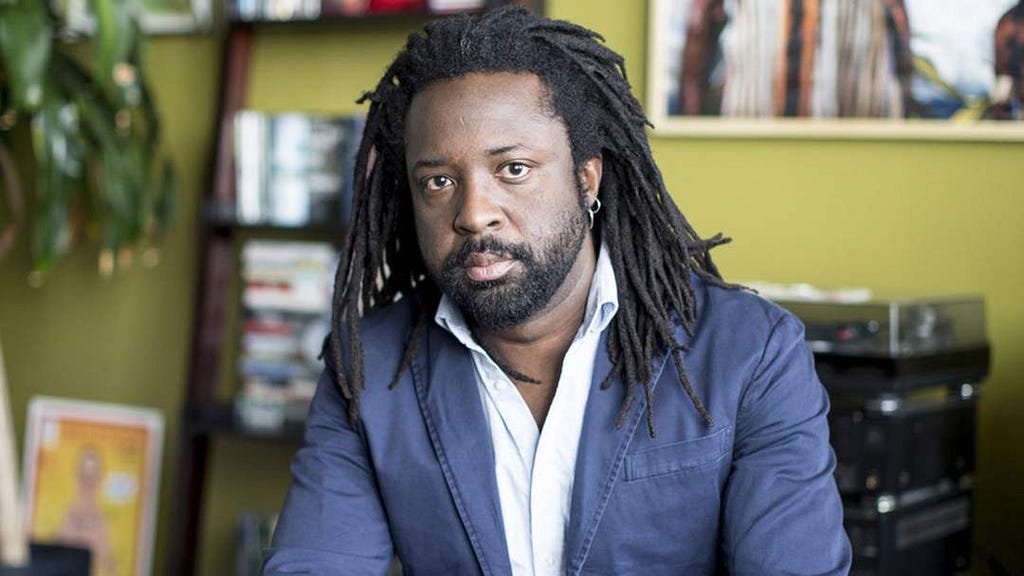
In 2015, Vulture reported on Marlon James’s intention to go full throttle geek and write his own fantasy series. The author of the critically acclaimed A Brief History of Seven Killings was inspired by the likes of George R.R. Martin and J.R.R. Tolkien, but was “sick and tired…of arguing about whether there should be a black hobbit in Lord of the Rings.” Today it was announced that James has officially taken the matter into his own hands, and Riverhead will be publishing his epic series, The Dark Star Trilogy — an “African Game of Thrones. The forthcoming books will be steeped in African mythology, and James will bring to life an entire new universe, complete with complex histories and fascinating characters. Here is the official description released by Riverhead Books:

“Three characters — the Tracker, the Moon Witch, and the Boy — are locked in a dungeon in the castle of a dying king, awaiting torture and trial for the death of a child. They were three of eight mercenaries who had been hired to find the child; the search, expected to take two months, took nine years. In the end, five of the eight mercenaries, as well as the child, were dead.

What happened? Where did their stories begin? And how did each story end? These are the questions Marlon James poses in the Dark Star Trilogy, three novels set amid African legend and his own fertile imagination — an African Game of Thrones. From royal intrigue to thrilling and dangerous voyages, and complete with pirates, queens, witches, shape-shifters and monsters, these novels are part fantasy, part myth and part detective story — all from the author of the Man Booker Prize-winning A Brief History of Seven Killings.”

The books are expected to be published next year.

Mary Miller Has a Few Questions

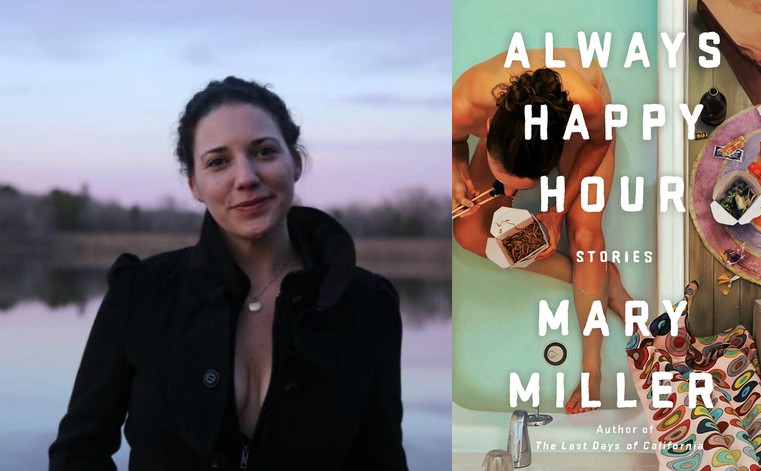
When I was accepted into the MFA program at the Michener Center — what seemed to me then and now a clerical error they were too kind to correct — one of the many happy-making trains of thought that kept returning was, That’s where Mary Miller goes. I had come across Miller’s first collection, Big World, the year before, and it quickly became one of the collections to which I pointed when I thought that is what I want to do. I think of Mary’s stories — in Big World, in her chapbook Less Shiny, and in her new collection, Always Happy Hour, out from Liveright (W.W. Norton) — as apertures through which we, her readers, are given the opportunity to witness, however briefly, a life in the process of being lived. Perhaps this sounds somewhat reductive, or not on the face of it an altogether captivating characterization, but at a time when it seems so much of contemporary short fiction is interested in massive world-building, in grandiosity, in purportedly clever conceits that ultimately obscure a reader’s ability to engage with a character, I find Miller’s stories so generously, beautifully fortifying. She is not interested in dazzling you with a twisting-and-turning plot; she’s happy to have that dazzle take place on the level of the sentence, her kingdom and her greatest gift. (The collection is abundant with sentences one comes across and is instantly furious that one hasn’t written.) What I love most about Miller’s stories, then, is how disinterested they are in presenting a reader with the sense that something has been solved, or is even solvable. I love that Mary Miller has created a space in short fiction wherein the goal is nothing more and nothing less than, to borrow a phrase from Maggie Nelson, “to let things hang out.”

It was the best way to end a terrible year, talking with Miller over e-mail about Always Happy Hour.

Vincent Scarpa: I wanted to begin, if it’s all right with you, with language, with your sentences. Though I identify as something of a syntax-junkie, I find that it’s something extremely difficult to talk about: the way a sentence sounds, and why I find a certain sentence — or, as in your work, so many sentences — to sound, lacking a more clarifying phrase, beautifully correct. Reading the stories in Always Happy Hour and revisiting your previous work — the novel The Last Days of California, the collections Big World and Less Shiny — I always come away feeling most strongly and most delighted by the sentences themselves above all else: their often untidy construction, their occasional disobedience of “proper” grammar, their hiccuping flow and rhythm, and the way these things come together to constitute your singular style. An example, just one of many, from the story, “At One Time This Was the Longest Covered Walkway in the World”: “I want to ask my boyfriend what color his ex-wife’s eyes are because if they’re blue then the boy isn’t his and we could be spending our nights alone.” I wonder: do you read your sentences aloud as you write? Do you find that you labor at the level of the line as much, if not more, than on the level of the story as a whole? Furthermore, I’d love to know which writers you turn to for good sentences, perhaps even feel instructed by. (Frankly, I’d love to know what are some of your favorite sentences.)

Mary Miller: Oh, how I love the sentence. Above all else. Above everything. I never read aloud, though, unless I’m timing myself for a reading. When I’m alone, it feels weird to hear my own voice.

I think my sentences have gotten tidier over the years; the most important thing is rhythm, how the words sound and feel. When I first started writing I didn’t have an amazing grasp of things like modifiers, and published stories with sentences like this: “We carried backpacks and sat around a table in tennis shoes.” Someone wrote to me and said, “The table doesn’t wear tennis shoes!” and I responded with something like, “Don’t be obtuse [I’m not a complete idiot]! You know what I’m saying!” But all the same, I would never write a sentence like that today. I rather like picturing a table with tennis shoes, though.

(I can’t believe this story is still online, but it is, and that sentence is in the first paragraph.)

The sentences I like best are the ones I wish I’d written because they reflect my own thoughts and feelings. I love my Kindle because I can highlight everything in one document instead of messing up my books with dog-ears. I highlight constantly:

— “Every living thing had mysteriously died the second we turned the camera on.” — Miranda July

— “‘I’ve got a retirement plan. It’s called a bullet,’ said Boris.” — Jack Pendarvis

— “We fall out of love only to fall in love with a duplicate of what we’ve left, never understanding that we love what we love and that it doesn’t change.” — Sara Majka

— “A psychiatrist friend of yours once told you that a telltale sign of a mentally unstable person is she’s never dressed appropriately for the weather.” — Vendela Vida

These sentences resonate with me for one reason or another. For example, I remember going over to my grandparents’ house one Sunday afternoon in the winter, how my grandmother asked why I was wearing shorts and kind of blocked me from entering her home until I answered. And then I wondered myself; it was too cold to be wearing gym shorts and yet there I was with my legs all chicken-skinned. It hadn’t even occurred to me to wear something halfway decent, something appropriate for the weather, and my own family said nothing to me, ever, for fear of offending me because I was so sensitive. No matter what anyone said to me, I was always trying to interpret the subtext, and I always felt the subtext was: you’re wrong; what’s the matter with you; why are you the way you are and how can I change it?

VS: You turned me on to that Sara Majka collection, Cities I’ve Never Lived In, when I came to see you in Gulfport, and I’ve probably thought of certain sentences, certain moments, in that collection at least once every few days since I read it in June. So, thank you.

As I think about some of my favorite sentence-makers — Mary Robison, who can marvel with a line “I would always be late, too, if at the parking garage I hadn’t grasped the mechanical-gate concept, that at the very fucking second the fucking stick rises, is when you go,” from One D.O.A., One on the Way, or Flannery O’Connor, who does breathless, breathtaking work in a sentence like “The black sky was underpinned with long silver streaks that looked like scaffolding and depth on depth behind it were thousands of stars that all seemed to be moving very slowly as if they were about some vast construction work that involved the whole order of the universe and would take all time to complete,” from Wise Blood, or William Gay, in Little Sister Death, of his protagonist: “He was seized with longing so intense it ached in his chest, he wanted it always to keep, to drag out secretly and study it like a yellowed photograph, and he thought I am home, this is me, this is where I have been rambling down to all these years” — I wonder, despite thinking that schooling or geographying or really any endeavor to group writers to be mostly futile and almost always exclusionary, if there isn’t something to be said about Southern writers, syntax, and sentences. It might be something as simple as an ear tuned to a different variety of speech pattern, or perhaps something more difficult to pin down, like what it is that might drive a person to talk quickly, ramble, rush out language with no space for pause or comma. Is any of this resonating with you? If so, I’d love to hear you talk about it, designated, as you are, as a “Southern writer.”

MM: Robison is so good! I arrived too late at the University of Southern Mississippi to be her student. All I got were the stories of how things were so much better before I’d gotten there, which of course is how it always is. You missed it, people want to tell you; it was so much better before…

I’m a Southern writer because I’ve always lived in the South. I don’t even know what it means, really, or how it’s “different,” because I’ve always lived here. When I moved to Austin for graduate school, I lost my accent for a few years but that was about it. (I’ve been told that it has returned in full force since my return to Mississippi.) Southerners value storytelling, humor, and rhythm, though I imagine that’s pretty universal. And I come from a family of musicians, so music is very important to us. Over Christmas, my siblings plugged their guitars into their amps and we sang along to Bonnie Raitt’s “Papa Come Quick” and The Band’s “The Weight,” songs that are more like novels set to music.

I’m a Southern writer because I’ve always lived in the South. I don’t even know what it means, really, or how it’s “different,” because I’ve always lived here.

We also kept making my sister’s boyfriend tell the same story every time someone new showed up. Each time he added new details and each time I thought I wouldn’t be entertained, but I was. Perhaps Southerners talk to each other more? Tell more stories? There’s still a front-porch culture; it’s hot nearly year-round (it’s currently 73 degrees) so you sit outside and drink beer or iced tea and just talk about where you’ve been and the things you’ve seen. Or, if you never go anywhere, you gossip about your neighbors.

VS: Many of the narrators and protagonists in the stories here are more or less self-aware, but that self-awareness by my no means indicates that they are going to change, or that they’re even capable of change. Perhaps this is best embodied in a remark made by the narrator of “The House on Main Street,” who says, “It is seven-thirty and already painfully bright outside. I need curtains but this seems completely beyond the realm of possibility — where would I get them and would they be long enough? I’d probably have to have them made.” In which case self-awareness signals an acknowledgement of one’s intractability, one’s tendency not to move toward action. Then there’s the narrator of “Proper Order,” a story which ends with her saying, “Don’t mess it up, I want to tell him. Don’t fuck things up because once you start fucking up it’s so hard to stop and there comes a point at which you simply don’t know how to do anything else anymore.” In which case self-awareness seems to also be a kind of resignation. What about that interior space interests you, or seems ripe for pulling and creating characters from? You capture it exceptionally well.

MM: At the Michener Center, I was a fiction writer who was also writing plays because, as you know, we had to have a secondary genre. I wrote a few plays over those three years but they never interested me much. I wanted to have my narrator think — what was she thinking? How was she feeling? And so I was always writing terrible stage directions, but even those didn’t do it. You can show your character pacing or frowning or crying but WHAT IS SHE THINKING? Action and dialogue and situation — for me everything is secondary to the thoughts in a character’s head.

I’m reading Chelsea Martin’s Mickey right now and dog-eared this last night:

“I felt incredibly close to Mickey in that moment. I felt like he could intuitively understand the trajectory of my mind, or was connected to me in some transcendent way, breaking down one of the many barriers that made us two separate people instead of one whole.

But I could never know what Mickey thought or felt, despite occasional reassurances. It felt the same as the way I couldn’t know if, when I held his hand for comfort while we fell asleep, he felt comforted, too, or was merely patiently attending to my embarrassing emotional needs.”

This is why I read, and why I write. Because you can never know what’s going on in someone else’s head. Because you can never really know the people with whom you are the closest.

VS: When we spoke in 2014 about your novel The Last Days of California, you said, “I think I came to terms long ago with the fact that not a whole lot of people are going to like my work in general.” I think I said something about how the masses have never been arbiters of the sublime, but I didn’t not see what you were getting at, either. Your work, as you said then, isn’t always plot-driven, and doesn’t always give people the ending they might desire. But reading the stories in Always Happy Hour, I think it’s precisely the choices which might alienate some that, on the contrary, convince me of your mastery over the short story form. In no small part because I think you follow and trust the language and make it do such beautiful work, but I think there’s also something of equal importance to be said about that which your stories don’t do. They don’t have an interest in presenting characters who are easily understandable or reducible, or whose actions and motives are always reasonable and unambiguous — because who, really, is? Nor do they engage in ribbon-tying endings, providing a false sense of closure just because the story itself is closing. Which is to say that I think the most rewarding part of reading these stories is the experience of feeling frustrated or worried or puzzled or disenchanted, not about the work itself, but by virtue of the work being so precise and so illuminating that we really do inhabit the world and the lives of these characters; characters who probably resemble us more than we’d like to believe. This is all a long, circuitous way, I suppose, of asking a rather lofty question: what do you feel a short story ought to do? Or, if this is even a different question, what is it you seek to do in your stories?

MM: In any kind of workshop environment (and outside of them, too), you’re asked: “what makes this day different from all of the other days?” and “how does the narrator change throughout the course of the story?”

I never cared much about these things. The day that everything changes isn’t as interesting to me as what led up to that day. And people do change — I’m not one of those people who believe we’re incapable of it — but I also don’t see it happen very often, not in my own life, nor in the lives of the people I know. So a narrator changing over the course of a story and/or coming to some great realization that alters everything — I don’t buy into all that.

The day that everything changes isn’t as interesting to me as what led up to that day.

I like to read about how people live, what someone’s life is like on a particular day. Not, of course, the most boring day of their life while they’re watching TV and semi-catatonic, but that could be a story, too. I’m a thinker, a ruminator, and while it’s not the best way to live, it can be interesting to read about. Who do they miss? Who do they love? How do they get through a day, an evening, a night? What do they want? What led them to this place and time in their life? All of these things interest me.

I walk my dog around our apartment complex and peer into the windows and I’m so incredibly curious. Who are these people? Why don’t I know them? I want to know them. Are they like me? Do they want to be friends? All indications are that they are not like me and do not want to be friends. Right now I’m living in a place with a very transient population because it’s casino/military/trashy, which makes it hard to talk to people. No one is putting down roots; they’re all just waiting to move on. I spoke to a neighbor not long ago and she was very friendly because she had questions for me: did I know why the cops had been called? Had I seen or heard anything? I talk to the homeless guy at the beach where I walk my dog and berate myself for never having any dollar bills to give him as he insists on cleaning my windshield, as he tells me his story about needing bus money to get back to New Orleans and I let him give it to me. I want to interrupt him and tell him I don’t need his tale, it’s not necessary. Of course I want to know everything and and write it down because most people don’t think about their lives as being interesting, or important.

Alas, I’m not that friendly, either, and so we will all be strangers here.

VS: The stories in Always Happy Hour alternate from first-person, second-person, and third-person narration. I’d be interested to hear you talk about the process of deciding from which point of view any given story should be told. Do you always know, going in, that a story is going to be, say, in first-person, or are there times in revision where something that essential can change? Do you have a sense, when writing, that the chosen modality has enforced upon the future of the story certain narrative limits or possibilities? Perhaps because I’ve now heard Antonya Nelson give the same “Against the Use of First Person” lecture twice, I’m even more interested in troubling or complicating the notion that there are things, lacking a better phrase, that you can get away with in one mode that you can’t in another. You seem to have such a keen instinct for not only choosing the right vantage point, but also for playing with perceptions of what these modes can and can not do, so I’d be curious to hear whatever your thoughts about this might be.

MM: I don’t like third person that much, and I hate it when a story begins with a character’s full name, like, “Jack Bishop was waiting for the train when he saw his ex-wife…” It feels like somebody’s making stuff up. And while I love fiction, I want to believe that what I am reading is real.

I learned pretty early that first person was for novices, or this is the line they give you — beginners use first person, and particularly first person present tense — but it often feels like the most authentic point of view to me. And I write in past tense, as well, but my most natural writing mode is first person, present. It’s personal and immediate, like you’re inhabiting the life of a person right now.

When I start writing in second person, I can’t stop, so I don’t do it much anymore. There was something too affected about it, and “you” becomes an authorial intrusion.

VS: My final question is a two-parter. Part one: I’d love to know which books you’ve found recently that you’ve enjoyed, and who we should not fail to be reading. Part two: what are you working on next?

MM: I loved Cities I’ve Never Lived In by Sara Majka. I think I’ve read it three times? And I’m currently finishing up Mickey by Chelsea Martin; what she’s done in this slim book is nothing short of amazing. I think people see a book like this as a bunch of vignettes that are separate and random and therefore easy to cobble together, but it seems harder to me than writing a novel where somebody’s always waking up and beginning a new day, where one thing leads to another. And she has a lot of intelligent stuff to say about art and the fallout that can take place within families, sometimes for no discernible reason. The ways it’s marketed — “a girl coming to terms with her breakup” — the way so many things are marketed — doesn’t do it justice. And I understand the whole marketing thing, it just seems like more often than not the people that are doing the marketing get it wrong.

Rachel Yoder’s forthcoming collection, Infinite Things All at Once, is so good. It’ll be out from Curbside Splendor this year.

As for the other part, I’m working on a novel. I don’t even want to call it that until I have a draft, though. Until then it’s just a very long story that seems to be flailing.

All of this reminds me of the boyfriend who was going to “sit down over a long weekend with a bottle of whiskey” and write the great American novel (loosely based, of course, on his life, with himself as the deeply-flawed but lovable anti-hero).

I guess the other thing about writing is that people think it’s easy. It’s tedious as shit. And you also have to know what a misplaced modifier is so you don’t have your tables wearing tennis shoes.

Writing Teens, in All Their Complex Glory

Lindsey Lee Johnson’s debut novel, The Most Dangerous Place On Earth (Random House), interlaces the lives of affluent high school students in Marin County, California, where she grew up. When popular girl Calista leaks the love note Tristan penned to her in middle school to their classmates — the archetypal pretty boy, striver, scam artist, dancer, and dime — she sets off a chain of events with tragic consequences. Calista and the others carry the blame for the middle school tragedy to high school, and not even new, bright-eyed teacher Molly can break the spell Tristan has cast over these Valley High students to save them from themselves.

I met Johnson ten years ago in Sandra Tsing Loh’s playwriting class in the Master of Professional Writing program at the University of Southern California. The years that Johnson and I attended produced several successful writers, many of whom would’ve named Johnson the “most likely to succeed” at graduation. Back then, we were in a writing group together, and Johnson was already producing stories about teen angst. In person she is soft-spoken and reserved, but on the page she’s commanding, intense, even fierce. After MPW, she worked as a writing tutor in her hometown and currently lives in Los Angeles.

While sipping elixirs called Illuminated (hers) and Immortal (mine) at Café Gratitude in Venice, I had the opportunity to ask Johnson about growing up in Marin County, tutoring teenagers, scoring Jonathan Franzen’s agent, and The Most Dangerous Place On Earth.

Andrea Arnold: Since we met, you have been writing about teenagers. Most of us like to forget those years. What was it about that time that compels you to return to it in your writing?

Lindsey Lee Johnson: I actually enjoyed my teenage years! I know that’s strange. But I liked high school. I had a good group of friends and was very involved in activities. I had a much harder time in my twenties. As an adult, all my day jobs have been in teaching or tutoring. I’ve spent a lot of time with teenagers, and I just think they’re fascinating.

AA: What was it about growing up in Marin County that made it an ideal setting for a high school novel about bullying? Were any of these storylines taken from something that happened in your high school or how did you come to the story?

LLJ: First, Mill Valley was an ideal setting for my novel because I know it better than anywhere in the world. When you’re writing a novel, one of the goals is to build a world that feels authentic, so knowing all the details of the place, like the fact that there’s a redwood tree in the 7-Eleven parking lot, helped.

More generally, Marin County is an interesting place because it’s a very wealthy, privileged, mostly white community that exists in a kind of bubble. San Francisco is about fifteen minutes away, but kids who live there don’t spend a lot of time in San Francisco, unless they’re going thrift store shopping on Haight Street, like I did, or because their parents are taking them to the ballet or something. Marin teenagers are in a very cosmopolitan region but isolated in a little town. Also, it’s an interesting place because, despite its wealth and relative lack of diversity, it thinks of itself as being very progressive, which it is. When I was growing up there, I was very privileged, everyone I knew was very privileged to one degree or another, but we were constantly being reminded that we were privileged and that we should be aware of the fact that there were people out there that were less privileged. For example, instead of freshman history class we took a class called Contemporary Social Issues, where we learned about racism, sexism, LGBTQ rights, economic inequality, everything. The community has these hippie roots, it is very progressive and socially aware, and yet everyone drives a BMW and shops at Nordstrom. It’s an interesting conundrum of a place.

The book came from my desire to write about teenagers as I knew them to be, not as I saw them being portrayed in media and pop culture. I remember growing up watching all those teen movies — Can’t Buy Me Love, Don’t Tell Mom the Babysitter’s Dead, Saved by the Bell and Beverly Hills 90210 on TV, and then came Gossip Girl. These are all aspirational fantasy shows, but they do color the way we look at teenage life, I think. The actors on those shows are twenty-five year old supermodels! I think they make us forget that teenagers are actually kids. In recent years, I started noticing a lot of news stories coming out about teenagers — bullying, partying, and posting videos on YouTube, et cetera. I just thought there was a one-sided view of teenagers out there. Like there were “good kids” and “bad kids.” I just don’t agree that you can look at teenagers in this one-dimensional kind of way.

The point is, I was captain of the cheerleading squad, but I was also a huge nerd. I was an editor of the school newspaper and dated another newspaper editor. This idea that there is such a thing as a high school cheerleader as we see her portrayed in the media, that there is one archetype that defines such a girl, really bothers me. The notion that you can see a group of high school cheerleaders walk by and think you know anything about who they really are comes from our distorted memories of our own high school years or from media representations. It’s not real! Teenagers are multi-dimensional, they are complex. They are people.

It’s not real! Teenagers are multi-dimensional, they are complex. They are people.

AA: New teacher Molly Nicoll has a lot of compassion for her students. You wrote: “…as a teenager she’d felt alien and alone with her Bob Dylan T-shirts and her Doc Martens rip-offs and the claustrophobic rage that she could not explain to anyone.” Who is Molly?

LLJ: Molly is a very idealistic, sheltered, twenty-three-year-old, brand new teacher. She’s from Fresno and has recently graduated with her credential. She just wants to get out and escape her life. She goes to Mill Valley, and she is very impressed by it. She thinks she’s going to save these kids with books, which is every English major’s dream. Like maybe I’ll hand a copy of Jane Eyre to the impressionable thirteen-year-old girl, and then she’ll become a confident, successful woman! [Laughs] Which is a fantasy that I’ve had and I think a lot of teachers have had. Molly finds out that teaching is not going to be what she thought it would be. Eventually, she is lured into this world she doesn’t understand, and gets herself into a bit of trouble.

AA: Nick is a liar and a cheater, but you love him because he’s clever and brilliant and gets away with it. I loved the way you incorporated San Francisco’s subcultures into his narrative — it’s full of surprises. What makes SF teens like Nick different?

LLJ: Thank you! I think Nick could exist in many different places. Sometimes you look at a kid who seems average, but when you interact with him a little, you see a nugget of brilliance that’s in there that can’t really be taught. A lot of times, a teenage boy will do a lot of work to not let you see that it’s there because he’s trying to be cool, protect himself, keep up his façade. All of my early readers have liked Nick the most. He’s kind of a jerk, but he’s also very curious and clever, and he sees through bullshit. I think that’s his appeal.

AA: Poor Damon. He ruins his whole life. I thought you did the best job with him. I saw him so clearly — his weight, his style, his anger and where it came from. I didn’t expect someone like him at Valley High. From where did his character germinate?

LLJ: He’s not based on anyone that I know, but I encountered a lot of kids his age who are very angry. They don’t know exactly why they are so angry. And their whole world is telling them to be quiet, sit in your chair, and stop tapping that pencil, don’t swear and pull your pants up! The world, especially a very polished world like Mill Valley, kind of just wants those kids to go away. I see Damon as the boy who has developed a harder and harder set of armor because he just doesn’t feel accepted. He’s vulnerable. I mean, I see him as a very tender character. He’s also incompetent at being a juvenile delinquent. Going back to this idea of good kids and bad kids — Nick and Ryan basically do the same crimes as Damon, but they don’t get caught. Damon isn’t clever. He has no guile. He doesn’t know how to cover things up. I’ve seen that kind of thing a lot. I think it’s hard as adults to see that kids are more complicated than you think. You might see a kid like Damon and assume he’s all bad, while you might see a kid like Abigail and assume she has everything together.

10 Great Teens In Contemporary Fiction: A Reading List

AA: You mentioned Abigail. What’s her story?

LLJ: Abigail is the girl you look at and think, Okay, Hillary Clinton, Junior! You are going to rule the world someday! She doesn’t belong in high school. High school, to her, is just a checklist. A thing to get done. She reminds me of you a little bit! [Laughs] Because you just take care of things. Abigail would’ve come in this restaurant and said, “Give me that table.” She handles her life. But the reason she does is that she has to. Her parents are basically absent. She’s never been treated like a child. She doesn’t think of herself as a child. She doesn’t act like a child. But when she gets into an illicit relationship, it becomes apparent, I hope, that she is a child.

AA: The novel begins and ends with Calista. Her character arc, from popular girl to hippie recluse, carries us through the narrative. What would you say to a young Calista if you could offer words of advice about growing up and getting through her teenage years?

LLJ: That’s a good question. I think the hardest thing about interacting with teenagers, as an adult, is that you can give them whatever advice you want to give them, but they are going to do what they are going to do. Calista has to figure things out for herself. No adult can swoop in and make her get over what she’s done. She has to work through it.

I guess I would tell her: You’re smart, and you have a passion for literature and poetry — hold on to that. Also, get out of that car! [Laughs]

AA: Who is your favorite character and why? Who was the most challenging/easiest to write?

LLJ: My favorite is David Chu. David is the sweetest character in the book. He is all heart. He’s average in every way. His looks are average. He has average intelligence. Average athletic skill. He’s just really nice, and all he wants is a simple, happy life. He wants to have a little house and a good job. He doesn’t really care what it is. He’d like to have a girlfriend to go to the movies with. And that’s enough for him, but it’s not enough for his parents who see him as their great hope. To them, he is supposed to be a successful, straight-A student and headed for Berkeley to become a doctor. It’s not who he is, but he’s desperate to please them. Dave was also the easiest to write. He came to me fully formed, and his chapter had hardly any edits. I felt like him so often when I was a teenager. I just wanted to be happy, but Mill Valley is a place where you’re supposed to be exceptional.

The hardest character to write was Emma. Technically, her chapter was hard to write because she’s just lying in bed for most of it. I won’t say why. Also, Emma is nothing like me. She’s a party girl. She’s spontaneous. She’s impulsive. She’s not very reflective. It was hard for me to get in her headspace.

AA: When we were at Tin House Writer’s Workshop together in 2012, I believe you said that you were writing a linked collection. What led to the structure of the novel?

LLJ: I’m a novelist through and through. I always thought of it as a novel. But it’s a novel in linked stories that has become more of a novel as I’ve worked on it. The stories became more knotted together as I edited and worked on them. The Molly teacher story came in after I finished all of the teenager stories, and her story is woven through the whole book, which I think helps tie them together better.

The book came from a list of teenage archetypes like in The Breakfast Club. I wanted to lay out the stereotypes and then undermine them. I wanted to use each chapter to reveal the complicated, three-dimensional human being underneath each teenage archetype. I wanted to knit the stories together to show a community of teenagers, and how small actions can have far-reaching consequences. While writing, I thought of the kids’ stories as a game of dominos — one story knocked the next story into action and on and on throughout the book.

AA: The Most Dangerous Place on Earth is your debut novel. What was the publishing process like for you?

LLJ: What is it like when you work your whole life for something from the age of seven, and then it happens to you? Oh, do you want the nitty gritty? [Laughs] I always had writing groups. I wrote the book and workshopped it with my group. Finally I felt it was in a place where I could send it out. I wanted to query agents, so I did that game everyone talks about where you look on your bookshelf and open your favorite books to see who represents them. Of course, my favorite writers are Jennifer Egan, Jeffrey Eugenides, Joan Didion, and Virginia Woolf! [Laughs] So I had to look beyond my favorites. I found some newer books that I really enjoyed and looked at who represented them. I ended up with a list of maybe twenty agents. Susan Golomb, who is an incredible agent, picked me out of the slush pile. She represented a book called The Imperfectionists by Tom Rachman, and that was a big influence on me when I was writing my book. I didn’t know that she was Jonathan Franzen’s agent at the time. Susan understood the book immediately. She did a great job selling it. There were five houses interested in buying the book. As soon as I talked to Random House, I knew they were right for it. They were all about the writing. They told me they were going to do a lot of editing. I wanted that. They signed the book, and we worked on it for about two years. We did four or five full drafts. A lot of that was adding new material and just refining what was there. They gave me very in-depth, very helpful edits to get my book to the best possible place.

AA: Do you have any specific advice for emerging writers?

LLJ: In terms of going into the marketplace, know what your book is at your core. Hold onto that. You have to be certain — not that yours is the greatest book in the world, but of what it is you are trying to do. I knew that I wanted to write a literary novel about teenagers for adult readers. That was a weird concept for the marketplace to grasp. There were other agents that said that I should sell it as YA and that I should change it like this and that. The publishing world will tell you a lot about what your book should or shouldn’t be or what it is or isn’t. A lot of opinions are going to start coming at you really fast. You have to be sure.

The publishing world will tell you a lot about what your book should or shouldn’t be or what it is or isn’t. A lot of opinions are going to start coming at you really fast. You have to be sure.

AA: You have an MFA-like degree. We call it “an MFA equivalent.” I know because I was in a class with you. What was your experience at MPW? Were there any teachers there you emulated? Who were your writing mentors?

LLJ: My most important writing mentor is actually not from MPW. I took a class with him at UCLA Extension before I went to grad school. His name is Seth Greenland. I think he’d read four other books that I’d written before this one. He read drafts. We’d meet for lunch and he’d tell me, “God, you’re really talented, but this isn’t a story!” [Laughs] “You need to write a story!” It was years of this. Like a decade of this. Seth just kind of hung in there and was there for me when I needed support. He believed that I could do it. I don’t know why.

From USC, well, Janet Fitch is like a force of nature. She just embodies being a writer. She’s a true artist. Her whole life is about it. And she was so serious about it. I was frustrated when I was a kid in English classes because teachers were too sweet and talked about writing as creativity time for expressing feelings, implying that creative writing couldn’t be graded or judged. Janet judged it! She made people cry! She wrote on one of my stories: “Time to knuckle down, Lindsey!” I thought that was the best thing that anybody had ever said to me. Her message was, “This is work and this is serious.” Also, she taught me what a scene was, which I never understood before her class. When she taught me that, I understood structure for the first time in my life, even after having written four other books.

AA: We were lucky enough not to grow up with cellphones and social media. I taught high school. I advised parents to limit their kids’ Facebook time. What do you say to teachers or parents of teenagers struggling with teens and today’s cyber environment?

LLJ: I have to preface this. I recognize that I’m not a parent, so I don’t know how it feels to be in that position. But I have been very involved in teenagers’ lives and have had their parents ask me what they should do about their kid [Laughs]. I have two thoughts about it. One thing is if you concentrate on raising your kid with a set of core values about who they are and how they should comport themselves in the world, then I’m not as worried about them. However, all kids need to be told very explicitly how fast social media spreads and that it’s public. Today’s teenagers don’t see Instagram as public. It’s just part of their world. My other thought is — Parents, you own the cellphone! You own the TV! You own the computer! You can take them away!

AA: What are you working on next?

LLJ: It is another story also about growing up and coming of age in the era of social media. It’s also about image-making, the culture of celebrity, and the dangers that come with that.

New Amazon Bookstore Coming to Manhattan in Spring

The online retailing giant is now moving offline

Amazon long ago conquered the online bookselling world, but now it is tackling the offline world too. This year, Amazon will be opening a bookstore in the Time Warner Center in Columbus Circle in Manhattan. The shop will be the fourth of its kind as the online retailer is already running successful locations in Seattle, Portland, and San Diego. Amazon also has also started bookstore projects in Chicago and Dedham, Massachusetts, to be completed in the coming months.

The New York Times commented that the already existing Amazon bookstores are pretty standard, but “the company stocks far fewer titles than typical bookstores, using online data to determine which ones to carry.” So, it’s highly unlikely that this emerging chain will be able to compete with the charm and personality of New York favorites like McNally Jackson or The Strand. What they do have on their side is cutting edge technology, which is permeating their other ventures, too. Last month, Business Insider reported on Amazon’s futuristic grocery stores, named Amazon Go because an app automatically tracks and charges your purchases, letting you leave without having to wait in line or interact with a cashier.

The irony of Amazon building physical stores is not lost on publications like The Verge, which notes how “Amazon will expand its book-selling empire with the very thing that it once helped to destroy: bookstores.” I guess we’ll see come spring whether or not their reinvention of the wheel gets traction in NYC.

Language, History, and the Memory of Violence

Is there one word to describe Ramon Saizarbitoria’s massive novel Martutene? “Slow-burning” might do the trick. On paper, this book’s plot seems easy to describe, albeit fairly static: it follows the lives of two middle-aged couples — Martin and Julia, Abaitua and Pilar — as they go about their daily lives and begin to question the bonds between them. This is somewhat accelerated by the arrival of Lynn, an American, whose life intersects with both couples in interesting ways. So far, that seems familiar: the stresses of time on a marriage, the presence of a younger outsider; readers may well think that they know how this will play out.

Thankfully, there’s more going on here than the relatively tired dissection of relatively affluent lives in a prosperous city. Start with the title: Martutene is a neighborhood in the city of Donostia in the Basque Autonomous Region, not far from the border with France. A reference early on to a writer declaring “that he wasn’t going to use the murderers’ language any more” helps establish the mood. For all that the overall shape of this novel might look familiar, the fact that the struggle for Basque independence looms in many of these characters’ histories contorts the narrative in unexpected ways.

Structurally, events unfold at a moderate pace. Saizarbitoria alternates between the two couples from chapter to chapter, and doesn’t provide a lot of exposition up front, instead revealing information gradually–to the extent that, for instance, the reader doesn’t learn how Abaitua and Pilar met until over two hundred pages into the novel. The chapters focusing on them take on a more visceral quality, as befits their work–both are doctors. Martin and Julia, meanwhile, have more literary occupations: he writes and she translates. This, then, opens the door for plenty of literary references to be made, including one that recurs throughout the novel.

That frequently-referenced work would be Max Frisch’s novel Montauk. (Which, serendipitously, was released in a new edition by Tin House in late 2016.) Nods to it abound throughout Martutene: Frisch’s book is a recurring topic of conversation, the novel’s structure seems to be an homage to what Frisch used in Montauk, and young women named Lynn play a significant role in each. It’s an interesting choice, especially given that Saizarbitoria’s novel is nearly four times the length of Frisch’s–this is a book that could devour its predecessor several times over.

More broadly, it adds to the air of Martutene as a work in which books exist as tactile objects. One early reference to Montauk delves into the specifics of that particular edition’s design.

On the beach there are only two empty deckchairs and their shadows. It looks like a Hopper. The title’s printed at the top, MontauK, with the first M and the final K set bigger than the other letters and stretching down below the line the others are on, and in that lower space between them is the writer’s name, Max Frisch.

And this is a novel that’s littered with books. For all that a sense of history is never too far out of reach for these characters, neither is a sense of culture. Action and contemplation frequently take center stage, but actions read about, imagined, or remembered also play a significant part in moving the novel’s plot forward. Add in the fact that Martin’s fiction is periodically referenced, and the end result is a dense web of allusions, a heady yet stately approach to storytelling.

At one point halfway through the novel, Martin describes a recurring nightmare about a room that he doesn’t want to enter, but is forced to. There, he encounters a sinister couple. The passage describing the detail perfectly encapsulates the blend of realism and ambiguity that can occur in dreams–and the way that memories of them seem to bear even more information than might have transpired in the actual dream.

He says that he’s aware of some things even though they aren’t made clear in the nightmare. For instance, the woman is young and beautiful. He said he doesn’t see her face, or the man’s. But he does see some other things in great detail. For example, the woman’s negligée is made of satin, it’s salmon pink, and it has bows on its edges; she has long nails that are painted bright red.

It’s also indicative of the sometimes languorous, always deliberate pacing of this book–which can, at times, be frustrating. There are 800-page novels propelled by extensive plotting and 800-page novels propelled by mood and nuance; this is very much in the latter category. That isn’t to say that the book succumbs to inertia; quite the opposite, in fact. Eventually, the novel’s plotlines begin to converge; eventually, one of its primary characters will turn out to be harboring a horrifying secret.

Martutene is an intellectual novel, a meticulous work, and an object lesson in how different aesthetic and historical strands can memorably converge. It’s very much on its own wavelength, and it takes its own time in establishing its own rhythms; this is not a novel for the impatient. But its headiness and its depth make for a satisfying reading experience. It’s a deep immersion in the lives of its characters, with all of the discomfort and revelation that that can bring.

Jedi

Jedi had a decision to make. In the next thirty minutes or less she had to decide how she wanted to die. She did not want to do it in the house. She had the habit of sleeping til late. She woke up in the afternoon and took a long bath. Her mother always told her to eat less before long journeys because she often couldn’t hold on to the wriggling food inside her stomach and would throw up. This was to be the longest journey of her life, so she ate only a watermelon, the sole reason she loved summers.

Jedi, born of a Sindhi father and a Bengali mother, grew up to be like neither. She was born with a different name that was used in her academic certificates and passport. Jedi was a name given by her grandfather. In Bengali, it simply means ‘stubborn’; in George Lucas’ universe, Jedi were the guardians of peace and justice in their galaxy. He took Jedi to see the 1999 movie The Phantom Menace, to introduce her to the franchise; she was only eight then.

She would have liked to watch it again today, before slitting her wrist open or plunging herself from a high-rise. She remembered Nemo had put it on her computer a few days ago. Nemo — the boy she had known for the past sixteen years and the man she had been in love with for the past three. They had gone around town as a couple, attending parties and meeting friends for those three years, but a week ago they broke up.

It was his child Jedi was carrying in her womb.

Jedi had always been fascinated with the world of the supernatural. As long as she could remember she had always wanted to acknowledge the presence of spirits, mythical and magical creatures, even demons. Collecting newspaper articles about people’s death was her hobby; she had a small scrapbook in which there were numerous such pieces on suicide, murder, homicide, police encounters, serial killings, and many more.

In one such article that came out a few years ago, she had read about a haunted compartment on the last metro of the day. Passengers disappeared mysteriously during this particular hour of the night. Every few months there would be an incident, but soon it became a common thing and people were not interested in reading about it anymore. But the urban legend remained and grew, that traveling in Coach Number 6 in the 23:05 PM metro was an invitation to death.

She decided to take the last metro that night. Alone.

Jedi had also thought of cycling to the harbor and jumping into the bay. She did not know how to swim and the current there was strong. But it was a place where cargo was more valued than human beings. And she didn’t want to breathe her last in such a place. So she decided against it. Besides, she had another person growing inside her; and if there was anything after death, then she didn’t want her only child’s soul to be trapped in a trading ground forever.

It was a journey of nine stations from her home to the last one. The station was comparatively empty at that time, the trains mostly carrying a convoy of scattered, lonely souls stuck between going and returning. Coach 6 usually was the emptiest, thanks to the legend. Jedi was sitting at one end of the compartment, with only a middle-aged man, wearing a long black coat that had aged beyond repair, as her companion. He had a violin case kept carefully by his side. To her left was a line of empty coaches; only at a distance she could see the silhouette of an old woman holding the hand of a little girl, waiting for their station.

The train passed through the bright lights of the glazing metropolis, brimming with accomplishments and affluence, to the more middle-class residential societies housing families and government employees, and finally descending underground into the abyss of filth, gutters, and into the stench of urbanization in yards where the homeless slept every night in oblivion.

By the fourth station, the old woman with the kid had gotten off. The man with the violin case was buttoning his coat, probably getting ready for his station; December was dry and cold outside, Jedi felt glad the coat would protect him from the howling winds. She was herself dressed in a hooded navy-blue sweatshirt that had a photograph of The Doors imprinted on it, and a pair of denims.

Once he left, Jedi was the only one left inside the train; or at least as far as her eyes could see, she was. Then it was just the rumbling of the coaches, the sound of metal meeting metal, and the chugging of the hand-holds running horizontally along the ceiling.

It was then that she finally felt alone.

Will her Mom miss her more, or her Dad, she thought. She pictured a scale in her head, with her parents’ affections laden on each side, the scale balanced perfectly. But between her and her parents it had always been an imbalanced relationship; they never agreed with her ways and she never abided by their terms. They did not approve of Nemo either. When Jedi started seeing Nemo, their neighbor’s son, her parents thought she had chosen him over them.

She turned her head, trying to ward off thoughts about her life that might make her task more difficult. And there he was, standing not more than fifty feet from her. He was dressed in black from head to toe, almost like the man with the violin case. For an instant she thought it could be him, but it wasn’t. Jedi couldn’t see his face, but this being was definitely much taller, and he walked with a limp. And he was coming towards her. His eyes had a glint, like gold dust sprinkled over a seashell, glistening with power, fury, and perhaps a strange sense of sadness.

The first thing she did when she saw him was bring one of her hands closer to her stomach, like she was cocooning something. This took her by surprise; every time she had thought about this moment, she had tried to imagine the various possibilities. In some she was panting, gasping for breath but running, as fast as she could, away from the shadows that engulfed her; in others she sat silently inside the compartment and no one appeared. But this feeling was new, this unknown sensation of acting as a shield to something that doesn’t even exist.

Or perhaps it had already started existing, breathing in air from her body, feeding on fluids she drank and the food she ate. It had been just three months, but who can tell about these things. She wasn’t a mother, wasn’t ready to be one. But she felt pain at the thought of losing it forever, the kind of pain one feels while amputating a limb.

And suddenly she had another decision to make, preferably in the next thirty seconds or less. Except it was too late, because the tall figure was already standing right in front of her. She had never seen a legend become real in her own life; it was like watching a shooting star crash into the night sky, forever caught between illusion and truth. And then he bent down and placed his face close to her ear, like he was about to share a secret.

The last thing she remembered seeing was like a flash from a lightsaber.

When she woke up, she felt dizzy, nauseous, and sickly. She couldn’t figure out if she was at her home or at a hospital. The curtains her mother chose were often as dull and lifeless as the ones they put up in the hospitals, as if to keep the sick patients sick. It was then she remembered the tall man again.

She remembered looking into his face and seeing her own in it. When she asked him if he was there to kill her, he said: “That is up to you; I am only a reflection. I am only here to push you. Whether you land on the platform or on the tracks will depend on which side you are facing.”

And that is all she could remember from that night.

On Being and Becoming

Fanny Howe’s books do not come easily categorized. Often noted for her several books of poetry and — that encompassing term — “prose,” Howe’s new book, The Needle’s Eye, is classified as “essays/poetry.” Typical to Howe, the latest book upends these loose categories, featuring short nonfiction, lyric essay, prose poem, and narrative.

The Needle’s Eye is simultaneously cerebral and lyrical, and, often, individual pieces display both sides, combining a lyric rhythm and well-drawn images with factual analysis. “Kristeva and Me,” a seemingly traditional nonfiction essay that weaves more and more lyricism in as it goes on, becomes a study on philosopher-psychoanalyst Julia Kristeva and on the adolescent psyche — something Howe pieces together throughout the book. “Kristeva and Me” takes this to the next level, with the inclusion of Boston marathon bomber Dzhokhar Tsarnaev, whom Howe seems to be trying to understand in some way — not his actions, but his youth.

Throughout this book, adolescence is almost scientifically studied (made initially clear by its subtitle, “Passing through Youth”). Howe explores young people in prisons, and even St. Francis of Assisi in his rebellious youth in the piece “In Prism.” In it, Howe writes, “Francis was an idealistic teenager, an iconic candidate for today’s teenage gangs and jihadis.”

Howe’s well-considered work looks at the world’s handling of teenagers — boys, especially — but not only their incarceration. “The Nymphs without Names” begins, “In ancient Greece young boys…were gods of the wild mountainside… The Greeks understood that some boys were like hurricanes frenziedly dancing and destroying.” Rather than explaining away encouraged violence, Howe probes it, glancing through various cultures. She refuses to look away. The piece ends, “For now, they are ordinary boys.”

In “Absence” she explores the Children’s Crusade, questioning whether it was much different than other crusades — in goals, in action. “The righteousness of childhood was theirs to act upon,” Howe writes. “They knew they could do way better than the grown-ups in creating a safe and verdant land.” Perhaps she’s right. Most of us say this about children. But — “They fell into the sea or society and disappeared,” Howe writes, some equation of the sea and society that may be less metaphor than it appears.

The collection’s title, The Needle’s Eye, is suggested in the piece “Like Grown-Ups” as a “view of the world as seen by a single individual.” Howe writes, perfectly, “Remember how you lift the silver needle to the light to see all the way through the eye and out the other side. The eye is shaped like an eye.” It’s almost as though this book is shaped like an eye, some vessel out of which a partial understanding comes, while acknowledging its own failures to really understand, to really see.

But that title also comes from the book’s epigraph, from W.B. Yeats:

“All the stream that’s roaring by / Came out of a needle’s eye; / Things unborn, things that are gone, / From needle’s eye still goad it on.”

This initially seems the opposite of Howe’s claim that the needle’s eye is simply an individual view of the world, part of a whole. But she asks here: What can we see of that? What does that tell us about the whole?

The Needle’s Eye is perfectly contained — everything as viewed through the tiniest opening. But it calls itself a small opening. It keeps asking. It replies with more questions. It goes back to its own beginnings.

Electric Literature Is Alive and Well and (Still) Living on Medium

On Wednesday, Medium’s CEO Ev Williams announced that, in addition to laying off 50 employees and closing its East Coast offices, the company has abandoned its ad revenue model which recruited publishers like us, The Awl, and The Ringer to move to Medium last year.

Many have been asking what that means for Electric Literature, and basically, things will stay the same. We’ll be publishing the same writing you enjoy here on Medium for the foreseeable future.

There have been many benefits from Electric Literature’s relaunch last summer. The website looks damn good, for one thing, it’s easier to use, and the community of readers we’ve found has been supportive and engaged. We were also fortunate to work with talented, inspired individuals at Medium, most of whom have been sadly let go.

Admittedly, the potential for higher ad revenue played a significant role in our decision to migrate, and we are disappointed by Medium’s swift retreat from the publisher-centric model.

But unlike larger publishers that will surely be more affected by this change, Electric Literature is a non-profit that relies on reader support and grants as well as earned income. In fact, proceeds from our newly launched Membership program will soon equal what we once made in monthly ad revenue. Electric Literature receives 100% of your Membership dues after credit card processing fees, and contributions are tax-deductible. So, if you’re worried about the state of publishing, please consider supporting the writing you believe in by joining today.

In his post, Williams said that Medium plans to shift “resources and attention to defining a new model for writers and creators to be rewarded, based on the value they’re creating for people.” We’re not sure what that will look like yet, but in the meantime, we are going to keep our heads down and continue to do the work of promoting vibrant literature, supporting writers, and broadening the audience for literary fiction in the digital age.

Ted Wilson Reviews the World: My Potato Sack

★★★★☆ (4 out of 5)

Hello, and welcome to my week-by-week review of the world. Today I am reviewing my potato sack.

With the exception of potato farmers, these days almost no one wants a potato sack. And it’s exactly that lack of demand which has driven the price of potato sacks so far down that it’s economically irresponsible to not purchase one to wear as a shirt.

Admittedly, when I ordered my potato sack from the back of a magazine I thought I was ordering a potato snack. When it arrived I was pretty disappointed that I couldn’t eat it, but when I discovered that it was the perfect shape for disguising my lumpy torso, I was thrilled. To look at me in it, you wouldn’t know that I have small male breasts.

All my polo shirts literally went out the window. Then I had to go pick them up because they’d blown across into my neighbor’s yard and she was pretty angry about it. I suggested she might feel better if she wore my potato sack for a little while but she wasn’t interested. Now my polo shirts are in a bag in the front hall closet.

I don’t know a better sack than the potato sack. Not only has my potato sack been an awesome shirt, it’s also been an awesome pillow case. You’d think the rough, scratchy texture wouldn’t be very nice to lay your face against, and you’d be right. The potato sack as pillow case keeps me up all night, but it also prevents me from oversleeping. I haven’t missed a single episode of Good Morning America.

There’s one thing I could have done without regarding my potato sack, and that was all the bugs living in its fibers. I don’t know what kind of bugs they were. Are scabies a bug? They were everywhere, all over me. I’d be talking to Frank at the corner store and then he’d say, “There are bugs all over your face.” Then I’d start swiping at them in a panic and Frank would ask me to please leave. It was embarrassing.

Despite the bugs, my potato sack has brought me a lot of unexpected joy, and I think that’s what life is really about. In a way, my potato sack is why we all exist. Except we each have our own personal potato sack.

BEST FEATURE: It smells of potatoes no matter how many times I wash it.
WORST FEATURE: Everyone kept asking me questions about it and all the interest worried me someone might steal it in the middle of the night.

Please join me next week when I’ll be reviewing a wallaby burger.