Well-written characters, the wisdom goes, must make hard decisions and face the consequences of their decisions. They are agents of their own destinies. The characters in Jen George’s debut collection of stories, The Babysitter at Rest, were not written with this wisdom in mind. George’s protagonists are experts in passivity: they are doubters, weepers, the blamers and blamed, they who sleep through alarms. Taken together, they form a picture of contemporary life that is at once exciting, absurd, depressing, and inconsolably honest.
The collection’s first story, “The Guide / Party,” begins with a sexless, long-haired guide breaking through the narrator’s apartment window. The Guide is there to train the narrator how to be an adult. The narrator is clingy and desperate for The Guide’s attention, whereas The Guide treats the narrator with bureaucratic indifference. When the narrator tries to “justify [her] delayed adulthood” by listing terrible things that have happened to her, The Guide responds “The listed defenses for your incompetence are universal conditions, not individual, and as such do not excuse you from anything.” Here, George undermines how we normally think about character. Precise details do not individualize the narrator. They generalize her, and even make the Guide “hate [her] somewhat.”
“Does greatness meaning growing up? Does it require forgetting childhood traumas? Becoming rich?”
Through The Guide’s insistent demands and the narrator’s expressions of authentic loneliness, readers feel the unrealistic expectations forced onto young people, especially young women, who are consistently told to “make a lot of money to buy expensive beauty treatments” or to “radiate positive,” even as their lives fall apart. The question at the heart of this story — and much of the collection — is how to be great. Does greatness meaning growing up? Does it require forgetting childhood traumas? Becoming rich? And, most importantly, what must be sacrificed to become great in society’s eyes?
In the collection’s title story, a cartoonish example of greatness comes via Tyler Burnett, a wealthy philanderer who wears dark sunglasses and who is somewhere “between [the age] forty-seven and fifty-two.” The narrator, a woman between seventeen and twenty-one, babysits Tyler Burnett’s “forever baby,” which is exactly what it sounds like, and quickly becomes his mistress. Tyler Burnett is glitz without substance, things without meaning. When he first meets the narrator he says, “Chemicals and fishing, the water. Yes, television. Art, no. A walk. To Swim. Jokes and such are not my kind. Sexy and rubs are my sort of thing. With you, something distracting.”
Like The Guide, Tyler Burnett makes excessive demands, though his are mostly sexual. His requests are so straightforward they’re at once funny, completely unsexy, and routinely disturbing. He buys the narrator gifts, like ice cream and ponies, and calls her child. About him, the narrator admits:
“At times I forget if we’re lovers or if he’s my father.”
Away from her lover, the narrator works a dead-end job where she is repeatedly demoted. At home, her roommates seem to always be throwing parties. Parties reappear throughout George’s work: they give her the liberty to write about people in extreme states. Her prose, in these scenes, moves with a witty, frantic energy that is both addictive and insouciantly violent. “Lizzie Olsen shoots people with nail bullets from her wooden gun while her parents snort ketamine on the banquet table. . . . Tyler Burnett shows up high on ketamine and we screw under the bed in my room.” This party ends with a friend buried alive in a pool sealed shut with bricks. Though George’s stories often slide toward nihilism — “Is this it?” we might ask, “Is life just empty sex and drinking?” — the absurd energy of her prose and subjects charges the writing with carnivalesque joy. Life, for all its violence and pain, still deserves to be written about.
“Her prose […] moves with a witty, frantic energy that is both addictive and insouciantly violent.”
In the collection’s final story, “Instruction,” George most directly grapples with greatness. The story takes place at an elite art school where the artists bury racehorses and are constantly disparaged by a large-handed Teacher. George uses sections and subtitles to move quickly through student gripes, their projects, conversations, and excerpts from the Teacher’s memoir. The narrator — an art student — and Teacher have an affair, but unlike in earlier stories, she resists the crippling influence of the egomaniacal patriarch. She even leaves school to move upstate with her contemporaries. “There were a lot of paintings of pastoral scenes and writing in the form of diary entries about nature or chores produced during that time, most of which are now considered garbage, the period being referred to in the art world as ‘The Garbage Years.’”
The narrator becomes one of the most prolific artists of “The Garbage Years,” an unfortunate legacy, she admits. Her achievement is equally distinguished and worthless. At the end of the story, she visits her dying Teacher. “You could have been great,” he tells her. “There are other things,” she responds, a phrase that speaks for characters throughout the collection.
Chasing greatness spurs doubt, self-hatred, and pain — especially when the conditions for greatness are determined by the sort of egotistical men that reappear throughout George’s collection. Despite its criticisms of greatness — or perhaps because of them — The Babysitter at Rest is an undeniably great debut collection of stories. George’s writing is funny, courageous, smart, surreal, seductive, and terrifyingly vulnerable.
Whatever you think about Bob Dylan’s Nobel win, the genetic overlap between literature and music is manifold and wondrous. Victor Hugo said: “Music expresses that which cannot be put into words and that which cannot remain silent.” If we take the imperatives of literature as a complement, then an equivalent statement might read: literature expresses that which cannot exist beyond language and that which cannot go unheard. On the level of craft, even, it’s no coincidence that so many writers listen to music while writing and so many musicians are prolific readers. Or that, in many cases, musicians are authors and authors musicians. Jay Z wrote Decoded, Patti Smith M Train, John Darnielle Wolf in White Van.
The bonds between music and literature are something I’ve been pondering in the beginning stages of writing my own novel, a supernaturally- inflected murder mystery about a black metal band whose charismatic singer has been brutally murdered. Any one of them might be the killer, or next. The band must examine the frontman’s songwriting to unravel the truth of how he died, to investigate his music in the story of his life to see why he was made leave it.
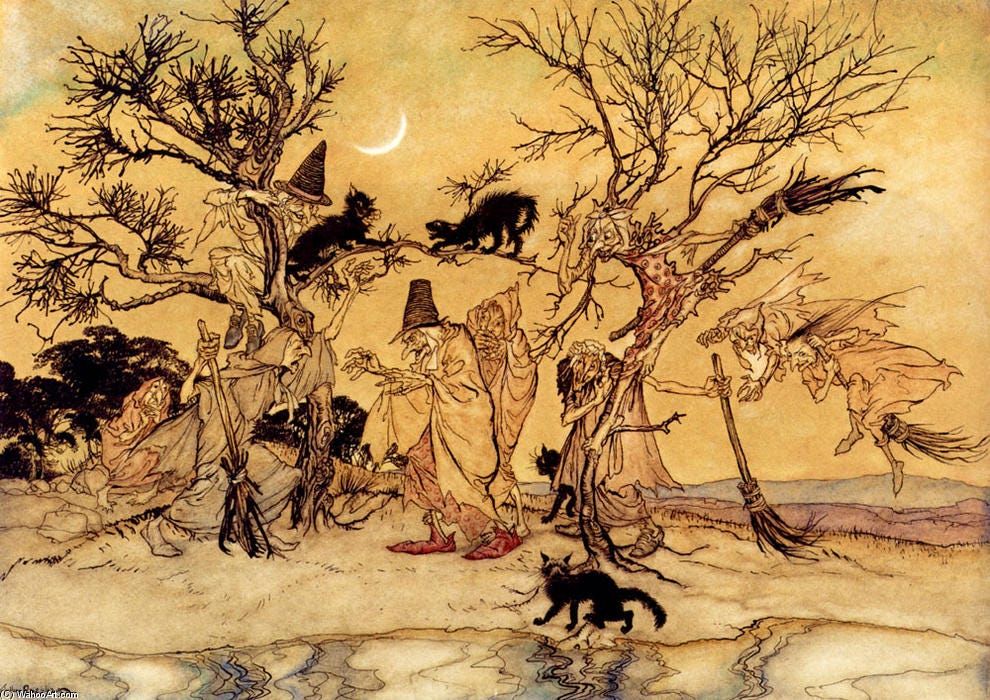
And so, in further exploring the enigmatic links between literature and music in a way that’s also seasonally appropriate, I devised a (baleful, malign, blood-curdling!!!) list of 13 Literary Songs for the Halloween Season. Given the literary qualities of music and the musical qualities of literature, I’ve also taken a liberal definition of what constitutes “literary.” For some entries, it may refer to actual literary allusions in the song, for others the narrative trajectory of the song’s lyrics, for others still the strange and poetic unraveling of something more elusive which, as Victor Hugo defines it, “cannot remain silent,” hidden in the song itself. One constant, however, in all of these songs: they will haunt you
1.“The Carny” by Nick Cave and the Bad Seeds (from Your Funeral, My Trial, 1986)
Real talk: any one of Nick Cave’s songs could’ve gone on this list. Cave is not only one of contemporary music’s most literary songwriters — a good many of his themed studio albums are practically short story collections in and of themselves — but also one of its spookiest, scoring his investigations into the gothic and depraved with a warlock’s brew of magisterial orchestral arrangements, sleazy rock standards, and Cave’s own trademark spare piano, like some sinuous, over-sexed Aussie Sinatra. It will come as no surprise that Cave himself is the author of two novels (1989’s And the Ass Saw the Angel and 2009’s The Death of Bunny Munro) as well as an epic poem scribbled onto the backs of airplane sick bags while on tour (2015’s The Sick Bag Song). “The Carny,” the second track on 1986’s underrated Your Funeral, My Trial, begins with a galumphing organ dirge with glockenspiel accompaniment you think is there to set the mood. The creepiest thing is it never lets up, carrying Cave’s ballad of an unnamed Carny who has abandoned his troupe all the way through to its disquieting final note. After the troupe buries the Carny’s old nag Sorrow in a “shallow, unmarked grave” “in the then parched meadow,” out of which it will emerge later in the song “to float upon the surface of the eaten soil,” Cave delivers a glorious, mock-Faulknerian description of the troupe wagoning up: “And the rain came hammering down/ Everybody running for their wagons/ Tying all the canvas flaps down/ The mangy cats growing in their cages/ The bird-girl flapping and squawking around/ The whole valley reeking of wet beast/ Wet beast and rotten, sodden hay/ Freak and brute creation all/ Packed up and on their way.”
2.“Pirate Jenny” by Nina Simone (from Nina Simone in Concert, 1964)
There’d be no Nick Cave, of course, without Nina Simone, as “Pirate Jenny” gamely shows. Originally from Kurt Weill’s TheThreepenny Opera and covered by a range of past performers — Marianne Faithfull, Marc Almond — “Pirate Jenny” tells the story of a woman pirate who implants herself as the barmaid in a small town where she patiently awaits the arrival of “The Black Freighter,” a “ghostly” ship “with a skull on its masthead” packed from bow to stern with ravening, genocidal pirates. No one, however, covered it quite like the High Priestess of Soul, who would’ve performed it more were it not for the fact that the wages of doing so, Simone reported, shaved years off her life. As with her besotted rendition of Screamin’ Jay Hawkins’ “I Put a Spell on You,” Simone more than makes “Pirate Jenny” her own, replacing the song’s plodding theatricality with menace in a minor key that channels at the chorus into a war-party of thundering bass-drums. Tellingly, Simone also resituates the song’s narrative arc in a “crummy Southern town” filled with leering patriarchal “gentlemen,” underscoring the social activist dimension of much of her music. When the denizens of “The Black Freighter” “swarm” the dock “chainin’ up people” and “bringin’ ’em to [Pirate Jenny],” who is tasked with deciding not the nature but the moment of their fates (“Kill ’em NOW, or LATER?”), it’s cathartic and chilling when Simone whispers: “Right… now.”
3.“Shanty for the Arethusa” by The Decembrists (from Her Majesty The Decembrists, 2003)
Although, IMO, The Decembrists can be so literary at times as to be almost unlistenable, the band struck atmospheric gold with its own nautical terror tale, “Shanty for the Arethusa,” off 2003’s Her Majesty The Decembrists, one of the strongest albums from the Portland-based indie rock quintet. The output of Decembrists lead-singer and principle songwriter Colin Meloy tends more toward expressionistic storytelling than verse-chorus-verse, and “Shanty for Arethusa” is no different. Weighing anchor with the sound of a creaking ship’s mast and a woman’s blood-curling scream, followed by a one-note proclamation of doom from Jenny Conlee’s Hammond Organ, the song’s opening verse evokes nothing so much as set-dressing for a piece of dark historical fiction: “We set to sail on a packet of spice, rum, and tea-leaves./ We’ve emptied out all the bars and the bowery hotels./ Tell your daughters do not walk the streets alone tonight.” With its intimations of 19th-century spiritualism and merchant imperialism gone awry, the tale that unfolds from there in fragments doesn’t augur any better for the company aboard the vessel itself (not to be confused, in case you’re wondering, with the HMS Arethusa from the British sea shanty of a slightly different name) when Meloy begins to warble: “But if you listen, quiet, you can hear the footsteps on the cross-trees./ The ghosts of sailors passed, their spectral bodies clinging to the shroud./ So goodnight, boys, goodnight…”
4.“Down by the Water” by PJ Harvey (from To Bring You My Love, 1995)
Probably the only song about filicide to make it into Billboard’s Top 10, British singer-songwriter PJ Harvey’s “Down by the Water” takes the thus far-aquatic theme of this playlist one step too far by embracing the imagined persona of a desperate and self-loathing murderess who has drowned her own daughter in a river. “Some critics have taken my writing so literally,” Harvey said, “to the point where they’ll listen to ‘Down by the Water’ and believe I have actually given birth to a child and drowned her.” Which speaks powerfully to the song’s status as a literary artifact much in the tradition of gangster rap, say, where the artist relating the lyric — like a first-person narrator in a short story — isn’t necessarily and, in most cases, necessarily isn’t the artist herself. As for the song, it eschews Harvey’s punk-inflected indie blues roots (she famously dated none other than Nick Cave throughout the early 90’s) in favor of a droning electronic arrangement, Harvey calling to the listener from some inflamed purgatory: “I lost my heart/ Under the bridge/ To that little girl/ So much to me…” Mid-verse, as the synth track begins to snarl, Harvey’s voice overlays Harvey’s voice in the mix: “That blue-eyed girl (that blue-eyed girl)/ She said ‘No more’ (she said no more)/ That blue-eyed girl (that blue-eyed girl)/ Became blue-eyed whore (became blue-eyed whore)…” If there’s a more subtly orchestrated instance of unreliable narration in modern pop music, I haven’t heard it. Yet “Down by the Water’s” Yellow Wallpaper, shaking-in-a-corner moment is just as understated finally when Harvey, not unlike Nina Simone at the end of “Pirate Jenny,” begins to whisper on a loop: “Little fish, big fish, swimming in the water/ Come back here, man, give me my daughter…”
5. “Possum Kingdom” by Toadies (from Rubberneck, 1994)
Another popular mid-90’s single that came out just one year before Harvey’s and received in America at least, where Toadies are from, almost as much radio-play, Dallas-based alterna-rockers Toadies’ “Possum Kingdom” is for lots of pre-Millennials that song you didn’t fully comprehend in the knit-hat-muffled, faintly baked days of your youth, only to hear it later as a functioning adult and think to yourself: hold on, WTF?! Packaging warped literary themes like obsession, murder and fanaticism in a choppy pop-rock ballad, “Possum Kingdom” is also a narrative song, if somewhat of an oblique one. On the surface, it sounds like a rape-and-murder ballad for the moth-eaten cardigan set until you dig a little deeper and find that singer-songwriter Vaden Todd Lewis intended it as an expansion of the narrative terrain covered in “I Burn” (another track off Rubberneck), steeped in the folklore of North Texas’ Possum Kingdom Lake and unfolding a tale of hieratic cult murder. In “I Burn,” the cult members torch themselves alive in order to reach a higher plane, while in “Possum Kingdom,” according to Todd Lewis, one of the immolated journeys posthumously to Possum Kingdom Lake and “tries to find somebody to join him.” Uh, okay? Esoteric world-building aside, Toadies’ “Possum Kingdom” is a super-creepy song. Its energetic time-signatures, rising in pitch until the always karaoke-worthy crescendo, belie the predatory threat of the lyrics: “I’m not gonna lie/ I’ll not be a gentleman/ Behind the boathouse/ I’ll show you my dark secret.” And just when you thought things couldn’t get any worse, Todd Lewis starts in on some sick shit like this: “I can promise you/ You’ll stay as beautiful/ With dark hair/ And soft skin…forever/ Forever.” The mid-90’s equivalent of a recovered memory of trauma, when “Possum Kingdom” asks us, “Do you wanna die?” all we can say in response is: we do!
6.“Wuthering Heights” by Kate Bush (from The Kick Inside, 1978)
Awesome creepy weirdo Kate Bush supposedly wrote “Wuthering Heights” in one night under a full moon when she was just 18, having devised the idea for it years previous when she caught the last 10 minutes of a BBC adaptation of Emily Bronte’s gothic novel of class warfare, mental decay and psychosexual obsession. (Bush shares a birthday with Emily.) Little could Bush have guessed at the time, her song would go on to become the first chart-topper by a female recording artist in the UK, and would inspire other awesome creepy weirdos such as David Bowie and St. Vincent, who frequently cites “Wuthering Heights” as her go-to karaoke jam, to get on with their bad selves in the years to come. Needless to say, there’s more than a little of Bronte’s novel in the song itself, which focuses its allusive energies on Catherine Earnshaw’s ghost and its recapitulant efforts to get at Heathcliff, her erstwhile lover, through his window casement. In fact, Bush’s song unfurls from Catherine’s spectral POV: “Ooh, it gets dark! It gets lonely,/ On the other side from you./ I pine a lot. I find the lot/ Falls through without you./ I’m coming back, love./ Cruel Heathcliff, my one dream,/ My only master.” Bush’s eerie vocal stylings, like some falsetto ghost priestess luring you to your doom, are a fitting conductor for Catherine’s tale. Ditto the cascading piano, Tangerine Dreamy guitar solo and intermittent strings that sherpa her voice as it climbs towards new heights, all the while invoking Catherine, the love that can never be Heathcliff’s and hers: “Heathcliff, it’s me — Cathy./ Come home. I’m so cold!/ Let me in-a-your window.”
7.“Veil of the Forgotten” by Witch Mountain (from Cauldron of the Wild, 2012)
As I always tell my creative writing students, good literature is all about tension. Usually, this manifests as a contrast between the work’s form and its content, its content and its tone, etc. — some struggle in the narrative that throws the reader off her guard, rendering her vulnerable to emotional effect. If this principal can be applied broadly to music, then Portland-based Witch Mountain is the ultimate literary doom metal band. Having existed now for almost 20 years and rotated through almost as many members (drummer Nathan Carson and guitarist Rob Wrong are the dudes that abide), Witch Mountain have had a roomy laboratory in which to grow and perfect their terrible, beautiful signature style — equal parts mammoth riffage, tremolo female vocals not unlike Kate Bush’s in “Wuthering Heights,” and occult ambience. “Veil of the Forgotten,” the 4th track off Witch Mountain’s 3rd album, Cauldron of the Wild, and a crushing set-list darling when the band preforms live, embodies precisely the tension I’m always gabbing on about to my students. Here, it’s between the song’s droning fugue interludes and huge, drop-D grooves; Uta Plotkin’s (and now Kayla Dixon’s) Judas Priest power-warbling and the weight of Wrong’s riffs anchored by Carson’s drums; and within Plotkin’s voice itself, like some evil blood-dwarf living deep in her throat, the growl of the closet thing here to a chorus: “We will win with patience, cold in the stone/ Cold jade and blood, amethyst and bone.” Not that I could tell you what “Veil of the Forgotten” is about, strictly speaking, only that it scares me shitless; eldritch, elemental and barely contained. On that score, it’s probably worth mentioning, too, that drummer Nathan Carson is also an accomplished author of weird fiction whose first book, the novella Starr Creek, was just released on Lazy Fascist Press.
8.“Thuja Magus Imperium” by Wolves in the Throne Room (from Celestial Lineage, 2011)
Calling all hessians: the opening track from Olympia-based black metal band Wolves in the Throne Room’s 4th album, Celestial Lineage — which Pitchfork critic Brandon Stosuy called “American black metal’s idiosyncratic defining record of 2011” — ushers listeners into a similar realm of poetic resonance. Another riff-fueled offering from the Pacific Northwest, Wolves in the Throne Room have been mixing the best of Norwegian black metal (Emperor, Taake), ambient (Dead Can Dance, Cocteau Twins), dark folk (Death in June, Coil) and goth (Swans, Christian Death) since 2003 to create a sublime and annihilating musical experience all their own. Calling down the pastoral imagery of WITTR’s homeland, “Thuja Magus Imperium” begins with an ethereal trance of female vocals set against the backdrop of a mournful keyboard track: “Redness in the east beyond the mountain/ The Wheel begins to turn anew/ Turning ever towards the sun/ Garlands adorn a chariot, aflame/ Blood runs from the flank of a wounded stag…” Then, at the 2:20-mark, something shifts, a spaced-out, orchestral guitar-riff ascending, and by 3:09, at the first hint of drums and Nathan Weaver’s witchy vocals, there’s no going back for the circumspect listener. A towering black wave has crested, comes crashing. Black metal in any form has always been prone to literary pretentiousness, which is kind of what makes it so awesome at times. Wolves in the Throne Room’s “Thuja Magus Imperium,” the sonic equivalent of reciting John Keats’ “Lamia” in a moonlit glade, is probably the closest the genre has ever come to realizing those pretensions in a way that holds water. Wolves in the Throne Room’s mainstay members, the Brothers Weaver (Nathan and Aaron, who reportedly live on some kind of organic farming commune) are nothing if not modern-day purveyors of the Romantic Sublime, making metal so loud and dark-hearted it’s gorgeous, projecting their listeners outside of themselves where they watch from afar as the people they were windmill their hair and throw the goat.
9.“The Call of Ktulu” by Metallica (from Ride the Lightning, 1984)
Once upon a time, when Metallica was still a kick-ass thrash band as opposed to the constipated dumpster fire they are today (that’s a fucked metaphor, but Metallica earned it), they put out an album called Ride the Lightning, which took its name from a passage in Stephen King’s novel The Stand and contained not only some of the L.A.-based quartet’s greatest cuts, but also referenced literary works by everyone from Ernest Hemingway (“For Whom the Bell Tolls”) to H.P. Lovecraft. The song in question — purposefully misspelled from “The Call of Cthulhu” in Lovecraft’s story of the same name — is the closer on Lightning, and the first all-instrumental track on which Hetfield, Hammett, Burton and Ulrich all played together. It’s also a fitting way for an album that contains hell-for-leather ear-splitters like “Ride the Lightning” and “Creeping Death” to fade into the stygian abyss of time immemorial, or something. Slight variations on the same sinister, incantatory riff carry the song from start to finish, only weakening to let in a wild Hammett solo and a couple doom-strokes from Hetfield at the end. It’s a minimalism that pays handsomely: “The Call of Ktulu” is a parking lot anthem of rocking the fuck out in acid-washed jeans, awaiting “The Thing That Should Not Be” (look ahead to 1986’s Master of Puppets). But what sets “The Call of Ktulu” apart from the rest of the album isn’t just the conspicuous absence of Hetfield’s voice — which was honestly pretty badass in its day — but the building awareness that you’re witnessing something powerful and occult in real time; something that, if played backward on the right record player, with the right amount of burning sage and underneath the right full moon might summon the Great God Cthulhu himself. Herein lies one of the theories as to why Metallica purposefully misspelled the name of Lovecraft’s reigning Old One, a bat-winged cephalopod the size of a skyscraper: according to the story, if you mention his name or write it down, he’ll appear. So either that, or copyright.
10. “Mac 10 Handle” by Prodigy (from Return of the Mac, 2007)
A pulp horror sensibility and Lovecraftian unreliable narrator of sorts also abound in Prodigy’s 2007 mix-tape single, “Mac 10 Handle” (off Return of the Mac, which preceded the release of H.N.I.C.Part II). Prodigy, formerly of Queens-based duo Mobb Deep, knows better than anyone that gangsta rap is literary storytelling writ large and unhinged, and “Mac 10 Handle” displays that storytelling at its finest, with a catchy self-effacing hook and a tongue-in-cheek gallows humor. The narrator of the song, not necessarily but also not necessarily not Prodigy himself, allows for the chorus to capture the mood before we even get the verse: “I sit alone in my dirty ass room starin’ at candles/ high on drugs — all alone wit my hand on the Mac 10 Handle/ Schemin’ on you niggaz.” The narrator of “Mac 10 Handle” is a boastful and bloodthirsty psychopath in the vein of the dude from “The Tell-Tale Heart” or Wilbur Whateley from Lovecraft’s “The Dunwich Horror,” shored up in his hovel of an apartment, journeying further and further from any recognizable form of moral reality on waves of skunk-weed, liquor and Chinese gangster movies, plotting by night the murders of his so-called enemies. “They got eyes in the sky,” Prodigy raps, “we under surveillance…Gotta watch what I say, they tappin’ my cell phone/ They wanna sneak and peek inside my home/ I’m paranoid and it’s not the weed/ In my rearview mirror each car they follow me…” Rap, especially gangsta rap, is no stranger to unreliable narrators, and Prodigy’s in “Mac 10 Handle” is paranoid, suggestible, drug-addled, deadly. Yet what sets him apart from the narrators, say, of Prodigy’s former outfit Mobb Deep, or those of someone like C-Murder, lies in how Prodigy subverts the tiger-owning, palatial estate-wandering archetype of the rags-to-riches criminal in favor of something earthier, infinitely more wretched and self-aware. When Prodigy raps in the second verse before the Outro: “I be alone in my hot ass room/ Smokin’ dope, loadin’ bullets in my clip for you…” you’ll get the chills, sure, but leave room for a cackle.
11. “Nowhere to Run To, Nowhere to Hide” by Gravediggaz (from 6 Feet Deep, 1994)
Rapper Mars offered up a pretty concise description of the subgenre of hip-hop known as “horror-core” or “death rap” when he said: “If you take Stephen King or Wes Craven and you throw them on a rap beat, that’s who I am.” Nothing more accurately embodies the New York City-quartet Gravediggaz, who supposedly premiered “horror-core” in its purest form with the release of their 1994 album, 6 Feet Deep (released overseas as Niggamortis). Consisting of The Undertaker (Prince Paul), The Gatekeeper (Frukwan), The Grym Repaer (Poetic) and The RZArector (RZA), Gravediggaz compounded as a unit what were already complex and literary rap styles individually, displaying a ghoul’s gallery of “alter egos” that battle for prominence, like ravenous creatures snapping at the listener out of the abyss, over the course of their densely orchestrated and lyrical songs. “Nowhere to Run to, Nowhere to Hide,” the second single off 6 Feet Deep, shudders into being with a sample from the beginning of Stanley Kubrick’s The Shining (that shrill ululation that follows the car), whipping it expertly into a spare, dirty mid-90’s concoction of drum and bass. If upon first listen the track sounds a lot like something off Wu-Tang Clan’s 36 Chambers, that’s no accident, as the RZA played a seminal role in both. And honestly, it’s the RZA who steals the show on “Nowhere to Run to…,” raving onto the track with a Paradise Lost-reference, followed by a flood of gothic imagery: “Lets’ get it on…and watch the spot get blown/ I be the sick lunatic with the devilish poem/ From the mists of the darkness I come with this/ Hittin’ straight, to the chest, like a Primatene mist/ RZArector, yah, the fantatical type/ I’m like a bat, in the night, when it’s time to take flight…” Poetic and Frukwan, too — especially Frukwan — put in their own dynamic work over the remainder of the song that amuses and terrifies in equal measure. Coming one after the next as they do, stepping on each other’s verses, “Nowhere to Run to…” has Gravediggaz sounding like a chorus of tormented souls speaking from out of the same purgatory, underscoring their signal and twisted motifs: madness, decay, resurrection, repeat.
12. “Pet Sematary” by Ramones (from Brain Drain, 1989)
There’s a legend ‘round here that goes something like this: some time in the late 80s’s just before the release of Mary Lambert’s adaptation of Stephen King’s novel Pet Sematary, The Ramones came to call at King’s house in Bangor, Maine. King, who is a gigantic Ramones-head, gave bassist Dee Dee Ramone a copy of his novel and Dee Dee reportedly vanished into King’s basement with it, emerging just an hour later with the lyrics to this song. According to critics, though, Dee Dee should’ve taken his time down there, as the track was roundly savaged upon its release in 1989, bopping over the credits to Lambert’s film. If you ask me, though, “Pet Sematary” is more than meets the ear at first. Much as in Gravediggaz’s “Nowhere to Run to…,” there’s something to be said for a song’s determination to revel in its subject matter, and Dee Dee’s King-anthem achieves this in spades, mashing up bubblegum Americana with supernatural ghoulishness. And once again, it’s got that tension, here between the sepulchral chiaroscuro of the lyrics set down against the verse-chorus-verse upbeat of the song: “Follow Victor to the sacred place,/ This ain’t a dream, I can’t escape,/ Molars and fangs, the clicking of bones,/ Spirits moaning among the tombstones,/ And the night, when the moon is bright,/ Something cries, something ain’t right.” But what really distinguishes “Pet Sematary” is that oddly plaintive and prescient chorus, its nasal delivery by Joey Ramone: “I don’t want to be buried in a Pet Sematary,/ I don’t want to live my life again…” When “the cold wind blows” and “the smell of death is all around,” it’s something we can all relate to, especially the weathered rock icons among us, and the prospect of riding the wheel one more time is more than anyone could bear.
13. “Lil’ Red Riding Hood” by Sam, The Sham and The Pharaohs (from Lil’ Red Riding Hood, 1966)
Believe it or not, Sam the Sham and the Pharaoh’s “Lil Red Riding Hood” is more than just a plot device in 1993’s Striking Distance or a sexy-getting-ready-song for when you’re putting on that mini-skirt caplet you bought for Halloween. Because intentional or not, it’s actually probably the creepiest song on this list. Sort of like Toadies’ “Possum Kingdom,” it strikes you that you probably listened to it for years in complete obliviousness to what it contained. Based on Charles Perrault’s fairy tale of the same name, and hinting at rape, victim-blaming and autoerotic shape-shifting from the POV of the “big bad wolf,” “Lil’ Red Riding Hood” has a whiff of Angela Carter’s The Bloody Chamber about it, in spite of the fact that the latter was published in 1979, thirteen years after the song was recorded and achieved Gold status from the RIAA. (Maybe also without the Second Wave Feminism.) Goateed and turbaned Sam the Sham, aka Domingo “Sam” Samudio, and his quartet of decidedly non-Egyptian “Pharaohs” (also responsible for the song “Wooly Bully”) took an ambiguous approach to Perrault’s material, which only serves to heighten the careful listener’s discomfort when Sam sings lines like: “Little Red Riding Hood/ I don’t think little big girls should/ Go walking in these spooky old woods alone…” Or perhaps even more disturbing: “I’m gonna keep my sheep suit on/ Until I’m sure that you’ve been shown/ That I can be trusted walking with you alone/Owoooooo!” Allllll riiiiight, Sam, you keep your distance! By the end of the song, Joyce Carol Oates’ “Where Are You Going, Where Have You Been” begins to seem like a more fitting companion piece. Much as in The Ramones’ “Pet Sematary,” there is tension here, too, between form and content, especially when the tune morphs from sinister to soulful and the big bad wolf begins to sound almost nostalgic for the days when a woman’s coyness was commensurate with her virtue. “Even bad wolves can be good,” he insists, but we fear for the Red Riding Hood who believes him.
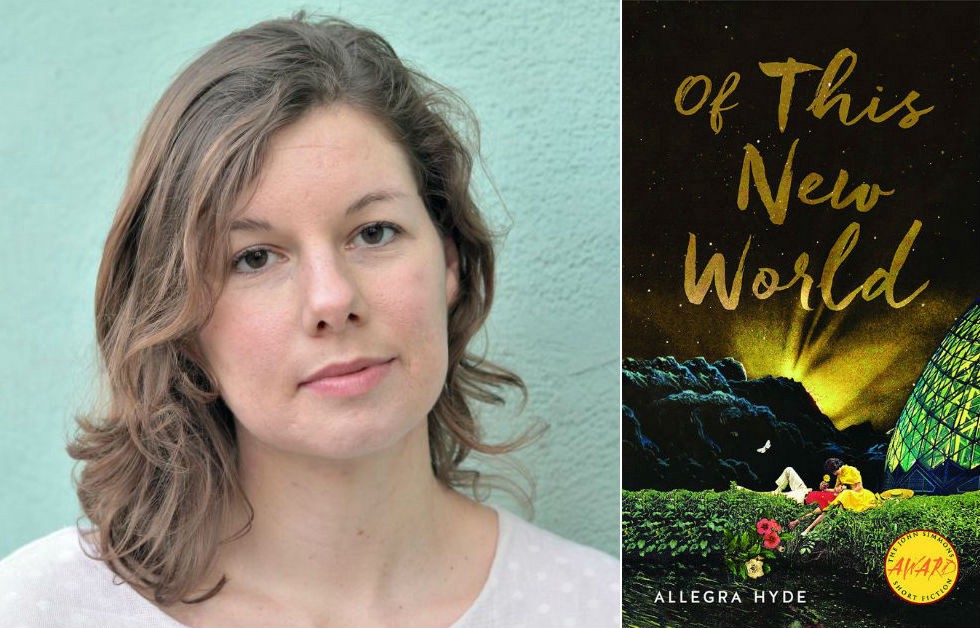
The narrator of “Shark Fishing,” the first story in Allegra Hyde’s debut collection Of This New World, asks herself, in one of the book’s most moving moments, “Who was I except someone who’d always been willing to dream?” The collection finds this narrator as it finds many of its protagonists: trying to navigate the knots between intention and result, promise and fulfillment, resistance and pragmatics. Each story, in its own way, is asking deft questions about the possibility of improvement, both on the micro and macro level, and where other writers could have fallen into didactic or moralistic traps, Hyde’s stories move effortlessly and gracefully, never once causing the reader to feel as though she has her authorial thumb pressed on the scale. It’s no surprise, then, that the University of Iowa Press saw fit to award Of This New World the 2016 John Simmons Short Fiction Award, a prestige visited upon, in recent years, writers like Marie-Helene Bertino, Jennine Capó Crucet, and Chad Simpson.
It enriched my reading experience even further to talk via email with Allegra Hyde about this percipient, lush, and hopeful set of stories.
Vincent Scarpa: What about idealism and its relationship — or lack thereof — to paradise felt ripe for exploration as the writer you are? Was there something you were setting out to magnify or explode from within that space, or was your approach a kind of neutral inquisition?
Allegra Hyde: Utopias — their pursuit and implementation — have obsessed me for many years. Or maybe haunted is a better word. I think it has a lot to do with my own perfectionist tendencies. I’m drawn to examples of people trying to live up to an ideal, in spite of the challenges, because I relate to that hunger for realizing a vision in the face of practical concerns.
I also think we’ve entered a ripe cultural moment for utopian thinking: sea levels are rising, a right-wing demagogue could win the US presidency, scenes of violence flood our news channels. We have an opportunity, here and now, to choose between despairing over an apocalyptic future or actively considering what a better world might look like — even if it seems pie in the sky — because we’ll never reach that reality without first daring to imagine what it might be.
We have an opportunity, here and now, to choose between despairing over an apocalyptic future or actively considering what a better world might look like…
VS: The narrator of “Free Love” says, of her off-the-grid hippie father’s plan to live in a houseboat and sail the world, that it sounds “spectacularly imprecise, gloriously underdeveloped.” This seems like the nature of most plans toward utopia, and I wonder if you think it’s the chief reason they fail. Or is there some larger force of impossibility one must contend with when trying to build a utopia, no matter the scale?
AH: I think the Anna Karenina principle applies here: “Happy families are all alike; every unhappy family is unhappy in its own way.” An imprecise execution of ideals might spell the demise of some utopian endeavors, but others have been spectacularly organized. Take the Shakers: at the height of their influence in the mid-nineteenth century, they had 6,000 members in something like twenty different communities. In Shaker life, each day was carefully orchestrated; the spiritual attitude they brought to labor made them economically viable. There was just the question of sex. How does an abstaining population carry on? Recruitment and orphan adoption can only go so far. If old age didn’t exist, maybe the Shakers would still be going strong. But they’re down to three members up in Maine. The aspect of their ethos that made them so productive — the curtailing of human desire — also made their endeavor ephemeral.
I say ephemeral instead of “a failure” because I have trouble applying the latter to these types of social experiments. Although a utopian community might not last in a physical sense, its espoused ideals may stick around longer than its members and have a far-reaching impact on the broader society. The Shakers, for instance, had all these breakthrough inventions — like the clothespin and the circular saw — which we still use. And their design principles of simplicity and efficiency are still visible all over New England.
Or — returning to “Free Love” — consider the proliferation of hippie communes in the 1960s. Most back-to-the-landers eventually went back to more normal lives and jobs, but their ideals of sexual fluidity and their respect for nature still continue to resonate. Utopian experiments, viable or not in the long-term, can still influence mainstream culture.
VS: Something I admire about these stories is that so many of them have an active political consciousness. I don’t know if you agree, but that seems to be something that’s all but vanished from so much of contemporary fiction. I’m not sure if it has something to do with the fear of being didactic or not, but it was refreshing to see you take on issues like global warming, PTSD, immigration, and so forth. Did you have any trepidation in tackling these issues? Is there something unique to fiction that allows such exploration?
AH: I did not set out to tackle political issues. I would never want to write — or read — fiction that tries to tell a reader what to think. I did, however, set out to write stories that felt meaningful. If I’m afraid of anything as a writer, it’s of becoming frivolous and self-indulgent, especially since I spend so much time alone in a room making stuff up. The gift of fiction, however, is that it can mirror back aspects of our society that might otherwise stay hidden. Making PTSD present in a story, for instance, is about recognizing this issue as part of the fabric of our daily lives. Twenty veterans a day commit suicide. My story “VFW Post 1492,” about a depressed and disabled veteran, isn’t taking a political stance so much as bearing witness to our modern reality.
VS: One of my favorite stories in the collection is “Shark Fishing,” which is a clear-eyed look both into the way colonization calibrates a place forever and at activism faced with the dangers of being a variety of colonization itself, despite ostensibly good intentions. Like “Delight,” another terrific story, it made me think a lot about the fact that utopian visions are by no means universal, and that a genuine desire to do good can so often be at cross purposes with what is presently capable.I’d love to hear you talk a bit about how this story came to be.
AH: When I was twenty-two, just out of college, I went to work at an environmental leadership school in the Bahamas. It was an inspiring place, one that echoed my own environmental ethics through its educational work, scientific research, and sustainable infrastructure. However, as I began to learn more about the local history — a history that included Puritan settlers, vast plantations, and luxury resorts — I began to see a pattern emerging. Initiatives on the island often started with great promise but ultimately ended in exploitation. I began questioning whether I was participating in the continuation of that cycle. I believed — and still believe — that it’s important to address climate change with the utmost urgency, but I also believe in respecting the integrity of an existing culture. “Shark Fishing” was an effort to explore the nuances beyond obvious labels of right and wrong.
VS: I was thinking of the writer Jim Shepard — one of my favorites — as I read these stories, without having yet seen that he in fact is a favorite of yours and gave such a lovely blurb. I think he came to mind because so many of the stories here, like Shepard’s stories, feel built on a solid foundation of research — whether it’s the history of Eleuthera in “Shark Fishing,” the botanical language of “Bury Me,” or the exquisite details of Mexico we find in “Flowers For Prisoners.” Can you talk about the role research plays in your writing practice? How much do you do and when is enough? How do you decide what makes it into the story and what doesn’t?
AH: I had the good fortune to study with Jim Shepard as an undergraduate. He was a brilliant and generous teacher, and he implanted some ideas about writing fiction that continue to define how I work. Having once caught a glimpse of his writing desk — surrounded by books and research materials — I realized that a short story can be the synthesis of so much unseen knowledge. When I research now, much of what I learn doesn’t make it onto the page. Nevertheless, it still feels important to hold a breadth of information in my mind as I write — whether it’s botanical language or Mexican geography — because research can infuse a story’s style and structure in profound yet invisible ways.
That isn’t to say the research that makes it onto the page isn’t significant. I try to use the material that will encourage a reader to trust me, to follow me into a fictional reality. I also sometimes share information in stories that seems too interesting to be buried by history — though that can be a slippery slope.
VS: I’d be remiss not to talk about structure, because these stories are so elegantly and masterfully architectured. Sometimes I think a good short story can mask a somewhat flimsy or clunky structure, but I think great stories are always working on the level of the line and the level of the whole. This is something I think you do so well in a story like “Ephemera,” where we’re switching between three distinct protagonists with three distinct varieties of loneliness. I wonder if you could talk a bit about story-building, and if structure is something you have an idea of going in or if it’s something that the movement of the language, line by line, necessitates?
AH: During the drafting process for “Ephemera,” the story’s structure evolved organically alongside the progression of plot and character. There was, in other words, an editorial feedback loop. The structure changed line by line. However, for a story like “Americans on Mars!” I went in with a distinct structure I wanted to pursue, having been inspired by the work of Amy Fusselman in The Pharmacist’s Mate (which I highly recommend). So in that case, an existing structure dictated the way the narrative emerged.
Regardless of how a story comes into fruition, the final stages of revision are a very visual process for me. I have an art background, so I tend to bring elements of design to my stories. For a piece like, “Ephemera,” I became very conscientious of the shape of the braided narrative, the way paragraphs of differing lengths played against one another, the harmonies of text and white space. To speak in generalizations, I admire the talent poets have at positioning text. They are often more aware than prose writers are of how white space can be a living, breathing part of a piece. With prose, conventions dictate that your writing is essentially a word soup that gets poured into the shape of a magazine page or a book layout. I tend to write with lots of paragraph breaks in my stories, in part because its something I can do as a prose writer to influence the visual structure of my stories within the conventions of the genre.
VS: You’re such a great practitioner of the short story. I’d love to hear other practitioners you admire, and also what you’re working on next, now that the collection is in the world.
AH: I’m bursting at the seams with my admiration for Jen George. Her first book, a collection of stories called The Baby Sitter at Rest, is out this October through Dorothy, a publishing project. George writes about the threshold between youthful naiveté and adult despair. Her fiction is vivaciously detailed, fierce and funny, and deftly captures that sense that everyone other than you knows what’s going on. I want everyone to read this book!
In terms of short story standbys, Amy Hempel’s writing has taught me a lot. The architecture of her fiction always works in elegant symbiosis with the story being told, and she’s so good at blending fact into fiction. Also, once at AWP, she touched my arm as she attempted to navigate a crowd on her way to panel. This felt like a blessing.
Of This New World may be out of my hands and loose in the world, but it serves as the foundation for my next project: a novel that expands and reworks “Shark Fishing.” Though this story is the longest in the collection, I haven’t been able to shake the sense that there’s more narrative territory to explore. So I’m returning to the Bahamas, in a way, trying to continue addressing climate change and what it means to seek a better world.
For everyone who doesn’t have a copy of JRR Tolkien’s The Silmarillion lying around, the names Beren and Lúthien may not mean too much. However, their story, tucked within the mythos of Tolkien’s high fantasy universe, is a thrilling legend of forbidden love. The “Tale of Beren and Luthien” takes place in Middle Earth, about 6,500 years before the events of The Lord of the Rings, and follows a mortal man and an immortal elf on a seemingly impossible quest devised by Lúthien’s father, an Elvish Lord, who disapproves of their desire to marry. Thankfully, HarperCollins has just announced the release (May, 2017) of a new volume titled Beren and Lúthien,which will give the narrative its first free standing publication. The release will also be the first time all the tale’s iterations are collected in one place.
Tolkien first composed the story in 1917, then titled “The Tale of Tinúviel,” after his return from World War One, where he served as a signaler at the Battle of Somme. The second prose telling crops up briefly in two locations — as a chapter in The Sillmarillion, and as told by Aragorn in The Fellowship of the Ring. There’s also an unfinished epic poem that was first published in The Lays of Beleriand. All three have been edited and organized by Christopher Tolkien, the author’s son. In their press release, HarperCollins stated, “to show something of the process whereby this legend of Middle-earth evolved over the years, [Christopher Tolkien] has told the story in his father’s own words by giving, first, its original form, and then passages in prose and verse from later texts that illustrate the narrative as it changed.”
The tale also has a touching personal link to the Tolkien family, as the headstones of JRR and his wife Edith are adorned with the names Beren and Lúthien, respectively.
Nadia hadn’t been to church since her mother’s funeral. Instead, she rode buses. One afternoon, she climbed off downtown in front of the Hanky Panky. She was certain someone would stop her — she even looked like a kid with her backpack — but the bouncer perched on a stool near the door barely glanced up from his phone when she ducked inside. At three on a Tuesday, the strip club was dead, empty silver tables dulled under the stage lights. Black shades pulled in front of the windows blocked the plastic sunlight; in the man-made darkness, fat white men with baseball caps pulled low slouched in chairs facing the stage. Under the spotlight, a flabby white girl danced, her breasts swinging like pendulums.
In the darkness of the club, you could be alone with your grief. Her father had flung himself into Upper Room. He went to both services on Sunday mornings, to Wednesday night Bible study, to Thursday night choir practice although he did not sing, although practices were closed but nobody had the heart to turn him away. Her father propped his sadness on a pew, but she put her sad in places no one could see. The bartender shrugged at her fake ID and mixed her a drink and she sat in dark corners, sipping rum-and-Cokes and watching women with beat bodies spin on stage. Never the skinny, young girls — the club saved them for weekends or nights — just older women thinking about grocery lists and child care, their bodies stretched and pitted from age. Her mother would’ve been horrified at the thought — her in a strip club, in the light of day — but Nadia stayed, sipping the watery drinks slowly. Her third time in the club, an old black man pulled up a chair beside her. He wore a red plaid shirt under suspenders, gray tufts peeking out from under his Pacific Coast Bait & Tackle cap.
“What you drinkin’?” he asked.
“What’re you drinking?” she said.
He laughed. “Naw. This a grown man drink. Not for a little thing like you. I’ll get you somethin’ sweet. You like that, honey? You look like you got a sweet tooth.”
He smiled and slid a hand onto her thigh. His fingernails curled dark and long against her jeans. Before she could move, a black woman in her forties wearing a glittery magenta bra and thong appeared at the table. Light brown streaked across her stomach like tiger stripes.
“You leave her be, Lester,” the woman said. Then to Nadia: “Come on, I’ll freshen you up.”
“Aw, Cici, I was just talkin’ to her,” the old man said.
“Please,” Cici said. “That child ain’t even as old as your watch.”
She led Nadia back to the bar and tossed what was left of her drink down the drain. Then she slipped into a white coat and beckoned for Nadia to follow her outside. Against the slate gray sky, the flat outline of the Hanky Panky seemed even more depressing. Further along the building, two white girls were smoking and they each threw up a hand when Cici and Nadia stepped outside. Cici returned the lazy greeting and lit a cigarette.
“You got a nice face,” Cici said. “Those your real eyes? You mixed?”
“No,” she said. “I mean, they’re my eyes but I’m not mixed.”
“Look mixed to me.” Cici blew a sideways stream of smoke. “You a runaway? Oh, don’t look at me like that. I won’t report you. I see you girls come through here all the time, looking to make a little money. Ain’t legal but Bernie don’t mind. Bernie’ll give you a little stage time, see what you can do. Don’t expect no warm welcome though. Hard enough fighting those blonde bitches for tips — wait till the girls see your light-bright ass.”
“I don’t want to dance,” Nadia said.
“Well, I don’t know what you’re looking for but you ain’t gonna find it here.” Cici leaned in closer. “You know you got see-through eyes? Feels like I can see right through them. Nothin’ but sad on the other side.” She dug into her pocket and pulled out a handful of crumpled ones. “This ain’t no place for you. Go on down to Fat Charlie’s and get you something to eat. Go on.”
Nadia hesitated, but Cici dropped the bills into Nadia’s palm and curled her fingers into a fist. Maybe she could do this, pretend she was a runaway, or maybe in a way, she was. Her father never asked where she’d been. She returned home at night and found him in his recliner, watching television in a darkened living room. He always looked surprised when she unlocked the front door, like he hadn’t even noticed that she’d been gone.
In Fat Charlie’s, Nadia had been sitting in the booth toward the back, flipping through a menu, when Luke Sheppard stepped out of the kitchen, white apron slung across his hips, black Fat Charlie’s T-shirt stretched across his muscular chest. He looked as handsome as she’d remembered from Sunday School, except he was a man now, bronzed and broad-shouldered, his hard jaw covered in stubble. And he was limping now, slightly favoring his left leg, but the gimpiness of his walk, its uneven pace and tenderness, only made her want him more. Her mother had died a month ago and she was drawn to anyone who wore their pain outwardly, the way she couldn’t. She hadn’t even cried at the funeral. At the repast, a parade of guests had told her how well she’d done and her father placed an arm around her shoulder. He’d hunched over the pew during the service, his shoulders quietly shaking, manly crying but crying still, and for the first time, she’d wondered if she might be stronger than him.
An inside hurt was supposed to stay inside. How strange it must to be to hurt in an outside way you couldn’t hide. She played with the menu flap as Luke limped his way over to her booth. She, and everyone at Upper Room, had watched his promising sophomore season end last year. A routine kick return, a bad tackle, and his leg broke, the bone cutting clear through the skin. The commentators had said he’d be lucky if he walked normal again, let alone played another down, so no one had been surprised when San Diego State pulled his scholarship. But she hadn’t seen Luke since he’d gotten out of the hospital. In her mind, he was still in a cot, surrounded by doting nurses, his bandaged leg propped toward the ceiling.
“What’re you doing here?” she asked.
“I work here,” he said, then laughed, but his laugh sounded hard, like a chair suddenly scraped against the floor. “How you been?”
He didn’t look at her, shuffling through his notepad, so she knew he’d heard about her mother.
“I’m hungry,” she said.
“That’s how you been? Hungry?”
“Can I get the crab bites?”
“You better not.” He guided her finger down the laminated menu to the nachos. “There. Try that.”
His hand curved soft over hers like he was teaching her to read, moving her finger under unfamiliar words. He always made her feel impossibly young, like two days later, when she returned to his section and tried to order a margarita. He laughed, tilting her fake ID toward him.
“Come on,” he said. “Aren’t you, like, twelve?”
She narrowed her eyes. “Oh fuck you,” she said, “I’m seventeen.”
But she’d said it a little too proudly and Luke laughed again. Even eighteen — which she wouldn’t turn until late August — would seem young to him. She was still in high school. He was twenty-one and had already gone to college, a real university, not the community college where everyone loafed around a few months after graduation before finding jobs. He knew things and he knew girls, college girls, girls who wore high heels to class, not sneakers, and carried satchels instead of backpacks, and spent their summers interning at Qualcomm or California Bank & Trust, not making juice at the pier. She imagined herself in college, one of those sophisticated girls, Luke driving to see her, or if she went out of state, flying to visit her over spring break. He would laugh if he knew how she imagined him in her life. He teased her often, like when she began doing her homework in Fat Charlie’s.
“Shit,” he said, flipping through her calculus book. “You a nerd.”
She wasn’t, really, but learning came easily to her. (Her mother used to tease her about that — must be nice, she’d say, when Nadia brought home an aced test she only studied for the night before.) She thought her advanced classes might scare Luke off, but he liked that she was smart. See this girl right here, he’d tell a passing waiter, first black lady president, just watch. Every black girl who was even slightly gifted was told this. But she liked listening to Luke brag and she liked it even more when he teased her for studying. He didn’t treat her like everyone else at school, who either sidestepped her or spoke to her like she was some fragile thing one harsh word away from breaking.
One February night, Luke drove her home and she invited him inside. Her father was gone for the weekend at the Men’s Advance, so the house was dark and silent when they arrived. She wanted to offer Luke a drink — that’s what women did in the movies, handed a man a boxy glass, filled with something dark and masculine — but moonlight glinted off glass cabinets emptied of liquor and Luke pressed her against the wall and kissed her. She hadn’t told him it was her first time but he knew. In her bed, he asked three times if she wanted to stop. Each time she told him no. Sex would hurt and she wanted it to. She wanted Luke to be her outside hurt.
Little Free Library-related crime is way up in Minnesota.
First reported by TwinCities.com, Little Free Libraries across St. Paul are being raided en masse by an unnamed burglar (or burglars, or possibly an international cartel of book thieves). Bethany Gladhill has had it the worst. Over the last two months, her fully stocked Little Free Library has been completely gutted over a dozen different times. None of the books have been returned, depleting her supply so much, she’s had to close down. Thankfully, the organization has some measures for this type of situation, including free book replacement and a stamping kit to denote the charitable origin of the texts, so that bookstores won’t accidentally purchase stolen copies.
For those unfamiliar, Little Free Library is a three year old non-profit that encourages communities to share literature through a network of mailbox like book-huts that families construct in front of their homes and register with the organization. The structures, which are left unlocked at all times, allow local residents of all ages to take and return books at their leisure. Or even contribute to the collection if they’d like.
As for who the Minnesota perpetrator is, other than a few witness sightings of cars darting off into the night, no one knows. Oddly, there’s essentially nothing to gain from the thefts. Even unstamped books that are, technically, sellable to bookstores, fetch prices of about $.15 per copy. If you factor in the cost of gas, the thieves could even be taking a loss. Still, the thefts haven’t yet slowed down, leaving the possibility open for a pack of vigilante detective novelists to set up a sting and secure justice for St. Paul’s readers.
Japanese publishing trend warns of an ugly future under Trump
In 20 days, voters will cast their ballots for the next President of the United States, but according to the Washington Post, Japanese writers have already written dozens of books envisioning what the world will look like if the Republican nominee, Donald Trump, were to win the election. The verdict? Pretty bleak. Is our close ally trying to send us a message through its authors? The titles certainly don’t hold back.
1. Trump Will Destroy U.S.-Japanese Relations by Yoshiki Hidaka
Tell us how you really feel, Yoshiki Hidaka. Jokes aside, the writer expresses a legitimate concern as Donald Trump continues to make inaccurate comments about the United States’s relationship and history with Japan.
2. Trump Fever: America’s Anti-Intellectualism by Masahiro Miyazaki
Political commentator Mashiro Miyazaki analyzes the potential repercussions a Trump presidency would have for Japan. In his book, he attempts to explain to his audience why certain Americans see Trump as an attractive option.
3. Collapsing America: The World Will Go Mad If There Is President Trump by Kumi Yokoe
Yokoe has been grappling with the rise of Donald Trump for awhile now. She wrote this book before Trump received the nomination, and in it she considers how the U.S.-Japanese alliance will evolve (or devolve) with Trump as the president.
For more information about the blooming Trump publishing industry in Japan, check out the full report from the Washington Post.
I’ve been reading Jonathan Lethem since I was eleven. Motherless Brooklyn was my grandfather’s favorite book; he gave it to me because he knew it would make me laugh, and it wormed its wisecracking way into my psyche and has stayed there ever since. I mean this by way of cards-on-the-table, so to speak: I’m a colossal Jonathan Lethem fan.
But how could I not be? He reinvents himself with every book, and his books are all so good. He’s covered all kinds of terrain, confused me all kinds of ways, and combined infinite ideas that just shouldn’t belong together — but of course they do. For example, would you consider Jimi Hendrix’s death relevant to innovations in brain surgery? Anarchist theory to burger-cooking? The international backgammon circuit to, well, anything?
Gambler Alexander Bruno has two problems. First, he keeps losing backgammon games. Second, he has a giant blot at the center of his vision. Turns out, both are the fault of a deeply rooted brain tumor, which he can have removed if he’s willing to become deeply indebted to his childhood semi-friend Keith Stolarsky, now a Berkeley real-estate mogul and slimebag. Oh, and he has to have his face taken off.
This is where we started our conversation.
Lily: Was A Gambler’s Anatomy always going to be a novel about faces?
Jonathan Lethem: I’ve had this long interest in the theme of faces. I associate it with certain films: Eyes without a Face, this incredible Pedro Almodóvar film called The Skin I’m In, even that silly John Woo movie Face/Off with John Travolta and Nicolas Cage — films about the destruction of the self from the outside in. It’s like a secret genre I’m into. And then there’s a thing a friend of mine said, one of those aphoristic utterances that you can’t figure out whether it’s real wisdom or fake wisdom. When we were teenagers, a friend of mine said this, and I’ve been thinking about it ever since: “You can’t be deep without a surface.”
LM: Speaking of genres, you’re so good at picking up genres and changing them. What are the genres at the root of this book?
JL: I’m reluctant to say this, but I think it’s a horror novel.
LM: I think so too! I had to make a rule that I couldn’t read it after 11:00 PM.
JL: That’s great. But I should say, I do think it’s an absurd novel, and silly, and the reason I’m reluctant to throw the word horror into the conversation is that people who have a proprietary sense of that genre would immediately and correctly say that it’s not scary enough; it’s not gory enough. It doesn’t really qualify, but that’s the narrative space I was working in.
There was also was a very powerful narrative pattern that I was excited to do with this book that I associate with not a genre but an archetype: the book that’s cleaved in two by a disaster, like DeLillo’s White Noise. The biggest thing that happens in the book happens in the middle, and the whole book is prelude and aftermath. I wanted the surgery to destroy the story as you’ve been experiencing it to this point.
LM: Is that why the story begins in Berlin, to set the reader up to think about splitting in two?
JL: No, I was in Berlin. I was on sabbatical, living in Berlin and thinking about what I wanted to do next, and I was tiptoeing closer and closer to the thought about the facial surgery and the thought about a gambler. I was reading a lot of Graham Greene, too. That was when it hit me how much Greene sunk into me during my teenage years. He was like my default setting for the novel: there should be a character in free-fall, and possibilities of romance that are thwarted. So that’s when the expatriate idea entered the picture. I thought, I’ve always responded to the dispossessed or expatriate character in allegorical or figurative terms, but I’ve never written it as a literal expatriate. So I thought, Okay, I could do this. I’m in Berlin. I’m going to do this.
I’ve always responded to the dispossessed or expatriate character in allegorical or figurative terms, but I’ve never written it as a literal expatriate.
LM: That’s interesting to me because I think Alexander Bruno is the most literal of your protagonists. He sees metaphors and pretty much says, “Nope. Not doing this.” I’m intrigued that you came at him from a more literal standpoint.
JL: It’s part of his refusal of depth and introspection. The saddest part of the book to me is his recollection of his childhood hospitalization, when he’s away from his mother, and he begins to create a sort of barricade around himself, and then later when he meets the waiter Konrad, who teaches him how to perform. The refusal of metaphorical thinking corresponds to his resistance to self-understanding.
LM: I think another genre this book fits into, or interacts with, is the quest for a lost father. And he picks such bad ones!
JL: Yeah! If you think of Konrad, his manager Falk, and, of course, Keith Stolarsky as a series of possible images of the father, it’s like Bruno is browsing helplessly among this series of very bad candidates. But the story of his face — Bruno thinks about his own face at the very beginning of the book. He thinks, “Looking in the mirror, I’m beginning to see my father, who I don’t know.” Every day he’s getting closer to his father, except that the surgery destroys this possibility.
LM: Instead he gets reverse-aged, in that the father figure he ends up with is Keith Stolarsky, who’s his peer.
JL: Younger, even. But Bruno is the consummate arrested-development character. His body signifies maturity and worldliness, but he doesn’t have any at all. Stolarsky runs rings around him.
LM: So where did Stolarsky come from?
JL: First of all, I grew up working in retail. I worked at used bookstores in New York City and at Moe’s on Telegraph Avenue. So I have a feeling for, and sensitivity to, that sort of entrepreneur, the king of a tiny kingdom. But there’s also a pattern I write about, an Orson Welles archetype: the corruptible innocent and the corrupting, charismatic worldly figure. It’s Prince Hal and Falstaff, too. I’ve reworked it in a number of places, but Stolarsky is also a reworking of Arthur Lomb, one of the most important characters from Fortress of Solitude. Arthur is the kid who stayed. He’s the kid who seems inconsequential when you’re young, but when you grow up he turns out to rule the world.
LM: Do you have your own Stolarsky?
JL: I have a few. One is my old friend Michael Seidenberg, who used to run his secret bookstore, Brazenhead Books. It was a real-world bookstore first — as a teenager, I worked for him — and then it was a secret bookstore and you could only get there by invitation, and it became a cult, and then of course it got too big and he had to squash it. He’s a very sweet Stolarsky in my life.
LM: Let’s talk about whether or not Bruno can read minds. I don’t want an answer — I love being confused by it. I just want to know what it’s about on a deeper level.
JL: Well, it’s metafictional. Bruno’s not self-reflective, so this is the way he thinks about whether he’s deep or not, and the way the reader can think about whether he’s connected to other human beings in any profound ways or not. It’s also me enjoying a strange aspect of my own sensibility, which is that I just love stories where you’re forced to do excess interpretive work. It’s like The Twilight Zone, where all the best episodes could be taken as allegorical stories of a mind devolving into madness. It’s “Occurrence at Owl Creek Bridge,” and the way I received Kafka when I first read him. I like that indeterminacy. I like that he’s testing his mind-reading all the time, and so the reader is too.
I just love stories where you’re forced to do excess interpretive work. It’s like The Twilight Zone…
LM: Something else I love in this book is the real-or-is-it-fake anarchist slider restaurant that Stolarsky opens so that his burger place can have some competition. It’s never clear if that restaurant, or, I should say, if its manager is an actual anarchist or not.
JL: This comes from the history of the left! It really was a Stalin thing. The best way to deal with discontent is that you build the oppositional entity so that you control it, but then who comes there? The real opposition! You build a place for people who want to destroy you. Stalin did this, but even in America, there were many committed Marxists who found themselves in cells run by the C.I.A. or the F.B.I.
LM: Yeah, or anyone who wrote for the Paris Review.
JL: And the Abstract Impressionists! The paintings of Rothko and Franz Kline and Arshile Gorky are where my soul lives. I contemplated those paintings as a child. The idea that they’re a counter-revolutionary con job is insane. It makes my head split open.
LM: What is it with sliders and burgers in your work, anyway? Motherless Brooklyn is full of White Castle.
JL: Burgers are German and American; they’re upscale and downscale; they’re for kids but you eat them for your entire life. My boys and I just discovered the secret menu at In-N-Out Burger. You can go to that drive-through, where you’d think you can only get a burger and fries, but if you know the secret you can ask for your burger animal-style, protein-style, all kinds of things. The place has a subtext. It’s like anything. It’s got a surface and it’s deep.
DON’T MISS OUT
Sign up for our newsletter to get submission announcements and stay on top of our best work.
YOUR INBOX IS LIT
Enjoy strange, diverting work from The Commuter on Mondays, absorbing fiction from Recommended Reading on Wednesdays, and a roundup of our best work of the week on Fridays. Personalize your subscription preferences here.