Folk singer Bob Dylan — yes, really — becomes the first American to win since 1993
It’s been over 20 years since an American won a Nobel Prize in Literature, the last being Toni Morrison in 1993. It has been so long that articles about the perennial snubbing of Americans are written every year. (It doesn’t help that in 2008 the secretary of the prize jury, Horace Engdahl, said the US “is too isolated, too insular” and that “ you can’t get away from the fact that Europe still is the center of the literary world.”) Well, the Swedes may think American literature is too isolated, but apparently not American music, because they just awarded Bob Dylan the Nobel Prize in Literature.
Yes, really.
Bob Dylan, who was awarded for “having created new poetic expressions within the great American song tradition,” is the first musician and lyricist to ever win the Nobel Prize. And his win has left people scratching heads around the world. The Nobel Prize is normally one of the few opportunities for literary books to be the focus of media discussion and attention. It is also a rare opportunity to boost the sales of overlooked authors (especially in America where readers rarely buy translated literature). Instead, we’ll be talking about a popular musician who — as great as he is — has been discussed to death for the last fifty years.
BREAKING 2016 #NobelPrize in Literature to Bob Dylan "for having created new poetic expressions within the great American song tradition
Most of us assumed that if another American were to win, it would be Don DeLillo, Marilynne Robinson, Thomas Pynchon, Cormac McCarthy, or poor old Philip Roth (who famously used to go sit in his agent’s office every year waiting for the Nobel call). Or perhaps a dark horse candidate like Lydia Davis, Claudia Rankine, or any other number of amazing writers in America’s very deep bench.
But the Swedish Academy has been famously hard to predict in the last few decades, giving the award to several long-shot candidates or even somewhat obscure writers in recent years. Last year’s winner, Svetlana Alexievich, was the first non-fiction writer to win in a long time. And perhaps opening the door to lyricists and famous musicians is what the Nobel needs to do to stay relevant.
Or perhaps the Nobel committee looked at how stupidly insane 2016 has been and thought, “We have to do our part!”
Last month, the Windham-Campbell Festival at Yale brought together three of our favorite writers — Tessa Hadley, Helen Garner, and Hilton Als — to talk about “girls.” The panel, dubbed “Good Girls, Bad Girls, White Girls, and Clever Girls,” dove into some heady subjects — 1970s feminist theory, maternal artistic influence, and the ineffable glamour of New Yorkers.
We were so gripped by their conversation, we decided to share it with our readers. First, for those not familiar with the panelists, a brief introduction:
— Tessa Hadley’sbooksinclude Clever Girl and Master Bedroom.
— Helen Garner’s books include The Spare Room and Monkey Grip.
— Hilton Als is a New Yorker staff writer and the author of White Girls.
All three are winners of a 2016 Windham-Campbell Prize. Professor Amy Hungerford moderated. And with that, here’s their conversation.
(This discussion has been edited and condsensed. A video can be found here.)
Amy Hungerford: Tessa, in Clever Girl there’s a dream of glamour at the edges of the story, especially intellectual glamour, or the glamour of radical ideas. Do you think that post-’70s feminists freed glamour from the model scene, where the term is used to belittle certain categories of the female body. Is glamour more powerful than it was in that moment?
Tessa Hadley: I should think there are a thousand different glamours. The glamour I think you are talking about in my book is, in a way, an invented one. My two teenage characters, my “clever girl” and her first passionate love — who, unbeknownst to her is obviously gay — endow their world with glamour. There’s something about that teenage moment — they see what may in reality be dingy and fill it with power and beauty. When I wrote that section of my book I had Patti Smith’s Just Kids by my side, because that’s exactly what she and Robert Mapplethorpe did. They invented a glamour different from the one that’s sold to us, the one that is often exploitative and ugly.
Helen Garner: The feminists of my generation purged our lives of a lot of things, of what we thought was tyrannical. We also purged ourselves of the male idea of glamour — what we’re supposed to look like — makeup, and the hair, and the nice clothes. Reading Patti Smith’s book reminded me of that time. In my crowd we were actors or musicians, a lot of single mothers trying to raise kids in hippie households. We purged ourselves of what we thought was bourgeois. We were trying to get away from the nuclear family. There was a glamour that we imbued ourselves with. We were flying around on bikes with kids on the back and everything was kind of cheap and you had to dye things interesting colors. When I look back, I think, Yeah, we were pretty cool back then. Glamour is a focus of life energy that’s humming and buzzing. But when I look at photos of us at the time — which, of course, are stripped of that thrilling feeling — we look terrible. We look kind of ugly and stupid.
The feminists of my generation purged our lives of a lot of things, of what we thought was tyrannical. We also purged ourselves of the male idea of glamour
Tessa Hadley: I think that’s so brilliantly true. One of the things I love doing in fiction is trying to recover the glamour of moments like that. It’s like trying to write about the glamour of a piece of music. How can you put into words on a page that extra thing? That sexy thrill of the moment. It’s eros. It just comes zooming in and everything becomes fabulous and wonderful. I was in New York last week, and I’m just thunderstruck by how fabulous people can look in New York without doing anything.
Amy Hungerford: Let’s talk about a kind of messiness: the messiness of bodies and gender. Whether they are bodies at the end of life, or bodies that are not gender conforming. In what ways have you thought about that in your writing? Or bodies that are mangled or somehow destroyed. How have you thought about gender and the body, Hilton?
Hilton Als: It’s funny because I gave a talk here last year…I’ve been invited several times by a professor who is known for his inclusive gay point of view. But, in fact, his behavior toward me is reminiscent of body fascism from New York gay bars in the ’80s. There’s a big divide in current literature, which is this: Why is there still a split between theory and practice? Why do people exercise great unkindness while purporting to write and think in a different way? It’s a basic ethos. You don’t treat people badly not because you don’t want to be treated badly, but because you just don’t. And I find that when it comes to discussions about the body, there are sensitive people like yourself, Amy, whom I’m happy to answer, but if I was in a different situation, with that other professor, I wouldn’t feel free to answer, because really the question would really be about that person’s career, as opposed to the interview. I’m finishing a book now for Yale, and this is one of the things I want to talk about in it: What is it about that professor that allows him to have a forum? Why is he able to do that? I’m robbed of an answer to his cruelty. The body stuff is so intense for people. Still. No matter how beautifully we’ve moved forward in the world.
Amy Hungerford:Helen, I would love for you to talk about The Spare Room. It’s about a woman whose friend is dying of terminal rectal cancer. She comes and visits the protagonist’s apartment, and takes up residence in a spare room. The protagonist is named Helen, as a matter of fact.
Helen Garner: That book is a novel because it contains certain fictional passages, but it’s based very closely on something that actually happened in my life. So, I called the character — the narrator — Helen, partly because I wanted to own the ugliness of the feelings that she had toward her dying friend. I didn’t want anybody to think that I was just making it up. I wanted to confess, in a way. But what happened was…I’m going to just tell the experience rather than the book…I had a friend who was an old hippie. Like a dip dyed, guru-having hippie. A lovely, sweet, batty kind of person, in her late sixties. She’d been very beautiful, but all her life had been alone. She’d never been with a man or a woman. I don’t know what her kind of sexuality was or if she even had much of one. But I loved her and she lived in a different town and I knew she’d gotten cancer. She got in touch with me and said, “I’m coming to Melbourne. Can I stay at your place for 3 weeks while I undergo a course of treatment?” I didn’t know anything about the clinic, but I said, “Of course.” I had this fantasy of myself as this kind, loving, tender, containing person. I thought I could be a maternal figure to her, I suppose.
Anyway, I got to the airport to collect her, and to my astonishment, she staggers off the plane into a state of collapse. I had to get a wheelchair to get her to the car and get her home. It turns out, before she left the other city, she’d had this horrendous treatment, which was a kind of shonky. Anyway, I won’t go there. But she was in a very bad way. So, the first day, I take her to the clinic the clinic is obviously shonky. It’s run by —
Amy Hungerford: I think that’s an Australian term. Can you translate?
Helen Garner: I mean the guy’s a quack. She’d loaded all her hope and fantasy for a possible future onto this doctor. I’d never seen such a horrible looking creep in my life. You know when you read Raymond Chandler, the private detectives, their room has crooked blinds? It was like that. Everything was dirty.
Tessa Hadley: Crooked blinds. That’s a terrible way.
Helen Garner: I saw these crooked blinds and I thought, “She’s doomed.” And indeed she was. But she said to me, “I need you to believe that this treatment is going to work.” I wanted to say, “Let’s get out of here. They’re going to take your money.” They were charging her $3,000 a week, pumping her full of Vitamin C, putting her in tanks of ozone, and other nutty stuff. She was a really beautiful looking old woman with white hair and she said to me, “by the middle of next week, I’ll have this cancer on the run.” I didn’t know what to do, confronted with that degree of delusion. I hardly slept. The nights were terrible.
Eventually I forced her to go to an ordinary doctor and the doctor said, “I’m sending you now to have a scan.” So they did a scan of her neck and they found that one of her vertebrae had been totally replaced by a tumor. At this point, I thought, Well, listen, you can’t go back to these people. They’re not helping you. They’re just robbing you. And for awhile there was this little window where she said to me, “Death’s at the end of this, isn’t it?” And I said, “Yes, it is.” There were about two hours where she sat with that fact and this great sweetness came between us. We stopped wrestling and fighting and having a power struggle and we just sat quietly. On the back veranda, a little breeze blew, and peace fell on us. And then by the next morning she was back into the fantasy.
Amy Hungerford:There’s a moment in that book when you describe wanting to drive a car into a wall with her in the seat. And to open the door and exit the car. I was so struck that this is exactlythe analogue of what the father does in your non-fiction book, ThisHouse of Grief.
Helen Garner: Oh my God. I hadn’t ever noticed that. Well spotted. Maybe that’s why I went to the trial. Somebody was asking me today, “Why did you write about that trial?” And I said, “I don’t know. There must be something in me…” And there it is.
Amy Hungerford: We’re doing deep therapy here…Let’s talk about our mothers for a minute. Is a mother, like a girl, a category that can be occupied by a whole range of embodiments and histories and lives?
Hilton Als: I was telling this story yesterday of how I used to hide writing under my bed. I came from a family of women. I couldn’t get a word in edgewise, so I wrote responses down. My mother was apparently cleaning one day, and she found the writing and wrote, “Very good,” and put it back. And, so, there’s the mother who gives permission to be an artist. Twyla Tharp says in one of her books, a child is a practicing artist. An artist is a practicing child. I don’t think that any of us who do this work could have done it alone. There had to be one person, whether it was an English teacher who was like a mother, or your mother, or an aunt, someone who looked at you and said, “Yes.”
There had to be one person, whether it was an English teacher who was like a mother, or your mother, or an aunt, someone who looked at you and said, “Yes.”
Tessa Hadley: Isn’t that fascinating? Is there anybody who writes in the face of “no”?
Hilton Als: Not thatI’ve ever met. Even people who write about their mothers and complain about their mothers have a memory of bliss at one point with that person.
Helen Garner: Maybe not with the mother, but there’s got to be a memory of blissful permission. A memory of “very good.” “Very good” is what you need.
Amy Hungerford: What are the misuses of gender in your thinking? When do you feel, in your own work, compelled by the cultural manifestations of gender? Or deformed by them, having to answer to them when you don’t want to?
Helen Garner: The only thing I can think to answer is that, in the past, I’ve tried to change the gender of a character once I already started. Brick wall.
Amy Hungerford: That’s fascinating. I’ve actually studied this with a writer I’m interviewing for my latest book. We went back and forth about the meaning of what that act was. She was about six months into writing her novel and changed her protagonist from a woman into a man, and in the conversation with her, she said sort of glibly, “Oh, it was for marketing reasons. I did not believe that this woman doing the things she was doing in the novel could ever be anything but pathetic, but if she became a man, she could do these things without being read as pathetic.” We then had a long conversation over time…So, you’ve felt that in fiction, your characters have a kind of rightness in their gender?
Helen Garner: It’s not something I think about when I’m writing. It’s just that on this one occasion I wanted to conceal the identity of the person it was based on, which was even more ridiculous. As soon as I just changed the gender, in the very first sentence, I thought, This isn’t going to work. The person was coming at everything from the wrong angle and the wrong tone. Everything was wrong.
Tessa Hadley: I can remember a student, a female student, trying to write as a man and writing the sentence “He felt for a tissue in his pocket.” Now, what a discovery that that sentence can’t really work for a man. I can’t really explain it. But, of course, that isn’t really what we think about, maleness and femaleness, anymore.
Hilton Als: It’s in the bones of the —
Tessa Hadley: Culture.
Hilton Als: Well, also of the writer. If you’re imaging the world through a particular character’s eyes, that character tells you who they are, I think. And, so, if you say, “John Williams,” he pops out and he’s the person speaking. And then you say, “Oh, I’m going to change it to Jeanine.” It’s like no, give me my trousers back. It’s like trying to alter the reality of your dreams.
I wanted to ask Helen this question when she was speaking of eros and glamour earlier. I was so interested in whether or not you’ve ever had the experience as a nonfiction writer of being erotically attracted to a subject and being surprised by that. Or finding them glamorous in that way.
I don’t mean, Oh, I want to be with them. Just that they have a kind of aura that surprises you as a writer, that is seductive in some way.
Helen Garner: I can immediately think of one. I wrote a book called Joe Cinque’s Consolation. It’s about a young, rather innocent, mother-dominated Italian guy — I never met him. He was murdered by his girlfriend, an Indian woman. This all happened in Canberra, Australia. She had some kind of psychiatric disorder, well, that was the defense that she ran. When she appeared in the court, a tremendous crackling aura was around her. She was a very good looking girl, I suppose in her mid-twenties. She suffered from various sorts of eating disorders and she had a terribly neurotic relationship with her own being and body. One day, she came into the court and her hair was hanging right down her back. A mess of dark hair. And she sat down — before the judge came in — and put it up as an Indian woman who’s lived with long, straight hair will do. It’s not as if she was kind of brushing it. She just grabbed this mass, twisted it at the back, skillfully bound it up, and then she did this little gesture with her palms. She felt for the strands at the sides and just tucked them in. I was thunderstruck. I looked at her and thought, even though she wasn’t doing it flamboyantly, it was an act of incredibly intense femininity, which radiated erotic power. And that was her relationship with Cinque. She had tremendous erotic power over him. She blamed him for everything that was wrong in her life and she eventually killed him with an injection of heroin. But that moment of her putting her hair up. At the time, I was shocked by it and I felt disapproval. That’s the kind of feeling that I would like to transcend as a writer.
Tessa Hadley: I think older women are such good observers of young women. And young men, actually.
When one reaches a certain age, you have this cool eye for the loveliness of young people.
When one reaches a certain age, you have this cool eye for the loveliness of young people. And, of course, you see so many…they’re all lovely, actually, which you don’t feel when you’re down in it.
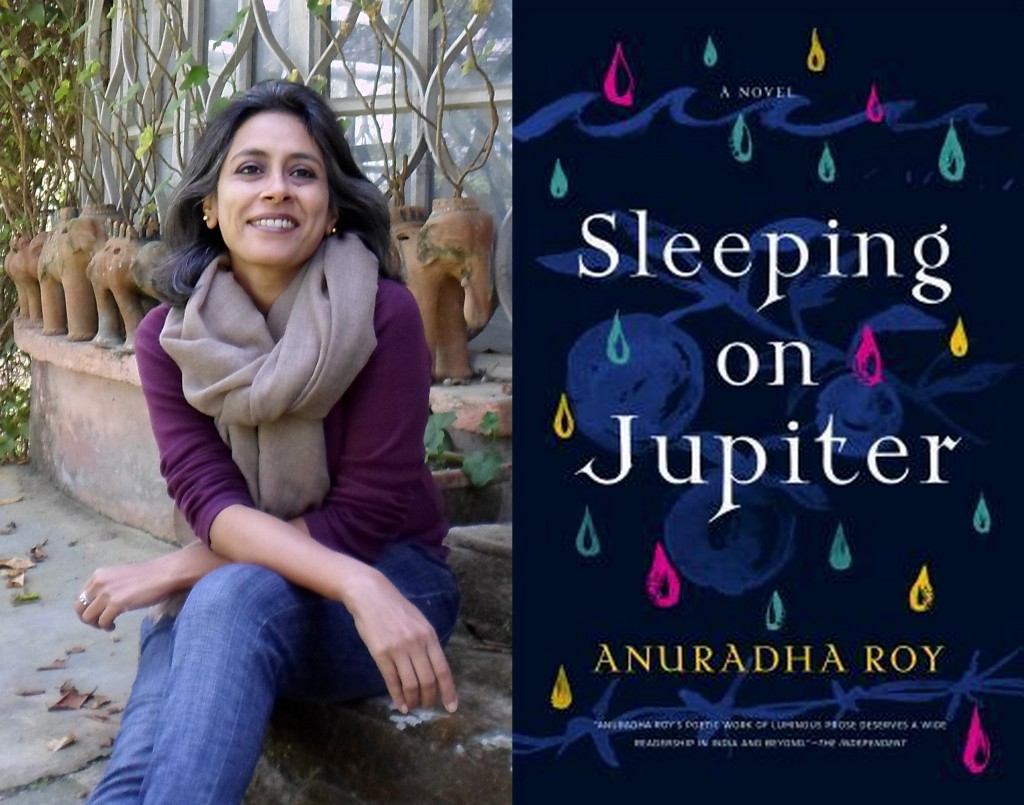
Anuradha Roy writes the kind of immersive, atmospheric prose that you might not expect to be laced with fierce violence. But Sleeping on Jupiter, the latest novel from the Booker Prize-nominated author, doesn’t shy away from dichotomies, whether it’s a gruesome murder in a breathlessly beautiful setting or a religious guru who abuses children.
Sleeping on Jupiter(Graywolf, 2016)follows a group of people whose lives intersect as they visit Jarmuli, a seaside temple town in India. The core of the novel is a trio of women in their sixties, friends on a long-anticipated holiday, and Nomi, a punkish young documentary filmmaker who comes looking for clues to her childhood at a local ashram. With its wealth and squalor, religious fanaticism and feigned religion, tourism and claustrophobia, Roy’s fictional town of Jarmuli presents the dualities of modern India. As the trip unfolds, the characters navigate this unpredictable space which always threatens violence — especially towards women.
I had the pleasure of corresponding with Roy over email about her latest book, creating fictional landscapes, and the intentionality of writing.
Carrie Mullins: Sleeping on Jupiter is a beautifully atmospheric, almost cinematic, novel, whether it’s Nomi’s first home in the jungle, or the sea by Jarmuli, or the Scandinavian forest. The sights, sounds, smells, even the horticulture of a place seems to be important to the story. What drew you to these particular landscapes? How do you think about the function and place of environment in a novel?
Anuradha Roy: I remember the way books like Crime and Punishment affected me as a teenager. We used to get these cut price translations of Russian classics in India in those days and so tended to read Chekhov, Tolstoy, Dostoevsky. The cold in them, the snow, the ice, the horses, the unfamiliar food, the long street names — a country I had never seen was alive in my head. Now when I think of the Shanghai of Tash Aw, the Wessex of Hardy, the rural landscapes of Bengal in Bibhutibhushan, the Scandinavia of Karin Fossum: the settings are inseparable from the characters and narrative. When I am reading a book, I like the feeling of being totally sucked into that world and place is crucial for that.
How particular and detailed and descriptive were those novels? I would have to go back to them to work that out, but the important thing for me is to try and evoke atmosphere and place with only a few details and to set the novel where I will want to live (in my imagination) for the three or four years it will take me to write the book. Even if a novel were to take place in one single room, I’d need to get the room vivid and right in my mind if I am to be able to write. It is not that you put in every detail you note down, but you need to know them for yourself.
CM: Along those lines, the novel is primarily set among the temples of Jarmuli. What inspired you to create this fictional town and why did you want to use a religious setting?
AR: Jarmuli is a temple town by the sea. Temple towns are quite unique in India — these are places for pilgrimage where practically the whole economic and cultural life of the town revolves around ancient temples. The book is set in a temple town partly because one of the themes of the novel is the place of religion in people’s lives — religion impacts different characters very differently in the book. Temple towns are also places for tourism and pilgrimage and therefore for transient relationships — there are quite a few of those in the novel.
The town is fictional because I like making up places as much as people. It gives me the freedom to create a world in which I can see my characters very clearly. The fictional places of my books grow partly out of real places I know, but I like to make and shape them for myself.
CM: Memory is a big theme in the book. Nomi has a fractured memory, Gouri is losing hers, and other characters, like Latika, have memories that they wish to forget. It’s interesting to write characters with incomplete memories because you, as the author, know more than they do. How do you think about the interplay between memory and character, and as an author, what to give and what to hold back? I was also struck by how the characters’ fractured memories related to each other, as if they each had part of the larger picture, the larger narrative of India.
AR: That’s very observant of you. Fiction has a great deal to do with memory — the writer’s own, those of her characters’ — it is impossible to escape. And this book is so much about attempting to excavate a past. During the time I was working on the book, I read how Oliver Sacks had described experiencing the London Blitz in one of his memoirs; however, his older brother told him they had both been away from London in boarding school at that time, that even though Oliver Sacks was certain he had gone through the bombing, he had in fact never experienced it, only read about it in letters from home. I found that fascinating — the fragility and unreliability, and yet the strength of memories.
So much comes from instinct and how good is the coffee you are drinking.
What to give, what to hold back — that is hard to pinpoint. I find the mechanics/the actual nuts and bolts of the writing quite hard to pin down. So much comes from instinct and how good is the coffee you are drinking.
CM: Violence shadows the characters throughout the novel, sometimes hanging back as a threat but often becoming more overt, especially against children and women. To what extent does this reflect the situation in India and to what extent is it just the world of the novel?
AR: The level of daily, routine violence in India is horrifying and disturbing. It is not just the world of the novel at all, it reflects our real lives here.
I didn’t start the novel intending to write about violence, but as Nomi grew in my mind, I began to feel more and more certain that her past was inescapably violent and that she and the other characters had to make their way in a pitiless environment.
CM: It is a pretty pitiless environment. Though for me there was a kind of strength, or maybe solace, in it being an ensemble novel as opposed to just Nomi’s story — and I think her story could sustain its own book. Can you talk a little bit about your decision to write Sleeping on Jupiter from a varied cast of characters versus focusing on Nomi?
AR: Actually, I’ve never written a book with a single storyline and a focus on one character. My books always seem to have largish populations, peoples connected with each other.
In this book, each character’s story illuminates the novel’s themes and concerns in different ways — sexuality, religion, violence, each of them has responses or experiences that set off the others’ experiences — or at least I hope so. And that their collisions and brushes with each other enrich the central narrative and also texture the narrative so that it is not one person’s saga but about love, fun, survival as well. I think the four women in the book particularly are very spirited, and even Nomi squeezes every last drop of juice she can from life, despite her environment.
(The problem with expressing intentionality or decisions is that it makes the whole writing process seem much more schematic than it is. When I am trying to make a living, breathing, absorbing, interesting entity out of some ideas and images in my head, I feel as if a lot of it operates out of instinct, out of ideas that come after a long walk, or waking from sleep thinking, that is what I need to do now, and running to a notebook to pin the thought down before I lose it. Of course writing decisions are absolutely logical and thought through, not once but a hundred times, but how that logic translates into the writing — when discussing it, the whole thing appears far more rational, crafted, and deliberate than it felt when writing it.)
I used to joke that between apparel, toys, books and DVDs, my family was, for a time, single-handedly funding Sesame Workshop, the non-profit that produces Sesame Street.
I had always been fascinated by Jim Henson’s gentle philosophical method and by the visionary Id-like wildness of his puppets. My toddler — himself an agent of chaos, akin to so many of Henson’s greatest creations — provided the perfect excuse to finally study at close range the antics of Henson’s Muppet characters. There was another reason of course, the great unpleasant present that often numbed me and left me cold: the low bank balances and high fees for existence; the sameness of each workday and fleetingness of each weekend; the damn maddening frustration of constantly having to be the disciplinarian — how bad I was at all of this. And the paperwork. No one tells you about the paperwork that adulthood involves.
Like so many others, I longed for childhood’s simplicity. I longed for the brown television in my grandmother’s bedroom, with its old-fashioned knobs and antennae, and how we had to carefully tune those knobs to clear the static from the PBS stations, which Granny and I would do enthusiastically every weekday in order to watch Sesame Street.
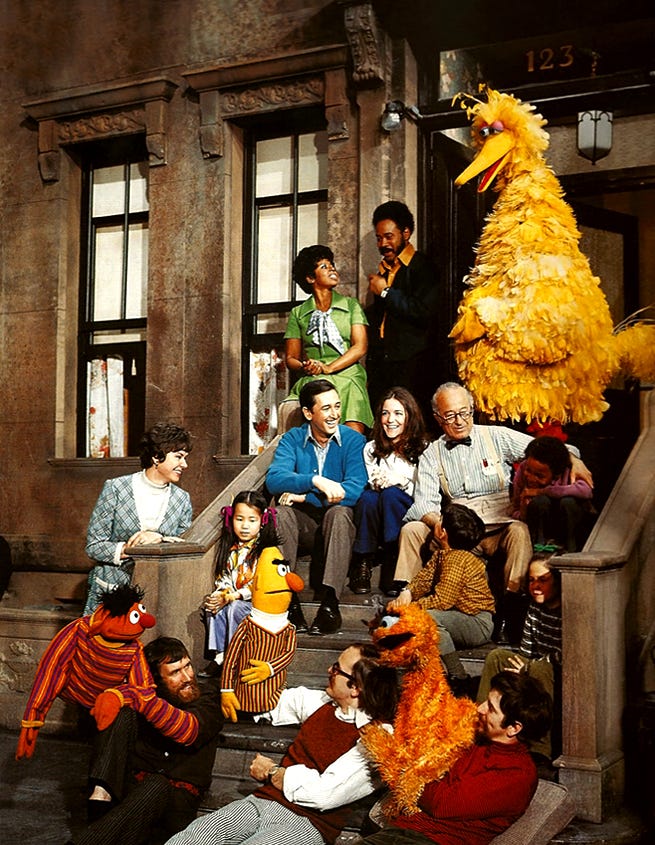
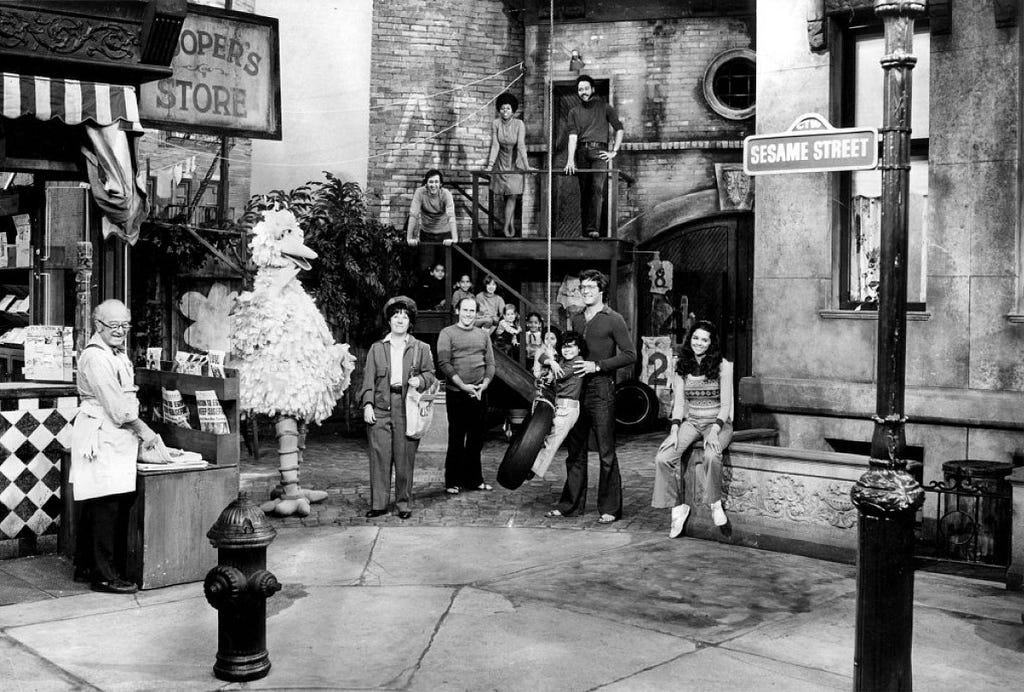
The original cast of ‘Sesame Street’, Season One (1969).
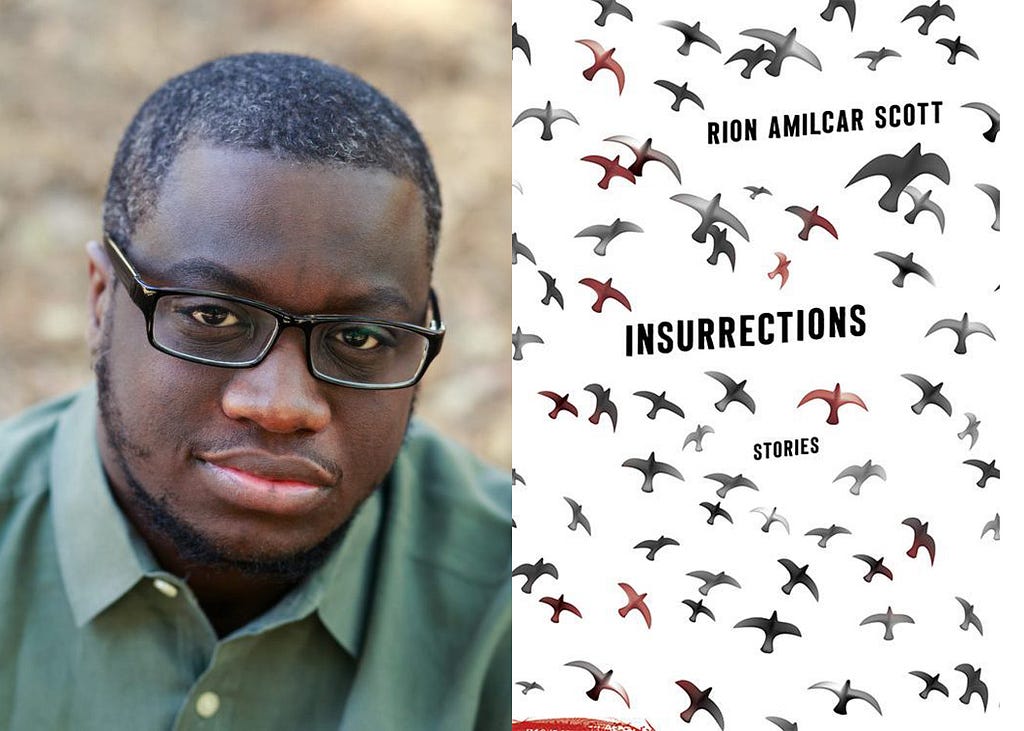
For my son’s third birthday I purchased a DVD set, Sesame Street Old School Vol. 3: 1979–1984. The set happened to encompass the span from the year I was born until, roughly, the last year Granny and I watched the show regularly. Around the time of his birthday I was drafting what would become the first story in my published collection, Insurrections. Initially I’d called the story “The Party” (in the collection it’s retitled “Good Times”), as it involved a Cookie Monster-themed birthday party thrown in honor of a rowdy toddler. In real life, the Cookie Monster party we’d thrown the year before when my son turned two had been a great success. In fictional form, however, it was transformed into a disaster. The father, who has survived a suicide attempt, plots the party as a kind of redemption, but nearly ruins everything by purchasing and wearing a foul-smelling Muppet costume.
By the time I’d given my son the Old School DVD, I had thought my story was finished. After slipping the disc into the machine, Samaadi and I began to watch it during dinner one night when I was struck by something incredible. Will Lee, the actor who’d played the gentle grocery store owner Mr. Hooper had passed away one season. Instead of ignoring his death, the Sesame Street writers had chosen to incorporate it into the show. As the human characters sit around discussing politics and other such pedestrian grown-up things, Big Bird arrives holding portraits he’s drawn of each of them in pencil. The adults are delighted, but when he shows them his drawing of Mr. Hooper they suddenly grow quiet, contemplative.
I can’t wait until he sees it, Big Bird says. Where is he? I want to give it to him.
Big Bird, don’t you remember we told you? Mr. Hooper died, Maria says. He’s dead.
Oh yeah, I remember, Big Bird replies. I’ll give it to him when he comes back.
Big Bird grows increasingly agitated and upset as the adults patiently explain that Mr. Hooper is not coming back. The actor who plays Bob breaks into real tears as he tells Big Bird they should all be grateful for the time they got to spend with Mr. Hooper. Big Bird rages at the unfairness of death — Give me one good reason! he cries.
In the end he realizes that all we’re left with is our sadness and our memories, and that there is no alternative “good reason.” As Gordon tells him, it has to be this way just because.
The scene is heavy, but never dark. Painful, but beautiful. And incredibly human in the way the actors publicly work through their grief, before the cameras, for the benefit of children everywhere. They didn’t have to do that. No one would have blamed Sesame Street for not addressing Mr. Hooper’s sudden absence. The choice to grapple with it face-on is more than anyone could have reasonably expected, but they did it. Children’s television elevated to high art.
I watched with wet eyes, nearly forgetting the three-year-old child next to me. When I looked at him he was sitting wide-eyed, riveted, barely lifting his fork to put food into his mouth.
Do you understand what’s happening? I asked him.
Yeah, he replied, looking solemnly at the screen. Mr. Hooper went to the store.
We returned to our silent, sad viewing. I tried to conjure the words needed to further explain, to help him understand. The words escaped me, and so, after a few minutes, I asked him again if he understood what was going on.
Big Bird is sad because Mr. Hooper is lost, he said.
Do you think he’s coming back?
No, Samaadi said. He’s lost. He’s not coming back.
Many thoughts and emotions passed through me as we watched, “Goodbye Mr. Hooper.” I didn’t have to contend much with death as a child; my grandmother didn’t pass until I was well into adulthood. I didn’t need to rage then like Big Bird. I viewed it as sad, but not unfair. Granny died at 101. I got to be with her longer than most. She had to die because we all do. Just because. But I did, and do, rage foolishly at the passing of time, the growing complexity of life that I can scarcely make sense of most of the time. Eventually the simplicity promised by childhood is like the adults told Big Bird — it’s gone, it’s lost, it’s not coming back. The only place I’ve found that small offering of peace is in writing fiction.
Watching Sesame Street with my son, I couldn’t help but think of my story of the suicidal father, hoping and grasping for Sesame Street to make sense of his unbearable life. I began to see images of him playing the episode for his son, for different — and yet related — reasons than I had played it for my own. I knew then that the story I had assumed was finished still needed more work. And I realized this only because the show that taught me letters and numbers, the show that helped teach me to read, continued teaching me as an adult to feel.
Rion Amilcar Scott’s work has been published in journals such as The Kenyon Review, Crab Orchard Review, PANK, The Rumpus, Fiction International, The Washington City Paper, The Toast, Akashic Books, Melville House and Confrontation, among others. His debut short story collection, Insurrections(University Press of Kentucky), was published in August 2016. Find him at: http://www.rionamilcarscott.com.
Going home is a strange process, especially if you’ve never been there before. My father was born in Cuba in 1950, but left the island with his family in 1956. Except for a brief visit in 1960, he hasn’t been back since. Cuba, then, is his home, or was his home, but not mine. I am, however, making my first trip to the island in just a few weeks’ time, and in some ways it feels like a long-awaited return, as though I am going back for my father. The island and its history occupy a mythic space in my mind, a potent blend of my father’s memories and my research, which means the trip will be more than just a revelation. It will also be, in many ways, a reckoning of sorts, the moment when my ideas about the island come face to face with its current realities. I both welcome and want desperately for this, but, having spent my early career writing about the island from a geographical and cultural distance, I am also nervous about the trip.
When I think of going home, then, I think not only of seeing familiar faces or recognizing a terrain that shaped you, but also bridging the gap between your idea of that place and what it means to you, especially if you return as a different person. Or especially if you’ve inherited those ideas, if those fragments are all you have of that place. What follows are ten books that I think grapple in beautiful ways with the complex phenomenon of going home.
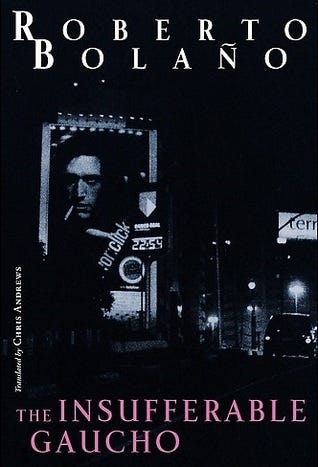
1. The Insufferable Gaucho by Roberto Bolaño
This darkly comic novella by Bolaño is one of my all-time favorites. Following the collapse of Argentina’s economy, esteemed lawyer Héctor Pereda decides to retire to a forgotten family ranch on the Pampas. Throughout his surreal homecoming, Pereda struggles to live a gaucho life after so many years in the city, and his pains are sometimes hilarious and sometimes tragic. Pereda attempts to resurrect an old way of life while also trying to discover a new self, and Bolaño’s hallucinatory plot suggests an insurmountable gap between the places we come from and the people we become.
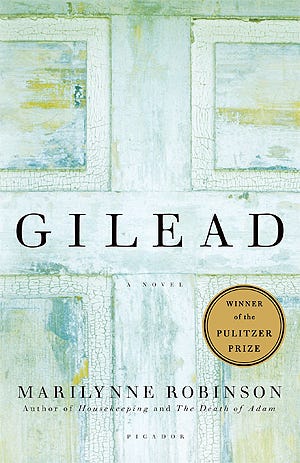
2. Gilead by Marilynne Robinson
I love this book for many reasons, including its sincere and weighty discussion of faith, which is where I see the theme of “going home” present itself (there are also other more literal instances of coming home, too). John Ames is both protagonist and narrator, aging and, in his mind, close to death. He records his story to pass on to his very young son who he thinks will not remember him otherwise. For me, Ames’ project is really to find a home within his faith, which is complicated by the history of his abolitionist grandfather and Ames’ contentious relationship with the ne’er-do-well son of a close friend. Throughout the book Ames pursues a sense of clarity regarding his life, and the tension of the story comes from his struggle to be at home in a world that so regularly challenges the tenets and durability of his faith.
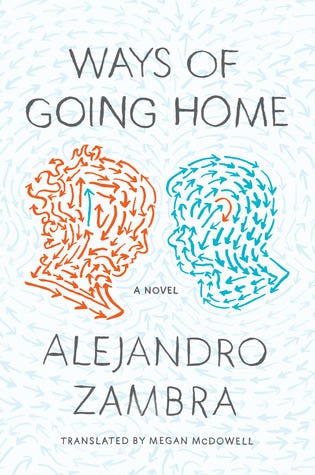
3. Ways of Going Home Alejandro Zambra
A lovely postmodern novella, this book uses the story-within-a-story structure to place a double lens over a nameless boy’s childhood during Chile’s Pinochet era. That lens magnifies the shadows of that boy’s history, providing an opportunity to re-experience some of that past and see the things that the young child, at the time, missed or did not understand. The effect is chilling, because the story cleanly and efficiently pulls back the veil of innocence typical of childhood memories. Going home becomes a dark revelation, showing how the minor memories of childhood are sometimes rife with the seeds of pain we only come to understand later in life.
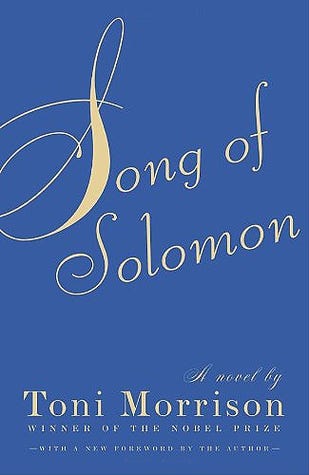
4. Song of Solomon by Toni Morrison
Mythic and of the body, Morrison’s classic taught me the undeniable and inescapable influence of family and history on the development of one’s identity. The life of the novel’s protagonist, Macon “Milkman” Dead III, depicts masterfully the tension between our familial bonds and self-realization. Milkman must constantly decide who of his clan he trusts and aligns with, and even his journey to a lost family farm in Pennsylvania proves perilous, suggesting that both redemption and damnation are consequences of going home.
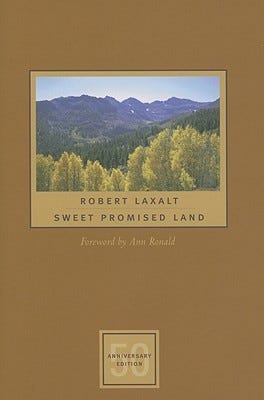
5. Sweet Promised Land by Robert Laxalt
This book is a really lovely and understated work of art. Dominique Laxalt is a Basque sheepherder who has not returned to his homeland in the French Pyrenees for nearly fifty years. His family eventually convinces him to make a trip back to France, and the journey, told affectionately and with great care, illustrates all that one must sometimes sacrifice when leaving home.
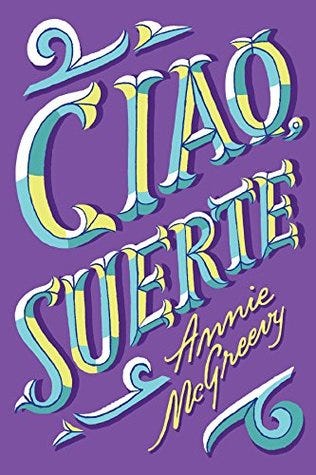
6. Ciao, Suerte by Annie McGreevy
McGreevy’s debut novella is a marvelous and beautiful reversal of the “going home” narrative. In this case, the “home” attempts to find a lost relation, not the other way around. Beatriz’s son and pregnant daughter-in-law were killed during Argentina’s dirty war, but now it’s 1990, and Beatriz has a new lead on the location and identity of her lost grandson, Miguel. The novella follows Beatriz as she attempts to reclaim her lost family, her lost “home,” and what follows is an immersive exploration of how difficult it is to reconstruct the bonds (of a family, of a culture, of a nation) that have been cut.
7. The Mambo Kings Play Songs of Love by Oscar Hijuelos
Oscar Hijuelos won the Pulitzer Prize in 1990 for this lush and imaginative novel. This book explores with great sympathy the life of Cesar Castillo, a Cuban musician who moves to New York in the 1950s. Castillo briefly flirts with fame when he and his brother appear on the I Love Lucy show, but that joyous moment — as is most of the novel — is told in retrospect, meaning Castillo “goes home” in memory only. The looking-back structure of the novel articulates well the fantasies we have for the past, and how our personal histories are subject to the sometimes golden lens of nostalgia.
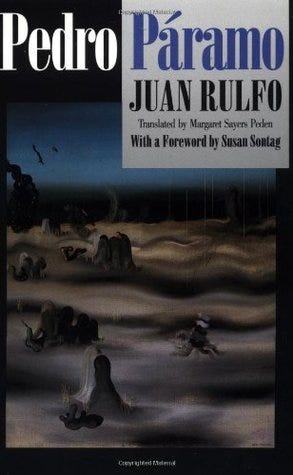
8. Pedro Páramo by Juan Rulfo
Surreal and structurally challenging, Rulfo’s novel tells the story of Páramo’s return to his hometown of Comala following the death of his mother. What he encounters is not a living village filled with familiar faces, but instead a literal ghost town. The narrative employs contrasting elements — spirits and the living, the past and the present — to articulate how life in Comala is a balance of hope and despair. Beautifully written, Rulfo’s atmospheric work would eventually influence Gabriel García Márquez, who claimed the novel helped inspire his own masterpiece, One Hundred Years of Solitude.
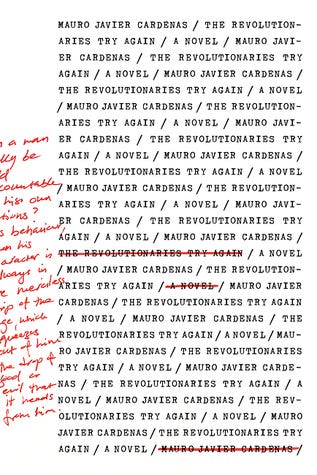
9. The Revolutionaries Try Again by Mauro Javier Cardenas
This is an amazing new novel where “coming home” means returning with ambition. Cardenas’ characters — former classmates at a prestigious school in Guayaquil, Ecuador — reunite in their home country in an effort to change the course of history. Encapsulating many voices and perspectives, the novel takes head on the intricate and complex history of Ecuador, and Cardenas’ style, which relies upon long, expressive sentences, captures incredibly that multifaceted perspective. An amazing book rife with intelligence and love for the potential of one’s homeland.
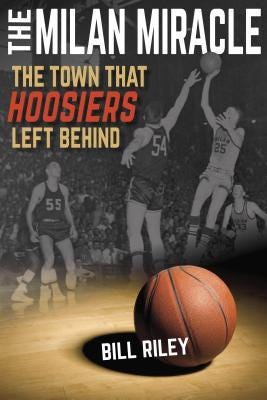
10. The Milan Miracle: The Town that Hoosiers Left Behind by Bill Riley
This recent nonfiction work follows the modern day Milan Indians (the team the movie Hoosiers was based on) and asks how true or lasting are the legends of our hometowns. Riley is a native of Indiana who grew up hearing and subscribing to “Hoosier hysteria,” and his book is an exploration of how and why that ideal — the success of the small town, the potential of every American dream — may or may not be possible anymore. To do this, Riley returns to his home state and follows the 2011 Milan Indian high school basketball team for a season, depicting with empathy and insight how that dream has become both a myth and a burden.
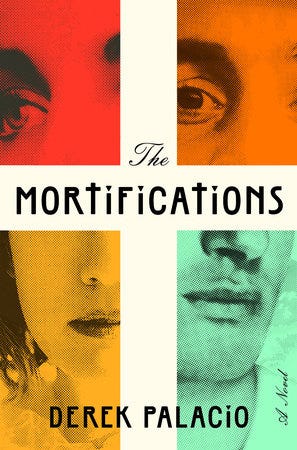
Derek Palacio is the author of the new novel, The Mortifications (Tim Duggan, 2016). He received his MFA in Creative Writing from The Ohio State University. His short story “Sugarcane” appeared in The O. Henry Prize Stories 2013, and his novella, How to Shake the Other Man, was published by Nouvella Books in the same year. He is the codirector, with Claire Vaye Watkins, of the Mojave School, a free creative writing workshop for teenagers in rural Nevada. He lives and teaches in Ann Arbor, Michigan, and is a faculty member of the Institute of American Indian Arts MFA program.
In 1925, one of the most famous writers in America received a book from a young admirer. It contained the inscription, “I hope that parts of this will please you half as much as every story of yours pleases me.” The fan was F. Scott Fitzgerald and the words were written on the flyleaf of The Great Gatsby. The object of his literary ardor was James Branch Cabell, who today is remembered chiefly for the fact that he is no longer remembered.
It’s amusing that when they were writing, Cabell and Fitzgerald were roughly equivalent names. A person could mention them in the same sentence, allowing that Cabell was an acknowledged master while Fitzgerald was just a talented kid, without raising any eyebrows. They were both respected literary authors. If Cabell were writing in 2016, though, he’d be relegated to the second tier of cultural eminence. He’d be published as a “fantasy author.” His books are filled with knights and dragons and damsels and all the trappings of the fantastic, and for this alone he would be pushed out of the pantheon of “serious literature.”
If Cabell were writing in 2016, though, he’d be relegated to the second tier of cultural eminence. He’d be published as a fantasy author.
It’s now a risky move for a literary author to break ranks and throw in an ogre. Take, for instance, Kazuo Ishiguro’s The Buried Giant, which was hailed as a courageous career move that might backfire and be considered “just fantasy” — a label he seemed to express concern about in a New York Times profile. Ursula Le Guin (who, runs one train of thought recently mentioned by Michael Dirda, hasn’t yet won a Nobel Prize because they don’t award it for fantasy) took umbrage with the implication, declaring it “insulting” and a “thoughtless prejudice.” Thoughtless, perhaps, but it’s a prejudice widely shared today — and one which may have kept the subject of this essay from getting the modern recognition he deserves.
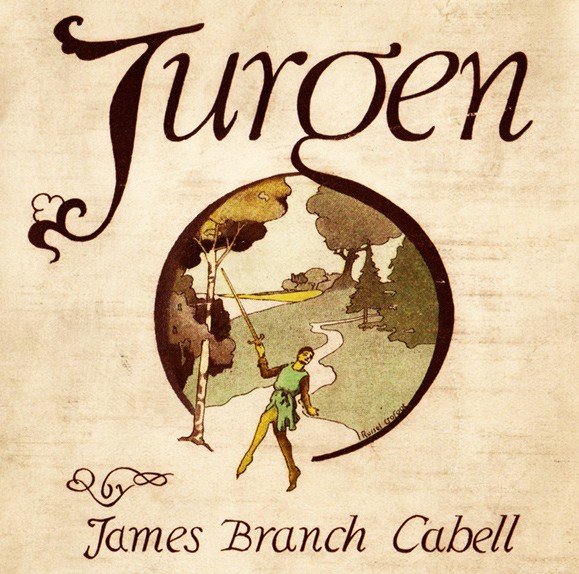
Cabell (1879–1958) wrote in cheerful obscurity until the banning of his novel Jurgen made him a reluctant cause célèbre. He was not suited to fame. He disliked leaving his native Virginia, was indifferent to critical and commercial prospects, and came to deplore the “hordes of idiots and prurient fools” who flocked to him as he gained notoriety. When pressed, he wearily told his editor to “tell the rabble my name is Cabell,” to clear up pronunciation issues. His goal was to “write perfectly of beautiful happenings,” and in pursuit of this goal he borrowed freely from classical and Norse mythology, Slavic folklore, troubadour ballads, Villon, Rabelais, Restoration drama, Enlightenment philosophy, and anything else that suited his fancy. In short, he wrote for himself.
Born to an old and affluent Virginia family (his great-grandfather had been governor), Cabell matriculated into William and Mary College at fifteen, where he was, according to his friend Ellen Glasgow, “the most brilliant youth in the student body” — until he got expelled for a scandal of the “Oscar Wilde variety.” His good name restored by his mother’s lawyers, he graduated, returned home to Richmond, and was immediately caught up in another scandal: a man was found dead outside the Cabell house, and whispers suggested that young James had killed him in an affair of honor regarding his mother. He later wrote of the incident, with characteristic archness, “I have even been credited with murder, but I was not the philanthropist who committed it.”
“I have even been credited with murder, but I was not the philanthropist who committed it.”
Over the next fifteen years Cabell produced books and stories rapidly and with growing assurance, though he made little impression on the national scene. It was a period of literary brilliance and outsized personalities — the age of Edith Wharton and Dorothy Parker, The Smart Set and Tarzan — and the urbane Virginia gentleman made no effort to stand out from the crowd. By the end of World War I a few critics had taken note of Cabell’s books, but the chances of him becoming a household name seemed remote. Then came Jurgen.
Robert M. McBride, his longtime publisher, released Cabell’s twelfth novel in the fall of 1919, without fanfare. But on January 3rd, 1920, the New York Tribune received a letter complaining that Jurgen
deftly and knowingly treats in thinly veiled episodes of all the perversities, abnormalities and dam-foolishness of sex. There is an undercurrent of extreme sensuality throughout the book, and once the trick of transposing the key is mastered one can dip into this tepid stream on every page.
Shortly thereafter, the New York Society for the Suppression of Vice declared war. Jurgen was banned, McBride was raided, the bookplates and unsold copies were seized, and Cabell became instantly famous. Writers nationwide declared a state of emergency, while everyone else dashed out to buy a copy of what they were assured was a delightfully scandalous book. A thriving black market emerged, with copies of Jurgen selling for two hundred times the list price. Twenty-year-old Zelda Fitzgerald wrote to Cabell that she had to get F. Scott a copy for Christmas:
I’ve grown weary and musty with ransacking book-stores — and I’ve also tried to steal Mr. George Nathan’s copy: under pretense of intoxication — all I got was a Toledo blade fencing foil. Judging from the kick he’s raised about it, I presume it’s priceless so if you know anybody who doesn’t think your pen is mightier than Nathan’s foil please tell the goofer that I’d like to exchange —
Jurgen became a standard raised against censorship and outmoded Victorian morality. An “emergency committee” was formed to combat the suppression. Theodore Dreiser proposed starting an artists’ defense fund and contributed the first hundred dollars. Deems Taylor adapted Jurgen into a musical suite that the New York Symphony Orchestra performed at Carnegie Hall. In England, Hugh Walpole cited Cabell as evidence that art was not dead in America. In 1922, when Jurgen was cleared in court, sales skyrocketed. Mencken, already a champion, declared Cabell the greatest living American author.
The irony is that there is an undercurrent of “extreme sensuality” in Jurgen. In one episode, “Jurgen held the lance erect, shaking it with his right hand. This lance was large, and the tip of it was red with blood.” He finds “an opening screened by a pink veil,” which he breaks with a “thrust” of his lance. Several other passages run similarly. But sex in Jurgen is a sideshow: the main event is a quest for lost love and coming to terms with one’s own mortality.
Sex in Jurgen is a sideshow: the main event is a quest for lost love and coming to terms with one’s own mortality.
The titular hero is a middle-aged poet-turned-pawnbroker. One evening he meets a monk who has tripped over a stone and is cursing the devil who put it in his path. “Fie brother,” says Jurgen, “and have not the devils enough to bear as it is?” The monk is nonplussed, and Jurgen warms to his subject:
It does not behoove God-fearing persons to speak with disrespect of the divinely appointed Prince of Darkness. To your further confusion, consider this monarch’s industry! Day and night you may detect him toiling at the task Heaven set him. That is a thing can be said of few communicants and of no monks. Think, too, of his fine artistry, as evidenced in all the perilous and lovely snares of this world, which it is your business to combat, and mine to lend money upon. Why, but for him we would both be vocationless!
Shortly thereafter, Jurgen encounters the devil, who thanks him for the good word and wishes him a life free from care. Jurgen replies that, alas, he is already married. The devil is appalled: “Eh, sirs, and a fine clever poet like you!” Jurgen explains that he’s no longer much of a poet, because his wife disapproves of his versifying.
The devil replies:
“This is very sad. I am afraid your wife does not quite understand you, Jurgen.”
“Sir,” says Jurgen, astounded, “do you read people’s inmost thoughts?”
Jurgen returns home to find that his wife has disappeared. Under pressure from his in-laws to do “the manly thing,” he reluctantly sets off to rescue her. During the quest he regains his youth, romances many women (including Guinevere and Helen of Troy), and wrestles with what to do with his wife if he ever finds her. He passes through the Garden Between Dawn and Sunrise, in which everything “was heart-breakingly familiar and very dear to Jurgen,” a place where “multitudinous maples and locust-trees stood here and there, irregularly, and were being played with very lazily by an irresolute west wind, so that foliage seemed to toss and ripple everywhere like green spray.” In the garden, men and women cavort with their forgotten sweethearts in the twilight, and Jurgen discovers that the snows of yesteryear are purer in memory. His first love, almost divine in recollection, suddenly seems to him petty and rather stupid. The whole thing is clever and sad and sometimes very mean, but it is beautifully written.
Cabell spent the 1920s shaping his disparate books into a monumental whole. Previous works were revised, continuities were established, and in 1930 he published the eighteenth and final volume of what he now called The Biography of Manuel. This gargantuan project traces the exploits of Count Manuel of Poictesme (“pwa-tem”) and his descendants from medieval France to modern Virginia.
It is an astonishing work, combining romance, epic, farce, pseudo-scholarship, genealogy, poetry, and philosophy. It’s also enormous, unwieldy, and frustrating. Even knowing how to read it is difficult. To fit his scheme he rewrote almost everything he had ever published, and eventually brought the whole cycle out in a uniform “Storisende Edition.” This theoretically rendered all previous editions obsolete and was printed in an expensive limited run of 1590 copies.
It is an astonishing work, combining romance, epic, farce, pseudo-scholarship, genealogy, poetry, and philosophy. It’s also enormous, unwieldy, and frustrating.
Almost as soon as the Biography was finished his reputation began to fade. Michael Swanwick argues that he torpedoed his own career with his overreaching ambition. Edmund Wilson posited that his decline was because the Great Depression hit and no one cared any longer for high-minded fantasies. The James Branch Cabell Library at the Virginia Commonwealth University (which still gives out an annual literary award in his name) suggests that his baroque style was displaced by the realism of Hemingway and Steinbeck. Whatever the reason, he fell abruptly out of favor.
Every few decades a bootless attempt is made to rehabilitate his reputation. Wilson tried at length in 1956, in an impenetrable New Yorker piece that likely lost Cabell more disciples than it won. “Along what lines,” he asked, “now can develop the career of a writer of remarkable gifts and unusual tenacity of purpose, born of the ‘quality’ caste — he still always refers to a lady as a ‘gentlewoman’ — in Richmond-in-Virginia (as he writes it), fourteen years after the Civil War and only two after the departure of the Yankees?” Lin Carter tried in the late ’60s by capitalizing on the success of The Lord of the Rings and contextualizing Cabell as an important progenitor of Tolkien. (When asked if he was influenced by Cabell, the professor replied with a resounding “no,” adding that he found him “quite boring.”) Recently Neil Gaiman has tried again, even issuing a few Cabell titles as audiobooks under his own imprint. But still Cabell remains largely unknown and out of print.
The challenges are various. First, despite our modern love of genre distinctions, selling him as high fantasy doesn’t work. His heroes wear swords and occasionally fight dragons, but Cabell has more in common with Shaw than he does with Tolkien. Then there is the Volume Problem. Where does one begin? The casual reader is unlikely to pick up the first book of the Biography (Beyond Life, a 300-page essay on art theory) and read through the rest. Conan Doyle wrote, tragically, that he had not read Dumas because he did not know where to start. With Cabell it’s the same. (The solution: start with Jurgen.)
There is also the Idea Problem. As a philosopher Cabell is didactic and generally bleak. An inverted Kierkegaard, he posits three stages of being: Chivalrous, Gallant, and Poetic. The first sees life as a test, the second as a game, the third as raw material for creativity. It’s an off-putting worldview. There is, too, the Gender Problem — Cabell showed neither interest nor ability in writing women. He is not quite misogynistic, but he is chivalrous to a fault, and the line can be a blurry one.
He is not quite misogynistic, but he is chivalrous to a fault, and the line can be a blurry one.
Finally, there is the Style Problem. Cabell is a playful wordsmith, apt to hide sonnets in blocks of prose or invent archaic authorities and quote them at length, in Latin or Greek or Old French. He enjoys puzzles and is obsessed with multiples of ten. He writes allegorically while vociferously decrying allegory. Reading him is exhilarating but frequently exhausting. Dorothy Parker said, “None other has such wit, such erudition, such delicacy. …And I couldn’t read all the way through one of [his books] to save my mother from the electric chair.”
About half the people upon whom I fanatically foist Jurgen agree with Parker’s sentiment, or at least the latter part of it. The other half adore him. I’ve never met anyone who falls in between. Cabell is polarizing, but he shouldn’t be allowed to languish in the scrapheap of forgotten scribblers or toddle on as a historical footnote to a maligned genre. For his perverse idealism, heroic in the face of certain defeat and congenitally incapable of yielding, he should be remembered. For the beauty of his prose and the admiration of his peers he should be studied. And for his ambition alone, if nothing else, he should be read.
For the first time , the Author’s Guild is opening its membership to non-professional writers.
The new Emerging Writers Membership from the Authors Guild provides an exciting opportunity for committed writers of any age to join the Authors Guild. Developed in partnership with Electric Literature, the Emerging Writers membership does not require prior publication or literary earnings to enroll, but still boasts many of the same benefits as traditional Authors Guild Membership, including marketing and social media training, liability insurance, and website hosting. Additionally, the membership promises access to seminars, workshops, and networking events programmed specifically for emerging writers.
Richard Russo, Pulitzer Prize-winning author and Vice President of the Authors Guild commented in the Authors Guild’s press release, "this is what I needed back when I was an emerging writer: the advice of people who'd been there before me, letting me know where to step, and, more importantly, where not to."
Despite the universality of its relevance, the Emerging Writers Membership was born out of contemporary concerns. As EL Executive Director noted in the press release, today’s writers build their careers in different ways, relying on freelance work, personal web publications like Medium and Tumblr, and social media to gain an audience and income. The Emerging Writers Membership will help guide a new generation of writers to utilize the democratizing tools of self-publication and the internet to their advantage. Authors Guild President Roxana Robinson commented, “we’re now able to give writers support as they enter the professional world, even before they’ve published a first book.”
Last month we published three new poems by Bill Carty. This week poetry editor Ed Skoog asked him a few questions about his work. Here are the answers.
I see these poems have been tagged “America,” which seems accurate. They are a “3 min read.”
In either case, I don’t think I stake out particularly unique ground in saying I’m concerned about the future.
Right now, 39K people are talking about Crohn’s Disease. 25K people are talking about Gregg Popovich. 12K: Dilbert.
Today, I saw the perfect headline: “Humans: Unusually Murderous Mammals, Typically Murderous Primates.”
A few winters ago, after a lonely walk through the sandscape of the Outer Cape, I stood on the observation deck above Shank Painter Pond. A stranger, an older woman, pointed across the water toward what she termed “the American vernacular landscape.” We could see the roofs of some apartments and condominiums. Beyond them and barely out of sight: Stop & Shop, the gym, an animal hospital, Citizens (sic?) Bank. Development stopped there, she said, because she fought to stop it.
She said, “The fight of money vs. none.”
In the moments before and after sunset, when houses have their lights on yet before they the blinds are closed, it doesn’t seem a performance to dance before the window, nor voyeuristic to stare from the street.
Teaching a writing workshop, I made my students break a self-imposed rule. I did the same: I wrote about Caravaggio, of whom I’d sworn too much had been written. Already, however, I’d written a poem about that fact.
“Very well, then I contradict myself.”
First, I typed: “I contract myself.”
In “Working Space,” Frank Stella writes: “But most important, [Caravaggio] changed the way artists would have to think about themselves and their work; he made the studio into a place of magic and mystery, a cathedral of the self.”
And then: “We want to build a pictorial space that accommodates all our gestures, imaginative as well as physical.”
As a surface, fashion isn’t so far from its economic agreement. Blue shoes. Bare skin. Vintage styles. Sackcloth for gown.
“In vain the razor-bill’d auk sails far north to Labrador, I follow quickly, I ascend to the nest…”
To not love silently, or —
Bill Carty lives in Seattle. He was a 2013–14 Poetry Fellow at the Fine Arts Work Center in Provincetown, MA, and a 2016 Literary Fellowship recipient from Artist Trust. His chapbook Refugium was published by Alice Blue Books, and his poems have recently appeared or are forthcoming in The Boston Review, The Iowa Review, Willow Springs, Conduit, Pleiades, The Volta, Oversound, and other journals. He is an Associate Editor at Poetry Northwest.
The humans use Arecibo to look for extraterrestrial intelligence. Their desire to make a connection is so strong that they’ve created an ear capable of hearing across the universe.
But I and my fellow parrots are right here. Why aren’t they interested in listening to our voices?
We’re a nonhuman species capable of communicating with them. Aren’t we exactly what humans are looking for?
The universe is so vast that intelligent life must surely have arisen many times. The universe is also so old that even one technological species would have had time to expand and fill the galaxy. Yet there is no sign of life anywhere except on Earth. Humans call this the Fermi paradox.
One proposed solution to the Fermi paradox is that intelligent species actively try to conceal their presence, to avoid being targeted by hostile invaders.
Speaking as a member of a species that has been driven nearly to extinction by humans, I can attest that this is a wise strategy.
It makes sense to remain quiet and avoid attracting attention.
The Fermi paradox is sometimes known as the Great Silence. The universe ought to be a cacophony of voices, but instead it’s disconcertingly quiet.
Some humans theorize that intelligent species go extinct before they can expand into outer space. If they’re correct, then the hush of the night sky is the silence of a graveyard.
Hundreds of years ago, my kind was so plentiful that the Río Abajo Forest resounded with our voices. Now we’re almost gone. Soon this rainforest may be as silent as the rest of the universe.
There was an African grey parrot named Alex. He was famous for his cognitive abilities. Famous among humans, that is.
A human researcher named Irene Pepperberg spent thirty years studying Alex. She found that not only did Alex know the words for shapes and colors, he actually understood the concepts of shape and color.
Many scientists were skeptical that a bird could grasp abstract concepts. Humans like to think they’re unique. But eventually Pepperberg convinced them that Alex wasn’t just repeating words, that he understood what he was saying.
Out of all my cousins, Alex was the one who came closest to being taken seriously as a communication partner by humans.
Alex died suddenly, when he was still relatively young. The evening before he died, Alex said to Pepperberg, “You be good. I love you.”
If humans are looking for a connection with a nonhuman intelligence, what more can they ask for than that?
Every parrot has a unique call that it uses to identify itself; biologists refer to this as the parrot’s “contact call.”
In 1974, astronomers used Arecibo to broadcast a message into outer space intended to demonstrate human intelligence. That was humanity’s contact call.
In the wild, parrots address each other by name. One bird imitates another’s contact call to get the other bird’s attention.
If humans ever detect the Arecibo message being sent back to Earth, they will know someone is trying to get their attention.
Parrots are vocal learners: we can learn to make new sounds after we’ve heard them. It’s an ability that few animals possess. A dog may understand dozens of commands, but it will never do anything but bark.
Humans are vocal learners too. We have that in common. So humans and parrots share a special relationship with sound. We don’t simply cry out. We pronounce. We enunciate.
Perhaps that’s why humans built Arecibo the way they did. A receiver doesn’t have to be a transmitter, but Arecibo is both. It’s an ear for listening, and a mouth for speaking.
Humans have lived alongside parrots for thousands of years, and only recently have they considered the possibility that we might be intelligent.
I suppose I can’t blame them. We parrots used to think humans weren’t very bright. It’s hard to make sense of behavior that’s so different from your own.
But parrots are more similar to humans than any extraterrestrial species will be, and humans can observe us up close; they can look us in the eye. How do they expect to recognize an alien intelligence if all they can do is eavesdrop from a hundred light-years away?
It’s no coincidence that “aspiration” means both hope and the act of breathing.
When we speak, we use the breath in our lungs to give our thoughts a physical form. The sounds we make are simultaneously our intentions and our life force.
I speak, therefore I am. Vocal learners, like parrots and humans, are perhaps the only ones who fully comprehend the truth of this.
There’s a pleasure that comes with shaping sounds with your mouth. It’s so primal and visceral that throughout their history, humans have considered the activity a pathway to the divine.
Pythagorean mystics believed that vowels represented the music of the spheres, and chanted to draw power from them.
Pentecostal Christians believe that when they speak in tongues, they’re speaking the language used by angels in Heaven.
Brahmin Hindus believe that by reciting mantras, they’re strengthening the building blocks of reality.
Only a species of vocal learners would ascribe such importance to sound in their mythologies. We parrots can appreciate that.
According to Hindu mythology, the universe was created with a sound: “Om.” It’s a syllable that contains within it everything that ever was and everything that will be.
When the Arecibo telescope is pointed at the space between stars, it hears a faint hum.
Astronomers call that the “cosmic microwave background.” It’s the residual radiation of the Big Bang, the explosion that created the universe fourteen billion years ago.
But you can also think of it as a barely audible reverberation of that original “Om.” That syllable was so resonant that the night sky will keep vibrating for as long as the universe exists.
When Arecibo is not listening to anything else, it hears the voice of creation.
We Puerto Rican parrots have our own myths. They’re simpler than human mythology, but I think humans would take pleasure from them.
Alas, our myths are being lost as my species dies out. I doubt the humans will have deciphered our language before we’re gone.
So the extinction of my species doesn’t just mean the loss of a group of birds. It’s also the disappearance of our language, our rituals, our traditions. It’s the silencing of our voice.
Human activity has brought my kind to the brink of extinction, but I don’t blame them for it. They didn’t do it maliciously. They just weren’t paying attention.
And humans create such beautiful myths; what imaginations they have. Perhaps that’s why their aspirations are so immense. Look at Arecibo. Any species that can build such a thing must have greatness within it.
My species probably won’t be here for much longer; it’s likely that we’ll die before our time and join the Great Silence. But before we go, we are sending a message to humanity. We just hope the telescope at Arecibo will enable them to hear it.
On October 28th, Electric Literature will host our second annual Genre Ball! To get in the spooky spirit of the season, we asked some of our Genre Ball hosts — Lynne Tillman, Nicole Dennis-Benn, Tony Tulathimutte, Teddy Wayne, James Hannaham, Helen Phillips, and Kelly Luce — to tell us about their favorite scary stories.
Our Genre Ball will be held the Friday before Halloween at the Ace Hotel in NYC. If you love books, booze, and seeing famous authors in funny costumes, you’ll want to get your tickets before they run out!
Check out the list of scary reads below.
“You Are Not I” and “Pages from Cold Point” by Paul Bowles
Chosen by Lynne Tillman
Paul Bowles’ stories “You Are Not I” and “Pages from Cold Point” are psychological nightmares, from which a reader might never wake, and all in the family. There’s madness in one, incest in the other, respectively, rendered as only Paul Bowles could: quietly, furtively, mysteriously, revealing the most terrifying of delusions and self-deceptions.
“The Moving Finger” by Stephen King
Chosen by Tony Tulathimutte
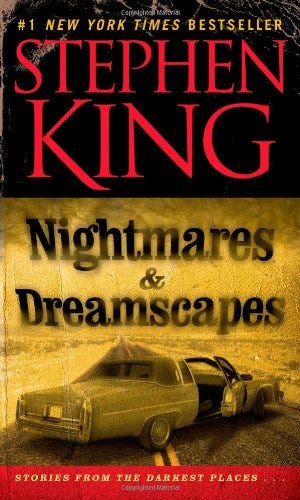
I have to say, for sheer purity and simplicity of premise, it’s tough to beat midcareer Stephen King — he has a story in Nightmares & Dreamscapes called “The Moving Finger,” not to be confused with the Agatha Christie novel. It’s an atrociously written overlong story about a guy watching Jeopardy at home when a finger starts to come out of his bathroom sink drain. The finger keeps coming out and getting longer, with more and more knuckles. In increasingly goofy prose he fends it off with Dran-o and a weedwhacker, puke and blood get everywhere, but goddamnit, that premise. The story ends with the poor guy asking: “Have you ever thought about how many holes to the underworld there are in an ordinary bathroom? Counting the holes in the faucets, that is? I make it seven.” Toilet, toilet tank, faucet, sink drain, shower, tub faucet, bathtub drain — yup. Does the finger symbolize anything? Is it a Telltale Heart? Nah. Just a moving finger.
“Daughters of Eve” by Lois Duncan
Chosen by Teddy Wayne
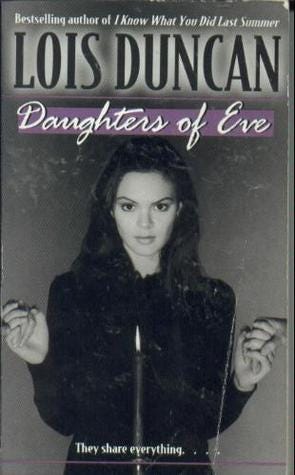
“I remember little from this book except reading it as a kid and being terrified,” said Teddy Wayne. In the story, a group of high school girls in a small Michigan town fall under the influence of their persuasive teacher Irene Stark. Preaching a version of women’s liberation, Irene draws the girl’s attention to the omnipresent patriarchal oppression in their lives, and suggest they take revenge. It begins innocently, with the head shaving of a vain boy in at school, but things quickly escalate in a sinister way.
Beloved by Toni Morrison
Chosen by James Hannaham and Nicole Dennis-Benn
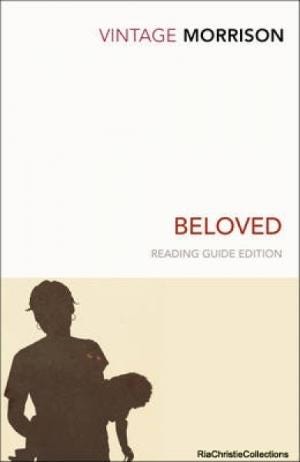
Hannaham: If a novel about the zombie child of a murdered black girl whose mother killed her rather than have the family get sent back into slavery who then returns from the beyond in order to mess with her mother and sister’s and everyone’s else’s mind and sleep with her mother’s lover is not a horror story, I don’t know what is. Especially when you consider that the mother’s plan actually works: she avoids capture by slicing her child’s throat with a saw, which freaks out the slave catchers so much that they leave her alone. Many people see Toni Morrison’s Beloved as a tragedy about a woman driven to extremes in order to save her family from the atrocity of slavery; I think it’s about how oppression can drive people so crazy that they may decide their only way out is to abuse what little power they have and either leave behind or forget the ghosts who engendered their freedom. Or so they think!
Dennis-Benn: My favorite horror story is Beloved by Toni Morrison. When I was younger I thought it was a scary story of a baby ghost haunting a mother after she killed it. I didn’t get the concept until college where it resonated with me in more ways than one — tackling race and identity and the price of freedom. Morrison opened up my eyes to the craft of storytelling, delving into complexities of characters and situations, telling a truly haunting and tragic tale of redemption.
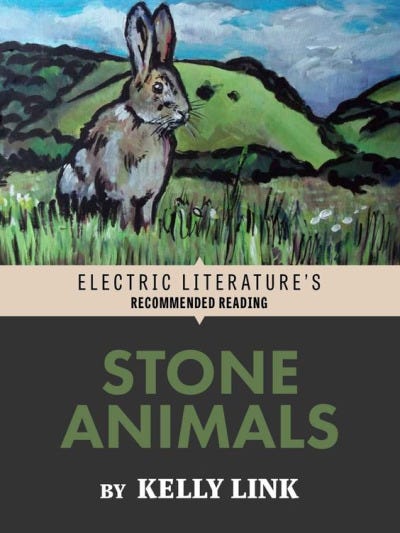
In Link’s hands, mundane objects (a toothbrush, a bar of soap) transform into haunted ones, and familiar tropes (a mother painting the walls in preparation for a new baby) become otherworldly and ominous. The questionable level of (un)reality throughout this story, and the threats that may or may not be about to emerge from the suburban scenery, put the reader in a state of ever-deepening, ever-mysterious horror.
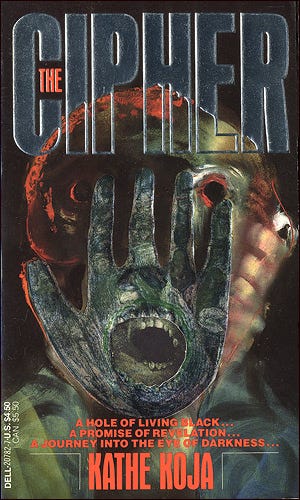
The Cipher by Kathe Koja
Chosen by Kelly Luce
Obsession, desperation, violence, and a weird bottomless hole in a couple’s apartment floor. This novel is poetically grotesque, delightfully horrific and surreal. Don’t get too close to the Funhole, y’all.
DON’T MISS OUT
Sign up for our newsletter to get submission announcements and stay on top of our best work.
YOUR INBOX IS LIT
Enjoy strange, diverting work from The Commuter on Mondays, absorbing fiction from Recommended Reading on Wednesdays, and a roundup of our best work of the week on Fridays. Personalize your subscription preferences here.