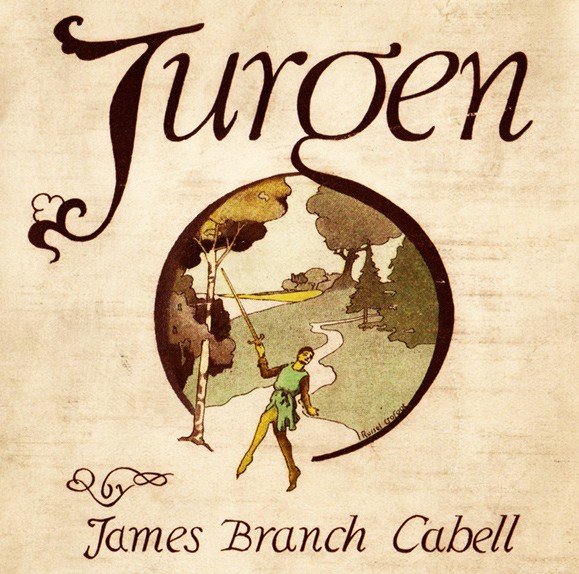
Jurgen is a Lost Fantasy Classic Everyone Should Read

In 1925, one of the most famous writers in America received a book from a young admirer. It contained the inscription, “I hope that parts of this will please you half as much as every story of yours pleases me.” The fan was F. Scott Fitzgerald and the words were written on the flyleaf of The Great Gatsby. The object of his literary ardor was James Branch Cabell, who today is remembered chiefly for the fact that he is no longer remembered.

It’s amusing that when they were writing, Cabell and Fitzgerald were roughly equivalent names. A person could mention them in the same sentence, allowing that Cabell was an acknowledged master while Fitzgerald was just a talented kid, without raising any eyebrows. They were both respected literary authors. If Cabell were writing in 2016, though, he’d be relegated to the second tier of cultural eminence. He’d be published as a “fantasy author.” His books are filled with knights and dragons and damsels and all the trappings of the fantastic, and for this alone he would be pushed out of the pantheon of “serious literature.”

If Cabell were writing in 2016, though, he’d be relegated to the second tier of cultural eminence. He’d be published as a fantasy author.

It’s now a risky move for a literary author to break ranks and throw in an ogre. Take, for instance, Kazuo Ishiguro’s The Buried Giant, which was hailed as a courageous career move that might backfire and be considered “just fantasy” — a label he seemed to express concern about in a New York Times profile. Ursula Le Guin (who, runs one train of thought recently mentioned by Michael Dirda, hasn’t yet won a Nobel Prize because they don’t award it for fantasy) took umbrage with the implication, declaring it “insulting” and a “thoughtless prejudice.” Thoughtless, perhaps, but it’s a prejudice widely shared today — and one which may have kept the subject of this essay from getting the modern recognition he deserves.

Cabell (1879–1958) wrote in cheerful obscurity until the banning of his novel Jurgen made him a reluctant cause célèbre. He was not suited to fame. He disliked leaving his native Virginia, was indifferent to critical and commercial prospects, and came to deplore the “hordes of idiots and prurient fools” who flocked to him as he gained notoriety. When pressed, he wearily told his editor to “tell the rabble my name is Cabell,” to clear up pronunciation issues. His goal was to “write perfectly of beautiful happenings,” and in pursuit of this goal he borrowed freely from classical and Norse mythology, Slavic folklore, troubadour ballads, Villon, Rabelais, Restoration drama, Enlightenment philosophy, and anything else that suited his fancy. In short, he wrote for himself.

Born to an old and affluent Virginia family (his great-grandfather had been governor), Cabell matriculated into William and Mary College at fifteen, where he was, according to his friend Ellen Glasgow, “the most brilliant youth in the student body” — until he got expelled for a scandal of the “Oscar Wilde variety.” His good name restored by his mother’s lawyers, he graduated, returned home to Richmond, and was immediately caught up in another scandal: a man was found dead outside the Cabell house, and whispers suggested that young James had killed him in an affair of honor regarding his mother. He later wrote of the incident, with characteristic archness, “I have even been credited with murder, but I was not the philanthropist who committed it.”

“I have even been credited with murder, but I was not the philanthropist who committed it.”

Over the next fifteen years Cabell produced books and stories rapidly and with growing assurance, though he made little impression on the national scene. It was a period of literary brilliance and outsized personalities — the age of Edith Wharton and Dorothy Parker, The Smart Set and Tarzan — and the urbane Virginia gentleman made no effort to stand out from the crowd. By the end of World War I a few critics had taken note of Cabell’s books, but the chances of him becoming a household name seemed remote. Then came Jurgen.

Robert M. McBride, his longtime publisher, released Cabell’s twelfth novel in the fall of 1919, without fanfare. But on January 3rd, 1920, the New York Tribune received a letter complaining that Jurgen

deftly and knowingly treats in thinly veiled episodes of all the perversities, abnormalities and dam-foolishness of sex. There is an undercurrent of extreme sensuality throughout the book, and once the trick of transposing the key is mastered one can dip into this tepid stream on every page.

Shortly thereafter, the New York Society for the Suppression of Vice declared war. Jurgen was banned, McBride was raided, the bookplates and unsold copies were seized, and Cabell became instantly famous. Writers nationwide declared a state of emergency, while everyone else dashed out to buy a copy of what they were assured was a delightfully scandalous book. A thriving black market emerged, with copies of Jurgen selling for two hundred times the list price. Twenty-year-old Zelda Fitzgerald wrote to Cabell that she had to get F. Scott a copy for Christmas:

I’ve grown weary and musty with ransacking book-stores — and I’ve also tried to steal Mr. George Nathan’s copy: under pretense of intoxication — all I got was a Toledo blade fencing foil. Judging from the kick he’s raised about it, I presume it’s priceless so if you know anybody who doesn’t think your pen is mightier than Nathan’s foil please tell the goofer that I’d like to exchange —

Jurgen became a standard raised against censorship and outmoded Victorian morality. An “emergency committee” was formed to combat the suppression. Theodore Dreiser proposed starting an artists’ defense fund and contributed the first hundred dollars. Deems Taylor adapted Jurgen into a musical suite that the New York Symphony Orchestra performed at Carnegie Hall. In England, Hugh Walpole cited Cabell as evidence that art was not dead in America. In 1922, when Jurgen was cleared in court, sales skyrocketed. Mencken, already a champion, declared Cabell the greatest living American author.

The irony is that there is an undercurrent of “extreme sensuality” in Jurgen. In one episode, “Jurgen held the lance erect, shaking it with his right hand. This lance was large, and the tip of it was red with blood.” He finds “an opening screened by a pink veil,” which he breaks with a “thrust” of his lance. Several other passages run similarly. But sex in Jurgen is a sideshow: the main event is a quest for lost love and coming to terms with one’s own mortality.

Sex in Jurgen is a sideshow: the main event is a quest for lost love and coming to terms with one’s own mortality.

The titular hero is a middle-aged poet-turned-pawnbroker. One evening he meets a monk who has tripped over a stone and is cursing the devil who put it in his path. “Fie brother,” says Jurgen, “and have not the devils enough to bear as it is?” The monk is nonplussed, and Jurgen warms to his subject:

It does not behoove God-fearing persons to speak with disrespect of the divinely appointed Prince of Darkness. To your further confusion, consider this monarch’s industry! Day and night you may detect him toiling at the task Heaven set him. That is a thing can be said of few communicants and of no monks. Think, too, of his fine artistry, as evidenced in all the perilous and lovely snares of this world, which it is your business to combat, and mine to lend money upon. Why, but for him we would both be vocationless!

Shortly thereafter, Jurgen encounters the devil, who thanks him for the good word and wishes him a life free from care. Jurgen replies that, alas, he is already married. The devil is appalled: “Eh, sirs, and a fine clever poet like you!” Jurgen explains that he’s no longer much of a poet, because his wife disapproves of his versifying.

The devil replies:

“This is very sad. I am afraid your wife does not quite understand you, Jurgen.”

“Sir,” says Jurgen, astounded, “do you read people’s inmost thoughts?”

Jurgen returns home to find that his wife has disappeared. Under pressure from his in-laws to do “the manly thing,” he reluctantly sets off to rescue her. During the quest he regains his youth, romances many women (including Guinevere and Helen of Troy), and wrestles with what to do with his wife if he ever finds her. He passes through the Garden Between Dawn and Sunrise, in which everything “was heart-breakingly familiar and very dear to Jurgen,” a place where “multitudinous maples and locust-trees stood here and there, irregularly, and were being played with very lazily by an irresolute west wind, so that foliage seemed to toss and ripple everywhere like green spray.” In the garden, men and women cavort with their forgotten sweethearts in the twilight, and Jurgen discovers that the snows of yesteryear are purer in memory. His first love, almost divine in recollection, suddenly seems to him petty and rather stupid. The whole thing is clever and sad and sometimes very mean, but it is beautifully written.

Cabell spent the 1920s shaping his disparate books into a monumental whole. Previous works were revised, continuities were established, and in 1930 he published the eighteenth and final volume of what he now called The Biography of Manuel. This gargantuan project traces the exploits of Count Manuel of Poictesme (“pwa-tem”) and his descendants from medieval France to modern Virginia.

It is an astonishing work, combining romance, epic, farce, pseudo-scholarship, genealogy, poetry, and philosophy. It’s also enormous, unwieldy, and frustrating. Even knowing how to read it is difficult. To fit his scheme he rewrote almost everything he had ever published, and eventually brought the whole cycle out in a uniform “Storisende Edition.” This theoretically rendered all previous editions obsolete and was printed in an expensive limited run of 1590 copies.

It is an astonishing work, combining romance, epic, farce, pseudo-scholarship, genealogy, poetry, and philosophy. It’s also enormous, unwieldy, and frustrating.

Almost as soon as the Biography was finished his reputation began to fade. Michael Swanwick argues that he torpedoed his own career with his overreaching ambition. Edmund Wilson posited that his decline was because the Great Depression hit and no one cared any longer for high-minded fantasies. The James Branch Cabell Library at the Virginia Commonwealth University (which still gives out an annual literary award in his name) suggests that his baroque style was displaced by the realism of Hemingway and Steinbeck. Whatever the reason, he fell abruptly out of favor.

Every few decades a bootless attempt is made to rehabilitate his reputation. Wilson tried at length in 1956, in an impenetrable New Yorker piece that likely lost Cabell more disciples than it won. “Along what lines,” he asked, “now can develop the career of a writer of remarkable gifts and unusual tenacity of purpose, born of the ‘quality’ caste — he still always refers to a lady as a ‘gentlewoman’ — in Richmond-in-Virginia (as he writes it), fourteen years after the Civil War and only two after the departure of the Yankees?” Lin Carter tried in the late ’60s by capitalizing on the success of The Lord of the Rings and contextualizing Cabell as an important progenitor of Tolkien. (When asked if he was influenced by Cabell, the professor replied with a resounding “no,” adding that he found him “quite boring.”) Recently Neil Gaiman has tried again, even issuing a few Cabell titles as audiobooks under his own imprint. But still Cabell remains largely unknown and out of print.

The challenges are various. First, despite our modern love of genre distinctions, selling him as high fantasy doesn’t work. His heroes wear swords and occasionally fight dragons, but Cabell has more in common with Shaw than he does with Tolkien. Then there is the Volume Problem. Where does one begin? The casual reader is unlikely to pick up the first book of the Biography (Beyond Life, a 300-page essay on art theory) and read through the rest. Conan Doyle wrote, tragically, that he had not read Dumas because he did not know where to start. With Cabell it’s the same. (The solution: start with Jurgen.)

There is also the Idea Problem. As a philosopher Cabell is didactic and generally bleak. An inverted Kierkegaard, he posits three stages of being: Chivalrous, Gallant, and Poetic. The first sees life as a test, the second as a game, the third as raw material for creativity. It’s an off-putting worldview. There is, too, the Gender Problem — Cabell showed neither interest nor ability in writing women. He is not quite misogynistic, but he is chivalrous to a fault, and the line can be a blurry one.

He is not quite misogynistic, but he is chivalrous to a fault, and the line can be a blurry one.

Finally, there is the Style Problem. Cabell is a playful wordsmith, apt to hide sonnets in blocks of prose or invent archaic authorities and quote them at length, in Latin or Greek or Old French. He enjoys puzzles and is obsessed with multiples of ten. He writes allegorically while vociferously decrying allegory. Reading him is exhilarating but frequently exhausting. Dorothy Parker said, “None other has such wit, such erudition, such delicacy. …And I couldn’t read all the way through one of [his books] to save my mother from the electric chair.”

About half the people upon whom I fanatically foist Jurgen agree with Parker’s sentiment, or at least the latter part of it. The other half adore him. I’ve never met anyone who falls in between. Cabell is polarizing, but he shouldn’t be allowed to languish in the scrapheap of forgotten scribblers or toddle on as a historical footnote to a maligned genre. For his perverse idealism, heroic in the face of certain defeat and congenitally incapable of yielding, he should be remembered. For the beauty of his prose and the admiration of his peers he should be studied. And for his ambition alone, if nothing else, he should be read.

Emerging Writer Membership from The Authors Guild

For the first time , the Author’s Guild is opening its membership to non-professional writers.

The new Emerging Writers Membership from the Authors Guild provides an exciting opportunity for committed writers of any age to join the Authors Guild. Developed in partnership with Electric Literature, the Emerging Writers membership does not require prior publication or literary earnings to enroll, but still boasts many of the same benefits as traditional Authors Guild Membership, including marketing and social media training, liability insurance, and website hosting. Additionally, the membership promises access to seminars, workshops, and networking events programmed specifically for emerging writers.

Richard Russo, Pulitzer Prize-winning author and Vice President of the Authors Guild commented in the Authors Guild’s press release, "this is what I needed back when I was an emerging writer: the advice of people who'd been there before me, letting me know where to step, and, more importantly, where not to."

Despite the universality of its relevance, the Emerging Writers Membership was born out of contemporary concerns. As EL Executive Director noted in the press release, today’s writers build their careers in different ways, relying on freelance work, personal web publications like Medium and Tumblr, and social media to gain an audience and income. The Emerging Writers Membership will help guide a new generation of writers to utilize the democratizing tools of self-publication and the internet to their advantage. Authors Guild President Roxana Robinson commented, “we’re now able to give writers support as they enter the professional world, even before they’ve published a first book.”

Some Notes on the Poems

A sort of interview with, and by, Bill Carty

Last month we published three new poems by Bill Carty. This week poetry editor Ed Skoog asked him a few questions about his work. Here are the answers.

I see these poems have been tagged “America,” which seems accurate. They are a “3 min read.”

In either case, I don’t think I stake out particularly unique ground in saying I’m concerned about the future.

Right now, 39K people are talking about Crohn’s Disease. 25K people are talking about Gregg Popovich. 12K: Dilbert.

Today, I saw the perfect headline: “Humans: Unusually Murderous Mammals, Typically Murderous Primates.”

A few winters ago, after a lonely walk through the sandscape of the Outer Cape, I stood on the observation deck above Shank Painter Pond. A stranger, an older woman, pointed across the water toward what she termed “the American vernacular landscape.” We could see the roofs of some apartments and condominiums. Beyond them and barely out of sight: Stop & Shop, the gym, an animal hospital, Citizens (sic?) Bank. Development stopped there, she said, because she fought to stop it.

She said, “The fight of money vs. none.”

In the moments before and after sunset, when houses have their lights on yet before they the blinds are closed, it doesn’t seem a performance to dance before the window, nor voyeuristic to stare from the street.

Teaching a writing workshop, I made my students break a self-imposed rule. I did the same: I wrote about Caravaggio, of whom I’d sworn too much had been written. Already, however, I’d written a poem about that fact.

“Very well, then I contradict myself.”

First, I typed: “I contract myself.”

In “Working Space,” Frank Stella writes: “But most important, [Caravaggio] changed the way artists would have to think about themselves and their work; he made the studio into a place of magic and mystery, a cathedral of the self.”

And then: “We want to build a pictorial space that accommodates all our gestures, imaginative as well as physical.”

As a surface, fashion isn’t so far from its economic agreement. Blue shoes. Bare skin. Vintage styles. Sackcloth for gown.

“In vain the razor-bill’d auk sails far north to Labrador,
I follow quickly, I ascend to the nest…”

To not love silently, or —

Bill Carty lives in Seattle. He was a 2013–14 Poetry Fellow at the Fine Arts Work Center in Provincetown, MA, and a 2016 Literary Fellowship recipient from Artist Trust. His chapbook Refugium was published by Alice Blue Books, and his poems have recently appeared or are forthcoming in The Boston Review, The Iowa Review, Willow Springs, Conduit, Pleiades, The Volta, Oversound, and other journals. He is an Associate Editor at Poetry Northwest.

The Great Silence

“The Great Silence” by Ted Chiang

The humans use Arecibo to look for extraterrestrial intelligence. Their desire to make a connection is so strong that they’ve created an ear capable of hearing across the universe.

But I and my fellow parrots are right here. Why aren’t they interested in listening to our voices?

We’re a nonhuman species capable of communicating with them. Aren’t we exactly what humans are looking for?

The universe is so vast that intelligent life must surely have arisen many times. The universe is also so old that even one technological species would have had time to expand and fill the galaxy. Yet there is no sign of life anywhere except on Earth. Humans call this the Fermi paradox.

One proposed solution to the Fermi paradox is that intelligent species actively try to conceal their presence, to avoid being targeted by hostile invaders.

Speaking as a member of a species that has been driven nearly to extinction by humans, I can attest that this is a wise strategy.

It makes sense to remain quiet and avoid attracting attention.

The Fermi paradox is sometimes known as the Great Silence. The universe ought to be a cacophony of voices, but instead it’s disconcertingly quiet.

Some humans theorize that intelligent species go extinct before they can expand into outer space. If they’re correct, then the hush of the night sky is the silence of a graveyard.

Hundreds of years ago, my kind was so plentiful that the Río Abajo Forest resounded with our voices. Now we’re almost gone. Soon this rainforest may be as silent as the rest of the universe.

There was an African grey parrot named Alex. He was famous for his cognitive abilities. Famous among humans, that is.

A human researcher named Irene Pepperberg spent thirty years studying Alex. She found that not only did Alex know the words for shapes and colors, he actually understood the concepts of shape and color.

Many scientists were skeptical that a bird could grasp abstract concepts. Humans like to think they’re unique. But eventually Pepperberg convinced them that Alex wasn’t just repeating words, that he understood what he was saying.

Out of all my cousins, Alex was the one who came closest to being taken seriously as a communication partner by humans.

Alex died suddenly, when he was still relatively young. The evening before he died, Alex said to Pepperberg, “You be good. I love you.”

If humans are looking for a connection with a nonhuman intelligence, what more can they ask for than that?

Every parrot has a unique call that it uses to identify itself; biologists refer to this as the parrot’s “contact call.”

In 1974, astronomers used Arecibo to broadcast a message into outer space intended to demonstrate human intelligence. That was humanity’s contact call.

In the wild, parrots address each other by name. One bird imitates another’s contact call to get the other bird’s attention.

If humans ever detect the Arecibo message being sent back to Earth, they will know someone is trying to get their attention.

Parrots are vocal learners: we can learn to make new sounds after we’ve heard them. It’s an ability that few animals possess. A dog may understand dozens of commands, but it will never do anything but bark.

Humans are vocal learners too. We have that in common. So humans and parrots share a special relationship with sound. We don’t simply cry out. We pronounce. We enunciate.

Perhaps that’s why humans built Arecibo the way they did. A receiver doesn’t have to be a transmitter, but Arecibo is both. It’s an ear for listening, and a mouth for speaking.

Humans have lived alongside parrots for thousands of years, and only recently have they considered the possibility that we might be intelligent.

I suppose I can’t blame them. We parrots used to think humans weren’t very bright. It’s hard to make sense of behavior that’s so different from your own.

But parrots are more similar to humans than any extraterrestrial species will be, and humans can observe us up close; they can look us in the eye. How do they expect to recognize an alien intelligence if all they can do is eavesdrop from a hundred light-years away?

It’s no coincidence that “aspiration” means both hope and the act of breathing.

When we speak, we use the breath in our lungs to give our thoughts a physical form. The sounds we make are simultaneously our intentions and our life force.

I speak, therefore I am. Vocal learners, like parrots and humans, are perhaps the only ones who fully comprehend the truth of this.

There’s a pleasure that comes with shaping sounds with your mouth. It’s so primal and visceral that throughout their history, humans have considered the activity a pathway to the divine.

Pythagorean mystics believed that vowels represented the music of the spheres, and chanted to draw power from them.

Pentecostal Christians believe that when they speak in tongues, they’re speaking the language used by angels in Heaven.

Brahmin Hindus believe that by reciting mantras, they’re strengthening the building blocks of reality.

Only a species of vocal learners would ascribe such importance to sound in their mythologies. We parrots can appreciate that.

According to Hindu mythology, the universe was created with a sound: “Om.” It’s a syllable that contains within it everything that ever was and everything that will be.

When the Arecibo telescope is pointed at the space between stars, it hears a faint hum.

Astronomers call that the “cosmic microwave background.” It’s the residual radiation of the Big Bang, the explosion that created the universe fourteen billion years ago.

But you can also think of it as a barely audible reverberation of that original “Om.” That syllable was so resonant that the night sky will keep vibrating for as long as the universe exists.

When Arecibo is not listening to anything else, it hears the voice of creation.

We Puerto Rican parrots have our own myths. They’re simpler than human mythology, but I think humans would take pleasure from them.

Alas, our myths are being lost as my species dies out. I doubt the humans will have deciphered our language before we’re gone.

So the extinction of my species doesn’t just mean the loss of a group of birds. It’s also the disappearance of our language, our rituals, our traditions. It’s the silencing of our voice.

Human activity has brought my kind to the brink of extinction, but I don’t blame them for it. They didn’t do it maliciously. They just weren’t paying attention.

And humans create such beautiful myths; what imaginations they have. Perhaps that’s why their aspirations are so immense. Look at Arecibo. Any species that can build such a thing must have greatness within it.

My species probably won’t be here for much longer; it’s likely that we’ll die before our time and join the Great Silence. But before we go, we are sending a message to humanity. We just hope the telescope at Arecibo will enable them to hear it.

The message is this:
You be good. I love you.
X

Six Frightening Reads to Freak You Out for Halloween

On October 28th, Electric Literature will host our second annual Genre Ball! To get in the spooky spirit of the season, we asked some of our Genre Ball hosts — Lynne Tillman, Nicole Dennis-Benn, Tony Tulathimutte, Teddy Wayne, James Hannaham, Helen Phillips, and Kelly Luce — to tell us about their favorite scary stories.

Our Genre Ball will be held the Friday before Halloween at the Ace Hotel in NYC. If you love books, booze, and seeing famous authors in funny costumes, you’ll want to get your tickets before they run out!

Check out the list of scary reads below.

“You Are Not I” and “Pages from Cold Point” by Paul Bowles

Chosen by Lynne Tillman

Paul Bowles’ stories “You Are Not I” and “Pages from Cold Point” are psychological nightmares, from which a reader might never wake, and all in the family. There’s madness in one, incest in the other, respectively, rendered as only Paul Bowles could: quietly, furtively, mysteriously, revealing the most terrifying of delusions and self-deceptions.

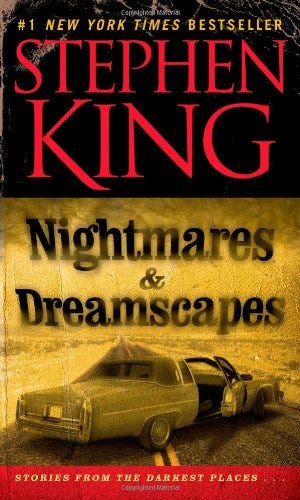
“The Moving Finger” by Stephen King

Chosen by Tony Tulathimutte

I have to say, for sheer purity and simplicity of premise, it’s tough to beat midcareer Stephen King — he has a story in Nightmares & Dreamscapes called “The Moving Finger,” not to be confused with the Agatha Christie novel. It’s an atrociously written overlong story about a guy watching Jeopardy at home when a finger starts to come out of his bathroom sink drain. The finger keeps coming out and getting longer, with more and more knuckles. In increasingly goofy prose he fends it off with Dran-o and a weedwhacker, puke and blood get everywhere, but goddamnit, that premise. The story ends with the poor guy asking: “Have you ever thought about how many holes to the underworld there are in an ordinary bathroom? Counting the holes in the faucets, that is? I make it seven.” Toilet, toilet tank, faucet, sink drain, shower, tub faucet, bathtub drain — yup. Does the finger symbolize anything? Is it a Telltale Heart? Nah. Just a moving finger.

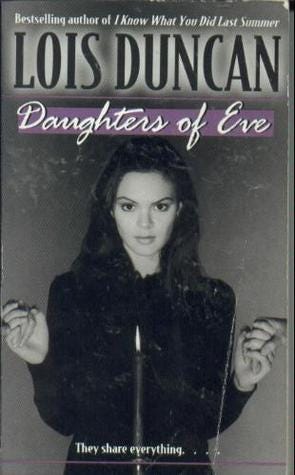
“Daughters of Eve” by Lois Duncan

Chosen by Teddy Wayne

“I remember little from this book except reading it as a kid and being terrified,” said Teddy Wayne. In the story, a group of high school girls in a small Michigan town fall under the influence of their persuasive teacher Irene Stark. Preaching a version of women’s liberation, Irene draws the girl’s attention to the omnipresent patriarchal oppression in their lives, and suggest they take revenge. It begins innocently, with the head shaving of a vain boy in at school, but things quickly escalate in a sinister way.

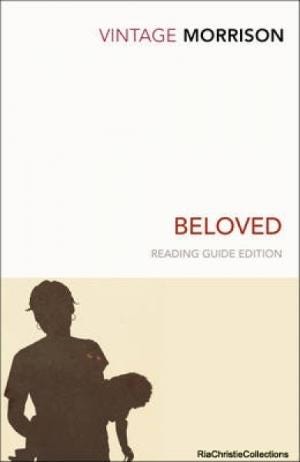
Beloved by Toni Morrison

Chosen by James Hannaham and Nicole Dennis-Benn

Hannaham: ​If a novel about the zombie child of a murdered black girl whose mother killed her rather than have the family get sent back into slavery who then returns from the beyond in order to mess with her mother and sister’s and everyone’s else’s mind and sleep with her mother’s lover is not a horror story, I don’t know what is. Especially when you consider that the mother’s plan actually works: she avoids capture by slicing her child’s throat with a saw, which freaks out the slave catchers so much that they leave her alone. Many people see Toni Morrison’s Beloved as a tragedy about a woman driven to extremes in order to save her family from the atrocity of slavery; I think it’s about how oppression can drive people so crazy that they may decide their only way out is to abuse what little power they have and either leave behind or forget the ghosts who engendered their freedom. Or so they think!

Dennis-Benn: My favorite horror story is Beloved by Toni Morrison. When I was younger I thought it was a scary story of a baby ghost haunting a mother after she killed it. I didn’t get the concept until college where it resonated with me in more ways than one — tackling race and identity and the price of freedom. Morrison opened up my eyes to the craft of storytelling, delving into complexities of characters and situations, telling a truly haunting and tragic tale of redemption.

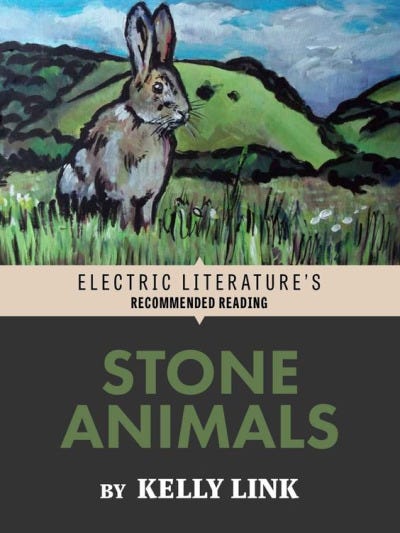
“Stone Animals” by Kelly Link

Chosen by Helen Phillips

In Link’s hands, mundane objects (a toothbrush, a bar of soap) transform into haunted ones, and familiar tropes (a mother painting the walls in preparation for a new baby) become otherworldly and ominous. The questionable level of (un)reality throughout this story, and the threats that may or may not be about to emerge from the suburban scenery, put the reader in a state of ever-deepening, ever-mysterious horror.

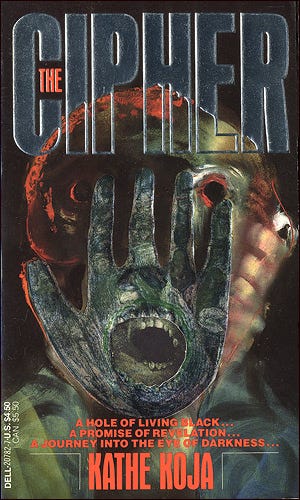
The Cipher by Kathe Koja

Chosen by Kelly Luce

Obsession, desperation, violence, and a weird bottomless hole in a couple’s apartment floor. This novel is poetically grotesque, delightfully horrific and surreal. Don’t get too close to the Funhole, y’all.

Electric Literature Is Seeking Essay Submissions!

Electric Literature is opening submissions of personal and critical essays starting next Monday, as well as humor that reflects on the world of reading, writing, literature, and storytelling in all its forms. We’re particularly interested in pieces that examine the intersection of the literary world and other creative disciplines: film, fine art, music, video games, architecture — you name it.

Some of our favorite recent personal essays include pieces about The Exorcist and a father’s descent into alcoholism; reading and writing as a participant in an art installation; an exploration of a writer’s shifting identities as she moves between Jamaica and the U.S.

Critical essays may cover a variety of topics: the history of our obsession with a novel’s first sentence; the spatial poetics of Nintendo; what women can learn from reading sexist male writers.

Payment for personal and craft essays, as well as humor pieces, is $50. Length is up to you; most essays we publish fall between 1500–5000 words.

Submissions will be accepted on our submittable account here.

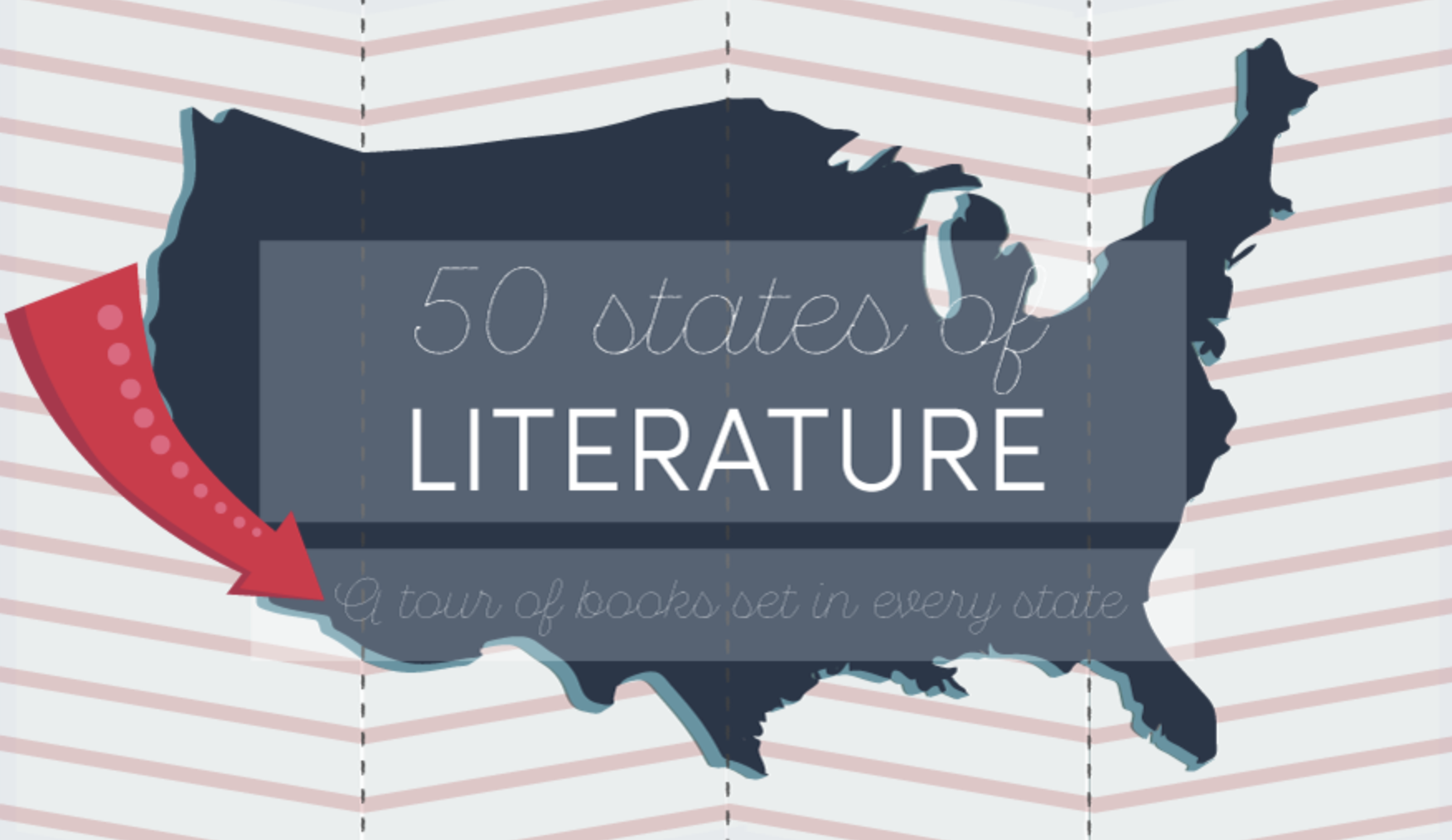
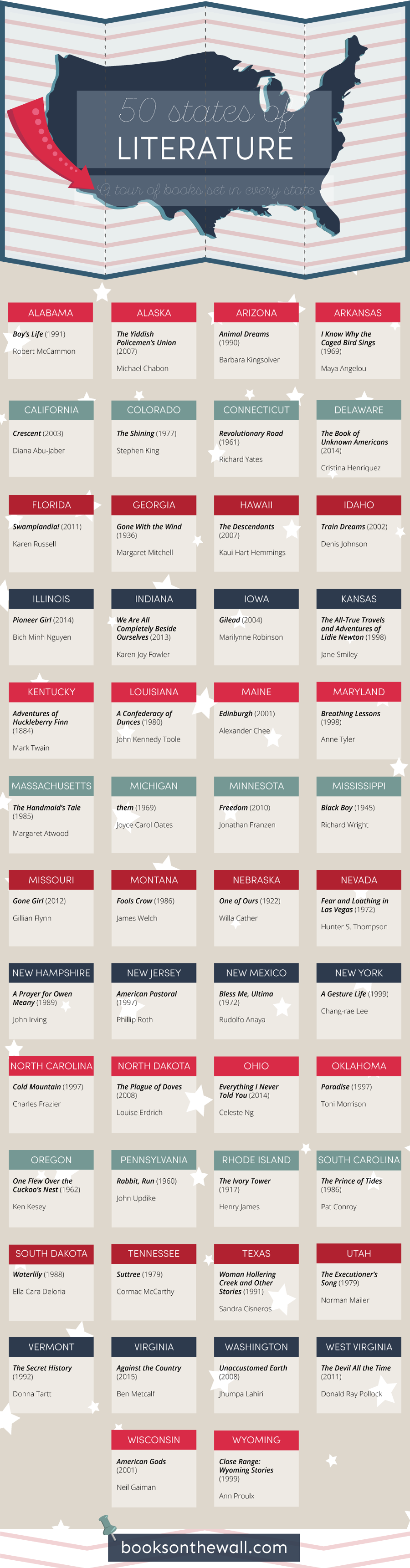
INFOGRAPHIC: 50 States of Literature

A tour of the United States through books!

If you’re the type of person who’s always dreamed of hopping in a VW van and road tripping the United States, but lack the time (or money), the folks over at Books on the Wall may have a solution for you: read your way across the country! They put together an infographic that features a book per state, and the collection of recommendations certainly renders a colorful picture of the fifty nifty. (Not sure all Coloradoans would choose King’s horror novel The Shining, to represent them, but it’s a part of the imaginative journey!)

Anne Valente on a Community in Grief

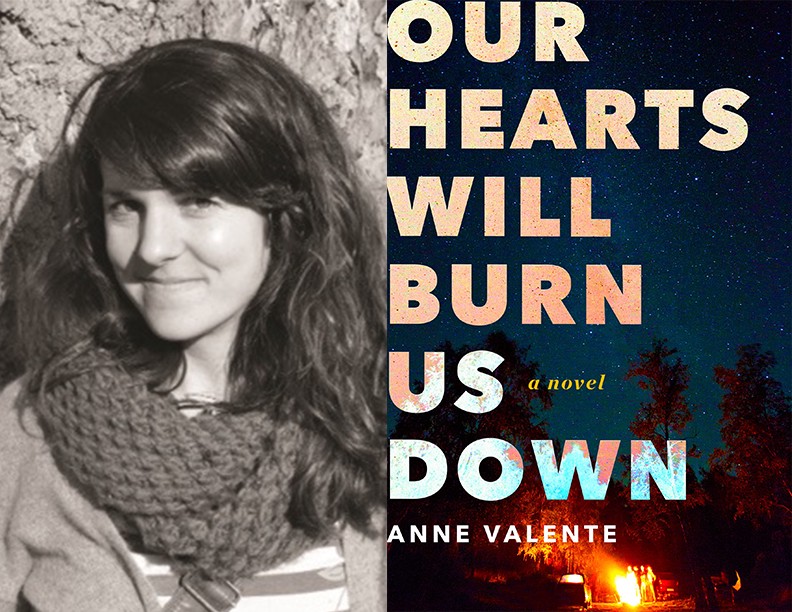
Anne Valente’s new novel, Our Hearts Will Burn Us Down (William Morrow, 2016) tells a slant of reality by looking at a community reeling after a fictional mass shooting. The shooter is dead, his murders an irrepressible public memory. The carnage occurs in Lewis and Clark High School in St. Louis, Missouri. The event is senseless, and everyone is left to pick up the pieces, since the shooter can’t answer for his actions.

Gun violence is a hard issue to talk about in America, let alone write about. We need books like Our Hearts Will Burn Us Down to infiltrate our everyday routines. Still, writing the introduction to this interview proves challenging. Anything I say here could divide readers, and I can’t know whether I’ve asked enough questions of the material.

Valente — the author of By Light We Knew Our Names, winner of the Dzanc Short Story Prize — isn’t prone to dance around difficult conditions, and Our Hearts Will Burn Us Down is up to the task. Originally from St. Louis, Valente is on faculty in the Creative Writing and Literature Department at Santa Fe University of Art and Design. I corresponded with her by email over a couple of weeks spanning the beginnings of our teaching semesters.

Jason Teal: Reading the acknowledgements is interesting because the original publication credit goes to Iron Horse Literary Review for the short story “Our Hearts Will Burn Us Down.” Can you talk about why you were compelled to push the scope of this narrative from a few pages to, then, hundreds?

Anne Valente: I never thought I’d be a writer to expand a short story into a novel, since almost every story I’ve ever written has felt like its own contained world. But after writing the short story, which was focused on an elementary school instead of a high school, I felt like there was so much more to explore. I’d written the short story in the aftermath of Sandy Hook, and after no gun legislation changed despite so many heated debates and so much news coverage, the short story felt unfinished. I wanted to further understand a community’s rebuilding and if rebuilding is even possible, beyond the twenty pages of a short story — and beyond the brief eye of the media that so quickly pulls away from mass tragedy. A novel felt like a better terrain to delve into these questions, and a high school better suited to exploring the individual lives of those affected.

JT: Speaking of community, how did you decide on the yearbook staff as taking focus amid other candidates, including surviving faculty and family — even the shooter himself? The point of view, a roving first-person plural that splinters into close-third in the character-building chapters, seemed especially potent.

AV: Point of view was one of the most crucial aspects of craft for me while writing this book — not only for how to best approach this story, but for the politics of storytelling and who controls a narrative like this. I absolutely knew I did not want to focus on the shooter, not even in speculating throughout the book on motive. We see so much of this in media already, and so much less on the families, the community, the friends and siblings and partners. A yearbook staff that both experienced and didn’t experience what their classmates went through felt apt, in grappling with the question of what is and isn’t theirs to mourn, and also what memory means and how we make sense of violence and the past. A yearbook is about memories, and presenting the best possible version of those memories, and I was interested in so many weeks and months of moving beyond this terrible event, and what memory could possibly mean in light of an event where there is no best possible version. I alternated between the first-person plural and the close-third point of view of these four main characters because this allowed me to contend with how a community mourns — what is everyone’s to mourn — and what is singularized and personal in a mass experience, the individual’s unique response to violence and mourning.

JT: St. Louis, too, is vividly drawn for readers. In one scene we find Zola observing the ritual of cicadas in beautiful detail, recalling their specificity to the region:

A Midwestern sound … A sound that had marked every year of her memory. A wave of noise as August burned off into September, then louder still as autumn deepened into October … They were everywhere. On the news, in the grass, clinging to the sapling branches of trees … Zola had listened to their sound each summer, a drone stretched through the screens of her bedroom windows, a sound that summoned the coming of fall.

You are from the area. Do you think the setting contributes to the response of the novel — to outside events and actions in the book?

AV: I hadn’t written much fiction at all about St. Louis before working on this novel, a place I knew intimately by growing up there. But in writing away from myself by writing about a kind of violence and communal grief I’d never experienced firsthand, I made it more familiar to my own understanding by setting it in a version of St. Louis I knew well. Beyond setting’s relationship to content, however, the landscape of fiction has always been extremely important to me as an element of craft. I began writing this book in the West, at a time when I was greatly missing the Midwest, and finished it back in the Midwest at a time when I was greatly missing the West. These characters are as attached to St. Louis, a place that marks their childhood and their home, as much as they need to leave it for what’s happened to their community, and how violence has altered their understanding of where their lives began. In some ways, this novel’s setting is a meditation on the ways that a landscape can break your heart. For me, it is a love letter to St. Louis as much as it is a backdrop for the community.

JT: Was it difficult writing four unique characters grieving altered communities? Did one student come more naturally than the rest?

AV: It was a challenge to imagine four distinct lives and the nuances of their experiences — both in response to grief, but also in what their lives looked like before this tragedy happened and how those concerns are still central to them. As my editor astutely suggested in revisions, these are characters who are shaped by collective grief, but they are also four teenagers who have their own lives and teenage concerns. It was as much of a challenge to write four different takes on grief as it was to write how each of the four managed their sorrow alongside the everyday conflicts in their individual lives — for example, whether they felt guilty for still feeling caught up in their high school relationships. I don’t think one student came more naturally than others, but I did want to make them distinct enough from one another — in their hobbies and activities, but also in their modes of processing the world and what is happening in their community. I think the greatest challenge was sanding the edges between passages of pluralized narration and more individualized third-person narration, and bridging the collective experience to the specific experiences of these four characters.

JT: Fire, in more than one way, plays a big part in the book. I don’t think naming arson will spoil too much. So, researching arson for the book, what most surprised you about fire?

AV: Research has always been one of my favorite aspects of writing — a way of learning so much about the world that I don’t know. For the novel, I checked out a number of arson and homicide investigation textbooks from the library, and I also found research articles on fire science. As a writer, I feel like I’m always stumbling upon connections between seemingly disparate topics — either a self-fulfilling prophecy, or else proof that everything is connected if you find the right constellation. What struck me most about researching fire was the surprisingly beautiful and poetic language used in these textbooks to describe burning: that two stages of fire eruption are smoldering and free burning, or that specific gravity is a substance’s weight in relation to the weight of water, or that the term for a substance’s flash point shifting from a solid to a gas is sublime. To me, all of these words also felt right for describing the process of grief.

JT: I like that you’re thinking about grief as its own language. Was this part of the motivation for writing the lyrical chapters? They read so audibly.

AV: At first, I think I was using the shorter, lyrical chapters as a means of conveying information that might sound forced in the mouths of characters, but I also know I’m a writer drawn to lyricism, and also to shorter forms. Before writing Our Hearts Will Burn Us Down, I wrote a chapbook of flash fiction and a short story collection, and even in a novel was still drawn to condensed language. I wanted short, concentrated sections that communicated sorrow in a mode beyond linear narrative, since grief is so often anything but linear. But I was also influenced by Mikhail Bakhtin’s literary theories of heteroglossia and polyphony. I’m really not much of a theory person at all, but I’m drawn to Bakhtin’s idea that novels are spaces for multiple voices, and for characters with their own subjectivities — that the author’s voice isn’t an objective stance but instead takes a backseat to the multiple perspectives that emerge within a novel. It sounds almost ridiculous to say, but I really didn’t feel like the authoritative, guiding hand in this book. Even going back to the politics of point of view, and whose grief is whose to mourn, for this novel it felt right for a multiplicity of perspectives and voices to come through — the collective point of view and the individualized third-person narratives of these four main characters, but also the outside voice of the newspaper, the television, the police and their diagrams, and these more lyrical sections. If the main chapters are a linear narrative, I also wanted more timeless, varied voices in this novel within these shorter sections. This felt right not only for privileging multiple voices, but for the ways in which grief bends and breaks a sense of linear time — and for the ways that grief yearns to reverse and stop time.

JT: I’m keen to understand if writing the book gave you space to grieve this kind of tragedy? When violence happens locally, the impact is of course devastating, but fictionalizing such a community heavy document is an important task. What new perspectives did writing about this difficult subject offer?

AV: This is such an important question, and one I honestly struggled with in writing this book. Much like the collective-first perspective of four yearbook staff members who experienced this in their school but didn’t experience violence directly, I grappled — and am still grappling — with what is and isn’t mine to grieve. This didn’t happen at my high school. This kind of violence hasn’t happened to me directly. As a fiction writer, I build narratives beyond autobiography. But I’ve still felt devastated each time a violent shooting occurs, in high schools and everywhere else, and have felt ashamed by that devastation — that my grief is nothing compared to that of the families and communities who have directly experienced it. Even though this book is fiction, it also isn’t fiction. It could happen anywhere. Our access point for tragedy is so often through our television and computer screens, but this shouldn’t be an excuse to separate ourselves from the pain of others — to simply shut off the television and perform the act of disavowal, that because it’s happening there it can’t be happening here.

Our access point for tragedy is so often through our television and computer screens, but this shouldn’t be an excuse to separate ourselves from the pain of others.

This book was one means of imagining a community after the television cameras pull away, after media decides there is no more story to tell. In my immediate world, I don’t know how the families in Littleton are doing seventeen years after Columbine, or how a community in Charleston still grieves a year later, or how and if a nightclub in Orlando rebuilds. We have so little access to others’ lives beyond the glare of a television, so little means of knowing the process of grieving and the attempt to move on. We can only imagine, an act of empathy, and this is the same foundation of fiction. Our imaginations are of course faulted, filled with assumptions and cultural biases, so I couldn’t rely exclusively on my imagination: this book addresses such a difficult subject, as you say, and I had to research and inform that imagination. I hope informed imagination is what creates the empathy that our world — and our creative work — so desperately needs. Writing this book was one way of trying to access what happens after the media stops telling us a particular story, and to look beyond what our televisions tell us.

JT: I saw your characters struggle alongside you, a similarly polarizing code of ethics, when tasked with writing yearbook profiles for students they didn’t know: Christina writes of another student, “What else is there to say?” Is there anything more for these characters to say? What is your next project about, if you don’t mind talking about it, and what do you anticipate for it, after moving away from this book?

AV: Since finishing this first novel, I’ve moved from the Midwest out to Santa Fe. Landscape and place have always been central to my writing, and I’ve found that the transition out West has inspired my writing in different ways. I’ve written and completed a new novel across my first year in New Mexico, a road trip novel that incorporates various pockets of research that are completely new to me — falconry, NASCAR, paleontology and climate change. But before I even came up with the content for this new book, I knew I wanted to write something that moves. Our Hearts Will Burn Us Down remains stationary in the fixed setting of St. Louis, which is its own wonderful challenge and was necessary for that narrative, but I wanted to try something new and see how a novel might develop differently across a variety of settings — in terms of backdrop, but also in terms of structure. Beyond a new novel, I plan to return to stories and essays here and there this year. It’s been awhile since I’ve written shorter forms, and I’m looking forward to seeing what develops.

JT: The array of names used in your fiction is of particular note — for example Zola, Wren, Betsy, and (maybe I’m biased here) Teal. Can you talk about the process of naming characters, if one exists? Likewise: Our Hearts Will Burn Us Down. By Light We Knew Our Names. Where do you find inspiration for your titles?

AV: That’s nice of you to say, because I feel like I’m terrible with names in stories, and also with titles! Naming characters is often so difficult, and I usually just allow a character’s personality to suggest the right name for them. The short story, “By Light We Knew Our Names,” was really one of the only times that I purposefully connected all of the characters’ names under the same umbrella — Wren, Kestrel and Teal are the names of birds, and these girls felt very much to me like caged birds waiting to take flight. As for the title, By Light We Knew Our Names — language that never actually appears in the story, or in the collection as a whole — felt right for a group of women who truly knew themselves by aurora light, which is to say, away from what a town of predatory men told them they were. As for the novel, I realized only after the fact of naming it that it follows the same aural, syllabic cadence of the collection’s title. In general, I’m drawn to language that has a rhythm, pulse and clear sound. With that said, the working title of my new novel manuscript is a single word. I’m feeling a little sheepish about long titles at the moment and wanted try something more clipped!

JT: The ambition of this book is impressive — it is a mystery, yet it is fabulist and experimental. The book tackles a mainstream topic, and does so with aplomb. It is also your debut novel with a major press. What advice do you have for writers facing a similar initiative? How did you keep yourself writing in the face of grief?

AV: Thanks for these kind words. To be honest, I wasn’t quite sure how to write a novel when I began working on this manuscript. I’d been working exclusively on short stories for several years, but a number of things came together in my life at the time that led to working on a novel. I’d started a doctoral program, and the challenge of a novel as my dissertation was one I wanted to take on. But then I transferred doctoral programs and the transition was far more jarring than I anticipated, and I funneled that sense of instability into the stability of working on a single project, every single day. I started and finished this novel across one intense year, both in terms of the transition, the book’s subject matter, and sitting with the grief of this book every day. I think there are all kinds of ways of structuring and writing a novel, and every writer I know has a different process. But for me, this was the only way I could do it, and the second novel manuscript I just finished was written in much the same way — every day, across one year. I think I’m the kind of writer that needs this centering, and I wrote this second novel through another cross-country move and transition. Though this new project hasn’t been as heavy as writing Our Hearts Will Burn Us Down, I think my mode as a writer has been to not turn away from the difficulty of the subject matter. It’s hard, as hard as watching the news and seeing yet another incidence of gun violence or police brutality, but past a point, looking away becomes harder. With this novel, and with subsequent projects since, I find that I’m often writing to sit with the grief, to allow it to just be instead of letting myself grow complacent or uncomfortable with it.

Though I know everyone’s process is different, my advice to a writer taking on first novel is to first and foremost make time for it every day. I set myself a daily word count and built a visual map above my desk for the novel’s timeline, events and researched information. Even if another writer approaches this process differently, I think it’s essential to touch upon the work in some way every day to stay immersed in the narrative’s world. Beyond that, my less tangible advice is to not be too concerned about audience or how the work will be received. I didn’t let anyone read a word of this book until I had a solid draft finished, and even then, only two people read it until my agent began sending it out — and one of those people was my partner. I was protective of it not because I was afraid of criticism, but because I didn’t want to be derailed from my own vision of the book through too much advice. It’s not a book for everyone. As you say, it’s a bit of a strange hybrid. But I wanted to make it mine instead of anticipating criticism or reception before I was even done. So my best advice for other writers is to write what you feel passionate to write, regardless of market trends or what other people might want to read — doing this helped me maintain and preserve my own voice.

A Canine Cure for Lonlieness

After graduate school, I decided to get a dog. It was entirely selfish, maybe the most selfish thing I had done in my life. Underpaid and uninsured, I had a lifestyle unfit for taking care of anyone (including myself), and a carpet covered with small, secretly malign objects — hairpins, vitamin bottles, Christmas socks with holes in them — that could end up in a dog’s stomach.

What would I do if the dog needed to see the doctor? What if, like my mother, I’d yell at the dog every time it got sick because I couldn’t afford to take it to the hospital? What if I’d yell not out of hatred, but because life had disappointed me…again?

I wouldn’t be yelling at the dog. I would be yelling at life.

What if he wanted to go to college?

Despite these worries, I kept up the dream. Why? I had always wanted what I considered to be the crème de la crème of household pets. I grew up in a working-class family; we were never able to afford one. So I convinced myself now that I was done with school forever, that this was my time.

Quite frankly, dogs are more alive than most people I know.

I had just moved into a house that I rented in Wallingford — a sleepy, liberal, family-oriented neighborhood of Seattle. I imagined it to be, in some ways, my dream house, my quiet writing abode, and I began searching on the internet through digital catalogs of beady, canine eyes.

One summer afternoon, I went to Cost Plus World Market to look for housewares, affordable “ethnic stuff” for my place.

In the salt and pepper shaker aisle, a stringy-haired woman with a paisley bandeau tied around her blonde head carried a canvas bag with a dog poking out of it. Black wavy hair, dropped-down ears, a perfectly-matte nose but wet nostrils, and eyes so full, so full of sadness or hope or something. I couldn’t help but fall.

I asked the woman, “What kind of dog is that?”

She looked up from a cylinder of tea that she had been contemplating in her shopping basket. “A Havanese.”

“I’ve never heard of that dog. Where did you get him?”

“From this breeder in Texas. I can give you their website. You can give them a call.”

It seemed ludicrous to get a dog off a website from a breeder in Texas. How would I manage to obtain this dog? Would it ever lose its Southern twang? What if, due to all our rain and cloud, it got S.A.D.?

I proceeded to research the breed on the internet. I found out that the dog was small, non-shedding, had minimal exercise requirements, was suitable for apartment living, and had the charm and personalidad of a clown.

I then contacted the breeder with questions like, “How much?” “When?” “Now?” “Send me pictures!”

The breeder crammed my inbox with photos of pristine Havanese and Havanese mix puppies and then I saw her: Polly.

The One!

Polly was a Havanese/Maltese mix, mostly-black but tan around the mouth and on the paws and eyebrows. Every photograph of her (the breeder provided multiple angles and various living scenarios — “Polly on top of a living room table!” “Polly on the couch, mouth agape, tail-wagging.” “Polly!”) evoked an undeniable joy and revelry in life.

The pooch was cute.

She had the sparkle in her eyes and the exuberance in her open maw. She was to die for.

At that time, I had two jobs — one as the editor of a literary journal, the other as a receiver for a local bookstore. I spent evenings reading and eating microwave dinners. Three days a week, I stuck price tags on books.

My back hurt. My nostrils were always filled with cardboard dust. Breaking boxes of books all day. Stacking books all day. Putting little stickers on the backs of them and then filing them away for someone else who could afford to read them.

I had been living the dream, supposedly. The writer’s dream of poverty and toil and unfinished stories. The dream. And, yet, I would come home and do nothing but fantasize about the puppy, Polly.

Some people look to God or volunteer work for salvation, from themselves, from their worries or dreams.

Other people buy things on the internet.

After a series of awkward financial transactions and conversations via email, the date was arranged for Polly, two months old, my Polly, to land in my life as LIVE CARGO on a plane from San Antonio to SeaTac.

In preparation for her arrival, I bought a six-foot leash, a heart-shaped nametag, and a fleece-lined bed that matched my sheets — khaki and brown.

I informed friends and family of the decision to expand my current domestic partnership of one. It became all that I talked about…no more dead-end writing, no more dead-end job, no more dead ends, period.

I showed my friends pictures of the sparkling eyes, the wagging tail. Everyone approved; everyone applauded. “Good for you,” they said. “How exciting!”

But one week prior to Polly’s arrival, I got a phone call from the breeder.

She said that Polly had been acting strangely. Polly refused to eat.

The breeder said that she could not send Polly on a plane in that condition. She would watch Polly and take her to the vet. We’d have to wait until Polly’s condition stabilized, until she ate properly, pooped properly, did the “usual dog-thing” properly, before the breeder could send her on the treacherous journey across so-and-so states.

Of course, I was heartbroken, but, convinced of my undying love, I agreed to all of the breeder’s terms. I thanked the breeder for keeping me updated, for taking care of my Polly, for whom I had already paid through an electronic transfer from bank to bank.

But the day Polly had been scheduled to arrive at SeaTac, the day I was to pick her up from the airport, liberate her from the plastic crate, clasp a nametag around her neck, squeak toys and drive her home in a car filled with “soothing music,” Polly died.

The breeder’s husband, an Englishman who lived in Texas, called to inform me. Polly had died of puppy leukemia.

In his British accent, he stated she had “terrible diarrhea” and a “beautiful soul.” He cried on the telephone.

I hung up. I stared at the ceiling and wailed.

When I opened my medicine cabinet, I saw the dog toothpaste standing beside my own. The dog toothpaste had the image of an open-mouthed Collie on it.

Grief became paranoia and rage. I demanded from the breeder another dog. They emailed me photographs of different puppies, as if I was embarking on some deadly, puppy hostage exchange program.

One of the puppies—in a clear attempt to appease me, the grief-stricken buyer—had been named “Polly2.” Even the breeder conceded that none would have the courage and the tenacity of the original “Polly,” an “old soul,” but all of the puppies were nonetheless beautiful and deserving of a good home.

After two weeks, I found him.

I did not feel that ripe blush of love and panic when I first saw his picture. Rather, he just looked perfectly wise and content.

His name was Imus — a Havanese mix, mostly white with black rings around his eyes, black ears and a large black spot on his back.

His left eye was lazy and he was a little bow-legged.

When I first picked him up from the airport, I played him Ella Fitzgerald in the car, like it was Starbucks. I had read on the internet that the dog would need soothing music when meeting its new owner for the first time. Nonetheless, he whimpered behind the bars of his carrier for the entire ride.

When I got him inside of my house, I opened the crate and he sprang out like a wild animal. He ran to me, wanted to crawl over me, my shoulders, my head, like a raccoon. Then he ran to a corner of the living room, keeping his eyes on me, curtsied, and peed on my landlord’s carpet.

“No!”

I quickly grabbed him and took him outside to the backyard and stood there with him for thirty minutes, waiting for him to pee again, but he didn’t. I took him inside and he peed in the same corner. And I cleaned and cleaned and cleaned.

That night, I read Puppies for Dummies cover to cover in bed as the dog, in his own bed on the floor, spent the whole time crying, trying to reach me.

Success and Its Trappings

Weighing in at a hefty four hundred pages, Matt Bell’s latest story collection, A Tree or a Person or a Wall (Soho), comes in the wake of his critically-acclaimed novels (also from Soho), In the House upon the Dirt Between the Lake and the Woods (2013) and Scrapper (2015). An early-career retrospective of sorts, much of the material contained in A Tree or a Person or a Wall originated in Bell’s Indie-published volumes, 2010’s How They Were Found and 2012’s Cataclysm Baby. There’s new work here, seven stories worth of it — the title piece, “Doll Parts,” “The Migration,” “The Stations,” “Inheritance,” “For You We Are Holding,” and “A Long Walk with Only Chalk to Mark the Way” — but, to a great extent, this volume revisits Bell’s earliest material. In the process, A Tree or a Person or a Wall can’t help but provoke questions about artistic development and the interplay between commerce and creativity. The basic issue: Does Bell’s early work stand comparison to what he’s producing now; or, does this collection represent an attempt to leverage old material in light of recent success?

“Bell is a literary experimentalist who never lets his experiments overtake his fiction’s need for dramatic effect.”

We deal with related concerns all the time in the literary world, and by “we” I don’t just mean book critics. Readers, writers, and critics, no one in America is immune to the impact of literature’s commercialization, a necessary consequence if writers are to make any sort of living from their work. Still, the profit motive can, and often does, go too far. Whether we’re talking about the Lee family’s cash grab, Go Set a Watchman (a supposed sequel that wound up being an early draft of To Kill a Mockingbird), or any number of other examples (John Kennedy Toole comes to mind with his posthumous masterpiece A Confederacy of Dunces followed some years later by his only other book, a truly terrible novella he’d written as a teenager, The Neon Bible), attempts to fleece consumers are common in America, certainly not just in literature.

But I think most writers with literary ambitions would like to believe they’re offering the best work they can, that they’re providing fair artistic value to their readers, not simply trying to cash in. (And here, in fairness to the authors mentioned above, they didn’t have much say in the suspect publications, owing to advanced age for Lee, suicide for Toole). Beyond that, successful writers like Bell must wonder whether their early work was the equal of whatever garnered them their “break,” if all they were missing was a little timing or luck to have had that break years before.

Even if we set aside thoughts of success and its trappings — considerations such as units sold, prize nominations, and general notoriety — the author’s hope has to be that he really was good enough once upon a time, even as he toiled in what might have been relative (or even true) obscurity. For that author, there’s got to be some vindication in seeing work he believed in finally reach a broader audience. If we’re honest with ourselves as writers, readers, and critics, though, the question we come back to, the only question that really matters, is whether this newfound attention is justified, whether it is deserved. When it comes to A Tree or a Person or a Wall, the only answer I can give is a resounding, “Yes.”

A talented, at times even daring, stylist Bell is a literary experimentalist who never lets his experiments overtake his fiction’s need for dramatic effect, that necessary quality of making the reader want to read. This is something many literary writers forget or even disdain: the fact that it’s their responsibility to attract readers and keep them interested, not the other way around. And it’s a lesson Bell seems to have learned from an early age. Fearless in terms of the subject matter he’s willing to write about and perhaps ever more so in the unexpected, sometimes extremely dark angles he takes in fleshing out his stories, Bell has the goods, no question.

Whether we’re considering the earlier work like “The Cartographer,” “The Collectors,” and the epic cli-fi novella “Cataclysm Baby” (vast in scope; beautiful and haunting, disturbing and thought provoking in execution) or the more recent standouts like “The Stations,” “The Migration,” and the collection’s final piece, the heartbreaking ode to the victims death leaves among the living, “A Long Walk with Only Chalk to Mark the Way,” overall, A Tree or a Person or a Wall more than lives up to the hype generated by Bell’s successful novels.

“A Tree or a Person or a Wall is, as a whole, a substantial piece of art.”

More than a basic chronology designed to consume space at the expense of quality, A Tree or a Person or a Wall is, as a whole, a substantial piece of art. Bell has taken the time to really piece this material together, to develop an overall seven-part structure that feels at once like an early-career retrospective and a unified piece of work. These are not linked stories per se (or, not overtly so), but in their overwhelming attention to humanity’s self-destructive love affairs with itself and its world and a human experience that is a constant quest for understanding, a quest that seems to succeed and fail simultaneously, again and again, this is a text that asks to be reread.

A Tree or a Person or a Wall is one of the best books I’ve read this year. From prose that is simultaneously elegant and muscular to its hybrid of mystery, wisdom, and earned emotion, from its notes of slipstream and fabulism to those of outright fable, this volume does indeed answer the literary question I posed earlier. This is a justified, even necessary collection, one we should be grateful to Soho for bringing out. Only in his mid-thirties, Matt Bell is a great short story writer, and has been now for many years. The lingering question is just how good Bell can become, whether we will look back on this volume and see it as a prelude to greater things still. Only time will tell.