A cautionary tale that reminds us all to back up our work
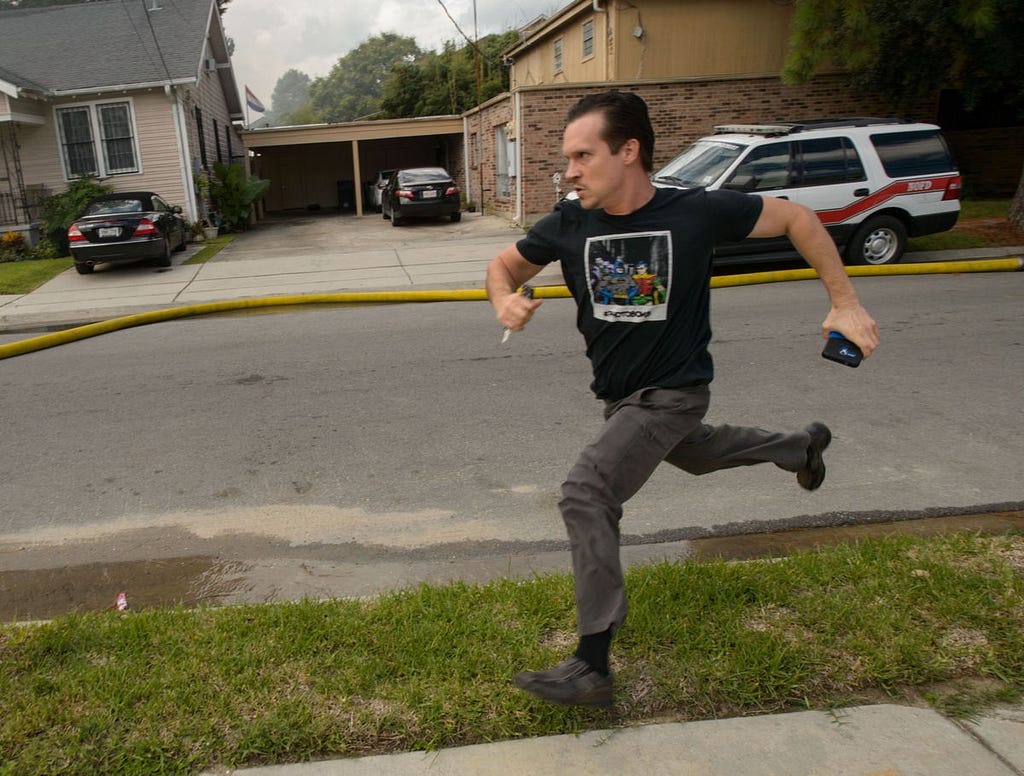
Gideon Hodge en route to save laptop. Apparently not a reinactment. This and other dramatic photographs by Matthew Hinton, available at the New Orleans Advocate.
In the digital age, despite differences in creed, color, and craft, all writers share one practice in common: backing up their work. Since most modern authors write on a laptop, they are particularly sensitive to the risk of losing all of their hard work in a nightmarish moment of bad luck. All it takes is one hard drive crash. Or in Gideon Hodge’s case, a raging fire.
Last week, Hodge who writes plays and novels, found himself running into his burning down home to save his laptop, which contained the entirety of his life’s work. When his fiancée called to tell him the terrible news, he instantly thought of the lone copies of two completed novels which he had not backed up elsewhere. He darted past firefighters who tried to dissuade him from entering what was essentially a death trap. Fortunately he and his laptop made it out unscathed. Everything else in the couple’s home was charred.
According to the New Orleans Advocate, Hodge didn’t think twice about putting himself in harm’s way for his art. He said, “Despite my better sense, I just ran inside and grabbed it. I didn’t think to be scared.”
Sometimes it takes a traumatic wakeup call to remind a writer the importance of backing up their work. As for Hodge, he plans on investing in multiple external hard drives to store outside of his home, just in case lightning strikes twice.
Everyone knows that it’s almost impossible to make money writing fiction, but that doesn’t mean you can’t make money betting on other people’s writing. The Nobel Prize in Literature will be announced in early October, and if you think you know who will win you can place your bets today.
According to sports betting side Ladbrokes, the favorites to win are Haruki Murakami, Ngugi Wa Thiong’o, and Philip Roth. However, Murakami and Roth have been topping the betting odds list for years and neither have won, suggesting the odds probably reflect the fame of those authors more than their actual chances of winning. (Similarly, Bob Dylan’s actual odds are certainly far lower than 50/1). It seems likely that Murakami is a bit too popular for the Nobel, and Roth, who is now retired, probably missed his chance. Thiong’o and Adunis seem like safer bets, but the Nobel doesn’t like to be predictable. Last year, Svetlana Alexievich won, making her the first non-fiction writer to win in a half century.
My own pick for a darkhorse candidate who might return good money: Hungarian novelist László Krasznahorkai.
Books and stories are a form of escapism for many of us. We read to go away from our current lives, or to learn about people who are vastly different from us, or to be swept up by language, or — well, a list of reasons we read would be endless. But escapism is definitely there, whether it’s something we seek or only a byproduct. The stories in Alexandra Kleeman’s new collection, Intimations, both distressingly and beautifully convey a different message: there is no escape.
In the opening story, “Fairy Tale,” for example, the narrator is dropped into somewhere unknown, mid-scene, mid-dinner. Sitting at a table with the narrator are her parents and an unfamiliar man (I am assuming the narrator is female only because of context clues but in truth, her gender, and that of several of the other narrators, is indeterminate). She desperately tries to figure out what’s going on:
I was looking at all of the things and trying to notice connections between them. Why this table, why now? Why these things and not others?
More men appear later, all apparently past boyfriends or lovers, and a suitor begins chasing the narrator with a kitchen knife, with the declared aim of murdering her. When he catches up to her, she knows it’s time to start running again but it’s unclear if she does. There is a sense of the story ending with the narrator stuck inside it, perpetually on the brink of death. And somehow, terribly, she implies early on that it may be her own fault:
The whole situation felt as unreal as something could while also feeling sorely, mortally dangerous. It seemed to draw strength from my speech, as in: the more I spoke within it, accepting its premises, the more I spoke into it without screaming at it, the more it made me whoever this position demanded.
That dwelling within a situation’s rules and accepting them makes the situation real is entirely apt. It describes not only the characters in these strange and often upsetting stories but also the way a reader sinks into them. “Fairy Tale” itself can serve as a metaphor for various things: a series of abusive relationships, a feeling of displacement within one’s own life, alienation from decisions made in the past, and more. But in relation to the other stories in the collection, this is secondary to the feeling of inescapability.
Another story, “A Brief History of Weather” which is actually the longest story in the book (and which it must be said, though Kleeman may be tired of the comparison, is extremely reminiscent of Ben Marcus’s The Age of Wire and String) is even more literal. Though the story is woven around concepts that seem to redefine natural laws, it is, essentially, about a house that is locked and shut tight and impossible to leave. It is a house whose essence is repelling weather, keeping any and all weather, fair or foul, out. Its isolation is maddening enough for the partial narrator to invent a sister for herself so that she has a companion. Though in some ways the most closed off of the stories, it is also the only one that gives a momentary escape at the end, one which after the story’s own closeness is a vast relief.
In the collection’s title story, the narrator finds herself in a place without doors, and her introduction to the story is a vivid reminder of how important doorways are, whether physical or metaphorical:
I was trying to think of all the different things I liked about doors. Their size, their heft, the sense that they were made for bodies to pass through them freely. The way they put holes in spaces in which you would otherwise be trapped forever, looking for some way in or out. All of the best moments in my life had been preceded by entering or exiting a door, or maybe just having a door waiting there in the background, offering the possibility of escape. They were the only thinks I could think of that were truly reversible: no clear beginning or ending, passing endlessly through a series of midpoints and temporary stops. They were beautiful in this revocability, flexible and soft.
If this definition of doorways holds true to the collection, then each of the stories takes place between doorways — the opening page and the ending one — but those doorways are only open to us, the readers, whereas the characters are locked into their limited house of the pages provided. One could argue that any short story — any text, really — is like this, but Kleeman’s Intimations draws attention to this whereas most short stories don’t. She manages to both draw us entirely into her fiction and keep us at a distance, as spectators glancing through a window or walking through the stories like ghosts able to walk through walls.
Another theme that many of the stories share is an examination of relationships: the ones we get stuck in and remain inside of, the ones we choose to leave yet can’t, and the ones we lose but don’t ever truly escape. And in all of them, the feeling of trauma — something we can deal with in a variety of ways but which never really goes away, and which, in other words, we remain trapped inside of, to some degree or other, forever — is pervasive. In “Jellyfish,” one of three stories featuring a woman named Karen, the only mention of it comes up: “she had always believed that a person without trauma was dangerous in some way, untested.” Indeed, Kleeman puts her characters through the ringer in various forms of traumatic situations, from being jailed in a house (there is more than one story about this) to being stuck inside an unfamiliar and dangerously alien situation (ditto) to almost losing a baby to the apocalypse.
With eight of the twelve stories previously published, the collection is bookended by previously published stories — “Fairy Tale” appeared in The Paris Review and “You, Disappearing” appeared in Guernica — which is an odd choice for an editor to make as often readers come into collections expecting new stories by the author, especially one with a much-beloved novel out already (You Too Can Have A Body Like Mine came out in the summer of 2015). But in looking back at the stories, the choice of arrangement strengthens the overall feeling of encasement that the stories bring up.
In the achromat’s fantasy they’re wearing unitards. This is because they want to live in a world where wearing unitards is something that can be done at all times and in absolutely every conceivable situation, including bar mitzvahs and funerals. The colour doesn’t matter. They have achromatopsia, which means it’s like they’re perpetually living in a 1950’s futuristic television show, and life is only slightly less sexist, racist and classist than it is now. At least that’s how someone put it to them one time in a smoky bar just after last call right before they asked the achromat to go home with them for some hanky-panky, which the achromat, of course, absolutely did.
The achromat is at present in love with a tetrachromat. They want that tetrachromat in an incredibly bad, and probably emotionally unhealthy way. The achromat feels like this thing, be it love or a reasonable facsimile, is meant to be. This, their unrequited romance, and FYI completely unacknowledged on the tetrachromat’s side, has been sparked by how they see the world differently, literally, than other people. This, the achromat feels and knows, is a very flimsy premise for a relationship, but nonetheless they can’t help themselves.
The achromat and the tetrachromat met when some scientists thought it would be scientifically advantageous to study them, so they paid the achromat and the tetrachromat with money from a prestigious university that neither the achromat nor the tetrachromat could ever afford to attend to do some tests. They spent several hours over the following couple of weeks sitting and waiting in a sanitized room accompanied by a soundtrack of whirling fans, rattling pipes and an experimental, avant-garde orchestra of blue bottle flies sizzling their wings on the overhead fluorescent lighting.
The tetrachromat was already seated in the waiting room wearing a short-sleeved white button-up shirt and a Star Wars bow tie when the achromat walked in on that first day. They greeted each other then the tetrachromat began to rummage through their bag. The achromat found the tetrachromat attractive and immediately became aroused. They contemplated sitting on the tetrachromat’s lap and running their tongue over their face, starting from the tetrachomat’s jaw-line, up along their cheek to their forehead, and finishing by licking their eyeballs. Instead, because society deems this unacceptable behaviour to enact upon a complete stranger — and a slightly bizarre way of initiating communication — the achromat sat down in an empty chair and began to rummage through their own bag. They both coincidentally pulled out Etgar Keret books, which sparked a conversation.
That first day, the day they met, the tetrachromat told the achromat as they were leaving, after having little pads stuck to their heads and being repeatedly asked what they saw while medium-sized computers went beep-beep-beep, that they loved the achromat’s colours, that they hadn’t seen such colours before. It seemed insensitive of the tetrachromat to say. The achromat wondered if the tetrachromat lacked social skills. Nonetheless, it was almost unarguably clear that the tetrachromat said what they said flirtatiously.
Regardless of the possible lack of social skills on the tetrachromat’s part, and the slight shimmering of doubt that the tetrachromat had said anything flirtatiously, the achromat fantasized about the tetrachromat wearing a very teensy-tiny unitard that left nothing to the imagination except potential pubic hair colouring, but since they can’t really make out anything other than shades of grey that didn’t matter either. It’s just a fetish of the achromat’s, these teensy-tiny unitards. The achromat is also obsessed with little tracks of fine hair, visible or not, doesn’t matter, that run vertically down past the navel. The mythical, magical treasure trail, which, as far as they’re concerned, leads to the gold at the end of the rainbow — this expression loses a bit of ka-chow for the achromat since to them a rainbow merely looks like a striped “C” that’s had too much to drink and has fallen on its face. Anyways, because in the achromat’s fantasy they themselves are also wearing a unitard, they feel like a cross between Kate Bush and Freddie Mercury, and because the achromat feels like them they don’t feel like themselves, thus they can put their mouth all over the tetrachromat without fear of rejection. The achromat feels confident that they’ll do things to the tetrachromat that no one has ever done before.
When they meet again in real life at a pizza place on a treelined, cobblestoned street, after the scientific tests have finished chewing them up and spitting them out as a series of numerical and statistical observations, they kiss each other on both cheeks and hug because they’re somewhere in Europe and that’s what one does when in Rome. (Note: They’re, in fact, not in Rome.) The achromat wants to wrap the smell of the tetrachromat’s skin all over themselves, like a child curling up in their favourite fuzzy blanket, so they hold the embrace a bit too uncomfortably long for the tetrachromat’s liking. The tetrachromat breaks away, confirming the previous sentences’ validity and says, “Do you know Keret’s Unzipped?”
The achromat knows Keret’s Unzipped. In it, a person finds a zipper in their partner’s mouth, unzips it and finds a different partner inside then leaves the first partner near the bin to presumably rot. This makes the achromat start to feel unhinged because they suspect that this is not a favourable reference with which to start a conversation that the achromat had been hoping would end with their face nuzzled in wispy, downy tuffs of navel hair. The achromat can tell that the tetrachromat wants to say more, and that saying more will not lead to the achromat ever witnessing the tetrachromat in a teensy-tiny unitard ceremoniously sashaying in a precoital fashion.
“I feel like I’d just want to unzip you and leave you behind the garbage even if one day I think that might be a mistake,” says the tetrachromat.
The achromat’s ears start to burn, which means that they have presumably gone red, which is something that the achromat was told was not desirable. Basically, they were told, it was akin to taking a feeling out of a rucksack and putting it on a sign that has an arrow pointing at oneself and waving it around for everyone else to see. The bubblings of a desire to rip the zipper from tetrachromat’s jacket and strangle them with it prick the achromat’s consciousness. Rationally they understand that this seems to be an inappropriate amount of rage.
“I love your colours,” the tetrachromat says, “but it’s not enough.”
A series of questions, concerns, queries dart through the achromat’s mind like, Enough for what? What did the tetrachromat think they wanted? Are they expecting me to pay for their coffee? Regardless of the belief the achromat held split seconds earlier that they were madly, deeply, eternally, and passionately in love with the tetrachromat, or at least foresaw an above-average romp with them, the achromat feels now like that was simply a different character in this story. That Keret had written it from right to left then scratched it all out as though it never happened. The achromat frantically tries to write it from wrong to right, and makes a mental note to write Keret a letter giving them shit for this, even though they realize that this is ridiculous.
The achromat concludes that sharing a chromosome deficiency and a particular affinity for a certain author seems like it’s not enough to create a love to endure eternity anyways and not even enough to materialize a fantasy involving teensy-tiny unitards, and wispy, downy navel hair.
The achromat momentarily forgets all about the tetrachromat, who’s still sitting across from them, so the tetrachromat stands up to leave, a little annoyed with being ignored, thus snapping the achromat back to reality. The tetrachromat pulls their shirt up and scratches their belly. The achromat imagines a fine, alluring hair trail leading to the pot of what the achromat now deems as rusted, mouldy, dirty, useless gold. The achromat closes their eyes and everything goes black. When they open them again the teensy-tiny unitard fantasy is floating lazily out the open door with the tetrachromat, and the achromat can’t help but wondering if things would have worked out if the tetrachromat had been a deuteranope instead.
Nostalgia for the very recent past is as annoying as it is comforting. Reiterations of Ghostbusters, Teenage Mutant Ninja Turtles, The X-Files, L.A. Law, Hey Arnold!, etc., etc., offer little more than pleasant familiarity to audiences and lucrative returns to investors. The recent popularity of Netflix’s Stranger Things — a pastiche of Spielbergian tropes and eighties references so precise as to resemble fan fiction, not of any particular intellectual property but of an entire era — is a testament to the power and popularity of remembering things not as they actually were but as they looked on television. Aside from the eighties-kid pandering of Ernest Cline, this trend has largely eluded contemporary literature, probably for the better. And though it is set in 1994 — the year of such era-defining phenomena as “The Rachel” hairdo, Kurt Cobain’s suicide, and the release of Pulp Fiction — Margaret Wappler’s debut novel, Neon Green, does not coast on easy nostalgia. Rather, it employs its nineties milieu toward aims infinitely more insightful and subtle than mere pastiche. Under Wappler’s scrutinizing authorial eye, 1994 is a specific and very real moment in time, not a nexus for a litany of obvious cultural touchstones. With evocative detail and restraint her novel depicts life in the nineties as it was actually lived — that is, with the slight addition of spaceships from Jupiter.
Neon Green follows the Allens, a nuclear family living in the Chicago suburb of Prairie Park, in the months after winning a government-sponsored contest to house a flying saucer in their backyard. Patriarch Ernest, an environmental activist, becomes concerned when he discovers the ship intermittently spewing green sludge onto his lawn; he then commences a legal battle against the organization responsible for the contest, New World Enterprises, that calls into question the compatibility of his moral idealism and his loyalty to his family. His wife Cynthia, who has compromised her idealism for the comfort and security provided by her work as an environmental lawyer, is too preoccupied to be overly concerned with the saucer, especially once she is diagnosed with breast cancer. Meanwhile their teenage daughter Alison and her older brother Gabe struggle against the strictures of adolescence and suburbia, only occasionally distracted by yet another one of their father’s environmentalist tirades or the green glow through their bedroom windows of the saucer’s “light show.”
One of Wappler’s deftest authorial moves is to resist symbolizing the spaceship. It is not an abstract manifestation of the Allens’ psychic torment, nor an allegorical mechanism demonstrating the corrupting effect of technology. It is a true and imposing physical object:
[I]t appeared to be little more than old airplane parts repurposed into a saucer. The same sharkskin metal bolted together. The material sturdy and impenetrable but also weathered. In some places, the surface buckled a bit or was scratched. The legs…looked like standard tubing from a hardware store, though with a silkier sheen.
And so it serves as a worthy antagonist for Ernest, and although no inhabitants are ever spotted through its darkened opaque windows, the ship takes on a character all its own, with a distinct narrative arc. The relationship between it and each of the Allens evolves throughout the novel; at different points in the narrative and through different characters’ eyes, the saucer is antagonistic, nurturing, pathetic, wounded, and always about as mysterious and unknowable as any human being.
Thankfully Wappler’s skillful close-third narration allows access to each of the four Allens’ interior lives. Alison in particular is powerfully rendered. Neither unrealistically precocious nor naïve, she is bright but melancholy, observant but lacking the experience to put words to her every feeling. She serves as the conduit for many of the novel’s most striking observations of both Midwestern life and young adulthood. “What a bunch of man-bots they were,” she remarks about the distracted way her father and brother go through the motions Christmas morning despite the grave prognosis of her mother’s illness. Elsewhere, in one unexpectedly haunting passage, Wappler captures exactly the combination of boredom and contentment that defined the pre-Internet afterschool hours:
On school nights, between 7 and 11, Gave and Alison’s world shrank to the confines of their home, and the options for amusement dwindled as well: watch TV, listen to music, play videogames, talk to their parents, talk on the phone. At some point, Alison would usually draw for a while in her room. Sometimes, Gabe would read, lately about the Vietnam War. He was glad he wasn’t eighteen in 1968 but oddly jealous, too. Everything seemed so meaningful back then.
Gabe’s thought suggests he views his own life as relatively meaninglessness, underscoring the desire for independence that grows in him throughout the novel. Moreover, Cynthia doesn’t allow herself to be defined by her cancer and neither does Wappler, who bestows upon her the nuance to be alternately brave, self-pitying, furious, and resigned — not just by her health problems but by her husband Ernest and his monomaniacal pursuit of self-serving justice.
And as well drawn as each Allen is, it is Ernest who functions as the novel’s focal point and whose growth is the most fraught and dramatic. He could have easily been a collection of quirks or a simple mouthpiece for the novel’s eco-critical themes, but Wappler’s narration is far too curious and compassionate to let his nuances go underexplored. In Ernest lies the exigence for Neon Green’s 1994 setting; the time period marks a turning point between the post-sixties political earnestness that fuels Ernest and the irony and disaffection he sees in his children that will come to define the decade ahead. Moreover, his tendency to let his idealism undermine his own comfort is the source of the novel’s most affecting comedy and tragedy. When we first meet Ernest he is in the midst of disrupting his own birthday barbeque celebration to clean up an insignificant lighter fluid spill:
Of course he knew that mopping up the spill would probably do nothing, that it was an infinitesimal smidgen in the grand scheme of things, but his fight was no less important when it was symbolic.
That Ernest possesses some self-awareness of his skewed sense of priorities but remains laser-focused on the cause is both noble and deeply, frustratingly sad. Like Harry Crews, an author with a similar penchant for grounding outlandish premises with complex and humane characterizations, Wappler does not flinch at the ugliness and pettiness that underlies her characters’ eccentricities.
And as alone in their own heads as the Allens frequently are, Neon Green’s structure, tracking in hyper-focus the family over the course of a few months, is the ideal form for showcasing the wit and compassion Wappler brings to her clear-eyed examinations of familial and social structures. By the novel’s conclusion, which without giving too much away is as note-perfect as any in recent memory, the hard-won growth of each of the core characters has been rendered with total candor. Even Ernest’s development from idealist to fatalist somehow reads as progress.
All in all, Neon Green hits a lot of familiar beats one expects from the “family drama” novel. What makes it flourish, however, is not so much the grounded wackiness of its sprinklings of sci-fi but rather its sensitive handling of its characters, which is never less than absolutely truthful. As Alison muses that regardless of “her family, her friends, who she thought she knew, there was only herself in the end to connect with, and only so much of herself to access at any given time,” the reader is thankful for the intimacy with which Wappler has shared her own characters.
Hello, and welcome to my week-by-week review of the world. Today I am reviewing the Greatest Generation.
If I asked you what the greatest generation is, you would probably say millennials because they do seem quite popular. If you’re not a millennial yourself, you probably want to be one. I know I do. I’d love to be one if only to turn the clock back a few decades. There are so many things I haven’t done. Like make love in a helicopter.
Anyway, you’re wrong. The greatest generation is in fact a podcast called The Greatest Generation. The hosts of the show, Alvin and Blen, discuss episodes of the out-of-this-world sci-fi series Star Trek: The Next Generation.
Each episode of the podcast focuses on a single episode of the TV series. As a listener, this is a great way to learn about a show I never had the chance to watch when it aired almost 30 years ago. For the hosts of the show, this format may prove flawed — when the TV series runs out of episodes, so do Alvin and Blen. Then they’ll be out of jobs.
I like the hosts of the show a lot. They seem like two fun, friendly guys who are probably good huggers. But everyone has their secrets and I’m sure these guys do too. Perhaps one of them accidentally took a life when he was younger. He and a friend were just play-fighting but then the next thing you know someone falls off a bale of hay and their neck is all twisted up and things can never be the same.
Or maybe one of the hosts simply has a fetish for licking fruit at the supermarket and then putting it back. I don’t know what secrets these guys have and I don’t want to know. I prefer that they remain as voices coming out of the library computer. I don’t ever want to meet either of them.
If you enjoy listening to strangers speak, this show is for you! It’s like overhearing a conversation at the mall food court that is so compelling you stick around even though you finished your shake. (The show also accepts cash donations for people who like to pay to listen to strangers speak.)
I’m considering starting my own podcast where I review each episode of The Greatest Generation. I don’t have a podcast partner so I would have to record myself talking to myself, which would take twice as long as a normal podcast. Plus I don’t have any recording equipment and I’m generally not the strongest with technology, so it seems like there are a lot of obstacles in my way. Never mind. I’m not going to do it.
BEST FEATURE: The hosts have a side gig helping to support the memory of WWII veterans. WORST FEATURE: I can’t see any of the things described on the show. Maybe they can improve that somehow. If they invent a new type of podcast with pictures they could really have something on their hands.
Please join me next week when I’ll be reviewing Clorox.
The longlist for the prestigious National Book Award in fiction was just announced, and the ten novels are an eclectic and interesting mix. The favorite will likely be Colson Whitehead’s best-selling The Underground Railroad, an Oprah pick and perhaps the most talked about literary novel of the year. But alongside established authors like Whitehead and Adam Haslett, the longlist includes a debut novels by Garth Greenwell as well as several under-the-radar but excellent novels. (The longlist sadly does not include any small press or short story collections this year though.)
Here’s the full list. Congrats to all the authors!
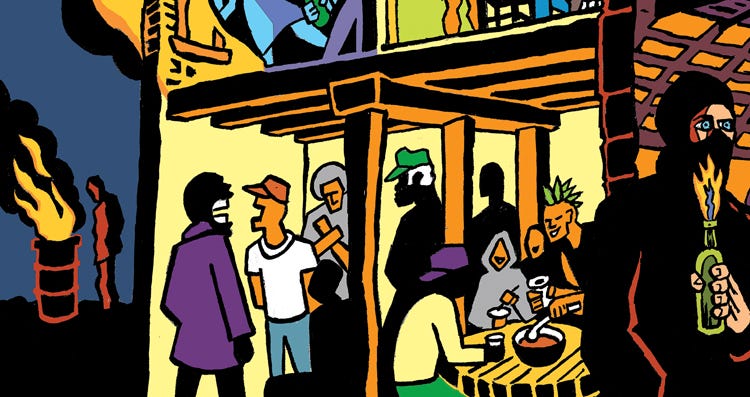
“If Amerikkkan society has an orifice,” Seth Tobocman writes in the opening chapter of his underground classic graphic autofiction, War in the Neighborhood, “a mouth through which it breathes, an asshole through which it shits, it is the Lower East Side of Manhattan. Which orifice depends on who you ask and what their political agenda is.”
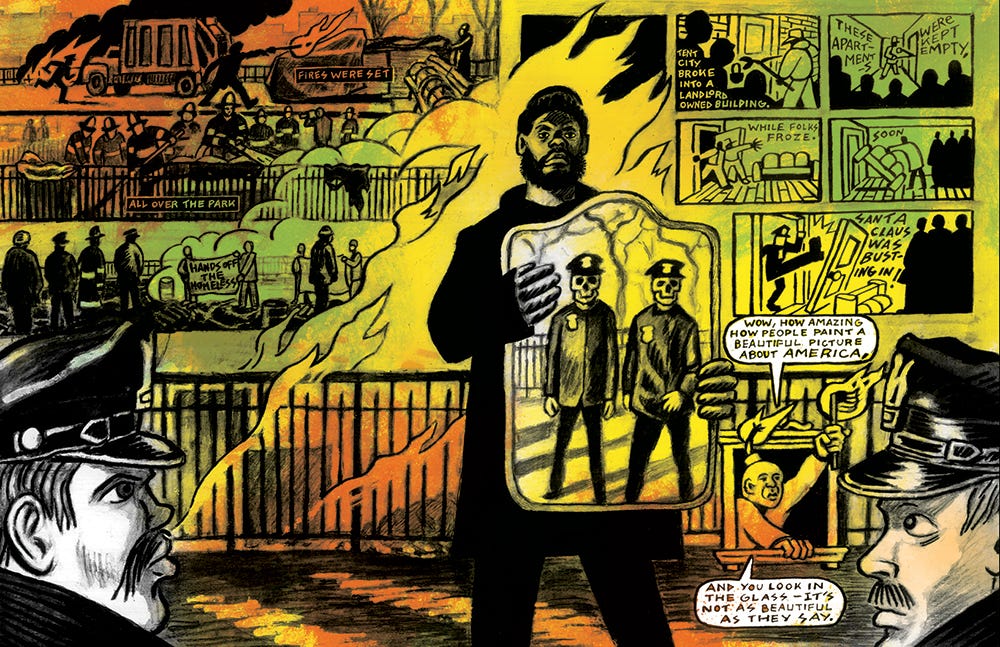
War in the Neighborhood is a document of and reaction to the Lower East Side in the 1980s and 1990s, a period of increasing class conflict and rapid gentrification that saw the end of an affordable Manhattan. The book’s linked stories take place mostly in the squats: formerly abandoned buildings taken over and rehabilitated by squatters for a variety of reasons ranging from activism to a simple, acute need for housing. A few stories are centered in and around Tompkins Square Park, which for generations served as the heart of radical political speech and action in New York. It was the site of the Tompkins Square Park Riot of August 1988 and the homeless encampment known as Tent City — both of which are documented in the book.
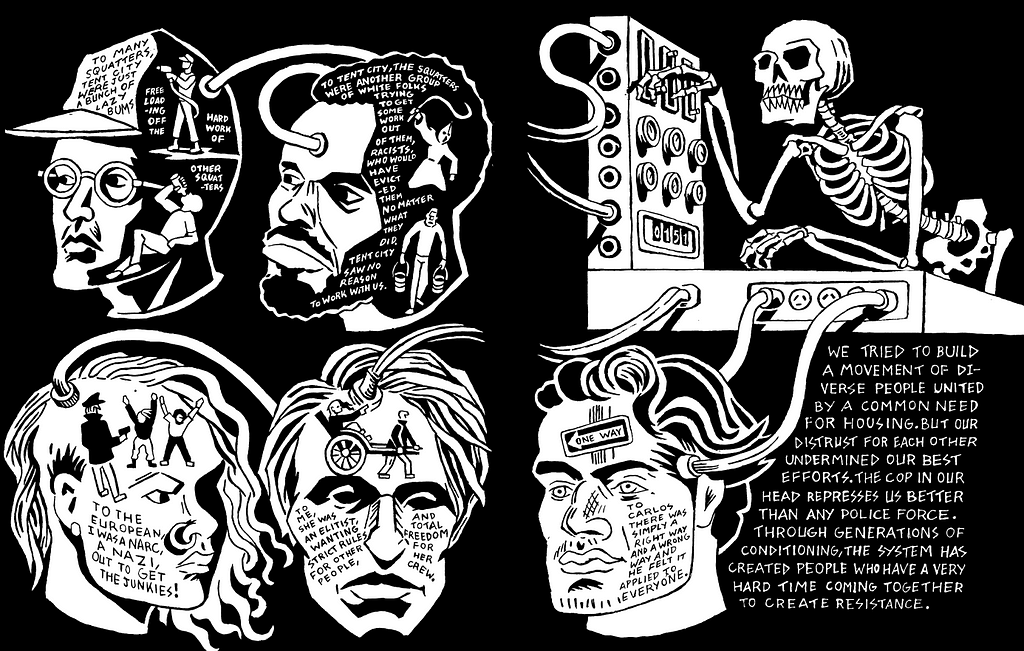
The stories come together to form a picture of a diverse community at a unique sociopolitical moment. The squatters and the homeless and the activists in these pages struggle against each other and themselves as much as they struggle against the police and the politicians and the real estate developers and the ever-encroaching tide of gentrification. There are no pure heroes to be found; there are no pure villains. Tobocman casts himself as a character — at once full participant and witness — but he is also the semi-detached narrator who presents the story with clear eyes and a fair, even hand. In Tobocman’s world, everyone is complex and flawed. Everyone makes mistakes. Everyone is capable of hurting others. Everyone is worthy of love and safety, and a place to call home.
War in the Neighborhood was first published in 1999 by Autonomedia, and went out of print in 2004. (The book still passed from hand to hand, its reputation growing as the price for the few remaining copies skyrocketed on Amazon.) At the time of its publication, it was a comment on the very recent past. 1995 and 1996 saw the last of the City’s massive, militaristic evictions of squats on the Lower East Side, and the years immediately following were a time of uneasy quiet, when squatters were trying to work toward an agreement with the City to turn their buildings into permanent low-income co-ops. That agreement was, indeed, struck, and the eleven remaining squats in the neighborhood began to convert to legal status in 2002, but even with that (somewhat controversial, perhaps pyrrhic) victory, it was clear that the economic and cultural climate that birthed the squats and allowed them to develop and, in some ways, thrive, had come to an end. And so when it was first released, the book served as both a mourning for what had been lost and a call to action for continued activism in a city where affordable housing was nearly extinct.
But War in the Neighborhood is not just about affordable housing. It is about individuals trying to live together in groups. It is about compassion and understanding and the absence of compassion and understanding. It is a reminder to all groups — particularly activist groups — that none of us are untainted by the white patriarchal power structure we’ve been raised in. In many of these stories, the squats are weakened by internal rifts caused by sexism and racism, leaving the groups fractured when it comes time to face the external forces of government and police. We see white squatters holding black people who would join the squats to different standards than they do white males. We see female squatters threatened and intimidated by male squatters. We see long-established squatters trying to drive out newcomers who are just looking for a roof over their heads.
Tobocman writes, “We come face to face with the cop, which is us. With the landlord, which is us. With the racist, which is us. With the sexist, which is us. With the fascist, which is us.”
We find ourselves now, in 2016, more in need of housing rights activism than ever. Not just in New York, but nationwide. At the same time, many of us are turning inward to recognize how even in liberal and radical spaces, racism and sexism are enormous obstacles. And so it seems particularly timely that into our current climate, once again at a unique moment of sociopolitical tension and possibility, publisher Ad Astra Comix is reissuing War in the Neighborhood. They’re running an Indiegogo campaign to support the publication, but it will be reissued regardless of the outcome of the fundraising. The new edition will feature the same compelling stories illustrated in Tobcman’s bold, angular, black-and-white style, with a new introduction by AK Thompson and, unlike the first edition, a binding that won’t fall apart in your hands. Highly recommended for the reader, the graphic-novel fan, the activist, the human being.
From Eric Ripert to Han Kang, stories of appetite and invention
There’s never been a better time to read or write about food. Americans have accepted that food is more than sustenance, it’s an experience. As we move away from a universal, pre-packaged meal landscape, food becomes a cultural, economic, and emotional barometer. If Holden Caulfield was operating today, he’d be on Reddit talking about how David Chang is a phony and avocado toast is bullshit. Gatsby’s vineyard in Napa would do invitation-only tours.
The downside to the proliferation of food writing is a glut of poorly written chef memoirs, blogs turned into wordy cookbooks, and listicles about bacon. Great food writing is more than a description of a dish. It runs a double narrative; people who are hungry for food tend to be hungry for something else, be it love, sex, or success. That’s why this list includes both novels and memoirs. The important element isn’t whether a dish is real or imagined, but if food propels the narrative towards a bigger revelation about oneself or culture. The people in these books endure hazings in hot kitchens for little money, they eat foods to rediscover places they’ve lost, they cook for people in an attempt to emotionally connect. They are, in short, exploring the complicated relationship that humans have with food, the endless quest to identify just what it is we’re hungry for.
1. Kitchens of the Great Midwest by J. Ryan Stradal
Stradal’s debut novel is the story of Eva Thorvald, a food prodigy with an impeccable palate and amazing culinary abilities; this girl is growing and selling her own hydroponic habaneros by age 10. But Kitchens of the Great Midwest is also an exploration — and occasional satire — of the modern American food scene in all its high-low paradoxes. Stradal points out that we’re living in a world that embraces cheap and convenient Subway sandwiches while also lusting after thousand dollar tasting menus and artisan ingredients. Perhaps it’s enough said that we all get the joke when Eva informs a woman at a party that her favorite “heirloom tomato” is actually a Monsanto hybrid.
2. Blood, Bones, and Butter: The Inadvertent Education of a Reluctant Chef by Gabrielle Hamilton
Gabrielle Hamilton is the chef and owner of Prune in the East Village but she also holds an MFA in creative writing from the University of Michigan. Her well-written memoir recounts her indirect path to owning her own restaurant, from family lamb roasts in rural Pennsylvania to working her way up through the tough kitchens of New York. This is the chef memoir to read if you’re interested in more than kitchen gossip; the details are sharp and the writing immersive.
3. Sweetbitter by Stephanie Danler
Danler’s debut novel follows Tess, a newcomer to New York City who, like so many others, finds work as a waitress. Tess is soon sucked into the crazy, exciting, exhausting world of restaurants, but it’s not just the restaurant industry that’s a whirl, but book the book itself, a fast paced story of ambition, culinary education, and romantic entanglements. As Danler told Electric Literature: “I wanted the experience of reading to be as close to the kind of dance of dinner service as possible.”
4. 32 Yolks by Eric Ripert
Eric Ripert has been at the helm of Le Bernadin since 1994 — a notably long time in the current age of celebrity chef empires. That doesn’t mean that Ripert’s memoir is dull, quite the contrary: Ripert had the (seemingly requisite) tumultuous childhood in which food was his passion and creative outlet. He left home for Paris at age 17 and worked for some of the best chefs in the world, including stints under David Bouley and the demanding yet genius Joël Robuchon (classic anecdote: in addition to his other kitchen duties, Ripert had to prepare an exacting dinner for Robuchon’s pet dog). In an age when many chefs would rather open restaurants than cook in them, it’s refreshing to read about someone who genuinely loves to be in the kitchen.
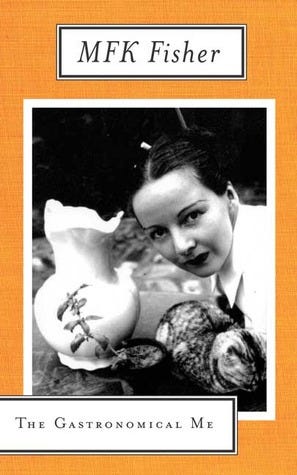
5. Gastronomical Me by MFK Fisher
Published in 1943, Gastronomical Me is a hybrid of memoir, travelogue, and dining play-by-play that fans of Ruth Reichl, Anthony Bourdain, or any other of today’s “food writers” will recognize. Fisher was born in California and moved to France in 1936, and this book describes a wonderful collection of her experiences, from an early peach and cream pie to her first French oyster. When it comes to food writers, Fisher is still one of the best.
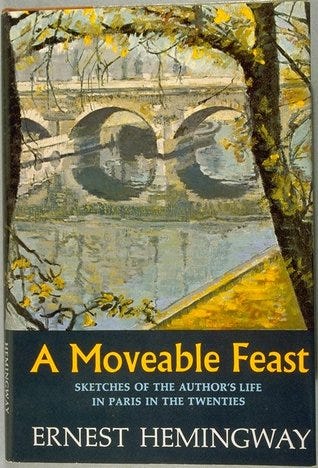
6. A Moveable Feast by Ernest Hemingway
Don’t dismiss this memoir of Hemingway’s early years in Paris as a quotable depiction of the zeitgeist of the 1920s. Hemingway writes with a hunger, both metaphoric and literal: the ambitious but still unsuccessful writer was occasionally too poor to grocery shop, hence the famous scene of him hunting for pigeons in the Jardin du Luxembourg. His descriptions of multi-course meals at Gertrude Stein’s house are transportative, and includes a contender for the best sentence ever written about eating oysters: “As I ate the oysters with their strong taste of the sea and their faint metallic taste that the cold white wine washed away, leaving only the sea taste and the succulent texture, and I drank their cold liquid from each shell and washed it down with the crisp taste of the wine, I lost the empty feeling and began to be happy and make plans.”
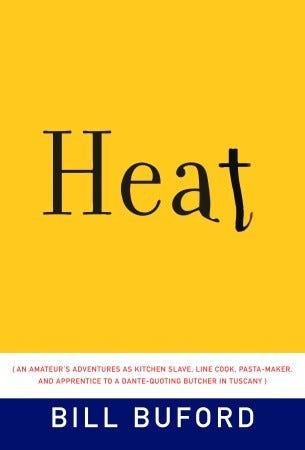
7. Heat by Bill Buford
The subtitle to Buford’s memoir sums it up nicely: An Amateur’s Adventures as Kitchen Slave, Line Cook, Pasta-Maker, and Apprentice to a Dante-Quoting Butcher in Tuscany. Buford was a writer for the New York Times when he was asked to profile New York City star chef Mario Batali. Instead of a mere profile, Buford went to work in the Babbo kitchens, learning first hand the intense realities of a restaurant kitchen (i.e. stifling heat, endless repetition of tasks, and a strict hierarchy that even reporters aren’t exempt from). It’s a fascinating behind the scenes look at professional cooking — one that will also stop you from thinking, yeah, I could do this, the next time you’re eating at a restaurant.
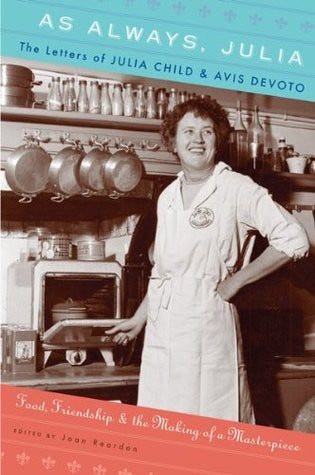
8. As Always, Julia: The Letters of Julia Child and Avis DeVoto edited by Joan Reardon and Avis DeVoto
Julia Child’s memoir, My Life in France, is a fantastic read, but I was really enthralled by this collection of letters written between Child and her friend and champion, Avis DeVoto. The two women had the kind of relationship that young pen pals can only dream of: after receiving a letter from Child in 1952 in regards to her husband’s recent magazine column on kitchen knives, the two began to correspond regularly. They wrote over one hundred letters in two years, most of them about food. As Always, Julia also chronicles the long road to success for Mastering the Art of French Cooking, which was difficult for Child to sell. DeVoto was instrumental in the book’s acquisition by Houghton Mifflin and later Knopf.
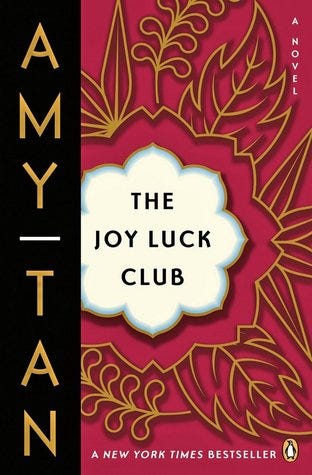
9. The Joy Luck Club by Amy Tan
The Joy Luck Club is a multigenerational novel about four women who fled China for San Francisco in the 1940s and their four American daughters. Food literally brings the older women together — they meet weekly for mah jong and dim sum — and throughout the book Tan mines the rich Chinese culture of food-related symbols and traditions. In China, a daughter cuts off a piece of flesh to put in her mother’s soup, then in America, the women show their love “not through hugs and kisses but with stern offerings of steamed dumplings, duck’s gizzards, and crab.”
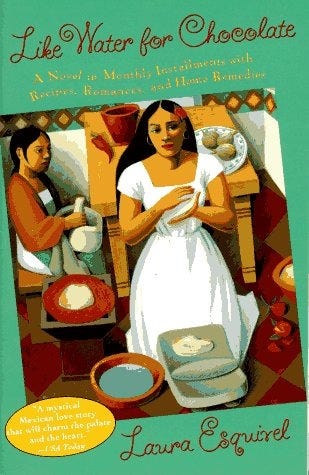
10. Like Water for Chocolate by Laura Esquivel
As the youngest daughter of the De La Garza family, Tita is bound to be her mother’s caretaker; she’s explicitly forbidden to marry until her mother dies. But Tita falls in love with Pedro, who is entranced by Tita’s cooking. Pedro, unable to marry her, marries her sister Rosaura, starting a tale of twenty-two years of unrequited love. Esquivel’s novel is structured around the twelve months of the year, and each month around a recipe.
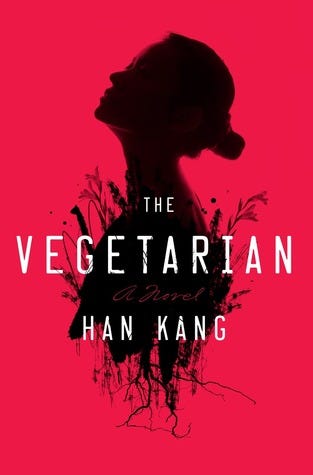
11. The Vegetarian by Han Kang
In this wonderfully unsettling novel by South Korean novelist Han Kang, Yeong-hye vows to become a vegetarian after she dreams that she is a plant. This seemingly benign life choice leads to a increasing level of discord within her family, who don’t understand and can’t accept her decision. (In one scene, Yeong-hye stabs herself rather than eat a piece of sweet and sour pork that her grandfather is trying to force down her throat.) Yeong-hye’s choice is about more than diet: the book grapples with philosophical questions about control, desire, and violence.
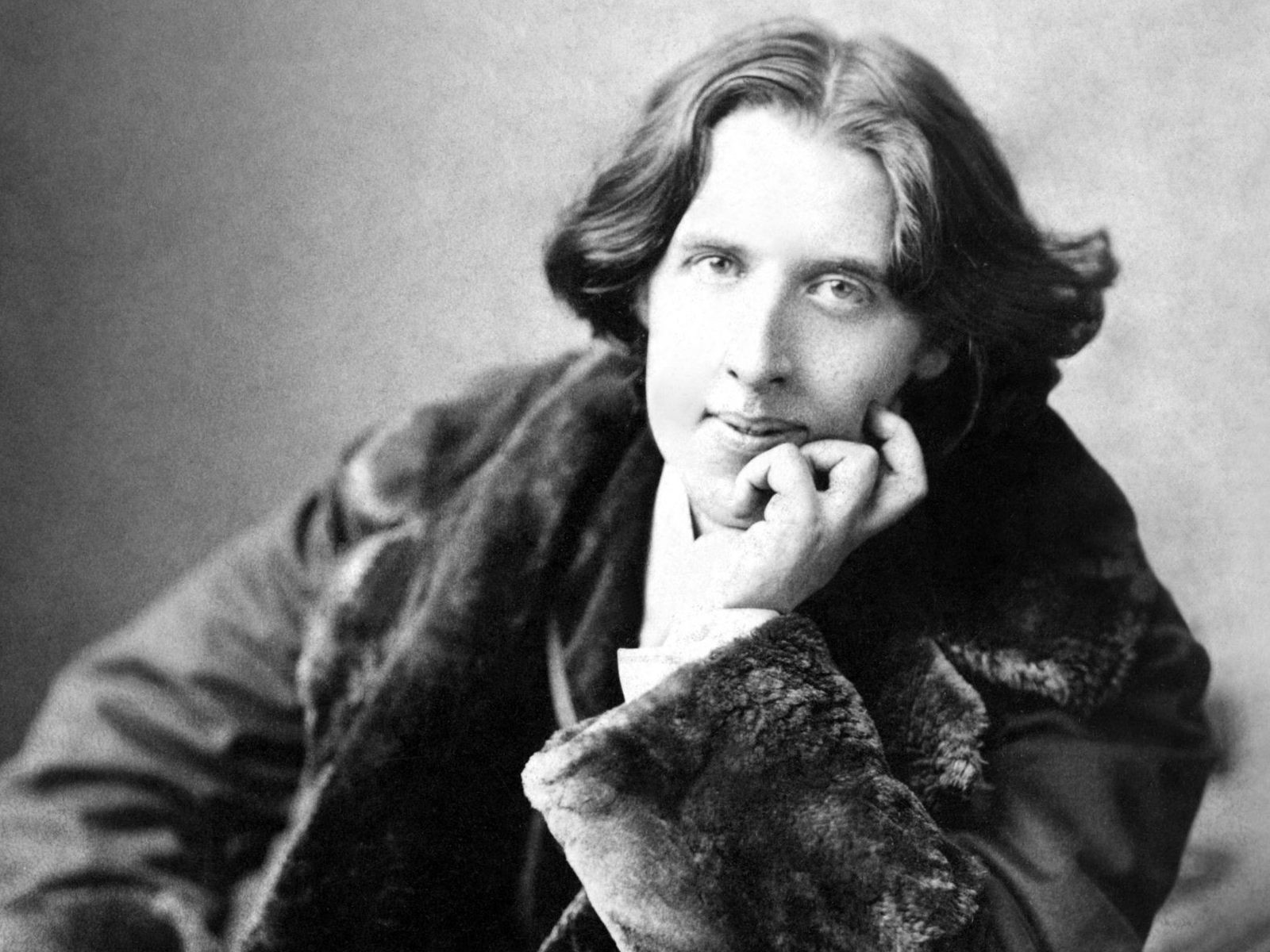
During his two-year sentence at Reading Prison (1895–1897) Oscar Wilde was held in his cell 23 hours per day, forbidden from interacting with other inmates at all times. Those intimate with his biography hold the time directly responsible for his untimely death three years later at the age of 46. Now, the prison, which shuttered as a functioning detention center in 2013, is hosting a temporary art exhibition in the writer’s honor.
Production duo Artangel are curating “Inside: Artists and Writers in Reading Prison” with the permission of the British Ministry of Justice. The New York Times reports, they’ve organized the exhibit a-linearly, encouraging visitors to traverse the grounds on their own accord, encountering visual work that range from direct representations of Wilde to more abstract meditations on captivity. Former Chinese political prisoner Ai Weiwei headlines the impressive list of artists that also includes Nan Goldin, Marlene Dumas, and Ragnar Kjartansson. Their work, operating in a variety of mediums, appears in the halls, narrow high ceilinged prison cells, and resonant open common spaces.
Wilde’s former dwelling, a 4×2 yard alcove, is left bare. In neighboring units, viewers will find stacked vintage copies of Wordsworth, Keats, and Hafiz, some of the only texts the writer had access to in his second year of captivity. He was banned from all forms of reading and writing during the first. A large wooden door that lead to Wilde’s cell is the only item contemporary to his time at Reading on display.
De Profundis will also be central to the exhibition. The 50,000 word letter to his lover and friend Lord Alfred Douglas that Wilde produced while imprisoned reflects on his life as an artist and self-identified provocateur. It will be read aloud by series of noted authors, including Patti Smith and Colm Toibin. The durational performances will take between five and six hours each.
For those who aren’t familiar with the history, Wilde’s imprisonment started with a lawsuit he launched himself, accusing The Marquees of Queensberry of libel. The nobleman had publically denounced Wilde as a “posing sodomite,” a legal offense at the time. In court, Wilde conceded his case after Queensberry marshalled an excess of damning evidence obtained through a network of private investigators and harsh cross examination. Shortly after, Wilde was the one on trial, where he was convicted on charges of “gross indecency.”
Wilde’s time in prison inspired him in the years after his release. The posthumously published epic poem The Ballad of Reading Gaol, depicts the hanging of Charles Thomas Wooldridge, which occurred on the prison grounds during his incarceration. He also composed two long letters to the Daily Chronicle describing, in detail, the conditions at Reading and the necessity for British prison reform.
DON’T MISS OUT
Sign up for our newsletter to get submission announcements and stay on top of our best work.
YOUR INBOX IS LIT
Enjoy strange, diverting work from The Commuter on Mondays, absorbing fiction from Recommended Reading on Wednesdays, and a roundup of our best work of the week on Fridays. Personalize your subscription preferences here.