There’s nothing that the book world likes to debate more than the differences between literary fiction and commercial or genre fiction. Is “literary fiction” truly different? Are genres just marketing categories? Is commercial fiction unfairly maligned?
Adding fuel to this debate is a new study that found that readers of literary fiction — but not commercial fiction — have a better understanding of other people’s emotions. The study, which was published in Psychology of Aesthetics, Creativity and the Arts, made 2,000 people do a “Reading the Mind in the Eyes Test” where they looked at photos of actors displaying different feelings and tried to pick the right emotion. The participants were also asked to say which authors they recognized from a list of names that included literary authors like Kazuo Ishiguro and Salman Rushdie as well as commercial authors like Tom Clancy and Stephen King. The result was clear:
Results indicate that exposure to literary but not genre fiction positively predicts performance on a test of theory of mind, even when accounting for demographic variables including age, gender, educational attainment, undergraduate major.
Why is this the case? The studies authors, David Kidd and Emanuele Castano, suggest it is literary fiction’s focus on character over plot:
We propose that these findings emerge because the implied (rather than explicit) socio-cognitive complexity, or roundness of characters, in literary fiction prompts readers to make, adjust, and consider multiple interpretations of characters’ mental states.
If this study sounds familar, it may be because a simlar study by the same researchers received a lot of attention (and criticism) in 2013. However, that study 0nly looked at people who had just been asked to read a passage of literary fiction or commercial fiction. This time, they were hoping to look at a lifetime of reading.
According to The Guardian, the researchers stressed that this didn’t mean literary fiction was the only fiction with value.
“This is not to say that reading popular genre fiction cannot be enjoyable or beneficial for other reasons — we suspect it is,” agreed Kidd. “Nor does the present evidence point towards a clear and consistent distinction between literary and popular genre fiction. Instead, it suggests that the broad distinction between relatively complex literary and relatively formulaic genre fiction can help us better understand how engaging with fiction affects how we think.”
So should literary fiction readers rub this study in their pop fiction reader friends faces? Well, hopefully their literary diet has given them increased empathy to know not to do that.
Michelle Pretorius is no stranger to the complexities of history as it shadows the present. She was born in Bloemfontein, in the Free State Province of South Africa. She moved around the country with her family as she grew up, but she returned to Bloemfontein, a conservative stronghold, as a teenager. Apartheid and Christian-nationalist ideology were particularly pervasive factors throughout her life. It wasn’t until she left South Africa that she was able to see objectively how damaging this environment was, as she says, “not just for the society, but for individual growth and compassion as well.”
Now a PhD student at Ohio University, her experience inspired the writing of her debut novel The Monster’s Daughter, published in July by Melville House. The book spans over one hundred years, tracking characters from the time of the Boer War, through the rise and fall of apartheid, and focusing on a contemporary murder case that weaves the past and present together. It is at once a page-turning crime thriller, a richly written character study, and a cross-genre work of speculative fiction. Pretorius achieves a difficult feat, writing characters with compassion while deftly juggling suspense and multiple points of view to deliver a book that will appeal to a wide range of audiences. I recently spoke to her about the book and its origins.
Todd Summar: As a debut novelist, why was it important to you to tell this particular story as your first major project?
Michelle Pretorius: A teacher I admire very much once said that first novels are often thinly veiled autobiography. I think that The Monster’s Daughter was my way of coming to terms with my past and my role as a white person growing up in South Africa during some of the darkest days in the country’s history. We were under severe censorship when I was a child. The government controlled the media, books, anything that could possibly spread a subversive message. I think they even tried to ban The Beatles at some point. It is part of the reason South Africa only got television in 1976. Conservatives feared that the outside world would spread its immoral ideas and lead black people to revolt because they would get ideas about their station in life. In schools we weren’t taught the real history of South Africa, but rather a whitewashed history in which our Afrikaner ancestors were mythologized, their status in folklore akin to gods. In church we were told that God himself had given this part of Africa to the Afrikaner, that it was his right to be there. It sounds like a huge cop-out now, but it was only once I left South Africa that I realized that perhaps these things I was raised to believe, might not be the truth. I started reading and researching the true history of South Africa, the reason things happened the way they did. I don’t believe in one group being inherently bad and another inherently good. There was a reason the Afrikaners went from an oppressed minority, to the oppressors. I wanted to understand what happened, to trace the arc of events, and while doing so I also wanted to find some kind of truth. The novel grew out of that desire.
Summar: In Western literature, there seems to be a lack of representation of the immense political and cultural struggle in South Africa’s history, and the after effects of apartheid. People in the United States tend to ignore what happens in other countries. As someone now writing and publishing in the United States, did this notion drive your urge to tell this story?
Pretorius: When I first started working on the project, I was surprised to learn that nobody in the US knew about the South African concentration camps during the Boer War. I don’t fault Americans for not knowing South Africa’s history. After all, I actually knew very little of it when I first came here as well. The concentration camps were an obvious place for me to start the novel since, I believe, that is where apartheid had its roots. Yes, the country was colonized before that, and even the colonizing Dutch in 1652 had slaves and oppressed the non-white peoples of the land, but I’m talking about the institutionalized oppression that took hold in the country in the 21st century and the apartheid government’s rise to power. History is obviously important in the book. I also believe that aspects of South Africa’s history of race relations and oppression can be found in many societies, which makes it relevant beyond just a history lesson about what happened in one particular country. It is my hope that it might start a dialogue about what is happening in the US and other countries as well.
Summar: In some ways, the book serves as a dramatic snapshot of the history of apartheid, woven together with the very personal stories of its complex characters. How did you balance the massive amounts of research with such a nimble, elegantly-crafted narrative?
Pretorius: I’ll be honest, I failed miserably at first. When I started writing the novel, I made the rookie mistake of trying to tell readers every fact about the Boer War, in great detail. I forgot about story and characters, and didn’t trust my reader to figure things out for themselves. It took me a while to realize that nobody picking up a novel would be interested in reading a history book of facts. A personal connection with characters is the way in which you make the history real for the reader. Once you have strong, grounded characters you can place them in any situation, and you’ll know how they will react. I am what some call a “pantser.” I don’t plan my story ahead of time. I like to take the journey along with my characters, and see what happens — by the seat of my pants as it were! I took time to figure out who my characters were, and placed them in the turmoil of real historical events. I had quite a few sleepless nights, fretting about how things would come together. I did a lot of reworking and re-visioning throughout the writing process, and I learned to be ruthless when it came to cutting prose that wasn’t working. I was also very fortunate to have a group of intelligent and supportive writers who weren’t afraid to let me know if something in my draft wasn’t working.
I like to take the journey along with my characters, and see what happens — by the seat of my pants as it were!
Summar: The novel’s structure — interspersing the events of a murder case in 2010 with a timeline that spans the previous 100+ years — is a boldly original approach that heightens the tension and underscores the fraught history of South Africa. Was this tactic always apparent to you or did it take some experimenting to arrive at that point?
Pretorius: The past is very much a factor in our present lives, whether we know and understand our history or not. I wanted to illustrate that reach of the past into the present. Even though I intended to write a historical novel at first, I realized fairly early on that a present-day murder mystery would drive the novel, and that the historical fiction would inform the murder mystery. They are symbiotic in the book. It didn’t make sense to write the story chronologically, and so, even though it takes a while for the connections between the two narratives to form, I hoped that the individual strands would be interesting enough in themselves to keep a reader engaged until the connections between them became apparent.
Summar: Your decision to straddle genres, incorporating elements of crime thrillers, speculative, and historical fiction, will likely surprise and excite readers. What inspired you to verge away from a straightforward approach into this unexpected territory?
Pretorius: The story demanded it, in a way. As I mentioned, the crime thriller part made the historical fiction more relevant. We only experience history in segments, which is part of the reason the same mistakes get repeated. I wanted there to be characters that bore witness to these cycles of history, that saw the larger picture. That’s difficult in a human lifespan. And so I turned to science fiction for help to create these characters that not only lived a long time, but were actually the superior race that the Afrikaners claimed to be.
Summar: What is the significance of starting the book’s timeline with the events of the Second Boer War?
Pretorius: I was interested in exploring the arc of the rise and fall of apartheid. The Second Boer War was, to my mind, the point during which the Afrikaners were most oppressed and humiliated. As a people, they had suffered immensely during and after the war. It was this suffering and oppression that led to the exigency and emergence of the Broederbond, and the rise of Christian Nationalism, which in turn paved the way for apartheid. It was also a repetition of history i.e. the oppression of black people and suppressing their language (like the British attempted to suppress the use of Afrikaans after the war) that led to the ultimate downfall of apartheid.
Summar: The major threads of the story follow the parallel arcs of two women — Constable Alet Berg and Tessa Morgan, a young woman with supernatural characteristics born from sinister genetic experiments during the Boer War — though the cast of characters surrounding them play integral roles. When and how did it become evident that you would follow and mesh these two characters’ stories together?
Pretorius: Many writers will tell you that the first hundred pages of a novel are the hardest. That’s when you grapple with who your characters are, and try to figure out the what and the why of your story. Tessa and Alet formed independently. I took a few drafts of that first hundred pages for me to start thinking about the relationship between the victim of a crime, and the person seeking justice for that victim. They are both women, so I think Alet, who is a police officer, has an inherent understanding of the violence enacted on women. I wanted the connection to be deeper than that, though. The book is a journey of discovery for Alet, along with the reader, and Tessa is the key to that discovery.
Summar: The book is steeped in South African politics, culture, and folklore, such as legends like the Thokoloshe, as well as the conflict between black and white South Africa, the specter of apartheid, the death squads, the Broederbond, and more. As a native of South Africa, how did you ensure the authenticity and accuracy of each touchstone, while also avoiding turning the novel into a laundry list or encyclopedia?
Pretorius: Having grown up in South Africa gave me an edge when it came to interpreting the research, as far as cultural cues and practices were concerned. But if writing a short story is a 5k, then writing a novel is an iron man, for me anyway. You have to let go of the idea that your writing is precious and that you are the ultimate authority, and write with the realization that a lot of what you are writing will not work. At the point you think that you’ve nailed it, you have to be open to sharing what you have with people you trust, so that they can tell you if what you’ve done is really working as well as you think it is. You have to let go of ego and listen honestly, reject the things that don’t fit your vision, and incorporate the comments that you know in your gut makes sense. It takes time to develop that skill. I was lucky in that I had a fantastic support system while writing The Monster’s Daughter. But even through multiple revisions, and edits by my agent, a lot of what I wrote still ended up in the trash during the final editing process because it simply wasn’t contributing to the story. I think that young writers mistakenly think that writing is autonomous. My experience is that it ultimately is a very collaborative effort.
Summar: Besides the history, the geography and physical settings are vivid. You grew up in South Africa, but how did you capture the details of all of these locations so accurately? Are these places you visited while growing up, places you returned to for research, etc.?
Pretorius: Some settings in the novel, like Bloemfontein and Johannesburg, are places that I had lived in growing up. I spent some brief periods of time in Cape Town as well. The major part of the novel, however, is set in Unie, a fictitious town in the Western Cape Province. Friends of mine who had emigrated to the United Kingdom decided to move back to South Africa to live on a farm in that area. I visited them on one of my trips back to South Africa. It was the first time I had ever been in that part of the country. I spent less than three days on the farm, but immediately knew that this was where the novel had to take place. It was beautiful, isolated, and I thought about how a city person (such as myself) would negotiate a shift to life on a farm or in the nearest town, on which Unie was based. I think that this strong sense of place seeded Alet’s character and interactions, and the inciting incident of the novel.
Summar: Throughout the story, it is clear that certain characters, such as Alet, Tessa, and Tessa’s brother Flippie, represent the forces of change and progress, while others, the more villainous antagonists, represent oppression and apartheid. Despite this, each character is illustrated with complexity, with human flaws and weaknesses. How did you balance these characters and avoid presenting them as flat symbols of the messages of the book?
Pretorius: I don’t believe in people being just one thing. Too often we try to make people fit into the one-dimensional view we have of them, or a part we need them to play in the drama of our lives. It’s part of the us/them binary that riddles politics today. It’s easy. It’s dehumanizing. And it doesn’t tell a full story. I grew up in a society that created convenient, shallow narratives to suppress not just non-whites, but women as well. Civil rights movements and feminism have a lot in common in that respect. So I’m not interested in telling a story of binaries. Every so-called “bad” person, has a complex reason for their actions, and every “good” person has dark aspects to their personality that they don’t necessarily show the world. It’s what makes us all human. Alet is a protagonist, but she has many flaws, some of them very unattractive. She does not fit into the box marked hero. On the other hand we have Benjamin, the traditional villain, yet I feel he is one of the most sympathetic characters in the novel, even though others have disagreed with me.
I grew up in a society that created convenient, shallow narratives to suppress not just non-whites, but women as well…So I’m not interested in telling a story of binaries.
TS: Like the characters, you avoid presenting either cause — for instance, that of the Afrikaners and of the ANC, and even askaris, native characters who assisted the Afrikaners — as either all good or all bad. How did you balance these portrayals?
Pretorius: As with people, I think that we need to look deeper at causes to really understand events. We live in a very complex world and it is easy to label X as good and Y as bad to help us negotiate our lives. Unfortunately, nothing is that simple. There are reasons the Afrikaners became the bad guys. The ANC, on the other hand, also did things in the name of the struggle which disqualified it as being inherently good. It was important to me to try to present as much of a truth as I could, which meant that I had to show the good and the bad of both sides. Research helped a lot with this. It was hard to dissuade myself of the human instinct to pick sides, but I tried to make the history speak for itself, even though it was through fictional means.
Summar: Are there are other novels, or even nonfiction works, that may have inspired you in the writing of The Monster’s Daughter? Do you feel like you are engaging in, or continuing, a literary conversation, or are you, perhaps, starting a new one?
Pretorius: As far as influences are concerned, it’s hard to say. I read everything. I love murder mysteries by authors such as Dennis Lehane and Tana French, but I also enjoy science fiction, especially what is termed “mundane” sci-fi. I like the type of speculative fiction that, if we perhaps knew a bit more, or made scientific advances, could very possibly become a reality. I would love to claim that what I’m doing is unique, but there have been many novels that have blurred the borders of genre. I’m thinking specifically here of Smilla’s Sense of Snow by Peter Hoeg which is a fantastic literary novel that incorporates murder mystery, historical events, a strong female protagonist, and a little bit of science fiction to examine the postcolonial tensions between Denmark and Greenland. Sound familiar? The Monster’s Daughter had already been slated for release by the time I read Hoeg’s novel, so I can’t claim it had an influence on what I was writing, but my point is that authors have been pushing the boundaries of genre expectations for a while now. Through technologies such as the internet and smart phones, borders in all aspects of life are getting malleable, less defined. It is a trend that is becoming more prevalent in literature as well and it is liberating as a writer to not have to think about constraints, but rather to use the best aspects of genre to approach story in a different way.
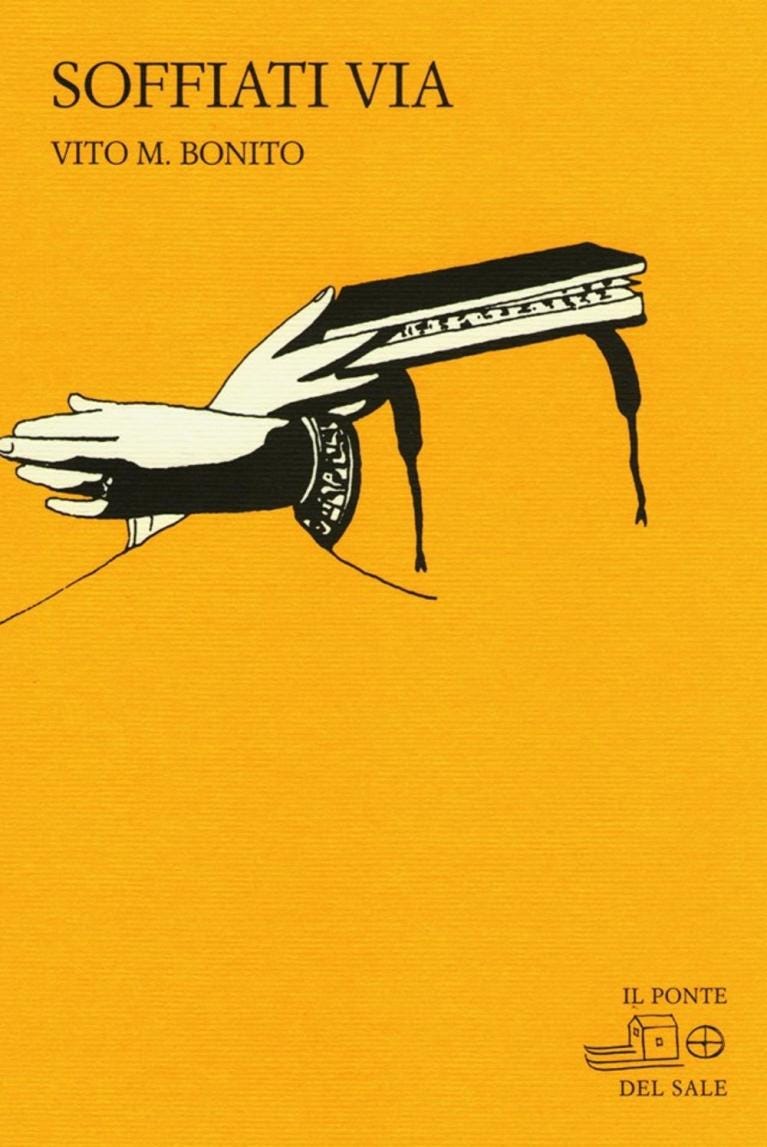
Standing outside of bars smoking hand rolled cigarettes with Vito Bonito, who I call my poet for shorthand. By the time I have finished writing this I will have become someone new. Our first meeting is at a poetry reading or lecture organized by Paolo Valesio, the esteemed poet and professor at Columbia University. The reading is in a museum of pre-pianos, keyboard instruments I don’t have all the names for.
The event is terrible. I show up and there is a woman I’ve met before with my friend Todd, when he had a residency in Rome and came up to Bologna to give a reading. She thinks we’re friends, she’s just moved back to Italy after forty years in New York, she makes racists remarks one after another. We sit and wait and I wait to lay my eyes on Vito Bonito. He lives up to all expectations. He’s around fifty, wears bulky silver rings and dark clothes. He smokes nervously out the window waiting for this discussion to finally begin. The reading is more of a lecture than a reading and some friend of his, or some acquaintance, never stops explaining the poems. When Vito does finally speak he reads his poems with clarity and deliberateness. I go up to Vito after the reading and introduce myself. The woman who thinks we are friends, also a translator, makes a joke, saying I stole a great poet from her to translate. She is the only one who laughs.
The woman who thinks we are friends, also a translator, makes a joke, saying I stole a great poet from her to translate. She is the only one who laughs.
Outside, the smoking begins. In the rain, Vito begins to roll cigarettes. He teaches Latin at the city’s most prestigious high school, where Pier Paolo Pasolini studied, and some of Vito’s students gather around him, asking him questions. It becomes clear they seem him as a cult figure. We move to a bar to have some wine. It is a strange group of people, all of us together, I don’t know who most of them are. It doesn’t appear that Vito knows them either. In the crowd I meet a woman who looks so familiar to me I actually ask her if I know her. She seems offended. She is Vito’s girlfriend; she thinks I am one of his students. I clarify, explain how I want to translate his poems, explain how I’ve been in Bologna for six years, how I live here with my partner, my female partner. She seems reassured.
It begins like this and moves rapidly forward. I meet Marilena, the girlfriend, for coffee on Monday mornings when I’m not teaching. She is a remarkable poet and short-story writer; we talk about translating Anne Carson’s Short Talks together into Italian. I meet Vito Wednesday afternoons when he isn’t teaching. It becomes a whole world. Both of them begin to recommend new books of contemporary Italian poetry to me — this is my second MFA. Reinforcing my idea, the idea that many have had before me, that translating is the best school for learning how to write.
Reinforcing my idea, the idea that many have had before me, that translating is the best school for learning how to write.
Translating changes how you write. I’ve always believed this. But now, after translating an entire collection of poems, I feel even stronger about this notion. Translating and working with a living author also changes how you read. The artist Moyra Davey writes in her book, The Problem of Reading:
“What to read? is a recurring dilemma in my life. The question always conjures up an image: a woman at home, half-dressed, moving restlessly from room to room, picking up a book, reading a page or two and no sooner feeling her mind drift, telling herself, “You should be reading something else, you should be doing something else.”
I jump off from different points when I am pretending to be Bonito, Bonito II. My reading takes me to different place. I have a new teacher in each of Bonito’s influences. Only some of them are literary. I soon begin to see that many of them are cinematic, sound and image. Being who I am, I gravitate towards the sounds.
That weekend, after talking with Vito endlessly about the great 19th century Italian poet Giovanni Pascoli, I see Pascoli everywhere. There is one poem in particular that I see as really deeply connected to Soffiati via: “I due fanciulli” and I decide to translate it myself:
In bed, the darkness the sheaf, flooded
with the most dense shadow: illusinve shadow, the seems
at every corner to raise its finger along the hem.
Away away made the biggest sobs and the rarest
weeps, for what blackness I know not
that one feels as it passes in this silence.
After a short while, tacit, little by little,
came the mother, and she explored with the soft light
revealed just so with her rosy hand.
She watched suspended; better than usual
she saw them sleep, tightly embracing
with their white arms, without feathers;
and she moved away, with a smile, from the bed.
Pascoli’s poems also include a word Bonito uses quite often, iddio. This was a new aspect of translation for me — creating entirely new words to represent an idea that doesn’t exist in English. Iddio is an antique form for God. It is both sacred and profane. We decided on mygod. It seems like a piece of the ubiquitious “Ohmygod” and also, visually, looks almost Norse, antique, premodern English.
This was a new aspect of translation for me — creating entirely new words to represent an idea that doesn’t exist in English.
Moyra Davey in The Problem of Reading goes on to say :
Jean-Paul Sartre and many other writers have said reading is writing, by which I understand that as readers we are always piecing together meaning and, in a sense, writing our own texts by weaving the threads and associations of previous readings and experiences. But by this I don’t mean to suggest that reading and writing are one and the same — writing is infinitely harder. The central question I mean to pose is, what if the most gratifying reading is also the one that also entails the risks of producing a text of one’s own?
I would venture to go beyond agreement and say that translation is exactly this activity. I read Bonito’s poems so many times, transcribe each of them by hand first in the Italian and then into English, repeat this on the computer, and revise three, four even five times. These readings turn into writing.
Translating disrupts many of the theoretical conventions I hold about literature and writing, about process itself. One of these conventions has to do with biographical information about the writer. I really feel strongly about Barthes’s notion of the dead author. I don’t believe in biographically based criticism, yet I find myself searching down every route Vito gives me in hopes of better understanding his book.
I don’t believe in biographically based criticism, yet I find myself searching down every route Vito gives me in hopes of better understanding his book.
For a long time I’ve been worried about the anxiety of influence when writing my own work while translating. As if there is really a division between these two activities anyhow. Not so much in my writing as much in my life. If, like Paul Ricoeur argues, we are beings made of mediated experience,writing “there is no self-understanding that is not mediated by signs, symbols, and texts; in the final analysis self-understanding coincides with the interpretation given to these mediating terms” (“On Interpretation”, in From Text to Action) the the level of influence we carry around with us is great, in fact, it is everything.
Arnold Schoenberg wrote: “When the form’s in place, everything within it can be pure feeling.” If this is true, and I think it is, translation should be less preoccupied with quote, “accuracy” and much more interested in feeling, tone, sound, image. Translation gives us form, the shell of language, all of my own voices, now mixing with the other author’s give it something new — make content. This is what I am searching for in my readings of Bonito’s influences, I am looking for the feeling.
Translation gives us form, the shell of language, all of my own voices, now mixing with the other author’s give it something new.
Working with a living poet, a poet who lives in my own city, is a strange experience because he can lead me directly to his points of influence and inspiration. I’ve decided it is a good thing, or it least has some positive value for the process. As a writer I firmly believe that the text should speak for itself, that whatever a reader needs from a text can be found their on the page. Cultural context can be essential. But the intentions of the author? No. But the feeling — somehow, I continue to reach for a primordial language I know does not exist, not even in the original text, through Vito’s resources.
This is a point of conflict because I want both things to be true. I think I can better translate these poems if I can understand them better; one way to understand these poems better is to get closer to their points of reference. What I worry about is if in some way, in my subconscious, I am seeking to uncover a “real” meaning or significance, when rationally, philosophically, I believe the real meaning of the poems is only to be found within the poems.
One of the most beautiful things about translation for me continues to be the possibility of spending time in someone else’s creative conscious.
But despite all of this, one of the most beautiful things about translation for me continues to be the possibility of spending time in someone else’s creative conscious. There are times when I get really sick of myself, or bored with the ideas and questions that keep churning in my brain; translation lets me escape these curiosities for a while and move on to someone else. But then, sometimes, another person’s creative conscious is deeply different from our own. In this case, Bonito asks a lot of questions and presents a lot of images around childhood that I haven’t thought deeply about.
Translating sets off a different chain of thought than one’s own writing does and thus a different chain of signifieds. What I think is going to be my plan for reading this semester is over taken with Vito’s suggestions and these lead to new undiscovered pathways, pathways that I would have previously been resistant to. Moyra Davey quotes Georges Perec in her book on reading: “‘putting off until tomorrow what you won’t do today, you finally re-devour [it] lying face down on your bed.’ He further speculates that in our pursuit of knowledge, ‘order and disorder are in fact the same word, denoting pure chance.’ ” Suddenly, it all relates to Bonito. Or Bonito ties it together — I’m not sure which.
What I think is going to be my plan for reading this semester is over taken with Vito’s suggestions.
As if in a premonition I was forced by my best friend’s girlfriend to watch Kids for the for the first time in ten years before starting the translation of these poems. Sitting on her couch in Bushwick, fuzzy from the night before, Korine’s violent vocabulary came back to me as something relevant and new.
I’d seen some of Harmony Korine’s films before but I hadn’t seen Gummo. It’s the sound of the voices. In the film an entire town is torn from the earth from a tornado. It is with this same swift motion that Bonito writes of these children swept from the earth. There is also the dadaist imagery of hands and feet sticking out from the tornado — the children in the poems also have dismembered bodies, missing hands and feet, they see themselves from above.
Giovanni Pascoli also writes about dead children, or about the dead children inside of us in some cases. By chance, like Davey’s points out, I found his book Il fanciullo in a bookshop one weekend. It is a book that talks about the child within each of us, about the child’s voice that never stops crying out. I set out to translate some of that book as well:
Inside each of us is a child, not only does he shiver […], but weeps still and has his own joys. When we are still young, he confuses his voice with ours, and the two children tumble and fight against each other, and always together, they fear, hope, enjoy and cry, they feel the beat of one heart, one shout and a singular yelp. But we grow and he remains small; we set our eyes on new desires and he holds his eyes fixed on his ancient serene wonder, our voices become big and rough, but his remains the soft ring of a tiny bell. […] But after even thirty centuries men are not born thirty year olds, and even after they’ve lived thirty years in some way they remain children.
The theme of the child’s permanent place in society, or the child within us that is never liberated is further explored in Avital Ronell’s essay “On the Unrelenting Creepiness of Childhood”:
The figure of the child, which in the end inserts an imaginary lesion in philosophy — a condition that calls out for endless symbolic repair — may be borne by the anguish of the différend. That is to say it enters, or is entered, into the places where speech falters and language chocks in the throat of a political body, where the question of fair representation is peremptorily dismissed or simply not addressed.
Childhood can last a whole lifetime if you find yourself throttled and unable to root out some representation of what is affecting you; this can happen every day. “I am speaking of this condition of being affected and not having the means — language, representation — to name, identify, reproduce, and recognize what is affecting us.” If I am not mistaken, Lyotard uses childhood to resist the modern Western ideal of emancipation; he manages to deflate the reverie that has you thinking you’ll get out from under the grip of the mancipium.
This idea of childhood, this lack of freedom, is what makes Bonito’s poems about childhood and death so disturbing, something of each of us has remained in that state. This state of disenfranchisement is common to children but also to all people lacking a common language. In the film In the Land of Silence and Darkness Werner Herzog explores a deaf and blink community in Germany. Often ignored by society and their families, these communities create a language of touch, using hands (a major trope within Bonito’s work) in order to communicate.
Then on a meta-level, I am the child, translating, listening to the voice of my poet-genitor, Ronell again:
Freedom is signaled, one could say, within the Heideggerian conjunction of Hören and Gehorsam, of hearing and adhering. Listening is an extreme form of obedience, of opening and giving oneself over to the voice of the other.
As I read this I think of another statement Ricoeur made, this time in his book On Translation, writing “The creative tension between the universal and the plural ensures that the task of translation is an endless one, a work of tireless memory and mourning, of appropriation and disappropriation, of taking up and letting go, of expressing oneself and welcoming others.” It is this invitation towards the voice of the other that makes translation a dialogue as well as a practice for all forms of writing. There is listening always and freedom in the choices of adherence.
Again, I find myself searching for the sounds, for the voice of my poet. I’m far from the first to attempt this metaphysical swap. In recent times the author David Rattray has explained this well, in “Transcript of a Talk on Translating Artaud,” he writes:
I worked very hard and put myself into it in a way that I think absolutely indispensable for somebody translating a writer like Artaud. You have to identify with the man or the woman. You have to identify with their work. If you don’t, you shouldn’t be translating it. Why would you translate something that you didn’t think had an important message for others?
More and more I believe translating is similar to acting. Acting is seeing the text meet the body of the actor and take new life.
More and more I believe translating is similar to acting. Acting is seeing the text meet the body of the actor and take new life. The same goes for the translator, the text meets a new body, a new system of signifiers and signifieds. For some, this means becoming the original author. Rattray implies some of this, but perhaps Borges’s fictional Pierre Menard represents (as George Steiner has pointed out) the heart of every passionate translator. When Borges writes:
Those who have insinuated that Menard devoted his life to writing a contemporary Quixote besmirch his illustrious memory. Pierre Menard did not want to compose another Quixote, which surely is easy enough — he wanted to compose the Quixote. Nor, surely, need one be obliged to note that his goal was never a mechanical transcription of the original; he had no intention of copying it. His admirable ambition was to produce a number of pages which coincided — word for word and line for line — with those of Miguel de Cervantes.
Menard explains himself in a fictional letter within the story:
I have assumed the mysterious obligation to reconscruct, word for word, the novel that for him was spontaneous. This game of solitaire I play is governed by two polar rules: the first allows me to try out formal or psychological variants; the second forces me to sacrifice them to the “original” text and to come, by irrefutable arguments, to those eradications…In addition to these first two artificial constraints there is another, inherent to the project. Composing the Quixote in the early seventeenth century was a reasonable, necessary, perhaps even inevitable undertaking; in the early twentieth, it is virtually impossible. Not for nothing have three hundred years elapsed, freighted with the most complex events. Among those events, to mention but one, is the Quixote itself.
Like Riceour suggests, Menard in taking up the life of Cervantes, adheres to new rules and loses something of himself in the process.
Being, somehow, Cervantes, and arriving thereby at the Quixote — that looked to Menard less challenging (and therefore less interesting) than continuing to be Pierre Menard and coming to the Quixote through the experiences of Pierre Menard. … “If I could just be immortal, I could do it.”
If I could just be immortal, I could make this translation “perfect!”
If I could just be immortal, I could make this translation “perfect!” But that isn’t possible. More and more I see convergences between myself and Vito, our points of references, our poetic voices. I realize I’ve always had these pieces in me, from the music of Daniel Johnston and Sleep to the images of the publisher kiddiepunk and its gothic aesthetic of childhood. It may be that I’ve always been drawn to the creepiness of childhood, always interested in the voice I can almost nearly access, trapped within me. It is Bonito’s poems that are giving this aesthetic new freedom. The rhythms and sounds and language of his imagination and given new life to my solitary brain.
BEST NOVEL: The Fifth Season by N.K. Jemisin (Orbit)
BEST NOVELLA: Binti by Nnedi Okorafor (Tor.com)
BEST NOVELETTE: “Folding Beijing” by Hao Jingfang, trans. Ken Liu (Uncanny Magazine, Jan-Feb 2015)
BEST SHORT STORY: “Cat Pictures Please” by Naomi Kritzer (Clarkesworld, January 2015)
BEST RELATED WORK: No Award
BEST GRAPHIC STORY: The Sandman: Overture written by Neil Gaiman, art by J.H. Williams III (Vertigo)
BEST DRAMATIC PRESENTATION, LONG FORM: The Martian screenplay by Drew Goddard, directed by Ridley Scott (Scott Free Productions; Kinberg Genre; TSG Entertainment; 20th Century Fox)
BEST DRAMATIC PRESENTATION, SHORT FORM: Jessica Jones: “AKA Smile” written by Scott Reynolds, Melissa Rosenberg, and Jamie King, directed by Michael Rymer (Marvel Television; ABC Studios; Tall Girls Productions;Netflix)
BEST EDITOR, SHORT FORM: Ellen Datlow
BEST EDITOR, LONG FORM: Sheila E. Gilbert
BEST PROFESSIONAL ARTIST: Abigail Larson
BEST SEMIPROZINE: Uncanny Magazine edited by Lynne M. Thomas & Michael Damian Thomas, Michi Trota, and Erika Ensign & Steven Schapansky
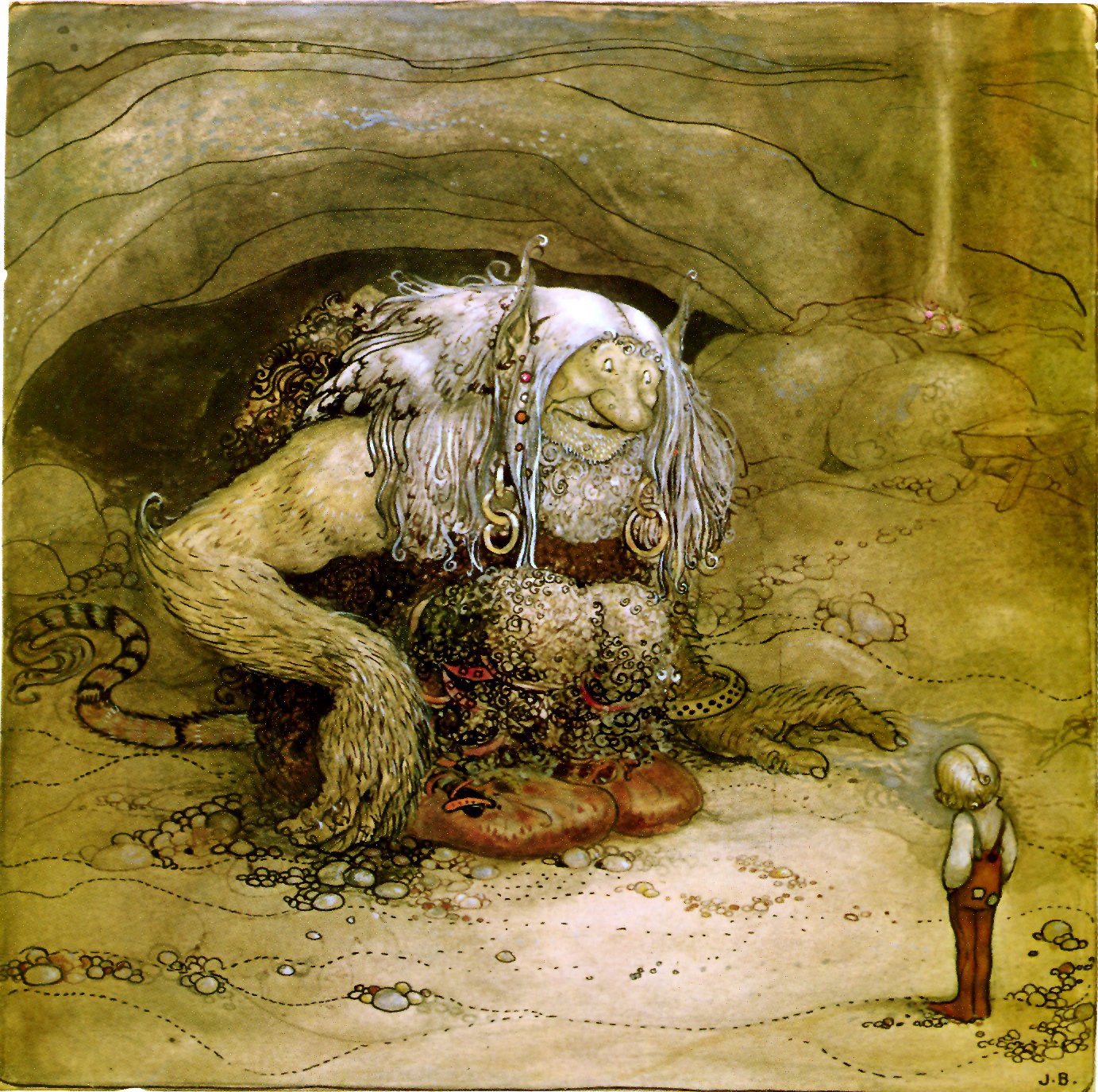
I’ve been reading lately about trolls, both the mythological monsters and those anonymous online ones who, per the Urban Dictionary, “purposely and deliberately (that purpose usually being self-amusement) starts an argument in a manner which attacks others on a forum without in any way listening to the arguments proposed by his peers.” Until recently, I had associated the current usage of “troll” with fairytales. The arrival on my desk of two bestiaries in particular, however, gave me a good excuse to reexamine what I knew — or thought I knew — about trolls and the way we use that word today.
In the 1840s, Peter Christen Asbjørnsen and Jøgen Moe collected a series of Norwegian folk tales, including the famous “Three Billy Goats Gruff.” In it, the smallest of the three goats is the first to attempt to cross a bridge guarded by a fierce troll. The goat implores the beast to wait for his big brother, who will make for a better feast. The middle sibling, of course, convinces the troll likewise. When the biggest of three goats reaches the bridge he knocks the troll into the water and the current carries away the creature, rendering the bridge safe forevermore. Here, a troll is an impediment to reaching greener pastures, whose greed causes it to pass up an easy meal in the hopes of a larger one. That does not, at first glance, immediately describe the kind of trolling we see on Twitter and online comments sections.
In the first half of the twentieth century, Ingri and Edgar Parin d’Aulaire published beautifully illustrated editions of Asbjørnsen and Moe’s tales. Their newly republished Book of Norwegian Folktales follows some other lovely editions of their stories we’ve seen lately, such as D’Aulaires’ Book of Trolls, and includes, as they translated it, “The Three Bushy Billy Goats.” Even more intriguing to trollology is the macabre “Cinderlad and the Troll” in which the youngest son of an impoverished man is bullied by his brothers and his king into confronting a troll. Trolls, it turns out, can be easily baited and thereby bested. The Cinderlad returns victorious, albeit after cooking the troll’s daughter in a pot and donning her clothes.
In The Golden Bough (1913), his landmark compendium of religious rites and superstitions, Sir James George Frazer wrote, “In many parts of Sweden firearms are […] discharged in all directions on Easter eve, and huge bonfires are lighted on hills and eminences. Some people think that the intention is to keep off the Troll and other evil spirits who are especially active at this season.” Even now, I might be might be supportive of our own open-carry laws if they served a similar purpose and really did keep trolls at bay, but I’ve seen no evidence that they do so.
Trolls are also particularly active on Midsummer Eve, which Frazer calls, “that mystic season the mountains open and from their cavernous depths the uncanny crew pours forth to dance and disport themselves for a time.” In troll country, the locals often “believe that should any of the Trolls be in the vicinity they will shew themselves.” When they do, I image the villagers know exactly how Bilbo Baggins felt when he encountered the ravenous trolls in The Hobbit (1937): “He was very much alarmed, as well as disgusted; he wished himself a hundred miles away.”
Jorge Luis Borges, in his Book of Imaginary Beings (1967), wrote “the Trolls of popular superstition are evil, stupid elves that dwell in mountain caves or in rundown huts.” Today, I imagine Twitter serves the same function; it is the dank mountain cave of many a troll. Trolls are also two-faced. Borges added that the “most distinguished among them have two or three heads.” The Dictionary of Satanism (1972) noted that a troll is “an earth demon or a personified nonhuman power.” That’s sounds a bit closer to our current usage, but it’s still not exactly accurate. I also suspect that a few online trolls might be decent — albeit confused — human beings IRL. The Trollusk in Mercer Mayer’s children’s book One Monster After Another (1974) has a more mundane but equally insidious purpose: it steals peoples’ mail so he can collect the stamps for himself.
According to the other excellent bestiary to recently cross my desk, trolls are chaotic evil. The excellent, fifth edition of the Dungeons & Dragons Monster Manual explains: “Born with horrific appetites, trolls eat anything they can catch and devour.” Furthermore, they “have no society to speak of” and are “difficult to control […] doing as the please even when working with more powerful creatures.” We might be getting closer here.
Most disturbingly, these D&D trolls are capable of regenerating lost limbs and are therefore very difficult to defeat. That happened in my own campaign just last month and it took a fireball to finally smite the poor thing. Similarly, in World of Warcraft, a troll’s health regeneration rate gets a 10% bonus. They are nothing is not tenacious.
I owe much of my interest in trolls not just to my research into video gaming communities, but to what philosophy professor Stephen T. Asma, in On Monsters: An Unnatural History of Our Worst Fears (2009), calls “the simultaneous lure and repulsion of the abnormal or extraordinary being,” but, again, that doesn’t seem to describe online trolls. I had to do a bit more digging into the etymology. According to the Oxford English Dictionary, to troll means “to fish for pike by working a dead bait.” In Webster’s New World College Dictionary, it means “to fish with a bait or lure trailed on a line behind a slowly moving boat.” That kind of trolling, perhaps even more of than the mythological ones, seems to describe the behavior of today’s online trolls, as we may very well see below in the comments-section responses:
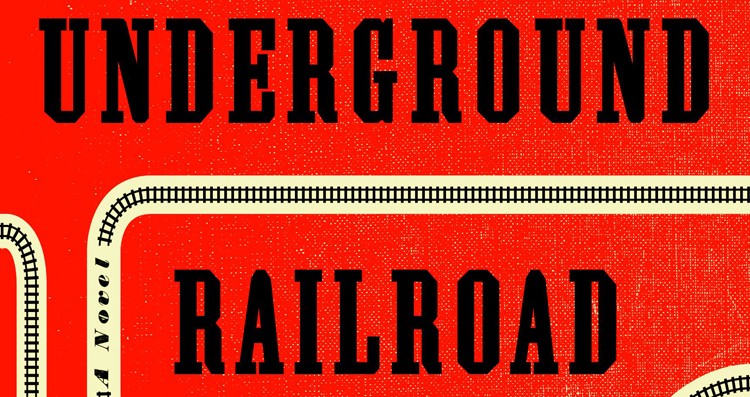
Slavery may have been abolished in the United States in 1865, but that doesn’t mean its effects still don’t ripple throughout the country to this very day. This, at least, is the idea Colson Whitehead deftly unpacks in his harrowing sixth novel, The Underground Railroad. The New York writer sends the book’s fifteen-year-old protagonist, Cora, on a clandestine journey from the south to the north of America in search of a barely imaginable freedom, and in so doing he captivatingly depicts how the repercussions of a life in bondage can haunt and constrain people even when they’ve escaped their shackles. Yet more universally, the novel delves deeper into its brutal world by showing how the institution of slavery wasn’t simply a means of subjugating the African-American population, but also a subtle, systematic means of keeping the whole of American society in check as well.
Initially, however, the focus of The Underground Railroad is very much on the inhumanity of slavery, and how its pitiless control of African Americans went far beyond the purely physical. As the novel opens, we meet Cora’s grandmother, Ajarry, as she’s parceled around from one slave owner to the next in a shockingly blunt introduction to pre-Civil War life in Georgia. Not only do slave ships and the Randall tobacco plantation subject her to the harshest and most degrading conditions imaginable, but the yoke on her is so complete that she can’t even take her own life:
“She twice tried to kill herself on the voyage to America […] The sailors stymied her both times, versed in the schemes and inclinations of chattel.”
In fact, the slaves in The Underground Railroad have been so completely dispossessed of themselves that they don’t even own their own thoughts, instead perceiving themselves only through the internalized frames and values of their owners. For example, in one memorable early passage, the third-person narrator recounts that Ajarry learnt about how “the white man’s scientists peered beneath things to understand how they work.” Therefore, rather than knowing herself and her world in her own terms, Cora’s grandmother “made a science of her own black body and accumulated observations,” essentially looking at herself through the eyes of her oppressors and thereby alienating herself from herself in a radically fundamental way.
Such cases of almost complete self-alienation exemplify just how totalitarian Whitehead portrays pre-abolition America as being. Yet, aside from furnishing a remarkably unflinching illustration of 19th-Century slave life, the family history with which he opens The Underground Railroad serves another function, working to introduce the overarching theme of how, to a large extent, our roots, beginnings and formative environments determine the trajectory of our lives and make us who we are. This first comes out in a discussion between Cora and her friend Lovey in the second chapter, where Lovey asks Cora which day she’d pick if she could choose the date of her birthday, and where she receives the fatalistic reply, “”Can’t pick,” Cora said, “It’s decided for you.””
But it also comes out much more clearly in Cora’s mother, Mabel, who in being the only slave to escape the Randall plantation without being caught sets a precedent that her daughter is all-but destined to follow. It’s because her mother absconded without capture that Cora believes the taciturn Caesar asks her to join him on his own attempt to flee, telling him, “You think I’m a lucky charm because Mabel got away.” Something similar could be said of Caesar himself, who in being “born on a small farm in Virginia owed by a petite old widow,” was able to benefit from a master with an ambivalent attitude to slavery, and with a willingness to teach him how to read and to let “his family range across the county as they pleased.”
“Whitehead reiterates the notion that our beginnings determine our later lives to a significant degree.”
It was this relaxed upbringing prior to his removal to Georgia that sowed in him the seeds of his own freedom. Moreover, it’s in this consistent emphasis on the upbringing and pedigree of his protagonists that Whitehead reiterates the notion that our beginnings determine our later lives to a significant degree. This is undoubtedly true of pre-abolition slaves, yet it’s also highly relevant insofar as it’s still very much true of us all today, what with countlessstudies and Robert Putnam’s recent Our Kids, for instance, revealing that two of the most reliable predictors of where we’ll end up in life is the neighborhood in which we grew up and the social status of our parents. As such, the slavery in The Underground Railroad essentially becomes a metaphor for any (modern) society in which birth is still a major factor in how that society is structured.
However, as domineering and as complete as the hold of slavery is on the vast majority of its subjects, the novel soon finds Cora and Caesar running away from the Randall plantation. Aided by a racially diverse series of well-wishers, they travel to South Carolina via the eponymous underground railroad, an actual rather than figurative railroad that, “with its secret trunk lines and mysterious routes,” snakes underneath much of the country. Handed fake documentation, they begin living in the Palmetto State as manumitted slaves, yet Cora soon finds that freedom isn’t the all-or-nothing condition it’s cracked up to be.
For one, she encounters a public health system that, under the guise of helping African Americans, is actually imposing a drastically eugenicist scheme of mass birth-control on them. According to Sam, one of the men who helped her and Caesar navigate the railroad, the hospitals are practicing “[c]ontrolled sterilization,” with one participating doctor confessing to him:
“With strategic sterilization — first the women but then both sexes in time — we could free them [African Americans] from bondage without fear that they’d butcher us in our sleep.”
This not-so subtle program of population control is something confirmed by Cora, who has a doctor offer to cut her fallopian tubes, and by Caesar, who later tells Cora, “They wanted to know what part of Africa my parents hailed from.”
In the face of such disillusioning experiences, and in the face of a Museum of Natural Wonders that glosses evasively over the horrors of American history, Cora ends up concluding that slavery hadn’t really wound down in the north, but merely assumed a new, more deceptive form. Living in a dormitory with other freed black women, she muses to herself one evening:
“They had gone to bed believing themselves to be free from white people’s control and commands about what they should do and be […] But the women were still being herded and domesticated.”
More alarmingly, it’s Cora’s own reactions to the new world around her as much as this world itself that suggests that a formal end to slavery isn’t enough to dissipate its effects on her. Working in the aforementioned Museum one afternoon, she beholds three “large black birds [hanging] from the ceiling on a wire,” yet rather than appreciate their distinctness as a species or their beauty, “They reminded [her] of the buzzards that chewed the flesh of the plantation dead when they were put on display.” It’s because she’s stuck within the shadowy frame of her enslaved youth like this that she fails to imagine just what a fully realized freedom might be for her, and it’s because she can’t conceive of such a freedom that she timidly refuses to venture beyond South Carolina, where she’s eventually sniffed out by the merciless slave catcher, Ridgeway.
It’s from the flight that ensues that she begins to take in more of the American south. It’s also at around this point that The Underground Railroad expands its scope to address how slavery wasn’t simply a barbarous economic expedient, but also an institution that kept many parts of America glued together socially. As early as the second chapter, we see how slavery and the racism inherent to it enacts a kind of divide-and-conquer mechanism, giving lower-class whites someone to hate other than the upper-class whites who exploit and dominate them. This emerges when Cora and Caesar first escape, when the narrator reveals:
“Advertisements were posted at every public place. The worst sort of scoundrels took up the chase. Drunkards, incorrigibles, poor whites who didn’t even own shoes delighted in this opportunity to scourge the colored population.”
Rather than question the culture and system that conspires to keep them destitute, these poor whites simply terrorize their even poorer counterparts. In highlighting this historical fact, Whitehead highlights how slavery was integral to the areas of the country that perhaps were just so overloaded with poor ‘free’ people that they couldn’t risk eradicating enslavement, for fear of unleashing a potentially destabilizing force of white people who would have no one to loathe other than their uppity lords and ladies.
What’s more, beyond illustrating this key divide-and-conquer gambit, The Underground Railroad also shows how the fear and loathing that surrounded manacled African Americans was harnessed to ensure unity and conformity within white populations. This is most strikingly detailed in the excellent North Carolina chapter, in which slave patrollers conduct regular searches of homes and property in the hunt for hidden runaways, calling “at all hours, visiting the poorest trapper and the wealthiest magistrate alike.” The result is that the spooked locals begin lacking all confidence and assertiveness, remaining “slumped on their distracted circuits, looking this way and that, never in front.”
Such passages and sections threaten to make The Underground Railroad a thoroughly disquieting and sometimes distressing read, even if Whitehead’s prose is masterfully terse yet three-dimensional in its presentation of pre-abolition America. However, it must be emphasized that, throughout its 320 pages, there always lingers a persevering slither of hope, one best symbolized by the underground railroad itself. That is, as the closing parts of the book reveal, the railroad was built piecemeal by hundreds if not thousands of “men and women […] who excavated a million tons of rock and dirt, toiled in the belly of the earth for the deliverance of slaves like her.”
It’s through such florid descriptions that the railroad itself turns into the metaphor it initially denied itself to be, representing every African American and anyone else who ever contributed a single sentiment, thought, idea, act or practice to the unending struggle for emancipation and self-definition. Yes, one pivotal character giving a speech near the close of the novel may claim that slavery’s “scars will never fade,” but in arduously working together to build a new culture and identity to replace an older, repressive one, Whitehead and his ultimately inspiring sixth novel remind us that “Africans in America” are “new in the history of the world, without models for what [they] will become.”
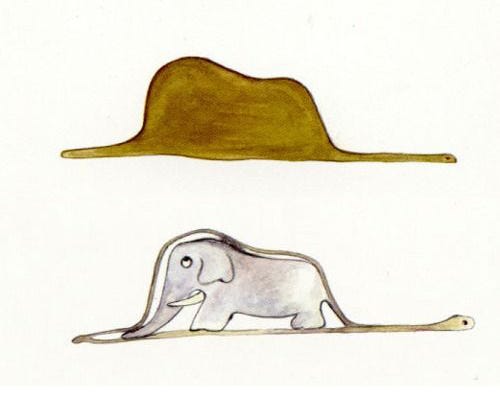
Mark Osborne’s animated adaptation of Antoine de Saint-Exupéry’s The Little Prince (2015) opens with an image all too familiar to fans of the 1943 children’s novella. Over a blank page, a voice (Jeff Bridges) tells us that as a child he saw a magnificent picture in a book, True Stories from Nature, of a boa constrictor in the act of swallowing an animal it had wrapped itself around. The illustration, reproduced from the first page of Saint-Exupéry’s book, comes to life in the film before our eyes, and is followed by the narrator’s first attempts at becoming an artist himself.
Illustrations from ‘Le petit prince’ (1943)
As an invisible pencil inscribes “Drawing Number One” and “Drawing Number Two,” he explains that grown-ups, odd as they are, have never quite understood his illustrations, encouraging him instead to concern himself with “matters of consequence.” It’s the reason, he says, that he became an aviator, and why he has never told the story of his friend the Little Prince to anyone. Before now, that is. As if on cue, many other illustrations from that famous French book flicker before us, setting the mood for what’s to follow.
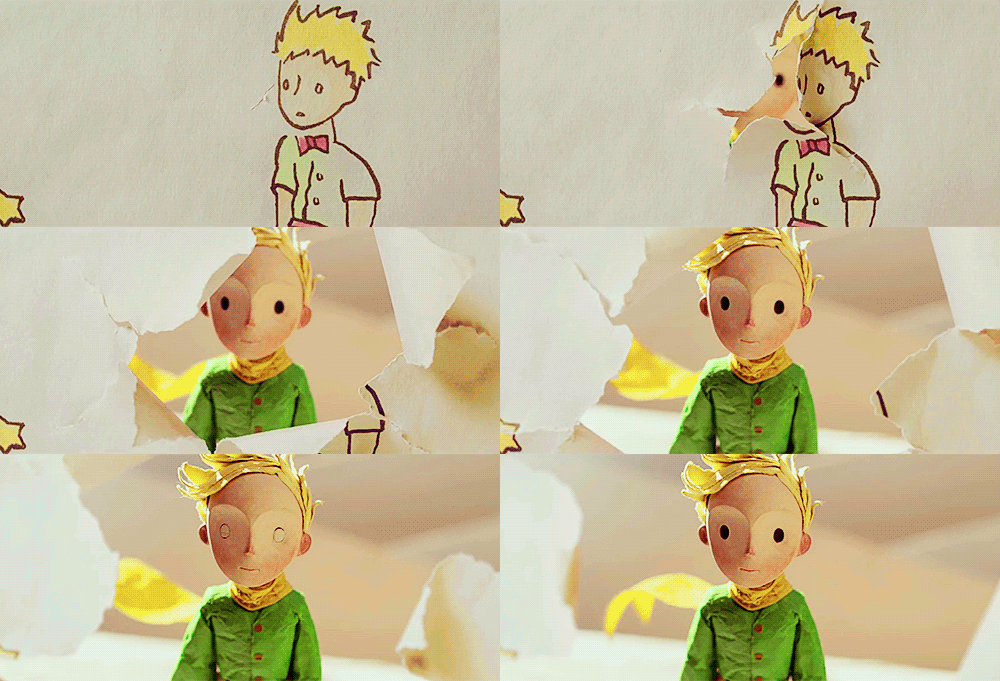
More than that, this opening sequence promises (and quite literally delivers) what is so often expected of filmed literary adaptations: that they will present us the pages of the book brought to life, animated, in the case of The Little Prince, as if by the very spirit that so enchanted us when we first flipped through Saint-Exupéry’s book — a book in which the eponymous Little Prince, wishing for a sheep to help him ward off the baobabs threatening his small home planet, worries at the same time that it would also eat his treasured blooming flower. And yet, the moment we cozy to the idea, the film changes form into something else. Gone suddenly are the hand-drawn pictures in a throwback watercolor style, as we enter the world of 21st-century CGI.
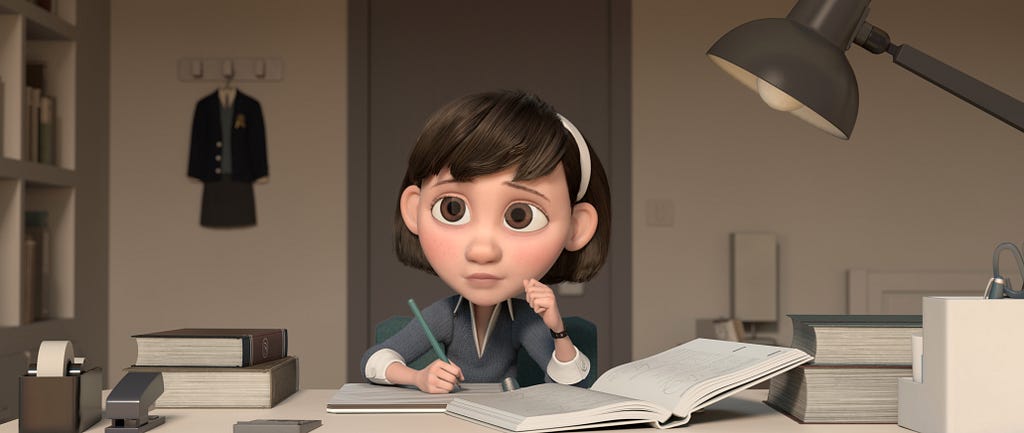
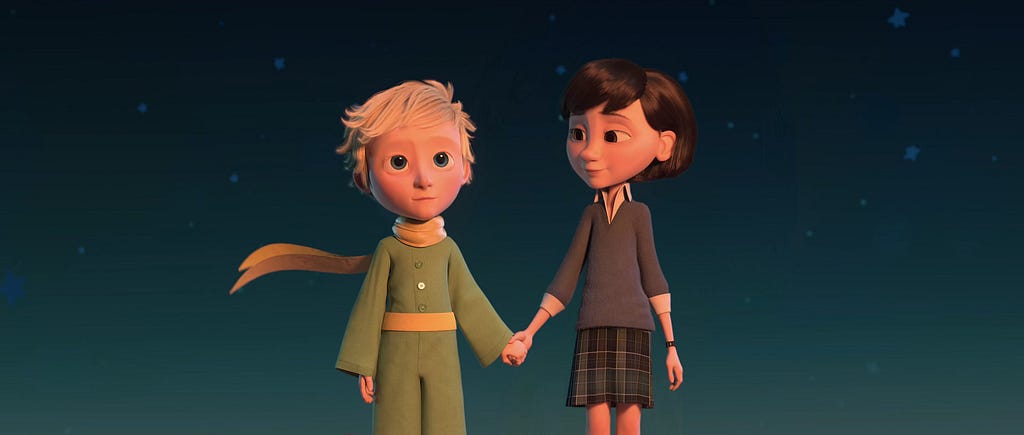
A young girl (Mackenzie Foy) and her mother (Rachel McAdams) are in the hallway of the Werth Academy, where The Little Girl will soon face an admissions committee like something out of Kafka. Unlike the earlier hand-drawn images — near replicas of Saint-Exupéry’s illustrations, in the style of his pseudo-autobiographical narrating avatar — which evoked a vibrant texturedness and whimsy characteristic of the book, this pristine hallway with its Pixar-like characters looks outright flat and glossy. Eventually, despite her mother’s well-intentioned helicopter parenting, The Little Girl bombs the admissions exam and they move on to Plan B: purchasing a home in the neighborhood of the Academy, thereby ensuring that The Little Girl will be granted a spot there in the fall.
The Little Girl (Mackenzie Foy) from ‘The Little Prince’
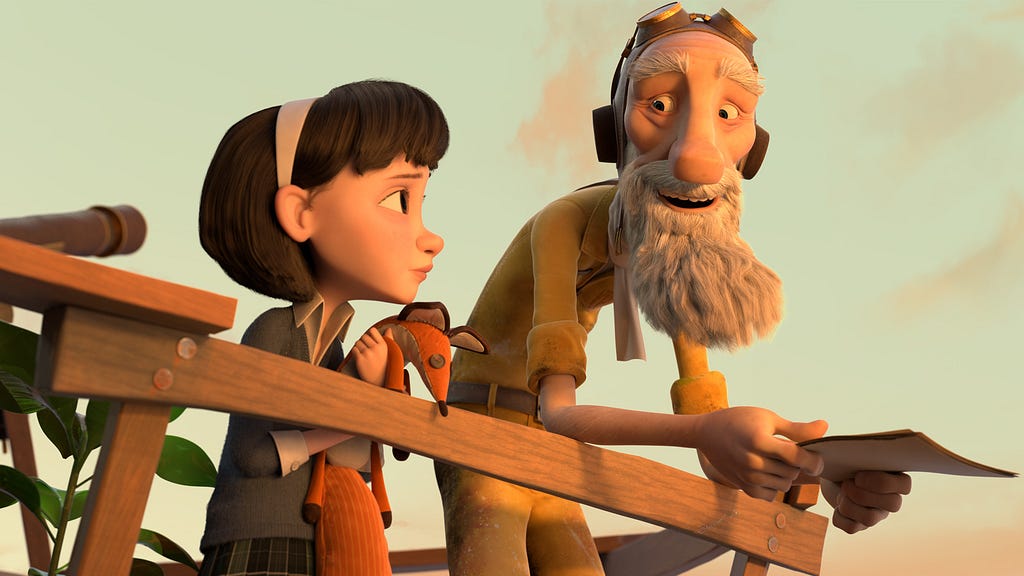
Adjacent to their new home they discover a rickety house, owned by an eccentric elder aviator with whom the girl develops a friendship, centered mostly around a series of stories he writes and illustrates for her. They are, of course, facsimiles of the first French edition of Le petit prince,and whenever The Little Girl reads them the audience is plunged alongside her into the narrative. To visually index the change Osborne and his animators forgo CGI, instead relying on stop-motion animation for these sequences, fleshing out, as it were, the tactility of the book’s illustrations. Not surprisingly these are the most affecting sequences in the film, beautifully rendering the simplicity of Saint-Exupéry’s story with just enough twee detail (stars that literally hang from a thread, a rose made more exquisite by its emphasized paper-like appearance, character design that is stridently minimalist) to warrant the leap from still to moving image.
The Aviator (Jeff Bridges) and the Little Girl
What one may first mistake as a mere framing device — not uncommon in adaptations that feel the need to explain their literary origins for the sake of the screen — the film constantly yanks us back to the Little Girl and the Aviator, and away from the Little Prince’s (Riley Osborne) narrative. In fact, given that Saint-Exupéry’s book is a collection of short fable-like stories strung together, it’s no surprise that Osborne (working off the screenplay by Irena Brignull and Bob Persichetti) quickly runs out of narrative for the eponymous and giggle-prone protagonist. It’s then one realizes that this adaptation is neither content in, nor intent on, merely bringing The Little Prince to screen, but rather that it seeks to model for us the very reading practice the story encourages, and thanks to which the book is one of the most beloved and iconic French properties in the world. In this sense, The Little Girl stands as the reader’s surrogate. Just as Saint-Exupéry’s narrator isn’t merely a passive presence in his own story (he’s compelled, after all, to author the story in the first place), and just as the Little Prince is a model for an active and engaged spectatorship (his incessant questions; his need for adventure), the Little Girl emerges as the contemporary extension of the book’s playful didacticism (when, for instance, in the book the Little Prince meets a vain man who only wishes to be flattered, we’re reminded that “conceited people never hear anything but praise,” the type of takeaway wisdom which recurs throughout the text).
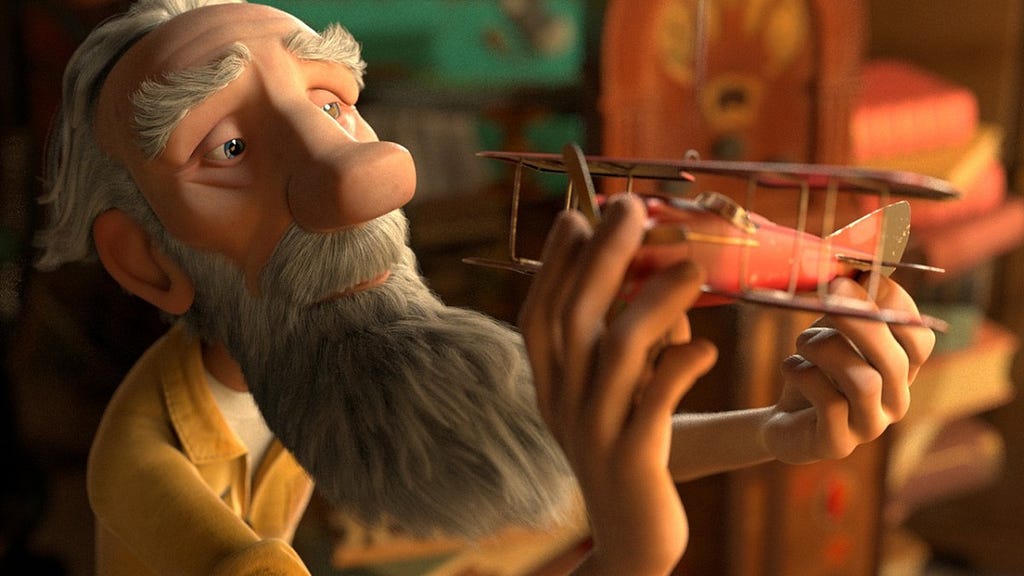
The Aviator, from ‘The Little Prince’
The latter third of the film follows the Little Girl alongside her plush toy fox, as she journeys to find the Aviator’s lost friend. When she does find him the film becomes its own version of Hook, with a grown-up and not so Little Prince (the older version, “Mr. Prince”, voiced by Paul Rudd) needing to be reminded of what made him an avatar for the wonders of childhood in the first place. As with Hook’s revisionist take on J.M. Barrie’s work, we are reintroduced here to Saint-Exupéry’s cast of characters, who have grown beyond the clear and strict allegories of their names to be deployed in the real world as bleak adult types.
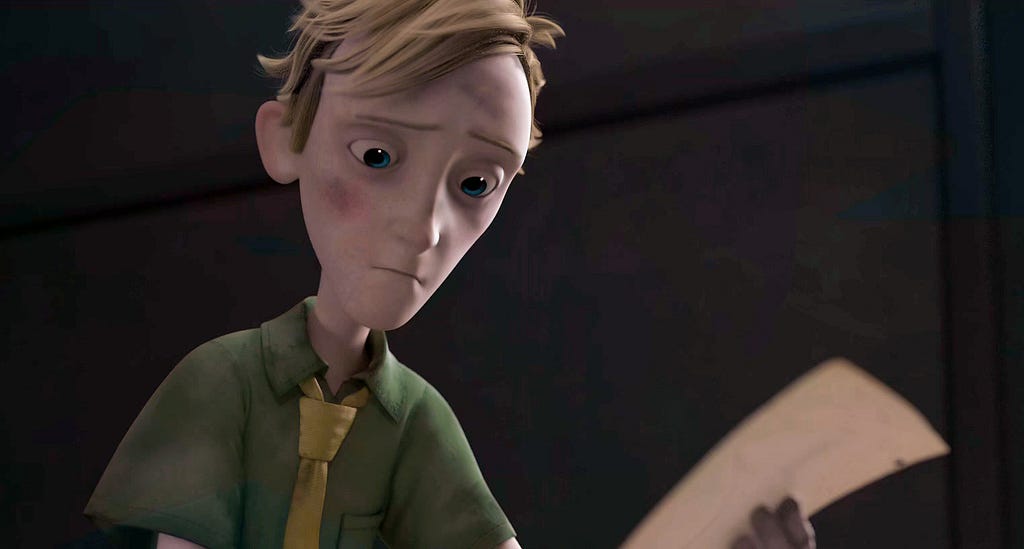
The grown Mr. Prince (Paul Rudd)
Just as children over the decades come to understand that the Businessman’s (Albert Brooks) avarice is absurd, and the Conceited Man’s (Ricky Gervais) vanity laughable, Osborne allows us to see how enshrined grownup values translate into a terrifying vision of an organized world, where the essential and purposeful are considered preeminent qualities — and where there’s little room given for children or their fancies. Admittedly didactic, this latter part of the film — which offers a third-act climax far more action-packed than the downturned ending of the book — functions as a narrative extension to the lessons Saint-Exupéry’s narrator threads throughout his wondrous memoir.
Osborne’s The Little Prince gives us a narrative of what it feels like to read that French story as well as what it looks like to embrace its life lessons: by the end, the Little Girl and her mother have settled into a much more relaxed rapport, one not determined or delimited by standardized tests or ideas of what it means to be an “essential” member of society. Just as Saint-Exupéry encourages his readers, here mother and daughter are seen looking up at the sky and its stars, asking themselves the question that still plagues the Aviator whenever he thinks of his young friend back on his home planet (“Is it yes or no? Has the sheep eaten the flower?”), and pondering the matters that are truly of the greatest importance.
‘The Little Prince’ is currently streaming on Netflix.
It’s the most wonderful time of the year, and it ain’t even Christmas yet! Mid-September in Brooklyn is coming up and you know what that means: The Brooklyn Book Festival is back for its eleventh year. To kick off the week of events, we’re hosting the Official Opening Night Party along with Catapult, Literary Hub, PEN America, and Tumblr. The Party is a Bookend Event and will most notably feature free drinks* and dancing. New York-based turntablist DJ Shiftee will be providing the tunes / to make you swoon.
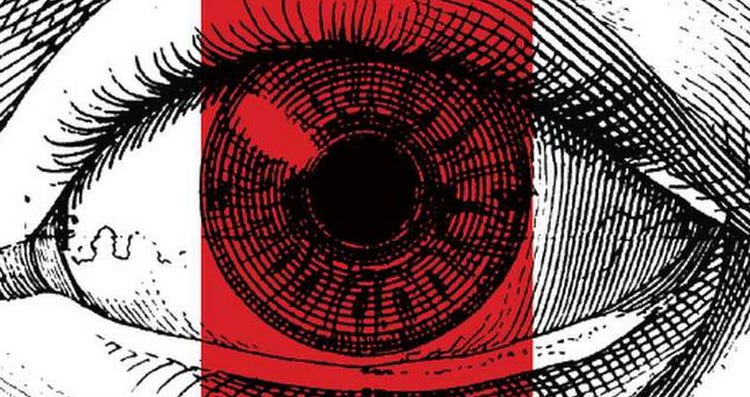
Lina Meruane’s semi-autobiographical Seeing Red is full of rhythmical jolts. At times, the reader is thrown to the end of a sentence, where she unexpectedly stops and teeters there, waiting. Then the next sentence reaches out and draws the reader on, plunging her into the smells, sounds, and spatial imbalances of the worlds around our protagonist, sometimes in the New York City where the fictional and real Lina Meruanes both earned their PhDs, and sometimes in Santiago de Chile, where the fictional and real Lina Meruanes both have Arab-Chilean families.
The book, translated from the Spanish by Megan McDowell, opens with a very small, but urgent, explosion:
It was happening. Right then, happening. They’d been warning me for a long time, and yet.
On the first page, blood vessels burst inside Lina’s fragile eyes, submerging her gaze first in blood, then in darkness. This isn’t entirely a surprise. For years, Lina has been having small explosions inside her eyes. Because of the brittleness of her veins, Lina’s doctors had asked her to follow a litany of impossible rules:
Stop smoking, first of all, and then don’t hold your breath, don’t cough, do not for any reason pick up heavy packages, boxes, suitcases. Never lean over, or dive headfirst into water. The carnal throes of passion were forbidden, because even an ardent kiss could cause my veins to burst.
So this explosion is not unexpected, and yet blindness was also impossible until it happened.
From this moment of darkness, the narrative hurtles forward, obsessed by Lina’s physical and emotional pains, which are examined with a vibrant, Kahloesque fascination. The narrative is also interested in how Lina’s pain stretches out, changing her relationships with the objects and people around her.
The plot of this short, tight novel is simple: Woman loses vision, woman waits, woman has operation. The sharply wrought and attentive prose, crafted here into compelling English, would probably be enough to keep our attention. But it’s the threat of what Lina will do next — amongst the obstacles thrown up by her family, the insurance company, the university, her love — that makes this novel un-put-downable.
At the opening, Lina’s relationship with her boyfriend, Ignacio, is held in a loose fist. She doesn’t even tell him, in these first moments, what has happened to her vision. They’re at a loud, raucous party, and he urges her to stay a while longer. She acquiesces. In the following days, as he discovers the extent of her loss, she simultaneously grips their relationship more tightly and hurls it away. She winds Ignacio in guilt and tries to shove him off. She both needs him and hates the smell of her neediness.
Just as Lina’s relationship with Ignacio grows more fraught, so does her relationship with the medical establishment. Both her parents are doctors, and no, she doesn’t want their advice. No, she will not have the operation done in Chile. She trusts only one doctor, Lekz.
In the beginning, Lekz is a cold, remote character who sits behind his instruments. He is a barrier, full of prohibitions and instructions, standing between Lina and the life she wants to live. After she loses her vision, she begins to rail against this barrier. Ignacio hushes her as she insists on reminding Lekz of her name:
Lucina, doctor, I told him officiously, knowing he’d be unable to pronounce it, while I reached out my hand, but you can call me Lina. He doesn’t know who the hell I am, I murmured then in Spanish to Ignacio, he doesn’t have the damnedest idea, this doctor to whom I’ve handed myself over in body and practically soul for two whole years.
As Lina’s prognosis worsens, she grows fiercer. By the end, she is so furious and demanding that she becomes something of a vengeful goddess. She demands increasingly more of Ignacio, and also of Lekz, whose position now changes. As Lina’s condition grows worse, Lekz becomes more vulnerable:
Lowering his voice impossibly, Lekz asked me to forgive him, it wasn’t me he forgot. I was everyone. Much as he struggled, he watched them enter his office and he didn’t have the slightest idea who they were, that’s what he told me, clearing his throat continuously, the magnifying lens raised before my eyes but still without examining me. With his hand suspended in the air, he confessed that patient after patient would come in and he would greet them all by name, something he’d learned to do mechanically.
In the end, Lekz shrinks before a furious, wronged Lina. The doctor reeks of cigarettes and exhaustion, and Lina asks him: “Am I going to die, doctor, or are you?” They are no longer in his office, with her quiescent behind his instruments. They are around a table, now equals, and the doctor is tied to Lina’s grief.
Lina’s mother is the only one among her inner circle to escape, pushed off by Lina’s desperate need for independence. Lina also knows too much about her mother to bear her presence. More than with any other character, Lina can see past her mother’s exterior. Just before her mother returns to Chile, post-surgery, Lina watches her sightlessly.
My mother trembled, while the doctor part of her demanded she get hold of herself, dry her tears on the sleeve of her blouse, not be late for her plane. We have to go, my mother’s other was saying, right now; and yes, I thought, both of you go, but especially the doctor you.
Lina’s observations are endlessly rich. Even when deprived of her sight, and relying on Ignacio’s eyes, she can still manage to paint us a detailed picture. Yet there is no facile conclusion that because Lina loses one sense, the others grow stronger. It is not Lina’s blindness that gives her x-ray vision, but her gifts as an author, her grief, and her fury. Lina might be blind, but she is desperateenough to see.
DON’T MISS OUT
Sign up for our newsletter to get submission announcements and stay on top of our best work.
YOUR INBOX IS LIT
Enjoy strange, diverting work from The Commuter on Mondays, absorbing fiction from Recommended Reading on Wednesdays, and a roundup of our best work of the week on Fridays. Personalize your subscription preferences here.