“Crying is one of the great pleasures of moviegoing.”
So Manohla Dargis reminded her readers in her New York Times review of Stephen Daldry’s Extremely Loud and Incredibly Close, the 2011 screen adaptation of the novel by Jonathan Safran Foer. Dargis, however, was quick to add a caveat: “[B]ut tears can be cheap.” In this economic taxonomy of emotions, tears evidently become valued when they demand one to expend a certain amount of effort. Cheap tears, on the other hand, are symptomatic of feelings that have been “unearned.”
Those were the kind of tears, according to Dargis, at the heart of the movie based on Safran Foer’s so-called “Sept 11 book.” Daldry’s film was kitsch, merely exploiting the atmosphere of emotions surrounding the events and aftermath of 9/11, and trying to “make us feel good, even virtuous, simply about feeling. And, yes, you may cry,” she added, “but when tears are milked as they are here, the truer response should be rage.” The use of the passive voice in her final damning sentence is indicative of what we associate with “cheap sentimentality,” that feeling of losing control over one’s emotional responses, usually against one’s better judgment. The tears are “milked” as if by force, despite our awareness that we are being manipulated (another charge which Dargis levels against Daldry’s film). Cheap sentimentality needles at us for the very fact that it robs us of our agency. Then again, the distinction between sentimentality and its bargain-priced counterpart is policed less through an intrinsic differentiation between them than by the arbitrary limits that are carved around them. Cheap or otherwise, “sentimental” remains a coded putdown in the contemporary vernacular, invoking as it does gendered ways of both reading and being.
Thomas Horn and Viola Davis in ‘Extremely Loud and Incredibly Close’
“Did they cry?”
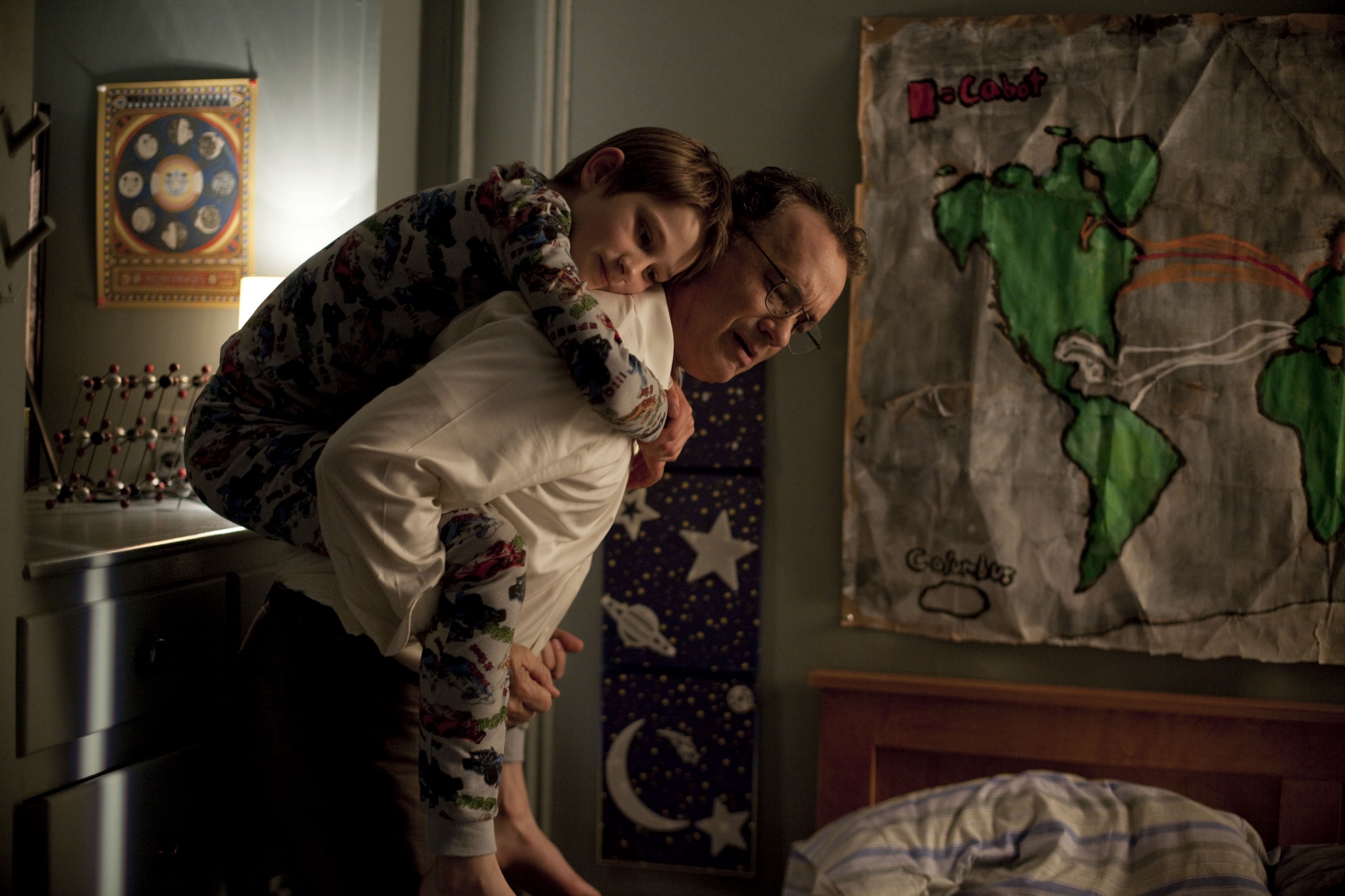
Oskar Schell (Thomas Horn), retracing what he believes to be his late father’s (Tom Hanks) last “reconnaissance expedition,” has found himself in a house in Fort Greene, Brooklyn. He’s visiting Abby Black (Viola Davis), the first on his list of possible New York-residing Blacks who may hold some knowledge as to what the key he found among his father’s belongings might open. The surname “Black” is the only clue he has to go on — and the only thing he believes still tethers him to his father, who died, as he tells us, “on the worst day.” This is no deterrent for eleven-year-old Oskar, an “amateur entomologist, Francophile, archeologist, computer consultant, pacifist, inventor,” as his business cards read. Once he explains his reason for knocking on Abby’s door she reluctantly lets him in, his awkward charm so endearing that she allows herself to be interrupted on what we later learn is the day her marriage has finally fallen apart. We are allowed brief glimpses of her husband, on the phone, before he exits without addressing his recently ex-wife.
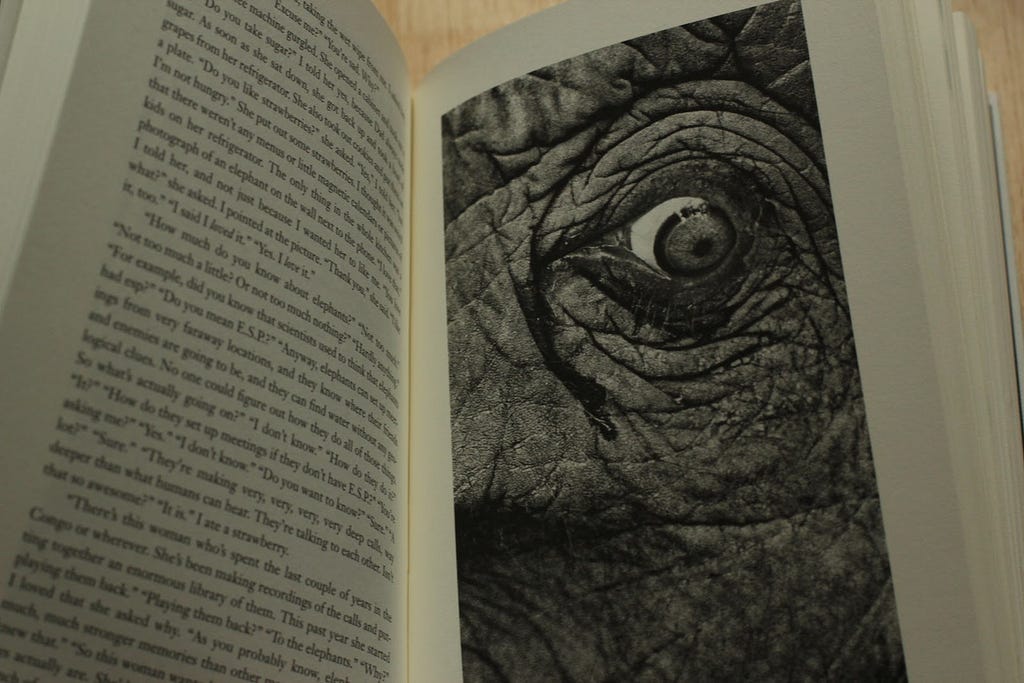
Oskar points to a postcard lying in one of the many packed boxes littering her hallway, and tells her that he likes the image: a close-up of an elephant’s eye. When he describes how a pachyderm researcher played old tapes with the calls of now-deceased elephants back to their families, Abby muses: “Did they cry?”
Image from Safran Foer’s novel
In the film, as in the book, Oskar dismisses the question out of hand. “Only humans can cry tears,” he says. Abby looks at the postcard once more, countering that the elephant in the picture appears to be crying. Oskar has an answer handy: “It looks like it, but it was probably manipulated in Photoshop.” In the novel, as if on cue, Abby “started to cry tears.” For those unfamiliar with Safran Foer’s narrator, the phrase is indicative of Oskar’s literal-minded descriptive language. What else would she have cried if not tears?
The postcard is cheap sentimentality at its most blatant — a vision of a heightened reality, at once depicting and hoping to elicit tears. The paragraphs that follow grant us insight into the thoughts of this eleven-year-old in the face of an unselfconscious, tear-streaked show of emotion:
Then she started to cry tears. I thought, I’m the one who’s supposed to cry. “Don’t cry,” I told her. “Why not?” she asked. “Because,” I told her. “Because what?” she asked. Since I didn’t know why she was crying I couldn’t think of a reason. Was she crying about the elephants? Or something else I’d said? Or the desperate person in the other room? Or something that I didn’t know about?
His immediate reaction is telling: after all, Oskar is the one who lost his father on 9/11. His grief, he suggests, should have primacy. In its place his probing questions (after he tries, unsuccessfully, to police Abby’s emotional condition while in his intrusive presence) speak to Safran Foer’s uncanny ability to have his narrator’s earnestness mirror our own codified and constricted social interactions. If only Oskar knew why Abby was crying, he might be able to offer a valid reason for his imperative that she not cry. This episode hits at the center of most criticisms of sentimentality (such as Dargis’s): once you’ve seen the manipulation and understood why you’ve been made to cry, you should be able to refrain from indulging in it.
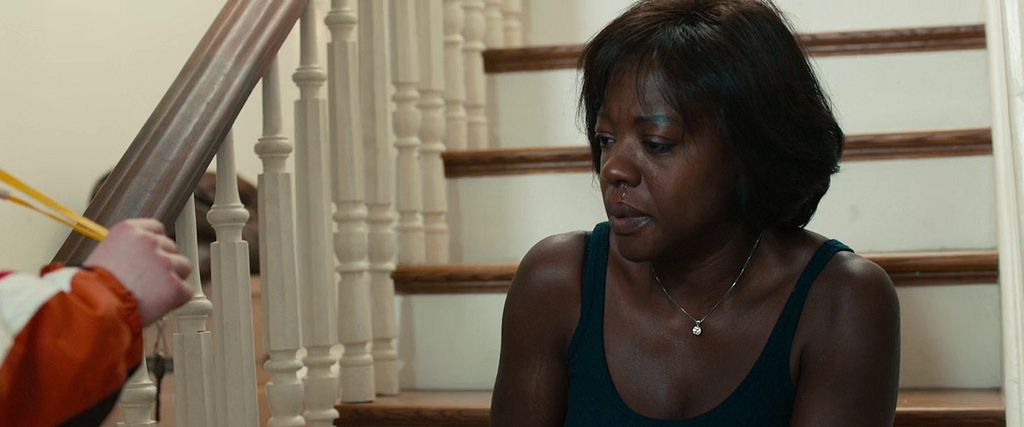
Viola Davis as Abby Black
In his adaptation, Daldry makes this connection — between the elephant image and Abby’s tears — all the more revealing. Viola Davis portrays Abby as a woman very clearly on the verge of tears. They are right on the surface, waiting to be deployed at the slightest nudge. Which explains why, after an innocuous close-up of the front of the postcard, she appears to instantly break down, as though triggered. It is also the very reason that we, as knowing audience members, are expected to detest the sentimental, the mawkish, tawdry, mushy, schmaltzy, saccharine, and cloying, for being too easy: rather than exploring the great depths of emotions they are merely skimmed, the elicited outpouring well beyond the scale of the circumstance that brought it about. Nothing in the scene, either in Safran Foer’s text or Daldry’s film, can describe the immensity and complexity of the marital discord being signified. Both opt instead to merely index it, through the evidence of Black’s emotional distress.
I must admit that Dargis’s critique of the film irked me at the time. Not because I disagreed with her outright, but perhaps because she vocalized something I’d struggled with while reading Safran Foer’s novel (which had often moved me to tears, usually in conspicuously public places where the sudden gush felt all the more inappropriate and shameful) and likewise while watching Daldry’s adaptation of it (sitting in the darkness, unable to contain the sobs that kept rising up at key points in the film). Not that I begrudged having been brought to tears (as perhaps Dargis and many others did). What I actually begrudged was my instinctual — and, let’s face it, intellectual — desire to disown them. Couldn’t I, after all, see the manipulative strings above and all around me? The twinkling score and picture-perfect casting, the implausible plot, the melodramatic climaxes? Hadn’t I been trained to read closely and coldly, to arm myself with critical skills such that I could parse how easily this post-9/11 fable-parable was merely a collection of clichés clicking neatly into place?
Oskar at a 9/11 memorial wall, from ‘Extremely Loud and Incredibly Close’
Perhaps. Yet I felt protective of my tears which, in hindsight, did not seem to have been unearned, easy, or cheap. Or if they were cheap then I didn’t care. What cheap sentimentality can do is to short-circuit our connection to the depths of our emotions, precisely by making us feel that they are closer to the surface than we’re perhaps comfortable with. In instances where the emotional manipulation is so obvious — as I will admit it is in Extremely Loud and Incredibly Close — our tears can feel like they have less to do with the narrative at hand than with things deep inside or even wholly outside ourselves. Do I cry alongside Oskar because I, too, lost my father at a young age? Or because I’m encouraged to think back to the trauma, which many of us experienced, seeing the towers fall on our television screens? Is the political here collapsed into the personal in ways both brazen and craven? Aren’t my tears (for Oskar, for myself, for the film) merely a working of the complicated emotional knots that these self-serious issues gave rise to in the first place?
Sandra Bullock as Oskar’s mother, Linda Schell
Ultimately, these questions remain intellectual exercises. They have yet to stop me from becoming a blubbering mess when Oskar and his mother (Sandra Bullock) engage in a melodramatic shouting and crying match at the kitchen sink, that ends in the heartbreaking moment when he tells her, with wounded assuredness, “I wish it were you.” When a film milks your tears, the critical discussion should turn to what this effect on the audience (or even the audience’s need for it) might indicate. I will admit, the total emotional surrender that such sentimental texts encourage can be terrifying (or ‘enraging,’ in Dargis’s summation). But there is value in losing oneself to them, to wallowing in their shallow emotional registers. Especially those that beckon you, from their title alone, to inch closer, while also warning of the deafening blow they’re about to let loose.
Hello, and welcome to my week-by-week review of the world. Today I am reviewing Pokemon Go.
There’s a new video game called Pokemon Go. It’s a Japanese knock-off of Pac-Man and can be downloaded from the internet for free.
I was not able to find an arcade room version of this, I think because the Japanese know it’s illegal. My librarian helped show me how to download it onto my phone but doing so involved a very long list of terms and conditions. I read through them all carefully to make sure I agreed with them, and I did.
The librarian asked me if I was sure, because downloading the game meant I was giving the video game company access to all sorts of personal data including being able to track wherever I was at any moment as well as read my email. I paused for a moment, to consider all of the secrets hidden in my emails, but then decided I just really wanted to play the game anyway.
Rather than the maze Pac-Man used to be trapped in, he is now in an earth-like setting, which coincidentally looks exactly like my home town. And let me tell you, the graphics are AMAZING. It’s very realistic looking. I literally can’t tell the difference between the video game and real life.
One of the most unrealistic things about the original version of Pac-Man was how he could get around without rolling. That made no sense. In Pokeman Go they opted to give him arms and legs, rosy red cheeks, and for some reason a lightning bolt tail. He’s much cuter this way. He looks like a yellow squirrel.
To be honest, I didn’t fully understand how to play the game. I couldn’t find a single ghost to eat. There were some cherries though, in a fridge that looked exactly like my own, so I ate them in the hopes of gaining super powers. Nothing seemed to happen though, other than it made me hungry in real life. Only when I went to my fridge to get cherries, they were all gone.
BEST FEATURE: No quarters are required to play. WORST FEATURE: I crashed my car while playing this game.
Please join me next week when I’ll be reviewing my big toe.
Part of the joy of discovering an artist’s work, regardless of their chosen medium, is getting the chance to spend some time in their headspace. Each piece of work, whether it be a novel, sculpture, or movie, gives you another glimpse of its creator’s thoughts and beliefs, allowing you insight into how they think and fleshing them out more than even the most vigorously reported biography ever could. When it comes to indie comics, there’s no one right now whose work lets readers in as much James Beard Award winner and BoJack Horseman production designer/ producer Lisa Hanawalt.
Her second book, Hot Dog Taste Test (Drawn & Quarterly), the follow up to 2013’s My Dirty Dumb Eyes, sees the cartoonist tackling a mishmash of subjects as varied as foodie culture, the evolution of bathroom habits, and horseback riding. The collection, much of which first saw print in David Chang’s Lucky Peach magazine, is less concerned with the sexual lives of anthropomorphic animals (though there’s still some of that) than her previous book, but still features plenty of the brand of gross-but-not-gross-out humor that’s her trademark.
Hanawalt expertly mixes things up — understanding that some punchlines need only elicit a smirk.
Whether she’s ruminating on the pros and cons of breakfast, showing off some of her favorite recipes, or preaching the virtues of otter farms, Hanawalt loads her page with visual and verbal jokes (many of which involve dicks or boobs). But Hanawalt expertly mixes things up — understanding that some punchlines need only elicit a smirk — in a way that makes sure the proceedings never feel overwhelming.
The book can still feel all over the place, though, as Hanawalt zeroes in on something only to turn away as soon as something else catches her fancy. While this would grate if she were a lesser artist, Hanawalt cartooning skills are such that it doesn’t matter, especially when one turns to any of the lush watercolors that litter the book.
One particularly notable section, portraying the day-to-day lives of a 30-something bird couple who’ve recently traded the city for the suburbs, stuns with rich colors sure to invoke the feeling you had scanning over the pages of your favorite picture book as a child. But it’s not just the painted work that shines, as her more traditional line work is as sharp and evocative as well. Even pages of text, many of which feature scratched out words and phrases, have a beauty to them. They may feel like filler at first, but as the book progresses, their immediacy starts to feel like glimpse of Hanawalt’s mind at work, almost in real time.
The collection is at it’s best in the more sustained pieces. These five pieces, which cover everything from day spent shadowing Wylie Dufresne around one of his Manhattan restaurants to a tour of Las Vegas’ many all-you-can-eat buffets to a family trip to Hanawalt’s mother’s homeland, Argentina, are an amalgam of experiential journalism and autobiography that manages to avoid the more annoying traps of both. Consisting of chunks of text and colorful line drawing, the pieces move along at a brisk pace, ideas and observations bubbling up in every direction. There’s a directness to them that elevates them past sketchbook pages, while managing to remain candid enough, giving you a sense of how she processes the world.
Hanawalt is part of a group of indie comic darlings who have moved to Hollywood in recent years to work in animation. Comics can be a thankless field, so it’s reassuring to see she hasn’t left the medium behind just because she’s achieved success while working on Bojack Horseman. In fact, as Hot Dog Taste Test proves, it may have freed her up to move forward, something which has made her already honest work feel more fresh and vital than ever before.
A New Service Offers One-Hour Book Delivery or Indie Shop Pick-Up
The Delivery Man, Chris Bird
Forget Amazon drones. A new start-up is promising book delivery within the hour.
The company is called NearSt., and it’s deploying a small army of book-toting scooter and bike messengers around London. Here’s how the service works: choose your book on the company’s site or app, enter your location, then decide whether you want Garth Greenwell’s What Belongs to You, Don Delillo’s Zero K, or Helen Oyeyemi’s What Is Not Yours Is Not Yours delivered to your doorstep quick as a Domino’s pizza, or whether you’d rather pop down to your local independent bookseller to pick up the book yourself. According to The Guardian, NearSt. is already working with 40 London bookshops, each of which is syncing up internal inventory systems to the site so that customers can be sure that the book they want is close by and ready.
There is no official word if or when NearSt. may link up with American booksellers, but CEO Nick Brackenbury has spoken of his desire for the start-up to expand its product category and its reach: “the ultimate goal [is] having every product in every shop in every high street on the platform at a global scale…we’re very excited by what lies ahead for local commerce, and what we can achieve with local businesses everywhere.” Clearly not hiding his ambition for the platform, Brackenbury has also stated his start-up is “absolutely” out to challenge the likes of Amazon.
So far, the testimonials from booksellers sound pretty glowing. Betsy Tobin, of London bookshop Ink@84, told TheGuardian it’s “dead easy: an automated phone call asks you to double-check stock is physically there, then press a button to acknowledge. A very streamlined process. My staff person has just drawn an interesting parallel with Pokémon Go, in that people enjoy using tech to track down a product but also like the physical/social process of going out to get it.”
The resurgence of the independent bookstore has been one of the year’s big literary stories. NearSt. looks to be the latest innovation in the direction away from megastores and online behemoths like Amazon.
The big question now: are tech-savvy independent booksellers going to bring us back from the digital abyss? Led by gaslight (iPhone flashlight), leather-bound parchment (any physical book) in tow, we return to the world…
Natalie Portman is on the cover of the latest New York Times T Style Magazine. Inside the issue you’ll find her email correspondence with none other than Jonathan Safran Foer, who has a new novel coming out this fall but was not asked to pose in his underwear. Say what you want about the pomp, the pretense, and the rumors, one thing is certain about this exchange: it’s a veritable gold mine of writing advice. Of course it is. Safran Foer is a Great American Novelist. Portman is a Great American Director. What else would you expect? This is Strunk & White for the 21st century.
To save you a little time, we culled the best of their literary wisdom.
A writer must face his greatest challenge head on.
Foer: “People often refer to aloneness and writer’s block as the two great challenges of being a novelist. In fact, the hardest part is having to care for guinea pigs.”
2. Write what feels wrong.
Foer: “Freedom might not be a prerequisite for the expression of passion — it helps, sometimes, not to be able to follow your instincts — but they are strongly intertwined.”
3. A novelist must have rituals.
Foer: “…the garbage and parking are among the many rituals around which my daily life is organized.
4. Keep track of those rituals. DO NOT lose them.
Portman: “You learn how deeply grounding ritual is when you lose it.”
5. Treat. Yo. Self.
Portman: “Before the concert we ate a meal at a restaurant that was pretty insane. It’s called the Clove Club; next time you come to London, eat there.”
6. Be homeless.
Portman: I realized how much Judaism for me was connected to yearning — to wanting what you don’t have — which is maybe why Israel is so complicated emotionally for Jews: It’s built into the emotional structure of our religion to yearn for a homeland we don’t have.
7. Explore how you feel about how you feel.
Portman: It was kind of a revelation for me to acknowledge, through Oz’s book, that mood could be so influenced by when and where you live, and the feelings of that time and place about feelings.
8. There is no such thing as a bad metaphor.
Foer: Not even Shabbat can stop the clock — two have moved from the future to the past in the course of our having this exchange — but every now and then the broken-down time machine that is Hotmail can cough itself back to life.
9. Reading the dictionary is like giving birth.
Portman: Etymology might seem dry, but the connections between words feel to me like the connectedness I felt while giving birth — that I was related to every woman who had ever given birth throughout time. I guess it’s having an experience that gives you a feeling of wonder, to use your word, that you can then feel that you share with people — not just people around you, or people exposed to the things that you’re exposed to, but people in the desert looking at slightly younger versions of the same stars while herding sheep and believing that lightning was the wrath of God.
10. Finally, it’s all about self-knowledge. About being self-aware, at all times.
Portman: What I always look for in my work are new challenges — things I’m not sure I can do. And oftentimes I can’t do them, and I fail. But that’s what keeps me interested, and nothing offers knowledge and self-knowledge like failure.
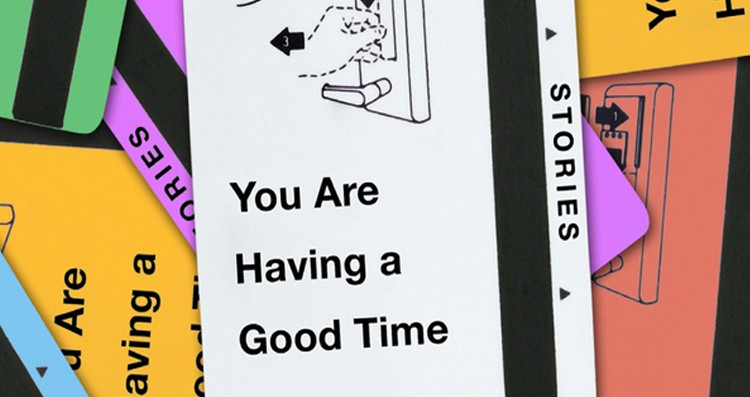
The epigraph to Amie Barrodale’s new collection, You Are Having a Good Time, reads, “There are only two things. There is a successful miscommunication, and an unsuccessful miscommunication.” Barrodale’s tales are witty, but they can also be lumbering. Her unusual characters are in odd stories that are sometimes difficult to connect with. Barrodale keeps the reader at a distance, and off-kilter. At times, this works as a way to give a quality of observation to her stories, as in the award-winning “William Wei,” where we see a man living in his apartment, repeating actions until a mysterious woman takes him away. But as You Are Having a Good Time unfolds, Barrodale’s opacity becomes harder to parse. Are we to sympathize with these characters? Hate them? Often, observation becomes the only thing: They are fish in the tank and we are the ones watching from outside the glass.
The many strengths of Barrodale’s work include the way she artfully engages characters in miscommunicative dialogue. This is done brilliantly, particularly in light of the opening quote. Characters don’t listen to each other, and what they say out of distraction reveals a lot. In “William Wei,” the woman “often induced men to love her and then abandoned them. She said [to William], ‘Didn’t you notice how I forced this on you?’ [William] said ‘I don’t know what you mean,’ and she said ‘Yeah, that’s what I’m telling you.’” In addition to the creation of these beautiful missed opportunities, Barrodale’s reality is one where characters often realize the truth of a situation after they’ve walked away. Whether they’re understanding someone’s true intention, or what they missed, or when a relationship truly ends, Barrodale uses the pacing of her scenes to create tension, and then release it in unusual, provocative ways. Often, the way Barrodale ends a story is as original and fresh as her characterization of these hyper-focused characters.
Barrodale uses the pacing of her scenes to create tension, and then release it in unusual, provocative ways.
Characters in Barrodale’s stories are profoundly affected by addiction — to substances and strange behaviors. Jealousy, obsession, and even meditation are so acutely drawn that they haunt characters like ghosts. In “The Imp,” a story about a man who suspects his wife of having an affair, the man says, “By this time, I had hope. Maybe, I thought, maybe it will all work out. Maybe it’s true what she says — hadn’t I been acting strangely? Wasn’t jealousy another word for possession?” Barrodale understands how someone can be haunted by the spirit of obsession as much as a spectre. Superficiality reigns. In “Animals,” an actress is praised for being an ingénue, and then dumped as easily as she’s taken up. “Frank Advice for Fat Women” details a therapist’s obsession with both a young client and her mother. In each case, Barrodale shows us how obsessions hide dark, shameful traits, and how most people find it difficult to really look in the mirror.
You Are Having a Good Time examines the idea of art and creation in two of its latter stories, “The Commission” and “Mynahs.” In both, Barrodale seems to be saying that there’s an obsessive nature to what we create, as well, and a desire to try to control it after it goes out into the world. Mr. Tatsusuke, the creator of delicate pieces sold by a character in “The Commission,” wants his art to be in many hands.
He spent a lot of time with me personally, talking about the importance of touch. He said that a piece is beautified by being handled by all different sorts of hands, and he asked that I please place his work out, so people could touch it.
It’s easy to read Mr. Tatsuke’s theories as Barrodale’s own, and the jewelry he creates as an analogue to her stories. This is a beautiful idea, when we consider the story. As E.L. Doctorow theorized, the reader animates the text with his or her own experiences. Barrodale’s story recalls that idea. In “Mynahs,” Barrodale examines how plagiarism in the writing community can hurt the originator of an idea, but is often accomplished with little consequence. Though writing about writing (and workshops) can be difficult to sustain, Barrodale writes frustration well. If there is an element that unifies her characters, it is the impotent frustration they feel for trying to make others see what they want. Though she sometimes fails to make her characters elicit deep emotion, they are written in such a way that they present these frustrations as simple fact.
Barrodale’s style in the stories of You Are Having a Good Time is sparse. Sparse can work, but every once in a while her characters’ actions seem empty or methodical, devoid of purpose. The subtext is either missing or too difficult to discern through the staccato of her syntax. This is not an even collection, and as it progresses, it becomes more distant and difficult. Yet is that the way with most people? Perhaps Barrodale would have us believe it were so.
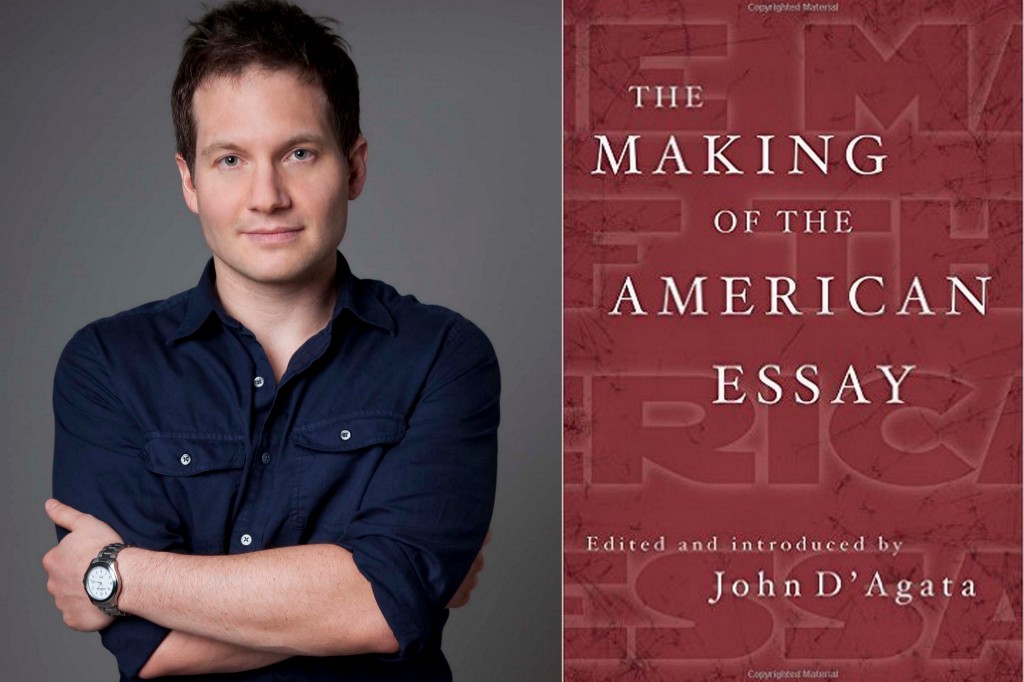
John D’Agata’s lyric essays — and his defense of the essay as art form — have been at the center of an ongoing discussion on the roles of fact and truth in the literary arts. His newest anthology, The Making of the American Essay, the third in a series, has sparked even more debate over the very definition of essay, what falls under the category, and the significance of — and suspicion of and resistance to — artistic invention. D’Agata has generously responded to a few of my questions on these topics, as well as on genre, lies, punishment, pleasure, and social media.
— Susan Steinberg
Susan Steinberg: I often try to explain what you mean when you speak of the essay as different from nonfiction — when you refer to the act of “essaying.” You described this to me a few years ago, and I was listening to you, but I since have become unable to articulate what you said. I tend to land on “it’s about the process, not the product,” but I find myself saying that about most things. Can you repeat what the essay, to you, is? Or does?
John D’Agata: I like to think of the essay as an art form that tracks the evolution of consciousness as it rolls over the folds of a new idea, memory, or emotion. What I’ve always appreciated about the essay is the feeling that it gives me that it’s capturing that activity of human thought in real time. I think that feeling is what we all respond to in essays: the sense of intimacy that essays give us when we’re made to feel privy to another human being’s thought process. Our minds might be the only truly private spaces that any of us possesses, so to be given access to another person’s mind in an essay can feel wonderfully thrilling. I think that’s why Michel de Montaigne used that Middle French word to describe this literary form in the 16th century: essai. It means “to test, to attempt, to experiment.” The essay celebrates what makes us human because it celebrates thinking. It doesn’t celebrate polemics or fact-checking or whatever else our high school teachers turned it into. It celebrates the art of consideration.
Steinberg: Your anthologies are comprised of writings that some might argue aren’t essays. I argued, in fact, that my story was a story and not an essay, when you first got in touch with me about including it in your most recent anthology. I wanted to defend it as a fiction, in large part because I didn’t want to misrepresent the piece or myself; my concerns were of both a personal and a professional nature, and I now suppose they were somewhat fear-based. So my question is: have other writers or editors challenged your categorizing of the work you select, and what do you make of the attempts to maintain these genre distinctions?
D’Agata: The first anthology in the series, The Next American Essay, includes a short story by Susan Sontag entitled “Unguided Tour,” and suffice it to say, she wasn’t happy with my decision to include her story in the book. Just before the book came out I got an earful from her in a letter that knocked me sideways. She insisted that her story was a story and that it shouldn’t be interpreted as anything else. Unfortunately, the book was already in production by the time she sent that letter, so all I could do was write to her and try to explain why I’d decided to include her story, which is the same reason why I’ve decided to use a good number of other texts throughout this series of anthologies that are actually stories or poems. It’s not to reclaim them as essays, but it’s instead to try to think about essays from a different angle.
When a chapter from Herman Melville’s Moby-Dick appears in The Making of the American Essay, it shows up in the midst of a bunch of essays that have long been celebrated as essays — texts by Emerson, Thoreau, Mark Twain, etc. And so at this point in the anthology we’ve got essays on the brain. We’ve started noticing patterns in those texts, a kind of “essayistic” sensibility that’s recognizable no matter what sort of subject matter it’s applied to. But then: Moby-Dick shows up, and we’re probably thrown off our guard. What I hope, however, is that we are reading this anthology with an open mind and that we are willing to go along with that text’s inclusion for at least a moment, and thus that we are willing to temporarily imagine that that chapter from Moby-Dick is indeed an essay.
So say we do that. Say we read that piece of Moby-Dick in the context of all of those other essays that surround it in the anthology. Does that section of Moby-Dick read differently? Do we see anything in it that’s similar to the other texts around it? Can we recognize the same essayistic movements in Melville that we’ve been noticing throughout the rest of the anthology? And, if we can, then what does that mean? Does it change our perception of Moby-Dick? Does it change our perception of the essay?
What is an essay, after all, if we can see it working as a propulsive force in fiction or poetry? Can we call the essay its own genre if it’s so promiscuously versatile? Can we call any genre a “genre” if, when we read it from different angles and under different shades of light, the differences between it and something else start becoming indistinguishable? If our perception of a text can so easily change the moment that text is placed in a different context — an essay collection one day, a poetry collection the next — is it possible that the borders between genres are not the towering blockades that some people fiercely defend them as?
When The Next American Essay came out, I sent a copy of the book to Ms. Sontag along with my sheepishly argumentative letter, and she replied with a postcard that basically said “Okay. I sort of see what you’re trying to do. Signed, Susan Sontag.” I took it as a compliment.
Steinberg: If memory is unreliable, perspective is subjective, and emotion is unfixed, then what is the function and/or responsibility of “fact” in essays? I ask because I’m curious about your relationship to fact, but I’m also curious about your thoughts on readers’ fixations on the notion of truth. If a misconception about essay writers is that they’re truth-tellers, then do they often run the risk of disappointing the reader? How can essay writers confront or undo what seems to be an impossible-to-fulfill expectation?
D’Agata: Facts are akin to images, for me. That probably strikes some as a perverse statement, but I say it as someone who turns to essays for literary experiences only, and for that reason, when I’m reading I don’t need facts to do much more than resonate with the rest of the story that’s being told.
But that’s not the case with every reader, of course. We’re all looking for different things and have different expectations when we read. Yet for that very reason we do a disservice to both the essay and its readership by suggesting that everything that falls beneath the umbrella of “nonfiction” ought to be written by the same rules and for the same audience. There are some nonfiction books that traffic primarily in facts, by which I mean that we value them for the facts and information that they introduce to us and the ways in which they organize them. And those books are great. I’m a rabid reader of history and science, for instance, and I turn to those genres because I want the information that their dustjackets proffer: A Story about X and How It Changed the World. And while I appreciate those books being well written and am always down for great storytelling, I’m not necessarily expecting that from those books or looking for that when I read them. When I read a memoir, on the other hand, I’m hoping to bear witness to an exhilaratingly expressive voice and am therefore expecting a completely different literary experience. I don’t care about the facts in that case; I care about the story.
Writers can help the issue by not insisting that everyone else write their “nonfiction” the same way they do.
Writers can help the issue by not insisting that everyone else write their “nonfiction” the same way they do. When my book The Lifespan of a Fact came out and started ruffling some feathers, there were a lot of famous writers who went out of their way to distance themselves from the book by denouncing it in self-serving ways. Some wrote op-ed letters or spoke up at writing conferences or Tweeted vigorously in order to declare that they would never do what I was advocating in the book. And I get that. Or, I mean I kind of get that. On some level I understand where that was coming from because the book was openly discussing a taboo subject in the nonfiction world, and it’s hard to cleanse yourself of that kind of taint once it gets on you. So distancing yourself as much as possible makes sense.
Yet on the other hand, aren’t we artists?Isn’t one of the duties of art to explore the outer reaches of our media, to go to places that our culture says are off-limits? It seems a little cowardly — or at least ungenerous — to attack someone just because they make their art in ways you do not want to make yours.
Steinberg: Do you feel there’s pleasure associated in punishing the essay writer who has been “caught in a lie”? Is punishing is too strong a word?
D’Agata: “Punishing” is probably too strong a word, as is “pleasure.” Catharsis might be more accurate. I think some people probably feel empowered by attacking writers whom they think have wronged them. Others of course may feel pressured to do it. Oprah’s decision to chastise James Frey was due to the pressure that she felt from her fans after it was revealed that some parts of his very popular memoir — which she helped make popular when she selected it for her book club — had been exaggerated. I think that’s why she decided many years later to apologize to Frey, because she realized that she’d been bullied by popular opinion. I found it interesting that she chose to apologize to him in private, however, rather than on her show.
Of all places, literature and art should be where uncertainty can be explored and is relished and even championed.
So while I’m not sure what is accomplished by “punishing” such a writer, I do understand the cathartic benefits of doing it. Our economy’s wobbly, our security’s being threatened, and who knows what’s happening politically right now? We’re chatting during a season in which the Republican nominee for the next presidential election is spewing inaccuracies on almost a daily basis, and for some reason no one seems able — or willing — to hold him accountable. It’s hard to know what to trust. So it makes sense that a book which presents itself as x yet turns out to be y would frustrate and anger some readers because we’re frustrated up the wazoo with everything else that’s going on. But the problem with getting angry at that kind of instability is that our anger is misdirected. Of all places, literature and art should be where uncertainty can be explored and is relished and even championed. It might make you feel better to tell me that I should kill myself (as someone did after my last book) because you don’t like how I wrote something, but the problem with that reaction is that 1) I’m not going to kill myself, and 2) you’re shutting yourself off from the very literary experience that I’m trying to offer. A lot of my work is about questing certainty, questioning genre, questioning the very assumptions that we make about the world.
Steinberg: What might a “lie” in an essay look like?
D’Agata: For me, a “lie” is something that feels incorrect on the page, which I think is the difference between verifiability and veracity. Something that’s verifiable can be fact-checked beyond the world of the text. But veracity — or truthfulness — speaks to the believability of what’s on the page and what’s going on in the world that has been created by the author. While reading, if I can move through a text without wondering whether or not what I’m reading is “real,” then that text has done its job of capturing the truthfulness of whatever it is that it’s exploring. And that’s what I’m looking for when I’m immersed in a literary experience.
But it’s a whole other story beyond the realm of literature. When I’m reading a news article about the banking industry, or a medical textbook about how to fix my heart, or a set of instructions on building a suspension bridge, I’m not looking for a literary experience. I want every fact in those texts to have been verified multiple times. We do the literary essay a disservice, however, when we expect from it the same kind of verifiability as we would from a medical text book.
Steinberg: As a fiction writer writing first-person narratives, readers ask if I did the things my narrators do. In these moments, which I would argue are often gendered, I know I can exercise the right to hide behind the word “fiction” as a polite way of saying “what difference would it make if I did (or did not).” How do you, as an essay writer, maintain a separation between you (John, the person) and your characters, aesthetic choices, and narratives?
D’Agata: There is a separation. I don’t know how else to say it: there just is one. The history of the essay is a history of personas, and of writers using those slanted versions of themselves to tell bigger stories than themselves so that they can explore bigger themes. Throughout the essay’s history the persona has been the vehicle that has propelled this genre into the stickiest and most evocative places it’s visited.
The persona has been the vehicle that has propelled this genre into the stickiest and most evocative places it’s visited
It’s true, though, that a lot of writers have struggled with the contradiction of writing through themselves but not really of themselves. In the 16th century, Michel de Montaigne wrote extensively about the fabricated self that he was presenting on the page. “I may presently change,” he once wrote, “not only by chance, but also by intention.” In the 18th century, Charles Lamb admitted to “the assumption of a character . . . which gives force and life to writing.” Virginia Woolf struggled too between “Never being yourself and yet always — that is the problem.”
I think of it the way I imagine actors do, which is that while I’m definitely using some portion of myself in order to create a persona, the character that ends up on the page isn’t my full self. My previous book was a collaboration with a fact-checker called The Lifespan of a Fact which tried to address this. It replicated the exchanges that the fact-checker and I had while we were fact-checking one of my essays for a magazine. Because the argument in the book is partially about the “shaping” that’s necessary in all art forms, we recreated some of our exchanges, completely fabricated others, and cast ourselves as two characters that were loosely based on us but were not actually us. And in order to spice up the drama in the book, we each assumed an exaggerated role: he, the poor mistreated intern who’s heroically trying to nail down every fact in the piece; and I, the arrogant and pompous diva who won’t allow anyone to mess with his art.
When the book came out, we gave lots of interviews in which we talked openly about the fabricated nature of the book, and yet some people still insisted on reading those characters as real. Reviewers did it too. I was called a “jerk” by a few very famous publications because the assumption was that I was the “I” that appeared on that page. What this taught me is that even when we’re told otherwise, and even when we know otherwise, we still let the stranglehold of the term “nonfiction” dictate how we read something. We still insist on reading that “I” as a mirror of the author. And so now, in many people’s minds, I am that “jerk” that they read in The Lifespan of a Fact. I’d say this frustrated me if I didn’t find it so fascinating and baffling.
Steinberg: There is no perfect segue into this next question, though I believe it’s connected to much of what you’re saying about persona and reality and how we respond to writing. What are your thoughts/feelings about social media? And what are your thought/feelings, if any, about writing essays in the context of an online culture that’s manufacturing a seemingly endless stream of writings and visual texts many would call “essays”?
D’Agata: I don’t have any social media accounts, and I don’t follow any either. Actually, that’s not true. I follow a couple Instagram accounts of funny celebrities. I don’t consider those essays, though; I just consider them funny. I could imagine an Instagram essay, however — something that mixes image and text in an episodically narrative way for a defined extent of time, like during a trip or a pregnancy or something like that. I’m sure there are such essays already, in fact, but until Chris Pratt writes one I probably won’t encounter any.
But if you’re asking whether I’d call them essays? Yeah, sure. I haven’t seen any yet, but I don’t know why they wouldn’t be considered essays. Even a simple blog that explores the daily activities of someone’s dog can be essayistic. It might not be very good, but that doesn’t mean it’s not essaying the idea of dogness. There’s an awful lot of crappy fiction and poetry out there that’s still called “fiction” and “poetry” even though it’s lazy or derivative or panders to the broadest common denominator of readers. But it still gets to call itself fiction or poetry. Quality can’t be a standard for inclusion in a genre.
Steinberg: I, too, have avoided social media. Several writers have told me this is crazy, whereas others have congratulated me. Both responses seem exaggerated, and both reinforce my decision to stay away from it. I’m wondering why you’ve chosen not to use it.
D’Agata: I’m not sure I have an interesting reason for avoiding social media. I felt a little brutalized on Twitter and Facebook during the broohaha surrounding my Lifespan book, so some of my reasons might be a little transparent. I prefer not to invite other people’s feverish anxieties into my life. But I also just like my privacy, so I’m not really a great candidate for platforms that encourage users to share their every thought with the world . . . and every meal, workout, vacation photo . . .
Steinberg: At the end of The Making of the American Essay, you have included a note on the title in which you elaborate some on the word “making.” I confess that before I read this note, I was going to ask why you chose this particular word. But instead I’m going to ask what you think could be the “unmaking” of the American essay.
D’Agata: Not letting the essay essay, not letting it grow and explore and change as a genre. That’s what could be its unmaking: not letting the essay essay.
About the Interviewer
Susan Steinberg is the author of two story collections. The most recent is Spectacle, from Graywolf. Her work has appeared in McSweeney’s, Conjunctions, American Short Fiction, and elsewhere. She has held residencies at the MacDowell Colony and Yaddo, and teaches at the University of San Francisco.
American culture has embraced certain summer behaviors. Post Memorial Day, we eat ice cream, grill outdoors, watch fireworks, and read vacuous and/or suspenseful books at the beach. Beach reads are meant to be easy reading. They’re mysteries, family vacation dramas, and tales of single gals looking for love and success in the big City. (In winter, many beach reads are more derisively called chick-lit.) The idea that we all want to flop on the beach and read the literary equivalent of reality TV stems from a history of inexpensive popular literature (see: the rise of cheap post-WWII paperbacks) and has been exacerbated by our unhealthy desire to label certain actions as “guilty pleasures.” At the beach, Amazon suggests with its list of flashy covers, you’re allowed to read the books you secretly want to read all year.
What about those of us who believe that lying prostrate on a beach towel is the perfect time to engage our minds? Is there a literary beach read?
Well, there are literary books that embrace at least one of the most common qualities of a beach read: they take place at the beach. (In fact, if your book takes place at the beach and is labeled as any genre other than literary fiction, you’re pretty much headed straight to the beach reads table.)
Flaubert’s Madam Bovary nailed the appeal of the beach for a tired mind when she said, “Doesn’t it seem to you that the mind moves more freely in the presence of that boundless expanse, that the sight of it elevates the soul and gives rise to thoughts of the infinite and the ideal?” The ocean, in literature or in life, is mind-expanding, relaxing, and meditative.
Here then is a list that aims to transport and engage: 11 works of literary fiction that take place, in some integral part, at the beach.
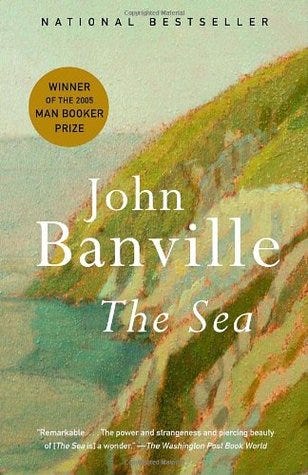
1. The Sea
by John Banville
Max Morden retreats to Ballyless, a fictional town on the Irish coast, after his wife Anna dies from cancer. Max doesn’t choose this spot randomly; he spent his childhood vacations in Ballyless and the place, imbued with history and nostalgia, becomes the catalyst for our deep dive into Max’s pensive state of mind. John Banville might be physically incapable of writing the type of sentences necessary for a “beach read” —even his mysteries under the pseudonym Benjamin Black are densely worded — but it would be hard to find a beach with a stronger pull. Ballyless mirrors Max’s state of mind: it’s dark and moody, with raging tides and rocky cliffs. So while Banville’s Booker Prize-winning novel is not a classic “beautiful beach,” it will make whatever beach you’re on more appealing.
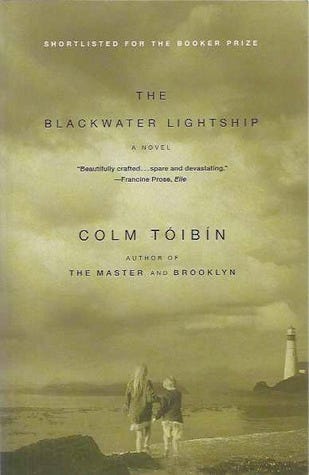
This quiet yet potent novel is set in Tóibín’s childhood home of County Wexford, Ireland. The book centers on a woman named Helen after she learns that her brother Declan is gay — still a taboo and a mostly unwelcome prospect in 1990s Ireland —and dying from AIDS. Declan asks her to break the news to their mother, with whom Helen is estranged, so Helen and Declan retreat to their grandmother’s house with the task. The wild coast near the house is a force to be reckoned with: when the group goes for a swim, it’s a dare-you-to-go-past-your-knees hopscotch through the freezing surf, and you commend them for their bravery, in this small act and others.
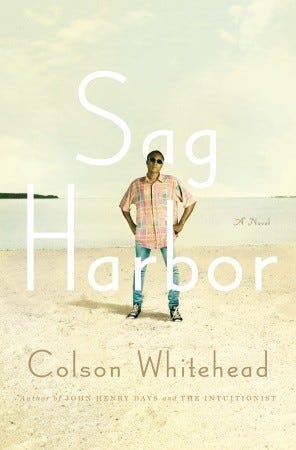
3. Sag Harbor
by Colson Whitehead
This coming of age story of 15-year-old Benji is both familiar (he’s concerned with music, girls, clothes) and unique; it’s 1985 and Benji’s family is part of a small, moneyed set of African Americans who own beach houses in the exclusive Hamptons enclave of Sag Harbor. The novel works on both levels, melding the Dandelion Wine-like meanderings of a teenager in summer with the ramifications of being a black boy in a white man’s territory.
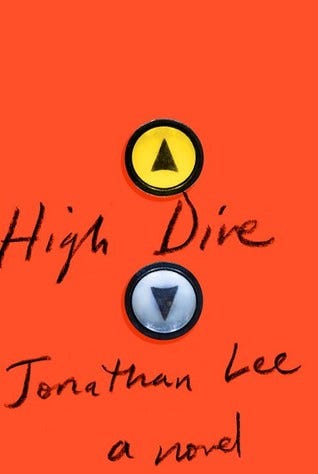
4. High Dive
by Jonathan Lee
High Dive introduces us to Brighton, but not from the point of view of the pale sunbathers who dot the boardwalk and beaches. Instead we get an insider’s look at the industry which caters to the vacationers, and specifically the staff of the the Grand Hotel in the run-up to the 1984 Conservative Party Conference. High Dive is written around a historical event and the novel’s tension comes from already knowing the ending — a member of the Irish Republican Army planted a bomb that killed two men and three women, though missed its target, PM Margaret Thatcher — but much of its allure comes from spending time with the staff of the hotel.
5. The Stranger
by Albert Camus
Even if you haven’t read this novel since high school, you probably remember the beach scene. A quick recap: Meursault, the protagonist, is walking on the beach after a confrontation between himself, his friend Raymond, and the character known as the Arab. Under the piercing North African sun, Meursault becomes hot to the point of being deranged. Though Meursault deescalated an episode of violence earlier in the day, when he encounters the Arab again, he shoots him. And shoots. The reason for Meursault’s overreaction (racism? nihilism? sunstroke?) is something to be meditated on at the end of the book, but in the meantime, Camus’ depiction of heat will make you squirm. Maybe best to bring this one to the pool.
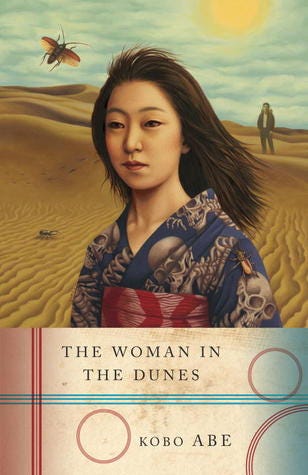
6. The Woman in the Dunes
by Kobo Abe
If you’re dedicated to the idea of sand as that pleasant, pillowly pile of grains that you sit on while you watch the ocean, you might not want to read this existential novel from Kobo Abe. The Woman in the Dunes is the fable-like story of a school teacher named Jumpei Niki who visits a fishing village to collect insects. When he misses his bus home, the villagers offer him a house in the dunes to stay the night. In the morning, the man discovers that the villagers have taken away the rope ladder which was the only means of leaving the house, and now he’s trapped there alongside a young woman. Together they must shovel out the encroaching sand in a Sisyphusian task that the villagers won’t let them escape.
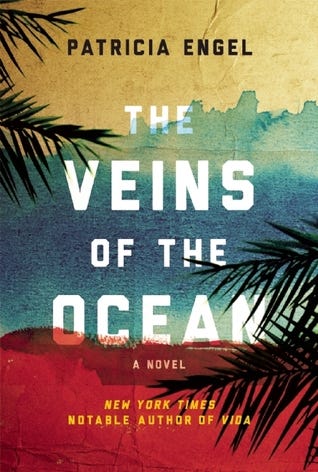
7. The Veins of the Ocean
by Patricia Engel
This novel doesn’t take place on one beach, but many, landing in Havana, Miami, Cartagena, and the Florida Keys. Like a good beach read, Engel’s language is rich, evocative, and easily transports you to another place. But beautiful settings don’t protect against violence — look at Marquez’s short story “The Most Handsome Drowned Man in the World” — and here the beauty of Reina Castillo’s surroundings heightens the brutality of the men around her.
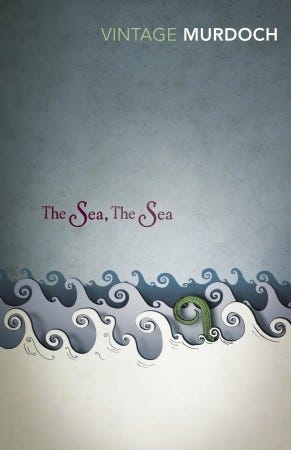
8. The Sea, The Sea
by Iris Murdoch
If you read enough books you start to believe that Britain’s shores aren’t just lined with seashells but with nostalgic, misanthropic old men. The Sea, The Sea is no exception. In Murdoch’s novel, Charles Arrowby, a successful and egotistical director-playwrite, leaves London to seclude himself away in a house by the sea and mull over his life, love, and career.
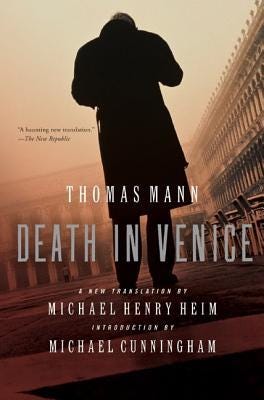
9. Death in Venice
by Thomas Mann
Mann’s novella takes place on the beaches of Lido, one of the many islands in the Venetian lagoon. Gustav von Eschenbach, a well-regarded German writer, goes to Lido for a holiday and quickly falls into the trap that literature has set for successful older men at the beach: he becomes pensive, sour, and nostalgic for his youth. Eschenbach’s problems manifest after he sees a strikingly beautiful young boy at at his hotel. The narrator’s infatuation with the boy grows into obsession as a cholera epidemic rages through the city.
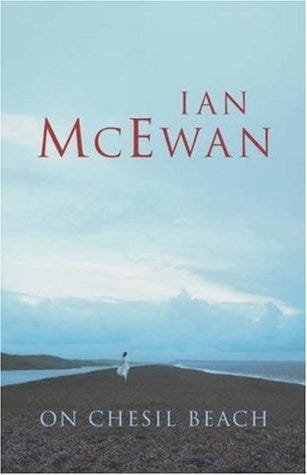
10. On Chesil Beach
by Ian McEwan
In other hands, McEwan’s novel could have been a true beach read. Consider the setup: it’s July 1962, and Edward Mayhew and Florence Ponting are spending their honeymoon in a small hotel right on the Dorset coast. What follows could be a work of romantic historical fiction or even a book with a Harlequin twist (Florence shuns Edward for the hunky bell boy, shirts are ripped.) Instead McEwan plumbs the dark depths of a new marriage between two people who are not on the same page emotionally, socioeconomically, or sexually.
11. Claire of the Sea Light
by Edwidge Danticat
Claire of the Sea Light takes place in the fictional seaside town of Ville Rose, Haiti. The novel is woven from the interconnected tales of the town’s residents after Claire, a young girl, disappears. Each character offers a new glimpse into the town’s troubles with class, corruption, and violence.
It didn’t seem right that Belgian snow stuck to my boots and turned to gray muck in the gutters just like it did back home in Idaho. The winding streets crammed with squat brick buildings were disorienting, but when I brushed my fingertips along the bricks, they scratched the same. I touched the buildings to ground myself, trying to shake this sensation of what the hell am I doing here? although I didn’t use words like hell, except when reciting Bible passages.
Strangers’ mouths puffed the same steam, but made unintelligible sounds of ooo-voo-too. Even I was alien to myself, dressed in a skirt and a nametag introducing me as Sister Wells.
Sometimes I “accidentally” let my long hair cover this tag; I hated having strangers know my name. But at least I knew where I was: Charleroi, Belgium — the world’s ugliest city, according to the Internet. On my first day there, a dreary Thursday in December of 2003, I did not disagree.
And I knew who I was: a twenty-one-year-old virgin who didn’t drink alcohol or caffeinated beverages, avoided R-rated movies and cigarettes, and paid 10 percent of my income to the Church of Jesus Christ of Latter-day Saints. My blonde hair and sturdy body were an inheritance from ancestors who hauled handcarts across the plains. In the midst of my homesick anxiety and culture shock, the story I kept telling myself was grounded in Mormonism.
In the midst of my homesick anxiety and culture shock, the story I kept telling myself was grounded in Mormonism.
Like most sister missionaries, I had attended three hours of church on Sundays for my whole life, an hour of seminary every day in high school, and three years of gospel study classes at Brigham Young University. So I spent my brief time at the Missionary Training Center focused on learning French and techniques for starting conversations with strangers. I was terrified; how could I take all my doctrinal knowledge and personal experience, put it in the palm of my hand, and offer it to a stranger?
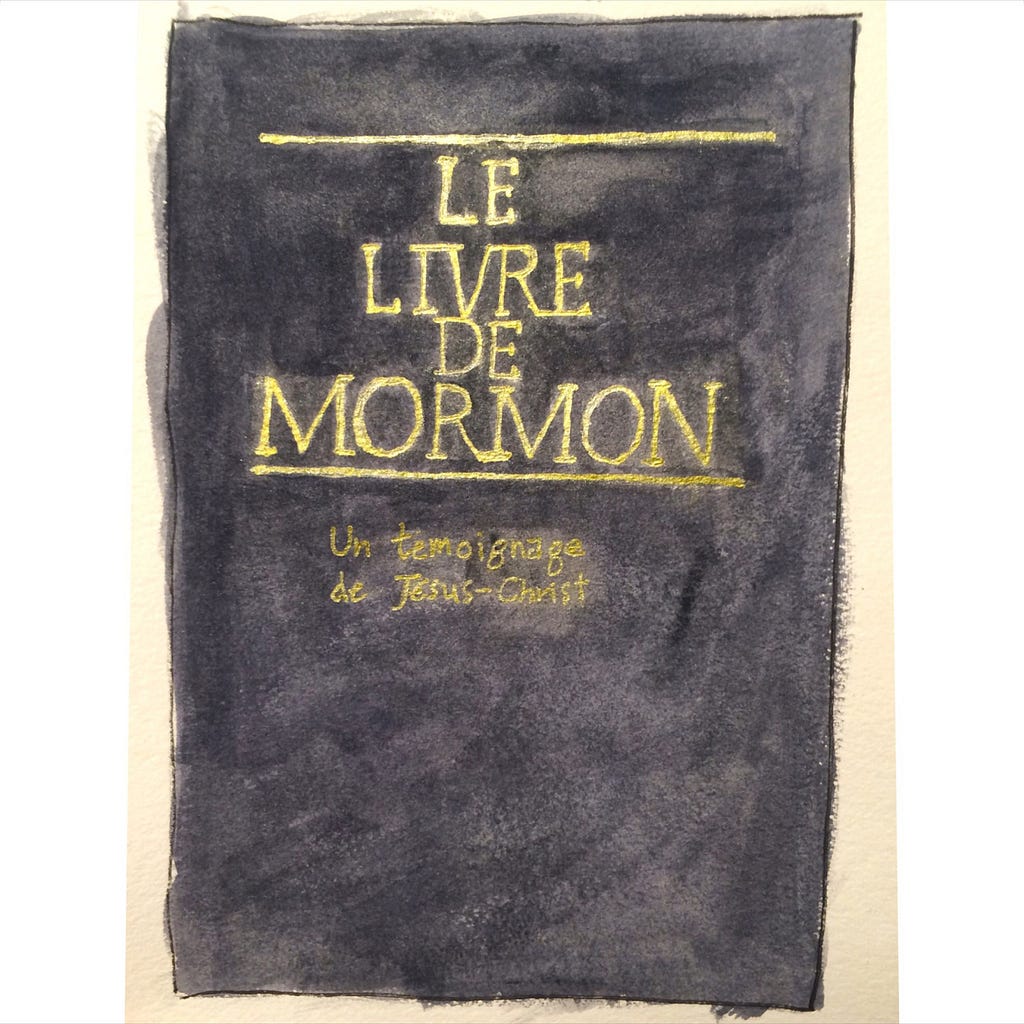
My first try was on the flight to Brussels. I sat next to a professional snowboarder from Germany who asked about my name tag. He looked less than thrilled when I whipped out my blue paperback copy of the Book of Mormon and put on my friendliest tour-guide voice.
“You probably know us as Mormons, but that’s just a nickname. We are the Church of Jesus Christ of Latter-day Saints, and the Book of Mormon is another testament of Jesus Christ.”
He didn’t react. I plowed ahead. “This book begins with a family living in Jerusalem in 600 BC. The father, Lehi, was a righteous man. God warned Lehi that Jerusalem would be destroyed, so Lehi left with his family and sailed to the Americas, where they settled. They’re the forefathers of modern Native Americans.”
I’d grown up next to Fort Hall Reservation and marveled at their oblivion to their incredible heritage. But now, explaining this to a stranger, it occurred to me that none of the Native Americans I knew looked Jewish. I ignored the thought and opened the book, showing him the vivid, detailed illustrations of burly, chiseled men with beards.
Explaining this to a stranger, it occurred to me that none of the Native Americans I knew looked Jewish.
“This new civilization splintered into two groups,” I continued. “The Nephites were the righteous group, because they followed the good son, Nephi. The other group, who followed the wicked brothers, were called Lamanites.”
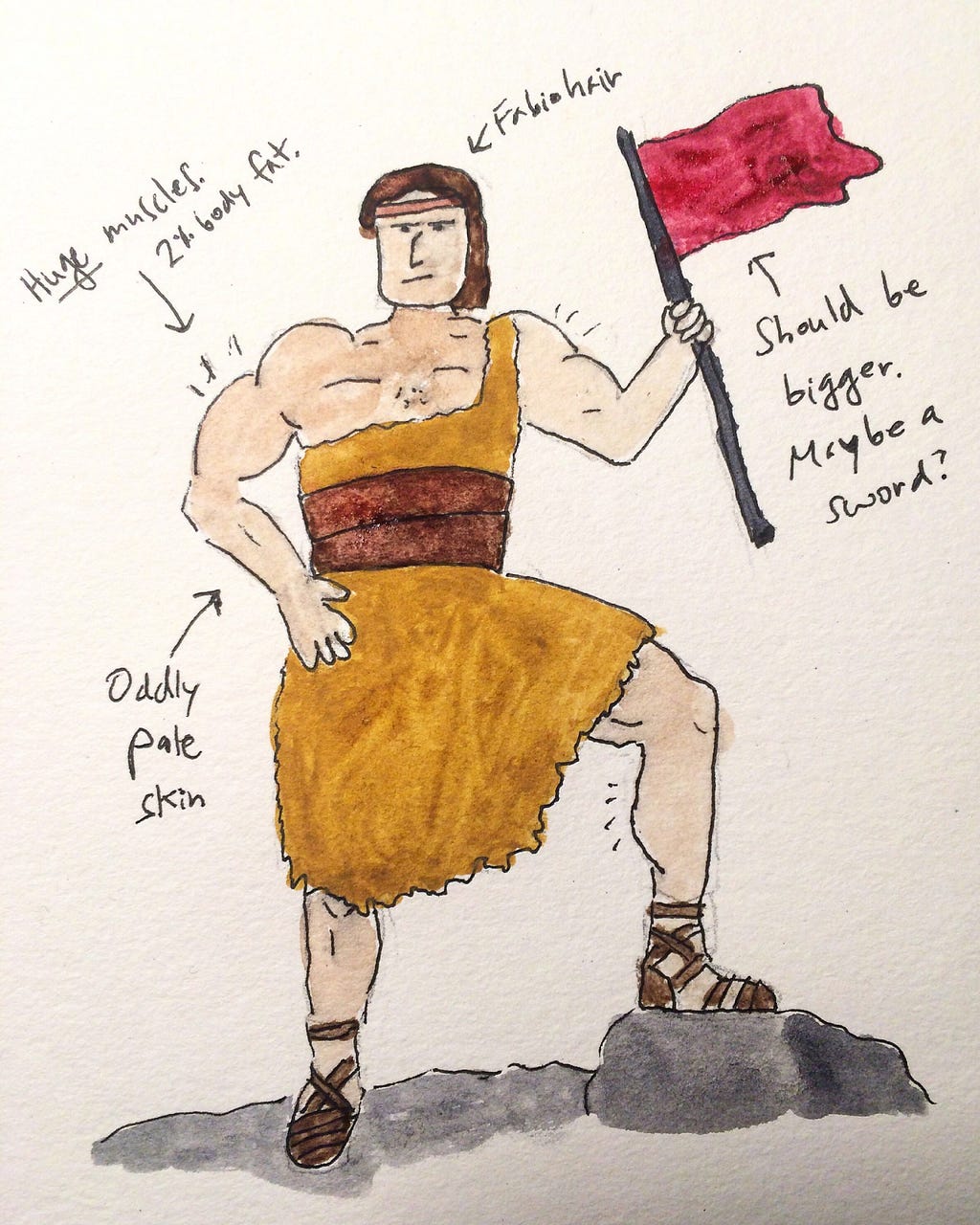
I didn’t mention that until 1981, the Book of Mormon described Nephites as “white and delightsome,” but then “white” had quietly been changed to “pure.” Nor did I tell him how it still said “the skins of the Lamanites were dark” because they were “cursed.” I followed the Prophet’s directions to teach “milk before meat,” although it suddenly felt like I was lying about my religion. I picked up the needle of my thoughts and placed it on a new track. The gospel is true. The gospel is true.
Dr. Jocelyn Elders, the first African American Surgeon General of the US once said, “You can’t be what you don’t see. I didn’t think about being a doctor. I didn’t even think about being a clerk in a store; I’d never seen a black clerk in a clothing store.”
One day in Belgium I saw a billboard advertising a new show, The L Word. We had been knocking on doors all morning, getting rejection after rejection, and my feet, knuckles, and ego were all sore. Standing there on the sidewalk, wearing my conservative outfit and nametag, I gazed up at the seductive pouts and windblown hair of those skinny high-femmes and thought I really want to watch that followed quickly by Ew, gross! What is wrong with you? and a prayer for forgiveness.
Before going on a mission, I went through the temple endowment ceremony and began wearing the garments, or special underwear consisting of a white T-shirt and shorts. Temple rituals are so sacred that no one talks about them except in vague terms, so the ceremony was a surprise — especially when most of it was a movie.
I sat in a small, white-and-gold auditorium with about thirty other templegoers and watched a re-telling of the Garden of Eden story from the Book of Genesis. Onscreen was a passive Eve, a blindly patriarchal Adam, and a God and Jesus with matching beards and sparkly white robes. The film was paused from time to time so we could learn “signs and tokens,” essentially handshakes and passwords, that were required to get into heaven. Everyone put on special clothing over our white temple outfits, including green aprons and white silk togas. Women put on veils and made bowed-head promises to be subservient to our husbands. There was a chanted prayer around an altar.
Temple rituals are so sacred that no one talks about them except in vague terms, so the ceremony was a surprise — especially when most of it was a movie.
The whole experience was surreal and difficult to swallow. I’d concluded years earlier that the Bible’s stories were mythologies for a less sophisticated audience. But here was the Forbidden fruit, two white humans created in a blink, and expulsion from Paradise, all presented as literal.
I waited for the joke to be up — for my mom to take off the veil and shake out her blond hair while everyone laughed, saying, “Don’t be silly! Why would God want us to dress oddly and chant? And of course you can ask questions!” But she didn’t.
The worst part was swearing on my life to never reveal the details of this ceremony. Five generations of my family had been “sealed” together for eternity in temples, and I was terrified of being the weak link. A lifetime of hearing, participating in, and guarding this sacred ritual loomed before me, and my underwear would constantly remind me of it.
I spent several pre-mission summers in central California, living with and working for my father, who was a defense attorney for men on death row. A large part of my duties included proofreading hundreds of pages of briefs and appeals, including detailed social histories and interviews with the inmates. The narratives of these men’s lives were written in a spare, journalistic tone.
As a white, Mormon teenager from a rural town, I’d never heard the terms “systemic racism” or “generational poverty” — not that these phrases were stated explicitly. But reading matter-of-fact narratives acquainted me with the specific horrors of these terms: adult backs still striped with scars from childhood beatings; watching friends and family be gunned down, often by police; young boys placed in institutional correctional homes and witnessing other residents be raped by staff and/or older boys.
The most damning story was about a young black man, whose life story included all of the above. He was accused of a murder in which, judging by the courtroom transcripts, it wasn’t clear who had literally pulled the trigger. This man’s white accomplices got off with a wrist-slap while he was sentenced to die.
This man’s white accomplices got off with a wrist-slap while he was sentenced to die.
In the air-conditioned chill of those sterile offices, a red pen in my hand, my clear-cut worldview of good and evil — of saints and sinners operating in an equal-opportunity society — began to erode. Now when the news reported a crime, I wondered what parts of the story weren’t being told.
In April of 2003, right before my mission, the Prophet Hinckley said, “Each of us has to face the matter — either the Church is true, or it is a fraud. There is no middle ground. It is the Church and kingdom of God, or it is nothing.”
Despite being a voracious reader, I never cracked open a book or visited a website that might have been critical of the Mormon church until I was twenty-five. I’d been home from my mission for two years and was graduating from BYU. Until that point, any time I questioned doctrines (for example, why could only white men hold the priesthood until 1978?) I put the issue aside, on a metaphoric “mental shelf,” confident that someday my concerns would be answered. But after the temple and my mission, this shelf was groaning under the weight.
When I discovered Postmormon.org, an online community of Mormons who had a “faith crisis” and left the church, I spent an entire night reading their exit stories. By morning, my shelf had shattered. I had believed that leaving Mormonism would only lead to misery, depression, and whoring in back alleys for meth before dying alone. I literally couldn’t conjure up the story of leaving and being happy until I read it…and read it again and again and again.
The most helpful therapist I’ve ever had was an interrupter. She would stop me mid-sentence, prod me to consider another point of view and remind me to stop using hyperbolic terms. At first I balked; my opinions and perspective were truth! But as a writer, tinkering with a story is appealing, even my own. So I learned to slow down, examine my viewpoint from different angles, and be conscientious of my word choice. And when my head and tongue re-framed my story, my “truth” shifted.
Writing a first draft is cathartic, sure, but to move beyond that and begin editing, you must view your previous self as a character.
Perhaps this is why memoirists often say the process is therapeutic. Writing a first draft is cathartic, sure, but to move beyond that and begin editing, you must view your previous self as a character. Shifting to this perspective forced me to admit how little authorial control I have on what happened and, all too often, on how life continues to unfold. All I can really control is how I’m telling the story.
The night my faith crumbled, I lost the stories that framed my world. Gone was the war of good and evil, the host of invisible angels and demons fighting over my soul, and the hand of an omnipotent Heavenly Father, watching and waiting to bless or curse me. My eyes burned from reading all night, but the rest of me felt even worse.
The night my faith crumbled, I lost the stories that framed my world.
Under a dim blue sky, I drove and then hiked up to my favorite spot in the foothills overlooking Utah Valley. The sun rose behind me, sparkling on Utah lake and the windows on BYU campus. I felt the dirt beneath my shoes, the pulse of my heartbeat sending blood through my veins, the wind prickling my hair. My underwear was just fabric. Everything I couldn’t touch now felt like a question.
It’s still strange to be around practicing Mormons, especially my family. Their religion is now like a pair of glasses I can take on and off, watching that familiar view of the world go in and out of focus until my eyes ache. Sometimes I catch a glimpse of myself in that lens: an apostate, a lost soul, a quitter who was seduced by the world and couldn’t hold on to the iron rod. But that is their version. I get to write my own.
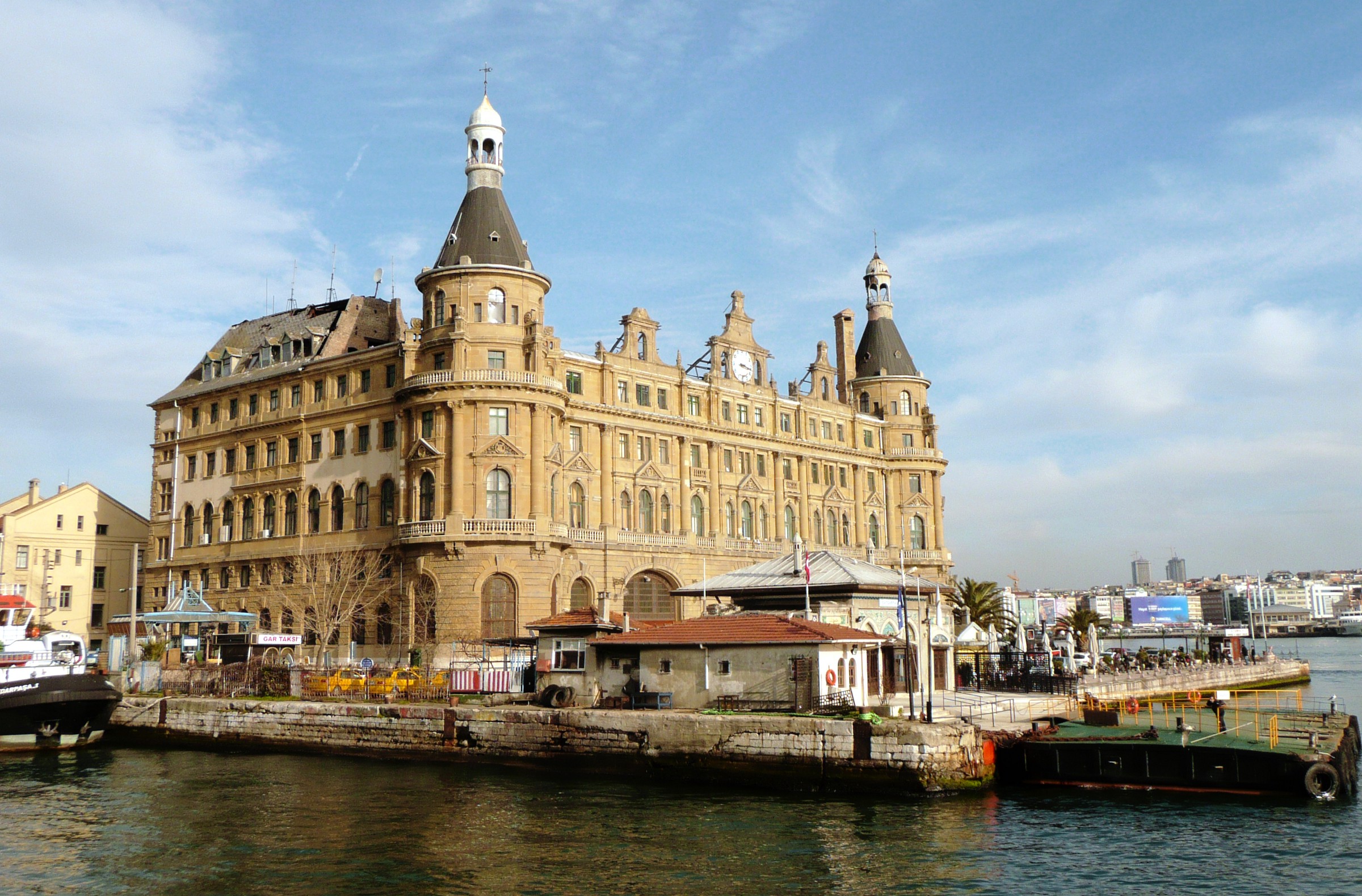
I was seventeen years old when I arrived at Haydar Pasha Station in Istanbul. I got off the train and walked down the marble steps where the Station met the sea. Instead of admiring the Station’s magnificent facade, I stared at the old city across the Bosphorus. I saw Istanbul for the first time then.
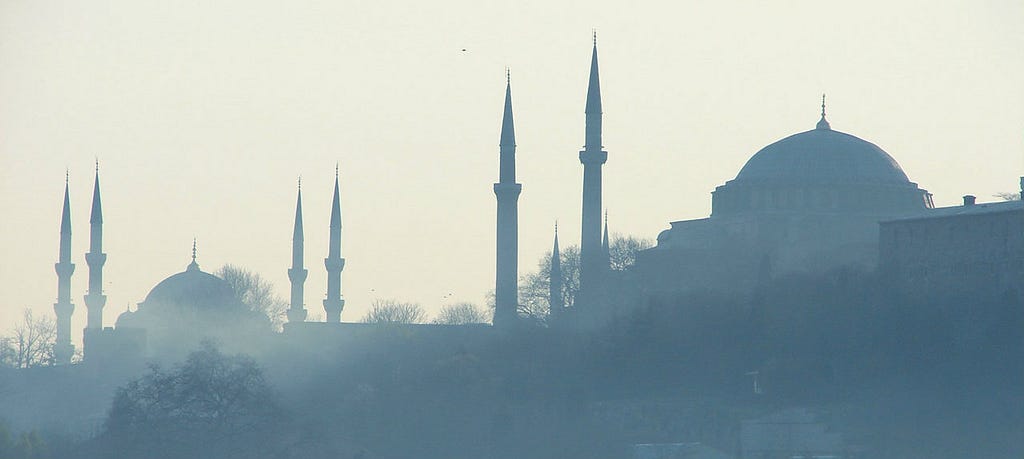
I had taken the Blue Train the night before at eleven o’clocks and reached the last stop at eight in the morning. Haydar Pasha Station was the end of the railway line on the Asian continent. There began the sea, then Europe. I came to Istanbul to study law but I was more excited with the city itself than studying at the university. It was a warm day. I could see historical buildings through a thin fog: the city walls, the roofs of Topkapi Palace, the dome of Hagia Sophia Church and the minarets of the Blue Mosque.
Whenever I recall that moment I think of what Herman Melville wrote about his visit to Istanbul in 1856. It was a few years after the publication of Moby-Dick. He was an unsuccessful writer despite his great books and was still floating from one sea to another. He wrote in his diary:
“The fog lifted from about the skirts of the city. It was a coy disclosure, a kind of coquetting, leaving room for the imagination and heightening the scene.”
I sensed on the first day that Istanbul would always embrace me with a light curtain of fog. Any time I would return to Haydar Pasha after school holidays I would meet Istanbul through that curtain. As the years roll on I now realise that my past has become more distant, the fog of my old days are denser, and the Station’s vivid times are vague.
Istanbul Fog, by Aviad 2001
Haydar Pasha Station was designed as the beginning point of a railway line towards Asia-minor and improved to accommodate the northern terminus of the Baghdad Railway line in 1904. Because of increased traffic, a larger building was needed, and two German architects, Otto Ritter and Helmut Conu, were appointed to carry out the job. They chose a neo-classical style to build the new station. The origin of the Station’s name is not certain but it is assumed that it was given in honor of a high ranking Ottoman officer, Haydar Pasha, who had served to the Sultan Selim III.
It is rather a gate opening to a great city than a mere station. As you come out of it you see a few steps going down to the pier where a ferry takes you to the city. It is the spot where Istanbul and the rest of the country unite. Trains carry people from small towns in the provinces to that picturesque spot by the Bosphorus.
The poetry book of Human Landscapes From My Country by Nazım Hikmet begins there, in front of the Station:
“Haydar Pasha Station,
spring 1941,
3 p.m.
On the steps, sun
fatigue
and confusion.
A man
stops on the steps,
thinking about something.
Thin.
Scared.”
It is not a coincidence that Nazım Hikmet picked Haydar Pasha Station for the opening of his grand book. It is a kind of verse-novel: 17,000 lines describing different people, through whom a whole picture of a country can be seen. Hikmet (1902–1963) is regarded as the greatest poet of modern Turkish literature. He began to write Human Landscapes during the Second World War, while in prison, serving a twenty-eight-year sentence for his communist beliefs. He gave the stories of the people on the train — in its cars, its restaurant, in the locomotive — and talked about their past and their dreams. He used his pen in a cinematographic way and presented the collective memory of a nation, alongside its fears and hopes, in an epic style.
If you are an author in Turkey you are destined to write about Istanbul sooner or later. I have come to that point in my third novel, Istanbul Istanbul. When I was working on it, my mother — my lifelong advisor — asked me what I was writing about. “About Istanbul,” I said. There was a pause on the other end of the telephone line. “The train station,” she said with a tender and confident voice, “you should not forget to mention the train station.” I scanned my mind to recollect what I had been covering in my novel. Writing about Istanbul required plenty of work. I had done my research, taken notes down and formed stories. But on hearing my mother’s words, I realized that I didn’t have a story taking place around Haydar Pasha Station. She, an illiterate Kurdish woman from rural Anatolia, opened a crack in my mind, as she had always done with her fairytales when I was a little child. She had fed me not only with milk but also with stories about rascal jinnies, faraway seas and invisible cities. And now she once again blew her breath into my chest and led me to put some ornaments of her mind into my novel. In Istanbul Istanbul there are some pages, like the opening story of chapter nine, written and designed in line with her wish. It is a story that takes place on the steps of Haydar Pasha Station, where helpless lovers fall in despair and at the same time find a glimpse of light. They are the same steps where Hikmet’s Human Landscapes began.
There are some cities you don’t need to see in order to fall in love with. Istanbul is one of them. I had fallen for her before I arrived at Haydar Pasha Station. I knew her through stories, novels, paintings and songs. But meeting her was not easy for a boy of seventeen like me. The speed, the enormity, the finely tuned chaos of the city was a world away from where I grew up, a small town in the middle of the plains. And the times were not easy for the people of Turkey either. There had been a military coup a couple of years before, in 1980. A heavy atmosphere was hanging over the city. Curfews, prohibitions, tortures, and book burnings were part of daily life. But despite all this, we had dreams in our hearts. We had an imagination of another way of life. We knew Istanbul was not a calm city to live in. The cost of living was high, and there were unemployment, traffic, crime, and intolerance. But it has always left room for the imagination as Herman Melville wrote: “The fog lifted… leaving room for the imagination.”
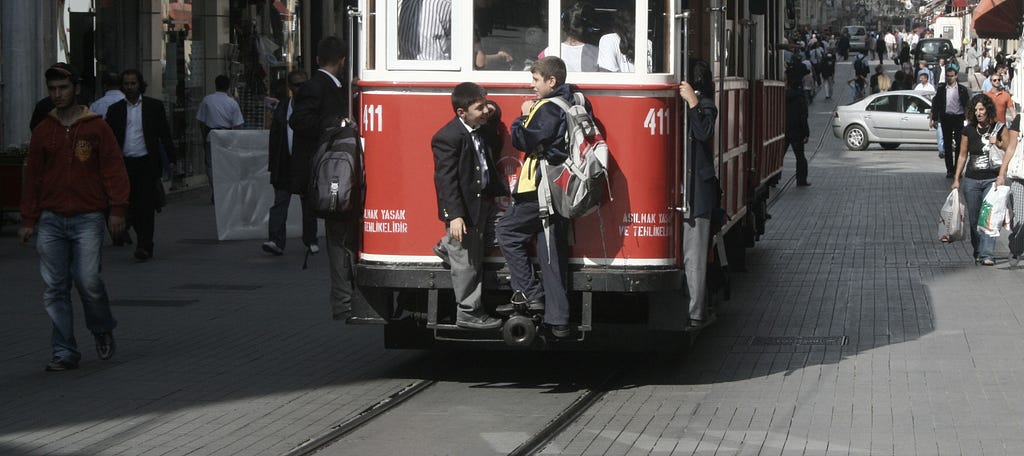
İstiklal Caddesi Tram
In France they say, “All poets are born in the countryside but die in Paris.” Istanbul has the same essence. Our poets and writers pen shady lines or lively scenes and indicate through them where they should be buried. Some acknowledge Istanbul as the junction of historical geographies, the meeting point of East and West. Some see it as a land of desire and mysticism and relate it to past eras. The Turkish poet Yahya Kemal, the short-story writer Sait Faik, and the novelists Ahmet Hamdi Tanpınar and Orhan Pamuk have approached Istanbul from different perspectives. Each of them has created his own city, unlike the others in its literature.
When you are underground there is only one direction that matters: upwards, toward the sky.
In Istanbul Istanbul, I wanted to portray the city as the unification point of time and space and the melting pot of opposing tendencies in life. I preferred not to talk about past golden ages. That approach has already been used up in our literature. In my novel, space and time converge on a prison cell three floors underground. When you are underground there is only one direction that matters: upwards, toward the sky. Time moves differently underground. On the surface, time is linear — past and future eclipse all else, and what matters is less where are you than where you’re going. Underground, past and future mean nothing. There is only the eternal, often agonising, now. By focusing my novel on prisoners in a subterranean cell, discussing the city above, I wanted to unite time and space, hope and hopelessness, darkness and brightness. They are all together and one. Istanbul is the name of that wholeness. Wherever you were born, you come to Istanbul to be part of its wholeness.
Istanbul is too real and at the same time too ambiguous. It makes possible both good and bad. When I was in one of those interrogation cells I felt the underground was the place for evil, while aboveground seemed to be the place for good. But instead of writing about good and evil, I wanted to explore the shades between them and to show how they exchange places.
Istanbul as a metropolis is not only the heart of this country but also the future of it. The beautiful and the ugly in Istanbul reflect the future of our people. That’s why it is now also the heart of our politics.
The Conservative bodies believe in the past. They think the best days are behind us. With passed utopias before their eyes, they don’t hesitate to ruin the present. They are wiping out the city’s green areas and constructing tall buildings. They call it progress. That’s why people feel obliged to defend this city against greediness. And now the word ‘beauty’ is not only an aesthetic word but a political word, too. When people call for beauty in Istanbul, the responses they get are police, tear-gas and the rise of construction firms in the stock market.
And now the word ‘beauty’ is not only an aesthetic word but a political word, too.
In the tales of my childhood there was always a place for heroes to suffer and then emancipate. Istanbul is now the place of both suffering and emancipation in our contemporary writing. We write about Istanbul with the hope that its beauty will shape our future.
After having witnessed two world wars, the invasion of the British army and the exile of Armenian intellectuals, the Haydar Pasha Station met its latest disaster on 28 November 2010, when a fire began on top of the roof. The fire was stopped before it was too late, but following the fire the station was closed down.
It was a suspicious fire. It came about the same time as legal debates were being held regarding Haydar Pasha Station and its surroundings. The government wanted a new development in the area, turning Haydar Pasha’s castle-like building into a fancy hotel. But the public opposed it and the legislative charter for the development was suspended by the court. Various international institutions, like the New York-based World Monument Fund, have added Haydar Pasha to their agenda, emphasising the uncertain future of the railway.
Haydar Pasha solidarity defending the station
Local authorities promised to renew railway lines and resume train journeys again by the end of 2015. But not a single rail line has been renewed so far, nor has there been any sign of reopening the Station. Istanbul dwellers are aware that Haydar Pasha might be another victim of urban gentrification. That’s why they have formed a new civic organization under the name “Haydar Pasha Solidarity” and launched an effort to save the Station, organizing concerts, exhibitions, and demonstrations. They also read out some lines from Human Landscapes, where Nazım Hikmet, many years ago, pointed out the merciless face of urban gentrification, which tears apart past and present:
“Concrete villas.
Lined up all the way to Pendik.
The trees are mere saplings,
the grapevines just greening.
The 3:45 train goes screaming past.
Concrete villas.
The Secretary Pasha’s summer house,
a forty-room marvel,
has been torn down.
Now it’s concrete villas,
concrete villas
all the way to Pendik.”
About the Author
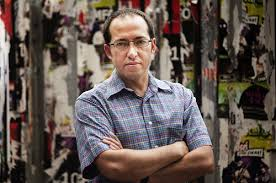
Burhan Sönmez is the author of Istanbul, Istanbul (2015), Sins & Innocents (2011), and North (2009). He was born in Turkey and grew up speaking Turkish and Kurdish. He worked as a lawyer in Istanbul and was a founder of the social-activist culture organisation TAKSAV (Foundation for Social Research, Culture and Art). He has written in various newspapers and magazines on literature, culture and politics. He was seriously injured following an assault by police in Turkey and had to move to Britain to receive treatment with the support of Freedom from Torture in London. He now lives in Cambridge and Istanbul.
DON’T MISS OUT
Sign up for our newsletter to get submission announcements and stay on top of our best work.
YOUR INBOX IS LIT
Enjoy strange, diverting work from The Commuter on Mondays, absorbing fiction from Recommended Reading on Wednesdays, and a roundup of our best work of the week on Fridays. Personalize your subscription preferences here.