Írisz: The Orchids

Translated by Eric M. B. Becker
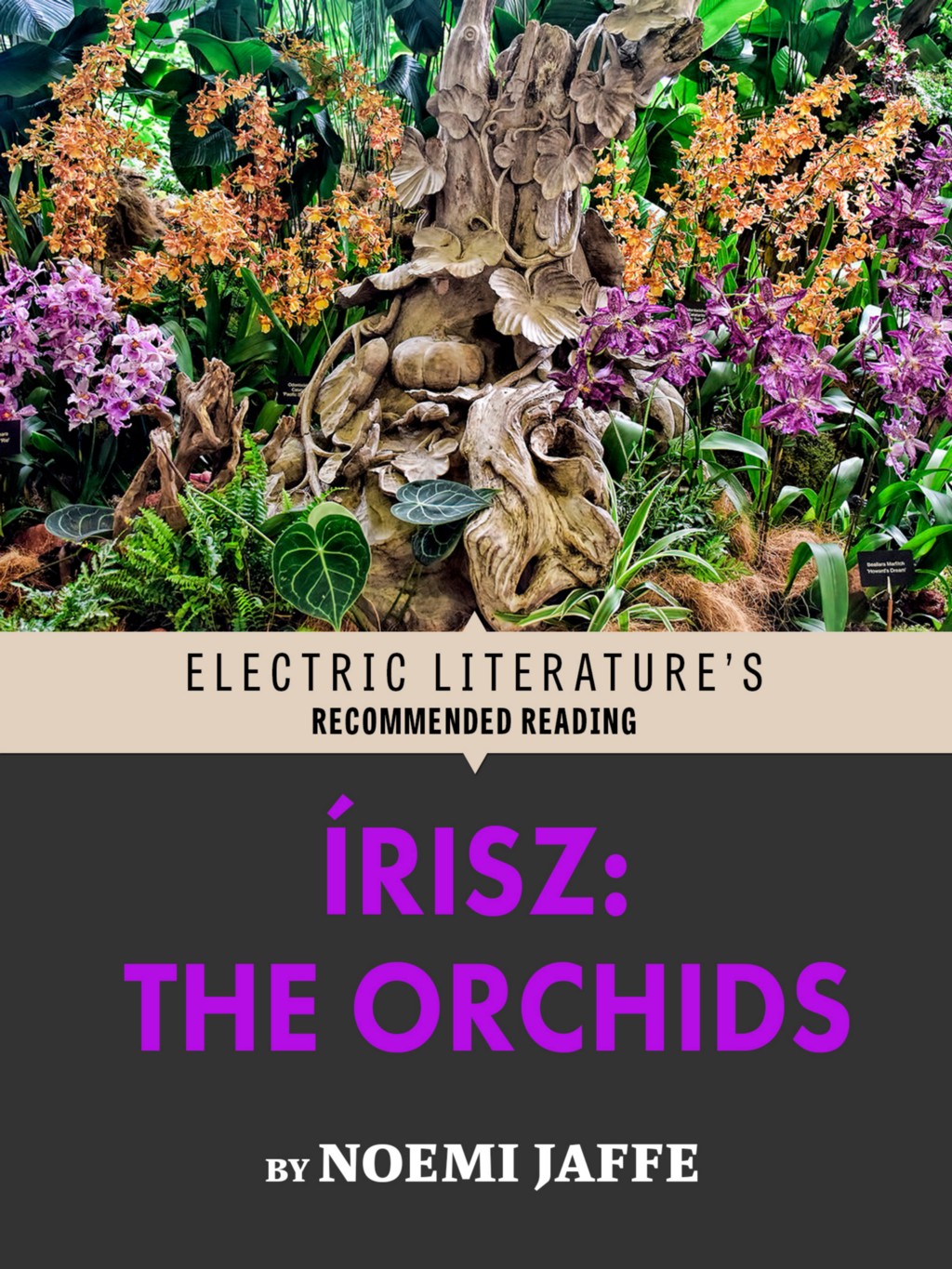
São Paulo Botanical Garden
New Species Report

NAME: Hardingia paranaensis (oncidium paranaensis) LOCATION: Paraná, Brazil
DATE: 1956

Hardingia paranaenses: Stem and floral structure similar to the Oncidium; epiphyte; conspicuous pseudobulbs, bloom sheaths protecting the pseudobulbs, multiple stems; exceptional number of flowers, very tiny; flared lateral sepals. (I looked up the meaning of conspicuous in the dictionary. “Obvious and attracting attention” and also “discernible.” Two contradictory meanings for the same word; people can be discernible even when they’re anything but obvious or conspicuous. But this is the term I read in everyone else’s reports. Conspicuous sounds closer to circumspect than discernible. Martim, I don’t want to use this term anymore to describe orchids. Do you think there’s any reason to say that an orchid is conspicuous? If you like, I can use the word to describe other flowers, the uglier or carnivorous ones. I knew a few easily discernible people in Budapest, and even here at the Garden. You want to know how to say conspicuous in Hungarian? Feltunö)

If Imre is still alive, he’s certainly not free, even if he always said he would be free no matter the situation, whether he’s walking free or locked up. I once read an interview with the writer Graciliano Ramos where he said that to him it made no difference whether he was free or imprisoned. What an idiotic and arrogant idea, to believe that freedom is found within and not wherever you find yourself, the places you’re able to roam. All heroes are like this — they think there’s some merit to being imprisoned in the name of the common good. What difference does it make to the people — a faceless mob who, if you stop to think about it, allow themselves be exploited by whoever screams the loudest — if Imre lays down his life for them or not? What can explain this mania every hero has for putting down roots? If Imre sleeps on a cold floor, goes days without eating, lets himself be tortured by Kádár’s police — how is all that for the good of the people?

I’m dead certain that — unless she’s been killed or raped — the girl who lived in front of our house and stood begging at the corner of Tuzöltö and Telepy is still there in the exact same spot, pleading for food. Vasko’s hardware store was broken into and looted and Vasko himself must have been beaten to death with one of his own wrenches. Or, if he did manage to escape, now he must be all alone with nothing to eat, wandering down some dusty road that leads to Szeged — which is where his mother lives, though I doubt she’s still there, either — with no one along the way to take him in. And all this despite the fact that Imre is in prison.

Imre, wherever you are, free yet imprisoned or imprisoned yet free, on the loose, in a cell, in another woman’s room, in an abandoned house off some back road, in Austria, where you’d never run, because you can’t handle so much as pronouncing the word run (which doesn’t need to be a dirty word; it’s man’s destiny to run and even staying behind, in many cases, is to run away), because for you words always mean only one thing and you can’t see that they really mean many — hear me out, in whatever way you can: with your hands, with your eyes, with your fingers. The word I said to you when you couldn’t decide whether you would come with me or not was szia, that same word I repeated time after time and whose meaning you always pretended was so discernible, but which I saw made you stifle a laugh, that same laugh of yours each time I kissed your fingers, your nose, your earlobes, the hairs on your head, your hip bones, and you felt embarrassed but excited at the same time. Szia is a word that means both “hello” and “goodbye.” I said szia because, in some way that even I didn’t quite understand, I wanted you to help me decide which one I meant. But you didn’t understand then and you don’t understand now; you decided for me that it meant “goodbye” and practically sent me packing. Hear me out, wherever you are, possibly even below ground without so much as a tombstone to mark the spot, the spot where — you used to joke — others would one day inscribe: “For once, he wasn’t late,” because you were always late for everything and I was always on time — that’s why I said szia. I couldn’t wait to decide whether I was going to stay or run away after the tanks rolled in and I saw that you were going to stay until you were imprisoned yet free, something I couldn’t allow to happen, couldn’t bear, and even now can’t agree with. So listen, I think that somehow you can still hear me, if you put your ears to the wind: I’m here, studying orchids in Brazil, at the São Paulo Botanical Garden, at 2:56 in the afternoon on the third of February 1960; I’m writing a report about the Hardingia, a new orchid just discovered in the countryside of a state named Paraná. I’ve even drawn it at the top of this report, so that you can see this epiphyte orchid. Don’t you know what epiphyte means? Bad luck. In Hungarian the word is álélősködő, but you won’t understand this, either.

The lip of this orchid has three lobes. When the pseudobulb dries out, it always forms a fissure lengthwise down the middle of the flower. You won’t be able to see this keel in my sketch. Here in Brazil, orchids don’t dry up, so these fissures don’t appear. Here, everything is in bloom all year. Not like there, where even the hardiest plants struggle to survive, and not just in the bitter cold of winter.

Martim says I see subjectivity in orchids, that I draw comparisons between everything and everything else and pay too much attention to words. And you would say the similar things to me, that I was always picking apart the words you all used, that I wanted to compare desserts to politics, flowers to relationships, my mother to guerrilla warfare. Neither she nor you understands me. I don’t believe that orchids and these other things have feelings or some capacity for sympathy. Nor do I see mysterious relationships between the world beyond and our little world, or think that everything is linked to everything else. Neither of you understand a thing and I’m not sure it’ll do a bit of good if I try to explain anything to you.

But words carry something beyond what they say, in a place that holds their meaning. I feel as if words hold some lost origin. And so, in this stubborn way that you, Martim, and all the others scorn, I’m trying to create a link between what each word once was and its meaning now. It seems that this way words and things might once again hold some greater meaning. With the orchids, I can’t help myself. Each time I say epiphyte or dry vein, I see the orchid as a collection of things in a state of — How can I explain to you? Careful when you hear this word, because here it means something different — in a state of “truth,” and also in a state of (I need to say it slowly) “beauty.” A state of truth and beauty. Don’t run in the other direction, don’t cover your eyes, don’t laugh, because if you do I won’t be able to go on. I’ll start laughing, too, and the two of us will laugh until we both fall over, like when we used to hear some comrade use words so stupid and void of meaning, words like freedom, justice, and equality. But now I’m going to say it, and you need to listen and listen closely: a state of truth and beauty.

This fullness found in orchids, which exists somewhere beyond words, in a state that’s unattainable by any human truth or beauty, makes me think of the empty words and phrases we spoke to each other: I don’t agree; You’re not understanding me; We really do live in different worlds.

These words don’t mean a thing and are only substitutes for what we really want to say, which is: Please, would you just hurry up and stay with me and forget about doing whatever it is that you think you have to do? Because there’s never anything to be done about anything and what you want me to do, in this situation you’ve created, won’t make any difference and only serves your vanity or your pride.

Or: Come with me, Imre.

When I look at myself in the mirror at night, without you watching me from behind — without my getting shy when you glance at me — and pulling away because I only like it when you look at me straight on or when I’m lying on the bed, I see fragments of this vein run dry, this very same orchid, a line that runs the entire length of my body. It begins at my neck, runs down, and passes through my stomach. The pseudobulb is a dense structure, storing water and distributing carbohydrates. You have an endless reservoir of water, which never runs dry even in cases of torture, desertion, failure. I even think you replenish your reserves in such moments; all these things are like fuel for you.

Imre, where do I find the water I came looking for here in Brazil, if all I see each night is this vein run dry?

Each orchid has a triangular base, with varying numbers of petals on top. They only bloom once a year and never last long — between two days and three months. Do you see the flower’s panicles, the ones that look like the folds of the robe from the statue of Anonymous at Budapest’s Vajdahunyad Castle? I love these little wrinkles that lend each flower’s colors infinite tonalities, almost as if the little shadows they create came from within the flower itself. As the daylight changes, the colors transform and move about. Their opacity and radiance also change, according to the light, the wind, and the humidity. A spot that is dark during the day might glow at night, and vice-versa. You can only see one of the flowers in the picture, but a single stem can hold up to 50 blooms, can you believe it? I sometimes count the number of specks on each flower, to see if they keep to some sort of pattern. Sometimes 20, other times 30 or 40, some spread out and others bundled together, so closely they begin to look like a single speck. I like to use the microscope to examine things that Martin hasn’t asked me to observe or which aren’t necessary, such as checking to see if the specks on the petals of each Hardingia are bunched together or spread out. Or to count how many there are in each sepal. Or to examine the flower’s vagina to see to what extent it resembles that of a woman.

I can never get a sense — not even when I peer at the orchids, playing oracle, not even examining them closely and calculating the number of freckles on each sepal in a way that results in combinations both numerical and cosmological — of whether you are alive or dead. And, if alive, whether you’re free yet imprisoned or imprisoned yet free. Or whether you’re in Budapest, in Austria, or in Siberia. I can’t forget you, but I also can’t remember who I am.

You used to say that you would be free in any situation but I don’t believe you’re free in a single one. You used to say that you could do whatever you want and that your will could never be imprisoned, tortured, changed, wounded. I don’t agree. To what extent did you really want what you said you did? I’m not sure if this desire of yours, this will, this drive, this strength was really your own. When someone believes so strongly in their own will, it’s time to ask questions, because will soon begins to take on the appearance of faith. You would say that this is just one more of my pseudo-philosophical musings that seem to question reality but which aren’t good for anything except remarking, “Oh!, it’s amazing how true that seems.” But it was because of one of these musings that I decided to come here; because of the orchids and because of the word szia. All other reasons, those you’d insist on calling real — fear, cowardice, and narcissism — are, in reality, tangential.

Take fear, for example. You feel it, too, even stronger than I do, only with you, it’s hidden beneath what you call “courage” and “ideals.” Cowardice and narcissism, then — well, it’s ridiculous how quickly everything becomes obvious. First off, you know I hate these words as much as you do, though you never showed the least bit of shame at throwing them in my face when I said szia and you couldn’t even be sure if I was saying “hello” or “goodbye,” but thought, in that instant, that my expression told you I was leaving.

So let’s consider for a second who is the bigger coward and narcissist: A coward retreats when it’s time to act. All of you used to say that it was better to be afraid than to be a coward. That if someone there among us lacked the courage to stand up and fight he ought to leave right then and wouldn’t be thought less of (as if that were even true) but no cowards would be tolerated when the time came to fight. If this is the definition of a coward, let’s consider the facts. Who refused to take Shtutsi to the veterinarian when he writhed in agony at home? Who waited for hours for me to arrive while my mother shit herself because he became nauseous at the thought of going upstairs to clean her up? And, worst of all: Who was it who preferred not to know what I meant when I said szia and then immediately turned his back on me, as if he already knew I meant “goodbye,” because, when it comes down to it, that was the most convenient word for you because it meant you could lay your cowardice at my feet? Who is it that always said he had no use for knowing the origins of words, but, whenever it suited him, acted as if they — words — were the only thing that mattered? You, who are so concerned with action, did you ever stop to think that action, the struggle, whatever name you give it, can also be a way of blinding yourself to things while thinking you see it all? You, who are so obsessive you can’t even move a matchstick out of place, because it bothers you, how the hell do you think you’re going to change Hungary? But worst of all, once the Soviets arrived and it became clear that we were going to lose everything, you couldn’t accept that the more cowardly thing to do was to stay — and be complicit. Under the pretense of some useless self-sacrifice, so costly and — to tell the truth — vain, you chose to stay instead of run. Run: this word that is so misunderstood, because, after all, isn’t staying another way of running away? To run is to pass through various states of existence — solid, liquid, gas — to be present for a few instants, while you’re living the moment and not while you’re dressing up life with ideals that aren’t worth a damn thing. And who does this hurt more? The person who believes he’s making some sort of sacrifice and considers himself a hero, or the person who’s been tagged a deserter and will always be thought of as a coward?

Now on to narcissism. Yet another definition you could agree with: a narcissist only thinks of himself and not of the greater good. (What a pathetic definition, have you ever met anyone who didn’t think only about themselves the entire time? And these are the people we can really place our trust in, because whoever says he doesn’t think about himself is lying.) Okay. Ever since we met each other, in Füvészkert, six years ago — when you saw me (actually, I saw you) as I was tending a gingko plant; you smoked while I placed medicine in each of its hollows; you hurled abuse while I sang who- knows-what; you flicked your cigarette into the lake while I looked at you with an expression only I know how to make; you laughed and I laughed, too, and since then I’ve exhausted my stock of funny faces and you yours of curses — since then you’ve always been opposed to my work, to Shtutsie, András, Béla, Károly, my family, and my way of doing things. I would follow you to meetings, to protests, I would hide banners for marches, put up your friends, return home in the early morning without any news from my mother nor her from me, invent codes botanical and linguistic for sneaking across secret messages, put myself at risk and expose myself to danger, be filled with joy at the moment we all thought that everything would finally go as planned. It didn’t go as planned. At a moment like that, when everything goes wrong, the least narcissistic attitude is to admit it: Everything went wrong, it all went wrong, it went wrong, just wrong, wrong. The least narcissistic attitude would have been not to refuse to recognize all those tanks and dead bodies. Not to still say no, there’s still a chance and it’s me — and only me — who still might be able to save someone or something. Me: a single blade of straw in the midst of an inferno.

The Hardingia has dark green leaves, flexible, similar to those of the Baptistonia or the Brasilidium.

Reports show that the Hardingia was recently discovered in a place called Ilha do Mel — the Isle of Honey — in the state of Paraná. There, swarms of male bees are seduced by any flower that resembles in the least a female bee. That must be why so many new species of orchid show up there. This part I made up, but Martim won’t mind, or, if he does, at least I’ll know that he read this report to the end.

We’ve reached close to 1,500 species, found in varied surroundings and stretching from the southern United States to Argentina, from sea level to elevations up to 13,000 feet.

Mama, anyuka, I always wanted to say this to you, but you always seemed as if you weren’t listening or didn’t understand, I’m not sure which: The opinions we form about things and about other people depend on our surroundings. It all depends on our surroundings and our point of view. You could have said I was a terrific student if you took into consideration my performance in my science or Hungarian language classes, but you wanted stellar grades from me in all my classes. Another example: If you looked at my relationship with Béla or the sellers at the market, you might have thought of me as a naïve, outgoing person. But no. To you, I was antisocial, rude, complicated, and difficult, and I only made your life difficult, too, scaring away clients with my questions and blathering on. If you’re still this way now, even though you might not say it because you can no longer speak, you must think to yourself that I’m the one to blame for your illness. Because for you, as for Imre, there’s only one side to every story, and my insistence on seeing more than two sides is a trait of dreamers who lack the courage to face life.

You and Imre, even though you do so in different ways, think you know what life is. You use the word just like that, without the least fuss. For you, life is doing what needs to be done, bearing hardship with your head held high, pretending like everything is alright, paying the bills — all the rest is useless ornament. Put another way, I’m a useless ornament that you, as a result of the misfortune dealt you by fate and by a man, were forced to bear and raise. But if, in the way botanists do with orchids, you could consider things based on their surroundings, then you’d understand my life, and especially my decision to leave, despite the fact that you can no longer understand anything. Among other reasons, this was why I left. I know it sounds strange, but I only managed to leave because I had no way of telling you that I was going. or that, had I been able to, I would have stayed. Is that how I’ve been able to forgive myself? If you could speak, if you could think, you’d find fault with me. You’d say all this is a ridiculous way of forgiving myself for all I’ve done to you, to Imre, to Hungary. But forgiveness is so much more complicated than this and I’m not sure I’m in need of any forgiveness. I’m not sure I did anything wrong. Of course, if I’m asking myself this question, it must mean that I’m not at peace with my decision. But no one is ever entirely at peace with the decisions they make. There’s something sad about always knowing exactly what you want and always being right. So maybe you judge me for what I did, but I can live with your judgment. Plenty of other people also throw me looks, are taken aback, can’t understand. “You left your sick mother all alone?” But I don’t know what the word alone means when no notion of company exists and, besides everything else, you’re being well cared for. “But what if she has bursts of lucidity, if deep down she’s able to understand some things and just can’t express her feelings or speak?” I’m going to have to live with this remote possibility. If you never forgive me for this, I’ll live with that, too.

There are more than 100 species of Epindendrum on Brazilian soil. New species are constantly being registered and it’s likely many others will still be found, especially in the Amazon. It’s one of the genera with the greatest number of species in Brazil — and in the world. The main characteristics that distinguish this genus from other Laelinae are its split bottom lip and the labellum that sticks to the entire length of its column, forming a tube.

Martim, if you’re reading one more of these ridiculous reports, it’s clear that you know I’m going to take the opportunity afforded by the orchid’s split bottom lip to transform it into a metaphor; but, since you already know this and already told me this is much too obvious, I’m going to be really childish. Everything is metaphor, save for dogs. Had Shtutsie been alive, he would have the only one capable of making me think twice about staying or leaving.

Anyu, I know that you love and that you need me — or needed me, to be more precise. You need me as an excuse to hate your life, so you could blame someone for everything bad that happened to you. Someone to buy food and the utensils you needed to cook — this was what you loved most — , someone to be wrong all the time, mixing up errands, appointment times, money, bank notes, words. I also know that if I weren’t to blame for all this, if I hadn’t been this terrible inconvenience, then you’d really be desperate and would never manage to love me in this bizarre way of yours. If I were with Rosza or László, who you always compared me to, then you’d have no one to blame and then your hate for me would be real. But at the end of every day, as we sat next to each other, finishing the rest of a cake and drinking tea, then I was able to feel your love. Every now and then, we’d remember songs from your childhood, which later became the songs of mine: Spotted cow, spotted cow, without ears or tail, we’re off to live where milk’s a-plenty and Come in, come in, little green branch, little green leaf, the golden gate’s wide open, walk right through, walk right through, the cat got stuck but he won’t harm you. Much later, Rezsö Seress and László Jávor sang “Vége a világnak” on the radio and you sang along, as though it were a song about your life:

One sad Sunday, with a hundred flowers of white, I waited for you, my love, with a prayer at the church, that Sunday morning chasing dreams, now sorrow’s come home without you, and ever since Sundays are always sad, I have tears to drink and sorrows to eat, oh sad Sunday, this one last Sunday, won’t you please come, my love, there will be a priest, a casket, an altar and a drape, even flowers waiting there for you, flowers, a casket and beneath the trees’ green leaves, this journey shall be my last, my eyes wide open to see you one last time, don’t be afraid of them, for I wish you all the best, even at the hour of my death, this one last Sunday.

Later, Billie Holiday recorded this very same song and she became famous the world over. In English, the tragic side of the song was played down, because after all the United States is not Hungary and neither is Brazil. That’s one reason why I like it here. I always felt a little bit afraid of this song, but I understood why you liked it and, in the odd moment of detente, I would ask you about my father, about the past. But when you felt you let too much slip, you immediately scolded yourself and clammed up. “Shh, shht, Írisz, there’s nothing to say. The past is past.”

But even having come all the way here, I can’t manage to let go of the past. Perhaps I’ll manage to forget the present, all that’s happening now with you, with Imre, and with myself, since there’s nothing to remember about my father. I have gaps I can never fill and that reach into every one of my thoughts. And yet, if it’s through these gaps that the pain seeps, they also afford me some good memories, even if I take into account what’s happening now and what’s yet to come. And then I remember certain smells, sounds, and foods, and I teach Martim and the girls at the botanical garden how to make your poppy-seed pastry: for the dough, four and a half cups of flour, sifted, one teaspoon baking soda, half a teaspoon of ground nutmeg, a cup of milk, half cup of butter, a quarter-cup of sugar, one teaspoon salt, two eggs, a teaspoon of vanilla, a teaspoon of grated lemon zest, and raisins; for the filling, a cup of ground poppies, half-cup of milk, quarter-cup of honey, half-cup of butter, a third-cup dates, chopped, a third-cup chopped walnuts, a pinch of cinnamon. I mix together the flour, the baking soda, and the nutmeg and put them aside; in a pan, I heat the milk, butter, sugar, and salt until the butter melts; I add the hot mixture to the dry, together with the eggs and the vanilla; I beat everything, first at low speed and then at high speed, toss in the lemon and, if necessary, more flour; I spread flour over the counter and then stretch the dough until it’s soft and supple; then I cover it with a towel and wait until it doubles in size. For the filling, I mix everything together in a pan, heat it, and then wait for it to cool. I spread out the dough, divide it in half, and wait ten more minutes. (As a kid, I could never wait these last ten minutes. I wanted to help you right away to make the little rectangles and you, who always knew how to wait the necessary amount for everything, would scold me, but now I wait, too.) I make the rectangles about a half-inch thick and fill them with the poppy and some raisins, dot the four corners with water and join them together in the middle. Then I stick them on frying pans greased with butter and put them in the oven. Everyone loves the pastry, just like I did, Anyu. And that’s when I pretend you were a caring mother who never minded teaching me recipes. That you even enjoyed sharing such things with me and let me help you in the kitchen.

It’s not easy to find poppy here in São Paulo; they have to import it and it’s expensive, but sometimes Martim comes with me to the Municipal Market and we buy poppy, fish, vegetables, fruit, and herbs. Then we go to my house or his (he’s on his own, Anyu, but there’s nothing between us, you can relax) and I cook for us, remembering your recipes, talking a bit about you, singing songs in Hungarian while he sings in Portuguese. I make stuffed cabbage, ricotta cake, goulash, cherry soup, little breads with ground beef and paprika, semolina loafs, pretzels, and lots of palacsinta, which here they call pancake. I’ll never be able to cook like you and, if I ever could, you’d be angry instead of proud. Whenever I did something well, you never liked it, and when I did something poorly, well, that was to be expected. I was born to do everything wrong.

Once you could no longer recognize me, you became more affectionate. Then, that outrageous laugh of yours, which, being so strange, made everyone else laugh to the point of tears, and which you only allowed yourself when we were all together badmouthing the government. Imre would mimic Rákosi, sounding just like the man, right down to the same expressions; later, this same laugh that only Imre could get out of you would escape from your lips more and more often, and no one knew why. Imre was no longer necessary to the equation and everyone laughed with you. Including me, who by that time couldn’t find many reasons to laugh. And every now and then you also called me Íriszka, Írinka, names I’d only heard from you twice in my entire life: once in a dream and another time when I hurt myself at school. You called to me a few times — like this, with your hand, folding your fingers like someone saying, “Come here” — and passed your hand over my face, feeling along my skin, but really it was I who was feeling for the warmth of your touch. It was something I’d always wanted to do, but I held back, fearful of your rejection. You began to tell me things about the past, about your mother, my father, how you’d learned to cook, and your favorite foods, which I then began to make and on which you even showered praise. You spoke my father’s name: Ignác, he who abandons. Ignác, the translator; the mathematician; the opera singer; the champion cork-popper; the man with the biggest nose in Hungary and the whole length of the Danube; the man who ate everything, who would devour seven pieces of mille-feuille one after the other without getting sick; the confirmed practical joker who would laugh even in the face of danger; the unnameable coward who abandoned his wife and daughter because he didn’t think there needed to be one more person in the world, especially in Hungary. This, though you agreed with him, you cannot forgive. Ignác, who later in your wild and delirious ramblings you confused with your own father — and with so many other men, including some from the army and the government. For that reason, I never knew if he really matched the description of the man I insisted on calling “Father.”

If I were you, and if things really happened the way you said, I wouldn’t forgive him either. And yet, as a daughter, he has my forgiveness. I’d even like to figure out where he is, to know where he came from, what language he speaks, why he abandoned you and me. I’d cook for him, forgive him a thousand times until he regretted ever thinking the world didn’t need one more person and hugged me with the same enthusiasm with which he’d once popped corks off the Margaret Bridge. I would find him and he would tell me that the story wasn’t at all like the coded, signed, half-spoken version you fed me, always adding some curse word before and after each sentence. He’d tell me that he was an important translator who worked for some government agency, who needed to travel to other countries to spread word there of what was happening to us in Hungary, and that nothing — not a daughter, not a wife — could stop him from doing this because, as a translator, he had easy access to other countries. He’d say that he left you with all the money he had and then some so you could take care of me, that he promised to come back, but that you wouldn’t allow it. He’d tell me how, all this time, he tried to get in touch with us but you kept him from getting close. Or maybe not. He’d say that the circus had stopped in Budapest, he’d fallen in love with one of the dancers and run off. He’d ask me: Who can resist a circus dancer? And I’d agree. I know that these thoughts are ridiculous. But it’s easier to imagine something ridiculous instead of a plausible and mediocre story that will make me even more of the realist you always made sure I became. I know the depth of my immaturity, but I need to tell stories about things and create other ways for these things to become real. I can’t stand it when people think things are facts and that facts never change.

You began to disappear as we began to disappear in your eyes. First came your displays of tenderness. Later, you began to laugh for no reason at all, and then you started calling us by other names, talking about things that appeared to really have happened, and others that did not. You took to hugging us — me, Béla, and Imre more than all the others, and anyone else who paid us a visit. You began to bake pastries. You spoke of Ignác and, after some time, grew quiet. Your hands kept waving me over for a hug and then — nothing. Sudden surrender, from one day to the next.

This surprising change is the only thing that makes me think that maybe it had been a conscious decision on your part, Anyu, and this causes me a great deal of hurt — that you might have chosen to go quiet as a way of freeing me, so that I would do what had to be done. For me, it would be unbearable to do something simply because you allowed it. I would even rather you’d died, so that I wouldn’t have this nagging doubt. There was nothing in your eyes, and your look didn’t suggest sorrow. Your gaze didn’t suggest anything; it was empty. That’s what I saw. You think that I saw what I wanted to see? Could be. In any case, how do we separate what we want to see from what’s in front of our eyes?

Okay, then, all right. I saw what I wanted and needed to see, the same way I believe that my father left us because that’s what he needed to do. But why is it I forgive my father, who left, and not you, who stayed behind? I have forgiven you. I’ve forgiven you and that’s why I needed to leave. You think I’m saying all of this just so I can convince myself that I needed to do the unforgivable? That’s not it. I believe in what I did and I forgive you because I know the value of silence and of what you left unsaid, the weight of the things you silenced, always greater than what you put into words. I learned to hear what you were saying by the temperature and texture of the poppy, by the way you ground the seeds. You taught me that love is found in the moments people touch and devour each other, drink in one another’s scent, and that most words disguise more than they reveal. Don’t worry if I find fault with you and grow angry just like you did with me. To be honest, I can only forgive Ignác because I believe that’s what you would have wanted me to do. You were unable to forgive him, but somehow you raised me so that you would be the target of my rage rather than him. Even in this you laid yourself down. You knew he’d run off to preserve a joy that you couldn’t offer him or anyone else, and that only your silence could make me understand that I ought to forgive him.

I already told you, before I came here, that I didn’t know anything about orchids and that, to tell the truth, I didn’t even like them that much. They’re too beautiful and too distinctive, and with their excessive beauty they appear to be making a point of being better than the rest of what nature has to offer. That’s why they attract people just like them, with their noses to the sky, who for the mere fact of collecting orchids end up convinced that they themselves are distinctive, using the orchids as a sort of window display of their own uniqueness.

But ever since I arrived here, in this garden that’s so far and different from the city center — São Paulo is like Budapest, in its size, its chaos, its abandonment, and its unruly order — ever since Martim taught me how to get closer to orchids, ever since I learned the significance of this flower’s distinctiveness and what it demands of those who come close to it, I’ve learned to like them, because they’re resilient and fragile at the same time. They live everywhere, from the cold, humid, and dark forests of the Andes to the dry scrubland of Brazil, where they survive whether on rock or humid swamplands. The same species, with the exact same characteristics. Of course we’re going to manage to make them adapt to Hungary, too, where everything adapts, where even you managed to adapt. This violet color — how is it this color survives the heat, the cold, the humidity, the dryness, the stuffiest air, the shadows, and the light? Where does such a violet come from when there’s barely any light?

Little by little, I began to learn that the distinctiveness of orchids isn’t some sign of exceptionalism, but of self-defense and resilience. They’re distinctive because they survive the worst of conditions, because they’ve devised a means of survival that makes use of the nutrients of other plants, without causing them harm. You can practically leave an orchid without water or light and it will go on as alive and fertile as ever. It will only bloom once a year, but, if you cut its stem at the right place and time, it will mysteriously grow and flower again, year after year. Ever since I began to learn about orchids — their variety, their distinctiveness, and the breadth of their geographical and meteorological environments — I came to understand that there’s a relationship between beauty and resilience. The capacity for adaptation, the patience the resilient exercise with themselves and with nature only increases their beauty: strong and unyielding, enduring, or, like an orchid, fragile but self-sustaining. That must be why, even now, you are still so beautiful and why I, while not exactly ugly — because I’m not — am of a more common and plain beauty, the type you find on any corner in Budapest, like a daisy, an impatiens. I’m not strong and I have no desire to be. I’m not resilient. I’ve never been resilient, and I don’t puff up my chest with pride at this because I don’t wish to be proud of anything. Not like you or Imre, another who possesses a beauty that for me would be unsustainable in its distinctiveness. The beauty of orchids I can handle: I can handle the beauty and strength of others, as I think I did for so many years with you and Imre. What would have become of you two without my own weakness? How would the two of you have survived, so strong and beautiful, were it not for my cowardice and my anxiety to accept things, my desire to escape?

Orchids don’t demand anything of me or anyone else. They bloom for blooming’s sake and their beauty is no more important than the ugliness of their dark and gnarled roots — there’s yet another truth even you can’t deny. Your beauty requires an underlying ugliness for its survival.

Martim gets irritated with this frenzy for drawing comparisons between orchids and the world around me. He says he understands how easily they lend themselves to metaphors, but that he finds it all too facile and pointless. I disagree. They suddenly appeared in my life, for whatever reason — fate, coincidence, some combination of the two, necessity, or cheap poetry. And if I’m in the state I’m in, why can’t I find recourse in metaphor to learn more about these orchids and find a way to explain things to you, to Imre, and even to myself?

Martim, I don’t think you want to hear me say it: Even though I was invited to come to Brazil, I was running away from somewhere else. You, who until this moment always believed in Communism, don’t want to hear me say the words: “I ran away from Budapest,” not even if I do it by way of analogies. But you already knew most of what I’ve laid out here before I said anything, and even so, you don’t want to listen. Or maybe you want to hear me but you can’t really bear it and you feel the need to reproach me for all this sentimentality. Did you want me to tell you, like this naïve Communist revolutionary of yours, Luís Carlos Prestes, that everything is all right? That I never saw what I saw? That I don’t know where Imre is because some Red Army soldier is chasing him through streets, factories, forests, until he finds him? And that when he does, he’ll interrogate and then kill him, or kill him before even bothering to ask any questions, because General Secretary Kádár said so? There’s nothing distinctive or beautiful about these men, Martim. They are like any old weed that grows in any old place at all. But if I compare my mother and Imre to orchids, this annoys you, because you know I’m telling the truth.

A few months ago, we read that Albert Camus said his greatest desire was that the Hungarian people continue their resistance because that was the only way to impact international opinion. He proposed a worldwide boycott against those he called “the oppressors”: the Soviets. He also said that if the resistance of the Hungarian people wasn’t strong enough to mobilize the world, Hungary should resist alone until the “Counterrevolutionary State” came tumbling down. But what shocked me more than anything, I don’t know if you remember, was when he said that a Hungary “conquered and in chains has done more for freedom and justice than any people for twenty years. That the Hungarian people “have left us a glorious heritage which we must deserve: freedom, which they did not win, but which in one single day they gave back to us.”

What I don’t understand, Martim, is how we Hungarians could have given all those people back their freedom in a single day if I don’t feel free. How could we give something back which we never even had? We don’t have our freedom, yet this is to be our legacy in the world. I’m certain Imre would agree with Camus, because it’s just such words that justify Imre’s sacrifice and our suffering. But that’s not freedom. I’ve never felt free, not before and not now, much less when I think that Imre might have died so that I might feel free. Martim, do you believe in such a freedom? Do you think we could ever feel free knowing that someone died for that freedom? What’s more ridiculous: believing such things or making comparisons between Imre, my mother, Hungarian, Portuguese, and these orchids?

Imre never pondered over the past. For a revolutionary spirit like him, of course, the past is past. In a certain sense, in this as in other things, he was like Anyu. Time — like eating, like surviving — is a practical matter: when each day reaches an end, it’s over.

But I need to tell you that even in these days full of revolution, in which I lived for and through the revolution, for Imre and the present, I remember that something lay dormant behind my eyelids, in the nooks of my elbows, beneath my armpits. Tiny but numerous doubts: about my mother growing sicker with each passing day, the secret words she traded with Imre, the way Imre cut our conversations short, and the surplus of good news coming from all sides — announcing each new victory, the recall of important Soviet ministers to Moscow, and Nagy’s imminent reclaiming of power. My past full of holes didn’t allow me to believe so firmly in the present.

Of course we didn’t know — and I know Imre never forgave himself for not having suspected something — that the Soviet tanks had received orders to not react. And so each street we took represented a false victory that we, in our foolishness, commemorated.

I accepted the first invitation that Rozsa — to her own detriment — miraculously wrangled for me. And I came here, where, with you and with the orchids, I once again embraced the present.

Caring for plants — this you share with me — has always been a way to understand the here and now. Nothing has the same temporal truth of plants, and to care for them only one thing is required: the ability to respect time. In the case of orchids even more so than with all the others. In addition to everything here with you and the orchids, there was the need to learn Portuguese and through it, with each new word and phrase, a new place, a bus route, a person, a proverb.

I had orchids, you, and this language. What did I need a past and a future for?

Putting Borges’ Infinite Library On the Internet

they used brick for stone…they used tar for mortar

-Genesis, 11:3

Jorge Luis Borges, when he published “The Library of Babel” in 1941, denied his own originality. In the introduction to The Garden of Branching Paths, the collection containing the story, he wrote, “Nor am I the first author of the tale ‘The Library of Babel,’” and referred his readers to an earlier essay that traced the total library back to the Ancient Greek atomists. Borges’ short story imagined a vast universe-as-library, thought by its inhabitants to contain every possible 410-page permutation of a basic character set, enough to express some version of every work ever written, and everything that ever could be. Borges found this idea of language as a purely combinatorial process in a short story by German proto-science fiction author Kurd Lasswitz, who could have found it in Lewis Carroll, Cicero, or Aristotle. When I created libraryofbabel.info, an online version of Borges’ dream or nightmare, I was another link in this chain, a conduit for a self-repeating idea.

When I created an online version of Borges’ dream or nightmare, I was another link in this chain, a conduit for a self-repeating idea.

Of course, Borges smiled to himself as he denied authorship of his story, because “The Library of Babel” is a demonstration of the impossibility of originality. For the librarians who inhabit his creation, the difference between invention and discovery has been effaced; the value of novelty that drives our art markets is unintelligible to them, as they live in a world where everything has been written, and they hope only to find, catalogue, or perhaps repeat those divinely ordained texts. The very act of writing appears absurd to them: “A blasphemous sect suggested that the searches should cease and that all men should juggle letters and symbols until they constructed, by an improbable gift of chance, these canonical books.” Whether we encounter the universal library as a philosopher’s thought experiment, a short story, or a website, it can have the effect of carrying us toward this realization, that language unmoors itself from the confines of reason. When we imagine our words, our letters, created by a combinatorial algorithm, occurring by chance in the pages of an arbitrary book or as the output of a thoughtless program, we should recognize that our own intentions never placed any constraints on the signification of our language. I would emphatically distinguish libraryofbabel.info from any artificial intelligence, which is capable of recreating language in a context similar to its rational use. Babel is all expression in its most irrational, decontextualized form; I prefer to think of it as artificial unintelligence.

Seen from this vantage, language doesn’t lose meaning, but gains an infinite signifiability. Borges’ narrator describes the limitless potential of his library’s texts:

In truth, the Library includes all verbal structures, all variations permitted by the twenty-five orthographical symbols, but not a single example of absolute nonsense. It is useless to observe that the best volume of the many hexagons under my administration is entitled The Combed Thunderclap and another The Plaster Cramp and another Axaxaxas mlö. These phrases, at first glance incoherent, can no doubt be justified in a cryptographical or allegorical manner; such a justification is verbal and, ex hypothesi, already figures in the Library. I cannot combine some characters

dhcmrlchtdj

which the divine Library has not foreseen and which in one of its secret tongues do not contain a terrible meaning. No one can articulate a syllable which is not filled with tenderness and fear, which is not, in one of these languages, the powerful name of a god.

Every random string of characters can be a code for any other, which may in turn be an esoteric allegory for some hidden meaning, or an ironic meaninglessness. I’ve noticed from living in the world of Borges’ story that even the simplest turns of phrase can endlessly reveal new facets, unforeseen thoughts.

Even the simplest turns of phrase can endlessly reveal new facets, unforeseen thoughts.

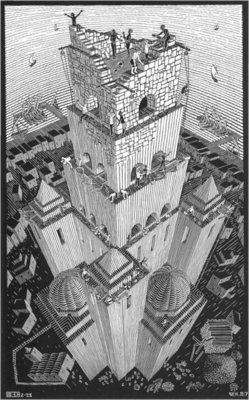
For instance, it was a long time before I gave careful thought to the title of Borges’ story. Why Babel? “The Library of Babel,” not the story but the name, stands as any title must in a liminal position relative to the text. The narrative is framed as though it were written by a librarian inside the story’s universe, inside the Library of Babel, though the title may very well come from the unnamed editor who occasionally interpolates footnotes or diacritics. The phrase is never repeated within the story, and so the title seems to split Borges’ tale, to suggest simultaneously that the narrative could name itself or that this name could fall upon it from outside, as though from a jealous God. These are the two possibilities of language considered in the namesake biblical tale, where a human race that hoped to name itself is overwhelmed by a proliferation of tongues fallen from heaven.

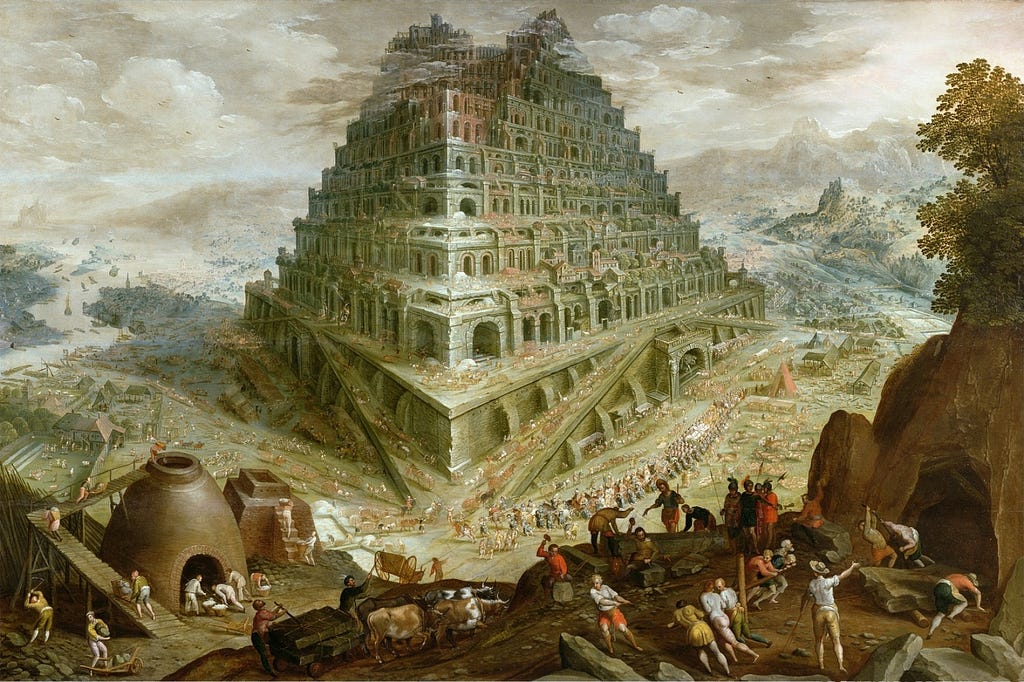
The account of the Tower of Babel, as all the stories of Genesis, is evocative and vague. The descendants of Noah who now populate the earth state their intentions with a simplicity that belies their abyssal profundity, “Come, let us build ourselves a city, and a tower whose top is in the heavens; let us make a name for ourselves, lest we be scattered abroad over the face of the whole earth.” What is that, to make a name for oneself? And how does it prevent dissemination? The word for name, the name of name, in Hebrew is shem, which happens to be identical to the name of the tribe that sets out to impose unity on the human race by enclosing them within a single structure.

God punishes them for their hubris by creating the multiplicity of languages, thus scattering the Shem over the earth. In the process, he imposes a name on their unfinished city, the name of Babel. “Therefore it was called Babel, because there the Lord confused [balal] the language of all the earth.” This word is both a proper noun and a homophone for the Hebrew word for confusion (babble comes close to reproducing this effect in English, though it is an unrelated word thought to be onomatopoetic in origin). The struggle between human and God is a conflict over the control of language, a struggle between name and confusion.

Derrida captures the resulting paradox in his “Des Tours de Babel,” “[God] at the same time imposes and forbids translation.” With the irruption of linguistic difference, it becomes necessary for humankind to translate among themselves. But the very act creates a name that is untranslatable because of its inner difference. Babel, being both proper and common noun, cannot be translated by a single word. In fact, it demonstrates the diversity within any no-longer-single language, as the listener must recognize the possibilities of this word and substitute its dual meanings to understand it in its own tongue. The aspiration of the Shem, not only to build a unified structure but to unite themselves under a unified name, is shown by God to be impossible not for circumstantial reasons (the interrupted construction), but due to essence of language.

Borges was fascinated by the history of attempts to control the fragmentation of language. One of his most famous non-fiction essays, “John Wilkins’ Analytical Language,” considers the efforts of one man who hoped to make a name, or all names, for himself in this way. Wilkins constructed a formal language on the principle that knowing its words we would know all the things named, and knowing the thing would bring immediate knowledge of the name. It worked as follows:

He divided the universe into forty categories or classes, which were then subdivided into differences, and subdivided in turn into species. To each class he assigned a monosyllable of two letters; to each difference, a consonant; to each species, a vowel. For example, de means element; deb, the first of the elements, fire; deba, a portion of the element of fire, a flame.

Borges explains the problem that haunts any such project: “…there is no classification of the universe that is not arbitrary and speculative. The reason is quite simple: we do not know what the universe is.” Only a being with absolute knowledge, only a God, would know where to make the divisions, how to apportion names so that they captured exactly the essence of their referents. The efforts of John Wilkins, and the rest of us here-below, can serve no better than the Chinese Encyclopedia imagined by Borges:

In its distant pages it is written that animals are divided into (a) those that belong to the emperor; (b) embalmed ones; (c) those that are trained; (d) suckling pigs; (e) mermaids; (f) fabulous ones; (g) stray dogs; (h) those that are included in this classification; (i) those that tremble as if they were mad; (j) innumerable ones; (k) those drawn with a very fine camel’s-hair brush; (1) etcetera; (m) those that have just broken the flower vase; (n) those that at a distance resemble flies.

Nor does Borges see this confusion, this Babel, as a conditional failing of a fallen but perfectible humanity. Rather, “there is no universe in the organic, unifying sense of that ambitious word.” Those who would make names for themselves, like Wilkins or the Shem, will find their efforts thwarted by a language that is faithful to reality in its fractured convolution.

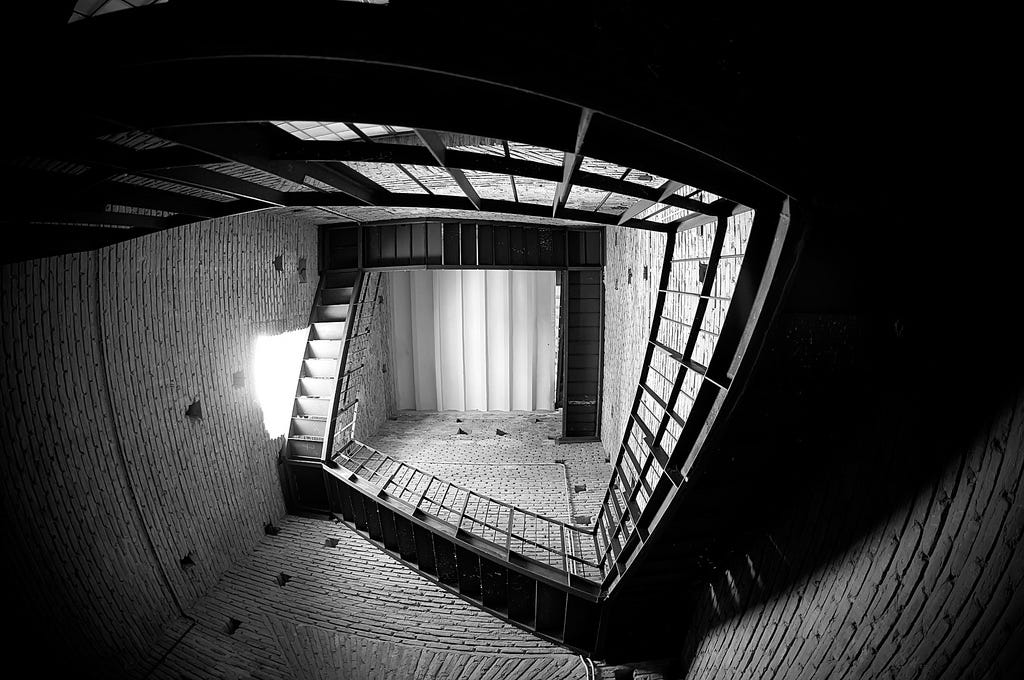
In the Babel imagined by Borges, the confusion of tongues takes place inside the tower, the library. The unified architecture does not create a unified linguistic community: “…the most ancient men, the first librarians, used a language quite different from the one we now speak; it is true that a few miles to the right the tongue is dialectical and that ninety floors farther up, it is incomprehensible.” More perniciously, it is possible for language to remain completely intelligible, and yet to house an infinity of differences that make the dual interpretations of Babel seem trivial: “An n number of possible languages use the same vocabulary; in some of them, the symbol library allows the correct definition a ubiquitous and lasting system of hexagonal galleries, but library is bread or pyramid or anything else, and these seven words which define it have another value. You who read me, are you sure of understanding my language?” The narrator seems to take this proliferation of languages as a sign of the comprehensiveness of the library, though Borges treats this notion with irony. The possibilities of a single phrase, word, or letter, can never be exhausted. As our narrator explained, a word can differ from itself, can contain multitudes of interpretations, without differing by a single letter or mark. We can translate these inner differences, but only among source or target languages that are themselves without unity or self-identity.

The possibilities of a single phrase, word, or letter, can never be exhausted.

There is translation not only within each library, but between the possible instantiations of the universal library as well. The structural limits necessary to any project of permutation shape how its texts signify. Borges used twenty-two lower-case letters, space, comma, and period, in books of 410 pages with forty lines and some 80 characters per page. To translate his project for the web, libraryofbabel.info kept as close as it could to the dimensions of Borges’ books, but of course creates them digitally, as a series of hyperlinked “pages.” This transubstantiation is not without its effects on how users approach the text; whereas Borges’ librarians were most satisfied by their discoveries of accidental poetry, visitors to libraryofbabel.info are just as likely to look up memes and ASCII art. Borges signals the impossibility of any library’s “universality” by including in his short story many of the characters (capital letters, digits, a diacritical mark) that were unknown to his librarians. While the narrator celebrates the completeness of his library, Borges gently ironizes this claim by showing that such a character set is insufficient even for his brief fiction.

The change of media was a biblical theme as well. Genesis tells us, with regards to the builders of the Tower of Babel, “they used brick for stone, and they used tar for mortar.”

If the possible significance of a single phrase can never be exhausted, no library can ever be total in the sense imagined by an entire tradition from the Ancient Greek atomists to Borges’ narrator. Only the elements, the atoms of a system can be permuted, which in the case of language are the letters, the marks of punctuation, and a nonfinite series of other contextualizing aspects, from the typeface to the grain of the voice. But language is not atomic; these elements split, divide, and ceaselessly differ from themselves, allowing the unthinkable to emerge from the most familiar texts. The website then is neither a realization of Borges’ fiction, nor a translation in the classical sense of perfect adequation. It translates with a repetition dependent on difference, a discovery indistinguishable from invention, which continues to illumine hidden facets of Borges’ inexhaustible story.

Nordic Noir is a Reflection of Modern Europe

Nordic crime fiction is a global phenomenon. Tonight, in London, New York, Mumbai, Tokyo, Lagos, Melbourne and Buenos Aires, readers by the thousands will be cracking open books populated by hardened Danish detectives, Swedish hacker-vigilantes and serial killers in Oslo. (Those who prefer their Nordic noir on TV will have more than a few options to choose from, too — The Bridge and The Killing, to name only the most famous.)

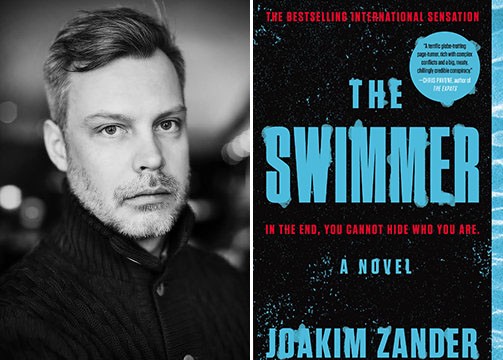
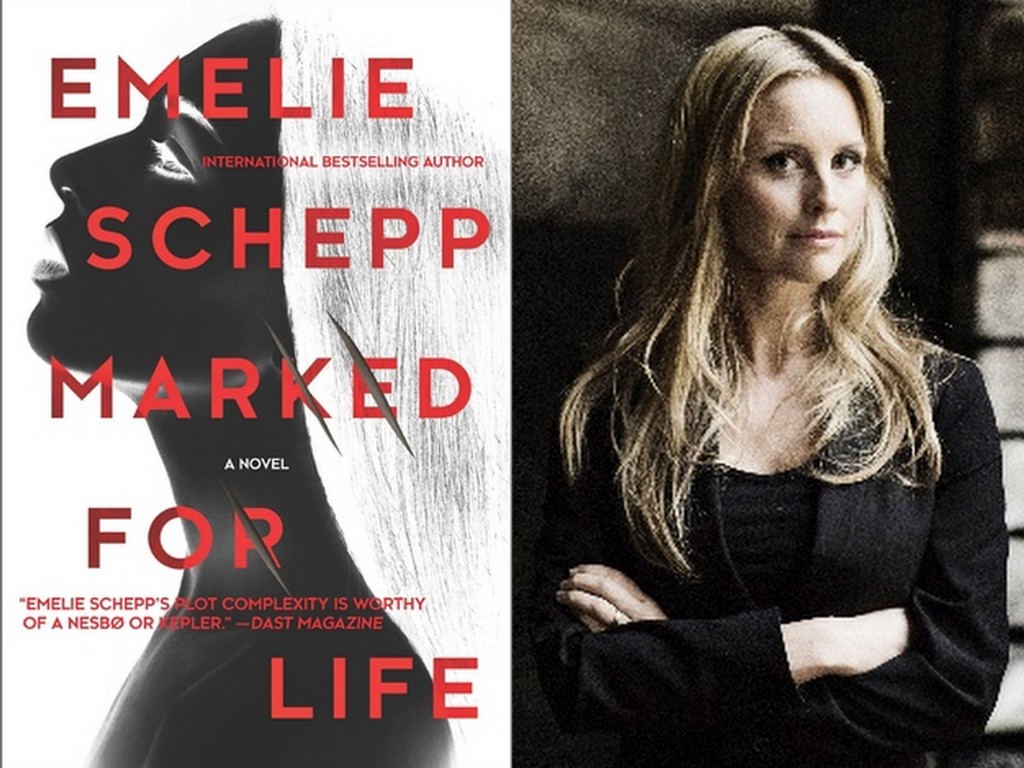
When we found out that two of the tradition’s notable and internationally acclaimed authors— Emelie Schepp, author of Vita spår (White Tracks); and Joakim Zander, author of The Swimmer — were corresponding in anticipation of the US release of Schepp’s latest novel, Marked for Life, we were intrigued, to say the least, and eager to share their conversation.

Schepp and Zander talked about what it means to be part of the literary legacy of Sjöwall, Mankell, and Larsson, about their writing influences, and about how they weave issues of immigration, refugees, ISIS, poverty and radicalization into the contemporary nordic landscape.

Joakim Zander: One of the questions I get the most when talking about my books abroad is: “Why is Nordic crime fiction so concerned with societal themes and criticisms?” I think there might be a number of reasons for this; the first relating to the tradition started in the 1970s by the “godparents” of Nordic crime, Maj Sjöwall and Per Wahlöö, who began to publish their books at a kind of breaking point in Swedish 20th century history. Since the beginning of the century there had been a steady increase in economic and societal growth, but the ‘70s meant marked stagnation and societal unrest. It was natural, I think, for crime writers to be drawn to the darker and more overarching themes of those times. This tradition was then carried on by writers like Henning Mankell, Liza Marklund and, to some degree, Stieg Larsson, as Swedish society continued to experience fundamental changes brought on by increased growth, urbanisation and immigration. I think we can perhaps return to the issue of immigration a bit later, but I am curious to hear your thoughts on this, Emelie. Do you feel that your books fit into this tradition of Swedish crime? And if so, why is this the case? Why is this important to you?

Emelie Schepp: As with many other crime writers, my books are a mirror of the world and society I live in. Swedish crime fiction often explores very dark themes and is often greatly concerned with social issues and the problems of living here.

…it can be quite shocking to learn about Sweden as the paradise lost…

Readers obviously feel a fascination for what we might call ‘Nordic melancholy,’ concocted from winter darkness, cold weather, and isolated landscapes. And I do think that my books fit into this tradition. I am aware that readers in other countries have a romantic idea of Sweden as one of the best places to live. It really is a great place to live, but I think it can be quite shocking to learn about Sweden as the paradise lost, and a society where violence, corruption, and murder actually exist. Behind our locked doors anything can happen. My motivation as a writer is to give my view of those who turn to crime, why they do so and what motivates them. I do believe that we are formed by the society we are brought up in. And how about you, Joakim, how do you approach these issues? I am especially curious since your books are perhaps not classic ”nordic noir,” but more international thrillers.

Zander: My whole writing process is quite theme-oriented, and usually I begin with issues that I have been thinking about for a long time. With my first book, The Swimmer, I had been thinking a lot about the war on terror and the West’s complicated and contradictory relationship to the Middle East, and I decided to try to construct part of the narrative to illustrate my view on this. With my second book, The Believer, I had been thinking a lot about how Swedish and other European societies are changing as a consequence of immigration over the last decades, and particularly at the moment with the Syrian refugee crisis. Although the causes that force people to flee their home countries are horrific, I think that the current immigration to Europe is an overwhelmingly positive thing for our societies. It forces us to rethink our old ways, to change and to adapt our societies, something that only makes us stronger. However, the large number of refugees that arrive in a very short time span also pose great challenges. Integration takes time and is often a painful process, especially when the people arriving are often very poor and do not speak the language of the destination country. An unfortunate consequence of this is that some parts of our societies become isolated and excluded from the mainstream. In my view this is a transitory phase, but the problems in these areas are real and tangible.

…some parts of our societies become isolated and excluded from the mainstream…

In my writing I am interested in trying to understand and illustrate where society is at the moment, and right now I think these are the issues define us, so for me it is impossible not to write about it. How about you, Emelie? What are your views on the current refugee situation and is it something that you consider in your writing?

Schepp: In Marked for Life, I wanted to write about a woman who should be odd. But I did not know how odd she was about to be until I read an article about child soldiers. In 2012 there was a huge debate about child soldiers after the movie “Kony 2012” had been shown on Swedish television. The movie is about Joseph R. Kony who is the leader of the Lord’s Resistance Army (LRA), a guerilla group that formerly operated in Uganda. He has been accused by government entities of ordering the abduction of children to become child soldiers. Over 66,000 children became soldiers. As I read the article I remember that I started questioning myself: “What would happen if there were child soldiers in Sweden? And what happens if the solider want to be a child again? Is it even possible?” And where in Sweden could I find children? I know it sounds very strange, but I had to find children that no one would miss, nor search for. To abduct a child in a playground often leads to quite a storm in media and I did not want that. I wanted the abduction to take place in secret, without anyone knowing.

One evening as I watched the news on TV, I saw a truck with a container that had overturned on a highway. And when the police arrived at the scene they found several refugees in the container. They had not been registered at the border. They were illegal. No one knew they were in Sweden. So I went down to the port of Norrköping and looked around. When I saw all the thousands of containers I realized that anything could be hiding in them, including children.

As I began writing Marked for Life I wanted to tell a story of how children can be shaped into something they were not born to become. Children are incredibly loyal, particularly to the hand that feeds them and I understood that such loyalty can be lifelong. I tell a story about immigrant children that are smuggled into Sweden and disappear without a trace. The sad thing is, this actually happens in Sweden today. Because of the large flow of immigration, smuggling and human trafficking are increasing. Desperate people who have decided to flee and have put their lives’ savings toward succeeding won’t be stopped. They have nothing to lose and nothing to return to. They want to achieve their dream of a better future. They will do everything to reach it. Travel down roads that do not exist. On water, through fences, past walls. They risk their lives. Many never make it; they die on the road. Adults and children disappear, are kidnapped, are taken away and are forced into a life of prostitution or slavery. Human traffickers profit from people in peril. And people in peril will do whatever they can to reach their dream. Their motivation is far stronger than that of those who try to stop them. In my second book, Marked for Revenge, I write about the young woman Pim who, in her dream of a better life, agrees to smuggle drugs. In both Marked for Life and Marked for Revenge I write about young people who are forced into different destinies.

And people in peril will do whatever they can to reach their dream.

But you, Joakim, in your second book, The Believer, you write about a young man who choses to join ISIS, although he is in control of his own destiny. Why do you think people in Europe would consider joining such a brutal organization?

Zander: I decided to write a book that partially dealt with the radicalisation of a young Swedish Muslim because, like everybody else, I was horrified by the war in Syria, the quick rise of ISIS, and the reports of young Europeans deciding to join a medieval, brutal form of Islam. In particular I was interested in the mechanisms that make a person prefer such a primitive and violent life to the relative order of Western life. When I started doing research on this topic, ISIS was still in ascendance and not much had been written about the young men (they are predominantly male) who had left for Syria and Iraq. There were very few first hand accounts of the process involved and what they had experienced when they arrived, because many of those in the first wave of jihadists were sent relatively untrained to the battle fields and most of them died there. But I got in touch with Professor Leif Stenberg at the Center for Middle Eastern Studies at the University of Lund in Sweden and he was extremely helpful to me, taking time to discuss the theology behind radicalisation and sharing case studies.

As I studied the topic more closely, the character that became Fadi in the book came to me. There are many factors that appear motivating for people who eventually become radicalised, but in Fadi I tried to create a kind of composite; a typical case or character. And the typical person is a young man who grows up in a disadvantaged neighbourhood. Often he would have a history of petty crimes and violence before radical Islam made him see the flaws in his old ways.

Almost always the story of radicalization appears to be a story about exclusion.

Almost always the story of radicalization appears to be a story about exclusion. Although there are exceptions, the people who are susceptible are usually not part of what could be considered mainstream society, and do not find that they are welcome there. Radicalization becomes an act of defiance and of solidarity with other Muslims that are oppressed around the globe. It was important to me that Fadi became real to the reader, that his motives were crystal clear. I want the reader to sympathise with and understand Fadi, despite his extremely poor choices.

One final question for you, Emelie: As you are continuing your series about Jana Berzelius, do you think that societal themes, like the current refugee situation, will continue to influence your writing, and if that is the case, how?

Schepp: I have just released my third book in the Jana Berzelius-series in Sweden and I have plans to write several more books about her. My ambition is that my books should reflect Swedish society but that doesn’t mean that I focus on a specific problem. Society can also be mirrored through a character. Our personalities are shaped in a complicated interplay between heritage and environment and it is these factors that I am curious of and want to try to understand. Therefore it is not possible to shut the world out; we are shaped by it and are a part of it. This is how it always will be. Also for the characters in my books.

Dan Brown Is Paying to Digitize a Mysticism Library

Mysticism and ancient texts play a prominent role in Dan Brown’s fiction, often prompting the Dr. House-esque epiphany that begets the novel’s triumphant conclusion. Many of these references, of course, were borrowed from reality. For the author Dan Brown, the Ritman Library (also known as the Bibliotheca Philosophica Hermetica) in Amsterdam consistently provided mystical information he’d use in his novels, particularly for ancient-codes-breaking-protagonist, Robert Langdon. According to The Guardian, Brown has now committed to reciprocating the collection’s aid, in the form of 300,000 euros (~340,000 dollars).

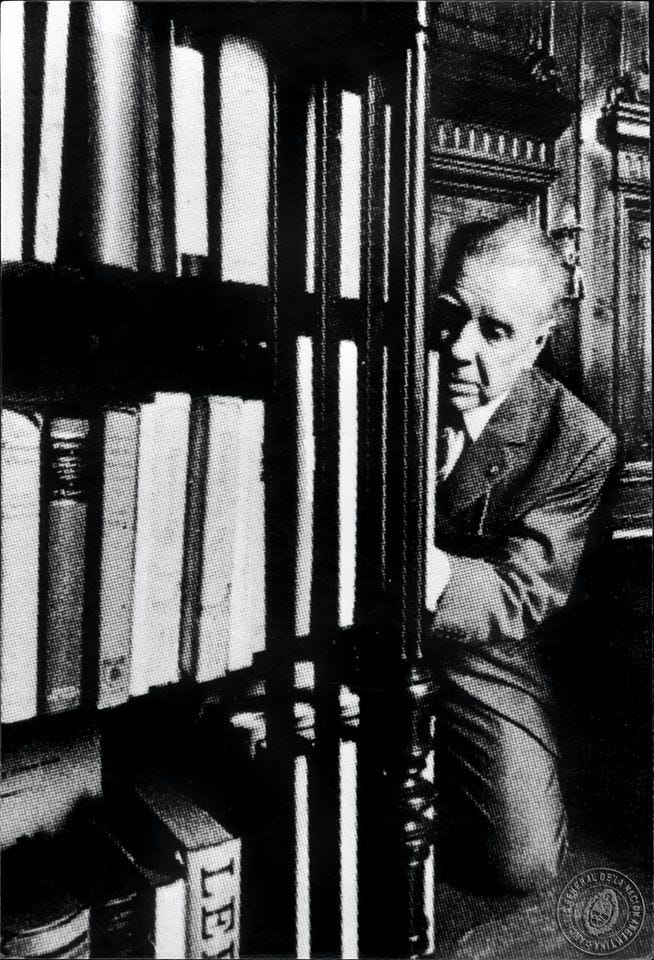
The large donation by the bestselling author is primarily aimed at helping speed up and complete the library’s ongoing digitization project. Brown announced news of the donation in a two-minute Youtube video on The Ritman Library’s channel. Emerging from behind a rotating bookcase in his own personal library, the author lavished praise on the Dutch collection and its endeavor to expand its readership via digitization. “I consider it a great honor,” he said, “to play a role in this important preservation initiative that will make these texts available to the public.”

In addition to Brown’s donation, the Library has reported receiving nearly 17,000 dollars from the Dutch Prins Bernhard Cultuurfonds — a foundation originally established in 1940 as an effort to rebuild the then-war-torn cultural life in the Netherlands.

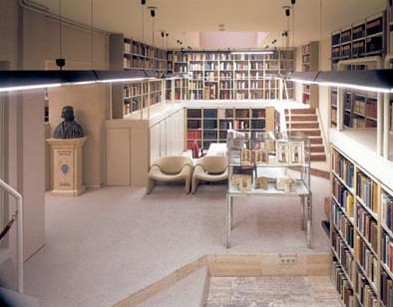
Ritman Library Interior

The Library’s collection includes, among others: Hermetica, alchemy, mysticism, Rosicrucians and Kabbala. The near-25,000 works are split into two main categories with ~4,600 manuscripts and printed books from before 1900, and the rest being printed after the turn of the century.

Brown’s donation is certainly a noble financial decision, and it is a glimmering example of democratizing the accessibility of a rare resource. It does make you wonder though, just how many Da Vinci Code sister texts may emerge? Or if he too will digitize his own personal library and, more importantly, donate his rotating bookcase (to me)? Important questions to be considered, no doubt.

11 Novels That Take Place Over One Summer

It wasn’t until I moved to the West Coast that I realized how much I relied on seasons to mark the passage of time. Without dropping leaves or sultry nights, time simply moved on. I’d be surprised to learn that only two weeks had passed since an event that felt like ages ago, or that it had already been three months since a memory that felt and looked like yesterday. I’m back East, where New Yorkers are notably obsessed with framing their anecdotes with seasonal references; if there was a beautiful spring or a bad winter, they mention it. We moved downtown last winter. The streets were a mess! It makes sense; seasons are natural tools for story-tellers. Like an original Oulipo device, they force a beginning and an end, serving as handy yardsticks for character growth. Plus, as any high school English class can tell you, seasons come with a ton of metaphors.

Every season seems primed for a certain type of story: winter’s tales of hardship, spring’s sexual awakening. But summer — longed-for, crazy summer — is when things get interesting. Children and students are cut loose, primed for trouble and the kind of learning that only happens outside the classroom. Adults are allowed to act on impulse because everyone’s gone crazy in the heatwave! Even lazy summer days lead somewhere unexpected: think of the Divers picnicking on the French Riviera before a duel breaks out or Tom Riply sipping a Negroni while planning a murder.

Here, then, are eleven books that take place over the course of a single summer.

The Mysteries of Pittsburgh by Michael Chabon

Michael Chabon began writing this novel when he was an undergraduate at the University of Pittsburgh, so it’s no surprise that the book is informed by summer as experienced by a student, or what I think of as Summer with a capital S. This Summer is the ultimate freedom. The midway point between a job done and a fresh start, it allows for total, guilt-free self-indulgence (or at least it did in the era before internships). Art Bechstein, Chabon’s protagonist, does what many do in Summer, he goes looking for an adventure, which is exactly what he gets as he spins around Pittsburgh with the unlikely duo of “fancy” Arthur Lecomte and book-loving biker Cleveland Arning.

Skios by Michael Frayn

This comic novel is set on the fictional Greek island of Skios during the summer conference of the Fred Toppler Foundation, a dubious organization that promotes “civilized values.” The central conceit — a zany mix-up of identity and luggage — is unbelievable in the age of Google, but it’s pulled off by Frayn, the master of farce.

The Siege of Krishnapur by J.G. Farrell

This Booker Prize-winning novel is one of J.G Farrell’s “Empire Trilogy” in which he explores the decline of the British Empire. The Siege of Krishnapur presents a fictionalized version of the real siege of Cawnpore that occurred during the Indian Rebellion of 1857. As the summer unfolds and the siege by the native sepoys presses on, the situation of the British residents of Krishnapur steadily deteriorates.

Dandelion Wine by Ray Bradbury

Dandelion Wine is a series of linked short stories that follow twelve-year-old Douglas Spaulding during one summer in Green Town, a fictionalized version of Bradbury’s hometown of Waukegan, Illinois. Douglas describes the dandelion wine that his grandfather makes as “summer on the tongue…summer caught and stoppered,” but he may as well be describing the book.

Let the Great World Spin by Colum McCann

On the morning of August 7, 1974, a French high-wire artist named Philippe Petit completed not just one but eight tightrope walks between the Twin Towers of the World Trade Center. This crazy-yet-true event is what connects every character in Colum McCann’s novel as they wander through a broken-down New York City during the last summer of the Vietnam War.

The Summer Book by Tove Jansson

The author of the Moomin series that I loved as a kid wrote a handful of books for adults, including this story of a six-year-old girl and her grandmother who are spending the summer on an island in the Gulf of Finland. The Summer Book is actually 22 beautiful, evocative vignettes that capture the sights and sounds of summer. (Keep this one in your back pocket for grey winter days.)

Salvage the Bones by Jesmyn Ward

This lyrical, heart-breaking novel takes place over twelve days in August in Bois Sauvage, Mississippi; a timeframe that becomes even more intensely loaded when you realize that the hurricane that’s gathering strength over the Gulf of Mexico is Katrina. Esch and her brothers do their best to prepare what they can, but — aside from each other — there isn’t much they can save.

Outline by Rachel Cusk

A woman goes to Athens to teach a summer course on writing. She is divorced and has children. That’s almost all we know about the narrator of Outline, at least in terms of hard facts. Yet through the ten conversations that the narrator has with people she meets in Athens — notably people who are much more open about spilling the details of their lives —it becomes clear how much you can learn about someone by listening between the lines.

The Great Gatsby by F. Scott Fitzgerald

Asked to name a scene from The Great Gatsby, most people probably think of Nick staring at the green light at the end of the dock. But the scene that’s always stuck with me is the impromptu party that the Buchanans throw at the Plaza Hotel. Fitzgerald uses summer to perfect effect here: its claustrophobic, sticky heat, an atmosphere that’s uncomfortable and stifling in every sense of the words. In fact the whole plot of Gatsby mirrors the summer. The tension mounts with the heat, and the final denouement comes with the first chill of fall.

Nemesis by Philip Roth

Nemesis explores the effects of a polio epidemic on a closely knit Newark community during the summer of 1944. By setting his novel in a season that should be the most fun and carefree for children, Roth manages to heighten the already dark realities of polio for the children it struck: sickness, lifelong paralysis, and even death.

Frog Music by Emma Donoghue

In the summer of 1876, San Francisco was suffering from both a smallpox epidemic and a record-breaking heat wave. This hot, intense atmosphere is the backdrop to the story of Blanche Beunon, a burlesque dancer who is trying to solve her friend’s murder in a rough-and-tumble city that in many ways was still a part of the Wild West.

Among Strange Victims Captures the Complex Mind of an Outsider

From Petronius’s Encolpius in The Satyricon to the visceral realists in Roberto Bolaño’s The Savage Detectives, intelligent and itinerant underachievers have served as astute critics of social conventions. These picaresque outsiders were gifted with clarity unequaled by their peers, and central to their lives were questions of how one ought to live: destitute but impassioned, or safely satisfied by the mind-numbing apathy of middle-class life?

Into this mix we can now add Rodrigo, the central character of Daniel Saldaña Paris’s debut novel in English, Among Strange Victims. A smart but aimless young man, Rodrigo works as a copy editor for the director of a museum, where he fantasizes about sleeping with his coworkers and sabotaging the speeches his boss delivers to investors. He’s an anti-intellectual, distrustful of the academy, though, as the son of an academic, he can’t shake off the education impressed on him by his mother. This education serves primarily to help him rationalize his disappointing life. Speaking about his dead-end job, Rodrigo claims, “This is freedom, I say to myself: an eight-hour day that, if I so wished, could be seven, or even less. An affirmation of will, but without necessary upheavals.”

A smart but aimless young man, Rodrigo works as a copy editor for the director of a museum, where he fantasizes about sleeping with his coworkers and sabotaging the speeches his boss delivers to investors

Freedom also includes contemplating used tea bags stapled to his wall and masturbating twice on Saturday. He lives alone in a small apartment overlooking a vacant lot home to a chicken. All is well for Rodrigo, until a case of mistaken identity propels him to marry his coworker, Cecilia. Though Rodrigo could have sorted out the mistake and avoided this conjugal sentence, he instead marries Cecilia. Predictably, the marriage grows stale. And Rodrigo becomes a tragic paradox: the picaresque character condemned to stasis.

The book’s second section pivots to a Spanish academic and lothario, Marcelo, on sabbatical in Mexico to research Richard Foret and Bee Langley, two overlooked modernist writers. Marcelo’s storyline alternates with that of Foret and Langley, a more traditionally picaresque narrative where comparison’s to Bolaño feel apt. Translator Christina MacSweeney has done an excellent job bringing the intelligent vitality of Paris’s prose into English, particularly in this passage describing Foret’s relationship to his contemporaries:

In Paris he had battled, with his own guts, against the castrating intellectualism of the Apollinaires, the soulless Cubists, the Marinettis of this world. Where in the work of these people was love, the unmoving motor of all the stasis, fixed point and vertex of the actions of men of real daring? Nothing of that was left, and only the pantomime of art, and Foret shat a million times on art.

The Foret and Langley sections are some of the strongest in the book. They are paced well and compellingly played against scenes of Marcelo hunting for houses in Mexico. As his trip continues, Marcelo grows tired of Foret’s incomprehensible manifesto, Considerations. He gravitates toward the poet Langley, but soon transfers his attention to a local professor who turns out to be Rodrigo’s mother.

Translator Christina MacSweeney has done an excellent job bringing the intelligent vitality of Paris’s prose into English

Marcelo’s and Rodrigo’s storylines converge when a recently laid-off Rodrigo moves in with his mother to get away from his wife. Cecilia stays in Mexico City, effectively ending their marriage, while Rodrigo stays behind to copy-edit for a colleague of Marcelo’s. There is no colleague, no book to edit, but Marcelo vouches for Rodrigo in a quid-pro-quo. Rodrigo must participate in a drug-riddled experiment run by an aging hippie. The two fall into a “complicity hatched in lying.”

Most of the second half of the novel is spent with Rodrigo as he grows increasingly vulnerable and self-aware. Philosophizing on the loneliness of marriage — a frequent habit — he says:

[marital loneliness] is more lonely than all other forms of loneliness, than sane, effective lonelinesses: the loneliness of the desert, of the widower, the loneliness of men who live surrounded by cats; marital loneliness is, I insist, more lonely than all the above because it imposes the necessity of being other.

Though Rodrigo’s theories are astute and enjoyable, it is unfortunate that the increased attention on Marcelo and Rodrigo means that Foret and Langley fade from the novel. However, the afterimage of their relationship pervades the novel. Their disappearance heightens the stark difference between how the two artists lived and how Marcelo and Rodrigo live. The lifestyle of Foret and Langley comes to seem impossible to recreate. What remains, in place of the artistic fervor that drove the two lovers, is a kind of spiritual torpor, the intellectualized idleness and middle-class domesticity of Rodrigo and Marcelo. What has happened to the life of the artist, Among Strange Victims asks. Why do we so often build critical distances between ourselves and our lives? And how can we bridge those gaps? The answers vary. Drugs, drinking, love, art making, even reading Bolaño — though this is played for a joke — all help us live in ways that feel authentic. By the end of the book, Paris suggests that there is little to learn from the self-obsessive fray of the present, and that only a calm understanding of the past that will allow us to move forward.

Hello, My Little Anger — An Essay by Gretchen Van Wormer

We haven’t been in the North Carolina Aquarium twenty minutes before I’ve drunk the blue Kool-Aid and asked my mom if we can please, please, please take a picture of the Slippery Dick. I want a snap not of the fish (halichoeres bivittatus) but of the fish’s educational sign, which reads:

Slippery Dicks don’t change their stripes as they get older. Unlike most other wrasses, they contain the same color and pattern throughout their lives.

The fish’s coloring is gloriously day-glo, but what’s drawn me in is the cheap joke of its sign: “You dicks never change!”

My cell phone is ancient as a horseshoe crab and doesn’t take pictures, so my mom asks my stepfather to get the shot. Bryce checks his phone to make sure it came out all right, and when it’s clear it has, I’m thrilled.

It is a little awkward to be in your 30s and taking pictures of Slippery Dicks with your mom and your Bryce as part of the Thanksgiving holiday. But it’s not my fault the aquarium delights me. With my family, I become positively human. Earlier I reached into a shallow pool of water and swooned as rays rippled up to my hand like kittens wanting their heads pet. When a docent chided me for using my whole mitt to touch them, “Two fingers, please, so I don’t get fired,” it was only a little annoying, because my stingray high was compounded with my innuendo high. “Two fingers, please”? Come on.

I want to be disgusted by the aquarium. The otters rebounding off their rock wall and sliding through the water in a maddening loop remind me of all that’s wrong with these places. I believe the Buddhist monk Thich Nhat Hanh when he says nature has feelings for us: “Do you see a tree out there? That tree loves you.” Locking up these creatures seems like a stone-cold way to requite that love.

Still, there’s something refreshing about swimming with all the other fish and doing as the fishes do.

After the Dick-pic, I stand next to my mom as she does the oddest thing: She speaks to a fellow aquarium-goer. “Beautiful, aren’t they?” she says of the fish, admiring their tropical shades. The woman agrees cheerfully. “Stunning.” She takes out her cell phone, and my mom says, “Oh, let me get out of your way so you can get a good one.”

A couple years ago, at the Amazonia exhibit at the National Zoo, I stood passive-aggressively in front of the glass as another viewer tried to harass/film a swimming turtle in its lake-prison. I was on my own, doing research for an essay about how angry the zoo makes me. I finally caved and took a step back so the woman could follow its glide, and when a smile splashed across her face, I assumed this was not due to her love of the turtle, but to her love of winning the epic battle of she vs. me.

How could my mom not only talk to her woman, but offer to get out of her way? So disturbing.

The North Carolina Aquarium is riddled with photo ops, and now my mom is determined to support all of them. A family squeezes most of itself inside a replica of a Megalodon jaw, and my mom grins with an almost-drunken pleasure before saying to the mother of this devoured brood, “Do you want me to take the picture so you can get in there, too?”

“Oh, that would be great!” the other mother says, and my mom takes pics of various wacky poses before handing the phone back.

Later, after dallying at the octopus exhibit, I round a corner to see my mom engaged in a truly vulgar act. It’s bad enough that she’s supporting other visitors’ giant-creature-replica shots, but suddenly there’s Bryce with his head sticking out of a jumbo crustacean.

“Got it.” She beams.


There’s the fear of becoming your mother, and then there’s the fear of not becoming your mother.

I have vague recollections of teenage angst toward my mom, most of which ended with my slamming the door and her threatening to take it off its hinges. My sister, Heidi, was the same way. But by the time we surfaced from childhood and realized that other people’s fathers weren’t like ours — a suicidal, narcissistic, addicted man whose own mother called him a “dry drunk” (an alcoholic who, even when sober, is an asshole) — we were no longer concerned about our maternal DNA. Instead, whenever we didn’t like how the other was acting, we’d dump on each other: “You’re reminding me of Dad right now!” or, “That’s so ‘Stanley J.’ of you!” It was icy water.

My parents finally divorced when I was eighteen and my sister twenty. The day my father moved out, I suggested my mom uncork a festive bottle of wine. It was like a hatch had swung open and I was free.

She met Bryce a couple years later. I must’ve been a touch hostile, because one afternoon, when I was home from college, she turned to me gently and said, “Has Bryce ever done anything to make you…uncomfortable?”

“God, no,” I said. “Never. Not at all.”

He’d only ever been nice. And my college was in New Orleans, a time zone and many states away, which should’ve made me feel liberated no matter what. But I was terrified that whatever had opened would close. I didn’t trust her.


My aquarium-ire is benevolent; it feeds on sympathy for the creatures, not on the creatures themselves. When I look back on the accusations of being like Dad, though, I can’t help but see these screaming matches as a beastlier species. The kind of being that hates parts of itself, and takes this out on another because they’ve got those parts too. “You’re all stings!” “You’re the one with the freakin’ barbs!!”

A slow evolver, I’ve taken eons to grasp that ugliness shares habitat with loveliness, and will predate the lovely if left unattended.

Thich Nhat Hanh, the Buddhist teacher who knows the trees love us, has pointed out that it’s not intelligent to see ourselves as existing apart from our environment, including our families:

We say our father is not us, but without our father, we cannot exist. So he is fully present in our body and in our mind…There are so many other non-self elements that you can touch and recognize within yourself — your ancestors, the earth, the sun, water, air, all the food you eat, and much more. It may seem like these things are separate from you, but without them you could not live.

He teaches that everything in us, even anger, is a vital organ, like the heart or lungs. We cannot pitch it when it bothers us. We have to love it:

The first function of mindfulness is to recognize, not fight. “Breathing in, I know that anger has manifested in me. Hello, my little anger.” And breathing out, “I will take good care of you.”

I’ve wanted to toss my father, my anger, because I understood them to be separate from my true and healthy self. There’s a lot of “best self” nonsense out there, and what it seems to amount to is that all unflattering aspects of oneself can be expunged. But this is as absurd as trying to restyle a Slippery Dick’s color patterns. You have to take care of the dickishness you’ve got. That’s the only way to chill.


At the aquarium, Bryce has succumbed to fish fatigue and found a quiet spot to fiddle with his cell phone while my mom and I wander around. Later we’ll hit the gift shop. It’s wondrously normal.

I don’t want to be a total downer about this captivity thing, so I give in to the baser desire of zenning out with the moon jellyfish. My mom and I watch as they float brainlessly by, pink clovers of brine shrimp traced on their translucent bells.

They’re so graceful that I almost forget they’ve got their own venom. Jellyfish don’t sting themselves, though, and they don’t sting members of their same-species swarm. Their tentacles have special receptors that recognize the chemistry of their own, and these receptors work like a safety switch, turning off the toxic quills.

I don’t know yet what will bring forgiveness of my father into being. But I do see that I must be kinder to myself. And that withholding this kindness has made me ill.

Mom, Bryce, and I leave the aquarium and step into a cool drizzle. At a restaurant twenty minutes away, we order calamari without irony. It’s delicious, and I feel grateful that the open water is so near.

Sex with Shakespeare: Kink and Secrecy in Singapore

Most nights, after work, I went out for drinks with Nikolai, the director of Macbeth. “You look distracted,” he said one evening. “What’s on your mind?”

I winced. I knew exactly what was on my mind. Ever since Oman, where some women in the Shakespeare class had introduced me to bootlegged DVDs of The O.C., I’d been a huge fan of the pulpy teen drama. By the time I moved to Singapore, however, the show had been canceled and the Internet had given me something even better: The O.C. spanking fan fiction. It exists, it is awesome, and it, as usual, was on my mind that evening. Nikolai was innovative, artistic, and nonjudgmental. If I had been fantasizing about Angelina Jolie in a black leather catsuit — in other words, the “sexy” stereotype of BDSM — I probably would have shared the fantasy. Nikolai would have laughed. But it’s one thing to be edgy; it’s quite another to fantasize about Sandy Cohen, with the epic eyebrows, spanking Ryan Atwood. So, no, my boss didn’t need to know what was on my mind.

But it’s one thing to be edgy; it’s quite another to fantasize about Sandy Cohen, with the epic eyebrows, spanking Ryan Atwood.

“I’m not thinking anything,” I said, too loudly. “Let’s drink.”

We did. We drank so much that, before long, we were drunk. Nikolai and I stumbled out of the wine bar and danced down a brick path near Robertson Quay, a posh stretch of restaurants, bars, and clubs along the river. A loose brick jutted out from the path.

“Get it!” Nikolai urged. “Pull it out!”

Giggling with the rush of being bad, I pulled the brick out of the path and threw it in the river. (I regret this. As a guest in Singapore, I had a responsibility to behave better.)

Then we ran.

“We’re in trouble now,” Nikolai joked. “They’re going to cane us!” (As the world was reminded during the 1994 Michael Fay controversy, when an American eighteen-year-old was sentenced to receive four cane strokes on his bare buttocks, the Singaporean judicial system employs corporal punishment.)

“Not me,” I teased. “Singaporean courts don’t cane women. Only men.”

“Really?” Nikolai said. I nodded.

“Trust me,” I slurred. “I know everything there is to know about judicial caning.” (Remember all those middle-school book reports on corporal punishment?)

Nikolai grinned.

“Since we’re being naughty tonight, shall we be really naughty?” he asked.

I nodded.

“Always,” I replied.

Section 377A of the Singaporean Penal Code states: “Any male person who, in public or private, commits, or abets the commission of, or procures or attempts to procure the commission by any male person of, any act of gross indecency with another male person, shall be punished with imprisonment for a term which may extend to two years.” In other words, the Singaporean penal code criminalizes homosexuality.

Nikolai is gay.

“Let’s go to a gay bar,” he suggested.

“Do you know where to find one?” I asked.

“Of course,” he replied.

Nikolai didn’t just know where to find one — he knew them all. So we went on a pub crawl that night, walking from nondescript bar to nondescript bar. The more I drank, the less it felt like we were breaking a law. What at first had felt naughty felt, in no time, normal.

“Are you scared the government will come after you?” I asked the owner of one club.

He shrugged.

“Not really,” he said. “They leave us alone.”

I imagine that with regard to unenforced prohibitions, Singapore is a bit like Shakespeare’s England. During his life, homosexuality was technically punishable with harsh laws. But those laws were rarely enforced. As Bruce Smith pointed out, during the combined forty-five years of Elizabeth I’s reign and the twenty-three years of James I’s reign, there was only one sodomy conviction — and that was for sex with a five-year-old boy, so it would be more accurate to call it a rape conviction.

I imagine that with regard to unenforced prohibitions, Singapore is a bit like Shakespeare’s England. During his life, homosexuality was technically punishable with harsh laws.

King James — yes, the same one who sponsored the King James Bible, and the patron for whom Shakespeare wrote Macbeth — may have even been gay or bisexual himself. (But it’s important to remember that, at that period, those terms didn’t exist. It’s possible that people then understood sexuality as something more fluid. A lot of how we understand our identities is culturally and historically specific.) James had a wife and three children, but he also spoke quite candidly about his passionate love for men, especially George Villiers, the first Duke of Buckingham. “You may be sure that I love the Earl of Buckingham more than anyone else,” said James to his Privy Council in 1617, in what some scholars believe was an early defense of same-sex love. “I wish to speak in my own behalf and not to have it thought to be a defect, for Jesus Christ did the same, and therefore I cannot be blamed. Christ had John, and I have George.” And in 1624, during his last illness, James sent Buckingham a telling letter, begging him to come to his bedside:

I cannot content myself without sending you this billet,

praying God that I may have a joyful and comfortable meeting

with you, and that we may make at this Christenmass a

new marriage, ever to be kept hereafter; for God so love

me, as I desire only to live in this world for your sake, and

that I had rather live banished in any part of the earth with

you, than live a sorrowful widow-life without you. And so

God bless you, my sweet child and wife, and grant that ye

may ever be a comfort to your dear dad and husband.

Although most surviving literary references to homosexuality from this period refer to same-sex attraction between men, writers were also aware of lesbian attraction. In one remarkable poem, John Donne — a poet and cleric in the Church of England — imagined sexual desire between women:

My two lips, eyes, thighs, differ from thy two,

But so as thine from one another do,

And, O, no more: the likeness being such,

Why should they not alike in all parts touch?

Hand to strange hand, lip to lip none denies;

Why should they breast to breast, or thighs to thighs?

Shakespeare’s own possible homoerotic interests have also been the subject of debate. Although he married Anne Hathaway and fathered three children with her, some readers cite the sonnets as evidence of Shakespeare’s bisexuality. Twenty-six of the sonnets are addressed to a married woman, who has often been called the “Dark Lady.” But one hundred and twenty-six of Shakespeare’s sonnets, including Sonnet 18 (“Shall I compare thee to a summer’s day?”) seem to be addressed to a young man, often called the “Fair Lord” or “Fair Youth.” (Sonnet 20 explicitly bemoans the fact that this young man is not female.) Some scholars theorize that this young man might be the same

“Mr. W. H.” to whom the sonnets were addressed. Maybe Shakespeare was bisexual. Others reject that theory; after all, there’s no reason to assume the sonnets are autobiographical.

What the Singaporean bartender had told me that night seemed true. No one in the club acted worried about an imminent raid. Despite their clandestine nature, the bars we visited did not feel shrouded by fear. I glanced around the room, pausing to wave hello to Antonio from The Merchant of Venice. Patrons laughed and flirted. Everyone seemed to be having a good time.

Maybe this wasn’t so bad.

Then I saw a familiar face.

One man wasn’t having fun.

I had met Edwin, a Singaporean friend, at a mutual friend’s beach party on Sentosa Island. We had bonded over our mutual long-distance relationships: my boyfriend was in New York; his girlfriend was in Kuala Lumpur. After that, Edwin and I ran into each other at parties or dinners every few months. He was smart and funny. I liked Edwin, though we didn’t share political views.

“It’s not biblical,” Edwin told me once when same-sex marriage came up. “It’s perverse.”

Tonight, in a secret gay bar with no sign on the door, Edwin sat alone. He gazed around the room, both hands on a glass of beer. His eyes were hungry and sad.

“It’s not biblical,” Edwin told me once when same-sex marriage came up. “It’s perverse.”

“Double, double, toil and trouble,” begins Macbeth’s most famous incantation. Everything in the play is double. Macbeth and Banquo are like “cannons overcharg’d with double cracks,” who “doubly redoubled strokes upon the foe.” When King Duncan stays at the Macbeths’ castle, where he will be murdered, it is “in double trust,” and Lady Macbeth promises that their care of him will be “in every point twice done and then done double.” Later, Macbeth tries to kill Macduff in an attempt to “make assurance double sure,” only to discover that the witches have toyed with him in “a double sense.”

Macbeth Consulting the Vision of the Armed Head by Johann Heinrich Füssli

Macbeth is a play about doubles. But there is a twist.

In Shakespeare’s tragedies, the hero (or antihero) often has a “double,” or voice — a secondary character who speaks for the central figure, linking him to the real world and to the audience. Marjorie Garber describes these sidekicks as “someone on the stage who encounters things and verifies [that what seems] impossible or unbearable [is], nonetheless, true.” In Hamlet, Horatio fills that role: at the end of the play, Horatio is the one who promises to tell Hamlet’s story. In King Lear, that voice is Edgar. (“I would not take this from report. It is, and my heart breaks at it,” he says at one impossibly sad moment.)

Macbeth’s obsession with equivocation speaks to this idea of double voices. The word equivocation itself comes from the Latin word æquivocus, which means “of equal voice.” In Macbeth, where even the fundamental premise of the play demands verification — are the witches “real,” or merely a product of Macbeth’s imagination? — that double voice is more important than ever. At first, Banquo fills that role. He links Macbeth (and Macbeth) to the audience. Indeed, Banquo seems to speak for us. “Were such things here as we do speak about? Or have we eaten on the insane root that takes the reason prisoner?” he asks, after the weyard sisters first appear. We know Banquo saw the sisters, too. Unlike the dagger that Macbeth sees (or imagines) before he kills King Duncan, Banquo’s voice verifies for the audience — and, indeed, for Macbeth himself — that these sisters do exist.

But Macbeth has a twist that sets it apart from every other Shakespearean tragedy: Macbeth murders his voice. Mad with fear that Banquo’s heirs will seize the throne, Macbeth has Banquo killed. After that, our antihero is on his own. There is no one left to verify what is real and what is not. Macbeth sees — or imagines — Banquo’s ghost at a feast, and from then on, there is nothing good left in his life. In fact, the night that Banquo dies is the very last time we see Macbeth and Lady Macbeth, who previously had the strongest marriage in the Shakespearean canon, speak to each other. When Macbeth’s voice dies, everything else disappears, too. Macbeth is alone.

When Macbeth’s voice dies, everything else disappears, too. Macbeth is alone.

He can’t survive that way. No person can.

In the bar, I lowered my face and walked over to Nikolai.

“We have to leave,” I muttered. “My friend is here.” I had invaded a safe space. Edwin didn’t want to be seen.

Nikolai chugged the rest of his drink and hopped to his feet. “Let’s go,” he said. We slipped out of the club.

Whenever Singaporean friends tried to defend 377A, they always emphasized the fact that it is rarely enforced.

“Homosexuals can do whatever they want,” a colleague once told me. “They just have to keep it private.”

“Privacy” is one of the most potent and insidious weapons a sexual majority can use against people with nonnormative sexual identities.

But the look on Edwin’s face that night told me a different story. I recognized the expression. “Privacy” is one of the most potent and insidious weapons a sexual majority can use against people with nonnormative sexual identities. “Privacy” sounds good. It sounds responsible and mature. But “privacy” is tied up with isolation and shame. It drives people underground. It puts people in danger.

“Privacy” palters with us in a double sense.

Sexuality doesn’t just appear at age eighteen. Like everyone else, kinky kids grow up with questions about our emerging sexualities. The difference is that, unlike people who grow up with normative sexual orientations, we can’t turn to pop culture for answers. There are almost no books, TV shows, or movies that show people like us, or relationships like the ones I craved, in a healthy or positive light. Our fear and shame doesn’t just come from negative messages; it comes from the lack of positive ones. When culture insists that people keep their “private” lives “private,” those who fall outside the norm fall through the cracks. We have no way to learn how to explore our fantasies safely.

One thing we do have is the Internet. Sexual minorities feel “private” online.

Predators feel “private” online, too.

When my friend Beth was sixteen, she met a fifty-four- year-old sadist on an Internet message board. His name was Logan. Beth was exactly like me at that age: obsessed with spanking and desperate to connect. She talked to Logan because she had no one else. After a few months of emails, Logan drove to Beth’s boarding school. She was nervous, but felt obligated to meet him. She didn’t want to be rude. He had made hotel reservations. So Beth got permission to leave school grounds for the weekend.

Beth was exactly like me at that age: obsessed with spanking and desperate to connect.

Beth was a virgin. She had never even been kissed. (For obvious reasons, her story hits close to home with me.) She didn’t want to have sex with Logan; she just needed to explore her masochistic impulses. But Beth was a good girl. She knew that she was supposed to keep her private life private. So she didn’t tell any of her friends where she was going that weekend. She didn’t tell anyone whom she was going to meet. Her only safety precaution was to leave a sealed envelope on her desk, with all the information she knew about Logan, just in case.

It was Friday. No one expected her back at school until Sunday night. If Beth disappeared, her friends would not find the envelope until a few days later.

“I was a rational, levelheaded kid,” Beth told me. “But the desire for it was more important than not getting murdered.”

To respect Beth’s privacy, I’ll leave out the rest of her story. Rest assured: no one had to open that sealed envelope. Beth went on to graduate school, became a top professional in her field, and eventually found healthy, safe, loving ways to explore her fetish with wonderful partners. In the end, things worked out. But the point is that when a kink is lifelong, innate, and unchosen — as it is for people like me and Beth, and many others — it mixes with stigma and “privacy” into danger.

We take risks because the isolation and emptiness of the alternative is worse.

I was lucky. I met John. He and I made mistakes — big ones, in some cases — but I stayed, for the most part, safe. Stories like Beth’s are common, but I was the safe one.

Think about that: I dropped out of high school, moved to a foreign country, and let a drug dealer whip me bloody before I had even learned about safe words — and compared to dozens of other stories I’ve heard, mine was the “safe” path.

Without sexual privacy, discretion suffers. Without sexual transparency, people suffer.

My “privacy,” unlike Edwin’s, was, for the most part, not the product of institutionalized government oppression. (That being said, fetishists can and do lose jobs, security clearances, or child custody battles because of our consensual orientations; in some places, consensual kink is explicitly illegal.) The biggest thing choking me was me. I’d been force-fed stigma for so long, I had lost the gag reflex to resist. If the men and women of Pink Dot, a grassroots Singaporean movement for LGBT equality, could challenge their government, I had no excuse to cower behind my own shame.

The biggest thing choking me was me. I’d been force-fed stigma for so long, I had lost the gag reflex to resist.

Nikolai and I said good night and I walked home. I lived on the forty-fourth floor of a skyscraper on Cantonment Road, in an apartment I shared with three flatmates. One entire wall of my bedroom was a huge window. I sat on my bed and remembered the expression on Edwin’s face. The city skyline sparkled before me.

I thought I’d been so honest with David, but that wasn’t true. I had doubled myself up so many times that I was more tightly folded than any origami crane. It would be impossible for anyone to read what had been written on my page. I was so repressed I couldn’t breathe.

The façade of honesty is more dangerous than a lie. I was that equivocator. I was the fiend who lies like truth. The two spent swimmers that do cling together and choke their art both had my face.

The Hiddleston Man: On the Competing Masculinities of ‘High-Rise’

He was constantly aware of the immense weight of concrete stacked above him, and the sense that his body was the focus of the lines of force running through the building, almost as if Anthony Royal had deliberately designed his body to be held within their grip.— J.G. Ballard, High-Rise

J.G. Ballard’s vertical-living dystopia, High-Rise is oppressively preoccupied with the body as both flesh and metaphor. Early on in the novel, which is narrated by three different male voices (that of the building’s architect, Anthony Royal; new tenant, Dr. Richard Laing; and lower-floor resident, Richard Wilder), we are given perhaps the most explicit acknowledgement of Ballard’s urban planning metaphor. Having been lured into a social gathering at one of his new neighbor’s apartments, Dr. Laing is listening intently to a description of the building “as some kind of huge animate presence.” “There was something in this feeling,” Laing informs us: “the elevators pumping up and down the long shafts resembled pistons in the chamber of a heart. The residents moving along the corridor were the cells in a network of arteries, the lights in their apartments the neurons of the brain.”

The narrative of High-Rise centers on the very disintegration of this imagined body politic. Neurons falter, arteries begin to clot, and eventually all that’s left is a thirst for destruction. The claustrophobic hierarchical structure of the building is transformed into an anarchic environment, its inhabitants giving in to their worst impulses — a Lord of the Flies of the skyscraper era. That’s where Ballard opens, exposing us, with his devilishly dark comedic wit, to the rotting body of the eponymous community at the novel’s center: “Later, as he sat on his balcony eating the dog,” the book begins, “Dr. Robert Laing reflected on the unusual events that had taken place within this huge apartment building during the previous three months.”

A stylish (every)man, out of time and place amidst a ravaged civilization.

Borrowing this striking and disconcerting imagery for his filmic adaptation of High-Rise, director Ben Wheatley opens with Dr. Laing (Tom Hiddleston) — wearing impeccably well-fitted slacks with his shirtsleeves rolled up — petting and then roasting a German Shepherd. I’m sure I was supposed to be taken aback by the barbarity of the situation, and yet I was mostly engrossed by Hiddleston’s wardrobe. Even after he’s butchered the dog (off-camera) the blood-splattered shirt remains effortlessly elegant, less a sign of his downward spiral than a suggestion that he remains in control. I couldn’t help but gawk at the actor’s lithe build, accentuated by this curious if telling costume choice — a stylish (every)man, out of time and place amidst a ravaged civilization.

Not even ten minutes later, Wheatley gives us a scene in which Laing luxuriously sunbathes in the nude on this very same balcony. We’ve been sent back in time, in order to account for the “unusual events” that had taken place three months prior. Blissfully unaware of his surroundings (as in the novel, the doctor enjoys the privacy the high-rise affords him, an imagined solitary confinement within an expansive and faceless community), Laing is startled awake by a crash. A bottle, it turns out, has been dropped from even higher above. We get what is likely to be the most GIF-ed moment from the entire film: a startled Laing hurriedly getting up, forcing the actor to hide his privates under the book that had been resting on his crotch. It’s a brief moment, underscoring Dr. Laing’s lack of privacy, but it also gives us one of the last glimpses of that clean-shaven compact body. Never again will Laing offer himself up to such scrutiny.

As the film continues, Hiddleston’s body will become inviolate, impenetrable, his suit and tie an armor that will keep him from falling into the type of lunacy that presumably afflicts his neighbors. Tellingly, his dual sex scenes — with two different neighbors who seem to find his Byronic posturing alluring, despite the chaos — show even less of the doctor than the brief moment on the balcony, in direct contrast to Richard Wilder (Luke Evans). In the book, Ballard describes Wilder as the strongest man in the building, with a “barrel-like chest” which he shows off “with some pride.” Laing, we’re told, “noticed that he was continually touching himself, for ever inspecting the hair on his massive calves, smelling the back of his scarred hands, as if he had just discovered his own body.” And while Wheatley’s film doesn’t quite push Wilder far enough (in the novel he eventually lives up to his name, shedding all his clothes, branding himself with makeshift tribal markings, devolving into an incomprehensible language) we are nevertheless encouraged to focus on his coarse and imposing body.

Luke Evans as Richard Wilder in ‘High-Rise’ (2015)

While Laing always looks like he’s just stepped off a GQ spread, Wilder is earthy and unequivocally tied to the film’s period. His bushy and messy sideburns match his unruly hair, while his denim shirt barely conceals the hirsute body that is always threatening to burst out, hinting at the simmering violent streak which eventually undoes him. Since Wheatley cuts back on the role of the architect, Anthony Royal (Jeremy Irons, playing with his signature imperiousness a character emasculated by the very community of women he’s inadvertently fostered), the film must instead rely on Wilder and Laing to give us two competing visions of contemporary masculinity.

Wheatley’s adaptation dismantles the sexist humanist language at work in the author’s rhetoric.

Considering that High-Rise eventually enshrines Laing — or rather, finds in his clean and muted aesthetic the only male role model worth letting survive — we might read it as a repudiation of Wilder’s masculine excess (“Our lives are too messy, Richard!” his wife complains), one which drives him towards senseless and barbaric violence (“He’s raping people he’s not supposed to and, to top it all off, he shat in Mercer’s attaché case,” a character yells). Laing’s charming swagger, by comparison, embodied by Internet boyfriend Hiddleston, emerges as a welcome palliative, though it also feels like an aspirational twisting of Ballard’s character.

Cover of first edition, 1975

The Laing of the book was openly ruthless in his self-survival, happy to live in incest in order to secure his sister’s apartment, a tenant in his building conspicuously absent from the film. Hiddleston’s Laing, on the other hand, is a dispassionate vision of tame masculinity. “You’re an excellent specimen,” he is told by Charlotte (Sienna Miller) when she discovers him sunbathing. The women of the high-rise eventually if implicitly anoint him de facto leader of their broken community, a new surrogate father figure for young Toby (Louis Suc), Charlotte’s son, who occupies the very last frame of the film. Looking like a curious young version of Laing — with the suit and tie to match — nerd Toby is tipped as the imagined future in Wheatley’s film world.

If the appeal of the high-rise in Ballard’s novel lay in the fact that it “was an environment built not for man, but for man’s absence,” Wheatley’s adaptation dismantles the sexist humanist language at work in the author’s rhetoric. We are left instead with a masculine body inviolate, epitomized by a hapless but cunning child and a roguish gentleman who exude non-threatening postures of masculinity, and who remain devoted and dependent on the women around them.