“The making of anthologies is not a task for the faint-hearted,” wrote Larry McMurtry in the opening of his foreword to Don Graham’s Lone Star Literature: From the Red River to the Rio Grande, published in 2003. “It always involves reducing an overabundance of material to something that can fit between the covers of a normal-sized book.”
If you know your Texas, at least a little, and you want to talk about its letters, you know you have to start with McMurtry — or with J. Frank Dobie or Américo Paredes, to that extent — and then follow up with Graham’s anthology — perhaps not necessarily in that order. While Graham’s selection might be subject to objection — as ought to be the case with any attempt to anthologize the unanthologizable — what I like about it is its awareness of the expansive and intricate territory that it aims to cover, described on the back cover of the book:
“This collection traces the continuing legacy of Texas literature. Despite generational and cultural differences, these authors share a landscape and a history that inspire them.”
Graham’s list includes names as culturally, geographically and stylistically distant from one another as Naomi Shihab Nye and Peter LaSalle, Dagoberto Gilb and Harryette Mullen, Katherine Anne Porter and Lawrence Wright, Rick Bass and Tomás Rivera, Molly Ivins and Rolando Hinojosa-Smith. The list goes on and on, making Graham’s anthology a strong point of departure to start delving into the rich literary tradition of a mammoth state over which six different national flags have waved through history.
Now I’ve been entrusted with an impossible task — write yet another list of ten books that represent the Lone Star state. I have tried to incorporate mostly new, contemporary voices, but also some classic ones, while trying to bring together a pool of authors diverse enough to hopefully mirror the state’s vastness.
I have tried to incorporate mostly new, contemporary voices, but also some classic ones, while trying to bring together a pool of authors diverse enough to hopefully mirror the state’s vastness.
Subjective as any list is, it’s been put together from the perspective of somebody who moved to Texas — from abroad! — as an adult twelve years ago. Furthermore, it’s been compiled from the standpoint of an author living in Austin, of all places — if you know your Texas, at least a little, you know that visions of the state are heavily influenced by region: the one perceived from the hipsterized state capital is different from the one observed from San Antonio, or Houston, or McAllen, or El Paso, or Dallas, or Abilene.
One thing, however, remains as true as the rapturing beauty of the Texas skies and the overpowering frailty of the bluebonnet: all of them are authentic in their own sense, bespeaking the immensity — geographical and otherwise — of the state. But never is the representation of Texas more inaccurate and caricaturesque than the one rendered by provincial and myopic bicoastal observers who’ve been to “Texas” just for SXSW or ACL.
My list.
1. Borderlands/La Frontera: The New Mestiza by Gloria Anzaldúa
First published in 1987, Borderlands… not only channeled and redefined the fluid and elusive concepts of cultural boundary and identity, and elevated to canon the uniqueness of the border, but also revealed to us the superpowers of Mestizo badasschickness. Reading Anzaldúa, a lesbian, an activist, a fierce poet and moving essayist, will change the way you look at writing as a bridge to bring seemingly distant ends together, all while introducing you to one of the most undefinable regions of the Lone Star state.
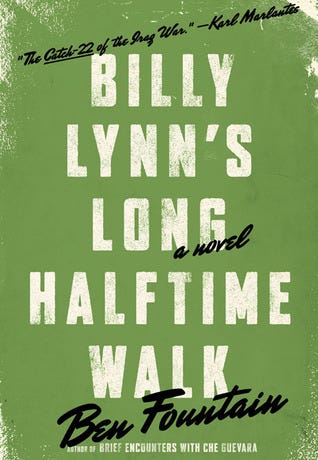
2. Billy Lynn’s Long Halftime Walk by Ben Fountain
What’s more Texan than football, Beyoncé’s extraterrestrial talents, and the devising of the Iraq War? Fountain delivers them all in one single punch with a vertigo-inducing sculptural language and a keen eye to observe the Dallas-power culture and the commercialization and objectification of both sports and warfare. Many books have been written about America’s latest war, but none of them captures the collision between working-class patriotism and betrayed hope, and the establishment’s disregard for human loss and appetite for blood-stained profit the way this one does.
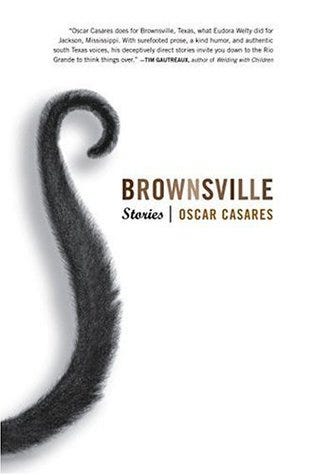
3. Brownsville: Stories by Oscar Cásares
The Rio Grande Valley, having being once an independent country for a brief period of time in 1840, is a universe in and of itself, with its own idiosyncrasies and even its own Spanglish. Cásares’s awe-inspiring debut collection portrays the lives of a myriad of residents of this small remote town seating on the edges of Matamoros, Mexico, with a language that is both bold and poetic, funny and moving. “Chango,” my favorite piece of all, is a story that I’ve read on countless occasions, and still brings me to tears every time.
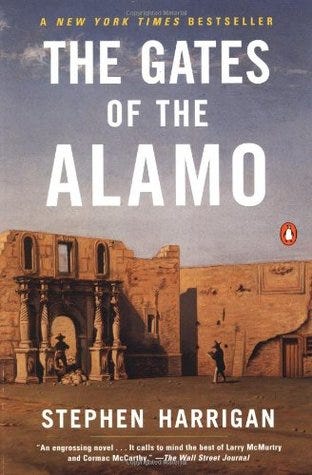
4. The Gates of the Alamo by Stephen Harrigan
Nothing captures the collective imagination of the state as the Alamo does. The mission was not only the battlefield of one of the pivotal battles of the Texas Revolution, but has also become one of Texas’s top tourist destinations. Harrigan approached the fall of the Alamo from an unseen-before perspective — that of the participants on all sides of the war — and in doing so rose to become one of the most distinctive, and popular, authors of historical fiction that Texas has ever had.
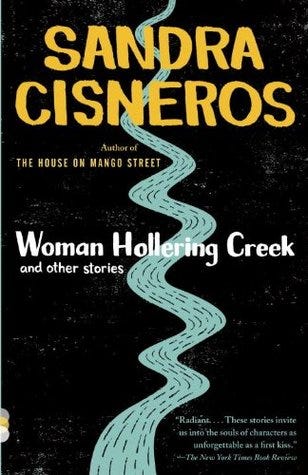
5. Woman Hollering Creek by Sandra Cisneros
That is not only the title of a fierce and subversive story collection that revels in its Texanness (“Never Marry a Mexican,” my favorite piece in the book, is an acid trip, a love funk, a heart-shattering rock), but also the name of an actual creek that crosses Alamo City. San Antonio became not only Cisneros’s adoptive hometown, but the place from where she has advanced and supercharged Latino and multicultural literature through her Macondo Workshop.
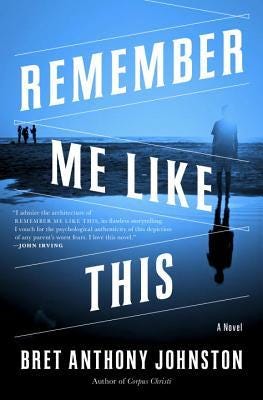
6. Remember Me Like This by Bret Anthony Johnston
“Chekhov advised writers to make sad stories cold, and I wanted to flip that logic. I wanted the summer heat of South Texas to exact the kind of pressure on my characters that the Russian winters exacted on this,” has said Johnston about bringing his hometown, Corpus Christi, to life in this haunting novel about a kid from the fictional town of Southport who is found four years after his disappearance. An enthralling tale of family, morality, fear and forgiveness, it’s, above all, a novel about a place, the Texas gulf coast, that is as intoxicating and quaint as rarely any other place in the state — and beyond.
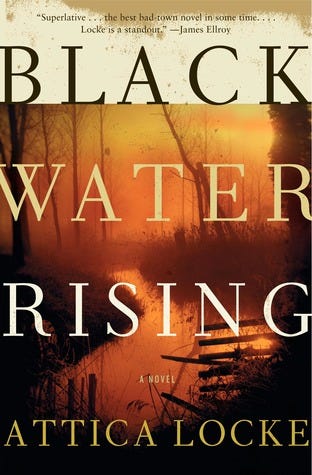
7. Black Water Rising by Attica Locke
“I intended to just write a slick little thriller,” has said Attica Locke about her absorbing debut novel set in Houston in the early 1980s. At the center of it is a struggling black lawyer entangled in a series of fateful relationships that touch power, oil money, politics, and race. She writes about a place she knows well, her hometown, which epitomizes the South in transition. If her name sounds familiar, it’s because she’s also the writer and co-producer of the TV show Empire. Locke’s the perfect ambassadress of the multicultural metropolis that is Houston.
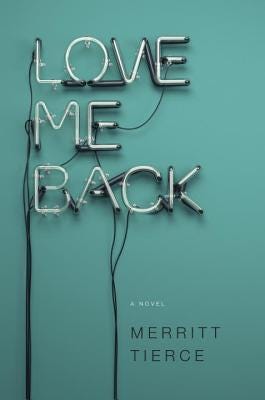
8. Love Me Back by Merritt Tierce
Attributes like “visceral,” “unsentimental,” “shocking,” or “transgressive” have long been used to define some of the most seismic writers associated with Texas, which have tended to be men — think Cormac McCarthy and his Blood Meridian. But those hallmarks have all been used rather recently to describe Tierce’s debut. Her protagonist, a waitress at an upscale Dallas steakhouse, was best described by Michael Ennis in Texas Monthly as “one of the most mesmerizing heroines in recent fiction, a self-destructive naïf who embodies the plight of millions of underemployed and overworked single mothers.”
9. Texas: The Great Theft by Carmen Boullosa
Here’s an epic story loosely based on the little-known 1859 Mexican invasion of the United States that features a parade of characters as seemingly dissimilar from one another as distinctive to the state’s landscape: “Mexican ranchers and Texas Rangers, Comanches and cowboys, German socialists and runaway slaves, Southern belles and dance hall girls”. Not only do I admire its timeliness, or Boullosa’s wild writing, but that it was published in translation from Spanish by a small imprint out of Dallas quickly becoming a powerhouse in the American literary firmament: Deep Vellum.
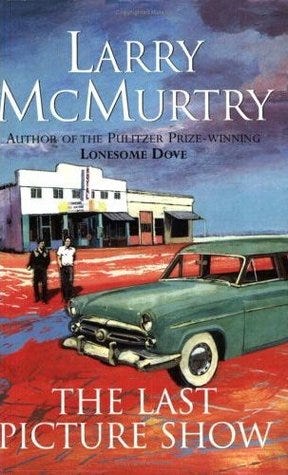
10. The Last Picture Show by Larry McMurtry
If you know your Texas, at least a little, you might want to finish a piece about its letters the way you started it: with McMurtry — or with Tino Villanueva, or Bejamin Alire Sáenz, or John Graves, to that extent. But if you decide to wrap it with him, you might not want to fall for the obvious and pick Lonesome Dove. You might want to pick a coming-of-age novel set in a place in West Texas so tiny and unknown it feels as if the author made it up.The Last Picture Showremains as heartbreaking, controversial and universal as ever. AsThe New York Times Book Reviewwrote about it in 1966, “Thalia is pretty hateful, but you are likely to remember it.”
On June 12, 2014, artist Rokudenashiko, or “good-for-nothing girl,” awoke to the police knocking on her door. Ten officers, nine of them men, walked into her apartment. In her graphic memoir, What Is Obscenity?: The Story of a Good for Nothing Artist and Her Pussy, they have shadows across their stern faces and tromp across her floor with a menacing sound:
“Doka doka doka.”
They had come to arrest her on obscenity charges. Among her obscene creations: a crowd-funded, vagina-shaped kayak, and plaster vulva molds decorated with paint, artificial flowers, plastic figurines. Most offensive, according to police, was the 3D scan of her anatomy, which she used to make the kayak and later distributed as a downloadable file to those who helped to fund it. The week her book debuted in English, she was found guilty of one charge of obscenity and fined 400,000 yen, about $3,600.
Rokudenashiko (pseudonym for Megumi Igarashi) calls her work “manko art,” or “pussy art.” In Japan, not unlike in the United States, the vagina is often referred to euphemistically. Some call it “asoko,” which, in context, means “down there.” (Jisho.org gives this helpful example sentence: “Sensei, asoko ga kayuin desu,” or “Doctor, I’ve got an itch in my crotch.”) My mom, when I was still of supervised-bathing age, called it the simultaneously mild and colorful “oshikko no tokoro” or “pee place.”
“Even the utterance of ‘manko’ was a taboo, and absolutely forbidden since I was a child,” writes Rokudenashiko, “and I’ve found myself respecting the archaic convention against saying it, even despite myself.” During her trial, she took pleasure in making prosecutors read the word over and over in her testimony. On that page of her book, she smiles in what can only be described as a “trollish” way, while a sweating, wrinkle-browed officer reads, cartoon vulvas radiating from his body.
The cartoon vulva in question is glimpsed on the cover of What Is Obscenity? and she has a name: Manko-chan, translated throughout the book as Ms. Manko. She is as cute and minimalistic as Japanese characters before her, from Hello Kitty to Capybara-san, with two black dots for eyes, a gold clitoris of a crown, and a ruffled labial mane that resembles the shampoo-shields Japanese kids wear for baths. Throughout the book, her mouth is always open, shouting, singing, and crying, except once, when it’s stuffed with a tampon.
Ms. Manko is a kind of mascot to vulvas, part of a phenomenon in Japan, where almost everything has its own cute mascot. Each prefecture has one, the best-known of them being Kumamoto’s Kumamon, a perpetually-surprised bear I always confuse with Pedobear. Even the Tokyo Metropolitan Police Department has Pipo-kun, a blushing alien “with oversized ears to hear the voice of the citizens, big eyes with which to observe every corner of society, and an antenna to receive the movements of society as a whole.”
What Is Obscenity? includes this creepy explanation of Pipo-kun in one of the interstitial spreads between chapters. These sections give closer explanation of everything from the Japanese criminal justice system to Shinto penis festivals, and they became some of my favorite parts of the book, turning it into a cheerful “rewarder” of curiosity, like a DK children’s encyclopedia.
The main narrative tracks Rokudenashiko’s story through the genesis of her manko art, her arrest, and the public reaction that followed. Originally serialized in the Japanese magazine Weekly Friday, its chapters are episodic, each one picking up a few beats before the last one left off.
The artist’s bright, simple style keeps her work lighthearted and accessible. Her cute drawings separate the vagina from sex, highlighting the absurdity of all the cultural judgments we place on a simple body part. “I’m part of your body,” says Ms. Manko to a young Rokudenashiko. “No different from your hands or feet or nose or mouth. But everyone ignores me.”
“That’s weird,” replies Rokudenashiko. “If you’re my body then you’re important. That should be normal.”
In English, her book is further softened by the use of the original Japanese word “manko,” rather than “pussy.” All the comic onomatopoeias remain written in Japanese too (with English translations beside them), there for those of us who can read it to hear the “gachan” of clamped handcuffs, the “haa” of an anxious sigh, the “bu — ” of a prison bus heading to the courthouse. Japanese skills aren’t necessary to understand this book, but they give an extra layer of access that I love. Reading from left to right, Japanese style, with English text, feels like my multilingual life in object form.
In my favorite section of What Is Obscenity?, at the very end of the book, the point of view shifts from the artist to Ms. Manko herself. The illustrations, until this point black-and-white, go full-color, filled in endearingly with colored pencil.
This section is a fictional summary of Rokudenashiko’s journey, telling the story of Ms. Manko’s ideological evolution: she begins with innocent enthusiasm, becomes depressed by society’s reaction at her mere presence, and turns into an angry revolutionary. When she realizes that even women are less interested in her than they are in hyper-cute popstar Kyary Pamyu Pamyu, she sees what she needs to do. “No matter how I studied,” she says, “it was useless if I didn’t reach people.”
We need Rokudenashiko as much in the U.S. as in Japan. Here, prudishness about sex and the human organs associated with it mean that we often don’t seek help when we need it because we’re embarrassed or ashamed. If we can’t compare stories freely with others, we can’t even know what’s normal, when pain is just part of a healthy period, for example, or when it is a signal of something wrong. Vice recently published a piece by journalist Mona Gable about how reproductive conservatism means that pregnant people face hurdles even when seeking something as undeniably necessary as a Zika screening.
When facing an injustice, we speak in a wide range of ways: furiously, gently, haltingly, obliquely. Sometimes we stay silent in fear or frustration or a struggle to find just the right words, weighing them until, unspoken, they burn holes in our bellies. Rokudenashiko fights back in a uniquely Japanese way, through the power of cute, through a tiny pink mascot yelling for as long as it takes.
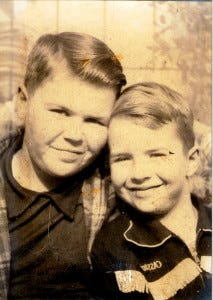
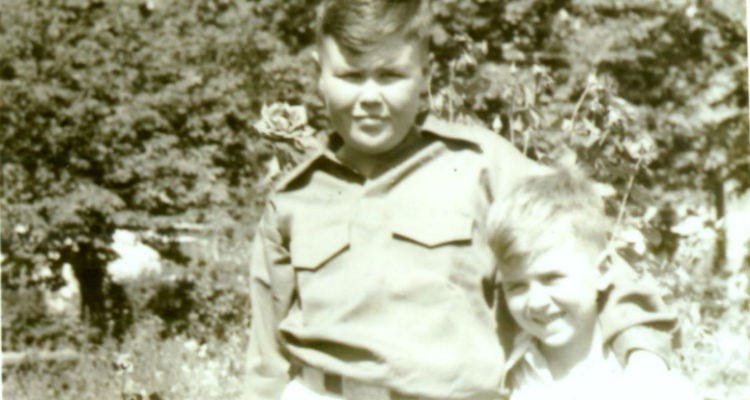
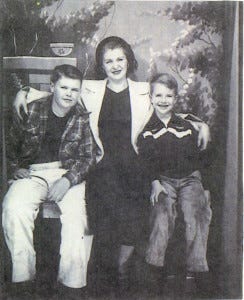
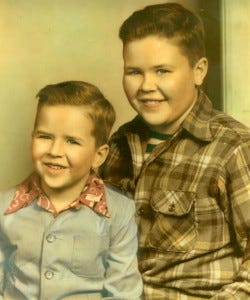
I remember my last conversation with my brother Raymond Carver, who had been fighting cancer for the last ten months. He called to tell me that he and Tess Gallagher, his companion for ten years, had been married in Reno. I congratulated him and wished them happiness. I still held the unrealistic hope that he would beat the disease, but Ray knew better. He said to me, “James, it’s time for me to cash in my chips.” I can’t remember what I said, if anything. What can you say when someone you love very much tells you he is dying? He protected me, this kind, gentle boy who was my big brother, my mentor, my buddy who watched over me, who had his arm around me in every family picture. I recalled the times we shared as kids growing up in Yakima, Washington and later as young men in California: Sacramento, Eureka, and the Bay Area. All those years, we had been best friends.
Raymond and James
Our father would take us fishing to all the lakes, rivers and streams around Yakima, Washington. In the summer, Dad took us to a lake called Rimrock, about an hour and a half northeast of Yakima. Rimrock was a picturesque lake, surrounded by trees and great for fishing. Dad told us the lake was a crater of an ancient volcano, so deep the bottom had never been discovered. The rubber raft Dad bought at an army surplus store served us all well. We would blow up the raft and drift out on the cold, clear lake. The water was so clean you could drink it. We would fish all day.
The three of us also fished on Rimrock Lake in the winter, when it froze over with a solid sheet of ice. We cut holes in the ice to fish and sat on camp stools in a totally pristine atmosphere under an unending blue sky, with clear crisp air and pure white ice as far as we could see. Eagles circled high in the sky. We watched our father smoke his Camels as we caught glimpses of our own breath. We were enveloped in a blanket of silence and snow. Not until one of us spoke would that silence break.
I also remember all the times we went goose hunting on the Columbia River, that mighty river that divides the states of Oregon and Washington. The river is one of the largest in the United States, running 1,243 miles. We hid behind large rocks on the high bluffs, wearing our warmest clothes and knee high boots to protect us from the rattlesnakes so prevalent there. Thousands of geese sat on islands in the middle of the river. At dawn all the geese would lift off honking, their wings creating a tremendous roar; the early morning sky turned dark with geese, flying to feed in the wheat fields that bordered the river on each side. The bluffs were hundreds of feet high. On windy days it was all the geese could do to get over these bluffs. We could almost knock them down with our shotguns, they flew so low. If the geese escaped to the Oregon side our day was over, yet the drive from Yakima was always worth the trip.
Raymond and James
In the winter of 1961, we were all living together in Eureka, California: me, my parents, Ray, and his wife Maryann. Ray asked me to drive to San Francisco with him. He wanted to see a play by the Russian author Anton Chekhov. Ray admired him so much. I readily accepted because I had never been to a city and was anxious to see San Francisco. We saw “The Cherry Orchard.” It was memorable for both of us. Later we made another trip, to see Chekhov’s “The Three Sisters” at the old Actor’s Workshop, a superb theater. This time we drove my 1956 Thunderbird convertible. Ray loved driving it. He took it on several trips to Reno with Maryann.
Ray and I had a great time in San Francisco. We’d go out to eat, walk around seeing the city, and watch foreign films. We liked Ingmar Bergman and Fellini.
We always had much to talk about. Ray let me read many of his short stories when he first finished them. He valued my opinion and would ask, “James, do you really like it?”
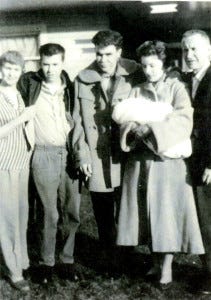
Mom, James, Ray, Maryann (holding Chrissy), and Dad
I owe so much to Ray for my early education. He exposed me to the classics and great literature, and led me to my first real experience with theater. Ray became my mentor and encouraged me to pursue a higher education. He introduced me to Russian authors and a wide range of English, German, French, and contemporary authors of the day, including James Baldwin and Norman Mailer. Jack Kerouac was one of my favorites. I read On the Road over and over. Ray became the greatest influence in my life, opening my eyes to the world. I learned so much from him.
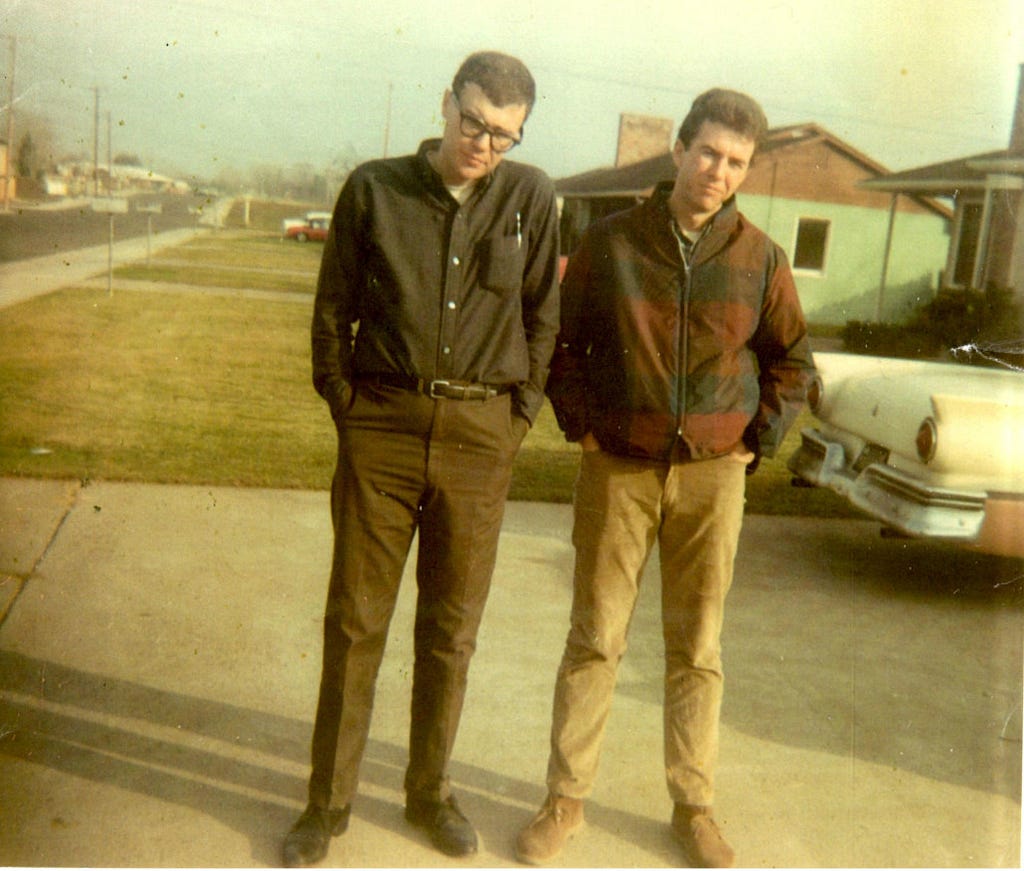
I remember the years we shared living together in Sacramento during the mid-60’s. I was going to junior college and living on student loans. Ray had already graduated from college but did not work much. One of his few jobs in Sacramento was working at Mercy Hospital in housekeeping. He worked three or four hours in the evening but was paid for eight. We both had nothing but spare time; we continued to spend many hours hanging out together, talking, reminiscing, and drinking. We would get in the car and drive with nowhere special to go. We talked about all the moves we and our parents had made looking for happiness. We drank from a bottle of Ten High Bourbon we kept in the glove compartment. One of us would say, “Wait until spring.” The other would say, “And things will bust wide open,” meaning at last, everything would be better for all of us. We both would break into laughter. It was a private joke which we never forgot; Ray mentioned it a year before he died. We always had the ability to laugh at ourselves and our failures.
Raymond and James
Our mother was quick, energetic, and industrious. While our father worked full time, she often worked as a waitress, in canneries, or in retail. She also managed a hat shop in downtown Yakima for a period of time, back when hats were popular for women and men. She was very capable, and generally ran the shop by herself. Mom worked to buy things for the house, not to put food on the table (that came later, when Dad got sick). She loved her husband and boys. She was a great cook, kept a clean house, and dressed Ray and me in clean, pressed clothes. All one has to do is look at the hundreds of photographs taken of him, especially the ones when he was very young, at the time when our parents were their poorest, to see how well cared-for he was. You won’t see a better-dressed child.
Raymond (10), Mom, and James
Our mother was pretty, with a good personality, a sense of humor and social graces. Like our father, she was smart in many different ways. Her parents taught her good grammar; consequently, she always spoke well and correctly. Luckily, she passed it on to Ray and me. I have read that some people in Yakima thought my mother was a little “peculiar.” If she had been less “classy” and more common, they might not have thought her peculiar. Mom, along with all her good qualities, had a quick Irish temper.
In Yakima, we had the best years of our family’s life. Our decline began in 1956, the year our father quit the Cascade Lumber Company in Yakima. He had been there for fifteen years or more, never missing a day’s work. Up until that moment, dad always paid his bills on time and provided his family with a good living. He was responsible, working since he was fourteen or fifteen years old and supporting his parents when they needed his help. Our family was living in a nice bungalow on Summitview Avenue, the better side of Yakima. We were settled, happy and doing well. Then dad’s brother Fred, who had been an institution at Cascade, was fired.
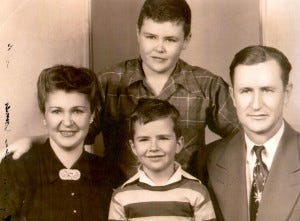
The Carver Family, 1950
Our father quit Cascade and accepted a job as a saw filer with his brother, Fred, in Chester, California. That move started the decline of the Carver family, a slow insidious unraveling that cost all of us almost everything. Dad’s health began to deteriorate when he got blood poisoning from a saw while working for the Collins Pines Lumber Company in Chester. It caused our mother grief and hardship, forcing her to work full time to support the family when my father became too ill to work. It greatly affected my life, as I was in and out of many schools, with no roots, no friends and no permanency. I had wanted to attend the University of Washington, in Seattle and had taken all necessary preparatory courses in high school. If we hadn’t moved to California, I most likely would have graduated from the University of Washington, with my father’s help, and lived in Seattle. The move also affected Ray and Maryann’s life together for many years into the future. If Dad had not left Yakima, he might have been able to have helped them financially; maybe their lives wouldn’t have been such a painful financial struggle for all those years; it may even have averted Ray’s alcoholism.
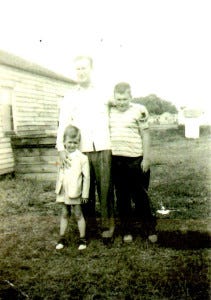
Dad, Raymond (9), and James
Ray and I lost our beloved father in Crescent City, California, in June of 1967. Dad was working as a saw filer for Simpson Timber Company. The night of his death, he ate a big dinner and went to bed early. He didn’t wake up the next morning. Mom found him cold and blue. The doctor was called. Dad’s heart had failed; he was pronounced dead and taken to the local morgue. Fortunately, I was with my mother, between college semesters. We were both in a state of shock. We immediately called Maryann in Sacramento. She called Ray, who was in Iowa, enrolled in the university to work on his master’s degree. He withdrew from school and came to Crescent City. After arrangements were made, we all followed the hearse back to Yakima. It was our father’s last journey.
I remember standing with Ray before the open casket, both of us weeping. Ray took a pack of cigarettes from his pocket, placed them in Dad’s shirt pocket, and said, “Dad, you will need these on your trip.” Our father was cremated the following day. The night before, I remember Ray and I drinking straight vodka and cursing God for letting our father die. We loved this man so much; a piece of our hearts was lost forever. It would never be the same again. We could not even talk about his death for years to come.
Before his success, Ray was often depressed because of his financial problems, and he didn’t have much work. He never had a serious job, not because he was never offered one, but because he only wanted to write. Through the years of their marriage, Maryann had worked to support the family. Then, in 1967 he accepted a good job with Science Research Associates, in Palo Alto, California. I was working not far away at the time, in Fremont, California, for General Motors. Ray came to my apartment on weekends to visit. We had long conversations about his unhappiness. He told me he didn’t like his job at SRA. He felt his family obligations were holding him back from what he really wanted to do, and that was to write.
Ray and Maryann, 1975
Although they loved each other very much, Ray and Maryann’s life together never really improved. They were separated in 1978, after several extramarital affairs, alcoholism and bankruptcies.
I saw Ray less after the breakup of his marriage, his meeting Tess Gallagher and his battle with cancer. But I am so grateful that his last ten years were good years for him, “gravy” as he called them.
Early in the morning on August 2, 1988, the phone rang. It was Tess Gallagher. She said simply, “Your brother is dead.” I felt heavy with sadness. I had been expecting the call, but I could never have been prepared. I thought of my father, and knew how saddened he would have been had he lived to see his first son die so young and with so much promise remaining. I thought of our mother, and the love and support she would need from me to get her through this.
Our beloved Ray was gone.
At the end of our last conversation, Ray said, “Goodbye, Bud.” He had never called me Bud in the past. It was what our father and his brother had called each other. It was an affectionate term between them, and I knew Ray meant it that way. It was his loving way of saying, “So long.”
Everyone seems to have an agenda when writing about my brother. Some want to cast Ray in a role that furthers their own academic or personal objectives. Others who have been close to him want to ride his coattails or claim some credit for his success. Most write only what they have read or been told by others who did not know him or his family. I am sure that my brother’s legacy will endure. I am also sure that the distortion of his life’s story will continue with his legacy. Ray is partly responsible; he was a born storyteller who would exaggerate the dysfunction in our family to embellish his autobiography.
Raymond
I often read Ray grew up in a drunken, dysfunctional family of “ne’er-do-wells” with ignorant, uninformed parents. He has been portrayed as abused and neglected like a character in a Charles Dickens novel, who somehow managed to pull himself up out of the muck and mire of a bad childhood to become famous. My father’s drinking has been greatly exaggerated. He did not drink every day, as most alcoholics do, from morning until night, as my brother did.
None of the writers except Carol Scklenicka has ever contacted me for the truth. Carol’s biography, Raymond Carver: A Writer’s Life, was published by Scribner in November 2009. Carol interviewed every relative of Ray’s, as well as almost every person who has ever known him from childhood to his death. Her biography is the only serious and credible one written so far. I’m sure it will stand the test of time. I have learned so much from Carol’s book that I did not know about my brother. I did not realize the extent that alcohol had consumed his life, and the violence later connected to it. Our lives had gone in separate directions during this time.
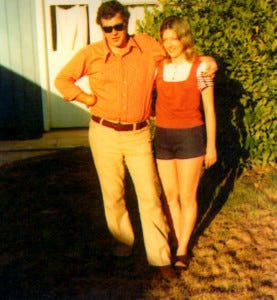
James and Raymond
My brother’s life has been sliced, diced, analyzed and dissected. The apparent consensus is that he rose to literary prominence despite drunken parents and a deprived childhood. That is false, and Ray himself is responsible for much of this misinformation. Many of his stories were based on personal experiences and the characters were drawn from people he knew, including his family. However, little of what he wrote was factual. He would alter details to make the story suit his own creative purposes. For example, it has been suggested that Ray based the story “Elephant” on me. But “Elephant” is a fiction built around a few facts. I did borrow money from Ray, as he sometimes borrowed from me. It was during a time when I had missed a lot of work because my wife was very sick. He asked me to pay our mother back instead of him, and I did; in the story, the character of the brother never pays the debt..Ray also wrote an essay on our father, “My Father’s Life.” Not all of it was fiction, but it was certainly not a true biography of our father and family. I am the only one who would know that. He changed much of it to suit himself, although a reader would believe it all to be true.
Raymond, Mom, and James
Ray embellished his childhood in interviews as well as in writings. He misrepresented facts, making our home life seem worse than it was. Perhaps he wanted to make his climb to fame appear more remarkable, or perhaps alcohol abuse clouded his memory. I do believe Ray appreciated the love and care our mother and father gave him, and the quality of time spent with him. His good character, sense of ethics, humility, and compassion were traits given to him by his parents. Dustin Hoffman, in an interview on Inside the Actors Studio, said that when he acts, his characters are drawn from his family: his father, his mother, his brother. In essence, that’s what Ray did. He drew from his family in his writing, because he was “made up” of his family — that’s who he was. Our parents should be revered, appreciated, and praised because Ray was an embodiment of each of them. As much as I love Ray, he was not the good father his own father was. His drive to write took priority over everything. He put his self interests above his family’s needs. Alcoholism, pursuit from bill collectors, family discord, and bankruptcies were embarrassing and bad examples he set for his children.
One biography states that my father was an alcoholic who died at the age of fifty- three. This suggests that alcohol is what killed my father, when my father actually died of a heart attack in his sleep. The biographer also says my mother was no stranger to domestic violence. Again, this is misleading, suggesting that my dad abused her. John Updike mentioned my parents in his tribute to my brother at his memorial service at St. Patrick’s cathedral in New York in 1988. He said our parents had a drinking problem. On the contrary, our mother drank only occasionally. Updike innocently picked that information up from others. This is how incorrect information perpetuates itself. If a lie is told often enough, it becomes the truth.
Raymond and Dad
In the book Carver Country Tess stated that Ray had grown up in a home where only Zane Grey books were read. True, our house did have Zane Grey books. However, there were many other books to read. We had no great literature or contemporary fiction of the time, but we had books. Dad liked adventure books and magazines and kept many in the house. He had a collection of Edgar Rice Burroughs’s Tarzan and the John Carter of Mars series, also from Burroughs. He had books on the Civil War and on President Roosevelt’s administration. Ray and I read all of Dad’s books. We also read the adventure magazines. Several times a week, Dad told us great stories. He was a marvelous storyteller with a very creative imagination. He made them up as he went along. Ray and I were mesmerized before he finished. I believe Dad’s stories helped motivate Ray’s interest in storytelling and his desire and need to write fiction.
Our parents wanted us to have better opportunities than they had. That is why Dad paid for Ray’s writing course, and an art course for me. I never heard Dad say that he wanted to teach us the saw-filing trade, or that he wanted us to follow in his footsteps. Neither of us showed any interest in his trade, and if we had I am sure he would have discouraged us. I heard Ray say in an interview in 1983, for the American Audio Prose Library, that he was expected to go into the sawmill industry. This is absolutely not true. Dad had wanted a formal education for himself, but was unable to afford one. He certainly wanted no less for his sons. Ray was altering the truth to his own purposes, fictionalizing his autobiography.
James and Raymond
I miss my brother very much. I loved him and respected him enormously. I believe he was a true genius to write everything that he did about the way people truly are with one another. We can’t really get inside the other person’s mind to see how it ticks; we can never know the true feelings one may have for another. We can only be guided by the things said and the feelings shown to us by the other person, and believe it to be true. Ray captured the complexity of those relationships, in love or outside of love.
Ray is gone now. It breaks my heart to remember our last words. He had never called me Bud in the past. I knew he would never see me again. I won’t forget you, my brother, my friend. Goodbye, Bud.
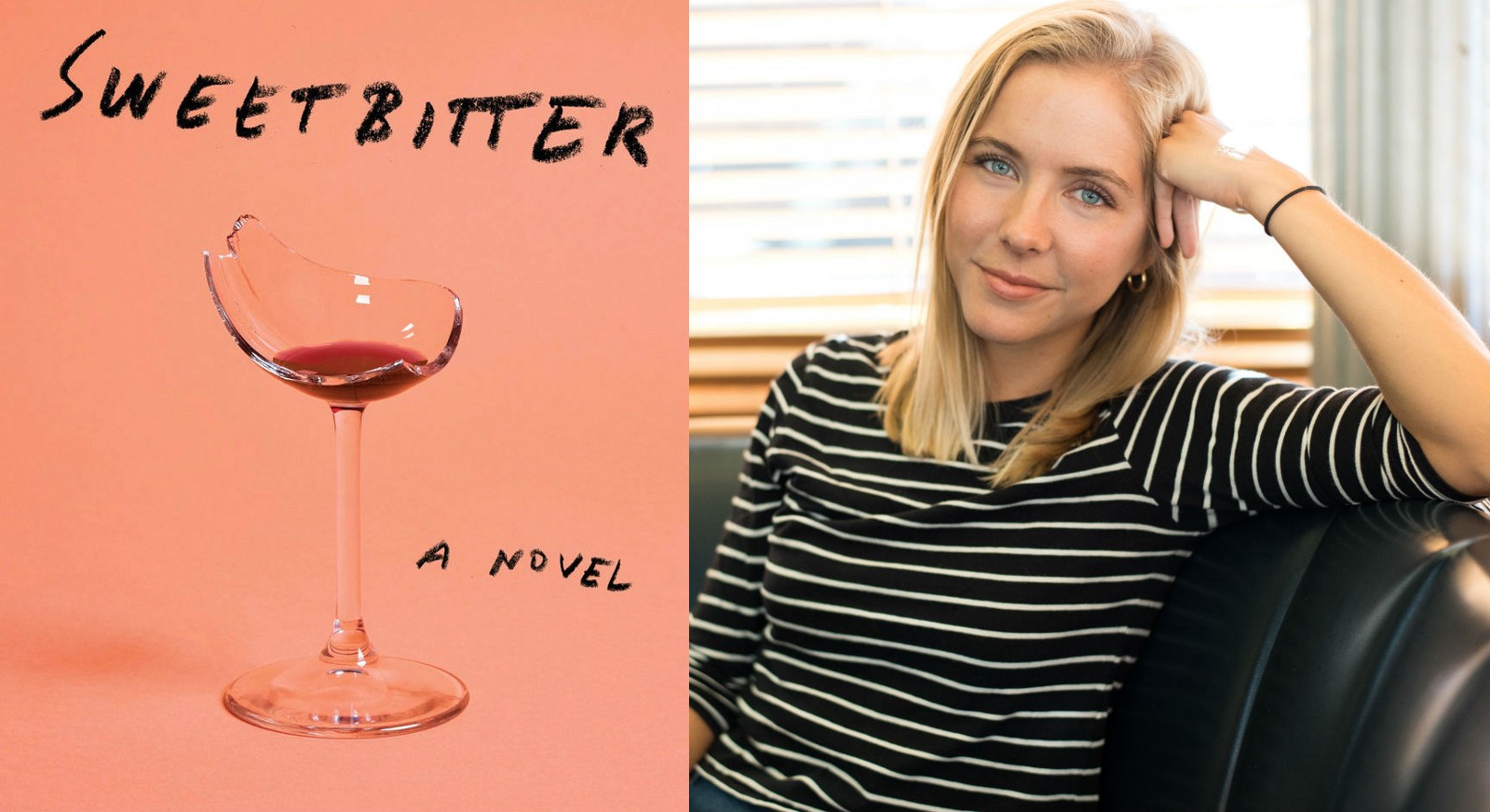
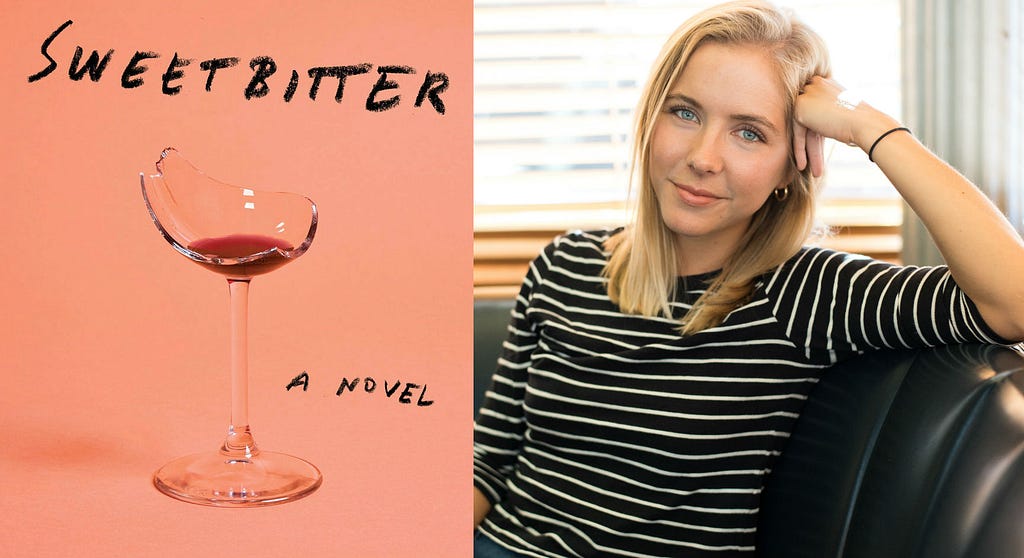
Sweetbitter (Knopf, 2016) is a profoundly sensorial novel by debut writer Stephanie Danler, in which the protagonist Tess — who is young and fierce, optimistic and hungry for experience — works as a backwaiter at a restaurant near Union Square. “You will develop a palate” is the book’s opening line, and from there Tess embarks on a luscious education on food, wine, sex and love. Central to this experience are Simone and Jake — a senior waiter and a bartender, respectively, cynics, both of them, who have a complicated history and who are seductive forces for Tess.
A former restaurant professional and incredibly talented writer of emotion and metaphor, Danler has written a book informed by her own deep knowledge of the restaurant industry. As Tess develops her palate — the central metaphor of the book — I fell under the spell of the book’s construction, through which one experiences the hectic and exhilarating nature of working in a restaurant and the gravity of food as story, thread, and history.
I met with Danler for coffee at Via Carota, one of Jody Williams’ restaurants in the West Village. We talked about New York, the choreography of restaurants, the structure of novels, and developing a palate that stays with you forever.
Megan Cummins: Sweetbitter opens with Tess, our narrator and protagonist, trying to get across the George Washington Bridge, but she doesn’t know about the tolls. I grew up in Michigan where there are no toll roads so I didn’t know about them either. I love that she gets turned away and she has to go to the Dunkin’ Donuts off the turnpike where she gets mistaken as a regular — and let’s face it, no one wants to be a regular at the Dunkin’ Donuts off the New Jersey turnpike.
Stephanie Danler: I’m so glad you got that. I was like, what is something terrible that could happen to her in this Dunkin’ Donuts?
MC: And getting recognized is exactly it. Because she’s so close, right? And she worries she’ll have to go all the way back to Ohio. But then she gets back to the toll both and she says, “Can I get in now?” And so that made me think of New York as this place that has borders and has a certain exclusivity to it — but also once you get in, it feels endless in a way. But you have to get in first. So I was wondering if you could talk about New York as a place that feels both exclusive and endless?
SD: A private club. Of course. I think that New York is this bubble and feels impenetrable for a lot of people that are not living in it. I think it takes a certain kind of person who has to be a little bit dumb and a little bit brave — and those two often go hand in hand — and also kind of ambitious, that comes here. There’s also some fearlessness involved. It’s so different from any other place in the United States, with its own customs and language. The people look different. It has its own grid. The maps look different. It has its own system of transportation. It is literally alien to 99% of the rest of the country. And so I think you find a long literary tradition of people coming to New York who have that drive and ambition and the desire for reinvention and the desire to penetrate the bubble. That penetration involves becoming themselves or becoming something. That is what every New York story that is close to me is about. The toll both is interesting because I kind of saw that Tess had these three points of entry early in the novel. They were the toll both, the bar where she has to get the keys to her apartment, and passing the test with Howard [the general manager of the restaurant]. And it’s not that she is in after that, and everything’s easy, but she’s allowed to play the game. She has been allowed to start. That’s really where the story takes off. From there it’s a series, to me, of initiation rituals like anything else, like any other private club or the military, where they take away your name, they take away your clothes. You don’t talk. You just learn and absorb the rules and language of this new world. And then when you emerge sixty pages later, or whatever it is, you’re a new person. And it’s interesting that you brought up that line — can I get in? — because that is really important. When I was writing this, my editor or classmates or teachers would ask, what’s the transition she’s going through? I think in fiction there’s this idea that there needs to be some transition. I made it from Point A to Point B, here was my trajectory, and Point B is so different from Point A. Here was my epiphany.
MC: Right — in the middle was my turning point.
SD: Exactly. It’s not even that it’s a formula. It’s how readers connect to the story. But I was really resistant because I wanted her journey to be a series of very subtle transitions because I think that’s how real growth happens. So that can I get in? changes when she’s walking across the Williamsburg Bridge at the end of the book. It shifts to it was my city when she realizes she didn’t need to ask for permission from anyone. And this whole process is her taking ownership of the city, and going from can I get in? to I’m here, this is mine.
MC: Taking ownership strikes a chord with me. Throughout the book everyone is asking her what else she does. What else do you do? And I feel sometimes that people in New York — or maybe everywhere — people are expected to be doing a hundred different creative spectacular things all while making a living. I was wondering what about both being young and being in New York makes Tess the subject of that question, What else do you do?
SD: It’s interesting that you say it’s about being in New York and the expectation that you’re managing five different lives simultaneously. I think in Tess’s case the expectation comes from an old stigma about the restaurant industry that has changed since the food culture explosion. The novel is set ten years ago. The food scene was already in the beginning stages of blossoming but since then we’ve seen it erupt. By seen I mean the industry as a viable job with growth that’s attracting highly educated, creative people, who aren’t just using it as a temporary stopgap before they go on to their real lives. I personally have been working in restaurants since I was fifteen, so for sixteen years when I stopped waiting tables, and there was always this stigma about this job as being throwaway. What I realized when I got to New York is that even the busboys were professional busboys. They knew their jobs inside and out. And it goes with this cliché that to live in New York you have to be the best at what you do. And these servers are the best at what they do. And a Danny Meyer restaurant, which is where I had my first job, attracts those kinds of people. I was blown away by it. I remember at that point in my life when people would ask me what else I was doing I would say, “Oh, I’m a writer.” But not everyone around me was. They were servers. They were career servers. And they were still pursuing their hobbies outside of their job, but they didn’t feel that same defensiveness. I think that for Tess, she’s so enamored with the world, it fills up her landscape so completely that she’s forgotten that she should be able to answer that question. I think that’s just very accurate of what I saw. And there was a time after my first couple years in New York that I stopped saying that I was a writer. Because I wasn’t. I was a restaurant professional. I was a sommelier; I went to wine school; I managed businesses; I helped open businesses. I was pursuing life in the restaurant industry, and I didn’t need to justify it with anything else. But initially in 2006 I think there was still that urge.
MC: Absolutely. And I also am thinking of a part from your book relatively early on when Tess almost opens the door to the coffee shop on Bedford Avenue to ask for a job but something tells her not to. And at the end of the book I thought about that moment again because I think something about the setting of the restaurant felt so perfect for a novel.
SD: Me too, obviously. [Laughs]
MC: You describe so well the very precise choreography of working at a restaurant, which Tess masters, and it made me think that you have to have a sort of similar, very precise choreography when writing a novel. So I was wondering why you were drawn to writing a novel rather than say a story? And I was wondering if you saw any parallels between the structure of working at a restaurant and the structure or balance of novel writing.
SD: Yes. There are two questions in what you just said. Why a novel, why not a story for this? And then there’s something about structure and form.
MC: I clung to the very precise choreography of the restaurant. When one thing goes wrong the whole service dissolves. And I think that can be true of a novel too.
SD: Absolutely. I was really interested in the form of the novel as mirroring the content exactly. And so you say choreography, and I’m thinking of rhythm, as far as the way the vignettes are set up, the speed with which the story unfolds, the speed of certain sentences versus the slowness of some other scenes, and I was very aware of balancing that the entire time. But all in an effort to make it feel like working a dinner service.
I wanted the experience of reading to be as close to the kind of dance of dinner service as possible
I wanted the experience of reading to be as close to the kind of dance of dinner service as possible. I’m so happy you said choreography because I paid so much attention to movement. So much of the book is Tess watching how other people are moving and trying to learn how to move the same way. I think consciously and unconsciously that falls away toward the end of the book because the job has become automatic to her, which also mirrors the real life experience of first starting a job and paying attention to every tic, where everyone’s eyes are landing, how people come from around the bar, how people are holding their plates, where people are positioned, and then it becomes second nature at a certain point and she can move on to the emotional intricacies that are bubbling all along the surface. But I agree that there’s something in the choreography of a dinner service that lends itself to writing a novel, if only in the fact that you are juggling sixteen different emergencies simultaneously and needing to hold them all in your mind at the same time. One of the more difficult things about novel writing that I found — because I’d never done this before — was being able to hold the end of the book in my mind while I was writing page seventy and knowing that they were all interconnected, and no decision was isolated. Nothing was isolated within the story. When I was editing it I would think, I need to do something on page twenty-five. You would think I could go to page twenty-five and make an adjustment. And I found my process to be horribly inefficient, but I needed to write up to that scene, and write away from that scene, in order to make any change, because of how interconnected everything was.
MC: Like if you drop the plate on the floor, you can’t just pick it up and put it on the table. You have to start over.
SD: Totally.
MC: The book is so metaphorically rich.
SD: It is a metaphor. It’s a metaphor about a palate, and developing a palate. The entire arc of the story is in the first sentence.
MC: You pull it off so seamlessly. The metaphor is carried throughout and yet it’s a real moving fully-fledged story of this young woman discovering her palate and her body in more ways than one. One thing that struck me was just how beautiful the descriptions of food are and how important food is — clearly it’s at the center, the restaurant is the food. I was wondering what your relationship with food was as you were writing the book. Did food and wine like the food and wine in the book fuel the language as you were working on the book, or was it all from memory?
SD: I was a food professional from 2002–2009 and then I went to graduate school and I continued waiting tables. And then I had already been changed as a person. This transformation Tess goes through where she learns to pay attention to the world through food and wine had already become my life. I was surrounded by incredible cooks, I’d been traveling to every wine region in Spain with my bosses for five years, multiple times a year. I’d been going to France. My life had been eating. On my days off my ex-husband and I would eat at three different places in a day because we only had one day off and we wanted to try everything in the city, and we’d go to Flushing to Chinatown there. So I already had that obsessive knowledge. But by the time I was writing the novel and in graduate school and working nonstop it wasn’t my life anymore. I loved being around food and I chose [to work at] Buvette because it’s one of my favorite restaurants in the city. I cherish being around Jody’s food. But it was also the only kind of job I’d ever had. And I knew it could give me the life that I wanted and I could support myself while I was writing. So a lot of it was from memory. A lot of it was trying to remember what it felt like to be fully inundated and cosseted in this industry. At this point I was learning about the publishing industry and learning about being a graduate student. And my whole life had changed. Every single aspect of it. People have asked me whether I had to research the book. And it wasn’t that I had to research, but I had to re-access something I wasn’t living in the moment anymore. And I was lucky that I remembered, and that I stayed close to wine. Because I had worked in wine retail more recently than I had in restaurants. Definitely. It was far away at that point. And being twenty-two was far away at that point. That was hard to access as well.
MC: Yeah. In some ways I feel like twenty-two, perhaps for our generation, is the first year of being an adult.
SD: Yeah, that’s why I chose it.
MC: Not for everyone, but in many cases. So it’s a perfect age for Tess, I think.
SD: There’s something about this prolonged adolescence through our twenties that so many writers and filmmakers have tapped into. But I do think that when you’re twenty-two, especially if you move to New York around that time, you’re not protected by your parents or the town you grew up in or your continuous identity from people that have known you. You’re not protected by an institution. There’s no school and academic calendar. There’s this brand new autonomy and a lot of twenty-two year olds that I see in New York — because after I was one I managed them for years — are drunk on that power. And so that part of Tess’s giddiness is something I could recall from myself but also observed over and over again hiring people in restaurants that were just getting here. And free.
MC: The back-story for Tess is relatively spare in the book.
SD: It’s very spare!
MC: We know enough and we know it’s good she got out. That she had to flee in a way. Her mother left when she was very young. Her father seems very distant. I was wondering if you could talk about that decision to exclude a lot of Tess’s family history.
SD: It was really such a natural choice and of course one that throughout graduate school a million people told me would never work and I was determined for it to work. I knew that it worked for the story that I wanted to tell because Tess is a present tense creature. I wrote her to be new. To be blank in a certain way so that her impressions of the world could be heightened and so we could feel everything through her fingertips as she touches it for the first time. It was a very delicate balance because a real blank slate is not a character and it’s certainly not a protagonist. So she needed to have weight from the very beginning, and a lot of weight comes from voice, I find, in fiction. It comes from the ring of authenticity of the voice. We know enough to know that she’s had some damage, we know that she’s escaped, we know that she’s observant, sensitive, ambitious, innocent. We know that in order to make the decision to move here I think you have to be inherently optimistic which is something that comes out throughout the book as she realizes I am different from these people who are nihilistic. I’m actually an optimist. Which is what saves her. So nothing else was necessary. The other aspect of that that I wanted to capture in the book is sort of the claustrophobic nature of living in New York and working in a restaurant where there’s really no context outside. New York experience is the only thing that counts — they tell her that — but you find that’s true in every single industry across the board. People want to know where else you’ve worked in New York as though you didn’t exist before you got here. A lot of your prior experience isn’t translatable because this is such an idiosyncratic place and so by keeping her within that bubble it felt more true to the experience of living here.
MC: I’m so glad you brought up optimism because I definitely saw Tess as an optimist. And her optimism sort of runs up against the cynicism of the other characters. Particularly Simone and Jake. And of course with Jake, I was seduced by him too. He’s just this beautiful bad news.
SD: He’s a nightmare.
MC: Such a nightmare. And so I was wondering…there are so many parts where I could see her attraction to Jake, and especially thinking back to how a twenty-two year old would be so compelled by someone like Jake. I saw him too as just being so careless with her. Tess is the youngest and she’s an optimist, but in general many people in the restaurant aren’t very careful with each other, so I’m wondering what about that age makes people not be careful with each other?
SD: So Jake’s thirty. Simone’s thirty-eight. I think that there’s something about overstaying your welcome, especially in the restaurant industry, people staying too long at the party, and it creates toxicity. And the toxicity comes from boredom. This is enchanting and enthralling to a twenty-two year old over the ten months — I think we get to eleven months — that we’re with her. For twenty years I think it’s probably stifling. I know that it has stifled Simone’s ambitions. And Jake is at the cusp where it’s about to stifle his. Tess for him is his last chance in a way. Or the closest he’s come to being able to break out of this disillusionment.
This is a disillusionment coming-of-age-story
And you have the old world disillusioned cynical characters but Tess reminds Jake that he doesn’t have to be that way. That’s his attraction to her. But at thirty, having been there seven years and having been Simone’s collateral damage for his entire life, he has the smallest amount of hope which is what Tess taps into. And not every day, because I didn’t want to make a fairy tale out of this. He’s an asshole. He’s an emotionally stunted asshole who can’t give her what she needs. But I think in the experiences that I’ve had with those kinds of men, and that my friends have had, there are these moments of softness and lucidity, and those are what keep you going for so long. And Tess definitely has that with Jake, especially toward the end. But I do think that a lot of broken dreams, stifled ambition, all of this can create a cloud, that Tess isn’t aware of when she first gets there, of bitterness. And you see that in the restaurant even though it is such an incredible job and it gives you an incredible life, anyone who stays too long anywhere finds that they lost their way and risks bitterness.
MC: I thought the struggle with Jake was expressed perfectly when he and Simone surprise Tess with a birthday cake. Tess is talking about traveling, and Jake comes up behind her and says, “Where do you think you’re going?” in a very affectionate way and at the same time is planning a trip to Europe without telling her.
SD: He doesn’t even know. Tess registers so little [to him] in a way when she’s next to Simone. I remember discussing that with my editors, whether Jake registers a betrayal, and I said no. He doesn’t. He registers that she’s upset and that he’s hurt her feelings but I think he’s too far gone down his path. It’s the worst.
MC: I felt the betrayal so strongly. And it’s interesting that you describe Jake as Simone’s collateral damage. Family is such a big theme in the restaurant. The whole restaurant is a family. They have family meal. But then Jake and Simone and Tess as well have a small family within that family. In some ways it’s edifying and nurturing, and Tess learns so much from Simone, but as you said Simone has already crossed into the realm of bitterness. That just made me think about family. I was wondering if in the book being in a family is emotionally perilous?
SD: My personal beliefs might differ from what I put into the novel. New York City attracts these orphan types and I have always thought of Tess as an orphan. Even if you’re not an actual orphan most of us here are cut off in a way from our families. Everyone came from someplace else for the most part. I think that your natural inclination is to recreate that security as quickly as possible and for someone who’s never had it, like Tess, to fall into a restaurant, where there’s family meal and everyone feels they’ve been born there and they’ve been there a million years, and then for her to be attracted to Jake and Simone who have this strange mother/son, brother/sister underlying bond of actual family, that makes sense to me. The way she latches on to Simone is very connected to her having never had a mother. I do not think that for Tess family is perilous. I think being so unformed and not knowing herself — and this might be true with family as well — I think being at the mercy of the people you love is perilous. And so if part of her journey is taking ownership of her city, I would also say part of her journey is developing boundaries, even boundaries as simple as I don’t like that. I think that’s what puts her in a position to fight back against Simone and Jake toward the end. I think that I’ve had a lot of experience with toxic families, and through my friends incredible experiences with great families, but I do think that losing your individual identity within that family is very dangerous.
MC: Interesting. You answered my question in a much more nuanced way than I phrased the question. What you said about how it’s not family that’s perilous but it’s about not being fully formed — that’s what’s perilous.
SD: It’s really dangerous to give yourself over to other people. Of course that’s the thrill of intimacy. But when I was writing the book, something I was obsessed with was how we don’t know each other, how we get into these professional environments. I’ve worked with so many people over the years, and I know these tidbits about them, and in the moment our intimacy was so intense and military-like, just like being in the trenches with someone, and when I left I knew nothing about them, sometimes not even where they were from and we had shared so many evenings together. And I think that where Tess is really reckless isn’t with the drinking or the drugs, but it’s with giving herself so freely to people.
MC: Yes. She’s very thoughtful and she’s very curious and she’s very genuine and earnest whereas everyone around her is —
SD: Not saying what they mean.
MC: Exactly. And she believes them because she means what she says. And that to me was so much the heart of Tess’s journey throughout the book. And the drugs and the drinking, they’re both substances for the body. They’re two parts of her life that in a way revolve around the restaurant and they’re both things that fuel her. Are the drugs for her working in concert with the food, or are they separate?
SD: I think that cocaine is a drug, food is a drug, wine is a drug, sex is a drug. Xanax is a drug. So what we mean by drug is that they put her into a heightened state. They give her a rush that she becomes addicted to. And she has the realization several times that she’s gotten into a lifestyle of more. I want more flavor, I want more feeling, I want more hours in the night. And so I don’t think the substance matters. I think that what she’s exploring throughout the book is an appetite. And that appetite is for life and for experience. And so food and drugs are absolutely on the same level. But determining what’s good for me and what’s bad for me is something I’m still negotiating at thirty-two, but that’s a big part of growing up and coming of age. Initially, especially when you’re quite young and you haven’t fully understood consequences yet, or maybe you haven’t had enough autonomy to understand them, there is no distinction between good and bad. It’s all just new.
MC: It’s part of her palate too. The night she blacks out, when she gets out of the car she says she takes a bump of some really good shit, and I had this feeling that at the beginning of the book she might not have been able to register what was good quality and what was bad quality.
SD: Yeah. Absolutely.
MC: At times in the book Tess is depressed, or maybe just sort of sad in the way young people are sometimes sad.
SD: Young people? Everyone!
MC: Right! Of course! Sadness doesn’t end when you’re not young anymore. I wrote down a quote here, something Tess thinks: “Sometimes my sadness felt so deep it must have been inherited.” That made me think about how food in the book is something with a history, a thread, a story. And then there was the dinner service with the seafood towers. There were only seventeen seafood towers to sell and they were gorgeously constructed, $175 each, and something about them made me so sad for some reason. These beautiful things that were so fleeting. I think food for Tess is an ecstatic experience, but is it also ever a sad experience for her?
SD: Of course. And you talking about that makes me think how so much of the sadness for Tess is that these things aren’t permanent. Her highs aren’t permanent. Her relationships with Jake and Simone and her coworkers aren’t permanent.
Food is a very intense but transient, fleeting, ephemeral experience that is erased at the end of the night
Food is a very intense but transient, fleeting, ephemeral experience that is erased at the end of the night. I think mentally that’s really hard on you when you’re working in restaurants. I think — and I say I think because I worked in restaurants for so long and I don’t really know another way of life — but there’s something about a job, an actual profession, where there’s no accumulation, where you don’t make lists that carry over from day to day, where you never complete projects, you complete evenings, and you could have had a great night and the next day you’re starting over from zero again, and I think it’s a hard space existentially to live in. To recreate this experience every single day. I also think there’s something about sex that is also a temporary intimacy that she’s struggling with, and trying to extend, and that’s what she’s beginning to figure out — first that sex can be intimate, and she’s trying to see if she can spread that out over her entire life, and she can’t. After eating an incredible meal, after consuming this seafood tower. I think about this all the time because I’ve spent such ridiculous sums of money on food. For my 27th birthday, my ex and I saved up and went to Per Se and it cost as much as our rent. It was really important to us. But it was six hours and that was it. It was over. I don’t have anything left of it but these memories. There’s no accumulation. It’s all ephemera. And it is sad, but also the way of life. And what that produces for Tess is a heightened awareness of beauty when she has it. I don’t know if she fully gets there within the novel but I think that accepting how temporary it all is often gives you those highs and those lows.
MC: Throughout the book people are telling Tess, “It’s just dinner.” Or Simone is saying, “Don’t worry little one, none of this will leave a scratch.” But by the end Tess is saying no, the point is that there are scratches.
SD: Everyone wants to brush it off, the experience. The entire novel, because she’s young, everyone is telling her that what she says doesn’t matter. That what she thinks is important or permanent is not going to be. I find myself talking to young people like that now, discounting what they say as “You don’t know what you’re talking about yet.” They haven’t lived enough. But their observations and experiences of the world are still valid and so precious. And I remember feeling that when I was young. I wanted to tell people older than me that were disillusioned that they were wrong. That they just weren’t in touch with that part of themselves anymore that could feel the way I could feel. So that is Tess’s very sincere genuine struggle with Jake and Simone. I think that her realization at the end that she is marked is kind of fighting back against that fleetingness, that knowledge that this experience is something she’ll never have back. The permanent part is that the way she experiences the world has been changed. She’s developed a palate. That never changes, for the rest of her life.
Martin was in a private room at the Sakura Karaoke Bar with fifteen people who worked for him. “Hotel California” was next on the list. The song’s title blinked on the small television screen. Behind the title, cherry blossoms bloomed in time-lapse. Sandra, his secretary, had made him promise that he’d sing “Hotel California.” Martin was retiring and Sandra had arranged a night out to celebrate. She’d invited Martin’s whole department and they’d all come, which Martin appreciated. Even Lennart, who’d only just started at the Stockholm office, had made it. Martin’s wife, Louise, had not wanted to come and he was happy for that.
Sandra picked the song because Martin had once been to California. That was before he started working for Ericsson. He’d been sent for a training course. The course was in Los Angeles, though the company was located in Silicon Valley. After the course had finished, he stayed in California through the end of the week. He rented a car and drove north from Los Angeles on Highway 1, which everyone at the course told him he should drive. He was excited to visit San Francisco. It was a city he thought he knew well from television. Highway 1 was very beautiful but the driving was slow.
In San Luis Obispo, he met a young man at a bar. The young man said his name was Cesar and spoke with an accent Martin had never heard before. He knew Cesar would ask for money eventually, but Martin was on vacation and certain he deserved this, so he put the thought of money out of his mind and thought instead of Cesar’s tanned face and slender wrists. He had difficulty understanding what Cesar was saying in the loud bar. The bar was on Chorro Street, not far from Mission San Luis Obispo. The broad white walls of the mission were yellow under the streetlights when he and Cesar walked past it to his motel.
From the window of the room, there was a view of Highway 1. Cesar undressed and Martin watched this and also the headlights that flashed in through the gap between the wall and the thick floral-patterned curtains he’d drawn immediately after entering the room.
When it was over, he lay awake and listened to Cesar breathe. Cesar’s chest was smooth except for a small patch of coarse black hair and Martin watched this move with each breath. A vein in Cesar’s neck pulsed steadily. Martin reached out and put his fingertips softly on it. He felt the flutter of the boy’s blood, the rise and fall of his chest.
The next morning, he woke up to an empty bed. He’d expected this. A piece of yellow paper had been ripped out of a brochure for wine tasting on the central coast and lay on top of Martin’s wallet, two of the ripped edges beginning to curl in the heat. On the piece of paper, Cesar had written: “Thanks.” Under this word, he’d drawn a small heart. Martin tossed the paper into the trash can.
It was just before nine. He showered and dressed. Then he made the bed, pulling the top sheet tight across the yellowed bottom sheet and tucking the comforter in between the bed and the wall. The pillows were uneven lumps. He looked at the bed and knew that the housekeeper would have to undo his work, but making the bed was a habit he could not break. He checked out early.
Over a cup of coffee from a McDonald’s he watched two pigeons fight over a hamburger wrapper in the parking lot. Then he continued driving north, but now along 101. He passed through cities with names like Atascadero and Paso Robles. He pronounced the name of each city aloud as he passed. He didn’t know whether he was saying the words correctly. By that afternoon, he was in San Francisco. He checked in to the Holiday Inn on Van Ness, and requested a room on the top floor. From his room, he could see the bay and the blinking red lights on the towers of the Bay Bridge, which he mistakenly assumed was the Golden Gate.
He ate dinner at the restaurant bar. The halibut was dry. The bartender claimed it was caught that afternoon, but Martin didn’t believe this. He avoided looking at the other guests.
In the morning, he took the ferry to Alcatraz. On board, he bought a ticket for the prison tour. The boat ride was choppy and cold. He stayed inside the passenger cabin and watched the waves and the seagulls that hovered about the boat.
On the island, he saw the barracks and admired a dilapidated water tower. Ivy grew up its trellis and over the rusted supports and into the rotting wooden base of the tank. The wind was blowing hard from what seemed like all directions at once. There was a whole city on Alcatraz, abandoned to disuse and decay. He walked past foundations and former garden plots and two rusted metal kitchen chairs resting on their backs at the foot of a thick bush.
Inside the prison, he volunteered to demonstrate captivity for the group. A nervous woman named Melanie, whose daughter had pushed her forward when the tour guide asked for volunteers, joined him in the cell. Melanie answered “Salinas” when the tour guide asked where she was from. The two of them entered the cell and turned to face the group. The tour guide asked Martin what his name was. He looked at the small crowd of people outside the cell and he looked at the tour guide. Then he said, “My name is Robert.”
Then the tour guide asked Martin where he was from. He said, “Stockholm.” And then added, “In Sweden.” The cell door rolled into place.
The tour guide told the group to imagine what life would have been like for the prisoners. “This is no Salinas,” the guide said. “No Stockholm.” Martin held a cell bar in each of his hands. They were cold and rough. On the back wall of the cell a small hole through which a prisoner had once escaped. The tour guide recited a brief explanation of how the prisoner had created the hole and concealed it from the prison guards.
Then the tour guide made a big show of setting Martin and the woman free from jail. “Melanie,” he said, and smiled at the group. “You served your time.” The tour guide then turned to Martin. “Stockholm,” he said. “You are rehabilitated.” The tour guide then pulled a lever at the end of the block of cells and the door opened. When Martin stepped free from the cell, the tour guide leaned forward and whispered, “I’m sorry. I forgot your name.”
On the ferry back to Pier 33, Melanie approached him. Her daughter was behind her, nodding her head in an encouraging way. “Hello,” Melanie said. She took a seat beside him and held out her hand for him to shake. He took her hand, shook it, and said, again, “My name is Robert.” He pronounced Robert the American way. He thought this would make it easier for Melanie to understand him. She said the name back to him. It sounded unnatural to him and he regretted immediately not giving her his real name. “We were locked up together,” she said.
“Yes,” he said. Melanie appeared not to have planned what to say after this. She sat and looked at her shoes. This made him uncomfortable, so he asked her what her and her daughter’s plans for the rest of the day were. Outside, the whitecaps stretched across the bay. There was a thick fog sitting beyond the bridge.
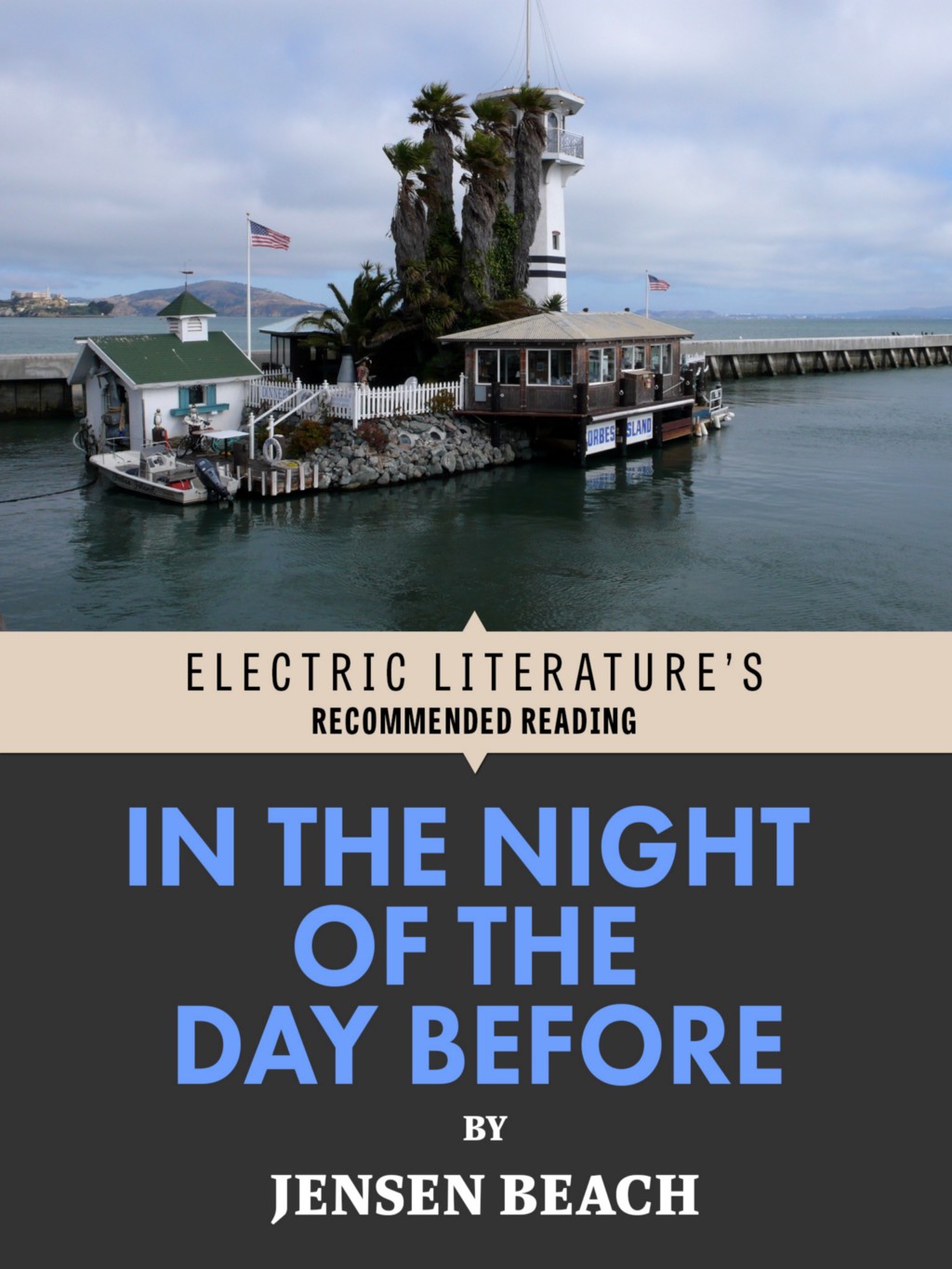
“Forbes Island,” she said. “I saw a program about it and have always wanted to go. Do you know what it is?”
He said that he did not.
“It’s a houseboat, or more of a barge, really,” Melanie said. She looked to her daughter as if for confirmation. “I don’t know. It’s a floating island. There’s a restaurant there.”
The ferry landed. Melanie and her daughter disembarked before he did. They were waiting for him when he got off the boat. The wind was still blowing, but he was now able to feel that it blew in off the water. “My daughter is going back to our hotel to do some schoolwork,” Melanie said. “I was thinking a glass of wine at Forbes sounded pretty good about now. Care to join me?”
Melanie’s daughter looked at him and said, as though he had accused her of not knowing, “The hotel is just over there.”
“Yes,” he said. “I’d like that.” He watched Melanie’s daughter walk away from them, her hair blowing with the wind away from the water and toward the city. Soon he and Melanie were walking slowly in the opposite direction along the busy and wide sidewalk of the Embarcadero.
“There used to be sea lions here,” Melanie said. They’d come to Pier 39. Even in the late afternoon it was busy with tourists and traffic. Martin disliked crowds. “But they’re all gone now for some reason. The guide on our tour told us yesterday.”
At Forbes Island they ordered drinks and went to the edge of one of the sand patios. Behind them the heavy leaves from one of the palm trees made a scratching noise. He couldn’t tell if the tree was real or just a very good replica. They watched the fog. Ferryboats made their way back to the city from Angel Island and Alcatraz. In the far distance, he counted at least a dozen sailboats. Melanie touched his shoulder.
Because he was too polite to come up with a reasonable excuse not to stretch a glass of wine into a meal, they ate together in the subaquatic dining room. He watched the green water outside the window above their table and tried not to think about being submerged. His wife, he thought, would love it here. She enjoyed unusual places like this. He knew exactly what she would tell her friends about the restaurant. “Only in America,” she’d say. “A floating island! Can you imagine?”
Melanie was divorced. She and her daughter had been visiting colleges in San Francisco, where her daughter wanted to go to school. This was their last day in the Bay Area. She wasn’t really from Salinas, but it was the first city that came to mind when the tour guide asked.
During the meal, she asked if the bar at his hotel was nice. She asked what the view was like from his room. She leaned close to him across the table, mirroring his arm movements. She told him she was lonely. He understood what she was doing. To each of her questions, he answered honestly and briefly. He told her about his job, about his trip to California so far, though he was careful to leave out San Luis Obispo altogether. He also did not tell her he was married. He told her about how in middle school he’d lost the tip of his left index finger to frostbite. His class had been orienteering and he’d missed one of the control points near the end of the course and wandered into the thick forest until he’d reached a farmhouse about five kilometers from the orienteering course. He thought the story spoke to his carelessness, so he rarely told it. But at Forbes Island, he felt it might somehow dissuade Melanie from her pursuit. She asked to see his finger, and he showed her. She took it between two of her fingers and squeezed. Then she turned her head side to side, examining the stub from every angle. He watched her do this. There was really nothing remarkable about the missing finger. It looked like a normal finger, only a little shorter and missing a fingernail.
“Do you have phantom limb syndrome?” Melanie asked.
He said he’d never felt anything like that, and it wasn’t an expression he’d heard in English, but he knew what she meant. He pulled his hand from hers. When it came, Martin paid the bill, although she offered to help.
“It’s unseasonably warm,” she told him outside. “The weather report this morning on the news said so. Unseasonably warm is a strange expression, don’t you think? It’s summer. It’s supposed to be warm.”
“Summer is often cold here,” he said, repeating something he’d heard from one of the bartenders at his hotel just the night before. Whenever he was aware he’d done so, he felt embarrassed to correct women this way. They crossed the Embarcadero and walked several blocks into North Beach, finally catching a cab on Columbus not far from Washington Square Park, which Melanie pointed out as they passed. “You know your way around,” Martin said. Melanie shifted nervously when he said this. She looked embarrassed, but he didn’t know English well enough to know why. At the hotel, she suggested they have a nightcap. “Something for the road,” she said. “Unless?”
He led Melanie into the bar, where they found a table near the television. The Giants, she explained while turning the pages of the cocktail menu, were playing the Dodgers. “It’s a great rivalry.”
After they’d ordered something to drink, he excused himself to use the restroom. He left the bar and entered the lobby, where he turned and looked back at Melanie. The drinks arrived while he was watching. Melanie sipped her drink through a straw and watched the baseball game. She clapped quietly when one of the Giants hit the ball deep into the outfield, and Martin wanted nothing more than to go home.
He took the elevator back to his floor and entered his room and locked the door behind him. He didn’t answer the phone when it rang, and he didn’t go to the door when someone knocked on it. He lay on the bed in the dark room and waited until he fell asleep. In the morning, he again checked out early and drove back to Los Angeles, where he stayed, uneventfully, for the rest of his trip.
The waitress at the Sakura Karaoke Bar brought another round of sake and Chinese beer. She knocked before entering. The room was warm and when the thick glass door opened, cold air rushed in and Martin felt this on his face. He was holding the microphone, waiting for the song to start. The waitress set the bottles on the table, gave a shallow bow, and backed out of the room. One of his colleagues pressed the play button on the console below the television. “Hotel California” began to play over the tinny speakers. Martin sang along for the first few bars. But soon he found himself thinking of Cesar in bed in San Luis Obispo. He saw the dark motel room, and through the opening in the curtains the black of the sky. Outside, a lamp mounted on the wall just above the large window cast an orange light back into the room, over Cesar and around him, and he moved side to side to music Martin could not now recall.
I first discovered Rufi Thorpe last summer, after hearing a co-worker rave about The Girls From Corona Del Mar, Thorpe’s first book. It’s a testament to Thorpe’s writing that, despite starting the book during one of the busiest times of my life — leaving a job, moving apartments — I devoured it in two days. It was miss-your-subway-stop good. It was tell-everyone-you-know-and-even-some-people-you-don’t-to-read-this-book good. So, you can imagine my excitement when I learned that Thorpe’s second novel, Dear Fang, With Love, would be coming out this spring (out May 24 from Knopf).
Dear Fang, With Love is about Lucas, a young father, who takes Vera, his teenage daughter, to Vilnius, Lithuania in the wake of Vera’s recent psychotic episode at a high school party. Once again, Thorpe’s voice, language, and attention to detail sucked me into the world she’s created. Thorpe manages to tackle dark issues — estranged families, mental illness, and failed relationships — with a unique sense of humor and big-hearted empathy.
I got the chance to speak to Rufi over the phone about Dear Fang, With Love, how writing a second novel is different from a debut, and the writing advice Ann Beattie gave to her.
Michelle King: I want to begin by talking about the structure of the book. The book is told from Lucas’s perspective, with emails and journal entries from Vera starting each chapter. I’d love to hear how you settled on this particular structure. Did you always know that Lucas would be the narrator?
Rufi Thorpe: The book actually started out entirely from Lucas’s point-of-view, with none of Vera’s perspective. But she’s a weed, that girl. She pops up. At times, it was difficult to keep her from taking over the whole book because she’s so addictive to write. But part of the book’s narrative relies on [the reader] not knowing certain things, so she couldn’t be the narrator entirely of the book or it would become a very different book. One of the themes of the book is outside/inside — how we seem to others versus how we seem to ourselves. So, that tension between Lucas and Vera and between their two realities is really where the heart of the book is.
MK: How late into the process of writing did Vera’s voice come into the book so directly?
RT: As a writer, I’m prone to drafting a lot and throwing away a lot. I wrote a whole version of this book from Lucas’s point of view and my agent was like, “It’s terrible!” [Laughs] And then I threw it away and I wrote a version from Lucas’s point of view and my agent was like, “It’s perfect!” And then my editor and she was like, “What about allowing Vera to have more of a voice on the page?” That required a complete restructuring, but when I started writing her pages, I could tell it was what the book needed. It just enlivened the book so much. It was really structurally tricky to get all the information you need to open a book and get it running with two narrators — that’s always technically challenging. Over the course of the two and a half years I spent writing the book, Vera was only a narrator for the last year and a half.
MK: I read in another interview that you said Lucas is the closest thing you’ve come to writing a self-portrait and that trying to look at yourself became easier to do so when it was a character who isn’t female. Why do you think that is?
RT: Oh gosh. I think that, in part — and it’s something that I hope that I’m outgrowing as a person — but whenever I would try to write autobiographical material where I would write a version of myself as a woman, I would be so weirdly distant but also judgmental and mean to myself as a character. And, so, something about the lens of otherness — of making it a different gender — gave me enough distance that I could be more “author-ly.” I could extend my author’s affection. I needed the character to be more distant.
I think that female authors often dress in drag in order to have a little bit more freedom…
I also think that there’s a slightly different…I don’t know. I feel like there’s a lot of women who like to imagine themselves as men. You know, I love Moby Dick. Anything Melville wrote. I just find him fascinating and fun. And hilarious. And, so, I was very excited to make my very good friend read Moby Dick and she was just so furious and I was like, “What’s making you so mad?” And she said, “Because I can never go on a whaling trip! Women have never been allowed to be that free and it makes me so insanely jealous to read about it!” I think that female authors often dress in drag in order to have a little bit more freedom, whether that’s freedom in terms of the kind of adventures characters get to go on or other kinds of freedoms. Lucas is allowed to be a little bit sad and it’s not the same kind of problem it would be if he were a female character who was a little bit sad. It doesn’t limit his romantic prospects. It’s not about his self-esteem, exactly. He’s allowed to be an unhealthy animal in a way that I don’t think he could be if he were written as a female character.
MK: That’s really interesting. In both of your novels you write so well about teenage girls, with such respect and such generosity. What was your character development process like for Vera?
RT: Well, it’s funny. Now I’m 31, so I recognize that I’m not exactly a teenage girl anymore, but I think we all still feel like our teen selves. For me, the memory of what it’s like to be a teenage girl is like oppressively fresh. Time is not going to dampen it. But, in terms of making sure Vera didn’t sound like a 90s teen girl, I did have to be aware of that. For instance, there’s a reference to her Pokemon collection. Originally, I had written it as a Beanie Baby collection. But readers were like, “She wouldn’t have Beanie Babies.” And I had to be like, “Oooooh. What would teen girls have now?”
MK: Mental illness plays a large role in this book. In writing a book that is at least in part about bipolar disorder, I wonder what you felt you were up against, in terms of having to be careful with the topic.
RT: The thing that I most wanted to do was not try to glamorize bipolar disorder, because I think it does a real disservice to people who are actually struggling with it. That being said, I think that one of the things that people with bipolar disorder struggle with is the glamour of their disorder, and the fact that, at times, they feel like Jesus and feel so good. So, my experience with mental illness is that I had a long-term relationship with a man who was Bipolar I and I have a very close female friend who was diagnosed Bipolar I. I got to see exactly what life had in store. The biggest struggle for me, in terms of originally framing the book, was that I wanted to write about Vera when she was older, when those questions about her future were not just theoretical, but were pressing. But I felt like I couldn’t legitimately write a Lucas who was all that much older. So, then I thought, Well, maybe I’ll make them younger. And Vera just came alive. There were enough reasons to set it earlier, but I did feel like I gave up talking about what’s really hard about living longterm with mental illness. I would love to write a book someday about 30-year-old Vera and 50-year-old Lucas.
MK: I want to discuss watching Vera’s disorder develop. [Warning: Spoiler] A great deal of the tension in the novel is whether or not Vera does, in fact, have bipolar disorder or if her episode at the party was the result of something else. When it was revealed that she does have bipolar disorder, I was surprised, but then realized, Well, of course she does. And thought of all these signs peppered throughout. I want to hear about how you held back information and what decisions you made and how.
RT: Oh, it was torturous. You don’t want to be too obvious, but you also don’t want it to come out of nowhere. People are always going to notice slightly different things. Some of the details are super obvious to people who are familiar with mental illness and, if you’re not familiar with mental illness, you’re just like, Weird that she’s not brushing her teeth! I just tried to walk the line the best that I could.
MK: I want to talk about the character of Fang. He’s such a big part of the book and, yet, we only hear his voice a handful of times and we don’t really know that much about him or his life outside of Vera. I’d love to hear you talk about what you see as his function in the novel.
RT: I think I’m drawn to outsider men with interesting ideas who are not quite who you expect them to be. That’s a character I love to write. I have a tremendous and passionate fondness for Fang. If Vera had some very ordinary boyfriend, it would longer the stakes of the whole situation. Fang is as good a chance as she has of finding a match. I know that they’re only in high school, but there is some way in which they’re really suited to each other. I wanted to bring up the thought experiment of ‘even in a best case scenario, what all is going to get in the way?’ Not only dealing with mental illness, but also just dealing with a teenager and growing up. How do we hold on to the good stuff that we’re given?
I also think that I wanted some kind of parallel to [Vera’s parents] Lucas and Katya’s high school romance. You know, I think about first loves both ways. I flip back and forth. Sometimes I think those first loves are real loves and are every bit as passionate as the ones that turn into marriages or that last for 50 years, and then other times they seem like trivial puppy love and of course they broke. They weren’t real and it was just being young and having a lot of hormones. That kind of optical illusion, where it means everything, it means nothing, it means everything, that’s what I was trying to get at with both relationships.
MK: My next question is about Katya and Lucas’s relationship. There was a part of me that was rooting for them to get back together —
RT: I know.
MK: And I know they shouldn’t! But…
RT: I know. Maybe they will! Life is long.
MK: I hope. But I was so pleased that, by the end of the book, they understood each other more. You answered it a bit in the last question, but I would like to hear about what in their relationship was compelling to you. What did you want to tease out? Ugh. Their relationship just broke my heart in half.
That kind of flirtation with danger is inevitable for me.
RT: I know, I know. It’s so hard. It’s just so sad that it wound up happening exactly how it did, because it so easily could have happened another way but, at the same time, it feels inevitable. Kat was another character that just sort of just took over. She’s so ferocious and easy to write, and she just does things. I love it. I find her fascinating. I think that, in some sense, if Lucas is me, there is something to people like Kat — that brazenness and that flirtation with distraction — that I am drawn to. That kind of flirtation with danger is inevitable for me. In the push and pull between them and the decisions they’re making — she really does want to abandon real, regular, normal life and he wants to play-act abandoning real, regular, normal life — and that’s the main conflict in their relationship. He thought they were just pretending and then all of the sudden it got really real. Real enough that another person was going to be born. And he wussed out. I think that’s interesting. A lot of writers with the pull between some sort of dream world or a realer reality and your socially mandated “social self.”
MK: I would like to shift gears a bit and discuss the role of location. In the acknowledgments, you talk about going to Vilnius before you had ever published a word. What was that trip like? And why, after publishing many words, did you decide to set a story — specifically this story — there?
RT: So, I was waitressing at a 1950s themed diner on the end of a pier. And it was a horrible — well, it was actually kind of a fun job, but it was obviously not being-a-published-writer job. It was being-a-waitress-in-a-burger-joint job and hoping-to-one-day-be-a-published-writer job. I had already gotten my MFA and I hadn’t really published any short stories. I’m bad at writing short stories, and it’s really hard to get bad short stories published. [Laughs] I was just sort of endlessly looking for contests to enter and submitting things and was just always getting rejected. It was the cycle. And, so, I randomly wound up getting a notification that I had gotten a second place in a contest that I could not even remember entering. But it enabled me to go away with Summer Literary Seminars, which is an amazing program. I wound up going to Lithuania when I knew literally nothing about Lithuania. I went because I could go. It was the most incredible place. During that trip, I was writing what wound up becoming The Girls From Corona Del Mar. And, so, it was an important trip for me artistically, but it was also an important trip for me personally, just in terms of evaluating where my life was and where I wanted it to go and what sort of person I wanted to be and how to become that person. It’s a city that was very formative for me. I thought of it as the place that transformations happened. When my characters needed to be transformed, it was the natural place to be transformed.
MK: One of the things that always impresses me about your writing is your attention to detail. These small details illuminate so much in your story and so much about your characters. Does attention to detail come naturally to you? Are their writers you look to who you’ve found instructive in this regard?
RT: Oh, yeah. A famous writer told me something that helped make my work better and it was about details. It was Ann Beattie. She was teaching at UVA’s MFA program when I was there and she was mad because — well, she hated me. [Laughs] She didn’t like my work very much, which is understandable because my work at the time was pretty bad. Like I said, I’m not very good at writing short stories. But [in one workshop story] I had these two girl characters eating tuna fish sandwiches and she was like, “And, Jesus, they could be eating anything.” And I was just like, “What is wrong with tuna fish sandwiches?” And she was like, “You can do it all for free. You’re not a painter. You don’t have to go buy expensive paint. You’re not a sculptor. You don’t have to go buy a huge hunk of marble. You just say ‘lo mein,’ and bam! They’re eating lo mein. Tuna fish sandwiches just does nothing to this scene. Having them eat it is lazy. Everything is at your fingertips. You can just snap your fingers and change a detail to a scene, so all of your details need to be serving the story and serving the moment and serving your characters and putting pressure on them.” And it’s absolutely true. She was right.
MK: Something you said — and you’ve said it a few times now — is that you’re bad at writing short stories. As a younger writer, that’s something that’s really inspiring for me to hear. It’s easy to get bogged down by the idea that you have to be good at everything. You have to write short stories and you have to write a novel. Do you have any advice — not even for young writers, but for aspiring writers in general — who feel they might be bad at short stories, but they would love to write a novel? Or that they might be bad at a certain thing and that discourages them?
If you love books more than anything else, that’s probably the number one requirement for being a writer.
RT: Totally. The thing is, I don’t think that storytelling is all that elite of a skill. I think there’s an evolutionary argument to be made that in any band of twenty or more homosapiens, it’s adventatious for one of them to be able to tell a good yarn. So, I think that anyone who wants to be a writer bad enough will subject themselves to how insanely hard and stupid it is to begin to have a career and make money [through writing]. If you can survive that and you can survive everyone telling you no, I think anyone can do it. The very fact that you want to is probably the sign that you can. If you love books more than anything else, that’s probably the number one requirement for being a writer.
In terms of having things you’re bad at, I do think some writers are good at both [short stories and novel-writing]. Sometimes you’ll even see the rare triple crown, where someone can write poetry, short stories, and novels, but I think that there are lots of examples of people who are great short story writers, but their novels don’t quite work or vice-versa. I feel like there’s something fundamental about short stories that I still don’t understand. I love reading short stories, but for whatever reasons, the ideas I want to write about are just way too big for the short story. I never find an idea that’s there right size, where I’m like, Ah, yes. This can be accomplished in 12 to 15 pages.
MK: Did you find yourself approaching the writing process differently with your second novel? Or even just how you think about having a book out in the world? Is it different when it’s the second one?
RT: Totally. I wrote the whole first draft before The Girls From Corona Del Mar came out because I just didn’t know how publication was going to affect me — if it was going to make me scared, or I was going to get really bad reviews that would make me doubt myself. I wrote it because I was terrified that something would happen to mess me up. Having a novel published is just…it’s terrifying and wonderful. It’s emotionally intense, but in a kind of useless way. It’s sort of like having a crush when you’re 12. You can’t stop thinking about it, but there’s really nothing there to think about. [Laughs] At least, that’s what pub week is like. Having actual readers reach out to you and say, “This book meant something to me” is something I hadn’t anticipated. That’s such a gift and it’s something you can’t really imagine until it’s actually happening. But the whole thing of “my book is in a bookstore” feels unreal. It’s also super stimulating. Writers are introverts, and I would just prefer to sit in a room by myself thinking about imaginary people. [Laughs] That’s why I’m a writer. But the second time around, you know a little bit more of what to expect. The whole thing is a little bit less fraught, so I’m able to enjoy it more. I now know that when a bookstore asks you to come read, that’s because a real person read my book and liked it and wants me to come to the store they work in. It all feels so much more tangible, and therefore I’m much more grateful for it. The whole publishing industry is sort of amazing in that way. It really is just a bunch of book nerds who love books. I think the first time around I didn’t know what it was. I didn’t get it.
MK: I sort of hate to end the interview with this question because you just wrote a book. So, it seems rude to be like, “So, what else are you doing?”
RT: [Laughs]
MK: But…are you working on anything else at the moment? I think I’m just asking because I want you to be. [Laughs]
RT: Well, indeed I am. I hit a point of not writing and my husband was like, “I think you should start a book.” [Laughs] It’s a book and I can’t talk about it too much, because I don’t want to wreck it. But it involves boats, it involves families, and it involves women who are not very good at being women. It has more to do with siblings and family dynamics than anything I’ve written. But I can’t even say what it’s going to turn into because it just keeps going and going.
MK: Well, you had me at women not being very good at being women. Wait. Did you say it involves boats?
RT: Boats. Yeah. One of my characters is into sailing, and sailing is the kind of thing…I was like, “Oh, I’ll just read some books about sailing and it’ll be all good.” But A. It’s really hard to make yourself memorize sailing terminology if you’re not sailing and B. It’s just clear that it’s too hard to fake. So, I’m going to have to take some sailing classes, about which I am thrilled.
The act of reproducing an image is, and always has been, an act of aggression. The camera is a weapon that reinforces power structures, tacitly assigning dominant/submissive roles. Although our daily routines and social media feeds are filled with selfies, cute cats, and baby pics racking up the “likes,” make no mistake: the camera inflicts as much damage as it reveals.
So is the case in Adrian Van Young’s Shadows in Summerland(ChiZine Publications), a humbling feat of Gothic, historic fiction. The novel follows William Mumler, the real-life spirit photographer who gained fame, moderate financial success and notoriety (plus the scorn of P.T. Barnum) in mid 19th century Boston with the help of his wife, Hannah, the celebrity medium Fanny Conant, and the sinister-yet-simple-minded “Spiritualist investigator” William Guay.
The story begins as they await trial, charged with fraud and murder: one of the ghostly subjects in Mumler’s photographs is believed to have been murdered by Mumler, but whose presence in the images proves his continued existence. So, either Mumler is a fraud or he is a murderer, and proof of one charge negates the other. But the tenuous truth and explanations behind each accusation — told through flashbacks from each of the four character’s distinct points of view — is what gives this novel its electricity.
The focus of the novel is undoubtedly Mumler, whose historic swindles provide the groundwork for one of the greatest unlikeable characters in recent memory. He’s simultaneously arrogant and lazy, an intellectual who’s helpless against confrontation, a momma’s boy, an elitist without class, and a depressed opportunist who will latch onto whoever makes his life easier. In these cases, it’s not difficult to imagine Mumler as an entitled Victorian hipster whose immediate connoisseurship of the en vogue photographic process mirrors that of the modern beer bro who is an expert after having a couple IPAs.
Young masterfully laces Mumler with tragedy, so while he may be an asshole, he’s prototypical of the American underdog — a role that had not even really solidified during the events in which this story takes place. We can’t help but love Mumler: there are his Mommy Issues (perhaps the only scenes where we experience the genuine Mumler are when he’s administering toxic amounts of laudanum to his dying mother). And then there’s the unrequited love of his cousin Cora, who died when they were young and whose death my or may not be the result of Mumler’s inaction (and what Gothic tale could be complete without sweet, sweet incest?)
Despite the focus on Mumler, the story’s driving narrative shines through in the cast’s relationships to each other. No one is honest. Everyone uses everyone else. Everyone needs everyone else. Mumler uses his eerily despondent wife Hannah Meir, whose (questionably) valid sixth sense enables her to see, and therefore, summon the ghosts for Mumler’s pictures. Hannah, in return, finds protection in Mumler after facing prejudice due to her ghostly sight. Fanny Conant, whose abusive upbringing has driven her to use the popular Spiritualism movement as a vehicle to drive the lesser-popular Feminism movement, sees a business relationship and amplified influence in Mumler; Mumler’s sexual attraction to Fanny further fuels this co-dependency. And William Guay, a hitherto transient, sees spiritual enlightenment in Mumler, and who will eagerly carry out Mumler’s dirty work.
The intricate clockwork of these relationships would be admirable by itself, but Young’s prose is the sort that lifts the narrative skeleton above the ground so it can grow flowers on the bones. To anyone who’s read and appreciated Young’s chameleon talent of co-opting different styles in his widely varied short story collection The Man Who Noticed Everything, this shouldn’t be a surprise. Carefully crafted with 19th Century Gothic flare, the language in Shadows in Summerland is a potent mix of Poe’s lyricism, Lovecraft’s viscera and Dickens’ utilitarianism. One could disassemble the book, tack the pages to a wall and throw darts at them with a good chance at hitting something beautiful.
For example, take this scene in which Fanny seduces Mumler in hopes of gaining an upper-hand in their business agreement, which ends in Mumler’s grotesque and poetic premature ejaculation:
Another button, two, three more and I felt the air rushing, alive, in between me. It was as though the force of him were prying at me to get in.
He groaned and he cramped violently and leaned toward me, and that was when he burbled forth. The milky gouts escaped from him from where he reared up through his shirt.
The act of balancing such lovely writing with a well-researched, intricate and entertaining story is precarious indeed, and, overwhelmingly, Young succeeds. If there is one minor qualm, it’s during the court scene in the final act. Not that the story or writing is any less engaging, but the practical need to infuse some answers to the novel’s ambiguities feels a little like Young shows his hand. It’s ultimately a necessary evil, and one that will certainly endear itself to the larger audience that this novel deserves.
Perhaps the most astonishing quality of Adrian Van Young’s Shadows in Summerland is how well it resonates in today’s modern era, despite its historic setting. It was a time period when a nation’s fears and grief — rendered by the bloody Civil War — manifested in demagogic beliefs. It was a time when people feared the loss of their own agency through new technologies. It was a time when photographic propaganda appealed to people’s most inflammatory desires and was powerful enough to bring about criminal charges. This novel is a reminder that damage has always existed behind the image.
Tash Aw, the author of three critically acclaimed novels, The Harmony Silk Factory (2005), Map of the Invisible World (2009), and Five Star Billionaire (2013), as well as a new contribution to the short memoir series The Face (Restless Books), was born in Taipei to Malaysian parents and grew up in Kuala Lumpur before moving to Britain to attend university. Tahmima Anam, the author of A Golden Age, which won the Commonwealth Writers’ Prize for Best First Book, was born in Dhaka, Bangladesh, and grew up in Paris, Bangkok, and New York.
They recently corresponded by email and were kind enough to share with us their conversation, in which they discuss issues of identity, leaving home and family, class, commercialism, and the past and future of Asia.
Tahmima Anam: In The Face: Strangers on a Pier, you express a deep ambivalence about Malaysia — on the one hand, you are uncomfortable with its excesses, with the way that class and power have played out in the years since you grew up there. And yet, Malaysia persists, in a big way, in your imagination — not only here, in your examination of your past, but also in your fiction. Can you talk a little more about that — and do you wish, ever, for a simpler relationship to “home”?
I like progress, I liked the idea of an Asia that grows richer in every sense with each generation; but I also believe in the idea of possibility.
Tash Aw: I think if anyone is truly honest about any meaningful relationship, they will experience a certain ambiguity about it: no one can love totally without questioning that relationship from time to time, and if they did, it wouldn’t be real. It’s the same with relationships with your country: the deeper your attachment, the more you question. Malaysia has undergone immense change over the last thirty years — much of it positive, but with a lot that needs to be questioned, too. Why, for example, is there a class of super-rich that has mushroomed in less than one generation — and I mean, eye-wateringly wealthy people — while most of the rest of the country particularly in rural areas but also in the big cities, are struggling as they always did? It’s a question of extremes, how we’ve got to such polar opposites in such a short space of time. I’m not a nostalgic person with a misty-eyed view of the past. I like progress, I liked the idea of an Asia that grows richer in every sense with each generation; but I also believe in the idea of possibility. Thirty years ago, everyone felt that they had the chance to transform their lives, now they don’t. Now we have a class structure that works powerfully and clearly. I’m invested in this change, I’m part of the way the past is stitched into the future, that’s why I write about it, why I question it.
I would absolutely love a simpler relationship with the concept of “home,” but I don’t think it’s going to happen; it’s destined always to be a complex, unresolved notion for me. Growing up in Malaysia, I got used to the idea that everyone had historic links to somewhere else, got used to the idea that people straddled cultures and languages, and sometimes struggled with the weight of this: what does it mean to be Malaysian, and Chinese, for example, when only half a century ago, being Chinese in Malaysia meant being a communist sympathizer — meant being the enemy. And then I moved to Europe to attend university and came into contact for the first time with people who were so deeply rooted in one particular part of the country, who knew the maiden names of their four great-grandmothers and could say things like, ‘I’m from Yorkshire,’ or, ‘I’m a Breton,’ with a certainty that was unshakeable. Even now, when I try to describe who I am to someone like that, they’ll say, ‘so are you Malaysian, or are you Chinese?’ It’s hopeless.
But this also makes me think of something that you and I talk about often, which is the idea of resisting categorisation, even though we might yearn for a simpler, more convenient identity: how important is it that you keep the different elements of your identity alive? For example, how important is it for you to keep moving between London and Dhaka, to keep speaking in both languages — are you ever exhausted by this constant split existence?
Tahmima Anam: I share your fascination with people who can point to a place and say “I’m from here” with all the confidence and authority of someone who has generations of stable and documented history. To me that’s terribly exotic. My husband is from New Hampshire — we visit his hometown every summer, and there are family homesteads on every corner, as well as stories that go back several generations. There’s the ancestor that walked to Dartmouth College and paid his tuition with a cow, and the one that built a house over 100 years ago that’s still standing — you get the picture. My maternal grandfather was from Bordoman, which now stands on the other side of an international border. I will never be able to go there and find his old house, or inherit a sense of rootedness from identifying with that place. I used to feel uncomfortable about this, but then I decided to embrace it. Yes, it’s exhausting — having to constantly translate, not just words, but layers of experience — but there’s also something exhilarating about it. In any case, it’s the only reality I know.
I wanted to ask about your ancestors — your grandfather, specifically — you write so movingly about the moment you realised you were living a life that was fundamentally alien to him. Can you talk more about that? Do you mourn the loss of being seen in your totality by the people you love?
Tash Aw: I know that you mean: that constant translating of cultural experiences becomes so much part of you that you can’t imagine any way of being. You might crave for a simpler identity — your home is where your parents and grandparents have always lived, that sort of thing — but when you get a taste of that sort of life, you shy away from it.
A lot of my ability to translate those cultural experiences comes from that disconnect I felt from my grandparents, I think. I guess I must have been about 13 or 14 when I first realised that my education was making me grow distant from them, and also my cousins who lived in the countryside. I hated that feeling of becoming remote from the people I loved, who had always loved me, hated the way my syntax and vocabulary became more elaborate, even though I tried to speak and behave the way I always had — the way they did. For a long time, I spent huge amounts of energy trying to bridge this complex gap — urban/rural, modern/traditional, migrant/rooted — only for me to break away in the end, despite all my efforts. I remember reading Alice Walker’s essay about how going to college made her a middle-class stranger in her father’s eyes. It was such a powerful moment for me, realising that no matter how sad I was about this widening gulf between me and my grandfather, his must have been a far more complex sadness; he must have known that his very ambitions for me — to become educated and middle-class — would make me alien to him and take me away from his world. He had never even been to school, could barely write; all that he wanted for my parents, and especially for me, was to get an education. He died when I was sixteen, before I could figure out that he must have known that I would become distant from him, and that he would love be because of that, not in spite of it. I was the one who wasn’t comfortable with the privileges that education gave me; I was the one lacking in love, not him.
In that way, my family’s story mirrors how South East Asia has changed in just three generations — it’s a story of how wealth and opportunity creates divisions. Even without the political difficulties — the wars and the creation of random boundaries that you talk about, growing nationalism, and so on — there’s a sense of disconnect with regard to history, both personal and national. I wonder if it’s the same in Bangladesh — whether, for example, people there reinvent their personal and national narratives, and if so, whether you ever worry about how quick and enthusiastic we are to reshape history in the name of progress?
Tahmima Anam: Sometimes, when people come to Dhaka, they want to see the “old town.” They spend three hours in traffic, passing billboards for condoms, first class flights to Dubai, advertisements for small US Universities (there is a very prominent one for the University of Flint, Michigan), and cell phone packages. When they arrive at the Old Town, they see the same billboards, the same low-hanging electric wires, the same crowded streets. They crane their necks out of their car windows and say, “where’s the Old Town?” Maybe someone helpful will point them to the few colonial buildings scattered along the river that have survived. But most of the city is awash with newness. There is the shiny newness of the rich, and the very shabby, derelict newness of the poor. But we have no desire to preserve the past — just a hectic, desperate need to move on to future, in which the fantasy of progress is yet untouched.
In this absence of past-ness, people are free to create their own narratives…
In this absence of past-ness, people are free to create their own narratives, their own stories of belonging and identity — for some people, this new identity is defined by wealth; for others, migration. There are attachments to history — for instance, the story of the liberation of Bangladesh — but increasingly, the dominant stories are about progress, change, and moving on from the past.
What does this erasure of the past mean for storytelling? For your sense of how, and why, you write? You allude to the messiness that lies just beneath the surface of the smoothed-over narratives of progress. What does this intimacy with the messy past, with the other, mean for you as a writer? Does it compel to you to write certain kinds of stories? Do you feel an obligation to represent your context in a particular way? And what are your thoughts on the nature of this obligation?
Tash Aw: I want to visit Dhaka! If only to see the billboards for condoms, which speak of some kind of sex education. We wouldn’t have anything that publicly suggested the existence of sex in Malaysia or Singapore.
When I was in my late teens and becoming interested in the politics of storytelling, I thought that all the shiny newness you speak about was an unequivocally good thing. I totally got why we’d want to erase a past tied to colonialism and poverty: being someone else’s subject, being exploited, being poor — those aren’t things that are necessarily worthy of being celebrated. My problem nowadays is more with the narratives we’ve created to replace this history. We want not just to obliterate the past but shape a present that is untrue and justifies all kinds of inequalities by smoothing over things that we find difficult to deal with in history — conflicts of race, religion, class, and so on — so we live in a weird state where the official narrative is one of untroubled success, but just underneath that veneer is a whole lot of messiness.
For example, in Malaysia, a multi-ethnic, multi-cultural country, the official narrative is one of racial harmony, but the reality is that there is a lot of tension between racial and ethnic groups, and a clear hierarchy of power. The only times these divisions are blurred are when class comes into play: rich or educated people of different races are more comfortable with each other than people of their own race from a lower income group — even if they happen to be members of their own family, which is why the distance I felt between me and my grandfather was so painful. But we live in a country that isn’t supposed to have a class system, so how do we explain this messiness?
And on a personal level this desire to fashion a super smooth narrative is even more problematic — it causes a bizarre, anaesthetized state of mind, which strips people of their culture and traditions and whole generations of rich stories: of suffering and endurance and love and conflict. My grandparents and parents wanted to create a narrative for themselves and especially for us that mirrored the national narrative, one of unwavering progress. The lack of past-ness, as you say, made it possible for them to do this. So too the pace of change in Asia. But what that means is that they have handed down to me two generations of silence. Sometimes, they let slip a story about their past — a story of loss or sadness, delivered with little or no emotion — and it stuns me because I never knew that about them, and though they have tried to write these stories out of their official narrative — and mine — they’re still there, still haunting them in an invisible but ever present way.
It’s about questioning this silence, about reassessing the past, not for any nostalgic motivation but to link it to the present and try to understand the craziness we live in.
I guess my writing is a reaction against this. It’s about questioning this silence, about reassessing the past, not for any nostalgic motivation but to link it to the present and try to understand the craziness we live in. And the past in the modern South East Asian context doesn’t necessarily mean the 19th century, or even pre-WW2 history, but a more recent past. Things change so quickly that even the late 1980s and early 1990s — the period I talk about in the book — are seen as ancient. Recently I did a reading in Singapore and a university student asked me about my ‘historical novels’ set ‘a long long time ago, like, in the 1970s and 80s.’ What would they make of Hilary Mantel’s 16th century novels?
I’m interested in the way Asia changes, interested in figuring out why we live the way we do. My writing feels less like an obligation to present a point of view, more like a fight, a rage against something I’ve been given and that I don’t want: I don’t want to live in a society where we’re disconnected from ourselves, where books and culture and history — who we are — don’t matter, and we don’t know who we are, don’t care about the inequalities we’ve created in just two or three decades. Our identity is now defined by Netflix and Louis Vuitton and endless malls. Even as I type, I can see a new message on my iPhone screen, an advert screaming: GET EXCLUSIVE BATMAN v SUPERMAN: DAWN OF JUSTICE PROJECTOR CUPS WITH EACH TOP UP. I don’t even know what a projector cup is. I get those messages 20 times a day. Consumerism is the great tool of the modern official narrative. It can be liberating, yes, but it is too convenient, an easy way to escape the questions we need to ask of ourselves.
A lot of what I talk about in the book involves painful choices, for example, between education and progress on the one hand and a more emotionally stable existence on the other. Your work is a lot about choice too: between obligation and sentiment, the self and society, modernity and tradition. These are complex, messy choices. When writing about them, do you ever feel compelled to reach a judgement — a fixed position of some sort?
Tahmima Anam: When I was growing up, the term “third world” was still acceptable. My father liked to use it a lot. He reminded me that I was from a third world country, and that people would look at me and the only thing they would see was the fact that I was from this poor country. Every time I got a disappointing grade in school, I was ruining my chances of upending the prevailing stereotypes about my kind of people. This was not an immigrant’s directive — I was not being told to make something of myself in order to erase my past, but to somehow make it up to my country because I had, by some twist of fate, ended up being born into a life of privilege. It wasn’t until I started writing fiction that I realised the double-edged nature of such an obligation. On the one hand, it feels like a heavy weight to bear, but on the other hand, I think having something to say — a debt one owes to one’s country or to the world — is an important weight. Whatever doubts I may have about my writing (and my doubts are plentiful), I never doubt the seriousness of what I’m trying to do. I know that the stories are important, that they mean something, and my task is only to become worthy of telling them. There is the temptation to reach a conclusion, to end up with a sort of judgment, but the beauty of fiction is that we are here to ask the urgent, rage-filled, burning questions — the rest is up to the reader.
One final question: tell me how you think your face will age. Will you continue to be mistaken for a host of other people, or will you become more yourself, more particular, as the years go by?
Tash Aw: I think I’ll always be mistaken for being someone I’m not; and I don’t think I’ll ever be able to resist the urge to pretend to be whoever they think I am. I have this really deep-seated need to make everyone feel that I’m just like them — I can’t explain why! But oddly enough, I find that constantly being mistaken for someone I’m not helps me articulate who I am. I used to internalize those presumptions of difference, but increasingly they make me see more clearly the various strands that make up who I really am.
ESSAY: THE NEW OXFORD AMERICAN TELLS A STORY, BY HELEN BETYA RUBINSTEIN
desperation |ˌdespəˈrā sh ən|
noun
a state of despair, typically one that results in rash or extreme behavior : she wrote to him in desperation.
She wrote to him in desperation. There had been a time, years ago, when he had desired her. For years she had struggled to forget about him. She had been fooling herself in thinking she could remain indifferent. She would have given up everything for love.
He called to take her out for a meal. He leaned forward to take her hand. He asked if she wanted coffee. She asked if she could move in.
She tried to make up for what she’d said. He couldn’t make out what she was saying. She made for the door. He made as if to run away. She made out that he was violent. He made out a receipt for $20. They made out in the back seat. He made up an excuse. She made up her face. Let’s kiss and make up.
He felt a surge of anxiety. She felt the ground give way beneath her.
She turned on him like a vengeful fury. She fought like fury in his arms. She flew into a rage. Her face was distorted with rage. Desk rage. Sports rage. PC rage. Video and computer games are all the rage. He raged at the futility of it all. The argument raged for days. She couldn’t hide the fear that raged within her.
The hidden depths of marital life. A power struggle. The idea that men should have power over women. She helped herself to a cookie. He helped himself to the wages she had brought home. She couldn’t help herself; she burst into tears. He could not help laughing. Help! I’m drowning. A help menu.
She bore herself with dignity. She bore the pain stoically. She bore six daughters. She could hardly bear his sarcasm. See BRUNT. See CROSS. See GRIN.
The folly of her action was borne in on her with devastating precision. Working mothers who feel bad about leaving their children. What a bad girl. Bad behavior. He beat her up real bad. She discovered he wasn’t so bad after all. Too bad, but that’s the way it is.
He spent a year in the wilds of Canada. She went through a wild phase of drunken parties and desperate affairs. Her imagination had run wild. The wild sea. A wild guess. The wild tribes from the north. The wild coastline of Cape Wrath. Her wild eyes were darting back and forth.
“Please, for my sake,” he wheedled. She flashed him a withering look. She flashed him an insincere smile. She glared at him, her eyes flashing. He made a rude gesture. He made a crude gesture. She was out of the back door in a flash.
A single mother. A single bed. A single whiskey. A single red rose. A pure and single heart. A singles bar. Single women bemoaning the absence of men. See note at MOURN. Isabel mourned her husband. His lean, muscular body. See note at THIN. His hair was going thin. She was painfully thin.
She was in the depths of despair. She wailed her wretched life. She rued the day she was born. She lamented the lack of shops in the town.
Quick as a flash, he was at her side. He knocked and entered without waiting for an answer. He did not wait for a reply. He was sick for a sight of her. “I must look a frightful sight,” she said. He shuddered with revulsion. She gave a convulsive sob. He began to babble an apology. “No!” she wept. She rubbed one of the sores, making it weep.
She allowed the babble of conversation to wash over her. A babble of protest. The babble of a brook. To shed light on such transatlantic psycho-babble. In answer to the stresses on modern woman, we have developed a range of beauty treatments.
Her soft voice stopped his babble. He placed a finger before pursed lips to hush her. She was the love of his life.
Her self-control finally broke. She would love him forever. Tell me what will pleasure you. “Of course I can,” she answered. She was totally obedient to him.
(Children and animals may be expected to obey, but nowadays obedient is seldom used to describe adult human beings without a suggestion that they are allowing someone else to assume too great a degree of authority.)
Their passion remained undiminished after 30 years of marriage. After forty years of marriage, he still claimed she had few shortcomings. A marriage made in heaven. A happy marriage. He understood her wish for peace and quiet. Talk of love panicked her. The violence of her own feelings. The savagery of his thoughts frightened him. Charges that he fondled a patient during an examination. A rabid feminist. She slammed the claims as “pure romance, complete fiction.”
Women, left to themselves, would make the world a beautiful place to live in.
Left to himself, he removed his shirt and tie.
Not another word passed between them. See BATON. See BUCK. See HAT. See LIP. See MUSTER. See PARCEL. See TIME. He killed his wife then drowned himself in a fit of despair.
Many have a horror of consulting a dictionary. The whole ball of wax. The whole enchilada. The whole shooting match. The whole schmear. See DODO. See DOORNAIL. See also DEAD BALL.
[Compiled using example sentences from the New Oxford American Dictionary, Second Edition (2005), with additions (make) from the Oxford American Writer’s Thesaurus, Second Edition (2008)]
In a C-section, everything happens behind a sterile, blue sheet. I can’t see so I listen to the narrative the nurse anesthetist tells me. She bends down to my face, so close our paper hats are almost touching. Her cheeks are freckled like farm fresh eggs. Her eyes blink through double protection: her dark-rimmed eyeglasses and the flimsy plastic shield between her sterile mask and cap. “She’s a little stuck,” she says. “You’re going to feel some pretty heavy tugging. Just pressure, though, no pain.”
My whole body feels as though it might topple off the operating table and onto the floor. The doctors jerk my belly so hard and sudden, I feel I might burst through the sterile sheet like a marathoner first to the finish.
During my previous C-section, the doctor talked about the sushi he ordered for lunch and going home to his octogenarian mother.
During my previous C-section, the doctor talked about the sushi he ordered for lunch and going home to his octogenarian mother. This time, he talks about the baby, “Try to move the head to the left,” he orders his assistant, “Can you grab the feet over here and push?” They spend long minutes coordinating efforts, as if maneuvering a ship, full sail, out of a bottle.
“I think I’m going to pass out,” I say.
I squeeze my husband’s hand as the anesthetist swivels on her stool to pump me full of more and different drugs.
“She’s out now, honey,” the anesthetist says, but other than the hum of large overhead lights and the steady whir of machines, the room is quiet.
“Why can’t I hear her cry? Is she breathing?”
“She’s still attached to cord,” the anesthetist says. Her voice is calm, matter of fact. My husband releases my hand to peek over the sheet and see what I cannot: a healthy girl, still a part of my body, all mine for a few seconds more before she’s released to the world, shrieking and screaming, and I am reassured.
***
“I want to be a dead body,” I tell my husband early in our relationship when he asks about my hopes and dreams and aspirations. “On Law & Order: SVU.”
“Is that show still on?” he asks.
I have to explain to him that the S in SVU stands for special, not sexual.
At the time, Law & Order: Special Victims Unit is in its thirteenth season. It has just lost Detective Stabler and the show’s future without Benson’s hunky half seems uncertain. The crime drama is like a beloved cat: old enough to pass at any time, but hardy enough to stick around a little while longer.
The crime drama is like a beloved cat: old enough to pass at any time, but hardy enough to stick around a little while longer.
I’m not an actress, though I wanted to be when I was a child. My mother said, “You don’t have the potential,” which I didn’t understand until I auditioned for the school play in eighth grade and found myself choking and shaking, unable to “project myself” the way the director ordered me to.
“Isn’t that a little morbid?” my husband asks.
It didn’t seem morbid at all, being an actress for a day, but without having to act. All I have to do is lie there, perfectly still.
“I can hold my breath for a really long time. I think I’d do a good job.”
The thought of myself spread out in the New York City streets with corn syrup blood on my chest and arms, frozen in place as M.E. Warner zips the black plastic body bag over my face, lured me to websites posting casting calls, even though I lived in Florida, a thousand miles from NYC.
Three years later when I am pregnant with our second child, when it seems like SVU might be on its last season, my husband turns to me and says, “Too bad.”
“Maybe they’ll need a pregnant dead body. You never know.”
“Maybe they’ll need a pregnant dead body. You never know.”
“Wouldn’t it be easier to just put a belly on someone else rather than searching for a pregnant woman?” he asks.
He doesn’t understand what it means to dream.
***
While Eliot Stabler’s home life mirrored a kind of suburban bliss: a Catholic marriage to a stay-at-home wife and mother to five kids, Olivia Benson’s personal life was steeped in trauma that only compounded as the seasons ticked on. Benson was the product of her mother’s rape, a mother who turned to alcohol and eventually died leaving Olivia with no biological family until she discovered a troubled half-brother who shared her rapist father. Benson, who had no children, was married to her job and to her past. Still, Benson yearned for family, the kind of home life she didn’t have, more than a glass of wine and takeout on the couch at the end of the day.
In “Inconceivable,” an episode devoted to fertility and the fate of a stolen tank of frozen embryos, Stabler tells Benson, “You’d make a great mom. Maybe you should think about having kids.” Later in this episode, a woman who faces infertility after cancer treatment asks Benson, “Do you have kids? Don’t you want them? What are you waiting for?”
At the end of the episode, Benson reveals to Stabler that she has tried adopting, but as a single woman working a demanding job Benson was “not prime parent material.”
These questions remain unanswered until the end of the episode, but we the viewers know by the longing look in Benson’s eye, the way she personally delivers the news of this woman that her embryos have not survived, the way she pauses before speaking, that Benson does want them, that she probably has asked herself, “What am I waiting for?” That she, too, fears it may be too late.
***
The summer before ninth grade, my Catholic high school assigns Robin Cook’s VitalSigns as part of a summer reading project. In the novel, a woman seeks treatment at a fertility clinic only to discover that the doctor who was supposed to be helping her conceive has actually sterilized her and other patients, preying upon the desperate and despairing to profit from the many rounds of IVF the women undergo. What I remember most from the novel is the protagonist crouched upon a cold table as the doctor harvests her eggs. Later, she discovers her embryos swimming in a petri dish doused in acid too bright for life. While most teenagers spend dark nights praying for their pregnancy tests to turn up one innocuous line instead of two, I begin saving for the IVF I am certain I’ll one day need.
While most teenagers spend dark nights praying for their pregnancy tests to turn up one innocuous line instead of two, I begin saving for the IVF I am certain I’ll one day need.
I am thirty-one by the time I marry. It took my mother almost two years to conceive me, long enough that she had almost given up.
“Just don’t get pregnant any time soon,” my mother says at my bridal shower. “I want us to take a cruise to Alaska next summer.”
On our honeymoon, my husband downs Bahama Mamas and Mai Tais, while I stick to water and juice, just in case. Two weeks later, I begin pricing Clomid and other fertility drugs after I’ve spent a three-pack of First Response to find I’m not pregnant after all.
“Don’t worry,” my husband says. “It is just one month. My boys can swim.”
“I’m not sure my eggs can float,” I say. I don’t know if the metaphor is right, but it’s all I can think of.
“We can try again when we’re ready,” he says. He is not ready now, but I am convinced my eggs will shrivel up and become raisins. I think about my desiccating ovaries, raisining as we wait. I think about Benson in Season 11’s episode “Ace,” the tragic desperation on her face when she and Stabler go undercover as married candy barons and try to buy the child they can’t have. I convince my husband to try one more time and he does because he knows that look and wants to make me happy.
The following month, I am pregnant.
“I told you my boys can swim,” he says.
After the baby is born, my husband says, “I wish we’d waited.”
He wants to wait before the next one. We wait one year instead of two or three. He’s not sure he wants a third but he knows he does not want a fourth.
“What if something happens to one of them?” I don’t ask.
“I wish we’d waited,” he repeats.
This becomes a kind of chortled mantra that keeps me up at night and makes me want to ask, “Don’t you want them? What are you waiting for?”
***
Benson and Stabler are named after producer Dick Wolf’s children: Eliot and Olivia. I wonder if this is why Stabler is not killed off but instead resigns when he leaves the show, as if writing the death of one Eliot might bring harm to the other.
***
I’m kneeling over my husband, the two of us shoehorned between the crib, the bed, and the closet on the gray fleece blanket I won at his family’s Christmas white elephant when he says, “Baby. Baby.”
I lean into him, my hot breath against his neck.
“Baby. Baby,” he says.
“Baby, Baby,” I parrot but my husband pushes me away.
“No,” he says. “Baby!” He points over my shoulder where our daughter is peeking out over the wall of pillows we’ve stacked to sandbag the mattress as if her sleep is some uncontainable flood and our marriage is an eroding beach.
The following month, we discover we are pregnant again.
“I really want to wait next time,” he says.
I still am not so sure. We need more than the heir and the spare. We need the just-in-case and what-if babies too.
***
When my husband found out we were having a baby, he said, “It’s important to put our marriage first. Don’t let the baby come between us.” But that is exactly where the baby is: between us. Her foot rubs my thigh in rhythmic circles, her soft hand pads the muscled valley of her father’s back as she sleeps, making sure that we’re both bookending her tiny body in the bed. And now there is another on the way. More space. More distance.
***
Benson does adopt. The show gives her a son she finds in a hotel drawer. He, too, is the product of rape. The child opens up a new side of her character and creates the kind of vulnerability that makes for good drama. Someone might kidnap her child (they try). Someone might hurt her child (they do). Her child might get sick (he does). He might stop breathing (he does). The adoption is not final; his father, the courts might try to take him away (they do).
***
My husband is a light sleeper. It took months for him to learn to sleep through the pulsing “chung-chung” as I streamed Law and Order: SVU on my phone into the dark hours of the evening. Sometimes, he stayed up late waiting for me to fall asleep so that he could slumber in silence, but mostly, he wanted to press his warm chest to my back, swing my hair over the pillow and bury his face in my neck. Beside us, Benson and Stabler solved the crimes and caught the bad guys, while Ice-T delivered plucky one-liners.
Unlike true crimes, in Law & Order: SVU, we know who the perpetrators are.
It wasn’t just that I needed TV to fall asleep, I needed that show. I flipped my phone screen down so that only the audio infiltrated the room. There was comfort in familiarity: I’d seen every episode at least once. When I reached the last episode, I’d simply return to the pilot and stream through again. Unlike true crimes, in Law & Order: SVU, we know who the perpetrators are. Even if justice isn’t served in the end, though most of the time it is, we know who to root for and against. The ripped-from-the-headlines plots only made the drama more predictable, and I took solace in that and in the signature chime between scenes. The cadence of a heartbeat echoes into the night: “chung-chung.”
***
Our first daughter will not fall asleep without me. She nurses all night. When she learns to speak, she cries for Mama and signs for milk. Her tiny hands open and close with urgency. Twice I try to wean her and fail. My doctor warns that breastfeeding might induce miscarriage and I vow to stop cold turkey when I discover I am pregnant with our second child. We try to attach the baby to sleep objects. We replace me with a Cabbage Patch Kid and plush-bodied baby with a rattle in her head. Lullaby Elmo, Heartbeat Bear, and a stuffed giraffe join us in bed. The distance between my husband and me grows. My belly grows. Heartbeat Bear is meant to calm a baby by recreating swooshing womb sounds. My daughter is over a year. Does she even remember the sound of the womb? She pushes a heart-shaped button on the bear’s back and the soft metronome of an ultrasound fills the dark room. She pushes the button again, turning the heartbeat on and off until my husband banishes Heartbeat Bear to the back of his closet. We are one less in bed. I cup my hand to my belly and wait to be one more.
***
My parents tell me about my young cousin who, in protest used to hold her breath until she passed out. “It was terrifying,” they said. “Her parents tried everything to get her to breathe, but she was stubborn. They’d have to wait until she fainted. Her parents never got used to it.”
***
Our first daughter only ever slept in our arms. My husband becomes a baby-wearing pro. He straps her tiny body to his chest and stays up all night playing video games online, defending imaginary towers so that I don’t have to worry about SIDS. She breathes skin-to-skin against his chest. After six months of split shift sleeping, when the SIDS risk goes down, we move her into our bed. She latches to sleep and nurses all night curled against me.
Our second daughter turns the crib from hamper to sleep space. I am up all night touching her, startling her through the slats in her crib, running my hands over her sleeper to sense the slight rise and fall of her small belly, listening for the snortles of breastmilk clogged in her nose.
I push the crib against the side of my bed and lay my daughter to sleep on the edge of her mattress. We are inches apart. We are almost touching. My arm bruises from reaching through the rails.
“I’m worried about you,” my husband says, stroking the mottled dots that fan across my skin, an archipelago of anxiety that stretches from elbow to shoulder.
“I’m worried about her,” I say.
***
Another cousin dies of an asthma attack. She is in her car driving when her bronchioles constrict. Her lungs tighten. She reroutes to the hospital, but stops breathing on the side of the road. No one is with her to force their own air into her lungs. When help arrives, it is too late for CPR to save her.
***
Twice our daughter falls out of bed. Both times, I’m not there. My husband is the one to pick her up, check her for bruises and broken bones and watch her eyes for odd dilation. He is the one to sit her on his lap and reassure her that the world is not a terrible place.
Our daughter is Columbus exploring the flat map of our queen size mattress. Both times, my husband tells me, “She was calling your name. She was looking for you.”
***
Instead of nursing my hungry infant at 3 a.m., I hand her over to my husband. “I’m too tired,” I say. My husband takes her crying into his arms, suckling his bicep.
“She wants to nurse,” he says, holding her body out in the dark.
“I just don’t want to,” I whine. “I want sleep.”
But the baby cries, so I nurse her until I’m crying too. When she spits up, instead of changing the sheets, I reach my arm between the crib rails and tug her swaddle to slide her to a drier spot on the mattress. I move her around like a puzzle piece between stains and think I am a terrible mother.
I move her around like a puzzle piece between stains and think I am a terrible mother.
The next time she cries, I queue up Law & Order: SVU to keep me awake. The camera follows Benson home where she hugs her son, feeds him from the Munchkin Stay-Put Bowls. Baby Noah sits in his high chair with the Sassy Wonder Wheel suction cupped to the tray. In another episode, Benson sits on the floor beside a big bag of MegaBlocks. I recognize all of these items from our own living room and think maybe I am doing something right.
***
When Baby Noah stops breathing, Benson is not there. She’s in the kitchen with her co-workers when the nanny rushes in to tell her that her baby’s face is turning blue.
Several times the courts try to take the baby from Benson. You love your job too much, they accuse.
Even your best is never enough.
***
I am a thousand miles away when my father’s heart beats and then doesn’t and he stops breathing. I’m sleeping through the night when a stranger puts his knitted fists to my father’s chest and starts CPR. I don’t hear the rhythmic count of 1-and, 2-and. I’m not there to see the bruises where the stranger beats my father back to life.
***
I Google baby monitors that measure an infant’s heartrate, movement, oxygenation, monitors that sound an alarm when the baby stops breathing, moving. Shrill chirps waken the room if the baby becomes too still to detect. I think about the drive to the OB/GYN a few weeks before our second daughter is born when I don’t feel the baby move all day. How I almost don’t call and when I do I’m surprised at the urgency when the receptionist asks, “How far from the office are you?” How the doctor takes me back right away, pumps me full of Capri Sun, and glides the ultrasound wand over my belly. We watch the baby kick and twist in fuzzy black and white halos on the screen.
How I almost don’t call and when I do I’m surprised at the urgency when the receptionist asks, “How far from the office are you?”
“Her lungs,” he says, pointing to a fluttering black vacuole on the screen. “She’s breathing beautifully,” he says and prints a photo of her bladder for me to take home.
I stare at the image of my unborn daughter, more space than substance. Her body on the screen swirled in white outlines, as if she is a collection of holes, figure eights looped upon themselves several times over.
After, he jokes on the phone to a colleague. “I just saved a baby’s life,” he says. He smirks and winks at me, while I sit on his worn plastic couch and finish my juice like an insolent child sent to the principal’s office for crying wolf.
On the way out, the receptionist reassures me. “You did the right thing. You just never know,” she says.
After the baby is born, I spend weeks researching the monitors. One clips to the diaper, another is sewn into a onesie or fitted into a sock. We purchase the one that slides under the center of the mattress, something innocuous and unseen, and wait to be woken by the high-pitched shriek of distress.
***
In a recent episode of Law and Order: SVU, a crazed nun holds the baby near the window. A concerned Benson has to lure the baby out of her arms. “I need you to put my son down, right now.” Her voice is stern, firm, and followed by action. Once she secures him, Benson softens her tone and says to her son, “Everybody wants to hug you.”
***
The monitor sits in its box on the kitchen counter between the empty napkin holder and a stack of unfinished sewing projects. Maybe I don’t trust the sensor. Maybe the instruction manual is too intimidating. The bruises on my arm turn green, disappear and sprout in new shades of blue and purple, a garden of perennials in cyclic bloom.
My husband doesn’t ask why I’m procrastinating when I’d been so insistent on the purchase. He, too, lets the monitor sit, for days, weeks, months. He pushes the box aside to pay bills or spread mayonnaise on his sandwiches. When the baby is about to turn one month old, he finally asks, “What are you waiting for?” I give him the answer we both know to be true, that it is still too hard to trust that the safest place for the baby is just out of reach.
DON’T MISS OUT
Sign up for our newsletter to get submission announcements and stay on top of our best work.
YOUR INBOX IS LIT
Enjoy strange, diverting work from The Commuter on Mondays, absorbing fiction from Recommended Reading on Wednesdays, and a roundup of our best work of the week on Fridays. Personalize your subscription preferences here.