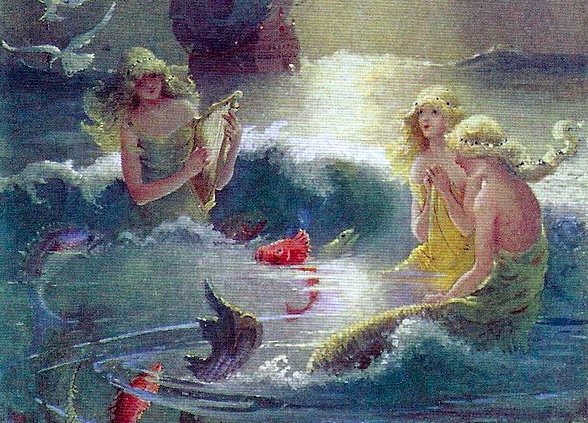
In the old tales, humans come together with animals and plants, mountains and rivers, rain and sky. The wood nymph, Daphne, turns into a laurel tree to escape the pursuit of a god. Seal women slough off their selkie skins to live on land for a time. Some traditions even tell of the first humans being made from trees. Folklore has a way of muddling binaries. In the traditional stories of selkies, mermaids, helpful animals, talking trees, and shapeshifters, our supposed divisions between humans and nature blur and we find we are far from alone in our sentience.
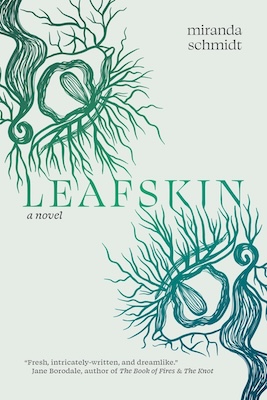
In my book,Leafskin, I used folklore and folkloric ways of thinking to bridge divisions between human and nature. My poet protagonist experiences a unique kinship with trees. Her embodied sense of this merging waxes and wanes as she experiences fertility treatments, childbirth, nursing, and different forms of love and art-making, all while living through our era of ecological destruction. Alongside the trees, a selkie story runs beneath the book, carried by the main character’s ex-girlfriend, an artist. I wondered what would happen if I brought the motifs of trees and waves, land and water, together. How could a selkie story change if it were unapologetically queer and feminist? What if a woman didn’t have to give up herself, her autonomy, her art, for motherhood? What is made in the liminal spaces where land and water, folklore and contemporary realism, art and parenting, come together? In Leafskin, I wrote toward these uncanny mergings, finding a strange multifaceted story full of the lore that I love.
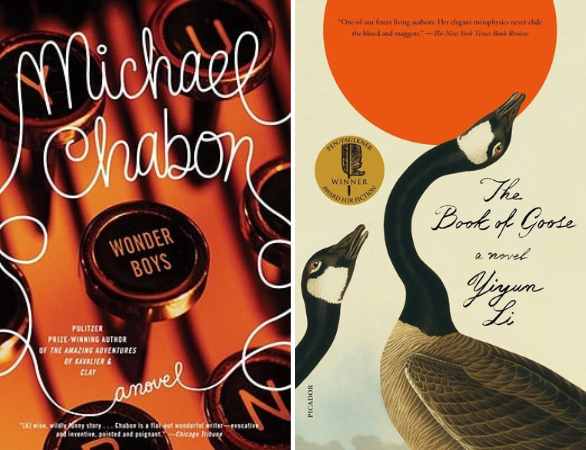
Folklore has long preoccupied my reading and deeply influenced my writing. There are so many works that would fit into this category and this list makes just a tiny fraction of the work: contemporary novels that draw on folklore and folkloric thinking to explore our ecological interconnectedness.
Returning home from an exploratory submarine mission gone awry, a woman begins to turn into a sea creature. This tale of a self melting away is partly told through the eyes of the woman’s wife, mourning her spouse while attempting to care for her, haunted by the relationship that was and is no more. It’s an intensely grieving novel, occurring mostly in small enclosed spaces (an apartment, a submarine). We are presented with both the present narrative of transformation and a journal kept on the submarine mission. Both narratives bring us through fantastical moments, spaces where realism slides away, revealing something far wilder and far more mysterious beneath. An uncanny and gently brutal book, this novel moves between perspectives and times, spiraling out a tale of loss and transformation.
A woman stops eating meat and becomes the focus of her extended family’s concern, lust, and violence. As she seems to recede further away from humanity, increasingly drawn to plants and plant behavior, she elicits more and more intense fascination and horror from those around her. Told in three parts from three points of view, the novel circles Yeong-hye, but only allows us small glimpses of her perspective in the tiny moments when she shares it with others. In the end, we are left with the trees and Yeong-hye’s desire to join them through life or death or some space between. A gorgeously terrifying novel, written by 2024’s recipient of the Nobel Prize in Literature, The Vegetarian circles the madness of consumption, domination, and the impossible contradictions of our human condition.
What if a mother started turning into a dog? The question at the center of this novel expands to wonder about our animal natures and the wilds we unleash in ourselves and the world through motherhood. Set in the suburbs, Nightbitch follows its title character, a mother who has set aside her art for parenting, through this hilarious and terrifying premise as she explores the lore of magical, shapeshifting women. It plays with the notions of the artist, the mother, the wife, and all the many selves the woman at its center must be and become in our world. Now a movie starring Amy Adams, the book holds an unsettling sense of the uncanny at its heart.
A re-envisioning of Erdrich’s lauded novel The Antelope Wife, this book tells the multigenerational story of families, Ojibwe and white, contending with the ramifications of violence through time. Rooted in indigenous stories, Antelope Women frequently brings its human characters together with other species in uncanny ways. Dogs suckle at human breasts and narrate human stories. Antelope tend to lone human children. Just as the humans of the story connect and entwine, so do the nonhuman, creating a rich tapestry of interconnected lives. In the foreword to Antelope Woman, Erdrich writes about how she wrote this book with the sky itself: “The Great Plains sky is a source of ideas for me, a touchstone of greatness and familiarity. The sky is a geographical family relative.”
Two women move through an apocalyptic landscape ravaged by climate change in a vehicle that shifts its shape. Through memories and the present moment, they are drawn into the landscape, transforming, moving across it, becoming a part of it. This novel exists in a space of hybridity. Moss grows from foreheads. People become multiple, become mountain. The story is interspersed with short focused sections meditating on plants and animals. Fragmented and poetic, Sift brings us into the mystery of a journey where the internal and external, and the human and more-than-human, merge.
A human woman, after an affair with an owl, gives birth to a baby who is both human and very much something else. Tensions arise over differing interpretations of reality, as the woman believes her baby to be half owl and the rest of the world treats the child as monstrous. The woman attempts to foster the wildness in her child while her husband and his family pursue increasingly inhumane attempts to “fix” the owl-baby. As the mother makes space for her child’s owl-ness, she finds her own art and perspective growing to harmonize with the nonhuman world. She hears the complex harmonies of birds, allows wood shrews to nest in her cello and cultivates rodents in her house to feed her baby. This is a book that does not flinch from the violence of the animal world or the violence of the human world’s attempts to repress the animal around and within ourselves.
Told from the perspective of an aging professor who just married his young student, this novel follows the student’s slow disappearance over the course of the honeymoon in the haunting Orkney Islands. These islands are full of selkie tales and the student is drawn, again and again, to the water. The unreliability of the narrator, a man enamored with the tragic heroines and love objects of 19th-century literature, adds to the strangeness of a book that plays with the natures of art and realities. By leaning into this perspective, Orkney becomes a critique of the kind of selkie/magical woman story that holds the woman as a receptacle for male fantasy. As we watch the professor’s young wife’s uncanny connection to the landscape, we are consistently reminded that we are watching her through his skewed perspective.
A young mother pursues witchcraft, feminism, her queer identity, a college degree, and her own narrative. This autobiographical novel rewrites fairy tales and finds its protagonist in conversation with women who turn into animals. These shapeshifting moments hold fascinating interactions, conversations that move fluidly, like the book itself, between the theoretical and the practical, the realistic and fantastical realms. Set in the 90s, this book captures a particular moment in time and feminism that feels as urgent today as it was three decades back.
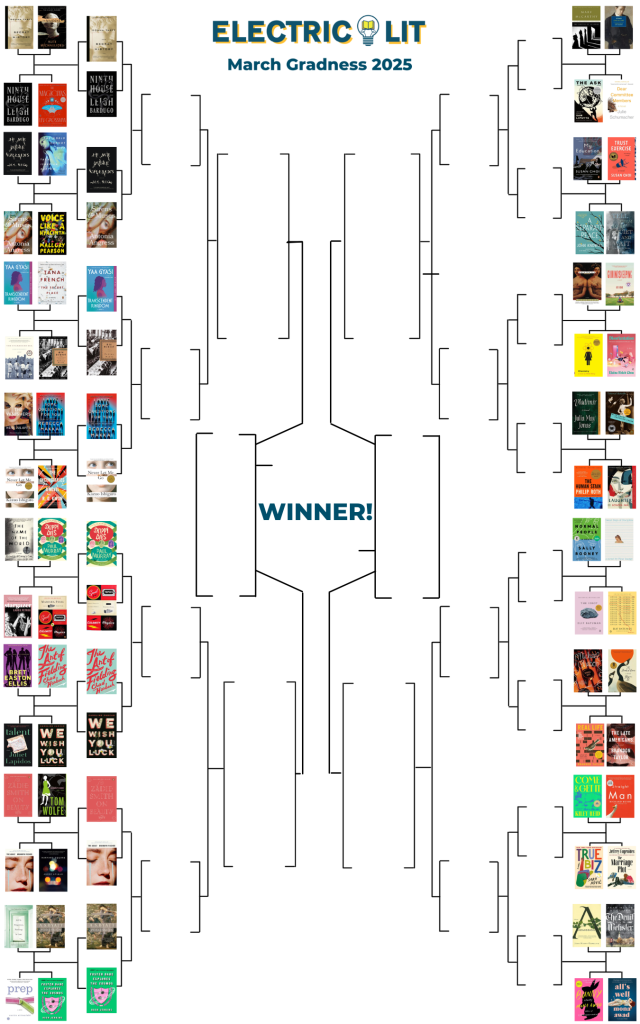
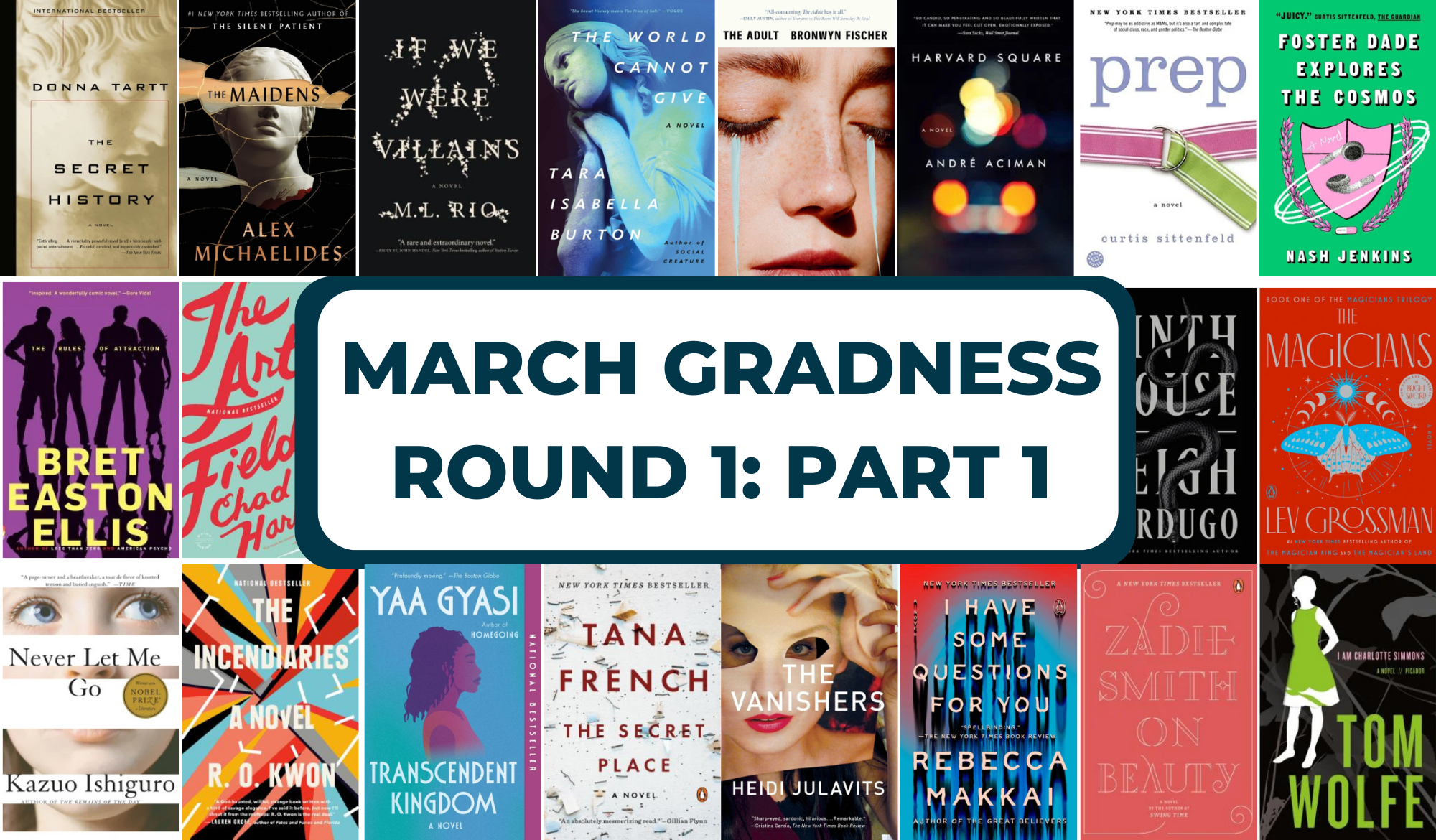
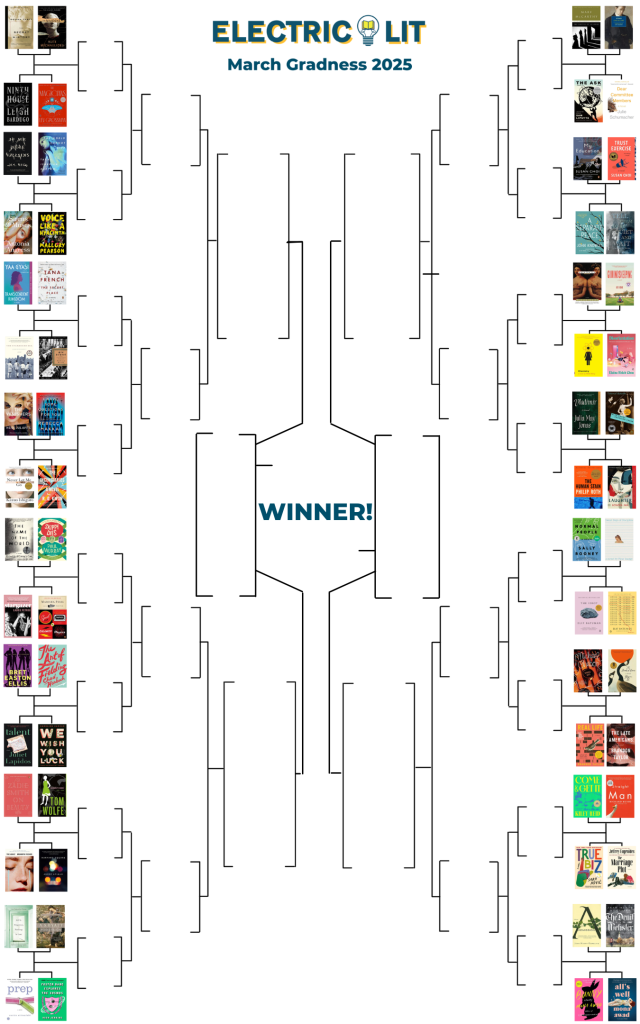
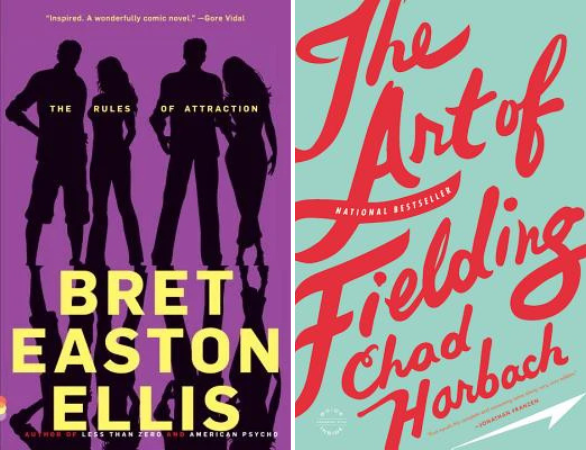
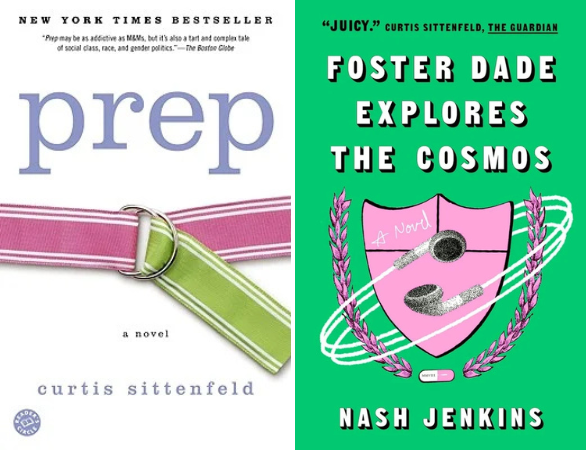
Welcome to March Gradness day two! There were some notable upsets in Round One, part one (Prep, The Rules of Attraction, and The Secret Place all knocked out!), and we’re sure there will be more to come. Our Instagram voters turned out in droves and overruled some of the results on the website (sorry to The Magicians and The Secret Place), so make sure to get those votes in. Check out the updated bracket below.
Click for a downloadable (and zoomable!) pdf
Round One (part two) polls are now closed. Thanks for voting! Head over to Round One (part two) to vote in the next round!
The NEA’s new compliance requirements are anti-trans. Donate now to help us raise $15,000 to replace our annual grant.
Dear Reader,
The National Endowment for the Arts has supported Electric Literature since 2016. Beginning in January, nonprofit arts administrators have closely followed Trump’s rash of executive orders, trying to anticipate how they might affect the NEA, a venerated and valuable organization that has been integral to Electric Literature’s work for nearly a decade.
Earlier this year, the NEA released new compliance guidelines that, pursuant to an executive order that seeks to “restore biological truth to the federal government,” require applicants to certify that their programs do not promote “gender ideology.” Federal funding is contingent on this certification. The ACLU is challenging this requirement, but as of this writing, the case is unresolved.
Frustrated and uncertain, I found myself, along with other editors, asking insidious questions like, “Does publishing trans writers constitute promoting gender ideology?” But to pursue this line of questioning is in itself a moral compromise. The term “gender ideology” is not only condescending, but like so much fascistic vocabulary, it is also unintelligible. I may not know what “gender ideology” means, but I do know that Electric Literature stands with trans writers and readers, and will continue to fiercely advocate for their rights, protection, and the full expression of their humanity.
This August, HarperCollins will publish Both/And, an anthology of trans and gender nonconforming writers, edited by EL’s Editor-in-Chief, Denne Michele Norris, who is the first black and openly trans person to helm a major literary publication. This should be obvious but I’ll say it anyway: to agree to the NEA’s compliance guidelines, even while crossing our fingers and holding our noses, would not merely be hypocritical—it would be a betrayal of our staff, contributors, and community.
For the last 9 years, Electric Literature has received between $10,000 and $15,000 from the NEA annually. The March 24 deadline passed yesterday, and Electric Literature did not submit an application. Today, I am asking our readers—who support trans rights, and who believe in Electric Literature’s mission to make literature more exciting, relevant, and inclusive—to stand with us. Please help us raise that same amount by April 15 and make a donation today.
Thank you for your time and support.
In solidarity,
Halimah Marcus Executive Director, Electric Literature
Before I lucked into an academic career and writing life, I spent a decade working construction, from repainting hundreds of student apartments to scraping paint off the third floor of a Victorian house to spraying fresh Sheetrock walls inside countless cookie-cutter houses in one of those suburbs that sprang up like wildflowers in the years just before the 2008 recession. I stayed in the trades for only ten years, but I’ve spent my writing life thinking about how to capture the complexities of labor in story.
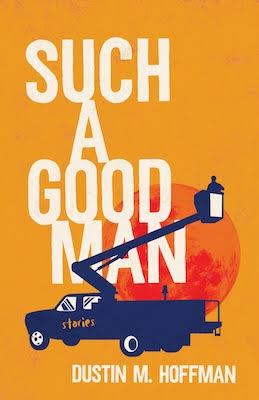
My new story collection, Such a Good Man, features many construction workers on the job: plumbers, painters, roofers, but also bouncy house attendants, baseball players, aerial photographers. I’m fascinated by the language of labor, the poetry of each job’s tasks and tools, the lilting music of the often gruff shop-talk laced with eccentric expletives, the surprising intimacy of found-families at work set against the grinding reality of the work itself. What I hope of my work, and what I most admire about authors that write about work deeply, is the full complexity that constantly seesaws between nobility and grating honesty, the horror and the honor, the beauty and the pain.
There are many beautiful books about working-class people, but I wanted to put together a list of books that don’t just explore the culture and experience of class, but books that dive into the job itself, that revel in the language of labor, that put their characters to work in scene rather than in the background. In Janet Zandy’s essential book Hands: Physical Labor, Class, and Cultural Work, she says true working-class literature takes us “into the skin of a worker,” into the “cadences, dialects, curtailed responses, directness of working-class speech…and always the graphic description of the physicality of labor.” That’s often the goal in my writing, and it’s certainly a triumph of the following twelve books of poetry and prose that depict not just working-class people but that foreground work as the feature.
I also adore Orwell’s Down and Out in Paris and London, which depicts low-wage restaurant work in some of Orwell’s most scene-driven narrative. But The Road to Wigan Pier is an absolutely brilliant and insightful investigative piece into the work and conditions of coal miners. When I first read this, the television show Dirty Jobs was quite popular, and Orwell was doing something similar yet much more in-depth—full immersion into this very dangerous, dirty job. He depicts the human lives at the center of this work with great sensitivity, while also capturing the sensory pain of forever crouching so as not to bang your head on a rocky roof. The book goes on to discuss class consciousness and socialism in ways that still feel valid and important today. Beyond being fascinating and important, this is such an entertaining read. I’m a huge Orwell fan, but I actually find Animal Farmand 1984 overly didactic to the point of being a bit obvious. In my opinion, Orwell’s nonfiction is his most interesting work.
This book has been my personal bible about labor in America. I always keep this near my writing desk, and I reference it often for inspiration. For those unaware of this groundbreaking book, what Terkel did was interview more than one hundred people about their jobs. Then he removed himself and his questions from the text so that each section reads like a monologue, uninterrupted, voiced raw and gorgeous by these working identities, from carpenters to police officers, sex workers to nuns, dentists to cabdrivers, nurses to photographers. You can open up to any section and be swept into authenticity and rare insight, and every section sparkles like an uncut gem. Though published in 1974, this book holds up beautifully today. NPR has released some of the original recorded interviews that fed this book, which you can access online.
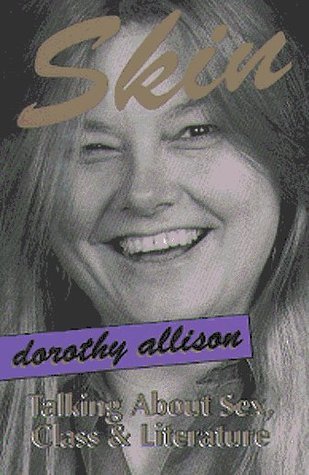
Skin: Talking About Sex, Class & Literature by Dorothy Allison
We’re still mourning the loss of Dorothy Allison, one of our greatest voices in American literature. This list is a perfect opportunity to talk about one of Allison’s lesser-discussed books. Skin is a collection of essays that are ahead of their time in intersectional discussions of class and sexuality. The first essay in the collection, “A Question of Class,” is a must-read treasure. In it, Allison so movingly explores her class identity and the jobs of her family members, the desperation, the affection, the cruelty, the prejudice, the love. It’s a beautiful, tough, wise essay, and the rest of the collection embraces discussions of work, class, and sex with similar luminescent bravery and brilliance.
Berlin is one of the greatest story writers of the ‘80s and ‘90s, who doesn’t get the attention of her Kmart realist siblings of working-class literature, like Raymond Carver and Bobbie Ann Mason. This collection of selected stories compiles many of her best stories, and in these masterful works we find such a keen eye for class commentary that never feels forced, and instead is funny, painful, ruminating, and so often keenly tuned into the details of labor. “My Jockey” is a perfect flash fiction story about work as a nurse. The title story is one that should be in every short story anthology for its innovative structure, its stunning voice, and especially its witty, piercing first-person perspective on this work that gives direct access to class comparisons; what better job to spy on how the other half lives and contemplate class in America? This essential book is packed full of great work stories.
This ode to the auto factories of Detroit seethes with voice and character. The poems take us on an evolution from the new guy initiated into this factory city (and Daniels shows us how the factories were indeed cities with their own stores and hospitals housed within the labyrinthine behemoths) to the labor-hardened maturity needed to survive this grueling yet often intimate culture. What gives this dangerous factory work its surprising beauty are the eccentric characters who glimmer through the grease and grime. Daniels’s language is so richly grounded in the details and jargon of this factory work, and to read this collection is to come away feeling like an honorary citizen of the factory city, for better or worse. Of course, Daniels has written so many brilliant collections, and Punching Out is a classic.
This book is all about military service, but what distinguishes it from other war literature is the way Klay treats the subject like a day job, capturing the mundanity of even terrifying work: “PFC said, it’d be cool to get IEDed, long as no one got hurt.” This comes from the shortest story in the collection, “OIF,” which I teach my creative writing students every year. Every sentence is mired in military acronyms and initialisms, so many that it can feel like a slog the first few sentences. But that’s the point of this story and the whole collection (which is never a slog to read)—to initiate us into this working culture through immersion. In an interview, Klay once said: “Believing war is beyond words is an abrogation of responsibility—it lets civilians off the hook from trying to understand, and veterans off the hook from needing to explain. You don’t honor someone by telling them, ‘I can never imagine what you’ve been through.’ Instead, listen to their story and try to imagine being in it, no matter how hard or uncomfortable that feels…” This collection accomplishes this breakthrough in empathy, just like the best of literature about work should all aspire to do, helping us to “try to imagine being in it.”
When this came out in 2009, it was my first Bonnie Jo Campbell book, and I was blown away by how she grounds labor in place. I lived and worked in the Kalamazoo, Michigan area that provides the setting for the stories in this collection, a setting as crucial as Sherwood Anderson’s Winesburg, Ohio. The characters in this book are all working class, are often stretched to desperation’s brink while they survive around the tenuous time of Y2K and pre-recession. The historical manufacturing culture of Michigan industry has always made our rust-belt state a canary in the coal mine for national recessions, and you feel the great recession knocking at these characters’ doors. The stories often focus on jobs that reflect the titular concept of salvaging a living that comes after the good jobs have disappeared. Rather than make cars in the motor city, Campbell’s characters salvage parts. They hunt for the food they can no longer afford to buy. They profit from the paranoia of a world falling apart, selling propane to Y2K preppers. Campbell shows the ingenuity of working-class people pushed into survival, scrapping together a living any way they can.
The title story in this collection is perhaps the most masterful office work story of the 2010s. Like so many, I loved the television series The Office, and this story picks up where the show leaves off by delving into the darkly haunting dehumanization of office life, despite all its benefits and HR correctness. Orozco pushes past absurd humor to show us the secret humanity and suffering of the office’s archetypal characters that we might laugh about at the surface level. The collection also includes stories about bridge workers and police officers on the job, always reminding us of the human cost of turning our bodies into machines to serve comfortable civilization. This collection is terrifying yet funny, accessible yet daringly experimental.
Wells’s debut novel takes us directly into the perspective of an invisible worker, the night cleaner at a white-collar office. The narrator shows us who knows our secret identities best—the person tidying up our lives stowed inside desk drawers and computer files. Though the day’s white-collar employees don’t know this narrator or her labor, she ponders them, their connections, their tribulations, their desires, through the detritus left between the regular nine to five hours. Similar to Orozco’s office fiction, this novel is also both funny and haunting, yet wholly unique. Wells so smartly illuminates the perceived arbitrary demarcations between white- and blue-collar labor and the common dehumanization so many of us share in common while on the clock.
I could pick any Saunders collection for its brilliant depictions of weird jobs, even if many of those jobs are completely surreal, like the narrator’s occupation in the titular novella Pastoralia. He works as a caveman in a live-action museum exhibit of human evolution that he can never leave. Interesting that this story gets its own evolution, in a way, in “Ghoul,” featured in his newest collection Liberation Day. “Sea Oak” is also a contemporary classic depicting food-service-sex-work in a gender reversal reflecting our own surreal American culture. In Saunders’s stories, capitalist anxiety always looms. I’m a big fan of this—using surrealism to mirror the absurdity of our working lives, the grinding repetition, the absurd way we’re required to monetize our time and bodies and efforts.
So, who better to push the absurdity of American working culture than one of Saunders’s students? Adjei-Brenyah picks up where Saunders leaves off, especially exploring the absurdity of retail labor and consumerism in the title story, “Friday Black,” as well as in “How to Sell a Jacket as Told by IceKing” and “In Retail.” These stories push deeply into horrors of consumer culture, and he explores even racial violence being commodified in a Saunders-style grotesque amusement park in “Zimmer Land.” I also deeply admired Adjei-Brenyah’s brilliant novel Chain-Gang All-Stars, which, I think, builds off themes initiated in this collection to explore a dystopic future where America’s terrifying history of prison labor has turned into coliseum games.
In Adam Petty’s astute essay “Dirty Life and Times: The Past, Present and Future of Working-Class Literature,” he asks a question: “We’ve had Kmart realism; why not Walmart realism?” Or what about Amazon realism? It’s certainly going to get surreal, globalized and computerized, guided by algorithm, surely even more alienating. Saunders led the way, and Hilary Leichter pushes the tradition forward with her highly stylized, experimental novel Temporary. Here the narrator weaves between temporary jobs, though each one seems to encompass an inescapable universe. This novel is full of humor, while also taking very seriously the cruelty of our modern world that makes every worker expendable, no matter how essential. The narrator searches for permanence in this picaresque plot of temporary jobs, but no such anchor is to be found in this magical labor-led universe that funhouse-mirrors our own. There’s so much gritty authenticity in the details of labor, as the jobs flit between realistic and absurd: pirate-deck swabber, door opener, assassin assistant, pamphlet distributor, replacement mother. Even the narrator’s lovers, a swarm of boyfriends she speaks to over the phone, are a writhing mass of slipping identities that require yet more labor.
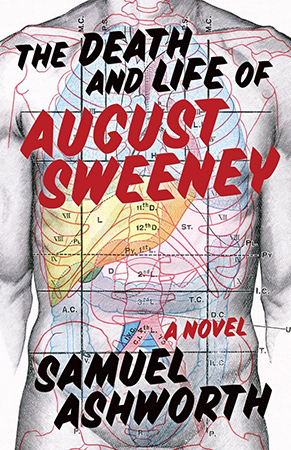
“No one seems to want to admit the truth: food is work, and then you shit it out.” So goes the trope-busting in Samuel Ashworth’s debut novel, The Death and Life of August Sweeney. Marketed as The Bear meets Bones, the novel aims to usurp both shows in terms of precision and grit. It opens with the final autopsy report of its titular character, August Sweeney, a larger-than-life chef whose career fluctuated between iconic and infamous.
The procedure is conducted—and narrated—by Dr. Maya Zhu, the strict, esteemed autopsist tasked with pathologizing the failings of August’s body, as demanded by his final will and testament. For much of the novel, why August chose her specifically is a mystery, but she is captivated by him regardless, like a moth drawn to flame.
By Dr. Maya Zhu’s hand, the evidence of all August’s 52 years are laid out beside him, organ by organ, on a dissection table. She reads his entrails like tea leaves to understand his past and her future. Together, these characters converge across the boundary of death to ask: what does it mean to seek power? And, once you’ve got it, what the hell do you do with it?
Dodging recent blights of snow and sickness across D.C., Ashworth and I spoke virtually about the worlds of food, autopsy, and writing—none as disparate as they seem.
Jessika Bouvier: I loved how much the novel toed the line between disgusting and delicious at all times. So many organs! We see this with Nose to Tail, one of August’s food shows (“He’d teach [celebrity chefs] to eat things like knuckle and duck tongue.”) We see this dichotomy with Dr. Maya Zhu, too, especially in the beginning—she is so committed to instill a sense of fear and disgust in the medical students shadowing her in the autopsy lab.
Beginning the novel, I couldn’t fathom how you would make the worlds of food and death intertwine; by the end, they were so connected that I couldn’t remember ever thinking of them as separate. What was the inciting incident that made you bring these two worlds together in fiction? Why, for you, are they inextricably linked?
Samuel Ashworth: From the beginning, this was always going to be a book of the body—I knew I wanted to tell a person’s life story through their autopsy. I felt really strongly that literature hadn’t produced what I would call a true book of the body, one where the human body was not only its subject, but its structure, its governor, its binding constraint.
All life is spurred by its appetite, and these characters are creatures of appetite.
The character of Dr. Maya Zhu actually pulled together quickly, but she was a medical student in her original conception. The idea was that I would take her through the first semester of gross anatomy, which is the first class everyone does in medical school. You have 40-odd cadavers embalmed in a room. You learn anatomy by taking them apart piece by piece, and that was going to be the structure of the story. I had a friend who was in medical school down in Philadelphia, so I drove down there; one night, she took me to her gross anatomy lab. I had not seen a dead body before—like, I’m Jewish, We don’t do open caskets. Suddenly I’m in a room with 40 dead bodies, and one of the things I immediately noticed was that I was wildly hungry. Not in a ‘I haven’t eaten’ way, but in a, I must eat food way.
It turns out this happens a lot. My friend said it happened all the time. I think there were two reasons for it: the nice, psychological comforting thing about how, in the presence of death, our bodies seek nourishment in order to make ourselves feel alive. But then there’s what I think is the actual reason, which is that the body preserved looks a lot like cured meat. You know, all life is spurred by its appetite, and these characters are creatures of appetite. That’s what this book is really about. So once I had that detail, I knew that the body on the table [in the novel] had to be a chef. And I wanted to make sure that chef would be the most interesting body he could possibly be, because he had to be somebody striking in order to get Dr. Maya Zhu’s attention.
JB: Although the storylines converge further into the novel, at first, these read like two different experiences. They also happen at drastically different paces: we read the moment of August’s birth up until his death, while Dr. Maya Zhu is mostly tethered to a single day, narrating as she performs August’s autopsy—52 years versus roughly 15 hours.
Was it always envisioned with these time constraints in mind? Was it a challenge to balance the level of interiority and background of both characters within this framework?
SA: Part of what was hard about that was they were constantly jockeying for the controller, and that was kind of the fun of it. That original image of a semester of gross anatomy lasted for a while, until I finally realized what I wanted was Maya to be a borderline savant. She’s brilliant; she can read a body like you and I read a text. The problem is even the most gifted medical student can’t do what I need; they might be able to name the body parts, but they can’t say what they do. It’s not credible. Once I realized that, I knew I needed to get into a proper autopsy lab. I got access to an autopsy lab in Pittsburgh for two weeks. I had written some chapters of Maya before that point—quite a few—and the minute I walked into that lab, I knew every word was worthless. I had been basing my images off of autopsies I’d seen on television, and every single thing television has taught [us] about the autopsy is spectacularly wrong.
Once I knew what I was doing, the format came very naturally, because an autopsy only lasts so long. You can’t drag it on for a week. In fact, the autopsy of August isn’t finished at the end of the book, which is kind of my favorite thing about it. That was a huge gift for me because I have a little pocket obsession with real time. I’m a Ulysses person at heart. When you have a story that takes place in the course of a day, you have to make that day exciting.
JB: There are so many side characters in the novel. I had a really soft spot for Timo, August’s first proper boss.
SA: (affectionately) Ah, Timo Pruno.
JB: I used to work front of house and he reminded me a bit of my first manager. There’s a moment between them, after August gets promoted to head chef at Timo’s, where Timo corrects August’s understanding of what it means to be a boss. A boss works for their employees, not the other way around.
It was doubly heartbreaking when, eventually, August climbs his way up the food chain and leaves Timo’s. For a long time he avoids ever returning; it felt indicative of how he struggles to learn and exert leadership and accountability within [the kitchen]. He was also indirectly taught by Victor, the cook at his teenage summer camp, how women can be treated in kitchens—he sees Victor groping Irina (also a teenager). This obviously all comes back to bite him in the ass later in the book, during the sections that reference #MeToo and his involvement.
What do you think the novel is interested in saying about community and accountability? How does one atone when they’ve wronged their community, betrayed it?
SA: When I was finishing this in the end of 2020…the restaurant industry and the medical world were in the middle of two seismic events: Covid-19 and #MeToo. It was a vast reckoning and an overdue one. My first instinct was to protect August, and then I was like, no—of course he [participated].
When it comes to what he does at the end, I wondered, how can someone like that make amends? You use your resources. You lift other people up. You do your best. You can’t undo what you did outright, and you will never absolve yourself of the guilt. So you use the guilt to do good, and that’s sort of what he’s trying to do at the end. And then, of course, his body and the past catches up with him.
When it comes to community, he does try to generate that in the end, which Dr. Maya Zhu discovers. And the reason it comes to such a revelation is that this is a book about ambition. I’m fascinated by ambition and power. I’m fascinated by the experience of fame, the way it works and distorts your day to day routine and your interactions with people. But when it comes to ambition, whether it’s artistic or capitalistic, it’s isolated. These are two people whose ambition has isolated them and has made them believe that they can only rely on themselves—especially Maya. August is the living incarnation of male privilege. I didn’t go into it being like, I want to write about privilege—August just is.
People sometimes ask if Dr. Maya Zhu and August are based on anybody I know. And the reality is they’re both based on me. They both have a piece of me that I rely on, and that I’m very scared of. There’s that part of me that wants to dedicate myself to something absolutely singular, to focus and cut everything else out of my life. And I have two kids. I’ve been with my wife for almost twenty years. I have not been alone as an adult. I wrote this out of fascination: what would it look like if I had that sort of completely unchallenged focus? What could I achieve? I think a lot of artists ask themselves this question. Should I be less human in my dedication to making something human?
I think it’s a false choice. But I think it’s the devil on our shoulder. So by bringing them to a place where they realize they’re not alone, that was me working through a lot of that for myself. August is like the Miltonian devil; he is so charismatic, so fun to be around. Maya is not that way. She’s brittle, she’s hostile. She’s not friendly. But she’s who I needed her to be to make [the story] work. I don’t think people fall in with her character except maybe me.
JB: I definitely could definitely relate to aspects of Maya. She reminded me of some friends of mine who feel like, as women, they have to ruthlessly commit themselves to whatever they’re doing in order to be taken seriously, especially in medicine. I thought this was a core tenet of her character that was really well done.
This transitions nicely into my next question: it’s obvious how meticulous your research process was. Of course, I also recognize the limits research has. I’m wondering how you approached the task of depicting experiences—cultural, gendered, and so on—that can’t be understood through research alone with care and credibility.
SA: For each of the characters in the book, big or smell, I’m always telling that one character’s story at a time. Maya is not all Chinese people. Maya is not all immigrants. Writ large, she is not all women in the medical field. Maya’s story is the only one that I’m telling here.
I find that the real danger is when well-intentioned writers try to use characters’ ethnicity or gender or social identities to make a statement. The problematic word there is the verb “use.” They’re not screwdrivers; they’re people. You can’t make it one-size fits all. I’m not interested in using Maya to make a broader statement about the immigrant experience.
It’s interesting. If I had set this a hundred years ago, I would have made Maya Jewish. I think there’s a huge strain of that Philip Rothian quality in her. Specifically, there’s this invocation in American Pastoral where he says that the injunction placed on every Jewish child in New York was: make something of yourself. You must not come to nothing. That’s a burden on her.
JB: It’s pointed out that food and death are two of the worst victims when it comes to over-romanticization in the media, particularly in movies and television. At the same time, there’s clearly a reverence for both occupations in the draft. Were there specific muses—medical dramas, Food Network shows, celebrities—you were writing toward, or even against?
SA: I think I was writing toward Padma Lakshmi.
JB: Oh, yeah, she does get a shout out.
SA: (laughing) I want Padma to read this and I want to be friends with her.
But yeah, I wanted to write the most accurate book of the restaurant industry ever made. Because you’re right, there’s a lot of romanticizing in this world. This book began life in the era of Gordon Ramsay and it ended in the era of Kwame Onwuachi and Carmy Berzatto. I tried to capture what it feels like to have your world change under you—’cause that’s what really happens to August, right? The rug gets pulled out from under him.
But when it came to Maya…I became deeply evangelical about autopsies, about the need to educate doctors and patients alike. They are basically an endangered species, and that cost us very deeply during Covid. The way [television] misrepresents the autopsy makes people believe that they’re only in cases of foul play. They pervert the science and demonize the people who conduct them, which has real knock-on effects in the world.
I would love it if one person reads the novel and it changes their sense of what they want to happen to their body after they die.
Most doctors will never see an autopsy. In fact, most doctors will never see, outside of a gross anatomy lab, the body parts that they prescribe medication for, unless you’re a surgeon. And even the surgeon won’t see anything outside of their immediate anatomy.
Autopsies remain the gold standard for diagnosis. Always have been, pretty much always will be. I would love it if one person reads the novel and it changes their sense of what they want to happen to their body after they die. I would be thrilled.
JB: August donates his body to science in part so Dr. Maya Zhu can pathologize what was “wrong” with him all his life, seemingly convinced he was biologically-bound to seek pleasure in spite of how it could, and did, hurt those he loved most. Like you mentioned, she takes away her own lessons about human connection and vulnerability.
With the novel done and out in the world, what lessons have you taken from the process of bringing this story to life? Whether as a writer, a father, or just as a human being.
SA: I would say the drafting of the novel was only half the experience of making the entire thing. The things I have learned in the last two, three years [about the writing industry] transformed my relationship with the medium. That’s not always a good thing. The process of selling this book was extraordinarily difficult, and the submission process I wouldn’t wish on anybody.
The most valuable thing I’ve taken away from it is the ability to treat patience like a weapon. I have always been an impatient person. I want to rush the end of drafts. I want to rush to find an agent, to get published, to put out revisions. That’s always been my M.O. It’s only in the last few years that I realized there was a way to tactically take your time as an artist.
The only weapons you have as an artist are your talent and your patience. And you need the patience to give your talent its space.
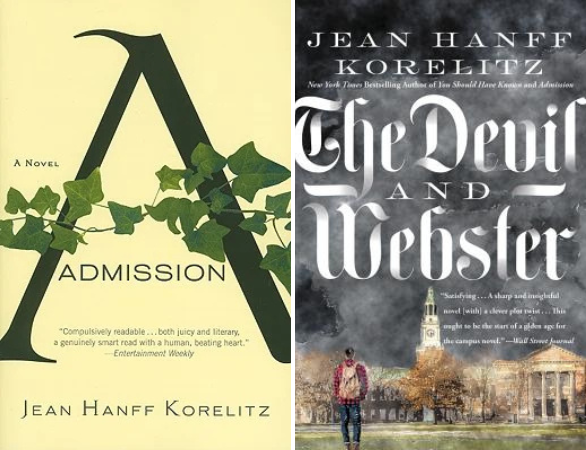
Over the next week and a half, you’ll be helping us decide the best campus novels of all time. Voting starts now! Below are the Round One (part one) match-ups, featuring the 32 campus novels on the lefthand side of the bracket, ranging from classics to contemporary takes on the genre.
Click for a printable (and zoomable!) PDF
Round One (part one) polls are now closed. Thanks for voting! Head over to Round One (part two) to vote on the bracket’s righthand side!
He always responded in the most eccentric possible way: and so on finding himself alone and confused, ostracized and adrift in Paris, instead of giving up, Alioscha chose to entrench himself even deeper in his writing obsession. I confirmed this for myself mere hours after landing in Paris. Uneasy about his state of mind and fearing he’d gone mad following the desertion of latest female companion, I searched for him everywhere, seeking any sign that he was still alive, finally locating him in the expanses of the Parc de Belleville. It was a serendipitous discovery. I’d gone to that place with its exceptional panoramic views on a whim, trying to kill time, resigned that I’d have to wait until the next day to try and talk to him, but upon reaching a cluster of graffitied wooden benches at the top of the hill and looking to my right, I suddenly found myself confronted by my friend’s solemn and tragic silhouette, set against the Parisian rooftops. The figure he cut revealed that, over the past few weeks, he’d only sunk deeper into the delirious swamp in which he already flailed. He looked like a soloist seized by a musical fever, moving his lips to a melody only he could hear, his hair whipped about by the wind and his body in the throes of a strange vibration, so abstracted and brooding that he seemed entirely indifferent to his surroundings, wholly focused on reading from a piece of paper held inches from his face. Only when I got closer, when I could finally hear the absurd litany he was muttering, hand clenched in a claw, did I realize without surprise that I was witnessing a kind of theatrical rehearsal in that secluded spot: Alioscha slowly and deliberately reciting the most recent chapter of Attila, the novel he’d been writing for years and whose long and chaotic discourse of impossible verses and nonsensical paragraphs he would finish just days before he killed himself.
But it would take until October for Alioscha to finish his book, and at that time it was only February, a raw winter afternoon on which Alioscha seemed immune to the cold and the vast and naked sky, so absorbed in his words that he remained completely unaware of my presence until I tapped him on the shoulder.
He turned, startled, as disoriented as if he’d just surfaced from the ocean’s depths. But when he saw it was me, he smiled and embraced me warmly, remembering out loud that I had, just one week prior, in fact, advised him of the time and date of my arrival.
“I thought it was Tuesday, that tomorrow was Wednesday!” he said, pained by his mistake. “Otherwise I wouldn’t have left the house until you got in!”
He rambled on, apologizing for his confusion until he appeared to accept that there was nothing to be done about the mix-up and instead began to tell me about the progress on his book.
“I finished another chapter yesterday,” he said, holding up the pages, purposefully avoiding any discussion of the details surrounding his new life situation. “In a few months, I’ll have written the last page.”
This seemed to be his only aim: to finish the book as soon as possible, working around the clock, refusing to feel sorry for himself over Camille’s jilting, taking refuge in his idiosyncratic endeavor to string together words and thereby not confront the absolute isolation in which he was immersed. He clearly avoided the subject of his reclusion as we looked for the exit from the park, for as we climbed stairs and left ponds and leaf-strewn dirt paths behind us, Alioscha wanted only to talk about what his recent reading and certain technical aspects of his book, making no mention of the despair I knew the young university student must have caused him. Nor did he confide in me when, having left the bounds of the park, we ran out of literary topics to discuss. As we moved farther from where I had found him, I remained uncertain whether Camille’s departure was a temporary, mutual decision, or if she had unilaterally resolved never to sleep in my friend’s company again. Regardless of what Alioscha did or did not tell me, he certainly showed obvious signs of having gone too long with no one to talk to: it was partly the nervous way he had of speaking, his expressions more clipped and abundant than usual, along with the worsening of his physical appearance, evidenced by long greasy hair and obvious pallor.
And yet, I actually found him to be in much better shape than I’d imagined a week before, when my home phone in Madrid rang in the wee hours of the morning. Alarmed by the untimely noise, I grabbed the receiver and heard the voice of a sick and dying man, a voice slow and thick, as if he’d been drinking alone, and which disclosed—with no apology for waking me—that Camille had left him. “Now I don’t have to worry about keeping tabs on her temperature or the violent coughing fits,” he mumbled ironically. “Now I can spend hours and hours writing with no other obligation except to remember to breathe.” That night he spoke in a passionless monotone, muted by somnolence, and before he hung up to drown in his own darkness, I lied and told him I already had a ticket to Paris for the following week. And I wasn’t the only one alarmed by the fateful bit of news that Alioscha had lost the young student’s companionship. When I relayed the news to him the next morning—as we were wont to do in such situations—his cousin Carlos Valls replied with a fateful prediction, a deep truth, the truest and most chilling, and one neither of us wanted to accept: “It could be now or in a few years,” he sighed, making his dark prophecy, “but one of these days Alioscha’s going to jump in the Seine with an anvil around his neck.”
It was his only plausible end. And yet, though Alioscha had always harbored an intense suicidal calling— over the years we could all see how he walked, unflinching, toward the brink of death—it was also true that when I set off on my rescue mission to Paris, it still seemed too soon for that fate, given that my friend was so consumed by writing that he hadn’t the time to think about hanging himself.
My friend was so consumed by writing that he hadn’t the time to think about hanging himself.
Such was the state affairs that early evening as we walked aimlessly in the vicinity of his neighborhood, Alioscha again insisting on the classical resonances in his novel, which he declared was structured around the patterns in specific Greek myths, and then making an offhand mention of his nonessential job at a nursing home in the Saint-Denis district. “It’s still just Saturdays and Sundays, and they’re not completely off their rocker,” he said with a complicit smile, reminding me of the afternoon I visited the home and caught him organizing a sort of clandestine sock-hop. “I bring the manuscript with me and start revising the second I get on the bus.”
He moved frenetically as we walked, animated, possessed by his typically fantastical nature, which had always allowed him to remain outside the coercive norms of constraint and decorum and often led to scenes that illustrated the extravagant character that had governed Alioscha since the day he was born. For instance, when we passed a few garbage bins on the street near the market and discovered, to our surprise, a pile of discarded books on the ground between them, Alioscha couldn’t resist such tempting rubbish and stopped to ransack them with gusto, throwing popular novels over his shoulder and rescuing a few volumes missing their covers. Shortly thereafter, having ticked off a list of important writers who had disavowed their home countries, he pulled me along on another irrepressible impulse to an alley near his apartment, a passageway littered with cigarette butts and broken bottles, where he showed me a plaque menaced by rust and inscribed with a short mention of the English poet who died there nearly a century before. But the moment that sparked his heartiest enthusiasm wasn’t when he came across a few decent books, dozens of copies of which could be found in the Paris kiosks, nor when he stood before the house of that nineteenth-century writer whose name I’d never heard, but when he suggested we visit a pond so small it was practically hidden, where we could feed red fish stale bread. No time for explanations, no answers to my questions, taking hold of my jacket so I wouldn’t slow us down at traffic lights, Alioscha rushed me to a secluded square with a small pool of dirty water, where he pulled a crust of bread from his pocket and began sprinkling crumbs here and there, trying to stir up the fish. Before we left, he stuck his hand in the water so they could feed greedily from the palm of his hand.
But the sight of him so joyous, so exuberant over his juvenile exploits, did not afford me the sense of peace I might’ve expected. In fact, it frightened me. And no wonder. I knew well that the lonelier and more desperate Alioscha became, the more compulsive about his work, the more sudden and intense his waves of irrational optimism, the deeper the resulting void that followed. Only when night fell and winter’s early shadows grew sharp and dense and a dry wind froze the streets, only when Alioscha caught a bit of a melody coming from a nearby shop and was suddenly overcome by a fit of nostalgia and all his anguish rushed to the fore, only then did he make a moving admission about his short, tortured romance with Camille. After a thoughtful silence, he stopped and wearily observed the pavement. Shoulders hunched and hands deep in the pockets of his trench coat, Alioscha confessed that he spent restless nights embracing a pillow, clinging to the illusion that he was holding a woman’s soft body, and other, even worse nights when he woke from the sinister nightmare that Camille had returned, only to desert him again. “And it’s not just my subconscious betraying me,” he said. “I call for her when I’m awake, too, even though I know she’ll never come, like it’s enough just to hear my own voice.”
After that, everything he said and did revolved around his memories of Camille. With a dejected gait, ignoring his untied shoelaces and the drivers that honked when he blindly stepped into the road, numb to everything but thoughts of the young student, he pulled me over to a bench by the Seine where he claimed to have seen her for the first time, and then on to a centuries-old tree famous for its height, where he swore that, in a teenage impulse, he’d carved his name and hers into the trunk with a knife. Then, evoking their early days—the only easy and happy time they’d shared—his tour took us to the home of Camille’s aunt, and there under the balcony he muttered and cursed the paradoxes of love, convinced that his happiest days with the girl had been at the beginning, when she still lived under her family’s roof and he’d delighted in running around half the city on foot just to see her for a few minutes.
But the most eloquent signs of his grief, those which mercilessly showed all he lacked, arose when we stopped in front of the main building of the Sorbonne, a place that was for him steeped in both sentiment and scars, and where, with a mix of guilt and sorrow, he recalled that when he’d met her, Camille had been an exceptional student.
“She always went to class. Everyday. Even when she had a fever,” he said in the middle of the cobblestone square, thinking of the times he’d waited for her, tucked away in some corner. He would start watching the door well before eight o’clock, and she would rush out to him the moment her class was over, mindful she wasn’t being followed.
And though he spoke as if describing scenes from a distant past, his recollection of those early meetings convinced Alioscha that he had to find out right then and there whether or not she had resumed her studies. We approached this undertaking with all the necessary precautions, sidestepping the main stairs, aware that— if she discovered us—Camille would likely be furious and set to beating my friend about the head with her purse. And so, having discarded a plan to hide among the columns at the entrance, we finally sheltered in a doorway dimly lit by a flickering streetlight that only revealed us intermittently, located at one end of the square where students and residents passed by, more concerned with their conversations than what was happening in the street. But despite our vigilance, we never saw her among the groups of students when the day’s last classes let out, nor with the professors who lagged behind, nor when almost all the lights were switched off and only a few increasingly ambiguous shapes remained visible inside the building. But instead of leaving, instead of taking refuge from the freezing night air in some bar, we lingered in the shadows until past eight o’clock, quiet and expectant, Alioscha glancing about and me trying to look inconspicuous, less motivated now by the hope of hearing Camille’s quick footsteps and more by the desire to pay homage to the ghosts of the past. We didn’t even make to leave when the last bells of a nearby church tolled, and no one was left in the square except a dog and his owner. We only moved off when Alioscha grew tired, so late by then that only the night watchmen remained, and we did so very slowly and in silence, each pained by our own dark angst, each longing, perhaps, for some vague homeland existing only in the purest fantasy, each with the same bitter and futureless melancholy of a pair of men who had spent many years in exile.
Alioscha only revealed the details surrounding Camille’s desertion the next morning, in the middle of the crowded Belleville market—one of Paris’s noisiest spots—at a stall consisting of a tarp covering three long tables heaped with bags and wallets and other poor-quality leather goods. It was an off-the-cuff confession. We had been strolling the market from end to end, not paying particular attention to any vendor, impervious to the fabrics and fruit-filled baskets on offer, when we passed a narrow side aisle and Alioscha, having spotted some studded belts, stopped to examine them.
He rifled indifferently through the merchandise, as if already familiar with the stock, and then, after a prolonged silence, spoke Camille’s name.
“One day she woke up with the highest temperature she’d had in weeks, soaked in cold sweat,” Alioscha said, picking up and discarding handbags and wallets at random, so abstracted that he seemed to be muttering to himself. “She realized she couldn’t go on much longer like that.”
It was the explanation I hadn’t dared to ask him for. Avoiding my eyes, Alioscha recounted how at the end of December, Camille had suffered from high fevers that left her vomiting through the night. Even so, he persisted in trying to cure her by his own methods, afraid he would lose her if he took her to a hospital. But, he went on to admit, despite the fact that he went broke buying ineffectual drugs and searched his medical school textbooks for alternative therapies, not only did he fail to restore her to health, but her condition worsened. This went on until one morning when Camille was forced to admit her mistake, and forgetting the promises she made in the euphoria of her flight from her family home, demanded to speak to her parents. In his recollection of those hours, Alioscha, who had always catered to her every whim, said that he brought the phone to the bed willingly, though he knew that once Camille contacted her father, the man would come immediately to take her away.
“She poured it all out she the minute the phone was in her hand, confessed everything she’d been hiding for eight months: where she lived and with whom and how much she regretted having gone missing for so long,” continued Alioscha, who claimed he’d had to lean against the wall for support as he listened in. “She cried and asked them to come and get her as soon as they could, swearing up and down that she would never do anything so stupid again.”
Based on what I gathered from Alioscha’s story, Camille’s father, terrified by his daughter’s confession, made a frantic trip to Paris from Tours and turned up at Alioscha’s basement apartment that very night, as furious as if he really had been rescuing the young student from a kidnapper. The man’s reaction was easy to imagine: horror when faced with the squalor of the musty and unventilated apartment, and rage at finding his daughter prostrate on a mattress as decrepit as an old cot in a war hospital.
“I showed him which medications I’d been giving her,” he brooded as the handbag vendor eyed him with growing suspicion. “But there was no way to calm him down: he was livid, like he couldn’t even believe that we’d been living in such a hole—he kept repeating that it looked like a broom closet, or catacombs.”
What most affected Alioscha, however, wasn’t the father’s rancor, which he must have expected, but that the man who hated him for having taken away his daughter should ultimately show him pity. Witnessing firsthand Alioscha’s preposterous state of poverty, the man realized that he was nothing but a poor wretch blinded by his own naive Romantic illusions. And seeing him so helpless, so alone and unbalanced in the chaos of the apartment glutted with books and smudged papers, Camille’s father took his leave with the same gesture of compassion he would have shown a pauper.
“He opened his wallet and gave me all the money he had on him,” Alioscha said, looking at me at last as he moved away from the stall, which we’d been blocking for several minutes without making a purchase. “And before he left with Camille, he gave me a card with his address and phone number and asked if I had any family that could help.”
He wouldn’t provide any more detail, not even whether he’d been able say goodbye to Camille, though as we left the market, I had the impression that he was always thinking of the girl and the futility of winning her back. Alioscha understandably feared the definitive nature of such farewells: after all, just two years before, in a foreshadowing of the spiral of loneliness in which he would sink ever deeper, Élene—his wife and only ally since the day he left Barcelona—had up and abandoned him in the wee hours of the morning, tired of the anachronistic tics of a failed writer who had moved them to Paris.
In truth, anything I knew about Alioscha’s history with Élene I’d learned from Carlos Valls, my main confidant, given that she had already left their apartment in Oberkampf for good by the time I first met Alioscha. So it was only thanks to the recollections of his cousin—as intrigued as I by the mystery of the man who had been his closest companion since childhood—that I heard how Alioscha and Élene had settled in Paris, enchanted by what Alioscha saw as the city’s mythical aura, which lasted until the third or fourth year when Élene began to sense the cracks that threatened her husband’s fantasies in which he’d become a respected novelist and she a great avant-garde painter. Carlos Valls had seemed certain that the couple’s relationship couldn’t have ended any other way. He remarked how, with Alioscha so absorbed in his writing, it was only logical that Élene—a discreet, balanced, and quiet woman—would feel increasingly defrauded, ever farther from her original goal, and would eventually come to the conclusion that the best thing was for her to open their front door and vanish, aware that if she kept living with Alioscha, she’d only become more lost in his asphyxiating labyrinth.
In any case, I gleaned that his relationship with Camille had been different in every sense, given that it had been short-lived, and there hadn’t been the same intermittent periods of harmony. Yet, as with his wife, their relationship had come to the same irrecoverable end. The affair had been shorter, much shorter, hardly eight months, and its conclusion, therefore, couldn’t be attributed to the eventual tedium inherent to cohabitation, to the shadows and silences that had gradually tarnished his life with Élene, but rather to an original misalignment, an older and more insurmountable breach far exceeding simple boredom, given that they’d been submerged in a state of deep and permanent tension ever since they’d moved to the basement rooms in Belleville. It quickly became clear that they had both fallen prey to a fleeting mirage they never should have indulged in. She was a beautiful young woman, unpredictable and capricious, who had only recently arrived in the city with a desire to lose herself in the Parisian night and its shadowy recesses, while Alioscha was already a grown man who behaved with monastic discipline, uninterested in parties and engrossed in his writerly routines. And to make matters worse, they’d known each other such a short time and so superficially that Camille’s disenchantment arrived almost simultaneous to the moment she began to share his bed, making him feel guilty for ever having courted her and convinced her to leave her aunt’s house. Over the course of their months together, both Carlos Valls and I were witness to Camille’s continual displays of anger. More than once we saw her interrupt Alioscha while he was speaking, cutting him off mid-sentence, or ignoring him when he asked her a question, or berating him for having bought cheaper soap than she was used to or because the milk he put in her coffee was too hot and burned her tongue.
It was an untenable situation, a painful and degrading reality no good for either one of them. Yet Camille resisted the relationship’s failure out of pure obstinacy, forcing herself to endure the mistake that originated on the night she called her father and told him she was starting her adventure as an emancipated woman. She hid behind her declaration of self-sufficiency for months, anxious, beside herself, trapped by her lies and her pride, too stubborn to admit her mistake, until the end of December when she fell gravely ill and had to choose between accepting defeat or dying in the company of a démodé troubadour.
She chose to live, and so abandoned Alioscha, who was left alone and one step away from madness or death.
He still maintained that, with time, he would have cured her, and that the success of his books was imminent, which was why he claimed to have the terrible sense of having been the victim of some misunderstanding. That might have explained some of his behavior, like how he returned to the Sorbonne day after day in the weeks following Camille’s departure, still rattled by the young woman’s disappearance, unable to accept that she’d gotten fed up with spending her nights shivering with cold.
My friend’s despondence caused me to make that visit to Paris my longest in the city, partly because I was worried and partly in solidarity, given the neglected state in which he’d been left. I stayed for almost two weeks, not enough time to see him recover, true, but sufficient to ascertain that Camille had indeed been his last chance at salvation: he subjected himself to such a peculiar lifestyle that he would never find another person who was willing to sleep in his bed. Besides, his economic insecurity was by then fully apparent. He lived off his paltry savings, what remained of a family inheritance, and the money he earned working in the nursing home. His income was so minimal that he’d turned to collecting bags of trash from his neighbors in the noisy building where he lived, in exchange for them covering his water and electricity, a new role that obliged him to cut his activities short at ten p.m. on the dot. Because of this responsibility, if the appointed time drew near while we chatted on the paths in the Parc de Belleville or some other remote part of the city, he would ask that we quickly make our way back to his building, where he would then go door to door hauling the bags his neighbors left out for him. Alioscha didn’t seem to be frustrated by his circumstances. Quite the opposite: he accepted them with punctual docility, attentive and conscientious, as if he didn’t notice the humiliation inherent to the task, impervious to the jokes and laughter, and so used to coping with failure that he wasn’t even rattled when they mocked him by setting out bags filled with rocks.
Yet what did still pain Alioscha deeply was the hushed memory of Camille, to which he continued to pay homage with incomprehensible ceremonies celebrated to appease his fantasy, such as the melancholy custom of showing up at the university gates with the quite unreasonable hope that she had resumed her studies instead of returning to Tours. Stranger yet was how he continued to set a place for her at the table, as if they were about to share a meal, or continuing to sleep on the couch so that the bed remained available for Camille’s feverish body. And those were just the more routine practices, which at times seemed designed to invoke her and others to simply stave off boredom: he’d also discovered new rituals, darker and more somber, like the way he disposed of the clothes she’d left behind, a process that seemed to be guided by a peculiar, sentimental intuition. Once, in the wee hours of the morning, I watched him lug a suitcase stuffed with shirts and sweaters to a church doorstep. Another day, I caught him filling a sack with several pairs of her shoes, which he later strung up from a solitary tree. And one overcast afternoon, I was witness to how he tossed a bag containing several pieces of her lingerie into the Seine, sighing all the while.
And yet it wasn’t all laments with him, since—as was often the case—the sadder and more alone he felt, the worse his ostracism in Paris, the more any ordinary event could enchant him. His faithful visits to the pond to feed the red fish, for instance, or his juvenile penchant for stealing from secondhand bookshops. And along with those more mundane pastimes, which I’d seen him enjoy for years, another more exciting and surprising hobby emerged: taking photographs on the street and developing the film in his apartment using a slow artisanal process.
He claimed it was a sudden passion, born by coincidence: one day he was rummaging around in the nursing home attic, through the cast-off chairs and chipped lamps, exploring the contents of the same trunk from which he’d rescued a busted radio and an old record player, and discovered a camera. His dismal economic circumstances meant he’d had to learn the secrets of the photographer’s art on his own. He developed the film himself, in the shower, following a meticulous and burdensome operation that he nonetheless seemed to enjoy, engrossed in the languid labor of transformation, as delighted as if it were alchemical magic. Afterward, when the process was complete and the images had been rescued from the nebula of the film roll, he stacked them on his writing desk, or laid them out on the couch, or left them hung up with clothespins on the drying line for a few days. But what my friend liked most was the thrill of shooting in the streets. That visit, whenever we met for a walk, Alioscha turned up with the camera around his neck, as if it were a part of his antiquated outfit, the most valuable and important accessory, the most extraordinary: the only thing that allowed him to momentarily suspend his nostalgia for Camille. He had fixed obsessions. He usually photographed people, not landscapes, and almost always opted for a woman’s face, whether it was a radiant girl waiting at a stoplight, or a woman reflected for a blurry instant in the top half of a mirror. He never had a plan. He worked as if guided by amazement, fascinated by a unique set of features or smile, drawn to some deliberate gesture, a business-woman’s elegant gait. They were impulsive acts, maneuvers in which Alioscha lurched abruptly, hunched over, running or climbing a fence or pressing himself to a storefront window, oblivious to the effect he was having on his model. He looked happy as we walked, pleased to be carrying a piece of the city inside his camera, jubilant over the ecstasy of the hunt. That is, until sundown, when the time came for us to say goodnight and Alioscha stumbled again over his shattered reality. His transformation was notable. Crestfallen and grave, he made plans for us to meet for lunch the next day, then walked slowly away down the sidewalk, eyes lowered and shoulders slumped. He never looked back and was always much sadder than at the beginning the day, as if wrapped in a funeral shroud, aware that the only signs of life awaiting him in his basement rooms were the portraits he’d hung there to dry.
So passed several of the days during which I witnessed firsthand the angst affecting Alioscha, a pain old and deep that followed him like a curse through the anonymity of Paris. In truth, I couldn’t do much in our short time together besides confirm his grim condition as an exile—even though that term wasn’t entirely accurate in his case. By unspoken agreement, we organized our days much like we had on my previous visits: I would spend the early part of the morning by myself, working on my articles and features, while he immersed himself in writing his novel of indecipherable paragraphs. Then around one o’clock, by which time Alioscha had used up all the strength he’d managed to store during his fitful nights, we would meet for lunch in some Belleville restaurant near his apartment, then stroll with no fixed destination, long walks that sometimes stretched on under the lit street lamps, depending on the urgency he felt to get back to his desk. Now that he was on his own and with no one to talk to, a ghost stranded in a village of ghosts, he sometimes preferred to leave his writing for later and prolong our time together so that he could leisurely digress on his incurable abstractions.
The sadder and more alone he felt, the worse his ostracism in Paris, the more any ordinary event could enchant him.
Alioscha and I always ended our evenings before the ten p.m. trash collection, so I never did see him up to his neck in that disreputable muck, soiled by mockery and scorn, filth and fruit peels, until the very last night of my visit when, thanks to an oversight, I returned to his apartment after we’d already said goodnight.
The origin of the mix-up could be traced back to that day’s lunch, when we got up to leave after coffee and dessert and Alioscha—distracted by his despair over Camille—left the little bag of bread he’d saved for the fish on the table. I put the bag in my pocket and promptly forgot it myself until a few minutes before ten o’clock, as I strolled alone down a poorly lit avenue, my mind far from Paris, preoccupied with getting back to the hotel and packing for my flight. Stepping onto the curb to hail a passing taxi, I put my hand in my coat pocket and felt the little bundle of bread from lunch. All I wanted was to rest, to take refuge from the intense chill of the February wind, but I remembered how Alioscha insisted that his beloved fish had adapted their feeding schedule to his visits. Certain that my friend’s ritual of sprinkling crumbs on the dirty pond was important, I apologized to the driver in the waiting taxi and found myself making the trip on foot back to Alioscha’s basement apartment. I was distracted and subdued, thinking of the assignments awaiting me in Madrid, and didn’t consider the fact that my friend would, at that very moment, be engaged in the thankless task of collecting the neighbors’ trash. I wasn’t thinking of it as I made my way down the gloomy street toward his lair, just like I hadn’t given it much thought on any other day, all the times he bid me goodnight, forever in a rush, at the mercy of the strict punctuality of the municipal garbage truck.
It only occurred to me when I neared his building and was forced to remember, for just as I was about to cross the street, I saw a group of teenagers heckling Alioscha as he grappled with the trash bags. I stopped on the darkened corner and waited in stillness. A streetlamp was angled over the scene before me, a weak stage light accentuating the impoverished set Alioscha seemed to have built for himself: Belleville itself was a busy, central neighborhood, but his building stood on a side street with worse lighting than its neighbors, as if he created his own outskirts wherever he called home.
Realizing that the drudge work of dealing with the entire building’s refuse also came with a daily dose of humiliation and contempt, I stood quietly for a few more moments, unsure whether or not I should cross the street, feeling my friend’s suffering but aware there was nothing I could do to help him: the kids’ jeers and bold stares left no room for doubt. As Alioscha was depositing a load of bags into the bins, one of his aggressors spoke from his perch on the fence and the others exploded in loud laughter. My friend ignored the provocation, focused on his job, immune to their insults, resigned to handling the garbage with striking passivity. Still unaware of my presence, his eyes fixed on the ground, Alioscha went back inside with an automaton’s steady march, quick and methodical, and in the streetlamp’s fragile light, his face contained a new expression, a deadened grimace reminiscent of the tortured figures held aloft on the shoulders of religious penitents in procession.
Alioscha returned with more bags every few minutes, the time it took for him to go upstairs and come down with another load, indifferent to his surroundings, imperturbable in spite of the grime and carnivalesque atmosphere that accompanied every round. He looked serious, very serious, like a condemned man appearing before the crowd, his face tight and sallow, the same sickly appearance as if he’d been locked away in a forgotten dungeon. But it was his composure that made the sad situation even sadder. He carried on as if nothing were wrong while the young men accosted him, deaf to their jeers, refusing to look at them or respond in any way, his sole concern to finish the job on time, operating with a speed and punctiliousness that cast him as even more pathetic and amusing to his audience. How could he tolerate such a situation? Perhaps he accepted such disgrace as part of his writerly legend, or maybe it was simply a quick and easy way to save money while he endeavored to write Attila. Whatever his calculus, I watched from the opposite sidewalk as he remained stoic, even when they threw a cigarette butt at his turned back or plopped a banana peel on his shoulder or amused themselves by moving the bins farther down the street. Unmoved by their provocations, Alioscha labored on, assured that the battle he was sworn to fight was not to be waged on Belleville sidewalks, but on the pages he wrote.
The sight I found most distressing, the vision that kept me from going over and giving him his fish food, was the mishap that occurred once the garbage truck had appeared at the end of the street, headlights submerged in the night like a ship entering an inhospitable port on the Brittany coast. The accident unfolded in a matter of seconds, when the truck was already stopped in front of the building next door, ready to lift and empty the dumpsters, and Alioscha was running down with the last of the bags. The kid on the fence, the first one to taunt him, shoved one of his companions, who in turn fell into my friend, who had no one else to stop him, and in the chaos of stumbling, tumbling bodies, it was Alioscha who ended up on the ground awash in crumpled wrappers and food scraps. He didn’t react. Uncomplaining, barely looking up to confirm that the truck was still idling, Alioscha stooped to pick up the scattered debris, ignoring the commotion around him, careful not to leave behind any pieces of paper or fruit peels, attempting to scuff the coffee grounds and cigarette ash off the pavement with his shoe.
With a squeal of brakes and grinding of the clutch, the truck shifted into gear, coming to an almost immediate stop outside Alioscha’s building, its bright headlights illuminating all the ugliness. Alioscha redoubled his efforts so as not to slow the usual pace of the collection, while a half dozen of his neighbors cheered his new show of submission. It was too much for me. Alarmed by the knowledge that such hell was routine, convinced that I could do nothing but witness his torment, I decided to leave before he’d finished, and as I moved off in search of a taxi back to my hotel, I thought about how much Alioscha must have had to suffer before being able to remain unaffected by those insults, and how unfair it was that such a thing was happening to someone like him, a person whose only sin was to bravely defend the one thing he believed in.
That image, his acceptance of defeat, his scrabbling about in the midst of ridicule, his vulnerability, was a good illustration of what had always been his destiny, the fate of one who chose to be consumed by a single idea. And the more courageous and sincere his commitment, the more he suffered, and the more he suffered, the stronger he persisted in his attempt, as if instead of being a writer whose books nobody understood, he was a heretic burning in a bonfire, fanning the executioner’s rage by enduring in his silence and his truth.
Cozy small-town America is built into the bedrock of our cultural ethos. The charming vision of provincial life extends well into the modern era. One needs to look no further than The Gilmore Girls to understand that the allure of an entire community embracing, celebrating, supporting, and knowing one another holds a comforting appeal for many.
Except when you’re on the outside. If you’re not one of the lovable, huggable citizens attending every parade, the gaze of a quaint town begins to feel like a scalpel. Being ‘known’ means being seen through a lens that was already in place before you arrived, either by birth or fate.
For better or worse, that’s the version of Small Town, USA I know best. Born a pastor’s kid, I moved with my family from one dot on the map to the next, operating as both insiders and outsiders at the same time. My father used to tell my sister and I that there was nowhere we could get into trouble—the locals would tell him before we even got home. Sure enough, comments on what shops we visited, the length of our skirts, the people we dated two towns over all became a part of routine life. We were welcome in these places as long as we abided by the local rules. Cross those unspoken lines, and we were instantly relegated back to outsider-status.
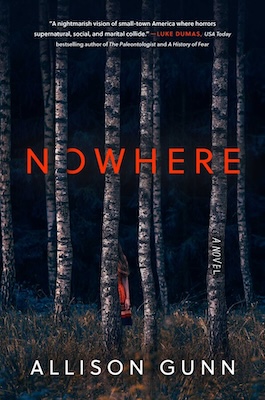
This was the experience out of which my debut novel Nowhere was born. In Dahlmouth, the Kennan family is initially welcomed given Rachel’s position as police chief. A few stumbles, however, and the town remembers they are, in fact, strangers from a strange land. Suddenly, it’s easy to blame them for tragedies or to condemn them for ‘sins’ that are typically buried in one’s closet.
But it’s lazy to paint small town life as a net negative. Genuine kindness resides within those borders as well. Oddly enough, those who live on the fringes of society are often the ones cementing the ideals of rustic Americana. For me, it came in the form of residents who had long received side-eyes thanks to their vices or heritage, be it an addiction to alcohol or a grandmother who got a little too friendly with the milkman forty years prior. For the Kennans, the same unconditional warmth is found in the wild child whose antics land her on the prayer chain every week or the rugged deputy for whom friendship transcends arbitrary condemnation.
Small towns are paradoxes filled with polite villains, outright renegades, unspoken rules, fearless loyalty, and everything in between. They are tragedies in waiting, supplying us with satisfaction when the lecherous mayor is exposed and crushing our hearts when the courageous rebel is defeated.
The terror that lives in small town horror novels rests in humanity rather than in the unconquerable villain gracing the pages. Will your neighbor love you as they love themselves? Or will they cast you into the flames to save themselves? What will you do to them when pushed to your limits? You’ll never know until the day arrives, a hellish reality that the following novels demonstrate in spades:
When a famous author of macabre children’s books goes missing, Travis Wren embarks on a journey to locate her using his psychic abilities. Soon, however, he vanishes as well with only his truck left outside the boundaries of a tiny commune cut off from the world, setting off a chain of events that unravels the secrets and safety of its inhabitants. An unnerving slow burn that will leave you looking over your shoulder, A History of Wild Places is a must-read.
A terrifying examination of broken families, Sharp Objects slices through the thin veneer of congeniality that covers a multitude of sins in small-town culture. Journalist Camille Preaker returns to her Missourian hometown to investigate the recent murders of two young girls. Flynn takes readers on a wild ride, evoking a visceral pain as Camille battles horrific memories of her past before crashing into a jaw-dropping ending.
When Katherine van der Wyler was executed by villagers 350 years ago for alleged witchcraft, death transformed her into a walking, whispering nightmare whose evil eye struck down her holy neighbors. With eyes and mouth now stitched closed, Katherine has become an almost mundane fact of modern life in Black Falls, residents deeming her harmless if ignored—until a group of teens decide they’re done playing nice. Terror unfolds quickly in this twisted fairy tale, taking readers on a disturbing roller coaster that dares you to keep your eyes open.
When a stranger arrives on the small rock known as Little Tall Island in the midst of an unprecedented winter storm, chaos and terror shatter the bonds between neighbors and friends. Making no apologies, the unwelcomed visitor resurrects the deepest secrets each townsperson holds, unearthing the darkness that resides within their tight-knit village.
While some readers may hesitate to pick up a published screenplay rather than a traditional novel, Storm of the Century is an oft overlooked gem in King’s crown which promises to shatter your visions of small-town tranquility.
With an intensely lovable and quirky main character, Kingfisher keeps her readers on the edge of their seats, rooting for a happy outcome. When Samantha Montgomery returns to her small, North Carolinian hometown for a visit, it comes as no surprise that the ghosts of her difficult grandmother continue to plague the family… except Samantha expected a figurative rather than literal haunting. In Kingfisher’s disorienting and wondrous signature style, readers glide through a ghost story laced with rose petals, heartache, and above all, enduring love.
A gripping tale that rivals Stephen King’s It, Kurian’s sophomore novel is impossible to put down. Twenty years after a group of unlikely friends conquered an ancient evil, a mysterious murder draws them back to the tiny town they tried to forget. Evil has many faces, but the one they encounter upon returning is all too familiar. Filled with non-stop twists and shocking revelations, A Step Past Darkness keeps readers on the edge of their seats from cover to cover.
Set in an idyllic small-town ripped from a Hallmark movie, My Darling Girl follows the destruction of author Alison O’Conner’s wholesome life after her estranged, terminally ill mother moves in to live out her final days. A unique take on the well-trod possession trope, My Darling Girl leverages the deceptive beauty of sleepy hollows to slowly tighten the noose around both the main character and the reader, reminding us that darkness lurks in the shadows of Christmas lights and countryside charm.
In Compound Fracture, Andrew Joseph White exposes the uncrushable resilience and class rebellion that still pulses within West Virginia. As Miles Abernathy begins to spread his wings, embracing their transgender identity, the evil pervading his community and family comes to the forefront. Amidst the bloody conflict, an ancestor returns from beyond to assist Miles and heal a legacy of trauma and fear. Equally inspiring and horrifying, Compound Fracture sinks into the reader’s heart and upends common stereotypes of both queer and Appalachian identities.
Last year, you helped us decide the saddest book of all time in our March Sadness bracket. Now we’re back again with yet another pun-based book competition: March Gradness, a quest to find the best campus novel out there.
You may be asking yourself: how long could they possibly keep this up? Surely there are only so many book-themed March Madness puns they can make? But don’t underestimate us—we’re just getting started!
Voting will begin Monday, 3/24 at 12 PM Eastern, and this year, we have a couple new twists:
Firstly, we have prizes! Download the bracket here, fill it out with your picks, then email it to us at books@electricliterature.com by 9 AM Eastern on Monday, 3/24 as a .pdf, .jpg, or .png file, using subject line BRACKET: followed by the title of the book you’ve chosen as the winner (e.g., “BRACKET: The Secret History”). The person whose bracket is closest to the real results will win a free manuscript consultation with an EL editor and a Reading into Everything tote! Two runners-up will each receive a tote as well. We’ll reach out to our winners the week after results are in.
Click to download a printable PDF.
Secondly, we have a new way to cast your votes. While you’ll still be able to vote in our Instagram stories as usual, you’ll also have the option of casting your votes right here on electricliterature.com! Stop by Monday at noon Eastern to vote in Round One.
Below is a sneak peak of the Round One match-ups, featuring 64 of the best campus novels out there, ranging from classics to contemporary takes on the genre.
Round 1 – Lefthand Side
The Secret History vs. The Maidens
Ninth House vs. The Magicians
If We Were Villains vs. The World Cannot Give
Sirens & Muses vs. Voice Like a Hyacinth
Transcendent Kingdom vs. The Secret Place
The Starboard Sea vs. Old School
The Vanishers vs. I Have Some Questions for You
Never Let Me Go vs. The Incendiaries
The Name of the World vs. Skippy Dies
Stargazer vs. Special Topics in Calamity Physics
The Rules of Attraction vs. The Art of Fielding
Talent vs. We Wish You Luck
On Beauty vs. I Am Charlotte Simmons
The Adult vs. Harvard Square
All Is Forgotten, Nothing Is Lost vs. Possession
Prep vs. Foster Dade Explores the Cosmos
Round 1 – Righthand Side
The Groves of Academe vs. Stoner
The Ask vs. Dear Committee Members
My Education vs. Trust Exercise
A Separate Peace vs. Tell Them to Be Quiet and Wait
“I chafe against a want for what is owed: / a movie in soft focus with warm colors, / perfect lighting, every scream queen / flagrant with her brilliant smile,” writes CD Eskilson in their imaginative and playful debut Scream / Queen, which interrogates monstrosity and the monsterification of trans, queer, and disabled/mentally ill bodies through the lens of pop culture, particularly horror films. The collection juxtaposes classic horror tropes—demons, jumpscares, haunted houses—with the real-life horror of transphobia and legislation targeting trans youth, as well as the more nuanced horror of inherited familial traumas.
Inhabiting a wide range of personae and formal traditions, Eskilson imagines a world in which HIM from The Powerpuff Girls is a genderqueer barista, Icarus posts thirst traps in drag on their finsta, and the women of the speaker’s family twirl into the teal waters of the Aegean Sea like Meryl Streep in Mamma Mia!, unburdened by their ghosts. By radically re-envisioning familiar characters and tropes, Eskilson breathes new life into their stories, granting them agency and also allowing readers who have been marginalized or flattened by harmful language and representation to see themselves reflected, perhaps for the first time. Scream / Queen is a testament to the liberatory power of queer imagination, creating “Not simply / a new ending, an entirely new script.”
I spoke to CD over Zoom, where we talked about queer origin stories, mythmaking, and the subversive potential of monsters.
Ally Ang: What was your first introduction to the horror genre and how did you come to fall in love with it?
CD Eskilson: I’ve been interested in horror movies, monsters, and horror as a concept since I was a little kid. For some reason, I was really enamored with monsters. I have memories of, before going to kindergarten, watching The Wolf Man on VHS or Creature from the Black Lagoon. I became fascinated with the more technical aspects of movie-making when I got to undergrad. I was a Media Studies minor in addition to being an English major. As I became an adult, rather than just being like, Cool, monsters! I was more like, How do these movies get made? or, What stories are they telling? So much horror today, like I Saw the TV Glow by Jane Schoenbrun, tells stories in really subversive or unexpected or radical ways. Monsters as a concept can be this liberatory radical utterance against the thing that’s being made into a monster.
AA: Yeah, totally. I was a scaredy cat as a kid, but I felt that same pull towards creatures and monstrous beings as I got a little older. I think a lot of queer people do.
CDE: For sure. I think it’s a sign, right? Everyone’s always like, Yeah, I was really into monsters as a kid too. And then I ended up being a trans person. Being in marching band is another big thing, or playing an instrument in general.
AA: Let’s start with the titles of both the book itself and the sections within the book, all of which take particular tropes and subgenres within horror (found footage, body horror, jump scare, etc.) and divide them with a slash. The slash can be interpreted in a lot of ways (the term “slasher” immediately comes to mind), but I was hoping you could tell me how you decided to structure these sections and what the slash signifies for you.
CDE: So within the sections themselves, the poems speak back—whether directly or in an emotional or lyric sense—to the titles. The BODY/HORROR section talks a little bit about chronic illness and the experiences of the trans body. Other sections, like FOUND/FOOTAGE, are a little more abstract, more like making sense of the past, childhood, experiences of dysphoria that you didn’t know were dysphoria, trying to figure out where you got to the point of realization about your identity. With the slashes, I’ve been really interested in how language works and how we connect to and identify with words. In the book, you start with FOUND/FOOTAGE which is two words, and as the book progresses, the last section, SUPER/NATURAL is one word that’s been divided. There’s this forced rupture in the word, but we can still identify it as the word. I’ve been thinking about that as a way of interrogating binaries, thinking through the ways in which we put up these arbitrary distinctions between parts of a whole or a spectrum. It’s a way of interrogating that violence and exploring how we can continue to identify something that’s had this violence enacted on it. And “slasher” is something I’ve been excited to see people pick up on. It’s that forceful happening within language and how we can resist it or make something new out of it.
AA: Scream / Queen doesn’t only use horror movies as references, but also Greek mythology, including Medusa, Icarus, and Geryon, imagining them as contemporary queer figures. What led you to draw upon that particular mythology, and where do you see the parallels between Greek mythology and contemporary horror?
CDE: Another thing I’ve noticed is that a lot of queer and trans folks I know have an interest or obsession with Greek mythology as kids. To be a linguistic nerd for a second, the word “monster” comes from the Latin “monstrare,” which means “to demonstrate.” So quite literally, monsters demonstrate something, which is very similar to a myth. It’s supposed to point towards this social truth. In the case of Medusa, who’s typically portrayed as a monstrous figure from the ancient past, there’s a resonance with monsters and horror movies today. And with Icarus, I was wondering what other story could be told about that figure? How could it be revised or reimagined to say something new that still speaks back to the idea of flying too close to the sun, defying expectations, defying possibility? I’ve been thinking through myth and horror as drawing from a similar idea, if that makes sense.
AA: There’s a moment in “During Intro to Film Theory” that really struck me—when talking about the real life horror of legislation targeting trans youth, you write, “What angle could I / film from to grip an audience and capture / all the care inequities? Without red dye, / people shrug, stay unfazed by our loss.” The weight of that responsibility as a trans person to make our humanity visible and legible to cis people is something that really resonated with me, and I’d love to hear more about how you thought about audience while writing this book. Did you feel the impulse to try to represent transness in a way that cis people would understand, or was that something you didn’t think about or actively rejected?
CDE: I think that’s really important to be thinking about as someone writing into identity or writing towards something that’s very personal and also very political at this particular moment, with the giant magnifying glass that’s on trans folks today. As I was writing the book, I wanted to imagine my audience as first and foremost trans and non-binary folks, particularly trans youth. The audience is also anyone whom language has othered or marginalized in some way and who are interested in reclaiming and revising the stories and language that are leveled against them. When I was writing, I was contending with the idea of language as something that can be so violent and so creative at the same time. It’s not like it’s inherently benevolent. We have to be part of the process of interrogating it, forming it, creating new forms of language that see us or help us be who we feel we are. I definitely wrote this as a way of hoping or praying for continuation of survival for trans folks, but hopefully it also allows people to see the radical performance that language can do outside of that—for folks who are neurodivergent or chronically ill as well. Hopefully people can see the possibility that can open from that.
AA: In “At the Midnight Show of Sleepaway Camp,” the speaker attends a showing of the film Sleepaway Camp with a group of queer friends who have differing reactions to the film’s big twist in which the main character is revealed to be a trans girl. You write, “Can’t we / hold both readings of the movie to be true? / Know there’s risk in our vindictive gore / but that it offers a resistance.” Later, in ”My Roommate Buffalo Bill,” the character of Buffalo Bill is presented as a confident, self-actualized trans woman in contrast with the speaker, who is more insecure and earlier in their transition. Can you speak more about your relationship to films like Sleepaway Camp, Dressed to Kill, The Silence of the Lambs, which contain depictions of trans women that could be considered transmisogynistic, problematic, or harmful? Do you think films like these are reclaimable or redeemable?
The audience is anyone whom language has othered and who are reclaiming and revising the stories that are leveled against them.
CDE: Horror can be an incredibly reactionary and violent space for a lot of folks, particularly trans folks, like with the trans panic trope going back to Psycho and Dressed to Kill, which also comes up in the book. I spend a lot of time thinking about these movies and what impact it has to see that or to see people so interested in that. When people decide that “The Silence of the Lambs did nothing wrong” is the hill they want to die on, it can be very frustrating.
In terms of reclaimability, I think that’s what the project of the poems, these reimaginings, is. With questions about whether a movie like Sleepaway Camp has a redeeming quality, I think a lot of that is for trans folks to decide whether that’s a piece of media they want to engage with. But for me, writing these poems, I was thinking how I could reimagine these characters as having the lives they wanted to live or as being recognized as a trans woman, which The Silence of the Lambs blatantly does not do. The way I’ve reckoned with that is by creating a reinterpretation, like making a movie into a myth—you know, how myths have so much revision around them, where we tell different versions of the stories. So mythologizing it allows me to participate in the storytelling or make it something I can claim ownership over.
AA: Yeah, that’s similar to how a lot of young queer people are so drawn to fanfiction.
CDE: Yeah, very similar to that. Fanfiction allows for the possibility of participating in the story in a way that allows queer folks to see themselves, like queer fanfiction about Twilight.
AA: I love that. Those reimaginings were my favorite poems in the book. I don’t have a question about this poem, but I just loved “Update on HIM from Powerpuff Girls.” I think that was my favorite one.
CDE: Yeah, HIM is so special, at least for me as a kid. Talking about introductions to horror, I remember being completely terrified of HIM and also utterly transfixed every time HIM was onscreen. I’m always excited that people loved HIM so much.
AA: Another major theme of this collection is the speaker’s relationship with/inheritance from their biological family; in particular, a mentally ill father and grandmother, an uncle who’s passed, and a sibling who is also queer/trans. The presence of these family members and their impact on the speaker’s life and sense of self feels like a kind of haunting, which is explored most directly in “Our Family Leaves the Haunted House.” But I wanted to talk about the last poem in the book, “Draft Message to My Sibling after Top Surgery.” I thought this was a beautiful place to end the collection, with the image of the speaker and their sibling running along the shoreline of a beach side by side. How did you decide to make this the final poem in the collection?
CDE: That wasn’t originally the last poem; I think I previously had a different one in the same section, but it was still towards the end in very early drafts. There was a certain point when I realized that horror is such a big part of the book—it’s where we start, and so much time is spent talking about monsters and the horror of certain experiences. In wanting the book to present some sort of growth or journey, I figured it would open things up more to end outside of that genre, looking beyond the confinement of haunting or monstrosity. Just being alive and being aware of one’s body through something like top surgery or the experience of being on the beach. It felt like a very natural place to end, returning to a place that feels safe and full of possibility.
AA: Are there any horror films or characters that you wanted to write about but didn’t make the manuscript?
Fanfiction allows for the possibility of participating in the story in a way that allows queer folks to see themselves.
CDE: One that I got really held up on that I didn’t know what to do with outside of the title being fun was this 1950s monster movie that’s just a bunch of Cold War propaganda, like The Blob—it’s called Them! and it’s about giant ants; they take over the town in a way that’s a veiled anti-Communist message. But the title was really cool.
I really like watery monsters—being from Southern California on the beach, I spent a lot of time thinking about what could live in the water—so I had a The Shape of Water poem that sort of just fizzled out because I like Creature from the Black Lagoon better and I couldn’t do both. I had to pick and my heart lies with Creature from the Black Lagoon. Sorry, Guillermo!
It was interesting thinking of what didn’t “make the cut” in terms of what kind of story I wanted to tell or what different angles to present monstrosity from. I’ve still been hung up on Greek myths, so I’ve continued to write about that after the book and carried stuff over that didn’t end up in the book.
AA: I guess that’ll be in the next one! Those are all my questions; is there anything else you’d like to mention that you didn’t get to yet?
CDE: I think the biggest thing as we move through this time is to continue to support trans and non-binary writers and people, especially Black trans and non-binary folks. And being mindful of how the things in the book are things that happen to people. Poetry is also speaking to a lived experience. So support people through books and in daily life through mutual aid and organizing as well.
DON’T MISS OUT
Sign up for our newsletter to get submission announcements and stay on top of our best work.
YOUR INBOX IS LIT
Enjoy strange, diverting work from The Commuter on Mondays, absorbing fiction from Recommended Reading on Wednesdays, and a roundup of our best work of the week on Fridays. Personalize your subscription preferences here.