“Enjoy Your Mutiny, Captain” — Read a New Short Story from David Nutt

FICTION: THE RIM, BY DAVID NUTT

LaRoche and DeWalt and DeWitt wait around the rim, squinting through the steam, the guilt, dreaming of the next career. This current situation, not really a career-type situation. Their crisis management skills, nowhere near par. LaRoche looks across the void of newly punctured earth and notices DeWalt with a loogie pronounced in his cheek, about to launch.

“Swallow that shit,” LaRoche says.

“Mmhhnnmm.” DeWalt moves his head in the negative, a vigorous slosh.

“Don’t be a motherfucker. Think about Hard-G Giles. That hole’s not even an hour old.”

A long stretch of cable dangles slack into the dim gap at their feet. Not a bad hole, LaRoche thinks. Another hot rash of guilt ensues.

DeWitt nudges DeWalt and DeWalt swallows the phlegm.

“I don’t wanna think about Hard-G Giles,” DeWalt says, a bit breathless.

“What?” LaRoche glances up from his fuzzed reverie.

“The look on his face.”

“Yeah,” DeWitt adds. “His face.”

“I didn’t see his face,” LaRoche says. “He had a face? I mean, he was left with one? It happened so fast.”

“You think he took that lame-ass Tupperware with him?”

LaRoche shoots DeWitt a caustic look.

“I liked you more when you talked less,” LaRoche says.

“Yeah, dude, well, I liked Hard-G Giles more when he had a face.”

“Touché.” DeWalt reaches over to DeWitt, arm angled for a high-five.

“Get that fucking thing away from me,” DeWitt snarls, and spits in the hole.

DeWalt retracts the hand and holds it up with the other hand, mid-air, like a civilian mugged at gunpoint, saying to LaRoche: “Enjoy your mutiny, captain.”

“Captain…” LaRoche can’t muster the words, any words.

DeWalt looks over the rim, downward, Hard-G-Giles-ward. “God, that’s a big fucking cunt of dirt,” he whispers.

DeWalt is wearing the orange flame-retardant jumpsuit from the job before the office job, a sentimental favorite, still a little charred on the sleeves and chest and crotch region. “That Tupperware, man. You remember how it made those ghostly whooshing sounds every time he opened it to get his lunch? That noise always chapped my ass, roiled my hemorrhoids. Now I sorta miss it. Probably got crushed under the thing along with the rest of him. They’re both halfway to hell by now. Tupperware. The actual brand.”

“The man had an abiding love of tofu Reubens.”

Abiding. Good word.”

“Tofu?” LaRoche asks, head swiveling. “Really?”

“He abided himself right into the goddamn grave.”

“That thing is no grave,” DeWalt says, leering at the hole. “A grave has a bottom.”

“God’s own glory hole,” smirks his former cubicle-mate DeWitt, his khakis ink-and-blood spattered, clip tie and shirttails blowing loose in the wind. But his smirk shrivels. “At the very least, the dude could’ve left us his tool holster, his hardhat. The goggles he wore strapped around his squinty Hard-G-Giles-like face.”

DeWalt flicks an old cinder from his lapel. “That machine, man. You hear it? I think it’s still running.”

The three men lean over the hole and listen.

“I don’t hear anything,” LaRoche says.

“Must be all that guilt clogging your ears.”

“It wasn’t my fault.”

“You pressed the button.”

“Not on purpose,” LaRoche replies. “I just bumped into the thing that bumped the other thing, and thatthing fell and crushed him and they both — ”

“You broke the goddamn earth,” DeWalt says. He turns and kicks a clump of loam at DeWitt. “Ain’t that right?”

DeWitt’s head, though, is heavy with other things.

“You okay, DeWitt?” LaRoche asks.

DeWitt looks up blankly and says, “Whitney.”

“Huh?”

Whitney,” DeWitt repeats. “Why the hell did my folks name me that? Whitney DeWitt? What a stupid fucking name.”

He gives the ground under his deerskin loafer a halfhearted stomp. The ledge loosens and folds and then he too is gone. Just gone. There isn’t even any cable to dangle after him.

“Holy fuck all,” DeWalt moans. “You see that?!”

“Wha?” LaRoche asks.

“DeWitt, man.” DeWalt points at the hole, the crumbled rim, a haze of stirred dirt. “He gone!”

“You sure?”

“Look, man!”

“I am looking,” says LaRoche, not looking at all. Instead he’s fussing with his daisy-yellow safety vest, brand new and ill fitting, the plastic reflectors that look pasted in place. He’s trying to manage his attentions, his guilts, his vectors. The problem, LaRoche thinks, is that he doesn’t have anything to manage them with.

“Ir-re-spons-i-ble!” DeWalt finger-stabs each syllable in the dusty air.

LaRoche squints harder and studies the man’s ruddy cheeks, his face flash-flooding.

“Are those tears?”

“Shut up.”

“No, I’m serious. I mean, is that what tears look like? Because those are great tears, man. Really. Well done. They almost sorta look like slugs, don’t they? Strange griefy slugs.”

DeWalt chews the rough knot of his tongue, a stoic mourner, refusing to wipe the slickness off his hot fireball face as he glares at the vacant spot that held DeWitt.

LaRoche shrugs.

He dangles his foot over the hole, dances it a bit, and draws it back.

“You hear that?” LaRoche looks up, looks around. “Anybody hear that?”

When Popular Fiction Isn’t Popular: Genre, Literary, and the Myths of Popularity

Genre Vs. Literary Has Nothing to Do with Popularity

Is the novel dead? Are MFA programs worth it? Can characters be unlikable? Genre or literary fiction? Is the novel dead because MFA programs are fighting a genre war with unlikable characters?

Sometimes it feels like there are only five topics the literary world can write about, but despite the sheer number of think pieces on these subjects, there tends to be very little said in the way of actual facts. When we get into a debate like self-publishing vs. traditional publishing or “genre” vs. “literary,” we’ve wandered into the book world version of conservative vs. liberal. Arguments revolve around feelings, constantly redefined terms, and moving goal posts rather than any interest in truth or understanding.

Take Damien Walter’s article in The Guardian claiming that “Literary fiction is an artificial luxury brand but it doesn’t sell.” Walter pretends he is attacking the literary snobbery, yet the piece is overtly condescending toward readers of books Walter looks down upon. For Walter, people who read “high-end literature” only do so because they (falsely) think it “make(s) you look cool” while readers of genre fiction are people who buy books “because they love them.” It isn’t just that literary fiction doesn’t sell, but its readers are poseurs who don’t even actually like books! Claiming anyone who reads books you don’t like is a fake reader who buys books out of bad faith is about as snobbish as you can get.

There are some other nonsensical arguments in Walter’s piece, such as his claim that David Mitchell — most famous for his genre-bending Cloud Atlas — is being penalized for “wander[ing] off the reservation” of literary fiction and experimenting with genre with his current book. That’s kind of like arguing that David Lynch will be penalized for being weird in his next film.

Walter also defines literary fiction as “an artificial luxury brand” — I’d love to know what a “natural” luxury brand is — “the Mercedes, the Harrods and the Luis Vuitton of high culture.” But those luxury brands are ones that cost more and are marketed to affluent customers as socioeconomic status symbols. Literary fiction books mostly cost the same as SF or thriller novels. Even the idea that literary fiction is favored by the actual elites of society is highly suspect. You are far more likely to find John Grisham and Dan Brown novels in the houses of politicians, lawyers, and hedge fund managers than the works of Lydia Davis and William Gaddis.

You are far more likely to find John Grisham and Dan Brown novels in the houses of politicians, lawyers, and hedge fund managers than the works of Lydia Davis and William Gaddis.

But what I’d like to focus on is the oddly persistent myth that genre fiction is “popular fiction” and that literary fiction is pointless and obscure. Or, as Jennifer Weiner regularly argues, that book critics and literary awards overlook the kind of fiction that real readers actually like. The idea even comes up in intra-genre wars, such as when the conservative SF Sad Puppies — who caused the biggest stir in science fiction this year by organizing a coordinated Hugo voting campaign — argued that science fiction is being destroyed by books “long on ‘literary’ elements” and short on what makes science fiction “popular.”

There is an odd cognitive dissonance that happens in these conversations, where we are simultaneously supposed to believe that literary fiction is “mainstream fiction” and genre fiction is “ghettoized,” and also that literary fiction is a niche nobody reads while genre authors laugh all the way to the bank. Throw into the mix a recent Wall Street Journal article on the increasingly practice of giving million dollar advances to literary debut novels, and you can see that the truth of the matter is pretty unclear.

A Note on My “Team”

Since the genre/literary debate is such a political one, I should probably lay out my cards. I’m an avid reader of both genre and literary fiction. My debut book was generally reviewed as “genre-bending” and featured literary realism stories alongside stories about cosmic horrors, fairy tale journeys, and zombies. Earlier this year, I co-edited and published a science fiction anthology that featured both “genre” and “literary” authors. I’m hardly of the opinion that books shelved as genre are inherently inferior to those shelved as literary. Artistically, I’m rooting for both sides.

Ultimately, though, I think that sales are an entirely irrelevant question in art (more on that at the end). My favorite books in both the genre world and the literary world are never the ones that sell well. What’s popular in any field is largely a matter of money and luck. My interest in this issue is with the persistent misconceptions and contradictions that abound.

How the Popular Pie Is Divvied Up

Is genre more popular than literary fiction? If you combine every single non-literary genre together, the sales are the vast majority of the market. However, the same people who make this argument typically say “literary fiction is just another genre.” So this is akin to saying that US-based NBA teams score more points than the Toronto Raptors. Sure, it’s true, but it doesn’t actually tell you anything about how good or bad the Raptors are. Non-superhero films sells more tickets than superhero films. All foods that aren’t pizza sell more than pizza. That doesn’t mean superhero films and pizza aren’t popular.

So this is akin to saying that US-based NBA teams score more points than the Toronto Raptors.

So are individual genres more popular than the genre of literary fiction? Well, that depends on which genre you mean. Despite the regular conflation of “genre fiction” with “popular fiction,” most genre fiction is not popular at all. I don’t merely mean that most books that are published in the various genres are unpopular — although that is certainly true. Most books don’t sell much period. I mean that most genres and subgenres are niche markets. You rarely see steam punk or bizarro fiction titles flying up the bestseller list. You rarely even see westerns or horror novels. By what measure are they “popular” fiction when literary fiction, which does regularly reach the bestseller lists, is not?

In reality, the bestseller lists are completely dominated by thrillers/mysteries, romance novels, and YA. Literary fiction titles are a regular staple. Other genres — westerns, hard SF, non-YA fantasy, and horror novels not written by Stephen King — are much less likely to appear. If you scroll through the New York Times combined print and ebook list, you’ll see a couple literary titles each week sandwiched between a bunch of big name thriller and romance authors like Grisham, Roberts, and Patterson. You’ll also see a handful of traditional adult SF or fantasy titles, but they are typically works that have been adapted for TV or film, such as Andy Weir’s The Martian. One could argue that Anthony Doerr and Jonathan Franzen are exceptions, and of course they are. But George R. R. Martin and Stephen King are exceptions in their genres too. The bestseller list is 100% exceptions.

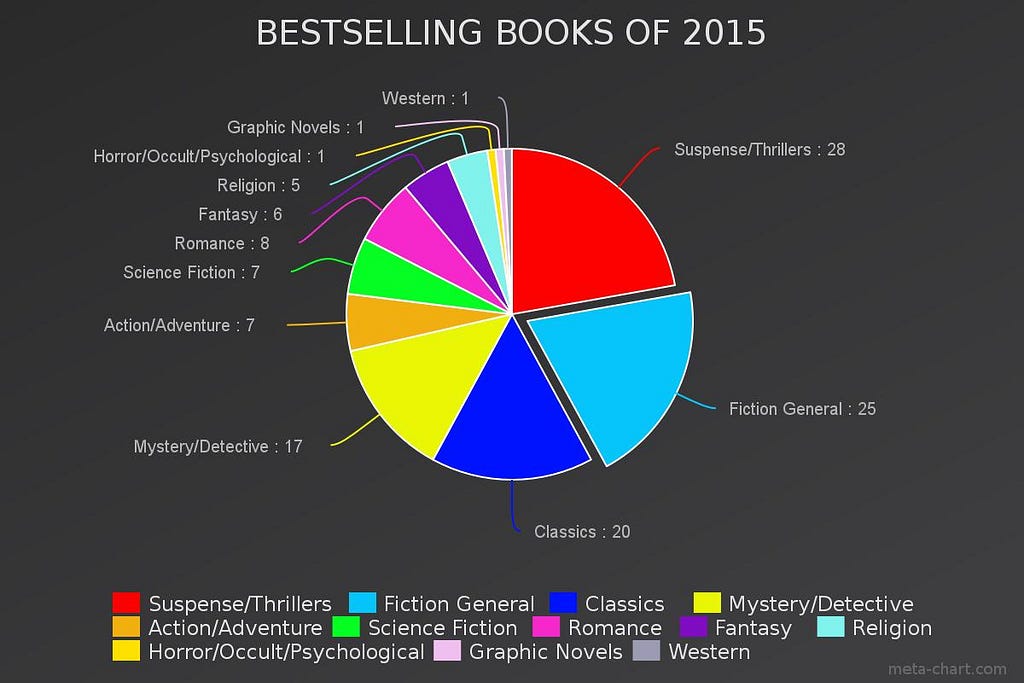
Using Neilsen BookScan — the industry’s sales tracking system that captures most, though not all, of the print market — I looked at the different categories for adult fiction that have sold more than 50,000 copies. (Children’s books, middle grade, and young adult are an enormous part of the market, but that’s a topic for another post.) For adult fiction, Suspense/Thrillers had 28 titles that made the cut, and Mystery/Detective had 17. Fiction General had 25 and Classics had 20 titles. None of the other genres had double digits, not even Romance. Western and Horror/Occult/Psychological each had 1 title that made the cut. Fantasy had 6, but only one that wasn’t written by George R. R. Martin.

The category Fiction General in BookScan includes many titles that Weiner would call “commercial women’s fiction.” Still, about half of those high-performing titles would be considered literary fiction (such as Doerr, Adichie, Ferrante, and Franzen) and basically all the Classics (Fitzgerald, Hemingway, Salinger, etc.) are literary titles. It would probably be fair to clump Mystery and Thrillers together, and several of the Fiction General titles could be shuffled to Romance, but no matter how you slice it, literary fiction is one of the larger chunks of the popular adult fiction pie.

A Note on BookScan and Those Numbers

BookScan is estimated to account for somewhere around 75% of the retail print market, so these does not tell the whole story. Some genres, like science fiction and romance, do well in ebook form. Still, it gives a good estimation of the relative selling power of different books.

I’m sure some readers will think it unfair to include classic titles. But is popularity only measured in the short-term? Is a book that sells 100,000 copies in a year, but is quickly forgotten, more “popular” than a book that sells 10,000 copies a year for 50 years? Even focusing only on contemporary titles, literary fiction makes up a larger percentage of popular books by this measure than most genres. (FWIW, many of the bestselling genre books are also from previous decades. For example, Michael Crichton’s Jurassic Park and Agatha Christie’s And Then There Were None are listed in Science Fiction and Mystery/Detective in BookScan.)

Looking at the BookScan titles also shows the murkiness of genre categorization though. One of the best selling books in Science Fiction is Emily St. John Mandel’s Station Eleven, a finalist for several major literary awards (and also the ire of Sad Puppies types). Plenty of other books could be categorized in different genres, or multiple genres at once. Genre distinctions are anything but clear.

What’s Popular Is Whatever You Want it to Be

The above is only looking at the most popular books, not the entire market overall. Some genres do better or worse in the long tail and are larger or smaller slices of the entire industry. And then again, some genre readers are more rabid buyers of books. Romance readers are infamous book devourers, and thus their portion of the reading population will be different than their portion of sales. In short, it is complicated. But the above numbers give a good overview of how the popular break-out books break down.

However, too often it seems their interest in “popular books” is actually only an interest in books that are popular in the styles they like. Take this interview with Weiner and Jodi Picoult from their famous Franzenfreude. The two authors bend their arguments into bizarre shapes trying to define what “commercial” fiction is in opposition to Jonathan Franzen, an author whose last two books sold at Stephen King levels (the #5 bestselling and #8 bestselling books of their respective years). Many of the titles Weiner and Picoult slag on here and elsewhere actually sell more copies, and are thus more truly “commercial,” than books they say are overlooked. Weiner says “How seriously am I going to take the paper’s critics when they start beating the drums for Gary Shteyngart” and then mocks Shteyngart’s BookScan numbers for the first week of his (then) new novel. Yet all three of Shteyngart’s novels have sold in six figures, making him a pretty darn popular novelist in any genre.

(Picoult also has very ahistorical comments about the popularity of famous authors like Jane Austen. But again, the facts are less important than truthiness in these debates. Austen may have, in actuality, been read mainly by the elites of her day–an era when about half of England’s population was illiterate to begin with–but she feels like she should count as a writer who writes for the masses.)

In fairness to Weiner, her main argument is that book review sections, like in the New York Times, don’t review as many commercial women authors as commercial male authors. I think that Weiner has a point, as there is plenty of sexism in publishing and women authors are often not treated as seriously as male authors. And Weiner is correct that romance and “women’s fiction” are not treated with the same respect as other genres. However, I wonder if Weiner conflates different issues, and is practicing a form of literary erasure by implying that women authors in most genres don’t count as women genre authors:

@fischermichael0 That’s my point! If NYT reviews thrillers and mysteries and fantasy, it should also cover women’s genre fiction.

— Jennifer Weiner (@jenniferweiner) September 2, 2015

Most likely, the readership of mysteries and thrillers is largely women — as is true of fiction as a whole — and the idea that the genres of Agatha Christie, Patricia Highsmith, and Ursula K. Le Guin are “male genres” is, to put it nicely, a stretch.

The New York Times is not perfect of course. But I will say that the New York Times does a far better job of covering non-white writers, international writers, and writers of poetry and short stories than the bestseller lists. Their 100 notable book list had a roughly equal gender split. A newspaper that only devoted coverage to popular fiction would be a newspaper that only covered white American novelists.

The (mostly) conservative white men of the Sad Puppies movement, and their more odious Rabid Puppies offshoot, nominated a slate of books that was by and large a list of relatively poor-selling books even as they claimed to be representing popular science fiction. On the other hand, many of the best selling science fiction titles of last year (Jeff VanderMeer’s Southern Reach trilogy, Emily St. John Mandel’s Station Eleven, etc.) were exactly the kind of literary titles the Puppies claimed were making SF unpopular. But to the Puppies it feels like their favorite books should be popular and it feels like literary SF shouldn’t be. Even more so, the Puppies complained that the Hugos were being awarded to people of color, queer writers, and other writers on “social justice warrior grounds.” Yet again, this seems entirely a matter of feeling instead of reality. A scroll through the list of recent Hugo winners shows that most have been white writers, and most have been white men.

Big in an Alternate Reality

When Walter and similar critics call literary fiction’s status “artificial,” they seem to imply literary fiction is being wrongly inflated by literary critics and awards. I’ve heard this argument many times. I must admit I find this idea pretty baffling. Commercial fiction is more likely to have massive corporate marketing campaigns with subway ads and full page spreads in popular magazines. A gushing review from actual literary critic is “artificial” while a Times Square billboard is “natural”?

A gushing review from actual literary critic is “artificial” while a Times Square billboard is “natural”?

The underlying argument seems to be that even if these books aren’t actually popular they are still popular in some theoretical sense, because they are the kind of books that could be popular in some alternative world. (This is essentially the Sad Puppies argument. The SF books they like don’t sell well because the evil Hugos and SF critics are pushing literary novels on the SF public.) In this way, all “real” genre is popular because it is all theoretically accessible and written to be fun and engaging.

Only someone who doesn’t read widely in genre fiction could actually think this. Plenty of genre fiction — especially in the SF, fantasy, and horror worlds — is as inaccessible as the most avant-garde poetry chapbook. Epic fantasy series often include detailed encyclopedias of their fictional worlds, hardly something accessible to casual readers. SF novels are often written in jargon and tropes that outsiders wouldn’t understand. And, most importantly, lots of really interesting, boundary-pushing work exists in the genre world. I doubt anyone would argue Gene Wolfe isn’t a SF author, and I also doubt anyone would honestly say his work is popular fiction. His books are every bit as dense and complex as the most “luxury brand” literary novels you could name, but they swim happily in the sea of genre.

And all that’s as it should be! Some of the most exciting genre work is written only for fans of those niche subgenres. That isn’t a bug, it’s a feature.

The Focus on Popularity Is Horrible for Literature

Which brings up the larger point: the incessant focus on popularity is an artistically-deadening feature of modern discourse. Far too many people tout sales numbers as some kind of armor against criticism, and think that the highest compliment you can ever pay an artist is that their work “sells well.” Sales have essentially no relation to quality. In fact, sales barely even have any relation to sales. By which I mean, books that sell well today are pretty unlikely to be selling well 50 or 100 years from now. How many best-selling titles from 100 years ago do you recognize? (Note: this Winston Churchill is not the prime minster. In fact, the American Churchill was so famous that the British Churchill wrote under the name Winston S. Churchill to avoid confusion. But the former is now totally forgotten while obscure-in-their-day contemporaries of his like Franz Kafka are widely read.)

The massively popular books are very rarely among the best, whether shelved as “genre” or as “literary.” Want to know what the best-selling book of the year has been? Go Set a Watchmen, a cash-grab novel that many have argued was unethical to even publish. The second? Grey, another cash-grab where E. L. James rewrote 50 Shades from a male point of view. (And, yes, Hollywood “reboot” culture is absolutely coming to the literary world in the near future. I mean, hey, it’s popular.)

There is an entire world of literature, quite literally. Yet you would never know it from the bestseller lists, which are populated by the same handful of names year in and year out. Those names are almost entirely white English-speaking men and women. They write in a narrow range of styles and subject matters. We should be extremely wary of anyone who wants book coverage to focus even more on the handful of white American authors who dominate sales.

We should be extremely wary of anyone who wants book coverage to focus even more on the handful of white American authors who dominate sales.

The overwhelming whiteness and homogeneity of popular books is not something that would be addressed by focusing even more coverage on the same handful of popular books. (To say nothing of what it would do to short stories, essay, and poetry collections.)

If you are determined to compare popularity, at least do so with actual facts. But it would be far better if we focused less on popularity, and more on the wide range of amazing books from all genres and corners of the globe that are daily ignored for yet another think piece on already popular books.

Originally published at electricliterature.com.

Ursula K. Le Guin talks to Michael Cunningham about genres, gender, and broadening fiction

To celebrate this fantastic conversation between Hugo-and-Nebula award winner Ursula K. Le Guin and Pulitzer Prize winner Michael Cunningham about writing, freedom, and defying the limitations of genre, Diversion Books are offering Electric Literature readers the eBook of LeGuin’s genre-busting novel The Lathe of Heaven for just $3.99:

“The Lathe of Heaven” by Ursula K. Le Guin on Ganxy

Michael Cunningham: Writers are always, pretty much by definition, writing within a historical period, though that period may not acquire a name until later. I don’t believe the Victorians thought of themselves as the Victorians. OK, the Modernists thought of themselves as Modernists, but still…

I wonder sometimes what period we’re in, in 2014. I personally don’t find “post-modernism” very satisfying.

Although I don’t have a name for it — I’ll trust history to provide that — I feel like the most prominent aspect of this period is what I suppose I’ll call “broadening.”

Broadening in the sense of a much larger collective conviction about who’s entitled to tell stories, what stories are worth telling, and who among the storytellers gets taken seriously.

I think of “broadening” not only in terms of race and gender, but in terms of what has long been labeled “genre” fiction.

I believe that some of the most innovative, deep, and beautiful fiction being written today is shelved in bookstores in the Science Fiction section.

I believe that some of the most innovative, deep, and beautiful fiction being written today is shelved in bookstores in the Science Fiction section. That that section probably contains more fascinating books than does the… what to call it?… mainstream fiction section…

Could you talk about that? About the breaking-down of the barriers between “genre” books and the books that are generally piled on the front tables at Barnes & Noble? This is especially important to me, in that I’m always trying to talk readers into venturing into genre fiction, and still encounter a surprising degree of resistance. The line, “I don’t read science fiction” emanates from a surprising number of well-educated, erudite mouths.

Ursula K. Le Guin: Well, you’ve said much of what I’d have said, and I’m delighted to hear it said by a writer whose fame is not within a “genre” but in what is still called literary fiction.

And that, of course, is the lingering problem: The maintenance of an arbitrary division between “literature” and “genre,” the refusal to admit that every piece of fiction belongs to a genre, or several of genres.

There are very real differences between science fiction and realistic fiction, between horror and fantasy, between romance and mystery. Differences in writing them, in reading them, in criticizing them. Vive les différences! They’re what gives each genre its singular flavor and savor, its particular interest for the reader — and the writer.

But when the characteristics of a genre are controlled, systematized, and insisted upon by publishers, or editors, or critics, they become limitations rather than possibilities. Salability, repeatability, expectability replace quality. A literary form degenerates into a formula. Hack writers get into the baloney factory production line, Hollywood devours and regurgitates the baloney, and the genre soon is judged by its lowest common denominator…. And we have the situation as it was from the 1940’s to the turn of the century: “genre” used not as a useful descriptor, but as a negative judgment, a dismissal.

“The genres” were ignored altogether and realistic fiction alone was left as literature, in the minds of the men who controlled criticism and teaching. Realism is of course a tremendous and wonderfully capacious literary genre, and it has dominated fiction since 1800 or before. But dominance isn’t the same thing as superiority. Fantasy is at least as immense as realism and much older — essentially coeval with literature itself. Yet fantasy was relegated for fifty years or sixty years to the nursery.

I love to remember Edmund Wilson, king of the realist bigots, squealing “Ooh those awful Orcs!” and believing he’d made a witty and cogent critical point

These days, I love to remember Edmund Wilson, king of the realist bigots, squealing “Ooh those awful Orcs!” and believing he’d made a witty and cogent critical point.

As you see, I bear some resentment and some scars from the years of anti-genre bigotry. My own fiction, which moves freely around among realism, magical realism, science fiction, fantasy of various kinds, historical fiction, young adult fiction, parable, and other subgenres, to the point where much of it is ungenrifiable, all got shoved into the Sci Fi wastebasket or labeled as kiddilit — subliterature.

And the labels stick. As you say, a lot of people still maintain genre prejudice. I still meet matrons who tell me kindly that their children enjoyed my books but of course they never read them, and people who make sure I know they don’t read that space-ship stuff. No, no, they read Literature — realism. Like The Help, or Fifty Shades of Grey.

But the walls I hammered at so long are down. They’re rubble. I like your term, “broadening,” for what’s going on. I agree that “postmodern” is a truly flabby word. But I guess I don’t really want a label for the new place we’re in. Labels turn into cages. I love to see people like Michael Chabon and Kij Johnson and David Mitchell and Jo Walton — and above all, old José Saramago! — waltzing around the literary landscape, freely using fragments of genres to build up their beautiful stories, finding unclassifiable forms for irresistible narratives. And to see the literary reputation of great nonrealists like Jorge Luis Borges and Italo Calvino holding steady or rising — along with the status of the Author of the Awful Orcs, and some obscure writers of that space-ship stuff, such as my Berkeley High School classmate, Philip K. Dick. Vive la Révolution!

MC: It’s been written of Samuel R. Delany’s work that, “By imagining a new gender and resultant sexual orientation, the story allows readers to reflect on the real world while maintaining an estranging distance.”

The story in question was, “Aye, and Gomorrah,” but it could be said of other work by Delany, and certainly of some of your own work, very much including The Left Hand of Darkness.

You needn’t focus specifically on the advantages of claiming the right, in fiction, to re-imagine genders, though that would of course be interesting. You could also talk a bit, if you like, about other freedoms offered when a writer releases herself/himself from what I suppose I’ll call the “natural” world — that is, from the planet Earth, its denizens and conventions.

UKLG: I think Delaney was using Darko Suvin’s very useful concept of “cognitive estrangement” for what is perhaps the characteristic gesture of science fiction: Giving the reader a new place from which to look at the old world. Or, as Suvin said, a mirror in which you can see the back of your own head. Stendhal, that dour realist, boasted that his novels were “a mirror at the side of the road” reflecting reality. But such a mirror can’t show you the world or yourself from a viewpoint you never saw it from before, as science fiction does.

Serious science fiction is just as much about the real world and human beings as realistic novels are.

The thing to remember, however exotic or futuristic or alien the mirror seems, is that you are in fact looking at your world and yourself. Serious science fiction is just as much about the real world and human beings as realistic novels are. (Sometimes more so, I think when faced with yet another dreary story about a dysfunctional upper middle class East Coast urban family.) After all, the imagination can only take apart reality and recombine it. We aren’t God, our word isn’t the world. But our minds can learn a lot about the world by playing with it, and the imagination finds an infinite playing field in fiction.

Along in the sixties it became important to a lot of us, especially women and gays, to try to get a better idea what exactly “gender” consisted of. “Him Tarzan, Me Jane” no longer seemed quite adequate. The science-fiction mirror offered itself to me (and Theodore Sturgeon, and Samuel R. Delaney, Vonda McIntyre, Joanna Russ, and many others) as a great way to get a different angle on the whole thing. Cognitive estrangement can help you develop new cognitions, wider understanding.

And that, as you say, offers a writer a desirable freedom. To me, though, it’s not a release or escape from our world. My world is all I have to make my stories from, my people are the only people I know. But by making up worlds and peoples, I can recombine and play with what we have and are, can ask what if it were like this instead of like this — What if nobody had a fixed gender, as on the planet Gethen? What if marriages, instead of two people and one couple, consisted of four people and four homo- and heterosexual couples, as they do on the planet O? If nobody in a world had ever waged war, how would people and daily life in that world differ from ours, and in what ways?

Much of my science fiction is, in this sense, anthropological. My father was an ethnologist, who learned from the Indians of California that California could be inhabited in a very different way from how we inhabit it — many different ways. I send imaginary people to imaginary planets to learn other ways in which we might inhabit our own. I feel some urgency in obtaining this information, since we’re inhabiting our planet in an increasingly destructive and unwise way.

MC: Are the distinctions between science fiction, speculative fiction, and fantasy still interesting to you? I’ve read interviews in which you discussed them in the past, and would be glad to have you comment on your current thinking in that area, unless of course you’re no longer particularly concerned about it.

UKLG: That is in fact the case, Michael. I felt obliged for so many years to protest, to rant about those distinctions — genuine and useful ones — being misused as value-judgments. Now the judgmentalism is dropping out of them, and that’s great. I don’t have to worry, I don’t have to rant. Whew!

MC: I teach an undergraduate course called Reading Fiction for Craft, and your short story, “The Ones Who Walk Away From Omelas,” has been on the syllabus from the beginning. My students and I discuss that story relatively early in the semester, during a class meeting I call “The Rules.”

I remind them throughout the semester that there are no rules, there are at best a few general principles that seem to work, for fiction writers, some of the time. And, okay, sometimes to work more often than not.

Your story is offered to them as an example of just how far a writer can stray from even the general principles, and still produce a remarkable, absorbing, moving story.

I hope you won’t mind my telling you that “The Ones Who Walk” is one of the few stories that’s always a huge hit, with every student, every semester.

We discuss many aspects of that story, prominent among them its disregard of what I suppose I’ll call “writerly good behavior.” You address the reader directly. You remind the reader that a story is an invention, and that the writer is usually trying to figure out what will be most effective to readers, although that effort is “supposed” to be concealed. You eschew central characters. And the story presents a genuine moral dilemma, a more or less insoluble one, in a medium in which writers are “supposed to” remain at least outwardly neutral, philosophically and politically. Or, rather, to be subvertly philosophical and political; to conceal the thinking under the characters and events.

Would you talk about that story? About how you arrived at it, how you developed it, whether you had doubts about its unorthodoxy after you’d finished it?

UKLG: Honestly, orthodoxy concerns me about as much as it concerns your average jackrabbit. I only follow rules that take me where I want to go. If there aren’t any rules, I make up my own (and follow them strictly).

Honestly, orthodoxy concerns me about as much as it concerns your average jackrabbit. I only follow rules that take me where I want to go.

The two books I really worried about being too far outside critical and reader expectation were The Left Hand of Darkness (I was totally wrong, it flew from the start) and Lavinia (I was partly right, alas, but it seems to be finding its readers.) But I don’t remember worrying about Omelas.

While writing it I thoroughly enjoyed defying all the conventions, dancing little metafictional jigs on the grave of the Self-Concealed Writer.

I sent it to my then agent, Virginia Kidd, who could have sold Das Kapital to a Texas Tea Party Congressman. She sold it right off and it’s been reprinted steadily ever since. Teachers in all kinds of fields — literature, philosophy, sociology, economics — use it as a discussion-starter. It poses a frightening moral question (which William James and Dostoyevsky both asked, and which is directly relevant to our society) and offers no direct resolution. This makes some students so angry and unhappy and unsatisfied that they want to complain about it, and then other students want to explain it to them. . . .

“Writerly good behavior” is a nice phrase. It makes me think about when I was an entering freshwoman at Radcliffe College (now subsumed in Harvard) in 1947. The President of the College paternally informed us girls that we were there to learn gracious living.

Yeah. Uhhuh. A bunch of crazy, graceless, passionate, adolescent female intellectuals ravenous to learn everything Harvard would teach us — and we were there to learn good behavior? Ladylikeness? How set a pretty table and pour tea?

Fortunately, Harvard gave us a superb education, which equipped some of us, at least, to begin to learn how and when to overturn the table and the tea urn. And why.

MC: Is there any question you wish an interviewer would ask, and hasn’t yet?

UKLG: I don’t think anyone has asked me about the relative importance of human beings and nonhuman beings in my fiction and poetry. For instance, the rather large place animals and trees occupy in my writing. Novels consist of human relationships, but I often extend those relationships to include other creatures, including forests, dragons, and rats. My poetry has a lot of geology in it — rocks. I seem to move easily out of the human-centered universe. Maybe I enjoy escaping from it? I don’t know…

Thank you, Michael Cunningham and Electric Literature, I have enjoyed this conversation.

Buy The Lathe of Heaven for just $3.99

Originally published at electricliterature.com.

If That’s All There Is

by Mona Awad, recommended by Laura van den Berg

So one night, on a dead shift, my coworker Archibald casually tells me there are things he’s been picturing doing to me of late and when I say, “Like what?” he hands me a small scrap of paper with the word cunnilingus written on it in red ink.

I stare at the jagged letters. All lowercase. The cunni written eerily straight, the lingus curved and veering downward like a tail. Each letter separated by a space as though they’re acronyms for other words.

I look at Archibald sitting in a swivel chair beside me, his thirty-something face red from the low-grade grain whiskey he keeps in a giant coffee mug under the desk. He’s looking at me like I’m not twice his size and wearing a turd-colored shirt that says MUSIC! BOOKS! VIDEO! on it and a blue apron over that that says WE HAVE IT ALL!!! He’s looking at me like I’m donning what Mel wears to go dancing on fetish nights at Savage Garden, which is basically just a few strategically positioned scraps of black lace.

I tell myself, Laugh. It’s a joke, obviously. But when I force a
one-note laugh like a cough, Archibald doesn’t laugh with me.

“I’m good at it, Lizzie,” Archibald says. “Quite good. I play the harmonica semiprofessionally. Chromatic scale.”

I look back down at the note. He’s scribbled it on one of those torn bits of scrap paper we keep in a fishbowl at the desk so customers can scribble whatever out‑of‑print or obscure book they want special-ordered. A dated history of the Ottoman Empire. Herzog’s walking diary from Munich to Paris. A photography book featuring extreme close-ups of female genitalia, where they don’t look like genitalia at all but like sea plants.

“I’m sure an attractive girl like you has a ton of admirers,” Archibald continues. “Boyfriends.”

He’s looking at me sideways, but I say nothing. I just look off to the left like it’s too true. After all, Archibald did once tell me that Fergie, our obese coworker who walks with a cane due to a childhood case of polio, is deeply in lust with me. When I pointed out that Fergie is old enough to be my grandfather, he said that Roland, the little troll man who works in receiving, has a profound boner for me too. So there’s that.

“You can’t be serious about this,” I say, shaking my head at the note.

“Why not?” he says, looking right at me. I see his expression is as eerily sober as it is when he talks about harmonica maintenance or extols the virtues of the chromatic over the diatonic scale.

Thankfully, a customer comes up. A man in a worn suit and a trench coat clutching a yellowed slip of paper fervently in his fist. On that paper will surely be a list of about ten out‑of‑print books on some obscure subject. This man is one of Archibald’s regulars. I wait for the man to leave even though my shift has been over for seven minutes by the time they’re finished, and Mel is waiting for me at the apartment to sample some new CDs. When the customer finally does leave, I say to Archibald, “Can I think about it?”

Archibald smiles at me with one side of his mouth.

“It’s not a ring, Lizzie. Just consider it an open invitation.”

The next day at work, I’m flirty, casual. I even have a plan, which I thought of last night and then visualized all day in Old English and Renaissance Poetry and then on my way to work. I’ll thank him off-the-cuff for the note, then suggest, off-the-cuff, that we go for coffee. Just coffee. I’ve borrowed Mel’s Celtic cross necklace, and put my mother’s lace tank under my work shirt, which I’ve unbuttoned down to the middle of my chest. I’m liberal with the Winter Dew eau de cologne. More careful than usual in my application of Rebel blended with Lady Danger, then topped with Girl About Town gloss. I even hazard a look at myself in the subway car windows on the way to work and I don’t immediately look away.

I find Archibald in the break room, sitting in the far corner on a lopsided futon by a moldering tower of Harlequins with ripped-off covers, scarfing banana bread out of a Tupperware container, looking seriously stoned.

He doesn’t acknowledge me when I come in. Even when I clear my throat, he’s still scarfing his bread as though in a kind of dream.

“Hey,” I say. Flirty, casual.

He raises his eyebrows in vague recognition, grunts, and then keeps eating the bread.
I sit down beside him on the futon, half-facing him, and braid my hands together on my lap. It’s not flirty. I feel as though we’re in court or I’m his therapist. I unbraid my fingers and run a hand through my hair. Cards, you have all the cards, remember.

“So I’ve been thinking about your offer.”

“Offer?”

I feel myself go red in patches the way I hate.

“What you wrote. On that scrap of paper yesterday?”

“Oh, right, my offer.” He smiles as if recalling the lovable antics of an old friend. “And?”

“I was thinking how it was really rude of me to just brush you off like that.”

“No worries.”

“Anyway, I was thinking that maybe…”

“Yeah?”

“Well… you know…” I trail off. Janice comes in just then, this obscenely depressed woman who works in Kids. She’s eyeing us now from where she sits on the broken rocking chair, frowning over her mug of cheap fennel tea.

“Maybe we could…” I say, lowering my voice.

“Could what?”

“You know, meet.”

“Really?” He looks pleased. Too pleased.

“Not the note. I mean go for coffee.”

Behind me, Janice snorts into her tea.

“Coffee,” he repeats.

He gives me the same look he gave me last time, the long, lingering one like I’m not wearing my bookstore uniform, but something sexy, even obscure.

“How about tonight?” he says.

“Tonight?” In my head I was picturing a date in the future. At least a week to prepare. Prepare for what? I should be spur‑of‑the-moment.

That’s how you live life, isn’t it? Carefree.

“I finish later than you do tonight,” I say at last.

“I’ll wait.”

“It’ll be late. I mean for coffee, though.”

“So we’ll have tea,” Archibald says.

The cabdriver’s name, according to the lit‑up license on the back of the seat, is Jesus. A scentless pine tree dangles from the smudged rearview mirror, in which I can see one of Jesus’s eyes, mud colored and narrowed, the brow over it thick and severely furrowed.

“He doesn’t care,” Archibald said in a low voice when we first got into the cab and he tried to take off my shirt. “He sees this kind of stuff all the time, trust me.”

I shook my head.

“You’re holding out on me, Lizzie. But that’s okay. I consider myself lucky just to be here with you. Just keep driving, Jesus,” he called. “We want to see more.”

“Where I go?”

“Just drive us around. Turn some circles, you know? Give us the grand tour of downtown.”
A few minutes later, I’m smiling pleasantly at Jesus’s eye in the rearview mirror, trying to act like Archibald’s head is not under my maxi skirt, between my legs, where it has been for some time now. I’m moaning quietly. Moaning so as not to be rude to Archibald, but trying to do it quietly so that I’m not being rude to the driver. The moans come out of me like hiccups. The truth is I’m too aware of Jesus, of the passing cars, the human traffic on the whooshing streets, the brightness of the city lights, to fully register what’s happening between my widely parted thighs. Mostly it’s as though the bottom half of me has been cut off from the top half and the top half is observing the happenings of the bottom from a curious, empirical height. This bland man is licking the crotch of my underwear, how nice. Now he has removed them. Now he is biting my thighs. Moaning quietly into my leg flesh. There are a couple of moments when the bottom and the top half fuse, when he bites one of my legs hard or I feel his moans hum against my skin, and I gasp. Then I become a whole body of actual flesh that he is actually touching, then I feel the brush of his tongue as an actual brush of an actual tongue between my actual thighs. That’s when I say, I love you, the words just flying out of my mouth like brassy butterflies.

Jesus looks at me. He heard it, but maybe, hopefully, Archibald didn’t.

When the meter gets to twenty dollars, I make my moaning more broken sounding, full of breaths and catches the way Mel’s is when I hear her having sex with her boyfriend through the wall, and then I pretend to orgasm. It’s been seven minutes or so. Mel knew a guy who could make her come in seven minutes.

Archibald lifts his head up from under my skirt, still between my legs.

“You came?”

I look at his face framed between my knees. Floating there weirdly in the dark. His lips are glossy, his thinning red hair in disarray. He takes his glasses off and his eyes are a different color — darker, greener, with bits of yellow in them, which are probably reflections from the lights outside.

I nod.

“You’re lying.”

“No, I really did.”

“It’s okay.” He pats my knee and sits back up on the seat beside me. “I’ll make you next time. Oh, hey, turn this up! Jesus, turn it up. Way up!” He thumps the back of the cabbie’s seat until the man obliges.

“I love this song,” Archibald says to me, leaning his head against the backseat. “Peggy Lee. ‘Is That All There Is.’ You heard it before?”

“No. I like it though,” I say. I don’t. It sounds too old-timey. That cheesy swell of strings. The elephantine trumpets. The woman’s world-weary voice sounding deep and dark as a well, but with one eyebrow raised, one side of her painted lips curled in a perverse smirk.

“It sounds like the circus,” I say.

“If that’s all there is, break out the booze and have a ball,” Archibald says; he’s looking at me intently but blearily. He’s got a big bottle of L’Ambiance he just took a swig from. He holds it out to me, but I shake my head. “I can’t believe you let me do that to you just now.”

“It was fun. I mean, I don’t see how it was fun for you.”

“Oh it was. It’s all I’ve wanted to do to you since I first saw you.”

“Really?”

“I have other fantasies too. Lots of them.”

“You do?”

“Sure. I’m grateful, you know. I’m grateful to you. Look at you. Look at me. I’m unworthy. It’s okay. I know I am. I’ve accepted it. The fact that you let me do this?” He shakes his head. “I’m shocked, honestly. But I’m not going to question it. I’ll take what I can get. It’s like this song. If that’s all there is, break out the booze and have a ball, you know?” He takes a sip of his wine jug. “Sorry we had to do it here, though. In front of Jesus. Guess I couldn’t wait. I was excited.”

“That’s okay. Maybe we can do it again sometime.”

“Anytime. Anytime you want, you just call. I hope you do.”

He takes my hand, smiles at me a little sadly. “Do you mind if I bum one of your cigarettes?”

When I come home and tell Mel what happened she says, “Sounds like it was a bust.”

“Totally,” I say.

But then I call him the next night and he comes over.

He starts coming over regularly. Nights we work together.

Nights we don’t. After a few weeks, I start calling him my boyfriend sort of, adding the sort of only when I’m talking to Mel. We have sex that I tell myself is good, it is good surely, certainly it is okay, it is definitely not terrible, and then afterward he tries to educate me about the jazz harmonica, which he says is the most underappreciated of instruments. He’ll be deeply stoned on the generous joint he rolled himself from the bag of pot I keep for him in my freezer, drunk on the alcohol he toted over here in a worn plastic bag. I’ll watch him pace my bedroom, going on about dissonance and scales, his head too big for his body, his glasses too big for his face. I remind myself that these lectures, delivered in his underwear with an earnestness that I tell myself is charming, are better than watching him laugh through a very sad and disturbing film, his second-favorite post-sex activity. I remind myself that I didn’t need to call him tonight, though I just did. Just like I called him on Wednesday. And Sunday and Monday. For fun.

After eight or so weeks of dating him, I still can’t explain his appeal to Mel, who often ushers me into the kitchen to have short hissing conversations about how he’s lame. It’s a descent to sleep with him. A Descent. When I tell her casually that Archibald’s coming over tonight, she says, “He is?”

“Yeah. Why?”

“Nothing. You’ve just been seeing him a lot.”

“Just for fun, though. He likes me,” I say, sort of wanton.

When she says nothing, I ask, “Do you think he likes me?”

“Do you like him?”

“I like the way he touches me a lot,” I say, thinking of how on the subway the other day, he grabbed my boob through my shirt and how it was actually pretty embarrassing and I told him repeatedly, People are watching, because they were and he said, Let them. But this is not a good example. I think of how I can wear a bra and underwear around him and I don’t have to hide my middle with my hands the way I did with Kurt, a friend I lost my technical virginity to a summer ago. He was a virgin too. What we did in the half dark of his dad’s truck was a platonic arrangement, so that we would no longer be freaks to ourselves or the world. The next day, he took me to see Rent and we had a seafood dinner on King Street. Archibald doesn’t take me to dinner, but I can be naked in front of him. Under bright lights. In full daylight. Actually naked. Breasts. Thighs. Stomach laid bare. This is a sight that excites him. And when I catch a glimpse of myself in the mirror in the half dark of the hallway on the way to the bathroom or kitchen, I don’t look away. I stay there. I look at my body and I am fascinated by what I now see to be its appeal. But I could never explain that, even to her.

“He touches me like…” I lower my voice. “…like he likes my body. Like, actually likes it.”

“So long as you know what you’re doing,” Mel says.

I tell her I do. So I keep calling him. So I call him almost every night. Most nights he comes.

He’s on his way right now. Probably still on the subway, though maybe, hopefully, already on the bus. I look at my watch. Running late. Sometimes the buses take time. He might have missed his connection, which he often does. Soon he’ll be here. Ringing the doorbell. Running his hands down my hips. Telling me he can’t believe a girl like me is even interested in a guy like him. And I’ll smile like it’s all too true.

The phone rings just then. I think it’s Archibald so I just say, “Where are you?”

“Is Archibald there?” It’s a woman’s voice, pointy and full of purpose.

“No, he isn’t.”

“Is this Lizzie?” the voice asks. She says the word Lizzie like it’s a loaded thing, a cup she’s ready to smash against a wall.

“Yes. Who’s this?”

Crackly silence. A dog yipping in the background she attempts to shush. The dog keeps yipping. She shushes him again. This time more violently.

Then: “Are you sleeping with him?”

Now it’s my turn not to say anything. The phone feels heavy and slick in my hand. Mel’s mouthing at me, Who is it?

“Who is this?” I ask.

“This is Britta,” says the voice, gathering gravity. “His girlfriend.”

Mel raises an eyebrow at me. “Girlfriend,” she repeats.

The woman on the other end of the line acquires flesh, a face, blond hair, tapping nails. I say nothing.

“Is he on his way over there? He’s on his way isn’t he? Hello? Hello?”
“Helloooo?” Archibald calls from the doorway. “Anybody home? Sorry I’m late. Oh, you’re on the phone,” he mouths, then shuffles into my room.

I come into my room to find Archibald lying on my bed playing his harmonica, kicking his feet against my dark blue wall. A grown man in a windbreaker. Hair going gray at the veiny temples. Pants too short for his thin, white legs. I’m wearing a lace slip in which I now I feel naked, fat, stupid. I put my housecoat on over it to gain some dignity. I sit in my desk chair, wait for him to notice that I’m not joining him on the bed.

At last he stops playing and turns to me. “What?”

“A woman named Britta just phoned. She says you’re sleeping with her. Are you?”

He doesn’t answer.

“I was descending to sleep with you, you know. I was descending!

And you cheat on me? And you’re smiling? What the hell is wrong with you?”

“Nothing. Just you’re super hot when you’re pissed is all,” he says, biting on his grin.

I start to cry.

Now he’s on his knees explaining. He explains for a long time, while I smoke one cigarette after another. Britta isn’t really his girlfriend. Not really, he says.

“She’s just this crazy woman who lived on the fifth floor of our house for a while. I actually felt sorry for her, you know? All by herself on the fifth floor. She had this little dog she washed every night. You wouldn’t believe it,” he said. I thought of the dog I heard yipping in the background. “When I told her it was over, she started stalking me. Like seriously stalking. Wouldn’t leave me alone. I guess she likes what I can do or something. But she was clinging to me. It was embarrassing, you know?”

I think of that pointy voice on the phone, swerving from hysteria to gravitas.

I light another cigarette and notice my hands are shaking.

He takes them in his. I snatch them away from him but he takes them again and this time, I let him.

“But you,” Archibald says. “You are the one I always wanted. I never even thought I could get someone like you, you know? And I hate to think I’ve ruined my chances here.”

He starts to kiss my hands. Kisses them all over, multiple times. Someone like me. I am the one he has always wanted. Never thought he could get. I feel my eyes well up again. The room becomes warped and swimmy. Then he kisses my thighs, starts to gently pry them apart with his hands. Get out. Get out right now. The words rise in my throat like bile, but they don’t come out. Instead, I just sit there limp, letting him.

I promise Mel I’ll end it. I promise myself I’ll end it. Every time I go over to his place or he comes over to mine, every time I hear the plaintive wail of his approaching harmonica, I think, End it. I tell myself this for weeks. Fucking end it. Speak the words. But what comes out is, Hey. I missed you. How come you’re late? For the first few weeks, I even picture myself walking away from him. Chin tilted high. Already lighter for having left him.

Instead I stay in bed, ignoring the nearly constant ringing telephone from an unknown number, waiting for him to come over. Get dizzy spells whenever I leave the apartment. Start skipping class. Calling in sick to work. Panic attacks, the doctor says, and prescribes pills which Archibald and I take together, lying in my bedroom or his, the lights dimmed.

“I’m dying,” I tell him quietly on our six-month anniversary.

“Oh, Dizzy Lizzy,” he says, grabbing my breast.

“I love you.” I say it more often, more fervently than before, the words slipping from my mouth before I can catch them, reel them back in.

“And I love you,” he says, stroking my thigh. When he touches me now, I feel revulsion and gratitude at the same time.

We have sex and I cry through the whole thing.

“Hey,” he says. “You okay?”

“I’m hungry,” I say.

Chinese food in bed, Take Out Dinner 2B with extra spring rolls. Pizza with wings. Sometimes I’ll stumble into the kitchen and make us something obscene, which we’ll devour, stoned, while watching one of his freak movies, for which I’ve now developed a newfound fascination: The Elephant Man or The Hunchback of Notre Dame or this carnival documentary he loves that takes a cold hard look at the mutant humanity behind sideshow acts. Or we listen to jazz, also my suggestion. I’ll lie there in my slip, let him go on and on about dissonance. It isn’t charming or funny anymore. It just is.

I no longer look at myself in the mirror on the way to the bathroom or the kitchen. I lie in my slip, never naked in front of him now, and I watch him, oblivious to my existence, playing the harmonica, for which I have now acquired a dull loathing, filling my room with its terrible, earsplitting whine. I watch him smoke my cigarettes, his thin freckled chest with its odd hair tufts, exhaling and inhaling. It’s over forever on the tip of my tongue, but when he sits up from my bed to say, Well, I should probably get going, I stare at his severely stooped knobby back, his shoulders hunched up around his ears, and when I open my mouth what I say is, Can I come with you?

From where I lie on his bed, I watch Archibald stumble, half-naked, toward the record player on the opposite end of his basement apartment, a single low-ceilinged room lit by chili pepper lights he told me he stole from a Mexican restaurant. I don’t know how long I’ve been in his basement, lying on his shitty green bed, stoned and naked and full of salt. Days? A week, maybe? There are Chinese takeout boxes all over the bed and table. Schoolbooks I brought with me but haven’t opened. I have no idea what time it is and I haven’t been to class or work in days. We’re playing the Peggy Lee album, the song “Is That All There Is?” by my own request for the ninth or ninetieth time. From a great distance, I hear Archibald ask me, “Are you okay?”

“I see why you love this song. It’s great.”

And I do see. In fact, when I hear Peggy Lee’s voice fill his dark, ugly, low-ceilinged room festooned with its blinking red lights, the fog clears. I well up, float, am buoyed by the circus sounds, the trumpets.

Like every time I came over, I came over intending to end it. Twice I opened my mouth to say it. Twice what came out was, Let’s order Chinese.

Now I’m just lying here spinning, my mouth open and parched from MSG, too stoned to move, watching two of him walk back toward me.

I don’t know when the knocking starts. Is it distinct from the music? Or maybe the music has a door? The song has a door someone is pounding on with their first? Weird I didn’t hear that before.

“Is that someone knocking on your door?” I ask.

“Ling can get it.” Ling is one of his five million housemates.

But the knocking keeps going.

“I don’t see why I have to answer,” Archibald says, talking to the air around him like it’s accusing him. “It’s one in the morning.”

The knocking continues, acquires bass.

“You sure you shouldn’t get that?” I slur.

Archibald stands up and makes his way toward the sliding doors. I hear him trudge slowly up the stairs. “Is That All There Is?” is still playing on repeat. Over and over again, Peggy Lee getting existential about the circus, about a fire, about love and then death. How many times have I heard this song? I continue my upward drift to the cracked popcorn ceiling, in a swaying motion, hearing voices, hushed and hissing, then louder, closer. In the song? No. Upstairs, it sounds like. I should get up, see, but my limbs are lead.

Suddenly a woman is marching toward me. Archibald pulls her back but she shakes him off, she won’t be stopped. She is a giant woman out of the circus, out of my nightmares of the circus. But she’s familiar. One of our customers, in fact. One of Archibald’s. She came into the store recently and asked me for a book about dachshund care. Didn’t have the title. Insisted I search by subject. Nodded absently while I read off listings. A huge woman with bubble-flipped dirty blond hair. She had with her then, as she does now, a little yipping dachshund on an absurdly short leash. The moment I see her I know she is the woman who called me. This is the dog that was barking in the background.

I lie there, still unable to move, while she seats herself in Archibald’s chair beside the bed, the one with the huge burn stain on the seat, with the overflowing ashtray on the armrest — full of all my ash and cigarette butts imprinted with Girl About Town gloss. She takes the dog in her arms and he wriggles there like a demon-possessed sausage, yipping like mad. He’s wearing a little tweed coat that looks like a cape.

I look around for Archibald but he is now nowhere to be seen.

“You’re Lizzie.” When she says my name, it isn’t a cup anymore. It’s shards on the floor.

“Yes. You’re Britta.”

“I just want you to know,” she says, “he’s been sleeping with me this whole time. After he sees you, he comes and sees me. He was supposed to see me tonight. Then he canceled on me last minute.” Her voice is grave but full of dangerous swerves and wavers, like it’s a car about to veer off the road.

I look at her. Her tight black slacks covered in little dog hairs. One of those awful Addition Elle sweaters my mother and I would never buy. The ones they sell at the back of the store with all the lame bells and whistles that no self-respecting fat woman would ever purchase. Sweaters for the women who have given up on style. Sweaters for the women who just want their flesh to be covered.

“Okay,” I say. My limbs are lead. My heart feels like it’s going to burst out of my chest, grow feet, and run out of the room.

“Ladies. Whoa. Look, everyone just be cool, okay? We’ll sit down and we’ll work this out,” Archibald says. He’s standing in a corner of the room, attempting to look grave, but I can tell that once more he’s trying not to smile. The perverse grin that appeared when I first confronted him about Britta is once again sliding around underneath his concerned expression, just under his twitching lips.

“Oh, I’m very cool,” Britta says, rocking a little in his burned chair. The whites of her eyes are all pink. She’s been crying, that’s obvious. I think of the squidgy banana bread I saw him scarf in the break room. The Tupperware containers I’ve sometimes seen on his fridge shelf beside his staple industrial-size jar of Jif peanut butter, full of mayonnaisey-looking slaw, broccoli salad. When I first saw them on his shelf, I thought, How strange. I could never in a million years picture this man finely slicing broccoli florets, chopping bacon into bits, then mixing them carefully with Craisins and grated cheddar and mayonnaise. Could never in a million years picture him removing a loaf of bread from the oven. That was all the handiwork of this tenuously dry-eyed woman, who’s clearly been crying over Archibald all day and will no doubt cry again. When his pager was buzzing earlier, that was her, wondering where in the hell he was. Probably she made him dinner. I picture a table for two set carefully, a sad flower in a lame vase between the gleaming plates. Some terrible bottle of wine he’d drink in two swallows. Maybe she was wearing something nice.

Or maybe this is her something nice. Maybe she lit candles for him. Maybe they’re still burning. Maybe her whole living room is on fire now.

“I don’t owe this woman anything anyway,” she’s saying now, presumably in response to something Archibald just said. “I don’t owe her a damn thing. In fact, if anything she should thank me. She should be fucking thanking me.”

“She’s right,” I say. “I should be. Thank you.”

I manage to rise up from the bed while they continue a discussion that falls in and out of my hearing.

My boots. I just need to find my boots. There’s that song about boots and walking that my mother loves, that I used to sing. Sung by another woman. Not Peggy but of that era. She was poised. She was thin. She was freedom dancing in high-heeled white boots. Stomp stomp stomp. That’s all I have to do through the white snow. Stomp stomp stomp. And not look back.

I get up and get into my combat boots, which I don’t lace. I pull my cardigan on over my mother’s slip.

I stumble my way toward the door, but it isn’t easy with the drugs, my heart thumping in my chest, the air around me like invisible water, like I’m at the bottom of a lake, feet sinking in tangly weeds, pawing my way forward.

I fall twice on my way up the basement stairs and then stumble out the front door. Now I’m outside in the gently falling snow walking toward where I think, hope, the bus stop is. He’s calling my name but I keep walking, trying to quicken my pace without slipping.

I just need to keep that song in my head about boots being made for walking and that’s just what they’ll do and I’ll be safe. The road is sheer ice and I slip a little as I walk.

I can hear his voice getting closer, but I keep walking, slipping, until I feel him touch my shoulder. I turn around and he is in the snow on his knees. He looks up at me.

He is going to make a speech. He is opening his mouth to say God knows what. More about how he can’t let me go, but he’ll understand if I never want to see him again. More about how unworthy he is of me. More about how insane Britta is. More about how I am the one he really wants.

“Lizzie,” he says, hugging my knees, and I am trying to pry myself loose.

“Asshole!” Britta screams.

I turn and see her charging toward us in the not-too-distant distance, waving a harmonica in the air like a gun. She hurls it and her aim is remarkable. It hits him right in the face. In the mouth.

For what feels like minutes, we both just stand there. Watch the blood gush beautifully, hideously out of his mouth while he burbles, presumably in shock. Eyes blinking. Then she runs over to him. Takes off her terrible cardigan. Underneath, she’s wearing one of those basic scoop-neck tops I have a dozen of at home. She stoppers his mouth with the sweater. Wraps him in her ridiculous scarf. Now she’s saying sorry, I’m so sorry. I’m watching the scene like it’s a still. Then I realize she’s looking at me. “Can you call a taxi?” she says, handing me her phone.

In the hospital waiting room we sit side by side with one empty chair between us for our purses. Archibald is semi-passed out on a gurney nearby. Every now and then we hear him mumble for his harmonica through a mouthful of gauze. From the look of the emergency room, lots of people have been shot and stabbed tonight. Lots of deep cuts and chest pains. Lots of sick babies. Getting hit in the mouth with a harmonica — even a chromatic one — is way down on the list of the doctor’s priorities. The nurse told us it would be a while.

Britta is pretending to flip through dated magazines. I’m staring at the TV.

“You can go, you know,” she says. “Really. I’m the one that hit him. Besides, I think it’ll be a while.”

“No, it’s okay,” I say, like my staying is some sort of sacrifice, like we’re in this together. But actually in my haste to go, I left my wallet in his apartment. Not to mention my keys, my clothes. I’m wearing nothing but the unlaced boots I wedged my feet in when I staggered out the door, my mother’s red night slip stained with Chinese food, and a cardigan splattered with Archibald’s mouth blood. I can’t bring myself to borrow money from Britta and I’m at least an hour’s walk from our apartment. I called Mel a couple of times on the hospital courtesy phone. No answer, no call back, even though I left messages. Maybe she’s out dancing. Or maybe she feels these are my just deserts.

I watch the silent TV on the wall above the sick people and the ugly leather chairs. On the screen, two fat girls in stretch pants are screaming and strangling each other on a stage strewn with overturned chairs. They’re going to kill each other, from the look of it, until two big bald men in black polo shirts suddenly appear to separate them. Along the bottom of the screen is a caption that reads, “I Cheated on You with Your Best Friend!”

I turn to Britta but she’s pointedly flipping through an old copy of Woman’s World. Feigning interest in yarn art. The scarf she used to mop up Archibald’s blood is sticking out of her large purse. It’s a nice purse. The sort my mother would buy. I remind myself that Britta is another country, another sort of terrain, strange and distant from me. That she is bigger than I am. Older. Sadder. More beyond saving. That body-wise, spirit-wise, I’m just a room compared to her sad house.

“Did Archibald ever play you that Peggy Lee song, ‘Is That All There Is?’” I ask her.

For a while she says nothing, just frowns into her magazine at a photo of a wreath made out of dark green pipe cleaners.

“Archibald played a lot of songs,” she says at last.

I look back at the TV.

One of the fat girls has now broken loose from security and has the other girl in a headlock. Behind them, between their abandoned, overturned chairs, a thin, ferrety-looking man sits serenely. This man watches as security separates the fat girls once more. He watches them claw and kick the air helplessly. He watches and he smiles, like such violence and misery are the stuff of life. When he suddenly smiles wide, maybe at something one of the fat girls screams, he reveals a missing incisor. I think of the way Archibald looked after he got hit. How after the shock wore off, he started laughing. Laughed in the taxi all the way to the hospital, the bandage that Britta had loosely shoved in his mouth already soaked through with blood, his laughter making the blood drip hotly down his chin.

“He never played you that song and talked to you about it? About his philosophy?” I ask Britta again. I’m looking at her, but she won’t look at me.

“I really don’t want to talk about this with you. If that’s okay.”

“Okay.” I look at her. I see her chins are tilted upward, quivering. “Your book came in, by the way.”

“What book?” she snaps.

How to Care for Your Dachshund. You ordered it from me.”

“Oh,” she says, as if she only distantly remembers. “Right.”

“It’s ready for you at the desk. Whenever you want it.”

I watch these laughably obese girls lunge for each other and get pulled apart once more. Their fat arms still reaching out to throttle each other.
Britta stands up suddenly.

“I’m going to get myself something from the cafeteria.” She hesitates, then looks down at me. “You want anything?”

Food. I forgot all about it even though I haven’t eaten in hours. The minute she offers, I feel how my stomach is empty, that I’m starving.
“No thanks,” I say, shaking my head. “I’m not hungry right now. Maybe later.”
I watch her hunched, doomed shape turn away and lumber all the way down to the end of the hospital corridor, then disappear through the swinging doors.

TED WILSON REVIEWS THE WORLD: APRIL FOOL’S DAY

★★★★☆

Hello, and welcome to my week-by-week review of the world. Today I am reviewing April Fool’s Day.

Today is April Fool’s Day — the day when people play pranks on those who don’t expect to be pranked on a day known for being pranked.

As far as I know, no one has ever been able to play a prank on me because either I am actually so gullible that even if they say it was a prank I don’t believe them or because I know it’s a prank immediately. Like the time my family dog pretended to “die” and he just laid there under the porch for several days and we left for Summer vacation and when we came back two months later he’d replaced himself with a dog skeleton. Ha ha.

The best April Fool’s Day prank I ever played was on my mom who believed in ghosts and I told her there was a ghost in my closet and she got so scared she moved us to a new town. I did that several years in a row until she stopped believing me, which was coincidentally the same year there was an escaped convict living in my closet and I just had to deal with it because she was tired of my games.

The worst April Fool’s Day prank I ever played was when I told my neighbor she had won the Publisher’s Clearing House lottery and the prize had been delivered to me by accident. She was so excited she fell to her knees and started crying. On the inside I was laughing, but on the outside I was also crying because it turned out she really needed that money to pay her medical bills and I knew I was going to have to cough it up or admit what I’d done. So I said “wait here,” I hopped in my car, drove to the bank, and withdrew $30,000.00 in cash. I told my neighbor that’s how it arrived. It turns out the joke was on me because the next day she had a new car.

I’m not sure if April Fool’s Day is celebrated around the world or only in America. I’ve never been out of the country on April 1st. In fact, now that I think about it, I’ve never been out of town on April 1st. It may just be a local holiday.

Regardless, people seem to mostly enjoy it. Even the people who end up looking like idiots. It’s a day that crosses all religious boundaries except for the Fundamentalist Church of Jesus Christ of Latter-day Saints because one of them told me laughing is a sin. That’s why I didn’t join. I love to laugh!

Even though my wife’s death took place years ago and didn’t happen on April 1st, I’m still hoping it was an April Fool’s Day prank. Only time will tell.

BEST FEATURE: Smiles and laughter everywhere you look!
WORST FEATURE: Sometimes pranks go too far and secrets are born.

Please join me next week when I’ll be reviewing a Cabbage Patch Doll named Charles.

The Black Parasol

“The Black Parasol” by Jack Pendarvis, recommended by Dzanc Books

Amy O’Brien, all alone, took a walk at night through the dilapidated town square of Ordain, Mississippi, to the creepy old doll hospital where the horrible murders had taken place. She pressed her palm to the cool lemon stucco just as lightning struck.

O’Brien ducked around the corner and under an awning. Big, slow drops of rain began to pelt the canvas.

Past the end of the alley was a bar she had never noticed, made of red cinder blocks. It had a glossy black wooden door. Warm yellow light streamed from the dirty windows.

The rain and wind picked up. She ran for it.

The insides were dimmer and gloomier than the welcoming light had suggested. At the end of the long bar, one old man shook dice in a long leather cup while another old man watched. A jowly, furtive middle-aged couple sat at a table in a far corner, staring at their empty glasses.

The rain came harder still. The bar’s corrugated tin roof rang and roared with it, a sound both pleasant and frightening.

O’Brien stood just inside the door. There was no bartender. Powerful rumbling rattled the bottles. She stepped up bravely and took her place on a stool. O’Brien steadied herself, putting her hands on the clammy bar. The surface was light green streaked with black, made of futuristic material, like a kitchen counter from the 1950s, so ugly. The old men kept going with their game. O’Brien turned and tried to get a better look at the soft, chubby couple — man and wife, she imagined, having a terrible anniversary.

When she turned again the bartender was there, slicing up a puny lime on a white plastic cutting board as if he’d been there the whole time. He looked up at her and smiled. He was a handsome, dark guy with crooked teeth and a funny hat. Like, a half-black guy, maybe? Not that it mattered. She kicked herself for even wondering. The air smelled like limes. O’Brien heard guitar music, snatches and hints above the rain outside.

“You ordering, sweetheart?” said the bartender.

“Yes, please.”

He wiped his hands on his apron.

“Got some ID on you, sweetheart?”

“Oh, I’m twenty-five. I get that a lot.”

“Still need to see it, darling.”

He didn’t look any older than O’Brien, and certainly not old enough to call women “sweetheart” and “darling” with such casual sincerity. Was it some irritating Mississippi affectation? She thought she would say something about it, but didn’t. She gave him her driver’s license.

“Could I get a white wine spritzer?”

He laughed at her.

“Something funny?”

“It’s a funny drink.”

“Yeah, I know,” she said. “Yeah, but it’s what I want.”

“You got it, sweetheart.”

The bottle of white he grabbed from the little glass-doored cooler had about a quarter left in it, the cork barely jammed into the neck.

She finished half her drink in two desperate gulps.

“Oh baby,” she said.

“Whoa, you really wanted that white wine spritzer.”

“Brother, you have no idea. Tell me about your hat.”

He took it off and examined it. His hair was very curly. He frowned and picked a piece of lint off the crown of his funny hat.

“Want to hold it?” he said.

“No thanks, sport.”

He showed it to her from a number of angles. “It’s felt, but sturdy. It’s bespoke. Do you know what that means?”

“Yes.”

“Okay, a lot of people don’t know what that means. But okay, you’re all right. I dated this hatter from Tennessee. She’s famous on the internet. I did a lot of research on this hat.” He put it on again, cocked it just so. “Some call it a Goober hat or a Jughead hat. I saw an old picture of one and they called it a whoopee cap. It was also associated with juvenile delinquency. You’re supposed to stick collectible pins in it, but I don’t choose to do that. The felt is mulberry, an unusual color for this kind of hat. My girlfriend picked it out, my ex-girlfriend, the well-known hatter, she picked out the color, said it went well with my rich skin tone. Well, you’d have to see it in the light.”

O’Brien downed the rest of her spritzer. “That was one sour-ass spritzer,” she said.

“Yeah, I’m sorry, honey. Don’t serve much white wine in here. I’m sure that bottle was pretty skunky. Want the rest of it? No charge.”

“Hell yes,” she said.

The door blew open. A flash of purple lightning showed a tall, thin figure draped in a long black cape. O’Brien could smell stinking wet wool all the way across the room.

“No book tonight, Doctor?”

The cadaverous stranger shook his head.

“Too wet, I guess,” said the bartender.

The man hung his dripping cape on a peg by the door. His slate-dark hair, parted in the middle, reached his shoulders. Putting down his twisty walking stick, he wrung out one side of his hair and then the other, splashing rainwater on the floor, and moved to a large round table in the middle of the bar, obviously his regular spot.

The bartender got a cheap bottle of port and filled a whole water glass with it. After he had delivered it to the tall, thin man, he came back and leaned over the bar, speaking quietly to O’Brien as if in confidence. “Dr. Cherubino. He usually brings his big black book. It must be two feet tall and a foot across and five inches thick. I don’t know how he carries it. He lays it out on that table there and gets out an old ink bottle and some blotting paper and writes in it with a big old goose-quill pen.”

“What is it?”

“You should go ask him about it.”

O’Brien looked over her shoulder. The man was there in the dark, staring at her. She gave a little shudder.

“No thanks.”

The bartender pushed another spritzer in front of her.

“How old you think he is?”

O’Brien took the tiniest sip of the new spritzer. She grimaced.

“Oh, that’s the worst,” she said. “Yeah, I don’t want to look at him again. I don’t know, fifty-five?”

“That’s the thing. He must be eighty. He’s been all over the world. People gave him herbs and all kinds of things to make him live longer. Techniques and secrets.”

Despite herself, O’Brien looked back at the doctor again. He was crumbling something into his port, maybe a dried leaf.

“You should talk to him. What else are you going to do? You two would really hit it off.”

“Seems like a loner.”

“Aw, he’s an old ham.”

The bartender went back to his sad lime. O’Brien contemplated her flat spritzer. She looked back at the old man and thought what the hell. She went over.

“Hi, I’m O’Brien. Do you mind if I sit down?”

He spoke without looking at her. “When I was a young man I broke my back entirely. I was healed by a weird shaman.”

O’Brien took it as a yes. She pulled out a chair at the end of the table.

“I like your stick,” she said.

“Crepe myrtle,” he said. And now that she was seated he looked at her. “According to Robert Graves, the myrtle is simultaneously the tree of love and the tree of death.”

“Wow,” said O’Brien.

Dr. Cherubino’s face was drawn and sunken, streaked with violet but not especially wrinkled. His eyes glowed black.

“What about this book of yours?” said O’Brien. “I’m hearing about a book.”

Dr. Cherubino looked down at the table as if expecting to see his book in its usual place.

“I collect ghost stories,” he said. “Ghosts interest us because they seem to blur so many lines we don’t acknowledge — and by blurring, to make them clearer, curiously. Presence and absence, life and death, dreaming and waking, the real and the unreal, sanity and madness. These are just a few of the categories we refer to as ‘opposites,’ unthinkingly.”

“So you write ghost stories?”

“I seek them out. I try to record them faithfully. Do you have any?”

“Who, me? No. I mean, I apparently said some strange things as a kid.”

“Please elaborate.”

“You know, I’m Korean. I don’t know if that has anything to do with it. Don’t ever remember being there. I was adopted, obvi. I complained that somebody named ‘Hot Dog’ was keeping me up all night making faces at me, which everybody thought was hilarious. And Mom said, ‘Are they funny faces?’ Apparently I shook really hard, I shook all over, and I said, ‘No, he scare me.’ Wow, I had forgotten. It’s stupid. ‘He scare me.’” She laughed. “Creepy.”

“I’d like more details, if you please,” said Dr. Cherubino.

O’Brien shrugged. “I was little. There was other stuff.”

“If I might interview your parents…”

“They don’t remember it any better than I do, really. It’s just things we say when we get together. I don’t know if you can even call them memories anymore. Just silly things we say that make us laugh. Inside jokes, family stuff.”

The bartender approached. “I’m stepping outside for a smoke,” he said. “Y’all need anything?”

“I’d be honored to buy you a drink,” said Dr. Cherubino to O’Brien. “I hope you will be encouraged to continue our conversation over it.”

“Maybe just a bitters and soda,” she said. “But you don’t have to pay.”

“Bitters and soda on the house, sweetheart,” said the bartender. He went to get it.

“I don’t believe I know your people,” said Dr. Cherubino. He took a luxurious swallow of bad port and licked his lips. “Are they immigrants to the area?”

“This area?” said O’Brien. “I’m not from around here.”

Dr. Cherubino looked disappointed. He dabbed at himself with a cocktail napkin. “My work is exclusively concerned with a fifty-mile radius, of which I like to fancy this establishment the exact center,” he said.

He leaned in. O’Brien leaned back. He leaned in closer, his hot breath like an expensive and dreadful cheese. O’Brien moved her chair.

“Are you quite aware,” he said.

“Bitters and soda,” the bartender interrupted, bringing the drink.

“Pretty,” said O’Brien.

It was pretty — a big, clean water glass. There were bubbles and lots of ice. The angostura wafted pinkly, coloring the water.

“I put a lime in it,” said the bartender. He looked proud.

O’Brien turned and looked at his butt as he walked away, apron strings tied above it. He had a little spring in his step. He pushed his bespoke hat forward on his head in what he probably thought of as “a jaunty angle.”

When she turned back to face the doctor, his big, sad eyes looked like hypno wheels. His long hair hung down, the color of a gravestone rubbing with a No. 2 pencil. He was an uncanny-looking dude wearing a lot of rings with gems of dark colors, blood and indigo. His caved-in cheeks were like black holes trying to suck in the rest of his face. He should have had moss growing on him. His eyelashes were like cobwebs.

“My dear, you look peaked,” he said. “A sip of soda might do you good.”

She looked at it, paranoid. Sure it was pretty. It glowed, like a witch’s frosted house. Drink it down. The magic potion. Come on, dearie, it’s just like medicine. Where was she? She didn’t know anybody. Dr. Cherubino and the bartender could be in on it together. They could be adept at luring.

“As I was saying before we were interrupted, you find yourself in the most haunted area of the United States, as far as such things can be measured. Much of the evidence is anecdotal, inevitably.”

“That’s so interesting, listen, I’m going to be going,” said O’Brien as she rose.

“Oh, my dear,” said Dr. Cherubino. He grabbed his walking stick, which was leaned against the table, and hoisted himself up an inch or two — out of politeness, maybe.

The bartender came through the front door, through which he had supposedly gone for a smoke, and strode toward the table with alarming speed, an unlit cigarette behind his ear.

“This is it,” O’Brien said out loud. Her legs shook.

“I’m sorry,” the bartender said when he reached the table. “I’ve just got to try that, if you don’t mind.”

“Uh, sure,” said O’Brien.

He downed her bitters and soda, over half the glass, and grinned with his pretty, crooked teeth. It really made him happy.

“I’m sorry, darling. I couldn’t get my mind off of it. It just looked so doggone tasty. I’m going to put it on the menu. I’m going to name it after you. I’ll make you another one. I’ll make you another O’Brien.”

“That was bizarrely presumptuous,” she said, but she was smiling. “No, I’m okay, I think.”

The bartender flopped into the empty chair between O’Brien and Dr. Cherubino with some force.

“Yeah, it’s dead in this dump,” he said. “Let’s move this party somewhere happening.”

“The young lady and I have business,” said Dr. Cherubino.

“What kind of business?”

“Business that is none of yours.”

“Ouch,” said the bartender.

O’Brien laughed. “I think he wants to put me in his book,” she said.

“See, now, that’s an honor,” said the bartender. “I’m not in your book. Am I? Why am I not in your book? I’ve been around a lot longer than she has. I have a cousin who’s done all kinds of stuff. She threw up a demon. Hey, I should get some credit. I’m the one who told her about your book.”

“It is emphatically not your place to publicize the personal interests or avocations of your customers.”

“You’re probably right,” said the bartender. “But you do carry a pretty damn big book everywhere you go. Not like it’s a secret.”

“We should continue our interview at my home, away from prying ears and eyes,” said Dr. Cherubino to O’Brien. “The rain seems to have stopped, and the walk will be pleasant in its aftermath. You can see the book resting on its special podium. I’ll take a few notes, nothing obtrusive, it will be much the same as passing the time in genial conversation. I have some excellent imported cheese of peculiar quality you might be interested in sampling for your pleasure.”

“I don’t know about wandering off. I don’t know my way around very well, not just yet.”

“But I’ll guide you, my dear. A leisurely walking tour. There are several haunted spots of some note betwixt here and there. I’d adore to gauge your elemental reaction.”

“I don’t know. I don’t think I’d like to walk home alone past, um…”

“Revenants?” said Dr. Cherubino.

“Sure,” said O’Brien.

“I’ll take you over there,” said the bartender, “and get you home safe, too. Where did you say you’re staying?”

“I didn’t,” said O’Brien.

“Have you ever been to my home, young man?” Dr. Cherubino asked the bartender. “I do not think you have ever been invited. In fact, I should be alarmed to discover that such was the case.”

“I know where it is. People point to it when they drive by. It’s an area of local interest.”

“I don’t suppose it is you who tosses his losing lottery tickets into my bushes,” said Dr. Cherubino.

“Boys, boys, there’s no need to fight over little old me,” O’Brien said. She laughed. Dr. Cherubino and the bartender looked genuinely puzzled. She frowned at them.

“I do understand the desire for a chaperone,” said Dr. Cherubino. “In fact, I commend it.”

“Oh, yeah,” said the bartender. “Me and her? We’re old buddies. I’m like her big brother basically. Right, sis?”

He reached over to put his hand on her shoulder and O’Brien jerked it away. The bartender laughed. He stood up and yelled at the old men rolling dice on the bar. “Gentlemen, I hate to break it to you but gambling is illegal!”

This got an appreciative reaction from the old-timers. The stouter of the two, the one who wore overalls, scooped up most of the pile of dollar bills, leaving some of them behind for the bartender. His unhappy, sallow friend wore a shiny old suit. With a shaky hand he plucked his fedora from the bar and put it on. His friend in overalls helped him off the stool.

“Guess that does it,” the bartender said when the old men finally made it out the door. “It’s deader than hell tonight. What do you say let’s shut this sucker down? Won’t take me two seconds. I got it down to a science.”

“What about that couple in the back? Their glasses were already empty when I got here.”

“What couple in the back?” said the bartender.

There was no couple in the back.

While the bartender was closing up, O’Brien walked out front. The summer storm was over. She called her boyfriend. He didn’t answer. He was at the Hialeah racetrack in Florida, shooting an ironic serial killer movie. He never answered. So she texted him that she was going to an unknown location with two strange men.

AVENGE ME, she texted.

When the bartender emerged, he took the tarpaulin off of his motorcycle and sidecar. He felt the seat of the sidecar to make sure it was dry for O’Brien. He gave her a helmet, much too large.

It didn’t take long to get to the doctor’s house, and O’Brien was disappointed because she enjoyed the ride, pushing the big helmet around on her head to watch the stars come out where the sky had cleared, smelling grass and ozone, noticing the black leaves of the trees wetly sparkling.

As remote as the town was, though, it was a town. There were occasional sidewalks. It wasn’t the way she and her boyfriend had imagined. The doctor’s neighborhood could have been any quiet neighborhood — say a Polish neighborhood in Toronto.

They stopped in front of the doctor’s cozy-looking little house.

The bartender disembarked. He removed his helmet, retrieved his funny hat from the compartment where he kept it, and put it on very carefully. Only then did he help O’Brien out of the sidecar.

“That was a blast,” she said.

“Don’t take much to make you happy,” he said.

His hand remained on her arm.

“I’m having an adventure,” she said.

“House is dark. Did he say he was walking?” He left her in the yard, sprinted up the walkway, and rang the doorbell. He cupped his hands next to his eyes and tried to look in. “I think I hear somebody bumping around in there.”

“Here he comes,” said O’Brien.

Streetlights were few, but the gaunt bird took the middle of the empty street, wings of his cloak fluttering behind him.

“We can’t get in the front way,” he said. “My apologies. The screen door is permanently stuck.”

He took them around the house, up the back steps, and through a small screened-in porch, perfectly square and cluttered. He let them into a tidy kitchen which had the faint but unpleasant scent of vinegar, possibly used as a cleaning agent.

The doctor placed his cane in an umbrella stand and hung his cape over it so that it resembled a dingy ghost.

He said, “I promised you cheese.”

They watched as he removed a pale wedge from his refrigerator, watched as he shuffled with it to the counter, where he carefully removed each of his rings and lined them up in a particular order before choosing a utensil from a wooden knife block.

He got out a sheet of wax paper, smoothed it on the counter, unwrapped the cheese, and set to work cutting it, wincing once as the tip of the knife entered his thumb.

He held a blood-speckled cube of whitish cheese to the light and frowned.

“Bad augury,” he said.

“Uh-oh,” said the bartender.

Dr. Cherubino put his thumb in his mouth and sucked thoughtfully.

Once he had cheese and crackers lying on a plate, Dr. Cherubino returned his rings to his fingers and had O’Brien and the bartender follow him down a dark hallway toward the front room.

The narrow hall was made narrower by bookcases on each side. The bookcases were full. Books were piled on top of many of them, and stacks of books sat on the floor against the wall wherever there was space. Above the bookcases there appeared to be old prints or etchings, though it was too dark to tell what they were. The air was thick with the sweet rot of paper. O’Brien sneezed three times, rapidly.

“Bless you, bless you, bless you,” said Dr. Cherubino.

They came into a large, scantly furnished room with an expensive-looking rug on the wooden floor and a podium set up as if for an audience of two, for it faced a loveseat, the room’s only place to sit. Hanging on the walls in bulky, chipped frames were torn old photographs of wildly bearded men with glittering expressions and sternly coiffed women who seemed to have peach pits where their eyes should have been.

At a distance behind the podium were two closed French doors with blue velvet drapes hanging inside them and hiding the next room from view.

“The haunted sewing room,” Dr. Cherubino said, gesturing at the closed doors. “I do not own a coffee table. If you don’t mind, we’ll place your refreshments on the ottoman.”

O’Brien and the bartender sat on the mahogany loveseat, which was cushioned in stripes of purple velvet — dark and lighter purple alternately. They were close by necessity, facing Dr. Cherubino’s maple podium, carved on which was the motto IN ARENA AEDIFICAS. Another large room behind the guests — an open dining room, unlighted — made the hair on the backs of their necks stand up. They could feel it behind them, and both were compelled to turn their heads and look into the dark for a moment. It contained a table and chairs, a Victrola, and as far as they could tell, nothing else.

Purplish beams from a streetlight striped the room. Dr. Cherubino lit several large black candles — on the mantel, a small table, and the windowsills — to help.

O’Brien and the bartender stared at him with some anticipation as he solemnly took his place behind the podium and opened the ponderous book with a creak and a great thud.

“Herein I have recorded, largely from eyewitness accounts, tales of untimely visitations from the phantom realms and other unusual occurrences. Amnesia, holy smells, stigmata, somnambulism — ”

“Holy smells?” said O’Brien.

“Intimates of the Catholic saint Padre Pio could smell him when he wasn’t there. The false messiah Sabattai Sevi was said to exude a marvelous aroma, so much so that the peasants began to gossip that he was using perfume. Naturally, neither of these fascinating mystics falls under the scope of my humble study. I bring them up merely as notable examples from human history. Locally, I have an interesting case involving hand lotion. But I think that to laymen such as yourselves, even a gifted one such as Miss O’Brien, an old-fashioned ghost story would be most pleasurable, most free of dry and pedantic speculations. There are several from which to choose.”

“What’s the scariest one you’ve got?” said the bartender.

“I would say without hesitation that the most chilling example I have collected to date is the story I call ‘The Black Parasol.’”

“Tell us that one, then.”

“I cannot. It is too chilling.”

“I think I can handle it,” said O’Brien. “Does the spirit of ‘Silky’ Dick Smythe haunt the abandoned doll hospital?”

Dr. Cherubino looked displeased. “Why would you ask such a thing?”

“I don’t know, this seemed like the time and place,” said O’Brien.

“Unknowingly, you have touched upon a sore subject. My late wife had a firm belief that she was the reincarnation of one of the victims of the notorious Teardrop Killer.”

O’Brien sat up straight. “Ooh! Is that what they called him?”

“My dear wife always felt, based on the content of her nightmares — if that is what we wish to call them — that the wrong man was blamed for those murders. She would say no more. It was a point of contention between us, her stubborn secrecy as to her personal revelations on the matter. Naturally, we do not like to be reminded of our petty squabbles with cherished ones who have departed. So you will forgive, I trust, this one lapse in my otherwise exhaustive catalog.” Dr. Cherubino licked his long finger and flipped a few pages. “Here, for example, we find a series of incidents said to have occurred in this very house.”

“Exciting,” said O’Brien. She crossed her arms and rubbed them.

“Perhaps you would not think it so exciting were you Mr. Byron Welch, the previous owner of the property. He had no trouble for the first seven years he was living here, but then one summer night when the air conditioner was broken and he tossed and turned in his damp and sweltering bed, he heard a sound with which he was unfamiliar. Part of it was like a horse on cobblestones. Well, these were modern times, of course, and there were no horses to speak of in town, and certainly no cobblestones, and in any case the sound seemed to be coming from within the house. Beneath the clip-clop was a low whir or hum, almost a rumble. Taking the tenor part, if you will, came a high tacka tacka tacka, tacka tacka tacka. Mr. Welch was not a gambling man, but he did enjoy movies featuring high adventure in lavish settings, and to him this latter noise was reminiscent of a spinning roulette wheel with the bright little ball clattering among the grooves. Tacka tacka tacka, tacka tacka tacka. Was it the broken mechanism of the air conditioner, struggling to gain purchase? Byron Welch rose from the tangled counterpane and approached his bedroom window, outside of which the central cooling unit stood ruined and most silent. And still, from somewhere down the hall — from the room directly behind me this very instant, it so turned out, but more of that anon — came the unrelenting sound: tacka tacka tacka. Tacka tacka tacka.

“It so happened that some time prior to this occurrence, Mr. Welch had chanced upon a set of perfectly good golf clubs, it seemed to him, protruding somewhat obscenely from a trashcan on the street — his street, this street. One may conjecture about the amusing circumstances leading one of Mr. Welch’s neighbors — or let us presume the wife of one of Mr. Welch’s neighbors — to discard a set of golf clubs in such a fashion. But that is a story for another time, and for a decidedly more lighthearted anthology of domestic humor.

“Mr. Welch was not a golfer, but it seemed to him almost absurd not to avail himself of this peculiar and gratis merchandise. If he was not a golfer, nor was he a greedy man. He chose one club, one that appealed to him, an iron of pleasing heft and balance in his hands. He placed it by his bed, propped in the corner, and forgot about it. Only on the night in question did it occur to him that in its place and with its functional qualities the golf club might prove a protective instrument.

“The sound went on. Tacka tacka tacka. Tacka tacka tacka. Down the passageway stole Byron Welch, creeping stealthily, his trusty golf club raised as if to strike. When he put a toe on the threshold of this very room, the sound abruptly stopped. You may be sure Mr. Byron Welch assumed his cautious posture for several frozen minutes. But, for that night at least, the sound never returned. In spite of the swelter, Welch swore that a cold breeze passed over him, raising the goose flesh on his arms and legs.

“On Sundays, it was Mr. Welch’s custom to perform the charitable act of driving a group of elderly women to the Baptist church, and afterward for a luncheon at Shoney’s buffet restaurant in the neighboring town. It so happened that the incident in question had occurred on a Saturday night, so it was fresh in Welch’s mind. He could hardly help chewing it over aloud to the sweet old women in his charge. They clucked and said, ‘My, my,’ but really didn’t seem to pay it much mind, and eventually it passed from even his mind.

“After lunch he dropped off his ladies at their homes, one by one. At last there was just one passenger remaining, a Miss Grace Duncan, never married, who piped up from the back in her sweet voice, ‘I know what you heard.’

“By this time, Byron Welch had nearly forgotten about the matter. ‘What I heard?’ he inquired. Miss Grace reminded him by making the sound: ‘Tacka tacka tacka. Tacka tacka tacka,’ and somehow or another, a chill went up his spine. She just laughed, a tinkling, gay little laugh.

“‘Why, dear,’ she said. ‘That’s the sound of the treadle working on an old-fashioned sewing machine.’”

“Ooh, that gave me a shiver for some reason,” said O’Brien.

Dr. Cherubino smiled with his long teeth. “Now, you may choose to believe that the old woman’s passing comment acted as some sort of autosuggestion, coloring what happened next.”

“May I interrupt you?” said O’Brien.

“I believe you have just taken that liberty,” said Dr. Cherubino.

“I’m sorry, I couldn’t hold my tongue any longer. I’ve been hit by an inspiration, and I don’t want to let the moment go by. That’s where the trouble always comes in for me: letting the moment go by. We really need to talk. This is lovely. I think I could get you some money for this, for your… work.”

“Money?” said Dr. Cherubino. With a bang he shut the book.

“Yes, I happen to be looking for this kind of material right now. Well, not this specifically. I never would have dreamed of it. But now that I hear it, I completely see how I could use it.”

“Use it?” Dr. Cherubino placed his palms on the cover of his black book. He placed them there with care, in the spirit of protection.

“I mean, you’d be cut in all the way, don’t get me wrong. Let me explain.” She jumped up and came toward him. By instinct, Dr. Cherubino hunched over his book, guarding it with his upper body. O’Brien backed off a little and Dr. Cherubino rose from his position almost sheepishly.

“Forgive me,” he said.

“No, I completely understand,” said O’Brien. “It’s a personal project for you. You’ve put a lot of work into it. I’m just thinking of a way it could benefit the community and get in front of a lot more people, so you could enjoy the benefit of all the incredible work you’ve done. I’ve been called here to help revitalize the downtown area.”

“That sounds terrible,” said Dr. Cherubino.

“Not at all,” said O’Brien. “Hear me out. My boyfriend and I were working for a big, important firm — ”

“Boyfriend,” said the bartender, mouth full of cracker.

“We wanted to get out on our own, hired guns, freelancers, consultants, see the country, bring big-city ideas to small communities in need. Plus which, my boyfriend was laid off and I quit in protest. It’s an exciting time.”

“Are you working for the Woodbines?” said Dr. Cherubino. The name seemed sour in his mouth.

“It doesn’t matter who hired us,” said O’Brien. “I’m working for the community. Now, what have you got going for you here? Not much, conventionally speaking. There’s some morbid interest in the, what did you call it? The Teardrop Killer. There’s a certain dark appeal to death tourism, sure. Did you know that the Lizzie Borden house is a bed and breakfast?”

“I shudder,” said Dr. Cherubino.

“It’s not for everybody. Or at least, not everybody wants to admit it. But what if we underplay it? People know about that part of the town’s history, sure. What Smythe did with those industrial rolls of silk. It can be the hook, maybe. No pun intended. Because he also used a hook. We don’t have to concentrate on the murders, not exclusively. We’re inviting people to the Most Haunted Town in America. Isn’t that what you said? Isn’t that what you call it? Isn’t that what it is?”

“I made some general remarks about the fifty-mile radius surrounding the bar,” said Dr. Cherubino.

“Oh, details,” said O’Brien.

“Many towns and cities claim to be the most haunted in America,” said Dr. Cherubino. “Including St. Augustine, incredibly, which is balderdash. I admit that I’ve let the falsehoods of such feckless city fathers rankle me, and sometimes at night, abed, I have considered what steps I might take to correct the rampant misinformation, the sloppy guesswork that passes for statistics in paranormal circles, the lack of regard for serious research. Were I to compose a stern form letter to various chambers of commerce, would that be just my human vainglory talking?”

“Oh, I don’t think so, sir,” said O’Brien. “I think you have to stand up for what you believe in. You’re already a local celebrity. I think you could be a national one. I see you leading tours, acting as a spokesman for the town. I see a school dedicated to the study of the ghostly sciences, with you as the dean in a special robe. I see a series of TV movies stimulating the local economy, shot on the sites of the actual events. My BF is a respected DP.”

“And my uncle was a world-class dipsomaniac,” said Dr. Cherubino. “Is. He is still with us at a hundred and ten, and so many of his betters cold in the ground. I am sorry. This is all so overwhelming. I wish there were a way to consult with my late wife.”

“Isn’t there?” said O’Brien.

“I have never had much luck.”

“Those things are evil,” said the bartender through another mouthful of cheese and crackers. “Ouija boards.”

“My Julia would have agreed with you. Some things stand out in my memory, chiefly the amazing speed with which the phrase ‘yellow fever’ was spelled out. The planchette fairly flew from our hands.”

“I have one,” said the bartender. “My great-aunt and uncle, this was her second husband, she met him in the Army. Well, they broke off from the Baptist church because she started speaking in tongues. One day she just started speaking in tongues and the deacons didn’t like it. And my great-aunt, you know, she’s pretty stubborn, so she’s like, ‘Fine! I’ll start my own church.’ So there was this preacher that was coming through town, one of these revivalists with the tents, they were going to set up out there behind the old fruit stand. You know that place. What it had for a roof was this huge slanting sheet of rusted-out metal that used to be the back of the screen for the drive-in movie. That’s all gone now. You remember the old fruit stand, Doc?”

“I do not,” said the doctor.

“Maybe I’m not describing it right. The front of the fruit stand was the back of the old drive-in movie screen. Is this ringing a bell?”

“I fear not,” said the doctor.

“You’d drive about two miles out of town and oh, never mind. It’s gone now anyway. Anyhow, nobody wanted this traveling preacher around. He was supposed to look like a praying mantis. Now, you’re not going to believe what happened next. It just may chill and surprise you.”

Dr. Cherubino took up his conversation with O’Brien again, as if the bartender weren’t there. “I must have some assurances if we are to continue any sort of discussion. My work is important to me.”

“Of course,” said O’Brien. “And I’d never use any of it without permission, if that’s what you’re worried about. Is that why you’re worried, Dr. Cherubino?”

“How did you know my name?”

“Oh! This guy told me.”

“Bill Dawes,” said the bartender.

“Is that your name?” asked O’Brien.

“Bill Dawes,” said the bartender.

Dr. Cherubino seemed to be considering many things. Finally, he spoke. “During my time in Greece I belonged to a secret society of thirteen individuals, each of us with a different talent. Are either of you familiar with tyromancy?”

O’Brien and Bill Dawes said they were unfamiliar with tyromancy.

“It is the telling of fortunes through the medium of cheese. Each tyromancer possesses his own peculiar methodology. One, for example, might have a rat as a familiar. The answer is given according to which cube of cheese the rat decides to eat.”

“Like throwing the I Ching,” said O’Brien.

“A fascinating comparison, and not an altogether ludicrous one. Yes, you intrigue me. I am inclined to trust you, young lady. In so many ways you bring to mind my Julia. The fact remains, however, that I am not able to consult oracularly on the matter as I would like. You have eaten all the cheese.”

“Sorry,” said Bill Dawes.

“No apology necessary. As your host, I provided it to be eaten, along with these delicious crackers from Israel. I had not considered that tyromancy might be required this evening. Truth be told, I seldom have occasion to practice that art any longer. It is a lonely business, practicing tyromancy for one’s self.”

“Do you want me to run out and get some more cheese?” said Bill Dawes. He took his mulberry Goober hat off his knee, placed it on his head, and rose.

“The cheese I require must be ordered specially through the mail services,” said Dr. Cherubino.

“Well, that was some good cheese,” said Bill Dawes.

“I didn’t get any,” said O’Brien.

“I’m a pig,” said Bill Dawes. “Hey, so do you want to hear about my cousin that threw up a demon or not?”

“We do not,” said Dr. Cherubino.

“Huh,” said Bill Dawes.

Dr. Cherubino took Bill Dawes’s vacated spot on the loveseat and motioned for O’Brien. She sat down next to him. He looked into O’Brien’s eyes.

“What I propose is a test,” he said. “I will tell you the story of ‘The Black Parasol.’ If you can bear to hear it from beginning to end without going mad, without screaming or begging me to stop or fleeing this house in terror, I will give serious consideration to your business proposal.”

“Sounds great,” said O’Brien.

“I need to use the can,” said Bill Dawes.

“All the way down the hall, to the left,” said Dr. Cherubino. “Please use the latch or the door will spring open on you while you are attempting to conduct your business.”

“The haunted toilet,” said Bill Dawes.

“Merely inadequate carpentry, I fear,” said Dr. Cherubino.

He watched Bill Dawes disappear down the dark hall before turning back to O’Brien.

“The facts of the case are well-known,” said Dr. Cherubino. “I mean, of course, the mundane, earthly facts. The fire occurred in 1885. I have all the clippings, the eyewitness accounts. The house of the Black Parasol stood on the corner of Hellman and Magnolia, which you must have passed on the way here. The lot contains the shuttered remnants of a gas station and convenience store.”

“I don’t remember,” said O’Brien.

“No matter. At the time of which we are speaking, it held a rambling, almost ludicrous structure, a prominent boarding house with a few unusual features. For one thing, the house was built directly onto the street. That is, there was no lawn. The immense boarding house was immediately accessible from Magnolia and took up a great deal of the lot. The family who owned and ran it were…” He gave her a look. “Woodbines. Mr. Woodbine was an older gentleman. His wife was some years younger but had never given him offspring. It was widely suggested that she could not. They had, however, adopted a young ward, Marcella by name, who, at the time of our story, was seventeen years old and to be married the following month. Now, I must tell you that another unusual feature of the boarding house was that the Woodbines had given over a portion of the ground floor to a lazy young grocer, who set up a small shop there.”

Dr. Cherubino was silent for a moment. He looked troubled.

“I will ask you once more. Are you acquainted with the Woodbines?” he said.

“Um… no?”

He looked at her.

“They’re a local family, I guess?” said O’Brien. “Important? Wealthy?”

“Yes, important and wealthy and powerful, and they do not appreciate the story I am telling you now.”

“Got it,” she said.

“The Crowns, to which my own Julia was related, are the true old family of Ordain, as regal as their name. A Woodbine won’t deign to hear of them. The Woodbines began as pretenders and, some would say, continue along that line. Crown is still a first or middle name hereabouts, but for two generations now no descendent of a Crown has given birth to a male heir. That is the Curse of the Crowns, well known. Though the remaining Crown sisters strongly identify themselves as such, the actual surname has evaporated — a wisp, a whisper, a ghost — whereas the Woodbines remain hearty and pervasive as weeds. Though his fellows be mowed down like blades of grass, a Woodbine sprouts his head from any tragedy, as my story will attest. For you see, the shiftless young grocer was Cullen Woodbine, or so he fashioned himself, who just showed up in town one day, supposedly the son of the elder Woodbine from a previous marriage. Some say that Cullen Woodbine was in reality a no-account bastard from God knows where, if you will forgive me.

“Young Cullen Woodbine maintained sleeping quarters at the house in addition to his little business. The source of the fire appears to have been a twenty-gallon can of kerosene belonging to him. How it came to be ignited is a mystery, if not much of one. Woodbine gave his account to the local paper, preemptively and rapidly, it strikes me. He had a theatrical engagement and asked his mysterious friend Sidney to watch the store in his absence. A theatrical engagement! Even in those more cultured times a curious alibi for this part of the state. Upon Cullen’s return, around midnight, he convinced the fellow Sidney, about whom not much is known, to stay over. They lay awake for the space of a half hour, talking amiably before succumbing to slumber. And now I will quote Cullen Woodbine’s public statement: ‘While we were talking we heard Miss Marcella overhead running her sewing machine. She generally sewed until a late hour, as she was to be married on February sixteenth, and was making her trousseau.’”

“Sewing,” said O’Brien.

“Indeed,” said Dr. Cherubino. “I have contemplated that very recurrence and considered the mythologies linking needlework to the raveling or unraveling of fate.”

Dr. Cherubino told O’Brien all about how Cullen Woodbine and his friend Sidney had drifted to sleep. The next thing Cullen knew, he told the newspaper, “I was startled from my sleep and found the bed on which I was sleeping enveloped by flames. I sprang from my bed and met my father in my room. I said, ‘My God, where is Miss Marcella?’”

In his accounting, Cullen Woodbine made himself out to be quite the hero, braving the flaming staircase in vain, assisting in various rescues of other tenants, at last fainting from the heat and smoke. The town constable, however, passed on a different story to the same reporter, having spoken with this Sidney, who had seen Cullen Woodbine earlier that evening, putting away a large box of matches. Cullen had asked him if he were hard to wake, and Sidney answered that he was. The next thing he recollected was Cullen whispering in his ear, asking him if he didn’t think something was the matter.

Dr. Cherubino, who had been telling his story with his eyes closed for some time, opened them.

“Whispering in his ear,” he said. “Didn’t he think something was the matter. Is he hard to wake? What was Cullen’s true relationship with Miss Marcella, by every normal societal measure his sister? But I go too far. Most prosaically, and with an old-fashioned good sense that may prove our best ally here, a final note in the paper informs us that Cullen Woodbine’s stock of groceries was insured at the princely sum of four hundred and fifty dollars.

“‘Notwithstanding the promptness of the firemen, the building was consumed, and at the same time, two persons.’ Ah. An elegance lacking in the tabloids of today. Mrs. Woodbine, having broken her thigh in a fall some weeks before the tragedy, was helpless, and perished. Likewise our Marcella. And here is where our story begins.”

“Wow,” said O’Brien. “Seems like it began a lot already, but okay.”

“We must forgive our ancestors. They were bereft of entertainment. Have you ever witnessed a person playing the spoons?”

“There was a Soundgarden video my brother loved,” said O’Brien.

“I have no idea what that means, nor do I wish to,” said Dr. Cherubino. “But I will ask you to imagine a world in which playing the spoons — slapping a pair of spoons on one’s knee or thereabouts — was the pinnacle of artistic achievement, as it certainly was in Ordain. For all I know, that may have been the nature of Woodbine’s theatrical engagement. We cannot fault the morbid turn that the curiosity of our own citizens took in the days after the fire. A certain Miss Isobel Hayes received a sealed letter from her beau, asking her to meet him at the site of the terrible fire well after curfew. There was to be a bright moon and I suppose the fellow had some Byronic pretensions, in love with the beauty of decay and ruin, or perhaps he fancied himself a Mississippi Baudelaire. In any case, Miss Hayes was properly titillated. She arrived as requested at the still-smoldering remains of the once-great house. Somewhere, a fox cried — the cry of the vixen, like a woman’s shrieking. Miss Hayes drew her shawl about her and called out to her beau. There came no answer. She had a mind to run back home, but as she turned to go the glint of the moon fell on some treasure. Thrilling to a wicked shock of avarice and taboo, Isobel Hayes stepped into the wreckage.

“Waiting for her was a curious object like a long bone, lying in a rapturous fan of what she took to be the most exquisite lace, blackened by flame. It was, she thought, the remnant of a fine lady’s parasol, a worthy souvenir. Imbedded in the handle of the black parasol was what seemed to be large, glittering red jewel. When she went to retrieve her prize, the lovely lacework fell away and disintegrated. Now her wonderful parasol was no better than a black stick, gritty to the touch and giving off an odor of smoky rot. She dropped it, repelled. Yet still the great gem winked at her. No matter how she tried, she could not pry it from the stalk that clasped it tight. And how she tried. Squatting there like a madwoman or an animal, this prim specimen, this beloved Sunday school teacher, growled and salivated with the effort. A domestic sound — the glassy congress of two milk bottles, say, or the mewling of a hungry infant; why not the crowing of a cock, dazzled by the burning moon? — restored her to her senses. She perceived her ashy crinoline. Miss Hayes hopped up and ran home, as you may imagine, suddenly no more than a scared little girl.

“You may imagine as well her horror when she arrived at her little room to strip away her dirty garments and cleanse her tainted soul, only to discover what she had carried with her, gripped in her fist, the entire way home unawares. Of course, it was the handle of the terrible black parasol. With a scream stifled by the dainty heel of her palm so as not to wake her parents, she banished the dreaded thing at once to the backmost part of her chifforobe, intending to return it to its proper resting place, the remains of the Woodbine boarding house, come the morning. She latched the door of the chifforobe and leaned a chair against it as a superstitious precaution. A few bitter drops of her mother’s laudanum helped Miss Hayes at last to sleep, until the softest sound awakened her: the gentle creak-creak-creaking of the chifforobe door.

“It was the peculiar habit of Miss Hayes to sleep with several pillows at her back, in a half-sitting position, so that all she had to do was open her eyes to see what lay across the room from her, the coursing moonlight lying in slashes upon it. The door of the chifforobe was hanging open, as was the mouth of poor Marcella, who hung in the air, whole and pale while her charred dressing gown blew in tatters, a living orange spark dancing here and there on sleeve or hem, her virginal body exposed, her virtuous face stretched out in an obscene parody of melancholy, as if she meant to speak in confidence to her bosom friend, her little Isobel, once again, the sad eyes of the phantom Marcella bubbling like gelatin, her sweet mouth a black hole, ringed by black teeth, and from the loathsome flickering of her huge and blackened tongue there issued forth a most unholy sound…”

All at once a violent shaking rocked them, a high-pitched, threatening, skeletal clatter that seemed to come from everywhere.

Dr. Cherubino clutched his chest and cried mercy.

O’Brien screamed and screamed. Dr. Cherubino fell forward onto her and she shoved him off. She got up and ran down the hallway, screaming. It was dark and she smashed into a pile of books, bloodying her knee.

The back door burst open and O’Brien thought she might swoon. She had never swooned nor fainted but suddenly she understood the feeling.

There was Bill Dawes, standing in the kitchen, laughing.

“Did I get y’all?” he said. “I guess I did!” He laughed some more.

“Get us?” screamed O’Brien. She ran toward him with her hand upraised. “Get us? You’re a bad person!”

“Aw, I just rattled the screen a little. Like a campfire surprise.”
He held her arm so she couldn’t slap him. She relented.

“I’m pregnant, you asshole!” she said.

“I served you drinks!” he screamed.

“Bitters and soda.”

“White wine spritzers!”

“I only finished one.”

“Bitters are like forty-five percent alcohol!”

“They are?” She was thinking about how you only used a few drops of bitters in anything, and was about to say it, when they noticed how quiet the house had become.

They found Dr. Cherubino dead. He lay on his back, eyes and mouth wide. His hair had turned quite white, and was dotted profanely with cracker crumbs. On the podium rested his book, filled from front to back, as the county sheriff would soon discover, with nothing but miniscule geometric symbols that only Dr. Cherubino could have read.

Play Electric Literature’s AWP Bingo

Packing your chapbooks, moleskines, and bathing suits for AWP LA? When you get there, be sure to visit us at table 836. You can get 10% off anything from our literary aces playing cards to our The Book Is Dead, Long Live the Book! tote bag if you win a round of AWP bingo. (We’ll have copies at the booth as well.)

literary bingo

Designed by Nadxieli Nieto

These AWP Events Are Not To Miss!

by Rebecca Makkai

The AWP schedule can be overwhelming. I’ve pared it down for you to the can’t-miss events. You’re welcome!

Thursday, March 31

8 am to 5:30 pm

R100 Conference Registration

Is that your ex, three people behind you in this two-hour line? Fuck.

Registration Area, West Hall, LA Convention Center, Exhibit Hall Level One

9:00 am to 10:00 am

R117 The Pedagogy of Pedagogy of Pedagogy

Four writers talk about teaching teaching, writing writing, composing composition. This is technically how you got funding to come to this thing. You promised your department head that there would be some serious pedagogical philosophy going down. You might also have implied that AWP was a sort of meditative retreat where you’d get a lot of syllabus writing done. Anyway, you’d better go to this. Take like five notes.

Room 403 B, LA Convention Center, Meeting Room Level

10:34 am

That Thing Where You Think You See Susan Orlean, But It Turns Out to Be an Adjunct Professor Named Linda

Convention Center Elevator

10:30 am to 11:45 am

R132 Rivering: Five Poets Talk about the River and Process

Five poets discuss the relation between the rhythm of the paddle and the rhythm of the line, the current of the river and the current of meaning. You totally did not mean to come into this room. There are like six people here, and the woman at the podium smiled at you so gratefully when you walked in. How long do you have to give it? Five minutes? Ten? They’re so earnest. Okay, lets go with seven minutes of head nodding, then a theatrical glance at your conference schedule, an open-mouthed gape at your watch, and an apologetic sprint from the room.

Room 405 A, LA Convention Center, Meeting Room Level

12:00 pm to 3:00 am

JW Marriott Bar

Attach a colorful flag to a pole, and stick the pole into your manbun/womanbun/writerhair. Text your friends the color of the flag. When they don’t show up, have a drunken, emphatic conversation with the guy next to you about theme. Like, what do we mean, theme? What the hell is that? Also, this guy has an almond allergy, and he will tell you all about it.

5:00 pm

Tattoo Caucus

Grand ballroom

Offsite:

7:00 pm-1 fucking 30 am

SLAM!: Seventy-Nine Writers Read for Longer than Necessary

This is not a poetry slam. None of these people has ever been to a poetry slam. This is a hostile takeover of an LA bar by seventy-nine writers, each of whom has been asked to read for three minutes maximum. (Twelve.) (In one case, seventeen.) Here’s a fun game: When the TV in the corner of the bar begins showing a Trump rally, pretend the words are coming out of The Donald’s mouth in breathy poet voice. Ineluctable thirst, my sideways longing. Yes. Viscosity of doubt, tongue of my mother’s mother tongue. God, yes. Make America lyric again.

The Alibi Room, 12236 W. Washington Blvd.

Friday, April 1

8:00 am to 5:30 pm

F102 Lactation Room

You had this confused with the Emily Dickinson Hermit Cave. Where is it this year? Where are you supposed to have your panic attack? There’s a grad student doing a headstand in the second floor hallway, but you get the feeling this is more of a showoff look at my yoga thing, something she’s been planning for six months, than an actual attempt at creating a quiet space. But if you hold a bundle of clothing to your chest and talk to it, they’ll let you into the lactation room, right? Give it a shot.

First-Aid Suite, LA Convention Center, Exhibit Hall Level One

10:30 pm to 11:45 am

F147 SoCal-LoCal-VoCal: We’re From Here

Four writers who are very much from southern California and saw their opportunity. You know two of these writers, so this would be a great thing to go to, because you’ve been meaning to catch up with Marie. But you haven’t had coffee yet. So here’s an idea: Go get your coffee, then come running into the panel at 11:32 like you’ve been desperate to get here and just managed to break free from some binding commitment. Take Marie to lunch.

Room 503 B, LA Convention Center, Meeting Room Level

12:30–1:45 pm

F162 A Guy You Never Heard of Recently Died

Everyone but you knows who this guy was. Walk in to educate yourself. Be moved by his writing. Start to feel incredibly awkward because everyone else in the room apparently knew him really well. Everyone else is crying. You really can’t leave now.

Gold Salon 1, JW Marriott LA, 1st Floor

3:00–4:45 pm

F232 Snap the Bird!: Promoting Your Twitter Account through Snapchat

Remember when writers needed to be encouraged to spend more time on the Internet? This nostalgia-themed panel will take you back to those glory days of 2008. Featuring such golden oldies as Only do what feels natural and Make sure to promote others as often as yourself and Follow accounts that interest you. Filled with retro touches like people your grandmother’s age carefully penciling “Instant Gram” (sp?) in spiral notebooks.

Room 401 B, LA Convention Center, Meeting Room Level

Book Fair Highlights

Friday afternoon is a great time to visit vendors at their most bedraggled! Be sure to check out:

  • The place giving out matchbooks
  • The place with the old-timey typewriter
  • The editor who’s had your essay for fourteen months and he’s just sitting there, and couldn’t he at least be reading? Like, if you’re fourteen months behind on submissions, maybe you could bring a few files with you. Just saying.
  • The grad student sobbing on the floor between booths L16 and L17, slowly realizing that there are fifteen thousand people here, and they can’t all be the Next Big Thing
  • The place giving out magnets

Offsite:

8:00 pm

LA Law Karaoke Costume Party at the Santa Monica Pier, sponsored by VIDA and Pen America, featuring Mary Oliver and Kesha

Here’s a fun idea: Miss this one because your friend is crying and needs to go somewhere quiet to melt down about how her mentor snubbed her. Then spend the next month staring at the awesome photos on Facebook.

Saturday, April 2, 2016

8:00 am to 9:15 am

S105 All Our Secrets: All of Them.

(Toni Morrison, Michael Ondaatje, John Irving, the resurrected corpse of David Foster Wallace)

Four legendary novelists share all the writing secrets they’ve gathered over lauded careers and (in one case) the afterlife. But who are we kidding? You’re not getting up at 8 am. Moderated by Alice Munro.

10:30 am to 11:45 am

S119 The Art of the Acknowledgment Page

Four writers will sit helplessly by while a fifth writer gives a thirty-minute lecture at the podium. You promised your friend Dwight you’d come to his panel, but poor Dwight is shooting you a look that says Oh my god, we were just supposed to introduce ourselves and say the names of our books, and you can’t abandon him now. The over-paneler reads his own acknowledgments, plus those of six other authors he admires. Dwight has started building a little SOS sign out of hotel breath mints. The panelist is now reading one of his own short stories, in its entirety. Dwight is dead. It’s probably safe to leave.

Room 404 AB, LA Convention Center, Meeting Room Level

12:00 pm

AA Meeting

You might want to go to this even if you’re not sober. Just for, like, balance.

Marriott Basement

3:00 pm to 4:15 pm

Your One Chance to Kiss up to Michael Collier

This panel technically has another name, but whatever. Sit in the audience rehearsing what you’re going to say. You don’t need to listen to the panel. What, is there a pop quiz? Walk up to the table afterwards, but linger at the end of the line. Let all these awkward folks go first. Smile patiently and let them pass you. Let your smile convey that they’re free to go up there and schmooze, but you and Michael have real business to discuss. You and the Mikester. The Mickey C. Good god, don’t call him that. Get up there and look at your own name badge to refresh your memory. Explain that you’re the person who once spilled orange juice on him in the Bread Loaf dining hall. Say that you very poetry. No. You poetry much in the AWP and once there was a Vermont. He looks confused. Explain patiently that on the mountain in Vermont there was a poetry, and many poems were in the journal, the ones that you poemed on the mountain, and the panel was a fantastic representation of the thing that you were thinking of back then and also now. When he glances around for help, say “I like mountains!” and run away.

Diamond Salon 6&7, JW Marriott LA, 3rd Floor

10:00 pm to 12:00 am

AWP Public Reception and Dance Party

Get your groove on with your choice of:

  1. Your fellow grad students, sweating their Warby Parkers off
  2. The same person you’ve been drunkenly grinding with for seven AWPs in a row before crying in opposite corners of the room and then texting for two hours and then flying home to your spouses
  3. Your former thesis advisor
  4. Alexander Chee

Diamond Salon 1–4, JW Marriott LA, 3rd Floor

1:00 am

Random Grad Student Hotel Room Party

You were trying to find Renee’s room, but these people seem cool.

Sunday, April 4, 2016

7:22 am

Shuttle Ride to Airport

Do not barf on Claudia Rankine. Do not barf on Claudia Rankine. Do not barf on Claudia Rankine.

Chris Bachelder, Author of The Throwback Special, Writes the American Male Psyche

I first encountered Chris Bachelder’s novel The Throwback Special in The Paris Review, where he serialized it starting last spring. I missed the first installment, and so I began the second one cranky. I’m not going to get this, I thought. And it’s about football anyway. I don’t care. And yet I read, and kept reading. I got hooked.

Of course The Throwback Special isn’t about football, which I should have seen coming, Friday Night Lights fan that I am. It’s about a group of twenty-two middle-aged men who convene in a hotel every year to re-enact the play in which Lawrence Taylor broke Joe Theismann’s leg, which is to say that it’s about community and nostalgia, violence and anxiety. It’s about masculinity, bigtime. Football is just an excuse. Let’s start there.

Lily Meyer: I’d like to talk about my own interest in your book. I do not watch football, I’ve never watched football, I’m young and female, and I loved The Throwback Special right away. I was surprised, and that made me curious: are you surprised, too? Who did you imagine reading The Throwback Special as you were writing it?

Chris Bachelder: That’s really gratifying, because I tended to think of it as a very small audience. With my last book, I had trouble placing it at first. So with this book, I really stopped thinking about audience in a pretty liberating and great way. So now that we’re here and there’s interest from people I didn’t think would be interested — it’s wonderful, and yeah, it’s surprising.

LM: Do you think of yourself as being an experimental writer? And if so, did you always?

CB: On the one hand, any good novel of any stripe is going to be experimental in its way, so it’s such a hard word. Any novel that’s interesting is going to try something new. When I started, though, I definitely wore that jersey. I wanted to be on the experimental literature team. And I think what’s happened is I’ve gotten less interested in formal experimentation, and more interested in a subtler kind.

Flannery O’Connor said, “If it looks funny on the page, I won’t read it.” There was a long time for me where if it didn’t look funny on the page I didn’t want to read it, but I’ve expanded my own tastes. I think there are experimental aspects of The Throwback Special, but it’s not as ostentatious, formally.

LM: I mean, the writer it reminded me of the most was John Le Carré.

CB: Really?

LM: At least in the humor it did. I think your jokes are in the same register — and I love Le Carré’s jokes. I wanted to ask about that, actually. Did you set out to make The Throwback Special funny?

CB: I see myself predominantly as a comic writer. If there’s no way to come at an idea from a comic stance, I lose interest pretty quickly. But I hope my idea of humor has expanded, become more complex and nuanced, started to intertwine with other emotions. I don’t want my work to be intermittently comic, but comic at the same time as other things. Comic and melancholy, angry. I’m looking for a good tonal mix.

LM: What would you say are the driving emotions of The Throwback Special?

CB: If nostalgia is an emotion — well, it’s a state, but it’s certainly a nostalgic book. There’s a sense of melancholy. And I don’t think bewilderment is an emotion, but these men strike me as slightly bewildered.

LM: They seem bewildered to me. They seem anxious to me, too.

CB: [laughing] Oh yeah, yeah.

LM: Really, really anxious.

It’s emotionally complicated, and as a writer, you don’t have to sort emotional complication out. You just enter it.

CB: I would hope that — talking about guiding emotions, I think what attracted me to the Theismann play is that it’s a complicated weather system in that it’s brutal. It’s savage. That’s a kind of cold front, but when you add time and nostalgia, you bring a warm front of wistfulness, a kind of ache. It’s emotionally complicated, and as a writer, you don’t have to sort emotional complication out. You just enter it.

LM: That’s something I love about The Throwback Special — there’s no sorting.

CB: I’ve just ceased to think that’s my job as a novelist. I don’t sort anything out. Besides, I don’t think the men quite know why they re-enact this play. I didn’t know myself until I started doing this kind of interview.

LM: So now you know?

CB: Well, one interesting thing I’ve found is that the men think the purpose of the weekend is the play, but the purpose is something else. They only vaguely understand what it gives them. And that was true for me. When I showed up in front of the computer writing them, I thought I was coming to do something with the play. I had to be fooled just like the men into doing what I was really doing, which was writing about belonging.

Nostalgia is about belonging.

I mean, it’s complicated why the men show up. They aren’t even friends, but they’re getting a kind of intimacy without friendship. And they’re having a weekend that’s completely different from their normal lives. That gives them a sense of cohesion and group membership and, yeah, belonging.

LM: How do they know each other? Do you know?

CB: No, I don’t. I didn’t want to get into how the men know each other, or setting up the ritual of the play. When you do a weird premise like this, you kind of just want to draw a circle around it and keep readers from asking too many questions.

LM: I reacted really strongly to the play itself, which is narrated not by the men but by spectators in the stands. My initial reaction was, “No! This is so unfair! I want to be on the field with them!”

CB: That was a risk. I had written an earlier draft where I tried to dramatize the play from, but it just didn’t feel convincing. I had to come at it a different way, with some distance.

LM: I just don’t know how you could possibly have made watching the play from within better than watching it from without.

CB: It was like if you’ve ever tried to write a fight scene. It felt too overwritten, too melodramatic.

LM: You lose the emotions in the play-by-play.

CB: Right. Also, the Theismann play takes five seconds. It’s hard to describe it in a way that honors its quickness.

LM: That’s what made me realize the narrative had to go outside the men. From within, it would have gone on too long. From the stands, you get the, “Oh my God, it’s over?”

CB: Yeah, the, “What just happened?”

LM: And the entire book has been building to the play! It’s such a sad moment. It seems like this is the highlight of these men’s years, and then it’s over so fast, it’s really sad!

CB: That’s gratifying to hear, that a reader felt that way. The elevator pitch of this book makes it sound absurd, farcical, maybe zany, but my job is to try to make readers care a bit about this premise, to take the men seriously. So definitely I was aiming for a kind of gravity and sadness to the whole thing, but especially to the end.

LM: So what was the very first bit of the premise?

CB: I saw the play when I was fourteen, so it’s always been in my head. It never leaves your head. I started thinking about it again, and feeling something literary there, some energy or power, so I started watching the play again. I’m kind of squeamish, so I watched it from across the room with my hands over my face.

I was wrong when I thought the power was in the play itself.

I was wrong when I thought the power was in the play itself. It was only when I understood that the power was in the play plus twenty-five years, plus thirty years, that I knew that the play was not my subject. What happened, if I had to guess, was that I watched the replay so many times that the players started to seem like actors. You watch something happen twenty times and you start thinking, “Wow, they are all moving perfectly together to make this catastrophic event happen.” But it was like I had to trick myself. I would never sit down and say, “I am going to write something about the American male psyche.”

LM: So how many drafts did you go through before you understood that you were writing about the American male psyche, not the Theismann play.

CB: Well, my process is to mull and think and despair and really just work a premise over, trusting that there’s something there, and then what I’ll do is I’ll think, I maybe can solve this puzzle of point of view, stance, tone, style — it’s like a Rubik’s cube. I’ll start and get not very far in before I know there’s something wrong. I’m not writing with conviction or energy. So I wrote a series of false starts. I wrote it as a short story, and thought, “Well, this didn’t work at thirty pages, so maybe I’ll try it at two hundred,” which is kind of perverse.

LM: I know you wanted to write about this particular play, but it’s a complicated thing to write about the Washington Redskins. The first two words of the book are “Washington Redskins.” At one point Derek, one of the men, thinks, “Good lord, they were named the Redskins,” but it’s the only time you explicitly address the fact that this team just has a racist name. What was your thought process about that?

CB: I’m not trying to give myself a free pass, first of all. But because it’s such a nostalgic book, and because that controversy is relatively recent, it wouldn’t be in the men’s consciousness to object to it. Again, not giving myself a pass, and not giving the men a pass. It’s an offensive name. I, like so many people, wish they would change it.

LM: I grew up in D.C. and I live in D.C. now, and everyone I know just calls them “the sports team” or “the football team” — we don’t use the name. But you couldn’t do that.

CB: It’s a tricky issue, but to draw attention to it would have drawn attention away from the central drama of the book. But that passage with Derek was at least a chance to bring it into one of the character’s consciousness.

LM: Honestly, the fact that no one but Derek ever comments on the team’s being named the Redskins drew my attention to the fact that these men are from not just a different generation from me, but a different era.

CB: These guys are interested in the perfection of a play. The re-enacting impulse is an impulse toward perfection. They’re completely committed to everything that was the case in 1985, including the name.

LM: Did you do research on re-enactors, or interview any other kinds of re-enactors?

CB: My research was pretty limited to the play itself — watching it, and then reading about it. I didn’t research re-enactors in general. One character in particular doesn’t like that term. He doesn’t want to be associated with Civil War re-enactors, even though I think the impulse is similar.

…if the Theismann play means anything, it means we’re not in control, even though we think we are.

What’s interesting is that if the Theismann play means anything, it means we’re not in control, even though we think we are. The football players go to the line of scrimmage and everything goes wrong. This play represents the really dark underside of what can happen, and is a lesson that we’re not fully in control, and so the paradox of the book is that if this is what this play means — utter contingency and chaos governing our lives — what do the men want to do? Re-enact it perfectly. Control it.

LM: How much emotional distance did you have from the men as you were writing?

CB: The omniscient point of view — roaming, mobile, but capable of going way deep — requires both intense proximity and dispassionate observation. I really like that point of view as a reader. I was committed to them, immersed in them, fascinated by them, but then I had a certain distance and detachment.

I’ll say that I never for a minute thought that the men are ridiculous. Of course, I have some that do or say ridiculous things, but I hope I’m not making fun of them. Did you think the book was satire?

LM: No. Absolutely not.

CB: People have called it that, and I don’t get to say what the book is, but I didn’t set out to write a Satirical Book About Men. That would be a bit unsporting, to invent an absurd premise and then pile on about how ridiculous they are. So I felt some tenderness toward the men and their troubles.

LM: How much did you develop the men as individuals in your head?

CB: Well, I had a list to keep track of who had two kids, how they looked, details like that. But at some point I realized I wasn’t going to develop twenty-two people. A reader could never keep up with twenty-two people. Better for a reader to let it wash over her.

LM: So what was the point of Adam, who comes late and leaves early, unnoticed?

CB: As I wrote the book I was really troubled by the lack of event, the lack of suspense or tension, but when I added too much, it was too much conflict. It took over the book when I added a big piece of outside plot, and so I wasn’t able to just watch them talk. So instead I tried to add tiny things throughout, little things to irritate them.

As you say, Adam is missing at the start, but they don’t even notice he’s missing. The book perversely fails to make a plot point where it could have. They never realize he was gone. That was a way to suggest that the ritual is coming to a close, or that it’s wearing out. Adam’s mysterious late appearance and mysterious early departure was a way to show decay and introduce instability, but not a radical instability that takes over the book.

LM: The one other character I want to talk about is Fat Michael [who plays Theismann and who is in perfect physical shape]. How did you develop him, and how did you decide he would be this year’s Theismann?

CB: I was just playing with the idea that there would be two characters with the same name, like, okay, there will be two Michaels, so let’s develop a nickname in that masculine style that’s part tribute, part criticism. They could call him Fat Michael if he were really fat, but that would be cruel, so instead they call him Fat Michael because he’s in great shape.

…when we write, what we have to do is think about what our characters want and not give it to them.

And then the lottery where the men choose which player to be — that was fun to play with. At first I tried to do a truly random lottery, but I gave that up. I wanted to be in control. You know, there’s a psychological burden to being some of these players. They don’t break the Theismann’s leg every year, it’s ceremonial, but there’s still a burden to playing Theismann. And when we write, what we have to do is think about what our characters want and not give it to them. Fat Michael is someone who’s committed to his body, to maintaining his fitness as he gets older, and so he’s someone who wouldn’t want to even ceremonially or metaphorically get struck down. It gets to him.

LM: Did you ever think about having there be a ceremonial injury, either intentional or unintentional?

CB: When I began the book, it was unclear in my mind whether they would break Fat Michael’s leg. But it was like the jazz motto, “Think of a note but don’t play it.” I was thinking about outrageous violence but wanted to steer away from it. What seemed more in line with the book was the injuries of middle-aged men — you know, some of them pull a muscle. That’s all that happens to them.