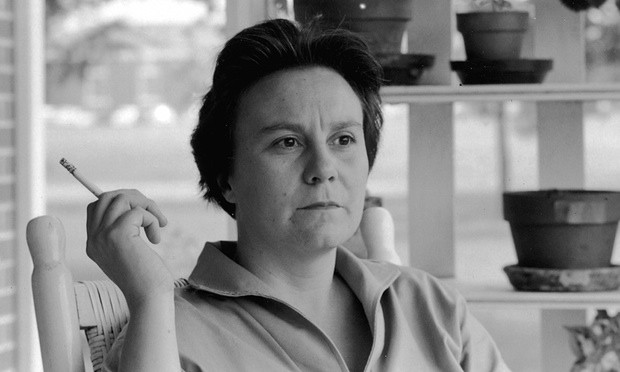
Harper Lee, the author of the classic novel To Kill a Mockingbird, has passed away at age 89. Lee died in the same town she was born in, Monroeville, Alabama.
Lee only published two novels in her life, the Pulitzer Prize winning To Kill a Mockingbird in 1960 and last year’s Go Set a Watchman — a book that is largely considered to be an early draft of Mockingbird. Still, she was easily one of America’s most beloved authors and To Kill a Mockingbird has been a widely-taught classic for decades. Lee was also known for her close friendship with another iconic Southern author, Truman Capote. She helped research his non-fiction novel In Cold Blood.
Lee famously shunned the popularity she received for her debut novel, preferring a quiet life in a small town. In 1964, she said this of her unexpected success:
I never expected any sort of success with Mockingbird. I was hoping for a quick and merciful death at the hands of the reviewers but, at the same time, I sort of hoped someone would like it enough to give me encouragement. Public encouragement. I hoped for a little, as I said, but I got rather a whole lot, and in some ways this was just about as frightening as the quick, merciful death I’d expected.
Lee was awarded high honors by both president George W. Bush and president Barack Obama. She received the Presidential Medal of Freedom for her contributions to American literature in 2007 and the National Medal of Arts in 2010.
In case you hadn’t noticed, pop culture has been soaked with post-apocalyptic fiction for the past few decades, from The Stand to The Walking Dead. But recently, ecologists and writers of speculative fiction alike have begun envisioning the end of the Anthropocene epoch a little differently. Instead of a sudden mass extinction event — nuclear fallout, pandemic, meteor impact, scheduled demolition — we may already be in the middle of a ‘slow apocalypse’ of our own making. The sins of our species may have already caught up with us.
Some writers — futurists like Kim Stanley Robinson, Margaret Atwood, Tobias S. Buckell, and other practitioners of the newly coined ‘climate fiction’ — explore this concept literally. Others take a more indirect approach, grappling with the idea on a thematic level like Jeff VanderMeer’s Southern Reach trilogy.
Perhaps it’s no accident, then, that Age of Blight comes to us from the Philippines, a nation likely to be one of climate change’s first true casualties. Kristine Ong Muslim’s collection of speculative short stories is haunting, fearless, and wildly imaginative. In spare, deceptively simple prose, Muslim writes the kind of unpredictable stories you want to re-read the instant you finish. It’s a difficult book to classify; it is “literary,” “horror,” “science fiction,” but more than anything, Age of Blight acts as a ruthless look in the mirror.
Some stories are drawn from real-life milestones in humanity’s cruelty toward the rest of the animal kingdom. “The Wire Mother” revisits Harry Harlow’s experiments with infant rhesus monkeys from the perspective of a stand-in mother made of wire mesh, watching human psychologists strap her children into literal torture chambers. “The Ghost of Laika Encounters a Satellite” imagines the last moments of one of the first animals in space, an “excruciating death by boiling of internal organs, which was, unfortunately for me, not instantaneous.”
Others stories imagine the world a century deeper into the slow apocalypse, where ravaged landscapes are both otherworldly and familiar. “And if they don’t seem familiar,” Muslim warns us in ‘A Note on the Places in This Book,’ “it is likely you aren’t paying much attention.”
Her most haunting stories invoke Hegel’s notion of the Other, exposing the connection between humankind’s thoughtless violence and our earliest, most primitive fears. In “Jude and the Moonman,” for instance (think The Sandlot as told by David Lynch), a pickup baseball game is interrupted by the arrival of a kid with a face like “a white board cut-out, with eyes made of buttons,” as well as “terrible, hateful spots on his skin, miniature lunar craters.” Naturally, the other kids throw rocks at its skull.
Not every story sings. At times, Muslim veers too close to straight-up allegory, relying on heavy-handed symbolism and ignoring Teju Cole’s advice that a good novel [or story] shouldn’t have a point. “Anyone who does not look and talk like us is the enemy,” says the girl conditioned by future scientists to be violent in “No Little Bobos.” When she expresses indifference toward her victims, the scientists remind her: “Now, when we hurt them, we also need to put our hearts and minds into hurting them. It is very important that you feel anger towards them.” It’s about as subtle as a Rupert Murdoch staff memo.
Similarly, villagers fear a mysterious building containing the Great Beast in “The Quarantine Tank,” until someone touches the surrounding electric fence without getting shocked, sowing doubt as to whether the Great Beast exists at all. On her blog, Muslim states, “This story is really about my views on monotheistic religions, most specifically the three Abrahamic religions, Christianity, Islam, and Judaism. Everything’s buried in symbols, like most science fictions.” While it’s natural for a writer’s opinions to come out in their prose, I’ll invoke Teju Cole once again on the notion of attempting to convey a specific message: “My goal in writing a novel,” he says, “is to leave the reader not knowing what to think” (emphasis added).
Luckily, Muslim’s brilliant, beautiful, provocative stories far outnumber the soap boxes. “Day of the Builders” is one of the best speculative portrayals of modernity’s annihilation of the natural world (and the colonial eradication of indigenous culture) I’ve ever read. And she does it in less than ten pages, one of the longest stories in the book. Most stories are only three-to-five pages, always ending on a psychologically titillating crescendo and leaving you wondering what happens next. By keeping her fiction so brief, Muslim follows Robert Boswell’s maxim from The Half-Known World that “to make something fully known is to make it unreal.”
Kristine Ong Muslim’s stories in Age of Blight are “quarter-known worlds,” at most, thin shards of a broken mirror reflecting a dark, bizarre future. She knows the difference between world-building and world-suggesting. She knows how to open up doors in your mind to rooms you never knew were there, at least not on a conscious level. And she knows to shut those doors before you get a good look.
Flashes of Beyoncé’s “Formation” video appear in my head like subliminal messages spliced into my consciousness. Blue Ivy’s afro. The sinking cop car, Beyoncé splayed atop the roof. Martin’s face next to the headline “More Than A Dreamer.” Beyoncé in all black, her eyes hidden like a mystic conversing with the very ecosystem of the Louisiana bayou; Beyoncé in blood red; Beyoncé powered up, battery charged to one hundred in her spinal column, Beyoncé like a bomb, Beyoncé detonated, Beyoncé fired because triggers can only be tickled for so long before chaos is activated; the big Beyoncé theory. Black creatives are gathering — powerful creatures that are part poet, part wolf: what a time to be alive, indeed.
Black creatives are gathering — powerful creatures that are part poet, part wolf: what a time to be alive, indeed.
My friendship and working relationship with author and satirist Rion Amilcar Scott reminds me how often Black American artistic circles can overlap: one of Scott’s colleagues at Bowie State University in Maryland, where Scott currently teaches, used to be a boss of mine at Karibu Books, a black bookstore with locations throughout Prince George’s County — that enclave, that center of space I called “home” for two years — years before Scott and I would meet for the first time, albeit online, thanks to the generosity of a writer who granted us space to be creative, and ridiculous, and black on the blog of a literary magazine.
Since then, I’ve learned and embraced the value of establishing an actual, true friendship with Rion: not one constructed of flimsy shout-outs on Twitter, or the occasional squad shot on Instagram, but with emails, with sit-downs, with support and acknowledgement of his space and mine, two separate points saying “As black artists, we should on occasion talk with one another, and plot to burn this motherfucker down.”
Before I begin to pander to a white sensibility that has nothing to do with my art, a proper introduction. Rion Amilcar Scott’s writing is subversive in the Ishmael Reed tradition: a brilliant sense of humor with an edge, therefore never dull and hardly comfortable but certainly volatile in that his writing can assassinate from miles away with militaristic precision. And while his essays — a recent meditation on Black Lives Matter for The Literary Hub, for example — are both cerebral and mystical, like a spell of sorts, fiction is the realm where his mind inflicts the most damage, where his imagination creates the most wonder. I knew as much when I published “A Friendly Game” for Specter (and later for Literary Orphans as part of the Black Thought issue I guest edited), and nominated it for a Pushcart — only one of six possible nominations I bothered to submit as editor/curator of Specter. With two story collections scheduled for release in 2016, Rion Amilcar Scott is arriving at a moment when we’ve been called into formation, and blackness — as a cultural and spiritual force of creativity and consciousness engaged with our world, our lives, our loves and flaws — asks us to be out here.
Rion Amilcar Scott has contributed to Crab Orchard Review, PANK, The Rumpus, Fiction International, The Toast, and Confrontation, among others. He was raised in Silver Spring, Maryland and earned an MFA from George Mason University. His collection, Wolf Tickets, is forthcoming from Tiny Hardcore Press, as well as the collection Insurrections from University Press of Kentucky (Fall 2016).
Mensah Demary: So I’ve been thinking about how to start this. A burning question: why U-God? Why is he your favorite Wu Tang member? Or at least, why do you keep bringing him up on Twitter? Explain yourself.
Rion Amilcar Scott: U-God isn’t my favorite Wu-Tang member. It alternates between Ghostface, The GZA, The RZA, and Ol’ Dirty depending on how I feel at the moment. What fascinates me about U-God, and Masta Killa for that matter, is what fascinates me about Phife of A Tribe Called Quest, Sen Dog of Cypress Hill, 5ft of Black Moon, and Flavor Flav — the willingness to play a secondary support role alongside better emcees. Rap suffered when the group disappeared and every mediocre rapper decided to try his or her hand as a soloist. I always thought that a mediocre rapper like Memphis Bleek should have found a better rapper and played sidekick. As support staff, U-God often makes exciting contributions on songs like “Cherchez Le Ghost” from Ghostface’s Supreme Clientele and “Soul Power” from Wu-Tang’s Iron Flag. Most of his solo albums have been pretty weak, though Keynote Speaker is pretty good.
The other thing that excites me about U-God is that he, Ghostface, Cappadonna and Raekwon represent an anarchic approach to language — abstractions, coined phrases, wild syntax, bizarre imagery
The other thing that excites me about U-God is that he, Ghostface, Cappadonna and Raekwon represent an anarchic approach to language — abstractions, coined phrases, wild syntax, bizarre imagery — whereas The GZA, The RZA, Inspectah Deck, Masta Killa and Method Man approach language in a much more orderly fashion. Ghostface’s Supreme Clientele is the pinnacle of that anarchic style. ODB fluctuated between these two poles (maybe owing to the fact that he didn’t write all of his lyrics — though the songs he did write land more on the anarchic side of things). I’m influenced by both approaches as a writer and also the tension between the two styles — this probably excites me most as a Wu fan. I’m probably more influenced and inspired by the Ghostface approach than the more orderly approach.
MD: In his memoir Mo’ Meta Blues, Questlove attributed the end of group acts in hip-hop with the arrival of Kanye West. (I’m riding the Ultralight Beam, loving most of Kanye’s new album The Life of Pablo, by the way.) On one hand, Quest is right…The Roots were probably the last act remaining when West rose. Whatever mix of mainstream and underground love The Roots thought they believed they could attain, Kanye snatched it. On the other hand, I wonder if group acts ended before Kanye. One could argue group acts — like ATCQ — were replaced with “crews” or loose affiliations where any personal or artistic attachment was decoupled from iron-clad business ties. Maybe I’m tripping.
Anyway, what’s good with the literary genius of Kendrick Lamar? When’s the last time you listened to To Pimp a Butterfly?
RAS: I actually listened to TPAB the other day on my way back from Philly. It was the first time in a long time and I wanted to reassess it on the verge of our AWP panel on his work. That album had a deep impact on me when it came out — pretty much all I listened to for a while, but it fell off my radar. I wanted to see if that falling off was because I and everybody else had over-hyped it and heard what we wanted to hear. I’ve definitely done that before, bestowing classic status on what I later realized were mediocre albums.
Don’t you see a man crying on these tracks, laying himself bare? Do you not hear the metaphors, the language, the technique?
TPAB is not a mediocre album, even if it is certainly an uneven and somewhat bloated album, which can be said about every rap album outside of Illmatic. It’s not as entertaining as Good Kid, Maad City, even as it’s clear that Lamar’s skills have grown. There are fewer traditionally structured songs with easily digestible and memorable hooks.
What makes it hard to listen to though is that it’s largely the record of a man opening up his chest and showing you his bloody heart. This is not an album one listens to back to back, day after day, because you have to digest the emotions. It seems like whenever we (as a society) have troubled times there is an album — actually several — that speak to that time. TPAB speaks to our troubles the way Marvin Gaye’s What’s Going On? spoke to those times.
MD: Calling an album “classic” in its immediate wake is so easy now. I get caught up in the Twitter echo chamber when it comes to music, and the chatter around TPAB when it dropped made the album feel more alive, more — I don’t know — prescient, maybe? I listened to it nonstop for weeks, sometimes locking onto a few songs I might’ve skipped, or didn’t give too much love on Twitter. “Mortal Man” for example.
The album made me angry, and that anger seeped into me and my daily life. I couldn’t write the anger away, as if I kept refilling the cauldron every time I played it. Maybe as a counterbalance, or because I’m a Drake stan, I gravitated to Take Care shortly after TPAB. I inadvertently chose an album that added so much more context to TPAB. Kendrick rapping about meeting Drake for the first time on the “Buried Alive Interlude” track is a jarring experience now.
The transformation Kendrick has undergone since then is a radical one, a black one, generated by a closer connection to his home, his soul, his people, you and I. If John Coltrane was transformed by religion/spirituality and, in my opinion, the presence and love and genius of Alice, then Kendrick is experiencing a similar change, precipitated perhaps by fame and its shallow nature.
RAS: It troubled me that people assessed the album the way they would assess a speech from a presidential candidate, rejecting the entire thing on the grounds that Lamar veered close to respectability politics or whatever, as if this album were a musical recitation of Bill Cosby’s “pound cake” speech or something. I wanted to ask those people, “Don’t you see a man crying on these tracks, laying himself bare? Do you not hear the metaphors, the language, the technique? Don’t you see a man struggling with these ideas, showing his work, coming to shaky conclusions and then rejecting those and coming to other conclusions?”
In this way TPAB is less like a work of fiction the way Good Kid felt like a work of fiction, and more like an essay collection that thinks through blackness, violence, depression, fame, and the pains of maturation.
MD: Do you think this same pressure applied to black musicians apply to black writers as well? What connections do you see between Kendrick and black writers?
RAS: There may be pressure for black writers to speak on blackness, but I think we do it largely because it’s on our minds. We’re made to be mindful of our blackness and in many situations not being mindful of it can have horrible consequences. It becomes an existential obsession and those obsessions we have form the basis of our works. I don’t think it makes sense for writers to run from their obsessions, including any of the many obsessions outside of racial identity that form the basis of our personalities and make us human.
We’re made to be mindful of our blackness and in many situations not being mindful of it can have horrible consequences.
You asked me this before Claire Vaye Watkins’s Tin House essay, “On Pandering,” dropped, but reading it gave me a different perspective on this question. That essay, while generally excellent, didn’t completely imagine what “pandering” might look like for people of color. It was interesting that she could go so long without having this “revelation.” People of color are constantly negotiating how to engage gatekeepers who are largely white and may have limited awareness of or respect for othered cultures.
On Twitter, Roxane Gay posited that for women writers or queer writers or writers of color, “pandering” can mean “writing more ethnically, or in a queerer way or in a more gendered way, to meet editor/imagined audience expectations.” I had to really think about this. My work is pretty damn ethnically specific. I questioned whether it was this way as a kind of unconscious bow to reader expectations, but really the decision to write about mostly black worlds is a conscious choice, but it is also one that is guided by the fact that the world I’ve lived in has always been mostly black. That’s the way it is for a lot of black people, I think.
There was so much talk when TPAB came out about whether white audiences would be able to get Kendrick’s album and I think the reason for that is that it makes very few overtures to whiteness and doesn’t attempt to translate the black experience. That was the exciting thing about it for a lot of black listeners.
Which brings me back to Roxane’s idea that we often “pander” by writing our cultures in a way that meets white/straight/male expectations. I think that’s true only, or mostly, when whites have large and defining roles within “ethnic” stories. (I suppose you can substitute “straight people” or “men” within queer and female contexts, though I’m sure the nuances are different.) Extra points when said white person is acting badly.
A monstrous white person on the page perpetuates the myth that racism mostly involves bad actions by evil individuals and the eradication of it mostly involves mean people acting nicer. That’s the world of Kathryn Stockett’s fantasy novel and movie, The Help. Really racism and white supremacy (like sexism and patriarchy) involve a systematic infrastructure that seems to perpetuate itself even in the absence of any overt ill will by individual actors. That’s far more disconcerting and scary and a far more difficult thing to dramatize.
MD: Okay. We were going to end our talk here, but I can’t without asking you for your thoughts on “Formation.”
RAS: I must start this by saying, I am by no means a Beyoncé stan. That’s becoming the classic opening when discussing this song and video; I’ve seen so many people on Twitter and Facebook use that line. Whenever there’s a Beyoncé moment on Twitter, I’m usually on my timeline making fun of it. This time though, I had no jokes, no cynicism. She’s seemed to have united the Beyhive with black folks who were uninterested in her or even disdainful of her music. I can’t stress how important it is for an artist of Beyoncé’s caliber to forcefully assert her blackness at a time of racialized strife and turmoil. The “stop shooting us” iconography. The sinking cop car. The drowning/baptism/rebirth in the floodwaters of Katrina, where so many became politicized (and one of the many preludes to the #blacklivesmatter movement that officially kicked off in Ferguson). The expressions of love for her “negro nose” and her family, mixing the personal with the political. There’s a lot here.
If artists haven’t felt the call to put their art in the service of our liberation, this is a very good and very black bat signal.
Every movement needs art to minister to its spiritual, emotional and intellectual needs. It’s as important as the street protests, more possibly if the art transcends the moment. I’ve heard people question the authenticity of Yoncé’s “Formation” moment. Saying she’s been a superstar for so long and never has been particularly political. Let’s remember though that Marvin Gaye wasn’t a new artist when he made What’s Going On? He was called. I’ve heard people say “Formation” doesn’t come forcefully enough. I can dig that. Though I do think that mixing the personal with the political, the trivial with the profound is very much of our times. But, no, this isn’t exactly What’s Going On? It doesn’t need to be; the title itself, “Formation,” implies a beginning. It leaves room for other black artists to pick up the torch and take it further in their own respective mediums. If artists haven’t felt the call to put their art in the service of our liberation, this is a very good and very black bat signal.
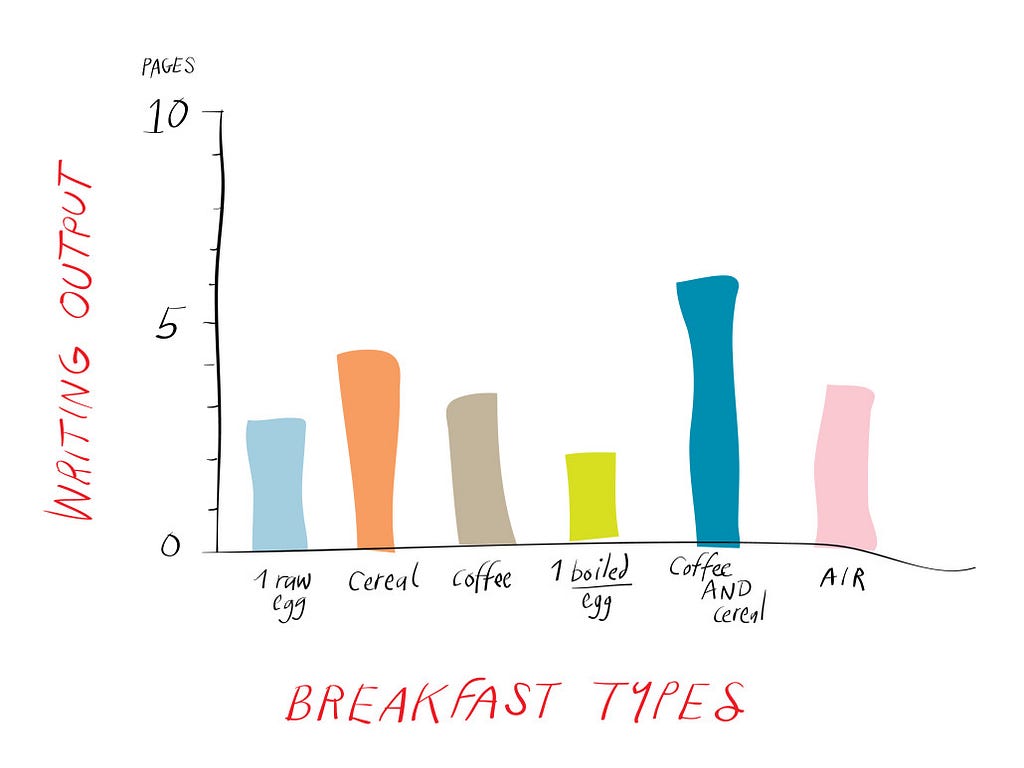
I experimented with food and sleep in order to find out the combination that left my mind and body feeling sharpest. I mustered up schedules in order to fit writing into all manner of work-related circumstances — grant writing days, copyediting days, transcription days, translation days. And for those unicorn days in which I had nothing else to do but write, I made schedules for those days too. I time stamped everything.
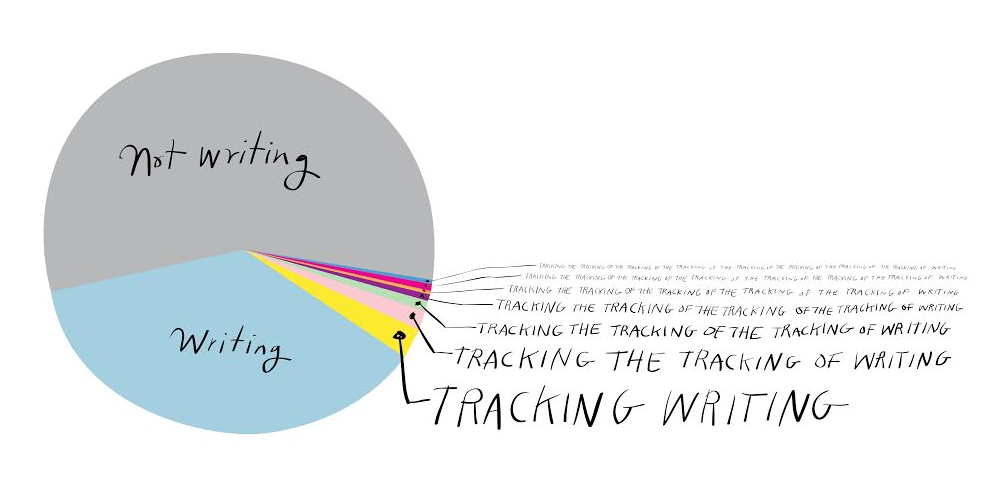
(As a joke to myself, I once started a meta chart, where I tracked the time it took me to track myself, then the time it took me to fill in the meta chart, then the time it took me to fill the slot indicating how long it had taken me to fill in the meta chart.)
The theory was that if I could figure out the science to writing, I would be able to create the right circumstances needed in order to land on my desk at the allotted writing time feeling refreshed, unblocked, and inspired.
Like a horse beginning a sprint at the sound of the starter pistol, I would write word after word, sentence after sentence, in glorious lap after lap of stirring storytelling.
But no amount of tracking, experimenting, and planning that I ever came up with kept me from the black eventuality of sitting down to write and nothing coming out.
There would be my mind a sheer blank, and there would be the white page so silencing.
I would sit in wait for an average of five minutes, fifteen seconds.
Then I’d turn to my journal in order to complain in all manner of metaphors about my lack of inspiration — the well run dry, the block, the free diver run out of air.
Then it occurred to me: What if in all my years of tracking, I had been keeping track of the wrong thing? What if instead of charting those hours that tangibly resulted in the creation of articles, stories, chapters, essays, what if instead it was more accurate to keep track of the types of writing I do that you will never see but are nonetheless necessary to produce the work that you do see? Isn’t that type of writing more important?
Because, see, writing about not writing is also writing.
But what else is writing?
All the hours I spend in the back of my throat, flexing my tongue, agonizing in unwritten sentences — is that writing?
What about the pen poised over the blank page, the fingers suspended above the keys overcast in the jeering electric light of the screen? Is that writing?
Is sheer inertia writing? Is sheer potential writing?
Is signing my name to a check writing?
Is making a list — buy the milk, the cereal, the frozen fruit, the greens — writing?
What about thinking — Oh, I could have written that — is that writing?
Is transcription writing? (Allow me to transcribe here part of that gem of Borges short stories Pierre Menard Author of the Don Quixote as flimsy defense, “[Pierre Menard] did not want to compose another Quixote — which is easy — but the Quixote itself. Needless to say, he never contemplated a mechanical transcription of the original; he did not propose to copy it. His admirable intention was to produce a few pages which would coincide — word for word and line for line — with those of Miguel de Cervantes.”)
And what if one notices a detail, composes a sentence in one’s head, but later forgets to commit it to paper and then the sentence is gone? Is staring at the departed silhouette of that sentence, the blank space in your mind that holds all the dark — is that writing?
So much of not writing is actually writing. A writer at rest may at all times be imperceptibly writing. It’s possible even that the type of writing that we do that you will never see in order to produce the writing that you will see, it’s possible that this type of writing happens at all hours and even in sleep.
The more I look at this line differentiating writing between not writing, the more this line disappears. Maybe there is no such thing as not writing. Maybe there is no such thing as the block. Maybe there is no such thing as an accurate chart that can show the real effort that goes into writing. Maybe the only accurate thing is to just look at the face of a writer — at the haggard lines, at the skin luminous with triumph — you can see the effort there.
Hello, and welcome to my week-by-week review of the world. Today I am reviewing a walk in the woods.
Normally I like walking in the woods. I enjoy spending time in nature, getting away from the city, and just finding time to be with myself. Unfortunately, this walk was mostly me running from things and getting lost. It was easily the worst walk I’ve ever been on. Worse than the one where I found a dead body, because that time it was the body of a missing person and I got a big reward.
After parking my car on the side of the highway, I entered the woods to pee without being seen. When I came out of the woods, my car was gone. Or so I thought. As I learned later, I had exited to a different stretch of the highway and my car was just around the bend. (It was actually stolen the next day but at this point it was still there.)
I tried hitchhiking, but when no one would stop to pick me up, I realized the reason might be because I had accidentally left my penis hanging out of my pants. For men it’s much easier to pee in public than for women. But it’s also much easier for us to unknowingly flash dozens of cars.
I was so embarrassed I ran back into the woods and hid for a while. When I saw a state trooper drive by, I started running. It only took about ten minutes before I was completely lost. I knew people used stars to navigate, so I started walking toward the sun. Unfortunately the sun wouldn’t stop moving so I ended up back where I began and regretting that I hadn’t brought sunglasses.
I’m a little bit of an expert on outdoor survival, because I’ve watched a lot of TV shows about it. The first trick is to dig for water, but I wasn’t thirsty, and I didn’t want to run the risk of finding oil and becoming so rich that it changed me as a person. The second trick is to eat bugs for protein, but the last time I ate a bug it was by accident and I still have bad associations with that. I was out of tricks.
That’s when the panic set in and I started to get all sweaty. I undressed to cool off and should not have rested my clothes on a nearby rock, because that rock turned out to be a turtle that walked off with my clothes. I could have caught him but he was attacked by an owl and I didn’t want to get in the middle of that.
Obviously I didn’t die out there because I’m writing this now, but I was lost for three days, naked, and hungry. All because Yahoo hasn’t sold any of those self-driving cars yet. If I had one of those it could have zoned in on my GPS signal and found me.
I give this walk one star because I got some exercise.
BEST FEATURE: The turtle dropped one of my socks which I used to keep my good foot warm. WORST FEATURE: I got poison ivy, somehow only on my face.
Please join me next week when I’ll be reviewing The Oscars.
A few years ago, everyone seemed certain that ebooks were taking over, and companies rushed to form the first successful “Netflix for books” service that could provide readers with unlimited ebooks for a low monthly price. Amazon jumped into the market with Kindle Unlimited, challenging the already existing Scribd and Oyster for the ebook subscription crown. But in the last year, ebook sales seem to to be declining or, at best, holding steady with a small slice of the market. While ebooks aren’t going anywhere, the dream of a Netflix or Spotify for books seems further away than ever.
Oyster, the best of the Netflix for books services, shut down last fall after Google bought up most of the talent. Another service, Entitle, also shut down last year. While Oyster offered books from Big 5 publishers like HarperCollins and Simon & Schuster, Amazon’s Kindle Unlimited is populated almost entirely with self-published books. If you love reading self-published books by unknown authors, Kindle Unlimited might be attractive, but it lacks the big name equivalents of the pop, TV and film stars that draw users to Spotify and Netflix.
This has left Scribd as the only major service to offer Big 5 authors alongside self-published books. Yet this week, Scribd announced plans to shutter its all-you-can-read Netflix-style buffet. Publisher’s Weekly explains:
Under the new plan, Scribd’s subscription service will essentially be a hybrid offering. Monthly subscribers will be issued Monthly Read credits that will enable them to read three e-books and one audiobook every month from the full Scribd library, while still being able to read an unlimited number of books from Scribd Selects, a rotating selection of titles.
Why is Scribd implementing such a confusing and user unfriendly system — a pool of rotating books that are all-you-can-read, a second pool where users can only pick three per month, and a third pool of audiobooks where users can only pick one per month — all of the sudden? The answer might be romance readers. Last year, Scribd drastically cut its romance and erotica offerings because, well, people were reading too many of them. Simply put, Scribd pays publishers on a per-read basis, and romance fans plow through so many books each month they were bankrupting the company.
Scribd is spinning this as an “excess in moderation” system, but we’ll see if readers buy it, or whether they’ll flee after yet another big change to the service. Then again, where do they flee to?
At this point, it seems possible that a “Netflix for books” service just can’t work. And perhaps that shouldn’t be too surprising. Rabid romance fans aside, most people read fewer books per month than they watch films or listen to albums. As such, paying ~$10 a month is much less of a deal for unlimited books than unlimited music or film and TV. This is especially true when even the services that have deals with the Big 5 presses don’t have access to most of their titles in the way that Spotify has almost any album you could want. Netflix, of course, also doesn’t have a tremendously great selection of TV and film. But Netflix recognized this problem and responded by producing excellent and award-winning content like House of Cards, Orange Is the New Black, and Daredevil.
Could that be the way forward for a “Netflix for books” service? Big name books that are only available on Scribd or Kindle Unlimited? With the print market still dominating book sales, that seems unlikely anytime soon, at least without an ebook service overpaying popular authors to make it happen.
So for the foreseeable future, it’s likely that a “Netflix for books” — at least one that dominates books in any way resembling the way Spotify and Netflix dominate other media — just isn’t going to happen.
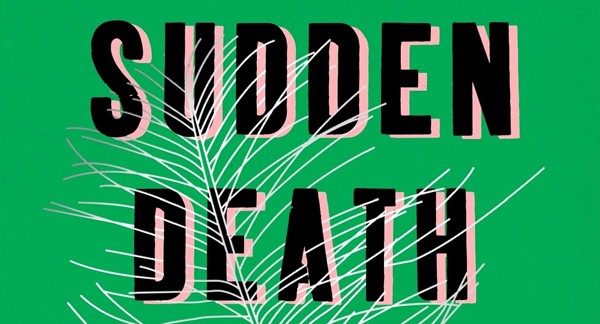
You may be tempted to try to get a sense of Sudden Death by Álvaro Enrigue before you read it. You might want to read some reviews. You might want to peruse the back cover or at least plug it in to Google. Don’t bother. If its preparation you are looking for, nothing will prepare you. Simply put, Sudden Death is not going to make sense until you read it and maybe not even then. Reading Sudden Death is an exercise in uncertainty.
But in the spirit of helpfulness, here is what happens between the covers of Sudden Death:
About half of the book’s chapters take place at a fictional tennis match between the Italian painter, Caravaggio and the Spanish poet, Quevedo. As for the other half of the chapters, which Enrigue intersperses with his fictional tennis match, anything goes — some chapters summarize historical events from the sixteenth and seventeenth centuries like the execution of Anne Boleyn, some present funny and moving portraits of historical figures from that time like Hernan Cortes, his daughter Doña Isabel and many many others, several chapters dramatize the creation of Caravaggio’s more famous paintings — in one chapter, Enrigue includes a screenplay starring Pius IV. Enrigue also includes a number of excerpts from seemingly historic texts about the game of tennis. And at one point, Enrigue inserts what appears to be an actual email exchange between himself and his publisher. Sudden Death is an overcoat lined with many pockets, each pocket containing a world. Sudden Death defies summary, and explaining what happens between the covers only makes the book more confusing.
At the beginning of the book’s final salvo Enrigue interjects himself into the chapter just to clarify that even he isn’t sure exactly what he’s doing here — mind you, this on page 203 of 262:
As I write, I don’t know what this book is about. It’s not exactly about a tennis match. Nor is it a book about the slow and mysterious integration of America into what we call “the Western world” … maybe it’s just a book about how to write this book; maybe that’s what all books are about.
While one could make the argument — and indeed, Enrigue does — that the novel’s structure is very much like a game tennis, the narrative bouncing back an fourth unpredictably from one scene to another, much like the first hair and putty balls that were used in the wild street game, which eventually became modern day tennis, one could also argue that this book is an undisciplined mess, and Enrigue’s tennis-as-structure analogy feels more like an afterthought than a stroke of genius. That may sound uncharitable, but an author should not need to gesture toward a novel’s unifying principle — it ought to be self-evident in the writing. That Enrigue feels he needs to actively nudge the reader toward his organizational premise suggests that he is afraid it isn’t immediately accessible, which it isn’t, which is troubling.
Here is how you read Sudden Death if you want to enjoy it: grease it up and swallow it down whole, with all of its inconsistencies, appreciating, above all, the enthusiasm and wonder with which Enrigue seems to approach his work. There is freshness to the way these disembodied scenes add up to inhabit the early baroque world. And even though Sudden Death becomes one thing and then it becomes something else, it adds up, and there is resolution and there is momentum. The book is full of surprising turns, and it is fun to read. I assume it was for these reasons that Enrigue’s original Spanish version, Muerte Súbita, won the Herralde Prize in 2013. Enrigue weaves yarn after yarn leading his reader through the twisting passageways of his research — Enrigue wrote the Sudden Death during a fellowship at the New York Public Library’s Cullman Center. An open-minded reader will pardon his dust, follow where he goes, and profit from the experience.
A less charitable reader will find it disappointing that even though the book is carefully researched, the historical characters he presents are not particularly well developed. There are simply too many of them and the book is too short to support any depth from so many characters. But character complexity doesn’t seem to be Enrigue’s main point here. Sudden Death often seems more an intellectual exercise than a novel. Enrigue presents historical details side by side with fantasy, and unless you really know your sixteenth and seventeenth century European and American history, you’ll need to do some serious digging to parse Enrigue’s research from his inventions. Enrigue seems to delight in misdirecting his reader toward his fabricated worlds over his researched ones, which, since he takes an equally authoritative tone with both, makes his work less the academic post-modern tale spinning of Borges or Eco (a style which he seems to admire), and more a straightforward miseducation of the reader. If you do not want to enjoy Sudden Death, allow these missteps to bother you.
Sudden Death is your kid brother who keeps fucking up but has a heart of gold. You can’t help but admire the audacity, even if there are moments when it feels like a disaster. But what I love here, what redeemed Sudden Death for me, was Enrigue himself. Unlike the cliché, writer-as-God-perpetually-looming-over-the-work, Enrigue isn’t self-assured. If in fact, he seems genuinely not to know what is coming next. Enrigue makes himself vulnerable to his readers, which creates a sympathetic pathway into his work. Enrigue invites the reader to question him, to doubt him, to cheer him on. Mostly, the novel seems more an imaginative chronicle of time spent in research than a coherent historical narrative, and that’s fine, actually. Sudden Death isn’t really what it claims to be, but that’s part of its charm — the book doesn’t know what it is.
I’d say the real protagonist of Sudden Death is Álvaro Enrigue, himself. One could even say — to extend his own forced analogy — that Sudden Death is a tennis match between the author and the reader. If it is as Enrigue says and “it’s just a book about how to write this book,” one could also say that Sudden Death is a book about how to read Sudden Death. All reading is a dance in which the writer leads and the reader follows — or, we might say in this case, Sudden Death is a tennis match in which the Enrigue furnishes the court, the ball, and the house rules and the reader furnishes the skill to play along. In Sudden Death, Enrigue has delivered us a beautiful serve, but to return it, we must play his game and expect the unexpected.
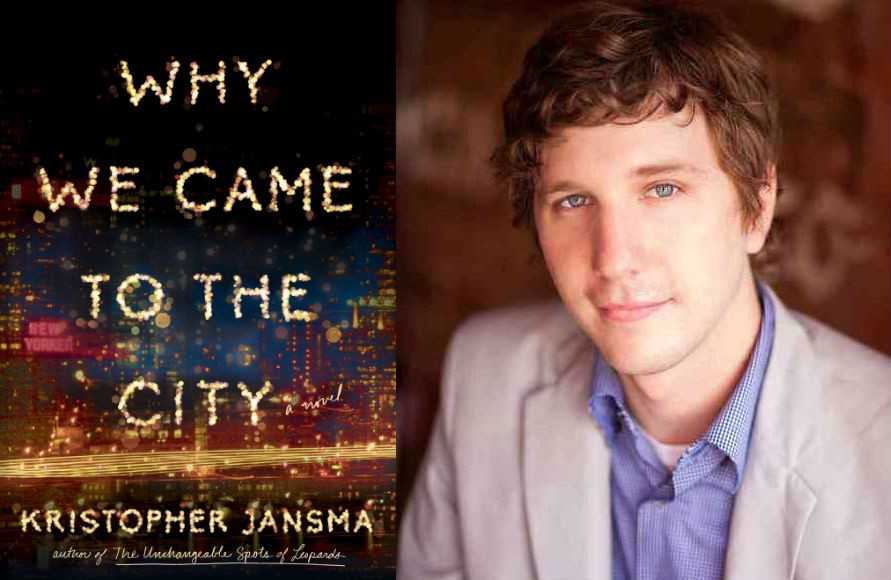
Nearly three years ago, I met Kristopher Jansma in this exact same Park Slope, Brooklyn coffee shop for this exact same reason: to talk about the release of a book. In March 2013, his debut novel, The Unchangeable Spots of Leopards, was about to hit shelves, and we gathered on a snowy day to talk about the trepidation of letting a first work out into the world. I’m going to spoil this story: Jansma survived the release of the novel, as well as the paperback cycle, to write a sophomore book, which hits shelves in February.
Why We Came To the City (Viking, 2016) is in part the story of five friends who’ve moved to New York, post-college in 2008, dealing with the curve balls that the great city throws at them, their lives ebbing and flowing at the boroughs’ whims. But it’s also part love (and, okay, breakup) letter to the city, rendering Jansma’s own relationship with its tumultuous streets, reminding us just how living and breathing an entity this machine really is — and what it takes to hack it here. That’s certainly something that the author has learned since moving here for an MFA at Columbia after graduating college in 2003, and then planting roots in Brooklyn with his family.
A lot has changed for Jansma in three years since we first met to talk Leopards (although the quality of the coffee here, sadly, hasn’t). That’s where we decided to pick up the conversation.
Meredith Turits: You’re physically in the same place as when we last met, but life-wise, you’re certainly not. What’s the biggest thing that’s changed?
Kristopher Jansma: Having a kid has just turned everything around. That’s shifted all of my priorities, including writing — trying to find ways of being an author and a writer when I’m not being a dad has been really challenging. I was thinking about going through [a book release] this time around and I think I have a better sense of what’s happening and what the stakes are, whereas the first time around you have no idea. So far, I’m not so panicky this time around, which is a good thing.
MT: You’re very active on Twitter. How has the transparency of Twitter and social media in general affected the way you interact with the contemporary fiction space?
KJ: It’s wonderful for talking to readers, and I find that’s something I can’t imagine would have been possible before. Ten years ago, you’d write your book and go to a reading, you might talk to a few people during a signing, and that’s it. And now I can have an ongoing conversation with a random guy who likes my book in the Lower East Side, an interesting person who I can now have a weird friendship with. But there’s the other side of it that can be sort of daunting where you’re seeing everybody else whose job it is to promote their own work or other people’s work complain and talk about how mad they are about this or that. It can be a little intimidating when you start to see how easy it is for certain people to get set off by something. You start to worry, Could that happen to me?
MT: My friend who is reading the book now had a great point where she said that the novel seemed to her more about a generation of people, and less about a specific group. It’s a concept that I loved.
There was always this tension around that that I wanted to capture, too. Everyone always has that one foot out the door.
KJ: I love that. That’s definitely something I wanted to talk about — not just these five characters, but what I’d seen going on with a whole generation or microgeneration. I came here with two friends of mine right after college in 2003, and those were the only two people I knew in New York for, like, two years. And then I watched what happened as we came up between 2003 and 2008. [My now-wife] Leah moved here in 2005, and we started meeting a lot of new people through her work friends in publishing who were very similar — young, hungry, willing to work long hours and put up with lots of crap. There was something so exciting about all of that, and I really wanted to write about that. And at the same time, there were always people who were leaving; people who I thought were wonderful who said, “Fuck it, I’m going to Texas!” or “Get me out of here, I’m going to move to Pittsburgh,” or some place cheaper. There was always this tension around that that I wanted to capture, too. Everyone always has that one foot out the door.
MT: Questioning the sustainability of the city.
KJ: Yeah. How can I make this work? The big thing I thought that changed was when the financial crisis hit. Before that had happened, I thought there had been this maybe naïve belief that everyone was going to just pay their dues and work super-hard and get promoted and rise up from editorial assistant to assistant editor to associate editor to editor to senior editor to running the imprint, and I remember having conversations with Leah’s friends like that where they’d be saying, “In ten years, we’ll be in charge of this whole place!” Then I think what happened was that the people who didn’t lose their jobs were there but they couldn’t go anywhere — they weren’t going to get a promotion. Nobody was going to move over to a different job, and their bosses weren’t retiring, leaving and making space for anyone else, and that totally changed the dynamic. And then more and more people did start leaving because they realized this isn’t going anywhere. So, I really wanted to capture what was happening here at that moment among people in their twenties.
MT: This group of people that you chose to represent, were they supposed to be archetypal?
KJ: The characters definitely weren’t archetype constructions at all. I’d started writing stories about these characters — Sara and George came first, and Irene was sort of in the background — and every once in a while I’d write about a different character who sort of felt like they felt in with these ones. Eventually, I had the people who were going to fit together the best. But I do think each of them shares qualities with people I’ve known over the years. Jacob is the loudmouth, super-confident kind of guy and George is sort of his counterbalance as someone who is very sweet but kind of meeker — I wanted to write about those things. Parts of each of them have drawn from people I’ve known.
MT: I think what’s interesting about them is we watch this relationship between how the city changes them, and how, at times, they change the city in a way. I’m curious about your own relationship to the city and how the city has changed you.
KJ: I think about it a lot. I grew up in New Jersey, about an hour and a half away from here, and I had no relationship with the city. I came on field trips to see Broadway show or something like that once in a while, but my family was not interested in New York at all. I never had any big dreams of living here even when I was growing up, and a lot of people I knew in my town and my high school would routinely go to New York on the weekends — clubs, bars — and I wasn’t cool enough to do any of that. I just had no interest in living in New York ever.
I went to Baltimore, to Hopkins, to study writing, and I got into Columbia for grad school, and that was my only option, so I went there and that was my introduction to living in New York. For the first few years, I really wasn’t a big fan. I never left my neighborhood. I more or less didn’t leave my apartment — I was always writing, and going to class and coming back and writing. On the weekends, I’d go to Baltimore to visit Leah, and that was my whole thing.
But then later once Leah moved here and I really committed to being here, I loved it, and it totally changed me. I started to realize going back that there was this confidence that I’d never had when I was in college — I always saw myself as part of a big group of friends, but never the leader, and my roommates were generally much more Jacob-like. More gregarious. And being in New York — and maybe living on my own anywhere would have done it to some degree — but there’s this ambition and power that kind of comes with that. I remember even charging up the street — I’d go up Broadway from 102nd to 116th and back, that was all I did most of the time — to go from my apartment to Columbia, and realizing at a certain point that I was bustling through these people, dodging around all the slow people on the sidewalk and I thought, Wow, I’m absorbing this energy from the city. Now I’m at the point where I can’t imagine living anywhere else. It’s gotten into my soul. It’s a pretty awesome place to be living. The city gives you a lot back, I think.
MT: What makes someone able to hack it here?
There’s a sort of stubbornness or insanity…that makes you keep on driving at something despite every message to the contrary.
KJ: I don’t know — that’s a good question. There’s a sort of stubbornness or insanity like we were talking about before that makes you keep on driving at something despite every message to the contrary. You have to be willing to put up with a lot of downsides: small apartments, noisy neighbors, those things. I think some people can see that and find it a way to make them tougher and enjoy the rest of it. Others are just not as interested in that. I’ve had friends who’ve been here who’ve left within a year or two years, who couldn’t wait to get out to the suburbs and have a yard and a fireplace or whatever. We’re now at the point where we’re finally starting to talk about that, and neither of us can imagine that.
I never felt like I was [that kind of person] — even in undergrad, I wanted to write a book someday, but I never really had that sense of I’m going to able to do this. It wasn’t until I got here that I could. Which is weird — coming here and seeing how many people there are who are trying to do it should scare you off a bit, but somehow, I thought, I can do this, too!
MT: Did you feel as you were writing that you had any kind of responsibility of how to render the city? And did you worry about your own biases sneaking in?
KJ: Definitely. One thing I worried about was in the beginning, I had plans for this giant, maximalist epic that would get to every corner of the city. I wanted to show the Fulton Fish Market and the Bronx and Staten Island, and have parts of it everywhere, and then I realized at some point that there’s a reason you can’t really do that. I mean, you can write a 900-page novel about the city, and others have very recently, but you can’t try to get your hands around all of it. It really would have to be a book that would show it from a million different angles because there are so many different New Yorks that exist overlapping all the time.
I realized what I can do is write about the New York I know. I can write about what it’s like to be a twentysomething young professional person bohemian-whatever, and I can write about that part of New York. Once it started to focus in that direction, I started hoping it would echo with anyone coming here from any neck of the woods.
MT: And to that point, very few people actually have that holistic experience of New York. New York is too overwhelming, and you have to carve your niche out.
KJ: I remember somebody telling me before I moved here that there were so many neighborhoods and so many people live in a neighborhood and never really leave it. That was basically my experience when I lived in Morningside Heights. There’d be times when I would have to go somewhere else — I’d have a birthday party and have to go to SoHo, or something — and I’d go on the subway and have no idea where I was or how it connected to anything. Even six or seven years later, I’d be walking and think, Oh, this is where that happened! They’d be all of these isolated pockets where, at the time, I had no idea how they happened.
And that was just Manhattan. I didn’t move to Brooklyn until 2010 or 11 — maybe after that. I knew nothing about Brooklyn, and just stayed in Manhattan all the time, and even when I started working on this book, there were all of these snarky, Manhattanite ‘we don’t like Brooklyn jabs’ in there that I ended up taking out because now I live here and I really like it. But it was mostly just because I had no idea where anything was — I’d come over to Park Slope to meet a friend or something and think, Well, none of the streets are numbered so I have no idea how to get anywhere. There are rare people who really do live in the whole city, but many of us just know a part of it. And that’s a lot — even one part of Brooklyn is bigger than a lot of other cities.
MT: What’s your thought on the phenomenon of the “Brooklyn book” right now?
KJ: That’s a good question. I remember when Leopards came out, we had just moved to Brooklyn and I was trying to keep it under wraps. I didn’t want them to put “he lives in Brooklyn” on the back of it, and I remember during interviews, I’d say, “Don’t say I live in Brooklyn.” But now I’m definitely a Brooklyn writer. I hardly go to Manhattan anymore.
It’s the same thing as with Manhattan, though — there are a hundred different Brooklyns. There’s sort of the Park Slope to Fort Greene zone we’re in. I have a friend who lives in Williamsburg, and I feel completely alienated from what’s going on with him. We go up there every once in a while and say, “Wow, this place has really changed since two months ago!” I think there are so many of us living here — it still really is such a wonderful place to live as a writer.
MT: Did you at any point worry or wonder about your reader who was not based in New York and what his or her experience would be with the book?
It can be a great place to be with all of your friends, but it can also be a very lonely place to be when that part of your life has started to change.
KJ: I wanted it to be something that would appeal to someone in other cities — that’s a lot of the reason why certain parts of the book like the prologue and the in-between part have certain details that are specific to New York, but I wanted to make sure that they had a tone that could fit other cities, as well. I wanted to have enough of that in there that it would maybe appeal to people who’d left the city, or younger people who are thinking about moving to the city one day and were dreaming about it. I’ve had interesting conversations with people who’ve read the book who used to live in the city but left because they didn’t like it, and I think it’s pretty interesting in that sense, too — if you become a city-hater, if you read the book, you wonder, What’s wrong with these kids that they like it here so much? I think the book ultimately turns on them as they stay there longer, and some of them end up leaving. It can be a great place to be with all of your friends, but it can also be a very lonely place to be when that part of your life has started to change.
MT: Do you think that if college Kris had picked up this book before deciding whether to move to the city he still would have come?
KJ: Yeah, I think so. I do. I think college Kris would have been encouraged by that because I remember thinking at the time that I’d lived in Baltimore, and that’s a city and not necessarily a super-easy one sometimes, and that I’m used to dealing with city stuff and getting around with public transportation and not getting mugged and stuff like that. Then I moved to New York, and realized, wait, this isn’t a daily reality. I think it would have been encouraging. I would have felt like there was a road map, at least, of how to get the most out of it.
MT: So, what’s next?
KJ: I’m working on something new. I can’t say a whole lot about it yet, but like this and like Leopards, it’s also growing out of some stories I’ve been writing. I’ve been writing a lot more trying to figure out family and my son, and I’ve been trying to figure out how to incorporate that into what I’m writing because as sad as I am about it, I’m not living this city life anymore — I’m not going out with my friends and having fun at a bar very often. We had to meet at 9:30 at night after Josh went to bed — this is a big night for me! I’m trying to figure out how to write about that a bit more, so the next thing will be about family, and about one thing that I’ve been thinking about as we’ve started a new generation, which is how much the things in my life already affect him in his life in ways that I wouldn’t have thought. Then, thinking back, how much of my parents’ stuff when they were my age was affecting the way I grew up and the way I saw things.
MT: And I have to ask: Is it going to be set in New York?
KJ: No. If it goes the way I think it will, most of it will be set it New Jersey, which is where I grew up. I’m thinking about trying to write about that again. Although, now as a New Yorker, I don’t ever want to live in New Jersey again. I’ll live anywhere else, but there’s a certain pride I have over escaping New Jersey.
Who did Furo see but a white person striding towards him as he passed through the glass doors of The Palms. A longhaired woman with a large mole on her chin, she wore a lavender summer dress and green oversized Crocs. In both hands she grasped the big yellow bags that boasted of lowest prices. Faced with this test, this face-to-face with a white person, Furo realized he was unprepared for the encounter. He was worried how they would see him. Could they tell by sight that there was something wrong with him? If they could, then why, how, what was it they saw that black people couldn’t? Thinking these thoughts, Furo halted in front of the glass doors, his attention fixed on the woman. She drew close, her gaze flicked over his face, and then she was past, her Crocs clopping and ShopRite bags rustling.
The woman’s lack of reaction to his presence proved nothing, Furo told himself, but he feared that before long he would find out the truth, because in the crowded passage ahead of him were several oyibo people, some Indian- and Lebanese-looking, some Chinese, walking alone or in small groups, laughing, chatting, gesturing at the bright lights in storefront windows: all of them as indifferent to their difference as he wasn’t to his. Then he thought he had stood too long in the same spot, that people must be staring at him and wondering, and he looked around but caught no eyes, they seemed to ignore him in the midst of plenty. Buoyed by this glimmer of a chance at a normal life — one where he wouldn’t always be the cobra in this charmless show of reality, the center of attention — he started forwards into the chill of the mall.
Furo’s fear came to nothing, as none of the oyibo who looked at him gave the impression that he was something he shouldn’t be. The few glances he attracted came from his own people, and even they seemed more interested in his dusty shoes, his wrinkled trousers, his sweat-grimed shirt, his cheap plastic folder, all the signs showing he wasn’t kosher in the money department. That was a look he was used to from before, and so it didn’t worry him. Better the scorn he knew than the admiration he didn’t. But above all, better the people who ignored him than the ones who didn’t. Moving through the crowd, he began to feel more at ease with the approach of non-blacks. There was no uncertainty about their reaction to sighting him. They would see him and maintain stride, see him and keep on talking, see him and show no surprise, every single time.
He arrived at the food court to find it brimming with voices. After-work hours on weekdays were busy periods for The Palms, as commuters killed time there — eating dinner, watching movies, browsing the shops — in a bid to wait out the worst of the traffic. Looking around for somewhere to sit, he saw that most of the tables were occupied by whispering couples or chattering groups of office colleagues, but near the center of the dining area stood a table with three empty chairs, the fourth taken by a man reading a book. Weaving a path through the jumble of conversations, Furo approached the silent table, and the man raised his head. His dreadlocked hair was neck-length, and his beard stubble was sprinkled with grey, as was the hair on his chest, which showed through the v-neck of his t-shirt. Despite the greying, he was about Furo’s age.
“Hello,” Furo said. “Can I share this table with you?”
“Please,” the man replied, and waited until Furo sat before returning to his book.
After placing his folder on the table, Furo raised both hands to massage his neck, at the same time throwing a look of resentment at all the happy people seated about him. He envied them. Unlike him, they all had homes to return to. He knew that the food court and all the shops in the mall would be closed by ten, and the mall would be emptied of people and locked up after the cinema upstairs finished its last showing around midnight. And then where would he go? He couldn’t risk illness, not when he had no money, and spending another night in an abandoned building full of mosquitoes seemed to beg for malaria. But what choice did he have today, tomorrow, the day after, until he began work at Haba! in a couple of weeks? In an effort to get away from these insoluble worries, Furo returned his gaze to the table, and narrowed his eyes at the book across from him. Fela: This Bitch of a Life — the words on the front cover. The man’s short-nailed hands gripped the book cover, pinning it open. Head cocked to one side, eyelids lowered, face expressionless, his lips moved silently as he read.
This bitch of a life indeed, Furo thought. There he was, living his life, and then this shit happened to him. He had always thought that white people had it easier, in this country anyway, where it seemed that everyone treated them as special, but after everything that he had gone through since yesterday, he wasn’t so sure any more. Everything conspired to make him stand out. This whiteness that separated him from everyone he knew. His nose smarting from the sun. His hands covered with reddened spots, as if mosquito bites were something serious. People pointing at him, staring all the time, shouting “oyibo” at every corner.
And yet his whiteness had landed him a job.
Furo blew out his cheeks in a sigh. Dropping his hands to grasp the table, he pulled in his chair. The metal legs screaked on the floor tiles. At this sound his tablemate looked up, and Furo, seizing the chance, said to him, “Sorry to bother you, but can you please tell me the time?” The man nodded yes, put down the book, reached into his trouser pocket, and pulled out a phone. He said, “It’s almost five thirty,” to which Furo responded, “Thanks.” As the man returned the phone to his pocket, Furo said, “Funny how time drags.”
“When you’re bored,” the man said. He smiled and added: “And when you’re waiting.”
Furo forced a laugh. “Also when you’re in trouble.”
“That too,” the man agreed. He waited a beat. “Do you mind saying what the trouble is?”
“Ah… no,” Furo said. “It’s not something I can talk about. But thanks for asking.”
The man leaned forwards in his chair and crossed his hands over his book. “But we can talk if you want. To pass the time.” He tapped the book. “That’s one good thing about books. You can always pick up from where you left off.”
“I have to confess I’m not a big fan of books myself,” Furo said. He thought a moment, and then chuckled. “I shouldn’t say that in public. I just got a job selling books.”
“What sort of books?”
With a glance at the man’s shock of hair, Furo said: “Probably not your type. Business books, that’s what the company sells.”
“What’s the company’s name?” As Furo hesitated, the man said, “I ask because I used to work for a publishing house. I might know your company.”
Furo nodded. “Haba!”
“Excuse me?” The man’s puzzled expression deepened as Furo raised his hand, but when he drew a line in the air with his forefinger and jabbed a hole under it, saying at the same time, “Haba with an exclamation mark, that’s the company’s name,” the man’s face brightened with comprehension. Furo finished drily: “I can see I’ll have trouble telling that name to people.”
The man snorted in laughter. “Yah, they’ll be surprised hearing haba from your mouth. Which is a good thing for a bookseller, I suppose. It will leave an impression.” After a pause, he said, “I haven’t heard of that company.”
They relapsed into silence. The air in the food court was thick with aromas from the quick service restaurants, and Furo felt his stomach stirring in response. He’d eaten a large meal barely two hours ago, and his belly was still tight with undigested starch, yet the smell of food, the sound and sight of others eating, tensed him with craving. He was grateful for the distraction when his companion said, “I haven’t introduced myself,” and held out his hand. “I’m Igoni.”
Furo’s brow puckered as they shook hands, and he repeated: “Igoni?”
Igoni nodded yes.
“Tobra?” Furo said.
Igoni’s eyes widened with surprise. “Ibim. You speak Kalabari?”
“Not really. I can understand a few words. My father’s from Abonnema, Briggs compound. I’m Furo Wariboko.”
“Imagine that,” Igoni said. His eyes sparkled at Furo. When he smiled, his parted lips revealed a flash of thumb-sucker’s teeth. “You must have one hell of a story.”
Furo wanted to ask what Igoni meant, but he thought better of the impulse. He had a sneaking feeling he’d already revealed too much. And so he remained silent as Igoni closed his book, then took up his laptop bag, stuffed the book into it and, rising from his chair, said, “I’m going to the cafe round the corner for a smoke. Can I buy you coffee or something?” Surprised by Igoni’s offer, Furo responded, “I’d like that.” He stood up quickly, picked up his folder, and followed Igoni into the stream of shoppers in the mall’s passageway.
As the first Nigerian mall of indubitably international standard, the unveiling of The Palms was a milestone event not only for the Lagos rich, but also for yuppie teenagers, music video directors, and politicians eager to showcase the investment paradise that was newly democratic Nigeria. At the time of the ribbon-cutting in 2006, Furo was at university in faraway Ekpoma, and so he had to make do with his sister’s recounting of the mall’s abundant pleasures over the telephone. Two warehouse-sized supermarkets, one fancy bookstore, many fast food restaurants, bric-a-brac shops, branded boutiques and jewelry outlets, a sports bar, a bowling-alley-cum-nightclub, a multiplex cinema, and scores of ATMs: any means by which to part the dazzled from their money, The Palms provided. And yet in all these years since he returned to Lagos, despite countless visits to the mall to watch the latest from Hollywood and spend his weekends with girlfriends he wanted to impress, Furo had never entered the mall’s sole cafe.
Approaching the glass facade of the cafe, Furo saw that a majority of the tables were occupied by oyibos. That was the reason he’d never set foot in the place: he assumed that any hangout that drew so many expats was too exclusive for someone unemployed. Which Igoni, going by appearances, was not. They had reached the entrance, and a private guard in visored cap and paramilitary uniform jumped up from his folding chair and eased the door open, then stamped his boot in greeting. Heads turned to watch them enter, and then turned back to pick up their conversations. The interior was lighted by shaded lamps pouring down soft yellow beams, and the floor tiles shone, the metal tables gleamed. From the walls hung flatscreen TVs showing news channels with the sound turned down. One half of the cafe was announced as non-smoking by wedge-shaped signs on the tables, and the other section was overhung by a haze, this fed by trails of smoke from all the hands clutching glowing cigarettes, smoldering cigarillos, sputtering cigars, and, here and there, hookah pipes. Igoni headed for the smoking section, Furo followed, and they settled into a red loveseat backed against the far wall.
The prices were as Furo imagined. Too high for him, now especially, when every naira he spent felt like spurting blood. He read the menu with mounting indignation until a waitress arrived for their orders. “Cappuccino, please,” Igoni said, and when Furo felt his hairs bristle at her attention, he chose, “Chocolate milkshake,” then closed the menu, set it down on the table, and stole a glance at his host. The embarrassment he felt at the price tag of his order, the cost of six full meals in a roadside buka, was nowhere apparent in Igoni’s face. In that instant Furo felt the bump of an idea falling into place, and the tingle that announced it a good one.
The waitress collected the menus and left before Furo spoke. “If you don’t mind my asking,” he said to Igoni, “what do you do for a living?”
“I don’t mind,” Igoni said. “I’m a writer.”
“Of books?”
Igoni nodded yes, and reaching into his pocket, he drew out a Benson & Hedges packet. Furo waited till the cigarette was lit. “What kind of books do you write?”
“Not business books,” Igoni said with a quick sly grin, and then leaned back in the loveseat, crossed his legs, and blew out smoke. “Fiction, short stories, that sort of thing.”
“I see,” Furo muttered in distraction, as his attention was diverted by a passing angel, the sudden dip in the hum of conversation. The café door had opened to let in a woman alone. Long seconds ticked while she stood in front of the entrance, her head turning with imperial slowness as she searched through faces. Then she struck for the smoking section. She wore yellow high heels, carried a bright yellow handbag, and the balloon-skirt of her black gown, which bounced at each stride she took, showed off her long legs. To Furo it seemed every eye in the cafe was fixed on her, but she relished the attention, her eyes twinkled with awareness of it, and on her lips played a smile that grew bolder the closer she came. After she slipped into the loveseat beside Furo’s table, the chatter in the cafe picked up again.
The waitress arrived bearing a tray, and after setting down Furo and Igoni’s drinks, she crossed over to the newcomer. Furo glanced around at the first sound of the woman’s voice, but it was her prettiness that kept him looking. He noticed the waitress closing her notebook, his cue to look away before he was caught staring, but he waited till the last moment, the tensing of the woman’s temple as she realized she was being watched, to swing his eyes away from her face to the TV above her head, which showed a crowd of Arabs chanting and waving placards written in English. His neck soon tired of straining upwards to no purpose, and abandoning this ruse, he turned forwards in his seat and reached for his drink.
The first sip of the chocolate milkshake heightened Furo’s hunger. The second cloyed his tongue with sweetness. The third gave him gooseflesh. Each time he sucked on the straw he took care to hold the liquid in his cheeks, to swill it round his mouth, and only when his cheeks were stretched tight and his gullet throbbed from the effort of remaining closed, did he gulp down the drink. It left its sweetness in his mouth and spread its coolness through his skin, and this, added to the coziness of the cafe, lulled him into a state approaching contentment. Until he glanced to the side, caught the stare of the woman, and felt a flush melting away the pleasure from his face. He dipped his head and sucked furiously on the straw.
Igoni finished his cigarette in silence and picked up his cappuccino. As he drank, Furo watched him openly. Igoni seemed friendly enough, he also appeared to have some money, and he was Kalabari, almost family without the drawbacks. Furo decided it was now time to ask the favour of Igoni that he’d intended since he realized that fate was finally dealing him a good hand. And so he said Igoni’s name, and when Igoni looked at him, he spoke in a halting voice:
“I know it’s a bit odd, but I want to ask you a favor.”
“Go ahead,” Igoni said.
“I need a place to stay in Lagos. Only for a short time, about two weeks. I’m hoping, if it’s possible, if it’s not too much trouble, that I can stay with you.”
“Oh,” Igoni said in a surprised tone. “That’s a big one.”
Furo jumped into the opening. “I know,” he said, “but I don’t have anyone else to ask.”
Igoni leaned forwards, rested his elbows on his knees, and cracked his knuckles. He stared at the ground between his feet until he raised his head. “I’ll be honest,” he said, his eyes seeking out Furo’s, and then swinging away as he continued in a voice shaded with regret. “Any other time I would be happy to have you over, but I’m in the middle of some writing, so I really can’t, not now.”
Furo’s voice was hoarse as he said, “I understand.” Igoni was about to speak again when his phone rang. After mumbling a few words, he hung up the call, and then reached for his wallet. “I have to rush off,” he said as he flipped it open. “The person I was waiting for has arrived.” He pulled out four crisp five hundreds and placed the notes by his saucer. “That will cover the bill.” Rising to his feet, he slung his laptop bag over his shoulder. “It was nice meeting you, Furo. Bye now.”
Furo watched Igoni until he disappeared into the milling throng outside the cafe’s glass front. Returning his gaze to the table, he noted that Igoni hadn’t finished his drink. He picked up the cup, and after swirling around the leftover cappuccino, he drank it down. As he clacked the cup on the saucer, the money caught his eye. Maybe he should have asked Igoni for money instead, he thought, and then heaved a coffee-scented sigh.
Furo Wariboko persisted in my thoughts after I left him at the mall, and so I did what everyone does these days: I Googled him. The search results pointed me to either Facebook or Twitter, and since I was no longer on Facebook (I deleted my account after I started receiving homophobic messages over my personal essay on wanting to be a girl), I followed the Twitter links. Now is the time to admit this: from the first moment I saw Furo I suspected I’d found a story, but it was when I heard him speak that I finally knew. A white man with a strong Nigerian accent, stranded in Lagos without a place to stay, without any friends to turn to, and with a job as a bookseller for a company so small I hadn’t heard of it? Even if I hadn’t met the hero myself, hadn’t gleaned the details directly from the source, and even if I had plucked the whole fiction out of the air, there was no way in hell the writer in me was going to miss the rat smell of the story. What I didn’t know though was the scale of the story. For that discovery I have Twitter to thank. It was there that I found out about the Furo who had gone missing in Lagos one day before I met my Furo. And it was from the tweeted photos of that lost Furo that I realized my own Furo used to be black.
Furo’s story didn’t emerge abracadabra-quick. It took me some time to weave the fragments I gathered from Twitter into any sort of narrative. (The thing with Twitter is: to get what you want from it, you first have to give it what it wants. As with most social networking platforms, the currency on Twitter is the users who sign up and the content they generate. Every currency holds value for someone somewhere, whether that value is based on gold or the stock market or, in the case of Twitter, popularity; that blanket word, which, for the pinpoint purpose of metaphor, I will now proceed to formularize as P = U x C x T. Extrapolating this to Twitter, popularity equals “500 million users” multiplied by “content generated by users” multiplied by “time spent on Twitter by users.” Yes, time–the terminus of all rigmaroles.) And so I, @_igoni, spent bundles of time on Twitter. Hours spent lurking on the timelines of virtual strangers. Hours spent snooping through megabytes of diarrheic data. But my investment paid off, I got what I wanted, I found @pweetychic_tk, whom I realized was Furo’s sister as I read this tweet of hers:
Pls help RT. This is my missing bro Furo Wariboko in the pic. He left home Monday morn & no news of him since. pic.twitter.com/0J9xt5WaW
I followed her on Twitter, of course, and going through her timeline hour after hour and day by day, reading her tweets for hidden meanings in her abbreviations and punctuation choices, and searching for mood flaggers like what news stories she retweeted and favorited, and monitoring her movements from the geotagging of her shared photos and videos, I began to get some insight into a part of Furo’s story that cannot be told better than by the family he left behind.
@pweetychic_tk: Wednesday, 20 June
09:08 | Hello Twitter! #myfirstTweet
09:10 | Pls help RT. This is my missing bro Furo Wariboko in the pic. He left home Monday morn & no news of him since. pic.twitter.com/0J9xt5WaW
09:26 | RT ‘@RubyOsa: My cousin @pweetychic_tk has just joined Twitter. #Follow her. Her big bro got lost in Eko 2 days ago!’ Thanks Ruby.
10:14 | @RubyOsa Furo is also on Twitter. His handle is @efyouaruoh
10:31 | Thanks! RT “@lazyeyedben: Hello @pweetychic_tk. I dig your pic. I’m now #ffing.”
11:01 | I’m fed up with this ASUU strike. 2 whole months without school!
14:37 | I’m hungry.
14:59 | Without @efyouaruoh the house is lonely. Mum & Dad are looking for him. I’m getting afraid. Maybe something has really happened.
16:35 | I’m starting a hashtag for my missing bro. See the attached picture for details. #Furo needs us! (RT if you have a heart.) twitpic.com/bz7htc
17:52 | RT “@RICHnaijakids: Lord in heaven, you’ve been good to me. Finally found the Air Retro 7s Bordeaux http://tmblr.co/ZX-9nta1U9bm”
17:55 | @RICHnaijakids Enjoy your riches oh. But we KNOW your fathers. #corruptleaders
18:58 | Today is K’s birthday. I should call him. I should be the bigger person. But I won’t.
19:41 | Mum & Dad just got back from the police. They’ve still not heard anything about Furo.
19:59 | I ask Mummy a simple YES or NO question & she gives me a 20-minute speech!
20:02 | How can the police at Akowonjo Station tell Dad to pay them to go and find Furo???
20:05 | I’m just tired of everything.
22:47 | Going to bed. Goodnight everyone.
From early on I distrusted the persona of @pweetychic_tk. I didn’t know why at first, as she seemed sincere enough in her tweets about herself, and so I put my skepticism down to my own suspicious nature. (Just to press home that point about my suspicious nature, here’s my first tweet upon opening my account: To make money off selling us to ourselves for free, that’s the business model of social media. Given the tone of this tweet, I’ll understand if netizens find it hard to believe when in future I declare that actually I don’t disapprove of social media. But I don’t and can’t and won’t. For one thing, I’m too much aware that my disapproval wouldn’t matter a Facebook poke to the billions who have adopted Facebook and Twitter as if they were new-age versions of Christianity and Islam. And then again, as @_igoni, how can I, in honesty, oppose the very medium responsible for my existence? My efforts would be better served in renouncing Jehovah from the pulpit of a Kingdom Hall. Jesus wept and the hashtag exists, that’s gospel, so I’ll move on to the real crux: my distrust of digital personas.) I was wrong to think that my skepticism was unfounded, as the more I learnt about Furo’s story, the more certain I became that his sister’s persona had to be either contrived or schizophrenic. For here was a young lady whose full-blood brother had just gone missing, and there she was on Twitter collecting followers and trading jokes? If her digital persona was not misleading, then her real one had to be full of shit.
@pweetychic_tk: Thursday, 21 June
03:36 | I think I’m starting to understand this Twitter thing oh…
09:11 | Morning Twitterfam! See the sunny weather we’re enjoying in Eko!
09:30 | Phone app lets women rate men like restaurants http://hfpv.to/629Nv via @HuffPoVidz
09:31 | If that app had come out b4 it might have saved me from my rubbish ex! (See last tweet.)
09:37 | Did anyone watch yesterday’s episode of Who Wants to Be a Millionaire?
10:16 | Not a single retweet or mention since morning! #bored
10:20 | The biggest #COCK I’ve ever seen belongs to the aboki who has a kiosk near my hostel!
10:21 | FOOL => RT “@RUDEbwoyDeji: This #Unilag okpeke @pweetychic_tk has just fessed up that she likes aboki cock ha ha ha!”
10:23 | @RUDEbwoyDeji Silence is the best answer for a FOOL.
12:36 | WOOHOO! 104 new followers! #COCK tweets rule!
12:47 | Some people are sending me angry DMs oh. #COCK
12:50 | Confession time! #COCK
12:51 | For all you tweeps who RTed my #COCK tweet, I meant CHICKEN! The aboki keeps a big fat chicken as a pet. #gotcha #LWKMD
13:47 | Hmm. Follows have stopped since #COCK became CHICKEN. #justsaying
13:50 | O se! ? RT “@lazyeyedben: #ff @pweetychic_tk, one of the realest chics on Twitter.”
15:27 | LOL RT “@drbigox: NEPA promo = Pay your bills regularly and win a generator.”
16:01 | I miss @efyouaruoh. Where are you? Mum & Dad went to the newspapers today. This is not funny any more oh. #Furo
16:06 | I’m sad :‘( @efyouaruoh won’t reply to his mentions
& FB messages. Or is he lost 4 real?
21:54 | See me see wahala! This ugly FOOL @RudebwoyDeji is still looking 4 my trouble!
22:19 | Some people on Twitter are stupid sha. They think they can just say anything. But that’s easy to fix. @RudebwoyDeji, you’re BLOCKED.
22:43 | Too much animosity on Twirrer tonight mehn . . .get a life you haters. #goodbye
While searching for Furo’s story, I, too, underwent a transformation. I was more relieved than surprised by this happenstance. The seeds had always been there, embedded in the parched earth of my subconscious. I had heard their muted rattling in the remembered moments of my sleeping life; I had seen their shadowy branches overhanging the narrow road that wound into my future. As is usual with Damascus journeys, I only understood the portents after my conversion. (One such portent–or, rather, evidence of my subliminal preoccupation — can be recognized in this quote from an interview I granted a magazine a few months earlier: No human being has ever directly seen their own face. It’s impossible within nature — the most you can do is glimpse your nose and, for those with full lips, the curve of your upper lip. And so we only see ourselves through external sources, whether as images in mirrors, pixels on the screen, or words on the page, words of love from a mother, words of hate from an ex-lover.) Long before Furo’s story became my own, I was already trying to say what I see now, that we are all constructed narratives.
@pweetychic_tk: Friday, 22 June
09:45 | This thing is getting real. It’s now 4 whole days since my big bro #Furo got lost. See his missing ad in today’s (cont) http://tl.gd/ktdfkbt
09:53 | I’m still disgusted at how the Christian Taliban twisted my #COCK tweet yesterday. It was just a joke — GET IT? #hypocrites
09:54 | 4 all the #hypocrites who attacked me, I now have 1856 followers! Eat your hearts out!
10:32 | WHAT have I done to this one AGAIN??? => @Nu9jaYoots
10:41 | @Nu9jaYoots Who dash you #YOOT Leader? You can’t even bloody spell! #mschew
10:52 | By their tweets we shall know them, Twitter #YOOT Leaders. With achieve-nothings like YOU no wonder PDP has a 68 y/o grandpa as Youth Leader!
10:55 | Why am I even wasting my time? For my new followers, abeg see my next hashtag.
11:43 | RT “@Lurv_Facts: Women are biologically attracted to a-holes because their traits resemble those needed for survival in the wild.”
11:44 | Retweets are NOT endorsements!
11:49 | I just lost 3 followers. WTF. Why can’t I get to 2000???
14:49 | For those who haven’t seen this yet, here’s my big brother’s missing advert in today’s newspaper: twitpic.com/yjs75Np #Furo
17:30 | God I LOVE this picture! twitpic.com/bzR76on via @JimmyChooLtd
17:31 | I’ll gladly endure the pain of wearing a tight pair of shoes… if it looks good LOL.
20:03 | I’m not pregnant. That’s a relief.
20:40 | _|_ (-.-) _|_ to @emem_1987 & @anpasticru
20:42 | Twitter is beginning to piss me off sha!
20:44 | Some RATS don’t know when to choke on their evil thoughts @emem_1987 @anpasticru
20:45 | I came here to look for my missing bro. Every other thing is dirt off my shoulder.
20:49 | This! RT “@lazyeyedben: I’m digging your style @pweetychic_tk. Don’t mind the olofofos.”
20:49 | THANKS @lazyeyedben! You’re such a cool dude!
21:04 | Co-sign => RT “@Rihanna: The one person you can’t run from is YOU!!!”
21:05 | I ♥ @Rihanna! #justsaying
21:15 | Mum & Dad have returned. Mum is crying again. My life is so not fun right now.
21:41 | OMG!!! Mummy wants to go to the mortuary 2moro to look for Furo!!!
22:17 | 2moro is officially the worst day of my life. #goodnight
My handle is @_igoni and I was born into the Twitter stream in January 2009. Apart from tweeting links to my online publications as well as other articles I’d enjoyed reading, I didn’t have much to do in my short existence. Until, that is, I found @pweetychic_tk and, through her, @efyouaruoh. Furo’s Twitter page displayed as its profile photo an image of sunglasses-wearing Neo from The Matrix, and the profile name was “FW,” while the bio read, “Lagos-based job hunter,” and so, if not for his sister’s tweets, @efyouaruoh would have remained a cipher for ever vanished into the dead-end alleys of the Web, just another one of hundreds of millions of unverified Twitter handles with a meager following and a preference for the pseudonymous; and, to boot, a digital persona whose final breath was drawn at 00:13 on 18 June. “Nepa bring light abeg,” he tweeted, and then nothing ever again. Silence, on Twitter, is as good as death, and if life hadn’t intervened to bring us together on the day after his final tweet, I might never have found myself scrolling through the timelines of the dead, searching for the POVs of the real person in the ghosts of their digital personas.
@pweetychic_tk: Saturday, 23 June
11:15 | This is NOT a good morning. Dad is driving us to the #mortuary in Ikeja. We’re going to search for #Furo there!
12:21 | I just knew the place would be UGLY twitpic.com/bzT67oM #mortuary
12:27 | It STINKS inside!!!! twitpic.com/c4KnnIP #mortuary
12:33 | RT “@Nneka_Or: omg can this be Lagos?? RT @pweetychic_tk: It STINKS inside!!!! twitpic.com/c4KnnIP #mortuary”
14:26 | @PrinceofmoJo Stop tweeting those links at me you PERVERT!!!
14:27 | Apologies 2 my followers 4 the error, but please don’t RT or click on @PrinceofmoJo #mortuary links. They’re porn.
14:44 | RT “@asiwajuayo: Yay! @pweetychic_tk is the reason! RT @TrendsLagos: “mortuary” is now trending in #Lagos: http://trendsmap.com/ng/lagos”
15:12 | Thanks ALL!!! My phone battery’s about to die, I have to go now. #mortuary
23:17 | OMG!!!!!! @DONJAZZY retweeted me!!!
When I’d learned enough about Furo’s story to be sure I was committed to following it to the end, I tweeted @pweetychic_tk. In remarkable time she had become a Twitter celeb, gathering seven times as many followers in a week as I had in four years, so I wasn’t certain she would respond to a Twitter lightweight like me. (Question: How did she get so many followers so fast? Answer: Check out the first page of the Google search for ‘get Twitter followers fast’. In other words, she did the work.) With this in mind — “this” being my dread of getting rebuffed in public — I pondered on the approach most likely to succeed, at the same time studying her timeline for any clues that might help with my decision, which I indeed reached upon seeing a serendipitous tweet of hers. From meeting her brother I knew about our shared ethnicity, and so, to indicate to her that we had a connection deeper than Twitter esprit de corps, I greeted her in Kalabari before offering to buy her ice cream. Calculation always trumps sincerity on social media. Yet I must admit that when she not only replied my tweet but also accepted my offer, I was buffaloed.
*It didn’t matter to me if I liked Tekena, but for the sake of what I wanted, I needed her to like me. And so, when I met her on that overcast Sunday afternoon, the first thing I said was, “You’re pretty.” Even as I intended to win her over with flattery, I was surprised by my reflux of pleasure, the rush of gratefulness at her acknowledgement of my appearance when she responded, “You’re pretty too.” Sunlight and water to a blossoming flower, likewise our sense of well-being is both nourished by the shine of other’s eyes and the gurgle of our self-regard. Who I was as a person was more than what I looked like, but then again, how people saw me was a part of who I was.
I soon found myself liking Tekena more than her brother, whose name I didn’t mention until she and I were eating ice cream at The Palms. You see, Furo had come across as a bit of a user. I know now that he was desperate, that on the day we met he was facing a predicament and had needed whatever help he could get, but something about his request to move in with me, the ease with which he asked such a thing of a stranger, had struck the wrong chord with me. His sister could be accused of taking advantage of a private mishap to build her popularity on social media, and in person I found her as chatty as I’d expected, and maybe too trusting of strangers bearing gifts, but at no point did she strike me as manipulative. Not in person, not towards me.
Thus I liked her. She was after all a recognizable Nigerian type, not much different from me in background and social standing. We were both members of that caste of young adults who grew up in the ruins of Nigeria’s middle class. We were born into the military dictatorships of the ’80s and ’90s; we attended the cheaper private schools or the better public ones; we read the same Pacesetter novels and watched the same NTA shows; we lived in cities. Unlike the majority of Nigerians in any age bracket, we spoke English as a first (and sometimes only) language, and our inbred accents were two to three generations old. Because of our parents, who were educated and devoted and fortunate enough to hold on to their salaried positions through all those decades of martial austerity; our private dictators, who beat their children with the same whips they used on the poorer relatives they took in as house helpers; our role models, who were so convinced of “what was what” that they affirmed a preference for butter over margarine even when they could only afford Blue Band for our school lunchboxes; our protectors and providers, who were neither middle class nor working class, neither wealthy enough to jet overseas on vacation nor deprived enough to cease the Christmastime pilgrimages to our family hometowns; our lifelong teachers, who instilled in us their deep-seated humiliation over the failures of Nigeria as well as their bitter nostalgia for the administrative competence of colonial rule. That was it: in Tekena’s voice and gestures, in many things about her, I saw the same contradictions that had shaped me. Shame and arrogance. Pragmatism and sentimentality. Thoughtless violence and unthinking sacrifice. Red blusher and black skin…
The thing is, on seeing Tekena my thoughts flew to my mother. She, too, wore red blusher in my childhood memories. My sentiments about my father are less conflicted: he left when I was eight. My mother stayed to be condemned to failure in raising her son. Because the success of a man, our people say, is the father’s doing. You are your father’s son — you follow in your father’s footsteps. Manhood and its machismo are attributed to the seed, which then follows that the failure to make a man is the egg’s burden. Your papa born you well, they will sing to a man in praise, but when he disappoints so-and-so’s expectations of XY manliness, it becomes Nah your mama I blame. My say is this: when you live in a worldwide bullring, bullshit is what you’ll get. If they say I cannot be my mother’s son, then it must be that I’m her daughter.
After we sat down in the food court of The Palms to eat our ice cream, I began asking Tekena about her brother. I lapped up all the details she gave of his disappearance, which it turned out weren’t much, not enough to slake my thirst. She had awoken on that Monday morning to find he had left the house for the job interview he’d only mentioned to her when he was ironing his clothes the previous night, and since neither she nor her father had thought there was anything odd about his long absence, he wasn’t missed until her mother returned from the office and asked after him. That was when Tekena went into his bedroom and found his mobile phone. And the rest, as she said, was a disaster. From Tekena’s tweets I already knew that she and her parents had no inkling of the change that had happened to Furo, hence I made no mention of my meeting with him. As I uttered suitable noises of sympathy in response to her recounting of the grief his disappearance had wrought upon the household, I couldn’t help asking myself, what if Furo had remained behind after he found himself transformed? This was the question I wanted answered, and one I would have to find out for myself.
DON’T MISS OUT
Sign up for our newsletter to get submission announcements and stay on top of our best work.
YOUR INBOX IS LIT
Enjoy strange, diverting work from The Commuter on Mondays, absorbing fiction from Recommended Reading on Wednesdays, and a roundup of our best work of the week on Fridays. Personalize your subscription preferences here.