A few years ago, everyone seemed certain that ebooks were taking over, and companies rushed to form the first successful “Netflix for books” service that could provide readers with unlimited ebooks for a low monthly price. Amazon jumped into the market with Kindle Unlimited, challenging the already existing Scribd and Oyster for the ebook subscription crown. But in the last year, ebook sales seem to to be declining or, at best, holding steady with a small slice of the market. While ebooks aren’t going anywhere, the dream of a Netflix or Spotify for books seems further away than ever.
Oyster, the best of the Netflix for books services, shut down last fall after Google bought up most of the talent. Another service, Entitle, also shut down last year. While Oyster offered books from Big 5 publishers like HarperCollins and Simon & Schuster, Amazon’s Kindle Unlimited is populated almost entirely with self-published books. If you love reading self-published books by unknown authors, Kindle Unlimited might be attractive, but it lacks the big name equivalents of the pop, TV and film stars that draw users to Spotify and Netflix.
This has left Scribd as the only major service to offer Big 5 authors alongside self-published books. Yet this week, Scribd announced plans to shutter its all-you-can-read Netflix-style buffet. Publisher’s Weekly explains:
Under the new plan, Scribd’s subscription service will essentially be a hybrid offering. Monthly subscribers will be issued Monthly Read credits that will enable them to read three e-books and one audiobook every month from the full Scribd library, while still being able to read an unlimited number of books from Scribd Selects, a rotating selection of titles.
Why is Scribd implementing such a confusing and user unfriendly system — a pool of rotating books that are all-you-can-read, a second pool where users can only pick three per month, and a third pool of audiobooks where users can only pick one per month — all of the sudden? The answer might be romance readers. Last year, Scribd drastically cut its romance and erotica offerings because, well, people were reading too many of them. Simply put, Scribd pays publishers on a per-read basis, and romance fans plow through so many books each month they were bankrupting the company.
Scribd is spinning this as an “excess in moderation” system, but we’ll see if readers buy it, or whether they’ll flee after yet another big change to the service. Then again, where do they flee to?
At this point, it seems possible that a “Netflix for books” service just can’t work. And perhaps that shouldn’t be too surprising. Rabid romance fans aside, most people read fewer books per month than they watch films or listen to albums. As such, paying ~$10 a month is much less of a deal for unlimited books than unlimited music or film and TV. This is especially true when even the services that have deals with the Big 5 presses don’t have access to most of their titles in the way that Spotify has almost any album you could want. Netflix, of course, also doesn’t have a tremendously great selection of TV and film. But Netflix recognized this problem and responded by producing excellent and award-winning content like House of Cards, Orange Is the New Black, and Daredevil.
Could that be the way forward for a “Netflix for books” service? Big name books that are only available on Scribd or Kindle Unlimited? With the print market still dominating book sales, that seems unlikely anytime soon, at least without an ebook service overpaying popular authors to make it happen.
So for the foreseeable future, it’s likely that a “Netflix for books” — at least one that dominates books in any way resembling the way Spotify and Netflix dominate other media — just isn’t going to happen.
You may be tempted to try to get a sense of Sudden Death by Álvaro Enrigue before you read it. You might want to read some reviews. You might want to peruse the back cover or at least plug it in to Google. Don’t bother. If its preparation you are looking for, nothing will prepare you. Simply put, Sudden Death is not going to make sense until you read it and maybe not even then. Reading Sudden Death is an exercise in uncertainty.
But in the spirit of helpfulness, here is what happens between the covers of Sudden Death:
About half of the book’s chapters take place at a fictional tennis match between the Italian painter, Caravaggio and the Spanish poet, Quevedo. As for the other half of the chapters, which Enrigue intersperses with his fictional tennis match, anything goes — some chapters summarize historical events from the sixteenth and seventeenth centuries like the execution of Anne Boleyn, some present funny and moving portraits of historical figures from that time like Hernan Cortes, his daughter Doña Isabel and many many others, several chapters dramatize the creation of Caravaggio’s more famous paintings — in one chapter, Enrigue includes a screenplay starring Pius IV. Enrigue also includes a number of excerpts from seemingly historic texts about the game of tennis. And at one point, Enrigue inserts what appears to be an actual email exchange between himself and his publisher. Sudden Death is an overcoat lined with many pockets, each pocket containing a world. Sudden Death defies summary, and explaining what happens between the covers only makes the book more confusing.
At the beginning of the book’s final salvo Enrigue interjects himself into the chapter just to clarify that even he isn’t sure exactly what he’s doing here — mind you, this on page 203 of 262:
As I write, I don’t know what this book is about. It’s not exactly about a tennis match. Nor is it a book about the slow and mysterious integration of America into what we call “the Western world” … maybe it’s just a book about how to write this book; maybe that’s what all books are about.
While one could make the argument — and indeed, Enrigue does — that the novel’s structure is very much like a game tennis, the narrative bouncing back an fourth unpredictably from one scene to another, much like the first hair and putty balls that were used in the wild street game, which eventually became modern day tennis, one could also argue that this book is an undisciplined mess, and Enrigue’s tennis-as-structure analogy feels more like an afterthought than a stroke of genius. That may sound uncharitable, but an author should not need to gesture toward a novel’s unifying principle — it ought to be self-evident in the writing. That Enrigue feels he needs to actively nudge the reader toward his organizational premise suggests that he is afraid it isn’t immediately accessible, which it isn’t, which is troubling.
Here is how you read Sudden Death if you want to enjoy it: grease it up and swallow it down whole, with all of its inconsistencies, appreciating, above all, the enthusiasm and wonder with which Enrigue seems to approach his work. There is freshness to the way these disembodied scenes add up to inhabit the early baroque world. And even though Sudden Death becomes one thing and then it becomes something else, it adds up, and there is resolution and there is momentum. The book is full of surprising turns, and it is fun to read. I assume it was for these reasons that Enrigue’s original Spanish version, Muerte Súbita, won the Herralde Prize in 2013. Enrigue weaves yarn after yarn leading his reader through the twisting passageways of his research — Enrigue wrote the Sudden Death during a fellowship at the New York Public Library’s Cullman Center. An open-minded reader will pardon his dust, follow where he goes, and profit from the experience.
A less charitable reader will find it disappointing that even though the book is carefully researched, the historical characters he presents are not particularly well developed. There are simply too many of them and the book is too short to support any depth from so many characters. But character complexity doesn’t seem to be Enrigue’s main point here. Sudden Death often seems more an intellectual exercise than a novel. Enrigue presents historical details side by side with fantasy, and unless you really know your sixteenth and seventeenth century European and American history, you’ll need to do some serious digging to parse Enrigue’s research from his inventions. Enrigue seems to delight in misdirecting his reader toward his fabricated worlds over his researched ones, which, since he takes an equally authoritative tone with both, makes his work less the academic post-modern tale spinning of Borges or Eco (a style which he seems to admire), and more a straightforward miseducation of the reader. If you do not want to enjoy Sudden Death, allow these missteps to bother you.
Sudden Death is your kid brother who keeps fucking up but has a heart of gold. You can’t help but admire the audacity, even if there are moments when it feels like a disaster. But what I love here, what redeemed Sudden Death for me, was Enrigue himself. Unlike the cliché, writer-as-God-perpetually-looming-over-the-work, Enrigue isn’t self-assured. If in fact, he seems genuinely not to know what is coming next. Enrigue makes himself vulnerable to his readers, which creates a sympathetic pathway into his work. Enrigue invites the reader to question him, to doubt him, to cheer him on. Mostly, the novel seems more an imaginative chronicle of time spent in research than a coherent historical narrative, and that’s fine, actually. Sudden Death isn’t really what it claims to be, but that’s part of its charm — the book doesn’t know what it is.
I’d say the real protagonist of Sudden Death is Álvaro Enrigue, himself. One could even say — to extend his own forced analogy — that Sudden Death is a tennis match between the author and the reader. If it is as Enrigue says and “it’s just a book about how to write this book,” one could also say that Sudden Death is a book about how to read Sudden Death. All reading is a dance in which the writer leads and the reader follows — or, we might say in this case, Sudden Death is a tennis match in which the Enrigue furnishes the court, the ball, and the house rules and the reader furnishes the skill to play along. In Sudden Death, Enrigue has delivered us a beautiful serve, but to return it, we must play his game and expect the unexpected.
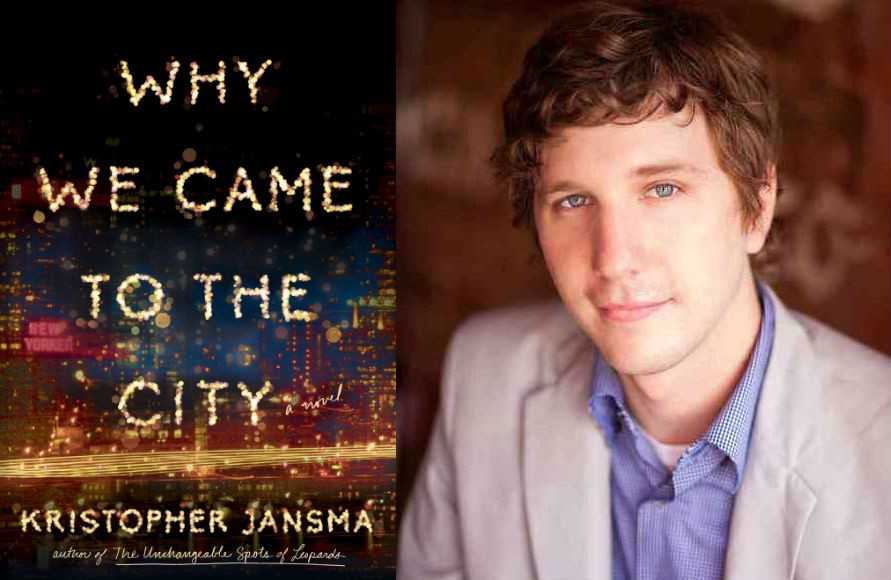
Nearly three years ago, I met Kristopher Jansma in this exact same Park Slope, Brooklyn coffee shop for this exact same reason: to talk about the release of a book. In March 2013, his debut novel, The Unchangeable Spots of Leopards, was about to hit shelves, and we gathered on a snowy day to talk about the trepidation of letting a first work out into the world. I’m going to spoil this story: Jansma survived the release of the novel, as well as the paperback cycle, to write a sophomore book, which hits shelves in February.
Why We Came To the City (Viking, 2016) is in part the story of five friends who’ve moved to New York, post-college in 2008, dealing with the curve balls that the great city throws at them, their lives ebbing and flowing at the boroughs’ whims. But it’s also part love (and, okay, breakup) letter to the city, rendering Jansma’s own relationship with its tumultuous streets, reminding us just how living and breathing an entity this machine really is — and what it takes to hack it here. That’s certainly something that the author has learned since moving here for an MFA at Columbia after graduating college in 2003, and then planting roots in Brooklyn with his family.
A lot has changed for Jansma in three years since we first met to talk Leopards (although the quality of the coffee here, sadly, hasn’t). That’s where we decided to pick up the conversation.
Meredith Turits: You’re physically in the same place as when we last met, but life-wise, you’re certainly not. What’s the biggest thing that’s changed?
Kristopher Jansma: Having a kid has just turned everything around. That’s shifted all of my priorities, including writing — trying to find ways of being an author and a writer when I’m not being a dad has been really challenging. I was thinking about going through [a book release] this time around and I think I have a better sense of what’s happening and what the stakes are, whereas the first time around you have no idea. So far, I’m not so panicky this time around, which is a good thing.
MT: You’re very active on Twitter. How has the transparency of Twitter and social media in general affected the way you interact with the contemporary fiction space?
KJ: It’s wonderful for talking to readers, and I find that’s something I can’t imagine would have been possible before. Ten years ago, you’d write your book and go to a reading, you might talk to a few people during a signing, and that’s it. And now I can have an ongoing conversation with a random guy who likes my book in the Lower East Side, an interesting person who I can now have a weird friendship with. But there’s the other side of it that can be sort of daunting where you’re seeing everybody else whose job it is to promote their own work or other people’s work complain and talk about how mad they are about this or that. It can be a little intimidating when you start to see how easy it is for certain people to get set off by something. You start to worry, Could that happen to me?
MT: My friend who is reading the book now had a great point where she said that the novel seemed to her more about a generation of people, and less about a specific group. It’s a concept that I loved.
There was always this tension around that that I wanted to capture, too. Everyone always has that one foot out the door.
KJ: I love that. That’s definitely something I wanted to talk about — not just these five characters, but what I’d seen going on with a whole generation or microgeneration. I came here with two friends of mine right after college in 2003, and those were the only two people I knew in New York for, like, two years. And then I watched what happened as we came up between 2003 and 2008. [My now-wife] Leah moved here in 2005, and we started meeting a lot of new people through her work friends in publishing who were very similar — young, hungry, willing to work long hours and put up with lots of crap. There was something so exciting about all of that, and I really wanted to write about that. And at the same time, there were always people who were leaving; people who I thought were wonderful who said, “Fuck it, I’m going to Texas!” or “Get me out of here, I’m going to move to Pittsburgh,” or some place cheaper. There was always this tension around that that I wanted to capture, too. Everyone always has that one foot out the door.
MT: Questioning the sustainability of the city.
KJ: Yeah. How can I make this work? The big thing I thought that changed was when the financial crisis hit. Before that had happened, I thought there had been this maybe naïve belief that everyone was going to just pay their dues and work super-hard and get promoted and rise up from editorial assistant to assistant editor to associate editor to editor to senior editor to running the imprint, and I remember having conversations with Leah’s friends like that where they’d be saying, “In ten years, we’ll be in charge of this whole place!” Then I think what happened was that the people who didn’t lose their jobs were there but they couldn’t go anywhere — they weren’t going to get a promotion. Nobody was going to move over to a different job, and their bosses weren’t retiring, leaving and making space for anyone else, and that totally changed the dynamic. And then more and more people did start leaving because they realized this isn’t going anywhere. So, I really wanted to capture what was happening here at that moment among people in their twenties.
MT: This group of people that you chose to represent, were they supposed to be archetypal?
KJ: The characters definitely weren’t archetype constructions at all. I’d started writing stories about these characters — Sara and George came first, and Irene was sort of in the background — and every once in a while I’d write about a different character who sort of felt like they felt in with these ones. Eventually, I had the people who were going to fit together the best. But I do think each of them shares qualities with people I’ve known over the years. Jacob is the loudmouth, super-confident kind of guy and George is sort of his counterbalance as someone who is very sweet but kind of meeker — I wanted to write about those things. Parts of each of them have drawn from people I’ve known.
MT: I think what’s interesting about them is we watch this relationship between how the city changes them, and how, at times, they change the city in a way. I’m curious about your own relationship to the city and how the city has changed you.
KJ: I think about it a lot. I grew up in New Jersey, about an hour and a half away from here, and I had no relationship with the city. I came on field trips to see Broadway show or something like that once in a while, but my family was not interested in New York at all. I never had any big dreams of living here even when I was growing up, and a lot of people I knew in my town and my high school would routinely go to New York on the weekends — clubs, bars — and I wasn’t cool enough to do any of that. I just had no interest in living in New York ever.
I went to Baltimore, to Hopkins, to study writing, and I got into Columbia for grad school, and that was my only option, so I went there and that was my introduction to living in New York. For the first few years, I really wasn’t a big fan. I never left my neighborhood. I more or less didn’t leave my apartment — I was always writing, and going to class and coming back and writing. On the weekends, I’d go to Baltimore to visit Leah, and that was my whole thing.
But then later once Leah moved here and I really committed to being here, I loved it, and it totally changed me. I started to realize going back that there was this confidence that I’d never had when I was in college — I always saw myself as part of a big group of friends, but never the leader, and my roommates were generally much more Jacob-like. More gregarious. And being in New York — and maybe living on my own anywhere would have done it to some degree — but there’s this ambition and power that kind of comes with that. I remember even charging up the street — I’d go up Broadway from 102nd to 116th and back, that was all I did most of the time — to go from my apartment to Columbia, and realizing at a certain point that I was bustling through these people, dodging around all the slow people on the sidewalk and I thought, Wow, I’m absorbing this energy from the city. Now I’m at the point where I can’t imagine living anywhere else. It’s gotten into my soul. It’s a pretty awesome place to be living. The city gives you a lot back, I think.
MT: What makes someone able to hack it here?
There’s a sort of stubbornness or insanity…that makes you keep on driving at something despite every message to the contrary.
KJ: I don’t know — that’s a good question. There’s a sort of stubbornness or insanity like we were talking about before that makes you keep on driving at something despite every message to the contrary. You have to be willing to put up with a lot of downsides: small apartments, noisy neighbors, those things. I think some people can see that and find it a way to make them tougher and enjoy the rest of it. Others are just not as interested in that. I’ve had friends who’ve been here who’ve left within a year or two years, who couldn’t wait to get out to the suburbs and have a yard and a fireplace or whatever. We’re now at the point where we’re finally starting to talk about that, and neither of us can imagine that.
I never felt like I was [that kind of person] — even in undergrad, I wanted to write a book someday, but I never really had that sense of I’m going to able to do this. It wasn’t until I got here that I could. Which is weird — coming here and seeing how many people there are who are trying to do it should scare you off a bit, but somehow, I thought, I can do this, too!
MT: Did you feel as you were writing that you had any kind of responsibility of how to render the city? And did you worry about your own biases sneaking in?
KJ: Definitely. One thing I worried about was in the beginning, I had plans for this giant, maximalist epic that would get to every corner of the city. I wanted to show the Fulton Fish Market and the Bronx and Staten Island, and have parts of it everywhere, and then I realized at some point that there’s a reason you can’t really do that. I mean, you can write a 900-page novel about the city, and others have very recently, but you can’t try to get your hands around all of it. It really would have to be a book that would show it from a million different angles because there are so many different New Yorks that exist overlapping all the time.
I realized what I can do is write about the New York I know. I can write about what it’s like to be a twentysomething young professional person bohemian-whatever, and I can write about that part of New York. Once it started to focus in that direction, I started hoping it would echo with anyone coming here from any neck of the woods.
MT: And to that point, very few people actually have that holistic experience of New York. New York is too overwhelming, and you have to carve your niche out.
KJ: I remember somebody telling me before I moved here that there were so many neighborhoods and so many people live in a neighborhood and never really leave it. That was basically my experience when I lived in Morningside Heights. There’d be times when I would have to go somewhere else — I’d have a birthday party and have to go to SoHo, or something — and I’d go on the subway and have no idea where I was or how it connected to anything. Even six or seven years later, I’d be walking and think, Oh, this is where that happened! They’d be all of these isolated pockets where, at the time, I had no idea how they happened.
And that was just Manhattan. I didn’t move to Brooklyn until 2010 or 11 — maybe after that. I knew nothing about Brooklyn, and just stayed in Manhattan all the time, and even when I started working on this book, there were all of these snarky, Manhattanite ‘we don’t like Brooklyn jabs’ in there that I ended up taking out because now I live here and I really like it. But it was mostly just because I had no idea where anything was — I’d come over to Park Slope to meet a friend or something and think, Well, none of the streets are numbered so I have no idea how to get anywhere. There are rare people who really do live in the whole city, but many of us just know a part of it. And that’s a lot — even one part of Brooklyn is bigger than a lot of other cities.
MT: What’s your thought on the phenomenon of the “Brooklyn book” right now?
KJ: That’s a good question. I remember when Leopards came out, we had just moved to Brooklyn and I was trying to keep it under wraps. I didn’t want them to put “he lives in Brooklyn” on the back of it, and I remember during interviews, I’d say, “Don’t say I live in Brooklyn.” But now I’m definitely a Brooklyn writer. I hardly go to Manhattan anymore.
It’s the same thing as with Manhattan, though — there are a hundred different Brooklyns. There’s sort of the Park Slope to Fort Greene zone we’re in. I have a friend who lives in Williamsburg, and I feel completely alienated from what’s going on with him. We go up there every once in a while and say, “Wow, this place has really changed since two months ago!” I think there are so many of us living here — it still really is such a wonderful place to live as a writer.
MT: Did you at any point worry or wonder about your reader who was not based in New York and what his or her experience would be with the book?
It can be a great place to be with all of your friends, but it can also be a very lonely place to be when that part of your life has started to change.
KJ: I wanted it to be something that would appeal to someone in other cities — that’s a lot of the reason why certain parts of the book like the prologue and the in-between part have certain details that are specific to New York, but I wanted to make sure that they had a tone that could fit other cities, as well. I wanted to have enough of that in there that it would maybe appeal to people who’d left the city, or younger people who are thinking about moving to the city one day and were dreaming about it. I’ve had interesting conversations with people who’ve read the book who used to live in the city but left because they didn’t like it, and I think it’s pretty interesting in that sense, too — if you become a city-hater, if you read the book, you wonder, What’s wrong with these kids that they like it here so much? I think the book ultimately turns on them as they stay there longer, and some of them end up leaving. It can be a great place to be with all of your friends, but it can also be a very lonely place to be when that part of your life has started to change.
MT: Do you think that if college Kris had picked up this book before deciding whether to move to the city he still would have come?
KJ: Yeah, I think so. I do. I think college Kris would have been encouraged by that because I remember thinking at the time that I’d lived in Baltimore, and that’s a city and not necessarily a super-easy one sometimes, and that I’m used to dealing with city stuff and getting around with public transportation and not getting mugged and stuff like that. Then I moved to New York, and realized, wait, this isn’t a daily reality. I think it would have been encouraging. I would have felt like there was a road map, at least, of how to get the most out of it.
MT: So, what’s next?
KJ: I’m working on something new. I can’t say a whole lot about it yet, but like this and like Leopards, it’s also growing out of some stories I’ve been writing. I’ve been writing a lot more trying to figure out family and my son, and I’ve been trying to figure out how to incorporate that into what I’m writing because as sad as I am about it, I’m not living this city life anymore — I’m not going out with my friends and having fun at a bar very often. We had to meet at 9:30 at night after Josh went to bed — this is a big night for me! I’m trying to figure out how to write about that a bit more, so the next thing will be about family, and about one thing that I’ve been thinking about as we’ve started a new generation, which is how much the things in my life already affect him in his life in ways that I wouldn’t have thought. Then, thinking back, how much of my parents’ stuff when they were my age was affecting the way I grew up and the way I saw things.
MT: And I have to ask: Is it going to be set in New York?
KJ: No. If it goes the way I think it will, most of it will be set it New Jersey, which is where I grew up. I’m thinking about trying to write about that again. Although, now as a New Yorker, I don’t ever want to live in New Jersey again. I’ll live anywhere else, but there’s a certain pride I have over escaping New Jersey.
Who did Furo see but a white person striding towards him as he passed through the glass doors of The Palms. A longhaired woman with a large mole on her chin, she wore a lavender summer dress and green oversized Crocs. In both hands she grasped the big yellow bags that boasted of lowest prices. Faced with this test, this face-to-face with a white person, Furo realized he was unprepared for the encounter. He was worried how they would see him. Could they tell by sight that there was something wrong with him? If they could, then why, how, what was it they saw that black people couldn’t? Thinking these thoughts, Furo halted in front of the glass doors, his attention fixed on the woman. She drew close, her gaze flicked over his face, and then she was past, her Crocs clopping and ShopRite bags rustling.
The woman’s lack of reaction to his presence proved nothing, Furo told himself, but he feared that before long he would find out the truth, because in the crowded passage ahead of him were several oyibo people, some Indian- and Lebanese-looking, some Chinese, walking alone or in small groups, laughing, chatting, gesturing at the bright lights in storefront windows: all of them as indifferent to their difference as he wasn’t to his. Then he thought he had stood too long in the same spot, that people must be staring at him and wondering, and he looked around but caught no eyes, they seemed to ignore him in the midst of plenty. Buoyed by this glimmer of a chance at a normal life — one where he wouldn’t always be the cobra in this charmless show of reality, the center of attention — he started forwards into the chill of the mall.
Furo’s fear came to nothing, as none of the oyibo who looked at him gave the impression that he was something he shouldn’t be. The few glances he attracted came from his own people, and even they seemed more interested in his dusty shoes, his wrinkled trousers, his sweat-grimed shirt, his cheap plastic folder, all the signs showing he wasn’t kosher in the money department. That was a look he was used to from before, and so it didn’t worry him. Better the scorn he knew than the admiration he didn’t. But above all, better the people who ignored him than the ones who didn’t. Moving through the crowd, he began to feel more at ease with the approach of non-blacks. There was no uncertainty about their reaction to sighting him. They would see him and maintain stride, see him and keep on talking, see him and show no surprise, every single time.
He arrived at the food court to find it brimming with voices. After-work hours on weekdays were busy periods for The Palms, as commuters killed time there — eating dinner, watching movies, browsing the shops — in a bid to wait out the worst of the traffic. Looking around for somewhere to sit, he saw that most of the tables were occupied by whispering couples or chattering groups of office colleagues, but near the center of the dining area stood a table with three empty chairs, the fourth taken by a man reading a book. Weaving a path through the jumble of conversations, Furo approached the silent table, and the man raised his head. His dreadlocked hair was neck-length, and his beard stubble was sprinkled with grey, as was the hair on his chest, which showed through the v-neck of his t-shirt. Despite the greying, he was about Furo’s age.
“Hello,” Furo said. “Can I share this table with you?”
“Please,” the man replied, and waited until Furo sat before returning to his book.
After placing his folder on the table, Furo raised both hands to massage his neck, at the same time throwing a look of resentment at all the happy people seated about him. He envied them. Unlike him, they all had homes to return to. He knew that the food court and all the shops in the mall would be closed by ten, and the mall would be emptied of people and locked up after the cinema upstairs finished its last showing around midnight. And then where would he go? He couldn’t risk illness, not when he had no money, and spending another night in an abandoned building full of mosquitoes seemed to beg for malaria. But what choice did he have today, tomorrow, the day after, until he began work at Haba! in a couple of weeks? In an effort to get away from these insoluble worries, Furo returned his gaze to the table, and narrowed his eyes at the book across from him. Fela: This Bitch of a Life — the words on the front cover. The man’s short-nailed hands gripped the book cover, pinning it open. Head cocked to one side, eyelids lowered, face expressionless, his lips moved silently as he read.
This bitch of a life indeed, Furo thought. There he was, living his life, and then this shit happened to him. He had always thought that white people had it easier, in this country anyway, where it seemed that everyone treated them as special, but after everything that he had gone through since yesterday, he wasn’t so sure any more. Everything conspired to make him stand out. This whiteness that separated him from everyone he knew. His nose smarting from the sun. His hands covered with reddened spots, as if mosquito bites were something serious. People pointing at him, staring all the time, shouting “oyibo” at every corner.
And yet his whiteness had landed him a job.
Furo blew out his cheeks in a sigh. Dropping his hands to grasp the table, he pulled in his chair. The metal legs screaked on the floor tiles. At this sound his tablemate looked up, and Furo, seizing the chance, said to him, “Sorry to bother you, but can you please tell me the time?” The man nodded yes, put down the book, reached into his trouser pocket, and pulled out a phone. He said, “It’s almost five thirty,” to which Furo responded, “Thanks.” As the man returned the phone to his pocket, Furo said, “Funny how time drags.”
“When you’re bored,” the man said. He smiled and added: “And when you’re waiting.”
Furo forced a laugh. “Also when you’re in trouble.”
“That too,” the man agreed. He waited a beat. “Do you mind saying what the trouble is?”
“Ah… no,” Furo said. “It’s not something I can talk about. But thanks for asking.”
The man leaned forwards in his chair and crossed his hands over his book. “But we can talk if you want. To pass the time.” He tapped the book. “That’s one good thing about books. You can always pick up from where you left off.”
“I have to confess I’m not a big fan of books myself,” Furo said. He thought a moment, and then chuckled. “I shouldn’t say that in public. I just got a job selling books.”
“What sort of books?”
With a glance at the man’s shock of hair, Furo said: “Probably not your type. Business books, that’s what the company sells.”
“What’s the company’s name?” As Furo hesitated, the man said, “I ask because I used to work for a publishing house. I might know your company.”
Furo nodded. “Haba!”
“Excuse me?” The man’s puzzled expression deepened as Furo raised his hand, but when he drew a line in the air with his forefinger and jabbed a hole under it, saying at the same time, “Haba with an exclamation mark, that’s the company’s name,” the man’s face brightened with comprehension. Furo finished drily: “I can see I’ll have trouble telling that name to people.”
The man snorted in laughter. “Yah, they’ll be surprised hearing haba from your mouth. Which is a good thing for a bookseller, I suppose. It will leave an impression.” After a pause, he said, “I haven’t heard of that company.”
They relapsed into silence. The air in the food court was thick with aromas from the quick service restaurants, and Furo felt his stomach stirring in response. He’d eaten a large meal barely two hours ago, and his belly was still tight with undigested starch, yet the smell of food, the sound and sight of others eating, tensed him with craving. He was grateful for the distraction when his companion said, “I haven’t introduced myself,” and held out his hand. “I’m Igoni.”
Furo’s brow puckered as they shook hands, and he repeated: “Igoni?”
Igoni nodded yes.
“Tobra?” Furo said.
Igoni’s eyes widened with surprise. “Ibim. You speak Kalabari?”
“Not really. I can understand a few words. My father’s from Abonnema, Briggs compound. I’m Furo Wariboko.”
“Imagine that,” Igoni said. His eyes sparkled at Furo. When he smiled, his parted lips revealed a flash of thumb-sucker’s teeth. “You must have one hell of a story.”
Furo wanted to ask what Igoni meant, but he thought better of the impulse. He had a sneaking feeling he’d already revealed too much. And so he remained silent as Igoni closed his book, then took up his laptop bag, stuffed the book into it and, rising from his chair, said, “I’m going to the cafe round the corner for a smoke. Can I buy you coffee or something?” Surprised by Igoni’s offer, Furo responded, “I’d like that.” He stood up quickly, picked up his folder, and followed Igoni into the stream of shoppers in the mall’s passageway.
As the first Nigerian mall of indubitably international standard, the unveiling of The Palms was a milestone event not only for the Lagos rich, but also for yuppie teenagers, music video directors, and politicians eager to showcase the investment paradise that was newly democratic Nigeria. At the time of the ribbon-cutting in 2006, Furo was at university in faraway Ekpoma, and so he had to make do with his sister’s recounting of the mall’s abundant pleasures over the telephone. Two warehouse-sized supermarkets, one fancy bookstore, many fast food restaurants, bric-a-brac shops, branded boutiques and jewelry outlets, a sports bar, a bowling-alley-cum-nightclub, a multiplex cinema, and scores of ATMs: any means by which to part the dazzled from their money, The Palms provided. And yet in all these years since he returned to Lagos, despite countless visits to the mall to watch the latest from Hollywood and spend his weekends with girlfriends he wanted to impress, Furo had never entered the mall’s sole cafe.
Approaching the glass facade of the cafe, Furo saw that a majority of the tables were occupied by oyibos. That was the reason he’d never set foot in the place: he assumed that any hangout that drew so many expats was too exclusive for someone unemployed. Which Igoni, going by appearances, was not. They had reached the entrance, and a private guard in visored cap and paramilitary uniform jumped up from his folding chair and eased the door open, then stamped his boot in greeting. Heads turned to watch them enter, and then turned back to pick up their conversations. The interior was lighted by shaded lamps pouring down soft yellow beams, and the floor tiles shone, the metal tables gleamed. From the walls hung flatscreen TVs showing news channels with the sound turned down. One half of the cafe was announced as non-smoking by wedge-shaped signs on the tables, and the other section was overhung by a haze, this fed by trails of smoke from all the hands clutching glowing cigarettes, smoldering cigarillos, sputtering cigars, and, here and there, hookah pipes. Igoni headed for the smoking section, Furo followed, and they settled into a red loveseat backed against the far wall.
The prices were as Furo imagined. Too high for him, now especially, when every naira he spent felt like spurting blood. He read the menu with mounting indignation until a waitress arrived for their orders. “Cappuccino, please,” Igoni said, and when Furo felt his hairs bristle at her attention, he chose, “Chocolate milkshake,” then closed the menu, set it down on the table, and stole a glance at his host. The embarrassment he felt at the price tag of his order, the cost of six full meals in a roadside buka, was nowhere apparent in Igoni’s face. In that instant Furo felt the bump of an idea falling into place, and the tingle that announced it a good one.
The waitress collected the menus and left before Furo spoke. “If you don’t mind my asking,” he said to Igoni, “what do you do for a living?”
“I don’t mind,” Igoni said. “I’m a writer.”
“Of books?”
Igoni nodded yes, and reaching into his pocket, he drew out a Benson & Hedges packet. Furo waited till the cigarette was lit. “What kind of books do you write?”
“Not business books,” Igoni said with a quick sly grin, and then leaned back in the loveseat, crossed his legs, and blew out smoke. “Fiction, short stories, that sort of thing.”
“I see,” Furo muttered in distraction, as his attention was diverted by a passing angel, the sudden dip in the hum of conversation. The café door had opened to let in a woman alone. Long seconds ticked while she stood in front of the entrance, her head turning with imperial slowness as she searched through faces. Then she struck for the smoking section. She wore yellow high heels, carried a bright yellow handbag, and the balloon-skirt of her black gown, which bounced at each stride she took, showed off her long legs. To Furo it seemed every eye in the cafe was fixed on her, but she relished the attention, her eyes twinkled with awareness of it, and on her lips played a smile that grew bolder the closer she came. After she slipped into the loveseat beside Furo’s table, the chatter in the cafe picked up again.
The waitress arrived bearing a tray, and after setting down Furo and Igoni’s drinks, she crossed over to the newcomer. Furo glanced around at the first sound of the woman’s voice, but it was her prettiness that kept him looking. He noticed the waitress closing her notebook, his cue to look away before he was caught staring, but he waited till the last moment, the tensing of the woman’s temple as she realized she was being watched, to swing his eyes away from her face to the TV above her head, which showed a crowd of Arabs chanting and waving placards written in English. His neck soon tired of straining upwards to no purpose, and abandoning this ruse, he turned forwards in his seat and reached for his drink.
The first sip of the chocolate milkshake heightened Furo’s hunger. The second cloyed his tongue with sweetness. The third gave him gooseflesh. Each time he sucked on the straw he took care to hold the liquid in his cheeks, to swill it round his mouth, and only when his cheeks were stretched tight and his gullet throbbed from the effort of remaining closed, did he gulp down the drink. It left its sweetness in his mouth and spread its coolness through his skin, and this, added to the coziness of the cafe, lulled him into a state approaching contentment. Until he glanced to the side, caught the stare of the woman, and felt a flush melting away the pleasure from his face. He dipped his head and sucked furiously on the straw.
Igoni finished his cigarette in silence and picked up his cappuccino. As he drank, Furo watched him openly. Igoni seemed friendly enough, he also appeared to have some money, and he was Kalabari, almost family without the drawbacks. Furo decided it was now time to ask the favour of Igoni that he’d intended since he realized that fate was finally dealing him a good hand. And so he said Igoni’s name, and when Igoni looked at him, he spoke in a halting voice:
“I know it’s a bit odd, but I want to ask you a favor.”
“Go ahead,” Igoni said.
“I need a place to stay in Lagos. Only for a short time, about two weeks. I’m hoping, if it’s possible, if it’s not too much trouble, that I can stay with you.”
“Oh,” Igoni said in a surprised tone. “That’s a big one.”
Furo jumped into the opening. “I know,” he said, “but I don’t have anyone else to ask.”
Igoni leaned forwards, rested his elbows on his knees, and cracked his knuckles. He stared at the ground between his feet until he raised his head. “I’ll be honest,” he said, his eyes seeking out Furo’s, and then swinging away as he continued in a voice shaded with regret. “Any other time I would be happy to have you over, but I’m in the middle of some writing, so I really can’t, not now.”
Furo’s voice was hoarse as he said, “I understand.” Igoni was about to speak again when his phone rang. After mumbling a few words, he hung up the call, and then reached for his wallet. “I have to rush off,” he said as he flipped it open. “The person I was waiting for has arrived.” He pulled out four crisp five hundreds and placed the notes by his saucer. “That will cover the bill.” Rising to his feet, he slung his laptop bag over his shoulder. “It was nice meeting you, Furo. Bye now.”
Furo watched Igoni until he disappeared into the milling throng outside the cafe’s glass front. Returning his gaze to the table, he noted that Igoni hadn’t finished his drink. He picked up the cup, and after swirling around the leftover cappuccino, he drank it down. As he clacked the cup on the saucer, the money caught his eye. Maybe he should have asked Igoni for money instead, he thought, and then heaved a coffee-scented sigh.
Furo Wariboko persisted in my thoughts after I left him at the mall, and so I did what everyone does these days: I Googled him. The search results pointed me to either Facebook or Twitter, and since I was no longer on Facebook (I deleted my account after I started receiving homophobic messages over my personal essay on wanting to be a girl), I followed the Twitter links. Now is the time to admit this: from the first moment I saw Furo I suspected I’d found a story, but it was when I heard him speak that I finally knew. A white man with a strong Nigerian accent, stranded in Lagos without a place to stay, without any friends to turn to, and with a job as a bookseller for a company so small I hadn’t heard of it? Even if I hadn’t met the hero myself, hadn’t gleaned the details directly from the source, and even if I had plucked the whole fiction out of the air, there was no way in hell the writer in me was going to miss the rat smell of the story. What I didn’t know though was the scale of the story. For that discovery I have Twitter to thank. It was there that I found out about the Furo who had gone missing in Lagos one day before I met my Furo. And it was from the tweeted photos of that lost Furo that I realized my own Furo used to be black.
Furo’s story didn’t emerge abracadabra-quick. It took me some time to weave the fragments I gathered from Twitter into any sort of narrative. (The thing with Twitter is: to get what you want from it, you first have to give it what it wants. As with most social networking platforms, the currency on Twitter is the users who sign up and the content they generate. Every currency holds value for someone somewhere, whether that value is based on gold or the stock market or, in the case of Twitter, popularity; that blanket word, which, for the pinpoint purpose of metaphor, I will now proceed to formularize as P = U x C x T. Extrapolating this to Twitter, popularity equals “500 million users” multiplied by “content generated by users” multiplied by “time spent on Twitter by users.” Yes, time–the terminus of all rigmaroles.) And so I, @_igoni, spent bundles of time on Twitter. Hours spent lurking on the timelines of virtual strangers. Hours spent snooping through megabytes of diarrheic data. But my investment paid off, I got what I wanted, I found @pweetychic_tk, whom I realized was Furo’s sister as I read this tweet of hers:
Pls help RT. This is my missing bro Furo Wariboko in the pic. He left home Monday morn & no news of him since. pic.twitter.com/0J9xt5WaW
I followed her on Twitter, of course, and going through her timeline hour after hour and day by day, reading her tweets for hidden meanings in her abbreviations and punctuation choices, and searching for mood flaggers like what news stories she retweeted and favorited, and monitoring her movements from the geotagging of her shared photos and videos, I began to get some insight into a part of Furo’s story that cannot be told better than by the family he left behind.
@pweetychic_tk: Wednesday, 20 June
09:08 | Hello Twitter! #myfirstTweet
09:10 | Pls help RT. This is my missing bro Furo Wariboko in the pic. He left home Monday morn & no news of him since. pic.twitter.com/0J9xt5WaW
09:26 | RT ‘@RubyOsa: My cousin @pweetychic_tk has just joined Twitter. #Follow her. Her big bro got lost in Eko 2 days ago!’ Thanks Ruby.
10:14 | @RubyOsa Furo is also on Twitter. His handle is @efyouaruoh
10:31 | Thanks! RT “@lazyeyedben: Hello @pweetychic_tk. I dig your pic. I’m now #ffing.”
11:01 | I’m fed up with this ASUU strike. 2 whole months without school!
14:37 | I’m hungry.
14:59 | Without @efyouaruoh the house is lonely. Mum & Dad are looking for him. I’m getting afraid. Maybe something has really happened.
16:35 | I’m starting a hashtag for my missing bro. See the attached picture for details. #Furo needs us! (RT if you have a heart.) twitpic.com/bz7htc
17:52 | RT “@RICHnaijakids: Lord in heaven, you’ve been good to me. Finally found the Air Retro 7s Bordeaux http://tmblr.co/ZX-9nta1U9bm”
17:55 | @RICHnaijakids Enjoy your riches oh. But we KNOW your fathers. #corruptleaders
18:58 | Today is K’s birthday. I should call him. I should be the bigger person. But I won’t.
19:41 | Mum & Dad just got back from the police. They’ve still not heard anything about Furo.
19:59 | I ask Mummy a simple YES or NO question & she gives me a 20-minute speech!
20:02 | How can the police at Akowonjo Station tell Dad to pay them to go and find Furo???
20:05 | I’m just tired of everything.
22:47 | Going to bed. Goodnight everyone.
From early on I distrusted the persona of @pweetychic_tk. I didn’t know why at first, as she seemed sincere enough in her tweets about herself, and so I put my skepticism down to my own suspicious nature. (Just to press home that point about my suspicious nature, here’s my first tweet upon opening my account: To make money off selling us to ourselves for free, that’s the business model of social media. Given the tone of this tweet, I’ll understand if netizens find it hard to believe when in future I declare that actually I don’t disapprove of social media. But I don’t and can’t and won’t. For one thing, I’m too much aware that my disapproval wouldn’t matter a Facebook poke to the billions who have adopted Facebook and Twitter as if they were new-age versions of Christianity and Islam. And then again, as @_igoni, how can I, in honesty, oppose the very medium responsible for my existence? My efforts would be better served in renouncing Jehovah from the pulpit of a Kingdom Hall. Jesus wept and the hashtag exists, that’s gospel, so I’ll move on to the real crux: my distrust of digital personas.) I was wrong to think that my skepticism was unfounded, as the more I learnt about Furo’s story, the more certain I became that his sister’s persona had to be either contrived or schizophrenic. For here was a young lady whose full-blood brother had just gone missing, and there she was on Twitter collecting followers and trading jokes? If her digital persona was not misleading, then her real one had to be full of shit.
@pweetychic_tk: Thursday, 21 June
03:36 | I think I’m starting to understand this Twitter thing oh…
09:11 | Morning Twitterfam! See the sunny weather we’re enjoying in Eko!
09:30 | Phone app lets women rate men like restaurants http://hfpv.to/629Nv via @HuffPoVidz
09:31 | If that app had come out b4 it might have saved me from my rubbish ex! (See last tweet.)
09:37 | Did anyone watch yesterday’s episode of Who Wants to Be a Millionaire?
10:16 | Not a single retweet or mention since morning! #bored
10:20 | The biggest #COCK I’ve ever seen belongs to the aboki who has a kiosk near my hostel!
10:21 | FOOL => RT “@RUDEbwoyDeji: This #Unilag okpeke @pweetychic_tk has just fessed up that she likes aboki cock ha ha ha!”
10:23 | @RUDEbwoyDeji Silence is the best answer for a FOOL.
12:36 | WOOHOO! 104 new followers! #COCK tweets rule!
12:47 | Some people are sending me angry DMs oh. #COCK
12:50 | Confession time! #COCK
12:51 | For all you tweeps who RTed my #COCK tweet, I meant CHICKEN! The aboki keeps a big fat chicken as a pet. #gotcha #LWKMD
13:47 | Hmm. Follows have stopped since #COCK became CHICKEN. #justsaying
13:50 | O se! ? RT “@lazyeyedben: #ff @pweetychic_tk, one of the realest chics on Twitter.”
15:27 | LOL RT “@drbigox: NEPA promo = Pay your bills regularly and win a generator.”
16:01 | I miss @efyouaruoh. Where are you? Mum & Dad went to the newspapers today. This is not funny any more oh. #Furo
16:06 | I’m sad :‘( @efyouaruoh won’t reply to his mentions
& FB messages. Or is he lost 4 real?
21:54 | See me see wahala! This ugly FOOL @RudebwoyDeji is still looking 4 my trouble!
22:19 | Some people on Twitter are stupid sha. They think they can just say anything. But that’s easy to fix. @RudebwoyDeji, you’re BLOCKED.
22:43 | Too much animosity on Twirrer tonight mehn . . .get a life you haters. #goodbye
While searching for Furo’s story, I, too, underwent a transformation. I was more relieved than surprised by this happenstance. The seeds had always been there, embedded in the parched earth of my subconscious. I had heard their muted rattling in the remembered moments of my sleeping life; I had seen their shadowy branches overhanging the narrow road that wound into my future. As is usual with Damascus journeys, I only understood the portents after my conversion. (One such portent–or, rather, evidence of my subliminal preoccupation — can be recognized in this quote from an interview I granted a magazine a few months earlier: No human being has ever directly seen their own face. It’s impossible within nature — the most you can do is glimpse your nose and, for those with full lips, the curve of your upper lip. And so we only see ourselves through external sources, whether as images in mirrors, pixels on the screen, or words on the page, words of love from a mother, words of hate from an ex-lover.) Long before Furo’s story became my own, I was already trying to say what I see now, that we are all constructed narratives.
@pweetychic_tk: Friday, 22 June
09:45 | This thing is getting real. It’s now 4 whole days since my big bro #Furo got lost. See his missing ad in today’s (cont) http://tl.gd/ktdfkbt
09:53 | I’m still disgusted at how the Christian Taliban twisted my #COCK tweet yesterday. It was just a joke — GET IT? #hypocrites
09:54 | 4 all the #hypocrites who attacked me, I now have 1856 followers! Eat your hearts out!
10:32 | WHAT have I done to this one AGAIN??? => @Nu9jaYoots
10:41 | @Nu9jaYoots Who dash you #YOOT Leader? You can’t even bloody spell! #mschew
10:52 | By their tweets we shall know them, Twitter #YOOT Leaders. With achieve-nothings like YOU no wonder PDP has a 68 y/o grandpa as Youth Leader!
10:55 | Why am I even wasting my time? For my new followers, abeg see my next hashtag.
11:43 | RT “@Lurv_Facts: Women are biologically attracted to a-holes because their traits resemble those needed for survival in the wild.”
11:44 | Retweets are NOT endorsements!
11:49 | I just lost 3 followers. WTF. Why can’t I get to 2000???
14:49 | For those who haven’t seen this yet, here’s my big brother’s missing advert in today’s newspaper: twitpic.com/yjs75Np #Furo
17:30 | God I LOVE this picture! twitpic.com/bzR76on via @JimmyChooLtd
17:31 | I’ll gladly endure the pain of wearing a tight pair of shoes… if it looks good LOL.
20:03 | I’m not pregnant. That’s a relief.
20:40 | _|_ (-.-) _|_ to @emem_1987 & @anpasticru
20:42 | Twitter is beginning to piss me off sha!
20:44 | Some RATS don’t know when to choke on their evil thoughts @emem_1987 @anpasticru
20:45 | I came here to look for my missing bro. Every other thing is dirt off my shoulder.
20:49 | This! RT “@lazyeyedben: I’m digging your style @pweetychic_tk. Don’t mind the olofofos.”
20:49 | THANKS @lazyeyedben! You’re such a cool dude!
21:04 | Co-sign => RT “@Rihanna: The one person you can’t run from is YOU!!!”
21:05 | I ♥ @Rihanna! #justsaying
21:15 | Mum & Dad have returned. Mum is crying again. My life is so not fun right now.
21:41 | OMG!!! Mummy wants to go to the mortuary 2moro to look for Furo!!!
22:17 | 2moro is officially the worst day of my life. #goodnight
My handle is @_igoni and I was born into the Twitter stream in January 2009. Apart from tweeting links to my online publications as well as other articles I’d enjoyed reading, I didn’t have much to do in my short existence. Until, that is, I found @pweetychic_tk and, through her, @efyouaruoh. Furo’s Twitter page displayed as its profile photo an image of sunglasses-wearing Neo from The Matrix, and the profile name was “FW,” while the bio read, “Lagos-based job hunter,” and so, if not for his sister’s tweets, @efyouaruoh would have remained a cipher for ever vanished into the dead-end alleys of the Web, just another one of hundreds of millions of unverified Twitter handles with a meager following and a preference for the pseudonymous; and, to boot, a digital persona whose final breath was drawn at 00:13 on 18 June. “Nepa bring light abeg,” he tweeted, and then nothing ever again. Silence, on Twitter, is as good as death, and if life hadn’t intervened to bring us together on the day after his final tweet, I might never have found myself scrolling through the timelines of the dead, searching for the POVs of the real person in the ghosts of their digital personas.
@pweetychic_tk: Saturday, 23 June
11:15 | This is NOT a good morning. Dad is driving us to the #mortuary in Ikeja. We’re going to search for #Furo there!
12:21 | I just knew the place would be UGLY twitpic.com/bzT67oM #mortuary
12:27 | It STINKS inside!!!! twitpic.com/c4KnnIP #mortuary
12:33 | RT “@Nneka_Or: omg can this be Lagos?? RT @pweetychic_tk: It STINKS inside!!!! twitpic.com/c4KnnIP #mortuary”
14:26 | @PrinceofmoJo Stop tweeting those links at me you PERVERT!!!
14:27 | Apologies 2 my followers 4 the error, but please don’t RT or click on @PrinceofmoJo #mortuary links. They’re porn.
14:44 | RT “@asiwajuayo: Yay! @pweetychic_tk is the reason! RT @TrendsLagos: “mortuary” is now trending in #Lagos: http://trendsmap.com/ng/lagos”
15:12 | Thanks ALL!!! My phone battery’s about to die, I have to go now. #mortuary
23:17 | OMG!!!!!! @DONJAZZY retweeted me!!!
When I’d learned enough about Furo’s story to be sure I was committed to following it to the end, I tweeted @pweetychic_tk. In remarkable time she had become a Twitter celeb, gathering seven times as many followers in a week as I had in four years, so I wasn’t certain she would respond to a Twitter lightweight like me. (Question: How did she get so many followers so fast? Answer: Check out the first page of the Google search for ‘get Twitter followers fast’. In other words, she did the work.) With this in mind — “this” being my dread of getting rebuffed in public — I pondered on the approach most likely to succeed, at the same time studying her timeline for any clues that might help with my decision, which I indeed reached upon seeing a serendipitous tweet of hers. From meeting her brother I knew about our shared ethnicity, and so, to indicate to her that we had a connection deeper than Twitter esprit de corps, I greeted her in Kalabari before offering to buy her ice cream. Calculation always trumps sincerity on social media. Yet I must admit that when she not only replied my tweet but also accepted my offer, I was buffaloed.
*It didn’t matter to me if I liked Tekena, but for the sake of what I wanted, I needed her to like me. And so, when I met her on that overcast Sunday afternoon, the first thing I said was, “You’re pretty.” Even as I intended to win her over with flattery, I was surprised by my reflux of pleasure, the rush of gratefulness at her acknowledgement of my appearance when she responded, “You’re pretty too.” Sunlight and water to a blossoming flower, likewise our sense of well-being is both nourished by the shine of other’s eyes and the gurgle of our self-regard. Who I was as a person was more than what I looked like, but then again, how people saw me was a part of who I was.
I soon found myself liking Tekena more than her brother, whose name I didn’t mention until she and I were eating ice cream at The Palms. You see, Furo had come across as a bit of a user. I know now that he was desperate, that on the day we met he was facing a predicament and had needed whatever help he could get, but something about his request to move in with me, the ease with which he asked such a thing of a stranger, had struck the wrong chord with me. His sister could be accused of taking advantage of a private mishap to build her popularity on social media, and in person I found her as chatty as I’d expected, and maybe too trusting of strangers bearing gifts, but at no point did she strike me as manipulative. Not in person, not towards me.
Thus I liked her. She was after all a recognizable Nigerian type, not much different from me in background and social standing. We were both members of that caste of young adults who grew up in the ruins of Nigeria’s middle class. We were born into the military dictatorships of the ’80s and ’90s; we attended the cheaper private schools or the better public ones; we read the same Pacesetter novels and watched the same NTA shows; we lived in cities. Unlike the majority of Nigerians in any age bracket, we spoke English as a first (and sometimes only) language, and our inbred accents were two to three generations old. Because of our parents, who were educated and devoted and fortunate enough to hold on to their salaried positions through all those decades of martial austerity; our private dictators, who beat their children with the same whips they used on the poorer relatives they took in as house helpers; our role models, who were so convinced of “what was what” that they affirmed a preference for butter over margarine even when they could only afford Blue Band for our school lunchboxes; our protectors and providers, who were neither middle class nor working class, neither wealthy enough to jet overseas on vacation nor deprived enough to cease the Christmastime pilgrimages to our family hometowns; our lifelong teachers, who instilled in us their deep-seated humiliation over the failures of Nigeria as well as their bitter nostalgia for the administrative competence of colonial rule. That was it: in Tekena’s voice and gestures, in many things about her, I saw the same contradictions that had shaped me. Shame and arrogance. Pragmatism and sentimentality. Thoughtless violence and unthinking sacrifice. Red blusher and black skin…
The thing is, on seeing Tekena my thoughts flew to my mother. She, too, wore red blusher in my childhood memories. My sentiments about my father are less conflicted: he left when I was eight. My mother stayed to be condemned to failure in raising her son. Because the success of a man, our people say, is the father’s doing. You are your father’s son — you follow in your father’s footsteps. Manhood and its machismo are attributed to the seed, which then follows that the failure to make a man is the egg’s burden. Your papa born you well, they will sing to a man in praise, but when he disappoints so-and-so’s expectations of XY manliness, it becomes Nah your mama I blame. My say is this: when you live in a worldwide bullring, bullshit is what you’ll get. If they say I cannot be my mother’s son, then it must be that I’m her daughter.
After we sat down in the food court of The Palms to eat our ice cream, I began asking Tekena about her brother. I lapped up all the details she gave of his disappearance, which it turned out weren’t much, not enough to slake my thirst. She had awoken on that Monday morning to find he had left the house for the job interview he’d only mentioned to her when he was ironing his clothes the previous night, and since neither she nor her father had thought there was anything odd about his long absence, he wasn’t missed until her mother returned from the office and asked after him. That was when Tekena went into his bedroom and found his mobile phone. And the rest, as she said, was a disaster. From Tekena’s tweets I already knew that she and her parents had no inkling of the change that had happened to Furo, hence I made no mention of my meeting with him. As I uttered suitable noises of sympathy in response to her recounting of the grief his disappearance had wrought upon the household, I couldn’t help asking myself, what if Furo had remained behind after he found himself transformed? This was the question I wanted answered, and one I would have to find out for myself.
Books — physical books, the kind with paper pages bound between ornamental covers — are flying off the shelves, according to new figures released by the U.S. Census Bureau. The 2015 numbers are in, and brick-and-mortar bookstores are reporting sales of $11.17 billion for the year. That’s a 2.5% increase over 2014, a whopping jump of $280 million. That’s roundabout 15 million copies of The Girl on the Train! (Is the entire increase attributable to Paula Hawkins? Could be. Kinda seems like it, doesn’t it?)
This is the first reported increase in bookstore sales since 2007, when there was still a Borders in every mall, Harry Potter was king, and the world financial market hadn’t yet been brought to its knees.
And just in case you think the Census Bureau must be mixing up books and e-books, think again. Publishers Weekly reports that the new numbers confirm “the sales trend of books for the year, which showed print sales on the rise and e-book sales on the decline.” A quick look at the Barnes & Noble holiday sales reports tells the same story, even for stores offering digital and physical books side-by-side. Factor in the recent rumors that Amazon could be opening hundreds of new brick-and-mortar bookstores, and you might be forgiven for thinking we’re in the early days of a bona fide boom.
Will we ever get back to the 2007 glory days, when bookstores were going gangbusters, to the tune of $17 billion a year? Who knows? That doesn’t mean you shouldn’t head down to your local indie shop tonight and buy another copy of The Girl on the Train, and maybe even a hardcover from a debut novelist. After all, we all have a part to play. Uncle Sam wants you. That’s what the U.S. Census Bureau seems to think, anyway.
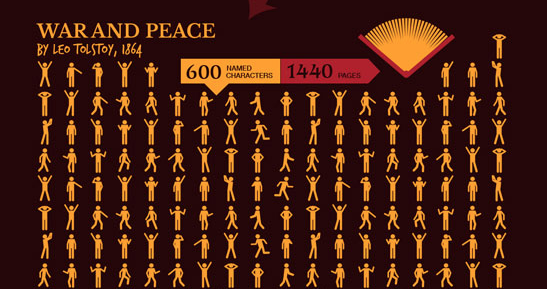
Ever read a book with so many characters you can’t even remember who anyone is? You aren’t alone! This infographic from Lovereading.co.uk takes a look at 15 books so overloaded with characters you need a second book just to keep track of them:
Some of the most impassioned conversation in the literary world has been devoted to highlighting what it lacks: voices of people of color, of gays and lesbians, of those marginalized or oppressed or simply ignored. Look a little closer, however, and you’ll notice this conversation focuses on race and gender while paying less attention to a demographic category that’s arguably just as determinative: class. When calls are made for greater diversity in publishing, the economic backgrounds of authors or editors rarely get mentioned.
Recently, several writers have been trying to thread the topic of class into the ongoing discussion of representation and opportunity in the literary sphere. Lorraine Berry and Andrea Bennett, writing for Literary Hub and Hazlitt, respectively, offered accounts of how lower-class experiences tend to generate less interest from editors and reviewers. Berry writes:
But very little has been explicitly articulated about the exclusion of the great American underclass, that perpetually poor group on the bottom tier of society that includes all races/genders/creeds. And as we winnow out opportunities for art about poverty, we lose so much potential for change.
In TheNew Republic, Phoebe Maltz Bovy took an idiosyncratic approach to the issue raised by Berry and Bennett, speculating on why, exactly, readers of all sorts may not feel compelled to give their attention to the experiences of the lower classes. Bovy refers to reading fiction as “aspirational,” meaning readers pick up novels or short stories (but mostly novels, if we’re being frank) to imagine themselves as better or at least more interesting than they are in their everyday lives. And when it comes to writing about the working class, that’s where things get rough:
It seems to me that socioeconomic class is a tougher sort of diversity to bring to writing. Unlike the other varieties, it’s at odds with what readers are used to and what they’re likely to want — namely wealthier, more glamorous, or just less drudgery-having versions of themselves.
It seems to me that socioeconomic class is a tougher sort of diversity to bring to writing.
As a diagnosis of current literary tastes, this is, I think, more or less accurate. But the thing about tastes is they change. There was a period, not too long ago, where writing about decidedly un-wealthy characters going about their vehemently non-glamorous lives commanded the attention of both critics and readers. By looking at that period and its literature, perhaps we can gain a better perspective on our own.
***
Beginning in the mid-70s and continuing through the 80s, a loose group of writers, variously known as “dirty realists” or “literary minimalists” or, my personal favorite, “Kmart realists,” produced a sizable literature of lower-middle-class and working-class life. Raymond Carver remains the best known writer from this era, but at the time, there were several writers whose reputations were nearly equal to his, including Tobias Wolff, Jayne Anne Phillips and Bobbie Ann Mason. They mostly wrote stories, publishing them first in The New Yorker and other magazines, then gathering them into collections that landed on the front page of the New York Times Book Review. Retrospectively, it was the last time the short story could compete with the novel terms of critical and, perhaps more to the point, commercial attention. In an essay from the late 80s, David Foster Wallace surveyed the state of short fiction, finding it abundant and even lucrative:
The workshop phenomenon has been justly credited with the recent “renaissance of the American short story,” a renaissance heralded in the late seventies with the emergence of writers like the late Raymond Carver (taught at Syracuse), Jayne Anne Phillips (M.F.A. from Iowa), and the late Breece Pancake. More small magazines devoted to short literary fiction exist today than ever before, most of them sponsored by programs or edited and staffed by recent M.F.A.s. Short story collections, even by relative unknowns, are now halfway viable economically, and publishers have moved briskly to accommodate trend.
Short story collections? Halfway viable economically? Truly the 80s were a literary utopia!
As a form, the short story collection is currently regarded as a kind of stepping stone, a way for young authors to clear their throats or midcareer authors to clear their hard drives. Of course there are exceptions, writers for whom the short story is the feature presentation — Lorrie Moore, say, or Kelly Link. But when Carver and others were at work, the short story collection had a sense of cohesion not unlike that of the album in popular music, to mention another form that’s seen better days. Why was the short story so central to the dirty realists? Carver once claimed that, in between working as a gas-station attendant and taking his two kids to the laundromat, writing short stories was all he had time for. Logistics aside, the short story soon became synonymous with depicting lower-class experience much the way that love is the preferred subject for the sonnet or the power ballad, and for critics, if not the dirty realists themselves, this constituted a turning away from the encyclopedic aims of the novel.
Logistics aside, the short story soon became synonymous with depicting lower-class experience much the way that love is the preferred subject for the sonnet or the power ballad…
The most succinct summation of dirty realism came not from a writer but an editor, and a British one at that. Bill Buford edited the highly regarded journal Granta for years, and in 1983 he devoted an entire issue to this new strain in American writing. Buford was the one who coined the term “dirty realism,” by the way; part of the movement’s appeal was that it lacked the braggadocio to call itself one, much less choose a name. Buford praised the realists for, among other things, doing away with the postmodern pyrotechnics of Pynchon and John Barth, honing their focus to stories and characters who wouldn’t recognize pretension if it came into the diner where they were pulling a late shift and ordered coffee. Buford wrote:
These are strange stories, unadorned, unfurnished, low-rent tragedies about people who watch day-time television, read cheap romances or listen to country-and-western music. They are waitresses in roadside cafes, cashiers in supermarkets, construction workers, secretaries and underemployed cowboys. They play bingo, eat cheeseburgers, hunt deer and stay in cheap hotels. They drink a lot and are often in trouble: for stealing a car, breaking a window, pickpocketing a wallet. They are from Kentucky or Alabama or Oregon, but mainly, they could just about be from anywhere: drifters in a world cluttered with junk food and the oppressive details of modern consumerism.
To use a contemporary term, the dirty realists were authentic. During a decade so greedy and fake it anointed Alex P. Keaton the voice of youthful rebellion, these quiet, uninflected stories about people lacking cultural sophistication seemed like an ideal antidote. Not quite a threat, however; the process of deindustrialization that began in the early 70s and was capped by Reagan’s deregulation of labor unions ensured this largely rural, largely white working class would never coalesce into a political constituency. Indeed, part of the appeal of dirty realism was how it let readers appreciate the authenticity of the lower classes without being asked to change it.
Dirty realism stayed prestigious and reasonably popular for about a dozen years, at which point maximalists like Tom Wolfe began voicing their displeasure with work of such modesty and calm. Not a bad run, as far as literary movements go. But it begs the question of why such work flourished then, and doesn’t now. We’ve had Kmart realism; why not Walmart realism?
Here’s where I make a sweeping generalization. During the dirty realist era, what made one “authentic” was lacking things. Those who didn’t have cable, who didn’t live in the suburbs, who didn’t have bachelor’s degrees, they were truly authentic, getting by on junk food and gas station coffee like monks living on bread crusts. Today, we become authentic by possessing things: the most organic, most fairly traded coffee, the craft beer brewed locally and served only in a single bar between the Fourth of July and Labor Day, the phone so smart it has achieved sentience and comes packaged with a certificate of authenticity like a piece of the true cross. Those without the means to purchase such talismans are inauthentic and bland, pumped full of toxins by the soulless food they consume like the subjects of a corporate research project.
Today, we become authentic by possessing things: the most organic, most fairly traded coffee, the craft beer brewed locally and served only in a single bar between the Fourth of July and Labor Day, the phone so smart it has achieved sentience and comes packaged with a certificate of authenticity like a piece of the true cross.
This is not to say there weren’t issues with the ways dirty realism was received at the time. Plenty of readers romanticized the stories of that era, finding a kind of savage nobility in the exploits of the underclass. I know when I first read those stories, I found all those janitors and addicts unimpeachably real, in touch with a truth I couldn’t access from my dorm room. But given the choice, I’ll take romanticization over demonization, for that is surely how the underclass is seen nowadays. Those poor people, with their guns and their religion and their inadequately progressive opinions, they’ll never make proper subjects for literature.
The contemporary writers who choose to depict the underclass tackle this sense of revulsion, often making it their subject. Take Lindsay Hunter, whose recent novel Ugly Girls is a gauntlet thrown at the feet of readers who’d prefer a little glamour and wealth. The titular characters are Perry and Baby Girl, high school students in name only, as they spend most of their time stealing cars, taking them for aimless rides, then ditching them in Walmart parking lots. The circumstances would fit right into a story by Carver or Phillips — Perry even lives in a trailer park — but the tone is entirely different. With the dirty realists, there was often a sense of settling, of coming to terms with one’s disappointments or failures or general insignificance. Perry and Baby Girl do no such thing. Getting left behind by the world has made them feral, craving stimulation and lashing out at those who get in their way. The story finds them evading a sex offender who insinuates himself into their lives through text messages, Facebook posts and cons played upon their families. (The swipe at Facebook is especially great, the pinnacle of Silicon Valley’s gee-whiz utopianism made into nothing other than a means of manipulation for white trash perverts.) Violence eventually boils over, splattering guilt on all concerned parties, the criminal and the disenfranchised taking revenge upon one another.
Hunter’s novel struck me as more than just a good story well-told. It seemed prophetic. As the rich get richer and the poor get cancer, Perry and Baby Girl seem less like cultural outliers and more like intimations of what’s to come. More and more population groups look to be slipping into various tiers of the underclass, artists and writers most certainly included. (Full disclosure: I’m writing this in a Walmart, killing time while my car’s oil gets changed.) Reading about the experiences of the underclass is more than a way of expanding one’s sense of sympathy. It’s a way of preparing for the future, fortifying oneself against coming storms.
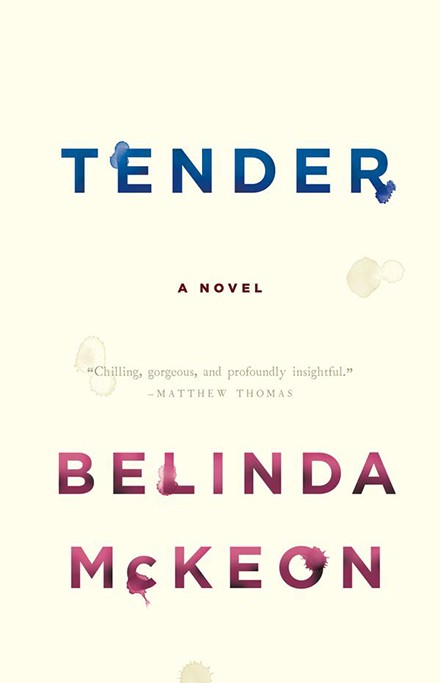
Belinda McKeon is an Irish novelist, short story writer and playwright who hails from the Irish midlands but has been based in Brooklyn for the past ten years. Her first novel, Solace, which The Irish Times called “at once a moving and gracefully etched story of human loss and interconnection set in contemporary Ireland and a deeply affecting meditation on being in the world,” won the Geoffrey Faber Memorial Prize in 2011. Her new novel, Tender (Lee Bourdeaux Books, 2016), hailed by The Guardian as “richly nuanced and utterly absorbing,” tells the story of shy college freshman Catherine and flamboyant photographer-in-training James, two nineteen-year-old rural exiles in Dublin as they navigate the increasingly intense nature of their co-dependent relationship. It’s a beautiful, claustrophobic evocation of friendship, longing, and the obsessive power of first love. I sat down with McKeon earlier this month in the Bowery’s Swift Hibernian Lounge to discuss autobiographical fiction, the nature of obsession and Ireland’s archaic constitutional ban on abortion.
Dan Sheehan:You’ve said that this novel is “autobiographical at its core” — which I’m sure prompts a lot of wearying questions I’ll try not to ask here; but I’m curious to know how, a decade or so on from your own personal experience of it, you approached the process of tapping into the incredible intensity of feeling that often accompanies a young person’s first foray into the adult world?
Belinda McKeon: Well I did have, and do have, diaries from that time. I was a really obsessive journal-keeper. I wrote long, detailed entries during those teens-to-early-twenties years, so I did have those to refer to, but I didn’t actually read them until I was about a quarter of the way into the writing of the novel and when I did, they were actually less useful than I thought they’d be. They were too real somehow. So the real work of tapping into that intensity and into what that time felt like came in the writing, the same type of writing that any piece of fiction requires: becoming completely immersed in the world as it’s being created. The more I wrote the more I started to feel myself getting back in touch with what it felt like to be that age. So that was how I did it, but that said, as I’m talking I’m remembering that there was probably about a year of really serious false starts with that material, where I was trying to write in the first person, and then trying out a perspective that was maybe twenty years into the future looking back on the time — all sorts of ways of attempting to inhabit the material. For what felt like a long, painful, disastrous time none of it was working and I don’t think I felt like I was connecting with that period at all. But when I look back at it now, a few years on, I think I actually was connecting with what it felt like to be in that period, but it was all so cringe-inducing and so uncomfortable that my impulse was to resist it and to believe that it just wasn’t working.
DS: Were you tempted then, at those points, to abandon the project or was it always something that you knew you had to power through?
BMcK: No, I was quite stubborn about it. I wanted to get it right but that proved so hard to do that there was a lot of anxiety and a fair bit of panic wrapped up in the process.
DS: The four sections that comprise this book are quite stylistically different, each one corresponding to Catherine’s state of mind at the time. Why did you decide to structure the novel this way?
Your unconscious knows what it’s doing but the rest of you is just sort of panicking and flailing.
BMcK: Well it was a conscious decision, but it didn’t come about until quite late on in the process of writing the book. Part One is the very naïve, “innocence” section whereas Part Two is more “experience” — they’ve spent a year apart, she’s grown away from him, it’s sort of the campus novel section of the book. Those are the two sections that I worked on for a long time at the beginning and it was only when they were drafted that I realized the third section, which is the more fragmented section, needed to have an entirely different rhythm. From there it became clear that Section Two also needed to have a more markedly different rhythm to Section One. I guess what I’m saying is that it was intuitive. I remember that the shape of Section Three showed itself to me at a time when, for some reason, I was reading a lot of poetry and not reading any fiction. I suppose that may have been my unconscious driving me toward the rhythm of poetry rather than prose for that section. In a way the momentum of each section was designed to reflect Catherine’s mental state, but I didn’t sit down initially with that intention. The writing process uncovers different layers of intention. Your unconscious knows what it’s doing but the rest of you is just sort of panicking and flailing.
DS:You depict the nature of longing and obsession so brilliantly in this novel, to the point where Catherine’s behaviour becomes both completely inexcusable and uncomfortably understandable to the reader. Did the extremity of her descent surprise you in the writing or did you know from the novel’s inception that James and Catherine’s relationship would eventually enter this dark place?
BMcK: I knew she was going to go to a dark place and I knew that it had to be really uncomfortable, so in that sense it didn’t surprise me. The earlier draft of the novel, which my publisher saw, depicted her climactic point in a different way and it wasn’t working. Her deception, her betrayal of James, was of a different type and that was something I was very unsure about. Then, after a couple of people read it and responded to it I knew that it had to change, so it took me a while to find the particular manifestation of her distress that was right for the story. But I knew that she had to go to that place, absolutely. This novel is, to a certain extent, in my own experience, and the experience did bring me to really difficult places, especially for someone of that age. Really dark and spiraling places.
DS: So that even if the events or the people weren’t strictly autobiographical, you knew that there was a feeling you were trying to capture, and to not go all-in on that would do the novel a disservice?
BMcK: Absolutely. I suppose the correct way to think about it is in terms of it being a feeling, but when a person goes through that kind of distress and enters into that kind of isolation and paranoia — it’s a state of mental and emotional plummeting really — it’s not just a feeling. It’s a feeling that has feelings; it’s so multi-layered. It’s a deep anxiety spiral that produces more and more of itself. It’s very good at producing more and more delusions and fears and convictions. So Catherine is caught in this loop of panic and distress, and the writing just had to go there.
DS: Your two novels have very different approaches to dialogue. In Solace, the emotional distance between father and son is such that their attempts to really talk to one another are continually frustrated; things are constantly left unsaid. In Tender, however, the vibrant, performative nature of Catherine and James’s conversations end up being, in their own way, just as effective in frustrating the release of what is unutterable between them.
BMcK: It is true I suppose that the too-muchness of their conversation can’t bring them release or full expression either, and that’s probably because those things are almost impossible between people anyway. Especially when you’re portraying a character who is nineteen or twenty and just experiencing love and deep connection with another person for the first time. Not to make this sound like a romantic comedy, but Catherine really believes that James is going to make her life complete. She really believes that she has found the person who will be able to give utterance to all the things that she hasn’t been able to utter for herself and about herself and about experience. And of course he can’t, nobody can, and that’s one of the aspects of heartbreak that everybody has to experience. That realisation that another person cannot bridge the gap that is just an inevitable part of being human. So it makes sense then that even though they are so voluble — that nothing goes unsaid, to an extreme, uncomfortable extent — even though that is the case, the last word is never said, the lost thing can never be recovered.
DS: And I suppose that trait isn’t necessarily the preserve of nineteen and twenty year old college students either. We’re talking about something so intense that for a person of any age it would be almost impossible to manage.
There are aspects of a tradition that you can kind of imbibe, and sometimes you need to push against that.
BMcK: Well when I was that age I truly believed it was possible to find that kind of expression, that kind of utterance. As you go through that experience for the first time you begin to grow away from that expectation of a full kind of speech, of a full connection. That kind of cathartic experience, you realize, isn’t possible. I guess what I’m saying is that, as you get older, you just stop asking so much of other people. But it is true that the types of dialogue between the two novels are very different. Solace is very much a novel of the unsaid and I very consciously wanted to move away from that, which was a real technical challenge for me because I’d grown up on that tradition of Irish literature, where the unsaid is so much more powerful than the spoken. Where a glance or an intimation can say so much. That mode came very naturally to me while I was writing Solace, almost too naturally, and I think I realized that, with Tender, I wanted to do something different. There are aspects of a tradition that you can kind of imbibe, and sometimes you need to push against that.
DS: So this novel became a stylistic challenge as well as an emotional one?
BMcK: Yes, it absolutely was. It was uncomfortable stylistically as well as emotionally and those two aspects of the novel writing process were probably very wrapped up together: the stylistic challenge and the challenge to the ego. I think that when you’re writing the beautiful, restrained prose the ego is quite protected, the ego of the writer that is, but with this kind of work, where everything is vomited out on the page, you’re exposing yourself a lot more and that can be quite embarrassing and cringe-inducing. There’s always the temptation to make your characters seem much more suave than they are because you hope that will translate into the perception of you as an author, but if you have an nineteen year old character who is very naïve, very wide-eyed, you have to be true to what that wide-eyedness consists of. I wasn’t going to turn her into a hipster, basically. It might have been more flattering to me in some contexts but it just wouldn’t have been true. I think that was another reason why the novel took a little longer than I thought it was going to take. I was doing daily battle with my own mortified ego [laughs], but oh well.
DS:“My own mortified ego,” I like that.
BMcK: “My so-called ego.”
DS:You have another writing career, outside of novels and short fiction, as a playwright. How much do you think your work in playwriting has informed your approach to fiction writing?
BMcK: I really consider myself a beginning playwright. I think it’s the other way around, that the fiction informs the playwriting, but dialogue is the common ground and that’s where my instinct for writing plays comes from. My inner ear provides me with dialogue quite naturally so that’s where the plays come from but I think I still have a lot to learn about structure and shape when it comes to playwriting. I really do regard myself as someone still starting out .
DS: But you are under commission at The Abbey Theatre [Ireland’s national theatre] at the moment. Can you reveal anything about the play you’re working on or is it under wraps for the time being?
BMcK: Well it’s under wraps only because I’m still writing it. I’ve been under commission for years actually. I wrote one play and we workshopped it and I decided to leave it aside for a while. The problem then was that it dated quite badly. It was a kind of post-Celtic Tiger play and I really felt, when I looked back on it, that it wasn’t going to endure as an idea. So the replacement play is about two women, about a journalist and a politician, and something that they have on each other. It’s about a much younger woman whom they have in common. I can’t say much more about it because not much more exists. A commission is an interesting thing because it’s not a guarantee of production, it’s a process in itself: you write the play, hopefully you go through the following steps with the theatre and eventually, if all works out, there’ll be a production. That process can be both frustrating and protective for a playwright. I found it to be a bit of both.
DS: I’ve talked to writers who love the newfound collaborative aspects of working in theatre or in, say, a writers room for TV, and others who bristle against the whole idea of it, who prefer to work in isolation. Do you have a preference?
I think it’s just safer to be the asshole in charge, and that’s what a novelist is.
BMcK: Well I think it depends. I have really enjoyed it, and at other times I have hated it. It depends on the people involved. We’re back to the idea of ego. It you find yourself in a room with great people, smart people, open people, creative people, it can be a wonderful experience. I’m not precious about the words on the page. I was a journalist as well so you learn to give up your words if they’re not working, or at least for that to be negotiable. But if you’re in a room with an asshole, forget it. It really is awful because there’s no way out. I’ve had that experience and it was enough to turn me off playwriting for years. I just thought, “fuck this, I’m going back into my room.” It’s a real shame because the whole fabric of a piece can be destroyed by one asshole who happens to be in charge. I think it’s just safer to be the asshole in charge, and that’s what a novelist is.
DS: So if I title this interview “The Asshole in Charge”…
BMcK: Please do.
DS: You recently edited a collection of short stories by a group of international writers [A Kind of Compass: Stories on Distance] about the nature of distance from home. How has distance from Ireland, the years spent living here in New York, affected how you write about it in your fiction? Do you find that you need a certain period of distance from a particular time in your life before you can write about it?
There’s just a very intense community of conversation going on in that country all the time and even though I love it I don’t seem to be able to marry it with a steady writing life.
BMcK: This is kind of the fundamental question for me because I’ve been here for ten years now and both of my novels were written during that time, so I have no idea what it would be like to be a writer in Ireland. Even though I go there a lot, I still have a very close and regular connection with the country, I still write about Ireland almost all the time, my writing life, such as it has managed to come into existence, happened because I moved away. Although, while I did make a conscious decision to emigrate, it wasn’t a “I hate you Ireland, I need to write!” type of decision. It just so happened that I only got my head together, in the way that I hoped or wanted to, in terms of a routine, in terms of being productive, once I left. I don’t know whether that was a coincidence or whether it was necessary. Definitely having a distance from Ireland has helped me to set stories and novels there. I think that if I was living there, and I can only speculate, I’d be over-stimulated and would probably become a bit blocked because of that. Even just from listening to people. I talked about my ear for dialogue, that I think it’s quite sharp, and so often when I’m visiting Ireland, which I did this weekend and which I do very regularly, I find that you hear things that you want to use all the time. And it’s wonderful, but if it was like that 365 days a year, I’m pretty sure I wouldn’t be able to write at all. There’s just a very intense community of conversation going on in that country all the time and even though I love it I don’t seem to be able to marry it with a steady writing life. It’s strange.
The theme of this collection is distance and I conceived of it not as geographical but as psychic or emotional distance. As an emigrant, that becomes part of your daily identity: you left. You left and you’re not there anymore. Ten years, fifteen years, I don’t think that feeling goes away. It’s not that it gets more intense, but it takes on different shades. Every time I’m back on the plane to JFK there’s a different version of head-wrecking going on. My husband and I, we’re both Irish, we came here together and we have a good number of Irish friends but we don’t really have an Irish community here, we didn’t seek that out. So whenever we accidentally happen to be in the company of other Irish people, it’s just like taking drugs [laughs], we’re just over-fucking-whelmed, you know? We go insane. So you have to modulate that.
DS:You and your husband have been curating the Irish Arts Center PoetryFest for the last few years. Can you tell us a little about that?
BMcK: We’re both poetry lovers, even though neither of us writes poetry. I used to run a poetry festival in Ireland called Poetry Now, and that was an international festival which was great because, frankly, it was very well funded and we had the means to bring in poets from all over the world. Aengus, my husband, was essentially my co-curator on that as well, although not officially, and when we moved we just decided to do something similar over here. So for the last seven years we’ve being curating PoetryNow, which started out as an Irish festival — the idea was to showcase some of the superb Irish poets who didn’t have name recognition here in the US but who we felt deserved to. Then, as the years passed and the festival grew, we wanted to turn it into a sort of meeting of Irish and American voices. Ultimately I would like to see it grow into an international festival that still has Irish poetry at its core, because that’s really what any literary field is now, it’s global.
DS: Throughout Tender, despite coming out in the wake of Ireland’s decriminalisation of homosexuality, James is plagued by the very real concern that, outside of few-and-far-between liberal sanctuaries like Trinity College, there isn’t a safe place for him in Irish society. With the recent passing of the Marriage Equality Act, and the overwhelmingly positive response by voters, especially of the younger generation, to the referendum which led to it, do you feel like the battle for gay rights in Ireland has finally been won? Do you think the issue of gay equality is one which we no longer have to be ashamed of neglecting in Ireland?
BMcK: I think it was a great day, May 23rd was an amazing day. But the campaign had to be fought and I do think that that was something that should not have had to happen. Our fellow citizens should never have had to come up to those of us who are straight and say “Hey, can we get married?” That shouldn’t have happened. But I also think that the campaign, in order for it to have the strongest possible chance of succeeding, had to be a very “good mannered” campaign. There was certain amount of sanitization. The nuanced and complex experience of being gay in Ireland almost had to be simplified, to be presented in a way that was unproblematic so as not to arouse the poor anxieties of the rest of the community.
DS: Desexualizing a segment of the population in a way that you would never ask of the heterosexual majority.
BMcK: Yes, this kind of “oh, aren’t they lovely” attitude which is just as patronizing and as problematic as any other form of prejudice. Unfortunately that seemed to be necessary, and of course the end result was a terrific one. But I think, and I’m not an expert and I’m not a part of the gay community, that no, the battle, such as it is, goes on. I support BelongTo, which is an organization in Ireland that advocates for and gives emotional support to young LGBT people, and I get regular circulars from them in which it’s pretty obvious that their work is ongoing on so many different levels. Of course the fact that marriage equality now exists is a massive step forward, but the year of campaigning and of media scrutiny leading up to that result was really traumatic for a lot of LGBT people, especially young people in Ireland. Hearing their lives being debated like that. There is still bullying, there’s still problems in schools and in the prison sector, prejudice still exists. It hasn’t gone away. The work goes on for those campaigners.
DS: As it does for those campaigning for the repeal of the 8th Amendment [which in 1983 introduced a constitutional ban on abortion], another major issue in Irish society which you have been vocal in your support of.
…this is a redline issue: the fact that it is not safe to be a pregnant woman in Ireland, because if anything happens, your fetus has more rights than you do.
BMcK: Well we’re talking now in early February and there’s going to be a general election in Ireland at the end of the month. So canvassing has started, politicians are knocking on people’s doors to ask for their votes, and this is a redline issue: the fact that it is not safe to be a pregnant woman in Ireland, because if anything happens, your fetus has more rights than you do. It’s something that I feel really passionately about for various reasons, some of them personal, but one of the things I find most distressing is that the government has not even moved to protect women who have to terminate their pregnancies in England for medical reasons. So you have Irish women going to England to terminate pregnancies that are not viable, for medical reasons, and, if they want to bury the remains themselves (which many parents want to do), having to smuggle them back to Ireland in their cars or have their ashes DHL’d back weeks later. The stories are just desperately sad. Those of us supporting the repeal of the 8th Amendment want it repealed in all circumstances, but that the government will not even move to repeal it in this extreme circumstance, it disgusts me. I hope that people will bring it up on their doorsteps. If there were to be a referendum I think that it would be a very dirty campaign, but I do believe that the majority of people would vote for the amendment to be repealed.
DS: Do you think public opinion has swung to that point?
BMcK: I do. We have to remember that no woman of child-bearing age in Ireland has had an opportunity to vote on this issue in a referendum. It has been that long since it has been possible to vote in a referendum on what women are allowed to do with their own bodies. It’s a very neat, controlling maneuver that has been maintained by successive cowardly governments who don’t want to be the ones to step up to the plate and say, “ok, we’re doing this.” It was interesting to see how Enda Kenny, the current Taoiseach [Prime Minister] of Ireland, who has been in that position for a few years, made a public appearance in a gay bar six months before the marriage equality referendum took place. They made the decision that it was politically profitable to be openly pro marriage equality, that it was good for the image of Ireland. But it seems to me that they have also made the decision that it is not useful to them to project an image of an Ireland where women have a choice. I think the fact that, until last year, only straight couples could get married was damaging to the morale of the country. When you oppress one segment of the community, the rest of the community is also dragged down because of it. In the same way, in a country in which women’s rights are not respected, the rest of the county is dragged down because of that too. It’s just shocking that young girls in Ireland are growing up in a country that does not view them as equal citizens. It comes down to that.
Belinda will be in conversation with Joseph O’Neill on Tuesday, February 16, at the Irish Arts Center and with Kate Zambreno on Monday, February 22, at Bookcourt in Brooklyn.
Sign up for our newsletter to get submission announcements and stay on top of our best work.
YOUR INBOX IS LIT
Enjoy strange, diverting work from The Commuter on Mondays, absorbing fiction from Recommended Reading on Wednesdays, and a roundup of our best work of the week on Fridays. Personalize your subscription preferences here.