The world lost one of its greatest cultural figures today, as legendary musician David Bowie passed away at age 69. He died after a battle with cancer. Bowie was known as a forward-thinking chameleon musician who was always changing, innovating, and creating new sounds and styles. Even in his late 60s, Bowie was producing new music. His last album, Blackstar, was released only days before his death.
Bowie was also, not surprisingly, an avid reader and many of his albums were influenced by books. When Vanity Fair asked him “What is your idea of perfect happiness?” he responded simply “reading.”
In 2013, Bowie posted his 100 favorite books on his public Facebook page. The list is a characteristically eclectic list featuring everyone from Junot Diaz and George Orwell to Angela Carter and Muriel Spark.
RIP Bowie. The world was a better place for having you in it.
We’ve asked some of our favorite international authors to write about literary communities and cultures around the globe. We’re bringing you their essays in a regular Electric Literature series: The Writing Life Around the World. This month’s installment is by A. Igoni Barrett, author of Love Is Power, or Something Like That. His debut novel, Blackass, will be released by Graywolf in March.
One day eleven years ago I swallowed fear, stuck my neck into the noose of fate and swore I would swim or drown. I was 25 years old and had never held a job, never strayed far from my mother’s protection, never stopped depending on her for feeding money, pocket money, any money. Yet I ignored her entreaties to endure my final year in university, and after gathering up my beloved books and 2Pac CDs, I jumped into unknown waters to make my way as a writer.
Every revolution ends the instant it begins. Mine ended up in Lagos. It began as a son’s rebellion against his mother’s devotion, and today, with three books to my name, I see what I’ve achieved in all these years of revolt is to refocus my gaze on the actual bully, that stomping boot in which I’ve lived like a foot for thirty-six years. My country, Nigeria.
Before the day I left my mother’s house forever, I had lived happily enough in the rustic city of Ibadan, where I was studying agriculture at Nigeria’s oldest university. Two prominent figures of modern literature, Chinua Achebe and Wole Soyinka, had studied there along with many other Nigerian thinkers. Thus I assumed the university’s illustrious alumni were evidence of a grand tradition. At the time of my matriculation, in 1997, I had begun scribbling scraps of stories in secret, and even though I didn’t yet dare to call myself a writer I was already doing what every nascent artist does, seeking a tradition to either align with or rage against.
I found nothing there for me. No friends with similar tastes in books. No literary journals by either students or faculty. No public book readings I ever heard of. No freedom to explore the shelves of the outdated library. No writing workshops, reading clubs, or tattooed barwomen with nicknames like Head Woolf with whom I might have debated my oblivious penchant for male writers. One thing there was plenty of was angry young people in secret fraternities and student unions, but these coteries were focused on bloodletting and partying and politicking rather than literature. After seven years in that wasteland — my studies were meant to last five, but for the incessant academic strikes and school shutdowns — the only knowledge I gained about writing was that mine was not a transitory phase.
All my life I had read alone; no one had exchanged books with me or recommended writers to me.
Before 2003 — the year I attended a book reading for the first time, which was organized in Ibadan by the local chapter of ANA, the Association of Nigerian Authors — I had no idea there was any such thing as a writing community in Nigeria. All my life I had read alone; no one had exchanged books with me or recommended writers to me. I was appointed library prefect in my final year of secondary school, but that public school, like all the others, had no library worth the name. For many years I only read whatever I found at home: my mother’s romance and detective and cowboy novels, and the motley books my absent father had left behind. Even the few books I borrowed from friends’ houses (and sometimes stole, like E.R. Braithwaite’s To Sir, With Love — sorry, Remi) usually belonged to their parents.
Thus many of my favorite books were serendipitous sightings in used books stalls, the only places I could afford on my pocket money. My early years in Ibadan are still some of my fondest memories mainly because of the British Council library, a Borgesian labyrinth to my awestruck eyes, which became a veritable garden of forking paths for a teenager who had grown accustomed to never having enough books. It was a catastrophic day when the library shut down a few weeks after I chanced upon and was transported by Tolstoy’s War and Peace.
In search of a new home after abandoning my mother’s, I went to the Niger Delta, finally settling in Imiringi, a farming village about three hours’ drive from my birthplace. My peripatetic father had perched there for some months in an apartment that was paid up for a year, and I eased happily into his fully furnished, book-stocked, vacated space. I was 16 when I had moved with my family to Ibadan from Port Harcourt, the city in the Niger Delta where I was born and where my milk teeth are buried. Ibadan was where I began seeking myself through writing, but it was in Port Harcourt I first lost myself in books.
While my pigs grew fat in sleep and my catfish chased the moon across the pond’s surface, while my yams did their secret growing at night, I would write for myself until I found an audience.
The question of home resolved, all I needed was a plan. I settled quickly on one: to farm and write. I would sow the earth by day and reap the imagination at night. I would feed myself by the work of my hands, employing the knowledge I had acquired at university. While my pigs grew fat in sleep and my catfish chased the moon across the pond’s surface, while my yams did their secret growing at night, I would write for myself until I found an audience. I was young, healthy, unafraid of hard work, and responsible to no one but myself. Unlike my mother, I had no offspring to provide for, nor plans for a spouse, though a lover would be welcome, but then again, ever since I realized in my adolescence that God was a fictional character in a rambling tendentious book, I had been just fine with jerking off.
Back in 2001, my mother was the first person to ask me why did I write. My response was mumbled gibberish because I had no answer ready, though I could also hear in her tone that nothing I said would placate her. These days, whenever I’m asked that question, I do my utmost to give a different answer every time. I write because I can, because you read, because we die, because I must. I was 11 when I first experienced the must-write feeling, though it lasted only as long as it took me to realize my poems were childish. About two years later, in 1993, I got the itch again, and spent three straight days writing a play whose main characters, blond hair and all, were Nigerian-accented aliens from a Georgette Heyer universe. After that second failure, I decided to become an aeronautical engineer. Anything was easier than writing. And for anyone who has read enough to recognize how bad their writing is, nothing is harder than writing. Except not writing. Thus I wasted many years suppressing the urge to write, until, one day, just like that, I left my mother’s house to become a farmer.
About my plan in Imiringi: I knew farming was no sweat, it was writing that would require effort. Growing food from the soil and raising animals for slaughter would be a task easily done, but finding words for the images in my mind, oh boy, that was backbreaking labor.
I was both right and wrong. Farming, too, was hard. Not the farm work itself, which I never got to do. Because I never found the money to lease farmland, never got the loan I had applied to the state government for. I spent almost two years dreaming of pigs and catfish and yams, my farming spiel growing wilder the surer I became of failure. I discovered the true value of money, which can only be known when you have none. I grew my hair into locks, rather than pay barbers, and ate everything that anyone offered, including iguana (fishy-tasting), porcupine (gamy), some astringent fruit whose name I never learnt, and even a strange-looking fish — which the locals considered taboo — with a doglike dentition and appendages like breasts on its belly. I made friends whose mothers’ kitchens I can still describe, as well as friends who shared drinks and spliffs and orgasms with me.
About my stay in Imiringi: No experience in life is wasted, especially when you’re writing.
About my stay in Imiringi: No experience in life is wasted, especially when you’re writing. I was writing in Imiringi when my short story won an international competition that led to the publication of my first book from which I got the funds to launch an online literary journal that caught the attention of a Lagos-based publisher who offered me the job that ended my plan of farming in Imiringi. And so, one day, just like that, I set aside my writing to become an editor.
I arrived in Lagos in March 2007. From my earliest days in this seaside city of Cs — congested, cacophonous, chaotic, cosmopolitan, captivating, etc. — I was flung into a community of writers, editors, publishers, and booksellers. I met people whose work I had read, whose work I wanted to read, and whose conversations I noted down so others might someday read them as fiction. I met publishers who invested money in work other than that of friends and relatives, and editors who craved anonymity even as they poured their heart and skill into their jobs. There were book readings at Quintessence and Jazzhole, spoken-word poetry and drama performances at Bogobiri and Terrakulture, writing workshops by Chimamanda Ngozi Adichie and Adewale Maja-Pearce, art exhibitions at Bisi Silva’s Centre for Contemporary Art, literary festivals like the long-lasting LABAF; and everywhere I looked, in writer’s homes or at their favorite drinking spots, there were books being talked about and exchanged and recommended. I had finally found in Lagos what I went seeking at university: a self-sustaining tradition of creativity and enterprise.
In the midst of writers who acknowledge your own writing, self-denial begins to seem like self-deception.
It was in Imiringi I began calling myself a writer, but I didn’t believe it until I got to Lagos. In the midst of writers who acknowledge your own writing, self-denial begins to seem like self-deception. And so when the novelist Eghosa Imasuen — who now runs Kachifo, the publishing company I used to work for and whose Farafina imprint published the local editions of my last two books — told me all those years ago that he admired my writing, I thanked him. When the Ugandan short-story writer Doreen Baingana, on one of her several trips to Nigeria for writing residencies and to teach workshops, announced to the audience at her book reading that my second story collection was this and that, I believed her. When the poet Toni Kan — who recently signed an endorsement deal with Samsung to have his name on billboards across Lagos promoting the latest Galaxy phone — bought me beers because he enjoyed my novel, I drank up. When the Kenyan author Binyavanga Wainaina bought my first story collection in Lagos in 2010 and came looking for me to sign it, I grinned with pleasure. And when in the same year the British journalist Michela Wrong, after she returned to London from her book tour in Nigeria that included an appearance at a monthly reading series I had just then started in Lagos, wrote me an email offering to introduce me to her literary agents, I stared at my laptop screen in disbelief.
Two years was all it took. Two years of working in publishing. Two years of hardly writing. Two years of editing a magazine that was first a bi-monthly, then a quarterly, and still never sold out its 1000 print run in a city of nearly twenty million people. Two confounding years of reading accounting data that showed how American, British, and even South African publishers sold more copies of Nigerian writers’ books than local publishers could manage for the same titles. Two humbling years of watching as other Nigerian writers, many of whom lived abroad, signed bigger book deals, expanded their audience, and made good money from doing exactly what they wanted. Two long sweaty years of spending three to five hours in Lagos traffic every weekday on my way to and from work. That’s what it took for me to rebel.
But from the writing community I had found in Lagos, all I wanted at that point in my life was a pot of money and to be left alone.
In June 2009 I resigned from my editing job to strike out as a full-time writer. I knew now that farming was a pipedream, that living in a village also required money, and that I would never support myself from selling my books in Nigeria. I also knew that a community is only as useful as what the individual wants from it. From my family, my mother, I had wanted the freedom to find myself. From my nation, Nigeria, I wanted basic infrastructure, competent educational systems, and legislated respect for the most vulnerable in society, everything that every citizen deserves. But from the writing community I had found in Lagos, all I wanted at that point in my life was a pot of money and to be left alone.
Be careless with your wishes, they never become horses. Mine took more than a year to materialize as a writing residency. My first trip outside Nigeria for my first-ever residency, a real pot of shillings as well as a beach house in Mombasa for three solitary months, all of which came through Binyavanga Wainaina and the book I’d signed for him in Lagos. I got my wish, and I rode it all the way to Kenya and back, writing and living exactly as I wanted.
Five years later, I’m still here, neck in noose, fear in my belly, and swimming with all my might. Home is wherever I write, and Lagos, for now, is the place I’ve dug my teeth into.
About the Author
A. Igoni Barrett was born in Port Harcourt, Nigeria, and lives in Lagos. He is a winner of the 2005 BBC World Service short story competition, the recipient of a Chinua Achebe Center Fellowship, a Norman Mailer Center Fellowship, and a Rockefeller Foundation Bellagio Center Residency. His short story collection, Love is Power, or Something Like That, was published in 2013. In 2014 he was named on the Africa39 list of sub-Saharan African writers under 40. His first novel, entitled Blackass, will be published in the US in March 2016.
Fifty-one minutes until my next jump. One sideways cut through air. Two stories’ worth of roof tiles against my back. Seven horizontal feet to the staircase. Thirty-five stairs to the street. Only after I did it would I be able to sleep again. After I retired no one paid me for the rush anymore but I needed it anyway.
Since my boss didn’t believe in dress codes I wore my last movie outfit. Black tights, leotard, jacket. A rubber band to keep my afro in place. I touched the parachute in my backpack and the sneakers I’d flee in if someone objected to my vacation through Manhattan’s coveted private outdoor space. In twenty minutes I’d leave the subway. In three minutes I’d arrive outside. The last minute of the workday stretched long enough for me to picture the jump fifteen times.
My officemates and I stormed the elevator and flooded the lobby, protecting the half-inch between our bodies before the hordes on the sidewalk forced us to touch. I used all my pointy parts to finish the fight to the subway: elbows, knees, nose. The turnstile represented a second and a half of peace: no one usually touched me there. Seven stops later the downtown train spit out globs of people whose armpit sweat disgusted me for my entire walk up the stairs. When I reached air I was almost free.
Fifty steps to the next street. Thirty more to the alley. I hoisted myself up on a pair of dents in the bottom row of bricks and dug my fingernails into mortar. A pristine kitchen lay behind the second windowsill. Folded dishtowels. Lined-up wine bottles. Dishes drying symmetrically in their rack. So much alien order to ditch one half-step at a time. My left foot hit a too-shallow brick dent. Fear, the world’s cruelest tide, pounded my ears alongside a lick of the high. I dug my right foot into brick and clutched the windowsill above my head. My left foot threatened to fall so I forced my chest and feet atop the windowsill in a series of acts that took me to the edge of effort.
A man glared at me from his kitchen. His window knock drove me to the end of the sill. I clutched brick until my fingers burned and inched up past his shouts. When I reached the roof I couldn’t hear him anymore.
Union Square shone from the roof’s lip. Lamps lit every third window in the apartment towers around the park, turning them into a wall of inside-out dice. I saw myself getting lucky: hitting the perfect wave of solitude when I entered the air. The brick building next door winked at me. I uttered the jumper’s prayer, a wordless wish that I’d land right. The hand on my back was larger than mine.
The man from below grabbed my left arm as if he were going to hurl too-drunk me out of a club. I forgot that I wasn’t standing in the best place to yank it back. Instead of hitting the air sideways I went vertical. All sound disappeared.
The roof tiles stung my back. I hit the stretch of blank air that separated me from the staircase head down. The man’s laughter went up my veins. The rush was still there, fighting the sad surge of electricity that took over my spine and losing.
My shoulder bounced off the staircase. I couldn’t find my parachute. The rush should have died then but it stood up and yelled in my ear. So did the fear. I fell with an apology to the man on my lips and my best landings in my head. The bottom of Manhattan’s empty concrete pool rose to greet me. My lungs filled with love.
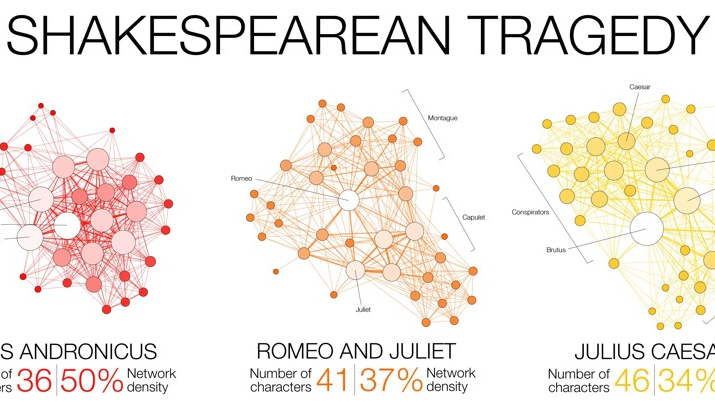
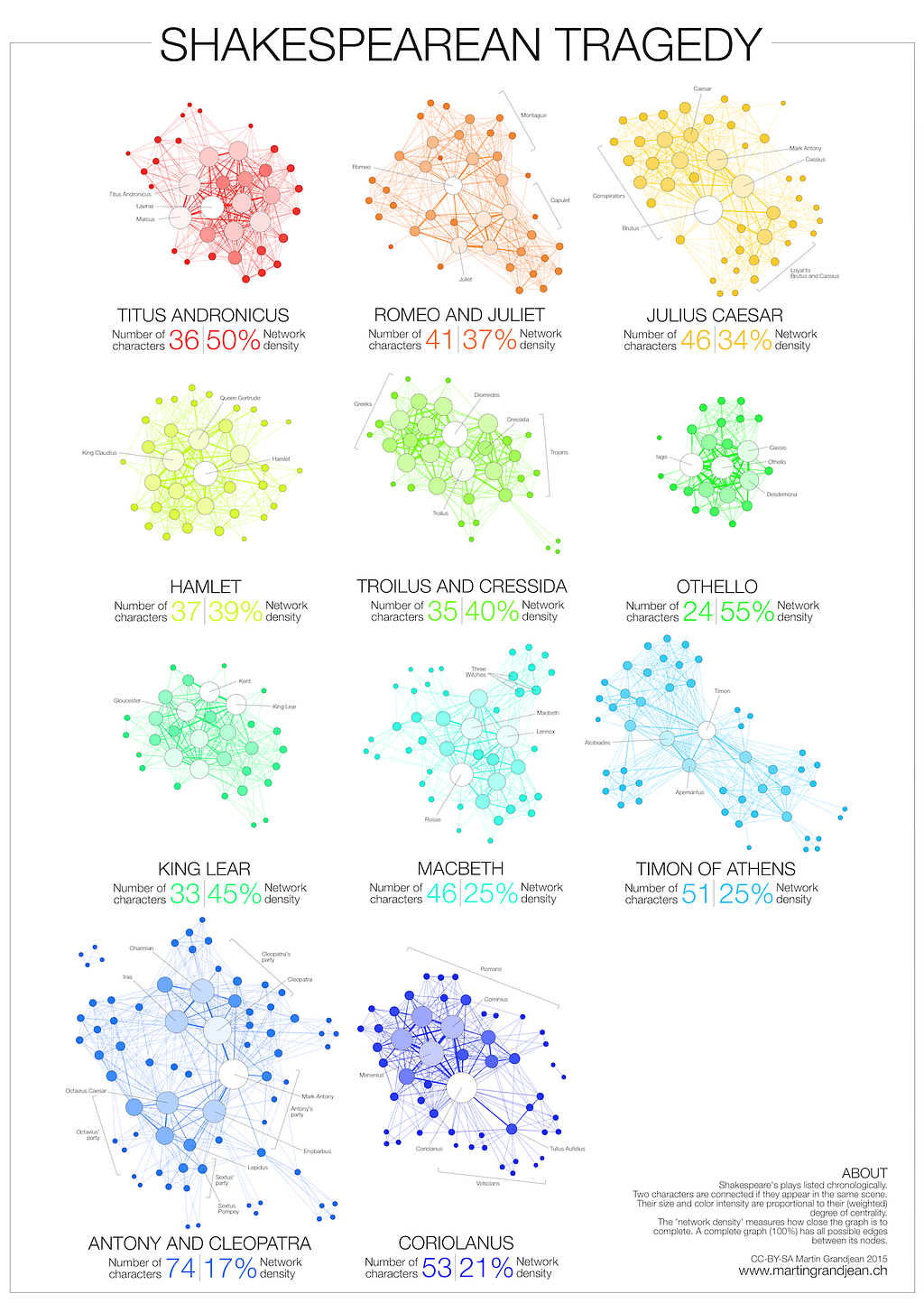
Are you a Shakespeare fan? This infographic lets you investigate his tragedies by looking at his character interactions. Are they closely connected or isolated? Do all his plays have similar structure and density? Find out below. The infographic was created by data research analyst and designer Martin Grandjean.
Hello, and welcome to my week-by-week review of the world. Today I am reviewing my bodyguard.
With all these people attacking other people with guns these days, it seems like no one is safe anymore. That’s why I decided to get a bodyguard.
The bodyguard business is booming and rates have skyrocketed, but can you really put a price on a life? People hiring assassins seem to think so but I disagree. That’s why I took out a loan to keep myself alive.
Banks don’t give out loans for bodyguards, but I met a man on Craigslist who offers personal loans for just about any of life’s problems. Coincidentally, he also moonlights as a bodyguard, so he was able to pay himself directly, while I could repay the loan in easy installments with minimal interest. I’ve never been very good with math so it was great to have someone who could provide both muscle and brains.
It wasn’t soon before his role expanded to include other duties, such as handling my finances and taking my car out multiple times a day to test it and make sure it was running properly. He was proving himself an invaluable part of my life.
I say “he” because he never told me his name. In the bodyguard world, it’s important to keep an appropriate amount of emotional distance. This reduces the emotional pain for the protectee if the bodyguard should ever be killed. Unfortunately his plan didn’t work — I couldn’t help but feel protective of him. It was unavoidable. We all saw this happen in that Kevin Costner movie, The Guardian.
That’s why I hired a bodyguard to protect my bodyguard. Then, another one for that one, and so on, until I hired so many I couldn’t remember who was protecting who. I figured if something happened, certainly someone would be there to stop it.
I appointed my bodyguard/financial advisor as Head Bodyguard, which may have gone to his head, because he fell in love with six different bodyguards. The heart wants what it wants, and I can’t fault him for that, but things got messy for everyone. So many hearts were broken. No matter how many bodyguards you have, none of them can protect the heart.
My bodyguard killed his heart by driving off a cliff with my car. I’ll never forget him, whoever he was.
I had to replace him, so I bought a bodyguard from the ex-con who works at my gas station. My bodyguard is one that leaves me completely emotionally detached — a Colt CM901 assault rifle. Now no one will ever be able to hurt me.
BEST FEATURE: His eyes. He had beautiful eyes. WORST FEATURE: After he passed away, I had to hire an accountant to look over my finances. It turns out my bodyguard wasn’t very good at math after all.
Please join me next week when I’ll be reviewing My Bodyguard (the movie, not the guy I just reviewed here).
At the time, the decision to award Sholokhov the prize was already controversial, as the author had criticized the Academy’s selection of Boris Pasternak in 1958, and many believed the award had been given to Sholokhov as “an attempt to counterbalance ill-feelings towards the Nobel.” Additionally, Sholokhov has been accused of plagiarizing And Quiet Flows the Don, notably including a public accusation from Alexandr Solzhenitsyn and other writers shortly after Sholokhov received the Nobel Prize. But now, the newly released archives have revealed that the selection of Sholokhov was, in fact, unanimous among the committee.
This new information (released fifty years later as per the practices of the Swedish Academy) gives us an interesting lens on history. As many modern literary prizes are often preempted by the timed-release of long lists and short lists, the Nobel prize is one of the few in which the decision-making process is kept relatively under wraps.
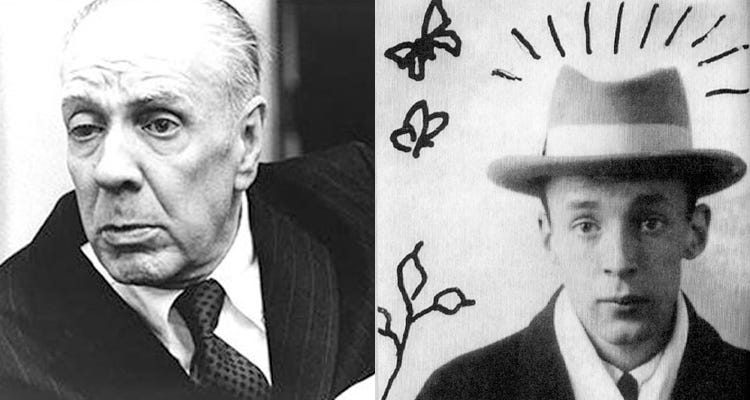
While some of the writers on the newly-released list (such as Beckett and Neruda) would go on to win the prize in the years to come, others never won the prize. On the subject, Borges once remarked: “Not granting me the Nobel prize has become a Scandinavian tradition; since I was born they have not been granting it to me.” Little did he know, he had come very close to receiving it after all.
Did you know that the incalculable number of stories in existence — which were created in every culture and in countless forms and styles — are all merely versions of the same exact four (or seven or twenty-three or two) basic stories? Or, if you are to believe a recent Atlantic article, merely remixes of the one primal story?
In “All Stories Are the Same,” TV producer John Yorke is the latest critic to try and reduce art to some secret and simple answer. Anyone who has studied storytelling has been subjected over and over again to this kind of useless analysis. There are exactly seven basic plots to all fiction. Actually, all stories are either a) Man vs. Nature, b) Man vs. Man, or c) Man vs. Self (or else a bunch of other Man vs. things). All stories involve either a stranger coming to town or else a man going on a journey. All stories are essentially Man vs. Stranger in Town vs. Freytag’s Pyramid. And so on and so forth.
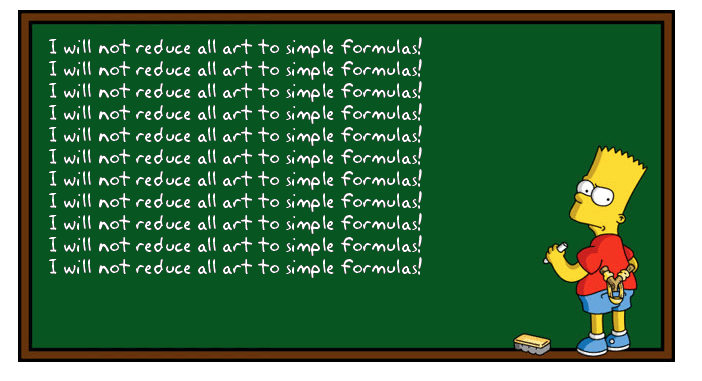
These self-congratulatory attempts to reduce art to formula rarely tell us anything useful about stories. These formulas don’t tell us how stories function or how different narratives affect readers. They don’t tell us how great stories were written or what meanings the works can produce. Instead, these essentialist structures are parlor tricks that exploit the need for all mysteries to have simple explanations. But what the critic is invariably doing is generalizing to the point of nonsense. In Yorke’s essay, he begins by listing three basic story types, then declaring they are all actually the same. Here is his first basic formula:
A dangerous monster threatens a community. One man takes it on himself to kill the beast and restore happiness to the kingdom.
This summary alone is already very general, but not enough for Yorke’s purposes. When he starts to list his examples of the stories that fit this type (The Thing, Jurassic Park, The Shining, “every episode” of CSI, Psycho, Erin Brockovich), it becomes apparent that he wants to abstract each and every element of those two sentences to the point of absurdity. The word “kingdom” now means literally any number of people from one to the entire planet. The term “restore happiness” means “overcomes something even if no happiness is restored.” The “one man” brave enough to fight evil can mean two, ten, twenty, or even every character in the narrative. “Monster” can mean any antagonist. Hell, “monster” can mean almost anything at all: “The monster can be fire in The Towering Inferno, an upturned boat in The Poseidon Adventure.”
Rather than the story of a lone hero standing up to an inhuman monster to save his community, this “basic story” has been reduced to “some people struggle with something dangerous.” Wow, what an insight.
Yorke says, “though superficially dissimilar, the skeletons of each are identical,” but he is exactly wrong. These stories are drastically different in tone, style, message, structure, and everything else, and are only “identical” on the most superficial level. Yorke has zoomed out until the elephant and SUV each appear as a single grey pixel, then declared them essentially the same.
It isn’t so much that Yorke or is wrong, but that he is merely saying nothing. Yes, you can abstract and generalize until everything is the same. But does that tell us anything? All fruits are really the same, just edible plant matter. All objects on earth are made from a few basic atoms. Everything in the universe is just energy. Yada yada. But at least understanding atoms or plant matter teach us important things about biology and physics. The abstraction of story to a few simple models tells us nothing. Sure, I can say The Metamorphosis and Moby-Dick are both stories about men struggling with animals, but does this give you any kind of insight into either work?
Instead, these models are the literary criticism version of astrology. Two humans with completely different life experiences, genes, histories, and personalities are lumped together through a couple vague generalities. (Horoscope generalities are so vague that almost everyone will think they apply to them, regardless of birth date.)
This is why I find it frustrating how often discussions of literary genres devolve into claims they are all the same. “Oh, magical realism is just normal fantasy written by Latin Americans!” is the kind of thing that sounds superficially smart, but offers no insight into the different techniques, intentions, influences, and effects of Marquez and Tolkien.
It can be really frustrating debating this stuff, because there’s no threshold for when they abandon the pretense that two stories are the same. There is no argumentative methodology. Individual details can be embraced or abandoned as evidence without any alteration to the fundamental argument. You never get to a non-negotiable difference. If a key difference is pointed out, people just hop to the other foot to talk about how the stories are really alike. There’s no consistency in the level of evidence that’s necessary to claim that two stories are the same, or that one is the remix or another. It’s the classic problem of non-falsifiability: arguments that cannot be disproven have no value.
In his piece, Yorke acknowledges that a bazillion other people have done what he is doing, but he says his system is unique cause he is the only one who asks “why.” Yorke’s Atlantic piece doesn’t really go into the why, you’ll have to buy his book for that, but I think what Yorke and similar story model pushers forget to ask is: so what? What use does the single story model serve?
If these models don’t teach us any useful ways to interpret stories, do they teach us interesting ways to create them? In his piece, Yorke quotes three actual writers, the writer-filmmakers Guillermo Del Toro, David Hare, and Charlie Kaufman. All three are say that story models are pointless, reductive, and unhelpful. Yorke brings them up to scoff at them, saying they all “protest too much” and then declaring that all their work is actually just remixes of classic forms… without even a single sentence of elaboration or evidence. What is telling is not that you can come up with an abstract model like “stuff happens to people” to lump their work together, but that Del Toro, Hare, and Kaufman all find such thinking to be utterly useless to the writer. All three are great writers and filmmakers. Their award-winning work is interesting and often boundary pushing, and I’d hazard to guess it is that way precisely because they avoid the simple formulas and models that critics like Yorke come up with. In my own experience, writers I’ve known who’ve clutched the formula writing advice books closet to their chest always produced the stalest, most uninteresting work. They focused far too much on how their work could be similar to other work rather than how it could be different.
And this is the ultimate problem. Whether or not you can create a couple generalized models and be “right” is pointless if those models don’t actually help readers understand and appreciate art, nor help creators create new and interesting work. Criticism should be helping us have a deeper and more nuanced view of art, not a more simplistic and shallow one. I’ve always found that the most useful and insightful way to look at fiction is to study its spectacular diversity. Stories can illicit every human emotion, can take place in any location real or imagined, and can use any structure you can think of. This near-limitless expanse is not something we should obscure with vague generates; it is the very thing we should celebrate and embrace.
Please elaborate on what perfunctory “novelness” is.
@postitbreakup
Hi Postit,
I’m sure you’ve heard the idea that “literary fiction” is just another genre, like science fiction or romance, as opposed to, as some would have it, “better fiction.” Let’s just say for the sake of argument that it is — what features distinguish literary fiction from other genres? Often people say that literary fiction foregrounds language over plot, but that’s not always the case. (For example, I don’t think of Kazuo Ishiguro’s writing as particularly “languagey.”) To my mind, one of the main reasons we call something “literary” is because you can talk about what it’s “about” without recounting the plot.
What I meant by the above tweets was that first novels often have an overabundance of “aboutness.” In other words, they are straining too much towards the “literary”; the theme is more salient than any other element of the novel. You know when people say of a book, “The setting is almost another character”? I dislike this formulation, but the point is clear: The setting looms large. In these extra-novel-y novels I’m talking about, the theme looms large. Too large.
Teju Cole once said, “A good novel shouldn’t have a point.” His own novel Open City illustrates this beautifully — I can’t boil it down to one or two abstractions; it’s about too many things. In the past couple of years I’ve read a few novels (or started and abandoned, as the case may be) that felt very top-down in their construction, as though the author decided what the point of the book was first, and then wrote it. I don’t care if authors do this, but as a reader, I want to feel like I’m discovering what the book is about as I read it; I don’t want to know from page one (or worse, sooner — sometimes all the blurbs and epigraphs make it clear what a book is about before you even start it).
In his review of Fates & Furies by Lauren Groff, James Wood wrote, “I’m unafraid to host a big spoiler party — a novel that can be truly ‘spoiled’ by the summary of its plot is a novel that was already spoiled by that plot.” I don’t love knowing the plot of a novel ahead of time, but in terms of “spoiler alerts,” I’d rather know the plot than all the themes. And if every blurber and reviewer is able to pinpoint the same one or two themes and package it up for you, the novel probably isn’t as interesting or complex as it should be.
*
Dear Blunt Instrument,
I was down in New Orleans recently talking with a writer friend. She writes short stories. When I asked her what a story should do, she told me: a story should entertain, either that, or give your reader a punch in a soft little place. Do you think it’s more important to entertain your reader or to punch them?
Thanks.
Best, Jacob
Hi Jacob,
You’re asking a pretty big question here: Essentially, what is fiction for? And while we’re at it, what is art for?
In a nutshell, I think the purpose of art is to make meaning. That leaves room for lots of different kinds of fiction to make different kinds of meaning. If you ask me (you did), the best art makes more than one kind of meaning. So there is no need to limit a story’s purpose to either “entertainment” or “punching.”
But let’s unpack those terms a little bit. We tend to equate entertainment with amusement: just a little light-hearted fun. But “entertain” also means to hold or maintain (as in the phrase “entertain the idea”) — and if a story holds your attention, it’s entertaining you, even if it’s not TV-fun. Entertainment can be highly intellectual or emotionally harrowing.
Your friend’s remark about “punching the reader in a soft little place” (this phrasing, incidentally, makes me squeamish; “soft little place” is hitting me the way “moist” hits others) seems to speak to something else. They’re suggesting that a story should hurt in some way, perhaps making you sad or shocking you out of complacency. This reminds me of the idea that art should “comfort the disturbed and disturb the comfortable.” This quote has never felt quite right to me, in part because it assumes a neat binary between who is disturbed and who is comfortable, in part because it oversimplifies the complex experience of art. (Interestingly, the quote was originally about newspapers, not art.)
I am often entertained by art without being comforted. Art can be both funny and disturbing. In short, neither writers nor readers have to choose. Stories can do anything they want, and should try to do as much as they can.
Editor’s note: This article is sponsored by Patreon. The sponsor did not have any editorial input into the article’s content.
Who hasn’t dreamed, now and again, of finding a patron? The unexpected inheritance. A generous mentor. The mysterious stranger who breezes into town, spots some potential, and loosens the proverbial pursestrings. Writers certainly aren’t immune to wishful thinking of that variety, bootstraps be damned. The patron is a timeless literary device, perfect for inciting action, stoking ambition, offering guidance, or foisting a character into strange surroundings. Novels are about transformations, aren’t they? A good patron mainlines the stuff. Or maybe there are just a lot of writers out there checking email on the hour, hoping against hope for word from the Medicis and MacArthurs of the world…
Since we’re still in the new year, gift-giving, life-changing spirit, we thought we’d make a list honoring the notable patrons in (not of) fiction. In no particular order, except for the reigning champ, yer man of the marshes, here they are, the ten great patrons in fiction.
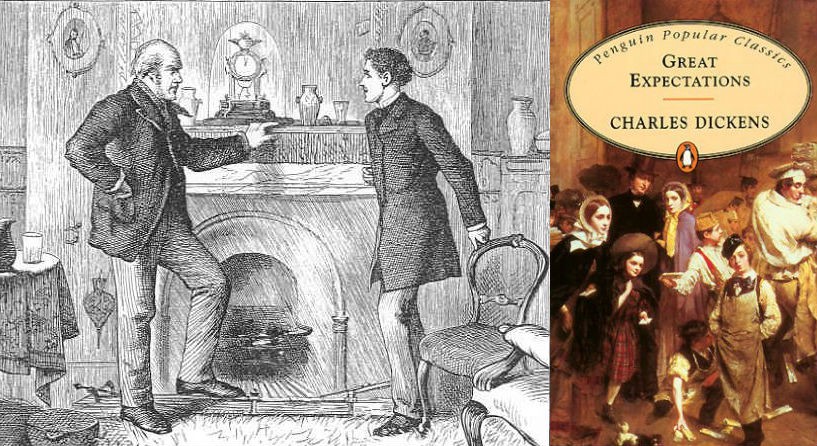
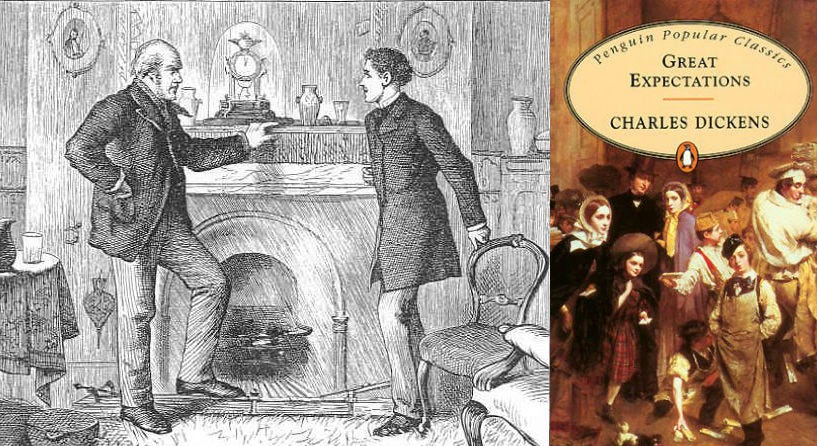
1. Magwitch, Great Expectations
Abel Magwitch: the terrible engine of Dickens’ classic tale of ambition and comeuppance. Mrs. Joe Gargery brought up Pip by hand, but it was Magwitch who fashioned the boy’s future. From his first appearance, Magwitch electrifies: “A fearful man, all in coarse gray, with a great iron on his leg. A man with no hat, and with broken shoes, and with an old rag tied round his head. A man who had been soaked in water, and smothered in mud, and lamed by stones, and cut by flints, and stung by nettles, and torn by briars; who limped, and shivered, and glared, and growled; and whose teeth chattered in his head as he seized me by the chin.” Who better to make Pip into a proper gentleman?
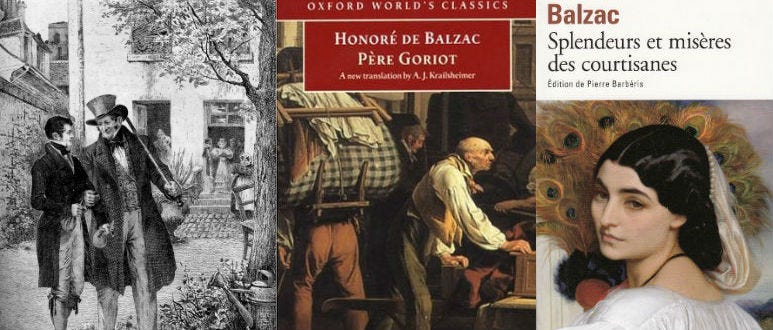
2. Jacques Collin (aka Abbé Carlos Herrera, aka Vautrin), La Comédie humaine
The man wears many guises in Balzac’s volumes, but he’s always around to offer a young striver some advice (usually of the whispering devil sort). Arguably his greatest role was as the Abbé Carlos Herrera in Splendeurs et Misères des Courtisanes. Yes, his intentions as patron were ultimately sinister, but there’s no denying his love for Lucien de Rubempré, or the intensity of his suffering when Lucien meets his fate at La Force.
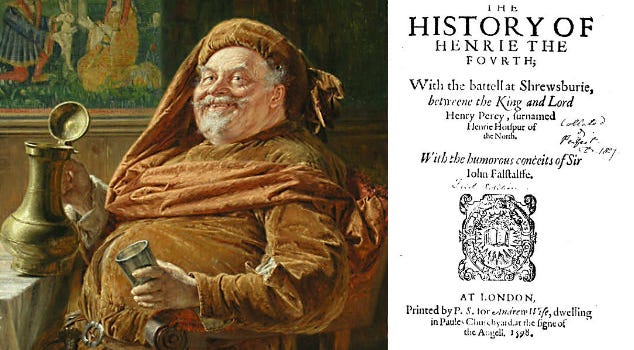
3. Falstaff, Henry IV, Parts I & II
The patronage ladder goes both ways. What is Sir John Falstaff, if not a patron? Wasn’t it Falstaff — old Jack, sweet Jack — who showed Prince Hal the ways of the public house, who taught the young man to hustle and debauch and how to stay on the right side of Mistress Quickly? A patron through and through. Kind Jack. Valiant Jack.
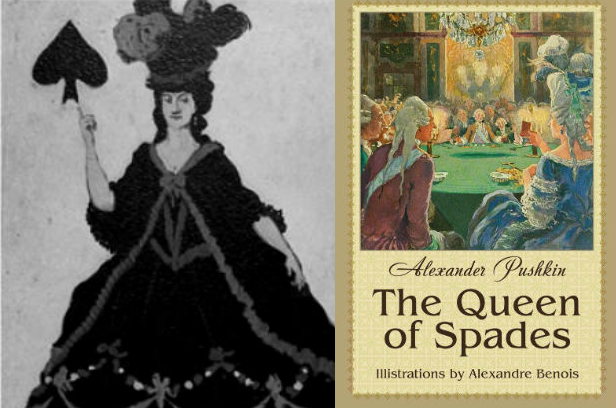
4. The Countess, “The Queen of Spades”
Pushkin’s Countess is no ordinary patron (though she does have a ward). Her bequest is a magic combination of faro cards: three, seven, ace. Played in succession, they guarantee a sure fortune, or, in the case of young Hermann, a trip to the insane asylum.
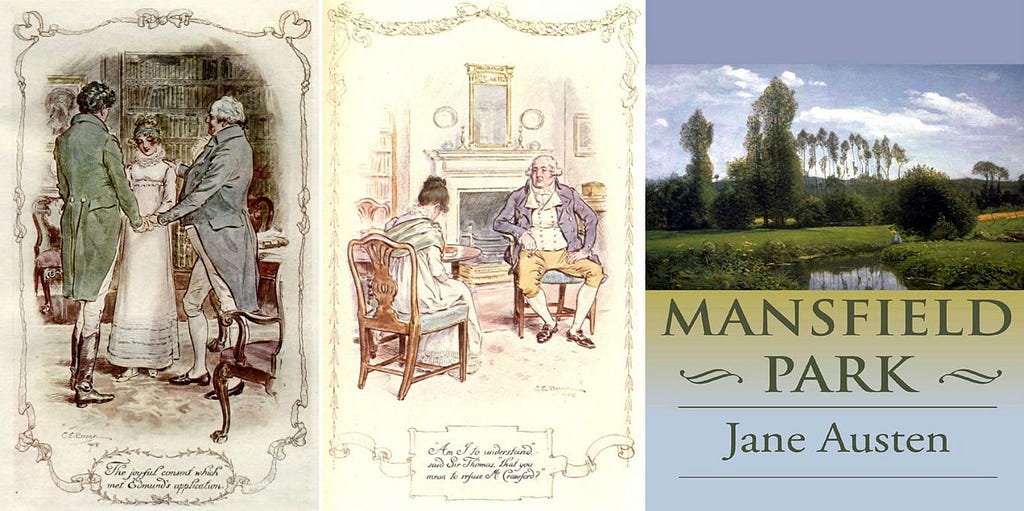
5. Sir Thomas Bertram, Mansfield Park
Austen’s Sir Thomas is oft-absent, oft-misguided, and sometimes a prick. Nonetheless, he takes Fanny into his household and eventually comes to see she’s the best among them, and so endorses her choice of husband. Not a bad record, all in all.
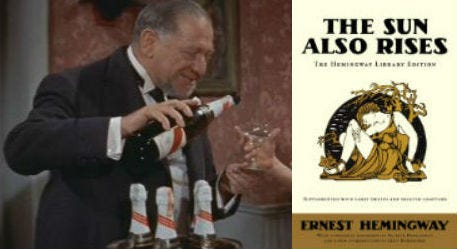
6. Count Mippipopolous, The Sun Also Rises
The Count fills one of the primary duties of any expat patron worth his salt: he’s always buying champagne. He’s also flush with cash, has a dubious title, sponsors somebody named Zizi, will show you his scars, and enjoys watching young people dance. And he offers Lady Brett and Jake some excellent tips: “This wine is too good for toast-drinking, my dear. You don’t want to mix emotions up with a wine like that. You lose the taste.”
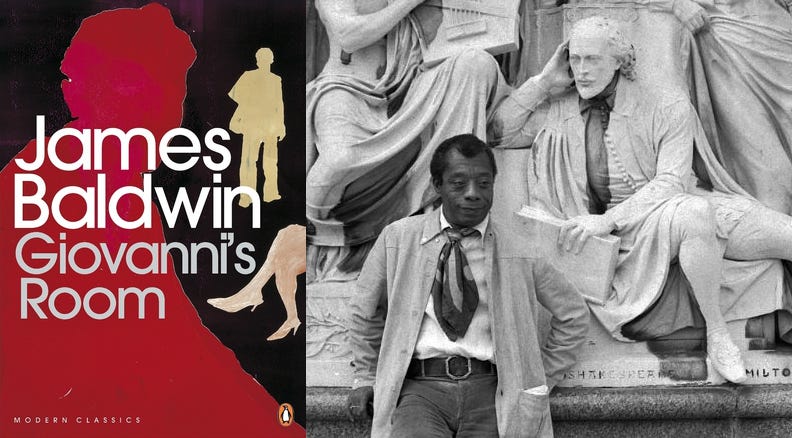
7. Jacques, Giovanni’s Room
Another older man in Paris who enjoys the company of youth. Baldwin’s Jacques is the one both David and Giovanni go to for money, shelter, and guidance. Like many patrons, he’s cynical with a romantic streak. Over oysters in les Halles, he delivers this pivotal advice: “Love him…love him and let him love you. Do you think anything else under heaven really matters?”
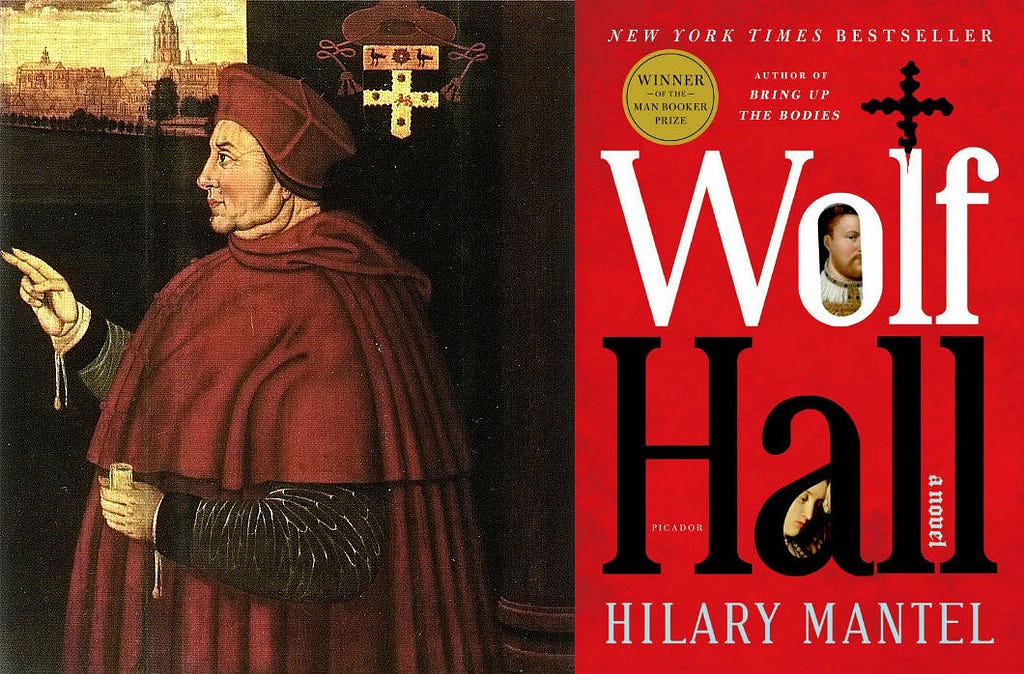
8. Cardinal Thomas Wolsey, Wolf Hall
Perhaps more than any other figure, Wolsey is responsible for shaping the giant at the center of Hilary Mantel’s trilogy. Cromwell comes up with the Cardinal, witnesses the ignominy, and lets his mentor’s example inspire and guide his own ascendance.
9. The Dowager, IQ84
Shizue Ogata, aka the Dowager, resident of the Willow House, owner of a shelter. Yes, she promotes and pays for assassination, but the targets are perpetrators of domestic abuse, beaters of women and children, so she still fits the bill.
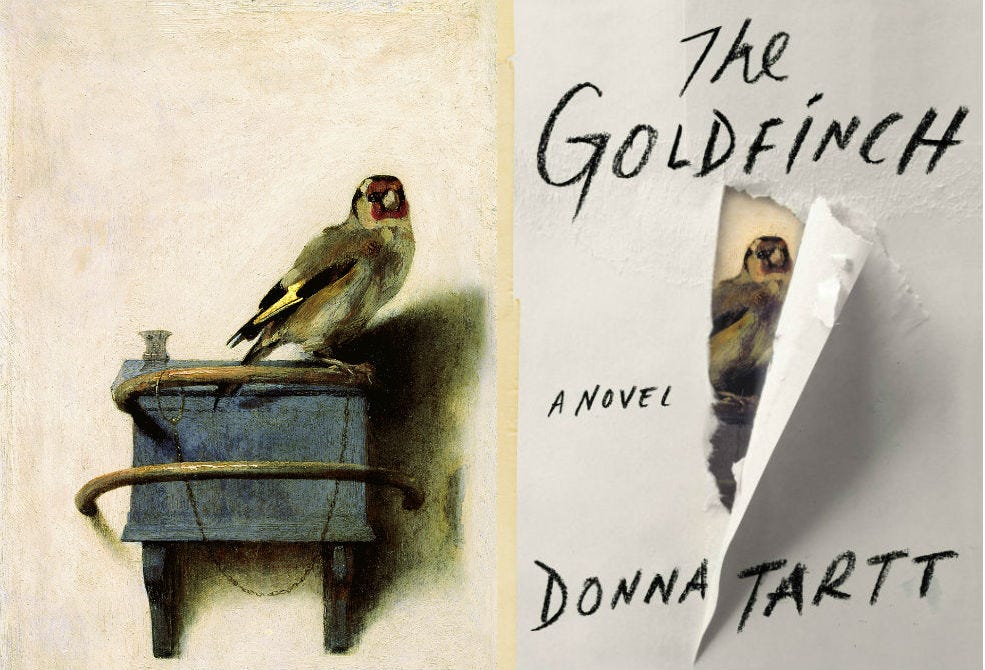
10. James Hobart, The Goldfinch
How many reviews, essays and think-pieces described Donna Tartt’s 2013 opus as ‘Dickensian’? It’s fitting, then, that she should embrace one of the master’s favorite devices. James Wood described Hobart, who takes Theo into his home and his business, as “Magwitch without the criminal record.”
Honorable Mention: every other Dickens patron (how many? dozens? hundreds?), including especially Betsey Trotwood, John Jarndyce, Mr. Brownlow, and Mr. Clennam’s uncle; all the maiden aunts and rich relations who glide through Edith Wharton’s world; García Márquez’ patriarch, José Arcadio Buendía; and Dan Cody, who welcomed young Jay Gatsby on board.
About the Sponsor: This post is sponsored by Patreon, today’s literary patron. Patreon is a crowd-funding platform that empowers a new generation of creators to make a living from their passion and hard work, through reader support. Each month, Patreon’s community of creators receives over $4.2 million in support from over 300,000 patrons.
Memoir is unique for its ability to help us see into lives; often, though, the premise of writing about an experience allows the writer to set off on a journey that she wouldn’t undertake otherwise. Such is the case in Sarah Einstein’s memoir, Mot, in which the author journeys across state lines to visit a friend in his homelessness. Einstein meets Mot, the man who gives his name to her book, in a center for homeless people where she works. He comes to her just as her work in the center is wearing her down: encounters with angry, mentally unstable individuals in an over-stressed system have left her bereft of energy and patience. Mot offers friendship and an escape from the world of the center, but due to his unstable hold on the world (Mot is plagued by a multitude of voices and personalities in his head) Einstein’s link to him is tenuous at best. This award-winning memoir blends a realistic view of life in social work with a narrative fragmented by Mot’s disjointed thoughts. Einstein creates structure with words to hold up an experience when life was failing. The tension in her work between fragmented and linear energies illuminates an unusual friendship.
“[M]y fascination with Mot is not romantic,” she tells us early on, “It’s a remnant of my disappointed desire to change the world and my stubborn belief that one person can do so.” Einstein’s friendship with Mot is platonic, yet he takes her away from her marriage. Scotti, her husband, is also mired in the fatiguing type of work Sarah does, and she wonders (often) if the two were never meant to marry in the first place. “I worry that both Scotti and I understand ourselves through the things we do for other people, that we don’t know how to find meaning in the relationship we have with each other,” she says. What Mot provides is an outlet for Einstein that allows her to feel like she’s actually making a difference — her marriage has fallen apart and she leaves her job at the center. She needs Mot. Whether or not she actually does help, whether or not she can save him or even offer him respite from his illness is an important question she asks herself throughout the work.
Einstein’s writing is self-aware. She seems to know how she’ll be perceived, even as she is undertaking her journey to be with Mot.
I’m dirty. Tired. Bedraggled. It occurs to me that maybe I don’t just look crazy. That I’m a middle-aged housewife come to play at homelessness with a man who believes dead gods live in his throat and who molested his sister, and that this may well mean that I am crazy.
This is important. Einstein allows herself to ask taboo questions — is it crazy, as she says, to try to fight against mental illness itself, against a difficult system? The constant nature of her desire to fight for Mot — to fight to get through to him, even when it seems hopeless — embodies a microcosmic example of the system as a whole. It’s broken, and yet we need people to stay in its brokenness to help us serve each other.
The author’s fear drives the narrative, making Mot (like Mot) unpredictable, and intriguing. Mot is unstable, and even his moments of lucidity are punctuated by Einstein’s fear that she will mess up, that she will make a mistake with him that can’t be undone. When he reveals bits of his troubled childhood, she has to reject her feelings of anxiety, which she knows are a barrier to helping him. She says, “My fear will never totally go away, but the friendship will survive it.” Still, she presses on, relying on “a dangerous kind of hope.” Since Einstein’s actions seem to surprise her, and since she often acts against her own interests, Mot is uneasy yet compelling reading.
What shines, here, is Einstein’s solid prose. The author has a firm grasp of her own emotions, which allows her to veer off with Mot’s unintentional broken thoughts. This is a book that portrays illness in all of its sad disrepair. Just as everything is going well, Mot will stray from their relationship, or lash out at Einstein, believing the paranoid voices that tell him she’s out to get him. Einstein often doesn’t know to respond to Mot, but she steers her narrative along steadily. In one such case, she says,
The mixture of illness and pragmatism makes my head spin. I don’t know what’s happening. It has been weeks since his delusions were so vivid, so directive. I play along, though I suspect it’s the wrong thing to do. But I’ve lost my leverage, having squandered it on a silly plan to try to trick his illness into forgetting the tension of the last week […] Perhaps our friendship isn’t broken beyond repair.
Mot is ever hopeful, but tinged with a longing for a better system, for more energy, or for a better solution to homelessness, abuse, and mental illness. Even as Einstein realizes that her life with her husband, Scotti is “delineated by other people’s emergencies”, she is unable to tear herself from Mot. Mot’s is a life outside of ordinary ideas about “normal”, and Einstein’s memoir is able to break from traditional ideas about structure, or meaning in writing. Mot’s splintered thoughts as recorded by Einstein are raw and hard to read, yet the mystery surrounding his illness and way of life — and how Einstein has recorded him — make clear why the author abandoned her own life to follow him. She makes it clear that some questions are worth asking even if we know we won’t receive answers.
Though Einstein’s memoir purports to be about a short time in her life that she devoted to Mot, it eventually becomes about the pursuit of her own hopes, the limitations on hope and the human spirit. “Like [Mot],” the author says, “I know that it may only be myself I’m trying to outrun.”
DON’T MISS OUT
Sign up for our newsletter to get submission announcements and stay on top of our best work.
YOUR INBOX IS LIT
Enjoy strange, diverting work from The Commuter on Mondays, absorbing fiction from Recommended Reading on Wednesdays, and a roundup of our best work of the week on Fridays. Personalize your subscription preferences here.