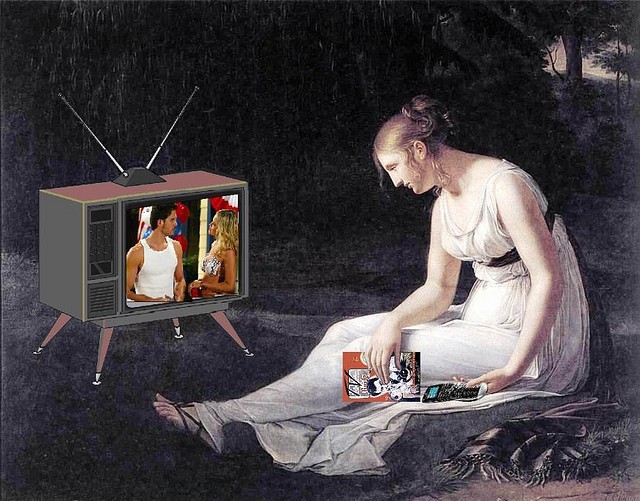
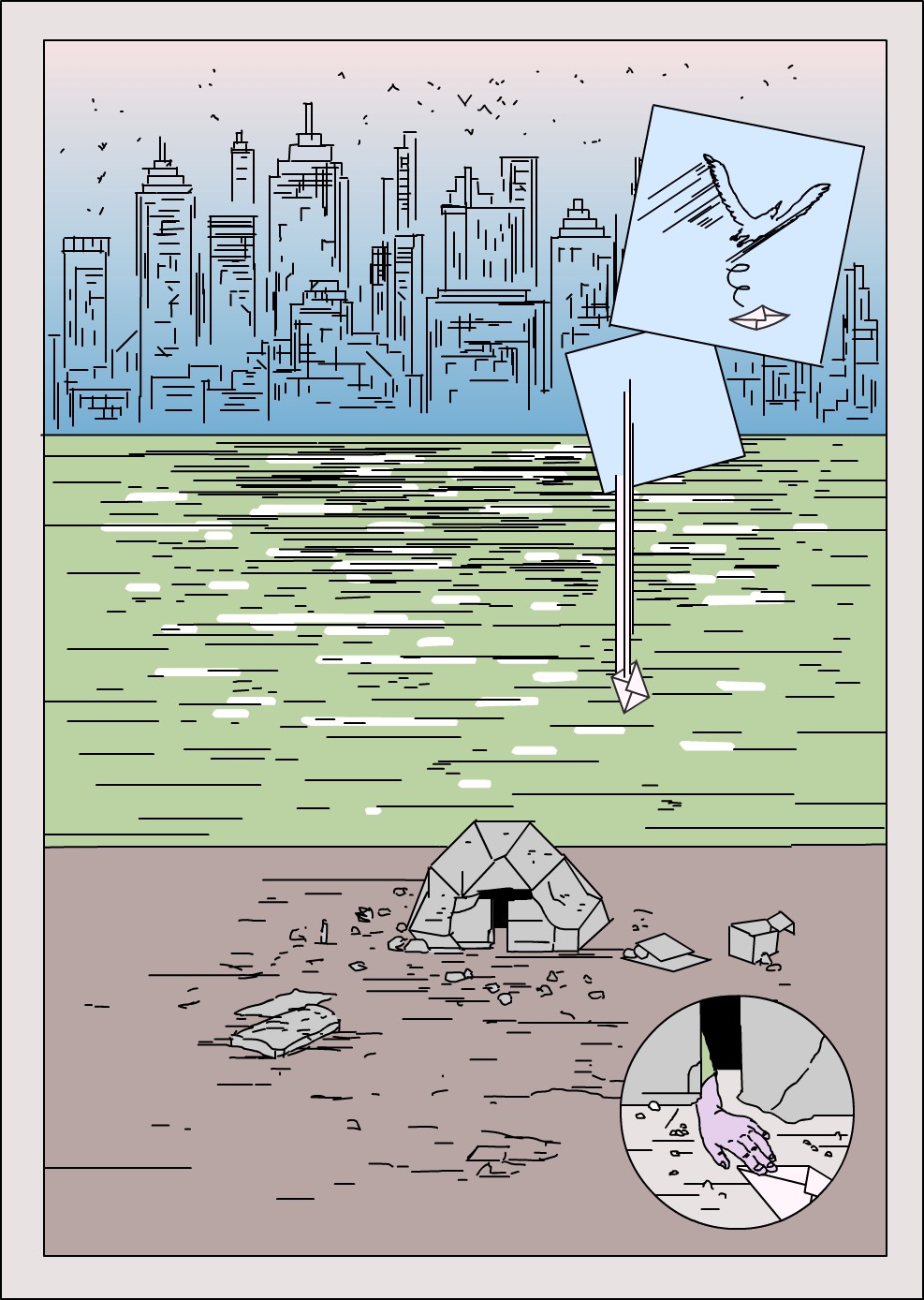
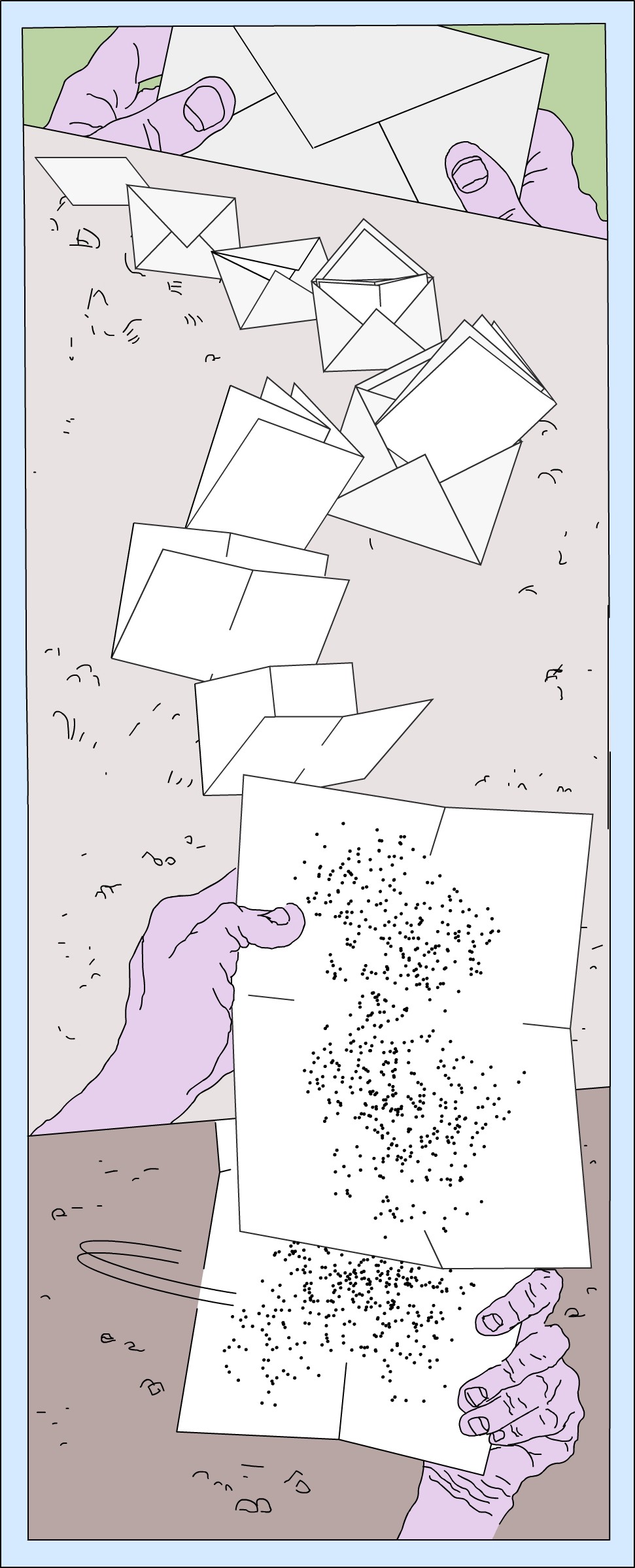
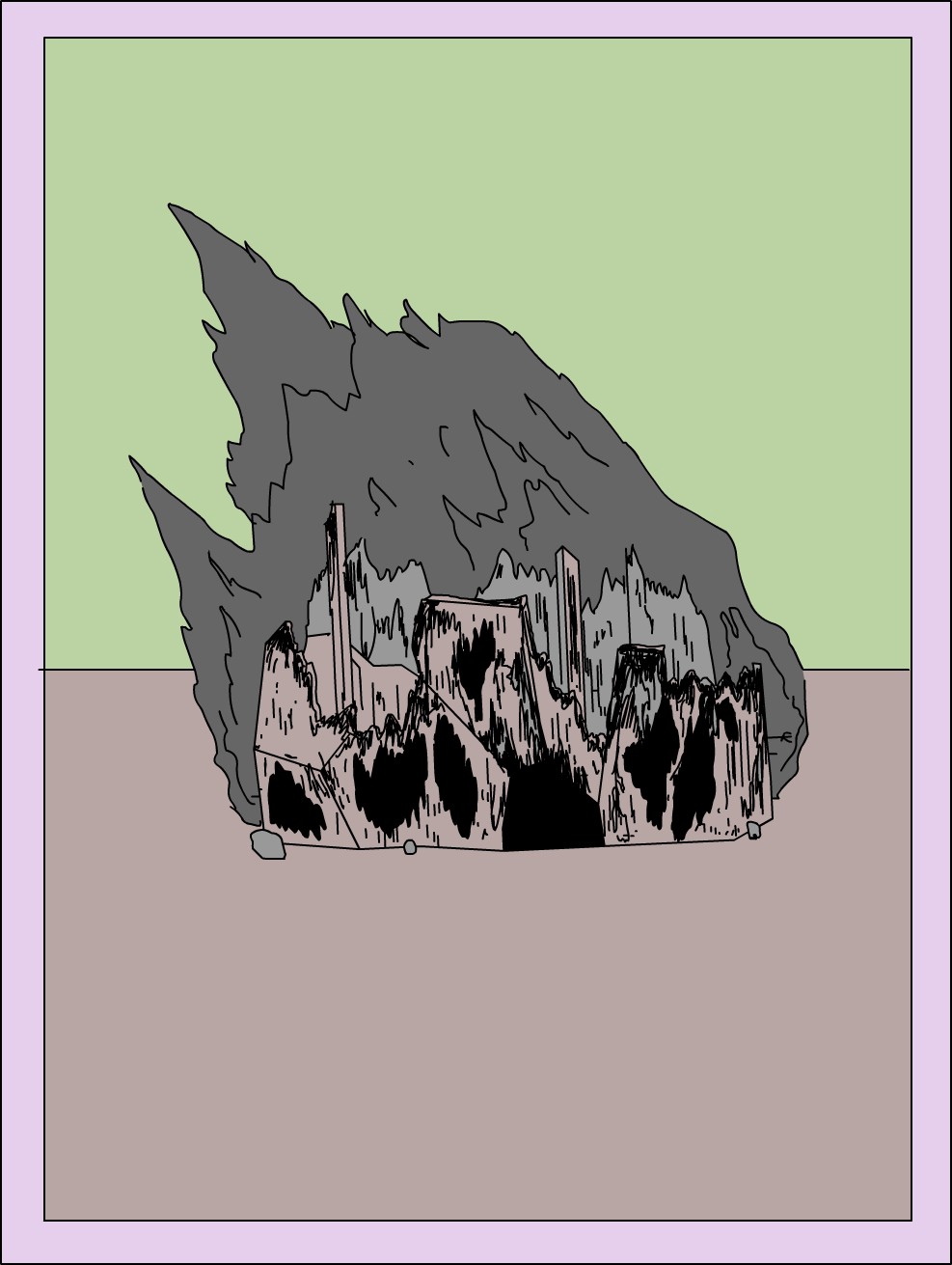
COMIC: THE WORK, BY SAMMY STEIN




According to a recent Wall Street Journal article, Thomas Ligotti now ranks as one of ten living writers whose work has been published in a Penguin Classics paperback. One of ten. This is significant for two reasons. First, Penguin is the preeminent publisher of what common consensus dictates as “classic literature.” They have unparalleled distribution, and copies of Ligotti’s books haven’t always been so easy to track down. In fact, the only way I was originally able to read his debut collection, Songs of a Dead Dreamer, was through an interlibrary loan — and that was just a few years ago. In that sense, they have done readers a great service. The second reason this is significant? I don’t know how to say this without being blunt, but it’s nearly unthinkable to see the work of a contemporary horror writer treated with such gravity. I don’t think I’m being provocative by saying this, but the horror genre is, more often than not, maligned by the publishing industry.
Ligotti’s work, on the other hand, is frequently referred to as “philosophical” horror. This is coded language to let readers know that it’s perfectly acceptable — if not overtly expected — to read Ligotti as “serious literature.” Longtime fans of horror, of course, recognize that the genre has always been worthy of serious consideration, that it frequently does what serious literature claims to be doing, while actually doing the opposite. At its best, horror can show us the way things are, rather than the way they appear to be, or, more importantly, the way we’d prefer them to be. A recent blog post at Time Spiral Press, written in response to the New Yorker’s slightly out-of-touch overview, summed things up quite nicely: “Horror is about nothing at all except reality. Unreality is for everything else.”
In his most distinctive work, Ligotti — with his defunct urban landscapes and twisted hints of shadowy and domineering inner workings — is uniquely able to cut into the horror of consciousness itself. As Professor Nobody, the narrator of one of Songs’ most memorable stories, quips in a so-called lecture on supernatural horror: “Existence equals nightmare.” And then later, “Every one of us, having been stolen from nonexistence, opens his eyes on the world and looks down the road at a few convulsions and a final obliteration.” With his emphasis on the horror of the unknown, of the beyond, as well as the sheer malevolence of outside forces, Ligotti is clearly indebted to Lovecraft, though his writing style is far more sophisticated. Ligotti’s stories frequently swerve into unexpected and absurd asides that are as unsettling as anything found in Kafka. His language is strikingly lyrical, often emphasizing a dreamlike quality — not to mention an odd fixation on dummies and puppets — that recalls Bruno Schulz.
The Penguin Classics edition combines Ligotti’s first two collections, the aforementioned Songs of a Dead Dreamer and Grimscribe, originally published in 1986 and 1991, respectively. At nearly 450 pages, it’s a hefty book, and the stories included present a rich variety of narrative forms. The uniting factor among them is Ligotti’s utterly unique vision and insidious technique. As Jeff VanderMeer writes in his wonderful introduction, “Unnamed narrators, nameless towns . . . allow for a corresponding vagueness of either character or setting that, perversely, creates the necessary anchor for even a reader a century from now, traveling beneath strange stars, to be held in thrall.” Sounds like serious literature to me.
With all of this in mind, it’s not difficult to see the publication of this collection as solidifying Ligotti’s role in the continuum of American supernatural literature, the birthing of a new dark star in the crooked constellation that includes Poe, Chambers, and Lovecraft. It’s frequently said that we are living in a new golden age of weird fiction, that a renaissance of sorts, signaled by newer talents such as Laird Barron, Livia Llewelyn, and Richard Gavin, is in full swing. I have to agree. I don’t know what this says about the world, or the times in which we live, and I won’t make any attempt to guess. Like Dr. Munck in “The Frolic,” who comes to realize all too late that the fabric of reality is perhaps merely coating the “jagged heaps in shadows,” I have a hunch that it’s something deeper than I can say — and that you, reading this right now, might already know what I mean.
“Because [once I knew a poem by heart] I had the ability to do something no one could take away from me. The library could take the book back. My mom could say ‘Go to bed’ at night. But I could keep the poem so close? Something changed when I was able to do that.”
— Nikky Finney
“It has always been much easier (because it has always seemed much safer) to give a name to the evil without than to locate the terror within.”
— James Baldwin
Outside, the rain …
9:25 a.m., and the third-floor classroom fills with students. We have come for what Yale’s course catalog unceremoniously calls, “Advanced Poetry Workshop.” We look out rain-streaked windows, sleepily shed dripping layers, check email, stare into space. Then: the clack-clack-clack of high heels. Something in us rises to attention. It’s the distinct sound of our professor, Elizabeth Alexander, who loves to quote June Jordan: [R]ain or shine, I made myself wear very high heels. Let the hallowed halls echo to the fact of a woman, a Black woman, passing through! As for the students, we are mostly sneakered, serious and shy; but now it’s the middle of the semester, and we have begun to peel back self-deprecation and irony and those other more useless layers of ego. We are working, ready.
Professor Alexander has immaculate reverence for art and an aptitude for cleaving the sacred from the precious. (She will insist you take a blunt instrument to your poem if something need be uncaged.) She has no tolerance for ego or attitude or anything else that fattens the bone of the work. She makes us stand, one by one, and face the class and sing. One by one, we clutch the backs of our pushed-in chairs, warble, tremble, forget the words to “Twinkle, Twinkle Little Star.” Fear’s soft stench has barely dissipated when we find ourselves singing together “Michael Row Your Boat Ashore” — harmonies emanating from the front left corner of the room. We trust and are transformed.
We read at least one collection of poems a week. We write at least one poem a week. We choose our favorite pens. We offer critique. We blog. We go to readings. We pore over writerly superstitions and come back, always, to the blank page. We memorize poems, which I’d loved to do since Mr. O’Rourke’s sixth-grade English class, where I’d learned “Stopping By Woods on a Snowy Evening” and then learned that I could say it twice to myself before being picked nearly last in the boys basketball game I’d insist myself into at recess. So when Professor Alexander tells us, “You’ll learn a poem by heart to recite to the class,” my sixth-grade self throws up her gangly arms. I’m thrilled. Then, finally, the day I’ve been assigned arrives. When Professor Alexander asks if anyone has a poem for the morning, I recite nothing.
Specifically, what I do not recite is Ai’s “Child Beater,” the poem I’ve been sitting with for weeks. In college, I heard Lyrae Van Clief-Stefanon read and, during the q & a, a question I no longer remember prompted the answer: “I was in the car, and in front of me was a truck with dead animals. I closed my eyes, but then I thought, ‘I’m poet. I have to look.’ I opened my eyes.” I am in this class because I want to be a poet. I want to bring that act of difficult looking into the task of learning a poem by heart. For weeks, I search for the right piece — rejecting the well-thumbed pages of books whose poems I have already taken in, whose words I send to friends and family when I want to bless their days. That is deep and gorgeous terrain, but it is not the difficult witness.
Then, in The Penguin Anthology of Twentieth-Century American Poetry, I find Gerald Stern’s “Behaving Like a Jew.” In that poem, the speaker comes across a dead opossum in the road and staves off the temptation to sublimate through language the material confrontation with death. No, the speaker seems to say, poetry will not wrap in silk the terrible ordinariness of new death trembling unpicturesquely on the side of the road:
— I am going to be unappeased at the opossum’s death.
I am going to behave like a Jew
and touch his face, and stare into his eye
…
I am not going to stand in a wet ditch
…
and praise the beauty and the balance
and lose myself in the immortal lifestream
when my hands are still a little shaky
from his stiffness and his bulk
This, I think. I will learn it by heart. It has all the components of Van Clief-Stefanon’s story: the hard act of looking, the animal carnage — an ars poetica of sorts. I love this poem for its craft and ethic but, as I sit with the poem, I realize that I also love it because it tells me a flattering story about myself. It calls me by the name I call myself in public and in private. I am going to behave like a Jew. Do the hard and right thing by being what you are. Difficult, often, to do; but comfortable to consider. I enter the poem and emerge in tact. I’m still thinking of Van Clief-Stefanon’s words. Be a poet, I tell myself. Learn your other names. I want to find a poem that sits uneasily in my body and teaches me something about the shapes I am and the shapes I might become. That night as I’m falling asleep, her name comes to me. I grab a pen and a neon pink post-it off my nightstand. I write it: Ai.
Born Florence Anthony, Ai (1947–2010) — who claimed her whole Japanese, Choctaw-Chickasaw, Black, Irish, Southern Cheyenne, Comanche self — worked prolifically in the dramatic monologue. In seven collections of poetry, she forged an unlikely constellation of personae, claiming the voices of, among many others: former F.B.I. Director J. Edgar Hoover, Elvis Presley, fourteen-year-old Jack who murdered his parents, Robert Oppenheimer, James Dean.
In the introduction to The Collected Poems of Ai, Yusef Komunyakaa writes that her poems manifest “the terrifying beauty of pure candor.” For Ai, trespassing is ethic. She is a poet for whom the boundaries of the nation, the home, the body, are violable and violated. Her speakers’ acts are intimate and violent, gorgeous and brutal — deep-seated human contradiction cast in unblinking language.
* * *
Outside, the rain, a pinafore of gray water, dresses the town…
I was eight years old when a Holocaust survivor came to my Hebrew school class to tell his story — a story I loved to tell myself for years afterwards. His family was sent to Auschwitz, where they were murdered, but an SS officer took note of the then-boy’s painting skills and kept him as a portraitist. An ever-doodling child, I clung to the man’s words. They seemed to me to be a literal manifestation of art’s lifeforce. Now, when I look to that story, a disconcerting lesson wells up: the capacity for beauty is not the capacity for good.
* * *
A pinafore of gray water, the Child Beater names the weather. What a delicately anachronistic image. Pinafore. Not a word haphazardly swiped from the quotidian, but the language of someone who pays attention, who revels. The language of someone who loves language — which is to say, the language of someone who loves. Pinafore. A word sourced from, perhaps, a little girl’s fantasies of quaintness.
And now, in Wednesday morning workshop, looking out the window at the rain and silently shaping my mouth into pinafore, I am already tumbling into the poem’s next lines:
Her body, somehow fat, though I feed her only once a day,
reminds me of my own just after she was born.
The violence enters together with the beauty. Across the table, someone is talking about ghazals. I gnaw at the top of of my pen. I am filled to the brim with disquiet.
The speaker beats his daughter to retrieve the self he was before her. He wants her out, out, out; but his poetic testimony reveals how the Child Beater and his daughter are always already entwined. Her language is in his mouth; his body, marked by the time they’ve shared. “Child Beater” not only exposes the speaker’s indissoluble bond with the daughter he beats, in whose body he sees his own; the poem also forges the unlikely platform where he, as speaker, and I, as reader, meet. This poem is gathering ground.
Sharifa Rhodes-Pitts says that the first question of non-fiction is, “What am I doing here?” I love poetry for how far in I can come before I even know to ask that question — so immersed on all sides I have to draw the map out anew. Poetry refutes the myth that language can ever be only one thing. Poetry revels in double-meanings, language as sound, as shape, as at once interior and exterior, and all of the shifting intersections of those categories. It is raining — which brought me into the poem — but the lilt of language moved me along so that, in the middle of a workshop on a gray and Wednesday morning, I am shaping in my mouth the words of the Child Beater. I am holding his language. I am making possible his testimony.
* * *
“I can’t imagine,” my white family and friends tell each other so many times it sounds like a plea, or an incantation. “I just cannot imagine,” they say, meaning they cannot imagine how the massacre happened; how, on June 17, 2015, Dylann Roof, a 21-year-old white man, entered Emmanuel A.M.E. Church in Charleston and murdered Cynthia Hurd, Susie Jackson, Ethel Lance, Depayne Middleton-Doctor, Clementa Pinckney, Daniel Simmons, Tywanza Sanders, Sharonda Coleman-Singleton, Myra Thompson — nine black people, who had made a space sacred and welcomed him in. “We,” my family and friends insist, “cannot imagine.”
But. Can you imagine hearing and not intervening in a racist joke? Can you imagine attending a university that invests in private prisons? Can you imagine being an American and never learning black history? Can you imagine studying the Holocaust without talking about Japanese internment? Can you imagine teaching a science class without Henrietta Lax, without the Tuskegee Syphilis Experiment, without any thought at all to whose bodies have produced your knowledge? Can you imagine living on land stolen from native peoples? (‘But I worked hard to make the down payment on this house!’) Can you imagine buying something, ignorant to the conditions of its production? Can you imagine crossing the street at night so as not to be within arms length of a black man who threatens to share the sidewalk with you? No, maybe you’re saying. I don’t do that. But can you imagine?
because white men can’t
police their imagination
black men are dying
— Claudia Rankine, Citizen
“I can’t imagine,” my dad tells me, my uncle tells me, my cousin tells me. There’s something in the act of iterated disavowal that limns the space we share. A border is a contact point. We turn away, not because we don’t recognize Dylann Roof’s actions, but because we do. If the seething hate of Roof’s manifesto is language we can easily situate ourselves outside of, Ai’s speakers take us in, demand that we reckon with a poetics of citizenship in which we are complicit. How do we participate in Roof’s testimony? In what ways do we perpetuate the violence that makes his actions thinkable?
I grab the belt and beat her across the back
until her tears, beads of salt-filled glass, falling,
shatter on the floor.
“We believe Ai’s speakers even when we don’t wish to,” Komunyakaa writes. In Ai’s work, we are the speakers’ accomplices, if only because we are enrolled as witnesses to their confession. The beautiful language of Ai’s speakers’ makes a meeting place where I find myself unlikely and open with all of the danger and possibility of that posture. The language is violent and precise. It’s the chaotic sweep of anger alongside the careful precision of noticing. The words don’t sit comfortably in my body. I am opened and raw.
Ai’s is not the didactic language of politics. Hers is the political language of relation — multi-sited, complex, and shifting. I am not the Child Beater, but neither do I stand outside of him. I see him there with all of his language and, because recognition marks shared territory, I am restless. Is it only in the beauty of his language that I see myself? Or is there something of his abjection, his violence, that shows me something of me that I already know but will not name?
When Professor Alexander asks, “Has anyone prepared a poem for recitation today?” I hold my prepared poem in my chest and say nothing. In part, I don’t want to reproduce the violence that the poem enacts but, if I turn the difficult looking toward myself, I see that I am quiet, too, because in speaking the poem aloud I am calling my own and hideous name. I am quiet that day, but I am holding the poem. I have joined the Child Beater through language, entered through the beautiful word, and found myself waiting in the wreck.

by Maurice Emerson Decaul

I walked into Swallow Café off the Morgan L a week before the massacre in Paris to meet up with Brandon Caro. We were to talk about Old Silk Road, his debut novel, recently published by Post Hill Press, but as fate would have it, Swallow Café because of the din and lack of available seating proved to be an unideal place. So, instead we decided to take a drive through the neighborhood and ended up for the most part talking about our wars and our experiences growing up in New York City a time before it was cool to say, let’s meet in Bushwick for anything, much less coffee.
My intent was to discuss the way Caro has situated the current American military involvement in Afghanistan, collapsing time through the juxtaposition of historical figures: Alexander the Great, The Khan, Dr. Brydon of the British East India Company, a unit of Soviet tanks and Pat Tillman, who is omnipresent in a dream time news cycle like, way. But as is common when veterans get together, we started to share stories, the type of discourse rarely discussed openly.
The President recently addressed the nation to describe the current way in which the use of the tactic of terror has evolved from the sophisticated mass casualty attacks of September 11th 2001, perpetrated by Al Qaeda, to a new, equally nefarious but exponentially more difficult to counter, low-intensity chronic threat posed by actors such as Da’esh aka ISIL ,whose modus operandi in Europe, North America, parts of North Africa and in Australia depends on individuals willing to commit murderous acts with little institutional support. The “Lone wolf” the “self-radicalized” person, he or she is called.
The drumbeats of this new war are being beaten. And with the deployment to Syria of American Special Forces, the rhetoric professing that there would be no American “boots on the ground” has been discredited. I bring this up to contextualize my conversation with Caro because we have both had our boots “on the ground” so to speak, me in Iraq and Caro in Afghanistan. As our elected officials’ debate strategy, our service people know already what might be asked, but it is important in our democracy for the demos not to be excluded. It is important for the demos to know.
Brandon Caro: I just want to talk about, the positive changes in New York in the last, I guess, twenty years, as far as the reduction in violent crime. I grew up here. I grew up in Manhattan. I was ten when we moved to Greenwich in 1992. And I just… I just remember an atmosphere of fear.
I just remember growing up during the crack and haze epidemics, fear really controlled my life to a large degree. I was a small kid. I couldn’t go anywhere alone. When we moved to Greenwich everything was different. We could go wherever we wanted. But we were talking earlier about how it’s not like that in New York anymore. It’s just not….It’s not nearly as dangerous as it used to be.
Maurice Emerson Decaul: New York is a very different city. I left New York in ’98, when I joined the Marine Corps.
BC: Yeah. Yeah, I think it was like… It was still a bit dangerous in the ’80s and then it’s got a lot less dangerous since the ‘90s.
I actually…I witnessed a murder in like ’99, or 2000, uptown, like 109th street. I was…like right in the place where it happened. It was in like a Chinese restaurant. I walked outside and a guy came in and shot a guy that was right behind us. I had never seen anything like that. But Iraq was a really dangerous place, certainly when you were there.
MD: When were you in Iraq?
BC: I was never in Iraq. I just know from the news and the people I know.
MD: Yeah.
BC: But it was a really dangerous place. Basically, ’03 to ’07 and then it wasn’t, you know?
MD: Yeah. Yeah
BC: Really, it was Pre-ISIS Iraq, after the Sunni Awakening it experienced a–
MD: –A surge in violence.
BC: –Right. It experienced first a surge in violence and then a drop in violence and now it’s obviously more violent, I think, than it’s been.
MD: I was speaking to someone who was telling me about his family. one of his brothers is a General in the Iraqi Army. His brother was talking about Tikrit and using American bombs on ISIS because they can call them in. Another of his brothers, I’m sorry, his cousin had just been shot by an ISIS sniper.
BC: Really?
MD: Armpit, yeah.
BC: Axillary, yeah.
MD: He didn’t die. He’s lucky.
BC: He didn’t? That’s interesting, because…a guy I served with was shot under the arm pit by a sniper and he was killed. He was on the MK19 and it jammed because that’s what they do.
MD: I hate the MK19.
BC: He was trying to fix the tray and he got shot underneath the arm pit.
MD: Our last or second to last night in Iraq we were coming back from patrol close to our compound, we heard guns fired. Nothing major. It was a wedding.
BC: A celebration
MD: But someone took the opportunity to take a couple of shots at our vehicle.
BC: Yeah.
MD: And, you know, timing–
BC: And pre-armor, right?
MD: Yeah. This is 2003. This is July 2003.
BC: You didn’t have doors.
MD: We didn’t have doors.
BC: Dangling your feet outside the doors.
MD: Yeah.
BC: That’s crazy.
MD: So someone took the opportunity to take a shot at the vehicle. And timing played a part in not getting shot in the same area.
BC: You were in a–
MD: I was in a Humvee. I was the A driver.
BC: But the doors was open.
MD: The door was open.
BC: That’s fucking nuts.
BC: One of the only times I was ever shot at was on base. The bases were really not well defended.
MD: This was in Afghanistan?
BC: Yeah, in Afghanistan. We were under this big tent and someone fired a RPG and it just barely missed the tent.
MD: That sucks.
BC: Yeah. Well it was great. But if it had hit the tent, it would have been a mass casualty because there were at least one hundred people in the tent, everyone was on the Afghan side of the base, it was like a dinner, you know? It was like an event, you know? A guy, someone fired an RPG. It missed, then they just started with machine guns…and then we got our stuff, and went back to the front and it was already over.
MD: That’s how it happens. It happens very quickly.
BC: Yeah, it didn’t last very long. It felt like a long time [laughs]
MD: It does. It feels like a long time in the moment, but in retrospect, you know, those engagements–they happen…[snaps fingers]
BC: Yeah. Really, really fast.
MD: With us, there were a few occasions sort of like that. Not with RPGs, no one had a chance to shoot those at us because the Marines were on their game, man. On their game. We were in control of the Nasiriyah Museum, which is on the banks of the Euphrates. One night, maybe 2o’clock in the morning all hell broke loose. I mean literally every piece of ordnance we had started going off. And I woke up.
BC: Oh! I think I heard about this.
MD: Did you heard about this? You heard about this? [Laughs]
BC: Yeah, yeah. I think I heard about it.
MD: You know what a CLU is?
BC: No, what’s a CLU?
MD: The CLU is the aiming system for the Javelins.
BC: Oh, yeah. I do.
MD: The great thing about the CLU is that it allows you to see in Infrared. Not only in night vision, so also body heat. One of the Marines was scanning the water and saw a small group, maybe three people, stepping out of the Euphrates and moving towards the building and he engaged them with the SAW and I think that was it, I think it was over with his engagement. One of the Iraqis had an RPG so he engaged them and everyone else engaged too. So we were sent out the next morning to recover
BC: Whatever was out there?
MD: There was nothing out there.
BC: Oh, really?
MD: Yeah. I mean, we soured.
BC: They just took off or something?
MD: I don’t know. I have no idea if we hit them or did not hit them. I don’t know. I mean who knows?
BC: You bring up uncertainty, which is something that I experienced that would influence my book, Old Silk Road.
There was a really nasty IED that went off outside the FOB, the casualties came into us… to be treated and evac’d out, so we did that. There was one KIA….three or four wounded.
MD: Americans?
BC: All Americans, and this one…one woman, too, actually. We treated them and then evac’d them and then like an hour later they brought in this little kid. He must’ve been, like fourteen. He had these little whiskers on his moustache and they were like, “Doc, look at him. Check him out. Make sure that he doesn’t have any injuries, because we’re going to interrogate him and we don’t want him to say that we beat him up.” I was looking at him and they were like, “You can’t interrogate him” but obviously I wanted to fucking ask him questions you know? So, I think I asked one of the ANA soldiers “is this the one?” And he said “We’re going to find out and if he is, we’ll cut his head off.” The kid-his face just like…I mean, I had never seen such fear in my life.
MD: I can imagine.
BC: Because they will, they will do whatever they want. And we had absolutely no control. So I checked him out, he didn’t have any injuries, I think, I actually took some photos, too, but that was it. And then I never…I never heard from him, I never saw him again. I don’t know what happened. I don’t know if he set off the IED or not. He just…he just, like, Disappeared, completely.
And I use that in my book.
★★★☆☆
Hello, and welcome to my week-by-week review of the world. Today I am reviewing Santa’s face.
It doesn’t make any sense that Santa would have a face. He doesn’t need one. This is a magical being who can reshape his body to fit through a chimney. He’s not bound by the laws of physics. Just like creatures that live in caves and evolve to have no eyes, Santa lives in a remote part of the world and has never been seen.
Regardless of why Santa has a face, there’s no denying he has one. Unless you’re going to deny he has anything at all. I’ll begin with the top of his face and move down.
Not much is known about Santa’s forehead. It probably has a few wrinkles but only when he moves his eyebrows. Speaking of which, those are some really white eyebrows Santa has.
Most old men I know, myself included, have really long eyebrows that grow in every direction. Santa seems to keep his trimmed. Good for him. Even with the limited human contact he has, he still finds a reason to care about his appearance.
Moving on to his eyes. His eyes may look like normal eyes, but remember this is a guy who can see you while you’re asleep in the dark and thousands of miles away. Those are some pretty impressive eyes. If a biologist were to remove Santa’s eyeballs and take them apart, I imagine there would be some interesting discoveries.
I’m not going to discuss Santa’s nose too much because noses are gross, and I imagine his is even grosser, always running because of the cold North Pole weather.
Now Santa’s mouth is where things get interesting. Because it is completely surrounded by hair, there is no proof it is actually connected to the rest of his face. It may be that the beard is its own living entity and has only a mouth. Perhaps the entire upper half of the face is a disguise, and this is what Santa truly looks like.

Santa Claus, unmasked?
I guess for as normal looking of a face as Santa appears to have, there’s too much mystery behind it, and this review has only raised more questions than it’s answered. These questions will never be resolved unless someone can capture Santa and put him through some tests. That is what I am asking for for Christmas this year: someone please capture Santa and bring him to me.
BEST FEATURE: His skin is flawless. I’d pay good money to have skin like that.
WORST FEATURE: His face is so generic that he’s incredibly easy to impersonate.
Please join me next week when I’ll be reviewing a mug.
“You’ve really never heard it? Perhaps, after all, that’s not very surprising, since the persons concerned have naturally kept it a secret. On the other hand, when one thinks of all the people who couldn’t help knowing it, it’s rather surprising that there has been so little leakage.
“It is difficult to know how far back the business goes. The first thought that comes to one is that it ought to be possible to give a date by finding out the age of the houses concerned. A number of them are, indeed, of almost exactly the same date. But if one presses the investigation, one finds oneself coming up against some that are older, others that are more recent. The thing must have begun a long time ago. Where precisely, and at what date? Some of those who are in the secret may know of some tradition. I don’t. Probably during the Ancien Régime. The business must have continued during the Revolution, when it undoubtedly had a particular value. But the probability is that the systematic development of the scheme, the attempt to complete what had been already begun, belongs to the first third of the nineteenth century. True, the person to whom I owe most of my information on the subject is a woman, and women’s memory for facts is often erratic; but she told me that her own knowledge was derived from her grandfather, from whom she gathered that the system had been completed between the reign of Louis Philippe and the middle of the reign of Napoleon III, when Haussmann was busy with his great improvement plans. During those years the work seems to have gone on uninterruptedly, to have functioned perfectly in accordance with the original intention of its inventors, and to have rendered certain important, and at times rather remarkable, services, particularly, as you might guess, during the troubled period that began with the revolution of 1848 and continued up to the time of the coup d’état.
“But I haven’t really explained the thing to you yet, though you must have read a good deal between the lines of what I have been saying. The best thing I can do, I think, is to describe to you how I first stumbled on the secret. One day I was visiting a certain lady, a very great friend of mine, and a member, as one says, of the very highest social circles. She lives in a handsome apartment in the middle of Paris, not far from my own home, and situated in one of those quarters that today are no longer very popular because the streets are too noisy and too dark, the elevators too old, the bathing arrangements too crude, the rooms too high and too big and difficult to heat and furnish. This lady’s apartment is spacious, full of odd corners and unsuspected passages, with a door half-lost in a wealth of carved wood — the kind of thing that I adore. She herself is young, very lovely, and married. Her husband, on this occasion, was not at home — as, thank God, is frequently the case. I had got back into my clothes and was perfectly decent. She, on the other hand, had merely slipped on a pretty little house gown; her hair was not very tidy, and she was wearing on her feet a pair of bedroom slippers. She was in a lively and forthcoming mood. Suddenly, after a moment’s apparent hesitation, she said: ‘I’m going to show you something!’ She took a key from a drawer and motioned me to follow her. At the far end of the boudoir she opened a door that I had already noticed, which was not locked. Passing through it we found ourselves in one of those narrow passages to which I have referred. I had seen it of old, but had never walked down it. It can’t have been more than ten yards or so long. At the far end was a large curtain of faded velvet that masked a door. This door my friend opened with the key which she had brought with her. She closed it behind us, though leaving it unlocked. We were in another rather wider but shorter passage. We crossed a large, ill-lit room that seemed to be used as a storeroom, and took a third passage that ended in a dark but very large anteroom. Before reaching it we passed a door behind which we could hear people talking. From the anteroom we could see, through a wide open double door, a large drawing room with a heavy hanging luster. But we did not enter it. I had the impression we were no longer in my friend’s flat, but that the place where we found ourselves was by no means uninhabited. Everything bore evidence of the routine of daily life. My friend led me out of the anteroom down yet another passage. From this point onward she seemed to have to think for a moment before getting her bearings and choosing one door in preference to another. She stopped before what I took to be the door of a wardrobe, opened it with the key she had already used, and, following hard on her heels, I penetrated into a largish room, lit by a window of ground glass, which seemed to be a dressing closet furnished with large cupboards of painted wood. Many little signs indicated that we had crossed over into another flat. My friend went straight over to a small door that stood in the corner of the closet between one of the cupboards and the outer wall. But she changed her mind and, with a smile, still saying nothing, she approached a larger double door that stood opposite us more in the middle of the wall. She gave two or three discreet little knocks, which appeared to me to be arranged in a definite rhythmic sequence. Then she listened, at the same time readjusting her wrap, which hung very loosely about her, and giving a pat to her hair. When no reply came to her knocking, she very discreetly opened the door and, without crossing the threshold, made a sign to me to look. I saw a large, handsome room filled with rather worn, old-fashioned furniture. The general effect, however, was one of luxury. It contained a huge, low bed, a number of faded silk curtains, some extremely feminine toilet accessories that appeared to have been recently used, a quantity of rugs, upon one of which stood a pair of slippers that I could have sworn were still warm. Although we made no move to enter, there was something about our gazing at this intimate interior in which, as it were, a faint perfume still hung, that seemed rather barefaced, improbable, and exquisitely indecent. I did not dare to question my guide. I was afraid of breaking the charm. A moment later she closed the door as quietly as she had opened it, and turned back toward the smaller door in the corner of the dressing closet. Passing through it, we found another passage apparently full of odds and ends, which impeded our movement. This we took. Halfway it broadened out into a circular space lit by a window looking onto the street. I glanced out of it and could not help exclaiming: ‘But we’re no longer in your house at all! We must be a long way from it!’ My friend smiled but said nothing and led me a few paces farther. Then, pointing to a long gallery that we had just reached, filled with dark furniture and lit by windows of colored glass, and to what lay beyond, she spoke the first words she had uttered since leaving the room: ‘We could go still farther, but at the far end we should have to descend a staircase. You’ve seen enough, I imagine, to get a pretty fair idea of the place?’ We then retraced our steps to her boudoir.
“It was there, behind closed doors, that she began to explain. She told me that we could have gone on a long way, much further than I had any idea, opening one door after another, always with the same key; that from time to time we should have had to go down flights of steps, sometimes to a considerable depth, at times also to climb; and that if we had gone in the opposite direction — that is to say, leaving her boudoir at the other end — we should have found similar conditions. As you may imagine, I begged her to tell me more. Whither did these two directions lead, and why all these complicated passages? What needs, what secret purposes, did they fulfill? Still smiling, biting her lip in the most charming way, and bringing all her pretty little tricks to bear, she said it was all a deep secret and I had no right to know it. I proved to her by certain agreeable if silent arguments that I had, and little by little she imparted to me the key to the mystery. She pretended at first that one could have gone, in either direction, even as lightly dressed as she was, in a mere wrap and slippers, to ‘the very end of Paris,’ without having to put so much as one’s nose out of doors, and without being seen by any passerby or policeman on duty. The ‘very end of Paris’ to which she had referred turned out to be the end of a Paris of bygone days. If I understood her rightly, one of the ends in question would have been somewhere in the neighborhood of the Place des Vosges or of the Bastille; the other near the old city wall at the rue des Martyrs. This marvelous line of communication between the extremities of the city, this secret way, must, too, have dated from far back. At the time of its completion — if, indeed, it ever had been completed — it must have formed a chain of 365 links, one for each day in the year. In other words, this subterranean route had been constructed by knocking a way through 365 apartments, or rather premises, since I imagine that there must have been a number of private houses in the series. All that my friend could say was the great difficulties had had to be overcome, that ingenious communications had been fashioned up stairs and through cellars, and that it was just where they were concerned that the passage of time had done most damage to the system. She had heard tell, for instance, that the work put in hand by Haussmann had been a real disaster which had never been wholly repaired, and that since that time circulation had been possible only by dint of crossing streets at several points, quickly, it is true, by making a dash from one house door to the door opposite, or from one shop to another. For a fugitive from justice or for men who wanted to escape observation, even such partial secrecy was a good deal better than the casual criminal could expect, though it fell far short of the former conditions of almost incredible security — or for those who wanted to move about lightly clad. Sometimes, alas, the breaches made by Haussmann were more serious. Whole islands of houses had disappeared, or been replaced by new buildings. It is not hard to imagine the difficulties of re-establishing communications under such conditions, given the need for secrecy, and the number of workmen who would have had to be trusted. But the final straw seems to have been the new sewage system of Paris and the excavations made during the construction of the metro. It is easy to see why. My impression is that since then the route exists only in odd patches and that the adepts have more or less given up the struggle. There is nothing to prevent us imagining, in all their details, the strange reasons that made such an enterprise possible, which set it going, brought it to perfection, and maintained it in working order. No need to seek one and one only. No doubt politics entered into it in part. There must have been people who wanted a safe method of communication that could not be interfered with from outside, and safe lines of retreat. Let us imagine, for instance, the case of a man who had got mixed up in some plot or other, who was suspected of murder — political murder, perhaps. He would know that he was being hunted. Assume, for the sake of argument, that he lived near the Châtelet. The approaches to his house would be guarded. The police would be quite sure that he could neither pay nor receive visits without their being aware of the fact. They could decide on making the arrest in their own time. He would be careful never to go out except, quite deliberately, for an occasional walk down to the quay to look at the caged birds offered for sale there, and on such occasions he would be followed by four cops. But at any time he would be free to meet his friends at, say, the Clichy gate, or nearer still, at some spot in the center of the city. If the rendezvous was not actually in one of the 365, he would merely have to set out from the doorway of some house where he was unknown and unwatched. And if one day he got wind of the fact that men were waiting to arrest him at his own street entrance, he could escape danger by emerging into the open air at some point a long way off, or he could find a new hideout that no one would ever suspect and which he could reach from some point in the chain. At periods — and there have been many of them — when political plotting was a permanent feature of life, such advantages must have been invaluable and worth every effort to maintain. I had a vague but very definite feeling while my fair friend was slipping along those strange passages, with her wrap carelessly fastened and her bare feet tucked into slippers, or when, after knocking so discreetly, she made me lean on her shoulder and look into that warm, intimate interior, so that I felt almost as though I were peeping through the interstices of silk underwear. That room had been the scene of many pleasures, I dare swear, of delights and abandonments. I tried to get my friend to admit it. She replied, laughing, that if one were to believe everything one heard, there would be no end to it. She had been told, she said, that at one time the men in the secret had had the ‘right of free hunting,’ but that of course, or so she maintained, was only a story. ‘It must,’ she said, with a delicious little gurgle, ‘have been something like the droit du seigneur. But all that must have stopped a long time ago, even admitting that it ever existed.’ She agreed, however, that in view of the facilities presented, and the peculiar freedom of the relations which those in the know must have enjoyed, things almost certainly happened that we should hardly believe nowadays. It was her convinced opinion, however, that such things had occurred only between persons bound by a bond of close relationship, and even then only at certain points in the chain; and that it would be extremely foolish to imagine that there had ever been a time when the spirit of licentious orgy ran like firedamp through these urban mine-galleries. She assured me that, so far as she knew, nothing of that sort, ‘or almost nothing,’ now remained. ‘I should like,’ said I with an anxious glance, ‘to be as convinced of that as you are.’”
It’s totally undeniable: atheists, agnostics, and all kinds of non-Christians totally love Christmas. If they’re not celebrating the gospel of Santa Claus or the Grinch, it’s very likely that a secular Christmas celebration has includes some version of A Christmas Carol mixed in with its gingerbread and eggnog. This brief Charles Dickens masterpiece not only established how the Western world celebrates the holiday, but also permanently secularized Christmas as a time of good cheer and good will for literally everybody.
This brief Charles Dickens masterpiece not only established how the Western world celebrates the holiday, but also permanently secularized Christmas as a time of good cheer and good will for literally everybody.
You might take the idea of Scrooge not wanting to give Bob Cratchit Christmas Day off in A Christmas Carol as over-the-top; the kind of cruel fictional hyperbole perfectly in line with a book that also sports time-traveling ghosts. But in Jane Yolen’s forward to the 1988 Tor Books edition of A Christmas Carol, she reminds us that “for many times factory owners did not even give their workers time off on Christmas Day.” Thanks in part to the Industrial Revolution, Scrooge wasn’t just a make-believe person, but a fairly standard business practice. Charles Dickens’s famous short novel didn’t necessarily effect an overnight revolution in the way labor laws worked, but it did succinctly reassert his favorite themes of being a champion for the poor and weak in the face of greed and class oppression.
Historical context of A Christmas Carol is so crazy that a person living in 2015 — repleat with a zillion versions of this story — will probably find it pretty hard to believe that just a few decades before the publication in of the book in 1843, Christmas celebrations were not super popular in England. In fact in the 17th century, when the Puritans ruled England, Christmas was considered a pagan celebration and was utterly outlawed. By the 18th century, Christmas had made a comeback, at least in a legal sense, but the kinds of festive celebrations we associate with the holiday — like holly, wreathes, weren’t super hot until the early 1800’s. In the forward to the Atria Unbound edition of the book, Kathleen Helal writes that “during the years leading up to the publication of A Christmas Carol in 1843, however, the holiday was enjoying a renaissance in England…Brittan’s young Queen Victoria married the German Prince Albert in 1840, who popularized many Christmas traditions of his native country, such as the Christmas tree, in his wife’s homeland.” So, Dickens may not have made Christmas celebrations popular again, but it was certainly trending around the time he got A Christmas Carol published.
But, all this context and historical influence doesn’t amount to one slice of Roast Beast when we consider the text itself hits a contemporary reader without any of this information, and for the most part, is still a super popular book even if you’re not even sure what year it talks place in. The secular magic of A Christmas Carol isn’t limited to the fact that it has more to say about economic class than it does about religion, but also in just the way Dickens actually uses Christmas in the prose itself.
In the variety of scenes and pageantry associated wit the visitations from the first two spirits (not counting Jacob Marley) Dickens is overtly distancing the Christmas of his little world from the Christmas of worship. Consider: we never see Scrooge got to church, neither before nor after his transformation from miser to late-blooming philanthropist. During the section in which The Ghost of Christmas Present takes a Scrooge on a tour of various homes, none of the families are doing a lot of praying, but instead partying! The games played at the home of Scrooge’s nephew, Fred, are probably some of the most legendary of all party scenes in any novels containing party scenes. This is true of flashback parties too, because when the Ghost of Christmas Past takes Scrooge into his happier days, we get the ultimate dance jamboree thanks to Fezziwig’s holiday bash! Dickens has so much fun in this sequences that you almost feel like you’re reading a screwball comedy or that Mark Twain has somehow traveled back in time and helped out with some of the asides and jokes. I mean, there’s a lot of stuff about Fezziwig’s legs and how awesome they are.
Parties over prayer is reinforced not just in the depiction of actual parties throughout the book, but also through a notion of everyone being outright childish, particularly if they are an adult. It’s as if Dickens is repeatedly saying that being youthful and exuberant and more than a little silly is actually what Christmas is about. Perhaps salvation has more to do with controlled immaturity that it does with contemplation. Dickens masterfully hits this one out of the park with this line from the scenes at Cousin Fred’s home:
It’s as if Dickens is repeatedly saying that being youthful and exuberant and more than a little silly is actually what Christmas is about.
For it is good to be children sometimes and never better than at Christmas , when its might founder was a child himself!
Perhaps, Fred himself is some kind of stand-in or at least, assistant, for the overt voice of Dickens, urging the reader to think about Christmas as a positive metaphor for whatever they’re big enough to stick inside of it. Right from the word “doornail,” Fred is speaking nearly directly for Dickens in making the distinction between Christmas the religious holiday, and Christmas the possible tool for social justice and forgiveness. Check out Fred in the opening pages of the book:
But I am sure I have always thought of Christmas-time, when it has come around — apart from the veneration due to its sacred name and origin, if anything belonging to it can be apart from that — as a good time; a kind, forgiving , charitable, pleasant time; the only time I know of, in the long calendar of the year when men and women seem by one consent to open their shut –up hearts freely, and to think of people below them as if they really were fellow-passengers to the grave , and not another race of creatures bound on other journeys.
Fred didn’t need to redefine Christmas for Dickens or Scrooge, but perhaps he needed to for us. The “fellow-passengers to the grave” bit is telling too, because it implies our life on Earth is what counts and not any malarkey about living for an afterlife. Sure, heaven is mentioned in the book, but only in the abstract. The name of God is famously evoked not just by Fred, but of course, by Tiny Tim. And though I’m not sure Dickens intended this, but the use of “God Bless Us,” in this context, spinning around with time-traveling ghosts and heavens and hells that are decidedly terrestrial, even this phrase seems to suddenly become secular, or at the very least, no longer exclusive to Christians. Mere mortals are allowed to do the forgiving and the redeeming in A Christmas Carol. Supernatural beings like the Spirits of Christmas may help us along, but there are no actual angels, gods or sons of Gods in this, the most famous Christmas tale of them all. Instead, there’s a flawed “old sinner” as Dickens calls him, trying to fix his screwed up life.
Sound familiar? It’s all of us! Every one of us.
Carly Hallman’s debut novel, Year of the Goose (Unnamed Press 2015), is the kind of wonderfully unhinged and unencumbered book that resists categorization. It is at once a deft satire of contemporary China and popular culture, and a dizzying, absurdist romp. We are thrown into a world of hair tycoons, heiresses and pseudo-celebrities, diet camps turned into gruesome affairs, and monks turned into talking turtles. The eponymous goose, a national icon and symbol of the Bashful Goose Snack Company, is perhaps the perfect spokes-animal for a world gone mad. And while it’s perhaps easy to be silly as a goose, Hallman’s story transcends the merely silly and arrives somewhere emotionally true.
Hilary Leichter: One of the things I found most impressive about your novel was that nothing felt off-limits. By which I mean, there was a thrilling sense that anything could happen at any time, a sort of zany believability that encompassed all manner of antic magic and pathos and realism. In one moment, the reader experiences a kind of straightforward humor about bureaucracy, and in the next, we are listening to the tale of a talking turtle, as told by the turtle. A quote from an early chapter summed it up for me: “All was normal, but all was not normal.” How were you able to create a world large enough to account for these different timbres and modes of storytelling?
The best thing about this particular time in China, in my opinion, is the almost palpable sense that anything could happen at any moment, that truly anything is possible.
Carly Hallman: I wish I could take credit for building the book’s world, but I have to fess up: reality kindly offered me heaps of help. The best thing about this particular time in China, in my opinion, is the almost palpable sense that anything could happen at any moment, that truly anything is possible. So while my version of China is certainly an absurd one, I would assert that it’s often not that much more absurd than the real version. A good portion of the novel’s story lines and characters are rooted in news stories I’ve read, people I’ve known, experiences I’ve had. For instance, a true-life story about a teenager who sold his kidney to pay for an iPad led me to create a character who made his fortune selling his own hair, and eventually, the hair of others. When, a few months later, a multi-millionaire regaled me with tales of seeing UFOs in her youth, I knew my hair tycoon would also see these UFOs, and would interpret them as meaning he was chosen by supernatural entities to be wealthy and powerful. So a lot of what I did in this book was grab hold of something true and take it one step, or sometimes ten steps, further.
HL: There are some great passages brimming with excess in Year of the Goose. Gluttony, five-star hotel sashimi buffets, secret snack drawers, star-studded galas complete with celebrities and stunt-filled entrances. And at the same time, the characters are obsessed with deprivation. Kelly Hui longs to be a spokeswoman for weight-loss. Wang Xilai becomes an organic hair farmer, nurturing the locks of his employees, or “Heads” as he calls them, and selling their harvested hair to eager actresses and models and celebrities. Was this juxtaposition of deprivation and excess important to you, and to the story you wanted to tell?
In an age of abundance, how do we reconcile our wants with our needs?
CH: Absolutely. I think the juxtaposition of deprivation and excess is one of the most pervasive themes of our time. In an age of abundance, how do we reconcile our wants with our needs? How do we sustain moderation with so many outside forces attempting to sabotage us? Perhaps the easiest way to talk about this is to talk about the food and diet/weight loss industries. We’ve got commercials for Weight Watchers wedged in between commercials for sugary breakfast cereals and bacon double cheeseburgers. I can walk to the corner store here in Beijing and pick up both a box of laxative weight-loss teabags and my choice of twenty different kinds of processed snacks. It’s this brutal game of tug-of-war that advertisers play with us, and, by extension, that we play with ourselves. It’s all very scary and confusing. Lucky for me, I like exploring scary and confusing things.
HL: The book’s form is varied and constantly transforming. It is chock full of diary entries and blog-posts, and is often broken down into short, titled sections that interrupt and overlap. It reminded me very much of watching television and channel surfing, or falling down an internet click hole. Did you set out to create a structure that mimics or mirrors the experience of modern, daily life?
CH: Yes. Growing up as a bit of a misfit, I spent ample time indoors reading, but just as much time watching TV and surfing the internet. As a result, I now enjoy narratives that play with other forms, that remove themselves somewhat from the conventions of what is considered “literature.” I’m a sucker for books that allow the reader to piece together the story from bits of “evidence.” Life of Pi and World War Z are pretty famous, and mainstream, examples of what I mean.
The way I approached Year of the Goose was, indeed, also largely influenced by internet clickholes, and more specifically, how I (and many people) now access news and information. Say, god forbid, there’s some catastrophic event somewhere in the world. Maybe first I’ll read a reference to its occurrence on Twitter. Then, I’ll log onto to a news website or app like the BBC and read an article. Then maybe I’ll go back to Twitter and see what else people are saying. Then I’ll turn on the TV, watch and listen to what CNN has to add. Meanwhile, I’m logging onto Facebook scrolling through commentary from “friends.” On and on it goes. Coming to a story this way makes me feel like I’m a part of it, like I’m a badass sleuth trying to get to the bottom of things. I’m definitely not, but I do enjoy the feeling!
HL: Year of the Goose has multiple (and multiple and multiple) narrators, and you accomplish this really cool feat that I started referring to as Narrator Inception, where each narration contains other voices that co-opt and divert and shift the direction of the story. For example, we start with a new narrator, and then suddenly, he is telling us the story of his grandmother, and the grandmother is telling us the story of a Village Witch, and we’ve been thrown down into a beautiful well of voices. When you finally pull the reader back up to the surface, it’s as if a small miracle of point-of-view has occurred. In question form: how the heck did you do that? How did you keep your footing in one voice, while guiding the reader through entire cast of characters?
CH: Wow, “Narrator Inception” is such a cool way of putting it! I wish I’d thought of it! I also wish I was smart enough and had words enough to explain, technically, how I tackled this, but unfortunately, it was more of a hippy-dippy “feeling” thing, and not so much a cognitive, step-by-step thing. As I wrote these sections, I visualized Russian nesting dolls, and I also tried to tap into the idea that there are many voices living within us that are not our own voice, but are bent and shaped by our own voice. That what we think of as our own personal narratives are partially comprised of chunks borrowed from other people’s narratives.
A small illustration: a friend once told me this story about a near airplane crash she was in. It was a horrific tale. The plane flipped upside down, passengers not wearing seat belts fell from their seats, there were injuries, there was blood everywhere. When the plane was safely upright again, a Turkish pilot with gold teeth burst from the cockpit and excitedly congratulated himself on not actually crashing the plane while all the (conscious) passengers shouted at him to get back in there and drive the damn thing.
Even though the experience wasn’t my own, it has become my story too; I recall it every time I board (or even think about boarding) a flight. And when I recount the story, in my own head or aloud to other people, my friend’s words and phrases and sometimes even her voice do seep through, although my own psychology and experiences and linguistic patterns have hijacked large parts.
HL: I loved the way you sampled different kinds of language throughout the book. Credos, mantras from self-help books, gossip-rag clippings, television jingles. How do these different modes of writing inform your sentence-craft? Where else do you look for inspiration?
CH: I’ve always been a very indiscriminate reader. I enjoy reading things that other, more sensible people might dismiss outright. Catalogs, religious tracts, brochures, self-published self-help books, those pamphlets at doctors offices about diseases, small-time/local magazines and newsletters, vapid gossip magazines, internet bulletin boards and comments sections. Reading these materials reminds me of shopping at flea markets or garage sales. If you have the patience to sift through the verbal garbage, you’ll usually be rewarded by some wonderfully odd turns of phrase and bizarre stories. When I was last in England visiting my fiancé’s family, I read through a quarterly village publication and came across a column by a local man who detailed his lifelong obsession with tree girths. You’re not going to happen upon a gem like that in The New Yorker, you know?
Bad or cheesy advertising language (“Don’t delay! Call Today!”) also really appeals to me, especially stuff from the 80s and 90s. Comedy duo Tim and Eric have done some great parodies of such television commercials and informercials that I find really smart and funny. I’m a huge fan of commercial jingles too; they have this unbelievable staying power. I couldn’t tell you my own phone number off the top of my head, but I can instantly recall and sing for you the Stanley Steamers Carpet Cleaners song.
HL: Speaking of jingles, my favorite one in the book was:”Bashful Goose snacks, eat ’em right up, they’re so delicious, they’ll make you fall in love!” And this, coupled with a line that appears later in the novel: “none of these snacks will ever fill you up.” Could you talk a little bit about the idea of being full? Emotionally, physically, spiritually, artistically? I found it to be a really important theme running through the narrative.
CH: Loads of people, including myself, equate fullness with happiness or contentedness. It’s no wonder then that companies and people and religions and advertisers and etc. have repackaged happiness and fullness, both of which are mere feelings, as “achievable and lasting states.” It freaks me out that even though I’m well aware that there’s no such thing as unwavering, lifelong satisfaction, I still regularly fall into these traps. I’ll catch myself having embarrassing trains of thought like, “If I just bought this amazing new laptop, I’d be more productive and I’d write a best-selling book and an Oscar-winning screenplay and I’d get rich and be forever satisfied.” Or, “If I ordered these special lycra pants, I’d actually start attending yoga class, where I’d make new friends and get in fantastic shape, and then I’d have this amazing new life.”
As humans (and as consumers) we’re kind of obligated to keep trying, to keep buying, even if in the long-term, failure is inevitable.
So the gist of what I want to say about fullness and happiness is that they’re not temporary states. They’re fleeting. To chase them is to engage in an endless, but not entirely trivial, pursuit. I mean, we still have to eat, right? We still have to seek moments of pleasure, of joy. As humans (and as consumers) we’re kind of obligated to keep trying, to keep buying, even if in the long-term, failure is inevitable.
HL: Many of the locations in the book are sites of seclusion. We visit a camp for obese children, a monastery, and a hidden village for ex-millionaires. I half expected to see a writing residency pop up! Is there something magical for you about isolation in fiction, the sequestering of a character?
CH: It’s funny you point this out — this actually wasn’t a conscious decision at all! In hindsight, I think this motif probably emerged from two places. The first is I’m an introvert and I spend a significant amount of time alone, or in small groups of people. So the settings mirror my preferred reality. The second is that I believe people are often at their most raw and interesting when they are alone, when they think no one’s watching. A better writer might tell you to throw your characters out into the world, to let them interact with as many other characters and settings and circumstances as possible. You should probably listen to them. But for me, it’s fun (and admittedly a wee bit messed-up) to drop a character into a secluded or closed-off site and then play voyeur.
HL: What’s next? Are you working on any new projects?
CH: I’ll be in the U.S. in January for a small book tour, which I’m both excited and nervous about. My memoir-in-essays about growing up in a small Texas town, A Farewell To Walmart, is scheduled to be published early 2016 through Kindle Singles. And I’m also working away, slowly but surely, on novel #2.
My mom used to blame television static on ghosts. Cassandra, she’d say, it’s the ghost again! That was my cue to walk my red light-up sneakers on over to our ten-inch television. I’d swat its thick side, banishing the ghosts that interrupted our soap opera. Be on the lookout for when it comes back, she’d say. I’d wait, attentive for the first crackle that dare interrupt our Saturday. I was five years old. I had thick brown bangs that covered my eyes, and knobby knees that I’d shake, unwilling to stay still for long. My mom worked seventy-hour weeks as a CNA at an assisted living home. She loved sitting still. She had blue veins encircling her calves, as if someone had tried to draw a roadmap on her skin, but got tired and stopped at her knees. Her work didn’t give us much time together. So, I pretended to like soap operas.
My mom’s favorite show was The Young and the Restless, whose star character was also named Cassandra. Except this Cassandra was Cassandra Rawlins. She was wealthy. She could convince a cop to kill her evil husband; she could change her identity at the drop of a hat (or lover’s pants). My mother admired that this Cassandra always put herself first. To me, Cassandra looked unhappy. Selfish. Conniving. Always running from trouble. I didn’t get what Mom saw in her.
My mom and I didn’t have every Saturday together to watch Cassandra. Every other weekend was spent cleaning apartments on Pontiac Avenue. That road was only five blocks from our house, but those blocks made all the difference. The people who lived there, in buildings with laundry rooms, exercise rooms, dog-walkers, tiny fluffball dogs, and free granola bars, didn’t have to clean their own rooms.
On the days we didn’t have to clean, didn’t have to touch someone else’s trash, we lounged in front of the television at home like faux-millionaires.
We’d be on a staircase, sweaty, my mom at the top vacuuming as she sung some Whitney Houston song, and I at the bottom, dusting the railing. On the days we didn’t have to clean, didn’t have to touch someone else’s trash, we lounged in front of the television at home like faux-millionaires. We could be in our pajamas until noon, eating Klondike bars for breakfast, feeling as royal and wealthy as Cassandra.
The only thing that interrupted our Saturdays together was the ghost. Deep down I knew that the static, the fuzzy lines zig-zagging on the screen, wasn’t the fault of some ghost, but I wanted to play along. I loved hearing the swat of my hand against the brown plastic of the television, and seeing how I made the blur go away. I liked doing that work for her. I knew we stole cable.
It was easier to say ghosts than to talk about real things. My mom didn’t want to explain that the poor reception was connected to the bills piled on the kitchen table. She didn’t want to tell me it was hard supporting me, and that she didn’t want to share that work, even when she remarried. She never confided in me about her fears: What if it doesn’t work out, this marriage? That’s why the bank accounts aren’t shared, see? Do yanno the man I married, your father, used to be the kind of person who bought his dates fur coats? And like the kind of guy who buys dates fur coats, he ran out of money! But, you have me.
Her way of dealing with these fears was to work. When she couldn’t pay a bill, she’d say, I’ll take care of it, and work double, sometimes triple shifts. When she returned from shifts too tired to talk, I didn’t know how to ask her for more, or if I could. I didn’t want to be like her when I grew up, always working, disengaged, fighting off threats. During our time together, I felt as if I too were a ghost, getting in the way. I didn’t see value in spending time together by watching soap operas. What could that give me? What kind of parenting was that? Did she even want me there? She was overworked and underpaid and I couldn’t see how essential not being there was to being able to be there, in a home, with stolen cable and the luxury of a television, couch, and ice cream bars. I used to think her soap operas were a way to escape me and my stepdad and the fate that led her here.
***
I remember the first time she told me how she chose my name.
We were sitting on our emerald green leather couch, half-awake. Her greasy hair was in a ponytail. I was still in sweatpants that had Power Rangers on them. It was a Saturday, one of ours, another one where mom would turn on a soap and evaluate the lives on-screen with me. She was the age when she still felt confident enough to wear capri pants, exposing her calves, and I was the age where I still asked to have colorful cereal that made popping sounds in my mouth.
“I got my name from this show?” I asked, unsure how I felt about being named after someone who did not exist.
“That’s where I got your name,” my mom told me. “Cassandra Rawlins. I named you after her because she never lets someone stop her from wanting something. And I want that for you too.”
“I got my name from this show?” I asked, unsure how I felt about being named after someone who did not exist. I immediately grew more invested in the fate of this character.
I tried to turn my attention to what was happening on screen, but I couldn’t tell whether Paul, the wanna-be husband, was mad at, or in love with Cassandra. It looked the same to me, and everyone was suddenly on a cliff, and the horizon was stained a dark purple, and Paul was crying.
“She’s so beautiful,” my mother said. “Don’t you think? She wastes it though.”
“You’re pretty,” I said, because I could hear a sadness in my mom’s voice when she was talking about how pretty this other Cassandra was. I wanted this sadness in her to go away. She seemed tired.
“Not like that,” she said. “But that kind of pretty takes money. Too much.”
My mom sighed, resting her chin in her hands. She didn’t have long, red painted nails like Cassandra, because it was against hospital policy. See, long nails collect dirt, and you can’t have dirt on the floor. No brainer. Some new girls try to wear ’em and that’s how you know they’re new. They don’t think that their stylish little nails could cause someone else some trouble or infection. They don’t think.
“If I had money like Cassandra’s,” she said, “I’d just be a designer. Let all those juices flow and be surrounded by colors. Been thinking about repainting the bathroom. Maybe pink? Not hot pink, but a classy pink, yanno?” In this episode, Cassandra was pretending to be a designer. “The color has got to pop. Always.”
“Does it have to be pink?” I asked.
“Yeah, gotta be bright. It’s too dull in there. Not enough light.”
So next week we bought paint. We painted the entire bathroom a color that was closer to Pepto-Bismol than classy, but it made my mom happy. She called it “vivid and funky,” which was all she wanted for our bathroom. I didn’t know what was wrong with the previous color, a pale pink, perhaps a pink too demure to be a bolder pink, but I could tell that a part of my mom craved to be bold, to be able to reinvent herself like Cassandra. She couldn’t create a new identity, but she could repaint the walls.
When she made moves like these, I could see how watching Cassandra gave her a type of desire that her current life couldn’t give her; it was this vicarious motivation for more opportunities, more options, more abilities, more, that could spill into her life. I was grateful that she translated this into a new color of paint for the walls, and not an affair or a murderous trap.
***
It’s hard to talk about all the things that never happen. It’s easy to blame the things that come between people on others, on ghosts, on make-believe. To invent stories instead of facing our histories.
From the age that I could talk until middle school, I was always asking my mom questions that she refused to answer. I’d ask these questions during shows, and she’d often hush me, or pretend not to hear. I wasn’t content with not knowing. Like the shows we watched, I wanted my mom to face me with as much intent as the characters did each other. I wanted confessions and secrets! I wanted to say: Tell me about your father who wasn’t much of a father. What did you say to the man who raped you when he said he didn’t want me either? What color were his eyes? When he said he wanted to leave, how’d you know you didn’t? Who is he?
There always seemed to be something lurking in my childhood, some subtext between us that I could sense, but not quite grasp. For example, I was four and a flower girl at my parents’ wedding; this fact confused most of my family and grade-school aged friends, who didn’t understand how I could be before my parents were married. Before I learned the word for sex (though my mother, the nurse, made sure I understood all of the anatomy by kindergarten) or adoption, my cousin Jenn asked if my mom was an exotic dancer. At that age, we still thought sexy dances created babies. Turns out, my aunt couldn’t find a nice way to talk about how my mom became impregnated, how to say date-rape to a curious eleven-year-old Jenn, so she opted for a “special dancer.” So, I asked my mom if she was a dancer. As with most of my questions, she wasn’t happy with answering or acknowledging them. I asked mom why she had to work so much. Asked if she could forgive me when, six, I dropped her framed wedding photograph on the floor, because I was mad that she had to work again, and I thought that that would explain my feelings to her. I cleaned up the glass, and hid the photo under her pillow.
Surely, I was learning something of drama from our soap operas. And, surely, she was learning the art of concealment. In fact, it seemed as if that was all the soaps were teaching her. Throughout my teen years, we fought. Constantly. I wanted her to let me in, and when she didn’t, I rebelled. In high school, I would take the car out at nights, tell her I was at Stacy’s, and sleep at a boyfriend’s house.
In anger, in a night following one of my sleepovers, she called me “an ungrateful bitch,” and in anger, I returned, “You’ve made me that way.” In stubbornness, we held to these views of each other. It was easier to say she was an absent parent who didn’t care, and it was easier for her to say that I was a spoiled daughter who didn’t care; we both knew we were wrong, but wouldn’t admit it aloud.
As much as I thought I pushed myself away from my mom, I realized, I was pushing myself with the same kind of tools that she put in my hands.
I moved out of state to college on scholarship. While she wanted me to apply my brains to something like law or medicine, I chose literature. Instead of looking at potential salaries for comfort, I looked to books. I looked to imaginary people in stories and invented dramas where everyone had a reason, a motive, and where you as a reader could trace that, clearly, sometimes, even better than the characters. And I wrote. Writing was power. I could unveil whatever fact I chose at the exact moment I thought it needed to be shown. I was a God in a land of make believe, and I was angry. I didn’t want to talk about my own feelings of disconnect, so I let other lives speak for me. As much as I hated to admit it, my mom was the one that sat by my side and showed me how a story can be as vivid and illustrative of the world. As much as I thought I pushed myself away from my mom, I realized, I was pushing myself with the same kind of tools that she put in my hands.
***
My mom didn’t have Cassandra Rawlins’ secret wealth from the marriage of a tech millionaire, or her ability to design houses and use that trait to create a secret identity for herself. She never killed a man, nor convinced a man to kill a man for her. But she did have her own dramas. When she unveiled these facts to me, post-college, she told them without emotion. There was no dramatic pause or long, drawn-out scene.
There was, “Out of six children, that my dad called by numbers, he liked me the least. I was number four.” There was, “I don’t talk to my family. If they want to talk to me, they can.”
Mom had a family that barely spoke to her, but as cavalier as it sounds, that doesn’t mean she didn’t value family. She had a mother who died from an embolism (believed to be from the stress of dealing with her husband who was an abusive alcoholic). Before she died, my mom would do all the grocery shopping for her, would clean for her, and brush her thinning hair that fell out in clumps.
My mother’s father had a stroke five years after she died. My mom was twenty, and stopped her life to be by his side. Despite him telling her to kneel on salt as a child when she misspoke, or spoke whenever he didn’t want her to, which was often, she did not cringe when years later her father asked if he could hold me in his lap.
“She’s your granddaughter,” she said.
When he carved a whale out of wood for me, she did not tell me of his brutal hands. She just said, “That looks like it took a lot of time to build. Be careful with it. Don’t wanna break it.” Even though she could have told me this whale was made by the same hands that slapped her mother until she bled, she didn’t. She didn’t make the dramatic choice.
Even though she spent hours watching others onscreen dance around in their own pain, she did not admit hers. She did not use her pain as a way to get something out of me, although she could have. Her choice of silence was her way of creating a blank slate.
“Never go with a man who just takes you like you don’t have a choice. You always have a choice. Don’t let them pull you.”
It didn’t work completely. During our shows, I could see something in her, still pining. She’d have outbursts as if Cassandra was an extension of herself, as if she could entangle the desires and mistakes Cassandra made, and in some way reach her, in some way fix her life.
“Cassandra,” she said to the screen once, “don’t be such an idiot! Don’t trust that guy.”
“How do you know he’s bad?” I asked.
“Trust me, he’s bad. Just grabbed her hand. Never go with a man who just takes you like you don’t have a choice. You always have a choice. Don’t let them pull you.”
I liked hearing my mom say things like that. Although she knew it’d be exciting to run away and have love affairs, she also believed that to do that all of the time would be an unwise way to live. It made me think that although she did see the pleasure in leading a senseless life, that she, herself, had too much sense to give herself over to a story like that. She valued how mundane her life was.
***
One time, after I graduated college, I had the courage to ask Mom if she was happy. We were walking around Roger Williams Park, steering clear of the swans, as my mom is deathly afraid of them and their pointy beaks. I was holding her hand, and feeling as if this was a new act of rebellion. We didn’t hold hands much when I was small, so walking side by side with her, crossing the grassy hill, felt like uncharted territory. When we reached the paddleboats, I got in first. She didn’t like how the boat could move out from underneath her, so I made sure to keep one leg in the boat and the other on the dock, so she’d, after arguing, climb inside.
We paddled for a while on the lake, going beneath the hemline of bushes and the long fingers of elm trees. When we grew tired, we stopped in the middle of the lake, beside clusters of lily pads, too far out to step in without sinking, but close enough to see the sandy outline of shore. Her hair was down, which was rare; it was a burnt orange, a bottle-dyed brassy hue and needed to be re-dyed. I could see two inches of dark roots with traces of grey hairs sprouting on her crown. I sighed at the sight of that, as if she could look in the mirror each day, and not think once of fixing it.
When I asked my question, my mom straightened her back and sighed, releasing the pressure on her shoulders. Her shoulders still looked tense, as if a man was standing on top of them, but she at least tried to relax. She looked out at the water as if there was someone in there who could answer for her.
“It’s not what I expected, but things rarely are. You just have to go with it. I think that’s the difference between a lot of people. Some expect a lot and get bitter when things don’t turn out. So you just make do with what you have, and hope for better for your children. I tried to make you happy.”
My cheeks flushed. I played back every moment I’d stamped or screamed or closed my door on her, instead of talking, as if by doing this I could bring her closer to me. I, for the longest amount of time, wanted to be a Cassandra that she would spend time with, engage with, be as upset over my own battles as she was over the ones are the plastic, stupid screen.
“Remember when I got you those pants? From that store you liked?”
“They were nice pants,” I said, knowing exactly what pants she meant.
“You never wore them.”
I started to cry. They were Abercrombie pants. I pleaded with my mom to buy those pants, that were just pants, but because of that name, priced at over one hundred dollars. She worked hard enough to let me get one pair, a shirt, and a sweatshirt. I needed them because all the other girls in class, girls who lived on Pontiac Avenue and could get their nails done with their mothers, had them. They made fun of me. I was so tired of having not. The fabric was itchy and the seams stuck at my sides at all the wrong angles. I wore the outfit maybe twice. That was a week worth of work for her, and I put it back into a drawer. I barely even said thank you. I acted as if she should have known that I needed them, that she was missing that information essential to parenting.
I, too, had wanted to be as bold and demanding as Cassandra. No matter the cost.
“They were really nice pants,” I said.
“I tried to give you things,” she said. “I’m sorry I couldn’t give you more.”
See, even in a situation where I directly wanted my mom to talk about herself, to talk about her own happiness, she would set it aside to discuss my own. My mom is a lot of things, and not a lot of things; but this ability, to want for others first and foremost, is her most relentless talent.
***
Recently, I have started to watch my own soap: Jane the Virgin. I watch it because, while based on a lot of things, at its heart, it’s about how a single mother relates to her only daughter who is now a single mother. To be honest, that’s not why I started to watch it. I started to watch it because it was pitched to me by Netflix as a parody of soap operas, as something that I could (having watched many in my past) watch and laugh at. The show itself is self-aware, consistently calling itself “like a telenovela” and creating absurd situations that make the characters chase criminal masterminds, meet long-lost parents, get accidentally impregnated, and have to deal with the affairs of slightly unhinged family members. What I didn’t expect was that I’d relate to it.
When Jane begins to yell at her mother for having a child so young and giving up her own dreams, and how that too seemed like a burden on Jane, I didn’t expect it to make me cry. I didn’t expect to be clinging to the edge of my seat, waiting to see how a mother could respond to that. I didn’t expect a show to be able to illustrate that entangled notion of love and resentment that many single mothers experience, and that I thought was unique to my own experiences.
I didn’t expect a show to be able to illustrate that entangled notion of love and resentment that many single mothers experience, and that I thought was unique to my own experiences.
I used to think people watched soaps because they wanted to run away from their life. They wanted to sit and steep in someone else’s drama and through connecting to that, disconnect to their own life. Being on the other side, as one of those people who follow stories, I know that’s not why we watch them. All these stories ask the essential question, which is one of the hardest to answer: do you trust me? Often, what breaks the trust down in these stories is money.
On Jane the Virgin, Jane is constantly being asked to trust or not trust her baby daddy, who has millions of dollars, but often dishonors the humble way Jane was raised. As a viewer, you hope she will side with the mom, who does not have money, but is a good person. You hope there could be a bond that is not built upon the idea of always-enough money. Now, I see that my mom was watching these shows for that unspoken hope. We didn’t have money. When she did marry, it wasn’t for money. She told herself that she worked ferociously so that I would never have to choose someone for the money or the security.
When watching my show, I can’t help but feel involved in the characters’ struggles. I can’t help but imagine my mom sorting through her wallet at Building 191/2, looking for the best sale on hand soap and diapers, wondering if it will be enough for the week, the month. I know that when she went through that, there was no one to ask how to mother. She guessed as best she could. And I guessed as best as I could at how to be a daughter. I don’t know how much of that was wrong, but I know it’s not over. I know that I have to watch this show so I can see if the mother and the daughter can work through their problems. I have to see their mistakes and take mental notes on how they learn from them, or don’t.
Weekly, I call her. I call to see if she bought her calcium tablets, or dyed her hair, or went to the doctor’s. Once, she worked so hard, and was so tired, she fell down a flight of stairs and cracked her skull open. After two days, with a concussion, she went back to work. I have to check in on her because I know that she is working overtime, because that is the only story she knows. I know that I have to keep calling so that she can see that what holds us together is more than just the situation, more than money. That, post-school, post-living-at-home, this is the part in our story where we figure out new roles. I can’t get back all the times I shut her out, but I keep showing up, keep tuning in for what’s next. No one else could write that script for us. There’s just too much backstory to fill in, and like all good stories, we need to create our present, fully knowing where we’ve come from, and where we intend on going together.
This is a body: Hollowing Points
There are rules you learn in taking a charge:
ankles’ roots planted,
forcing your turnover, scrap if you’re losing,
get the fade
if you can’t get the W. I got a jumper;
off a heel, turn a two to a three,
shot into a clouding drone sky with hope falling short.
“Brick!” He and his car know
the importance of being loud. Who are you
to love me in a swish? Walking over,
“Fucc up bench warmer” &who are you
for me to be a “Fuck boy!” in a miss.
Taking L’s has taught me torture —
“On Blood, you dead” —
then how to feel.
He’s reaching,
pulling, from under the passenger seat.
Uncoordinated,
I can’t react. I’ll die, fuck it,
or my brother, fuck,
or those witnesses, waiting in sight.
There’s a bang
we know. An empty police car
is down the street; a hologram’s prying
does not help me.
My brother, already gone
for his duffle bag, has taught me how
a pistol can split your face
with that niggas blood ricocheting
off that bullet
& his sprinkles needle my pores,
my palm. I feel it before I can describe it;
cranberry custard mess. All I see
is bleeding. Why is my right lid too sticky
to open? My eye twitching, adhered;
I try washing the pomegranate out.
I occupy hours trying, splashing
saline city sanitation tap water
until the hot couldn’t maintain.
I tried weeping. My eye twitches
like a body flailing, throwing tantrum,
desperate to convince breath to stay in,
twitching like an eye lash that can’t be
blinked out, from the past.
All I see is bleeding. Why?
I should know. Why? Big brother,
feature-less, “I love you.” —
Nails as claws; scratch out —
“I had to erase ‘em.” I can’t un-see him. —
timed memories, darker & harder; —
“be or be done.” I leak blood. —
a pencil without eraser is not a pen; —
“Forget it, it never happened.” —
fix your nature, —
What I saw. “Never happened.” —
you can’t erase,
only blight out.
•
This is A Spirit Melting Its Container: The Last Degree
The mattress is on fire.
No forgotten cigarette to blame;
only me & my skin’s
smoldering. My eyes are replaced
with the image of Vi & she’s missing
the top enclosure of a skull.
When anything’s collapsed far enough
it gets hard to tell what’s breaking in or out.
Brain matter is painted light,
the coroner writes passages
& none of that answers my question
in a way I understand. The wall’s
deconstructing like it was built to do so.
The fever’s cured me;
no longer drowning
in mucus vapors. I can’t find
the toilet’s water mouth.
I’m throwing up the yellow vomit
& it’s scalding my molars.
If I reach out I’ll melt
that flush knob. If there is a river,
I’ll be sunk by my fat anchoring sins.
The me: pierced by the bullet through her
hardening into harpoons
sloshing between the liquefying ribs,
skin receding back in pores. I am
leaking pus like flowing milk
from a cracking pot promised to me
in this land. No, it is loose calcium
& I see it falling out of me
like leaves looking down at their tapped tree
& I’ll see it fevered, flashing out
my holes like a light house.
I’ve bonfire,
black flames take the body;
the light remains,
the light is all that remains.
•
That Was A Ghost Wearing A Dead Guy: If you’re just walking in and see the window, it’s hard to tell if that’s opportunity climbing in or out
The door behind us never opens. We occupy
a chair. The room feels like paint chips
cracking at the back of our throat.
The roof like a Coffin lid with hang nails
perching like bats from a ceiling,
try to scratch your way out, dripping mauve
acrylic. A ritual’s monster passes us to hang
behind the desk. I don’t know
what I’m interviewing for,
I don’t care what you have me do, I need a job.
I don’t know — “You must know
me. Who I am?” I don’t.
“I am the gallant mountain,
swallowing callous people.
Tighten the ropes,
it will only make sense after you fall.
Flamboyant heavy hand Hari Kari —
You aren’t married?”
What? “Why haven’t you married her?”
She has…for a while we’ve —
“Go home, do that”. That won’t help.
“Doesn’t matter, do it. Does she know?”
About the job? “No,
how you’re different inside
from out; of course the job,
& of course the other
too.” No…no. How could she?
“Take care of yourself,
or you’ll rot before your first day
at the Hearse Corporation.”
 Thank You!