The world is changing. On one continent, drought and famine ravage the countryside. On another, storms and hurricanes batter the coastlines. Civil unrest is common as humanity starves or drowns or butchers itself. Whether the item in use is rifle or grenade or carbon emissions, we’re all headed to the same place. We just don’t know how to stop it, or if we even can.
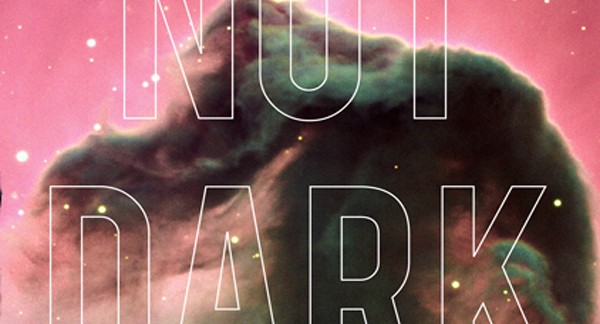
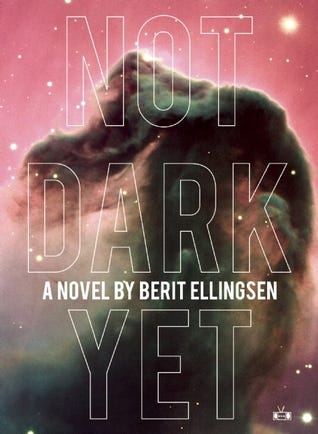
If this is starting to sound dourly familiar, it’s because Berit Ellingsen’s Not Dark Yet was published with eerie timing. As the United Nations climate talks that took place just outside of Paris, France this past month left the scientific community skeptical that the agreement would prove significant enough to prevent further climate change, it becomes even more difficult not to think we’re witnessing the beginning of our own undoing.
At the center of Berit Ellingsen’s debut novel, Brandon Minamoto, a former sniper for an unnamed outfit weighed down by the guilt of many kills. After his service, he moves back to an unnamed city on an unnamed continent, where he puts his keen eye to use as a photographer, and picks up work in a research lab at an unnamed local university. There, he meets Kaye, a charismatic assistant science professor who soon becomes his lover. But after an incident with a rogue owl in the lab that leads to their falling out, Brandon hightails it to a cabin in an unnamed town in the mountains, away from his boyfriend Michael, his brother Katsuhiro, and his guilt.
If the word “unnamed” seems a bit too ubiquitous in the previous paragraph, it’s because of Ellingsen’s insistence on describing an ailing world that shadows our own in as even-handed a manner as possible. No finger is pointed at one piece that isn’t pointed at the whole; no names are named, and all are implicated. Uncertainty, loss, and absence are some of the book’s most potent themes, and often, this lack of specificity has real power. At other times — like when a fellow trainee at an astronaut training center refers to a similar program “on the eastern continent” — it feels too constructed.
What’s this about a program? Well, similar to the privately funded Mars One mission in our own world, although whether the intention is to colonize or simply to go and return remains unclear. Brandon applies, in spite of the epilepsy-like losses of consciousness he endures throughout the book, and of the investment he has recently made in the experimental development of the land around his newly bought mountain cabin — can the new, warmer climate sustain fields of wheat in place of its native heather, his neighbors wonder? — and of the relationship he insists he is dedicated, even though much remains entirely offstage.
Not Dark Yet’s ambitions are somewhat oversized considering the constraints of such a slim volume. The strands of the story feel disparate throughout much of the middle of the book, in part because Ellingsen’s restrained diction refuses readers a close look into the inner workings of Brandon’s conscious mind. (His foreboding dreams, on the other hand, are depicted in detail and beautifully reflect his fraught uncertainty.) There is a powerful elegance in that restraint — Ellingsen’s attention to the detail of the natural world and to the marks humanity has made upon it is almost staggering in its precision — but it comes at a price. Brandon is most certainly the strong and silent type, and without more access to his thoughts, that silence feels like being left in the dark.
That said, maybe that darkness is the point. Ellingsen has noted that her title comes from a haiku by the 18th Century poet Yosa Buson: “Not quite dark yet / and the stars shining / above the withered fields.” Withered already, and so long ago. How could they possibly grow again in a world so poisoned?
There’s a quiet tension running through Not Dark Yet, a feeling that even if humanity did decide to come together and fight against its self-inflicted doom, both its recourse and its fate would remain uncertain. All this makes the novel’s finale — a haunting meditation on purpose and nothingness that somehow manages to make every previously disconnected storyline count — an even more remarkable feat.
A stark drama with a tight focus on the natural world and humankind’s perennially fraught relationship with it, Not Dark Yet stares straight into the dark eye of an impending Armageddon — the one we’re making for ourselves.
In 2015, my reading felt futile in the sense that for the first time in a few years I felt overwhelmed — too many excellent books, from too many disparate sources. Working on a couple of novels, I closed myself off from the internet for several months and during that time I wrote in the mornings and afternoons, then did nothing but read in the evenings — long, uninterrupted reading that healed a fragmented brain and energized my writing. With that isolation, I found it possible to once again live in my own writing and the writing of others. It was one of the most peaceful periods of the last few years for me.
But this reading did indeed reaffirm the growing realization that between fiction in translation, mainstream realism, and fabulist fiction, along with a plethora of interesting nonfiction…who can really comprehensively cover a year of books? (Which is, frankly, such a boring and arbitrary way to measure time anyway — and, also, why do we continue to torment ourselves with mornings?) In the attempt to be too comprehensive, and of course failing, you might you do yourself an injury or in some way force the issue and wind up not having as much fun reading as you might have otherwise.
What you have before you, then, is a list of wonderful books I read in 2015, most of which were published this year. Some, however, appeared in 2014 and a couple date back two or three years. This feels like more of a natural rhythm to reading, or at least that’s the story I’m going with. I missed out on reading a few of the heavy hitters from 2015, but I also managed to discover some gems from 2014 I’d missed before. Along the road, too, I picked up some real stinkers from heavy hitters in 2015 that will remain unnamed. (You know exactly who I mean — that book you hated with the intensity of a million exploding suns. Yes, that’s the one. I hated it, too. Good, I’m glad we’re all in agreement here.) I note no particular trends because I think trends are often just some kind of obstruction in the eye of the beholder — for example, I picked up a lot of great fiction in translation and I also published a massive tome of fiction in translation. Ergo, this was the year of fiction in translation. But…was it? Outside of my house?
Finally, I decided this year to single out three titles for special praise, my top picks for novel, short story collection, and nonfiction from 2015. I would also like to congratulate New Directions on what I thought was an extraordinary year for them, with five titles on my list. They also published some truly beautiful books from a design standpoint.
Best Novel of the Year
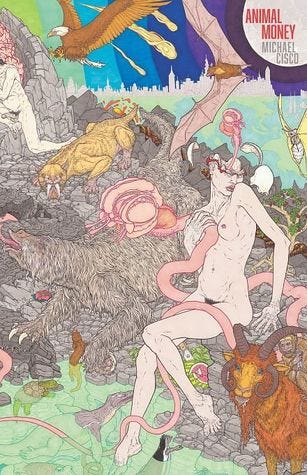
Animal Money by Michael Cisco (Lazy Fascist Press)
After I read the first quarter of Michael Cisco’s Animal Money, I was so overcome I ran around the outside of the house three times in the dark in my bathrobe shouting “Michael Cisco is a fucking genius!” Parasite tongues whispering public policy to the politician whose mouth they inhabit. Economists engaging in jumping competitions to decide primacy among competing theories. Spells to raise the dead conducted on airport tarmacs. Six intermingled rogue points of views and a continuing (possibly fabricated) life-story for an experimental physicist who incorporates the uncanny into her science and forever transforms the Earth. What madness is this: that it all works so seamlessly? In such sublime absurdist fashion.
But perhaps I should back up. Animal Money is “about” five economics professor who come up with the (surreal, radical) idea of animal money after meeting one another at the hotel of a conference they aren’t able to attend because they’ve all suffered coincidental injuries that require each to be heavily bandaged in some way. This bonds them as a group and a series of adventures ensue that include a weird zoo and a nudist beach. It’s written at a break-neck pace and in a style that’s very accessible. Cisco more or less piles brilliant set piece on top of brilliant set piece — and then in the most brilliant move the narrator begins to share space with narration by the other economic policy wonk academics and additional voices, at a point in the narrative where the reader has come to see them as one being anyway. All while Cisco also mercilessly skewers the world banking system and the peculiarly abstract world of money in general. He also manages to out-Clark Ashton Smith for Smith-like weird imagery, and certain sections are flat-out visionary and hallucinogenic in the best possible way.
I think of this novel as not just possibly the finest weird novel of the modern era, but also an uncanny Infinite Jest by way of early Pynchon and Robert Bolaño’s 2666. This novel requires your full and undivided attention, but will not come away from the experience unchanged.
Runners-up: Eka Kurniawan’s Beauty is a Wound (New Directions, translated by Annie Tucker) and Uwe Tellkamp’s The Tower (Allen Lane, translated by Mike Mitchell)
Best Story Collection of the Year
The Complete Storiesby Clarice Lispector, translated by Katrina Dodson (New Directions)
As I wrote for Slate earlier this year, “Finding the absurdity or oddness in reality is, in isolation, a good enough magician’s trick, one that has sustained entire literary careers. But the joy in discovering Lispector is that she fuses the trick to a simultaneous sense of the universal, often in the same sentence or paragraph. Her characters could never be anyone else, yet they are also all of us. Reading these stories, I had the same feeling I had when I first read the collected stories of Angela Carter and of Vladimir Nabokov: that something lives beyond the skin and in the skin, and you welcome the invasion, you begin to long for it every time you’re away from the book. You read slow, you read fast, you hold stories back and then devour them, you dread that moment when you’ve finished the last of them. Because the strangeness is familiar and yet different than you’ve ever encountered before. Because life seems more vital, almost hyperreal, after reading Lispector, and it is harder to ignore the hidden life surging all around you, in all its many forms.” Since then the collection has only grown more significant in my thoughts, in part for how Lispector fuses so uniquely the real and the surreal. The epic “Brasilia” has rewarded several re-readings, as have other stories in this soon-to-become iconic collection. Simply brilliant.
Runners-up: Joy Williams’ The Visiting Privilege (Knopf) and Amelia Gray’s Gutshot (FSG Originals)
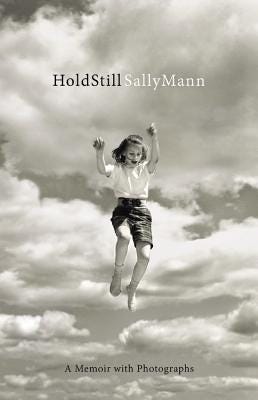
Has anyone found an attic more intellectually and historically valuable than that of photographer Sally Mann? In Hold Still, her attic divulges crimes, family foibles, blow jobs, car crashes, murder, and much more. (My own attic has a squirrel in it. End scene.) By working in the source of her source material, Mann is slyly pointing to the source of inspiration in a book that is, in part, about inspiration. However, even given the chapters focused on the controversy created by publishing candid photographs of her children, this memoir would be much the poorer if it didn’t also deal with race relations and various true and false visions of the South. No creator exists in a vacuum, and Mann’s honesty across not just the subject of her family’s eccentricities but the milieu in which she grew up also serves the valuable purpose of preserving something unique. The photographs are interesting but it’s a testament to Mann’s talent as a writer that they often seem superfluous. Whether it’s making us understand a bygone era or the process behind her art, Mann has a discerning eye. I felt after reading that I knew Mann in the way a friend might, but also that I had gained essential insight into the creative process itself.
Runners-up:The Soul of an Octopus by Sy Montgomery (Atria Books) and Learning to Die in the Anthropocene by Roy Scranton (City Lights)
***
Other Selections
Fiction/Poetry
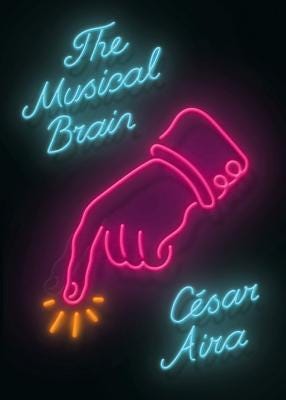
The Musical Brain by Cesar Aira, translated by Chris Andres (New Directions)
It’s no surprise that Aira’s collected stories share some of the same attributes as his wonderful novels — those novels are sometimes only medium-length novellas. What struck me most about these fictions is that Aira likes to teeter on the edge between realism and fabulism. There’s a sense of the contes cruel suffused with Kafka and weird ritual a la Thomas Ligotti, but with more of a fantastical air than a horrific one. The title story “The Musical Brain,” with its sense of decadent spectacle, shares some affinity with tales by Gustav Meyrink and other writers who engage in grotesqueries, while others like “The Ovenbird” are both grotesque and metafictional, real and definitely not-real. There is an ovenbird…and yet there isn’t. Above all else, Aira makes an art form out of a purposeful meandering. The stories rarely provide standard plots or resolutions, but wind up in interesting places and often seem like perfectly formed jewels.
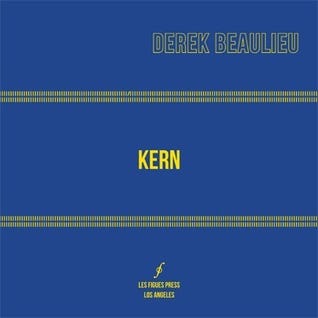
If letters have lives, as Johanna Drucker suggests, then Beaulieu has herein documented some of the more interesting and opulent of those lives. Not only that, he has catalogued entire ecosystems and diverse species of letters. Kern is part of the Global Poetics Series but also functions as a kind of experiment in meaning and as an art book. The distinction between the figurative and the literal dissolves as you turn the pages, encountering ever more complex experiments in typography. You can enjoy the book as conceptual poetry or as art or as brilliant letterpress creations. The best poem-images in Kern have a lovely sense of motion, as if depicting dancers, while others resemble maps made of letters. A few slink along like previously unknown lifeforms. Throughout, there are beautiful progressions, crescendos of climax, and then the quiet slow burns of endings.
Dark Matterby Aase Berg, translated by Johannes Göransson (Black Ocean)
Like some kind of procrustean monster-deity communicating to us in human language for the first time, Aase Berg in her poetry conveys an alien profundity and, in poems like “In Reactor,” an almost geologic expanse to her vision of time and space. In prose-poems like “The Animal Gap” and “Ampules from the Lust Garden of Suffering,” she more or less attempts to find a new way to think about the world and our place in it — wrenching language out of its preordained tracks. It’s no surprise to discover Berg became involved with poetry through the surrealists, and in a darkly glittering way her work attempts to find that moment of “convulsive beauty in the service of liberty.” I find her work deeply emotional, even when it leaves the human, as we know the human, far behind. I am also reminded of equivalents in tone in other media, like Scott Walker’s album “Tilt.” Along with the work of Joy Williams, Clarice Lispector, Eka Kurniawan, and Amelia Gray, discovering Aase Berg this year has been a revelation, one that has forever changed me. “Bebirded, abandoning/pull your deep claw out of me.”
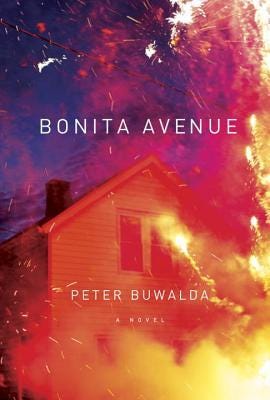
Bonita Avenue by Peter Buwalda, translated by Jonathan Reeder (Hogarth)
When I finished Bonita Avenue, this Dutch author’s English-language debut, I knew it was definitely a very good and structurally interesting book. But over the next nine months the novel has only grown more powerful in my imagination, and certain scenes have gotten stuck in my head and I can’t get them out. For example, I will never be able to view either broken glass or smoke rising through snow in the same way again. Buwalda skillfully charts the course of a dysfunctional family with many secrets and, in the formidable Professor Siem Sigerius, a stubborn patriarch whose past may destroy his family. The characters are complex, often amoral, and masterfully observed by the author. The drama and pathos are offset in a lovely way by dark humor and absurdity. Buwalda handles the revelations of mysteries in both the present and past with remarkable assurance. The novel’s climax is chilling, unforeseen, and in some ways, profound.
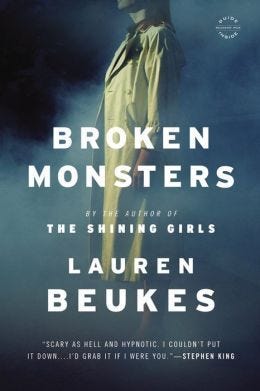
Out in trade paperback this year, Broken Monsters is a tour de force of disparate voices, in the way that Beukes conjures up such a wide range of characters and makes them real, immediate, and believable. Set in Detroit, the novel trades off of a deceptively familiar serial killer set-up to reach deeper and wider territory. Not only is the antagonist unique and well-rendered, but the crimes have an odd, spooky (if terrible) integrity that compares favorably to the best moments on the television show Hannibal. But Beukes isn’t interested in spectacle, although she does spectacle well. The novel also comments in interesting ways on the nature of art and the nature of our fragmented reality. And while the speculative and horrific elements are masterful, it’s the conjuring up of, for example, the complex voices of teenagers that makes Broken Monsters truly unique.
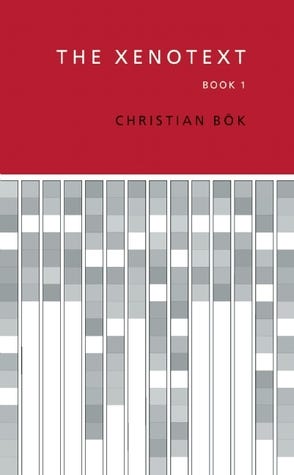
Poetry, conceptual or otherwise, needs to be in some way engaging to the reader; which is to say, whether a poem is intellectually engaging in an abstract way or immerses the reader in something concrete and sensual, the work can, to me at least, only hold value if it is more than the concept it embodies. The Xenotext came out of an outrageous experiment, but is intriguing on the page as well as in the realm of ideas. Bök has encoded a poem called “Orpheus” into the genome of a germ, so that the cell in question builds a protein that encodes yet another poem, “Eurydice.” Having demonstrated this idea in E. coli, Bok plans to insert his poem into a deathless bacterium, thereby writing a text able to outlive any apocalypse. Well, okay, maybe sometimes an idea is worth a thousand words. But the words are very entertaining, too. In sections entitled “The Late Heavy Bombardment,” “Colony Collapse Disorder,” and “The March of the Nucleotides,” Bök explores science-fiction concepts through experimental poetry. “Writhing in the innards of these cattle there swells a gale of bees, uprising through the rent ribs” reads one line, exemplifying how Bök gives concrete form to the abstract.
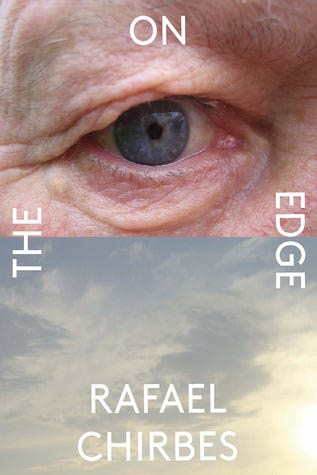
On the Edge by Rafael Chirbes, translated by Margaret Jull Costa (New Directions)
Mordent, ruminating, a slow burn, On the Edge depicts a Spanish town whose inhabitants are reeling from the collapse of the economy — in which context the discovery of a dead body in the marshes is just one more misery. The bankrupt owner of a factory, Esteban, is in part the center of the novel, but Chirbes employs several voices, and verges on the omnipotent voice in certain sections. Each new layer brings additional depth and context, along with odd pathologies, revealing a portrait of a place that hasn’t yet dealt with the past, dead bodies aside. Chirbes likes long paragraphs and a pacing that requires patience, but once you become acclimated to it, the book seems more urgent and at a certain point transforms into something approaching a page-turner.
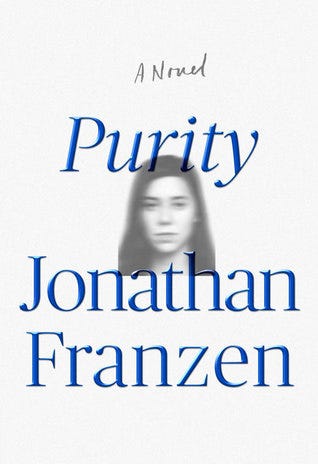
Purity by Jonathan Franzen (Farrar, Straus and Giroux)
As ever, Jonathan Franzen charts the eccentricities and absurdities and contradictions of his often conflicted and unlikeable (but always interesting) characters. Last time, Franzen framed the personal against the backdrop of ecological issues; this time the context constitutes a blistering critique of the post-information age filtered through Franzen’s enduring thesis — that everyone is fucked-up and no one is or can be ideologically pure, because humans aren’t built that way. The main character, Pip, navigates dangerous waters that include revelations about her past and decisions about her future. Along the way she meets the Devil, in the form of Andreas Wolff, a kind of off-brand Julian Assange, but with some of Assange’s same contradictions between public persona and private life. Trademark absurdist humor is atypically for Franzen a little muffled, but the novel is also less sprawling than predecessors. Freedom remains Franzen’s masterpiece, but many of its virtues carry over into Purity, including an ability to make us understand and feel empathy toward sometimes prickly and anti-social characters.
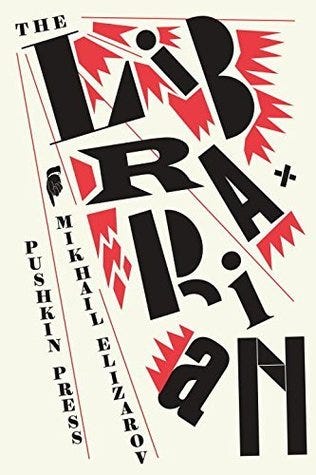
As I wrote over at Slate for their list of the most underrated books of the year, “In this brilliant winner of the Russian Booker Prize, the novels of a boring, pedantic Soviet-era writer turn out to convey unusual powers for those stalwart enough to read them through to the end. Rival groups of ‘librarians’ hoard the books and thus the powers, resulting in several bloody conflicts. From there, Elizarov meticulously spins out a tale by turns hilarious and harrowing. A metafictional conceit becomes very intense and tactile due to the Ukrainian author’s own unusual powers — without undermining the absurdist elements. Immensely entertaining, The Librarian lives up to comparisons to the work of Gogol and Bulgakov while being very much its own thing.” I’d add only that this is a very accessible book, a page-turner that should appeal equally to the realist and the fabulist.
Not Dark Yet by Berit Ellingsen (Two Dollar Radio)
As we spiral further and further into an era defined by climate change, the fiction we require to explore these issues and the forms it will take are evolving. Much of what we think of as near-future or mid-apocalypse fiction will soon feel dated or even morally reprehensible, nothing more than nostalgia dressed up as disaster porn. But in Not Dark Yet, Ellingsen charts a new course that is at times Kafkaesque and always mesmerizing. Never didactic or predictable, the novel follows a main character whose time in the military and subsequent interactions involving an experiment with owls have come to define his life. As we follow this character through events both surreal and painfully personal, Ellingsen also ties in elements related to our fascination with space travel and locally sourced products. The result is, indeed, “not dark yet,” but getting there. An ambiguous and luminous and mysterious text that changes shape and meaning on rereading, as with all the the best fiction.
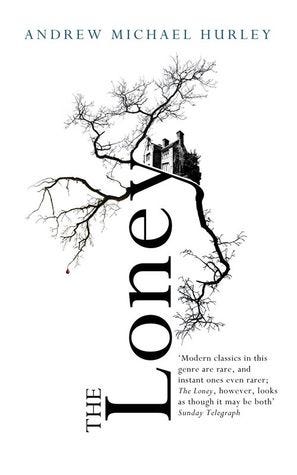
This stunning novel about faith and the uncanny is in some ways a literary successor to the work of Robert Aickman, although little mutterings and stirrings of Arthur Machen, Algernon Blackwood, and certain of M. John Harrison’s stories peer bright and bat-like through the spaces between the words. The narrator recounts in quiet yet suspenseful detail one particular Easter trip to a remote area of wilderness known as The Loney. The family is accompanied by the new parish priest, who fits in uncomfortably with the community at large. Hurley’s ability to know when to insinuate and when to full-on show lends great depth to the characterization, and our understanding of the various members of the family changes over the course of the narrative. The old cottage the family stays in and the strange men living nearby are equal source of terror, without seeming to be there just to create tension. The shadow of the old priest across the story, the history of the region, and what happens to the narrator on one long-ago trip converge to create an instant classic.
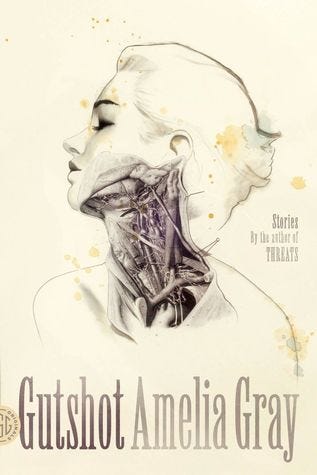
It has been rather difficult to trust the sanctity of the walls of my own house since reading Gray’s story “House Heart,” and the collection as a whole had me doubting the sanctity of the walls of my mind, too. I bought the collection in a bookstore where the clerk told me point-blank “That book is way too weird for anyone.” I replied, “Really? I think the author’s fiction is quite normal,” and gave the clerk a look as if they were the weird one — my usual approach in such situations. Still, it’s true that Gray does have a knack for drilling right into your brain with images and situations that resonate in unusual ways. The stories also exhibit a dark sense of humor and brilliant compression, making many other story writers seem long-winded. The sentences are just wonderful, even when describing the horrible (especially then), even when I just, as now, randomly pick out the first one I flip to: “The sun beats the shit out of a dirty road called Raton Pass where the closest thing to a pair of matching earrings is a guy named Carl who punches you in the head with his fist.” I think of Gray as a take-no-prisoners kind of writer — uncompromising, fascinating, and “edgy” in a way that reclaims the validity of that word. I both adore and am a little terrified by Gutshot and think of the stories often.
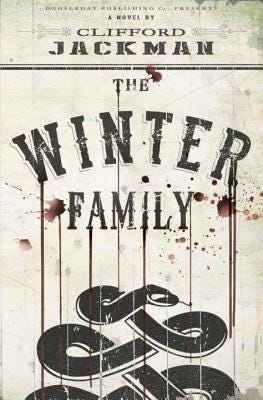
Bloody, amoral, and uncompromisingly bleak in its vision of the adventures of outlaws in the old West during and right after the Civil War, Jackman’s debut manages somehow to invite comparisons to Blood Meridian without seeming like pastiche. Highlights include a chilling character who only laughs and the vagaries of the Winter Family itself, which has its own code of conduct, and comes up against enemies as compromised as they are, or even more so. The novel unspools in brilliant set pieces that take place in Georgia and points more northern, like Chicago, with intervening sections of summary that read like chaotic, bizarre American folktales. The cleverness of using this summary to simply bypass any possible lulls is matched by attention to detail — both in recounting depravity and in keeping the reader right there, in the moment, during gun fights. Not exactly for the Jane Austen set.
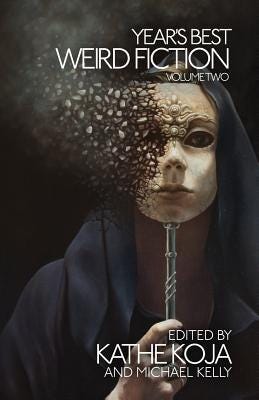
One issue for non-realist fiction over the years has been the lack of year’s best anthologies with rotating editors, which tends to help democratize the process of establishing canon. Another issue, specific to “weird fiction,” is a proliferation of horror, science fiction, and fantasy year’s best anthologies that all have blind spots when it comes to certain kinds of unclassifiable fiction. The Year’s Best Weird Fiction has provided a corrective for both problems — and has especially hit its stride with volume two, under the editorship of iconic weird-fiction writer Kathe Koja. Her selections include a quietly powerful story by Julio Cortazar as well as sublime work from Nathan Ballingrud, Karen Joy Fowler, Caitlin R. Kiernan, Carmen Maria Machado, Karin Tidbeck, and the brilliant new writer Usman T. Malik. No finer year’s best was published in 2015.
Beauty is a Wound by Eka Kurniawan, translated by Annie Tucker (New Directions)
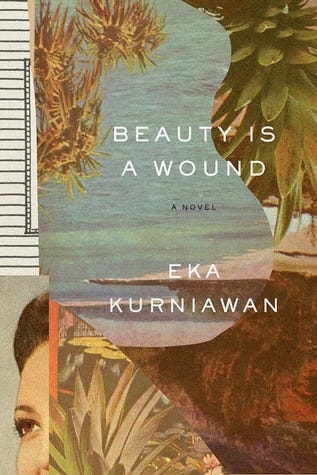
This Indonesian author’s English-language debut is scatological, scandalous, lively — beautiful and dark and messed up and fantastical. Terrible things happen and gorgeous things, and Kurniawan handles all of it with grace and empathy. Beauty is a Wound is like One Hundred Years of Solitude kicked into another gear, with an almost punk sensibility housed within gorgeous writing — and stories coiled within stories within stories. One of the most brilliant things about the novel is how Kurniawan never loses the thread even when spinning so many tales at once. This is especially impressive because his account is so matter-of-fact harrowing yet also darkly humorous. Somehow, too, he can write fairly traditional realistic scenes that exist side-by-side with almost surrealistic visions, without the result seeming tonally inconsistent. As a reader I was blown away. As a writer, I was taking notes to try to figure out how Kurniawan managed to create such a fusion. For those who prefer stolid realism and novels that don’t run around the yard getting into mischief, a second by Kurniawan released this year, Man Tiger (Verso), is still fantastical (and very good) but staid by comparison.
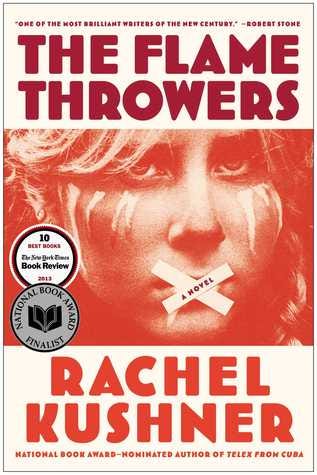
I know I’m coming very late to Rachel Kushner’s fiction, but I encountered The Flamethrowers for the first time this summer and could see no way to leave it off of this list. From the very first scenes of the protagonist driving her motorcycle down to Nevada to participate in a race, to the depictions of the 1970s New York art scene, I couldn’t stop reading this sharp, incendiary novel. I actually am not a huge fan of motorcycles, but the utter genius of the novel is that even if your mother had been run over by a motorcycle and a motorcycle had laid waste to your house and taken over your job and driven your children away from you, all the while insulting you on social media…you’d still be mesmerized by the sections of the novel in which Kushner describes the experience of riding a motorcycle. Kushner also skillfully weaves in details about the past to create a rich, kaleidoscopic vision of her characters’ lives.
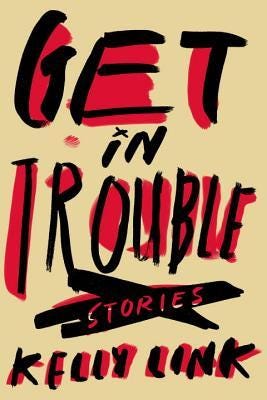
The “national treasure” Kelly Link (as Neil Gaiman put it) gets in trouble in her latest collection, mostly by continuing to write idiosyncratic and surprising short fiction. Whether it’s the autumnal and pitch-perfect “The Summer People” or the raucous and deliberately fragmented “I Can See Right Through You,” involving ghosts and a demon lover, Link cuts right to the heart of her characters’ lives. Her use of fantastical elements is subtle, smart, and at this point in her career organic and seamless. Link’s fiction also seems deeply weird, even when it contains pop culture referents — something odd moves beneath the surface, something ancient and dangerous. I particularly liked “Valley of the Girls” and “Origin Story,” but the thoroughly engrossing thing about Link’s work is that it changes. The next time I read these stories, something else will rise up from the pages.
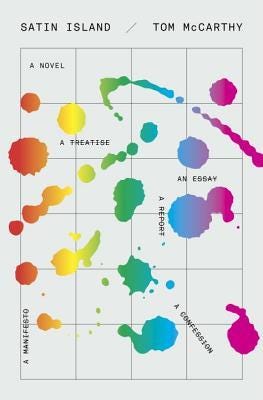
Even merely adequate granularity in fiction that tackles the post-Information age is hard to come by — most writers get it wrong or have just enough understanding of the complex and shifting paradigm to define it properly in their fiction, but not enough to be fluid in deploying what they know — to make that information move and perform complex maneuvers. Usually it’s depressingly a bit like watching a human swimmer in a race with a dolphin. But, as it turns out, Tom McCarthy is a dolphin when it comes to this subject, and Satin Island contains the evidence. His opening airport sequence would be brilliant first of all for how its privileging of a transitional space symbolizes so much more about the modern world and the main character, but McCarthy’s layering-in of television coverage of an oil spill lifts these scenes into what I would call genius-level territory. The way in which oil is fetishized and seeps into the beginning of the narrative in a metaphorical way recalls other brilliant works like Reza Negarestani’s Cyclonopedia. But that’s just the start of a pseudo-corporate adventure and tour of the fractured-fragmented world of fiction-becoming-nonfiction that we live within today. An investigation into skydiver deaths sends up the Cult of the Great Conspiracy, while the narrator’s attempt to create a singular Report for his boss provides a great deal of room for satire within a context that is all-too-real. The ending contains a level of mundane reality that may be as startling as climbing out into the sunlight after being underground for a year (get the hell out of your virtual reality) and also contains a revelatory (and absurdist) take on one of the main relationships in the novel.
Thus Were Their Facesby Silvina Ocampo, translated by Daniel Balderston (New York Review of Books Classics)
Because too few readers know the extent of Silvina Ocampo’s contribution to the literary arts, here’s a primer: She was an influential Argentine writer, translator, and playwright who published more than twenty books of poetry, fiction, and children’s stories. Along with her friend Jorge Luis Borges and her husband Adolfo Bioy Casares, Ocampo, came to epitomize Latin American fantastical literature prior to era of Julio Cortazar and Gabriel Garcia Marquez. Her sister Victoria Ocampo founded and edited the iconic journal Sur, with several of Silvina Ocampo’s literary works appearing therein. It’s also sometimes forgotten that Silvina Ocampo co-edited the classic Antología de la Literatura Fantástica with Borges and Bioy, later published in English as The Book of Fantasy. Italo Calvino wrote of Ocampo, “I don’t know of another writer who better captures the magic inside everyday rituals, the forbidden or hidden face that our mirrors don’t show us.” This year’s Thus Were Their Faces, collected stories, with an introduction by Helen Oyeyemi and a preface by Borges, begins to redress a serious and bizarre lack — that of finding her fiction in English. The collected stories — dark, gothic, fantastic, impressionistic, and grotesque — include a mysterious and highly recommended novella, “The Imposter.” In her introduction to Thus Were Their Faces, Ocampo notes that she fought with her teacher de Chirico over the way he “sacrificed everything for color” and that she turned away from painting to writing so she could more clearly see “the forms amid the color.” There are many forms amid the colors in this great composite collection, and hopefully will lead to more of this writer’s work being available in English.
War, So Much War by Mercè Rodoreda, translated by Maruxa Relano & Martha Tennent (Open Letter)
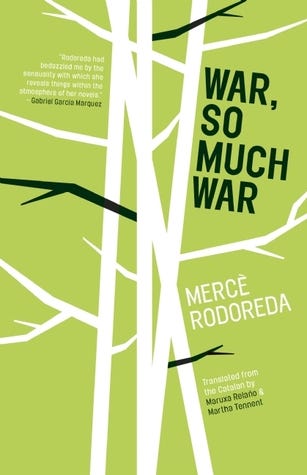
Mercè Rodoreda has been a favorite of mine ever since college, when I encountered her story “The Salamander” in a world literature anthology I bought at a second-hand bookstore. As you might expect, the story wasn’t just about a salamander (although, yeah, it was about a salamander). Instead, it was transformative, utterly unique, and combined an astute eye for the natural world and a great sense for the fantastic with a feminist subtext. That “mix” sums up much of the great Catalan writer’s oeuvre. War, So Much War, the latest translation of her work following volumes of short stories and the darkly sublime novel Death in Spring, is a phantasmagorical journey through a landscape of war. People disappear into the sea. Cat men made out of broken parts try to make their way in the world. A kind of anti-picturesque episodic adventure, the novel makes sense of war through the nonreal, makes us understand that in the worst circumstances the surreal is the every-day as well as the place people escape to because there is nowhere else to hide. Rodoreda fled to France during the Spanish Civil War, and spent two decades in exile. At various times she was not allowed to write in her native language. In that context, it has been extraordinarily satisfying to see more and more of her fiction in English translation. Very little of it was available at the time I first read “The Salamander.” War, So Much War helps to expand our understanding of a world-class writer’s fiction, with, hopefully more to come.
The Blizzard by Vladimir Sorokin, translated by Jamey Gambrell (Farrar, Straus and Giroux)
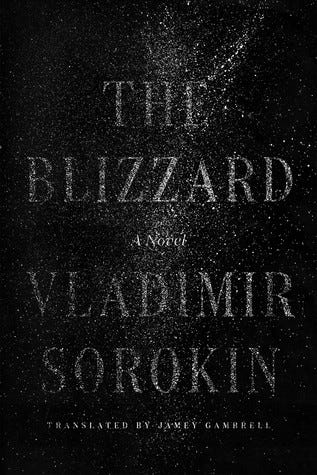
Anyone who enjoyed Mikhail Bulgakov’s A Country Doctor’s Notebook (nonfiction) or, indeed, Franz Kafka’s “The Country Doctor” (fiction), or certain fictions of Tolstoy, will enjoy Sorokin’s half-bizarro, half-traditional riff on the idea of man of medicine stuck in the boonies and the weirdness that may ensue. Rather than a stuffy translation full of faux Russianisms, we get instead approaches that veer from the sublime to slapstick. Garin’s attempt to get to the village of Dolgoye to stop a zombie epidemic is as ill-fated as the protagonist’s attempt to get off a bridge between two countries at the beginning of Vladimir Nabokov’s Bend Sinister. Two steps back, one step forward, until, mired in the non-journey with the good doctor, the reader finally realizes that perhaps the point is not the same point as the destination on a map. Toward the end, Sorokin reaches grand heights of rhetorical flourish in the service of uniquely strange situations. The “transparent pyramid” may emit a delicate whispering sound and evaporate, but the detritus of some of the more eloquent passages will linger in reader’s minds for quite some time. Just remember, the grommet, the grommet “from the giants’ cleaver, was big. Very big. Heavy. Weighty. It weighed may poods, hundreds of thousands of poods, and stretched, stretched, stretched” for many miles.
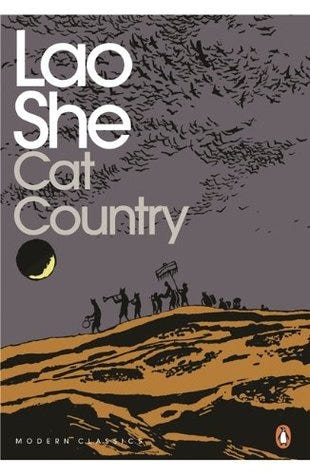
Hounded to death during China’s cultural revolution, Lao She had difficulties with censorship throughout his career. His best-known work was Cat Country, originally written in the 1930s and brought to English-language readers first in 1970 and then in 2013 in a revised Penguin Modern Classics edition (which I first encountered early this year). In the novel, a traveler from China crash-lands on Mars only to encounter a species of intelligent cats that rules over the planet. Befriended by a local cat person, the narrator encounters various aspect of the cat culture, which are clearly stand-ins for various aspects of Chinese society and governance. The guts of this novel are both cleverly inventive and observant of the culture Lao She grew up in. The author clearly could have become the leader of a robust and vibrant science-fiction tradition in China in some alternate-history version of that country. The translation is excellent, and the text is entertaining and lively while also having considerable satirical bite.
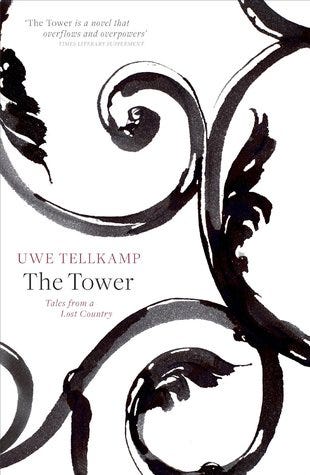
A critically acclaimed national bestseller in Germany, The Tower received some attention in England but practically none in the U.S. upon its English-language release on December 30, 2014 (perhaps only in Canada and the U.K.). This is a shame because The Tower is a unique, sweeping, and lyrical novel that chronicles the lives and misfortunes of an upper middle-class family of intellectuals in East Germany during the last years of communism. In my experience, at least, it is unusual to encounter a novel about this era, evoking the Stasi and bread lines, that reads in part like one of Mark Helprin’s more fantastical creations. Gritty realism occurs within a context of a tradition of high culture and dinner parties, no less urgent from that perspective. Christian Hoffman, a conscript in the National People’s Army, comes home to see his parents and soon thereafter his uncle Meno fall afoul of the authorities. From there the novel opens up in unexpected and interesting ways. Epic in scope, The Tower is a classic in every sense, and Tellkamp is unafraid to unleash the power of poetic passages. “Searching, the Great River seemed to tauten in the approaching night, its skin crinkled and cracked, as if it were trying to anticipate the wind…”
The Illogic of Kasselby Enrique Vila-Matas, translated by Anne McLean & Thomas Bunstead (New Directions)
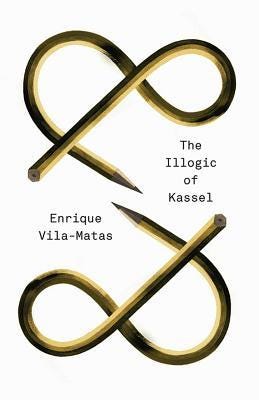
Poor Enrique Vila-Matas…or, rather, poor some version of Vila Matas. At the beginning of this at times metafictional novel, a novelist Enrique is invited to participate in the German Documenta exhibition by becoming a piece of performance art. He will be asked to spend time writing in a Chinese restaurant in the city of Kassel, possibly while passersby gawk or possibly to absolute indifference. Once in Germany, however, the nature of the assignment seems to change — as does Enrique’s enthusiasm for the project. In part it is Enrique’s overblown sense of his own importance that fuels the engine of the novel. In part it is the author’s (the real author’s) sense for what needs to be punctured and what needs to be celebrated in terms of the creative impulse. What follows stacks weirdness on weirdness, emphasizing both the virtues and pitfalls of conceptual art. The real achievement here is that a novel based so utterly on the abstract can feel so concrete and of-the-moment. Also of note are Vila-Matas’ A Brief History of Portable Literature and Because She Never Asked, both released this year by New Directions.
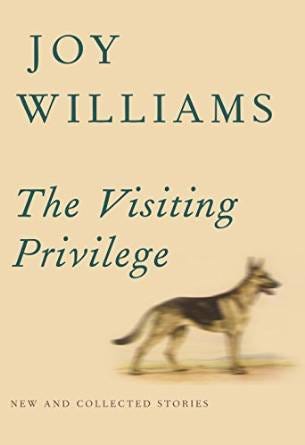
This comprehensive new collection from Joy Williams came as a total revelation to me because I had never read her fiction before. I can’t describe the sensation of reading Williams for the first time as anything other than being physically knocked off my feet. Even an early story like “The Yard Boy” contains multiple surprises, not least of which is a dead-pan hilarious deranged plant. “Winter Chemistry” is a beautifully nasty piece of work, never going where you think it will go, and ending so perfectly that in retrospect the path seems so natural. “Rot” feels fresh and new because Williams avoids the trap of many story writers who, because they would never do such a thing, are unwilling to “go there,” perhaps especially when “there” is a car in a living room. “Farm,” in which a drunk driving incident leads to, is a stone-cold classic of motivation and understatement, devastating and chilling. Structurally, the stories are fascinating to learn from, and even though some reviewers typify Williams’ work as “dark,” I don’t find it particular depressing because the specific detail is so perfect. An added bonus or overlay: Williams’ view of animals in these stories is an excellent example of a writer understanding that even if an animal in a story is not the focus of the story, that creature is still a part of that story, not just an inanimate bit of setting. Heady stuff, and highly recommended.
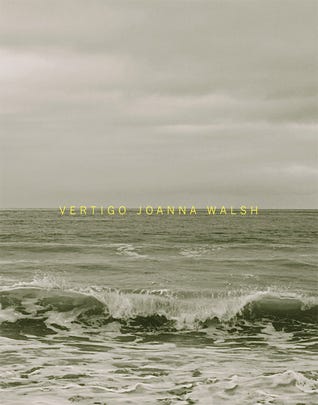
Slim books sometimes contain mighty and all-encompassing ideas, and such is the case with Walsh’s short story collection, from one of my favorite publishers. Echoing and evoking such writers as Angela Carter, Lydia Davis, and Clarice Lispector, but in her own unique voice, Walsh examines gender politics and the inequities of relationships in a hypnotic and personal way but within a space that is also universal. Stories such as “Claustrophia” are not so much polemics as state-of-the-nation non/fictions, and the intensity arises from precision of thought and image, the “lace tops with modesty inserts, and the spangles as if for nights out, the cardigans grown over with a fungus of secondary sexual characteristics –bristling with embroidery and drooping with labial frills.” Other tales like “The Children’s Ward” continually surprise and subvert throughout their short length: “Nevertheless I think I couldn’t kill the anesthesiologist…Nor do I think I could kill the surgeon, who looked like a banker without his suit. When [the patient] went under, did I want to kiss him?” I can’t stop quoting Walsh because her sentences are so excellent, and because all of her stories are constructed solely from excellent sentences. “I have had some good times in this body like right now.”
Sometimes you encounter a “regional” book of much wider interest. British Columbia: A Natural History (in a new, expanded edition) is a wonderful example. First off, it’s about an area of great biodiversity, an area that in contrast to many still has pristine and semi-pristine wilderness. In conveying a deep sense of the many intricate ecological zones that comprise British Columbia, the book succeeds brilliantly — not only is the information presented in an entertaining, clear, and interesting way without trying to simplify what needs to be emphasized as being complex and interdependent. The accompanying charts and graphs and photographs, unlike in many such books, really do illuminate the text and add to it. Even better, in order to discuss British Columbia in a meaningful way, the authors have to provide a primer on geology, biology, and ecology integrated into their discussion of this specific area. I appreciated this primer because the authors are such good writers that even basic concepts I already knew were interesting to read about again. What comes through, too, in a meaningful and passionate way is the author’s love of and connection to the area. The book is a practical and enduring expression of that love.
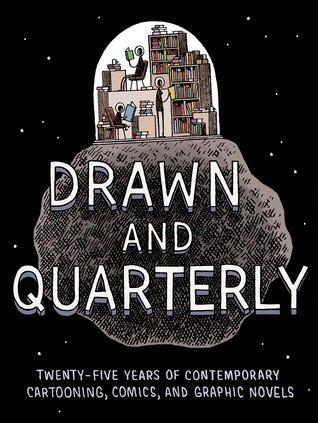
If there was a “no-brainer” selection for this list, it would have to be this compilation of text, art, and comics from Drawn and Quarterly. The little outfit that became a huge influencer and provided safe-haven for all sorts of comics artists who didn’t have other outlets has now given readers a lovely, lively, and sometimes eccentric account of its origins. With (sometimes new) work in D-Q 25 from Kate Beaton, Chester Brown, Yoshihiro Tatsumi, Art Spiegelman, Lynda Barry, Adrian Tomine, and many more, you could just browse through the art. But then you’d miss the commentary on how Drawn and Quarterly came to be, and how it grew, which is fascinating. Appreciations from various artists and influencers in book culture are often insightful. Taken in total, the book also gives readers a good idea of the evolution of the comics culture and some of the roadblocks that the press had to overcome to get to their current exalted and iconic status. I also appreciated the great endpapers and even the carefully chosen back-cover image of two dogs ripping apart a graphic novel.
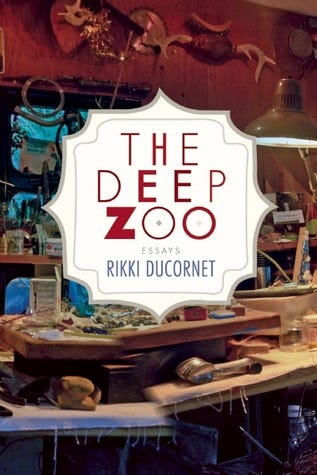
One of our best and most enduring surrealists and sensualists, Rikki Ducornet intuits connections supersaturated with color and finds the intersection of myth, nature, and the literary world. This slim collection contains worlds wide and deep in nonfiction form. It opens up in the imagination like an amazing cabinet of curiosities or exquisite coffee-table book composed entirely of words. What is the “deep zoo?” It’s worth quoting Ducornet at length to convey some of the delight in reading these essays. “For Bachelard they take the form of shells, a bird’s nest, an attic; for Borges a maze, mirrors, the tiger; for Calvino moonlight, the flame, and the crystal; for Cortazar ants on the march and the cry of the rooster…For Borges, there is an evident sympathy between the tiger’s stripes, the world’s maze, language, and the maze of the mind; for Calvino, between moonlight and the lucent transparency of clear thinking; for Bachelard, between attics and a love of solitude; for Cortazar, between the cock’s cry and the knowledge of mortality, of infinitude.”
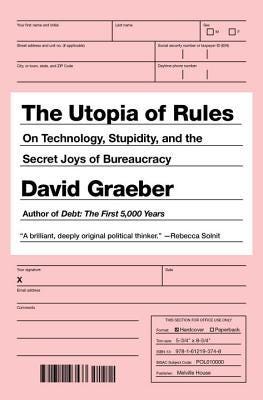
As someone who frequently found himself subjected to the tyranny of bureaucracy before becoming a full-time writer, Graeber’s book at times conjured up visions of hell. After one finds a dead mouse and dead plant in one’s desk or is asked repeatedly by the unhinged if one would like to “see a strange room,” the mechanisms by which governments and civil servants live out their strange lives become less ethereal and academic than dystopic and mind-numbing. Still, I was willing to entertain the idea that a less horrifying view of bureaucracy might have value, and I’m glad I did. I especially appreciated sections like “Dead Zones of the Imagination: An Essay on Structural Stupidity” and the appendix “On Batman and the Problem of Constituent Power.” I had less patience with the section entitled “The Utopia of Rules, or Why We Really Love Bureaucracy After All” — although that section doesn’t necessarily contradict my own theory that the entire world runs on absurdity, inefficiency, waste, and dumb-itude. At times I wished Graeber would have engaged more fully with the darker and more dysfunctional aspects of “bureaucracy,” but I have to admit that it is probably his chipper tone throughout that I’m objecting to more than anything else — that and because I am still having a hard time contextualizing a lot of the bizarre, absurd, and brain-killing experiences I have had in that world. In short, my own eccentricities should be no obstacle to readers picking up this fascinating and comprehensive book — one that will be influencing my fiction for some time to come.
To Our Friendsby The Invisible Committee (Semiotext(e) Intervention Series)
In this follow-up to The Coming Insurrection (2007), the Invisible Committee commits to print an altogether post-Baudrillardian vision that, even if it’s a secondary purpose, reveals the difficulty of pushing out of or beyond the hegemony created by how the internet tends to commodify or take over for its own purposes causes and impulses. A list of points in the first chapters focuses in part on ecological issues and takes issue with the idea of the Anthropocene, although not from exactly the same position as some Marxists. To the Invisible Committee, it seems (and I could be wrong) that by labeling and measuring, humankind is engaging in the same kind of control that led us to the current climate change crisis. Other sections, on cybernetics, read like science fictional extrapolation. A critique of lives lived online as substitute for real rebellion has real power (especially in the context of climate change), and throughout the book the thoughts expressed have a provocative, wake-up-and-untie-yourself-from-the-railroad-tracks value. At times, a note of exasperation dominates, as if the Invisible Committee believes its disciples have misunderstood the message, but the analysis provided herein is a useful launch-point for pushing back against underlying assumptions about our world.
There’s something to be said for certain academic books — and the thing to be said is that even if you don’t have the background and context to extract the meaning of every morsel, they can still be incredibly stimulating. I’m still not sure I have the understanding of literary theory to grok all of Forms, but I’m damn sure I found the book entertaining and informative — one of those books that change the way you think about fiction and even your own work. First and foremost, Forms is meant to wrench our thinking out of its predictable modes, even when it is doing so second-hand, by referencing other texts. In finding new pathways to linking the literary to political, social, and historical context, Caroline Levine in effect creates new realities in the reader’s mind. I found particularly fascinating sections like “Affordances,” wherein the author examines the underpinnings of textures like glass, steel, and cotton — and how assumptions about those elements in terms of design can undermine or lift up creative works. I must say, I love a sentence like “The idea of affordances is valuable for understanding the aesthetic object as imposing its order among a vast array of designed things, from prison cells to doorknobs.” There is no way to provide a full synopsis of this book in this short space, but perhaps this will help: Forms interrogates the tactile reality of our world, and how we convey that in the “virtual reality” of fiction. In doing so, it performs the valuable service of reminding us that everything has social and political ramifications — in part because everything we create first existed in the subjective reality of someone’s imagination.
This slim volume with an introduction from Michael Pollan would probably drive one of my botanist friends around the bend, due to its assertions about plant sentience. However, it is a fascinating exploration, across a couple dozen essays — one that seeks to expand our understanding of plants and to help us better see the interconnectivity of our biosphere. In recent years we have realized that photosynthesis is a much more complex process than previous thought, and chronicled the ways in which plants use fungal thoroughfares to community. In Brilliant Green, the authors identify the dozen or more senses plants have, discuss how plants have been viewed by various religions, argue that in terms of evolution plants are superior to human beings, and, above all else, make it clear that we don’t yet understand all of the nuances and complexes of flora around the world. A mind-expanding book in all ways.
How, exactly, are we primitive humans supposed to judge the intelligence of more fluid creatures like octopuses, whose neurons aren’t collected like feudal lords inside one castle-keep, but distributed also in their tentacles? That’s at least close to one question raised by Sy Montgomery in this engaging and user-friendly book on octopus behavior sentience. The Soul of an Octopus provides a wealth of general information about octopus behavior; for example, that they “use their funnels not only for propulsion but also to repel things they don’t like, just as you might use a snowblower to clear a sidewalk.” Montgomery has a knack for making her observations relatable — and for giving the reader both specific data and anecdotal evidence to support her claims. By framing the information with her own stories about octopuses she’s also acknowledging that cephalopods need the humanizing touch because the idea of “octopuses with thoughts, feelings, and personalities disturbs some scientists and philosophers.” In an era when we’ve come to recognize that otters understand the concept of death and even fish appear to be more highly socialized than previously thought, it’s a little sad we need more books like this one. But we do.
Do you believe in ghosts? Well, they believe in you. From the uncanny in the work of Nigerian legend Amos Tutuola to the ethereal projections in Henry James’ novels and stories, The Spectralities Reader collects some fascinating nonfiction about our obsessions with wraiths, haunts, and other unseen impulses. Whether you want to explore capitalism and ghosts or Walter Benjamin and ghosts or being buried alive with ghosts, you’ll find something of interest in this massive anthology. A fair amount of the material is deeply analytical and rife with footnotes, but there’s still enough of interest here for the layperson. Some will simply delight in terms like “Hauntology,” “Spectropolitics,” “Textual Haunting,” Phantasmic Radio,” and, of course, “Ghostwriting.” Others will delve deeper into a world of invisible memes and subtextual stirrings. “When the lights go out, hearing stays awake.”
As we find ourselves more and more entangled in the Anthropocene, in thrall to global warming, books that are low on bullshit and high in value are not only important but at a premium. Unlike many other attempts, Scranton’s Learning to Die in the Anthropocene deals with the issues head-on, understanding that avoidance doesn’t deter catastrophe. Instead, an understanding of the facts leads to being able to move beyond inaction to being usefully proactive. It’s not in any way coincidental or beside the point that Scranton quotes Spinoza at the beginning of his slim but wise tome: “A free man thinks of death least of all things, and his wisdom is a meditation of life, not of death.” In stripped down chapters like “Human Ecologies,” “Carbon Politics,” “The Compulsion of Strife,” and “A New Enlightenment,” Scranton makes passionate, accurate arguments that our current form of civilization is doomed. At the same time, from the ashes of this stance, he also offers hope if we can change our behavior. Above all else, we must accept the entirety of our predicament or we will never be able to find the perspective to move past it. Oddly, or perhaps not oddly, there is much about Scranton’s approach that is wise in how we deal with other aspects of our lives, and much that speaks to finding general contentment.
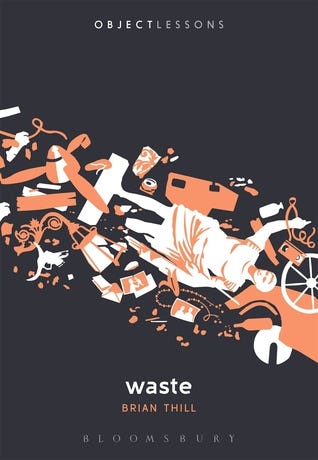
This slim volume is filled with garbage, but it’s meant to be filled with garbage. As the author notes “Though we try to imagine otherwise, waste is every object, plus time. Whatever else an object may be it is also waste — or was, or will be.” In such fascinating chapters as “The beach that speaks,” “Pigs in space,” and “Million-year panic,” Thill explores the history and future of waste. He speaks from good authority; when he was a kid, before he wanted to be an astronaut, he “wanted to drive a garbage truck.” From the movie Raiders of the Lost Ark to W.G. Sebald’s fiction, Thill painstakingly, and with precision, tackles his subject. The compression on display is impressive — rarely have so few pages contained so much interesting information. Although less of a how-to manual and more of an examination of evidence, Waste is a good companion volume to Roy Scranton’s Learning to Die in the Anthropocene. Both books are trying, in a level-headed way, to bring us to a specific and essential understanding of our modern situation.
This remarkable two-volume set focuses on the plants and environments of the British Columbia region. I found these books after a wet, water-logged walk through the University of British Columbia’s Botanical Gardens. It was a terrible, terrible day to go walking through the gardens, with the wind lashing our faces, and it was cold as hell, but we did anyway: an invigorating walk through a landscape made even more beautiful by the weather. Then we went into the gift shop on the way out, and I picked up Ancient Pathways and read the description and had to have it. Forty-five years of research and talking to indigenous botanists and other people in the First Nation communities led to the creation of a book that not only preserves knowledge but ties it all together across communities. Yes, there is a lot of detail about plants, but there is also enough general context and enough mysteries that the book doesn’t read like an encyclopedia — sometimes, as Nancy J. Turner follows the clues about a particular habitat or plant, the book almost reads like a true-life mystery. As a result, Ancient Pathways is never less than riveting. It is also a cultural history as well an environmental one, and that confluence speaks to the new (and old) ways in which we need to think about the biosphere today.
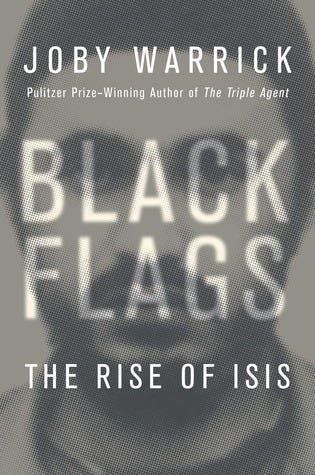
Rising above sensationalism or unsubstantiated claims, Black Flags provides a cogent and useful analysis of the pre-ISIS landscape in Iraq and Jordan. In a context in which Western journalism often provides incomplete analysis, Joby Warrick gets inside the genesis of ISIS in Jordanian prisons and its subsequent spread due to a series of unique events. The Western division of the Middle East after World War I is in part to blame, and so too is George W. Bush’s invasion of Iraq and subsequent disbanding of the Baathist Iraqi army. ISIS could not exist in such a potent strategic form without the combination of Baathist military experience and the ideological fervor of a deviant form of extreme Islam. Nor could it exist without the extreme cynicism of Syria’s Assad being willingness to hold onto power by allowing his country to slide into chaos. What Warrick does expertly is show how Jordan, on the front lines of possible terrorist activity, tried tirelessly to expose and de-claw a proto-ISIS organization, and how that effort was undermined by U.S. war fatigue and other factors. He also chronicles how a bunch of thugs led by the infamous Zarqawi “found religion” as a convenient way to inspire others, and how even other hard-liners thought Zarqawi’s approach too extreme and distanced themselves from his example.
If any book could stir up enough nostalgia to make me wistful for the awkward halls and “malaise” classrooms of high school, it’s Drylandby Sara Jaffe. Not because I’m one of those people who loved high school. Not because I long for a simpler time (those were four fraught years, markedly complicated) but because Dryland, a novel of slow-burning subtlety, excavates the oblique joy of adolescence, and in that way portrays high school as it actually is: a time of reckoning but wonder. During adolescence, teens experience a moment in which they pivot away from what’s known and begin investigating the world and their implication in it. It’s both terrifying and exhilarating. But above all, it evokes possibility. Dryland takes place in that pivot.
In Portland, Oregon in the early 90s, Julie Winter is fifteen, favors Henley’s, flannel, and hoodies, a shrewd choice for the Pacific Northwest landscape, but also a nod toward queer intonation. Though emotionally a bit of a loner, Julie maintains a couple close friendships and participates in extra-curriculars, most notably joining the swim team despite finding herself in her brother’s shadow, a once Olympic hopeful. Julie attends parties, but slinks into the background. Her independence stimulates both confidence and anxiety. Often unsure of expectation and the rules of the adult world, Julie guards herself in numerable ways. She creates diversion stories, explanations for why she takes the bus downtown to eat breakfast alone, or why she’s flipping through new issues of Swimmers’ World without ever buying a copy. Turns out, adults don’t take notice — especially in these examples of dailyness — and her elaborate fabrication stories go untold. “I was definitely the youngest person in the diner. Nobody seemed to notice, or care. There was no need for me to come up with a story, other than that I’d woken up early and been ravenous and wanted to eat eggs at a diner.”
While her diverging interests from other girls starts to pronounce itself, especially juxtaposed to her boy-crazed best friend Erika, it is mostly Julie tuned into the differentiation. Which is not to say she’s isolated in her experiences and feelings — often the case in queer coming-of-age stories — Erika takes note of her distance and difference. She edges close, compassionately, but in the end is just a teen herself, unable to offer the maturity and wisdom needed to guide Julie out of her armor and into greater self awareness.
Julie befriends the older and enigmatic, Ben, who, like many of Dryland’s characters, is at first cloaked, out of focus. But he reveals himself to be true, and as a once close friend to Jordan, Julie’s brother, he proves himself the holder of useful information. It’s the early 90s, the peak of AIDS panic, and Jordan’s absence from the Winter family has equivocal undertones. Ben’s friendship provokes in Julie a demure search for her brother, a search mirroring her own internalized exploration.
Most compelling in Dryland is Julie’s circumspect development of identity. Her understated and hesitating self-actualization is nuanced, never heavy handed, and punctured with ambiguity. Coming out of the closet is so often portrayed or explained as a clear step into a known self, a singular embrace of trueness, rather than the confusing, muddled, lumbering forth toward suspicions, which is so much more often the case. Alexis, another girl on the swim team, is popular and talented. She takes an amicable interest in Julie, and the ensuing friendship coils in tension. Like many queer girls, first love is charged by emotional projections; Julie longs for Alexis, or longs to embody her. And Alexis spurs both a dismantling of Julie and a rebuilding. Ontological toggling ensues. We see the struggle in Julie concomitantly with her, making her a protagonist intimate, salient, and sincere.
The writing, especially the dialogue, of Dryland is sparse, hospitable to the necessary unspokens that take place between teens, especially in sensually charged atmospheres.
Alexis said, What are you sorry for?
I said, Is it okay that I’m coming to the party?
She said, Of course, why wouldn’t it be okay?
I wanted to say You know why. Not as an accusation. I wanted to ask why she hadn’t called, or if I could have the number of her private line so I could call if I needed to.
Alexis turned off the shower and turned toward me. My body felt like an animal’s. She said, The party’s for the whole team. I’m glad you can come.
The landscape of Dryland is equally scarce, Oregon notoriously washed out, monochromatic. Yet, Jaffe finely composites the wet streets of Portland, forming the city into a periphery but crucial character. “The pavement was slick and the streetlights were starfishes of light… My mind felt foamy and clean.” Julie busses downtown, walks alone in that aimless but productive way of the explorative. Not much in Dryland is dry. Whether floundering in the pool or wandering in the rain, Julie seeks grounding, dry land. We sense it is not a dire but delicate search. Hope infuses with heartache. Rejection confronts desire. Highly introspective, thoughtful, and compassionate, Dryland is an exacting and authentic coming-of-age story.
Hello, and welcome to my week-by-week review of the world. Today I am reviewing food.
Some of the best food in the world is at the Macaroni Grill in Burlington, MA. But some of the other best food is in Japan.
My hostel room in Tokyo didn’t have a kitchen or stove or refrigerator or sink, and if I left any food sitting out, the Japanese man living in the other bed would eat it when I wasn’t looking. I started eating out a lot.
Every morning for breakfast I would have a taiyaki (a fake fish filled with chocolate). Because of all the calories in my breakfast, lunch was limited to a single bowl of rice with a lot of salt. There are no calories in salt.
By dinnertime I would be exhausted from lack of food. Although I spoke no Japanese, I would try to speak with my eyes, pleading “help me I’m so hungry and can you recommend a good place for dinner” to anyone willing to make eye contact. My eye-words were often lost in translation.
One evening around 4 PM, desperate to eat anything at all, I stopped at the first place I saw — I think it was called Jiro’s Sushi Restaurant. Unfortunately it was booked up that night, and supposedly for the next several months. I’ve never heard of a place booking up so far in advance. I think they just wanted to get rid of me because I asked for a senior’s discount.
I decided to start my own pop-up sushi business right in front of Jiro’s Sushi Restaurant. I wanted to show them they weren’t the only game in town and also I was running low on money because I was eating out all the time.
It turns out sushi is a lot harder to make than it looks, so I just bought some at 7–11 and glued on some labels that read “American Ted’s Sushi.” Sales were pretty slow and then a businessman kicked all my sushi everywhere and yelled at me. Then a policewoman showed up and I had to run. That was one of the worst dinners I ever had.
I was so disillusioned (and weak from lack of protein), that I got on the wrong train and ended up in Nagano, an hour and a half outside of Tokyo. After wandering through the woods, I found my way to an old man’s farm where he and his wife warmed me and fed me a bowl of bees. At first I tasted them only to be polite, but they turned out to be quite delicious. They had a smoky, meatiness to them.
What also had a smokiness to it was the bowl of cigarettes that I started eating. It turned out this was just an ashtray and I was being too polite.
BEST FEATURE: Sushi is so ubiquitous it can be bought at 7–11. WORST FEATURE: Sushi is so ubiquitous it can be bought at 7–11.
Please join me next week when I’ll be reviewing Full House.
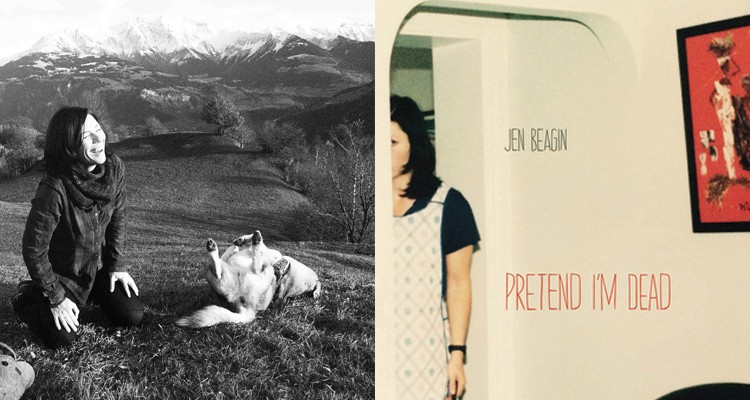
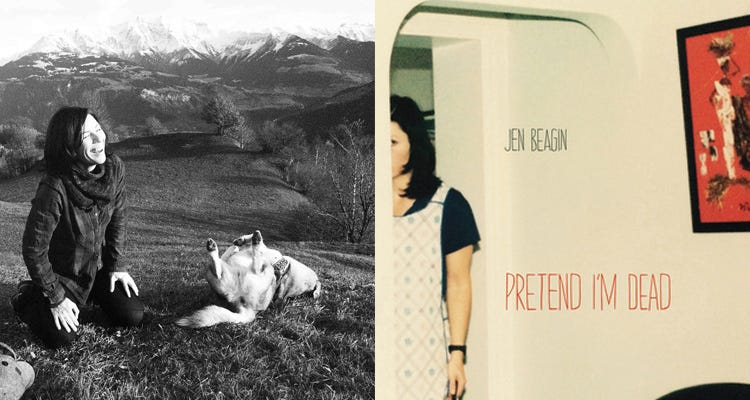
“Hole” (excerpted from Jen Beagin’s Pretend I’m Dead) is featured in Electric Literature’s Recommended Reading with an introduction from Emily Gould. Pretend I’m Dead is available from TriQuarterly Books.
Melissa Ragsdale: One of the most striking features of Pretend I’m Dead is the stark Mona-ness of Mona: she has this frank, strange, lovable flair to her that is all her own, from her nosy imagination to her habit of calling God “Bob.” Following the recent Claire Vaye Watkins “On Pandering” essay, there has been a lot of buzz lately about audience, voice, and where it comes from. How did you find Mona’s voice? Do you see your own self in her?
Jen Beagin: Oh, definitely. Mona is a version of me, for sure, except I’m much better looking. Just kidding. We’re about equal in the looks department. I do have slightly better taste in men and vacuums, but not much, and I did a lot more drugs, but overall, Mona is lonelier, and also more assertive, than I was at her age. I had a younger brother from whom I was estranged for several years and then reunited, and also a couple of besties, so I doubt I would have moved to New Mexico alone at that stage in my life–I was too attached to other people, and I didn’t have my shit together enough. In fact, I don’t think I had a bank account until I was 25.
In terms of the Watkins essay, I think that, for better or worse, I was pandering to myself at age 19, which was when I first attempted to write fiction, as a studio art major at UMass Lowell. It was also when I first wrote about someone named Mr. Disgusting. This was–yikes–over twenty years ago now. I ended up dropping out of college a year or so later and pulling a geographic to Santa Cruz, CA, where I cleaned houses and lived with my brother, and I didn’t write fiction again for 17 years. So, when I revisited Mr. Disgusting as a character, well over a decade later, I was very conscious of watching, and writing toward, my nineteen year old self. My aim was to write something she would have appreciated and admired, or at least wouldn’t be too embarrassed by. Watkins mentions “the little white man deep inside all of us” and, for me–at age nineteen–the little white men were mostly dirtbags, drunks, and addicts: Burroughs, Bukowski, Carver, a spoken word artist named Steven Jesse Bernstein, and, weirdly, Updike, who probably wasn’t a dirtbag, at least not in the same way, and whose characters I definitely couldn’t relate to, but boy, could he write a sentence.
MR: Addiction, recovery, and cleansing are huge themes of this book. Most of the characters are hanging onto something–whether a drug addiction or an event from their past–and many are engaged in elaborate stop-gaps. (For instance, Betty’s constant attempts to psychically spy on Johnny.) What does recovery mean for you? Do you see any of your characters as fully recovered?
JB: I don’t see myself, or any of my characters, as fully recovered, but rather somewhere on the path towards self-awareness. I was badly out of focus for many years, and by that I mean my primary focus was on other people and what they thought of me and/or the terrible things they’d said or done to me. Put another way, my head was always up someone else’s ass. Recovery, for me, starts with becoming aware of my own triggers, motivations, and fucked-up behavior, and I think most of my characters are on a similar path. Betty, though, is perhaps not very far along.
MR: One of the central points of this book is Mona’s move to New Mexico, and Mr. Disgusting ascribes great importance to New Mexico. What draws you to New Mexico as a setting?
I was a cleaning lady in New Mexico just before I went back to college in my mid-thirties. I didn’t live there for very long–I went broke after eight months–and I don’t feel as though I know the place all that well, but when I started writing, I knew I would set something there. Mostly, it was the landscape that spoke to me–it’s really dirty and really clean at the same time, and also both alive and dead, peaceful and unsettling, and I’ve always been drawn to those extremes.
MR: In this excerpt, we see Mona’s intense relationship with Mr. Disgusting play out, and eventually Mona begins seeing him in shifting perspectives between “aging hipster” and “total creature.” How did you go about creating this duality in Mr. Disgusting’s character?
JB: Mr. Disgusting is a composite of a bunch of guys I hung around out with in my twenties, all of whom were simultaneously young and old, beautiful and hideous, funny and dead serious. So the duality of Disgusting wasn’t something I felt I needed to create; it was already there, and very attractive to me.
MR: Mona’s relationship with photography is in flux throughout this book. While she’s under the influence of Mr. Disgusting, she blows off art school, and when she tells clients that she’s a photographer, she describes it as a “lie” to make them more comfortable with a white cleaning woman. Yet, we see that she’s both prolific and gifted at photography. For you, how much is Mona deluding herself? What does it take to label yourself as an artist?
JB: I took hundreds of pictures of myself cleaning houses, one of which was used for the cover of the book, because I was bored out of my mind, but I was also interested in making meaning out of the work I was doing. I cleaned a lot of houses all over the place, in Santa Cruz, San Francisco, and Taos, but I didn’t have much going on otherwise, and I wanted all the cleaning to count for something, even if it was “just for my records.” The pictures I took were mostly terrible or else vaguely creepy, and not in a good way, but I felt like I was doing something “other than,” which was vital to my sanity at the time. But was I an artist? Is Mona? I have no idea. I’ve always disliked that word. We are both photographers, though, for sure, and obsessive documenters.
MR: We see that Mr. Disgusting has a lot of power over Mona. However, in many aspects of his life, he is not in control–he’s a heroin addict, in failing health, close to impotent, and poor. In your view, where does Mr. Disgusting’s influence over Mona come from?
JB: Attraction is often a mystery to me, but I know that Mona feels invisible in her daily life and she feels seen by Disgusting, at least initially, and that’s very powerful. It doesn’t matter that he’s toothless, dickless, and penniless, because well-adjusted, well-heeled, conventionally handsome men don’t hold much interest for her. Yoko and Yoko would say that she manifested him for a reason, that he was the perfect vehicle for her to start dealing with her past, and blah, blah, but she also feels emotionally met by him on a level she hadn’t found with boys her own age, boys who perhaps hadn’t suffered enough. I remember being very attached to my suffering at that age, and also being drawn to people who had suffered in a similar manner.
***
Jen Beagin holds an MFA in Creative Writing from UC Irvine and has published stories in Juked and Faultline, among other journals and literary magazines. She lives in Boston. Pretend I’m Dead is her first novel.
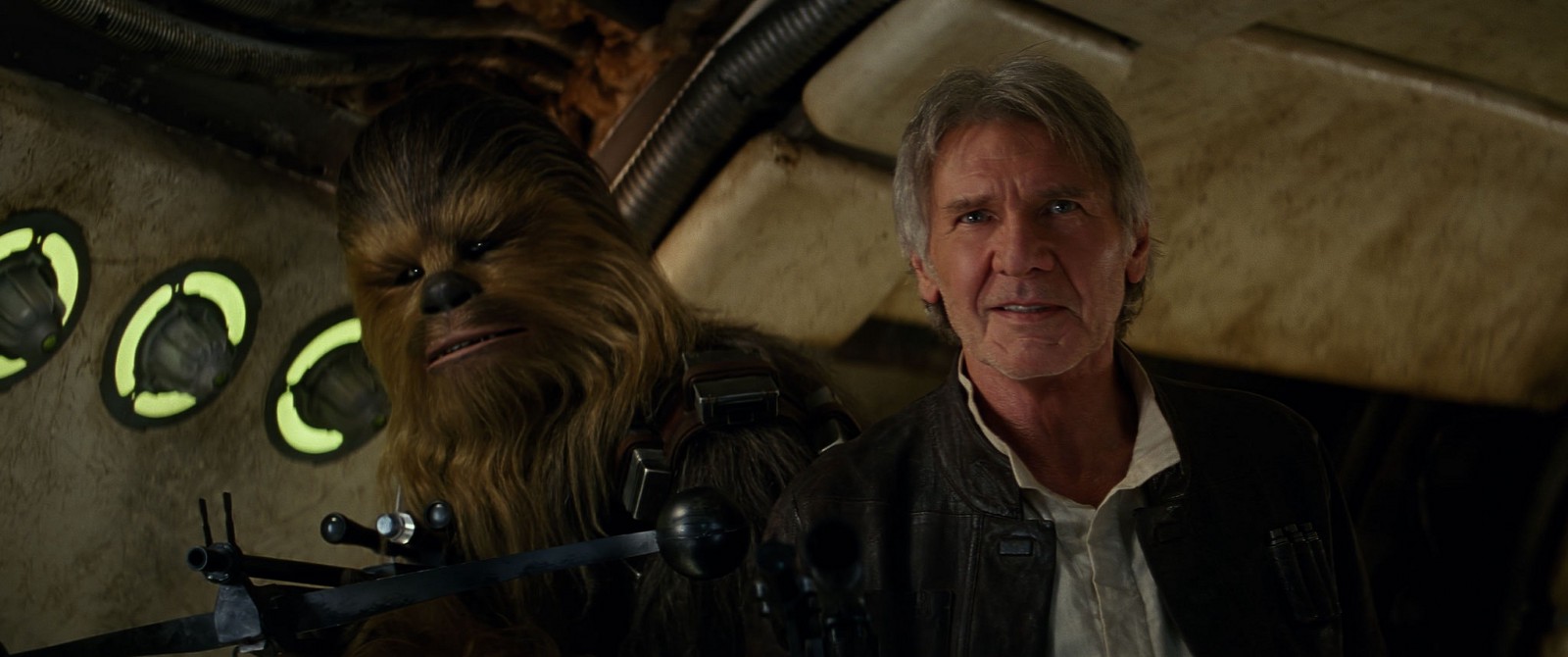
According to some rumors on the Internet, a completely new Star Wars movie is being released in select theaters around the world on Friday. If this is true, it could mean a lot of Star Wars fans are going to very casually be posting their reactions intermittently to social media. It might be difficult to discern exactly what these Star Wars fans are on about, but one this is for sure: they’re going to be salvating for more stimulation that is similar to Star Wars.
So, here’s a list of books to read in preparation for the new Star Wars or for after you’ve seen the new Star Wars. These books are not actually Star Wars books, but will remind you more than a little bit of Star Wars.
One Hundred Years of Solitude by Gabriel Garcia Marquez
This novel tells the story of one family over the course of several, several generations. What does this have to do with Star Wars? Well, at the beginning of most good versions of the novel you’ll find a family tree diagram that will help you distinguish “Remedois the Beauty” from “José Arcadio Buendía” from “Remedios Moscote” and so forth. Star Wars films have no such family tree diagram thing to help you sort all of this out, but they really should! (In the old Star Wars novels there’s not only Anakin Skywalker but Anakin Solo and Ben Kenobi, not to mention Ben Skywalker. Marquez eat your heart out!) Doubtlessly there will be new branches of the Skywalker and Solo and Organa family tree in this movie. Plus, One Hundred Years of Solitude and Star Wars share something else in common other than both being an epic family drama: ghosts of ancestors and mentors showing up to shoot the shit with the living.
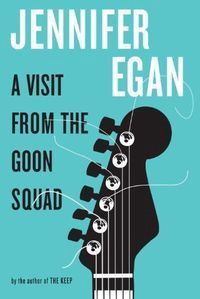
A Visit From the Goon Squad by Jennifer Egan
Egan’s award winning 2010 novel doesn’t tell a single story but instead a myriad of different stories, which eventually lead to numerous “ah-ha!” moments on the part of the reader when you realize yes, everything is connected. From the shoplifting in the first chapter, to the heartbreaking PowerPoint chapter, to the story of friends who upon meeting after years apart, find that their once bright potential has faltered. The Force Awakens has given us glimpses of beloved — once youthful — characters who are now older, and possibly estranged from one another. Luke Skywalker and Han Solo maybe having a falling-out is not too different from Scotty marching into Bennie’s office in Goon Squad and throwing a gross fish on his desk. If Luke turns out to be a weird old hermit and Han is somewhat “normal,” it doesn’t get any more Goon Squad than that.
Harry Potter and the Order of the Phoenix by J.K. Rowling
Finding out that the previous generation of “good guys” wasn’t all it cracked up to be seems to be a theme not only in the existing Star Wars films, but also in the new one. Rowling borrowed from this notion pretty hard in her fifth Harry Potter novel, in which we learn the newly anointed “Order of the Phoenix” was not the first “Order of the Phoenix.” In big fantasy epics, it seems like awesome orders of magical people are constantly getting disbanded and then getting back together in a different generation. Star Wars has already done this once with the Jedi Order, and now it looks like it’s poised to do it again. Rowling also gets bonus Star Wars points in The Order of the Phoenix because the showdown between Voldemort and Dumbledore is almost straight-up Vader and Obi-Wan.
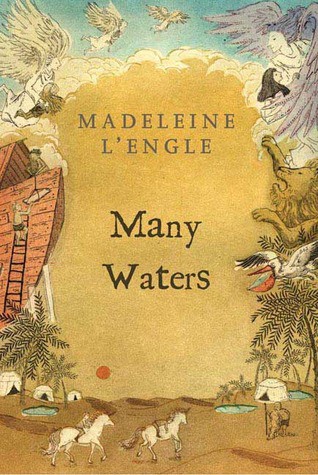
Many Waters by Madeleine L’engle
You might think you know the universe of A Wrinkle in Time because you’ve read A Wrinkle in Time and maybe A Swiftly Tilting Planet, but who do you know who has read Many Waters? This one is the most Star Wars of L’engle’s books for the simple reason that it revolves around Twins, specifically Dennys and Sandy Murry. In it, they also end up in the middle of a desert seemingly by magic and eventually end up riding unicorns. Pseudo-outer space twins in a magical desert? The Force is strong with the Murry family!
Ready Player One by Ernest Cline
This one is fairly obvious because there are so many references to ’70s and ’80s science fiction in it, but Ernest Cline’s debut novel also has true Star Wars structure. His protagonist Wade literally goes from zero to savior of the entire world, and does it primarily from being good at video games. In almost every single way, Wade is what Luke Skywalker would be like if Luke Skywalker were a real person. Ready Player One then is the meta-Star Wars; both less literary and deep than Star Wars, but somehow more-so on both counts because it’s more “real” in its overt fakery and homage.
Postcards From the Edge by Carrie Fisher
The themes of this novel don’t directly dovetail with Star Wars stuff, unless of course you think of the Dark Side of the Force as a metaphor for drug addiction. (Which it basically is.) Anyway, this novel was written by Carrie Fisher and it remains one of her strongest pieces of work. (Her one-woman shows are pretty solid too.) If you worry that Princess Leia doesn’t have enough agency in Star Wars, here you can check out her real-life alter-ego’s incisive writing and legit pathos.
The Hero With a Thousand Faces by Joseph Campbell
In almost every way, this 1949 analysis of myth and how myth functions is where it all began. George Lucas and Star Wars fans/scholars have been shouting at the top of their lungs for decades now that the reason Star Wars is so pervasively likable is that it’s all about Campbell’s observations about Jungian archetypes present in certain kinds of epic quest narratives. How about you read The Hero With a Thousand Faces and make up your own mind? I bet you’ll probably only agree with, like, half the things Campbell says, which is honestly the best kind of book.
What non-Star Wars book are you reading that are actually somehow all about Star Wars?
10) For the Writer Who Imagines a World Where Colleges have been established based on the philosophies of Marcus Garvey, Audre Lorde, Ida B. Wells, Harriet Tubman, George Washington Carver and James Baldwin.
Literary chameleon, film professor, and ping-pong wizard are some of the labels that come to mind when thinking of American novelist Jerome Charyn, but one label that often slips people’s minds is graphic storyteller. Charyn may have no talent for drawing or painting, but that hasn’t barred him from collaborating with some of the most respected comic artists in the industry, including Francois Boucq, Jacques de Loustal, and Jose Muñoz. The recent re-release of The Magician’s Wife, published by Dover Graphic Novels, marks Charyn’s reintroduction into the American comic book world nearly thirty years after receiving the 1986 Prix Alfred Award at Angoulême for best graphic novel. Despite having many of his comics exclusively published in Europe, Charyn’s comics are written with the same love for NYC that he describes in his Bronx-centric crime fiction.
The Magician’s Wife tells the story of a woman and her turbulent relationship with a traveling Magician with powers that may go beyond simple illusion, and the lingering effects of her broken marriage. The book, masterfully brought to life by artist Francois Boucq, was released this past October and is the first of Charyn’s comics to be published by Dover, soon to be followed by the never-before translated, The Boys of Sheriff Street. Mr. Charyn was gracious enough to talk to me over Skype where we discussed the impact comics had on his early upbringing, his affinity with European artists, and where new talent in the medium may be discovered.
Matthew Laiosa: I’ve read that comics were a major part of your early education. What were some of the comics that inspired you at a young age, and how did those tastes mature into adulthood?
Jerome Charyn:Since I grew up in a very poor area of the Bronx there were very few books so I basically learned how to read from comic books. My favorite was Captain Marvel because even at an early age I felt there was something so unusual about the art. Superman was very realistic, so was Batman, but Marvel had a very strange almost surreal touch to the art and it really pulled me in. I read Donald Duck, the Disney comics, and also Classic Comics were very important to me. They took the place of books, but again the art wasn’t that interesting in the Classic Comics. It was only in Captain Marvel, and that’s why when I went to Europe and I saw some of the graphic art it was a revelation. I had never seen art of that quality in comics. It was a shock.
ML: Many consider you a great American novelist, but almost all of your comics were made in Europe. Why is that?
JC: I got involved with DC, and I did something for Paradox called Family Man, but DC was a real labyrinth. It was not an easy world to break into. I hadn’t done graphic novels here, and they didn’t really know anything about the graphic novels in Europe. There was a divorce between both worlds, and little rapport between one and the other. I offered to do a Batman, but I don’t know how good it would have been. That’s how much of a separation there was.
ML: It’s definitely improved, but some of that divorce still seems to linger considering that many of your comics have still never been translated from French to English.
JC: Most of them are coming out with Dover, and a few of them were published here earlier, but the craze for graphic novels in America is very recent. I think that the great European artists are finally being recognized, artists such as Bilal, Tardi, and Liberatore. I wanted to work with Liberatore, and at first we were going to do it, but then it was just too difficult. Anyway, I was more interested in the European artists. I did love V for Vendetta.
ML: So some of the British stuff?
JC: Yeah, the British stuff was quite good.
ML: The Magician’s Wife won the best book award at Angoulême in 1986. Do you think comics have changed much in that time in either Europe or the U.S.?
JC: I think we’ve seen a more personal approach to comics in the United States, and that’s in part because of Art Spiegelman and Raw Magazine. In fact, he won a special Pulitzer Prize. Art has done extraordinary work. He is a real author.
In France you have more of a tradition of the artist and the writer. You have some artists who do their own work, and others who work with writers, and I think you can create great art in both formats. I’m not sure whether Boucq could tell a long story on his own, but I think when he gets the right story he does extraordinary work. There’s nobody like him, nobody who has that sense of movement. It’s almost like a motion picture. It’s very powerful.
ML: After establishing yourself as a novelist for over twenty years what made you want to write The Magician’s Wife as a comic rather than a novel?
JC: I was in France, and I was interviewed by the magazine, À Suivre. It was a magazine that the Belgian publisher Casterman put out, and what it did was provide a showcase for its own artists by reprinting their graphic novels in the magazine. They happened to review one of my novels, so just out of the blue I wrote the editor of À Suivre and said, “I would love to do a comic, and can you find an artist for me?” They introduced me to Boucq, and I’d always wanted to work with Loustal, so I was able to work with Loustal. I was able to work with Muñoz, and there were others I would have worked with, but it wasn’t that easy to maneuver.
ML: Who were some of the artists you wished you had worked with?
JC: I would have liked to work with Tardi, but the occasion never arose. And there are a lot of Italian artists I would have liked to work with.
ML: Manara?
JC: Yeah. The erotic side would have been very interesting if I had done some kind of sadomasochistic story. (Laughter)
ML: So did any of your peers ever question why you were doing comics?
I think it’s a question of how you make the connection with an artist; that’s the most difficult thing to do.
JC: NO! They wanted to do it. I remember when Joyce Carol Oates read The Magician’s Wife she said she would have loved to do a graphic novel. It’s very powerful because you see the written word turned into images, and when the work is good its every bit as complicated as a novel. I think it’s a question of how you make the connection with an artist; that’s the most difficult thing to do.
ML: Even though you were writing comics for a European audience The Magician’s Wife feels quintessentially American.
JC: Yeah, all of my graphic novels in some part take place in the United States except for the one I’m doing now about Charlemagne, and what I’m going to do is see if we can get a co-production with Dark Horse, or Marvel. If it works out, I’ll have the script in English and I’ll just show some of the sample pages to Dark Horse and see what happens.
ML: What relationship does your comic Billy Budd, KGB, also illustrated by Francois Boucq, have in common with Herman Melville’s Billy Budd?
JC: I love Melville, so I wanted to find some way of using the hero of Billy Budd, KGB as some kind of Melvillian character, so the title is appropriate. I couldn’t use that title in France because the French wouldn’t have understood it. It was called Devil’s Mouth, or Bouche du Diable in French, and that’s just been reissued and it’s doing very well in France.
ML: How do you choose what stories to tell in comics and what stories to tell in prose?
Give me the location, and a few hints and I can put it together in my own way, in my own crazy way.
JC: If I remember, The Magician’s Wife was something I was going to do as a novel, and I realized that it probably wouldn’t work, so I already had the idea in mind. The graphic novel I’ve just done with Boucq, which will also be published by Dover, is called, Little Tulip, and I think it’s the best work we’ve done together. It came from an idea that Boucq had about the Gulag. It can work both ways. The idea can come from me, or from him. So if you give me something about the Gulag, and you want the hero to be an artist, then it’s not that difficult for me to put it together because I love to tell stories. Give me the location, and a few hints and I can put it together in my own way, in my own crazy way.
ML: A lot of your books exist in a sort of augmented reality. Even when you write prose it exists in an almost comic book world of extremes.
JC: I’m not interested in the quotidian, in everyday life: the raising of children, family problems, or ‘realistic stories.’ They just don’t interest me. I always have to deal with a kind of extreme. I like to work at the edge. There has to be a certain kind of slant.
ML: You have also written a few books of historical fiction. What attracts you to these different worlds?
I like heroes and villains. I like adventure, as if we’re telling children stories for adults.
JC: With historical fiction, I’m dealing with people I admire, such as Emily Dickinson and Abraham Lincoln. JohnnyOne-Eye was about the Revolution and George Washington. I like heroes and villains. I like adventure, as if we’re telling children stories for adults.
ML: Some argue that a comic is a kind of wannabe movie told in still images vs. moving pictures, but as a professor of film, are there certain storytelling capabilities unique to comics?
JC: That’s a good question. I think what you are able to do in a comic, let’s say that Boucq is the closest to action on the screen, but what’s unique to the medium is the stopped frame. In other words, you can stop the action and look at individual images, but you can’t do that in a movie because it exists in time. The propulsion forward is inevitable. There are only certain filmmakers who can slow down the frame, and do that with a constant skill. You look at the films today and they’re ninety-nine percent action, even the very best of them.
ML: And in comics between two panels you can fluctuate time from one second to millennia.
JC: Exactly. You can have a whole world between two panels and you can switch the landscape between the panels, which you can’t do as easily in film. But there is a real connection. Its no accident that comic book superheroes have worked so well in the cinema because it’s basically a very primitive art, and superheroes are just perfect. I’m not particularly interested in that, but in terms of the screen it works very well.
ML: You’ve written a number of non-fiction books including books on film. Have you ever been interested in writing a book on comics?
JC: Not really because I have a very distorted view of comics, and I’m not sure I would be able to tell the story accurately, and also it was like a childhood disease. I mean, there has been great work done with Batman, but that’s because the scripts are wonderful. And I’m not sure I’d be the right person to tell the history of comics.
ML: You have also written a few memoirs. For better or worse, the memoir-comic has become a popular genre within the medium. Are there any untold moments from your life you would want to tell in a comic book?
JC: I started out as an artist, and one reason why I’m so drawn to these European graphic artists is that I admired them and envied their skills. I wish I could do comics, I wish I could be a comic book artist and I could combine the novel with the image and that would be a perfect world, and then I probably would go into autobiography or I would range anywhere I wanted, but I don’t have the gift. I started out as an artist, and I have no talent whatsoever.
ML: You started as a painter right?
JC: Yeah, and there’s nothing I can do about it. On the other hand I’ve done some work for television and I thought I would be so pleased when I was able to hear the dialogue that I had written when it was on the TV screen, but it didn’t do anything for me at all. However, when I did Little Tulip, and saw what Boucq had done with the story, it was completely magical.
ML: What makes Boucq’s art so extraordinary?
JC: If he doesn’t have a good story you’re not going to get a good graphic novel, but if you give him a good story he is going to do a great comic because he can do anything. He can be satirical. He can be lyrical. He can be brutal. He has that gift, and that’s why it works.
ML: I think by being someone traditionally considered outside of comics you have a ‘rules-need-not-apply’ attitude. Do you think the comic book medium could benefit with greater participation from other novelists and/or storytellers outside of the medium? And if so what writer would you most like to see enter the comic book field?
JC: I would say rather than novelists, screenwriters would fit closer with the idea of writing scripts for graphic novels, but since they earn so much money working in film I’m not sure they would want to work in graphic novels. In the future, if someone like Tarantino came along, he would be able to do extraordinary work in the graphic novel. His films are almost like graphic novels in motion.
ML: You mentioned Joyce Carol Oates’ enthusiasm and interest in writing her own comic book, so what keeps her, or say someone like a Don DeLillo from scripting a comic book?
It’s not meant to be realistic. One reason why I love Krazy Kat is that the landscape changes from panel to panel and you never knew where you are going to be next
JC: It would be great if Don did a graphic novel, and maybe if he expressed a wish to do it I’m sure it would be done. I don’t know how interested he would be. I’d have to ask him. Remember it’s special to me because I grew up in this world and it’s how I learned to read. Also, if you look at my writing, it is very related to the graphic novel. The movement from sentence to sentence is like a graphic novel, and this is maybe why certain readers have such difficulty because it’s not realistic. It’s not meant to be realistic. One reason why I love Krazy Kat is that the landscape changes from panel to panel and you never knew where you are going to be next
ML: It’s more dreamlike.
JC: Yeah.
ML: I believe comics have the most potential for breaking new ground in changing the way stories are told, especially when you look at work such as Chris Ware’s, Building Stories, which uses fourteen separate printed components in order to tell a single story that can be read in any order. Where do you see the future of the book and where do you see the future of the comic book?
JC: First of all, you have very young readers who are growing up in a world with images and they’ll be able to deal with all the complexities. Now you need the genius to go along with the vision, and that’s always hard to deliver. You can’t tell where genius will come from. It could be a painter who turns to graphic novels, or it could be a songwriter. I would love to see a graphic novel with a story by Bob Dylan. It would be incredible. As far as books are concerned, it’s very difficult to say where the future lies. I don’t think anybody knows.
“When you write to me and say you love her work, I have a moment where I think, “But … Elena is my friend! My private relationship with her, so intense and so true, is one that nobody else can fully know!”
Claire Messud
To say that I have a few autobiographical similarities to the narrator of Elena Ferrante’s Neapolitan Quartet, also named Elena (“Lenu”) Greco, would be an understatement. Born into a close-knit yet violent (Italian) neighborhood that no one ever seemed to leave, I, like Lenu, fantasized about ‘getting out,” and used education as my primary propeller towards a different fate. Like Lenu, I became a writer, married a brainy introvert, raised children, struggled with the dichotomies between family life and making art, had a passionate affair, found myself constantly returning to the city I’d once sworn to escape, ultimately left my marriage… I could go on. Most significantly, at the heart of Ferrante’s series, I also had a childhood marked indelibly by my intimacy with a more beautiful, more charismatic and powerful girl who, despite her many gifts, seemed doomed: in Lenu’s case, her best friend Lila, and in mine, my same-aged cousin who lived next door to me, whose name coincidentally also begins with an L.
Of course, Ferrante (whose real remains unknown) writes of girlhood in 1950s Naples, whereas I came of age in Chicago in the 1970s and 80s. The turbulent political landscape of Italy during the some sixty years covered by the four novels is divergent in many ways from the (also turbulent) history of the United States, and the quintessential Italianness of the Quartet is integral to the fate of its characters. Whereas in my old neighborhood, boys growing to men in a state of hopeless poverty and stagnation often turned to gangs or became small-time workers for the Mob, those in Lenu and Lila’s world are as likely to become involved with Communism or Fascism, go on the run for political crimes, and attend political meetings in secret, as they are to become “gangsters” of sorts — in fact, the two things seem somewhat inextricable, in a way less true of organized crime in the United States, where politics and the Mob are more financial bedfellows than ideological ones.
The novels’ immersion in Italy — in particular Naples, and more specifically one poor, dialect-infused neighborhood in Naples — is crucial to the understanding of how intensely personal readers’ responses to Ferrante have tended to be. Because although I am Italian-American and grew up below the poverty line in a neighborhood quite similar to Lenu and Lila’s, that fact — or any other biographical fact — seems irrelevant when considering the fact that almost all Ferrante’s women readers seem to feel much as I do: as though these books were written for them, to them, about the insides of their own messy guts and brain. To love Ferrante has almost become akin to a secret handshake in certain circles (similar to Anne Carson but on an explosive scale), yet it is fair to extrapolate that many of her avid American fans had upbringings radically different from Lenu’s and Lila’s in Naples. What readers relate to most are her characters’ fearlessly naked, almost unfathomably nuanced interior lives and relationships.
You don’t have to be Italian, or poor, or have a “getting out” story, or ever to have known anyone in organized crime, to feel Ferrante’s novels read your mind and cut closer to the bone more than other books, and on the strength of word of mouth buzz, Ferrante has become Italy’s best known writer. In our era of social media accessibility, shameless self-promotion, and hot young celebrity culture, this is nothing short of astounding: an anonymous Italian woman of a certain age, of whom James Wood wrote, “Compared with Ferrante, Thomas Pynchon is a publicity profligate,” has managed to make droves of American readers feel the way one feels when a favorite indie band signs on a major label: wait, that’s my band — they were writing about and singing for me!
It’s difficult to talk about Ferrante without talking about gender. By anecdotal and critical evidence, her audience is almost entirely female, and even male critics who laud her see her work as highly gendered. Writes Wood, “Ferrante may never mention Hélène Cixous or French feminist literary theory, but her fiction is a kind of practical écriture feminine.” One certainly doesn’t have to be a woman to appreciate Ferrante…but to what extent might being one change the experience? When I was halfway through My Brilliant Friend, the inaugural novel in the series, I posted on Facebook that the book should be “required reading for anyone who wants to understand female psychology.” Having now finished the powerful finale of the four, The Story of the Lost Child, I would stand by the sentiment, but at the same time have grown wary of my own description. “Nothing quite like it has ever been published,” writes Meghan O’Rourke of the series in The Guardian: “four novels that make up a single book… a kind of quasi-feminist bildungsroman that also happens to be a history of Italy in the late 20th century.” What is clear is that these novels are profoundly ambitious literary feats, unique in tone, style and scope, when it often seems everything has already been done. Ferrante’s achievement — one novel, told in four luminous volumes — manages to also be written with a complete absence of what Claire Vaye Watkins recently discussed as “pandering” to the male literary establishment. If anything is clear from Lenu’s voice — from Ferrante’s writing across all her books — it is that she implicitly writes for the universal She. Her prose — passionate, intimate, urgent, confiding — show no aesthetic concern for courting either male literary traditions or, perhaps, even male readers as a means of legitimizing her art, and indeed, she hasn’t “needed” them. Still, she is so scarily good that I can’t help but wonder: why doesn’t she have them anyway?
The Neapolitan Quartet is arguably the deepest, widest and richest portrait of a lifelong friendship between two girls/women ever documented in literature. Ferrante often draws comparisons to Lessing in this regard, but the depth of her exploration of Lenu and Lila, over four books, truly has no rival. The critics, too, seem in overwhelming agreement on Ferrante’s merit, and that in the Neapolitan series, she is at the top of her game. That said, it is hard to imagine some of the ways she is discussed in reviews ever being applied to a male writer.. Her core focus on female friendship seems to have led some to approach the novels’ complexity and multiplicity as so genre-busting and defying of categorization that it can smack of patronizing cloaked in praise. Writes Elizabeth Lowry in the Wall Street Journal: “How should we classify Elena Ferrante’s magnificently complicated Neapolitan quartet? The three previous titles in the series — My Brilliant Friend (2012), The Story of a New Name (2013) and Those Who Leave and Those Who Stay (2014) — defy categorization. Are they genre or literary fiction? Soap operas? Political epics? Some form of memoir?” Though it is not in itself in any way an “insult” to have one’s novel seen as multidimensional or not conforming to one specific literary tradition, I find myself wondering whether a series of novels that explored the male psyche and relationships, while also involving politics, class issues, and a certain amount of meta exploration of literature itself, would be described as though its diverse themes were… so surprising. Didn’t Updike attempt much the same in his Rabbit series, and Roth through Zuckerman, and Elroy in his Los Angeles Quartet? Is serious fiction that chronicles characters over time and explores both the innermost depths of their intimate relationships, along with the political climate of the times and a profound interrogation of class struggles, truly such a confounding thing as to call into question whether we are reading a soap opera, or, as Lowry later invokes in her review, a thriller? Or does it only seem so because the focal characters are girls/young women for most of the pages?
If the lives of girls and young women are sometimes trivialized by the literary establishment (here and in Europe), they are treated with almost mythical devotion by Ferrante. Indeed, the one weakness of the Neapolitan Quartet may be that Ferrante devotes so little page time to Lenu and Lila as mature women. The singularly defining event of their lives (Ferrante’s titles are full of spoilers) occurs, in the final novel, when they are not yet forty, and the rest of their lives (especially once past fifty) are sped over in strokes so broad as to be positively un-Ferrantean. Here is a writer who can spend an entire thick novel on the every thought and deed of girls between the ages of six and sixteen, yet the same women, once menopausal, no longer seem to interest their author much. Likewise, Lenu’s daughters — three women with their own complicated history — are painted with none of the intricacy of the dozens of characters in her old neighborhood, and never rise above “types.”
Lenu’s lovers, as she ages, seem to merit no scenes; if she has close friends after she and Lila part ways forever, we don’t ever meet them. Perhaps Ferrante initially gave herself free reign and then, after some 1,000 pages, panicked and felt she had better wrap things up already. Whatever the reason, the final third of the final novel feels that thing one never feels when reading a Ferrante novel: rushed. While the first three books — and The Story of the Lost Child as well — have a quality of breathless emotional fervor, they also unapologetically languish on any detail or side plot that strikes the narrator’s fancy. Guns are delightfully introduced in Act I that are not fired by Act III — people drop away, major concerns shift. Ferrante’s Neapolitan novels, though full of returning characters and at times coincidences that strain at realism, follow the rhythms of a life, not a curated narrative arc. It is disappointing, therefore, when the author who specializes in reading women’s minds and hearts seems to indicate that said minds and hearts are inherently less engaging in advanced age.
Of course it is arguable that Lenu’s story simply becomes less relevant once she “gets out” — something it takes her until her fifties to fully do. Because as much as Lenu’s and Lila’s stories excavate iconic themes of womanhood, the Neapolitan series is also a quintessential rags-to-riches story, in which the two girls’ different ascents from abject poverty, and the both beautiful and abhorrent neighborhood that keeps its claws in them, are as crucial to the story as any feminist themes or as the characters’ elaborate personal lives. Ironically, a recent piece Buzzfeed on held Ferrante up as a great writer of The American Dream. Writes Alissa Quart, “Where is the American equivalent of Ferrante? […] The inequality novel that Americans will read in droves, that critics pay attention to? There was once The Great Gatsby, Bellow’s Augie March, Dreiser’s Sister Carrie and The Financier, even Raymond Carver’s working-class silent men of 30 years ago. Certainly those who claim the neorealist caption — Jonathan Franzen, recently dubbed an author of ‘failed-marriage razzmatazz’ by one critic — have neglected this story.” Though the claim that no American writers are writing novels interrogating social class and either upward or downward mobility seems unfounded (Junot Diaz comes to mind as exploring similar terrain as Ferrante on American soil; recently Helen Phillips’ The Beautiful Bureaucrat took on the hopelessness and stagnation of new adults trying to make their way in a numb, corporatized world without opportunities), Ferrante’s prowess as a chronicler of class, place and history are not to be overshadowed by her focus on female friendship and motherhood.
In the end, however, no single “topic” can fully explain Ferrante’s resonance. As Claire Messud writes —
Politics and feminism are compelling and important subjects but they won’t make readers long for the novels with the zeal of a nine-year-old. Only the human heart can do that, the emotionally truthful depiction of the complex web of love, desire, loathing, envy, compassion and pain that binds people over a lifetime. Ultimately, Ferrante has framed her magnum opus — for all its tremendous ambition, and in spite of the tumult of events that resounds through the pages at ever-greater, eventually exhausting, speed — as a simple love story. These books deal above all with the perpetually unrequited but never extinguished Platonic passion…
I would extend this further to say that Lenu and Lila’s relationship, though central, is not the only uncannily rich relationship propelling the books, and that character — characters in interaction with one another and, of course, with themselves — is Ferrante’s rarest of gifts. She seems capable of transmitting the untranslatable alchemy of human psychology onto the page in a whole other league from even other contemporary masters of character like Franzen. Accordingly, her audience identifies fiercely with what her characters feel about motherhood, ambition, jealousy, desire, justice, writing, aging — Ferrante writes so ferociously, so from the inside out, that we know the inhabitants of Lenu’s world more intricately than we could ever hope to know such a large ensemble cast in even our own lives. It is easy to emerge from the Neapolitan Quartet feeling slightly dazed, as though everything we have ever heard about “character development” was little more than a bullet point list in the hands of other writers.
And Lila, of course is both Ferrante’s and Lenu’s piece de resistance. As Lenu says of her friend, in a cross between rhapsody and lament, “She possessed intelligence and didn’t put it to use but, rather, wasted it, like a great lady for whom all the riches of the world are merely a sign of vulgarity. She stood out among so many because she, naturally, did not submit to any training, to any use, or to any purpose. All of us had submitted and that submission had — through trials, failures, successes — reduced us. Only Lila, nothing and no one seemed to reduce her.” In my own life, my “Lila” did not disappear without a trace at 66, leaving a wake of mystery behind, rendering herself forever my obsession. As people often will in real life, she instead kicked most of her self-destructive habits by her late 20s, settled down with a nice woman, became a police officer, bought a dog. In other words, in Lenu’s eyes, she was “reduced.” The Lila of the page — who is both one of the most multidimensional, characters in literature, yet also a metaphor, a riddle, a philosophical question with no answer — can never just resolve. “A hallmark of Ferrante’s writing,” O’Rourke says in The Guardian, “is [this] juxtaposition between matter-of-factness and metaphor, between hyperrealism and hallucinatory distortion.” Such is the magic of Lila, and of the series.
To commit to the Neapolitan Quartet is a rigorous and impassioned endeavor, not for every reader. For those who don’t go in for digressions, who don’t care for the distinction between live-wire emotional prose vs. sentimentality, who cannot be persuaded to care about the lives of girls and young women no matter how artfully and intelligently presented, the books would be an exercise in frustration, sure to be thrown across the room (where, heavy as they are, something would be broken, just as Lila might desire). For readers willing to be seduced, however, these four intoxicating novels comprise nothing less than a singular masterpiece.
Sign up for our newsletter to get submission announcements and stay on top of our best work.
YOUR INBOX IS LIT
Enjoy strange, diverting work from The Commuter on Mondays, absorbing fiction from Recommended Reading on Wednesdays, and a roundup of our best work of the week on Fridays. Personalize your subscription preferences here.