My Career as a Precocious Literary Girlie

“Chiyojo” by Osamu Dazai

Let’s face it, women are no good. Or is it just me? I can’t speak for all women, but it’s beyond doubt that I, for one, am no good. And yet, even as I say this, an obstinate sort of self-belief, deeply rooted in some dark, hidden corner of my heart, insists that at least there’s one good thing about me . . . And that only leaves me all the more confused about myself, trapped in this oppressive, intolerable state of mind. It’s like having my head stuck in a rusty old cast-iron pot. I’m a stupid person. Genuinely stupid. And in the new year I’ll be nineteen. I’m no longer a child.

When I was twelve, my uncle in Kashiwagi submitted a student composition of mine for a contest sponsored by the magazine Blue Bird. My piece was awarded first prize, and one of the judges, a famous author, went hideously overboard in praising it, and I’ve been a mess ever since. That composition of mine is just embarrassing to me now. Was it really all that special? What was supposed to be so good about it? Titled “Errand,” it’s a simple story about being sent to buy some Bat cigarettes for my father. When the tobacco-shop lady handed me five packets, it made me a little sad that all of them were the same pale green color, so I exchanged one for a different brand in a vermilion packet. But then, sadly, I no longer had enough money. The lady just smiled, however, and said I could make it up next time, which was awfully nice of her and made me really happy. When I balanced the four green packets on the palm of my hand and placed the vermilion one on top, it looked like a blossoming primrose, so pretty that my heart seemed to skip, and I could hardly walk straight. That’s the gist of the piece, which I now find mortifyingly childish and cloying.

But it wasn’t long after that, at the urging again of my uncle in Kashiwagi, that I submitted another composition of mine, titled “Kasuga-cho,” and this time it was published not in the “Readers’ Submissions” section of the magazine but on the very first page, in big, bold lettering. The story begins with my aunt in Ikebukuro moving to Kasuga-cho in Nerima. She told me about the big garden in her new house and invited me to visit her there, and so, on the first Sunday in June, I boarded a train at Komagome Station, transferred to a Tokyo-bound train at Ikebukuro, and got off at Nerima Station, where I saw nothing but fields all around me. I had no idea which direction Kasuga-cho might be, and when I asked people working in the fields, none of them seemed to know, and I ended up fighting back tears. It was a very hot day. The last person I asked was a man of about forty who was pulling a cart filled with empty cider bottles. He stopped, flashed a lonely smile, and used a gray, soiled hand towel to wipe the sweat dripping down his face. He thought for some time, muttering “Kasuga-cho, Kasuga-cho . . .” Finally he said, “Kasuga-cho long way from here. You catch east train there, Nerima Station, east train to Ikebukuro. Transfer train to Shinjuku. At Shinjuku transfer local train, get off Suidobashi . . .” and so on, doing his best to give me these detailed directions in very broken Japanese. I knew right away that he was thinking of the other Kasuga-cho, the one in Hongo, but I also realized he was Korean, which touched my heart and made me all the more grateful to him. The Japanese people I approached feigned ignorance because they couldn’t be bothered, while this man from Korea, dripping with the sweat of his labor, takes the time to really try and help me. His information was wrong, of course, but I thanked him for his kindness and followed his directions, walking back to Nerima Station and jumping on a train for Tokyo. I seriously thought about going all the way to Kasuga-cho in Hongo, but that would have been silly, so I went straight home instead. Once there, I felt sad and out of sorts and decided to write down an honest account of what had happened. This account is what was published in huge print on the front page of The Blue Bird, and that’s when all my woes began.

Our house is in Nakazato-cho in Takinogawa. My father, who teaches English at a private university, is a son of Tokyo, but Mother was born in Ise. I have no older siblings, just a physically infirm little brother who entered middle school this year. By no means do I dislike my family, but I’m so lonely. Things were better before. They really were. Mother and Father both spoiled me rotten, and I was always joking and making everyone laugh. I was an excellent older sister too, very kind to my brother. But soon after my composition was featured in The Blue Bird, having won me another prize, I transformed into a truly cowardly, hateful creature. I even began talking back to my mother and arguing with her. The famous author Iwami-sensei, who was one of the judges, published in the same issue a commentary on “Kasuga-cho” that was two or three times the length of the story itself. It made me so sad when I read it. I felt as if I’d somehow deceived this great man, who was clearly a modest person with a heart much purer and more beautiful than mine.

And then, at school, Mr. Sawada brought the magazine to our composition lesson and copied out the entire text of “Kasuga-cho” on the blackboard, working himself into quite a lather as he harangued us for an hour, bellowing praise for each sentence. I could have died I had difficulty breathing, the world went dim and hazy before my eyes, and I had this horrifying sensation that my entire body was turning to stone. I knew I didn’t deserve all this praise; and what would happen the next time I wrote something mediocre or worse? Everyone would laugh at me, and it worried me half to death to think how embarrassing and painful that would be. Even at that tender age, I could tell that Mr. Sawada wasn’t impressed with the composition itself so much as with its having been featured prominently in The Blue Bird and lauded by the celebrated Iwami-sensei. But this realization only made me feel all the more unbearably alone. And the thing is, everything I was worried about actually ended up happening, in one painful, embarrassing scene after another. My friends at school suddenly began distancing themselves from me, and Ando, who had been my best friend, mocked me relentlessly, calling me “Ichiyo-san” and “Murasaki Shikibu-sama” and so on. Finally she stopped associating with me altogether, taking up instead with the Nara and Imai crowd, whom she’d previously despised. They’d huddle together, stealing glances at me and whispering, making nasty remarks, and bursting into squeals of laughter.

I told myself I’d never write another composition as long as I lived. Urged on by my uncle in Kashiwagi, I had submitted the piece without really thinking, and it was a big mistake. This uncle of mine is my mother’s younger brother and works at the ward office in Yodobashi. He’s thirty-four or -five and fathered a baby last year, but he thinks he’s still young and sometimes drinks too much and raises a ruckus. Whenever he comes to our house, he leaves with a handful of cash Mother slips him. When he entered university his plan had been to study to become a novelist, and although his teachers and mentors had high hopes for him, according to Mother, he fell in with an unsavory crowd and ended up dropping out of school. He apparently reads tons of novels, by both domestic and foreign writers, and he’s the one who urged me to send my stupid composition to The Blue Bird seven years ago and who’s made my life miserable in so many ways ever since. I didn’t like literature. I feel differently now, but at the time, with my silly compositions having been featured in two consecutive issues of the magazine, with my friends turning on me, and with my teacher openly giving me unwarranted special treatment, it was all just too much, and I came to hate even the thought of writing. I was determined that no matter how my uncle flattered and cajoled me, I would not be submitting any more works. When he pushed me too hard, I would just start wailing at the top of my voice and put an end to it. During composition class I didn’t write a single word but would doodle circles and triangles and paper-doll faces and things. Mr. Sawada called me into the teachers’ room one day and scolded me about my attitude, saying that there’s a difference between self-respect and arrogance. It was absolutely humiliating.

I was about to graduate primary school, however, after which I hoped incidents like this would be behind me. And indeed, once I began commuting to the girls’ school in Ochanomizu, I was relieved to find that not a single person in my class knew about my stupid essay having won some contest. In composition class I wrote with a carefree attitude and was happy to receive average marks. But my uncle in Kashiwagi continued to tease and badger me relentlessly. Every time he came to our house he would bring three or four novels and order me to dive in. I generally found these books difficult to understand and often just pretended to have read them when I handed them back.

When I was in the third year of girls’ school, my father received, totally unexpectedly, a long letter from the famous Iwami-sensei, the judge who’d selected and lauded my submission to The Blue Bird. In the letter, he called me a “rare talent” and said a lot of things I’m too embarrassed to repeat, praising me ridiculously and saying it would be a pity to waste such a gift. He urged my father to have me write more pieces and offered to help get them published. It was a serious letter, written in formal, self-effacing language that we were hardly worthy of. Father handed it to me without saying anything. When I read it, I once again felt admiration for the excellent sensei, but reading between the lines it was clear to me that my uncle’s meddling was behind this. He had somehow contrived a means to approach Iwami-sensei and trick him into writing the letter. I was certain of this, and I told my father as much. “Uncle put Iwami-sensei up to it. I have no doubt about that. But why would he do such a creepy thing?” I was near tears and looked up at Father, who gave me a little nod, showing me that he too had seen through it. And he didn’t look happy. “Your uncle in Kashiwagi means well, I’m sure,” he said, “but he’s put me in a difficult position. How am I supposed to reply to such a great man?”

When I read it, I once again felt admiration for the excellent sensei, but reading between the lines it was clear to me that my uncle’s meddling was behind this.

I don’t think Father had ever liked this uncle of mine much. When my composition was selected, both he and Mother had been thrilled and celebrated noisily, but Father alone protested, yelling at my uncle, saying that all this excitement was not in my best interest. Mother told me about this afterwards, sounding very disgruntled. She often speaks ill of her little brother, but she blows up when Father criticizes him in any way. My mother is a good, kindhearted, cheerful person, but it’s not uncommon for her and Father to get into arguments about this uncle of mine—the Satan of our family. Two or three days after we received Iwami-sensei’s courteous letter, they got into a terrible shouting match.

We were eating dinner when Father broached the subject. “Iwami-sensei has kindly gone out of his way to write such a heartfelt letter,” he said. “I’m thinking that, in order to avoid seeming disrespectful, I need to take Kazuko and pay him a visit, so we can apologize and she can explain exactly how she feels. Just writing a letter could give rise to misunderstandings, and I wouldn’t want to offend him in any way.”

Mother lowered her eyes and thought for a moment before saying, “My brother is to blame. Forgive us for all the inconvenience.” Then she raised her head with a little smile, dragged a straggling lock of hair back in place with her pinkie finger, and went on, speaking rapidly. “I guess it’s because we’re just a pair of fools, but when Kazuko was so extravagantly praised by the famous Sensei, we naturally wanted to ask his continued blessings. We wanted to try to keep things rolling, if possible. You’re always blaming us, but aren’t you being a little obstinate yourself?”

Father paused his chopsticks in midair and spoke as if delivering a lecture. “Trying to ‘keep things rolling’ is pointless. There’s a limit to how far a girl can go in the field of literature. She might be briefly celebrated for the novelty of it all, only to find afterwards that her entire life has been ruined. Kazuko herself fears this. The best life for a girl is to have a normal marriage and become a good mother. You two only want to use Kazuko to vicariously satisfy your own vanity and ambition.”

Mother paid no attention to what he was saying but turned away to reach for the hot pot on the charcoal brazier, then let go and cried out. “Ow! I burned myself.” She put her index finger and thumb to her lips. “But, listen. You know my brother has no ill will in all this.” She was still not facing Father, who now set his bowl and chopsticks down.

“How many times do I have to say this?” he shouted. “You two are preying on her!”

He adjusted the frame of his glasses with his left hand and was about to continue, when Mother suddenly let out a keening wail that quickly deteriorated into sobs. Dabbing at her eyes with her apron, she began bringing up financial matters, openly disparaging Father’s salary and our clothing budget and I don’t know what. Father looked at me and my brother and with a jerk of his chin ordered us to leave. I took my brother to the study, where for a full hour we heard them yelling at each other in the living room. My mother is normally an easygoing, openhearted person, but when she gets agitated she can say things so reckless and hurtful that it makes me want to stop up my ears with candle-wax. The next day, on his way back from teaching, Father called on Iwami-sensei at his home to express gratitude and apologize. That morning he had encouraged me to accompany him, but the thought of it frightened me so much that my lower lip started trembling and wouldn’t stop, and I just didn’t have it in me. Father returned at about seven that evening and reported that “Twami-san,” though surprisingly young, was a splendid gentleman who fully understood how we felt, to the extent that he ended up apologizing to Father, saying that he hadn’t really wanted to encourage the girl to pursue literature but had been asked repeatedly to write that letter and had finally done so, albeit reluctantly. He didn’t name the person who’d put him up to it, but obviously it was my uncle in Kashiwagi. Father explained all this to Mother and me. When I surreptitiously pinched the back of his hand, I saw him wrinkle his bespectacled eyes in a little smile. Mother listened, nodding calmly as he spoke, and had nothing to say in response.

For some time after that, my uncle didn’t come around much, and when he did, he treated me rather coldly and didn’t stay long. I forgot all about composition. When I got home from school each day I’d tend to the flower garden, run errands, help out in the kitchen, tutor my younger brother, sew, study my lessons, massage my mother’s shoulders, and so on. I was busy each day trying to be of service to everyone, and that kept me motivated and enthusiastic. 

Then came the storm. At New Year’s when I was in my fourth and final year of girls’ school, my primary-school teacher Mr. Sawada paid us a visit. Mother and Father were taken aback somewhat but pleased to see him again and wined and dined him generously. Mr. Sawada told us he’d quit teaching primary school and was now working as a private tutor and living a more carefree life. He certainly didn’t strike me as being carefree, however. I had assumed that he was about the same age as my uncle, early forties at most, but now you might have taken him for fifty-something. He had always looked older than he was, I suppose, but in the four or five years since I’d last seen him he seemed to have aged about twenty. He came across as exhausted, lacking the strength even to laugh; and whenever he tried to force a smile, his hollow cheeks were creased with deep wrinkles. I didn’t feel pity for him so much as a kind of repulsion. He still wore his hair closely cropped, but it was predominantly white now. He praised me personally, which he’d never done when I was his student, and it left me somewhat confused at first, and then very uncomfortable. He remarked on how pretty I was, how ladylike, and so on-transparent flattery, delivered with an absurd degree of deference, as if I were somehow above him. He gave Mother and Father a frightfully tedious account of my primary school career, focusing on my compositions, which I, for one, had already happily forgotten about.

“Such a waste of talent.” he said. “At the time, I was not particularly interested in juvenile compositions and knew nothing of the teaching method by which creative writing can actually be used to enhance a child’s innocence and wonder. I have a firm grasp on the subject now, however, having done extensive research, and I’m confident in my mastery of the latest methods. What do you say, Kazuko-san? Why not have another go at studying composition under my tutelage? I can guarantee . . .” blah blah blah. He was quite inebriated by now, having drunk several cups of sake. Sitting with one fist on his hip, elbow out, he concluded this grandiose nonsense by insisting we shake hands to seal the deal. Mother and Father were smiling, but I could tell they didn’t know what to make of all this. Unfortunately, as it turned out, Mr. Sawada’s proposal wasn’t just drunken bluster. Ten days or so later he showed up at our house, acting as if we’d been expecting him.

“Very well. We’ll start by going over the fundamentals of composition,” he announced.

I was flabbergasted. I later found out that Mr. Sawada had found himself in trouble over something to do with entrance exams and had been forced to resign from the school, after which, in order to survive, he’d begun making the rounds of his former students’ homes, presenting himself as a highly qualified tutor and pressuring the families to hire him. Shortly after visiting us at New Year’s, it seems he discreetly wrote a letter to Mother, once again enthusiastically praising my so-called literary talent. He also informed her about the current popularity of the essay form and the recent ascendance of a number of young girls who were being acclaimed as literary geniuses. He was obviously trying to entice her into contributing to his scheme. Since Mother, for her part, still retained lingering regrets about my abortive literary career, she promptly fell into his trap, writing back to ask if he’d be willing to give me weekly lessons. She told father that her main intention in doing so was to offer some assistance to Mr. Sawada in his efforts to support himself, and Father reluctantly agreed, apparently feeling that it would be wrong to refuse a man who had once been my teacher. Such was the situation, and from then on Mr. Sawada showed up each Saturday to lecture me in the study, where he would proclaim the most ridiculous nonsense. I hated every minute of it.

“To master writing, the first thing one needs is a solid grasp of the use of postpositions.” He’d make obvious statements like this and then beat them into the ground, as if they were matters of supreme importance. “Taro plays in the garden,’ right? Taro wa niwa wo asobu, is incorrect. Taro wa niwa e asobu, is also incorrect. Taro wa niwa nite asobu’ is the proper way to say it.” When I giggled at these ludicrous examples, he glared at me reproachfully, as if trying to burn a hole in my face. Then he heaved a deep sigh and said, “Your problem is that you lack sincerity. However great a person’s talent, without sincerity he or she will never achieve success in any field. Are you familiar with Terada Masako, the one they call “the baby-girl genius”? Born into an impoverished home, the unfortunate child’s greatest desire was to study, and yet she lacked the means to purchase so much as a single book. The one thing she did have, however, was sincerity. She faithfully followed her teacher’s instructions, and that’s why she was able to produce that masterpiece of hers. And her teacher too must have been a zealous fellow. If you had a little more sincerity in you, I’m certain I could make you every bit as successful as Terada Masako. In fact, because you happen to be blessed with favorable circumstances, I believe I can make you into an even greater writer than she is. Why? Because in one respect, at least, I’m more advanced than her teacher was. I’m talking about my grasp of moral education. Do you know who Rousseau was? Jean-Jacques Rousseau. He lived in the sixteen hundreds-or rather the seventeen . . . Wait. Was it the eighteen hundreds? Oh, that’s right, go ahead and laugh. Laugh your insincere little head off. You have some nerve, mocking your own mentor because you think all you need is your talent. Listen to me. Long ago, in China, there was a man named Gankai, who . . .”

I know it’s naughty to say things like this about a teacher from primary school, to whom I’m supposed to be indebted, but I couldn’t help thinking that the man was losing his grip.

He would go on and on, talking about all sorts of random things, but as soon as an hour had passed, he’d switch it all off. “We’ll pick up from there next week,” he’d airily announce, then stroll out of the study into the living room, where he’d chat awhile with my mother before taking his leave. I know it’s naughty to say things like this about a teacher from primary school, to whom I’m supposed to be indebted, but I couldn’t help thinking that the man was losing his grip. He would flip through his little notebook, then come out with insanely obvious statements. “Description is an important part of writing,” he said one day. “If the description doesn’t work, readers won’t know what you’re trying to say.” After returning the notebook to his breast pocket, he turned to look sternly out the window, where countless small snowflakes were drifting down, like something out of a kabuki play. “For example, if you wanted to describe the way the snow is falling right now,” he said, “it would be wrong to say it’s falling heavily. That doesn’t feel like snow. Falling rapidly? Same problem. How about fluttering down? Still not quite right . . . Sifting down-now, that’s close. Now we’re zeroing in on the feeling of this snow. Yes, yes, very interesting.” He waggled his head and crossed his arms, terribly impressed with himself. “Softly falling-how’s that? Well, ‘softly’ is an adverb we normally associate with spring rain, so, no. Shall we settle on ‘sifting,’ then? Wait. ‘Sifting softly’—combining the two might be one way to go. Sifting softly, softly sifting . . .” He narrowed his eyes while whispering the words, as if savoring the taste of them. And then, suddenly, “No! Still not good enough. Ah! Do you know this line from the old Noh play? ‘Like goose down, the snow scatters and swirls.’ That’s the classics for you-solid stuff. ‘Goose down,’ in and of itself, is a truly ingenious device. Kazuko-san, are you beginning to understand?” He turned to face me for the first time since peering out the window. I hated him and felt sorry for him at the same time and was nearly in tears.

In spite of scenes like this, I stuck it out for some three months, absorbing the same sort of dreary, unfocused drivel every Saturday, but eventually I couldn’t bear even to look at the man’s face anymore and told Father everything, asking him to put an end to Mr. Sawada’s visits. Father heard me out and said that he hadn’t expected this. He’d been against bringing in a tutor from the beginning but had gone ahead and agreed after being persuaded that it was primarily to help my former teacher support himself. He had no idea that I’d been receiving such irresponsible instruction; apparently he’d simply imagined that a weekly lesson from the man couldn’t hurt and might even help me with my schoolwork. Once again, he and Mother got into a terrible quarrel over this. They were in the living room, but sitting in the study I could hear every word, and I ended up crying my eyes out. Knowing that all this turmoil was because of me, I felt like the worst, most unfilial daughter in the world. I even wondered if I should go ahead and wholeheartedly study the art of writing, if only to please Mother. But I knew I didn’t have it in me. I couldn’t write anything at all now, and in fact I never had possessed the literary talent some people ascribed to me. Even Mr. Sawada was better at describing falling snow than I, and I, who can’t actually do anything, was the real fool for laughing at him. “Sifting softly” was a word-picture I could never have come up with. Overhearing Mother and Father’s shouting match, I couldn’t help seeing myself as a truly horrible daughter.

Mother lost the argument that night, and we saw no more of Mr. Sawada, but bad things continued to happen. From Fukagawa in Tokyo emerged a girl of eighteen named Kanazawa Fumiko, who wrote beautiful prose that won universal praise. Her books sold far more than even those of the most celebrated novelists, and the rumor was that she became fabulously wealthy overnight. This was according to my uncle in Kashiwagi, who reported it to us triumphantly, as if he were the one who’d hit the jackpot. Listening to him, Mother got all worked up again. She babbled on enthusiastically as we cleaned up in the kitchen after lunch.

“Kazuko too has the talent to write, if only she’d try! What is your problem, Kazuko? It’s no longer like the old days, when a woman had to confine herself to the home. You should give it another shot, and let your uncle from Kashiwagi guide you. Unlike Mr. Sawada, your uncle actually spent time in college, and you see all the books he reads. Say what you like, that makes him a lot more reliable. And if there’s that much money to be made, I’m sure even your father will agree.”

So my uncle once again began showing up at our house almost daily. He would drag me into the study to harangue me, saying things like, “First of all, you need to keep a diary. Just write what you see and feel. That alone can make for real literature.” He also lectured me about a lot of difficult, convoluted literary theories, but I had zero interest in writing anything and let it all go in one ear and out the other. Mother is a person who’ll get all excited about something but soon lose steam. Her enthusiasm this time lasted about a month before turning to indifference; but my uncle, far from cooling off, was now all the more determined to make me into a real writer, and announced as much with a perfectly straight face.

“Kazuko really has no choice but to become an author!” he shouted at Mother one day when Father was out. “Girls with this weird sort of intelligence aren’t cut out for a normal marriage. Her only option is to give up on all that and devote herself to the artist’s path. 

Mother, understandably enough, looked offended at such an outrageous statement. “Oh?” she said with a sad smile. “Poor Kazuko. It doesn’t seem fair.”

Maybe my uncle was right, though. The following year I graduated from girls’ school, and now, though I passionately despise his devilish prophecy, or curse, some small part of me wonders if won’t prove to be true. I’m no good. I’m definitely stupid, and I’m not even sure who I am anymore. I changed, suddenly, after I finished school. I’m bored every day. Helping out in the home, tending to the flower garden, practicing the koto, looking after my brother-it all seems silly and meaningless. I’m now a voracious reader of scandalous, off-color books that I hide from my parents. Why do novels focus so much on exposing people’s evil secrets? I’ve become an indecent girl who daydreams about unmentionable things. I now want to do just as my uncle taught me and restrict my writing to things I see and feel, as a way of asking God for forgiveness, but I don’t have the courage. Or, rather, I don’t have the talent. I can’t bear this feeling, as if my head is stuck in a rusty old iron pot. I cannot write, even though these days I often think I want to try. The other day I broke in a new writing brush by scribbling in my notebook a piece I called “The Sleeping Box,” about a trifling incident that happened one night. I later had my uncle read it, but before he got halfway through it he cast the notebook aside.

“Kazuko, it’s past time for you to give up on the dream of becoming a lady writer,” doing a stunning about-face and looking seriously fed up. It wasn’t advice so much as an admonition. “Creating literature requires a special kind of genius,” he informed me, with a wry smile. My father, on the other hand, takes a more lighthearted approach to it all, laughing and telling me that if I enjoy writing, I should go ahead and write. Mother sometimes hears gossip about Kanazawa Fumiko, or other young women writers who’ve become suddenly famous, and gets all worked up again.

“Kazuko, you could write just as well as this girl if you tried, but you don’t have the tenacity to stick to it. Do you know the old story about Kaga no Chiyojo? Long ago, when Chiyojo first called on a great haiku master she hoped to study under, he gave her the task of writing a haiku with the title ‘Nightingale.’ She quickly turned out several attempts, but the master declined to approve any of them. So, what did Chiyojo do? She spent an entire sleepless night racking her brains, endlessly repeating the proposed title in her head, until she noticed that the sun was rising, at which point, without giving it any thought at all, she composed the famous ‘Nightingale,’ I cry, / ‘Nightingale, sing for me,’ and / now day is breaking. When she showed this to the master, he praised her for the first time, slapping his knee and shouting, ‘Chiyojo’s done it!’ Do you see what I’m trying to say? Perseverance is vital in all things.” Mother takes a sip of tea after this pronouncement, then mutters the poem again under her breath. “‘Nightingale,’ I cry, ‘Nightingale, sing for me,’ and now day is breaking.’ Brilliantly executed,” she says, thoroughly impressed with her own story.

Mother, I’m not Chiyojo. I’m a dimwitted little imitation literary girl. Lying with my legs under the kotatsu covers to keep warm, reading a magazine and growing sleepy, it occurred to me that the kotatsu is a sleeping box for human beings, but when I wrote a story about that and showed it to my uncle, he tossed it aside without even finishing it. I reread the story later and realized he was right: it wasn’t the least bit interesting. How does one become skilled at writing stories? Yesterday I secretly sent a letter to Iwami-sensei. “Please don’t forget about the little girl genius of seven years ago,” I wrote. I think I might be losing my mind.

What a Bunch of Monkeys Taught Us About Motherhood—and Why It’s All Wrong

Though I shill out parenting advice for a living, books about it often make me want to scream. That’s because most of them take for granted that a small set of research by middle-class white men (and later, women), conducted mostly on other middle-class white people, is infallible. As someone who’s witnessed the complexities of research with children firsthand, I’ve always been wary of this body of work. Now, with Nancy Reddy’s new The Good Mother Myth: ​​Unlearning Our Bad Ideas About How to Be a Good Mom, I have proof. 

The book, part-memoir, part-analysis, follows Reddy as she takes on some of our most seemingly infallible ideas about parenting, herself in the throes of early motherhood. We learn about John Bowlby, who concluded that post-World War II orphans were traumatized not by war, but by the absence of their mothers; Harry Harlow, who noticed that Macaw monkeys preferred a wire and cotton “mother” to a sharp, abusive one, even when she had milk; and Mary Ainsworth, whose “Strange Situation” claimed to predict psychological well-being by a two-minute experiment with weird people, in a weird room. 

These characters, and others, are exquisitely exposed by Reddy, who conducts an autopsy on not just the shoddy research of this period, but the social and cultural climate in which it was conducted, and the personal shortcomings (In Bowlby’s case, some might say vendettas) of the handful of mid-century researchers who still deeply influence parenting advice today.

I sat down with Reddy over Zoom to talk about hauntings, collective caregiving, and the process of writing her first non-fiction book. 


Sarah Wheeler: You talk about how there’s no way to make motherhood easy, but there are lots of ways to make it harder. Can you talk about some of the ways that motherhood is made harder for us?

Nancy Reddy: I think it’s everything from the big national lack of a safety net, like access to good prenatal care, maternity leave, affordable childcare, all of those kinds of huge structural things that make parenting in America uniquely brutal. 

And then there’s also all the cultural stuff around what it means to be a mom. At the center of the book is the idea that being a good mom, heavy scare quotes, means that you’re this omnipotent being who can just do it all yourself, powered by, I don’t know what, love and a superhuman need to never sleep. Parenting, like so many things in America, ends up becoming this really individualized and very isolating experience and I think a lot of moms feel pressure to do it correctly, themselves. 

Early on, there was a mothering group, at the natural parenting store where I went for prenatal yoga, called “Cuddle Bugs.” And I remember thinking, “once I’ve gotten this figured out, then I’ll be ready to be among all these other moms,” instead of being like, “take your messy self and go, talk about what is happening and what you need.”

SW: One of the things that is so essential in your book is the idea that all of this pressure doesn’t come from nowhere. You trace it back to these iconic researchers of the mid 20th century, whose work still greatly impacts motherhood. You have a lot of great scenes of your new motherhood being almost shadowed by the work of these old white men. 

NR: When I started the research part of the book, I was really trying to figure out where did these bad ideas come from. What is the origin of this mythology? What I discovered is that so much of what got circulated, and still gets circulated as science, really came out of a very particular cultural and historical moment. This is post World War II. There were a lot of women and mothers who had been working in the war effort who sent their babies to state supported daycare, where they did really well and the mothers loved it. And then all of a sudden, there’s men returning home from war, and there’s a lot of people in political life and public life worried about what’s going to happen. So it’s not an accident that the science that’s being done at that time supports those economic imperatives and gender ideologies. That they find that the most important thing that your baby needs is a mother to be home and constantly available all the time, therefore you can’t possibly work. It just happens to suit this economic agenda of getting men back in the workforce and women back at home.

SW: Can you trace some of the early research, let’s say on attachment, from that post World War II moment where it’s being conducted to you sitting in the nursery with your first born?

NR: Absolutely. I think the language and the images that we have are really powerful conveyors of that. Before I had my first son, I had this image of myself sitting at a desk typing my dissertation, with the baby in one of those [wraps]. And it was this image of this incredibly present mother. That’s an image that goes back, certainly to Harry Harlow’s monkey research, the newborn macaque monkeys clinging to the cloth mothers. That became this really iconic image of what it means to be a mother,  to be totally available and totally selfless all the time. 

SW: And those images stuck, right? An Instagram influencer making some one line comment about attachment or being present for your baby, that’s kind of a paraphrase of the paraphrase of the paraphrase of Harlow? You explain so well how the foundation for all of those paraphrases is actually quite shoddy, and not just politically problematic, but scientifically.

NR: Harlow is a really fascinating example of what happens when scientific research escapes academia: how it circulates and recirculates, and how much nuance is lost and how things get used for other purposes. In 1959 he gave this talk as president of the American Psychological Association (APA) called “The Nature of Love.” He played 15 minutes of a video where you see the baby and the cloth mother. And he says something like, ”Look at her. She’s soft, warm, tender, patient and available 24 hours a day.” And that’s really what got picked up about what it means to be a mother. But even in that talk, there are these little moments that are actually pretty radical, where he says, for example, if the important variable is not lactation but comfort, men could be good monkey mothers too. And nobody picks that up! Like, Women’s Wear Daily is not talking about it.

SW: We’ve also talked about the level of subjective interpretation of some of these findings. It’s a pretty big leap to go from monkeys with a wire mother covered in cloth to actual human interaction, right, which is so much more complex? So even just that suspension of disbelief is intense.

NR: Also just methodologically, it’s wild that he created this mother surrogate to try to understand what would happen with monkey babies, and then was very willing to go along with it when the popular press extrapolated from monkeys to human babies. 

SW: And you make the argument that the way that academia works encourages us to make these pretty simple and kind of absolutist conclusions, in addition to the cultural and economic incentives to create research with these results. 

NR: For me, there’s an important disciplinary distinction. A lot of attachment theory is grounded in either lab science, like Harlow’s work with the monkeys, or these laboratory procedures that came out of psychology, like the Strange Situation. You bring your baby in, they do a little experimental protocol, the whole thing takes 20 minutes. They tell you what your baby’s attachment style is, and that’s the end of the story. It’s very great for researchers, because you can do it really quickly. You can reproduce it. You can publish fast. You can train grad students to do it. But I’m not convinced that it actually really tells us anything very interesting about human relationships. 

SW: I love the parts of the book where you talk about Margaret Mead and the contrast between Harlow and Bowlby or Mary Ainsworth’s Strange Situation, which was very artificial, and research on parenting that actually looked at real mothers.

NR: Yes, the counterpart to that, I would say, is the work that anthropologists do–deep ethnographic work. Margaret Mead is one example of that – going to a place, living in a community, learning a language and trying to do participant-observation. Mead, of course, is complicated. She did write about so-called “primitives” in Samoa. She’s still a white lady, going abroad and taking all of that with her. But what was really interesting to me was that she went to Samoa as a very young woman, spent time there, really got to know the culture and then brought back with her these ideas about parenting that she put into place when she had her own daughter. She observed that community, and she saw that it was not women in single-family houses raising children by themselves while their husbands were off at work. I think that that time really showed her how crazy the American ideals of the time were. And so she always lived with other families. She called it a “composite household.” She really intentionally surrounded her daughter with other adults and with other kids. And I think that’s pretty amazing, but you have to be very intentional in seeking that out in our culture.

SW: Speaking of American parenting, I thought you wrote so well about how our good mother myths uphold the work of capitalism. You have this lovely quote that’s basically, if we aren’t stuck in our homes, being anxious about our kids, then we’d be out on the streets, revolutionizing. Can you elaborate on that?

NR: It’s this optimization that you’ve written about too. Emily Oster is not to blame for it, but I think she’s a symptom and driver of that culture. Our culture pushes us to optimize these things for our kids in a way that is expensive and incredibly time consuming and probably not better for them. If more parents took the energy and the social capital that they were putting into competitive sports and fancy instrument lessons, and focused that on rec sports and music in the schools, and lunch programs, we could use those resources to benefit lots of kids, and not just our own. 

Dani McClain’s book We Live For The We talks about the way that for a lot of Black mothers, motherhood becomes a springboard into forms of public service. I think it’s the opposite of what we’re talking about, where it’s not how can I get this for my kid?, but how can I get this for lots of kids? I also think about an organization that I’ve gotten involved with in my town that’s opposed to the proposed closure of our only majority-minority school. Through my work with that group, I’ve gotten to know one mother in particular who has these incredible research skills, where she’s been able to figure out all of this stuff like, how can we make sure the kids in the town adjacent to ours can be part of our little league? How can we try to get solar panels on the roofs of our buildings? Because that would save money, and enable hire more teachers, right? And I just that’s been such an inspiring example to me to be like, look at Karina using these skills that to do things for kids who are not her kids, you know? 

SW: Through the book, you are kind of offering this, you know, it’s almost like a public service announcement, you know, that is your own story, which you’re very generous about. But also like, “Hey everyone, most of this kind of noise that you’re getting as a parent comes from a few influential researchers, in the last century. And guess what? I got news for you, it’s not great research!” So, thinking about what to replace those conversations with feels really valuable.

NR: I had a friend early on who was like, “But who do those ideas serve? Who is benefiting?” For me, the thing that I try to really listen to is just that should, like I so often feel like, well, I should be doing X, Y, Z, and that’s that should is almost always a sign that the thing I feel like I should be doing is actually not what my family needs, but is responding to some sort of external pressure, right? And oftentimes, when we put it down, it just feels really good to be like, “Nope, we’re actually not going to do that. Like, that’s not what we value.”

SW: You open the book with this stunning line “before I had a baby, I was good at things.” And it makes me think about how the forces you’re describing link up with the way that particularly white, middle class women are raised to be kind of problem solvers which added to this feeling of incompetence for you. And do you see that incompetence as further driving cycle of individualism? 

NR: Not just that, but I think also the professionalization, right? It is so easy to see motherhood as a professional identity– that it’s the most important job in the world, and it’s so high stakes, it can only really be done well by the biological Mother and and and you should bring all of the skills from your education and your professional life to bear on this work. And I am really aware of how that approach to parenting sucks the joy out of so much of it. If you’re trying to improve your performance as a parent, it’s really hard to actually connect with your kid, which is where the joy is.

SW: You’ve talked about how these motherhood myths obviously harm mothers, and also harm children by distracting their mothers from the real pursuit of motherhood, which to me is achieving equanimity and acceptance while being present in a reasonable way, and modeling how to be a human. I think maybe you would agree with that? But how do they also harm other folks? You talked about how fathers or allo-parents are left out of this early research. 

NR: Mothers are the most obvious target, but I also think it’s really bad for men. Women, whether you become a mother or not, have this whole motherhood advice industrial complex aimed at us. I do not wish that same kind of fire hose of expectations to be aimed at anyone else. But I think men oftentimes don’t have much guidance at all. I think about the men in my life who are mostly just trying to do a little bit better than their dads, or sometimes a lot better than their dads, but they don’t have a lot of modeling. I at least have the option of a Cuddle Bugs. I’m not sure if there was a father’s equivalent to that. For men, there’s so often not much in the way of expectations or support or community. And I think it’s harmful, if you assume that motherhood is natural and the inevitable destiny of every woman, that’s pretty bad for people who don’t want to have kids, right? Some of the people who have been the most meaningful supports in our family have been people who don’t have kids, but who really love my kids. If we have a culture that looks on women, especially those who don’t have kids, with suspicion, it harms those women, and it harms families.

SW: I’m also wondering how the myths dispelled by the research that you focus on in the book include or exclude women of color, mothers of color, working, working class, and poor mothers?

NR: The mythology of the good mother has always been—from the postwar period on—married, straight, middle class, upper middle class and white and by definition, excludes anyone who doesn’t fit those boundaries. It excludes women whose children are disabled, who are themselves disabled, women of color, and anyone who’s not a gestational parent. 

SW: You’re no stranger to the world of motherhood and creativity – the anthology you co-edited, The Long Devotion: Poets Writing Motherhood, is beloved by many, and in your Substack Newsletter, Write More, Be Less Careful, you have a series where you interview writer-caregivers about their craft (we met in 2023 when you interviewed me). I’m wondering how those conversations informed your experience writing this book, as someone who still spends serious time caring for children?

NR: One thing that comes up a lot is feeling totally crunched for time, but also a changing relationship to time. There’s kind of the businessman’s approach to time, where it’s like nine to five and you’re putting in your shift at the writing factory. And I think that caregiving really forces us to think about time differently, and there are some moments in both writing and parenting where time feels stretchier and more expansive. Like if you’re a new parent and you have 15 minutes where you can write, you actually can do a lot in those 15 minutes. 

One other thing that’s been coming up a lot recently is the idea of being gentle with yourself and being gentle with others, which I appreciate so much as a perspective, maybe because it’s not one that’s been easy for me to adopt. Beating ourselves up never actually gets the writing done or makes it better. One of the big things that that series has really shown me is how inspiring it is that there are so many of us who are just trying so hard, and we are out there and it’s valuable and it’s important, and that the process itself is valuable.

7 Books Where Real Estate Drives the Plot

You can completely renovate a home in half an hour. If you don’t believe me, watch TV. It’s all in the magic of editing: the first act shows the renovators swamping a couple with a $50,000 budget with color palette questions; the second act includes the problems, the challenges, and whoops-we’ve-hit-a-water-main; the third act is the unveil as the happy family walks in their completely overhauled home, resplendent with mood lighting, mason jars, and macramé.

Then the credits roll. The TV production cleaning crew comes in; the macramé moves out. Mere props! The audience at home suspects they’re props (“really? on that budget?”), but we don’t care because 1) we like being entertained and 2) there’s something about the life-freshening magic of renovations that we find aspirational. Who doesn’t love a good before-and-after?

Homes are often metaphors in novels because they make such effective mirrors of our interior worlds: a character at a low point is a character who neglects to trim their hedges. A home renovation in a novel often signals a character in transition. In my novel, The Perfect Home, home renovation is slightly different: it’s the audience-facing occupation of husband-and-wife reality TV stars with a renovation show, fixing up other peoples’ houses. Meanwhile, their own suburban Nashville home sits curiously empty.

The idea is to fill it with children. But their challenges—and successes—in doing so end up unraveling the veneer of wholesome home-renovation entertainment they’ve portrayed to the world. 

A piece of real estate as subject matter for a novel might not have obvious appeal. Yet somehow it does. It makes sense on a hierarchy-of-needs level: food and shelter are universal experiences, so we watch cooking and renovation shows with fascination. It’s fun to fantasize about how we’d renovate our homes if we had the resources of the characters in these books. It’s fun to imagine what secrets lurk behind the non-load-bearing walls we tear down. 

And in the novels below, authors have skillfully used unique real estate situations for all sorts of literary purposes: metaphors, side plots, symbols, and entanglements. It’s everything that makes a novel superior entertainment. (Nothing against reality TV).

When We Believed in Mermaids by Barbara O’Neal

“My sister has been dead for nearly fifteen years when I see her on the TV news.” The book begins with one of those cannon-shot openers you know is going to maintain momentum all story long. The long-lost sister is (spoilers) “Mari” now, building an alternative life in New Zealand. Her exploration of a historical house doubles as exploration of her new life. The old house is, to readers, just as mysterious as Mari’s reasons for leaving.

Barbara O’Neal has a knack for taking domestic situations and breathing so much life into the balloon of the story’s emotional stakes that it becomes a page-turner just to see what’s going to pop. In When We Believed in Mermaids, much of the emotional work requires digging up the past—sort of like getting a new appraisal on a property that’s been sitting there for decades. 

The House We Grew Up In by Lisa Jewell

After her mother’s death, a woman returns to her childhood home. There’s clutter. Evidence of hoarding. The realities of the house serve as evidence of mental illness and the trauma that existed there, a major theme throughout the book. Much like the family it contained, the house looks nice on the inside while the inside is a puzzle of messy secrets that take an entire book to unspool. 

It’s not so much a renovation as a de-cluttering project, but the effect is the same. Restoring the beauty of the house—if indeed they ever do—is only possible after untangling the emotions of affairs and tragedies that led to its state of disrepair.

The Homewreckers by Mary Kay Andrews

The protagonist, Hattie Kavanaugh, restores homes for a living and gets the opportunity to star in a home renovation show—The Homewreckers. One of the unpleasant surprises during one Tybee Island renovation isn’t termites in the walls—it’s evidence about a disappearance. It’s a genre-blending book where an innocent reality TV show becomes something very different in the eyes of the public. 

Write My Name Across the Sky by Barbara O’Neal

Having an apartment like the three main characters in Write My Name Across the Sky is unusual. The novel makes constant reference to what a lucky purchase it had been—Manhattan property values being what they are—and the setting doubles as the glue connecting three wayward family members. These three—two daughters and one sister of a deceased songwriter—are, in some ways, are only united by their relation to the woman behind the titular song that paid for the apartment in the first place.

When one character suggests selling this apartment, it feels like such a betrayal of family trust that we feel for the other characters who’d prefer to live there. The apartment is a relic of a lost loved one, a longtime home for Aunt Gloria, and temporary shelter for the talented Willow. That Sam eventually comes around to its appeal says more about her journey than it does the apartment’s. 

Bricking It by Nick Spalding

Dan and Hayley Daley inherit a rundown Victorian-era farmhouse: an easy profit if they can fix it up. Naturally, there’s not a novel there if it’s going to be that easy. What’s unique here is that the house is less a metaphor than a rich mine for all the frustrating—and even funny—challenges of trying to update a house that just doesn’t want to be renovated.

The Last Thing He Told Me by Laura Dave

The Last Thing He Told Me begins in a floating home, and the metaphor there is a life about to be swept away in the current. What a great choice, because the effect is instant: Owen’s mysterious “Protect her” letter kicks off a story with riverine momentum. The search unites Hannah and Bailey—not related by blood but through Owen—the same way the floating home forced them into living in close quarters.

Home Before Dark by Riley Sager

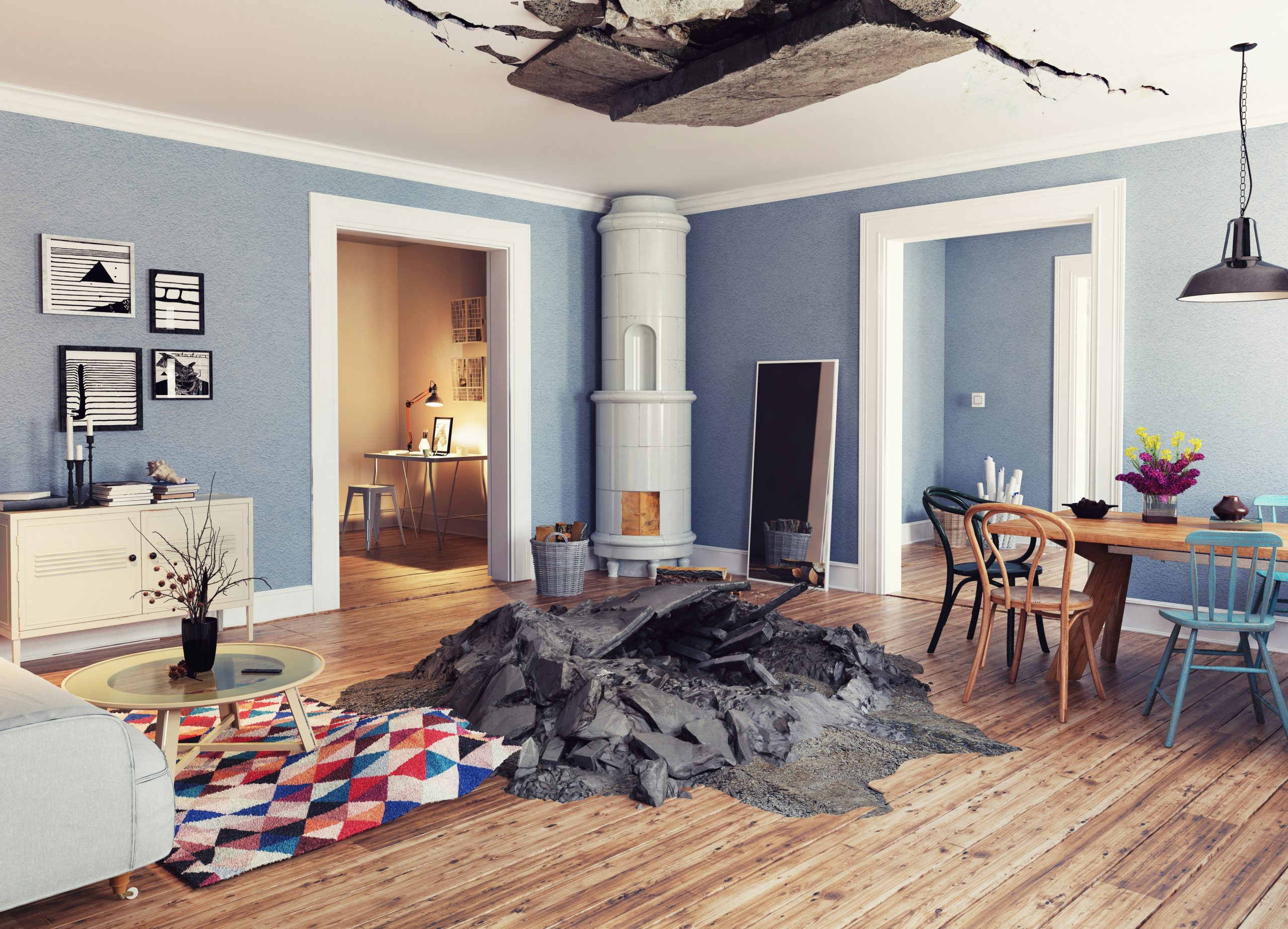
A literal House of Horrors here as the protagonist, Maggie Holt, inherits the mansion that had inspired her late father to write a bestselling book about the haunted house. Finding out the causes of the haunting feel a bit like demo day during a renovation—you’re never sure what’s going to turn up behind the walls. The House of Horrors book-within-a-book is a fun way to unravel the mysteries here, including a collapsed kitchen ceiling that reveal a secret love affair. You know. Standard demo day stuff.

Aria Aber on Finding Transcendence in Berlin’s Underground Scene

Good Girl—the debut novel by award-winning poet Aria Aber—follows nineteen-year-old Nila as she becomes charmed in a Berlin club and falls manically in love with Marlowe, an older brooding American writer. Raised by Afghan refugees, Nila’s childhood remains haunted by the shadows of exile while she yearns to be free and to live life outside of the realms of her room. She follows friends and strangers into dark warehouses and neon dancefloors, and soon stumbles upon an upper echelon world alongside Berlin’s underground scene, finding out that both orbit around art, sex, drugs, God, and secrets. “The club wasn’t really called the Bunker, but that’s what I will call it, because that’s how we experienced it: a shelter from the war of our daily lives, a building in which the history of this city, this country, was being corroded under our feet, where the machines of our bodies could roam free and dream.” 

Aber’s novel might be considered a künstlerroman and a bildungsroman. The portrait of the young photographer. A story about an artist becoming herself. But what happens when that self is obscured in lies, grief, and shame? What if the identity she is becoming is only an image of someone else entirely, then what might one be left with in adulthood? Above all, Good Girl proves itself to be much more layered than a genre-defined künstlerroman or bildungsroman. It is a complex, multidimensional story—not only a coming-of-age but a poetic journey that traces a young photographer’s political awakening and how she finds her voice amongst a tsunami of influences. As Nila discovers what it means to be the person you are, she too discovers what it means for that identity to be true. 

Between philosophical dialogues and debates on aesthetics and Marxism, the novel is also consistently laced with gorgeous prose, pills, and parties occurring in almost every chapter. However, the real grit and grime of Good Girl lies in what goes unsaid. It’s buried in the silent glimpses and unspoken conversations that pass across the room of wealthy elites at a German fundraiser for Afghan dogs, or the news on a television that plays in the background of Berlin’s bakeries and cafés, or the quiet curiosity Nila feels while wandering Venice as “an uneasy tourist” in a foreign city for the first time—unsure of what to do and how to travel without a purpose or a family member’s funeral. 

I spoke to Aria Aber, a poet, about her transition into prose and writing about a pulsing, provocative narrative of a girl growing up, falling down, and rising into the storyteller she was always meant to become


Kyla D. Walker: How did that transition from poetry to prose go for you? And why did you decide to write the novel?

Aria Aber: I started writing the novel in 2020 when I moved back to Berlin because I didn’t have any health insurance here in the U.S. I rented this small apartment in my old neighborhood there. And, of course, the world was shut down. I went on daily walks through the streets where there were all these clubs that I used to frequent a decade prior. And I was overcome with a sense of grief. On the one hand, for the world at large because of the pandemic and all the political upheaval that was happening that year. And on the other hand, it was a very private type of grief for a friend who had passed away. This sense, the inevitable sense of loss, activated my consciousness to an extent where I was experiencing all of these memories and sensations. Some of these chapters, or the first draft, of Good Girl really just poured out of me. Berlin, of course, is such a major character in the novel and being in the city physically led to me focusing the story in Berlin in particular. 

I knew that it had to be a novel because I wanted to explore one character’s consciousness and their power dynamics with other characters, which is a little harder to do in poetry—at least in the poetry that I write, which is usually lyrical and focused on a very particular moment of epiphany or realization. And you can’t really maintain the sense of linearity—and political awakening that is important in the novel—within one poem. I also didn’t want to draw too much attention to the form of the book, which is why I decided not to write a novel in verse, which would have been a possibility. But a novel in verse always brings up the conversation of verse versus linearity, so prose allows you to hide the form a little more.

KW: There’s a line that says: “…Nabokov, on the other hand, was one of my favorite writers. He wrote with a lushness that embraced both beauty and irony. I always thought that the poetic intensity of his style stemmed from the fact that he was exiled in English, that he excavated the strangeness of English because he was a foreigner in it.” I just thought that shows how the book is conceptually concerned with the nuances of language: its barriers and the exclusivity and/or accessibility that language can create. Did you know from the start you needed to write this novel originally in English?

I personally think of beauty as something violent rather than just pretty and easily observed.

AA Yes. I always knew that this would have to be written in English, primarily because at the time when I started writing this book, I had made my career in the English language. But I also wanted to highlight the fact that the protagonist, because it is written in first person, is not native to the English language in order to draw attention to the textures and foreignness of the way that I deal with the English language in particular. There is a version of my life in which I might have written this novel in German. And I ended up translating it myself into German. However, all of my writing—be it poetry or fiction or even nonfiction—starts with a melody in my mind that I then translate into language. So it felt the most natural to me to write it in English. I was also invested in discussing two different types of immigrants in the book. On the one hand, we have Nila as this character who is a refugee and who is born in Germany. And, on the other hand, we have an American expat: Marlowe Woods, who sits on the other end of the spectrum as a voluntary economic migrant. I was interested in highlighting the differences of how they are being perceived by German society and the kinds of privileges or disadvantages each of them experience.

KW: My next question is tied to what you mentioned in the way that Nila sees herself throughout the novel. There’s this quote on page 13 that says, “Beauty was a tragic virtue, often abused because we are fooled by it. But I emanated something darker, something uglier. Like a fraught hunger for life.” Does this view of beauty leak into Nila’s photographic perspective on top of how she sees herself? And then does that tragic virtue of beauty carry over into how she selects which images to take?

AA: I think her understanding of beauty is skewed in some ways because she thinks of herself as ugly and undesirable and yet understands that she has some sense of power within her that’s attractive to other people—especially to someone like Marlowe, which I think is her voracious hunger for life. And beauty I personally think of it as something violent rather than just pretty and easily observed. I think of beauty as related to the sublime. So when you experience something that is beautiful, you are overwhelmed with the sensation of being at the receiving end of it. It might change something in you. It might awaken something in you. It might lead you down a very different path. There are many different ways in which this manifests within the conversations and the thoughts that Nila has in the novel. Beauty can be experienced, I think, when you read a book as well as just being at a party and surrounded by many people. Ultimately the beauty—in a very philosophical and aesthetic sense—that I’m talking about here is a beauty of change and experience that might unlatch something within you. But beauty, and that particular quote that you read, I think, relates to a sense of attractiveness that is more classical that she doesn’t feel connected to.

KW: Speaking of the sublime, too, I was very moved by the role that religion plays throughout Good Girl and this idea of how faith can act as a wall between characters and cause separation. It seems that Nila almost wishes her parents, and especially her mother, had been more religious while she was growing up. I’m curious how this desire and this hope of hers complicate the notion of being “a good girl” or in fact rebelling against that idea.

AA: There are two ways in which I thought about faith in the novel. The first is organized religion, which is not very present in Nila’s nuclear family and which she yearns for because she seeks structure and rules and a very rigid way of experiencing the world. As a person in exile, especially so early on, where she experiences her family to be kind of adolescents as well—not knowing which rules to carry over, which ones to implement—leaves her in a state of confusion and dislocation and only adds to the already quite destabilizing sensations of being a young person in the world. And on the other hand, I think my personal relationship to God and faith—and I instilled a little bit of that in Nila too—is the yearning to be part of something bigger than yourself and to dissolve yourself with a higher essence, which is actually very mystical in nature. She seeks God everywhere, and she doesn’t always find that connection even though, of course, raves and the excessive party culture that she fashions her life around, as well as using consciousness-expanding drugs, allow her to simulate a part of that religious feeling or oceanic feeling. I guess I was interested in the dichotomy between excess and abstinence, between strict rules and unabashed hedonism, and the two drives that psychologically manifest in Nila. She’s such a person of extremes. On the one hand, there is this feeling of Eros and the life drive that is leading her down a path of Dionysian filth. Then on the other hand, there is Thanatos, the death drive that makes her a little ashamed and wishes she didn’t exist at all. And the only times when she feels a certain amount of peace within herself and not absolutely overtaken by extremes is when she feels at one with the world, which ultimately is a moment of quietness that we sometimes experience in prayers.

KW: Throughout the novel, there are also these really interesting discussions of fascism, Marxism, aesthetic theory, and gentrification—with Eli studying architecture and Doreen’s activism, among other things that come up. In these scenes in particular, the socioeconomic statuses of the characters start to become clearer and the different ways their perspectives have been formed in Berlin. So, for these characters, what do you think might be the role of the artist within these larger political ideologies?

AA: I don’t think the novel provides a very clear answer on what the responsibility of the artist is. However, I personally—as a very political person—think that we do have a responsibility to the world at large regardless of whether we’re artists or not. I don’t think that aesthetics exist in a vacuum divorced from ethics. I think these two things inform each other constantly. And what I wanted to achieve in this novel is to create a character who does get changed by the world, right? Her artistic awakening is subtly linked to her political awakening at the very end. After the NSU violence is uncovered, she has this moment where she’s looking at a photograph of her father and his cousins and a couple of her uncles on a hill in Kabul, and one of the cousins has a camcorder in his hand. But for a moment, she thinks he’s holding a rifle. And that moment to her, I think, is crucial because it’s integral to the sensation that she is part of something bigger than herself. And I don’t discuss this overtly in the novel—what that means symbolically. Mistaking it for a rifle, mistaking it for a machinery of violence that could kill but is actually also just a piece of technology similar to the one that she has chosen as her art medium: a camcorder or a camera. So I do think that those two things are linked, and we at least owe it to the world to let it change us, even if as artists we don’t make art that would be considered political on the surface or didactic in any way.

KW: I wanted us to talk a little bit about what you mentioned about the violence in Berlin, the National Socialist Underground murders. That chapter was so powerful and tragic and especially moved me personally. I’m so thankful that you wrote about it. How did it feel and what was the experience like of writing about these real events that intertwined with the fictional? Was that history inescapable for this story?

AA: It was inescapable, one-hundred percent, because I wanted to write a story that is set at that particular time. And, looking back, it feels like a failed opportunity for Germany to wake up in some way and see itself as the country that it is, which has not very much evolved from where it was many, many decades ago, even though it prides itself on things such as memory culture and having accepted and dealt with its past, with its very racist past, in a good way. I just remember being a young person at that time and feeling the sense of confirmation for all the fears that I was raised with, that I had suspected to be true but hoped secretly might not be true. And I also knew that I wanted to write a novel that ends with an act of right-wing violence. Even before I had set on how, I had settled on the timeline and mainly because there aren’t enough, I think, of these kinds of stories and it is a fear that I always harbor that this is just around the corner and will happen. The way I fictionalized it in the novel is to include the burning and the murders: the burning of the bakery and the murders of those two Afghan bakers in Berlin in particular. Because most of the other things that I write about in the novel are actual occurrences, I wanted to dramatize it for the sake of the narrative and make it closer to Nila’s own life so that she would be forced to experience a political awakening. Having this story be more removed from her as it transpired in real life would have maybe not felt urgent enough for the psychology of this character in particular because she’s so reluctant to accept herself as a politicized body within the world that she inhabits. But also, I didn’t want to spend too much time discussing the murders of real people because it’s still very close to me, and I wanted to be respectful to the actual victims and not sensationalize their deaths, which is why I chose to create a fictional event at the very end. It is such a painful moment in German history.

KW: Now diving a bit deeper into the relationship between Nila and Marlowe, there’s this sense of the shadow of exile that haunts Nila and her parents after they’ve left Afghanistan and are starting their new lives in Berlin. And we talked a bit earlier about this as well—how Marlowe was also an immigrant in Germany though comes from a very different background, but still finds some similarities with Nila. Later, the relationship turns out to be quite toxic and abusive. I’m curious how geopolitics might be playing a role in this particular relationship. How have war and imperialist forces affected the dynamics between them, if at all?

AA: Interestingly, when I first sketched out the novel, I was inspired by Nabokov’s treatment of Lolita. He said, when he set out to write that book, that he was thinking of the characters Humbert and Lolita as the Old World versus the New World—with Lolita representing America and Humbert representing Europe in some way, and how they interact with each other. I don’t think that ultimately manifests in the novel in any productive way, but it’s an interesting framework to think of as a surface, right? And when I set out to write Good Girl, I thought about including this American character in order to also symbolize American imperialism and how it has affected the world and Afghanistan in particular at that time. 

This was a great starting out point, even though it became less and less relevant the more fleshed out Marlowe as a character became. I think it definitely plays a role in the ways they interact with each other because he has all of these privileges that he is more or less unaware of, right? He speaks the lingua franca of the world. He’s a white man. He can move through rooms without being detected as a foreigner, which Nila cannot. And yet, at the same time, there is this almost paradoxical yearning for America within Nila herself, but also in her father and her family who are attached to this very antiquated idea of the land of freedom, where anything is possible, which they don’t see for themselves in Germany… I was interested in the nuances of that and how they manifest in her family and why she’s attracted to Marlowe in particular. Part of it is that he is from California, which is the state that her father idolizes so there is that connection and an inherited fascination with the landscape of the West that he brings into her life. And on the other hand, he is also symbolic of everything that she yearns for in terms of artistic freedom and a life that is not dictated by rules but is rather lived in freedom.

One other thing that is quite interesting to me is that Nila, early on in the novel, says that she sees an image of Marlowe in a magazine beforehand and that she remembers that photograph which has made a big impact on her. So she’s quite literally enamored of his image—the surface and everything that he represents there. And the more she gets to know him, the more the image crumbles. He becomes weaker and less successful, or less confident, whereas she gains a sense of confidence and artistic voice. So, their arcs are opposed to each other, which psychologically is very interesting, even though it doesn’t necessarily function with the parallelism of the nation states and how they represent those.

KW: Throughout the book there are several mentions of writers that Nila is reading and being influenced by. Who are some of the writers you were influenced by while writing Good Girl and do they overlap with Nila’s?  

AA: Interestingly, the writers that Nila mentions were not part of my personal syllabus that I used while writing Good Girl. Because I don’t have an MFA in fiction and didn’t have classical training, I had to teach myself how to write a novel. I read a lot of Jean Rhys and Marguerite Duras and James Baldwin because all three of them write these protagonists who are adrift in various cityscapes. So urban melancholia was something that I was trying to learn how to bring across on the page, and at the same time, also this feeling of insatiable desire and erotic fulfillment that they also often seek and don’t always manage to find in other people. So, the sense of loneliness and being adrift in a city was something that I learned, or tried to copy, from those writers.

Being an Asian Southerner Means Being an Anomaly, Squared

“Southings,” an excerpt from Take My Name But Say It Slow by Thomas Dai

Southing, noun

1: difference in latitude to the south from the last preceding point of reckoning

2: southerly progress

The cicadas began to arrive in the South in May. I suppose “arrive” is the wrong word, as the insects had been in the yard for two years already when my parents bought the property back in 2006, their bodies buried eight or more feet deep in the soil, insect clocks set to a seventeen-year timer. They’d grown older in our unwitting company, outlasting two chickens, four goldfish, three graduating seniors, and at least a couple hundred rabbits. Like billions of their brethren across the country, the cicadas were now emerging in their blackened, red-eyed old age, tymbal subwoofers pumping out this endless, dirge-like song. 

“These bugs are seventeen years old,” I tell my mother. “The same age as Airik.” 

“Oh really?” she says, actually impressed. “He’s been eating them. I hope they taste good.” 

Mom is showing me around the backyard as Airik the shepherd-chow mix shuffles along in our wake, a belly full of his contemporaries. Almost two years have passed since last I came south. While I was away, my younger sister graduated and moved north for college, leaving my parents with an empty nest. Dad has gotten into home surveillance. He’s acquired a fleet of drones which he uses to take aerial snapshots of the neighborhood. (One went AWOL in a neighbor’s tree, and Dad’s been too embarrassed to walk over and ask for it back.) Then there’s the cheap cameras he’s placed around the house, their live footage streamable on his phone. Each night since the pandemic began, Dad’s sent the family group text a screen grab from one of his feeds—usually a pixelated image of Airik asleep on the porch—accompanied by the same, repeating message of “Good night and good luck!”

Mom, for her part, has pivoted from childrearing to plant husbandry. She shows me the vegetable beds out back, each haphazardly planted with Chinese watercress, Chinese chives, Chinese eggplants, tomatoes, strawberries, coriander, a lone bitter melon, some swollen peppers and shriveled string beans. There are white irises in bloom all around us, and a big metal pail filled with dark water and what I think must be lilies.  

During the years my siblings and I were growing up here, my parents never seemed to take a shine to the South. They never went on hikes in the Smoky mountains like they do now, or kayaked in the flooded quarry just south of downtown, or had the time to get involved with neighborhood beautification. And yet, I don’t remember them ever complaining about feeling isolated either. “It was very simple,” Dad tells me. He had a three-point plan when he came here: study hard, get a job, raise a family in America—a plan he has executed up to this point. When I ask him if he ever felt unwelcome in Tennessee, he responds adamantly in the negative. Back then Japan was America’s main economic rival, and in his account, Americans thought of China, not Japan, as their main ally in the East. “I always think immigration is the key thing,” he says; letting migrants in should be “compulsory,” as long as the immigrants are as diligent as him. 

My father became a citizen the moment he was eligible, and when money was no longer a problem, he and my mother acquired green cards for their parents so they could visit us whenever they wished. The long-term goal was always to bring the whole family over, to have my grandparents and uncles and cousins all settle in Tennessee. That never worked out—not least of which because China is no longer a place that highly-educated Chinese people feel they need to leave. Growing up, I always thought that maybe my parents were lonely here in the South, and that maybe if they’d made more of an effort to assimilate, not just in terms of citizenship, but culture, they wouldn’t have missed their family so much that they needed their family to come over here.  

What friends my parents had when I was young were all drawn from the small and frequently drained pool of local Chinese immigrants—friends who were always decamping for other states or reverse migrating back to China. My parents sometimes speak of following suit after they retire, of pulling up stakes like the cicadas are doing now, circling back to the dappled treetops where their own, cyclical lives began. A Chinese treatise on war, the one not written by Sun Tzu, describes a maneuver known as “Slough off the Cicada’s Golden Shell,” in which a retreating force leaves a copy of itself behind on the battlefield to confuse a gullible opponent. Right now, my parents’ backyard is covered in these decoys. They crunch like packing peanuts beneath my feet. 

If my parents ever did go back to China, I’d feel like one of the decoys: an amber-colored molt left behind by my predecessors. These shells seem more intact than former selves have any right to be, each with a telltale tear by the head through which their wearers got away. Seeing my parents’ yard covered in cicada shells was reason enough to come home this summer: how a skin deprived of its body still stands, clinging crab-like to fence posts and stems. One brisk rain might wash them away, but up until now, they’ve stayed.    


My mind is often drifting southwards even as my body stays sequestered in the North.

I was born and raised in the American South, in a suburb of Knoxville called Farragut. For ten of the past fourteen years, I’ve lived in New England, with the remaining four split between China and Arizona. Yet none of these places have felt like a permanent backdrop to my life in the way that East Tennessee once did. I know this because my mind is often drifting southwards even as my body stays sequestered in the North. I’ll be riding the subway, looking absentmindedly down the length of the train car, and suddenly the entire locomotive spyglass will be filled with this verdigris flush, a green that rushes along beneath the city on unseen tracks, reminding me, invariably, of the South. In other words, the trigger is environmental: the way the air is balanced today, the glossy depth of a field my partner and I pass while driving from one Boston suburb to the next, looking for passable dim sum. This field will look, in the brief glimpse of it I can catch, fresh, perfect, unmown. 

And so we come to the crux of the matter: a Southern field I once knew. I hesitate to even describe this field, as it really was a prosaic space, a pastoral interlude in the middle of suburbia, as neutral and inviting as only a field can be. Obviously there was grass in this field; that, and a few trees. I cannot call up specific names for those trees, nor for the many birds, reptiles, and insects that, in addition to me and the cows, must have inhabited that space. Knowing the field in that way never interested me. The field was this outside space, one I did not wish to assimilate into my world, even as I spent hours exploring its expanse. Nowadays, I consider that field—or rather, my attachment to it—as possibly the most Southern thing about me. Although I lack most of the outward tells of Southernness, which is to say I speak unaccented English and have a face that is neither white nor black but yellow, that field places me in the South. My memories of it are full-body ones: overgrown, terrestrial, musical as any sentence by my hometown’s literary hero James Agee, lit up like a landscape shot by Sally Mann. 

I used to practice wushu out in the field, far away from all my neighbors’ prying eyes, stretching and high kicking and making patterns with my limbs. For years, I’ve had this recurring dream where I’m back there, dressed in my East Tennessee Wushu Team uniform of sky blue polyester, alone and running. It’s dawn or early evening, the field’s grassy swells covered in fog, and as I run, I start leaping at the crest of each earthen wavelet, and these leaps keep stretching out until I am gliding through air like the warriors in Wuxia films do, a body no longer in touch with the ground, predisposed toward flight. 

While I’m no expert at dream analysis, the subconscious speaks pretty loudly in this one. I loved that field, but that field belonged to someone else, a farmer who owned the cattle and harvested the hay. Technically speaking, I was a trespasser on this man’s property, and so my relationship to his field might as well be my relationship to the South as a whole: an enduring fidelity I feel for a space I could never, fully own.  


I’ve been thinking more than usual about this: the place which Asians do or don’t have in that part of America which gets defined as the South. Most of the scholars I’ve consulted on the topic tell me that “Asian America” and “the South” rarely, if ever, converge, making the Asians at the center of this Venn Diagram seem like poor navigators, honorary Californians who somehow wound up in Tennessee. There are many reasons for this incongruence (what the editors of an anthology called Asian Americans in Dixie refer to as the Asian Southerner’s “discrepant” status). One is simple demographics. Even though Southern cities like Atlanta and Houston boast large and rapidly growing Asian communities, proportionally fewer Asians live in the South than in the West or Northeast. Another factor might be spin. Asian Americans are consistently seen and represented, even by ourselves, as “new” Americans, and the spaces and timelines we populate are reliably contemporary or futuristic. We are proprietary products, that is, of the long 20th century as well as harbingers of the 21st. Our Oort cloud of associations includes “fusion cuisine,” “forgotten wars,” “globalization,” “foreign imports,” “software engineer,” and “R&D.” On the other hand, the South and its people are famously anti-progressive, old and loamy and deeply rooted in all things. Despite all the hubbub about so-called “New Souths,” Southern identity is perceived by most to be marooned in the before times, somewhere betwixt Civil War and Civil Rights. Asians were here in the South back then as well (see the “Manilla men” of the Louisiana bayous, the handful of indentured coolies who labored on Southern plantations, the eight thousand plus Japanese incarcerated in Arkansas during WWII), and yet our historical presence in these parts has been easy to forget, our present-day contributions limited to a smattering of Indian-owned motels and Chinese-owned grocers.

Asians can rarely tell where they fit within the South’s racial pecking order.

As the critic Leslie Bow writes, Asians in the South have long occupied a kind of “social limbo, a segregation from segregation,” by which she means that Asians can rarely tell where they fit within the South’s racial pecking order. One could of course make the same argument about Asians elsewhere in this country. Outside of a few urban enclaves, aren’t most Asian communities so small as to barely register within any local patchwork of social relations? Perhaps the aberrancy of Asians in the South is simply a difference in degree, then—we feel more like a minority here than elsewhere, and so more existentially adrift. But the difference also has to do with how the South has itself been framed as a space apart, home to the obese, the poor, and the excessively religious; the bigots and the rednecks; the winsome folk singers and daredevil Davy Crocketts. This vast and heterogeneous region has so often been held up and put down as a different, phantasmal America, and so being Asian in this space means embodying an exception within the exception—an anomaly, squared. 

One core tenet of Southern distinctiveness is the intense, almost maudlin connection good Southerners are supposed to feel for the land they were raised on. As a college student in the North, I once attended the office hours of a teaching assistant who’d also grown up in the Tennessee Valley. White Southerners I knew at my school often spoke of feeling out of place there, outclassed by an even older WASP elite. (Some of these Southerners even banded together to form a short-lived “Southern Culture Club,” spearheaded by a girl I knew from my freshman dorm who claimed direct descent from Robert E. Lee.) My teacher probably had little interest in discussing Southern identity politics with me, but she also didn’t balk when I asked her about her upbringing in East Tennessee. She told me she’d grown up on a farm north of Fountain City with chickens and goats and brothers who shot squirrels, and said that it was only after she, too, left the South for college that she realized hers was not a “normal” American upbringing. Most of the people my teacher knew growing up were only one or two generations removed from agrarian life. This closeness to the land, or at least the land’s memory, was what distinguished Southerners from everyone else. 

Perhaps this is also why the confluence of Southernness and Asianness has continued to elude me. The former is premised on land: stolen land, broken land, land which has been worked over for generations, but land nonetheless. The latter—if it’s built on anything at all—is built on dislocation and diaspora, on the dispersed and fragile networks forged by those who’ve learned to dwell in spaces few and far between. 

This is all to say that there are Asian people in the South, millions of them, in fact, but that doesn’t mean they feel Southern. 


On the screen porch in Farragut, I sit with the dog and the sweltering air. I rock back and forth in the chair as sunlight sews clever little embroideries into a white wooden table. This is the table where I learned how to write—you can still see the imprint of old words, both Chinese and English, grooved onto its surface—and also the table where I once laid a dead king snake after a long walk through the field, its sleek length banded black and white, one of those perfect found objects of summer. 

Airik’s old, but he’s only recently begun to show it. He’s acquired a few things since last I saw him: rheumy eyes, occasional fits of flatulence, a custom-built staircase with a railing leading down into the yard (no one with hands ever uses these stairs, but my parents’ home insurers insisted on the railing for liability reasons). Petting him as he pants, I pick three or four ticks out of his fur, each like a botoxed raisin. 

Here we are: a man and his dog on the porch, listening to cicadas. Is there any configuration more Southern than that?

Since none of my friends live in town anymore, I spend most of my time at home just driving around, indulging my private nostalgia while playing the part of the Asian tourist. I go to places I never paid much attention to when I lived here, places called “Founder’s Park” and the “Farragut Folklife Museum” inside of town hall, where one can admire an oil portrait of David Farragut—first admiral of the U.S. Navy, born not far from this spot!—and scope out his wife’s collection of fine china. I even go into Knoxville itself, my hometown’s recently resurgent core: Gay Street and Market Square, a weather kiosk installed in 1912 that no longer tells the weather. I visit one boring municipal museum, and then another, loiter about a park commemorating James Agee just down the street from my parents’ first American apartment. There is a sign by the river welcoming pandemic travelers. “For the Love of Knoxville. Travel Safe. Stay Safe.”   

I guess this is “the South,” or my slice of it at least. My South is that austral shiver I get when I hear Dolly Parton’s “The Bridge.” It’s the mountains blued out by distance which are permanently fixed into a folksy still-life in the back of my mind. It’s the field: the field as it was, and as it is. When I’m back in this South, I’m always trying to parse where myth and land part ways. At the Museum of Appalachia, I walk around a barn dubbed the “Appalachian Hall of Fame,” squinting at all the writing on the wall: “These are our people. World renowned, unknown, famous, infamous, interesting, diverse, different. But above all, they are a warm, colorful, and jolly lot. In love with our land, our mountains, our culture.” The barn is stuffed with quilts and old photographs, mandolins with frayed strings, the kind of apocrypha (e.g., a child’s sled owned by the founder of Dunkin Donuts, who years ago vacationed in East Tennessee) that only such institutions care to retain. Here there is a corner devoted to “Misc & Unusual Indian Artifacts,” and beyond that, a bunch of placarded exhibits bearing the colorful stories of Appalachian Hall of Famers, stories like that of Asa Jackson’s “Fabulous Perpetual Motion Machine” and “Old ‘Saupaw’ the Cave Dwelling Hermit and his Little Hanging Cabinet.” 

None of these stories speak of Appalachian Asians, or of Asians in the broader South. There is no such “representation” to be had at this museum, unless you count, as I do, the kudzu vines conquering all the nearby trees or the Indian peafowl roaming the grounds, pecking away at some invisible prey. 


Several decades ago, another Asian named Choong Soon Kim came to the South in order to study it. Much like my own parents, Kim arrived here as a doctoral student. He wanted to write a treatise on Southern culture, a deep dive into “the ‘innards’ of the South” as told through the refracting lens of race. The resulting book—An Asian Anthropologist in the South: Field Experiences with Blacks, Indians, and Whites—is not so much an objective account of Southern race relations as it is a reflection of how one Asian anthropologist was received in the South. 

That reception was not always a warm one. Children followed Kim down the streets of Georgia, chanting “Chinaman, Chinaman.” Multiple informants, mostly educated whites, refused to shake Kim’s hand or answer any of his questions, even as they spoke deferentially to his white colleagues. Someone broke into Kim’s motel room to steal his field notes and left a threatening note on his car. At one point, a cop bluntly told Kim that no foreigner from an “underdeveloped” country should have the gall to question Americans about their ways. And yet Kim refuses to interpret any of these events as racially motivated, writing in his book’s epilogue: “I wish to emphasize that I have never been subjected to [racial discrimination] during my ten years of living in the South.” 

Confident as Kim may have been that he had never experienced Southern racism firsthand, he nonetheless concludes that Asianness and Southernness are immiscible entities. Unlike the white anthropologist who tries to “go native,” Kim realized in the field that it was more expedient for him to play up his foreignness. Southerners were more likely to help him with directions and talk his ear off, slowly, about local happenings if they perceived him as a temporary irritant rather than a potential fellow citizen. Kim’s method for getting by in the South was thus to strategically orientalize himself, to “conform to the role of the stereotyped Asian both in my field work and in all other aspects of my life.”

It’s that “all other aspects of my life” bit that gets me, how someone can learn to flourish in a place without ever integrating into its fabric. Although Kim would spend more than three decades in the South before returning to Korea; although he raised his children here; although he owned property in the South, presumably paid taxes to a Southern state, and taught a generation’s worth of Southern students at UT Martin, where he was a professor of sociology until 2001, Kim never came around to seeing himself as a Southerner. It was like his time in the field began the moment he came to the South and didn’t finish until he left it: a thirty-six-year study completed by one “nonimmersed Asian ethnographer.” 

I’ve been trying to remind myself on this latest Southern journey that my life and project are not the same as Kim’s, even if both of us link the South in our minds to a field both abstract and real. He stood outside or above it, his field site, trying to master its conditions. I’ve long wanted the opposite: to have the field master me. 

Perhaps what I’m delineating is just a generational difference. Kim is my parents, or at least the stereotyped version of them I’ve constructed for easy consumption (terse and hard-working neo-Confucians, unconcerned with social justice and connected always to the old country), while I am their offspring, equally troped: this flighty layabout overfull of misplaced identifications; this second-gen wandering heart desperate to belong.

It seems too direct to ask my parents if they feel like Southerners now, thirty-five years after my father’s arrival. The answer, I fear, is liable to be yes and no at once. My mother tells me that when she moved here, she didn’t really consider how Tennessee might be different from anywhere else in America. And yet being here has changed her. “I think mostly in English now,” she tells me. It took many years for that to happen, but now the sounds in our minds are the same. I ask her if she found it difficult when I was young to communicate with me, a no-brainer kind of question that right after I say it makes us both laugh. “You think it’s hard?” she says, turning the question back on me. I lie and tell her I don’t remember. 

Kim reports meeting someone like me in the course of his fieldwork, a Korean American born in the South named Wilson that Kim chastises as only a disappointed parent can. “He appeared Oriental, but knew nothing about the Orient.” And yet this young, oriental man, Southern drawl and all, could also not pass muster as Southern. By the Asian anthropologist’s standards, Wilson was a cultural mongrel lacking any “clearcut identity,” a con artist who didn’t even know he was running a con, this “marginal man belonging nowhere.”


It would be easy for me to compare my own Asian Southernness to bad improv, a mug’s game of representations in which what I’m taken for is rarely what I am. Due to the legacy of redlining, my public school and the tony suburb it served were both overwhelmingly white (Black Knoxvillians all lived in North or East Knoxville and attended schools we suburbanites disparaged as “inner city”). So, yes, what Asians there were in Farragut did stick out, and there were times when I thought of us, me and all the Asians I knew, as propertied squatters with no valid claim to this non-Asian place—a place I had the misfortune of loving as much as I did.

Still, it’s important for me to note that my own Asian identity did not form inside of a vacuum. My parents were early members of the East Tennessee Chinese Association, founded in 1992, and through that association’s various functions, had introduced me to other Chinese immigrants and their kids, some of whom have remained my lifelong friends. The things that bonded me to my fellow Chinese Knoxvillians were not just the strong nuclear forces of race and class and city. It was the baroque specificity of any scene within a scene, all these things I thought no one outside of our tiny East Tennessee x China enclave could understand, things like our aunts smuggling over seeds from Zhejiang; our mothers’ late nineties traffic in VCR tapes, all of Michelle Kwan; or that sigh of relief some of us breathed when it turned out we sucked at violin. It was the lopsided satellites on our porches that gave our visiting grandparents’ access to CCTV, and the better than passable Sichuan restaurant known as Hong Kong House, RIP, which used to sit like an MSG-laced beachhead by Tennessee’s first official state road. It was the miasmic, soul-crushing boredom of Sunday Chinese School weighed against the ethnocentric delights of parties we poopooed to our white friends but secretly relished. It was the magnificent sprawl of those parties, the pool of slip-on shoes at the door, the potluck contributions that deified their casserole containers, the mellifluous blend of Mando-pop karaoke and Super Smash Bros. Melee. It was the dads getting trashed at the weiqi table as the moms counted cards in the kitchen. It was learning the rules to all our parents’ games, but still sticking to Spades instead. 

It was also the fact that one day we’d all leave. Whatever this milieu of ours was, it could not be reconciled with where we were, for where we were was in the South. I remember a night right after graduation when I took all my Asian friends with me to the field. We dragged a bunch of hay bales together into a circle, piled all our homework from AP Physics and AP U.S. History and AP Calculus in the middle of that circle, and then we set our homework on fire, because there was a lot of it, and the A’s we’d made no longer mattered. I don’t know what everyone was thinking that night at the bonfire of nerd vanities, but I’m pretty sure it had something to do with how we’d all be gone by summer’s end, off to some college north or west of here. This field in the South could not be ours. This field in the South had been caked on in stygian layers, sedimented in stories of decrepitude and succession, in histories always on the edge of forgetting and Southern people laid low by the weight of their benighted land. We would not be those people. We would be fleet of foot, pecunious. We would run until our yellow and brown bodies were lighter than Southern air, air that everyone knows is heavy. 

But that’s only half of the story, the half I’ve been too eager to tell. In all my years of practicing wushu, the move I most wanted to master was called an aerial, a cartwheel performed in midair. I always started the move perfectly, my legs tossing up above me, my arms and shoulders relaxed as I somersaulted into flight. Then something in me would falter. My eyes would make contact with the field below. My hand would shoot down to touch it. 


In the town of Rocky Top, Tennessee, I walk past rows of trailer houses, each with at least two “NO TRESPASSING” signs posted. Rocky Top used to be called Lake City before the local council brokered a deal with an investor who wanted to build a water park nearby. The investor promised to sink $100 million into the project, but only if the residents of Lake City agreed to rename their town “Rocky Top” after Tennessee’s official state song. Following a legal skirmish with the estate of the song’s writers, Lake City succeeded at renaming itself Rocky Top—as in “Rocky Top, you’ll always be / Home sweet home to me”—in 2014. The $100 million dollar water park, however, has yet to materialize.  

 It’s the middle of a hot day, and even the children are sheltering in place. The Thursday special at the Vol’s Diner is catfish, and the antiques store with the native effigy out front just closed. I’m walking past a gas station, feeling light-headed from caffeine, when the thing that always happens starts happening to me. (I don’t mean “always happens in the South,” as these scenes do not discriminate by region.) “Hey,” says a youngish white man biking on the sidewalk, and I’m already crossing the street, hoping my dodge wasn’t too obvious. 

“Hey you,” he says again. “Do you understand what I’m saying?” 

I walk faster, and the man starts to follow me on his bike. “Motherfucker!” he yells now. “Motherfucker! Chink!”

I keep walking and say nothing, though in my head I’m thinking “fucking meth head” and “redneck piece of shit.” The man on the bike keeps pace with me.

“Go back to where you came from!” “Motherfucker! Chink! Motherfucker! Chink!” 

“Well, this is fucking stupid,” I say to no one but myself, turning off the street and breaking into a run. Without thinking it through, I grab a fist-sized rock off the ground and keep running, wondering if those long-ago years of wushu practice might finally come in handy. But the man soon disappears, the day rectified into silence. There is an empty baseball field in front of me, I notice, and a dead tree drawn and quartered by a chain link fence. I go to my car and just sit there for a few minutes, running the AC. I’m already berating myself for not dealing with the situation in a calmer or more confident way. Why had I immediately crossed the street instead of responding to the man’s greeting? Why had I been so quick to pathologize him, that “fucking meth head”? Why had fantasies of violence jumped so readily into my head?  

I guess I’m more like Kim than I care to admit. Every time this scene repeats, I try to empathize with the opposition, to rationalize their actions as a neutral observer might, and in so doing, remove their barbs from my skin. I try and do this especially in the South, because in a deeply condescending way, I feel like I owe it to these sad people stuck in sad places, these Rocky Toppers plentiful in pride of place but scarce in everything else. And yet the bitterness in me is also very real, and very Southern. I may be fed up with myself for taking what amounts to schoolyard name-calling so seriously, but I’m even more fed up with them, these men and women who insist on begging the question in the most debasing of ways, these wrathful Southern revenants we honorary whites are supposed to handle with kid gloves or avoid. Why are we not extended, at bare minimum, the benefit of their avoidance? Why is it so hard, when they come calling, to stand where we are and just be? 


I’ve been trying to leave the South for almost fourteen years now. Coming back is partly an obligation, a son visiting his aging parents. But truthfully, I feel out of sorts when I’ve been absent from the Valley for too long. My little sector of Appalachia is probably the one place on Earth where I can always tell when something has changed. There’s now a Kung Fu tea right next to Tennessee’s first highway, and a Pho 99 where a Stefano’s Pizza used to be. Near that pho place is Far East, a tiny Chinese grocer where I used to sit on a crackly leather armchair by the door as Mom picked out vegetables, sucking on a gratis Dum-dum. The kindly source of those Dum-dums is now dead (lung cancer, Mom confides), and so we do our shopping at a newer and better-stocked grocer called Sunrise. I always stop outside of Sunrise to read the latest notices pinned to the community message board. Today there are the usual advertisements for badminton lessons, citizenship lawyers, and language exchanges, plus a help wanted sign for Little Caesar’s with the tagline “JOIN THE EMPIRE” printed on it in all caps.  

What’s also changed, to my sadness and surprise, is the field. Sometime in the last two years, the farmer sold the land and developers swooped in. The neighborhood will be called “Ivey Farms” when it’s finished. People will live there, and not just in their minds. They will lead lives not unlike the one that I led when I was growing up here, which is to say they will need their own outsides.

I must go and see it, obviously, the field before it’s no longer itself. It looks rather small with freshly paved roads circumnavigating its heart. Much of the ground cover has been stripped away to reveal the land’s livid, red insides, from which bulwarks of wood, soon to be houses, now rise. I think back to all the hours I spent here as a kid, how the field that wasn’t mine still conferred to me a sense of place. I learned my cardinal directions from sitting in that field and adopting its orientation. To the east were always the Smokies, to the west a woodland masking the interstate. My north was a new neighborhood, my south the neighborhood where I still dream. I don’t want to leave yet, but there’s not much left to see. I consider taking a few tufts of grass with me as a keepsake, but that would be morbid, I think, like shaving hairs off a corpse. As I cut back across the dividing line which separates my parents’ neighborhood from the field, I notice I’ve brought a bit of the field back with me, a few grams of Southern soil, pressed into my soles, that I leave behind me now as tracks. 


To walk around with a vestigial geography in the mind, to feel shackled to a place whether you want to be or not: these are feelings an Asian Southerner gets from both sides.

Maybe the question is actually less complicated than I’ve made it out to be. You’re either from a place, or you aren’t; you’re Southern, or something else. I haven’t lived in the South since I turned eighteen. Ergo, I’m no longer Southern. What helps me undo this bind is the fact that so much of Southern identity is about missing a place from afar. This is a feeling many Asian Americans are also familiar with, even if the homes they pine for lie further east than Tennessee. To walk around with a vestigial geography in the mind, to feel shackled to a place whether you want to be or not: these are feelings an Asian Southerner gets from both sides. 

This is also how I know that an Asian South does exist. I miss it. It’s as simple as that. All the glimmerings of that hybrid strata—the humidity, the cicadas, the scallions bunched up in the yard—and all the habits of mind and body these glimmerings sustain, they’re real. My father likes to talk about how he wanted to be an artist, too, when he was young—not a writer, but the kind of artist who sketches people in the park. He’s very glad he didn’t try to go through with that plan, the path of “crazy people,” he says. But now that he’s older, he’s gotten back into picture-making, using cameras instead of a pen. “I don’t think you could take a picture like this anywhere else,” he says of a heavily-edited image he’s just framed. The picture shows a forest in the Smokies from above, in autumn time, the foliage washed in ruby-red. Dad has affixed a stamp-style yinjian, or signature, to one corner, indicating that this Southern image is his. “Doesn’t it look just like a Chinese painting?”    

As for my old dog, he coordinates his dying with the cicadas. By July, they’re all gone, and I’m reading a pamphlet from the pet crematorium warning me to avoid stewing in this “deafening silence.” Mom asks me what I think we should do with the ashes. I tell her we should scatter him in the field before its new tenants move in. When we try and take him out of the urn, though, the lid of the vessel is sealed. “Let’s just leave him on the porch then,” Mom says. He was sleeping there when he passed. 


Excerpted from Take My Name But Say It Slow: Essays by Thomas Dai. Copyright © 2025 by Thomas Dai. Used with permission of the publisher, W. W. Norton & Company, Inc. All rights reserved.

This selection may not be reproduced, stored in a retrieval system, or transmitted in any form by any means without the prior written permission of the publisher.

Exclusive Cover Reveal of “Bind Me Tighter Still” by Lara Ehrlich

Electric Literature is pleased to reveal the cover of Bind Me Tighter Still by Lara Ehrlich, which will be published by Red Hen Press on September 09, 2025. You can pre-order your copy here.

The youngest of three siren sisters, Ceto is weary of an existence driven by hunger, no better than a fish. She trades her tail for life on land, marries the first man she meets, and bears a daughter, only to discover that domesticity is just as mundane as siren-hood. In search of something more, she flees with her daughter Naia to the ocean, where she establishes a mermaid burlesque and recreates herself, performing as a siren in a tank built into the limestone cliffs overlooking the sea. She trains more sirens, expanding Sirenland from a roadside attraction to a national sensation she rules without opposition—until Naia, at 15, begins to push back against the world Ceto has created and the role she performs in her mother’s shows. A death at Sirenland threatens Ceto’s authority and leads Naia to question whether this women-ruled kingdom is truly as empowering as her mother would have her believe. Bind Me Tighter Still explores power and hunger, sacrifice and motherhood, and celebrates the fierceness of female strength in a male-dominated world.


Here is the cover, photography by Renee Robyn.

Lara Ehrlich: “I took the book’s title from The Odyssey, in which Odysseus implores his men to “Bind me tighter, still” to the mast as their ship approaches the island of the sirens, so he can’t give in to their song. The book—and the cover—subverts the concept of a man needing to be bound to withstand a woman’s allure.

For me, what’s interesting about siren-hood is not the possession of a tail, but the seam where the tail meets human flesh. That’s where the tension lies, both in real sirens and in the sirens of Bind Me Tighter Still—women in Lycra tails performing before an audience. I’m reminded of a scene from Mad Men, where the powerful, sexy Joan—admired in part for her beautiful breasts—removes her bra to reveal the raw welts left by the straps on her shoulders.

I’m fascinated by how the suffocating tightness of the tail constricts flesh in the name of otherworldly beauty, reminiscent of corsets and push-up bras, and how these garments are worn both to invite the viewer’s gaze and, at the same time, to empower the wearer.

Renee Robyn’s photography, and this photograph in particular, convey a similar tension. The woman on the cover is bound, but not in the sense of being powerless. Her restraint is a choice, a performance of vulnerability that is entirely within her control. This inversion of power dynamics is at the heart of the story.”

My Mother’s Death Is a Government Disaster

DisasterAssistance.gov

Four thousand eight hundred
for the preparation of the body
+ three thousand seven hundred
ninety-five for the casket +
nine hundred eighty for the grave
liner + five hundred to open and close
the earth + four hundred twenty-five
for something called a vault
service charge + twelve hundred
for two plots including one
for my father who was still
alive + one hundred for prayer
cards + three hundred forty-one
dollars and twenty-five cents
sales tax. Disclaimer: We do not
warrant or claim that the vault
you are purchasing is watertight.

The stone cost four thousand
four hundred eighty-four dollars
+ three hundred thirteen dollars
and eighty-eight cents sales tax,
bringing the total cost
of my mother’s death
to sixteen thousand nine hundred
thirty-nine dollars and thirteen cents,
not counting, of course, the cost
of therapy and the cost
of her empty slippers by the door
and the cost of my father
no longer able to sleep
in the bed he’d shared with her
and many other costs beyond dollars
and sense. But the United States
had calculated that my mother’s life,
rather her death, was worth nine
thousand dollars, thereby decreasing
the actual cost to seven thousand nine hundred
thirty-nine dollars and thirteen cents,
that is, if my father uploaded
to DisasterAssistance.gov the required
paperwork: receipts for the aforementioned
goods and services and a certificate
of death that listed the causes.
I helped my father by scanning
the documents, making sure to include
my mother’s disaster number,
and then we waited. The expiration
date was approaching, but my father
had heard nothing. When he called, a robot
said: You are very important to us.
We’re experiencing a high volume
of calls. Please stay on the line. Your wait
time is approximately three hours
forty-two minutes. My father waited
two hours twelve minutes before the line
went dead. This is their plan, my father said.
They want you to give up, to miss
the deadline. Well, I’m ready to hold
forever. He called back, and fell asleep
while holding, and hours later woke
to a human voice, who told him that the death
certificate was blurry: acute respiratory failure
looked like a cute respite allure
and coronavirus pneumonia looked like
crown us new mania and the manner of death
was natural but the boxes for accident,
pending investigation, and could not be
determined
seemed to have some kind
of mark beside them, and in order
for them to process my father’s application,
we would need to upload the death certificate
with higher resolution, and we had failed
to upload the back of the certificate.
ORIGINAL DOCUMENT HAS A MULTI-
COLORED BACKGROUND ON SPECIAL
WHITE SECURITY PAPER AND THE GREAT
SEAL OF THE STATE OF INDIANA ON BACK
THAT TURNS FROM ORANGE TO YELLOW
WHEN RUBBED. ORIGINAL DOCUMENT
HAS A HIDDEN VOID ON FRONT
THAT APPEARS WHEN PHOTOGRAPHED.
We tried again, and my father called
to make sure it had been received
and could be read, but a robot told him the wait
was now seven hours seven minutes. The robot
was very sorry about the increasing volume
of calls. They want to bleed the clock,
my father told me. They want you to assume
everything’s okay only for you to find out
a day late that it’s too late. Just before the dead-
line, he got through to a human, not the same
human he’d spoken with before, who confirmed
that my mother’s death certificate was now
clear, and three months later my father received
a check for nine thousand dollars, which he used
to buy an automatic generator. After my mother
died, my father slept in an electric chair
that reclined to elevate his diabetic legs
and stood him up in the morning. He was afraid
of getting stuck. One night, a storm knocked out
the power. The generator kicked in and the house
came back to life: the lights on the Christmas tree
blinked, and voices from the TV,
which my father kept on twenty-four hours
a day, filled the room’s silence. I need
to have it on, my father told me, but only sports
and sitcoms. No news, no drama, nothing heavy.
ORIGINAL POEM HAS A WHITE
BACKGROUND ON RECYCLED PAPER
AND THE GREAT SEAL OF THE MISTAKE
OF 2020-2023 ON BACK THAT TURNS
RED WHEN RUBBED. ORIGINAL
HAS A HIDDEN VOID BETWEEN EVERY LINE
AND BETWEEN EVERY WORD. TO SEE
THE VOID WILL COST YOU
SIXTEEN THOUSAND NINE HUNDRED
THIRTY-NINE DOLLARS AND THIRTEEN
CENTS TIMES ONE POINT TWO MILLION.


Quiet Quit

Didn’t bother to set an alarm or make the bed.
Coffee grew cold in my cup

while toast burned. Fruit flies swarmed a bowl
of bananas turned black.

Dozed on the toilet, book on my lap. Forgot
to brush my teeth, forgot the wash a week,

had to soak the reek from toe-holed socks.
Forgot my mother’s phone number.

Didn’t bother to tie my laces, fell on my face,
chipped two teeth. Let the car run out of gas.

Let the inspection expire. Let the milk expire,
ate cereal dry. A nap turned into a two-day sleep.

Then the first buds broke. Catkins of alder trees,
cuckoo and bluebell bloom.

Crowned my teeth, darned my socks.
Pulled weeds, mulched the base of the alder,

didn’t bother to wash from my hands the smell
of wood chips, pine straw, moss. My mother

is buried far away, so I use Google Earth
to visit her grave, and the house where she lived,

and the hospital parking lot where I slept
in my car and woke to sirens and snow.

I’m trying to make my bed and brush my teeth.
I’m trying to remember her voice

before her lungs quit. Song sparrows fly twigs
to the flowerbed outside my window.

This morning in overgrown grass under light rain,
a butterfly alighted on my face.

In “Nosferatu,” The Monster That Needs Feeding Is Female Desire

Could desire be a form of demonic possession? A superstitious question, I know, but one I’ve seriously considered. Because when I recall the last time I experienced desire for another, nothing seemed impossible. All the positions, the acts that had previously felt out of bounds, that I’d recoiled from, not only stoked my curiosity but also appeared to fall entirely within the realm of possibility. Perfect sense, I concluded. Common sense. My desires, of which I wanted to be a full and willing participant, made up a long list: Anal. Choking. Fisting. Slapping. Edging. Rimming. Being watched, as I touch myself. Being bound. Fellatio in a public place. Period sex, when flow is heaviest. Teabagging in cold morning air, my nose running, birdsong cheering me on. Cunnilingus and fingering from under the table, while dinner turns cold and I get warm.

Maybe that’s why Ellen Hutter’s initial prayer at the beginning of Robert Eggers’ 2024 remake of Nosferatu felt so familiar to me. The sounds she utters afterwards, as she lies dressed in a thin nightgown on bare ground, are even more recognizable. I have uttered an approximation of that prayer, and those moans, varying only in pitch and intensity, have escaped my body.

This is a horror movie, but to my surprise, I left the theater feeling aroused. There must be something wrong with me, I thought. After all, isn’t Nosferatu about toxic relationships? Didn’t I just finish watching scene upon scene of gratuitous bloodshed, of murder, of human suffering, of evil triumphing over good? Yet it also struck me as empowering, and one of the most feminist films I’d seen in a while. In Eggers’ hands, the story becomes something more: it’s a monster movie, yes, but it’s also a film about what a woman is willing to sacrifice to sate her appetite—not the vampire’s appetite, but her own.

Ellen’s character is typically remembered more for her final sacrifice than her desire. And no wonder. After the vampire wreaks havoc on the town of Wisborg, Ellen and Professor von Franz come to agree, in secret, that the only way for Count Orlok to be vanquished is through Ellen herself. She must offer her body—and willingly—to satisfy and destroy an otherwise invincible demon. It’s a familiar motif, and also a rather antiquated and yawn-worthy one: the notion of offering up a sacrifice, especially a woman, to save the world, because it’s assumed a woman will always act for the greater good; because a woman will put the needs of others before her own; because by virtue of being a woman, she must atone for the notion of original sin, and feel pity for the suffering of strangers she has no especial reason to care for. Boring, to say nothing of unrealistic.

This is the story of a woman who will stop at nothing to satisfy her desire.

It’s all a bit too comfortable, too convenient, and it’s a testament to Eggers’ filmmaking power that the notion of female self-sacrifice as a heroic gesture comes across as utterly anticlimactic. It’s like a page ripped out of a fable, a fairy tale. In Eggers’ Nosferatu, the sacrifice isn’t the point. This is the story of a woman who will stop at nothing to satisfy her desire. While it’s no surprise that Lily-Rose Depp’s Ellen Hutter exhibits and wields significantly more agency than her 1922 counterpart, what does feel refreshing is that it’s not simply the agency requisite to stepping into the role of a voluntary sacrifice. It’s agency to seek out and plumb the depths of desire, and, most vital, to sacrifice anything and anyone that stands in the way of that desire—be it a marriage, friends, or an entire town.

Like any epic adventure story that has its twists and turns, that has its pitfalls and victims, Nosferatu is about the journey to great, mind-blowing sex, the kind of sex that isn’t typically requisite to marriage and—surely, one of life’s ugly truths—is more probably found outside of it (see also: Halina Reijn’s recent movie Babygirl). This is a film about feeding female desire, and being bold and brazen enough to want satisfaction so badly that everything and everyone must, by necessity, fall to the wayside. Ellen’s desire is so strong that it causes shipwreck, brings plague, kills her beloved friend, Anna, and drives people to madness, even prompting the hard-ass, stick-in-the-mud Friedrich to commit abominations, such as necrophilia on his wife’s corpse. It also weakens and nearly destroys Ellen’s husband, Thomas.

While I’ve no doubt that Ellen loves Thomas and Thomas loves Ellen (cue the violins), in Nosferatu, love does not conquer all. Love is tested, weighed against female desire, and comes out on the losing side. When Thomas fearfully warns Ellen that he knows Orlok is coming for her, she taunts her husband, emasculating him. Though she kneels at his feet, the power and the authority in this scene lie wholly with her. She tells Thomas that he couldn’t satisfy her like the other he could, and I believe her. She’s not haunted. She was never haunted. Well before Ellen Hutter prayed to her “guardian angel,” the monster already existed within her. Herr Knock describes her, early in the film, as sylph-like in her beauty, and it becomes something of a running theme to conclude that Ellen is someone exceptional, a woman not of this world, “not of humankind.” I would disagree, with vehemence. There are varying degrees of Ellen Hutter in all of us. Rather, it is Anna, doll-like, pious, compliant and submissive, who strikes me as being not so much “of humankind” but manufactured from mankind.

Well before Ellen Hutter prayed to her ‘guardian angel,’ the monster already existed within her.

At one point, Count Orlok says, perhaps a bit too modestly, “I am an appetite, nothing more.” But he isn’t just an appetite; he is Ellen’s appetite. And by extension, he is the manifestation of the appetite of any red-blooded woman, whether living in the nineteenth-century or now. This appetite is wonderfully, triumphantly dominant in its monstrosity, in its need and hunger, and in its inexhaustible ruthlessness. It is something to be reveled in, and it isn’t to be ignored, much less dreaded. Female desire is a force that has cowed many a man, made him shrink and shrivel, and brought him face-to-face with his most personal failings, his ineptitude. I have only to think of Thomas Hutter’s attempt at robust sex after Ellen provokes him to the point of anger. Oh, dear Thomas. All that futile, earnest thrusting. It is always an event, like watching a dog chase its own tail, to see an otherwise mild-mannered man erupt, but that scene only more deeply impressed in my mind that, in matters of desire, the logic may hold that something is perhaps better than nothing. Yet it will never replace what truly makes your blood run and your body burn.

I don’t believe it’s Ellen’s supposed “covenant” with Orlok via a prayer that incites the vampire’s wrath when she marries Thomas. That’s the fairy tale and fable element at work again. No, I thought to myself, that’s only a front. And the story, if viewed through an altered lens, becomes an unexpectedly modern one. Thomas may be kind and caring and tender. He is every bit the conventional Prince Charming, a true hero. But he doesn’t fully satisfy his wife, so—what is a girl to do?—she must summon desire from another source. What fairy tales, even the dark ones, don’t go into is that the story doesn’t end with a kiss and a ring and the promise of forever. That’s merely the beginning. The bed is its own threshold, the equivalent of Orlok’s fortress, and the shadow it casts is long. Just as the proverbial dragon needs to be slayed and misunderstandings between lovers unknotted for a couple to unite, female desire also has to be fed—over and over. For me, that is what Nosferatu is really about: what a woman is willing to sacrifice to finally have the chance to achieve a stunning, glorious, life-draining “big O.”

And what Ellen is willing to sacrifice is significant. One of the most memorable losses depicted in the film is the killing of Anna’s daughters. I’m going to veer into the taboo, the verboten, the unthinkable, and say I am convinced it’s both important and necessary that Eggers shows the difficult scene of Orlok holding one of Anna’s children like a ragdoll and draining her blood before casting her corpse away. I’m grateful for that scene because, when I watched it, I felt something unfurl in my chest: that burden of having to care, or of feeling that, because I identify as a woman, I should, by instinct, show concern about things like the welfare of children and other small creatures, that I should feel pity when I see roadkill on the highway or be moved when tragedy befalls the innocent. Ellen knew Orlok’s uncompromising nature; she always knew. I would offer that a portion of the real agency in the film is that she knew, and she let it all happen anyway. These horrors could have been stopped much sooner, but they weren’t.

To this day, motherhood is considered one of the most sacred and foundational pillars of being a woman, propped up and defended as an ideal. But the death of Anna’s children sacrifices that sanctity for female sexual fulfillment. The power of motherhood is thrown, repulsively, almost casually, like a piece of unwanted flesh from the deli counter, right in our faces. Contrast this with the final scene, which depicts Ellen’s deathbed. The sheets are saturated with blood, and instantly, I thought: childbirth. But this isn’t childbirth. This is consummation at its finest. And how quiet and serene the conclusion—even sublime. How masterful and resplendent. How fantastically empowering. Children gone. Annoying, sanctimonious couple dead. Husband sent on a fool’s errand and cuckolded. I’ll speak only for myself when I say I will take the orgasm over the baby any day.

It has always nagged me when I hear of desire being described as dark, as if there were such a thing as the Splenda version of desire or Desire Lite. Of course desire is dark. Of course desire is hard to face, because to confront desire inevitably means pressing one’s nose against the glass and boring one’s eyes as far into the reaches of human nature as one can endure. The whole point of desire is that it is meant to push one’s limits, to test and probe one’s boundaries, not just sexually but in other ways: mentally, emotionally. There was nothing delicate or beautiful about what I felt for the man who awakened my desire, which was so powerful that my body couldn’t contain it. One night on my own, my blood humming beneath my skin, I took a paper-cutting knife, pushed up the blade, and drew a short, straight line down my thigh. When the skin wouldn’t break, I sliced again, then again, until the wound turned liquid and shone in the dark. I touched the blood, tasted it, and my knees shook. It doesn’t seem a coincidence that I came hardest thinking of the man, who treated me the worst, and he didn’t even need to be there when his name, monosyllabic, interchangeable in those fleeting, precious moments with other words, with God, with Fuck, flew out of my throat like a scream. By that point, I had lost count of the number of times I had apologized to him during our meetings. I’m sorry. I’m sorry. I’m sorry. Both in-person and in writing. Variations of: I’m sorry. I’ve done wrong. I’ve made another mistake. I know I’ve disappointed you. I will do better. You’re always right. I remember hanging my head, lowering my voice, and putting my guilty face on. “I apologize,” I said, deliberately adding a small tremor, so he would believe me. I arranged my expression, as the spit gathered in a small swell on my tongue and my knuckles turned white on the wooden chair to hold myself back.

Desire is as complex as it can be dangerous.

My point here is not to support toxic relationships that are often and frequently abusive. It’s that desire is as complex as it can be dangerous. To this end, if I were to take a lesson from Nosferatu, I would argue that self-sacrifice does not mean so much giving up as giving in, of learning more about yourself and of understanding every facet of your body and its needs, especially as a woman. I know too well the little smile Ellen gives Orlok in the moments the sun rises, and he is about to disintegrate. My own body trembling with the aftershock of a climax, warm sweat fast cooling, and the tide of exhaustion lulling me to a dreamless sleep, that is a smile of victory, of saying but not saying, “I’ve won this round. 15 – love.”

No wonder I found the final scene of Nosferatu so invigorating, because I’d like to think that in real life, the equivalent of Ellen Hutter would get out of bed again, dress herself, and go about her business, perhaps make a cup of joe before proceeding to her hot yoga session. Let him do the laundry. Let him replace the sheets—or not, because in less than twelve hours, she’ll return, and they will only get dirty again.

“You’re losing yourself to him,” a friend said to me, seeing that I was changing because I was in the throes of desire for another. “You don’t realize it, but you’re losing yourself. Do you love him more, or do you love yourself more?” I paused and considered. It was true that for some time I had felt drained and tired. With every apology, every supposed misstep, it was as if a sketch of my identity were being slowly erased. Then I said, “I’m not losing myself. I’m finding myself.” Already I understood that the contours of something new was taking shape. I was re-drawing the borders; I was stitching out a fresh sovereignty and sky and marking out what could and could not enter that truly sacred space: the self. I was shuddering through the membrane of my old skin and molting what was no longer useful, while keeping close the priceless life lessons I’d earned. Before ending the call, I added with a brusqueness that startled me, “Oh, and I will always love myself more. Always.”

Terrifying, isn’t it? And so fitting for the horror genre: a woman placing her desire above all else. Above morality. Above wifehood and motherhood. Above even the individual she loves. Months have passed, and my version of Count Orlok is, like the monster cracking apart in the sun, long gone. But the knee-shaking, body-contorting orgasms happily remain. When I scan my bookshelves, I take in what my Orlok has left me. All those valuable tomes, and how I have sunk my teeth into their pages to suck, well, like a vampire, their pulp and their substance. I look at my reflection in the mirror, and I see a different, stronger version of my body. More lean muscle. Cheeks flushed from intense exercise. Forehead and nose dripping sweat. Pleasure, knowledge, health and vitality—all in all, not too bad a result.
Which begs this question: I wonder who, in the end, is the real monster in Nosferatu, and what the term “monster” even means within the context of this film. What you see, after all, isn’t always the truth. Who has really been feeding off of whom the whole time? Think, then think again.

Zahid Rafiq Confronts Fragility and Turmoil in Stories from Kashmir

Zahid Rafiq’s debut collection The World With Its Mouth Open carries a quiet sense of haunting. Eleven stories bring forth eleven lives, changed by an encounter—with a stranger, personal grief, financial circumstances or the conflict that stains the quotidian conditions in Kashmir.

In the opening story, Nusrat, a pregnant woman, encounters a childhood friend’s older brother, Rajaji, on her way back from the doctor’s appointment and finds herself grieving the girl she used to be. In “The House,” a workman discovers bones as he digs the earth to build the foundation of a new house. He worries about other secrets the earth holds, insisting to dig deeper, and bringing up questions of how to dispose of the remains correctly but the owners have other plans, adamant on making the remnants disappear without the word getting out. In “The Man with the Suitcase,” Salim, a young man on the hunt for a new job is going door to door at local businesses when he catches a glimpse of a stranger with a suitcase. An unknown curiosity makes Salim abandon his employment search and with it, skirting the responsibilities of being the breadwinner and the grief of having lost his older brother, as he goes on a seemingly wild goose chase. Rafiq offers chilling, striking details that expose his characters’ inner turmoil amid the chaos and violence that permeates their land and lives. 

In conversation, on a Saturday morning, Zahid tells me he is a reluctant writer—always avoiding getting to the page but pushed to contend with fear and the uncertainty of life when the words arrive. We spoke about restraint in language, vague endings, the uncertainty of our lives, and more.


Bareerah Ghani: I want to begin with the opening story where we meet this pregnant woman who is grieving her previous miscarriages, thinking about how at the time of losing the baby, she’d begun noticing other childless women. It got me thinking about how sometimes loss and grief, instead of making us more isolated, can make us more attuned to the world around us. I would love your thoughts on how grief affects our worldview.

Zahid Rafiq: I think it is different for different people. Some people, I guess, could become bitter. Some people sharpen. Some people become more aware and receptive of the grief of others. Some probably drown in their grief in a way that they no longer are aware of other people’s grief. I wouldn’t like to generalize. As a writer, I am interested in trying to see who these characters are. How do they respond to grief? What does it make of them? How do they relate to themselves and to one another?

BG: In many of your stories, grief is such a prominent thing, and I wonder if you perceive it as one of those emotions that can consume you, that can quite easily become your identity.

ZR: In cultures where there has been a lot of violence, where there is oppression, injustice, grief, sorrow, kind of, become the sea we swim in. It becomes almost like this nature of ours. We go about life, but grief is this ever-present thing – grief, sorrow, melancholy, the bitter aftertaste of things! And in the place these stories are set in, there is a persistence of grief.

BG: And it shows up in your prose, too, in the way there is restraint. Was that intentional?

ZR: To some degree. I would say it was a restraint I wanted to have in life, and it was a restraint I wanted to have in the prose as well. It was partly conscious, or rather, I became conscious of this while working on it, that I’m trying to hold myself back. I realized during the writing that I was reluctant to take certain paths; I think that the reluctance and the restraint are somehow related.

BG: Your stories have this underlying sense of unease and unrest. They often end in very vague ways, and you leave the reader with a lot to figure out on their own, which I love! I’m curious about how you think of endings in life and in fiction?

ZR: In a way, there are no endings. It keeps going on – something comes to an end, and another thing sprouts out of it. But of course there are, at the same time, endings to stories, to relationships, to everything but they are never very clean endings. Like revolutions end, dictatorships end, countries are born, occupations end, but it always merges into something else. There is this constant metamorphosis that keeps happening, so endings are not very clean to me, not clear to me. And the way I write, sometimes I don’t have the endings. But what I want to do is not write a false sentence. I would rather have it end in a manner that isn’t clean. But at least it is true to itself. The sentence is true to itself, and to the story. 

And then, some of these endings are also vague because the world I write about is vague and I don’t quite see it all. I’m trying to make sense of it, just as a reader would when reading the book. And in a lot of places, I am aware of the narrowness of my own vision, of how I couldn’t see beyond something, but that was my limitation as I was writing this book. That was where I was. 

BG: I understand what you’re saying about this world that your characters inhabit, which is so uncertain, and I couldn’t help but notice that in so many of your stories we have this presence of a stranger, who your characters encounter, and it changes their day or their life in some way. For example, in “The Man with the Suitcase,” the engine of the story is really just, Salim being curious about this stranger he sees on the street and it leads him to confront his grief, and this suggests to me that our lives are a chain reaction to one another and the world around us. Do you believe life in its essence is uncertain and unstable, and we, in our search of material markers of achievement, create a false sense of certainty?

ZR: It’s extremely uncertain. We cover it up with things, with marriages, relationships, decency, morals, ethics, religion, all of it. But you peel off a layer, and it’s scary, the sheer uncertainty that one might not exist tomorrow morning. In certain places, though, one does not have to confront that fact so much, because the layer that covers this uncertainty is smoother, thicker, unblemished. But if you inhabit places which are, in some sense, saturated in violence, then it becomes very clear how fragile one’s existence is, and how fragile everything is. I’m interested in removing the top layer and seeing how does one live when we know that we can die in the evening.

BG: Did you start writing fiction to contend with this uncertainty?

ZR: I don’t know. That’s a hard question, because I wanted to write fiction for a long, long time. It is some kind of a necessity, that I’m aware of. This is in a way my central meaning.

BG: What is the one lesson you’ve acquired from your years of journalism, and applied in your approach to fiction?

ZR: I think some of the restraint that you spoke about earlier comes from there. One of the necessities of doing that job was not to indulge one’s feelings too much, to go out and report. It’s like, you go to these places where terrible things have happened, and you can’t be the first one to cry. And so that forces on you a certain kind of restraint. You must do your work, you must not weep.  That job also introduced me to a lot of people, had me see the various layers of the world in which these stories are set, the world from which I write. 

BG: I want to talk about the title. It’s beautiful, haunting, and very apt for the stories we get. There’s this undercurrent of paranoia about the world coming to get you. Your characters are constantly battling expectations and anxious thoughts about what others think and how they perceive them. And there’s always that underlying threat that something bad is going to happen, and it makes sense given where they live. I am curious about where you see the line between this being a cynical worldview or a reality, particularly for those living under occupation.

ZR: I would be curious to see how it speaks to someone who lives in a different set of circumstances. I write out of this mass of feeling, of uncertainty, precariousness, fear of confronting these moments when one is asked to show courage, and sometimes one has it, and sometimes one doesn’t. Before writing these stories, I didn’t know them. To be able to expound on them, to be able to say, what does it mean? I don’t know. I don’t think I have the necessary tools to, or even the vision to say much more. And I hope that if there is more to say, it will take another form of another story, because that’s how I want to think. That’s how I like to think – to articulate myself through characters, through brief moments, sentences.

The title came after the book was done. I didn’t want to take a title from one of the stories. It does in some way capture something of this book, that there is something that can swallow these people. They live around a vortex. Sometimes it’s the vortex of doubt. Sometimes it’s the suspicion, not being able to trust another person.

BG: I was particularly taken by the ending for “Dogs,” where the old dog says to the younger one, “Do you think everyone dies the same way? You don’t still think it is those wretched hiccups and the closing of eyes… if only dying were so easy.” It reminded me of Palestinian poet Mosab Abu Toha’s verses, “If you live in Gaza, you die several times.” I’m curious about your interpretation of death and dying, and your thoughts particularly on the dialogue?

ZR: I didn’t really decide on that dialogue. For a lot of these dialogues that the characters in the book say, I would like to believe that it’s their dialogue. I didn’t plan that this character will say this. 

Characters said their own things, in some way. So when the old dog says what it did, I was like, Okay, what do you mean, old dog? You want to say anything more about it? But the old dog didn’t say anything more about it. And that’s the truth. And for a while I felt the story was incomplete. And had a few endings in mind but all of them seemed like me trying to make sense of the old dog and the situation and the story, and I was like, I don’t want to do that. That’s where it kind of ended for me.

I’m often not convinced by my own endings to be honest, but I think they’re true. I would like some endings in the traditional sense, endings that tie everything together. Till that happens I guess I am stuck with incomplete, unsatisfying, truths.

BG: I understand where you’re coming from. It does feel organic in your writing as well. It’s one of the things I really liked about this book. The fact that we end kind of mid event.

ZR: And these people, these characters, these dogs – they’re going to continue their life. They’re going to continue with their day. And we just have a sense of these characters. That’s how it is for me. 

BG: What is next for you in terms of writing fiction?

ZR: I think another story, probably a novel. I’m hoping a novel. I’m trying to write it but it is this distant cloud of dust that has in it shapes, faces, that has a mood, and I’m trying to get a feel of it, not in the way that I understand it, but in the way that I can speak it and go farther, go closer.

The Smallest Boys Must Tell the Biggest Stories

“First Love” by Paul Theroux

Say good night to Grandpa,” Jack said.

The boy murmured, “Good night,” in a shy breathy singsong. “Good night what?”

“Good night, Grandpa.” Corrected, the boy looked miserable, mounting the stairs slowly, as though slightly lame, while I watched his small scuffing feet in sympathy, helpless to ease his awkwardness.

I was surprised a moment later when Jack said, “We need to talk, Dad,” sounding severe in his demand, because I was thinking of the boy.

“Lovely kid,” I said.

“He’s got a lot on his mind.”

“I was eleven once.” I wanted to say more when Jack interrupted. “He doesn’t need to be told he’s grown a lot since you last saw him.”

“It was meant as a compliment. And that was not exactly what I said.” I was about to say I hate to be misquoted, when Jack spoke again.

“You make these disownable assertions and you always avoid the point.”

I knew I was being scolded, yet I couldn’t help admiring Jack’s precision, especially that neat smack with the back of his hand, disownable.

“He has no control over his height,” Jack was saying. “It’s not a compliment. He’s the smallest boy in his class, and in case you’re interested he’s having a tough time at his new school.”

“I could sense that,” I said, beginning to rise from my chair, gripping the arms, thinking how, in old age, just getting up from a damn chair required a plan in advance for a sequence of moves.

“I’m not through, Dad.”

Feeling scolded again, I sat heavily in protest and held my knees, noticing in my resentful scrutiny that my son’s hair was going gray just above his ears, and that seemed to add to his air of severity.

“It’s your absurd church story.”

I said nothing but found more to criticize in my son’s appearance—the uncombed hair, the sweater pulled out of shape, his expensive but unpolished shoes. Surely such negligence was unacceptable in (as Jack once described himself) a customer care coordinator, who needed to be a convincing authority figure and communicator. Or was he scruffy because his wife was away?

“Absurd how?”

“That you went to church with your old granny as a five-year-old. The long walk through the woods—miles apparently. And then you came to the river . . .”

“I know the story,” I said. “Why are you rehashing it?”

“To emphasize how preposterous it is,” Jack said. “How, at the river your old granny . . .”

“Please.” I raised my hand and wagged my finger like a wiper blade before him, but he persisted.

“. . . put you on her shoulder and waded across the river, until the water brimmed chest high.”

Now I smiled, seeing it clearly—the old granny, the brown river, the small boy braced on her shoulder borne forth in the swift current to the far bank of tall reeds, the church steeple in the distance, like a pepper mill upright in torn clouds, the boy bright-eyed in the purple dawn, clinging to the white frizz on the old woman’s head.

“I was trying to inspire him. It’s about piety. Filial piety and spiritual piety.”

“But it never happened,” Jack said coldly.

“It most certainly happened.” Then I smiled again. “Just not to me.”

“He’s not one of your readers, Dad. He’s a small boy. He’s struggling at school. And he’s impressionable.”

I said, “I never scolded you as you are doing to me now.” I expected Jack to admit this, but instead he shook his head peevishly, looking more aged and careworn, while I sat and twinkled, as though defying him to reply.

“Maybe I never gave you cause to scold me.” Jack had been standing all this time, and now he folded his arms and looked down at me, seated, still defiantly twinkling. “One more thing, Dad. Imagine how much richer your life would be if you listened.”

“I have spent my whole life listening.” And I folded my arms, in mimicry of my son, as though to signal I was about to change the subject. “Some grandparents sell their house and relocate. So that they can be near their grandchildren.”

I saw the eager, futile, clumsy oldies, hovering, babysitting, twitching at the margins of the marriage, cheering the grandchildren’s sports events, reading to them, taking them for ice cream, panting and stumbling to keep up with them, foolishly looking for praise.

“At least I’ve spared you that.”

“Oh, yes, I just remembered. ‘I loathe great acting.’ ‘I hate vacations.’ ‘Politics is choosing the tallest dwarf.’”

I had reddened as my son spoke, mimicking my voice. I said, “He told you, did he?”

“Look, I’m glad you’re here, Dad, even if it’s only a week. Obviously Ben looks up to you. He found you on the internet. He says he wants to read your books.”

“I told him not to. That would spoil things,” I said. Softening my tone, I said, “Does this mean I can’t take him to school anymore?”

“No. I need you to. Laura won’t be back for days. I have to go to work. You came at a good time. Just”—he raised his hand and lowered it like a hatchet to mean Enough. No more.


“I thought we had an understanding,” I said the next day as we walked to school, the boy’s short legs scissoring beside my loping legs. I remembered what Jack had said about Ben being the smallest boy in the class. But he was a beautiful boy, his hair silken, gray-blue eyes, long lashes, pale cheeks; his thin legs, his trousers stylishly tight. Yet even with his quickened stride he could not keep up with me.

Feeling the necessity to explain, but hating having to, I said, “My story about going to church, being carried across the river on my granny’s shoulder—that was supposed to be our secret.”

“Dad asked,” the boy said, his voice hoarse with reluctance.

“Asked what?”

“If you were telling me stories.”

“You could have said, ‘I don’t know.’”

“That wouldn’t be true.”

I saw that the boy was scrupulously honest—how awkward and inconvenient: he will never understand the irony and impressionism in my fiction.

“Right. So if I asked you, ‘Do they talk about me?’ would you tell me?”

“I guess so.”

“What do they say?”

The child’s face tightened, his eyes narrowing, as though looking at something in the distance. He’s trying to remember, I thought at first. But something in the boy’s posture, seeming to duck, making himself small, told me the boy was trying to forget.

“‘He goes on and on about his new book.’” In that believable sentence the boy lapsed into a new voice, which I took to be not Jack’s but Laura’s.

“Heigh-ho,” I said, with a wave of my hand, as though undoing a curse. Then, softly, “Maybe I shouldn’t tell you any more stories.”

The boy was silent but his face contorted for a second with a noticeable twitch, as though an insect had hit his cheek.

“Unless you want me to.”

From the way Ben slowed and trudged I could tell he was pondering this, thinking hard, each footstep like a sudden shifting thought, and I remembered, He’s got a lot on his mind, so I didn’t press him.

At the school gate, he said, “Are you coming to the soccer game this afternoon?” and added, “You don’t have to if you don’t want to.”

“I wouldn’t miss it for anything.”

“Dad never comes—he’s always working.”

‘He’s a customer care coordinator,’ I said, trying not to sound satirical.

“He’s a customer care coordinator,” I said, trying not to sound satirical. But the boy hadn’t heard. He’d sprinted into the schoolyard, in the direction of a dark girl in a blue beret, bigger than he, who smiled when she saw him.


I spent the rest of the day recopying a story I’d written in longhand, thinking, I must remember to tell the boy this. My method was to write a draft in ballpoint, but instead of correcting it line by line I set the pages before me and copied them, correcting as I went, and always the story was enlarged, the dialogue crisper, the descriptions denser. But the light was bad, the chair was wrong, I missed my own desk, and at last I left the house, walking by a longer route to the delicatessen, disliking the idea that I was killing time, and hating the useless hours afterward on a park bench, looking like a futile old man, waiting for the school day to end.

The game had started by the time I got to it. I watched with the mothers, surprised by their youth, admiring how lovely they looked in their enthusiasm. I caught Ben’s eye and waved to him, but I lost interest in the game and turned to the people in the stands, the mothers near me, the students sitting apart—girls and boys together, all races, confident, casually dressed, and I saw among the other spectators the dark girl in the blue beret, her chin in her hands, and now I saw her eager eyes, her pretty lips, her face brightened by her glee watching the game. She stood out from all the others, but she was too young to know how lovely she was, and that her life would be both blessed and cursed by her beauty.

Then, distracted, I grew sad seeing a boy in a necktie and long-sleeved shirt, with spiky hair, sitting apart from the others—the boy I had been, even to the chewed tie; tense, unathletic, puny, hoping not to be noticed. I spent the rest of the game glancing at the dark girl, grieving for the geeky loner.

“When I was eleven,” I said on the walk home, “that was a big year. I fell in love.”

I saw Ben look away, and he began to walk faster.

“She was the new girl in the class, from Holland, amazingly enough. ‘Our Dutch girl’ the teacher called her. She was a bit bigger than me and she had a beautiful face. Marta van de Velde. It was my first experience of love.”

I looked at the boy for a reaction. Still silent, Ben shifted his gym bag from one shoulder to the other. He said, “Did you see my header? Did you see us score that goal at the end?”

“Of course—that was outstanding.”

But I hadn’t seen. I had been thinking of Marta van der Velde, her smooth face and blue eyes, her small prim lips, the way she sat, her twitching lashes when she looked down, her hands clasped on the desktop. What was it that attracted me? Her beauty, certainly, but something else—a suggestion of humor in her watchfulness, and a gentle manner. And her flesh. She was someone I wanted to touch, someone I wished to hold. That was it—to hold her, and be held. I was, at that age, innocent of anything more.

She sat across the aisle, the new girl Marta, in her white blouse with the lace collar and the bunchy skirt and black buckled shoes. And I stared, twisting my chewed tie in my bitten fingers and wishing to hold her—somehow, to lie next to her, as I imagined later, my eyes shut tight, before I went to sleep.

“Why did you like her?”

“Good question!” I said, “It was her smile, her smooth cheeks, her eyes, her pretty fingers. She was sweet. She wasn’t a tease.”

“Is that all?”

“She didn’t look like any of the other girls. And she was nicer than me.”

“In what way?”

“I love these questions, Ben. She was happier. She was better in most ways. She had unusual handwriting—upright and strong. I liked seeing her holding the thick pen in her delicate fingers.”

“There’s a girl in my class, Brady—she’s like that.”

I had been thinking of Marta. I said, “I didn’t know what to say to her.”

“Brady smiles a lot, but she never talks to me. She’s bigger than me. She plays volleyball.” Seeing that I was not responding, he narrowed his eyes and went silent.

But the boy’s silence provoked me, and in some small corner of my brain I recaptured the boy’s words as a whispered echo, the name of the girl.

“Her first name is Brady?”

The boy nodded and said, “But she has her own friends.”

“All I wanted to do was look at her, stare endlessly at her, as you would a work of art. What would you say to a work of art? You’d just stand there like a goofball and admire it and feel small, lost in your fascination.”

Ben said, “We’ve got another game on Friday,” and quickly, “You don’t have to go if you don’t want to.”

“I’ll be there,” I said. “Maybe Brady will be there.”

The boy shrugged, hunching his shoulders, looking smaller.

“I followed her home,” I said.

The boy was trudging again, each slapping footfall like an arrested thought. “I loved her,” I said. “I didn’t know what to do.” The memory possessed me, induced a reverie, and in my concentration I forgot where I was until I got to the walkway of my son’s house. I said, “This is between us.”

“What is?”

“What I just told you.”

“I didn’t understand what you were saying.”

I patted the boy’s smooth cheek, my hand lingering on its warmth.

I counted on seeing Ben: by concentrating on him I understood myself at that age. I had not realized how small I’d been at eleven, and—though I’d also played on the soccer team and competed with the rest of the boys in the gym in phys ed—how puny.

So I grieved for my younger self, but I knew that boy better—the boy I’d been—and I marveled that I’d been so bold as to declare my love for Marta van der Velde. I remembered it: the small brown paper bag of fresh fudge, and the note inside, I love you. I’d covertly raised the lid on her desk before school and left it inside, next to her fat pen, and her pencils and ruler.

Had she known it was from me? I hoped so.

“Do you want to impress Brady?” I asked Ben after school the day before the game. “By playing well? Maybe scoring a goal?”

“I’m a wing,” Ben said. “I pass the ball to the striker.”

“But are you happy to see Brady in the stands?”

“I don’t think about it.”

I nodded—it was just what I would have said, and I was glad once again to be reminded of the habitual evasions of my younger self.

“Of course not, why should you? You’ve got other things to think about,” I said. “Tell me about your English teacher.”

“Mr. Bowlus. He has hairy ears.”

I laughed out loud and began to cough and staggered a little. “Are you all right, Grandpa?”

Too moved to answer, I hugged the boy and then realized that he was trying to twist free.


I was at first puzzled by the smell of bacon the next morning, the clank of a kettle, the bubbling of eggs frying in fat—odors and sounds from the kitchen that seemed intrusive because I was unused to them. Laura, busy at the stove, kept her back turned when I greeted her, saying I was glad to see her. But I was dismayed, because her showing up meant an interruption of my routine with Ben.

Laura said, “Hi!” calling out to me over her shoulder, while shoveling in the skillet with her spatula and whacking it once.

Seeing Jack opening his car door, I hurried to the driveway and said, “I had no idea Laura was coming back so soon.”

“She lives here, Dad. She’s my wife.”

“Maybe I should go.”

I wanted him to protest: No, stay. It’s great having you here.

But he said, “It’s up to you.”

That left me without a reply, and after Jack had gone to work, hearing Laura in the kitchen, talking on the phone as she chopped—What? Onions, carrots—on the butcher block, holding the phone in the crook of her shoulder and ear as she worked, slashing (it seemed to me) harder than necessary, I felt excluded, and superfluous, the chopping sounds like a severe warning.

I had apologized to them for this visit as an interruption, yet I knew they did not allow themselves to be interrupted. They were in motion when I arrived, and they stayed in motion. They did not break their stride. They worked, they went out. We’re seeing friends—wasn’t I a friend?—You have a chance to bond with Ben.

I’d saved them the cost of a babysitter, yet being with Ben was what I wanted. And there was the game.


Searching the stands for the girl I’d seen smiling at Ben that first day in the schoolyard, and at the previous game, I spotted her easily, the blue beret, the cheeks the shade of milky coffee, and bright eyes, the glint of green, dark eyebrows, full lips—a beauty. Her loose tracksuit bulked on her but her hands and wrists were slender. She was smallish, the size of Marta van der Velde—but bigger than Ben; not a woman yet but a girl, unformed, a luminous child, concentrating on the game that had just begun.

She was smallish, the size of Marta van der Velde—but bigger than Ben; not a woman yet but a girl, unformed, a luminous child, concentrating on the game that had just begun.

I followed the game through Brady’s gestures and expressions, the way she clapped when the ball was kicked, her hands over her face, peering through her parted fingers at tense moments, clawing at her beret at the sound of a whistle. She sat with other girls but she seemed oblivious of them, until one of them tapped her arm and pointed behind her. A tall smiling boy dropped beside her and, using his elbow, rocked her sideways, her whole body swaying, as he laughed.

She didn’t object, neither did she speak to him. Her fingers laced together, she averted her eyes, as—I saw—Ben labored to keep the ball between his feet, dancing around it, causing the opposing player to lurch and stumble. But Brady didn’t see Ben’s nimble move. She was distracted, looking down, her hands over her ears. With the tall boy beside her, she’d lost her smile and had stiffened.

Marta in her strange upright handwriting had eventually thanked me for the fudge, but she had never mentioned the note, the words of which now embarrassed me again, more acutely than the first time when, waiting to follow her home, she was nowhere to be seen.

Preoccupied with this memory, my back to the stands, I did not see Brady leave, and the tall boy was gone, too, though I had no way of telling whether they’d left together.

“That’s our first loss,” Ben said afterward. Had there been a scoreboard? I hadn’t noticed.

“I was sitting near Brady,” I said. “She was watching you.”

“Okay,” the boy said without emphasis.

“Isn’t that what you want?”

He was silent, his gym bag bumping his leg. After five steps he said, “I don’t know.”

I was sorry we were nearing the house, where I couldn’t speak to him as I wished. But passing the park bench where I’d killed time two days ago I suggested we sit for a while.

“Marta van der Velde had a friend,” I said, as I sat. “One of the bigger boys. A seventh grader.”

“Did you know him?”

“We didn’t know any of the older boys—not their names. They never spoke to us. Seventh graders were thirteen.”

“We’re all on the playground together,” Ben said.

“I don’t even think he was in our school.”

“Did she like him?”

“I think she was afraid of him. He was big. He made me feel small.”

Saying that I seized the boy’s attention. And I remembered Jack saying, He’s small for his age.

“He met her after school,” I said. “When we came out to the street he was there, waiting. She walked quickly over to him, being obedient, and she seemed afraid of him. He took charge of her, standing so close to her that when I walked by I could barely see her. His arms were around her, as though he was folded over her.”

“Did you say anything?”

“At first I didn’t know what to say.” I was looking closely at Ben. “Then the next day in class I said, ‘I’m going to California. I’m not sure when I’ll be back.’”

The boy squinted and looked doubtful, unprepared for “California.”

“It was a sunny, far-off place—palm trees, and heat, and the Pacific Ocean.”

“It was a lie.”

“It was a hope, Benny. It was a wish.”

I remembered more, another dream, of Africa: I wanted to know what no one else knew. I wanted to go where no one had ever gone. I did not want to be told anything; I wanted to be the teller.

“I felt small,” I said. “I wanted to impress her.”

The boy looked doubtful again, shaking his head slightly, with uncertain eyes.

“I loved her,” I said. “That was my way of telling her.”

And my belief was that if I am prevented from doing what I want to do, I will be unhappy. I knew I needed to be original in order to exist; to distinguish myself in some way to Marta and everyone else, to defend myself in doing this thing, whatever it might be, in art, or writing, or travel, and I knew nothing of any of those things, but if I dared and took a risk I might find out.

“Did you tell anyone?” Ben asked—he was thinking of I loved her.

“I couldn’t,” I said, and I now realized why: because I wanted to keep the secret in my heart. No one knew what it was. If I told anyone they’d tease me and tell me it was a weakness, and try to thwart me, because in the past whenever I revealed something I felt deeply about I was mocked.

“You could have told the girl.”

“Marta van der Velde,” I said. “I wanted her so badly.” I resisted saying that I hated that seventh grader who’d put his arms around her. “For a long time I didn’t want to think about it. I’m thinking about it now in a new way, and it’s very awkward. Do you understand?”

“You’re thinking about it now,” the boy stated plainly, and it seemed in his repeating it that it was proof of his understanding.

“It’s like this,” I said. “You receive something special in a big box. It’s very well packed—a painting, a lamp, a vase—and you unpack it carefully, saving all the wrapping. And when the object is unpacked and looking very small and delicate, you put it aside and take all the tissue, the padding and the Bubble Wrap, the straw and Styrofoam beads and put them all back in the box. But it won’t fit. A third of the stuff lies at your feet.” I found myself giggling sadly. “It just will not fit.”

The boy drew back, looking alarmed, and lifted his gym bag to his thighs as though to protect himself.

“How is it that you can take more out of a box than you can fit back in?” I said, my voice rising.

Clutching his gym bag, the boy looked as though he was going to cry.

“Memories are like that,” I said. “You’ve taken too much out. And you’re stuck with it.” Seeing that the boy seemed frightened and tearful, I said, “But I’m lucky. I became a writer. A writer can always dispose of those extra memories.”

“Where have you been?” Jack said, greeting us at the door, when we got to the house.

“We lost the game,” Ben said.


“Remember when I asked you what your parents said about me?” I asked Ben the next day on the way to school. I had stewed miserably in the night, and slept badly, recalling Marta van der Velde and I’m going to California.

The boy nodded, his face tightening, looking accused.

“‘He goes on and on about his new books,’ you said.”

They said it,” the boy was swift in his rebuttal.

“It’s true—and you know why?”

He made a face, twisting it, to indicate he didn’t know or didn’t want to venture a guess.

“Because no one else does, Benny,” I said. “I need to keep the thought of my work alive in my mind, and sometimes talk about it, because I’m not sure it’s alive in anyone else’s mind.”

We continued to walk, Ben beside me, trudging again, as always his bewilderment evident in the way his feet moved.

“What else did they say?”

In a reciting voice, the boy said, “‘Writers are never satisfied with their books. But Andre is.’”

I was stung, but I laughed, admiring my son again. So it seemed I had fathered a wit, even if the wit was used against me.

“‘He’s arrogant’; I suppose they say that.”

Ben said, “No—they don’t.”

“But people do. It’s not arrogance—it’s a survival skill.” I thought again of Marta van der Velde. I said, “Do people say to you, ‘I know what you want, little boy!’”

“Sometimes.”

“But they never do. They never know. They used to say that to me. They thought they knew. But they had no idea, because they didn’t know me.” I lowered my head and looked at the boy. “You’re wondering what I wanted.”

The question startled him. He said, “I guess so.”

“I wanted to go where no one else went,” I said. “I wanted to know what no one else knew. I wanted to do what no one else did.”

“How do you do that?”

“By becoming a hero,” I said. “That’s what Marta van der Velde gave me. A wish to be bold. A determination to excel.”

“Action hero,” Ben said.

“I didn’t know that expression.” Then I covered my face. “Oh god, I’ve talked too much. Are you going to tell them? Promise me you won’t.”

“I promise,” he said, looking terrified.

That evening, Jack said, “We’ve got a dinner tonight. Some friends.”

Saying that always sounded to me as though my son was hinting that I was not a friend.

“I’m glad to babysit.”

“No. They’re coming here. They’re expecting you to be here.”

I relaxed at the thought of meeting new people—they might be readers. They were the Strawsons, Jack said: he in marketing, she a teacher. Their son was in Ben’s class.

“I’ll need to get ready,” I said and went up to my room and poured myself a large whiskey. Hearing the doorbell ring I waited until I heard greetings, then drank the last of my whiskey and joined my son and his friends.

“This is my father,” Jack said.

“Andre Parent,” I said and looked closely for any sign of recognition.

We ate, I listened, no questions were directed my way, I smiled and responded at the right moments, and toward the end of the meal Jack said across the table, “I’ve been meaning to ask you guys about your trip.”

“India.” And the man turned to me. “Have you been to India?”

“Many times. All over,” I said. “Wrote about it.”

But the man was still talking, describing his impressions of India, the poor people, the noise, the food, his wife chipping in with, “The crowds, the dust, the heat—you wouldn’t believe the squalor.”

“I just remembered,” I said. “I promised to tell Ben a story.”

“We’ll save you some dessert.”

The boy was too sleepy to listen. I sat by the bed, seeing myself in the boy, conjuring up the image of Marta van der Velde, whom I had not thought of for sixty-five years. Yet it was she who had aroused the desire in me that I took to be love—and it must have been love, because it had inspired my chivalrous wish to be a hero. The inspiration not a book, not a great historical figure, not a rousing speech by a teacher; but a shy pretty Dutch girl, newly arrived, with a smooth face and gray-blue eyes, a compact figure at the desk beside me, who had been claimed by an older boy. She had given me something else to love and long for.

I dozed, and when I woke, Jack was beside me, his hand on my shoulder.

“I must have nodded off.”

I tottered to my room yawning, but, having been abruptly awakened, could not get to sleep for a while. I remembered that Marta van der Velde had the beginnings of a figure—and I smiled in the dark. It was the purest love; nothing had preceded it, nor had I told anyone in my life. But my life is my response to that first love.


I woke late, Ben had gone to school. I regretted that I had missed him, the morning walk, the conversation with the boy that provoked memories.

They had finished breakfast. Laura was tidying. Fussing, putting things in order seemed to be her way of ignoring me, because in the act of tidying she could always blamelessly turn her back to me.

“Did you tell him?” she said.

Jack cleared his throat. “Laura has some friends coming later today. We’ll need your room.”

“Later today” meant I’d have to leave soon. But this sort of rudeness had the effect of making me excessively polite and accommodating, to remove the curse. I became hearty, I said I understood. I went upstairs to my room and gathered my clothes and my whiskey bottle and packed my bag. Then I sat in the parlor with my hands in my lap. I didn’t want to face them. What was there to say? I was being expelled.

“I got your car out of the garage,” Jack said. “It’s a tricky driveway.”

“That was thoughtful.”

“Benny will be sorry he missed you,” Laura called from the next room. I could see she was sorting magazines, flipping them, kneeling, facing away.

“Tell him something for me,” I said. “Tell him I’m going to California. I’m not sure when I’ll be back.”